EP4021752B1 - Lubricant supported electric motor with a monitoring port - Google Patents
Lubricant supported electric motor with a monitoring port Download PDFInfo
- Publication number
- EP4021752B1 EP4021752B1 EP20797934.5A EP20797934A EP4021752B1 EP 4021752 B1 EP4021752 B1 EP 4021752B1 EP 20797934 A EP20797934 A EP 20797934A EP 4021752 B1 EP4021752 B1 EP 4021752B1
- Authority
- EP
- European Patent Office
- Prior art keywords
- lubricant
- disposed
- electric motor
- hydrostatic support
- supported electric
- Prior art date
- Legal status (The legal status is an assumption and is not a legal conclusion. Google has not performed a legal analysis and makes no representation as to the accuracy of the status listed.)
- Active
Links
Images
Classifications
-
- H—ELECTRICITY
- H02—GENERATION; CONVERSION OR DISTRIBUTION OF ELECTRIC POWER
- H02K—DYNAMO-ELECTRIC MACHINES
- H02K9/00—Arrangements for cooling or ventilating
- H02K9/19—Arrangements for cooling or ventilating for machines with closed casing and closed-circuit cooling using a liquid cooling medium, e.g. oil
- H02K9/193—Arrangements for cooling or ventilating for machines with closed casing and closed-circuit cooling using a liquid cooling medium, e.g. oil with provision for replenishing the cooling medium; with means for preventing leakage of the cooling medium
-
- H—ELECTRICITY
- H02—GENERATION; CONVERSION OR DISTRIBUTION OF ELECTRIC POWER
- H02K—DYNAMO-ELECTRIC MACHINES
- H02K11/00—Structural association of dynamo-electric machines with electric components or with devices for shielding, monitoring or protection
- H02K11/20—Structural association of dynamo-electric machines with electric components or with devices for shielding, monitoring or protection for measuring, monitoring, testing, protecting or switching
-
- B—PERFORMING OPERATIONS; TRANSPORTING
- B60—VEHICLES IN GENERAL
- B60K—ARRANGEMENT OR MOUNTING OF PROPULSION UNITS OR OF TRANSMISSIONS IN VEHICLES; ARRANGEMENT OR MOUNTING OF PLURAL DIVERSE PRIME-MOVERS IN VEHICLES; AUXILIARY DRIVES FOR VEHICLES; INSTRUMENTATION OR DASHBOARDS FOR VEHICLES; ARRANGEMENTS IN CONNECTION WITH COOLING, AIR INTAKE, GAS EXHAUST OR FUEL SUPPLY OF PROPULSION UNITS IN VEHICLES
- B60K1/00—Arrangement or mounting of electrical propulsion units
- B60K1/02—Arrangement or mounting of electrical propulsion units comprising more than one electric motor
-
- F—MECHANICAL ENGINEERING; LIGHTING; HEATING; WEAPONS; BLASTING
- F16—ENGINEERING ELEMENTS AND UNITS; GENERAL MEASURES FOR PRODUCING AND MAINTAINING EFFECTIVE FUNCTIONING OF MACHINES OR INSTALLATIONS; THERMAL INSULATION IN GENERAL
- F16N—LUBRICATING
- F16N1/00—Constructional modifications of parts of machines or apparatus for the purpose of lubrication
-
- F—MECHANICAL ENGINEERING; LIGHTING; HEATING; WEAPONS; BLASTING
- F16—ENGINEERING ELEMENTS AND UNITS; GENERAL MEASURES FOR PRODUCING AND MAINTAINING EFFECTIVE FUNCTIONING OF MACHINES OR INSTALLATIONS; THERMAL INSULATION IN GENERAL
- F16N—LUBRICATING
- F16N29/00—Special means in lubricating arrangements or systems providing for the indication or detection of undesired conditions; Use of devices responsive to conditions in lubricating arrangements or systems
-
- F—MECHANICAL ENGINEERING; LIGHTING; HEATING; WEAPONS; BLASTING
- F16—ENGINEERING ELEMENTS AND UNITS; GENERAL MEASURES FOR PRODUCING AND MAINTAINING EFFECTIVE FUNCTIONING OF MACHINES OR INSTALLATIONS; THERMAL INSULATION IN GENERAL
- F16N—LUBRICATING
- F16N29/00—Special means in lubricating arrangements or systems providing for the indication or detection of undesired conditions; Use of devices responsive to conditions in lubricating arrangements or systems
- F16N29/02—Special means in lubricating arrangements or systems providing for the indication or detection of undesired conditions; Use of devices responsive to conditions in lubricating arrangements or systems for influencing the supply of lubricant
-
- F—MECHANICAL ENGINEERING; LIGHTING; HEATING; WEAPONS; BLASTING
- F16—ENGINEERING ELEMENTS AND UNITS; GENERAL MEASURES FOR PRODUCING AND MAINTAINING EFFECTIVE FUNCTIONING OF MACHINES OR INSTALLATIONS; THERMAL INSULATION IN GENERAL
- F16N—LUBRICATING
- F16N7/00—Arrangements for supplying oil or unspecified lubricant from a stationary reservoir or the equivalent in or on the machine or member to be lubricated
-
- H—ELECTRICITY
- H02—GENERATION; CONVERSION OR DISTRIBUTION OF ELECTRIC POWER
- H02K—DYNAMO-ELECTRIC MACHINES
- H02K11/00—Structural association of dynamo-electric machines with electric components or with devices for shielding, monitoring or protection
- H02K11/20—Structural association of dynamo-electric machines with electric components or with devices for shielding, monitoring or protection for measuring, monitoring, testing, protecting or switching
- H02K11/21—Devices for sensing speed or position, or actuated thereby
-
- H—ELECTRICITY
- H02—GENERATION; CONVERSION OR DISTRIBUTION OF ELECTRIC POWER
- H02K—DYNAMO-ELECTRIC MACHINES
- H02K5/00—Casings; Enclosures; Supports
- H02K5/04—Casings or enclosures characterised by the shape, form or construction thereof
- H02K5/16—Means for supporting bearings, e.g. insulating supports or means for fitting bearings in the bearing-shields
- H02K5/167—Means for supporting bearings, e.g. insulating supports or means for fitting bearings in the bearing-shields using sliding-contact or spherical cap bearings
- H02K5/1677—Means for supporting bearings, e.g. insulating supports or means for fitting bearings in the bearing-shields using sliding-contact or spherical cap bearings radially supporting the rotor around a fixed spindle; radially supporting the rotor directly
-
- H—ELECTRICITY
- H02—GENERATION; CONVERSION OR DISTRIBUTION OF ELECTRIC POWER
- H02K—DYNAMO-ELECTRIC MACHINES
- H02K7/00—Arrangements for handling mechanical energy structurally associated with dynamo-electric machines, e.g. structural association with mechanical driving motors or auxiliary dynamo-electric machines
- H02K7/08—Structural association with bearings
- H02K7/086—Structural association with bearings radially supporting the rotor around a fixed spindle; radially supporting the rotor directly
- H02K7/088—Structural association with bearings radially supporting the rotor around a fixed spindle; radially supporting the rotor directly radially supporting the rotor directly
-
- B—PERFORMING OPERATIONS; TRANSPORTING
- B60—VEHICLES IN GENERAL
- B60K—ARRANGEMENT OR MOUNTING OF PROPULSION UNITS OR OF TRANSMISSIONS IN VEHICLES; ARRANGEMENT OR MOUNTING OF PLURAL DIVERSE PRIME-MOVERS IN VEHICLES; AUXILIARY DRIVES FOR VEHICLES; INSTRUMENTATION OR DASHBOARDS FOR VEHICLES; ARRANGEMENTS IN CONNECTION WITH COOLING, AIR INTAKE, GAS EXHAUST OR FUEL SUPPLY OF PROPULSION UNITS IN VEHICLES
- B60K1/00—Arrangement or mounting of electrical propulsion units
- B60K2001/001—Arrangement or mounting of electrical propulsion units one motor mounted on a propulsion axle for rotating right and left wheels of this axle
-
- B—PERFORMING OPERATIONS; TRANSPORTING
- B60—VEHICLES IN GENERAL
- B60K—ARRANGEMENT OR MOUNTING OF PROPULSION UNITS OR OF TRANSMISSIONS IN VEHICLES; ARRANGEMENT OR MOUNTING OF PLURAL DIVERSE PRIME-MOVERS IN VEHICLES; AUXILIARY DRIVES FOR VEHICLES; INSTRUMENTATION OR DASHBOARDS FOR VEHICLES; ARRANGEMENTS IN CONNECTION WITH COOLING, AIR INTAKE, GAS EXHAUST OR FUEL SUPPLY OF PROPULSION UNITS IN VEHICLES
- B60K7/00—Disposition of motor in, or adjacent to, traction wheel
- B60K7/0007—Disposition of motor in, or adjacent to, traction wheel the motor being electric
-
- B—PERFORMING OPERATIONS; TRANSPORTING
- B60—VEHICLES IN GENERAL
- B60Y—INDEXING SCHEME RELATING TO ASPECTS CROSS-CUTTING VEHICLE TECHNOLOGY
- B60Y2306/00—Other features of vehicle sub-units
- B60Y2306/03—Lubrication
-
- F—MECHANICAL ENGINEERING; LIGHTING; HEATING; WEAPONS; BLASTING
- F16—ENGINEERING ELEMENTS AND UNITS; GENERAL MEASURES FOR PRODUCING AND MAINTAINING EFFECTIVE FUNCTIONING OF MACHINES OR INSTALLATIONS; THERMAL INSULATION IN GENERAL
- F16N—LUBRICATING
- F16N2210/00—Applications
- F16N2210/18—Electric motors
-
- F—MECHANICAL ENGINEERING; LIGHTING; HEATING; WEAPONS; BLASTING
- F16—ENGINEERING ELEMENTS AND UNITS; GENERAL MEASURES FOR PRODUCING AND MAINTAINING EFFECTIVE FUNCTIONING OF MACHINES OR INSTALLATIONS; THERMAL INSULATION IN GENERAL
- F16N—LUBRICATING
- F16N2250/00—Measuring
- F16N2250/04—Pressure
-
- H—ELECTRICITY
- H02—GENERATION; CONVERSION OR DISTRIBUTION OF ELECTRIC POWER
- H02K—DYNAMO-ELECTRIC MACHINES
- H02K2201/00—Specific aspects not provided for in the other groups of this subclass relating to the magnetic circuits
- H02K2201/03—Machines characterised by aspects of the air-gap between rotor and stator
-
- H—ELECTRICITY
- H02—GENERATION; CONVERSION OR DISTRIBUTION OF ELECTRIC POWER
- H02K—DYNAMO-ELECTRIC MACHINES
- H02K2205/00—Specific aspects not provided for in the other groups of this subclass relating to casings, enclosures, supports
- H02K2205/09—Machines characterised by drain passages or by venting, breathing or pressure compensating means
Definitions
- the present invention relates generally to a lubricant supported electric motor. More specifically, the present invention relates to a lubricant supported electric motor with at least one monitoring port for improving the operating characteristics and performance of the lubricant supported electric motor.
- On wheel”, “in-wheel” or “near-wheel” motor configurations are one alternative arrangement for the traditional ICE prime mover that distributes the prime mover function to each or some of the plurality of wheels via one or more motors disposed on, within, or proximate to the plurality of wheels.
- a traction motor using a central shaft though a rotor and rolling element bearings to support the rotor, can be utilized as the "on wheel", “in wheel” or “near wheel” motor configuration.
- a lubricant supported electric motor such as described in U.S. Application Serial No. 16/144,002 can be utilized as the "on wheel", “in wheel” or “near wheel” motor configuration. While each of these motor configurations result in a smaller size and lighter weight arrangement as compared to the prime movers based on the internal combustion engine, they each have certain drawbacks and disadvantages.
- traction motors as the "on wheel”, “in wheel” or “near wheel” configuration still results in motors that are too heavy and not robust enough to shock loading to be useful for wheel-end applications.
- present traction motors are large, heavy structures supported by rolling element bearings, which are too heavy and large to be practical for wheel end applications.
- utilization of a lubricant supported electric motors as the "on wheel”, “in wheel” or “near wheel” motor in an automotive or land vehicle application results in an arrangement with some performance issues when it is subjected to the wide range of dynamic forces encountered during operation at the wide range of speeds encountered in a prime-mover application.
- the subject invention is generally directed to a lubricant supported electric motor that includes a stator and a rotor movably disposed within the stator.
- the stator presents an outer raceway and the rotor presents an inner raceway disposed in spaced relationship with the outer raceway to define at least one hydrostatic support chamber disposed therebetween.
- a lubricant is disposed in the at least one hydrostatic support chamber for supporting the rotor within the stator.
- a monitoring port is disposed in fluid communication with the at least one hydrostatic support chamber, and a sensor is coupled with the monitoring port for monitoring an operating characteristic of the lubricant or the hydrostatic support chamber.
- the monitored operating characteristic is analyzed to determine an operating condition of the lubricant supported electric motor in real time, such as the detection of lubricant supply faults, unstable motor operation, or other real-time diagnostics and prognostics.
- the lubricant supported electric motor with a monitoring port and sensor is also light and small, and thus contributes to the overall design strategy for eliminating weight and size from automobiles and land vehicles.
- Example embodiments of a lubricant supported electric motor in accordance with the present invention will now be more fully described.
- Each of these example embodiments are provided so that this invention is thorough and fully conveys the scope of the inventive concepts, features and advantages to those skilled in the art.
- numerous specific details are set forth such as examples of specific components, devices and mechanisms associated with the lubricant supported electric motor to provide a thorough understanding of each of the embodiments associated with the present invention.
- the example embodiments may be embodied in many different forms, and thus should not be construed or interpreted to limit the scope of the inventior as defined in the appended claims.
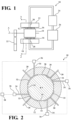
- FIGs 1-2 illustrate a lubricant supported electric motor 10 in accordance with an aspect of the invention.
- the lubricant supported electric motor 10 includes a stator 12 and a rotor 14 extending along an axis A and movably (i.e., rotatably) disposed within the stator 12 to define a gap 16 (also shown as "G" in Figure 1 ) therebetween.
- the stator 12 and the rotor 14 can be reversed, with the stator 12 extending along the axis A and the rotor 14 rotatably disposed around the stator 12.
- a lubricant 18 is disposed in the gap 16 for supporting the rotor 14 within the stator 12, and providing continuous contact between these components.
- the lubricant 18 may therefore act as a buffer (e.g., suspension) between the stator 12 and the rotor 14 minimizing or preventing contact therebetween.
- the lubricant 18 prevents direct contact between the stator 12 and rotor 14 and provides an electric lubricant supported motor 10 which is robust to shock and vibration loading due to the presence of the lubricant 18.
- a substantially incompressible lubricant 18 may be used in order to minimize the gap between the stator 12 and rotor 14.
- the stator 12 defines a passageway 20 disposed in fluid communication with the gap 16 for introducing the lubricant 18.
- the passageway 20 could be provided on any other components of the lubricant supported electric motor 10 without departing from the subject invention as defined in the appended claims.
- the lubricant 18 may be cycled or pumped through the passageway 20 and into the gap 16 in various ways.
- a high pressure source e.g., a pump
- a low pressure source e.g., a sump
- Rotation of the rotor 14 relative to the stator 12 may operate as a self-pump to drive lubricant 18 through the passageway 20 and into the gap 16.
- the rotor 14 is interconnected to a drive assembly 22 for coupling the lubricant supported electric motor 10 to one of the plurality of wheels of a vehicle.
- the drive assembly 22 may include a planetary gear system.
- the drive assembly 22 may include one or more parallel axis gears.
- the stator 12 and rotor 14 are configured to exert an electromagnetic force therebetween to convert electrical energy into mechanical energy, moving the rotor 14 and ultimately driving the wheel coupled to the lubricant supported electric motor 10 via the drive assembly 22.
- the drive assemblies 20 may provide one or more reduction ratios between the lubricant supported electric motor 10 and the wheel in response to movement of the rotor 14.
- the rotor 14 presents an inner raceway 28 and the stator 12 presents an outer raceway 30.
- the inner and outer raceways 28, 30 collectively define at least one hydrostatic support chamber 32 which is established by a portion of the gap 16 and receives the lubricant 18 for supporting the rotor 14 within the stator 12.
- the hydrostatic support chamber 32 which is established in the gap 16 between the inner and outer raceways 28, 30 determines a dynamic pressure developed when the lubricant supported electric motor 10 is in hydrodynamic mode.
- the gap 16 between the inner and outer raceways 28, 30 also determines the pressure in the hydrostatic support chamber 32 when the lubricant supported electric motor 10 is in hydrostatic mode.
- the at least one hydrostatic support chamber 32 includes a plurality of hydrostatic support chambers 32 spaced circumferentially around and between the stator 12 and the rotor 14 and which each have their individualized pressure in the hydrodynamic and hydrostatic modes.
- the at least one hydrostatic support chamber 32 can include four hydrostatic support chambers 32 circumferentially spaced from one another around the axis A.
- any number of hydrostatic support chambers 32 can be utilized without departing from the scope of the invention as defined in the appended claims.
- the stator 12 defines a plurality of passageways 20 each disposed in fluid communication with a respective one of the hydrostatic support chambers 32 for supplying lubricant thereto.
- the lubricant supported electric motor 10 includes a monitoring port 34 disposed in fluid communication with each hydrostatic support chamber 32.
- a sensor 36 is coupled to the monitoring port 34 for sensing the operating characteristic of the lubricant 18 disposed within the at least one hydrostatic support chamber 28.
- the sensor 36 can be a pressure sensor configured to sense a pressure of the lubricant 18 disposed within the at least one hydrostatic support chamber 28.
- the sensor 36 could also be comprised of other sensors 36, such as a temperature sensor for sensing a temperature of the lubricant 18 or a viscosity sensor for sensing a viscosity of the lubricant, without departing from the scope of the invention as defined in the appended claims.
- each hydrostatic support chamber 32 includes its own respective monitoring port 34 and sensor 36 for providing individualized monitoring of the plurality of hydrostatic support chambers 32.
- the utilization of the monitoring port 34 and the sensor 36 advantageously improves the performance of the lubricant supported electric motor 10 by providing the ability to detect operating characteristics of the lubricant 18 disposed within each of the hydrostatic support chambers 28, which is used and analyzed to detect certain operating characteristics of the lubricant supported electric motor 10 such as oil supply faults, stable or instable motor operation, as well as others.
- the monitoring port 34 and the sensor 36 facilitates real-time diagnostics and prognostics for the lubricant supported electric motor 10.
- each sensor 36 is preferably electrically connected to a controller 38 for sending the monitored operating characteristic of the lubricant 18 and/or hydrostatic support chamber 32 to the controller 38 for further evaluation to determine the operating characteristic of the lubricant supported electric motor 10 and provide the real-time diagnostics and prognostics.
- the operating characteristics e.g., pressure, temperature, viscosity
- the controller 38 can be used by the controller 38 to:
- monitoring port 34 and sensor 36 advantageously provides for optimized performance and operating characteristics for the lubricant supported electric motor 10 in real-time.
- the monitoring port 34 and sensor 36 allows for the monitoring and diagnosing of the motor's performance in real-time using, for example, pressure measurements of the lubricant 18 in the hydrostatic support chamber 32. This improved monitoring of the motor's performance ultimately leads to better overall performance of the lubricant supported electric motor 10 compared to its static and very conservatively designed counterparts.
Landscapes
- Engineering & Computer Science (AREA)
- General Engineering & Computer Science (AREA)
- Mechanical Engineering (AREA)
- Power Engineering (AREA)
- Microelectronics & Electronic Packaging (AREA)
- Chemical & Material Sciences (AREA)
- Combustion & Propulsion (AREA)
- Transportation (AREA)
- Connection Of Motors, Electrical Generators, Mechanical Devices, And The Like (AREA)
- Rolling Contact Bearings (AREA)
- Motor Or Generator Frames (AREA)
Description
- This PCT International Patent Application claims the benefit and priority to
U.S. Utility Patent Application Serial No. 17/064,684 filed on October 7, 2020 which claims priority toU.S. Provisional Application Serial No. 62/912,122 filed on October 8, 2019 - The present invention relates generally to a lubricant supported electric motor. More specifically, the present invention relates to a lubricant supported electric motor with at least one monitoring port for improving the operating characteristics and performance of the lubricant supported electric motor.
- This section provides a general summary of background information and the comments and examples provided in this section are not necessarily prior art to the present invention.
- Various drivelines in automotive, truck, and certain off-highway applications take power from a central prime mover and distribute the power to the wheels using mechanical devices such as transmissions, transaxles, propeller shafts, and live axles. These configurations work well when the prime mover can be bulky or heavy, such as, for example, various internal combustion engines ("ICE"). However, more attention is being directed towards alternative arrangements of prime movers that provide improved environmental performance, eliminate mechanical driveline components, and result in a lighter-weight vehicle with more space for passengers and payload.
- "On wheel", "in-wheel" or "near-wheel" motor configurations are one alternative arrangement for the traditional ICE prime mover that distributes the prime mover function to each or some of the plurality of wheels via one or more motors disposed on, within, or proximate to the plurality of wheels. For example, in one instance, a traction motor, using a central shaft though a rotor and rolling element bearings to support the rotor, can be utilized as the "on wheel", "in wheel" or "near wheel" motor configuration. In another instance, a lubricant supported electric motor, such as described in U.S. Application Serial No. 16/144,002, can be utilized as the "on wheel", "in wheel" or "near wheel" motor configuration. While each of these motor configurations result in a smaller size and lighter weight arrangement as compared to the prime movers based on the internal combustion engine, they each have certain drawbacks and disadvantages.
- For example, the utilization of traction motors as the "on wheel", "in wheel" or "near wheel" configuration still results in motors that are too heavy and not robust enough to shock loading to be useful for wheel-end applications. In other words, present traction motors are large, heavy structures supported by rolling element bearings, which are too heavy and large to be practical for wheel end applications. Similarly, the utilization of a lubricant supported electric motors as the "on wheel", "in wheel" or "near wheel" motor in an automotive or land vehicle application results in an arrangement with some performance issues when it is subjected to the wide range of dynamic forces encountered during operation at the wide range of speeds encountered in a prime-mover application. Present arrangements of lubricant supported electric motors are not robust enough, and thus not designed to perform well under all the conditions and dynamic forces encountered in a wheel-end motor arrangement. Additionally, present arrangements of lubricant supported electric motors in "on-wheel" applications are static and very conservatively designed systems that have very limited performance measurements, and thus have higher bearing friction/shear loss and shorter life. Accordingly, a need remains for an improved lubricant supported electric motor which provides improved operating characteristics in real-time.
US 2019/093 757 A1 relates to electric motors with lubricant support between a rotor and stator of the electric motor. - The subject invention is generally directed to a lubricant supported electric motor that includes a stator and a rotor movably disposed within the stator. The stator presents an outer raceway and the rotor presents an inner raceway disposed in spaced relationship with the outer raceway to define at least one hydrostatic support chamber disposed therebetween. A lubricant is disposed in the at least one hydrostatic support chamber for supporting the rotor within the stator. A monitoring port is disposed in fluid communication with the at least one hydrostatic support chamber, and a sensor is coupled with the monitoring port for monitoring an operating characteristic of the lubricant or the hydrostatic support chamber. The monitored operating characteristic is analyzed to determine an operating condition of the lubricant supported electric motor in real time, such as the detection of lubricant supply faults, unstable motor operation, or other real-time diagnostics and prognostics. The lubricant supported electric motor with a monitoring port and sensor is also light and small, and thus contributes to the overall design strategy for eliminating weight and size from automobiles and land vehicles. Other advantages will be appreciated in view of the following more detailed description of the subject invention. The invention is set out in the appended set of claims
- The drawings described herein are for illustrative purposes only of selected embodiments and not all possible implementations, and are not intended to limit the scope of the present invention as defined in the appended claims.
-
Figure 1 is a schematic view of a lubricant supported electric motor according to an aspect of the subject invention; and -
Figure 2 is a cross-sectional view of the lubricant supporting electric motor taken along 2-2 ofFigure 1 illustrating a monitoring port and sensor in communication with a hydrostatic support chamber. - Example embodiments of a lubricant supported electric motor in accordance with the present invention will now be more fully described. Each of these example embodiments are provided so that this invention is thorough and fully conveys the scope of the inventive concepts, features and advantages to those skilled in the art. To this end, numerous specific details are set forth such as examples of specific components, devices and mechanisms associated with the lubricant supported electric motor to provide a thorough understanding of each of the embodiments associated with the present invention. However, as will be apparent to those skilled in the art, not all specific details described herein need to be employed, the example embodiments may be embodied in many different forms, and thus should not be construed or interpreted to limit the scope of the inventior as defined in the appended claims.
-
Figures 1-2 illustrate a lubricant supportedelectric motor 10 in accordance with an aspect of the invention. As best illustrated inFigure 1 , the lubricant supportedelectric motor 10 includes astator 12 and arotor 14 extending along an axis A and movably (i.e., rotatably) disposed within thestator 12 to define a gap 16 (also shown as "G" inFigure 1 ) therebetween. In an alternative arrangement which is not a part of the present invention, thestator 12 and therotor 14 can be reversed, with thestator 12 extending along the axis A and therotor 14 rotatably disposed around thestator 12. Alubricant 18 is disposed in thegap 16 for supporting therotor 14 within thestator 12, and providing continuous contact between these components. Thelubricant 18 may therefore act as a buffer (e.g., suspension) between thestator 12 and therotor 14 minimizing or preventing contact therebetween. In other words, thelubricant 18 prevents direct contact between thestator 12 androtor 14 and provides an electric lubricant supportedmotor 10 which is robust to shock and vibration loading due to the presence of thelubricant 18. Additionally, and alternatively, a substantiallyincompressible lubricant 18 may be used in order to minimize the gap between thestator 12 androtor 14. - As further illustrated
Figure 1 , thestator 12 defines apassageway 20 disposed in fluid communication with thegap 16 for introducing thelubricant 18. However, thepassageway 20 could be provided on any other components of the lubricant supportedelectric motor 10 without departing from the subject invention as defined in the appended claims. According to an aspect, thelubricant 18 may be cycled or pumped through thepassageway 20 and into thegap 16 in various ways. For example, a high pressure source (e.g., a pump) 24 of thelubricant 18 may be fluidly coupled to a low pressure source (e.g., a sump) 26 of thelubricant 18, where thelubricant 18 may move from the high pressure source to the lower pressure source, through thepassageway 20 and into thegap 16. Rotation of therotor 14 relative to thestator 12 may operate as a self-pump to drivelubricant 18 through thepassageway 20 and into thegap 16. - As further illustrated in
Figure 1 , therotor 14 is interconnected to a drive assembly 22 for coupling the lubricant supportedelectric motor 10 to one of the plurality of wheels of a vehicle. For example, in one instance, the drive assembly 22 may include a planetary gear system. Alternatively, the drive assembly 22 may include one or more parallel axis gears. Thestator 12 androtor 14 are configured to exert an electromagnetic force therebetween to convert electrical energy into mechanical energy, moving therotor 14 and ultimately driving the wheel coupled to the lubricant supportedelectric motor 10 via the drive assembly 22. Thedrive assemblies 20 may provide one or more reduction ratios between the lubricant supportedelectric motor 10 and the wheel in response to movement of therotor 14. - As best illustrated in
Figure 2 , therotor 14 presents aninner raceway 28 and thestator 12 presents anouter raceway 30. The inner andouter raceways hydrostatic support chamber 32 which is established by a portion of thegap 16 and receives thelubricant 18 for supporting therotor 14 within thestator 12. For example, thehydrostatic support chamber 32 which is established in thegap 16 between the inner andouter raceways electric motor 10 is in hydrodynamic mode. Thegap 16 between the inner andouter raceways hydrostatic support chamber 32 when the lubricant supportedelectric motor 10 is in hydrostatic mode. In a preferred embodiment, the at least onehydrostatic support chamber 32 includes a plurality ofhydrostatic support chambers 32 spaced circumferentially around and between thestator 12 and therotor 14 and which each have their individualized pressure in the hydrodynamic and hydrostatic modes. For example, as illustrated inFigure 2 , in a preferred arrangement, the at least onehydrostatic support chamber 32 can include fourhydrostatic support chambers 32 circumferentially spaced from one another around the axis A. However, any number ofhydrostatic support chambers 32 can be utilized without departing from the scope of the invention as defined in the appended claims. As further illustrated inFigure 2 , thestator 12 defines a plurality ofpassageways 20 each disposed in fluid communication with a respective one of thehydrostatic support chambers 32 for supplying lubricant thereto. - As further illustrated in
Figure 2 , the lubricant supportedelectric motor 10 includes amonitoring port 34 disposed in fluid communication with eachhydrostatic support chamber 32. Asensor 36 is coupled to themonitoring port 34 for sensing the operating characteristic of thelubricant 18 disposed within the at least onehydrostatic support chamber 28. For example, thesensor 36 can be a pressure sensor configured to sense a pressure of thelubricant 18 disposed within the at least onehydrostatic support chamber 28. However, thesensor 36 could also be comprised ofother sensors 36, such as a temperature sensor for sensing a temperature of thelubricant 18 or a viscosity sensor for sensing a viscosity of the lubricant, without departing from the scope of the invention as defined in the appended claims. - As further illustrated in
Figure 2 , when the at least onehydrostatic support chamber 32 includes a plurality ofhydrostatic support chambers 32, amonitoring port 34 andsensor 36 can be disposed in communication with eachhydrostatic support chamber 32. In other words, in a preferred arrangement, eachhydrostatic support chamber 32 includes its ownrespective monitoring port 34 andsensor 36 for providing individualized monitoring of the plurality ofhydrostatic support chambers 32. The utilization of themonitoring port 34 and thesensor 36 advantageously improves the performance of the lubricant supportedelectric motor 10 by providing the ability to detect operating characteristics of thelubricant 18 disposed within each of thehydrostatic support chambers 28, which is used and analyzed to detect certain operating characteristics of the lubricant supportedelectric motor 10 such as oil supply faults, stable or instable motor operation, as well as others. In other words, themonitoring port 34 and thesensor 36 facilitates real-time diagnostics and prognostics for the lubricant supportedelectric motor 10. - As illustrated in
Figure 2 , eachsensor 36 is preferably electrically connected to acontroller 38 for sending the monitored operating characteristic of thelubricant 18 and/orhydrostatic support chamber 32 to thecontroller 38 for further evaluation to determine the operating characteristic of the lubricant supportedelectric motor 10 and provide the real-time diagnostics and prognostics. For example, the operating characteristics (e.g., pressure, temperature, viscosity) sensed by the plurality ofsensors 36 can be used by thecontroller 38 to: - verify correct oil flow into the
hydrostatic support chamber 32 using a pressure-based flow model. For example, at a known oil flow rate a known pressure should result. If the pressure is too high this may indicate inner to outer raceway clearances that are too close. If the pressure is too low this may indicate leakage in the oil supply or an inner to outer raceway clearance that is too large; - observe rotor vibration related to pressure fluctuations within the hydrostatic support chamber 32 (e.g. rotor motions such as translation, rocking, whirl). For example pressure fluctuations may be caused by the rotor moving away from being centered in the stator and changing the inner to outer raceway clearance;
- observe rotor centering related to pressure relationships of
hydrostatic support chambers 32 diametrically opposed to each other. For example, when the rotor moves closer to a chamber on the top of the stator, the pressure in that chamber will increase due to the tighter clearance between the inner raceway and the outer raceway. At the same time, the rotor will move further away from the chamber at the bottom of the stator, which will decrease the pressure in the chamber due to the looser clearance between the inner and outer raceway. The combination of increasing pressure at the top and decreasing pressure at the bottom indicates that the rotor is moving off of center; - estimate rotor position measurement to allow feedback control of rotor position. For example, the rotor centering position can be estimated using the method described above. This position estimate can be used to change the electric current supplied to the motor or the oil pressure supplied to the motor to cause the rotor to stay as close to a centered position as possible;
- estimate lubricant properties (e.g., viscosity) when used in conjunction with oil pump volumetric flow. For example, as the lubricant heats up it will typically become less viscous, which results in a lower chamber pressure for a given flow rate. Observing the decrease in pressure across multiple chambers may be an indicator of reduced viscosity; and
- diagnose system faults in the lubricant, lubricant pump, and pressure sensing systems. For example, for a given flow rate of oil into a chamber, if the pressure is not within a known normal range, than a fault in the oil supply or raceways is indicated.
- The incorporation of monitoring
port 34 andsensor 36 advantageously provides for optimized performance and operating characteristics for the lubricant supportedelectric motor 10 in real-time. In other words, themonitoring port 34 andsensor 36 allows for the monitoring and diagnosing of the motor's performance in real-time using, for example, pressure measurements of thelubricant 18 in thehydrostatic support chamber 32. This improved monitoring of the motor's performance ultimately leads to better overall performance of the lubricant supportedelectric motor 10 compared to its static and very conservatively designed counterparts. - The foregoing description of the embodiments has been provided for purposes of illustration and description. It is not intended to be exhaustive or to limit the invention as defined in the appended claims.
Claims (10)
- A lubricant supported electric motor (10) comprising:a stator (12) presenting an outer raceway (30);a rotor (14) extending along an axis (A) and rotatably disposed within said stator (12);said rotor (14) presenting an inner raceway (28) disposed in spaced relationship with said outer raceway (30) to define at least one hydrostatic support chamber (32) therebetween;a lubricant (18) disposed in said hydrostatic support chamber (32) for supporting said rotor (14) within said stator (12),characterized by:a monitoring port (34) disposed in fluid communication with said at least one hydrostatic support chamber (32); anda sensor (36) coupled with said monitoring port (34) for monitoring an operating characteristic of said lubricant (18) disposed in said at least one hydrostatic support chamber (32) for use in determining a real-time operating condition of the lubricant supported electric motor (10).
- The lubricant supported electric motor (10) as set forth in Claim 1, further comprising a controller (38) disposed in electrical communication with said sensor (36) and configured to analyze said monitored operating characteristic of said lubricant (18) disposed in said hydrostatic support chamber (32) and determine the real-time operating condition of the lubricant supported electric motor (10).
- The lubricant supported electric motor (10) as set forth in Claim 1, wherein said sensor (36) is comprised of a pressure sensor configured to sense a pressure of said lubricant (18) disposed within said at least one hydrostatic support chamber (32).
- The lubricant supported electric motor (10) as set forth in Claim 1, wherein said sensor (36) is comprised of a temperature sensor configured to sense a temperature of said lubricant (18) disposed within said at least one hydrostatic support chamber (32).
- The lubricant supported electric motor (10) as set forth in Claim 2, wherein said at least one hydrostatic support chamber (32) includes a plurality of hydrostatic support chambers (32) disposed circumferentially about said axis (A) in spaced relationship with one another.
- The lubricant supported electric motor (10) as set forth in Claim 5, further comprising a plurality of monitoring ports (34) each disposed in fluid communication with a respective one of said plurality of hydrostatic support chambers (32) and a plurality of sensors (36) each disposed in communication with a respective one of said plurality of monitoring ports (34).
- The lubricant supported electric motor (10) as set forth in Claim 6, wherein said controller (38) is disposed in electrical communication with each of said plurality of sensors (36) and configured to receive and analyze operating characteristics of said lubricant (18) disposed in each of said plurality of hydrostatic support chambers (32).
- The lubricant supported electric motor (10) as set forth in Claim 1, wherein said rotor (14) is operably connected to a final drive device (22) that is interconnected to a wheel of a vehicle.
- The lubricant supported electric motor (10) as set forth in Claim 1, wherein said stator (12) defines a passageway (20) disposed in fluid communication with said at least one hydrostatic support chamber (32) for supplying said lubricant (18).
- The lubricant supported electric motor (10) as set forth in Claim 5, wherein said stator (12) defines a plurality of passageways (20) each disposed in fluid communication with a respective one of said plurality of hydrostatic support chambers (32) for supplying said lubricant (18).
Applications Claiming Priority (3)
| Application Number | Priority Date | Filing Date | Title |
|---|---|---|---|
| US201962912122P | 2019-10-08 | 2019-10-08 | |
| US17/064,684 US11863053B2 (en) | 2019-10-08 | 2020-10-07 | Lubricant supported electric motor with a monitoring port |
| PCT/US2020/054671 WO2021072007A1 (en) | 2019-10-08 | 2020-10-08 | Lubricant supported electric motor with a monitoring port |
Publications (3)
| Publication Number | Publication Date |
|---|---|
| EP4021752A1 EP4021752A1 (en) | 2022-07-06 |
| EP4021752C0 EP4021752C0 (en) | 2025-02-19 |
| EP4021752B1 true EP4021752B1 (en) | 2025-02-19 |
Family
ID=75274426
Family Applications (1)
| Application Number | Title | Priority Date | Filing Date |
|---|---|---|---|
| EP20797934.5A Active EP4021752B1 (en) | 2019-10-08 | 2020-10-08 | Lubricant supported electric motor with a monitoring port |
Country Status (5)
| Country | Link |
|---|---|
| US (1) | US11863053B2 (en) |
| EP (1) | EP4021752B1 (en) |
| CN (1) | CN114600349A (en) |
| PL (1) | PL4021752T3 (en) |
| WO (1) | WO2021072007A1 (en) |
Families Citing this family (1)
| Publication number | Priority date | Publication date | Assignee | Title |
|---|---|---|---|---|
| CN115628849A (en) * | 2022-10-13 | 2023-01-20 | 中国第一汽车股份有限公司 | A new energy vehicle high-speed rotor stress relief device and method |
Family Cites Families (13)
| Publication number | Priority date | Publication date | Assignee | Title |
|---|---|---|---|---|
| US3101224A (en) * | 1960-09-12 | 1963-08-20 | Boeing Co | High load hydrostatic bearing |
| US3119639A (en) * | 1962-01-09 | 1964-01-28 | Boeing Co | Hydrostatic bearing |
| US3546505A (en) * | 1968-05-06 | 1970-12-08 | Rex Chainbelt Inc | Vibrator motor with self-container lubricant circulator |
| JPS566919A (en) * | 1979-06-26 | 1981-01-24 | Canon Inc | Fluid bearing |
| JPS569668A (en) * | 1979-07-02 | 1981-01-31 | Haruhisa Tezuka | Generating device utilizing wave power |
| JPH0755440B2 (en) * | 1992-03-05 | 1995-06-14 | 工業技術院長 | Method for improving thermal displacement history of hydrostatic spindle for precision processing machines |
| US6324899B1 (en) * | 1998-04-02 | 2001-12-04 | Reliance Electric Technologies, Llc | Bearing-sensor integration for a lubrication analysis system |
| JP3569668B2 (en) * | 2000-09-11 | 2004-09-22 | Thk株式会社 | Pneumatic dynamic spindle device |
| JP4134541B2 (en) * | 2000-09-25 | 2008-08-20 | 株式会社ジェイテクト | Fluid bearing |
| DE102007022221A1 (en) | 2007-05-11 | 2008-11-13 | Robert Bosch Gmbh | Hydrodynamic high pressure liquid, especially fuel, pump has bearing annular gap width that decreases in region between liquid inlet and outlet openings in direction of rotation |
| EP2108832B1 (en) | 2008-04-10 | 2015-12-02 | Siemens Aktiengesellschaft | Generator and wind turbine |
| CN103089810B (en) | 2013-01-25 | 2015-04-29 | 西安交通大学 | Online vibration control tilting-pad radial sliding bearing device |
| CN111183569B (en) | 2017-09-27 | 2023-06-02 | 尼亚布科知识产权控股有限责任公司 | Lubricant-supported motor |
-
2020
- 2020-10-07 US US17/064,684 patent/US11863053B2/en active Active
- 2020-10-08 CN CN202080070106.2A patent/CN114600349A/en active Pending
- 2020-10-08 WO PCT/US2020/054671 patent/WO2021072007A1/en not_active Ceased
- 2020-10-08 EP EP20797934.5A patent/EP4021752B1/en active Active
- 2020-10-08 PL PL20797934.5T patent/PL4021752T3/en unknown
Also Published As
| Publication number | Publication date |
|---|---|
| WO2021072007A1 (en) | 2021-04-15 |
| EP4021752A1 (en) | 2022-07-06 |
| US11863053B2 (en) | 2024-01-02 |
| PL4021752T3 (en) | 2025-05-05 |
| EP4021752C0 (en) | 2025-02-19 |
| CN114600349A (en) | 2022-06-07 |
| US20210104936A1 (en) | 2021-04-08 |
Similar Documents
| Publication | Publication Date | Title |
|---|---|---|
| CN114503404B (en) | Lubricant supply system and method for lubricant-supported electric motors | |
| US11355996B2 (en) | Lubricant supported electric motor with controlled and balanced lubricant flow | |
| KR101513330B1 (en) | Differential cover providing lubricant flow control | |
| US9303696B2 (en) | Optimized outer clutch housing for reduced spin loss, improved oil flow and improved clutch durability | |
| EP2770229A1 (en) | Axle assembly and method of lubrication control | |
| KR19980081087A (en) | Twin Clutch Axle with Multiple Chambers | |
| US11418086B2 (en) | Axle assembly having an electric motor module and a terminal box | |
| CN202189050U (en) | Lubrication simulated experimental device for rolling bearing | |
| KR101724508B1 (en) | Limp home mode drive method for hybrid electric vehicle | |
| EP4021752B1 (en) | Lubricant supported electric motor with a monitoring port | |
| US20240429777A1 (en) | Lubricant supported electric motor with bearing support | |
| US11472226B2 (en) | Lubricant supported electric motor with wheel support | |
| CN115808308B (en) | Roller bearing and guide pulley coating performance test device | |
| CN109114103A (en) | Intelligent hydrodynamic bearing | |
| US10935089B2 (en) | Method of determining and predicting a ball loss in a ball and ramp assembly | |
| CN114514677B (en) | Lubricant-supported electric motor with movable raceway and optimization method for its operation | |
| CN116754220B (en) | High-speed friction motion gesture measuring device for wet clutch friction pair | |
| CN213360893U (en) | Clutch device | |
| US20240110606A1 (en) | Wet brake system and method for a vehicle | |
| CN222702417U (en) | Clutch assembly | |
| US20210091628A1 (en) | Lubricant supported electric motor with a profiled raceway | |
| CN207790308U (en) | Moving device |
Legal Events
| Date | Code | Title | Description |
|---|---|---|---|
| STAA | Information on the status of an ep patent application or granted ep patent |
Free format text: STATUS: UNKNOWN |
|
| STAA | Information on the status of an ep patent application or granted ep patent |
Free format text: STATUS: THE INTERNATIONAL PUBLICATION HAS BEEN MADE |
|
| PUAI | Public reference made under article 153(3) epc to a published international application that has entered the european phase |
Free format text: ORIGINAL CODE: 0009012 |
|
| STAA | Information on the status of an ep patent application or granted ep patent |
Free format text: STATUS: REQUEST FOR EXAMINATION WAS MADE |
|
| 17P | Request for examination filed |
Effective date: 20220330 |
|
| AK | Designated contracting states |
Kind code of ref document: A1 Designated state(s): AL AT BE BG CH CY CZ DE DK EE ES FI FR GB GR HR HU IE IS IT LI LT LU LV MC MK MT NL NO PL PT RO RS SE SI SK SM TR |
|
| DAV | Request for validation of the european patent (deleted) | ||
| DAX | Request for extension of the european patent (deleted) | ||
| GRAP | Despatch of communication of intention to grant a patent |
Free format text: ORIGINAL CODE: EPIDOSNIGR1 |
|
| STAA | Information on the status of an ep patent application or granted ep patent |
Free format text: STATUS: GRANT OF PATENT IS INTENDED |
|
| INTG | Intention to grant announced |
Effective date: 20240920 |
|
| GRAS | Grant fee paid |
Free format text: ORIGINAL CODE: EPIDOSNIGR3 |
|
| GRAA | (expected) grant |
Free format text: ORIGINAL CODE: 0009210 |
|
| STAA | Information on the status of an ep patent application or granted ep patent |
Free format text: STATUS: THE PATENT HAS BEEN GRANTED |
|
| AK | Designated contracting states |
Kind code of ref document: B1 Designated state(s): AL AT BE BG CH CY CZ DE DK EE ES FI FR GB GR HR HU IE IS IT LI LT LU LV MC MK MT NL NO PL PT RO RS SE SI SK SM TR |
|
| REG | Reference to a national code |
Ref country code: GB Ref legal event code: FG4D |
|
| REG | Reference to a national code |
Ref country code: CH Ref legal event code: EP |
|
| REG | Reference to a national code |
Ref country code: DE Ref legal event code: R096 Ref document number: 602020046401 Country of ref document: DE |
|
| REG | Reference to a national code |
Ref country code: IE Ref legal event code: FG4D |
|
| U01 | Request for unitary effect filed |
Effective date: 20250219 |
|
| U07 | Unitary effect registered |
Designated state(s): AT BE BG DE DK EE FI FR IT LT LU LV MT NL PT RO SE SI Effective date: 20250225 |
|
| PG25 | Lapsed in a contracting state [announced via postgrant information from national office to epo] |
Ref country code: RS Free format text: LAPSE BECAUSE OF FAILURE TO SUBMIT A TRANSLATION OF THE DESCRIPTION OR TO PAY THE FEE WITHIN THE PRESCRIBED TIME-LIMIT Effective date: 20250519 |
|
| PG25 | Lapsed in a contracting state [announced via postgrant information from national office to epo] |
Ref country code: ES Free format text: LAPSE BECAUSE OF FAILURE TO SUBMIT A TRANSLATION OF THE DESCRIPTION OR TO PAY THE FEE WITHIN THE PRESCRIBED TIME-LIMIT Effective date: 20250219 |
|
| PG25 | Lapsed in a contracting state [announced via postgrant information from national office to epo] |
Ref country code: NO Free format text: LAPSE BECAUSE OF FAILURE TO SUBMIT A TRANSLATION OF THE DESCRIPTION OR TO PAY THE FEE WITHIN THE PRESCRIBED TIME-LIMIT Effective date: 20250519 Ref country code: IS Free format text: LAPSE BECAUSE OF FAILURE TO SUBMIT A TRANSLATION OF THE DESCRIPTION OR TO PAY THE FEE WITHIN THE PRESCRIBED TIME-LIMIT Effective date: 20250619 |
|
| PG25 | Lapsed in a contracting state [announced via postgrant information from national office to epo] |
Ref country code: HR Free format text: LAPSE BECAUSE OF FAILURE TO SUBMIT A TRANSLATION OF THE DESCRIPTION OR TO PAY THE FEE WITHIN THE PRESCRIBED TIME-LIMIT Effective date: 20250219 |
|
| PG25 | Lapsed in a contracting state [announced via postgrant information from national office to epo] |
Ref country code: GR Free format text: LAPSE BECAUSE OF FAILURE TO SUBMIT A TRANSLATION OF THE DESCRIPTION OR TO PAY THE FEE WITHIN THE PRESCRIBED TIME-LIMIT Effective date: 20250520 |
|
| PG25 | Lapsed in a contracting state [announced via postgrant information from national office to epo] |
Ref country code: SM Free format text: LAPSE BECAUSE OF FAILURE TO SUBMIT A TRANSLATION OF THE DESCRIPTION OR TO PAY THE FEE WITHIN THE PRESCRIBED TIME-LIMIT Effective date: 20250219 |
|
| PG25 | Lapsed in a contracting state [announced via postgrant information from national office to epo] |
Ref country code: CZ Free format text: LAPSE BECAUSE OF FAILURE TO SUBMIT A TRANSLATION OF THE DESCRIPTION OR TO PAY THE FEE WITHIN THE PRESCRIBED TIME-LIMIT Effective date: 20250219 |
|
| PG25 | Lapsed in a contracting state [announced via postgrant information from national office to epo] |
Ref country code: SK Free format text: LAPSE BECAUSE OF FAILURE TO SUBMIT A TRANSLATION OF THE DESCRIPTION OR TO PAY THE FEE WITHIN THE PRESCRIBED TIME-LIMIT Effective date: 20250219 |
|
| PLBE | No opposition filed within time limit |
Free format text: ORIGINAL CODE: 0009261 |
|
| STAA | Information on the status of an ep patent application or granted ep patent |
Free format text: STATUS: NO OPPOSITION FILED WITHIN TIME LIMIT |
|
| 26N | No opposition filed |
Effective date: 20251120 |
|
| U21 | Renewal fee for the european patent with unitary effect paid with additional fee |
Year of fee payment: 6 Effective date: 20260302 |
|
| PGFP | Annual fee paid to national office [announced via postgrant information from national office to epo] |
Ref country code: GB Payment date: 20260303 Year of fee payment: 6 |
|
| PGFP | Annual fee paid to national office [announced via postgrant information from national office to epo] |
Ref country code: PL Payment date: 20260220 Year of fee payment: 6 |