EP4020935B1 - System zur zusammenarbeit von verkehrsunternehmen - Google Patents
System zur zusammenarbeit von verkehrsunternehmen Download PDFInfo
- Publication number
- EP4020935B1 EP4020935B1 EP21213506.5A EP21213506A EP4020935B1 EP 4020935 B1 EP4020935 B1 EP 4020935B1 EP 21213506 A EP21213506 A EP 21213506A EP 4020935 B1 EP4020935 B1 EP 4020935B1
- Authority
- EP
- European Patent Office
- Prior art keywords
- qos
- mec
- vehicle
- information
- prediction model
- Prior art date
- Legal status (The legal status is an assumption and is not a legal conclusion. Google has not performed a legal analysis and makes no representation as to the accuracy of the status listed.)
- Active
Links
Images









Classifications
-
- G—PHYSICS
- G06—COMPUTING OR CALCULATING; COUNTING
- G06N—COMPUTING ARRANGEMENTS BASED ON SPECIFIC COMPUTATIONAL MODELS
- G06N5/00—Computing arrangements using knowledge-based models
- G06N5/04—Inference or reasoning models
-
- H—ELECTRICITY
- H04—ELECTRIC COMMUNICATION TECHNIQUE
- H04W—WIRELESS COMMUNICATION NETWORKS
- H04W24/00—Supervisory, monitoring or testing arrangements
- H04W24/04—Arrangements for maintaining operational condition
-
- G—PHYSICS
- G06—COMPUTING OR CALCULATING; COUNTING
- G06N—COMPUTING ARRANGEMENTS BASED ON SPECIFIC COMPUTATIONAL MODELS
- G06N20/00—Machine learning
-
- G—PHYSICS
- G06—COMPUTING OR CALCULATING; COUNTING
- G06N—COMPUTING ARRANGEMENTS BASED ON SPECIFIC COMPUTATIONAL MODELS
- G06N3/00—Computing arrangements based on biological models
- G06N3/02—Neural networks
- G06N3/08—Learning methods
- G06N3/09—Supervised learning
-
- G—PHYSICS
- G06—COMPUTING OR CALCULATING; COUNTING
- G06N—COMPUTING ARRANGEMENTS BASED ON SPECIFIC COMPUTATIONAL MODELS
- G06N3/00—Computing arrangements based on biological models
- G06N3/02—Neural networks
- G06N3/08—Learning methods
- G06N3/098—Distributed learning, e.g. federated learning
-
- G—PHYSICS
- G06—COMPUTING OR CALCULATING; COUNTING
- G06Q—INFORMATION AND COMMUNICATION TECHNOLOGY [ICT] SPECIALLY ADAPTED FOR ADMINISTRATIVE, COMMERCIAL, FINANCIAL, MANAGERIAL OR SUPERVISORY PURPOSES; SYSTEMS OR METHODS SPECIALLY ADAPTED FOR ADMINISTRATIVE, COMMERCIAL, FINANCIAL, MANAGERIAL OR SUPERVISORY PURPOSES, NOT OTHERWISE PROVIDED FOR
- G06Q10/00—Administration; Management
- G06Q10/04—Forecasting or optimisation specially adapted for administrative or management purposes, e.g. linear programming or "cutting stock problem"
-
- G—PHYSICS
- G06—COMPUTING OR CALCULATING; COUNTING
- G06Q—INFORMATION AND COMMUNICATION TECHNOLOGY [ICT] SPECIALLY ADAPTED FOR ADMINISTRATIVE, COMMERCIAL, FINANCIAL, MANAGERIAL OR SUPERVISORY PURPOSES; SYSTEMS OR METHODS SPECIALLY ADAPTED FOR ADMINISTRATIVE, COMMERCIAL, FINANCIAL, MANAGERIAL OR SUPERVISORY PURPOSES, NOT OTHERWISE PROVIDED FOR
- G06Q10/00—Administration; Management
- G06Q10/06—Resources, workflows, human or project management; Enterprise or organisation planning; Enterprise or organisation modelling
- G06Q10/067—Enterprise or organisation modelling
-
- G—PHYSICS
- G06—COMPUTING OR CALCULATING; COUNTING
- G06Q—INFORMATION AND COMMUNICATION TECHNOLOGY [ICT] SPECIALLY ADAPTED FOR ADMINISTRATIVE, COMMERCIAL, FINANCIAL, MANAGERIAL OR SUPERVISORY PURPOSES; SYSTEMS OR METHODS SPECIALLY ADAPTED FOR ADMINISTRATIVE, COMMERCIAL, FINANCIAL, MANAGERIAL OR SUPERVISORY PURPOSES, NOT OTHERWISE PROVIDED FOR
- G06Q50/00—Information and communication technology [ICT] specially adapted for implementation of business processes of specific business sectors, e.g. utilities or tourism
- G06Q50/10—Services
-
- H—ELECTRICITY
- H04—ELECTRIC COMMUNICATION TECHNIQUE
- H04W—WIRELESS COMMUNICATION NETWORKS
- H04W24/00—Supervisory, monitoring or testing arrangements
- H04W24/06—Testing, supervising or monitoring using simulated traffic
-
- H—ELECTRICITY
- H04—ELECTRIC COMMUNICATION TECHNIQUE
- H04W—WIRELESS COMMUNICATION NETWORKS
- H04W28/00—Network traffic management; Network resource management
- H04W28/02—Traffic management, e.g. flow control or congestion control
- H04W28/0226—Traffic management, e.g. flow control or congestion control based on location or mobility
-
- H—ELECTRICITY
- H04—ELECTRIC COMMUNICATION TECHNIQUE
- H04W—WIRELESS COMMUNICATION NETWORKS
- H04W28/00—Network traffic management; Network resource management
- H04W28/16—Central resource management; Negotiation of resources or communication parameters, e.g. negotiating bandwidth or QoS [Quality of Service]
- H04W28/24—Negotiating SLA [Service Level Agreement]; Negotiating QoS [Quality of Service]
-
- H—ELECTRICITY
- H04—ELECTRIC COMMUNICATION TECHNIQUE
- H04W—WIRELESS COMMUNICATION NETWORKS
- H04W4/00—Services specially adapted for wireless communication networks; Facilities therefor
- H04W4/20—Services signaling; Auxiliary data signalling, i.e. transmitting data via a non-traffic channel
-
- H—ELECTRICITY
- H04—ELECTRIC COMMUNICATION TECHNIQUE
- H04W—WIRELESS COMMUNICATION NETWORKS
- H04W4/00—Services specially adapted for wireless communication networks; Facilities therefor
- H04W4/30—Services specially adapted for particular environments, situations or purposes
- H04W4/38—Services specially adapted for particular environments, situations or purposes for collecting sensor information
-
- H—ELECTRICITY
- H04—ELECTRIC COMMUNICATION TECHNIQUE
- H04W—WIRELESS COMMUNICATION NETWORKS
- H04W4/00—Services specially adapted for wireless communication networks; Facilities therefor
- H04W4/30—Services specially adapted for particular environments, situations or purposes
- H04W4/40—Services specially adapted for particular environments, situations or purposes for vehicles, e.g. vehicle-to-pedestrians [V2P]
-
- H—ELECTRICITY
- H04—ELECTRIC COMMUNICATION TECHNIQUE
- H04W—WIRELESS COMMUNICATION NETWORKS
- H04W40/00—Communication routing or communication path finding
- H04W40/02—Communication route or path selection, e.g. power-based or shortest path routing
- H04W40/18—Communication route or path selection, e.g. power-based or shortest path routing based on predicted events
-
- G—PHYSICS
- G06—COMPUTING OR CALCULATING; COUNTING
- G06N—COMPUTING ARRANGEMENTS BASED ON SPECIFIC COMPUTATIONAL MODELS
- G06N3/00—Computing arrangements based on biological models
- G06N3/02—Neural networks
- G06N3/08—Learning methods
-
- H—ELECTRICITY
- H04—ELECTRIC COMMUNICATION TECHNIQUE
- H04W—WIRELESS COMMUNICATION NETWORKS
- H04W24/00—Supervisory, monitoring or testing arrangements
- H04W24/10—Scheduling measurement reports ; Arrangements for measurement reports
-
- H—ELECTRICITY
- H04—ELECTRIC COMMUNICATION TECHNIQUE
- H04W—WIRELESS COMMUNICATION NETWORKS
- H04W84/00—Network topologies
- H04W84/02—Hierarchically pre-organised networks, e.g. paging networks, cellular networks, WLAN [Wireless Local Area Network] or WLL [Wireless Local Loop]
- H04W84/04—Large scale networks; Deep hierarchical networks
- H04W84/042—Public Land Mobile systems, e.g. cellular systems
Definitions
- the subject matter disclosed herein generally relates to methods, systems, and machine-readable storage media for improving transportation services in a multi-provider environment.
- Mobility as a Service (MaaS) operators may have contracts with different transportation service providers (TSPs), including public and private entities, to provide transport services within a certain region.
- TSPs transportation service providers
- the servicing area can be large, even across country borders, which makes it difficult for a single MaaS operator to satisfy all the mobility requirements of all subscribers.
- the transportation modes offered by each MaaS operator may also differ.
- V2X Vehicle-to-Everything
- MEC Multi-access Edge Computing
- the disclosed embodiments may provide a V2X Information Service (VIS) framework for cooperative acquisition, partitioning, and distribution of information for efficient, journey-specific quality-of-service (QoS) predictions.
- VIS V2X Information Service
- QoS quality-of-service
- the VIS framework identifies space/time correlations between radio condition/quality data collected in V2X system(s) and a vehicle's planned journey in order to provide a prediction of the radio conditions/quality of the communication network along the designated route.
- Example methods, systems, and computer programs are directed to sharing information among multiple Mobility as a Service (MaaS) systems for presenting service information to users. Examples merely typify possible variations. Unless explicitly stated otherwise, components and functions are optional and may be combined or subdivided, and operations may vary in sequence or be combined or subdivided. In the following description, for purposes of explanation, numerous specific details are set forth to provide a thorough understanding of example embodiments. It will be evident to one skilled in the art, however, that the present subject matter may be practiced without these specific details.
- an interoperable framework including hardware and software components in vehicles and in the cloud edge, that permits the creation of a digital twin of the system that enables the generation of a coverage map for end-users.
- the coverage map is built dynamically and collaboratively, based on the securely aggregated information from elements of a federated learning system (e.g., vehicles, applications in user devices, Roadside Units (RSUs), edge cloud infrastructure).
- the coverage map may be presented in a specialized Human/Machine Interface (HMI) available in the vehicle, which includes presenting the expected availability of certain Vehicle-to-Everything (V2X) features, which is tracked and updated over time.
- HMI Human/Machine Interface
- the solution is designed to enable interoperable MaaS services in heterogeneous V2X scenarios, by using standardized interfaces and messages.
- One system includes means for receiving, by a multi-access edge computing (MEC) application, parameters of a global quality of service (QoS) prediction model, and means for sending, to a local prediction function (PF), an update of a local QoS prediction model. Further, the system includes means for detecting a journey of a vehicle requested by a user, and means for sending to the local PF, a request for a value of the QoS along the journey. The value of the QoS is a measure of quality of transportation services delivered during the journey. The system further includes means for receiving the predicted value of the QoS along the journey, and means for providing, by the MEC application, the predicted value of the QoS to the vehicle.
- MEC multi-access edge computing
- FIG 1 illustrates a Mobility as a Service (MaaS) scenario with multiple Transportation Service Providers (TSP) and graphical indicators of the level of support of certain services (“service coverage maps") in space and in time.
- Mobility as a Service is the integration of various forms of transport services into a single mobility service accessible on demand.
- a MaaS operator facilitates a diverse menu of transport options, which may be any combination of public transport, ride-sharing, car-sharing, bike-sharing, taxi, car rental, etc.
- Each operator may offer services in different areas, such as areas 106-108.
- a vehicle 104 going from point A to point B may use a route that includes services from area 107 and area 108 along a route 102.
- MaaS offers added value through use of a single application to provide access to mobility, with a single payment channel instead of multiple ticketing and payment operations.
- MaaS help users with their mobility needs and solve the inconvenient parts of individual journeys as well as the entire system of mobility services.
- a successful MaaS service brings new business models and ways to organize and operate the various transport options, with benefits for transport operators including access to improved user and demand information and new opportunities to serve unmet demand.
- the aim of MaaS is to provide an alternative to the use of the private cars that is convenient, sustainable, reduces congestion, and sometimes cheaper.
- Providing users with a seamless mobility experience with reduced operational cost involves collection, aggregation, and sharing of data from various entities. For example, historical data about user preferences and trips can be collected from the MaaS User Application during trip initiation, selection, journey, and trip completion. Similarly, TSPs have data about user demands, congestion on the road, environment, charging conditions, etc., through the sensors of their vehicles. MaaS operators also may have agreements with network service providers, which have useful data regarding people mobility patterns for various geographic areas and times of day. Sharing such data fragments among the MaaS operators will be mutually beneficial, e.g., providing users with better experiences (e.g., zero wait time, no coverage hole) and maintaining a healthy fleet.
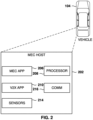
- Figure 2 is a schematic drawing illustrating a system to control a vehicle 104, according to an embodiment.
- Figure 2 includes a MEC host 202 incorporated into the vehicle 104.
- the vehicle 104 may be any type of vehicle, such as a commercial vehicle, a consumer vehicle, a recreation vehicle, a car, a truck, a motorcycle, or a boat, able to operate at least partially in an autonomous mode.
- the vehicle 104 may operate at times in a manual mode where the driver operates the vehicle 104 conventionally using pedals, steering wheel, and other controls. At other times, the vehicle 104 may operate in a fully autonomous mode, where the vehicle 104 operates without user intervention.
- the vehicle 104 may operate in a semi-autonomous mode, where the vehicle 104 controls many of the aspects of driving, but the driver may intervene or influence the operation using conventional (e.g., steering wheel) and non-conventional inputs (e.g., voice control).
- the MEC host 202 includes a Multi-access Edge Computing (MEC) application 206, a processor 208, a V2X application 210, sensors 214, and a communications module 216.
- MEC Multi-access Edge Computing
- MEC is a technology that allows applications to be instantiated at the edge of an access network and provides a low-latency and a close-proximity environment to user equipment (UE).
- UE user equipment
- vertical industries such as the automotive industry, are expected to significantly benefit from the deployment of MEC infrastructure together with the deployment of Radio Access Networks (RANs).
- RANs Radio Access Networks
- the sensors 214 may include various forward, side, and rearward facing cameras, radar, Light Detection and Ranging (LIDAR), ultrasonic, or similar sensors.
- the vehicle 104 includes an on-board diagnostics system to record vehicle operation and other aspects of the vehicle's performance, maintenance, or status.
- the vehicle 104 may also include various other sensors, such as driver identification sensors (e.g., a seat sensor, an eye tracking and identification sensor, a fingerprint scanner, a voice recognition module, or the like), occupant sensors, or various environmental sensors to detect wind velocity, outdoor temperature, barometer pressure, rain/moisture, or the like.
- the communications module 216 may utilize a network, which may include local-area networks (LAN), wide-area networks (WAN), wireless networks (e.g., 802.11 or cellular network), the Public Switched Telephone Network (PSTN) network, ad hoc networks, personal area networks (e.g., Bluetooth), vehicle-based networks (e.g., Controller Area Network (CAN) BUS), or other combinations or permutations of network protocols and network types.
- the network may include a single local area network (LAN) or wide-area network (WAN), or combinations of LANs or WANs, such as the Internet.
- the various devices coupled to the network may be coupled to the network via one or more wired or wireless connections.
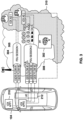
- FIG. 3 illustrates an architecture for implementing predictive Quality of Service (QoS), according to some example embodiments.
- QoS Quality of Service
- the operation and control of vehicles is becoming more autonomous over time, and most vehicles will likely become fully autonomous in the future.
- Vehicles that include some form of autonomy or otherwise assist a human operator may be referred to as "computer-assisted or autonomous driving" vehicles.
- Computer-assisted or autonomous driving (CA/AD) vehicles may include Artificial Intelligence (AI), machine learning (ML), and/or other like self-learning systems to enable autonomous operation.
- AI Artificial Intelligence
- ML machine learning
- FIG. 3 illustrates an architecture for implementing predictive Quality of Service (QoS), according to some example embodiments.
- the QoS measures the quality of transportation services delivered to users, which includes several factors, such as availability of resources for making a trip, estimated time to complete the trip, traffic congestion affecting a trip, availability of network connectivity (e.g., for the user, for the vehicle), etc.
- the QoS is measured by one or more numerical values (e.g., a number, a vector), and thresholds are established to determine when the value of the QoS is below one or more thresholds, which indicates deterioration in the quality of the delivery, and will trigger responses for the system to improve the QoS for one or more users.
- the Vehicle-to-Everything (V2X) applications 210 include different types of communications, such as Vehicle-to-Vehicle (V2V), Vehicle-to-Infrastructure (V2I) and/or Infrastructure-to-Vehicle (I2V), Vehicle-to-Network (V2N) and/or network-to-vehicle (N2V), Vehicle-to-Pedestrian communications (V2P), and ITS station (ITS-S) to ITS-S communication (X2X).
- V2V Vehicle-to-Vehicle
- V2I Vehicle-to-Infrastructure
- I2V Infrastructure-to-Vehicle
- V2N Vehicle-to-Network
- N2V network-to-vehicle
- V2P Vehicle-to-Pedestrian communications
- ITS-S ITS station
- the V2X applications 210 can use co-operative awareness to provide more intelligent services for end-users.
- vUEs vehicle stations or vehicle user equipment
- vUEs vehicle stations or vehicle user equipment
- RSUs roadside infrastructure or roadside units
- application servers e.g., application servers
- pedestrian devices e.g., smartphones, tablets, etc.
- collect knowledge of their local environment e.g., information received from other vehicles or sensor equipment in proximity
- process and share that knowledge in order to provide more intelligent services, such as cooperative perception, maneuver coordination, and the like, which are used for collision warning systems, autonomous driving, and/or the like.
- the 5G Automotive Association addressed the feature of predictive Quality of Service (PQoS), which is a mechanism enabling mobile networks (e.g., 308, 310) to provide advance notifications about P-QoS changes to interested consumers.
- PQoS predictive Quality of Service
- ETSI Multi-access Edge Computing Industry Specification Group ETSI MEC ISG
- MEC V2X API standardized API in the edge cloud can help in delivering P-QoS information to consuming apps, in Multi-MNO, Multi-vendor, Multi-OEM scenarios.
- the connectivity service provided by the mobile network to the vehicle is represented by a Protocol Data Unit (PDU) session 304.
- the PDU session 304 contains one or more QoS flows.
- the IQN consumer is the entity that requests IQNs and uses the information within the IQN to adapt the behavior of the vehicle and the application accordingly - for example, V2X application 210, V2X application server 312.
- a Prediction Function (PF) 302 collects necessary information, such as statistics including network, vehicle, and third-party data, to generate predictions, e.g., using machine-learning models.
- Figure 3 shows an example of a vehicle running two applications using predictive QoS.
- V2X application 210 includes Intelligent Transport Systems (ITS), which are systems to support transportation of goods and humans with information and communication technologies in order to efficiently and safely use the transport infrastructure and transport means (e.g., automobiles, trains, aircraft, watercraft, etc.). Elements of ITS are standardized in various standardization organizations, both on an international level and on regional levels.
- ITS Intelligent Transport Systems
- ITS may utilize a variety of existing and new access technologies (or radio access technologies (RAT)) and ITS applications.
- V2X RATs include Institute of Electrical and Electronics Engineers (IEEE) RATs and Third Generation Partnership (3GPP) RATs.
- IEEE V2X RATs include, for example, Wireless Access in Vehicular Environments (WAVE), Dedicated Short Range Communication (DSRC), Intelligent Transport Systems in the 5 GHz frequency band (ITS-G5), the IEEE 802.11p protocol (which is the layer 1 (L1) and layer 2 (L2) part of WAVE, DSRC, and ITS-G5), and sometimes the IEEE 802.16 protocol referred to as Worldwide Interoperability for Microwave Access (WiMAX).
- WiMAX Worldwide Interoperability for Microwave Access
- DSRC refers to vehicular communications in the 5.9 GHz frequency band that is generally used in the United States
- ITS-G5 refers to vehicular communications in the 5.9 GHz frequency band in Europe. Since the present embodiments are applicable to any number of different RATs (including IEEE 802.11p-based RATs) that may be used in any geographic or political region, the terms “DSRC” (used, among other regions, in the U.S.) and “ITS-G5" (used, among other regions, in Europe) may be used interchangeably throughout this disclosure.
- the 3GPP V2X RATs include, for example, cellular V2X (C-V2X) using Long Term Evolution (LTE) technologies (sometimes referred to as “LTE-V2X”) and/or using Fifth Generation (5G) technologies (sometimes referred to as “5G-V2X” or “NR-V2X”).
- LTE Long Term Evolution
- 5G Fifth Generation
- Other RATs may be used for ITS and/or V2X applications such as RATs using UHF and VHF frequencies, Global System for Mobile Communications (GSM), and/or other wireless communication technologies.
- GSM Global System for Mobile Communications
- PFs 302 are deployed at the network and/or road infrastructure side.
- the PFs 302 may be Machine Learning (ML) model(s)/algorithm(s) and/or Artificial Intelligence (AI) agents implemented, for example, by a Deep Neural Network (DNN), and/or some other ML/AI algorithm, such as those discussed herein.
- ML Machine Learning
- AI Artificial Intelligence
- DNN Deep Neural Network
- the role of the PF 302 is to generate predictions of Quality-of-Service (QoS) to be experienced by, for example, Teleoperated Driving applications, V2X applications, and the like.
- QoS Quality-of-Service
- Predictive QoS is a mechanism that enables a network to provide notifications about predicted QoS changes to interested users in order to adjust the application behavior in advance. Such prior notifications, whenever predictions are made with sufficient confidence, may be delivered with a notice period before the new predicted QoS is experienced. The notice period depends on the specific application and use case and should be long enough to give the application sufficient time to adapt to the new predicted QoS.
- the messages carrying such information are called In-advance QoS Notifications (IQN), which are received by connected vehicles, thus enabling V2X applications to take appropriate action prior to the predicted QoS change taking.
- IQN In-advance QoS Notifications
- predicted QoS enables applications for remote and autonomous driving to adjust to the changing conditions in the environment.
- edge computing refers to the implementation, coordination, and use of computing and resources at locations closer to the "edge” or collection of “edges” of the network, where the edge refers to the parts of the network close to the users.
- the purpose of this arrangement is to improve total cost of ownership, reduce application and network latency, reduce network backhaul traffic and associated energy consumption, improve service capabilities, and improve compliance with security or data privacy requirements (especially as compared to conventional cloud computing).
- edge nodes can reside in whatever location needed by the system architecture or ad hoc service (e.g., in a high-performance computing data center or cloud installation; a designated edge node server, an enterprise server, a roadside server, a telecom central office; or a local or peer at-the-edge device being served consuming edge services).
- ad hoc service e.g., in a high-performance computing data center or cloud installation; a designated edge node server, an enterprise server, a roadside server, a telecom central office; or a local or peer at-the-edge device being served consuming edge services.
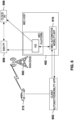
- FIG 4 illustrates an example MEC system architecture for providing V2X applications, according to various embodiments.
- the V2X applications may include different types of communication, such as Vehicle-to-Vehicle (V2V), Vehicle-to-Infrastructure (V2I), Vehicle-to-Network (V2N), and Vehicle-to-Pedestrian (V2P) communications.
- V2V Vehicle-to-Vehicle
- V2I Vehicle-to-Infrastructure
- V2N Vehicle-to-Network
- V2P Vehicle-to-Pedestrian
- V2X applications can use co-operative awareness to provide more intelligent services for end-users.
- entities such as vehicle stations or vehicle user equipment (VUEs), also referred to herein simply as UE, roadside infrastructure or roadside units (RSUs), application servers, and pedestrian devices (e.g., smartphones, tablets, etc.), collect knowledge of their local environment (e.g., information received from other vehicles or sensor equipment in proximity) to process and share that knowledge in order to provide more intelligent services, such as cooperative perception, maneuver coordination, and the like, which are used for collision warning systems, autonomous driving, and/or the like.
- V2X applications utilize an underlying access technology or radio access technology (RAT) to convey messages for co-operative awareness.
- RAT radio access technology
- RATs may include, for example, IEEE 802.11p based protocols such as DSRC and ITS-G5, 3GPP cellular-based protocols such as 5G-V2X and/or LTE-V2X protocols.
- IEEE 802.11p based protocols such as DSRC and ITS-G5
- 3GPP cellular-based protocols such as 5G-V2X and/or LTE-V2X protocols.
- MEC offers application developers and content providers cloud-computing capabilities and an IT service environment at the edge of the network. This environment is characterized by ultra-low latency and high bandwidth as well as real-time access to radio network information that can be leveraged by applications. MEC technology permits flexible and rapid deployment of innovative applications and services towards mobile subscribers, enterprises and vertical segments. In particular, regarding the automotive sector, applications such as MEC applications 412 need to exchange data, provide data to aggregation points and access data in databases which provide an overview of the local situation derived from a multitude of sensors (by various cars, roadside units, etc.).
- the V2X system involves multiple MEC hosts 402, 403 and the use of the MEC V2X Information Service (VIS) 408.
- Each of the MEC hosts 402, 402 may be part of the edge cloud 404, and the remote cloud 410 may include one or more remote application servers 406.
- the MEC system may support the feature V2Xservice.
- the MEC system includes the capability to provide feedback information from the network in support of V2X functions, which helps with predicting whether a communication channel is currently reliable or not (e.g., in terms of fulfilling latency requirements and/or a threshold packet arrival).
- the MEC system supporting V2XService includes the capability to provide quality related information from the network to the vehicle about when the various connectivity parameters (like latency, PER, signal strength, etc.) are going to change.
- the MEC system supporting V2XService includes the capability to provide interoperability by supporting V2X information exchange among road users connected through different access technologies, networks, and/or MNOs.
- the MEC system supporting V2XService enables multi-operator operation for V2X stations/equipment to provide service continuity across access network coverage nationwide and across borders of different operators' networks, and includes the capability to provide interoperability in multi-operator scenarios, enabling MEC apps 412 in different systems to communicate securely with each other, in order to enable synchronization in multi-operator systems also in absence of cellular coverage (outside of 3GPP domain).
- the MEC platform can include a MEC V2X API that provides access to MEC VIS 408 information, configuration, and commands.
- the MEC V2X API supports both queries and subscriptions (e.g., pub/sub mechanism) that are used over a Representational State Transfer (“REST" or "RESTful") API or over alternative transports such as a message bus.
- REST Representational State Transfer
- HTTP protocol bindings may be defined for the MEC V2X API.
- the MEC VIS 408 permits information exposure, pertinent to the support of automotive use cases, to MEC app 412 instances.
- the VIS 408 also permits a single ITS operator to offer V2X applications/services over a region that may span different countries and involve multiple network operators, MEC systems, and MEC app providers.
- the VIS 408 can include the following functionalities: (a) gathering of PC5 V2X relevant information from the 3GPP network for purposes of performing UE authorization for V2X communications (e.g., obtaining a list of V2X authorized UEs, obtaining relevant information about the authorization based on UE subscription, and obtaining V2X configuration parameters such as a common set of V2X configuration parameters which can include PC5 configuration parameters); (b) exposure of the information obtained in (a) to MEC apps in the same MEC host or MEC apps in other MEC hosts; (c) enablement of MEC apps to communicate securely with the V2X-related 3GPP core network logical functions (e.g., enabling communication between a MEC host and a V2X control function in the core network); (d) enablement of MEC apps in different MEC
- MEC V2X API provides information to MEC apps 412 in a standardized way, which provides interoperability in multi-vendor scenarios. Nevertheless, MEC apps 412 may communicate in a direct way (e.g., without the use of MEC platform). In some embodiments, inter-system communication may be realized between MEC Orchestrators (MEOs). Additionally, possible Mp3 enhancements (or new reference points between MEC systems) may be defined for MEC app communication.
- MEOs MEC Orchestrators
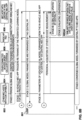
- FIG. 5 depicts an example V2X communication system utilizing MEC technology providing support for V2X applications.
- a MEC system offers V2X services in a cross-country, cross-operator, cross-vendor environment.
- the MEC system supports and/or provides various services to endpoint devices, each of which may have different requirements or constraints. For example, some services may have priority or Quality of Service (QoS) constraints (e.g., traffic data for autonomous V-ITS-Ss may have a higher priority than infotainment data), reliability and resiliency (e.g., traffic data may require mission-critical reliability, while infotainment data may be allowed some error variance), as well as power, cooling, and form-factor constraints.
- QoS Quality of Service
- a variety of interfaces are used by a UE application (app) to request the MEC system to run an app (e.g., MEC app) in the MEC system, or to move an app in or out of the MEC system.
- apps e.g., MEC app
- Such interfaces include, for example, the Mp3 reference point used for internal MEC management, used for controlling communication between MEC platforms, and the Mx2 reference point used for external access.
- an “operator” refers to an entity or organization that owns or controls infrastructure equipment (including radio infrastructure, core network and/or back-haul infrastructure, and the like) necessary to provide communications and/or network-related services.
- An operator provides technical capabilities to access a mobile network or wireless environment using an Over-the-Air (OTA) or wireless communication channel.
- OTA Over-the-Air
- the term "operator” as used herein may be considered synonymous to and/or referred to as a network operator, mobile network operator, cellular network operator, wireless service provider, wireless carrier, mobile network carrier, virtual MNO, and/or the like.
- the RANs 502-503 may be macro cell base stations, small and/or micro cell base stations, access points, and/or other like network elements.
- the access points may be, for example, wireless routers, roadside ITS stations (R-ITS-Ss) or roadside units, gateway appliances, central hubs, and/or the like.
- the base stations may be, for example, 3GPP Long Term Evolution (LTE) evolved NodeBs (eNBs), 3GPP 5G/NR next generation eNBs (ng-eNBs) and/or next generation NodeBs (gNBs), and/or the like.
- LTE Long Term Evolution
- ng-eNBs 3GPP 5G/NR next generation eNBs
- gNBs next generation NodeBs
- a collection of RANs 502 may be referred to as an "access level edge network" or "access level edge.”
- RAN 502 is co-located with an edge compute node 504 and RAN 503 is co-located with an edge compute node 505.
- the edge compute nodes 504-505 may be Multi-access Edge Computing (MEC) hosts or any other edge compute node, such as those discussed herein.
- the MEC hosts are entities that contain a MEC platform and a virtualization infrastructure to provide compute, storage and network resources to MEC apps.
- a MEC platform is a collection of functionality (including hardware and software elements) that is required to run MEC apps on a specific MEC host's virtualization infrastructure and to enable them to provide and consume MEC services, and that can provide itself a number of MEC services.
- MEC apps are applications that can be instantiated on a MEC host and can provide or consume MEC services, and MEC services are services provided via a MEC platform either by the MEC platform itself or by a MEC app.
- the RANs 502-503 are RSUs, R-ITS-Ss, base stations, or RAN nodes (e.g., eNB, ng-eNB, gNB, or the like).
- the management services are virtualized entities provided by a cloud computing service and/or one or more cloud compute nodes (collectively referred to as a "cloud" or the like).
- the CUs may run within virtual machine(s) (VMs) and/or software container(s) that are provided by the cloud's virtualization infrastructure.
- the cloud may operate or include the aforementioned CU, or may provide management applications/services separate from the CU.
- V2X applications and services include, for example, safety apps/services, convenience apps/services, advanced driving assistance apps/services, and vulnerable road user (VRU) apps/services, among many others.
- safety apps/services include Intersection Movement Assist (IMA) and Queue Warning (QW).
- IMA Intersection Movement Assist
- QW Queue Warning
- IMA is designed to avoid intersection crossing crashes by warning drivers of vehicles approaching from a lateral direction at an intersection.
- Intersection crashes include intersection, intersection-related, driveway/alley, and driveway access related crashes.
- QW queue of vehicles on the road may pose a potential danger and cause delay of traffic (e.g., when a turning queue extends to other lanes).
- the queue information can be made available to other V-ITS-Ss 101 beforehand, which minimizes the likelihood of crashes and allows for mitigation actions.
- Advanced driving assistance apps/services also referred to as “advanced driver-assistance systems” or “ADAS” are electronic systems (comprising hardware and software elements) that help a vehicle driver while driving or parking a vehicle, and typically employ various microcontrollers, electronic control units (ECUs), sensors, and/or power semiconductor devices/systems (collectively referred to herein as “driving control units” or “DCUs”) implemented in the vehicle.
- ECUs electronice control units
- DCUs driving control units
- These apps/services are also applicable to autonomous driving apps/services
- IQNs are based on communications network information (e.g., RAN 502).
- IQNs are enhanced/extended to include information on edge compute node and/or edge cloud computational resource predictions. This set of information is referred to herein as enhanced In-advance QoS Notification.
- embodiments include a signaling framework to ensure that IQNs are accessible by edge computing providers (e.g., MEC host 402) in an interoperable manner.
- edge computing providers e.g., MEC host 402
- the MEC V2X API may be exploited and/or enhanced.
- An MEC app 610 executes at the data network near a MEC platform (e.g., as part of the MEC host 402) and is collocated with respective RANs.
- the V2X App communicates the journey specifics to a respective MEC app 610 and, later on, provides this information as input to the RAN PF 606 and/or cloud PF 608.
- Figure 7 illustrates a sample architecture for implementing QoS predictions, according to some example embodiments. Further, embodiments provide for the creation of a map, referred to herein as coverage map, for presenting in a graphical user interface (GUI) providing transportation service information, such as prediction on the QoS.
- GUI graphical user interface
- the PQoS utilizes local sensory data coming from vehicles 104 and other traffic participants, e.g., pedestrians, cyclists. Moreover, the context includes nearby streets, roads, etc., as part of a city area served by a central MEC app 702.
- the PQoS framework includes several components: an HMI 708, in-vehicle MEC host 706, the local PF 302, information signaling frameworks 709, a central MEC app 702, and a central PF 704.
- the central MEC app 702 obtains local QoS prediction model parameters from multiple distributed in-vehicle MEC apps and then provides an update of the overall area's QoS prediction model (needed to locally produce the area's prediction digital twin) to MEC-enabled vehicles, even those vehicles that did not contribute their local PQoS models.
- the central MEC app 702 forwards QoS predictions performed by the central PF 704, including the expected level of support for various end-user services, to VIS service consumers (e.g., V2X client apps) at the vehicle's side.
- VIS service consumers e.g., V2X client apps
- the inferencing for vehicles equipped with MEC infrastructure is performed locally at the vehicle after the download of the global prediction model.
- the coverage map is used not only for travel planning, but also for trajectory and route sharing ratings to optimize the overall (both communication and vehicular) traffic efficiency and road safety.
- the PQoS system is supported by two communications protocols: i) a sensor data-based local perception communication protocol among vehicles or between a vehicle and other traffic participants, and ii) an application-level communication protocol between in-vehicle MEC apps 206 and the central MEC app 702. This enables the in-vehicle construction of the city's predicted digital twin based on the communicated parameters of the global PQoS prediction model.
- the global system digital twin updates are based on the obtainment and aggregation of micro-system digital twins (micro-HD maps) contributed by in-vehicle MEC apps 206.
- the proposed PQoS solution introduces interoperable elements to enable interoperability for applications and advanced services, especially in heterogeneous C-V2X scenarios, e.g., multi-MNO, multi-vendor, multi-OEM environments. This need of interoperability is highly requested by the automotive industry and solutions to address these requirements are not yet available.
- HMI Human Machine Interface
- Some vehicles are equipped with a Human Machine Interface (HMI) 708 (e.g., display, buttons, touchscreen) to provide input on the trip origin's location, time, and end location of journey.
- the display of the HMI 708 is configured for showing a map with the geographical support of various services (e.g., autonomous driving, infotainment, content delivery).
- the in-vehicle MEC apps 206 collect data and measurements from V2X, sensors, cameras, etc., as well as from local network of user devices within short range, and share the collected data with other MEC apps.
- a local PF 302 executing at each in-vehicle MEC host, obtains local contextual information and shared route preferences as input, and issues joint radio and edge cloud QoS predictions for all involved locations and times as output, based on a local update of the previously downloaded region-wide QoS prediction model.
- the central MEC app 702 builds a global regional PQoS prediction model by aggregating local prediction model updates tailored to a set of mobility services.
- HMI 708 modern vehicles are equipped with a number of technologies for HMI, and a common device is a display controlled either via touchscreen, knobs, or buttons. Another possibility is the use of voice recognition, where the driver or passenger provides voice commands and the machine acknowledges and confirms via voice synthesis. Additionally, gestures can be used to provide the inputs, and the driver or the passenger can enter data and parameters with the gestures that are detected by cameras or millimeter wave radars.
- the HMI 708 may be used to enter the destination for the current trip and stopovers or waypoints, if any. Further, for a future trip, the starting location could be additionally entered via the HMI 708.
- the user should also be able to provide the route information via apps in the smartphone, tablet, PC, or other mobile devices in the car, but not necessarily directly connected to the in-vehicle network (or alternatively, even devices outside the car may need to use the same prediction system, for an offline planning of the trip, before entering the car).
- the route information entered via such external devices should be automatically available to the in-vehicle journey management system.
- a backend or edge cloud application accessible by the vehicle app and by the other mobile devices, is used to gather the information.
- a client app running on the car cockpit can be connected with the above described HMI, as well as other client app instances, running on smartphones, tablets, PCs, or other devices (inside or outside the car), synchronized with the client app in the cockpit.
- the MEC app 206 running on the in-vehicle MEC host 706 can be connected to the local in-vehicle WiFi access point.
- a modern vehicle is equipped with several computing units and sensors (cameras, radar, LIDAR, microphones, ultra-sound, etc.), and soon, vehicles will also be equipped with V2X functionalities, which enable data exchange between vehicles, vehicles and road infrastructure, and vehicles and other traffic participants.
- V2X functionalities which enable data exchange between vehicles, vehicles and road infrastructure, and vehicles and other traffic participants.
- the computing units are referred to as electronic control units (ECU), which are embedded systems that control one or more of the electrical or, including mechanical, subsystems in the vehicle 104.
- ECU electronice control units
- Some examples include the door control unit, engine control unit, HMI, powertrain control module, battery management system, anti-lock braking system, telematics control unit (TCU), etc.
- Some of the control units are connected to sensors and to actuators to perform driving or driving assistance functions.
- ECU consolidation The different control functions are then virtualized in that central unit. It is expected that the future vehicle will contain a small number of central computing units that will run virtualized instances of multiple functionalities related not only to the vehicle control itself but to the overall mobility service as well as in-vehicle entertainment, aka infotainment.
- Those centralized computing units will play the same role as MEC hosts, which we call here in-vehicle MEC infrastructure. Since it is necessary that the data from the different sensors and from V2X are processed at the computing units for the driving functions, this same data can be consumed by applications running in the MEC hosts to support the mobility services.
- the in-vehicle MEC host 706 contains a MEC platform, referred to herein as in-vehicle MEC app 206, capable of communicating with other MEC hosts, e.g., via an in-vehicle WiFi access point, or via cellular network connectivity.
- the in-vehicle MEC host 706 includes several hardware and software components. From a hardware level, redundant computing units are necessary for the safety relevant subsystems, which include watchdog functionalities to meet functional safety requirements. On the software level, there are multiple layers of orchestration of the different virtualized functionalities with a clear separation between safety and critical functionalities, and those related to infotainment and mobility services.
- the local PF 302 performs PQoS predictions based on journey-specific input and may be implemented via a machine-learning model, e.g., neural network, or a logistic regression model.
- a machine-learning model e.g., neural network, or a logistic regression model.
- the in-vehicle MEC app 206 may obtain, for training purposes, several kinds of information from different sources, such as radio measurements collected by the car, outputs from sensors, information from user devices in the car, and information from nearby vehicles and devices.
- the format for sharing predictions produced by the local PF, using IQN is shown in Table 1: Table 1 IQN type IQN sub-type ID Predicted KPI Time values
- KPI Key Performance Indicator
- the predicted Key Performance Indicator (KPI) attribute of the message structure includes a KPI, which can be the latency, reliability, packet delivery ratio, throughput, User Plane (UP) connection, network utilization, delay variation (jitter), availability (of the communication service), accuracy, etc.
- PredictedQos resource data type
- This data structure is sent to the VIS service consumer following its request on j ourney-specific QoS predictions.
- Table 2 Name Data type Cardinality Remarks timeGranularity TimeStamp 0..1 Time granularity of visiting a location. locationGranularity String 1 Granularity of visited location. Measured in meters.
- routes Structure (inlined) 1..N Information relating to the potential routes of a vehicular UE. >routelnfo Structure (inlined) 2..N Information relating to a specific route.
- the first structure shall relate to the route origin and the last to the route destination. Intermediate waypoint locations may also be provided.
- time TimeStamp 0..1 Estimated time at the location.
- rsrp Uint8 0..1 RSRP as defined in [R14], [R15] ; only included in the response.
- rsrq Uint8 0..1 RSRQ as defined in [R14], [R15] ; only included in the response.
- the data type of locationGranularity is a string which indicates the granularity of a visited location by means of latitudinal and longitudinal margins.
- V2X applications e.g., MEC apps and client apps
- V2X applications receive such notifications with the aim to take proper actions prior to signal quality degradation.
- the PQoS information is not accessed by MEC service providers, and therefore, it cannot be used for MEC PoP optimization per a performance criterion.
- the payload message of IQNs only includes attributes related to performance metrics tightly related to radio signal quality, thus, only reflecting the RAN and CN parts of a radio access system. Predictions of the expected availability of MEC processing, storage and memory resources are neither performed nor included in the state-of-the-art IQN message.
- the local PF 302 and the central PF 704 may be either responsible for all tasks including training data collection, model training and inferencing, or a different entity (e.g., an "AI function") may be responsible for data collection and model training, leaving to the PFs the process of inferencing to generate predictions.
- a different entity e.g., an "AI function”
- the user via the HMI 708, may exploit the federated PQoS prediction model directly as the model parameters stored in the local PF 302 facilitate the creation of the system's digital twin, given a map with locations and times of interest, together with preferred services that may need to be launched on the road.
- two information signaling frameworks 709 are provided: a signaling framework to collaboratively train an automotive federated learning model, and another federated learning model for edge cloud PQoS inferencing. Both signaling frameworks utilize standardized MEC interfaces and a proposed extension of the standardized MEC V2X API.
- the central PF 704 aggregates the received local model updates and produces an update of the global prediction model (e.g., by averaging the parameters of the updated local prediction models). Further, the central PF 704 performs PQoS predictions tailored to client applications instantiated at vehicular UEs not having a MEC host installed onboard.
- the central MEC app 702 obtains local PQoS prediction model parameters from multiple distributed in-vehicle MEC apps for training of the federated PQoS learning model. The central MEC app 702 then provides an update of the overall area's PQoS prediction model (needed to locally produce the area's prediction digital twin) to MEC-enabled vehicles, even different from the ones contributing the local areas' QoS prediction models.
- the central MEC app 702 forwards PQoS predictions performed by the central PF 704, including the expected level of support for various end-user services, to VIS service consumers (e.g., V2X client apps) at the vehicle's side. Further, centralized inferencing is performed to provide QoS predictions to V2X Apps instantiated at vehicles which lack of an in-vehicle MEC host.
- Figures 8A-8B illustrate a signaling framework to collaboratively train an automotive federated learning model for QoS predictions.
- an iterative process is utilized until the model converges to a predetermined level of accuracy.
- the federated PQoS learning model is called "holistic" because it includes both radio signal and edge cloud resource availability information.
- the PQoS learning model for issuing joint radio and edge cloud PQoS predictions, is built by training an ML program based on cellular connectivity measurement data, such as RSRP/RSRQ measurements coming from all UEs connected to the cellular network (e.g., vehicles and other devices) and MEC resource utilization measurements from nearby MEC hosts (moving and static ones).
- cellular connectivity measurement data such as RSRP/RSRQ measurements coming from all UEs connected to the cellular network (e.g., vehicles and other devices) and MEC resource utilization measurements from nearby MEC hosts (moving and static ones).
- the PQoS learning model is generated in the central PF instantiated within the MEC host 808.
- model parameters also referred to herein as features, include weights, biases, and gradient values of a neural network, or coefficients of a logistic regression model.
- Stage 0 may be repeated periodically (e.g., daily, outside rush hours) once a sufficient number of time-stamped measurements is collected by the RAN and the MEC host.
- stage 1 (see Figures 8A and 8B ) is performed to re-train the PQoS model by the central PF.
- a loop 801 includes operations for continuous improvement of the PQoS model, which includes releasing the PQoS model to multiple entities, utilizing the PQoS model to gather additional data, and improving the model with the additional collected data.
- the parameters of the global PQoS model are forwarded by the central PF of the MEC host 808 (utilizing VIS, the central MEC app, the in-vehicle MEC app and the in-vehicle VIS) to local PFs at in-vehicle MEC app 206 that are currently under coverage.
- This set of vehicles may include vehicles previously contributing to the global model, as well as new vehicles with such capability entering the coverage area of the radio AP/ RSU.
- the loop 801 further includes periodical acquisition of short-range sensor information that is sent from the sensors 214 on the vehicle to the local PF via the in-vehicle MEC app 206, and periodical acquisition of GNSS and V2V/I2V information sent from the mobile communication unit of the vehicle TCU 26 to the local PF via the in-vehicle MEC app 206.
- the local models stored in the in-vehicle MEC hosts are updated by each vehicle's local PF based on the downloaded parameters of the global model and the local sensory data coming from RADAR, LiDAR, cameras, and other sensors installed both in the same vehicle (including passenger devices such as smartphones) and in nearby vehicles and VRU devices within short range (V2V, I2V signals).
- the parameters of the updated local models for joint radio/edge cloud QoS predictions are forwarded (utilizing in-vehicle VIS, VIS, and via the in-vehicle and central MEC apps) from the local PF inside the in-vehicle MEC app 206 to the central PF in the MEC host 808 hosting the global model.
- the central PF of the MEC host 808 receives periodic updates of devices' measurements from other MEC hosts 802 and other connected devices 804.
- the global PQoS model is updated by the central PF in MEC host 808, based on the uploaded cross-vehicle local model parameters and any measurement data collected in the meantime by other devices not carrying a MEC host.
- the convergence of the updated PQoS global model is evaluated, by comparing the new recalculated PQoS model to the PQoS model in the previous iteration. If a degree of similarity between the two last global PQoS model updates is over a predefined "model similarity threshold" (for example, when the norm of the difference of the two last obtained model parameter vectors is sufficiently small), the iterative training procedure of loop 801 stops, and the method follows to stage 6.
- model similarity threshold for example, when the norm of the difference of the two last obtained model parameter vectors is sufficiently small
- the PQoS global model is forwarded by the central PF (utilizing VIS, in-vehicle VIS and the central and in-vehicle MEC Apps) to the local PFs together with a notification informing of training completion.
- the recipients of the converged global model parameters may be model contributors or entirely new devices with processing capabilities which are under coverage.
- Figure 9 illustrates details of stage 2 of the federated PQoS model training procedure, according to some example embodiments.
- the training of the federated PQoS model is triggered.
- a request is sent to the VIS 906 via a POST request (e.g., POST .../provide_model_update (ModelUpdate)).
- POST request e.g., POST .../provide_model_update (ModelUpdate)
- the global model parameters are fetched from the central PF 302.
- a response to the POST request is sent, in operation 905, to the central MEC app 610 (e.g., including the ModelUpdate data type in the response message).
- the PQoS model is updated at operation 912, and in operation 914, the in-vehicle MEC app 206 sends a PUT request to the in-vehicle VIS 904 (e.g., PUT ... /provide_model_update (ModelUpdate).
- the in-vehicle VIS 904 replies to the PUT request (e.g., 204 no content).
- the local model parameters, at the local PF 902, are replaced by the new received global parameters for the PQoS model.
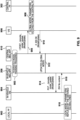
- Figure 10 shows the detailed signaling of stage 4 of the federated PQoS model training procedure, according to some example embodiments.
- the local PF 902 updates the local PQoS model.
- the in-vehicle MEC app 206 sends a request to the in-vehicle VIS 904 for an update on the model (e.g., GET .../provide_model_update (ModelUpdate)).
- the in-vehicle VIS 904 replies 1006 with the updated PQoS model.
- the updated local model parameters are forwarded to the central MEC app 610.
- the central MEC app 610 sends a PUT request to the VIS 906 (e.g., PUT .../provide_model_update (ModelUpdate).
- the VIS 906 replies 1012 with an acknowledgment (e.g., 204 no content).
- the central PF 302 updates the local PQoS model parameters stored at the central PF 302. Further, at operation 1016, the central PF 302 updates the global PQoS model.
- FIG 11 shows the detailed signaling of stage 6 of the federated PQoS model training procedure, according to some example embodiments.
- the training procedure is halted as the model convergence is achieved, as illustrated in the loop 801 of Figures 8A-8B .
- the central MEC app 610 requests an update of the model from the VIS 906 (e.g., GET .../provide_model_update (ModelUpdate)).
- the VIS 906 fetches the converged global PQoS model parameters from the central PF 302, and sends a response 1108 to the central MEC app 610 (e.g., 200 OK ModelUpdate).
- the central MEC app 610 forwards the new PQoS model parameters to the in-vehicle MEC app 206, which then sends an update (operation 1112) to the in-vehicle VIS 904 (e.g., PUT .../provide_model_update (ModelUpdate)).
- the in-vehicle VIS 904 responds (operation 1114) with an acknowledgment (e.g., 204 no content).
- the local PQoS model parameters are replaced with the new updated PQoS model parameters.
- the ModelUpdate data type represents the model based on which QoS predictions are performed by either the local PF 902 or the central PF 302.
- the attributes of the ModelUpdate data type are described below with reference to Table 3.
- Table 3 Name Data type Cardinality Remarks modelld String 1 ID of the QoS prediction model modelVersionNumber Integer 1 Version number of the model modelAccuracy Uint8 1 Achieved accuracy of model after testing lossFunction Enum (inlined) 1 Objective/ loss function with the following permitted values: • MEAN_SQUARED_ERROR • MEAN_ABSOLUTE_ERROR • MEAN_BIAS_ERROR model Parameters Structure (inlined) 1 Set of model parameters >parameter Uint8 2..N Model parameter (e.g., neural network weights, biases, gradients, linear model coefficients etc.).
- Figure 12 shows logical interactions among the various entities discussed herein allowing IQN communications between different IQN consumers (e.g., a MEC app corresponding to a V2X application instantiated at a vUE) and IQN producers (e.g., MEC app owned/ managed by a car OEM/ service provider).
- This signaling framework refers to the case where there is no MEC host installed at the vehicle side.
- a first IQN consumer is a client app 1204 executing at a UE, which can be the primary beneficiary of IQN information, and a second IQN consumer, which is a central MEC app 1206 managed by a service provider (e.g., vehicle OEM or a fleet manager).
- a service provider e.g., vehicle OEM or a fleet manager
- An IQN request is generated by either the client app 1204 or the central MEC app 1206 and transmitted to the VIS 906, e.g., through the MEC V2X API.
- the VIS 906 interacts with the RAN PF 1202 and the central PF 302 to obtain radio and edge cloud-related IQN attributes, respectively.
- the RAN PF 1202 After predictions are created by the RAN PF 1202 and the cloud PF 302, they will provide the corresponding attributes of the IQN message via the V2X API to the IQN consumer, e.g., the RAN PF 1202 will provide the IQN attributes on radio signal and network quality along the vehicle's route (focusing, for example, on the request of client app 1204 - MEC app corresponding to a V2X app executed at a vehicular UE), whereas the cloud PF 302 will provide the IQN attributes on available edge computing resources (i) along the designated vehicle's route, as a response to a request of client app 1204, or, (ii) over a service deployment area, as a response to a request of the central MEC app 1206.
- both domains' IQN prediction attributes are collected by the VIS, the latter will concatenate them to form a single compound IQN response message to be sent to the requesting app via the V2X API.
- the two phases of the communication e.g., the retrieval of predictions from the two PFs and the concatenation of IQN
- a buffering of these two phases might be needed (e.g., because the predictions are generated with different periodicities and different phase offsets).
- the messages in Figure 12 should not necessarily be seen as strictly consequential.
- Figure 13 is a signaling framework for journey-specific QoS inferencing in the existence of a MEC host installed at the requestor vehicle side, according to some example embodiments.
- the client app 1204 and the in-vehicle MEC app 206 interface with the in-vehicle VIS 904, which in turn interacts with the in-vehicle PF 902.
- the PQoS predictions can be performed locally within the in-vehicle MEC host itself, without the need to communicate the QoS prediction request to the central PF, which results in less communication overhead.
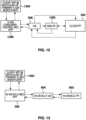
- Figure 14 is a flowchart of a method for obtaining journey-specific QoS predictions, according to some example embodiments. Since the global prediction model may be updated multiple times during a planned journey, instead of the QoS prediction client issuing a single request before the start of the journey, QoS inferencing (predictions) may be performed on a regular, automated basis.
- a new request for the remaining waypoints of the planned journey is issued as soon as an update of the global prediction model is downloaded by the vehicle and stored at the in-vehicle MEC host (e.g., at the local PF). This is applicable to QoS prediction requests coming from vehicles equipped with an in-vehicle MEC host.
- the in-vehicle MEC application subscribes to the in-vehicle VIS service, which issues notifications when the predicted QoS in the remaining journey is found to be below a threshold indicated by the service consumer upon subscription.
- the subscription is renewed with the remaining journey locations and expected arrival times each time one of the intermediate waypoints is visited.
- This method is applicable to both types of vehicular UEs, e.g., the ones with and without an in-vehicle MEC host installed on board the vehicle.
- QoS predictions are performed by the local PF on a regular basis along the journey, even in the absence of global model updates, and the local prediction model may be updated based on local information (e.g., sensors, cameras, V2X signals).
- local information e.g., sensors, cameras, V2X signals.
- the in-vehicle MEC app requests and receives PQoS predictions before a journey starts. From operation 1402, the method flows to operation 1404, where the journey starts at the designated time.
- a check is performed at operation 1406 to determine if the destination has been reached. If the destination has been reached, the journey ends (operation 1408), and if the destination has not been reached, the method flows to operation 1410, where a check is made to determine if there are global prediction PQoS model updates downloaded by the vehicle. If PQoS model updates have been downloaded, the method flows to operation 1412; otherwise, the method flows back to operation 1406.
- the in-vehicle MEC app requests and receives PQoS predictions from the local PF via the in-vehicle VIS for the remainder of the journey. From operation 1412, the method loops back to operation 1406.
- Figure 15 illustrates the flow for receiving in-vehicle VIS event notifications on predicted QoS, according to some example embodiments.
- a service consumer such as the in-vehicle MEC app 206 interacts with the in-vehicle VIS 904.
- the in-vehicle MEC app 206 sets an active subscription with the in-vehicle VIS 904.
- the in-vehicle VIS is informed by the local PF of an event where the predicted PQoS is below a predetermined threshold at one or more waypoints during the journey, as identified by the local PF output.
- the in-vehicle VIS 904 sends a POST request at operation 1506 with the message body containing the PredQosNotification, a data structure to the callback reference address included by the service consumer in the in-vehicle VIS predicted QoS event subscription.
- the in-vehicle MEC app sends a "204 No Content" response to the in-vehicle VIS 904. From that point, future events detected (at operation) 1510 with the predicted PQoS below the predetermined threshold will cause new QoS degradation notifications to the service consumer 206.
- a PredQosNotification data type represents the notification from the in-vehicle VIS 904.
- the attributes of the PredQosNotification follow the format indicated in Table 4 below.
- Table 4 Name Data type Cardinality Description notification Type String 1 Shall be set to "PredQosNotification”.
- qosDrop Structure (inlined) 1 Remaining journey locations at which QoS reduction is predicted.
- time TimeStamp 0..1 Estimated time at the location.
- qosReduction Uint8 1 QoS reduction e.g., in decibels for the case of received Signal-to-Noise Ratio, or, in msec for the case of end-to-end latency).
- the in-vehicle VIS 904 sends a POST request to the in-vehicle MEC app 206 with the predicted QoS notification, and at operation 1514, an acknowledgement is sent in the opposite direction.
- FIG 16 illustrates the training and use of a machine-learning program, according to some example embodiments.
- machine-learning programs also referred to as machine-learning algorithms or tools, are utilized to perform operations associated with PQoS.
- Machine Learning is an application that provides computer systems the ability to perform tasks, without explicitly being programmed, by making inferences based on patterns found in the analysis of data.
- Machine learning explores the study and construction of algorithms, also referred to herein as tools, that may learn from existing data and make predictions about new data.
- Such machine-learning algorithms operate by building an ML model 1616 from example training data 1612 in order to make data-driven predictions or decisions expressed as outputs or assessments 1620.
- example embodiments are presented with respect to a few machine-learning tools, the principles presented herein may be applied to other machine-learning tools.
- ML ML
- Supervised ML uses prior knowledge (e.g., examples that correlate inputs to outputs or outcomes) to learn the relationships between the inputs and the outputs.
- the goal of supervised ML is to learn a function that, given some training data, best approximates the relationship between the training inputs and outputs so that the ML model can implement the same relationships when given inputs to generate the corresponding outputs.
- Unsupervised ML is the training of an ML algorithm using information that is neither classified nor labeled, and allowing the algorithm to act on that information without guidance. Unsupervised ML is useful in exploratory analysis because it can automatically identify structure in data.
- Classification problems also referred to as categorization problems, aim at classifying items into one of several category values (for example, is this object an apple or an orange?).
- Regression algorithms aim at quantifying some items (for example, by providing a score to the value of some input).
- Some examples of commonly used supervised-MI, algorithms are Logistic Regression (LR), Naive-Bayes, Random Forest (RF), neural networks (NN), deep neural networks (DNN), matrix factorization, and Support Vector Machines (SVM).
- LR Logistic Regression
- RF Random Forest
- N neural networks
- DNN deep neural networks
- SVM Support Vector Machines
- unsupervised ML Some common tasks for unsupervised ML include clustering, representation learning, and density estimation. Some examples of commonly used unsupervised-MI, algorithms are K-means clustering, principal component analysis, and autoencoders.
- ML federated learning
- collaborative learning Another type of ML is federated learning (also known as collaborative learning) that trains an algorithm across multiple decentralized devices holding local data, without exchanging the data.
- This approach stands in contrast to traditional centralized machine-learning techniques where all the local datasets are uploaded to one server, as well as to more classical decentralized approaches which often assume that local data samples are identically distributed.
- Federated learning enables multiple actors to build a common, robust machine learning model without sharing data, thus allowing to address critical issues such as data privacy, data security, data access rights and access to heterogeneous data.
- example ML model 1616 provides PQoS predictions related to trip information.
- the training data 1612 comprises examples of values for the features 1602.
- the training data comprises labeled data with examples of values for the features 1602 and labels indicating the outcome, such as trip outcome, trip demand, electric-vehicle failure, etc.
- the machine-learning algorithms utilize the training data 1612 to find correlations among identified features 1602 that affect the outcome.
- a feature 1602 is an individual measurable property of a phenomenon being observed.
- the concept of a feature is related to that of an explanatory variable used in statistical techniques such as linear regression. Choosing informative, discriminating, and independent features is important for effective operation of ML in pattern recognition, classification, and regression.
- Features may be of different types, such as numeric features, strings, and graphs.
- the features 1602 may be of different types and may include one or more of user information 1603, trip information 1604 (e.g., route, waypoints), vehicle information 1605, vehicle sensor information 1606, PQoS information 1607, federated-model information 1608, payment information 1609, MaaS operator information 1610, etc.
- the ML algorithm analyzes the training data 1612 based on identified features 1602 and configuration parameters 1611 defined for the training.
- the result of the training 1614 is an ML model 1616 that is capable of taking inputs to produce assessments.
- Training an ML algorithm involves analyzing large amounts of data (e.g., from several gigabytes to a terabyte or more) in order to find data correlations.
- the ML algorithms utilize the training data 1612 to find correlations among the identified features 1602 that affect the outcome or assessment 1620.
- the training data 1612 includes labeled data, which is known data for one or more identified features 1602 and one or more outcomes, such as trips delivered, vehicle sensor information, vehicle failures, beginning and ending trip locations, user information, actual demand measured, etc.
- the ML algorithms usually explore many possible functions and parameters before finding what the ML algorithms identify to be the best correlations within the data; therefore, training may make use of large amounts of computing resources and time.
- ML algorithms include configuration parameters 1611, and the more complex the ML algorithm, the more parameters there are that are available to the user.
- the configuration parameters 1611 define variables for an ML algorithm in the search for the best ML model.
- the training parameters include model parameters and hyperparameters. Model parameters are learned from the training data, whereas hyperparameters are not learned from the training data, but instead are provided to the ML algorithm.
- model parameters include maximum model size, maximum number of passes over the training data, data shuffle type, regression coefficients, decision tree split locations, and the like.
- Hyperparameters may include the number of hidden layers in a neural network, the number of hidden nodes in each layer, the learning rate (perhaps with various adaptation schemes for the learning rate), the regularization parameters, types of nonlinear activation functions, and the like. Finding the correct (or the best) set of hyperparameters can be a very time-consuming task that makes use of a large amount of computer resources.
- new data 1618 is provided as an input to the ML model 1616, and the ML model 1616 generates the assessment 1620 as output. For example, the prediction of the quality of service for a trip, demand prediction at a geographic region, user preferences, etc.
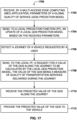
- Figure 17 is a flowchart of a method 1700 for sharing information among multiple MaaS systems for presenting service information to users, according to some example embodiments. While the various operations in this flowchart are presented and described sequentially, one of ordinary skill will appreciate that some or all of the operations may be executed in a different order, be combined or omitted, or be executed in parallel.
- a MEC application executing in a processor (e.g., a MEC host) of a vehicle, receives parameters of a global QoS prediction model.
- the global QoS prediction model is a federated model utilizing information from a plurality of vehicles.
- the method 1700 flows to operation 1704, where the MEC application sends, to a local prediction function (PF), an update of a local QoS prediction model based on the received parameters.
- PF local prediction function
- the method 1700 flows to operation 1706 for detecting, by the MEC application, a journey of the vehicle requested by a user.
- the method 1700 flows to operation 1708 for sending, by the MEC application to the local PF, a request for a value of the QoS along the journey to be calculated by the local QoS prediction model.
- the value of the QoS is a measure of quality of transportation services delivered during the journey.
- the MEC application receives the predicted value of the QoS along the journey, and at operation 1712, the MEC application provides the predicted value of the QoS to the vehicle.
- the QoS prediction model is generated by utilizing federated learning to train a machine-learning program utilizing the information from the plurality of vehicles.
- training data for generating the global QoS prediction model includes data from sensors collected by vehicles, data of trips taken by users, profile data of the users, and communication data for wireless communication from the vehicles.
- the global QoS prediction model utilizes features comprising one or more of user information, trip information, vehicle information, sensor information, and transportation provider information.
- the method 1700 further comprises collecting data from sensors in the vehicle, and forwarding the collected data from the sensors to a central MEC application.
- the method 1700 further comprises detecting, by the in-vehicle MEC application, that accuracy of the local QoS prediction model is below a predetermined threshold; and requesting, via the central MEC application, updated parameters of the global QoS prediction model.
- the parameters of the global QoS prediction model are calculated by a central prediction function (PF), and the method 1700 further comprises receiving, by the in-vehicle MEC application, a second value of the QoS prediction model calculated by the central PF; and causing presentation, by the in-vehicle MEC application, of the second value of the QoS on the display of the vehicle.
- PF central prediction function
- the method 1700 further comprises collecting, by the in-vehicle MEC application, journey information from a mobile device of a user; and updating information for predicting the value of the QoS based on the collected information from the mobile device.
- a machine-readable storage medium includes instructions that, when executed by a machine, cause the machine to perform operations comprising: receiving, by a multi-access edge computing (MEC) application executing in a processor of a vehicle, parameters of a global quality of service (QoS) prediction model, the global QoS prediction model being a federated model utilizing information from a plurality of vehicles; updating, by the in-vehicle MEC application, a local QoS prediction model based on the received parameters; detecting, by the in-vehicle MEC application, a journey of the vehicle requested by a user; predicting, by the local QoS prediction model, a QoS along the journey; and causing presentation, by the in-vehicle MEC application, of the predicted QoS on a display of the vehicle.
- MEC multi-access edge computing
- QoS global quality of service
- Another general aspect is for a system that includes a memory comprising instructions and one or more computer processors.
- the instructions when executed by the one or more computer processors, cause the one or more computer processors to perform operations comprising: receiving, by a multi-access edge computing (MEC) application executing in a processor of a vehicle, parameters of a global quality of service (QoS) prediction model, the global QoS prediction model being a federated model utilizing information from a plurality of vehicles; updating, by the in-vehicle MEC application, a local QoS prediction model based on the received parameters; detecting, by the in-vehicle MEC application, a journey of the vehicle requested by a user; predicting, by the local QoS prediction model, a QoS along the journey; and causing presentation, by the in-vehicle MEC application, of the predicted QoS on a display of the vehicle.
- MEC multi-access edge computing
- QoS global quality of service
- Another general aspect is for a system that includes means for receiving parameters of a global quality of service (QoS) prediction model, the global QoS prediction model being a federated model utilizing information from a plurality of vehicles; means for updating, a local QoS prediction model based on the received parameters; means for detecting a journey of the vehicle requested by a user; predicting, by the local QoS prediction model, a QoS along the journey; and means for causing presentation of the predicted QoS on a display of the vehicle.
- QoS global quality of service
- a system comprises: means for receiving, by a local prediction function (PF), parameters of a global quality of service (QoS) prediction model and an update of a local QoS prediction model; means for receiving, by the local PF from a multi-access edge computing (MEC) application, a request for a value of the QoS along a journey of a vehicle requested by a user; means for predicting, utilizing the local QoS prediction model at the local PF, the value of the QoS along the journey of the vehicle, the value of the QoS being a measure of quality of transportation services delivered during the journey of the vehicle; and means for sending, by the local PF to the MEC application, the predicted value of the QoS along the journey.
- PF local prediction function
- QoS global quality of service
- the benefits of using the federated PQoS model include:
- Figure 18 is a block diagram illustrating an example of a machine 1800 upon or by which one or more example process embodiments described herein may be implemented or controlled.
- the machine 1800 may operate as a standalone device or may be connected (e.g., networked) to other machines.
- the machine 1800 may operate in the capacity of a server machine, a client machine, or both in server-client network environments.
- the machine 1800 may act as a peer machine in a peer-to-peer (P2P) (or other distributed) network environment.
- P2P peer-to-peer
- machine shall also be taken to include any collection of machines that individually or jointly execute a set (or multiple sets) of instructions to perform any one or more of the methodologies discussed herein, such as via cloud computing, software as a service (SaaS), or other computer cluster configurations.
- SaaS software as a service
- Circuitry is a collection of circuits implemented in tangible entities that include hardware (e.g., simple circuits, gates, logic). Circuitry membership may be flexible over time and underlying hardware variability. Circuitries include members that may, alone or in combination, perform specified operations when operating. In an example, hardware of the circuitry may be immutably designed to carry out a specific operation (e.g., hardwired).
- the hardware of the circuitry may include variably connected physical components (e.g., execution units, transistors, simple circuits) including a computer-readable medium physically modified (e.g., magnetically, electrically, by moveable placement of invariant massed particles) to encode instructions of the specific operation.
- a computer-readable medium physically modified (e.g., magnetically, electrically, by moveable placement of invariant massed particles) to encode instructions of the specific operation.
- the instructions enable embedded hardware (e.g., the execution units or a loading mechanism) to create members of the circuitry in hardware via the variable connections to carry out portions of the specific operation when in operation.
- the computer-readable medium is communicatively coupled to the other components of the circuitry when the device is operating.
- any of the physical components may be used in more than one member of more than one circuitry.
- execution units may be used in a first circuit of a first circuitry at one point in time and reused by a second circuit in the first circuitry, or by a third circuit in a second circuitry, at a different time.
- the machine 1800 may include a hardware processor 1802 (e.g., a central processing unit (CPU), a hardware processor core, or any combination thereof), a graphics processing unit (GPU) 1803, a main memory 1804, and a static memory 1806, some or all of which may communicate with each other via an interlink (e.g., bus) 1808.
- the machine 1800 may further include a display device 1810, an alphanumeric input device 1812 (e.g., a keyboard), and a user interface (UI) navigation device 1814 (e.g., a mouse).
- the display device 1810, alphanumeric input device 1812, and UI navigation device 1814 may be a touch screen display.
- the machine 1800 may additionally include a mass storage device (e.g., drive unit) 1816, a signal generation device 1818 (e.g., a speaker), a network interface device 1820, and one or more sensors 1821, such as a Global Positioning System (GPS) sensor, compass, accelerometer, or another sensor.
- the machine 1800 may include an output controller 1828, such as a serial (e.g., universal serial bus (USB)), parallel, or other wired or wireless (e.g., infrared (IR), near field communication (NFC)) connection to communicate with or control one or more peripheral devices (e.g., a printer, card reader).
- a serial e.g., universal serial bus (USB)
- USB universal serial bus
- IR infrared
- NFC near field communication
- the mass storage device 1816 may include a machine-readable medium 1822 on which is stored one or more sets of data structures or instructions 1824 (e.g., software) embodying or utilized by any one or more of the techniques or functions described herein.
- the instructions 1824 may also reside, completely or at least partially, within the main memory 1804, within the static memory 1806, within the hardware processor 1802, or within the GPU 1803 during execution thereof by the machine 1800.
- one or any combination of the hardware processor 1802, the GPU 1803, the main memory 1804, the static memory 1806, or the mass storage device 1816 may constitute machine-readable media.
- machine-readable medium 1822 is illustrated as a single medium, the term “machine-readable medium” may include a single medium, or multiple media, (e.g., a centralized or distributed database, and/or associated caches and servers) configured to store the one or more instructions 1824.
- machine-readable medium may include any medium that is capable of storing, encoding, or carrying instructions 1824 for execution by the machine 1800 and that cause the machine 1800 to perform any one or more of the techniques of the present disclosure, or that is capable of storing, encoding, or carrying data structures used by or associated with such instructions 1824.
- Nonlimiting machine-readable medium examples may include solid-state memories, and optical and magnetic media.
- a massed machine-readable medium comprises a machine-readable medium 1822 with a plurality of particles having invariant (e.g., rest) mass. Accordingly, massed machine-readable media are not transitory propagating signals.
- massed machine-readable media may include non-volatile memory, such as semiconductor memory devices (e.g., Electrically Programmable Read-Only Memory (EPROM), Electrically Erasable Programmable Read-Only Memory (EEPROM)) and flash memory devices; magnetic disks, such as internal hard disks and removable disks; magneto-optical disks; and CD-ROM and DVD-ROM disks.
- semiconductor memory devices e.g., Electrically Programmable Read-Only Memory (EPROM), Electrically Erasable Programmable Read-Only Memory (EEPROM)
- flash memory devices e.g., Electrically Programmable Read-Only Memory (EPROM), Electrically Erasable Programmable Read-Only Memory (EEPROM)
- EPROM Electrically Programmable Read-Only Memory
- EEPROM Electrically Erasable Programmable Read-Only Memory
- flash memory devices e.g., Electrically Erasable Programmable Read-Only Memory (EEPROM)
- flash memory devices e.g., Electrically Eras
- the instructions 1824 may further be transmitted or received over a communications network 1826 using a transmission medium via the network interface device 1820.
- the term "or" may be construed in either an inclusive or exclusive sense. Moreover, plural instances may be provided for resources, operations, or structures described herein as a single instance. Additionally, boundaries between various resources, operations, modules, engines, and data stores are somewhat arbitrary, and particular operations are illustrated in a context of specific illustrative configurations. Other allocations of functionality are envisioned and may fall within a scope of various embodiments of the present disclosure. In general, structures and functionality presented as separate resources in the example configurations may be implemented as a combined structure or resource. Similarly, structures and functionality presented as a single resource may be implemented as separate resources. These and other variations, modifications, additions, and improvements fall within a scope of embodiments of the present disclosure as represented by the appended claims. The specification and drawings are, accordingly, to be regarded in an illustrative rather than a restrictive sense.
Landscapes
- Engineering & Computer Science (AREA)
- Theoretical Computer Science (AREA)
- Physics & Mathematics (AREA)
- Business, Economics & Management (AREA)
- Signal Processing (AREA)
- Computer Networks & Wireless Communication (AREA)
- General Physics & Mathematics (AREA)
- Software Systems (AREA)
- Computing Systems (AREA)
- Strategic Management (AREA)
- Human Resources & Organizations (AREA)
- Evolutionary Computation (AREA)
- Artificial Intelligence (AREA)
- General Engineering & Computer Science (AREA)
- Mathematical Physics (AREA)
- Data Mining & Analysis (AREA)
- Economics (AREA)
- Quality & Reliability (AREA)
- Tourism & Hospitality (AREA)
- Computational Linguistics (AREA)
- Health & Medical Sciences (AREA)
- General Health & Medical Sciences (AREA)
- Entrepreneurship & Innovation (AREA)
- General Business, Economics & Management (AREA)
- Marketing (AREA)
- Medical Informatics (AREA)
- Computer Vision & Pattern Recognition (AREA)
- Biophysics (AREA)
- Life Sciences & Earth Sciences (AREA)
- Development Economics (AREA)
- Biomedical Technology (AREA)
- Game Theory and Decision Science (AREA)
- Operations Research (AREA)
- Molecular Biology (AREA)
- Primary Health Care (AREA)
- Educational Administration (AREA)
- Traffic Control Systems (AREA)
- Mobile Radio Communication Systems (AREA)
Claims (15)
- System, das Folgendes umfasst:Mittel zum Empfangen (1702), durch eine Multi-Access Edge Computing (MEC)-Anwendung, von Parametern eines globalen Dienstgüte (QoS)-Vorhersagemodells;Mittel zum Senden (1704), durch die MEC-Anwendung an eine lokale Vorhersagefunktion (PF), einer Aktualisierung eines lokalen QoS-Vorhersagemodells basierend auf den empfangenen Parametern;Mittel zum Erkennen (1706), durch die MEC-Anwendung, einer von einem Benutzer angeforderten Fahrt eines Fahrzeugs;Mittel zum Senden (1708), durch die MEC-Anwendung an die lokale PF, einer Anforderung für einen Wert der QoS entlang der Fahrt, der durch das lokale QoS-Vorhersagemodell berechnet werden soll, wobei der Wert der QoS ein Maß für die Qualität der Transportdienstleistungen ist, die während der Fahrt erbracht werden;Mittel zum Empfangen (1710), durch die MEC-Anwendung, des vorhergesagten Wertes der QoS entlang des Weges; undMittel zur Bereitstellung (1712), durch die MEC-Anwendung, des vorhergesagten Wertes der QoS an das Fahrzeug.
- System nach Anspruch 1, wobei das QoS-Vorhersagemodell unter Verwendung von föderiertem Lernen erzeugt wird, um ein Maschinenlernprogramm zu trainieren, das die Informationen von einer Vielzahl von Fahrzeugen nutzt.
- System nach einem der Ansprüche 1-2, wobei die Trainingsdaten zum Erzeugen des globalen QoS-Vorhersagemodells Daten von Sensoren, die von Fahrzeugen gesammelt wurden, Daten von Fahrten, die von Benutzern unternommen wurden, Profildaten der Benutzer und Kommunikationsdaten für die drahtlose Kommunikation von den Fahrzeugen umfassen.
- System nach einem der Ansprüche 1-3, wobei das globale QoS-Vorhersagemodell Merkmale nutzt, die eine oder mehrere der folgenden Informationen umfassen:
Benutzerinformationen, Fahrtinformationen, Fahrzeuginformationen, Sensorinformationen und Transportanbieterinformationen. - System nach einem der Ansprüche 1-4, das ferner Folgendes umfasst:Mittel zum Sammeln, durch die MEC-Anwendung, von Daten von Sensoren im Fahrzeug; undMittel zum Weiterleiten, durch die MEC-Anwendung, der gesammelten Daten von den Sensoren an eine zentrale MEC-Anwendung.
- System nach einem der Ansprüche 1-5, das ferner Folgendes umfasst:Mittel zum Erkennen, durch die MEC-Anwendung, dass die Genauigkeit des lokalen QoS-Vorhersagemodells unter einem vorbestimmten Schwellenwert liegt; undMittel zum Anfordern, über die zentrale MEC-Anwendung, aktualisierter Parameter des globalen QoS-Vorhersagemodells.
- System nach einem der Ansprüche 1-6, wobei die Parameter des globalen QoS-Vorhersagemodells durch eine zentrale Vorhersagefunktion (PF) berechnet werden, wobei das System ferner Folgendes umfasst:Mittel zum Empfangen, durch die MEC-Anwendung, eines zweiten Wertes des von der zentralen PF berechneten QoS-Vorhersagemodells; undMittel zum Veranlassen der Darstellung, durch die MEC-Anwendung, des zweiten Wertes der QoS auf dem Display des Fahrzeugs.
- System nach einem der Ansprüche 1-7, das ferner Folgendes umfasst:Mittel zum Sammeln, durch die MEC Anwendung, von Fahrtinformationen von einem mobilen Gerät des Benutzers; undMittel zum Aktualisieren von Informationen zur Vorhersage des Wertes der QoS auf der Grundlage der gesammelten Informationen von dem mobilen Gerät.
- Verfahren, das Folgendes umfasst:Empfangen (1702) von Parametern eines globalen Dienstgüte (QoS)-Vorhersagemodells;Senden (1704), an eine lokale Vorhersagefunktion (PF), einer Aktualisierung eines lokalen QoS-Vorhersagemodells basierend auf den empfangenen Parametern;Erkennen (1706) einer von einem Benutzer angeforderten Fahrt eines Fahrzeugs;Senden (1708), an die lokale PF, einer Anforderung für einen Wert der QoS entlang des Weges, der durch das lokale QoS-Vorhersagemodell berechnet werden soll, wobei der Wert der QoS ein Maß für die Qualität der während der Fahrt erbrachten Transportdienstleistungen ist;Empfangen (1710) des vorhergesagten Wertes der QoS entlang des Weges;und Bereitstellen (1712) des vorhergesagten Wertes der QoS für das Fahrzeug.
- Verfahren nach Anspruch 9, wobei das QoS-Vorhersagemodell unter Nutzung von föderiertem Lernen erzeugt wird, um ein Maschinenlernprogramm zu trainieren, das die Informationen von einer Vielzahl von Fahrzeugen nutzt.
- Verfahren nach den Ansprüchen 9-10, wobei die Trainingsdaten zum Erzeugen des globalen QoS-Vorhersagemodells Daten von durch Fahrzeuge gesammelten Sensoren, Daten von durch Benutzer unternommenen Fahrten, Profildaten der Benutzer und Kommunikationsdaten für die drahtlose Kommunikation von den Fahrzeugen umfassen.
- Verfahren nach einem der Ansprüche 9-11, wobei das globale QoS-Vorhersagemodell Merkmale nutzt, die eine oder mehrere der folgenden Informationen umfassen:
Benutzerinformationen, Fahrtinformationen, Fahrzeuginformationen, Sensorinformationen und Transportanbieterinformationen. - Verfahren nach einem der Ansprüche 9-12, wobei die Maschine ferner Vorgänge durchführt, die Folgendes umfassen:Sammeln von Daten von Sensoren im Fahrzeug; undWeiterleiten der von den Sensoren gesammelten Daten an eine zentrale MEC-Anwendung.
- Verfahren nach einem der Ansprüche 9-13, wobei die Maschine ferner Vorgänge durchführt, die Folgendes umfassen:Erkennen, dass die Genauigkeit des lokalen QoS-Vorhersagemodells unter einem vorgegebenen Schwellenwert liegt; undAnfordern aktualisierter Parameter des globalen QoS-Vorhersagemodells.
- Computerlesbare Medien mit Programmanweisungen, die von einem Computer ausgeführt werden können, wobei die Programmanweisungen durch einen der Verfahrensschritte der Ansprüche 9-14 definiert sind.
Applications Claiming Priority (1)
| Application Number | Priority Date | Filing Date | Title |
|---|---|---|---|
| US17/132,469 US12045738B2 (en) | 2020-12-23 | 2020-12-23 | Transportation operator collaboration system |
Publications (2)
| Publication Number | Publication Date |
|---|---|
| EP4020935A1 EP4020935A1 (de) | 2022-06-29 |
| EP4020935B1 true EP4020935B1 (de) | 2024-10-09 |
Family
ID=75383353
Family Applications (1)
| Application Number | Title | Priority Date | Filing Date |
|---|---|---|---|
| EP21213506.5A Active EP4020935B1 (de) | 2020-12-23 | 2021-12-09 | System zur zusammenarbeit von verkehrsunternehmen |
Country Status (3)
| Country | Link |
|---|---|
| US (1) | US12045738B2 (de) |
| EP (1) | EP4020935B1 (de) |
| CN (1) | CN114745692A (de) |
Families Citing this family (34)
| Publication number | Priority date | Publication date | Assignee | Title |
|---|---|---|---|---|
| WO2021207269A1 (en) * | 2020-04-07 | 2021-10-14 | Assia Spe, Llc | Systems and methods for remote collaboration |
| US11382033B2 (en) * | 2020-11-30 | 2022-07-05 | Verizon Patent And Licensing Inc. | Systems and methods for performance-aware energy saving in a radio access network |
| US12211379B2 (en) * | 2020-12-23 | 2025-01-28 | Intel Corporation | Transportation environment data service |
| EP4275334A1 (de) * | 2021-02-05 | 2023-11-15 | Huawei Technologies Co., Ltd. | Vorrichtungen und verfahren zur vorhersage einer erfahrung in einem mobilen netzwerk |
| US11871338B2 (en) * | 2021-04-29 | 2024-01-09 | International Business Machines Corporation | Distributed multi-access edge service delivery |
| US11570594B2 (en) * | 2021-05-27 | 2023-01-31 | GM Global Technology Operations LLC | Method of facilitating on-demand wireless connectivity using device-to-device resources and data pooling with a vehicle platoon |
| EP4142353A1 (de) * | 2021-08-26 | 2023-03-01 | Robert Bosch GmbH | Verfahren und vorrichtungen zur funkkommunikation |
| CN113784397B (zh) * | 2021-09-10 | 2024-11-19 | 腾讯科技(深圳)有限公司 | 一种数据处理方法、设备以及可读存储介质 |
| EP4164194A1 (de) * | 2021-10-06 | 2023-04-12 | Robert Bosch GmbH | Verfahren und vorrichtungen zur funkkommunikation |
| CN116918418A (zh) * | 2021-11-23 | 2023-10-20 | 中兴通讯股份有限公司 | 用于模型管理的系统和方法 |
| US11527074B1 (en) * | 2021-11-24 | 2022-12-13 | Continental Automotive Technologies GmbH | Systems and methods for deep multi-task learning for embedded machine vision applications |
| KR20230084991A (ko) * | 2021-12-06 | 2023-06-13 | 라인플러스 주식회사 | 사용자 운전 경로 기반 내비게이션 서비스 제공 방법 및 시스템 |
| GB202117853D0 (en) * | 2021-12-10 | 2022-01-26 | British Telecomm | Service provision |
| US20250014136A1 (en) * | 2021-12-17 | 2025-01-09 | Sony Group Corporation | Communication network node, method, communication network, terminal device |
| DE102021214675A1 (de) * | 2021-12-20 | 2023-06-22 | Robert Bosch Gesellschaft mit beschränkter Haftung | Verfahren zur QoS-Prädiktion |
| CN116455515B (zh) * | 2022-01-10 | 2025-10-14 | 腾讯科技(深圳)有限公司 | 数据传输方法及相关设备 |
| WO2023143695A1 (en) * | 2022-01-25 | 2023-08-03 | Huawei Technologies Co., Ltd. | Aggregated qos predictions for end-to-end user plane links |
| US12167306B2 (en) * | 2022-02-25 | 2024-12-10 | Ford Global Technologies, Llc | Vehicular ad-hoc network manager |
| EP4246379A1 (de) | 2022-03-15 | 2023-09-20 | Zenseact AB | System und verfahren zum automatischen lernen von selbstsupraleitenden netzen in automatisierten fahrsystemen |
| CN115309712A (zh) * | 2022-07-20 | 2022-11-08 | 哈尔滨工业大学 | 一种基于活动理论的MaaS系统的信息需求获取方法 |
| CN115550944B (zh) * | 2022-08-18 | 2024-02-27 | 重庆大学 | 一种车联网中基于边缘计算和深度强化学习的动态服务放置方法 |
| EP4325446A1 (de) | 2022-08-18 | 2024-02-21 | Zenseact AB | Verfahren und system zum selbstüberwachten training von wahrnehmungsfunktionen für ein automatisiertes fahrsystem in einem fahrzeug |
| EP4579627A4 (de) * | 2022-08-22 | 2025-09-10 | Mitsubishi Electric Corp | Kommunikationssystem |
| GR1010554B (el) * | 2022-10-04 | 2023-10-11 | Ebos Technologies, | Βελτιστοποιηση μηχανικης εκμαθησης (με) για συνδεδεμενες και αυτοματοποιημενες υπηρεσιες κινητικοτητας (σακ) 5g |
| US20240142508A1 (en) * | 2022-10-12 | 2024-05-02 | Andrew Schultz | Adaptable method for problem identification and predictive failure analysis using electrical waveforms |
| JP7694533B2 (ja) * | 2022-10-27 | 2025-06-18 | トヨタ自動車株式会社 | 情報処理装置、方法、及びプログラム |
| US20240296340A1 (en) * | 2023-03-01 | 2024-09-05 | Mitsubishi Slectric Research Laboratories, Inc. | Methods to Improve Federated Learning Robustness in Internet of Vehicles |
| EP4478776A1 (de) * | 2023-06-13 | 2024-12-18 | Volkswagen Ag | Ein verfahren zur bestimmung einer prädiktiven dienstqualität, pqos, in der mobilkommunikation |
| US11907093B1 (en) | 2023-09-05 | 2024-02-20 | Armada Systems Inc. | Cloud-based fleet and asset management for edge computing of machine learning and artificial intelligence workloads |
| US12131242B1 (en) | 2023-09-05 | 2024-10-29 | Armada Systems Inc. | Fleet and asset management for edge computing of machine learning and artificial intelligence workloads deployed from cloud to edge |
| US11899671B1 (en) | 2023-09-05 | 2024-02-13 | Armada Systems Inc. | Real-time search and retrieval of streaming sensor data |
| US12014634B1 (en) * | 2023-09-05 | 2024-06-18 | Armada Systems Inc. | Cloud-based fleet and asset management for edge computing of machine learning and artificial intelligence workloads |
| US12014219B1 (en) | 2023-09-05 | 2024-06-18 | Armada Systems Inc. | Cloud-based fleet and asset management for edge computing of machine learning and artificial intelligence workloads |
| US11935416B1 (en) | 2023-10-24 | 2024-03-19 | Armada Systems Inc. | Fleet and asset management and interfaces thereof associated with edge computing deployments |
Family Cites Families (5)
| Publication number | Priority date | Publication date | Assignee | Title |
|---|---|---|---|---|
| CN110351160B (zh) * | 2018-04-08 | 2021-12-14 | 华为技术有限公司 | 监测业务质量的方法和装置 |
| EP4380232A3 (de) * | 2018-09-17 | 2024-08-21 | Huawei Technologies Co., Ltd. | Vorrichtung und verfahren zur bereitstellung einer dienstgütefunktion |
| WO2020060333A1 (en) * | 2018-09-20 | 2020-03-26 | Lg Electronics Inc. | Method and apparatus for performing qos prediction based on ue autonomous prediction in nr v2x |
| WO2020069742A1 (en) * | 2018-10-04 | 2020-04-09 | Huawei Technologies Co., Ltd. | Network node and client device for quality-of-service change management |
| US12156071B2 (en) | 2019-05-07 | 2024-11-26 | Intel Corporation | V2X services for providing journey-specific QoS predictions |
-
2020
- 2020-12-23 US US17/132,469 patent/US12045738B2/en active Active
-
2021
- 2021-12-09 EP EP21213506.5A patent/EP4020935B1/de active Active
- 2021-12-23 CN CN202111590023.9A patent/CN114745692A/zh active Pending
Also Published As
| Publication number | Publication date |
|---|---|
| CN114745692A (zh) | 2022-07-12 |
| US20210112441A1 (en) | 2021-04-15 |
| US12045738B2 (en) | 2024-07-23 |
| EP4020935A1 (de) | 2022-06-29 |
Similar Documents
| Publication | Publication Date | Title |
|---|---|---|
| US12045738B2 (en) | Transportation operator collaboration system | |
| US20230138163A1 (en) | Safety metrics based pre-crash warning for decentralized environment notification service | |
| De Souza et al. | Computation offloading for vehicular environments: A survey | |
| US20230300579A1 (en) | Edge-centric techniques and technologies for monitoring electric vehicles | |
| US11012513B2 (en) | Data-driven managed services built on top of networks of autonomous vehicles | |
| US10691138B2 (en) | Systems and methods for managing fleets of autonomous vehicles to optimize electric budget | |
| US10812996B2 (en) | Methods and systems for communication among nodes for the internet of things, including autonomous vehicles, for optimizing operations of the nodes | |
| US11003184B2 (en) | Cloud-aided and collaborative data learning among autonomous vehicles to optimize the operation and planning of a smart-city infrastructure | |
| US10743159B2 (en) | Methods and systems for service-driven connectivity management in networks of autonomous vehicles | |
| US10595175B2 (en) | Methods and systems for detecting anomalies and forecasting optimizations to improve smart city or region infrastructure management using networks of autonomous vehicles | |
| US11362882B2 (en) | Methods and systems for optimal and adaptive urban scanning using self-organized fleets of autonomous vehicles | |
| US11889393B2 (en) | Methods and systems for detecting anomalies and forecasting optimizations to improve urban living management using networks of autonomous vehicles | |
| US11036370B2 (en) | Computer-assisted or autonomous driving vehicles social network | |
| US20190205115A1 (en) | Systems and methods for secure and safety software updates in the context of moving things, in particular a network of autonomous vehicles | |
| US20200245115A1 (en) | Devices and methods for updating maps in autonomous driving systems in bandwidth constrained networks | |
| US12548101B2 (en) | Transportation operator collaboration for enhanced user experience and operational efficiency | |
| US20190026796A1 (en) | Systems and methods for trading data in a network of moving things, for example including a network of autonomous vehicles | |
| US20230074288A1 (en) | V2x services for providing journey-specific qos predictions | |
| WO2021226062A1 (en) | Intelligent transport system service dissemination | |
| US11032370B2 (en) | Wireless communications in a vehicular macro cloud | |
| US10957195B2 (en) | Apparatuses, systems, and methods for graphical progress interfaces for dynamic transportation networks | |
| US20210110326A1 (en) | Route-based digital service management | |
| Maharjan et al. | Smart parking utilizing IoT embedding fog computing based on smart parking architecture | |
| Taneja | A mobility analytics framework for Internet of Things | |
| US20220318691A1 (en) | Personalizing a shared ride in a mobility-on-demand service |
Legal Events
| Date | Code | Title | Description |
|---|---|---|---|
| PUAI | Public reference made under article 153(3) epc to a published international application that has entered the european phase |
Free format text: ORIGINAL CODE: 0009012 |
|
| STAA | Information on the status of an ep patent application or granted ep patent |
Free format text: STATUS: THE APPLICATION HAS BEEN PUBLISHED |
|
| AK | Designated contracting states |
Kind code of ref document: A1 Designated state(s): AL AT BE BG CH CY CZ DE DK EE ES FI FR GB GR HR HU IE IS IT LI LT LU LV MC MK MT NL NO PL PT RO RS SE SI SK SM TR |
|
| STAA | Information on the status of an ep patent application or granted ep patent |
Free format text: STATUS: REQUEST FOR EXAMINATION WAS MADE |
|
| 17P | Request for examination filed |
Effective date: 20230102 |
|
| RBV | Designated contracting states (corrected) |
Designated state(s): AL AT BE BG CH CY CZ DE DK EE ES FI FR GB GR HR HU IE IS IT LI LT LU LV MC MK MT NL NO PL PT RO RS SE SI SK SM TR |
|
| GRAP | Despatch of communication of intention to grant a patent |
Free format text: ORIGINAL CODE: EPIDOSNIGR1 |
|
| STAA | Information on the status of an ep patent application or granted ep patent |
Free format text: STATUS: GRANT OF PATENT IS INTENDED |
|
| INTG | Intention to grant announced |
Effective date: 20240430 |
|
| GRAS | Grant fee paid |
Free format text: ORIGINAL CODE: EPIDOSNIGR3 |
|
| GRAA | (expected) grant |
Free format text: ORIGINAL CODE: 0009210 |
|
| STAA | Information on the status of an ep patent application or granted ep patent |
Free format text: STATUS: THE PATENT HAS BEEN GRANTED |
|
| AK | Designated contracting states |
Kind code of ref document: B1 Designated state(s): AL AT BE BG CH CY CZ DE DK EE ES FI FR GB GR HR HU IE IS IT LI LT LU LV MC MK MT NL NO PL PT RO RS SE SI SK SM TR |
|
| REG | Reference to a national code |
Ref country code: CH Ref legal event code: EP |
|
| REG | Reference to a national code |
Ref country code: DE Ref legal event code: R096 Ref document number: 602021019883 Country of ref document: DE |
|
| REG | Reference to a national code |
Ref country code: IE Ref legal event code: FG4D |
|
| P01 | Opt-out of the competence of the unified patent court (upc) registered |
Free format text: CASE NUMBER: APP_54719/2024 Effective date: 20241004 |
|
| PGFP | Annual fee paid to national office [announced via postgrant information from national office to epo] |
Ref country code: NL Payment date: 20241128 Year of fee payment: 4 |
|
| REG | Reference to a national code |
Ref country code: NL Ref legal event code: FP |
|
| REG | Reference to a national code |
Ref country code: LT Ref legal event code: MG9D |
|
| REG | Reference to a national code |
Ref country code: AT Ref legal event code: MK05 Ref document number: 1731845 Country of ref document: AT Kind code of ref document: T Effective date: 20241009 |
|
| PG25 | Lapsed in a contracting state [announced via postgrant information from national office to epo] |
Ref country code: PT Free format text: LAPSE BECAUSE OF FAILURE TO SUBMIT A TRANSLATION OF THE DESCRIPTION OR TO PAY THE FEE WITHIN THE PRESCRIBED TIME-LIMIT Effective date: 20250210 Ref country code: HR Free format text: LAPSE BECAUSE OF FAILURE TO SUBMIT A TRANSLATION OF THE DESCRIPTION OR TO PAY THE FEE WITHIN THE PRESCRIBED TIME-LIMIT Effective date: 20241009 Ref country code: IS Free format text: LAPSE BECAUSE OF FAILURE TO SUBMIT A TRANSLATION OF THE DESCRIPTION OR TO PAY THE FEE WITHIN THE PRESCRIBED TIME-LIMIT Effective date: 20250209 |
|
| PG25 | Lapsed in a contracting state [announced via postgrant information from national office to epo] |
Ref country code: FI Free format text: LAPSE BECAUSE OF FAILURE TO SUBMIT A TRANSLATION OF THE DESCRIPTION OR TO PAY THE FEE WITHIN THE PRESCRIBED TIME-LIMIT Effective date: 20241009 |
|
| PG25 | Lapsed in a contracting state [announced via postgrant information from national office to epo] |
Ref country code: BG Free format text: LAPSE BECAUSE OF FAILURE TO SUBMIT A TRANSLATION OF THE DESCRIPTION OR TO PAY THE FEE WITHIN THE PRESCRIBED TIME-LIMIT Effective date: 20241009 |
|
| PG25 | Lapsed in a contracting state [announced via postgrant information from national office to epo] |
Ref country code: ES Free format text: LAPSE BECAUSE OF FAILURE TO SUBMIT A TRANSLATION OF THE DESCRIPTION OR TO PAY THE FEE WITHIN THE PRESCRIBED TIME-LIMIT Effective date: 20241009 |
|
| PG25 | Lapsed in a contracting state [announced via postgrant information from national office to epo] |
Ref country code: NO Free format text: LAPSE BECAUSE OF FAILURE TO SUBMIT A TRANSLATION OF THE DESCRIPTION OR TO PAY THE FEE WITHIN THE PRESCRIBED TIME-LIMIT Effective date: 20250109 |
|
| PG25 | Lapsed in a contracting state [announced via postgrant information from national office to epo] |
Ref country code: LV Free format text: LAPSE BECAUSE OF FAILURE TO SUBMIT A TRANSLATION OF THE DESCRIPTION OR TO PAY THE FEE WITHIN THE PRESCRIBED TIME-LIMIT Effective date: 20241009 Ref country code: GR Free format text: LAPSE BECAUSE OF FAILURE TO SUBMIT A TRANSLATION OF THE DESCRIPTION OR TO PAY THE FEE WITHIN THE PRESCRIBED TIME-LIMIT Effective date: 20250110 Ref country code: AT Free format text: LAPSE BECAUSE OF FAILURE TO SUBMIT A TRANSLATION OF THE DESCRIPTION OR TO PAY THE FEE WITHIN THE PRESCRIBED TIME-LIMIT Effective date: 20241009 |
|
| PG25 | Lapsed in a contracting state [announced via postgrant information from national office to epo] |
Ref country code: PL Free format text: LAPSE BECAUSE OF FAILURE TO SUBMIT A TRANSLATION OF THE DESCRIPTION OR TO PAY THE FEE WITHIN THE PRESCRIBED TIME-LIMIT Effective date: 20241009 |
|
| PG25 | Lapsed in a contracting state [announced via postgrant information from national office to epo] |
Ref country code: RS Free format text: LAPSE BECAUSE OF FAILURE TO SUBMIT A TRANSLATION OF THE DESCRIPTION OR TO PAY THE FEE WITHIN THE PRESCRIBED TIME-LIMIT Effective date: 20250109 |
|
| PG25 | Lapsed in a contracting state [announced via postgrant information from national office to epo] |
Ref country code: SM Free format text: LAPSE BECAUSE OF FAILURE TO SUBMIT A TRANSLATION OF THE DESCRIPTION OR TO PAY THE FEE WITHIN THE PRESCRIBED TIME-LIMIT Effective date: 20241009 |
|
| PG25 | Lapsed in a contracting state [announced via postgrant information from national office to epo] |
Ref country code: MC Free format text: LAPSE BECAUSE OF FAILURE TO SUBMIT A TRANSLATION OF THE DESCRIPTION OR TO PAY THE FEE WITHIN THE PRESCRIBED TIME-LIMIT Effective date: 20241009 |
|
| PG25 | Lapsed in a contracting state [announced via postgrant information from national office to epo] |
Ref country code: DK Free format text: LAPSE BECAUSE OF FAILURE TO SUBMIT A TRANSLATION OF THE DESCRIPTION OR TO PAY THE FEE WITHIN THE PRESCRIBED TIME-LIMIT Effective date: 20241009 |
|
| REG | Reference to a national code |
Ref country code: DE Ref legal event code: R097 Ref document number: 602021019883 Country of ref document: DE |
|
| PG25 | Lapsed in a contracting state [announced via postgrant information from national office to epo] |
Ref country code: EE Free format text: LAPSE BECAUSE OF FAILURE TO SUBMIT A TRANSLATION OF THE DESCRIPTION OR TO PAY THE FEE WITHIN THE PRESCRIBED TIME-LIMIT Effective date: 20241009 |
|
| PG25 | Lapsed in a contracting state [announced via postgrant information from national office to epo] |
Ref country code: RO Free format text: LAPSE BECAUSE OF FAILURE TO SUBMIT A TRANSLATION OF THE DESCRIPTION OR TO PAY THE FEE WITHIN THE PRESCRIBED TIME-LIMIT Effective date: 20241009 |
|
| PG25 | Lapsed in a contracting state [announced via postgrant information from national office to epo] |
Ref country code: SK Free format text: LAPSE BECAUSE OF FAILURE TO SUBMIT A TRANSLATION OF THE DESCRIPTION OR TO PAY THE FEE WITHIN THE PRESCRIBED TIME-LIMIT Effective date: 20241009 |
|
| PG25 | Lapsed in a contracting state [announced via postgrant information from national office to epo] |
Ref country code: CZ Free format text: LAPSE BECAUSE OF FAILURE TO SUBMIT A TRANSLATION OF THE DESCRIPTION OR TO PAY THE FEE WITHIN THE PRESCRIBED TIME-LIMIT Effective date: 20241009 |
|
| PG25 | Lapsed in a contracting state [announced via postgrant information from national office to epo] |
Ref country code: IT Free format text: LAPSE BECAUSE OF FAILURE TO SUBMIT A TRANSLATION OF THE DESCRIPTION OR TO PAY THE FEE WITHIN THE PRESCRIBED TIME-LIMIT Effective date: 20241009 |
|
| REG | Reference to a national code |
Ref country code: CH Ref legal event code: PL |
|
| PLBE | No opposition filed within time limit |
Free format text: ORIGINAL CODE: 0009261 |
|
| STAA | Information on the status of an ep patent application or granted ep patent |
Free format text: STATUS: NO OPPOSITION FILED WITHIN TIME LIMIT |
|
| PG25 | Lapsed in a contracting state [announced via postgrant information from national office to epo] |
Ref country code: LU Free format text: LAPSE BECAUSE OF NON-PAYMENT OF DUE FEES Effective date: 20241209 |
|
| PG25 | Lapsed in a contracting state [announced via postgrant information from national office to epo] |
Ref country code: SE Free format text: LAPSE BECAUSE OF FAILURE TO SUBMIT A TRANSLATION OF THE DESCRIPTION OR TO PAY THE FEE WITHIN THE PRESCRIBED TIME-LIMIT Effective date: 20241009 |
|
| 26N | No opposition filed |
Effective date: 20250710 |
|
| REG | Reference to a national code |
Ref country code: BE Ref legal event code: MM Effective date: 20241231 |
|
| PG25 | Lapsed in a contracting state [announced via postgrant information from national office to epo] |
Ref country code: BE Free format text: LAPSE BECAUSE OF NON-PAYMENT OF DUE FEES Effective date: 20241231 |
|
| PG25 | Lapsed in a contracting state [announced via postgrant information from national office to epo] |
Ref country code: FR Free format text: LAPSE BECAUSE OF NON-PAYMENT OF DUE FEES Effective date: 20241209 |
|
| PG25 | Lapsed in a contracting state [announced via postgrant information from national office to epo] |
Ref country code: CH Free format text: LAPSE BECAUSE OF NON-PAYMENT OF DUE FEES Effective date: 20241231 |
|
| PG25 | Lapsed in a contracting state [announced via postgrant information from national office to epo] |
Ref country code: IE Free format text: LAPSE BECAUSE OF NON-PAYMENT OF DUE FEES Effective date: 20241209 |
|
| PGFP | Annual fee paid to national office [announced via postgrant information from national office to epo] |
Ref country code: DE Payment date: 20251119 Year of fee payment: 5 |