EP4020850B1 - Remote controller, communication-environment sending device, and communication-environment check method - Google Patents
Remote controller, communication-environment sending device, and communication-environment check method Download PDFInfo
- Publication number
- EP4020850B1 EP4020850B1 EP21197317.7A EP21197317A EP4020850B1 EP 4020850 B1 EP4020850 B1 EP 4020850B1 EP 21197317 A EP21197317 A EP 21197317A EP 4020850 B1 EP4020850 B1 EP 4020850B1
- Authority
- EP
- European Patent Office
- Prior art keywords
- vehicle
- communication
- remote controller
- ultrasonic
- ultrasonic signal
- Prior art date
- Legal status (The legal status is an assumption and is not a legal conclusion. Google has not performed a legal analysis and makes no representation as to the accuracy of the status listed.)
- Active
Links
Images



Classifications
-
- G—PHYSICS
- G01—MEASURING; TESTING
- G01H—MEASUREMENT OF MECHANICAL VIBRATIONS OR ULTRASONIC, SONIC OR INFRASONIC WAVES
- G01H17/00—Measuring mechanical vibrations or ultrasonic, sonic or infrasonic waves, not provided for in the other groups of this subclass
-
- B—PERFORMING OPERATIONS; TRANSPORTING
- B60—VEHICLES IN GENERAL
- B60R—VEHICLES, VEHICLE FITTINGS, OR VEHICLE PARTS, NOT OTHERWISE PROVIDED FOR
- B60R16/00—Electric or fluid circuits specially adapted for vehicles and not otherwise provided for; Arrangement of elements of electric or fluid circuits specially adapted for vehicles and not otherwise provided for
- B60R16/02—Electric or fluid circuits specially adapted for vehicles and not otherwise provided for; Arrangement of elements of electric or fluid circuits specially adapted for vehicles and not otherwise provided for electric constitutive elements
- B60R16/037—Electric or fluid circuits specially adapted for vehicles and not otherwise provided for; Arrangement of elements of electric or fluid circuits specially adapted for vehicles and not otherwise provided for electric constitutive elements for occupant comfort, e.g. for automatic adjustment of appliances according to personal settings, e.g. seats, mirrors, steering wheel
-
- G—PHYSICS
- G08—SIGNALLING
- G08C—TRANSMISSION SYSTEMS FOR MEASURED VALUES, CONTROL OR SIMILAR SIGNALS
- G08C23/00—Non-electrical signal transmission systems, e.g. optical systems
- G08C23/02—Non-electrical signal transmission systems, e.g. optical systems using infrasonic, sonic or ultrasonic waves
-
- H—ELECTRICITY
- H04—ELECTRIC COMMUNICATION TECHNIQUE
- H04B—TRANSMISSION
- H04B11/00—Transmission systems employing ultrasonic, sonic or infrasonic waves
-
- H—ELECTRICITY
- H04—ELECTRIC COMMUNICATION TECHNIQUE
- H04W—WIRELESS COMMUNICATION NETWORKS
- H04W4/00—Services specially adapted for wireless communication networks; Facilities therefor
- H04W4/30—Services specially adapted for particular environments, situations or purposes
- H04W4/40—Services specially adapted for particular environments, situations or purposes for vehicles, e.g. vehicle-to-pedestrians [V2P]
- H04W4/48—Services specially adapted for particular environments, situations or purposes for vehicles, e.g. vehicle-to-pedestrians [V2P] for in-vehicle communication
-
- H—ELECTRICITY
- H04—ELECTRIC COMMUNICATION TECHNIQUE
- H04W—WIRELESS COMMUNICATION NETWORKS
- H04W4/00—Services specially adapted for wireless communication networks; Facilities therefor
- H04W4/80—Services using short range communication, e.g. near-field communication [NFC], radio-frequency identification [RFID] or low energy communication
Definitions
- Embodiments of the present invention relate to a quality checking technique for ultrasonic communication to be performed between an in-vehicle device and a control terminal.
- Radio wave communication or infrared communication is often used as a means of the communication between the in-vehicle device and the control terminal, in addition to ultrasonic communication using ultrasonic waves.
- Patent Document 1 JP 2015-063284 A discloses conventional technique.
- ultrasonic waves are susceptible to radio disturbance due to disturbance factors such as environmental sound in the inaudible sound range (about 18 kHz or more) to be used for ultrasonic communication
- the contents of ultrasonic communication may not be correctly received by the receiving terminal.
- the sound of rubbing a vinyl bag contains a frequency component in the inaudible range, which is a factor that hinders ultrasonic communication.
- WO 2019/077594 A1 relates to a communication management and communicating between a communication device and another device using ultra-sonic signals, but does not disclose calculating and displaying a propagability index of an ultrasonic signal from the information related to noise sound inside a vehicle.
- US 2017/064747 A1 relates to a method of pairing vehicular terminal and user terminal by using beacon and vehicular terminal.
- an object of the present invention is to provide a remote controller according to claim 1, a communication-environment sending device according to claim 5, and a communication-environment check method according to claim 7. each of which enables a user to check communication environment of ultrasonic communication.
- a remote controller 10 and in-vehicle devices 51, 52, 53, and 54 (hereinafter, referred to as "target in-vehicle devices 51 to 54"), which are operated by this remote controller 10 with the use of an ultrasonic signal ⁇ , by referring to Fig. 1 to Fig. 4 .
- Fig. 1 is a conceptual configuration diagram illustrating a vehicle 100 in which the remote controller 10 according to the first embodiment and the target in-vehicle devices 51 to 54 are installed.
- Fig. 2A and Fig. 2B are schematic diagrams illustrating a smartphone 10a that is one aspect of the remote controller 10 according to the first embodiment.
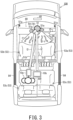
- Fig. 3 is a schematic view of the inside of the vehicle 100 provided with a communication-environment sending device 70 according to the first embodiment and the target in-vehicle devices 51 to 54, when viewed from the roof side.
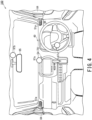
- Fig. 4 is a schematic view of the periphery of an inner panel 80 provided with the communication-environment sending device 70 according to the first embodiment.
- the remote controller 10 is a portable terminal (i.e., mobile terminal) 10a owned by a user 200, as exemplified by a smartphone shown in Fig. 2A and Fig. 2B .
- the remote controller 10 may also be a PC (Personal Computer), a wearable device, a public terminal, a specially designed and manufactured remote controller, and/or an in-vehicle operation terminal 10b installed around the rear seat 53c ( Fig. 3 ).
- the remote controller 10 includes a speaker 11, a microphone 12, a display 13, a memory 14, and processing circuitry 15 as shown in Fig. 1 .
- the memory 14 is configured as, for example, a ROM (Read Only Memory), a RAM (Random Access Memory), and/or an HDD (Hard Disk Drive).
- ROM Read Only Memory
- RAM Random Access Memory
- HDD Hard Disk Drive
- the processing circuitry 15 implements respective functions of a transmitter/receiver 17, an information receiver 18, a controller 19, and an input/output interface 20 by executing the programs stored in the memory 14.
- the transmitter/receiver 17 transmits an ultrasonic signal ⁇ , which controls the operation of the target in-vehicle devices 51 to 54, via the speaker 11.
- the speaker 11 may be an existing speaker provided for audio or may be a dedicated speaker separately provided for ultrasonic communication.
- the target in-vehicle devices 51 to 54 to be remotely controlled by this ultrasonic signal ⁇ are, for example, an air conditioner 51, a lighting device 52, a seat 53, and an IVI (In-Vehicle Infotainment) 54.
- the target in-vehicle devices are not particularly limited to the above aspects as long as they are electronically controllable in-vehicle accessories such as a locking mechanism of a door opening/closing lever, an in-vehicle camera, a conventional navigation system, and an audio device.
- the IVI 54 is, for example, a system that provides various functions such as a navigation function, a location information service function, a multimedia reproduction function of music and video, a voice communication function, a data communication function, and an Internet connection function in a complex manner.
- the IVI 54 will be described in detail in the description of the vehicle 100 described below.
- Each of the target in-vehicle devices 51 to 54 is connected by a communication network 90 in the vehicle such as a CAN (Controller Area Network) and a LIN (Local Interconnect Network).
- the IVI 54 is provided with an ultrasonic receiver 79, and the ultrasonic receiver 79 receives the ultrasonic signal ⁇ emitted by the remote controller 10.
- the IVI 54 serves as a repeater (i.e., relay device) so as to transmit an operation instruction to the target in-vehicle devices 51 to 54 via the communication network 90.
- the entire system may be configured such that each of the target in-vehicle devices 51 to 54 is provided with its own ultrasonic receiver 79 and is directly and remotely controlled by the remote controller 10 so as to exert its function.
- remote control for example, in the case of the multimedia playback function of the IVI 54, the functions of start, stop, volume increase/decrease, media reproduction, fast-forward or fast-rewind are executed.
- the target in-vehicle devices 51 to 54 constitute the IVI 54 and the microphone 72 of the IVI 54 capable of detecting the ultrasonic signal ⁇ is provided on the display 71, which is disposed between the driver's seat 53a and the passenger seat 53b on the inner panel 80, as shown in Fig. 3 and Fig. 4 .
- the command of ultrasonic communication may be acquired from a server 400 connected by the Internet 300.
- the entire system may be configured such that basic commands are provided by memories 14 and 73 of the respective devices 10 and 70 and additional commands are acquired from the server 400.
- the information receiver 18 detects information related to noise sound inside the vehicle 100 (hereinafter, referred to as "noise-related information").
- the noise-related information is information on disturbance that hinders ultrasonic communication and information on underlying causes of such disturbance, as exemplified by the traveling speed (i.e., velocity) of the vehicle 100, the traveling acceleration of the vehicle 100, the opening degree of the window 84, and the air-flow volume of the air conditioner 51.
- the conditioned air ⁇ to be sent from an air outlet 51a of the air conditioner 51 in Fig. 3 forms a temperature interface between the portable terminal 10a to be operated by the user 200 and the microphone 72 of the IVI 54 due to the temperature difference from the ambient air.
- the conditioned air ⁇ to be blown from the air outlet 51a of the front-seat air conditioner and the air outlet 51b of the rear-seat air conditioner flows between the IVI 54 and the portable terminal 10a held by the user 200 seated in the rear seat 53c.
- the ultrasonic signal ⁇ enters the temperature interface formed at the boundary between the conditioned air ⁇ and the ambient air, the ultrasonic signal ⁇ may be disturbed by reflection at the temperature interface, which may greatly affect ultrasonic communication.
- the information receiver 18 acquires the blowing sound in the vehicle 100 through the microphone 12 of the portable terminal 10a.
- operating noise of the air conditioner 51 is generated. For example, motor noise is generated.
- the conditioned air ⁇ flows out of the air outlets 51a and 51b, the conditioned air ⁇ generates sound of coming into contact with the fins of the air outlets 51a and 51b. Since this operating noise may include ultrasonic waves that cause disturbance in the frequency band to be used for the ultrasonic signal ⁇ , such operating noise is also included in the noise-related information.
- the information receiver 18 may directly acquire the ultrasonic waves included in the operating noise of the devices in the vehicle 100 as the noise-related information.
- the information receiver 18 may learn how to estimate ultrasonic waves from the operating sound by machine learning in advance, and thereby, the ultrasonic component can be estimated with high accuracy from the operating sound of the in-vehicle devices acquired by the existing microphone 12.
- the information receiver 18 learns the disturbance frequency range peculiar to the vehicle 100 in advance for ultrasonic communication, noise sound in the vehicle that seem to be unrelated at first glance can be included in the noise-related information.
- the information receiver 18 may determine the moving speed of the portable terminal 10a by the GPS function installed in the portable terminal 10a so as to determine the traveling mode of the vehicle 100. For example, the ultrasonic waves to be generated can be estimated for the respective cases where the vehicle 100 is traveling on the coast, the vehicle 100 is rapidly accelerating, and the vehicle 100 is traveling electrically.
- the controller 19 uses the acquired noise-related information to calculate degree of smoothness of wireless communication (i.e., probability of successfully transmitting the wireless signal to the receiving side in terms of disturbance factors, and hereinafter, referred to as a "propagability index") for the ultrasonic signal Q.
- degree of smoothness of wireless communication i.e., probability of successfully transmitting the wireless signal to the receiving side in terms of disturbance factors, and hereinafter, referred to as a "propagability index" for the ultrasonic signal Q.
- the controller 19 calculates the propagability index of the ultrasonic signal ⁇ from the acquired noise-related information. For example, when the blowing noise is loud, it can be estimated that the air circulation inside the vehicle is strong and the propagability index of the ultrasonic signal Q is low. When the ultrasonic wave contained in this blowing noise has a frequency far from the frequency of the ultrasonic signal Q, the influence on the propagability index is small.
- controller 19 also calculates intensity of disturbance to be generated by this operating sound in the ultrasonic-communication frequency band for the operating sound of the air conditioner 51, and the propagability index is calculated from this intensity.
- Ultrasonic waves can also be generated from, for example, the inflow and outflow of air due to opening of the window 84, the opening and closing noise of the window 84, and the switching noise to be generated from the driving source of the vehicle 100 and the battery. Since these noises may also interfere with ultrasonic communication, such noises are also included in the noise-related information.
- the display 13 is, for example, a touch panel having both of an input device for inputting data according to an operation of the user 200 and a display device such as a liquid crystal display device for displaying data.
- the operation page 21 of "IVI”, "air conditioner”, “lighting”, and “seat” are displayed on the display 13 in a switchable manner by the tab 22.
- Fig. 2A illustrates the operation page 21 for operating the air conditioner 51
- Fig. 2B illustrates the operation page 21 for operating the IVI 54
- the air conditioner 51 is adjusted by remote operation with the use of eight buttons 23a to 23h such as a circulation switching button 23a, an AUTO button 23b, an air-flow volume button 23c, and a compressor drive button 23d.
- buttons 24a to 24g such as the channel buttons 24a and 24b.
- the brightness adjustment and ON/OFF of the lighting device 52 are remotely controlled.
- the reclining angle adjustment and the front-rear position adjustment are remotely controlled.
- the display 13 displays the calculated propagability index as the communication quality level of the ultrasonic signal ⁇ , for example, on the status bar 27.
- the communication quality level is represented in four stages by the number of 0 to 3 arcs 28 as shown in Fig. 2A and Fig. 2B , for example.
- the display format of the communication quality level is not limited to the fan-shaped icon 31 in which the arcs 28 shown in Fig. 2A and Fig. 2B are arranged concentrically, and the communication quality level may be represented by, for example, the number of antenna bars or numbers.
- the display position of the communication quality level is not particularly limited to the status bar 27, and may be anywhere on the display screen 26 as long as the user 200 can visually recognize it.
- notification of specific actions for improving the propagability index may be executed for the user 200.
- the display 13 i.e., display screen 26
- the notification may be made by voice, and the notification aspect is not limited to a specific method.
- the user 200 can check the communication quality level on the remote controller 10 before or during the remote control and can grasp whether the ultrasonic communication can be used or not.
- the user When the user repeatedly uses the communication environment checking function, the user will be able to predict under what circumstances the ultrasonic communication will be difficult to use.
- sending device 70 which cooperates with the remote controller 10, and the vehicle 100 provided with this sending device 70 by referring to Fig. 3 and Fig. 4 in addition to Fig. 1 .
- the vehicle 100 is provided with a vehicle controller (i.e., ECU or Electronic Control Unit) 91, various sensors 92 to 96, the IVI 54, and the target in-vehicle devices 51 to 54.
- vehicle controller i.e., ECU or Electronic Control Unit
- These devices are interconnected by the above-described communication network 90 to exchange information.
- the ECU 91 is configured as a plurality of in-vehicle computers provided in various places in the vehicle 100, and has, for example, an engine control function, a handle control function, a brake control function, and a data security function.
- the ECU 91 for brake control receives information on the operation of the accelerator pedal and the brake pedal and the running speed via the pedal stroke sensor 93 and the vehicle speed sensor 92, converts the received information into a control signal, and applies driving force or braking force to the front wheels or the rear wheels by the control signal.
- the IVI 54 includes, for example, a touch panel display 71 having both of an input device for inputting data according to the operation of the user 200 and a display device such as a liquid crystal display device for displaying data.
- the IVI 54 includes an in-vehicle microphone 72, an in-vehicle memory 73, an in-vehicle speaker 74, and in-vehicle processing circuitry 75.
- the term "in-vehicle” is added to the beginning of each component name of the IVI 54 as required.
- the in-vehicle memory 73 is composed of, for example, a ROM, a RAM, or an HDD.
- the IVI 54 exerts various functions such as the above-described navigation function and location information service function.
- the plurality of air outlets 51a and 51b of the air conditioner 51 are provided in the vehicle 100 so as to be positioned appropriately with respect to the target to which the conditioned air ⁇ is sent.
- the air outlet 51a provided for the front seats 53a and 53b is near the display 71 of the IVI 54 while being far from the rear seats 53c.
- the conditioned air ⁇ is not sufficiently detected by the portable terminal 10a of the user 200 seated in the rear seat 53c.
- this conditioned air ⁇ forms a temperature interface near the IVI 54 and becomes a factor that hinders ultrasonic communication.
- the IVI 54 is preferably provided with a transmission function so as to serve as a sending device 70 configured to notify the remote controller 10 of the disturbance occurrence status that interferes with the ultrasonic communication in the vicinity of the IVI 54.
- the IVI 54 (70) further includes the functions of a detector 76, a positional information receiver 77, and a sender 78.
- the detector 76 receives the noise-related information from the ECU 91 and the various sensors 92 to 96 connected to the IVI 54 in the communication network 90.
- the detector 76 acquires the noise-related information in the vehicle from these connected devices 91 to 96.
- the information to be detected by the detector 76 is, for example, the traveling speed of the vehicle 100, the traveling acceleration of the vehicle 100, the driving state of the motor, the driving state of the engine, the opening degree of the window 84, and/or air-flow volume of the air conditioner.
- the vehicle parameter may be another physical quantity which is related to the vehicle 100 and is derived by combining the above-described parameters such as the traveling speed.
- the speed or acceleration to be detected by the detector 76 is detected via the vehicle speed sensor 92.
- the speed and acceleration may be acquired by the positional information receiver 77 via the GPS (Global Positioning System) sensor 96, which is a satellite positioning system.
- GPS Global Positioning System
- the detector 76 detects the opening degree of the window 84 via the window sensor 94 for the following reason.
- the window 84 is fully opened, the amount of air flowing into the vehicle is large, and it is considered that the disturbance affecting the ultrasonic signal ⁇ is also large.
- the sending device 70 may directly detect the noise that is actually being generated through the in-vehicle microphone 72, similarly to the portable terminal 10a.
- the sender 78 is provided in the vehicle and converts the noise-related information in the vehicle into the ultrasonic signal ⁇ (i.e., environmental notification signal) for environmental notification so as to send the ultrasonic signal Q to the remote controller 10.
- the ultrasonic signal ⁇ i.e., environmental notification signal
- the IVI 54 acquires the noise-related information in the vehicle, especially around the IVI 54 in this manner and includes the noise-related information in the transmission signal to notify the portable terminal 10a of the noise-related information.
- the controller 19 of the portable terminal 10a reflects the notified noise-related information in the display of the communication quality level.
- the communication form for notifying the noise-related information around the IVI 70 to be sent to the portable terminal 10a is ultrasonic communication, and in embodiments not forming part of the claimed invention wireless communication, or infrared communication.
- the sending device 70 does not have to be built into the IVI 54. As shown in Fig. 4 , the sending device 70 may be externally attached to the surface 97a of the IVI 54 or may be provided in the peripheral area 97b of the rearview mirror 85. Additionally or alternatively, the installation location of the sending device 70 may be on the handle97c, for example.
- the respective functions (17 to 20, 76 to 79) of the processing circuitry 15 and 75 of the remote controller 10 and the target in-vehicle devices 51 to 54 can be achieved by hardware processing such as an ASIC (Application Specific Integration Circuit) and an FPGA instead of software processing.
- ASIC Application Specific Integration Circuit
- the user 200 starts a remote-control application on the portable terminal 10a in order to start or tune the target in-vehicle devices 51 to 54.
- the operation page 21 for each of the target in-vehicle devices 51 to 54 shown in Fig. 2A and Fig. 2B is displayed on the display screen 26 of the portable terminal 10a.
- the portable terminal 10a sends the ultrasonic signal Q to the sending device 70 so as to notify that the remote-control application has been started.
- the information receiver 18 of the portable terminal 10a acquires the noise-related information in the steps S12 to S15.
- the execution order of the steps S12 to S15 is not limited to a specific order.
- the information receiver 18 acquires the noise sound in the vehicle 100 via the microphone 12 of the portable terminal 10a.
- the information receiver 18 detects the running state of the vehicle 100 by using the GPS function of the portable terminal 10a or via the respective sensors 92 to 96. At this time, the average speed may be used instead of acquiring the instantaneous speed of the vehicle 100.
- each window 84 and the operating state of the air conditioner 51 are detected from the microphone 12 in the steps S14 and S15.
- the opening degree of each window 84 and the operating state of the air conditioner 51 are both detected as noise sound. Since the outside air flowing into the vehicle and the conditioned air ⁇ blown from the air conditioner 51 are both characterized by their strength and frequency, the opening of the window 84 and the driving state of the air conditioner 51 can be identified and distinguished from each other by causing the processing circuitry 15 to learn their characteristics under machine learning in advance.
- the traveling direction of the vehicle 100 acquired by the GPS function and the generation direction of the noise sound may be used as elements for specifying the opening degree of the window 84 and the driving state of the air conditioner 51.
- the detection in the steps S12 to S15 may be performed by the sending device 70.
- the sending device 70 acquires the noise-related information when being notified that the remote-control application of the remote controller 10 has started.
- the microphone for acquiring the noise sound in the step S12 the in-vehicle microphone 72 provided in the sending device 70 is used as described above.
- the running state of the vehicle 100, the state of the window 84, and the operating state of the air conditioner 51 in the steps S13 to S15 are acquired through the communication network 90.
- the running state may be acquired by using the GPS sensor 96 instead of the vehicle speed sensor 92 or the pedal stroke sensor 93.
- the sending device 70 sends the above-described noise-related information to the portable terminal 10a by, for example, ultrasonic communication. Since the sending device 70 sends the noise-related information to the portable terminal 10a in this manner, the portable terminal 10a can calculate the propagability index more accurately.
- the user can check the communication quality level at the timing when trying to use remote-control with the portable terminal 10a.
- the timing of requesting the noise-related information from the sending device 70 is not limited to the above-described case, and may be automatically requested at regular intervals, for example.
- the controller 19 calculates the propagability index on the basis of the noise-related information in the step S16.
- the communication environment is bad and the sending device 70 cannot detect the activation of the remote-control application. In some cases, the sending device 70 cannot detect the ultrasonic signal ⁇ having been sent to the portable terminal 10a.
- the portable terminal 10a does not receive the ultrasonic signal ⁇ from the sending device 70 even after the remote-control application is started.
- the portable terminal 10a determines the communication environment to be bad and calculates the propagability index on the basis of this determination.
- the controller 19 displays the communication quality level on the status bar 27 of the display 13 with the icon 29 in the step S17 (END).
- the user 200 can check the communication environment of the ultrasonic communication.
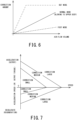
- Fig. 6 is a schematic diagram illustrating the relationship between air-flow volume and correction amount in the second embodiment.
- the controller 19 corrects the ultrasonic signal ⁇ transmitted from the remote controller 10.
- the correction amount to this ultrasonic signal ⁇ is changed depending on the acquired noise-related information.
- a plurality of air outlets 51a and 51b of the air conditioner 51 are provided in the vehicle 100.
- the blowing direction also differs depending on various modes such as a normal mode in which the air is blown to the upper body of the passenger, a FOOT mode, and a defroster mode (DEF mode).
- the influence of the conditioned air ⁇ on the ultrasonic communication depends on which mode is being executed during the ultrasonic communication. For example, in the FOOT mode, the conditioned air ⁇ flows near the floor in the vehicle to warm the passenger's feet. Hence, when the air conditioner 51 is operating in the FOOT mode, the influence of the blown air on the ultrasonic communication is small.
- the correction amount to the ultrasonic signal ⁇ is changed depending on the mode being executed.
- the sending device 70 installed in the peripheral area 97b of the rear-view mirror 85 in Fig. 4 has acquired information on the air-flow volume and the operation mode of the air conditioner 51 through the communication network 90.
- the operation mode is the FOOT mode
- the influence of the operation on the ultrasonic communication is not large.
- the correction amount of the ultrasonic signal ⁇ in the controller 19 is set small. That is, as shown in Fig. 6 , the increasing gradient of the correction amount to the ultrasonic signal Q with the increase of the air-flow volume is set to be different depending on each operation mode.
- Fig. 6 illustrates the relationship between the air-flow volume and the correction amount when the in-vehicle microphone 72 is provided at the upper portion of the vehicle interior.
- the function of the air-flow volume and the correction amount in each mode changes depending on the installation position of the sending device 70.
- the correction amount is appropriately determined depending on the distance between the microphone 72 of the sending device 70 and the air outlets 51a to 51c, and susceptibility (i.e., exposure) to the conditioned air ⁇ .
- the operating status of each of the in-vehicle devices acquired via the communication network 90 is added to the correction to the ultrasonic signal ⁇ in this manner, and thus, the communication quality can be improved by the effective correction.
- Fig. 7 is a map illustrating the relationship between speed acceleration, and correction amount.
- the map that defines the speed, acceleration, and correction amount shown in Fig. 7 is stored in the memory 14. This map specifies and defines the optimum correction amount for each speed and acceleration on the basis of the measurement results of the ultrasonic characteristics of the vehicle 100 for each speed and acceleration.
- the controller 19 determines the correction coefficient on the basis of the mapped correction amount, and corrects the ultrasonic signal ⁇ to be transmitted from the portable terminal 10a.
- the correction amount is also set to increase from “small” to “medium” to “large”.
- the correction amount of the negative acceleration area of the map is set to "medium” or “large” so as to correspond to the output of the motor.
- the noise-related information sent from the sending device 70 is usually included in the ultrasonic signal Q as a carrier wave, in some cases, it does not reach the remote controller 10 sufficiently due to the disturbance in the ultrasonic frequency band. In this case, the correction amount may be determined on the basis of the noise-related information received in the past few minutes.
- the second embodiment is the same as the first embodiment in terms of configuration and operation, and duplicate description is omitted.
- the remote controller 10 of the second embodiment in addition to that the effects of the first embodiment, correction can be performed depending on the noise environment. Hence, even if there is a disturbance in the vehicle, the communication quality of the ultrasonic signal ⁇ can be maintained at high quality.
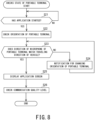
- Fig. 8 is a flowchart illustrating the operation of the remote controller 10 according to the third embodiment.
- the remote controller 10 When the controller 19 determines that the communication quality level is below a predetermined level and the remote controller 10 is not directed to the target in-vehicle devices 51 to 54, the remote controller 10 according to the third embodiment notifies the user of the instruction to direct the remote controller 10 toward the target in-vehicle devices 51 to 54. That is, when the IVI 54 serves as a repeater (i.e., relay device) for the other target in-vehicle devices 51-53, the portable terminal 10a notifies the user 200 of the instruction to direct the portable terminal 10a at the IVI 54.
- the IVI 54 serves as a repeater (i.e., relay device) for the other target in-vehicle devices 51-53
- the information receiver 18 determines whether the remote-control application has started or not. If the determination result is affirmative (YES in the step S21), the information receiver 18 checks the orientation of the portable terminal 10a in the step S22.
- the electronic compass installed in the portable terminal 10a is used.
- the speaker 11 of the portable terminal 10a is considered to face the front of the vehicle 100.
- the controller 19 checks whether the direction of the speaker 11 of the portable terminal 10a and the traveling direction of the vehicle 100 match or not.
- the target in-vehicle devices 51 to 54 are often placed in the front part of the vehicle interior. Even if they are installed in the rear seat 53c, they are disposed in front of the user 200 in the vehicle traveling direction. Thus, if the traveling direction of the vehicle 100 and the orientation of the portable terminal 10a match, it can be said that the direction of the portable terminal 10a is appropriate.
- the controller 19 notifies the user 200 that the orientation of the portable terminal 10a should be changed, by displaying instruction on the display 13 or by voice, for example.
- the user 200 changes the orientation of the portable terminal 10a in such a manner that a suitable communication state can be established.
- the components of the portable terminal 10a set for matching the traveling direction are not limited to the speaker 11 but also appropriate components such as the microphone 12 depending on the characteristics of the model.
- the controller 19 notifies the user 200 of the coincidence by displaying the operation page 21 on the display screen 26, for example.
- the display form in the step S25 may be a display form of prompting the user 200 to turn the portable terminal 10a in his/her hand into an appropriate direction by fixing a figure on the display screen 26 in a specific direction inside the vehicle such that the speaker 11 facing downward is turned upward.
- the user 200 can check the appropriate orientation of the portable terminal 10a and adjust the orientation with minimum attention.
- the communication quality level is displayed on the display screen 26 in the step S26 similarly to the first embodiment (END).
- the third embodiment is the same as the first embodiment in terms of configuration and operation, and duplicate description is omitted.
- the orientation adjustment is promoted and a suitable communication environment can be constructed before the user 200 remotely controls the target in-vehicle devices 51 to 54. Hence, the communication quality level can be improved.
- the propagability index is visualized, which allows the user to check the communication environment of the ultrasonic communication.
Landscapes
- Engineering & Computer Science (AREA)
- Computer Networks & Wireless Communication (AREA)
- Signal Processing (AREA)
- Physics & Mathematics (AREA)
- General Physics & Mathematics (AREA)
- Mechanical Engineering (AREA)
- Selective Calling Equipment (AREA)
- Fittings On The Vehicle Exterior For Carrying Loads, And Devices For Holding Or Mounting Articles (AREA)
- Traffic Control Systems (AREA)
Description
- Embodiments of the present invention relate to a quality checking technique for ultrasonic communication to be performed between an in-vehicle device and a control terminal.
- In recent years, technology has been developed for a driver in a traveling vehicle to remotely control in-vehicle devices such as an air conditioner and a navigation system with the use of a portable terminal or a remote controller (hereinafter, collectively referred to as a "control terminal"). Radio wave communication or infrared communication is often used as a means of the communication between the in-vehicle device and the control terminal, in addition to ultrasonic communication using ultrasonic waves.
- Patent Document 1 (
JP 2015-063284 A - Since ultrasonic waves are susceptible to radio disturbance due to disturbance factors such as environmental sound in the inaudible sound range (about 18 kHz or more) to be used for ultrasonic communication, the contents of ultrasonic communication may not be correctly received by the receiving terminal. For example, the sound of rubbing a vinyl bag contains a frequency component in the inaudible range, which is a factor that hinders ultrasonic communication.
- However, a user cannot perceive ultrasonic waves and the occurrence of such a disturbance, and thus, the user cannot know whether the system is in the state of being ready for use or not.
-
WO 2019/077594 A1 relates to a communication management and communicating between a communication device and another device using ultra-sonic signals, but does not disclose calculating and displaying a propagability index of an ultrasonic signal from the information related to noise sound inside a vehicle.US 2017/064747 A1 relates to a method of pairing vehicular terminal and user terminal by using beacon and vehicular terminal. - In view of the above-described circumstances, an object of the present invention is to provide a remote controller according to
claim 1, a communication-environment sending device according to claim 5, and a communication-environment check method according to claim 7. each of which enables a user to check communication environment of ultrasonic communication. - In the accompanying drawings:
-
Fig. 1 is a conceptual configuration diagram illustrating a vehicle in which the remote controller according to the first embodiment and target in-vehicle devices are installed; -
Fig. 2A and Fig. 2B are schematic diagrams illustrating a smartphone that is one aspect of the remote controller according to the first embodiment; -
Fig. 3 is a schematic view of the inside of the vehicle provided with the communication-environment sending device according to the first embodiment and the target in-vehicle devices, when viewed from the roof side; -
Fig. 4 is a schematic view of the periphery of an inner panel provided with the communication-environment sending device according to the first embodiment; -
Fig. 5 is a flowchart illustrating an operation procedure of the remote controller and the communication-environment sending device according to the first embodiment; -
Fig. 6 is a schematic diagram illustrating the relationship between air-flow volume and correction amount in the second embodiment; -
Fig. 7 is a map illustrating the relationship between speed and acceleration and correction amount in the second embodiment; and -
Fig. 8 is a flowchart illustrating the operation of the remote controller according to the third embodiment. - Hereinbelow, embodiments of the present invention will be described by referring to the accompanying drawings.
- First, a description will be given of a
remote controller 10 and in-vehicle devices vehicle devices 51 to 54"), which are operated by thisremote controller 10 with the use of an ultrasonic signal Ω, by referring toFig. 1 to Fig. 4 . -
Fig. 1 is a conceptual configuration diagram illustrating avehicle 100 in which theremote controller 10 according to the first embodiment and the target in-vehicle devices 51 to 54 are installed. -
Fig. 2A and Fig. 2B are schematic diagrams illustrating asmartphone 10a that is one aspect of theremote controller 10 according to the first embodiment. -
Fig. 3 is a schematic view of the inside of thevehicle 100 provided with a communication-environment sendingdevice 70 according to the first embodiment and the target in-vehicle devices 51 to 54, when viewed from the roof side. -
Fig. 4 is a schematic view of the periphery of aninner panel 80 provided with the communication-environment sendingdevice 70 according to the first embodiment. - The
remote controller 10 is a portable terminal (i.e., mobile terminal) 10a owned by auser 200, as exemplified by a smartphone shown inFig. 2A and Fig. 2B . Theremote controller 10 may also be a PC (Personal Computer), a wearable device, a public terminal, a specially designed and manufactured remote controller, and/or an in-vehicle operation terminal 10b installed around therear seat 53c (Fig. 3 ). - In the following embodiments, a description will be given of a case where the
portable terminal 10a is used as theremote controller 10 by installing an application program developed for remote control on theportable terminal 10a. - The
remote controller 10 includes aspeaker 11, amicrophone 12, adisplay 13, amemory 14, andprocessing circuitry 15 as shown inFig. 1 . - The
memory 14 is configured as, for example, a ROM (Read Only Memory), a RAM (Random Access Memory), and/or an HDD (Hard Disk Drive). - The
processing circuitry 15 implements respective functions of a transmitter/receiver 17, aninformation receiver 18, acontroller 19, and an input/output interface 20 by executing the programs stored in thememory 14. - The transmitter/
receiver 17 transmits an ultrasonic signal Ω, which controls the operation of the target in-vehicle devices 51 to 54, via thespeaker 11. Thespeaker 11 may be an existing speaker provided for audio or may be a dedicated speaker separately provided for ultrasonic communication. The target in-vehicle devices 51 to 54 to be remotely controlled by this ultrasonic signal Ω are, for example, anair conditioner 51, alighting device 52, aseat 53, and an IVI (In-Vehicle Infotainment) 54. The target in-vehicle devices are not particularly limited to the above aspects as long as they are electronically controllable in-vehicle accessories such as a locking mechanism of a door opening/closing lever, an in-vehicle camera, a conventional navigation system, and an audio device. - The IVI 54 is, for example, a system that provides various functions such as a navigation function, a location information service function, a multimedia reproduction function of music and video, a voice communication function, a data communication function, and an Internet connection function in a complex manner.
- The IVI 54 will be described in detail in the description of the
vehicle 100 described below. - Each of the target in-
vehicle devices 51 to 54 is connected by acommunication network 90 in the vehicle such as a CAN (Controller Area Network) and a LIN (Local Interconnect Network). For example, theIVI 54 is provided with anultrasonic receiver 79, and theultrasonic receiver 79 receives the ultrasonic signal Ω emitted by theremote controller 10. Further, theIVI 54 serves as a repeater (i.e., relay device) so as to transmit an operation instruction to the target in-vehicle devices 51 to 54 via thecommunication network 90. - The entire system may be configured such that each of the target in-
vehicle devices 51 to 54 is provided with its ownultrasonic receiver 79 and is directly and remotely controlled by theremote controller 10 so as to exert its function. In response to remote control, for example, in the case of the multimedia playback function of theIVI 54, the functions of start, stop, volume increase/decrease, media reproduction, fast-forward or fast-rewind are executed. - In the following, a description will be given of a case where the target in-
vehicle devices 51 to 54 constitute theIVI 54 and themicrophone 72 of theIVI 54 capable of detecting the ultrasonic signal Ω is provided on thedisplay 71, which is disposed between the driver'sseat 53a and thepassenger seat 53b on theinner panel 80, as shown inFig. 3 andFig. 4 . - The command of ultrasonic communication may be acquired from a
server 400 connected by the Internet 300. In addition, the entire system may be configured such that basic commands are provided bymemories respective devices server 400. - Returning to
Fig. 1 , description of the configuration of theremote controller 10 will be continued. - The
information receiver 18 detects information related to noise sound inside the vehicle 100 (hereinafter, referred to as "noise-related information"). - The noise-related information is information on disturbance that hinders ultrasonic communication and information on underlying causes of such disturbance, as exemplified by the traveling speed (i.e., velocity) of the
vehicle 100, the traveling acceleration of thevehicle 100, the opening degree of thewindow 84, and the air-flow volume of theair conditioner 51. - For example, the conditioned air σ to be sent from an
air outlet 51a of theair conditioner 51 inFig. 3 forms a temperature interface between theportable terminal 10a to be operated by theuser 200 and themicrophone 72 of the IVI 54 due to the temperature difference from the ambient air. - The conditioned air σ to be blown from the
air outlet 51a of the front-seat air conditioner and theair outlet 51b of the rear-seat air conditioner flows between the IVI 54 and theportable terminal 10a held by theuser 200 seated in therear seat 53c. When the ultrasonic signal Ω enters the temperature interface formed at the boundary between the conditioned air σ and the ambient air, the ultrasonic signal Ω may be disturbed by reflection at the temperature interface, which may greatly affect ultrasonic communication. - For this reason, the
information receiver 18 acquires the blowing sound in thevehicle 100 through themicrophone 12 of theportable terminal 10a. - Further, when the
air conditioner 51 is operated, operating noise of theair conditioner 51 is generated. For example, motor noise is generated. Further, when the conditioned air σ flows out of theair outlets air outlets information receiver 18 may directly acquire the ultrasonic waves included in the operating noise of the devices in thevehicle 100 as the noise-related information. - Even when the
microphone 12 of theremote controller 10 cannot perceive ultrasonic waves, theinformation receiver 18 may learn how to estimate ultrasonic waves from the operating sound by machine learning in advance, and thereby, the ultrasonic component can be estimated with high accuracy from the operating sound of the in-vehicle devices acquired by the existingmicrophone 12. In particular, when theinformation receiver 18 learns the disturbance frequency range peculiar to thevehicle 100 in advance for ultrasonic communication, noise sound in the vehicle that seem to be unrelated at first glance can be included in the noise-related information. - The
information receiver 18 may determine the moving speed of theportable terminal 10a by the GPS function installed in theportable terminal 10a so as to determine the traveling mode of thevehicle 100. For example, the ultrasonic waves to be generated can be estimated for the respective cases where thevehicle 100 is traveling on the coast, thevehicle 100 is rapidly accelerating, and thevehicle 100 is traveling electrically. - The
controller 19 uses the acquired noise-related information to calculate degree of smoothness of wireless communication (i.e., probability of successfully transmitting the wireless signal to the receiving side in terms of disturbance factors, and hereinafter, referred to as a "propagability index") for the ultrasonic signal Q. - The
controller 19 calculates the propagability index of the ultrasonic signal Ω from the acquired noise-related information. For example, when the blowing noise is loud, it can be estimated that the air circulation inside the vehicle is strong and the propagability index of the ultrasonic signal Q is low. When the ultrasonic wave contained in this blowing noise has a frequency far from the frequency of the ultrasonic signal Q, the influence on the propagability index is small. - In addition, the
controller 19 also calculates intensity of disturbance to be generated by this operating sound in the ultrasonic-communication frequency band for the operating sound of theair conditioner 51, and the propagability index is calculated from this intensity. - Ultrasonic waves can also be generated from, for example, the inflow and outflow of air due to opening of the
window 84, the opening and closing noise of thewindow 84, and the switching noise to be generated from the driving source of thevehicle 100 and the battery. Since these noises may also interfere with ultrasonic communication, such noises are also included in the noise-related information. - The
display 13 is, for example, a touch panel having both of an input device for inputting data according to an operation of theuser 200 and a display device such as a liquid crystal display device for displaying data. - As shown in
Fig. 2A and Fig. 2B , for example, theoperation page 21 of "IVI", "air conditioner", "lighting", and "seat" are displayed on thedisplay 13 in a switchable manner by thetab 22. - For example,
Fig. 2A illustrates theoperation page 21 for operating theair conditioner 51, andFig. 2B illustrates theoperation page 21 for operating theIVI 54. On theoperation page 21 of theair conditioner 51 inFig. 2A , theair conditioner 51 is adjusted by remote operation with the use of eightbuttons 23a to 23h such as acirculation switching button 23a, anAUTO button 23b, an air-flow volume button 23c, and acompressor drive button 23d. - When the
tab 22 of "IVI" is touched, the screen is switched to theoperation page 21 of theIVI 54 ofFig. 2B , and theIVI 54 is remotely controlled with the use ofvarious buttons 24a to 24g such as thechannel buttons - Although it is not shown, the brightness adjustment and ON/OFF of the
lighting device 52 are remotely controlled. For theseat 53, the reclining angle adjustment and the front-rear position adjustment are remotely controlled. - On the
status bar 27 at the upper end of the display 13 (i.e., display screen 26),various icons 31 indicating the remaining battery level of theportable terminal 10a and the state of the radio field strength for wireless communication are displayed. - In the
portable terminal 10a according to the first embodiment, thedisplay 13 displays the calculated propagability index as the communication quality level of the ultrasonic signal Ω, for example, on thestatus bar 27. - The communication quality level is represented in four stages by the number of 0 to 3 arcs 28 as shown in
Fig. 2A and Fig. 2B , for example. - When the communication environment of the ultrasonic signal Q is satisfactory and the propagability index is high, three
arcs 28 are displayed by theicon 31 as shown inFig. 2A . When the propagability index declines by one level from the state ofFig. 2A , twoarcs 28 are displayed as shown inFig. 2B . - The display format of the communication quality level is not limited to the fan-shaped
icon 31 in which thearcs 28 shown inFig. 2A and Fig. 2B are arranged concentrically, and the communication quality level may be represented by, for example, the number of antenna bars or numbers. - The display position of the communication quality level is not particularly limited to the
status bar 27, and may be anywhere on thedisplay screen 26 as long as theuser 200 can visually recognize it. - In accordance with the propagability index, notification of specific actions for improving the propagability index may be executed for the
user 200. In detail, the display 13 (i.e., display screen 26) may display instruction words such as "Please point the portable terminal toward the in-vehicle receiver" and/or "Please bring the portable terminal closer to the in-vehicle receiver". Instead of displaying the notification on thedisplay screen 26, the notification may be made by voice, and the notification aspect is not limited to a specific method. When the specific operation is notified in this manner, the user can grasp that the communication quality level is low and can also take specific measures to raise the communication quality level by himself/herself. - Since the
portable terminal 10a has such a communication environment checking function, theuser 200 can check the communication quality level on theremote controller 10 before or during the remote control and can grasp whether the ultrasonic communication can be used or not. - When the user repeatedly uses the communication environment checking function, the user will be able to predict under what circumstances the ultrasonic communication will be difficult to use.
- Next, a description will be given of the communication environment sending device 70 (hereinafter, simply referred to as "sending
device 70"), which cooperates with theremote controller 10, and thevehicle 100 provided with this sendingdevice 70 by referring toFig. 3 andFig. 4 in addition toFig. 1 . - The
vehicle 100 is provided with a vehicle controller (i.e., ECU or Electronic Control Unit) 91,various sensors 92 to 96, theIVI 54, and the target in-vehicle devices 51 to 54. - These devices (91 to 96) are interconnected by the above-described
communication network 90 to exchange information. - The
ECU 91 is configured as a plurality of in-vehicle computers provided in various places in thevehicle 100, and has, for example, an engine control function, a handle control function, a brake control function, and a data security function. For example, theECU 91 for brake control receives information on the operation of the accelerator pedal and the brake pedal and the running speed via thepedal stroke sensor 93 and thevehicle speed sensor 92, converts the received information into a control signal, and applies driving force or braking force to the front wheels or the rear wheels by the control signal. - The
IVI 54 includes, for example, atouch panel display 71 having both of an input device for inputting data according to the operation of theuser 200 and a display device such as a liquid crystal display device for displaying data. - In addition to the
touch panel display 71, theIVI 54 includes an in-vehicle microphone 72, an in-vehicle memory 73, an in-vehicle speaker 74, and in-vehicle processing circuitry 75. In the description of theIVI 54, in order to distinguish theIVI 54 from the components of theportable terminal 10a (i.e., thespeaker 11, themicrophone 12, thedisplay 13, thememory 14, and the processing circuitry 15), the term "in-vehicle" is added to the beginning of each component name of theIVI 54 as required. - The in-
vehicle memory 73 is composed of, for example, a ROM, a RAM, or an HDD. - When the in-
vehicle processing circuitry 75 executes and processes instructions on the basis of the programs stored in the in-vehicle memory 73, theIVI 54 exerts various functions such as the above-described navigation function and location information service function. - As described above, the plurality of
air outlets air conditioner 51 are provided in thevehicle 100 so as to be positioned appropriately with respect to the target to which the conditioned air σ is sent. - The
air outlet 51a provided for thefront seats display 71 of theIVI 54 while being far from therear seats 53c. Thus, even when the conditioned air σ is blown from theair outlet 51a, the conditioned air σ is not sufficiently detected by theportable terminal 10a of theuser 200 seated in therear seat 53c. However, even when it is not detected by theportable terminal 10a, this conditioned air σ forms a temperature interface near theIVI 54 and becomes a factor that hinders ultrasonic communication. - Thus, in order to make the communication environment checking function of the
portable terminal 10a more accurate, theIVI 54 is preferably provided with a transmission function so as to serve as a sendingdevice 70 configured to notify theremote controller 10 of the disturbance occurrence status that interferes with the ultrasonic communication in the vicinity of theIVI 54. - Specifically, the IVI 54 (70) further includes the functions of a
detector 76, apositional information receiver 77, and asender 78. - The
detector 76 receives the noise-related information from theECU 91 and thevarious sensors 92 to 96 connected to theIVI 54 in thecommunication network 90. - The
detector 76 acquires the noise-related information in the vehicle from these connecteddevices 91 to 96. - The information to be detected by the
detector 76 is, for example, the traveling speed of thevehicle 100, the traveling acceleration of thevehicle 100, the driving state of the motor, the driving state of the engine, the opening degree of thewindow 84, and/or air-flow volume of the air conditioner. Further, the vehicle parameter may be another physical quantity which is related to thevehicle 100 and is derived by combining the above-described parameters such as the traveling speed. - For example, the speed or acceleration to be detected by the
detector 76 is detected via thevehicle speed sensor 92. - The speed and acceleration may be acquired by the
positional information receiver 77 via the GPS (Global Positioning System)sensor 96, which is a satellite positioning system. - The
detector 76 detects the opening degree of thewindow 84 via thewindow sensor 94 for the following reason. When thewindow 84 is fully opened, the amount of air flowing into the vehicle is large, and it is considered that the disturbance affecting the ultrasonic signal Ω is also large. - Further, the sending
device 70 may directly detect the noise that is actually being generated through the in-vehicle microphone 72, similarly to theportable terminal 10a. - The
sender 78 is provided in the vehicle and converts the noise-related information in the vehicle into the ultrasonic signal Ω (i.e., environmental notification signal) for environmental notification so as to send the ultrasonic signal Q to theremote controller 10. - Since the noise reduces the quality of the ultrasonic signal Q, the
IVI 54 acquires the noise-related information in the vehicle, especially around theIVI 54 in this manner and includes the noise-related information in the transmission signal to notify theportable terminal 10a of the noise-related information. - The
controller 19 of theportable terminal 10a reflects the notified noise-related information in the display of the communication quality level. The communication form for notifying the noise-related information around theIVI 70 to be sent to theportable terminal 10a is ultrasonic communication, and in embodiments not forming part of the claimed invention wireless communication, or infrared communication. - The sending
device 70 does not have to be built into theIVI 54. As shown inFig. 4 , the sendingdevice 70 may be externally attached to thesurface 97a of theIVI 54 or may be provided in theperipheral area 97b of therearview mirror 85. Additionally or alternatively, the installation location of the sendingdevice 70 may be on the handle97c, for example. - The respective functions (17 to 20, 76 to 79) of the
processing circuitry remote controller 10 and the target in-vehicle devices 51 to 54 can be achieved by hardware processing such as an ASIC (Application Specific Integration Circuit) and an FPGA instead of software processing. - Further, these functions can be achieved by combining software processing and hardware processing.
- Next, a description will be given of the operation procedure of the
remote controller 10 and the sendingdevice 70 according to the first embodiment on the basis of the step number in the flowchart ofFig. 5 by referring toFig. 1 to Fig. 4 as required. - First, in the step S11, the
user 200 starts a remote-control application on theportable terminal 10a in order to start or tune the target in-vehicle devices 51 to 54. - When the remote-control application is started, the
operation page 21 for each of the target in-vehicle devices 51 to 54 shown inFig. 2A and Fig. 2B is displayed on thedisplay screen 26 of theportable terminal 10a. In the case of using the in-vehicle sending device 70, theportable terminal 10a sends the ultrasonic signal Q to the sendingdevice 70 so as to notify that the remote-control application has been started. - Next, the
information receiver 18 of theportable terminal 10a acquires the noise-related information in the steps S12 to S15. The execution order of the steps S12 to S15 is not limited to a specific order. - For example, in the step S12, the
information receiver 18 acquires the noise sound in thevehicle 100 via themicrophone 12 of theportable terminal 10a. - In the step S13, the
information receiver 18 detects the running state of thevehicle 100 by using the GPS function of theportable terminal 10a or via therespective sensors 92 to 96. At this time, the average speed may be used instead of acquiring the instantaneous speed of thevehicle 100. - Further, the opening degree of each
window 84 and the operating state of theair conditioner 51 are detected from themicrophone 12 in the steps S14 and S15. - In the
portable terminal 10a, the opening degree of eachwindow 84 and the operating state of theair conditioner 51 are both detected as noise sound. Since the outside air flowing into the vehicle and the conditioned air σ blown from theair conditioner 51 are both characterized by their strength and frequency, the opening of thewindow 84 and the driving state of theair conditioner 51 can be identified and distinguished from each other by causing theprocessing circuitry 15 to learn their characteristics under machine learning in advance. The traveling direction of thevehicle 100 acquired by the GPS function and the generation direction of the noise sound may be used as elements for specifying the opening degree of thewindow 84 and the driving state of theair conditioner 51. - The detection in the steps S12 to S15 may be performed by the sending
device 70. In this case, the sendingdevice 70 acquires the noise-related information when being notified that the remote-control application of theremote controller 10 has started. In this case, as the microphone for acquiring the noise sound in the step S12, the in-vehicle microphone 72 provided in the sendingdevice 70 is used as described above. - The running state of the
vehicle 100, the state of thewindow 84, and the operating state of theair conditioner 51 in the steps S13 to S15 are acquired through thecommunication network 90. The running state may be acquired by using theGPS sensor 96 instead of thevehicle speed sensor 92 or thepedal stroke sensor 93. - The sending
device 70 sends the above-described noise-related information to theportable terminal 10a by, for example, ultrasonic communication. Since the sendingdevice 70 sends the noise-related information to theportable terminal 10a in this manner, theportable terminal 10a can calculate the propagability index more accurately. - When transmission of the noise-related information from the sending
device 70 is requested each time theoperation page 21 of the remote-control application is activated, the user can check the communication quality level at the timing when trying to use remote-control with theportable terminal 10a. The timing of requesting the noise-related information from the sendingdevice 70 is not limited to the above-described case, and may be automatically requested at regular intervals, for example. - Next, the
controller 19 calculates the propagability index on the basis of the noise-related information in the step S16. - In some cases, the communication environment is bad and the sending
device 70 cannot detect the activation of the remote-control application. In some cases, the sendingdevice 70 cannot detect the ultrasonic signal Ω having been sent to theportable terminal 10a. - In both of these cases, the
portable terminal 10a does not receive the ultrasonic signal Ω from the sendingdevice 70 even after the remote-control application is started. When theportable terminal 10a does not receive the ultrasonic signal Ω from the sendingdevice 70 within a predetermined time, theportable terminal 10a determines the communication environment to be bad and calculates the propagability index on the basis of this determination. - The
controller 19 displays the communication quality level on thestatus bar 27 of thedisplay 13 with theicon 29 in the step S17 (END). - According to the
remote controller 10 of the first embodiment as described above, theuser 200 can check the communication environment of the ultrasonic communication. - When checking of the communication environment is repeated, the user will be able to predict under what circumstances the ultrasonic communication will be difficult to use.
-
Fig. 6 is a schematic diagram illustrating the relationship between air-flow volume and correction amount in the second embodiment. - In the
remote controller 10 according to the second embodiment, thecontroller 19 corrects the ultrasonic signal Ω transmitted from theremote controller 10. The correction amount to this ultrasonic signal Ω is changed depending on the acquired noise-related information. - As described in the first embodiment, a plurality of
air outlets air conditioner 51 are provided in thevehicle 100. The blowing direction also differs depending on various modes such as a normal mode in which the air is blown to the upper body of the passenger, a FOOT mode, and a defroster mode (DEF mode). - Thus, the influence of the conditioned air σ on the ultrasonic communication depends on which mode is being executed during the ultrasonic communication. For example, in the FOOT mode, the conditioned air σ flows near the floor in the vehicle to warm the passenger's feet. Hence, when the
air conditioner 51 is operating in the FOOT mode, the influence of the blown air on the ultrasonic communication is small. - Thus, for example, as shown in
Fig. 6 , the correction amount to the ultrasonic signal Ω is changed depending on the mode being executed. - For example, it is assumed that the sending
device 70 installed in theperipheral area 97b of the rear-view mirror 85 inFig. 4 has acquired information on the air-flow volume and the operation mode of theair conditioner 51 through thecommunication network 90. - Under this assumption, when the operation mode is the FOOT mode, it is considered that the influence of the operation on the ultrasonic communication is not large. Thus, even when the information that the air-flow volume of the
air conditioner 51 is large (i.e., strong) is received from the sendingdevice 70, the correction amount of the ultrasonic signal Ω in thecontroller 19 is set small. That is, as shown inFig. 6 , the increasing gradient of the correction amount to the ultrasonic signal Q with the increase of the air-flow volume is set to be different depending on each operation mode. -
Fig. 6 illustrates the relationship between the air-flow volume and the correction amount when the in-vehicle microphone 72 is provided at the upper portion of the vehicle interior. The function of the air-flow volume and the correction amount in each mode changes depending on the installation position of the sendingdevice 70. The correction amount is appropriately determined depending on the distance between themicrophone 72 of the sendingdevice 70 and theair outlets 51a to 51c, and susceptibility (i.e., exposure) to the conditioned air σ. - It is also preferred to change the correction amount depending on the opening degree of the
window 84 to be acquired from thewindow sensor 94. This is because the flow rate of the outside air flowing in from thewindow 84 largely depends on the opening degree of thewindow 84, and the outside air generates convection in the vehicle that has a great influence on the ultrasonic communication. - The operating status of each of the in-vehicle devices acquired via the
communication network 90 is added to the correction to the ultrasonic signal Ω in this manner, and thus, the communication quality can be improved by the effective correction. -
Fig. 7 is a map illustrating the relationship between speed acceleration, and correction amount. - In the second embodiment, the map that defines the speed, acceleration, and correction amount shown in
Fig. 7 is stored in thememory 14. This map specifies and defines the optimum correction amount for each speed and acceleration on the basis of the measurement results of the ultrasonic characteristics of thevehicle 100 for each speed and acceleration. - The
controller 19 determines the correction coefficient on the basis of the mapped correction amount, and corrects the ultrasonic signal Ω to be transmitted from theportable terminal 10a. - For example, when the
vehicle 100 is accelerating, the engine operates at a high output, and thus, it is considered that the ultrasonic intensity included in the combustion sound is strong as well as the combustion sound. Hence, as the acceleration is strengthened, the correction amount is also set to increase from "small" to "medium" to "large". - At the time of coasting, there is no combustion noise because the fuel is being cut, so it is considered that there is no influence from ultrasonic waves contained in the combustion noise. However, when the
vehicle 100 is a hybrid vehicle, a regenerative sound is generated by the electric motor at the time of coasting. The same applies to the regenerative sound for electric vehicles. - Thus, in consideration of the regenerative sound to be generated at the time of coasting and/or braking, the correction amount of the negative acceleration area of the map is set to "medium" or "large" so as to correspond to the output of the motor.
- Since the noise-related information sent from the sending
device 70 is usually included in the ultrasonic signal Q as a carrier wave, in some cases, it does not reach theremote controller 10 sufficiently due to the disturbance in the ultrasonic frequency band. In this case, the correction amount may be determined on the basis of the noise-related information received in the past few minutes. - Except for correcting the ultrasonic signal Ω and changing the correction amount on the basis of the noise-related information, the second embodiment is the same as the first embodiment in terms of configuration and operation, and duplicate description is omitted.
- According to the
remote controller 10 of the second embodiment as described above, in addition to that the effects of the first embodiment, correction can be performed depending on the noise environment. Hence, even if there is a disturbance in the vehicle, the communication quality of the ultrasonic signal Ω can be maintained at high quality. -
Fig. 8 is a flowchart illustrating the operation of theremote controller 10 according to the third embodiment. - When the
controller 19 determines that the communication quality level is below a predetermined level and theremote controller 10 is not directed to the target in-vehicle devices 51 to 54, theremote controller 10 according to the third embodiment notifies the user of the instruction to direct theremote controller 10 toward the target in-vehicle devices 51 to 54. That is, when theIVI 54 serves as a repeater (i.e., relay device) for the other target in-vehicle devices 51-53, theportable terminal 10a notifies theuser 200 of the instruction to direct theportable terminal 10a at theIVI 54. - The procedure will be described by referring to the flowchart of
Fig. 8 in detail. - First, the
information receiver 18 determines whether the remote-control application has started or not. If the determination result is affirmative (YES in the step S21), theinformation receiver 18 checks the orientation of theportable terminal 10a in the step S22. - For the checking of the orientation of the
portable terminal 10a, the electronic compass installed in theportable terminal 10a is used. When theuser 200 sits down and holds theportable terminal 10a in the orientation by which it can be correctly used, thespeaker 11 of theportable terminal 10a is considered to face the front of thevehicle 100. - Next, in the step S23, the
controller 19 checks whether the direction of thespeaker 11 of theportable terminal 10a and the traveling direction of thevehicle 100 match or not. - Since the direction of the
vehicle 100 matches the traveling direction of thevehicle 100, if the traveling direction and the orientation of theportable terminal 10a match (YES in the step S23), it can be estimated that theportable terminal 10a is facing forward in thevehicle 100. - Normally, the target in-
vehicle devices 51 to 54 are often placed in the front part of the vehicle interior. Even if they are installed in therear seat 53c, they are disposed in front of theuser 200 in the vehicle traveling direction. Thus, if the traveling direction of thevehicle 100 and the orientation of theportable terminal 10a match, it can be said that the direction of theportable terminal 10a is appropriate. - If the traveling direction and the orientation of the
portable terminal 10a do not match (NO in the step S23), it is determined that theportable terminal 10a is not directed toward the target in-vehicle devices 51 to 54. In this case, in the step S24, thecontroller 19 notifies theuser 200 that the orientation of theportable terminal 10a should be changed, by displaying instruction on thedisplay 13 or by voice, for example. Theuser 200 changes the orientation of theportable terminal 10a in such a manner that a suitable communication state can be established. - The components of the
portable terminal 10a set for matching the traveling direction are not limited to thespeaker 11 but also appropriate components such as themicrophone 12 depending on the characteristics of the model. - When the direction of the
microphone 12 of theportable terminal 10a and the traveling direction of thevehicle 100 coincide (YES in the step S23), in the step S25, thecontroller 19 notifies theuser 200 of the coincidence by displaying theoperation page 21 on thedisplay screen 26, for example. - In recent years,
many smartphones 10a are standardly provided with a function to change the display form such as the display direction and the aspect ratio at any time depending on how theuser 200 holds it. Such a technique may be applied to the display form in the step S25. For example, the display form in the step S25 may be a display form of prompting theuser 200 to turn theportable terminal 10a in his/her hand into an appropriate direction by fixing a figure on thedisplay screen 26 in a specific direction inside the vehicle such that thespeaker 11 facing downward is turned upward. With such a display mode, theuser 200 can check the appropriate orientation of theportable terminal 10a and adjust the orientation with minimum attention. - Further, the communication quality level is displayed on the
display screen 26 in the step S26 similarly to the first embodiment (END). - Except for prompting the user to match the traveling direction of the
vehicle 100 with the orientation of theportable terminal 10a, the third embodiment is the same as the first embodiment in terms of configuration and operation, and duplicate description is omitted. - According to the
remote controller 10 of the third embodiment as described above, in addition to the effects of the first embodiment, the orientation adjustment is promoted and a suitable communication environment can be constructed before theuser 200 remotely controls the target in-vehicle devices 51 to 54. Hence, the communication quality level can be improved. - According to the remote controller, the sending device, and the communication-environment check method of at least one embodiment described above, the propagability index is visualized, which allows the user to check the communication environment of the ultrasonic communication.
Claims (7)
- A remote controller (10) comprising:a speaker (11) configured to send an ultrasonic signal that controls an action of an in-vehicle device;an information receiver (18) configured to detect information related to noise sound inside the vehicle;a controller (19) configured to calculate a propagability index of the ultrasonic signal from the information related to noise sound; anda display (13) configured to display the propagability index as communication quality level of the ultrasonic signal.
- The remote controller (10) according to claim 1, wherein the information related to noise sound is at least one of traveling speed of the vehicle, traveling acceleration of the vehicle, opening degree of a window, and air-flow volume of an air conditioner.
- The remote controller (10) according to claim 1 or claim 2, wherein:the information receiver (18) is configured to detect output of an in-vehicle motor; andthe controller (19) is configured to change correction amount of the ultrasonic signal depending on the output of the in-vehicle motor.
- The remote controller (10) according to claim 1,
wherein the controller (19) is configured to output an instruction to direct the remote controller toward the in-vehicle device, when the communication quality level is equal to or lower than a predetermined level and the remote controller is not directed toward the in-vehicle device. - A communication-environment sending device (70) comprising:a detector (76) that is provided in a vehicle (100) and is configured to acquire information related to noise sound in the vehicle; anda sender (78) that is provided in the vehicle and is configured to convert the information related to noise sound in the vehicle into an ultrasonic environmental notification signal, send the ultrasonic environmental notification signal to a remote controller (10) according to any of claims 1-4 and disposed in the vehicle.
- The communication-environment sending device (70) according to claim 5, wherein the information related to noise sound is at least one of traveling speed of the vehicle (100), traveling acceleration of the vehicle, opening degree of a window, and air-flow volume of an air conditioner.
- A communication-environment check method that controls an action of an in-vehicle device by an ultrasonic signal, the communication-environment check method comprising:controlling an action of an in-vehicle device by an ultrasonic signal with a remote controller according to any of claims 1-4;receiving information related to noise sound in the vehicle by the remote controller;calculating (S16), by the controller of the remote controller, a propagability index of the ultrasonic signal from the information related to noise sound; anddisplaying (S17) , by the display of the remote controller, the propagability index as a communication quality level of the ultrasonic signal.
Applications Claiming Priority (1)
| Application Number | Priority Date | Filing Date | Title |
|---|---|---|---|
| JP2020212383A JP7619040B2 (en) | 2020-12-22 | 2020-12-22 | Remote control device, communication environment transmission device, and communication environment confirmation program |
Publications (2)
| Publication Number | Publication Date |
|---|---|
| EP4020850A1 EP4020850A1 (en) | 2022-06-29 |
| EP4020850B1 true EP4020850B1 (en) | 2024-08-21 |
Family
ID=78293844
Family Applications (1)
| Application Number | Title | Priority Date | Filing Date |
|---|---|---|---|
| EP21197317.7A Active EP4020850B1 (en) | 2020-12-22 | 2021-09-17 | Remote controller, communication-environment sending device, and communication-environment check method |
Country Status (3)
| Country | Link |
|---|---|
| EP (1) | EP4020850B1 (en) |
| JP (1) | JP7619040B2 (en) |
| HU (1) | HUE068960T2 (en) |
Families Citing this family (1)
| Publication number | Priority date | Publication date | Assignee | Title |
|---|---|---|---|---|
| KR20250037315A (en) * | 2023-09-08 | 2025-03-17 | 상하이 토선 테크놀로지 리미티드 | Method, server, request unit, and response unit for multi-region cooperative remote calibration of vehicle |
Family Cites Families (9)
| Publication number | Priority date | Publication date | Assignee | Title |
|---|---|---|---|---|
| JP2001078276A (en) | 1999-09-07 | 2001-03-23 | Mitsubishi Electric Corp | Remote control device |
| JP2003324498A (en) | 2002-05-08 | 2003-11-14 | Chuo Spring Co Ltd | Wireless transmitting / receiving system and opening / closing device for building opening |
| JP2004336261A (en) | 2003-05-06 | 2004-11-25 | Funai Electric Co Ltd | Remote control system, and disk device |
| JP5846042B2 (en) | 2012-05-16 | 2016-01-20 | 株式会社デンソー | Remote engine starter and in-vehicle device |
| US20150243163A1 (en) * | 2012-12-14 | 2015-08-27 | Biscotti Inc. | Audio Based Remote Control Functionality |
| JP6079532B2 (en) | 2013-09-26 | 2017-02-15 | トヨタ自動車株式会社 | Vehicle authentication device |
| KR101675364B1 (en) * | 2015-05-21 | 2016-11-22 | 주식회사 엠투브 | Pairing method with obd terminal for vehicle using beacon and the obd terminal for vehicle |
| JP6794722B2 (en) | 2016-08-31 | 2020-12-02 | ヤマハ株式会社 | Vehicle interior sound environment notification device and vehicle interior sound environment notification method |
| EP3698491A4 (en) | 2017-10-16 | 2021-06-02 | Sonular Ltd. | Communication management and communicating between a communication device and another device |
-
2020
- 2020-12-22 JP JP2020212383A patent/JP7619040B2/en active Active
-
2021
- 2021-09-17 HU HUE21197317A patent/HUE068960T2/en unknown
- 2021-09-17 EP EP21197317.7A patent/EP4020850B1/en active Active
Also Published As
| Publication number | Publication date |
|---|---|
| EP4020850A1 (en) | 2022-06-29 |
| JP7619040B2 (en) | 2025-01-22 |
| JP2022098789A (en) | 2022-07-04 |
| HUE068960T2 (en) | 2025-02-28 |
Similar Documents
| Publication | Publication Date | Title |
|---|---|---|
| US9327645B2 (en) | Providing alerts for objects left in a vehicle | |
| KR102931644B1 (en) | Voice control of vehicle systems | |
| US20180170231A1 (en) | Systems and methods for providng customized and adaptive massaging in vehicle seats | |
| US20110106375A1 (en) | Method and system for providing an integrated platform for entertainment, information, communication, control and computing applications in vehicles | |
| US20140195125A1 (en) | Motor vehicle | |
| US20180226077A1 (en) | Vehicle driving assist and vehicle having same | |
| US20130090932A1 (en) | Vehicular apparatus | |
| US20140323039A1 (en) | Method and apparatus for controlling vehicle communication | |
| JP2008255753A (en) | In-vehicle voice guidance device | |
| US10977505B2 (en) | Occupant monitoring device for vehicle | |
| KR20190050002A (en) | Remote control device and vehicle including the same | |
| US11999294B2 (en) | Vehicle and control method thereof | |
| EP4020850A1 (en) | Remote controller, communication-environment sending device, and communication-environment check method | |
| CN116061877A (en) | Vehicle passive entry system, handheld terminal and vehicle control system | |
| US20080082231A1 (en) | Data setting change apparatus, navigation apparatus and data setting change system | |
| JP7702789B2 (en) | Information processing device, information processing method, and program | |
| EP4020852B1 (en) | Remote controller, communication-environment sending device, communication-environment check method, and communication-environment sending method | |
| JP2009220810A (en) | Information providing system for automobile | |
| EP4020851B1 (en) | Remote controller | |
| CN108674344A (en) | Speech processing system based on steering wheel and its application | |
| TWI394931B (en) | Control method of starting navigation positioning system and electronic appartus using the same | |
| JP4245160B2 (en) | Vehicle door opening position control device | |
| JP2009126465A (en) | Electronic control unit cooling system | |
| JP4581767B2 (en) | Communication device | |
| KR20140128807A (en) | An method for configuring of a vehichle and an appratus using it |
Legal Events
| Date | Code | Title | Description |
|---|---|---|---|
| PUAI | Public reference made under article 153(3) epc to a published international application that has entered the european phase |
Free format text: ORIGINAL CODE: 0009012 |
|
| STAA | Information on the status of an ep patent application or granted ep patent |
Free format text: STATUS: REQUEST FOR EXAMINATION WAS MADE |
|
| 17P | Request for examination filed |
Effective date: 20211015 |
|
| AK | Designated contracting states |
Kind code of ref document: A1 Designated state(s): AL AT BE BG CH CY CZ DE DK EE ES FI FR GB GR HR HU IE IS IT LI LT LU LV MC MK MT NL NO PL PT RO RS SE SI SK SM TR |
|
| STAA | Information on the status of an ep patent application or granted ep patent |
Free format text: STATUS: EXAMINATION IS IN PROGRESS |
|
| 17Q | First examination report despatched |
Effective date: 20230602 |
|
| GRAP | Despatch of communication of intention to grant a patent |
Free format text: ORIGINAL CODE: EPIDOSNIGR1 |
|
| STAA | Information on the status of an ep patent application or granted ep patent |
Free format text: STATUS: GRANT OF PATENT IS INTENDED |
|
| INTG | Intention to grant announced |
Effective date: 20240606 |
|
| GRAS | Grant fee paid |
Free format text: ORIGINAL CODE: EPIDOSNIGR3 |
|
| GRAA | (expected) grant |
Free format text: ORIGINAL CODE: 0009210 |
|
| STAA | Information on the status of an ep patent application or granted ep patent |
Free format text: STATUS: THE PATENT HAS BEEN GRANTED |
|
| AK | Designated contracting states |
Kind code of ref document: B1 Designated state(s): AL AT BE BG CH CY CZ DE DK EE ES FI FR GB GR HR HU IE IS IT LI LT LU LV MC MK MT NL NO PL PT RO RS SE SI SK SM TR |
|
| REG | Reference to a national code |
Ref country code: GB Ref legal event code: FG4D |
|
| REG | Reference to a national code |
Ref country code: CH Ref legal event code: EP |
|
| REG | Reference to a national code |
Ref country code: IE Ref legal event code: FG4D |
|
| REG | Reference to a national code |
Ref country code: DE Ref legal event code: R096 Ref document number: 602021017440 Country of ref document: DE |
|
| REG | Reference to a national code |
Ref country code: LT Ref legal event code: MG9D |
|
| REG | Reference to a national code |
Ref country code: NL Ref legal event code: MP Effective date: 20240821 |
|
| PG25 | Lapsed in a contracting state [announced via postgrant information from national office to epo] |
Ref country code: NO Free format text: LAPSE BECAUSE OF FAILURE TO SUBMIT A TRANSLATION OF THE DESCRIPTION OR TO PAY THE FEE WITHIN THE PRESCRIBED TIME-LIMIT Effective date: 20241121 |
|
| REG | Reference to a national code |
Ref country code: AT Ref legal event code: MK05 Ref document number: 1716549 Country of ref document: AT Kind code of ref document: T Effective date: 20240821 |
|
| PG25 | Lapsed in a contracting state [announced via postgrant information from national office to epo] |
Ref country code: NL Free format text: LAPSE BECAUSE OF FAILURE TO SUBMIT A TRANSLATION OF THE DESCRIPTION OR TO PAY THE FEE WITHIN THE PRESCRIBED TIME-LIMIT Effective date: 20240821 Ref country code: PT Free format text: LAPSE BECAUSE OF FAILURE TO SUBMIT A TRANSLATION OF THE DESCRIPTION OR TO PAY THE FEE WITHIN THE PRESCRIBED TIME-LIMIT Effective date: 20241223 Ref country code: PL Free format text: LAPSE BECAUSE OF FAILURE TO SUBMIT A TRANSLATION OF THE DESCRIPTION OR TO PAY THE FEE WITHIN THE PRESCRIBED TIME-LIMIT Effective date: 20240821 Ref country code: FI Free format text: LAPSE BECAUSE OF FAILURE TO SUBMIT A TRANSLATION OF THE DESCRIPTION OR TO PAY THE FEE WITHIN THE PRESCRIBED TIME-LIMIT Effective date: 20240821 Ref country code: GR Free format text: LAPSE BECAUSE OF FAILURE TO SUBMIT A TRANSLATION OF THE DESCRIPTION OR TO PAY THE FEE WITHIN THE PRESCRIBED TIME-LIMIT Effective date: 20241122 |
|
| PG25 | Lapsed in a contracting state [announced via postgrant information from national office to epo] |
Ref country code: BG Free format text: LAPSE BECAUSE OF FAILURE TO SUBMIT A TRANSLATION OF THE DESCRIPTION OR TO PAY THE FEE WITHIN THE PRESCRIBED TIME-LIMIT Effective date: 20240821 |
|
| PG25 | Lapsed in a contracting state [announced via postgrant information from national office to epo] |
Ref country code: LV Free format text: LAPSE BECAUSE OF FAILURE TO SUBMIT A TRANSLATION OF THE DESCRIPTION OR TO PAY THE FEE WITHIN THE PRESCRIBED TIME-LIMIT Effective date: 20240821 |
|
| PG25 | Lapsed in a contracting state [announced via postgrant information from national office to epo] |
Ref country code: AT Free format text: LAPSE BECAUSE OF FAILURE TO SUBMIT A TRANSLATION OF THE DESCRIPTION OR TO PAY THE FEE WITHIN THE PRESCRIBED TIME-LIMIT Effective date: 20240821 Ref country code: IS Free format text: LAPSE BECAUSE OF FAILURE TO SUBMIT A TRANSLATION OF THE DESCRIPTION OR TO PAY THE FEE WITHIN THE PRESCRIBED TIME-LIMIT Effective date: 20241221 |
|
| PG25 | Lapsed in a contracting state [announced via postgrant information from national office to epo] |
Ref country code: HR Free format text: LAPSE BECAUSE OF FAILURE TO SUBMIT A TRANSLATION OF THE DESCRIPTION OR TO PAY THE FEE WITHIN THE PRESCRIBED TIME-LIMIT Effective date: 20240821 |
|
| PG25 | Lapsed in a contracting state [announced via postgrant information from national office to epo] |
Ref country code: RS Free format text: LAPSE BECAUSE OF FAILURE TO SUBMIT A TRANSLATION OF THE DESCRIPTION OR TO PAY THE FEE WITHIN THE PRESCRIBED TIME-LIMIT Effective date: 20241121 Ref country code: ES Free format text: LAPSE BECAUSE OF FAILURE TO SUBMIT A TRANSLATION OF THE DESCRIPTION OR TO PAY THE FEE WITHIN THE PRESCRIBED TIME-LIMIT Effective date: 20240821 |
|
| PG25 | Lapsed in a contracting state [announced via postgrant information from national office to epo] |
Ref country code: RS Free format text: LAPSE BECAUSE OF FAILURE TO SUBMIT A TRANSLATION OF THE DESCRIPTION OR TO PAY THE FEE WITHIN THE PRESCRIBED TIME-LIMIT Effective date: 20241121 Ref country code: PT Free format text: LAPSE BECAUSE OF FAILURE TO SUBMIT A TRANSLATION OF THE DESCRIPTION OR TO PAY THE FEE WITHIN THE PRESCRIBED TIME-LIMIT Effective date: 20241223 Ref country code: PL Free format text: LAPSE BECAUSE OF FAILURE TO SUBMIT A TRANSLATION OF THE DESCRIPTION OR TO PAY THE FEE WITHIN THE PRESCRIBED TIME-LIMIT Effective date: 20240821 Ref country code: NO Free format text: LAPSE BECAUSE OF FAILURE TO SUBMIT A TRANSLATION OF THE DESCRIPTION OR TO PAY THE FEE WITHIN THE PRESCRIBED TIME-LIMIT Effective date: 20241121 Ref country code: NL Free format text: LAPSE BECAUSE OF FAILURE TO SUBMIT A TRANSLATION OF THE DESCRIPTION OR TO PAY THE FEE WITHIN THE PRESCRIBED TIME-LIMIT Effective date: 20240821 Ref country code: LV Free format text: LAPSE BECAUSE OF FAILURE TO SUBMIT A TRANSLATION OF THE DESCRIPTION OR TO PAY THE FEE WITHIN THE PRESCRIBED TIME-LIMIT Effective date: 20240821 Ref country code: IS Free format text: LAPSE BECAUSE OF FAILURE TO SUBMIT A TRANSLATION OF THE DESCRIPTION OR TO PAY THE FEE WITHIN THE PRESCRIBED TIME-LIMIT Effective date: 20241221 Ref country code: HR Free format text: LAPSE BECAUSE OF FAILURE TO SUBMIT A TRANSLATION OF THE DESCRIPTION OR TO PAY THE FEE WITHIN THE PRESCRIBED TIME-LIMIT Effective date: 20240821 Ref country code: GR Free format text: LAPSE BECAUSE OF FAILURE TO SUBMIT A TRANSLATION OF THE DESCRIPTION OR TO PAY THE FEE WITHIN THE PRESCRIBED TIME-LIMIT Effective date: 20241122 Ref country code: FI Free format text: LAPSE BECAUSE OF FAILURE TO SUBMIT A TRANSLATION OF THE DESCRIPTION OR TO PAY THE FEE WITHIN THE PRESCRIBED TIME-LIMIT Effective date: 20240821 Ref country code: ES Free format text: LAPSE BECAUSE OF FAILURE TO SUBMIT A TRANSLATION OF THE DESCRIPTION OR TO PAY THE FEE WITHIN THE PRESCRIBED TIME-LIMIT Effective date: 20240821 Ref country code: BG Free format text: LAPSE BECAUSE OF FAILURE TO SUBMIT A TRANSLATION OF THE DESCRIPTION OR TO PAY THE FEE WITHIN THE PRESCRIBED TIME-LIMIT Effective date: 20240821 Ref country code: AT Free format text: LAPSE BECAUSE OF FAILURE TO SUBMIT A TRANSLATION OF THE DESCRIPTION OR TO PAY THE FEE WITHIN THE PRESCRIBED TIME-LIMIT Effective date: 20240821 |
|
| REG | Reference to a national code |
Ref country code: HU Ref legal event code: AG4A Ref document number: E068960 Country of ref document: HU |
|
| PG25 | Lapsed in a contracting state [announced via postgrant information from national office to epo] |
Ref country code: SM Free format text: LAPSE BECAUSE OF FAILURE TO SUBMIT A TRANSLATION OF THE DESCRIPTION OR TO PAY THE FEE WITHIN THE PRESCRIBED TIME-LIMIT Effective date: 20240821 Ref country code: RO Free format text: LAPSE BECAUSE OF FAILURE TO SUBMIT A TRANSLATION OF THE DESCRIPTION OR TO PAY THE FEE WITHIN THE PRESCRIBED TIME-LIMIT Effective date: 20240821 Ref country code: DK Free format text: LAPSE BECAUSE OF FAILURE TO SUBMIT A TRANSLATION OF THE DESCRIPTION OR TO PAY THE FEE WITHIN THE PRESCRIBED TIME-LIMIT Effective date: 20240821 |
|
| PG25 | Lapsed in a contracting state [announced via postgrant information from national office to epo] |
Ref country code: EE Free format text: LAPSE BECAUSE OF FAILURE TO SUBMIT A TRANSLATION OF THE DESCRIPTION OR TO PAY THE FEE WITHIN THE PRESCRIBED TIME-LIMIT Effective date: 20240821 |
|
| PG25 | Lapsed in a contracting state [announced via postgrant information from national office to epo] |
Ref country code: CZ Free format text: LAPSE BECAUSE OF FAILURE TO SUBMIT A TRANSLATION OF THE DESCRIPTION OR TO PAY THE FEE WITHIN THE PRESCRIBED TIME-LIMIT Effective date: 20240821 |
|
| PG25 | Lapsed in a contracting state [announced via postgrant information from national office to epo] |
Ref country code: IT Free format text: LAPSE BECAUSE OF FAILURE TO SUBMIT A TRANSLATION OF THE DESCRIPTION OR TO PAY THE FEE WITHIN THE PRESCRIBED TIME-LIMIT Effective date: 20240821 Ref country code: SK Free format text: LAPSE BECAUSE OF FAILURE TO SUBMIT A TRANSLATION OF THE DESCRIPTION OR TO PAY THE FEE WITHIN THE PRESCRIBED TIME-LIMIT Effective date: 20240821 |
|
| REG | Reference to a national code |
Ref country code: CH Ref legal event code: PL |
|
| PG25 | Lapsed in a contracting state [announced via postgrant information from national office to epo] |
Ref country code: LU Free format text: LAPSE BECAUSE OF NON-PAYMENT OF DUE FEES Effective date: 20240917 |
|
| REG | Reference to a national code |
Ref country code: DE Ref legal event code: R097 Ref document number: 602021017440 Country of ref document: DE |
|
| PLBE | No opposition filed within time limit |
Free format text: ORIGINAL CODE: 0009261 |
|
| STAA | Information on the status of an ep patent application or granted ep patent |
Free format text: STATUS: NO OPPOSITION FILED WITHIN TIME LIMIT |
|
| PG25 | Lapsed in a contracting state [announced via postgrant information from national office to epo] |
Ref country code: MC Free format text: LAPSE BECAUSE OF FAILURE TO SUBMIT A TRANSLATION OF THE DESCRIPTION OR TO PAY THE FEE WITHIN THE PRESCRIBED TIME-LIMIT Effective date: 20240821 |
|
| REG | Reference to a national code |
Ref country code: BE Ref legal event code: MM Effective date: 20240930 |
|
| PG25 | Lapsed in a contracting state [announced via postgrant information from national office to epo] |
Ref country code: BE Free format text: LAPSE BECAUSE OF NON-PAYMENT OF DUE FEES Effective date: 20240930 |
|
| PG25 | Lapsed in a contracting state [announced via postgrant information from national office to epo] |
Ref country code: CH Free format text: LAPSE BECAUSE OF NON-PAYMENT OF DUE FEES Effective date: 20240930 |
|
| PG25 | Lapsed in a contracting state [announced via postgrant information from national office to epo] |
Ref country code: IE Free format text: LAPSE BECAUSE OF NON-PAYMENT OF DUE FEES Effective date: 20240917 |
|
| 26N | No opposition filed |
Effective date: 20250522 |
|
| PG25 | Lapsed in a contracting state [announced via postgrant information from national office to epo] |
Ref country code: SE Free format text: LAPSE BECAUSE OF FAILURE TO SUBMIT A TRANSLATION OF THE DESCRIPTION OR TO PAY THE FEE WITHIN THE PRESCRIBED TIME-LIMIT Effective date: 20240821 |
|
| PGFP | Annual fee paid to national office [announced via postgrant information from national office to epo] |
Ref country code: DE Payment date: 20250730 Year of fee payment: 5 |
|
| PGFP | Annual fee paid to national office [announced via postgrant information from national office to epo] |
Ref country code: HU Payment date: 20250828 Year of fee payment: 5 |
|
| PGFP | Annual fee paid to national office [announced via postgrant information from national office to epo] |
Ref country code: FR Payment date: 20250808 Year of fee payment: 5 |
|
| PG25 | Lapsed in a contracting state [announced via postgrant information from national office to epo] |
Ref country code: CY Free format text: LAPSE BECAUSE OF FAILURE TO SUBMIT A TRANSLATION OF THE DESCRIPTION OR TO PAY THE FEE WITHIN THE PRESCRIBED TIME-LIMIT; INVALID AB INITIO Effective date: 20210917 |