EP4020756B1 - Power management for applications having duty-cycled high peak supply currents - Google Patents
Power management for applications having duty-cycled high peak supply currents Download PDFInfo
- Publication number
- EP4020756B1 EP4020756B1 EP21212238.6A EP21212238A EP4020756B1 EP 4020756 B1 EP4020756 B1 EP 4020756B1 EP 21212238 A EP21212238 A EP 21212238A EP 4020756 B1 EP4020756 B1 EP 4020756B1
- Authority
- EP
- European Patent Office
- Prior art keywords
- current
- voltage
- buffer capacitor
- battery
- current limiter
- Prior art date
- Legal status (The legal status is an assumption and is not a legal conclusion. Google has not performed a legal analysis and makes no representation as to the accuracy of the status listed.)
- Active
Links
Images





Classifications
-
- H—ELECTRICITY
- H02—GENERATION; CONVERSION OR DISTRIBUTION OF ELECTRIC POWER
- H02J—ELECTRIC POWER NETWORKS; CIRCUIT ARRANGEMENTS OR SYSTEMS FOR SUPPLYING OR DISTRIBUTING ELECTRIC POWER; SYSTEMS FOR STORING ELECTRIC ENERGY
- H02J7/00—Circuit arrangements for charging or discharging batteries or for supplying loads from batteries
- H02J7/34—Parallel operation in networks using both storage and other DC sources, e.g. providing buffering
- H02J7/345—Parallel operation in networks using both storage and other DC sources, e.g. providing buffering using capacitors as storage or buffering devices
-
- H—ELECTRICITY
- H02—GENERATION; CONVERSION OR DISTRIBUTION OF ELECTRIC POWER
- H02J—ELECTRIC POWER NETWORKS; CIRCUIT ARRANGEMENTS OR SYSTEMS FOR SUPPLYING OR DISTRIBUTING ELECTRIC POWER; SYSTEMS FOR STORING ELECTRIC ENERGY
- H02J7/00—Circuit arrangements for charging or discharging batteries or for supplying loads from batteries
- H02J7/90—Regulation of charging or discharging current or voltage
- H02J7/933—Regulation of charging or discharging current or voltage the cycle being controlled or terminated in response to electric parameters
-
- H—ELECTRICITY
- H02—GENERATION; CONVERSION OR DISTRIBUTION OF ELECTRIC POWER
- H02J—ELECTRIC POWER NETWORKS; CIRCUIT ARRANGEMENTS OR SYSTEMS FOR SUPPLYING OR DISTRIBUTING ELECTRIC POWER; SYSTEMS FOR STORING ELECTRIC ENERGY
- H02J7/00—Circuit arrangements for charging or discharging batteries or for supplying loads from batteries
- H02J7/60—Circuit arrangements for charging or discharging batteries or for supplying loads from batteries including safety or protection arrangements
-
- H—ELECTRICITY
- H02—GENERATION; CONVERSION OR DISTRIBUTION OF ELECTRIC POWER
- H02J—ELECTRIC POWER NETWORKS; CIRCUIT ARRANGEMENTS OR SYSTEMS FOR SUPPLYING OR DISTRIBUTING ELECTRIC POWER; SYSTEMS FOR STORING ELECTRIC ENERGY
- H02J7/00—Circuit arrangements for charging or discharging batteries or for supplying loads from batteries
- H02J7/855—Circuit arrangements for charging or discharging batteries or for supplying loads from batteries with circuits adapted for supplying loads from the battery
Definitions
- This disclosure relates generally to power management of battery powered applications, and more specifically to power management of applications with duty-cycled high peak supply currents.
- United states patent application, publication number US2018/024579 discloses an energy storage (ES) circuit including a plurality of terminals configured to connect to a pulse load having an input voltage and drawing a low current during a first interval and a high current during a second interval, and connect to a power supply having a source voltage and delivering a source current, an energy storage capacitor connected to the plurality of terminals, and a bidirectional direct current (DC) to DC converter configured to recharge, during at least a portion of the first interval, the energy storage capacitor using a plurality of charge drawn from the source current, and reduce a drop in the input voltage during the second interval by delivering a difference between the source current and the high current to the pulse load using the plurality of charge stored in the energy storage capacitor.
- ES energy storage
- European patent application, publication number EP2582004 discloses a power converter system for managing power between a power supply and a load, the system including: a first buck-boost circuit connected to the power supply; and a capacitor provided between the buck-boost circuit and the load to buffer power supply for the load.
- the system may include a second buck-boost circuit between the capacitor and the load.
- a power converter system includes: a boost circuit connected to the power supply; a buck circuit connected to the load; and a capacitor provided between the boost circuit and the buck circuit to manage the supply of power to the load.
- United States patent application, publication number US 2013/082661 discloses a system which includes a first battery module including a number of rechargeable cells.
- a first battery module current limiter is configured to monitor a current flowing to or from the plurality of rechargeable cells of the first battery module.
- the battery module current limiter is further configured to selectively limit the current flowing to a non-zero current that is less than a predetermined current threshold, wherein the selectively limiting is based on whether the monitored current is approaching the predetermined current threshold.
- United States patent application, publication number US 2008/0129219 discloses a power supply for powering a load, the load being in the form of a flash drive circuit for a digital camera.
- the power supply includes a supercapacitive device, in the form of a super capacitor, for powering is the circuit.
- a regulator unit in the form of an inductive regulator charges the supercapacitor.
- the power supply includes a boost converter for charging the super capacitor from the battery and a bypass FET in parallel with the inductor of the boost converter. The bypass FET is activated if the battery voltage is greater than or equal to the required voltage.
- Embodiments described herein provide for power management of battery-based systems for applications having duty-cycled high peak supply currents.
- current drawn from a battery e.g., a coin cell battery
- the buffer capacitor includes undesirable limitations with regards to leakage, size and the like, which are minimized with a current limiting circuit while optimizing battery capacity.
- FIG. 1 and FIG. 2 show the discharge characteristics of a typical Lithium coin cell battery under a continuous and pulsed current load.
- a Closed Circuit Voltage (CCV) 10 is maintained relatively close to the initial 3.0V voltage over a significant range of battery capacity (expressed in mA-hours).
- the CCV 10 represents a continuous or background current of 0.19mA at 2.9V, 21 degrees Celsius through 15K ohms.
- a relatively low pulsed current results in a CCV 12, also over the significant range of battery capacity.
- the CCV 12 represents a pulsed current of 6.8mA at 2.7V, 21 degrees Celsius through 400 ohms, with a 2 second pulse applied 12 times per day.
- An internal resistance 14 is also maintained at a relatively low value over the significant range of battery capacity.
- a Closed Circuit Voltage (CCV) 20 drops significantly from the initial 3.0V voltage due to premature battery degradation resulting from the application of a high peak current pulse load.
- the CCV 20 represents a continuous or background current close to 0 mA at 21 degrees Celsius.
- a relatively high pulsed current results in a CCV 22, with a significant reduction in CCV due to the battery degradation.
- the CCV 22 represents a pulsed current of 23mA at 2.7V, 21 degrees Celsius through 120 ohms, with a 1 millisecond pulse applied every 15 milliseconds.
- An internal resistance 24 increases earlier than the internal resistance 14 of FIG. 1 due to the premature battery degradation.
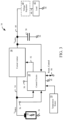
- FIG. 3 shows a power management system for applications having duty-cycled high peak supply currents, in accordance with an example embodiment 30 of the present disclosure.
- Examples of duty-cycled high peak supply current systems include without limitation, an Ultra Wideband (UWB) ranging system, an automotive keyless remote Frequency Operated Button (FOB), Internet of Things devices and applications powered by batteries with minimal capacity.
- the embodiment 30 includes a battery 32, supplying a battery voltage 34 referenced to a ground 36.
- a current limiter 36 charges a buffer capacitor 38 to the buffer voltage 40.
- the buffer capacitor 38 supplies a load 42, such as a circuit block having an occasional or periodic requirement for high peak supply currents.
- the load 42 is both supplied by the buffer capacitor 38 and the current limiter 36.
- the current limiter 36 ensures that the current flowing from the battery 32 is maintained substantially at or below a maximum current limit.
- the buffer capacitor 38 supplies the peak or pulsed current to the load 42 that exceeds the battery 32 current limited by the current limiter 36.
- the buffer capacitor 38 is dimensioned such that it can deliver the supply current during the time window that the connected load 42 is activated, while the voltage at the buffer capacitor 38 will not drop below a certain minimum level that is required for proper operation of the connected load 42.
- a voltage regulator 44 regulates the buffer voltage 40 to a regulated voltage 46.
- the voltage regulator is a resonant or switched regulator based on inductive or capacitive elements, rather than a linear regulator thus minimizing further current drain on the buffer capacitor.
- the voltage regulator 44 is a boost regulator to allow a bigger voltage drop (e.g., voltage droop) on the buffer capacitor, thereby allowing for a smaller buffer capacitor 38 to be used.
- the embodiment 30 includes control circuits 48, powered by a supply 50 and providing a control signal 52 to control the current limiter 36.
- the supply 50 is supplied from the battery 32 to guarantee functionality of the control circuits 48 with a discharged buffer capacitor 38.
- the charging current output by the current limiter 36, the final charge voltage of the buffer voltage 40 or regulated voltage 46, and the general timing of functions of the current limiter 36 is programmable as a function of various sensor inputs (e.g., battery 32 temperature, and/or state-of-charge), to optimize design trade-offs between minimum application costs, maximum battery life, minimum charging or recharging time of the buffer capacitor 38 and recovery time of the battery 32.
- control circuits 48 include a temperature sensor 54 to sense a temperature of the battery 32, a current sensor input 56 indicating a current delivered by the battery 32, the battery voltage 34 and buffer voltage 40 input to the control circuit 48 to measure voltage drop across the current limiter 36, and a reset and control signal 58 for additional external control of the control circuits 48.
- the current limit of the current limiter 36 is programmable.
- a programmable current limiter 36 is useful for optimizing the power management system for different applications having different battery types or sizes or different peak-current capabilities.
- the programmable current limiter 36 allows for setting the maximum battery 32 current as a function of temperature.
- the current limiter 36 is programmable to an off (or open) state having low leakage between the battery 32 and the buffer capacitor 38.
- a programmable off state prevents draining the battery 32 due to leakage current of the load and/or buffer capacitor 38.
- a leakier, and therefore cheaper buffer capacitor 38 is used by switching the current limiter 36 to an off state when the load 42 is in a sleep-mode. Consequently, the buffer capacitor 38 discharges during the off state of the current limiter 36 and thus requires recharging before the load 42 is reactivated. In this mode, the battery voltage 34 will exceed the buffer voltage 40.
- a low-current load is supplied directly from the battery 32 without discharging the buffer capacitor 38, and thus the battery voltage 34 is less than the buffer voltage 40.
- a low-current Low Frequency (LF) and Ultra High Frequency (UHF) integrated circuit (IC) is directly supplied by the battery 32, while a high-current UWB IC is supplied by the buffer capacitor 38.
- the LF and UHF IC will cause the battery voltage 34 to drop because of an output impedance of the battery 32, thus causing a reversal of voltage polarity across the current limiter 36.
- the current limiter 36 includes a low-power bypass mode. Once the buffer capacitor 38 is charged while the load 42 is in sleep-mode, the current limiter 36 need only supply sufficient current to compensate for leakage of the buffer capacitor 38 and any leaky circuits connected thereto.
- the leakage current associated with the buffer capacitor 38 and connected circuits is typically much less than a current limit of the current limiter 36 (e.g., 10mA for a typical lithium coin cell battery).
- the bias circuits that are required by the current limiter 36 for accurate current limiting are disabled, and the current limiter 36 is placed in a conductive bypass state.
- the series impedance of this conductive bypass state is not critical, as long as sufficient current is supplied to the buffer capacitor 38 to minimize voltage drop of the buffer voltage 40.
- the bypass state is also used as a test path under test conditions, with higher peak currents, it is desirable that the bypass state have a lower impedance.
- the low-power bypass mode is advantageous when the buffer capacitor 38 needs to remain charged during the sleep mode of the load 42 and to minimize draining the battery 32 due to bias currents required in the current limiter 36.
- the current limiter 36 is latched into the bypass mode, and subsequently unlatched prior to reactivating the load 42.
- the current limiter 36 includes a voltage limiter mode. This mode is useful for maintaining a charge on the buffer capacitor 38 with reduced buffer capacitor 38 leakage, while the load 42 is in the sleep mode.
- the voltage limiter mode includes monitoring the buffer voltage 40 and charging the buffer capacitor 38 to at least a threshold voltage. In one embodiment, the threshold voltage is programmable. Once the buffer voltage 40 reaches the threshold voltage, the current limiter 36 operates as a voltage limiter by only compensating for the leakage current of the load 42 and the buffer capacitor 38. Leakage typically increases with applied voltage, hence the voltage limiter mode will reduce the leakage current of the buffer capacitor 38 and load 42, thereby optimizing the effective battery life of the battery 32.
- the leakage current reduction exceeds the extra current consumed by the implementation of the voltage limiter mode. Accordingly, the voltage limiter mode is only enabled when the battery voltage 34 exceeds a certain threshold and/or temperature. The voltage limiter mode enables usage of cheaper capacitors with higher corresponding leakage.
- the current limiter 36 includes a buck mode and a boost mode.
- the boost mode charges the buffer capacitor 38 to a buffer voltage 40 exceeding the battery voltage 34. By increasing the buffer voltage 40 beyond what is required for the load 42, additional voltage-droop of the buffer voltage 40 is permitted when the load 42 is activated, thus permitting a smaller buffer capacitor 38 size.
- the boosted buffer voltage 40 is reduced with the voltage regulator 44 of FIG. 3 (e.g., operating as a buck regulator).
- the current limiter buck mode charges the buffer capacitor 38 when the buffer voltage 40 is less than the battery voltage 34. Accordingly, the current limiter power efficiency and output current is maximized.
- Both the buck mode and the boost mode are beneficial when the buffer capacitor 38 is allowed to float by putting the current limiter 36 in the off mode, while the load 42 is in the sleep mode.
- the buffer capacitor 38 is subsequently recharged prior to the load 42 becoming active.
- the buck mode and boost mode are implemented in the current limiter 36 with a resonant or switched mode converter.
- the buck mode and boost mode use the same shared capacitors and/or inductors.
- the buck or boost converter is disabled during the active state of the load 42, thus necessitating a larger buffer capacitor 38.
- FIG. 4 shows an example embodiment 60 of the current limiter 36 of FIG. 3 .
- a current mirror is formed with P-type Field Effect Transistors (PFETs) 62 and 64 with source terminals connected to the battery voltage 34 and drain terminals connected between the buffer voltage 40 and node 68 respectively.
- PFETs P-type Field Effect Transistors
- a first amplifier 66 compares the buffer voltage 40 to the node 68 to drive a gate of a PFET 70 connected between the node 68 and a controllable current source 72. The first amplifier 66 forces a same voltage between the drains of the PFETs 62 and 64, resulting in a well-matched drain current through PFETs 62 and 64.
- a second amplifier 78 compares a node 74, joining a drain of the PFET 70 to the controllable current source 72, with a reference voltage 76 to provide a gate voltage 80.
- the gate voltage 80 forces the drain current of the PFETs 62 and 64 to be equal to a current sunk by the controllable current source 72.
- the current sunk by the controllable current source 72 is reduced (for a given current limit), by increasing the gain or a channel width of the PFET 62 relative to a channel width relative to the PFET 64.
- the current limiter 60 is programmed by changing a sunk current of the controllable current source 72.
- the current limiter 60 is programmed by changing the relative gain or channel widths of the PFETs 62 and 64 through mask options, fuse links and the like.
- the gate voltage 80 is forced to the battery voltage 34 when the battery voltage 34 exceeds the buffer voltage 40, or is forced to the buffer voltage 40 when the battery voltage 34 is less than the buffer voltage 40.
- the gate voltage 80 is forced to ground, thereby connecting the battery 32 and the buffer capacitor 38 through a low impedance.
- an additional switch is added between the battery 32 and the buffer capacitor 38 to bypass the current limiter 60, when the current limiter 60 is disabled. Disabling the bias circuits in the current limiter 60 minimizes power consumption.
- bias circuits in the embodiment 60 include at least the controllable current source 72 and internal bias circuits (not shown) in the first amplifier 66 and the second amplifier 78.
- a decision to activate the bypass mode is made by monitoring a voltage difference between the battery voltage 34 and the buffer voltage 40.
- a decision to activate the bypass mode is made by monitoring the saturation of the controllable current source 72 as indicated by the gate voltage 80 being close to ground 36. Accordingly, this indicates that the PFET 62 is out of saturation and that the buffer capacitor 38 is charged. Subsequently, the current limiter 60 is latched into the bypass state and bias circuits of the current limiter 60 are disabled.
- FIG. 5 shows an example embodiment 90 of the controllable current source 72 of FIG. 4 .
- the embodiment controls a current sunk from the node 74 to the ground 36.
- the node 74 is monitored with respect to the ground 36 for selecting a combination of the switches 92, 94 and 96 to approximate a desired current source value.
- Activation of the switches 94 and 96 connect respective resistors 98 and 100 in parallel to each other and between the node 74 and the ground 36.
- the off-mode is realized by disabling all of the switches 92, 94 and 96.
- a low power mode is realized by closing one or more of the switches 92, 94 and 96 and further disabling all monitoring circuits. It should be appreciated that other embodiments of the controllable current source 90 have a different number of switches from what is depicted in the example embodiment 90 of FIG. 5 .
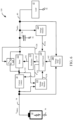
- FIG. 6 shows an example embodiment 110 of a power management system for applications having duty-cycled high peak supply currents, including a boost-mode converter 112 in series with the current limiter 36.
- the boost-mode converter 112 is implemented with a charge pump.
- the boost-mode converter 112 is implemented with a capacitive voltage doubler.
- the boost-mode converter 112 is controlled by an oscillator 114 through an oscillator output 116.
- a control circuit 118 controls the oscillator with control signal 120.
- the control circuit 118 controls the current limiter 36 with a control signal 122 and a bypass switch 124 across the boost-mode converter 112 with a control signal 126.
- a voltage drop monitor 130 measures a voltage drop between the battery voltage 34 and a node 132, thereby measuring a voltage drop across the current limiter 36.
- a voltage monitor 134 measures the buffer voltage 40 and provides a measured voltage signal 136 to the control circuit 118.
- the voltage drop monitor 130 provides a voltage drop signal 138 to the control circuit 118.
- a voltage drop monitor 140 measures a voltage difference between the battery voltage 34 and the buffer voltage 40 and provides a voltage difference signal 142 to the control circuit 118.
- the boost-mode converter 112 is bypassed by closing the switch 124 and disabled.
- the boost-mode converter 112 is enabled and the bypass switch 124 opened.
- the voltage drop across the current limiter 36 is used to control the effective switching frequency of the boost-mode converter 112 to optimize converter efficiency.
- the boost-mode converter 112 is disabled or paused.
- FIG. 7 shows a charging characteristic of the buffer capacitor 38 during a charge phase 150, with subsequent loading of the buffer capacitor 38 by the load 42 during an active phase 152 of the load 42 and a recharging phase 154 of the buffer capacitor 38.
- the buffer capacitor 38 starts with no charge and ramps to a voltage 162 of 1.8V while the current limiter 36 acts as a current source during a period 160.
- the input current to the current limiter 36 is 50% of a current limit of the current limiter 36.
- the boost mode converter 112 is enabled until the maximum voltage 166 of 3.6V is reached.
- the buffer voltage 40 drops during the period 168 down to the voltage 162 as it supplies current to the load 42.
- the amount of reduction in the buffer voltage 40 depends in part on the load current and size of the buffer capacitor 38.
- the boost mode converter 112 is disabled again. Consequently, the continued reduction in buffer voltage 40 occurs at a slow rate during the period 170.
- the current limit is programmed to ensure that the buffer voltage 40 does not drop below the voltage 172 of 1.5V, required for proper operation of the load 42.
- the buffer capacitor 38 is recharged during periods 174 and 176, with the same operation performed during periods 160 and 164.
- the boost mode converter 112 is disabled during the 168 period to reduce RFI issues when the load 42 is active.
- FIG. 8 shows an example embodiment 180 of a power management system for applications having duty-cycled high peak supply currents, including a reconfigurable boost and buck mode converter 182 for charging the buffer capacitor 38 and supplying the load 184.
- a buck converter is used for charging the buffer capacitor 38 when the buffer voltage 40 is less than the battery voltage 34, and a boost converter is used for charging the buffer capacitor 38 when the buffer voltage 40 is above the battery voltage 34.
- a buck converter is used to supply a load 184 with a voltage that is lower than the buffer voltage 40, and a boost converter is used to supply the load 184 with a voltage higher than the buffer voltage 40, wherein the buck converter and the boost converter share an inductor 188.
- the boost and buck mode converter 182 supplies power to a UWB transceiver 184 over a path 186.
- the boost mode is used for charging the buffer capacitor 38 above the battery voltage 34, hence permitting more voltage droop and/or a smaller buffer capacitor 38.
- the buck mode receives the boosted buffer voltage 40 as an input, and provides a voltage to the UWB transceiver 184, which is bucked down from the buffer voltage 40. This buck-charge operation provides for better efficiency and higher charging current to the load 184.
- the converter 182 bucks the battery voltage 34 down to a lower buffer voltage 40, then the converter 182 receives and boosts the buffer voltage 40 up to a higher load voltage to supply the load 184.
- the converter 182 during the charge phase 150 the converter 182 bucks the buffer voltage 40 up to the voltage 162 (also corresponding to the battery voltage 34) during the period 160 and boosts the buffer voltage 40 up to the voltage 166 during the period 164.
- the converter 182 bucks the buffer voltage 40 down to the voltage 162 (also corresponding to the battery voltage 34) during the period 168 and boosts the buffer voltage 40 during the period 170.
- FIG. 9 shows a method 190 for power management for applications having duty-cycled high peak supply currents.
- a buffer capacitor 38 is charged with a current from a battery 32, limited by a current limiter 36.
- a load 42 is supplied with a pulsed current from the buffer capacitor 38.
- the current limiter 36 is controlled with sensor inputs 34, 40, 56 and 54 to limit a degradation of the battery 32 including at least one of a capacity and a lifetime of the battery 32.
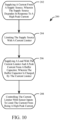
- FIG. 10 shows a method 200 for power management for applications having duty-cycled high peak supply currents.
- a current is supplied from a supply source (e.g., a battery 32), which will be damaged when it has to deliver high peak currents.
- the current from the supply source is limited with a current limiter 36.
- an activated load 42 is supplied with a current from the current limiter 36 and a peak current from the buffer capacitor 38, wherein the buffer capacitor 38 is charged by the current limiter 36.
- the current limiter 36 is controlled with sensor inputs 34, 40, 56 and 54 to limit the current from being a high peak current, thereby limiting degradation of the supply source.
- a method for power management for applications having duty-cycled high peak supply currents comprises charging a buffer capacitor with a first current supplied by a battery, wherein the first current is limited by a current limiter.
- a load is supplied with a second current supplied by the buffer capacitor, wherein the second current comprises a pulsed current.
- the current limiter is controlled with at least one of a plurality of sensor inputs to limit a capacity degradation of the battery.
- the current limiter must be latched into a conductive bypass mode and a bias circuit of the current limiter is disabled, in response to the load entering a sleep mode and the buffer capacitor being charged above a threshold voltage, wherein the threshold voltage is greater than a minimum voltage.
- a current limit of the current limiter is determined by a temperature of the battery.
- the buffer capacitor is disconnected from the load in response to the load entering a sleep mode, and recharging the buffer capacitor prior to reconnected the buffer capacitor to the load in response to the load exiting the sleep mode.
- the buffer capacitor is charged to a buffer voltage being less than a battery voltage of the battery, by reducing a voltage output of the current limiter with a buck converter, thereby maximizing one or more of an output current of the current limiter and a power efficiency of the current limiter.
- the buffer capacitor is charged to a buffer voltage being greater than a battery voltage of the battery, by increasing a voltage output of the current limiter with a boost converter, thereby increasing a permissible voltage droop of the buffer capacitor.
- the buffer capacitor is charged to at least a threshold voltage in response to the load entering a sleep mode, wherein the threshold voltage is programmed to reduce a leakage of the buffer capacitor as a function of temperature, and the current limiter operates as a voltage limiter when a voltage of the buffer capacitor exceeds the threshold voltage.
- the buffer capacitor is charged to a buffer voltage being higher than a battery voltage, by boosting a voltage output of the current limiter with a boost converter, and reducing the buffer voltage with a buck converter to supply a load voltage to the load, wherein the buck converter and the boost converter share an inductor.
- An output voltage of the current limiter is doubled with a voltage doubler in response to the first current being less than half of a limit current of the current limiter.
- a switching frequency of the voltage doubler is controlled with a voltage drop across the current limiter.
- an apparatus comprises a battery configured to supply a first current, wherein the first current is at or below a threshold current.
- a buffer capacitor is configured for one or more of being charged by the first current and supplying a second current to a load, wherein the second current comprises a pulsed current.
- a current limiter is interposed between the battery and the buffer capacitor, wherein the current limiter limits the first current and the buffer capacitor supplies a pulsed load current to the load.
- a plurality of sensors is configured to control the current limiter.
- the current limiter must comprise a conductive bypass mode configured to connect the battery to the buffer capacitor through a low impedance path in response to the load entering a sleep mode and the buffer capacitor being charged above a threshold voltage.
- the plurality of sensors comprises a temperature sensor configured to determine a current limit of the current limiter based on a temperature of the battery.
- a switch is configured to disconnect the buffer capacitor from the load in response to the load entering a sleep mode, and the current limiter is configured to recharge the buffer capacitor prior to reconnecting the buffer capacitor to the load with the switch in response to the load exiting the sleep mode.
- a buck converter is interposed between the current limiter and the buffer capacitor, wherein the buck converter is configured to charge the buffer capacitor when the buffer voltage is lower than the battery voltage, thereby maximizing one or more of an output current of the current limiter and a power efficiency of the current limiter.
- a boost converter is interposed between the current limiter and the buffer capacitor, wherein the boost converter is configured to charge the buffer capacitor to a buffer voltage being greater than a battery voltage of the battery, thereby increasing a permissible voltage droop of the buffer capacitor.
- a voltage doubler is interposed between the current limiter and the buffer capacitor, wherein the voltage doubler is configured to double an output voltage of the current limiter in response to the first current being less than half of a limit current of the current limiter.
- a method for power management for applications having duty-cycled high peak supply currents comprises supply a current with a supply source, wherein one or more of a lifetime and a current capacity of the supply source is degraded in response to the current being a high peak current.
- the current of the supply source is limited with a current limiter.
- the current limiter is controlled with at least one of a plurality of sensor inputs to limit the current from being the high peak current.
- the disclosure of the method for power management for applications having duty-cycled high peak supply currents extends to one of the following features, or any combination thereof.
- the current limiter is latched into a conductive bypass mode and a bias circuit of the current limiter is disabled, in response to the load entering a sleep mode and the buffer capacitor being charged above a threshold voltage, wherein the threshold voltage is greater than a minimum voltage.
- An output voltage of the current limiter is doubled with a voltage doubler in response to the continuous current being less than half of a limit current of the current limiter.
Landscapes
- Engineering & Computer Science (AREA)
- Power Engineering (AREA)
- Charge And Discharge Circuits For Batteries Or The Like (AREA)
- Dc-Dc Converters (AREA)
Description
- This disclosure relates generally to power management of battery powered applications, and more specifically to power management of applications with duty-cycled high peak supply currents.
- Many applications require a relatively low average supply current provided by a battery, but periodically require a high peak current. These applications are often duty-cycled, with a relatively long inactive period (e.g., sleep, stand-by or off time). Typically, a battery can easily sustain the average current for a long period of time, but the battery life, or capacity, is degraded significantly when peak currents are required to be supplied.
- Traditional solutions to the problem of battery degradation due to pulsed loads include adding a large capacitor in parallel with the battery. However, this large capacitor is costly, can have mechanical reliability issues due to its size, and also can contribute significantly to leakage current thus further reducing the effective battery life. In addition, use of a lower leakage capacitor in parallel with the battery further increases the cost beyond that incurred with a standard capacitor having higher leakage current.
-
United states patent application, publication number US2018/024579 discloses an energy storage (ES) circuit including a plurality of terminals configured to connect to a pulse load having an input voltage and drawing a low current during a first interval and a high current during a second interval, and connect to a power supply having a source voltage and delivering a source current, an energy storage capacitor connected to the plurality of terminals, and a bidirectional direct current (DC) to DC converter configured to recharge, during at least a portion of the first interval, the energy storage capacitor using a plurality of charge drawn from the source current, and reduce a drop in the input voltage during the second interval by delivering a difference between the source current and the high current to the pulse load using the plurality of charge stored in the energy storage capacitor. -
European patent application, publication number EP2582004 discloses a power converter system for managing power between a power supply and a load, the system including: a first buck-boost circuit connected to the power supply; and a capacitor provided between the buck-boost circuit and the load to buffer power supply for the load. The system may include a second buck-boost circuit between the capacitor and the load. In another embodiment, a power converter system includes: a boost circuit connected to the power supply; a buck circuit connected to the load; and a capacitor provided between the boost circuit and the buck circuit to manage the supply of power to the load. -
United States patent application, publication number US 2013/082661 discloses a system which includes a first battery module including a number of rechargeable cells. A first battery module current limiter is configured to monitor a current flowing to or from the plurality of rechargeable cells of the first battery module. The battery module current limiter is further configured to selectively limit the current flowing to a non-zero current that is less than a predetermined current threshold, wherein the selectively limiting is based on whether the monitored current is approaching the predetermined current threshold. -
United States patent application, publication number US 2008/0129219 discloses a power supply for powering a load, the load being in the form of a flash drive circuit for a digital camera. The power supply includes a supercapacitive device, in the form of a super capacitor, for powering is the circuit. A regulator unit, in the form of an inductive regulator charges the supercapacitor. The power supply includes a boost converter for charging the super capacitor from the battery and a bypass FET in parallel with the inductor of the boost converter. The bypass FET is activated if the battery voltage is greater than or equal to the required voltage. - The present invention is illustrated by way of example and is not limited by the accompanying figures, in which like references indicate similar elements. Elements in the figures are illustrated for simplicity and clarity and have not necessarily been drawn to scale.
-
FIG. 1 is a graphical view of a discharge characteristic of a lithium coin cell with a continuous load. -
FIG. 2 is a graphical view of a discharge characteristic of a lithium coin cell with a pulsed load. -
FIG. 3 is a schematic view of a system for power management of applications having duty-cycled high peak supply currents, in accordance with an example embodiment of the present disclosure. -
FIG. 4 is a schematic view of the controllable current limiter ofFIG. 3 , in accordance with an example embodiment of the present disclosure. -
FIG. 5 is a schematic view of the controllable current source ofFIG. 4 , in accordance with an example embodiment of the present disclosure. -
FIG. 6 is a schematic view of a system for power management of applications having duty-cycled high peak supply currents, in accordance with an example embodiment of the present disclosure. -
FIG. 7 is a graphical view of an embodiment of a charging characteristic of the buffer capacitor ofFIG. 6 with subsequent loading. -
FIG. 8 is a schematic view of a system for power management of applications having duty-cycled high peak supply currents, in accordance with an example embodiment of the present disclosure. -
FIG. 9 is a flowchart representation of a method for power management for applications having duty-cycled high peak supply currents, in accordance with an example embodiment of the present disclosure. -
FIG. 10 is a flowchart representation of a method for power management for applications having duty-cycled high peak supply currents, in accordance with an example embodiment of the present disclosure. - Embodiments described herein provide for power management of battery-based systems for applications having duty-cycled high peak supply currents. Specifically, current drawn from a battery (e.g., a coin cell battery), is limited to prevent premature degradation of the battery current capacity, while peak loads are supplied from a buffer capacitor. The buffer capacitor includes undesirable limitations with regards to leakage, size and the like, which are minimized with a current limiting circuit while optimizing battery capacity.
-
FIG. 1 and FIG. 2 show the discharge characteristics of a typical Lithium coin cell battery under a continuous and pulsed current load. InFIG. 1 , a Closed Circuit Voltage (CCV) 10 is maintained relatively close to the initial 3.0V voltage over a significant range of battery capacity (expressed in mA-hours). Specifically, theCCV 10 represents a continuous or background current of 0.19mA at 2.9V, 21 degrees Celsius through 15K ohms. A relatively low pulsed current results in aCCV 12, also over the significant range of battery capacity. Specifically, theCCV 12 represents a pulsed current of 6.8mA at 2.7V, 21 degrees Celsius through 400 ohms, with a 2 second pulse applied 12 times per day. Aninternal resistance 14 is also maintained at a relatively low value over the significant range of battery capacity. - In
FIG. 2 , a Closed Circuit Voltage (CCV) 20 drops significantly from the initial 3.0V voltage due to premature battery degradation resulting from the application of a high peak current pulse load. Specifically, the CCV 20 represents a continuous or background current close to 0 mA at 21 degrees Celsius. A relatively high pulsed current results in aCCV 22, with a significant reduction in CCV due to the battery degradation. Specifically, theCCV 22 represents a pulsed current of 23mA at 2.7V, 21 degrees Celsius through 120 ohms, with a 1 millisecond pulse applied every 15 milliseconds. Aninternal resistance 24 increases earlier than theinternal resistance 14 ofFIG. 1 due to the premature battery degradation. -
FIG. 3 shows a power management system for applications having duty-cycled high peak supply currents, in accordance with anexample embodiment 30 of the present disclosure. Examples of duty-cycled high peak supply current systems include without limitation, an Ultra Wideband (UWB) ranging system, an automotive keyless remote Frequency Operated Button (FOB), Internet of Things devices and applications powered by batteries with minimal capacity. Theembodiment 30 includes abattery 32, supplying abattery voltage 34 referenced to aground 36. Acurrent limiter 36 charges abuffer capacitor 38 to thebuffer voltage 40. In one embodiment, thebuffer capacitor 38 supplies aload 42, such as a circuit block having an occasional or periodic requirement for high peak supply currents. In another embodiment, theload 42 is both supplied by thebuffer capacitor 38 and thecurrent limiter 36. - The
current limiter 36 ensures that the current flowing from thebattery 32 is maintained substantially at or below a maximum current limit. In one embodiment, thebuffer capacitor 38 supplies the peak or pulsed current to theload 42 that exceeds thebattery 32 current limited by thecurrent limiter 36. Thebuffer capacitor 38 is dimensioned such that it can deliver the supply current during the time window that the connectedload 42 is activated, while the voltage at thebuffer capacitor 38 will not drop below a certain minimum level that is required for proper operation of the connectedload 42. - In one embodiment, a voltage regulator 44 regulates the
buffer voltage 40 to a regulatedvoltage 46. Preferably, the voltage regulator is a resonant or switched regulator based on inductive or capacitive elements, rather than a linear regulator thus minimizing further current drain on the buffer capacitor. In one embodiment, the voltage regulator 44 is a boost regulator to allow a bigger voltage drop (e.g., voltage droop) on the buffer capacitor, thereby allowing for asmaller buffer capacitor 38 to be used. - The
embodiment 30 includescontrol circuits 48, powered by asupply 50 and providing acontrol signal 52 to control thecurrent limiter 36. In one embodiment, thesupply 50 is supplied from thebattery 32 to guarantee functionality of thecontrol circuits 48 with a dischargedbuffer capacitor 38. In example embodiments, the charging current output by thecurrent limiter 36, the final charge voltage of thebuffer voltage 40 or regulatedvoltage 46, and the general timing of functions of thecurrent limiter 36 is programmable as a function of various sensor inputs (e.g.,battery 32 temperature, and/or state-of-charge), to optimize design trade-offs between minimum application costs, maximum battery life, minimum charging or recharging time of thebuffer capacitor 38 and recovery time of thebattery 32. Specifically, in theexample embodiment 30, thecontrol circuits 48 include atemperature sensor 54 to sense a temperature of thebattery 32, acurrent sensor input 56 indicating a current delivered by thebattery 32, thebattery voltage 34 andbuffer voltage 40 input to thecontrol circuit 48 to measure voltage drop across thecurrent limiter 36, and a reset andcontrol signal 58 for additional external control of thecontrol circuits 48. - In one embodiment of the power management system of
FIG. 3 , the current limit of thecurrent limiter 36 is programmable. A programmablecurrent limiter 36 is useful for optimizing the power management system for different applications having different battery types or sizes or different peak-current capabilities. Furthermore, the programmablecurrent limiter 36 allows for setting themaximum battery 32 current as a function of temperature. - In one embodiment of the power management system of
FIG. 3 , thecurrent limiter 36 is programmable to an off (or open) state having low leakage between thebattery 32 and thebuffer capacitor 38. During a sleep-mode of theload 42, a programmable off state prevents draining thebattery 32 due to leakage current of the load and/orbuffer capacitor 38. In one embodiment, a leakier, and thereforecheaper buffer capacitor 38, is used by switching thecurrent limiter 36 to an off state when theload 42 is in a sleep-mode. Consequently, thebuffer capacitor 38 discharges during the off state of thecurrent limiter 36 and thus requires recharging before theload 42 is reactivated. In this mode, thebattery voltage 34 will exceed thebuffer voltage 40. - In another embodiment, a low-current load is supplied directly from the
battery 32 without discharging thebuffer capacitor 38, and thus thebattery voltage 34 is less than thebuffer voltage 40. For example, in a Key FOB application, a low-current Low Frequency (LF) and Ultra High Frequency (UHF) integrated circuit (IC) is directly supplied by thebattery 32, while a high-current UWB IC is supplied by thebuffer capacitor 38. The LF and UHF IC will cause thebattery voltage 34 to drop because of an output impedance of thebattery 32, thus causing a reversal of voltage polarity across thecurrent limiter 36. - In all embodiments of the power management system of
FIG. 3 , thecurrent limiter 36 includes a low-power bypass mode. Once thebuffer capacitor 38 is charged while theload 42 is in sleep-mode, thecurrent limiter 36 need only supply sufficient current to compensate for leakage of thebuffer capacitor 38 and any leaky circuits connected thereto. The leakage current associated with thebuffer capacitor 38 and connected circuits is typically much less than a current limit of the current limiter 36 (e.g., 10mA for a typical lithium coin cell battery). In all embodiments, the bias circuits that are required by thecurrent limiter 36 for accurate current limiting are disabled, and thecurrent limiter 36 is placed in a conductive bypass state. In one embodiment, the series impedance of this conductive bypass state is not critical, as long as sufficient current is supplied to thebuffer capacitor 38 to minimize voltage drop of thebuffer voltage 40. In another embodiment, where the bypass state is also used as a test path under test conditions, with higher peak currents, it is desirable that the bypass state have a lower impedance. The low-power bypass mode is advantageous when thebuffer capacitor 38 needs to remain charged during the sleep mode of theload 42 and to minimize draining thebattery 32 due to bias currents required in thecurrent limiter 36. In all embodiments, after theload 42 enters the sleep mode, when the buffer capacitor is sufficiently charged, thecurrent limiter 36 is latched into the bypass mode, and subsequently unlatched prior to reactivating theload 42. - In one embodiment of the power management system of
FIG. 3 , thecurrent limiter 36 includes a voltage limiter mode. This mode is useful for maintaining a charge on thebuffer capacitor 38 with reducedbuffer capacitor 38 leakage, while theload 42 is in the sleep mode. In one embodiment, the voltage limiter mode includes monitoring thebuffer voltage 40 and charging thebuffer capacitor 38 to at least a threshold voltage. In one embodiment, the threshold voltage is programmable. Once thebuffer voltage 40 reaches the threshold voltage, thecurrent limiter 36 operates as a voltage limiter by only compensating for the leakage current of theload 42 and thebuffer capacitor 38. Leakage typically increases with applied voltage, hence the voltage limiter mode will reduce the leakage current of thebuffer capacitor 38 andload 42, thereby optimizing the effective battery life of thebattery 32. In one embodiment, the leakage current reduction exceeds the extra current consumed by the implementation of the voltage limiter mode. Accordingly, the voltage limiter mode is only enabled when thebattery voltage 34 exceeds a certain threshold and/or temperature. The voltage limiter mode enables usage of cheaper capacitors with higher corresponding leakage. - In one embodiment of the power management system of
FIG. 3 , thecurrent limiter 36 includes a buck mode and a boost mode. In one embodiment, the boost mode charges thebuffer capacitor 38 to abuffer voltage 40 exceeding thebattery voltage 34. By increasing thebuffer voltage 40 beyond what is required for theload 42, additional voltage-droop of thebuffer voltage 40 is permitted when theload 42 is activated, thus permitting asmaller buffer capacitor 38 size. In one embodiment, the boostedbuffer voltage 40 is reduced with the voltage regulator 44 ofFIG. 3 (e.g., operating as a buck regulator). In another embodiment, the current limiter buck mode charges thebuffer capacitor 38 when thebuffer voltage 40 is less than thebattery voltage 34. Accordingly, the current limiter power efficiency and output current is maximized. Both the buck mode and the boost mode are beneficial when thebuffer capacitor 38 is allowed to float by putting thecurrent limiter 36 in the off mode, while theload 42 is in the sleep mode. Thebuffer capacitor 38 is subsequently recharged prior to theload 42 becoming active. In one embodiment, the buck mode and boost mode are implemented in thecurrent limiter 36 with a resonant or switched mode converter. In one embodiment, the buck mode and boost mode use the same shared capacitors and/or inductors. In one embodiment, where excessive Radio Frequency Interference (RFI) issues are present, the buck or boost converter is disabled during the active state of theload 42, thus necessitating alarger buffer capacitor 38. -
FIG. 4 shows anexample embodiment 60 of thecurrent limiter 36 ofFIG. 3 . A current mirror is formed with P-type Field Effect Transistors (PFETs) 62 and 64 with source terminals connected to thebattery voltage 34 and drain terminals connected between thebuffer voltage 40 andnode 68 respectively. Afirst amplifier 66 compares thebuffer voltage 40 to thenode 68 to drive a gate of aPFET 70 connected between thenode 68 and a controllablecurrent source 72. Thefirst amplifier 66 forces a same voltage between the drains of thePFETs PFETs second amplifier 78 compares anode 74, joining a drain of thePFET 70 to the controllablecurrent source 72, with a reference voltage 76 to provide agate voltage 80. Thegate voltage 80 forces the drain current of thePFETs current source 72. - In another embodiment, the current sunk by the controllable
current source 72 is reduced (for a given current limit), by increasing the gain or a channel width of thePFET 62 relative to a channel width relative to thePFET 64. In one embodiment, thecurrent limiter 60 is programmed by changing a sunk current of the controllablecurrent source 72. In another embodiment, thecurrent limiter 60 is programmed by changing the relative gain or channel widths of thePFETs current limiter 60 implementing the programmable off state, thegate voltage 80 is forced to thebattery voltage 34 when thebattery voltage 34 exceeds thebuffer voltage 40, or is forced to thebuffer voltage 40 when thebattery voltage 34 is less than thebuffer voltage 40. In one embodiment ofcurrent limiter 60 implementing the low-power bypass mode, thegate voltage 80 is forced to ground, thereby connecting thebattery 32 and thebuffer capacitor 38 through a low impedance. In another embodiment, an additional switch is added between thebattery 32 and thebuffer capacitor 38 to bypass thecurrent limiter 60, when thecurrent limiter 60 is disabled. Disabling the bias circuits in thecurrent limiter 60 minimizes power consumption. For example, bias circuits in theembodiment 60 include at least the controllablecurrent source 72 and internal bias circuits (not shown) in thefirst amplifier 66 and thesecond amplifier 78. In one embodiment, a decision to activate the bypass mode is made by monitoring a voltage difference between thebattery voltage 34 and thebuffer voltage 40. In another embodiment, a decision to activate the bypass mode is made by monitoring the saturation of the controllablecurrent source 72 as indicated by thegate voltage 80 being close toground 36. Accordingly, this indicates that thePFET 62 is out of saturation and that thebuffer capacitor 38 is charged. Subsequently, thecurrent limiter 60 is latched into the bypass state and bias circuits of thecurrent limiter 60 are disabled. -
FIG. 5 shows anexample embodiment 90 of the controllablecurrent source 72 ofFIG. 4 . The embodiment controls a current sunk from thenode 74 to theground 36. In theembodiment 90, thenode 74 is monitored with respect to theground 36 for selecting a combination of theswitches switches respective resistors node 74 and theground 36. - The off-mode is realized by disabling all of the
switches switches current source 90 have a different number of switches from what is depicted in theexample embodiment 90 ofFIG. 5 . -
FIG. 6 shows anexample embodiment 110 of a power management system for applications having duty-cycled high peak supply currents, including a boost-mode converter 112 in series with thecurrent limiter 36. In one example embodiment, the boost-mode converter 112 is implemented with a charge pump. In another example embodiment, the boost-mode converter 112 is implemented with a capacitive voltage doubler. The boost-mode converter 112 is controlled by anoscillator 114 through anoscillator output 116. Acontrol circuit 118 controls the oscillator withcontrol signal 120. Thecontrol circuit 118 controls thecurrent limiter 36 with acontrol signal 122 and abypass switch 124 across the boost-mode converter 112 with acontrol signal 126. A voltage drop monitor 130 measures a voltage drop between thebattery voltage 34 and anode 132, thereby measuring a voltage drop across thecurrent limiter 36. A voltage monitor 134 measures thebuffer voltage 40 and provides a measured voltage signal 136 to thecontrol circuit 118. The voltage drop monitor 130 provides avoltage drop signal 138 to thecontrol circuit 118. A voltage drop monitor 140 measures a voltage difference between thebattery voltage 34 and thebuffer voltage 40 and provides avoltage difference signal 142 to thecontrol circuit 118. - When the
buffer voltage 40 is less than thebattery voltage 34, as sensed by thevoltage drop monitor 140, then only thecurrent limiter 36 is used, and the boost-mode converter 112 is bypassed by closing theswitch 124 and disabled. When the voltage difference between thebuffer voltage 40 and thebattery voltage 34 is small or the input current to thecurrent limiter 36 is half of a programmed current limit of thecurrent limiter 36, then the boost-mode converter 112 is enabled and thebypass switch 124 opened. In another embodiment, the voltage drop across thecurrent limiter 36, as measured by thevoltage drop monitor 130, is used to control the effective switching frequency of the boost-mode converter 112 to optimize converter efficiency. In one embodiment, when thebuffer voltage 40 reaches a programmed voltage threshold, as sensed by thevoltage monitor 134, the boost-mode converter 112 is disabled or paused. -
FIG. 7 with continued reference toFIG. 6 shows a charging characteristic of thebuffer capacitor 38 during acharge phase 150, with subsequent loading of thebuffer capacitor 38 by theload 42 during anactive phase 152 of theload 42 and arecharging phase 154 of thebuffer capacitor 38. InFIG. 7 , thebuffer capacitor 38 starts with no charge and ramps to avoltage 162 of 1.8V while thecurrent limiter 36 acts as a current source during aperiod 160. In one embodiment, at thevoltage 162, the input current to thecurrent limiter 36 is 50% of a current limit of thecurrent limiter 36. During aperiod 164, theboost mode converter 112 is enabled until the maximum voltage 166 of 3.6V is reached. - When the load is activated during the
active phase 152, thebuffer voltage 40 drops during theperiod 168 down to thevoltage 162 as it supplies current to theload 42. The amount of reduction in thebuffer voltage 40 depends in part on the load current and size of thebuffer capacitor 38. When thebuffer voltage 40 drops below thevoltage 162, corresponding to the input current to thecurrent limiter 36 being 50% of the current limit of thecurrent limiter 36, theboost mode converter 112 is disabled again. Consequently, the continued reduction inbuffer voltage 40 occurs at a slow rate during theperiod 170. In one embodiment, the current limit is programmed to ensure that thebuffer voltage 40 does not drop below thevoltage 172 of 1.5V, required for proper operation of theload 42. After theload 42 reenters the sleep-mode thebuffer capacitor 38 is recharged duringperiods periods boost mode converter 112 is disabled during the 168 period to reduce RFI issues when theload 42 is active. -
FIG. 8 shows anexample embodiment 180 of a power management system for applications having duty-cycled high peak supply currents, including a reconfigurable boost andbuck mode converter 182 for charging thebuffer capacitor 38 and supplying theload 184. A buck converter is used for charging thebuffer capacitor 38 when thebuffer voltage 40 is less than thebattery voltage 34, and a boost converter is used for charging thebuffer capacitor 38 when thebuffer voltage 40 is above thebattery voltage 34. A buck converter is used to supply aload 184 with a voltage that is lower than thebuffer voltage 40, and a boost converter is used to supply theload 184 with a voltage higher than thebuffer voltage 40, wherein the buck converter and the boost converter share aninductor 188. For example, in theembodiment 180, the boost andbuck mode converter 182 supplies power to aUWB transceiver 184 over apath 186. In theembodiment 180, the boost mode is used for charging thebuffer capacitor 38 above thebattery voltage 34, hence permitting more voltage droop and/or asmaller buffer capacitor 38. Subsequently, the buck mode receives the boostedbuffer voltage 40 as an input, and provides a voltage to theUWB transceiver 184, which is bucked down from thebuffer voltage 40. This buck-charge operation provides for better efficiency and higher charging current to theload 184. In another embodiment, theconverter 182 bucks thebattery voltage 34 down to alower buffer voltage 40, then theconverter 182 receives and boosts thebuffer voltage 40 up to a higher load voltage to supply theload 184. - With reference to
FIG. 7 andFIG. 8 , in another embodiment, during thecharge phase 150 theconverter 182 bucks thebuffer voltage 40 up to the voltage 162 (also corresponding to the battery voltage 34) during theperiod 160 and boosts thebuffer voltage 40 up to the voltage 166 during theperiod 164. During the active ordischarge phase 152, theconverter 182 bucks thebuffer voltage 40 down to the voltage 162 (also corresponding to the battery voltage 34) during theperiod 168 and boosts thebuffer voltage 40 during theperiod 170. -
FIG. 9 with reference toFIG. 3 shows amethod 190 for power management for applications having duty-cycled high peak supply currents. At 192, abuffer capacitor 38 is charged with a current from abattery 32, limited by acurrent limiter 36. At 194, aload 42 is supplied with a pulsed current from thebuffer capacitor 38. At 196, thecurrent limiter 36 is controlled withsensor inputs battery 32 including at least one of a capacity and a lifetime of thebattery 32. -
FIG. 10 with reference toFIG. 3 shows amethod 200 for power management for applications having duty-cycled high peak supply currents. At 202, a current is supplied from a supply source (e.g., a battery 32), which will be damaged when it has to deliver high peak currents. At 204, the current from the supply source is limited with acurrent limiter 36. At 206, an activatedload 42 is supplied with a current from thecurrent limiter 36 and a peak current from thebuffer capacitor 38, wherein thebuffer capacitor 38 is charged by thecurrent limiter 36. At 208, thecurrent limiter 36 is controlled withsensor inputs - As will be appreciated, embodiments as disclosed include at least the following. In one embodiment, a method for power management for applications having duty-cycled high peak supply currents comprises charging a buffer capacitor with a first current supplied by a battery, wherein the first current is limited by a current limiter. A load is supplied with a second current supplied by the buffer capacitor, wherein the second current comprises a pulsed current. The current limiter is controlled with at least one of a plurality of sensor inputs to limit a capacity degradation of the battery. The current limiter must be latched into a conductive bypass mode and a bias circuit of the current limiter is disabled, in response to the load entering a sleep mode and the buffer capacitor being charged above a threshold voltage, wherein the threshold voltage is greater than a minimum voltage..
- Alternative embodiments of the method for power management for applications having duty-cycled high peak supply currents further include one of the following features, or any combination thereof. A current limit of the current limiter is determined by a temperature of the battery. The buffer capacitor is disconnected from the load in response to the load entering a sleep mode, and recharging the buffer capacitor prior to reconnected the buffer capacitor to the load in response to the load exiting the sleep mode. The buffer capacitor is charged to a buffer voltage being less than a battery voltage of the battery, by reducing a voltage output of the current limiter with a buck converter, thereby maximizing one or more of an output current of the current limiter and a power efficiency of the current limiter. The buffer capacitor is charged to a buffer voltage being greater than a battery voltage of the battery, by increasing a voltage output of the current limiter with a boost converter, thereby increasing a permissible voltage droop of the buffer capacitor. The buffer capacitor is charged to at least a threshold voltage in response to the load entering a sleep mode, wherein the threshold voltage is programmed to reduce a leakage of the buffer capacitor as a function of temperature, and the current limiter operates as a voltage limiter when a voltage of the buffer capacitor exceeds the threshold voltage. The buffer capacitor is charged to a buffer voltage being higher than a battery voltage, by boosting a voltage output of the current limiter with a boost converter, and reducing the buffer voltage with a buck converter to supply a load voltage to the load, wherein the buck converter and the boost converter share an inductor. An output voltage of the current limiter is doubled with a voltage doubler in response to the first current being less than half of a limit current of the current limiter. A switching frequency of the voltage doubler is controlled with a voltage drop across the current limiter.
- In another embodiment, an apparatus comprises a battery configured to supply a first current, wherein the first current is at or below a threshold current. A buffer capacitor is configured for one or more of being charged by the first current and supplying a second current to a load, wherein the second current comprises a pulsed current. A current limiter is interposed between the battery and the buffer capacitor, wherein the current limiter limits the first current and the buffer capacitor supplies a pulsed load current to the load. A plurality of sensors is configured to control the current limiter. The current limiter must comprise a conductive bypass mode configured to connect the battery to the buffer capacitor through a low impedance path in response to the load entering a sleep mode and the buffer capacitor being charged above a threshold voltage.
- Alternative embodiments of the apparatus further include one of the following features, or any combination thereof. The plurality of sensors comprises a temperature sensor configured to determine a current limit of the current limiter based on a temperature of the battery. A switch is configured to disconnect the buffer capacitor from the load in response to the load entering a sleep mode, and the current limiter is configured to recharge the buffer capacitor prior to reconnecting the buffer capacitor to the load with the switch in response to the load exiting the sleep mode. A buck converter is interposed between the current limiter and the buffer capacitor, wherein the buck converter is configured to charge the buffer capacitor when the buffer voltage is lower than the battery voltage, thereby maximizing one or more of an output current of the current limiter and a power efficiency of the current limiter. A boost converter is interposed between the current limiter and the buffer capacitor, wherein the boost converter is configured to charge the buffer capacitor to a buffer voltage being greater than a battery voltage of the battery, thereby increasing a permissible voltage droop of the buffer capacitor. A voltage doubler is interposed between the current limiter and the buffer capacitor, wherein the voltage doubler is configured to double an output voltage of the current limiter in response to the first current being less than half of a limit current of the current limiter.
- Also disclosed is a method for power management for applications having duty-cycled high peak supply currents comprises supply a current with a supply source, wherein one or more of a lifetime and a current capacity of the supply source is degraded in response to the current being a high peak current. The current of the supply source is limited with a current limiter. The current limiter is controlled with at least one of a plurality of sensor inputs to limit the current from being the high peak current.
- The disclosure of the method for power management for applications having duty-cycled high peak supply currents extends to one of the following features, or any combination thereof. The current limiter is latched into a conductive bypass mode and a bias circuit of the current limiter is disabled, in response to the load entering a sleep mode and the buffer capacitor being charged above a threshold voltage, wherein the threshold voltage is greater than a minimum voltage. An output voltage of the current limiter is doubled with a voltage doubler in response to the continuous current being less than half of a limit current of the current limiter.
- Although the invention is described herein with reference to specific embodiments, various modifications and changes can be made without departing from the scope of the present invention as set forth in the claims below. Accordingly, the specification and figures are to be regarded in an illustrative rather than a restrictive sense, and all such modifications are intended to be included within the scope of the present invention, only if said modifications do not contradict the appended claims (i.e. the modified arrangement comprises all features of at least one of the appended independent claims). Any benefits, advantages, or solutions to problems that are described herein with regard to specific embodiments are not intended to be construed as a critical, required, or essential feature or element of any or all the claims. Unless stated otherwise, terms such as "first" and "second" are used to arbitrarily distinguish between the elements such terms describe. Thus, these terms are not necessarily intended to indicate temporal or other prioritization of such elements.
Claims (13)
- A method for power management for applications having duty-cycled high peak supply currents comprising:charging (192) a buffer capacitor with a first current supplied by a battery, wherein the first current is limited by a current limiter;supplying (194) a load with a second current supplied by the buffer capacitor, wherein the second current comprises a pulsed current; andcontrolling (196)the current limiter with at least one of a plurality of sensor inputs to limit a capacity degradation of the battery;wherein the current limiter is latched into a conductive bypass mode and a bias circuit of the current limiter is disabled, in response to the load entering a sleep mode and the buffer capacitor being charged above a threshold voltage, wherein the threshold voltage is greater than a minimum voltage.
- The method of claim 1 wherein a current limit of the current limiter is determined by a temperature of the battery.
- The method of claim 1 or 2 further comprising disconnecting the buffer capacitor from the load in response to the load entering a sleep mode, and recharging the buffer capacitor prior to reconnecting the buffer capacitor to the load in response to the load exiting the sleep mode.
- The method of claim 3 further comprising charging the buffer capacitor to a buffer voltage being less than a battery voltage of the battery, by reducing a voltage output of the current limiter with a buck converter, thereby maximizing one or more of an output current of the current limiter and a power efficiency of the current limiter.
- The method of claim 3 further comprising charging the buffer capacitor to a buffer voltage being greater than a battery voltage of the battery, by increasing a voltage output of the current limiter with a boost converter, thereby increasing a permissible voltage droop of the buffer capacitor.
- The method of any preceding claim 1 further comprising charging the buffer capacitor to at least a threshold voltage in response to the load entering a sleep mode, wherein the threshold voltage is programmed to reduce a leakage of the buffer capacitor as a function of temperature, and the current limiter operates as a voltage limiter when a voltage of the buffer capacitor exceeds the threshold voltage.
- The method of any preceding claim further comprising doubling an output voltage of the current limiter with a voltage doubler in response to the first current being less than half of a limit current of the current limiter.
- An apparatus comprising:a battery (36) configured to supply a first current, wherein the first current is at or below a threshold current;a buffer capacitor (38) configured for both being charged by the first current and supplying a second current to a load (42), wherein the second current comprises a pulsed current;a current (36) limiter interposed between the battery and the buffer capacitor,wherein the current limiter is configured to limit the first current and the buffer capacitor is configured to supply a pulsed load current to the load; anda plurality of sensors configured to control the current limiter, to limit a capacity degradation of the battery;wherein the current limiter comprises a conductive bypass mode configured to connect the battery to the buffer capacitor through a low impedance path in response to the load entering a sleep mode and the buffer capacitor being charged above a threshold voltage.
- The apparatus of claim 8 the plurality of sensors comprises a temperature sensor (54) configured to determine a current limit of the current limiter based on a temperature of the battery.
- The apparatus of claim 9 or 10 further comprising a switch configured to disconnect the buffer capacitor from the load in response to the load entering a sleep mode, and the current limiter configured to recharge the buffer capacitor prior to reconnecting the buffer capacitor to the load with the switch in response to the load exiting the sleep mode.
- The apparatus of claim 11 further comprising a buck converter interposed between the current limiter and the buffer capacitor, wherein the buck converter is configured to charge the buffer capacitor when the buffer voltage is lower than the battery voltage, thereby maximizing one or more of an output current of the current limiter and a power efficiency of the current limiter.
- The apparatus of claim 11 further comprising a boost converter (112) interposed between the current limiter and the buffer capacitor, wherein the boost converter is configured to charge the buffer capacitor to a buffer voltage being greater than a battery voltage of the battery, thereby increasing a permissible voltage droop of the buffer capacitor.
- The apparatus of any of claims 8 to 12 further comprising a voltage doubler interposed between the current limiter and the buffer capacitor, wherein the voltage doubler is configured to double an output voltage of the current limiter in response to the first current being less than half of a limit current of the current limiter.
Applications Claiming Priority (1)
| Application Number | Priority Date | Filing Date | Title |
|---|---|---|---|
| US17/131,041 US11557910B2 (en) | 2020-12-22 | 2020-12-22 | Power management for applications having duty-cycled high peak supply currents |
Publications (2)
| Publication Number | Publication Date |
|---|---|
| EP4020756A1 EP4020756A1 (en) | 2022-06-29 |
| EP4020756B1 true EP4020756B1 (en) | 2025-05-28 |
Family
ID=78821472
Family Applications (1)
| Application Number | Title | Priority Date | Filing Date |
|---|---|---|---|
| EP21212238.6A Active EP4020756B1 (en) | 2020-12-22 | 2021-12-03 | Power management for applications having duty-cycled high peak supply currents |
Country Status (2)
| Country | Link |
|---|---|
| US (1) | US11557910B2 (en) |
| EP (1) | EP4020756B1 (en) |
Families Citing this family (2)
| Publication number | Priority date | Publication date | Assignee | Title |
|---|---|---|---|---|
| US12105547B2 (en) * | 2023-02-09 | 2024-10-01 | Xsense Ltd. | Battery power supply circuit for maximizing utilization of available battery capacity |
| WO2026038133A1 (en) * | 2024-08-13 | 2026-02-19 | Xsense Ltd | Battery power supply circuit for maximizing utilization of available battery capacity with a sleep capable load |
Family Cites Families (7)
| Publication number | Priority date | Publication date | Assignee | Title |
|---|---|---|---|---|
| IL122416A0 (en) * | 1997-12-02 | 1998-06-15 | Electric Fuel Ltd | Battery |
| US6504422B1 (en) * | 2000-11-21 | 2003-01-07 | Semtech Corporation | Charge pump with current limiting circuit |
| WO2006081613A1 (en) | 2005-02-02 | 2006-08-10 | Cap-Xx Limited | A power supply |
| US8847553B2 (en) | 2011-10-03 | 2014-09-30 | R.W. Beckett Corporation | Mobile power systems for high power applications |
| EP2582004B1 (en) | 2011-10-12 | 2017-12-06 | BlackBerry Limited | Power converter system for mobile devices |
| EP3259836B1 (en) | 2015-02-17 | 2019-04-03 | Kamp, Petrus | A power converter and management system for providing energy to a pulsating load |
| US10003208B2 (en) | 2016-02-24 | 2018-06-19 | Nxp B.V. | Apparatus for power management |
-
2020
- 2020-12-22 US US17/131,041 patent/US11557910B2/en active Active
-
2021
- 2021-12-03 EP EP21212238.6A patent/EP4020756B1/en active Active
Also Published As
| Publication number | Publication date |
|---|---|
| EP4020756A1 (en) | 2022-06-29 |
| US20220200308A1 (en) | 2022-06-23 |
| US11557910B2 (en) | 2023-01-17 |
Similar Documents
| Publication | Publication Date | Title |
|---|---|---|
| US6462507B2 (en) | Apparatus and method for initial charging, self-starting, and operation of a power supply with an intermittent and/or variable energy source and a rechargeable energy storage device | |
| US11205921B2 (en) | Supplemental power supply for a battery-powered device | |
| US8508208B2 (en) | Buck-boost regulator with converter bypass function | |
| US6998816B2 (en) | System and method for reducing external battery capacity requirement for a wireless card | |
| US9444285B2 (en) | Charge controller for vehicle | |
| US7477038B2 (en) | Vehicle-mounted power supply system | |
| US9415732B2 (en) | Vehicle power unit | |
| FI117772B (en) | Method and apparatus for reducing the voltage across a voltage type voltage regulator | |
| US20070252564A1 (en) | Method and circuit for a voltage supply for real time clock circuitry based on voltage regulated charge pump | |
| JP4785410B2 (en) | Electronic device having a booster circuit | |
| EP0752748B1 (en) | Multiple function battery charger, self-configuring as supply voltage regulator for battery powered apparatuses | |
| EP4020756B1 (en) | Power management for applications having duty-cycled high peak supply currents | |
| KR20020087100A (en) | Ultra-capacitor based dynamically regulated charge pump power converter | |
| CN105932863A (en) | Control circuit | |
| US20060082351A1 (en) | Low power operation of back-up power supply | |
| US20150079914A1 (en) | Antenna driving device | |
| US20060145665A1 (en) | Power management circuit and methodology for battery-powered systems | |
| EP3491726B1 (en) | Power management integrated circuit with programmable cold start | |
| US6566844B1 (en) | Method and apparatus for extending the functionality of a battery | |
| US6242896B1 (en) | Converting available electrical power to desirable electrical power | |
| JP2010178528A (en) | Energy storage device | |
| KR20220015402A (en) | Methods and devices for energy harvesting and charging rechargeable energy storage devices | |
| US9680372B1 (en) | Hold up converter | |
| US20050253556A1 (en) | Battery charging control | |
| US11689042B2 (en) | Device and method for charging a battery discharged beyond at least one operating threshold |
Legal Events
| Date | Code | Title | Description |
|---|---|---|---|
| PUAI | Public reference made under article 153(3) epc to a published international application that has entered the european phase |
Free format text: ORIGINAL CODE: 0009012 |
|
| STAA | Information on the status of an ep patent application or granted ep patent |
Free format text: STATUS: THE APPLICATION HAS BEEN PUBLISHED |
|
| AK | Designated contracting states |
Kind code of ref document: A1 Designated state(s): AL AT BE BG CH CY CZ DE DK EE ES FI FR GB GR HR HU IE IS IT LI LT LU LV MC MK MT NL NO PL PT RO RS SE SI SK SM TR |
|
| STAA | Information on the status of an ep patent application or granted ep patent |
Free format text: STATUS: REQUEST FOR EXAMINATION WAS MADE |
|
| 17P | Request for examination filed |
Effective date: 20230102 |
|
| RBV | Designated contracting states (corrected) |
Designated state(s): AL AT BE BG CH CY CZ DE DK EE ES FI FR GB GR HR HU IE IS IT LI LT LU LV MC MK MT NL NO PL PT RO RS SE SI SK SM TR |
|
| GRAP | Despatch of communication of intention to grant a patent |
Free format text: ORIGINAL CODE: EPIDOSNIGR1 |
|
| STAA | Information on the status of an ep patent application or granted ep patent |
Free format text: STATUS: GRANT OF PATENT IS INTENDED |
|
| RIC1 | Information provided on ipc code assigned before grant |
Ipc: H02J 7/34 20060101AFI20250127BHEP |
|
| INTG | Intention to grant announced |
Effective date: 20250304 |
|
| GRAS | Grant fee paid |
Free format text: ORIGINAL CODE: EPIDOSNIGR3 |
|
| GRAA | (expected) grant |
Free format text: ORIGINAL CODE: 0009210 |
|
| STAA | Information on the status of an ep patent application or granted ep patent |
Free format text: STATUS: THE PATENT HAS BEEN GRANTED |
|
| AK | Designated contracting states |
Kind code of ref document: B1 Designated state(s): AL AT BE BG CH CY CZ DE DK EE ES FI FR GB GR HR HU IE IS IT LI LT LU LV MC MK MT NL NO PL PT RO RS SE SI SK SM TR |
|
| REG | Reference to a national code |
Ref country code: GB Ref legal event code: FG4D |
|
| REG | Reference to a national code |
Ref country code: CH Ref legal event code: EP |
|
| REG | Reference to a national code |
Ref country code: IE Ref legal event code: FG4D Ref country code: DE Ref legal event code: R096 Ref document number: 602021031388 Country of ref document: DE |
|
| REG | Reference to a national code |
Ref country code: NL Ref legal event code: MP Effective date: 20250528 |
|
| PG25 | Lapsed in a contracting state [announced via postgrant information from national office to epo] |
Ref country code: FI Free format text: LAPSE BECAUSE OF FAILURE TO SUBMIT A TRANSLATION OF THE DESCRIPTION OR TO PAY THE FEE WITHIN THE PRESCRIBED TIME-LIMIT Effective date: 20250528 Ref country code: ES Free format text: LAPSE BECAUSE OF FAILURE TO SUBMIT A TRANSLATION OF THE DESCRIPTION OR TO PAY THE FEE WITHIN THE PRESCRIBED TIME-LIMIT Effective date: 20250528 |
|
| REG | Reference to a national code |
Ref country code: LT Ref legal event code: MG9D |
|
| PG25 | Lapsed in a contracting state [announced via postgrant information from national office to epo] |
Ref country code: GR Free format text: LAPSE BECAUSE OF FAILURE TO SUBMIT A TRANSLATION OF THE DESCRIPTION OR TO PAY THE FEE WITHIN THE PRESCRIBED TIME-LIMIT Effective date: 20250829 Ref country code: NO Free format text: LAPSE BECAUSE OF FAILURE TO SUBMIT A TRANSLATION OF THE DESCRIPTION OR TO PAY THE FEE WITHIN THE PRESCRIBED TIME-LIMIT Effective date: 20250828 |
|
| PG25 | Lapsed in a contracting state [announced via postgrant information from national office to epo] |
Ref country code: PL Free format text: LAPSE BECAUSE OF FAILURE TO SUBMIT A TRANSLATION OF THE DESCRIPTION OR TO PAY THE FEE WITHIN THE PRESCRIBED TIME-LIMIT Effective date: 20250528 Ref country code: NL Free format text: LAPSE BECAUSE OF FAILURE TO SUBMIT A TRANSLATION OF THE DESCRIPTION OR TO PAY THE FEE WITHIN THE PRESCRIBED TIME-LIMIT Effective date: 20250528 |
|
| PG25 | Lapsed in a contracting state [announced via postgrant information from national office to epo] |
Ref country code: BG Free format text: LAPSE BECAUSE OF FAILURE TO SUBMIT A TRANSLATION OF THE DESCRIPTION OR TO PAY THE FEE WITHIN THE PRESCRIBED TIME-LIMIT Effective date: 20250528 |
|
| PG25 | Lapsed in a contracting state [announced via postgrant information from national office to epo] |
Ref country code: HR Free format text: LAPSE BECAUSE OF FAILURE TO SUBMIT A TRANSLATION OF THE DESCRIPTION OR TO PAY THE FEE WITHIN THE PRESCRIBED TIME-LIMIT Effective date: 20250528 |
|
| PG25 | Lapsed in a contracting state [announced via postgrant information from national office to epo] |
Ref country code: RS Free format text: LAPSE BECAUSE OF FAILURE TO SUBMIT A TRANSLATION OF THE DESCRIPTION OR TO PAY THE FEE WITHIN THE PRESCRIBED TIME-LIMIT Effective date: 20250828 |
|
| PG25 | Lapsed in a contracting state [announced via postgrant information from national office to epo] |
Ref country code: IS Free format text: LAPSE BECAUSE OF FAILURE TO SUBMIT A TRANSLATION OF THE DESCRIPTION OR TO PAY THE FEE WITHIN THE PRESCRIBED TIME-LIMIT Effective date: 20250928 |
|
| PG25 | Lapsed in a contracting state [announced via postgrant information from national office to epo] |
Ref country code: LV Free format text: LAPSE BECAUSE OF FAILURE TO SUBMIT A TRANSLATION OF THE DESCRIPTION OR TO PAY THE FEE WITHIN THE PRESCRIBED TIME-LIMIT Effective date: 20250528 |
|
| REG | Reference to a national code |
Ref country code: AT Ref legal event code: MK05 Ref document number: 1799225 Country of ref document: AT Kind code of ref document: T Effective date: 20250528 |
|
| PGFP | Annual fee paid to national office [announced via postgrant information from national office to epo] |
Ref country code: DE Payment date: 20251126 Year of fee payment: 5 |
|
| PG25 | Lapsed in a contracting state [announced via postgrant information from national office to epo] |
Ref country code: AT Free format text: LAPSE BECAUSE OF FAILURE TO SUBMIT A TRANSLATION OF THE DESCRIPTION OR TO PAY THE FEE WITHIN THE PRESCRIBED TIME-LIMIT Effective date: 20250528 Ref country code: DK Free format text: LAPSE BECAUSE OF FAILURE TO SUBMIT A TRANSLATION OF THE DESCRIPTION OR TO PAY THE FEE WITHIN THE PRESCRIBED TIME-LIMIT Effective date: 20250528 Ref country code: SM Free format text: LAPSE BECAUSE OF FAILURE TO SUBMIT A TRANSLATION OF THE DESCRIPTION OR TO PAY THE FEE WITHIN THE PRESCRIBED TIME-LIMIT Effective date: 20250528 |
|
| PGFP | Annual fee paid to national office [announced via postgrant information from national office to epo] |
Ref country code: FR Payment date: 20251120 Year of fee payment: 5 |
|
| PG25 | Lapsed in a contracting state [announced via postgrant information from national office to epo] |
Ref country code: CZ Free format text: LAPSE BECAUSE OF FAILURE TO SUBMIT A TRANSLATION OF THE DESCRIPTION OR TO PAY THE FEE WITHIN THE PRESCRIBED TIME-LIMIT Effective date: 20250528 |
|
| PG25 | Lapsed in a contracting state [announced via postgrant information from national office to epo] |
Ref country code: EE Free format text: LAPSE BECAUSE OF FAILURE TO SUBMIT A TRANSLATION OF THE DESCRIPTION OR TO PAY THE FEE WITHIN THE PRESCRIBED TIME-LIMIT Effective date: 20250528 |
|
| PG25 | Lapsed in a contracting state [announced via postgrant information from national office to epo] |
Ref country code: SK Free format text: LAPSE BECAUSE OF FAILURE TO SUBMIT A TRANSLATION OF THE DESCRIPTION OR TO PAY THE FEE WITHIN THE PRESCRIBED TIME-LIMIT Effective date: 20250528 |
|
| PG25 | Lapsed in a contracting state [announced via postgrant information from national office to epo] |
Ref country code: IT Free format text: LAPSE BECAUSE OF FAILURE TO SUBMIT A TRANSLATION OF THE DESCRIPTION OR TO PAY THE FEE WITHIN THE PRESCRIBED TIME-LIMIT Effective date: 20250528 |
|
| REG | Reference to a national code |
Ref country code: DE Ref legal event code: R097 Ref document number: 602021031388 Country of ref document: DE |
|
| PG25 | Lapsed in a contracting state [announced via postgrant information from national office to epo] |
Ref country code: RO Free format text: LAPSE BECAUSE OF FAILURE TO SUBMIT A TRANSLATION OF THE DESCRIPTION OR TO PAY THE FEE WITHIN THE PRESCRIBED TIME-LIMIT Effective date: 20250528 |
|
| PLBE | No opposition filed within time limit |
Free format text: ORIGINAL CODE: 0009261 |
|
| STAA | Information on the status of an ep patent application or granted ep patent |
Free format text: STATUS: NO OPPOSITION FILED WITHIN TIME LIMIT |
|
| REG | Reference to a national code |
Ref country code: CH Ref legal event code: L10 Free format text: ST27 STATUS EVENT CODE: U-0-0-L10-L00 (AS PROVIDED BY THE NATIONAL OFFICE) Effective date: 20260409 |