EP4020327A2 - Verfahren und vorrichtung zum trainieren eines datenverarbeitungsmodells, elektronische vorrichtung und speichermedium - Google Patents
Verfahren und vorrichtung zum trainieren eines datenverarbeitungsmodells, elektronische vorrichtung und speichermedium Download PDFInfo
- Publication number
- EP4020327A2 EP4020327A2 EP22163265.6A EP22163265A EP4020327A2 EP 4020327 A2 EP4020327 A2 EP 4020327A2 EP 22163265 A EP22163265 A EP 22163265A EP 4020327 A2 EP4020327 A2 EP 4020327A2
- Authority
- EP
- European Patent Office
- Prior art keywords
- data processing
- processing model
- trained
- data
- node
- Prior art date
- Legal status (The legal status is an assumption and is not a legal conclusion. Google has not performed a legal analysis and makes no representation as to the accuracy of the status listed.)
- Pending
Links
Images




Classifications
-
- G—PHYSICS
- G06—COMPUTING OR CALCULATING; COUNTING
- G06N—COMPUTING ARRANGEMENTS BASED ON SPECIFIC COMPUTATIONAL MODELS
- G06N20/00—Machine learning
-
- G—PHYSICS
- G06—COMPUTING OR CALCULATING; COUNTING
- G06F—ELECTRIC DIGITAL DATA PROCESSING
- G06F18/00—Pattern recognition
- G06F18/20—Analysing
- G06F18/21—Design or setup of recognition systems or techniques; Extraction of features in feature space; Blind source separation
- G06F18/214—Generating training patterns; Bootstrap methods, e.g. bagging or boosting
-
- G—PHYSICS
- G06—COMPUTING OR CALCULATING; COUNTING
- G06F—ELECTRIC DIGITAL DATA PROCESSING
- G06F18/00—Pattern recognition
- G06F18/20—Analysing
- G06F18/21—Design or setup of recognition systems or techniques; Extraction of features in feature space; Blind source separation
- G06F18/217—Validation; Performance evaluation; Active pattern learning techniques
-
- G—PHYSICS
- G06—COMPUTING OR CALCULATING; COUNTING
- G06N—COMPUTING ARRANGEMENTS BASED ON SPECIFIC COMPUTATIONAL MODELS
- G06N3/00—Computing arrangements based on biological models
- G06N3/02—Neural networks
- G06N3/04—Architecture, e.g. interconnection topology
- G06N3/044—Recurrent networks, e.g. Hopfield networks
-
- G—PHYSICS
- G06—COMPUTING OR CALCULATING; COUNTING
- G06N—COMPUTING ARRANGEMENTS BASED ON SPECIFIC COMPUTATIONAL MODELS
- G06N3/00—Computing arrangements based on biological models
- G06N3/02—Neural networks
- G06N3/04—Architecture, e.g. interconnection topology
- G06N3/049—Temporal neural networks, e.g. delay elements, oscillating neurons or pulsed inputs
-
- G—PHYSICS
- G06—COMPUTING OR CALCULATING; COUNTING
- G06N—COMPUTING ARRANGEMENTS BASED ON SPECIFIC COMPUTATIONAL MODELS
- G06N3/00—Computing arrangements based on biological models
- G06N3/02—Neural networks
- G06N3/04—Architecture, e.g. interconnection topology
- G06N3/0499—Feedforward networks
-
- G—PHYSICS
- G06—COMPUTING OR CALCULATING; COUNTING
- G06N—COMPUTING ARRANGEMENTS BASED ON SPECIFIC COMPUTATIONAL MODELS
- G06N3/00—Computing arrangements based on biological models
- G06N3/02—Neural networks
- G06N3/06—Physical realisation, i.e. hardware implementation of neural networks, neurons or parts of neurons
- G06N3/063—Physical realisation, i.e. hardware implementation of neural networks, neurons or parts of neurons using electronic means
-
- G—PHYSICS
- G06—COMPUTING OR CALCULATING; COUNTING
- G06N—COMPUTING ARRANGEMENTS BASED ON SPECIFIC COMPUTATIONAL MODELS
- G06N3/00—Computing arrangements based on biological models
- G06N3/02—Neural networks
- G06N3/08—Learning methods
- G06N3/082—Learning methods modifying the architecture, e.g. adding, deleting or silencing nodes or connections
-
- G—PHYSICS
- G06—COMPUTING OR CALCULATING; COUNTING
- G06N—COMPUTING ARRANGEMENTS BASED ON SPECIFIC COMPUTATIONAL MODELS
- G06N3/00—Computing arrangements based on biological models
- G06N3/02—Neural networks
- G06N3/08—Learning methods
- G06N3/084—Backpropagation, e.g. using gradient descent
-
- G—PHYSICS
- G06—COMPUTING OR CALCULATING; COUNTING
- G06N—COMPUTING ARRANGEMENTS BASED ON SPECIFIC COMPUTATIONAL MODELS
- G06N3/00—Computing arrangements based on biological models
- G06N3/02—Neural networks
- G06N3/08—Learning methods
- G06N3/09—Supervised learning
Definitions
- the disclosure relates to the field of computer technologies, in particularly to the field of artificial intelligence (AI) technologies such as deep learning (DL) and big data processing, and especially to a method and an apparatus for training a data processing model, an electronic device and a storage medium.
- AI artificial intelligence
- a method and an apparatus for training a data processing model, a method and an apparatus for processing data, an electronic device, a storage medium and a computer program product are provided in the disclosure.
- a method for training a data processing model includes: acquiring sample data; acquiring an initial data processing model, the initial data processing model including a plurality of forward nodes for outputting a plurality of intermediate results corresponding to the sample data; determining a plurality of time-dependent features corresponding to the plurality of forward nodes; acquiring a data processing model to be trained by processing the initial data processing model based on the plurality of time-dependent features; and acquiring a target data processing model by training the data processing model to be trained using the sample data and the plurality of intermediate results.
- acquiring the data processing model to be trained by processing the initial data processing model based on the plurality of time-dependent features includes: determining a target forward node from the plurality of forward nodes based on the plurality of time-dependent features; generating a check node corresponding to the target forward node, the check node being configured to output a check result corresponding to the sample data, the check result being the same as an intermediate result output by the target forward node; and generating the data processing model to be trained based on the plurality of forward nodes and the check node.
- acquiring the target data processing model by training the data processing model to be trained using the sample data and the plurality of intermediate results includes: acquiring the target data processing model by training the data processing model to be trained using the sample data, other intermediate results and the check result; in which, the other intermediate results are intermediate results corresponding to the sample data output by other forward nodes, and the target forward node and the other forward nodes constitute the plurality of forward nodes.
- the data processing model to be trained includes a plurality of reverse nodes for outputting predicted tuning parameters corresponding to the sample data, the sample data having corresponding annotated tuning parameters, in which acquiring the target data processing model by training the data processing model to be trained using the sample data, the other intermediate results and the check result, includes: acquiring the check result corresponding to the sample data, generated by the check node; acquiring the predicted tuning parameters output by the plurality of reverse nodes by taking the sample data, the other intermediate results, and the check result as a reverse training input of the data processing model to be trained; and taking the trained data processing model as the target data processing model in response to the predicted tuning parameters and the annotated tuning parameters satisfying a preset condition.
- the time-dependent feature of the target forward node indicates that there is no time-dimension calculation association relationship between the target forward node and other forward nodes.
- a method for processing data includes: acquiring data to be processed; and acquiring a data processing result output by the target data processing model by inputting the data to be processed into the target data processing model trained by the above method for training the data processing model.
- the first processing module includes: a determining submodule, configured to determine a target forward node from the plurality of forward nodes based on the plurality of time-dependent features; a first generation submodule, configured to generate a check node corresponding to the target forward node, the check node being configured to output a check result corresponding to the sample data, the check result being the same as an intermediate result output by the target forward node; and a second generation submodule, configured to generate the data processing model to be trained based on the plurality of forward nodes and the check node.
- the training module includes: a training submodule, configured to acquire the target data processing model by training the data processing model to be trained using the sample data, other intermediate results and the check result; in which the other intermediate results are intermediate results corresponding to the sample data output by other forward nodes, and the target forward node and the other forward nodes constitute the plurality of forward nodes.
- the training module further includes: an input submodule, configured to acquire the plurality of intermediate results output by the plurality of forward nodes in the data processing model to be trained by taking the sample data as a forward training input of the data processing model to be trained; and a deletion submodule, configured to delete the intermediate calculation result output by the target forward node, and retain the other intermediate results output by the other forward nodes.
- an input submodule configured to acquire the plurality of intermediate results output by the plurality of forward nodes in the data processing model to be trained by taking the sample data as a forward training input of the data processing model to be trained
- a deletion submodule configured to delete the intermediate calculation result output by the target forward node, and retain the other intermediate results output by the other forward nodes.
- the data processing model to be trained includes a plurality of reverse nodes for outputting predicted tuning parameters corresponding to the sample data, the sample data having corresponding annotated tuning parameters, and the training submodule, is specifically configured to: acquire the check result corresponding to the sample data, generated by the check node; acquire the predicted tuning parameters output by the plurality of reverse nodes by taking the sample data, the other intermediate results, and the check result as a reverse training input of the data processing model to be trained; and take the trained data processing model as the target data processing model in response to the predicted tuning parameters and the annotated tuning parameters satisfying a preset condition.
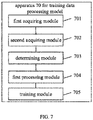
- an apparatus for processing data includes: a third acquiring module, configured to acquire data to be processed; and a second processing module, configured to acquire a data processing result output by the target data processing model by inputting the data to be processed into the target data processing model trained by the above apparatus for training the data processing model.
- FIG. 1 is a diagram according to a first embodiment of the disclosure.
- an executive body of a method for training a data processing model in some embodiments is an apparatus for training a data processing model.
- the apparatus is achieved by means of software and/or hardware and configured in an electronic device.
- the electronic device includes but not limited to a terminal, a server side, etc.
- Big data processing refers to a process of analyzing and processing large-scale data by means of artificial intelligence and big data may be summarized as 5 Vs, that is, volume, velocity, variety, value and veracity.
- sample data are acquired.
- sample data in some embodiments are not sample data for a certain specific user and may not reflect personal information of a certain specific user.
- an initial data processing model is acquired, the initial data processing model including a plurality of forward nodes for outputting a plurality of intermediate results corresponding to the sample data.
- the data processing model acquired in an initial stage of training may be referred to as the initial data processing model.
- the initial data processing model may be an artificial intelligence model, for example a neutral network model or a machine learning model.
- the initial data processing model may be any other possible model that may perform data processing tasks, which is not limited herein.
- the initial data processing model in some embodiments of the disclosure includes the plurality of forward nodes.
- the forward node may be configured to perform a forward calculation task in the data processing logic, that is, when the sample data are input into the data processing model, the forward calculation tasks are usually performed on the sample data based on the plurality of forward nodes to output the plurality of intermediate results respectively corresponding to the sample data.
- the result of the forward calculation task performed on the sample data using the forward node may be referred to as the intermediate result.
- the initial data processing model when the sample data are acquired, the initial data processing model may be acquired, that is, a data processing model may be acquired from a preset model library as the initial data processing model.
- the initial data processing model includes the plurality of forward nodes that may output the plurality of intermediate results corresponding to the sample data in performing the forward calculation tasks.
- the initial data processing model in some embodiments is not a data processing model for a certain specific user and may not reflect personal information of a certain specific user.
- a plurality of time-dependent features corresponding to the plurality of forward nodes are determined.
- the time-dependent feature means whether there is a time-dimension calculation association relationship between a corresponding forward node and other forward nodes, that is, whether the corresponding forward node depends on intermediate results output by other forward nodes when performing the forward calculation task.
- the time-dependent feature may be a dependence on a calculation sequence of different forward nodes or may be a dependence of a calculation association relationship on time dimension within a period of calculation time, which is not limited herein.
- t may represent a calculation serial number of a forward node, that is, the forward calculation task s include calculation at a 0 th action, calculation at a first action, ..., and calculation at a t th action, and different forward nodes respectively correspond to different calculation tasks.
- a forward node depends on an intermediate result output at a (t-1) th action when performing calculation at a t th action, it may be determined that the time-dependent feature of the forward node is that there is a calculation association relationship between the forward node and other forward nodes; and when a forward node does not depend on an intermediate result output at any other action when performing calculation at a t th block, it may be determined that the time-dependent feature of the forward node is that there is no calculation association relationship between the forward node and other forward nodes.
- FIG. 2 is a diagram of a time-dependent feature in some embodiments of the disclosure.
- the plurality of forward nodes include a forward node 2, a forward node 3 and a forward node 4.
- the calculation sequence of the plurality of forward nodes is the forward node 2, the forward node 3 and the forward node 4, sequentially.
- calculations may be performed in a sequence of a (t-1) th action, a t th action and a (t+1) th action.
- the forward node 3 depends on an intermediate result output at the (t-1) th action when performing calculation at the t th action and depends on an intermediate result output at the t th action when performing calculation at the (t+1) th action. Therefore, it may be determined that the time-dependent feature of the forward node 3 is that there is a time-dimension calculation association relationship between the forward node 3 and other forward nodes.
- the forward node 2 and the forward node 4 do not depend on an intermediate result output at other any action when performing calculations at the (t-1) th action, the t th action and the (t+1) th action. Therefore, it may be determined that the time-dependent features of the forward node 2 and the forward node 4 are that there is no time-dimension calculation association relationship between the forward node 2 and other forward nodes and between the forward node 4 and other forward nodes.
- the intermediate result input by the forward node may be acquired and it may analyze whether there is an association relationship between the input intermediate result and the intermediate result output by the calculation task at other actions, thereby analyzing the corresponding time-dependent feature, which is not limited herein.
- the data processing model acquired by optimizing the initial data processing model may be referred to as the data processing model to be trained.
- a loss function may be preconfigured for the data processing model to be processed.
- the sample data, the plurality of intermediate results, the predicted processing result and the annotated processing result are taken as input parameters of the loss function, a loss value input by the loss function is determined, and it is determined whether the data processing model satisfies the convergence time in combination with the loss value, which is not limited herein.
- the target data processing model acquired includes a data processing logic for the sample data.
- construction of the data processing logic for the sample data is performed when authorized by the user. The construction process conforms to the relevant laws and regulations.
- FIG. 3 is a diagram according to a second embodiment of the disclosure.
- an initial data processing model is acquired, the initial data processing model including a plurality of forward nodes for outputting a plurality of intermediate results corresponding to the sample data.
- the initial data processing model in some embodiments is not a data processing model for a certain specific user and may not reflect personal information of a certain specific user.
- a plurality of time-dependent features corresponding to the plurality of forward nodes are determined.
- FIG. 4 is a diagram of another time-dependent feature in some embodiments of the disclosure. It may include a forward node 1, a forward node 2, a forward node 3 and a forward node 4.
- the time-dependent feature of the forward node 1 is that there is no time-dimension calculation association relationship with other forward nodes.
- the forward node 1 may be determined as the target forward node.
- the target forward node is determined from the plurality of forward nodes based on the plurality of time-dependent features; the check node corresponding to the target forward node is generated, the check node being configured to output the check result corresponding to the sample data, the check result being the same as the intermediate result output by the target forward node; and the data processing model to be trained is generated based on the plurality of forward nodes and the check node, thereby optimizing the structure of the initial data processing model with reference to the time-dependent features. Since the corresponding check node is configured to perform the check task, the check result obtained by check may be supported to perform parameter tuning on the data processing model, which effectively reduces the dependence on the intermediate result output by the target forward node.
- the data processing model to be trained acquired at the action includes a data processing logic for the sample data.
- construction of the data processing logic for the sample data is performed when authorized by the user. The construction process conforms to the relevant laws and regulations.
- a target data processing model is acquired by training the data processing model to be trained using the sample data, other intermediate results and the check result; in which the other intermediate results are intermediate results corresponding to the sample data output by other forward nodes, and the target forward node and the other forward nodes constitute the plurality of forward nodes.
- the target forward node is determined from the plurality of forward nodes based on the plurality of time-dependent features; the check node corresponding to the target forward node is generated, the check node being configured to output the check result corresponding to the sample data, the check result being the same as the intermediate result output by the target forward node; and the data processing model to be trained is generated based on the plurality of forward nodes and the check node, thereby optimizing the structure of the initial data processing model with reference to the time-dependent features. Since the corresponding check node is configured to perform the check task, the check result obtained by check may be supported to perform parameter tuning on the data processing model, which effectively reduces the dependence on the intermediate result output by the target forward node.
- FIG. 5 is a diagram according to a third embodiment of the disclosure.
- the forward calculation task may be configured to perform a data processing task
- the plurality of intermediate results output by the plurality of forward nodes are acquired, in which the intermediate results may be configured as an input of reverse calculation tasks, and the reverse calculation tasks may be regarded as model parameter tuning tasks.
- the sample data in some embodiments may be acquired from a set of public data or the sample data may be acquired by authorization of a user corresponding to the sample data.
- the check node may be configured to perform the check task, to output the intermediate result corresponding to the sample data (the intermediate result output by the check node may be referred to as the check result).
- the trained data processing model is taken as the target data processing model in response to the predicted tuning parameters and the annotated tuning parameters satisfying a preset condition.
- corresponding annotated tuning parameters may be preset for the data processing model, and a loss function is preconfigured for the data processing model.
- parameter updating is performed to obtain updated predicted tuning parameters, and when the loss value between the predicted tuning parameters and the annotated optimal parameters is less than the loss threshold, it may be determined that it satisfies the preset condition between the predicted tuning parameters and the annotated tuning parameters.
- the tuning parameters to be adjusted may be adjusted based on the predicted tuning parameters to obtain the target data processing model, or the preset condition may be configured as any other possible condition, which is not limited herein.
- performance of the data processing model may be effectively enhanced, training efficiency and performance of the data processing model may be ensured, and training effect of the data processing model may be effectively enhanced, so that the data processing model is adapted to an application scene with the higher in-time requirement, which greatly enriches model training and application scenes.
- the intermediate result output by the target forward node may be deleted, and the other intermediate results output by the other forward nodes may be retained; and the check result corresponding to the sample data, generated by the check node, may be acquired. Therefore, continuous occupation of a memory in the subsequent data training process, of the intermediate result output by the target forward node, may be avoided, which enhances storage performance, thereby assisting in enhancing the training speed of the data processing model.
- performance of the data processing model may be effectively enhanced, training efficiency and performance of the data processing model may be ensured, and training effect of the data processing model may be effective enhanced, so that the data processing model is adapted to an application scene with the higher in-time requirement, which greatly enriches model training and application scenes.
- FIG. 6 is a diagram according to a fourth embodiment of the disclosure.
- an executive body of the method for processing data may acquire data to be processed by means of public, legal and compliant ways, for example, from a set of public data or from a user if the user authorized.
- the data to be processed may not reflect personal information of a certain specific user.
- the method for processing data includes the following.
- the current data to be processed may be referred to as the data to be processed.
- the data to be processed may be for example one segment of speech data frames or a plurality segments of speech data frames, that is, the number of data to be processed may be one or more, which is not limited herein.
- sample data in some embodiments of the disclosure may be acquired in accordance with the relevant laws and regulations.
- a data processing result output by the target data processing model is acquired by inputting the data to be processed into the target data processing model trained by the method for training the data processing model.
- the data processing result output by the target data processing model may be acquired by inputting the data to be processed into the target data processing model trained by the method for training the data processing model.
- the data processing result output by the target data processing model may be acquired by acquiring the data to be processed and inputting the data to be processed into the target data processing model trained by the method for training the data processing model. Since the target data processing model is trained by optimizing the structure of the initial data processing model in combination with the time-dependent features of the forward nodes, when the data to be processed are processed by the target data processing model, consumption of a memory by the data processing logic may be effectively reduced, thereby effectively enhancing the data processing efficiency and the data processing effect.
- the first acquiring module 701 is configured to acquire sample data.
- the determining submodule 8041 is configured to determine a target forward node from the plurality of forward nodes based on the plurality of time-dependent features.
- the first generation submodule 8042 is configured to generate a check node corresponding to the target forward node, the check node being configured to output a check result corresponding to the sample data, the check result being the same as an intermediate result output by the target forward node.
- the second generation submodule 8043 is configured to generate the data processing model to be trained based on the plurality of forward nodes and the check node.
- the training module 805 includes a training submodule 8051.
- the training module 805 further includes an input submodule 8052 and a deletion submodule 8053.
- the input submodule 8052 is configured to acquire the plurality of intermediate results output by the plurality of forward nodes in the data processing model to be trained by taking the sample data as a forward training input of the data processing model to be trained.
- the deletion submodule 8053 is configured to delete the intermediate calculation result output by the target forward node, and retain the other intermediate results output by the other forward nodes.
Landscapes
- Engineering & Computer Science (AREA)
- Theoretical Computer Science (AREA)
- Physics & Mathematics (AREA)
- Data Mining & Analysis (AREA)
- Artificial Intelligence (AREA)
- Evolutionary Computation (AREA)
- General Engineering & Computer Science (AREA)
- General Physics & Mathematics (AREA)
- Software Systems (AREA)
- Life Sciences & Earth Sciences (AREA)
- Mathematical Physics (AREA)
- Computing Systems (AREA)
- Biomedical Technology (AREA)
- Health & Medical Sciences (AREA)
- Biophysics (AREA)
- Molecular Biology (AREA)
- Computational Linguistics (AREA)
- General Health & Medical Sciences (AREA)
- Computer Vision & Pattern Recognition (AREA)
- Evolutionary Biology (AREA)
- Bioinformatics & Computational Biology (AREA)
- Bioinformatics & Cheminformatics (AREA)
- Medical Informatics (AREA)
- Neurology (AREA)
- Management, Administration, Business Operations System, And Electronic Commerce (AREA)
- Information Retrieval, Db Structures And Fs Structures Therefor (AREA)
- Image Analysis (AREA)
- Complex Calculations (AREA)
Applications Claiming Priority (1)
| Application Number | Priority Date | Filing Date | Title |
|---|---|---|---|
| CN202110584511.2A CN113361574A (zh) | 2021-05-27 | 2021-05-27 | 数据处理模型的训练方法、装置、电子设备及存储介质 |
Publications (2)
| Publication Number | Publication Date |
|---|---|
| EP4020327A2 true EP4020327A2 (de) | 2022-06-29 |
| EP4020327A3 EP4020327A3 (de) | 2022-10-26 |
Family
ID=77527913
Family Applications (1)
| Application Number | Title | Priority Date | Filing Date |
|---|---|---|---|
| EP22163265.6A Pending EP4020327A3 (de) | 2021-05-27 | 2022-03-21 | Verfahren und vorrichtung zum trainieren eines datenverarbeitungsmodells, elektronische vorrichtung und speichermedium |
Country Status (5)
| Country | Link |
|---|---|
| US (1) | US20220207427A1 (de) |
| EP (1) | EP4020327A3 (de) |
| JP (1) | JP2022078286A (de) |
| KR (1) | KR20220061060A (de) |
| CN (1) | CN113361574A (de) |
Families Citing this family (4)
| Publication number | Priority date | Publication date | Assignee | Title |
|---|---|---|---|---|
| CN114692866B (zh) * | 2022-03-23 | 2025-06-10 | 北京百度网讯科技有限公司 | 用于辅助模型训练的方法、装置及计算机程序产品 |
| CN115186738B (zh) * | 2022-06-20 | 2023-04-07 | 北京百度网讯科技有限公司 | 模型训练方法、装置和存储介质 |
| CN114971926B (zh) * | 2022-06-22 | 2025-12-19 | 中国平安财产保险股份有限公司 | 保费计算模型测试方法、系统、设备及存储介质 |
| CN117852110B (zh) * | 2024-01-10 | 2024-08-30 | 深圳志崇科技有限公司 | 一种数据传输的安全校验装置 |
Family Cites Families (9)
| Publication number | Priority date | Publication date | Assignee | Title |
|---|---|---|---|---|
| US7088860B2 (en) * | 2001-03-28 | 2006-08-08 | Canon Kabushiki Kaisha | Dynamically reconfigurable signal processing circuit, pattern recognition apparatus, and image processing apparatus |
| JP5510014B2 (ja) * | 2010-04-13 | 2014-06-04 | 富士通株式会社 | ニューラルネットワーク設計方法及びプログラム |
| US11256990B2 (en) * | 2016-05-20 | 2022-02-22 | Deepmind Technologies Limited | Memory-efficient backpropagation through time |
| US10846595B2 (en) * | 2016-12-20 | 2020-11-24 | Intel Corporation | Rapid competitive learning techniques for neural networks |
| US11200461B2 (en) * | 2018-12-21 | 2021-12-14 | Capital One Services, Llc | Methods and arrangements to identify feature contributions to erroneous predictions |
| JP2020135748A (ja) * | 2019-02-25 | 2020-08-31 | 株式会社Preferred Networks | 最適化装置、最適化方法及びプログラム |
| US11836600B2 (en) * | 2020-08-20 | 2023-12-05 | D5Ai Llc | Targeted incremental growth with continual learning in deep neural networks |
| US12248367B2 (en) * | 2020-09-29 | 2025-03-11 | Hailo Technologies Ltd. | Software defined redundant allocation safety mechanism in an artificial neural network processor |
| CN112529210A (zh) * | 2020-12-09 | 2021-03-19 | 广州云从鼎望科技有限公司 | 模型训练方法、装置以及计算机可读存储介质 |
-
2021
- 2021-05-27 CN CN202110584511.2A patent/CN113361574A/zh active Pending
-
2022
- 2022-03-14 JP JP2022039275A patent/JP2022078286A/ja active Pending
- 2022-03-17 US US17/655,253 patent/US20220207427A1/en active Pending
- 2022-03-21 EP EP22163265.6A patent/EP4020327A3/de active Pending
- 2022-04-25 KR KR1020220050650A patent/KR20220061060A/ko active Pending
Also Published As
| Publication number | Publication date |
|---|---|
| JP2022078286A (ja) | 2022-05-24 |
| CN113361574A (zh) | 2021-09-07 |
| KR20220061060A (ko) | 2022-05-12 |
| EP4020327A3 (de) | 2022-10-26 |
| US20220207427A1 (en) | 2022-06-30 |
Similar Documents
| Publication | Publication Date | Title |
|---|---|---|
| EP4020327A2 (de) | Verfahren und vorrichtung zum trainieren eines datenverarbeitungsmodells, elektronische vorrichtung und speichermedium | |
| CN112699991B (zh) | 用于加速神经网络训练的信息处理的方法、电子设备和计算机可读介质 | |
| US20250036920A1 (en) | Mixture-of-experts model implementation method and system, electronic device, and storage medium | |
| CN114612749B (zh) | 神经网络模型训练方法及装置、电子设备和介质 | |
| JP7438303B2 (ja) | ディープラーニングモデルのトレーニング方法、自然言語処理方法及び装置、電子機器、記憶媒体及びコンピュータプログラム | |
| CN113407850B (zh) | 一种虚拟形象的确定和获取方法、装置以及电子设备 | |
| JP7357114B2 (ja) | 生体検出モデルのトレーニング方法、装置、電子機器および記憶媒体 | |
| CN112527281B (zh) | 基于人工智能的算子升级方法、装置、电子设备及介质 | |
| CN112580666B (zh) | 图像特征的提取方法、训练方法、装置、电子设备及介质 | |
| CN111133458B (zh) | 增强神经网络 | |
| US20260073127A1 (en) | Interaction method and apparatus, electronic device and computer readable medium | |
| CN116030235A (zh) | 目标检测模型训练方法、目标检测方法、装置和电子设备 | |
| CN114357180A (zh) | 知识图谱的更新方法及电子设备 | |
| CN118363977A (zh) | 结构化查询语言语句生成方法、装置、设备及存储介质 | |
| JP2023002690A (ja) | セマンティックス認識方法、装置、電子機器及び記憶媒体 | |
| WO2025195173A1 (zh) | 数据处理方法、训练注意力计算的方法、装置、设备和介质 | |
| CN114861059A (zh) | 资源推荐方法、装置、电子设备及存储介质 | |
| CN114817476A (zh) | 语言模型的训练方法、装置、电子设备和存储介质 | |
| KR20250050980A (ko) | 이미지 처리 방법 및 장치, 기기와 매체 | |
| US20220301131A1 (en) | Method and apparatus for generating sample image | |
| CN115862031A (zh) | 文本处理方法、神经网络的训练方法、装置和设备 | |
| CN116205309B (zh) | 内容理解模型的训练方法、内容理解方法以及相关装置 | |
| US20220188163A1 (en) | Method for processing data, electronic device and storage medium | |
| CN114860411B (zh) | 多任务学习方法、装置、电子设备和存储介质 | |
| CN113408632A (zh) | 提高图像分类准确性的方法、装置、电子设备及存储介质 |
Legal Events
| Date | Code | Title | Description |
|---|---|---|---|
| PUAI | Public reference made under article 153(3) epc to a published international application that has entered the european phase |
Free format text: ORIGINAL CODE: 0009012 |
|
| STAA | Information on the status of an ep patent application or granted ep patent |
Free format text: STATUS: THE APPLICATION HAS BEEN PUBLISHED |
|
| AK | Designated contracting states |
Kind code of ref document: A2 Designated state(s): AL AT BE BG CH CY CZ DE DK EE ES FI FR GB GR HR HU IE IS IT LI LT LU LV MC MK MT NL NO PL PT RO RS SE SI SK SM TR |
|
| REG | Reference to a national code |
Ref country code: DE Ref legal event code: R079 Free format text: PREVIOUS MAIN CLASS: G06N0003040000 Ipc: G06N0003080000 |
|
| PUAL | Search report despatched |
Free format text: ORIGINAL CODE: 0009013 |
|
| AK | Designated contracting states |
Kind code of ref document: A3 Designated state(s): AL AT BE BG CH CY CZ DE DK EE ES FI FR GB GR HR HU IE IS IT LI LT LU LV MC MK MT NL NO PL PT RO RS SE SI SK SM TR |
|
| RIC1 | Information provided on ipc code assigned before grant |
Ipc: G06N 3/063 20060101ALI20220921BHEP Ipc: G06N 3/04 20060101ALI20220921BHEP Ipc: G06N 3/08 20060101AFI20220921BHEP |
|
| STAA | Information on the status of an ep patent application or granted ep patent |
Free format text: STATUS: REQUEST FOR EXAMINATION WAS MADE |
|
| 17P | Request for examination filed |
Effective date: 20230425 |
|
| RBV | Designated contracting states (corrected) |
Designated state(s): AL AT BE BG CH CY CZ DE DK EE ES FI FR GB GR HR HU IE IS IT LI LT LU LV MC MK MT NL NO PL PT RO RS SE SI SK SM TR |
|
| STAA | Information on the status of an ep patent application or granted ep patent |
Free format text: STATUS: EXAMINATION IS IN PROGRESS |
|
| 17Q | First examination report despatched |
Effective date: 20250618 |