EP4019963A2 - Method for ultrasonic testing of a secondary battery and method for manufacturing a secondary battery including the same - Google Patents
Method for ultrasonic testing of a secondary battery and method for manufacturing a secondary battery including the same Download PDFInfo
- Publication number
- EP4019963A2 EP4019963A2 EP21213090.0A EP21213090A EP4019963A2 EP 4019963 A2 EP4019963 A2 EP 4019963A2 EP 21213090 A EP21213090 A EP 21213090A EP 4019963 A2 EP4019963 A2 EP 4019963A2
- Authority
- EP
- European Patent Office
- Prior art keywords
- secondary battery
- laser
- ultrasonic signal
- cap
- ultrasonic
- Prior art date
- Legal status (The legal status is an assumption and is not a legal conclusion. Google has not performed a legal analysis and makes no representation as to the accuracy of the status listed.)
- Pending
Links
Images




Classifications
-
- G—PHYSICS
- G01—MEASURING; TESTING
- G01N—INVESTIGATING OR ANALYSING MATERIALS BY DETERMINING THEIR CHEMICAL OR PHYSICAL PROPERTIES
- G01N29/00—Investigating or analysing materials by the use of ultrasonic, sonic or infrasonic waves; Visualisation of the interior of objects by transmitting ultrasonic or sonic waves through the object
- G01N29/04—Analysing solids
- G01N29/043—Analysing solids in the interior, e.g. by shear waves
-
- H—ELECTRICITY
- H01—ELECTRIC ELEMENTS
- H01M—PROCESSES OR MEANS, e.g. BATTERIES, FOR THE DIRECT CONVERSION OF CHEMICAL ENERGY INTO ELECTRICAL ENERGY
- H01M10/00—Secondary cells; Manufacture thereof
- H01M10/42—Methods or arrangements for servicing or maintenance of secondary cells or secondary half-cells
- H01M10/4285—Testing apparatus
-
- G—PHYSICS
- G01—MEASURING; TESTING
- G01N—INVESTIGATING OR ANALYSING MATERIALS BY DETERMINING THEIR CHEMICAL OR PHYSICAL PROPERTIES
- G01N29/00—Investigating or analysing materials by the use of ultrasonic, sonic or infrasonic waves; Visualisation of the interior of objects by transmitting ultrasonic or sonic waves through the object
- G01N29/22—Details, e.g. general constructional or apparatus details
- G01N29/24—Probes
- G01N29/2418—Probes using optoacoustic interaction with the material, e.g. laser radiation, photoacoustics
-
- B—PERFORMING OPERATIONS; TRANSPORTING
- B23—MACHINE TOOLS; METAL-WORKING NOT OTHERWISE PROVIDED FOR
- B23K—SOLDERING OR UNSOLDERING; WELDING; CLADDING OR PLATING BY SOLDERING OR WELDING; CUTTING BY APPLYING HEAT LOCALLY, e.g. FLAME CUTTING; WORKING BY LASER BEAM
- B23K31/00—Processes relevant to this subclass, specially adapted for particular articles or purposes, but not covered by any single one of main groups B23K1/00 - B23K28/00
- B23K31/12—Processes relevant to this subclass, specially adapted for particular articles or purposes, but not covered by any single one of main groups B23K1/00 - B23K28/00 relating to investigating the properties, e.g. the weldability, of materials
- B23K31/125—Weld quality monitoring
-
- G—PHYSICS
- G01—MEASURING; TESTING
- G01N—INVESTIGATING OR ANALYSING MATERIALS BY DETERMINING THEIR CHEMICAL OR PHYSICAL PROPERTIES
- G01N29/00—Investigating or analysing materials by the use of ultrasonic, sonic or infrasonic waves; Visualisation of the interior of objects by transmitting ultrasonic or sonic waves through the object
- G01N29/04—Analysing solids
-
- G—PHYSICS
- G01—MEASURING; TESTING
- G01N—INVESTIGATING OR ANALYSING MATERIALS BY DETERMINING THEIR CHEMICAL OR PHYSICAL PROPERTIES
- G01N29/00—Investigating or analysing materials by the use of ultrasonic, sonic or infrasonic waves; Visualisation of the interior of objects by transmitting ultrasonic or sonic waves through the object
- G01N29/14—Investigating or analysing materials by the use of ultrasonic, sonic or infrasonic waves; Visualisation of the interior of objects by transmitting ultrasonic or sonic waves through the object using acoustic emission techniques
-
- G—PHYSICS
- G01—MEASURING; TESTING
- G01N—INVESTIGATING OR ANALYSING MATERIALS BY DETERMINING THEIR CHEMICAL OR PHYSICAL PROPERTIES
- G01N29/00—Investigating or analysing materials by the use of ultrasonic, sonic or infrasonic waves; Visualisation of the interior of objects by transmitting ultrasonic or sonic waves through the object
- G01N29/22—Details, e.g. general constructional or apparatus details
- G01N29/26—Arrangements for orientation or scanning by relative movement of the head and the sensor
- G01N29/27—Arrangements for orientation or scanning by relative movement of the head and the sensor by moving the material relative to a stationary sensor
-
- G—PHYSICS
- G01—MEASURING; TESTING
- G01N—INVESTIGATING OR ANALYSING MATERIALS BY DETERMINING THEIR CHEMICAL OR PHYSICAL PROPERTIES
- G01N29/00—Investigating or analysing materials by the use of ultrasonic, sonic or infrasonic waves; Visualisation of the interior of objects by transmitting ultrasonic or sonic waves through the object
- G01N29/44—Processing the detected response signal, e.g. electronic circuits specially adapted therefor
-
- G—PHYSICS
- G01—MEASURING; TESTING
- G01N—INVESTIGATING OR ANALYSING MATERIALS BY DETERMINING THEIR CHEMICAL OR PHYSICAL PROPERTIES
- G01N29/00—Investigating or analysing materials by the use of ultrasonic, sonic or infrasonic waves; Visualisation of the interior of objects by transmitting ultrasonic or sonic waves through the object
- G01N29/44—Processing the detected response signal, e.g. electronic circuits specially adapted therefor
- G01N29/4409—Processing the detected response signal, e.g. electronic circuits specially adapted therefor by comparison
- G01N29/4427—Processing the detected response signal, e.g. electronic circuits specially adapted therefor by comparison with stored values, e.g. threshold values
-
- G—PHYSICS
- G01—MEASURING; TESTING
- G01N—INVESTIGATING OR ANALYSING MATERIALS BY DETERMINING THEIR CHEMICAL OR PHYSICAL PROPERTIES
- G01N29/00—Investigating or analysing materials by the use of ultrasonic, sonic or infrasonic waves; Visualisation of the interior of objects by transmitting ultrasonic or sonic waves through the object
- G01N29/44—Processing the detected response signal, e.g. electronic circuits specially adapted therefor
- G01N29/4445—Classification of defects
-
- G—PHYSICS
- G01—MEASURING; TESTING
- G01N—INVESTIGATING OR ANALYSING MATERIALS BY DETERMINING THEIR CHEMICAL OR PHYSICAL PROPERTIES
- G01N29/00—Investigating or analysing materials by the use of ultrasonic, sonic or infrasonic waves; Visualisation of the interior of objects by transmitting ultrasonic or sonic waves through the object
- G01N29/44—Processing the detected response signal, e.g. electronic circuits specially adapted therefor
- G01N29/46—Processing the detected response signal, e.g. electronic circuits specially adapted therefor by spectral analysis, e.g. Fourier analysis or wavelet analysis
-
- H—ELECTRICITY
- H01—ELECTRIC ELEMENTS
- H01M—PROCESSES OR MEANS, e.g. BATTERIES, FOR THE DIRECT CONVERSION OF CHEMICAL ENERGY INTO ELECTRICAL ENERGY
- H01M10/00—Secondary cells; Manufacture thereof
- H01M10/04—Construction or manufacture in general
- H01M10/0422—Cells or battery with cylindrical casing
-
- H—ELECTRICITY
- H01—ELECTRIC ELEMENTS
- H01M—PROCESSES OR MEANS, e.g. BATTERIES, FOR THE DIRECT CONVERSION OF CHEMICAL ENERGY INTO ELECTRICAL ENERGY
- H01M50/00—Constructional details or processes of manufacture of the non-active parts of electrochemical cells other than fuel cells, e.g. hybrid cells
- H01M50/10—Primary casings; Jackets or wrappings
- H01M50/102—Primary casings; Jackets or wrappings characterised by their shape or physical structure
- H01M50/109—Primary casings; Jackets or wrappings characterised by their shape or physical structure of button or coin shape
-
- H—ELECTRICITY
- H01—ELECTRIC ELEMENTS
- H01M—PROCESSES OR MEANS, e.g. BATTERIES, FOR THE DIRECT CONVERSION OF CHEMICAL ENERGY INTO ELECTRICAL ENERGY
- H01M50/00—Constructional details or processes of manufacture of the non-active parts of electrochemical cells other than fuel cells, e.g. hybrid cells
- H01M50/10—Primary casings; Jackets or wrappings
- H01M50/147—Lids or covers
- H01M50/166—Lids or covers characterised by the methods of assembling casings with lids
- H01M50/169—Lids or covers characterised by the methods of assembling casings with lids by welding, brazing or soldering
-
- G—PHYSICS
- G01—MEASURING; TESTING
- G01N—INVESTIGATING OR ANALYSING MATERIALS BY DETERMINING THEIR CHEMICAL OR PHYSICAL PROPERTIES
- G01N2291/00—Indexing codes associated with group G01N29/00
- G01N2291/02—Indexing codes associated with the analysed material
- G01N2291/023—Solids
-
- G—PHYSICS
- G01—MEASURING; TESTING
- G01N—INVESTIGATING OR ANALYSING MATERIALS BY DETERMINING THEIR CHEMICAL OR PHYSICAL PROPERTIES
- G01N2291/00—Indexing codes associated with group G01N29/00
- G01N2291/02—Indexing codes associated with the analysed material
- G01N2291/028—Material parameters
- G01N2291/0289—Internal structure, e.g. defects, grain size, texture
-
- G—PHYSICS
- G01—MEASURING; TESTING
- G01N—INVESTIGATING OR ANALYSING MATERIALS BY DETERMINING THEIR CHEMICAL OR PHYSICAL PROPERTIES
- G01N2291/00—Indexing codes associated with group G01N29/00
- G01N2291/10—Number of transducers
- G01N2291/102—Number of transducers one emitter, one receiver
-
- G—PHYSICS
- G01—MEASURING; TESTING
- G01N—INVESTIGATING OR ANALYSING MATERIALS BY DETERMINING THEIR CHEMICAL OR PHYSICAL PROPERTIES
- G01N2291/00—Indexing codes associated with group G01N29/00
- G01N2291/26—Scanned objects
- G01N2291/269—Various geometry objects
- G01N2291/2697—Wafer or (micro)electronic parts
-
- Y—GENERAL TAGGING OF NEW TECHNOLOGICAL DEVELOPMENTS; GENERAL TAGGING OF CROSS-SECTIONAL TECHNOLOGIES SPANNING OVER SEVERAL SECTIONS OF THE IPC; TECHNICAL SUBJECTS COVERED BY FORMER USPC CROSS-REFERENCE ART COLLECTIONS [XRACs] AND DIGESTS
- Y02—TECHNOLOGIES OR APPLICATIONS FOR MITIGATION OR ADAPTATION AGAINST CLIMATE CHANGE
- Y02E—REDUCTION OF GREENHOUSE GAS [GHG] EMISSIONS, RELATED TO ENERGY GENERATION, TRANSMISSION OR DISTRIBUTION
- Y02E60/00—Enabling technologies; Technologies with a potential or indirect contribution to GHG emissions mitigation
- Y02E60/10—Energy storage using batteries
-
- Y—GENERAL TAGGING OF NEW TECHNOLOGICAL DEVELOPMENTS; GENERAL TAGGING OF CROSS-SECTIONAL TECHNOLOGIES SPANNING OVER SEVERAL SECTIONS OF THE IPC; TECHNICAL SUBJECTS COVERED BY FORMER USPC CROSS-REFERENCE ART COLLECTIONS [XRACs] AND DIGESTS
- Y02—TECHNOLOGIES OR APPLICATIONS FOR MITIGATION OR ADAPTATION AGAINST CLIMATE CHANGE
- Y02P—CLIMATE CHANGE MITIGATION TECHNOLOGIES IN THE PRODUCTION OR PROCESSING OF GOODS
- Y02P70/00—Climate change mitigation technologies in the production process for final industrial or consumer products
- Y02P70/50—Manufacturing or production processes characterised by the final manufactured product
Definitions
- the present disclosure herein relates to a method for testing a secondary battery and a method for manufacturing a secondary battery including the same, and more particularly, to a test method for detecting defects in a process through ultrasonic waves generated during a process of manufacturing a secondary battery or ultrasonic waves generated by laser applied for inspection after the secondary battery is completely manufactured, and a method for manufacturing a secondary battery including the same.
- a secondary battery is formed by accommodating an electrode assembly including a positive electrode, a negative electrode, and a separator in a pouch and then injecting an electrolyte therein.
- the positive electrode and the negative electrode constituting the electrode assembly of the secondary battery are formed by applying a positive electrode material and a negative electrode material on an electrode sheet.
- the secondary battery is required to have various performance according to a device applied thereto, and thus, it is necessary to develop a secondary battery using various positive and negative electrode materials.
- studies on a method of detecting process defects occurring during a process of manufacturing various secondary batteries are being conducted.
- the present disclosure provides a method for quickly and easily detecting internal and external defects occurring during a process of manufacturing a secondary battery, which are not detected through the existing methods.
- An embodiment of the inventive concept provides a method for testing a secondary battery, the method including: applying laser to the secondary battery after a manufacturing process is completed to generate an ultrasonic signal; detecting the ultrasonic signal; converting the detected ultrasonic signal to generate a digital signal; and processing and analyzing the digital signal.
- the processing and analyzing of the digital signal may be performed by learning a difference depending on whether defects occur in the secondary battery or by directly detecting a specific signal generated when the defects occur.
- the applying of the laser to generate the ultrasonic signal may include: emitting the laser from a laser source; and applying the laser emitted from the laser source to a portion of the secondary battery through a transmission part and a focusing part.
- the transmission part may be configured to adjust a position, to which the laser is applied, by controlling a path of the laser, and the focusing part may be configured to focus the laser to control a size of a focal point.
- the secondary battery may include: an electrode assembly including a positive electrode, a negative electrode, and a separator between the positive electrode and the negative electrode; a can surrounding the electrode assembly; and a cap covering at least one surface of top and bottom surfaces of the can, wherein each of the positive electrode and the negative electrode has a jelly-roll type, wherein the laser may be applied to welding regions defined as a position at which a welding process is performed, and the welding process may be performed to couple the electrode assembly to the can, the electrode assembly to the cap, and the can to the cap.
- the can may have a cylindrical shape having a height greater than a diameter of the top surface thereof, and the laser is applied to at least one of the welding regions.
- the laser may generate the ultrasonic signal at an edge of the cap.
- the can may have a coin shape having a diameter of the top surface, which is greater than a height thereof, and the laser may be applied to a sidewall of the can.
- the laser may generate the ultrasonic signal to the top surface of the cap.
- rotating the secondary battery in one direction at a predetermined time interval and the applying of the laser to generate the ultrasonic signal may be repeatedly performed.
- the secondary battery for which the manufacturing process is completed may be provided in plurality, and the secondary batteries may move in one direction along a rail and are sequentially tested by a fixed test device.
- the test device may include a mount, a laser head fixed by the mount, a fiber laser connected to the laser head, and an ultrasonic sensor disposed at one side of the laser head, and the secondary batteries may move into a space between the laser head and the rail.
- the ultrasonic signal may be temporally and spatially synchronized with the applied laser.
- a method for testing a secondary battery include: detecting an ultrasonic signal generated during a process of manufacturing the secondary battery; converting the detected ultrasonic signal to generate a digital signal; and processing and analyzing the digital signal, wherein the ultrasonic signal is generated by a welding process during the process of manufacturing the secondary battery.
- the welding process may be at least one of a laser welding process, an ultrasonic welding process, and a resistance welding process.
- the processing and analyzing of the digital signal may be performed by learning a difference depending on whether defects occur in the secondary battery or by directly detecting a specific signal generated when the defects occur.
- a method for manufacturing a secondary battery includes: coupling different components constituting the secondary battery to each other through a welding process; applying laser to welding regions, on which the welding process is performed, to generate an ultrasonic signal; and processing and analyzing the ultrasonic signal to test the secondary battery whether defects occur in the secondary battery.
- the secondary battery may include: an electrode assembly including a positive electrode, a negative electrode, and a separator between the positive electrode and the negative electrode; a can surrounding the electrode assembly; and a cap covering at least one surface of top and bottom surfaces of the can, wherein each of the positive electrode and the negative electrode has a jelly-roll type, and wherein the welding process may be performed to couple the electrode assembly to the can, the electrode assembly to the cap, and the can to the cap.
- rotating the secondary battery in one direction at a predetermined time interval and the applying of the laser to generate the ultrasonic signal may be repeatedly performed.
- the processing and analyzing of the ultrasonic signal to test the secondary battery whether the defects occur in the secondary battery may be performed by learning a difference depending on whether the defects occur in the secondary battery or by directly detecting a specific signal generated when the defects occur.
- first and second are used herein to describe various regions, directions, shapes, and the like, these regions, directions, and shapes should not be limited by these terms. These terms are used only to discriminate one region, direction, or shape from another region, direction, or shape. Therefore, a portion referred to as a first portion in one embodiment can be referred to as a second portion in another embodiment.
- An embodiment described and exemplified herein includes a complementary embodiment thereof. Like reference numerals refer to like elements throughout.
- FIG. 1 is a flowchart for explaining a method for testing a secondary battery according to embodiments of the inventive concept.
- FIG. 1 is a flowchart for explaining a test method for detecting process defects through ultrasonic waves generated by laser applied after a process of manufacturing the secondary battery is completed.
- a method for testing a secondary battery includes a process (S11) of terminating a secondary battery manufacturing process, a process (S12) of applying laser to the secondary battery after the manufacturing process is completed to generate ultrasonic waves, a process (S13) of detecting the ultrasonic waves generated by applying the laser, a process (S14) of converting an ultrasonic signal detected through an A/D converter to generate a digital signal, and a process (S15) of processing and analyzing data of the digital signal.
- the process (S15) of processing and analyzing the data of the digital signal may be performed by learning a difference depending on whether defects occur in the secondary battery or by directly detecting a specific signal generated when the defects occur.
- the laser may be applied to a specific position determined according to a shape of the secondary battery and a welding portion.
- a position, at which the laser is applied, and a position, at which the ultrasonic waves are generated, according to the shape of the secondary battery and the welding portion will be described in detail below with reference to FIGS. 4 and 5 .
- qualities inside and outside the secondary battery may be inspected by processing and analyzing the ultrasonic signal generated by the applied laser.
- the ultrasonic signal generated by the applied laser may be an analog signal.
- the ultrasonic signal may be temporally and spatially synchronized with the applied laser.
- the ultrasonic signal may be converted into a digital signal through an A/D converter.
- the converted digital signal may be processed through computer software and may be processed and analyzed through deep learning. Accordingly, in the method for testing the secondary battery according to the inventive concept, total inspection of a plurality of secondary batteries may be quickly and easily performed to reduce costs due to product defects.
- the method for manufacturing the secondary battery according to the inventive concept may include a process of coupling a can and a cap, which will be described later with reference to FIGS. 4 and 5 , to each other through a welding process, and the process of applying the laser to welding regions, on which the welding process is performed, to generate the ultrasonic signal and the process of processing and analyzing the ultrasonic signal to test the secondary battery whether the defects of the secondary battery occur, which are described with reference to FIG. 1 .
- the process of processing and analyzing the ultrasonic signal to test the secondary battery whether the defects occur in the secondary battery may be performed by learning a difference depending on whether the defects occur in the secondary battery or by directly detecting a specific signal generated when the defects occur.
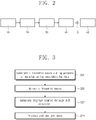
- FIG. 2 is a conceptual view for explaining the process of applying the laser to detect the ultrasonic signal in the method for testing the secondary battery according to embodiments of the inventive concept, in detail.
- laser may be emitted from a laser source 10.
- the laser emitted from the laser source 10 may be applied to a target 40 through a transmission part 20 and a focusing part 30.
- the transmission part 20 may adjust the position, to which the laser is applied, by controlling a path of the laser.
- the focusing part 30 may focus the laser to control a size of a focal point.
- the transmission part 20 and the focusing part 30 may include various optical systems depending on the purpose.
- the target 40 may be a portion of the secondary battery.
- the target 40 may be one of welding portions of the secondary battery.
- An ultrasonic detection part 50 may detect an ultrasonic signal S generated from the target 40 by the applied laser.
- the ultrasonic detection part 50 may include an ultrasonic detection sensor.
- the ultrasonic detection part 50 may transmit the detected ultrasonic signal S to the A/D converter.
- FIG. 3 is a flowchart for explaining the method for testing the secondary battery according to embodiments of the inventive concept.
- FIG. 3 is a flowchart for explaining a test method for detecting the process defects through the ultrasonic waves generated during the process of manufacturing the secondary battery.
- the method for testing the secondary battery includes a process (S21) of generating the ultrasonic waves during the process of manufacturing the secondary battery, a process (S22) of detecting the ultrasonic waves during the process of manufacturing the secondary battery, a process (S23) of converting the ultrasonic signal detected through the A/D converter to generate the digital signal, and a process (S24) of processing and analyzing the data of the digital signal.
- the ultrasonic waves may be generated by at least one of a laser welding process, an ultrasonic welding process, a resistance welding process, and the like during the process of manufacturing the secondary battery.
- the process of manufacturing the secondary battery may be managed in real time by detecting and analyzing the ultrasonic waves generated from various causes during the process of manufacturing the secondary battery.
- the process of detecting, processing, and analyzing the ultrasonic waves may be substantially the same as that described with reference to FIGS. 1 and 2 .
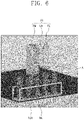
- FIG. 4 is a perspective view for explaining the method for testing the secondary battery according to embodiments of the inventive concept.
- a secondary battery 100 may include an electrode assembly, a can 110, and a cap 130.
- the can 110 may have a cylindrical shape having a height greater than a diameter of a top surface thereof.
- the cap 130 may have a coin shape having a diameter of a top surface, which is greater than a height thereof.
- the diameter of the top surface of the can 110 may be greater than the diameter of the top surface of the cap 130.
- the cap 130 may cover at least one of top and bottom surface of the can 110.
- the cap 130 may cover both the top and bottom surfaces of the can 110.
- the cap 130 may cover the top surface of the can 110.
- the can 110 may surround an electrode assembly including a positive electrode, a negative electrode, and a separator between the positive electrode and the negative electrode.
- the electrode assembly including the positive electrode, the negative electrode, and the separator may be provided in an inner space surrounded by the can 110.
- an electrolyte may be filled into a space between the positive electrode, the negative electrode, and the separator and the can 110.
- Each of the positive electrode and the negative electrode may have a jelly-roll type.
- the cap 130 may include welding regions on the top or bottom surface thereof.
- the welding regions may be regions recessed by a predetermined depth from the top surface of the cap 130 and may have rotational symmetry. Weld regions may be opened at an edge of the cap 130. However, this is merely an example, and positions and shapes of the welding regions are not limited thereto.
- a welding process may be performed on the welding regions to couple the electrode assembly to the can 110, the electrode assembly to the cap 130, and the can 110 to the cap 130.
- the laser L emitted from the laser source 10 may be applied to any one of the above-described welding regions.
- the laser L may be applied to a position that is close to a center of the cap 130 at any one of the welding regions.
- the optical systems corresponding to the transmission part 20 and the focusing part 30 described with reference to FIG. 2 may be provided between the laser source 10 and the welding regions.
- the laser L applied to any one of the welding regions may generate the ultrasonic signal S at the edge of the cap 130.
- the ultrasonic detection part 50 disposed adjacent to the cap 130 may detect the ultrasonic signal S.
- the secondary battery 100 including the electrode assembly, the can 110, and the cap 130 may rotate in one direction while the positions of the laser source 10 and the ultrasonic detection part 50 are fixed.
- the rotation of the secondary battery 100 at a predetermined time interval and the generation of the ultrasonic signal S by applying the laser L may be repeatedly performed.
- the secondary battery 100 may rotate by about 90 degrees at a predetermined time interval, and accordingly, the laser L may be applied to each of the welding regions, and thus, four ultrasonic signals S may be obtained.
- this is merely an example, and the number of obtainable ultrasonic signals S may vary depending on the positions of the welding regions, the number of welding regions, and a rotation angle of the secondary battery 100.
- FIG. 5 is a perspective view for explaining a method for testing a secondary battery according to embodiments of the inventive concept. For convenience of description, descriptions of items substantially the same as those described with reference to FIG. 4 will be omitted.
- a secondary battery 200 may include an electrode assembly, a can 210, and a cap 230.
- Each of the can 210 and the cap 230 may have a coin shape having a diameter of a top surface, which is greater than a height thereof.
- the diameter of the top surface of the can 210 may be greater than the diameter of the top surface of the cap 230.
- the cap 230 may cover at least one of top and bottom surface of the can 210.
- the cap 230 may include a welding region WR at an edge of the bottom surface thereof. A welding process may be performed on the welding regions WR to couple the electrode assembly to the can 110, the electrode assembly to the cap 130, and the can 110 to the cap 130.
- Laser L emitted from the laser source 10 may be applied to a sidewall of the can 210 adjacent to the welding regions WR.
- the optical systems corresponding to the transmission part 20 and the focusing part 30 described with reference to FIG. 2 may be provided between the laser source 10 and the sidewall of the can 210.
- the laser L applied to the sidewall of the can 210 may generate an ultrasonic signal S to the top surface of the cap 230.
- the ultrasonic detection part 50 disposed adjacent to the top surface of the cap 230 may detect the ultrasonic signal S.
- the secondary battery 200 including the electrode assembly, the can 210, and the cap 230 may rotate in one direction while the positions of the laser source 10 and the ultrasonic detection part 50 are fixed.
- the secondary battery 200 may rotate by about 10 degrees at a predetermined time interval, and thus 36 ultrasonic signals S may be obtained.
- FIG. 6 is a perspective view for explaining the method for testing the secondary battery according to embodiments of the inventive concept.
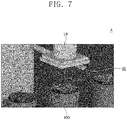
- FIG. 7 is an enlarged view for explaining the method for testing the secondary battery according to embodiments of the inventive concept and corresponds to a portion A of FIG. 6 .
- a plurality of secondary batteries 100 for which the manufacturing process is completed may move along a rail RA.
- the plurality of secondary batteries 100 moving along the rail RA may be sequentially tested by a fixed test device TD.
- the test device TD may include a mount FM, a laser head LH fixed by the mount FM, a fiber laser FL connected to the laser head LH, and an ultrasonic sensor SS disposed at one side of the laser head LH.
- the laser head LH may vertically overlap the rail RA on which the plurality of secondary batteries 100 are disposed and be spaced apart from the rail RA.
- the plurality of secondary batteries 100 may move into a space between the laser head LH and the rail RA.
- the laser emitted through the fiber laser FL may be applied to a top surface of any one of the secondary batteries 100 through the laser head LH.
- the laser may be applied to one of the welding regions described with reference to FIG. 4 , and an ultrasonic signal generated by applying the laser may be detected through an ultrasonic sensor SS disposed adjacent to the welding regions.
- the position of the ultrasonic sensor SS may vary according to positions and shapes of the welding regions.
- FIGS. 8 and 9 are views for explaining the method for testing the secondary battery according to embodiments of the inventive concept and are graphs related to data processing and analysis.
- FIG. 8 is a view for explaining acoustic energy with respect to a time of the ultrasonic signals detected by the ultrasonic sensor
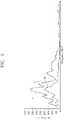
- FIG. 9 is a view for explaining an amplitude with respect to a frequency of each of the ultrasonic signals that have been processed and analyzed.
- a horizontal axis represents the time, a unit is ⁇ s, and a vertical axis represents a relative magnitude of the acoustic energy.
- a horizontal axis represents the frequency, a unit is MHz, and a vertical axis represents a relative magnitude of the amplitude.
- raw data of the ultrasonic signals may be converted into a digital signal through an A/D converter, and the converted digital signal may be processed through computer software.
- the processed signal may be displayed as a graph as illustrated in FIG. 9 .
- a first graph G1 represents a signal generated from a secondary battery having no defect
- a second graph G2 represents a signal generated from a secondary battery having defects.
- whether the defects occur in the secondary battery may be effectively and quickly determined by learning a signal difference according to the occurrence of the defects.
- whether the secondary battery is defective may be determined by directly detecting a specific signal generated when the defects occur.
- the ultrasonic signal generated during the process of manufacturing the secondary battery or the ultrasonic signal generated by the laser applied for the inspection after the secondary battery is completely manufactured may be processed and analyzed to inspect the external and internal qualities of the secondary battery.
- the total inspection of the plurality of secondary batteries may be quickly and easily performed to reduce the cost due to the product defects.
Landscapes
- Chemical & Material Sciences (AREA)
- Physics & Mathematics (AREA)
- Engineering & Computer Science (AREA)
- General Physics & Mathematics (AREA)
- Pathology (AREA)
- Immunology (AREA)
- General Health & Medical Sciences (AREA)
- Health & Medical Sciences (AREA)
- Life Sciences & Earth Sciences (AREA)
- Analytical Chemistry (AREA)
- Biochemistry (AREA)
- Electrochemistry (AREA)
- Chemical Kinetics & Catalysis (AREA)
- General Chemical & Material Sciences (AREA)
- Signal Processing (AREA)
- Manufacturing & Machinery (AREA)
- Acoustics & Sound (AREA)
- Optics & Photonics (AREA)
- Mechanical Engineering (AREA)
- Quality & Reliability (AREA)
- Mathematical Physics (AREA)
- Spectroscopy & Molecular Physics (AREA)
- Sealing Battery Cases Or Jackets (AREA)
- Investigating Or Analyzing Materials By The Use Of Ultrasonic Waves (AREA)
- Secondary Cells (AREA)
- Connection Of Batteries Or Terminals (AREA)
Abstract
Description
- This U.S. non-provisional patent application claims priority under 35 U.S.C. § 119 of
Korean Patent Application No. 10-2020-0183507, filed on December 24, 2020 - The present disclosure herein relates to a method for testing a secondary battery and a method for manufacturing a secondary battery including the same, and more particularly, to a test method for detecting defects in a process through ultrasonic waves generated during a process of manufacturing a secondary battery or ultrasonic waves generated by laser applied for inspection after the secondary battery is completely manufactured, and a method for manufacturing a secondary battery including the same.
- When laser is irradiated onto a material, light energy is converted into thermal energy, and thus, vibration, i.e., ultrasonic waves are generated due to an instantaneous change in volume. Since the ultrasonic waves induced by the laser reflect properties of the material, the properties of the material may be examined by analyzing the properties of the material.
- On the other hand, the development and use of secondary batteries have recently been increasing due to the advantages of being rechargeable and capable of being small and large-capacity. A secondary battery is formed by accommodating an electrode assembly including a positive electrode, a negative electrode, and a separator in a pouch and then injecting an electrolyte therein. The positive electrode and the negative electrode constituting the electrode assembly of the secondary battery are formed by applying a positive electrode material and a negative electrode material on an electrode sheet. The secondary battery is required to have various performance according to a device applied thereto, and thus, it is necessary to develop a secondary battery using various positive and negative electrode materials. In addition, studies on a method of detecting process defects occurring during a process of manufacturing various secondary batteries are being conducted.
- However, the currently used inspection technologies, such as X-ray inspection, destructive inspection, or visual inspection, have a limitation in that defects inside the material are not inspected at a high speed, and thus, rapid and accurate non-destructive inspection technologies are required.
- The present disclosure provides a method for quickly and easily detecting internal and external defects occurring during a process of manufacturing a secondary battery, which are not detected through the existing methods.
- Technical objects to be solved by the present invention are not limited to the aforementioned technical objects and unmentioned technical objects will be clearly understood by those skilled in the art from the specification and the appended claims.
- An embodiment of the inventive concept provides a method for testing a secondary battery, the method including: applying laser to the secondary battery after a manufacturing process is completed to generate an ultrasonic signal; detecting the ultrasonic signal; converting the detected ultrasonic signal to generate a digital signal; and processing and analyzing the digital signal.
- In an embodiment, the processing and analyzing of the digital signal may be performed by learning a difference depending on whether defects occur in the secondary battery or by directly detecting a specific signal generated when the defects occur.
- In an embodiment, the applying of the laser to generate the ultrasonic signal may include: emitting the laser from a laser source; and applying the laser emitted from the laser source to a portion of the secondary battery through a transmission part and a focusing part.
- In an embodiment, the transmission part may be configured to adjust a position, to which the laser is applied, by controlling a path of the laser, and the focusing part may be configured to focus the laser to control a size of a focal point.
- In an embodiment, the secondary battery may include: an electrode assembly including a positive electrode, a negative electrode, and a separator between the positive electrode and the negative electrode; a can surrounding the electrode assembly; and a cap covering at least one surface of top and bottom surfaces of the can, wherein each of the positive electrode and the negative electrode has a jelly-roll type, wherein the laser may be applied to welding regions defined as a position at which a welding process is performed, and the welding process may be performed to couple the electrode assembly to the can, the electrode assembly to the cap, and the can to the cap.
- In an embodiment, the can may have a cylindrical shape having a height greater than a diameter of the top surface thereof, and the laser is applied to at least one of the welding regions.
- In an embodiment, the laser may generate the ultrasonic signal at an edge of the cap.
- In an embodiment, the can may have a coin shape having a diameter of the top surface, which is greater than a height thereof, and the laser may be applied to a sidewall of the can.
- In an embodiment, the laser may generate the ultrasonic signal to the top surface of the cap.
- In an embodiment, rotating the secondary battery in one direction at a predetermined time interval and the applying of the laser to generate the ultrasonic signal may be repeatedly performed.
- In an embodiment, the secondary battery for which the manufacturing process is completed may be provided in plurality, and the secondary batteries may move in one direction along a rail and are sequentially tested by a fixed test device.
- In an embodiment, the test device may include a mount, a laser head fixed by the mount, a fiber laser connected to the laser head, and an ultrasonic sensor disposed at one side of the laser head, and the secondary batteries may move into a space between the laser head and the rail.
- In an embodiment, the ultrasonic signal may be temporally and spatially synchronized with the applied laser.
- In an embodiment of the inventive concept, a method for testing a secondary battery include: detecting an ultrasonic signal generated during a process of manufacturing the secondary battery; converting the detected ultrasonic signal to generate a digital signal; and processing and analyzing the digital signal, wherein the ultrasonic signal is generated by a welding process during the process of manufacturing the secondary battery.
- In an embodiment, the welding process may be at least one of a laser welding process, an ultrasonic welding process, and a resistance welding process.
- In an embodiment, the processing and analyzing of the digital signal may be performed by learning a difference depending on whether defects occur in the secondary battery or by directly detecting a specific signal generated when the defects occur.
- In an embodiment of the inventive concept, a method for manufacturing a secondary battery includes: coupling different components constituting the secondary battery to each other through a welding process; applying laser to welding regions, on which the welding process is performed, to generate an ultrasonic signal; and processing and analyzing the ultrasonic signal to test the secondary battery whether defects occur in the secondary battery.
- In an embodiment, the secondary battery may include: an electrode assembly including a positive electrode, a negative electrode, and a separator between the positive electrode and the negative electrode; a can surrounding the electrode assembly; and a cap covering at least one surface of top and bottom surfaces of the can, wherein each of the positive electrode and the negative electrode has a jelly-roll type, and wherein the welding process may be performed to couple the electrode assembly to the can, the electrode assembly to the cap, and the can to the cap.
- In an embodiment, rotating the secondary battery in one direction at a predetermined time interval and the applying of the laser to generate the ultrasonic signal may be repeatedly performed.
- In an embodiment, the processing and analyzing of the ultrasonic signal to test the secondary battery whether the defects occur in the secondary battery may be performed by learning a difference depending on whether the defects occur in the secondary battery or by directly detecting a specific signal generated when the defects occur.
- The accompanying drawings are included to provide a further understanding of the inventive concept, and are incorporated in and constitute a part of this specification. The drawings illustrate exemplary embodiments of the inventive concept and, together with the description, serve to explain principles of the inventive concept. In the drawings:
-
FIGS. 1 and3 are flowcharts for explaining a method for testing a secondary battery according to embodiments of the inventive concept; -
FIG. 2 is a conceptual view for explaining the method for testing the secondary battery according to embodiments of the inventive concept; -
FIGS. 4 and5 are perspective views for explaining the method for testing the secondary battery according to embodiments of the inventive concept; -
FIG. 6 is a perspective view for explaining the method for testing the secondary battery according to embodiments of the inventive concept; -
FIG. 7 is an enlarged view for explaining the method for testing the secondary battery according to embodiments of the inventive concept and corresponds to a portion A ofFIG. 6 ; and -
FIGS. 8 and9 are views for explaining the method for testing the secondary battery according to embodiments of the inventive concept and are graphs related to data processing and analysis. - Embodiments of the inventive concept will be described with reference to the accompanying drawings so as to sufficiently understand constitutions and effects of the inventive concept.
- The present invention is not limited to the embodiments disclosed below, but should be implemented in various forms, and various modifications and changes may be made. Rather, these embodiments are provided so that this disclosure will be thorough and complete, and will fully convey the scope of the present invention to those skilled in the art. Further, the present invention is only defined by scopes of claims. In the accompanying drawings, the ratio of each component may be exaggerated or reduced for convenience of description.
- In the following description, the technical terms are used only for explaining a specific exemplary embodiment while not limiting the present invention. Unless terms used in embodiments of the present invention are differently defined, the terms may be construed as meanings that are commonly known to a person skilled in the art.
- In this specification, the terms of a singular form may include plural forms unless specifically mentioned. The meaning of 'comprises' and/or 'comprising' specifies a component, a step, an operation and/or an element does not exclude other components, steps, operations and/or elements.
- It will be understood that although the terms first and second are used herein to describe various regions, directions, shapes, and the like, these regions, directions, and shapes should not be limited by these terms. These terms are used only to discriminate one region, direction, or shape from another region, direction, or shape. Therefore, a portion referred to as a first portion in one embodiment can be referred to as a second portion in another embodiment. An embodiment described and exemplified herein includes a complementary embodiment thereof. Like reference numerals refer to like elements throughout.
- Hereinafter, a method for testing a secondary battery and a method for manufacturing a secondary battery including the same according to embodiments of the inventive concept will be described in detail with reference to the drawings.
-
FIG. 1 is a flowchart for explaining a method for testing a secondary battery according to embodiments of the inventive concept. In more detail,FIG. 1 is a flowchart for explaining a test method for detecting process defects through ultrasonic waves generated by laser applied after a process of manufacturing the secondary battery is completed. - Referring to
FIG. 1 , a method for testing a secondary battery according to an embodiment of the inventive concept includes a process (S11) of terminating a secondary battery manufacturing process, a process (S12) of applying laser to the secondary battery after the manufacturing process is completed to generate ultrasonic waves, a process (S13) of detecting the ultrasonic waves generated by applying the laser, a process (S14) of converting an ultrasonic signal detected through an A/D converter to generate a digital signal, and a process (S15) of processing and analyzing data of the digital signal. The process (S15) of processing and analyzing the data of the digital signal may be performed by learning a difference depending on whether defects occur in the secondary battery or by directly detecting a specific signal generated when the defects occur. - In more detail, the laser may be applied to a specific position determined according to a shape of the secondary battery and a welding portion. A position, at which the laser is applied, and a position, at which the ultrasonic waves are generated, according to the shape of the secondary battery and the welding portion will be described in detail below with reference to
FIGS. 4 and5 . - According to the inventive concept, qualities inside and outside the secondary battery may be inspected by processing and analyzing the ultrasonic signal generated by the applied laser. The ultrasonic signal generated by the applied laser may be an analog signal. The ultrasonic signal may be temporally and spatially synchronized with the applied laser. The ultrasonic signal may be converted into a digital signal through an A/D converter. The converted digital signal may be processed through computer software and may be processed and analyzed through deep learning. Accordingly, in the method for testing the secondary battery according to the inventive concept, total inspection of a plurality of secondary batteries may be quickly and easily performed to reduce costs due to product defects.
- The method for manufacturing the secondary battery according to the inventive concept may include a process of coupling a can and a cap, which will be described later with reference to
FIGS. 4 and5 , to each other through a welding process, and the process of applying the laser to welding regions, on which the welding process is performed, to generate the ultrasonic signal and the process of processing and analyzing the ultrasonic signal to test the secondary battery whether the defects of the secondary battery occur, which are described with reference toFIG. 1 . The process of processing and analyzing the ultrasonic signal to test the secondary battery whether the defects occur in the secondary battery may be performed by learning a difference depending on whether the defects occur in the secondary battery or by directly detecting a specific signal generated when the defects occur. -
FIG. 2 is a conceptual view for explaining the process of applying the laser to detect the ultrasonic signal in the method for testing the secondary battery according to embodiments of the inventive concept, in detail. - Referring to
FIG. 2 , laser may be emitted from alaser source 10. The laser emitted from thelaser source 10 may be applied to atarget 40 through atransmission part 20 and a focusingpart 30. Thetransmission part 20 may adjust the position, to which the laser is applied, by controlling a path of the laser. The focusingpart 30 may focus the laser to control a size of a focal point. Thetransmission part 20 and the focusingpart 30 may include various optical systems depending on the purpose. Thetarget 40 may be a portion of the secondary battery. For example, thetarget 40 may be one of welding portions of the secondary battery. Anultrasonic detection part 50 may detect an ultrasonic signal S generated from thetarget 40 by the applied laser. Theultrasonic detection part 50 may include an ultrasonic detection sensor. Theultrasonic detection part 50 may transmit the detected ultrasonic signal S to the A/D converter. -
FIG. 3 is a flowchart for explaining the method for testing the secondary battery according to embodiments of the inventive concept. In more detail,FIG. 3 is a flowchart for explaining a test method for detecting the process defects through the ultrasonic waves generated during the process of manufacturing the secondary battery. - Referring to
FIG. 3 , the method for testing the secondary battery according to an embodiment of the inventive concept includes a process (S21) of generating the ultrasonic waves during the process of manufacturing the secondary battery, a process (S22) of detecting the ultrasonic waves during the process of manufacturing the secondary battery, a process (S23) of converting the ultrasonic signal detected through the A/D converter to generate the digital signal, and a process (S24) of processing and analyzing the data of the digital signal. - In more detail, the ultrasonic waves may be generated by at least one of a laser welding process, an ultrasonic welding process, a resistance welding process, and the like during the process of manufacturing the secondary battery. According to the inventive concept, the process of manufacturing the secondary battery may be managed in real time by detecting and analyzing the ultrasonic waves generated from various causes during the process of manufacturing the secondary battery. The process of detecting, processing, and analyzing the ultrasonic waves may be substantially the same as that described with reference to
FIGS. 1 and2 . -
FIG. 4 is a perspective view for explaining the method for testing the secondary battery according to embodiments of the inventive concept. - Referring to
FIG. 4 , asecondary battery 100 may include an electrode assembly, acan 110, and acap 130. For example, thecan 110 may have a cylindrical shape having a height greater than a diameter of a top surface thereof. For example, thecap 130 may have a coin shape having a diameter of a top surface, which is greater than a height thereof. For example, the diameter of the top surface of thecan 110 may be greater than the diameter of the top surface of thecap 130. - The
cap 130 may cover at least one of top and bottom surface of thecan 110. When thecan 110 has a pipe shape of which top and bottom surfaces are opened, thecap 130 may cover both the top and bottom surfaces of thecan 110. When thecan 110 has a pipe shape of which a top surface is opened, and a bottom surface is closed, thecap 130 may cover the top surface of thecan 110. - Although not shown, the
can 110 may surround an electrode assembly including a positive electrode, a negative electrode, and a separator between the positive electrode and the negative electrode. In other words, the electrode assembly including the positive electrode, the negative electrode, and the separator may be provided in an inner space surrounded by thecan 110. In addition, an electrolyte may be filled into a space between the positive electrode, the negative electrode, and the separator and thecan 110. Each of the positive electrode and the negative electrode may have a jelly-roll type. - The
cap 130 may include welding regions on the top or bottom surface thereof. For example, the welding regions may be regions recessed by a predetermined depth from the top surface of thecap 130 and may have rotational symmetry. Weld regions may be opened at an edge of thecap 130. However, this is merely an example, and positions and shapes of the welding regions are not limited thereto. A welding process may be performed on the welding regions to couple the electrode assembly to thecan 110, the electrode assembly to thecap 130, and thecan 110 to thecap 130. - The laser L emitted from the
laser source 10 may be applied to any one of the above-described welding regions. For example, the laser L may be applied to a position that is close to a center of thecap 130 at any one of the welding regions. Although not shown, the optical systems corresponding to thetransmission part 20 and the focusingpart 30 described with reference toFIG. 2 may be provided between thelaser source 10 and the welding regions. - The laser L applied to any one of the welding regions may generate the ultrasonic signal S at the edge of the
cap 130. Theultrasonic detection part 50 disposed adjacent to thecap 130 may detect the ultrasonic signal S. - The
secondary battery 100 including the electrode assembly, thecan 110, and thecap 130 may rotate in one direction while the positions of thelaser source 10 and theultrasonic detection part 50 are fixed. The rotation of thesecondary battery 100 at a predetermined time interval and the generation of the ultrasonic signal S by applying the laser L may be repeatedly performed. For example, thesecondary battery 100 may rotate by about 90 degrees at a predetermined time interval, and accordingly, the laser L may be applied to each of the welding regions, and thus, four ultrasonic signals S may be obtained. However, this is merely an example, and the number of obtainable ultrasonic signals S may vary depending on the positions of the welding regions, the number of welding regions, and a rotation angle of thesecondary battery 100. -
FIG. 5 is a perspective view for explaining a method for testing a secondary battery according to embodiments of the inventive concept. For convenience of description, descriptions of items substantially the same as those described with reference toFIG. 4 will be omitted. - Referring to
FIG. 5 , asecondary battery 200 may include an electrode assembly, acan 210, and acap 230. Each of thecan 210 and thecap 230 may have a coin shape having a diameter of a top surface, which is greater than a height thereof. The diameter of the top surface of thecan 210 may be greater than the diameter of the top surface of thecap 230. - The
cap 230 may cover at least one of top and bottom surface of thecan 210. Thecap 230 may include a welding region WR at an edge of the bottom surface thereof. A welding process may be performed on the welding regions WR to couple the electrode assembly to thecan 110, the electrode assembly to thecap 130, and thecan 110 to thecap 130. - Laser L emitted from the
laser source 10 may be applied to a sidewall of thecan 210 adjacent to the welding regions WR. Although not shown, the optical systems corresponding to thetransmission part 20 and the focusingpart 30 described with reference toFIG. 2 may be provided between thelaser source 10 and the sidewall of thecan 210. - The laser L applied to the sidewall of the
can 210 may generate an ultrasonic signal S to the top surface of thecap 230. Theultrasonic detection part 50 disposed adjacent to the top surface of thecap 230 may detect the ultrasonic signal S. - The
secondary battery 200 including the electrode assembly, thecan 210, and thecap 230 may rotate in one direction while the positions of thelaser source 10 and theultrasonic detection part 50 are fixed. For example, thesecondary battery 200 may rotate by about 10 degrees at a predetermined time interval, and thus 36 ultrasonic signals S may be obtained. However, this is merely an example, and the number of obtainable ultrasonic signals S may vary depending on a rotation angle of thesecondary battery 200. -
FIG. 6 is a perspective view for explaining the method for testing the secondary battery according to embodiments of the inventive concept.FIG. 7 is an enlarged view for explaining the method for testing the secondary battery according to embodiments of the inventive concept and corresponds to a portion A ofFIG. 6 . - Referring to
FIGS. 6 and7 , a plurality ofsecondary batteries 100 for which the manufacturing process is completed may move along a rail RA. The plurality ofsecondary batteries 100 moving along the rail RA may be sequentially tested by a fixed test device TD. The test device TD may include a mount FM, a laser head LH fixed by the mount FM, a fiber laser FL connected to the laser head LH, and an ultrasonic sensor SS disposed at one side of the laser head LH. The laser head LH may vertically overlap the rail RA on which the plurality ofsecondary batteries 100 are disposed and be spaced apart from the rail RA. The plurality ofsecondary batteries 100 may move into a space between the laser head LH and the rail RA. - The laser emitted through the fiber laser FL may be applied to a top surface of any one of the
secondary batteries 100 through the laser head LH. For example, the laser may be applied to one of the welding regions described with reference toFIG. 4 , and an ultrasonic signal generated by applying the laser may be detected through an ultrasonic sensor SS disposed adjacent to the welding regions. The position of the ultrasonic sensor SS may vary according to positions and shapes of the welding regions. -
FIGS. 8 and9 are views for explaining the method for testing the secondary battery according to embodiments of the inventive concept and are graphs related to data processing and analysis. In more detail,FIG. 8 is a view for explaining acoustic energy with respect to a time of the ultrasonic signals detected by the ultrasonic sensor, andFIG. 9 is a view for explaining an amplitude with respect to a frequency of each of the ultrasonic signals that have been processed and analyzed. InFIG. 8 , a horizontal axis represents the time, a unit is µs, and a vertical axis represents a relative magnitude of the acoustic energy. InFIG. 9 , a horizontal axis represents the frequency, a unit is MHz, and a vertical axis represents a relative magnitude of the amplitude. - As illustrated in
FIG. 8 , raw data of the ultrasonic signals may be converted into a digital signal through an A/D converter, and the converted digital signal may be processed through computer software. The processed signal may be displayed as a graph as illustrated inFIG. 9 . - For example, a first graph G1 represents a signal generated from a secondary battery having no defect, and a second graph G2 represents a signal generated from a secondary battery having defects. According to the inventive concept, whether the defects occur in the secondary battery may be effectively and quickly determined by learning a signal difference according to the occurrence of the defects. In addition, whether the secondary battery is defective may be determined by directly detecting a specific signal generated when the defects occur.
- According to the method for testing the secondary battery of the present invention, the ultrasonic signal generated during the process of manufacturing the secondary battery or the ultrasonic signal generated by the laser applied for the inspection after the secondary battery is completely manufactured may be processed and analyzed to inspect the external and internal qualities of the secondary battery.
- According to the method for testing the secondary battery of the present invention, the total inspection of the plurality of secondary batteries may be quickly and easily performed to reduce the cost due to the product defects.
- Although the embodiment of the inventive concept is described with reference to the accompanying drawings, those with ordinary skill in the technical field of the inventive concept pertains will be understood that the present disclosure can be carried out in other specific forms without changing the technical idea or essential features. Therefore, the above-disclosed embodiments are to be considered illustrative and not restrictive.
Claims (20)
- A method for testing a secondary battery, the method comprising:applying laser to the secondary battery after a manufacturing process is completed to generate an ultrasonic signal;detecting the ultrasonic signal;converting the detected ultrasonic signal to generate a digital signal; andprocessing and analyzing the digital signal.
- The method of claim 1, wherein the processing and analyzing of the digital signal is performed by learning a difference depending on whether defects occur in the secondary battery or by directly detecting a specific signal generated when the defects occur.
- The method of claim 1, wherein the applying of the laser to generate the ultrasonic signal comprises:emitting the laser from a laser source; andapplying the laser emitted from the laser source to a portion of the secondary battery through a transmission part and a focusing part.
- The method of claim 3, wherein the transmission part is configured to adjust a position, to which the laser is applied, by controlling a path of the laser, and
the focusing part is configured to focus the laser to control a size of a focal point. - The method of claim 1, wherein the secondary battery comprises:an electrode assembly comprising a positive electrode, a negative electrode, and a separator between the positive electrode and the negative electrode;a can surrounding the electrode assembly; anda cap covering at least one surface of top and bottom surfaces of the can,wherein each of the positive electrode and the negative electrode has a jelly-roll type,wherein the laser is applied to welding regions defined as a position at which a welding process is performed, andthe welding process is performed to couple the electrode assembly to the can, the electrode assembly to the cap, and the can to the cap.
- The method of claim 5, wherein the can has a cylindrical shape having a height greater than a diameter of the top surface thereof, and
the laser is applied to at least one of the welding regions. - The method of claim 6, wherein the laser generates the ultrasonic signal at an edge of the cap.
- The method of claim 5, wherein the can has a coin shape having a diameter of the top surface, which is greater than a height thereof, and
the laser is applied to a sidewall of the can. - The method of claim 8, wherein the laser generates the ultrasonic signal to the top surface of the cap.
- The method of claim 1, wherein rotating the secondary battery in one direction at a predetermined time interval and the applying of the laser to generate the ultrasonic signal are repeatedly performed.
- The method of claim 1, wherein the secondary battery for which the manufacturing process is completed is provided in plurality, and
the secondary batteries move in one direction along a rail and are sequentially tested by a fixed test device. - The method of claim 11, wherein the test device comprises a mount, a laser head fixed by the mount, a fiber laser connected to the laser head, and an ultrasonic sensor disposed at one side of the laser head, and
the secondary batteries move into a space between the laser head and the rail. - The method of claim 1, wherein the ultrasonic signal is temporally and spatially synchronized with the applied laser.
- A method for testing a secondary battery, the method comprising:detecting an ultrasonic signal generated during a process of manufacturing the secondary battery;converting the detected ultrasonic signal to generate a digital signal; andprocessing and analyzing the digital signal,wherein the ultrasonic signal is generated by a welding process during the process of manufacturing the secondary battery.
- The method of claim 14, wherein the welding process is at least one of a laser welding process, an ultrasonic welding process, and a resistance welding process.
- The method of claim 14, wherein the processing and analyzing of the digital signal is performed by learning a difference depending on whether defects occur in the secondary battery or by directly detecting a specific signal generated when the defects occur.
- A method for manufacturing a secondary battery, the method comprising:coupling different components constituting the secondary battery to each other through a welding process;applying laser to welding regions, on which the welding process is performed, to generate an ultrasonic signal; andprocessing and analyzing the ultrasonic signal to test the secondary battery whether defects occur in the secondary battery.
- The method of claim 17, wherein the secondary battery comprises:an electrode assembly comprising a positive electrode, a negative electrode, and a separator between the positive electrode and the negative electrode;a can surrounding the electrode assembly; anda cap covering at least one surface of top and bottom surfaces of the can,wherein each of the positive electrode and the negative electrode has a jelly-roll type, andwherin the welding process is performed to couple the electrode assembly to the can, the electrode assembly to the cap, and the can to the cap.
- The method of claim 17, wherein rotating the secondary battery in one direction at a predetermined time interval and the applying of the laser to generate the ultrasonic signal are repeatedly performed.
- The method of claim 17, wherein the processing and analyzing of the ultrasonic signal to test the secondary battery whether the defects occur in the secondary battery is performed by learning a difference depending on whether the defects occur in the secondary battery or by directly detecting a specific signal generated when the defects occur.
Applications Claiming Priority (1)
| Application Number | Priority Date | Filing Date | Title |
|---|---|---|---|
| KR1020200183507A KR102565300B1 (en) | 2020-12-24 | 2020-12-24 | Testing method of secondary battery and manufacturing method of secondary battery including the same |
Publications (2)
| Publication Number | Publication Date |
|---|---|
| EP4019963A2 true EP4019963A2 (en) | 2022-06-29 |
| EP4019963A3 EP4019963A3 (en) | 2022-09-07 |
Family
ID=78824891
Family Applications (1)
| Application Number | Title | Priority Date | Filing Date |
|---|---|---|---|
| EP21213090.0A Pending EP4019963A3 (en) | 2020-12-24 | 2021-12-08 | Method for ultrasonic testing of a secondary battery and method for manufacturing a secondary battery including the same |
Country Status (3)
| Country | Link |
|---|---|
| US (1) | US12044656B2 (en) |
| EP (1) | EP4019963A3 (en) |
| KR (1) | KR102565300B1 (en) |
Cited By (1)
| Publication number | Priority date | Publication date | Assignee | Title |
|---|---|---|---|---|
| CN116908198A (en) * | 2023-05-31 | 2023-10-20 | 合肥工业大学智能制造技术研究院 | Lithium battery cap defect detection equipment and detection method thereof |
Families Citing this family (1)
| Publication number | Priority date | Publication date | Assignee | Title |
|---|---|---|---|---|
| EP4479739A1 (en) * | 2022-02-14 | 2024-12-25 | Liminal Insights, Inc. | Systems for performing acoustic measurement of batteries |
Family Cites Families (9)
| Publication number | Priority date | Publication date | Assignee | Title |
|---|---|---|---|---|
| JP4067061B2 (en) | 1996-05-23 | 2008-03-26 | 日立マクセル株式会社 | Non-aqueous secondary battery |
| KR100778242B1 (en) | 2005-12-19 | 2007-11-22 | 한국생산기술연구원 | Welding line detection device for welding defect inspection |
| KR100907052B1 (en) * | 2007-10-09 | 2009-07-09 | 현대자동차주식회사 | Non-destructive inspection device for electron beam welding of laser-guided ultrasonic method and its inspection method |
| WO2017043178A1 (en) * | 2015-09-09 | 2017-03-16 | ソニー株式会社 | Secondary battery |
| KR20180091480A (en) | 2017-02-07 | 2018-08-16 | 에이치엘그린파워 주식회사 | System and Method for detecting weld defects by type |
| KR102141380B1 (en) | 2017-02-09 | 2020-08-05 | 주식회사 엘지화학 | Nondestructive Inspection System for Aluminum Pouch Sealing Using Ultrasonic Wave |
| JP7203080B2 (en) * | 2017-07-13 | 2023-01-12 | イーコントロールズ エルエルシー | Modular lithium-ion battery system for forklifts |
| JP7078468B2 (en) | 2018-06-29 | 2022-05-31 | プライムアースEvエナジー株式会社 | Secondary battery, battery container inspection method, and secondary battery manufacturing method |
| KR102711941B1 (en) * | 2018-11-29 | 2024-09-27 | 주식회사 엘지에너지솔루션 | Secondary battery with improved electrode tap and method of manufacturing the same |
-
2020
- 2020-12-24 KR KR1020200183507A patent/KR102565300B1/en active Active
-
2021
- 2021-12-07 US US17/643,026 patent/US12044656B2/en active Active
- 2021-12-08 EP EP21213090.0A patent/EP4019963A3/en active Pending
Non-Patent Citations (1)
| Title |
|---|
| DENG ZHE ET AL: "Ultrasonic Scanning to Observe Wetting and "Unwetting" in Li-Ion Pouch Cells", JOULE, vol. 4, no. 9, 1 September 2020 (2020-09-01), pages 2017 - 2029, XP055910566, ISSN: 2542-4351, Retrieved from the Internet <URL:http://dx.doi.org/10.1016/j.joule.2020.07.014> DOI: 10.1016/j.joule.2020.07.014 * |
Cited By (1)
| Publication number | Priority date | Publication date | Assignee | Title |
|---|---|---|---|---|
| CN116908198A (en) * | 2023-05-31 | 2023-10-20 | 合肥工业大学智能制造技术研究院 | Lithium battery cap defect detection equipment and detection method thereof |
Also Published As
| Publication number | Publication date |
|---|---|
| KR102565300B1 (en) | 2023-08-10 |
| EP4019963A3 (en) | 2022-09-07 |
| US12044656B2 (en) | 2024-07-23 |
| US20220205957A1 (en) | 2022-06-30 |
| KR20220092093A (en) | 2022-07-01 |
Similar Documents
| Publication | Publication Date | Title |
|---|---|---|
| US12044656B2 (en) | Method for testing secondary battery and method for manufacturing secondary battery including the same | |
| KR102437200B1 (en) | Arrays of Acoustic Transducers for Physical Analysis of Batteries | |
| JP5662873B2 (en) | Ultrasonic flaw detection method | |
| US8783111B2 (en) | Ultrasonic testing probe and ultrasonic testing apparatus | |
| GB2503722A (en) | A photoacoustic inspection device | |
| CN104698088A (en) | Method and device for TOFD (Time of Flight Diffraction) detection of pressure pipeline on basis of ultrasonic phased array | |
| RU2717382C2 (en) | Device for monitoring and measuring defects of welded seam of cylindrical wall and method of using such device | |
| KR20100038428A (en) | Ultrasonic detection device, ultrasonic detection method, and atomic power plant nondestructive inspection method | |
| CN109307713A (en) | A kind of nuclear power steel containment vessel butt weld detection method | |
| CN101192458B (en) | Pressure vessels top cover actuating device lower omega welding seam ultrasonic inspection method and device | |
| JP2013088242A (en) | Ultrasonic testing method and ultrasonic testing apparatus | |
| US12553866B2 (en) | Systems for preforming acoustic measurement of batteries | |
| US9213019B2 (en) | Method of determining a size of a defect using an ultrasonic linear phased array | |
| CN109799191B (en) | Optical non-contact detection device and method for acoustic disturbance on rough surface of solid material | |
| WO2023154951A1 (en) | Systems for performing acoustic measurement of batteries | |
| TWI471559B (en) | Ultrasonic sensor, the use of its inspection methods and inspection devices | |
| KR20170043956A (en) | Non-contact air-coupled ultrasonic testing appratus | |
| CN102866134B (en) | Optical system for laser-induced detection | |
| CN114397368B (en) | Phased array ultrasonic detection system and method | |
| CA2939629C (en) | Method for testing a workpiece using ultrasound | |
| Gitis et al. | Flaw detection in the coating process of lithium-ion battery electrodes with acoustic guided waves | |
| US20080291458A1 (en) | Holographic interferometry for non-destructive testing of power sources | |
| US20250244294A1 (en) | Systems and methods for detecting misalignment in battery cells using ultrasound | |
| JPS594663B2 (en) | Non-destructive material inspection method for fin tubes using ultrasound | |
| JP3828016B2 (en) | Ultrasonic flaw detection method and apparatus for inner surface of bearing outer race |
Legal Events
| Date | Code | Title | Description |
|---|---|---|---|
| PUAI | Public reference made under article 153(3) epc to a published international application that has entered the european phase |
Free format text: ORIGINAL CODE: 0009012 |
|
| STAA | Information on the status of an ep patent application or granted ep patent |
Free format text: STATUS: REQUEST FOR EXAMINATION WAS MADE |
|
| 17P | Request for examination filed |
Effective date: 20211208 |
|
| AK | Designated contracting states |
Kind code of ref document: A2 Designated state(s): AL AT BE BG CH CY CZ DE DK EE ES FI FR GB GR HR HU IE IS IT LI LT LU LV MC MK MT NL NO PL PT RO RS SE SI SK SM TR |
|
| PUAL | Search report despatched |
Free format text: ORIGINAL CODE: 0009013 |
|
| AK | Designated contracting states |
Kind code of ref document: A3 Designated state(s): AL AT BE BG CH CY CZ DE DK EE ES FI FR GB GR HR HU IE IS IT LI LT LU LV MC MK MT NL NO PL PT RO RS SE SI SK SM TR |
|
| RIC1 | Information provided on ipc code assigned before grant |
Ipc: G01N 29/04 20060101ALI20220804BHEP Ipc: G01N 29/24 20060101ALI20220804BHEP Ipc: G01N 29/14 20060101ALI20220804BHEP Ipc: G01N 29/46 20060101ALI20220804BHEP Ipc: G01N 29/27 20060101AFI20220804BHEP |
|
| STAA | Information on the status of an ep patent application or granted ep patent |
Free format text: STATUS: EXAMINATION IS IN PROGRESS |
|
| 17Q | First examination report despatched |
Effective date: 20241010 |
|
| GRAP | Despatch of communication of intention to grant a patent |
Free format text: ORIGINAL CODE: EPIDOSNIGR1 |
|
| STAA | Information on the status of an ep patent application or granted ep patent |
Free format text: STATUS: GRANT OF PATENT IS INTENDED |
|
| RIC1 | Information provided on ipc code assigned before grant |
Ipc: G01N 29/27 20060101AFI20260302BHEP Ipc: G01N 29/04 20060101ALI20260302BHEP Ipc: G01N 29/24 20060101ALI20260302BHEP Ipc: G01N 29/14 20060101ALI20260302BHEP Ipc: G01N 29/46 20060101ALI20260302BHEP Ipc: G01N 29/44 20060101ALI20260302BHEP |
|
| INTG | Intention to grant announced |
Effective date: 20260317 |