EP4019946B1 - System und verfahren zur nicht-invasiven echtzeit-vorhersage der qualität von flüssigen lebensmitteln in einer geschlossenen verpackung - Google Patents
System und verfahren zur nicht-invasiven echtzeit-vorhersage der qualität von flüssigen lebensmitteln in einer geschlossenen verpackung Download PDFInfo
- Publication number
- EP4019946B1 EP4019946B1 EP21217803.2A EP21217803A EP4019946B1 EP 4019946 B1 EP4019946 B1 EP 4019946B1 EP 21217803 A EP21217803 A EP 21217803A EP 4019946 B1 EP4019946 B1 EP 4019946B1
- Authority
- EP
- European Patent Office
- Prior art keywords
- nir
- liquid food
- food item
- training
- red radiation
- Prior art date
- Legal status (The legal status is an assumption and is not a legal conclusion. Google has not performed a legal analysis and makes no representation as to the accuracy of the status listed.)
- Active
Links
Images



Classifications
-
- G—PHYSICS
- G01—MEASURING; TESTING
- G01N—INVESTIGATING OR ANALYSING MATERIALS BY DETERMINING THEIR CHEMICAL OR PHYSICAL PROPERTIES
- G01N21/00—Investigating or analysing materials by the use of optical means, i.e. using sub-millimetre waves, infrared, visible or ultraviolet light
- G01N21/17—Systems in which incident light is modified in accordance with the properties of the material investigated
- G01N21/25—Colour; Spectral properties, i.e. comparison of effect of material on the light at two or more different wavelengths or wavelength bands
- G01N21/31—Investigating relative effect of material at wavelengths characteristic of specific elements or molecules, e.g. atomic absorption spectrometry
- G01N21/35—Investigating relative effect of material at wavelengths characteristic of specific elements or molecules, e.g. atomic absorption spectrometry using infrared light
- G01N21/359—Investigating relative effect of material at wavelengths characteristic of specific elements or molecules, e.g. atomic absorption spectrometry using infrared light using near infrared light
-
- G—PHYSICS
- G01—MEASURING; TESTING
- G01N—INVESTIGATING OR ANALYSING MATERIALS BY DETERMINING THEIR CHEMICAL OR PHYSICAL PROPERTIES
- G01N21/00—Investigating or analysing materials by the use of optical means, i.e. using sub-millimetre waves, infrared, visible or ultraviolet light
- G01N21/17—Systems in which incident light is modified in accordance with the properties of the material investigated
- G01N21/25—Colour; Spectral properties, i.e. comparison of effect of material on the light at two or more different wavelengths or wavelength bands
- G01N21/31—Investigating relative effect of material at wavelengths characteristic of specific elements or molecules, e.g. atomic absorption spectrometry
- G01N21/35—Investigating relative effect of material at wavelengths characteristic of specific elements or molecules, e.g. atomic absorption spectrometry using infrared light
- G01N21/3577—Investigating relative effect of material at wavelengths characteristic of specific elements or molecules, e.g. atomic absorption spectrometry using infrared light for analysing liquids, e.g. polluted water
-
- G—PHYSICS
- G01—MEASURING; TESTING
- G01N—INVESTIGATING OR ANALYSING MATERIALS BY DETERMINING THEIR CHEMICAL OR PHYSICAL PROPERTIES
- G01N33/00—Investigating or analysing materials by specific methods not covered by groups G01N1/00 - G01N31/00
- G01N33/02—Food
- G01N33/04—Dairy products
-
- G—PHYSICS
- G01—MEASURING; TESTING
- G01N—INVESTIGATING OR ANALYSING MATERIALS BY DETERMINING THEIR CHEMICAL OR PHYSICAL PROPERTIES
- G01N33/00—Investigating or analysing materials by specific methods not covered by groups G01N1/00 - G01N31/00
- G01N33/02—Food
- G01N33/14—Beverages
-
- G—PHYSICS
- G01—MEASURING; TESTING
- G01N—INVESTIGATING OR ANALYSING MATERIALS BY DETERMINING THEIR CHEMICAL OR PHYSICAL PROPERTIES
- G01N2201/00—Features of devices classified in G01N21/00
- G01N2201/12—Circuits of general importance; Signal processing
- G01N2201/129—Using chemometrical methods
Definitions
- the disclosure herein generally relates to food quality prediction, and, more particularly, to a system and method for non-invasive real-time prediction of liquid food quality within enclosed package.
- liquid food-items are packaged within air-tight containers.
- Such containers may include various layers to prevent the exposure of the liquid food item with outside environment, thus imparting a comparatively longer shelf-life to the packaged liquid food than those liquid food items that are kept with improper packaging or no packaging.
- Such packaging there are scenarios that leads to huge wastage of packaged food items.
- the liquid food-items within the air-tight containers cannot be evaluated for their quality post packaging i.e., once the air-tight containers are sealed, the information about the quality of the contents within the air-tight containers is not available and one has to rely solely on the printed date on the packaging of the air-tight containers. Further, at times this can prove to be misleading and contents of the airtight containers may be good post expiry or worse and inedible even prior to expiry. Such situations can arise due to temperature shocks received by the air-tight containers during its shelf and transportation lifetime.
- Document CN108732111 A discloses non-destructive method for determining the quality of at least one beverage, in particular a fermented and/or alcoholic beverage (such as a wine and/or wine product), in a closed container.
- a fermented and/or alcoholic beverage such as a wine and/or wine product
- the method comprises, in a first step, determining at least one first value of at least one quality parameter of the beverage, in a second step, determining at least one second value of the quality parameter of the beverage, and in a third step, based on the value of the quality parameters, in particular based on the ratio between the individual values of the quality parameters, the subtraction and/or the values of the quality parameters, determining the quality of the beverage.
- the beverage is in particular located in a closed, in particular unopened, container.
- the method specifically allows for independent, self-referential quality determination, particularly without the need for complex algorithms to be associated with libraries or databases. Furthermore, the determination of the quality of the beverage is in particular independent of the physical properties of the container, such as its color, geometry and/or thickness. Therefore, the method is particularly independent of variations in the container due to production differences.
- Document WANG YANWEN ET AL "A Non-destructive method to assess freshness of raw bovine milk using FT-NIR spectroscopy", J. Food Sci. Technol., 52(8), 5305-5310, 2015 , discloses a non-destructive method to analyze the freshness of raw milk using an FT-NIR spectrometer and a fiber optic probe.
- Diffuse transmittance spectra were acquired in the spectral range 833 ⁇ 2,500 nm from raw milk samples collected from Northwest A&F University Animal Husbandry Station. After each spectral acquisition, quality parameters such as acidity, pH, and lactose content were measured by traditional detection methods. For all milk samples, PLS (partial least square regression), MLR (multiple linear regression), and ANN ⁇ artificial neural networks) analyses were carried out in order to develop models to predict parameters that were indicative of freshness.
- Embodiments of the present disclosure present technological improvements as solutions to one or more of the above-mentioned technical problems recognized by the inventors in conventional systems.
- the invention is directed to a method as defined in claim 1.
- the invention is directed to a system as defined in claim 5.
- the invention is directed to one or more non-transitory machine-readable information storage mediums as defined in claim 9.
- NIR near infra-red radiation
- the disclosed apparatus includes a semi-transparent window configured on a portion of the enclosed package for transmitting the near infra-red radiation (NIR) signal through the contents of the enclosed package.
- NIR near infra-red radiation
- a NIR reflection spectra which is obtained by virtue of the enclosed package dimensions and the contents of the enclosed package are measured.
- the NIR reflection spectra is then correlated with food quality using a machine learning based model.
- FIG. 1 through FIG. 4D where similar reference characters denote corresponding features consistently throughout the figures, there are shown preferred embodiments and these embodiments are described in the context of the following exemplary system and/or method.
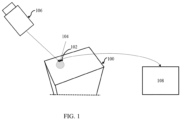
- FIG. 1 illustrates an example of an enclosed package for liquid food items in accordance with an example embodiment of the present disclosure.
- the enclosed package 100 is shown to assume a cuboid shape, however it will be understood that the enclosed package 100 may assume any shape other than the shape and size shown.
- a semi-transparent window 102 may be configured towards the inner walls of the enclosed package as depicted in FIG.1 .
- the semitransparent window 102 is shown to assume form of a circular shaped window.
- the semi-transparent window 102 may assume any shape other than the shape shown here.
- the semi-transparent window 102 can be configured by altering a transparent opening 104 of the existing enclosed package (for example, the enclosed package 100) material for employing the NIR based sensor or NIR/hyperspectral device 106 to transmit and measure the reflected spectra and thereby to predict the quality of the food item, more specifically liquid food item inside the enclosed package 100.
- the transparent opening 104 is configured on the enclosed package (for example, enclosed package 100) towards the inner walls of the enclosed package as depicted in FIG.1 .
- the transparent opening 104 is shown to assume form of a circular shaped window. However, in alternate implementations, the transparent opening 104 may assume any shape other than the shape shown here.
- the NIR device 106 acts as a transducer i.e., the NIR device 106 transmits the NIR signal through the enclosed package 100 and also receive the NIR reflection spectra from the enclosed package 100.
- the NIR reflection spectra is obtained when a NIR signal is transmitted though the semitransparent window 102 configured on the enclosed package 100.
- the data related to the NIR reflection spectra which is received by the NIR device 106 is collected by an electronic device 108 for prediction of quality of liquid food item contained inside the enclosed package (for example, the enclosed package 100).
- the electronic device 108 can be a laptop, desktop or mobile.
- the electronic device 108 is configured to include machine learning (NL) based models or algorithms.
- the collected NIR reflection spectra data include information about the contents of the enclosed package (for example, the enclosed package 100) for example, milk, juice, soups, etc. Further, the information related to the collected NIR reflection spectra serve as a transfer function of the package dimensions, package contents and the quality of the contents of the enclosed package (for example, enclosed package 100).
- the NIR reflection spectra data will be collected by the NIR device 106 and sent to an android/iOS application.
- the machine learning (ML) based application runs in the background of the android/iOS application that predicts the quality of liquid food item within packaged enclosed package (for example, the enclosed package 100) in real time.
- the collected NIR reflection spectra data are then correlated with the liquid food quality item within enclosed package (for example, the enclosed package 100) using the machine learning based models comprised in the electronic device 108.
- the NIR reflection spectra changes over time for the NIR input or signal which is swept across various wavelengths range of 780 to 2,500 nm. Further, as the food degrades there is a corresponding change in an interference pattern of the reflected lights within the enclosed package. This interference pattern can thus be correlated to the quality of the food.
- the response i.e., received NIR reflection spectra including the specific features such as information related to the contents of the enclosed package (for example, the enclosed package 100) is trained via machine learning (ML) based models to provide a correlation between food quality, more specifically quality of liquid food item inside the enclosed package (for example, the enclosed package 100).
- the machine learning (ML) models/algorithms comprised in the electronic device 108 are based on the reflectance of light.
- the machine learning model helps in ascertaining the quality of the contents for example, juice having excess acidity for safe consumption or milk curdled without a user having to open the enclosed package (for example, enclosed package 100). More specifically, the machine learning models are based on the correlation between the food quality with the received signal related to NIR reflection spectra over a range of frequencies. Training the machine learning model is further explained in the later sections.
- the present disclosure provides a lumped model which accounts for prediction of degradation of the overall quality of liquids or liquid foods enclosed within enclosed package (for example, the enclosed package 100) and considers reflections within the enclosed package (for example, the enclosed package 100) for the prediction of quality.
- the lumped model for orange juice is developed based on the NIR reflection spectra of the orange juice and the ascorbic acid (AA) concentration in the orange juice. It is to be noted the ascorbic acid is the biomarker for the orange juice and the biomarker is specific to the liquid food item.
- the NIR reflection spectra is fed into the lumped model which is able to provide insights regarding the quality of the orange juice in real time by determining the AA concentration from the NIR reflection spectra. Further, the information about the quality of the orange juice and the remaining shelf life of the orange juice is derived from the AA concentration.
- the word "NIR signature" represents the changes in the NIR reflection spectra due to the change of chemical composition, etc., over time, i.e., due to the degradation of liquids or liquid foods or liquid food items over time. Further, the 'NIR signature' of the NIR reflection spectra generated when the liquid food item is good will be different from the NIR reflection spectra data, which is generated when the liquid food item is turns bad or spoiled. Hence, the quality of the liquid food item is determined based on "good” food spectra and "spoiled” food spectra.
- the NIR reflection spectra obtained due to the changes in the physio-chemical properties of liquid food item over a period of time may be captured by an electronic device 108 that may be capable of predicting the quality of the liquid food item and a remaining shelf-life of the liquid food item.
- a system embodied in the electronic device 108, for predicting the quality of liquid food item contained in the enclosed package, and a method therefore are explained further with reference to FIGS. 2 and 3 , respectively.
- FIG. 2 a block diagram of a system 200 for predicting quality of a liquid food item contained in a enclosed package (for example, the enclosed package 100 of FIG. 1 ) is illustrated, according to some embodiments of the present disclosure.
- the system 200 is capable of training a model for predicting the quality of liquid food item based on the NIR reflection spectra obtained inside the enclosed package as depicted in FIG. 1 .
- the system 200 includes or is otherwise in communication with one or more hardware processors such as a processor 202, at least one memory such as a memory 204, and an I/O interface 206.
- the processor 202, memory 204, and the I/O interface 206 may be coupled by a system bus such as a system bus 208 or a similar mechanism.
- the I/O interface 206 may include a variety of software and hardware interfaces, for example, a web interface, a graphical user interface, and the like.
- the interfaces 206 may include a variety of software and hardware interfaces, for example, interfaces for peripheral device(s), such as a keyboard, a mouse, an external memory, a camera device, and a printer.
- the interfaces 206 may enable the system 200 to communicate with other devices, such as web servers and external databases.
- the interfaces 206 can facilitate multiple communications within a wide variety of networks and protocol types, including wired networks, for example, local area network (LAN), cable, etc., and wireless networks, such as Wireless LAN (WLAN), cellular, or satellite.
- the interfaces 206 may include one or more ports for connecting a number of computing systems with one another or to another server computer.
- the I/O interface 206 may include one or more ports for connecting a number of devices to one another or to another server.
- the hardware processor 202 may be implemented as one or more microprocessors, microcomputers, microcontrollers, digital signal processors, central processing units, state machines, logic circuitries, and/or any devices that manipulate signals based on operational instructions. Among other capabilities, the hardware processor 202 is configured to fetch and execute computer-readable instructions stored in the memory 204.
- the memory 204 may include any computer-readable medium known in the art including, for example, volatile memory, such as static random-access memory (SRAM) and dynamic random-access memory (DRAM), and/or non-volatile memory, such as read only memory (ROM), erasable programmable ROM, flash memories, hard disks, optical disks, and magnetic tapes.
- volatile memory such as static random-access memory (SRAM) and dynamic random-access memory (DRAM)
- non-volatile memory such as read only memory (ROM), erasable programmable ROM, flash memories, hard disks, optical disks, and magnetic tapes.
- the memory 204 includes a plurality of modules 220 and a repository 240 for storing data processed, received, and generated by one or more of the modules 220.
- the modules 220 may include routines, programs, objects, components, data structures, and so on, which perform particular tasks or implement particular abstract data types.
- the repository 240 includes a system database 242 and other data 244.
- the other data 244 may include data generated as a result of the execution of one or more modules in the other modules 220.
- the repository 240 may store the data of the NIR reflection spectra associated with the prediction of food quality.
- the data may include a data associated with the NIR reflection spectra obtained from inside the enclosed package 100.
- the repository 240 may store the data associated with the concentration of the biomarkers specific to the liquid food item contained in the enclosed package 100 and their progression which is required to estimate the remaining shelf for each liquid food item for example, juice, milk etc.
- a method of quality prediction of a liquid food item contained in the enclosed package (for example, the enclosed package 100) by using the system (for example, the system 200) is described further with reference to FIG. 3 .
- FIG. 3 a flow diagram of a method 300 for predicting quality of a liquid food item contained in the enclosed package (for example, the enclosed package 100) is described in accordance with an example embodiment.
- the method 300 depicted in the flow chart may be executed by a system, for example, the system, 200 of FIG. 2 .
- the system 200 may be embodied in a computing device, as will be described further in the description.
- Operations of the flowchart, and combinations of operation in the flowchart may be implemented by various means, such as hardware, firmware, processor, circuitry and/or other device associated with execution of software including one or more computer program instructions.
- one or more of the procedures described in various embodiments may be embodied by computer program instructions.
- the computer program instructions, which embody the procedures, described in various embodiments may be stored by at least one memory device of a system and executed by at least one processor in the system. Any such computer program instructions may be loaded onto a computer or other programmable system (for example, hardware) to produce a machine, such that the resulting computer or other programmable system embody means for implementing the operations specified in the flowchart.
- the operations of the method 300 are described with help of system 200. However, the operations of the method 300 can be described and/or practiced by using any other system.
- the one or more hardware processors transmit a near infra-red radiation (NIR) signal over a range of frequencies using a near infra-red radiation (NIR) device through a semi-transparent window configured on an enclosed package (for example, the enclosed package 100) containing a liquid food item.
- the one or more hardware processors obtain the resulting near infra-red radiation (NIR) reflection spectra inside the enclosed package (for example, the enclosed package 100) containing the liquid food item using an electronic device.
- NIR near infra-red radiation
- the one or more hardware processors derive, using a trained machine learning model, a plurality of features from the near infra-red radiation (NIR) reflection spectra obtained, wherein the trained machine learning model is trained on a near infra-red radiation (NIR) spectra obtained over a range of frequencies to characterize the liquid food item and correlate with quality.
- the plurality of features can include area under the curve of the NIR reflection spectra, localized changes in the slope across the curve, height of the peaks, mean, variance, spread of the curve, wavelengths at which the peaks appear.
- the one or more hardware processors perform a correlation of the plurality of derived features with the concentration of a biomarker contained in the liquid food item and estimate a remaining shelf-life of the liquid food item based on the concentration of the biomarker.
- the one or more hardware processors estimates the quality of the liquid food item based on the correlation and the estimated remaining shelf-life.
- the machine learning model is trained using a training dataset which comprises of a plurality of training features derived from the near infra-red radiation (NIR) reflection spectra obtained over the range of frequencies and a plurality of concentration of training biomarkers. Further, a correlation of the plurality of training features derived from the near infra-red radiation (NIR) reflection spectra with the plurality of concentration of the training biomarkers is performed and the remaining shelf-life of the plurality of liquid food items is estimated based on the plurality of concentration of the training biomarkers. Further, the machine learning model is trained to estimate the quality of the liquid food item based on the obtained correlation and the estimated remaining shelf-life.
- NIR near infra-red radiation
- the spoilage of the liquid food item contained in the enclosed package is correlated to the biomarker threshold for considering the degradation in quality and labeling the data in terms of quality/freshness index with respect to the biomarker threshold.
- lab experiments are performed to monitor the NIR signature at different concentrations of biomarkers specific to the plurality of liquid food items.
- the NIR signature observed when the biomarker concentration reaches its threshold, wherein the liquid food item is labelled bad.
- the machine learning model is trained on these time-series data namely, concentration of the biomarker, corresponding NIR signature change for prediction of quality in terms of the remaining shelf life.
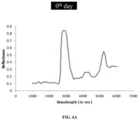
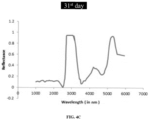
- FIG. 4A through 4D shows a use case example illustrating the detection of spoilage in an orange Juice based on NIR reflection spectra and the concentration of ascorbic acid in accordance with some embodiments of the present disclosure.
- the spoilage of orange juice occurs through both enzymatic and non-enzymatic pathways.
- the enzymatic pathways are inhibited in order to prolong shelf life.
- the concentrations of compounds such as ascorbic acid, sugars (fructose, glucose, sucrose), dissolved & headspace oxygen, 5-hydroxymethyl furfural and furfural in orange juice changes (increases/decreases) over time.
- Orange juice is a rich source of Vitamin C (ascorbic acid), having ⁇ 425 mg/L at the time of packaging.
- the ascorbic acid degradation/spoilage is one of the principal ways by which the quality of the orange juice is commonly judged.
- the spoilage is correlated to the ascorbic acid (AA) threshold for considering the degradation in quality and labeling the data in terms of quality/freshness index with respect to the AA threshold of 200mg/L.
- AA ascorbic acid
- lab experiments are performed to monitor the NIR signature at different concentrations of AA in orange juice. The NIR signature observed when AA concentration. reaches 200mg/L, the orange juice is labelled bad.
- a model is trained on these time-series data namely, conc of AA, corresponding signature change for prediction of quality in terms of the remaining shelf life.
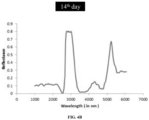
- FIG. 4A through 4D variation of NIR reflection spectra of orange juice with respect to the variation in the concentration of Ascorbic Acid (biomarker) over time is depicted in FIG. 4A through 4D .
- FIG. 4B depicts the variation of NIR reflection spectra of orange juice at 14th day when the concentration of the ascorbic acid in the
- the concentration of the Ascorbic Acid present in the orange juice reaches its threshold, for example in case of Ascorbic acid, the threshold is 200mg/L, the orange juice is considered non-ideal for consumption or in other words, the orange juice is considered to be spoiled.
- the biomarker is specific to the liquid food item contained in the enclosed package.
- this trained machine learning model acts as a soft sensor.
- the NIR reflection spectra is observed through the transparent window 104 on the enclosed package (for example, Tetrapak).
- a dedicated mobile application is developed which allows user to scan the NIR reflection spectra.
- the trained machine learning model /soft sensor in the background which is linked to this application (locally or over cloud) considers the NIR reflection spectra as input to the trained machine learning model, estimates the corresponding ascorbic acid concentration at that time and correlates the NIR reflection spectra with the estimated ascorbic acid concentration.
- the trained machine learning model finally estimates the remaining shelf life based on the correlation and the remaining shelf life and the same is shown to the user in the mobile application.
- Various embodiments disclosed herein provide method and system for estimating quality of food item packaged in an enclosed package.
- the embodiment of present disclosure herein addresses unresolved problem of monitoring and estimation of food quality no-invasively based on the NIR reflection spectra obtained inside the enclosed package.
- the NIR reflection spectra is obtained by transmitting a NIR radiation through the semi-transparent window configured on the enclosed package.
- the real-time quality monitoring may allow concerned stake holders to take dynamic decisions on repricing, reusing, recycling and repurposing, and so on and thus reduce food wastage and economic loss.
- the disclosure also comprises a program and in addition to a computer-readable means having a message therein; such computer-readable storage means contain program-code means for implementation of one or more steps of the method, when the program runs on a server or mobile device or any suitable programmable device.
- the hardware device can be any kind of device which can be programmed including e.g., any kind of computer like a server or a personal computer, or the like, or any combination thereof.
- the device may also include means which could be e.g., hardware means like e.g., an application-specific integrated circuit (ASIC), a field-programmable gate array (FPGA), or a combination of hardware and software means, e.g., an ASIC and an FPGA, or at least one microprocessor and at least one memory with software processing components located therein.
- the means can include both hardware means and software means.
- the method embodiments described herein could be implemented in hardware and software.
- the device may also include software means. Alternatively, the embodiments may be implemented on different hardware devices, e.g., using a plurality of CPUs.
- the embodiments herein can comprise hardware and software elements.
- the embodiments that are implemented in software include but are not limited to, firmware, resident software, microcode, etc.
- the functions performed by various components described herein may be implemented in other components or combinations of other components.
- a computer-usable or computer readable medium can be any apparatus that can comprise, store, communicate, propagate, or transport the program for use by or in connection with the instruction execution system, apparatus, or device.
- a computer-readable storage medium refers to any type of physical memory on which information or data readable by a processor may be stored.
- a computer-readable storage medium may store instructions for execution by one or more processors, including instructions for causing the processor(s) to perform steps or stages consistent with the embodiments described herein.
- the term "computer-readable medium” should be understood to include tangible items and exclude carrier waves and transient signals, i.e., be non-transitory. Examples include random access memory (RAM), read-only memory (ROM), volatile memory, nonvolatile memory, hard drives, CD ROMs, DVDs, flash drives, disks, and any other known physical storage media.
Landscapes
- Physics & Mathematics (AREA)
- Health & Medical Sciences (AREA)
- Life Sciences & Earth Sciences (AREA)
- Chemical & Material Sciences (AREA)
- Spectroscopy & Molecular Physics (AREA)
- Biochemistry (AREA)
- Analytical Chemistry (AREA)
- General Health & Medical Sciences (AREA)
- General Physics & Mathematics (AREA)
- Immunology (AREA)
- Pathology (AREA)
- Engineering & Computer Science (AREA)
- Food Science & Technology (AREA)
- Medicinal Chemistry (AREA)
- Investigating Or Analysing Materials By Optical Means (AREA)
Claims (9)
- Prozessorimplementiertes Verfahren (300), umfassend:Übertragen (302), über einen oder mehrere Hardwareprozessoren (202), eines Nahinfrarotstrahlungs-, NIR-, Signals über einen Bereich von Frequenzen unter Verwendung einer Nahinfrarotstrahlungs-, NIR-, Vorrichtung (106) durch ein halbtransparentes Fenster (102), das auf einer geschlossenen Verpackung (100) konfiguriert ist, die ein flüssiges Lebensmittel enthält;Empfangen, über den einen oder die mehreren Hardwareprozessoren (202), von Daten in Bezug auf Nahinfrarotstrahlungs-, NIR-, Reflexionsspektren innerhalb der geschlossenen Verpackung (100), die das flüssige Lebensmittel enthält, unter Verwendung der NIR-Vorrichtung (106);Abtasten der NIR-Reflexionsspektren durch einen Benutzer über eine mobile Anwendung, um die Daten in Bezug auf die NIR-Reflexionsspektren innerhalb der geschlossenen Verpackung (100), die das flüssige Lebensmittel enthält, zu erhalten;Sammeln (304), über den einen oder die mehreren Hardwareprozessoren (202), der Daten in Bezug auf NIR-Reflexionsspektren innerhalb der geschlossenen Verpackung, die das flüssige Lebensmittel enthält, unter Verwendung einer elektronischen Vorrichtung (108);Ableiten (306), unter Verwendung eines maschinellen Lernmodells, das in der elektronischen Vorrichtung (108) enthalten ist, über den einen oder die mehreren Hardwareprozessoren (202), einer Mehrzahl von Merkmalen aus den so gesammelten NIR-Reflexionsspektren, wobei das maschinelle Lernmodell auf NIR-Reflexionsspektren trainiert wird, die über einen Bereich von Frequenzen erhalten werden, um das flüssige Lebensmittel zu charakterisieren und mit einer Konzentration eines Biomarkers zu korrelieren, der in dem flüssigen Lebensmittel enthalten ist und die Qualität anzeigt;Durchführen (308), über den einen oder die mehreren Hardwareprozessoren (202), einer Korrelation der Mehrzahl von abgeleiteten Merkmalen mit der Konzentration des Biomarkers, der in dem flüssigen Lebensmittel enthalten ist, und Schätzen einer verbleibenden Haltbarkeit des flüssigen Lebensmittels basierend auf der Konzentration des Biomarkers;Schätzen (310), über den einen oder die mehreren Hardwareprozessoren (202), der Qualität des flüssigen Lebensmittels basierend auf der Korrelation und der geschätzten verbleibenden Haltbarkeit; undAnzeigen, für den Benutzer auf der mobilen Anwendung, der Qualität des flüssigen Lebensmittels basierend auf der Korrelation und der geschätzten verbleibenden Haltbarkeit.
- Prozessorimplementiertes Verfahren nach Anspruch 1, wobei das halbtransparente Fenster (102), das auf der geschlossenen Verpackung konfiguriert ist, für Nahinfrarotstrahlungs-, NIR-, Bildgebung verwendet wird.
- Prozessorimplementiertes Verfahren nach Anspruch 1, wobei der Schritt des Trainierens des maschinellen Lernmodells ferner umfasst:(i) Erhalten eines Trainingsdatensatzes, der eine Mehrzahl von Trainingsmerkmalen, die aus den Nahinfrarotstrahlungs-, NIR-, Reflexionsspektren abgeleitet sind, die über den Bereich von Frequenzen erhalten werden, und eine Mehrzahl von Konzentrationen von Trainingsbiomarkern umfasst, wobei die Nahinfrarotstrahlungs-, NIR-, Reflexionsspektren und die Konzentrationen der Trainingsbiomarker einer Mehrzahl von flüssigen Lebensmitteln zugeordnet sind;(ii) Durchführen einer Korrelation der Mehrzahl von Trainingsmerkmalen, die aus den Nahinfrarotstrahlungs-, NIR-, Reflexionsspektren abgeleitet sind, mit der Mehrzahl von Konzentrationen der Trainingsbiomarker, die in dem erhaltenen Trainingsdatensatz enthalten sind;(iii) Schätzen der verbleibenden Haltbarkeit der Mehrzahl von flüssigen Lebensmitteln basierend auf der Mehrzahl von Konzentrationen der Trainingsbiomarker; und(iv) Trainieren des maschinellen Lernmodells, um die Qualität des flüssigen Lebensmittels basierend auf der erhaltenen Korrelation und der geschätzten verbleibenden Haltbarkeit zu schätzen.
- Prozessorimplementiertes Verfahren nach Anspruch 1, wobei der Biomarker, der bei der Schätzung der Qualität des flüssigen Lebensmittels verwendet wird, für das flüssige Lebensmittel spezifisch ist, das innerhalb der geschlossenen Verpackung (100) enthalten ist.
- System (200), umfassend:einen Speicher (204), der Anweisungen speichert;eine oder mehrere Kommunikationsschnittstellen (206);eine geschlossene Verpackung (100), die flüssiges Lebensmittel enthält;ein halbtransparentes Fenster (102), das auf der geschlossenen Verpackung (100) konfiguriert ist;eine Nahinfrarotstrahlungs-, NIR-, Vorrichtung (106);eine elektronische Vorrichtung (108);eine mobile Anwendung; undeinen oder mehrere Hardwareprozessoren (202), die mit dem Speicher (204) über die eine oder die mehreren Kommunikationsschnittstellen (206) gekoppelt sind, wobei der eine oder die mehreren Hardwareprozessoren (202) durch die Anweisungen konfiguriert sind zum:Übertragen eines Nahinfrarotstrahlungs-, NIR-, Signals über einen Bereich von Frequenzen unter Verwendung der Nahinfrarotstrahlungs-, NIR-, Vorrichtung (106) durch das halbtransparente Fenster (102), das auf der geschlossenen Verpackung (100) konfiguriert ist, die das flüssige Lebensmittel enthält;Empfangen von Daten in Bezug auf Nahinfrarotstrahlungs-, NIR-, Reflexionsspektren innerhalb der geschlossenen Verpackung (100), die das flüssige Lebensmittel enthält, unter Verwendung der NIR-Vorrichtung;Abtasten der Nahinfrarotstrahlungs-, NIR-, Reflexionsspektren, wenn sie durch einen Benutzer über die mobile Anwendung initiiert werden, um die Daten in Bezug auf die Nahinfrarotstrahlungs-, NIR-, Reflexionsspektren innerhalb der geschlossenen Verpackung (100), die das flüssige Lebensmittel enthält, zu erhalten;Sammeln der Daten in Bezug auf die Nahinfrarotstrahlungs-, NIR-, Reflexionsspektren innerhalb der geschlossenen Verpackung (100), die das flüssige Lebensmittel enthält, unter Verwendung der elektronischen Vorrichtung (108);Ableiten, unter Verwendung eines maschinellen Lernmodells, das in der elektronischen Vorrichtung (108) enthalten ist, einer Mehrzahl von Merkmalen aus den gesammelten Nahinfrarotstrahlungs-, NIR-, Reflexionsspektren, wobei das maschinelle Lernmodell auf Nahinfrarotstrahlungs-, NIR-, Spektren trainiert wird, die über einen Bereich von Frequenzen erhalten werden, um das flüssige Lebensmittel zu charakterisieren und mit einer Konzentration eines Biomarkers zu korrelieren, der in dem flüssigen Lebensmittel enthalten ist und die Qualität anzeigt;Durchführen einer Korrelation der Mehrzahl von abgeleiteten Merkmalen mit der Konzentration des Biomarkers, der in dem flüssigen Lebensmittel enthalten ist, und Schätzen einer verbleibenden Haltbarkeit des flüssigen Lebensmittels basierend auf der Konzentration des Biomarkers;Schätzen der Qualität des flüssigen Lebensmittels basierend auf der Korrelation und der geschätzten verbleibenden Haltbarkeit; undAnzeigen, für den Benutzer auf der mobilen Anwendung, der Qualität des flüssigen Lebensmittels basierend auf der Korrelation und der geschätzten verbleibenden Haltbarkeit.
- System nach Anspruch 5, wobei das halbtransparente Fenster (102), das auf der geschlossenen Verpackung konfiguriert ist, konfiguriert ist, für Nahinfrarotstrahlungs-, NIR-, Bildgebung verwendet zu werden.
- System nach Anspruch 5, wobei das Trainieren des maschinellen Lernmodells ferner umfasst:(i) Erhalten eines Trainingsdatensatzes, der eine Mehrzahl von Trainingsmerkmalen, die aus den Nahinfrarotstrahlungs-, NIR-, Reflexionsspektren abgeleitet sind, die über den Bereich von Frequenzen erhalten werden, und eine Mehrzahl von Konzentrationen von Trainingsbiomarkern umfasst, wobei die Nahinfrarotstrahlungs-, NIR-, Reflexionsspektren und die Konzentrationen der Trainingsbiomarker einer Mehrzahl von flüssigen Lebensmitteln zugeordnet sind;(ii) Durchführen einer Korrelation der Mehrzahl von Trainingsmerkmalen, die aus den Nahinfrarotstrahlungs-, NIR-, Reflexionsspektren abgeleitet sind, mit der Mehrzahl von Konzentrationen der Trainingsbiomarker, die in dem erhaltenen Trainingsdatensatz enthalten sind;(iii) Schätzen der verbleibenden Haltbarkeit der Mehrzahl von flüssigen Lebensmitteln basierend auf der Mehrzahl von Konzentrationen der Trainingsbiomarker; und(iv) Trainieren des maschinellen Lernmodells, um die Qualität des flüssigen Lebensmittels basierend auf der erhaltenen Korrelation und der geschätzten verbleibenden Haltbarkeit zu schätzen.
- System nach Anspruch 5, wobei der Biomarker, der bei der Schätzung der Qualität des flüssigen Lebensmittels verwendet wird, für das flüssige Lebensmittel spezifisch ist, das innerhalb der geschlossenen Verpackung enthalten ist.
- Ein oder mehrere nichtflüchtige maschinenlesbare Informationsspeichermedien, die eine oder mehrere Anweisungen umfassen, die, wenn sie von einem oder mehreren Hardwareprozessoren des Systems nach einem der Ansprüche 5 bis 8 ausgeführt werden, das System veranlassen, das Verfahren nach einem der Ansprüche 1 bis 4 durchzuführen.
Applications Claiming Priority (1)
| Application Number | Priority Date | Filing Date | Title |
|---|---|---|---|
| IN202021056751 | 2020-12-28 |
Publications (3)
| Publication Number | Publication Date |
|---|---|
| EP4019946A1 EP4019946A1 (de) | 2022-06-29 |
| EP4019946C0 EP4019946C0 (de) | 2025-06-04 |
| EP4019946B1 true EP4019946B1 (de) | 2025-06-04 |
Family
ID=79601849
Family Applications (1)
| Application Number | Title | Priority Date | Filing Date |
|---|---|---|---|
| EP21217803.2A Active EP4019946B1 (de) | 2020-12-28 | 2021-12-27 | System und verfahren zur nicht-invasiven echtzeit-vorhersage der qualität von flüssigen lebensmitteln in einer geschlossenen verpackung |
Country Status (2)
| Country | Link |
|---|---|
| US (1) | US11747275B2 (de) |
| EP (1) | EP4019946B1 (de) |
Families Citing this family (2)
| Publication number | Priority date | Publication date | Assignee | Title |
|---|---|---|---|---|
| US12007324B2 (en) | 2021-07-08 | 2024-06-11 | University Of Maryland, College Park | Systems and methods for pH sensing in fluids |
| CN117668672A (zh) * | 2024-02-01 | 2024-03-08 | 季华实验室 | 液态食品检测方法、装置、设备及存储介质 |
Family Cites Families (5)
| Publication number | Priority date | Publication date | Assignee | Title |
|---|---|---|---|---|
| AU2005100565B4 (en) * | 2005-07-12 | 2006-02-02 | The Australian Wine Research Institute | Non-destructive analysis by VIS-NIR spectroscopy of fluid(s) in its original container |
| US9016193B2 (en) * | 2012-04-16 | 2015-04-28 | Eugenio Minvielle | Logistic transport system for nutritional substances |
| EP3213050A4 (de) * | 2014-10-31 | 2018-06-27 | Muldoon, Cecilia | Nichtinvasiver weinbeigeschmacksdetektor |
| CN108732111B (zh) * | 2017-04-25 | 2022-12-13 | Bsh家用电器有限公司 | 用于确定至少一种饮料的质量的方法和质量检测装置 |
| US10732101B1 (en) * | 2019-01-15 | 2020-08-04 | Enos Analytical, LLC | Non-destructive gas concentration analyzer |
-
2021
- 2021-12-27 EP EP21217803.2A patent/EP4019946B1/de active Active
- 2021-12-27 US US17/562,133 patent/US11747275B2/en active Active
Also Published As
| Publication number | Publication date |
|---|---|
| EP4019946A1 (de) | 2022-06-29 |
| EP4019946C0 (de) | 2025-06-04 |
| US20220205905A1 (en) | 2022-06-30 |
| US11747275B2 (en) | 2023-09-05 |
Similar Documents
| Publication | Publication Date | Title |
|---|---|---|
| Kang et al. | Advances in machine learning and hyperspectral imaging in the food supply chain | |
| US20230214982A1 (en) | Machine learning-based assessment of food item quality | |
| Tian et al. | Detection of soluble solid content in apples based on hyperspectral technology combined with deep learning algorithm | |
| Wang et al. | Smart storage technologies applied to fresh foods: A review | |
| EP4019946B1 (de) | System und verfahren zur nicht-invasiven echtzeit-vorhersage der qualität von flüssigen lebensmitteln in einer geschlossenen verpackung | |
| US20220299493A1 (en) | System using machine learning model to determine food item ripeness | |
| Guo et al. | Nondestructive monitoring storage quality of apples at different temperatures by near‐infrared transmittance spectroscopy | |
| Cruz et al. | Nondestructive simultaneous prediction of internal browning disorder and quality attributes in ‘Rocha’pear (Pyrus communis L.) using VIS-NIR spectroscopy | |
| Srivastava et al. | Non-destructive sensing methods for quality assessment of on-tree fruits: a review | |
| Xu et al. | Research on nondestructive identification of grape varieties based on EEMD‐DWT and hyperspectral image | |
| Meng et al. | Determination of soluble solids content and firmness in plum using hyperspectral imaging and chemometric algorithms | |
| Han et al. | Quantitative analysis of fish microbiological quality using electronic tongue coupled with nonlinear pattern recognition algorithms | |
| Zhang et al. | Classification detection of saccharin jujube based on hyperspectral imaging technology | |
| Zhu et al. | Comparison of mutton freshness grade discrimination based on hyperspectral imaging, near infrared spectroscopy and their fusion information | |
| Mu et al. | Non‐destructive detection of blueberry skin pigments and intrinsic fruit qualities based on deep learning | |
| Han et al. | A Nondestructive Method for Fish Freshness Determination with Electronic Tongue Combined with Linear and Non-linear Multivariate Algorithms. | |
| Feng et al. | Detection of early subtle bruising in strawberries using VNIR hyperspectral imaging and deep learning | |
| Wang et al. | Insights of freshness phenotype detection for postharvest fruit and vegetables | |
| Feng et al. | Advancing food safety and quality assessment: a comprehensive review of non-destructive analytical technologies | |
| Qian et al. | A study on phenotypic micro-variation of stored melon based on weight loss rate | |
| Cai et al. | Determination of the SSC in oranges using Vis-NIR full transmittance hyperspectral imaging and spectral visual coding: A practical solution to the scattering problem of inhomogeneous mixtures | |
| Jiang et al. | Prediction of multi-task physicochemical indices based on hyperspectral imaging and analysis of the relationship between physicochemical composition and sensory quality of tea | |
| US12241841B2 (en) | System and method for non-invasive real-time prediction of liquid food quality within enclosed package | |
| Han et al. | Detection storage time of mild bruise’s loquats using hyperspectral imaging | |
| Mhapsekar et al. | A systematic review of the internet of things and artificial intelligence applications in milk quality monitoring and analysis |
Legal Events
| Date | Code | Title | Description |
|---|---|---|---|
| PUAI | Public reference made under article 153(3) epc to a published international application that has entered the european phase |
Free format text: ORIGINAL CODE: 0009012 |
|
| STAA | Information on the status of an ep patent application or granted ep patent |
Free format text: STATUS: THE APPLICATION HAS BEEN PUBLISHED |
|
| AK | Designated contracting states |
Kind code of ref document: A1 Designated state(s): AL AT BE BG CH CY CZ DE DK EE ES FI FR GB GR HR HU IE IS IT LI LT LU LV MC MK MT NL NO PL PT RO RS SE SI SK SM TR |
|
| STAA | Information on the status of an ep patent application or granted ep patent |
Free format text: STATUS: REQUEST FOR EXAMINATION WAS MADE |
|
| 17P | Request for examination filed |
Effective date: 20220930 |
|
| RBV | Designated contracting states (corrected) |
Designated state(s): AL AT BE BG CH CY CZ DE DK EE ES FI FR GB GR HR HU IE IS IT LI LT LU LV MC MK MT NL NO PL PT RO RS SE SI SK SM TR |
|
| STAA | Information on the status of an ep patent application or granted ep patent |
Free format text: STATUS: EXAMINATION IS IN PROGRESS |
|
| 17Q | First examination report despatched |
Effective date: 20240301 |
|
| GRAP | Despatch of communication of intention to grant a patent |
Free format text: ORIGINAL CODE: EPIDOSNIGR1 |
|
| STAA | Information on the status of an ep patent application or granted ep patent |
Free format text: STATUS: GRANT OF PATENT IS INTENDED |
|
| INTG | Intention to grant announced |
Effective date: 20250213 |
|
| RAP3 | Party data changed (applicant data changed or rights of an application transferred) |
Owner name: TATA CONSULTANCY SERVICES LIMITED |
|
| GRAS | Grant fee paid |
Free format text: ORIGINAL CODE: EPIDOSNIGR3 |
|
| GRAA | (expected) grant |
Free format text: ORIGINAL CODE: 0009210 |
|
| STAA | Information on the status of an ep patent application or granted ep patent |
Free format text: STATUS: THE PATENT HAS BEEN GRANTED |
|
| AK | Designated contracting states |
Kind code of ref document: B1 Designated state(s): AL AT BE BG CH CY CZ DE DK EE ES FI FR GB GR HR HU IE IS IT LI LT LU LV MC MK MT NL NO PL PT RO RS SE SI SK SM TR |
|
| REG | Reference to a national code |
Ref country code: GB Ref legal event code: FG4D |
|
| REG | Reference to a national code |
Ref country code: CH Ref legal event code: EP |
|
| REG | Reference to a national code |
Ref country code: IE Ref legal event code: FG4D |
|
| U01 | Request for unitary effect filed |
Effective date: 20250604 |
|
| U07 | Unitary effect registered |
Designated state(s): AT BE BG DE DK EE FI FR IT LT LU LV MT NL PT RO SE SI Effective date: 20250611 |
|
| PG25 | Lapsed in a contracting state [announced via postgrant information from national office to epo] |
Ref country code: ES Free format text: LAPSE BECAUSE OF FAILURE TO SUBMIT A TRANSLATION OF THE DESCRIPTION OR TO PAY THE FEE WITHIN THE PRESCRIBED TIME-LIMIT Effective date: 20250604 |
|
| PG25 | Lapsed in a contracting state [announced via postgrant information from national office to epo] |
Ref country code: NO Free format text: LAPSE BECAUSE OF FAILURE TO SUBMIT A TRANSLATION OF THE DESCRIPTION OR TO PAY THE FEE WITHIN THE PRESCRIBED TIME-LIMIT Effective date: 20250904 Ref country code: GR Free format text: LAPSE BECAUSE OF FAILURE TO SUBMIT A TRANSLATION OF THE DESCRIPTION OR TO PAY THE FEE WITHIN THE PRESCRIBED TIME-LIMIT Effective date: 20250905 |
|
| PG25 | Lapsed in a contracting state [announced via postgrant information from national office to epo] |
Ref country code: PL Free format text: LAPSE BECAUSE OF FAILURE TO SUBMIT A TRANSLATION OF THE DESCRIPTION OR TO PAY THE FEE WITHIN THE PRESCRIBED TIME-LIMIT Effective date: 20250604 |
|
| PG25 | Lapsed in a contracting state [announced via postgrant information from national office to epo] |
Ref country code: HR Free format text: LAPSE BECAUSE OF FAILURE TO SUBMIT A TRANSLATION OF THE DESCRIPTION OR TO PAY THE FEE WITHIN THE PRESCRIBED TIME-LIMIT Effective date: 20250604 |
|
| PG25 | Lapsed in a contracting state [announced via postgrant information from national office to epo] |
Ref country code: RS Free format text: LAPSE BECAUSE OF FAILURE TO SUBMIT A TRANSLATION OF THE DESCRIPTION OR TO PAY THE FEE WITHIN THE PRESCRIBED TIME-LIMIT Effective date: 20250904 |
|
| REG | Reference to a national code |
Ref country code: CH Ref legal event code: U11 Free format text: ST27 STATUS EVENT CODE: U-0-0-U10-U11 (AS PROVIDED BY THE NATIONAL OFFICE) Effective date: 20260101 |
|
| PG25 | Lapsed in a contracting state [announced via postgrant information from national office to epo] |
Ref country code: IS Free format text: LAPSE BECAUSE OF FAILURE TO SUBMIT A TRANSLATION OF THE DESCRIPTION OR TO PAY THE FEE WITHIN THE PRESCRIBED TIME-LIMIT Effective date: 20251004 |
|
| PGFP | Annual fee paid to national office [announced via postgrant information from national office to epo] |
Ref country code: GB Payment date: 20251223 Year of fee payment: 5 |
|
| PG25 | Lapsed in a contracting state [announced via postgrant information from national office to epo] |
Ref country code: SM Free format text: LAPSE BECAUSE OF FAILURE TO SUBMIT A TRANSLATION OF THE DESCRIPTION OR TO PAY THE FEE WITHIN THE PRESCRIBED TIME-LIMIT Effective date: 20250604 |
|
| PG25 | Lapsed in a contracting state [announced via postgrant information from national office to epo] |
Ref country code: CZ Free format text: LAPSE BECAUSE OF FAILURE TO SUBMIT A TRANSLATION OF THE DESCRIPTION OR TO PAY THE FEE WITHIN THE PRESCRIBED TIME-LIMIT Effective date: 20250604 |
|
| PG25 | Lapsed in a contracting state [announced via postgrant information from national office to epo] |
Ref country code: SK Free format text: LAPSE BECAUSE OF FAILURE TO SUBMIT A TRANSLATION OF THE DESCRIPTION OR TO PAY THE FEE WITHIN THE PRESCRIBED TIME-LIMIT Effective date: 20250604 |
|
| U20 | Renewal fee for the european patent with unitary effect paid |
Year of fee payment: 5 Effective date: 20251225 |