EP4019798B1 - Actionneur electromecanique comportant un element d'ossature - Google Patents
Actionneur electromecanique comportant un element d'ossature Download PDFInfo
- Publication number
- EP4019798B1 EP4019798B1 EP21216504.7A EP21216504A EP4019798B1 EP 4019798 B1 EP4019798 B1 EP 4019798B1 EP 21216504 A EP21216504 A EP 21216504A EP 4019798 B1 EP4019798 B1 EP 4019798B1
- Authority
- EP
- European Patent Office
- Prior art keywords
- electromechanical actuator
- axis
- axes
- frame element
- shaft
- Prior art date
- Legal status (The legal status is an assumption and is not a legal conclusion. Google has not performed a legal analysis and makes no representation as to the accuracy of the status listed.)
- Active
Links
Images



Classifications
-
- B—PERFORMING OPERATIONS; TRANSPORTING
- B60—VEHICLES IN GENERAL
- B60T—VEHICLE BRAKE CONTROL SYSTEMS OR PARTS THEREOF; BRAKE CONTROL SYSTEMS OR PARTS THEREOF, IN GENERAL; ARRANGEMENT OF BRAKING ELEMENTS ON VEHICLES IN GENERAL; PORTABLE DEVICES FOR PREVENTING UNWANTED MOVEMENT OF VEHICLES; VEHICLE MODIFICATIONS TO FACILITATE COOLING OF BRAKES
- B60T13/00—Transmitting braking action from initiating means to ultimate brake actuator with power assistance or drive; Brake systems incorporating such transmitting means, e.g. air-pressure brake systems
- B60T13/74—Transmitting braking action from initiating means to ultimate brake actuator with power assistance or drive; Brake systems incorporating such transmitting means, e.g. air-pressure brake systems with electrical assistance or drive
- B60T13/741—Transmitting braking action from initiating means to ultimate brake actuator with power assistance or drive; Brake systems incorporating such transmitting means, e.g. air-pressure brake systems with electrical assistance or drive acting on an ultimate actuator
-
- B—PERFORMING OPERATIONS; TRANSPORTING
- B60—VEHICLES IN GENERAL
- B60T—VEHICLE BRAKE CONTROL SYSTEMS OR PARTS THEREOF; BRAKE CONTROL SYSTEMS OR PARTS THEREOF, IN GENERAL; ARRANGEMENT OF BRAKING ELEMENTS ON VEHICLES IN GENERAL; PORTABLE DEVICES FOR PREVENTING UNWANTED MOVEMENT OF VEHICLES; VEHICLE MODIFICATIONS TO FACILITATE COOLING OF BRAKES
- B60T13/00—Transmitting braking action from initiating means to ultimate brake actuator with power assistance or drive; Brake systems incorporating such transmitting means, e.g. air-pressure brake systems
- B60T13/74—Transmitting braking action from initiating means to ultimate brake actuator with power assistance or drive; Brake systems incorporating such transmitting means, e.g. air-pressure brake systems with electrical assistance or drive
-
- F—MECHANICAL ENGINEERING; LIGHTING; HEATING; WEAPONS; BLASTING
- F16—ENGINEERING ELEMENTS AND UNITS; GENERAL MEASURES FOR PRODUCING AND MAINTAINING EFFECTIVE FUNCTIONING OF MACHINES OR INSTALLATIONS; THERMAL INSULATION IN GENERAL
- F16D—COUPLINGS FOR TRANSMITTING ROTATION; CLUTCHES; BRAKES
- F16D55/00—Brakes with substantially-radial braking surfaces pressed together in axial direction, e.g. disc brakes
- F16D55/02—Brakes with substantially-radial braking surfaces pressed together in axial direction, e.g. disc brakes with axially-movable discs or pads pressed against axially-located rotating members
- F16D55/22—Brakes with substantially-radial braking surfaces pressed together in axial direction, e.g. disc brakes with axially-movable discs or pads pressed against axially-located rotating members by clamping an axially-located rotating disc between movable braking members, e.g. movable brake discs or brake pads
- F16D55/224—Brakes with substantially-radial braking surfaces pressed together in axial direction, e.g. disc brakes with axially-movable discs or pads pressed against axially-located rotating members by clamping an axially-located rotating disc between movable braking members, e.g. movable brake discs or brake pads with a common actuating member for the braking members
- F16D55/225—Brakes with substantially-radial braking surfaces pressed together in axial direction, e.g. disc brakes with axially-movable discs or pads pressed against axially-located rotating members by clamping an axially-located rotating disc between movable braking members, e.g. movable brake discs or brake pads with a common actuating member for the braking members the braking members being brake pads
- F16D55/226—Brakes with substantially-radial braking surfaces pressed together in axial direction, e.g. disc brakes with axially-movable discs or pads pressed against axially-located rotating members by clamping an axially-located rotating disc between movable braking members, e.g. movable brake discs or brake pads with a common actuating member for the braking members the braking members being brake pads in which the common actuating member is moved axially, e.g. floating caliper disc brakes
-
- F—MECHANICAL ENGINEERING; LIGHTING; HEATING; WEAPONS; BLASTING
- F16—ENGINEERING ELEMENTS AND UNITS; GENERAL MEASURES FOR PRODUCING AND MAINTAINING EFFECTIVE FUNCTIONING OF MACHINES OR INSTALLATIONS; THERMAL INSULATION IN GENERAL
- F16D—COUPLINGS FOR TRANSMITTING ROTATION; CLUTCHES; BRAKES
- F16D65/00—Parts or details
- F16D65/14—Actuating mechanisms for brakes; Means for initiating operation at a predetermined position
- F16D65/16—Actuating mechanisms for brakes; Means for initiating operation at a predetermined position arranged in or on the brake
- F16D65/18—Actuating mechanisms for brakes; Means for initiating operation at a predetermined position arranged in or on the brake adapted for drawing members together, e.g. for disc brakes
- F16D65/183—Actuating mechanisms for brakes; Means for initiating operation at a predetermined position arranged in or on the brake adapted for drawing members together, e.g. for disc brakes with force-transmitting members arranged side by side acting on a spot type force-applying member
-
- F—MECHANICAL ENGINEERING; LIGHTING; HEATING; WEAPONS; BLASTING
- F16—ENGINEERING ELEMENTS AND UNITS; GENERAL MEASURES FOR PRODUCING AND MAINTAINING EFFECTIVE FUNCTIONING OF MACHINES OR INSTALLATIONS; THERMAL INSULATION IN GENERAL
- F16D—COUPLINGS FOR TRANSMITTING ROTATION; CLUTCHES; BRAKES
- F16D2121/00—Type of actuator operation force
- F16D2121/18—Electric or magnetic
- F16D2121/24—Electric or magnetic using motors
-
- F—MECHANICAL ENGINEERING; LIGHTING; HEATING; WEAPONS; BLASTING
- F16—ENGINEERING ELEMENTS AND UNITS; GENERAL MEASURES FOR PRODUCING AND MAINTAINING EFFECTIVE FUNCTIONING OF MACHINES OR INSTALLATIONS; THERMAL INSULATION IN GENERAL
- F16D—COUPLINGS FOR TRANSMITTING ROTATION; CLUTCHES; BRAKES
- F16D2125/00—Components of actuators
- F16D2125/18—Mechanical mechanisms
- F16D2125/44—Mechanical mechanisms transmitting rotation
- F16D2125/46—Rotating members in mutual engagement
- F16D2125/48—Rotating members in mutual engagement with parallel stationary axes, e.g. spur gears
-
- F—MECHANICAL ENGINEERING; LIGHTING; HEATING; WEAPONS; BLASTING
- F16—ENGINEERING ELEMENTS AND UNITS; GENERAL MEASURES FOR PRODUCING AND MAINTAINING EFFECTIVE FUNCTIONING OF MACHINES OR INSTALLATIONS; THERMAL INSULATION IN GENERAL
- F16D—COUPLINGS FOR TRANSMITTING ROTATION; CLUTCHES; BRAKES
- F16D2125/00—Components of actuators
- F16D2125/18—Mechanical mechanisms
- F16D2125/44—Mechanical mechanisms transmitting rotation
- F16D2125/46—Rotating members in mutual engagement
- F16D2125/50—Rotating members in mutual engagement with parallel non-stationary axes, e.g. planetary gearing
Definitions
- the present invention relates to the general field of motor vehicle disc brakes, and more particularly relates to a motor vehicle disc brake of electromechanical type, that is to say comprising an electromechanical actuator for pressing one or more brake pads against the disc in order to generate braking. More specifically, the invention relates to an electromechanical actuator for a motor vehicle disc brake caliper comprising framework elements making it possible to position the movable elements of the motor assembly relative to each other independently of the housing housing these moving elements.
- FIG. 1 there is shown, in perspective, an example of a caliper body 1 of an electromechanical disc brake capable of being slaved to an actuator according to the invention.
- the caliper 1 advantageously comprises hydraulic means ensuring service braking, the actuator according to the invention ensuring parking and/or emergency braking.
- the figure 2 represents, in an exploded view, an example of an electromechanical actuator 7 of known type.
- the caliper body 1 comprises a base 2 extended by an arch 4, itself extended by fingers 6.
- the base 2 comprises a housing in which a movable piston is engaged to press a brake pad not shown on a disc braking.
- This base 2 also contains in the rear region of the piston a movement transformation mechanism with helical connection, to convert a rotational movement into a translational movement of the piston, which corresponds to converting a moment of forces into a pressing effort.
- This caliper body 1 is further equipped with an electromechanical actuator 7 to act on the piston so as to press the pad against the disc, upon activation of this actuator 7.
- This actuator 7 comprises a housing 8, or casing, having a fixing face 9, visible on the figure 2 , by which it is intended to be coupled to the caliper body 1, and a face opposite face 11 closed by a cover 12.
- the fixing face 9 and the opposite face 11 are substantially flat faces and parallel to each other.
- the housing 8 contains different components forming a motorization assembly 13 coupled to a mechanical reducer 14 which makes it possible to move the piston when this reducer 14 is coupled to the caliper body 1, that is to say when the actuator 7 is fixed to the base 2.
- the reducer 14 comprises a first double toothed wheel 16 meshed with a second double toothed wheel 17, which drives an epicyclic gear train 18.
- the motor assembly 13 comprises an electric motor 19 having an output pinion 20, as well as two electronic cards 21, 22 which control this motor 19.
- the cards and the motor 19 are carried by a plate 23 which closes and is fixed in a corresponding opening 24, this opening opening into the fixing face 9 of the housing 8.
- the elements of the reduction gear 14 rotate around axes parallel to the axis of rotation of the motor, marked by AM.
- the axis AM is parallel to a main axis marked by AX which corresponds to the axis of translation of the piston when the actuator 7 is mounted on the caliper body 1, this axis AX is extending longitudinally relative to the vehicle equipped with the brake.
- the stirrup can also include, in addition to the electromechanical means for moving the piston, hydraulic means for moving the piston.
- the electromechanical means ensure the movement of the piston in the case of parking braking, and the hydraulic means ensure its movement in the event of service braking.
- the mobile components When the actuator 7 is put into operation, the mobile components generate vibrations which are transmitted in particular to the housing 8 and to the cover 12, thus producing parasitic noise.
- the housing 8 and the cover do not make it possible to achieve sufficiently precise positioning of the axes of movement of the mobile components relative to the motor axis AM.
- the document FROM 10 2019 204181 A1 shows an electromechanical actuator of the known type provided with a housing with cover, in which a housing for the gearbox axes is formed.
- the aim of the invention is to propose an actuator making it possible to decouple the mobile components of the housing and the cover 12.
- the main object of the invention is an electromechanical actuator for a motor vehicle disc brake caliper comprising a housing, a mechanical gearbox, components of the mechanical gearbox of which are enclosed in the housing and a cover which closes an end face, in which certain components of the mechanical gearbox are mobile in the housing moving around one or the other of two axes parallel to each other,
- At least one framework element which is connected to one of the housing or the cover and which guides in rotation of at least one component moving around a first of said two axes and the guiding at least one other component moving around the other of said two axes.
- the moving components of the actuator are connected together by the framework element(s), thus making the moving components independent of the housing or cover.
- the framework element comprises two cylindrical bearings, each of which is coaxial with one of said two axes and of which each cylindrical bearing receives a guide shaft in rotation of at least one component around the axis which is attached to it. partner.
- At least one cylindrical surface is formed by molding around the shaft associated with it.
- the framework element is housed in an associated portion of the cover, which has two recesses in each of which an axial end of a cylindrical bearing surface is received.
- the framework element comprises an annular portion with internal teeth, which is coaxial with one axis of said two axes and carries a shaft coaxial with the other axis of said two axes.
- the framework element comprises an extension carrying means for guiding an output shaft of a motor driving the electromechanical actuator around a third axis AM parallel to said two axes.
- the framing element is mounted inside the housing.
- the two framework elements are fixed to one another by elastic interlocking.
- the invention also relates to a disc brake caliper for a motor vehicle, characterized in that it comprises an electromechanical actuator according to any one of the preceding claims.
- the invention also relates to a disc brake for a motor vehicle, characterized in that it comprises a caliper according to the claim.
- an electromechanical actuator 7 which comprises, as described with reference to the figure 2 , a housing 8 in which the components of a mechanical gearbox 14 are arranged.
- first double toothed wheel 16 which is movable in rotation around a secondary axis AS parallel to the motor axis AM and to the main axis AX which corresponds to the translation axis of the piston and a second double toothed wheel 17 which is movable in rotation around the main axis AX.
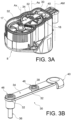
- the electromechanical actuator 7 also includes an upper framework element 30, shown in more detail in Figure 3B , which guides the components of the reducer 14 in movement around the main axis AX and the secondary axis AS.
- the upper framework element 30 guides the first toothed wheel 16 in rotation around the secondary axis AS and it guides the second double toothed wheel 17 in rotation around the main axis AX.
- the upper framework element 30 also makes it possible to position the main axis AX and the secondary axis AS longitudinally relative to each other.
- the upper framework element 30 comprises for this purpose two cylindrical spans 32 each of which is associated and is coaxial with the secondary axis AS or with the main axis AX and a longitudinal beam 34 connecting the cylindrical spans 32 one to another. the other.
- each double toothed wheel 16, 17 rotates around a coaxial shaft 36 with main axis AX or secondary axis AS.
- the shaft 36 associated with one of the double toothed wheels 16, 17 and preferably the shaft 36 associated with the second double toothed wheel 17 is fixed to the cylindrical bearing associated with the main axis AX.
- the cylindrical surface 32 associated with the main axis AX is molded around the shaft 36.
- the cylindrical surface 32 associated with the secondary axis AS defines a cylindrical housing 38 receiving an associated end of the shaft 36 associated with the secondary axis AS.
- the longitudinal beam 34 extends until it covers the output pinion 20, without coming into contact with it.
- the end of the longitudinal beam 34 extending around the output pinion 20 forms a cover 40 which, preferably, comes into contact with the housing 8 to participate in the positioning of the element d upper framework 30 relative to housing 8.
- the upper framework element 30, and in particular its longitudinal beam 34 extends axially above the double toothed wheels 16, 17, as does the cover 12.
- the cover 12 comprises a convex portion 42 which is associated with the upper framework element 30 and in which the longitudinal beam 34 is housed.
- This convex portion is open axially towards the interior volume of the housing 8 and has cylindrical recesses 44 respectively coaxial with the motor axis AM, the main axis AX and the secondary axis AS.
- Each recess receives an axial end of a cylindrical surface 32.
- a damping element 46 for example of annular shape, is received between the axial end of a cylindrical surface 32 and the recess 44, in particular to damp vibrations.
- the longitudinal beam 34 of the upper framework element 30 extends longitudinally only between the main axis AX and the secondary axis AS, that is to say that the upper framework element 30 does not cover not output gear 20.
- the cover 12 comprises a convex portion 42 formed accordingly, that is to say which comprises two recesses 44 centered on the main axis AX and the secondary axis AS, respectively and the convex portion 42 extends longitudinally between the two recesses 44.
- the lower framework element 50 comprises a first annular portion 52 coaxial with the main axis AX, which has internal teeth 54.
- This first annular portion 52 is intended to cooperate with the epicyclic gear train 18, and more particularly with the satellite gears thereof.
- the lower framework element 50 comprises a second portion 56 coaxial with the secondary axis AS which is intended to cooperate with the shaft 36 associated with the first double toothed wheel 16.
- the shaft 36 associated with the second double toothed wheel 17 is fixed to the second portion 56.
- the second portion 56 is molded around a lower end of the shaft 36.
- the first annular portion 52 makes it possible to maintain the epicyclic gear train 18 coaxial with the main axis AX and the lower framework element 50 therefore makes it possible to position the main axis AX and the secondary axis AS one by one. relation to the other.
- This extension 58 comprises a cylinder 60 coaxial with the motor axis AM which is intended to receive a guide member of the output shaft 62 of the motor 19, such as a bearing and which is capable of being fixed to the body of the motor 19.
- the lower framework element 50 is arranged inside the housing 8.
- the wall of the housing 8 is preferably located at a distance from the lower framework element 50.
- the lower framework element 50 comprises legs 72 extending radially relative to the main axis AX which are carried by the annular portion 52.
- Each tab 72 cooperates with a complementary shape of the wall of the housing 8 to achieve positioning of the lower framework element 50 in the housing 8.
- each radial tab 72 has a groove 74 open radially towards the outside and at its upper axial end, to receive a complementary boss, when the lower framework element 50 is introduced into the housing 8 according to an axial translation movement from bottom to top.
- Each framework element 30, 50 makes it possible in isolation to guide two components of the reducer 14 in rotation around the main axis AX and around the secondary axis AS, it also makes it possible to define a correct positioning of the two axes AX, AS relative to each other.
- an electromechanical actuator can comprise only one of these two framework elements 30, 50, and it can also comprise the two framework elements 30, 50.
- each framework element 30, 50 makes it possible in isolation to define the positioning of the main axis AX and the secondary axis AS relative to each other.
- the two framework elements 30, 50 comprise means for their connection and their positioning relative to each other.
- the positioning of the framework elements relative to each other is carried out on the one hand by the assembly of the components of the reducer 14.
- Positioning is carried out in particular by mounting the shaft 36 associated with the secondary axis AS, which is fixed, at its lower end, to the second portion 56 of the lower framework element 50, and its upper end is received in the cylindrical housing 38 of the cylindrical surface 32 associated with the secondary axis AS of the upper framework element 30.
- Positioning is also carried out by mounting the second double toothed wheel 17 and the epicyclic gear 18 on the shaft 36 associated with the main axis AX as well as by the cooperation of the epicyclic gear 18 with the internal teeth 54 of the first annular portion 52 of the lower framework element 50.
- connection of the two framework elements 30, 50 to one another is preferably carried out by elastic interlocking, that is to say by clipping.
- the upper framework element 30 comprises lateral arms 64 which extend transversely on either side of the longitudinal beam 34 and the free end of the lateral arms of which cooperates with fixing feet 68 making part of the lower framing element 50.
- the upper framework element 30 comprises two lateral arms 64 located on each side of the longitudinal beam 34.
- a first end of the lateral arms 64 is connected to one of the two cylindrical bearing surfaces 32 and the two lateral arms 64 are join at their free ends to form a plate 66 cooperating with a fixing foot 68.
- Each fixing foot 68 is parallel to the axes AM, AX, AS and extends axially in the direction of the upper framework element 30 from of the first annular portion 52.
- each fixing foot 68 forms an elastically deformable hook which is received in an opening 71 formed in the plate 66 constituted by the free ends of the lateral arms 64.
- each fixing foot 68 cooperates with the plate 66 constituted by the free ends of the lateral arms 64 to block the axial movement of the framework elements 30, 50 relative to each other. .
- This axial blocking is achieved on the one hand by the hook shape of the free upper end 70 of each fixing foot 68, which, in the assembly position, rests against an upper face of the plate and on the other hand part by an axial stop (not shown) formed by the fixing foot 68.
Landscapes
- Engineering & Computer Science (AREA)
- General Engineering & Computer Science (AREA)
- Mechanical Engineering (AREA)
- Transportation (AREA)
- Braking Arrangements (AREA)
- Braking Systems And Boosters (AREA)
Description
- La présente invention se rapporte au domaine général des freins à disque de véhicule automobile, et concerne plus particulièrement un frein à disque de véhicule automobile de type électromécanique, c'est-à-dire comprenant un actionneur électromécanique pour presser une ou plusieurs plaquettes de frein contre le disque afin de générer le freinage. Plus précisément, l'invention se rapporte à un actionneur électromécanique pour étrier de frein à disque de véhicule automobile comprenant des éléments d'ossature permettant de positionner les éléments mobiles de l'ensemble de motorisation les uns par rapport aux autres indépendamment du boitier logeant ces éléments mobiles.
- En référence à la
figure 1 , on a représenté, en perspective, un exemple de corps d'étrier 1 de frein à disque électromécanique susceptible d'être asservi à un actionneur selon l'invention. L'étrier 1 comporte avantageusement des moyens hydrauliques assurant le freinage de service, l'actionneur selon l'invention assurant le freinage de parking et/ou de secours. Par ailleurs, lafigure 2 représente, selon une vue éclatée, un exemple d'actionneur électromécanique 7 de type connu. - Comme visible sur la
figure 1 , le corps d'étrier 1 comporte une base 2 prolongée par une voûte 4, elle-même prolongée par des doigts 6. La base 2 comporte un logement dans lequel est engagé un piston mobile pour presser une plaquette de frein non représentée sur un disque de freinage. Cette base 2 renferme encore dans la région arrière du piston un mécanisme de transformation de mouvement à liaison hélicoïdale, pour convertir un mouvement de rotation en un mouvement de translation du piston, ce qui correspond à convertir un moment de forces en un effort presseur. - Ce corps d'étrier 1 est en outre équipé d'un actionneur électromécanique 7 pour agir sur le piston de façon à presser la plaquette contre le disque, sur activation de cet actionneur 7. Cet actionneur 7 comprend un boîtier 8, ou carter, ayant une face de fixation 9, visible sur la
figure 2 , par laquelle il est destiné à être accouplé au corps d'étrier 1, et une face opposée 11 fermée par un couvercle 12. La face de fixation 9 et la face opposée 11 sont des faces sensiblement planes et parallèles l'une à l'autre. - Le boîtier 8 renferme différents composants formant un ensemble de motorisation 13 accouplé à un réducteur mécanique 14 qui permet de déplacer le piston lorsque ce réducteur 14 est accouplé au corps d'étrier 1, c'est-à-dire lorsque l'actionneur 7 est fixé à la base 2. Le réducteur 14 comporte une première double roue dentée 16 engrenée dans une deuxième double roue dentée 17, qui entraîne un train épicycloïdal 18.
- L'ensemble de motorisation 13 comporte un moteur électrique 19 ayant un pignon de sortie 20, ainsi que deux cartes électroniques 21, 22 qui pilotent ce moteur 19. Les cartes et le moteur 19 sont portés par une plaque 23 fermant et se fixant dans une ouverture correspondante 24, cette ouverture débouchant dans la face de fixation 9 du boîtier 8. Comme visible sur la
figure 2 , les éléments du réducteur 14 tournent autour d'axes parallèles à l'axe de rotation du moteur, repéré par AM. Dans l'exemple des figures, l'axe AM est parallèle à un axe principal repéré par AX qui correspond à l'axe de translation du piston lorsque l'actionneur 7 est monté sur le corps d'étrier 1, cet axe AX s'étendant longitudinalement par rapport au véhicule équipé du frein. - Lorsque l'actionneur 7 est monté, le moteur 19 avec les cartes 21 et 22 sont en place dans la cavité correspondant à l'ouverture 24, et le pignon 20 entraîne la première double roue dentée 16. Le train épicycloïdal 18 comporte un élément d'accouplement 27, par exemple de type torx, qui débouche dans une ouverture correspondante 28 de la face de fixation 9, pour entraîner le mécanisme de transformation de mouvement logé dans la base 2. Par ailleurs, l'étrier peut comporter également, outre les moyens électromécaniques de déplacement du piston, des moyens hydrauliques de déplacement du piston. Dans ce cas, les moyens électromécaniques assurent le déplacement du piston dans le cas d'un freinage de parking, et les moyens hydrauliques assurent son déplacement en cas de freinage de service.
- Lorsque l'actionneur 7 est mis en fonctionnement, les composants mobiles génèrent des vibrations qui sont notamment transmises au boitier 8 et au couvercle 12, produisant ainsi un bruit parasite.
- De plus, de par leur conception, et notamment leurs tolérances dimensionnelles, le boitier 8 et le couvercle ne permettent pas de réaliser un positionnement suffisamment précis des axes de déplacement des composants mobiles par rapport à l'axe moteur AM.
- Le document
DE 10 2019 204181 A1 montre un actionneur électromécanique du type connu pourvu d'un boîtier avec couvercle, dans lequel un logement pour les axes du réducteur est formé. - L'invention a pour but de proposer un actionneur permettant de découpler les composants mobiles du boitier et du couvercle 12.
- L'invention a pour principal objet un actionneur électromécanique pour étrier de frein à disque de véhicule automobile comportant un boitier, un réducteur mécanique dont des composants du réducteur mécanique sont enfermés dans le boitier et un couvercle qui ferme une face d'extrémité, dans lequel certains composants du réducteur mécanique sont mobiles dans le boitier en déplacement autour de l'un ou l'autre de deux axes parallèles l'un à l'autre,
- caractérisé en ce que il comporte au moins un élément d'ossature qui est relié à l'un du boitier ou du couvercle et qui réalise le guidage en rotation d'au moins un composant en déplacement autour d'un premier desdits deux axes et le guidage d'au moins un autre composant en déplacement autour de l'autre desdits deux axes.
- Les composants mobiles de l'actionneur sont reliés entre eux par le ou les éléments d'ossature, rendant ainsi les composants mobiles indépendants du boitier ou du couvercle.
- La conception du boitier et/ou du couvercle en est alors simplifiée.
- De préférence, l'élément d'ossature comporte deux portées cylindriques dont chacune est coaxiale à l'un desdits deux axes et dont chaque portée cylindrique reçoit un arbre de guidage en rotation d'au moins un composant autour de l'axe qui lui est associé.
- De préférence, au moins une portée cylindrique est formée par moulage autour de l'arbre qui lui est associé.
- De préférence, l'élément d'ossature est logé dans une portion associée du couvercle, qui comporte deux renfoncements dans chacun desquels une extrémité axiale d'une portée cylindrique est reçue.
- De préférence, l'élément d'ossature comporte une portion annulaire à denture intérieure, qui est coaxiale à l'un axe desdits deux axes et porte un arbre coaxial à l'autre axe desdits deux axes.
- De préférence, l'élément d'ossature comporte une extension portant des moyens de guidage d'un arbre de sortie d'un moteur d'entrainement de l'actionneur électromécanique autour d'un troisième axe AM parallèle auxdits deux axes.
- De préférence, l'élément d'ossature est monté à l'intérieur du boitier.
- De préférence, les deux éléments d'ossature sont fixés l'un avec l'autre par emboîtement élastique.
- L'invention a aussi pour objet un étrier de frein à disque de véhicule automobile, caractérisé en ce qu'il comporte un actionneur électromécanique selon l'une quelconque des revendications précédentes.
- L'invention a aussi pour objet un frein à disque de véhicule automobile, caractérisé en ce qu'il comporte un étrier selon la revendication.
- L'invention pourra être mieux comprise à la lecture de la description détaillée qui va suivre, d'exemples de mise en oeuvre non limitatifs de celle-ci, ainsi qu'à l'examen des figures, schématiques et partielles, du dessin annexé, sur lequel :
- [
Fig. 1 ] est une vue d'ensemble, en perspective, d'un corps d'étrier de frein électromécanique représenté seul, - [
Fig. 2 ] est une vue d'ensemble, éclatée, d'un actionneur électromécanique destiné à équiper un étrier, - [
Fig. 3A] et [Fig. 3B ] sont des représentations schématiques de l'actionneur montrant un élément d'ossature supérieur selon l'invention, - [
Fig. 4A] et [Fig. 4B ] sont des représentations schématiques en perspectives du couvercle associé à l'élément d'ossature supérieur représenté auxfigures 3A et 3B , - [
Fig. 5 ] est une section de l'actionneur comportant l'élément d'ossature supérieur et le couvercle qui lui est associé, - [
Fig. 6A ] et [Fig. 6B ] sont des représentations en perspective d'un élément d'ossature supérieur et du couvercle associé qui sont réalisés selon une variante de réalisation de l'invention, - [
Fig. 7A ] et [Fig. 7B ] sont des représentations schématiques de l'actionneur montrant un élément d'ossature inférieur selon l'invention, - [
Fig. 8 ] est une représentation schématique en perspective d'une variante de réalisation de l'élément d'ossature inférieur, - [
Fig. 9 ] est une vue en perspective d'un actionneur comportant un élément d'ossature supérieur et un élément d'ossature inférieur assemblés l'un avec l'autre, - [
Fig. 10 ] est une représentation en perspective de l'élément d'ossature supérieur et l'élément d'ossature inférieur assemblés l'un avec l'autre. - Les
figures 1 et 2 ont déjà été décrites précédemment dans la partie relative à l'état de la technique antérieure et au contexte technique de l'invention. - On a représenté aux
figures 3A et 3B un actionneur électromécanique 7, qui comporte, comme décrit en référence à lafigure 2 , un boitier 8 dans lequel les composants d'un réducteur mécanique 14 sont agencés. - Ici, on peut voir une première double roue dentée 16, qui est mobile en rotation autour d'un axe secondaire AS parallèle à l'axe moteur AM et à l'axe principal AX qui correspond à l'axe de translation du piston et une deuxième double roue dentée 17 qui est mobile en rotation autour de l'axe principal AX.
- L'actionneur électromécanique 7 comporte aussi un élément d'ossature supérieur 30, représenté plus en détails à la
figure 3B , qui réalise le guidage des composants du réducteur 14 en déplacement autour de l'axe principal AX et de l'axe secondaire AS. Ainsi, l'élément d'ossature supérieur 30 réalise le guidage de la première roue dentée 16 en rotation autour de l'axe secondaire AS et il réalise le guidage de la deuxième double roue dentée 17 en rotation autour de l'axe principal AX. - L'élément d'ossature supérieur 30 permet aussi de positionner longitudinalement l'axe principal AX et l'axe secondaire AS l'un par rapport à l'autre.
- L'élément d'ossature supérieur 30 comporte à cet effet deux portées cylindriques 32 dont chacune est associée et est coaxiale à l'axe secondaire AS ou à l'axe principal AX et une poutre longitudinale 34 reliant les portées cylindriques 32 l'une à l'autre.
- Comme on peut le voir à la
figure 5 , chaque double roue dentée 16, 17 tourne autour d'un arbre 36 coaxial à axe principal AX ou à l'axe secondaire AS. - Selon un mode de réalisation préféré, l'arbre 36 associé à l'une des doubles roues dentées 16, 17 et de préférence l'arbre 36 associé à la deuxième double roue dentée 17 est fixé à la portée cylindrique associée à l'axe principal AX.
- A titre d'exemple non limitatif, la portée cylindrique 32 associée à l'axe principal AX est moulée autour de l'arbre 36. La portée cylindrique 32 associée à l'axe secondaire AS délimite un logement cylindrique 38 recevant une extrémité associée de l'arbre 36 associé à l'axe secondaire AS.
- Selon le mode de réalisation représenté aux
figures 3A et 3B , la poutre longitudinale 34 s'étend jusqu'à recouvrir le pignon de sortie 20, sans venir au contact avec celui-ci. Comme on peut le voir à la figure l'extrémité de la poutre longitudinale 34 s'étendant autour du pignon de sortie 20 forme un capot 40 qui, de préférence, vient en contact avec le boitier 8 pour participer au positionnement de l'élément d'ossature supérieur 30 par rapport au boitier 8. - L'élément d'ossature supérieur 30, et en particulier sa poutre longitudinale 34 s'étend axialement au-dessus des doubles roues dentées 16, 17, de même que le couvercle 12. Comme on peut le voir aux
figures 4A et 4B , le couvercle 12 comporte une portion bombée 42 qui est associée à l'élément d'ossature supérieur 30 et dans laquelle la poutre longitudinale 34 est logée. Cette portion bombée est ouverte axialement vers le volume intérieur du boitier 8 et comporte des renfoncements 44 cylindriques respectivement coaxiaux à l'axe moteur AM, à l'axe principal AX et à l'axe secondaire AS. - Chaque renfoncement reçoit une extrémité axiale d'une portée cylindrique 32. De préférence, un élément amortisseur 46, par exemple de forme annulaire, est reçu entre l'extrémité axiale d'une portée cylindrique 32 et le renfoncement 44, notamment pour amortir les vibrations.
- Selon une variante de réalisation représentée aux
figure 6A et6B , la poutre longitudinale 34 de l'élément d'ossature supérieur 30 s'étend longitudinalement uniquement entre l'axe principal AX et l'axe secondaire AS, c'est-à-dire que l'élément d'ossature supérieur 30 ne recouvre pas le pignon de sortie 20. - Le couvercle 12 comporte une portion bombée 42 formée en conséquence, c'est-à-dire qui comporte deux renfoncements 44 centrées sur l'axe principal AX et l'axe secondaire AS, respectivement et la portion bombée 42 s'étend longitudinalement entre les deux renfoncements 44.
- On a représenté aux
figures 7A et suivantes une partie du réducteur mécanique 14 comportant un élément d'ossature inférieur 50 coopérant avec le train épicycloïdal 18 et l'arbre 36 associé à la première double roue dentée 16. - L'élément d'ossature inférieur 50 comporte une première portion annulaire 52 coaxiale à l'axe principal AX, qui comporte une denture intérieure 54.
- Cette première portion annulaire 52 est destinée à coopérer avec le train épicycloïdal 18, et plus particulièrement avec les pignons satellites de celui-ci.
- L'élément d'ossature inférieur 50 comporte une deuxième portion 56 coaxiale à l'axe secondaire AS qui est destinée à coopérer avec l'arbre 36 associé à la première double roue dentée 16.
- De préférence l'arbre 36 associé à la deuxième double roue dentée 17 est fixé à la deuxième portion 56. A titre d'exemple non limitatif, la deuxième portion56 est moulée autour d'une extrémité inférieure de l'arbre 36.
- Ainsi, la première portion annulaire 52 permet de maintenir le train épicycloïdal 18 coaxial à l'axe principal AX et l'élément d'ossature inférieur 50 permet par conséquent de positionner l'axe principal AX et l'axe secondaire AS l'un par rapport à l'autre.
- On a représenté à la
figure 8 une variante de réalisation de l'élément d'ossature inférieur 50 qui comporte une extension 58 s'étendant longitudinalement jusqu'à l'axe moteur AM. - Cette extension 58 comporte un cylindre 60 coaxial à l'axe moteur AM qui est destiné à recevoir un organe de guidage de l'arbre de sortie 62 du moteur 19, tel qu'un roulement et qui est apte à être fixé au corps du moteur 19.
- L'élément d'ossature inférieur 50 est arrangé à l'intérieur du boitier 8.
- La paroi du boitier 8 est de préférence située à distance de l'élément d'ossature inférieur 50.
- L'élément d'ossature inférieur 50 comporte des pattes 72 s'étendant radialement par rapport à l'axe principal AX qui sont portées par la portion annulaire 52.
- Chaque patte 72 coopère avec une forme complémentaire de la paroi du boitier 8 pour réaliser un positionnement de l'élément d'ossature inférieur 50 dans le boitier 8.
- Ici, chaque patte radiale 72 comporte une gorge 74 ouverte radialement vers l'extérieur et à son extrémité axiale supérieure, pour recevoir un bossage complémentaire, lorsque l'élément d'ossature inférieur 50 est introduit dans le boitier 8 selon un mouvement de translation axiale de bas vers le haut.
- Chaque élément d'ossature 30, 50 permet isolément de guider deux composants du réducteur 14 en rotation autour de l'axe principal AX et autour de l'axe secondaire AS, il permet en outre de définir un positionnement correct des deux axes AX, AS l'un par rapport à l'autre.
- Ainsi, un actionneur électromécanique peut comporter un seul de ces deux éléments d'ossature 30, 50, et il peut aussi comporter les deux éléments d'ossature 30, 50.
- On a représenté aux
figures 9 et 10 un exemple de réalisation du réducteur comportant l'élément d'ossature supérieur 30 et l'élément d'ossature inférieur 50. - Comme on l'a dit précédemment, chaque élément d'ossature 30, 50 permet isolément de définir le positionnement de l'axe principal AX et de l'axe secondaire AS l'un par rapport à l'autre.
- Pour que la combinaison des deux éléments d'ossature 30, 50 continue de définir le positionnement des axes AX et AX l'un par rapport à l'autre, les deux éléments d'ossature 30, 50 comportent des moyens pour leur liaison et leur positionnement l'un par rapport à l'autre.
- Le positionnement des éléments d'ossature l'un par rapport à l'autre s'effectue d'une part par le montage des composants du réducteur 14.
- Le positionnement s'effectue notamment par le montage de l'arbre 36 associé à l'axe secondaire AS, qui est fixé, à son extrémité inférieure, à la deuxième portion 56 de l'élément d'ossature inférieur 50, et son extrémité supérieure est reçue dans le logement cylindrique 38 de la portée cylindrique 32 associée à l'axe secondaire AS de l'élément d'ossature supérieur 30.
- Le positionnement s'effectue aussi par le montage de la deuxième double roue dentée 17 et du train épicycloïdal 18 sur l'arbre 36 associé à l'axe principal AX ainsi que par la coopération du train épicycloïdal 18 avec la denture intérieure 54 de la première portion annulaire 52 de l'élément d'ossature inférieur 50.
- La liaison des deux éléments d'ossature 30, 50 l'un avec l'autre s'effectue de préférence par emboîtement élastique, c'est-à-dire par clipsage.
- A cet effet, l'élément d'ossature supérieur 30 comporte des bras latéraux 64 qui s'étendent transversalement de part et d'autre de la poutre longitudinale 34 et dont l'extrémité libre des bras latéraux coopère avec des pieds de fixation 68 faisant partie de l'élément d'ossature inférieur 50.
- Ici, l'élément d'ossature supérieur 30 comporte deux bras latéraux 64 situés de chaque côté de la poutre longitudinale 34. Une première extrémité des bras latéraux 64 est reliée à l'une des deux portées cylindriques 32 et les deux bras latéraux 64 se rejoignent à leurs extrémités libres pour former une platine 66 coopérant avec un pied de fixation 68. Chaque pied de fixation 68 est parallèle aux axe AM, AX, AS et s'étend axialement en direction de l'élément d'ossature supérieur 30 à partir de la première portion annulaire 52.
- L'extrémité supérieure libre 70 de chaque pied de fixation 68 forme un crochet déformable élastiquement qui est reçu dans une ouverture 71 formée dans la platine 66 constituée par les extrémités libres des bras latéraux 64.
- L'extrémité supérieure libre 70 de chaque pied de fixation 68 coopère avec la platine 66 constituée par les extrémités libres des bras latéraux 64 pour réaliser un blocage en mouvement axial des éléments d'ossature 30, 50 l'un par rapport à l'autre.
- Ce blocage axial est réalisé d'une part par la forme en crochet de l'extrémité supérieure libre 70 de chaque pied de fixation 68, qui, en position d'assemblage, s'appuie contre une face supérieure de la platine et d'autre part par une butée axiale (non représentée) formée par le pied de fixation 68.
-
- 1 corps d'étrier
- 7 actionneur électromécanique
- 2 base
- 4 voûte
- 6 doigts
- 8 boitier
- 9 face de fixation
- 11 face opposée
- 12 couvercle
- 13 ensemble de motorisation
- 14 réducteur mécanique
- 16 première double roue dentée
- 17 deuxième double roue dentée
- 18 train épicycloïdal
- 19 moteur électrique
- 20 pignon de sortie
- 21, 22 : cartes électroniques
- 23 plaque
- 27 élément d'accouplement
- 30 élément d'ossature supérieur
- 32 portée cylindrique
- 34 poutre longitudinale
- 36 arbre
- 38 logement cylindrique
- 40 capot
- 42 portion bombée
- 44 renfoncement
- 46 élément amortisseur
- 50 élément d'ossature inférieur
- 52 première portion annulaire
- 54 denture intérieure
- 56 deuxième portion
- 58 extension
- 60 cylindre
- 62 arbre de sortie
- 72 patte radiale
- 74 gorge
- 64 bras latéraux
- 68 pied de fixation
- 66 platine
- 70 extrémité supérieure libre
- AM axe moteur
- AX axe principal
- AS axe secondaire
Claims (8)
- Actionneur électromécanique (7) pour étrier de frein à disque de véhicule automobile comportant un boitier (8), un réducteur mécanique (14) dont des composants du réducteur mécanique (14) sont enfermés dans le boitier (8) et un couvercle (12) qui ferme une face d'extrémité, dans lequel certains composants (16, 17, 18) du réducteur mécanique (14) sont mobiles dans le boitier (8) en déplacement autour de l'un ou l'autre de deux axes (AX, AS) parallèles l'un à l'autre, l'actionneur électromécanique comportant au moins un élément d'ossature (30, 50) qui est relié à l'un du boitier (8) ou du couvercle (12) et qui réalise le guidage en rotation d'au moins un composant (16) en déplacement autour d'un premier (AS) desdits deux axes et le guidage d'au moins un autre composant (17, 18) en déplacement autour de l'autre (AX) desdits deux axes, l'élément d'ossature (30) comportant deux portées cylindriques (32) dont chacune est coaxiale à l'un desdits deux axes (AX, AS) et dont chaque portée cylindrique (32) reçoit un arbre (36) de guidage en rotation d'au moins un composant (16, 17, 18) autour de l'axe (AX, AS) qui lui est associé, caractérisé en ce que l'élément d'ossature (30) est logé dans une portion (42) associée du couvercle (12), qui comporte deux renfoncements (44) dans chacun desquels une extrémité axiale d'une portée cylindrique (32) est reçue.
- Actionneur électromécanique (7) selon la revendication précédente, caractérisé en ce qu'au moins une portée cylindrique (32) est formée par moulage autour de l'arbre (36) qui lui est associé.
- Actionneur électromécanique (7) selon la revendication 1, caractérisé en ce que l'élément d'ossature (50) comporte une portion annulaire (52) à denture intérieure (54), qui est coaxiale à l'un axe (AX) desdits deux axes et porte un arbre (36) coaxial à l'autre axe (AS) desdits deux axes.
- Actionneur électromécanique (7) selon la revendication précédente, caractérisé en ce que l'élément d'ossature (50) comporte une extension (58) portant des moyens de guidage d'un arbre de sortie (62) d'un moteur (19) d'entrainement de l'actionneur électromécanique (7) autour d'un troisième axe (AM) parallèle auxdits deux axes (AX, AS).
- Actionneur électromécanique (7) selon la revendication 3 ou 4, caractérisé en ce que l'élément d'ossature (50) est monté à l'intérieur du boitier (8).
- Actionneur électromécanique (7) selon l'une quelconque des revendications 3 à 5, en combinaison avec l'une quelconque des revendications 1 ou 2, caractérisé en ce que les deux éléments d'ossature (30, 50) sont fixés l'un avec l'autre par emboîtement élastique.
- Etrier de frein à disque de véhicule automobile, caractérisé en ce qu'il comporte un actionneur électromécanique (7) selon l'une quelconque des revendications précédentes.
- Frein à disque de véhicule automobile, caractérisé en ce qu'il comporte un étrier selon la revendication 7.
Applications Claiming Priority (1)
| Application Number | Priority Date | Filing Date | Title |
|---|---|---|---|
| FR2013998A FR3118109B1 (fr) | 2020-12-23 | 2020-12-23 | Actionneur electromecanique comportant un element d'ossature |
Publications (2)
| Publication Number | Publication Date |
|---|---|
| EP4019798A1 EP4019798A1 (fr) | 2022-06-29 |
| EP4019798B1 true EP4019798B1 (fr) | 2023-10-25 |
Family
ID=74592266
Family Applications (1)
| Application Number | Title | Priority Date | Filing Date |
|---|---|---|---|
| EP21216504.7A Active EP4019798B1 (fr) | 2020-12-23 | 2021-12-21 | Actionneur electromecanique comportant un element d'ossature |
Country Status (2)
| Country | Link |
|---|---|
| EP (1) | EP4019798B1 (fr) |
| FR (1) | FR3118109B1 (fr) |
Families Citing this family (1)
| Publication number | Priority date | Publication date | Assignee | Title |
|---|---|---|---|---|
| DE102023121042A1 (de) | 2023-08-08 | 2025-02-13 | Oechsler Ag | Lagereinheit sowie Stellantrieb |
Family Cites Families (5)
| Publication number | Priority date | Publication date | Assignee | Title |
|---|---|---|---|---|
| DE102010032053A1 (de) * | 2010-07-23 | 2012-01-26 | Lucas Automotive Gmbh | Unterbaugruppe für einen elektromechanischen Bremsaktuator |
| DE102014015848A1 (de) * | 2014-10-27 | 2016-04-28 | Lucas Automotive Gmbh | Elektromechanischer Bremsaktuator und Unterbaugruppe hierfür |
| KR101612677B1 (ko) * | 2015-06-22 | 2016-04-26 | 효성전기주식회사 | 금속 금형 및 기어박스 사출 병행방식의 링기어를 적용한 moc 액츄에이터 |
| KR20200094379A (ko) * | 2019-01-30 | 2020-08-07 | 주식회사 만도 | 전기기계식 브레이크용 엑츄에이터 |
| DE102019204181A1 (de) * | 2019-03-26 | 2020-10-01 | Brose Fahrzeugteile SE & Co. Kommanditgesellschaft, Würzburg | Elektrischer Bremsaktuator eines Kraftfahrzeugs |
-
2020
- 2020-12-23 FR FR2013998A patent/FR3118109B1/fr active Active
-
2021
- 2021-12-21 EP EP21216504.7A patent/EP4019798B1/fr active Active
Also Published As
| Publication number | Publication date |
|---|---|
| FR3118109B1 (fr) | 2023-01-13 |
| EP4019798A1 (fr) | 2022-06-29 |
| FR3118109A1 (fr) | 2022-06-24 |
Similar Documents
| Publication | Publication Date | Title |
|---|---|---|
| EP3676144B1 (fr) | Etrier de frein a disque de type electromecanique comprenant deux actionneurs mecaniques pour compenser une usure inégale d'une même plaquette | |
| EP3089901B1 (fr) | Motoreducteur a train epicycloidal, frein a tambour, frein a disque et dispositif de freinage ainsi equipes | |
| EP2864167B1 (fr) | Servofrein electrique a compensation de jeu de transmission | |
| EP3458662B1 (fr) | Commande d'ouverture exterieure de vehicule automobile | |
| FR3047035A1 (fr) | Commande d’ouverture exterieure de vehicule automobile | |
| EP0715695A1 (fr) | Volant amortisseur notamment pour vehicule automobile | |
| WO2019048753A1 (fr) | Actionneur avec roue a denture axiale | |
| EP2649341A1 (fr) | Frein à disque à verrou de blocage de la cartouche de conversion par un verrou | |
| EP3298298B1 (fr) | Boitier de transmission et son procede de fermeture et engin equipe d'un tel boitier de transmission | |
| WO2017103005A1 (fr) | Actionneur electromecanique a encombrement reduit pour frein a disque | |
| EP4019798A1 (fr) | Actionneur electromecanique comportant un element d'ossature | |
| FR3016013A1 (fr) | Actionneur de frein a tambour avec motorisation par emboitement a jeu angulaire | |
| EP3089900B1 (fr) | Motoreducteur avec moteur electrique adaptable pour actionneur de frein a tambour | |
| EP0188164B1 (fr) | Bloc de direction de véhicule automobile, comportant un coussin central fixe | |
| FR2764029A1 (fr) | Dispositif pour actionner un arbre de commutation d'une boite de vitesses, pouvant pivoter autour d'un axe et etre deplace en translation le long de cet axe | |
| EP4323667B1 (fr) | Couvercle pour groupe motoréducteur pour actionneur électrique de frein à disque et groupe motoréducteur comprenant un tel couvercle | |
| FR2983920A1 (fr) | Demarreur de moteur thermique | |
| FR3059744A1 (fr) | Couvercle pour boitier d'actionneur electromecanique de frein a disque avec une structure de type nid d'abeilles | |
| FR2914719A1 (fr) | Train d'engrenages epicycloidal et boite de vitesses equipe d'un tel train | |
| EP4248108B1 (fr) | Motoreducteur pour actionneur de frein de vehicule a duree de vie augmentee | |
| FR2545543A1 (fr) | Demarreur pour moteur thermique | |
| FR2878908A1 (fr) | Dispositif de demarrage d'un moteur thermique | |
| FR3104662A1 (fr) | Porte-satellite comprenant au moins un tourillon monté flottant dans le corps du porte-satellite | |
| EP4559767A1 (fr) | Frein a disque, notamment pour vehicule automobile | |
| FR3135501A1 (fr) | Dispositif de verrou de parking pour un réducteur de vitesse de véhicule automobile |
Legal Events
| Date | Code | Title | Description |
|---|---|---|---|
| PUAI | Public reference made under article 153(3) epc to a published international application that has entered the european phase |
Free format text: ORIGINAL CODE: 0009012 |
|
| STAA | Information on the status of an ep patent application or granted ep patent |
Free format text: STATUS: THE APPLICATION HAS BEEN PUBLISHED |
|
| AK | Designated contracting states |
Kind code of ref document: A1 Designated state(s): AL AT BE BG CH CY CZ DE DK EE ES FI FR GB GR HR HU IE IS IT LI LT LU LV MC MK MT NL NO PL PT RO RS SE SI SK SM TR |
|
| STAA | Information on the status of an ep patent application or granted ep patent |
Free format text: STATUS: REQUEST FOR EXAMINATION WAS MADE |
|
| 17P | Request for examination filed |
Effective date: 20221221 |
|
| RBV | Designated contracting states (corrected) |
Designated state(s): AL AT BE BG CH CY CZ DE DK EE ES FI FR GB GR HR HU IE IS IT LI LT LU LV MC MK MT NL NO PL PT RO RS SE SI SK SM TR |
|
| GRAP | Despatch of communication of intention to grant a patent |
Free format text: ORIGINAL CODE: EPIDOSNIGR1 |
|
| STAA | Information on the status of an ep patent application or granted ep patent |
Free format text: STATUS: GRANT OF PATENT IS INTENDED |
|
| INTG | Intention to grant announced |
Effective date: 20230516 |
|
| GRAS | Grant fee paid |
Free format text: ORIGINAL CODE: EPIDOSNIGR3 |
|
| GRAA | (expected) grant |
Free format text: ORIGINAL CODE: 0009210 |
|
| STAA | Information on the status of an ep patent application or granted ep patent |
Free format text: STATUS: THE PATENT HAS BEEN GRANTED |
|
| AK | Designated contracting states |
Kind code of ref document: B1 Designated state(s): AL AT BE BG CH CY CZ DE DK EE ES FI FR GB GR HR HU IE IS IT LI LT LU LV MC MK MT NL NO PL PT RO RS SE SI SK SM TR |
|
| REG | Reference to a national code |
Ref country code: GB Ref legal event code: FG4D Free format text: NOT ENGLISH |
|
| REG | Reference to a national code |
Ref country code: CH Ref legal event code: EP |
|
| REG | Reference to a national code |
Ref country code: DE Ref legal event code: R096 Ref document number: 602021006206 Country of ref document: DE |
|
| REG | Reference to a national code |
Ref country code: IE Ref legal event code: FG4D Free format text: LANGUAGE OF EP DOCUMENT: FRENCH |
|
| REG | Reference to a national code |
Ref country code: LT Ref legal event code: MG9D |
|
| REG | Reference to a national code |
Ref country code: NL Ref legal event code: MP Effective date: 20231025 |
|
| REG | Reference to a national code |
Ref country code: AT Ref legal event code: MK05 Ref document number: 1624949 Country of ref document: AT Kind code of ref document: T Effective date: 20231025 |
|
| PG25 | Lapsed in a contracting state [announced via postgrant information from national office to epo] |
Ref country code: NL Free format text: LAPSE BECAUSE OF FAILURE TO SUBMIT A TRANSLATION OF THE DESCRIPTION OR TO PAY THE FEE WITHIN THE PRESCRIBED TIME-LIMIT Effective date: 20231025 |
|
| PG25 | Lapsed in a contracting state [announced via postgrant information from national office to epo] |
Ref country code: GR Free format text: LAPSE BECAUSE OF FAILURE TO SUBMIT A TRANSLATION OF THE DESCRIPTION OR TO PAY THE FEE WITHIN THE PRESCRIBED TIME-LIMIT Effective date: 20240126 |
|
| PG25 | Lapsed in a contracting state [announced via postgrant information from national office to epo] |
Ref country code: IS Free format text: LAPSE BECAUSE OF FAILURE TO SUBMIT A TRANSLATION OF THE DESCRIPTION OR TO PAY THE FEE WITHIN THE PRESCRIBED TIME-LIMIT Effective date: 20240225 |
|
| PG25 | Lapsed in a contracting state [announced via postgrant information from national office to epo] |
Ref country code: LT Free format text: LAPSE BECAUSE OF FAILURE TO SUBMIT A TRANSLATION OF THE DESCRIPTION OR TO PAY THE FEE WITHIN THE PRESCRIBED TIME-LIMIT Effective date: 20231025 |
|
| PG25 | Lapsed in a contracting state [announced via postgrant information from national office to epo] |
Ref country code: AT Free format text: LAPSE BECAUSE OF FAILURE TO SUBMIT A TRANSLATION OF THE DESCRIPTION OR TO PAY THE FEE WITHIN THE PRESCRIBED TIME-LIMIT Effective date: 20231025 |
|
| PG25 | Lapsed in a contracting state [announced via postgrant information from national office to epo] |
Ref country code: ES Free format text: LAPSE BECAUSE OF FAILURE TO SUBMIT A TRANSLATION OF THE DESCRIPTION OR TO PAY THE FEE WITHIN THE PRESCRIBED TIME-LIMIT Effective date: 20231025 |
|
| PG25 | Lapsed in a contracting state [announced via postgrant information from national office to epo] |
Ref country code: LT Free format text: LAPSE BECAUSE OF FAILURE TO SUBMIT A TRANSLATION OF THE DESCRIPTION OR TO PAY THE FEE WITHIN THE PRESCRIBED TIME-LIMIT Effective date: 20231025 Ref country code: IS Free format text: LAPSE BECAUSE OF FAILURE TO SUBMIT A TRANSLATION OF THE DESCRIPTION OR TO PAY THE FEE WITHIN THE PRESCRIBED TIME-LIMIT Effective date: 20240225 Ref country code: GR Free format text: LAPSE BECAUSE OF FAILURE TO SUBMIT A TRANSLATION OF THE DESCRIPTION OR TO PAY THE FEE WITHIN THE PRESCRIBED TIME-LIMIT Effective date: 20240126 Ref country code: ES Free format text: LAPSE BECAUSE OF FAILURE TO SUBMIT A TRANSLATION OF THE DESCRIPTION OR TO PAY THE FEE WITHIN THE PRESCRIBED TIME-LIMIT Effective date: 20231025 Ref country code: BG Free format text: LAPSE BECAUSE OF FAILURE TO SUBMIT A TRANSLATION OF THE DESCRIPTION OR TO PAY THE FEE WITHIN THE PRESCRIBED TIME-LIMIT Effective date: 20240125 Ref country code: AT Free format text: LAPSE BECAUSE OF FAILURE TO SUBMIT A TRANSLATION OF THE DESCRIPTION OR TO PAY THE FEE WITHIN THE PRESCRIBED TIME-LIMIT Effective date: 20231025 Ref country code: PT Free format text: LAPSE BECAUSE OF FAILURE TO SUBMIT A TRANSLATION OF THE DESCRIPTION OR TO PAY THE FEE WITHIN THE PRESCRIBED TIME-LIMIT Effective date: 20240226 |
|
| PG25 | Lapsed in a contracting state [announced via postgrant information from national office to epo] |
Ref country code: SE Free format text: LAPSE BECAUSE OF FAILURE TO SUBMIT A TRANSLATION OF THE DESCRIPTION OR TO PAY THE FEE WITHIN THE PRESCRIBED TIME-LIMIT Effective date: 20231025 Ref country code: RS Free format text: LAPSE BECAUSE OF FAILURE TO SUBMIT A TRANSLATION OF THE DESCRIPTION OR TO PAY THE FEE WITHIN THE PRESCRIBED TIME-LIMIT Effective date: 20231025 Ref country code: PL Free format text: LAPSE BECAUSE OF FAILURE TO SUBMIT A TRANSLATION OF THE DESCRIPTION OR TO PAY THE FEE WITHIN THE PRESCRIBED TIME-LIMIT Effective date: 20231025 Ref country code: NO Free format text: LAPSE BECAUSE OF FAILURE TO SUBMIT A TRANSLATION OF THE DESCRIPTION OR TO PAY THE FEE WITHIN THE PRESCRIBED TIME-LIMIT Effective date: 20240125 Ref country code: LV Free format text: LAPSE BECAUSE OF FAILURE TO SUBMIT A TRANSLATION OF THE DESCRIPTION OR TO PAY THE FEE WITHIN THE PRESCRIBED TIME-LIMIT Effective date: 20231025 Ref country code: HR Free format text: LAPSE BECAUSE OF FAILURE TO SUBMIT A TRANSLATION OF THE DESCRIPTION OR TO PAY THE FEE WITHIN THE PRESCRIBED TIME-LIMIT Effective date: 20231025 |
|
| PG25 | Lapsed in a contracting state [announced via postgrant information from national office to epo] |
Ref country code: DK Free format text: LAPSE BECAUSE OF FAILURE TO SUBMIT A TRANSLATION OF THE DESCRIPTION OR TO PAY THE FEE WITHIN THE PRESCRIBED TIME-LIMIT Effective date: 20231025 |
|
| PG25 | Lapsed in a contracting state [announced via postgrant information from national office to epo] |
Ref country code: CZ Free format text: LAPSE BECAUSE OF FAILURE TO SUBMIT A TRANSLATION OF THE DESCRIPTION OR TO PAY THE FEE WITHIN THE PRESCRIBED TIME-LIMIT Effective date: 20231025 |
|
| REG | Reference to a national code |
Ref country code: DE Ref legal event code: R097 Ref document number: 602021006206 Country of ref document: DE |
|
| PG25 | Lapsed in a contracting state [announced via postgrant information from national office to epo] |
Ref country code: SK Free format text: LAPSE BECAUSE OF FAILURE TO SUBMIT A TRANSLATION OF THE DESCRIPTION OR TO PAY THE FEE WITHIN THE PRESCRIBED TIME-LIMIT Effective date: 20231025 |
|
| PG25 | Lapsed in a contracting state [announced via postgrant information from national office to epo] |
Ref country code: SM Free format text: LAPSE BECAUSE OF FAILURE TO SUBMIT A TRANSLATION OF THE DESCRIPTION OR TO PAY THE FEE WITHIN THE PRESCRIBED TIME-LIMIT Effective date: 20231025 Ref country code: SK Free format text: LAPSE BECAUSE OF FAILURE TO SUBMIT A TRANSLATION OF THE DESCRIPTION OR TO PAY THE FEE WITHIN THE PRESCRIBED TIME-LIMIT Effective date: 20231025 Ref country code: RO Free format text: LAPSE BECAUSE OF FAILURE TO SUBMIT A TRANSLATION OF THE DESCRIPTION OR TO PAY THE FEE WITHIN THE PRESCRIBED TIME-LIMIT Effective date: 20231025 Ref country code: IT Free format text: LAPSE BECAUSE OF FAILURE TO SUBMIT A TRANSLATION OF THE DESCRIPTION OR TO PAY THE FEE WITHIN THE PRESCRIBED TIME-LIMIT Effective date: 20231025 Ref country code: EE Free format text: LAPSE BECAUSE OF FAILURE TO SUBMIT A TRANSLATION OF THE DESCRIPTION OR TO PAY THE FEE WITHIN THE PRESCRIBED TIME-LIMIT Effective date: 20231025 Ref country code: DK Free format text: LAPSE BECAUSE OF FAILURE TO SUBMIT A TRANSLATION OF THE DESCRIPTION OR TO PAY THE FEE WITHIN THE PRESCRIBED TIME-LIMIT Effective date: 20231025 Ref country code: CZ Free format text: LAPSE BECAUSE OF FAILURE TO SUBMIT A TRANSLATION OF THE DESCRIPTION OR TO PAY THE FEE WITHIN THE PRESCRIBED TIME-LIMIT Effective date: 20231025 |
|
| PG25 | Lapsed in a contracting state [announced via postgrant information from national office to epo] |
Ref country code: LU Free format text: LAPSE BECAUSE OF NON-PAYMENT OF DUE FEES Effective date: 20231221 |
|
| PG25 | Lapsed in a contracting state [announced via postgrant information from national office to epo] |
Ref country code: MC Free format text: LAPSE BECAUSE OF FAILURE TO SUBMIT A TRANSLATION OF THE DESCRIPTION OR TO PAY THE FEE WITHIN THE PRESCRIBED TIME-LIMIT Effective date: 20231025 |
|
| REG | Reference to a national code |
Ref country code: BE Ref legal event code: MM Effective date: 20231231 |
|
| PG25 | Lapsed in a contracting state [announced via postgrant information from national office to epo] |
Ref country code: MC Free format text: LAPSE BECAUSE OF FAILURE TO SUBMIT A TRANSLATION OF THE DESCRIPTION OR TO PAY THE FEE WITHIN THE PRESCRIBED TIME-LIMIT Effective date: 20231025 Ref country code: LU Free format text: LAPSE BECAUSE OF NON-PAYMENT OF DUE FEES Effective date: 20231221 |
|
| PLBE | No opposition filed within time limit |
Free format text: ORIGINAL CODE: 0009261 |
|
| STAA | Information on the status of an ep patent application or granted ep patent |
Free format text: STATUS: NO OPPOSITION FILED WITHIN TIME LIMIT |
|
| 26N | No opposition filed |
Effective date: 20240726 |
|
| REG | Reference to a national code |
Ref country code: IE Ref legal event code: MM4A |
|
| PG25 | Lapsed in a contracting state [announced via postgrant information from national office to epo] |
Ref country code: IE Free format text: LAPSE BECAUSE OF NON-PAYMENT OF DUE FEES Effective date: 20231221 |
|
| PG25 | Lapsed in a contracting state [announced via postgrant information from national office to epo] |
Ref country code: BE Free format text: LAPSE BECAUSE OF NON-PAYMENT OF DUE FEES Effective date: 20231231 |
|
| PG25 | Lapsed in a contracting state [announced via postgrant information from national office to epo] |
Ref country code: SI Free format text: LAPSE BECAUSE OF FAILURE TO SUBMIT A TRANSLATION OF THE DESCRIPTION OR TO PAY THE FEE WITHIN THE PRESCRIBED TIME-LIMIT Effective date: 20231025 |
|
| PG25 | Lapsed in a contracting state [announced via postgrant information from national office to epo] |
Ref country code: SI Free format text: LAPSE BECAUSE OF FAILURE TO SUBMIT A TRANSLATION OF THE DESCRIPTION OR TO PAY THE FEE WITHIN THE PRESCRIBED TIME-LIMIT Effective date: 20231025 Ref country code: IE Free format text: LAPSE BECAUSE OF NON-PAYMENT OF DUE FEES Effective date: 20231221 Ref country code: BE Free format text: LAPSE BECAUSE OF NON-PAYMENT OF DUE FEES Effective date: 20231231 |
|
| PG25 | Lapsed in a contracting state [announced via postgrant information from national office to epo] |
Ref country code: FI Free format text: LAPSE BECAUSE OF FAILURE TO SUBMIT A TRANSLATION OF THE DESCRIPTION OR TO PAY THE FEE WITHIN THE PRESCRIBED TIME-LIMIT Effective date: 20231025 |
|
| PG25 | Lapsed in a contracting state [announced via postgrant information from national office to epo] |
Ref country code: CY Free format text: LAPSE BECAUSE OF FAILURE TO SUBMIT A TRANSLATION OF THE DESCRIPTION OR TO PAY THE FEE WITHIN THE PRESCRIBED TIME-LIMIT; INVALID AB INITIO Effective date: 20211221 |
|
| REG | Reference to a national code |
Ref country code: CH Ref legal event code: PL |
|
| PG25 | Lapsed in a contracting state [announced via postgrant information from national office to epo] |
Ref country code: CH Free format text: LAPSE BECAUSE OF NON-PAYMENT OF DUE FEES Effective date: 20241231 |
|
| PG25 | Lapsed in a contracting state [announced via postgrant information from national office to epo] |
Ref country code: TR Free format text: LAPSE BECAUSE OF FAILURE TO SUBMIT A TRANSLATION OF THE DESCRIPTION OR TO PAY THE FEE WITHIN THE PRESCRIBED TIME-LIMIT Effective date: 20231025 |
|
| PGFP | Annual fee paid to national office [announced via postgrant information from national office to epo] |
Ref country code: DE Payment date: 20251126 Year of fee payment: 5 |
|
| PGFP | Annual fee paid to national office [announced via postgrant information from national office to epo] |
Ref country code: FR Payment date: 20251120 Year of fee payment: 5 |
|
| PG25 | Lapsed in a contracting state [announced via postgrant information from national office to epo] |
Ref country code: HU Free format text: LAPSE BECAUSE OF FAILURE TO SUBMIT A TRANSLATION OF THE DESCRIPTION OR TO PAY THE FEE WITHIN THE PRESCRIBED TIME-LIMIT; INVALID AB INITIO Effective date: 20211221 |