EP4019522A1 - New derivatives of pyrrolopyrrole cyanines and uses thereof - Google Patents
New derivatives of pyrrolopyrrole cyanines and uses thereof Download PDFInfo
- Publication number
- EP4019522A1 EP4019522A1 EP20306699.8A EP20306699A EP4019522A1 EP 4019522 A1 EP4019522 A1 EP 4019522A1 EP 20306699 A EP20306699 A EP 20306699A EP 4019522 A1 EP4019522 A1 EP 4019522A1
- Authority
- EP
- European Patent Office
- Prior art keywords
- group
- groups
- mmol
- alkyl
- following formula
- Prior art date
- Legal status (The legal status is an assumption and is not a legal conclusion. Google has not performed a legal analysis and makes no representation as to the accuracy of the status listed.)
- Granted
Links
Images



Classifications
-
- C—CHEMISTRY; METALLURGY
- C07—ORGANIC CHEMISTRY
- C07F—ACYCLIC, CARBOCYCLIC OR HETEROCYCLIC COMPOUNDS CONTAINING ELEMENTS OTHER THAN CARBON, HYDROGEN, HALOGEN, OXYGEN, NITROGEN, SULFUR, SELENIUM OR TELLURIUM
- C07F5/00—Compounds containing elements of Groups 3 or 13 of the Periodic Table
- C07F5/02—Boron compounds
-
- B—PERFORMING OPERATIONS; TRANSPORTING
- B01—PHYSICAL OR CHEMICAL PROCESSES OR APPARATUS IN GENERAL
- B01J—CHEMICAL OR PHYSICAL PROCESSES, e.g. CATALYSIS OR COLLOID CHEMISTRY; THEIR RELEVANT APPARATUS
- B01J21/00—Catalysts comprising the elements, oxides, or hydroxides of magnesium, boron, aluminium, carbon, silicon, titanium, zirconium, or hafnium
- B01J21/06—Silicon, titanium, zirconium or hafnium; Oxides or hydroxides thereof
- B01J21/063—Titanium; Oxides or hydroxides thereof
-
- B—PERFORMING OPERATIONS; TRANSPORTING
- B01—PHYSICAL OR CHEMICAL PROCESSES OR APPARATUS IN GENERAL
- B01J—CHEMICAL OR PHYSICAL PROCESSES, e.g. CATALYSIS OR COLLOID CHEMISTRY; THEIR RELEVANT APPARATUS
- B01J31/00—Catalysts comprising hydrides, coordination complexes or organic compounds
- B01J31/16—Catalysts comprising hydrides, coordination complexes or organic compounds containing coordination complexes
- B01J31/18—Catalysts comprising hydrides, coordination complexes or organic compounds containing coordination complexes containing nitrogen, phosphorus, arsenic or antimony as complexing atoms, e.g. in pyridine ligands, or in resonance therewith, e.g. in isocyanide ligands C=N-R or as complexed central atoms
- B01J31/1805—Catalysts comprising hydrides, coordination complexes or organic compounds containing coordination complexes containing nitrogen, phosphorus, arsenic or antimony as complexing atoms, e.g. in pyridine ligands, or in resonance therewith, e.g. in isocyanide ligands C=N-R or as complexed central atoms the ligands containing nitrogen
- B01J31/181—Cyclic ligands, including e.g. non-condensed polycyclic ligands, comprising at least one complexing nitrogen atom as ring member, e.g. pyridine
- B01J31/1825—Ligands comprising condensed ring systems, e.g. acridine, carbazole
- B01J31/183—Ligands comprising condensed ring systems, e.g. acridine, carbazole with more than one complexing nitrogen atom, e.g. phenanthroline
-
- B—PERFORMING OPERATIONS; TRANSPORTING
- B01—PHYSICAL OR CHEMICAL PROCESSES OR APPARATUS IN GENERAL
- B01J—CHEMICAL OR PHYSICAL PROCESSES, e.g. CATALYSIS OR COLLOID CHEMISTRY; THEIR RELEVANT APPARATUS
- B01J31/00—Catalysts comprising hydrides, coordination complexes or organic compounds
- B01J31/26—Catalysts comprising hydrides, coordination complexes or organic compounds containing in addition, inorganic metal compounds not provided for in groups B01J31/02 - B01J31/24
- B01J31/38—Catalysts comprising hydrides, coordination complexes or organic compounds containing in addition, inorganic metal compounds not provided for in groups B01J31/02 - B01J31/24 of titanium, zirconium or hafnium
-
- B—PERFORMING OPERATIONS; TRANSPORTING
- B01—PHYSICAL OR CHEMICAL PROCESSES OR APPARATUS IN GENERAL
- B01J—CHEMICAL OR PHYSICAL PROCESSES, e.g. CATALYSIS OR COLLOID CHEMISTRY; THEIR RELEVANT APPARATUS
- B01J35/00—Catalysts, in general, characterised by their form or physical properties
- B01J35/19—Catalysts containing parts with different compositions
-
- B—PERFORMING OPERATIONS; TRANSPORTING
- B01—PHYSICAL OR CHEMICAL PROCESSES OR APPARATUS IN GENERAL
- B01J—CHEMICAL OR PHYSICAL PROCESSES, e.g. CATALYSIS OR COLLOID CHEMISTRY; THEIR RELEVANT APPARATUS
- B01J35/00—Catalysts, in general, characterised by their form or physical properties
- B01J35/30—Catalysts, in general, characterised by their form or physical properties characterised by their physical properties
- B01J35/39—Photocatalytic properties
-
- C—CHEMISTRY; METALLURGY
- C07—ORGANIC CHEMISTRY
- C07F—ACYCLIC, CARBOCYCLIC OR HETEROCYCLIC COMPOUNDS CONTAINING ELEMENTS OTHER THAN CARBON, HYDROGEN, HALOGEN, OXYGEN, NITROGEN, SULFUR, SELENIUM OR TELLURIUM
- C07F5/00—Compounds containing elements of Groups 3 or 13 of the Periodic Table
- C07F5/02—Boron compounds
- C07F5/027—Organoboranes and organoborohydrides
-
- C—CHEMISTRY; METALLURGY
- C09—DYES; PAINTS; POLISHES; NATURAL RESINS; ADHESIVES; COMPOSITIONS NOT OTHERWISE PROVIDED FOR; APPLICATIONS OF MATERIALS NOT OTHERWISE PROVIDED FOR
- C09B—ORGANIC DYES OR CLOSELY-RELATED COMPOUNDS FOR PRODUCING DYES, e.g. PIGMENTS; MORDANTS; LAKES
- C09B23/00—Methine or polymethine dyes, e.g. cyanine dyes
- C09B23/0008—Methine or polymethine dyes, e.g. cyanine dyes substituted on the polymethine chain
- C09B23/005—Methine or polymethine dyes, e.g. cyanine dyes substituted on the polymethine chain the substituent being a COOH and/or a functional derivative thereof
- C09B23/0058—Methine or polymethine dyes, e.g. cyanine dyes substituted on the polymethine chain the substituent being a COOH and/or a functional derivative thereof the substituent being CN
-
- C—CHEMISTRY; METALLURGY
- C09—DYES; PAINTS; POLISHES; NATURAL RESINS; ADHESIVES; COMPOSITIONS NOT OTHERWISE PROVIDED FOR; APPLICATIONS OF MATERIALS NOT OTHERWISE PROVIDED FOR
- C09B—ORGANIC DYES OR CLOSELY-RELATED COMPOUNDS FOR PRODUCING DYES, e.g. PIGMENTS; MORDANTS; LAKES
- C09B23/00—Methine or polymethine dyes, e.g. cyanine dyes
- C09B23/0075—Methine or polymethine dyes, e.g. cyanine dyes the polymethine chain being part of an heterocyclic ring
-
- H—ELECTRICITY
- H01—ELECTRIC ELEMENTS
- H01B—CABLES; CONDUCTORS; INSULATORS; SELECTION OF MATERIALS FOR THEIR CONDUCTIVE, INSULATING OR DIELECTRIC PROPERTIES
- H01B1/00—Conductors or conductive bodies characterised by the conductive materials; Selection of materials as conductors
- H01B1/06—Conductors or conductive bodies characterised by the conductive materials; Selection of materials as conductors mainly consisting of other non-metallic substances
- H01B1/12—Conductors or conductive bodies characterised by the conductive materials; Selection of materials as conductors mainly consisting of other non-metallic substances organic substances
- H01B1/121—Charge-transfer complexes
-
- H—ELECTRICITY
- H01—ELECTRIC ELEMENTS
- H01G—CAPACITORS; CAPACITORS, RECTIFIERS, DETECTORS, SWITCHING DEVICES, LIGHT-SENSITIVE OR TEMPERATURE-SENSITIVE DEVICES OF THE ELECTROLYTIC TYPE
- H01G9/00—Electrolytic capacitors, rectifiers, detectors, switching devices, light-sensitive or temperature-sensitive devices; Processes of their manufacture
- H01G9/20—Light-sensitive devices
- H01G9/2059—Light-sensitive devices comprising an organic dye as the active light absorbing material, e.g. adsorbed on an electrode or dissolved in solution
- H01G9/2063—Light-sensitive devices comprising an organic dye as the active light absorbing material, e.g. adsorbed on an electrode or dissolved in solution comprising a mixture of two or more dyes
-
- H—ELECTRICITY
- H10—SEMICONDUCTOR DEVICES; ELECTRIC SOLID-STATE DEVICES NOT OTHERWISE PROVIDED FOR
- H10K—ORGANIC ELECTRIC SOLID-STATE DEVICES
- H10K85/00—Organic materials used in the body or electrodes of devices covered by this subclass
- H10K85/30—Coordination compounds
- H10K85/321—Metal complexes comprising a group IIIA element, e.g. Tris (8-hydroxyquinoline) gallium [Gaq3]
- H10K85/322—Metal complexes comprising a group IIIA element, e.g. Tris (8-hydroxyquinoline) gallium [Gaq3] comprising boron
-
- H—ELECTRICITY
- H10—SEMICONDUCTOR DEVICES; ELECTRIC SOLID-STATE DEVICES NOT OTHERWISE PROVIDED FOR
- H10K—ORGANIC ELECTRIC SOLID-STATE DEVICES
- H10K85/00—Organic materials used in the body or electrodes of devices covered by this subclass
- H10K85/60—Organic compounds having low molecular weight
- H10K85/649—Aromatic compounds comprising a hetero atom
- H10K85/657—Polycyclic condensed heteroaromatic hydrocarbons
-
- H—ELECTRICITY
- H01—ELECTRIC ELEMENTS
- H01G—CAPACITORS; CAPACITORS, RECTIFIERS, DETECTORS, SWITCHING DEVICES, LIGHT-SENSITIVE OR TEMPERATURE-SENSITIVE DEVICES OF THE ELECTROLYTIC TYPE
- H01G9/00—Electrolytic capacitors, rectifiers, detectors, switching devices, light-sensitive or temperature-sensitive devices; Processes of their manufacture
- H01G9/20—Light-sensitive devices
- H01G9/2059—Light-sensitive devices comprising an organic dye as the active light absorbing material, e.g. adsorbed on an electrode or dissolved in solution
-
- H—ELECTRICITY
- H10—SEMICONDUCTOR DEVICES; ELECTRIC SOLID-STATE DEVICES NOT OTHERWISE PROVIDED FOR
- H10K—ORGANIC ELECTRIC SOLID-STATE DEVICES
- H10K85/00—Organic materials used in the body or electrodes of devices covered by this subclass
- H10K85/60—Organic compounds having low molecular weight
- H10K85/631—Amine compounds having at least two aryl rest on at least one amine-nitrogen atom, e.g. triphenylamine
- H10K85/636—Amine compounds having at least two aryl rest on at least one amine-nitrogen atom, e.g. triphenylamine comprising heteroaromatic hydrocarbons as substituents on the nitrogen atom
-
- H—ELECTRICITY
- H10—SEMICONDUCTOR DEVICES; ELECTRIC SOLID-STATE DEVICES NOT OTHERWISE PROVIDED FOR
- H10K—ORGANIC ELECTRIC SOLID-STATE DEVICES
- H10K85/00—Organic materials used in the body or electrodes of devices covered by this subclass
- H10K85/60—Organic compounds having low molecular weight
- H10K85/658—Organoboranes
-
- Y—GENERAL TAGGING OF NEW TECHNOLOGICAL DEVELOPMENTS; GENERAL TAGGING OF CROSS-SECTIONAL TECHNOLOGIES SPANNING OVER SEVERAL SECTIONS OF THE IPC; TECHNICAL SUBJECTS COVERED BY FORMER USPC CROSS-REFERENCE ART COLLECTIONS [XRACs] AND DIGESTS
- Y02—TECHNOLOGIES OR APPLICATIONS FOR MITIGATION OR ADAPTATION AGAINST CLIMATE CHANGE
- Y02E—REDUCTION OF GREENHOUSE GAS [GHG] EMISSIONS, RELATED TO ENERGY GENERATION, TRANSMISSION OR DISTRIBUTION
- Y02E10/00—Energy generation through renewable energy sources
- Y02E10/50—Photovoltaic [PV] energy
- Y02E10/542—Dye sensitized solar cells
Definitions
- the present invention concerns new derivatives of pyrrolopyrrole cyanines and uses thereof, in particular as near infrared sensitizers for solar cells.
- NIR near infrared
- AVT Average Visible light Transmittance
- the best transparent OPV cells offer power conversion efficiencies (PCE) of around 5.1% with an AVT of 51.5% or a PCE of 9.7% with an AVT of 34% ( Lee, K.; Um, H.-D.; Choi, D.; Park, J.; Kim, N.; Kim, H.; Seo, K. The Development of Transparent Photovoltaics. Cell Reports Physical Science 2020, 1, 100143 ).
- Perovskite solar cells is another emerging technology that aims at transparent and colorless devices ( Nature Energy, vol 2, November 2017, 849-860 ; Adv. Mater. 2017, 29, 1700192 ; ACS Appl. Energy Mater. 2019, 2, 3972-3978 ; Joule 2, 1-11 September 19, 2018; https://doi.org/10.1016/j.joule.2018.06.004 ).
- the perovskite in question (lead, iodine, ammonium) is however a very opaque material in the visible range; the transparency of the device is then obtained thanks to small holes drilled in the cell.
- the aim of the present invention is to provide compounds being useful as dyes that strongly and selectively absorb in the near infrared range and having a low absorbance in the visible range.
- Another aim of the present invention is to provide compounds having photoelectrochemical properties allowing the preparation of efficient dye-sensitized solar cells (DSSC).
- DSSC dye-sensitized solar cells
- the aim of the present invention is also to provide colorless, transparent and efficient cells.
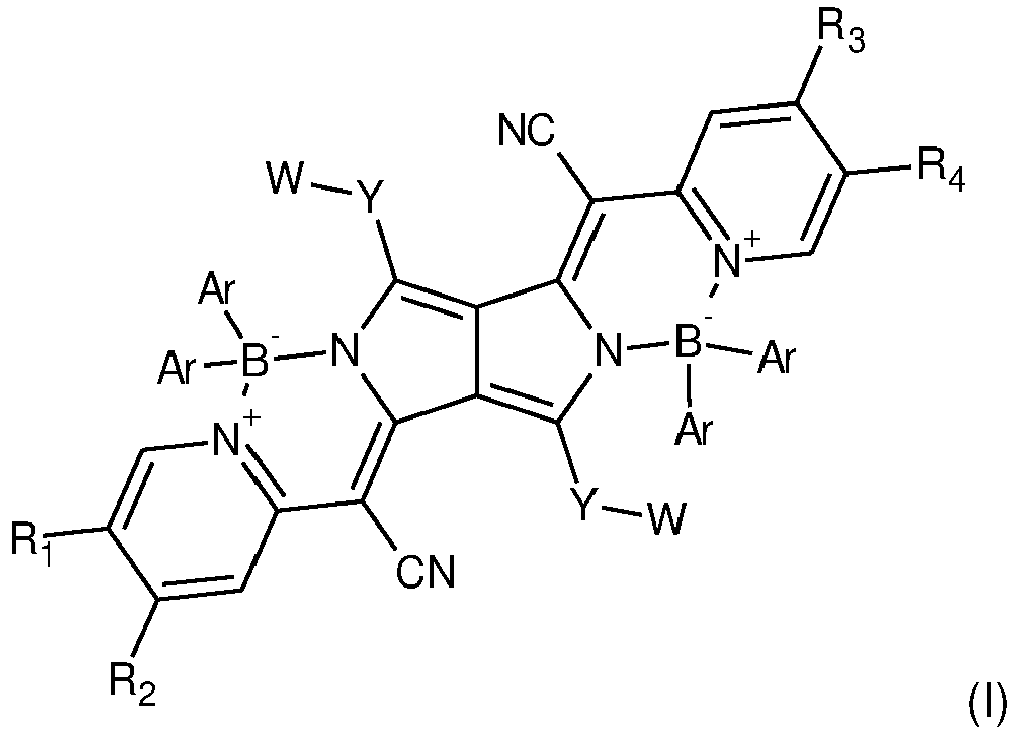
- the present invention relates to a compound having the following formula (I): wherein:
- C 1 -C z means a carbon-based chain which can have from t to z carbon atoms, for example C 1 -C 3 means a carbon-based chain which can have from 1 to 3 carbon atoms.
- alkyl group means: a linear or branched, saturated, hydrocarbon-based aliphatic group comprising, unless otherwise mentioned, from 1 to 16 carbon atoms, and preferably from 1 to 12 carbon atoms.
- alkyl group means: a linear or branched, saturated, hydrocarbon-based aliphatic group comprising, unless otherwise mentioned, from 1 to 16 carbon atoms, and preferably from 1 to 12 carbon atoms.
- alkoxy group means: an -O-alkyl radical where the alkyl group is as previously defined.
- alkyl group is as previously defined.
- -O-(C 1 -C 16 )alkyl groups and in particular the -O-methyl group, the -O-ethyl group as -O-C 3 alkyl group, the -O-propyl group, the -O-isopropyl group, and as -O-C 4 alkyl group, the -O-butyl, -O-isobutyl or -O-tert-butyl group.
- thioalkyl group means: a -S-alkyl radical where the alkyl group is as previously defined.
- alkyl group is as previously defined.
- phenylene means a divalent benzene ring (-C 6 H 4 -).
- thiophenylene means a divalent thiophene ring.
- furanylene means a divalent furane ring.
- dialkylamino means: an -N(alkyl) 2 - group, the alkyl group being as defined above.
- Ar is selected from the group consisting of:
- Ar is selected from the group consisting of:
- Ar is selected from the group consisting of:
- Ar is a phenyl group, a p-tert-butylphenyl group or a phenyl group substituted with an alkoxy group.
- Y is a phenylene radical or a thiophenylene radical.
- Y is a phenylene radical.
- the present invention also relates to a compound as defined above, having the following formula (II): wherein Ar, R 1 , R 2 , R 3 , R 4 , and W are as defined above.
- W is a group having one of the below formulae (4) to (7):
- R 1 is H and R 2 is an anchoring group as defined above in formula (I), such as -COOH.
- R 1 is H and R 2 is -COOH.
- R 1 and R 4 are H, and R 2 and R 3 are anchoring groups as defined above.
- R 1 and R 4 are H, and R 2 and R 3 are -COOH.
- R 1 and R 4 are H, and R 2 is -COOH and R 3 is a group of formula (VII) or (VII').
- R 1 and R 3 are H, and R 2 is -COOH and R 4 is a group of formula (VII).
- the present invention relates to a compound having one of the following formulae:
- the present invention also relates to the use of a compound of formula (I) as defined above as a dye sensitizer.
- the present invention also relates to a dye sensitized solar cell comprising at least one compound of formula (I) as defined above as dye sensitizer.
- the compounds of formula (I) as defined above have a low absorption in the visible range and thus can be used to prepare DSSC being transparent and colorless.
- the compounds according to the invention have a strong absorbance in the near infrared (NIR) and are also efficient as they have proved already a PCE of at least 4% under standard A.M.1.5G light conditions.
- NIR near infrared
- the sensitizers according to the invention are able to absorb little or not at all in the visible range, making them almost colorless for the naked eye.
- the sensitizer is integrated in the DSSC device by chemisorption to a large bandgap semi-conductor such as TiO 2 , ZnO, SnO 2 or their derivatives including doped materials, constituting the photo-active electrode. This is carried out by soaking the photo-anode in a solution with the dye solubilized containing deaggregating/coadsorbant agent.
- the nanoparticles of the large bandgap semi-conductor are deposited by screen-printing from a paste containing the nanoparticles followed by post-annealing treatment to remove the porogen. It leads to a porosity that can be modulated between 25 to 70 %.
- the transparent counter-electrode is based on glass transparent conducting oxide bearing low amount of electrocatalytic nanoparticles such as Pt, graphene or related materials, MXenes, sulfides to maintain high optical transparency.
- the liquid electrolyte is composed of a solvent or solvent-free ionic liquids containing additives such imidazolium or pyridinium-based molecules, alkali cations and the redox mediator such as iodine/iodide, tempo-derivatives, binary systems such as iodo-bromide or iodo-sulfide systems or organometallic complexes.
- the two electrodes are sealed together using a thermoplastic polymer heated under ambient or controlled atmosphere.
- Glass-frit sealing of devices is a second option to ensure high quality sealing and barrier to O 2 or water ingress.
- the electrolyte is injected by vacuum back-filling or by means of a peristatic pump flow through UV-drilled or sandblasting hole located at the counter-electrode side. This part is hermetically sealed either by a polymer or a glass-frit after electrolyte injection.
- An antireflecting coating can be applied to the two sides of the device using a ultra-thin layer of SiO 2 nanoparticles deposited by spin coating.
- the DSSC according to the invention may be used to prepare a transparent window which can be used for building-integrated, automobile-integrated, building applied PV or urban street equipment. It can be integrated as a transparent embodiment for nomadic electronics or on-screen applications.
- the dye sensitized solar cell of the invention further comprises at least one further dye, said dye being identical to or different from a compound of formula (I) according to the invention.
- dyes the followings may be mentioned: Ru, Fe, Cu, Zn or Os-based coordination complexes, organic donor- ⁇ -acceptor molecules, polymethine, croconines or squaraine dyes.
- the present invention also relates to the use of a compound of formula (I) as defined above as a dye sensitizer in dye-sensitized photocatalytic systems (DSPs) for hydrogen production, CO 2 reduction, water oxidation, organic compounds activation or degradation of pollutants.
- DSPs dye-sensitized photocatalytic systems
- a typical DSP is composed of a photosensitizer (PS) and a catalyst (CAT) which are both co-grafted onto n-type semiconductor (n-SC) nanoparticles (NPs), usually titanium dioxide (TiO 2 )(see Chem. Soc. Rev., 2016, 45, 9 and Eur. J. Inorg. Chem. 2020, 899-917 ).
- PS photosensitizer
- CAT catalyst
- NPs n-type semiconductor
- TiO 2 titanium dioxide
- a catalytic amount of FeCl 3 was dissolved in t-amylalcohol (20 mL), small cubes of solid sodium were added (1 g, 44 mmol, 5 eq) and the mixture was heated at 90°C for 1h.
- a suspension of 4-iodobenzonitrile (5 g, 22 mmol, 2,5 eq) in t-amylacohol (12.5 mL) was added, followed by a dropwise addition of diethyl succinate (1.52 g, 8.7 mmol), the resulting red solution was heated at 90°C.
- the mixture was cooled at room temperature and acetic acid (5 mL), was added dropwise under vigorous stirring.
- 1-Bromo-3,5-di-tert-butylbenzene 4 (2g, 7.4mmol, bis(pinacolato)diboron (2.07 g, 8.2 mmol, 1.1 eq), potassium acetate (2.19 g, 22.3 mmol, 3 eq) and Pd(dppf)Cl 2 (0,27 g, 0.37 mmol, 0.05 eq) were placed under argon atmosphere and dissolved in dry DMF (40mL). The reaction mixture was heated overnight at 80°C. The reaction was cooled to room temperature, quenched with water, extracted three times with ethyl acetate, dried over magnesium sulfate and solvents were removed under reduce pressure.
- Methyl isonicotinate (25 g, 182 mmol) was dissolved in MeOH (250mL) and H 2 SO 4 (1mL) under argon atmsophere and heated at reflux. A solution of ammonium persulfate (75 g, 328 mmol, 1.8 eq) in water (150mL) was added dropwise and the reaction mixture was stirred overnight at reflux. After cooling to room temperature, the mixture was filtrated through filter paper and the filtrate was concentrated in vacuo to remove MeOH. The resulting solution was extracted 3 times with ethyl acetate, washed 3 times with water, the organic layer was dried over magnesium sulfate and solvents were removed under reduced pressure.
- tBuOK (7.2 g, 64mmol, 3.5 eq) was dissolved in 40mL of t-amyl alcohol. After complete dissolution of the base at 105°C, thiophene-2-carbonitrile (5 g, 45.8 mmol, 3 eq) was then added to the reaction mixture and the solution was heated one hour at 105°C. A solution of diethylsuccinate (3.19 g, 18.3 mmol) in 20mL of t-amyl alcohol was added dropwise at reflux within one hour and left overnight. The mixture was cooled at room temperature and acetic acid (5 mL), was added dropwise under vigorous stirring.
- DPP-2 0.2 g, 0.40 mmol
- DCM dry DCM
- a solution of N-Bromosuccinimide (0.17 g, 1.40 mmol, 3.5eq) in 10mL of DCM was added dropwise and the reaction mixture was stirred 16h at room temperature.
- the solution was quenched with water, extracted three times with ethyl acetate and the organic layer was dried over magnesium sulfate. Solvents were removed under reduce pressure at 25°C to afford the desired compound as a dark solid (0.26 g, 100%).
- DPP-2' (0.3 g, 0.41 mmol), boronic ester 1 (0.384 g, 1.22 mmol, 3 eq), and K 2 CO 3 (0.28 g, 2.03 mmol, 5eq) were placed under argon atmosphere and dissolved in THF (20mL) and water (6mL). The solution was degassed 30 minutes under argon in an ultrasonic bath and Pd(PPh 3 ) 4 (0.094 g, 0.081 mmol, 0.2 eq) was added. The reaction mixture was heated overnight at 85°C.
- the reaction was cooled to room temperature, quenched with water, extracted 3 times with ethyl acetate, dried over magnesium sulfate and solvents are removed under reduce pressure.
- the crude was then heated 30 minutes at 180°C in the oven. After cooling to room temperature, the resulting solid was dissolved in THF and filtrated through celite. After solvents removal, the product was taken up in cyclohexane and filtrated through membrane to afford the desired compound as a red solid (0.19 g, 71%).
- PPcy-th-3 (0.006, 0.004 mmol) was stirred at room temperature in THF (5mL).
- DPP-1 (0.200 g, 0.301 mmol) were refluxed in 1mL POCl 3 for 3h.
- the POCl 3 was distilled off and the residue was dried on vacuum.
- p1 (0.110 mg, 0.602 mmol, 2 eq) dissolved in 10ml of abs. THF were added and the mixture was heated to reflux for 1 h. After cooling to room temperature, water was added and extracted 3 times with dichloromethane. The organic layer was dried over magnesium sulfate and solvents were evaporated.
- the crude product was treated with methanol in an ultrasonic bath and then filtrated on membrane and washed with methanol until the filtrate was colorless. The resulting blue product (0.139 mg, 56%) was pure enough for further reactions.
- As-DPP-1 (0.080 g, 0.097 mmol) and 2-(5-Bromopyridin-2-yl)acetonitrile (0.023 g, 0.117 mmol, 1.2 eq) were heated to reflux in absolute toluene under argon. Phosphoryl chloride (0.05 mL, 0.486 mmol, 5 eq) was then added. The reaction was monitored by thin-layer chromatography. As soon as As-DPP-1 was fully consumed or the concentration of by-products increased, the reaction was quenched with water and extracted 3 times with ethyl acetate. The organic layer was dried over magnesium sulfate and solvents were evaporated. The crude product was treated with methanol in an ultrasonic bath.
- HD-1 (1 g, 1.74 mmol)
- 2,4-Dibutoxyphenylboronic Acid (1.02 g, 3.82 mmol, 2.2 eq)
- K 2 CO 3 (1.19 g, 8.70 mmol, 5eq)
- the solution was degassed 30 minutes under argon in an ultrasonic bath and Pd(PPh 3 ) 4 (0.4 g, 0.348 mmol, 0.2 eq) was added.
- the reaction mixture was heated overnight at 65°C.
- HD-1' 0.580 g, 0.760 mmol, bis(pinacolato)diboron (0.212 g, 0.836 mmol, 1.1 eq), potassium acetate (0.223 g, 2.28 mmol, 3 eq) and Pd(dppf)Cl 2 (0,028 g, 0.038 mmol, 0.05 eq) were placed under argon atmosphere and dissolved in dry DMF (10mL). The reaction mixture was heated overnight at 80°C. The reaction was cooled to room temperature, quenched with water, extracted three times with ethyl acetate, dried over magnesium sulfate and solvents were removed under reduce pressure.
- As-PPcy-1 (0.015 g, 0.013 mmol), HD-1 (0.018 g, 0.026 mmol, 2 eq), and K 2 CO 3 (0.007 g, 0.056 mmol, 5eq) were placed under argon atmosphere and dissolved in toluene (3mL) and water (1mL). The solution was degassed 30 minutes under argon in an ultrasonic bath and Pd(PPh 3 ) 4 (0.002 g, 0.001 mmol, 0.1 eq) was added. The reaction mixture was heated overnight at 85°C.
- Methyl 4-bromopicolinate (1 g, 4.63 mmol) was dissolved in 15mL EtOH, the solution was cooled to 0-10°C in an ice bath, and then NaBH 4 (0.35 g, 9.26mmol, 2 eq)) was added dropwise to the above mixture. The temperature of the reaction mixture was increased to 60°C and left for 3 h. The mixture was poured into 20mL ice water and stirred for 30 min. The resulting solution was extracted with ethyl acetate. The combined organic phases were washed with saturated brine, dried over anhydrous MgSO 4 , and filtered. The solution was concentrated under reduced pressure to afford a yellow oil (0.810 g, 93%).
- PBr 3 (10.0 mL, 105.28 mmol) in 20 mL CHCl 3 was added dropwise to the solution of p2 " (3.60 g, 16.51 mmol) in 100 mL CHCl 3 .
- the reaction mixture was heated under reflux for 6 h.
- the resulting solution was mixed with 150 mL ice water and the pH was adjusted to 10 with potassium carbonate.
- the resulting solution was extracted with dichloromethane.
- the combined organic phases were washed with brine, dried over Na 2 SO 4 , filtered, and concentrated under reduced pressure to afford a white solid (5.28 g, 78%).
- As-DPP-1 (0.065 g, 0.078 mmol) and p2 (0.018 g, 0.095 mmol, 1.2 eq) were heated to reflux in absolute toluene under argon. Phosphoryl chloride (0.04 mL, 0.395 mmol, 5 eq) was then added. The reaction was monitored by thin-layer chromatography. As soon as As-DPP-1 was fully consumed or the concentration of by-products increased, the reaction was quenched with water and extracted 3 times with ethyl acetate. The organic layer was dried over magnesium sulfate and solvents were evaporated. The crude product was treated with methanol in an ultrasonic bath.
- As-PPcy-2 (0.022 g, 0.016 mmol), HD-1 (0.027 g, 0.033 mmol, 2 eq), and K 2 CO 3 (0.011 g, 0.085 mmol, 5eq) were placed under argon atmosphere and dissolved in toluene (3mL) and water (1mL). The solution was degassed 30 minutes under argon in an ultrasonic bath and Pd(PPh 3 ) 4 (0.004 g, 0.002 mmol, 0.1 eq) was added. The reaction mixture was heated overnight at 85°C.
- BC-1 Under an argon atmsophere, BC-1" (2.00 g, 7.02 mmol) was dissolved in dry THF (8 mL) and cooled to -78 °C in a dry ice/acetone bath. n-BuLi solution in hexane (3.90 mL, 9.82 mmol, 1.4 eq) was added dropwise to the mixture, left 2h at -78°c and warm up for additional 2h at room temperature. The reaction mixture was cooled again at -78)C and Me 2 SnCl 2 (0.77 g, 3.51 mmol, 0.5 eq) was added.
- BC-1' (0.15 g, 0.27 mmol) was dissolved in 1 mL of dry dichloroethane. A 1M solution of BCl 3 was added dropwise at room temperature and the mixture was heated at 80°C overnight. After cooling, the solution of BC-1 was used without further purification due to its high instability. MW (g.mol -1 ): 456.90
- the reaction is cooled to room temperature, quenched with water, extracted 3 times with ethyl acetate, dried over magnesium sulfate and solvents are removed under reduce pressure.
- the crude was purified by column chromatography using EP/DCM (6:4) as eluent to afford the final pure product as white solid (1.20 g, %).
- this new family of dyes (S1-S7) is able to regenerate at faster half-time speed, ie. nanosecond time-scale, compared to state-of the art sensitizers which are in the range of microsecond time-scale. It has a very slow geminate recombination dynamic which affords in devices to reach quantitative injection yield with a broad range of electrolyte compositions.
- the spectra of the dyes are dominated by a strong and thin absorption band peaking between 750 and 800 nm depending on the structure of the pyrrolopyrrole cyanines. This feature is particularly valuable for the application in colorless DSSCs because the absorbance is strongly localized on the NIR with low contribution in the visible region to maximize AVT.
- a comparison of the electronic spectra of dyes S1 and S3 demonstrates the bathochomic shift upon replacing a phenylene by a thiophenylene.
- introducing a trisarylamine donating group red shifts the absorbance by (dye S1 versus dye S4). All these dyes are strongly fluorescent with emission lifetimes in the range of few nanosecond at room temperature. The latter property indicates that the dye excited state is significantly long-lived to efficiently inject an electron in the conduction band of TiO 2 .
Landscapes
- Chemical & Material Sciences (AREA)
- Engineering & Computer Science (AREA)
- Organic Chemistry (AREA)
- Materials Engineering (AREA)
- Power Engineering (AREA)
- Chemical Kinetics & Catalysis (AREA)
- Inorganic Chemistry (AREA)
- Physics & Mathematics (AREA)
- Spectroscopy & Molecular Physics (AREA)
- Microelectronics & Electronic Packaging (AREA)
- Organic Low-Molecular-Weight Compounds And Preparation Thereof (AREA)
- Catalysts (AREA)
- Nitrogen Condensed Heterocyclic Rings (AREA)
Abstract
Description
- The present invention concerns new derivatives of pyrrolopyrrole cyanines and uses thereof, in particular as near infrared sensitizers for solar cells.
- The search for sensitizers with increasingly high performance for dye sensitized solar cells is a very important issue, because these cells have discriminating characteristics compared to competing technologies: the aesthetic quality of the cells where the color can be changed as desired, the possibility of manufacturing cells on flexible or rigid substrates, semi-transparency of the device, the PV performance not very sensitive to the intensity of the light source, nor its orientation angle and cell temperature, etc. These properties make them promising candidates for PV integrated into the buildings and inside home (J. Mater. Chem. A, 2016, 4, 8512-8540; Nature Energy, ; and Adv. Mater. 2017, 29, 1700192).
- Today, the stake in this field is to exploit the field of low energies (long wavelengths) and in particular of the near infrared (near infrared, "NIR") because few dyes absorb specifically in this spectral range yet rich in energy (about 40% of the total energy received by the earth from the sun), and those tested are generally very inefficient.
- To date, there is no known solution which gives complete satisfaction for making colorless, transparent and effective cells. There are sensitizers for DSSCs which exploit the NIR domain a little, but the coloration remains strong because the absorption spectrum of the dye still covers too much the visible wavelengths. All organic cells (OPV) and perovskite cells target this new axis of development, but with lower performances.
- In the field of OPV there are some photovoltaic devices made up of a mixture of 2 compounds with a certain transparency, but this mixture remains substantially colored. The degree of coloration of a film can be quantitatively described by the AVT (Average Visible light Transmittance) factor. This is a numeric value in percent, which indicates the transmittance of a material in the entire visible range (400-700 nm) weighted at each wavelength by the photopic response of the human eye and the quantity of photons in the solar spectrum. The best transparent OPV cells offer power conversion efficiencies (PCE) of around 5.1% with an AVT of 51.5% or a PCE of 9.7% with an AVT of 34% (Lee, K.; Um, H.-D.; Choi, D.; Park, J.; Kim, N.; Kim, H.; Seo, K. The Development of Transparent Photovoltaics. Cell Reports Physical Science 2020, 1, 100143).
- Perovskite solar cells is another emerging technology that aims at transparent and colorless devices (Nature Energy, ; Adv. Mater. 2017, 29, 1700192; ACS Appl. Energy Mater. 2019, 2, 3972-3978; Joule 2, 1-11 September 19, 2018; https://doi.org/10.1016/j.joule.2018.06.004). The perovskite in question (lead, iodine, ammonium) is however a very opaque material in the visible range; the transparency of the device is then obtained thanks to small holes drilled in the cell. The best PCE obtained to date is around 8.2% but with an AVT of 22% (Solar Energy Materials and Solar Cells 196 (2019)) only or 10.7% with an AVT of 37.5% (Adv. Energy Mater. 2015, 5, 1500486). Large gap perovskite cells therefore only exploiting UV and near UV light have an AVT close to 70% but lead to a low efficiency of around 1% (ACS Appl. Energy Mater. 2019, 2, 3972). In addition, it should be noted that the marketing of perovskite cells is severely hampered by the presence of lead and their stability which remains to be improved.
- In the field of DSSCs, there are very few active dyes only in the near infrared field. Among those described, we can cite the derivatives of squaraines, of which the best dye (HSQ5) offers a PCE of 3.66% with a maximal transmittance of 60.3% but it nevertheless gives a green coloration to the device and AVT is not evaluated (Adv. Energy Mater. 2014, 4, 1301966). Finally, the LSCs technology (Luminescence Solar Concentrator) is optimal in terms of AVT (88.3%) but very low in terms of PCE around 0.4%.
- The aim of the present invention is to provide compounds being useful as dyes that strongly and selectively absorb in the near infrared range and having a low absorbance in the visible range.
- Another aim of the present invention is to provide compounds having photoelectrochemical properties allowing the preparation of efficient dye-sensitized solar cells (DSSC).
- The aim of the present invention is also to provide colorless, transparent and efficient cells.
- Therefore, the present invention relates to a compound having the following formula (I):

- Ar is selected from the group consisting of:
- ∘ a phenyl group; and
- ∘ a phenyl group substituted with at least one substituent L selected from the group consisting of:
- ▪ (C1-C16)alkyl groups;
- ▪ (C1-C16)alkoxy groups; and
- ▪ (C1-C16)thioalkyl groups;
- Y is selected from the group consisting of:
- ∘ a phenylene radical; and
- ∘ a thiophenylene radical;
- ∘ a furanylene radical; and
- W is a phenyl group comprising at least one substituent Z, in particular one, two or three substituents Z,
wherein Z is selected from the group consisting of:- ▪ (C1-C12)alkyl groups;
- ▪ (C1-C12)alkoxy groups; and
- ▪ di((C1-C12)alkyl)amino groups;
- R1 is H;
- R2 is an anchoring group selected from the group consisting of:
- ∘ a -COOH group;
- ∘ a -C(=O)-NH(OH) group;
- ∘ a -CH=C(CN)(COOH) group; and
- ∘ a -PO3H2 group;
- R3 is selected from the group consisting of:
- ∘ H;
- ∘ an anchoring group selected from the group consisting of:
- ▪ a -COOH group;
- ▪ a -C(=O)-NH(OH) group;
- ▪ a -CH=C(CN)(COOH) group; and
- ▪ a -PO3H2 group;
- ∘ (C1-C16)alkyl groups;
- ∘ (C1-C16)alkoxy groups;
- ∘ (C1-C16)thioalkyl groups; and
- ∘ a group having the following formula (III):

- ▪ (C1-C16)alkyl groups;
- ▪ a group having the following formula (IV):

- ▪ a group having the following formula (V):

- ▪ a group having the following formula (VI):

- ∘ a group having the following formula (III-1):


- R4 is selected from the group consisting of:
- ∘ H;
- ∘ (C1-C16)alkyl groups;
- ∘ (C1-C16)alkoxy groups;
- ∘ (C1-C16)thioalkyl groups; and
- ∘ a group having the following formula (VII):
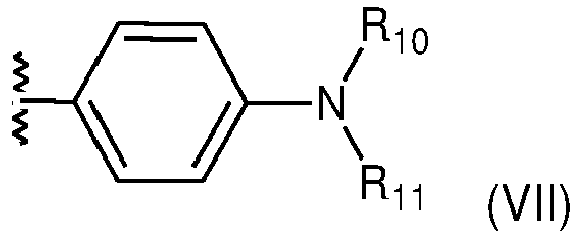
- ▪ (C1-C16)alkyl groups;
- ▪ a group having the following formula (VIII):

- ▪ a group having the following formula (IX):
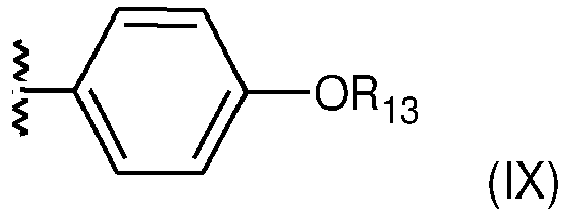
- ▪ a group having the following formula (X):

- The following definitions are set forth to illustrate and define the meaning and scope of the various terms used to describe the invention herein.
- The expression "C1-Cz" means a carbon-based chain which can have from t to z carbon atoms, for example C1-C3 means a carbon-based chain which can have from 1 to 3 carbon atoms.
- The term "alkyl group" means: a linear or branched, saturated, hydrocarbon-based aliphatic group comprising, unless otherwise mentioned, from 1 to 16 carbon atoms, and preferably from 1 to 12 carbon atoms. By way of examples, mention may be made of methyl, ethyl, n-propyl, isopropyl, butyl, isobutyl, tert-butyl or pentyl groups.
- The term "alkoxy group" means: an -O-alkyl radical where the alkyl group is as previously defined. By way of examples, mention may be made of -O-(C1-C16)alkyl groups, and in particular the -O-methyl group, the -O-ethyl group as -O-C3alkyl group, the -O-propyl group, the -O-isopropyl group, and as -O-C4alkyl group, the -O-butyl, -O-isobutyl or -O-tert-butyl group.
- The term "thioalkyl group" means: a -S-alkyl radical where the alkyl group is as previously defined. By way of examples, mention may be made of -S-(C1-C16)alkyl groups, and in particular of -S-(C1-C12)alkyl groups.
- The term "phenylene" means a divalent benzene ring (-C6H4-).
- The term "thiophenylene" means a divalent thiophene ring.
- The term "furanylene" means a divalent furane ring.
- The term "dialkylamino" means: an -N(alkyl)2- group, the alkyl group being as defined above.
- According to an embodiment, in formula (I), Ar is selected from the group consisting of:
- a phenyl group;
- a substituted phenyl group comprising one substituent in ortho, meta or para position, having the following formula (1):

- a substituted phenyl group having the following formula (2):

- L1 is selected from the group consisting of:
- ▪ (C1-C16)alkyl groups;
- ▪ (C1-C16)alkoxy groups; and
- ▪ (C1-C16)thioalkyl groups;
- L2 is H and L3 is selected from the group consisting of:
- ▪ (C1-C16)alkyl groups;
- ▪ (C1-C16)alkoxy groups; and
- ▪ (C1-C16)thioalkyl groups;
- or L3 is H and L2 is selected from the group consisting of:
- ▪ (C1-C16)alkyl groups;
- ▪ (C1-C16)alkoxy groups; and
- ▪ (C1-C16)thioalkyl groups;
- L1 is selected from the group consisting of:
- a substituted phenyl group having the following formula (3):

- L4 is selected from the group consisting of:
- ▪ (C1-C16)alkyl groups;
- ▪ (C1-C16)alkoxy groups; and
- ▪(C1-C16)thioalkyl groups;
- L5 is H and L6 is selected from the group consisting of:
- ▪ (C1-C16)alkyl groups;
- ▪ (C1-C16)alkoxy groups; and
- ▪ (C1-C16)thioalkyl groups;
- or L6 is H and L5 is selected from the group consisting of:
- ▪ (C1-C16)alkyl groups;
- ▪ (C1-C16)alkoxy groups; and
- ▪ (C1-C16)thioalkyl groups.
- L4 is selected from the group consisting of:
- According to an embodiment, in formula (I), Ar is selected from the group consisting of:
- a phenyl group;
- a substituted phenyl group comprising one substituent in ortho, meta or para position, having the formula (1) as defined above;
- a substituted phenyl group having the above formula (2) wherein L2 is H and L3 is selected from the group consisting of: (C1-C16)alkyl groups; (C1-C16)alkoxy groups; and (C1-C16)thioalkyl groups;
- a substituted phenyl group having the above formula (2) wherein L2 is selected from the group consisting of: (C1-C16)alkyl groups; (C1-C16)alkoxy groups; and (C1-C16)thioalkyl groups; and L3 is H;
- a substituted phenyl group having the above formula (3) wherein L5 is H and L6 is selected from the group consisting of: (C1-C16)alkyl groups; (C1-C16)alkoxy groups; and (C1-C16)thioalkyl groups; and
- a substituted phenyl group having the above formula (3) wherein L5 is selected from the group consisting of: C1-C16)alkyl groups; (C1-C16)alkoxy groups; and (C1-C16)thioalkyl groups; and L6 is H.
- According to an embodiment, in formula (I), Ar is selected from the group consisting of:
- a phenyl group;
- a substituted phenyl group having the formula (1) as defined above;
- a substituted phenyl group having the formula (2) as defined above, wherein:
- L1 is as defined above; and
- L2 is H and L3 is identical to L1 or L3 is H and L2 is identical to L1; and
- a substituted phenyl group having the formula (3) as defined above, wherein:
- L4 is as defined above; and
- L5 is H and L6 is identical to L4 or L6 is H and L5 is identical to L4.
- According to an embodiment, in formula (I), Ar is a phenyl group, a p-tert-butylphenyl group or a phenyl group substituted with an alkoxy group.
- According to an embodiment, in formula (I), Y is a phenylene radical or a thiophenylene radical.
- According to an embodiment, in formula (I), Y is a phenylene radical.
- The present invention also relates to a compound as defined above, having the following formula (II):

- According to an embodiment, in formula (I) or in formula (II) as defined above, W is a group having one of the below formulae (4) to (7):

- Z being as defined above.
- According to an embodiment, in formula (I) or in formula (II), R1 is H and R2 is an anchoring group as defined above in formula (I), such as -COOH.
- According to an embodiment, in formula (I) or in formula (II), R1 is H and R2 is -COOH.
- According to an embodiment, in formula (I) or in formula (II), R1 and R4 are H, and R2 and R3 are anchoring groups as defined above.
- According to an embodiment, in formula (I) or in formula (II), R1 and R4 are H, and R2 and R3 are -COOH.
- According to an embodiment, in formula (I) or in formula (II), R1 and R4 are H, and R2 is -COOH and R3 is a group of formula (VII) or (VII').
- According to an embodiment, in formula (I) or in formula (II), R1 and R3 are H, and R2 is -COOH and R4 is a group of formula (VII).
- According to a preferred embodiment, the present invention relates to a compound having one of the following formulae:


- The present invention also relates to the use of a compound of formula (I) as defined above as a dye sensitizer.
- The present invention also relates to a dye sensitized solar cell comprising at least one compound of formula (I) as defined above as dye sensitizer.
- The compounds of formula (I) as defined above have a low absorption in the visible range and thus can be used to prepare DSSC being transparent and colorless.
- The compounds according to the invention have a strong absorbance in the near infrared (NIR) and are also efficient as they have proved already a PCE of at least 4% under standard A.M.1.5G light conditions.
- The DSSCs cells prepared with the dyes according to the invention have a PCE of 4% (Jsc = 15.6 mA/cm2, Voc = 430 mV, ff = 0.59) with an AVT which can be superior to 75%, which demonstrates the great potential of this new family of compounds.
- The sensitizers according to the invention are able to absorb little or not at all in the visible range, making them almost colorless for the naked eye.
- The sensitizer is integrated in the DSSC device by chemisorption to a large bandgap semi-conductor such as TiO2, ZnO, SnO2 or their derivatives including doped materials, constituting the photo-active electrode. This is carried out by soaking the photo-anode in a solution with the dye solubilized containing deaggregating/coadsorbant agent. The nanoparticles of the large bandgap semi-conductor are deposited by screen-printing from a paste containing the nanoparticles followed by post-annealing treatment to remove the porogen. It leads to a porosity that can be modulated between 25 to 70 %. The transparent counter-electrode is based on glass transparent conducting oxide bearing low amount of electrocatalytic nanoparticles such as Pt, graphene or related materials, MXenes, sulfides to maintain high optical transparency. The liquid electrolyte is composed of a solvent or solvent-free ionic liquids containing additives such imidazolium or pyridinium-based molecules, alkali cations and the redox mediator such as iodine/iodide, tempo-derivatives, binary systems such as iodo-bromide or iodo-sulfide systems or organometallic complexes. The two electrodes are sealed together using a thermoplastic polymer heated under ambient or controlled atmosphere. Glass-frit sealing of devices is a second option to ensure high quality sealing and barrier to O2 or water ingress. The electrolyte is injected by vacuum back-filling or by means of a peristatic pump flow through UV-drilled or sandblasting hole located at the counter-electrode side. This part is hermetically sealed either by a polymer or a glass-frit after electrolyte injection. An antireflecting coating can be applied to the two sides of the device using a ultra-thin layer of SiO2 nanoparticles deposited by spin coating.
- The DSSC according to the invention may be used to prepare a transparent window which can be used for building-integrated, automobile-integrated, building applied PV or urban street equipment. It can be integrated as a transparent embodiment for nomadic electronics or on-screen applications.
- According to an embodiment, the dye sensitized solar cell of the invention further comprises at least one further dye, said dye being identical to or different from a compound of formula (I) according to the invention.
- As further dyes, the followings may be mentioned: Ru, Fe, Cu, Zn or Os-based coordination complexes, organic donor-π-acceptor molecules, polymethine, croconines or squaraine dyes.
- The present invention also relates to the use of a compound of formula (I) as defined above as a dye sensitizer in dye-sensitized photocatalytic systems (DSPs) for hydrogen production, CO2 reduction, water oxidation, organic compounds activation or degradation of pollutants.
- A typical DSP is composed of a photosensitizer (PS) and a catalyst (CAT) which are both co-grafted onto n-type semiconductor (n-SC) nanoparticles (NPs), usually titanium dioxide (TiO2)(see Chem. Soc. Rev., 2016, 45, 9 and Eur. J. Inorg. Chem. 2020, 899-917). The operation principle of DSP shares many similarities with DSSC. Upon light irradiation, the PS absorbs photons and injects electrons in the conduction band (CB) of the n-SC, which acts as electron mediator between the PS and the CAT. Then, the reduced CAT performs the desired reaction (H2 production or CO2 reduction). Finally, the oxidized PS (PS+) is regenerated by an external sacrificial electron donor (SD). Many similar sensitizers of DSSC have been successfully implemented in DSP (see Chem. Soc. Rev., 2016, 45, 9 and Eur. J. Inorg. Chem. 2020, 899-917), but very few effectively exploit NIR window to produce fuels (
ACS Omega 2019, 4, 14272-14283 -
-
Figure 1 : (J-V) curve measured under A.M.1.5G conditions upon optimized conditions and electrolyte formulation with DSSC including S1 dye. -
Figure 2 : Absorption spectra of S1, S3, S4, S5 and S7 recorded in DMF solution. -
Figure 3 : Emission spectra of S1, S3, S4, S5 and S7 recorded in DMF solution. -
Figure 4 : Streak image and variation of absorbance for the ground-state and radical cation of the dye (S1) in DSSC obtained by ps-pump probe transient absorption spectroscopy. -

-

-

- A catalytic amount of FeCl3 was dissolved in t-amylalcohol (20 mL), small cubes of solid sodium were added (1 g, 44 mmol, 5 eq) and the mixture was heated at 90°C for 1h. A suspension of 4-iodobenzonitrile (5 g, 22 mmol, 2,5 eq) in t-amylacohol (12.5 mL) was added, followed by a dropwise addition of diethyl succinate (1.52 g, 8.7 mmol), the resulting red solution was heated at 90°C. The mixture was cooled at room temperature and acetic acid (5 mL), was added dropwise under vigorous stirring. After complete addition the red slurry was stirred at 110°C for 30 minutes and then cooled at room temperature, the resulting precipitate was recovered by filtration and washed with water and methanol to afford the desired compound as a dark powder (1.5 g, 37%). Due to its high insolubility in common organic solvents, DPP-1" was used without further purification.
-

- Under argon atmosphere, DPP-1" (1.5g, 2.8 mmol) and DMAP (0.17 g, 1.4 mmol, 0.5 eq) were dissolved in dry THF (80mL) and stirred 30 minutes at room temperature. Di-tert-butyl dicarbonate (1.5 g, 6.9 mmol, 2.5 eq) dissolved in 20mL of dry THF was added dropwise to the reaction mixture. The reaction was stirred overnight at room temperature. The solution was quenched with water, extracted three times with ethyl acetate and the organic layer was dried over magnesium sulfate. Solvents were removed under reduce pressure at 25°C to afford the desired compound as a yellow solid (2.06 g, 100%).
MW (g.mol-1): 740.33
NMR (1H, CDCl3, 400 MHz), δ (ppm): 7.83 (d, 3J=8.63 Hz, 4H), 7.46 (d, 3J=8.65 Hz, 4H), 1.45 (s, 18H)
NMR (13C, CDCl3, 100 MHz), δ (ppm): 159.0, 147.9, 145.4, 137.6, 137.5, 129.7, 127.5, 112.6, 98.5, 85.7, 27.5
MS (ASAP-) m/z: 739.99 -

- In a sealable tube, 1-Bromo-3,5-di-tert-butylbenzene 4 (2g, 7.4mmol, bis(pinacolato)diboron (2.07 g, 8.2 mmol, 1.1 eq), potassium acetate (2.19 g, 22.3 mmol, 3 eq) and Pd(dppf)Cl2 (0,27 g, 0.37 mmol, 0.05 eq) were placed under argon atmosphere and dissolved in dry DMF (40mL). The reaction mixture was heated overnight at 80°C. The reaction was cooled to room temperature, quenched with water, extracted three times with ethyl acetate, dried over magnesium sulfate and solvents were removed under reduce pressure. The crude was purified by column chromatography using CH2Cl2/petroleum ether (2/8) as eluent to afford the final product as white crystals (2.12 g, 90%).
MW (g.mol-1): 316.29
NMR (1H, CDCl3, 400 MHz), δ (ppm): 7.66 (d, 4J=2.03 Hz, 2H), 7.54 (t, 4J=2.07 Hz, 1H), 1.35 (s, 18H), 1.34 (s, 12H) -

- In a sealable tube, DPP-1' (0.3 g, 0.41 mmol), boronic ester 1 (0.384 g, 1.22 mmol, 3 eq), and K2CO3 (0.28 g, 2.03 mmol, 5eq) were placed under argon atmosphere and dissolved in THF (20mL) and water (6mL). The solution was degassed 30 minutes under argon in an ultrasonic bath and Pd(PPh3)4 (0.094 g, 0.081 mmol, 0.2 eq) was added. The reaction mixture was heated overnight at 85°C. The reaction was cooled to room temperature, quenched with water, extracted 3 times with ethyl acetate, dried over magnesium sulfate and solvents are removed under reduce pressure. The crude was then heated 30 minutes at 180°C in the oven. After cooling to room temperature, the resulting solid was dissolved in THF and filtrate through celite. After solvents removal, the product was taken up in cyclohexane and filtrated through membrane to afford the desired compound as a red solid (0.193 g, 71%).
MW (g.mol-1): 664.93.
NMR (1H, THF, 400 MHz) δ (ppm): 10.36 (s, 2H), 8.74 (d, 3J=8.61 Hz, 4H), 8.00 (d, 3J=8.74 Hz, 4H), 7.74 (d, 4J=1.75 Hz, 4H), 7.68 (t, 4J=1.75 Hz, 2H), 1.58 (s, 36H).
NMR (13C, THF, 100 MHz) δ (ppm): 162.2, 151.1, 144.9, 143.1, 139.5, 128.0, 127.3, 127.0, 121.8, 121.3, 111.5, 34.6, 30.8609.
HRMS (ES-) m/z: [M-H]- calculated for C46H51N2O2: 663.3951; found: 663.3957. Δ=0.9ppm. -

-

- Methyl isonicotinate (25 g, 182 mmol) was dissolved in MeOH (250mL) and H2SO4 (1mL) under argon atmsophere and heated at reflux. A solution of ammonium persulfate (75 g, 328 mmol, 1.8 eq) in water (150mL) was added dropwise and the reaction mixture was stirred overnight at reflux. After cooling to room temperature, the mixture was filtrated through filter paper and the filtrate was concentrated in vacuo to remove MeOH. The resulting solution was extracted 3 times with ethyl acetate, washed 3 times with water, the organic layer was dried over magnesium sulfate and solvents were removed under reduced pressure. The solid was purified by column chromatography using PE/AcOEt (4:6) as eluent to afford the desired compound as yellowish oil (4.16 g, 14%).
MW (g.mol-1): 167.17
NMR (1H, CDCl3, 400 MHz) δ (ppm): 8.66 (dd, 3J= 5.02 Hz, 4J=0.83 Hz, 1h), 7.84 (q, 4J=2.31 Hz, 4J=0.74 Hz, 1H), 7.72 (dt, 3J=5.16 Hz, 4J=0.76 Hz, 1h), 4.81 (s, 2H), 3.93 (s, 3H)
HRMS (ES+) m/z: [M-H]- calculated for C8H10NO3: 168.0661; found: 168.0655. Δ=-3.6ppm. -

- In a solution of SOCl2 (50mL) at 0°C was added dropwise p1" (4.16 g, 24.9 mmol) dissolved in CHCl3 (5mL). The reaction was stirred overnight at room temperature. CH2Cl2 (100mL) was added and the solvent were removed under reduce pressure. This step was repeated until the excess of SOCl2 was entirely removed. The resulting grey solid (4.6 g, 100%) was used in the next step without further purification.
MW (g.mol-1): 185.61
NMR (1H, CDCl3, 300 MHz) δ (ppm): 8.88 (d, 3J=5.52 Hz, 1H), 8.38 (s, 1H), 8.18 (dd, 3J=4.20 Hz, 4J=1.44 Hz, 1h), 5.08 (s, 2H), 4.04 (s, 3H) -

- Under argon atmosphere, p1' (2.5 g, 13.5 mmol) was dissolved in dry ACN (250mL) and stirred at room temperature. TMSCN (2.53 mL, 20.2 mmol, 1.5 eq) and TBAF (20.2 mL, 20.2 mmol, 1.5 eq) were added and the reaction mixture heated 30 minutes at reflux. Solvents were evaporated. The resulting solid was solubilized in AcOEt and washed 4 times with brine The organic layer was dried over magnesium sulfate and solvents were evaporated. A brown oil (2.29 g, 96%) was obtained without further purification.
MW (g.mol-1): 176.18
NMR (1H, CDCl3, 400 MHz) δ (ppm): 8.73 (dd, 3J=5.03 Hz, 4J=0.77 Hz, 1H), 7.96 (d, 4J=0.55 Hz, 1H), 7.82 (dd, 3J=4.23 Hz, 4J=1.46 Hz, 1H), 4.01 (s, 2H), 3.97 (s, 3H)
NMR (13C, CDCl3, 100 MHz) δ (ppm): 164.9, 151.6, 150.8, 138.8, 122.4, 121.5, 116.4, 53.4, 52.9, 26.6, 24.1, 19.7, 13.6823
HRMS (ASAP-) m/z: [M-H]- calculated for C9H7N2O2: 175.0508; found: 175.0510. Δ=1.1 ppm -

- DPP-1 (0.130 g, 0.196 mmol) and p1 (0.088 g, 0.049 mmol, 2.5 eq) were heated to reflux in absolute toluene under argon. Phosphoryl chloride (0.15 mL, 1.57 mmol, 8 eq) was then added. The reaction was monitored by thin-layer chromatography. As soon as DPP-1 was used up or the concentration of by-products increased, the reaction was quenched with water and extracted 3 times with ethyl acetate. The organic layer was dried over magnesium sulfate and solvents were evaporated. The crude product was treated with methanol in an ultrasonic bath. The solid was collected by filtration and washed with methanol until the filtrate was colorless to afford the desired compound as a green solid (0.13 g, 68%).
MW (g.mol-1): 980.50.
NMR (1H, CDCl3, 300 MHz) δ (ppm): 13.54 (s, 2H), 8.61 (d, 3J=5.22 Hz, 2H), 7.83 (s, 2H), 7.75 (d, 4J=1.60 Hz, 8H), 7.50 (d, 4J=1.91 Hz, 4H), 7.48 (d, 4J=1.46 Hz, 2H), 7.46 (t, 4J=1.81 Hz, 2H), 3.93 (s, 6H), 1.38 (s, 36H).
NMR (13C, CDCl3, 100 MHz) δ (ppm): 165.1, 156.2, 151.2, 148.3, 144.9, 143.5, 139.6, 130.5, 127.9, 126.6, 122.1, 121.7, 120.1, 117.6, 116.9, 52.6, 31.5.
MS (ASAP-) m/z: [M]- calculated for C64H64N6O4S2: 980.4989; found: 980.5007. Δ=1.8ppm. -

- Under argon atmosphere, PPcy (0.10 g, 0.102 mmol,) and N,N-diisopropylethylamine (0.20 mL, 1.02 mmol, 10 eq) were heated to reflux in dry dichloromethane. Chloro(diphenyl)borane (0.2 mL) was added dropwise and the mixture was heated to reflux for 10 min. The reaction mixture was quenched with water, extracted three times with dichloromethane and dried over MgSO4. After removing the solvent, the crude product was purified by column chromatography using DCM/EP (7:3) as eluent to afford the desired compound as a green solid (0.055 g, 41%).
MW (g.mol-1): 1309.28
NMR (1H, CDCl3, 300 MHz) δ (ppm): 7.89 (d, 3J=6.61 Hz, 2H), 7.86 (d, 4J=1.65 Hz, 2H), 7.35 (t, 4J=1.42 Hz, 2H), 7.32 (d, 4J=1.70 Hz, 4H), 7.16 (d, 4J=1.73 Hz, 2H), 7.13 (s, 20H), 7.05 (d, 3J=8.24 Hz, 4H), 6.81 (d, 3J=8.2Hz, 4H), 3,81 (s, 6H), 1.39 (s, 36H).
HRMS (ASAP-) m/z: [M]- calculated for C88H8210B2N6O4: 1306.6656; found: 1306.6689. Δ=2.5ppm. - PPcy-2 (0.055, 0.042 mmol) was stirred at room temperature in THF (10mL). A solution of LiOH (0.020 g, 0.84 mmol, 20 eq) in water (2mL) was added dropwise in the reaction mixture and stirred 1h. Aqueous hydrochloric acid preparation (2M) is added slowly until pH=4. The remaining solution was extracted 3 times with ethyl acetate. After evaporation, the crude product was dissolved in DCM and EP was added. The resulting precipitate was collected by filtration and washed with EP to afford the desired compound as a dark green solid (0.044 g, 81%).
MW (g.mol-1): 1281.23
NMR (1H, CDCl3, 300 MHz) δ (ppm): 7.92 (d, 3J=6.62 Hz, 2H), 7.90 (d, 4J=1.68 Hz, 2H), 7.39 (t, 4J=1.81 Hz, 2H), 7.33 (d, 4J=1.75 Hz, 4H), 7.13 (m, 22H), 7.05 (d, 3J=8.20 Hz, 4H), 6.81 (d, 3J=8.23 Hz, 4H), 1.38 (s, 36H).
HRMS (ASAP-) m/z: [M]- calculated for C86H78 10B2N6O4: 1278.6343; found: 1278.6353. Δ=0.8ppm. -

-

- Under argon atmosphere, PPcy (0.030 g, 0.031 mmol,) and N,N-diisopropylethylamine (0.05 mL, 0.306 mmol, 10 eq) were heated to reflux in dry dichloromethane. Bis(4-(tert-butyl)phenyl)chloroborane (0.1 mL) was added dropwise and the mixture was heated to reflux for 10min. The reaction mixture was quenched with water, extracted three times with dichloromethane and dried over MgSO4. After removing the solvent, the crude product was purified by column chromatography using DCM/EP (7:3) as eluent to afford the desired compound as a green solid (0.022 g, 47%).
MW (g.mol-1): 1532.91
NMR (1H, CDCl3, 300 MHz) δ (ppm): 7.96 (d, 3J=6.62 Hz, 2H), 7.86 (d, 4J=1.20 Hz, 2H), 7.40 (m, 6H), 7.18 (dd, 3J=6.36 Hz, 4J=1.77Hz, 2H), 7.14 (d, 3J=8.01 Hz, 12H), 7.07 (d, 3J=8.28 Hz, 8H), 6.81 (d, 3J=8.37 Hz, 4H), 3.79 (s, 6H), 1.37 (s, 36H), 1.25 (s, 36H)
HRMS (ASAP+) m/z: [M-H]+ calculated for C104H115 10B2N6O4: 1331.9239; found: 1531.9181. Δ=-3.8ppm. - PPcy-3 (0.020, 0.013 mmol) was stirred at room temperature in THF (5mL). A solution of LiOH (0.006 g, 0.260 mmol, 20 eq) in water (1mL) is added dropwise in the reaction mixture and stirred for 1h. Aqueous hydrochloric acid preparation (2M) is added slowly until pH=4. The remaining solution was extracted 3 times with ethyl acetate. After evaporation, the crude product was dissolved in DCM and EP was added. The resulting precipitate was collected by filtration and washed with EP to afford the desired compound as a dark green solid (0.015 g, 79%).
MW (g.mol-1): 1505.66
NMR (1H, CDCl3, 300 MHz) δ (ppm): 7.88 (s, 2H), 7.30 (s, 6H), 7.06 (d, 3J=18 Hz, 20H), 6.73 (d, 3J=7.40Hz, 4H), 1.29 (s, 36H), 1.26 (s, 36H)
HRMS (ASAP-) m/z: [M]- calculated for C102H110N6O4 10B2: 1502.8847; found: 1502.8879. Δ=2.1 ppm. -

-

-

- tBuOK (7.2 g, 64mmol, 3.5 eq) was dissolved in 40mL of t-amyl alcohol. After complete dissolution of the base at 105°C, thiophene-2-carbonitrile (5 g, 45.8 mmol, 3 eq) was then added to the reaction mixture and the solution was heated one hour at 105°C. A solution of diethylsuccinate (3.19 g, 18.3 mmol) in 20mL of t-amyl alcohol was added dropwise at reflux within one hour and left overnight. The mixture was cooled at room temperature and acetic acid (5 mL), was added dropwise under vigorous stirring. After complete addition the slurry was stirred at 110°C for 30 minutes and then cooled at room temperature, the resulting precipitate was recovered by filtration and washed with water and methanol to afford the desired compound as a dark powder (3.2 g, 57%). Due to its high insolubility in common organic solvents, DPP-2''' was used without further purification.
-

- Under argon atmosphere, DPP-2''' (1.5g, 4.99 mmol) and DMAP (0.31 g, 2.5 mmol, 0.5 eq) were dissolved in dry THF (80mL) and stirred 30 minutes at room temperature. Di-tert-butyl dicarbonate (2.72 g, 12.5 mmol, 2.5 eq) dissolved in 20mL of dry THF was added dropwise to the reaction mixture. The reaction was stirred overnight at room temperature. The solution was quenched with water, extracted three times with ethyl acetate and the organic layer was dried over magnesium sulfate. Solvents were removed under reduce pressure at 25°C to afford the desired compound as a dark brown solid (2.15 g, 86%).
MW (g.mol-1): 500.58
NMR (1H, CDCl3, 400 MHz), δ (ppm): 8.82 (dd, 3J=3.82 Hz, 4J=1.14 Hz, 2H), 7.63 (dd, 3J=3.80 Hz, 4J=1.15 Hz, 2H), 7.18 (dd, 3J=4.90 Hz, 4J=3.96 Hz, 2H), 1.59 (s, 18H)
NMR (1H, CDCl3, 100 MHz), δ (ppm): 159.0, 148.7, 137.9, 133.8, 131.7, 129.6, 128.0, 110.2, 85.8, 27.6
HRMS (ASAP-) m/z: [M]- calculated for C24H24N2O6S2: 500.1076; found: 500.1079. Δ=0.6ppm. -

- Under argon atmosphere, DPP-2" (0.2 g, 0.40 mmol) was dissolved in dry DCM (40mL) and stirred 30 minutes at room temperature. A solution of N-Bromosuccinimide (0.17 g, 1.40 mmol, 3.5eq) in 10mL of DCM was added dropwise and the reaction mixture was stirred 16h at room temperature. The solution was quenched with water, extracted three times with ethyl acetate and the organic layer was dried over magnesium sulfate. Solvents were removed under reduce pressure at 25°C to afford the desired compound as a dark solid (0.26 g, 100%).
MW (g.mol-1): 658.38
NMR (1H, CDCl3, 400 MHz), δ (ppm): 8.08 (d, 3J=4.22 Hz, 2H), 7.16 (d, 3J=4.26 Hz, 2H), 7), 1.53 (s, 18H)
NMR (1H, CDCl3, 400 MHz), δ (ppm): 158.6, 148.8, 136.7, 134.4, 131.0, 130.9, 120.8, 110.3, 86.3, 27.7
HRMS (ASAP-) m/z: [M]- calculated for C24H22N2O6S2: 655.9286; found: 655.9280. Δ=-0.9ppm. -

- In a sealable tube, DPP-2' (0.3 g, 0.41 mmol), boronic ester 1 (0.384 g, 1.22 mmol, 3 eq), and K2CO3 (0.28 g, 2.03 mmol, 5eq) were placed under argon atmosphere and dissolved in THF (20mL) and water (6mL). The solution was degassed 30 minutes under argon in an ultrasonic bath and Pd(PPh3)4 (0.094 g, 0.081 mmol, 0.2 eq) was added. The reaction mixture was heated overnight at 85°C. The reaction was cooled to room temperature, quenched with water, extracted 3 times with ethyl acetate, dried over magnesium sulfate and solvents are removed under reduce pressure. The crude was then heated 30 minutes at 180°C in the oven. After cooling to room temperature, the resulting solid was dissolved in THF and filtrated through celite. After solvents removal, the product was taken up in cyclohexane and filtrated through membrane to afford the desired compound as a red solid (0.19 g, 71%).
MW (g.mol-1): 676.98
NMR (1H, THF, 400 MHz) δ (ppm): 10.16 (s, 2H), 8.58 (d, 3J=4.04 Hz, 2H), 7.62 (d, 4J=1,74 Hz, 4H), 7.69 (d, 3J=4.03 Hz, 2H), 7.72 (t, 4J=1.72 Hz, 2H), 1.52 (s, 36H).
NMR (13C, CDCl3, 100 MHz) δ (ppm): 159.5, 149.6, 148.3, 133.9, 133.0, 132.7, 131.1, 131.0, 130.0, 129.9, 129.4, 128.1, 126.5, 126.3, 126.2, 125.8, 122.7, 120.9, 118.4, 107.9, 32.7, 28.8.
HRMS (ASAP+) m/z: [M+H]+ calculated for C42H49N2O2S2: 677.3235; found: 677.3254. Δ=2.8ppm. -

- DPP-2 (0.150 g, 0.222 mmol) and p1 (0.10 g, 0.055 mmol, 2.5 eq) were heated to reflux in absolute toluene under argon. Phosphoryl chloride (0.17 mL, 1.78 mmol, 8 eq) was then added. The reaction was monitored by thin-layer chromatography. As soon as DPP-2 was used up or the concentration of by-products increased, the reaction was quenched with water and extracted 3 times with ethyl acetate. The organic layer was dried over magnesium sulfate and solvents were evaporated. The crude product was treated with methanol in an ultrasonic bath. The solid was collected by filtration and washed with methanol until the filtrate was colorless to afford the desired compound as a dark green solid (0.093 g, 43%).
MW (g.mol-1): 993.30.
NMR (1H, CDCl3, 300 MHz) δ (ppm): 13.76 (s, 2H), 8.71 (d, 3J=5.22 Hz, 2H), 7.83 (s, 2H), 7.75 (d, 4J=1.64 Hz, 8H), 7.50 (d, 4J=1.91 Hz, 4H), 7.48 (d, 4J=1.44 Hz, 2H), 7.46 (t, 4J=1.88 Hz, 2H), 3.93 (s, 6H), 1.38 (s, 36H).
NMR (13C, CDCl3, 300 MHz) δ (ppm): 149.6, 148.3, 133.9, 133, 132.8, 131.1, 131, 130, 129.9, 129.5, 128.1, 126.6, 126.4, 126.2, 125.9, 122.8, 121.0, 118.5, 107.9, 32.8, 28.9.
HRMS (ES+) m/z: [M+Na]+ calculated for C60H60N6O4S2Na: 1015.4015; found: 1015.3998. Δ=-1.7ppm. -

- Under argon atmosphere, PPcy-th (0.035 g, 0.035 mmol,) and N,N-diisopropylethylamine (0.100 mL, 0.353 mmol, 10 eq) were heated to reflux in dry dichloromethane. Bis(4-(tert-butyl)phenyl)chloroborane (0.1 mL) was added dropwise and the mixture was heated to reflux for 10min. The reaction mixture was quenched with water, extracted three times with dichloromethane and dried over MgSO4. After removing the solvent, the crude product was purified by column chromatography using DCM/EP (7:3) as eluent to afford the desired compound as a purple solid (0.006 g, 11%).
MW (g.mol-1): 1544.82
NMR (1H, CDCl3, 300 MHz) δ (ppm): 8.12 (d, 3J=6.59 Hz, 2H), 7.96 (d, 4J=1.23 Hz, 2H), 7.30 (t, 4J=1.71 Hz, 2H), 7.26 (m, 4H), 7.17 (q, 3J=3.64 Hz, 16H), 6.80 (d, 3J=3.78 Hz, 2H), 6.76 (d, 3J=8.84 Hz, 2H), 6.25 (d, 3J=3.77 Hz, 2H), 3.80 (s, 6H), 1.31 (s, 36H), 1.29 (s, 36H).
HRMS (ASAP-) m/z: [M]- calculated for C100H110N6O4S2 10B2: 1542.8289; found: 1542.8281. Δ=-0.5ppm. - PPcy-th-3 (0.006, 0.004 mmol) was stirred at room temperature in THF (5mL). A solution of LiOH (0.002 g, 0.078 mmol, 20 eq) in water (1mL) is added dropwise in the reaction mixture and stirred for 1h. Aqueous hydrochloric acid preparation (2M) was added slowly until pH=4. The remaining solution is extracted 3 times with ethyl acetate. After evaporation, the crude product was dissolved in DCM and EP was added. The resulting precipitate was collected by filtration and washed with EP to afford the desired compound as a purple solid (0.004 g, 69%).
MW (g.mol-1): 1517.70
NMR (1H, CDCl3, 300 MHz) δ (ppm): 8.11 (d, 3J=6.50 Hz, 2H), 7.98 (s, 2H), 7.28 (t, 4J=1.70 Hz, 2H), 7.24 (d, 4J=1.76 Hz, 4H), 7.17 (q, 3J=6.68 Hz, 18H), 6.79 (d, 3J=3.77 Hz, 2H), 6.25 (d, 3J=3.75 Hz, 2H), 1.31 (s, 36H), 1.21 (s, 36H)
HRMS (ASAP-) m/z: [M]- calculated for C98H106N6O4S2 10B2: 1514.7976; found: 1514.8020. Δ=2.9ppm. -

-

- DPP-1 (0.200 g, 0.301 mmol) were refluxed in 1mL POCl3 for 3h. The POCl3 was distilled off and the residue was dried on vacuum. p1 (0.110 mg, 0.602 mmol, 2 eq) dissolved in 10ml of abs. THF were added and the mixture was heated to reflux for 1 h. After cooling to room temperature, water was added and extracted 3 times with dichloromethane. The organic layer was dried over magnesium sulfate and solvents were evaporated. The crude product was treated with methanol in an ultrasonic bath and then filtrated on membrane and washed with methanol until the filtrate was colorless. The resulting blue product (0.139 mg, 56%) was pure enough for further reactions.
MW (g.mol-1) : 823.09
NMR (1H, CDCl3, 300 MHz) δ (ppm) : 13.87 (s, 1H), 8.77 (d, 3J=5.08 Hz, 1H), 8.45 (d, 3J=8.45 Hz, 2H), 8.23 (s, 1H), 7.85 (q, 3J=5.56 Hz, 4H), 7.74 (s, 1H), 7.65 (dd, 3J=6.81 Hz, 4J=1.54 Hz, 4H), 7.51 (dd, 3J=3.15 Hz, 4J=1.71 Hz, 4H), 7.46 (d, 3J=3.53 Hz, 2H), 3.95 (s, 3H), 1.41 (s, 16H), 1.39 (s, 16H)
HRMS (ES+) m/z: [M-H]+ calculated for C55H59N4O3S: 823.4587; found: 823.4589. Δ =0.2ppm. -

- As-DPP-1 (0.080 g, 0.097 mmol) and 2-(5-Bromopyridin-2-yl)acetonitrile (0.023 g, 0.117 mmol, 1.2 eq) were heated to reflux in absolute toluene under argon. Phosphoryl chloride (0.05 mL, 0.486 mmol, 5 eq) was then added. The reaction was monitored by thin-layer chromatography. As soon as As-DPP-1 was fully consumed or the concentration of by-products increased, the reaction was quenched with water and extracted 3 times with ethyl acetate. The organic layer was dried over magnesium sulfate and solvents were evaporated. The crude product was treated with methanol in an ultrasonic bath. The solid was collected by filtration and washed with methanol until the filtrate was colorless to afford the desired compound as a green solid (0.076 g, 78%).
MW (g.mol-1): 1002.11
NMR (1H, CDCl3, 400 MHz) δ (ppm): 13.50 (s, 1H), 13.20 (s, 1H), 8.60 (dd, 3J=5.17 Hz, 4J=0.74 Hz, 1H), 8.54 (dd, 4J=2.40 Hz, 4J=0.64 Hz, 1H), 7.94 (s, 1H), 7.76 (qd, 3J=8.75 Hz, 4J=1.90 Hz, 8H), 7.62 (dd, 3J=8.64 Hz, 4J=2.37 Hz, 1H), 7.51 (dd, 4J=2.44 Hz, 4J=1.68 Hz, 5H), 7.47 (t, 4J=1.72 Hz, 2H), 7.27 (d, 3J=8.48 Hz, 1H), 3.95 (s, 3H), 1.39 (s, 18H), 1.38 (s, 18H)
NMR (13C, CDCl3, 100 MHz) δ (ppm): 165.2, 156.4, 153.8, 151.2, 148.4, 148.2, 144.9, 144.8, 139.5, 139.2, 138.0, 130.2, 127.9, 126.7, 122.13, 121.7, 120.4, 117.7, 115.0, 52.7, 35.0, 31.5
HRMS (ES-) m/z: [M]- calculated for C62H60N6O2 79Br: 999.3961; found: 999.3951. Δ= 1.0 ppm. -

- Under argon atmosphere, As-PPcy-H-1 (0.066 g, 0.082 mmol,) and N,N-diisopropylethylamine (0.110 mL, 0.659 mmol, 10 eq) were heated to reflux in dry dichloromethane. Chloro(diphenyl)borane (0.1 mL) was added dropwise and the mixture was heated to reflux for 10min. The reaction mixture was then quenched with water, extracted three times with dichloromethane and dried over MgSO4. After removing the solvent, the crude product was purified by column chromatography using petrol ether/CH2Cl2 (3/7) as eluent to afford the desired compound as a dark green solid (0.044 g, 50%).
MW (g.mol-1): 1330.14.
NMR (1H, CDCl3, 400 MHz) δ (ppm): 7.92 (d, 3J=6.05 Hz, 1H), 7.89 (d, 4J=1.77 Hz, 2H), 7.55 (dd, 3J=6.92 Hz, 4J=2.16 Hz, 1H), 7.42 (d, 4J=0.86 Hz, 2H), 7.36 (dd, 3J=10.29 Hz, 4J=1.52 Hz, 4H), 7.25 (d, 3J=9.08 Hz, 1H), 7.17 (m, 20H), 7.08 (dd, 3J=8.32 Hz, 3J=9.84 Hz, 4H), 6.84 (dd, 3J=8.36 Hz, 4J=3.20 Hz, 4H), 3.81 (s, 3H), 1.41 (s, 18H), 1.40 (s, 18H).
NMR (13C, CDCl3, 100 MHz) δ (ppm): 163.5, 156.4, 155.9, 150.9, 150.8, 148.7, 145.7, 145.5, 144.9, 144.7, 142.7, 142.5, 142.1, 140.3, 140.1, 139.7, 133.8, 133.7, 130.4, 129.7, 129.7, 127.6, 127.5, 126.6, 126.4, 125.6, 125.6, 122.3, 122.2, 122.1, 121.8, 121.5, 121.4, 116.8, 116.3, 112.7, 34.9, 31.5.
HRMS (ASAP-) m/z: [M]- calculated for C86H7910B2N6O2 79Br: 1326.5707; found: 1326.5734. Δ=2.0ppm. -

- In a sealable tube, 4-Bromotriphenylamine (1 g, 3.08 mmol), KIO3 (0.442 g, 2.06 mmol, 0.7 eq), and KI (0.696 g, 4.19 mmol, 1.36 eq) were placed under argon atmosphere, dissolved in AcOH (16mL) and heated at 85°C overnight. The reaction mixture was quenched using saturated solution of Na2S2O3 and stirred for 1h at room temperature. The solution was extracted 3 times with dichloromethane, dried over magnesium sulfate and solvents are removed under reduce pressure. The crude was purified by column chromatography using petrol ether/CH2Cl2 (9/1) as eluent to afford the final pure product as white crystals (1.4 g, 80%).
MW (g.mol-1): 576.01.
NMR (1H, CDCl3, 400 MHz) δ (ppm): 7.53 (d, 3J=8.86 Hz, 4H), 7.35 (d, 3J=8.90 Hz, 2H), 6.92 (d, 3J=8.88 Hz, 2H), 6.80 (d, 3J=8.85 Hz, 4H). -
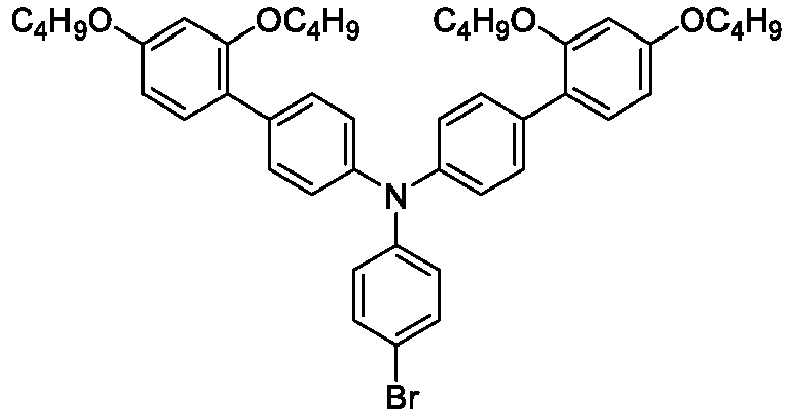
- In a sealable tube, HD-1" (1 g, 1.74 mmol), 2,4-Dibutoxyphenylboronic Acid (1.02 g, 3.82 mmol, 2.2 eq), and K2CO3 (1.19 g, 8.70 mmol, 5eq) were placed under argon atmosphere and dissolved in toluene (20mL) and water (6mL). The solution was degassed 30 minutes under argon in an ultrasonic bath and Pd(PPh3)4 (0.4 g, 0.348 mmol, 0.2 eq) was added. The reaction mixture was heated overnight at 65°C. The reaction was cooled to room temperature, quenched with water, extracted 3 times with ethyl acetate, dried over magnesium sulfate and solvents are removed under reduce pressure. The crude was purified by column chromatography using petrol ether/CH2Cl2 (9/1) as eluent to afford the final pure product as white solid (0.580 g, 44%).
MW (g.mol-1): 764.85.
NMR (1H, CDCl3, 400 MHz) δ (ppm): 7.44 (d, 3J=8.67 Hz, 4H), 7.33 (d, 3J=8.88 Hz, 2H), 7.23 (d, 3J=8.82 Hz, 2H), 7.12 (d, 3J=8.64 Hz, 4H), 7.04 (d, 3J=8.85 Hz, 2H), 6.54 (m, 4H), 3.97 (m, 8H), 1.75 (m, 8H), 1.41 (m, 8H), 0.94 (m, 12H). -

- In a sealable tube, HD-1' (0.580 g, 0.760 mmol, bis(pinacolato)diboron (0.212 g, 0.836 mmol, 1.1 eq), potassium acetate (0.223 g, 2.28 mmol, 3 eq) and Pd(dppf)Cl2 (0,028 g, 0.038 mmol, 0.05 eq) were placed under argon atmosphere and dissolved in dry DMF (10mL). The reaction mixture was heated overnight at 80°C. The reaction was cooled to room temperature, quenched with water, extracted three times with ethyl acetate, dried over magnesium sulfate and solvents were removed under reduce pressure. The crude was purified by column chromatography using petrol ether/CH2Cl2 (1/1) as eluent to afford the final product as white solid (0.554 g, 90%).
MW (g.mol-1): 811.91.
NMR (1H, CDCl3, 300 MHz) δ (ppm): 7.67 (d, 3J=8.59 Hz, 2H), 7.42 (d, 3J=8.72 Hz, 4H), 7.26 (d, 3J=8.56 Hz, 2H), 7.14 (d, 3J=8.69 Hz, 4H), 7.12 (d, 3J=8.58 Hz, 2H), 6.54 (m, 4H), 3.97 (m, 8H), 1.75 (m, 8H), 1.41 (m, 8H), 1.36 (s, 12H), 0.94 (m, 12H). -

- In a sealable tube, As-PPcy-1 (0.015 g, 0.013 mmol), HD-1 (0.018 g, 0.026 mmol, 2 eq), and K2CO3 (0.007 g, 0.056 mmol, 5eq) were placed under argon atmosphere and dissolved in toluene (3mL) and water (1mL). The solution was degassed 30 minutes under argon in an ultrasonic bath and Pd(PPh3)4 (0.002 g, 0.001 mmol, 0.1 eq) was added. The reaction mixture was heated overnight at 85°C. The reaction was cooled to room temperature, quenched with water, extracted 3 times with dichloromethane, dried over magnesium sulfate and solvents are removed under reduce pressure. The crude was first purified by column chromatography using petrol ether/CH2Cl2 (9/1) as eluent and then by recycling HPLC to afford the final pure product as a brown-green solid (0.009 g, 41%).
MW (g.mol-1): 1935.18.
NMR (1H, CDCl3, 300 MHz) δ (ppm): 7.41 (m, 7H), 7.35 (m, 5H), 7.23 (d, 3J=9.00 Hz), 7.16 (s, 20H), 7.08 (m, 9H), 6.85 (d, 3J=7.22 Hz, 4H), 6.53 (m, 4H), 3.96 (m, 8H), 3.79 (s, 3H), 1.73 (m, 8H), 1.52 (m, 8H), 1.41 (s, 18H), 1.39 (s, 18H), 0.94 (m, 12H).
NMR (13C, CDCl3, 75 MHz) δ (ppm): 159.6, 150.8, 133.8, 127.5, 126.3, 125.6, 121.5, 105.3, 100.4, 68.1, 67.7, 34.9, 31.5, 31.3, 31.1, 19.2, 13.8, 13.8.
HRMS (ES+) m/z: [M+Na]+ calculated for C132H133 10B2N7O6Na: 1955.0474; found: 1955.0444. Δ=-1.5ppm. - As-PPcy-HD-1 (0.008, 0.004 mmol) was stirred at room temperature in THF (5mL). A solution of LiOH (0.002 g, 0.083 mmol, 20 eq) in water (1mL) was added dropwise in the reaction mixture and stirred for 1h. Aqueous hydrochloric acid preparation (2M) is added slowly until pH=4. The remaining solution is extracted 3 times with ethyl acetate. After evaporation, the crude product was dissolved in DCM and EP was added. The resulting precipitate was collected by filtration and washed with EP to afford the desired compound as a brown-green solid (0.006 g, 76%).
MW (g.mol-1): 1921.15.
NMR (1H, CDCl3, 400 MHz) δ (ppm): 7.41 (m, 7H), 7.35 (m, 5H), 7.23 (d,), 7.16 (s, 20H), 7.08 (m, 9H), 6.85 (d, 4H), 6.53 (m, 4H), 3.96 (m, 8H), 3.79 (s, 3H), 1.73 (m, 8H), 1.52 (m, 8H), 1.41 (s, 18H), 1.39 (s, 18H), 0.94 (m, 12H).
HRMS (ES-) m/z: [M-H]- calculated for C131H130N7O6 10B2: 1917.0341; found: 1917.0.300. Δ=-2.1 ppm. -

-

-

- Methyl 4-bromopicolinate (1 g, 4.63 mmol) was dissolved in 15mL EtOH, the solution was cooled to 0-10°C in an ice bath, and then NaBH4 (0.35 g, 9.26mmol, 2 eq)) was added dropwise to the above mixture. The temperature of the reaction mixture was increased to 60°C and left for 3 h. The mixture was poured into 20mL ice water and stirred for 30 min. The resulting solution was extracted with ethyl acetate. The combined organic phases were washed with saturated brine, dried over anhydrous MgSO4, and filtered. The solution was concentrated under reduced pressure to afford a yellow oil (0.810 g, 93%).
MW (g.mol-1): 188.02.
NMR (1H, CDCl3, 300 MHz) δ (ppm): 8.37 (d, 3J=5.33 Hz, 1H), 7.49 (s, 4J=0.53 Hz, 1H), 7.38 (dd, 3J=5.32 Hz, 4J=1.79 Hz, 1H), 4.74 (s, 2H). -

- PBr3 (10.0 mL, 105.28 mmol) in 20 mL CHCl3 was added dropwise to the solution of p2" (3.60 g, 16.51 mmol) in 100 mL CHCl3. The reaction mixture was heated under reflux for 6 h. The resulting solution was mixed with 150 mL ice water and the pH was adjusted to 10 with potassium carbonate. The resulting solution was extracted with dichloromethane. The combined organic phases were washed with brine, dried over Na2SO4, filtered, and concentrated under reduced pressure to afford a white solid (5.28 g, 78%).
MW (g.mol-1): 250.92.
NMR (1H, CDCl3, 300 MHz) δ (ppm): 8.38 (d, 3J=5.33 Hz, 1H), 7.62 (d, 4J=1.49 Hz, 1H), 7.38 (dd, 3J=5.32 Hz, 4J=1.79 Hz, 1H), 4.49 (s, 2H). -

- Under argon atmosphere, p2' (2.5 g, 13.5 mmol) is dissolved in dry acetonitrile (250mL) and stirred at room temperature. TMSCN (2.53 mL, 20.2 mmol, 1.5 eq) and TBAF (20.2 mL, 20.2 mmol, 1.5 eq) were added and the reaction mixture heated 30 minutes at reflux. Solvents were evaporated. The resulting solid was solubilized in AcOEt and washed 4 times with brine The organic layer was dried over magnesium sulfate and solvents were evaporated. A brown oil (2.29 g, 96%) was obtained without further purification.
MW (g.mol-1): 197.04.
NMR (1H, CDCl3, 400 MHz) δ (ppm): 8.41 (d, 3J=5.33 Hz, 1H), 7.63 (d, 4J=1.75 Hz, 1H), 7.38 (dd, 3J=5.31 Hz, 4J=1.81 Hz, 1H), 4.49 (s, 2H).
NMR (13C, CDCl3, 100 MHz) δ (ppm): 151.8, 150.6, 134.0, 126.5, 125.7, 116.2, 26.2893.
HRMS (ASAP+) m/z: [M+H]+ calculated for C7H6N2Br: 196.9714; found: 196.9721. Δ=3.6ppm. -

- As-DPP-1 (0.065 g, 0.078 mmol) and p2 (0.018 g, 0.095 mmol, 1.2 eq) were heated to reflux in absolute toluene under argon. Phosphoryl chloride (0.04 mL, 0.395 mmol, 5 eq) was then added. The reaction was monitored by thin-layer chromatography. As soon as As-DPP-1 was fully consumed or the concentration of by-products increased, the reaction was quenched with water and extracted 3 times with ethyl acetate. The organic layer was dried over magnesium sulfate and solvents were evaporated. The crude product was treated with methanol in an ultrasonic bath. The solid was collected by filtration and washed with methanol until the filtrate was colorless to afford the desired compound as a blue-green solid (0.034 g, 43%).
MW (g.mol-1): 1002.11.
NMR (1H, CDCl3, 400 MHz) δ (ppm): 13.51 (m, 2H), 8.62 (d, 3J=5.28 Hz, 1H), 8.28 (d, 3J=5.35 Hz, 1H), 7.90 (s, 1H), 7.76 (q, 3J=7.88 Hz, 8H), 7.54 (dd, 3J=9.32 Hz, 4J=1.23 Hz, 2H), 7.50 (t, 4J=1.91 Hz, 4H), 7.47 (m, 2H), 7.13 (d, 3J=7.44 Hz, 4J=1.68 Hz, 1H), 3.94 (s, 3H), 1.38 (s, 18H), 1.37 (s, 18H).
NMR (13C, CDCl3, 100 MHz) δ (ppm): 151.2, 130.3, 126.7, 122.1, 121.6, 35.0, 31.5425.
HRMS (ES-) m/z: [M]- calculated for C62H60N6O2 79Br: 999.3961; found: 999.3961. Δ=0.0ppm. -

- Under argon atmosphere, As-PPcy-H-2 (0.035 g, 0.035 mmol,) and N,N-diisopropylethylamine (0.060 mL, 0.350 mmol, 10 eq) were heated to reflux in dry dichloromethane. Chloro(diphenyl)borane (0.1 mL) was added dropwise and the mixture was heated to reflux for 10min. The reaction mixture was then quenched with water, extracted three times with dichloromethane and dried over MgSO4. After removing the solvent, the crude product was purified by column chromatography using petrol ether/CH2Cl2 (3/7) as eluent to afford the desired compound as a dark green solid (0.022 g, 47%).
MW (g.mol-1): 1330.14.
NMR (1H, CDCl3, 400 MHz) δ (ppm): 7.92 (d, 3J=6.05 Hz, 1H), 7.89 (d, 4J=1.77 Hz, 2H), 7.64 (d, 3J=6.40 Hz, 1H), 7.53 (d, 4J=1.6 Hz, 1H), 7.42 (d, 4J=0.76 Hz, 2H), 7.36 (m, 4H), 7.20 (dd, 3J=5.96 Hz, 4J=1.6 Hz, 2H), 7.16 (m, 20H), 7.08 (dd, 3J=7.96 Hz, 4J=2.64 Hz, 4H), 6.84 (dd, 3J=8.48 Hz, 4J=1.72 Hz, 4H), 3.81 (s, 3H), 1.41 (s, 18H), 1.40 (s, 18H).
NMR (13C, CDCl3, 100 MHz) δ (ppm): 163.5, 156.3, 150.8, 150.7, 150.5, 145.8, 144.9, 144.6, 142.7, 142.6, 140.2, 140.1, 139.7, 136.7, 133.7, 133.7, 130.4, 130.4, 129.7, 129.7, 129.6, 127.6, 126.4, 125.6, 125.5, 123.7, 122.2, 122.1, 121.8, 121.7, 121.4, 116.9, 116.3, 115.2, 34.9.
HRMS (ES+) m/z: [M+Na]+ calculated for C86H79 10B2N6O2Na79Br: 1349.5604; found: 1349.5614. Δ=0.7ppm. -

- In a sealable tube, As-PPcy-2 (0.022 g, 0.016 mmol), HD-1 (0.027 g, 0.033 mmol, 2 eq), and K2CO3 (0.011 g, 0.085 mmol, 5eq) were placed under argon atmosphere and dissolved in toluene (3mL) and water (1mL). The solution was degassed 30 minutes under argon in an ultrasonic bath and Pd(PPh3)4 (0.004 g, 0.002 mmol, 0.1 eq) was added. The reaction mixture was heated overnight at 85°C. The reaction was cooled to room temperature, quenched with water, extracted 3 times with dichloromethane, dried over magnesium sulfate and solvents are removed under reduce pressure. The crude was first purified by column chromatography using petrol ether/CH2Cl2 (9/1) as eluent and then by recycling HPLC to afford the final pure product as a dark-green solid (0.030 g, 94%).
MW (g.mol-1): 1935.18.
NMR (1H, CDCl3, 400 MHz) δ (ppm): 7.84 (m, 3H), 7.56 (d, 4J=1.69 Hz, 1H), 7.43 (d, 3J=8.48 Hz, 4H), 7.41 (t, 4J=2.08 Hz, 2H), 7.39 (m, 2H), 7.36 (dd, 3J=8.48 Hz, 4J=1.72 Hz, 4H), 7.23 (d, 3J=11.2 Hz, 2H), 7.17 (m, 20H), 7.11 (d, 3J=8.88 Hz, 6H), 7.08 (m, 3H), 7.06 (d, 4J=0.96 Hz, 2H), 6.98 (dd, 3J=6.64 Hz, 4J=2.24 Hz, 1H), 6.85 (dd, 3J=8.32 Hz, J=5.80 Hz, 4H), 6.53 (m, 4H), 3.96 (m, 8H), 3.79 (s, 3H), 1.73 (m, 8H), 1.52 (m, 8H), 1.41 (s, 18H), 1.39 (s, 18H), 0.94 (m, 12H).
NMR (13C, CDCl3, 100 MHz) δ (ppm): 159.7, 156.9, 150.8, 150.7, 144.6, 134.4, 133.8, 130.8, 130.4, 127.8, 127.4, 126.9, 126.2, 125.5, 125.4, 124.7, 122.8, 121.5, 105.4, 100.5, 68.1, 67.8, 34.9, 31.5, 31.3, 31.1, 26.9, 19.2.
HRMS (ES+) m/z: [M]+ calculated for C132H133 10B2N7O6: 1935.0576; found: 1932.0484. Δ=4.8 ppm. - As-PPcy-HD-2 (0.030, 0.015 mmol) was stirred at room temperature in THF (5mL). A solution of LiOH (0.007 g, 0.310 mmol, 20 eq) in water (1mL) is added dropwise in the reaction mixture and stirred for 1h. Aqueous hydrochloric acid preparation (2M) was added slowly until pH=4. The remaining solution was extracted 3 times with ethyl acetate. After evaporation, the crude product was dissolved in DCM and EP was added. The resulting precipitate was collected by filtration and washed with EP to afford the desired compound as a dark green solid (0.027 g, 90%).
MW (g.mol-1): 1921.15.
NMR (1H, CDCl3, 400 MHz) δ (ppm): 7.84 (m, 3H), 7.43 (d, 3J=8.48 Hz, 4H), 7.41 (t, 4J=2.08 Hz, 2H), 7.39 (m, 2H), 7.36 (dd, 3J=8.48 Hz, 4J=1.72 Hz, 4H), 7.23 (d, 3J=11.2 Hz, 2H), 7.17 (m, 20H), 7.11 (d, 3J=8.88 Hz, 6H), 7.08 (m, 3H), 7.06 (d, 4J=0.96 Hz, 2H), 6.85 (dd, 3J=8.32 Hz, J=5.80 Hz, 4H), 6.53 (m, 4H), 3.96 (m, 8H), 1.73 (m, 8H), 1.52 (m, 8H), 1.41 (s, 18H), 1.39 (s, 18H), 0.94 (m, 12H).
HRMS (ES-) m/z: [M]- calculated for C131H130N7O6S2 10B2: 1917.0341; found: 1917.0352. Δ=0.6ppm. -

-

- Under a nitrogen atmosphere, 4-bromophenol (2.00 g, 11.56 mmol), KI (0.48 g, 2.89 mmol), 18-crown-6 (0.76 g, 2.89 mmol, 0.25 eq) and K2CO3 (4.00 g, 28.90 mmol, 2.5 eq) were added into 20 mL of dry DMF in a two-neck flask. After stirring for 5 min, 2-ethylhexyl bromide (5.58 g, 28.90 mmol, 2.5 eq) was added via a syringe. The mixture was heated to reflux for 24h. The cooled mixture was poured into water and then extracted with diethyl ether there times. The combined organic phase was dried over MgSO4. After removing the organic solvents, the residue was purified through a column chromatography on silica gel using a mixture of petrol ether and dichloromethane (9 :1) as eluent to give compound BC-1" (3.02 g, 92%) as a colorless oil.
MW (g.mol-1): 285.23
NMR (1H, CDCl3, 400 MHz) δ (ppm): 7.53 (d, 3J=8.99, 2H), 6.67 (d, 3J=9.00 Hz, 2H), 3.80 (d, 3J=5.68 Hz, 2H), 1.70 (m, 1H), 1.43 (m, 4H), 1.29 (m, 4H), 0.89 (m, 4H) -

- Under an argon atmsophere, BC-1" (2.00 g, 7.02 mmol) was dissolved in dry THF (8 mL) and cooled to -78 °C in a dry ice/acetone bath. n-BuLi solution in hexane (3.90 mL, 9.82 mmol, 1.4 eq) was added dropwise to the mixture, left 2h at -78°c and warm up for additional 2h at room temperature. The reaction mixture was cooled again at -78)C and Me2SnCl2 (0.77 g, 3.51 mmol, 0.5 eq) was added. The reaction was stirred at -78 °C for 20 min, and then the bath was removed and the reaction allowed to warm to room temperature and stir overnight. Solvents were removed under reduced pressure and after purification through column chromatography on silica gel (dichloromethane with 1% Et3N as eluent) and recycling HPLC, a colorless oil was obtained (3.30 g, 84%).
MW (g.mol-1): 559.42
NMR (1H, CDCl3, 400 MHz) δ (ppm): 7.41 (d, 3J=8.50 Hz, 4H), 6.91 (d, 3J=8.52 Hz, 4H), 3.84 (dd, 3J=5.56 Hz, 4J=1.2 Hz, 4H), 1.72 (m, 2H), 1.44 (m, 8H), 1.31 (m, 8H), 0.91 (m, 12H), 0.45 (s, 6H)
NMR (13C, CDCl3, 100 MHz) δ (ppm): 137.2, 114.7, 70.1, 39.3, 30.5, 29.0, 23.8, 23.0, 14.0, 11.1 -

- Under an atmosphere, BC-1' (0.15 g, 0.27 mmol) was dissolved in 1 mL of dry dichloroethane. A 1M solution of BCl3 was added dropwise at room temperature and the mixture was heated at 80°C overnight. After cooling, the solution of BC-1 was used without further purification due to its high instability.
MW (g.mol-1): 456.90 -

- Under argon atmosphere, PPcy (0.060 g, 0.061 mmol,) and N,N-diisopropylethylamine (0.10 mL, 0.605 mmol, 10 eq) were heated to reflux in dry dichloromethane. BC-1 in dichloroethane (0.3 mL) was added dropwise and the mixture was heated to reflux for 10min. The reaction mixture was quenched with water, extracted three times with dichloromethane and dried over MgSO4. After removing the solvent, the crude product was purified by column chromatography using DCM/EP (7:3) as eluent to afford the desired compound as a green solid (0.016 g, 15%).
MW (g.mol-1): 1821.14
NMR (1H, CDCl3, 400 MHz) δ (ppm): 7.99 (d, 3J=6.60Hz, 2H), 7.87 (d, 4J=1.19 Hz, 2H), 7.38 (m, 6H), 7.17 (dd, 3J=6.60 Hz, 4J=1.74 Hz, 2H), 7.14 (d, 3J=8.28 Hz, 4H), 7.02 (d, 3J=8.23 Hz, 8H), 6.82 (d, 3J=7.56 Hz, 4H), 6.68 (d, 3J=8.45 Hz, 8H), 3.80 (s, 6H), 3.71 (m, 8H), 1.67 (m, 4H), 1.38 (s, 36H), 1.30 (m, 30H), 0.89 (m, 26H)
HRMS (ES+) m/z: [M]+ calculated for C118H141 10B2N6O8: 1819.1461; found: 1819.1399. Δ=-3.4ppm. - As-PPcy-HD-3 (0.015 g, 0.008 mmol) was stirred at room temperature in THF (5mL). A solution of LiOH (0.004 g, 0.16 mmol, 20 eq) in water (1mL) was added dropwise in the reaction mixture and stirred for 1h. Aqueous hydrochloric acid preparation (2M) is added slowly until pH=4. The remaining solution is extracted 3 times with ethyl acetate. After evaporation, the crude product was dissolved in DCM and EP was added. The resulting precipitate was collected by filtration and washed with EP to afford the desired compound as a green solid (0.011 g, 74%).
MW (g.mol-1): 1793.11
NMR (1H, CDCl3, 400 MHz) δ (ppm): .99 (d, 3J=6.60Hz, 2H), 7.87 (d, 4J=1.19 Hz, 2H), 7.38 (m, 6H), 7.17 (dd, 3J=6.60 Hz, 4J=1.74 Hz, 2H), 7.14 (d, 3J=8.28 Hz, 4H), 7.02 (d, 3J=8.23 Hz, 8H), 6.82 (d, 3J=7.56 Hz, 4H), 6.68 (d, 3J=8.45 Hz, 8H), 3.71 (m, 8H), 1.67 (m, 4H), 1.38 (s, 36H), 1.30 (m, 30H), 0.89 (m, 26H)
HRMS (ES-) m/z: [M-H]- calculated for C118H141 10B2N6O8: 1790.1070; found: 1790.1025. Δ=-2.5ppm. -

-

- In a sealable tube, bis(4-bromophenyl)amine (1 g, 3.06 mmol), 2,4-Dibutoxyphenylboronic Acid (2.44 g, 9.17 mmol, 3 eq), and K2CO3 (2.00 g, 15.30 mmol, 5eq) were placed under argon atmosphere and dissolved in toluene (20mL) and water (6mL). The solution was degazed 30 minutes under argon in an ultrasonic bath and Pd(PPh3)4 (0.71 g, 0.61 mmol, 0.2 eq) was added. The reaction mixture was heated overnight at 65°C. The reaction is cooled to room temperature, quenched with water, extracted 3 times with ethyl acetate, dried over magnesium sulfate and solvents are removed under reduce pressure. The crude was purified by column chromatography using EP/DCM (6:4) as eluent to afford the final pure product as white solid (1.20 g, %).
MW (g.mol-1): 609.85
NMR (1H, CDCl3, 400 MHz) δ (ppm): 7.74 (d, 3J=8.70 Hz, 4H), 7.24 (d, 3J=8.75 Hz, 2H), 7.11 (d, 3J=8.71 Hz, 4H), 6.54 (m, 4H), 4.00 (t, 3J=6.56 Hz, 8H), 3.96 (t, 3J=6.55 Hz, 4H) 1.76 (m, 8H), 1.49 (m, 8H), 0.99 (t, 3J=7.35 Hz, 6H), 0.97 (t, 3J=7.32 Hz, 6H) -

- As-PPcy-2 (0.02 g, 0.015 mmol), HD-2 (0.011 g, 0.018 mmol), Na-tBuO (0.007 g, 0.075 mmol, 5eq), Pd(dba)2 (5 mol-%) (dba = dibenzylideneacetone), tri-tert-butylphosphine tetrafluoroborate (5 mol-%) and 5 mL of dry and degazed toluene were placed in a flask under argon atmsophere. Then the reaction mixture was heated to 80 °C for 24 h. After the reaction mixture had been cooled to room temperature and the mixture was washed with CH2Cl2. After solvent removal, the crude was first purified by column chromatography using petrol ether/CH2Cl2 (7/3) as eluent and then by recycling HPLC to afford the final pure product as a green solid (0.014 g, 50%).
MW (g.mol-1): 1859.08
NMR (1H, CDCl3, 300 MHz) δ (ppm): 7.77 (d, 4J=1.32 Hz, 1H), 7.74 (d, 3J=6.59 Hz, 1H), 7.44 (q, 3J=8.46 Hz, 6H), 7.39 (m, 1H), 7.35 (m, 3H), 7.28 (d, 4J=1.73 Hz, 2H), 7.14 (d, 3J=8.62 Hz, 20H), 7.09 (m, 5H), 7.01 (dd, 3J= 6.57 Hz, 4J=1.71 Hz, 1H), 6.96 (d, 3J=8.31 Hz, 2H), 6.92 (4J=2.64 Hz, 1H), 6.80 (dd, 3J=8.30 Hz, 4J=3.87 Hz, 4H), 6.46 (m, 4H), 6.21 (dd, 3J=5.85 Hz, 4J=2.65 Hz, 1H), 3.94 (t, 3J=6.46 Hz, 4H), 3.84 (t, 3J=6.43 Hz, 4H), 3.77 (s, 3H), 1.54 (m, 8H), 1.39 (s, 18H), 1.34 (s, 18H), 0.98 (t, 3J=7.31 Hz, 6H), 0.82 (t, 3J=7.30 Hz, 6H)
NMR (13C, CDCl3, 75 MHz) δ (ppm): 163.9, 159.9, 158.4, 156.8, 154.9, 151.3, 150.7, 150.6, 148.1, 145.7, 144.8, 141.9, 140.9, 140.3, 138.7, 137.4, 133.7, 131.0, 130.8, 130.2, 127.3, 126.0, 125.4, 125.1, 122.0, 121.5, 121.5, 121.1, 116.5, 105.3, 100.3, 68.0, 67.9, 67.7, 52.8, 45.8, 34.9, 34.9, 31.5, 31.5, 31.3, 30.9, 29.7, 19.2, 13.8, 13.7, 9.0
HRMS (ES+) m/z: [M]+ calculated for C126H129 10B2N7O6: 1856.0263; found: 1856.0258. Δ=-0.3 ppm -

- As-PPcy-HD-3 (0.014, 0.007 mmol) was stirred at room temperature in THF (5mL). A solution of LiOH (0.004 g, 0.15 mmol, 20 eq) in water (1mL) was added dropwise in the reaction mixture and stirred for 1h. Aqueous hydrochloric acid preparation (2M) is added slowly until pH=4. The remaining solution is extracted 3 times with ethyl acetate. After evaporation, the crude product was dissolved in DCM and EP was added. The resulting precipitate was collected by filtration and washed with EP to afford the desired compound as a green solid (0.011 g, 79%).
MW (g.mol-1): 1845.05
NMR (1H, CDCl3, 400 MHz) δ (ppm) : 7.77 (d, 4J=1.32 Hz, 1H), 7.74 (d, 3J=6.59 Hz, 1H), 7.44 (q, 3J=8.46 Hz, 6H), 7.39 (m, 1H), 7.35 (m, 3H), 7.28 (d, 4J=1.73 Hz, 2H), 7.14 (d, 3J=8.62 Hz, 20H), 7.09 (m, 5H), 7.01 (dd, 3J= 6.57 Hz, 4J=1.71 Hz, 1H), 6.96 (d, 3J=8.31 Hz, 2H), 6.92 (4J=2.64 Hz, 1H), 6.80 (dd, 3J=8.30 Hz, 4J=3.87 Hz, 4H), 6.46 (m, 4H), 6.21 (dd, 3J=5.85 Hz, 4J=2.65 Hz, 1H), 3.94 (t, 3J=6.46 Hz, 4H), 3.84 (t, 3J=6.43 Hz, 4H), 1.54 (m, 8H), 1.39 (s, 18H), 1.34 (s, 18H), 0.98 (t, 3J=7.31 Hz, 6H), 0.82 (t, 3J=7.30 Hz, 6H)
HRMS (ES+) m/z: [M]+ calculated for C125H127 10B2N7O6: 1842.0107; found: 1842.0052. Δ=-3.0 ppm - When integrated into devices, this new family of dyes (S1-S7) is able to regenerate at faster half-time speed, ie. nanosecond time-scale, compared to state-of the art sensitizers which are in the range of microsecond time-scale. It has a very slow geminate recombination dynamic which affords in devices to reach quantitative injection yield with a broad range of electrolyte compositions.
- The results are shown in
Figures 1 to 4 . - Steady-state absorption spectra were collected with a Analytik Jena UV-visible spectrophotometer using 1-cm-path-length cells. Emission spectra were collected with a FluoroLog emission spectrometer. The optical densities of the samples for emission spectroscopy were below 0.1 and the samples were excited at the wavelength of the maximum absorption band.
- 1H and 13C NMR spectra were recorded on an AVANCE 300 UltraShield BRUKER. Chemical shifts are referenced relative to residual protium or carbon signal in the deuterated solvent. NMR spectra were recorded at room temperature, chemical shifts are written in ppm and coupling constants in Hz. Mass spectrometry was performed with a JEOL JMS-700 B/E spectrometer.
- The spectra of the dyes are dominated by a strong and thin absorption band peaking between 750 and 800 nm depending on the structure of the pyrrolopyrrole cyanines. This feature is particularly valuable for the application in colorless DSSCs because the absorbance is strongly localized on the NIR with low contribution in the visible region to maximize AVT. A comparison of the electronic spectra of dyes S1 and S3 demonstrates the bathochomic shift upon replacing a phenylene by a thiophenylene. In the same vein, introducing a trisarylamine donating group red shifts the absorbance by (dye S1 versus dye S4). All these dyes are strongly fluorescent with emission lifetimes in the range of few nanosecond at room temperature. The latter property indicates that the dye excited state is significantly long-lived to efficiently inject an electron in the conduction band of TiO2.
Claims (14)
- A compound having the following formula (I):
 • Ar is selected from the group consisting of:∘ a phenyl group; and∘ a phenyl group substituted with at least one substituent L selected from the group consisting of:▪ (C1-C16)alkyl groups;▪ (C1-C16)alkoxy groups; and▪ (C1-C16)thioalkyl groups;• Y is selected from the group consisting of:∘ a phenylene radical; and∘ a thiophenylene radical;∘ a furanylene radical; and• W is a phenyl group comprising at least one substituent Z, in particular one, two or three substituents Z,
wherein Z is selected from the group consisting of:▪ (C1-C12)alkyl groups;▪ (C1-C12)alkoxy groups; and▪ di((C1-C12)alkyl)amino groups;• R1 is H;• R2 is an anchoring group selected from the group consisting of:∘ a -COOH group;∘ a -C(=O)-NH(OH) group;∘ a -CH=C(CN)(COOH) group; and∘ a -PO3H2 group;• R3 is selected from the group consisting of:∘ H;∘ an anchoring group selected from the group consisting of:▪ a -COOH group;▪ a -C(=O)-NH(OH) group;▪ a -CH=C(CN)(COOH) group; and▪ a -PO3H2 group;∘ (C1-C16)alkyl groups;∘ (C1-C16)alkoxy groups;∘ (C1-C16)thioalkyl groups; and∘ a group having the following formula (III): ▪ (C1-C16)alkyl groups;▪ a group having the following formula (IV):
 ▪ a group having the following formula (V):
 ▪ a group having the following formula (VI):
 ∘ a group having the following formula (III-1):
 • R4 is selected from the group consisting of:∘ H;∘ (C1-C16)alkyl groups;∘ (C1-C16)alkoxy groups;∘ (C1-C16)thioalkyl groups; and∘ a group having the following formula (VII):
 ▪ (C1-C16)alkyl groups;▪ a group having the following formula (VIII):
 ▪ a group having the following formula (IX):
 ▪ a group having the following formula (X):
- The compound having the formula (I) of claim 1, wherein Ar is selected from the group consisting of:• a phenyl group;• a substituted phenyl group comprising one substituent in ortho, meta or para position, having the following formula (1):
 • a substituted phenyl group having the following formula (2):
 - L1 is selected from the group consisting of:▪ (C1-C16)alkyl groups;▪ (C1-C16)alkoxy groups; and▪ (C1-C16)thioalkyl groups;- L2 is H and L3 is selected from the group consisting of:▪ (C1-C16)alkyl groups;▪ (C1-C16)alkoxy groups; and▪ (C1-C16)thioalkyl groups;- or L3 is H and L2 is selected from the group consisting of:▪ (C1-C16)alkyl groups;▪ (C1-C16)alkoxy groups; and▪ (C1-C16)thioalkyl groups;• a substituted phenyl group having the following formula (3):
 - L4 is selected from the group consisting of:▪ (C1-C16)alkyl groups;▪ (C1-C16)alkoxy groups; and▪ (C1-C16)thioalkyl groups;- L5 is H and L6 is selected from the group consisting of:▪ (C1-C16)alkyl groups;▪ (C1-C16)alkoxy groups; and▪ (C1-C16)thioalkyl groups;- or L6 is H and L5 is selected from the group consisting of:▪ (C1-C16)alkyl groups;▪ (C1-C16)alkoxy groups; and▪ (C1-C16)thioalkyl groups.
 - The compound having the formula (I) of claim 1 or 2, wherein Ar is selected from the group consisting of:• a phenyl group;• a substituted phenyl group having the formula (1) as defined in claim 2;• a substituted phenyl group having the formula (2) as defined in claim 2, wherein:- L1 is as defined in claim 2; and- L2 is H and L3 is identical to L1 or L3 is H and L2 is identical to L1; and• a substituted phenyl group having the formula (3) as defined in claim 2, wherein:- L4 is as defined in claim 2; and- L5 is H and L6 is identical to L4 or L6 is H and L5 is identical to L4.
- The compound having the formula (I) of any one of claims 1 to 3, wherein Ar is a phenyl group, a p-tert-butylphenyl group or a phenyl group substituted with an alkoxy group.
- A compound according to any one of claims 1 to 4, having the following formula (II):

- A compound according to any one of claims 1 to 5, wherein W is a group having one of the below formulae (4) to (7):

- A compound according to any one of claims 1 to 6, wherein R1 is H and R2 is an anchoring group as defined in claim 1, such as -COOH.
- A compound according to any one of claims 1 to 7, wherein R1 and R4 are H, and R2 and R3 are anchoring groups as defined in claim 1.
- A compound according to any one of claims 1 to 8, wherein R1 and R4 are H, and R2 and R3 are -COOH.
- A compound according to any one of claims 1 to 9, having one of the following formulae:


- The use of the compound of any one of claims 1 to 10 as a dye sensitizer.
- A dye sensitized solar cell comprising at least one compound of any one of claims 1 to 10 as dye sensitizer.
- The dye sensitized solar cell of claim 12, further comprising at least one further dye, said dye being identical to or different from a compound of any one of claims 1 to 10.
- The use of the compound of any one of claims 1 to 10 as a dye sensitizer in dye-sensitized photocatalytic systems (DSPs) for hydrogen production, CO2 reduction, water oxidation, organic compounds activation, or degradation of pollutants.
Priority Applications (11)
| Application Number | Priority Date | Filing Date | Title |
|---|---|---|---|
| PT203066998T PT4019522T (en) | 2020-12-28 | 2020-12-28 | New derivatives of pyrrolopyrrole cyanines and uses thereof |
| EP20306699.8A EP4019522B1 (en) | 2020-12-28 | 2020-12-28 | New derivatives of pyrrolopyrrole cyanines and uses thereof |
| DK20306699.8T DK4019522T3 (en) | 2020-12-28 | 2020-12-28 | New derivatives of pyrrolopyrrole cyanines and their applications |
| ES20306699T ES2968260T3 (en) | 2020-12-28 | 2020-12-28 | New pyrrolopyrrole cyanine derivatives and uses thereof |
| KR1020237021752A KR20230149287A (en) | 2020-12-28 | 2021-12-21 | New derivatives of pyrrolopyrrole cyanine and their uses |
| AU2021412336A AU2021412336A1 (en) | 2020-12-28 | 2021-12-21 | New derivatives of pyrrolopyrrole cyanines and uses thereof |
| JP2023539326A JP7765478B2 (en) | 2020-12-28 | 2021-12-21 | Novel derivatives of pyrrolopyrrol cyanine and their uses |
| US18/259,567 US12410198B2 (en) | 2020-12-28 | 2021-12-21 | Derivatives of pyrrolopyrrole cyanines and uses thereof |
| PCT/EP2021/086964 WO2022144228A1 (en) | 2020-12-28 | 2021-12-21 | New derivatives of pyrrolopyrrole cyanines and uses thereof |
| CN202180088098.9A CN117178027A (en) | 2020-12-28 | 2021-12-21 | New derivatives of pyrrolopyrrocyanines and their uses |
| TW110148834A TW202241915A (en) | 2020-12-28 | 2021-12-27 | New derivatives of pyrrolopyrrole cyanines and uses thereof |
Applications Claiming Priority (1)
| Application Number | Priority Date | Filing Date | Title |
|---|---|---|---|
| EP20306699.8A EP4019522B1 (en) | 2020-12-28 | 2020-12-28 | New derivatives of pyrrolopyrrole cyanines and uses thereof |
Publications (2)
| Publication Number | Publication Date |
|---|---|
| EP4019522A1 true EP4019522A1 (en) | 2022-06-29 |
| EP4019522B1 EP4019522B1 (en) | 2023-09-27 |
Family
ID=74191513
Family Applications (1)
| Application Number | Title | Priority Date | Filing Date |
|---|---|---|---|
| EP20306699.8A Active EP4019522B1 (en) | 2020-12-28 | 2020-12-28 | New derivatives of pyrrolopyrrole cyanines and uses thereof |
Country Status (11)
| Country | Link |
|---|---|
| US (1) | US12410198B2 (en) |
| EP (1) | EP4019522B1 (en) |
| JP (1) | JP7765478B2 (en) |
| KR (1) | KR20230149287A (en) |
| CN (1) | CN117178027A (en) |
| AU (1) | AU2021412336A1 (en) |
| DK (1) | DK4019522T3 (en) |
| ES (1) | ES2968260T3 (en) |
| PT (1) | PT4019522T (en) |
| TW (1) | TW202241915A (en) |
| WO (1) | WO2022144228A1 (en) |
Citations (1)
| Publication number | Priority date | Publication date | Assignee | Title |
|---|---|---|---|---|
| EP2272849A1 (en) * | 2008-03-30 | 2011-01-12 | FUJIFILM Corporation | Compound capable of absorbing infrared ray, and microparticles comprising the compound |
Family Cites Families (5)
| Publication number | Priority date | Publication date | Assignee | Title |
|---|---|---|---|---|
| JP5601768B2 (en) * | 2008-10-09 | 2014-10-08 | 富士フイルム株式会社 | Near-infrared absorbing composition, near-infrared absorbing coating material, and production method thereof |
| JP6255529B2 (en) * | 2015-02-18 | 2017-12-27 | Dic株式会社 | Resin composition, method for producing the same, and molded article |
| JP7012308B2 (en) * | 2016-09-07 | 2022-01-28 | 学校法人関西学院 | Polycyclic aromatic compounds |
| JP7318529B2 (en) * | 2018-01-31 | 2023-08-01 | 東レ株式会社 | COMPOUND, COMPOSITION CONTAINING THE SAME, MOLDED PRODUCT AND LIGHT-EMITTING DEVICE USING THE SAME |
| US12410366B2 (en) * | 2019-02-22 | 2025-09-09 | Konica Minolta, Inc. | Infrared-emitting compound, and luminescent thin film, luminescent particle, wavelength conversion film and infrared-emitting surface light source containing same |
-
2020
- 2020-12-28 DK DK20306699.8T patent/DK4019522T3/en active
- 2020-12-28 ES ES20306699T patent/ES2968260T3/en active Active
- 2020-12-28 PT PT203066998T patent/PT4019522T/en unknown
- 2020-12-28 EP EP20306699.8A patent/EP4019522B1/en active Active
-
2021
- 2021-12-21 WO PCT/EP2021/086964 patent/WO2022144228A1/en not_active Ceased
- 2021-12-21 CN CN202180088098.9A patent/CN117178027A/en active Pending
- 2021-12-21 US US18/259,567 patent/US12410198B2/en active Active
- 2021-12-21 JP JP2023539326A patent/JP7765478B2/en active Active
- 2021-12-21 KR KR1020237021752A patent/KR20230149287A/en active Pending
- 2021-12-21 AU AU2021412336A patent/AU2021412336A1/en active Pending
- 2021-12-27 TW TW110148834A patent/TW202241915A/en unknown
Patent Citations (1)
| Publication number | Priority date | Publication date | Assignee | Title |
|---|---|---|---|---|
| EP2272849A1 (en) * | 2008-03-30 | 2011-01-12 | FUJIFILM Corporation | Compound capable of absorbing infrared ray, and microparticles comprising the compound |
Non-Patent Citations (12)
| Title |
|---|
| ACS APPL. ENERGY MATER., vol. 2, 2019, pages 3972 - 3978 |
| ACS OMEGA, vol. 4, 2019, pages 14272 - 14283 |
| ADV. ENERGY MATER., vol. 4, 2014, pages 1301966 |
| ADV. ENERGY MATER., vol. 5, 2015, pages 1500486 |
| ADV. MATER., vol. 29, 2017, pages 1700192 |
| CHEM. SOC. REV., vol. 45, 2016, pages 9 |
| EUR. J. INORG. CHEM., 2020, pages 899 - 917 |
| J. MATER. CHEM. A, vol. 4, 2016, pages 8512 - 8540 |
| J. PHYS. CHEM. C, vol. 122, 2018, pages 495 |
| JOULE, vol. 2, 19 September 2018 (2018-09-19), pages 1 - 11, Retrieved from the Internet <URL:https://doi.org/10.1016/j.joule.2018.06.004> |
| LEE, K.UM, H.-D.CHOI, D.PARK, J.KIM, N.KIM, H.SEO, K.: "The Development of Transparent Photovoltaics", CELL REPORTS PHYSICAL SCIENCE, vol. 1, 2020, pages 100143 |
| NATURE ENERGY, vol. 2, November 2017 (2017-11-01), pages 849 - 860 |
Also Published As
| Publication number | Publication date |
|---|---|
| US12410198B2 (en) | 2025-09-09 |
| WO2022144228A1 (en) | 2022-07-07 |
| TW202241915A (en) | 2022-11-01 |
| DK4019522T3 (en) | 2023-12-11 |
| CN117178027A (en) | 2023-12-05 |
| JP2024500537A (en) | 2024-01-09 |
| PT4019522T (en) | 2023-12-15 |
| AU2021412336A1 (en) | 2023-07-13 |
| KR20230149287A (en) | 2023-10-26 |
| ES2968260T3 (en) | 2024-05-08 |
| EP4019522B1 (en) | 2023-09-27 |
| JP7765478B2 (en) | 2025-11-06 |
| US20240083923A1 (en) | 2024-03-14 |
Similar Documents
| Publication | Publication Date | Title |
|---|---|---|
| TWI382063B (en) | Photosensitive pigments | |
| Seo et al. | Novel D-π-A system based on zinc porphyrin dyes for dye-sensitized solar cells: synthesis, electrochemical, and photovoltaic properties | |
| Qin et al. | Incorporating a stable fluorenone unit into D–A–π–A organic dyes for dye-sensitized solar cells | |
| WO2020232973A1 (en) | DOUBLE D-π-A TYPE PILLAR[5]ARENE DYE, SYNTHESIS METHOD AND APPLICATION THEREOF | |
| Guo et al. | A novel asymmetric phthalocyanine-based hole transporting material for perovskite solar cells with an open-circuit voltage above 1.0 V | |
| Cai et al. | Molecular engineering of the fused azacycle donors in the DA-π-A metal-free organic dyes for efficient dye-sensitized solar cells | |
| Zhu et al. | D–A–π–A featured sensitizers containing an auxiliary acceptor of benzoxadiazole: molecular engineering and co-sensitization | |
| Maglione et al. | Tuning optical absorption in pyran derivatives for DSSC | |
| Abdellah et al. | The molecular engineering, synthesis and photovoltaic studies of a novel highly efficient Ru (ii) complex incorporating a bulky TPA ancillary ligand for DSSCs: donor versus π-spacer effects | |
| Cogal et al. | Asymmetric phthalocyanine derivatives containing 4-carboxyphenyl substituents for dye-sensitized solar cells | |
| Hosseinnezhad et al. | Synthesis and application of two organic dyes for dye-sensitized solar cells | |
| Massin et al. | Molecular engineering of carbazole-fluorene sensitizers for high open-circuit voltage DSSCs: Synthesis and performance comparison with iodine and cobalt electrolytes | |
| Su et al. | Structure-property relationships:“Double-tail versus double-flap” ruthenium complex structures for high efficiency dye-sensitized solar cells | |
| Vats et al. | Synthesis, photophysical characterization and dye adsorption behavior in unsymmetrical squaraine dyes with varying anchoring groups | |
| Dinçalp et al. | Effect of side chain substituents on the electron injection abilities of unsymmetrical perylene diimide dyes | |
| Zhang et al. | Effects of various heteroatom donor species on the photophysical, electrochemical and photovoltaic performance of dye-sensitized solar cells | |
| Jia et al. | New D–π–A dyes incorporating dithieno [3, 2-b: 2′, 3′-d] pyrrole (DTP)-based π-spacers for efficient dye-sensitized solar cells | |
| Xia et al. | 7, 16-Dihydro-14H-diindolo [3, 2-c: 2′, 3′-h] phenothiazine-based organic dyes with high molar extinction coefficient for efficient dye-sensitized solar cells | |
| Arrechea et al. | Charge recombination losses in thiophene-substituted porphyrin dye-sensitized solar cells | |
| Quan et al. | Effect of electron donor and acceptor in dithienopyrrolobenzothiadiazole-based organic dyes for efficient quasi-solid-state dye-sensitized solar cells | |
| Ho et al. | Photophysical characteristics and photosensitizing abilities of thieno [3, 2-b] thiophene-Based photosensitizers for photovoltaic and photocatalytic applications | |
| Huang et al. | Influence of a D–π–A system through a linked unit of double and triple bonds in a triarylene bridge for dye-sensitised solar cells | |
| Tanaka et al. | Synthesis of disilanylene polymers with donor–acceptor-type π-conjugated units and applications to dye-sensitized solar cells | |
| Devulapally et al. | Effect of auxiliary acceptor on D-π-A based porphyrin sensitizers for dye sensitized solar cells | |
| EP4019522B1 (en) | New derivatives of pyrrolopyrrole cyanines and uses thereof |
Legal Events
| Date | Code | Title | Description |
|---|---|---|---|
| PUAI | Public reference made under article 153(3) epc to a published international application that has entered the european phase |
Free format text: ORIGINAL CODE: 0009012 |
|
| STAA | Information on the status of an ep patent application or granted ep patent |
Free format text: STATUS: THE APPLICATION HAS BEEN PUBLISHED |
|
| AK | Designated contracting states |
Kind code of ref document: A1 Designated state(s): AL AT BE BG CH CY CZ DE DK EE ES FI FR GB GR HR HU IE IS IT LI LT LU LV MC MK MT NL NO PL PT RO RS SE SI SK SM TR |
|
| STAA | Information on the status of an ep patent application or granted ep patent |
Free format text: STATUS: REQUEST FOR EXAMINATION WAS MADE |
|
| 17P | Request for examination filed |
Effective date: 20221201 |
|
| RBV | Designated contracting states (corrected) |
Designated state(s): AL AT BE BG CH CY CZ DE DK EE ES FI FR GB GR HR HU IE IS IT LI LT LU LV MC MK MT NL NO PL PT RO RS SE SI SK SM TR |
|
| RIC1 | Information provided on ipc code assigned before grant |
Ipc: H10K 85/60 20230101ALI20230301BHEP Ipc: H01G 9/20 20060101ALI20230301BHEP Ipc: C09B 23/01 20060101ALI20230301BHEP Ipc: H10K 85/30 20230101ALI20230301BHEP Ipc: H01G 9/00 20060101ALI20230301BHEP Ipc: C09B 57/00 20060101ALI20230301BHEP Ipc: C07F 5/02 20060101AFI20230301BHEP |
|
| GRAP | Despatch of communication of intention to grant a patent |
Free format text: ORIGINAL CODE: EPIDOSNIGR1 |
|
| STAA | Information on the status of an ep patent application or granted ep patent |
Free format text: STATUS: GRANT OF PATENT IS INTENDED |
|
| RAP1 | Party data changed (applicant data changed or rights of an application transferred) |
Owner name: UNIVERSITE DE PICARDIE JULES VERNE Owner name: NANTES UNIVERSITE Owner name: CENTRE NATIONAL DE LA RECHERCHE SCIENTIFIQUE |
|
| INTG | Intention to grant announced |
Effective date: 20230414 |
|
| GRAS | Grant fee paid |
Free format text: ORIGINAL CODE: EPIDOSNIGR3 |
|
| GRAA | (expected) grant |
Free format text: ORIGINAL CODE: 0009210 |
|
| STAA | Information on the status of an ep patent application or granted ep patent |
Free format text: STATUS: THE PATENT HAS BEEN GRANTED |
|
| AK | Designated contracting states |
Kind code of ref document: B1 Designated state(s): AL AT BE BG CH CY CZ DE DK EE ES FI FR GB GR HR HU IE IS IT LI LT LU LV MC MK MT NL NO PL PT RO RS SE SI SK SM TR |
|
| REG | Reference to a national code |
Ref country code: GB Ref legal event code: FG4D |
|
| REG | Reference to a national code |
Ref country code: CH Ref legal event code: EP |
|
| REG | Reference to a national code |
Ref country code: DE Ref legal event code: R096 Ref document number: 602020018247 Country of ref document: DE |
|
| REG | Reference to a national code |
Ref country code: IE Ref legal event code: FG4D |
|
| REG | Reference to a national code |
Ref country code: DK Ref legal event code: T3 Effective date: 20231205 |
|
| REG | Reference to a national code |
Ref country code: PT Ref legal event code: SC4A Ref document number: 4019522 Country of ref document: PT Date of ref document: 20231215 Kind code of ref document: T Free format text: AVAILABILITY OF NATIONAL TRANSLATION Effective date: 20231211 |
|
| P01 | Opt-out of the competence of the unified patent court (upc) registered |
Effective date: 20231116 |
|
| REG | Reference to a national code |
Ref country code: SE Ref legal event code: TRGR |
|
| REG | Reference to a national code |
Ref country code: NL Ref legal event code: FP |
|
| REG | Reference to a national code |
Ref country code: LT Ref legal event code: MG9D |
|
| REG | Reference to a national code |
Ref country code: NO Ref legal event code: T2 Effective date: 20230927 |
|
| PG25 | Lapsed in a contracting state [announced via postgrant information from national office to epo] |
Ref country code: RS Free format text: LAPSE BECAUSE OF FAILURE TO SUBMIT A TRANSLATION OF THE DESCRIPTION OR TO PAY THE FEE WITHIN THE PRESCRIBED TIME-LIMIT Effective date: 20230927 Ref country code: LV Free format text: LAPSE BECAUSE OF FAILURE TO SUBMIT A TRANSLATION OF THE DESCRIPTION OR TO PAY THE FEE WITHIN THE PRESCRIBED TIME-LIMIT Effective date: 20230927 Ref country code: LT Free format text: LAPSE BECAUSE OF FAILURE TO SUBMIT A TRANSLATION OF THE DESCRIPTION OR TO PAY THE FEE WITHIN THE PRESCRIBED TIME-LIMIT Effective date: 20230927 Ref country code: HR Free format text: LAPSE BECAUSE OF FAILURE TO SUBMIT A TRANSLATION OF THE DESCRIPTION OR TO PAY THE FEE WITHIN THE PRESCRIBED TIME-LIMIT Effective date: 20230927 Ref country code: FI Free format text: LAPSE BECAUSE OF FAILURE TO SUBMIT A TRANSLATION OF THE DESCRIPTION OR TO PAY THE FEE WITHIN THE PRESCRIBED TIME-LIMIT Effective date: 20230927 |
|
| REG | Reference to a national code |
Ref country code: GR Ref legal event code: EP Ref document number: 20230402545 Country of ref document: GR Effective date: 20240209 |
|
| REG | Reference to a national code |
Ref country code: AT Ref legal event code: MK05 Ref document number: 1615351 Country of ref document: AT Kind code of ref document: T Effective date: 20230927 |
|
| PG25 | Lapsed in a contracting state [announced via postgrant information from national office to epo] |
Ref country code: IS Free format text: LAPSE BECAUSE OF FAILURE TO SUBMIT A TRANSLATION OF THE DESCRIPTION OR TO PAY THE FEE WITHIN THE PRESCRIBED TIME-LIMIT Effective date: 20240127 |
|
| PG25 | Lapsed in a contracting state [announced via postgrant information from national office to epo] |
Ref country code: AT Free format text: LAPSE BECAUSE OF FAILURE TO SUBMIT A TRANSLATION OF THE DESCRIPTION OR TO PAY THE FEE WITHIN THE PRESCRIBED TIME-LIMIT Effective date: 20230927 |
|
| PG25 | Lapsed in a contracting state [announced via postgrant information from national office to epo] |
Ref country code: SM Free format text: LAPSE BECAUSE OF FAILURE TO SUBMIT A TRANSLATION OF THE DESCRIPTION OR TO PAY THE FEE WITHIN THE PRESCRIBED TIME-LIMIT Effective date: 20230927 Ref country code: RO Free format text: LAPSE BECAUSE OF FAILURE TO SUBMIT A TRANSLATION OF THE DESCRIPTION OR TO PAY THE FEE WITHIN THE PRESCRIBED TIME-LIMIT Effective date: 20230927 Ref country code: IS Free format text: LAPSE BECAUSE OF FAILURE TO SUBMIT A TRANSLATION OF THE DESCRIPTION OR TO PAY THE FEE WITHIN THE PRESCRIBED TIME-LIMIT Effective date: 20240127 Ref country code: EE Free format text: LAPSE BECAUSE OF FAILURE TO SUBMIT A TRANSLATION OF THE DESCRIPTION OR TO PAY THE FEE WITHIN THE PRESCRIBED TIME-LIMIT Effective date: 20230927 Ref country code: CZ Free format text: LAPSE BECAUSE OF FAILURE TO SUBMIT A TRANSLATION OF THE DESCRIPTION OR TO PAY THE FEE WITHIN THE PRESCRIBED TIME-LIMIT Effective date: 20230927 Ref country code: AT Free format text: LAPSE BECAUSE OF FAILURE TO SUBMIT A TRANSLATION OF THE DESCRIPTION OR TO PAY THE FEE WITHIN THE PRESCRIBED TIME-LIMIT Effective date: 20230927 Ref country code: SK Free format text: LAPSE BECAUSE OF FAILURE TO SUBMIT A TRANSLATION OF THE DESCRIPTION OR TO PAY THE FEE WITHIN THE PRESCRIBED TIME-LIMIT Effective date: 20230927 |
|
| REG | Reference to a national code |
Ref country code: ES Ref legal event code: FG2A Ref document number: 2968260 Country of ref document: ES Kind code of ref document: T3 Effective date: 20240508 |
|
| PG25 | Lapsed in a contracting state [announced via postgrant information from national office to epo] |
Ref country code: PL Free format text: LAPSE BECAUSE OF FAILURE TO SUBMIT A TRANSLATION OF THE DESCRIPTION OR TO PAY THE FEE WITHIN THE PRESCRIBED TIME-LIMIT Effective date: 20230927 |
|
| REG | Reference to a national code |
Ref country code: DE Ref legal event code: R097 Ref document number: 602020018247 Country of ref document: DE |
|
| PG25 | Lapsed in a contracting state [announced via postgrant information from national office to epo] |
Ref country code: IT Free format text: LAPSE BECAUSE OF NON-PAYMENT OF DUE FEES Effective date: 20231228 |
|
| PLBE | No opposition filed within time limit |
Free format text: ORIGINAL CODE: 0009261 |
|
| STAA | Information on the status of an ep patent application or granted ep patent |
Free format text: STATUS: NO OPPOSITION FILED WITHIN TIME LIMIT |
|
| PG25 | Lapsed in a contracting state [announced via postgrant information from national office to epo] |
Ref country code: MC Free format text: LAPSE BECAUSE OF FAILURE TO SUBMIT A TRANSLATION OF THE DESCRIPTION OR TO PAY THE FEE WITHIN THE PRESCRIBED TIME-LIMIT Effective date: 20230927 |
|
| PG25 | Lapsed in a contracting state [announced via postgrant information from national office to epo] |
Ref country code: MC Free format text: LAPSE BECAUSE OF FAILURE TO SUBMIT A TRANSLATION OF THE DESCRIPTION OR TO PAY THE FEE WITHIN THE PRESCRIBED TIME-LIMIT Effective date: 20230927 |
|
| 26N | No opposition filed |
Effective date: 20240628 |
|
| REG | Reference to a national code |
Ref country code: IE Ref legal event code: MM4A |
|
| PG25 | Lapsed in a contracting state [announced via postgrant information from national office to epo] |
Ref country code: IE Free format text: LAPSE BECAUSE OF NON-PAYMENT OF DUE FEES Effective date: 20231228 |
|
| PG25 | Lapsed in a contracting state [announced via postgrant information from national office to epo] |
Ref country code: SI Free format text: LAPSE BECAUSE OF FAILURE TO SUBMIT A TRANSLATION OF THE DESCRIPTION OR TO PAY THE FEE WITHIN THE PRESCRIBED TIME-LIMIT Effective date: 20230927 |
|
| PG25 | Lapsed in a contracting state [announced via postgrant information from national office to epo] |
Ref country code: SI Free format text: LAPSE BECAUSE OF FAILURE TO SUBMIT A TRANSLATION OF THE DESCRIPTION OR TO PAY THE FEE WITHIN THE PRESCRIBED TIME-LIMIT Effective date: 20230927 Ref country code: IE Free format text: LAPSE BECAUSE OF NON-PAYMENT OF DUE FEES Effective date: 20231228 |
|
| PG25 | Lapsed in a contracting state [announced via postgrant information from national office to epo] |
Ref country code: BG Free format text: LAPSE BECAUSE OF FAILURE TO SUBMIT A TRANSLATION OF THE DESCRIPTION OR TO PAY THE FEE WITHIN THE PRESCRIBED TIME-LIMIT Effective date: 20230927 |
|
| PG25 | Lapsed in a contracting state [announced via postgrant information from national office to epo] |
Ref country code: BG Free format text: LAPSE BECAUSE OF FAILURE TO SUBMIT A TRANSLATION OF THE DESCRIPTION OR TO PAY THE FEE WITHIN THE PRESCRIBED TIME-LIMIT Effective date: 20230927 |
|
| PG25 | Lapsed in a contracting state [announced via postgrant information from national office to epo] |
Ref country code: IT Free format text: LAPSE BECAUSE OF NON-PAYMENT OF DUE FEES Effective date: 20231228 |
|
| PGRI | Patent reinstated in contracting state [announced from national office to epo] |
Ref country code: IT Effective date: 20240102 |
|
| PG25 | Lapsed in a contracting state [announced via postgrant information from national office to epo] |
Ref country code: IT Free format text: LAPSE BECAUSE OF NON-PAYMENT OF DUE FEES Effective date: 20231228 |
|
| PGRI | Patent reinstated in contracting state [announced from national office to epo] |
Ref country code: IT Effective date: 20240102 |
|
| PG25 | Lapsed in a contracting state [announced via postgrant information from national office to epo] |
Ref country code: CY Free format text: LAPSE BECAUSE OF FAILURE TO SUBMIT A TRANSLATION OF THE DESCRIPTION OR TO PAY THE FEE WITHIN THE PRESCRIBED TIME-LIMIT; INVALID AB INITIO Effective date: 20201228 |
|
| PG25 | Lapsed in a contracting state [announced via postgrant information from national office to epo] |
Ref country code: HU Free format text: LAPSE BECAUSE OF FAILURE TO SUBMIT A TRANSLATION OF THE DESCRIPTION OR TO PAY THE FEE WITHIN THE PRESCRIBED TIME-LIMIT; INVALID AB INITIO Effective date: 20201228 |
|
| PGFP | Annual fee paid to national office [announced via postgrant information from national office to epo] |
Ref country code: PT Payment date: 20251120 Year of fee payment: 6 |
|
| PG25 | Lapsed in a contracting state [announced via postgrant information from national office to epo] |
Ref country code: TR Free format text: LAPSE BECAUSE OF FAILURE TO SUBMIT A TRANSLATION OF THE DESCRIPTION OR TO PAY THE FEE WITHIN THE PRESCRIBED TIME-LIMIT Effective date: 20230927 |
|
| PGFP | Annual fee paid to national office [announced via postgrant information from national office to epo] |
Ref country code: NL Payment date: 20251127 Year of fee payment: 6 Ref country code: LU Payment date: 20251127 Year of fee payment: 6 |
|
| REG | Reference to a national code |
Ref country code: CH Ref legal event code: U11 Free format text: ST27 STATUS EVENT CODE: U-0-0-U10-U11 (AS PROVIDED BY THE NATIONAL OFFICE) Effective date: 20260101 |
|
| REG | Reference to a national code |
Ref country code: CH Ref legal event code: R18 Free format text: ST27 STATUS EVENT CODE: U-0-0-R10-R18 (AS PROVIDED BY THE NATIONAL OFFICE) Effective date: 20260106 |
|
| PGFP | Annual fee paid to national office [announced via postgrant information from national office to epo] |
Ref country code: GB Payment date: 20251229 Year of fee payment: 6 |
|
| PGFP | Annual fee paid to national office [announced via postgrant information from national office to epo] |
Ref country code: NO Payment date: 20251127 Year of fee payment: 6 |
|
| PGFP | Annual fee paid to national office [announced via postgrant information from national office to epo] |
Ref country code: IT Payment date: 20251210 Year of fee payment: 6 Ref country code: DK Payment date: 20251127 Year of fee payment: 6 |
|
| PGFP | Annual fee paid to national office [announced via postgrant information from national office to epo] |
Ref country code: FR Payment date: 20251127 Year of fee payment: 6 |
|
| PGFP | Annual fee paid to national office [announced via postgrant information from national office to epo] |
Ref country code: GR Payment date: 20251124 Year of fee payment: 6 Ref country code: BE Payment date: 20251226 Year of fee payment: 6 |
|
| PGFP | Annual fee paid to national office [announced via postgrant information from national office to epo] |
Ref country code: SE Payment date: 20251218 Year of fee payment: 6 |
|
| PGFP | Annual fee paid to national office [announced via postgrant information from national office to epo] |
Ref country code: ES Payment date: 20260112 Year of fee payment: 6 |
|
| PGFP | Annual fee paid to national office [announced via postgrant information from national office to epo] |
Ref country code: DE Payment date: 20251231 Year of fee payment: 6 |
|
| PGFP | Annual fee paid to national office [announced via postgrant information from national office to epo] |
Ref country code: CH Payment date: 20260101 Year of fee payment: 6 |