EP4019206A1 - Robot control system, robot control method, and recording medium - Google Patents
Robot control system, robot control method, and recording medium Download PDFInfo
- Publication number
- EP4019206A1 EP4019206A1 EP19942216.3A EP19942216A EP4019206A1 EP 4019206 A1 EP4019206 A1 EP 4019206A1 EP 19942216 A EP19942216 A EP 19942216A EP 4019206 A1 EP4019206 A1 EP 4019206A1
- Authority
- EP
- European Patent Office
- Prior art keywords
- robot
- task
- program
- perform
- user
- Prior art date
- Legal status (The legal status is an assumption and is not a legal conclusion. Google has not performed a legal analysis and makes no representation as to the accuracy of the status listed.)
- Pending
Links
Images



Classifications
-
- B—PERFORMING OPERATIONS; TRANSPORTING
- B25—HAND TOOLS; PORTABLE POWER-DRIVEN TOOLS; MANIPULATORS
- B25J—MANIPULATORS; CHAMBERS PROVIDED WITH MANIPULATION DEVICES
- B25J9/00—Program-controlled manipulators
- B25J9/16—Program controls
- B25J9/1656—Program controls characterised by programming, planning systems for manipulators
- B25J9/1661—Program controls characterised by programming, planning systems for manipulators characterised by task planning, object-oriented languages
-
- B—PERFORMING OPERATIONS; TRANSPORTING
- B25—HAND TOOLS; PORTABLE POWER-DRIVEN TOOLS; MANIPULATORS
- B25J—MANIPULATORS; CHAMBERS PROVIDED WITH MANIPULATION DEVICES
- B25J9/00—Program-controlled manipulators
- B25J9/16—Program controls
- B25J9/1628—Program controls characterised by the control loop
- B25J9/163—Program controls characterised by the control loop learning, adaptive, model based, rule based expert control
-
- B—PERFORMING OPERATIONS; TRANSPORTING
- B25—HAND TOOLS; PORTABLE POWER-DRIVEN TOOLS; MANIPULATORS
- B25J—MANIPULATORS; CHAMBERS PROVIDED WITH MANIPULATION DEVICES
- B25J9/00—Program-controlled manipulators
- B25J9/16—Program controls
- B25J9/1656—Program controls characterised by programming, planning systems for manipulators
- B25J9/1664—Program controls characterised by programming, planning systems for manipulators characterised by motion, path, trajectory planning
- B25J9/1666—Avoiding collision or forbidden zones
-
- G—PHYSICS
- G06—COMPUTING OR CALCULATING; COUNTING
- G06Q—INFORMATION AND COMMUNICATION TECHNOLOGY [ICT] SPECIALLY ADAPTED FOR ADMINISTRATIVE, COMMERCIAL, FINANCIAL, MANAGERIAL OR SUPERVISORY PURPOSES; SYSTEMS OR METHODS SPECIALLY ADAPTED FOR ADMINISTRATIVE, COMMERCIAL, FINANCIAL, MANAGERIAL OR SUPERVISORY PURPOSES, NOT OTHERWISE PROVIDED FOR
- G06Q10/00—Administration; Management
- G06Q10/06—Resources, workflows, human or project management; Enterprise or organisation planning; Enterprise or organisation modelling
-
- G—PHYSICS
- G06—COMPUTING OR CALCULATING; COUNTING
- G06Q—INFORMATION AND COMMUNICATION TECHNOLOGY [ICT] SPECIALLY ADAPTED FOR ADMINISTRATIVE, COMMERCIAL, FINANCIAL, MANAGERIAL OR SUPERVISORY PURPOSES; SYSTEMS OR METHODS SPECIALLY ADAPTED FOR ADMINISTRATIVE, COMMERCIAL, FINANCIAL, MANAGERIAL OR SUPERVISORY PURPOSES, NOT OTHERWISE PROVIDED FOR
- G06Q10/00—Administration; Management
- G06Q10/08—Logistics, e.g. warehousing, loading or distribution; Inventory or stock management
-
- G—PHYSICS
- G06—COMPUTING OR CALCULATING; COUNTING
- G06Q—INFORMATION AND COMMUNICATION TECHNOLOGY [ICT] SPECIALLY ADAPTED FOR ADMINISTRATIVE, COMMERCIAL, FINANCIAL, MANAGERIAL OR SUPERVISORY PURPOSES; SYSTEMS OR METHODS SPECIALLY ADAPTED FOR ADMINISTRATIVE, COMMERCIAL, FINANCIAL, MANAGERIAL OR SUPERVISORY PURPOSES, NOT OTHERWISE PROVIDED FOR
- G06Q30/00—Commerce
- G06Q30/02—Marketing; Price estimation or determination; Fundraising
- G06Q30/0283—Price estimation or determination
-
- G—PHYSICS
- G06—COMPUTING OR CALCULATING; COUNTING
- G06Q—INFORMATION AND COMMUNICATION TECHNOLOGY [ICT] SPECIALLY ADAPTED FOR ADMINISTRATIVE, COMMERCIAL, FINANCIAL, MANAGERIAL OR SUPERVISORY PURPOSES; SYSTEMS OR METHODS SPECIALLY ADAPTED FOR ADMINISTRATIVE, COMMERCIAL, FINANCIAL, MANAGERIAL OR SUPERVISORY PURPOSES, NOT OTHERWISE PROVIDED FOR
- G06Q50/00—Information and communication technology [ICT] specially adapted for implementation of business processes of specific business sectors, e.g. utilities or tourism
- G06Q50/04—Manufacturing
-
- G—PHYSICS
- G06—COMPUTING OR CALCULATING; COUNTING
- G06Q—INFORMATION AND COMMUNICATION TECHNOLOGY [ICT] SPECIALLY ADAPTED FOR ADMINISTRATIVE, COMMERCIAL, FINANCIAL, MANAGERIAL OR SUPERVISORY PURPOSES; SYSTEMS OR METHODS SPECIALLY ADAPTED FOR ADMINISTRATIVE, COMMERCIAL, FINANCIAL, MANAGERIAL OR SUPERVISORY PURPOSES, NOT OTHERWISE PROVIDED FOR
- G06Q50/00—Information and communication technology [ICT] specially adapted for implementation of business processes of specific business sectors, e.g. utilities or tourism
- G06Q50/10—Services
- G06Q50/12—Hotels or restaurants
-
- G—PHYSICS
- G05—CONTROLLING; REGULATING
- G05B—CONTROL OR REGULATING SYSTEMS IN GENERAL; FUNCTIONAL ELEMENTS OF SUCH SYSTEMS; MONITORING OR TESTING ARRANGEMENTS FOR SUCH SYSTEMS OR ELEMENTS
- G05B2219/00—Program-control systems
- G05B2219/30—Nc systems
- G05B2219/36—Nc in input of data, input key till input tape
- G05B2219/36503—Adapt program to real coordinates, software orientation
-
- G—PHYSICS
- G05—CONTROLLING; REGULATING
- G05B—CONTROL OR REGULATING SYSTEMS IN GENERAL; FUNCTIONAL ELEMENTS OF SUCH SYSTEMS; MONITORING OR TESTING ARRANGEMENTS FOR SUCH SYSTEMS OR ELEMENTS
- G05B2219/00—Program-control systems
- G05B2219/30—Nc systems
- G05B2219/36—Nc in input of data, input key till input tape
- G05B2219/36513—Select out of a plurality of programs, patterns
-
- G—PHYSICS
- G05—CONTROLLING; REGULATING
- G05B—CONTROL OR REGULATING SYSTEMS IN GENERAL; FUNCTIONAL ELEMENTS OF SUCH SYSTEMS; MONITORING OR TESTING ARRANGEMENTS FOR SUCH SYSTEMS OR ELEMENTS
- G05B2219/00—Program-control systems
- G05B2219/30—Nc systems
- G05B2219/39—Robotics, robotics to robotics hand
- G05B2219/39453—Select program as function of location of mobile manipulator
Definitions
- the present invention relates to a robot control system for using a robot in various environments, conveniently and at low cost.
- robots are custom-made products.
- An environment where a robot is used and a task which uses the robot are set in advance, and the robot, which is highly adjusted according to the environment and the task, is constructed.
- This adjustment was conventionally carried out by manual programming, and caused a considerable amount of labor; however, in recent years, automation by learning using data such as deep learning has begun to advance.
- Patent Documents 1 to 3 disclose adjustment of a robot using learning.
- the adjustment is limited to a robot used to adjust, an environment at an adjustment time, and a condition at the adjustment time concerning an adjusted task, and it is necessary to redo the adjustment even if any of the conditions are changed.
- a task of "grabbing fried foods” and a task of "grabbing fried shrimps” are the same tasks in a sense of putting side dishes into a lunch box.
- these tasks are different ones for robots.
- the side dishes to put in the lunch box change every day and are not permanent. Accordingly, a task which the robot performs is changed each time a kind of a side dish is changed, and thus, it becomes necessary to order the adjustment of the task change to the robot integrator. This is an unrealistic situation similar to a situation of the environmental change, and makes it difficult to advance the robot introduction when the task is changed frequently. This is a second factor.
- a robot control system including:
- a robot control method including:
- a recording medium storing a program, the program causing a computer to perform a process including:
- a cloud apparatus including:
- FIG. 1 is a block diagram showing an overall configuration of a robot control system according to an example embodiment of the present invention.
- a robot control system 1 includes a cloud apparatus 100, a controller 200, and an interface unit 300.
- the cloud apparatus 100, the controller 200, and the interface unit 300 can communicate with each other by a wired or wireless network.
- the cloud apparatus 100 is a server apparatus installed on a cloud side.
- the controller 200 and the interface unit 300 are installed in an actual environment where a work by a robot is performed.
- the controller 200 is a device for controlling the robot.
- the interface unit 300 is operated by a user to input information necessary to control the robot.
- FIG. 1 illustrates a set of the controller 200 and the interface unit 300 for convenience; however, in practice, a plurality of controllers 200 and the interface units 300 are commonly used for one cloud apparatus 100.
- FIG. 2A is a block diagram illustrating a hardware configuration of the cloud apparatus 100.
- the cloud apparatus 100 includes a communication unit 102, a processor 103, a memory 104, a recording medium 105, and a database (DB) 106.
- DB database
- the communication unit 102 communicates with the controller 200 and the interface unit 300 through the wired or wireless network. Specifically, the communication unit 102 receives a task and attribute information of the task, which are designated by a user, from the interface unit 300. The communication unit 102 transmits a program corresponding to the task and the attribute information designated by the user to the controller 200.
- the processor 103 is a computer such as a CPU (Central Processing Unit) and controls the entire cloud apparatus 100 by executing a program prepared in advance. Specifically, the processor 103 conducts a process of transmitting a program corresponding to the task and the attribute information designated by the user to the controller 200 and a process of calculating a fee generated by using the program.
- a CPU Central Processing Unit
- the memory 104 includes a ROM (Read Only Memory), a RAM (Random Access Memory), and the like.
- the memory 104 stores various programs to be executed by the processor 103.
- the memory 104 is also used as a work memory during an execution of various processes by the processor 103.
- the recording medium 105 is a non-volatile and non-transitory recording medium such as a disk-shaped recording medium, a semiconductor memory, or the like, and is removable from the cloud apparatus 100.
- the recording medium 105 records various programs executed by the processor 103.
- a program recorded on the recording medium 105 is loaded into the memory 104 and is executed by the processor 103.
- the database 106 stores programs (hereinafter, also referred to as "task-specific programs") prepared respectively to a plurality of tasks.
- the database 106 stores usage histories of the task-specific programs for each user.
- the cloud apparatus 100 may include an input apparatus such as a keyboard or a mouse for the user to perform instructions or inputs, and a display apparatus.
- FIG. 2B is a block diagram showing a hardware configuration of the controller 200.
- the controller 200 includes a communication unit 202, a processor 203, a memory 204, a recording medium 205, and a database (DB) 206.
- DB database
- the communication unit 202 communicates with the cloud apparatus 100 and the interface unit 300 through a wired or wireless network. Specifically, the communication unit 202 receives the task-specific program from the cloud apparatus 100. If necessary, the communication unit 202 transmits a task-specific program learned in the controller 200 or a new task-specific program generated in the controller 200 to the cloud apparatus 100.
- the processor 203 is a computer such as a CPU or the CPU with a GPU (Graphics Processing Unit), and controls the entire controller 200 by executing a program prepared in advance. Specifically, the processor 203 conducts a process of controlling the robot by executing the task-specific program, a process of learning the task-specific program, a process of generating a new task-specific program, and the like.
- the memory 204 includes a ROM, a RAM, and the like.
- the memory 204 stores various programs to be executed by the processor 203. Also, the memory 204 is used as a work memory during an execution of various processes by the processor 203.
- the recording medium 205 is a non-volatile and non-transitory recording medium such as a disk-shaped recording medium, a semiconductor memory, or the like, and is removably configured with respect to the controller 200.
- the recording medium 205 records various programs executed by the processor 203.
- a program recorded on the recording medium 205 is loaded into the memory 204 and is executed by the processor 203.
- the database 206 stores data used in the controller 200 to learn the task-specific program.
- the controller 200 may include an input apparatus such as a keyboard or a mouse and a display apparatus.
- FIG. 3 illustrates a functional configuration of a robot control system 1A according to a first example embodiment.
- the robot control system 1A includes a storage unit 111, a reception unit 112, an acquisition unit 113, and a robot control unit 211.
- a program for controlling a robot is divided for each task and is supplied to the robot control unit 211 as the task-specific program.
- a “task” is a target that the robot realizes upon completion of operation.
- robot arm an arm-type robot
- the "carrying an object to be a subject” means moving the object from one point to another point.
- the "carrying an object to be a subject” is generally a basic operation of the robot arm called "pick and place”.
- a task is defined as a verb and an object of the verb is defined as attribute information.
- the task of "carrying fried shrimps” and the task of "carrying fried foods” are different tasks. Accordingly, the programs for executing these tasks are formed as different programs.
- the system usability of a user is considered, and these tasks are treated as the same ones but attribute information is different for each task. That is, on the system, the task of "carrying fried shrimps" and the task of "carrying fried foods” are treated as the same as a task of "carrying an object to be a subject (pick and place)", and the "fried shrimps" and the "fried foods” are treated as different attribute information.
- the storage unit 111 stores the task-specific program described above for a plurality of tasks.
- the reception unit 112 receives selections of a task and the attribute information, which are conducted by the user. For example, the user operates the interface unit 300 and specifies a task to be executed by the robot and attribute information related to the task-specific program that executes the task.
- the reception unit 112 receives the selections of the task and the attribute information made by the user from the interface unit 300.
- the acquisition unit 113 acquires a task-specific program for executing a task from the storage unit 111 based on the task and the attribute information selected by the user, and provides the task-specific program to the robot control unit 221.
- the robot control unit 211 executes the provided task-specific program to control the robot. Hence, by selecting the program prepared and the attribute information for each task, it becomes possible to make the robot execute a desired task.
- the storage unit 111, the reception unit 112, and the acquisition unit 113 are in the cloud apparatus 100, and the robot control unit 211 is in the controller 200.
- the acquisition unit 113 transmits the task-specific program acquired from the storage unit 111 to the robot control unit 211 of the controller 200.
- all of the storage unit 111, the reception unit 112, the acquisition unit 113, and the robot control unit 211 may be arranged inside the controller 200.
- the task-specific program which is downloaded from the cloud apparatus 100 in advance, is stored in the storage unit 111 in the controller 200.
- FIG. 4 is a block diagram showing a functional configuration of a robot control system 1B according to the second example embodiment.
- the cloud apparatus 100 includes a program storage unit 121 and a transceiver unit 122.
- the controller 200 includes a robot control unit 221, a transceiver unit 222, a task learning unit 223, and a task generation unit 224.
- the program storage unit 121 stores task-specific programs concerning a plurality of tasks in the same manner as the storage unit 111 in the first example embodiment.
- the transceiver unit 122 receives a task and attribute information designated by a user from the interface unit 300.
- the transceiver unit 122 acquires a task-specific program corresponding to the task designated by the user from the program storage unit 121 and transmits the task-specific program to the controller 200.
- the interface unit 300 is a device for acquiring user's desired selections.
- the user views a display of the interface unit 300, and selects a desired task and desired attribute information using a finger or an input device such as a dedicated pen or a mouse.
- Information entered by the user is transmitted to the cloud apparatus 100 through a communication network.
- FIG. 5 illustrates an example of the interface unit 300.
- the interface unit 300 may be a tablet terminal.
- the interface unit 300 displays at least the task and the attribute information.
- a task window 21, an attribute information window 22, and an operation part 23 are displayed on the display unit 20 of the tablet terminal.
- the user selects a task by indicating an icon displayed in the task window 21, and selects attribute information displayed in the attribute information window 22.
- the attribute information window 22 displays "FRIED SHRIMP", "CROQUETTE", and the like as objects of the "PICK & PLACE".
- the interface unit 300 transmits the task and the attribute information selected by the user to the cloud apparatus 100.
- the robot control unit 221 gives a motion instruction to a robot.
- a robot arm is exemplified as the robot.
- the transceiver unit 222 of the controller 200 downloads the task-specific program associated with the task and the attribute information selected by the user in the interface unit 300, through the communication network from the cloud apparatus 100.
- the controller 200 may download a necessary task-specific program each time.
- the controller 200 may implement or download all task-specific programs stored in the program storage unit 121 of the cloud apparatus 100 to the controller 200 in advance, acquire the task and the attribute information selected by the user from the interface unit 300, and activate a corresponding task-specific program.
- the robot control unit 221 outputs a motion instruction calculated by the task-specific program to finally operate the robot (the robot arm in the present example embodiment).
- the motion instruction may be generally a posture of the robot arm, torque of an actuator (a motor or the like) or the like.
- the motion instruction can be considered as a signal to move the robot.
- the robot control unit 221 may output the motion instruction directly to the actuator forming the robot arm. Also, in a case where the robot arm includes an own controller, the robot control unit 221 may convert the motion instruction calculated by the task-specific program into an output for the own controller, and may output it to the own controller.
- the task-specific programs incorporated in the above-described configuration will be executed by robots placed in various environments. In this case, it is preferable to adjust the program in the environment where the robot is placed. Therefore, in the present example embodiment, the task learning unit 223, which adjusts the task-specific program for the environment where the robot is placed, is provided.
- the task-specific program which has been learned by the task learning unit 223, is appropriately transmitted to and updated to the robot control unit 221.
- a feature of the task learning unit 223 in the present example embodiment is that the robot includes a function for learning while avoiding the robot from hitting an obstacle.
- the robot learns appropriate movements while hitting with obstacles around the robot (that is, objects in a surrounding environment). Therefore, it is difficult to conduct re-learning under an environment where the robot is placed on a site and has worked. This is because the robot may damage an object in a surrounding, or may interfere with a work of another robot arm if that object is another robot arm.
- the robot may hurt the people or interfere with a work of the people.
- a task learning unit 223, which can perform learning while avoiding an obstacle is provided.
- the task learning unit 223 uses an algorithm as follows. Now, the following function is defined as an interference function B(x).
- control target device is a robot or an unmanned vehicle to be controlled, and a robot arm is depicted in the example of FIG. 4 .
- x denotes a state vector of the control target device. If "u” denotes an input vector to the actuator of the robot, the input vector of the robot moving avoiding an obstacle is obtained by the following optimization calculation.
- 'u ⁇ ' denotes an optimal input vector
- 'P' denotes a matrix for creating an evaluation function for u
- ⁇ B(x,u) denotes a variation of B(x) per unit step
- ' ⁇ ' denotes a coefficient.
- the task learning unit 223 obtains the optimum input vector u ⁇ that minimizes the evaluation function described in 'u T Pu' (a quadratic form of u in this case) and inputs the optimum input vector u ⁇ to the robot, so that the robot operates by avoiding an obstacle.
- the matrix P can be set in various ways; however, the matrix P is often set to be related to a level of achievement of a task.
- a reward for learning is necessary and the reward needs to be defined.
- the reward is given in that a higher value of the reward indicates a more preferable movement; however of course, the reward may be given in that a lower value of the reward is the more preferable movement.
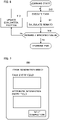
- FIG. 6 illustrates a sequence of the learning by the task learning unit 223.
- the task learning unit 223 executes a task (step S10).
- the task learning unit 223 calculates a reward for executing the task (step S11).
- the task learning unit 223 calculates the reward based on a distance between the hand of the robot arm and the point A and the distance between the hand of the robot arm and the obstacle.
- the task learning unit 223 determines whether or not the calculated reward is equal to or greater than a specified value defined in advance (step S12). When the reward is equal to or higher than the specified value (step S12: Yes), the task learning unit 223 terminates the learning. On the other hand, when the reward is not equal to or higher than the specified value (step S12: No), the task learning unit 223 updates an evaluation function by updating the matrix P with a certain update rule (step S13), and then returns to step S10 to repeat steps S10 to S12. By performing this loop, the matrix P, which can execute the task suitable for an environment, is learned, so that the robot can execute the task with an optimum movement.
- An update of the matrix P corresponds to an update of elements (parameters) forming the matrix P in accordance with the certain update rule.
- the update rule is well designed, a learning time becomes faster. However, in a case not considering the learning time, a method of randomly changing the parameters in small increments may be used. It is repeated that the parameters are update, the reward is improved, and the parameters are thus applied.
- the controller 200 may upload the matrix P obtained by the learning of the task learning unit 223 to the cloud apparatus 100, and the cloud apparatus 100 may store the received matrix P in the program storage unit 121.
- the matrix P is stored as the attribute information of the task together with a user name. Also, this information may be viewed or downloaded by other users.
- the task generation unit 224 is used to create a task newly defined by the user.
- the user defines a movement of a robot through the interface unit 300.
- a teaching method of a posture adopted in many robot arms may be used.
- the task generation unit 224 may create a basic movement and then may activate the task learning unit 223, so that the robot itself learns. By these operations, it is possible to define an optimal task.
- the user can also upload a task-specific program and attribute information related to the newly created task to the cloud apparatus 100, store them in the program storage unit 121, and share them with other users.
- the user inputs voice to a voice input receiving unit of a terminal that functions as the interface unit 300.
- the task generation unit 224 can create a task and attribute information by performing a natural language process on the input voice and recognizing the task and the attribute information.
- the interface unit 300 may also display a tab for selecting the natural language which the user uses, and the user may select a desired language and input voice.
- the user can create a task by entering the task and the attribute information to be created in a task entry field and an attribute information entry field on a display screen of the interface unit 300 with sentences of the natural language and by pressing an input completion button with a finger or a touch pen.
- a tab for selecting the natural language to be used may also be displayed, and the user may select and enter the desired language.
- the user by a feature of having a mechanism that divides a program on a task basis and learns without destroying itself and surroundings by avoiding an obstacle, it is possible for the user to utilize a robot only by paying a user fee for only tasks the user needs. Furthermore, since the user can improve the movement of the robot, and can share the newly created task-specific program with others by uploading it to the cloud apparatus 100, it is possible to generate the task-specific program at speed exceeding a speed at which a particular manufacturer supplies a program. Due to this advantage, a base of a robot utilization expands greatly, and manpower-saving robots is able to be introduced in various industries that suffer from human resource shortages.
- FIG. 8 is a block diagram illustrating a functional configuration of a robot control system 1C according to a third example embodiment.
- the cloud apparatus 100 includes the program storage unit 121, the transceiver unit 122, a usage history accumulation unit 123, and a fee calculation unit 124.
- the configuration of the controller 200 is the same as that of the second example embodiment.
- the cloud apparatus 100 includes a function of billing.
- the usage history accumulation unit 123 records usage histories of the task-specific program for each user. Specifically, the usage histories may include a number of downloads of the program and a usage time of the program. The number of downloads of the program is acquired from the program storage unit 121. The usage time of the program is obtained by communications from the robot control unit 221 of the controller 200.
- the usage history accumulation unit 123 is implemented in the cloud apparatus 100; however, the usage history accumulation unit 123 may be implemented in a local server.
- the fee calculation unit 124 calculates a fee to be charged for each user based on usage histories of a program for the user, which is accumulated in the usage history accumulation unit 123.
- a billing method of the fee may be a volume-based billing proportional to the number of downloads and an amount of the program usage time, or may be a flat rate billing for the number of downloads or the program usage time within respective predetermined ranges.
- the fee calculation unit 124 internally retains a certain formula or a logic, and calculates a fee to be billed for each user. Information indicating the calculated fee can be transmitted to the interface unit 300 and displayed to the user.
- the usage history accumulation unit 123 may record history information concerning those user's operations, and the fee calculation unit 124 may calculate a fee in consideration of the history information.
- the fee calculation unit 124 may discount the fee or may provide an incentive such as a financial reward to the user who uploaded the new task-specific program.
- an incentive for example, a monetary reward, a discount coupon, a free coupon, or the like may be considered.
- the interface unit 300 illustrated in FIG. 5 is an example, and an application of the present invention is not limited to this example.
- the example in which the interface unit 300 is implemented in a tablet terminal is illustrated; however, the interface unit 300 may be implemented in a personal computer, a smartphone, or the like.
- a cross key displayed on the display screen is described as an example of the operation part 23; however, a selection operation from the user is not limited to this operation using a cross key.
- the user may perform a selection operation with a mouse pointer displayed on the screen.
- the interface unit 300 includes a touch panel, the user can perform a selection operation with a finger or a touch pen.
- FIG. 4 illustrates the robot arm as a robot; however, the robot can be anything as well as the robot arm.
- an unmanned vehicle an unmanned vehicle such as a car or a ship
- a vehicle type a drone, or the like
- "move OO" is conceivable.
- a paved road, a rough road, or the like is set in "OO" as the attribute information.
- a motion instruction to the robot is different between moving on a paved road and moving on the rough road.
- an output of the robot control unit may indicate torque of a wheel, speed of a vehicle, acceleration, or the like.
- the robot control unit may perform an output tailored to an interface of each robot so as to operate the robot.
- the task learning unit 223 is usually implemented in the controller 200 as illustrated in FIG. 4 .
- the task learning unit may be implemented in the cloud apparatus.
- the task learning unit provided in the cloud apparatus may acquire information for the learning from the robot control unit through the communication network and may perform the learning.
- the robot control system according to the third example embodiment illustrated in FIG. 8 is built, and is introduced into three user companies (A company, B company, and C company) of food factories. It is assumed that each of the three user companies owns the controller 200 and the interface unit 300, and utilizes in common one cloud apparatus 100.
- the food factory A company desired to use a robot only for picking fried shrimps.
- the food factory B company and the food factory C company desired to use a robot for picking fried shrimps and croquettes.
- a task of "pick and place” by a robot arm was prepared in the cloud apparatus 100, and items of "fried shrimp” and "croquette” were prepared as the attribute information.
- task-specific programs two types of "pick and place fried shrimps” and “pick and place croquettes” were prepared.
- One unit of the robot arm is leased to each company for 100,000 yen per month.
- a rate plan for using a task-specific program two types are prepared: a flat rate billing allowing using up to five programs for 50,000 yen per month, and a volume-based billing of one program for 30,000 yen per month.
- the A company selects the volume-based billing, while the B company and the C company select the flat rate billing.
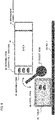
- FIG. 9 illustrates a schematic view of a workplace for the "pick and place".
- FIG. 9 is a plan view of the workplace as viewed from above.
- a robot arm 37 aligns serving items 34 warmed by an oven 32, that is, fried shrimps or croquettes, in the hotel pan 36 on a table 35 next to the oven 32.
- Each company has the same outline of the workplace, the table 35 is approximately the same size as the hotel pan 36, and a wall 38 at a side of the hotel pan 36 is opposite to the oven 32; accordingly, the robot control unit 221 needs to be careful regarding a collision of the robot arm 37 with the wall 38.
- the hotel pan 36 for each company is different in size. Two hotel pans 36 of 654mm ⁇ 530mm are aligned in the A company, one hotel pan 36 of 654mm ⁇ 530mm aligned in the B company, and one hotel pan 36 of 327 ⁇ 265mm in the C company.
- each company was able to immediately carry out the "pick and place” operation of the fried shrimps or the croquettes without any problems and hitting the wall.
- the robot arm 37 took an anxious posture such as approaching the wall 38 upon taking a posture for avoiding an obstacle; however, the robot arm 37 gradually carried out an on-line learning, and was able to complete a work keeping an appropriate distance from the wall 38 after dozens of times of operations.
- a reward function was set so as to be higher in a case of approaching a position where an object is placed and being 100mm away from a wall.
- the C company created a task of the "pick and place” of fried foods using the task generation unit 224 by operating the interface unit 300. Furthermore, in the C company, the "pick and place” operation of the fried foods is carried out in an environment of the C company, and an optimal operation of the robot arm is realized using the task learning section 223. Then, the C company uploaded its own program and learning information to the program storage unit 121 of the cloud apparatus 100.
- the A company needed to add a task of the "pick and place” of fried foods.
- the A company changed a contract from a volume-based billing to a flat rate system.
- the A company downloaded the task-specific program for the "pick and place” of fried foods, which the C company prepared and provided to the cloud apparatus 100, and added the operation.
- the task-specific program for the "pick and place” of fried foods prepared by the C company worked well.
- the food factory case has been illustrated; however, it can be used for general purposes in other industries such as assembly factories, and can handle a "screw tightening" task peculiar to the assembly factories.
- the rate system and the incentive in the above example are illustrated as examples, and various rate systems and incentives are considered. For instance, as the rate system, a number of times the service has been used (that is, a number of downloads of a program and a usage time of the program) and a system for billing a fee according to a usage period (subscription method) or the like may be considered.
- the robot control system according to any one of supplementary notes 1 through 6, further comprising a learning unit configured to learn an environment around the robot that is controlled by executing the acquired program and to update the acquired program.
- a robot control method comprising:
- a recording medium storing a program, the program causing a computer to perform a process comprising:
- a cloud apparatus comprising:
Landscapes
- Engineering & Computer Science (AREA)
- Business, Economics & Management (AREA)
- Strategic Management (AREA)
- Economics (AREA)
- Tourism & Hospitality (AREA)
- Development Economics (AREA)
- Marketing (AREA)
- Physics & Mathematics (AREA)
- General Business, Economics & Management (AREA)
- General Physics & Mathematics (AREA)
- Theoretical Computer Science (AREA)
- Human Resources & Organizations (AREA)
- Robotics (AREA)
- Mechanical Engineering (AREA)
- Entrepreneurship & Innovation (AREA)
- Accounting & Taxation (AREA)
- Finance (AREA)
- Game Theory and Decision Science (AREA)
- Primary Health Care (AREA)
- Operations Research (AREA)
- Quality & Reliability (AREA)
- Health & Medical Sciences (AREA)
- General Health & Medical Sciences (AREA)
- Manufacturing & Machinery (AREA)
- Educational Administration (AREA)
- Manipulator (AREA)
Abstract
Description
- The present invention relates to a robot control system for using a robot in various environments, conveniently and at low cost.
- In recent years, an introduction of a robot has been studied not only in factories which carry out mass production such as automobile factories, but also in various kinds of industries, against a backdrop of serious labor shortages. For example, at a physical distribution site, automation of transportation is being examined using an automated carrier called AGVs (Automated Guided Vehicles). Also, an introduction of an arm-type robot called a robot arm is examined in an assembly factory of electronic components. In the future, an examination of robot introduction will be accelerated even in industries such as a food factory, a restaurant, a hotel, a hospital, and nursing care.
- Generally, robots are custom-made products. An environment where a robot is used and a task which uses the robot (carrying things, tightening screws, and the like) are set in advance, and the robot, which is highly adjusted according to the environment and the task, is constructed. This adjustment was conventionally carried out by manual programming, and caused a considerable amount of labor; however, in recent years, automation by learning using data such as deep learning has begun to advance. For example,
Patent Documents 1 to 3 disclose adjustment of a robot using learning. However, even if adjusted by any method, the adjustment is limited to a robot used to adjust, an environment at an adjustment time, and a condition at the adjustment time concerning an adjusted task, and it is necessary to redo the adjustment even if any of the conditions are changed. -
- Patent Document 1:
Japanese Patent Application Laid-open under No. H09-81205 - Patent Document 2:
Japanese Patent Application Laid-open under No. 2005-78519 - Patent Document 3:
Japanese Patent Application Laid-open under No. 2007-66242 - As described above, an examination of a robot introduction has been carried out in various industries; however, it is difficult to say that the introduction is advancing at a level satisfying a user. Especially, the introduction has not advanced as much as expected in food factories, restaurants, hotels, hospitals, nursing care, and the like. There are several factors that make it difficult.
- In these industries, it is difficult to use robots in a specific environment. For example, in the food factory, products to be produced change on a weekly basis and lines thus need to be changed according to an amount to be produced. If the lines are changed, a layout of the robots also need to be changed. However, for the robots, changing the layout is nothing but a change in an environment. Accordingly, it is necessary to adjust the robots again. It is difficult for a user to adjust the robots on that site, and an adjustment work may be ordered to a robot integrator each time. An adjustment automation is progressing with a technology such as deep learning; however, enormous sample data are necessary to carry out the adjustment by the deep learning and it takes several months for the adjustment. That is, in a situation, in which the change occurs on a weekly basis and orders and adjustments are made each time, it is virtually the same as the robot cannot be used. This is a first factor why the introduction of robots has not progressed.
- Moreover, even tasks that seem to be the same task for a human may not be the same one for a robot. For example, for a person working in the food factory, a task of "grabbing fried foods" and a task of "grabbing fried shrimps" are the same tasks in a sense of putting side dishes into a lunch box. However, these tasks are different ones for robots. The side dishes to put in the lunch box change every day and are not permanent. Accordingly, a task which the robot performs is changed each time a kind of a side dish is changed, and thus, it becomes necessary to order the adjustment of the task change to the robot integrator. This is an unrealistic situation similar to a situation of the environmental change, and makes it difficult to advance the robot introduction when the task is changed frequently. This is a second factor.
- It is one object of the present invention to eliminate a need for an enormous adjustment work occurring at a time of introducing a robot, and to provide a robot control system capable of facilitating the introduction of the robot.
- According to an example aspect of the present invention, there is provided a robot control system including:
- a storage unit configured to store a plurality of programs corresponding to tasks for a robot to perform;
- a reception unit configured to receive selections made by a user, which designate a task for the robot to perform and attribute information related to a program causing the robot to perform the task among the plurality of programs;
- an acquisition unit configured to acquire the program for performing the task among the plurality of programs from the storage unit based on the task and the attribute information; and
- a robot control unit configured to control the robot in accordance with the acquired program.
- According to another example aspect of the present invention, there is provided a robot control method including:
- receiving selections made by a user, which designate a task for a robot to perform and attribute information related to a program causing the robot to perform the task among a plurality of programs;
- acquiring the program causing the robot to perform the task among the plurality of programs from a storage unit based on the task and the attribute information, the storage unit storing the plurality of programs corresponding to tasks for the robot to perform; and
- controlling the robot in accordance with the acquired program.
- According to still another example aspect of the present invention, there is provided a recording medium storing a program, the program causing a computer to perform a process including:
- receiving selections made by a user, which designate a task for a robot to perform and attribute information related to a program causing the robot to perform the task among a plurality of programs;
- acquiring the program causing the robot to perform the task among the plurality of programs from a storage unit based on the task and the attribute information, the storage unit storing the plurality of programs corresponding to tasks for the robot to perform; and
- controlling the robot in accordance with the acquired program.
- According to still yet another example aspect of the present invention, there is provided a cloud apparatus including:
- a storage unit configured to store a plurality of programs corresponding to tasks for a robot to perform;
- a receiving unit configured to receive a task for the robot to perform and attribute information related to a program causing the robot to perform the task among the plurality of programs, the task and the attribute information being selected by a user;
- an acquisition unit configured to acquire the program for performing the task among the plurality of programs from the storage unit based on the task and the attribute information; and
- a transmitting unit configured to transmit the acquired program.
- According to the present invention, it is possible to eliminate a need for enormous adjustment work occurring at a time of robot introduction, to provide a robot control system capable of facilitating the introduction of the robot.
-
-
FIG. 1 is a block diagram showing an overall configuration of a robot control system. -
FIG. 2A and FIG. 2B are block diagrams illustrating hardware configurations of a cloud apparatus and a controller. -
FIG. 3 is a block diagram illustrating a functional configuration of a robot control system according to a first example embodiment. -
FIG. 4 is a block diagram illustrating a functional configuration of a robot control system according to a second example embodiment. -
FIG. 5 illustrates a display example of an interface unit. -
FIG. 6 illustrates a sequence of learning by a task learning unit. -
FIG. 7 illustrates a display example of the interface unit in a task generation mode. -
FIG. 8 is a block diagram illustrating a functional configuration of a robot control system according to a third example embodiment. -
FIG. 9 is a plan view of a workplace for a robot according to an example. - In the following, example embodiments of the present invention will be described with reference to the accompanying drawings.
-
FIG. 1 is a block diagram showing an overall configuration of a robot control system according to an example embodiment of the present invention. Arobot control system 1 includes acloud apparatus 100, acontroller 200, and aninterface unit 300. Thecloud apparatus 100, thecontroller 200, and theinterface unit 300 can communicate with each other by a wired or wireless network. Thecloud apparatus 100 is a server apparatus installed on a cloud side. On the other hand, thecontroller 200 and theinterface unit 300 are installed in an actual environment where a work by a robot is performed. Thecontroller 200 is a device for controlling the robot. Theinterface unit 300 is operated by a user to input information necessary to control the robot.FIG. 1 illustrates a set of thecontroller 200 and theinterface unit 300 for convenience; however, in practice, a plurality ofcontrollers 200 and theinterface units 300 are commonly used for onecloud apparatus 100. -
FIG. 2A is a block diagram illustrating a hardware configuration of thecloud apparatus 100. As illustrated, thecloud apparatus 100 includes acommunication unit 102, aprocessor 103, amemory 104, arecording medium 105, and a database (DB) 106. - The
communication unit 102 communicates with thecontroller 200 and theinterface unit 300 through the wired or wireless network. Specifically, thecommunication unit 102 receives a task and attribute information of the task, which are designated by a user, from theinterface unit 300. Thecommunication unit 102 transmits a program corresponding to the task and the attribute information designated by the user to thecontroller 200. - The
processor 103 is a computer such as a CPU (Central Processing Unit) and controls theentire cloud apparatus 100 by executing a program prepared in advance. Specifically, theprocessor 103 conducts a process of transmitting a program corresponding to the task and the attribute information designated by the user to thecontroller 200 and a process of calculating a fee generated by using the program. - The
memory 104 includes a ROM (Read Only Memory), a RAM (Random Access Memory), and the like. Thememory 104 stores various programs to be executed by theprocessor 103. Thememory 104 is also used as a work memory during an execution of various processes by theprocessor 103. - The
recording medium 105 is a non-volatile and non-transitory recording medium such as a disk-shaped recording medium, a semiconductor memory, or the like, and is removable from thecloud apparatus 100. Therecording medium 105 records various programs executed by theprocessor 103. When thecloud apparatus 100 performs various kinds of processes, a program recorded on therecording medium 105 is loaded into thememory 104 and is executed by theprocessor 103. - The
database 106 stores programs (hereinafter, also referred to as "task-specific programs") prepared respectively to a plurality of tasks. Thedatabase 106 stores usage histories of the task-specific programs for each user. In addition to the above, thecloud apparatus 100 may include an input apparatus such as a keyboard or a mouse for the user to perform instructions or inputs, and a display apparatus. -
FIG. 2B is a block diagram showing a hardware configuration of thecontroller 200. As illustrated, thecontroller 200 includes acommunication unit 202, aprocessor 203, amemory 204, arecording medium 205, and a database (DB) 206. - The
communication unit 202 communicates with thecloud apparatus 100 and theinterface unit 300 through a wired or wireless network. Specifically, thecommunication unit 202 receives the task-specific program from thecloud apparatus 100. If necessary, thecommunication unit 202 transmits a task-specific program learned in thecontroller 200 or a new task-specific program generated in thecontroller 200 to thecloud apparatus 100. - The
processor 203 is a computer such as a CPU or the CPU with a GPU (Graphics Processing Unit), and controls theentire controller 200 by executing a program prepared in advance. Specifically, theprocessor 203 conducts a process of controlling the robot by executing the task-specific program, a process of learning the task-specific program, a process of generating a new task-specific program, and the like. - The
memory 204 includes a ROM, a RAM, and the like. Thememory 204 stores various programs to be executed by theprocessor 203. Also, thememory 204 is used as a work memory during an execution of various processes by theprocessor 203. - The
recording medium 205 is a non-volatile and non-transitory recording medium such as a disk-shaped recording medium, a semiconductor memory, or the like, and is removably configured with respect to thecontroller 200. Therecording medium 205 records various programs executed by theprocessor 203. When thecontroller 200 performs various processes, a program recorded on therecording medium 205 is loaded into thememory 204 and is executed by theprocessor 203. - The
database 206 stores data used in thecontroller 200 to learn the task-specific program. In addition to the above, thecontroller 200 may include an input apparatus such as a keyboard or a mouse and a display apparatus. -
FIG. 3 illustrates a functional configuration of arobot control system 1A according to a first example embodiment. As illustrated, therobot control system 1A includes astorage unit 111, areception unit 112, anacquisition unit 113, and arobot control unit 211. - In the present example embodiment, it may be one feature in that a program for controlling a robot is divided for each task and is supplied to the
robot control unit 211 as the task-specific program. A "task" is a target that the robot realizes upon completion of operation. For example, in a case of an arm-type robot (hereinafter, also referred to as "robot arm"), there is "carrying an object to be subject", "tightening a screw" or the like as a task. In this case, the "carrying an object to be a subject" means moving the object from one point to another point. The "carrying an object to be a subject" is generally a basic operation of the robot arm called "pick and place". There are various objects as the "objects to be a subject"; for example, in a case of a food factory, an object which the robot needs to carry such as a "fried food" and a "fried shrimp" may be the "object to be a subject". On this system, a task is defined as a verb and an object of the verb is defined as attribute information. - As described earlier, for robots, the task of "carrying fried shrimps" and the task of "carrying fried foods" are different tasks. Accordingly, the programs for executing these tasks are formed as different programs. On the other hand, on the system, usability of a user is considered, and these tasks are treated as the same ones but attribute information is different for each task. That is, on the system, the task of "carrying fried shrimps" and the task of "carrying fried foods" are treated as the same as a task of "carrying an object to be a subject (pick and place)", and the "fried shrimps" and the "fried foods" are treated as different attribute information.
- The
storage unit 111 stores the task-specific program described above for a plurality of tasks. Thereception unit 112 receives selections of a task and the attribute information, which are conducted by the user. For example, the user operates theinterface unit 300 and specifies a task to be executed by the robot and attribute information related to the task-specific program that executes the task. Thereception unit 112 receives the selections of the task and the attribute information made by the user from theinterface unit 300. - The
acquisition unit 113 acquires a task-specific program for executing a task from thestorage unit 111 based on the task and the attribute information selected by the user, and provides the task-specific program to therobot control unit 221. Therobot control unit 211 executes the provided task-specific program to control the robot. Hence, by selecting the program prepared and the attribute information for each task, it becomes possible to make the robot execute a desired task. - In one preferred example, the
storage unit 111, thereception unit 112, and theacquisition unit 113 are in thecloud apparatus 100, and therobot control unit 211 is in thecontroller 200. In this case, theacquisition unit 113 transmits the task-specific program acquired from thestorage unit 111 to therobot control unit 211 of thecontroller 200. On the other hand, in another preferred example, all of thestorage unit 111, thereception unit 112, theacquisition unit 113, and therobot control unit 211 may be arranged inside thecontroller 200. In this case, the task-specific program, which is downloaded from thecloud apparatus 100 in advance, is stored in thestorage unit 111 in thecontroller 200. - Next, a second example embodiment of the present invention will be described.
FIG. 4 is a block diagram showing a functional configuration of arobot control system 1B according to the second example embodiment. As illustrated, thecloud apparatus 100 includes aprogram storage unit 121 and atransceiver unit 122. Moreover, thecontroller 200 includes arobot control unit 221, atransceiver unit 222, atask learning unit 223, and atask generation unit 224. - In the
cloud apparatus 100, theprogram storage unit 121 stores task-specific programs concerning a plurality of tasks in the same manner as thestorage unit 111 in the first example embodiment. Thetransceiver unit 122 receives a task and attribute information designated by a user from theinterface unit 300. Thetransceiver unit 122 acquires a task-specific program corresponding to the task designated by the user from theprogram storage unit 121 and transmits the task-specific program to thecontroller 200. - The
interface unit 300 is a device for acquiring user's desired selections. The user views a display of theinterface unit 300, and selects a desired task and desired attribute information using a finger or an input device such as a dedicated pen or a mouse. Information entered by the user is transmitted to thecloud apparatus 100 through a communication network. -
FIG. 5 illustrates an example of theinterface unit 300. In this example, theinterface unit 300 may be a tablet terminal. Theinterface unit 300 displays at least the task and the attribute information. In the example ofFIG. 5 , atask window 21, anattribute information window 22, and anoperation part 23 are displayed on thedisplay unit 20 of the tablet terminal. By operating theoperation part 23, the user selects a task by indicating an icon displayed in thetask window 21, and selects attribute information displayed in theattribute information window 22. In this example, since the user has selected "PICK & PLACE" as the task, theattribute information window 22 displays "FRIED SHRIMP", "CROQUETTE", and the like as objects of the "PICK & PLACE". In response to selections of a task and attribution information and a transmission instruction by the user, theinterface unit 300 transmits the task and the attribute information selected by the user to thecloud apparatus 100. - The
robot control unit 221 gives a motion instruction to a robot. In the example ofFIG. 4 , a robot arm is exemplified as the robot. Thetransceiver unit 222 of thecontroller 200 downloads the task-specific program associated with the task and the attribute information selected by the user in theinterface unit 300, through the communication network from thecloud apparatus 100. Basically, thecontroller 200 may download a necessary task-specific program each time. However, instead, thecontroller 200 may implement or download all task-specific programs stored in theprogram storage unit 121 of thecloud apparatus 100 to thecontroller 200 in advance, acquire the task and the attribute information selected by the user from theinterface unit 300, and activate a corresponding task-specific program. - In the
controller 200, therobot control unit 221 outputs a motion instruction calculated by the task-specific program to finally operate the robot (the robot arm in the present example embodiment). The motion instruction may be generally a posture of the robot arm, torque of an actuator (a motor or the like) or the like. The motion instruction can be considered as a signal to move the robot. Therobot control unit 221 may output the motion instruction directly to the actuator forming the robot arm. Also, in a case where the robot arm includes an own controller, therobot control unit 221 may convert the motion instruction calculated by the task-specific program into an output for the own controller, and may output it to the own controller. - The task-specific programs incorporated in the above-described configuration will be executed by robots placed in various environments. In this case, it is preferable to adjust the program in the environment where the robot is placed. Therefore, in the present example embodiment, the
task learning unit 223, which adjusts the task-specific program for the environment where the robot is placed, is provided. - The task-specific program, which has been learned by the
task learning unit 223, is appropriately transmitted to and updated to therobot control unit 221. A feature of thetask learning unit 223 in the present example embodiment is that the robot includes a function for learning while avoiding the robot from hitting an obstacle. In a general learning algorithm, the robot learns appropriate movements while hitting with obstacles around the robot (that is, objects in a surrounding environment). Therefore, it is difficult to conduct re-learning under an environment where the robot is placed on a site and has worked. This is because the robot may damage an object in a surrounding, or may interfere with a work of another robot arm if that object is another robot arm. Moreover, in an environment where people are around the robot, the robot may hurt the people or interfere with a work of the people. - In the present example embodiment, in order to improve this matter, a
task learning unit 223, which can perform learning while avoiding an obstacle, is provided. By this configuration, in an environment where the robot actually operates, without making an adjustment in advance, it is possible to provide a new structure for utilizing the robot by simply downloading a necessary task-specific program to the robot. - Specifically, as a structure for learning while avoiding obstacles, the
task learning unit 223 uses an algorithm as follows. Now, the following function is defined as an interference function B(x). - [Math 1]

- Here, the "control target device" is a robot or an unmanned vehicle to be controlled, and a robot arm is depicted in the example of
FIG. 4 . "x" denotes a state vector of the control target device. If "u" denotes an input vector to the actuator of the robot, the input vector of the robot moving avoiding an obstacle is obtained by the following optimization calculation. - [Math 2]
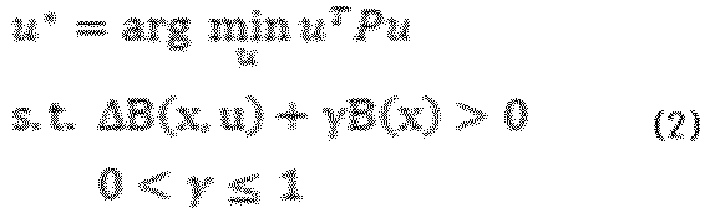
- Here, 'u∗' denotes an optimal input vector, 'P' denotes a matrix for creating an evaluation function for u, ΔB(x,u) denotes a variation of B(x) per unit step, and 'γ' denotes a coefficient. The
task learning unit 223 obtains the optimum input vector u∗ that minimizes the evaluation function described in 'uTPu' (a quadratic form of u in this case) and inputs the optimum input vector u∗ to the robot, so that the robot operates by avoiding an obstacle. The matrix P can be set in various ways; however, the matrix P is often set to be related to a level of achievement of a task. - In the above algorithm, a robot movement depends on the matrix P. However, there are many cases where it is not known whether the matrix P itself is suitable from the beginning. Therefore, the mechanism of learning is also introduced.
- In order to learn, a reward for learning is necessary and the reward needs to be defined. For example, in a case where a robot arm performs a task of "extending a hand of the robot arm to a certain point A while keeping a distance as far as possible from an obstacle," the closer the hand of the robot arm approaches to the point A and the larger the physical distance to the obstacle, the higher the reward may be defined. Here, the reward is given in that a higher value of the reward indicates a more preferable movement; however of course, the reward may be given in that a lower value of the reward is the more preferable movement.
-
FIG. 6 illustrates a sequence of the learning by thetask learning unit 223. First, thetask learning unit 223 executes a task (step S10). Next, thetask learning unit 223 calculates a reward for executing the task (step S11). In the above example, thetask learning unit 223 calculates the reward based on a distance between the hand of the robot arm and the point A and the distance between the hand of the robot arm and the obstacle. - Next, the
task learning unit 223 determines whether or not the calculated reward is equal to or greater than a specified value defined in advance (step S12). When the reward is equal to or higher than the specified value (step S12: Yes), thetask learning unit 223 terminates the learning. On the other hand, when the reward is not equal to or higher than the specified value (step S12: No), thetask learning unit 223 updates an evaluation function by updating the matrix P with a certain update rule (step S13), and then returns to step S10 to repeat steps S10 to S12. By performing this loop, the matrix P, which can execute the task suitable for an environment, is learned, so that the robot can execute the task with an optimum movement. - An update of the matrix P corresponds to an update of elements (parameters) forming the matrix P in accordance with the certain update rule. In a case where the update rule is well designed, a learning time becomes faster. However, in a case not considering the learning time, a method of randomly changing the parameters in small increments may be used. It is repeated that the parameters are update, the reward is improved, and the parameters are thus applied.
- The
controller 200 may upload the matrix P obtained by the learning of thetask learning unit 223 to thecloud apparatus 100, and thecloud apparatus 100 may store the received matrix P in theprogram storage unit 121. In this case, the matrix P is stored as the attribute information of the task together with a user name. Also, this information may be viewed or downloaded by other users. - The
task generation unit 224 is used to create a task newly defined by the user. The user defines a movement of a robot through theinterface unit 300. For this definition of the movement, a teaching method of a posture adopted in many robot arms may be used. In a case of a complex task, first, thetask generation unit 224 may create a basic movement and then may activate thetask learning unit 223, so that the robot itself learns. By these operations, it is possible to define an optimal task. The user can also upload a task-specific program and attribute information related to the newly created task to thecloud apparatus 100, store them in theprogram storage unit 121, and share them with other users. - For example, the user inputs voice to a voice input receiving unit of a terminal that functions as the
interface unit 300. Thetask generation unit 224 can create a task and attribute information by performing a natural language process on the input voice and recognizing the task and the attribute information. Theinterface unit 300 may also display a tab for selecting the natural language which the user uses, and the user may select a desired language and input voice. - Moreover, for example, as illustrated in
FIG. 7 , the user can create a task by entering the task and the attribute information to be created in a task entry field and an attribute information entry field on a display screen of theinterface unit 300 with sentences of the natural language and by pressing an input completion button with a finger or a touch pen. A tab for selecting the natural language to be used may also be displayed, and the user may select and enter the desired language. - As described above, in the present example embodiment, by a feature of having a mechanism that divides a program on a task basis and learns without destroying itself and surroundings by avoiding an obstacle, it is possible for the user to utilize a robot only by paying a user fee for only tasks the user needs. Furthermore, since the user can improve the movement of the robot, and can share the newly created task-specific program with others by uploading it to the
cloud apparatus 100, it is possible to generate the task-specific program at speed exceeding a speed at which a particular manufacturer supplies a program. Due to this advantage, a base of a robot utilization expands greatly, and manpower-saving robots is able to be introduced in various industries that suffer from human resource shortages. - Next, a third example embodiment of the present invention will be described.
FIG. 8 is a block diagram illustrating a functional configuration of arobot control system 1C according to a third example embodiment. As illustrated, thecloud apparatus 100 includes theprogram storage unit 121, thetransceiver unit 122, a usagehistory accumulation unit 123, and afee calculation unit 124. The configuration of thecontroller 200 is the same as that of the second example embodiment. - In the third example embodiment, for a case in that a user downloads and uses a task-specific program from the
cloud apparatus 100, thecloud apparatus 100 includes a function of billing. The usagehistory accumulation unit 123 records usage histories of the task-specific program for each user. Specifically, the usage histories may include a number of downloads of the program and a usage time of the program. The number of downloads of the program is acquired from theprogram storage unit 121. The usage time of the program is obtained by communications from therobot control unit 221 of thecontroller 200. In the example ofFIG. 8 , the usagehistory accumulation unit 123 is implemented in thecloud apparatus 100; however, the usagehistory accumulation unit 123 may be implemented in a local server. - The
fee calculation unit 124 calculates a fee to be charged for each user based on usage histories of a program for the user, which is accumulated in the usagehistory accumulation unit 123. A billing method of the fee may be a volume-based billing proportional to the number of downloads and an amount of the program usage time, or may be a flat rate billing for the number of downloads or the program usage time within respective predetermined ranges. Thefee calculation unit 124 internally retains a certain formula or a logic, and calculates a fee to be billed for each user. Information indicating the calculated fee can be transmitted to theinterface unit 300 and displayed to the user. - Moreover, when the user generates a new task-specific program using the function of the
task generation unit 224 and provides the new task-specific program to thecloud apparatus 100, the usagehistory accumulation unit 123 may record history information concerning those user's operations, and thefee calculation unit 124 may calculate a fee in consideration of the history information. For example, thefee calculation unit 124 may discount the fee or may provide an incentive such as a financial reward to the user who uploaded the new task-specific program. As an incentive, for example, a monetary reward, a discount coupon, a free coupon, or the like may be considered. - In the above example embodiment, it is possible to apply the following modifications.
- The
interface unit 300 illustrated inFIG. 5 is an example, and an application of the present invention is not limited to this example. For instance, inFIG. 5 , the example in which theinterface unit 300 is implemented in a tablet terminal is illustrated; however, theinterface unit 300 may be implemented in a personal computer, a smartphone, or the like. - Also, in
FIG. 5 , a cross key displayed on the display screen is described as an example of theoperation part 23; however, a selection operation from the user is not limited to this operation using a cross key. For example, the user may perform a selection operation with a mouse pointer displayed on the screen. Moreover, in a case where theinterface unit 300 includes a touch panel, the user can perform a selection operation with a finger or a touch pen. -
FIG. 4 illustrates the robot arm as a robot; however, the robot can be anything as well as the robot arm. For example, as the robot, an unmanned vehicle (an unmanned vehicle such as a car or a ship) of a vehicle type, a drone, or the like can also be used. In a case of a robot of the vehicle type, as a task, "move OO" is conceivable. Here, a paved road, a rough road, or the like is set in "OO" as the attribute information. A motion instruction to the robot is different between moving on a paved road and moving on the rough road. In this case, an output of the robot control unit may indicate torque of a wheel, speed of a vehicle, acceleration, or the like. The robot control unit may perform an output tailored to an interface of each robot so as to operate the robot. - Since the
task learning unit 223 is used with respect to all tasks, thetask learning unit 223 is usually implemented in thecontroller 200 as illustrated inFIG. 4 . However, it is also possible to perform the learning of a task on a cloud apparatus side, and the task learning unit may be implemented in the cloud apparatus. In this case, the task learning unit provided in the cloud apparatus may acquire information for the learning from the robot control unit through the communication network and may perform the learning. - Next, a description will be given of a specific example to which the present invention is applied. In this example, the robot control system according to the third example embodiment illustrated in
FIG. 8 is built, and is introduced into three user companies (A company, B company, and C company) of food factories. It is assumed that each of the three user companies owns thecontroller 200 and theinterface unit 300, and utilizes in common onecloud apparatus 100. - At a service release, the food factory A company desired to use a robot only for picking fried shrimps. The food factory B company and the food factory C company desired to use a robot for picking fried shrimps and croquettes. Hence, as the robot control system, a task of "pick and place" by a robot arm was prepared in the
cloud apparatus 100, and items of "fried shrimp" and "croquette" were prepared as the attribute information. As task-specific programs, two types of "pick and place fried shrimps" and "pick and place croquettes" were prepared. - One unit of the robot arm is leased to each company for 100,000 yen per month. Also, as a rate plan for using a task-specific program, two types are prepared: a flat rate billing allowing using up to five programs for 50,000 yen per month, and a volume-based billing of one program for 30,000 yen per month. The A company selects the volume-based billing, while the B company and the C company select the flat rate billing.
- Each company downloaded the task-specific program after the robot arm was installed, and carried out picking operations of fried shrimps and croquettes.
FIG. 9 illustrates a schematic view of a workplace for the "pick and place".FIG. 9 is a plan view of the workplace as viewed from above. Arobot arm 37 aligns servingitems 34 warmed by anoven 32, that is, fried shrimps or croquettes, in thehotel pan 36 on a table 35 next to theoven 32. Each company has the same outline of the workplace, the table 35 is approximately the same size as thehotel pan 36, and awall 38 at a side of thehotel pan 36 is opposite to theoven 32; accordingly, therobot control unit 221 needs to be careful regarding a collision of therobot arm 37 with thewall 38. However, thehotel pan 36 for each company is different in size. Two hotel pans 36 of 654mm×530mm are aligned in the A company, onehotel pan 36 of 654mm×530mm aligned in the B company, and onehotel pan 36 of 327×265mm in the C company. - After the program was downloaded from the
cloud apparatus 100, each company was able to immediately carry out the "pick and place" operation of the fried shrimps or the croquettes without any problems and hitting the wall. In addition, immediately after a start of the operation, therobot arm 37 took an anxious posture such as approaching thewall 38 upon taking a posture for avoiding an obstacle; however, therobot arm 37 gradually carried out an on-line learning, and was able to complete a work keeping an appropriate distance from thewall 38 after dozens of times of operations. As a reward of the learning, a reward function was set so as to be higher in a case of approaching a position where an object is placed and being 100mm away from a wall. - After that, the C company created a task of the "pick and place" of fried foods using the
task generation unit 224 by operating theinterface unit 300. Furthermore, in the C company, the "pick and place" operation of the fried foods is carried out in an environment of the C company, and an optimal operation of the robot arm is realized using thetask learning section 223. Then, the C company uploaded its own program and learning information to theprogram storage unit 121 of thecloud apparatus 100. - After that, the A company needed to add a task of the "pick and place" of fried foods. First, the A company changed a contract from a volume-based billing to a flat rate system. Then, the A company downloaded the task-specific program for the "pick and place" of fried foods, which the C company prepared and provided to the
cloud apparatus 100, and added the operation. Also, in the A company, the task-specific program for the "pick and place" of fried foods prepared by the C company worked well. - Since the task-specific program for the "pick and place" of fried foods, which the C company uploaded, was downloaded by other companies, as an incentive, 50,000 yen was cashed back to the C company.
- As described above, using the robot control system according to the example embodiments, it becomes possible for a plurality of companies to easily introduce robots. Usually, it is said that an introduction of the robot arm costs 5 million yen to 10 million yen including an adjustment system integration and a period takes from half a year to one year. With this system, the introduction cost and time have been significantly reduced. Moreover, since this system includes a structure and an incentive to share task-specific programs among user companies of the system, the system can also be used as a revenue source by uploading the task-specific programs to be used by many other companies. The greater the number of companies participating in this system, the greater the benefits that participants can enjoy.
- In the above-described example, only the "pick and place" is described as a task; however, another task such as "cutting food" can also be used universally. Moreover, in the above-described example, the food factory case has been illustrated; however, it can be used for general purposes in other industries such as assembly factories, and can handle a "screw tightening" task peculiar to the assembly factories. Note that the rate system and the incentive in the above example are illustrated as examples, and various rate systems and incentives are considered. For instance, as the rate system, a number of times the service has been used (that is, a number of downloads of a program and a usage time of the program) and a system for billing a fee according to a usage period (subscription method) or the like may be considered.
- A part or all of the example embodiments described above may also be described as the following supplementary notes, but not limited thereto.
-
- 1. A robot control system comprising:
- a storage unit configured to store a plurality of programs corresponding to tasks for a robot to perform;
- a reception unit configured to receive selections made by a user, which designate a task for the robot to perform and attribute information related to a program causing the robot to perform the task among the plurality of programs;
- an acquisition unit configured to acquire the program for performing the task among the plurality of programs from the storage unit based on the task and the attribute information; and
- a robot control unit configured to control the robot in accordance with the acquired program.
- 2. The robot control system according to
supplementary note 1, wherein the plurality of programs are prepared for each task. - 3. The robot control system according to
supplementary note 1 or 2, wherein the robot control unit determines a control with respect to the robot by using an evaluation function. - 4. The robot control system according to any one of
supplementary notes 1 through 3, further comprising: - a usage history accumulation unit configured to accumulate usage histories of the acquired program for each user; and
- a fee calculation unit configured to calculate a usage fee of the acquired program for each user based on the usage histories.
- 5. The robot control system according to supplementary note 4, wherein the fee calculation unit calculates a fee defined in advance in a case where an amount used to calculate the fee is within a predetermined range.
- 6. The robot control system according to supplementary note 4, wherein the fee calculation unit calculates a flat rate according to a usage period.
- 7. The robot control system according to any one of
supplementary notes 1 through 6, further comprising a learning unit configured to learn an environment around the robot that is controlled by executing the acquired program and to update the acquired program. - 8. The robot control system according to supplementary note 7, wherein the learning unit improves an execution level of the task by operating the robot while avoiding the robot from hitting an obstacle.
- 9. The robot control system according to supplementary note 7 or 8, wherein the storage unit stores a program learned by the learning unit.
- 10. The robot control system according to any one of
supplementary notes 1 through 9, wherein the storage unit stores a program concerning a task created by the user. - 11. The robot control system according to any one of supplementary notes 4 through 6, wherein the fee calculation unit is configured to decrease the fee to charge the user or to give an incentive to the user, in response to storing a program concerning the task created by the user.
- 12. The robot control system according to
supplementary note 1, wherein - the storage unit is placed on a cloud; and
- the storage unit and the robot control unit are communicably connected to each other.
- 13. A robot control method comprising:
- receiving selections made by a user, which designate a task for a robot to perform and attribute information related to a program causing the robot to perform the task among a plurality of programs;
- acquiring the program causing the robot to perform the task among the plurality of programs from a storage unit based on the task and the attribute information, the storage unit storing the plurality of programs corresponding to tasks for the robot to perform; and
- controlling the robot in accordance with the acquired program.
- 14. A recording medium storing a program, the program causing a computer to perform a process comprising:
- receiving selections made by a user, which designate a task for a robot to perform and attribute information related to a program causing the robot to perform the task among a plurality of programs;
- acquiring the program causing the robot to perform the task among the plurality of programs from a storage unit based on the task and the attribute information, the storage unit storing the plurality of programs corresponding to tasks for the robot to perform; and
- controlling the robot in accordance with the acquired program.
- 15. A cloud apparatus comprising:
- a storage unit configured to store a plurality of programs corresponding to tasks for a robot to perform;
- a receiving unit configured to receive a task for the robot to perform and attribute information related to a program causing the robot to perform the task among the plurality of programs, the task and the attribute information being selected by a user;
- an acquisition unit configured to acquire the program for performing the task among the plurality of programs from the storage unit based on the task and the attribute information; and
- a transmitting unit configured to transmit the acquired program.
- While the invention has been described with reference to the example embodiments and examples, the invention is not limited to the above example embodiments and examples. It will be understood by those of ordinary skill in the art that various changes in form and details may be made therein without departing from the spirit and scope of the present invention as defined by the claims.
-
- 1, 1A, 1B, 1C
- Robot control system
- 100
- Cloud apparatus
- 121
- Program storage unit
- 122
- Transceiver unit
- 123
- Usage history accumulation unit
- 124
- Fee calculation unit
- 200
- Controller
- 221
- Robot control unit
- 222
- Transceiver unit
- 223
- Task learning unit
- 224
- Task generation unit
- 300
- Interface unit
Claims (14)
- A robot control system comprising:a storage unit configured to store a plurality of programs corresponding to tasks for a robot to perform;a reception unit configured to receive selections made by a user, which designate a task for the robot to perform and attribute information related to a program causing the robot to perform the task among the plurality of programs;an acquisition unit configured to acquire the program for performing the task among the plurality of programs from the storage unit based on the task and the attribute information; anda robot control unit configured to control the robot in accordance with the acquired program.
- The robot control system according to claim 1, wherein the plurality of programs are prepared for each task.
- The robot control system according to claim 1 or 2, wherein the robot control unit determines a control with respect to the robot by using an evaluation function.
- The robot control system according to any one of claims 1 through 3, further comprising:a usage history accumulation unit configured to accumulate usage histories of the acquired program for each user; anda fee calculation unit configured to calculate a usage fee of the acquired program for each user based on the usage histories.
- The robot control system according to claim 4, wherein the fee calculation unit calculates a fee defined in advance in a case where an amount used to calculate the fee is within a predetermined range.
- The robot control system according to claim 4, wherein the fee calculation unit calculates a flat rate according to a usage period.
- The robot control system according to any one of claims 1 through 6, further comprising a learning unit configured to learn an environment around the robot that is controlled by executing the acquired program and to update the acquired program.
- The robot control system according to claim 7, wherein the learning unit improves an execution level of the task by operating the robot while avoiding the robot from hitting an obstacle.
- The robot control system according to claim 7 or 8, wherein the storage unit stores a program learned by the learning unit.
- The robot control system according to any one of claims 1 through 9, wherein the storage unit stores a program concerning a task created by the user.
- The robot control system according to any one of claims 4 through 6, wherein the fee calculation unit is configured to decrease the fee to charge the user or to give an incentive to the user, in response to storing a program concerning the task created by the user.
- A robot control method comprising:receiving selections made by a user, which designate a task for a robot to perform and attribute information related to a program causing the robot to perform the task among a plurality of programs;acquiring the program causing the robot to perform the task among the plurality of programs from a storage unit based on the task and the attribute information, the storage unit storing the plurality of programs corresponding to tasks for the robot to perform; andcontrolling the robot in accordance with the acquired program.
- A recording medium storing a program, the program causing a computer to perform a process comprising:receiving selections made by a user, which designate a task for a robot to perform and attribute information related to a program causing the robot to perform the task among a plurality of programs;acquiring the program causing the robot to perform the task among the plurality of programs from a storage unit based on the task and the attribute information, the storage unit storing the plurality of programs corresponding to tasks for the robot to perform; andcontrolling the robot in accordance with the acquired program.
- A cloud apparatus comprising:a storage unit configured to store a plurality of programs corresponding to tasks for a robot to perform;a receiving unit configured to receive a task for the robot to perform and attribute information related to a program causing the robot to perform the task among the plurality of programs, the task and the attribute information being selected by a user;an acquisition unit configured to acquire the program for performing the task among the plurality of programs from the storage unit based on the task and the attribute information; anda transmitting unit configured to transmit the acquired program.
Applications Claiming Priority (1)
| Application Number | Priority Date | Filing Date | Title |
|---|---|---|---|
| PCT/JP2019/032847 WO2021033315A1 (en) | 2019-08-22 | 2019-08-22 | Robot control system, robot control method, and recording medium |
Publications (2)
| Publication Number | Publication Date |
|---|---|
| EP4019206A1 true EP4019206A1 (en) | 2022-06-29 |
| EP4019206A4 EP4019206A4 (en) | 2022-08-17 |
Family
ID=74660462
Family Applications (1)
| Application Number | Title | Priority Date | Filing Date |
|---|---|---|---|
| EP19942216.3A Pending EP4019206A4 (en) | 2019-08-22 | 2019-08-22 | ROBOT CONTROL SYSTEM, ROBOT CONTROL METHOD AND RECORDING MEDIA |
Country Status (4)
| Country | Link |
|---|---|
| US (1) | US12070864B2 (en) |
| EP (1) | EP4019206A4 (en) |
| JP (1) | JP7334784B2 (en) |
| WO (1) | WO2021033315A1 (en) |
Families Citing this family (2)
| Publication number | Priority date | Publication date | Assignee | Title |
|---|---|---|---|---|
| CN113843801B (en) | 2021-10-18 | 2022-11-29 | 上海节卡机器人科技有限公司 | Control method, device and system of composite robot |
| JP7668241B2 (en) * | 2022-02-28 | 2025-04-24 | 川崎重工業株式会社 | Information processing device |
Family Cites Families (29)
| Publication number | Priority date | Publication date | Assignee | Title |
|---|---|---|---|---|
| JPH0981205A (en) | 1995-09-11 | 1997-03-28 | Fujitsu Ltd | Learning system |
| JP2001250045A (en) | 1999-12-30 | 2001-09-14 | Sony Corp | Purchasing system and method, order receiving device and method, data selling agent system, data selling device and method, and computer program |
| JP2003108791A (en) | 2001-09-28 | 2003-04-11 | Yamaha Corp | Contents distribution program, contents distributing method and contents distribution server |
| JP3703822B2 (en) | 2003-09-02 | 2005-10-05 | 株式会社国際電気通信基礎技術研究所 | Internal variable estimation device, internal variable estimation method, and internal variable estimation program |
| JP4929449B2 (en) | 2005-09-02 | 2012-05-09 | 国立大学法人横浜国立大学 | Reinforcement learning apparatus and reinforcement learning method |
| JP5112666B2 (en) * | 2006-09-11 | 2013-01-09 | 株式会社日立製作所 | Mobile device |
| US8868241B2 (en) * | 2013-03-14 | 2014-10-21 | GM Global Technology Operations LLC | Robot task commander with extensible programming environment |
| US20150149263A1 (en) * | 2013-11-22 | 2015-05-28 | Here Global B.V. | Automated Parking Payment |
| US9707680B1 (en) * | 2015-05-28 | 2017-07-18 | X Development Llc | Suggesting, selecting, and applying task-level movement parameters to implementation of robot motion primitives |
| US9925662B1 (en) | 2015-06-28 | 2018-03-27 | X Development Llc | Generating a trained robot path based on physical manipulation of the robot and based on training user interface input(s) associated with the physical manipulation |
| CN105215987B (en) | 2015-10-12 | 2017-03-22 | 埃夫特智能装备股份有限公司 | Industrial robot technology cloud system and working method thereof |
| JP7016700B2 (en) | 2016-01-26 | 2022-02-07 | 株式会社Fuji | Job creation device |
| EP3243607B1 (en) | 2016-05-09 | 2021-01-27 | OpiFlex Automation AB | A system and a method for programming an industrial robot |
| JP2018032126A (en) | 2016-08-23 | 2018-03-01 | セイコーエプソン株式会社 | Robot information management device, robot, and robot billing system |
| KR102012073B1 (en) * | 2017-02-03 | 2019-08-19 | 두산로보틱스 주식회사 | Method and Apparatus for Programming Robot based on Skill |
| JP6951659B2 (en) * | 2017-05-09 | 2021-10-20 | オムロン株式会社 | Task execution system, task execution method, and its learning device and learning method |
| JP6863082B2 (en) | 2017-05-26 | 2021-04-21 | オムロン株式会社 | Learning device, learning control method, and its program |
| JP2019005834A (en) | 2017-06-22 | 2019-01-17 | 株式会社デンソー | Learning system and learning method |
| JP6680730B2 (en) | 2017-08-08 | 2020-04-15 | ファナック株式会社 | Control device and learning device |
| US20190068466A1 (en) * | 2017-08-30 | 2019-02-28 | Intel Corporation | Technologies for auto-discovery of fault domains |
| EP3476545A1 (en) * | 2017-10-27 | 2019-05-01 | Creaholic SA | Method for operating a computer-based inventory of hardware modules of a robotic system |
| US10878294B2 (en) | 2018-01-05 | 2020-12-29 | Irobot Corporation | Mobile cleaning robot artificial intelligence for situational awareness |
| US10695911B2 (en) | 2018-01-12 | 2020-06-30 | Futurewei Technologies, Inc. | Robot navigation and object tracking |
| WO2019209878A1 (en) * | 2018-04-23 | 2019-10-31 | Purdue Research Foundation | Robot navigation and robot-iot interactive task planning using augmented reality |
| JP2020011320A (en) * | 2018-07-17 | 2020-01-23 | オムロン株式会社 | Parameter identification device, method, and program |
| JP7036686B2 (en) * | 2018-07-24 | 2022-03-15 | 株式会社ダイヘン | Optional function usage fee calculation method, optional function usage fee calculation device and computer program |
| US11895559B2 (en) * | 2018-12-13 | 2024-02-06 | Ntt Docomo, Inc. | Moving means determination device |
| CN113826051B (en) * | 2019-03-18 | 2025-01-17 | 西门子股份公司 | Generate digital twins of the interactions between parts of a physical system |
| US11203116B2 (en) * | 2019-08-02 | 2021-12-21 | Teradyne, Inc. | System and method for predicting robotic tasks with deep learning |
-
2019
- 2019-08-22 WO PCT/JP2019/032847 patent/WO2021033315A1/en not_active Ceased
- 2019-08-22 US US17/633,284 patent/US12070864B2/en active Active
- 2019-08-22 JP JP2021540609A patent/JP7334784B2/en active Active
- 2019-08-22 EP EP19942216.3A patent/EP4019206A4/en active Pending
Also Published As
| Publication number | Publication date |
|---|---|
| JPWO2021033315A1 (en) | 2021-02-25 |
| EP4019206A4 (en) | 2022-08-17 |
| US20220281105A1 (en) | 2022-09-08 |
| JP7334784B2 (en) | 2023-08-29 |
| WO2021033315A1 (en) | 2021-02-25 |
| US12070864B2 (en) | 2024-08-27 |
Similar Documents
| Publication | Publication Date | Title |
|---|---|---|
| US11663475B2 (en) | Distributional reinforcement learning for continuous control tasks | |
| EP3326114B1 (en) | Continuous control with deep reinforcement learning | |
| Ge et al. | Impedance adaptation for optimal robot–environment interaction | |
| JP2017138881A (en) | Machine learning device for learning display of operation menu, numerical control device, machine tool system, manufacturing system, and machine learning method | |
| US12070864B2 (en) | Robot control system, robot control method, and recording medium | |
| Wang et al. | Intelligent dynamic control of stochastic economic lot scheduling by agent-based reinforcement learning | |
| JP2021501433A (en) | Generation of control system for target system | |
| Tejer et al. | Robust and efficient task scheduling for robotics applications with reinforcement learning | |
| Thrun | Towards programming tools for robots that integrate probabilistic computation and learning | |
| Jia et al. | Vibration suppression of welding robot based on chaos-regression tree dynamic model | |
| Fenta et al. | Opportunities in flexible manufacturing systems in the near future | |
| Liao et al. | Evolutionary path planning for robot assisted part handling in sheet metal bending | |
| Kutsuzawa et al. | Trajectory adjustment for nonprehensile manipulation using latent space of trained sequence-to-sequence model | |
| JP6898479B2 (en) | Machine learning device, numerical control device, machine tool system, manufacturing system and machine learning method to learn the display of operation menu | |
| JP6608731B2 (en) | Price setting device and price setting method | |
| Madar et al. | Interactive evolutionary computation in process engineering | |
| CN113065686B (en) | Scheduling data optimization processing method, device and equipment | |
| Euler et al. | Centralized ensemble-based trajectory planning of cooperating sensors for estimating atmospheric dispersion processes | |
| Shen et al. | Real-time trajectory planning for collaborative robots using incremental multi-objective optimization | |
| Perez et al. | Applications of the RTN scheduling model in the chemical industry | |
| Argall et al. | Policy feedback for the refinement of learned motion control on a mobile robot | |
| Li et al. | Online Single-Machine Scheduling via Reinforcement Learning | |
| Deo et al. | The application of simio scheduling in industry 4.0 | |
| Tamizi et al. | Inference search algorithm for optimizing scheduling and minimizing mean tardiness in parallel joint robots | |
| Abdelkarim et al. | ecg2o: a seamless extension of g2o for equality-constrained factor graph optimization |
Legal Events
| Date | Code | Title | Description |
|---|---|---|---|
| STAA | Information on the status of an ep patent application or granted ep patent |
Free format text: STATUS: THE INTERNATIONAL PUBLICATION HAS BEEN MADE |
|
| PUAI | Public reference made under article 153(3) epc to a published international application that has entered the european phase |
Free format text: ORIGINAL CODE: 0009012 |
|
| STAA | Information on the status of an ep patent application or granted ep patent |
Free format text: STATUS: REQUEST FOR EXAMINATION WAS MADE |
|
| 17P | Request for examination filed |
Effective date: 20220322 |
|
| AK | Designated contracting states |
Kind code of ref document: A1 Designated state(s): AL AT BE BG CH CY CZ DE DK EE ES FI FR GB GR HR HU IE IS IT LI LT LU LV MC MK MT NL NO PL PT RO RS SE SI SK SM TR |
|
| A4 | Supplementary search report drawn up and despatched |
Effective date: 20220719 |
|
| RIC1 | Information provided on ipc code assigned before grant |
Ipc: B25J 9/16 20060101ALI20220713BHEP Ipc: G06Q 50/10 20120101ALI20220713BHEP Ipc: B25J 9/22 20060101ALI20220713BHEP Ipc: B25J 13/00 20060101AFI20220713BHEP |
|
| DAV | Request for validation of the european patent (deleted) | ||
| DAX | Request for extension of the european patent (deleted) | ||
| STAA | Information on the status of an ep patent application or granted ep patent |
Free format text: STATUS: EXAMINATION IS IN PROGRESS |
|
| 17Q | First examination report despatched |
Effective date: 20240319 |