EP4018686B1 - Steering of binauralization of audio - Google Patents
Steering of binauralization of audio Download PDFInfo
- Publication number
- EP4018686B1 EP4018686B1 EP20761482.7A EP20761482A EP4018686B1 EP 4018686 B1 EP4018686 B1 EP 4018686B1 EP 20761482 A EP20761482 A EP 20761482A EP 4018686 B1 EP4018686 B1 EP 4018686B1
- Authority
- EP
- European Patent Office
- Prior art keywords
- audio
- signal
- state
- binauralized
- frame
- Prior art date
- Legal status (The legal status is an assumption and is not a legal conclusion. Google has not performed a legal analysis and makes no representation as to the accuracy of the status listed.)
- Active
Links
Images




Classifications
-
- H—ELECTRICITY
- H04—ELECTRIC COMMUNICATION TECHNIQUE
- H04S—STEREOPHONIC SYSTEMS
- H04S7/00—Indicating arrangements; Control arrangements, e.g. balance control
- H04S7/30—Control circuits for electronic adaptation of the sound field
-
- H—ELECTRICITY
- H04—ELECTRIC COMMUNICATION TECHNIQUE
- H04S—STEREOPHONIC SYSTEMS
- H04S2420/00—Techniques used stereophonic systems covered by H04S but not provided for in its groups
- H04S2420/01—Enhancing the perception of the sound image or of the spatial distribution using head related transfer functions [HRTF's] or equivalents thereof, e.g. interaural time difference [ITD] or interaural level difference [ILD]
-
- H—ELECTRICITY
- H04—ELECTRIC COMMUNICATION TECHNIQUE
- H04S—STEREOPHONIC SYSTEMS
- H04S2420/00—Techniques used stereophonic systems covered by H04S but not provided for in its groups
- H04S2420/03—Application of parametric coding in stereophonic audio systems
Definitions
- the present disclosure relates to the field of steering binauralization of audio.
- the present disclosure relates to a method, a non-transitory computer-readable medium and a system for steering binauralization of audio.
- binauralization uses a Head Related Transfer Function, HRTF, to produce virtual audio scenes, which may be reproduced by headphones or speakers. Binauralization may also be referred to as virtualization.
- the audio generated by a binauralization method may be referred to as binauralized audio or virtualized audio.
- the binauralized audio may be generated dynamically either on the content creation side or on the playback side.
- various game engines provide binauralization methods to binauralize the audio objects and mix them to the [un-binauralized] background sound.
- post-processing techniques may generate the binauralized audio as well.
- Document FR3075443A1 relates to a method for processing a monophonic signal in a 3D audio decoder, comprising a processing step for binauralizing decoded signals intended to be delivered spatially by a headset.
- the method is such that, on detection, in a datastream representative of the monophonic signal, of an indication of non-binauralization processing, which indication is associated with spatial delivery position information, the decoded monophonic signal is directed to a stereophonic rendering engine, which takes into account the position information to construct two delivery channels that are directly processed via a direct mixing step that sums these two channels with a binauralized signal output from the binauralization processing, in order to be delivered via the headset.
- Document FR3075443A1 also relates to a decoder device that implements the processing method.
- the steering also avoids dual-binauralization, i.e. binauralization post-processing of already binauralized audio, even if the audio input signal comprises a mix of un-binauralized background and short-term binauralized sound. It may be desirable to avoid dual-binauralization as it could have an adverse effect on the audio and result in a negative user experience. For example, the direction of a gunshot perceived by a game player could be incorrect when applying binauralization twice.
- the mixed audio signal is beneficial in that it smooths the transition from the audio input signal to the binauralized audio signal such that abrupt changes are avoided, which may cause discomfort for the user.
- the step of generating the audio output signal comprises: for a second threshold period of time, mixing the binauralized audio signal and the audio input signal into a mixed audio signal and setting the mixed audio signal as audio output signal, wherein a portion of the binauralized audio signal in the mixed audio signal is gradually decreased during the second threshold period, and wherein at an end of the second threshold period, the audio output signal comprises only the audio input signal.
- the mixed audio signal optionally comprises the audio input signal and the binauralized audio signal as a linear combination with weights that sum to unity, wherein the weights may depend on a value of the steering signal.
- the weights that sum to unity are beneficial in that the total energy content of the audio output signal is not affected by the mixing.
- the step of calculating a confidence value comprises extracting features of the current audio frame of the audio input signal, the features of the audio input signal comprise at least one of inter-channel level differences, ICLDs, inter-channel phase differences, ICPDs, inter-channel coherences, ICCs, mid/side Mel-Frequency Cepstral Coefficients. MFCC, and a spectrogram peak/notch feature, and calculating the confidence value based on the extracted features.
- the extracted features are beneficial in that they allow a more precise calculation of the confidence value.
- the step of calculating a confidence value further comprises: receiving features of a plurality of audio frames of the audio input signal previous to the current audio frame, the features corresponding to the extracted features of the current audio frame; applying weights to the features of the current and the plurality of previous audio frames of the audio input signal, wherein the weight applied to the features of the current audio frame is larger than the weights applied to the features of the plurality of previous audio frames, and calculating the confidence value based on the weighted features.
- the weights are beneficial in that they prioritize newer frames, especially the current frame, which makes the result more responsive to change in the features calculated from the frames.
- the general gaming content contains much short-term binauralized sound. This is due to the special binauralization methods used for gaming content.
- a binauralized movie content is obtained by applying the binauralizers for all of the audio frames, sometimes all at once.
- the binauralizers are usually applied for specific audio objects [e.g., gunshot, footstep etc.], which usually sparsely appears over time. That is, in contrast to the other types of binauralized content with relatively long binauralized periods, the gaming content has a mix of un-binauralized background and short-term binauralized sound.
- the binauralization detection module may analyze audio data frame by frame in real time and output confidence scores relating to a plurality of types of audio [for example: binauralizing/dialogue/music/noise/VOIP] simultaneously.
- the confidence values may be used to steer the binauralization method.
- a further object of the present disclosure is to provide a binauralization detection method that avoids relatively frequent switching.
- the machine learning classifier may be trained previously or with a training set that is branched off of the same data being input into the binauralization detector 130.
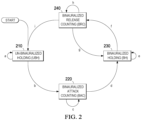
- the four-state state machine will be discussed further below with regards to FIG. 2 .
- the state will be changed to the BH 230 state [arrow d in FIG. 2 ]. Meanwhile, the state signal will be set to one and the accumulator will be reset.
- the long-term monitor While the last state is the BRC 240 state, the long-term monitor is active. The monitor checks if the most recent consecutive confidence values are all smaller than a confidence threshold T medianHigh . If any confidence value that is higher than or equal to T medianHigh appears, the state will change back to BH 230 [arrow g in FIG. 2 ] while the state signal is kept as one. In an embodiment, 20 seconds of recent consecutive confidence values are checked, though any other number of seconds is possible. In an embodiment, T medianHigh is 0.55, though any other proper fraction is possible.
- the state will change to UBH 210 [arrow i in FIG. 2 ]. Meanwhile, the state will be set to zero and the monitor will be reset.
- FIG. 3A shows example confidence values 330 over time.
- the confidence values 330 shown are smoothed confidence values, however they could be non-smoothed as well.
- the state signal 350 does not change from one to zero as soon as the confidence value 330 lowers, because the consecutive requirement of the long-term monitor corresponding to the BRC 240 state is not achieved and hence the state machine does not move to the UBH 210 state until later.
- the aim of the state signal 350 to prevent frequent switching between the binauralized and un-binauralized state is achieved.
- FIG. 3C shows an example steering signal 360 resulting from the example confidence values 330 of FIG. 3A and the example state signal 350 of FIG. 3B .
- the steering signal 360 steers the processing of the audio. If the steering signal 360 is zero, no processing occurs. Consequently, the audio input signal is outputted as is as the audio output signal. If the steering signal 360 is one, binauralization processing occurs by applying a head related transfer function, HRTF, on the audio input signal resulting in a binauralized audio signal as the audio output signal. If the steering signal 360 is between zero and one, a mix occurs, and a mixed audio signal is outputted as the audio output signal.
- a steering signal 360 between zero and one may e.g. be caused by an intermediate ramp between a zero and one state, to be discussed further below.
- the switching point of the steering signal 360 should not be selected during the dense and loud binauralized sound period, because immediately switching on/off the HRTF in that period would lead to an inconsistent listening experience.
- the step of determining a steering signal 360 like the example steering signal 360 in FIG. 3C thus comprises, beyond observing changes in the state signal 350, comparing the confidence value 330 of the current audio frame to a deactivation threshold, and comparing the energy value of the current audio frame to energy values of previous audio frames.
- the pre-determined set may e.g. be the most recent 24, 48 or 96 audio frames.
- the steering signal 360 is kept at its current value if the energy value of the current audio frame is equal to or above the energy value of 90 % of the most recent 48 audio frames.
- Other ratios such as 80%, 70%, etc., are possible, and also other counts of audio frames such as 10, 35, 42, etc.,.
- the example steering signal in FIG. 3C switches from one to zero.
- the switch is implemented by applying a ramp function.
- the steering signal 360 has a value between zero and one and thus leads to mixing the binauralized audio signal and the audio input signal into a mixed audio signal and setting the mixed audio signal as audio output signal. This further avoids abrupt changes to the binauralization that would lead to an inconsistent listening experience.
- the ramping may be implemented in that upon the steering signal 360 being changed to activate binauralization of audio, the step of generating the audio output signal comprises: for a first threshold period of time, mixing the binauralized audio signal and the audio input signal into a mixed audio signal and setting the mixed audio signal as audio output signal, wherein a portion of the binauralized audio signal in the mixed audio signal is gradually increased during the first threshold period, and wherein at an end of the first threshold period, the audio output signal comprises only the binauralized audio signal.
- the step of generating the audio output signal comprises setting the audio output signal as the audio input signal.
- the steering signal 360 will hold its last value.
- the audio output signal will be a mixed audio signal.
- the binauralized audio signal and the audio input signal are mixed as a linear combination with weights that sum to unity, wherein the weights depend on a value of the steering signal 360.
- the weight of the binauralized audio signal is higher than the weight of the audio input signal if the steering signal 360 is closer to one than zero, and vice versa.
- FIG. 4 shows a flowchart illustrating a method 400 for steering binauralization of audio.
- the method 400 comprises a number of steps, some of which are optional, and some may be performed in any order.
- the method 400 shown in FIG. 4 is an example embodiment and not intended to be limiting.
- the first step of the method 400 is a step of receiving 410 an audio input signal.
- the audio input signal may be any format and may be compressed and/or encrypted or not.
- the step of receiving 410 an audio input signal comprises decrypting any encrypted audio and/or uncompressing any compressed audio before any other step of the method 400 is performed.
- the audio input signal may comprise several channels of audio, some of which may comprise only binauralized sound, some of which may comprise only un-binauralized sound and some of which may comprise a mix of binauralized and un-binauralized sound.
- the audio input signal does not need to comprise both binauralized and un-binauralized sound, though the steering result will be very simple in any other case.
- the step of analyzing 420 an energy value of the audio input signal is optional and if included, this step 420 is performed before the step of determining 460 a steering signal.
- energy information may be extracted from another source, such as from metadata.
- Another step of the method 400 is a step of calculating 430 a confidence value indicating a likelihood that a current audio frame of the audio input signal comprises binauralized audio.
- This step 430 may be performed independently of the other steps of the method 400.
- This step 430 may further comprise the steps of: extracting features of the current audio frame of the audio input signal, the features of the audio input signal comprise at least one of inter-channel level differences, ICLDs, inter-channel phase differences, ICPDs, and inter-channel coherences, ICCs, and calculating the confidence value based on the extracted features; receiving features of a plurality of audio frames of the audio input signal previous to the current audio frame, the features corresponding to the extracted features of the current audio frame; applying weights to the features of the current and the plurality of previous audio frames of the audio input signal, wherein the weight applied to the features of the current audio frame is larger than the weights applied to the features of the plurality of previous audio frames, and calculating the confidence value based on the weighted features.
- This step 430 may further comprise applying weights to the features of the current and the plurality of previous audio frames of the audio input signal according to an asymmetric window function, wherein the asymmetric window may be a first half of a Hamming window.
- This step 430 may further comprise accumulating the features of the current and a pre-determined number of previous audio frames of the audio input signal into a weighted histogram that weights each sub-band used to calculate the features according to the total energy in that sub-band, and calculating the confidence value based on the mean value or standard variation of the weighted histogram.
- This step 430 may further comprise inputting the weighted features of the current and the plurality of previous audio frames of the audio input signal, into a machine learning classifier, wherein the machine learning classifier is trained to output a confidence value based on the input.
- Another step of the method 400 is a step of smoothing 440 the confidence value into a smoothed confidence value.
- This step 440 is optional and if included, this step 440 is performed as a part of the step of calculating 430 a confidence value, however the steps 430, 440 may be implemented by different circuits/units. As a result, this step 440 may be performed independently of the steps of the method 400 other than the step of calculating 430 a confidence value.
- This step 440 may comprise receiving a confidence value of an audio frame immediately preceding the current audio frame; and adjusting the confidence value of the current audio frame using a one-pole filter wherein the confidence value of the current audio frame and the confidence value of an audio frame immediately preceding the current audio frame are inputs to the one-pole filter and the adjusted confidence value is an output from the one-pole filter.
- This step 440 may further comprise the one-pole filter having a smoothing time lower than a smoothing threshold, wherein the smoothing threshold is determined based on an RC time constant.
- Another step of the method 400 is a step of determining 450 a state signal based on the confidence value.
- the state signal is a binary function with the range of zero to one.
- the value of the state signal being zero indicates that the audio input signal comprises an un-binauralized state while the value of the state signal being one indicates that the audio input signal comprises a binauralized state.
- Another step of the method 400 is a step of determining 460 a steering signal based on: the energy value of the audio frame analyzed in the step of analyzing 420 an energy value of the audio input signal or received through other means; the confidence value calculated in the step of calculating 430 a confidence value and/or the step of smoothing 440 the confidence value, depending on whether the step of smoothing 440 the confidence value has occurred; and the state signal determined in the step of determining 450 a state signal.
- the steering signal steers the step of generating 470 an audio output signal. If the steering signal is zero, the binauralization of audio is deactivated or reduced. If the steering signal is one, the binauralization of audio is activated. If the steering signal is between zero and one, a mix occurs.
- the step of generating 470 an audio output signal may or may not be performed in conjunction with the step of determining 460 a steering signal and may or may not be performed by the same circuit.
- FIG. 5 shows a mobile device architecture for implementing the features and processes described in reference to FIGS. 1-4 , according to an embodiment.
- Architecture 500 may be implemented in any electronic device, including but not limited to: a desktop computer, consumer audio/visual, AV, equipment, radio broadcast equipment or mobile devices [e.g., smartphone, tablet computer, laptop computer or wearable device].
- architecture 500 is for a smart phone and includes processor[s] 501, peripherals interface 502, audio subsystem 503, loudspeakers 504, microphone 505, sensors 506 [e.g., accelerometers, gyros, barometer, magnetometer, camera], location processor 507 [e.g., GNSS receiver], wireless communications subsystems 508 [e.g., Wi-Fi, Bluetooth, cellular] and I/O subsystem[s] 509, which includes touch controller 510 and other input controllers 511, touch surface 512 and other input/control devices 513.
- processor[s] 501 includes processor[s] 501, peripherals interface 502, audio subsystem 503, loudspeakers 504, microphone 505, sensors 506 [e.g., accelerometers, gyros, barometer, magnetometer, camera], location processor 507 [e.g., GNSS receiver], wireless communications subsystems 508 [e.g., Wi-Fi, Bluetooth, cellular] and I/O subsystem[s] 509, which includes touch controller 510
- Memory interface 514 is coupled to processors 501, peripherals interface 502 and memory 515 [e.g., flash, RAM, ROM].
- Memory 515 stores computer program instructions and data, including but not limited to: operating system instructions 516, communication instructions 517, GUI instructions 518, sensor processing instructions 519, phone instructions 520, electronic messaging instructions 521, web browsing instructions 522, audio processing instructions 523, GNSS/navigation instructions 524 and applications/data 525.
- Audio processing instructions 523 include instructions for performing the audio processing described in reference to FIGS. 1-4 .
- Portions of the adaptive audio system may include one or more networks that comprise any desired number of individual machines, including one or more routers [not shown] that serve to buffer and route the data transmitted among the computers.
- Such a network may be built on various different network protocols, and may be the Internet, a Wide Area Network, WAN, a Local Area Network, LAN, or any combination thereof.
- One or more of the components, blocks, processes or other functional components may be implemented through a computer program that controls execution of a processor-based computing device of the system. It should also be noted that the various functions disclosed herein may be described using any number of combinations of hardware, firmware, and/or as data and/or instructions embodied in various machine-readable or computer-readable media, in terms of their behavioral, register transfer, logic component, and/or other characteristics.
- Computer-readable media in which such formatted data and/or instructions may be embodied include, but are not limited to, physical [non-transitory], non-volatile storage media in various forms, such as optical, magnetic or semiconductor storage media.
- the systems and methods disclosed hereinabove may be implemented as software, firmware, hardware or a combination thereof.
- aspects of the present application may be embodied, at least in part, in an apparatus, a system that includes more than one device, a method, a computer program product, etc.
- the division of tasks between functional units referred to in the above description does not necessarily correspond to the division into physical units; to the contrary, one physical component may have multiple functionalities, and one task may be carried out by several physical components in cooperation.
- Certain components or all components may be implemented as software executed by a digital signal processor or microprocessor or be implemented as hardware or as an application-specific integrated circuit.
- Such software may be distributed on computer readable media, which may comprise computer storage media [or non-transitory media] and communication media [or transitory media].
- computer storage media includes both volatile and non-volatile, removable and non-removable media implemented in any method or technology for storage of information such as computer readable instructions, data structures, program modules or other data.
- Computer storage media includes, but is not limited to, RAM, ROM, EEPROM, flash memory or other memory technology, CD-ROM, digital versatile disks, DVDs, or other optical disk storage, magnetic cassettes, magnetic tape, magnetic disk storage or other magnetic storage devices, or any other medium which can be used to store the desired information, and which can be accessed by a computer.
- communication media typically embodies computer readable instructions, data structures, program modules or other data in a modulated data signal such as a carrier wave or other transport mechanism and includes any information delivery media.
Landscapes
- Physics & Mathematics (AREA)
- Engineering & Computer Science (AREA)
- Acoustics & Sound (AREA)
- Signal Processing (AREA)
- Stereophonic System (AREA)
Applications Claiming Priority (5)
| Application Number | Priority Date | Filing Date | Title |
|---|---|---|---|
| CN2019101291 | 2019-08-19 | ||
| US201962896321P | 2019-09-05 | 2019-09-05 | |
| EP19218142 | 2019-12-19 | ||
| US202062956424P | 2020-01-02 | 2020-01-02 | |
| PCT/US2020/047079 WO2021034983A2 (en) | 2019-08-19 | 2020-08-19 | Steering of binauralization of audio |
Publications (2)
| Publication Number | Publication Date |
|---|---|
| EP4018686A2 EP4018686A2 (en) | 2022-06-29 |
| EP4018686B1 true EP4018686B1 (en) | 2024-07-10 |
Family
ID=72235024
Family Applications (1)
| Application Number | Title | Priority Date | Filing Date |
|---|---|---|---|
| EP20761482.7A Active EP4018686B1 (en) | 2019-08-19 | 2020-08-19 | Steering of binauralization of audio |
Country Status (5)
| Country | Link |
|---|---|
| US (1) | US11895479B2 (https=) |
| EP (1) | EP4018686B1 (https=) |
| JP (1) | JP7586573B2 (https=) |
| CN (1) | CN114503607B (https=) |
| WO (1) | WO2021034983A2 (https=) |
Families Citing this family (2)
| Publication number | Priority date | Publication date | Assignee | Title |
|---|---|---|---|---|
| CN113299299B (zh) * | 2021-05-22 | 2024-03-19 | 深圳市健成云视科技有限公司 | 音频处理设备、方法及计算机可读存储介质 |
| TWI801217B (zh) * | 2022-04-25 | 2023-05-01 | 華碩電腦股份有限公司 | 訊號異常檢測系統及其方法 |
Family Cites Families (15)
| Publication number | Priority date | Publication date | Assignee | Title |
|---|---|---|---|---|
| US8045840B2 (en) | 2004-11-19 | 2011-10-25 | Victor Company Of Japan, Limited | Video-audio recording apparatus and method, and video-audio reproducing apparatus and method |
| WO2008069593A1 (en) * | 2006-12-07 | 2008-06-12 | Lg Electronics Inc. | A method and an apparatus for processing an audio signal |
| EP2831873B1 (en) | 2012-03-29 | 2020-10-14 | Nokia Technologies Oy | A method, an apparatus and a computer program for modification of a composite audio signal |
| WO2014177202A1 (en) | 2013-04-30 | 2014-11-06 | Huawei Technologies Co., Ltd. | Audio signal processing apparatus |
| US10231056B2 (en) | 2014-12-27 | 2019-03-12 | Intel Corporation | Binaural recording for processing audio signals to enable alerts |
| US9769574B2 (en) | 2015-02-24 | 2017-09-19 | Oticon A/S | Hearing device comprising an anti-feedback power down detector |
| US20180249277A1 (en) | 2015-09-18 | 2018-08-30 | Sennheiser Electronic Gmbh & Co. Kg | Method of Stereophonic Recording and Binaural Earphone Unit |
| KR20170125660A (ko) | 2016-05-04 | 2017-11-15 | 가우디오디오랩 주식회사 | 오디오 신호 처리 방법 및 장치 |
| US10089063B2 (en) * | 2016-08-10 | 2018-10-02 | Qualcomm Incorporated | Multimedia device for processing spatialized audio based on movement |
| CN109891913B (zh) | 2016-08-24 | 2022-02-18 | 领先仿生公司 | 用于通过保留耳间水平差异来促进耳间水平差异感知的系统和方法 |
| EP3529999A4 (en) | 2016-11-17 | 2019-11-13 | Samsung Electronics Co., Ltd. | SYSTEM AND METHOD FOR PRODUCING AUDIO DATA FOR A HEAD-MOUNTED DISPLAY DEVICE |
| GB2562518A (en) * | 2017-05-18 | 2018-11-21 | Nokia Technologies Oy | Spatial audio processing |
| US10244342B1 (en) | 2017-09-03 | 2019-03-26 | Adobe Systems Incorporated | Spatially representing graphical interface elements as binaural audio content |
| FR3075443A1 (fr) * | 2017-12-19 | 2019-06-21 | Orange | Traitement d'un signal monophonique dans un decodeur audio 3d restituant un contenu binaural |
| CN112075092B (zh) | 2018-04-27 | 2021-12-28 | 杜比实验室特许公司 | 经双耳化立体声内容的盲检测 |
-
2020
- 2020-08-19 WO PCT/US2020/047079 patent/WO2021034983A2/en not_active Ceased
- 2020-08-19 EP EP20761482.7A patent/EP4018686B1/en active Active
- 2020-08-19 JP JP2022509676A patent/JP7586573B2/ja active Active
- 2020-08-19 US US17/637,446 patent/US11895479B2/en active Active
- 2020-08-19 CN CN202080066026.XA patent/CN114503607B/zh active Active
Also Published As
| Publication number | Publication date |
|---|---|
| CN114503607B (zh) | 2024-01-02 |
| CN114503607A (zh) | 2022-05-13 |
| JP2022544795A (ja) | 2022-10-21 |
| US11895479B2 (en) | 2024-02-06 |
| WO2021034983A2 (en) | 2021-02-25 |
| EP4018686A2 (en) | 2022-06-29 |
| WO2021034983A3 (en) | 2021-04-01 |
| JP7586573B2 (ja) | 2024-11-19 |
| US20220279300A1 (en) | 2022-09-01 |
Similar Documents
| Publication | Publication Date | Title |
|---|---|---|
| JP7150939B2 (ja) | ボリューム平準化器コントローラおよび制御方法 | |
| Wichern et al. | Wham!: Extending speech separation to noisy environments | |
| CN107731238B (zh) | 多声道信号的编码方法和编码器 | |
| CN108899044B (zh) | 语音信号处理方法及装置 | |
| EP3785453B1 (en) | Blind detection of binauralized stereo content | |
| CN114203163A (zh) | 音频信号处理方法及装置 | |
| CN108922553B (zh) | 用于音箱设备的波达方向估计方法及系统 | |
| CN105074822A (zh) | 用于音频分类和处理的装置和方法 | |
| CN112470219B (zh) | 压缩机目标曲线以避免增强噪声 | |
| EP4018686B1 (en) | Steering of binauralization of audio | |
| WO2024168003A1 (en) | Dialog intelligibility enhancement method and system | |
| CN120359567A (zh) | 基于音频内容类型识别的音频场景分析 | |
| US10771913B2 (en) | Determining sound locations in multi-channel audio | |
| CN115713946B (zh) | 人声定位方法及电子设备和存储介质 | |
| EP3573352A1 (en) | Data processing device and data processing method | |
| EP4278350A1 (en) | Detection and enhancement of speech in binaural recordings | |
| US10902864B2 (en) | Mixed-reality audio intelligibility control | |
| CN112053669A (zh) | 一种人声消除方法、装置、设备及介质 | |
| US12300259B2 (en) | Automatic classification of audio content as either primarily speech or primarily non-speech, to facilitate dynamic application of dialogue enhancement | |
| US11929091B2 (en) | Blind detection of binauralized stereo content | |
| CN116745844A (zh) | 双耳录音中语音的检测和增强 | |
| CN117859176A (zh) | 检测用户生成内容中的环境噪声 | |
| HK40040917A (en) | Blind detection of binauralized stereo content | |
| HK40040917B (en) | Blind detection of binauralized stereo content |
Legal Events
| Date | Code | Title | Description |
|---|---|---|---|
| STAA | Information on the status of an ep patent application or granted ep patent |
Free format text: STATUS: UNKNOWN |
|
| STAA | Information on the status of an ep patent application or granted ep patent |
Free format text: STATUS: THE INTERNATIONAL PUBLICATION HAS BEEN MADE |
|
| PUAI | Public reference made under article 153(3) epc to a published international application that has entered the european phase |
Free format text: ORIGINAL CODE: 0009012 |
|
| STAA | Information on the status of an ep patent application or granted ep patent |
Free format text: STATUS: REQUEST FOR EXAMINATION WAS MADE |
|
| 17P | Request for examination filed |
Effective date: 20220321 |
|
| AK | Designated contracting states |
Kind code of ref document: A2 Designated state(s): AL AT BE BG CH CY CZ DE DK EE ES FI FR GB GR HR HU IE IS IT LI LT LU LV MC MK MT NL NO PL PT RO RS SE SI SK SM TR |
|
| DAV | Request for validation of the european patent (deleted) | ||
| DAX | Request for extension of the european patent (deleted) | ||
| P01 | Opt-out of the competence of the unified patent court (upc) registered |
Effective date: 20230417 |
|
| GRAP | Despatch of communication of intention to grant a patent |
Free format text: ORIGINAL CODE: EPIDOSNIGR1 |
|
| STAA | Information on the status of an ep patent application or granted ep patent |
Free format text: STATUS: GRANT OF PATENT IS INTENDED |
|
| INTG | Intention to grant announced |
Effective date: 20240220 |
|
| GRAS | Grant fee paid |
Free format text: ORIGINAL CODE: EPIDOSNIGR3 |
|
| GRAA | (expected) grant |
Free format text: ORIGINAL CODE: 0009210 |
|
| STAA | Information on the status of an ep patent application or granted ep patent |
Free format text: STATUS: THE PATENT HAS BEEN GRANTED |
|
| AK | Designated contracting states |
Kind code of ref document: B1 Designated state(s): AL AT BE BG CH CY CZ DE DK EE ES FI FR GB GR HR HU IE IS IT LI LT LU LV MC MK MT NL NO PL PT RO RS SE SI SK SM TR |
|
| REG | Reference to a national code |
Ref country code: CH Ref legal event code: EP |
|
| REG | Reference to a national code |
Ref country code: DE Ref legal event code: R096 Ref document number: 602020033777 Country of ref document: DE |
|
| REG | Reference to a national code |
Ref country code: LT Ref legal event code: MG9D |
|
| REG | Reference to a national code |
Ref country code: NL Ref legal event code: MP Effective date: 20240710 |
|
| PG25 | Lapsed in a contracting state [announced via postgrant information from national office to epo] |
Ref country code: PT Free format text: LAPSE BECAUSE OF FAILURE TO SUBMIT A TRANSLATION OF THE DESCRIPTION OR TO PAY THE FEE WITHIN THE PRESCRIBED TIME-LIMIT Effective date: 20241111 |
|
| REG | Reference to a national code |
Ref country code: AT Ref legal event code: MK05 Ref document number: 1703091 Country of ref document: AT Kind code of ref document: T Effective date: 20240710 |
|
| PG25 | Lapsed in a contracting state [announced via postgrant information from national office to epo] |
Ref country code: NL Free format text: LAPSE BECAUSE OF FAILURE TO SUBMIT A TRANSLATION OF THE DESCRIPTION OR TO PAY THE FEE WITHIN THE PRESCRIBED TIME-LIMIT Effective date: 20240710 |
|
| PG25 | Lapsed in a contracting state [announced via postgrant information from national office to epo] |
Ref country code: PT Free format text: LAPSE BECAUSE OF FAILURE TO SUBMIT A TRANSLATION OF THE DESCRIPTION OR TO PAY THE FEE WITHIN THE PRESCRIBED TIME-LIMIT Effective date: 20241111 Ref country code: NL Free format text: LAPSE BECAUSE OF FAILURE TO SUBMIT A TRANSLATION OF THE DESCRIPTION OR TO PAY THE FEE WITHIN THE PRESCRIBED TIME-LIMIT Effective date: 20240710 |
|
| PG25 | Lapsed in a contracting state [announced via postgrant information from national office to epo] |
Ref country code: NO Free format text: LAPSE BECAUSE OF FAILURE TO SUBMIT A TRANSLATION OF THE DESCRIPTION OR TO PAY THE FEE WITHIN THE PRESCRIBED TIME-LIMIT Effective date: 20241010 |
|
| PG25 | Lapsed in a contracting state [announced via postgrant information from national office to epo] |
Ref country code: PL Free format text: LAPSE BECAUSE OF FAILURE TO SUBMIT A TRANSLATION OF THE DESCRIPTION OR TO PAY THE FEE WITHIN THE PRESCRIBED TIME-LIMIT Effective date: 20240710 Ref country code: GR Free format text: LAPSE BECAUSE OF FAILURE TO SUBMIT A TRANSLATION OF THE DESCRIPTION OR TO PAY THE FEE WITHIN THE PRESCRIBED TIME-LIMIT Effective date: 20241011 Ref country code: FI Free format text: LAPSE BECAUSE OF FAILURE TO SUBMIT A TRANSLATION OF THE DESCRIPTION OR TO PAY THE FEE WITHIN THE PRESCRIBED TIME-LIMIT Effective date: 20240710 |
|
| PG25 | Lapsed in a contracting state [announced via postgrant information from national office to epo] |
Ref country code: BG Free format text: LAPSE BECAUSE OF FAILURE TO SUBMIT A TRANSLATION OF THE DESCRIPTION OR TO PAY THE FEE WITHIN THE PRESCRIBED TIME-LIMIT Effective date: 20240710 |
|
| PG25 | Lapsed in a contracting state [announced via postgrant information from national office to epo] |
Ref country code: LV Free format text: LAPSE BECAUSE OF FAILURE TO SUBMIT A TRANSLATION OF THE DESCRIPTION OR TO PAY THE FEE WITHIN THE PRESCRIBED TIME-LIMIT Effective date: 20240710 |
|
| PG25 | Lapsed in a contracting state [announced via postgrant information from national office to epo] |
Ref country code: AT Free format text: LAPSE BECAUSE OF FAILURE TO SUBMIT A TRANSLATION OF THE DESCRIPTION OR TO PAY THE FEE WITHIN THE PRESCRIBED TIME-LIMIT Effective date: 20240710 Ref country code: IS Free format text: LAPSE BECAUSE OF FAILURE TO SUBMIT A TRANSLATION OF THE DESCRIPTION OR TO PAY THE FEE WITHIN THE PRESCRIBED TIME-LIMIT Effective date: 20241110 |
|
| PG25 | Lapsed in a contracting state [announced via postgrant information from national office to epo] |
Ref country code: HR Free format text: LAPSE BECAUSE OF FAILURE TO SUBMIT A TRANSLATION OF THE DESCRIPTION OR TO PAY THE FEE WITHIN THE PRESCRIBED TIME-LIMIT Effective date: 20240710 |
|
| PG25 | Lapsed in a contracting state [announced via postgrant information from national office to epo] |
Ref country code: RS Free format text: LAPSE BECAUSE OF FAILURE TO SUBMIT A TRANSLATION OF THE DESCRIPTION OR TO PAY THE FEE WITHIN THE PRESCRIBED TIME-LIMIT Effective date: 20241010 Ref country code: ES Free format text: LAPSE BECAUSE OF FAILURE TO SUBMIT A TRANSLATION OF THE DESCRIPTION OR TO PAY THE FEE WITHIN THE PRESCRIBED TIME-LIMIT Effective date: 20240710 |
|
| PG25 | Lapsed in a contracting state [announced via postgrant information from national office to epo] |
Ref country code: RS Free format text: LAPSE BECAUSE OF FAILURE TO SUBMIT A TRANSLATION OF THE DESCRIPTION OR TO PAY THE FEE WITHIN THE PRESCRIBED TIME-LIMIT Effective date: 20241010 Ref country code: PL Free format text: LAPSE BECAUSE OF FAILURE TO SUBMIT A TRANSLATION OF THE DESCRIPTION OR TO PAY THE FEE WITHIN THE PRESCRIBED TIME-LIMIT Effective date: 20240710 Ref country code: NO Free format text: LAPSE BECAUSE OF FAILURE TO SUBMIT A TRANSLATION OF THE DESCRIPTION OR TO PAY THE FEE WITHIN THE PRESCRIBED TIME-LIMIT Effective date: 20241010 Ref country code: LV Free format text: LAPSE BECAUSE OF FAILURE TO SUBMIT A TRANSLATION OF THE DESCRIPTION OR TO PAY THE FEE WITHIN THE PRESCRIBED TIME-LIMIT Effective date: 20240710 Ref country code: IS Free format text: LAPSE BECAUSE OF FAILURE TO SUBMIT A TRANSLATION OF THE DESCRIPTION OR TO PAY THE FEE WITHIN THE PRESCRIBED TIME-LIMIT Effective date: 20241110 Ref country code: HR Free format text: LAPSE BECAUSE OF FAILURE TO SUBMIT A TRANSLATION OF THE DESCRIPTION OR TO PAY THE FEE WITHIN THE PRESCRIBED TIME-LIMIT Effective date: 20240710 Ref country code: GR Free format text: LAPSE BECAUSE OF FAILURE TO SUBMIT A TRANSLATION OF THE DESCRIPTION OR TO PAY THE FEE WITHIN THE PRESCRIBED TIME-LIMIT Effective date: 20241011 Ref country code: FI Free format text: LAPSE BECAUSE OF FAILURE TO SUBMIT A TRANSLATION OF THE DESCRIPTION OR TO PAY THE FEE WITHIN THE PRESCRIBED TIME-LIMIT Effective date: 20240710 Ref country code: ES Free format text: LAPSE BECAUSE OF FAILURE TO SUBMIT A TRANSLATION OF THE DESCRIPTION OR TO PAY THE FEE WITHIN THE PRESCRIBED TIME-LIMIT Effective date: 20240710 Ref country code: BG Free format text: LAPSE BECAUSE OF FAILURE TO SUBMIT A TRANSLATION OF THE DESCRIPTION OR TO PAY THE FEE WITHIN THE PRESCRIBED TIME-LIMIT Effective date: 20240710 Ref country code: AT Free format text: LAPSE BECAUSE OF FAILURE TO SUBMIT A TRANSLATION OF THE DESCRIPTION OR TO PAY THE FEE WITHIN THE PRESCRIBED TIME-LIMIT Effective date: 20240710 |
|
| REG | Reference to a national code |
Ref country code: CH Ref legal event code: PL |
|
| REG | Reference to a national code |
Ref country code: DE Ref legal event code: R097 Ref document number: 602020033777 Country of ref document: DE |
|
| PG25 | Lapsed in a contracting state [announced via postgrant information from national office to epo] |
Ref country code: RO Free format text: LAPSE BECAUSE OF FAILURE TO SUBMIT A TRANSLATION OF THE DESCRIPTION OR TO PAY THE FEE WITHIN THE PRESCRIBED TIME-LIMIT Effective date: 20240710 Ref country code: SM Free format text: LAPSE BECAUSE OF FAILURE TO SUBMIT A TRANSLATION OF THE DESCRIPTION OR TO PAY THE FEE WITHIN THE PRESCRIBED TIME-LIMIT Effective date: 20240710 Ref country code: DK Free format text: LAPSE BECAUSE OF FAILURE TO SUBMIT A TRANSLATION OF THE DESCRIPTION OR TO PAY THE FEE WITHIN THE PRESCRIBED TIME-LIMIT Effective date: 20240710 |
|
| PG25 | Lapsed in a contracting state [announced via postgrant information from national office to epo] |
Ref country code: LU Free format text: LAPSE BECAUSE OF NON-PAYMENT OF DUE FEES Effective date: 20240819 |
|
| PG25 | Lapsed in a contracting state [announced via postgrant information from national office to epo] |
Ref country code: MC Free format text: LAPSE BECAUSE OF FAILURE TO SUBMIT A TRANSLATION OF THE DESCRIPTION OR TO PAY THE FEE WITHIN THE PRESCRIBED TIME-LIMIT Effective date: 20240710 Ref country code: EE Free format text: LAPSE BECAUSE OF FAILURE TO SUBMIT A TRANSLATION OF THE DESCRIPTION OR TO PAY THE FEE WITHIN THE PRESCRIBED TIME-LIMIT Effective date: 20240710 Ref country code: CH Free format text: LAPSE BECAUSE OF NON-PAYMENT OF DUE FEES Effective date: 20240831 |
|
| PG25 | Lapsed in a contracting state [announced via postgrant information from national office to epo] |
Ref country code: CZ Free format text: LAPSE BECAUSE OF FAILURE TO SUBMIT A TRANSLATION OF THE DESCRIPTION OR TO PAY THE FEE WITHIN THE PRESCRIBED TIME-LIMIT Effective date: 20240710 |
|
| PG25 | Lapsed in a contracting state [announced via postgrant information from national office to epo] |
Ref country code: SK Free format text: LAPSE BECAUSE OF FAILURE TO SUBMIT A TRANSLATION OF THE DESCRIPTION OR TO PAY THE FEE WITHIN THE PRESCRIBED TIME-LIMIT Effective date: 20240710 Ref country code: IT Free format text: LAPSE BECAUSE OF FAILURE TO SUBMIT A TRANSLATION OF THE DESCRIPTION OR TO PAY THE FEE WITHIN THE PRESCRIBED TIME-LIMIT Effective date: 20240710 |
|
| PLBE | No opposition filed within time limit |
Free format text: ORIGINAL CODE: 0009261 |
|
| STAA | Information on the status of an ep patent application or granted ep patent |
Free format text: STATUS: NO OPPOSITION FILED WITHIN TIME LIMIT |
|
| 26N | No opposition filed |
Effective date: 20250411 |
|
| REG | Reference to a national code |
Ref country code: BE Ref legal event code: MM Effective date: 20240831 |
|
| PG25 | Lapsed in a contracting state [announced via postgrant information from national office to epo] |
Ref country code: BE Free format text: LAPSE BECAUSE OF NON-PAYMENT OF DUE FEES Effective date: 20240831 |
|
| PG25 | Lapsed in a contracting state [announced via postgrant information from national office to epo] |
Ref country code: IE Free format text: LAPSE BECAUSE OF NON-PAYMENT OF DUE FEES Effective date: 20240819 |
|
| PG25 | Lapsed in a contracting state [announced via postgrant information from national office to epo] |
Ref country code: SE Free format text: LAPSE BECAUSE OF FAILURE TO SUBMIT A TRANSLATION OF THE DESCRIPTION OR TO PAY THE FEE WITHIN THE PRESCRIBED TIME-LIMIT Effective date: 20240710 |
|
| PGFP | Annual fee paid to national office [announced via postgrant information from national office to epo] |
Ref country code: DE Payment date: 20250724 Year of fee payment: 6 |
|
| PGFP | Annual fee paid to national office [announced via postgrant information from national office to epo] |
Ref country code: GB Payment date: 20250724 Year of fee payment: 6 |
|
| PGFP | Annual fee paid to national office [announced via postgrant information from national office to epo] |
Ref country code: FR Payment date: 20250723 Year of fee payment: 6 |
|
| PG25 | Lapsed in a contracting state [announced via postgrant information from national office to epo] |
Ref country code: CY Free format text: LAPSE BECAUSE OF FAILURE TO SUBMIT A TRANSLATION OF THE DESCRIPTION OR TO PAY THE FEE WITHIN THE PRESCRIBED TIME-LIMIT; INVALID AB INITIO Effective date: 20200819 |
|
| PG25 | Lapsed in a contracting state [announced via postgrant information from national office to epo] |
Ref country code: HU Free format text: LAPSE BECAUSE OF FAILURE TO SUBMIT A TRANSLATION OF THE DESCRIPTION OR TO PAY THE FEE WITHIN THE PRESCRIBED TIME-LIMIT; INVALID AB INITIO Effective date: 20200819 |