EP4017232B1 - Dispositif de dissipation de chaleur - Google Patents
Dispositif de dissipation de chaleur Download PDFInfo
- Publication number
- EP4017232B1 EP4017232B1 EP20899235.4A EP20899235A EP4017232B1 EP 4017232 B1 EP4017232 B1 EP 4017232B1 EP 20899235 A EP20899235 A EP 20899235A EP 4017232 B1 EP4017232 B1 EP 4017232B1
- Authority
- EP
- European Patent Office
- Prior art keywords
- housing
- sub
- heat dissipation
- screw rod
- dissipation device
- Prior art date
- Legal status (The legal status is an assumption and is not a legal conclusion. Google has not performed a legal analysis and makes no representation as to the accuracy of the status listed.)
- Active
Links
Images



Classifications
-
- H—ELECTRICITY
- H05—ELECTRIC TECHNIQUES NOT OTHERWISE PROVIDED FOR
- H05K—PRINTED CIRCUITS; CASINGS OR CONSTRUCTIONAL DETAILS OF ELECTRIC APPARATUS; MANUFACTURE OF ASSEMBLAGES OF ELECTRICAL COMPONENTS
- H05K7/00—Constructional details common to different types of electric apparatus
- H05K7/20—Modifications to facilitate cooling, ventilating, or heating
- H05K7/20009—Modifications to facilitate cooling, ventilating, or heating using a gaseous coolant in electronic enclosures
- H05K7/20127—Natural convection
-
- F—MECHANICAL ENGINEERING; LIGHTING; HEATING; WEAPONS; BLASTING
- F21—LIGHTING
- F21V—FUNCTIONAL FEATURES OR DETAILS OF LIGHTING DEVICES OR SYSTEMS THEREOF; STRUCTURAL COMBINATIONS OF LIGHTING DEVICES WITH OTHER ARTICLES, NOT OTHERWISE PROVIDED FOR
- F21V29/00—Protecting lighting devices from thermal damage; Cooling or heating arrangements specially adapted for lighting devices or systems
- F21V29/50—Cooling arrangements
- F21V29/70—Cooling arrangements characterised by passive heat-dissipating elements, e.g. heat-sinks
- F21V29/83—Cooling arrangements characterised by passive heat-dissipating elements, e.g. heat-sinks the elements having apertures, ducts or channels, e.g. heat radiation holes
-
- F—MECHANICAL ENGINEERING; LIGHTING; HEATING; WEAPONS; BLASTING
- F21—LIGHTING
- F21V—FUNCTIONAL FEATURES OR DETAILS OF LIGHTING DEVICES OR SYSTEMS THEREOF; STRUCTURAL COMBINATIONS OF LIGHTING DEVICES WITH OTHER ARTICLES, NOT OTHERWISE PROVIDED FOR
- F21V15/00—Protecting lighting devices from damage
- F21V15/01—Housings, e.g. material or assembling of housing parts
- F21V15/012—Housings with variable shape or dimensions, e.g. by means of elastically deformable materials or by movement of parts forming telescopic extensions of the housing body
-
- G—PHYSICS
- G06—COMPUTING OR CALCULATING; COUNTING
- G06F—ELECTRIC DIGITAL DATA PROCESSING
- G06F1/00—Details not covered by groups G06F3/00 - G06F13/00 and G06F21/00
- G06F1/16—Constructional details or arrangements
- G06F1/20—Cooling means
-
- G—PHYSICS
- G06—COMPUTING OR CALCULATING; COUNTING
- G06F—ELECTRIC DIGITAL DATA PROCESSING
- G06F1/00—Details not covered by groups G06F3/00 - G06F13/00 and G06F21/00
- G06F1/16—Constructional details or arrangements
- G06F1/20—Cooling means
- G06F1/203—Cooling means for portable computers, e.g. for laptops
-
- G—PHYSICS
- G06—COMPUTING OR CALCULATING; COUNTING
- G06F—ELECTRIC DIGITAL DATA PROCESSING
- G06F1/00—Details not covered by groups G06F3/00 - G06F13/00 and G06F21/00
- G06F1/16—Constructional details or arrangements
- G06F1/20—Cooling means
- G06F1/206—Cooling means comprising thermal management
-
- H—ELECTRICITY
- H05—ELECTRIC TECHNIQUES NOT OTHERWISE PROVIDED FOR
- H05K—PRINTED CIRCUITS; CASINGS OR CONSTRUCTIONAL DETAILS OF ELECTRIC APPARATUS; MANUFACTURE OF ASSEMBLAGES OF ELECTRICAL COMPONENTS
- H05K5/00—Casings, cabinets or drawers for electric apparatus
- H05K5/02—Details
- H05K5/0213—Venting apertures; Constructional details thereof
-
- H—ELECTRICITY
- H05—ELECTRIC TECHNIQUES NOT OTHERWISE PROVIDED FOR
- H05K—PRINTED CIRCUITS; CASINGS OR CONSTRUCTIONAL DETAILS OF ELECTRIC APPARATUS; MANUFACTURE OF ASSEMBLAGES OF ELECTRICAL COMPONENTS
- H05K5/00—Casings, cabinets or drawers for electric apparatus
- H05K5/02—Details
- H05K5/0213—Venting apertures; Constructional details thereof
- H05K5/0214—Venting apertures; Constructional details thereof with means preventing penetration of rain water or dust
-
- H—ELECTRICITY
- H05—ELECTRIC TECHNIQUES NOT OTHERWISE PROVIDED FOR
- H05K—PRINTED CIRCUITS; CASINGS OR CONSTRUCTIONAL DETAILS OF ELECTRIC APPARATUS; MANUFACTURE OF ASSEMBLAGES OF ELECTRICAL COMPONENTS
- H05K5/00—Casings, cabinets or drawers for electric apparatus
- H05K5/02—Details
- H05K5/0217—Mechanical details of casings
-
- H—ELECTRICITY
- H05—ELECTRIC TECHNIQUES NOT OTHERWISE PROVIDED FOR
- H05K—PRINTED CIRCUITS; CASINGS OR CONSTRUCTIONAL DETAILS OF ELECTRIC APPARATUS; MANUFACTURE OF ASSEMBLAGES OF ELECTRICAL COMPONENTS
- H05K7/00—Constructional details common to different types of electric apparatus
- H05K7/20—Modifications to facilitate cooling, ventilating, or heating
- H05K7/20009—Modifications to facilitate cooling, ventilating, or heating using a gaseous coolant in electronic enclosures
- H05K7/20136—Forced ventilation, e.g. by fans
-
- H—ELECTRICITY
- H05—ELECTRIC TECHNIQUES NOT OTHERWISE PROVIDED FOR
- H05K—PRINTED CIRCUITS; CASINGS OR CONSTRUCTIONAL DETAILS OF ELECTRIC APPARATUS; MANUFACTURE OF ASSEMBLAGES OF ELECTRICAL COMPONENTS
- H05K7/00—Constructional details common to different types of electric apparatus
- H05K7/20—Modifications to facilitate cooling, ventilating, or heating
- H05K7/20009—Modifications to facilitate cooling, ventilating, or heating using a gaseous coolant in electronic enclosures
- H05K7/20209—Thermal management, e.g. fan control
Definitions
- Embodiments of the present disclosure relate to the field of hardware equipment, and in particular, to a heat dissipation device.
- the novel outdoor electronic device box comprises an outer box body, an inner box body and a lifting mechanism.
- the inner box body is sleeved with an outer box body capable of sliding up and down, the lifting mechanism driving the outer box body to move up and down is arranged on the inner box body, a threading hole is formed in the bottom of the inner box body, and a box door capable of achieving opening and closing is arranged on the widest outer side face of the inner box body;
- the outer box body comprises a main body and a box cover arranged at the upper end of the main body, the main body comprises a first groove, a second groove, two inserting bodies and two inserting grooves, the inserting bodies are arranged at the lower end of a front body of the first groove and the upper end of a back body of the second groove, and the inserting grooves are formed in the lower end of a back body of the first groove and the upper end of a front body of the second groove.
- Embodiments of the present disclosure provide a heat dissipation device, to solve at least to some extent one of the related technical problems including a problem that in some cases a heat dissipation manner in which small holes are opened at the bottom and the top of an apparatus to allow cold air to be sucked in from the bottom and discharged from the top through convection to implement heat exchange has low heat dissipation efficiency.
- a heat dissipation device includes a housing.
- the housing includes a first sub-housing and a second sub-housing, the second sub-housing is adjacent to a bottom of the heat dissipation device, and the first sub-housing is adjacent to a top of the heat dissipation device.
- One or more holes are provided in a part of the second sub-housing that is overlapping the first sub-housing, the first sub-housing and the second sub-housing are capable of relative movement, and the relative movement is capable of exposing the one or more holes provided in the second sub-housing to form an air duct.
- 5G technology can bring users better user experience with transmission rates much higher than those of previous cellular networks, which may be up to 10 Gbit/s.
- Another advantage of 5G technology is low network latency and faster response speed. Due to outstanding advantages, 5G technology can meet application scenarios of large data transmission such as high-definition videos and virtual reality as well as low latency scenarios such as autonomous driving and telemedicine.
- the implementation of 5G places higher demands on hardware systems. High rates, low latency, multiple antennas, and other needs put more demanding requirements on heat generation scenarios of hardware.
- Current 4G terminals have relatively low power consumption because of low rates. In the 5G era, as the sizes of terminals remain unchanged, the power consumption of the terminals has increased significantly.
- innovative solutions are required for heat dissipation to meet normal operation conditions of various components of terminal products, so that the products can function normally and provide satisfying experience for users.
- the starting point of the embodiments of the present disclosure is based on the principle of heat dissipation through convection.
- An active convection air duct design is added without affecting the appearance, to allow a convection heat dissipation air duct of a product to make an adjustment according to a heat generation state of the product, and the air duct is designed to be as much as possible near components with high heat generation, thereby strengthening the air convection effect in key areas, shortening the length of the air duct to reduce the fan wind resistance, and optimizing the heat generation state of the product in different states, so as to maximize the hardware performance of the product and improve the performance of the product to meet user experience requirements of 5G products.
- heat dissipation device in the embodiments of the present disclosure is applicable to, in addition to 5G products, products and equipment that require heat dissipation in other application scenarios, for example, 4G-related products and equipment, other communication equipment, and hardware equipment such as computer equipment.
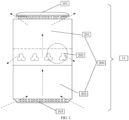
- FIG. 2 is a schematic structural diagram of a heat dissipation device according to an embodiment of the present disclosure.
- the heat dissipation device 11 includes a housing 200.
- the housing 200 includes a first sub-housing 201 and a second sub-housing 203.
- the second sub-housing 203 is adjacent to the bottom of the heat dissipation device 11, and the first sub-housing 201 is adjacent to the top of the heat dissipation device 11.
- One or more holes 202 are provided in a part of the second sub-housing 203 overlapping the first sub-housing 201, and the first sub-housing 201 and the second sub-housing 203 are capable of relative movement.
- the relative movement is capable of exposing the one or more holes 202 provided in the second sub-housing 203 to form an air duct.
- the housing 200 may be provided surrounding an apparatus to be subjected to heat dissipation.
- the apparatus to be subjected to heat dissipation includes a bottom cover 103 at the bottom of the apparatus and a top cover 101 provided at the top of the apparatus. Air convection is formed between a hole provided in a groove at the bottom cover 103 and a hole provided in the top cover.
- the one or more holes 202 are provided in the part of the second sub-housing 203 overlapping the first sub-housing 201, in response to the relative movement between the first sub-housing 201 and the second sub-housing 203, the one or more holes 202 provided in the second sub-housing 203 may be exposed to form the air duct, so that the heat dissipation efficiency for the apparatus is improved, thereby solving the problem that in some cases a heat dissipation manner in which small holes are opened at the bottom and the top of the apparatus to allow cold air to be sucked in from the bottom and discharged from the top through convection to implement heat exchange has low heat dissipation efficiency.
- first sub-housing 201 and the second sub-housing 203 in the housing 200 of the heat dissipation device 11 in FIG. 2 may be integrally provided, that is, the housing of the entire heat dissipation device 11 is formed by one first sub-housing 201 and one second sub-housing 203, certainly, sub-housings that are not integrally provided may be used.
- first sub-housing 201 and a separate second sub-housing 203 are provided on every side, or the first sub-housing 201 and the second sub-housing 203 are only provided on one or more sides instead of that the first sub-housings 201 and the second sub-housings 203 are provided on all sides.
- the shape of the one or more holes 202 in FIG. 2 is merely an example, and another shape may be used.
- the one or more holes 202 may be one or more circular holes or one or more rectangular holes. The shape of the one or more holes 202 may be adjusted according to an actual requirement, and is not limited in the embodiments of the present disclosure.
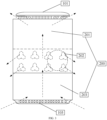
- FIG. 2 only shows that there is only one row of holes 202 in the second sub-housing 203. This is merely an example for description. The quantity of holes and the quantity of rows of holes may be set according to an actual requirement. As shown in FIG. 3 , two rows of holes 202 are provided in the second sub-housing 203.
- the one or more holes 202 in the second sub-housing 203 are provided in an area with relatively high heat generation of the apparatus, for example, a chip area.
- a dashed circle corresponds to an area with relatively high heat generation of the apparatus.
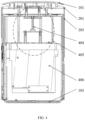
- the heat dissipation device further includes a mainboard support 405.
- the mainboard support 405 is assembled in the second sub-housing 203 from the bottom of the heat dissipation device.
- the first sub-housing 201 is assembled in the second sub-housing 203 from the top of the heat dissipation device and is guided against an outer side wall of the second sub-housing 203.
- the mainboard support 405 is electrically connected to a mainboard 406 of the apparatus to be subjected to heat dissipation by a lead.
- a screw rod 404 is provided on the mainboard support 405, and a screw rod sleeve 502 is provided on the screw rod 404.
- the screw rod 404 is fixedly connected to the mainboard support 405.
- the first sub-housing 201 is fixedly connected to the screw rod sleeve 502 of the screw rod 404.
- the manner of fixed connection may be a screw.
- Rotation of the screw rod 404 is capable of driving the screw rod sleeve 502 to perform a reciprocating movement, and the reciprocating movement of the screw rod sleeve 502 drives the relative movement between the first sub-housing 201 and the second sub-housing 203.
- the heat dissipation device 11 further includes a drive motor.
- the drive motor is configured to receive a control instruction to drive the screw rod 404 to perform the rotation.
- a first control instruction is sent to the drive motor in response to a temperature of the apparatus to be subjected to heat dissipation placed in the housing 200 exceeding a first preset threshold.
- the first control instruction is configured to instruct the drive motor to drive the screw rod 404 to perform the rotation to bring about the relative movement between the first sub-housing 201 and the second sub-housing 203, to expose the one or more holes provided in the second sub-housing 203 to form the air duct.
- a second control instruction is sent to the drive motor in response to the temperature of the apparatus to be subjected to heat dissipation placed in the housing 200 being lower than a second preset threshold.
- the second control instruction is configured to instruct the drive motor to drive the screw rod 404 to perform the rotation to bring about the relative movement between the first sub-housing 201 and the second sub-housing 203, to cause the first sub-housing 201 to cover the one or more holes 202 in the second sub-housing 203.
- a temperature sensor inside a component detects an operating temperature at a critical position inside the component.
- the system keeps a current state and continuously runs.
- the system drives the motor to bring about the relative movement between the first sub-housing 201 and the second sub-housing 203 to expose the one or more holes 202 provided in advance to form the air duct to accelerate heat dissipation, thereby ensuring reliable operation. Meanwhile, temperature detection is continuously performed.
- the system drives the motor to further drive the first sub-housing 201 to perform opposite movement relative to the second sub-housing 203, so that the first sub-housing 201 covers the one or more holes 202 in the second sub-housing 203, thereby closing the air duct and keeping continuous operation of the system.
- temperature detection remains in an operating state.
- a motor mechanism detects the position of the air duct, and the system is turned off after the air duct is closed.
- the first sub-housing 201 and the second sub-housing 203 are slid apart from each other by the motor under the control of a driver, to expose the one or more holes 202 for heat dissipation of the chip area.
- Cold air can quickly reach a heat generation area of a chip of the mainboard under the action of a fan to form convection cooling.
- the driver controls the motor to pull the first sub-housing 201 and the second sub-housing 203 to return to an original state to ensure the original appearance, to avoid the impact of dust or the like because heat dissipation holes are exposed for a long time, thereby meeting an active heat dissipation requirement of the apparatus.
- the apparatus may be a 5G apparatus or other hardware equipment, so that the heat dissipation performance of a component under a critical operation condition is greatly improved, thereby improving user experience.
- a buckle 503 is provided on the first sub-housing.
- the buckle 503 is connected to the first sub-housing 201 and the second sub-housing 203.
- the first sub-housing 201 in response to the first sub-housing 201 moving under the drive of the screw rod 404 and the sleeve 502, in one aspect, the first sub-housing 201 is limited by a stroke of the screw rod 404, and in another aspect, a buckle 503 is used to ensure that during the movement of the first sub-housing 201 and the second sub-housing 203, the second sub-housing 203 and the first sub-housing 201 are prevented from being detached under an external force, thereby improving the assembly reliability of the entire machine.
- a hole is provided in the first sub-housing 201.
- a fixture is used to pry open the buckle through the position of the hole, thereby separating the second sub-housing 203 and the first sub-housing 201 to repair the entire machine.
- the first sub-housing 201 and the screw rod sleeve 502 are fixed by a screw 501.
- the screw rod 404 and the mainboard support 405 are fixed by a screw 504.
- a fan 601 is further provided on the mainboard support 405.
- An air duct of the fan 601 is consistent with the air duct formed by exposing the one or more holes 202 provided in the second sub-housing 203 through the relative movement.
- the screw rod 404 drives the first sub-housing 201 to slide relative to the second sub-housing 203 to expose the one or more holes 202 provided in advance.
- the exposed one or more holes 202 form the air duct to allow cold air to be effectively provided, so that the cold air can quickly reach a heat dissipation fin area, the air duct of the fan 601 is shortened, and the air pressure is reduced, thereby improving the efficiency of the fan 601 and extending the service life of the fan 601.
- the position of the fan in the embodiments of the present disclosure may be adjusted and set according to the solution design and thermal design of a product.
- a sleeve guide rail 701 is provided on the mainboard support 405.
- a first magnet 702 and a second magnet 703 are provided inside the sleeve guide rail 701.
- the first magnet 702 is provided at an end in the sleeve guide rail adjacent to the mainboard support 405, and the second magnet 703 is provided at an end in the sleeve guide rail away from the mainboard support 405.
- the mainboard support 405 is fixedly connected to the first sub-housing 201.
- the first magnet 702 may be a permanent magnet
- the second magnet 703 may be an electromagnet.
- the electromagnet is energized to adjust the magnetic poles of the electromagnet to cause the electromagnet and the permanent magnet to attract each other or repel each other to cause the mainboard support 405 to perform relative movement, so as to bring about the relative movement between the first sub-housing 201 and the second sub-housing 203.
- the one or more holes are provided in the part of the second sub-housing overlapping the first sub-housing, after the relative movement between the first sub-housing and the second sub-housing, the one or more holes provided in the second sub-housing may be exposed to form the air duct, so that the heat dissipation efficiency for the apparatus is improved, thereby solving the problem that in some cases a heat dissipation manner in which small holes are opened at the bottom and the top of the apparatus to allow cold air to be sucked in from the bottom and discharged from the top through convection to implement heat exchange has low heat dissipation efficiency.
Landscapes
- Engineering & Computer Science (AREA)
- Microelectronics & Electronic Packaging (AREA)
- General Engineering & Computer Science (AREA)
- Physics & Mathematics (AREA)
- Theoretical Computer Science (AREA)
- Human Computer Interaction (AREA)
- General Physics & Mathematics (AREA)
- Thermal Sciences (AREA)
- Computer Hardware Design (AREA)
- Cooling Or The Like Of Electrical Apparatus (AREA)
Claims (6)
- Dispositif de dissipation de chaleur (11), comprenant un boîtier (200) et un support de carte mère (405), dans lequel :le boîtier (200) comprend un premier sous-boîtier (201) et un deuxième sous-boîtier (203), le deuxième sous-boîtier (203) est configuré pour être adjacent à un fond du dispositif de dissipation de chaleur (11), et le premier sous-boîtier (201) est configuré pour être adjacent à un dessus du dispositif de dissipation de chaleur (11) ; etun ou plusieurs trous (202) sont prévus dans une partie du deuxième sous-boîtier (203) chevauchant le premier sous-boîtier (201), le premier sous-boîtier (201) et le deuxième sous-boîtier (203) sont capables de mouvement relatif, et le mouvement relatif est capable d'exposer l'un ou plusieurs trous (202) prévus dans le deuxième sous-boîtier (203) pour former un conduit d'air ;dans lequel le support de carte mère (405) est assemblé dans le deuxième sous-boîtier (203) à partir du fond du dispositif de dissipation de chaleur (11) ; le premier sous-boîtier (201) est assemblé dans le deuxième sous-boîtier (203) depuis le dessus du dispositif de dissipation de chaleur (11) et est guidé contre une paroi latérale externe du deuxième sous-boîtier (203) ; et le support de carte mère (405) est relié électriquement par un fil à une carte mère (406) d'un appareil devant être soumis à une dissipation de chaleur ;caractérisé en ce que,une tige filetée (404) est prévue sur le support de carte mère (405), et un manchon de tige filetée (502) est prévu sur la tige filetée (404) ; la tige filetée (404) est reliée de manière fixe au support de carte mère (405) ; le premier sous-boîtier (201) est relié de manière fixe au manchon de tige filetée (502) de la tige filetée (404) ; etla rotation de la tige filetée (404) est capable d'entraîner le manchon de tige filetée (502) pour effectuer un mouvement alternatif, et le mouvement alternatif du manchon de tige filetée (502) entraîne le mouvement relatif entre le premier sous-boîtier (201) et le deuxième sous-boîtier (203).
- Dispositif de dissipation de chaleur (11) de la revendication 1, comprenant en outre un moteur d'entraînement, dans lequel :
le moteur d'entraînement est configuré pour recevoir une instruction de commande pour entraîner la tige filetée (404) pour effectuer la rotation. - Dispositif de dissipation de chaleur (11) de la revendication 2, dans lequel :une première instruction de commande est envoyée au moteur d'entraînement en réponse à une température de l'appareil devant être soumis à une dissipation de chaleur placé dans le boîtier (200) dépassant un premier seuil prédéfini, dans lequel la première instruction de commande est configurée pour commander au moteur d'entraînement d'entraîner la tige filetée (404) pour effectuer la rotation afin de provoquer le mouvement relatif entre le premier sous-boîtier (201) et le deuxième sous-boîtier (203), pour exposer l'un ou plusieurs trous (202) prévus dans le deuxième sous-boîtier (203) pour former le conduit d'air ; etune deuxième instruction de commande est envoyée au moteur d'entraînement en réponse à la température de l'appareil devant être soumis à une dissipation de chaleur placé dans le boîtier (200) étant inférieure à un deuxième seuil prédéfini, dans lequel la deuxième instruction de commande est configurée pour commander au moteur d'entraînement d'entraîner la tige filetée (404) pour effectuer la rotation afin de provoquer le mouvement relatif entre le premier sous-boîtier (201) et le deuxième sous-boîtier (203), pour amener le premier sous-boîtier (201) à couvrir l'un ou plusieurs trous (202) dans le deuxième sous-boîtier (203).
- Dispositif de dissipation de chaleur (11) selon la revendication 1, dans lequel une boucle (503) est prévue sur le premier sous-boîtier (201), et la boucle (503) est reliée au premier sous-boîtier (201) et au deuxième sous-boîtier (203).
- Dispositif de dissipation de chaleur (11) de la revendication 1, dans lequel un ventilateur (601) est en outre prévu sur le support de carte mère (405), et un conduit d'air du ventilateur (601) est compatible avec le conduit d'air formé en exposant l'un ou plusieurs trous (202) prévus dans le deuxième sous-boîtier (203) grâce au mouvement relatif.
- Dispositif de dissipation de chaleur (11) de la revendication 1, dans lequel :un rail de guidage de manchon (701) est prévu sur le support de carte mère (405) ;un premier aimant (702) et un deuxième aimant (703) sont prévus à l'intérieur du rail de guidage de manchon (701) ; le premier aimant (702) est prévu à une extrémité adjacente au support de carte mère (405) dans le rail de guidage de manchon (701), et le deuxième aimant (703) est prévu à une extrémité éloignée du support de carte mère (405) dans le rail de guidage de manchon (701) ; le support de carte mère (405) est relié de manière fixe au premier sous-boîtier (201) ; etle premier aimant (702) et le deuxième aimant (703) s'attirent ou se repoussent mutuellement pour permettre au support de carte mère (405) d'effectuer un mouvement relatif, pour provoquer le mouvement relatif entre le premier sous-boîtier (201) et le deuxième sous-boîtier (203).
Applications Claiming Priority (2)
| Application Number | Priority Date | Filing Date | Title |
|---|---|---|---|
| CN201911285515.XA CN112996342B (zh) | 2019-12-13 | 2019-12-13 | 散热装置 |
| PCT/CN2020/118101 WO2021114823A1 (fr) | 2019-12-13 | 2020-09-27 | Dispositif de dissipation de chaleur |
Publications (3)
| Publication Number | Publication Date |
|---|---|
| EP4017232A1 EP4017232A1 (fr) | 2022-06-22 |
| EP4017232A4 EP4017232A4 (fr) | 2022-10-12 |
| EP4017232B1 true EP4017232B1 (fr) | 2024-08-28 |
Family
ID=76329477
Family Applications (1)
| Application Number | Title | Priority Date | Filing Date |
|---|---|---|---|
| EP20899235.4A Active EP4017232B1 (fr) | 2019-12-13 | 2020-09-27 | Dispositif de dissipation de chaleur |
Country Status (4)
| Country | Link |
|---|---|
| EP (1) | EP4017232B1 (fr) |
| JP (1) | JP7386975B2 (fr) |
| CN (1) | CN112996342B (fr) |
| WO (1) | WO2021114823A1 (fr) |
Families Citing this family (4)
| Publication number | Priority date | Publication date | Assignee | Title |
|---|---|---|---|---|
| CN113840524B (zh) * | 2021-10-14 | 2024-02-27 | 国网江苏省电力有限公司宿迁供电分公司 | 安全运维审计操作一体化终端及防护方法 |
| CN114400883B (zh) * | 2021-12-28 | 2023-04-21 | 江苏力普通瑞电力电子科技有限公司 | 一种便于维护的高压变频器预充电系统 |
| CN114857698B (zh) * | 2022-05-31 | 2024-04-02 | Tcl空调器(中山)有限公司 | 一种加湿组件及净化器 |
| CN117929822B (zh) * | 2024-01-30 | 2024-11-19 | 常州东晟合众节能科技有限公司 | 一种具有安全防护功能的电表箱 |
Family Cites Families (17)
| Publication number | Priority date | Publication date | Assignee | Title |
|---|---|---|---|---|
| JPH1154975A (ja) * | 1997-07-31 | 1999-02-26 | Ricoh Co Ltd | 筐体内排気装置 |
| KR20030092261A (ko) * | 2002-05-29 | 2003-12-06 | 발레오만도전장시스템스코리아 주식회사 | 히트싱크 플레이트를 가지는 차량용 교류발전기의 조립구조 |
| JP2007234791A (ja) | 2006-02-28 | 2007-09-13 | Fuji Electric Retail Systems Co Ltd | 電子機器冷却装置 |
| JP5835067B2 (ja) | 2011-07-04 | 2015-12-24 | 株式会社Jvcケンウッド | プロジェクタ |
| KR101506907B1 (ko) * | 2014-11-18 | 2015-03-30 | (주)위너스라이팅 | 상변화 방열 장치 |
| CN204231854U (zh) * | 2014-12-02 | 2015-03-25 | 南京润杰电控设备有限公司 | 一种控制柜散热装置 |
| CN105555082B (zh) * | 2016-01-18 | 2018-07-06 | 杭州奕胜科技有限公司 | 一种汽车功放外壳 |
| CN106982537B (zh) * | 2016-01-19 | 2021-04-20 | 中兴通讯股份有限公司 | 风道风阻的无极可调式方法及装置 |
| CN205725400U (zh) * | 2016-04-27 | 2016-11-23 | 金仕泽 | 磁动力机构 |
| US11364142B2 (en) * | 2016-05-11 | 2022-06-21 | Vivonics, Inc. | Cooling system and method for a prosthetic socket |
| CN106852046B (zh) | 2017-02-10 | 2023-04-07 | 浙江远望通信技术有限公司 | 一种新型室外电子设备箱 |
| CN107979950A (zh) * | 2017-11-13 | 2018-05-01 | 中国航空工业集团公司西安航空计算技术研究所 | 通风集成机架的自动分风装置 |
| CN209043090U (zh) * | 2018-09-12 | 2019-06-28 | 天津市利鑫达夏星散热器股份有限公司 | 一种便于携带的铝合金散热器 |
| CN109585732A (zh) * | 2018-11-21 | 2019-04-05 | 合肥泽尼特新能源有限公司 | 一种新能源汽车电池散热套 |
| CN109981867A (zh) * | 2019-03-26 | 2019-07-05 | 努比亚技术有限公司 | 散热方法、移动终端及计算机可读存储介质 |
| CN209675520U (zh) * | 2019-04-10 | 2019-11-22 | 东莞市煜锦实业有限公司 | 一种带有散热装置的连接器 |
| CN110454423B (zh) * | 2019-08-19 | 2025-01-24 | 珠海格力电器股份有限公司 | 冷暖风扇 |
-
2019
- 2019-12-13 CN CN201911285515.XA patent/CN112996342B/zh active Active
-
2020
- 2020-09-27 JP JP2022517259A patent/JP7386975B2/ja active Active
- 2020-09-27 WO PCT/CN2020/118101 patent/WO2021114823A1/fr not_active Ceased
- 2020-09-27 EP EP20899235.4A patent/EP4017232B1/fr active Active
Also Published As
| Publication number | Publication date |
|---|---|
| EP4017232A4 (fr) | 2022-10-12 |
| CN112996342B (zh) | 2025-12-19 |
| JP2022548666A (ja) | 2022-11-21 |
| JP7386975B2 (ja) | 2023-11-27 |
| WO2021114823A1 (fr) | 2021-06-17 |
| CN112996342A (zh) | 2021-06-18 |
| EP4017232A1 (fr) | 2022-06-22 |
Similar Documents
| Publication | Publication Date | Title |
|---|---|---|
| EP4017232B1 (fr) | Dispositif de dissipation de chaleur | |
| EP3250017B1 (fr) | Dispositif électronique | |
| US20090310301A1 (en) | Systems and methods for venturi fan-assisted cooling | |
| US20150176602A1 (en) | Motor of a Ceiling Fan | |
| CN110661186B (zh) | 一种可自动散热的云服务配电柜 | |
| US20180173284A1 (en) | Heat sink for use in storage and associated storage | |
| CN110571662A (zh) | 一种通信用散热配电柜 | |
| CN110678052B (zh) | 具有散热模组的手机 | |
| EP3618596B1 (fr) | Serveur de bord extérieur haute performance | |
| CN110650619B (zh) | 搭载散热模组的手机 | |
| CN111031756B (zh) | 电子设备 | |
| CN210840499U (zh) | 电子设备 | |
| CN115437476B (zh) | 电子设备和电子设备的散热方法 | |
| CN119171266A (zh) | 一种具有模块化散热结构的配电箱 | |
| EP2182789B1 (fr) | Fenêtre de dissipation de chaleur et équipement de communication | |
| CN118054314A (zh) | 一种户外柜 | |
| CN204102217U (zh) | 一种门禁装置 | |
| CN220359494U (zh) | 电控箱 | |
| CN222621404U (zh) | 电子设备 | |
| CN207354477U (zh) | 激光电视主机散热窗开闭结构 | |
| CN217656880U (zh) | 一种物联网网关控制器 | |
| CN108447742B (zh) | 一种节能式电磁开关 | |
| CN223294994U (zh) | 一种具有过载保护的水冷空调控制器 | |
| CN215529736U (zh) | 一种电子电力设备定制智能散热器结构 | |
| CN223950532U (zh) | 电梯控制柜 |
Legal Events
| Date | Code | Title | Description |
|---|---|---|---|
| STAA | Information on the status of an ep patent application or granted ep patent |
Free format text: STATUS: THE INTERNATIONAL PUBLICATION HAS BEEN MADE |
|
| PUAI | Public reference made under article 153(3) epc to a published international application that has entered the european phase |
Free format text: ORIGINAL CODE: 0009012 |
|
| STAA | Information on the status of an ep patent application or granted ep patent |
Free format text: STATUS: REQUEST FOR EXAMINATION WAS MADE |
|
| 17P | Request for examination filed |
Effective date: 20220317 |
|
| AK | Designated contracting states |
Kind code of ref document: A1 Designated state(s): AL AT BE BG CH CY CZ DE DK EE ES FI FR GB GR HR HU IE IS IT LI LT LU LV MC MK MT NL NO PL PT RO RS SE SI SK SM TR |
|
| A4 | Supplementary search report drawn up and despatched |
Effective date: 20220913 |
|
| RIC1 | Information provided on ipc code assigned before grant |
Ipc: H05K 5/02 20060101ALI20220907BHEP Ipc: F21V 15/01 20060101ALI20220907BHEP Ipc: H05K 7/14 20060101ALI20220907BHEP Ipc: F21V 29/83 20150101ALI20220907BHEP Ipc: H05K 7/20 20060101AFI20220907BHEP |
|
| DAV | Request for validation of the european patent (deleted) | ||
| DAX | Request for extension of the european patent (deleted) | ||
| GRAP | Despatch of communication of intention to grant a patent |
Free format text: ORIGINAL CODE: EPIDOSNIGR1 |
|
| STAA | Information on the status of an ep patent application or granted ep patent |
Free format text: STATUS: GRANT OF PATENT IS INTENDED |
|
| INTG | Intention to grant announced |
Effective date: 20240531 |
|
| GRAS | Grant fee paid |
Free format text: ORIGINAL CODE: EPIDOSNIGR3 |
|
| GRAA | (expected) grant |
Free format text: ORIGINAL CODE: 0009210 |
|
| STAA | Information on the status of an ep patent application or granted ep patent |
Free format text: STATUS: THE PATENT HAS BEEN GRANTED |
|
| AK | Designated contracting states |
Kind code of ref document: B1 Designated state(s): AL AT BE BG CH CY CZ DE DK EE ES FI FR GB GR HR HU IE IS IT LI LT LU LV MC MK MT NL NO PL PT RO RS SE SI SK SM TR |
|
| REG | Reference to a national code |
Ref country code: CH Ref legal event code: EP |
|
| REG | Reference to a national code |
Ref country code: DE Ref legal event code: R096 Ref document number: 602020036870 Country of ref document: DE |
|
| REG | Reference to a national code |
Ref country code: IE Ref legal event code: FG4D |
|
| REG | Reference to a national code |
Ref country code: LT Ref legal event code: MG9D |
|
| PG25 | Lapsed in a contracting state [announced via postgrant information from national office to epo] |
Ref country code: NO Free format text: LAPSE BECAUSE OF FAILURE TO SUBMIT A TRANSLATION OF THE DESCRIPTION OR TO PAY THE FEE WITHIN THE PRESCRIBED TIME-LIMIT Effective date: 20241128 |
|
| REG | Reference to a national code |
Ref country code: AT Ref legal event code: MK05 Ref document number: 1719323 Country of ref document: AT Kind code of ref document: T Effective date: 20240828 |
|
| PG25 | Lapsed in a contracting state [announced via postgrant information from national office to epo] |
Ref country code: NL Free format text: LAPSE BECAUSE OF FAILURE TO SUBMIT A TRANSLATION OF THE DESCRIPTION OR TO PAY THE FEE WITHIN THE PRESCRIBED TIME-LIMIT Effective date: 20240828 Ref country code: PL Free format text: LAPSE BECAUSE OF FAILURE TO SUBMIT A TRANSLATION OF THE DESCRIPTION OR TO PAY THE FEE WITHIN THE PRESCRIBED TIME-LIMIT Effective date: 20240828 Ref country code: PT Free format text: LAPSE BECAUSE OF FAILURE TO SUBMIT A TRANSLATION OF THE DESCRIPTION OR TO PAY THE FEE WITHIN THE PRESCRIBED TIME-LIMIT Effective date: 20241230 Ref country code: GR Free format text: LAPSE BECAUSE OF FAILURE TO SUBMIT A TRANSLATION OF THE DESCRIPTION OR TO PAY THE FEE WITHIN THE PRESCRIBED TIME-LIMIT Effective date: 20241129 Ref country code: FI Free format text: LAPSE BECAUSE OF FAILURE TO SUBMIT A TRANSLATION OF THE DESCRIPTION OR TO PAY THE FEE WITHIN THE PRESCRIBED TIME-LIMIT Effective date: 20240828 |
|
| PG25 | Lapsed in a contracting state [announced via postgrant information from national office to epo] |
Ref country code: BG Free format text: LAPSE BECAUSE OF FAILURE TO SUBMIT A TRANSLATION OF THE DESCRIPTION OR TO PAY THE FEE WITHIN THE PRESCRIBED TIME-LIMIT Effective date: 20240828 |
|
| PG25 | Lapsed in a contracting state [announced via postgrant information from national office to epo] |
Ref country code: LV Free format text: LAPSE BECAUSE OF FAILURE TO SUBMIT A TRANSLATION OF THE DESCRIPTION OR TO PAY THE FEE WITHIN THE PRESCRIBED TIME-LIMIT Effective date: 20240828 |
|
| REG | Reference to a national code |
Ref country code: NL Ref legal event code: MP Effective date: 20240828 |
|
| PG25 | Lapsed in a contracting state [announced via postgrant information from national office to epo] |
Ref country code: AT Free format text: LAPSE BECAUSE OF FAILURE TO SUBMIT A TRANSLATION OF THE DESCRIPTION OR TO PAY THE FEE WITHIN THE PRESCRIBED TIME-LIMIT Effective date: 20240828 Ref country code: IS Free format text: LAPSE BECAUSE OF FAILURE TO SUBMIT A TRANSLATION OF THE DESCRIPTION OR TO PAY THE FEE WITHIN THE PRESCRIBED TIME-LIMIT Effective date: 20241228 |
|
| PG25 | Lapsed in a contracting state [announced via postgrant information from national office to epo] |
Ref country code: HR Free format text: LAPSE BECAUSE OF FAILURE TO SUBMIT A TRANSLATION OF THE DESCRIPTION OR TO PAY THE FEE WITHIN THE PRESCRIBED TIME-LIMIT Effective date: 20240828 |
|
| PG25 | Lapsed in a contracting state [announced via postgrant information from national office to epo] |
Ref country code: RS Free format text: LAPSE BECAUSE OF FAILURE TO SUBMIT A TRANSLATION OF THE DESCRIPTION OR TO PAY THE FEE WITHIN THE PRESCRIBED TIME-LIMIT Effective date: 20241128 Ref country code: ES Free format text: LAPSE BECAUSE OF FAILURE TO SUBMIT A TRANSLATION OF THE DESCRIPTION OR TO PAY THE FEE WITHIN THE PRESCRIBED TIME-LIMIT Effective date: 20240828 |
|
| PG25 | Lapsed in a contracting state [announced via postgrant information from national office to epo] |
Ref country code: RS Free format text: LAPSE BECAUSE OF FAILURE TO SUBMIT A TRANSLATION OF THE DESCRIPTION OR TO PAY THE FEE WITHIN THE PRESCRIBED TIME-LIMIT Effective date: 20241128 Ref country code: PT Free format text: LAPSE BECAUSE OF FAILURE TO SUBMIT A TRANSLATION OF THE DESCRIPTION OR TO PAY THE FEE WITHIN THE PRESCRIBED TIME-LIMIT Effective date: 20241230 Ref country code: PL Free format text: LAPSE BECAUSE OF FAILURE TO SUBMIT A TRANSLATION OF THE DESCRIPTION OR TO PAY THE FEE WITHIN THE PRESCRIBED TIME-LIMIT Effective date: 20240828 Ref country code: NO Free format text: LAPSE BECAUSE OF FAILURE TO SUBMIT A TRANSLATION OF THE DESCRIPTION OR TO PAY THE FEE WITHIN THE PRESCRIBED TIME-LIMIT Effective date: 20241128 Ref country code: NL Free format text: LAPSE BECAUSE OF FAILURE TO SUBMIT A TRANSLATION OF THE DESCRIPTION OR TO PAY THE FEE WITHIN THE PRESCRIBED TIME-LIMIT Effective date: 20240828 Ref country code: LV Free format text: LAPSE BECAUSE OF FAILURE TO SUBMIT A TRANSLATION OF THE DESCRIPTION OR TO PAY THE FEE WITHIN THE PRESCRIBED TIME-LIMIT Effective date: 20240828 Ref country code: IS Free format text: LAPSE BECAUSE OF FAILURE TO SUBMIT A TRANSLATION OF THE DESCRIPTION OR TO PAY THE FEE WITHIN THE PRESCRIBED TIME-LIMIT Effective date: 20241228 Ref country code: HR Free format text: LAPSE BECAUSE OF FAILURE TO SUBMIT A TRANSLATION OF THE DESCRIPTION OR TO PAY THE FEE WITHIN THE PRESCRIBED TIME-LIMIT Effective date: 20240828 Ref country code: GR Free format text: LAPSE BECAUSE OF FAILURE TO SUBMIT A TRANSLATION OF THE DESCRIPTION OR TO PAY THE FEE WITHIN THE PRESCRIBED TIME-LIMIT Effective date: 20241129 Ref country code: FI Free format text: LAPSE BECAUSE OF FAILURE TO SUBMIT A TRANSLATION OF THE DESCRIPTION OR TO PAY THE FEE WITHIN THE PRESCRIBED TIME-LIMIT Effective date: 20240828 Ref country code: ES Free format text: LAPSE BECAUSE OF FAILURE TO SUBMIT A TRANSLATION OF THE DESCRIPTION OR TO PAY THE FEE WITHIN THE PRESCRIBED TIME-LIMIT Effective date: 20240828 Ref country code: BG Free format text: LAPSE BECAUSE OF FAILURE TO SUBMIT A TRANSLATION OF THE DESCRIPTION OR TO PAY THE FEE WITHIN THE PRESCRIBED TIME-LIMIT Effective date: 20240828 Ref country code: AT Free format text: LAPSE BECAUSE OF FAILURE TO SUBMIT A TRANSLATION OF THE DESCRIPTION OR TO PAY THE FEE WITHIN THE PRESCRIBED TIME-LIMIT Effective date: 20240828 |
|
| PG25 | Lapsed in a contracting state [announced via postgrant information from national office to epo] |
Ref country code: RO Free format text: LAPSE BECAUSE OF FAILURE TO SUBMIT A TRANSLATION OF THE DESCRIPTION OR TO PAY THE FEE WITHIN THE PRESCRIBED TIME-LIMIT Effective date: 20240828 Ref country code: SM Free format text: LAPSE BECAUSE OF FAILURE TO SUBMIT A TRANSLATION OF THE DESCRIPTION OR TO PAY THE FEE WITHIN THE PRESCRIBED TIME-LIMIT Effective date: 20240828 Ref country code: DK Free format text: LAPSE BECAUSE OF FAILURE TO SUBMIT A TRANSLATION OF THE DESCRIPTION OR TO PAY THE FEE WITHIN THE PRESCRIBED TIME-LIMIT Effective date: 20240828 |
|
| PG25 | Lapsed in a contracting state [announced via postgrant information from national office to epo] |
Ref country code: EE Free format text: LAPSE BECAUSE OF FAILURE TO SUBMIT A TRANSLATION OF THE DESCRIPTION OR TO PAY THE FEE WITHIN THE PRESCRIBED TIME-LIMIT Effective date: 20240828 |
|
| PG25 | Lapsed in a contracting state [announced via postgrant information from national office to epo] |
Ref country code: CZ Free format text: LAPSE BECAUSE OF FAILURE TO SUBMIT A TRANSLATION OF THE DESCRIPTION OR TO PAY THE FEE WITHIN THE PRESCRIBED TIME-LIMIT Effective date: 20240828 |
|
| PG25 | Lapsed in a contracting state [announced via postgrant information from national office to epo] |
Ref country code: SK Free format text: LAPSE BECAUSE OF FAILURE TO SUBMIT A TRANSLATION OF THE DESCRIPTION OR TO PAY THE FEE WITHIN THE PRESCRIBED TIME-LIMIT Effective date: 20240828 |
|
| REG | Reference to a national code |
Ref country code: CH Ref legal event code: PL |
|
| PG25 | Lapsed in a contracting state [announced via postgrant information from national office to epo] |
Ref country code: LU Free format text: LAPSE BECAUSE OF NON-PAYMENT OF DUE FEES Effective date: 20240927 |
|
| REG | Reference to a national code |
Ref country code: DE Ref legal event code: R097 Ref document number: 602020036870 Country of ref document: DE |
|
| PLBE | No opposition filed within time limit |
Free format text: ORIGINAL CODE: 0009261 |
|
| STAA | Information on the status of an ep patent application or granted ep patent |
Free format text: STATUS: NO OPPOSITION FILED WITHIN TIME LIMIT |
|
| PG25 | Lapsed in a contracting state [announced via postgrant information from national office to epo] |
Ref country code: MC Free format text: LAPSE BECAUSE OF FAILURE TO SUBMIT A TRANSLATION OF THE DESCRIPTION OR TO PAY THE FEE WITHIN THE PRESCRIBED TIME-LIMIT Effective date: 20240828 |
|
| REG | Reference to a national code |
Ref country code: BE Ref legal event code: MM Effective date: 20240930 |
|
| PG25 | Lapsed in a contracting state [announced via postgrant information from national office to epo] |
Ref country code: BE Free format text: LAPSE BECAUSE OF NON-PAYMENT OF DUE FEES Effective date: 20240930 |
|
| PG25 | Lapsed in a contracting state [announced via postgrant information from national office to epo] |
Ref country code: FR Free format text: LAPSE BECAUSE OF NON-PAYMENT OF DUE FEES Effective date: 20241028 |
|
| GBPC | Gb: european patent ceased through non-payment of renewal fee |
Effective date: 20241128 |
|
| PG25 | Lapsed in a contracting state [announced via postgrant information from national office to epo] |
Ref country code: CH Free format text: LAPSE BECAUSE OF NON-PAYMENT OF DUE FEES Effective date: 20240930 |
|
| PG25 | Lapsed in a contracting state [announced via postgrant information from national office to epo] |
Ref country code: IE Free format text: LAPSE BECAUSE OF NON-PAYMENT OF DUE FEES Effective date: 20240927 |
|
| 26N | No opposition filed |
Effective date: 20250530 |
|
| PG25 | Lapsed in a contracting state [announced via postgrant information from national office to epo] |
Ref country code: SE Free format text: LAPSE BECAUSE OF FAILURE TO SUBMIT A TRANSLATION OF THE DESCRIPTION OR TO PAY THE FEE WITHIN THE PRESCRIBED TIME-LIMIT Effective date: 20240828 |
|
| PGFP | Annual fee paid to national office [announced via postgrant information from national office to epo] |
Ref country code: DE Payment date: 20250919 Year of fee payment: 6 |
|
| PGFP | Annual fee paid to national office [announced via postgrant information from national office to epo] |
Ref country code: IT Payment date: 20250923 Year of fee payment: 6 |
|
| PG25 | Lapsed in a contracting state [announced via postgrant information from national office to epo] |
Ref country code: GB Free format text: LAPSE BECAUSE OF NON-PAYMENT OF DUE FEES Effective date: 20241128 |
|
| PG25 | Lapsed in a contracting state [announced via postgrant information from national office to epo] |
Ref country code: CY Free format text: LAPSE BECAUSE OF FAILURE TO SUBMIT A TRANSLATION OF THE DESCRIPTION OR TO PAY THE FEE WITHIN THE PRESCRIBED TIME-LIMIT; INVALID AB INITIO Effective date: 20200927 |
|
| PG25 | Lapsed in a contracting state [announced via postgrant information from national office to epo] |
Ref country code: HU Free format text: LAPSE BECAUSE OF FAILURE TO SUBMIT A TRANSLATION OF THE DESCRIPTION OR TO PAY THE FEE WITHIN THE PRESCRIBED TIME-LIMIT; INVALID AB INITIO Effective date: 20200927 |