EP4017204B1 - Mobilvorrichtungssystem und -verfahren zur vorbeugung von netzwerksignalabfang und -hacking - Google Patents
Mobilvorrichtungssystem und -verfahren zur vorbeugung von netzwerksignalabfang und -hacking Download PDFInfo
- Publication number
- EP4017204B1 EP4017204B1 EP21192207.5A EP21192207A EP4017204B1 EP 4017204 B1 EP4017204 B1 EP 4017204B1 EP 21192207 A EP21192207 A EP 21192207A EP 4017204 B1 EP4017204 B1 EP 4017204B1
- Authority
- EP
- European Patent Office
- Prior art keywords
- network
- data
- call
- calls
- attack
- Prior art date
- Legal status (The legal status is an assumption and is not a legal conclusion. Google has not performed a legal analysis and makes no representation as to the accuracy of the status listed.)
- Active
Links
Images




Classifications
-
- H—ELECTRICITY
- H04—ELECTRIC COMMUNICATION TECHNIQUE
- H04L—TRANSMISSION OF DIGITAL INFORMATION, e.g. TELEGRAPHIC COMMUNICATION
- H04L63/00—Network architectures or network communication protocols for network security
- H04L63/04—Network architectures or network communication protocols for network security for providing a confidential data exchange among entities communicating through data packet networks
- H04L63/0428—Network architectures or network communication protocols for network security for providing a confidential data exchange among entities communicating through data packet networks wherein the data content is protected, e.g. by encrypting or encapsulating the payload
- H04L63/0471—Network architectures or network communication protocols for network security for providing a confidential data exchange among entities communicating through data packet networks wherein the data content is protected, e.g. by encrypting or encapsulating the payload applying encryption by an intermediary, e.g. receiving clear information at the intermediary and encrypting the received information at the intermediary before forwarding
-
- G—PHYSICS
- G06—COMPUTING OR CALCULATING; COUNTING
- G06F—ELECTRIC DIGITAL DATA PROCESSING
- G06F21/00—Security arrangements for protecting computers, components thereof, programs or data against unauthorised activity
- G06F21/50—Monitoring users, programs or devices to maintain the integrity of platforms, e.g. of processors, firmware or operating systems
- G06F21/55—Detecting local intrusion or implementing counter-measures
-
- H—ELECTRICITY
- H04—ELECTRIC COMMUNICATION TECHNIQUE
- H04L—TRANSMISSION OF DIGITAL INFORMATION, e.g. TELEGRAPHIC COMMUNICATION
- H04L63/00—Network architectures or network communication protocols for network security
- H04L63/14—Network architectures or network communication protocols for network security for detecting or protecting against malicious traffic
- H04L63/1408—Network architectures or network communication protocols for network security for detecting or protecting against malicious traffic by monitoring network traffic
-
- H—ELECTRICITY
- H04—ELECTRIC COMMUNICATION TECHNIQUE
- H04L—TRANSMISSION OF DIGITAL INFORMATION, e.g. TELEGRAPHIC COMMUNICATION
- H04L65/00—Network arrangements, protocols or services for supporting real-time applications in data packet communication
- H04L65/10—Architectures or entities
- H04L65/102—Gateways
- H04L65/1033—Signalling gateways
- H04L65/104—Signalling gateways in the network
-
- H—ELECTRICITY
- H04—ELECTRIC COMMUNICATION TECHNIQUE
- H04L—TRANSMISSION OF DIGITAL INFORMATION, e.g. TELEGRAPHIC COMMUNICATION
- H04L65/00—Network arrangements, protocols or services for supporting real-time applications in data packet communication
- H04L65/1066—Session management
- H04L65/1101—Session protocols
- H04L65/1104—Session initiation protocol [SIP]
-
- H—ELECTRICITY
- H04—ELECTRIC COMMUNICATION TECHNIQUE
- H04L—TRANSMISSION OF DIGITAL INFORMATION, e.g. TELEGRAPHIC COMMUNICATION
- H04L67/00—Network arrangements or protocols for supporting network services or applications
- H04L67/34—Network arrangements or protocols for supporting network services or applications involving the movement of software or configuration parameters
-
- H—ELECTRICITY
- H04—ELECTRIC COMMUNICATION TECHNIQUE
- H04M—TELEPHONIC COMMUNICATION
- H04M7/00—Arrangements for interconnection between switching centres
- H04M7/12—Arrangements for interconnection between switching centres for working between exchanges having different types of switching equipment, e.g. power-driven and step by step or decimal and non-decimal
- H04M7/1205—Arrangements for interconnection between switching centres for working between exchanges having different types of switching equipment, e.g. power-driven and step by step or decimal and non-decimal where the types of switching equipement comprises PSTN/ISDN equipment and switching equipment of networks other than PSTN/ISDN, e.g. Internet Protocol networks
- H04M7/125—Details of gateway equipment
-
- H—ELECTRICITY
- H04—ELECTRIC COMMUNICATION TECHNIQUE
- H04W—WIRELESS COMMUNICATION NETWORKS
- H04W12/00—Security arrangements; Authentication; Protecting privacy or anonymity
- H04W12/02—Protecting privacy or anonymity, e.g. protecting personally identifiable information [PII]
-
- H—ELECTRICITY
- H04—ELECTRIC COMMUNICATION TECHNIQUE
- H04W—WIRELESS COMMUNICATION NETWORKS
- H04W12/00—Security arrangements; Authentication; Protecting privacy or anonymity
- H04W12/03—Protecting confidentiality, e.g. by encryption
- H04W12/033—Protecting confidentiality, e.g. by encryption of the user plane, e.g. user's traffic
-
- H—ELECTRICITY
- H04—ELECTRIC COMMUNICATION TECHNIQUE
- H04W—WIRELESS COMMUNICATION NETWORKS
- H04W12/00—Security arrangements; Authentication; Protecting privacy or anonymity
- H04W12/12—Detection or prevention of fraud
- H04W12/121—Wireless intrusion detection systems [WIDS]; Wireless intrusion prevention systems [WIPS]
- H04W12/122—Counter-measures against attacks; Protection against rogue devices
-
- H—ELECTRICITY
- H04—ELECTRIC COMMUNICATION TECHNIQUE
- H04W—WIRELESS COMMUNICATION NETWORKS
- H04W12/00—Security arrangements; Authentication; Protecting privacy or anonymity
- H04W12/12—Detection or prevention of fraud
- H04W12/128—Anti-malware arrangements, e.g. protection against SMS fraud or mobile malware
-
- H—ELECTRICITY
- H04—ELECTRIC COMMUNICATION TECHNIQUE
- H04W—WIRELESS COMMUNICATION NETWORKS
- H04W88/00—Devices specially adapted for wireless communication networks, e.g. terminals, base stations or access point devices
- H04W88/02—Terminal devices
Definitions
- the present invention generally relates to protection of mobile device computer systems from malicious activity of unauthorized access via hacking of the device. More particularly, the present invention discloses hacking prevention systems and methods that deploy an application executable to refrain unauthorized access to a user's mobile device and to facilitate bilateral integrated prevention and protection of the system. Unauthorized access via signal interception is not according to the invention and is present for illustration purposes only.
- the logical operations/functions described herein are a distillation of machine specifications or other physical mechanisms specified by the operations/functions such that the otherwise inscrutable machine specifications may be comprehensible to the human mind.
- the distillation also allows one of skill in the art to adapt the operational/functional description of the technology across many different specific vendors' hardware configurations or platforms, without being limited to specific vendors' hardware configurations or platforms.
- VHDL Very high speed Hardware Description Language
- Mobile phones have become essential tools for communication and information exchange in the last two decades. Many people rely on their mobile phones in their personal lives as well as their businesses. Most mobile phone users exchange very sensitive and private information using their mobile phones assuming that the mobile phone network is reliable and secure.
- Mobile devices have become the new personal computers, storing as much data as a PC but providing greater flexibility and portability.
- smartphones now perform the same functions as a computer, one critical feature is missing - security.
- mobile devices are subjected to two major data security threats: tapping and hacking.
- the most notable threat to mobile phone users' privacy is signal interception (phone tapping), as these devices are connected to the public switched telephone network (PSTN).
- PSTN public switched telephone network
- the former case can be implemented by detecting the wireless signal, but this needs cracking of the encrypted signal (if it is encrypted), while the latter case can be implemented by tapping the signal in the switches or transmission medium (optical fiber, coaxial cables, or microwave links), but this requires access to the core network infrastructure.
- the two options seem challenging, both options are feasible particularly for operators, law enforcement officers or even individuals with enough expertise and tools.
- Hacking of the mobile devices connected to the World Wide Web includes but is not limited to physical connection (physical hacking) to the device in an unauthorized manner; network attacks; application attack (malware); spear phishing attack; configuration attack; rooted or jailbroken compromise device; keylogging; and zero day or unknown attack.
- Malware is software that is designed to engage in malicious behavior on a device and is currently regarded as the greatest threat to mobile phones. Malware can commonly perform actions without a user's knowledge such as making changes to the user's phone bill, sending unsolicited messages to the user's contact list, or giving an attacker remote control of the device. Malware can also be used to steal personal information from a mobile device. Currently much of the malware designed for mobile devices requires the user to download or install the software, but according to recent research, future mobile exploits will allow automatic malware installation. Mobile phones can be infected with malware through an open Bluetooth connection, short messaging service (SMS), multimedia messaging service (MMS) and downloadable applications.
- SMS short messaging service
- MMS multimedia messaging service
- app stores provide an ideal transport mechanism for the delivery of malicious software to high volumes of mobile devices.
- Mobile operating system developers manage app stores. They include the Apple App Store, Android Market, Windows Marketplace for Mobile, Blackberry App World, or Nokia's Ovi Store; by known third- party organizations such as Amazon.com or by unknown third party companies.
- apps are set up and their relative lack of safeguards makes them soft targets for hackers.
- the companies that maintain the app stores make no guarantees about the safety or quality of the apps. Users download apps and install them at their own risk. For example, the Google Android platform has seen a 400 per cent increase in malware designed to steal user data since 2010, due to Google's relaxed vetting process where anyone can anonymously create and distribute malicious applications.
- SMiShing Another common threat to mobile phone devices is SMiShing.
- the terms refer to a security attack in which the user is sent an SMS posing as a legitimate service that tricks them into divulging personal information or downloading a virus. For example, a text message may be sent claiming that the recipient's bank account had been blocked and then asks for confirmation of the account details so that a new card could be sent out.
- Attackers often use email, texts and social networking sites to send links to phishing sites. There is indication that as more people access sensitive accounts and services from their mobile devices, it is expected to see an increase in phishing attacks launched from malware on devices.
- U.S. Patent No. US US8582567B2 System and method for providing network level and nodal level vulnerability protection in VoIP networks, discloses a system, method and apparatus for providing network level and nodal level vulnerability protection in VoIP networks by receiving a communication; filtering the received commumcation using three or more stages selected from the group comprising a media protection and filtering plane, a policy based filtering plane, a signature based filtering plane, a protocol anomaly detection and filtering plane and a behavioral learning based filtering plane; and either allowing or denying the received communication based the filtering step.
- U.S. Patent Application US20150312272 A1 Protecting computing assets from resource intensive querying attacks discloses a method and system for managing data traffic and protecting computing assets.
- the method and system includes intercepting queries and messages, such as EDNS0 queries, and sending probe queries and reply queries to the originating computing device to determine whether the originating computing device may be sufficiently validated so as to justify forwarding resource-intensive queries and messages to the targeted computing device.
- U.S. Patent Application US 2013/0097706 A1 A computer-networked system that allows mobile subscribers, and others, to submit mobile applications to be analyzed for anomalous and malicious behavior using data acquired during the execution of the application within a highly instrumented and controlled environment for which the analysis relies on per-execution as well. as comparative aggregate data across many such executions from one or more subscribers.
- U.S. Patent Application US2015/0326587A1 A system including one or more "BotMagnet" modules that are exposed to infection by malicious code.
- the BotMagnets may include one or more virtual machines hosing operating systems in which malicious code may be installed and executed without exposing sensitive data or other parts of a network.
- outbound traffic may be transmitted to a Sinkhole module that implements a service requested by the outbound traffic and transmits responses to the malicious code executing within the BotMagnet.
- the Sinkhole module may implement a proxy mode in which traffic received by the Sinkhole module is transmitted to a destination specified in the traffic but modified to reference the Sinkhole as the source. Events occurring on the BotMagnet and Sinkhole are correlated and used to characterize the malicious code. The characterization may be transmitted to other computer systems in order to detect instances of the malicious code.
- a system for classifying events on a computer network includes an event clustering engine for receiving event and log data related to identifiable actors from a security information and event management (SIEM) or log management module and selecting behavioral groupings of the event and log data.
- An affinity-based feature generation module assigns a value to each identifiable actor based on occurrences within predetermined time intervals of the identifiable actors having the selected behavioral grouping.
- a time-based weighting decay module applies a time decaying function to the assigned values for each identifiable actor.
- a feature engineering storage module stores information relating to the identifiable actors and their associated time-decayed values.
- a machine learning module generates a prediction model based on information received from the event clustering engine and the time-based weighting decay module, and the prediction model is utilized by a prediction engine on a computer to predict and classify received event and log data as malicious or non-malicious.
- Unauthorized access via signal interception is not according to the invention and is present for illustration purposes only
- the method comprising the steps of: installing an application executable on the user's mobile device to facilitate execution of a sequence of programmed instructions to perform at least one signal transmission between two or more users within a computer-based environment, said at least one signal transmission employs Real-time Transport Protocol (RTP); subsequently, automatically establishing an encrypted channel in a form of an SSL TLS connection between the user's mobile device and an encrypted access node; analyzing whether the at least one signal transmission between two or more users is directed to a known user within the same encrypted access node; if the at least one signal transmission between two or more users is directed to the known user within the same access node, establishing an SRTP session over the SSUTLS connection between the two or more users; if the at least one signal transmission between two or more users is
- the system comprising: one or more processors; and a memory system communicatively coupled to the one or more processors, the memory system comprises executable instructions including: installing an application executable on the user's mobile device to facilitate execution of sequence of programmed instructions to perform at least one signal transmission between two or more users within a computer-based environment, said at least one signal transmission employs Real-time Transport Protocol (RTP); subsequently, automatically establishing an encrypted channel in a form of SSL TLS connection between the user's mobile device and an encrypted access node; analyzing whether the at least one signal transmission between two or more users is directed to a known user within the same encrypted access node; if the at least one signal transmission between two or more users is directed to the known user within the same access node, establishing SRTP session over the SSI
- the technology described herein relates to protection of mobile device computer systems from malicious activity of unauthorized access via signal interception and/or hacking of the device. More particularly, the present invention discloses signal interception and hacking prevention systems and methods that deploy an application executable to refrain unauthorized access to a user's mobile device to facilitate bilateral integrated prevention and protection of the system.
- mobile device/mobile phone interchangeably refers, but not limited to any communication device configured to operate within mobile phone systems as hybrid (wireless/wire-lined) communication systems.
- the connection between the mobile phone and the serving unit (base station) uses wireless communication.
- Base stations are connected to a sophisticated switching center (mobile switching center) through optical fibers or microwave links.
- the connection between the base station and the mobile switching center might be direct or through a controlling unit called a base station controller.
- the mobile switching center connects the mobile phones to other mobile phones or to fixed phones through the public phone network.
- the connections between the base stations, base station controllers, the mobile switching center, and the public switching telephone network usually use optical fiber or microwave links.
- the connections between the mobile phones and the base stations constitute the radio access node, while the connections between the base station and the mobile switching centers and between the mobile switching centers to each other and to the public switching telephone network constitute the core network (the fixed network).
- Early mobile phone systems such as the first generation system (advanced mobile phone system (AMPS)) used analog signal representation and processing.
- AMPS is the mobile phone system standard developed by Bell Labs, and officially introduced, after the approval of the Federal Communications Commission (FCC), in the Americas in 1983 and Australia in 1987. During the 1980s and into the 2000s, it was the technology that was in vogue in North America and other localities.
- FCC Federal Communications Commission
- Such analog mobile phone systems could be intercepted easily using radio receivers called frequency scanners.
- Second generation systems moved to the digital era but with only voice communication and some sort of data communications as in Global system for mobile communication (GSM), code division multiple access (CDMA) (also known as IS-95 or cdmaONE) and digital AMPS (D-AMPS) (also known as TDMA, IS-54 or IS-136).
- GSM Global system for mobile communication
- CDMA code division multiple access
- D-AMPS digital AMPS
- One of the many advantages of the digital mobile phone systems is the ability of encrypting signals for better privacy and security.
- Third generation systems also known as cdma2000 and UMTS
- AMPS and D-AMPS are now obsolete.
- Mobile phone operators provide mainly two systems: GSM and CDMA (cdmaONE, cdma2000, or UMTS). Different mobile phone systems vary widely in system design and underlying technology. However, all second and third generation mobile phone systems try to offer high levels of security and privacy to the user through user authentication, signal encryption and user anonymity. Nevertheless, these techniques, unfortunately, do not guarantee the privacy of mobile users.
- AES Advanced Encryption Standard
- NIST National Institute of Standards and Technology
- antivirus interchangeably refers, but not limited to software that is used to prevent, detect, and remove malware, including but not limited to viruses, worms, trojans, spyware, and adware.
- API interchangeably refers, but not limited to Android Package (e.g., "filename.apk”), a packaging file format for the Android mobile operating system.
- botnet interchangeably refers, but not limited to a collection of software agents, robots, or “zombies” that run autonomously and automatically, typically overtaken by hackers to perform malicious operations.
- buffer overflow interchangeably refers, but not limited to (also known as buffer overrun) an anomaly where a program, while writing data to a buffer, overruns the buffer's boundary and overwrites adjacent memory. Buffer overflows can be triggered by inputs that are designed to execute code or alter the way the program operates. This may result in erratic program behavior, including memory access errors, incorrect results, a crash, or a breach of system security.
- DoS Delivery of Service
- DES Data Encryption Standard
- HTTP Hypertext Transfer Protocol
- encrypted signal refers to a signal encrypted by a method or system of the invention.
- unencrypted signal is a signal that is not encrypted by a method or system of the invention.
- jailbroken interchangeably refers, but not limited to an Apple iPhone or iPad that has had its Apple iOS operating system covertly “unlocked” to gain full root access, removing all Apple imposed limitations on applications, and essentially exposing all of an application's features.
- keylogging interchangeably refers, but not limited to keystroke logging or the action of tracking (or logging) the keys struck on a keyboard, typically in a covert manner so that the person using the keyboard is unaware that actions are being monitored.
- keylogging methods ranging from hardware and software-based approaches to electromagnetic and acoustic analysis.
- malwareicious network access refers to access of a network available either at layers 1 and 2 through interception of an accessible signal (for example, a WiFi signal) or at layers 3 and/or higher through hacking of a client device.
- an accessible signal for example, a WiFi signal
- malware interchangeably refers, but not limited to malicious software, a general term used by computer professionals to mean a variety of forms of hostile, intrusive, or annoying software or program code.
- MMS Multimedia Messaging Service
- phishing interchangeably refers, but not limited to a way of attempting to acquire sensitive information such as usernames, passwords, and credit card details by masquerading as a trustworthy entity in an electronic communication. Communications purporting to be from popular social websites, auction sites, online payment processors, or ⁇ administrators are commonly used to lure unsuspecting users.
- rootkit interchangeably refers, but not limited to malware that lurks camouflaged from anti-malware software and administrators by circumventing or interrupting standard operating system or other application functionality, allowing unseen and unwanted privileged access to a device.
- RTF refers to Real-time Transport Protocol, a network protocol for delivering audio and video over IP networks.
- RTCF refers to RTP Control Protocol (standard RFC-3550), a sister protocol of the Real-time Transport Protocol (RTP).
- RTP Real-time Transport Protocol
- RTCP provides out-of-band statistics and control information for an RTP session.
- sandbox interchangeably refers, but not limited to a security mechanism for separating running programs.
- SSH Secure Shell
- malware interchangeably refers, but not limited to a type of malware that collects information and makes it available, usually secretly, to a third party.
- the presence of spyware is typically hidden from the user and can be difficult to detect.
- SASL refers to Simple Authentication and Security Layer (standard RFC 4422), a framework for authentication and data security in Internet protocols. It decouples authentication mechanisms from application protocols, in theory allowing any authentication mechanism supported by SASL to be used in any application protocol that uses SASL.
- SHA-1 refers to Secure Hash Algorithm 1 (standard RFC-3174), a cryptographic hash function designed by the United States National Security Agency and is a U.S. Federal Information Processing Standard published by the United States NIST.
- SHA-1 produces a 160-bit hash value known as a message digest.
- a SHA-1 hash value is typically rendered as a hexadecimal number, 40 digits long.
- SSL Secure Sockets Layer
- This link ensures that all data passed between the web server and browsers remain private and integral.
- SSL is an industry standard and is used by millions of websites in the protection of their online transactions with their customers.
- SRTF refers to Secure Real-time Transport Protocol, which defines a profile of RTP (Real-time Transport Protocol), intended to provide encryption, message authentication and integrity, and replay protection to the RTP data.
- RTP Real-time Transport Protocol
- TLS/SSL refers to Transport Layer Security (TLS) and its predecessor, Secure Sockets Layer (SSL), both of which are frequently referred to as "SSL.” They are cryptographic protocols that provide communications security over a computer network.
- jan interchangeably refers, but not limited to software that appears to perform a desirable function while containing malicious and/or undesirable elements.
- virus definition/signature interchangeably refers, but not limited to a unique string of bits, or the binary pattern of the machine code of a virus.
- virus definitions also typically refers to the database of all current virus signature files used by a particular antivirus software for virus detection. Virus definitions are the primary method of detection for most antivirus software programs.
- Wired Application Protocol (WAP)
- WAP Wireless Application Protocol
- XEP-0078 refers to a protocol for authentication with a Jabber/Xabber server, using the SHA1 algorithm.
- zombie interchangeably refers, but not limited to an Internet connected mobile device that has been compromised by a virus or trojan that can be used to perform malicious tasks under remote direction, usually from a botnet.
- end-point (mobile) device interchangeably refers, but not limited to computers ("machines” and “computers” are used interchangeably herein) and computing or computer systems (for example, physically separate locations or devices), computer and computerized devices, processors, processing systems, computing cores (for example, shared devices), and similar systems, modules and combinations of the aforementioned, servers in a form of a remote computer or remote computer system, or computer program therein, that is accessible over a communications medium, such as a communications network including the Internet, that provides services to other computer programs (and their users), in the same or other computers.
- a server may also include a virtual machine, a software based emulation of a computer, and/or hardware based emulation (such as VMWare ESXi servers).
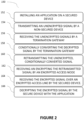
- FIG. 1 A method 100 for preventing a third-party interception of a voice or text signal transmitted from a secure a device and addressed to one or more non-secured devices, according to some embodiments of the invention, is illustrated in FIG. 1 .
- an anti-interception application is first installed on a device to be secured 102.
- a secured device is typically a mobile device such as cellular phone, a smart phone, or a tablet computer; but can be a digital desk phone that is either connected to a packet-switched or circuit switched network.
- the device is connected to a circuit-switched network (e.g. a PSTN)
- the device will include, for example a POTS telephone connected to the PSTN through a modem apparatus.
- the secured device encrypts voice or text data into an encrypted signal 104 and transmits the encrypted signal over a secured line 106.
- the encryption can be performed according to SRTP over TLS/SSL protocol
- the secured line can be wired or wireless, such as a secured WiFi connection.
- the transmitted encrypted signal remains encrypted, until received by an encrypted access node 108.
- the encrypted access node decrypts the encrypted signal 110 and sends a decrypted signal to a termination gateway.
- the termination gateway receives the decrypted signal 112 and conditionally converts the decrypted signal 114. That is, if the secured (sending) device is connected to a PSTN network, the termination gateway converts the decrypted signal from a PSTN protocol to a packet- switched protocol for each unsecured (receiving) device connected to a packet-switched network.
- the termination gateway converts the decrypted signal from a packet-switched protocol to a PSTN protocol for each non-secured device that is connected to a PSTN network.
- the termination gateway retransmits the decrypted, conditionally converted signal 116.
- the retransmitted signal is received by one or more non-secured devices over a clear line 118.
- each of the non-secured (receiving) devices can a mobile device or digital desk phone.
- the receiving device can be connected via either a packet-switched network or PSTN. Therefore, a user speaking or texting from a secured device can have the ability to communicate with any phone in the world- not necessarily a protected phone-while the protected phone remains secure from interception of signals it transmits.
- FIG. 2 illustrating a method 150 for preventing a third-party interception of a voice or text signal received by one or more secured devices, originating from a non-secured device.
- an anti-interception application is first installed on one or more devices to be secured 152, which, as described in method 100 can be mobile device or a digital desk phone, and on a packet-switched or circuit-switched network.
- a non-secured device transmits an unencrypted signal over a clear line 154.
- a termination gateway receives the unencrypted signal 156 and conditionally converts the unencrypted signal 158. That is, if the non-secured (sending) device is connected to a PSTN network, the termination gateway converts the unencrypted signal from a PSTN protocol to a packet- switched protocol for each secured (receiving) device connected to a packet-switched network.
- the termination gateway converts the unencrypted signal from a packet-switched protocol to a PSTN protocol for each secured device that is connected to a PSTN network.
- the termination gateway retransmits the unencrypted, conditionally converted signal 160.
- the retransmitted signal is received and encrypted by an encrypted access node 162.
- the secured device receives the encrypted signal 164 and with the anti-interception application decrypts the encrypted signal 166.
- Both the secured devices and non-secured device can each be a mobile device or a digital desk phone, which can be connected to a packet switched or PSTN network. Therefore, a user listening or receiving text from a secured device can have the ability to communicate with any phone in the world- not necessarily a protected phone- while the protected phone remains secure from interception of signals it receives.
- the decrypted or unencrypted signal is usually not modified by the termination gateway if the sending and receiving devices are both on a packet switched network or both on a PSTN network.
- Methods 100 and 150 may be combined, providing bidirectional protection from third-party signal interception of a secured device.
- the combined anti-interception application contains the features of both the anti-interception application of method 100 and of method 150.
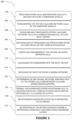
- FIG. 3 illustrating a method 200 for protecting a secured device connected to one or more networks from access via hacking.
- an anti-hacking application is installed on the secured device 201.
- the anti- hacking application effects steps for securing the secured device from hacking attacks.
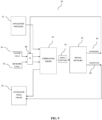
- a timestamping module receives system calls and network calls of the secured device 202.
- the timestamped system calls and network calls are received by a correlation module that packages the timestamped system and network calls into an input vector 206. Additionally, the correlation module receives lists of permissions (e.g., from a permissions database) for applications on the secured device 208.
- the correlation module computes parameters of the system calls and network calls 210. These parameters can include, but are not limited to, a difference in time values of the timestamp of a system call and said network call; correspondence of a system call or a network call with a privilege pertaining to an application making the system call or network call; a validity of a certificate attached to a network call; or any combination thereof.
- the correlation engine further packages the parameters into the input vector 212.
- a neural network receives input vector 214 and determines, based on learned behavior, whether system and network calls are valid and therefore approved, or whether they are suspected as being part of hacking activity 216.
- the approved and suspected system/network calls are fed to two output streams: an appoved output and a suspected output 218.
- the mitigation rules engine determines an appropriate mitigating action , such as disconnecting from one of the networks, invalidating a transmission session, destroying the access keys and/or deleting the system cache; notifying the user by raising an unauthorized access alert; automatically activating a three factor authentication stage; downgrading accessibility and functionality of files to readonly; accessing said network through a VPN; or any combination thereof.
- Methods 100, 150, and 200 may be combined in any combination, with installed software appropriately integrated according to the which methods are to be combined. For example, a complete method will protect a secured device from interception of both incoming and outgoing voice and text as well as from hacking.
- FIG. 4 illustrates, according to an embodiment of the present invention, an example of a computerized system for implementing the invention 300.
- the systems and methods described herein can be implemented in software or hardware or any combination thereof.
- the systems and methods described herein can be implemented using one or more computing devices which may or may not be physically or logically separate from each other. Additionally, various aspects of the methods described herein may be combined or merged into other functions.
- the illustrated system elements could be combined into a single hardware device or separated into multiple hardware devices. If multiple hardware devices are used, the hardware devices could be physically located proximate to or remotely from each other.
- the methods can be implemented in a computer program product accessible from a computer- usable or computer-readable storage medium that provides program code for use by or in connection with a computer or any instruction execution system.
- a computer-usable or computer-readable storage medium can be any apparatus that can contain or store the program for use by or in connection with the computer or instruction execution system, apparatus, or device.
- a data processing system suitable for storing and/or executing the corresponding program code can include at least one processor coupled directly or indirectly to computerized data storage devices such as memory elements.
- Input/output (I/O) devices can be coupled to the system.
- Network adapters may also be coupled to the system to enable the data processing system to become coupled to other data processing systems or remote printers or storage devices through intervening private or public networks.
- the features can be implemented on a computer with a display device, such as an LCD (liquid crystal display), touch-screen; or touch-pad, virtual display, or another type of monitor for displaying information to the user, and a keyboard and an input device, such as a mouse or trackball by which the user can provide input to the computer.
- a display device such as an LCD (liquid crystal display), touch-screen; or touch-pad, virtual display, or another type of monitor for displaying information to the user
- a keyboard and an input device such as a mouse or trackball by which the user can provide input to the computer.
- a computer program can be a set of instructions that can be used, directly or indirectly, in a computer.
- the systems and methods described herein can be implemented using programming languages such as C, C++, Assembly, C# TM , JAVA TM , Flash TM ActionScript, Visual Basic TM , JavaScript TM , PHP, Python, XML, HTML, etc. or a combination of programming languages, including compiled or interpreted languages, and can be deployed in any form, including as a stand-alone program or as a module, component, subroutine, or other unit suitable for use in a computing environment.
- the software can include, but is not limited to, firmware, resident software, microcode, etc.
- Protocols such as TCP/UDP/ICMP HTTP DNS/SOAP may be used in implementing interfaces between programming modules.
- the components and functionality described herein may be implemented on any desktop operating system executing in a virtualized or non-virtualized environment, using any programming language suitable for software development, including, but not limited to, different versions of Microsoft Windows TM , Apple TM Mac TM , iOS TM , Google TM Android TM , Unix TM X- Windows TM , Windows Mobile TM , Windows Phone TM , Linux TM , etc.
- the processing system can be in communication with a computerized data storage system.
- the data storage system can include a non-relational or relational data store, such as a MySQL TM or other relational database. Other physical and logical database types could be used.
- the data store may be a database server, such as Microsoft SQL Server TM , Oracle TM , IBM DB2 TM , SQLITE TM , or any other database software, relational or otherwise.
- the data store may store the information identifying syntactical tags and any information required to operate on syntactical tags.
- the processing system may use object-oriented programming and may store data in objects.
- the processing system may use an object-relational mapper (ORM) to store the data objects in a relational database.
- ORM object-relational mapper
- an RDBMS can be used.
- tables in the RDBMS can include columns that represent coordinates.
- data representing user events, virtual elements, etc. can be stored in tables in the RDBMS.
- the tables can have pre-defined relationships between them.
- the tables can also have adjuncts associated with the coordinates.
- Suitable processors for the execution of a program of instructions include, but are not limited to, general and special purpose microprocessors, and the sole processor or one of multiple processors or cores, of any kind of computer.
- a processor may receive and store instructions and data from a computerized data storage device such as a read-only memory, a random access memory, both, or any combination of the data storage devices described herein.
- a processor may include any processing circuitry or control circuitry operative to control the operations and performance of an electronic device.
- the processor may also include, or be operatively coupled to communicate with, one or more data storage devices for storing data.
- data storage devices can include, as non-limiting examples, magnetic disks (including internal hard disks and removable disks), magneto-optical disks, optical disks, read-only memory, random access memory, and/or flash storage.
- Storage devices suitable for tangibly embodying computer program instructions and data can also include all forms of non-volatile memory, including, for example, semiconductor memory devices, such as EPROM, EEPROM, and flash memory devices; magnetic disks such as internal hard disks and removable disks; magneto-optical disks; and CD-ROM and DVD-ROM disks.
- the processor and the memory can be supplemented by, or incorporated in, ASICs (application-specific integrated circuits).
- the systems, modules, and methods described herein can be implemented using any combination of software or hardware elements.
- the systems, modules, and methods described herein can be implemented using one or more virtual machines operating alone or in combination with each other. Any applicable virtualization solution can be used for encapsulating a physical computing machine platform into a virtual machine that is executed under the control of virtualization software running on a hardware computing platform or host.
- the virtual machine can have both virtual system hardware and guest operating system software.
- the systems and methods described herein can be implemented in a computer system that includes a back-end component, such as a data server, or that includes a middleware component, such as an application server or an Internet server, or that includes a front-end component, such as a client computer having a graphical user interface or an Internet browser, or any combination of them.
- the components of the system can be connected by any form or medium of digital data communication such as a communication network. Examples of communication networks include, e.g., Bluetooth, Wi-Fi, GSM, CDMA, 2g, 3g, UMTS, LTE, WiMAX, ZigBee and alike, a LAN, a WAN, and the computers and networks that form the Internet.
- One or more embodiments of the invention may be practiced with other computer system configurations, including hand-held devices, microprocessor systems, microprocessor-based or programmable consumer electronics, minicomputers, mainframe computers, etc.
- the invention may also be practiced in distributed computing environments where tasks are performed by remote processing devices that are linked through a network.
- Embodiments within the scope of the present disclosure also include physical and other computer-readable media for carrying or storing computer-executable instructions and/or data structures.
- one or more of the processes described herein may be implemented at least in part as instructions embodied in a non-transitory computer-readable medium and executable by one or more computing devices (e.g., any of the media content access devices described herein).
- a processor e.g., a microprocessor
- Computer-readable media can be any available media that can be accessed by a general purpose or special purpose computer system.
- Computer-readable media that store computer-executable instructions are non-transitory computer-readable storage media (devices).
- Computer-readable media that carry computer-executable instructions are transmission media.
- embodiments of the disclosure can comprise at least two distinctly different kinds of computer-readable media: non-transitory computer-readable storage media (devices) and transmission media.
- Non-transitory computer-readable storage media includes RAM, ROM, EEPROM, CD-ROM, solid state drives (“SSDs”) (e.g., based on RAM), Flash memory, phase-change memory (“PCM”), other types of memory, other optical disk storage, magnetic disk storage or other magnetic storage devices, or any other medium which can be used to store desired program code means in the form of computer-executable instructions or data structures and which can be accessed by a general purpose or special purpose computer.
- SSDs solid state drives
- PCM phase-change memory
- a "network” is defined as one or more data links that enable the transport of electronic data between computer systems and/or modules and/or other electronic devices.
- a network or another communications connection can include a network and/or data links which can be used to carry desired program code means in the form of computer-executable instructions or data structures and which can be accessed by a general purpose or special purpose computer. Combinations of the above should also be included within the scope of computer-readable media.
- program code means in the form of computer-executable instructions or data structures can be transferred automatically from transmission media to non-transitory computer-readable storage media (devices) (or vice versa).
- computer-executable instructions or data structures received over a network or data link can be buffered in RAM within a network interface module (e.g., a "NIC"), and then eventually transferred to computer system RAM and/or to less volatile computer storage media (devices) at a computer system.
- a network interface module e.g., a "NIC”
- non-transitory computer-readable storage media (devices) could be included in computer system components that also (or even primarily) utilize transmission media.
- Computer-executable instructions comprise, for example, instructions and data which, when executed at a processor, cause a general purpose computer, special purpose computer, or special purpose processing device to perform a certain function or group of functions.
- computer-executable instructions are executed on a general-purpose computer to turn the general-purpose computer into a special purpose computer implementing elements of the disclosure.
- the computer executable instructions may be, for example, binaries, intermediate format instructions such as assembly language, or even source code.
- the disclosure may be practiced in network computing environments with many types of computer system configurations, including, personal computers, desktop computers, laptop computers, message processors, hand-held devices, multi-processor systems, microprocessor-based or programmable consumer electronics, network PCs, minicomputers, mainframe computers, mobile telephones, PDAs, tablets, pagers, watches, routers, switches, and the like.
- the disclosure may also be practiced in distributed system environments where local and remote computer systems, which are linked (either by hardwired data links, wireless data links, or by a combination of hardwired and wireless data links) through a network, both perform tasks.
- program modules may be located in both local and remote memory storage devices.
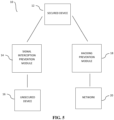
- FIG. 5 illustrating a combined system 10 for preventing signal interception and hacking.
- the system 10 comprises a signal interception prevention module 14 and a hacking prevention module 18.
- the system further comprises software loaded on the memory of a secured device 12. The two modules are described herein as separate systems.
- the system 10 provides protection to the secured device from interception of incoming and/or outgoing voice/text communication with one or more unsecured devices 16, as well as protection from hacking over a network 20.
- FIG 6 illustrating an operating environment and elements of a system 30 for preventing a third-party interception of a voice or text signal transmitted from a secure a device 32a-c and addressed to one or more non-secured devices 36a-c, and/or system 31 for preventing a third-party interception of a voice or text signal received by one or more secure devices 32a-c and originating from a non-secured device 36a-c, according to some embodiments of the present invention.
- secured and non-secured devices are connected to a phone system and can be any of a mobile device 32a, 36a, such as a cellular phone, smart phone, or tablet computer, connected to a cellular cloud 44; an IP telephone 32b, 36b connected to the phone system thorough an IP cloud 46; or a POTS phone with a modem apparatus 32c, 36c connected to the phone system through a PSTN cloud 48.
- a mobile device 32a, 36a such as a cellular phone, smart phone, or tablet computer, connected to a cellular cloud 44
- IP telephone 32b, 36b connected to the phone system thorough an IP cloud 46
- a POTS phone with a modem apparatus 32c, 36c connected to the phone system through a PSTN cloud 48 a PSTN cloud 48.
- an anti-interception application is installed on a secured device 32a-c.
- the secured device 32a-c transmits voice and text signals (e.g., data packets) addressed to one or more non-secured devices 36a-c: the application encrypts the and the encrypted signal is transmitted user over an encrypted access line 34, which can be wired or wireless.
- An encrypted access node 38 receives and decrypts the encrypted signal.
- a termination gateway 40 is receives the decrypted signal.
- the termination gateway 40 is conditionally converts the decrypted signal, as follows: if the secured device [32c] is connected to a PSTN network and one of the non-secured devices [36a-b] is connected to a packet-switched network, termination gateway 40 converts the decrypted signal from a PSTN protocol to a packet-switched protocol; if the secured device [32a-b] is connected to a packet-switched network, the non-secured device [36c] is connected to a PSTN network, to convert said signal from a packet-switched protocol to a PSTN protocol; the termination gateway 40 retransmits the decrypted, conditionally converted signal. The retransmitted signal is received by one or more non-secured devices [36a-c] are configured to receive said retransmitted signal a over a clear access line [42].
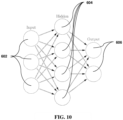
- FIG. 10 is a schematic illustration of an example of the neural network 600 used by the detection engine.
- Inputs in that scheme refer to system call and network calls, the output creates the "normal working curve" of the device;
- the application is configured to receive access privileges upon initial scanning of the at least one communication device wherein the network is configured to operate under conditions wherein the inputs are the system calls data, the networks calls data 602, whether the privileges of all applications are installed data, and time stamp data, transferred via hidden intermediate states 604 and wherein the outputs are "good” or "not good” 606, deterministic and/or with a reference value to state the level of correlation, whether definite and/or in scale.
Landscapes
- Engineering & Computer Science (AREA)
- Computer Security & Cryptography (AREA)
- Computer Networks & Wireless Communication (AREA)
- Signal Processing (AREA)
- Computer Hardware Design (AREA)
- General Engineering & Computer Science (AREA)
- Computing Systems (AREA)
- Multimedia (AREA)
- Software Systems (AREA)
- Theoretical Computer Science (AREA)
- Business, Economics & Management (AREA)
- General Business, Economics & Management (AREA)
- Physics & Mathematics (AREA)
- General Physics & Mathematics (AREA)
- Data Exchanges In Wide-Area Networks (AREA)
- Telephonic Communication Services (AREA)
Claims (15)
- Ein Verfahren [200] zum Schutz einer gesicherten Vorrichtung vor dem Zugriff durch Hacker, wobei das Verfahren den Schritt der Installation einer Anwendung auf der gesicherten Vorrichtung umfasst, die auf einem nicht flüchtigen computerlesbaren Medium der gesicherten Vorrichtung [201] ausführbar ist; wobei die gesicherte Vorrichtung mit der Anwendung weitere Schritte des Verfahrens ausführt, die die folgenden Schritte umfassen:a. Empfangen eines oder mehrerer Systemaufrufe und eines oder mehrerer Netzwerkaufrufe der gesicherten Vorrichtung durch ein Zeitstempelmodul [202];b. Zeitstempeln der Systemaufrufe und der Netzwerkaufrufe durch das Zeitstempelmodul [204];c. Verpacken der mit Zeitstempeln versehenen Systemaufrufe und der mit Zeitstempeln versehenen Netzwerkaufrufe durch ein Korrelationsmodul in einen Eingangsvektor [206]; undd. Empfangen, durch das Korrelationsmodul, einer oder mehrerer Listen von Berechtigungen für eine oder mehrere Anwendungen, die auf der gesicherten Vorrichtung installiert sind [208];wobei das Verfahren [200] ferner die Schritte umfasst:e. Berechnen von Parametern der Systemaufrufe und der Netzwerkaufrufe [210], wobei die Parameter aus einer Gruppe ausgewählt werden, die eine Differenz der Zeitwerte des Zeitstempels eines Systemaufrufs und eines Netzwerkaufrufs, eine Übereinstimmung eines Systemaufrufs oder eines Netzwerkaufrufs mit einem Privileg in einer oder mehreren der Listen, die zu einer Anwendung gehören, die den Systemaufruf oder den Netzwerkaufruf tätigt, eine Gültigkeit eines an den Netzwerkaufruf angehängten Zertifikats oder eine beliebige Kombination davon umfasst;f. weiteres Verpacken der Parameter in den Eingabevektor [212];g. Empfangen des Eingangsvektors durch ein neuronales Netzwerk [214];h. Bestimmung durch das neuronale Netzwerk, ob ein Systemaufruf oder ein Netzwerkaufruf genehmigt oder verdächtig ist [216];i. Zuführung eines genehmigten System- oder Netzwerkaufrufs zu einem genehmigten Ausgang und eines verdächtigen System- oder Netzwerkaufrufs zu einem verdächtigen Ausgang [218];j. Empfangen der verdächtigen Ausgabe durch eine Mitigationsregelmaschine [220];k. Bestimmen einer Abhilfemaßnahme als Funktion der verdächtigen Ausgabe [222] durch die Abhilferegelmaschine.
- Das Verfahren nach Anspruch 1, wobei das neuronale Netzwerk so ausgelegt ist, dass es eine Korrelation zwischen einem Betriebssystem der gesicherten Vorrichtung und Netzwerksignalübertragungen erkennt.
- Das Verfahren nach Anspruch 1, wobei das neuronale Netzwerk so gestaltet ist, dass es die Korrelation zwischen den Systemaufrufen und den Netzwerksignalübertragungen erkennt, indem es die Trainingsdaten des Automatisierungsprozesses analysiert und anschließend eine abgeleitete Funktion erzeugt, die für neue Mapping-Beispiele verwendet wird.
- Das Verfahren nach Anspruch 1, das zusätzlich einen Schritt umfasst, in dem vorbestimmte risikobasierte Richtlinien in Kraft gesetzt werden, um die Erkennung eines Angriffs auf die mobile Vorrichtung kontinuierlich zu erleichtern, wobei eine oder mehrere der vorbestimmten risikobasierten Richtlinien aus einer Gruppe ausgewählt werden, die aus der Verweigerung eingehender Übertragungen durch Trennen eines Wi-Fi-Netzwerks und Verbinden mit einem VPN-Netzwerk bei Erkennung des Angriffs besteht.
- Das Verfahren nach Anspruch 1 umfasst zusätzlich einen Schritt des Speicherns und Erleichterns von forensischen Daten, um eine Quelle des Angriffs anzuzeigen, wobei eine oder mehrere der forensischen Daten aus einer Gruppe ausgewählt werden, die aus den Daten der angegriffenen Quelle, den Angriffsvektordaten, den Angriffsnamendaten, den Standortdaten, den Zeitdaten und beliebigen Kombinationen davon besteht.
- Das Verfahren nach Anspruch 1, wobei eine oder mehrere der Entschärfungsaktionen aus einer Gruppe ausgewählt sind, die Folgendes umfasst:a. die sichere Vorrichtung, das mit einem oder mehreren Netzwerken verbunden ist, das Trennen der Verbindung zu einem oder mehreren dieser Netzwerke;b. Ungültigmachen einer Übertragungssitzung;c. Zerstörung von Zugangsschlüsseln und/oder Löschen eines System-Caches;d. Benachrichtigung eines Benutzers durch Auslösen eines Alarms bei unberechtigtem Zugriff;e. automatische Aktivierung einer Drei-Faktor-Authentifizierungsstufe; undf. Herabstufung der Zugänglichkeit und Funktionalität von Dateien auf "schreibgeschützt".
- Das Verfahren nach Anspruch 6, wobei ein unbefugter Zugriff auf das Netzwerk SSL-Striping, Traffic Manipulation, Reconnaissance Scan (TCP, UDP, ARP), Rouge Access Point, Rouge FemtoCell, SSL Certificate Tampering (SSL Pinning) oder eine beliebige Kombination davon umfasst.
- Das Verfahren nach Anspruch 1, wobei ein unautorisierter Zugriff auf eine Anwendung das Erkennen von bösartigen Anwendungen, unbekannten Zero-Day-Programmen, Zeitbomben, Anti-Debugging, Manipulationen des Live-Datenschutzes, Privilegienerweiterung oder einer beliebigen Kombination davon umfasst.
- Eine gegen Hacking geschützte, gesicherte Vorrichtung, die mit einem Netzwerk verbunden ist, wobei die Vorrichtung ein nicht-transitorisches, computerlesbares Medium enthält, das Anweisungen für den Betrieb eines Systems [50] zur Verhinderung von Hacking auf der Vorrichtung enthält, wobei das System Folgendes umfasst:a. ein Korrelationsmodul [60];b. ein Zeitstempelmodul [68], das so gestaltet ist, dass es Systemaufrufe [54] - Aufrufe von Routinen des Betriebssystems der Vorrichtung - und Netzwerkaufrufe [56] - Anfragen nach Zugriff oder Status von einem Netzwerk - empfängt und jedem der Systemaufrufe [54] und Netzwerkaufrufe [56] Zeitstempel zuordnet; wobei das Korrelationsmodul [60] so gestaltet ist, dass es die Systemaufrufe [54] mit den Zeitstempeln und die Netzwerkaufrufe [56] mit den Zeitstempeln empfängt;
wobei das Korrelationsmodul so gestaltet ist, dass es die mit Zeitstempeln versehenen Systemaufrufe [54] und die mit Zeitstempeln versehenen Netzwerkaufrufe [56] zu einem Eingangsvektor [70] zusammenfasst;c. eine Anwendungsprivilegien-Datenbank [52], wobei die Datenbank [52] eine oder mehrere Listen von Privilegien für eine oder mehrere auf der Vorrichtung installierte Anwendungen umfasst; wobei das Korrelationsmodul [60] so gestaltet ist, dass es die eine oder die mehreren Listen von Privilegien empfängt;d. ein neuronales Netzwerk [62], das so gestaltet ist, dass es den Eingangsvektor [70] empfängt;e. eine genehmigte Ausgabe [64] und eine verdächtige Ausgabe [66] des neuronalen Netzwerks [62];
undf. eine Mitigationsregelmaschine [58];
wobei:i. das Korrelationsmodul ferner so gestaltet ist, dass es Parameter der Systemaufrufe [54] und der Netzwerkaufrufe [56] berechnet, wobei die Parameter aus einer Gruppe ausgewählt sind, die aus Folgendem besteht: einer Differenz der Zeitwerte des Zeitstempels eines Systemaufrufs und eines Netzwerkaufrufs, einer Übereinstimmung eines Systemaufrufs oder eines Netzwerkaufrufs mit einer Berechtigung in einer oder mehreren der Listen, die zu einer Anwendung gehören, die den Systemaufruf oder den Netzwerkaufruf tätigt, einer Gültigkeit eines Zertifikats, das an den Netzwerkaufruf angehängt ist, oder einer beliebigen Kombination davon, und die Parameter ferner in den Eingangsvektor [70] packt;ii. das neuronale Netzwerk so gestaltet ist, dass es den Eingangsvektor [70] empfängt und feststellt, ob ein Systemaufruf [54] oder ein Netzwerkaufruf [56] als Hacking-Versuch der Vorrichtung zugelassen oder verdächtig ist;iii. ein genehmigter Systemaufruf oder Netzwerkaufruf wird dem genehmigten Ausgang [64] zugeführt;iv. ein verdächtiger System- oder Netzwerkaufruf wird in den verdächtigen Ausgang [66] eingespeist; undv. die Mitigationsregelmaschine [58] so konfiguriert ist, dass sie die verdächtige Ausgabe [66] empfängt und eine Aktion in Abhängigkeit von der verdächtigen Ausgabe [66] bestimmt. - Die Vorrichtung nach Anspruch 9, wobei das neuronale Netzwerk so gestaltet ist, dass es die Korrelation zwischen dem Betriebssystem der mobilen Vorrichtung und den Netzwerksignalübertragungen erkennt, indem es die Trainingsdaten des Automatisierungsprozesses analysiert und anschließend eine abgeleitete Funktion erzeugt, die für neue Mapping-Beispiele verwendet wird.
- Die Vorrichtung nach Anspruch 9, wobei vorbestimmte risikobasierte Richtlinien in Kraft gesetzt werden, um die Erkennung eines Angriffs auf die mobile Vorrichtung kontinuierlich zu erleichtern, wobei eine oder mehrere der vorbestimmten risikobasierten Richtlinien aus einer Gruppe ausgewählt werden, die aus der Verweigerung eingehender Übertragungen durch Trennen des Wi-Fi-Netzwerks und Verbinden mit dem VPN-Netzwerk bei Erkennung des Angriffs besteht.
- Die Vorrichtung nach Anspruch 9, wobei forensische Daten gespeichert werden, um eine Quelle des Angriffs anzuzeigen, wobei eine oder mehrere der forensischen Daten aus einer Gruppe ausgewählt werden, die aus den Daten der angegriffenen Quelle, den Angriffsvektordaten, den Angriffsnamendaten, den Standortdaten, den Zeitdaten und beliebigen Kombinationen davon besteht.
- Die Vorrichtung nach Anspruch 9, wobei die Aktionen der Mitigationsregelmaschine aus einer Gruppe ausgewählt werden, die Folgendes umfasst:a. die sichere Vorrichtung, die mit einem oder mehreren Netzwerken verbunden ist, das Trennen der sicheren Vorrichtung von einem oder mehreren dieser Netzwerke;b. Ungültigmachen einer Übertragungssitzung;c. Zerstörung von Zugriffsschlüsseln und/oder Löschen eines System-Caches;d. Benachrichtigung eines Benutzers durch Auslösen eines Alarms bei unberechtigtem Zugriff;e. automatische Aktivierung einer Drei-Faktor-Authentifizierungsstufe;f. Herabstufung der Zugänglichkeit und Funktionalität von Dateien auf "schreibgeschützt";g. Zugriff auf das genannte Netzwerk über ein VPN.
- Die Vorrichtung nach Anspruch 9, wobei ein unautorisierter Zugriff auf das Netzwerk SSL-Striping, Traffic Manipulation, Reconnaissance Scan (TCP, UDP, ARP), Rouge Access Point, Rouge FemtoCell, SSL Certificate Tampering (SSL Pinning) oder eine beliebige Kombination davon umfasst.
- Die Vorrichtung nach Anspruch 9, wobei ein unbefugter Zugriff auf eine Anwendung eine oder mehrere bösartige Anwendungen, unbekannte Zero-Days, Zeitbomben, Anti-Debugging, Manipulation des Live-Datenschutzes oder eine beliebige Kombination davon umfasst.
Applications Claiming Priority (3)
| Application Number | Priority Date | Filing Date | Title |
|---|---|---|---|
| US201662383607P | 2016-09-06 | 2016-09-06 | |
| EP17848286.5A EP3510830A4 (de) | 2016-09-06 | 2017-09-06 | Mobilvorrichtungssystem und -verfahren zur vorbeugung von netzwerksignalabfang und -hacking |
| PCT/IL2017/051004 WO2018047173A1 (en) | 2016-09-06 | 2017-09-06 | Mobile device system and method for preventing network signal interception and hacking |
Related Parent Applications (1)
| Application Number | Title | Priority Date | Filing Date |
|---|---|---|---|
| EP17848286.5A Division EP3510830A4 (de) | 2016-09-06 | 2017-09-06 | Mobilvorrichtungssystem und -verfahren zur vorbeugung von netzwerksignalabfang und -hacking |
Publications (3)
| Publication Number | Publication Date |
|---|---|
| EP4017204A1 EP4017204A1 (de) | 2022-06-22 |
| EP4017204C0 EP4017204C0 (de) | 2024-07-31 |
| EP4017204B1 true EP4017204B1 (de) | 2024-07-31 |
Family
ID=61562369
Family Applications (2)
| Application Number | Title | Priority Date | Filing Date |
|---|---|---|---|
| EP17848286.5A Pending EP3510830A4 (de) | 2016-09-06 | 2017-09-06 | Mobilvorrichtungssystem und -verfahren zur vorbeugung von netzwerksignalabfang und -hacking |
| EP21192207.5A Active EP4017204B1 (de) | 2016-09-06 | 2017-09-06 | Mobilvorrichtungssystem und -verfahren zur vorbeugung von netzwerksignalabfang und -hacking |
Family Applications Before (1)
| Application Number | Title | Priority Date | Filing Date |
|---|---|---|---|
| EP17848286.5A Pending EP3510830A4 (de) | 2016-09-06 | 2017-09-06 | Mobilvorrichtungssystem und -verfahren zur vorbeugung von netzwerksignalabfang und -hacking |
Country Status (4)
| Country | Link |
|---|---|
| US (2) | US11171935B2 (de) |
| EP (2) | EP3510830A4 (de) |
| IL (2) | IL265201B2 (de) |
| WO (1) | WO2018047173A1 (de) |
Families Citing this family (3)
| Publication number | Priority date | Publication date | Assignee | Title |
|---|---|---|---|---|
| US11789743B2 (en) * | 2021-01-15 | 2023-10-17 | Tenable, Inc. | Host operating system identification using transport layer probe metadata and machine learning |
| CN116467760A (zh) * | 2023-02-21 | 2023-07-21 | 联想(北京)有限公司 | 一种固件防护方法、控制器、系统、设备和存储介质 |
| KR102653193B1 (ko) * | 2023-12-08 | 2024-03-29 | 충북대학교 산학협력단 | 사이버 공격의 위장 전술 판단 방법 및 이를 수행하기 위한 장치 |
Family Cites Families (24)
| Publication number | Priority date | Publication date | Assignee | Title |
|---|---|---|---|---|
| GB9610645D0 (en) * | 1996-05-21 | 1996-07-31 | Ncr Int Inc | Financial transaction system |
| US7184538B1 (en) * | 2000-06-30 | 2007-02-27 | Verizon Services Corp. | Method of and apparatus for mediating common channel signaling message between networks using control message templates |
| US7103067B1 (en) * | 2001-12-21 | 2006-09-05 | Cisco Technology, Inc. | Mechanism for translating between two different voice-over-IP protocols |
| WO2005057893A2 (en) * | 2003-12-15 | 2005-06-23 | Bce Inc. | Adapter for secure voip communications |
| US8582567B2 (en) | 2005-08-09 | 2013-11-12 | Avaya Inc. | System and method for providing network level and nodal level vulnerability protection in VoIP networks |
| US7596224B2 (en) * | 2004-12-07 | 2009-09-29 | Motorola, Inc. | Method and system for secure call alert |
| US7983254B2 (en) * | 2005-07-20 | 2011-07-19 | Verizon Business Global Llc | Method and system for securing real-time media streams in support of interdomain traversal |
| GB2454871B (en) | 2007-11-16 | 2012-01-18 | Motorola Solutions Inc | System, method and processor for use in communication |
| US20100108044A1 (en) * | 2008-11-06 | 2010-05-06 | International Engine Intellectual Property Company, Llc | Combustion Chamber with Double Convex Surfaces and Double Concave Surfaces |
| EP2381665B1 (de) * | 2010-04-26 | 2018-06-13 | BlackBerry Limited | Systeme und Verfahren für eine Sprachanruf-Einrichtung für mobile Geräte |
| WO2011151734A2 (en) * | 2010-06-03 | 2011-12-08 | Morrigan Partners Limited | Secure communication systems, methods, and devices |
| US8875273B2 (en) | 2010-12-17 | 2014-10-28 | Isolated Technologies, Inc. | Code domain isolation |
| CN202178780U (zh) | 2011-08-31 | 2012-03-28 | 公安部第三研究所 | 一种基于单向传输的内外网安全隔离系统 |
| EP2610776B1 (de) * | 2011-09-16 | 2019-08-21 | Veracode, Inc. | Automatisierte verhaltens- und statische analyse unter verwendung eines instrumentierten sandkastens und maschinenlernklassifizierung für mobile sicherheit |
| US20130108044A1 (en) * | 2011-10-30 | 2013-05-02 | Cellcrypt Limited | Multi-Platform Communication System Providing Real-Time Point to Point Encrypted Communication |
| CN102831163A (zh) | 2012-07-20 | 2012-12-19 | 江苏缨思贝睿物联网科技有限公司 | 数据传送方法及数据传送系统 |
| GB201213622D0 (en) * | 2012-07-31 | 2012-09-12 | Sirran Technologies Ltd | Improved telecommunication system |
| US9306962B1 (en) * | 2013-07-25 | 2016-04-05 | Niddel Corp | Systems and methods for classifying malicious network events |
| CN103684997A (zh) | 2013-12-31 | 2014-03-26 | 厦门市美亚柏科信息股份有限公司 | 完全物理隔离数据单向即时传输方法及系统 |
| US11765208B2 (en) * | 2014-01-13 | 2023-09-19 | Comcast Cable Communications, Llc | Systems and methods for dynamic connection management |
| US9407659B2 (en) | 2014-04-23 | 2016-08-02 | Arbor Networks, Inc. | Protecting computing assets from resource intensive querying attacks |
| US20150326592A1 (en) * | 2014-05-07 | 2015-11-12 | Attivo Networks Inc. | Emulating shellcode attacks |
| CN104038739A (zh) | 2014-06-05 | 2014-09-10 | 国家电网公司 | 利用视频扫描二维码来实现网络物理隔离状态下的单向数据传递方法及装置 |
| US20160191645A1 (en) * | 2014-12-30 | 2016-06-30 | Citrix Systems, Inc. | Containerizing Web Applications for Managed Execution |
-
2017
- 2017-09-06 IL IL265201A patent/IL265201B2/en unknown
- 2017-09-06 EP EP17848286.5A patent/EP3510830A4/de active Pending
- 2017-09-06 WO PCT/IL2017/051004 patent/WO2018047173A1/en not_active Ceased
- 2017-09-06 IL IL307596A patent/IL307596B2/en unknown
- 2017-09-06 EP EP21192207.5A patent/EP4017204B1/de active Active
-
2019
- 2019-03-06 US US16/294,172 patent/US11171935B2/en active Active
-
2021
- 2021-08-16 US US17/402,983 patent/US11876788B2/en active Active
Also Published As
| Publication number | Publication date |
|---|---|
| IL265201B2 (en) | 2024-03-01 |
| EP4017204A1 (de) | 2022-06-22 |
| WO2018047173A1 (en) | 2018-03-15 |
| EP4017204C0 (de) | 2024-07-31 |
| US11171935B2 (en) | 2021-11-09 |
| US20190215312A1 (en) | 2019-07-11 |
| EP3510830A1 (de) | 2019-07-17 |
| US11876788B2 (en) | 2024-01-16 |
| EP3510830A4 (de) | 2020-07-22 |
| US20210377233A1 (en) | 2021-12-02 |
| IL265201B1 (en) | 2023-11-01 |
| IL265201A (en) | 2019-05-30 |
| IL307596B2 (en) | 2026-02-01 |
| IL307596B1 (en) | 2025-10-01 |
| IL307596A (en) | 2023-12-01 |
Similar Documents
| Publication | Publication Date | Title |
|---|---|---|
| Cinar et al. | The current state and future of mobile security in the light of the recent mobile security threat reports | |
| US10924517B2 (en) | Processing network traffic based on assessed security weaknesses | |
| Suarez-Tangil et al. | Evolution, detection and analysis of malware for smart devices | |
| La Polla et al. | A survey on security for mobile devices | |
| Dmitrienko et al. | On the (in) security of mobile two-factor authentication | |
| EP3965364B1 (de) | Hierarchische risikobewertung und abschwächung von bedrohungen in einer mobilen vernetzungsumgebung | |
| Al-Turjman et al. | Cyber security in mobile social networks | |
| Penning et al. | Mobile malware security challeges and cloud-based detection | |
| WO2018049018A1 (en) | Methods and systems for on-device real-time adaptive security based on external threat intelligence inputs | |
| WO2018048850A1 (en) | Methods and systems for on-device real-time adaptive security based on external threat intelligence inputs | |
| Anisetti et al. | Security threat landscape | |
| Raveendranath et al. | Android malware attacks and countermeasures: Current and future directions | |
| US11876788B2 (en) | Mobile device system and method for preventing network signal interception and hacking | |
| Singh et al. | Security attacks taxonomy on bring your own devices (BYOD) model | |
| US20250106235A1 (en) | Real-time mitigative security architecture | |
| US20260087137A1 (en) | System and method for detecting exploit including shellcode | |
| Walls et al. | A study of the effectiveness abs reliability of android free anti-mobile malware apps | |
| Schneider et al. | Mobile devices vulnerabilities | |
| Al Khamis et al. | Developing a Conceptual Framework for Enhanced Cybersecurity Defense Against Zero-Click Exploit | |
| Kambourakis et al. | Intrusion detection and prevention for mobile ecosystems | |
| Armin | Mobile threats and the underground marketplace | |
| Alakbarov | Security issues and solution mechanisms in cloud computing systems: a review | |
| Muttik | Securing mobile devices: Present and future | |
| Devare et al. | Design of Comprehensive Mobile Device Vulnerability Checking Application | |
| Kioupakis et al. | Preparing for malware that uses covert communication channels: The case of Tor-based Android malware |
Legal Events
| Date | Code | Title | Description |
|---|---|---|---|
| PUAI | Public reference made under article 153(3) epc to a published international application that has entered the european phase |
Free format text: ORIGINAL CODE: 0009012 |
|
| STAA | Information on the status of an ep patent application or granted ep patent |
Free format text: STATUS: THE APPLICATION HAS BEEN PUBLISHED |
|
| AC | Divisional application: reference to earlier application |
Ref document number: 3510830 Country of ref document: EP Kind code of ref document: P |
|
| AK | Designated contracting states |
Kind code of ref document: A1 Designated state(s): AL AT BE BG CH CY CZ DE DK EE ES FI FR GB GR HR HU IE IS IT LI LT LU LV MC MK MT NL NO PL PT RO RS SE SI SK SM TR |
|
| STAA | Information on the status of an ep patent application or granted ep patent |
Free format text: STATUS: REQUEST FOR EXAMINATION WAS MADE |
|
| 17P | Request for examination filed |
Effective date: 20221122 |
|
| RBV | Designated contracting states (corrected) |
Designated state(s): AL AT BE BG CH CY CZ DE DK EE ES FI FR GB GR HR HU IE IS IT LI LT LU LV MC MK MT NL NO PL PT RO RS SE SI SK SM TR |
|
| GRAP | Despatch of communication of intention to grant a patent |
Free format text: ORIGINAL CODE: EPIDOSNIGR1 |
|
| STAA | Information on the status of an ep patent application or granted ep patent |
Free format text: STATUS: GRANT OF PATENT IS INTENDED |
|
| INTG | Intention to grant announced |
Effective date: 20240220 |
|
| GRAS | Grant fee paid |
Free format text: ORIGINAL CODE: EPIDOSNIGR3 |
|
| GRAA | (expected) grant |
Free format text: ORIGINAL CODE: 0009210 |
|
| STAA | Information on the status of an ep patent application or granted ep patent |
Free format text: STATUS: THE PATENT HAS BEEN GRANTED |
|
| AC | Divisional application: reference to earlier application |
Ref document number: 3510830 Country of ref document: EP Kind code of ref document: P |
|
| AK | Designated contracting states |
Kind code of ref document: B1 Designated state(s): AL AT BE BG CH CY CZ DE DK EE ES FI FR GB GR HR HU IE IS IT LI LT LU LV MC MK MT NL NO PL PT RO RS SE SI SK SM TR |
|
| REG | Reference to a national code |
Ref country code: CH Ref legal event code: EP Ref country code: GB Ref legal event code: FG4D |
|
| REG | Reference to a national code |
Ref country code: DE Ref legal event code: R096 Ref document number: 602017083809 Country of ref document: DE |
|
| REG | Reference to a national code |
Ref country code: IE Ref legal event code: FG4D |
|
| U01 | Request for unitary effect filed |
Effective date: 20240830 |
|
| U07 | Unitary effect registered |
Designated state(s): AT BE BG DE DK EE FI FR IT LT LU LV MT NL PT RO SE SI Effective date: 20240910 |
|
| U20 | Renewal fee for the european patent with unitary effect paid |
Year of fee payment: 8 Effective date: 20240911 |
|
| PG25 | Lapsed in a contracting state [announced via postgrant information from national office to epo] |
Ref country code: NO Free format text: LAPSE BECAUSE OF FAILURE TO SUBMIT A TRANSLATION OF THE DESCRIPTION OR TO PAY THE FEE WITHIN THE PRESCRIBED TIME-LIMIT Effective date: 20241031 |
|
| PG25 | Lapsed in a contracting state [announced via postgrant information from national office to epo] |
Ref country code: PL Free format text: LAPSE BECAUSE OF FAILURE TO SUBMIT A TRANSLATION OF THE DESCRIPTION OR TO PAY THE FEE WITHIN THE PRESCRIBED TIME-LIMIT Effective date: 20240731 Ref country code: GR Free format text: LAPSE BECAUSE OF FAILURE TO SUBMIT A TRANSLATION OF THE DESCRIPTION OR TO PAY THE FEE WITHIN THE PRESCRIBED TIME-LIMIT Effective date: 20241101 |
|
| PG25 | Lapsed in a contracting state [announced via postgrant information from national office to epo] |
Ref country code: IS Free format text: LAPSE BECAUSE OF FAILURE TO SUBMIT A TRANSLATION OF THE DESCRIPTION OR TO PAY THE FEE WITHIN THE PRESCRIBED TIME-LIMIT Effective date: 20241130 |
|
| PG25 | Lapsed in a contracting state [announced via postgrant information from national office to epo] |
Ref country code: HR Free format text: LAPSE BECAUSE OF FAILURE TO SUBMIT A TRANSLATION OF THE DESCRIPTION OR TO PAY THE FEE WITHIN THE PRESCRIBED TIME-LIMIT Effective date: 20240731 |
|
| PG25 | Lapsed in a contracting state [announced via postgrant information from national office to epo] |
Ref country code: ES Free format text: LAPSE BECAUSE OF FAILURE TO SUBMIT A TRANSLATION OF THE DESCRIPTION OR TO PAY THE FEE WITHIN THE PRESCRIBED TIME-LIMIT Effective date: 20240731 Ref country code: RS Free format text: LAPSE BECAUSE OF FAILURE TO SUBMIT A TRANSLATION OF THE DESCRIPTION OR TO PAY THE FEE WITHIN THE PRESCRIBED TIME-LIMIT Effective date: 20241031 |
|
| PG25 | Lapsed in a contracting state [announced via postgrant information from national office to epo] |
Ref country code: RS Free format text: LAPSE BECAUSE OF FAILURE TO SUBMIT A TRANSLATION OF THE DESCRIPTION OR TO PAY THE FEE WITHIN THE PRESCRIBED TIME-LIMIT Effective date: 20241031 Ref country code: PL Free format text: LAPSE BECAUSE OF FAILURE TO SUBMIT A TRANSLATION OF THE DESCRIPTION OR TO PAY THE FEE WITHIN THE PRESCRIBED TIME-LIMIT Effective date: 20240731 Ref country code: NO Free format text: LAPSE BECAUSE OF FAILURE TO SUBMIT A TRANSLATION OF THE DESCRIPTION OR TO PAY THE FEE WITHIN THE PRESCRIBED TIME-LIMIT Effective date: 20241031 Ref country code: IS Free format text: LAPSE BECAUSE OF FAILURE TO SUBMIT A TRANSLATION OF THE DESCRIPTION OR TO PAY THE FEE WITHIN THE PRESCRIBED TIME-LIMIT Effective date: 20241130 Ref country code: HR Free format text: LAPSE BECAUSE OF FAILURE TO SUBMIT A TRANSLATION OF THE DESCRIPTION OR TO PAY THE FEE WITHIN THE PRESCRIBED TIME-LIMIT Effective date: 20240731 Ref country code: GR Free format text: LAPSE BECAUSE OF FAILURE TO SUBMIT A TRANSLATION OF THE DESCRIPTION OR TO PAY THE FEE WITHIN THE PRESCRIBED TIME-LIMIT Effective date: 20241101 Ref country code: ES Free format text: LAPSE BECAUSE OF FAILURE TO SUBMIT A TRANSLATION OF THE DESCRIPTION OR TO PAY THE FEE WITHIN THE PRESCRIBED TIME-LIMIT Effective date: 20240731 |
|
| PG25 | Lapsed in a contracting state [announced via postgrant information from national office to epo] |
Ref country code: SM Free format text: LAPSE BECAUSE OF FAILURE TO SUBMIT A TRANSLATION OF THE DESCRIPTION OR TO PAY THE FEE WITHIN THE PRESCRIBED TIME-LIMIT Effective date: 20240731 |
|
| PG25 | Lapsed in a contracting state [announced via postgrant information from national office to epo] |
Ref country code: MC Free format text: LAPSE BECAUSE OF FAILURE TO SUBMIT A TRANSLATION OF THE DESCRIPTION OR TO PAY THE FEE WITHIN THE PRESCRIBED TIME-LIMIT Effective date: 20240731 |
|
| PG25 | Lapsed in a contracting state [announced via postgrant information from national office to epo] |
Ref country code: CZ Free format text: LAPSE BECAUSE OF FAILURE TO SUBMIT A TRANSLATION OF THE DESCRIPTION OR TO PAY THE FEE WITHIN THE PRESCRIBED TIME-LIMIT Effective date: 20240731 |
|
| PG25 | Lapsed in a contracting state [announced via postgrant information from national office to epo] |
Ref country code: SK Free format text: LAPSE BECAUSE OF FAILURE TO SUBMIT A TRANSLATION OF THE DESCRIPTION OR TO PAY THE FEE WITHIN THE PRESCRIBED TIME-LIMIT Effective date: 20240731 |
|
| REG | Reference to a national code |
Ref country code: CH Ref legal event code: PL |
|
| PLBE | No opposition filed within time limit |
Free format text: ORIGINAL CODE: 0009261 |
|
| STAA | Information on the status of an ep patent application or granted ep patent |
Free format text: STATUS: NO OPPOSITION FILED WITHIN TIME LIMIT |
|
| GBPC | Gb: european patent ceased through non-payment of renewal fee |
Effective date: 20241031 |
|
| 26N | No opposition filed |
Effective date: 20250501 |
|
| PG25 | Lapsed in a contracting state [announced via postgrant information from national office to epo] |
Ref country code: GB Free format text: LAPSE BECAUSE OF NON-PAYMENT OF DUE FEES Effective date: 20241031 |
|
| PG25 | Lapsed in a contracting state [announced via postgrant information from national office to epo] |
Ref country code: CH Free format text: LAPSE BECAUSE OF NON-PAYMENT OF DUE FEES Effective date: 20240930 |
|
| PG25 | Lapsed in a contracting state [announced via postgrant information from national office to epo] |
Ref country code: IE Free format text: LAPSE BECAUSE OF NON-PAYMENT OF DUE FEES Effective date: 20240906 |
|
| U20 | Renewal fee for the european patent with unitary effect paid |
Year of fee payment: 9 Effective date: 20250930 |
|
| PG25 | Lapsed in a contracting state [announced via postgrant information from national office to epo] |
Ref country code: CY Free format text: LAPSE BECAUSE OF FAILURE TO SUBMIT A TRANSLATION OF THE DESCRIPTION OR TO PAY THE FEE WITHIN THE PRESCRIBED TIME-LIMIT; INVALID AB INITIO Effective date: 20170906 |
|
| PG25 | Lapsed in a contracting state [announced via postgrant information from national office to epo] |
Ref country code: HU Free format text: LAPSE BECAUSE OF FAILURE TO SUBMIT A TRANSLATION OF THE DESCRIPTION OR TO PAY THE FEE WITHIN THE PRESCRIBED TIME-LIMIT; INVALID AB INITIO Effective date: 20170906 |
|
| PG25 | Lapsed in a contracting state [announced via postgrant information from national office to epo] |
Ref country code: TR Free format text: LAPSE BECAUSE OF FAILURE TO SUBMIT A TRANSLATION OF THE DESCRIPTION OR TO PAY THE FEE WITHIN THE PRESCRIBED TIME-LIMIT Effective date: 20240731 |