EP4017119B1 - Drahtloses multirouter-kommunikationssystem mit client-ausgleich - Google Patents
Drahtloses multirouter-kommunikationssystem mit client-ausgleich Download PDFInfo
- Publication number
- EP4017119B1 EP4017119B1 EP21215541.0A EP21215541A EP4017119B1 EP 4017119 B1 EP4017119 B1 EP 4017119B1 EP 21215541 A EP21215541 A EP 21215541A EP 4017119 B1 EP4017119 B1 EP 4017119B1
- Authority
- EP
- European Patent Office
- Prior art keywords
- router
- mac address
- routers
- onboard
- network
- Prior art date
- Legal status (The legal status is an assumption and is not a legal conclusion. Google has not performed a legal analysis and makes no representation as to the accuracy of the status listed.)
- Active
Links
Images
Classifications
-
- H—ELECTRICITY
- H04—ELECTRIC COMMUNICATION TECHNIQUE
- H04W—WIRELESS COMMUNICATION NETWORKS
- H04W4/00—Services specially adapted for wireless communication networks; Facilities therefor
- H04W4/30—Services specially adapted for particular environments, situations or purposes
- H04W4/40—Services specially adapted for particular environments, situations or purposes for vehicles, e.g. vehicle-to-pedestrians [V2P]
- H04W4/42—Services specially adapted for particular environments, situations or purposes for vehicles, e.g. vehicle-to-pedestrians [V2P] for mass transport vehicles, e.g. buses, trains or aircraft
-
- H—ELECTRICITY
- H04—ELECTRIC COMMUNICATION TECHNIQUE
- H04W—WIRELESS COMMUNICATION NETWORKS
- H04W48/00—Access restriction; Network selection; Access point selection
-
- H—ELECTRICITY
- H04—ELECTRIC COMMUNICATION TECHNIQUE
- H04W—WIRELESS COMMUNICATION NETWORKS
- H04W40/00—Communication routing or communication path finding
- H04W40/24—Connectivity information management, e.g. connectivity discovery or connectivity update
-
- H—ELECTRICITY
- H04—ELECTRIC COMMUNICATION TECHNIQUE
- H04L—TRANSMISSION OF DIGITAL INFORMATION, e.g. TELEGRAPHIC COMMUNICATION
- H04L45/00—Routing or path finding of packets in data switching networks
- H04L45/58—Association of routers
-
- H—ELECTRICITY
- H04—ELECTRIC COMMUNICATION TECHNIQUE
- H04W—WIRELESS COMMUNICATION NETWORKS
- H04W28/00—Network traffic management; Network resource management
- H04W28/02—Traffic management, e.g. flow control or congestion control
- H04W28/08—Load balancing or load distribution
-
- H—ELECTRICITY
- H04—ELECTRIC COMMUNICATION TECHNIQUE
- H04W—WIRELESS COMMUNICATION NETWORKS
- H04W4/00—Services specially adapted for wireless communication networks; Facilities therefor
- H04W4/30—Services specially adapted for particular environments, situations or purposes
- H04W4/40—Services specially adapted for particular environments, situations or purposes for vehicles, e.g. vehicle-to-pedestrians [V2P]
-
- H—ELECTRICITY
- H04—ELECTRIC COMMUNICATION TECHNIQUE
- H04W—WIRELESS COMMUNICATION NETWORKS
- H04W4/00—Services specially adapted for wireless communication networks; Facilities therefor
- H04W4/30—Services specially adapted for particular environments, situations or purposes
- H04W4/40—Services specially adapted for particular environments, situations or purposes for vehicles, e.g. vehicle-to-pedestrians [V2P]
- H04W4/48—Services specially adapted for particular environments, situations or purposes for vehicles, e.g. vehicle-to-pedestrians [V2P] for in-vehicle communication
-
- H—ELECTRICITY
- H04—ELECTRIC COMMUNICATION TECHNIQUE
- H04W—WIRELESS COMMUNICATION NETWORKS
- H04W48/00—Access restriction; Network selection; Access point selection
- H04W48/02—Access restriction performed under specific conditions
-
- H—ELECTRICITY
- H04—ELECTRIC COMMUNICATION TECHNIQUE
- H04W—WIRELESS COMMUNICATION NETWORKS
- H04W76/00—Connection management
- H04W76/10—Connection setup
- H04W76/14—Direct-mode setup
-
- H—ELECTRICITY
- H04—ELECTRIC COMMUNICATION TECHNIQUE
- H04L—TRANSMISSION OF DIGITAL INFORMATION, e.g. TELEGRAPHIC COMMUNICATION
- H04L2101/00—Indexing scheme associated with group H04L61/00
- H04L2101/60—Types of network addresses
- H04L2101/618—Details of network addresses
- H04L2101/622—Layer-2 addresses, e.g. medium access control [MAC] addresses
-
- H—ELECTRICITY
- H04—ELECTRIC COMMUNICATION TECHNIQUE
- H04L—TRANSMISSION OF DIGITAL INFORMATION, e.g. TELEGRAPHIC COMMUNICATION
- H04L67/00—Network arrangements or protocols for supporting network services or applications
- H04L67/01—Protocols
- H04L67/10—Protocols in which an application is distributed across nodes in the network
-
- H—ELECTRICITY
- H04—ELECTRIC COMMUNICATION TECHNIQUE
- H04W—WIRELESS COMMUNICATION NETWORKS
- H04W84/00—Network topologies
- H04W84/005—Moving wireless networks
-
- H—ELECTRICITY
- H04—ELECTRIC COMMUNICATION TECHNIQUE
- H04W—WIRELESS COMMUNICATION NETWORKS
- H04W84/00—Network topologies
- H04W84/02—Hierarchically pre-organised networks, e.g. paging networks, cellular networks, WLAN [Wireless Local Area Network] or WLL [Wireless Local Loop]
- H04W84/10—Small scale networks; Flat hierarchical networks
- H04W84/12—WLAN [Wireless Local Area Networks]
Definitions
- the present invention relates to a wireless communication system for moving vehicles, such as trains.
- US 8037204 is related to a wireless communication system for trains and discloses a method for train inauguration for generation of a car and unit topology of the train.
- EP 3131271 discloses a system for connecting resource restricted devices, such as ZigBee Green Power devices, heavily restricted in the available amount of energy, to proxy devices operating as relay devices to forward messages from the resource restricted devices.
- the data (load) may be shared between the routers, and the routers may have separate cellular connections, i.e. be connected to different cells.
- the vehicle network backbone is divided into separate parts that are not able to communicate with each other. Each sub-network covers a part of the vehicle and is run by one router. The users connecting to sub-network A are assigned to router A and so on. In the case of a train having a dual router system, two sub-networks are used each covering half of the coaches.
- a wireless communication system for a moving vehicle comprising:
- the present invention provides a method and wireless communication system for moving vehicle, in particular trains, enabling a redundant client balancing which alleviates the above-discussed drawbacks of the previously known systems.
- clients such as WiFi clients
- the client balancing is done according to a pre-defined pattern, based on the MAC-address, implemented on every router onboard the vehicle.
- each router is provided with a set of MAC address representations. If the received MAC address from the client matches the set of MAC address representations, the client determines to ignore the client, if the set of MAC address representations is an ignore set, or to accept the client, if the set of MAC address representations is an accept set.
- the here disclosed way of distributing clients among the available routers is independent of client location, time of client connection and reconnection(s) and number of clients.
- Realtime MAC recording and inter-router communication provides an automatic redundancy functionality.
- the new client balancing may further be arranged to automatically re-arrange the clients if a part of the system malfunctions, such as one of the routers.
- the redundancy re-balancing may be based on the same MAC-address analysis but with adapted, new sets of MAC address representations, i.e. a second client balancing pre-defined pattern, taking the lost routers into account.
- the multi-router system comprises at least two routers connected to the landside cellular network with external antennas. However, more than two routers may also be used, such as at least three, at least four or at least five. In one embodiment, at least one router is provided in each carriage in the moving vehicle.
- the routers and their associated antennas may be spread out in the moving vehicle to increase the probability to connect to multiple basestations thereby increasing the bandwidth.
- Clients may connect to the routers e.g. using the vehicle WiFi network, and all routers can communicate with each other through a backbone connection, thereby forming the onboard router network. Any medium can be used for the network backbone such as copper wiring, optical fiber and wireless.
- the media access control address, MAC address is a unique identifier assigned to devices for use in communications, e.g. in IEEE 802.11 networking technologies.
- MAC addresses typically comprises six groups, octets, of hexadecimal digits, which may be separated by hyphens, colons, or without a separator. The first three octets (octet 1-3) are used as organizationally unique identifiers (OUI), and the last three octets (octet 4-6) are used as network interface controller (NIC) specific identifiers.
- UMI organizationally unique identifier
- NIC network interface controller
- Each router in the network receives and analyses the MAC address of each connected client device, independent of the device location in the vehicle.
- the analysis compares the received MAC addresses to a set of MAC address representations provided in each router.
- a set of MAC address representations may contain a set of MAC address, or representations correlated to MAC addresses.
- the set of MAC address representations may contain a range or listing of full MAC addresses.
- the MAC address representations are only related to parts of the full MAC addresses, such as to one or a few of the octets. The other octets are then ignored, or substituted by a wildcard, mask or the like.
- the set of MAC address representations relate to at least one of the last octets, such as the last octet, or the last two octets. Since these octets are generally determined freely by the manufacturer of the device, and may e.g. be assigned as a running index, independent of device type etc, these numbers are relatively randomized.
- a set of MAC address representations may cover a range for the last octet, ranging from a first number XX to a second number YY. The remaining octets may then be ignored, represented by "-" in the following.
- This set of MAC address representations is then: --;--;--;--;--;XX to --;--;--;--;YY.
- a set of MAC address representations covering a range for the last two octets, ranging from a first number XX;XX to a second number YY;YY, and with the remaining octets ignored, may then be: --;--;--;--;XX;XX to --;--;--;--;YY;YY
- the numbers XX, YY, XX;XX and YY;YY may be any hexadecimal numbers.
- octets in addition or alternatively to the last one or more octets. For example, it is possible to consider only the second last octet. Other octets may also be considered in the same way, even though these octets are generally less randomized.
- the sets of MAC address representations comprise a range of numbers for at least one octet of the MAC addresses, and preferably at least the last octet. In a preferred embodiment only the last octet is used, however it is also feasible to use the two last octets, or even more octets .
- the MAC address representations may also be other types of representations.
- the MAC address representations may be processed MAC addresses.
- the MAC address representations may be hash values of MAC addresses, or part of MAC addresses.
- the set of MAC address representations may then e.g. contain a range of hash values.
- a new MAC address from a client is received, its hash value is then calculated, and compared to the hash values of the set of MAC address representations related to such hash values.
- the MAC address representations may also be checksums of MAC addresses, fingerprints of MAC addresses, and other types of more or less randomized functions that may be performed on the MAC addresses.
- the sets of MAC address representations may be related to MAC addresses to ignore, i.e. forming a "black list”. In this case, clients having MAC addresses falling within a set of MAC address representations will be ignored, and not accepted by the router.
- the sets of MAC address representations may be related to MAC addresses to accept, i.e. forming a "white list”. In this case, clients having MAC addresses falling within a set of MAC address representations will be accepted, and allowed to communicate through the router.
- the sets of MAC address representations represent MAC addresses to ignore, and wherein each router provides a filter functionality, only accepting clients having MAC addresses not matching the set of MAC address representations.
- the filter functionality may e.g. be embodied with the DHCP ignore functionality. This functionality is per se known, and is used to exclude certain MAC addresses to access a network, but can here be modified to provide the sets of MAC address representations discussed above.
- the sets of MAC address representations for the different routers are preferably mutually exclusive, whereby a client can only be accepted by one router in the onboard router network.
- the sets of MAC address representations for the different routers are preferably comprehensive, and together covering all, or at least nearly all, possible MAC addresses. Hereby, it is ensured that any client will be accepted by one of the routers.
- the sets of MAC address representations may be of equal size, i.e. all covering essentially the same number of MAC addresses. However, the sets of MAC address representations may also be of different sizes.
- the sets of MAC address representations may be static. For example, the sets of MAC address representations may be determined and provided to the routers only once, e.g. by manual interaction, upon initialization of the system. Alternatively, the static sets of MAC address representations may be replaced or updated, e.g. manually, at certain times, such as when the configuration of the system is changed, or at regular time intervals.
- the sets of MAC address representations is determined dynamically, and preferably in real-time.
- the sets of MAC address representations can be continuously updated to reflect contextual and/or system specific changes, such as variations in bandwidth for the different routers, variations in client load on the routers, malfunctioning of a router, etc.
- Other features may also be considered for the dynamic determination of the sets of MAC address representations, such as packet loss (intermittent failure for packets of data to arrive), latency (round-trip response time, hence responsiveness), throughput/bandwidth (overall rate of data transmission, whether current or potential) and a variety of radiophysical metrics, such as signal strength.
- the controller may e.g. be arranged to detect malfunction of any of the routers in the onboard router network, and upon detection of a malfunctioning router, be arranged to create an updated set of MAC address representations for the remaining router(s).
- the MAC addresses corresponding to the set of MAC address representations of the malfunctioning router may e.g. be redistributed among the remaining routers.
- the controller may be arranged to detect the number of currently operative routers in the onboard router network in real-time, and to continuously update the sets of MAC address representations in accordance with this.
- the sets of MAC address representations are based on the number of operative routers in the onboard router network.
- the sets of MAC address representations may further be based on at least one of: the available bandwidth of each router and the data usage for each router.
- the controller is arranged in the stationary communication server, the stationary communication server being arranged to provide the created sets of MAC address representations to the routers.
- the controller is not arranged in the onboard router network. Instead, it may be arranged in a land based, stationary server, and connected to the onboard router network through the at least one exterior mobile network. This is generally a very robust and reliable solution, since it will be capable of handling e.g. situations where any one of the routers malfunctions.
- the controller is arranged in at least one master router of said at least two routers in said onboard router network, wherein said master router provides the respective created set(s) of MAC address representations to the other router(s) in the onboard router network.
- the system becomes more autonomous, since the controller is a part of the onboard router network.
- it is also in some parts more sensitive. For example, if the master router would malfunction, the controller may become incapable of performing its client balancing tasks.
- any new or dropped clients will not affect the performance, and the clients experience a non-interrupted WiFi service.
- the MAC-address analysis is further preferably performed in such a way that it is independent of client device type and manufacturer, e.g. by considering only the one or two last octets in the MAC address, as discussed in the foregoing. This provides an even client balancing between the routers.
- VoIP Voice over IP
- the pre-defined sets of MAC address representations which may also be referred to as pre-defined client balancing pattern, decides to which router a client should be assigned.
- Data flow parameters such as client data usage can be taken into account for further load balancing optimization.
- High data consumption clients can thereby be assigned to routers with more available capacity.
- the client-router assignment is preferably performed once, at the time of client connection. However, client re-assignment can also be performed occasionally to enhance the system balance.
- the sets of MAC address representations may differ between routers and systems depending on available bandwidth per router, number of cellular links per router and other connected devices onboard the vehicle such as payment devices, CCTV and multimedia devices.
- the configured pattern may also change depending on time, region and vehicle type.
- the herein disclosed client balancing is based on a pattern having unique user device information, MAC-addresses, as input and is therefore independent of the WiFi network size, number of clients, network changes due to vehicle reconfigurations, broadcasting frequency and network configuration such as virtual local area network (VLAN) or subnetwork which virtually divides the vehicle network.
- VLAN virtual local area network
- the above-discussed automatic dynamic redundancy functionality may use a second pre-defined client balancing pattern, based on the same MAC-address analysis mentioned above, to takeover and balance the clients assigned to a malfunctioning router.
- the takeover is preferably done once and the moved clients can at a later stage be automatically re-assigned back to the original router once the system is working properly.
- the patterns may depend on the number of routers, available bandwidth per router etc. and may therefore change depending on time, region and vehicle type.
- Heavily congested wireless WiFi networks is today a scenario for networks onboard vehicles since the number of passengers and the demands on the WiFi service increase.
- Moving vehicles, especially trains are systems that change quickly. The number of passengers have a large variation during the day and the vehicle setup, such as number of coaches, different coach types, etc, can change multiple times within a week. Also, the passenger location onboard the trains can change on a minute-by-minute basis.
- the present invention provides a client balancing solution taking into account the requirements above. It can balance the clients evenly independent on vehicle configuration, number of passengers and passenger location.
- the invention uses a method which is independent of device type, which is highly advantageous for moving vehicles where the passenger devices are unknown. The method also supports automatic system redundancy required to achieve high QoS.
- the present invention facilitates even balancing in a multi-router system without complex data traffic analysis.
- the client balancing is automatic requiring no manual configuration of software or hardware making the method fast. It is independent of vehicle configuration thereby introducing a very high degree of freedom for the vehicle operator.
- the client balancing optimises multi-router systems since the resources of the system become more evenly used by the clients thereby improving the wireless service, such as the WiFi service.
- the communication between routers and access points is maintained throughout the vehicle network. This is not the case with existing solutions which utilise virtual or physical network separation.
- the presented client balancing is independent of user device type which is advantageous on moving vehicles having passengers using many different devices. This also makes the client balancing functionality technology future-proof.
- the access point for the WiFi connection makes no difference to the client balancing, an even balance is therefore obtained independent of passenger location which is not the case with existing solutions. New clients will be balanced between the routers without interrupting the WiFi service for already connected clients.
- the method of the present invention is therefore truly dynamic since it scales with network size, user device type and number of passengers and their physical location when connecting and the time of connection as well.
- the client balancing enables a simple redundancy functionality based on the same MAC-address analysis. Clients can be re-balanced if a router malfunctions with an even client balance between the remaining routers. This is a most important feature for networks on moving vehicles since maintenance is hard while the vehicle is moving.
- each router preferably comprises at least one, and preferably a plurality, of modems for communication with said at least one exterior mobile network, wherein each modem is in operative connection with each router of the plurality of routers through said onboard router network.
- the routers are preferably arranged to communicate with clients onboard the moving vehicle through a wireless local area network standard, and preferably an IEEE 802.11 standard, commonly referred to as WiFi.
- a wireless local area network standard preferably an IEEE 802.11 standard, commonly referred to as WiFi.
- WiFi Wireless Fidelity
- a set of internal LANs may be provided inside the moving vehicle for providing (wireless) communication between each individual router and at least one client (sometimes referred to as terminal) onboard.
- each internal LAN may provide WiFi communication between one router of the plurality of routers and at least one client onboard the moving vehicle.
- each carriage is preferably only associated with one internal LAN provided by one router, however, the inventive system allows each client to have indirect access to the other routers via the onboard router network.
- the at least one client onboard may accordingly be connected to one of the plurality of routers via a LAN (local area network) provided by one or more wireless access points within the public transport vehicle.
- LAN local area network
- at least one such wireless access point is provided in each carriage.
- the land based stationary communication server may be any server or site accessible through the exterior mobile network, such as a DNS server, an ISP infrastructure gateway, an aggregation gateway, a content provider server of interest to vehicle passengers, or the like.
- the stationary servers will constitute the Internet, but partly or purely private network applications are also feasible.
- the data streams from each router may be forwarded on one or several links to and from a dedicated external server, which may be referred to as an aggregation server or gateway.
- the different links can thereby form a single virtual link between a router and the gateway.
- a method for client balancing in a wireless communication system for a moving vehicle comprising a plurality of routers onboard said moving vehicle, each of said routers being in communicative contact with every other router in said moving vehicle through an onboard router network, said method comprising:
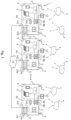
- Fig. 1 shows a schematic illustration of a vehicle 1, in the form of a train, having a plurality of carriages 2, three of which are shown in this figure.
- the train has a communication system comprising a plurality of data communication routers 3, or simply routers 3, arranged in separate carriages 2 of the vehicle 1.
- each carriage 2 is provided with a router 3, however, in other embodiments of the invention only some specific carriages 2 may be provided with a router 3, such as e.g. a front passenger carriage, a rear passenger carriage and a café or restaurant carriage.
- Several routers may also be provided within in the same carriage(s).
- the data communication routers 3 may also be denominated MAR (Mobile Access Router) or MAAR (Mobile Access and Applications Router).
- the routers need not be arranged in different carriages, and it is also feasible to have two or more routers within a single carriage, or in vehicles not having any carriages.
- Each router 3 is configured to receive and transmit wireless data communication to and from a stationary communication server through at least one exterior mobile network 4, e.g. external wide area networks (WANs), as indicated by the dashed arrows.
- WANs wide area networks
- Communication to and from the exterior mobile networks 4 is provided via one or several antennas or antenna arrays 5, arranged on the exterior of the vehicle, such as on the roof.
- the exterior mobile network 4 accordingly provides one data link or several data links between each router 3 and the stationary communication server. In the case where two or more data links are available they can either be between the router 3 and one of the exterior mobile networks 4 and/or by using several exterior mobile networks 4 simultaneously.
- the routers 3 are configured to receive and transmit data packets to and from one or more clients 6 onboard the vehicle 1 through an internal local area network (LAN) 7.
- the LAN 7 is preferably a wireless network, using one or several internal antennas to communicate with clients 6 or terminal units 6 within the vehicle 1.
- the client(s) may be computing devices such as laptops, mobile telephones, PDAs and so on. It is also possible to use a wired network within the vehicle 1.
- Each router 3 is preferably connected to or part of a separate and different LAN 7 as compared to the other routers 3 within the vehicle 1, for example, if each carriage 2 is provided with one router 3 then each carriage 2 is provided with a separate LAN 7.
- the routers 3 are furthermore connected to each other through a backbone, thereby forming an onboard router network 10 in order to receive and transmit data packets to and from each other. This enables clients to connect to any of the routers 3 within the wireless communication system of the vehicle 1, regardless of which router that is closest, and within which router's access area the client is.
- the communication system further comprises one or several controllers 9, in this illustration each router 3 is provided with an individual controller 9 that is configured to evaluate a set of performance parameters of the data link(s) between each router 3 and the exterior mobile network(s) 4. The controllers are then to assign data streams to the different data links, in case a router has access to several links, e.g. based on an evaluation of the performance parameters.
- the plurality of routers 3 are arranged to communicate on several different communication routes having different characteristics, in some embodiments each router 3 is configured to communicate on at least two different communication routes having different characteristics.
- the system allows for the different routers 3 within the train to have separate and different communication routes to and from the exterior mobile network 4, e.g. owned by different network operators.
- the various data streams can be transferred and distributed among the different data links, based on e.g. available bandwidth, such that clients 6 onboard the train 1, are always sure to receive the best data connection available.
- the transferring of data streams through different data links may additionally or alternatively comprises the two main steps: evaluation and assignment. Each of these permits some variability. Numerous types of tests, generating a predictable response, such as an echo, could be performed to evaluate link quality, and such tests can be combined in any order, serially or in parallel. The following are only examples.
- a WWAN Internet service provider will normally offer the addresses of one or more domain name system (DNS) servers, an essential service. DNS queries can be bound to each link, to attempt to resolve a largely arbitrary domain name using one of the ISP's provided servers, or any other. Failure to respond within a given time frame is taken to mean either a general problem transferring the small amount of data, or a more specific problem with the queried DNS server.
- DNS domain name system
- an ECHO_REQUEST datagram is used to elicit an ECHO_RESPONSE from an arbitrary remote host, preferably a very stable one.
- the evaluation can also be made on the pay-load, i.e. the transmitted data streams, by identification and evaluation of response times, etc.
- the system may also comprise a global positioning system (GPS) receiver 13 for receiving GPS signals indicative of the current position of the vehicle, and wherein the controller may be arranged to assign data streams to various data links also partly in dependence on said received GPS signals.
- GPS global positioning system
- the router comprises a plurality of SIMs 12 a-d.
- the number of SIMs is in this particular illustration 4, but preferably at least two, such as e.g. six, ten or twelve.
- the SIMs 12 form a common SIM pool 11, accessible for each of the modems 8 a-N within each router, and also to each different router 3 connected to the onboard router network 10 within the vehicle 1.
- the SIMs 12 are preferably SIM cards, and the SIM pool 11 is realized as a SIM card holder, comprising a plurality of slots for receiving a plurality of SIM cards. Periodical assignment of one or several of the SIM(s) to any modem is controlled by the controller(s) 9.
- the assignment of SIMs to modems at every specific time is preferably determined based on a set of rules in the controller.
- the set of rules may e.g. be used to assign SIMs to the modems based on information such as in which country the vehicle is currently travelling, the amount of data that has been conveyed by use of the different SIMs, the current price related to conveying data through the different SIMs, the type of data being conveyed, etc.
- Distribution and balancing of the clients among the routers is provided by provision of a set of MAC address representations in each router.
- the sets may define MAC addresses to be accepted or, alternatively, to MAC addresses to be ignored.
- the sets are preferably mutually exclusive and comprehensive, so that every possible MAC address will be accepted by a single router among the plurality of routers.
- the routers When a new client is connecting to the onboard router network, the routers receive a MAC address from the client. All the clients then determines whether the received MAC address matches the set of MAC address representations in the routers, and based on this, each router determines whether to accept or ignore the new client. In the end, one router will accept the new client, whereas the other routers will ignore the new client.
- the client balancing may be implemented in several ways depending on network architecture, router capacity and antenna array configuration.
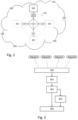
- Fig. 2 illustrates a simplified schematic view of the client balancing as implemented on the communication router with an IP host server 200.
- the clients 100-105 are connected to the network and thereby to all the routers, and the forwarded MAC addresses are used as input to the MAC-address analysis 111.
- the result is input to the filter 112, defined by a pre-defined pattern, in the form of a set of MAC address representations, distributed to the routers by the remote controller 110.
- the client balancing is performed according to the same pattern but with filters 113-115.
- the filters may be realized in software, e.g. by use of the DHCP ignore functionality.
- the remote controller may be arranged in a remote, land based server, connected to the onboard router network through the exterior network(s).
- the controller can be arranged within the onboard router network, such as in one of the routers acting as a master router.
- the set of MAC address representations may contain a range or listing of full MAC addresses. However, preferably, the MAC address representations are only related to parts of the full MAC addresses, such as to one or a few of the octets. The other octets are then ignored, or substituted by a wildcard, mask or the like. In one embodiment, the set of MAC address representations relate to at least the last octet, such as the last octet, or the last two octets. However, the MAC address representations may also be other types of representations. For example, the MAC address representations may be processed MAC addresses.
- the MAC address representations may be hash values of MAC addresses, or part of MAC addresses.
- the set of MAC address representations may then e.g. contain a range of hash values.
- a new MAC address from a client is received, its hash value is then calculated, and compared to the hash values of the set of MAC address representations related to such hash values.
- the MAC address representations may also be checksums of MAC addresses, fingerprints of MAC addresses, and other types of more or less randomized functions that may be performed on the MAC addresses.
- the sets of MAC address representations may be related to MAC addresses to ignore, i.e. forming a "black list”. In this case, clients having MAC addresses falling within a set of MAC address representations will be ignored, and not accepted by the router.
- the sets of MAC address representations may be related to MAC addresses to accept, i.e. forming a "white list”. In this case, clients having MAC addresses falling within a set of MAC address representations will be accepted, and allowed to communicate through the router.
- the sets of MAC address representations for the different routers are both comprehensive and mutually exclusive, ensuring that any client will be accepted by one, and only one, of the routers in the onboard router network.
- Fig. 3 shows a schematic flow chart of the WiFi client balancing implemented on all routers with the redundancy functionality.
- the MAC-addresses of the connected devices are input to the MAC-address analysis 300.
- the result is compared to the pre-defined pattern 301, i.e. the sets of MAC address representations, which filters the clients to the specific router.
- a redundancy function 302 may perform a life-check of all communication routers. If it is established that at least one router has failed, a second pre-defined pattern 304 is used, i.e. modified sets of MAC address representations.
- the clients previously assigned to the now failing router may be re-assigned to the remaining, still operative routers.
- the clients passing the filtering may be hosted by the communication router 303.
- the check to establish whether all routers are still operative, and to determine a failure in any of the routers, is preferably made repeatedly and continuously.
- the pre-defined patterns formed by the sets of MAC address representations, can be configured to depend on user specific data consumption in order to further optimize the client balancing.
- client balancing By using MAC-address based client balancing the method becomes highly dynamic and scalable. As Fig. 2 illustrates, new clients will be distributed among the routers in the same manner and extending the network with more routers is possible as well. The use of access points, switches or other equipment within the vehicle network will not disturb the client balancing.
- the routers may be provided in different compartments or carriages of the vehicle, or several routers in the same carriage or compartment.
- the client balancing between the routers may be obtained by various forms of MAC address representations, such as by use of only part of the full MAC addresses, by using a processed version of the MAC addresses, such as by hashing, or the like.
- the scope of the present invention is defined by the appended claims. It should be noted that the above-mentioned embodiments illustrate rather than limit the invention, and that those skilled in the art will be able to design many alternative embodiments without departing from the scope of the appended claims.
- any reference signs placed between parentheses shall not be construed as limiting to the claim.
- the word “comprising” does not exclude the presence of other elements or steps than those listed in the claim.
- the word “a” or “an” preceding an element does not exclude the presence of a plurality of such elements.
Landscapes
- Engineering & Computer Science (AREA)
- Computer Networks & Wireless Communication (AREA)
- Signal Processing (AREA)
- Computer Security & Cryptography (AREA)
- Aviation & Aerospace Engineering (AREA)
- Mobile Radio Communication Systems (AREA)
Claims (14)
- Drahtloses Kommunikationssystem für ein sich bewegendes Fahrzeug (1), wobei das drahtlose Kommunikationssystem umfasst:mehrere Router (3; 200 - 203; 303), wobei jeder Router ausgestaltet ist, um:drahtlose Datenkommunikation von und zu einem stationären Kommunikationsserver außerhalb des sich bewegenden Fahrzeugs (1) durch wenigstens ein externes mobiles Netzwerk (4) über wenigstens eine Antenne (5) zu empfangen und zu senden, wobei das wenigstens eine externe mobile Netzwerk (4) wenigstens einen Datenlink bereitstellt;Datenpakete von und zu wenigstens einem Client (6) an Bord des sich bewegenden Fahrzeugs (1) zu empfangen und zu übertragen;mit jedem anderen Router (3; 200 - 203; 303) in dem sich bewegenden Fahrzeug zu kommunizieren, um Datenpakete von und zu jedem anderen Router zu empfangen und zu senden, wodurch ein Routernetzwerk (10) an Bord geformt ist;dadurch gekennzeichnet, dass jeder Router (3; 200 - 203; 303) angeordnet ist, um eine Medienzugangs-Steueradresse, MAC-Adresse, von einem Client (6) zu empfangen, der an das Routernetzwerk (10) an Bord angeschlossen ist und dass jeder Router mit einem Satz von MAC-Adressendarstellungen bereitgestellt ist, die zu akzeptierende oder zu ignorierende MAC-Adressen darstellen, wobei jeder Router (3; 200 - 203; 303) angeordnet ist, um die empfangene MAC-Adresse zu analysieren und sie mit ihrem Satz von MAC-Adressendarstellungen zu vergleichen und um basierend auf der Analyse zu bestimmen, ob der Client (6) akzeptiert oder ignoriert werden soll, wobei die Sätze von MAC-Adressendarstellungen für die unterschiedlichen Router gegenseitig exklusiv sind, wodurch ein Client (6) nur durch einen Router in dem Routernetzwerk (10) an Bord akzeptiert werden kann und dass das System weiterhin eine Steuerung umfasst, wobei die Sätze von MAC-Adressendarstellungen durch die Steuerung (9) erstellt sind und wobei die Steuerung (9) angeordnet ist, um Funktionsstörungen irgendeines der Router (3; 200 - 203; 303) in dem Routernetzwerk (10) an Bord zu detektieren und beim Detektieren eines Routers mit Fehlfunktion angeordnet ist, um einen aktualisierten Satz von MAC-Adressendarstellungen für den wenigstens einen verbleibenden Router zu erstellen.
- Drahtloses Kommunikationssystem nach Anspruch 1, wobei die Sätze von MAC-Adressendarstellungen für die unterschiedlichen Router umfassend sind und zusammen im Wesentlichen jede mögliche MAC-Adresse umfassen.
- Drahtloses Kommunikationssystem nach Anspruch 1, wobei der aktualisierte Satz von MAC-Adressendarstellungen für den/die verbleibenden Router die MAC-Adressen eines Routers mit Fehlfunktionen dem wenigstens einen verbleibenden Router neu zuordnet.
- Drahtloses Kommunikationssystem nach irgendeinem der vorhergehenden Ansprüche, wobei die Steuerung (9) angeordnet ist, um die Anzahl von aktuell betriebsbereiten Routern (3; 200 - 203; 303) in dem Routernetzwerk (10) an Bord in Echtzeit zu detektieren und die Sätze von MAC-Adressendarstellungen dementsprechend kontinuierlich zu aktualisieren.
- Drahtloses Kommunikationssystem nach irgendeinem der vorhergehenden Ansprüche, wobei die Steuerung in dem stationären Kommunikationsserver angeordnet ist, wobei der stationäre Kommunikationsserver angeordnet ist, um die erstellten Sätze von MAC-Adressendarstellungen den Routern bereitzustellen.
- Drahtloses Kommunikationssystem nach irgendeinem der vorhergehenden Ansprüche, wobei die Steuerung (9) in wenigstens einem Masterrouter der wenigstens zwei Router (3; 200 - 303; 303) in dem Routernetzwerk (10) an Bord angeordnet ist, wobei der Masterrouter den jeweiligen erstellten wenigstens einen Satz von MAC-Adressendarstellungen dem anderen wenigstens einen Router in dem Routernetzwerk an Bord bereitstellt.
- Drahtloses Kommunikationssystem nach irgendeinem der vorhergehenden Ansprüche, wobei die Sätze von MAC-Adressendarstellungen auf der Anzahl von betriebsbereiten Routern im Routernetzwerk (10) an Bord basieren.
- Drahtloses Kommunikationssystem nach Anspruch 7, wobei die Sätze von MAC-Adressendarstellungen weiterhin auf wenigstens einen basieren von: der verfügbaren Bandbreite jedes Routers und der Datennutzung für jeden Router (3; 200 - 203; 303).
- Drahtloses Kommunikationssystem nach irgendeinem der vorhergehenden Ansprüche, wobei die Sätze von MAC-Adressendarstellungen eine Reihe von Anzahlen für wenigstens ein Byte der MAC-Adressen und bevorzugt wenigstens das letzte Byte umfassen.
- Drahtloses Kommunikationssystem nach irgendeinem der vorhergehenden Ansprüche, wobei jeder Router (3; 200 - 203; 303) wenigstens ein und bevorzugt mehrere Modem(s) (8a - n) zur Kommunikation mit wenigstens dem einem externen mobilen Netzwerk (4) umfasst, wobei jedes Modem in betriebsbereiter Verbindung mit jedem Router (3; 200 - 203; 303) der mehreren Router durch das Routernetzwerk an Bord steht.
- Drahtloses Kommunikationssystem nach irgendeinem der vorhergehenden Ansprüche, wobei die Sätze von MAC-Adressendarstellungen zu ignorierende MAC-Adressen darstellen und wobei jeder Router eine Filterfunktionalität bereitstellt, die nur Clients mit MAC-Adressen akzeptiert, die nicht mit dem Satz von MAC-Adressendarstellungen übereinstimmen.
- Drahtloses Kommunikationssystem nach irgendeinem der vorhergehenden Ansprüche, wobei die Router (3; 200 - 203; 303) angeordnet sind, um mit den Clients (6) an Bord des sich bewegenden Fahrzeugs durch einen drahtlosen lokalen Bereichsnetzwerk-Standard und bevorzugt einen IEEE 802.11-Standard zu kommunizieren.
- Drahtloses Kommunikationssystem nach irgendeinem der vorhergehenden Ansprüche, wobei die Router (3; 200 - 203; 303) an Bord des sich bewegenden Fahrzeugs durch ein verdrahtetes Backbone verbunden sind, wodurch das Routernetzwerk (10) an Bord geformt ist.
- Verfahren zum Client-Ausgleich in einem drahtlosen Kommunikationssystem für ein sich bewegendes Fahrzeug (1), wobei das drahtlose Kommunikationssystem mehrere Router (3; 200 - 203; 303) an Bord des sich bewegenden Fahrzeugs umfasst, wobei jeder der Router in kommunikativem Kontakt mit jedem anderen Router in dem sich bewegenden Fahrzeug durch ein Routernetzwerk (10) an Bord steht, wobei das Verfahren umfasst:Bereitstellen eines Satzes von MAC-Adressendarstellungen, die zu akzeptierende oder zu ignorierende MAC-Adressen darstellen, in jedem der Router, wobei die Sätze gegenseitig exklusiv sind, wobei ein Client (6) nur von einem Router im Routernetzwerk (10) an Bord akzeptiert sein kann,Empfangen einer Medienzugangs-Steueradresse, MAC-Adresse, von irgendeinem Client (6), der an das Routernetzwerk (10) an Bord angeschlossen ist;Analysieren der empfangenen MAC-Adresse in jedem Router (3; 200 - 203; 303) und Vergleichen mit ihrem Satz an MAC-Adressendarstellungen und basierend auf dieser Analyse Bestimmen, ob der Client akzeptiert oder ignoriert werden soll;wobei das System weiterhin eine Steuerung umfasst, wobei die Sätze von MAC-Adressendarstellungen von der Steuerung (9) erstellt sind und wobei die Steuerung (9) eine Fehlfunktion irgendeines der Router (3; 200 - 203; 303) in dem Routernetzwerk (10) an Bord detektiert und bei der Detektion eines Routers mit Fehlfunktion einen aktualisierten Satz von MAC-Adressendarstellungen für den wenigstens einen verbleibenden Router erstellt.
Applications Claiming Priority (1)
| Application Number | Priority Date | Filing Date | Title |
|---|---|---|---|
| SE2051515A SE545043C2 (en) | 2020-12-21 | 2020-12-21 | Multi-router wireless communication system with client balancing |
Publications (3)
| Publication Number | Publication Date |
|---|---|
| EP4017119A1 EP4017119A1 (de) | 2022-06-22 |
| EP4017119B1 true EP4017119B1 (de) | 2025-06-11 |
| EP4017119C0 EP4017119C0 (de) | 2025-06-11 |
Family
ID=79283146
Family Applications (1)
| Application Number | Title | Priority Date | Filing Date |
|---|---|---|---|
| EP21215541.0A Active EP4017119B1 (de) | 2020-12-21 | 2021-12-17 | Drahtloses multirouter-kommunikationssystem mit client-ausgleich |
Country Status (4)
| Country | Link |
|---|---|
| US (1) | US12150032B2 (de) |
| EP (1) | EP4017119B1 (de) |
| CA (1) | CA3143456A1 (de) |
| SE (1) | SE545043C2 (de) |
Families Citing this family (3)
| Publication number | Priority date | Publication date | Assignee | Title |
|---|---|---|---|---|
| CN116033391A (zh) * | 2023-02-07 | 2023-04-28 | 厦门雅基软件有限公司 | 车辆通信方法、装置、电子设备及存储介质 |
| CN116056040B (zh) * | 2023-02-07 | 2026-04-14 | 北京柏林互动科技有限公司 | 车辆通信方法、装置、电子设备及存储介质 |
| CN116260886A (zh) * | 2023-03-17 | 2023-06-13 | 阿里巴巴(中国)有限公司 | 通信方法、系统、设备及存储介质 |
Family Cites Families (23)
| Publication number | Priority date | Publication date | Assignee | Title |
|---|---|---|---|---|
| SE0000707D0 (sv) | 1999-05-04 | 2000-03-01 | Magnus Agervald | System för överförande av data via flera kommunikationsvägar |
| US7881208B1 (en) * | 2001-06-18 | 2011-02-01 | Cisco Technology, Inc. | Gateway load balancing protocol |
| US20050174943A1 (en) * | 2003-09-10 | 2005-08-11 | Shiwei Wang | End-to-end mapping of VLAN ID and 802.1P COS to multiple BSSID for wired and wireless LAN |
| US8037204B2 (en) * | 2005-02-11 | 2011-10-11 | Cisco Technology, Inc. | Method and system for IP train inauguration |
| US8189552B2 (en) * | 2006-05-16 | 2012-05-29 | Autonet Mobile, Inc. | Mobile router that monitors links |
| US11818580B1 (en) * | 2006-06-27 | 2023-11-14 | Trend Micro Incorporated | Detecting unauthorized access points in a network |
| US10110602B2 (en) * | 2009-12-01 | 2018-10-23 | Kct Holdings, Llc | Secure internal data network communication interfaces |
| US8570861B1 (en) * | 2010-06-29 | 2013-10-29 | Amazon Technologies, Inc. | Reputation-based networking |
| LT2518977T (lt) | 2011-04-29 | 2019-06-25 | Icomera Ab | Transporto priemonės ryšio sistema |
| GB2508354B (en) * | 2012-11-28 | 2018-09-05 | Nomad Spectrum Ltd | Communication method |
| LT2943011T (lt) | 2014-05-08 | 2019-07-25 | Icomera Ab | Belaidžio ryšio važiuojančioje transporto priemonėje sistema |
| US11277390B2 (en) * | 2015-01-26 | 2022-03-15 | Listat Ltd. | Decentralized cybersecure privacy network for cloud communication, computing and global e-commerce |
| US10700988B2 (en) * | 2015-03-05 | 2020-06-30 | Cisco Technology, Inc. | System and method for dynamic bandwidth adjustments for cellular interfaces in a network environment |
| CN108028861B (zh) * | 2015-08-12 | 2021-04-20 | 飞利浦照明控股有限公司 | 密集大网络中管理代理设备分配的方法、代理设备和系统 |
| US9591676B1 (en) * | 2015-09-22 | 2017-03-07 | Veniam, Inc. | Systems and methods for managing mobility in a network of moving things |
| SE542226C2 (en) | 2016-07-14 | 2020-03-17 | Icomera Ab | Distributed wireless communication system for moving vehicles |
| US10142221B2 (en) * | 2016-09-07 | 2018-11-27 | T-Mobile Usa, Inc. | Network address translation in networks using multiple NAT devices |
| EP3520455A4 (de) * | 2016-09-27 | 2020-04-22 | A9.com, Inc. | Verfahren zur teilung einer netzwerkkonfiguration |
| US11050620B2 (en) * | 2017-11-14 | 2021-06-29 | TidalScale, Inc. | Dynamic reconfiguration of resilient logical modules in a software defined server |
| TWI692228B (zh) * | 2018-10-24 | 2020-04-21 | 啟碁科技股份有限公司 | 用於網狀網路的連線建立系統及方法 |
| WO2020247888A1 (en) * | 2019-06-07 | 2020-12-10 | Arris Enterprises Llc | Dynamic load balancing of gateway access points |
| US11432152B2 (en) * | 2020-05-04 | 2022-08-30 | Watchguard Technologies, Inc. | Method and apparatus for detecting and handling evil twin access points |
| WO2022073166A1 (en) * | 2020-10-08 | 2022-04-14 | Arris Enterprises Llc | System and method for prompting user to disable service set identifier isolation |
-
2020
- 2020-12-21 SE SE2051515A patent/SE545043C2/en unknown
-
2021
- 2021-12-17 EP EP21215541.0A patent/EP4017119B1/de active Active
- 2021-12-20 CA CA3143456A patent/CA3143456A1/en active Pending
- 2021-12-20 US US17/556,507 patent/US12150032B2/en active Active
Also Published As
| Publication number | Publication date |
|---|---|
| EP4017119A1 (de) | 2022-06-22 |
| SE2051515A1 (en) | 2022-06-22 |
| SE545043C2 (en) | 2023-03-07 |
| US20220201588A1 (en) | 2022-06-23 |
| US12150032B2 (en) | 2024-11-19 |
| EP4017119C0 (de) | 2025-06-11 |
| CA3143456A1 (en) | 2022-06-21 |
Similar Documents
| Publication | Publication Date | Title |
|---|---|---|
| US10924901B2 (en) | Distributed wireless communication system for moving vehicles | |
| EP4017119B1 (de) | Drahtloses multirouter-kommunikationssystem mit client-ausgleich | |
| US12034519B2 (en) | Method and system for wireless satellite communication via low earth orbit (LEO) satellites | |
| US10911411B2 (en) | Extending public WiFi hotspot to private enterprise network | |
| Kärkkäinen et al. | Enabling ad-hoc-style communication in public wlan hot-spots | |
| EP3177074B1 (de) | Verfahren und system zur dynamischen auswahl von kommunikationspfaden für ein sich bewegendes fahrzeug | |
| US10375622B2 (en) | Train communication system with silent compartments | |
| US10924929B2 (en) | Wireless communication system | |
| US12021652B2 (en) | Wireless communication system with PoE network switches for moving vehicles | |
| US20140258478A1 (en) | Distributed Functionality Across Multiple Network Devices | |
| Nguyen et al. | A proposal of autonomic edge cloud platform with CCN-based service routing protocol | |
| EP4489508A1 (de) | Drahtloses kommunikationssystem für bodengebundene, bewegliche fahrzeuge | |
| Eager et al. | An analysis of multicast inefficiencies in multi-tenant MEC infrastructures for 5G networks | |
| Elamer et al. | UWS Academic Portal |
Legal Events
| Date | Code | Title | Description |
|---|---|---|---|
| PUAI | Public reference made under article 153(3) epc to a published international application that has entered the european phase |
Free format text: ORIGINAL CODE: 0009012 |
|
| STAA | Information on the status of an ep patent application or granted ep patent |
Free format text: STATUS: THE APPLICATION HAS BEEN PUBLISHED |
|
| AK | Designated contracting states |
Kind code of ref document: A1 Designated state(s): AL AT BE BG CH CY CZ DE DK EE ES FI FR GB GR HR HU IE IS IT LI LT LU LV MC MK MT NL NO PL PT RO RS SE SI SK SM TR |
|
| STAA | Information on the status of an ep patent application or granted ep patent |
Free format text: STATUS: REQUEST FOR EXAMINATION WAS MADE |
|
| 17P | Request for examination filed |
Effective date: 20221124 |
|
| RBV | Designated contracting states (corrected) |
Designated state(s): AL AT BE BG CH CY CZ DE DK EE ES FI FR GB GR HR HU IE IS IT LI LT LU LV MC MK MT NL NO PL PT RO RS SE SI SK SM TR |
|
| STAA | Information on the status of an ep patent application or granted ep patent |
Free format text: STATUS: EXAMINATION IS IN PROGRESS |
|
| 17Q | First examination report despatched |
Effective date: 20240722 |
|
| GRAP | Despatch of communication of intention to grant a patent |
Free format text: ORIGINAL CODE: EPIDOSNIGR1 |
|
| STAA | Information on the status of an ep patent application or granted ep patent |
Free format text: STATUS: GRANT OF PATENT IS INTENDED |
|
| RIC1 | Information provided on ipc code assigned before grant |
Ipc: H04W 84/12 20090101ALN20250211BHEP Ipc: H04W 84/00 20090101ALN20250211BHEP Ipc: H04L 101/622 20220101ALN20250211BHEP Ipc: H04W 48/00 20090101AFI20250211BHEP |
|
| INTG | Intention to grant announced |
Effective date: 20250220 |
|
| GRAS | Grant fee paid |
Free format text: ORIGINAL CODE: EPIDOSNIGR3 |
|
| GRAA | (expected) grant |
Free format text: ORIGINAL CODE: 0009210 |
|
| STAA | Information on the status of an ep patent application or granted ep patent |
Free format text: STATUS: THE PATENT HAS BEEN GRANTED |
|
| AK | Designated contracting states |
Kind code of ref document: B1 Designated state(s): AL AT BE BG CH CY CZ DE DK EE ES FI FR GB GR HR HU IE IS IT LI LT LU LV MC MK MT NL NO PL PT RO RS SE SI SK SM TR |
|
| REG | Reference to a national code |
Ref country code: GB Ref legal event code: FG4D |
|
| REG | Reference to a national code |
Ref country code: CH Ref legal event code: EP |
|
| REG | Reference to a national code |
Ref country code: DE Ref legal event code: R096 Ref document number: 602021032065 Country of ref document: DE |
|
| REG | Reference to a national code |
Ref country code: IE Ref legal event code: FG4D |
|
| U01 | Request for unitary effect filed |
Effective date: 20250611 |
|
| U07 | Unitary effect registered |
Designated state(s): AT BE BG DE DK EE FI FR IT LT LU LV MT NL PT RO SE SI Effective date: 20250623 |
|
| PG25 | Lapsed in a contracting state [announced via postgrant information from national office to epo] |
Ref country code: ES Free format text: LAPSE BECAUSE OF FAILURE TO SUBMIT A TRANSLATION OF THE DESCRIPTION OR TO PAY THE FEE WITHIN THE PRESCRIBED TIME-LIMIT Effective date: 20250611 |
|
| PG25 | Lapsed in a contracting state [announced via postgrant information from national office to epo] |
Ref country code: NO Free format text: LAPSE BECAUSE OF FAILURE TO SUBMIT A TRANSLATION OF THE DESCRIPTION OR TO PAY THE FEE WITHIN THE PRESCRIBED TIME-LIMIT Effective date: 20250911 Ref country code: GR Free format text: LAPSE BECAUSE OF FAILURE TO SUBMIT A TRANSLATION OF THE DESCRIPTION OR TO PAY THE FEE WITHIN THE PRESCRIBED TIME-LIMIT Effective date: 20250912 |
|
| PG25 | Lapsed in a contracting state [announced via postgrant information from national office to epo] |
Ref country code: HR Free format text: LAPSE BECAUSE OF FAILURE TO SUBMIT A TRANSLATION OF THE DESCRIPTION OR TO PAY THE FEE WITHIN THE PRESCRIBED TIME-LIMIT Effective date: 20250611 |
|
| PG25 | Lapsed in a contracting state [announced via postgrant information from national office to epo] |
Ref country code: RS Free format text: LAPSE BECAUSE OF FAILURE TO SUBMIT A TRANSLATION OF THE DESCRIPTION OR TO PAY THE FEE WITHIN THE PRESCRIBED TIME-LIMIT Effective date: 20250911 |
|
| PG25 | Lapsed in a contracting state [announced via postgrant information from national office to epo] |
Ref country code: IS Free format text: LAPSE BECAUSE OF FAILURE TO SUBMIT A TRANSLATION OF THE DESCRIPTION OR TO PAY THE FEE WITHIN THE PRESCRIBED TIME-LIMIT Effective date: 20251011 |
|
| PG25 | Lapsed in a contracting state [announced via postgrant information from national office to epo] |
Ref country code: SM Free format text: LAPSE BECAUSE OF FAILURE TO SUBMIT A TRANSLATION OF THE DESCRIPTION OR TO PAY THE FEE WITHIN THE PRESCRIBED TIME-LIMIT Effective date: 20250611 |
|
| PG25 | Lapsed in a contracting state [announced via postgrant information from national office to epo] |
Ref country code: CZ Free format text: LAPSE BECAUSE OF FAILURE TO SUBMIT A TRANSLATION OF THE DESCRIPTION OR TO PAY THE FEE WITHIN THE PRESCRIBED TIME-LIMIT Effective date: 20250611 |
|
| PG25 | Lapsed in a contracting state [announced via postgrant information from national office to epo] |
Ref country code: PL Free format text: LAPSE BECAUSE OF FAILURE TO SUBMIT A TRANSLATION OF THE DESCRIPTION OR TO PAY THE FEE WITHIN THE PRESCRIBED TIME-LIMIT Effective date: 20250611 |
|
| PG25 | Lapsed in a contracting state [announced via postgrant information from national office to epo] |
Ref country code: SK Free format text: LAPSE BECAUSE OF FAILURE TO SUBMIT A TRANSLATION OF THE DESCRIPTION OR TO PAY THE FEE WITHIN THE PRESCRIBED TIME-LIMIT Effective date: 20250611 |
|
| PLBE | No opposition filed within time limit |
Free format text: ORIGINAL CODE: 0009261 |
|
| STAA | Information on the status of an ep patent application or granted ep patent |
Free format text: STATUS: NO OPPOSITION FILED WITHIN TIME LIMIT |
|
| REG | Reference to a national code |
Ref country code: CH Ref legal event code: L10 Free format text: ST27 STATUS EVENT CODE: U-0-0-L10-L00 (AS PROVIDED BY THE NATIONAL OFFICE) Effective date: 20260423 |