EP4016999A1 - Image processing method and apparatus, terminal, and computer-readable storage medium - Google Patents
Image processing method and apparatus, terminal, and computer-readable storage medium Download PDFInfo
- Publication number
- EP4016999A1 EP4016999A1 EP20918514.9A EP20918514A EP4016999A1 EP 4016999 A1 EP4016999 A1 EP 4016999A1 EP 20918514 A EP20918514 A EP 20918514A EP 4016999 A1 EP4016999 A1 EP 4016999A1
- Authority
- EP
- European Patent Office
- Prior art keywords
- prediction mode
- prediction
- coding unit
- coding
- unit
- Prior art date
- Legal status (The legal status is an assumption and is not a legal conclusion. Google has not performed a legal analysis and makes no representation as to the accuracy of the status listed.)
- Pending
Links
- 238000000034 method Methods 0.000 claims abstract description 39
- 238000003672 processing method Methods 0.000 claims abstract description 17
- 238000007781 pre-processing Methods 0.000 claims description 135
- 238000010586 diagram Methods 0.000 description 10
- 238000004364 calculation method Methods 0.000 description 7
- 238000005516 engineering process Methods 0.000 description 7
- 230000006870 function Effects 0.000 description 7
- 238000007906 compression Methods 0.000 description 3
- 230000003044 adaptive effect Effects 0.000 description 2
- 230000006835 compression Effects 0.000 description 2
- 238000013500 data storage Methods 0.000 description 2
- 230000001133 acceleration Effects 0.000 description 1
- 238000004590 computer program Methods 0.000 description 1
- 238000001514 detection method Methods 0.000 description 1
- 238000001914 filtration Methods 0.000 description 1
- 230000003287 optical effect Effects 0.000 description 1
- 238000013139 quantization Methods 0.000 description 1
- 238000000638 solvent extraction Methods 0.000 description 1
Images



Classifications
-
- H—ELECTRICITY
- H04—ELECTRIC COMMUNICATION TECHNIQUE
- H04N—PICTORIAL COMMUNICATION, e.g. TELEVISION
- H04N19/00—Methods or arrangements for coding, decoding, compressing or decompressing digital video signals
- H04N19/10—Methods or arrangements for coding, decoding, compressing or decompressing digital video signals using adaptive coding
- H04N19/102—Methods or arrangements for coding, decoding, compressing or decompressing digital video signals using adaptive coding characterised by the element, parameter or selection affected or controlled by the adaptive coding
- H04N19/103—Selection of coding mode or of prediction mode
- H04N19/109—Selection of coding mode or of prediction mode among a plurality of temporal predictive coding modes
-
- H—ELECTRICITY
- H04—ELECTRIC COMMUNICATION TECHNIQUE
- H04N—PICTORIAL COMMUNICATION, e.g. TELEVISION
- H04N19/00—Methods or arrangements for coding, decoding, compressing or decompressing digital video signals
- H04N19/10—Methods or arrangements for coding, decoding, compressing or decompressing digital video signals using adaptive coding
- H04N19/102—Methods or arrangements for coding, decoding, compressing or decompressing digital video signals using adaptive coding characterised by the element, parameter or selection affected or controlled by the adaptive coding
- H04N19/103—Selection of coding mode or of prediction mode
-
- H—ELECTRICITY
- H04—ELECTRIC COMMUNICATION TECHNIQUE
- H04N—PICTORIAL COMMUNICATION, e.g. TELEVISION
- H04N19/00—Methods or arrangements for coding, decoding, compressing or decompressing digital video signals
- H04N19/10—Methods or arrangements for coding, decoding, compressing or decompressing digital video signals using adaptive coding
- H04N19/102—Methods or arrangements for coding, decoding, compressing or decompressing digital video signals using adaptive coding characterised by the element, parameter or selection affected or controlled by the adaptive coding
- H04N19/103—Selection of coding mode or of prediction mode
- H04N19/11—Selection of coding mode or of prediction mode among a plurality of spatial predictive coding modes
-
- H—ELECTRICITY
- H04—ELECTRIC COMMUNICATION TECHNIQUE
- H04N—PICTORIAL COMMUNICATION, e.g. TELEVISION
- H04N19/00—Methods or arrangements for coding, decoding, compressing or decompressing digital video signals
- H04N19/10—Methods or arrangements for coding, decoding, compressing or decompressing digital video signals using adaptive coding
- H04N19/102—Methods or arrangements for coding, decoding, compressing or decompressing digital video signals using adaptive coding characterised by the element, parameter or selection affected or controlled by the adaptive coding
- H04N19/132—Sampling, masking or truncation of coding units, e.g. adaptive resampling, frame skipping, frame interpolation or high-frequency transform coefficient masking
-
- H—ELECTRICITY
- H04—ELECTRIC COMMUNICATION TECHNIQUE
- H04N—PICTORIAL COMMUNICATION, e.g. TELEVISION
- H04N19/00—Methods or arrangements for coding, decoding, compressing or decompressing digital video signals
- H04N19/10—Methods or arrangements for coding, decoding, compressing or decompressing digital video signals using adaptive coding
- H04N19/134—Methods or arrangements for coding, decoding, compressing or decompressing digital video signals using adaptive coding characterised by the element, parameter or criterion affecting or controlling the adaptive coding
- H04N19/146—Data rate or code amount at the encoder output
- H04N19/147—Data rate or code amount at the encoder output according to rate distortion criteria
-
- H—ELECTRICITY
- H04—ELECTRIC COMMUNICATION TECHNIQUE
- H04N—PICTORIAL COMMUNICATION, e.g. TELEVISION
- H04N19/00—Methods or arrangements for coding, decoding, compressing or decompressing digital video signals
- H04N19/10—Methods or arrangements for coding, decoding, compressing or decompressing digital video signals using adaptive coding
- H04N19/134—Methods or arrangements for coding, decoding, compressing or decompressing digital video signals using adaptive coding characterised by the element, parameter or criterion affecting or controlling the adaptive coding
- H04N19/154—Measured or subjectively estimated visual quality after decoding, e.g. measurement of distortion
-
- H—ELECTRICITY
- H04—ELECTRIC COMMUNICATION TECHNIQUE
- H04N—PICTORIAL COMMUNICATION, e.g. TELEVISION
- H04N19/00—Methods or arrangements for coding, decoding, compressing or decompressing digital video signals
- H04N19/10—Methods or arrangements for coding, decoding, compressing or decompressing digital video signals using adaptive coding
- H04N19/169—Methods or arrangements for coding, decoding, compressing or decompressing digital video signals using adaptive coding characterised by the coding unit, i.e. the structural portion or semantic portion of the video signal being the object or the subject of the adaptive coding
- H04N19/17—Methods or arrangements for coding, decoding, compressing or decompressing digital video signals using adaptive coding characterised by the coding unit, i.e. the structural portion or semantic portion of the video signal being the object or the subject of the adaptive coding the unit being an image region, e.g. an object
- H04N19/176—Methods or arrangements for coding, decoding, compressing or decompressing digital video signals using adaptive coding characterised by the coding unit, i.e. the structural portion or semantic portion of the video signal being the object or the subject of the adaptive coding the unit being an image region, e.g. an object the region being a block, e.g. a macroblock
-
- H—ELECTRICITY
- H04—ELECTRIC COMMUNICATION TECHNIQUE
- H04N—PICTORIAL COMMUNICATION, e.g. TELEVISION
- H04N19/00—Methods or arrangements for coding, decoding, compressing or decompressing digital video signals
- H04N19/10—Methods or arrangements for coding, decoding, compressing or decompressing digital video signals using adaptive coding
- H04N19/189—Methods or arrangements for coding, decoding, compressing or decompressing digital video signals using adaptive coding characterised by the adaptation method, adaptation tool or adaptation type used for the adaptive coding
-
- H—ELECTRICITY
- H04—ELECTRIC COMMUNICATION TECHNIQUE
- H04N—PICTORIAL COMMUNICATION, e.g. TELEVISION
- H04N19/00—Methods or arrangements for coding, decoding, compressing or decompressing digital video signals
- H04N19/10—Methods or arrangements for coding, decoding, compressing or decompressing digital video signals using adaptive coding
- H04N19/189—Methods or arrangements for coding, decoding, compressing or decompressing digital video signals using adaptive coding characterised by the adaptation method, adaptation tool or adaptation type used for the adaptive coding
- H04N19/196—Methods or arrangements for coding, decoding, compressing or decompressing digital video signals using adaptive coding characterised by the adaptation method, adaptation tool or adaptation type used for the adaptive coding being specially adapted for the computation of encoding parameters, e.g. by averaging previously computed encoding parameters
-
- H—ELECTRICITY
- H04—ELECTRIC COMMUNICATION TECHNIQUE
- H04N—PICTORIAL COMMUNICATION, e.g. TELEVISION
- H04N19/00—Methods or arrangements for coding, decoding, compressing or decompressing digital video signals
- H04N19/46—Embedding additional information in the video signal during the compression process
- H04N19/463—Embedding additional information in the video signal during the compression process by compressing encoding parameters before transmission
-
- H—ELECTRICITY
- H04—ELECTRIC COMMUNICATION TECHNIQUE
- H04N—PICTORIAL COMMUNICATION, e.g. TELEVISION
- H04N19/00—Methods or arrangements for coding, decoding, compressing or decompressing digital video signals
- H04N19/90—Methods or arrangements for coding, decoding, compressing or decompressing digital video signals using coding techniques not provided for in groups H04N19/10-H04N19/85, e.g. fractals
- H04N19/96—Tree coding, e.g. quad-tree coding
Definitions
- This disclosure relates to the field of image coding technologies, and in particular, to an image processing method and apparatus, a terminal, and a computer-readable storage medium.
- Embodiments of this disclosure provide an image processing method and apparatus, a terminal, and a computer-readable storage medium that can adaptively and quickly determine the coding prediction manner of a coding unit.
- An embodiment of this disclosure provides an image processing method.
- the method includes: determining an associated unit set of a current coding unit in an image frame, the associated unit set including associated coding units, the associated coding units including: at least one of a target unit in the image frame adjacent to the current coding unit, and a coding unit in the image frame having a parent relationship or a child relationship with the current coding unit; determining first statistical information according to a prediction mode of each associated coding unit in the associated unit set; obtaining second statistical information of preprocessing image blocks corresponding to the current coding unit; and determining a coding prediction manner of the current coding unit according to the first statistical information and the second statistical information, the coding prediction manner being used for indicating a prediction mode selected from the prediction modes of the associated coding units to perform prediction coding on the current coding unit according to the prediction mode selected from the prediction modes of the associated coding units and/or being used for indicating an order of applying prediction modes selected from the prediction modes of the associated coding units to perform prediction coding on the current
- An embodiment of this disclosure provides an image processing apparatus.
- the apparatus includes: a processing unit, configured to determine an associated unit set of a current coding unit in an image frame, the associated unit set including associated coding units, the associated coding units including: at least one of a target unit in the image frame adjacent to the current coding unit, and a coding unit in the image frame having a parent relationship or a child relationship with the current coding unit; an obtaining unit, configured to determine first statistical information according to a prediction mode of each associated coding unit in the associated unit set; the obtaining unit being further configured to obtain second statistical information of preprocessing image blocks corresponding to the current coding unit; and the processing unit being further configured to determine a coding prediction manner of the current coding unit according to the first statistical information and the second statistical information, the coding prediction manner being used for indicating a prediction mode selected from the prediction modes of the associated coding units to perform prediction coding on the current coding unit according to the prediction mode selected from the prediction modes of the associated coding units and/or being used for indicating
- An embodiment of this disclosure provides a terminal, including a processor and a memory, the memory being configured to store executable program code, and the processor being configured to invoke the executable program code, to perform the above image processing method.
- An embodiment of this disclosure further provides a computer-readable storage medium, storing instructions, the instructions, when run on a computer, causing the computer to perform the above image processing method.
- first statistical information is determined according to prediction modes of units adjacent to a coding unit and/or having a parent relationship or a child relationship with a coding unit, and second statistical information of preprocessing image blocks corresponding to the coding unit is obtained, and a coding prediction manner of the coding unit is determined according to the first statistical information and the second statistical information, so that the coding prediction manner of the coding unit can be determined adaptively and quickly, thereby improving the efficiency of determining the coding prediction manner.
- Image frame a video includes multiple image frames.
- Video compression coding generally adopts a block-based coding manner, that is, an image frame in a video is divided into multiple non-overlapping blocks, and then the blocks are coded. Each image frame may be coded in an inter prediction coding manner or an intra prediction coding manner during video coding.
- the coding unit is a basic unit for coding in an image frame.
- the coding unit may be a block having a pixel size of 64 ⁇ 64, 32x32, 16x 16, 8x8, or the like.
- the predict unit is a basic unit for predicting in an image frame.
- the predict unit may be a block having a pixel size of 64 ⁇ 64, 64 ⁇ 32, 32 ⁇ 64, 32 ⁇ 32, 32 ⁇ 16, 16 ⁇ 32, 16 ⁇ 16, 16 ⁇ 8, 8 ⁇ 16, 8 ⁇ 8, 8 ⁇ 4, 4 ⁇ 8, 4 ⁇ 4, or the like.
- Transform unit (TU): It is a basic unit for presenting a residual or transform coefficients in an image frame.
- the transform unit may also be a block having a pixel size of 32 ⁇ 32, 16 ⁇ 16, 8 ⁇ 8, 4 ⁇ 4, or the like.
- DB deblocking filter
- SAO sample adaptive offset
- ME motion estimation
- RDcost rate-distortion cost, being used for selecting the best among multiple options.
- FIG. 1 shows a standard HEVC coding frame.
- An image frame Fn is inputted to a coder, where the image frame Fn is first divided into multiple coding tree units (CTU) according to a certain size (for example, 64x64), and the CTUs are divided by depth to obtain multiple coding units, each coding unit including PUs and TUs.
- CTU coding tree units
- prediction processing is performed on each PU to obtain a predicted value
- the predicted value is subtracted from the input data to obtain a residual
- the residual is subjected to discrete cosine transform (DCT) and quantization to obtain a residual coefficient
- the residual coefficient is sent to an entropy coding module for processing to obtain a bitstream.
- the residual coefficient is inversely quantized and inversely transformed to obtain a residual value of a reconstructed image frame, and then added with the predicted value to obtain a reconstructed image frame F'n.
- the reconstructed image frame F'n enters a reference frame queue after in-loop filtering, and is used as a reference image of a next image frame for sequential coding.
- PU prediction is divided into intra prediction and inter prediction.
- an optimal partioning mode is found by comparing different PUs within the same prediction type, and then an intra prediction mode and an inter prediction mode are compared to find an optimal prediction mode for a current CU; at the same time, an adaptive residual quad-tree transform (RQT) based on a quad-tree structure is performed on the CU to find an optimal TU mode; and finally, the image frame is divided into multiple CUs, and PUs and TUs corresponding to the CUs.
- RQT adaptive residual quad-tree transform
- FIG. 2 shows eight partioning modes for the PU.
- the Rect mode has 2 specific partioning modes, which are 2NxN and Nx2N, respectively.
- the AMP mode has 4 partioning modes, which are 2NxnU, 2NxnD, nLx2N and nRx2N, respectively.
- the above 7 partioning modes correspond to 7 specific inter prediction modes, namely, an inter 2Nx2N mode, an inter 2NxN mode, an inter Nx2N mode, an inter 2N ⁇ nU mode, an inter 2NxnD mode, an inter nLx2N mode and an inter nRx2N mode.
- the HEVC standards also provide 2 inter prediction modes: an inter skip mode and an inter merge mode.
- an inter prediction it is necessary to find the optimal one from the above nine inter prediction modes, that is, find the prediction mode with the lowest rate-distortion cost.
- An optimal result of the inter prediction is compared with an optimal result of the intra prediction to determine whether to select inter prediction or intra prediction.
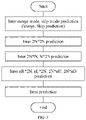
- the prediction is usually performed by first using various inter prediction modes and then using intra prediction modes according to the procedure shown in FIG. 3 .
- the foregoing prediction process requires the use of all the prediction modes for prediction, which may lead to a large quantity of redundant calculations. For example, if it can be determined in advance that the optimal prediction mode after traversal calculation is more likely to be the intra prediction mode, then during prediction, only intra prediction is performed, and no inter prediction is performed, so that inter prediction can be avoided, thereby improving the efficiency of prediction processing.
- the embodiments of this disclosure provide an image processing method that adaptively and quickly determines a coding prediction manner of a coding unit by using the quantity and an optimal prediction mode of adjacent units of the coding unit, the quantity and an optimal prediction mode of coding units having a parent relationship or a child relationship with the coding unit, and the quantity, an optimal prediction mode, and rate-distortion cost information of image blocks corresponding to the coding unit in the information obtained by image frame preprocessing.
- the coding prediction manner is used for indicating prediction modes to be selected and the order of applying the prediction modes, thus effectively improving the efficiency of determining the coding prediction manner. Detailed descriptions are provided below.
- FIG. 4 is a schematic flowchart of an image processing method according to an embodiment of this disclosure.
- the image processing method described in this embodiment of this disclosure may be applicable to a terminal having a video coding function, such as a computer, a video coder, a server, or the like.
- the method includes S401 to S404.
- S401 Determine an associated unit set of a current coding unit in an image frame.
- the coding unit is any coding unit obtained by dividing the image frame into CTUs and then dividing by depth a CTU.
- the terminal determines the associated unit set of the current coding unit according to the position relationship and the division hierarchy relationship between the units obtained by dividing the image frame.
- the associated unit set includes associated coding units of the current coding unit, the associated coding units including one or more of a target unit in the image frame adjacent to the current coding unit, and a coding unit in the image frame that have a parent relationship or a child relationship with the current coding unit.
- the target unit is an adjacent unit in the image frame that is adjacent to the current coding unit in a preset direction, where the preset direction may be one or more of left, upper left, top, or upper right.
- the target unit may be a predict unit or a coding unit in the image frame.
- the coding unit having a parent relationship or a child relationship with the current coding unit includes: a coding unit having a parent relationship with the current coding unit, that is, a parent coding unit to which the current coding unit belongs; or a coding unit having a child relationship with the current coding unit, that is, a child coding unit into which the current coding unit is divided.
- S402 Determine first statistical information according to a prediction mode of each associated coding unit in the associated unit set.
- the terminal obtains a prediction mode of each associated coding unit in the associated unit set, the prediction mode including a first prediction mode or a second prediction mode; performs statistics on the quantity of the associated coding units for which the prediction mode is the first prediction mode in the associated unit set according to the obtained prediction mode of each associated coding unit; and determines the quantity of associated coding units for which the prediction mode is the first prediction mode in the associated unit set as the first statistical information.
- the first prediction mode is an intra prediction mode
- the second prediction mode is an inter prediction mode.
- the terminal obtains the total quantity of the associated coding units in the associated unit set and obtains the prediction mode of each associated coding units in the associated unit set; performs statistics on the quantity of associated coding units for which the prediction mode is the first prediction mode in the associated unit set according to the obtained prediction mode of each associated coding unit; and determines the quantity of associated coding units for which the prediction mode is the first prediction mode in the associated unit set and the total quantity of the associated coding units in the associated unit set as the first statistical information.
- the total quantity of the associated coding units is a sum of the quantity of parent coding units of the coding units in the associated unit set and the quantity of target units, or a sum of the quantity of child coding units of the coding units in the associated unit set and the quantity of target units.
- the quantity of associated coding units for which the prediction mode is a first prediction mode is a sum of the quantity of target units for which the prediction mode is the first prediction mode and the quantity of parent coding units for which the prediction mode is the first prediction mode in the parent coding unit of the current coding unit, or is a sum of the quantity of target units for which the prediction mode is a the first prediction mode and the quantity of child coding units of the current coding unit for which the prediction mode is the first prediction mode.
- the first prediction mode is an intra prediction mode and the target unit is a predict unit.
- E represents a coding unit
- A, B, C, and D are PUs adjacent to the coding unit E, and optimal prediction modes of the predict units A, B, C, and D are already determined.
- 501 represents a parent coding unit of the coding unit E
- 502 represents a child coding unit of the coding unit E.
- the coding unit E is divided into four child coding units according to its center.
- the predict units A, B, C, and D and the parent coding unit or the child coding unit of the coding unit E are all associated coding units of the coding unit E.
- nBlock1 the quantity of adjacent predict units for which the optimal prediction mode is an intra prediction mode is recorded.
- nIntra1 the quantity of the adjacent predict units for which the optimal prediction mode is an intra prediction mode is recorded. Only one of the parent coding unit or child coding unit of the coding unit E exists due to the coding order. To be specific, if the parent coding unit exists, the child coding unit does not exist; and if the child coding unit exists, the parent coding unit does not exist.
- the quantity nBlock1 is increased by 1 to obtain a total quantity nBlock of the associated coding units of the coding unit E. If the optimal prediction mode of the parent coding unit is the intra prediction mode, the quantity nIntra1 is increased by 1, which means that the quantity nIntra of the associated coding units of the coding unit E for which the prediction mode is an intra prediction mode is obtained.
- the quantity nBlock1 is increased by 4 to obtain a total quantity nBlock of the associated coding units of the coding unit E; and then whether the optimal prediction mode of each child coding unit is an intra prediction mode is determined one by one. If optimal prediction modes of all the four child coding units are intra prediction modes, the quantity nIntra1 is added by 4, which means that the quantity nIntra of the associated coding units of the coding unit E for which the prediction mode is an intra prediction mode is obtained.
- S403 Obtain second statistical information of preprocessing image blocks corresponding to the current coding unit.
- the preprocessing image block corresponding to the current coding unit refers to an image block obtained by dividing the image area corresponding to the current coding unit in the image frame during the preprocessing of the image frame corresponding to the current coding unit.
- the terminal obtains the prediction mode of each preprocessing image block corresponding to the current coding unit, the prediction mode including a first prediction mode or a second prediction mode; performs statistics on the quantity of preprocessing image blocks for which the prediction mode is the first prediction mode among the preprocessing image blocks corresponding to the current coding unit according to the obtained prediction mode of each preprocessing image block; and determines the quantity of preprocessing image blocks for which the prediction mode is the first prediction mode as the second statistical information.
- the first prediction mode may be an intra prediction mode; and the second prediction mode may be an inter prediction mode.
- the terminal obtains the total quantity of the preprocessing image blocks corresponding to the current coding unit and obtains the prediction mode of each preprocessing image block; performs statistics on the quantity of the preprocessing image blocks for which the prediction mode is the first prediction mode among the preprocessing image blocks corresponding to the current coding unit according to the obtained prediction mode of each preprocessing image block; and determines the total quantity of the preprocessing image blocks and the quantity of the preprocessing image blocks for which the prediction mode is the first prediction mode as the second statistical information.
- the terminal obtains the total quantity of the preprocessing image blocks corresponding to the current coding unit and obtains the prediction mode and rate-distortion cost information of each preprocessing image block, the rate-distortion cost information including an intra rate-distortion cost and an inter rate-distortion cost, the intra rate-distortion cost being an optimal rate-distortion cost when the first prediction mode (or intra prediction mode) is used for the preprocessing image block, and the inter rate-distortion cost being an optimal rate-distortion cost when the second prediction mode (or inter prediction mode) is used for the preprocessing image block; determines the quantity of the preprocessing image blocks for which the prediction mode is the first prediction mode according to the prediction mode of each preprocessing image block; and accumulates the intra rate-distortion cost of each preprocessing image block to obtain the sum value of the intra rate-distortion costs, and accumulates the inter rate-distortion cost of each preprocessing image block to obtain the sum value
- the terminal determines one or more of the total quantity of the preprocessing image blocks, the sum value of the intra rate-distortion costs, the sum value of the inter rate-distortion costs, and the quantity of the preprocessing image blocks for which the prediction mode is the first prediction mode as the second statistical information.
- a preprocessing process such as a lookahead process in x265.
- the purpose is to determine a frame type, and guide code rate control, or the like, by analyzing a sequence in advance.
- x265 is an open source free software and function base used for a video that satisfies high efficiency video coding standards. Some information obtained from the preprocessing process may be used for guiding the later coding prediction process.
- intra prediction and inter prediction are performed on the image frames according to a fixed image block size, and then statistical information of the image blocks in the image area corresponding to the current coding unit, including a total quantity of the image blocks, a sum value of the intra rate-distortion costs, a sum value of the inter rate-distortion costs, a quantity of image blocks for which an optimal prediction mode is the first prediction mode, or the like, may be obtained, to provide a reference for determining the coding prediction manner of the current coding unit.
- the intra prediction optimal rate-distortion cost and inter prediction optimal rate-distortion cost may be obtained for each 16 ⁇ 16 image block. If the size of the current coding unit is 8 ⁇ 8 or 16 ⁇ 16, then there is only 1 image block in the image area corresponding to the current coding unit; if the size of the current coding unit is 32x32, then there are 4 image blocks in the image area corresponding to the current coding unit; and if the size of the current coding unit is 64x64, then there are 16 image blocks in the image area corresponding to the current coding unit.
- the total quantity of image blocks in the image area corresponding to the current coding unit is obtained, and is denoted as num; the sum value of the intra prediction optimal rate-distortion costs of the image blocks in the image area corresponding to the current coding unit is obtained, that is, the sum value of the intra rate-distortion costs, and is denoted as intracost; the sum value of the inter prediction optimal rate-distortion costs of the image blocks in the image area corresponding to the current coding unit, that is, the sum value of the inter rate-distortion costs, is obtained and is denoted as intercost; and the quantity of image blocks for which an optimal prediction mode is an intra prediction mode in the image blocks in the image area corresponding to the current coding unit is obtained and is denoted as intra_num.
- S404 Determine a coding prediction manner of the current coding unit according to the first statistical information and the second statistical information.
- the first statistical information includes a quantity of associated coding units for which the prediction mode is a first prediction mode
- the second statistical information includes a quantity of preprocessing image blocks for which the prediction mode is the first prediction mode.
- the terminal detects whether the quantity of the associated coding units for which the prediction mode is the first prediction mode is greater than or equal to the first preset value, and detects whether the quantity of the preprocessing image blocks for which the prediction mode is the first prediction mode is greater than or equal to the second preset value; if the quantity of associated coding units for which the prediction mode is the first prediction mode is greater than or equal to the first preset value, and the quantity of the preprocessing image blocks for which the prediction mode is the first prediction mode is greater than or equal to the second preset value, the coding prediction manner of the current coding unit is determined as follows: using the first prediction mode to perform prediction processing on the current coding unit, and then using the second prediction mode to perform prediction processing on the current coding unit; or the coding prediction manner of the current coding unit is determined as follows
- the first statistical information includes a quantity of associated coding units for which the prediction mode is the first prediction mode and a total quantity of the associated coding units; and the second statistical information includes a quantity of preprocessing image blocks for which the prediction mode is the first prediction mode and a total quantity of the preprocessing image blocks.
- the terminal detects whether the quantity of associated coding units for which the prediction mode is the first prediction mode is greater than or equal to a first preset value, and detects whether the total quantity of the associated coding units is greater than or equal to a third preset value.
- the coding prediction manner of the current coding unit is determined as follows: using the first prediction mode to perform prediction processing on the current coding unit, and then using the second prediction mode to perform prediction processing on the current coding unit; or the coding prediction manner of the current coding unit is determined as follows: using the first prediction mode to perform prediction processing on the current coding unit.
- the coding prediction manner of the current coding unit can be determined adaptively according to the quantity of associated coding units for which the prediction mode is the first prediction mode in the associated coding units of the current coding unit, and the quantity of preprocessing image blocks for which the prediction mode is the first prediction mode in the preprocessing image blocks corresponding to the current coding unit.
- the quantity of associated coding units for which the prediction mode is the first prediction mode and the quantity of preprocessing image blocks for which the prediction mode is the first prediction mode are both greater than the preset value, it may be determined that the optimal prediction mode of the current coding unit has a relatively high probability of being the first prediction mode.
- the first prediction mode may be directly determined as the prediction mode of the current coding unit, or it may be determined that the first prediction mode is advanced. Since the process of quantity statistics and the process of comparing the quantitys involves a small amount of calculation and is less time-consuming, the above manner can be used to effectively improve the efficiency of determining the coding prediction manner on the basis of determining the coding prediction manner of the current coding unit relatively accurately.
- the first statistical information includes a quantity of associated coding units for which the prediction mode is a first prediction mode and a total quantity of the associated coding units; and the second statistical information includes a quantity of preprocessing image blocks for which the prediction mode is the first prediction mode, a total quantity of the preprocessing image blocks, a total sum value of the intra rate-distortion costs, and a total sum value of the inter rate-distortion costs.
- the first coding prediction manner is determined as the coding prediction manner of the current coding unit.
- the first coding prediction manner is: using a first prediction mode to perform prediction processing on the current coding unit, and then using a second prediction mode to perform prediction processing on the current coding unit.
- Satisfying the first preset condition may mean that: a difference between the quantity of the preprocessing image blocks for which the prediction mode is the first prediction mode and the total quantity of the preprocessing image blocks is less than or equal to a target value, the total quantity of the associated coding units is greater than or equal to a first value, the quantity of the associated coding units for which the prediction mode is the first prediction mode is greater than or equal to a second value, and the sum value of intra rate-distortion costs is less than the value obtained by multiplying the sum value of the inter rate-distortion costs with a first reference value.
- the second value is determined according to the total quantity of associated coding units, for example the second value is half of the total quantity of associated coding units.
- the first reference value is positively related to a coding speed and is a value greater than 0 and less than or equal to 1. For example, the target value is 0 and the first value is 2.
- the quantity of associated coding units for which the prediction mode is the first prediction mode, the total quantity of associated coding units, the quantity of preprocessing image blocks for which the prediction mode is the first prediction mode, the total quantity of the preprocessing image blocks, the sum value of the intra rate-distortion costs, and the sum value of the inter rate-distortion costs satisfy the first preset condition. If the first preset condition is satisfied, it is further detected whether the quantity of associated coding units for which the prediction mode is the first prediction mode, the total quantity of associated coding units, the sum value of the intra rate-distortion costs and the sum value of the inter rate-distortion costs satisfy the second preset condition.
- a second coding prediction manner is determined as the coding prediction manner of the current coding unit. If the second preset condition is not satisfied, the first coding prediction manner is determined as the coding prediction manner of the current coding unit.
- the second coding prediction manner is: using the first prediction mode to perform prediction processing on the current coding unit.
- Satisfying the second preset condition may mean that: a difference between the quantity of the associated coding units for which the prediction mode is the first prediction mode and the total quantity of the associated coding units is less than or equal to a target value, and the sum value of the intra rate-distortion costs is less than a value obtained by multiplying the sum value of the inter rate-distortion costs with a second reference value.
- the second reference value is positively related to the coding speed and is a value greater than or equal to 0 and less than or equal to 1, and is less than the first reference value.
- the target value is 0.
- the target value in the second preset condition may be the same or different from the target value in the first preset condition. For the content meant by satisfying the first preset condition, reference may be made to the previous description and will not be repeated herein again.
- the first prediction mode is an intra prediction mode and the second prediction mode is an inter prediction mode.
- the total quantity of associated coding units in the associated unit set of the current coding unit is nBlock, the quantity of associated coding units for which the prediction mode is an intra prediction mode in the associated unit set is nIntra; the total quantity of preprocessing image blocks corresponding to the current coding unit is num, and the quantity of preprocessing image blocks for which the prediction mode is the intra prediction mode is intra_num.
- the sum value of the intra rate-distortion costs and the sum value of the inter rate-distortion costs of the preprocessing image blocks are intracost and intercost, respectively.
- the first reference value is thr1, and the second reference value is thr2. As shown in FIG.
- the value of the first reference value thr1 may range from 0.9 to 1. When the coding speed is relatively slow, the value of thr1 is 0.9, and as the coding speed becomes higher, thr1 also gradually increases. If equation 1 is satisfied, it indicates that the prediction mode of each preprocessing image block corresponding to the current coding unit is the intra prediction mode, and the quantity of the associated coding units of the current coding unit is greater than or equal to 2, and the prediction modes of more than half of the associated coding units of the current coding unit is the intra prediction mode, and the sum value intracost of the intra rate-distortion costs of the preprocessing image block is less than the value obtained by multiplying the sum value intercost of the inter rate-distortion costs with the first reference value thr1.
- the optimal prediction mode of the current coding unit is more likely to be the intra prediction mode, and the intra prediction can be advanced, so that the coding prediction manner of the current coding unit is determined to be: using the intra prediction mode to perform prediction processing on the current coding unit first, and then using the intra prediction mode to perform prediction processing on the current coding unit.
- the second reference value thr2 is less than the first reference value thr1.
- the value of thr2 may range from 0 to 0.4.
- the value ofthr2 is 0, and as the coding speed becomes higher, thr2 also gradually increases. If equation 2 is satisfied, it indicates that the prediction mode of each associated coding unit of the current coding unit is also the intra prediction mode and the sum value intracost of the intra rate-distortion costs of the preprocessing image blocks is less than the value obtained by multiplying the sum value intercost of the inter rate-distortion costs with the second reference value thr2.
- the optimal prediction mode of the current coding unit is most likely to be the intra prediction mode, and only the intra prediction may be performed, so that the coding prediction manner of the current coding unit is determined to be: using the intra prediction mode only to perform prediction processing on the current coding unit.
- a third coding prediction manner is determined as the coding prediction manner of the current coding unit.
- the third coding prediction manner is: using the second prediction mode to perform prediction processing on the current coding unit.
- Satisfying the third preset condition may means that: the total quantity of the associated coding units is greater than or equal to a third value, the quantity of the associated coding units for which the prediction mode is the first prediction mode is less than or equal to a fourth value, the total quantity of the preprocessing image blocks is greater than or equal to a fifth value, and the quantity of preprocessing image blocks for which the prediction mode is the first prediction mode is less than or equal to a sixth value, and a sum value of inter rate-distortion costs is less than a value obtained by multiplying a sum value of intra rate-distortion costs with a third reference value.
- the third reference value is positively related to the coding speed and is a value greater than 0 and less than or equal to 1. For example, the third value is 2, the fifth value is 1, and the fourth value and the sixth value are 0.
- the third reference value is thr3.
- the value of the third reference value thr3 may range from 0.4 to 1. When the coding speed is relatively slow, the value of thr3 is 0.4, and as the coding speed becomes higher, thr3 also gradually increases. If equation 3 is satisfied, it indicates that the quantity of associated coding units of the current coding unit is greater than or equal to 2, and the optimal prediction mode of each associated coding unit is the inter prediction mode; and the current coding unit corresponds to at least one preprocessing image block, the optimal prediction mode of each preprocessing image block is the inter prediction mode, and the sum value intercost of the inter rate-distortion costs of the preprocessing image blocks is less than the value obtained by multiplying the sum value intracost of the intra rate-distortion costs with the third reference value thr3.
- the optimal prediction mode of the current coding unit is most likely to be the inter prediction mode, and the inter prediction may be performed only, so that the coding prediction manner of the current coding unit is determined to be: using the inter prediction mode only to perform prediction processing on the current coding unit.
- the coding prediction manner of the current coding unit can be determined adaptively by detecting a preset condition satisfied by five parameters: the quantity of associated coding units for which the prediction mode is the first prediction mode, the total quantity of associated coding units, the quantity of preprocessing image blocks for which the prediction mode is the first prediction mode, the total quantity of the preprocessing image blocks, the sum value of the intra rate-distortion costs and the sum value of the inter rate-distortion costs.
- the accuracy of the determined coding prediction manner can be effectively improved on the basis of appropriately increasing the complexity of the determining conditions; the above detection process involves a small amount of calculation and less time-consuming, and the determining of the coding prediction manner is efficient.
- prediction processing is performed on the coding unit in accordance with the indication of the coding prediction manner. If the second coding prediction manner is selected, only the first prediction mode is used to perform prediction processing on the coding unit in the subsequent prediction processing, thus saving the step of using the second prediction mode to perform prediction processing on the coding unit, saving the time and the software and hardware resources consumed by the prediction processing, and accelerating the prediction processing. If the third coding prediction manner is selected, only the second prediction mode is used to perform prediction processing on the coding unit in the subsequent prediction processing, thus saving the step of using the first prediction mode to perform prediction processing on the coding unit, saving the time and the software and hardware resources consumed by the prediction processing, and accelerating of the prediction processing.
- the selected coding prediction manner instructs to perform intra prediction only, then only the intra prediction is performed on the coding unit during the subsequent prediction processing.
- merge and/or skip prediction processing inter 2Nx2N prediction processing, Rect prediction processing, and AMP prediction processing are sequentially performed on the coding unit to obtain the optimal inter prediction mode for the coding unit.
- the Rect prediction processing includes inter 2NxN prediction processing and inter Nx2N prediction processing
- the AMP prediction processing includes inter 2NxnU prediction processing, inter 2NxnD prediction processing, inter nLx2N prediction processing, and inter nRx2N prediction processing.
- the inter 2Nx2N prediction processing is using the inter 2Nx2N mode to perform prediction processing, and the rest of the description is similar.
- the first prediction mode is first used to perform prediction processing on the coding unit, and the first rate-distortion cost of the coding unit when the first prediction mode is used is calculated; then the second prediction mode of the target type is used to perform prediction processing on the coding unit, and the second rate-distortion of the coding unit when the second prediction mode of the target type is used is calculated.
- the second prediction mode of the target type includes a merge prediction mode and/or a skip prediction mode.
- the second rate-distortion cost may be the minimum value of the inter rate-distortion cost of the coding unit when the merge prediction mode is used and the inter rate-distortion cost of the coding unit when the skip prediction mode is used.
- satisfying the fourth preset condition means that: the first rate-distortion cost is less than the value obtained by multiplying the second rate-distortion cost with a fourth reference value.
- the fourth reference value is positively related to the coding speed and is a value greater than 0 and less than or equal to 1. If the fourth preset condition is satisfied, it indicates that the optimal prediction mode of the coding unit is most likely to be the first prediction mode.
- the first prediction mode can be determined as the optimal prediction mode of the coding unit, and the subsequent steps of performing prediction processing on the coding unit by using other types of second prediction modes can be ended, thus saving some of the steps of performing prediction processing on the coding unit by using the second prediction mode, saving the time and the software and hardware resources consumed by the prediction processing to a certain extent, and accelerating of the prediction processing.
- the fourth reference value is thr4.
- the intra prediction is performed on the coding unit first, and the optimal intra rate-distortion cost intrabestcost of the intra prediction is calculated; then the merge prediction and the skip prediction in inter prediction is performed on the coding unit, and the optimal inter rate-distortion cost interbestcost of the merge prediction and the skip prediction is calculated. If the intrabestcost is less than the value obtained by multiplying the interbestcost with the fourth reference value thr4, it indicates that the optimal prediction mode of the coding unit is most likely to be the intra prediction mode.
- the intra prediction mode can be determined as the optimal prediction mode of the coding unit and the remaining inter prediction can be ended to skip some of the steps of the inter prediction, thus achieving prediction acceleration. If the intrabestcost is greater than or equal to the value obtained by multiplying the interbestcost with the fourth reference value thr4, the remaining inter prediction continues to be performed downward to obtain the optimal prediction mode for the coding unit.
- the optimal prediction model is a prediction model with the lowest rate-distortion cost.
- the above examples are illustrated with the first prediction mode as the intra prediction mode and the second prediction mode as the inter prediction mode.
- the first prediction mode may also be an inter prediction mode; the second prediction mode may also be an intra prediction mode. In this case, the corresponding processing is similar.
- first statistical information is determined according to prediction modes of units adjacent to a coding unit and/or having a parent relationship or a child relationship with a coding unit, and second statistical information of preprocessing image blocks corresponding to the coding unit is obtained, and a coding prediction manner of the coding unit is determined according to the first statistical information and the second statistical information, so that the coding prediction manner of the coding unit can be determined adaptively and quickly, thereby improving the efficiency of determining the coding prediction manner.
- FIG. 10 is a schematic structural diagram of an image processing apparatus according to an embodiment of this disclosure.
- the image processing apparatus described in this embodiment of this disclosure corresponds to the terminal described above.
- the apparatus includes a processing unit 1001 and an obtaining unit 1002.
- the processing unit 1001 is configured to determine an associated unit set of a current coding unit in an image frame.
- the associated unit set includes associated coding units, the associated coding units include at least one of a target unit in the image frame adjacent to the current coding unit, and a coding unit in the image frame having a parent relationship or a child relationship with the current coding unit.
- the obtaining unit 1002 is configured to determine first statistical information according to a prediction mode of each associated coding unit in the associated unit set.
- the obtaining unit 1002 is further configured to obtain second statistical information of preprocessing image blocks corresponding to the current coding unit.
- the processing unit 1011 is further configured to determine a coding prediction manner of the current coding unit according to the first statistical information and the second statistical information.
- the coding prediction manner is used for indicating a prediction mode selected from the prediction modes of the associated coding units to perform prediction coding on the current coding unit according to the prediction mode selected from the prediction modes of the associated coding units and/or being used for indicating an order of applying prediction modes selected from the prediction modes of the associated coding units to perform prediction coding on the current coding unit according to the order of applying prediction modes selected from the prediction modes of the associated coding units.
- the first statistical information includes a quantity of associated coding units for which the prediction mode is a first prediction mode and a total quantity of the associated coding units; and the second statistical information includes a total quantity of the preprocessing image blocks, a quantity of preprocessing image blocks for which the prediction mode is the first prediction mode, and rate-distortion cost information.
- the processing unit 1001 is further configured to determine a first coding prediction manner as the coding prediction manner of the current coding unit in a case that the first statistical information and the second statistical information satisfy a first preset condition and do not satisfy a second preset condition.
- the first coding prediction manner includes: using a first prediction mode to perform prediction processing on the current coding unit, and then using a second prediction mode to perform prediction processing on the current coding unit.
- the processing unit 1001 is further configured to: after the determining a first coding prediction manner as the coding prediction manner of the current coding unit, calculate a first rate-distortion cost of the current coding unit in a case that the first prediction mode is used, and calculate a second rate-distortion cost of the current coding unit in a case that a second prediction mode of a target type is used; and determine the first prediction mode as the prediction mode of the current coding unit and end an operation of using a second prediction mode of another type to perform prediction processing on the current coding unit, in a case that the first rate-distortion cost and the second rate-distortion cost satisfy a fourth preset condition.
- the processing unit 1001 is further configured to determine a second coding prediction manner as the coding prediction manner of the current coding unit in a case that the first statistical information and the second statistical information satisfy a first preset condition and a second preset condition; where the second coding prediction manner includes: using a first prediction mode to perform prediction processing on the current coding unit.
- the processing unit 1001 is further configured to determine a third coding prediction manner as the coding prediction manner of the current coding unit in a case that the first statistical information and the second statistical information satisfy a third preset condition; where the third coding prediction manner includes: using a second prediction mode to perform prediction processing on the current coding unit.
- the obtaining unit 1002 is specifically configured to obtain the total quantity of the associated coding units in the associated unit set, and obtain the prediction mode of each associated coding unit; and the processing unit 1001 is specifically configured to determine the quantity of associated coding units for which the prediction mode is the first prediction mode in the associated unit set according to the prediction mode of each associated coding unit; and determine the quantity of associated coding units for which the prediction mode is the first prediction mode, and the total quantity of the associated coding units as first statistical information.
- the obtaining unit 1002 is specifically configured to obtain the total quantity of the preprocessing image blocks corresponding to the current coding unit, and obtain the prediction mode and rate-distortion cost information of each preprocessing image block; and the processing unit 1001 is specifically configured to: determine the quantity of preprocessing image blocks for which the prediction mode is the first prediction mode according to the prediction mode of each preprocessing image block; and determine the second statistical information according to the total quantity of the preprocessing image blocks, the quantity of the preprocessing image blocks for which the prediction mode is the first prediction mode, and the rate-distortion cost information.
- the rate-distortion cost information includes an intra rate-distortion cost and an inter rate-distortion cost
- the processing unit 1001 is specifically configured to: determine a sum value of intra rate-distortion costs and a sum value of inter rate-distortion costs according to the rate-distortion cost information of each preprocessing image block; and determine the total quantity of the preprocessing image blocks, the quantity of preprocessing image blocks for which the prediction mode is the first prediction mode, the sum value of intra rate-distortion costs, and the sum value of inter rate-distortion costs as the second statistical information.
- the total quantity of the associated coding units is a sum of the quantity of the target units and the quantity of parent coding units having a parent relationship with the current coding unit, or is a sum of the quantity of the target units and the quantity of child coding units having a child relationship with the current coding unit.
- the quantity of associated coding units for which the prediction mode is the first prediction mode is determined according to the quantity of the target units for which the prediction mode is the first prediction mode and the quantity of parent coding units for which the prediction mode is the first prediction mode in the coding units having a parent relationship with the current coding unit; or is determined according to the quantity of the target units for which the prediction mode is the first prediction mode and the quantity of child coding units for which the prediction mode is the first prediction mode in the coding units having a child relationship with the current coding unit.
- the processing unit 1001 is specifically configured to: detect whether the quantity of associated coding units for which the prediction mode is the first prediction mode, the total quantity of associated coding units, the quantity of preprocessing image blocks for which the prediction mode is the first prediction mode, the total quantity of preprocessing image blocks, the sum value of the intra rate-distortion costs, and the sum value of the inter rate-distortion costs satisfy the first preset condition; if the first preset condition is satisfied, the first coding prediction manner is determined as the coding prediction manner of the current coding unit.
- the first coding prediction manner is: using a first prediction mode to perform prediction processing on the current coding unit, and then using a second prediction mode to perform prediction processing on the current coding unit.
- satisfying the first preset condition may mean that: a difference between the quantity of the preprocessing image blocks for which the prediction mode is the first prediction mode and the total quantity of the preprocessing image blocks is less than or equal to a target value, the total quantity of the associated coding units is greater than or equal to a first value, the quantity of the associated coding units for which the prediction mode is the first prediction mode is greater than or equal to a second value, and the sum value of intra rate-distortion costs is less than the value obtained by multiplying the sum value of the inter rate-distortion costs with a first reference value.
- the second value is determined according to the total quantity of associated coding units.
- the processing unit 1001 is specifically configured to: detect whether the quantity of associated coding units for which the prediction mode is the first prediction mode, the total quantity of associated coding units, the quantity of preprocessing image blocks for which the prediction mode is the first prediction mode, the total quantity of the preprocessing image blocks, the sum value of the intra rate-distortion costs, and the sum value of the inter rate-distortion costs satisfy the first preset condition. If the first preset condition is satisfied, it is further detected whether the quantity of associated coding units for which the prediction mode is the first prediction mode, the total quantity of associated coding units, the sum value of the intra rate-distortion costs and the sum value of the inter rate-distortion costs satisfy the second preset condition. If the second preset condition is satisfied, a second coding prediction manner is determined as the coding prediction manner of the current coding unit. The second coding prediction manner is: using the first prediction mode to perform prediction processing on the current coding unit.
- satisfying the second preset condition may mean that: a difference between the quantity of the associated coding units for which the prediction mode is the first prediction mode and the total quantity of the associated coding units is less than or equal to a target value, and the sum value of the intra rate-distortion costs is less than a value obtained by multiplying the sum value of the inter rate-distortion costs with a second reference value.
- the processing unit 1001 is specifically configured to detect whether the quantity of associated coding units for which the prediction mode is the first prediction mode, the total quantity of associated coding units, the quantity of preprocessing image blocks for which the prediction mode is the first prediction mode, the total quantity of the preprocessing image blocks, the sum value of the intra rate-distortion costs, and the sum value of the inter rate-distortion costs satisfy the third preset condition. If the third preset condition is satisfied, a third coding prediction manner is determined as the coding prediction manner of the current coding unit. The third coding prediction manner is: using the second prediction mode to perform prediction processing on the current coding unit.
- satisfying the third preset condition may means that: the total quantity of the associated coding units is greater than or equal to a third value, the quantity of the associated coding units for which the prediction mode is the first prediction mode is less than or equal to a fourth value, the total quantity of the preprocessing image blocks is greater than or equal to a fifth value, and the quantity of preprocessing image blocks for which the prediction mode is the first prediction mode is less than or equal to a sixth value, and a sum value of inter rate-distortion costs is less than a value obtained by multiplying a sum value of intra rate-distortion costs with a third reference value.
- the apparatus includes a calculation unit 1003.
- the calculation unit is configured to: calculate a first rate-distortion cost of the coding unit in a case that the first prediction mode is used, and calculate a second rate-distortion cost of the coding unit in a case that a second prediction mode of a target type is used.
- the processing unit 1001 is further configured to: detect whether the first rate-distortion cost and the second rate-distortion cost satisfy a fourth preset condition; and if the fourth preset condition is satisfied, determine the first prediction mode as the prediction mode of the coding unit.
- the second prediction mode of the target type includes a merge prediction mode (a prediction mode provided in the HEVC standards) and/or a skip prediction mode (a prediction mode provided in the HEVC standards); and satisfying the fourth preset condition means that: the first rate-distortion cost is less than a value obtained by multiplying the second rate-distortion cost with a fourth reference value.
- first statistical information is determined according to prediction modes of units adjacent to a coding unit and/or having a parent relationship or a child relationship with a coding unit, and second statistical information of preprocessing image blocks corresponding to the coding unit is obtained, and a coding prediction manner of the coding unit is determined according to the first statistical information and the second statistical information, so that the coding prediction manner of the coding unit can be determined adaptively and quickly, thereby improving the efficiency of determining the coding prediction manner.
- FIG. 11 is a schematic structural diagram of a terminal according to an embodiment of this disclosure.
- the terminal provided in the embodiments of this disclosure includes: a processor 1101 and a memory 1102.
- the processor 1101 and the memory 1102 may be connected in a bus or in other manners. In the embodiments of this disclosure, the bus connection is used as an example.
- the processor 1101 may be a central processing unit (CPU).
- the processor 1101 may alternatively be a hardware chip.
- the foregoing hardware chip may be an application-specific integrated circuit (ASIC), a programmable logic device (PLD), or a combination thereof.
- the foregoing PLD may be a complex programmable logic device (CPLD), a field-programmable gate array (FPGA), a generic array logic (GAL), or any combination thereof.
- the memory 1102 may mainly include a program storage area and a data storage area.
- the program storage area may store an operating system, a storage program required by at least one function (for example, a word storage function, a position storage function, and the like).
- the data storage area may store data (for example, image data and word data) created according to the adoption of the apparatus, and the like, and may include an application storage program.
- the memory 1102 may include a high speed random access memory, and may alternatively include a non-volatile memory, such as at least one magnetic disk storage device, a flash memory, or another volatile solid-state storage device.
- the memory 1102 is further configured to store program instructions.
- the processor 1101 is configured to execute the program instructions stored in the memory 1102, and when the program instructions are executed, the processor 1101 is configured to: determine an associated unit set of a current coding unit in an image frame, the associated unit set including associated coding units, the associated coding units including: at least one of a target unit in the image frame adjacent to the current coding unit, and a coding unit in the image frame having a parent relationship or a child relationship with the current coding unit; determine first statistical information according to a prediction mode of each associated coding unit in the associated unit set; obtain second statistical information of preprocessing image blocks corresponding to the current coding unit; and determine a coding prediction manner of the current coding unit according to the first statistical information and the second statistical information, the coding prediction manner being used for indicating a prediction mode selected from the prediction modes of the associated coding units to perform prediction coding on the current coding unit according to the prediction mode selected from the prediction modes of the associated coding units and/or being used for
- the processor 1101 when determining first statistical information according to a prediction mode of each associated coding unit in the associated unit set, is specifically configured to: obtain the total quantity of the associated coding units in the associated unit set, and obtaining the prediction mode of each associated coding unit; determine the quantity of associated coding units for which the prediction mode is the first prediction mode in the associated unit set according to the prediction mode of each associated coding unit; and determine the quantity of associated coding units for which the prediction mode is the first prediction mode, and the total quantity of the associated coding units as first statistical information.
- the processor 1101 when obtaining second statistical information of preprocessing image blocks corresponding to the coding unit, is specifically configured to: obtain the total quantity of the preprocessing image blocks corresponding to the current coding unit, and obtaining the prediction mode and rate-distortion cost information of each preprocessing image block; determine the quantity of preprocessing image blocks for which the prediction mode is the first prediction mode according to the prediction mode of each preprocessing image block; and determine the second statistical information according to the total quantity of the preprocessing image blocks, the quantity of the preprocessing image blocks for which the prediction mode is the first prediction mode, and the rate-distortion cost information.
- the rate-distortion cost information includes an intra rate-distortion cost and an inter rate-distortion cost.
- the processor 1101 when determining the second statistical information according to the total quantity of the preprocessing image blocks, the quantity of the preprocessing image blocks for which the prediction mode is the first prediction mode, and the rate-distortion cost information, is specifically configured to: determine a sum value of intra rate-distortion costs and a sum value of inter rate-distortion costs according to the rate-distortion cost information of each preprocessing image block; and determine the total quantity of the preprocessing image blocks, the quantity of preprocessing image blocks for which the prediction mode is the first prediction mode, the sum value of intra rate-distortion costs, and the sum value of inter rate-distortion costs as the second statistical information.
- the total quantity of the associated coding units is a sum of the quantity of the target units and the quantity of coding units having a parent relationship with the current coding unit, or is a sum of the quantity of the target units and the quantity of child coding units having a child relationship with the current coding unit.
- the quantity of associated coding units for which the prediction mode is the first prediction mode is determined according to the quantity of the target units for which the prediction mode is the first prediction mode and the quantity of coding units for which the prediction mode is the first prediction mode in the coding units having a parent relationship with the current coding unit; or is determined according to the quantity of the target units for which the prediction mode is the first prediction mode and the quantity of coding units for which the prediction mode is the first prediction mode in the coding units having a child relationship with the current coding unit.
- the processor 1101 when determining the coding prediction manner of the current coding unit according to the first statistical information and the second statistical information, is specifically configured to: detect whether the quantity of associated coding units for which the prediction mode is the first prediction mode, the total quantity of associated coding units, the quantity of preprocessing image blocks for which the prediction mode is the first prediction mode, the total quantity of preprocessing image blocks, the sum value of the intra rate-distortion costs, and the sum value of the inter rate-distortion costs satisfy the first preset condition; if the first preset condition is satisfied, the first coding prediction manner is determined as the coding prediction manner of the current coding unit.
- the first coding prediction manner is: using a first prediction mode to perform prediction processing on the current coding unit, and then using a second prediction mode to perform prediction processing on the current coding unit.
- satisfying the first preset condition may mean that: a difference between the quantity of the preprocessing image blocks for which the prediction mode is the first prediction mode and the total quantity of the preprocessing image blocks is less than or equal to a target value, the total quantity of the associated coding units is greater than or equal to a first value, the quantity of the associated coding units for which the prediction mode is the first prediction mode is greater than or equal to a second value, and the sum value of intra rate-distortion costs is less than the value obtained by multiplying the sum value of the inter rate-distortion costs with a first reference value.
- the second value is determined according to the total quantity of associated coding units.
- the processor 1101 when determining the coding prediction manner of the current coding unit according to the first statistical information and the second statistical information, is specifically configured to: detect whether the quantity of associated coding units for which the prediction mode is the first prediction mode, the total quantity of associated coding units, the quantity of preprocessing image blocks for which the prediction mode is the first prediction mode, the total quantity of the preprocessing image blocks, the sum value of the intra rate-distortion costs, and the sum value of the inter rate-distortion costs satisfy the first preset condition.
- the first preset condition it is further detected whether the quantity of associated coding units for which the prediction mode is the first prediction mode, the total quantity of associated coding units, the sum value of the intra rate-distortion costs and the sum value of the inter rate-distortion costs satisfy the second preset condition. If the second preset condition is satisfied, a second coding prediction manner is determined as the coding prediction manner of the current coding unit. The second coding prediction manner is: using the first prediction mode to perform prediction processing on the current coding unit.
- satisfying the second preset condition may mean that: a difference between the quantity of the associated coding units for which the prediction mode is the first prediction mode and the total quantity of the associated coding units is less than or equal to a target value, and the sum value of the intra rate-distortion costs is less than a value obtained by multiplying the sum value of the inter rate-distortion costs with a second reference value.
- the processor 1101 when determining the coding prediction manner of the current coding unit according to the first statistical information and the second statistical information, is specifically configured to detect whether the quantity of associated coding units for which the prediction mode is the first prediction mode, the total quantity of associated coding units, the quantity of preprocessing image blocks for which the prediction mode is the first prediction mode, the total quantity of the preprocessing image blocks, the sum value of the intra rate-distortion costs, and the sum value of the inter rate-distortion costs satisfy the third preset condition. If the third preset condition is satisfied, a third coding prediction manner is determined as the coding prediction manner of the current coding unit. The third coding prediction manner is: using the second prediction mode to perform prediction processing on the current coding unit.
- satisfying the third preset condition may means that: the total quantity of the associated coding units is greater than or equal to a third value, the quantity of the associated coding units for which the prediction mode is the first prediction mode is less than or equal to a fourth value, the total quantity of the preprocessing image blocks is greater than or equal to a fifth value, and the quantity of preprocessing image blocks for which the prediction mode is the first prediction mode is less than or equal to a sixth value, and a sum value of inter rate-distortion costs is less than a value obtained by multiplying a sum value of intra rate-distortion costs with a third reference value.
- the processor 1101 is further configured to: calculate a first rate-distortion cost of the current coding unit in a case that the first prediction mode is used, and calculate a second rate-distortion cost of the current coding unit in a case that a second prediction mode of a target type is used; detect whether the first rate-distortion cost and the second rate-distortion cost satisfy a fourth preset condition; and if the fourth preset condition is satisfied, determine the first prediction mode as the prediction mode of the current coding unit.
- the second prediction mode of the target type includes a merge prediction mode and/or a skip prediction mode; and satisfying the fourth preset condition means that: the first rate-distortion cost is less than a value obtained by multiplying the second rate-distortion cost with a fourth reference value.
- the processor 1101 and the memory 1102 described in this embodiment of this disclosure may perform the implementations of the terminal described in the image processing method provided in the above embodiments, and may also perform the implementation described in the image processing apparatus provided in the above embodiments, which is not be described herein again.
- first statistical information is determined according to prediction modes of units adjacent to a current coding unit and/or having a parent relationship or a child relationship with the current coding unit, and second statistical information of preprocessing image blocks corresponding to the current coding unit is obtained, and a coding prediction manner of the current coding unit is determined according to the first statistical information and the second statistical information, so that the coding prediction manner of the current coding unit can be determined adaptively and quickly, thereby improving the efficiency of determining the coding prediction manner.
- the embodiments of this disclosure further provide a computer-readable storage medium, storing instructions, the instructions, when run on a computer, causing the computer to perform the image processing method according to the embodiments of this disclosure.
- the embodiments of this disclosure further provide a computer program product including instructions, the instructions, when run on a computer, causing the computer to perform the image processing method according to embodiments of this disclosure.
- the program may be stored in a computer-readable storage medium.
- the storage medium may include a flash disk, a read-only memory (ROM), a random access memory (RAM), a magnetic disk, an optical disk, and the like.
Landscapes
- Engineering & Computer Science (AREA)
- Multimedia (AREA)
- Signal Processing (AREA)
- Computing Systems (AREA)
- Theoretical Computer Science (AREA)
- Compression Or Coding Systems Of Tv Signals (AREA)
Abstract
Description
- This application claims priority to
Chinese Patent Application No. 202010088822.5, entitled "IMAGE PREDICTION PROCESSING METHOD AND APPARATUS, TERMINAL, AND COMPUTER-READABLE STORAGE MEDIUM" filed on February 12, 2020 - This disclosure relates to the field of image coding technologies, and in particular, to an image processing method and apparatus, a terminal, and a computer-readable storage medium.
- With the development of video coding technologies, a variety of video coding standards have emerged. In the video coding standards, multiple prediction modes are usually provided. Currently, to determine the prediction mode finally adopted in the video coding process, it is necessary to calculate a rate-distortion cost in each prediction mode.
- Embodiments of this disclosure provide an image processing method and apparatus, a terminal, and a computer-readable storage medium that can adaptively and quickly determine the coding prediction manner of a coding unit.
- An embodiment of this disclosure provides an image processing method. The method includes: determining an associated unit set of a current coding unit in an image frame, the associated unit set including associated coding units, the associated coding units including: at least one of a target unit in the image frame adjacent to the current coding unit, and a coding unit in the image frame having a parent relationship or a child relationship with the current coding unit; determining first statistical information according to a prediction mode of each associated coding unit in the associated unit set; obtaining second statistical information of preprocessing image blocks corresponding to the current coding unit; and determining a coding prediction manner of the current coding unit according to the first statistical information and the second statistical information, the coding prediction manner being used for indicating a prediction mode selected from the prediction modes of the associated coding units to perform prediction coding on the current coding unit according to the prediction mode selected from the prediction modes of the associated coding units and/or being used for indicating an order of applying prediction modes selected from the prediction modes of the associated coding units to perform prediction coding on the current coding unit according to the order of applying prediction modes selected from the prediction modes of the associated coding units.
- An embodiment of this disclosure provides an image processing apparatus. The apparatus includes: a processing unit, configured to determine an associated unit set of a current coding unit in an image frame, the associated unit set including associated coding units, the associated coding units including: at least one of a target unit in the image frame adjacent to the current coding unit, and a coding unit in the image frame having a parent relationship or a child relationship with the current coding unit; an obtaining unit, configured to determine first statistical information according to a prediction mode of each associated coding unit in the associated unit set; the obtaining unit being further configured to obtain second statistical information of preprocessing image blocks corresponding to the current coding unit; and the processing unit being further configured to determine a coding prediction manner of the current coding unit according to the first statistical information and the second statistical information, the coding prediction manner being used for indicating a prediction mode selected from the prediction modes of the associated coding units to perform prediction coding on the current coding unit according to the prediction mode selected from the prediction modes of the associated coding units and/or being used for indicating an order of applying prediction modes selected from the prediction modes of the associated coding units to perform prediction coding on the current coding unit according to the order of applying prediction modes selected from the prediction modes of the associated coding units.
- An embodiment of this disclosure provides a terminal, including a processor and a memory, the memory being configured to store executable program code, and the processor being configured to invoke the executable program code, to perform the above image processing method.
- An embodiment of this disclosure further provides a computer-readable storage medium, storing instructions, the instructions, when run on a computer, causing the computer to perform the above image processing method.
- According to the embodiments of this disclosure, first statistical information is determined according to prediction modes of units adjacent to a coding unit and/or having a parent relationship or a child relationship with a coding unit, and second statistical information of preprocessing image blocks corresponding to the coding unit is obtained, and a coding prediction manner of the coding unit is determined according to the first statistical information and the second statistical information, so that the coding prediction manner of the coding unit can be determined adaptively and quickly, thereby improving the efficiency of determining the coding prediction manner.
- To describe the technical solutions in the embodiments of this disclosure or the existing technologies more clearly, the following briefly introduces the accompanying drawings required for describing the embodiments or the existing technologies. Apparently, the accompanying drawings in the following description show only some embodiments of this disclosure, and a person of ordinary skill in the art may still derive other drawings from these accompanying drawings without creative efforts.
-
FIG. 1 is a schematic diagram of an HEVC coding framework according to an embodiment of this disclosure. -
FIG. 2 is a schematic diagram showing a partitioning manner corresponding to an inter prediction mode according to an embodiment of this disclosure. -
FIG. 3 is a schematic diagram of a prediction procedure according to an embodiment of this disclosure. -
FIG. 4 is a schematic flowchart of an image processing method according to an embodiment of this disclosure. -
FIG. 5 is a schematic diagram of a positional relationship between units according to an embodiment of this disclosure. -
FIG. 6 is a schematic flowchart of determining a coding prediction manner according to an embodiment of this disclosure. -
FIG. 7 is another schematic flowchart of determining a coding prediction manner according to an embodiment of this disclosure; -
FIG. 8 is a schematic diagram of a prediction procedure according to another embodiment of this disclosure. -
FIG. 9 is a schematic diagram of a prediction procedure according to another embodiment of this disclosure. -
FIG. 10 is a schematic structural diagram of an image processing apparatus according to an embodiment of this disclosure. -
FIG. 11 is a schematic structural diagram of a terminal according to an embodiment of this disclosure. - The following clearly and completely describes the technical solutions in the embodiments of this disclosure with reference to the accompanying drawings in the embodiments of this disclosure. First, several terms used in the embodiments of this disclosure are briefly introduced.
- Image frame: a video includes multiple image frames. Video compression coding generally adopts a block-based coding manner, that is, an image frame in a video is divided into multiple non-overlapping blocks, and then the blocks are coded. Each image frame may be coded in an inter prediction coding manner or an intra prediction coding manner during video coding.
- In the high efficient video coding (HEVC) standards, the concepts of a coding unit, a predict unit and a transform unit are proposed. The coding unit (CU) is a basic unit for coding in an image frame. The coding unit may be a block having a pixel size of 64×64, 32x32, 16x 16, 8x8, or the like. The predict unit (PU) is a basic unit for predicting in an image frame. The predict unit may be a block having a pixel size of 64×64, 64×32, 32×64, 32×32, 32×16, 16×32, 16×16, 16×8, 8×16, 8×8, 8×4, 4×8, 4×4, or the like. Transform unit (TU): It is a basic unit for presenting a residual or transform coefficients in an image frame. The transform unit may also be a block having a pixel size of 32×32, 16×16, 8×8, 4×4, or the like.
- DB: deblocking filter, SAO: sample adaptive offset; ME: motion estimation; RDcost: rate-distortion cost, being used for selecting the best among multiple options.
- Video coding technologies are developing toward high-definition, high-frame rate, and high-compression rate. The currently popular video compression coding standards such as H.264 has certain limitations in the principle, and cannot meet the above requirements for video coding technologies. Therefore, HEVC standards came into being.
FIG. 1 shows a standard HEVC coding frame. An image frame Fn is inputted to a coder, where the image frame Fn is first divided into multiple coding tree units (CTU) according to a certain size (for example, 64x64), and the CTUs are divided by depth to obtain multiple coding units, each coding unit including PUs and TUs. Then, prediction processing is performed on each PU to obtain a predicted value, the predicted value is subtracted from the input data to obtain a residual, the residual is subjected to discrete cosine transform (DCT) and quantization to obtain a residual coefficient, and then the residual coefficient is sent to an entropy coding module for processing to obtain a bitstream. At the same time, the residual coefficient is inversely quantized and inversely transformed to obtain a residual value of a reconstructed image frame, and then added with the predicted value to obtain a reconstructed image frame F'n. The reconstructed image frame F'n enters a reference frame queue after in-loop filtering, and is used as a reference image of a next image frame for sequential coding. - PU prediction is divided into intra prediction and inter prediction. First, an optimal partioning mode is found by comparing different PUs within the same prediction type, and then an intra prediction mode and an inter prediction mode are compared to find an optimal prediction mode for a current CU; at the same time, an adaptive residual quad-tree transform (RQT) based on a quad-tree structure is performed on the CU to find an optimal TU mode; and finally, the image frame is divided into multiple CUs, and PUs and TUs corresponding to the CUs.
-
FIG. 2 shows eight partioning modes for the PU. There are 7 partioning modes for inter prediction, which are 2Nx2N mode, rectangle (Rect) partioning mode and asymmetric motion partioning (AMP) mode. The Rect mode has 2 specific partioning modes, which are 2NxN and Nx2N, respectively. The AMP mode has 4 partioning modes, which are 2NxnU, 2NxnD, nLx2N and nRx2N, respectively. The above 7 partioning modes correspond to 7 specific inter prediction modes, namely, an inter 2Nx2N mode, an inter 2NxN mode, an inter Nx2N mode, an inter 2N×nU mode, an inter 2NxnD mode, an inter nLx2N mode and an inter nRx2N mode. In addition to the above 7 inter prediction modes, the HEVC standards also provide 2 inter prediction modes: an inter skip mode and an inter merge mode. For the inter prediction, it is necessary to find the optimal one from the above nine inter prediction modes, that is, find the prediction mode with the lowest rate-distortion cost. An optimal result of the inter prediction is compared with an optimal result of the intra prediction to determine whether to select inter prediction or intra prediction. - In order to determine the final prediction mode to be adopted, it is necessary to calculate the rate-distortion cost under each prediction mode. However, the amount of calculation for calculating the rate-distortion cost is large, making the process of determining the prediction mode time-consuming and inefficient. Currently, the prediction is usually performed by first using various inter prediction modes and then using intra prediction modes according to the procedure shown in
FIG. 3 . The foregoing prediction process requires the use of all the prediction modes for prediction, which may lead to a large quantity of redundant calculations. For example, if it can be determined in advance that the optimal prediction mode after traversal calculation is more likely to be the intra prediction mode, then during prediction, only intra prediction is performed, and no inter prediction is performed, so that inter prediction can be avoided, thereby improving the efficiency of prediction processing. Based on this, the embodiments of this disclosure provide an image processing method that adaptively and quickly determines a coding prediction manner of a coding unit by using the quantity and an optimal prediction mode of adjacent units of the coding unit, the quantity and an optimal prediction mode of coding units having a parent relationship or a child relationship with the coding unit, and the quantity, an optimal prediction mode, and rate-distortion cost information of image blocks corresponding to the coding unit in the information obtained by image frame preprocessing. The coding prediction manner is used for indicating prediction modes to be selected and the order of applying the prediction modes, thus effectively improving the efficiency of determining the coding prediction manner. Detailed descriptions are provided below. -
FIG. 4 is a schematic flowchart of an image processing method according to an embodiment of this disclosure. The image processing method described in this embodiment of this disclosure may be applicable to a terminal having a video coding function, such as a computer, a video coder, a server, or the like. The method includes S401 to S404. - S401: Determine an associated unit set of a current coding unit in an image frame.
- In the embodiments of this disclosure, the coding unit is any coding unit obtained by dividing the image frame into CTUs and then dividing by depth a CTU. The terminal determines the associated unit set of the current coding unit according to the position relationship and the division hierarchy relationship between the units obtained by dividing the image frame. The associated unit set includes associated coding units of the current coding unit, the associated coding units including one or more of a target unit in the image frame adjacent to the current coding unit, and a coding unit in the image frame that have a parent relationship or a child relationship with the current coding unit.
- In some embodiments, the target unit is an adjacent unit in the image frame that is adjacent to the current coding unit in a preset direction, where the preset direction may be one or more of left, upper left, top, or upper right. The target unit may be a predict unit or a coding unit in the image frame. The coding unit having a parent relationship or a child relationship with the current coding unit includes: a coding unit having a parent relationship with the current coding unit, that is, a parent coding unit to which the current coding unit belongs; or a coding unit having a child relationship with the current coding unit, that is, a child coding unit into which the current coding unit is divided.
- S402: Determine first statistical information according to a prediction mode of each associated coding unit in the associated unit set.
- In the embodiments of this disclosure, the terminal obtains a prediction mode of each associated coding unit in the associated unit set, the prediction mode including a first prediction mode or a second prediction mode; performs statistics on the quantity of the associated coding units for which the prediction mode is the first prediction mode in the associated unit set according to the obtained prediction mode of each associated coding unit; and determines the quantity of associated coding units for which the prediction mode is the first prediction mode in the associated unit set as the first statistical information. In some implementations, the first prediction mode is an intra prediction mode; the second prediction mode is an inter prediction mode.
- In some other embodiments of this disclosure, the terminal obtains the total quantity of the associated coding units in the associated unit set and obtains the prediction mode of each associated coding units in the associated unit set; performs statistics on the quantity of associated coding units for which the prediction mode is the first prediction mode in the associated unit set according to the obtained prediction mode of each associated coding unit; and determines the quantity of associated coding units for which the prediction mode is the first prediction mode in the associated unit set and the total quantity of the associated coding units in the associated unit set as the first statistical information.
- In some implementations, the total quantity of the associated coding units is a sum of the quantity of parent coding units of the coding units in the associated unit set and the quantity of target units, or a sum of the quantity of child coding units of the coding units in the associated unit set and the quantity of target units. The quantity of associated coding units for which the prediction mode is a first prediction mode is a sum of the quantity of target units for which the prediction mode is the first prediction mode and the quantity of parent coding units for which the prediction mode is the first prediction mode in the parent coding unit of the current coding unit, or is a sum of the quantity of target units for which the prediction mode is a the first prediction mode and the quantity of child coding units of the current coding unit for which the prediction mode is the first prediction mode.
- For example, the first prediction mode is an intra prediction mode and the target unit is a predict unit. As shown in
FIG. 5 , E represents a coding unit, A, B, C, and D are PUs adjacent to the coding unit E, and optimal prediction modes of the predict units A, B, C, and D are already determined. 501 represents a parent coding unit of the coding unit E, and 502 represents a child coding unit of the coding unit E. InFIG. 5 , the coding unit E is divided into four child coding units according to its center. The predict units A, B, C, and D and the parent coding unit or the child coding unit of the coding unit E are all associated coding units of the coding unit E. It is determined whether there is an adjacent predict unit of coding unit E at each of the positions A, B, C, and D; the quantity of adjacent predict units is recorded, which is denoted as nBlock1; and the quantity of the adjacent predict units for which the optimal prediction mode is an intra prediction mode is recorded, which is denoted as nIntra1. Only one of the parent coding unit or child coding unit of the coding unit E exists due to the coding order. To be specific, if the parent coding unit exists, the child coding unit does not exist; and if the child coding unit exists, the parent coding unit does not exist. - If the parent coding unit of the coding unit E exists and there is only one parent coding unit, the quantity nBlock1 is increased by 1 to obtain a total quantity nBlock of the associated coding units of the coding unit E. If the optimal prediction mode of the parent coding unit is the intra prediction mode, the quantity nIntra1 is increased by 1, which means that the quantity nIntra of the associated coding units of the coding unit E for which the prediction mode is an intra prediction mode is obtained.
- If the child coding unit of coding unit E exists and the quantity of child coding units is 4, the quantity nBlock1 is increased by 4 to obtain a total quantity nBlock of the associated coding units of the coding unit E; and then whether the optimal prediction mode of each child coding unit is an intra prediction mode is determined one by one. If optimal prediction modes of all the four child coding units are intra prediction modes, the quantity nIntra1 is added by 4, which means that the quantity nIntra of the associated coding units of the coding unit E for which the prediction mode is an intra prediction mode is obtained.
- S403: Obtain second statistical information of preprocessing image blocks corresponding to the current coding unit.
- In the embodiments of this disclosure, the preprocessing image block corresponding to the current coding unit refers to an image block obtained by dividing the image area corresponding to the current coding unit in the image frame during the preprocessing of the image frame corresponding to the current coding unit. In some implementations, the terminal obtains the prediction mode of each preprocessing image block corresponding to the current coding unit, the prediction mode including a first prediction mode or a second prediction mode; performs statistics on the quantity of preprocessing image blocks for which the prediction mode is the first prediction mode among the preprocessing image blocks corresponding to the current coding unit according to the obtained prediction mode of each preprocessing image block; and determines the quantity of preprocessing image blocks for which the prediction mode is the first prediction mode as the second statistical information. The first prediction mode may be an intra prediction mode; and the second prediction mode may be an inter prediction mode.
- In some other implementations, the terminal obtains the total quantity of the preprocessing image blocks corresponding to the current coding unit and obtains the prediction mode of each preprocessing image block; performs statistics on the quantity of the preprocessing image blocks for which the prediction mode is the first prediction mode among the preprocessing image blocks corresponding to the current coding unit according to the obtained prediction mode of each preprocessing image block; and determines the total quantity of the preprocessing image blocks and the quantity of the preprocessing image blocks for which the prediction mode is the first prediction mode as the second statistical information.
- In some other implementations, the terminal obtains the total quantity of the preprocessing image blocks corresponding to the current coding unit and obtains the prediction mode and rate-distortion cost information of each preprocessing image block, the rate-distortion cost information including an intra rate-distortion cost and an inter rate-distortion cost, the intra rate-distortion cost being an optimal rate-distortion cost when the first prediction mode (or intra prediction mode) is used for the preprocessing image block, and the inter rate-distortion cost being an optimal rate-distortion cost when the second prediction mode (or inter prediction mode) is used for the preprocessing image block; determines the quantity of the preprocessing image blocks for which the prediction mode is the first prediction mode according to the prediction mode of each preprocessing image block; and accumulates the intra rate-distortion cost of each preprocessing image block to obtain the sum value of the intra rate-distortion costs, and accumulates the inter rate-distortion cost of each preprocessing image block to obtain the sum value of the inter rate-distortion costs. The terminal determines one or more of the total quantity of the preprocessing image blocks, the sum value of the intra rate-distortion costs, the sum value of the inter rate-distortion costs, and the quantity of the preprocessing image blocks for which the prediction mode is the first prediction mode as the second statistical information.
- In the image frame coding process, there is usually a preprocessing process, such as a lookahead process in x265. The purpose is to determine a frame type, and guide code rate control, or the like, by analyzing a sequence in advance. x265 is an open source free software and function base used for a video that satisfies high efficiency video coding standards. Some information obtained from the preprocessing process may be used for guiding the later coding prediction process. During execution of the preprocessing process, intra prediction and inter prediction are performed on the image frames according to a fixed image block size, and then statistical information of the image blocks in the image area corresponding to the current coding unit, including a total quantity of the image blocks, a sum value of the intra rate-distortion costs, a sum value of the inter rate-distortion costs, a quantity of image blocks for which an optimal prediction mode is the first prediction mode, or the like, may be obtained, to provide a reference for determining the coding prediction manner of the current coding unit.
- For example, by dividing the image frames with a size of 16×16 and performing the intra prediction and inter prediction for each 16×16 image block, the intra prediction optimal rate-distortion cost and inter prediction optimal rate-distortion cost may be obtained for each 16×16 image block. If the size of the current coding unit is 8×8 or 16×16, then there is only 1 image block in the image area corresponding to the current coding unit; if the size of the current coding unit is 32x32, then there are 4 image blocks in the image area corresponding to the current coding unit; and if the size of the current coding unit is 64x64, then there are 16 image blocks in the image area corresponding to the current coding unit. The total quantity of image blocks in the image area corresponding to the current coding unit is obtained, and is denoted as num; the sum value of the intra prediction optimal rate-distortion costs of the image blocks in the image area corresponding to the current coding unit is obtained, that is, the sum value of the intra rate-distortion costs, and is denoted as intracost; the sum value of the inter prediction optimal rate-distortion costs of the image blocks in the image area corresponding to the current coding unit, that is, the sum value of the inter rate-distortion costs, is obtained and is denoted as intercost; and the quantity of image blocks for which an optimal prediction mode is an intra prediction mode in the image blocks in the image area corresponding to the current coding unit is obtained and is denoted as intra_num.
- S404: Determine a coding prediction manner of the current coding unit according to the first statistical information and the second statistical information.
- In some embodiments, the first statistical information includes a quantity of associated coding units for which the prediction mode is a first prediction mode, and the second statistical information includes a quantity of preprocessing image blocks for which the prediction mode is the first prediction mode. The terminal detects whether the quantity of the associated coding units for which the prediction mode is the first prediction mode is greater than or equal to the first preset value, and detects whether the quantity of the preprocessing image blocks for which the prediction mode is the first prediction mode is greater than or equal to the second preset value; if the quantity of associated coding units for which the prediction mode is the first prediction mode is greater than or equal to the first preset value, and the quantity of the preprocessing image blocks for which the prediction mode is the first prediction mode is greater than or equal to the second preset value, the coding prediction manner of the current coding unit is determined as follows: using the first prediction mode to perform prediction processing on the current coding unit, and then using the second prediction mode to perform prediction processing on the current coding unit; or the coding prediction manner of the current coding unit is determined as follows: using the first prediction mode to perform prediction processing on the current coding unit.
- In some other embodiments, the first statistical information includes a quantity of associated coding units for which the prediction mode is the first prediction mode and a total quantity of the associated coding units; and the second statistical information includes a quantity of preprocessing image blocks for which the prediction mode is the first prediction mode and a total quantity of the preprocessing image blocks. The terminal detects whether the quantity of associated coding units for which the prediction mode is the first prediction mode is greater than or equal to a first preset value, and detects whether the total quantity of the associated coding units is greater than or equal to a third preset value. If the quantity of associated coding units for which the prediction mode is the first prediction mode is greater than or equal to the first preset value and the total quantity of associated coding units is greater than or equal to the third preset value, whether the quantity of preprocessing image blocks for which the prediction mode is the first prediction mode is greater than or equal to the second preset value is further detected, and whether the total quantity of preprocessing image blocks is greater than or equal to the fourth preset value is further detected; if the quantity of preprocessing image blocks for which the prediction mode is the first prediction mode is greater than or equal to the second preset value, and the total quantity of the preprocessing image blocks is greater than or equal to the fourth preset value, the coding prediction manner of the current coding unit is determined as follows: using the first prediction mode to perform prediction processing on the current coding unit, and then using the second prediction mode to perform prediction processing on the current coding unit; or the coding prediction manner of the current coding unit is determined as follows: using the first prediction mode to perform prediction processing on the current coding unit.
- In the above two manners, the coding prediction manner of the current coding unit can be determined adaptively according to the quantity of associated coding units for which the prediction mode is the first prediction mode in the associated coding units of the current coding unit, and the quantity of preprocessing image blocks for which the prediction mode is the first prediction mode in the preprocessing image blocks corresponding to the current coding unit. When the quantity of associated coding units for which the prediction mode is the first prediction mode and the quantity of preprocessing image blocks for which the prediction mode is the first prediction mode are both greater than the preset value, it may be determined that the optimal prediction mode of the current coding unit has a relatively high probability of being the first prediction mode. In this case, the first prediction mode may be directly determined as the prediction mode of the current coding unit, or it may be determined that the first prediction mode is advanced. Since the process of quantity statistics and the process of comparing the quantitys involves a small amount of calculation and is less time-consuming, the above manner can be used to effectively improve the efficiency of determining the coding prediction manner on the basis of determining the coding prediction manner of the current coding unit relatively accurately.
- Since the determining conditions of the above two manners are relatively simple, the accuracy of the determined coding prediction manner is low, and to improve the accuracy of the determined coding prediction manner, the following determining manner may be adopted. The first statistical information includes a quantity of associated coding units for which the prediction mode is a first prediction mode and a total quantity of the associated coding units; and the second statistical information includes a quantity of preprocessing image blocks for which the prediction mode is the first prediction mode, a total quantity of the preprocessing image blocks, a total sum value of the intra rate-distortion costs, and a total sum value of the inter rate-distortion costs.
- In some implementations, it is detected whether the quantity of associated coding units for which the prediction mode is the first prediction mode, the total quantity of associated coding units, the quantity of preprocessing image blocks for which the prediction mode is the first prediction mode, the total quantity of preprocessing image blocks, the sum value of the intra rate-distortion costs, and the sum value of the inter rate-distortion costs satisfy the first preset condition; if the first preset condition is satisfied, the first coding prediction manner is determined as the coding prediction manner of the current coding unit. The first coding prediction manner is: using a first prediction mode to perform prediction processing on the current coding unit, and then using a second prediction mode to perform prediction processing on the current coding unit.
- Satisfying the first preset condition may mean that: a difference between the quantity of the preprocessing image blocks for which the prediction mode is the first prediction mode and the total quantity of the preprocessing image blocks is less than or equal to a target value, the total quantity of the associated coding units is greater than or equal to a first value, the quantity of the associated coding units for which the prediction mode is the first prediction mode is greater than or equal to a second value, and the sum value of intra rate-distortion costs is less than the value obtained by multiplying the sum value of the inter rate-distortion costs with a first reference value. The second value is determined according to the total quantity of associated coding units, for example the second value is half of the total quantity of associated coding units. The first reference value is positively related to a coding speed and is a value greater than 0 and less than or equal to 1. For example, the target value is 0 and the first value is 2.
- In some other implementations, it is detected whether the quantity of associated coding units for which the prediction mode is the first prediction mode, the total quantity of associated coding units, the quantity of preprocessing image blocks for which the prediction mode is the first prediction mode, the total quantity of the preprocessing image blocks, the sum value of the intra rate-distortion costs, and the sum value of the inter rate-distortion costs satisfy the first preset condition. If the first preset condition is satisfied, it is further detected whether the quantity of associated coding units for which the prediction mode is the first prediction mode, the total quantity of associated coding units, the sum value of the intra rate-distortion costs and the sum value of the inter rate-distortion costs satisfy the second preset condition. If the second preset condition is satisfied, a second coding prediction manner is determined as the coding prediction manner of the current coding unit. If the second preset condition is not satisfied, the first coding prediction manner is determined as the coding prediction manner of the current coding unit. The second coding prediction manner is: using the first prediction mode to perform prediction processing on the current coding unit.
- Satisfying the second preset condition may mean that: a difference between the quantity of the associated coding units for which the prediction mode is the first prediction mode and the total quantity of the associated coding units is less than or equal to a target value, and the sum value of the intra rate-distortion costs is less than a value obtained by multiplying the sum value of the inter rate-distortion costs with a second reference value. The second reference value is positively related to the coding speed and is a value greater than or equal to 0 and less than or equal to 1, and is less than the first reference value. For example, the target value is 0. The target value in the second preset condition may be the same or different from the target value in the first preset condition. For the content meant by satisfying the first preset condition, reference may be made to the previous description and will not be repeated herein again.
- For example, the first prediction mode is an intra prediction mode and the second prediction mode is an inter prediction mode. The total quantity of associated coding units in the associated unit set of the current coding unit is nBlock, the quantity of associated coding units for which the prediction mode is an intra prediction mode in the associated unit set is nIntra; the total quantity of preprocessing image blocks corresponding to the current coding unit is num, and the quantity of preprocessing image blocks for which the prediction mode is the intra prediction mode is intra_num. The sum value of the intra rate-distortion costs and the sum value of the inter rate-distortion costs of the preprocessing image blocks are intracost and intercost, respectively. The first reference value is thr1, and the second reference value is thr2. As shown in
FIG. 6 , it is determined whether nBlock, nIntra, num, intra num, intracost, and intercost satisfy the relationship shown inEquation 1, whereEquation 1 is as follows:
- where & means "and". The value of the first reference value thr1 may range from 0.9 to 1. When the coding speed is relatively slow, the value of thr1 is 0.9, and as the coding speed becomes higher, thr1 also gradually increases. If
equation 1 is satisfied, it indicates that the prediction mode of each preprocessing image block corresponding to the current coding unit is the intra prediction mode, and the quantity of the associated coding units of the current coding unit is greater than or equal to 2, and the prediction modes of more than half of the associated coding units of the current coding unit is the intra prediction mode, and the sum value intracost of the intra rate-distortion costs of the preprocessing image block is less than the value obtained by multiplying the sum value intercost of the inter rate-distortion costs with the first reference value thr1. In this case, the optimal prediction mode of the current coding unit is more likely to be the intra prediction mode, and the intra prediction can be advanced, so that the coding prediction manner of the current coding unit is determined to be: using the intra prediction mode to perform prediction processing on the current coding unit first, and then using the intra prediction mode to perform prediction processing on the current coding unit. - After determining to advance the intra prediction, whether nIntra, nBlock, intracost, and intercost satisfy the relationship shown in
Equation 2 is further determined, where theEquation 2 is as follows:
- The second reference value thr2 is less than the first reference value thr1. The value of thr2 may range from 0 to 0.4. When the coding speed is relatively slow, the value ofthr2 is 0, and as the coding speed becomes higher, thr2 also gradually increases. If
equation 2 is satisfied, it indicates that the prediction mode of each associated coding unit of the current coding unit is also the intra prediction mode and the sum value intracost of the intra rate-distortion costs of the preprocessing image blocks is less than the value obtained by multiplying the sum value intercost of the inter rate-distortion costs with the second reference value thr2. In this case, the optimal prediction mode of the current coding unit is most likely to be the intra prediction mode, and only the intra prediction may be performed, so that the coding prediction manner of the current coding unit is determined to be: using the intra prediction mode only to perform prediction processing on the current coding unit. - In some other implementations, it is detected whether the quantity of associated coding units for which the prediction mode is the first prediction mode, the total quantity of associated coding units, the quantity of preprocessing image blocks for which the prediction mode is the first prediction mode, the total quantity of the preprocessing image blocks, the sum value of the intra rate-distortion costs, and the sum value of the inter rate-distortion costs satisfy the third preset condition. If the third preset condition is satisfied, a third coding prediction manner is determined as the coding prediction manner of the current coding unit. The third coding prediction manner is: using the second prediction mode to perform prediction processing on the current coding unit.
- Satisfying the third preset condition may means that: the total quantity of the associated coding units is greater than or equal to a third value, the quantity of the associated coding units for which the prediction mode is the first prediction mode is less than or equal to a fourth value, the total quantity of the preprocessing image blocks is greater than or equal to a fifth value, and the quantity of preprocessing image blocks for which the prediction mode is the first prediction mode is less than or equal to a sixth value, and a sum value of inter rate-distortion costs is less than a value obtained by multiplying a sum value of intra rate-distortion costs with a third reference value. The third reference value is positively related to the coding speed and is a value greater than 0 and less than or equal to 1. For example, the third value is 2, the fifth value is 1, and the fourth value and the sixth value are 0.
- For example, the third reference value is thr3. As shown in
FIG. 7 , whether nBlock, nIntra, num, intra num, intracost, and intercost satisfy the relationship shown in Equation 3 is determined, where Equation 3 is as follows:
- The value of the third reference value thr3 may range from 0.4 to 1. When the coding speed is relatively slow, the value of thr3 is 0.4, and as the coding speed becomes higher, thr3 also gradually increases. If equation 3 is satisfied, it indicates that the quantity of associated coding units of the current coding unit is greater than or equal to 2, and the optimal prediction mode of each associated coding unit is the inter prediction mode; and the current coding unit corresponds to at least one preprocessing image block, the optimal prediction mode of each preprocessing image block is the inter prediction mode, and the sum value intercost of the inter rate-distortion costs of the preprocessing image blocks is less than the value obtained by multiplying the sum value intracost of the intra rate-distortion costs with the third reference value thr3. In this case, the optimal prediction mode of the current coding unit is most likely to be the inter prediction mode, and the inter prediction may be performed only, so that the coding prediction manner of the current coding unit is determined to be: using the inter prediction mode only to perform prediction processing on the current coding unit.
- In the above three manners, the coding prediction manner of the current coding unit can be determined adaptively by detecting a preset condition satisfied by five parameters: the quantity of associated coding units for which the prediction mode is the first prediction mode, the total quantity of associated coding units, the quantity of preprocessing image blocks for which the prediction mode is the first prediction mode, the total quantity of the preprocessing image blocks, the sum value of the intra rate-distortion costs and the sum value of the inter rate-distortion costs. The accuracy of the determined coding prediction manner can be effectively improved on the basis of appropriately increasing the complexity of the determining conditions; the above detection process involves a small amount of calculation and less time-consuming, and the determining of the coding prediction manner is efficient.
- In this embodiment of this disclosure, after determining the coding prediction manner of the coding unit, prediction processing is performed on the coding unit in accordance with the indication of the coding prediction manner. If the second coding prediction manner is selected, only the first prediction mode is used to perform prediction processing on the coding unit in the subsequent prediction processing, thus saving the step of using the second prediction mode to perform prediction processing on the coding unit, saving the time and the software and hardware resources consumed by the prediction processing, and accelerating the prediction processing. If the third coding prediction manner is selected, only the second prediction mode is used to perform prediction processing on the coding unit in the subsequent prediction processing, thus saving the step of using the first prediction mode to perform prediction processing on the coding unit, saving the time and the software and hardware resources consumed by the prediction processing, and accelerating of the prediction processing.
- For example, as shown in
FIG. 8 , if the selected coding prediction manner instructs to perform intra prediction only, then only the intra prediction is performed on the coding unit during the subsequent prediction processing. If the selected coding prediction manner instructs to perform inter prediction only, then during the subsequent prediction processing, merge and/or skip prediction processing, inter 2Nx2N prediction processing, Rect prediction processing, and AMP prediction processing are sequentially performed on the coding unit to obtain the optimal inter prediction mode for the coding unit. The Rect prediction processing includes inter 2NxN prediction processing and inter Nx2N prediction processing, and the AMP prediction processing includes inter 2NxnU prediction processing, inter 2NxnD prediction processing, inter nLx2N prediction processing, and inter nRx2N prediction processing. The inter 2Nx2N prediction processing is using the inter 2Nx2N mode to perform prediction processing, and the rest of the description is similar. - In some embodiments, if the first coding prediction manner is selected, during the subsequent prediction processing, the first prediction mode is first used to perform prediction processing on the coding unit, and the first rate-distortion cost of the coding unit when the first prediction mode is used is calculated; then the second prediction mode of the target type is used to perform prediction processing on the coding unit, and the second rate-distortion of the coding unit when the second prediction mode of the target type is used is calculated. In some embodiments, the second prediction mode of the target type includes a merge prediction mode and/or a skip prediction mode. When the second prediction mode of the target type includes the merge prediction mode and the skip prediction mode, the second rate-distortion cost may be the minimum value of the inter rate-distortion cost of the coding unit when the merge prediction mode is used and the inter rate-distortion cost of the coding unit when the skip prediction mode is used.
- Whether the first rate-distortion cost and the second rate-distortion cost satisfy the fourth preset condition is detected. In some implementations, satisfying the fourth preset condition means that: the first rate-distortion cost is less than the value obtained by multiplying the second rate-distortion cost with a fourth reference value. The fourth reference value is positively related to the coding speed and is a value greater than 0 and less than or equal to 1. If the fourth preset condition is satisfied, it indicates that the optimal prediction mode of the coding unit is most likely to be the first prediction mode. In this case, the first prediction mode can be determined as the optimal prediction mode of the coding unit, and the subsequent steps of performing prediction processing on the coding unit by using other types of second prediction modes can be ended, thus saving some of the steps of performing prediction processing on the coding unit by using the second prediction mode, saving the time and the software and hardware resources consumed by the prediction processing to a certain extent, and accelerating of the prediction processing.
- For example, the fourth reference value is thr4. As shown in
FIG. 9 , when the coding prediction manner instructs to perform the intra prediction first, during the prediction processing, the intra prediction is performed on the coding unit first, and the optimal intra rate-distortion cost intrabestcost of the intra prediction is calculated; then the merge prediction and the skip prediction in inter prediction is performed on the coding unit, and the optimal inter rate-distortion cost interbestcost of the merge prediction and the skip prediction is calculated. If the intrabestcost is less than the value obtained by multiplying the interbestcost with the fourth reference value thr4, it indicates that the optimal prediction mode of the coding unit is most likely to be the intra prediction mode. In this case, the intra prediction mode can be determined as the optimal prediction mode of the coding unit and the remaining inter prediction can be ended to skip some of the steps of the inter prediction, thus achieving prediction acceleration. If the intrabestcost is greater than or equal to the value obtained by multiplying the interbestcost with the fourth reference value thr4, the remaining inter prediction continues to be performed downward to obtain the optimal prediction mode for the coding unit. - The optimal prediction model is a prediction model with the lowest rate-distortion cost. The above examples are illustrated with the first prediction mode as the intra prediction mode and the second prediction mode as the inter prediction mode. The first prediction mode may also be an inter prediction mode; the second prediction mode may also be an intra prediction mode. In this case, the corresponding processing is similar.
- According to this embodiment of this disclosure, first statistical information is determined according to prediction modes of units adjacent to a coding unit and/or having a parent relationship or a child relationship with a coding unit, and second statistical information of preprocessing image blocks corresponding to the coding unit is obtained, and a coding prediction manner of the coding unit is determined according to the first statistical information and the second statistical information, so that the coding prediction manner of the coding unit can be determined adaptively and quickly, thereby improving the efficiency of determining the coding prediction manner.
-
FIG. 10 is a schematic structural diagram of an image processing apparatus according to an embodiment of this disclosure. The image processing apparatus described in this embodiment of this disclosure corresponds to the terminal described above. The apparatus includes aprocessing unit 1001 and an obtainingunit 1002. Theprocessing unit 1001 is configured to determine an associated unit set of a current coding unit in an image frame. The associated unit set includes associated coding units, the associated coding units include at least one of a target unit in the image frame adjacent to the current coding unit, and a coding unit in the image frame having a parent relationship or a child relationship with the current coding unit. The obtainingunit 1002 is configured to determine first statistical information according to a prediction mode of each associated coding unit in the associated unit set. The obtainingunit 1002 is further configured to obtain second statistical information of preprocessing image blocks corresponding to the current coding unit. The processing unit 1011 is further configured to determine a coding prediction manner of the current coding unit according to the first statistical information and the second statistical information. The coding prediction manner is used for indicating a prediction mode selected from the prediction modes of the associated coding units to perform prediction coding on the current coding unit according to the prediction mode selected from the prediction modes of the associated coding units and/or being used for indicating an order of applying prediction modes selected from the prediction modes of the associated coding units to perform prediction coding on the current coding unit according to the order of applying prediction modes selected from the prediction modes of the associated coding units. - In some embodiments, the first statistical information includes a quantity of associated coding units for which the prediction mode is a first prediction mode and a total quantity of the associated coding units; and the second statistical information includes a total quantity of the preprocessing image blocks, a quantity of preprocessing image blocks for which the prediction mode is the first prediction mode, and rate-distortion cost information.
- In some embodiments, the
processing unit 1001 is further configured to determine a first coding prediction manner as the coding prediction manner of the current coding unit in a case that the first statistical information and the second statistical information satisfy a first preset condition and do not satisfy a second preset condition. The first coding prediction manner includes: using a first prediction mode to perform prediction processing on the current coding unit, and then using a second prediction mode to perform prediction processing on the current coding unit. - In some embodiments, the
processing unit 1001 is further configured to: after the determining a first coding prediction manner as the coding prediction manner of the current coding unit, calculate a first rate-distortion cost of the current coding unit in a case that the first prediction mode is used, and calculate a second rate-distortion cost of the current coding unit in a case that a second prediction mode of a target type is used; and determine the first prediction mode as the prediction mode of the current coding unit and end an operation of using a second prediction mode of another type to perform prediction processing on the current coding unit, in a case that the first rate-distortion cost and the second rate-distortion cost satisfy a fourth preset condition. - In some embodiments, the
processing unit 1001 is further configured to determine a second coding prediction manner as the coding prediction manner of the current coding unit in a case that the first statistical information and the second statistical information satisfy a first preset condition and a second preset condition; where the second coding prediction manner includes: using a first prediction mode to perform prediction processing on the current coding unit. - In some embodiments, the
processing unit 1001 is further configured to determine a third coding prediction manner as the coding prediction manner of the current coding unit in a case that the first statistical information and the second statistical information satisfy a third preset condition; where the third coding prediction manner includes: using a second prediction mode to perform prediction processing on the current coding unit. - In some embodiments, the obtaining
unit 1002 is specifically configured to obtain the total quantity of the associated coding units in the associated unit set, and obtain the prediction mode of each associated coding unit; and theprocessing unit 1001 is specifically configured to determine the quantity of associated coding units for which the prediction mode is the first prediction mode in the associated unit set according to the prediction mode of each associated coding unit; and determine the quantity of associated coding units for which the prediction mode is the first prediction mode, and the total quantity of the associated coding units as first statistical information. - In some embodiments, the obtaining
unit 1002 is specifically configured to obtain the total quantity of the preprocessing image blocks corresponding to the current coding unit, and obtain the prediction mode and rate-distortion cost information of each preprocessing image block; and theprocessing unit 1001 is specifically configured to: determine the quantity of preprocessing image blocks for which the prediction mode is the first prediction mode according to the prediction mode of each preprocessing image block; and determine the second statistical information according to the total quantity of the preprocessing image blocks, the quantity of the preprocessing image blocks for which the prediction mode is the first prediction mode, and the rate-distortion cost information. - In some embodiments, the rate-distortion cost information includes an intra rate-distortion cost and an inter rate-distortion cost; and the
processing unit 1001 is specifically configured to: determine a sum value of intra rate-distortion costs and a sum value of inter rate-distortion costs according to the rate-distortion cost information of each preprocessing image block; and determine the total quantity of the preprocessing image blocks, the quantity of preprocessing image blocks for which the prediction mode is the first prediction mode, the sum value of intra rate-distortion costs, and the sum value of inter rate-distortion costs as the second statistical information. - In some embodiments, the total quantity of the associated coding units is a sum of the quantity of the target units and the quantity of parent coding units having a parent relationship with the current coding unit, or is a sum of the quantity of the target units and the quantity of child coding units having a child relationship with the current coding unit. The quantity of associated coding units for which the prediction mode is the first prediction mode is determined according to the quantity of the target units for which the prediction mode is the first prediction mode and the quantity of parent coding units for which the prediction mode is the first prediction mode in the coding units having a parent relationship with the current coding unit; or is determined according to the quantity of the target units for which the prediction mode is the first prediction mode and the quantity of child coding units for which the prediction mode is the first prediction mode in the coding units having a child relationship with the current coding unit.
- In some embodiments, the
processing unit 1001 is specifically configured to: detect whether the quantity of associated coding units for which the prediction mode is the first prediction mode, the total quantity of associated coding units, the quantity of preprocessing image blocks for which the prediction mode is the first prediction mode, the total quantity of preprocessing image blocks, the sum value of the intra rate-distortion costs, and the sum value of the inter rate-distortion costs satisfy the first preset condition; if the first preset condition is satisfied, the first coding prediction manner is determined as the coding prediction manner of the current coding unit. The first coding prediction manner is: using a first prediction mode to perform prediction processing on the current coding unit, and then using a second prediction mode to perform prediction processing on the current coding unit. - In some embodiments, satisfying the first preset condition may mean that: a difference between the quantity of the preprocessing image blocks for which the prediction mode is the first prediction mode and the total quantity of the preprocessing image blocks is less than or equal to a target value, the total quantity of the associated coding units is greater than or equal to a first value, the quantity of the associated coding units for which the prediction mode is the first prediction mode is greater than or equal to a second value, and the sum value of intra rate-distortion costs is less than the value obtained by multiplying the sum value of the inter rate-distortion costs with a first reference value. The second value is determined according to the total quantity of associated coding units.
- In some embodiments, the
processing unit 1001 is specifically configured to: detect whether the quantity of associated coding units for which the prediction mode is the first prediction mode, the total quantity of associated coding units, the quantity of preprocessing image blocks for which the prediction mode is the first prediction mode, the total quantity of the preprocessing image blocks, the sum value of the intra rate-distortion costs, and the sum value of the inter rate-distortion costs satisfy the first preset condition. If the first preset condition is satisfied, it is further detected whether the quantity of associated coding units for which the prediction mode is the first prediction mode, the total quantity of associated coding units, the sum value of the intra rate-distortion costs and the sum value of the inter rate-distortion costs satisfy the second preset condition. If the second preset condition is satisfied, a second coding prediction manner is determined as the coding prediction manner of the current coding unit. The second coding prediction manner is: using the first prediction mode to perform prediction processing on the current coding unit. - In some embodiments, satisfying the second preset condition may mean that: a difference between the quantity of the associated coding units for which the prediction mode is the first prediction mode and the total quantity of the associated coding units is less than or equal to a target value, and the sum value of the intra rate-distortion costs is less than a value obtained by multiplying the sum value of the inter rate-distortion costs with a second reference value.
- In some embodiments, the
processing unit 1001 is specifically configured to detect whether the quantity of associated coding units for which the prediction mode is the first prediction mode, the total quantity of associated coding units, the quantity of preprocessing image blocks for which the prediction mode is the first prediction mode, the total quantity of the preprocessing image blocks, the sum value of the intra rate-distortion costs, and the sum value of the inter rate-distortion costs satisfy the third preset condition. If the third preset condition is satisfied, a third coding prediction manner is determined as the coding prediction manner of the current coding unit. The third coding prediction manner is: using the second prediction mode to perform prediction processing on the current coding unit. - In some embodiments, satisfying the third preset condition may means that: the total quantity of the associated coding units is greater than or equal to a third value, the quantity of the associated coding units for which the prediction mode is the first prediction mode is less than or equal to a fourth value, the total quantity of the preprocessing image blocks is greater than or equal to a fifth value, and the quantity of preprocessing image blocks for which the prediction mode is the first prediction mode is less than or equal to a sixth value, and a sum value of inter rate-distortion costs is less than a value obtained by multiplying a sum value of intra rate-distortion costs with a third reference value.
- In some embodiments, the apparatus includes a
calculation unit 1003. The calculation unit is configured to: calculate a first rate-distortion cost of the coding unit in a case that the first prediction mode is used, and calculate a second rate-distortion cost of the coding unit in a case that a second prediction mode of a target type is used. Theprocessing unit 1001 is further configured to: detect whether the first rate-distortion cost and the second rate-distortion cost satisfy a fourth preset condition; and if the fourth preset condition is satisfied, determine the first prediction mode as the prediction mode of the coding unit. - In some embodiments, the second prediction mode of the target type includes a merge prediction mode (a prediction mode provided in the HEVC standards) and/or a skip prediction mode (a prediction mode provided in the HEVC standards); and satisfying the fourth preset condition means that: the first rate-distortion cost is less than a value obtained by multiplying the second rate-distortion cost with a fourth reference value.
- It is to be understood that the functions of each function unit of the image processing apparatus of the embodiments of this disclosure may be specifically implemented according to the method in the above method embodiments, and for the specific implementation process, reference may be made to the relevant description of the above method embodiments, which will not be repeated herein.
- According to this embodiment of this disclosure, first statistical information is determined according to prediction modes of units adjacent to a coding unit and/or having a parent relationship or a child relationship with a coding unit, and second statistical information of preprocessing image blocks corresponding to the coding unit is obtained, and a coding prediction manner of the coding unit is determined according to the first statistical information and the second statistical information, so that the coding prediction manner of the coding unit can be determined adaptively and quickly, thereby improving the efficiency of determining the coding prediction manner.
-
FIG. 11 is a schematic structural diagram of a terminal according to an embodiment of this disclosure. The terminal provided in the embodiments of this disclosure includes: aprocessor 1101 and amemory 1102. Theprocessor 1101 and thememory 1102 may be connected in a bus or in other manners. In the embodiments of this disclosure, the bus connection is used as an example. - The
processor 1101 may be a central processing unit (CPU). Theprocessor 1101 may alternatively be a hardware chip. The foregoing hardware chip may be an application-specific integrated circuit (ASIC), a programmable logic device (PLD), or a combination thereof. The foregoing PLD may be a complex programmable logic device (CPLD), a field-programmable gate array (FPGA), a generic array logic (GAL), or any combination thereof. - The
memory 1102 may mainly include a program storage area and a data storage area. The program storage area may store an operating system, a storage program required by at least one function (for example, a word storage function, a position storage function, and the like). The data storage area may store data (for example, image data and word data) created according to the adoption of the apparatus, and the like, and may include an application storage program. In addition, thememory 1102 may include a high speed random access memory, and may alternatively include a non-volatile memory, such as at least one magnetic disk storage device, a flash memory, or another volatile solid-state storage device. - The
memory 1102 is further configured to store program instructions. The processor 1101 is configured to execute the program instructions stored in the memory 1102, and when the program instructions are executed, the processor 1101 is configured to: determine an associated unit set of a current coding unit in an image frame, the associated unit set including associated coding units, the associated coding units including: at least one of a target unit in the image frame adjacent to the current coding unit, and a coding unit in the image frame having a parent relationship or a child relationship with the current coding unit; determine first statistical information according to a prediction mode of each associated coding unit in the associated unit set; obtain second statistical information of preprocessing image blocks corresponding to the current coding unit; and determine a coding prediction manner of the current coding unit according to the first statistical information and the second statistical information, the coding prediction manner being used for indicating a prediction mode selected from the prediction modes of the associated coding units to perform prediction coding on the current coding unit according to the prediction mode selected from the prediction modes of the associated coding units and/or being used for indicating an order of applying prediction modes selected from the prediction modes of the associated coding units to perform prediction coding on the current coding unit according to the order of applying prediction modes selected from the prediction modes of the associated coding units. - The methods performed by the processor in the embodiments of this disclosure are described from the perspective of the processor, and it is to be understood that the processor in the embodiments of this disclosure requires the cooperation of other hardware structures to perform the above methods. The embodiments of this disclosure do not describe in detail and limit the specific implementation process.
- In some embodiments, the
processor 1101, when determining first statistical information according to a prediction mode of each associated coding unit in the associated unit set, is specifically configured to: obtain the total quantity of the associated coding units in the associated unit set, and obtaining the prediction mode of each associated coding unit; determine the quantity of associated coding units for which the prediction mode is the first prediction mode in the associated unit set according to the prediction mode of each associated coding unit; and determine the quantity of associated coding units for which the prediction mode is the first prediction mode, and the total quantity of the associated coding units as first statistical information. - In some embodiments, the
processor 1101, when obtaining second statistical information of preprocessing image blocks corresponding to the coding unit, is specifically configured to: obtain the total quantity of the preprocessing image blocks corresponding to the current coding unit, and obtaining the prediction mode and rate-distortion cost information of each preprocessing image block; determine the quantity of preprocessing image blocks for which the prediction mode is the first prediction mode according to the prediction mode of each preprocessing image block; and determine the second statistical information according to the total quantity of the preprocessing image blocks, the quantity of the preprocessing image blocks for which the prediction mode is the first prediction mode, and the rate-distortion cost information. - In some embodiments, the rate-distortion cost information includes an intra rate-distortion cost and an inter rate-distortion cost. The
processor 1101, when determining the second statistical information according to the total quantity of the preprocessing image blocks, the quantity of the preprocessing image blocks for which the prediction mode is the first prediction mode, and the rate-distortion cost information, is specifically configured to: determine a sum value of intra rate-distortion costs and a sum value of inter rate-distortion costs according to the rate-distortion cost information of each preprocessing image block; and determine the total quantity of the preprocessing image blocks, the quantity of preprocessing image blocks for which the prediction mode is the first prediction mode, the sum value of intra rate-distortion costs, and the sum value of inter rate-distortion costs as the second statistical information. - In some embodiments, the total quantity of the associated coding units is a sum of the quantity of the target units and the quantity of coding units having a parent relationship with the current coding unit, or is a sum of the quantity of the target units and the quantity of child coding units having a child relationship with the current coding unit. The quantity of associated coding units for which the prediction mode is the first prediction mode is determined according to the quantity of the target units for which the prediction mode is the first prediction mode and the quantity of coding units for which the prediction mode is the first prediction mode in the coding units having a parent relationship with the current coding unit; or is determined according to the quantity of the target units for which the prediction mode is the first prediction mode and the quantity of coding units for which the prediction mode is the first prediction mode in the coding units having a child relationship with the current coding unit.
- In some embodiments, when determining the coding prediction manner of the current coding unit according to the first statistical information and the second statistical information, the
processor 1101 is specifically configured to: detect whether the quantity of associated coding units for which the prediction mode is the first prediction mode, the total quantity of associated coding units, the quantity of preprocessing image blocks for which the prediction mode is the first prediction mode, the total quantity of preprocessing image blocks, the sum value of the intra rate-distortion costs, and the sum value of the inter rate-distortion costs satisfy the first preset condition; if the first preset condition is satisfied, the first coding prediction manner is determined as the coding prediction manner of the current coding unit. The first coding prediction manner is: using a first prediction mode to perform prediction processing on the current coding unit, and then using a second prediction mode to perform prediction processing on the current coding unit. - In some embodiments, satisfying the first preset condition may mean that: a difference between the quantity of the preprocessing image blocks for which the prediction mode is the first prediction mode and the total quantity of the preprocessing image blocks is less than or equal to a target value, the total quantity of the associated coding units is greater than or equal to a first value, the quantity of the associated coding units for which the prediction mode is the first prediction mode is greater than or equal to a second value, and the sum value of intra rate-distortion costs is less than the value obtained by multiplying the sum value of the inter rate-distortion costs with a first reference value. The second value is determined according to the total quantity of associated coding units.
- In some embodiments, when determining the coding prediction manner of the current coding unit according to the first statistical information and the second statistical information, the
processor 1101 is specifically configured to: detect whether the quantity of associated coding units for which the prediction mode is the first prediction mode, the total quantity of associated coding units, the quantity of preprocessing image blocks for which the prediction mode is the first prediction mode, the total quantity of the preprocessing image blocks, the sum value of the intra rate-distortion costs, and the sum value of the inter rate-distortion costs satisfy the first preset condition. If the first preset condition is satisfied, it is further detected whether the quantity of associated coding units for which the prediction mode is the first prediction mode, the total quantity of associated coding units, the sum value of the intra rate-distortion costs and the sum value of the inter rate-distortion costs satisfy the second preset condition. If the second preset condition is satisfied, a second coding prediction manner is determined as the coding prediction manner of the current coding unit. The second coding prediction manner is: using the first prediction mode to perform prediction processing on the current coding unit. - In some embodiments, satisfying the second preset condition may mean that: a difference between the quantity of the associated coding units for which the prediction mode is the first prediction mode and the total quantity of the associated coding units is less than or equal to a target value, and the sum value of the intra rate-distortion costs is less than a value obtained by multiplying the sum value of the inter rate-distortion costs with a second reference value.
- In some embodiments, when determining the coding prediction manner of the current coding unit according to the first statistical information and the second statistical information, the
processor 1101 is specifically configured to detect whether the quantity of associated coding units for which the prediction mode is the first prediction mode, the total quantity of associated coding units, the quantity of preprocessing image blocks for which the prediction mode is the first prediction mode, the total quantity of the preprocessing image blocks, the sum value of the intra rate-distortion costs, and the sum value of the inter rate-distortion costs satisfy the third preset condition. If the third preset condition is satisfied, a third coding prediction manner is determined as the coding prediction manner of the current coding unit. The third coding prediction manner is: using the second prediction mode to perform prediction processing on the current coding unit. - In some embodiments, satisfying the third preset condition may means that: the total quantity of the associated coding units is greater than or equal to a third value, the quantity of the associated coding units for which the prediction mode is the first prediction mode is less than or equal to a fourth value, the total quantity of the preprocessing image blocks is greater than or equal to a fifth value, and the quantity of preprocessing image blocks for which the prediction mode is the first prediction mode is less than or equal to a sixth value, and a sum value of inter rate-distortion costs is less than a value obtained by multiplying a sum value of intra rate-distortion costs with a third reference value.
- In some embodiments, after the
processor 1101 determines the first coding prediction manner as the coding prediction manner of the current coding unit, theprocessor 1101 is further configured to: calculate a first rate-distortion cost of the current coding unit in a case that the first prediction mode is used, and calculate a second rate-distortion cost of the current coding unit in a case that a second prediction mode of a target type is used; detect whether the first rate-distortion cost and the second rate-distortion cost satisfy a fourth preset condition; and if the fourth preset condition is satisfied, determine the first prediction mode as the prediction mode of the current coding unit. - In some embodiments, the second prediction mode of the target type includes a merge prediction mode and/or a skip prediction mode; and satisfying the fourth preset condition means that: the first rate-distortion cost is less than a value obtained by multiplying the second rate-distortion cost with a fourth reference value.
- In a specific implementation, the
processor 1101 and thememory 1102 described in this embodiment of this disclosure may perform the implementations of the terminal described in the image processing method provided in the above embodiments, and may also perform the implementation described in the image processing apparatus provided in the above embodiments, which is not be described herein again. - According to this embodiment of this disclosure, first statistical information is determined according to prediction modes of units adjacent to a current coding unit and/or having a parent relationship or a child relationship with the current coding unit, and second statistical information of preprocessing image blocks corresponding to the current coding unit is obtained, and a coding prediction manner of the current coding unit is determined according to the first statistical information and the second statistical information, so that the coding prediction manner of the current coding unit can be determined adaptively and quickly, thereby improving the efficiency of determining the coding prediction manner.
- The embodiments of this disclosure further provide a computer-readable storage medium, storing instructions, the instructions, when run on a computer, causing the computer to perform the image processing method according to the embodiments of this disclosure.
- The embodiments of this disclosure further provide a computer program product including instructions, the instructions, when run on a computer, causing the computer to perform the image processing method according to embodiments of this disclosure.
- For brief description, the foregoing method embodiments are stated as a series of action combinations. However, a person skilled in the art is to appreciate that this disclosure is not limited to the described order of the actions, because according to this disclosure, some steps may be performed in other orders or simultaneously. In addition, a person skilled in the art is further to learn that the embodiments described in the specification are some examples of this disclosure, and the related actions and modules are not necessarily mandatory to this disclosure.
- A person of ordinary skill in the art may understand that all or some of the steps of the methods in the foregoing embodiments may be implemented by a program instructing relevant hardware. The program may be stored in a computer-readable storage medium. The storage medium may include a flash disk, a read-only memory (ROM), a random access memory (RAM), a magnetic disk, an optical disk, and the like.
- The foregoing disclosure is merely some of the embodiments of this disclosure, and certainly is not intended to limit the protection scope of this disclosure. Therefore, equivalent variations made in accordance with the claims of this disclosure shall fall within the scope of this disclosure.
Claims (15)
- An image processing method, comprising:determining an associated unit set of a current coding unit in an image frame, the associated unit set comprising associated coding units, the associated coding units comprising: at least one of a target unit in the image frame adjacent to the current coding unit, and a coding unit in the image frame having a parent relationship or a child relationship with the current coding unit;determining first statistical information according to a prediction mode of each associated coding unit in the associated unit set;obtaining second statistical information of preprocessing image blocks corresponding to the current coding unit; anddetermining a coding prediction manner of the current coding unit according to the first statistical information and the second statistical information, the coding prediction manner being used for indicating a prediction mode selected from the prediction modes of the associated coding units to perform prediction coding on the current coding unit according to the prediction mode selected from the prediction modes of the associated coding units and/or being used for indicating an order of applying prediction modes selected from the prediction modes of the associated coding units to perform prediction coding on the current coding unit according to the order of applying prediction modes selected from the prediction modes of the associated coding units.
- The method according to claim 1, wherein the first statistical information comprises: a quantity of associated coding units for which the prediction mode is a first prediction mode and a total quantity of the associated coding units; and
the second statistical information comprises: a total quantity of the preprocessing image blocks, a quantity of preprocessing image blocks for which the prediction mode is the first prediction mode, and rate-distortion cost information. - The method according to claim 1 or 2, wherein the determining a coding prediction manner of the current coding unit according to the first statistical information and the second statistical information comprises:
determining a first coding prediction manner as the coding prediction manner of the current coding unit in a case that the first statistical information and the second statistical information satisfy a first preset condition and do not satisfy a second preset condition; wherein the first coding prediction manner comprises: using a first prediction mode to perform prediction processing on the current coding unit, and then using a second prediction mode to perform prediction processing on the current coding unit. - The method according to claim 3, further comprising:after the determining a first coding prediction manner as the coding prediction manner of the current coding unit,calculating a first rate-distortion cost of the current coding unit in a case that the first prediction mode is used, and calculating a second rate-distortion cost of the current coding unit in a case that a second prediction mode of a target type is used; anddetermining the first prediction mode as the prediction mode of the current coding unit and ending an operation of using a second prediction mode of another type to perform prediction processing on the current coding unit, in a case that the first rate-distortion cost and the second rate-distortion cost satisfy a fourth preset condition.
- The method according to claim 4, wherein the second prediction mode of the target type comprises a merge prediction mode and/or a skip prediction mode; and satisfying the fourth preset condition means that:
the first rate-distortion cost is less than a value obtained by multiplying the second rate-distortion cost with a fourth reference value. - The method according to claim 1 or 2, wherein the determining a coding prediction manner of the current coding unit according to the first statistical information and the second statistical information comprises:
determining a second coding prediction manner as the coding prediction manner of the current coding unit in a case that the first statistical information and the second statistical information satisfy a first preset condition and a second preset condition; wherein the second coding prediction manner comprises: using a first prediction mode to perform prediction processing on the current coding unit. - The method according to any one of claims 3 to 6, wherein satisfying the first preset condition means that: a difference between a quantity of preprocessing image blocks for which the prediction mode is the first prediction mode and a total quantity of the preprocessing image blocks is less than or equal to a target value, a total quantity of the associated coding units is greater than or equal to a first value, a quantity of associated coding unit for which the prediction mode is the first prediction mode is greater than or equal to a second value, and a sum value of intra rate-distortion costs is less than a value obtained by multiplying a sum value of inter rate-distortion costs with a first reference value, wherein the second value is determined according to the total quantity of the associated coding units; and
satisfying the second preset condition means that: a difference between the quantity of the associated coding units for which the prediction mode is the first prediction mode and the total quantity of the associated coding units is less than or equal to the target value, and the sum value of the intra rate-distortion costs is less than a value obtained by multiplying the sum value of the inter rate-distortion costs with a second reference value. - The method according to claim 1 or 2, further comprising:
determining a third coding prediction manner as the coding prediction manner of the current coding unit in a case that the first statistical information and the second statistical information satisfy a third preset condition; wherein the third coding prediction manner comprises: using a second prediction mode to perform prediction processing on the current coding unit. - The method according to claim 8, wherein the satisfying a third preset condition means that: a total quantity of the associated coding units is greater than or equal to a third value, a quantity of associated coding units for which the prediction mode is a first prediction mode is less than or equal to a fourth value, a total quantity of the preprocessing image blocks is greater than or equal to a fifth value, a quantity of preprocessing image blocks for which the prediction mode is the first prediction mode is less than or equal to a sixth value, and a sum value of inter rate-distortion costs is less than a value obtained by multiplying a sum value of intra rate-distortion costs with a third reference value.
- The method according to claim 2, wherein the determining first statistical information according to a prediction mode of each associated coding unit in the associated unit set comprises:obtaining the total quantity of the associated coding units in the associated unit set, and obtaining the prediction mode of each associated coding unit;determining the quantity of associated coding units for which the prediction mode is the first prediction mode in the associated unit set according to the prediction mode of each associated coding unit; anddetermining the quantity of associated coding units for which the prediction mode is the first prediction mode, and the total quantity of the associated coding units as first statistical information.
- The method according to claim 2, wherein the obtaining second statistical information of preprocessing image blocks corresponding to the current coding unit comprises:obtaining the total quantity of the preprocessing image blocks corresponding to the current coding unit, and obtaining the prediction mode and rate-distortion cost information of each preprocessing image block;determining the quantity of preprocessing image blocks for which the prediction mode is the first prediction mode according to the prediction mode of each preprocessing image block; anddetermining the second statistical information according to the total quantity of the preprocessing image blocks, the quantity of the preprocessing image blocks for which the prediction mode is the first prediction mode, and the rate-distortion cost information.
- The method according to claim 11, wherein the rate-distortion cost information comprises an intra rate-distortion cost and an inter rate-distortion cost; and
the determining the second statistical information according to the total quantity of the preprocessing image blocks, the quantity of the preprocessing image blocks for which the prediction mode is the first prediction mode, and the rate-distortion cost information comprises:determining a sum value of intra rate-distortion costs and a sum value of inter rate-distortion costs according to the rate-distortion cost information of each preprocessing image block; anddetermining the total quantity of the preprocessing image blocks, the quantity of preprocessing image blocks for which the prediction mode is the first prediction mode, the sum value of intra rate-distortion costs, and the sum value of inter rate-distortion costs as the second statistical information. - An image processing apparatus, comprising:a processing unit, configured to determine an associated unit set of a current coding unit in an image frame, the associated unit set comprising associated coding units, the associated coding units comprising: at least one of a target unit in the image frame adjacent to the current coding unit, and a coding unit in the image frame having a parent relationship or a child relationship with the current coding unit;an obtaining unit, configured to determine first statistical information according to a prediction mode of each associated coding unit in the associated unit set;the obtaining unit being further configured to obtain second statistical information of preprocessing image blocks corresponding to the current coding unit; andthe processing unit being further configured to determine a coding prediction manner of the current coding unit according to the first statistical information and the second statistical information, the coding prediction manner being used for indicating a prediction mode selected from the prediction modes of the associated coding units to perform prediction coding on the current coding unit according to the prediction mode selected from the prediction modes of the associated coding units and/or being used for indicating an order of applying prediction modes selected from the prediction modes of the associated coding units to perform prediction coding on the current coding unit according to the order of applying prediction modes selected from the prediction modes of the associated coding units.
- A terminal, comprising a processor and a memory, the memory being configured to store executable program code, and the processor being configured to invoke the executable program code to perform the image processing method according to any one of claims 1 to 12.
- A computer-readable storage medium storing instructions, the instructions, when run on a computer, causing the computer to perform the image processing method according to any one of claims 1 to 12.
Applications Claiming Priority (2)
| Application Number | Priority Date | Filing Date | Title |
|---|---|---|---|
| CN202010088822.5A CN111277824B (en) | 2020-02-12 | 2020-02-12 | Image prediction processing method, device, terminal and computer readable storage medium |
| PCT/CN2020/127690 WO2021159785A1 (en) | 2020-02-12 | 2020-11-10 | Image processing method and apparatus, terminal, and computer-readable storage medium |
Publications (2)
| Publication Number | Publication Date |
|---|---|
| EP4016999A1 true EP4016999A1 (en) | 2022-06-22 |
| EP4016999A4 EP4016999A4 (en) | 2022-11-30 |
Family
ID=70999402
Family Applications (1)
| Application Number | Title | Priority Date | Filing Date |
|---|---|---|---|
| EP20918514.9A Pending EP4016999A4 (en) | 2020-02-12 | 2020-11-10 | IMAGE PROCESSING METHOD AND APPARATUS, TERMINAL AND COMPUTER READABLE STORAGE MEDIA |
Country Status (5)
| Country | Link |
|---|---|
| US (1) | US12058320B2 (en) |
| EP (1) | EP4016999A4 (en) |
| JP (1) | JP7391456B2 (en) |
| CN (1) | CN111277824B (en) |
| WO (1) | WO2021159785A1 (en) |
Families Citing this family (6)
| Publication number | Priority date | Publication date | Assignee | Title |
|---|---|---|---|---|
| CN111277824B (en) * | 2020-02-12 | 2023-07-25 | 腾讯科技(深圳)有限公司 | Image prediction processing method, device, terminal and computer readable storage medium |
| CN114449283B (en) * | 2020-10-30 | 2024-06-07 | 腾讯科技(深圳)有限公司 | Data processing method, device, computer equipment and storage medium |
| CN114513659B (en) * | 2022-02-15 | 2023-04-11 | 北京百度网讯科技有限公司 | Method, apparatus, electronic device and medium for determining picture prediction mode |
| CN114666579B (en) * | 2022-03-22 | 2025-11-04 | 北京达佳互联信息技术有限公司 | Video encoding methods, apparatus, electronic devices and storage media |
| CN116527890B (en) * | 2023-05-23 | 2025-12-19 | 腾讯科技(深圳)有限公司 | Intra-frame prediction mode determination method, device, equipment and storage medium |
| CN120953042B (en) * | 2025-10-15 | 2026-04-17 | 摩尔线程智能科技(北京)股份有限公司 | GPU, processor, chip, device and data storage method |
Family Cites Families (15)
| Publication number | Priority date | Publication date | Assignee | Title |
|---|---|---|---|---|
| KR100987765B1 (en) * | 2003-09-30 | 2010-10-13 | 삼성전자주식회사 | Method and apparatus for performing prediction in video encoder |
| TWI256258B (en) * | 2004-12-16 | 2006-06-01 | Ind Tech Res Inst | Method to speed up the mode decision of video coding |
| JP2010135864A (en) * | 2007-03-29 | 2010-06-17 | Toshiba Corp | Image encoding method, device, image decoding method, and device |
| CN101969561B (en) * | 2010-10-27 | 2016-03-30 | 北京中星微电子有限公司 | A kind of intra-frame mode selection method, device and a kind of encoder |
| JP2013012995A (en) * | 2011-06-30 | 2013-01-17 | Sony Corp | Image processing device and method |
| CN104247423B (en) * | 2012-03-21 | 2018-08-07 | 联发科技(新加坡)私人有限公司 | The frame mode coding method of scalable video coding system and device |
| US9426473B2 (en) * | 2013-02-01 | 2016-08-23 | Qualcomm Incorporated | Mode decision simplification for intra prediction |
| US9148667B2 (en) * | 2013-02-06 | 2015-09-29 | Qualcomm Incorporated | Intra prediction mode decision with reduced storage |
| JP6200335B2 (en) * | 2014-01-20 | 2017-09-20 | 日本放送協会 | Movie encoding apparatus and movie encoding program |
| US9883187B2 (en) * | 2015-03-06 | 2018-01-30 | Qualcomm Incorporated | Fast video encoding method with block partitioning |
| CN115460407B (en) * | 2016-01-27 | 2025-11-11 | 韩国电子通信研究院 | Method and apparatus for encoding and decoding video by using prediction |
| CN109788287B (en) * | 2017-11-10 | 2022-10-25 | 腾讯科技(深圳)有限公司 | Video encoding method, video encoding device, computer equipment and storage medium |
| CN110198440B (en) * | 2018-03-29 | 2022-11-18 | 腾讯科技(深圳)有限公司 | Method, apparatus and readable medium for determining coding prediction information and video coding |
| CN108924551B (en) * | 2018-08-29 | 2022-01-07 | 腾讯科技(深圳)有限公司 | Method for predicting video image coding mode and related equipment |
| CN111277824B (en) * | 2020-02-12 | 2023-07-25 | 腾讯科技(深圳)有限公司 | Image prediction processing method, device, terminal and computer readable storage medium |
-
2020
- 2020-02-12 CN CN202010088822.5A patent/CN111277824B/en active Active
- 2020-11-10 WO PCT/CN2020/127690 patent/WO2021159785A1/en not_active Ceased
- 2020-11-10 JP JP2022524011A patent/JP7391456B2/en active Active
- 2020-11-10 EP EP20918514.9A patent/EP4016999A4/en active Pending
-
2022
- 2022-02-28 US US17/682,651 patent/US12058320B2/en active Active
Also Published As
| Publication number | Publication date |
|---|---|
| WO2021159785A1 (en) | 2021-08-19 |
| US20220182615A1 (en) | 2022-06-09 |
| CN111277824B (en) | 2023-07-25 |
| US12058320B2 (en) | 2024-08-06 |
| EP4016999A4 (en) | 2022-11-30 |
| JP2023500223A (en) | 2023-01-05 |
| CN111277824A (en) | 2020-06-12 |
| JP7391456B2 (en) | 2023-12-05 |
Similar Documents
| Publication | Publication Date | Title |
|---|---|---|
| EP4016999A1 (en) | Image processing method and apparatus, terminal, and computer-readable storage medium | |
| RU2701054C1 (en) | Image encoding device, an image encoding method and a program, as well as an image decoding device, an image decoding method and a program | |
| EP2772057B1 (en) | Method and device for determining parameters for encoding or decoding of an image of a video sequence | |
| US8526495B2 (en) | Apparatus and method of constrained partition size for high efficiency video coding | |
| CN111492655B (en) | Texture-based partition decisions for video compression | |
| GB2531003A (en) | Method and apparatus for vector encoding in video coding and decoding | |
| JP7610233B2 (en) | METHOD AND APPARATUS FOR PREDICTIVE VIDEO CODING | |
| EP4262205A1 (en) | Video predictive coding method and apparatus | |
| EP3205091A1 (en) | Method and apparatus for vector encoding in video coding and decoding | |
| CN111937404B (en) | A video encoding and decoding method and device for a video encoder or decoder | |
| EP3881534B1 (en) | Method and apparatus of luma-chroma separated coding tree coding with constraints | |
| KR20170102806A (en) | Method for encoding/decoding a video signal and apparatus therefor | |
| GB2539212A (en) | Handling of non-correct block vectors generated for intra block copy coding mode | |
| EP2953352A1 (en) | Inter-frame prediction encoding method and encoder | |
| CN111741297A (en) | Inter-frame prediction method, video coding method and related devices thereof | |
| CN112087624A (en) | Coding management method based on high-efficiency video coding | |
| CN114449262A (en) | Video coding control method, device, equipment and storage medium | |
| CN105451020A (en) | Video compression method and device | |
| EP3244617A1 (en) | A method and device for deblocking filtering a boundary within an intra predicted block | |
| CN111182298B (en) | Method, device, equipment and storage medium for determining coding mode | |
| EP3499891A1 (en) | Texture-based partitioning decisions for video compression | |
| KR102129271B1 (en) | Method and apparatus for encoding of video using depth image | |
| EP4654582A1 (en) | Video coding method and apparatus, and electronic device, storage medium and program product | |
| CN111713105B (en) | A video image processing method, device and storage medium | |
| CN114697650B (en) | Down-sampling-based intra-frame division method, related device equipment and medium |
Legal Events
| Date | Code | Title | Description |
|---|---|---|---|
| STAA | Information on the status of an ep patent application or granted ep patent |
Free format text: STATUS: THE INTERNATIONAL PUBLICATION HAS BEEN MADE |
|
| PUAI | Public reference made under article 153(3) epc to a published international application that has entered the european phase |
Free format text: ORIGINAL CODE: 0009012 |
|
| STAA | Information on the status of an ep patent application or granted ep patent |
Free format text: STATUS: REQUEST FOR EXAMINATION WAS MADE |
|
| 17P | Request for examination filed |
Effective date: 20220317 |
|
| AK | Designated contracting states |
Kind code of ref document: A1 Designated state(s): AL AT BE BG CH CY CZ DE DK EE ES FI FR GB GR HR HU IE IS IT LI LT LU LV MC MK MT NL NO PL PT RO RS SE SI SK SM TR |
|
| RAP3 | Party data changed (applicant data changed or rights of an application transferred) |
Owner name: TENCENT TECHNOLOGY (SHENZHEN) COMPANY LIMITED |
|
| A4 | Supplementary search report drawn up and despatched |
Effective date: 20221027 |
|
| RIC1 | Information provided on ipc code assigned before grant |
Ipc: H04N 19/96 20140101ALI20221021BHEP Ipc: H04N 19/463 20140101ALI20221021BHEP Ipc: H04N 19/196 20140101ALI20221021BHEP Ipc: H04N 19/11 20140101ALI20221021BHEP Ipc: H04N 19/176 20140101ALI20221021BHEP Ipc: H04N 19/147 20140101ALI20221021BHEP Ipc: H04N 19/103 20140101AFI20221021BHEP |
|
| DAV | Request for validation of the european patent (deleted) | ||
| DAX | Request for extension of the european patent (deleted) | ||
| STAA | Information on the status of an ep patent application or granted ep patent |
Free format text: STATUS: EXAMINATION IS IN PROGRESS |
|
| 17Q | First examination report despatched |
Effective date: 20241218 |