EP4015976B1 - Heat exchanger - Google Patents
Heat exchanger Download PDFInfo
- Publication number
- EP4015976B1 EP4015976B1 EP20461594.2A EP20461594A EP4015976B1 EP 4015976 B1 EP4015976 B1 EP 4015976B1 EP 20461594 A EP20461594 A EP 20461594A EP 4015976 B1 EP4015976 B1 EP 4015976B1
- Authority
- EP
- European Patent Office
- Prior art keywords
- heat exchanger
- deflector
- flap
- core
- inlet tank
- Prior art date
- Legal status (The legal status is an assumption and is not a legal conclusion. Google has not performed a legal analysis and makes no representation as to the accuracy of the status listed.)
- Active
Links
Images


Classifications
-
- F—MECHANICAL ENGINEERING; LIGHTING; HEATING; WEAPONS; BLASTING
- F28—HEAT EXCHANGE IN GENERAL
- F28D—HEAT-EXCHANGE APPARATUS, NOT PROVIDED FOR IN ANOTHER SUBCLASS, IN WHICH THE HEAT-EXCHANGE MEDIA DO NOT COME INTO DIRECT CONTACT
- F28D7/00—Heat-exchange apparatus having stationary tubular conduit assemblies for both heat-exchange media, the media being in contact with different sides of a conduit wall
- F28D7/16—Heat-exchange apparatus having stationary tubular conduit assemblies for both heat-exchange media, the media being in contact with different sides of a conduit wall the conduits being arranged in parallel spaced relation
- F28D7/1684—Heat-exchange apparatus having stationary tubular conduit assemblies for both heat-exchange media, the media being in contact with different sides of a conduit wall the conduits being arranged in parallel spaced relation the conduits having a non-circular cross-section
-
- F—MECHANICAL ENGINEERING; LIGHTING; HEATING; WEAPONS; BLASTING
- F02—COMBUSTION ENGINES; HOT-GAS OR COMBUSTION-PRODUCT ENGINE PLANTS
- F02B—INTERNAL-COMBUSTION PISTON ENGINES; COMBUSTION ENGINES IN GENERAL
- F02B29/00—Engines characterised by provision for charging or scavenging not provided for in groups F02B25/00, F02B27/00 or F02B33/00 - F02B39/00; Details thereof
- F02B29/04—Cooling of air intake supply
- F02B29/045—Constructional details of the heat exchangers, e.g. pipes, plates, ribs, insulation, materials, or manufacturing and assembly
- F02B29/0462—Liquid cooled heat exchangers
-
- F—MECHANICAL ENGINEERING; LIGHTING; HEATING; WEAPONS; BLASTING
- F28—HEAT EXCHANGE IN GENERAL
- F28F—DETAILS OF HEAT-EXCHANGE AND HEAT-TRANSFER APPARATUS, OF GENERAL APPLICATION
- F28F9/00—Casings; Header boxes; Auxiliary supports for elements; Auxiliary members within casings
- F28F9/02—Header boxes; End plates
- F28F9/026—Header boxes; End plates with static flow control means, e.g. with means for uniformly distributing heat exchange media into conduits
- F28F9/0265—Header boxes; End plates with static flow control means, e.g. with means for uniformly distributing heat exchange media into conduits by using guiding means or impingement means inside the header box
-
- F—MECHANICAL ENGINEERING; LIGHTING; HEATING; WEAPONS; BLASTING
- F28—HEAT EXCHANGE IN GENERAL
- F28D—HEAT-EXCHANGE APPARATUS, NOT PROVIDED FOR IN ANOTHER SUBCLASS, IN WHICH THE HEAT-EXCHANGE MEDIA DO NOT COME INTO DIRECT CONTACT
- F28D21/00—Heat-exchange apparatus not covered by any of the groups F28D1/00 - F28D20/00
- F28D2021/0019—Other heat exchangers for particular applications; Heat exchange systems not otherwise provided for
- F28D2021/008—Other heat exchangers for particular applications; Heat exchange systems not otherwise provided for for vehicles
- F28D2021/0082—Charged air coolers
-
- F—MECHANICAL ENGINEERING; LIGHTING; HEATING; WEAPONS; BLASTING
- F28—HEAT EXCHANGE IN GENERAL
- F28F—DETAILS OF HEAT-EXCHANGE AND HEAT-TRANSFER APPARATUS, OF GENERAL APPLICATION
- F28F9/00—Casings; Header boxes; Auxiliary supports for elements; Auxiliary members within casings
- F28F9/02—Header boxes; End plates
- F28F9/026—Header boxes; End plates with static flow control means, e.g. with means for uniformly distributing heat exchange media into conduits
- F28F9/028—Header boxes; End plates with static flow control means, e.g. with means for uniformly distributing heat exchange media into conduits by using inserts for modifying the pattern of flow inside the header box, e.g. by using flow restrictors or permeable bodies or blocks with channels
-
- Y—GENERAL TAGGING OF NEW TECHNOLOGICAL DEVELOPMENTS; GENERAL TAGGING OF CROSS-SECTIONAL TECHNOLOGIES SPANNING OVER SEVERAL SECTIONS OF THE IPC; TECHNICAL SUBJECTS COVERED BY FORMER USPC CROSS-REFERENCE ART COLLECTIONS [XRACs] AND DIGESTS
- Y02—TECHNOLOGIES OR APPLICATIONS FOR MITIGATION OR ADAPTATION AGAINST CLIMATE CHANGE
- Y02T—CLIMATE CHANGE MITIGATION TECHNOLOGIES RELATED TO TRANSPORTATION
- Y02T10/00—Road transport of goods or passengers
- Y02T10/10—Internal combustion engine [ICE] based vehicles
- Y02T10/12—Improving ICE efficiencies
Definitions
- the present invention generally relates to a heat exchanger, in particular to a heat exchanger provided with a deflector in an inlet tank of the heat exchanger for uniform distribution of fluid flowing therein.
- WO 2013/022072 discloses a heat exchanger having the features of the preamble of claim 1.
- Heat exchangers are provided in a vehicle at an air inlet circuit to cool the air flowing into an engine of the vehicle.
- the charge air cooler is connected downstream of a supercharger/turbocharger.
- the hot air received from the supercharger is cooled down at the charge air cooler, and the cooled air is provided to the engine.
- the charge air cooler may include two fluid circuits, one fluid circuit being the hot air flowing from the supercharger, and other fluid circuit being a coolant loop. Further, both fluid circuits are defined in a heat exchange configuration, so that the hot air exchanges heat with the coolant flowing therein.
- the charge air cooler may include an inlet tank and an outlet tank to enable circulation of the hot air into a core of the charge air cooler.
- the charge air cooler may be strategically positioned in order to optimally utilize the space in the vehicle. In such case, the supercharger and the charge air cooler may be in parallel with each other, so the inlet port may be angled to connect with the supercharger.
- the hot airflow entering into the inlet port may not uniformly distributed on the core of the charge air cooler. Further, the non-uniform distribution of the hot air on the core may lead to inefficient heat exchange between the coolant and the hot air that results in inefficient performance of the charge air cooler.
- an air duct connecting the inlet port of the charge air cooler may be angled or U-shaped, due to arrangement of various components connected in the air inlet circuit. Further, the hot airflow entering into the housing may not be homogenous on the cross-section of the core, due to non-symmetrical inlet port or a curvature of flow path in the inlet tank. Such non-uniform distribution of airflow leads to inefficient heat exchange and thermal performance. Further, there is a possibility of thermal shock issue on the charge air cooler due to the non-uniform distribution of air at the inlet, which may damage the parts of the charge air cooler.
- some elements or parameters may be indexed, such as a first element and a second element.
- this indexation is only meant to differentiate and name elements which are similar but not identical. No idea of priority should be inferred from such indexation, as these terms may be switched without betraying the invention. Additionally, this indexation does not imply any order in mounting or use of the elements of the invention.
- the present invention relates to a heat exchanger according to claim 1.
- the deflector includes a base portion and the flap is connected to the base portion.
- the heat exchanger further includes at least one protruded portions, in particular two protruded portions, formed on adjacent sides of the flap and protruding from the base portion of the deflector.
- the protruded portion protrudes from the base portion of the deflector in a direction towards the core of the heat exchanger.
- protruded portions are inclined towards the flap.
- the flap and at least one protruded portion are angled at different angles on a same plane.
- the flap and at least one protruded portion are inclined on parallel planes.
- an end portion of the flap is bent at an angle with respect to the body of the flap.
- the deflector is connected to an inner wall of the inlet tank.
- the present invention generally relates a charge air cooler provided with a deflector in an inlet tank of the charge air cooler to enable uniform distribution of air on a core of the charge air cooler.
- the inlet air duct may be bent or in non-symmetrical shape, so the air entering into a housing of the charge air cooler may non-uniformly distributed in the inlet area of the core that leads to inefficient heat exchange between the air and a coolant and leads to thermal shock.
- a deflector is provided in the inlet tank that uniformly distribute the air on a core provided in a housing of the charge air cooler. Further, the geometry and placement of the deflector is explained with respect to the following figures.
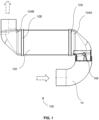
- Fig. 1 illustrates a schematic view of a heat exchanger 100, in accordance with an embodiment of the present invention.
- the heat exchanger 100 can be a charge air cooler or any other heat exchanger.
- the heat exchanger 100 is a charge air cooler.
- the charge air cooler 100 includes a core (not shown in Fig. 1 ), a housing 102 accommodating the core, an inlet tank 104A and an outlet tank 104B.
- the inlet tank 104A is connected to a first header 12A and the outlet tank 104B is connected to a second header 12B.
- the first header and the second header 12A-B are fluidically connected to heat exchange elements (not shown in Fig) of the core.
- a cooling fluid may flow from the first header 12A to the second header 12B through the heat exchange elements.
- the inlet tank 104A and the outlet tank 104B are fluidically connected to the heat exchange elements to enable a first fluid flow, preferably airflow over the heat exchange elements.
- a second fluid flow preferably a coolant, flows into the heat exchange elements.
- the first fluid flow and the second fluid flow are defined in the housing in such a way that the first fluid flow is adapted to exchange heat with the second fluid flow.
- the inlet tank 104A is connected to an inlet conduit 10, which may be angled due to various requirements.
- the first fluid flow hereinafter referred to as air flow
- air flow entering into the housing 102 is non-uniform at the inlet area of the core.
- a deflector 106 is provided within the inlet tank 104A. The deflector 106 is adapted to uniformly distribute the first fluid onto the core of the charge air cooler.
- Figs. 2 and 3 illustrate different views of the inlet tank 104A of the charge air cooler 100 of Fig. 1 showing the deflector 106.
- Fig. 2 illustrates a perspective view of the inlet tank nozzle 104A of Fig. 1
- Fig. 3 illustrates a front view of the inlet tank 104A of Fig. 1 .
- the charge air cooler 100 includes at least one deflector 106 provided within the inlet tank 104A to uniformly distribute the first fluid entering into the inlet tank 104A on the core of the charge air cooler 100.
- the at least one deflector 106 includes at least one flap 108 inclined at an angle towards the core of the charge air cooler 100.
- the flap 108 is angled with respect to the conduit in which it is mounted and points towards the core.
- the inlet tank 104A of the proposed invention is explained with at least one deflector 106, it is possible to configure more than one deflector 106 within the inlet tank 104A.
- the at least one deflector 106 hereinafter referred to as deflector 106, includes a base portion 110 in which the at least one flap 108, hereinafter referred to as flap, is connected thereto.
- the base portion 110 may be rectangular and comprise protruding end portions 110A, which may be bent at angle with respect to the base portion 110.
- both lateral ends of the base portion 110 which is in vicinity to the inner wall of the inlet tank 104A and serve as mounting portions for the base portion 110, are bent at angle with respect to it and the conduit walls to which it is mounted.
- the end portions 110A of the base portion 110 is connected to the inner wall 116 of the inlet tank 104A.
- the base portion 110 further includes protruded portions 112 formed on adjacent sides of the flap 108 and protruding from the base portion 110 of the deflector 106. In particular, the protruded portions 112 are formed on the end portions 110A of the base portion 110.
- the deflector 106 includes two protruded portions 112 formed on the both end portions 110A of the base portion 110.
- the two protruded portion 112 are inclined with respect to the base portion 110 and towards each other.
- at least one protruded portion 112 is coupled to any one of the end portions 110A of the base portion 110 of the deflector 106.
- the at least one protruded portion 112 is inclined towards the flap 108 of the deflector 106.
- the protruded portions 112 are protruded from the base portion 110 in a direction towards the core. In other words, the protruded portions 112 are protruded from the base portion 110 generally in the same direction as the flap 108 protruding therefrom, but in a differing orientation with respect to the conduit.
- Fig. 4 illustrates a perspective view of the deflector of Fig. 2 depicting the flap 108 and the protruded portions 112
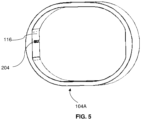
- Fig. 5 illustrates a perspective view of inlet tank nozzle 104A depicting the inner wall 116.
- the flap 108 and the protruded portions 112 are angled at different angles on a same plane.
- the flap 108 is bent more than of the protruded portions 112, in such a way that the protruded portions 112 are in a plane above the flap 108.
- the flap 108 and the protruded portions 112 are inclined on parallel planes.
- the base portion 110 of the deflector 106 includes tongues 202 formed on the end portions 110A of the base portion 110 and adapted to be received in slots 204 formed on the inner wall 116 of the inlet tank 104A. As shown in Fig. 5 , the slots 204 are formed on the inner wall 116 of the inlet tank 104A, corresponding to the tongues 202 formed in the base portion 110 of the deflector 106.
- the deflector 106 is brazed to the inner wall 116 of the inlet tank 104A.
- the inner wall 116 of the inlet tank 104A is provided with an "O" ring, on which the end portions 110A of the deflector 106 is connected thereto. Further, an end portion 114 of the flap 108 is bent at an angle with respect to the body of the flap 108.
- the deflector 106 may divert the first fluid across the heat exchange elements.
- the first fluid flowing into the inlet tank 104A is uniformly distributed on the core by directing the fluid at desired location of the heat exchange elements.
- the first fluid exchanges the heat with the second fluid entering into the heat exchange elements.
- the first fluid e.g., hot air
- the heat exchange between the first fluid and the second fluid can be optimum, thereby attaining optimal thermal efficiency of the charge air cooler 100.
- the first fluid exits the housing 102 through the outlet tank 104B.
- the deflector 106 is defined in the charge air cooler 100 to enable uniform distribution of fluid on the core, the deflector 106 can be defined in any other heat exchanger to enable uniform distribution at an inlet area of the core of the heat exchanger.
Landscapes
- Engineering & Computer Science (AREA)
- Physics & Mathematics (AREA)
- Thermal Sciences (AREA)
- Mechanical Engineering (AREA)
- General Engineering & Computer Science (AREA)
- Chemical & Material Sciences (AREA)
- Combustion & Propulsion (AREA)
- Heat-Exchange Devices With Radiators And Conduit Assemblies (AREA)
Description
- The present invention generally relates to a heat exchanger, in particular to a heat exchanger provided with a deflector in an inlet tank of the heat exchanger for uniform distribution of fluid flowing therein.
WO 2013/022072 discloses a heat exchanger having the features of the preamble of claim 1. - Heat exchangers, particularly charge air coolers, are provided in a vehicle at an air inlet circuit to cool the air flowing into an engine of the vehicle. Generally, the charge air cooler is connected downstream of a supercharger/turbocharger. The hot air received from the supercharger is cooled down at the charge air cooler, and the cooled air is provided to the engine. The charge air cooler may include two fluid circuits, one fluid circuit being the hot air flowing from the supercharger, and other fluid circuit being a coolant loop. Further, both fluid circuits are defined in a heat exchange configuration, so that the hot air exchanges heat with the coolant flowing therein. Further, the charge air cooler may include an inlet tank and an outlet tank to enable circulation of the hot air into a core of the charge air cooler. In some vehicles, the charge air cooler may be strategically positioned in order to optimally utilize the space in the vehicle. In such case, the supercharger and the charge air cooler may be in parallel with each other, so the inlet port may be angled to connect with the supercharger.
- In such cases, the hot airflow entering into the inlet port may not uniformly distributed on the core of the charge air cooler. Further, the non-uniform distribution of the hot air on the core may lead to inefficient heat exchange between the coolant and the hot air that results in inefficient performance of the charge air cooler. In other cases, an air duct connecting the inlet port of the charge air cooler may be angled or U-shaped, due to arrangement of various components connected in the air inlet circuit. Further, the hot airflow entering into the housing may not be homogenous on the cross-section of the core, due to non-symmetrical inlet port or a curvature of flow path in the inlet tank. Such non-uniform distribution of airflow leads to inefficient heat exchange and thermal performance. Further, there is a possibility of thermal shock issue on the charge air cooler due to the non-uniform distribution of air at the inlet, which may damage the parts of the charge air cooler.
- Accordingly, there remains a need for an inlet tank or port that enables uniform distribution of airflow on a core of a charge air cooler. Further, there remains another need for a charge air cooler having an angled inlet with features to enable uniform distribution of fluid on the core of the charge air cooler.
- In the present description, some elements or parameters may be indexed, such as a first element and a second element. In this case, unless stated otherwise, this indexation is only meant to differentiate and name elements which are similar but not identical. No idea of priority should be inferred from such indexation, as these terms may be switched without betraying the invention. Additionally, this indexation does not imply any order in mounting or use of the elements of the invention.
- In view of the foregoing, the present invention relates to a heat exchanger according to claim 1.
- Further, the deflector includes a base portion and the flap is connected to the base portion.
- The heat exchanger further includes at least one protruded portions, in particular two protruded portions, formed on adjacent sides of the flap and protruding from the base portion of the deflector.
- Further, the protruded portion protrudes from the base portion of the deflector in a direction towards the core of the heat exchanger.
- Further, the protruded portions are inclined towards the flap.
- In one embodiment, the flap and at least one protruded portion are angled at different angles on a same plane.
- In another embodiment, the flap and at least one protruded portion are inclined on parallel planes.
- Further, an end portion of the flap is bent at an angle with respect to the body of the flap.
- In one embodiment, the deflector is connected to an inner wall of the inlet tank.
- Other characteristics, details and advantages of the invention can be inferred from the description of the invention hereunder. A more complete appreciation of the invention and many of the attendant advantages thereof will be readily obtained as the same becomes better understood by reference to the following detailed description when considered in connection with the accompanying figures, wherein:
-
Fig. 1 illustrates a schematic view of a heat exchanger, in accordance with an embodiment of the present invention; -
Fig. 2 illustrates a perspective view of an inlet tank nozzle of the heat exchanger ofFig. 1 ; -
Fig. 3 illustrates a front view of the inlet tank nozzle of the heat exchanger showing a deflector ofFig. 2 ; -
Fig. 4 illustrates a perspective view of the deflector of the inlet tank ofFig. 3 ; and -
Fig. 5 illustrates a perspective view of the inlet tank nozzle of the heat exchanger ofFig. 2 . - It must be noted that the figures disclose the invention in a detailed enough way to be implemented, said figures helping to better define the invention if needs be. The invention should however not be limited to the embodiment disclosed in the description.
- The present invention generally relates a charge air cooler provided with a deflector in an inlet tank of the charge air cooler to enable uniform distribution of air on a core of the charge air cooler. In conventional charge air cooler, the inlet air duct may be bent or in non-symmetrical shape, so the air entering into a housing of the charge air cooler may non-uniformly distributed in the inlet area of the core that leads to inefficient heat exchange between the air and a coolant and leads to thermal shock. To avoid such scenario, a deflector is provided in the inlet tank that uniformly distribute the air on a core provided in a housing of the charge air cooler. Further, the geometry and placement of the deflector is explained with respect to the following figures.
-
Fig. 1 illustrates a schematic view of aheat exchanger 100, in accordance with an embodiment of the present invention. Theheat exchanger 100 can be a charge air cooler or any other heat exchanger. In the present embodiment, theheat exchanger 100 is a charge air cooler. Thecharge air cooler 100 includes a core (not shown inFig. 1 ), ahousing 102 accommodating the core, aninlet tank 104A and anoutlet tank 104B. Theinlet tank 104A is connected to afirst header 12A and theoutlet tank 104B is connected to asecond header 12B. The first header and thesecond header 12A-B are fluidically connected to heat exchange elements (not shown in Fig) of the core. In other words, a cooling fluid may flow from thefirst header 12A to thesecond header 12B through the heat exchange elements. Further, theinlet tank 104A and theoutlet tank 104B are fluidically connected to the heat exchange elements to enable a first fluid flow, preferably airflow over the heat exchange elements. Further, a second fluid flow, preferably a coolant, flows into the heat exchange elements. The first fluid flow and the second fluid flow are defined in the housing in such a way that the first fluid flow is adapted to exchange heat with the second fluid flow. Theinlet tank 104A is connected to aninlet conduit 10, which may be angled due to various requirements. As theinlet conduit 10 is angled, the first fluid flow, hereinafter referred to as air flow, entering into thehousing 102 is non-uniform at the inlet area of the core. To avoid non-uniform distribution air on the core of the, adeflector 106 is provided within theinlet tank 104A. Thedeflector 106 is adapted to uniformly distribute the first fluid onto the core of the charge air cooler. -
Figs. 2 and3 illustrate different views of theinlet tank 104A of thecharge air cooler 100 ofFig. 1 showing thedeflector 106. In one example,Fig. 2 illustrates a perspective view of theinlet tank nozzle 104A ofFig. 1 andFig. 3 illustrates a front view of theinlet tank 104A ofFig. 1 . Thecharge air cooler 100 includes at least onedeflector 106 provided within theinlet tank 104A to uniformly distribute the first fluid entering into theinlet tank 104A on the core of thecharge air cooler 100. In one embodiment, the at least onedeflector 106 includes at least oneflap 108 inclined at an angle towards the core of thecharge air cooler 100. In other words, theflap 108 is angled with respect to the conduit in which it is mounted and points towards the core. Although theinlet tank 104A of the proposed invention is explained with at least onedeflector 106, it is possible to configure more than onedeflector 106 within theinlet tank 104A. Further, the at least onedeflector 106, hereinafter referred to asdeflector 106, includes abase portion 110 in which the at least oneflap 108, hereinafter referred to as flap, is connected thereto. - The
base portion 110 may be rectangular and comprise protrudingend portions 110A, which may be bent at angle with respect to thebase portion 110. In other words, both lateral ends of thebase portion 110, which is in vicinity to the inner wall of theinlet tank 104A and serve as mounting portions for thebase portion 110, are bent at angle with respect to it and the conduit walls to which it is mounted. Theend portions 110A of thebase portion 110 is connected to theinner wall 116 of theinlet tank 104A. Thebase portion 110 further includes protrudedportions 112 formed on adjacent sides of theflap 108 and protruding from thebase portion 110 of thedeflector 106. In particular, the protrudedportions 112 are formed on theend portions 110A of thebase portion 110. In one example, thedeflector 106 includes two protrudedportions 112 formed on the bothend portions 110A of thebase portion 110. In such example, the two protrudedportion 112 are inclined with respect to thebase portion 110 and towards each other. In another example, at least one protrudedportion 112 is coupled to any one of theend portions 110A of thebase portion 110 of thedeflector 106. In such example, the at least one protrudedportion 112 is inclined towards theflap 108 of thedeflector 106. Further, the protrudedportions 112 are protruded from thebase portion 110 in a direction towards the core. In other words, the protrudedportions 112 are protruded from thebase portion 110 generally in the same direction as theflap 108 protruding therefrom, but in a differing orientation with respect to the conduit. -
Fig. 4 illustrates a perspective view of the deflector ofFig. 2 depicting theflap 108 and the protrudedportions 112, andFig. 5 illustrates a perspective view ofinlet tank nozzle 104A depicting theinner wall 116. Theflap 108 and the protrudedportions 112 are angled at different angles on a same plane. In one example, theflap 108 is bent more than of the protrudedportions 112, in such a way that the protrudedportions 112 are in a plane above theflap 108. In another example, theflap 108 and the protrudedportions 112 are inclined on parallel planes. Further, thebase portion 110 of thedeflector 106 includestongues 202 formed on theend portions 110A of thebase portion 110 and adapted to be received inslots 204 formed on theinner wall 116 of theinlet tank 104A. As shown inFig. 5 , theslots 204 are formed on theinner wall 116 of theinlet tank 104A, corresponding to thetongues 202 formed in thebase portion 110 of thedeflector 106. In another embodiment, thedeflector 106 is brazed to theinner wall 116 of theinlet tank 104A. In yet another embodiment, theinner wall 116 of theinlet tank 104A is provided with an "O" ring, on which theend portions 110A of thedeflector 106 is connected thereto. Further, anend portion 114 of theflap 108 is bent at an angle with respect to the body of theflap 108. - In order to attain homogenous fluid distribution on the core of the
charge air cooer 100, thedeflector 106 may divert the first fluid across the heat exchange elements. As thedeflector 106 is provided in theinlet tank 104A, the first fluid flowing into theinlet tank 104A is uniformly distributed on the core by directing the fluid at desired location of the heat exchange elements. At the core, the first fluid exchanges the heat with the second fluid entering into the heat exchange elements. As the first fluid, e.g., hot air, uniformly distributed on the inlet side of the core, the heat exchange between the first fluid and the second fluid can be optimum, thereby attaining optimal thermal efficiency of the charge air cooler 100.Thereafter, the first fluid exits thehousing 102 through theoutlet tank 104B. Although thedeflector 106 is defined in thecharge air cooler 100 to enable uniform distribution of fluid on the core, thedeflector 106 can be defined in any other heat exchanger to enable uniform distribution at an inlet area of the core of the heat exchanger. - All the above-described embodiments are just to explain the present invention while more embodiments and combinations thereof might exist. Hence, the present invention should not be limited to the above-described embodiments alone.
Claims (8)
- A heat exchanger (100) comprising: a core, a housing (102) connected with an inlet tank (104A), said core being accommodated in said housing; and at least one deflector (106) provided within the inlet tank (104A), wherein the deflector (106) comprises at least one flap (108) inclined towards the core of the heat exchanger (100), characterised in that the inner wall (116) of the inlet tank (104A) is provided with slots (204) and tongues (202) formed on the deflector (106) are received in the slots (204).
- The heat exchanger (100) as claimed in claim 1, wherein the deflector (106) further comprises a base portion (110), the flap (108) being connected to the base portion (110).
- The heat exchanger (100) as claimed in claim 2, further comprising at least one protruded portion (112), in particular two protruded portions (112), formed on adjacent sides of the flap (108) and protruding from the base portion (110) of the deflector (106).
- The heat exchanger (100) as claimed in claim 3, wherein the protruded portion (112) protrudes from the base portion (110) of the deflector (106) in a direction towards the core of the heat exchanger (100).
- The heat exchanger (100) as claimed in any of the claims 3 and 4, wherein the protruded portions (112) are inclined towards the flap (108).
- The heat exchanger (100) as claimed in any of the claims 3 to 5, wherein the flap (108) and at least one protruded portion (112) are angled at different angles within the same plane.
- The heat exchanger (100) as claimed in any of the claims 3 to 5, wherein the flap (108) and at least one protruded portion (112) are inclined on parallel planes.
- The heat exchanger (100) as claimed in any of the preceding claims, wherein an end portion (114) of the flap (108) is bent at an angle with respect to the body of the flap (108).
Priority Applications (1)
| Application Number | Priority Date | Filing Date | Title |
|---|---|---|---|
| EP20461594.2A EP4015976B1 (en) | 2020-12-15 | 2020-12-15 | Heat exchanger |
Applications Claiming Priority (1)
| Application Number | Priority Date | Filing Date | Title |
|---|---|---|---|
| EP20461594.2A EP4015976B1 (en) | 2020-12-15 | 2020-12-15 | Heat exchanger |
Publications (2)
| Publication Number | Publication Date |
|---|---|
| EP4015976A1 EP4015976A1 (en) | 2022-06-22 |
| EP4015976B1 true EP4015976B1 (en) | 2024-10-23 |
Family
ID=73854805
Family Applications (1)
| Application Number | Title | Priority Date | Filing Date |
|---|---|---|---|
| EP20461594.2A Active EP4015976B1 (en) | 2020-12-15 | 2020-12-15 | Heat exchanger |
Country Status (1)
| Country | Link |
|---|---|
| EP (1) | EP4015976B1 (en) |
Families Citing this family (1)
| Publication number | Priority date | Publication date | Assignee | Title |
|---|---|---|---|---|
| US20250003704A1 (en) * | 2023-06-28 | 2025-01-02 | Raytheon Technologies Corporation | Heat Exchanger with Enhanced Heat Transfer Manifold |
Family Cites Families (4)
| Publication number | Priority date | Publication date | Assignee | Title |
|---|---|---|---|---|
| CA2113519C (en) * | 1994-01-14 | 1999-06-08 | Allan K. So | Passive by-pass for heat exchangers |
| JP2000088477A (en) * | 1998-09-14 | 2000-03-31 | Calsonic Corp | Apparatus for cooling egr gas |
| JP5988296B2 (en) * | 2011-08-10 | 2016-09-07 | 臼井国際産業株式会社 | Multi-tube heat exchanger |
| WO2017122832A1 (en) * | 2016-01-12 | 2017-07-20 | 株式会社ティラド | Exhaust gas heat exchanger having stacked flat tubes |
-
2020
- 2020-12-15 EP EP20461594.2A patent/EP4015976B1/en active Active
Also Published As
| Publication number | Publication date |
|---|---|
| EP4015976A1 (en) | 2022-06-22 |
Similar Documents
| Publication | Publication Date | Title |
|---|---|---|
| US20140366816A1 (en) | Modular cooling unit for automotive vehicle | |
| US11603790B2 (en) | Heat exchanger | |
| US10690233B2 (en) | Bypass control for U-flow transmission oil coolers | |
| CN105863895B (en) | Integrated exhaust gas recirculation cooler | |
| CN103608577B (en) | Intake housings and intake modules for internal combustion engines | |
| US7703506B2 (en) | Exhaust heat exchanger | |
| KR20170037806A (en) | Water-cooled charge air cooler with integrated multi-stage cooling | |
| EP4015976B1 (en) | Heat exchanger | |
| US6607025B2 (en) | Heat-exchange module for a motor vehicle | |
| EP3517873B1 (en) | Heat exchanger and method of cooling a flow of heated air | |
| US20240021913A1 (en) | Cooling module for an electric or hybrid motor vehicle, having a tangential-flow turbomachine with an additional heat exchanger | |
| US11691498B2 (en) | Vehicle radiator assembly and cooling system having the same | |
| US11655745B2 (en) | Exhaust gas heat exchanger | |
| KR102863827B1 (en) | Cooling module | |
| EP4030042B1 (en) | Radiator-intercooler integrated module and vehicle including the same | |
| US11353273B2 (en) | Heat exchanger module and a housing therefor | |
| CN110100143A (en) | Intercooler | |
| US12187114B2 (en) | Shutter device for vehicle | |
| EP3786567B1 (en) | Heat exchanger | |
| EP3816568A1 (en) | Heat exchanger | |
| CN117337248A (en) | Cooling module with tangential flow turbine for electric or hybrid motor vehicles | |
| EP4015975A1 (en) | Heat exchanger | |
| JP6512117B2 (en) | Heat exchange unit | |
| US12520451B2 (en) | Cooling unit including manifolds, an air blower, and a radiator | |
| EP4317881A1 (en) | A heat exchanger assembly |
Legal Events
| Date | Code | Title | Description |
|---|---|---|---|
| PUAI | Public reference made under article 153(3) epc to a published international application that has entered the european phase |
Free format text: ORIGINAL CODE: 0009012 |
|
| STAA | Information on the status of an ep patent application or granted ep patent |
Free format text: STATUS: THE APPLICATION HAS BEEN PUBLISHED |
|
| AK | Designated contracting states |
Kind code of ref document: A1 Designated state(s): AL AT BE BG CH CY CZ DE DK EE ES FI FR GB GR HR HU IE IS IT LI LT LU LV MC MK MT NL NO PL PT RO RS SE SI SK SM TR |
|
| STAA | Information on the status of an ep patent application or granted ep patent |
Free format text: STATUS: REQUEST FOR EXAMINATION WAS MADE |
|
| 17P | Request for examination filed |
Effective date: 20221222 |
|
| RBV | Designated contracting states (corrected) |
Designated state(s): AL AT BE BG CH CY CZ DE DK EE ES FI FR GB GR HR HU IE IS IT LI LT LU LV MC MK MT NL NO PL PT RO RS SE SI SK SM TR |
|
| P01 | Opt-out of the competence of the unified patent court (upc) registered |
Effective date: 20230528 |
|
| REG | Reference to a national code |
Ref legal event code: R079 Ref country code: DE Ref document number: 602020039832 Country of ref document: DE Free format text: PREVIOUS MAIN CLASS: F28F0009020000 Ipc: F28D0007160000 |
|
| GRAP | Despatch of communication of intention to grant a patent |
Free format text: ORIGINAL CODE: EPIDOSNIGR1 |
|
| STAA | Information on the status of an ep patent application or granted ep patent |
Free format text: STATUS: GRANT OF PATENT IS INTENDED |
|
| RIC1 | Information provided on ipc code assigned before grant |
Ipc: F28F 9/02 20060101ALI20240424BHEP Ipc: F02B 29/04 20060101ALI20240424BHEP Ipc: F28D 7/16 20060101AFI20240424BHEP |
|
| INTG | Intention to grant announced |
Effective date: 20240521 |
|
| GRAS | Grant fee paid |
Free format text: ORIGINAL CODE: EPIDOSNIGR3 |
|
| GRAA | (expected) grant |
Free format text: ORIGINAL CODE: 0009210 |
|
| STAA | Information on the status of an ep patent application or granted ep patent |
Free format text: STATUS: THE PATENT HAS BEEN GRANTED |
|
| AK | Designated contracting states |
Kind code of ref document: B1 Designated state(s): AL AT BE BG CH CY CZ DE DK EE ES FI FR GB GR HR HU IE IS IT LI LT LU LV MC MK MT NL NO PL PT RO RS SE SI SK SM TR |
|
| REG | Reference to a national code |
Ref country code: GB Ref legal event code: FG4D |
|
| REG | Reference to a national code |
Ref country code: CH Ref legal event code: EP |
|
| REG | Reference to a national code |
Ref country code: DE Ref legal event code: R096 Ref document number: 602020039832 Country of ref document: DE |
|
| REG | Reference to a national code |
Ref country code: IE Ref legal event code: FG4D |
|
| REG | Reference to a national code |
Ref country code: LT Ref legal event code: MG9D |
|
| REG | Reference to a national code |
Ref country code: NL Ref legal event code: MP Effective date: 20241023 |
|
| REG | Reference to a national code |
Ref country code: AT Ref legal event code: MK05 Ref document number: 1735169 Country of ref document: AT Kind code of ref document: T Effective date: 20241023 |
|
| PG25 | Lapsed in a contracting state [announced via postgrant information from national office to epo] |
Ref country code: NL Free format text: LAPSE BECAUSE OF FAILURE TO SUBMIT A TRANSLATION OF THE DESCRIPTION OR TO PAY THE FEE WITHIN THE PRESCRIBED TIME-LIMIT Effective date: 20241023 |
|
| PG25 | Lapsed in a contracting state [announced via postgrant information from national office to epo] |
Ref country code: NL Free format text: LAPSE BECAUSE OF FAILURE TO SUBMIT A TRANSLATION OF THE DESCRIPTION OR TO PAY THE FEE WITHIN THE PRESCRIBED TIME-LIMIT Effective date: 20241023 |
|
| PG25 | Lapsed in a contracting state [announced via postgrant information from national office to epo] |
Ref country code: HR Free format text: LAPSE BECAUSE OF FAILURE TO SUBMIT A TRANSLATION OF THE DESCRIPTION OR TO PAY THE FEE WITHIN THE PRESCRIBED TIME-LIMIT Effective date: 20241023 Ref country code: PT Free format text: LAPSE BECAUSE OF FAILURE TO SUBMIT A TRANSLATION OF THE DESCRIPTION OR TO PAY THE FEE WITHIN THE PRESCRIBED TIME-LIMIT Effective date: 20250224 Ref country code: IS Free format text: LAPSE BECAUSE OF FAILURE TO SUBMIT A TRANSLATION OF THE DESCRIPTION OR TO PAY THE FEE WITHIN THE PRESCRIBED TIME-LIMIT Effective date: 20250223 |
|
| PG25 | Lapsed in a contracting state [announced via postgrant information from national office to epo] |
Ref country code: FI Free format text: LAPSE BECAUSE OF FAILURE TO SUBMIT A TRANSLATION OF THE DESCRIPTION OR TO PAY THE FEE WITHIN THE PRESCRIBED TIME-LIMIT Effective date: 20241023 |
|
| PG25 | Lapsed in a contracting state [announced via postgrant information from national office to epo] |
Ref country code: BG Free format text: LAPSE BECAUSE OF FAILURE TO SUBMIT A TRANSLATION OF THE DESCRIPTION OR TO PAY THE FEE WITHIN THE PRESCRIBED TIME-LIMIT Effective date: 20241023 |
|
| PG25 | Lapsed in a contracting state [announced via postgrant information from national office to epo] |
Ref country code: ES Free format text: LAPSE BECAUSE OF FAILURE TO SUBMIT A TRANSLATION OF THE DESCRIPTION OR TO PAY THE FEE WITHIN THE PRESCRIBED TIME-LIMIT Effective date: 20241023 |
|
| PG25 | Lapsed in a contracting state [announced via postgrant information from national office to epo] |
Ref country code: NO Free format text: LAPSE BECAUSE OF FAILURE TO SUBMIT A TRANSLATION OF THE DESCRIPTION OR TO PAY THE FEE WITHIN THE PRESCRIBED TIME-LIMIT Effective date: 20250123 |
|
| PG25 | Lapsed in a contracting state [announced via postgrant information from national office to epo] |
Ref country code: LV Free format text: LAPSE BECAUSE OF FAILURE TO SUBMIT A TRANSLATION OF THE DESCRIPTION OR TO PAY THE FEE WITHIN THE PRESCRIBED TIME-LIMIT Effective date: 20241023 Ref country code: AT Free format text: LAPSE BECAUSE OF FAILURE TO SUBMIT A TRANSLATION OF THE DESCRIPTION OR TO PAY THE FEE WITHIN THE PRESCRIBED TIME-LIMIT Effective date: 20241023 Ref country code: GR Free format text: LAPSE BECAUSE OF FAILURE TO SUBMIT A TRANSLATION OF THE DESCRIPTION OR TO PAY THE FEE WITHIN THE PRESCRIBED TIME-LIMIT Effective date: 20250124 |
|
| PG25 | Lapsed in a contracting state [announced via postgrant information from national office to epo] |
Ref country code: PL Free format text: LAPSE BECAUSE OF FAILURE TO SUBMIT A TRANSLATION OF THE DESCRIPTION OR TO PAY THE FEE WITHIN THE PRESCRIBED TIME-LIMIT Effective date: 20241023 |
|
| PG25 | Lapsed in a contracting state [announced via postgrant information from national office to epo] |
Ref country code: RS Free format text: LAPSE BECAUSE OF FAILURE TO SUBMIT A TRANSLATION OF THE DESCRIPTION OR TO PAY THE FEE WITHIN THE PRESCRIBED TIME-LIMIT Effective date: 20250123 |
|
| PG25 | Lapsed in a contracting state [announced via postgrant information from national office to epo] |
Ref country code: SM Free format text: LAPSE BECAUSE OF FAILURE TO SUBMIT A TRANSLATION OF THE DESCRIPTION OR TO PAY THE FEE WITHIN THE PRESCRIBED TIME-LIMIT Effective date: 20241023 |
|
| PG25 | Lapsed in a contracting state [announced via postgrant information from national office to epo] |
Ref country code: MC Free format text: LAPSE BECAUSE OF FAILURE TO SUBMIT A TRANSLATION OF THE DESCRIPTION OR TO PAY THE FEE WITHIN THE PRESCRIBED TIME-LIMIT Effective date: 20241023 |
|
| PG25 | Lapsed in a contracting state [announced via postgrant information from national office to epo] |
Ref country code: DK Free format text: LAPSE BECAUSE OF FAILURE TO SUBMIT A TRANSLATION OF THE DESCRIPTION OR TO PAY THE FEE WITHIN THE PRESCRIBED TIME-LIMIT Effective date: 20241023 |
|
| PG25 | Lapsed in a contracting state [announced via postgrant information from national office to epo] |
Ref country code: EE Free format text: LAPSE BECAUSE OF FAILURE TO SUBMIT A TRANSLATION OF THE DESCRIPTION OR TO PAY THE FEE WITHIN THE PRESCRIBED TIME-LIMIT Effective date: 20241023 |
|
| PG25 | Lapsed in a contracting state [announced via postgrant information from national office to epo] |
Ref country code: RO Free format text: LAPSE BECAUSE OF FAILURE TO SUBMIT A TRANSLATION OF THE DESCRIPTION OR TO PAY THE FEE WITHIN THE PRESCRIBED TIME-LIMIT Effective date: 20241023 |
|
| REG | Reference to a national code |
Ref country code: DE Ref legal event code: R097 Ref document number: 602020039832 Country of ref document: DE |
|
| PG25 | Lapsed in a contracting state [announced via postgrant information from national office to epo] |
Ref country code: SK Free format text: LAPSE BECAUSE OF FAILURE TO SUBMIT A TRANSLATION OF THE DESCRIPTION OR TO PAY THE FEE WITHIN THE PRESCRIBED TIME-LIMIT Effective date: 20241023 |
|
| PG25 | Lapsed in a contracting state [announced via postgrant information from national office to epo] |
Ref country code: CZ Free format text: LAPSE BECAUSE OF FAILURE TO SUBMIT A TRANSLATION OF THE DESCRIPTION OR TO PAY THE FEE WITHIN THE PRESCRIBED TIME-LIMIT Effective date: 20241023 |
|
| PG25 | Lapsed in a contracting state [announced via postgrant information from national office to epo] |
Ref country code: IT Free format text: LAPSE BECAUSE OF FAILURE TO SUBMIT A TRANSLATION OF THE DESCRIPTION OR TO PAY THE FEE WITHIN THE PRESCRIBED TIME-LIMIT Effective date: 20241023 |
|
| REG | Reference to a national code |
Ref country code: CH Ref legal event code: PL |
|
| PG25 | Lapsed in a contracting state [announced via postgrant information from national office to epo] |
Ref country code: LU Free format text: LAPSE BECAUSE OF NON-PAYMENT OF DUE FEES Effective date: 20241215 |
|
| PLBE | No opposition filed within time limit |
Free format text: ORIGINAL CODE: 0009261 |
|
| STAA | Information on the status of an ep patent application or granted ep patent |
Free format text: STATUS: NO OPPOSITION FILED WITHIN TIME LIMIT |
|
| PG25 | Lapsed in a contracting state [announced via postgrant information from national office to epo] |
Ref country code: SE Free format text: LAPSE BECAUSE OF FAILURE TO SUBMIT A TRANSLATION OF THE DESCRIPTION OR TO PAY THE FEE WITHIN THE PRESCRIBED TIME-LIMIT Effective date: 20241023 |
|
| GBPC | Gb: european patent ceased through non-payment of renewal fee |
Effective date: 20250123 |
|
| 26N | No opposition filed |
Effective date: 20250724 |
|
| REG | Reference to a national code |
Ref country code: BE Ref legal event code: MM Effective date: 20241231 |
|
| PG25 | Lapsed in a contracting state [announced via postgrant information from national office to epo] |
Ref country code: BE Free format text: LAPSE BECAUSE OF NON-PAYMENT OF DUE FEES Effective date: 20241231 Ref country code: GB Free format text: LAPSE BECAUSE OF NON-PAYMENT OF DUE FEES Effective date: 20250123 |
|
| PG25 | Lapsed in a contracting state [announced via postgrant information from national office to epo] |
Ref country code: CH Free format text: LAPSE BECAUSE OF NON-PAYMENT OF DUE FEES Effective date: 20241231 |
|
| PG25 | Lapsed in a contracting state [announced via postgrant information from national office to epo] |
Ref country code: IE Free format text: LAPSE BECAUSE OF NON-PAYMENT OF DUE FEES Effective date: 20241215 |
|
| PGFP | Annual fee paid to national office [announced via postgrant information from national office to epo] |
Ref country code: FR Payment date: 20251230 Year of fee payment: 6 |
|
| PGFP | Annual fee paid to national office [announced via postgrant information from national office to epo] |
Ref country code: DE Payment date: 20251231 Year of fee payment: 6 |