EP4015279B1 - Vehicle control device and system, and vehicle - Google Patents
Vehicle control device and system, and vehicle Download PDFInfo
- Publication number
- EP4015279B1 EP4015279B1 EP20880917.8A EP20880917A EP4015279B1 EP 4015279 B1 EP4015279 B1 EP 4015279B1 EP 20880917 A EP20880917 A EP 20880917A EP 4015279 B1 EP4015279 B1 EP 4015279B1
- Authority
- EP
- European Patent Office
- Prior art keywords
- terminal
- comparator
- voltage
- resistor
- control switch
- Prior art date
- Legal status (The legal status is an assumption and is not a legal conclusion. Google has not performed a legal analysis and makes no representation as to the accuracy of the status listed.)
- Active
Links
Images

Classifications
-
- B—PERFORMING OPERATIONS; TRANSPORTING
- B60—VEHICLES IN GENERAL
- B60L—PROPULSION OF ELECTRICALLY-PROPELLED VEHICLES; SUPPLYING ELECTRIC POWER FOR AUXILIARY EQUIPMENT OF ELECTRICALLY-PROPELLED VEHICLES; ELECTRODYNAMIC BRAKE SYSTEMS FOR VEHICLES IN GENERAL; MAGNETIC SUSPENSION OR LEVITATION FOR VEHICLES; MONITORING OPERATING VARIABLES OF ELECTRICALLY-PROPELLED VEHICLES; ELECTRIC SAFETY DEVICES FOR ELECTRICALLY-PROPELLED VEHICLES
- B60L3/00—Electric devices on electrically-propelled vehicles for safety purposes; Monitoring operating variables, e.g. speed, deceleration or energy consumption
- B60L3/0007—Measures or means for preventing or attenuating collisions
-
- B—PERFORMING OPERATIONS; TRANSPORTING
- B60—VEHICLES IN GENERAL
- B60L—PROPULSION OF ELECTRICALLY-PROPELLED VEHICLES; SUPPLYING ELECTRIC POWER FOR AUXILIARY EQUIPMENT OF ELECTRICALLY-PROPELLED VEHICLES; ELECTRODYNAMIC BRAKE SYSTEMS FOR VEHICLES IN GENERAL; MAGNETIC SUSPENSION OR LEVITATION FOR VEHICLES; MONITORING OPERATING VARIABLES OF ELECTRICALLY-PROPELLED VEHICLES; ELECTRIC SAFETY DEVICES FOR ELECTRICALLY-PROPELLED VEHICLES
- B60L3/00—Electric devices on electrically-propelled vehicles for safety purposes; Monitoring operating variables, e.g. speed, deceleration or energy consumption
- B60L3/04—Cutting off the power supply under fault conditions
-
- B—PERFORMING OPERATIONS; TRANSPORTING
- B60—VEHICLES IN GENERAL
- B60R—VEHICLES, VEHICLE FITTINGS, OR VEHICLE PARTS, NOT OTHERWISE PROVIDED FOR
- B60R16/00—Electric or fluid circuits specially adapted for vehicles and not otherwise provided for; Arrangement of elements of electric or fluid circuits specially adapted for vehicles and not otherwise provided for
- B60R16/02—Electric or fluid circuits specially adapted for vehicles and not otherwise provided for; Arrangement of elements of electric or fluid circuits specially adapted for vehicles and not otherwise provided for electric constitutive elements
- B60R16/03—Electric or fluid circuits specially adapted for vehicles and not otherwise provided for; Arrangement of elements of electric or fluid circuits specially adapted for vehicles and not otherwise provided for electric constitutive elements for supply of electrical power to vehicle subsystems or for
-
- B—PERFORMING OPERATIONS; TRANSPORTING
- B60—VEHICLES IN GENERAL
- B60R—VEHICLES, VEHICLE FITTINGS, OR VEHICLE PARTS, NOT OTHERWISE PROVIDED FOR
- B60R21/00—Arrangements or fittings on vehicles for protecting or preventing injuries to occupants or pedestrians in case of accidents or other traffic risks
- B60R21/01—Electrical circuits for triggering passive safety arrangements, e.g. airbags, safety belt tighteners, in case of vehicle accidents or impending vehicle accidents
-
- B—PERFORMING OPERATIONS; TRANSPORTING
- B60—VEHICLES IN GENERAL
- B60R—VEHICLES, VEHICLE FITTINGS, OR VEHICLE PARTS, NOT OTHERWISE PROVIDED FOR
- B60R21/00—Arrangements or fittings on vehicles for protecting or preventing injuries to occupants or pedestrians in case of accidents or other traffic risks
- B60R21/01—Electrical circuits for triggering passive safety arrangements, e.g. airbags, safety belt tighteners, in case of vehicle accidents or impending vehicle accidents
- B60R21/013—Electrical circuits for triggering passive safety arrangements, e.g. airbags, safety belt tighteners, in case of vehicle accidents or impending vehicle accidents including means for detecting collisions, impending collisions or roll-over
- B60R21/0136—Electrical circuits for triggering passive safety arrangements, e.g. airbags, safety belt tighteners, in case of vehicle accidents or impending vehicle accidents including means for detecting collisions, impending collisions or roll-over responsive to actual contact with an obstacle, e.g. to vehicle deformation, bumper displacement or bumper velocity relative to the vehicle
-
- B—PERFORMING OPERATIONS; TRANSPORTING
- B60—VEHICLES IN GENERAL
- B60R—VEHICLES, VEHICLE FITTINGS, OR VEHICLE PARTS, NOT OTHERWISE PROVIDED FOR
- B60R21/00—Arrangements or fittings on vehicles for protecting or preventing injuries to occupants or pedestrians in case of accidents or other traffic risks
- B60R2021/0027—Post collision measures, e.g. notifying emergency services
Definitions
- the present invention relates to the technical field of vehicles, and particularly relates to a vehicle control device, a and a vehicle.
- a CAN signal can be sent to a vehicle control unit and a battery management system through a controller area network (Controller Area Network, CAN) bus, and the CAN signal represents collision of the vehicle, such that the battery management system is enabled to switch off power supply according to the CAN signal, thereby enabling the vehicle to be powered off.
- controller area network Controller Area Network
- the embodiments of the present invention provide a vehicle control device, a and a vehicle, which aims at solving a problem that the battery management system cannot power off the power supply in time currently when a vehicle is collided.
- a vehicle control device in one embodiment of the present invention, the vehicle control device includes:
- the first voltage when a first terminal of the comparator is a non-inverting input and a second terminal of the comparator is an inverting input, the first voltage is higher thana second voltage, and the second voltage is a voltage input from the first terminal of the first resistor circuit to the second terminal of the comparator; when the first terminal of the comparator is an inverting input, and the second terminal of the comparator is a non-inverting input, the first voltage is lower than the second voltage.
- the comparator is further configured to receive a third voltage which is output by the air bag module and output a low level signal to the control switch, so that the control switch is controlled to be swithced off according to the low level signal, and the battery management system is powered by the power supply after the control switch is switched off, wherein the third voltage is sent out by the air bag module when the vehicle collision event is not detected by the air bag module; where when the first terminal of the comparator is a non-inverting input, the second terminal of the comparator is an inverting input, the third voltage is less than the second voltage; when the first terminal of the comparator is an inverting input, the second terminal of the comparator is a non-inverting input, the third voltage is higher than the second voltage.
- the first resistor circuit includes a first resistor and a second resistor
- the comparator includes a comparator unit and a third resistor; a first terminal of the comparator unit is connected with the air bag module, a second terminal of the comparator unit is connected with the first terminal of the first resistor circuit, a third terminal of the comparator unit is connected with a first terminal of the third resistor, a fourth terminal of the comparator unit is grounded, and a fifth terminal of the comparator unit is connected with a second terminal of the third resistor; the third terminal of the comparator unit is connected with the power supply, and the fifth terminal of the comparator unit is connected with the first terminal of the control switch.
- the device further includes a first port configured to be grounded
- control switch is a triode; as an alternative, the control switch is an optical coupler, and the optical coupler further includes a fourth terminal, the fourth terminal is grounded.
- vehicle control system in one embodiment of the present invention, the vehicle control system includes: an air bag module, a power supply, and the vehicle control device described in the first aspect and all possible embodiments in the first aspect;
- the air bag module is further configured to output a third voltage to the air bag module so that the battery management system is enabled to receive power supply from the power supply through the vehicle control device, when a vehicle collision event is not detected by the air bag module; where when the first terminal of a comparator in the vehicle control device is a non-inverting input, and the second terminal of the comparator in the vehicle control device is an inverting input, the third voltage is higher than the second voltage; when the first terminal of the comparator in the vehicle control device is an inverting input, and the second terminal of the comparator in the vehicle control device is a non-inverting input, the third voltage is higher than the second voltage.
- a vehicle isprovided in one embodiment of the present invention, where the vehicle is provided with the vehicle control system described in the first aspect and all possible embodiments in the first aspect.
- a vehicle control device, a vehicle control system and a vehicle are provided in the embodiments of the present invention.
- the vehicle control device includes a first resistor circuit, a comparator, a control switch, and a second resistor circuit; the comparator is used to receive the first voltage sent by the air bag module when a vehicle collision event is detected, and output a high level signal to the control switch, so that the control switch is controlled to be turned on according to the high level signal, the battery management system is enabled to be grounded after the control switch is turned on, the battery management system is powered off after it is grounded, so that the battery management system can quickly cut off the power supply of the vehicle and is not influenced by signal interference, time required for switching off is reduced, and the reliability is improved.
- FIG. 1 is a schematic diagram of an existing vehicle control technology.
- ABM represents an air bag module (Air Bag Module, ABM)
- VCU represents a vehicle control unit
- BMS represents a battery management system.
- ABM Air Bag Module
- VCU represents a vehicle control unit
- BMS represents a battery management system.
- the CAN signal is prone to be interferenced, there is a certain instability. If the BMS does not receive the CAN signal sent by the ABM, the BMS may still receive the CAN signal sent by the VCU, so that the BMS controls the battery contactor to be switched off.
- one embodiment of the present invention provides a vehicle control device, asystem, and a vehicle.
- Thedevice includes a first resistor circuit 100, a comparator 200, a control switch 300, and a second resistor circuit 400; the comparator 200 is used to receive a first voltage when the ABM 500 detects a vehicle collision event of the vehicle, and output a high level signal to the control switch 300, so that the control switch 300 is controlled to be turned on according to the high level signal, the battery management system 600 is grounded after the control switch is turned on, and the battery management system 600 is powered off after it is grounded, so that the battery management system 600 can quickly cut off the power supply of the vehicle without being affected by signal interference, the time required for switching on/off the control switch 300 is reduced, and the reliability is improved.
- FIG. 2 is a schematic structural diagram of a vehicle control device according to one embodiment of the present invention.
- the vehicle control device according to this embodiment includes a first resistor circuit 100, a comparator 200, a control switch 300, and a second resistor circuit 400.
- a first terminal of the comparator 200 is connected with the air bag module 500, the second terminal of the comparator 200 is connected with a first terminal of the first resistor circuit 100, a third terminal of the comparator 200 is connected with a power supply, a fourth terminal of the comparator 200 is grounded, and a fifth terminal of the comparator 200 is connected with a first terminal of the control switch 300.
- a second terminal of the control switch 300 is connected with the battery management system 600, and a third terminal of the control switch 300 is grounded.
- a second terminal of the first resistor circuit 100 is connected with the power supply, and a third terminal of the first resistor circuit 100 is grounded.
- a first terminal of the second resistor circuit 400 is connected with the power source, and a second terminal of the second resistor circuit 400 is connected with the battery management system 600.
- the comparator 200 is configured to receive the first voltage output by the air bag module 500 and output a high level signal to the control switch 300, the battery management system 600 is grounded after the control switch 300 is turned on, and the battery management system 600 is powered off after it is grounded; where the first voltage is sent out when the air bag module 500 detects the vehicle collision event of the vehicle.
- the third terminal of the comparator 200, the second terminal of the first resistor circuit 100 and the first terminal of the second resistor circuit 400 are commonly connected with the power supply, and volt current condenser (Volt Current Condenser, VCC) in FIG. 2 represents the power supply which is used for supplying power to the vehicle control device.
- the comparator 200 includes at least five terminals. The first port and the second ports are input ports used for receiving two voltage signals to be compared; the third terminal is a power terminal of the comparator 200, the fourth terminal is a port configured to be grounded of the comparator 200; and the fifth terminal is an output terminal of the comparator 200.
- the second terminal of the comparator 200 is connected with a second voltage obtained by dividing the first resistor circuit 100, the second voltage is used as a reference voltage, the first terminal of the comparator 200 receives the voltage output by the air bag module 500.
- the comparator 200 generates a corresponding level signal by comparing the voltage output by the air bag module 500 and the second voltage, and outputs the level signal to the control switch 300.
- the comparator 200 can either be implemented by multiple circuit components or be implemented by a single integrated circuit chip, implementation of the comparator is not limited herein, for example, the comparator can be chip with a product model of LM393 or LM23 9.
- the control switch 300 includes at least three terminals.
- the first terminal of the control switch 300 receives a level signal output by the comparator 200
- the second terminal of the control switch 300 is connected with the battery management system 600
- the third terminal of the control switch 300 is grounded.
- the control switch 300 controlsbetween the second terminal and the third terminal to be switched on/off according to the level signal output by the comparator 200, thereby controlling the battery management system 600 to be grounded.
- a specific circuit of the control switch 300 is not limited herein, for example, the control switch 300 may be a triode, an optical coupler, etc.
- the vehicle control device includes a first resistor circuit 100, a comparator 200, a control switch 300 and a second resistor circuit 400; the control switch 300 outputs a high level signal to the control switch 300, so that the control switch 300 is controlled to be switched on according to the high level signal, after the control switch is switched on, the battery management system 600 is grounded, after the battery management system is grounded, the battery management system 600 is powered off, so that the battery management system 600 can quickly cut off power supply of the vehicle without being affected by signal interference, time required for switching on/off the control switch 300 is reduced, and the reliability is improved.
- the second terminal of the comparator 200 when the first terminal of the comparator 200 is a non-inverting input, the second terminal of the comparator 200 is an inverting input, the first voltage is higher than the second voltage, the second voltage is the voltage which is input from the first terminal of the first resistor circuit 100 to the second terminal of the comparator 200.
- the first terminal of the comparator 200 is an inverting input
- the second terminal of the comparator 200 is a non-inverting input
- the first voltage is lower than the second voltage.
- the first terminal of the comparator 200 may be a non-inverting input, and the second terminal is an inverting input; as an alternative, the first terminal may be an inverting input, and the second terminal is a non-inverting input, the first terminal and the second terminal of the comparator 200 are not limited herein.
- the device may be implemented by one of two implementations listed below:
- the air bag module 500 detects a vehicle collision event and outputs a first voltage to the control switch 300. Where the first voltage is higher than the second voltage.
- the comparator 200 is configured to compare the first voltage received from the non-inverting input with the second voltage received from the inverting input, since the first voltage is higher than the second voltage, the comparator 200 outputs a high level signal to the control switch 300, the control switch 300 receives the high level signal and then turns on the circuit path between the second terminal thereof and the third terminal thereof, so that the battery management system 600 is grounded, the battery management system 600 controls a battery contactor to be switched off, so that the vehicle is powered off.
- the first terminal of the comparator 200 is an inverting input, and the second terminal of the comparator 200 is a non-inverting input. If the vehicle is collided, the air bag module 500 detects a vehicle collision event, and outputs a first voltage to the control switch 300. Where the first voltage is lower than the second voltage.
- the comparator 200 is configured to compare the first voltage received from the non-inverting input with the second voltage received from the inverting input, since the first voltage is lower than the second voltage, thus, the comparator 200 outputs a high level signal to the control switch 300, the control switch 300 receives the high level signal and then turns on the circuit path between the second terminal thereof and the third terminal thereof, so that the battery management system 600 is grounded, the battery management system 600 controls the battery contactor to be switched off, so that the vehicle is powered off.
- the comparator 200 is further configured to receive a third voltage output by the air bag module 500, and outputs a low level signal to the control switch 300 to enable the control switch 300 to be switched off according to the low level signal, the battery management system 600 is powered by the power supply after the control switch 300 is switched off, where the third voltage is sent out by the air bag module 500 when a vehicle collision event does not occur.
- the third voltage is lower than the second voltage; when the first terminal of the comparator 200 is an inverting input, and the second terminal of the comparator 200 is a non-inverting input, the third voltage is higher than the second voltage.
- the first terminal of the comparator 200 may be a non-inverting input, and the second terminal may be an inverting input; as an alternative, the first terminal may be an inverting input, and the second terminal may be a non-inverting input, the first terminal and the second terminal of the comparator 200 are not limited herein. the first terminal and the second terminal of the comparator 200 are respectively described herein.
- the air bag module 500 detects that the vehicle does not collide, and outputs the third voltage to the comparator 200, where the third voltage is lower than the second voltage.
- the comparator 200 is configured to compare the third voltage received from the non-inverting input with the second voltage received from the inverting input, since the third voltage is lower than the second voltage, thus, the comparator 200 outputs a low level signal to the control switch 300, the control switch 300 receives the low level signal and then switches off the circuit path between the second terminal thereof and the third terminal thereof, so that the battery management system 600 is enabled to receive power from the power supply, the battery management system 600 controls the battery contactor to be switched off, so that the vehicle is powered on.
- the value of the third voltage may be assigned as 0, when the value of the third voltage is not equal to 0, the air bag module 500 continuously outputs the third voltage to the comparator 200 to ensure that the vehicle can be powered on in the event that the vehicle collision event does not occur.
- the air bag module 500 fails to detect a vehicle collision event, and thus outputs the third voltage to the comparator 200, where the third voltage is higher than the second voltage.
- the comparator 200 is configured to compare the third voltage received from the non-inverting input with the second voltage received from the inverting input, since the third voltage is higher than the second voltage, thus, the comparator 200 outputs a low level signal to the control switch 300, the control switch 300 receives the low level signal and then switches off the circuit path between the second terminal thereof and the third terminal thereof, so that the battery management system 600 receives the power supply, and the battery management system 600 controls the battery contactor to be switched off, and thus the vehicle is enabeld to be powered on.
- the specific value of the third voltage is not limited herein, as long as the third voltage is higher than the second voltage.
- the air bag module 500 continuously outputs the third voltage to the comparator 200 to ensure that the vehicle can be powered on in the event that the vehicle collision event does not occur.
- FIG. 3 is a schematic structural diagram of a vehicle control device according to another embodiment of the present invention.
- the control switch 300 illustrated as a triode Q is taken as an example, however,of the control switch 300 is not limited thereto.
- the first terminal of the triode Q is a base electrode
- the second terminal of the triode Q is a collector electrode
- the third terminal of the triode Q is an emitting electrode.
- the base electrode receives a high level signal
- the triode Q is turned on, that is, a circuit path between the collector electrode and the emitting electrode is turned on.
- the triode Q is switched off, that is, the circuit path between the collector electrode and the emitting electrode is switched off.
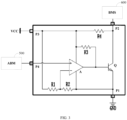
- the first resistor circuit 100 includes a first resistor R1 and a second resistor R2.
- a first terminal of the first resistor R1 is connected with a power supply, a second terminal of the first resistor R1 is connected with a first terminal of the second resistor R2, and a second terminal of the second resistor R2 is grounded.
- a second terminal of the comparator 200 is connected between the first resistor R1 and the second resistor R2.
- the first resistor R1 and the second resistor R2 are connected in series between the power supply and GND, so that the voltage of the power supply is divided and a second voltage is obtained.
- the second terminal of the comparator 200 is connected between the first resistor R1 and the second resistor R2, and the second voltage is connected with the second terminal of the comparator 200.
- the second voltage may be obtained as a reference voltage through voltage division of the first resistor R1 and the second resistor R2 and is compared with the voltage output by the air bag module 500.
- the resistor values of the first resistor R1 and the second resistor R2 are not limited herein, they may be determined according to actually required value of the second voltage and the value of the voltage of the power supply.
- the first resistor R1 and the second resistor R2 may be adjustable divided resistors configured to adjust an input voltage of the second terminal of the comparator 200 according to the requirement.
- the comparator 200 includes a comparator unit A and a third resistor R3.
- a first terminal of the comparator unit A is connected with the air bag module 500, a second terminal of the comparator unit A is connected with the first terminal of the first resistor circuit 100, a third terminal of the comparator unit A is connected with a first terminal of the third resistor R3, a fourth terminal of the comparator unit A is grounded, and a fifth terminal of the comparator unit A is connected with a second terminal of the third resistor R3; a third terminal of the comparator unit A is connected with a power supply, and a fifth terminal of the comparator unit A is connected with the first terminal of the control switch 300.
- the third resistor R3 is servered as current limitation.
- the third resistor R3 is connected between the power supply and the first terminal of the control switch 300 so as to limit the current on the circuit path connected between the power supply and the first terminal of the control switch 300.
- the second resistor circuit 400 may include a fourth resistor R4, and the fourth resistor R4 is connected between the power supply and the second terminal of the control switch 300.
- the fourth resistor R4 is a current-limiting resistor which is served as current limitation.
- thedevice further includes a first port P1 configured to be grounded.
- a third terminal of the first resistor circuit 100, a fourth terminal of the comparator 200 and a third terminal of the control switch 300 are commonly connected with the first port P1.
- the comparator 200 is specifically configured to output a high level signal to the control switch 300 when receiving the first voltage, so that the control switch 300 is enabled to switch on the first port P1 and the battery management system 600 according to the received high level signal.
- the first port P1 of thedevice is configured to be grounded.
- the third terminal of the first resistor circuit 100, the fourth terminal of the comparator 200, and the third terminal of the control switch 300 are grounded through the first port P1.
- the comparator 200 outputs a high level signal to the control switch 300 after receiving the first voltage and enables the control switch 300 to switch on the first port P1 and the battery management system 600 according to the received high level signal, so that the battery management system 600 is grounded, and the battery management system 600 is powered off.
- the comparator 200 When the comparator 200 receives the third voltage, the comparator 200 outputs a low level signal to the control switch 300, so that the control switch 300 switches off the first port P1 and the battery management system 600 according to the received low level signal, so that the battery management system 600 is powered by the power supply.
- the device further includes a second port P2 connected with the battery management system 600.
- a second terminal of the second resistor circuit 400 and a second terminal of the control switch 300 are commonly connected with the second port P2.
- the second port P2 of the device is configured to be externally connected with the battery management system 600 externally, the second terminal of the second resistor circuit 400 and the second terminal of the control switch 300 are commonly connected with the battery management system 600 through the second port P2.
- the device further includes a third port P3 configured to be connected with the power supply, and a fourth port P4 configured to be connected with the air bag module 500.
- a third terminal of the comparator 200, a second terminal of the first resistor circuit 100, and a first terminal of the second resistor circuit 400 are commonly connected with the third port P3.
- the first terminal of the comparator 200 is connected with the fourth port P4.
- FIG. 4 is a schematic structural diagram of a vehicle control device according to another embodiment of the present invention.
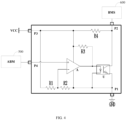
- the control switch 300 is an optical coupler U;a fourth terminal of the optical coupler U is grounded.
- the model of the optical coupler U is not limited herein, for example, the model of the optical coupler U may be PC 817, or be PC 922, or the like.
- a first terminal and a fourth terminal of the optical coupler U are control terminals. When the first terminal of the optical coupler U receives a high level signal, the first terminal and the fourth terminal generates a conductive path, so that the second terminal and the third terminalare controlled to be turned on, and the battery management system 600 is grounded. When the first terminal of the optical coupler U receives a low level signal, the first terminal and the fourth terminal do not generate a conductive path, so that the second terminal and the third terminal are controlled to be switched off, thus, the battery management system 600 is powered by the power supply.
- the optical coupler is used as the control switch 300, such that a control circuit of the air bag module 500 can be isolated from a control circuit of the battery management system 600, a safety protection effect is achieved, and the reliability of the device is improved.
- the air bag module Air Bag Module, ABM
- VCU Vehicle Control Unit
- the vehicle control system includes an air bag module 500, a power supply, and a vehicle control device according to the embodiments described above.
- the air bag module 500 is configured to output a first voltage to the air bag module 500 when a vehicle collision event occurs, so that the battery management system 600 is powered off.
- the first voltage is higher than the second voltage
- the second voltage is the voltage input from the first terminal of the first resistor circuit 100 in the vehicle control device to the second terminal of the comparator 200.
- the air bag module 500 is further configured to output a third voltage to the air bag module 500 when a vehicle collision event is not detected, so that the battery management system 600 is powered by the power supply.
- the third voltage is lower than the second voltage.
- the third voltage is higher than the second voltage.
Landscapes
- Engineering & Computer Science (AREA)
- Mechanical Engineering (AREA)
- Life Sciences & Earth Sciences (AREA)
- Sustainable Development (AREA)
- Sustainable Energy (AREA)
- Power Engineering (AREA)
- Transportation (AREA)
- Electric Propulsion And Braking For Vehicles (AREA)
- Air Bags (AREA)
Description
- This application claims priority to
Chinese Patent Application No. 201911052991.7 filed on October 31, 2019 - The present invention relates to the technical field of vehicles, and particularly relates to a vehicle control device, a and a vehicle.
- With the development and progress of society, vehicles have become the tools that are necessary for people to go out; as people are focusing on energy and environment, electric vehicles start to be applied and developed. When an electric vehicles collides, the electric vehicle needs to be controlled to be powered off, so that the electric vehicle is no longer moving, and a safety of a person is ensured.
- In the prior art, when an air bag module recognizes that the vehicle collides, a CAN signal can be sent to a vehicle control unit and a battery management system through a controller area network (Controller Area Network, CAN) bus, and the CAN signal represents collision of the vehicle, such that the battery management system is enabled to switch off power supply according to the CAN signal, thereby enabling the vehicle to be powered off.
- However, in the prior art, due to the fact that CAN signal is instable, and the CAN signal can be interfered when the vehicle is collided, and a transmission rate of the CAN signal is slower, such that the battery management system cannot receive the CAN signal, too, and the battery management system cannot receive the CAN signal in time, thus, the battery management system cannot timely switch off the power supply, the vehicle cannot be stopped in time, and the safety of the driver cannot be guaranteed. An example of the prior art is described in
CN 201 385 585 Y . - The embodiments of the present invention provide a vehicle control device, a and a vehicle, which aims at solving a problem that the battery management system cannot power off the power supply in time currently when a vehicle is collided.
- In the first aspect, a vehicle control device is provided in one embodiment of the present invention, the vehicle control device includes:
- a first resistor circuit, a comparator, a control switch, and a second resistor circuit;
- a first terminal of the comparator is connected with an air bag module, a second terminal of the comparator is connected with a first terminal of the first resistor circuit, a third terminal of the comparator is connected with a power supply, a fourth terminal of the comparator is grounded, and a fifth terminal of the comparator is connected with a first terminal of the control switch;
- a second terminal of the control switch is connected with a battery management system, and a third terminal of the control switch is grounded;
- a second terminal of the first resistor circuit is connected with the power supply, and a third terminal of the first resistor circuit is grounded;
- a first terminal of the second resistor circuit is connected with the power supply, and a second terminal of the second resistor circuit is connected with the battery management system;
- the comparator is configured to receive a first voltage which is output by the air bag module and output a high level signal to the control switch to enable the control switch to be switched on according to the high level signal, and enable the battery management system to be grounded after the control switch is switched on, and enable the battery management system to be powered off after the battery management system is grounded, wherein the first voltage is sent out by the air bag module when a vehicle collision event is detected.
- In one possible embodiment, when a first terminal of the comparator is a non-inverting input and a second terminal of the comparator is an inverting input, the first voltage is higher thana second voltage, and the second voltage is a voltage input from the first terminal of the first resistor circuit to the second terminal of the comparator; when the first terminal of the comparator is an inverting input, and the second terminal of the comparator is a non-inverting input, the first voltage is lower than the second voltage.
- In one possible embodiment, the comparator is further configured to receive a third voltage which is output by the air bag module and output a low level signal to the control switch, so that the control switch is controlled to be swithced off according to the low level signal, and the battery management system is powered by the power supply after the control switch is switched off, wherein the third voltage is sent out by the air bag module when the vehicle collision event is not detected by the air bag module;
where when the first terminal of the comparator is a non-inverting input, the second terminal of the comparator is an inverting input, the third voltage is less than the second voltage; when the first terminal of the comparator is an inverting input, the second terminal of the comparator is a non-inverting input, the third voltage is higher than the second voltage. - In one possible embodiment, the first resistor circuit includes a first resistor and a second resistor;
- a first terminal of the first resistor is connected with the power supply, a second terminal of the first resistor is connected with the first terminal of the second resistor, and a second terminal of the second resistor is grounded;
- the second terminal of the comparator is connected between the first resistor and the second resistor.
- In one possible embodiment, the comparator includes a comparator unit and a third resistor;
a first terminal of the comparator unit is connected with the air bag module, a second terminal of the comparator unit is connected with the first terminal of the first resistor circuit, a third terminal of the comparator unit is connected with a first terminal of the third resistor, a fourth terminal of the comparator unit is grounded, and a fifth terminal of the comparator unit is connected with a second terminal of the third resistor; the third terminal of the comparator unit is connected with the power supply, and the fifth terminal of the comparator unit is connected with the first terminal of the control switch. - In one possible embodiment, the device further includes a first port configured to be grounded;
- the third terminal of the first resistor circuit, the fourth terminal of the comparator and the third terminal of the control switch are commonly connected with the first port configured to be grounded;
- the comparator is configured to output a high level signal to the control switch so that the control switch is enabled to turn on the first port configured to be grounded and the battery management system according to the received high level signal;
- the device further includes a second port configured to be connected with the battery management system;
- the second terminal of the second resistor circuit and the second terminal of the control switch are commonly connected with the second port;
- the device further includes a third port configured to be connected with the power supply, and a fourth port configured to be connected with the air bag module;
- the third terminal of the comparator, a second terminal of the first resistor circuit and the first terminal of the second resistor circuit are commonly connected with the third port;
- the first terminal of the comparator is connected with the fourth port.
- In one possible embodiment, the control switch is a triode;
as an alternative, the control switch is an optical coupler, and the optical coupler further includes a fourth terminal, the fourth terminal is grounded. - In the second aspect, vehicle control system is provided in one embodiment of the present invention, the vehicle control system includes: an air bag module, a power supply, and the vehicle control device described in the first aspect and all possible embodiments in the first aspect;
- the air bag module is configured to output a first voltage to the air bag module to switch off the battery management system through the vehicle control device when a vehicle collision event is detected;
- where when a first terminal of a comparator in the vehicle control device is a non-inverting input, and a second terminal of the comparator in the vehicle control device is an inverting input, the first voltage is higher thana second voltage, and the second voltage is a voltage which is input from a first terminal of a first resistor circuit in the vehicle control device to a second terminal of the comparator; when the first terminal of the comparator in the vehicle control device is an inverting input, and the second terminal of the comparator in the vehicle control device is a non-inverting input, the first voltage is lower than the second voltage.
- In one possible embodiment, the air bag module is further configured to output a third voltage to the air bag module so that the battery management system is enabled to receive power supply from the power supply through the vehicle control device, when a vehicle collision event is not detected by the air bag module;
where when the first terminal of a comparator in the vehicle control device is a non-inverting input, and the second terminal of the comparator in the vehicle control device is an inverting input, the third voltage is higher than the second voltage; when the first terminal of the comparator in the vehicle control device is an inverting input, and the second terminal of the comparator in the vehicle control device is a non-inverting input, the third voltage is higher than the second voltage. - In the third aspect, a vehicle isprovided in one embodiment of the present invention, where the vehicle is provided with the vehicle control system described in the first aspect and all possible embodiments in the first aspect.
- A vehicle control device, a vehicle control system and a vehicle are provided in the embodiments of the present invention. The vehicle control device includes a first resistor circuit, a comparator, a control switch, and a second resistor circuit; the comparator is used to receive the first voltage sent by the air bag module when a vehicle collision event is detected, and output a high level signal to the control switch, so that the control switch is controlled to be turned on according to the high level signal, the battery management system is enabled to be grounded after the control switch is turned on, the battery management system is powered off after it is grounded, so that the battery management system can quickly cut off the power supply of the vehicle and is not influenced by signal interference, time required for switching off is reduced, and the reliability is improved.
- In order to describe the embodiments of the present invention or technical solutions in the prior art more clearly, a brief introduction regarding the accompanying drawings that need to be used for describing the embodiments or the prior art is given below; it is obvious that the accompanying drawings described below are only some embodiments of the present invention, the person of ordinary skill in the art may also obtain other drawings according to these drawings without paying creative labor.
-
FIG.1 illustrates a schematic diagram of the existing vehicle control technology; -
FIG. 2 illustrates a schematic block diagram of a vehicle control device according to one embodiment of the present invention; -
FIG. 3 illustrates a schematic block diagram of a vehicle control device according to another embodiment of the present invention; -
FIG. 4 illustrates a schematic block diagram of a vehicle control device according to another embodiment of the present invention. - Reference numerals are listed below:
- 100: first resistor circuit;
- 200: comparator;
- 300: control switch;
- 400: second resistor circuit;
- 500: air bag module;
- 600: battery management system;
- R1: first resistor;
- R2: second resistor;
- R3: third resistor;
- R4: fourth resistor;
- P1: first port;
- P2: second port;
- P3: third port;
- P4: fourth port;
- A: comparator unit;
- Q: triode;
- U: optical coupler.
- The technical solutions in the embodiments of the present invention will be described clearly and comprehensively with reference to accompanying drawings in the embodiments, it is obvious that, the embodiments described below are only some embodiments of the present invention rather than the entirety of the embodiments. base electroded on the embodiments in the present invention, some other embodiments, which are obtained by the person of ordinary skill in the art without paying creative labor, are all included in the protection scope of the present application.
- Terms such as "first", "second", "third", "fourth", and the like (if present) in the specification, the claims and the figures of the present invention are used to distinguish similar objects without the need to describe a particular order or order of sequence. It should be understood that the data used in this way may be interchanged where appropriate, so that the embodiments of the present invention described herein can be implemented in an order other than those illustrated or described herein. Furthermore, the terms such as "comprising" and "having" and any variations thereof are intterminaled to cover non-exclusive inclusion, for example, processes, methods, systems, products or devices which contain a series of steps or units are not necessarily limited to the explicitly listed steps or units; instead, these processes, methods, systems, products or devices may include other steps or units that are not explicitly listed or inherent to these processes, methods, products or devices.
- In order to describe the technical solutions of the present invention, the technical solutions of the present invention are described in detail below with reference to the specific embodiments, the specific embodiments described below can be combined with each other, with respect to the same or similar concepts or processes, these concepts or processes may not be repeatedly described in some embodiments.
-
FIG. 1 is a schematic diagram of an existing vehicle control technology. InFIG. 1 , ABM represents an air bag module (Air Bag Module, ABM), VCU represents a vehicle control unit, BMS represents a battery management system. As shown inFIG. 1 , in the prior art, when the ABM detects a vehicle collision event, a message is sent to the VCU and the BMS at the same time in the form of CAN signal, after the message is received, the BMS waits for a plurality of cycles to confirm that the vehicle collision event is valid, and then controls a battery contactor to be switched off, so that the vehicle is powered off. A time period from the time when ABM sents the vehicle collision event to the time when the vehicle is powered off requires more than 100 ms. Moreover, the CAN signal is prone to be interferenced, there is a certain instability. If the BMS does not receive the CAN signal sent by the ABM, the BMS may still receive the CAN signal sent by the VCU, so that the BMS controls the battery contactor to be switched off. - However, in the prior art, due to the fact that the CAN signal is instable, and the CAN signal can be interfered when the vehicle is collided, a transmission rate of the CAN signal is slow, so that the battery management system cannot receive the CAN signal in time, the battery management system cannot even receive the CAN signal in time, so that the battery management system cannot turn off the power supply in time, the vehicle cannot be stopped in time, and the safety of the personnel cannot be guaranteed.
- In this regard, one embodiment of the present invention provides a vehicle control device, asystem, and a vehicle. Thedevice includes a
first resistor circuit 100, acomparator 200, acontrol switch 300, and asecond resistor circuit 400; thecomparator 200 is used to receive a first voltage when theABM 500 detects a vehicle collision event of the vehicle, and output a high level signal to thecontrol switch 300, so that thecontrol switch 300 is controlled to be turned on according to the high level signal, thebattery management system 600 is grounded after the control switch is turned on, and thebattery management system 600 is powered off after it is grounded, so that thebattery management system 600 can quickly cut off the power supply of the vehicle without being affected by signal interference, the time required for switching on/off thecontrol switch 300 is reduced, and the reliability is improved. -
FIG. 2 is a schematic structural diagram of a vehicle control device according to one embodiment of the present invention. Referring toFIG. 2 , the vehicle control device according to this embodiment includes afirst resistor circuit 100, acomparator 200, acontrol switch 300, and asecond resistor circuit 400. - A first terminal of the
comparator 200 is connected with theair bag module 500, the second terminal of thecomparator 200 is connected with a first terminal of thefirst resistor circuit 100, a third terminal of thecomparator 200 is connected with a power supply, a fourth terminal of thecomparator 200 is grounded, and a fifth terminal of thecomparator 200 is connected with a first terminal of thecontrol switch 300. A second terminal of thecontrol switch 300 is connected with thebattery management system 600, and a third terminal of thecontrol switch 300 is grounded. - A second terminal of the
first resistor circuit 100 is connected with the power supply, and a third terminal of thefirst resistor circuit 100 is grounded. A first terminal of thesecond resistor circuit 400 is connected with the power source, and a second terminal of thesecond resistor circuit 400 is connected with thebattery management system 600. - The
comparator 200 is configured to receive the first voltage output by theair bag module 500 and output a high level signal to thecontrol switch 300, thebattery management system 600 is grounded after thecontrol switch 300 is turned on, and thebattery management system 600 is powered off after it is grounded; where the first voltage is sent out when theair bag module 500 detects the vehicle collision event of the vehicle. - In this embodiment, the third terminal of the
comparator 200, the second terminal of thefirst resistor circuit 100 and the first terminal of thesecond resistor circuit 400 are commonly connected with the power supply, and volt current condenser (Volt Current Condenser, VCC) inFIG. 2 represents the power supply which is used for supplying power to the vehicle control device. Thecomparator 200 includes at least five terminals. The first port and the second ports are input ports used for receiving two voltage signals to be compared; the third terminal is a power terminal of thecomparator 200, the fourth terminal is a port configured to be grounded of thecomparator 200; and the fifth terminal is an output terminal of thecomparator 200. The second terminal of thecomparator 200 is connected with a second voltage obtained by dividing thefirst resistor circuit 100, the second voltage is used as a reference voltage, the first terminal of thecomparator 200 receives the voltage output by theair bag module 500. Thecomparator 200 generates a corresponding level signal by comparing the voltage output by theair bag module 500 and the second voltage, and outputs the level signal to thecontrol switch 300. Thecomparator 200 can either be implemented by multiple circuit components or be implemented by a single integrated circuit chip, implementation of the comparator is not limited herein, for example, the comparator can be chip with a product model of LM393 or LM23 9. - The
control switch 300 includes at least three terminals. The first terminal of thecontrol switch 300 receives a level signal output by thecomparator 200, the second terminal of thecontrol switch 300 is connected with thebattery management system 600, and the third terminal of thecontrol switch 300 is grounded. Thecontrol switch 300 controlsbetween the second terminal and the third terminal to be switched on/off according to the level signal output by thecomparator 200, thereby controlling thebattery management system 600 to be grounded. A specific circuit of thecontrol switch 300 is not limited herein, for example, thecontrol switch 300 may be a triode, an optical coupler, etc. - The vehicle control device provided by this embodiment of the present invention includes a
first resistor circuit 100, acomparator 200, acontrol switch 300 and asecond resistor circuit 400; thecontrol switch 300 outputs a high level signal to thecontrol switch 300, so that thecontrol switch 300 is controlled to be switched on according to the high level signal, after the control switch is switched on, thebattery management system 600 is grounded, after the battery management system is grounded, thebattery management system 600 is powered off, so that thebattery management system 600 can quickly cut off power supply of the vehicle without being affected by signal interference, time required for switching on/off thecontrol switch 300 is reduced, and the reliability is improved. - In one possible implementation mode, when the first terminal of the
comparator 200 is a non-inverting input, the second terminal of thecomparator 200 is an inverting input, the first voltage is higher than the second voltage, the second voltage is the voltage which is input from the first terminal of thefirst resistor circuit 100 to the second terminal of thecomparator 200. When the first terminal of thecomparator 200 is an inverting input, the second terminal of thecomparator 200 is a non-inverting input, the first voltage is lower than the second voltage. - In this embodiment, the first terminal of the
comparator 200 may be a non-inverting input, and the second terminal is an inverting input; as an alternative, the first terminal may be an inverting input, and the second terminal is a non-inverting input, the first terminal and the second terminal of thecomparator 200 are not limited herein. The device may be implemented by one of two implementations listed below: - In a first implementation, when the first terminal of the
comparator 200 is a non-inverting input and the second terminal of thecomparator 200 is an inverting input, if the vehicle is collided, theair bag module 500 detects a vehicle collision event and outputs a first voltage to thecontrol switch 300. Where the first voltage is higher than the second voltage. Thecomparator 200 is configured to compare the first voltage received from the non-inverting input with the second voltage received from the inverting input, since the first voltage is higher than the second voltage, thecomparator 200 outputs a high level signal to thecontrol switch 300, thecontrol switch 300 receives the high level signal and then turns on the circuit path between the second terminal thereof and the third terminal thereof, so that thebattery management system 600 is grounded, thebattery management system 600 controls a battery contactor to be switched off, so that the vehicle is powered off. - In a second implementation , the first terminal of the
comparator 200 is an inverting input, and the second terminal of thecomparator 200 is a non-inverting input. If the vehicle is collided, theair bag module 500 detects a vehicle collision event, and outputs a first voltage to thecontrol switch 300. Where the first voltage is lower than the second voltage. Thecomparator 200 is configured to compare the first voltage received from the non-inverting input with the second voltage received from the inverting input, since the first voltage is lower than the second voltage, thus, thecomparator 200 outputs a high level signal to thecontrol switch 300, thecontrol switch 300 receives the high level signal and then turns on the circuit path between the second terminal thereof and the third terminal thereof, so that thebattery management system 600 is grounded, thebattery management system 600 controls the battery contactor to be switched off, so that the vehicle is powered off. - In one possible implementation mode, the
comparator 200 is further configured to receive a third voltage output by theair bag module 500, and outputs a low level signal to thecontrol switch 300 to enable thecontrol switch 300 to be switched off according to the low level signal, thebattery management system 600 is powered by the power supply after thecontrol switch 300 is switched off, where the third voltage is sent out by theair bag module 500 when a vehicle collision event does not occur. - When the first terminal of the
comparator 200 is a non-inverting input, and the second terminal of thecomparator 200 is an inverting input, the third voltage is lower than the second voltage; when the first terminal of thecomparator 200 is an inverting input, and the second terminal of thecomparator 200 is a non-inverting input, the third voltage is higher than the second voltage. - In this embodiment, the first terminal of the
comparator 200 may be a non-inverting input, and the second terminal may be an inverting input; as an alternative, the first terminal may be an inverting input, and the second terminal may be a non-inverting input, the first terminal and the second terminal of thecomparator 200 are not limited herein. the first terminal and the second terminal of thecomparator 200 are respectively described herein. - When the first terminal of the
comparator 200 is a non-inverting input and the second terminal of thecomparator 200 is an inverting input, when vehicle collision event does not occur, theair bag module 500 detects that the vehicle does not collide, and outputs the third voltage to thecomparator 200, where the third voltage is lower than the second voltage. Thecomparator 200 is configured to compare the third voltage received from the non-inverting input with the second voltage received from the inverting input, since the third voltage is lower than the second voltage, thus, thecomparator 200 outputs a low level signal to thecontrol switch 300, thecontrol switch 300 receives the low level signal and then switches off the circuit path between the second terminal thereof and the third terminal thereof, so that thebattery management system 600 is enabled to receive power from the power supply, thebattery management system 600 controls the battery contactor to be switched off, so that the vehicle is powered on. Where the specific value of the third voltage is not limited herein as long as the third voltage is than the third voltage, the value of the third voltage may be assigned as 0, when the value of the third voltage is not equal to 0, theair bag module 500 continuously outputs the third voltage to thecomparator 200 to ensure that the vehicle can be powered on in the event that the vehicle collision event does not occur. - When the first terminal of the
comparator 200 is an inverting input, and the second terminal is a non-inverting input, when the vehicle does not collide, theair bag module 500 fails to detect a vehicle collision event, and thus outputs the third voltage to thecomparator 200, where the third voltage is higher than the second voltage. Thecomparator 200 is configured to compare the third voltage received from the non-inverting input with the second voltage received from the inverting input, since the third voltage is higher than the second voltage, thus, thecomparator 200 outputs a low level signal to thecontrol switch 300, thecontrol switch 300 receives the low level signal and then switches off the circuit path between the second terminal thereof and the third terminal thereof, so that thebattery management system 600 receives the power supply, and thebattery management system 600 controls the battery contactor to be switched off, and thus the vehicle is enabeld to be powered on. The specific value of the third voltage is not limited herein, as long as the third voltage is higher than the second voltage. Theair bag module 500 continuously outputs the third voltage to thecomparator 200 to ensure that the vehicle can be powered on in the event that the vehicle collision event does not occur. -
FIG. 3 is a schematic structural diagram of a vehicle control device according to another embodiment of the present invention. InFIG. 3 , thecontrol switch 300 illustrated as a triode Q is taken as an example, however,of thecontrol switch 300 is not limited thereto. The first terminal of the triode Q is a base electrode, the second terminal of the triode Q is a collector electrode, and the third terminal of the triode Q is an emitting electrode. When the base electrode receives a high level signal, the triode Q is turned on, that is, a circuit path between the collector electrode and the emitting electrode is turned on. When the base electrode receives a low level signal, the triode Q is switched off, that is, the circuit path between the collector electrode and the emitting electrode is switched off. Referring toFIG. 3 , in one possible implementation mode, thefirst resistor circuit 100 includes a first resistor R1 and a second resistor R2. - A first terminal of the first resistor R1 is connected with a power supply, a second terminal of the first resistor R1 is connected with a first terminal of the second resistor R2, and a second terminal of the second resistor R2 is grounded.
- A second terminal of the
comparator 200 is connected between the first resistor R1 and the second resistor R2. - In this embodiment, the first resistor R1 and the second resistor R2 are connected in series between the power supply and GND, so that the voltage of the power supply is divided and a second voltage is obtained. The second terminal of the
comparator 200 is connected between the first resistor R1 and the second resistor R2, and the second voltage is connected with the second terminal of thecomparator 200. The second voltage may be obtained as a reference voltage through voltage division of the first resistor R1 and the second resistor R2 and is compared with the voltage output by theair bag module 500. The resistor values of the first resistor R1 and the second resistor R2 are not limited herein, they may be determined according to actually required value of the second voltage and the value of the voltage of the power supply. - Optionally, the first resistor R1 and the second resistor R2 may be adjustable divided resistors configured to adjust an input voltage of the second terminal of the
comparator 200 according to the requirement. - In one possible implementation mode, the
comparator 200 includes a comparator unit A and a third resistor R3. - A first terminal of the comparator unit A is connected with the
air bag module 500, a second terminal of the comparator unit A is connected with the first terminal of thefirst resistor circuit 100, a third terminal of the comparator unit A is connected with a first terminal of the third resistor R3, a fourth terminal of the comparator unit A is grounded, and a fifth terminal of the comparator unit A is connected with a second terminal of the third resistor R3; a third terminal of the comparator unit A is connected with a power supply, and a fifth terminal of the comparator unit A is connected with the first terminal of thecontrol switch 300. - In this embodiment, the third resistor R3 is servered as current limitation. The third resistor R3 is connected between the power supply and the first terminal of the
control switch 300 so as to limit the current on the circuit path connected between the power supply and the first terminal of thecontrol switch 300. - In one possible implementation mode, the
second resistor circuit 400 may include a fourth resistor R4, and the fourth resistor R4 is connected between the power supply and the second terminal of thecontrol switch 300. The fourth resistor R4 is a current-limiting resistor which is served as current limitation. - In one possible implementation mode, thedevice further includes a first port P1 configured to be grounded.
- A third terminal of the
first resistor circuit 100, a fourth terminal of thecomparator 200 and a third terminal of thecontrol switch 300 are commonly connected with the first port P1. - The
comparator 200 is specifically configured to output a high level signal to thecontrol switch 300 when receiving the first voltage, so that thecontrol switch 300 is enabled to switch on the first port P1 and thebattery management system 600 according to the received high level signal. - In this embodiment, the first port P1 of thedevice is configured to be grounded. The third terminal of the
first resistor circuit 100, the fourth terminal of thecomparator 200, and the third terminal of thecontrol switch 300 are grounded through the first port P1. When thecomparator 200 outputs a high level signal to thecontrol switch 300 after receiving the first voltage and enables thecontrol switch 300 to switch on the first port P1 and thebattery management system 600 according to the received high level signal, so that thebattery management system 600 is grounded, and thebattery management system 600 is powered off. When thecomparator 200 receives the third voltage, thecomparator 200 outputs a low level signal to thecontrol switch 300, so that thecontrol switch 300 switches off the first port P1 and thebattery management system 600 according to the received low level signal, so that thebattery management system 600 is powered by the power supply. - In one possible implementation mode, the device further includes a second port P2 connected with the
battery management system 600. - A second terminal of the
second resistor circuit 400 and a second terminal of thecontrol switch 300 are commonly connected with the second port P2. - In this embodiment, the second port P2 of the device is configured to be externally connected with the
battery management system 600 externally, the second terminal of thesecond resistor circuit 400 and the second terminal of thecontrol switch 300 are commonly connected with thebattery management system 600 through the second port P2. - In one possible implementation mode, the device further includes a third port P3 configured to be connected with the power supply, and a fourth port P4 configured to be connected with the
air bag module 500. - A third terminal of the
comparator 200, a second terminal of thefirst resistor circuit 100, and a first terminal of thesecond resistor circuit 400 are commonly connected with the third port P3. - The first terminal of the
comparator 200 is connected with the fourth port P4. - In this embodiment, the third port P3 of the device is configured to be connected with external power supply. The third terminal of the
comparator 200, the second terminal of thefirst resistor circuit 100 and the first terminal of thesecond resistor circuit 400 are commonly connected with the power supply through the third port P3. The fourth port P4 of the device is configured to be connected with the first terminal of theair bag module 500 through the fourth port P4. -
FIG. 4 is a schematic structural diagram of a vehicle control device according to another embodiment of the present invention. Referring toFIG. 4 , in one possible implementation mode, thecontrol switch 300 is an optical coupler U;a fourth terminal of the optical coupler U is grounded. - The model of the optical coupler U is not limited herein, for example, the model of the optical coupler U may be PC 817, or be PC 922, or the like. A first terminal and a fourth terminal of the optical coupler U are control terminals. When the first terminal of the optical coupler U receives a high level signal, the first terminal and the fourth terminal generates a conductive path, so that the second terminal and the third terminalare controlled to be turned on, and the
battery management system 600 is grounded. When the first terminal of the optical coupler U receives a low level signal, the first terminal and the fourth terminal do not generate a conductive path, so that the second terminal and the third terminal are controlled to be switched off, thus, thebattery management system 600 is powered by the power supply. - In this embodiment, the optical coupler is used as the
control switch 300, such that a control circuit of theair bag module 500 can be isolated from a control circuit of thebattery management system 600, a safety protection effect is achieved, and the reliability of the device is improved. - As described above, when the vehicle control device in the embodiments of the present invention is collided, the air bag module (Air Bag Module, ABM) can directly cut off high-voltage of the vehicle by control based on hardware circuit without the CAN bus and the vehicle control unit (Vehicle Control Unit, VCU), thus, the vehicle control device has the at least advantages listed below:
- 1) Due to the fact that it is the ABM which directly cuts off high voltage of the vehicle, the time period lasting from the time when the ABM recognizes vehicle collision event to the time when vehicle is powered off is greatly reduced. According to experiments, the time period lasting from the time when the ABM recognizes the vehicle collision event to the time when the vehicle is powered off can be shortened to 30 ms or below 30 ms.
- 2) Due to the fact that the CAN bus is not participated, so that the problems that CAN signal is instable and is prone to be interfered and/or the transmission rate of the CAN signal is slow can be avoided.
- 3) Due to the fact the VCU is not participated, the amount of data to be processed by the VCU can be reduced, so that the VCU can perform more other operations.
- 4) The hardware circuit corresponding to the vehicle control device designed in the embodiments of the present invention is simple, is prone to be implemented, and is low in the cost of components.
- 5) In the embodiment of the present invention, the safety of the vehicle is improved as a whole, and the security of the person can be guaranteed.
- One embodiment of the present invention further provides a vehicle control system. The vehicle control system includes an
air bag module 500, a power supply, and a vehicle control device according to the embodiments described above. - The
air bag module 500 is configured to output a first voltage to theair bag module 500 when a vehicle collision event occurs, so that thebattery management system 600 is powered off. - Where when the first terminal of the
comparator 200 in the vehicle control device is a non-inverting input, and the second terminal of thecomparator 200 in the vehicle control device is an inverting input, the first voltage is higher than the second voltage, and the second voltage is the voltage input from the first terminal of thefirst resistor circuit 100 in the vehicle control device to the second terminal of thecomparator 200. When the first terminal of thecomparator 200 in the vehicle control device is an inverting input, and the second terminal of thecomparator 200 in the vehicle control device is a non-inverting input, the first voltage is lower than the second voltage. - In one possible implementation mode, the
air bag module 500 is further configured to output a third voltage to theair bag module 500 when a vehicle collision event is not detected, so that thebattery management system 600 is powered by the power supply. - Where when the first terminal of the
comparator 200 in the vehicle control device is a non-inverting input, and the second terminal of thecomparator 200 in the vehicle control device is an inverting input, the third voltage is lower than the second voltage. When the first terminal of thecomparator 200 in the vehicle control device is an inverting input, and the second terminal of thecomparator 200 in the vehicle control device is a non-inverting input, the third voltage is higher than the second voltage. - Referring the vehicle control system according to the embodiment of the present invention, regarding the implementation process of the vehicle control system, reference can be made to the embodiments of the vehicle control device described above, the implementation principle and the technical effects of the vehicle control system are similar to that of the vehicle control device, and are not repeatedly described herein.
- Referring to the vehicle provided by the embodiment of the present invention, regarding the detail of the implementation process of the vehicle control system, reference can be made to the embodiments of the vehicle control device and the vehicle control system described above, the implementation principle and the technical effects of the vehicle are similar to that of the vehicle control device and the vehicle control system, and are not repeatedly described herein.
- As stated above, it should be noted that, the various embodiments described above are merely used to explain the technical solutions of the present invention, and are not intended to limit the technical solutions of the present invention. Although the present invention has been described in detail with reference to the embodiments described above, one of ordinary skill in the art should understand that the technical solutions described in these embodiments can still be modified, or some or all technical features in the embodiments can be equivalently replaced; however, these modifications or replacements do not make the essences of corresponding technical solutions to break away from the spirit and the scope of the technical solutions of the embodiments of the present invention.
Claims (10)
- A vehicle control device, comprising:a first resistor circuit (100), a comparator (200), a control switch (300), and a second resistor circuit (400);a first terminal of the comparator is connected with an air bag module (500), a second terminal of the comparator is connected with a first terminal of the first resistor circuit, a third terminal of the comparator is connected with a power supply, a fourth terminal of the comparator is grounded, and a fifth terminal of the comparator is connected with a first terminal of the control switch;a second terminal of the control switch is connected with a battery management system (600), and a third terminal of the control switch is grounded;a second terminal of the first resistor circuit is connected with the power supply, and a third terminal of the first resistor circuit is grounded;a first terminal of the second resistor circuit is connected with the power supply, and a second terminal of the second resistor circuit is connected with the battery management system;the comparator is configured to receive a first voltage which is output by the air bag module and output a high level signal to the control switch to enable the control switch to be switched on according to the high level signal, and enable the battery management system to be grounded after the control switch is switched on, and enable the battery management system to be powered off after the battery management system is grounded, wherein the first voltage is sent out by the air bag module when a vehicle collision event is detected.
- The device according to claim 1, wherein when a first terminal of the comparator is a non-inverting input and a second terminal of the comparator is an inverting input, the first voltage is higher thana second voltage, and the second voltage is a voltage input from the first terminal of the first resistor circuit to the second terminal of the comparator; when the first terminal of the comparator is an inverting input, and the second terminal of the comparator is a non-inverting input, the first voltage is lower than the second voltage.
- The device according to claim 2, wherein the comparator is further configured to receive a third voltage which is output by the air bag module and output a low level signal to the control switch, so that the control switch is controlled to be swithced off according to the low level signal, and the battery management system is powered by the power supply after the control switch is switched off, wherein the third voltage is sent out by the air bag module when the vehicle collision event is not detected by the air bag module;
wherein when the first terminal of the comparator is a non-inverting input, the second terminal of the comparator is an inverting input, the third voltage is less than the second voltage; when the first terminal of the comparator is an inverting input, the second terminal of the comparator is a non-inverting input, the third voltage is higher than the second voltage. - The device according to claim 1, wherein the first resistor circuit comprises a first resistor (R1) and a second resistor (R2);a first terminal of the first resistor is connected with the power supply, a second terminal of the first resistor is connected with the first terminal of the second resistor, and a second terminal of the second resistor is grounded;the second terminal of the comparator is connected between the first resistor and the second resistor.
- The device according to claim 1, wherein the comparator comprises a comparator unit and a third resistor (R3);
a first terminal of the comparator unit is connected with the air bag module, a second terminal of the comparator unit is connected with the first terminal of the first resistor circuit, a third terminal of the comparator unit is connected with a first terminal of the third resistor, a fourth terminal of the comparator unit is grounded, and a fifth terminal of the comparator unit is connected with a second terminal of the third resistor; the third terminal of the comparator unit is connected with the power supply, and the fifth terminal of the comparator unit is connected with the first terminal of the control switch. - The device according to claim 1, further comprising a first port configured to be grounded;the third terminal of the first resistor circuit, the fourth terminal of the comparator and the third terminal of the control switch are commonly connected with the first port configured to be grounded;the comparator is configured to output a high level signal to the control switch so that the control switch is enabled to turn on the first port configured to be grounded and the battery management system according to the received high level signal;the device further comprises a second port configured to be connected with the battery management system;the second terminal of the second resistor circuit and the second terminal of the control switch are commonly connected with the second port;the device further comprises a third port configured to be connected with the power supply, and a fourth port configured to be connected with the air bag module;the third terminal of the comparator, a second terminal of the first resistor circuit and the first terminal of the second resistor circuit are commonly connected with the third port;the first terminal of the comparator is connected with the fourth port.
- The device according to any one of claims 1-6, wherein the control switch is a triode;
as an alternative, the control switch is an optical coupler, and the optical coupler further comprises a fourth terminal, the fourth terminal is grounded. - A vehicle control system, comprising: an air bag module, a power supply, and the vehicle control device according to any one of claims 1-7;the air bag module is configured to output a first voltage to the air bag module to switch off the battery management system through the vehicle control device when a vehicle collision event is detected;wherein when a first terminal of a comparator in the vehicle control device is a non-inverting input, and a second terminal of the comparator in the vehicle control device is an inverting input, the first voltage is higher thana second voltage, and the second voltage is a voltage which is input from a first terminal of a first resistor circuit in the vehicle control device to a second terminal of the comparator; when the first terminal of the comparator in the vehicle control device is an inverting input, and the second terminal of the comparator in the vehicle control device is a non-inverting input, the first voltage is lower than the second voltage.
- The system according to claim 8, wherein the air bag module is further configured to output a third voltage to the air bag module so that the battery management system is enabled to receive power supply from the power supply through the vehicle control device, when a vehicle collision event is not detected by the air bag module;
wherein when the first terminal of a comparator in the vehicle control device is a non-inverting input, and the second terminal of the comparator in the vehicle control device is an inverting input, the third voltage is higher than the second voltage; when the first terminal of the comparator in the vehicle control device is an inverting input, and the second terminal of the comparator in the vehicle control device is a non-inverting input, the third voltage is higher than the second voltage. - A vehicle, wherein the vehicle is provided with the vehicle control system according to claim 8 or claim 9.
Applications Claiming Priority (2)
| Application Number | Priority Date | Filing Date | Title |
|---|---|---|---|
| CN201911052991.7A CN111645523B (en) | 2019-10-31 | 2019-10-31 | Vehicle Controls, Systems and Vehicles |
| PCT/CN2020/114120 WO2021082748A1 (en) | 2019-10-31 | 2020-09-09 | Vehicle control device and system, and vehicle |
Publications (3)
| Publication Number | Publication Date |
|---|---|
| EP4015279A1 EP4015279A1 (en) | 2022-06-22 |
| EP4015279A4 EP4015279A4 (en) | 2022-10-19 |
| EP4015279B1 true EP4015279B1 (en) | 2025-03-26 |
Family
ID=72342500
Family Applications (1)
| Application Number | Title | Priority Date | Filing Date |
|---|---|---|---|
| EP20880917.8A Active EP4015279B1 (en) | 2019-10-31 | 2020-09-09 | Vehicle control device and system, and vehicle |
Country Status (4)
| Country | Link |
|---|---|
| US (1) | US11970065B2 (en) |
| EP (1) | EP4015279B1 (en) |
| CN (1) | CN111645523B (en) |
| WO (1) | WO2021082748A1 (en) |
Families Citing this family (1)
| Publication number | Priority date | Publication date | Assignee | Title |
|---|---|---|---|---|
| KR20220053762A (en) * | 2020-10-22 | 2022-05-02 | 현대자동차주식회사 | Apparatus for supporting safety of deiver and method thereof |
Family Cites Families (14)
| Publication number | Priority date | Publication date | Assignee | Title |
|---|---|---|---|---|
| KR20050007083A (en) * | 2003-07-11 | 2005-01-17 | 현대자동차주식회사 | Apparatus for controlling battery of vehicle |
| CN201385585Y (en) * | 2009-04-09 | 2010-01-20 | 海马(郑州)汽车有限公司 | Power-off control device of electrical vehicle power battery |
| JP5251905B2 (en) * | 2010-03-09 | 2013-07-31 | 三菱自動車工業株式会社 | Side collision determination device for vehicle and high-voltage power cutoff device |
| US20110304202A1 (en) * | 2010-05-13 | 2011-12-15 | Coda Automotive, Inc. | Battery disconnection in electric vehicles |
| JP5389730B2 (en) * | 2010-05-14 | 2014-01-15 | 株式会社デンソー | Discharge device for power conversion system |
| CN102069717B (en) * | 2010-12-24 | 2012-08-29 | 南京金城机械有限公司 | Fire prevention device of motor vehicle |
| CN202480896U (en) * | 2012-01-13 | 2012-10-10 | 浙江吉利汽车研究院有限公司 | Safety redundancy device for automobile power battery system |
| CN104494544B (en) * | 2014-12-25 | 2017-01-18 | 东风汽车公司 | Collision power-off protection system of electromobile |
| CN105150854B8 (en) * | 2015-09-08 | 2016-12-21 | 福建省汽车工业集团云度新能源汽车股份有限公司 | A kind of High-voltage safety protection system of electromobile |
| CN205168210U (en) | 2015-12-07 | 2016-04-20 | 北京新能源汽车股份有限公司 | Power battery high-voltage output power-off device |
| US9954548B2 (en) * | 2016-04-08 | 2018-04-24 | Infineon Technologies Ag | Electronic switching and protection circuit with a logarithmic ADC |
| JP6378267B2 (en) * | 2016-08-12 | 2018-08-22 | 株式会社Subaru | vehicle |
| CN109910807B (en) * | 2019-02-21 | 2021-02-23 | 东软睿驰汽车技术(沈阳)有限公司 | Collision detection circuit |
| CN110103716A (en) * | 2019-04-23 | 2019-08-09 | 甘肃南洋新能源科技发展有限公司 | Power battery power-off protection method and system when a kind of new-energy automobile collides |
-
2019
- 2019-10-31 CN CN201911052991.7A patent/CN111645523B/en active Active
-
2020
- 2020-09-09 US US17/640,614 patent/US11970065B2/en active Active
- 2020-09-09 WO PCT/CN2020/114120 patent/WO2021082748A1/en not_active Ceased
- 2020-09-09 EP EP20880917.8A patent/EP4015279B1/en active Active
Also Published As
| Publication number | Publication date |
|---|---|
| CN111645523A (en) | 2020-09-11 |
| US20220340009A1 (en) | 2022-10-27 |
| WO2021082748A1 (en) | 2021-05-06 |
| US11970065B2 (en) | 2024-04-30 |
| EP4015279A4 (en) | 2022-10-19 |
| CN111645523B (en) | 2021-11-02 |
| EP4015279A1 (en) | 2022-06-22 |
Similar Documents
| Publication | Publication Date | Title |
|---|---|---|
| US11108252B2 (en) | Charging sequence control of a power electronics system | |
| JP6378267B2 (en) | vehicle | |
| US10535259B2 (en) | Traffic monitor and method | |
| JP2017505101A (en) | Terminal, power adapter and charging error processing method | |
| US12348169B2 (en) | Method for controlling electric machines | |
| JP6568455B2 (en) | ID allocation correction method and in-vehicle communication system | |
| EP4015279B1 (en) | Vehicle control device and system, and vehicle | |
| CN202651813U (en) | Charging device of electric vehicle and electric vehicle | |
| KR20200074914A (en) | Electric control system | |
| US10860075B2 (en) | Intelligent power tap with zone control and safety zone control | |
| KR20200134976A (en) | Battery system and relay control device thereof | |
| US11477047B2 (en) | In-vehicle network system | |
| EP3264680B1 (en) | Selective bypassing of daisy-chained network devices | |
| WO2020093626A1 (en) | Power supply system and vehicle | |
| US9912262B2 (en) | Positioning arrangement for moving an object that is to be positioned | |
| US9680305B2 (en) | Implementation of fire safety shutdown for solar panels with high reliability | |
| CN118144588A (en) | Charge and discharge control system, control method, computer device and storage medium | |
| EP3527421B1 (en) | Off-prevention circuit of contactor | |
| CN203027176U (en) | Mobile integrated emergency excitation device | |
| KR101731818B1 (en) | Signal control duplex system of traffic signal controller | |
| KR20190073224A (en) | Submarine storage battery management device and its method | |
| KR20240118569A (en) | Switch control device and battery pack including the same | |
| KR20160135422A (en) | Lamp driving system and method of vehicle | |
| CN118457473A (en) | Power supply system and power supply method of automatic driving system | |
| US20140139025A1 (en) | Power control device and power control method |
Legal Events
| Date | Code | Title | Description |
|---|---|---|---|
| STAA | Information on the status of an ep patent application or granted ep patent |
Free format text: STATUS: THE INTERNATIONAL PUBLICATION HAS BEEN MADE |
|
| PUAI | Public reference made under article 153(3) epc to a published international application that has entered the european phase |
Free format text: ORIGINAL CODE: 0009012 |
|
| STAA | Information on the status of an ep patent application or granted ep patent |
Free format text: STATUS: REQUEST FOR EXAMINATION WAS MADE |
|
| 17P | Request for examination filed |
Effective date: 20220314 |
|
| AK | Designated contracting states |
Kind code of ref document: A1 Designated state(s): AL AT BE BG CH CY CZ DE DK EE ES FI FR GB GR HR HU IE IS IT LI LT LU LV MC MK MT NL NO PL PT RO RS SE SI SK SM TR |
|
| A4 | Supplementary search report drawn up and despatched |
Effective date: 20220919 |
|
| RIC1 | Information provided on ipc code assigned before grant |
Ipc: B60R 21/01 20060101ALI20220913BHEP Ipc: B60R 16/03 20060101ALI20220913BHEP Ipc: B60L 3/04 20060101ALI20220913BHEP Ipc: B60L 3/00 20190101AFI20220913BHEP |
|
| DAV | Request for validation of the european patent (deleted) | ||
| DAX | Request for extension of the european patent (deleted) | ||
| P01 | Opt-out of the competence of the unified patent court (upc) registered |
Effective date: 20230530 |
|
| GRAP | Despatch of communication of intention to grant a patent |
Free format text: ORIGINAL CODE: EPIDOSNIGR1 |
|
| STAA | Information on the status of an ep patent application or granted ep patent |
Free format text: STATUS: GRANT OF PATENT IS INTENDED |
|
| RIC1 | Information provided on ipc code assigned before grant |
Ipc: B60R 21/01 20060101ALI20241007BHEP Ipc: B60R 16/03 20060101ALI20241007BHEP Ipc: B60L 3/04 20060101ALI20241007BHEP Ipc: B60L 3/00 20190101AFI20241007BHEP |
|
| INTG | Intention to grant announced |
Effective date: 20241023 |
|
| GRAS | Grant fee paid |
Free format text: ORIGINAL CODE: EPIDOSNIGR3 |
|
| GRAA | (expected) grant |
Free format text: ORIGINAL CODE: 0009210 |
|
| STAA | Information on the status of an ep patent application or granted ep patent |
Free format text: STATUS: THE PATENT HAS BEEN GRANTED |
|
| AK | Designated contracting states |
Kind code of ref document: B1 Designated state(s): AL AT BE BG CH CY CZ DE DK EE ES FI FR GB GR HR HU IE IS IT LI LT LU LV MC MK MT NL NO PL PT RO RS SE SI SK SM TR |
|
| REG | Reference to a national code |
Ref country code: GB Ref legal event code: FG4D Free format text: NOT ENGLISH |
|
| REG | Reference to a national code |
Ref country code: CH Ref legal event code: EP |
|
| REG | Reference to a national code |
Ref country code: DE Ref legal event code: R096 Ref document number: 602020048508 Country of ref document: DE |
|
| REG | Reference to a national code |
Ref country code: IE Ref legal event code: FG4D |
|
| PG25 | Lapsed in a contracting state [announced via postgrant information from national office to epo] |
Ref country code: RS Free format text: LAPSE BECAUSE OF FAILURE TO SUBMIT A TRANSLATION OF THE DESCRIPTION OR TO PAY THE FEE WITHIN THE PRESCRIBED TIME-LIMIT Effective date: 20250626 |
|
| PG25 | Lapsed in a contracting state [announced via postgrant information from national office to epo] |
Ref country code: FI Free format text: LAPSE BECAUSE OF FAILURE TO SUBMIT A TRANSLATION OF THE DESCRIPTION OR TO PAY THE FEE WITHIN THE PRESCRIBED TIME-LIMIT Effective date: 20250326 |
|
| REG | Reference to a national code |
Ref country code: LT Ref legal event code: MG9D |
|
| PG25 | Lapsed in a contracting state [announced via postgrant information from national office to epo] |
Ref country code: NO Free format text: LAPSE BECAUSE OF FAILURE TO SUBMIT A TRANSLATION OF THE DESCRIPTION OR TO PAY THE FEE WITHIN THE PRESCRIBED TIME-LIMIT Effective date: 20250626 |
|
| PG25 | Lapsed in a contracting state [announced via postgrant information from national office to epo] |
Ref country code: HR Free format text: LAPSE BECAUSE OF FAILURE TO SUBMIT A TRANSLATION OF THE DESCRIPTION OR TO PAY THE FEE WITHIN THE PRESCRIBED TIME-LIMIT Effective date: 20250326 |
|
| PG25 | Lapsed in a contracting state [announced via postgrant information from national office to epo] |
Ref country code: LV Free format text: LAPSE BECAUSE OF FAILURE TO SUBMIT A TRANSLATION OF THE DESCRIPTION OR TO PAY THE FEE WITHIN THE PRESCRIBED TIME-LIMIT Effective date: 20250326 |
|
| PG25 | Lapsed in a contracting state [announced via postgrant information from national office to epo] |
Ref country code: GR Free format text: LAPSE BECAUSE OF FAILURE TO SUBMIT A TRANSLATION OF THE DESCRIPTION OR TO PAY THE FEE WITHIN THE PRESCRIBED TIME-LIMIT Effective date: 20250627 Ref country code: BG Free format text: LAPSE BECAUSE OF FAILURE TO SUBMIT A TRANSLATION OF THE DESCRIPTION OR TO PAY THE FEE WITHIN THE PRESCRIBED TIME-LIMIT Effective date: 20250326 |
|
| REG | Reference to a national code |
Ref country code: NL Ref legal event code: MP Effective date: 20250326 |
|
| PG25 | Lapsed in a contracting state [announced via postgrant information from national office to epo] |
Ref country code: NL Free format text: LAPSE BECAUSE OF FAILURE TO SUBMIT A TRANSLATION OF THE DESCRIPTION OR TO PAY THE FEE WITHIN THE PRESCRIBED TIME-LIMIT Effective date: 20250326 |
|
| PG25 | Lapsed in a contracting state [announced via postgrant information from national office to epo] |
Ref country code: SE Free format text: LAPSE BECAUSE OF FAILURE TO SUBMIT A TRANSLATION OF THE DESCRIPTION OR TO PAY THE FEE WITHIN THE PRESCRIBED TIME-LIMIT Effective date: 20250326 |
|
| REG | Reference to a national code |
Ref country code: AT Ref legal event code: MK05 Ref document number: 1778741 Country of ref document: AT Kind code of ref document: T Effective date: 20250326 |
|
| PG25 | Lapsed in a contracting state [announced via postgrant information from national office to epo] |
Ref country code: SM Free format text: LAPSE BECAUSE OF FAILURE TO SUBMIT A TRANSLATION OF THE DESCRIPTION OR TO PAY THE FEE WITHIN THE PRESCRIBED TIME-LIMIT Effective date: 20250326 |
|
| PG25 | Lapsed in a contracting state [announced via postgrant information from national office to epo] |
Ref country code: PT Free format text: LAPSE BECAUSE OF FAILURE TO SUBMIT A TRANSLATION OF THE DESCRIPTION OR TO PAY THE FEE WITHIN THE PRESCRIBED TIME-LIMIT Effective date: 20250728 Ref country code: ES Free format text: LAPSE BECAUSE OF FAILURE TO SUBMIT A TRANSLATION OF THE DESCRIPTION OR TO PAY THE FEE WITHIN THE PRESCRIBED TIME-LIMIT Effective date: 20250326 |
|
| PGFP | Annual fee paid to national office [announced via postgrant information from national office to epo] |
Ref country code: DE Payment date: 20250916 Year of fee payment: 6 |
|
| PG25 | Lapsed in a contracting state [announced via postgrant information from national office to epo] |
Ref country code: IT Free format text: LAPSE BECAUSE OF FAILURE TO SUBMIT A TRANSLATION OF THE DESCRIPTION OR TO PAY THE FEE WITHIN THE PRESCRIBED TIME-LIMIT Effective date: 20250326 Ref country code: PL Free format text: LAPSE BECAUSE OF FAILURE TO SUBMIT A TRANSLATION OF THE DESCRIPTION OR TO PAY THE FEE WITHIN THE PRESCRIBED TIME-LIMIT Effective date: 20250326 |
|
| PGFP | Annual fee paid to national office [announced via postgrant information from national office to epo] |
Ref country code: GB Payment date: 20250919 Year of fee payment: 6 |
|
| PG25 | Lapsed in a contracting state [announced via postgrant information from national office to epo] |
Ref country code: AT Free format text: LAPSE BECAUSE OF FAILURE TO SUBMIT A TRANSLATION OF THE DESCRIPTION OR TO PAY THE FEE WITHIN THE PRESCRIBED TIME-LIMIT Effective date: 20250326 |
|
| PGFP | Annual fee paid to national office [announced via postgrant information from national office to epo] |
Ref country code: FR Payment date: 20250929 Year of fee payment: 6 |
|
| PG25 | Lapsed in a contracting state [announced via postgrant information from national office to epo] |
Ref country code: EE Free format text: LAPSE BECAUSE OF FAILURE TO SUBMIT A TRANSLATION OF THE DESCRIPTION OR TO PAY THE FEE WITHIN THE PRESCRIBED TIME-LIMIT Effective date: 20250326 |
|
| PG25 | Lapsed in a contracting state [announced via postgrant information from national office to epo] |
Ref country code: RO Free format text: LAPSE BECAUSE OF FAILURE TO SUBMIT A TRANSLATION OF THE DESCRIPTION OR TO PAY THE FEE WITHIN THE PRESCRIBED TIME-LIMIT Effective date: 20250326 |
|
| PG25 | Lapsed in a contracting state [announced via postgrant information from national office to epo] |
Ref country code: SK Free format text: LAPSE BECAUSE OF FAILURE TO SUBMIT A TRANSLATION OF THE DESCRIPTION OR TO PAY THE FEE WITHIN THE PRESCRIBED TIME-LIMIT Effective date: 20250326 |
|
| PG25 | Lapsed in a contracting state [announced via postgrant information from national office to epo] |
Ref country code: IS Free format text: LAPSE BECAUSE OF FAILURE TO SUBMIT A TRANSLATION OF THE DESCRIPTION OR TO PAY THE FEE WITHIN THE PRESCRIBED TIME-LIMIT Effective date: 20250726 |
|
| REG | Reference to a national code |
Ref country code: DE Ref legal event code: R097 Ref document number: 602020048508 Country of ref document: DE |
|
| PG25 | Lapsed in a contracting state [announced via postgrant information from national office to epo] |
Ref country code: DK Free format text: LAPSE BECAUSE OF FAILURE TO SUBMIT A TRANSLATION OF THE DESCRIPTION OR TO PAY THE FEE WITHIN THE PRESCRIBED TIME-LIMIT Effective date: 20250326 |
|
| PG25 | Lapsed in a contracting state [announced via postgrant information from national office to epo] |
Ref country code: CZ Free format text: LAPSE BECAUSE OF FAILURE TO SUBMIT A TRANSLATION OF THE DESCRIPTION OR TO PAY THE FEE WITHIN THE PRESCRIBED TIME-LIMIT Effective date: 20250326 |
|
| PLBE | No opposition filed within time limit |
Free format text: ORIGINAL CODE: 0009261 |
|
| STAA | Information on the status of an ep patent application or granted ep patent |
Free format text: STATUS: NO OPPOSITION FILED WITHIN TIME LIMIT |
|
| REG | Reference to a national code |
Ref country code: CH Ref legal event code: L10 Free format text: ST27 STATUS EVENT CODE: U-0-0-L10-L00 (AS PROVIDED BY THE NATIONAL OFFICE) Effective date: 20260211 |
|
| 26N | No opposition filed |
Effective date: 20260105 |