EP4014482B1 - Netzwerkkamera mit einer privatsphärenabdeckung - Google Patents
Netzwerkkamera mit einer privatsphärenabdeckung Download PDFInfo
- Publication number
- EP4014482B1 EP4014482B1 EP20726868.1A EP20726868A EP4014482B1 EP 4014482 B1 EP4014482 B1 EP 4014482B1 EP 20726868 A EP20726868 A EP 20726868A EP 4014482 B1 EP4014482 B1 EP 4014482B1
- Authority
- EP
- European Patent Office
- Prior art keywords
- cover
- network camera
- output
- camera according
- processing module
- Prior art date
- Legal status (The legal status is an assumption and is not a legal conclusion. Google has not performed a legal analysis and makes no representation as to the accuracy of the status listed.)
- Active
Links
Images

Classifications
-
- H—ELECTRICITY
- H04—ELECTRIC COMMUNICATION TECHNIQUE
- H04N—PICTORIAL COMMUNICATION, e.g. TELEVISION
- H04N7/00—Television systems
- H04N7/18—Closed-circuit television [CCTV] systems, i.e. systems in which the video signal is not broadcast
- H04N7/181—Closed-circuit television [CCTV] systems, i.e. systems in which the video signal is not broadcast for receiving images from a plurality of remote sources
-
- G—PHYSICS
- G06—COMPUTING OR CALCULATING; COUNTING
- G06F—ELECTRIC DIGITAL DATA PROCESSING
- G06F18/00—Pattern recognition
- G06F18/20—Analysing
- G06F18/24—Classification techniques
- G06F18/241—Classification techniques relating to the classification model, e.g. parametric or non-parametric approaches
- G06F18/2413—Classification techniques relating to the classification model, e.g. parametric or non-parametric approaches based on distances to training or reference patterns
- G06F18/24133—Distances to prototypes
- G06F18/24143—Distances to neighbourhood prototypes, e.g. restricted Coulomb energy networks [RCEN]
-
- G—PHYSICS
- G06—COMPUTING OR CALCULATING; COUNTING
- G06V—IMAGE OR VIDEO RECOGNITION OR UNDERSTANDING
- G06V10/00—Arrangements for image or video recognition or understanding
- G06V10/70—Arrangements for image or video recognition or understanding using pattern recognition or machine learning
- G06V10/82—Arrangements for image or video recognition or understanding using pattern recognition or machine learning using neural networks
-
- G—PHYSICS
- G06—COMPUTING OR CALCULATING; COUNTING
- G06V—IMAGE OR VIDEO RECOGNITION OR UNDERSTANDING
- G06V20/00—Scenes; Scene-specific elements
- G06V20/50—Context or environment of the image
- G06V20/52—Surveillance or monitoring of activities, e.g. for recognising suspicious objects
-
- H—ELECTRICITY
- H04—ELECTRIC COMMUNICATION TECHNIQUE
- H04N—PICTORIAL COMMUNICATION, e.g. TELEVISION
- H04N21/00—Selective content distribution, e.g. interactive television or video on demand [VOD]
- H04N21/40—Client devices specifically adapted for the reception of or interaction with content, e.g. set-top-box [STB]; Operations thereof
- H04N21/43—Processing of content or additional data, e.g. demultiplexing additional data from a digital video stream; Elementary client operations, e.g. monitoring of home network or synchronising decoder's clock; Client middleware
- H04N21/442—Monitoring of processes or resources, e.g. detecting the failure of a recording device, monitoring the downstream bandwidth, the number of times a movie has been viewed, the storage space available from the internal hard disk
- H04N21/44213—Monitoring of end-user related data
- H04N21/44218—Detecting physical presence or behaviour of the user, e.g. using sensors to detect if the user is leaving the room or changes his face expression during a TV programme
-
- H—ELECTRICITY
- H04—ELECTRIC COMMUNICATION TECHNIQUE
- H04N—PICTORIAL COMMUNICATION, e.g. TELEVISION
- H04N23/00—Cameras or camera modules comprising electronic image sensors; Control thereof
- H04N23/50—Constructional details
- H04N23/51—Housings
-
- H—ELECTRICITY
- H04—ELECTRIC COMMUNICATION TECHNIQUE
- H04N—PICTORIAL COMMUNICATION, e.g. TELEVISION
- H04N23/00—Cameras or camera modules comprising electronic image sensors; Control thereof
- H04N23/50—Constructional details
- H04N23/55—Optical parts specially adapted for electronic image sensors; Mounting thereof
-
- H—ELECTRICITY
- H04—ELECTRIC COMMUNICATION TECHNIQUE
- H04N—PICTORIAL COMMUNICATION, e.g. TELEVISION
- H04N23/00—Cameras or camera modules comprising electronic image sensors; Control thereof
- H04N23/60—Control of cameras or camera modules
- H04N23/66—Remote control of cameras or camera parts, e.g. by remote control devices
- H04N23/661—Transmitting camera control signals through networks, e.g. control via the Internet
-
- H—ELECTRICITY
- H04—ELECTRIC COMMUNICATION TECHNIQUE
- H04N—PICTORIAL COMMUNICATION, e.g. TELEVISION
- H04N7/00—Television systems
- H04N7/18—Closed-circuit television [CCTV] systems, i.e. systems in which the video signal is not broadcast
- H04N7/183—Closed-circuit television [CCTV] systems, i.e. systems in which the video signal is not broadcast for receiving images from a single remote source
Definitions
- the invention relates to the field of network cameras provided with a cover intended to preserve the privacy of users.
- IP cameras also called “IP cameras”
- Network cameras are computer systems in their own right, which transmit compressed video streams over communication networks using the Internet Protocol via Wi-Fi or Ethernet type links.
- the video streams are then possibly recorded on the Cloud or can be accessed live on mobile equipment, such as a smartphone, from a web interface or an application.
- These network cameras are used for example in video surveillance applications, professional or domestic, outdoors or indoors. These network cameras are also used, for example, in video telephony applications.
- a first network camera of the prior art which is provided with a privatization cover to preserve the privacy of the users.
- the cover When the occupants of a house are in the house, the cover is in a closed position, in which it hides the image sensor of the first network camera.
- the hood swings into an open position when the house is empty.
- the hood can move from one position to the other automatically and programmed, or by being operated manually or remotely by a user.
- a second network camera of the prior art which, to preserve the privacy of users, comprises a tinted screen positioned permanently in front of the image sensor.
- the second network camera produces a video stream representative not of the scene, but of differences evaluated in real time between the scene and a fixed environment.
- the second network camera does not film the scene in the classic way, in RGB (for Red, Green, Blue ) , but uses a DVS type image sensor (for Dynamic Vision Sensor ). This second network camera produces "functional" images, usable for video surveillance but sufficiently degraded to not risk compromising the privacy of users.
- Deep learning algorithms (or Deep Learning, in English) are executed on the degraded images to implement pattern recognition. These algorithms correspond to the optical recognition algorithms implemented in RGB imaging, but the level of recognition is markedly lower.
- the privacy of the users is well protected but no information can be acquired and no analysis of the scene can be carried out.
- analyzes can be carried out continuously, but an image precise and quality of the scene is never available, which in particular prevents the implementation of a videophone function.
- US 2019/199898 A1 discloses the creation of metadata associated with events in the captured image.
- US 2016/105598 A1 refers to mobile systems to block the image to be captured.
- the object of the invention is a network camera capable, on the one hand, of producing a quality video stream, and on the other hand, of permanently providing information in real time on a scene in front of the network camera, while effectively safeguarding user privacy.
- the processing module can produce a quality video stream from the acquired images, which are perfectly clear, and transmit the video stream to a communication network to which the network camera is connected.
- This video stream can for example be used to implement a high-performance videophone function.
- the processing module cannot transmit video streams to the communication network, since the switch device prohibits this transmission.
- the privacy of network camera users is therefore preserved.
- the processing module can however locally analyze the scene seen through the at least partially opaque cover, and transmit information data which are abstract and anonymous data, the transmission of which does not compromise the privacy of the users.
- the privacy of a user is all the more preserved as it is impossible to control the transmission of a video stream from outside the network camera without his knowledge, and in particular from the communication network. Indeed, for the switch device to authorize the transmission of the video stream, the cover must be physically in the open position.
- an output of the detection device is directly connected to a control input of the device switch, the detection device thus controlling the switch device according to the detection of the open position or the closed position of the cover.
- the switch device comprises a video buffer .
- the detection device comprises an optical fork arranged to detect between its arms the presence or absence of the cover or of an intermediate piece connected to the cover.
- the camera comprises a first transmission channel and a second transmission channel connected respectively to the first output and to the second output of the processing module, the first transmission channel having a first bit rate sufficient to transmit the video stream, and the second transmission channel having a second bit rate insufficient to transmit the video stream.
- the processing module integrates software comprising routines for implementing a communication protocol used on the second transmission channel.
- the processing module comprises an image processor connected directly to the image sensor, a microprocessor and a neural processing chip used to implement the second processing.
- the cover is opaque to the visible spectrum but transparent to the infrared spectrum.
- the network camera comprises at least one infrared light-emitting diode arranged to emit infrared light to illuminate a scene facing the network camera when the cover is in the closed position and the scene is too dark.
- the cover comprises a film that is opaque to the visible spectrum but transparent to the infrared spectrum.
- the cap is coloured, mass-tinted, opaque to the visible spectrum but transparent to the infrared spectrum.
- the hood is motorized to move between the open position and the closed position.
- the information data is representative of a number of individual(s) present and/or of the age of the individuals and/or of their gender and/or of the emotion expressed and/or of their attention and/or the position of their gaze and/or the position of their body and/or the direction of their gaze.
- a computer program comprising instructions for implementing, by a microprocessor of a network camera, the aforementioned processing method.
- storage means are also proposed storing a computer program comprising instructions for implementing, by a microprocessor of a network camera, the processing method according to the aforementioned claim.
- the network camera according to the invention 1 is here intended to implement a videophone application.
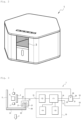
- the network camera 1 firstly comprises an image acquisition device 2, comprising an optical device comprising for example one or more lenses, and an image sensor located behind the optical device (that is to say inside and not outside the network camera 1).
- the network camera 1 also includes a cover 3 which is at least partially opaque to the visible spectrum.
- the cover 3 is opaque to the visible spectrum but transparent to a particular non-visible spectrum, which is in this case the infrared spectrum.
- cover 3 allows infrared light to pass but blocks visible light.
- Cover 3 comprises for this purpose a thin film integrated into the thickness of cover 3, the film being opaque to the visible spectrum and transparent to the infrared spectrum.
- Cover 3 is movable between an open (and low) position, visible on the figure 1 , in which the field of vision of the image sensor is left free and in which the network camera 1 can implement a wide-angle videophone function, and a closed (and high) position, visible on the picture 2 , in which the cover 3 extends in front and hides the image acquisition device 2 and therefore the image sensor.
- the cover 3 is motorized to move between the open position and the closed position.
- the cover 3 can be controlled remotely, for example via a smartphone, or else automatically.
- the image acquisition device 2 of the network camera 1 comprises at least one, in this case two light sources arranged to emit light in the particular non-visible spectrum, i.e. in the infrared spectrum.
- Each light source is here an IR LED 7, that is to say an infrared light-emitting diode.
- the two IR LEDs 7 are positioned on either side of the optical device 6.
- the network camera 1 further comprises a processing module 10 comprising a microprocessor 11, an image processor 12 (or ISP, for Image Signal Processor ) , a neural processing chip 13 (or NPU, for Neural Processing Unit ) , that is to say a chip dedicated to the implementation of artificial intelligence algorithms and neural networks.
- the processing module 10 also includes a memory 14 connected to the microprocessor 11.
- the processing module 10 comprises an input 15 which is directly connected to the image sensor 5, as well as a first output 16 and a second output 17.
- the input 15 of the processing module 10 is an input of the image processor 12.
- the first output 16 and the second output 17 are outputs of the microprocessor 11.
- the network camera 1 comprises a first transmission channel 18 and a second transmission channel 19, which are respectively connected to the first output 16 and to the second output 17 of the processing module 10.
- the first transmission channel 18 has a first high bit rate making it possible to transmit a video stream.
- the second transmission channel 19 has a second low bit rate, insufficient to transmit a video stream.
- the software includes routines for executing a communication protocol used on the second transmission channel 19.
- the communication protocol is an SPI protocol which is emulated by a port. Therefore, no particular electronic block dedicated to the implementation of the communication protocol is used.
- the second bit rate is here equal to a few kb/s.
- the network camera 1 further comprises a detection device arranged to detect an actual position of the cover 3.
- the detection device here comprises an optical fork 20.
- the optical fork 20 comprises two arms 21, an optical transmitter positioned on one of the arms 21 and an optical receiver positioned on the other of the arms 21.
- the optical transmitter produces a light beam which is received by the optical receiver when the space is free between the two arms 21, and which is not received by the optical receiver when a body (opaque to the spectrum of the light beam of the optical fork 20) is positioned between the two arms 21.
- the optical fork 20 here produces on its output 23 a low voltage level when a body is positioned between the two arms 21, and a high voltage level when no body is positioned between the two arms 21.
- the detection device also comprises an intermediate piece 24 linked to the cover 3.
- the intermediate piece 24 is opaque to the spectrum of the light beam from the optical fork 20.
- the intermediate piece 24 has a common portion 25 and an end portion 26.
- the running portion 25 is of longitudinal shape and extends perpendicular to the cover 3 from a lower portion of the cover 3.
- the running portion 25 has a first end linked to the cover 3, and a second end.
- the extremal portion 26 extends from the second end of the current portion 25, perpendicular to this one up.
- the intermediate piece 24 therefore has an L-shaped section along a plane perpendicular to the cover 3.
- the optical fork 20 cooperates with the end portion 26 of the intermediate piece 24.
- the network camera 1 also includes a switch device.
- the switch device is mounted on the first transmission channel 18 and is therefore connected to the first output 16 of the processing module 10.
- the switch device here comprises a video buffer 28 having a control input 29.
- the video buffer 28 When the video buffer 28 receives on its control input 29 a low voltage level, which means that the cover 3 is closed, the video buffer 28 blocks the transmission and therefore plays the role of a switch in a blocked state.
- the video buffer 28 When the video buffer 28 receives on its control input 29 a high voltage level, which means that the cover 3 is open, the video buffer 28 transmits on its output 31 the data received on its input 32 and therefore plays the role of a switch in an on state.
- the image sensor 5 acquires, via the optical device 6, acquired images that are perfectly sharp and precisely representative of the scene which is in the field of vision of the image sensor 5.
- the processing module 10 implements a first processing on the acquired images to generate a video stream.
- the image processor 12 carries out a preliminary digital processing on the acquired images, comprising for example a noise reduction, a demosaicing, a softening, etc.
- the microprocessor 11 acquires the images acquired at the output of the image processor 12, possibly performs additional digital processing, and formats the video stream.
- the optical fork 20 detects the absence of the end portion 26 of the intermediate piece 24 between the arms 21, and therefore detects that the cover 3 is in the open position.
- the optical fork 20 produces a high voltage level.
- the video buffer 28 receives on its control input 29 the high voltage level.
- the video buffer 28 transmits on its output 31 the data received on its input 32 and authorizes the transmissions carried out by the microprocessor 11 on the first transmission channel 18 via the first output 16 of the processing module 10.
- the network camera 1 can therefore transmit the video stream to a network of communication to which it is connected.
- the image sensor 5 acquires degraded images due to the opacity of the cover 3 in the visible spectrum.
- the processing module 10 implements a second processing on the acquired images.
- the image processor 12 performs on the images acquired through the cover 3 a preliminary digital processing.
- the microprocessor 11 receives the images acquired at the output of the image processor 12 and transmits them to the neural processing chip 13.
- the neural processing chip 13 implements scene analysis using artificial intelligence and neural network algorithms.
- the microprocessor 11 and the neural processing chip 13 extract from the scene “abstract” information data relating to the acquired images.
- the information data is representative of all or some of this information: number of individual(s) present in the scene, age of the individuals, gender, emotion expressed, attention, position of their gaze, position of their body , direction of their gaze, etc.
- the optical fork 20 detects the presence of the end portion 26 of the intermediate piece 24 between the arms 21, and therefore that the cover 3 is in the closed position.
- the optical fork 20 produces a low voltage level.
- the video buffer 28 receives on its control input 29 the low voltage level, and prohibits any transmission to the communication network by the processing module 10 via its first output 16.
- Network camera 1 can therefore no longer transmit video stream, because the first transmission channel 18 is cut and the second transmission channel 19 does not allow it due to its low bit rate.
- the network camera 1 therefore only transmits the low bit rate information data to the communication network, on the second transmission channel 19.
- the two IR LEDs 7 can be used to illuminate it with infrared light and thus improve the quality of the images acquired through the cover 3 and therefore the accuracy of the information data.
- the network camera according to the invention 1 is particularly advantageous.
- the cover 3 When the cover 3 is open, it can produce a quality video stream and make it possible to implement a high-performance videophone function.
- the architecture of network camera 1 prevents any transmission of video streams when cover 3 is closed.
- the stream blocking is physical, and results from the fact that the first transmission channel 18 is blocked by the switch device and from the fact that the second transmission channel 19 cannot transmit video streams.
- the network camera is used in a video telephony application. It could of course be used in a different application, video surveillance for example.
- the cover comprises a film that is opaque to the visible spectrum but transparent to the infrared spectrum. This characteristic of the cover could be obtained in a different way.
- the cover could be coloured, mass-tinted, opaque to the visible spectrum but transparent to the infrared spectrum.
- cover could be transparent to another spectrum, for example to the ultraviolet spectrum.
- the cover could also be simply partially opaque to the visible spectrum, thanks to a film or a coloring.
- the network camera could perfectly be integrated into multi-function equipment, such as smart speaker, set-top box, residential gateway, etc.
- the network camera would be possible to provide for the network camera to operate not according to two modes but according to three modes: a first mode, cover open, in which a stream video can be transmitted, a second mode, cover closed, in which only information data can be transmitted, and a third mode, cover closed, in which no transmission is possible.
Landscapes
- Engineering & Computer Science (AREA)
- Multimedia (AREA)
- Theoretical Computer Science (AREA)
- Signal Processing (AREA)
- Physics & Mathematics (AREA)
- General Physics & Mathematics (AREA)
- Evolutionary Computation (AREA)
- General Health & Medical Sciences (AREA)
- Health & Medical Sciences (AREA)
- Computer Vision & Pattern Recognition (AREA)
- Databases & Information Systems (AREA)
- Artificial Intelligence (AREA)
- Social Psychology (AREA)
- Computing Systems (AREA)
- Medical Informatics (AREA)
- Software Systems (AREA)
- Data Mining & Analysis (AREA)
- Life Sciences & Earth Sciences (AREA)
- Bioinformatics & Computational Biology (AREA)
- Evolutionary Biology (AREA)
- General Engineering & Computer Science (AREA)
- Bioinformatics & Cheminformatics (AREA)
- Computer Networks & Wireless Communication (AREA)
- Studio Devices (AREA)
- Closed-Circuit Television Systems (AREA)
Claims (16)
- Netzwerkkamera, umfassend:- einen Bildsensor (5);- eine Abdeckung (3), die zumindest teilweise für das sichtbare Spektrum undurchlässig ist, wobei die Abdeckung (3) zwischen einer geschlossenen Position, in der sie sich vor dem Bildsensor (5) erstreckt und denselben verdeckt, und einer offenen Position beweglich ist;- ein Verarbeitungsmodul (10), das mindestens einen Eingang (15), einen ersten Ausgang (16) und einen zweiten Ausgang (17) hat und ausgebildet ist, über den Eingang (15) von dem Bildsensor (5) erfasste Bilder zu empfangen, um an den erfassten Bildern eine erste Verarbeitung durchzuführen, um einen Videostrom zu erzeugen, sowie eine zweite Verarbeitung, um Informationsdaten zu den erfassten Bildern zu erzeugen, und den Videostrom über den ersten Ausgang (16) und die Informationsdaten über den zweiten Ausgang (17) zu übertragen;- eine Detektionsvorrichtung, die ausgebildet ist, zu erfassen, ob sich die Abdeckung (3) in der offenen Position oder in der geschlossenen Position befindet;- eine Unterbrechervorrichtung, die mit dem ersten Ausgang (16) des Verarbeitungsmoduls (10) verbunden ist;
wobei die Netzwerkkamera (1) derart ausgebildet ist, dass, wenn die Detektionsvorrichtung erfasst, dass sich die Abdeckung (3) in der geschlossenen Position befindet, die Unterbrechervorrichtung gesteuert wird, um jegliche Übertragung an ein Kommunikationsnetzwerk durch das Verarbeitungsmodul (10) über den ersten Ausgang (16) zu unterbinden. - Netzwerkkamera nach Anspruch 1, bei der ein Ausgang (23) der Detektionsvorrichtung direkt mit einem Steuereingang (29) der Unterbrechervorrichtung verbunden ist, wobei die Detektionsvorrichtung so die Unterbrechervorrichtung in Abhängigkeit von der Erfassung der offenen Position oder der geschlossenen Position der Abdeckung (3) steuert.
- Netzwerkkamera nach Anspruch 2, bei der die Unterbrechervorrichtung einen Videopuffer (28) umfasst.
- Netzwerkkamera nach einem der vorhergehenden Ansprüche, bei dem die Detektionsvorrichtung eine optische Gabel (20) umfasst, die ausgebildet ist, zwischen ihren Armen (21) das Vorhandensein oder das Nichtvorhandensein der Abdeckung (3) oder eines mit der Abdeckung verbundenen Zwischenstücks (24) zu erfassen.
- Netzwerkkamera nach einem der vorhergehenden Ansprüche, umfassend einen ersten Übertragungsweg (18) und einen zweiten Übertragungsweg (19), die mit dem ersten Ausgang (16) bzw. mit dem zweiten Ausgang (17) des Verarbeitungsmoduls (10) verbunden sind, wobei der erste Übertragungsweg einen ersten Durchsatz aufweist, der ausreicht, den Videostrom zu übertragen, und der zweite Übertragungsweg einen zweiten Durchsatz aufweist, der nicht ausreicht, den Videostrom zu übertragen.
- Netzwerkkamera nach Anspruch 5, bei der das Verarbeitungsmodul eine Software integriert, die Routinen umfasst, um ein Kommunikationsprotokoll, das auf dem zweiten Übertragungsweg (19) verwendet wird, umzusetzen.
- Netzwerkkamera nach einem der vorhergehenden Ansprüche, bei der das Verarbeitungsmodul (10) einen Bildprozessor (12) umfasst, der direkt mit dem Bildsensor (5) verbunden ist, einen Mikroprozessor (11) und einen neuronalen Verarbeitungschip (13), der verwendet wird, um die zweite Verarbeitung durchzuführen.
- Netzwerkkamera nach einem der vorhergehenden Ansprüche, bei der die Abdeckung für das sichtbare Spektrum undurchlässig, aber für das Infrarotspektrum durchlässig ist.
- Netzwerkkamera nach Anspruch 8, ferner umfassend mindestens eine Infrarot-Elektrolumineszenzdiode (7), die ausgebildet ist, Infrarotlicht auszusenden, um eine Szene gegenüber der Netzwerkkamera (1) zu beleuchten, wenn sich die Abdeckung (3) in der geschlossenen Position befindet und die Szene zu dunkel ist.
- Netzwerkkamera nach Anspruch 8, bei der die Abdeckung (3) eine für das sichtbare Spektrum undurchlässige Folie, aber für das Infrarotspektrum durchlässige Folie umfasst.
- Netzwerkkamera nach Anspruch 8, bei der die Abdeckung (3) eine Färbung aufweist, die in Masse gefärbt wurde, die für das sichtbare Spektrum undurchlässig, aber für das Infrarotspektrum durchlässig ist.
- Netzwerkkamera nach einem der vorhergehenden Ansprüche, bei der die Abdeckung (3) motorisiert ist, um sich zwischen der offenen Position und der geschlossenen Position zu verschieben.
- Netzwerkkamera nach einem der vorhergehenden Ansprüche, bei der die Informationsdaten repräsentativ für eine Anzahl von anwesenden Personen und/oder das Alter der Personen und/oder ihr Geschlecht und/oder die ausgedrückte Emotion und/oder ihre Aufmerksamkeit und/oder die Position ihres Blicks und/oder die Position ihres Körpers und/oder die Richtung ihres Blicks sind.
- Verarbeitungsverfahren, das in einer Netzwerkkamera (1) nach einem der Ansprüche 1 bis 13 eingesetzt wird, umfassend die Schritte:- wenn sich die Abdeckung (3) in der offenen Position befindet, Erfassen der von dem Bildsensor (5) erfassten Bilder, Durchführen der ersten Verarbeitung an den erfassten Bildern, um den Videostrom zu erzeugen, und Übertragen des Videostroms über den ersten Ausgang (16) des Verarbeitungsmoduls (10) an ein Kommunikationsnetzwerk;- wenn sich die Abdeckung (3) in der geschlossenen Position befindet, Erfassen der von dem Bildsensor (5) erzeugten Bilder, Durchführen der zweiten Verarbeitung an den erfassten Bildern, um Informationsdaten zu erzeugen, und Übertragen der Informationsdaten über den zweiten Ausgang (17) des Verarbeitungsmoduls (10) an das Kommunikationsnetzwerk.
- Computerprogramm, umfassend Anweisungen zum Durchführen des Verarbeitungsverfahrens nach Anspruch 14 durch einen Mikroprozessor (11) einer Netzwerkkamera (1).
- Speichermittel, die dadurch gekennzeichnet sind, dass sie ein Computerprogramm speichern, das Anweisungen umfasst, um das Verarbeitungsverfahren nach Anspruch 14 durch einen Mikroprozessor (11) einer Netzwerkkamera (1) durchzuführen.
Applications Claiming Priority (2)
| Application Number | Priority Date | Filing Date | Title |
|---|---|---|---|
| FR1909165A FR3099976B1 (fr) | 2019-08-12 | 2019-08-12 | Caméra réseau munie d’un capot de privatisation |
| PCT/EP2020/064520 WO2021028086A1 (fr) | 2019-08-12 | 2020-05-26 | Camera reseau munie d'un capot de privatisation |
Publications (2)
| Publication Number | Publication Date |
|---|---|
| EP4014482A1 EP4014482A1 (de) | 2022-06-22 |
| EP4014482B1 true EP4014482B1 (de) | 2023-06-28 |
Family
ID=69375413
Family Applications (1)
| Application Number | Title | Priority Date | Filing Date |
|---|---|---|---|
| EP20726868.1A Active EP4014482B1 (de) | 2019-08-12 | 2020-05-26 | Netzwerkkamera mit einer privatsphärenabdeckung |
Country Status (3)
| Country | Link |
|---|---|
| EP (1) | EP4014482B1 (de) |
| FR (1) | FR3099976B1 (de) |
| WO (1) | WO2021028086A1 (de) |
Family Cites Families (5)
| Publication number | Priority date | Publication date | Assignee | Title |
|---|---|---|---|---|
| CN106464844A (zh) * | 2014-04-08 | 2017-02-22 | 琼和欧文·雅各布斯以色列理工学院-康奈尔研究所 | 用于配置婴儿监控器摄像机以提供用于分析的统一数据集的系统和方法 |
| US10306125B2 (en) * | 2014-10-09 | 2019-05-28 | Belkin International, Inc. | Video camera with privacy |
| JP6650691B2 (ja) * | 2015-07-02 | 2020-02-19 | キヤノン株式会社 | 撮像装置 |
| US10180615B2 (en) * | 2016-10-31 | 2019-01-15 | Google Llc | Electrochromic filtering in a camera |
| JP2019118043A (ja) * | 2017-12-27 | 2019-07-18 | キヤノン株式会社 | 撮像装置、画像処理装置、制御方法およびプログラム |
-
2019
- 2019-08-12 FR FR1909165A patent/FR3099976B1/fr not_active Expired - Fee Related
-
2020
- 2020-05-26 EP EP20726868.1A patent/EP4014482B1/de active Active
- 2020-05-26 WO PCT/EP2020/064520 patent/WO2021028086A1/fr not_active Ceased
Also Published As
| Publication number | Publication date |
|---|---|
| WO2021028086A1 (fr) | 2021-02-18 |
| FR3099976A1 (fr) | 2021-02-19 |
| EP4014482A1 (de) | 2022-06-22 |
| FR3099976B1 (fr) | 2021-07-09 |
Similar Documents
| Publication | Publication Date | Title |
|---|---|---|
| US8576302B2 (en) | Imaging apparatus comprising color image pickup device and monochrome image pickup device | |
| EP2721828B1 (de) | Hochauflösende multispektrale bilderfassung | |
| EP1989582B1 (de) | Verfahren und einrichtung zum identifizieren und kalibrieren panoramischer optischer systeme | |
| US8072503B2 (en) | Methods, apparatuses, systems, and computer program products for real-time high dynamic range imaging | |
| EP2571277B1 (de) | Kommunikationsverfahren und entsprechendes Brillensystem für einen Benutzer, der eine Anzeigestation verwendet | |
| TW201208366A (en) | Image processing apparatus, image processing method, and program | |
| US20140104392A1 (en) | Generating image information | |
| EP3465086B1 (de) | Optronisches sichtgerät für landfahrzeug | |
| EP2098072B1 (de) | Vorrichtung für eine videokonferenz-kommunikation und entsprechendes kommunikationsverfahren | |
| EP2011329A2 (de) | Verfahren zum verarbeiten eines relativbeleuchtungsphänomens an einem digitalbild und assoziiertes verarbeitungssystem | |
| EP4411666A1 (de) | System zur erfassung eines farbbildes und eines infrarotbildes einer szene | |
| EP1886496A2 (de) | Verfahren und einrichtung zur steuerung der bewegung einer sichtlinie, videokonferenzsystem, endgerät und programm zur implementierung des verfahrens | |
| FR2838016A1 (fr) | Procede de traitement en temps reel d'un signal representatif d'une image | |
| JP7021036B2 (ja) | 電子機器及び通知方法 | |
| EP4014482A1 (de) | Netzwerkkamera mit einer privatsphärenabdeckung | |
| US10686991B2 (en) | Techniques for improving photograph quality for fouled lens or sensor situations | |
| US12501189B2 (en) | Region of interest sampling and retrieval for artificial reality systems | |
| FR3104363A1 (fr) | Dispositif de capture d’images | |
| EP1847958B1 (de) | Echtzeitsegmentierung eines digitalen Bildes in einer Überwachungszone | |
| FR3081639A1 (fr) | Procede et systeme de transmission optiques de donnees pour des applications de realite virtuelle ou augmentee | |
| US20250301228A1 (en) | Systems and Methods for Detection and Mitigation of a Rolling Band using a Secondary Camera | |
| US10816814B2 (en) | Imaging device | |
| EP4195152A1 (de) | Kamera, computervisionsystem mit einer solchen kamera und von einer solchen kamera erzeugter datenstrom | |
| FR2782877A1 (fr) | Systeme automatique de prise de son et d'images | |
| FR2942048A1 (fr) | Dispositif de capture d'images 360° comprenant un systeme catadiotrique couple a un capteur d'images. |
Legal Events
| Date | Code | Title | Description |
|---|---|---|---|
| STAA | Information on the status of an ep patent application or granted ep patent |
Free format text: STATUS: UNKNOWN |
|
| STAA | Information on the status of an ep patent application or granted ep patent |
Free format text: STATUS: THE INTERNATIONAL PUBLICATION HAS BEEN MADE |
|
| PUAI | Public reference made under article 153(3) epc to a published international application that has entered the european phase |
Free format text: ORIGINAL CODE: 0009012 |
|
| STAA | Information on the status of an ep patent application or granted ep patent |
Free format text: STATUS: REQUEST FOR EXAMINATION WAS MADE |
|
| 17P | Request for examination filed |
Effective date: 20220120 |
|
| AK | Designated contracting states |
Kind code of ref document: A1 Designated state(s): AL AT BE BG CH CY CZ DE DK EE ES FI FR GB GR HR HU IE IS IT LI LT LU LV MC MK MT NL NO PL PT RO RS SE SI SK SM TR |
|
| DAV | Request for validation of the european patent (deleted) | ||
| DAX | Request for extension of the european patent (deleted) | ||
| GRAP | Despatch of communication of intention to grant a patent |
Free format text: ORIGINAL CODE: EPIDOSNIGR1 |
|
| STAA | Information on the status of an ep patent application or granted ep patent |
Free format text: STATUS: GRANT OF PATENT IS INTENDED |
|
| INTG | Intention to grant announced |
Effective date: 20230113 |
|
| GRAS | Grant fee paid |
Free format text: ORIGINAL CODE: EPIDOSNIGR3 |
|
| GRAA | (expected) grant |
Free format text: ORIGINAL CODE: 0009210 |
|
| STAA | Information on the status of an ep patent application or granted ep patent |
Free format text: STATUS: THE PATENT HAS BEEN GRANTED |
|
| AK | Designated contracting states |
Kind code of ref document: B1 Designated state(s): AL AT BE BG CH CY CZ DE DK EE ES FI FR GB GR HR HU IE IS IT LI LT LU LV MC MK MT NL NO PL PT RO RS SE SI SK SM TR |
|
| REG | Reference to a national code |
Ref country code: CH Ref legal event code: EP |
|
| REG | Reference to a national code |
Ref country code: AT Ref legal event code: REF Ref document number: 1583781 Country of ref document: AT Kind code of ref document: T Effective date: 20230715 |
|
| REG | Reference to a national code |
Ref country code: IE Ref legal event code: FG4D Free format text: LANGUAGE OF EP DOCUMENT: FRENCH |
|
| REG | Reference to a national code |
Ref country code: DE Ref legal event code: R096 Ref document number: 602020013035 Country of ref document: DE |
|
| REG | Reference to a national code |
Ref country code: LT Ref legal event code: MG9D |
|
| PG25 | Lapsed in a contracting state [announced via postgrant information from national office to epo] |
Ref country code: SE Free format text: LAPSE BECAUSE OF FAILURE TO SUBMIT A TRANSLATION OF THE DESCRIPTION OR TO PAY THE FEE WITHIN THE PRESCRIBED TIME-LIMIT Effective date: 20230628 Ref country code: NO Free format text: LAPSE BECAUSE OF FAILURE TO SUBMIT A TRANSLATION OF THE DESCRIPTION OR TO PAY THE FEE WITHIN THE PRESCRIBED TIME-LIMIT Effective date: 20230928 |
|
| REG | Reference to a national code |
Ref country code: NL Ref legal event code: MP Effective date: 20230628 |
|
| REG | Reference to a national code |
Ref country code: AT Ref legal event code: MK05 Ref document number: 1583781 Country of ref document: AT Kind code of ref document: T Effective date: 20230628 |
|
| PG25 | Lapsed in a contracting state [announced via postgrant information from national office to epo] |
Ref country code: RS Free format text: LAPSE BECAUSE OF FAILURE TO SUBMIT A TRANSLATION OF THE DESCRIPTION OR TO PAY THE FEE WITHIN THE PRESCRIBED TIME-LIMIT Effective date: 20230628 Ref country code: NL Free format text: LAPSE BECAUSE OF FAILURE TO SUBMIT A TRANSLATION OF THE DESCRIPTION OR TO PAY THE FEE WITHIN THE PRESCRIBED TIME-LIMIT Effective date: 20230628 Ref country code: LV Free format text: LAPSE BECAUSE OF FAILURE TO SUBMIT A TRANSLATION OF THE DESCRIPTION OR TO PAY THE FEE WITHIN THE PRESCRIBED TIME-LIMIT Effective date: 20230628 Ref country code: LT Free format text: LAPSE BECAUSE OF FAILURE TO SUBMIT A TRANSLATION OF THE DESCRIPTION OR TO PAY THE FEE WITHIN THE PRESCRIBED TIME-LIMIT Effective date: 20230628 Ref country code: HR Free format text: LAPSE BECAUSE OF FAILURE TO SUBMIT A TRANSLATION OF THE DESCRIPTION OR TO PAY THE FEE WITHIN THE PRESCRIBED TIME-LIMIT Effective date: 20230628 Ref country code: GR Free format text: LAPSE BECAUSE OF FAILURE TO SUBMIT A TRANSLATION OF THE DESCRIPTION OR TO PAY THE FEE WITHIN THE PRESCRIBED TIME-LIMIT Effective date: 20230929 |
|
| RAP4 | Party data changed (patent owner data changed or rights of a patent transferred) |
Owner name: SAGEMCOM BROADBAND SAS |
|
| PG25 | Lapsed in a contracting state [announced via postgrant information from national office to epo] |
Ref country code: FI Free format text: LAPSE BECAUSE OF FAILURE TO SUBMIT A TRANSLATION OF THE DESCRIPTION OR TO PAY THE FEE WITHIN THE PRESCRIBED TIME-LIMIT Effective date: 20230628 |
|
| PG25 | Lapsed in a contracting state [announced via postgrant information from national office to epo] |
Ref country code: SK Free format text: LAPSE BECAUSE OF FAILURE TO SUBMIT A TRANSLATION OF THE DESCRIPTION OR TO PAY THE FEE WITHIN THE PRESCRIBED TIME-LIMIT Effective date: 20230628 |
|
| PG25 | Lapsed in a contracting state [announced via postgrant information from national office to epo] |
Ref country code: ES Free format text: LAPSE BECAUSE OF FAILURE TO SUBMIT A TRANSLATION OF THE DESCRIPTION OR TO PAY THE FEE WITHIN THE PRESCRIBED TIME-LIMIT Effective date: 20230628 |
|
| PG25 | Lapsed in a contracting state [announced via postgrant information from national office to epo] |
Ref country code: IS Free format text: LAPSE BECAUSE OF FAILURE TO SUBMIT A TRANSLATION OF THE DESCRIPTION OR TO PAY THE FEE WITHIN THE PRESCRIBED TIME-LIMIT Effective date: 20231028 |
|
| PG25 | Lapsed in a contracting state [announced via postgrant information from national office to epo] |
Ref country code: SM Free format text: LAPSE BECAUSE OF FAILURE TO SUBMIT A TRANSLATION OF THE DESCRIPTION OR TO PAY THE FEE WITHIN THE PRESCRIBED TIME-LIMIT Effective date: 20230628 Ref country code: SK Free format text: LAPSE BECAUSE OF FAILURE TO SUBMIT A TRANSLATION OF THE DESCRIPTION OR TO PAY THE FEE WITHIN THE PRESCRIBED TIME-LIMIT Effective date: 20230628 Ref country code: RO Free format text: LAPSE BECAUSE OF FAILURE TO SUBMIT A TRANSLATION OF THE DESCRIPTION OR TO PAY THE FEE WITHIN THE PRESCRIBED TIME-LIMIT Effective date: 20230628 Ref country code: PT Free format text: LAPSE BECAUSE OF FAILURE TO SUBMIT A TRANSLATION OF THE DESCRIPTION OR TO PAY THE FEE WITHIN THE PRESCRIBED TIME-LIMIT Effective date: 20231030 Ref country code: IS Free format text: LAPSE BECAUSE OF FAILURE TO SUBMIT A TRANSLATION OF THE DESCRIPTION OR TO PAY THE FEE WITHIN THE PRESCRIBED TIME-LIMIT Effective date: 20231028 Ref country code: ES Free format text: LAPSE BECAUSE OF FAILURE TO SUBMIT A TRANSLATION OF THE DESCRIPTION OR TO PAY THE FEE WITHIN THE PRESCRIBED TIME-LIMIT Effective date: 20230628 Ref country code: EE Free format text: LAPSE BECAUSE OF FAILURE TO SUBMIT A TRANSLATION OF THE DESCRIPTION OR TO PAY THE FEE WITHIN THE PRESCRIBED TIME-LIMIT Effective date: 20230628 Ref country code: CZ Free format text: LAPSE BECAUSE OF FAILURE TO SUBMIT A TRANSLATION OF THE DESCRIPTION OR TO PAY THE FEE WITHIN THE PRESCRIBED TIME-LIMIT Effective date: 20230628 Ref country code: AT Free format text: LAPSE BECAUSE OF FAILURE TO SUBMIT A TRANSLATION OF THE DESCRIPTION OR TO PAY THE FEE WITHIN THE PRESCRIBED TIME-LIMIT Effective date: 20230628 |
|
| PG25 | Lapsed in a contracting state [announced via postgrant information from national office to epo] |
Ref country code: PL Free format text: LAPSE BECAUSE OF FAILURE TO SUBMIT A TRANSLATION OF THE DESCRIPTION OR TO PAY THE FEE WITHIN THE PRESCRIBED TIME-LIMIT Effective date: 20230628 |
|
| REG | Reference to a national code |
Ref country code: DE Ref legal event code: R097 Ref document number: 602020013035 Country of ref document: DE |
|
| PG25 | Lapsed in a contracting state [announced via postgrant information from national office to epo] |
Ref country code: DK Free format text: LAPSE BECAUSE OF FAILURE TO SUBMIT A TRANSLATION OF THE DESCRIPTION OR TO PAY THE FEE WITHIN THE PRESCRIBED TIME-LIMIT Effective date: 20230628 |
|
| PLBE | No opposition filed within time limit |
Free format text: ORIGINAL CODE: 0009261 |
|
| STAA | Information on the status of an ep patent application or granted ep patent |
Free format text: STATUS: NO OPPOSITION FILED WITHIN TIME LIMIT |
|
| PG25 | Lapsed in a contracting state [announced via postgrant information from national office to epo] |
Ref country code: IT Free format text: LAPSE BECAUSE OF FAILURE TO SUBMIT A TRANSLATION OF THE DESCRIPTION OR TO PAY THE FEE WITHIN THE PRESCRIBED TIME-LIMIT Effective date: 20230628 |
|
| 26N | No opposition filed |
Effective date: 20240402 |
|
| PG25 | Lapsed in a contracting state [announced via postgrant information from national office to epo] |
Ref country code: SI Free format text: LAPSE BECAUSE OF FAILURE TO SUBMIT A TRANSLATION OF THE DESCRIPTION OR TO PAY THE FEE WITHIN THE PRESCRIBED TIME-LIMIT Effective date: 20230628 |
|
| PG25 | Lapsed in a contracting state [announced via postgrant information from national office to epo] |
Ref country code: BG Free format text: LAPSE BECAUSE OF FAILURE TO SUBMIT A TRANSLATION OF THE DESCRIPTION OR TO PAY THE FEE WITHIN THE PRESCRIBED TIME-LIMIT Effective date: 20230628 |
|
| PG25 | Lapsed in a contracting state [announced via postgrant information from national office to epo] |
Ref country code: BG Free format text: LAPSE BECAUSE OF FAILURE TO SUBMIT A TRANSLATION OF THE DESCRIPTION OR TO PAY THE FEE WITHIN THE PRESCRIBED TIME-LIMIT Effective date: 20230628 |
|
| REG | Reference to a national code |
Ref country code: CH Ref legal event code: PL |
|
| PG25 | Lapsed in a contracting state [announced via postgrant information from national office to epo] |
Ref country code: MC Free format text: LAPSE BECAUSE OF FAILURE TO SUBMIT A TRANSLATION OF THE DESCRIPTION OR TO PAY THE FEE WITHIN THE PRESCRIBED TIME-LIMIT Effective date: 20230628 |
|
| PG25 | Lapsed in a contracting state [announced via postgrant information from national office to epo] |
Ref country code: LU Free format text: LAPSE BECAUSE OF NON-PAYMENT OF DUE FEES Effective date: 20240526 |
|
| PG25 | Lapsed in a contracting state [announced via postgrant information from national office to epo] |
Ref country code: MC Free format text: LAPSE BECAUSE OF FAILURE TO SUBMIT A TRANSLATION OF THE DESCRIPTION OR TO PAY THE FEE WITHIN THE PRESCRIBED TIME-LIMIT Effective date: 20230628 Ref country code: LU Free format text: LAPSE BECAUSE OF NON-PAYMENT OF DUE FEES Effective date: 20240526 Ref country code: CH Free format text: LAPSE BECAUSE OF NON-PAYMENT OF DUE FEES Effective date: 20240531 |
|
| REG | Reference to a national code |
Ref country code: BE Ref legal event code: MM Effective date: 20240531 |
|
| PG25 | Lapsed in a contracting state [announced via postgrant information from national office to epo] |
Ref country code: IE Free format text: LAPSE BECAUSE OF NON-PAYMENT OF DUE FEES Effective date: 20240526 |
|
| PG25 | Lapsed in a contracting state [announced via postgrant information from national office to epo] |
Ref country code: BE Free format text: LAPSE BECAUSE OF NON-PAYMENT OF DUE FEES Effective date: 20240531 |
|
| PGFP | Annual fee paid to national office [announced via postgrant information from national office to epo] |
Ref country code: DE Payment date: 20250423 Year of fee payment: 6 |
|
| PGFP | Annual fee paid to national office [announced via postgrant information from national office to epo] |
Ref country code: GB Payment date: 20250423 Year of fee payment: 6 |
|
| PGFP | Annual fee paid to national office [announced via postgrant information from national office to epo] |
Ref country code: FR Payment date: 20250423 Year of fee payment: 6 |
|
| PG25 | Lapsed in a contracting state [announced via postgrant information from national office to epo] |
Ref country code: HU Free format text: LAPSE BECAUSE OF FAILURE TO SUBMIT A TRANSLATION OF THE DESCRIPTION OR TO PAY THE FEE WITHIN THE PRESCRIBED TIME-LIMIT; INVALID AB INITIO Effective date: 20200526 |
|
| PG25 | Lapsed in a contracting state [announced via postgrant information from national office to epo] |
Ref country code: CY Free format text: LAPSE BECAUSE OF FAILURE TO SUBMIT A TRANSLATION OF THE DESCRIPTION OR TO PAY THE FEE WITHIN THE PRESCRIBED TIME-LIMIT; INVALID AB INITIO Effective date: 20200526 |