EP4014159B1 - Verfahren und vorrichtung zur multiratenkompression neuraler bilder mit mikrostrukturierten masken - Google Patents
Verfahren und vorrichtung zur multiratenkompression neuraler bilder mit mikrostrukturierten masken Download PDFInfo
- Publication number
- EP4014159B1 EP4014159B1 EP21832117.2A EP21832117A EP4014159B1 EP 4014159 B1 EP4014159 B1 EP 4014159B1 EP 21832117 A EP21832117 A EP 21832117A EP 4014159 B1 EP4014159 B1 EP 4014159B1
- Authority
- EP
- European Patent Office
- Prior art keywords
- masks
- weights
- decoding
- encoding
- pruning
- Prior art date
- Legal status (The legal status is an assumption and is not a legal conclusion. Google has not performed a legal analysis and makes no representation as to the accuracy of the status listed.)
- Active
Links
Images





Classifications
-
- G—PHYSICS
- G06—COMPUTING OR CALCULATING; COUNTING
- G06N—COMPUTING ARRANGEMENTS BASED ON SPECIFIC COMPUTATIONAL MODELS
- G06N3/00—Computing arrangements based on biological models
- G06N3/02—Neural networks
- G06N3/08—Learning methods
- G06N3/082—Learning methods modifying the architecture, e.g. adding, deleting or silencing nodes or connections
-
- G—PHYSICS
- G06—COMPUTING OR CALCULATING; COUNTING
- G06N—COMPUTING ARRANGEMENTS BASED ON SPECIFIC COMPUTATIONAL MODELS
- G06N3/00—Computing arrangements based on biological models
- G06N3/02—Neural networks
- G06N3/04—Architecture, e.g. interconnection topology
- G06N3/045—Combinations of networks
-
- G—PHYSICS
- G06—COMPUTING OR CALCULATING; COUNTING
- G06N—COMPUTING ARRANGEMENTS BASED ON SPECIFIC COMPUTATIONAL MODELS
- G06N3/00—Computing arrangements based on biological models
- G06N3/02—Neural networks
- G06N3/04—Architecture, e.g. interconnection topology
- G06N3/045—Combinations of networks
- G06N3/0455—Auto-encoder networks; Encoder-decoder networks
-
- G—PHYSICS
- G06—COMPUTING OR CALCULATING; COUNTING
- G06N—COMPUTING ARRANGEMENTS BASED ON SPECIFIC COMPUTATIONAL MODELS
- G06N3/00—Computing arrangements based on biological models
- G06N3/02—Neural networks
- G06N3/04—Architecture, e.g. interconnection topology
- G06N3/0464—Convolutional networks [CNN, ConvNet]
-
- G—PHYSICS
- G06—COMPUTING OR CALCULATING; COUNTING
- G06N—COMPUTING ARRANGEMENTS BASED ON SPECIFIC COMPUTATIONAL MODELS
- G06N3/00—Computing arrangements based on biological models
- G06N3/02—Neural networks
- G06N3/04—Architecture, e.g. interconnection topology
- G06N3/0495—Quantised networks; Sparse networks; Compressed networks
-
- G—PHYSICS
- G06—COMPUTING OR CALCULATING; COUNTING
- G06N—COMPUTING ARRANGEMENTS BASED ON SPECIFIC COMPUTATIONAL MODELS
- G06N3/00—Computing arrangements based on biological models
- G06N3/02—Neural networks
- G06N3/08—Learning methods
- G06N3/088—Non-supervised learning, e.g. competitive learning
-
- G—PHYSICS
- G06—COMPUTING OR CALCULATING; COUNTING
- G06N—COMPUTING ARRANGEMENTS BASED ON SPECIFIC COMPUTATIONAL MODELS
- G06N3/00—Computing arrangements based on biological models
- G06N3/02—Neural networks
- G06N3/08—Learning methods
- G06N3/09—Supervised learning
-
- G—PHYSICS
- G06—COMPUTING OR CALCULATING; COUNTING
- G06N—COMPUTING ARRANGEMENTS BASED ON SPECIFIC COMPUTATIONAL MODELS
- G06N3/00—Computing arrangements based on biological models
- G06N3/02—Neural networks
- G06N3/08—Learning methods
- G06N3/0985—Hyperparameter optimisation; Meta-learning; Learning-to-learn
-
- H—ELECTRICITY
- H04—ELECTRIC COMMUNICATION TECHNIQUE
- H04N—PICTORIAL COMMUNICATION, e.g. TELEVISION
- H04N19/00—Methods or arrangements for coding, decoding, compressing or decompressing digital video signals
- H04N19/10—Methods or arrangements for coding, decoding, compressing or decompressing digital video signals using adaptive coding
- H04N19/102—Methods or arrangements for coding, decoding, compressing or decompressing digital video signals using adaptive coding characterised by the element, parameter or selection affected or controlled by the adaptive coding
-
- H—ELECTRICITY
- H04—ELECTRIC COMMUNICATION TECHNIQUE
- H04N—PICTORIAL COMMUNICATION, e.g. TELEVISION
- H04N19/00—Methods or arrangements for coding, decoding, compressing or decompressing digital video signals
- H04N19/10—Methods or arrangements for coding, decoding, compressing or decompressing digital video signals using adaptive coding
- H04N19/134—Methods or arrangements for coding, decoding, compressing or decompressing digital video signals using adaptive coding characterised by the element, parameter or criterion affecting or controlling the adaptive coding
- H04N19/146—Data rate or code amount at the encoder output
- H04N19/147—Data rate or code amount at the encoder output according to rate distortion criteria
-
- H—ELECTRICITY
- H04—ELECTRIC COMMUNICATION TECHNIQUE
- H04N—PICTORIAL COMMUNICATION, e.g. TELEVISION
- H04N19/00—Methods or arrangements for coding, decoding, compressing or decompressing digital video signals
- H04N19/10—Methods or arrangements for coding, decoding, compressing or decompressing digital video signals using adaptive coding
- H04N19/169—Methods or arrangements for coding, decoding, compressing or decompressing digital video signals using adaptive coding characterised by the coding unit, i.e. the structural portion or semantic portion of the video signal being the object or the subject of the adaptive coding
- H04N19/17—Methods or arrangements for coding, decoding, compressing or decompressing digital video signals using adaptive coding characterised by the coding unit, i.e. the structural portion or semantic portion of the video signal being the object or the subject of the adaptive coding the unit being an image region, e.g. an object
- H04N19/176—Methods or arrangements for coding, decoding, compressing or decompressing digital video signals using adaptive coding characterised by the coding unit, i.e. the structural portion or semantic portion of the video signal being the object or the subject of the adaptive coding the unit being an image region, e.g. an object the region being a block, e.g. a macroblock
-
- H—ELECTRICITY
- H04—ELECTRIC COMMUNICATION TECHNIQUE
- H04N—PICTORIAL COMMUNICATION, e.g. TELEVISION
- H04N19/00—Methods or arrangements for coding, decoding, compressing or decompressing digital video signals
- H04N19/10—Methods or arrangements for coding, decoding, compressing or decompressing digital video signals using adaptive coding
- H04N19/189—Methods or arrangements for coding, decoding, compressing or decompressing digital video signals using adaptive coding characterised by the adaptation method, adaptation tool or adaptation type used for the adaptive coding
- H04N19/192—Methods or arrangements for coding, decoding, compressing or decompressing digital video signals using adaptive coding characterised by the adaptation method, adaptation tool or adaptation type used for the adaptive coding the adaptation method, adaptation tool or adaptation type being iterative or recursive
-
- H—ELECTRICITY
- H04—ELECTRIC COMMUNICATION TECHNIQUE
- H04N—PICTORIAL COMMUNICATION, e.g. TELEVISION
- H04N19/00—Methods or arrangements for coding, decoding, compressing or decompressing digital video signals
- H04N19/10—Methods or arrangements for coding, decoding, compressing or decompressing digital video signals using adaptive coding
- H04N19/189—Methods or arrangements for coding, decoding, compressing or decompressing digital video signals using adaptive coding characterised by the adaptation method, adaptation tool or adaptation type used for the adaptive coding
- H04N19/196—Methods or arrangements for coding, decoding, compressing or decompressing digital video signals using adaptive coding characterised by the adaptation method, adaptation tool or adaptation type used for the adaptive coding being specially adapted for the computation of encoding parameters, e.g. by averaging previously computed encoding parameters
-
- G—PHYSICS
- G06—COMPUTING OR CALCULATING; COUNTING
- G06F—ELECTRIC DIGITAL DATA PROCESSING
- G06F8/00—Arrangements for software engineering
- G06F8/30—Creation or generation of source code
- G06F8/36—Software reuse
-
- G—PHYSICS
- G06—COMPUTING OR CALCULATING; COUNTING
- G06N—COMPUTING ARRANGEMENTS BASED ON SPECIFIC COMPUTATIONAL MODELS
- G06N3/00—Computing arrangements based on biological models
- G06N3/02—Neural networks
- G06N3/04—Architecture, e.g. interconnection topology
- G06N3/047—Probabilistic or stochastic networks
-
- G—PHYSICS
- G06—COMPUTING OR CALCULATING; COUNTING
- G06N—COMPUTING ARRANGEMENTS BASED ON SPECIFIC COMPUTATIONAL MODELS
- G06N3/00—Computing arrangements based on biological models
- G06N3/02—Neural networks
- G06N3/08—Learning methods
- G06N3/084—Backpropagation, e.g. using gradient descent
-
- H—ELECTRICITY
- H04—ELECTRIC COMMUNICATION TECHNIQUE
- H04N—PICTORIAL COMMUNICATION, e.g. TELEVISION
- H04N19/00—Methods or arrangements for coding, decoding, compressing or decompressing digital video signals
- H04N19/10—Methods or arrangements for coding, decoding, compressing or decompressing digital video signals using adaptive coding
- H04N19/102—Methods or arrangements for coding, decoding, compressing or decompressing digital video signals using adaptive coding characterised by the element, parameter or selection affected or controlled by the adaptive coding
- H04N19/117—Filters, e.g. for pre-processing or post-processing
-
- H—ELECTRICITY
- H04—ELECTRIC COMMUNICATION TECHNIQUE
- H04N—PICTORIAL COMMUNICATION, e.g. TELEVISION
- H04N19/00—Methods or arrangements for coding, decoding, compressing or decompressing digital video signals
- H04N19/10—Methods or arrangements for coding, decoding, compressing or decompressing digital video signals using adaptive coding
- H04N19/102—Methods or arrangements for coding, decoding, compressing or decompressing digital video signals using adaptive coding characterised by the element, parameter or selection affected or controlled by the adaptive coding
- H04N19/132—Sampling, masking or truncation of coding units, e.g. adaptive resampling, frame skipping, frame interpolation or high-frequency transform coefficient masking
Definitions
- Standard groups and companies have been actively searching for potential needs for standardization of future video coding technology. These standard groups and companies have focused on artificial intelligence (AI)-based end-to-end neural image compression (NIC) using deep neural networks (DNNs). The success of this approach has brought more and more industrial interest in advanced neural image and video compression methodologies.
- AI artificial intelligence
- NIC end-to-end neural image compression
- DNNs deep neural networks
- the disclosure describes a method and an apparatus for compressing an input image, using a multi-rate NIC framework in which only one NIC model instance is used to achieve image compression at multiple bitrates with guidance from multiple binary masks targeting different bitrates.
- FIG. 1 is a diagram of an environment 100 in which methods, apparatuses and systems described herein may be implemented, according to embodiments.
- the environment 100 may include a user device 110, a platform 120, and a network 130. Devices of the environment 100 may interconnect via wired connections, wireless connections, or a combination of wired and wireless connections.
- the user device 110 includes one or more devices capable of receiving, generating, storing, processing, and/or providing information associated with platform 120.
- the user device 110 may include a computing device (e.g., a desktop computer, a laptop computer, a tablet computer, a handheld computer, a smart speaker, a server, etc.), a mobile phone (e.g., a smart phone, a radiotelephone, etc.), a wearable device (e.g., a pair of smart glasses or a smart watch), or a similar device.
- the user device 110 may receive information from and/or transmit information to the platform 120.
- the platform 120 includes one or more devices as described elsewhere herein.
- the platform 120 may include a cloud server or a group of cloud servers.
- the platform 120 may be designed to be modular such that software components may be swapped in or out. As such, the platform 120 may be easily and/or quickly reconfigured for different uses.
- the platform 120 may be hosted in a cloud computing environment 122.
- the platform 120 may not be cloud-based (i.e., may be implemented outside of a cloud computing environment) or may be partially cloud-based.
- the cloud computing environment 122 includes an environment that hosts the platform 120.
- the cloud computing environment 122 may provide computation, software, data access, storage, etc. services that do not require end-user (e.g., the user device 110) knowledge of a physical location and configuration of system(s) and/or device(s) that hosts the platform 120.
- the cloud computing environment 122 may include a group of computing resources 124 (referred to collectively as “computing resources 124" and individually as “computing resource 124").
- the computing resource 124 includes one or more personal computers, workstation computers, server devices, or other types of computation and/or communication devices. In some implementations, the computing resource 124 may host the platform 120.
- the cloud resources may include compute instances executing in the computing resource 124, storage devices provided in the computing resource 124, data transfer devices provided by the computing resource 124, etc. In some implementations, the computing resource 124 may communicate with other computing resources 124 via wired connections, wireless connections, or a combination of wired and wireless connections.
- the computing resource 124 includes a group of cloud resources, such as one or more applications (“APPs”) 124-1, one or more virtual machines (“VMs”) 124-2, virtualized storage (“VSs”) 124-3, one or more hypervisors (“HYPs”) 124-4, or the like.
- APPs applications
- VMs virtual machines
- VSs virtualized storage
- HOPs hypervisors
- the application 124-1 includes one or more software applications that may be provided to or accessed by the user device 110 and/or the platform 120.
- the application 124-1 may eliminate a need to install and execute the software applications on the user device 110.
- the application 124-1 may include software associated with the platform 120 and/or any other software capable of being provided via the cloud computing environment 122.
- one application 124-1 may send/receive information to/from one or more other applications 124-1, via the virtual machine 124-2.
- the virtual machine 124-2 includes a software implementation of a machine (e.g., a computer) that executes programs like a physical machine.
- the virtual machine 124-2 may be either a system virtual machine or a process virtual machine, depending upon use and degree of correspondence to any real machine by the virtual machine 124-2.
- a system virtual machine may provide a complete system platform that supports execution of a complete operating system ("OS").
- a process virtual machine may execute a single program, and may support a single process.
- the virtual machine 124-2 may execute on behalf of a user (e.g., the user device 110), and may manage infrastructure of the cloud computing environment 122, such as data management, synchronization, or long-duration data transfers.
- the virtualized storage 124-3 includes one or more storage systems and/or one or more devices that use virtualization techniques within the storage systems or devices of the computing resource 124.
- types of virtualizations may include block virtualization and file virtualization.
- Block virtualization may refer to abstraction (or separation) of logical storage from physical storage so that the storage system may be accessed without regard to physical storage or heterogeneous structure. The separation may permit administrators of the storage system flexibility in how the administrators manage storage for end users.
- File virtualization may eliminate dependencies between data accessed at a file level and a location where files are physically stored. This may enable optimization of storage use, server consolidation, and/or performance of non-disruptive file migrations.
- the hypervisor 124-4 may provide hardware virtualization techniques that allow multiple operating systems (e.g., "guest operating systems") to execute concurrently on a host computer, such as the computing resource 124.
- the hypervisor 124-4 may present a virtual operating platform to the guest operating systems, and may manage the execution of the guest operating systems. Multiple instances of a variety of operating systems may share virtualized hardware resources.
- the network 130 includes one or more wired and/or wireless networks.
- the network 130 may include a cellular network (e.g., a fifth generation (5G) network, a long-term evolution (LTE) network, a third generation (3G) network, a code division multiple access (CDMA) network, etc.), a public land mobile network (PLMN), a local area network (LAN), a wide area network (WAN), a metropolitan area network (MAN), a telephone network (e.g., the Public Switched Telephone Network (PSTN)), a private network, an ad hoc network, an intranet, the Internet, a fiber optic-based network, or the like, and/or a combination of these or other types of networks.
- 5G fifth generation
- LTE long-term evolution
- 3G third generation
- CDMA code division multiple access
- PLMN public land mobile network
- LAN local area network
- WAN wide area network
- MAN metropolitan area network
- PSTN Public Switched Telephone Network
- private network
- the number and arrangement of devices and networks shown in FIG. 1 are provided as an example. In practice, there may be additional devices and/or networks, fewer devices and/or networks, different devices and/or networks, or differently arranged devices and/or networks than those shown in FIG. 1 . Furthermore, two or more devices shown in FIG. 1 may be implemented within a single device, or a single device shown in FIG. 1 may be implemented as multiple, distributed devices. Additionally, or alternatively, a set of devices (e.g., one or more devices) of the environment 100 may perform one or more functions described as being performed by another set of devices of the environment 100.
- FIG. 2 is a block diagram of example components of one or more devices of FIG. 1 .
- a device 200 may correspond to the user device 110 and/or the platform 120. As shown in FIG. 2 , the device 200 may include a bus 210, a processor 220, a memory 230, a storage component 240, an input component 250, an output component 260, and a communication interface 270.
- the bus 210 includes a component that permits communication among the components of the device 200.
- the processor 220 is implemented in hardware, firmware, or a combination of hardware and software.
- the processor 220 is a central processing unit (CPU), a graphics processing unit (GPU), an accelerated processing unit (APU), a microprocessor, a microcontroller, a digital signal processor (DSP), a field-programmable gate array (FPGA), an application-specific integrated circuit (ASIC), or another type of processing component.
- the processor 220 includes one or more processors capable of being programmed to perform a function.
- the memory 230 includes a random access memory (RAM), a read only memory (ROM), and/or another type of dynamic or static storage device (e.g., a flash memory, a magnetic memory, and/or an optical memory) that stores information and/or instructions for use by the processor 220.
- RAM random access memory
- ROM read only memory
- static storage device e.g., a flash memory, a magnetic memory, and/or an optical memory
- the storage component 240 stores information and/or software related to the operation and use of the device 200.
- the storage component 240 may include a hard disk (e.g., a magnetic disk, an optical disk, a magneto-optic disk, and/or a solid state disk), a compact disc (CD), a digital versatile disc (DVD), a floppy disk, a cartridge, a magnetic tape, and/or another type of non-transitory computer-readable medium, along with a corresponding drive.
- the input component 250 includes a component that permits the device 200 to receive information, such as via user input (e.g., a touch screen display, a keyboard, a keypad, a mouse, a button, a switch, and/or a microphone). Additionally, or alternatively, the input component 250 may include a sensor for sensing information (e.g., a global positioning system (GPS) component, an accelerometer, a gyroscope, and/or an actuator).
- the output component 260 includes a component that provides output information from the device 200 (e.g., a display, a speaker, and/or one or more light-emitting diodes (LEDs)).
- LEDs light-emitting diodes
- the communication interface 270 includes a transceiver-like component (e.g., a transceiver and/or a separate receiver and transmitter) that enables the device 200 to communicate with other devices, such as via a wired connection, a wireless connection, or a combination of wired and wireless connections.
- the communication interface 270 may permit the device 200 to receive information from another device and/or provide information to another device.
- the communication interface 270 may include an Ethernet interface, an optical interface, a coaxial interface, an infrared interface, a radio frequency (RF) interface, a universal serial bus (USB) interface, a Wi-Fi interface, a cellular network interface, or the like.
- the device 200 may perform one or more processes described herein. The device 200 may perform these processes in response to the processor 220 executing software instructions stored by a non-transitory computer-readable medium, such as the memory 230 and/or the storage component 240.
- a computer-readable medium is defined herein as a non-transitory memory device.
- a memory device includes memory space within a single physical storage device or memory space spread across multiple physical storage devices.
- Software instructions may be read into the memory 230 and/or the storage component 240 from another computer-readable medium or from another device via the communication interface 270. When executed, software instructions stored in the memory 230 and/or the storage component 240 may cause the processor 220 to perform one or more processes described herein. Additionally, or alternatively, hardwired circuitry may be used in place of or in combination with software instructions to perform one or more processes described herein. Thus, implementations described herein are not limited to any specific combination of hardware circuitry and software.
- the device 200 may include additional components, fewer components, different components, or differently arranged components than those shown in FIG. 2 . Additionally, or alternatively, a set of components (e.g., one or more components) of the device 200 may perform one or more functions described as being performed by another set of components of the device 200.
- This disclosure proposes a multi-rate NIC framework for learning and deploying only one NIC model instance that supports multi-rate image compression.
- a set of binary masks is learned, one for each targeted bitrate, to guide a decoder in a reconstruction stage to recover images from different bitrates.
- FIG. 3 is a block diagram of a test apparatus 300 for multi-rate neural image compression, during a test stage, according to embodiments.
- the test apparatus 300 includes a test DNN encoder 310, a test encoder 320, a test decoder 330 and a test DNN decoder 340.
- a target of the test stage of an NIC workflow Given an input image x of size (h,w,c), where h, w, c are the height, width, and a number of channels, respectively, a target of the test stage of an NIC workflow can be described as follows.
- the test DNN encoder 310 encodes the input image x to obtain an encoded representation y , using a DNN.
- the test encoder 320 encodes the obtained encoded representation y to obtain a compressed representation y that is compact for storage and transmission.
- the obtained encoded representation y may encoded through quantization and entropy encoding.
- the test decoder 330 decodes the obtained compressed representation y to obtain a recovered representation y '.
- the obtained compressed representation y may be decoded through decoding and dequantization.
- the test DNN decoder 340 decodes the obtained recovered representation y ' to reconstruct a reconstructed image x , using a DNN.
- the reconstructed image x should be similar to the original input image x.
- test DNN encoder 310 There is not any restriction on network structures of the test DNN encoder 310 and the test DNN decoder 340. Also, there is not any restriction on methods (quantization and entropy coding) that are used by the test encoder 320 and the test decoder 330.
- a loss function D ( x, x ) is used to measure a reconstruction error, which is called a distortion loss, such as peak signal-to-noise ratio (PSNR) and/or structural similarity index measure (SSIM).
- the method and apparatus for multi-rate neural image compression use one single trained model instance of an NIC network, and use a set of binary masks to guide the NIC model instance to generate different compressed representations as well as a corresponding reconstructed image, each mask targeting a different value of a hyperparameter ⁇ .
- W j e and W j d denote a set of weight coefficients of an encoder and a decoder part of the NIC model instance, respectively, where W j e and W j d are the weight coefficients of a j -th layer of the test DNN encoder 310 and the test DNN decoder 340, respectively.
- ⁇ 1, ..., ⁇ N denote N hyperparameters
- y i and x i denote a compressed representation and a reconstructed image that correspond to a hyperparameter ⁇ i .
- M ij e and M ij d denote binary masks for the j -th layer of the test DNN encoder 310 and the test DNN decoder 340, respectively, corresponding to the hyperparameter ⁇ i .
- Weights W j e is a 5-dimensional (5D) tensor with size (c 1 , k 1 , k 2 , k 3 , c 2 ).
- An input of a layer is a 4-dimensional (4D) tensor A of size (h 1 , w 1 ,d 1 ,c 1 ), and an output of the layer is a 4D tensor B of size (h 2 , w 2 ,d 2 ,c 2 ).
- the sizes c 1 , k 1 , k 2 , k 3 , c 2 , h 1 , w 1 , d 1 , h 2 , w 2 , d 2 are integer numbers greater or equal to 1.
- the corresponding tensor reduces to a lower dimension.
- Each item in each tensor is a floating number.
- the parameters h 1 , w 1 and d 1 (h 2 , w 2 and d 2 ) are height, weight and depth of the input tensor A (output tensor B).
- the parameter c 1 (c 2 ) is a number of input (output) channels.
- the parameters k 1 , k 2 and k 3 are sizes of convolution kernels corresponding to height, weight and depth axes, respectively.
- the output tensor B is computed through a convolution operation O, based on the input tensor A, the masks M ij e and the weights W j e .
- the test DNN encoder 310 includes only one model instance with the weights W j e
- the test DNN decoder 340 includes only one model instance with the weights W j d .
- the test DNN encoder 310 selects the set of the encoding masks M ij e to compute the masked weights W ij e ′ , which are used by the test DNN encoder 310 to compute the DNN-encoded representation y .
- the test encoder 320 computes the compressed representation y in an encoding process.
- the test decoder 330 computes the recovered representation y ' through a decoding process. Using the hyperparameter ⁇ i , the test DNN decoder 340 selects the set of the decoding masks M ij d to compute the masked weights W ij d ′ , which are used by the test DNN decoder 340 to compute the reconstructed image x , based on the recovered representation y '.
- a shape of the weight W j e or W j d (so as the mask M ij e or M ij d ) can be changed to correspond to a convolution of a reshaped input with the reshaped weight W j e or W j d to obtain the same output.
- a desired micro-structure of the masks may be designed to align with an underlying GEMM matrix multiplication process of how the convolution operation is implemented so that an inference computation of using the masked weight coefficients can be accelerated.
- block-wise micro-structures may be used for the masks (so as the masked weight coefficients) of each layer in the 3D reshaped weight tensor or the 2D reshaped weight matrix.
- a mask may be partitioned into blocks of size (g i , g o , g k ), and for the case of reshaped 2D weight matrix, a mask may be partitioned into blocks of size (g i ,g o ). All items in a block of a mask will have the same binary value 1 or 0. That is, weight coefficients are masked out in a block-wise micro-structured fashion.
- a goal is to learn a set of micro-structured encoding masks M ij e and micro-structured decoding masks M ij d , each of the masks M ij e and M ij d targeting each of hyperparameters ⁇ i .
- a progressive multi-stage training framework may achieve this goal.
- the hyperparameters ⁇ 1,..., ⁇ i are ranked in ascending order, and correspond to masks that generate compressed representations with increasing distortion (decreasing quality) and decreasing rate loss (increasing bitrates).
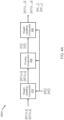
- Two different training frameworks may be used to learn a model instance and the masks, i.e., W j e , W j d , M ij e , M ij d , as illustrated in FIG. 4A .
- FIG. 4A An overall workflow of the first training framework is shown in FIG. 4A .
- FIG. 4A is a block diagram of a training apparatus 400A for multi-rate neural image compression, during a training stage, according to embodiments.
- the training apparatus 400A includes a weight updating component 410, a pruning component 420 and a weight updating component 430.
- a current model instance has weights W j e ⁇ i , W j d ⁇ i , and the masks are denoted M ij e , M ij d .
- the goal is to obtain masks M i ⁇ 1 j e , M i ⁇ 1 j d , as well as updated weights W j e ⁇ i ⁇ 1 , W j d ⁇ i ⁇ 1 .
- the weight coefficients among the weights W j e ⁇ i , W j d ⁇ i that are masked by M ij e , M ij d , respectively, are fixed or set. For example, if an entry in the mask M ij e is 1, the corresponding weight W j e ⁇ i is fixed.
- the weight updating component 410 updates remaining unmasked weight coefficients among the weights W j e ⁇ i ⁇ and W j e ⁇ i through backpropagation, using an R-D loss of Equation (1) targeting at a first hyperparameter ⁇ 1 , into updated weights W ⁇ j e ⁇ i and W ⁇ j d ⁇ i .
- Multiple epoch iterations may be performed to optimize the R-D loss in this weight update process, e.g., until reaching a maximum iteration number or until a loss converges.
- a micro-structured weight pruning process is performed.
- the pruning component 420 uses the updated weights W ⁇ j e ⁇ i and W ⁇ j d ⁇ i as inputs, for the unfixed weight coefficients among the updated weights W ⁇ j e ⁇ i and W ⁇ j d ⁇ i , the pruning component 420 obtains or computes a pruning loss L s ( b ) (e.g., the L 1 or L 2 norm of the weights in a block) for each micro-structured block b (3D block for 3D reshaped weight tensor or 2D block for 2D reshaped weight matrix).
- the pruning component 420 ranks these micro-structured blocks in ascending order, and prunes the blocks (i.e., by setting corresponding weights in the pruned blocks as 0) top down from a ranked list until a stop criterion is reached.
- the NIC model with the updated weights W ⁇ j e ⁇ i , W ⁇ j d ⁇ i and the masks M ij e , M ij d generates a distortion loss D val ( W ⁇ j e ⁇ i , W ⁇ j d ⁇ i , M ij e , M ij d ).
- the stop criterion can be a tolerable percentage threshold that allows the distortion loss to increase.
- the pruning component 420 generates a set of binary pruning masks P ij e and P ij d , where an entry in the mask P ij e or P ij d being 0 means the corresponding weight W j e or W j d is pruned.
- the weight updating component 430 fixes additional unfixed weights among the updated weights W ⁇ j e ⁇ i and W ⁇ j d ⁇ i that are masked by the masks P ij e and P ij d , and updates remaining weights among the updated weights W ⁇ j e ⁇ i and W ⁇ j d ⁇ i that are not masked by either the masks P ij e , P ij d or M ij e , M ij d , by regular backpropagation to optimize the overall R-D loss of Equation (1) targeting the hyperparameter ⁇ i -1 .
- non-pruned entries among the masks P ij e P ij d that are non-masked in the masks M ij e M ij d will be additionally set to 1 as being masked in M i ⁇ 1 j e M i ⁇ 1 j d .
- the weight updating component 430 outputs the updated weights W j e ⁇ i ⁇ 1 and W j d ⁇ i ⁇ 1 .
- the final updated weights W j e ⁇ 1 and W j d ⁇ 1 are the final output weights W j e and W j d for the learned model instance.
- FIG. 4B An overall workflow of the second training framework is shown in FIG. 4B .
- FIG. 4B is a block diagram of a training apparatus 400B for multi-rate neural image compression, during a training stage, according to embodiments.
- the training apparatus 400B includes a weight updating component 440, a pruning component 450, a weight updating component 460, and an inverse pruning weight updating component 470.
- the weight updating component 440 learns a set of model weights W ⁇ j e ⁇ 1 , W ⁇ j d ⁇ 1 through a weight update process using regular backpropagation using a training dataset S tr , by optimizing the R-D loss of Equation (1) targeting a hyperparameter ⁇ 1 .
- the pruning component 450 performs a micro-structured pruning process based on the model weights W ⁇ j e ⁇ 1 , W ⁇ j d ⁇ 1 .
- the pruning component 450 partitions each reshaped 3D weight tensor or 2D weight matrix into micro-blocks (3D blocks for a 3D reshaped weight tensor or 2D blocks for a 2D reshaped weight matrix), and obtains or computes a pruning loss L s ( b ) (e.g., an L 1 or L 2 norm of weights in a block) for each micro-structured block b.
- the pruning component 450 ranks these micro-structured blocks in ascending order, and prunes the blocks (i.e., by setting the corresponding weights in the pruned blocks as 0) from top to down on a ranked list to target each of the hyperparameters ⁇ 1 , ..., ⁇ N in the following way.
- the pruning component 450 obtains corresponding binary pruning masks P ij e and P ij d , in which an entry in the mask P ij e or P ij d being 0 means the corresponding weight among the weights W ⁇ j e ⁇ i or W ⁇ j d ⁇ i is pruned.
- the pruning component 450 further obtains the pruning masks P i + 1 j e and P i + 1 j d for ⁇ i +1 , to obtain updated weights W ⁇ j e ⁇ i + 1 , W ⁇ j d ⁇ i + 1 .
- the pruning component 450 fixes weight coefficients among the weights W ⁇ j e ⁇ i or W ⁇ j d ⁇ i that are masked to be pruned by the masks P ij e and P ij d , continues to prune down, in the ranked list, remaining unpruned micro-blocks until reaching a stop criterion for the hyperparameter ⁇ i +1 .
- the NIC model with the weights W ⁇ j e ⁇ i , W ⁇ j d ⁇ i generates a distortion loss D val ( W ⁇ j e ⁇ i , W ⁇ j d ⁇ i ) .
- the stop criterion can be a tolerable percentage threshold that we allow the distortion loss to increase.
- the pruning component 450 generates pruning masks P i + 1 j e and P i + 1 j d by adding these additional pruned micro-blocks into the masks P ij e and P ij d .
- the weight updating component 460 fixes all these pruned micro-blocks masked by the masks P i + 1 j e and P i + 1 j d , and updates remaining unfixed weights, using regular backpropagation to optimize the R-D loss of Equation (1) targeting the hyperparameter ⁇ i +1 , to generate a set of updated weights W ⁇ j e ⁇ i + 1 , W ⁇ j d ⁇ i + 1 .
- the pruning component 450 obtains the set of pruning masks P 1 j e , ... , P Nj e , P 1 j d , ... , P Nj d , and the weight updating component 460 updates final updated weights W ⁇ j e ⁇ N , W ⁇ j d ⁇ N .
- the pruning masks P ij e and P ij d are directly used as the model masks M ij e and M ij d for the hyperparameter ⁇ i .
- the inverse pruning weight updating component 470 trains the weights W j e and W j d through an inverse pruning weight update process based on the final updated weights W ⁇ j e ⁇ N , W ⁇ j d ⁇ N and the model masks M 1 j e , ... , M ij e and M 1 j d , ... , M ij d in the following way.
- weight coefficients among the weights W ⁇ j e ⁇ i , W ⁇ j d ⁇ i that are masked as 1 in the masks M ij e and M ij d are fixed, weight coefficients that are masked as 1 in the masks M i ⁇ 1 j e and M i ⁇ 1 j d but 0 in the masks M ij e and M ij d are filled in.
- These weights can be filled with their original values at a time they are pruned in the pruning process, or they can be filled with randomly initialized values.
- the inverse pruning weight updating component 470 updates these newly-filled weights with regular backpropagation by optimizing the R-D loss of Equation (1) targeting the hyperparameter ⁇ i -1 . This results in the updated weights W ⁇ j e ⁇ i ⁇ 1 , W ⁇ j d ⁇ i ⁇ 1 . This process is repeated until last weights W ⁇ j e ⁇ 1 , W ⁇ j d ⁇ 1 . W ⁇ j e ⁇ 1 , W ⁇ j d ⁇ 1 are obtained as final output W j e and W j d .
- a prune-and-grow (PnG) training framework may be used to learn binary masks.
- FIG. 4C gives an overall workflow of this PnG training framework.
- FIG. 4C is a block diagram of a training apparatus 400C for multi-rate neural image compression, during a training stage, according to embodiments.
- the training apparatus 400C includes a weight updating component 480, a pruning component 485 and a weight updating component 490.
- the goal is to learn the set of sparse encoding masks M ij e and sparse decoding masks M ij d , each of the masks M ij e and M ij d targeting each hyperparameter ⁇ i .
- the PnG training framework is a progressive multi-stage training framework to achieve this goal.
- hyperparameters ⁇ 1,..., ⁇ N are ranked in a descending order, and correspond to masks that generate compressed representations with increasing distortion (decreasing quality) and decreasing rate loss.
- a current target is to train the masks targeting a hyperparameter ⁇ i +1
- a current model instance has weights W j e ⁇ i , W j d ⁇ i
- the masks are denoted M ij e , M ij d .
- the goal is to obtain masks M i + 1 j e , M i + 1 j d , as well as updated weights W j e ⁇ i + 1 , W j d ⁇ i + 1 .
- weight coefficients among the weights W j e ⁇ i , W j d ⁇ i are masked by the masks M ij e , M ij d , respectively. For example, if an entry in the mask M ij e is 1, the corresponding weight W j e ⁇ i will be fixed.
- the weight updating component 480 updates remaining unmasked weight coefficients among the weights W j e ⁇ i and W j d ⁇ i through regular backpropagation using R-D loss of Equation (1) targeting hyperparameters ⁇ i+1 , into updated weights W ⁇ j e ⁇ i and W ⁇ j d ⁇ i .
- Multiple epoch iterations will be taken to optimize the R-D loss in this weight update process, e.g., until reaching a maximum iteration number or until the loss converges.
- the pruning component 485 performs a weight pruning process.
- Any DNN weight pruning method such as an unstructured weight sparsification method [1] or a structured weight pruning method [2] can be used here.
- Hyperparameter ⁇ 0 balances an importance of the sparse regularization loss, which is usually predetermined.
- the sparse regularization loss aims at promoting a number of zero valued weight coefficients among the weights W j e and W j d .
- Each S W j e / S W j d is the sparse loss defined over the weight tensor W j e / W j d .
- a (c 1 , k 1 , k 2 , k 3 , c 2 )-size weight tensor can be flattened into a vector of size c 1 ⁇ k 1 ⁇ k 2 ⁇ k 3 ⁇ c 2 , and an L 0 , L 1 , L 2 , or L 2,1 norm of the flattened vector can be computed as the sparse loss.
- the weight pruning process includes two modules. First, in a pruning module, using the updated weights W ⁇ j e ⁇ i and W ⁇ j d ⁇ i as inputs, for unfixed weight coefficients among the updated weights W ⁇ j e ⁇ i and W ⁇ j d ⁇ i , the pruning component 485 first selects weight coefficients that are unimportant (i.e., with a small loss if pruned).
- the pruning component 485 fixes previously-fixed weights by the masks M ij e , M ij d , and the weight updating component 490 updates remaining weights among the updated weights W ⁇ j e ⁇ i and W ⁇ j d ⁇ i by normal backpropagation to optimize the total loss of Equation (2) targeting the hyperparameter ⁇ i +1 .
- Multiple epoch iterations will be taken to optimize the total loss, e.g., until reaching a maximum iteration number or until the loss converges.
- the pruning component 485 finally outputs a set of binary pruning masks P ij e and P ij d , where an entry in a mask P ij e or P ij d being 0 means a corresponding weight in W j e or W j d is set to zero (pruned).
- the weight updating component 490 fixes additional unfixed weights among the updated weights W ⁇ j e ⁇ i and W ⁇ j d ⁇ i that are masked by the masks P ij e and P ij d , and updates remaining weights among the updated weights W ⁇ j e ⁇ i and W ⁇ j d ⁇ i that are not masked by either the masks P ij e , P ij d or M ij e , M ij d , by regular backpropagation to optimize the overall R-D loss of Equation (1) targeting the hyperparameter ⁇ i +1 .
- non-pruned entries in the mask P ij e P ij d that are non-masked in the mask M ij e M ij d will be additionally set to 1 as being masked in the mask M i + 1 j e M i + 1 j d .
- the weight updating component 490 outputs updated weights W j e ⁇ i + 1 and W j d ⁇ i + 1 .
- Final updated weights W j e ⁇ N and W j d ⁇ N are the final output weights W j e and W j d for the learned model instance.
- a binary mask can be structurally or unstructurally sparse. That is, zero entries can be distributed randomly or form some special pattern in a weight tensor. All layers in the DNN model may be required to have the same sparsity pattern. Each layer of the DNN model can also take a different sparsity pattern. The following gives three embodiments of the sparsity patterns.
- a binary mask can have randomly distributed zero entries. This is called an unstructured mask.
- unimportant weights are weights with very small values. For example, p% weight coefficients in a weight tensor with smallest values may be chosen to be pruned.
- a 5D weight tensor of size (c 1 , k 1 , k 2 , k 3 , c 2 )
- an entire column (along c 1 axis), a row (along c 2 axis), and a channel (along k 1 ⁇ k 2 ⁇ k 3 axis) may be set to be zero.
- a loss e.g., L 1 or L 2 norm
- a bottom p% of columns, rows, or channels with smallest loss may be selected to be pruned.
- a 5D weight tensor of size (c 1 , k 1 , k 2 , k 3 , c 2 ) may be reshaped into a 4D tensor, a 3D cube, a 2D matrix, or even a 1D vector.
- small micro-structured weights may be set to be zero, such as small 4D, 3D, 2D or 1D blocks.
- a loss e.g., L1 or L2 norm
- a bottom p% of micro-structures may be selected to be pruned.
- the unstructured masks may have a least constraint on weight coefficients and can better preserve a compression performance.
- this embodiment may not accelerate an inference computation.
- the structured masks can naturally reduce computation, but with a strong constraint on weight coefficients, and therefore, the structured masks hurt compression performance more.
- the micro-structured masks are a trade-off between the unstructured and structured masks, and a balance between preserving a compression performance and an inference acceleration depends on a specific design of micro-structures and a corresponding hardware computing device.
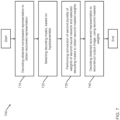
- FIG. 5 is a flowchart of a method 500 of multi-rate neural image compression, according to embodiments.
- one or more process blocks of FIG. 5 may be performed by the platform 120. In some implementations, one or more process blocks of FIG. 5 may be performed by another device or a group of devices separate from or including the platform 120, such as the user device 110.
- the method 500 includes selecting encoding masks, based on a hyperparameter.
- the method 500 includes performing a convolution of a first plurality of weights of a first neural network and the selected encoding masks to obtain first masked weights.
- the method 500 includes encoding an input image to obtain an encoded representation, using the first masked weights.
- the method 500 includes encoding the obtained encoded representation to obtain a compressed representation.
- FIG. 5 shows example blocks of the method 500
- the method 500 may include additional blocks, fewer blocks, different blocks, or differently arranged blocks than those depicted in FIG. 5 . Additionally, or alternatively, two or more of the blocks of the method 500 may be performed in parallel.
- FIG. 6 is a block diagram of an apparatus 600 for multi-rate neural image compression, according to embodiments.
- the apparatus 600 includes first selecting code 610, first performing code 620, first encoding code 630 and second encoding code 640.
- the first selecting code 610 is configured to cause at least one processor to select encoding masks, based on a hyperparameter.
- the first performing code 620 is configured to cause the at least one processor to perform a convolution of a first plurality of weights of a first neural network and the selected encoding masks to obtain first masked weights.
- the first encoding code 630 is configured to cause the at least one processor to encode an input image to obtain an encoded representation, using the first masked weights.
- the second encoding code 640 is configured to cause the at least one processor to encode the obtained encoded representation to obtain a compressed representation.
- FIG. 7 is a flowchart of a method 700 of multi-rate neural image decompression, according to embodiments.
- one or more process blocks of FIG. 7 may be performed by the platform 120. In some implementations, one or more process blocks of FIG. 7 may be performed by another device or a group of devices separate from or including the platform 120, such as the user device 110.
- the method 700 includes decoding the obtained compressed representation to obtain a recovered representation.
- the method 700 includes selecting decoding masks, based on the hyperparameter.
- the method 700 includes performing a convolution of a second plurality of weights of a second neural network and the selected decoding masks to obtain second masked weights.
- the method 700 includes decoding the obtained recovered representation to reconstruct an output image, using the second masked weights.
- Each of the encoding masks and the decoding masks may be partitioned into blocks, and each item in a respective one of the blocks may have a same binary value.
- the first neural network and the second neural network may be trained by updating one or more of the first plurality of weights and the second plurality of weights that are not respectively masked by the encoding masks and the decoding masks, to minimize a rate-distortion loss that is determined based on the input image, the output image and the compressed representation, pruning the updated one or more of the first plurality of weights and the second plurality of weights not respectively masked by the encoding masks and the decoding masks, to obtain binary pruning masks indicating which of the first plurality of weights and the second plurality of weights are pruned, updating at least one of the first plurality of weights and the second plurality of weights that are not respectively masked by the encoding masks, the decoding masks and the obtained binary pruning masks, to minimize the rate-distortion loss, and updating the encoding masks and the decoding masks, based on the obtained binary pruning masks.
- the pruning may include determining a pruning loss for each of the blocks into which each of the encoding masks and the decoding masks is partitioned, ranking the blocks in an ascending order, based on the determined pruning loss for each of the blocks, and setting two or more of the first plurality of weights and the second plurality of weights that corresponds to a plurality of the blocks that is top down among the ranked blocks until a stop criterion is reached.
- Each of the encoding masks and the decoding masks may have a randomly distributed binary value.
- Each of the encoding masks and the decoding masks may be partitioned into columns, rows or channels, and each item in a respective one of the columns, rows or channels may have a same binary value.
- FIG. 7 shows example blocks of the method 700
- the method 700 may include additional blocks, fewer blocks, different blocks, or differently arranged blocks than those depicted in FIG. 7 . Additionally, or alternatively, two or more of the blocks of the method 700 may be performed in parallel.
- FIG. 8 is a block diagram of an apparatus 800 for multi-rate neural image decompression, according to embodiments.
- the apparatus 800 includes first decoding code 810, second selecting code 820, second performing code 830 and second decoding code 840.
- the first decoding code 810 is configured to cause the at least one processor to decode the obtained compressed representation to obtain a recovered representation.
- the second selecting code 820 is configured to cause the at least one processor to select decoding masks, based on the hyperparameter.
- the second performing code 830 is configured to cause the at least one processor to perform a convolution of a second plurality of weights of a second neural network and the selected decoding masks to obtain second masked weights.
- the second decoding code 840 is configured to cause the at least one processor to decode the obtained recovered representation to reconstruct an output image, using the second masked weights.
- Each of the encoding masks and the decoding masks may be partitioned into blocks, and each item in a respective one of the blocks may have a same binary value.
- the first neural network and the second neural network may be trained by updating one or more of the first plurality of weights and the second plurality of weights that are not respectively masked by the encoding masks and the decoding masks, to minimize a rate-distortion loss that is determined based on the input image, the output image and the compressed representation, pruning the updated one or more of the first plurality of weights and the second plurality of weights not respectively masked by the encoding masks and the decoding masks, to obtain binary pruning masks indicating which of the first plurality of weights and the second plurality of weights are pruned, updating at least one of the first plurality of weights and the second plurality of weights that are not respectively masked by the encoding masks, the decoding masks and the obtained binary pruning masks, to minimize the rate-distortion loss, and updating the encoding masks and the decoding masks, based on the obtained binary pruning masks.
- the pruning may include determining a pruning loss for each of the blocks into which each of the encoding masks and the decoding masks is partitioned, ranking the blocks in an ascending order, based on the determined pruning loss for each of the blocks, and setting two or more of the first plurality of weights and the second plurality of weights that corresponds to a plurality of the blocks that is top down among the ranked blocks until a stop criterion is reached.
- Each of the encoding masks and the decoding masks may have a randomly distributed binary value.
- Each of the encoding masks and the decoding masks may be partitioned into columns, rows or channels, and each item in a respective one of the columns, rows or channels may have a same binary value.
- the embodiments described herein use only one model instance to achieve multi-rate compression effect with multiple binary masks.
- Two training frameworks may be used to learn the model instance and masks, which may have a block-wise micro-structure.
- a prune-and-grow training framework may be to learn the model instance and general and flexible binary masks.
- the embodiments described herein may largely reduce deployment storage to achieve multi-rate compression, and use a flexible and general framework that accommodates various types of NIC models.
- the structured and micro-structured masks provide an additional benefit of computation reduction.
- the term component is intended to be broadly construed as hardware, firmware, or a combination of hardware and software.
Landscapes
- Engineering & Computer Science (AREA)
- Theoretical Computer Science (AREA)
- Physics & Mathematics (AREA)
- Software Systems (AREA)
- General Engineering & Computer Science (AREA)
- Computing Systems (AREA)
- General Physics & Mathematics (AREA)
- General Health & Medical Sciences (AREA)
- Artificial Intelligence (AREA)
- Evolutionary Computation (AREA)
- Computational Linguistics (AREA)
- Molecular Biology (AREA)
- Biophysics (AREA)
- Biomedical Technology (AREA)
- Data Mining & Analysis (AREA)
- Mathematical Physics (AREA)
- Life Sciences & Earth Sciences (AREA)
- Health & Medical Sciences (AREA)
- Multimedia (AREA)
- Signal Processing (AREA)
- Compression Or Coding Systems Of Tv Signals (AREA)
- Compression Of Band Width Or Redundancy In Fax (AREA)
Claims (7)
- Verfahren (500) zur neuronalen Bildkompression mit mehreren Raten, wobei das Verfahren von mindestens einem Prozessor durchgeführt wird und das Verfahren umfasst:Auswählen (510) von Kodiermasken auf der Grundlage eines Hyperparameters;Maskieren einer ersten Vielzahl von Gewichten eines ersten neuronalen Netzes unter Verwendung der ausgewählten Kodiermasken zum Erhalten erster maskierter Gewichte des ersten neuronalen Netzes;Kodieren (530), durch das neuronale Netz, eines Eingabebildes zum Erhalten einer kodierten Darstellung unter Verwendung der ersten maskierten Gewichte des ersten neuronalen Netzes; undKodieren (540) der erhaltenen kodierten Darstellung zum Erhalten einer komprimierte Darstellung,ferner umfassend:Dekodieren der erhaltenen komprimierten Darstellung zum Erhalten einer wiederhergestellten Darstellung;Auswählen von Dekodiermasken auf der Grundlage des Hyperparameters;Maskieren einer zweiten Vielzahl von Gewichten eines zweiten neuronalen Netzes unter Verwendung der ausgewählten Dekodiermasken zum Erhalten von zweiten maskierten Gewichten; undDekodieren, durch das zweite neuronale Netz, der erhaltenen wiederhergestellten Darstellung zum Rekonstruieren des Eingabebildes unter Verwendung der zweiten maskierten Gewichte,wobei jede der Kodiermasken und der Dekodiermasken in Blöcke unterteilt ist, undjedes Element in einem jeweiligen der Blöcke denselben Binärwert hat,wobei das erste neuronale Netz und das zweite neuronale Netz durch folgende Vorgänge trainiert werden:Aktualisieren einer oder mehrerer der ersten Vielzahl von Gewichten und der zweiten Vielzahl von Gewichten, die nicht durch die Kodiermasken bzw. die Dekodiermasken maskiert sind, zum Minimieren eines Ratenverzerrungsverlustes, der auf der Grundlage des Eingabebildes, des rekonstruierten Eingabebildes und der komprimierten Darstellung bestimmt wird;Beschneiden der aktualisierten einen oder mehreren der ersten Vielzahl von Gewichten und der zweiten Vielzahl von Gewichten, die nicht durch die Kodiermasken bzw. die Dekodiermasken maskiert sind, zum Erhalten von binären Beschneidungsmasken, die angeben, welche der ersten Vielzahl von Gewichten und der zweiten Vielzahl von Gewichten beschnitten werden, wobei das Beschneiden umfasst:Bestimmen eines Beschneidungsverlustes für jeden der Blöcke, in die jede der Kodiermasken und der Dekodiermasken unterteilt ist;Reihen der Blöcke in einer aufsteigenden Reihenfolge auf der Grundlage des bestimmten Beschneidungsverlustes für jeden der Blöcke; undBeschneiden der Blöcke von oben nach unten, bis ein Stoppkriterium erreicht ist, indem die Gewichte in den beschnittenen Blöcken auf null gesetzt werden;Aktualisieren mindestens eines der ersten Vielzahl von Gewichten und der zweiten Vielzahl von Gewichten, die nicht durch die Kodiermasken, die Dekodiermasken bzw. die erhaltenen binären Beschneidungsmasken maskiert sind, zum Minimieren des Ratenverzerrungsverlustes; undAktualisieren der Kodiermasken und der Dekodiermasken auf der Grundlage der erhaltenen binären Beschneidungsmasken.
- Verfahren nach Anspruch 1, wobei jede der Kodiermasken und der Dekodiermasken einen zufällig verteilten Binärwert hat.
- Verfahren nach Anspruch 1, wobei jede der Kodiermasken und der Dekodiermasken in Spalten, Zeilen oder Kanäle unterteilt ist, und
jedes Element in einer jeweiligen der Spalten, der Zeilen oder der Kanäle denselben Binärwert hat. - Vorrichtung für neuronale Bildkompression mit mehreren Raten, wobei die Vorrichtung umfasst:mindestens einen Speicher, der zum Speichern von Programmcode ausgelegt ist; undmindestens einen Prozessor, der dafür ausgelegt ist, den Programmcode zu lesen und einen Betrieb entsprechend den Anweisungen des Programmcodes durchzuführen, wobei der Programmcode umfasst:ersten Auswahlcode, der dafür ausgelegt ist, den mindestens einen Prozessor zu veranlassen, Kodiermasken auf der Grundlage eines Hyperparameters auszuwählen;ersten Ausführungscode, der dafür ausgelegt ist, den mindestens einen Prozessor zu veranlassen, eine erste Vielzahl von Gewichten eines ersten neuronalen Netzes unter Verwendung der ausgewählten Kodiermasken zum Erhalten von ersten maskierten Gewichten des ersten neuronalen Netzes zu maskieren;ersten Kodierungscode, der dafür ausgelegt ist, den mindestens einen Prozessor zu veranlassen, ein Eingabebild mit dem neuronalen Netz zum Erhalten einer kodierten Darstellung unter Verwendung der ersten maskierten Gewichte zu kodieren; undzweiten Kodierungscode, der dafür ausgelegt ist, den mindestens einen Prozessor zu veranlassen, die erhaltene kodierte Darstellung zum Erhalten einer komprimierten Darstellung zu kodieren,wobei der Programmcode ferner umfasst:ersten Dekodierungscode, der dafür ausgelegt ist, den mindestens einen Prozessor zu veranlassen, die erhaltene komprimierte Darstellung zum Erhalten einer wiederhergestellten Darstellung zu dekodieren;zweiten Auswahlcode, der dafür ausgelegt ist, den mindestens einen Prozessor zu veranlassen, Dekodiermasken auf der Grundlage des Hyperparameters auszuwählen;zweiten Ausführungscode, der dafür ausgelegt ist, den mindestens einen Prozessor zu veranlassen, eine zweite Vielzahl von Gewichten eines zweiten neuronalen Netzes unter Verwendung der ausgewählten Dekodiermasken zum Erhalten von zweiten maskierten Gewichten zu maskieren; undzweiten Dekodierungscode, der dafür ausgelegt ist, den mindestens einen Prozessor zu veranlassen, durch das zweite neuronale Netz die erhaltene wiederhergestellte Darstellung zum Rekonstruieren des Eingabebildes unter Verwendung der zweiten maskierten Gewichte zu dekodieren,wobei jede der Kodiermasken und der Dekodiermasken in Blöcke unterteilt ist, undjedes Element in einem jeweiligen der Blöcke denselben Binärwert hat,wobei der Programmcode ferner Code umfasst, der dafür ausgelegt ist, den mindestens einen Prozessor zu veranlassen, das erste neuronale Netz und das zweite neuronale Netz durch folgende Vorgänge zu trainieren:Aktualisieren, durch den mindestens einen Prozessor, einer oder mehrerer der ersten Vielzahl von Gewichten und der zweiten Vielzahl von Gewichten, die nicht durch die Kodiermasken bzw. die Dekodiermasken maskiert sind, zum Minimieren eines Ratenverzerrungsverlustes, der auf der Grundlage des Eingabebildes, des rekonstruierten Eingabebildes und der komprimierten Darstellung bestimmt wird;Beschneiden, durch den mindestens einen Prozessor, der aktualisierten einen oder mehreren der ersten Vielzahl von Gewichten und der zweiten Vielzahl von Gewichten, die nicht durch die Kodiermasken bzw. die Dekodiermasken maskiert sind, zum Erhalten von binären Beschneidungsmasken, die angeben, welche der ersten Vielzahl von Gewichten und der zweiten Vielzahl von Gewichten beschnitten werden, wobei das Beschneiden umfasst:Bestimmen, durch den mindestens einen Prozessor, eines Beschneidungsverlustes für jeden der Blöcke, in die jede der Kodiermasken und der Dekodiermasken unterteilt ist;Reihen, durch den mindestens einen Prozessor, der Blöcke in einer aufsteigenden Reihenfolge auf der Grundlage des bestimmten Beschneidungsverlustes für jeden der Blöcke; undBeschneiden, durch den mindestens einen Prozessor, der Blöcke von oben nach unten, bis ein Stoppkriterium erreicht ist, indem die Gewichte in den beschnittenen Blöcken auf null gesetzt werden;Aktualisieren, durch den mindestens einen Prozessor, mindestens eines der ersten Vielzahl von Gewichten und der zweiten Vielzahl von Gewichten, die nicht durch die Kodiermasken, die Dekodiermasken bzw. die erhaltenen binären Beschneidungsmasken maskiert sind, zum Minimieren des Ratenverzerrungsverlustes; undAktualisieren, durch den mindestens einen Prozessor, der Kodiermasken und der Dekodiermasken auf der Grundlage der erhaltenen binären Beschneidungsmasken.
- Vorrichtung nach Anspruch 4, wobei jede der Kodiermasken und der Dekodiermasken einen zufällig verteilten Binärwert hat.
- Vorrichtung nach Anspruch 4, wobei jede der Kodiermasken und der Dekodiermasken in Spalten, Zeilen oder Kanäle unterteilt ist, und
jedes Element in einer jeweiligen der Spalten, der Zeilen oder der Kanäle denselben Binärwert hat. - Nichtflüchtiges, computerlesbares Medium, das Anweisungen speichert, die, wenn sie von mindestens einem Prozessor für neuronale Bildkompression mit mehreren Raten ausgeführt werden, den mindestens einen Prozessor veranlassen, das Verfahren nach einem der Ansprüche 1 bis 3 durchzuführen.
Applications Claiming Priority (4)
| Application Number | Priority Date | Filing Date | Title |
|---|---|---|---|
| US202063045341P | 2020-06-29 | 2020-06-29 | |
| US202063087519P | 2020-10-05 | 2020-10-05 | |
| US17/242,874 US20210406691A1 (en) | 2020-06-29 | 2021-04-28 | Method and apparatus for multi-rate neural image compression with micro-structured masks |
| PCT/US2021/030413 WO2022005594A1 (en) | 2020-06-29 | 2021-05-03 | Method and apparatus for multi-rate neural image compression with micro-structured masks |
Publications (3)
| Publication Number | Publication Date |
|---|---|
| EP4014159A1 EP4014159A1 (de) | 2022-06-22 |
| EP4014159A4 EP4014159A4 (de) | 2022-11-23 |
| EP4014159B1 true EP4014159B1 (de) | 2024-11-06 |
Family
ID=79031177
Family Applications (1)
| Application Number | Title | Priority Date | Filing Date |
|---|---|---|---|
| EP21832117.2A Active EP4014159B1 (de) | 2020-06-29 | 2021-05-03 | Verfahren und vorrichtung zur multiratenkompression neuraler bilder mit mikrostrukturierten masken |
Country Status (6)
| Country | Link |
|---|---|
| US (1) | US20210406691A1 (de) |
| EP (1) | EP4014159B1 (de) |
| JP (1) | JP7323715B2 (de) |
| KR (1) | KR102899664B1 (de) |
| CN (1) | CN114631119B (de) |
| WO (1) | WO2022005594A1 (de) |
Families Citing this family (5)
| Publication number | Priority date | Publication date | Assignee | Title |
|---|---|---|---|---|
| US20220051101A1 (en) * | 2020-08-14 | 2022-02-17 | Tencent America LLC | Method and apparatus for compressing and accelerating multi-rate neural image compression model by micro-structured nested masks and weight unification |
| CN118696318A (zh) * | 2022-03-04 | 2024-09-24 | 英特尔公司 | 基于硬件感知稀疏性模式加速深度学习推理的方法和装置 |
| WO2025127957A1 (en) * | 2023-12-12 | 2025-06-19 | Huawei Technologies Co., Ltd. | Method for encoding, decoding, training and related device |
| CN117857795B (zh) * | 2024-03-06 | 2024-05-31 | 中国传媒大学 | 生成-熵估计联合的极限图像压缩、解压缩方法及系统 |
| CN119743612B (zh) * | 2024-12-16 | 2025-11-07 | 西安电子科技大学 | 面向语义通信不依赖发送端模型的生成式图像压缩系统及方法 |
Family Cites Families (48)
| Publication number | Priority date | Publication date | Assignee | Title |
|---|---|---|---|---|
| US6798914B1 (en) | 1999-05-07 | 2004-09-28 | Galaxy Ip Source, Llc | Neural-network-based method of image compression |
| US9905200B2 (en) * | 2015-10-19 | 2018-02-27 | Yahoo Holdings, Inc. | Computerized system and method for automatically creating and applying a filter to alter the display of rendered media |
| US10354168B2 (en) * | 2016-04-11 | 2019-07-16 | A2Ia S.A.S. | Systems and methods for recognizing characters in digitized documents |
| US10623775B1 (en) * | 2016-11-04 | 2020-04-14 | Twitter, Inc. | End-to-end video and image compression |
| CN110892419B (zh) * | 2017-05-16 | 2023-08-08 | 谷歌有限责任公司 | 停止码容忍的图像压缩神经网络 |
| CN110915215B (zh) | 2017-05-26 | 2024-03-08 | 谷歌有限责任公司 | 使用神经网络的图块化图像压缩 |
| CN111213379B (zh) * | 2017-10-16 | 2023-11-21 | 数字洞察力有限公司 | 用于将图像编码/解码的方法、装置和存储比特流的记录介质 |
| US10924755B2 (en) | 2017-10-19 | 2021-02-16 | Arizona Board Of Regents On Behalf Of Arizona State University | Real time end-to-end learning system for a high frame rate video compressive sensing network |
| KR102285064B1 (ko) * | 2017-10-30 | 2021-08-04 | 한국전자통신연구원 | 은닉 변수를 이용하는 영상 및 신경망 압축을 위한 방법 및 장치 |
| CN108012157B (zh) * | 2017-11-27 | 2020-02-04 | 上海交通大学 | 用于视频编码分数像素插值的卷积神经网络的构建方法 |
| US11902369B2 (en) * | 2018-02-09 | 2024-02-13 | Preferred Networks, Inc. | Autoencoder, data processing system, data processing method and non-transitory computer readable medium |
| US10855986B2 (en) * | 2018-05-29 | 2020-12-01 | Qualcomm Incorporated | Bandwidth compression for neural network systems |
| US11915144B2 (en) | 2018-10-02 | 2024-02-27 | Nokia Technologies Oy | Apparatus, a method and a computer program for running a neural network |
| EP3952306B1 (de) | 2018-10-02 | 2025-02-19 | Nokia Technologies Oy | Vorrichtung, verfahren und computerprogramm zur video-kodierung |
| WO2020080827A1 (en) * | 2018-10-19 | 2020-04-23 | Samsung Electronics Co., Ltd. | Ai encoding apparatus and operation method of the same, and ai decoding apparatus and operation method of the same |
| US10810435B2 (en) * | 2018-11-07 | 2020-10-20 | Adobe Inc. | Segmenting objects in video sequences |
| TWI694414B (zh) | 2018-12-18 | 2020-05-21 | 國立成功大學 | 卷積神經網路分析方法、電腦程式產品與電子裝置 |
| US11335034B2 (en) * | 2019-01-16 | 2022-05-17 | Disney Enterprises, Inc. | Systems and methods for image compression at multiple, different bitrates |
| US11676035B2 (en) * | 2019-01-23 | 2023-06-13 | Deepmind Technologies Limited | Learning non-differentiable weights of neural networks using evolutionary strategies |
| EP3924889A4 (de) * | 2019-02-15 | 2022-11-09 | Nokia Technologies Oy | Verfahren, vorrichtung und computerprogrammprodukt zur videocodierung und videodecodierung |
| US10594338B1 (en) * | 2019-03-18 | 2020-03-17 | WaveOne Inc. | Adaptive quantization |
| US10886943B2 (en) * | 2019-03-18 | 2021-01-05 | Samsung Electronics Co., Ltd | Method and apparatus for variable rate compression with a conditional autoencoder |
| US11257483B2 (en) * | 2019-03-29 | 2022-02-22 | Intel Corporation | On-device neural network adaptation with binary mask learning for language understanding systems |
| CN111818346B (zh) * | 2019-04-11 | 2023-04-18 | 富士通株式会社 | 图像编码方法和装置、图像解码方法和装置 |
| US10909728B1 (en) * | 2019-05-01 | 2021-02-02 | Amazon Technologies, Inc. | Learned lossy image compression codec |
| CN110189249B (zh) * | 2019-05-24 | 2022-02-18 | 深圳市商汤科技有限公司 | 一种图像处理方法及装置、电子设备和存储介质 |
| KR102837710B1 (ko) * | 2019-06-05 | 2025-07-22 | 삼성전자주식회사 | 영상의 ai 부호화 및 ai 복호화 방법, 및 장치 |
| US11455755B2 (en) * | 2019-09-05 | 2022-09-27 | Siemens Medical Solutions Usa, Inc. | Methods and apparatus for neural network based image reconstruction |
| US12039448B2 (en) * | 2019-09-05 | 2024-07-16 | Huawei Technologies Co., Ltd. | Selective neural network pruning by masking filters using scaling factors |
| US11445222B1 (en) * | 2019-09-30 | 2022-09-13 | Isize Limited | Preprocessing image data |
| KR102688688B1 (ko) * | 2019-10-10 | 2024-07-25 | 엘지전자 주식회사 | 영상을 압축 또는 복원하기 위한 방법 및 장치 |
| KR102287947B1 (ko) * | 2019-10-28 | 2021-08-09 | 삼성전자주식회사 | 영상의 ai 부호화 및 ai 복호화 방법, 및 장치 |
| KR102436512B1 (ko) * | 2019-10-29 | 2022-08-25 | 삼성전자주식회사 | 부호화 방법 및 그 장치, 복호화 방법 및 그 장치 |
| US20210132688A1 (en) * | 2019-10-31 | 2021-05-06 | Nvidia Corporation | Gaze determination using one or more neural networks |
| KR20210067788A (ko) * | 2019-11-29 | 2021-06-08 | 삼성전자주식회사 | 전자 장치, 시스템 및 그 제어 방법 |
| JP7479137B2 (ja) * | 2019-12-03 | 2024-05-08 | キヤノン株式会社 | 信号処理装置および信号処理方法、システム並びにプログラム |
| US10965948B1 (en) * | 2019-12-13 | 2021-03-30 | Amazon Technologies, Inc. | Hierarchical auto-regressive image compression system |
| US20210326710A1 (en) * | 2020-04-16 | 2021-10-21 | Tencent America LLC | Neural network model compression |
| WO2021220008A1 (en) * | 2020-04-29 | 2021-11-04 | Deep Render Ltd | Image compression and decoding, video compression and decoding: methods and systems |
| CN113570508A (zh) * | 2020-04-29 | 2021-10-29 | 上海耕岩智能科技有限公司 | 图像修复方法及装置、存储介质、终端 |
| CN111787323B (zh) * | 2020-05-23 | 2021-09-03 | 清华大学 | 一种基于对抗学习的可变比特率生成式压缩方法 |
| CN115943629A (zh) * | 2020-06-04 | 2023-04-07 | 交互数字Vc控股法国有限公司 | 视频编码中基于神经网络的滤波器 |
| US12524674B2 (en) * | 2020-06-10 | 2026-01-13 | Google Llc | Subtask adaptable neural network |
| WO2021262053A1 (en) * | 2020-06-25 | 2021-12-30 | Telefonaktiebolaget Lm Ericsson (Publ) | Method and system for image compressing and coding with deep learning |
| US11622117B2 (en) * | 2020-07-21 | 2023-04-04 | Tencent America LLC | Method and apparatus for rate-adaptive neural image compression with adversarial generators |
| US20220051101A1 (en) * | 2020-08-14 | 2022-02-17 | Tencent America LLC | Method and apparatus for compressing and accelerating multi-rate neural image compression model by micro-structured nested masks and weight unification |
| US20220051102A1 (en) * | 2020-08-14 | 2022-02-17 | Tencent America LLC | Method and apparatus for multi-rate neural image compression with stackable nested model structures and micro-structured weight unification |
| US12206869B2 (en) * | 2020-11-16 | 2025-01-21 | Qualcomm Incorporated | Skip convolutions for efficient video processing |
-
2021
- 2021-04-28 US US17/242,874 patent/US20210406691A1/en not_active Abandoned
- 2021-05-03 CN CN202180006013.8A patent/CN114631119B/zh active Active
- 2021-05-03 KR KR1020227008432A patent/KR102899664B1/ko active Active
- 2021-05-03 WO PCT/US2021/030413 patent/WO2022005594A1/en not_active Ceased
- 2021-05-03 EP EP21832117.2A patent/EP4014159B1/de active Active
- 2021-05-03 JP JP2022528274A patent/JP7323715B2/ja active Active
Also Published As
| Publication number | Publication date |
|---|---|
| CN114631119A (zh) | 2022-06-14 |
| JP2023501730A (ja) | 2023-01-18 |
| US20210406691A1 (en) | 2021-12-30 |
| EP4014159A4 (de) | 2022-11-23 |
| WO2022005594A1 (en) | 2022-01-06 |
| KR20220045217A (ko) | 2022-04-12 |
| KR102899664B1 (ko) | 2025-12-15 |
| CN114631119B (zh) | 2025-06-03 |
| EP4014159A1 (de) | 2022-06-22 |
| JP7323715B2 (ja) | 2023-08-08 |
Similar Documents
| Publication | Publication Date | Title |
|---|---|---|
| EP4014159B1 (de) | Verfahren und vorrichtung zur multiratenkompression neuraler bilder mit mikrostrukturierten masken | |
| KR102854514B1 (ko) | 마이크로-구조화된 가중치 프루닝 및 가중치 통합을 이용한 신경 네트워크 모델 압축을 위한 방법 및 장치 | |
| US11622117B2 (en) | Method and apparatus for rate-adaptive neural image compression with adversarial generators | |
| JP7418570B2 (ja) | スタック可能ネスト化モデル構造を用いたマルチレート・ニューラルイメージ圧縮のための方法および装置 | |
| EP4115610B1 (de) | Verfahren und vorrichtung zur adaptiven neuronalen bildkompression mit ratensteuerung durch metalernen | |
| KR102709771B1 (ko) | 메타 러닝에 의한 유연한 하이퍼프라이어 모델을 갖는 적응 이미지 압축을 위한 방법 및 장치 | |
| JP7697033B2 (ja) | ニューラル画像圧縮における反復的なコンテンツ適応型オンライントレーニングのためのシステム、方法、及びコンピュータプログラム | |
| CN114667544B (zh) | 多速率神经图像压缩方法和装置 | |
| US12159438B2 (en) | Substitutional input optimization for adaptive neural image compression with smooth quality control | |
| JP7342265B2 (ja) | μ構造化ネストマスク及び重み単一化によるマルチレートニューラル画像圧縮モデルを圧縮及び加速するための方法及び装置 | |
| JP2024512652A (ja) | ニューラル画像圧縮における複数ブロック用のコンテンツ適応型オンライン訓練のためのシステム、方法、およびコンピュータプログラム | |
| HK40072069A (en) | Multi rate neural image compression method, device and electronic equipment | |
| HK40072071B (zh) | 多比特率神经图像压缩方法及设备以及存储介质 | |
| HK40072071A (en) | Multi bit rate neural image compression method, equipment and storage medium | |
| HK40072069B (zh) | 多速率神经图像压缩方法、装置以及电子设备 |
Legal Events
| Date | Code | Title | Description |
|---|---|---|---|
| STAA | Information on the status of an ep patent application or granted ep patent |
Free format text: STATUS: THE INTERNATIONAL PUBLICATION HAS BEEN MADE |
|
| PUAI | Public reference made under article 153(3) epc to a published international application that has entered the european phase |
Free format text: ORIGINAL CODE: 0009012 |
|
| STAA | Information on the status of an ep patent application or granted ep patent |
Free format text: STATUS: REQUEST FOR EXAMINATION WAS MADE |
|
| 17P | Request for examination filed |
Effective date: 20220317 |
|
| AK | Designated contracting states |
Kind code of ref document: A1 Designated state(s): AL AT BE BG CH CY CZ DE DK EE ES FI FR GB GR HR HU IE IS IT LI LT LU LV MC MK MT NL NO PL PT RO RS SE SI SK SM TR |
|
| REG | Reference to a national code |
Ref country code: DE Ref legal event code: R079 Free format text: PREVIOUS MAIN CLASS: G06K0009000000 Ipc: G06N0003040000 Ref document number: 602021021587 Country of ref document: DE |
|
| A4 | Supplementary search report drawn up and despatched |
Effective date: 20221024 |
|
| RIC1 | Information provided on ipc code assigned before grant |
Ipc: H04N 19/132 20140101ALN20221018BHEP Ipc: H04N 19/117 20140101ALN20221018BHEP Ipc: H04N 19/196 20140101ALI20221018BHEP Ipc: H04N 19/192 20140101ALI20221018BHEP Ipc: H04N 19/176 20140101ALI20221018BHEP Ipc: H04N 19/147 20140101ALI20221018BHEP Ipc: H04N 19/102 20140101ALI20221018BHEP Ipc: G06N 3/08 20060101ALI20221018BHEP Ipc: G06N 3/04 20060101AFI20221018BHEP |
|
| DAV | Request for validation of the european patent (deleted) | ||
| DAX | Request for extension of the european patent (deleted) | ||
| STAA | Information on the status of an ep patent application or granted ep patent |
Free format text: STATUS: EXAMINATION IS IN PROGRESS |
|
| 17Q | First examination report despatched |
Effective date: 20231116 |
|
| REG | Reference to a national code |
Ref legal event code: R079 Free format text: PREVIOUS MAIN CLASS: G06N0003040000 Ipc: G06N0003045500 Ref country code: DE Ref legal event code: R079 Ref document number: 602021021587 Country of ref document: DE Free format text: PREVIOUS MAIN CLASS: G06N0003040000 Ipc: G06N0003045500 |
|
| GRAP | Despatch of communication of intention to grant a patent |
Free format text: ORIGINAL CODE: EPIDOSNIGR1 |
|
| STAA | Information on the status of an ep patent application or granted ep patent |
Free format text: STATUS: GRANT OF PATENT IS INTENDED |
|
| RIC1 | Information provided on ipc code assigned before grant |
Ipc: H04N 19/132 20140101ALN20240705BHEP Ipc: H04N 19/117 20140101ALN20240705BHEP Ipc: G06N 3/084 20230101ALN20240705BHEP Ipc: G06N 3/047 20230101ALN20240705BHEP Ipc: G06N 3/0464 20230101ALN20240705BHEP Ipc: H04N 19/196 20140101ALI20240705BHEP Ipc: H04N 19/192 20140101ALI20240705BHEP Ipc: H04N 19/176 20140101ALI20240705BHEP Ipc: H04N 19/147 20140101ALI20240705BHEP Ipc: H04N 19/102 20140101ALI20240705BHEP Ipc: G06N 3/088 20230101ALI20240705BHEP Ipc: G06N 3/082 20230101ALI20240705BHEP Ipc: G06N 3/0455 20230101AFI20240705BHEP |
|
| INTG | Intention to grant announced |
Effective date: 20240726 |
|
| GRAS | Grant fee paid |
Free format text: ORIGINAL CODE: EPIDOSNIGR3 |
|
| GRAA | (expected) grant |
Free format text: ORIGINAL CODE: 0009210 |
|
| STAA | Information on the status of an ep patent application or granted ep patent |
Free format text: STATUS: THE PATENT HAS BEEN GRANTED |
|
| AK | Designated contracting states |
Kind code of ref document: B1 Designated state(s): AL AT BE BG CH CY CZ DE DK EE ES FI FR GB GR HR HU IE IS IT LI LT LU LV MC MK MT NL NO PL PT RO RS SE SI SK SM TR |
|
| REG | Reference to a national code |
Ref country code: GB Ref legal event code: FG4D |
|
| REG | Reference to a national code |
Ref country code: CH Ref legal event code: EP |
|
| REG | Reference to a national code |
Ref country code: DE Ref legal event code: R096 Ref document number: 602021021587 Country of ref document: DE |
|
| REG | Reference to a national code |
Ref country code: IE Ref legal event code: FG4D |
|
| REG | Reference to a national code |
Ref country code: LT Ref legal event code: MG9D |
|
| REG | Reference to a national code |
Ref country code: NL Ref legal event code: MP Effective date: 20241106 |
|
| PG25 | Lapsed in a contracting state [announced via postgrant information from national office to epo] |
Ref country code: IS Free format text: LAPSE BECAUSE OF FAILURE TO SUBMIT A TRANSLATION OF THE DESCRIPTION OR TO PAY THE FEE WITHIN THE PRESCRIBED TIME-LIMIT Effective date: 20250306 Ref country code: HR Free format text: LAPSE BECAUSE OF FAILURE TO SUBMIT A TRANSLATION OF THE DESCRIPTION OR TO PAY THE FEE WITHIN THE PRESCRIBED TIME-LIMIT Effective date: 20241106 Ref country code: PT Free format text: LAPSE BECAUSE OF FAILURE TO SUBMIT A TRANSLATION OF THE DESCRIPTION OR TO PAY THE FEE WITHIN THE PRESCRIBED TIME-LIMIT Effective date: 20250306 |
|
| PG25 | Lapsed in a contracting state [announced via postgrant information from national office to epo] |
Ref country code: FI Free format text: LAPSE BECAUSE OF FAILURE TO SUBMIT A TRANSLATION OF THE DESCRIPTION OR TO PAY THE FEE WITHIN THE PRESCRIBED TIME-LIMIT Effective date: 20241106 Ref country code: NL Free format text: LAPSE BECAUSE OF FAILURE TO SUBMIT A TRANSLATION OF THE DESCRIPTION OR TO PAY THE FEE WITHIN THE PRESCRIBED TIME-LIMIT Effective date: 20241106 |
|
| REG | Reference to a national code |
Ref country code: AT Ref legal event code: MK05 Ref document number: 1740178 Country of ref document: AT Kind code of ref document: T Effective date: 20241106 |
|
| PG25 | Lapsed in a contracting state [announced via postgrant information from national office to epo] |
Ref country code: BG Free format text: LAPSE BECAUSE OF FAILURE TO SUBMIT A TRANSLATION OF THE DESCRIPTION OR TO PAY THE FEE WITHIN THE PRESCRIBED TIME-LIMIT Effective date: 20241106 |
|
| PG25 | Lapsed in a contracting state [announced via postgrant information from national office to epo] |
Ref country code: ES Free format text: LAPSE BECAUSE OF FAILURE TO SUBMIT A TRANSLATION OF THE DESCRIPTION OR TO PAY THE FEE WITHIN THE PRESCRIBED TIME-LIMIT Effective date: 20241106 |
|
| PG25 | Lapsed in a contracting state [announced via postgrant information from national office to epo] |
Ref country code: NO Free format text: LAPSE BECAUSE OF FAILURE TO SUBMIT A TRANSLATION OF THE DESCRIPTION OR TO PAY THE FEE WITHIN THE PRESCRIBED TIME-LIMIT Effective date: 20250206 |
|
| PG25 | Lapsed in a contracting state [announced via postgrant information from national office to epo] |
Ref country code: GR Free format text: LAPSE BECAUSE OF FAILURE TO SUBMIT A TRANSLATION OF THE DESCRIPTION OR TO PAY THE FEE WITHIN THE PRESCRIBED TIME-LIMIT Effective date: 20250207 Ref country code: LV Free format text: LAPSE BECAUSE OF FAILURE TO SUBMIT A TRANSLATION OF THE DESCRIPTION OR TO PAY THE FEE WITHIN THE PRESCRIBED TIME-LIMIT Effective date: 20241106 Ref country code: AT Free format text: LAPSE BECAUSE OF FAILURE TO SUBMIT A TRANSLATION OF THE DESCRIPTION OR TO PAY THE FEE WITHIN THE PRESCRIBED TIME-LIMIT Effective date: 20241106 |
|
| PG25 | Lapsed in a contracting state [announced via postgrant information from national office to epo] |
Ref country code: PL Free format text: LAPSE BECAUSE OF FAILURE TO SUBMIT A TRANSLATION OF THE DESCRIPTION OR TO PAY THE FEE WITHIN THE PRESCRIBED TIME-LIMIT Effective date: 20241106 |
|
| PG25 | Lapsed in a contracting state [announced via postgrant information from national office to epo] |
Ref country code: RS Free format text: LAPSE BECAUSE OF FAILURE TO SUBMIT A TRANSLATION OF THE DESCRIPTION OR TO PAY THE FEE WITHIN THE PRESCRIBED TIME-LIMIT Effective date: 20250206 |
|
| PG25 | Lapsed in a contracting state [announced via postgrant information from national office to epo] |
Ref country code: SM Free format text: LAPSE BECAUSE OF FAILURE TO SUBMIT A TRANSLATION OF THE DESCRIPTION OR TO PAY THE FEE WITHIN THE PRESCRIBED TIME-LIMIT Effective date: 20241106 |
|
| PGFP | Annual fee paid to national office [announced via postgrant information from national office to epo] |
Ref country code: DE Payment date: 20250519 Year of fee payment: 5 |
|
| PG25 | Lapsed in a contracting state [announced via postgrant information from national office to epo] |
Ref country code: DK Free format text: LAPSE BECAUSE OF FAILURE TO SUBMIT A TRANSLATION OF THE DESCRIPTION OR TO PAY THE FEE WITHIN THE PRESCRIBED TIME-LIMIT Effective date: 20241106 |
|
| PGFP | Annual fee paid to national office [announced via postgrant information from national office to epo] |
Ref country code: GB Payment date: 20250522 Year of fee payment: 5 |
|
| PG25 | Lapsed in a contracting state [announced via postgrant information from national office to epo] |
Ref country code: EE Free format text: LAPSE BECAUSE OF FAILURE TO SUBMIT A TRANSLATION OF THE DESCRIPTION OR TO PAY THE FEE WITHIN THE PRESCRIBED TIME-LIMIT Effective date: 20241106 |
|
| PGFP | Annual fee paid to national office [announced via postgrant information from national office to epo] |
Ref country code: FR Payment date: 20250516 Year of fee payment: 5 |
|
| PG25 | Lapsed in a contracting state [announced via postgrant information from national office to epo] |
Ref country code: RO Free format text: LAPSE BECAUSE OF FAILURE TO SUBMIT A TRANSLATION OF THE DESCRIPTION OR TO PAY THE FEE WITHIN THE PRESCRIBED TIME-LIMIT Effective date: 20241106 |
|
| PG25 | Lapsed in a contracting state [announced via postgrant information from national office to epo] |
Ref country code: SK Free format text: LAPSE BECAUSE OF FAILURE TO SUBMIT A TRANSLATION OF THE DESCRIPTION OR TO PAY THE FEE WITHIN THE PRESCRIBED TIME-LIMIT Effective date: 20241106 |
|
| PG25 | Lapsed in a contracting state [announced via postgrant information from national office to epo] |
Ref country code: CZ Free format text: LAPSE BECAUSE OF FAILURE TO SUBMIT A TRANSLATION OF THE DESCRIPTION OR TO PAY THE FEE WITHIN THE PRESCRIBED TIME-LIMIT Effective date: 20241106 |
|
| PG25 | Lapsed in a contracting state [announced via postgrant information from national office to epo] |
Ref country code: IT Free format text: LAPSE BECAUSE OF FAILURE TO SUBMIT A TRANSLATION OF THE DESCRIPTION OR TO PAY THE FEE WITHIN THE PRESCRIBED TIME-LIMIT Effective date: 20241106 |
|
| REG | Reference to a national code |
Ref country code: DE Ref legal event code: R097 Ref document number: 602021021587 Country of ref document: DE |
|
| PG25 | Lapsed in a contracting state [announced via postgrant information from national office to epo] |
Ref country code: SE Free format text: LAPSE BECAUSE OF FAILURE TO SUBMIT A TRANSLATION OF THE DESCRIPTION OR TO PAY THE FEE WITHIN THE PRESCRIBED TIME-LIMIT Effective date: 20241106 |
|
| PLBE | No opposition filed within time limit |
Free format text: ORIGINAL CODE: 0009261 |
|
| STAA | Information on the status of an ep patent application or granted ep patent |
Free format text: STATUS: NO OPPOSITION FILED WITHIN TIME LIMIT |
|
| 26N | No opposition filed |
Effective date: 20250807 |
|
| REG | Reference to a national code |
Ref country code: CH Ref legal event code: H13 Free format text: ST27 STATUS EVENT CODE: U-0-0-H10-H13 (AS PROVIDED BY THE NATIONAL OFFICE) Effective date: 20251223 |
|
| PG25 | Lapsed in a contracting state [announced via postgrant information from national office to epo] |
Ref country code: LU Free format text: LAPSE BECAUSE OF NON-PAYMENT OF DUE FEES Effective date: 20250503 |
|
| PG25 | Lapsed in a contracting state [announced via postgrant information from national office to epo] |
Ref country code: CH Free format text: LAPSE BECAUSE OF NON-PAYMENT OF DUE FEES Effective date: 20250531 |
|
| PG25 | Lapsed in a contracting state [announced via postgrant information from national office to epo] |
Ref country code: MC Free format text: LAPSE BECAUSE OF FAILURE TO SUBMIT A TRANSLATION OF THE DESCRIPTION OR TO PAY THE FEE WITHIN THE PRESCRIBED TIME-LIMIT Effective date: 20241106 |