EP4012812B1 - Method for producing a battery - Google Patents
Method for producing a battery Download PDFInfo
- Publication number
- EP4012812B1 EP4012812B1 EP21200963.3A EP21200963A EP4012812B1 EP 4012812 B1 EP4012812 B1 EP 4012812B1 EP 21200963 A EP21200963 A EP 21200963A EP 4012812 B1 EP4012812 B1 EP 4012812B1
- Authority
- EP
- European Patent Office
- Prior art keywords
- liquid
- electrolytic solution
- air pressure
- battery
- battery case
- Prior art date
- Legal status (The legal status is an assumption and is not a legal conclusion. Google has not performed a legal analysis and makes no representation as to the accuracy of the status listed.)
- Active
Links
Images


Classifications
-
- H—ELECTRICITY
- H01—ELECTRIC ELEMENTS
- H01M—PROCESSES OR MEANS, e.g. BATTERIES, FOR THE DIRECT CONVERSION OF CHEMICAL ENERGY INTO ELECTRICAL ENERGY
- H01M50/00—Constructional details or processes of manufacture of the non-active parts of electrochemical cells other than fuel cells, e.g. hybrid cells
- H01M50/60—Arrangements or processes for filling or topping-up with liquids; Arrangements or processes for draining liquids from casings
- H01M50/609—Arrangements or processes for filling with liquid, e.g. electrolytes
- H01M50/627—Filling ports
-
- H—ELECTRICITY
- H01—ELECTRIC ELEMENTS
- H01M—PROCESSES OR MEANS, e.g. BATTERIES, FOR THE DIRECT CONVERSION OF CHEMICAL ENERGY INTO ELECTRICAL ENERGY
- H01M50/00—Constructional details or processes of manufacture of the non-active parts of electrochemical cells other than fuel cells, e.g. hybrid cells
- H01M50/60—Arrangements or processes for filling or topping-up with liquids; Arrangements or processes for draining liquids from casings
- H01M50/609—Arrangements or processes for filling with liquid, e.g. electrolytes
-
- H—ELECTRICITY
- H01—ELECTRIC ELEMENTS
- H01M—PROCESSES OR MEANS, e.g. BATTERIES, FOR THE DIRECT CONVERSION OF CHEMICAL ENERGY INTO ELECTRICAL ENERGY
- H01M10/00—Secondary cells; Manufacture thereof
- H01M10/04—Construction or manufacture in general
- H01M10/0431—Cells with wound or folded electrodes
-
- H—ELECTRICITY
- H01—ELECTRIC ELEMENTS
- H01M—PROCESSES OR MEANS, e.g. BATTERIES, FOR THE DIRECT CONVERSION OF CHEMICAL ENERGY INTO ELECTRICAL ENERGY
- H01M10/00—Secondary cells; Manufacture thereof
- H01M10/05—Accumulators with non-aqueous electrolyte
-
- H—ELECTRICITY
- H01—ELECTRIC ELEMENTS
- H01M—PROCESSES OR MEANS, e.g. BATTERIES, FOR THE DIRECT CONVERSION OF CHEMICAL ENERGY INTO ELECTRICAL ENERGY
- H01M10/00—Secondary cells; Manufacture thereof
- H01M10/05—Accumulators with non-aqueous electrolyte
- H01M10/058—Construction or manufacture
-
- H—ELECTRICITY
- H01—ELECTRIC ELEMENTS
- H01M—PROCESSES OR MEANS, e.g. BATTERIES, FOR THE DIRECT CONVERSION OF CHEMICAL ENERGY INTO ELECTRICAL ENERGY
- H01M10/00—Secondary cells; Manufacture thereof
- H01M10/05—Accumulators with non-aqueous electrolyte
- H01M10/058—Construction or manufacture
- H01M10/0585—Construction or manufacture of accumulators having only flat construction elements, i.e. flat positive electrodes, flat negative electrodes and flat separators
-
- H—ELECTRICITY
- H01—ELECTRIC ELEMENTS
- H01M—PROCESSES OR MEANS, e.g. BATTERIES, FOR THE DIRECT CONVERSION OF CHEMICAL ENERGY INTO ELECTRICAL ENERGY
- H01M10/00—Secondary cells; Manufacture thereof
- H01M10/42—Methods or arrangements for servicing or maintenance of secondary cells or secondary half-cells
- H01M10/48—Accumulators combined with arrangements for measuring, testing or indicating the condition of cells, e.g. the level or density of the electrolyte
- H01M10/484—Accumulators combined with arrangements for measuring, testing or indicating the condition of cells, e.g. the level or density of the electrolyte for measuring electrolyte level, electrolyte density or electrolyte conductivity
-
- H—ELECTRICITY
- H01—ELECTRIC ELEMENTS
- H01M—PROCESSES OR MEANS, e.g. BATTERIES, FOR THE DIRECT CONVERSION OF CHEMICAL ENERGY INTO ELECTRICAL ENERGY
- H01M50/00—Constructional details or processes of manufacture of the non-active parts of electrochemical cells other than fuel cells, e.g. hybrid cells
- H01M50/10—Primary casings; Jackets or wrappings
- H01M50/102—Primary casings; Jackets or wrappings characterised by their shape or physical structure
- H01M50/103—Primary casings; Jackets or wrappings characterised by their shape or physical structure prismatic or rectangular
-
- H—ELECTRICITY
- H01—ELECTRIC ELEMENTS
- H01M—PROCESSES OR MEANS, e.g. BATTERIES, FOR THE DIRECT CONVERSION OF CHEMICAL ENERGY INTO ELECTRICAL ENERGY
- H01M50/00—Constructional details or processes of manufacture of the non-active parts of electrochemical cells other than fuel cells, e.g. hybrid cells
- H01M50/60—Arrangements or processes for filling or topping-up with liquids; Arrangements or processes for draining liquids from casings
- H01M50/609—Arrangements or processes for filling with liquid, e.g. electrolytes
- H01M50/618—Pressure control
-
- H—ELECTRICITY
- H01—ELECTRIC ELEMENTS
- H01M—PROCESSES OR MEANS, e.g. BATTERIES, FOR THE DIRECT CONVERSION OF CHEMICAL ENERGY INTO ELECTRICAL ENERGY
- H01M10/00—Secondary cells; Manufacture thereof
- H01M10/05—Accumulators with non-aqueous electrolyte
- H01M10/058—Construction or manufacture
- H01M10/0587—Construction or manufacture of accumulators having only wound construction elements, i.e. wound positive electrodes, wound negative electrodes and wound separators
-
- H—ELECTRICITY
- H01—ELECTRIC ELEMENTS
- H01M—PROCESSES OR MEANS, e.g. BATTERIES, FOR THE DIRECT CONVERSION OF CHEMICAL ENERGY INTO ELECTRICAL ENERGY
- H01M2220/00—Batteries for particular applications
- H01M2220/20—Batteries in motive systems, e.g. vehicle, ship, plane
-
- H—ELECTRICITY
- H01—ELECTRIC ELEMENTS
- H01M—PROCESSES OR MEANS, e.g. BATTERIES, FOR THE DIRECT CONVERSION OF CHEMICAL ENERGY INTO ELECTRICAL ENERGY
- H01M50/00—Constructional details or processes of manufacture of the non-active parts of electrochemical cells other than fuel cells, e.g. hybrid cells
- H01M50/10—Primary casings; Jackets or wrappings
- H01M50/116—Primary casings; Jackets or wrappings characterised by the material
- H01M50/117—Inorganic material
- H01M50/119—Metals
-
- Y—GENERAL TAGGING OF NEW TECHNOLOGICAL DEVELOPMENTS; GENERAL TAGGING OF CROSS-SECTIONAL TECHNOLOGIES SPANNING OVER SEVERAL SECTIONS OF THE IPC; TECHNICAL SUBJECTS COVERED BY FORMER USPC CROSS-REFERENCE ART COLLECTIONS [XRACs] AND DIGESTS
- Y02—TECHNOLOGIES OR APPLICATIONS FOR MITIGATION OR ADAPTATION AGAINST CLIMATE CHANGE
- Y02E—REDUCTION OF GREENHOUSE GAS [GHG] EMISSIONS, RELATED TO ENERGY GENERATION, TRANSMISSION OR DISTRIBUTION
- Y02E60/00—Enabling technologies; Technologies with a potential or indirect contribution to GHG emissions mitigation
- Y02E60/10—Energy storage using batteries
-
- Y—GENERAL TAGGING OF NEW TECHNOLOGICAL DEVELOPMENTS; GENERAL TAGGING OF CROSS-SECTIONAL TECHNOLOGIES SPANNING OVER SEVERAL SECTIONS OF THE IPC; TECHNICAL SUBJECTS COVERED BY FORMER USPC CROSS-REFERENCE ART COLLECTIONS [XRACs] AND DIGESTS
- Y02—TECHNOLOGIES OR APPLICATIONS FOR MITIGATION OR ADAPTATION AGAINST CLIMATE CHANGE
- Y02P—CLIMATE CHANGE MITIGATION TECHNOLOGIES IN THE PRODUCTION OR PROCESSING OF GOODS
- Y02P70/00—Climate change mitigation technologies in the production process for final industrial or consumer products
- Y02P70/50—Manufacturing or production processes characterised by the final manufactured product
Definitions
- the present disclosure relates to a method for producing a battery, including a liquid injecting step of injecting an electrolytic solution into a battery case.
- a battery is first assembled by accommodating an electrode body in a metal battery case, and then the internal air pressure of the battery case is reduced less than the atmospheric pressure and further a specified amount of an electrolytic solution is injected in the battery case through a liquid inlet provided in the battery case. Subsequently, the air pressure in the battery case is returned to the atmospheric pressure, thereby promoting impregnation of the injected electrolytic solution into the inside of the electrode body.
- a battery case is designed with as small a size as possible, so that the empty space of the battery case around the electrode body is small. Therefore, if the injecting speed of the electrolytic solution is increased, the electrolytic solution may overflow out of the battery through the liquid inlet before the specified amount of the electrolytic solution is completely injected. To avoid such a defect, it is necessary to slowly inject the electrolytic solution according to the impregnation speed of the electrolytic solution into the electrode body. This liquid injecting time takes long and leads to low productivity of batteries.
- Patent Document 1 proposes the following manners (see claim 1 and others of Patent Document 1. Specifically, while the internal air pressure of a battery case is reduced less than the atmospheric pressure, firstly, an electrolytic solution is injected until at least part of an electrode body is immersed with the electrolytic solution. Successively, the air pressure in the battery case is increased, thereby promoting impregnation of the injected electrolytic solution into the electrode body, thus decreasing the liquid level of the electrolytic solution. Thereafter, injection of the electrolytic solution is restarted to inject a remaining amount of electrolytic solution.
- This manner can increase the liquid-injecting speed of the electrolytic solution in the first-time injection as compared with the foregoing method in which a specified amount of the electrolytic solution is injected at a time.
- the time required for the liquid injecting step can be shortened.
- Patent Document 1 Japanese patent unexamined application publication No. 2018-106816 ( JP 2018-106816A )
- the present disclosure has been made to address the above problems and has a purpose to provide a method for producing a battery with a shorter time required for a liquid injecting step to inject an electrolytic solution into a battery case as compared with a conventional method.
- one teaching of the present disclosure provides a method for producing a battery, the battery comprising: a battery case made of metal, including a liquid inlet; an electrode body accommodated in the battery case, the electrode body including an electrode opposed part in which a positive active material layer of a positive electrode sheet and a negative active material layer of a negative electrode sheet are opposed to each other; and an electrolytic solution contained in the battery case, characterized in that the method comprises injecting the electrolytic solution into the battery case through the liquid inlet, the injecting includes: a first liquid-injecting step of injecting the electrolytic solution of a predetermined first injection amount while air pressure in the battery case is regulated to a predetermined first air pressure, the predetermined first injection amount being determined so that a liquid-level height of the injected electrolytic solution falls within an intermediate liquid-level range in which the liquid-level height of the injected electrolytic solution is equal to or higher than a first reference height at which the whole electrode opposed part of the electrode body is immersed in the electrolytic solution
- the electrolytic solution in contrast, in the first liquid injection, the electrolytic solution is injected until the liquid-level height of the injected electrolytic solution falls within the intermediate liquid-level range in which the liquid-level height is equal to or higher than the foregoing first reference height but lower than the foregoing second reference height.
- the air pressure in the battery case is increased in the subsequent second liquid-injecting step, the liquid-level height of the electrolytic solution is also maintained in the intermediate liquid-level range and the whole the electrode opposed part is immersed in the electrolytic solution. This can avoid the electrode opposed part from protruding out from the liquid surface and prevent air from entering in the electrode opposed part.
- the remaining second injection amount of the electrolytic solution in can be injected in a short time.
- the above-described battery producing method can consequently shorten the time required for the liquid injecting than the conventional method described in Patent Document 1, and thus can enhance the productivity of batteries.
- the second liquid-injecting step may include air pressure increase to intermittently increase the air pressure in the battery case and additional liquid injection to intermittently inject the electrolytic solution, the air pressure increase and the additional liquid injection being alternately repeated.
- the second liquid-injecting step is configured to alternately repeat the "air pressure increase” to intermittently increase the air pressure in the battery case and the "additional liquid injection” to intermittently inject the electrolytic solution.
- This configuration can inject the remaining amount of electrolytic solution in a short time by simply performing the second liquid-injecting step.
- the second liquid-injecting step may include continuously injecting the electrolytic solution while continuously increasing the air pressure in the battery case.
- the second liquid-injecting step is configured to continuously inject the electrolytic solution while continuously increasing the air pressure in the battery case. This configuration can inject the remaining amount of electrolytic solution in a short time.
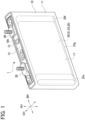
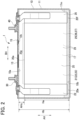
- FIG. 1 is a perspective view of a battery 1 and FIG. 2 is a longitudinal cross-sectional view of the battery 1 in the first embodiment.
- each direction of the battery 1 that is, the longitudinal direction AH, the lateral direction BH, and the thickness direction CH, are defined as illustrated in FIG. 2 .
- This battery 1 is a rectangular-cross-sectional and airtight lithium-ion secondary battery which is mounted in a vehicle, such as a hybrid car, plug-in hybrid case, and an electric car.
- the battery 1 includes a battery case 10, an electrode body 20 accommodated in this battery case 10, a positive terminal member 30 and a negative terminal member 40 supported on the battery case 10, and others.
- an electrolytic solution 17 is contained, a part of which permeates the electrode body 20 and the remaining electrolytic solution is accumulated on the bottom of the battery case 10.
- the battery case 10 is made of metal (e.g., aluminum in the present embodiment) formed in a rectangular parallelepiped box shape, including a case body member 11 having a bottom-closed rectangular tube shape having an opening only at an upper end and a case lid member 13 having a square plate-like shape welded to the case body member 11 so as to close the opening.
- the case lid member 13 of the battery case 10 is provided with a liquid inlet 10h that is hermetically closed by a sealing member 15. Further, on the case lid member 13, the positive terminal member 30 and the negative terminal member 40 are fixedly-attached so as to be electrically insulated from the case lid member 13.
- the electrode body 20 has a flat shape and is encased in a sideways position in the battery case 10.
- This electrode body 20 is configured such that a strip-shaped positive electrode sheet 21 including a strip-shaped positive current collecting foil 22 whose each principal surface is coated with a positive active material layer 23, a strip-shaped negative electrode sheet 25 including a strip-shaped negative current collecting foil 26 whose each principal surface is coated with a negative active material layer 27, and a pair of strip-shaped separators 29 are stacked one on another and wound together in a flat shape about the axis line.
- the electrode body 20 includes a positive current collecting part 20e located on one side (a left side in FIGs. 1 and 2 ) in the lateral direction BH, a negative current collecting part 20f located on the other side (a right side in FIGs. 1 and 2 ) in the lateral direction BH, and an electrode opposed part 20g located between those current collecting parts 20e and 20f.
- the positive current collecting part 20e is a portion formed of the positive current collecting foil 22 of the positive electrode sheet 21 and wound in a flat shape.
- the negative current collecting part 20f is a portion formed of the negative current collecting foil 26 of the negative electrode sheet 25 and wound in a flat shape.
- the electrode opposed part 20g is a flat wound portion so that the positive active material layers 23 of the positive electrode sheet 21, formed on the positive current collecting foil 22, and the negative active material layers 27 of the negative electrode sheet 25, formed on the negative current collecting foil 26, are correspondingly opposed to each other through each separator 29.
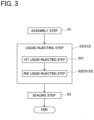
- an assembly step S1 (see FIG. 3 ), firstly, the battery 1 is assembled. Specifically, the case lid member 13 is prepared and fixedly attached with the positive terminal member 30 and negative terminal member 40 as shown in FIGs. 1 and 2 . Then, the positive terminal member 30 and negative terminal member 40 are respectively welded to the positive current collecting part 20e and the negative current collecting part 20f of the electrode body 20 which are fabricated separately. Furthermore, this electrode body 20 is inserted in the case body member 11 and the opening of the case body member 11 is closed with the case lid member 13. The case body member 11 and the case lid member 13 are welded to each other to accomplish the battery case 10.
- a liquid injecting step S2 (see FIG. 3 ) is performed, in which a specified amount V of the electrolytic solution 17 (e.g., 36.0 ml in the present embodiment) is injected into the battery case 10 through the liquid inlet 10h provided in the case lid member 13.
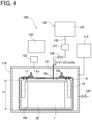
- This liquid injecting step S2 is carried out by use of a liquid injection device 100 shown in FIG. 4 .
- This liquid injection device 100 includes a vacuum chamber 110 in which the battery 1 is to be placed, a liquid injection part 130 for injecting the electrolytic solution 17 into the battery case 10, a control unit 140, and others.
- the vacuum chamber 110 is attached with a vacuum pump 115, a pressure regulation valve 120, and a pressure sensor 125.
- a mass flow controller may be used instead of the pressure regulation valve 120.
- the liquid injection part 130 includes a cylindrical liquid injection nozzle 131 for injecting the electrolytic solution 17 into the battery case 10 and an electrolytic-solution tank 133 for storing the electrolytic solution 17 in advance.
- the liquid injection nozzle 131 and the electrolytic-solution tank 133 are connected to each other through a liquid flow passage 135. In some point of this liquid flow passage 135, there are placed a flow meter 137 and a liquid injection valve 139.
- the control unit 140 includes a microcomputer that includes a CPU, a ROM, and a RAM, which are not shown, and operates according to a predetermined control program stored in the ROM and others. To this control unit 140, there are individually connected the vacuum pump 115, the pressure regulation valve 120, the pressure sensor 125, the flow meter 137, and the liquid injection valve 139. Based on each signal from the pressure sensor 125 and the flow meter 137, the control unit 140 controls operations of the vacuum pump 115, opening and closing of the pressure regulation valve 120, and opening and closing of the liquid injection valve 139.
- the battery 1 assembled as above Prior to the liquid injecting step S2, the battery 1 assembled as above is placed in the vacuum chamber 110, and the tip end of the liquid injection nozzle 131 is inserted in advance in the battery case 10 through the liquid inlet 10h.
- a first liquid-injecting step S21 (see FIG. 3 ) of the liquid injecting step S2
- the internal pressure of the vacuum chamber 110 is reduced from the atmospheric pressure P0 of 101 kPa to regulate the air pressure P in the vacuum chamber 110 and the battery case 10 to a predetermined first air pressure P1 (e.g., 20 kPa in the first embodiment) (see a broken-line graph in FIG. 5 ).
- a predetermined first injection amount V1 (20.0 ml in the first embodiment) of the electrolytic solution 17 is injected into the battery case 10 (see a solid-line graph in FIG. 5 ).
- the first injection amount V1 of 20.0 ml is an injection amount determined so that the liquid-level height H of the electrolytic solution 17 injected in the battery case 10, which is the height of a liquid surface 17m of the electrolytic solution 17 from the bottom surface 10b of the battery case 10, can fall within an intermediate liquid-level range AHc (Ha ⁇ H ⁇ Hb) in which the liquid-level height H is equal to or higher than the first reference height Ha at which the whole electrode opposed part 20g of the electrode body 20 is immersed in the electrolytic solution 17, but is lower than the second reference height Hb at which the electrolytic solution 17 reaches, or touches, the liquid inlet 10h (see FIG. 2 ).
- AHc Ha ⁇ H ⁇ Hb
- the first reference height Ha is a distance from the bottom surface 10b of the battery case 10 to an upper end 20a of the electrode body 20; specifically, the first reference height Ha is 50 mm in the first embodiment.
- the second reference height Hb is a distance from the bottom surface 10b of the battery case 10 to the inner upper surface 10a (the lower surface of the case lid member 13) of the battery case 10; specifically, the second reference height Hb is 60 mm in the first embodiment.
- the electrolytic solution 17 of the first injection amount V1 i.e., 20.0 ml
- the liquid-level height H of the electrolytic solution 17 is about 56 mm.
- the control unit 140 closes the pressure regulation valve 120 and then activates the vacuum pump 115 to reduce the internal air pressure of the vacuum chamber 110 (see FIGs. 4 and 5 ).
- the air pressure P in the vacuum chamber 110 and the battery case 10 detected by the pressure sensor 125, decreases from the atmospheric pressure P0 of 101 kPa to the first air pressure P1 of 20 kPa
- the vacuum pump 115 is stopped, the liquid injection valve 139 is opened, and injection of the electrolytic solution 17 into the battery case 10 is started at time t1.
- the flow meter 137 detects that the electrolytic solution 17 of the first injection amount V1 of 20.0 ml is injected, the liquid injection valve 139 is closed.
- the liquid-level height H of the injected electrolytic solution 17 becomes a height falling within the intermediate liquid-level range AHc (50 ⁇ H ⁇ 60), concretely, about 56 mm.
- the air pressure increase to intermittently increase the air pressure P in the battery case 10 and the additional liquid injection to intermittently inject the electrolytic solution 17 are alternately repeated.
- the air pressure P in the battery case 10 is intermittently increased in 8 stages (P1 ⁇ P3 ⁇ P4 ⁇ P5 ⁇ P6 ⁇ P7 ⁇ P8 ⁇ P9 ⁇ P2).
- the electrolytic solution 17 is intermittently injected by an additional injection amount Va of 2.0 ml in 8 stages.
- the control unit 140 opens the pressure regulation valve 120 to gradually increase the air pressure P in the vacuum chamber 110 and the battery case 10 from the first air pressure P1 of 20 kPa. This promotes impregnation of the injected electrolytic solution 17 into the electrode body 20, thus gradually decreasing the liquid-level height H of the electrolytic solution 17. This is because the volume VD of the air remaining in the electrode body 20 decreases in inverse proportion to the air pressure P as the air pressure P rises (Boyle's law).
- the pressure regulation valve 120 is closed.
- the liquid-level height H of the electrolytic solution 17 decreases by about 5 mm down to about 51 mm (within the intermediate liquid-level range AHc (50 ⁇ H ⁇ 60)) as indicated by a solid line in FIG. 5 .
- the control unit 140 opens the liquid injection valve 139 again to restart injection of the electrolytic solution 17.
- the flow meter 137 detects that the electrolytic solution 17 is additionally injected by the additional injection amount Va of 2.0 ml, the liquid injection valve 139 is closed.
- the liquid-level height H of the electrolytic solution 17 increases again to about 56 mm.
- the electrolytic solution 17 of the specified amount V, 36.0 ml can be injected in an elapsed time t of 450 seconds.
- each air pressure P3 to P9 it is preferable to determine the magnitude of each air pressure P3 to P9 in advance for example by investigating a relationship between the magnitude of each air pressure P3 to P9 and each additional injection amount Va of the electrolytic solution 17 in a battery identical in shape to the battery 1 while measuring the liquid-level height H by use of a liquid-level sensor or the like.
- the battery 1 is taken out of the vacuum chamber 110.
- the liquid inlet 10h of the battery 1 is hermetically closed with the sealing member 15 by welding. This battery 1 is then subjected to initial charge and various tests. The battery 1 is thus accomplished.
- the electrolytic solution 17 is injected until the liquid-level height H of the electrolytic solution 17 falls within the intermediate liquid-level range AHc (Ha ⁇ H ⁇ Hb) in which the liquid-level height H is equal to or higher than the first reference height Ha but is lower than the second reference height Hb.
- the air pressure P in the battery case 10 is increased in the following second liquid-injecting step S22, similarly, the liquid-level height H of the electrolytic solution 17 is maintained within the intermediate liquid-level range AHc (Ha ⁇ H ⁇ Hb) and the whole electrode opposed part 20g is immersed in the electrolytic solution 17.
- the remaining second injection amount V2 of the electrolytic solution 17 can be injected in a short time.
- the method for producing the battery 1 can therefore shorten the time required for the liquid injecting step S2 than the conventional method described in Patent Document 1 and enhance the productivity of the battery 1.
- the air pressure increase to intermittently increase the internal air pressure of the battery case 10 and the additional liquid injection to intermittently inject the electrolytic solution 17 are alternately repeated.
- This configuration can inject the remaining electrolytic solution 17 in a short time by simply performing the second liquid-injecting step S22.
- a second embodiment will be described below.
- the remaining amount of the electrolytic solution 17 is injected by alternately repeating the air pressure increase to intermittently increase the internal air pressure of the battery case 10 and the additional liquid injection to intermittently inject the electrolytic solution 17.
- the second embodiment differs from the first embodiment in that a second liquid-injecting step S122 (see FIG. 3 ) of the liquid injecting step S12 in the second embodiment is performed by continuously injecting the electrolytic solution 17 while continuously increasing the air pressure P in the battery case 10 (see FIG. 6 ).
- the air pressure P in the vacuum chamber 110 and the battery case 10 is continuously increased by use of an electropneumatic regulator instead of the pressure regulation valve 120 from the first air pressure P1 of 20 kPa to the second air pressure P2 of 101 kPa corresponding to the atmospheric pressure P0 as shown by a broken line in FIG. 6 in a curve to which the inclination of a tangent line is larger as the elapsed time t is longer,.
- the liquid injection valve 139 is opened and a constant additional flow rate Ra of the electrolytic solution 17 is injected into the battery case 10.
- the liquid-level height H of the electrolytic solution 17 is maintained at about 56 mm. This is because, as in the first embodiment, the volume VD of the air remaining in the electrode body 20 decreases in inverse proportion to the air pressure P as the air pressure P rises (Boyle's law), so that the impregnation of the electrolytic solution 17 into the electrode body 20 is promoted by just that much.
- the flow meter 137 detects that the electrolytic solution 17 of the second injection amount V2, 16.0 ml, is additionally injected, the liquid injection valve 139 is closed.
- the electrolytic solution 17 of the specified amount V, 36.0 ml can be injected in an elapsed time t of 420 seconds, which is shorter than the elapsed time t of 450 seconds in the first embodiment.
- the second embodiment can also shorten the time required for the liquid injecting step S2 than the conventional method described in Patent Document 1, thus enabling to enhance the productivity of the battery 1.
- the second liquid-injecting step S122 is performed to continuously inject the electrolytic solution 17 while continuously increasing the air pressure P in the battery case 10.
- the remaining electrolytic solution 17 can be injected in a shorter time than in the second liquid-injecting step S22 in the first embodiment.
- the present disclosure is applied to the method for producing the battery 1 provided with a flat-shaped wound electrode body 20, but is not limited thereto.
- the present disclosure is also applicable to a method for producing a battery provided with a laminated electrode body configured such that rectangular positive electrode sheets and rectangular negative sheets are alternately laminated in two or more layers with rectangular separators individually interposed therebetween.
- An alternative may be set such that the first air pressure P1 is equal to the atmospheric pressure and the second air pressure P2 is higher than the atmospheric pressure. In this case, liquid injection is performed in the first liquid-injecting step without pressure reduction and then the air pressure P is intermittently or continuously increased to the second air pressure P2 in the second liquid-injecting step.
- the electrolytic solution 17 is additionally intermittently injected 8 times by an additional injection amount Va of 2.0 ml at a time while the air pressure P intermittently changes (P1 ⁇ P3 ⁇ P4 ⁇ P5 ⁇ P6 ⁇ P7 ⁇ P8 ⁇ P9 ⁇ P2) so as to be gradually larger as time goes by, i.e., as the elapsed time t is longer. Further, the additional injection is carried out so that the liquid-level height H repeatedly changes within a range of about 51 mm to about 56 mm.
- it may be arranged to set constant the magnitude of change in the air pressure P intermittently changed while gradually decreasing the additional injection amount Va of electrolytic solution intermittently added and also gradually decreasing the change range of the liquid-level height H changed by the additional injection.
- the first injection amount V1 and further the subsequent intermittent changes in air pressure P and additional injection amount Va may be determined so as to keep the liquid-level height H of the electrolytic solution 17 within the intermediate liquid-level range AHc (Ha ⁇ H ⁇ Hb).
- the magnitude of increase in air pressure P intermittently caused, the magnitude of additional injection amount Va in each intermittent additional injection, and the change range of the liquid-level height H caused by the additional injections may be set different in each air pressure increase and additional liquid injection.
- the additional flow rate Ra of the electrolytic solution 17 in the continuous additional injection is set constant, the change in air pressure P from the first air pressure P1 to the second air pressure P2 (P1 ⁇ P2) is set to be gradually larger as time goes by, i.e., as the elapsed time t is longer.
- the second embodiment it may be arranged such that the magnitude of change in air pressure P is changed in an almost linear manner, while the additional flow rate Ra in the additional injection is gradually decreased and the liquid-level height H in the additional injection is constant.
- first injection amount V1 and further the subsequent changes in the air pressure P and additional injection amount Va may be determined so as to keep the liquid-level height H of the electrolytic solution 17 within the intermediate liquid-level range AHc (Ha ⁇ H ⁇ Hb).
- the magnitude of increase in air pressure P continuously caused, the magnitude of additional flow rate Ra in additional injection, and the liquid-level height H caused by the additional injection may be changed as the air pressure increase and the additional liquid injection progress.
- increasing the air pressure P and additionally injecting the liquid may be appropriately combined; for example, the additional liquid injection is continuously performed while the air pressure P is continuously increased in a first stage and then the increase of the air pressure P and the additional liquid injection are intermittently alternately performed in a second, or last, stage.
Landscapes
- Chemical & Material Sciences (AREA)
- Chemical Kinetics & Catalysis (AREA)
- Electrochemistry (AREA)
- General Chemical & Material Sciences (AREA)
- Engineering & Computer Science (AREA)
- Manufacturing & Machinery (AREA)
- Inorganic Chemistry (AREA)
- Filling, Topping-Up Batteries (AREA)
- Secondary Cells (AREA)
Description
- The present disclosure relates to a method for producing a battery, including a liquid injecting step of injecting an electrolytic solution into a battery case.
- In producing a battery, for example, a battery is first assembled by accommodating an electrode body in a metal battery case, and then the internal air pressure of the battery case is reduced less than the atmospheric pressure and further a specified amount of an electrolytic solution is injected in the battery case through a liquid inlet provided in the battery case. Subsequently, the air pressure in the battery case is returned to the atmospheric pressure, thereby promoting impregnation of the injected electrolytic solution into the inside of the electrode body.
- However, from the viewpoint of increasing the volumetric energy density of a battery, a battery case is designed with as small a size as possible, so that the empty space of the battery case around the electrode body is small. Therefore, if the injecting speed of the electrolytic solution is increased, the electrolytic solution may overflow out of the battery through the liquid inlet before the specified amount of the electrolytic solution is completely injected. To avoid such a defect, it is necessary to slowly inject the electrolytic solution according to the impregnation speed of the electrolytic solution into the electrode body. This liquid injecting time takes long and leads to low productivity of batteries.
- To address the aforesaid disadvantages,
Patent Document 1 proposes the following manners (seeclaim 1 and others ofPatent Document 1. Specifically, while the internal air pressure of a battery case is reduced less than the atmospheric pressure, firstly, an electrolytic solution is injected until at least part of an electrode body is immersed with the electrolytic solution. Successively, the air pressure in the battery case is increased, thereby promoting impregnation of the injected electrolytic solution into the electrode body, thus decreasing the liquid level of the electrolytic solution. Thereafter, injection of the electrolytic solution is restarted to inject a remaining amount of electrolytic solution. This manner can increase the liquid-injecting speed of the electrolytic solution in the first-time injection as compared with the foregoing method in which a specified amount of the electrolytic solution is injected at a time. Thus, the time required for the liquid injecting step can be shortened. - Patent Document 1:
Japanese patent unexamined application publication No. 2018-106816 JP 2018-106816A - However, even in the method of
Patent Document 1, if the liquid injecting speed of the electrolytic solution is increased in the second-time injection, the electrolytic solution may overflow out of the battery through the liquid inlet before the remaining amount of electrolytic solution is completely injected. It is thus necessary to slowly inject the electrolytic solution in accordance with the impregnation speed of the electrolytic solution into the electrode body. Alternatively, it is necessary to wait until the liquid level of electrolytic solution sufficiently decreases and then inject the remaining amount of electrolytic solution. Accordingly, the second-time injection needs a long liquid injection time. Since such a conventional liquid injecting step takes much time as mentioned above, there is room for improvement. - The present disclosure has been made to address the above problems and has a purpose to provide a method for producing a battery with a shorter time required for a liquid injecting step to inject an electrolytic solution into a battery case as compared with a conventional method.
- To achieve the above-mentioned purpose, one teaching of the present disclosure provides a method for producing a battery, the battery comprising: a battery case made of metal, including a liquid inlet; an electrode body accommodated in the battery case, the electrode body including an electrode opposed part in which a positive active material layer of a positive electrode sheet and a negative active material layer of a negative electrode sheet are opposed to each other; and an electrolytic solution contained in the battery case, characterized in that the method comprises injecting the electrolytic solution into the battery case through the liquid inlet, the injecting includes: a first liquid-injecting step of injecting the electrolytic solution of a predetermined first injection amount while air pressure in the battery case is regulated to a predetermined first air pressure, the predetermined first injection amount being determined so that a liquid-level height of the injected electrolytic solution falls within an intermediate liquid-level range in which the liquid-level height of the injected electrolytic solution is equal to or higher than a first reference height at which the whole electrode opposed part of the electrode body is immersed in the electrolytic solution but is lower than a second reference height at which the electrolytic solution reaches the liquid inlet; and a second liquid-injecting step of injecting the electrolytic solution of a second injection amount that is a remaining amount up to a specified amount while increasing the air pressure in the battery case to a second air pressure higher than the first air pressure and maintaining the liquid-level height of the electrolytic solution within the intermediate liquid-level range.
- In the method of
Patent Document 1, when the air pressure in the battery case is increased after the first liquid injection, the liquid level of the electrolytic solution excessively lowers, so that the electrode opposed part of the electrode body protrudes from the liquid surface, and thus air is likely to enter the electrode opposed part. When the liquid injection is then restarted to inject the remaining amount of electrolytic solution, the electrolytic solution is less likely to enter the electrode opposed part. It is therefore necessary to slowly inject the electrolytic solution of the remaining amount in order to avoid overflow of the electrolytic solution to the outside of the battery through the liquid inlet. Alternatively, it is necessary to wait until the liquid level of the electrolytic solution sufficiently lowers and then inject the remaining amount of electrolytic solution. Thus, the second liquid injection takes long. - In the foregoing battery producing method, in contrast, in the first liquid injection, the electrolytic solution is injected until the liquid-level height of the injected electrolytic solution falls within the intermediate liquid-level range in which the liquid-level height is equal to or higher than the foregoing first reference height but lower than the foregoing second reference height. When the air pressure in the battery case is increased in the subsequent second liquid-injecting step, the liquid-level height of the electrolytic solution is also maintained in the intermediate liquid-level range and the whole the electrode opposed part is immersed in the electrolytic solution. This can avoid the electrode opposed part from protruding out from the liquid surface and prevent air from entering in the electrode opposed part. In the second liquid-injecting step, accordingly, the remaining second injection amount of the electrolytic solution in can be injected in a short time. The above-described battery producing method can consequently shorten the time required for the liquid injecting than the conventional method described in
Patent Document 1, and thus can enhance the productivity of batteries. - Further, in the foregoing method for producing a battery, the second liquid-injecting step may include air pressure increase to intermittently increase the air pressure in the battery case and additional liquid injection to intermittently inject the electrolytic solution, the air pressure increase and the additional liquid injection being alternately repeated.
- In the above-described battery producing method, the second liquid-injecting step is configured to alternately repeat the "air pressure increase" to intermittently increase the air pressure in the battery case and the "additional liquid injection" to intermittently inject the electrolytic solution. This configuration can inject the remaining amount of electrolytic solution in a short time by simply performing the second liquid-injecting step.
- Further, in the foregoing method for producing a battery, the second liquid-injecting step may include continuously injecting the electrolytic solution while continuously increasing the air pressure in the battery case.
- In the above-described battery producing method, the second liquid-injecting step is configured to continuously inject the electrolytic solution while continuously increasing the air pressure in the battery case. This configuration can inject the remaining amount of electrolytic solution in a short time.
-
-
FIG. 1 is a perspective view of a battery in first and second embodiments; -
FIG. 2 is a longitudinal cross-sectional view of the battery in the first and second embodiments; -
FIG. 3 is a flowchart showing a battery producing method in the first and second embodiments; -
FIG. 4 is an explanatory view showing a liquid injecting step in the first and second embodiments; -
FIG. 5 is a graph related to the liquid injecting step in the first embodiment, showing a relationship between elapsed time and liquid-level height of an electrolytic solution and air pressure in a battery case; and -
FIG. 6 is a graph related to a second liquid-injecting step in the second embodiment, showing a relationship between elapsed time and liquid-level height of an electrolytic solution and air pressure in a battery. - A detailed description of a first embodiment according to this disclosure will now be given referring to the accompanying drawings.
FIG. 1 is a perspective view of abattery 1 andFIG. 2 is a longitudinal cross-sectional view of thebattery 1 in the first embodiment. In the following description, each direction of thebattery 1, that is, the longitudinal direction AH, the lateral direction BH, and the thickness direction CH, are defined as illustrated inFIG. 2 . Thisbattery 1 is a rectangular-cross-sectional and airtight lithium-ion secondary battery which is mounted in a vehicle, such as a hybrid car, plug-in hybrid case, and an electric car. Thebattery 1 includes abattery case 10, anelectrode body 20 accommodated in thisbattery case 10, apositive terminal member 30 and anegative terminal member 40 supported on thebattery case 10, and others. In thebattery case 10, anelectrolytic solution 17 is contained, a part of which permeates theelectrode body 20 and the remaining electrolytic solution is accumulated on the bottom of thebattery case 10. - The
battery case 10 is made of metal (e.g., aluminum in the present embodiment) formed in a rectangular parallelepiped box shape, including acase body member 11 having a bottom-closed rectangular tube shape having an opening only at an upper end and acase lid member 13 having a square plate-like shape welded to thecase body member 11 so as to close the opening. Thecase lid member 13 of thebattery case 10 is provided with aliquid inlet 10h that is hermetically closed by a sealingmember 15. Further, on thecase lid member 13, thepositive terminal member 30 and thenegative terminal member 40 are fixedly-attached so as to be electrically insulated from thecase lid member 13. - The
electrode body 20 has a flat shape and is encased in a sideways position in thebattery case 10. Thiselectrode body 20 is configured such that a strip-shaped positive electrode sheet 21 including a strip-shaped positivecurrent collecting foil 22 whose each principal surface is coated with a positive active material layer 23, a strip-shaped negative electrode sheet 25 including a strip-shaped negativecurrent collecting foil 26 whose each principal surface is coated with a negative active material layer 27, and a pair of strip-shaped separators 29 are stacked one on another and wound together in a flat shape about the axis line. - The
electrode body 20 includes a positivecurrent collecting part 20e located on one side (a left side inFIGs. 1 and2 ) in the lateral direction BH, a negative current collectingpart 20f located on the other side (a right side inFIGs. 1 and2 ) in the lateral direction BH, and an electrode opposedpart 20g located between those current collectingparts current collecting part 20e is a portion formed of the positivecurrent collecting foil 22 of the positive electrode sheet 21 and wound in a flat shape. On the other hand, the negative current collectingpart 20f is a portion formed of the negativecurrent collecting foil 26 of the negative electrode sheet 25 and wound in a flat shape. The electrode opposedpart 20g is a flat wound portion so that the positive active material layers 23 of the positive electrode sheet 21, formed on the positivecurrent collecting foil 22, and the negative active material layers 27 of the negative electrode sheet 25, formed on the negativecurrent collecting foil 26, are correspondingly opposed to each other through eachseparator 29. - The method for producing the above-described
battery 1 will be described below with reference toFIGs. 3 to 5 . In an assembly step S1 (seeFIG. 3 ), firstly, thebattery 1 is assembled. Specifically, thecase lid member 13 is prepared and fixedly attached with thepositive terminal member 30 andnegative terminal member 40 as shown inFIGs. 1 and2 . Then, thepositive terminal member 30 andnegative terminal member 40 are respectively welded to the positive current collectingpart 20e and the negativecurrent collecting part 20f of theelectrode body 20 which are fabricated separately. Furthermore, thiselectrode body 20 is inserted in thecase body member 11 and the opening of thecase body member 11 is closed with thecase lid member 13. Thecase body member 11 and thecase lid member 13 are welded to each other to accomplish thebattery case 10. - Subsequently, a liquid injecting step S2 (see
FIG. 3 ) is performed, in which a specified amount V of the electrolytic solution 17 (e.g., 36.0 ml in the present embodiment) is injected into thebattery case 10 through theliquid inlet 10h provided in thecase lid member 13. This liquid injecting step S2 is carried out by use of aliquid injection device 100 shown inFIG. 4 . Thisliquid injection device 100 includes avacuum chamber 110 in which thebattery 1 is to be placed, aliquid injection part 130 for injecting theelectrolytic solution 17 into thebattery case 10, acontrol unit 140, and others. - The
vacuum chamber 110 is attached with avacuum pump 115, apressure regulation valve 120, and apressure sensor 125. As an alternative, a mass flow controller may be used instead of thepressure regulation valve 120. - The
liquid injection part 130 includes a cylindricalliquid injection nozzle 131 for injecting theelectrolytic solution 17 into thebattery case 10 and an electrolytic-solution tank 133 for storing theelectrolytic solution 17 in advance. Theliquid injection nozzle 131 and the electrolytic-solution tank 133 are connected to each other through aliquid flow passage 135. In some point of thisliquid flow passage 135, there are placed aflow meter 137 and aliquid injection valve 139. - The
control unit 140 includes a microcomputer that includes a CPU, a ROM, and a RAM, which are not shown, and operates according to a predetermined control program stored in the ROM and others. To thiscontrol unit 140, there are individually connected thevacuum pump 115, thepressure regulation valve 120, thepressure sensor 125, theflow meter 137, and theliquid injection valve 139. Based on each signal from thepressure sensor 125 and theflow meter 137, thecontrol unit 140 controls operations of thevacuum pump 115, opening and closing of thepressure regulation valve 120, and opening and closing of theliquid injection valve 139. - Prior to the liquid injecting step S2, the
battery 1 assembled as above is placed in thevacuum chamber 110, and the tip end of theliquid injection nozzle 131 is inserted in advance in thebattery case 10 through theliquid inlet 10h. In a first liquid-injecting step S21 (seeFIG. 3 ) of the liquid injecting step S2, the internal pressure of thevacuum chamber 110 is reduced from the atmospheric pressure P0 of 101 kPa to regulate the air pressure P in thevacuum chamber 110 and thebattery case 10 to a predetermined first air pressure P1 (e.g., 20 kPa in the first embodiment) (see a broken-line graph inFIG. 5 ). Under this reduced pressure, then, a predetermined first injection amount V1 (20.0 ml in the first embodiment) of theelectrolytic solution 17 is injected into the battery case 10 (see a solid-line graph inFIG. 5 ). The elapsed time t (seconds) inFIG. 5 means an elapsed time that passes from the start time (t=0) of reducing the internal air pressure of the vacuum chamber 110 (the battery case 10). - The first injection amount V1 of 20.0 ml is an injection amount determined so that the liquid-level height H of the
electrolytic solution 17 injected in thebattery case 10, which is the height of aliquid surface 17m of theelectrolytic solution 17 from thebottom surface 10b of thebattery case 10, can fall within an intermediate liquid-level range AHc (Ha≤H<Hb) in which the liquid-level height H is equal to or higher than the first reference height Ha at which the whole electrode opposedpart 20g of theelectrode body 20 is immersed in theelectrolytic solution 17, but is lower than the second reference height Hb at which theelectrolytic solution 17 reaches, or touches, theliquid inlet 10h (seeFIG. 2 ). - In the first embodiment, the first reference height Ha is a distance from the
bottom surface 10b of thebattery case 10 to anupper end 20a of theelectrode body 20; specifically, the first reference height Ha is 50 mm in the first embodiment. The second reference height Hb is a distance from thebottom surface 10b of thebattery case 10 to the innerupper surface 10a (the lower surface of the case lid member 13) of thebattery case 10; specifically, the second reference height Hb is 60 mm in the first embodiment. In contrast, when theelectrolytic solution 17 of the first injection amount V1, i.e., 20.0 ml, is injected into thebattery case 10, the liquid-level height H of theelectrolytic solution 17 is about 56 mm. - In this first liquid-injecting step S21, specifically, the
control unit 140 closes thepressure regulation valve 120 and then activates thevacuum pump 115 to reduce the internal air pressure of the vacuum chamber 110 (seeFIGs. 4 and5 ). When the air pressure P in thevacuum chamber 110 and thebattery case 10, detected by thepressure sensor 125, decreases from the atmospheric pressure P0 of 101 kPa to the first air pressure P1 of 20 kPa, thevacuum pump 115 is stopped, theliquid injection valve 139 is opened, and injection of theelectrolytic solution 17 into thebattery case 10 is started at time t1. Thereafter, when theflow meter 137 detects that theelectrolytic solution 17 of the first injection amount V1 of 20.0 ml is injected, theliquid injection valve 139 is closed. Thus, the liquid-level height H of the injectedelectrolytic solution 17 becomes a height falling within the intermediate liquid-level range AHc (50≤H<60), concretely, about 56 mm. - In a second liquid-injecting step S22 (see
FIG. 3 ), theelectrolytic solution 17 of a remaining, second injection amount V2 (= V-V1), e.g., 16.0 ml in the first embodiment, is injected up to the specified amount V of 36.0 ml while the air pressure P in thebattery case 10 is increased to the second air pressure P2 (101 kPa corresponding to the atmospheric pressure P0 in the first embodiment) higher than the first air pressure P1 of 20 kPa and the liquid-level height H of theelectrolytic solution 17 is maintained within the above-described intermediate liquid-level range AHc (50≤H<60). - In the first embodiment, the air pressure increase to intermittently increase the air pressure P in the
battery case 10 and the additional liquid injection to intermittently inject theelectrolytic solution 17 are alternately repeated. Specifically, as indicated by a broken line inFIG. 5 , the air pressure P in thebattery case 10 is intermittently increased in 8 stages (P1→ P3→ P4→ P5→ P6→ P7→ P8→ P9→ P2). In contrast, from each of time t3 to time t9 and time t2 at which each air pressure P3 to P9 and P2 is reached, theelectrolytic solution 17 is intermittently injected by an additional injection amount Va of 2.0 ml in 8 stages. - To be specific, the
control unit 140 opens thepressure regulation valve 120 to gradually increase the air pressure P in thevacuum chamber 110 and thebattery case 10 from the first air pressure P1 of 20 kPa. This promotes impregnation of the injectedelectrolytic solution 17 into theelectrode body 20, thus gradually decreasing the liquid-level height H of theelectrolytic solution 17. This is because the volume VD of the air remaining in theelectrode body 20 decreases in inverse proportion to the air pressure P as the air pressure P rises (Boyle's law). When the air pressure in thevacuum chamber 110 detected by thepressure sensor 125 reaches the predetermined air pressure P3 of 22.2 kPa, thepressure regulation valve 120 is closed. Accordingly, the liquid-level height H of theelectrolytic solution 17 decreases by about 5 mm down to about 51 mm (within the intermediate liquid-level range AHc (50 ≤ H < 60)) as indicated by a solid line inFIG. 5 . At time t3, subsequently, thecontrol unit 140 opens theliquid injection valve 139 again to restart injection of theelectrolytic solution 17. When theflow meter 137 then detects that theelectrolytic solution 17 is additionally injected by the additional injection amount Va of 2.0 ml, theliquid injection valve 139 is closed. Thus, the liquid-level height H of theelectrolytic solution 17 increases again to about 56 mm. - The air pressure increase to intermittently increase the air pressure P in the
battery case 10 and the additional injection to intermittently inject theelectrolytic solution 17 are alternately repeated 8 times to inject theelectrolytic solution 17 of the remaining second injection amount V2, 16.0 ml (= 2.0 ml × 8). In the liquid injecting step S2 in the first embodiment, consequently, theelectrolytic solution 17 of the specified amount V, 36.0 ml, can be injected in an elapsed time t of 450 seconds. - Prior to execution of the first embodiment, it is preferable to determine the magnitude of each air pressure P3 to P9 in advance for example by investigating a relationship between the magnitude of each air pressure P3 to P9 and each additional injection amount Va of the
electrolytic solution 17 in a battery identical in shape to thebattery 1 while measuring the liquid-level height H by use of a liquid-level sensor or the like. - Meanwhile, even though the detailed experimental results are omitted, when the method of
Patent Document 1 is adopted instead of the liquid injecting step S2 in the first embodiment, it is found that it takes an elapsed time t of 850 seconds to inject theelectrolytic solution 17 of the specified amount V of 36.0 ml to thebattery 1. The first embodiment can therefore greatly reduce the time required for the liquid injecting step S2 than the method ofPatent Document 1. - After the end of the liquid injecting step S2, the
battery 1 is taken out of thevacuum chamber 110. In a sealing step S3, subsequently, theliquid inlet 10h of thebattery 1 is hermetically closed with the sealingmember 15 by welding. Thisbattery 1 is then subjected to initial charge and various tests. Thebattery 1 is thus accomplished. - As described above, in the method for producing the
battery 1, in the first liquid-injecting step S21, theelectrolytic solution 17 is injected until the liquid-level height H of theelectrolytic solution 17 falls within the intermediate liquid-level range AHc (Ha≤H<Hb) in which the liquid-level height H is equal to or higher than the first reference height Ha but is lower than the second reference height Hb. When the air pressure P in thebattery case 10 is increased in the following second liquid-injecting step S22, similarly, the liquid-level height H of theelectrolytic solution 17 is maintained within the intermediate liquid-level range AHc (Ha≤H<Hb) and the whole electrode opposedpart 20g is immersed in theelectrolytic solution 17. This can prevent the electrode opposedpart 20g from protruding out from aliquid surface 17m and hence avoid entrance of air into the electrode opposedpart 20g. Accordingly, in the second liquid-injecting step S22, the remaining second injection amount V2 of theelectrolytic solution 17 can be injected in a short time. The method for producing thebattery 1 can therefore shorten the time required for the liquid injecting step S2 than the conventional method described inPatent Document 1 and enhance the productivity of thebattery 1. - In the first embodiment, furthermore, in the second liquid-injecting step S22, the air pressure increase to intermittently increase the internal air pressure of the
battery case 10 and the additional liquid injection to intermittently inject theelectrolytic solution 17 are alternately repeated. This configuration can inject the remainingelectrolytic solution 17 in a short time by simply performing the second liquid-injecting step S22. - A second embodiment will be described below. In the first embodiment, as described above, in the second liquid-injecting step S22 of the liquid injecting step S2, the remaining amount of the
electrolytic solution 17 is injected by alternately repeating the air pressure increase to intermittently increase the internal air pressure of thebattery case 10 and the additional liquid injection to intermittently inject theelectrolytic solution 17. In contrast, the second embodiment differs from the first embodiment in that a second liquid-injecting step S122 (seeFIG. 3 ) of the liquid injecting step S12 in the second embodiment is performed by continuously injecting theelectrolytic solution 17 while continuously increasing the air pressure P in the battery case 10 (seeFIG. 6 ). - In the first liquid-injecting step S21, pressure reduction and liquid injection are performed as in the first embodiment. In the second liquid-injecting step S122, from time tlb, the air pressure P in the
vacuum chamber 110 and thebattery case 10 is continuously increased by use of an electropneumatic regulator instead of thepressure regulation valve 120 from the first air pressure P1 of 20 kPa to the second air pressure P2 of 101 kPa corresponding to the atmospheric pressure P0 as shown by a broken line inFIG. 6 in a curve to which the inclination of a tangent line is larger as the elapsed time t is longer,. On the other hand, theliquid injection valve 139 is opened and a constant additional flow rate Ra of theelectrolytic solution 17 is injected into thebattery case 10. Then, as indicated by a solid line inFIG. 6 , the liquid-level height H of theelectrolytic solution 17 is maintained at about 56 mm. This is because, as in the first embodiment, the volume VD of the air remaining in theelectrode body 20 decreases in inverse proportion to the air pressure P as the air pressure P rises (Boyle's law), so that the impregnation of theelectrolytic solution 17 into theelectrode body 20 is promoted by just that much. - When the
flow meter 137 detects that theelectrolytic solution 17 of the second injection amount V2, 16.0 ml, is additionally injected, theliquid injection valve 139 is closed. In the second embodiment, therefore, theelectrolytic solution 17 of the specified amount V, 36.0 ml, can be injected in an elapsed time t of 420 seconds, which is shorter than the elapsed time t of 450 seconds in the first embodiment. - Prior to execution of the second embodiment, it is preferable to obtain in advance a relationship between the change in the air pressure P and the additional flow rate Ra of the additionally-injected
electrolytic solution 17, in which the liquid-level height H is substantially constant, for example by investigating the relationship between the change in each air pressure P and the additional flow rate Ra of the additionally-injectedelectrolytic solution 17 in a battery identical to thebattery 1 while measuring the liquid-level height H by use of a liquid-level sensor or the like. - The second embodiment can also shorten the time required for the liquid injecting step S2 than the conventional method described in
Patent Document 1, thus enabling to enhance the productivity of thebattery 1. In the second embodiment, the second liquid-injecting step S122 is performed to continuously inject theelectrolytic solution 17 while continuously increasing the air pressure P in thebattery case 10. Thus, the remainingelectrolytic solution 17 can be injected in a shorter time than in the second liquid-injecting step S22 in the first embodiment. - The present disclosure is described in the foregoing first and second embodiments but is not limited thereto.
- In the first and second embodiments, for instance, the present disclosure is applied to the method for producing the
battery 1 provided with a flat-shapedwound electrode body 20, but is not limited thereto. For example, the present disclosure is also applicable to a method for producing a battery provided with a laminated electrode body configured such that rectangular positive electrode sheets and rectangular negative sheets are alternately laminated in two or more layers with rectangular separators individually interposed therebetween. - In the first and second embodiments, to meet a relation of P1 < P2, the first air pressure P1 is set lower than the atmospheric pressure and the second air pressure P2 is set equal to the atmospheric pressure (P2 = P0), but they are not limited thereto. An alternative may be set such that the first air pressure P1 is equal to the atmospheric pressure and the second air pressure P2 is higher than the atmospheric pressure. In this case, liquid injection is performed in the first liquid-injecting step without pressure reduction and then the air pressure P is intermittently or continuously increased to the second air pressure P2 in the second liquid-injecting step.
- In the first embodiment, as shown in
FIG. 5 , theelectrolytic solution 17 is additionally intermittently injected 8 times by an additional injection amount Va of 2.0 ml at a time while the air pressure P intermittently changes (P1→ P3→ P4→ P5→ P6→ P7→ P8→ P9→ P2) so as to be gradually larger as time goes by, i.e., as the elapsed time t is longer. Further, the additional injection is carried out so that the liquid-level height H repeatedly changes within a range of about 51 mm to about 56 mm. - However, as an alternative to the first embodiment, it may be arranged to set constant the magnitude of change in the air pressure P intermittently changed while gradually decreasing the additional injection amount Va of electrolytic solution intermittently added and also gradually decreasing the change range of the liquid-level height H changed by the additional injection.
- The first injection amount V1 and further the subsequent intermittent changes in air pressure P and additional injection amount Va may be determined so as to keep the liquid-level height H of the
electrolytic solution 17 within the intermediate liquid-level range AHc (Ha≤H<Hb). The magnitude of increase in air pressure P intermittently caused, the magnitude of additional injection amount Va in each intermittent additional injection, and the change range of the liquid-level height H caused by the additional injections may be set different in each air pressure increase and additional liquid injection. - In the second embodiment, similarly, as shown in
FIG. 6 , the additional flow rate Ra of theelectrolytic solution 17 in the continuous additional injection is set constant, the change in air pressure P from the first air pressure P1 to the second air pressure P2 (P1→P2) is set to be gradually larger as time goes by, i.e., as the elapsed time t is longer. The additional liquid injection is carried out so that the liquid-level height H is constant (H= about 56 mm). - However, as an alternative to the second embodiment, it may be arranged such that the magnitude of change in air pressure P is changed in an almost linear manner, while the additional flow rate Ra in the additional injection is gradually decreased and the liquid-level height H in the additional injection is constant.
- Further, the first injection amount V1 and further the subsequent changes in the air pressure P and additional injection amount Va may be determined so as to keep the liquid-level height H of the
electrolytic solution 17 within the intermediate liquid-level range AHc (Ha≤H<Hb). The magnitude of increase in air pressure P continuously caused, the magnitude of additional flow rate Ra in additional injection, and the liquid-level height H caused by the additional injection may be changed as the air pressure increase and the additional liquid injection progress. - Furthermore, increasing the air pressure P and additionally injecting the liquid may be appropriately combined; for example, the additional liquid injection is continuously performed while the air pressure P is continuously increased in a first stage and then the increase of the air pressure P and the additional liquid injection are intermittently alternately performed in a second, or last, stage.
-
- 1
- Battery
- 10
- Battery case
- 10h
- Liquid inlet
- 15
- Closing member
- 17
- Electrolytic solution
- 20
- Electrode body
- 20g
- Electrode opposed part
- 21
- Positive electrode sheet
- 23
- Positive active material layer
- 25
- Negative electrode sheet
- 27
- Negative active material layer
- S1
- Assembly step
- S2, S12
- Liquid injecting step
- S21
- First liquid-injecting step
- S22, S122
- Second liquid-injecting step
- S3
- Closing step
- V
- Specified amount
- V1
- First injection amount
- V2
- Second injection amount
- Va
- Additional injection amount
- Ra
- Additional flow rate
- P
- Air pressure (in Battery case)
- P1
- First air pressure
- P2
- Second air pressure
- H
- Liquid-level height
- Ha
- First reference height
- Hb
- Second reference height
- AHc
- Intermediate liquid-level range
Claims (3)
- A method for producing a battery (1), the battery (1) comprising:a battery case (10) made of metal, including a liquid inlet (10h);an electrode body (20) accommodated in the battery case (10), the electrode body (20) including an electrode opposed part (20g) in which a positive active material layer (23) of a positive electrode sheet (21) and a negative active material layer (27) of a negative electrode sheet (25) are opposed to each other; andan electrolytic solution (17) contained in the battery case (10),characterized in thatthe method comprises injecting (S2, S12) the electrolytic solution (17) into the battery case (10) through the liquid inlet (10h),the injecting (S2, S12) includes:a first liquid-injecting step (S21) of injecting the electrolytic solution (17) of a predetermined first injection amount (V1) while air pressure (P) in the battery case (10) is regulated to a predetermined first air pressure (P1),
the predetermined first injection amount (V1) being determined so that a liquid-level height (H) of the injected electrolytic solution (17) falls within an intermediate liquid-level range (AHc) (Ha≤H<Hb) in which the liquid-level height (H) of the injected electrolytic solution (17) is equal to or higher than a first reference height (Ha) at which the whole electrode opposed part (20g) of the electrode body (20) is immersed in the electrolytic solution (17) but is lower than a second reference height (Hb) at which the electrolytic solution (17) reaches the liquid inlet (10h); anda second liquid-injecting step (S22, S122) of injecting the electrolytic solution (17) of a second injection amount (V2) (V2=V-V1) that is a remaining amount up to a specified amount (V) while increasing the air pressure (P) in the battery case (10) to a second air pressure (P2) (P2 > P1) higher than the first air pressure (P1) and maintaining the liquid-level height (H) of the electrolytic solution (17) within the intermediate liquid-level range (AHc). - The method for producing a battery (1) according to claim 1, wherein the second liquid-injecting step (S22) includes air pressure increase to intermittently increase the air pressure (P) in the battery case (10) and additional liquid injection to intermittently inject the electrolytic solution (17), the air pressure increase and the additional liquid injection being alternately repeated.
- The method for producing a battery (1) according to claim 1, wherein the second liquid-injecting step (S122) includes continuously injecting the electrolytic solution (17) while continuously increasing the air pressure (P) in the battery case (10).
Applications Claiming Priority (1)
| Application Number | Priority Date | Filing Date | Title |
|---|---|---|---|
| JP2020203503A JP7216696B2 (en) | 2020-12-08 | 2020-12-08 | Battery manufacturing method |
Publications (2)
| Publication Number | Publication Date |
|---|---|
| EP4012812A1 EP4012812A1 (en) | 2022-06-15 |
| EP4012812B1 true EP4012812B1 (en) | 2025-05-14 |
Family
ID=78078122
Family Applications (1)
| Application Number | Title | Priority Date | Filing Date |
|---|---|---|---|
| EP21200963.3A Active EP4012812B1 (en) | 2020-12-08 | 2021-10-05 | Method for producing a battery |
Country Status (5)
| Country | Link |
|---|---|
| US (1) | US11837755B2 (en) |
| EP (1) | EP4012812B1 (en) |
| JP (1) | JP7216696B2 (en) |
| KR (1) | KR102648710B1 (en) |
| CN (1) | CN114614219A (en) |
Families Citing this family (7)
| Publication number | Priority date | Publication date | Assignee | Title |
|---|---|---|---|---|
| CN115939694B (en) * | 2022-08-17 | 2024-09-24 | 宁德时代新能源科技股份有限公司 | Method for determining the amount of liquid injected into a battery cell |
| CN115360438B (en) * | 2022-10-20 | 2023-03-24 | 中创新航科技股份有限公司 | Battery with a battery cell |
| JP7662682B2 (en) * | 2023-01-25 | 2025-04-15 | プライムプラネットエナジー&ソリューションズ株式会社 | Secondary battery manufacturing method |
| JP7844370B2 (en) | 2023-02-01 | 2026-04-13 | プライムプラネットエナジー&ソリューションズ株式会社 | Energy storage devices |
| CN116345084B (en) * | 2023-03-31 | 2026-01-23 | 宜春清陶能源科技有限公司 | Method and device for injecting battery electrolyte |
| JP7765442B2 (en) * | 2023-09-27 | 2025-11-06 | プライムプラネットエナジー&ソリューションズ株式会社 | Method for evaluating electrode distance in non-aqueous electrolyte secondary battery and method for manufacturing non-aqueous electrolyte secondary battery |
| WO2025192831A1 (en) * | 2024-03-12 | 2025-09-18 | 주식회사 엘지에너지솔루션 | Apparatus and method for manufacturing secondary battery |
Family Cites Families (13)
| Publication number | Priority date | Publication date | Assignee | Title |
|---|---|---|---|---|
| JPH07118307B2 (en) * | 1988-09-14 | 1995-12-18 | 古河電池株式会社 | Injection method of electrolyte to storage battery and injection machine |
| JP3467135B2 (en) | 1995-10-05 | 2003-11-17 | 阿波エンジニアリング株式会社 | Filling method of electrolyte |
| JP5294298B2 (en) * | 2008-01-31 | 2013-09-18 | Necエナジーデバイス株式会社 | Method and apparatus for manufacturing film-covered electrical device |
| JP5683938B2 (en) | 2010-12-22 | 2015-03-11 | 日立オートモティブシステムズ株式会社 | Secondary battery manufacturing method and electrolyte injection device |
| DE102011110479A1 (en) * | 2011-08-17 | 2013-02-21 | Vb Autobatterie Gmbh & Co. Kgaa | Process for the preparation of an accumulator filled with a liquid electrolyte, filling vessel therefor, machine and accumulator |
| CN103988357B (en) * | 2011-11-24 | 2017-09-26 | 丰田自动车株式会社 | The manufacture method of nonaqueous electrolytic solution secondary battery |
| US9859569B2 (en) * | 2012-02-07 | 2018-01-02 | Nissan Motor Co., Ltd. | Method and device for manufacturing film-wrapped electrical device |
| JP5921274B2 (en) * | 2012-03-22 | 2016-05-24 | 株式会社東芝 | Battery manufacturing apparatus and battery manufacturing method |
| JP6024990B2 (en) * | 2013-10-29 | 2016-11-16 | トヨタ自動車株式会社 | Method for producing non-aqueous electrolyte secondary battery |
| JP6838389B2 (en) | 2016-12-22 | 2021-03-03 | トヨタ自動車株式会社 | Battery manufacturing method |
| JP6977603B2 (en) | 2018-02-16 | 2021-12-08 | トヨタ自動車株式会社 | Liquid injection device |
| EP3926725A4 (en) * | 2019-02-15 | 2023-05-03 | Eliiy Power Co., Ltd. | Structure for nonaqueous electrolyte secondary batteries, method for producing structure for nonaqueous electrolyte secondary batteries, and method for producing nonaqueous electrolyte secondary battery |
| JP7135995B2 (en) * | 2019-05-08 | 2022-09-13 | トヨタ自動車株式会社 | Battery manufacturing method |
-
2020
- 2020-12-08 JP JP2020203503A patent/JP7216696B2/en active Active
-
2021
- 2021-09-08 US US17/468,884 patent/US11837755B2/en active Active
- 2021-10-05 EP EP21200963.3A patent/EP4012812B1/en active Active
- 2021-10-26 CN CN202111247472.3A patent/CN114614219A/en active Pending
- 2021-11-29 KR KR1020210166671A patent/KR102648710B1/en active Active
Also Published As
| Publication number | Publication date |
|---|---|
| EP4012812A1 (en) | 2022-06-15 |
| US11837755B2 (en) | 2023-12-05 |
| JP2022090917A (en) | 2022-06-20 |
| KR20220081286A (en) | 2022-06-15 |
| KR102648710B1 (en) | 2024-03-19 |
| CN114614219A (en) | 2022-06-10 |
| JP7216696B2 (en) | 2023-02-01 |
| US20220181757A1 (en) | 2022-06-09 |
Similar Documents
| Publication | Publication Date | Title |
|---|---|---|
| EP4012812B1 (en) | Method for producing a battery | |
| JP6838389B2 (en) | Battery manufacturing method | |
| US10211471B2 (en) | Apparatus for controlling purging in a hydrogen storage system and method for the same | |
| KR102586807B1 (en) | Electrolyte injection apparatus, and Electrolyte injection method | |
| JP7763217B2 (en) | Method for manufacturing an electricity storage device | |
| JP6066213B2 (en) | Secondary battery manufacturing method and secondary battery | |
| JP7214700B2 (en) | Method for manufacturing secondary battery | |
| JP2008243657A (en) | Secondary battery manufacturing method and manufacturing apparatus thereof | |
| CN110462882A (en) | Electrolyte injection device | |
| JP7135995B2 (en) | Battery manufacturing method | |
| JP2002298833A (en) | Manufacturing method of secondary battery and liquid injection method | |
| JP6642356B2 (en) | Injection device | |
| KR102886238B1 (en) | Battery cell volume measuring device and battery cell volume measuring method using same | |
| US20230073871A1 (en) | Battery cell jig comprising spacer, apparatus comprising same for measuring volume of battery cell, and method for measuring volume of battery cell using same | |
| JP2021082524A (en) | Nonaqueous electrolyte secondary battery | |
| JP7265711B2 (en) | Battery manufacturing method | |
| JP2014241214A (en) | Method of manufacturing sealed battery | |
| JP3751765B2 (en) | Method for manufacturing cylindrical battery | |
| CN117673675A (en) | Liquid injection device and battery cell injection method | |
| JPH1021954A (en) | Negative absorption sealed lead-acid battery | |
| JP2013135124A (en) | Liquid injection device, manufacturing system, liquid injection method, and liquid injection program | |
| JP7087994B2 (en) | Full charge capacity calculation device | |
| US12469938B2 (en) | Method for producing power storage device | |
| KR20180010393A (en) | Electrolyte Injection Apparatus for Prismatic Battery and Electrolyte Injection Method Using The Same | |
| CN223680354U (en) | Device for injecting electrolyte into a secondary battery |
Legal Events
| Date | Code | Title | Description |
|---|---|---|---|
| PUAI | Public reference made under article 153(3) epc to a published international application that has entered the european phase |
Free format text: ORIGINAL CODE: 0009012 |
|
| STAA | Information on the status of an ep patent application or granted ep patent |
Free format text: STATUS: REQUEST FOR EXAMINATION WAS MADE |
|
| 17P | Request for examination filed |
Effective date: 20211005 |
|
| AK | Designated contracting states |
Kind code of ref document: A1 Designated state(s): AL AT BE BG CH CY CZ DE DK EE ES FI FR GB GR HR HU IE IS IT LI LT LU LV MC MK MT NL NO PL PT RO RS SE SI SK SM TR |
|
| RAP3 | Party data changed (applicant data changed or rights of an application transferred) |
Owner name: PRIME PLANET ENERGY & SOLUTIONS, INC. |
|
| GRAP | Despatch of communication of intention to grant a patent |
Free format text: ORIGINAL CODE: EPIDOSNIGR1 |
|
| STAA | Information on the status of an ep patent application or granted ep patent |
Free format text: STATUS: GRANT OF PATENT IS INTENDED |
|
| INTG | Intention to grant announced |
Effective date: 20250122 |
|
| P01 | Opt-out of the competence of the unified patent court (upc) registered |
Free format text: CASE NUMBER: APP_3637/2025 Effective date: 20250122 |
|
| GRAS | Grant fee paid |
Free format text: ORIGINAL CODE: EPIDOSNIGR3 |
|
| GRAA | (expected) grant |
Free format text: ORIGINAL CODE: 0009210 |
|
| STAA | Information on the status of an ep patent application or granted ep patent |
Free format text: STATUS: THE PATENT HAS BEEN GRANTED |
|
| AK | Designated contracting states |
Kind code of ref document: B1 Designated state(s): AL AT BE BG CH CY CZ DE DK EE ES FI FR GB GR HR HU IE IS IT LI LT LU LV MC MK MT NL NO PL PT RO RS SE SI SK SM TR |
|
| REG | Reference to a national code |
Ref country code: GB Ref legal event code: FG4D |
|
| REG | Reference to a national code |
Ref country code: CH Ref legal event code: EP |
|
| REG | Reference to a national code |
Ref country code: IE Ref legal event code: FG4D |
|
| REG | Reference to a national code |
Ref country code: DE Ref legal event code: R096 Ref document number: 602021030726 Country of ref document: DE |
|
| REG | Reference to a national code |
Ref country code: NL Ref legal event code: MP Effective date: 20250514 |
|
| PG25 | Lapsed in a contracting state [announced via postgrant information from national office to epo] |
Ref country code: FI Free format text: LAPSE BECAUSE OF FAILURE TO SUBMIT A TRANSLATION OF THE DESCRIPTION OR TO PAY THE FEE WITHIN THE PRESCRIBED TIME-LIMIT Effective date: 20250514 Ref country code: PT Free format text: LAPSE BECAUSE OF FAILURE TO SUBMIT A TRANSLATION OF THE DESCRIPTION OR TO PAY THE FEE WITHIN THE PRESCRIBED TIME-LIMIT Effective date: 20250915 Ref country code: ES Free format text: LAPSE BECAUSE OF FAILURE TO SUBMIT A TRANSLATION OF THE DESCRIPTION OR TO PAY THE FEE WITHIN THE PRESCRIBED TIME-LIMIT Effective date: 20250514 |
|
| REG | Reference to a national code |
Ref country code: LT Ref legal event code: MG9D |
|
| PG25 | Lapsed in a contracting state [announced via postgrant information from national office to epo] |
Ref country code: GR Free format text: LAPSE BECAUSE OF FAILURE TO SUBMIT A TRANSLATION OF THE DESCRIPTION OR TO PAY THE FEE WITHIN THE PRESCRIBED TIME-LIMIT Effective date: 20250815 Ref country code: NO Free format text: LAPSE BECAUSE OF FAILURE TO SUBMIT A TRANSLATION OF THE DESCRIPTION OR TO PAY THE FEE WITHIN THE PRESCRIBED TIME-LIMIT Effective date: 20250814 |
|
| PG25 | Lapsed in a contracting state [announced via postgrant information from national office to epo] |
Ref country code: PL Free format text: LAPSE BECAUSE OF FAILURE TO SUBMIT A TRANSLATION OF THE DESCRIPTION OR TO PAY THE FEE WITHIN THE PRESCRIBED TIME-LIMIT Effective date: 20250514 Ref country code: NL Free format text: LAPSE BECAUSE OF FAILURE TO SUBMIT A TRANSLATION OF THE DESCRIPTION OR TO PAY THE FEE WITHIN THE PRESCRIBED TIME-LIMIT Effective date: 20250514 |
|
| REG | Reference to a national code |
Ref country code: AT Ref legal event code: MK05 Ref document number: 1795595 Country of ref document: AT Kind code of ref document: T Effective date: 20250514 |
|
| PG25 | Lapsed in a contracting state [announced via postgrant information from national office to epo] |
Ref country code: BG Free format text: LAPSE BECAUSE OF FAILURE TO SUBMIT A TRANSLATION OF THE DESCRIPTION OR TO PAY THE FEE WITHIN THE PRESCRIBED TIME-LIMIT Effective date: 20250514 |
|
| PG25 | Lapsed in a contracting state [announced via postgrant information from national office to epo] |
Ref country code: HR Free format text: LAPSE BECAUSE OF FAILURE TO SUBMIT A TRANSLATION OF THE DESCRIPTION OR TO PAY THE FEE WITHIN THE PRESCRIBED TIME-LIMIT Effective date: 20250514 |
|
| PG25 | Lapsed in a contracting state [announced via postgrant information from national office to epo] |
Ref country code: AT Free format text: LAPSE BECAUSE OF FAILURE TO SUBMIT A TRANSLATION OF THE DESCRIPTION OR TO PAY THE FEE WITHIN THE PRESCRIBED TIME-LIMIT Effective date: 20250514 |
|
| PGFP | Annual fee paid to national office [announced via postgrant information from national office to epo] |
Ref country code: FR Payment date: 20250827 Year of fee payment: 5 |
|
| PG25 | Lapsed in a contracting state [announced via postgrant information from national office to epo] |
Ref country code: RS Free format text: LAPSE BECAUSE OF FAILURE TO SUBMIT A TRANSLATION OF THE DESCRIPTION OR TO PAY THE FEE WITHIN THE PRESCRIBED TIME-LIMIT Effective date: 20250814 |
|
| PG25 | Lapsed in a contracting state [announced via postgrant information from national office to epo] |
Ref country code: IS Free format text: LAPSE BECAUSE OF FAILURE TO SUBMIT A TRANSLATION OF THE DESCRIPTION OR TO PAY THE FEE WITHIN THE PRESCRIBED TIME-LIMIT Effective date: 20250914 |
|
| PG25 | Lapsed in a contracting state [announced via postgrant information from national office to epo] |
Ref country code: LV Free format text: LAPSE BECAUSE OF FAILURE TO SUBMIT A TRANSLATION OF THE DESCRIPTION OR TO PAY THE FEE WITHIN THE PRESCRIBED TIME-LIMIT Effective date: 20250514 |
|
| PGFP | Annual fee paid to national office [announced via postgrant information from national office to epo] |
Ref country code: DE Payment date: 20250911 Year of fee payment: 5 |
|
| PGFP | Annual fee paid to national office [announced via postgrant information from national office to epo] |
Ref country code: GB Payment date: 20251028 Year of fee payment: 5 |
|
| PG25 | Lapsed in a contracting state [announced via postgrant information from national office to epo] |
Ref country code: DK Free format text: LAPSE BECAUSE OF FAILURE TO SUBMIT A TRANSLATION OF THE DESCRIPTION OR TO PAY THE FEE WITHIN THE PRESCRIBED TIME-LIMIT Effective date: 20250514 Ref country code: SM Free format text: LAPSE BECAUSE OF FAILURE TO SUBMIT A TRANSLATION OF THE DESCRIPTION OR TO PAY THE FEE WITHIN THE PRESCRIBED TIME-LIMIT Effective date: 20250514 |
|
| PG25 | Lapsed in a contracting state [announced via postgrant information from national office to epo] |
Ref country code: CZ Free format text: LAPSE BECAUSE OF FAILURE TO SUBMIT A TRANSLATION OF THE DESCRIPTION OR TO PAY THE FEE WITHIN THE PRESCRIBED TIME-LIMIT Effective date: 20250514 |
|
| PG25 | Lapsed in a contracting state [announced via postgrant information from national office to epo] |
Ref country code: EE Free format text: LAPSE BECAUSE OF FAILURE TO SUBMIT A TRANSLATION OF THE DESCRIPTION OR TO PAY THE FEE WITHIN THE PRESCRIBED TIME-LIMIT Effective date: 20250514 |
|
| PG25 | Lapsed in a contracting state [announced via postgrant information from national office to epo] |
Ref country code: SK Free format text: LAPSE BECAUSE OF FAILURE TO SUBMIT A TRANSLATION OF THE DESCRIPTION OR TO PAY THE FEE WITHIN THE PRESCRIBED TIME-LIMIT Effective date: 20250514 Ref country code: RO Free format text: LAPSE BECAUSE OF FAILURE TO SUBMIT A TRANSLATION OF THE DESCRIPTION OR TO PAY THE FEE WITHIN THE PRESCRIBED TIME-LIMIT Effective date: 20250514 |
|
| PG25 | Lapsed in a contracting state [announced via postgrant information from national office to epo] |
Ref country code: IT Free format text: LAPSE BECAUSE OF FAILURE TO SUBMIT A TRANSLATION OF THE DESCRIPTION OR TO PAY THE FEE WITHIN THE PRESCRIBED TIME-LIMIT Effective date: 20250514 |
|
| REG | Reference to a national code |
Ref country code: DE Ref legal event code: R097 Ref document number: 602021030726 Country of ref document: DE |
|
| PLBE | No opposition filed within time limit |
Free format text: ORIGINAL CODE: 0009261 |
|
| STAA | Information on the status of an ep patent application or granted ep patent |
Free format text: STATUS: NO OPPOSITION FILED WITHIN TIME LIMIT |
|
| REG | Reference to a national code |
Ref country code: CH Ref legal event code: L10 Free format text: ST27 STATUS EVENT CODE: U-0-0-L10-L00 (AS PROVIDED BY THE NATIONAL OFFICE) Effective date: 20260325 |
|
| 26N | No opposition filed |
Effective date: 20260217 |