EP4012584A1 - Verfahren zur erzeugung von erweiterten elf-dateien zur bereitstellung von vereinheitlichten und sicheren entfaltungen - Google Patents
Verfahren zur erzeugung von erweiterten elf-dateien zur bereitstellung von vereinheitlichten und sicheren entfaltungen Download PDFInfo
- Publication number
- EP4012584A1 EP4012584A1 EP21181510.5A EP21181510A EP4012584A1 EP 4012584 A1 EP4012584 A1 EP 4012584A1 EP 21181510 A EP21181510 A EP 21181510A EP 4012584 A1 EP4012584 A1 EP 4012584A1
- Authority
- EP
- European Patent Office
- Prior art keywords
- additional
- elf file
- file
- elf
- extended
- Prior art date
- Legal status (The legal status is an assumption and is not a legal conclusion. Google has not performed a legal analysis and makes no representation as to the accuracy of the status listed.)
- Withdrawn
Links
Images


Classifications
-
- G—PHYSICS
- G06—COMPUTING OR CALCULATING; COUNTING
- G06F—ELECTRIC DIGITAL DATA PROCESSING
- G06F9/00—Arrangements for program control, e.g. control units
- G06F9/06—Arrangements for program control, e.g. control units using stored programs, i.e. using an internal store of processing equipment to receive or retain programs
- G06F9/44—Arrangements for executing specific programs
-
- G—PHYSICS
- G06—COMPUTING OR CALCULATING; COUNTING
- G06F—ELECTRIC DIGITAL DATA PROCESSING
- G06F9/00—Arrangements for program control, e.g. control units
- G06F9/06—Arrangements for program control, e.g. control units using stored programs, i.e. using an internal store of processing equipment to receive or retain programs
- G06F9/44—Arrangements for executing specific programs
- G06F9/445—Program loading or initiating
Definitions
- the invention discloses a method for creating an extended ELF file, which contains a compiled application code and additional embedded resources to provide unified and secure deployments in software engineering.
- ELF Executable and Linkable Format
- the ELF format is flexible, extensible, and cross-platform. For instance, it supports different endiannesses and address sizes so it does not exclude any particular central processing unit (CPU) or instruction set architecture. This has allowed it to be adopted by many different operating systems on many different hardware platforms.
- CPU central processing unit
- instruction set architecture This has allowed it to be adopted by many different operating systems on many different hardware platforms.
- Each ELF file is made up of one ELF header, followed by file data.
- the data can include program header table, describing zero or more memory segments, section header table, describing zero or more sections and data referred to by entries in the program header table or section header table.
- the segments contain information that is needed for run time execution of the file, while sections contain important data for linking and relocation. Any byte in the entire file can be owned by one section at most, and orphan bytes can occur which are unowned by any section.
- the Executable and Linkable Format (ELF), mentioned above, is often used for this purpose, e. g. by Linux for Desktops, but also in the embedded domain.
- ELF Executable and Linkable Format
- the ELF format is designed to contain the compiled machine code as well as debug information, which is required when running the application in a debugger.
- the application might produce a binary log file, which holds information about the concrete tasks it executes one after the other.
- a kind of log message decoder is necessary, that needs to be shipped together with the executable file.
- Another example could be in the embedded domain, where e. g. connection parameters to peripherals such as a data UART (universal asynchronous receiver-transmitter) are required.
- Another approach to solve such complex deployments is to set up an artifact server, where all files - executables and resources files - are stored. If a user needs e. g. a log file decoder for a particular application, tools like the log file analyzer could query the artifact server for a log file decoder matching the local executable file.
- this kind of deployment only works if access to said server is available all the time. If this is not the case, e. g. when running tools inside a special, protected area with limited network access, it fails.
- the problem that needs to be solved is to create a single-file deployment containing compiled application code along with additional resources.
- said file shall be compatible with an ordinary ELF file such that existing tools like debuggers can work with them without modification and last but not least an access to delivered resources shall be controllable.
- the method for creating an extended ELF file which contains a compiled application code and additional embedded resources to provide unified and secure deployments in software engineering comprises the following steps:
- a non-loadable section in the sense of this invention will be any "custom" section that is embedded into the ordinary ELF file.
- ELF uses flags to mark sections as either loadable or not (non-loadable section).
- Non-Loadable sections as are used in the inventive method, are typically used for debug symbols.
- the "first" custom section the named “first additional non-loadable section” that is embedded by the inventive method (at least internally) named “manifest” or “manifest section” which is a well understood name in software engineering.
- the "further non-loadable section” is another non-loadable section that is added to the ordinary ELF file and in which additional resources are stored.
- ELF files are binary files, consisting of arbitrary many sections. A section has a name as well as associated address information and usually the compiled machine code.
- An ordinary ELF file format is understood as a "living" standard in that it is continuously adapted to current development needs.
- a generic specification is available e. g. on LinuxBase: https://refspecs.linuxbase.org/elf/elf.pdf. The basic idea is now that for each resource or file or additional information that should be embedded into the ordinary ELF file, further non-loadable sections are added, that contain the desired data of an additional embedded resource which, however, is not loaded when running the executable file.
- the resulting files are still ordinary ELF files and can be used directly by tools like debuggers, which require such a format for loading and debugging an application.
- tools like debuggers which require such a format for loading and debugging an application.
- this is crucial, as no intermediate "installation” or “extraction” steps need to be carried out manually by the users.
- the modified ELF files can contain any kind of additional resources that users might require in order to work with that particular build of the application, be it configurations, log file decoders or anything else an accompanying tool might require when working with a particular build of the application to be delivered.
- non-loadable sections must explicitly be marked as loadable to be loaded or non-loaded to be non-loaded, which means its content will be loaded or will not be loaded when running / loading the ELF file.
- the content of non-loadable sections will be used, e. g. for debug information.
- the idea of the inventive method is to use a first non-loadable section, additionally to already existing non-loadable sections which are already in the ordinary ELF file. Its content is a "manifest" or register or list, i. e. it contains additional control information for tools that later on will use the modified ELF file to extract the embedded resources.
- the first additional non-loadable section of the extended ELF file is named always with the same name.
- the arbitrary string of the at least one further non-loadable section is either a name of the additional embedded resource or a generated identifier.
- a generated identifier can be for example a universally unique identifier (UUID).
- UUID universally unique identifier
- the first additional non-loadable section as a kind of manifest or register contains mappings of file names or paths to the further non-loadable section names, especially if using some generated names for the sections to keep the likelihood of name clashes at a minimum. This way, if a tool requires e. g. the embedded resource "res/log-decoder.xml", it will firstly read the first additional non-loadable section from the ELF file, then get the section name from said first additional non-loadable section and finally read the section content, which is the content of the desired file.
- each additional embedded resource is protected by the following steps:
- the first additional non-loadable section together with a combination of symmetric encryption can be used.
- a generated key for encryption e. g. an Advanced Encryption Standard (AES) key
- AES Advanced Encryption Standard
- the generated AES key is encrypted with a public key of a created asymmetric key pair and said encrypted AES key is stored in a further non-loadable section or directly in the first additional non-loadable section of the modified ELF file.
- an asymmetric key pair is created, one private key and one public key of the group of end users.
- Support for multiple user groups is implemented on top of the above described encryption scheme, but the general idea remains the same.
- Each "user group” gets its own asymmetric key pair generated.
- the AES key is encrypted with that group's public key and saved/stored to the modified ELF file.
- a user must possess at least one of the private keys where the counter public key was used to encrypt and store one cipher version of the AES key. To sum it up: Only the encrypted version of the AES key is ever stored in the ELF file.
- critical resources can be encrypted and, by means of distributing a software key, are only accessible by a defined audience. That way, the resulting binary can be passed on even to users who shall not be able to read all of the embedded information.
- the symmetric key previously created is encrypted once with each public key of the user group that shall later have access to the embedded resource and then added to the first additional non-loadable section. For example, if a resource shall be shared with two groups of users, e. g. the "internal" users of a company and "external" users of a customer of that company, the symmetric key is encrypted once with each group's public key and then, the symmetric key is stored twice in the first additional non-loadable section.
- the private keys which act as a kind of software license, is distributed to the appropriate user group. For example, in the case of the log file analyzer, the private key could be delivered as part of the tool installation, so it is able to extract and decrypt the embedded information.
- a protocol is used to write the resource to the ELF file and to extract the information of the resource on a consumer side.
- a protocol is defined on top which tools can implement to embed arbitrary resources into ELF files in a, if desired, protected way and, on the consuming side, extract the information again.
- the usage of a well-designed protocol has the advantage of that tools and libraries can easily be written to access the embedded information.
- the protocol would basically describe the embedded information and allow e. g. listing the embedded files via additional tooling.
- a very simple yet sufficient approach is to use a widely used format like JSON or YAML for the content of the manifest section. Tools and libraries that would need to access the embedded information always first read this file. Hence, using a standard format keeps implementation effort low.
- the content of the manifest file is then used to further extract necessary information and the actual data of the embedded resources.
- the manifest will contain an "object” (in JSON jargon), i. e. a key/value map (where values in turn can also contain objects or lists, hence, the manifest itself can be arbitrary complex).
- object in JSON jargon
- key/value map where values in turn can also contain objects or lists, hence, the manifest itself can be arbitrary complex.
- the manifest typically needs to provide the following information:
- the manifest can be used to store additional meta information, e. g. a project name and version, which then could be used by the tools reading resources from the ELF file.
- additional meta information e. g. a project name and version
- tools might prefer to use newer types of resources compared to older releases.
- a single ELF file might contain both the "old" variants of these files, for backwards compatibility, as well as the "new" ones which might e. g. be more efficient, provide extra information, and so on.
- a tool might then check the meta data first to learn which files it might expect to find in the ELF file.
- the described inventive method can be used in a wide field of areas in theory, however, especially in the "desktop" area it is quite common to work with archives or installers to deploy a compiled application.
- the described inventive method combines the ease of use of simple ELF files with the advantages of a proper installer and allows to protect the included information at the same time.
- critical resources can be encrypted and, by means of distributing a software key, are only accessible by a defined audience. That way, the resulting binary can be passed on even to users who shall not be able to read all of the embedded information.
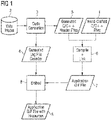
- the diagram according to figure 1 illustrates how the process of creating a modified ELF file with embedded resources works.
- a project which consists of both hand-crafted C/C++ source code 1 as well as a data model 2.
- This is a typical case in more complex applications, where it is beneficial to have a part of information, usually "interface" type definitions and constants, available in such a way, that it can be used in various domains.
- interface usually "interface” type definitions and constants, available in such a way, that it can be used in various domains.
- C/C++ is the de facto standard, however, a test framework which runs system tests on the overall system, i. e. the hardware + embedded software, might be written in another high level language, e. g. Python or Java.
- an appropriate code 3 not only for the application itself can be generated, but also for this test framework.
- some kind of decoder 4 is required. This could be e. g. an XML file describing the format of the individual log messages or also "code", e. g. Python or JavaScript code, which later on could be run by the actual log file analyzer software to decode the log entries and show them to the user. Because both, the generated C/C++ files 5 and 1 for the application and the log file decoder 4, are created from the data model 2, they have a kind of implicit dependency on it, and also on each other.
- the generated C/C++ files 5 and 1 are compiled and linked 6 and an ordinary application ELF file 7 is generated.
- an ordinary application ELF file 7 is generated.
- another step is added, namely the embed step 8, where the generated log file decoder 4 is stored right into the ELF file. Now it is sufficient to pass around this extended and modified ELF file 9, because it holds everything required for both executing the application as well as analyzing logs that it created during runtime.
- FIG. 2 shows another embodiment of the inventive method. It illustrates how to use the resources embedded in an ELF file 9.
- the modified ELF file 9 contains additional resources, e. g. the decoder for binary log files as mentioned above.
- the ELF file contains the machine code for an embedded application, which is loaded onto a device 10. Now, some testing is conducted with the device 10, e. g. to verify the functionality of the just loaded 11 firmware version. This results, among other things, in the creation of a log file 12.
- This log file 12 is in binary form, for example it contains raw data of data structures used within the firmware, which are not further processed before writing to the log for the sake of efficiency.
- a decoder 9 which is a piece of data or a script which was previously embedded in the modified ELF file, is needed to convert the binary log content to a human readable format.
- a log file analyzer 13 application is needed. This application directly uses the same ELF file 9 as was previously loaded 11 onto the device 10 as "decoder”. It can extract the actual decoder from the ELF file 9, as a well-defined protocol was implemented and used to write the resources to the ELF files. Because the same ELF file as loaded 11 onto the device 10 is used, one can be sure that either the contained decoder 4 in the modified/extended ELF file properly translates 14 the binary content 12 to a human readable form or the application itself does the decoding depending on the concrete approach.
- FIG. 3 shows the overall set up in terms of the involved files.
- Starting point is a plain ELF file 16, which is produced by calling a toolchains compiler and linker on the source files.
- This ELF files consists of some meta data and various sections 17, which contain the compiled machine code as well as debugging symbols (if the application has been built with debug symbols enabled).
- the overall goal is to embed additional resources 18, that typically are stored as individual files as well.
- an extended ELF file 9 is produced.
- This ELF file 9 contains the original sections from the plain ELF file 16.
- the resources have been added as new, non-loadable sections 21, whereas this is required in order that tools will not try to interpret these sections 21 as code that needs to be loaded.
- the manifest section 20 contains all the information that tools need to extract the resources 18 from the extended ELF file 9, this section is called the manifest section 20.
- This section 20 serves as the starting point for the extraction of a particular resource.
- a tool would first read the manifest 20. From the manifest 20 or first additional non-loadable section, it can learn which concrete resources are stored in the extended ELF file 9 and read them out as well, applying - if used - e. g. decryption of the previously encrypted data.
Landscapes
- Engineering & Computer Science (AREA)
- Software Systems (AREA)
- Theoretical Computer Science (AREA)
- Physics & Mathematics (AREA)
- General Engineering & Computer Science (AREA)
- General Physics & Mathematics (AREA)
- Stored Programmes (AREA)
Priority Applications (1)
| Application Number | Priority Date | Filing Date | Title |
|---|---|---|---|
| PCT/EP2021/085032 WO2022122942A1 (en) | 2020-12-11 | 2021-12-09 | Method for generating extended elf files to simplify complex and secure application deployments |
Applications Claiming Priority (1)
| Application Number | Priority Date | Filing Date | Title |
|---|---|---|---|
| EP20213563 | 2020-12-11 |
Publications (1)
| Publication Number | Publication Date |
|---|---|
| EP4012584A1 true EP4012584A1 (de) | 2022-06-15 |
Family
ID=76601123
Family Applications (1)
| Application Number | Title | Priority Date | Filing Date |
|---|---|---|---|
| EP21181510.5A Withdrawn EP4012584A1 (de) | 2020-12-11 | 2021-06-24 | Verfahren zur erzeugung von erweiterten elf-dateien zur bereitstellung von vereinheitlichten und sicheren entfaltungen |
Country Status (1)
| Country | Link |
|---|---|
| EP (1) | EP4012584A1 (de) |
Citations (3)
| Publication number | Priority date | Publication date | Assignee | Title |
|---|---|---|---|---|
| US20060015723A1 (en) * | 2004-07-15 | 2006-01-19 | Sony Corporation | System and method for authorizing the use of stored information in an operating system |
| US8701181B2 (en) * | 2007-11-09 | 2014-04-15 | International Business Machines Corporation | Methods and systems for preventing security breaches |
| US9256756B2 (en) * | 2013-12-31 | 2016-02-09 | Giga-Byte Technology Co., Ltd. | Method of encryption and decryption for shared library in open operating system |
-
2021
- 2021-06-24 EP EP21181510.5A patent/EP4012584A1/de not_active Withdrawn
Patent Citations (3)
| Publication number | Priority date | Publication date | Assignee | Title |
|---|---|---|---|---|
| US20060015723A1 (en) * | 2004-07-15 | 2006-01-19 | Sony Corporation | System and method for authorizing the use of stored information in an operating system |
| US8701181B2 (en) * | 2007-11-09 | 2014-04-15 | International Business Machines Corporation | Methods and systems for preventing security breaches |
| US9256756B2 (en) * | 2013-12-31 | 2016-02-09 | Giga-Byte Technology Co., Ltd. | Method of encryption and decryption for shared library in open operating system |
Non-Patent Citations (1)
| Title |
|---|
| BRAZHNIKOV KIRILL: "Using digital signatures for data integrity checking in Linux", 15 August 2020 (2020-08-15), pages 1 - 11, XP055861705, Retrieved from the Internet <URL:https://www.embedded.com/using-digital-signatures-for-data-integrity-checking-in-linux/> [retrieved on 20211115] * |
Similar Documents
| Publication | Publication Date | Title |
|---|---|---|
| CN104462959B (zh) | 一种安卓应用的加固保护方法、服务器和系统 | |
| US8631390B2 (en) | Archiving a build product | |
| JP6815385B2 (ja) | アプリケーションのコード難読化のためのシステムおよび方法 | |
| US9355229B2 (en) | Method for protecting an application program and related computer program product | |
| US20160357530A1 (en) | Method and apparatus for intermediate representation of applications | |
| CN110059456B (zh) | 代码保护方法、代码保护装置、存储介质与电子设备 | |
| CN106203006A (zh) | 基于dex与so文件动态执行的Android应用加固方法 | |
| US7664967B2 (en) | Development system with methodology providing information hiding in executable programs | |
| US11934538B2 (en) | Augmenting executables having cryptographic primitives | |
| US20110271350A1 (en) | method for protecting software | |
| CN110597496B (zh) | 应用程序的字节码文件获取方法及装置 | |
| CN114547558A (zh) | 授权方法、授权控制方法及装置、设备和介质 | |
| US12517744B2 (en) | Applying security mitigation measures for stack corruption exploitation in intermediate code files | |
| BRPI0614089A2 (pt) | método para evitar engenharia reversa de software, modificação não autorizada e interceptação de dados de tempo de execução | |
| CN107292135A (zh) | 一种程序代码保护方法和装置 | |
| WO2016201853A1 (zh) | 加解密功能的实现方法、装置及服务器 | |
| CN119026093B (zh) | 一种字节码文件加密部署的方法、装置、设备及存储介质 | |
| CN107871066B (zh) | 基于安卓系统的代码编译方法及装置 | |
| CN115238249A (zh) | 应用程序代码混淆方法、装置、设备和介质 | |
| JP5387089B2 (ja) | プログラム及びプログラム実行装置 | |
| Pöll et al. | Automating the quantitative analysis of reproducibility for build artifacts derived from the android open source project | |
| Yang et al. | Android control flow obfuscation based on dynamic entry points modification | |
| CN110472425A (zh) | 基于Mono的Unity插件加密方法、存储介质 | |
| EP4012584A1 (de) | Verfahren zur erzeugung von erweiterten elf-dateien zur bereitstellung von vereinheitlichten und sicheren entfaltungen | |
| CN114547559A (zh) | 符号混淆方法、装置、介质和计算设备 |
Legal Events
| Date | Code | Title | Description |
|---|---|---|---|
| PUAI | Public reference made under article 153(3) epc to a published international application that has entered the european phase |
Free format text: ORIGINAL CODE: 0009012 |
|
| STAA | Information on the status of an ep patent application or granted ep patent |
Free format text: STATUS: THE APPLICATION HAS BEEN PUBLISHED |
|
| AK | Designated contracting states |
Kind code of ref document: A1 Designated state(s): AL AT BE BG CH CY CZ DE DK EE ES FI FR GB GR HR HU IE IS IT LI LT LU LV MC MK MT NL NO PL PT RO RS SE SI SK SM TR |
|
| RAP1 | Party data changed (applicant data changed or rights of an application transferred) |
Owner name: SHENZHEN GOODIX TECHNOLOGY CO., LTD. |
|
| STAA | Information on the status of an ep patent application or granted ep patent |
Free format text: STATUS: THE APPLICATION IS DEEMED TO BE WITHDRAWN |
|
| 18D | Application deemed to be withdrawn |
Effective date: 20221216 |