EP4012385A1 - Verfahren und vorrichtung zur regularisierung einer schnellen dreidimensionalen tomografischen bildgebung mittels eines maschinenlernalgorithmus - Google Patents
Verfahren und vorrichtung zur regularisierung einer schnellen dreidimensionalen tomografischen bildgebung mittels eines maschinenlernalgorithmus Download PDFInfo
- Publication number
- EP4012385A1 EP4012385A1 EP21757422.7A EP21757422A EP4012385A1 EP 4012385 A1 EP4012385 A1 EP 4012385A1 EP 21757422 A EP21757422 A EP 21757422A EP 4012385 A1 EP4012385 A1 EP 4012385A1
- Authority
- EP
- European Patent Office
- Prior art keywords
- tomogram
- cell
- regularized
- machine
- raw
- Prior art date
- Legal status (The legal status is an assumption and is not a legal conclusion. Google has not performed a legal analysis and makes no representation as to the accuracy of the status listed.)
- Granted
Links
Images




Classifications
-
- G—PHYSICS
- G06—COMPUTING OR CALCULATING; COUNTING
- G06N—COMPUTING ARRANGEMENTS BASED ON SPECIFIC COMPUTATIONAL MODELS
- G06N3/00—Computing arrangements based on biological models
- G06N3/02—Neural networks
- G06N3/08—Learning methods
-
- G—PHYSICS
- G01—MEASURING; TESTING
- G01N—INVESTIGATING OR ANALYSING MATERIALS BY DETERMINING THEIR CHEMICAL OR PHYSICAL PROPERTIES
- G01N21/00—Investigating or analysing materials by the use of optical means, i.e. using sub-millimetre waves, infrared, visible or ultraviolet light
- G01N21/17—Systems in which incident light is modified in accordance with the properties of the material investigated
- G01N21/41—Refractivity; Phase-affecting properties, e.g. optical path length
- G01N21/45—Refractivity; Phase-affecting properties, e.g. optical path length using interferometric methods; using Schlieren methods
-
- G—PHYSICS
- G06—COMPUTING OR CALCULATING; COUNTING
- G06T—IMAGE DATA PROCESSING OR GENERATION, IN GENERAL
- G06T12/00—Tomographic reconstruction from projections
-
- G—PHYSICS
- G06—COMPUTING OR CALCULATING; COUNTING
- G06N—COMPUTING ARRANGEMENTS BASED ON SPECIFIC COMPUTATIONAL MODELS
- G06N20/00—Machine learning
-
- G—PHYSICS
- G06—COMPUTING OR CALCULATING; COUNTING
- G06N—COMPUTING ARRANGEMENTS BASED ON SPECIFIC COMPUTATIONAL MODELS
- G06N3/00—Computing arrangements based on biological models
- G06N3/02—Neural networks
-
- G—PHYSICS
- G06—COMPUTING OR CALCULATING; COUNTING
- G06N—COMPUTING ARRANGEMENTS BASED ON SPECIFIC COMPUTATIONAL MODELS
- G06N3/00—Computing arrangements based on biological models
- G06N3/02—Neural networks
- G06N3/04—Architecture, e.g. interconnection topology
- G06N3/045—Combinations of networks
-
- G—PHYSICS
- G06—COMPUTING OR CALCULATING; COUNTING
- G06N—COMPUTING ARRANGEMENTS BASED ON SPECIFIC COMPUTATIONAL MODELS
- G06N3/00—Computing arrangements based on biological models
- G06N3/02—Neural networks
- G06N3/04—Architecture, e.g. interconnection topology
- G06N3/0464—Convolutional networks [CNN, ConvNet]
-
- G—PHYSICS
- G06—COMPUTING OR CALCULATING; COUNTING
- G06N—COMPUTING ARRANGEMENTS BASED ON SPECIFIC COMPUTATIONAL MODELS
- G06N3/00—Computing arrangements based on biological models
- G06N3/02—Neural networks
- G06N3/08—Learning methods
- G06N3/09—Supervised learning
-
- G—PHYSICS
- G06—COMPUTING OR CALCULATING; COUNTING
- G06T—IMAGE DATA PROCESSING OR GENERATION, IN GENERAL
- G06T12/00—Tomographic reconstruction from projections
- G06T12/10—Image preprocessing, e.g. calibration, positioning of sources or scatter correction
-
- G—PHYSICS
- G06—COMPUTING OR CALCULATING; COUNTING
- G06V—IMAGE OR VIDEO RECOGNITION OR UNDERSTANDING
- G06V10/00—Arrangements for image or video recognition or understanding
- G06V10/70—Arrangements for image or video recognition or understanding using pattern recognition or machine learning
- G06V10/82—Arrangements for image or video recognition or understanding using pattern recognition or machine learning using neural networks
-
- G—PHYSICS
- G01—MEASURING; TESTING
- G01N—INVESTIGATING OR ANALYSING MATERIALS BY DETERMINING THEIR CHEMICAL OR PHYSICAL PROPERTIES
- G01N21/00—Investigating or analysing materials by the use of optical means, i.e. using sub-millimetre waves, infrared, visible or ultraviolet light
- G01N21/17—Systems in which incident light is modified in accordance with the properties of the material investigated
- G01N2021/178—Methods for obtaining spatial resolution of the property being measured
- G01N2021/1785—Three dimensional
- G01N2021/1787—Tomographic, i.e. computerised reconstruction from projective measurements
-
- G—PHYSICS
- G06—COMPUTING OR CALCULATING; COUNTING
- G06T—IMAGE DATA PROCESSING OR GENERATION, IN GENERAL
- G06T2210/00—Indexing scheme for image generation or computer graphics
- G06T2210/41—Medical
-
- G—PHYSICS
- G06—COMPUTING OR CALCULATING; COUNTING
- G06T—IMAGE DATA PROCESSING OR GENERATION, IN GENERAL
- G06T2211/00—Image generation
- G06T2211/40—Computed tomography
- G06T2211/436—Limited angle
-
- G—PHYSICS
- G06—COMPUTING OR CALCULATING; COUNTING
- G06T—IMAGE DATA PROCESSING OR GENERATION, IN GENERAL
- G06T2211/00—Image generation
- G06T2211/40—Computed tomography
- G06T2211/441—AI-based methods, deep learning or artificial neural networks
Definitions
- the following embodiments relate to a method and apparatus for rapidly regularizing three-dimensional (3-D) tomography using a machine learning algorithm.
- a current 3-D tomography technology has low resolution in the direction of an optical axis because spatial frequency information in the corresponding direction is not measured due to a physical limit of an optical lens.
- spatial frequency information that is not measured is filled by using an iteration-based regularization algorithm using known information or assumption of a sample.
- Common regularization algorithms include non-negativity using an assumption that the background of a sample has a value equal to or greater than a specific value, a total variation using an assumption that a 3-D tomogram of a sample has a small image gradient, etc.
- a regularization algorithm such as the total variation
- a regularization algorithm is commonly used because it can effectively increase resolution of a 3-D image in the direction of an optical axis, but has a disadvantage in that several minutes to several hours of a calculation time are taken because a regularized 3-D tomographic image is obtained by iteratively calculating a gradient descent.
- a user has to find out optimum results in a trial and error manner by putting several parameters because algorithmic parameters suitable for each sample are different.
- Non-patent Document 1 Kim, K., et al. (2016). "Optical diffraction tomography techniques for the study of cell pathophysiology.” arXiv preprint arXiv: 1603.00592.
- Non-patent Document 2 Wolf, E. (1969). "Three-dimensional structure determination of semi-transparent objects from holographic data.” Optics Communications 1(4): 153-156 .
- Non-patent Document 4 Park, Y. (2016). “Quantitative phase imaging in biomedicine.” Nature Photonics 12(10): 578-589 .
- Embodiments describe a method and apparatus for rapidly regularizing 3-D tomography using a machine learning algorithm, and more specifically, provide a technology for providing the rapid regularization of a tomographic image through a deep learning algorithm that learns a feature of a regularization algorithm, such as a total variation, without a process of finding the optimization or parameter of an algorithm.
- Embodiments provide a method and apparatus for rapidly regularizing 3-D tomography using a machine learning algorithm, which increase resolution by learning a non-linear relation between a 3-D tomogram that is first optically imaged and a regularized 3-D tomogram thereof through deep learning and regularizing a newly imaged 3-D tomogram within several seconds.
- a method of regularizing three-dimensional (3-D) tomography using a machine-learning algorithm may include obtaining a raw tomogram of a cell by measuring a 3-D tomogram of a cell, obtaining a regularized tomogram by using a regularization algorithm, and learning a relation between the raw tomogram and the regularized tomogram through a machine-learning algorithm.
- the method may further include regularizing the measured 3-D tomogram of the cell by using the trained machine-learning algorithm.
- Obtaining a raw tomogram of a cell by measuring a 3-D tomogram of a cell may include measuring a 3-D refractive index image of the cell by using an incident light rotation method using illumination at a plurality of angles or obtaining a 3-D refractive index image of the cell by using a plurality of two-dimensional (2-D) images measured while rotating the cell (sample rotation) or translating the cell.
- Obtaining a raw tomogram of a cell by measuring a 3-D tomogram of a cell may include obtaining a regulated refractive index image corresponding to each image through total variation regularization, and forming a paired dataset of the raw tomogram and the regularized tomogram.
- Learning a relation between the raw tomogram and the regularized tomogram through a machine-learning algorithm may include extracting a specific feature of a cell type by learning a non-linear relation between paired datasets of the raw tomogram and the regularized tomogram through the machine-learning algorithm.
- Regularizing the measured 3-D tomogram of the cell by using the machine-learning algorithm may include outputting the regularized tomogram by inputting the measured raw tomogram to a convolutional neural network (CNN) algorithm, and identifying the type of cell by applying the regularized tomogram.
- CNN convolutional neural network
- Regularizing the measured 3-D tomogram of the cell by using the machine-learning algorithm may include a contraction path of extracting a specific feature from raw tomogram data of the cell through sequential application of convolution and subsampling for each path, and an expansion path of outputting regularized tomogram data having a size identical with an input value through the sequential application of convolution and subsampling for each path.
- An apparatus for regularizing three-dimensional (3-D) tomography using a machine-learning algorithm may include a 3-D tomogram measurement unit configured to obtain a raw tomogram of a cell by measuring a 3-D tomogram of a cell, a regularization algorithm configured to obtain a regularized tomogram, and a machine-learning algorithm configured to learn a relation between the raw tomogram and the regularized tomogram.
- the apparatus may further include a regularization unit configured to regularize the measured 3-D tomogram of the cell by using the trained machine-learning algorithm.
- the regularization unit may output the regularized tomogram by inputting the measured raw tomogram to a convolutional neural network (CNN) algorithm, and may identify the type of cell by applying the regularized tomogram.
- CNN convolutional neural network
- the method and apparatus for rapidly regularizing 3-D tomography using a machine learning algorithm which provide a deep learning-based regularization method 10 times faster than the existing regularization method used in a 3-D tomography technology by providing the rapid regularization of a tomographic image through a deep learning algorithm that learns a feature of a regularization algorithm, such as a total variation.
- the method and apparatus for rapidly regularizing 3-D tomography using a machine learning algorithm which increase resolution by leaning a non-linear relation between a 3-D tomogram that is first optically imaged and a regularized 3-D tomogram thereof through deep learning and regularizing a newly imaged 3-D tomogram within several seconds.
- a three-dimensional (3-D) tomography technology widely used in life science and medicine cannot physically obtain all of pieces of spatial frequency information (k z ) corresponding to the direction of an optical axis (z coordinates in a common x, y, z coordinate system) because an angle at which a sample may be physically illuminated and an angle at which scattered light is obtained from a sample are limited due to a light acquisition limit (e.g., a numerical aperture) of a lens.
- a light acquisition limit e.g., a numerical aperture
- Non-patent Document 3 In order to solve such a missing cone problem, it is very important to perform post-processing by using a computational regularization algorithm (Non-patent Document 3).
- a conventional regularization algorithm taken from several minutes to several hours is incapable of the real-time 3-D visualization of a sample. Accordingly, it is necessary to develop a rapid regularization algorithm.
- the following embodiments provide a method and apparatus for rapidly regularizing 3-D tomography using a machine learning algorithm, and provide a deep learning-based regularization method 10 times faster than the existing regularization method used in the 3-D tomography technology.
- embodiments are intended to increase resolution by learning a non-linear relation between a 3-D tomogram that is first optically imaged and a regularized 3-D tomogram thereof through deep learning, such as a convolutional neural network (CNN) algorithm, and regularizing a newly imaged 3-D tomogram within several seconds, instead of regularizing a total variation-based iterative algorithm in which a missing cone degrading resolution in the direction of an optical axis is taken from several minutes to several hours in the 3-D tomography technology.
- deep learning such as a convolutional neural network (CNN) algorithm
- FIG. 1 is a diagram schematically describing a method of regularizing 3-D tomography using a machine-learning algorithm according to an embodiment.
- An object of the present embodiment is to provide the rapid regularization of a tomographic image through a deep learning algorithm that learns a feature of a regularization algorithm, such as a total variation, without a process of finding out the optimization or parameter of an algorithm.
- the 3-D tomography technology may generate a 3-D image by synthesizing several sheets of two-dimensional (2-D) images obtained by illumination at several angles, rotating a sample, or translating the sample.
- a 3-D tomogram of a cell may be measured by using a 3-D tomogram measurement unit 110 according to an embodiment.
- a regularized tomogram may be obtained by using the existing regularization algorithm 120, such as a total variation.
- a cell raw tomogram database 111 may be constructed by measuring the 3-D tomogram of the cell through the 3-D tomogram measurement unit 110.
- a regularized tomogram database may be constructed through the regularization algorithm 120.
- a distribution (image) of 3-D refractive indices of a sample can be measured without using dyeing or labeling.
- the type of cell can be identified based on the distribution. If a distribution of 3-D refractive indices is used, the type of cell can be identified based on a specific morphological feature and biochemical characteristic of a cell type. In particular, the type of cell can be identified simply and accurately by measuring a 3-D refractive index of a cell and applying the measured value to a machine-learning algorithm.
- FIG. 2 is a flowchart illustrating a method of regularizing 3-D tomography using a machine-learning algorithm according to an embodiment.
- the method of regularizing 3-D tomography using a machine-learning algorithm may include a step 210 of obtaining a raw tomogram of a cell by measuring a 3-D tomogram of the cell, a step 220 of obtaining a regularized tomogram by using a regularization algorithm, and a step 230 of learning a relation between the raw tomogram and the regularized tomogram through a machine-learning algorithm.
- the method may further include a step 240 of regularizing the measured 3-D tomogram of the cell by using the trained machine-learning algorithm.
- resolution can be increased by learning a non-linear relation between a 3-D tomogram that is first optically imaged and a regularized 3-D tomogram thereof through deep learning and regularizing a newly imaged 3-D tomogram within several seconds.
- the method of regularizing 3-D tomography using a machine-learning algorithm according to an embodiment may be described by taking, as an example, an apparatus for regularizing 3-D tomography using a machine-learning algorithm according to an embodiment.
- FIG. 3 is a block diagram illustrating an apparatus for regularizing 3-D tomography using a machine-learning algorithm according to an embodiment.
- an apparatus 300 for regularizing 3-D tomography using a machine-learning algorithm may include a 3-D tomogram measurement unit 310, a regularization algorithm 320 and a machine-learning algorithm 330.
- the apparatus 300 for regularizing 3-D tomography using a machine-learning algorithm may further include a regularization unit 340.
- the 3-D tomogram measurement unit 310 may obtain a raw tomogram of a cell by measuring a 3-D tomogram of the cell.
- the 3-D tomogram measurement unit 310 may optically measure a distribution of 3-D refractive indices of the cell.
- the 3-D refractive index measurement unit 310 may be an optical system composed of a light source, a camera, etc., and may be constructed in various forms, such as a reflection type and a transmission type.
- the 3-D refractive index measurement unit 310 may include a light source, an interferometer and a measurement unit.
- the light source may let light incident on a cell.
- a laser may be used as the light source.
- the light source may radiate a laser beam to a sample, such as a cell to be measured.
- the light source used may use a single-wavelength laser.
- the light source may also use a large amount of information to identify a cell by measuring a 3-D refractive index in each wavelength by using a multi-wavelength laser.
- the cell may be represented as a sample indicative of a target to be measured, and may be a bacteria or a microorganism in addition to a cell, and may be an object including a cell, etc.
- the interferometer may obtain multiple 2-D holograms by measuring transmission light diffracted by a cell after light incident from the light source is incident on the cell.
- the interferometer is a measuring instrument using an interference phenomenon of light, and is a tool for monitoring an interference phenomenon occurring when two pieces of light meet again after light emitted from the same light source is divided into the two pieces of light so that there is a difference between the progress paths of the two pieces of light.
- the measurement unit may measure a distribution of 3-D refractive indices of a cell by using multiple 2-D holograms obtained by the interferometer.
- a camera that is, an imaging apparatus for photographing an image, may be used as the measurement unit.
- Such a 3-D refractive index measurement unit 310 may measure a distribution of 3-D refractive indices of a cell through at least one optical measurement among optical diffraction tomography and optical projection tomography.
- the 3-D tomogram measurement unit 310 may measure a 3-D refractive index image of a cell by using an incident light rotation method using illumination at a plurality of angles or may obtain a 3-D refractive index image of a cell by using a plurality of 2-D images measured while rotating the cell (sample rotation) or translating the cell.
- a regularized tomogram may be obtained using the regularization algorithm 320.
- the regularization algorithm 320 may obtain a regulated refractive index image corresponding to each image through regularization, such as a total variation, and may form a paired dataset of the raw tomogram and the regularized tomogram.
- the machine-learning algorithm 330 may learn a relation between the raw tomogram and the regularized tomogram.
- the machine-learning algorithm 330 may extract a specific feature of a cell type by learning a non-linear relation between paired datasets of the raw tomogram and the regularized tomogram.
- the machine-learning algorithm 330 may be composed of a deep learning algorithm (e.g., a deep neural network (DNN)) or a convolutional neural network (CNN) algorithm. Accordingly, a refractive index feature specific to a cell type may be extracted through the deep learning algorithm or the CNN algorithm by using the measured raw tomogram of the cell.
- a deep learning algorithm e.g., a deep neural network (DNN)
- CNN convolutional neural network
- the regularization unit 340 may regularize the measured 3-D tomogram of the cell by using the trained machine-learning algorithm.
- the regularization unit 340 may output a regularized tomogram by inputting the measured raw tomogram to the deep learning algorithm or the CNN algorithm, and may identify the type of cell by applying the regularized tomogram.
- the regularization unit 340 may regularize the measured 3-D tomogram of the cell, through a contraction path of extracting, from raw tomogram data of the cell, a specific feature through the sequential application of convolution and subsampling for each path and an expansion path of outputting regularized tomogram data having the same size as an input value through the sequential application of convolution and subsampling for each path.
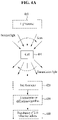
- FIG. 4a is a diagram for describing a method of measuring a 3-D refractive index of a cell using an incident light rotation method according to an embodiment.
- FIG. 4b is a diagram for describing a method of measuring a 3-D refractive index of a cell using a cell rotation method according to an embodiment.
- FIG. 4c is a diagram for describing a method of measuring a 3-D refractive index of a cell using a sample translation method according to an embodiment.
- the present embodiments may be applied to all types of 3-D tomograms.
- the present embodiments are described based on a refractive index owned by all things among a 3-D tomogram.
- the refractive index is a unique optical physical quantity of a material that describes how the speed is decelerated when light passes through the material.
- FIGS. 4a to 4c illustrate possible various measurement optical implementations.
- the optical diffraction tomography and the optical projection tomography may use the same optical implementation (Non-patent Document 2 and Non-patent Document 4).
- Light emitted from a coherent light source 410 may be incident on the cell 401.
- a hologram of transmission light diffracted by the cell 401 may be measured by using an interferometer 420.
- a distribution of 3-D refractive indices 440 of the cell 401 may be measured by using several sheets of 2-D holograms measured while rotating (scanning) an angle at which the light is incident on the cell 401.
- a difference between the diffraction tomography and the projection tomography is a restoration algorithm 430 in which whether light in the sample is diffracted is taken into consideration.
- a distribution of the 3-D refractive indices 440 may be measured by directly rotating the cell 401, instead of rotating the incident light in the method of measuring a distribution of the 3-D refractive indices of the cell 401 using the incident light rotation method described with reference to FIG. 4a .
- a distribution of the 3-D refractive indices may be measured in several sheets of 2-D images while directly translating the cell 401 in the direction of an optical axis, instead of rotating the incident light in the method of measuring a distribution of the 3-D refractive indices of the cell 401 using the incident light rotation method described with reference to FIG. 4a .
- a method of measuring the cell 401 may include a form in which the cells 401 are placed at a low concentration on an in vitro slide glass, a form in which the cells 401 form a single layer or several layers at a high concentration on an in vitro slide glass, a tissue slide form in which a bio tissue slide is cut to a thickness between 5 micrometers and 200 micrometers, a form in which the cell 401 is placed on an in vitro multi-well plate, or a form in which cells pass through a microfluidic channel for high-throughput screening in vitro.
- a single-wavelength laser may be used as the light source.
- a low-coherence light source having a wavelength width (full-width half-maximum of a spectral bandwidth) of 1 nm or more to 100 nm or less may be used.
- a larger amount of information may be used to identify the cell 401 by measuring a 3-D refractive index in each center wavelength by using a combination of lasers or low-coherence light sources having several center wavelengths.
- FIG. 5 is a diagram for describing a method of regularizing 3-D tomography using a convolutional neural network according to an embodiment.
- 3-D refractive index images of cells whose types have already been classified may be measured using the methods described with reference to FIGS. 4a to 4c .
- a regularized tomogram 530 corresponding to each image may be obtained through regularization, such as a total variation, and a paired dataset of a "raw tomogram 510 - regularized tomogram 530" may be formed.
- a specific feature may be extracted by learning a complicated nonlinear relation between the paired dataset by using a deep learning algorithm or CNN algorithm 520.
- the raw tomogram 510 may be represented a 3-D refractive index image 511 or a spatial frequency spectrum 512.
- the regularized tomogram 530 may be represented as a 3-D refractive index image 531 or a spatial frequency spectrum 532.
- the CNN algorithm 520 may be used based on measured 3-D refractive index information.
- information inputted to the CNN algorithm 520 is the raw tomogram 510, that is, 3-D refractive index information of each cell.
- a predictive value obtained as the results of machine learning accordingly is the regularized tomogram 530, that is, regularized 3-D refractive index information filled with spatial frequency information (k z ) that has not been physically measured.
- the predictive value obtained as the results of machine learning is a 3-D tomogram.
- a specific feature may be extracted (feature extraction) from the 3-D refractive index tomogram data (i.e., the raw tomogram) 510 through the sequential application of convolution and subsampling for each path in a contraction path 521.
- regularized 3-D refractive index information having the same size as an input value, that is, the regularized tomogram 530, may be outputted again through the sequential application of convolution and subsampling for each path.
- refractive index information composed in a 3-D form is n(x, y, z)
- a specific feature may be directly extracted from the refractive index information in a 3-D matrix form.
- a spatial location (x, y, z) may be transformed into a spatial frequency location (kx, ky, kz) through a Fourier transform, etc. and used.
- Regularization may be performed by applying to a specific feature of a cell type obtained using the aforementioned method by using a distribution of 3-D refractive indices of a specific cell.
- efficiency of deep learning can be increased by using both a real part of a refractive index related to the deceleration of light within a material and an imaginary part of a refractive index related to the absorption of the light.
- Efficiency of deep learning can also be increased by using spatial frequency information as the input value of the algorithm.
- a 3-D tomogram can be rapidly regularized within several seconds.
- This technology enables regularization of a several-second scale, unlike a conventional regularization method based on iterative optimization using a gradient descent, which is taken several minutes to several hours. Accordingly, a large number of 3-D tomograms can be regularized in real time.
- the present disclosure has been described by being applied to an optical tomography technology for measuring a distribution of 3-D refractive indices, but may be applied to wide tomography technologies, for example, an x-ray, electron microscopy computed tomography (CT), magnetic resonance imaging (MRI), etc.
- CT electron microscopy computed tomography
- MRI magnetic resonance imaging
- a fast regularization method can be realized through deep learning by using a pair of a physically measured 3-D tomogram and a tomogram regularized using a conventional algorithm.
- a deep learning algorithm that has learnt a regularization algorithm parameter first found by a user enables rapid regularization without additional parameter search or optimization when receiving a new tomogram input value.
- ODT optical diffraction tomography
- RI refractive index
- an embodiment may provide a machine-learning algorithm, such as a deep neural network (DNN), which rapidly improves resolution of a 3D refractive index map through the method of regularizing 3-D tomography using a machine-learning algorithm.
- a machine-learning algorithm such as a deep neural network (DNN)
- DNN deep neural network
- the 3D-based CNN may learn a transform between two tomogram domains through a paired dataset (a raw tomogram/ regularized tomogram having improved resolution through an iterative total variation algorithm).
- FIG. 6 is a diagram illustrating optical diffraction tomography (ODT) and a regularization process using a machine-learning algorithm according to an embodiment.
- ODT optical diffraction tomography
- FIG. 6 illustrates an optical diffraction tomography (ODT) and regularization process using a 3D deep neural network, that is, a machine-learning algorithm, and the existing iterative total variation (TV) algorithm.
- ODT uses scattered fields of microbeads at various angles in order to reconstruct a 3D refractive index (RI) through a Fourier diffraction theory.
- a raw tomogram 610 is regularized using a machine-learning algorithm.
- a regularized tomogram 620 may be regularized within five seconds. In contrast, about 1 minute is taken for the optimization of the existing iterative total variation (TV) algorithm 630.
- TV iterative total variation
- FIG. 7 is a diagram for describing a structure of the machine-learning algorithm according to an embodiment.
- a trained 3-D deep neural network regularizes a tomogram patch (64x64x64), and may concatenate all the regularized patches to a total tomogram only within several seconds.
- Four cells (reduction, encoder normal, decoder normal, and expansion) are alternatively in downsampling and upsampling paths.
- Standard convolution is used in the reduction and encoder normal cells in the downsampling path.
- Expansion convolution is used in the decoder normal and expansion cells in the upsampling path in order to preserve feature information and efficiently expand a feature dimension.
- the aforementioned apparatus may be implemented as a hardware component, a software component and/or a combination of a hardware component and a software component.
- the apparatus and component described in the embodiments may be implemented using a processor, a controller, an arithmetic logic unit (ALU), a digital signal processor, a microcomputer, a field programmable gate array (FPGA), a programmable logic unit (PLU), a microprocessor or one or more general-purpose computers or special-purpose computers, such as any other apparatus capable of executing or responding to an instruction.
- the processing apparatus may perform an operating system (OS) and one or more software applications executed on the OS. Furthermore, the processing apparatus may access, store, manipulate, process and generate data in response to the execution of software.
- OS operating system
- the processing apparatus may access, store, manipulate, process and generate data in response to the execution of software.
- the processing apparatus may include a plurality of processing elements and/or a plurality of types of processing elements.
- the processing apparatus may include a plurality of processors or a single processor and a single controller.
- a different processing configuration such as a parallel processor, is also possible.
- Software may include a computer program, a code, an instruction or a combination of one or more of them, and may configure a processing apparatus so that the processing apparatus operates as desired or may instruct the processing apparatuses independently or collectively.
- the software and/or the data may be embodied in any type of machine, a component, a physical apparatus, a computer storage medium or a apparatus in order to be interpreted by the processor or to provide an instruction or data to the processing apparatus.
- the software may be distributed to computer systems connected over a network and may be stored or executed in a distributed manner.
- the software and the data may be stored in one or more computer-readable recording media.
- the method according to an embodiment may be implemented in the form of a program instruction executable by various computer means and recorded on a computer-readable recording medium.
- the computer-readable recording medium may include a program instruction, a data file, and a data structure alone or in combination.
- the program instruction recorded on the medium may be specially designed and constructed for an embodiment, or may be known and available to those skilled in the computer software field.
- Examples of the computer-readable medium include magnetic media such as a hard disk, a floppy disk and a magnetic tape, optical media such as a CD-ROM and a DVD, magneto-optical media such as a floptical disk, and hardware devices specially configured to store and execute a program instruction, such as a ROM, a RAM, and a flash memory.
- Examples of the program instruction include not only machine language code produced by a compiler, but a high-level language code which may be executed by a computer using an interpreter, etc.
Landscapes
- Engineering & Computer Science (AREA)
- Theoretical Computer Science (AREA)
- Physics & Mathematics (AREA)
- General Physics & Mathematics (AREA)
- Evolutionary Computation (AREA)
- Software Systems (AREA)
- General Health & Medical Sciences (AREA)
- Health & Medical Sciences (AREA)
- Artificial Intelligence (AREA)
- Computing Systems (AREA)
- Mathematical Physics (AREA)
- Life Sciences & Earth Sciences (AREA)
- General Engineering & Computer Science (AREA)
- Data Mining & Analysis (AREA)
- Molecular Biology (AREA)
- Biophysics (AREA)
- Computational Linguistics (AREA)
- Biomedical Technology (AREA)
- Computer Vision & Pattern Recognition (AREA)
- Medical Informatics (AREA)
- Multimedia (AREA)
- Databases & Information Systems (AREA)
- Chemical & Material Sciences (AREA)
- Analytical Chemistry (AREA)
- Biochemistry (AREA)
- Immunology (AREA)
- Pathology (AREA)
- Investigating Or Analysing Materials By Optical Means (AREA)
- Image Analysis (AREA)
Applications Claiming Priority (2)
| Application Number | Priority Date | Filing Date | Title |
|---|---|---|---|
| KR1020200020158A KR102246439B1 (ko) | 2020-02-19 | 2020-02-19 | 기계학습 알고리즘을 활용한 신속한 3차원 단층촬영의 정규화 방법 및 장치 |
| PCT/KR2021/000128 WO2021167241A1 (ko) | 2020-02-19 | 2021-01-06 | 기계학습 알고리즘을 활용한 신속한 3차원 단층촬영의 정규화 방법 및 장치 |
Publications (4)
| Publication Number | Publication Date |
|---|---|
| EP4012385A1 true EP4012385A1 (de) | 2022-06-15 |
| EP4012385A4 EP4012385A4 (de) | 2023-08-30 |
| EP4012385C0 EP4012385C0 (de) | 2025-11-12 |
| EP4012385B1 EP4012385B1 (de) | 2025-11-12 |
Family
ID=75740423
Family Applications (1)
| Application Number | Title | Priority Date | Filing Date |
|---|---|---|---|
| EP21757422.7A Active EP4012385B1 (de) | 2020-02-19 | 2021-01-06 | Verfahren und vorrichtung zur regularisierung einer schnellen dreidimensionalen tomografischen bildgebung mittels eines maschinenlernalgorithmus |
Country Status (5)
| Country | Link |
|---|---|
| US (1) | US12141897B2 (de) |
| EP (1) | EP4012385B1 (de) |
| KR (1) | KR102246439B1 (de) |
| CN (1) | CN114341927B (de) |
| WO (1) | WO2021167241A1 (de) |
Cited By (1)
| Publication number | Priority date | Publication date | Assignee | Title |
|---|---|---|---|---|
| CN115839930A (zh) * | 2023-02-14 | 2023-03-24 | 成都华芯众合电子科技有限公司 | 一种通过等离激元共振测量液体折射率的光学平台 |
Families Citing this family (4)
| Publication number | Priority date | Publication date | Assignee | Title |
|---|---|---|---|---|
| KR20210128505A (ko) * | 2019-03-13 | 2021-10-26 | 주식회사 토모큐브 | 3차원 정량적 위상 이미징을 이용하여 미생물들을 식별 |
| KR102659201B1 (ko) * | 2022-05-30 | 2024-04-22 | 주식회사 토모큐브 | Ai 기술 기반의 3차원 굴절률 현미경 영상 분해능 개선 시스템 및 방법 |
| KR102824766B1 (ko) | 2022-06-17 | 2025-06-25 | 경북대학교 산학협력단 | 단층 영상 이미지를 이용한 세균 자동 동정 방법 및 이를 수행하기 위한 시스템 및 기록 매체 |
| KR102893802B1 (ko) * | 2023-05-09 | 2025-12-01 | 한국전자통신연구원 | 초고해상도 홀로토모그램 영상을 획득하기 위한 장치 및 방법 |
Family Cites Families (15)
| Publication number | Priority date | Publication date | Assignee | Title |
|---|---|---|---|---|
| CA2810822C (en) * | 2009-09-22 | 2018-03-06 | Visen Medical, Inc. | Systems and methods for virtual index-matching of diffusive media |
| WO2013134949A1 (zh) * | 2012-03-16 | 2013-09-19 | 西安电子科技大学 | 内窥式x射线发光断层成像装置及方法 |
| US10285659B2 (en) * | 2013-12-06 | 2019-05-14 | Rensselaer Polytechnic Institute | Stored luminescence computed tomography |
| KR101683573B1 (ko) * | 2015-03-31 | 2016-12-07 | 연세대학교 산학협력단 | 안구 단층 촬영 영상에서의 시세포 층 정량화 검출 장치 및 그 방법 |
| WO2017015381A1 (en) * | 2015-07-20 | 2017-01-26 | Rensselaer Polytechnic Institute | X-ray phase-contrast and dark-field information extraction with electric fringe scanning and/or active pixel processing |
| US9805481B2 (en) * | 2016-01-22 | 2017-10-31 | General Electric Company | System and method for regularized reconstruction of phase contrast computerized tomography |
| US10845759B2 (en) * | 2016-05-06 | 2020-11-24 | Uwm Research Foundation, Inc. | Snapshot optical tomography system and method of acquiring an image with the system |
| KR101927852B1 (ko) * | 2016-06-10 | 2018-12-13 | 주식회사 토모큐브 | 3차원 굴절률 토모그램과 딥러닝을 이용한 비염색 비표지 세포 종류 구분 방법 및 장치 |
| WO2019060843A1 (en) * | 2017-09-22 | 2019-03-28 | Nview Medical Inc. | IMAGE RECONSTRUCTION USING MACHINE LEARNING REGULARIZERS |
| US10799189B2 (en) * | 2017-11-22 | 2020-10-13 | General Electric Company | Systems and methods to deliver point of care alerts for radiological findings |
| US10810767B2 (en) * | 2018-06-12 | 2020-10-20 | Siemens Healthcare Gmbh | Machine-learned network for Fourier transform in reconstruction for medical imaging |
| KR102130963B1 (ko) * | 2018-07-09 | 2020-07-08 | 라온피플 주식회사 | 두부이미지 분석 장치 및 이미지 분석 방법 |
| KR101926181B1 (ko) * | 2018-08-01 | 2018-12-06 | (주)한그린테크 | 머신러닝 기반 신선도 측정 장치 및 방법 |
| CN113039581B (zh) * | 2018-09-14 | 2025-06-06 | 恩维医疗公司有限公司 | 三维对象的多尺度图像重建 |
| CN110706298B (zh) * | 2019-09-10 | 2023-04-07 | 天津大学 | 正则化加权最小二乘的透射反射双模式超声成像重建方法 |
-
2020
- 2020-02-19 KR KR1020200020158A patent/KR102246439B1/ko active Active
-
2021
- 2021-01-06 EP EP21757422.7A patent/EP4012385B1/de active Active
- 2021-01-06 CN CN202180005100.1A patent/CN114341927B/zh active Active
- 2021-01-06 WO PCT/KR2021/000128 patent/WO2021167241A1/ko not_active Ceased
- 2021-01-06 US US17/753,452 patent/US12141897B2/en active Active
Cited By (1)
| Publication number | Priority date | Publication date | Assignee | Title |
|---|---|---|---|---|
| CN115839930A (zh) * | 2023-02-14 | 2023-03-24 | 成都华芯众合电子科技有限公司 | 一种通过等离激元共振测量液体折射率的光学平台 |
Also Published As
| Publication number | Publication date |
|---|---|
| US20220383562A1 (en) | 2022-12-01 |
| EP4012385C0 (de) | 2025-11-12 |
| EP4012385B1 (de) | 2025-11-12 |
| EP4012385A4 (de) | 2023-08-30 |
| CN114341927A (zh) | 2022-04-12 |
| KR102246439B1 (ko) | 2021-04-30 |
| CN114341927B (zh) | 2025-10-24 |
| WO2021167241A1 (ko) | 2021-08-26 |
| US12141897B2 (en) | 2024-11-12 |
Similar Documents
| Publication | Publication Date | Title |
|---|---|---|
| US12141897B2 (en) | Method and device for regularizing rapid three-dimensional tomographic imaging using machine-learning algorithm | |
| Jin et al. | Tomographic phase microscopy: principles and applications in bioimaging | |
| Gao et al. | Iterative projection meets sparsity regularization: towards practical single-shot quantitative phase imaging with in-line holography | |
| Lim et al. | High-fidelity optical diffraction tomography of multiple scattering samples | |
| Yang et al. | Low-dose x-ray tomography through a deep convolutional neural network | |
| Horstmeyer et al. | Diffraction tomography with Fourier ptychography | |
| US11410304B2 (en) | Method and apparatus for rapid diagnosis of hematologic malignancy using 3D quantitative phase imaging and deep learning | |
| Kandel et al. | Label-free tissue scanner for colorectal cancer screening | |
| JP7122769B2 (ja) | 3次元屈折率映像とディープラーニングを活用したラベルフリー方式の3次元分子像生成方法および装置 | |
| Nashed et al. | Distributed automatic differentiation for ptychography | |
| JP6112872B2 (ja) | 撮像システム、画像処理方法、および撮像装置 | |
| Giewekemeyer et al. | Ptychographic coherent x-ray diffractive imaging in the water window | |
| CN107655571B (zh) | 一种基于色散模糊的光谱成像系统及其光谱重建方法 | |
| Ghosh et al. | ADP: Automatic differentiation ptychography | |
| Zhou et al. | Fast automatic multiple positioning for lensless coherent diffraction imaging | |
| Wang et al. | Ptychography at all wavelengths | |
| Jiang et al. | Coded ptychographic imaging | |
| Vyas et al. | Isotropic quantitative differential phase contrast imaging techniques: a review | |
| Denker et al. | Plug-and-play half-quadratic splitting for ptychography | |
| Moon | Deep learning in digital holography for biomedical applications | |
| Alshaabi et al. | Fourier-based three-dimensional multistage transformer for aberration correction in multicellular specimens | |
| CN114326352A (zh) | 一种基于数字全息的实时细胞三维分析方法 | |
| Maire et al. | Experimental inversion of optical diffraction tomography data with a nonlinear algorithm in the multiple scattering regime | |
| Müller | Optical diffraction tomography for single cells | |
| della Maggiora et al. | Single exposure quantitative phase imaging with a conventional microscope using diffusion models |
Legal Events
| Date | Code | Title | Description |
|---|---|---|---|
| STAA | Information on the status of an ep patent application or granted ep patent |
Free format text: STATUS: THE INTERNATIONAL PUBLICATION HAS BEEN MADE |
|
| PUAI | Public reference made under article 153(3) epc to a published international application that has entered the european phase |
Free format text: ORIGINAL CODE: 0009012 |
|
| STAA | Information on the status of an ep patent application or granted ep patent |
Free format text: STATUS: REQUEST FOR EXAMINATION WAS MADE |
|
| 17P | Request for examination filed |
Effective date: 20220309 |
|
| AK | Designated contracting states |
Kind code of ref document: A1 Designated state(s): AL AT BE BG CH CY CZ DE DK EE ES FI FR GB GR HR HU IE IS IT LI LT LU LV MC MK MT NL NO PL PT RO RS SE SI SK SM TR |
|
| DAV | Request for validation of the european patent (deleted) | ||
| DAX | Request for extension of the european patent (deleted) | ||
| REG | Reference to a national code |
Ref country code: DE Ref legal event code: R079 Free format text: PREVIOUS MAIN CLASS: G01N0021450000 Ipc: G06T0011000000 Ref country code: DE Ref legal event code: R079 Ref document number: 602021042262 Country of ref document: DE Free format text: PREVIOUS MAIN CLASS: G01N0021450000 Ipc: G06T0011000000 |
|
| A4 | Supplementary search report drawn up and despatched |
Effective date: 20230728 |
|
| RIC1 | Information provided on ipc code assigned before grant |
Ipc: G06N 3/08 20060101ALI20230724BHEP Ipc: G06N 3/045 20230101ALI20230724BHEP Ipc: G06T 11/00 20060101AFI20230724BHEP |
|
| RAP1 | Party data changed (applicant data changed or rights of an application transferred) |
Owner name: TOMOCUBE, INC. |
|
| GRAP | Despatch of communication of intention to grant a patent |
Free format text: ORIGINAL CODE: EPIDOSNIGR1 |
|
| STAA | Information on the status of an ep patent application or granted ep patent |
Free format text: STATUS: GRANT OF PATENT IS INTENDED |
|
| INTG | Intention to grant announced |
Effective date: 20250610 |
|
| GRAS | Grant fee paid |
Free format text: ORIGINAL CODE: EPIDOSNIGR3 |
|
| GRAA | (expected) grant |
Free format text: ORIGINAL CODE: 0009210 |
|
| STAA | Information on the status of an ep patent application or granted ep patent |
Free format text: STATUS: THE PATENT HAS BEEN GRANTED |
|
| AK | Designated contracting states |
Kind code of ref document: B1 Designated state(s): AL AT BE BG CH CY CZ DE DK EE ES FI FR GB GR HR HU IE IS IT LI LT LU LV MC MK MT NL NO PL PT RO RS SE SI SK SM TR |
|
| REG | Reference to a national code |
Ref country code: CH Ref legal event code: F10 Free format text: ST27 STATUS EVENT CODE: U-0-0-F10-F00 (AS PROVIDED BY THE NATIONAL OFFICE) Effective date: 20251112 Ref country code: GB Ref legal event code: FG4D |
|
| REG | Reference to a national code |
Ref country code: IE Ref legal event code: FG4D |
|
| REG | Reference to a national code |
Ref country code: DE Ref legal event code: R096 Ref document number: 602021042262 Country of ref document: DE |
|
| U01 | Request for unitary effect filed |
Effective date: 20251212 |
|
| U07 | Unitary effect registered |
Designated state(s): AT BE BG DE DK EE FI FR IT LT LU LV MT NL PT RO SE SI Effective date: 20260122 |
|
| U20 | Renewal fee for the european patent with unitary effect paid |
Year of fee payment: 6 Effective date: 20260129 |