EP4011882A1 - 4-substituted aminoisoquinoline derivatives - Google Patents
4-substituted aminoisoquinoline derivatives Download PDFInfo
- Publication number
- EP4011882A1 EP4011882A1 EP22150686.8A EP22150686A EP4011882A1 EP 4011882 A1 EP4011882 A1 EP 4011882A1 EP 22150686 A EP22150686 A EP 22150686A EP 4011882 A1 EP4011882 A1 EP 4011882A1
- Authority
- EP
- European Patent Office
- Prior art keywords
- alkyl
- heterocycloalkyl
- nmr
- mhz
- cycloalkyl
- Prior art date
- Legal status (The legal status is an assumption and is not a legal conclusion. Google has not performed a legal analysis and makes no representation as to the accuracy of the status listed.)
- Granted
Links
Images


Classifications
-
- C—CHEMISTRY; METALLURGY
- C07—ORGANIC CHEMISTRY
- C07D—HETEROCYCLIC COMPOUNDS
- C07D217/00—Heterocyclic compounds containing isoquinoline or hydrogenated isoquinoline ring systems
- C07D217/22—Heterocyclic compounds containing isoquinoline or hydrogenated isoquinoline ring systems with hetero atoms or with carbon atoms having three bonds to hetero atoms with at the most one bond to halogen, e.g. ester or nitrile radicals, directly attached to carbon atoms of the nitrogen-containing ring
-
- A—HUMAN NECESSITIES
- A61—MEDICAL OR VETERINARY SCIENCE; HYGIENE
- A61P—SPECIFIC THERAPEUTIC ACTIVITY OF CHEMICAL COMPOUNDS OR MEDICINAL PREPARATIONS
- A61P35/00—Antineoplastic agents
-
- C—CHEMISTRY; METALLURGY
- C07—ORGANIC CHEMISTRY
- C07D—HETEROCYCLIC COMPOUNDS
- C07D209/00—Heterocyclic compounds containing five-membered rings, condensed with other rings, with one nitrogen atom as the only ring hetero atom
- C07D209/02—Heterocyclic compounds containing five-membered rings, condensed with other rings, with one nitrogen atom as the only ring hetero atom condensed with one carbocyclic ring
- C07D209/44—Iso-indoles; Hydrogenated iso-indoles
- C07D209/48—Iso-indoles; Hydrogenated iso-indoles with oxygen atoms in positions 1 and 3, e.g. phthalimide
- C07D209/49—Iso-indoles; Hydrogenated iso-indoles with oxygen atoms in positions 1 and 3, e.g. phthalimide and having in the molecule an acyl radical containing a saturated three-membered ring, e.g. chrysanthemumic acid esters
-
- C—CHEMISTRY; METALLURGY
- C07—ORGANIC CHEMISTRY
- C07D—HETEROCYCLIC COMPOUNDS
- C07D213/00—Heterocyclic compounds containing six-membered rings, not condensed with other rings, with one nitrogen atom as the only ring hetero atom and three or more double bonds between ring members or between ring members and non-ring members
- C07D213/02—Heterocyclic compounds containing six-membered rings, not condensed with other rings, with one nitrogen atom as the only ring hetero atom and three or more double bonds between ring members or between ring members and non-ring members having three double bonds between ring members or between ring members and non-ring members
- C07D213/04—Heterocyclic compounds containing six-membered rings, not condensed with other rings, with one nitrogen atom as the only ring hetero atom and three or more double bonds between ring members or between ring members and non-ring members having three double bonds between ring members or between ring members and non-ring members having no bond between the ring nitrogen atom and a non-ring member or having only hydrogen or carbon atoms directly attached to the ring nitrogen atom
- C07D213/60—Heterocyclic compounds containing six-membered rings, not condensed with other rings, with one nitrogen atom as the only ring hetero atom and three or more double bonds between ring members or between ring members and non-ring members having three double bonds between ring members or between ring members and non-ring members having no bond between the ring nitrogen atom and a non-ring member or having only hydrogen or carbon atoms directly attached to the ring nitrogen atom with hetero atoms or with carbon atoms having three bonds to hetero atoms with at the most one bond to halogen, e.g. ester or nitrile radicals, directly attached to ring carbon atoms
- C07D213/72—Nitrogen atoms
- C07D213/73—Unsubstituted amino or imino radicals
-
- C—CHEMISTRY; METALLURGY
- C07—ORGANIC CHEMISTRY
- C07D—HETEROCYCLIC COMPOUNDS
- C07D221/00—Heterocyclic compounds containing six-membered rings having one nitrogen atom as the only ring hetero atom, not provided for by groups C07D211/00 - C07D219/00
- C07D221/02—Heterocyclic compounds containing six-membered rings having one nitrogen atom as the only ring hetero atom, not provided for by groups C07D211/00 - C07D219/00 condensed with carbocyclic rings or ring systems
-
- C—CHEMISTRY; METALLURGY
- C07—ORGANIC CHEMISTRY
- C07D—HETEROCYCLIC COMPOUNDS
- C07D233/00—Heterocyclic compounds containing 1,3-diazole or hydrogenated 1,3-diazole rings, not condensed with other rings
- C07D233/04—Heterocyclic compounds containing 1,3-diazole or hydrogenated 1,3-diazole rings, not condensed with other rings having one double bond between ring members or between a ring member and a non-ring member
- C07D233/06—Heterocyclic compounds containing 1,3-diazole or hydrogenated 1,3-diazole rings, not condensed with other rings having one double bond between ring members or between a ring member and a non-ring member with only hydrogen atoms or radicals containing only hydrogen and carbon atoms, directly attached to ring carbon atoms
- C07D233/08—Heterocyclic compounds containing 1,3-diazole or hydrogenated 1,3-diazole rings, not condensed with other rings having one double bond between ring members or between a ring member and a non-ring member with only hydrogen atoms or radicals containing only hydrogen and carbon atoms, directly attached to ring carbon atoms with alkyl radicals, containing more than four carbon atoms, directly attached to ring carbon atoms
- C07D233/10—Heterocyclic compounds containing 1,3-diazole or hydrogenated 1,3-diazole rings, not condensed with other rings having one double bond between ring members or between a ring member and a non-ring member with only hydrogen atoms or radicals containing only hydrogen and carbon atoms, directly attached to ring carbon atoms with alkyl radicals, containing more than four carbon atoms, directly attached to ring carbon atoms with only hydrogen atoms or radicals containing only hydrogen and carbon atoms, directly attached to ring nitrogen atoms
-
- C—CHEMISTRY; METALLURGY
- C07—ORGANIC CHEMISTRY
- C07D—HETEROCYCLIC COMPOUNDS
- C07D239/00—Heterocyclic compounds containing 1,3-diazine or hydrogenated 1,3-diazine rings
- C07D239/70—Heterocyclic compounds containing 1,3-diazine or hydrogenated 1,3-diazine rings condensed with carbocyclic rings or ring systems
- C07D239/72—Quinazolines; Hydrogenated quinazolines
- C07D239/78—Quinazolines; Hydrogenated quinazolines with hetero atoms directly attached in position 2
- C07D239/84—Nitrogen atoms
-
- C—CHEMISTRY; METALLURGY
- C07—ORGANIC CHEMISTRY
- C07D—HETEROCYCLIC COMPOUNDS
- C07D239/00—Heterocyclic compounds containing 1,3-diazine or hydrogenated 1,3-diazine rings
- C07D239/70—Heterocyclic compounds containing 1,3-diazine or hydrogenated 1,3-diazine rings condensed with carbocyclic rings or ring systems
- C07D239/72—Quinazolines; Hydrogenated quinazolines
- C07D239/95—Quinazolines; Hydrogenated quinazolines with hetero atoms directly attached in positions 2 and 4
-
- C—CHEMISTRY; METALLURGY
- C07—ORGANIC CHEMISTRY
- C07D—HETEROCYCLIC COMPOUNDS
- C07D271/00—Heterocyclic compounds containing five-membered rings having two nitrogen atoms and one oxygen atom as the only ring hetero atoms
- C07D271/02—Heterocyclic compounds containing five-membered rings having two nitrogen atoms and one oxygen atom as the only ring hetero atoms not condensed with other rings
- C07D271/06—1,2,4-Oxadiazoles; Hydrogenated 1,2,4-oxadiazoles
-
- C—CHEMISTRY; METALLURGY
- C07—ORGANIC CHEMISTRY
- C07D—HETEROCYCLIC COMPOUNDS
- C07D401/00—Heterocyclic compounds containing two or more hetero rings, having nitrogen atoms as the only ring hetero atoms, at least one ring being a six-membered ring with only one nitrogen atom
- C07D401/02—Heterocyclic compounds containing two or more hetero rings, having nitrogen atoms as the only ring hetero atoms, at least one ring being a six-membered ring with only one nitrogen atom containing two hetero rings
- C07D401/04—Heterocyclic compounds containing two or more hetero rings, having nitrogen atoms as the only ring hetero atoms, at least one ring being a six-membered ring with only one nitrogen atom containing two hetero rings directly linked by a ring-member-to-ring-member bond
-
- C—CHEMISTRY; METALLURGY
- C07—ORGANIC CHEMISTRY
- C07D—HETEROCYCLIC COMPOUNDS
- C07D401/00—Heterocyclic compounds containing two or more hetero rings, having nitrogen atoms as the only ring hetero atoms, at least one ring being a six-membered ring with only one nitrogen atom
- C07D401/02—Heterocyclic compounds containing two or more hetero rings, having nitrogen atoms as the only ring hetero atoms, at least one ring being a six-membered ring with only one nitrogen atom containing two hetero rings
- C07D401/06—Heterocyclic compounds containing two or more hetero rings, having nitrogen atoms as the only ring hetero atoms, at least one ring being a six-membered ring with only one nitrogen atom containing two hetero rings linked by a carbon chain containing only aliphatic carbon atoms
-
- C—CHEMISTRY; METALLURGY
- C07—ORGANIC CHEMISTRY
- C07D—HETEROCYCLIC COMPOUNDS
- C07D401/00—Heterocyclic compounds containing two or more hetero rings, having nitrogen atoms as the only ring hetero atoms, at least one ring being a six-membered ring with only one nitrogen atom
- C07D401/02—Heterocyclic compounds containing two or more hetero rings, having nitrogen atoms as the only ring hetero atoms, at least one ring being a six-membered ring with only one nitrogen atom containing two hetero rings
- C07D401/10—Heterocyclic compounds containing two or more hetero rings, having nitrogen atoms as the only ring hetero atoms, at least one ring being a six-membered ring with only one nitrogen atom containing two hetero rings linked by a carbon chain containing aromatic rings
-
- C—CHEMISTRY; METALLURGY
- C07—ORGANIC CHEMISTRY
- C07D—HETEROCYCLIC COMPOUNDS
- C07D401/00—Heterocyclic compounds containing two or more hetero rings, having nitrogen atoms as the only ring hetero atoms, at least one ring being a six-membered ring with only one nitrogen atom
- C07D401/02—Heterocyclic compounds containing two or more hetero rings, having nitrogen atoms as the only ring hetero atoms, at least one ring being a six-membered ring with only one nitrogen atom containing two hetero rings
- C07D401/12—Heterocyclic compounds containing two or more hetero rings, having nitrogen atoms as the only ring hetero atoms, at least one ring being a six-membered ring with only one nitrogen atom containing two hetero rings linked by a chain containing hetero atoms as chain links
-
- C—CHEMISTRY; METALLURGY
- C07—ORGANIC CHEMISTRY
- C07D—HETEROCYCLIC COMPOUNDS
- C07D403/00—Heterocyclic compounds containing two or more hetero rings, having nitrogen atoms as the only ring hetero atoms, not provided for by group C07D401/00
- C07D403/02—Heterocyclic compounds containing two or more hetero rings, having nitrogen atoms as the only ring hetero atoms, not provided for by group C07D401/00 containing two hetero rings
- C07D403/04—Heterocyclic compounds containing two or more hetero rings, having nitrogen atoms as the only ring hetero atoms, not provided for by group C07D401/00 containing two hetero rings directly linked by a ring-member-to-ring-member bond
-
- C—CHEMISTRY; METALLURGY
- C07—ORGANIC CHEMISTRY
- C07D—HETEROCYCLIC COMPOUNDS
- C07D403/00—Heterocyclic compounds containing two or more hetero rings, having nitrogen atoms as the only ring hetero atoms, not provided for by group C07D401/00
- C07D403/02—Heterocyclic compounds containing two or more hetero rings, having nitrogen atoms as the only ring hetero atoms, not provided for by group C07D401/00 containing two hetero rings
- C07D403/10—Heterocyclic compounds containing two or more hetero rings, having nitrogen atoms as the only ring hetero atoms, not provided for by group C07D401/00 containing two hetero rings linked by a carbon chain containing aromatic rings
-
- C—CHEMISTRY; METALLURGY
- C07—ORGANIC CHEMISTRY
- C07D—HETEROCYCLIC COMPOUNDS
- C07D413/00—Heterocyclic compounds containing two or more hetero rings, at least one ring having nitrogen and oxygen atoms as the only ring hetero atoms
- C07D413/02—Heterocyclic compounds containing two or more hetero rings, at least one ring having nitrogen and oxygen atoms as the only ring hetero atoms containing two hetero rings
- C07D413/04—Heterocyclic compounds containing two or more hetero rings, at least one ring having nitrogen and oxygen atoms as the only ring hetero atoms containing two hetero rings directly linked by a ring-member-to-ring-member bond
-
- C—CHEMISTRY; METALLURGY
- C07—ORGANIC CHEMISTRY
- C07D—HETEROCYCLIC COMPOUNDS
- C07D413/00—Heterocyclic compounds containing two or more hetero rings, at least one ring having nitrogen and oxygen atoms as the only ring hetero atoms
- C07D413/02—Heterocyclic compounds containing two or more hetero rings, at least one ring having nitrogen and oxygen atoms as the only ring hetero atoms containing two hetero rings
- C07D413/06—Heterocyclic compounds containing two or more hetero rings, at least one ring having nitrogen and oxygen atoms as the only ring hetero atoms containing two hetero rings linked by a carbon chain containing only aliphatic carbon atoms
-
- C—CHEMISTRY; METALLURGY
- C07—ORGANIC CHEMISTRY
- C07D—HETEROCYCLIC COMPOUNDS
- C07D417/00—Heterocyclic compounds containing two or more hetero rings, at least one ring having nitrogen and sulfur atoms as the only ring hetero atoms, not provided for by group C07D415/00
- C07D417/02—Heterocyclic compounds containing two or more hetero rings, at least one ring having nitrogen and sulfur atoms as the only ring hetero atoms, not provided for by group C07D415/00 containing two hetero rings
- C07D417/04—Heterocyclic compounds containing two or more hetero rings, at least one ring having nitrogen and sulfur atoms as the only ring hetero atoms, not provided for by group C07D415/00 containing two hetero rings directly linked by a ring-member-to-ring-member bond
-
- C—CHEMISTRY; METALLURGY
- C07—ORGANIC CHEMISTRY
- C07D—HETEROCYCLIC COMPOUNDS
- C07D417/00—Heterocyclic compounds containing two or more hetero rings, at least one ring having nitrogen and sulfur atoms as the only ring hetero atoms, not provided for by group C07D415/00
- C07D417/02—Heterocyclic compounds containing two or more hetero rings, at least one ring having nitrogen and sulfur atoms as the only ring hetero atoms, not provided for by group C07D415/00 containing two hetero rings
- C07D417/12—Heterocyclic compounds containing two or more hetero rings, at least one ring having nitrogen and sulfur atoms as the only ring hetero atoms, not provided for by group C07D415/00 containing two hetero rings linked by a chain containing hetero atoms as chain links
-
- C—CHEMISTRY; METALLURGY
- C07—ORGANIC CHEMISTRY
- C07D—HETEROCYCLIC COMPOUNDS
- C07D471/00—Heterocyclic compounds containing nitrogen atoms as the only ring hetero atoms in the condensed system, at least one ring being a six-membered ring with one nitrogen atom, not provided for by groups C07D451/00 - C07D463/00
- C07D471/02—Heterocyclic compounds containing nitrogen atoms as the only ring hetero atoms in the condensed system, at least one ring being a six-membered ring with one nitrogen atom, not provided for by groups C07D451/00 - C07D463/00 in which the condensed system contains two hetero rings
- C07D471/04—Ortho-condensed systems
-
- C—CHEMISTRY; METALLURGY
- C07—ORGANIC CHEMISTRY
- C07D—HETEROCYCLIC COMPOUNDS
- C07D471/00—Heterocyclic compounds containing nitrogen atoms as the only ring hetero atoms in the condensed system, at least one ring being a six-membered ring with one nitrogen atom, not provided for by groups C07D451/00 - C07D463/00
- C07D471/02—Heterocyclic compounds containing nitrogen atoms as the only ring hetero atoms in the condensed system, at least one ring being a six-membered ring with one nitrogen atom, not provided for by groups C07D451/00 - C07D463/00 in which the condensed system contains two hetero rings
- C07D471/10—Spiro-condensed systems
-
- C—CHEMISTRY; METALLURGY
- C07—ORGANIC CHEMISTRY
- C07D—HETEROCYCLIC COMPOUNDS
- C07D473/00—Heterocyclic compounds containing purine ring systems
- C07D473/26—Heterocyclic compounds containing purine ring systems with an oxygen, sulphur, or nitrogen atom directly attached in position 2 or 6, but not in both
- C07D473/32—Nitrogen atom
-
- C—CHEMISTRY; METALLURGY
- C07—ORGANIC CHEMISTRY
- C07D—HETEROCYCLIC COMPOUNDS
- C07D487/00—Heterocyclic compounds containing nitrogen atoms as the only ring hetero atoms in the condensed system, not provided for by groups C07D451/00 - C07D477/00
- C07D487/02—Heterocyclic compounds containing nitrogen atoms as the only ring hetero atoms in the condensed system, not provided for by groups C07D451/00 - C07D477/00 in which the condensed system contains two hetero rings
- C07D487/04—Ortho-condensed systems
Definitions
- R 1 and R 2 are each independently H, alkyl, halo, CN, OR c , SR c , or NR a R b .
- one of R 3 , R 4 , and R 8 is (CO)NR m R n .
- R m and R n together with the nitrogen atom they are attached, form a heterocycloalkyl group, optionally substituted with alkyl, cycloalkyl, heterocycloalkyl, NR a R b , NH(CO)R d , NH(CO)OR c , and NH(CO)NR a R b .
- one of R 3 , R 4 , and R 5 is heterocycloalkyl, CN, NR m R n , (CO)R d , (CO)OR c , SO 2 NR m R n , (CO)NR m R n , C(NH)NR m R n , or NH(CO)R d .
- one of R 3 , R 4 , and R 5 is (CO)NR m R n .
- the compound is a compound of formula (XV) wherein
- one of R 3 , R 4 , and R 5 is (CO)NR m R n .
- R m and R n together with the nitrogen atom they are attached, form a heterocycloalkyl group, optionally substituted with alkyl, cycloalkyl, heterocycloalkyl, NR a R b , NH(CO)R d , NH(CO)OR c , and NH(CO)NR a R b .
- the present invention provides a compound represented by formula (I): wherein
- Y is N.
- the compound of formula (I) is represented by the following formulas: wherein
- a compound of formula (I) is represented by formula (Ia) wherein
- R 11 is alkynyl, optionally substituted with amino, alkylamino, dialkylamino, or -NH(CO)-alkenyl. In other embodiments, R 11 is halo. In certain embodiments, R 11 is chloro.
- R 6 is NH 2 .
- R 1 , R 2 , R 4 , and R 5 are each H.
- R 3 is CN. In other embodiments, R 3 is heterocycloalkyl or heteroaryl, optionally substituted with alkyl, aminoalkyl, heterocycloalkyl-alkyl, heterocycloalkyl, cycloalkyl-alkyl, and cycloalkyl.
- R 3 is (CO)NR m R n . In other embodiments, R 3 is C(NH)NR m R n . In some embodiments, R m is H and R n is heterocycloalkyl. In some embodiments, R m is H and R n is (CH 2 ) p -T, optionally substituted with alkyl, halo, or OH. In some embodiments, p is 1-4.
- R m is H and R n is aryl or heteroaryl. In other embodiments, R m and R n , together with the nitrogen atom they are attached, form a heterocycloalkyl group. In some embodiments, R m and R n are independently alkyl.
- the compound of formula (II) is represented by a compound of formula (III)
- R m is H and R n is (CH 2 ) p -T, optionally substituted with OH.
- R m and R n are independently alkyl.
- p is 1-4.
- T is NR a R b or O-alkyl.
- T is N(CH 3 ) 2 .
- T is OCH 3 .
- T is heterocycloalkyl.
- T is a 5- or 6-membered heterocycloalkyl group.
- T is piperidine or pyrrolidine.
- R 6 is NH 2 .
- R 11 is halo. In certain embodiments, R 11 is chloro.
- the compound of the invention is N-(2-aminoethyl)-2-aminoethyl-N-(2-aminoethyl)-2-aminoethyl-N-(2-aminoethyl)-2-aminoethyl-N-(2-aminoethyl)-2-aminoethyl
- the compound of the invention is N-(2-aminoethyl)-2-aminoethyl-N-(2-aminoethyl)-2-aminoethyl-N-(2-aminoethyl)-2-aminoethyl-N-(2-aminoethyl)-2-aminoethyl
- the compound of the invention is N-(2-aminoethyl)-2-aminoethyl-N-(2-aminoethyl)-2-aminoethyl-N-(2-aminoethyl)-2-aminoethyl-N-(2-aminoethyl)-2-aminoethyl
- the compound of the invention is N-(2-aminoethyl)-2-aminoethyl-N-(2-aminoethyl)-2-aminoethyl-N-(2-aminoethyl)-2-aminoethyl-N-(2-aminoethyl)-2-aminoethyl
- the compound of the invention is N-(2-aminoethyl)-2-aminoethyl-N-(2-aminoethyl)-2-aminoethyl-N-(2-aminoethyl)-2-aminoethyl-N-(2-aminoethyl)-2-aminoethyl
- the compound of the invention is N-(2-aminoethyl)-2-aminoethyl-N-(2-aminoethyl)-2-aminoethyl-N-(2-aminoethyl)-2-aminoethyl-N-(2-aminoethyl)-2-aminoethyl
- the compound of the invention is N-(2-aminoethyl)-2-aminoethyl-N-(2-aminoethyl)-2-aminoethyl-N-(2-aminoethyl)-2-aminoethyl-N-(2-aminoethyl)-2-aminoethyl
- the compound is the invention is or a pharmaceutically acceptable salt, N-oxide, hydrate, solvate, tautomer, or optical isomer thereof.
- the compound of formula (I) of the invention is represented by a compound of formulas V a - V f wherein
- the compound of formula (I) of the invention is represented by a compound of formulas VI a -VI c wherein
- the compound of formula (I) of the invention is represented by a compound of formulas VII a -VTI c wherein
- the compound of formula (I) of the invention is represented by a compound of formulas VTII a -VIII f wherein
- the compound of formula (I) of the invention is represented by a compound of formulas IX a -IX f wherein
- the compound of formula (I) of the invention is represented by a compound of formulas Xa-Xf wherein
- the compound of formula (I) of the invention is represented by a compound of formulas XI a -XI f wherein
- the compound of the invention can be prepared by the methods known in the art and the methods in the reaction schemes and experiments as described herein.
- Scheme 1 provides a general reaction scheme for the preparation of the compounds of the invention through a halogenation reaction, followed by functionalization.
- a compound of the invention can be prepared via Sonogashira methodology as described in Scheme 2.
- Scheme 3 describes the preparation of a compound of the invention via Suzuki coupling.
- a compound of the invention can be prepared by functionalization of isoquinoline amine according to Scheme 4.
- Scheme 5 provides a general synthetic strategy for synthesis of functionalized 1-amino or 2-amino or 3-amino isoquinoline, quinoline/quinazoline and isoquinolines using quinoline or isoquinoline or quinazoline amine as nucleophile.
- Scheme 6 provides a general synthetic strategy for synthesis of 4-Substituted isoquinolines, quinolones and quinazolines.
- Scheme 7 provides synthesis of target compounds via Sonogashira coupling.
- Pd(PPh 3 ) 2 Cl 2 (5 mol%), CuI (5 mol%), PPh 3 (0.1 equiv.), Triethylamine (22 equiv.), 50°C, 12 h.
- the compounds of the invention are described in Figures 4-6 .
- the compounds of the invention are readily prepared via Sonogashira or Suzuki coupling of iodo arenes with alkynes or alkene boronates, catalyzed by Pd(PPh 3 ) 2 Cl 2 (Sonogashira) or Pd(PPh 3 ) 4 (Suzuki) (e.g., in Table 4) as demonstrated in Scheme 8.
- Scheme 8 Synthesis of alkyne and alkene analogs of the compound of the invention NIS (N-iodosuccinimide); DIPEA (diisopropylethylamine); DMF (dimethylformamide)
- the nature and substitution pattern on the amide and amidine head groups remarkably affect the anticancer properties of the compounds.
- the compounds By systematically varying the amide and amidine functionalities, the compounds have been identified that are about two orders of magnitude more potent than the compounds previously reported by Sintim et al. (PCT/US2015/041551 ).
- the length of the amide head group, substitution pattern and relative position to the alkyne moiety remarkably affects the anticancer activity against MV4-11 cell line (AML cell line).
- AML cell line MV4-11 cell line
- the nature of the amide group in the molecules shown in Figure 1 had a dramatic effect on the anticancer activities of the molecules tested.
- compounds HSM1669, M731, and HSM1684 differed from each other by a simple methylene group (CH 2 ) yet the anticancer activities against AML are 260 nM (HSM1669), 36 nM (HSM731) and 71 nM (HSM1684). It appears that anticancer potency increases with an additional methylene group (HSM1669 to M731) but then decreases when another methylene group is added (M731 to HSM1684). Further, depending on the nature of the amide linker, the relative positions of the alkyne and amide moieties appear to affect anticancer potencies.
- the relationship between M731 and HSM1688 (para vs meta substitution) is similar to that between HSD79 and HSD82 but whereas the anticancer activity of M731 is higher than that of HSM1688 (36 nM versus 250 nM; almost a fold difference), and that of HSD79 and HSD82 are similar (108 nM versus 150 nM).
- the anticancer activities (IC 50 ) against MV4-11 are 36 nM, 450 nM, and 108 nM, pointing to the essentiality of a nitrogen group at this 4* position.
- the IC50 values are 250 nM for HSM1688 (nitrogen at the 4* position) and 150 nM for HSD82 (carbon at the 4* position).
- substituents of compounds of the invention are disclosed in groups or in ranges. It is specifically intended that the invention include each and every individual subcombination of the members of such groups and ranges.
- C 1-5 alkyl is specifically intended to individually disclose methyl, ethyl, C 3 alkyl, C 4 alkyl, and C 5 alkyl.
- the term "about” can allow for a degree of variability in a value or range, for example, within 10%, within 5%, or within 1% of a stated value or of a stated limit of a range.
- alkyl is meant to refer to a saturated hydrocarbon group which is straight-chained or branched.
- Example alkyl groups include methyl (Me), ethyl (Et), propyl ( e.g., n-propyl and isopropyl), butyl ( e.g., n-butyl, isobutyl, t-butyl), pentyl (e.g., n-pentyl, isopentyl, neopentyl), and the like.
- An alkyl group can contain from 1 to about 20, from 2 to about 20, from 1 to about 10, from 1 to about 8, from 1 to about 6, from 1 to about 4, or from 1 to about 3 carbon atoms.
- alkenyl refers to an unsaturated monovalent chain of carbon atoms including at least one double bond, which may be optionally branched. It is understood that in embodiments that include alkenyl, illustrative variations of those embodiments include lower alkenyl, such as C 2 -C 6 , C 2 -C 4 alkenyl, and the like.
- alkynyl refers to an unsaturated monovalent chain of carbon atoms including at least one triple bond, which may be optionally branched. It is understood that in embodiments that include alkynyl, illustrative variations of those embodiments include lower alkynyl, such as C 2 -C 6 , C 2 -C 4 alkynyl, and the like.
- cycloalkyl refers to non-aromatic carbocycles including cyclized alkyl, alkenyl, and alkynyl groups.
- Cycloalkyl groups can include mono- or polycyclic (e.g., having 2, 3 or 4 fused rings) ring systems, including spirocycles.
- cycloalkyl groups can have from 3 to about 20 carbon atoms, 3 to about 14 carbon atoms, 3 to about 10 carbon atoms, or 3 to 7 carbon atoms. Cycloalkyl groups can further have 0, 1, 2, or 3 double bonds and/or 0, 1, or 2 triple bonds.
- cycloalkyl moieties that have one or more aromatic rings fused (i.e., having a bond in common with) to the cycloalkyl ring, for example, benzo derivatives of cyclopentane, cyclopentene, cyclohexane, and the like.
- a cycloalkyl group having one or more fused aromatic rings can be attached through either the aromatic or non-aromatic portion.
- One or more ring-forming carbon atoms of a cycloalkyl group can be oxidized, for example, having an oxo or sulfido substituent.
- Example cycloalkyl groups include cyclopropyl, cyclobutyl, cyclopentyl, cyclohexyl, cycloheptyl, cyclopentenyl, cyclohexenyl, cyclohexadienyl, cycloheptatrienyl, norbornyl, norpinyl, norcarnyl, adamantyl, and the like.
- aryl refers to monocyclic or polycyclic (e.g., having 2, 3 or 4 fused rings) aromatic hydrocarbons such as, for example, phenyl, naphthyl, anthracenyl, phenanthrenyl, and the like. In some embodiments, an aryl group has from 6 to about 20 carbon atoms.
- heteroaryl refers to an aromatic heterocycle having at least one heteroatom ring member such as sulfur, oxygen, or nitrogen.
- Heteroaryl groups include monocyclic and polycyclic (e.g., having 2, 3 or 4 fused rings) systems. Any ring-forming N atom in a heteroaryl group can also be oxidized to form an N-oxo moiety.
- heteroaryl groups include without limitation, pyridyl, N-oxopyridyl, pyrimidinyl, pyrazinyl, pyridazinyl, triazinyl, furyl, quinolyl, isoquinolyl, thienyl, imidazolyl, thiazolyl, indolyl, pyrryl, oxazolyl, benzofuryl, benzothienyl, benzthiazolyl, isoxazolyl, pyrazolyl, triazolyl, tetrazolyl, indazolyl, 1,2,4-thiadiazolyl, isothiazolyl, benzothienyl, purinyl, carbazolyl, benzimidazolyl, indolinyl, and the like.
- heterocycloalkyl refers to a non-aromatic heterocycle where one or more of the ring-forming atoms are a heteroatom such as an O, N, or S atom.
- Heterocycloalkyl groups can include mono- or polycyclic (e.g., having 2, 3 or 4 fused rings) ring systems as well as spirocycles.
- Example heterocycloalkyl groups include morpholino, thiomorpholino, piperazinyl, tetrahydrofuranyl, tetrahydrothienyl, 2,3-dihydrobenzofuryl, 1,3-benzodioxole, benzo-1,4-dioxane, piperidinyl, pyrrolidinyl, isoxazolidinyl, isothiazolidinyl, pyrazolidinyl, oxazolidinyl, thiazolidinyl, imidazolidinyl, and the like.
- heterocycloalkyl moieties that have one or more aromatic rings fused (i.e., having a bond in common with) to the nonaromatic heterocyclic ring, for example phthalimidyl, naphthalimidyl, and benzo derivatives of heterocycles.
- a heterocycloalkyl group having one or more fused aromatic rings can be attached though either the aromatic or non-aromatic portion.
- moieties where one or more ring-forming atoms are substituted by 1 or 2 oxo or sulfido groups.
- the heterocycloalkyl group has from 1 to about 20 carbon atoms, and in further embodiments from about 3 to about 20 carbon atoms. In some embodiments, the heterocycloalkyl group contains 3 to about 20, 3 to about 14, 3 to about 7, or 5 to 6 ring-forming atoms. In some embodiments, the heterocycloalkyl group has 1 to about 4, 1 to about 3, or 1 to 2 heteroatoms. In some embodiments, the heterocycloalkyl group contains 0 to 3 double bonds. In some embodiments, the heterocycloalkyl group contains 0 to 2 triple bonds.
- halo or “halogen” includes fluoro, chloro, bromo, and iodo.
- a “halogen-substitution” or “halo” substitution designates replacement of one or more hydrogen atoms with F, CI, Br or I.
- haloalkyl refers to an alkyl group having one or more halogen substituents.
- Example haloalkyl groups include CF 3 , C 2 F 5 , CHF 2 , CCl 3 , CHCl 2 , C 2 Cl 5 , and the like.
- the formulas also include any and all hydrates and/or solvates of the compound formulas. It is appreciated that certain functional groups, such as the hydroxy, amino, and like groups form complexes and/or coordination compounds with water and/or various solvents, in the various physical forms of the compounds. Accordingly, the above formulas are to be understood to include and represent those various hydrates and/or solvates.
- the compound of the present invention also includes "pharmaceutically acceptable salts" of the compounds described herein.
- pharmaceutically acceptable salts refers to derivatives of the disclosed compounds wherein the parent compound is modified by converting an existing acid or base moiety to its salt form.
- examples of pharmaceutically acceptable salts include, but are not limited to, mineral or organic acid salts of basic residues such as amines; alkali or organic salts of acidic residues such as carboxylic acids; and the like.
- the pharmaceutically acceptable salts of the compound of the invention include the conventional non-toxic salts of the parent compound formed, for example, from non-toxic inorganic or organic acids.
- the pharmaceutically acceptable salts of the compound of the invention can be synthesized from the parent compound which contains a basic or acidic moiety by conventional chemical methods.
- such salts can be prepared by reacting the free acid or base forms of these compounds with a stoichiometric amount of the appropriate base or acid in water or in an organic solvent, or in a mixture of the two; generally, nonaqueous media like ether, ethyl acetate, ethanol, isopropanol, or acetonitrile are preferred.
- the pharmaceutically acceptable salts of the compound of the invention can be obtained by converting derivatives which possess tertiary amino groups into the corresponding quaternary ammonium salts in a manner known per se using quaternizing agents.
- suitable quaternizing agents are alkyl halides, such as methyl iodide, ethyl bromide, and n-propyl chloride, and also arylalkyl halides, such as benzyl chloride or 2-phenylethyl bromide.
- the "subject” used here refers to an animal or a human. In some embodiment, the term “subject” refers to a human.
- a pharmaceutical composition comprising a compound of claim 1, or a pharmaceutically acceptable salt, N-oxide, hydrate, solvate, tautomer, or optical isomer thereof, and a pharmaceutically acceptable carrier or diluent.
- the present invention features a pharmaceutical composition
- a pharmaceutical composition comprising a compound of the invention as described herein, or a pharmaceutically acceptable salt, N-oxide, hydrate, solvate, tautomer, or optical isomer thereof, and a pharmaceutically acceptable carrier or diluent.
- the pharmaceutical composition includes a therapeutically effective amount of the one or more compounds for treating a cancer patient.
- the composition may include other component and/or ingredients, including, but not limited to, other therapeutically active compounds, and/or one or more pharmaceutically acceptable carriers, diluents, excipients, and the like.
- pharmaceutically acceptable carrier or “pharmaceutically acceptable diluent” is art-recognized and refers to a pharmaceutically-acceptable material, composition or vehicle, such as a liquid or solid filler, diluent, excipient, solvent or encapsulating material, involved in carrying or transporting any subject composition or component thereof.
- a pharmaceutically-acceptable material such as a liquid or solid filler, diluent, excipient, solvent or encapsulating material, involved in carrying or transporting any subject composition or component thereof.
- Each carrier must be “acceptable” in the sense of being compatible with the subject composition and its components and not injurious to the patient.
- materials which may serve as pharmaceutically acceptable carriers include: (1) sugars, such as lactose, glucose and sucrose; (2) starches, such as corn starch and potato starch; (3) cellulose, and its derivatives, such as sodium carboxymethyl cellulose, ethyl cellulose and cellulose acetate; (4) powdered tragacanth; (5) malt; (6) gelatin; (7) talc; (8) excipients, such as cocoa butter and suppository waxes; (9) oils, such as peanut oil, cottonseed oil, safflower oil, sesame oil, olive oil, corn oil and soybean oil; (10) glycols, such as propylene glycol; (11) polyols, such as glycerin, sorbitol, mannitol and polyethylene glycol; (12) esters, such as ethyl oleate and ethyl laurate; (13) agar; (14) buffering agents, such as magnesium hydroxide and aluminum hydroxide;
- a therapeutically effective dose of a compound according to the invention is used, in addition to physiologically acceptable carriers, diluents and/or adjuvants for producing a pharmaceutical composition.
- the dose of the active compound can vary depending on the route of administration, the age and weight of the patient, the nature and severity of the diseases to be treated, and similar factors.
- the daily dose can be given as a single dose, which is to be administered once, or be subdivided into two or more daily doses, and is as a rule 0.001-2000 mg. Particular preference is given to administering daily doses of 0.1-500 mg, e.g. 0.1-100 mg.
- Suitable administration forms are oral, parenteral, intravenous, transdermal, topical, inhalative, intranasal and sublingual preparations. Particular preference is given to using oral, parenteral, e.g. intravenous or intramuscular, intranasal, e.g. dry powder or sublingual preparations of the compounds according to the invention.
- the customary galenic preparation forms such as tablets, sugar-coated tablets, capsules, dispersible powders, granulates, aqueous solutions, alcohol-containing aqueous solutions, aqueous or oily suspensions, syrups, juices or drops, are used.
- Solid medicinal forms can comprise inert components and carrier substances, such as calcium carbonate, calcium phosphate, sodium phosphate, lactose, starch, mannitol, alginates, gelatine, guar gum, magnesium stearate, aluminium stearate, methyl cellulose, talc, highly dispersed silicic acids, silicone oil, higher molecular weight fatty acids, (such as stearic acid), gelatine, agar agar or vegetable or animal fats and oils, or solid high molecular weight polymers (such as polyethylene glycol); preparations which are suitable for oral administration can comprise additional flavorings and/or sweetening agents, if desired.
- carrier substances such as calcium carbonate, calcium phosphate, sodium phosphate, lactose, starch, mannitol, alginates, gelatine, guar gum, magnesium stearate, aluminium stearate, methyl cellulose, talc, highly dispersed silicic acids, silicone oil, higher mole
- Liquid medicinal forms can be sterilized and/or, where appropriate, comprise auxiliary substances, such as preservatives, stabilizers, wetting agents, penetrating agents, emulsifiers, spreading agents, solubilizers, salts, sugars or sugar alcohols for regulating the osmotic pressure or for buffering, and/or viscosity regulators.
- auxiliary substances such as preservatives, stabilizers, wetting agents, penetrating agents, emulsifiers, spreading agents, solubilizers, salts, sugars or sugar alcohols for regulating the osmotic pressure or for buffering, and/or viscosity regulators.
- additives are tartrate and citrate buffers, ethanol and sequestering agents (such as ethylenediaminetetraacetic acid and its nontoxic salts).
- High molecular weight polymers such as liquid polyethylene oxides, microcrystalline celluloses, carboxymethyl celluloses, polyvinylpyrrolidones, dextrans or gelatine, are suitable for regulating the viscosity.
- solid carrier substances are starch, lactose, mannitol, methyl cellulose, talc, highly dispersed silicic acids, high molecular weight fatty acids (such as stearic acid), gelatine, agar agar, calcium phosphate, magnesium stearate, animal and vegetable fats, and solid high molecular weight polymers, such as polyethylene glycol.
- Oily suspensions for parenteral or topical applications can be vegetable synthetic or semisynthetic oils, such as liquid fatty acid esters having in each case from 8 to 22 C atoms in the fatty acid chains, for example palmitic acid, lauric acid, tridecanoic acid, margaric acid, stearic acid, arachidic acid, myristic acid, behenic acid, pentadecanoic acid, linoleic acid, elaidic acid, brasidic acid, erucic acid or oleic acid, which are esterified with monohydric to trihydric alcohols having from 1 to 6 C atoms, such as methanol, ethanol, propanol, butanol, pentanol or their isomers, glycol or glycerol.
- vegetable synthetic or semisynthetic oils such as liquid fatty acid esters having in each case from 8 to 22 C atoms in the fatty acid chains, for example palmitic acid, lauric acid, tride
- fatty acid esters are commercially available miglyols, isopropyl myristate, isopropyl palmitate, isopropyl stearate, PEG 6-capric acid, caprylic/capric acid esters of saturated fatty alcohols, polyoxyethylene glycerol trioleates, ethyl oleate, waxy fatty acid esters, such as artificial ducktail gland fat, coconut fatty acid isopropyl ester, oleyl oleate, decyl oleate, ethyl lactate, dibutyl phthalate, diisopropyl adipate, polyol fatty acid esters, inter alia.
- Silicone oils of differing viscosity are also suitable. It is furthermore possible to use vegetable oils, such as castor oil, almond oil, olive oil, sesame oil, cotton seed oil, groundnut oil or soybean oil.
- Suitable solvents, gelatinizing agents and solubilizers are water or watermiscible solvents.
- suitable substances are alcohols, such as ethanol or isopropyl alcohol, benzyl alcohol, 2-octyldodecanol, polyethylene glycols, phthalates, adipates, propylene glycol, glycerol, di- or tripropylene glycol, waxes, methyl cellosolve, cellosolve, esters, morpholines, dioxane, dimethyl sulphoxide, dimethylformamide, tetrahydrofuran, cyclohexanone, etc.
- gelatinizing agents and film-forming agents are also perfectly possible.
- ionic macromolecules such as sodium carboxymethyl cellulose, polyacrylic acid, polymethacrylic acid and their salts, sodium amylopectin semiglycolate, alginic acid or propylene glycol alginate as the sodium salt, gum arabic, xanthan gum, guar gum or carrageenan.
- surfactants for example of Na lauryl sulphate, fatty alcohol ether sulphates, di-Na-N-lauryl- ⁇ -iminodipropionate, polyethoxylated castor oil or sorbitan monooleate, sorbitan monostearate, polysorbates (e.g. Tween), cetyl alcohol, lecithin, glycerol monostearate, polyoxyethylene stearate, alkylphenol polyglycol ethers, cetyltrimethylammonium chloride or mono-/dialkylpolyglycol ether orthophosphoric acid monoethanolamine salts can also be required for the formulation.
- surfactants for example of Na lauryl sulphate, fatty alcohol ether sulphates, di-Na-N-lauryl- ⁇ -iminodipropionate, polyethoxylated castor oil or sorbitan monooleate, sorbitan monostearate, polysorbates (e.g. T
- Preparations for parenteral administration can be present in separate dose unit forms, such as ampoules or vials.
- Use is preferably made of solutions of the active compound, preferably aqueous solution and, in particular, isotonic solutions and also suspensions.
- These injection forms can be made available as ready-to-use preparations or only be prepared directly before use, by mixing the active compound, for example the lyophilisate, where appropriate containing other solid carrier substances, with the desired solvent or suspending agent.
- Intranasal preparations can be present as aqueous or oily solutions or as aqueous or oily suspensions. They can also be present as lyophilisates which are prepared before use using the suitable solvent or suspending agent.
- inhalable preparations can present as powders, solutions or suspensions.
- inhalable preparations are in the form of powders, e.g. as a mixture of the active ingredient with a suitable formulation aid such as lactose.
- the preparations are produced, aliquoted and sealed under the customary antimicrobial and aseptic conditions.
- a compound of the invention may be administered as a combination therapy with further active agents, e.g. therapeutically active compounds useful in the treatment of cancer, for example, prostate cancer, ovarian cancer, lung cancer, or breast cancer.
- the cancer is acute myeloid leukemia, chronic myeloid leukemia, ovarian cancer, cervical cancer, pancreatic cancer, breast cancer, brain cancer, skin cancer, lung cancer, prostate cancer, Lymphoma, Leukemia, colon cancer, head cancer, neck cancer, thyroid cancer, kidney cancer, liver cancer and stomach cancer.
- the active ingredients may be formulated as compositions containing several active ingredients in a single dose form and/or as kits containing individual active ingredients in separate dose forms. The active ingredients used in combination therapy may be coadministered or administered separately.
- a compound of the invention as described herein is a protein kinase inhibitor.
- the present invention features a method of inhibiting a protein kinase, wherein the method comprises contacting the protein kinase with an effective amount of a compound of the invention.
- protein kinase includes, but is not limited to, FLT3 and TrkC.
- the protein kinase is Abli , Abl2, AFK, ALK, AMPK group, ATM, ATR, Aurora A, Aurora B, Axl, BCKDK, BLK, BMPR1B, BMX, Brk, BRSK1, BTK, CaM-KIalpha, CaM-KIIalpha, CaMKK group, CaM-KIV , CaM-KKalpha, CaM-KKbeta, CCDPK, CCRK, CDK1,CDK11, CDK2, CDK4, CDK5, CDK6, CDK7, CDK9, CDK group, CDPK, Chak1, CHK1, CHK2, CK1 alpha, CK1 delta, CK1 epsilon, CK1 group, CK2 alpha, CK2 beta, CK2 group, CLK1,CSF1R, Csk, DAPK1, DAPK2, DAPK3, DAPK group, DCAMKL1 , DMPK group, DNA-PK,
- a compound of the invention as described herein can be used for treating, inhibiting, suppressing, or reducing the severity of a disease or a disorder associated with a protein kinase, wherein the method comprises administering to the subject in need thereof a therapeutically effective amount of a compound of the invention, or a pharmaceutically acceptable salt, N-oxide, hydrate, solvate, tautomer, or optical isomer thereof.
- the protein kinase is one known in the art.
- the protein kinase includes, but is not limited to, FLT3 and TrkC.
- the protein kinase is Abl, Abl2, AFK, ALK, AMPK_group, ATM, ATR, Aurora A, Aurora B, Axl, BCKDK, BLK, BMPR1B, BMX, Brk, BRSK1, BTK, CaM-KIalpha, CaM-KIIalpha, CaMKK group, CaM-KIV , CaM-KKalpha, CaM-KKbeta, CCDPK, CCRK, CDK1,CDK11, CDK2, CDK4, CDK5, CDK6, CDK7, CDK9, CDK group, CDPK, Chak1, CHK1, CHK2, CK1 alpha, CK1 delta, CK1 epsilon, CK1 group, CK2 alpha, CK2 beta, CK2 group, CLK1,CSF1R, Csk, DAPK1, DAPK2, DAPK3, DAPK_group, DCAMKL1 , DMPK group, DNA-PK
- the disease or disorder associated with a protein kinase includes, but is not limited to, cancer, diabetes, malaria, viral infections (such as HIV), cardiovascular and hypertension, CNS and neurodegeneration (such as Alzheimer's, Parkinson, manic depression, supranuclear palsy), osteoporosis, inflammation and autoimmune (such as rheumatoid arthritis, myelofibrosis, inflammatory bowel disease, Crohn's disease, colitis, psoriasis, systemic lupus erythematosus, keratoconjunctivitis sicca), allergy (general allergic disease, allergic asthma, allergic rhinitis).
- the disease or disorder associated with a protein kinase is cancer, diabetes, malaria, viral infections, cardiovascular and hypertension, CNS and neurodegeneration, osteoporosis, pulmonary fibrosis, retinitis pigmentosis, Wet macular degeneration, Duchenne muscular dystrophy, diabetic eye disease, inflammation and autoimmune, or allergy.
- the disease or disorder associated with a protein kinase is cancer.
- the invention is directed to a method of treating, inhibiting, suppressing, or reducing the severity of cancer in a subject in need thereof, wherein the method comprises administering to the subject a therapeutically effective amount of a compound as described herein, or a pharmaceutically acceptable salt, N-oxide, hydrate, solvate, tautomer, or optical isomer thereof, or a pharmaceutical composition containing one or more of the compounds as described herein.
- the invention disclosed herein relates to a method for the treatment of a cancer patient wherein abnormal kinase activities are implicated by administrating a therapeutically effective amount of a compound disclosed herein to the patient in need of relief from said cancer.
- a compound disclosed herein may be used alone or in combination with other compounds useful for treating cancer, including those compounds that may be therapeutically effective by the same or different modes of action.
- the compounds described herein may be used in combination with other compounds that are administered to treat other symptoms of cancer, such as nausea, vomiting, pain, etc.
- the cancer is selected from the group consisting of acute myeloid leukemia, chronic myeloid leukemia, ovarian cancer, cervical cancer, pancreatic cancer, breast cancer, brain cancer, skin cancer, lung cancer, prostate cancer, Lymphoma, Leukemia, colon cancer, head cancer, neck cancer, thyroid cancer, kidney cancer, liver cancer and stomach cancer. In some embodiments, the cancer is acute myeloid leukemia.
- a compound of the invention as described herein can be used for treating, inhibiting, suppressing, or reducing the severity of cancer in a subject, wherein the method comprises administering to the subject in need thereof a therapeutically effective amount of a compound of the invention, or a pharmaceutically acceptable salt, N-oxide, hydrate, solvate, tautomer, or optical isomer thereof, or a pharmaceutical composition containing one or more of the compounds as described herein.
- the cancer that can be treated, inhibited, suppressed, or reduced the severity of by a compound of the invention as described anywhere herein includes, but is not limited to, ovarian cancer, pancreatic cancer, breast cancer, brain cancer, skin cancer, lung cancer, prostate cancer, Lymphoma, Leukemia, colon cancer, head cancer, neck cancer, and stomach cancer.
- the cancer that can be treated, inhibited, suppressed, or reduced the severity of by a compound of the invention as described anywhere herein includes, but is not limited to, acute myeloid leukemia, chronic myeloid leukemia, ovarian cancer, cervical cancer, pancreatic cancer, breast cancer, brain cancer, skin cancer, lung cancer, prostate cancer, Lymphoma, Leukemia, colon cancer, head cancer, neck cancer, thyroid cancer, kidney cancer, liver cancer and stomach cancer.
- the cander is breast cancer.
- the cancer is ovarian cancer.
- the cancer is prostate cancer.
- the cancer is acute myeloid leukemia.
- a compound of the invention as described herein is a protein kinase inhibitor.
- the compound of the invention can be used for treating, inhibiting, suppressing, or reducing the severity of a disease or a disorder associated with protein kinase, wherein the method comprises administering to the subject in need thereof a therapeutically effective amount of a compound of invnention, or a pharmaceutically acceptable salt, N-oxide, hydrate, solvate, tautomer, or optical isomer thereof.
- the protein kinase is one known in the art.
- the protein kinase includes, but is not limited to, FLT3 and TrkC.
- the protein kinase is Abl , Abl2, AFK, ALK, AMPK group, ATM, ATR, Aurora A, Aurora B, Axl, BCKDK, BLK, BMPR1B, BMX, Brk, BRSK1, BTK, CaM-KIalpha, CaM-KIIalpha, CaMKK group, CaM-KIV , CaM-KKalpha, CaM-KKbeta, CCDPK, CCRK, CDK1,CDK11, CDK2, CDK4, CDK5, CDK6, CDK7, CDK9, CDK group, CDPK, Chak1, CHK1, CHK2, CK1 alpha, CK1 delta, CK1 epsilon, CK1 group, CK2 alpha, CK2_beta, CK2 group, CLK1,CSF1R, Csk, DAPK1, DAPK2, DAPK3, DAPK group, DCAMKL1 , DMPK group, DNA
- the compound of the invention can be used for treating cancer, for example, acute myeloid leukemia, chronic myeloid leukemia, ovarian cancer, cervical cancer, pancreatic cancer, breast cancer, brain cancer, skin cancer, lung cancer, prostate cancer, Lymphoma, Leukemia, colon cancer, head cancer, neck cancer, thyroid cancer, kidney cancer, liver cancer and stomach cancer.
- the cancer is breast cancer.
- the cancer is ovarian cancer.
- the cancer is prostate cancer.
- the cancer is acute myeloid leukemia.
- a compound of the invention can be used for treating, inhibiting, suppressing, or reducing the severity of acute myeloid leukemia in a subject, wherein the method comprises administering to said subject a therapeutically effective amount of a compound of the invention, or a pharmaceutically acceptable salt, N-oxide, hydrate, solvate, tautomer, or optical isomer thereof.
- the cancer is acute myeloid leukemia, chronic myeloid leukemia, ovarian cancer, cervical cancer, pancreatic cancer, breast cancer, brain cancer, skin cancer, lung cancer, prostate cancer, Lymphoma, Leukemia, colon cancer, head cancer, neck cancer, thyroid cancer, kidney cancer, liver cancer and stomach cancer.
- the cancer is breast cancer.
- the cancer is ovarian cancer.
- the cancer is prostate cancer.
- the cancer is acute myeloid leukemia.
- Midostaurin hydrate (control compound) was purchased from Sigma-Aldrich (St. Louis, MO), >98% HPLC purity and used without further purification. Cell lines were seeded into 96-well plates the afternoon prior to treatment. Approximately 18 hours later, compounds were diluted in dimethyl sulfoxide (DMSO) and added to cells. Plates were incubated for 72 hours and cells viability determined with CellTiter-Blue Cell Viability Assay (Promega, Madison, WI). Plates were read after 4 additional hours of incubation at 37 °C using plate reader (Bio-Tek, Winooski, VT). Data was analyzed and graphed using GraphPad Prism Software (Graphpad, La Jolla, CA).
- HSW630-1 Effect of HSW630-1 on protein expression was tested in the MV4-11 leukemia cell line.
- Total protein extracts were prepared using RIPA buffer (SIGMA) supplemented with Complete Mini TM protease inhibitor and PHOStop TM phosphatase inhibitors (Roche). Equal amounts of proteins (up to 25 ⁇ g) were separated on 4-12% NuPAGE gels in 1X MOPS or 1x MES buffer (Invitrogen) and transferred onto PVDF membranes (Millipore).
- the membrane was blocked with 5% dry milk in 1X TBS/0.1% Tween 20 (TBST) for at least 1 h at room temperature and incubated with human specific primary antibodies: FLT3, Phospho-FLT3, c-Myc (Cell Signaling Technologies), KRAS (Santa Cruz), or mouse anti- ⁇ -actin (SIGMA) overnight at 4°C.
- the membrane was washed 3 times in TBST and incubated with a horseradish peroxidase-conjugated secondary anti-rabbit or anti-mouse antibody (Cell Signaling Technologies) for 1 h at room temperature. Blots were again washed and the signal was detected with SuperSignal West Femto Chemiluminescent Substrate (Pierce) and exposed to HyBlot CL ® autoradiography film (Denville).
- Example 1D 6-(3-(diethylamino)prop-1-yn-1-yl)isoquinolin-3-amine
- Example 1G tert-butyl (3-(3-aminoisoquinolin-6-yl)prop-2-yn-1-yl)carbamate
- Example 5J tert-butyl 4-(3-(4-ethynylbenzamido)propyl)piperazine-1-carboxylate
- Example 13 4-((3-amino-6-chloroisoquinolin-4-yl)ethynyl)-N-(4-((4-methylpiperazin-1-yl)methyl)phenyl)benzamide
- Example 18 4-((3-amino-6-chloroisoquinolin-4-yl)ethynyl)-N-(3-(piperidin-1-yl)propyl)benzamide.
- Example 19 4-((3-amino-6-chloroisoquinolin-4-yl)ethynyl)-N-(5-(dimethylamino)pentyl)benzamide.
- Example 20 4-((3-amino-6-chloroisoquinolin-4-yl)ethynyl)-N-(3-(dimethylamino)-2-hydroxypropyl)benzamide.
- Example 23 4-((3-amino-6-chloroisoquinolin-4-yl)ethynyl)-N-(3-(1,3-dioxoisoindolin-2-yl)propyl)benzamide.
- Example 48 4-((4-(4,4-dimethyl-4,5-dihydro-1H-imidazol-2-yl)phenyl)ethynyl)-6,7-dimethoxyquinazolin-2-amine (HSN335)
- Example 70 4-((6-chloro-3-(cyclopropanecarboxamido)isoquinolin-4-yl)ethynyl)-N-(2-(piperidin-1-yl)ethyl)benzamide (HSN329)
- Example 82 3-((3-amino-6-chloroisoquinolin-4-yl)ethynyl)-4-methyl-N-(4-(4-methyl-1H-imidazol-1-yl)-3-(trifluoromethyl)phenyl)benzamide (HSN380)
- Example 84 3-((3-amino-6-chloroisoquinolin-4-yl)ethynyl)-N-(3,5-dichloro-4-(2-(dimethylamino)ethoxy)phenyl)-4-methylbenzamide (HSN391)
- Example 90 4-((3-amino-6-chloroisoquinolin-4-yl)ethynyl)-5-methyl-N-(4-((4-methylpiperazin-1-yl)methyl)-3-(trifluoromethyl)phenyl)picolinamide (HSN404)
- Example 100 3-((8-amino-1,7-naphthyridin-5-yl)ethynyl)-N-(3-fluoro-4-(4-methylpiperazin-1-yl)phenyl)-4-methylbenzamide (HSN445)
- Example 101 3-((2-amino-6,7-dimethoxyquinazolin-4-yl)ethynyl)-N-(3-fluoro-4-(4-methylpiperazin-1-yl)phenyl)-4-methylbenzamide (HSN446)
- Example 102 3-((2-amino-6,7-dimethoxyquinazolin-4-yl)ethynyl)-N-(4-(2-(dimethylamino)ethoxy)phenyl)-4-methylbenzamide (HSN447)
- Example 103 5-((8-amino-1,7-naphthyridin-5-yl)ethynyl)-6-methyl-N-(4-((4-methylpiperazin-1-yl)methyl)-3-(trifluoromethyl)phenyl)nicotinamide (HSN459)
- Example 104 5-((1-aminoisoquinolin-4-yl)ethynyl)-6-methyl-N-(4-((4-methylpiperazin-1-yl)methyl)-3-(trifluoromethyl)phenyl)nicotinamide (HSN461)
- Example 105 2-((8-amino-1,7-naphthyridin-5-yl)ethynyl)-5-methyl-N-(4-((4-methylpiperazin-1-yl)methyl)-3-(trifluoromethyl)phenyl)thiazole-4-carboxamide (HSN482)
- Example 106 4-((1-aminoisoquinolin-4-yl)ethynyl)-3-methyl-N-(4-((4-methylpiperazin-1-yl)methyl)-3-(trifluoromethyl)phenyl)benzamide (HSN485)
- Example 107 4-((3-amino-6-chloroisoquinolin-4-yl)ethynyl)-3-methyl-N-(4-((4-methylpiperazin-1-yl)methyl)-3-(trifluoromethyl)phenyl)benzamide (HSN486)
- Example 108 4-((1-aminoisoquinolin-4-yl)ethynyl)-N-(4-((4-methylpiperazin-1-yl)methyl)-3-(trifluoromethyl)phenyl)benzamide (HSN489)
- Example 109 4-((3-amino-6-chloroisoquinolin-4-yl)ethynyl)-N-(4-((4-methylpiperazin-1-yl)methyl)-3-(trifluoromethyl)phenyl)benzamide (HSN490)
- Example 110 3-((8-amino-1,7-naphthyridin-5-yl)ethynyl)-4-methyl-N-(4-(morpholinomethyl)-3-(trifluoromethyl)phenyl)benzamide (HSN514)
- Example 111 3-((8-amino-1,7-naphthyridin-5-yl)ethynyl)-N-(4-((4-ethylpiperazin-1-yl)methyl)-3-(trifluoromethyl)phenyl)-4-methylbenzamide (HSN515)
- Example 112 5-((1-aminoisoquinolin-4-yl)ethynyl)-1-methyl-N-(4-((4-methylpiperazin-1-yl)methyl)-3-(trifluoromethyl)phenyl)-1H-pyrazole-3-carboxamide (HSN516)
- 6-chloroisoquinolin-3-amine (3.2 mmol) was iodinated by N-Iodosuccinimide (675 mg) and purified by flash column (part 1).
- 4-ethynylbenzaldehyde (1 eq) was dissolved in tert-butyl alcohol and the corresponding diamine (1 eq) was added and stirred for 1 hour at room temperature.
- 1.1 eq of iodine and 3 eq of potassium carbonate were added and the mixture was reflux overnight. Crude product was subject to column purification (part 2).
- HotSpot assay platform was used to measure kinase/inhibitor interactions exactly as previously described.
- Kinase and substrate were mixed in a buffer containing 20 mM HEPES pH 7.5, 10 mM MgCl 2 , 1 mM EGTA, 0.02% Brij35, 0.02 mg/mL BSA, 0.1 mM Na 3 VO 4 , 2 mM DTT and 1% DMSO. Single-dose of compounds (500 nM) were then added to each reaction mixture.
- the compounds of the invention are ⁇ FLT3 inhibitors (Table 4 for percentage enzymatic inhibition at 0.5 ⁇ M compounds). Detailed characterization of one of HSM1651 revealed that it inhibited FLT3, FLT3 ITD and FLT3 D835Y with IC 50 values of 40 nM, 100 nM and 56 nM respectively ( Figure 8A ). Table 4: FLT3 inhibition profile and anti-proliferative activities of the compounds of the innvention against different leukemia cancer cell lines.
- Table 5 % Inhibition of Trkc/C-Kit Activities Entry Compound name % inhibition of TrkC at 500 nM % inhibition of c-Kit at 500 nM 1 HSW630-1 99% 68% 2 HSM1651 64% 83% 3 HSM1703 49% 60% 4 HSM1721 52% 80% 5 HSM1743 44% 78% 7 HSM1611 16% 63% 8 HSM1796 7% 3% 9 HSM1798 11% 15% 10 HSM1813 17% 39% 11 HSM1820 74% 86% 12 HSM1819 80% 82% 13 HSM1859 42% 62%
- Table 6A Percent Inhibition of cancer cell line proliferation in the presence of compounds (1 ⁇ M) Comp ound HS N21 0 HS N20 4 HSM 1669 HSM 1812 HS N13 7 HSM 1673 HSM 1683 HS N10 5 HSM 1610 HSM 1674 HS N17 7 HSM 1702 HS N18 4 HSM 1750 HS N14 5 HS N13 9 HS N13 5 HSM 1773 code A3 A4 A5 A6 A7 A9 A10 A1 1 A12 A13 A1 4 A15 A1 6 A17 A2 0 A2 2 A2 3 A24 MV-4-11 10 0 77 83 92 99 98 95 88 90 93 91 99 97 93 99 95 10 0 93 HCT 116 6 21 46 17 60 28 10 40 39 14 15 33 38 20 35 32 21 24 HeLa 16 22 20 97 20 38 49 1 20 8 1 17 51 11 11 35 0 24 MCF- 7 1 20 98 100 74 56 57 12 29 36 46 100 92
- HSN352, HSN353, HSN334, HSN356, HSN285 and HSN325 were prepared via the Sonogashira coupling. These compounds' proliferation inhibition (IC 50 ) against MV4-11 and MOLM-14 (FLT3-driven AML cell lines) were determined (Table 6B).
- HSN248, HSN178, HSN247, MXC1702 and HSN315 that also contained the 2-aminoquinoline core were only moderate inhibitors of AML proliferation or FLT3 enzymatic activity.
- the 1-methyl-4-(2-(trifluoromethyl)benzyl)piperazine moiety ( Figure 11 ) is not the sole determinant of FLT3 inhibition.
- Table 7 IC 50 (proliferation) and FMS-like tyrosein kinase 3 inhibition of activity Compound % inhibition of FLT3 activity (500 nM) ICso (nM) MV4-11 MOLM14 HSN248 (D7) 73 % 181 ⁇ 6.5 180 ⁇ 7.8 HSN178 (D15) 66% 144 ⁇ 2.6 187 ⁇ 5.5 HSN247 (D6) 74% 154 ⁇ 7.1 129 ⁇ 8.2 HSM1702 (A15) 66% 71 ⁇ 1.1 102 ⁇ 11 HSN315 (D28) 32% 549 ⁇ 7.4 523 ⁇ 6.4 HSN285 28% 721 ⁇ 5.8 415 ⁇ 6.9 HSN286 (D30) 97% 0.49 ⁇ 0.02 0.72 ⁇ 0.02 HSN325 33 % 135 ⁇ 5.87 456 ⁇ 15 HSN334 99% 1.38 ⁇ 0.1 1.61 ⁇ 0.02 HSN353 94% 3.45 ⁇ 0.
- kinase inhibitors that have found clinical success have been multikinase inhibitors.
- sorafenib used to treat kidney cancer, hepatocellular carcinoma and radioiodine-resistant thyroid cancers, also inhibits several kinases, such as RAF, MEK, ERK, VEGFR, PDGFR, FLT3, c-KIT, FGFR-1, DDR2.
- Dasatinib another multikinase inhibitor is a first line treatment for CML and Ph + ALL inhibits multitudes of kinase. This includes BCR-ABL, YES, EPHA8, c-KIT, SRC, LCK, DDR2, FRK, FYN, ARG, BTK, HCK.
- HSN286 and its analogs also inhibited other cancer-related kinases.
- Src-family kinases such as BLK, FGR, FYN, HCK, LYN, SRC and YES
- HCK Src-family kinases
- kinase screening services Reaction Biology and DiscoverX were used to characterize the inhibition of kinase activity (enzymatic activity in the presence of 500 nM of compounds).
- HSN286 and analogs potently inhibit FLT3 and the Src-family kinases but not other kinases such as Aurora A, CDK6 or PIK3Ca. (Table 9).
- the inhibition of the Src-kinase family could be important clinically because these kinases are downstream of FLT3. In the event of FLT3 mutation, the inhibition of the Src-family kinases could still lead to proliferation inhibition.
- K d (nM) determined via DiscoverX K d Elect service Kinase HSN286 HSN356 AURKA >30000 5100 BLK 3.9 1.2 CDK6 28000 ND CDK9 2300 ND FAK 5100 4700 FGR 7 7.9 FLT3 7.2 1.3 FYN 28 38 HCK 3.6 2.5 KIT 42 7.2 LYN 11 5.4 PIK3CA 26000 >30000 PIM1 11000 19000 PLK1 >30000 9600 SRC 16 15
- the compounds of the invention are novel FLT3 inhibitors which can inhibit the problematic D835 secondary mutants.
- 4-alkyne substituted aminoisoquinolines readily obtained via Sonogashira coupling but not the related quinolines, were potent FLT3 and SRC-kinase inhibitors.
- Extensive structure-activity relationship (SAR) studies revealed that the FLT3 inhibition profiles and anti-proliferative activities against FLT3-driven cancer cell lines, MV4-11 and MOLM-14 were dictated by the substitution pattern and nature of benzamide.
- Table 11 Percentage Kinase Inhibition Data: HSN286, HSN325 and HSM1702 HSN286 HSN325 HSM1702 AKT1 0 0 13 AKT2 3 0 18 ALK 0 2 7 Aurora A 0 0 19 AXL 3 3 0 BLK 100 30 10 BRAF 97 38 3 BRK 92 0 18 BTK 41 4 5 c-MER 0 0 6 c-Met 20 15 4 c-Src 99 30 9 CDK1/cyclin E 0 0 13 CDK2/cyclin A 0 0 18 CDK4/cyclin D1 0 0 16 CDK6/cyclin D3 7 0 50 CDK9/cyclin K 24 7 53 CDK9/cyclin T1 0 0 41 CDK9/cyclin T2 0 0 65 CSK 93 0 1 CTK/MATK 0 5 0 DDR2 77 81 0 DNA-PK 0 0 ND EGFR 44 0 0 EPHA3 96
- Example 141 In vivo Efficacy Study
- HSN356, HSN334, HSN286, HSN461 and HSN431 against AML cell line MV4-11 are similar (all have IC50 ⁇ 1 nM against MV4-11) yet the compounds have differing potencies in-vivo.
- HSN286 and HSN286 are both 3-aminoisoquinolines but HSN286 is not efficacious in-vivo whereas HSN431 is efficacious ( Figure 20 ).
- HSN334 only differs from HSN356 and HSN461 via a carbon to nitrogen but the percent survival of mice injected with MV4-11 cell lines of HSN334 is different from both HSN356 and HSN461.
- mice Six week old female NSG mice were injected intravenously with 1x10 6 logarithimically growing MV4-11 cells expressing luciferase (MV4-11). Luciferase expressing leukemia cells were imaged using the IVIS Xenogen system (Perkin Elmer, Waltham MA). On day of imaging, mice are injected IP with 150 mg/kg luciferin (Perkin Elmer, Waltham, MA), anaesthetized and then placed in imaging chamber. Maximal luminescence is recorded and then averaged among each treatment group. Ten days post cell injection, mice were imaged and then sorted into groups so that leukemic burden was similar and dosing started. Mice were dosed either with vehicle (10% DMSO/10% Tween 20/80% saline) or 25 mg/kg of compounds three times per week for the duration of the experiment. Mice were weighed and observed five days per week and imaged once per week.
- the compounds of the invention are also active against several other cancers.
- the claimed compounds are active against lung cancer (Table 17). This is to be expected since the compounds can be tuned to inhibit different kinases, which drive specific tumors (Tables 11-16).
- Table 17 IC50 against NCI H1703 (NSCLC)/ nM Compound IC50 against NCI H1703 (NSCLC)/ nM HSN356 88 HSN379 13 HSN334 98 HSN286 50 HSN459 38 HSN461 157 HSN431 247
- the compounds of the invention potently inhibit proliferation of K562 cell lines (CML) (Table 18).
- Table 18 Inhibition of Proliferation of K562 Cell Lines (CML) HSL41 30.1 ⁇ 0.19 nM HSL45 25.3 ⁇ 0.1 nM HSL58 94.5 ⁇ 0.1 nM HSN178 1443 ⁇ 0.21 nM HSN285 1102 ⁇ 0.08 nM HSN316 913 ⁇ 0.1 nM HSN334 6.1 ⁇ 0.1 nM HSN356 1.8 ⁇ 0.03 nM HSL43 10.1 ⁇ 0.1 nM HSL47 161.1 ⁇ 0.11 nM HSL64 1932 ⁇ 0.41 nM HSN247 25.7 ⁇ 0.31 nM HSN286 3.5 ⁇ 0.02 nM HSN317 1483 ⁇ 0.1 nM HSN352 2.4 ⁇ 0.06 nM HSN375 8.8 ⁇ 0.4 nM HSL44 43.5 ⁇ 0.14
Landscapes
- Chemical & Material Sciences (AREA)
- Organic Chemistry (AREA)
- Health & Medical Sciences (AREA)
- Life Sciences & Earth Sciences (AREA)
- General Health & Medical Sciences (AREA)
- Medicinal Chemistry (AREA)
- Nuclear Medicine, Radiotherapy & Molecular Imaging (AREA)
- Pharmacology & Pharmacy (AREA)
- Chemical Kinetics & Catalysis (AREA)
- Animal Behavior & Ethology (AREA)
- General Chemical & Material Sciences (AREA)
- Public Health (AREA)
- Veterinary Medicine (AREA)
- Pharmaceuticals Containing Other Organic And Inorganic Compounds (AREA)
- Nitrogen Condensed Heterocyclic Rings (AREA)
- Quinoline Compounds (AREA)
- Other In-Based Heterocyclic Compounds (AREA)
- Pyridine Compounds (AREA)
- Plural Heterocyclic Compounds (AREA)
Abstract
Description
- This application claims the benefit of
U.S. Provisional Application Serial No. 62/461,295, filed on February 21,2016 U.S. Provisional Application Serial No. 62/375,154, filed on August 15, 2016 - This invention relates to 4-substituted aminoisoquinoline compounds and their derivatives and uses thereof for treatment of cancer, for example, acute myeloid leukemia.
- In human cells there are over 500 kinases regulating important processes, such as cell cycle regulation, proliferation, apoptosis and migration. Inhibitors of protein kinases have the potential to treat many diseases that are controlled by disregulation of protein kinases. Thus far over twenty kinase inhibitors have been approved by the FDA to treat various diseases.
- Ponatinib, an approved FDA drug, is a 7-alkynyl imidazo[1,5-b]pyridazine compound and it is used against CML. Ponatinib, however, has toxic side effects and about 40% of patients on ponatinib developed some form of thrombosis. The FDA temporarily halted the sale of ponatinib in 2014 due to this adverse issue and it is now given as a drug of last resort for CML patients who have ABL (T315I) mutation and have not responded to any other therapy (Gainor, J.F. et al., Ponatinib: Accelerated Disapproval, Oncologist, 20(8), 847-848 (2015); Talbert, D.R. et al., Toxicol. Sci, 143 (1), 147-155 (2015).
- In the efforts to develop kinase inhibitors against several disease-related kinases, it is discovered that 4-substituted isoquinolines are privileged kinases inhibitors. Further, the substitution pattern of these 4-substituted isoquinolines play critical roles in kinase selectivity and hence cancer selectivity. 4-Alkynyl-substituted aminoisoquinolines in particular have shown exceptional activity against various kinases and potently inhibit cancer proliferation. This important discovery has facilitated the tailoring of 4-substituted aminoisoquinoline into compounds that inhibit various cancers. Additionally, the 4-alkynyl-substituted 1- or 3-amino isoquinolines can be tuned for selectivity and toxicity and hence represent a new-generation alkyne-containing kinase inhibitors with desirable drug-like properties.
- In one aspect, the present invention features a compound represented by a compound of formula (IV)

- W is NR', alkene, alkyne, C1-8 alkyl, heteroalkyl containing 1-8 carbon and hetero atoms, cycloalkyl, hetereocycloalkyl, aryl, or heteroaryl, wherein cycloalkyl, hetereocycloalkyl, aryl, and heteroaryl optionally form a fused aryl or heteroaryl group with Ring A;
- U, Y, and Z are each N or CR6, wherein R6 is H or NRaRb;
- R7 and R8 are each independently H, alkyl, alkenyl, alkynyl, halo, nitro, ORc, SRc, CN, haloalkyl, O-haloalkyl, (CO)Rd, NRaRb, NH(CO)Rd, NH(CO)ORc, NH(CO)NRaRb, (CO)ORc, (CO)NRaRb, SO2NRaRb, cycloalkyl, heterocycloalkyl, aryl, or heteroaryl;
- or R7 and R8, together with the carbon atoms to which they are attached, form a cycloalkyl, heterocycloalkyl, aryl, or heteroaryl group, each optionally substituted with substituents independently selected from the group consisting of alkyl, cycloalkyl, alkenyl, alkynyl, halo, nitro, ORc, SRc, CN, haloalkyl, O-haloalkyl, NRaRb, (CO)Rd, (CO)ORc, (CO)NRaRb, SO2NRaRb, and-C(CH3)(=N-NHC(NH)NH2;
- Ring A is a 5- or 6-membered aryl or heteroaryl group, wherein Ring A is optionally substituted with substituents selected from the group consisting of alkyl, alkenyl, alkynyl, cycloalkyl, heterocycloalkyl, halo, nitro, ORc, SRc, CN, haloalkyl, O-haloalkyl, NRmRn, (CO)Rd, (CO)ORc, SO2NRmRn, (CO)NRmRn, C(NH)NRmRn, NH(CO)Rd, NH(CO)ORc, NH(CO)NRmRn, aryl, heteroaryl;
- Rm and Rn are each independently
- H, OH,
- alkyl, -(CH2)p-T, -aryl-(CH2)p-T, -(CH2)p-aryl-T, -heteroaryl-(CH2)p-T, -(CH2)p-heteroaryl-T, each optionally substituted with alkyl, halo, nitro, CN, haloalkyl, O-haloalkyl, ORc, SRc, NRaRb, (CO)Rd, NH(CO)Rd, NH(CO)ORc, NH(CO)NRaRb, NHC(NH)NH2, (CO)ORc, (CO)NRaRb, SO2NRaRb, arylamino, or heteroarylamino,
- or Rm and Rn, together with the nitrogen atom they are attached, form a heterocycloalkyl group, optionally substituted with alkyl, cycloalkyl, heterocycloalkyl, aryl, heteroaryl, halo, nitro, CN, ORc, SRc, CORd, NRaRb, NH(CO)Rd, NH(CO)ORc, NH(CO)NRaRb, a guanidine group, (CO)ORc, or (CO)NRaRb;
- T is NRaRb, ORc, SRc, O-(CH2)q-NRaRb, cycloalkyl, heterocycloalkyl, aryl, heteroaryl, a guanidine group, or an isonicotinimidamide group;
- R' is H, alkyl, or cycloalkyl;
- Ra, Rb, Rc, and Rd are each independently H, alkyl, alkenyl, cycloalkyl, heterocycloalkyl, aryl, heteroaryl, -(CH2)q-cycloalkyl, -(CH)q-heterocycloalkyl, -(CH2)q-aryl, -(CH)q-heteroaryl,-(CO)-alkyl, -(CO)-cycloalkyl, -(CO)-heterocycloalkyl, -(SO2)-alkyl, -(SO2)-cycloalkyl, or -(SO2)-heterocycloalkyl, or Ra and Rb, together with the nitrogen atom to which they are attached, form a heterocycloalkyl group, wherein cycloalkyl, heterocycloalkyl, aryl and heteroaryl are each optioncally substituted with a group consisting of alkyl, halo, nitro, CN, haloalkyl, O-haloalkyl, OH, O-alkyl, SH, S-alkyl, NH2, NH(alkyl), and N(alkyl)2; and
- p and q are each independently 0-8;
- In another aspect, the present invention is directed to a pharmaceutical composition comprising one or more compounds as described herein, or a pharmaceutically acceptable salt, N-oxide, hydrate, solvate, tautomer, or optical isomer thereof, and a pharmaceutically acceptable carrier or diluent.
- In yet another aspect, the present invention is directed to a method of treating, inhibiting, suppressing, or reducing the severity of cancer in a subject in need thereof, wherein the method comprises administering to the subject a therapeutically effective amount of a compound as described herein, or a pharmaceutically acceptable salt, N-oxide, hydrate, solvate, tautomer, or optical isomer thereof, or a pharmaceutical composition containing one or more compounds as described herein.
- In yet another aspect, the present invention is directed to a method of treating, inhibiting, suppressing, or reducing the severity of a disease or a disorder associated with protein kinase in a subject in need thereof, wherein the method comprises administering to the subject a therapeutically effective amount of a compound as described herein, or a pharmaceutically acceptable salt, N-oxide, hydrate, solvate, tautomer, or optical isomer thereof, or a pharmaceutical composition containing one or more compounds as described herein.
- The details of one or more embodiments of the invention are set forth in the accompanying the description below. Other features, objects, and advantages of the invention will be apparent from the description and drawings, and from the claims.
-
-
Figure 1 depicts that the length of the amide head group, substitution pattern, and relative position to the alkyne moiety remarkably affects the anticancer activity against MV4-11 cell line (AML cell line). -
Figure 2 depicts that Compound 1703 is potent against MCF-7 cell lines. -
Figure 3 depicts that Compound 1703 is potent against HeLa cell lines. -
Figure 4 depicts 4-substituted isoquinoline/quinoline/quinazoline/purine compounds. -
Figure 5 depicts general structures of the compounds of the invention. -
Figure 6 depicts the compounds of the invention. -
Figure 7 depicts displacement of halogen on quinolone or isoquinoline or quinazoline for the preparation of the compounds of the invention. -
Figures 8A, 8B, and 8C depict dose-response curves and Western Blot analyses.Figure 8A : Dose-response curves of HSW1651 against FLT3 and important FLT3 mutants.Figures 8B and 8C : Western Blot analyses of p-FLT3/total FLT3 (Figure 8B ) and p-STAT5/STAT5 (Figure 8C ) protein expression in MV4-11 after treatment with HSM1651 and DMSO vehicle (V) control. Scanned images were analyzed using image J software. -
Figure 9 depicts representative examples of compounds synthesized. -
Figure 10 depicts the percentage inhibition of proliferation in MV4-11 cell line with various analogs (100 nM). Table 2 provides IC50 values for selected compounds D7, D15, D6, A15, D28, D30 and midostaurin (compounds are described inFigure 9 ). -
Figure 11 depicts D30 analogs that were synthesized to investigate the influence of the quinoline/quinazoline/isoquinoline core on anticancer activity and kinase inhibition. -
Figure 12 depicts HSN286 (D30) activity against FLT3-driven MV4-11 and MOLM-14 but not other cancer cell lines and normal cell line, MRC5. -
Figure 13 depicts docked quizartinib bound to the inactive form of wild-type FLT3 (A) and docked HSN286 bound to the inactive form of wild-type FLT3 (B). PDB # 4xuf. Docking was done with Autodock Vina. The docked quizartinib matched the ligand in the crystal struture of FLT3/quizartinib. Key residues D835, Y842 and F691 which when mutated block binding of FLT3 inhibitors are shown as sticks. -
Figure 14 depicts FLT3 residues that are within 6 Å of quizartinib in the docked structure (A) and FLT3 residues that are within 6 Å of HSN286 in the docked structure (B). -
Figure 15 depicts overlays of FLT3 binding mode of quizartinib and the compounds of the invention. -
Figure 16 depicts enzymatic inhibiton of FLT3, FLT3 ITD and Src Kinases, respectively, by the compounds of the invention. -
Figures 17A and 17B depict Western Blot analysis after treating MV4-11 with HSN286.Figure 17A : Phospho-FLT3/FLT3, PhosphoSRC/SRC and phospho-STAT3/STAT3; andFigure 17B : phospho-STAT5/STAT5 and phospho-p-38/p-38. Cells were treated with DMSO vehicle (V), HSN286 (9 nM and 45 nM) for 6 h, 24 h and 48 h. Western Blot with anti-rabbit or anti-mouse antibody. Scanned images were analyzed using image J software. -
Figure 18 depicts compounds of the invention with different substitution pattern. -
Figure 19 depicts compounds of the invention with different substitution pattern. -
Figure 20 depicts the percent survival atday 60 of NSG mice injected with AML cell line MV4-11 and treated with various compounds at 25 mg/Kg, 3x/week. - In one aspect, the present invention features a compound represented by a compound of formula (IV)

- W is NR', alkene, alkyne, C1-8 alkyl, heteroalkyl containing 1-8 carbon and hetero atoms, cycloalkyl, hetereocycloalkyl, aryl, or heteroaryl, wherein cycloalkyl, hetereocycloalkyl, aryl, and heteroaryl optionally form a fused aryl or heteroaryl group with Ring A;
- U, Y, and Z are each N or CR6, wherein R6 is H or NRaRb;
- R7, and R8 are each independently H, alkyl, alkenyl, alkynyl, halo, nitro, ORc, SRc, CN, haloalkyl, O-haloalkyl, (CO)Rd, NRaRb, NH(CO)Rd, NH(CO)ORc, NH(CO)NRaRb, (CO)ORc, (CO)NRaRb, SO2NRaRb, cycloalkyl, heterocycloalkyl, aryl, or heteroaryl;
- or R7 and R8, together with the carbon atoms to which they are attached, form a cycloalkyl, heterocycloalkyl, aryl, or heteroaryl group, each optionally substituted with substituents independently selected from the group consisting of alkyl, cycloalkyl, alkenyl, alkynyl, halo, nitro, ORc, SRc, CN, haloalkyl, O-haloalkyl, NRaRb, (CO)Rd, (CO)ORc, (CO)NRaRb, SO2NRaRb, and-C(CH3)(=N-NHC(NH)NH2;
- Ring A is a 5- or 6-membered aryl or heteroaryl group, wherein Ring A is optionally substituted with substituents selected from the group consisting of alkyl, alkenyl, alkynyl, cycloalkyl, heterocycloalkyl, halo, nitro, ORc, SRc, CN, haloalkyl, O-haloalkyl, NRmRn, (CO)Rd, (CO)ORc, SO2NRmRn, (CO)NRmRn, C(NH)NRmRn, NH(CO)Rd, NH(CO)ORc, NH(CO)NRmRn, aryl, heteroaryl;
- Rm and Rn are each independently
- H, OH,
- alkyl, -(CH2)p-T, -aryl-(CH2)p-T, -(CH2)p-aryl-T, -heteroaryl-(CH2)p-T, -(CH2)p-heteroaryl-T, each optionally substituted with alkyl, halo, nitro, CN, haloalkyl, O-haloalkyl, ORc, SRc, NRaRb, (CO)Rd, NH(CO)Rd, NH(CO)ORc, NH(CO)NRaRb, NHC(NH)NH2, (CO)ORc, (CO)NRaRb, SO2NRaRb, arylamino, or heteroarylamino,
- or Rm and Rn, together with the nitrogen atom they are attached, form a heterocycloalkyl group, optionally substituted with alkyl, cycloalkyl, heterocycloalkyl, aryl, heteroaryl, halo, nitro, CN, ORc, SRc, CORd, NRaRb, NH(CO)Rd, NH(CO)ORc, NH(CO)NRaRb, a guanidine group, (CO)ORc, or (CO)NRaRb;
- T is NRaRb, ORc, SRc, O-(CH2)q-NRaRb, cycloalkyl, heterocycloalkyl, aryl, heteroaryl, a guanidine group, or an isonicotinimidamide group;
- R' is H, alkyl, or cycloalkyl;
- Ra, Rb, Rc, and Rd are each independently H, alkyl, alkenyl, cycloalkyl, heterocycloalkyl, aryl, heteroaryl, -(CH2)q-cycloalkyl, -(CH)q-heterocycloalkyl, -(CH2)q-aryl, -(CH)q-heteroaryl,-(CO)-alkyl, -(CO)-cycloalkyl, -(CO)-heterocycloalkyl, -(SO2)-alkyl, -(SO2)-cycloalkyl, or -(SO2)-heterocycloalkyl, or Ra and Rb, together with the nitrogen atom to which they are attached, form a heterocycloalkyl group, wherein cycloalkyl, heterocycloalkyl, aryl and heteroaryl are each optioncally substituted with a group consisting of alkyl, halo, nitro, CN, haloalkyl, O-haloalkyl, OH, O-alkyl, SH, S-alkyl, NH2, NH(alkyl), and N(alkyl)2; and
- p and q are each independently 0-8;
- In some embodiments, the compound of the invention is represented by a compound of formula (V)

- W is NR', -C≡C-, or a heterocycloalkyl group containing a 5- or 6-membered ring, wherein R' is H or alkyl;
- U, Y, and Z are each N or CR6, wherein R6 is H or NRaRb;
- V, U1, Y1, and Z1 are each N or CR6';
- R1, R2, and R6' are each independently H, alkyl, cycloalkyl, halo, nitro, ORc, SRc, CN, haloalkyl, O-haloalkyl, or NRaRb;
- R3, R4, and R5 are each independently H, alkyl, cycloalkyl, heterocycloalkyl, halo, nitro, ORc, SRc, CN, haloalkyl, O-haloalkyl, NRmRn, (CO)Rd, (CO)ORc, SO2NRmRn, (CO)NRmRn, C(NH)NRmRn, NH(CO)Rd, NH(CO)ORc, NH(CO)NRmRn, aryl, or heteroaryl;
- Rm and Rn are each independently
- H, OH,
- alkyl, -(CH2)p-T, -aryl-(CH2)p-T, -(CH2)p-aryl-T, -heteroaryl-(CH2)p-T, -(CH2)p-heteroaryl-T, each optionally substituted with alkyl, cycloalkyl, halo, nitro, CN, haloalkyl, O-haloalkyl, ORc, SRc, (CO)Rd, NRaRb, NH(CO)Rd, NH(CO)ORc, NH(CO)NRaRb, NHC(NH)NH2, (CO)ORc, (CO)NRaRb, and SO2NRaRb,
- or Rm and Rn, together with the nitrogen atom they are attached, form a heterocycloalkyl group, optionally substituted with alkyl, cycloalkyl, heterocycloalkyl, aryl, heteroaryl, halo, nitro, CN, ORc, SRc, CORd, NRaRb, NH(CO)Rd, NH(CO)ORc, NH(CO)NRaRb, a guanidine group, (CO)ORc, and (CO)NRaRb;
- T is NRaRb, ORc, SRc, O-(CH2)q-NRaRb, cycloalkyl, heterocycloalkyl, aryl, heteroaryl, a guanidine group, or an isonicotinimidamide group;
- Ra, Rb, Re, and Rd are each independently H, alkyl, alkenyl, cycloalkyl, heterocycloalkyl, aryl, heteroaryl, -(CH2)q-cycloalkyl, -(CH)q-heterocycloalkyl, -(CH2)q-aryl, -(CH)q-heteroaryl,-(CO)-alkyl, -(CO)-cycloalkyl, or -(CO)-heterocycloalkyl, or Ra and Rb, together with the nitrogen atom to which they are attached, form a heterocycloalkyl group, wherein cycloalkyl, heterocycloalkyl, aryl and heteroaryl are each optioncally substituted with a group consisting of alkyl, halo, nitro, CN, haloalkyl, O-haloalkyl, OH, O-alkyl, SH, S-alkyl, NH2, NH(alkyl), and N(alkyl)2; and
- p and q are each independently 0-5.
- In some embodiments, R6 is NRaRb.
- In some embodiments, one of R3, R4, and R8 is heterocycloalkyl, CN, NRmRn, (CO)Rd, (CO)ORc, SO2NRmRn, (CO)NRmRn, C(NH)NRmRn, or NH(CO)Rd.
- In some embodiments, one of R3, R4, and R8 is (CO)NRmRn.
- In some embodiments, Rm is H and Rn is -(CH2)p-T, -aryl-(CH2)p-T, -(CH2)p-aryl-T, or-heteroaryl-(CH2)p-T, each optionally substituted with alkyl, halo, and ORc.
- In some embodiments, T is NRaRb, O-(CH2)q-NRaRb, heterocycloalkyl, aryl, or heteroaryl.
- In some embodiments, Rm and Rn, together with the nitrogen atom they are attached, form a heterocycloalkyl group, optionally substituted with alkyl, cycloalkyl, heterocycloalkyl, NRaRb, NH(CO)Rd, NH(CO)ORc, and NH(CO)NRaRb.
- In some embodiments, R1 and R2 are each independently H, alkyl, halo, CN, ORc, SRc, or NRaRb.
- In some embodiments, the compound of the invention is a compound of the formula:


- R1, R2 R10, R11, R12, and R13 are each independently H, alkyl, cycloalkyl, halo, nitro, ORc, SRc, CN, haloalkyl, O-haloalkyl, or NRaRb;
- R3, R4, and R5 are each independently H, alkyl, cycloalkyl, heterocycloalkyl, halo, nitro, ORc, SRc, CN, haloalkyl, O-haloalkyl, NRmRn, (CO)Rd, (CO)ORc, SO2NRmRn, (CO)NRmRn, C(NH)NRmRn, NH(CO)Rd, NH(CO)ORc, NH(CO)NRmRn, aryl, or heteroaryl;
- R6 is H or NRaRb;
- Rm and Rn are each independently
- H, OH,
- alkyl, -(CH2)p-T, -aryl-(CH2)p-T, -(CH2)p-aryl-T, -heteroaryl-(CH2)p-T, -(CH2)p-heteroaryl-T, each optionally substituted with alkyl, cycloalkyl, halo, nitro, CN, haloalkyl, O-haloalkyl, ORc, SRc, (CO)Rd, NRaRb, NH(CO)Rd, NH(CO)ORc, NH(CO)NRaRb, NHC(NH)NH2, (CO)ORc, (CO)NRaRb, and SO2NRaRb,
- or Rm and Rn, together with the nitrogen atom they are attached, form a heterocycloalkyl group, optionally substituted with alkyl, cycloalkyl, heterocycloalkyl, aryl, heteroaryl, halo, nitro, CN, ORc, SRc, CORd, NRaRb, NH(CO)Rd, NH(CO)ORc, NH(CO)NRaRb, a guanidine group, (CO)ORc, and (CO)NRaRb;
- T is NRaRb, ORc, SRc, O-(CH2)q-NRaRb, cycloalkyl, heterocycloalkyl, aryl, heteroaryl, a guanidine group, or an isonicotinimidamide group;
- Ra, Rb, Rc, and Rd are each independently H, alkyl, alkenyl, cycloalkyl, heterocycloalkyl, aryl, heteroaryl, -(CH2)q-cycloalkyl, -(CH)q-heterocycloalkyl, -(CH2)q-aryl, -(CH)q-heteroaryl,-(CO)-alkyl, -(CO)-cycloalkyl, or -(CO)-heterocycloalkyl, or Ra and Rb, together with the nitrogen atom to which they are attached, form a heterocycloalkyl group, wherein cycloalkyl, heterocycloalkyl, aryl and heteroaryl are each optioncally substituted with a group consisting of alkyl, halo, nitro, CN, haloalkyl, O-haloalkyl, OH, O-alkyl, SH, S-alkyl, NH2, NH(alkyl), and N(alkyl)2; and
- p and q are each independently 0-5;
- In some embodiments, R6 is NRaRb.
- In some embodiments, one of R3, R4, and R5 is heterocycloalkyl, CN, NRmRn, (CO)Rd, (CO)ORc, SO2NRmRn, (CO)NRmRn, C(NH)NRmRn, or NH(CO)Rd.
- In some embodiments, one of R3, R4, and R8 is (CO)NRmRn.
- In some embodiments, Rm is H and Rn is -(CH2)p-T, -aryl-(CH2)p-T, -(CH2)p-aryl-T, or-heteroaryl-(CH2)p-T, each optionally substituted with alkyl, halo, and ORc.
- In some embodiments, T is NRaRb, O-(CH2)q-NRaRb, heterocycloalkyl, aryl, or heteroaryl.
- In some embodiments, Rm and Rn, together with the nitrogen atom they are attached, form a heterocycloalkyl group, optionally substituted with alkyl, cycloalkyl, heterocycloalkyl, NRaRb, NH(CO)Rd, NH(CO)ORc, and NH(CO)NRaRb.
- In some embodiments, R1 and R2 are each independently H, alkyl, halo, CN, ORc, SRc, or NRaRb.
- In some embodiments, the compound of the invention is a compound of the following formula
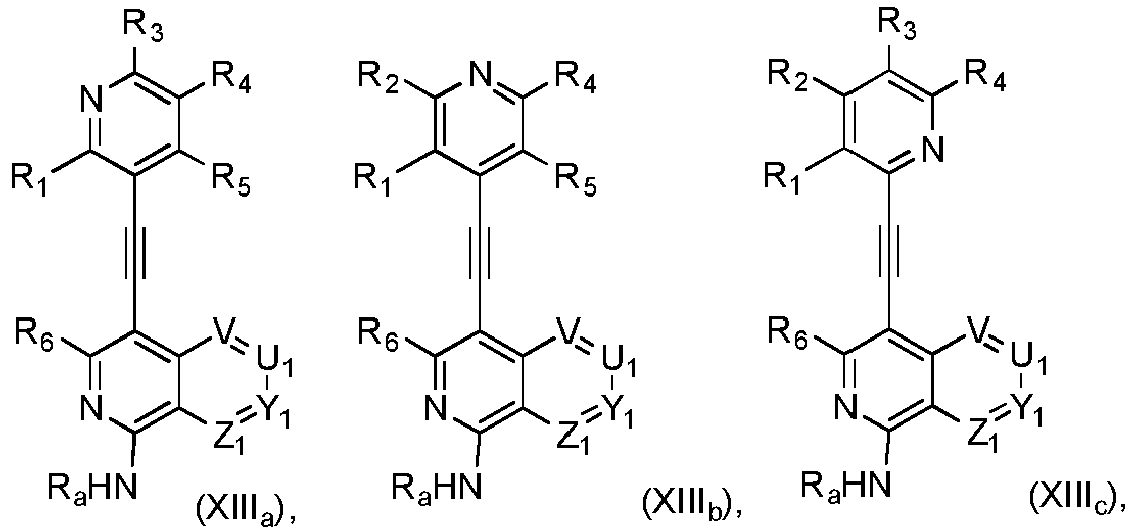


- V, U1, Y1, and Z1 are each N or CR6';
- R1, R2, and R6' are each independently H, alkyl, cycloalkyl, halo, nitro, ORc, SRc, CN, haloalkyl, O-haloalkyl, or NRaRb;
- R3, R4, and R5 are each independently H, alkyl, cycloalkyl, heterocycloalkyl, halo, nitro, ORc, SRc, CN, haloalkyl, O-haloalkyl, NRmRn, (CO)Rd, (CO)ORc, SO2NRmRn, (CO)NRmRn, C(NH)NRmRn, NH(CO)Rd, NH(CO)ORc, NH(CO)NRmRn, aryl, or heteroaryl;
- R6 is H or NRaRb;
- R7 and R8 are each independently H, alkyl, alkenyl, alkynyl, halo, nitro, ORc, SRc, CN, haloalkyl, O-haloalkyl, (CO)Rd, NRaRb, NH(CO)Rd, NH(CO)ORc, NH(CO)NRaRb, (CO)ORc, (CO)NRaRb, SO2NRaRb, cycloalkyl, heterocycloalkyl, aryl, or heteroaryl;
- Rm and Rn are each independently
- H, OH,
- alkyl, -(CH2)p-T, -aryl-(CH2)p-T, -(CH2)p-aryl-T, -heteroaryl-(CH2)p-T, -(CH2)p-heteroaryl-T, each optionally substituted with alkyl, cycloalkyl, halo, nitro, CN, haloalkyl, O-haloalkyl, ORc, SRc, (CO)Rd, NRaRb, NH(CO)Rd, NH(CO)ORc, NH(CO)NRaRb, NHC(NH)NH2, (CO)ORc, (CO)NRaRb, and SO2NRaRb,
- or Rm and Rn, together with the nitrogen atom they are attached, form a heterocycloalkyl group, optionally substituted with alkyl, cycloalkyl, heterocycloalkyl, aryl, heteroaryl, halo, nitro, CN, ORc, SRc, CORd, NRaRb, NH(CO)Rd, NH(CO)ORc, NH(CO)NRaRb, a guanidine group, (CO)ORc, and (CO)NRaRb;
- T is NRaRb, ORc, SRc, O-(CH2)q-NRaRb, cycloalkyl, heterocycloalkyl, aryl, heteroaryl, a guanidine group, or an isonicotinimidamide group;
- Ra, Rb, Rc, and Rd are each independently H, alkyl, alkenyl, cycloalkyl, heterocycloalkyl, aryl, heteroaryl, -(CH2)q-cycloalkyl, -(CH)q-heterocycloalkyl, -(CH2)q-aryl, -(CH)q-heteroaryl,-(CO)-alkyl, -(CO)-cycloalkyl, or -(CO)-heterocycloalkyl, or Ra and Rb, together with the nitrogen atom to which they are attached, form a heterocycloalkyl group, wherein cycloalkyl, heterocycloalkyl, aryl and heteroaryl are each optioncally substituted with a group consisting of alkyl, halo, nitro, CN, haloalkyl, O-haloalkyl, OH, O-alkyl, SH, S-alkyl, NH2, NH(alkyl), and N(alkyl)2; and
- p and q are each independently 0-5;
- In some embodiments, R6 is NRaRb.
- In some embodiments, one of R3, R4, and R5 is heterocycloalkyl, CN, NRmRn, (CO)Rd, (CO)ORc, SO2NRmRn, (CO)NRmRn, C(NH)NRmRn, or NH(CO)Rd.
- In some embodiments, one of R3, R4, and R5 is (CO)NRmRn.
- In some embodiments, Rm is H and Rn is -(CH2)p-T, -aryl-(CH2)p-T, -(CH2)p-aryl-T, or-heteroaryl-(CH2)p-T, each optionally substituted with alkyl, halo, and ORc.
- In some embodiments, T is NRaRb, O-(CH2)q-NRaRb, heterocycloalkyl, aryl, or heteroaryl.
- In some embodiments, Rm and Rn, together with the nitrogen atom they are attached, form a heterocycloalkyl group, optionally substituted with alkyl, cycloalkyl, heterocycloalkyl, NRaRb, NH(CO)Rd, NH(CO)ORc, and NH(CO)NRaRb.
- In some embodiments, R1 and R2 are each independently H, alkyl, halo, CN, ORc, SRc, or NRaRb.
- In some embodiments, the compound is a compound of the following formula:


- V, U1, Y1, and Z1 are each N or CR6';
- R1, R2, and R6' are each independently H, alkyl, cycloalkyl, halo, nitro, ORc, SRc, CN, haloalkyl, O-haloalkyl, or NRaRb;
- R3, R4, and R5 are each independently H, alkyl, cycloalkyl, heterocycloalkyl, halo, nitro, ORc, SRc, CN, haloalkyl, O-haloalkyl, NRmRn, (CO)Rd, (CO)ORc, SO2NRmRn, (CO)NRmRn, C(NH)NRmRn, NH(CO)Rd, NH(CO)ORc, NH(CO)NRmRn, aryl, or heteroaryl;
- R6 is H or NRaRb;
- R7 and R8 are each independently H, alkyl, alkenyl, alkynyl, halo, nitro, ORc, SRc, CN, haloalkyl, O-haloalkyl, (CO)Rd, NRaRb, NH(CO)Rd, NH(CO)ORc, NH(CO)NRaRb, (CO)ORc, (CO)NRaRb, SO2NRaRb, cycloalkyl, heterocycloalkyl, aryl, or heteroaryl;
- Rm and Rn are each independently
- H, OH,
- alkyl, -(CH2)p-T, -aryl-(CH2)p-T, -(CH2)p-aryl-T, -heteroaryl-(CH2)p-T, -(CH2)p-heteroaryl-T, each optionally substituted with alkyl, cycloalkyl, halo, nitro, CN, haloalkyl, O-haloalkyl, ORc, SRc, (CO)Rd, NRaRb, NH(CO)Rd, NH(CO)ORc, NH(CO)NRaRb, NHC(NH)NH2, (CO)ORc, (CO)NRaRb, and SO2NRaRb,
- or Rm and Rn, together with the nitrogen atom they are attached, form a heterocycloalkyl group, optionally substituted with alkyl, cycloalkyl, heterocycloalkyl, aryl, heteroaryl, halo, nitro, CN, ORc, SRc, CORd, NRaRb, NH(CO)Rd, NH(CO)ORc, NH(CO)NRaRb, a guanidine group, (CO)ORc, and (CO)NRaRb;
- T is NRaRb, ORc, SRc, O-(CH2)q-NRaRb, cycloalkyl, heterocycloalkyl, aryl, heteroaryl, a guanidine group, or an isonicotinimidamide group;
- Ra, Rb, Rc, and Rd are each independently H, alkyl, alkenyl, cycloalkyl, heterocycloalkyl, aryl, heteroaryl, -(CH2)q-cycloalkyl, -(CH)q-heterocycloalkyl, -(CH2)q-aryl, -(CH)q-heteroaryl,-(CO)-alkyl, -(CO)-cycloalkyl, or -(CO)-heterocycloalkyl, or Ra and Rb, together with the nitrogen atom to which they are attached, form a heterocycloalkyl group, wherein cycloalkyl, heterocycloalkyl, aryl and heteroaryl are each optioncally substituted with a group consisting of alkyl, halo, nitro, CN, haloalkyl, O-haloalkyl, OH, O-alkyl, SH, S-alkyl, NH2, NH(alkyl), and N(alkyl)2; and
- p and q are each independently 0-5;
- In some embodiments, R6 is NRaRb.
- In some embodiments, one of R3, R4, and R5 is heterocycloalkyl, CN, NRmRn, (CO)Rd, (CO)ORc, SO2NRmRn, (CO)NRmRn, C(NH)NRmRn, or NH(CO)Rd.
- In some embodiments, one of R3, R4, and R5 is (CO)NRmRn.
- In some embodiments, Rm is H and Rn is -(CH2)p-T, -aryl-(CH2)p-T, -(CH2)p-aryl-T, or - heteroaryl-(CH2)p-T, each optionally substituted with alkyl, halo, and ORc.
- In some embodiments, T is NRaRb, O-(CH2)q-NRaRb, heterocycloalkyl, aryl, or heteroaryl.
- In some embodiments, Rm and Rn, together with the nitrogen atom they are attached, form a heterocycloalkyl group, optionally substituted with alkyl, cycloalkyl, heterocycloalkyl, NRaRb, NH(CO)Rd, NH(CO)ORc, and NH(CO)NRaRb.
- In some embodiments, R1 and R2 are each independently H, alkyl, halo, CN, ORc, SRc, or NRaRb.
- In some embodiments, the compound is a compound of formula (XV)

- R' is H or alkyl;
- R1, R2, R10, R11, R12, and R13 are each independently H, alkyl, cycloalkyl, halo, nitro, ORc, SRc, CN, haloalkyl, O-haloalkyl, or NRaRb;
- R3, R4, and R5 are each independently H, alkyl, cycloalkyl, heterocycloalkyl, halo, nitro, ORc, SRc, CN, haloalkyl, O-haloalkyl, NRmRn, (CO)Rd, (CO)ORc, SO2NRmRn, (CO)NRmRn, C(NH)NRmRn, NH(CO)Rd, NH(CO)ORc, NH(CO)NRmRn, aryl, or heteroaryl;
- Rm and Rn are each independently
- H, OH,
- alkyl, -(CH2)p-T, -aryl-(CH2)p-T, -(CH2)p-aryl-T, -heteroaryl-(CH2)p-T, -(CH2)p-heteroaryl-T, each optionally substituted with alkyl, cycloalkyl, halo, nitro, CN, haloalkyl, O-haloalkyl, ORc, SRc, (CO)Rd, NRaRb, NH(CO)Rd, NH(CO)ORc, NH(CO)NRaRb, NHC(NH)NH2, (CO)ORc, (CO)NRaRb, and SO2NRaRb,
- or Rm and Rn, together with the nitrogen atom they are attached, form a heterocycloalkyl group, optionally substituted with alkyl, cycloalkyl, heterocycloalkyl, aryl, heteroaryl, halo, nitro, CN, ORc, SRc, CORd, NRaRb, NH(CO)Rd, NH(CO)ORc, NH(CO)NRaRb, a guanidine group, (CO)ORc, and (CO)NRaRb;
- T is NRaRb, ORc, SRc, O-(CH2)q-NRaRb, cycloalkyl, heterocycloalkyl, aryl, heteroaryl, a guanidine group, or an isonicotinimidamide group;
- Ra, Rb, Rc, and Rd are each independently H, alkyl, alkenyl, cycloalkyl, heterocycloalkyl, aryl, heteroaryl, -(CH2)q-cycloalkyl, -(CH)q-heterocycloalkyl, -(CH2)q-aryl, -(CH)q-heteroaryl, - (CO)-alkyl, -(CO)-cycloalkyl, or -(CO)-heterocycloalkyl, or Ra and Rb, together with the nitrogen atom to which they are attached, form a heterocycloalkyl group, wherein cycloalkyl, heterocycloalkyl, aryl and heteroaryl are each optioncally substituted with a group consisting of alkyl, halo, nitro, CN, haloalkyl, O-haloalkyl, OH, O-alkyl, SH, S-alkyl, NH2, NH(alkyl), and N(alkyl)2; and
- p and q are each independently 0-5.
- In some embodiments, R' is H.
- In some embodiments, one of R3, R4, and R5 is heterocycloalkyl, CN, NRmRn, (CO)Rd, (CO)ORc, SO2NRmRn, (CO)NRmRn, C(NH)NRmRn, or NH(CO)Rd.
- In some embodiments, one of R3, R4, and R5 is (CO)NRmRn.
- In some embodiments, Rm is H and Rn is -(CH2)p-T, -aryl-(CH2)p-T, -(CH2)p-aryl-T, or-heteroaryl-(CH2)p-T, each optionally substituted with alkyl, halo, and ORc.
- In some embodiments, T is NRaRb, O-(CH2)q-NRaRb, heterocycloalkyl, aryl, or heteroaryl.
- In some embodiments, Rm and Rn, together with the nitrogen atom they are attached, form a heterocycloalkyl group, optionally substituted with alkyl, cycloalkyl, heterocycloalkyl, NRaRb, NH(CO)Rd, NH(CO)ORc, and NH(CO)NRaRb.
- In some embodiments, R1 and R2 are each independently H, alkyl, halo, CN, ORc, SRc, or NRaRb.
- The present invention provides a compound represented by formula (I):

- Ring A is a 5- or 6-membered aryl or heteroaryl group, optionally substituted;
- Y and Z are each N or CR9, wherein R9 is H, alkyl, halo, nitro, OH, SH, CN, O-alkyl, haloalkyl, O-haloalkyl, S-alkyl, (CO)-alkyl, (CO)-alkenyl, NRaRb, (CO)ORc, (CO)NRaRb, or SO2NRaRb, wherein Ra, Rb, and Rc are H or alkyl;
- W is azo, alkene, alkyne, C1-8 alkyl, heteroalkyl containing 1-8 carbon and hetero atoms, cycloalkyl, hetereocycloalkyl, aryl, or heteroaryl, wherein cycloalkyl, hetereocycloalkyl, aryl, and heteroaryl optionally form a fused aryl or heteroaryl group with Ring A;
- R6, R7, and R8 are each independently H, alkyl, alkenyl, alkynyl, halo, nitro, OH, SH, CN, O-alkyl, haloalkyl, O-haloalkyl, S-alkyl, (CO)-alkyl, (CO)-alkenyl, NRaRb, NH(CO)-alkyl, NH(CO)ORc, NH(CO)NRaRb, (CO)ORc, (CO)NRaRb, SO2NRaRb, cycloalkyl, heterocycloalkyl, aryl, or heteroaryl;
- or R7 and R8, together with the carbon atoms to which they are attached, form a cycloalkyl, heterocycloalkyl, aryl, or heteroaryl group, each optionally substituted with substituents independently selected from alkyl, alkenyl, alkynyl, halo, nitro, OH, SH, CN, O-alkyl, haloalkyl, O-haloalkyl, S-alkyl, (CO)-alkyl, (CO)-alkenyl, NRaRb, (CO)ORc, (CO)NRaRb, SO2NRaRb,-C(CH3)(=N-NHC(NH)NH2, cycloalkyl, heterocycloalkyl, aryl, and heteroaryl, wherein alkyl, alkenyl, alkynyl cycloalkyl, heterocycloalkyl, aryl, and heteroaryl are each optionally substituted with amino, alkylamino, alkylamino, -NH(CO)-alkyl, or -NH(CO)-alkenyl;
- wherein Ring A is optionally substituted with substituents independently selected from:
- alkyl, alkenyl, alkynyl, halo, nitro, OH, SH, CN, O-alkyl, haloalkyl, O-haloalkyl, S-alkyl, (CO)-alkyl, (CO)-alkenyl, NRaRb, NH(CO)-alkyl, NH(CO)ORc, NH(CO)NRaRb, (CO)ORc, SO2NRaRb;
- cycloalkyl, heterocycloalkyl, aryl, or heteroaryl, each optionally substituted with substituents independently selected from alkyl, aminoalkyl, heterocycloalkyl-alkyl, heterocycloalkyl, cycloalkyl-alkyl, and cycloalkyl; and
- (CO)NRmRn or CNH)NRmRn, wherein Rm and Rn are each independently H, alkyl, -(CH2)p-T, cycloalkyl, heterocycloaryl, aryl, or heteroaryl, wherein -(CH2)p-T, cycloalkyl, heterocycloaryl, aryl, and heteroaryl are each optionally substituted with alkyl, halo, nitro, CN, OH, SH, O-alkyl, S-alkyl, (CO)-alkyl, (CO)-alkenyl, NRaRb, (CO)ORc, (CO)NRaRb, SO2NRaRb, cycloalkylamino, heterocycloalkylamino, arylamino, or heteroarylamino;
- or Rm and Rn, together with the nitrogen atom they are attached, form a heterocycloalkyl or heteroaryl group, optionally substituted with alkyl, halo, nitro, CN, OH, SH, O-alkyl, S-alkyl,-CO-alkyl, -CO-alkenyl, NRaRb, (CO)ORc, or (CO)NRaRb;
- wherein p is 0-8; and
- wherein T is NRaRb, O-alkyl, cycloalkyl, heterocycloalkyl, aryl, heteroaryl, cycloalkylamino, heterocycloalkylamino, arylamino, heteroarylamino, a guanidine group, or an isonicotinimidamide group;
- In some embodiment, Y is N.
- In some embodiment, Z is CH.
- In some embodiment, W is azo, -CH=CH-, -C≡C-, a phenyl group, or a 5- or 6-membered heteroaryl group. In other embodiments, W is azo. In certain embodiments, W is -C≡C-.
- In some embodiment, R6 is (CO)NRmRn. In other embodiments, wherein R6 is C(NH)NRmRn.
- In some embodiments, R6 is NH2.
- In some embodiments, the compound of formula (I) is represented by the following formulas:


- R1 and R2 are each independently H, alkyl, alkenyl, alkynyl, halo, nitro, OH, SH, CN, O-alkyl, haloalkyl, O-haloalkyl, S-alkyl, (CO)-alkyl, (CO)-alkenyl, NRaRb, NH(CO)-alkyl, NH(CO)ORc, NH(CO)NRaRb, (CO)ORc, (CO)NRaRb, SO2NRaRb, cycloalkyl, heterocycloalkyl, aryl, or heteroaryl;
- R3 is:
- H or CN;
- cycloalkyl, heterocycloalkyl, aryl, or heteroaryl, each optionally substituted with substituents independently selected from alkyl, aminoalkyl, heterocycloalkyl-alkyl, heterocycloalkyl, cycloalkyl-alkyl, and cycloalkyl; and
- (CO)NRmRn or C(NH)NRmRn, wherein Rm and Rn are each independently H, alkyl, -(CH2)p-T, cycloalkyl, heterocycloaryl, aryl, or heteroaryl, wherein -(CH2)p-T, cycloalkyl, heterocycloaryl, aryl, and heteroaryl are each optionally substituted with alkyl, halo, nitro, CN, OH, SH, O-alkyl, S-alkyl, (CO)-alkyl, (CO)-alkenyl, NRaRb, (CO)ORc, (CO)NRaRb, SO2NRaRb, cycloalkylamino, heterocycloalkylamino, arylamino, or heteroarylamino;
- or Rm and Rn, together with the nitrogen atom they are attached, form a heterocycloalkyl or heteroaryl group, optionally substituted with alkyl, halo, nitro, CN, OH, SH, O-alkyl, S-alkyl,-CO-alkyl, -CO-alkenyl, NRaRb, (CO)ORc, or (CO)NRaRb;
- p is 0-8; and
- T is NRaRb, O-alkyl, cycloalkyl, heterocycloalkyl, aryl, heteroaryl, cycloalkylamino, heterocycloalkylamino, arylamino, heteroarylamino, a guanidine group, or an isonicotinimidamide group.
- In some embodiments, the compound of formula (I) is represented by the following formulas:

- E, Y2, Y3, Y4, and Y5 are each O, S, N, or NR14, wherein R14 is H, alkyl, (CO)-alkyl, (CO)ORc, (CO)NRaRb, or SO2NRaRb;
- R3 is:
- H or CN;
- cycloalkyl, heterocycloalkyl, aryl, or heteroaryl, each optionally substituted with substituents independently selected from alkyl, aminoalkyl, heterocycloalkyl-alkyl, heterocycloalkyl, cycloalkyl-alkyl, and cycloalkyl; and
- (CO)NRmRn or C(NH)NRmRn, wherein Rm and Rn are each independently H, alkyl, -(CH2)p-T, cycloalkyl, heterocycloaryl, aryl, or heteroaryl, wherein -(CH2)p-T, cycloalkyl, heterocycloaryl, aryl, and heteroaryl are each optionally substituted with alkyl, halo, nitro, CN, OH, SH, O-alkyl, S-alkyl, (CO)-alkyl, (CO)-alkenyl, NRaRb, (CO)ORc, (CO)NRaRb, SO2NRaRb, cycloalkylamino, heterocycloalkylamino, arylamino, or heteroarylamino;
- or Rm and Rn, together with the nitrogen atom they are attached, form a heterocycloalkyl or heteroaryl group, optionally substituted with alkyl, halo, nitro, CN, OH, SH, O-alkyl, S-alkyl, - CO-alkyl, -CO-alkenyl, NRaRb, (CO)ORc, or (CO)NRaRb;
- p is 0-8; and
- T is NRaRb, O-alkyl, cycloalkyl, heterocycloalkyl, aryl, heteroaryl, cycloalkylamino, heterocycloalkylamino, arylamino, heteroarylamino, a guanidine group, or an isonicotinimidamide group.
- In some embodiments, a compound of formula (I) is represented by formula (Ia)

- R1, R2, R4, and R5 are each independently H, alkyl, alkenyl, alkynyl, halo, nitro, OH, SH, CN, O-alkyl, haloalkyl, O-haloalkyl, S-alkyl, (CO)-alkyl, (CO)-alkenyl, NRaRb, NH(CO)-alkyl, NH(CO)ORc, NH(CO)NRaRb, (CO)ORc, (CO)NRaRb, SO2NRaRb, cycloalkyl, heterocycloalkyl, aryl, or heteroaryl;
- R3 is:
- H or CN;
- cycloalkyl, heterocycloalkyl, aryl, or heteroaryl, each optionally substituted with substituents independently selected from alkyl, aminoalkyl, heterocycloalkyl-alkyl, heterocycloalkyl, cycloalkyl-alkyl, and cycloalkyl; and
- (CO)NRmRn or C(NH)NRmRn, wherein Rm and Rn are each independently H, alkyl, -(CH2)p-T, cycloalkyl, heterocycloaryl, aryl, or heteroaryl, wherein -(CH2)p-T, cycloalkyl, heterocycloaryl, aryl, and heteroaryl are each optionally substituted with alkyl, halo, nitro, CN, OH, SH, O-alkyl, S-alkyl, (CO)-alkyl, (CO)-alkenyl, NRaRb, (CO)ORc, (CO)NRaRb, SO2NRaRb, cycloalkylamino, heterocycloalkylamino, arylamino, or heteroarylamino;
- or Rm and Rn, together with the nitrogen atom they are attached, form a heterocycloalkyl or heteroaryl group, optionally substituted with alkyl, halo, nitro, CN, OH, SH, O-alkyl, S-alkyl,-CO-alkyl, -CO-alkenyl, NRaRb, (CO)ORc, or (CO)NRaRb;
- p is 0-8; and
- T is NRaRb, O-alkyl, cycloalkyl, heterocycloalkyl, aryl, heteroaryl, cycloalkylamino, heterocycloalkylamino, arylamino, heteroarylamino, a guanidine group, or an isonicotinimidamide group.
- In some embodiments, the compound of formula (Ia) is represented by a compound of formula (II)

R10, R11, R12, and R13 are each independently H, alkyl, alkenyl, alkynyl, halo, nitro, OH, SH, CN, O-alkyl, haloalkyl, O-haloalkyl, S-alkyl, (CO)-alkyl, (CO)-alkenyl, NRaRb, (CO)ORc, (CO)NRaRb, SO2NRaRb, -C(CH3)(=N-NHC(NH)NH2, cycloalkyl, heterocycloalkyl, aryl, and heteroaryl, wherein alkyl, alkenyl, alkynyl cycloalkyl, heterocycloalkyl, aryl, and heteroaryl are each optionally substituted with amino, alkylamino, dialkylamino, -NH(CO)-alkyl, or -NH(CO)-alkenyl. - In some embodiments, R6, R10, R11, R12, and R13 are each independently H, alkyl, alkynyl, halo, OH, CN, amino, alkylamino, or di-alkylamino.
- In some embodiments, R11 is alkynyl, optionally substituted with amino, alkylamino, dialkylamino, or -NH(CO)-alkenyl. In other embodiments, R11 is halo. In certain embodiments, R11 is chloro.
- In some embodiments, R6 is NH2.
- In some embodiments, R1, R2, R4, and R5 are each H.
- In some embodiments, R3 is CN. In other embodiments, R3 is heterocycloalkyl or heteroaryl, optionally substituted with alkyl, aminoalkyl, heterocycloalkyl-alkyl, heterocycloalkyl, cycloalkyl-alkyl, and cycloalkyl.
- In some embodiments, R3 is (CO)NRmRn. In other embodiments, R3 is C(NH)NRmRn. In some embodiments, Rm is H and Rn is heterocycloalkyl. In some embodiments, Rm is H and Rn is (CH2)p-T, optionally substituted with alkyl, halo, or OH. In some embodiments, p is 1-4.
- In some embodiments, T is NRaRb or O-alkyl. In some embodiments, T is -N(alkyl)2. In certain embodiments, T is N(CH3)2. In other embodiments, T is OCH3. In some embodiments, T is heterocycloalkylamino, a guanidine group, or an isonicotinimidamide group. In some embodiments, T is heterocycloalkyl. In certain embodiments, T is a 5- or 6-membered heterocycloalkyl group. In some embodiments, T is piperidine or pyrrolidine.
- In some embodiments, Rm is H and Rn is aryl or heteroaryl. In other embodiments, Rm and Rn, together with the nitrogen atom they are attached, form a heterocycloalkyl group. In some embodiments, Rm and Rn are independently alkyl.
- In some embodiments, the compound of formula (II) is represented by a compound of formula (III)

- In some embodiments, the compound of formula (I) is represented by a compound of formulas IVa-IVf:


- R1, R2, R4, R5, R10, and R13 are each independently H, alkyl, alkenyl, alkynyl, halo, nitro, OH, SH, CN, O-alkyl, haloalkyl, O-haloalkyl, S-alkyl, (CO)-alkyl, (CO)-alkenyl, NRaRb, NH(CO)-alkyl, NH(CO)ORc, NH(CO)NRaRb, (CO)ORc, (CO)NRaRb, SO2NRaRb, cycloalkyl, heterocycloalkyl, aryl, or heteroaryl; and
- R11 and R12 are each independently H, alkyl, alkenyl, alkynyl, halo, nitro, OH, SH, CN, O-alkyl, haloalkyl, O-haloalkyl, S-alkyl, (CO)-alkyl, (CO)-alkenyl, NRaRb, (CO)ORc, (CO)NRaRb, SO2NRaRb, -C(CH3)(=N-NHC(NH)NH2, cycloalkyl, heterocycloalkyl, aryl, and heteroaryl, wherein alkyl, alkenyl, alkynyl cycloalkyl, heterocycloalkyl, aryl, and heteroaryl are each optionally substituted with amino, alkylamino, dialkylamino, -NH(CO)-alkyl, or -NH(CO)-alkenyl.
- In some embodiments, Rm is H and Rn is (CH2)p-T, optionally substituted with OH. In other embodiments, Rm and Rn are independently alkyl. In some embodiments, p is 1-4. In some embodiments, T is NRaRb or O-alkyl. In certain embodiments, T is N(CH3)2. In other embodiments, T is OCH3. In some embodiments, T is heterocycloalkyl. In some embodiments, T is a 5- or 6-membered heterocycloalkyl group. In certain embodiments, T is piperidine or pyrrolidine.
- In some embodiments, Rm and Rn, together with the nitrogen atom they are attached, form a 5- or 6-membered heterocycloalkyl group.
- In some embodiments, R6 is NH2.
- In some embodiments, R11 is halo. In certain embodiments, R11 is chloro.
- In some embodiments, the compound of the invention is


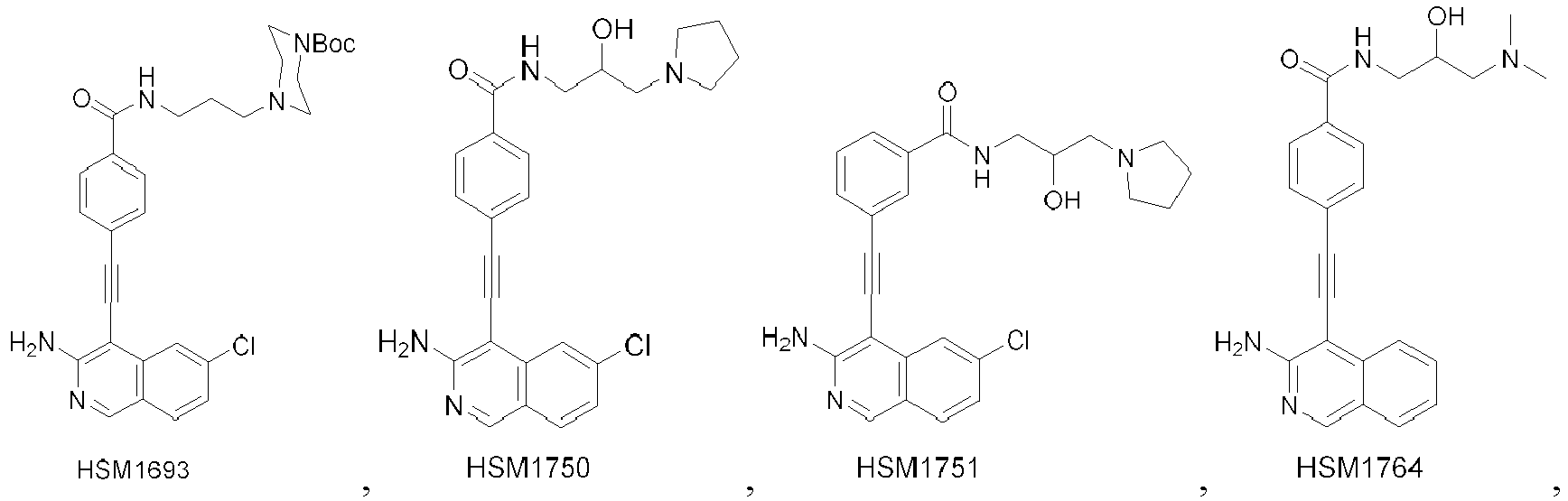


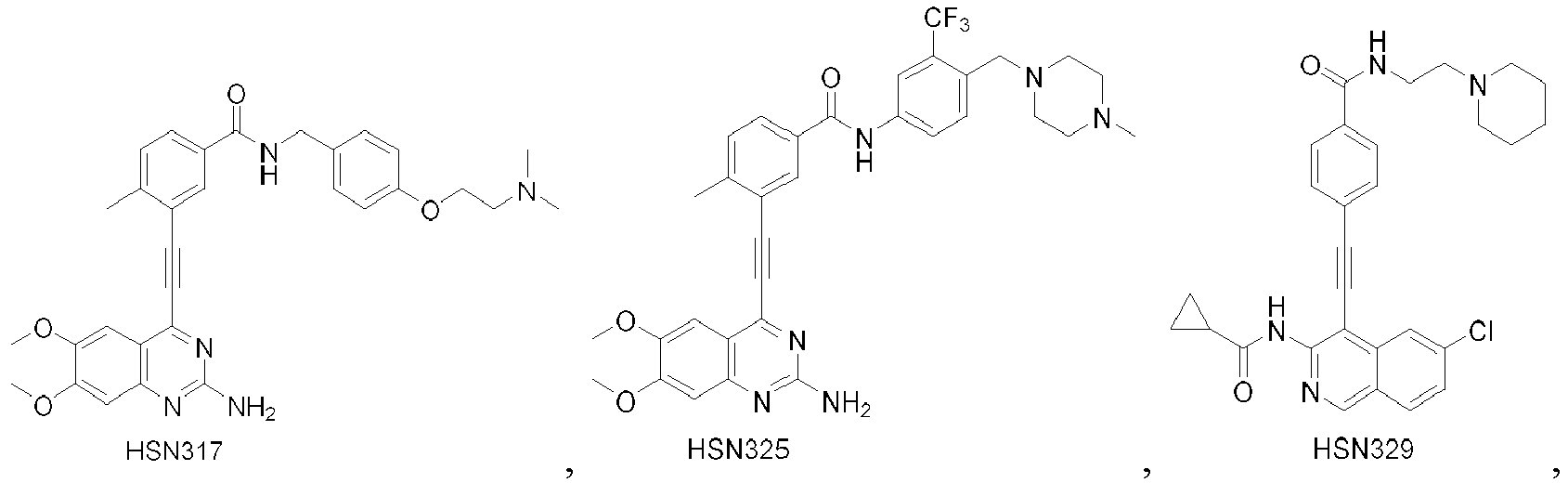

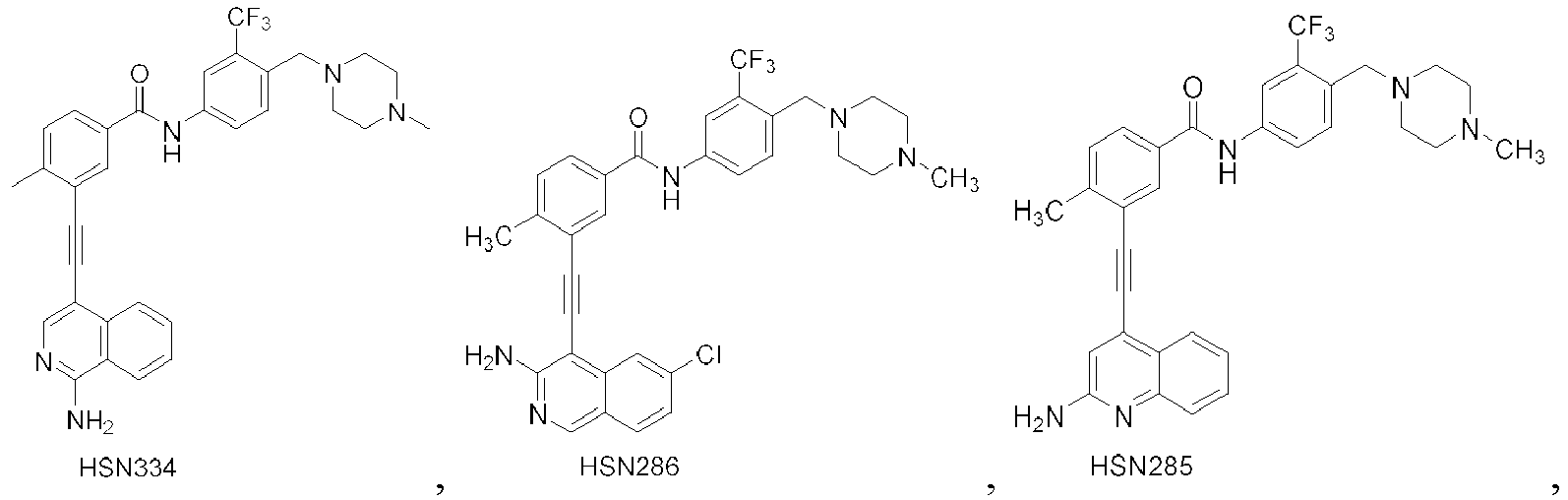

- In some embodiments, the compound of the invention is


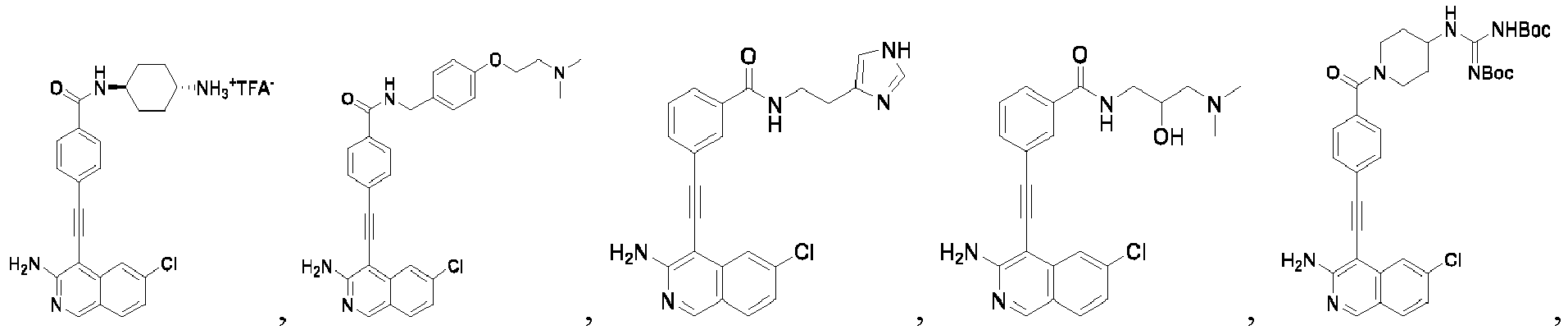
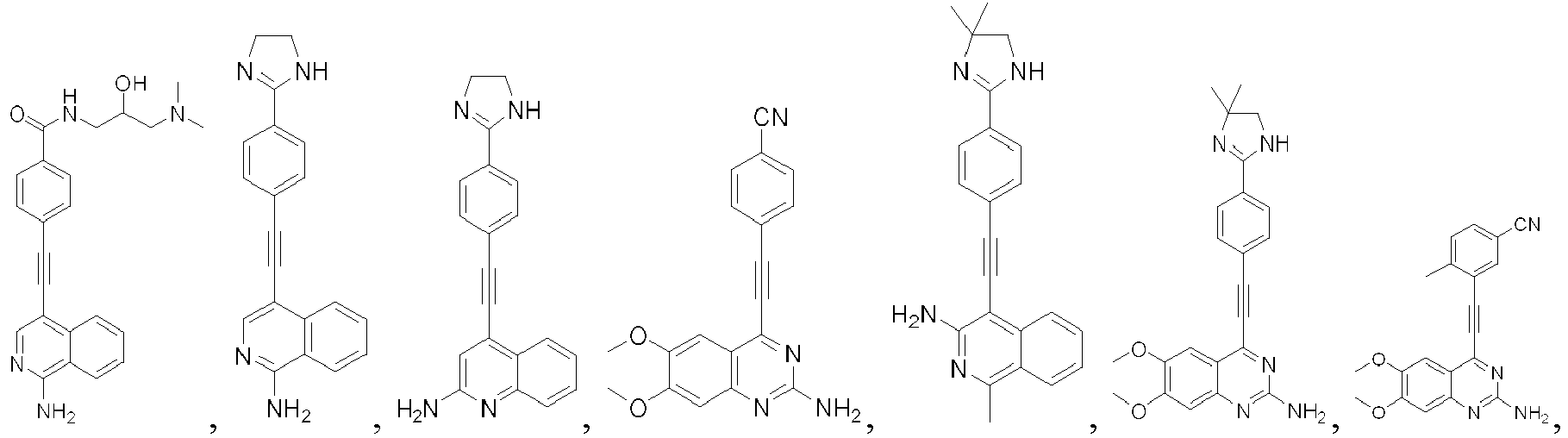


- In some embodiments, the compound of the invention is


- In some embodiments, the compound of the invention is





- In some embodiments, the compound of the invention is

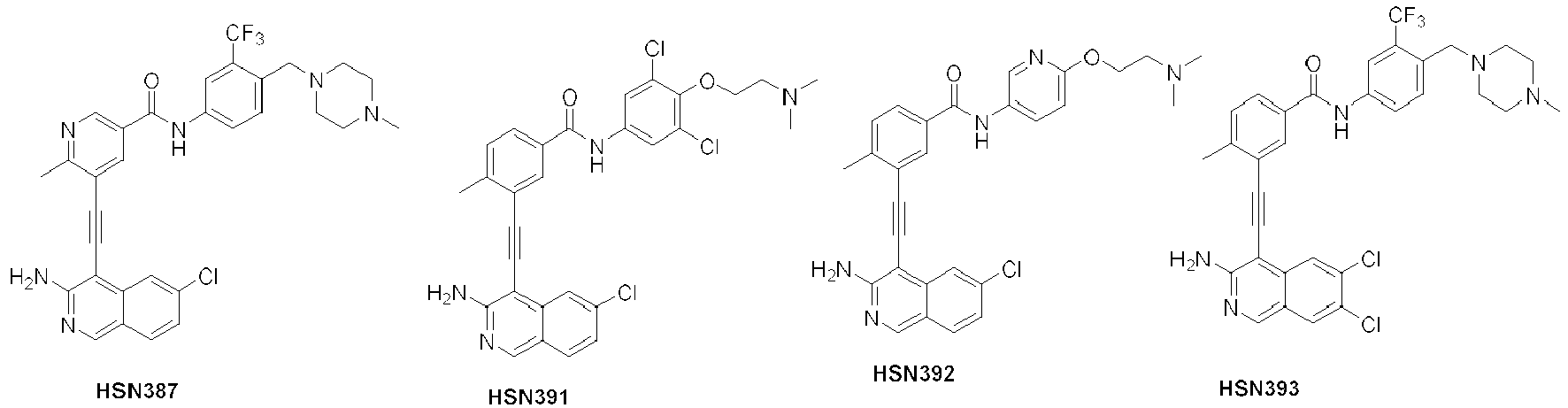

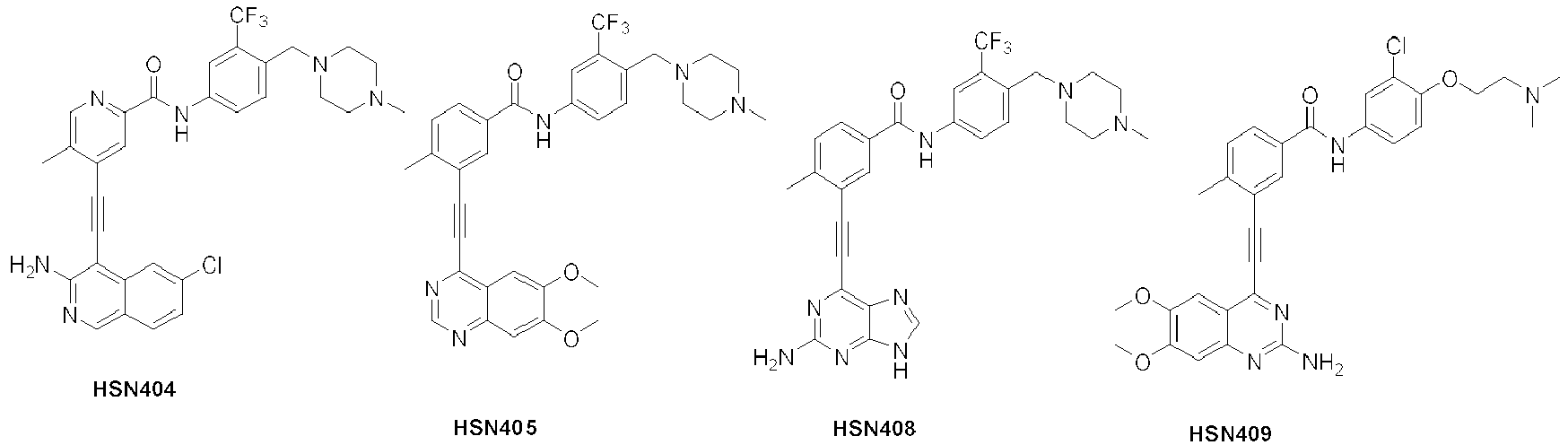


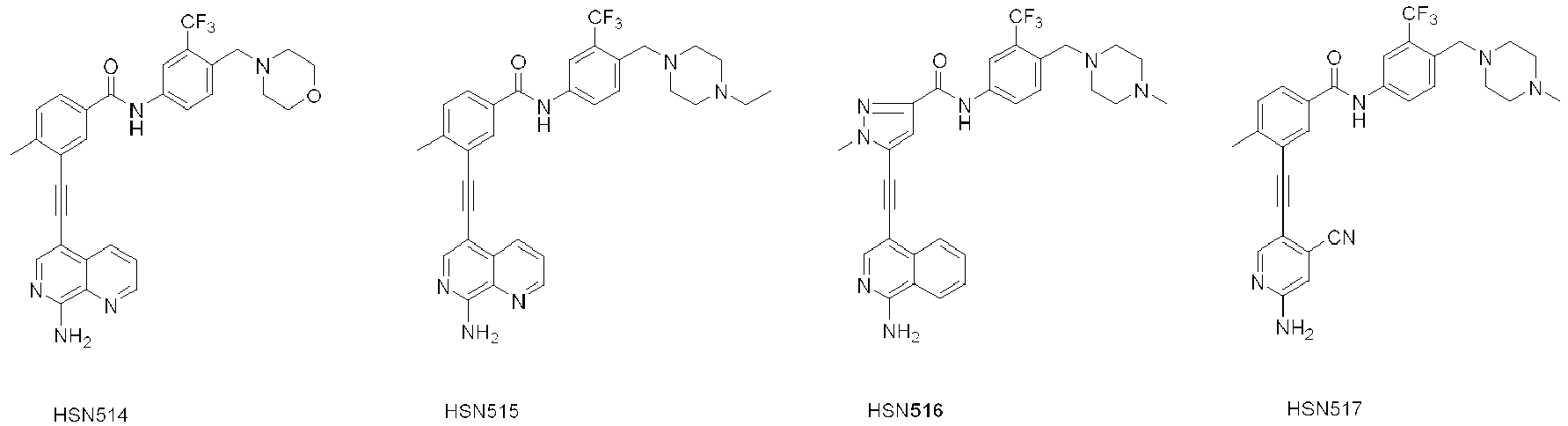


- In some embodiments, the compound of the invention is


- In some embodiments, the compound of the invention is


- In some embodiments, the compound of the invention is


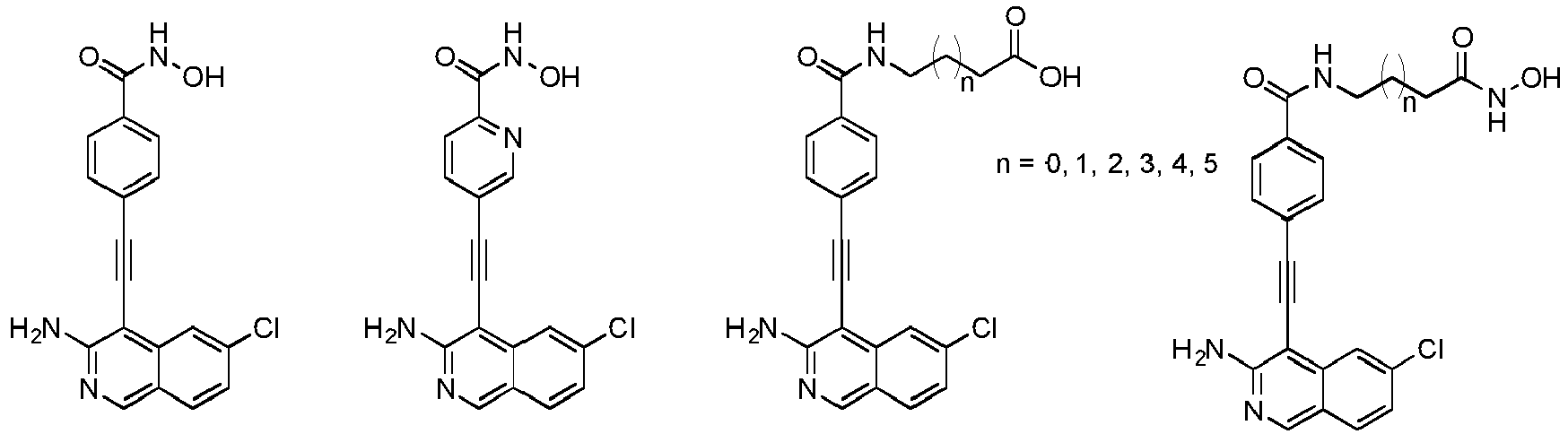


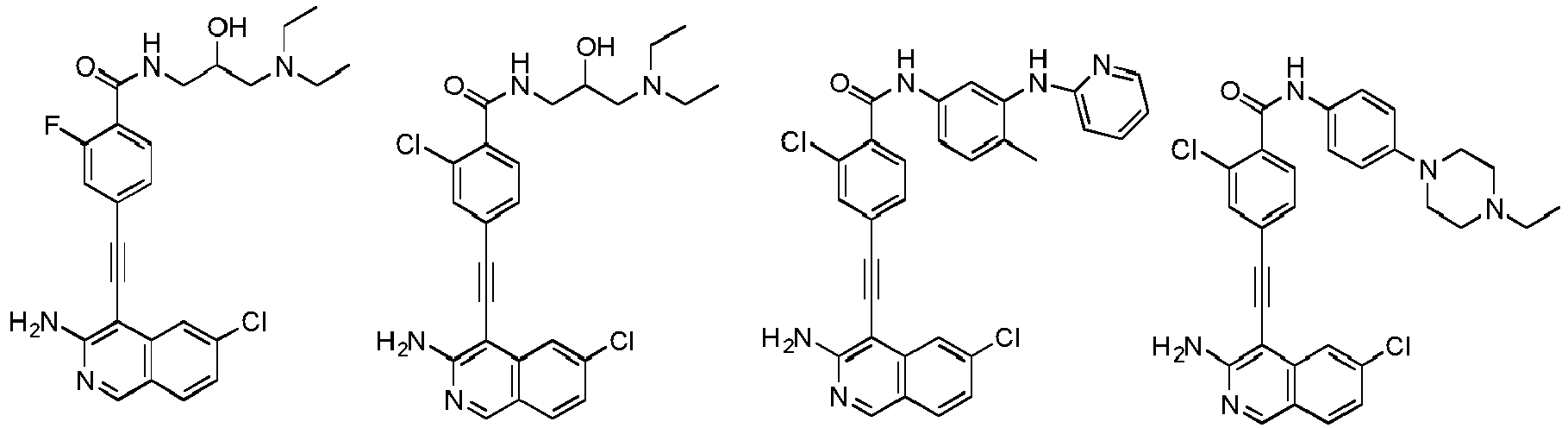


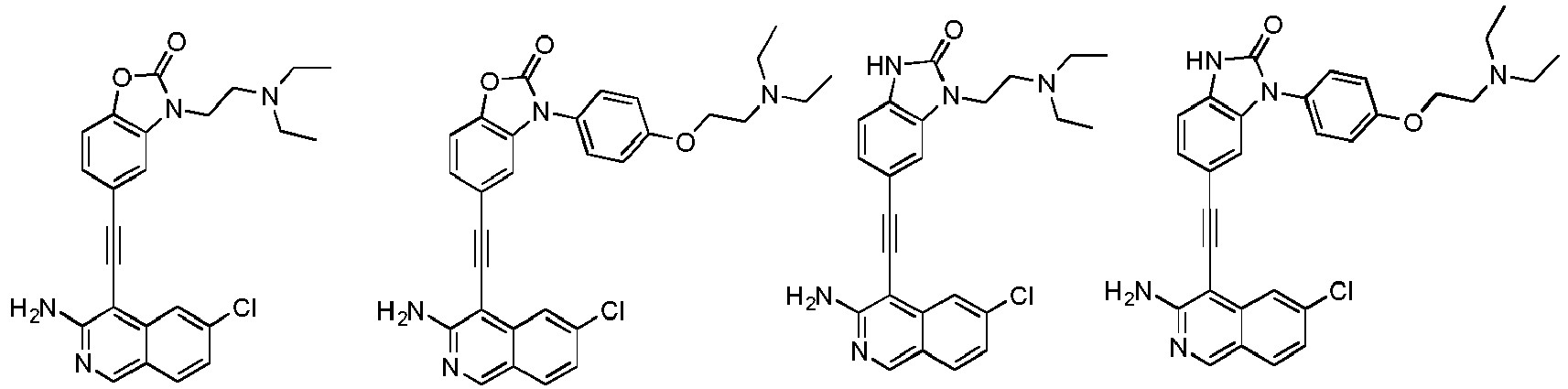


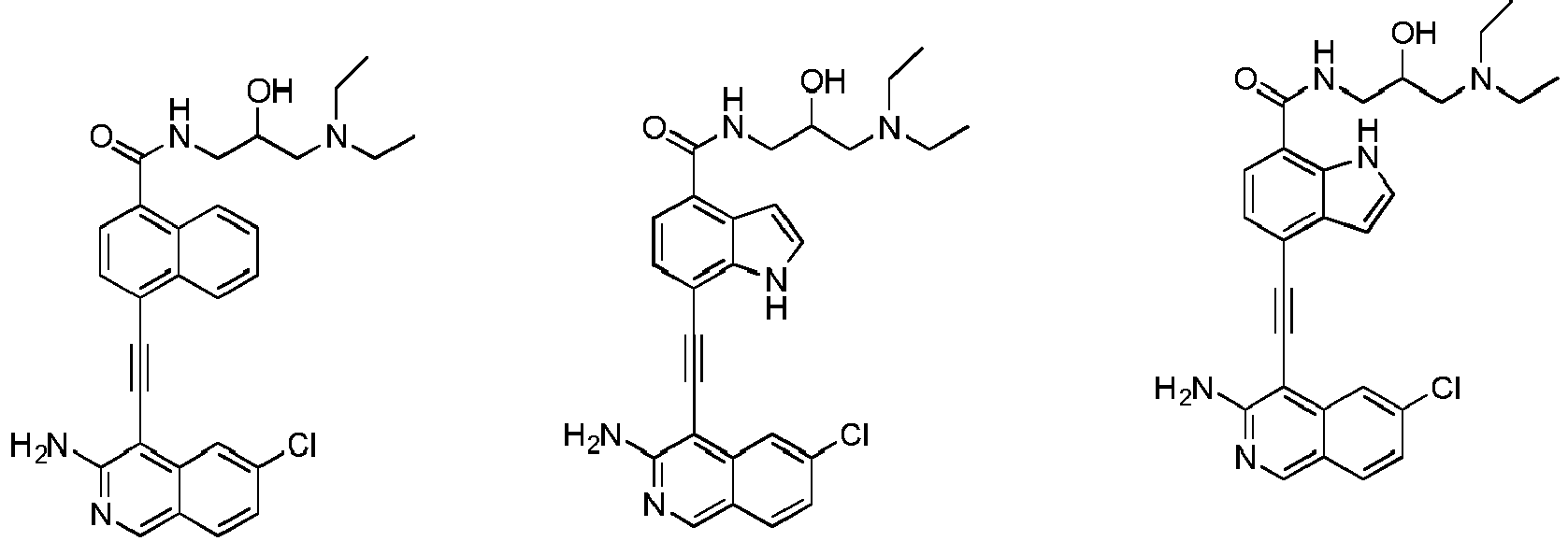


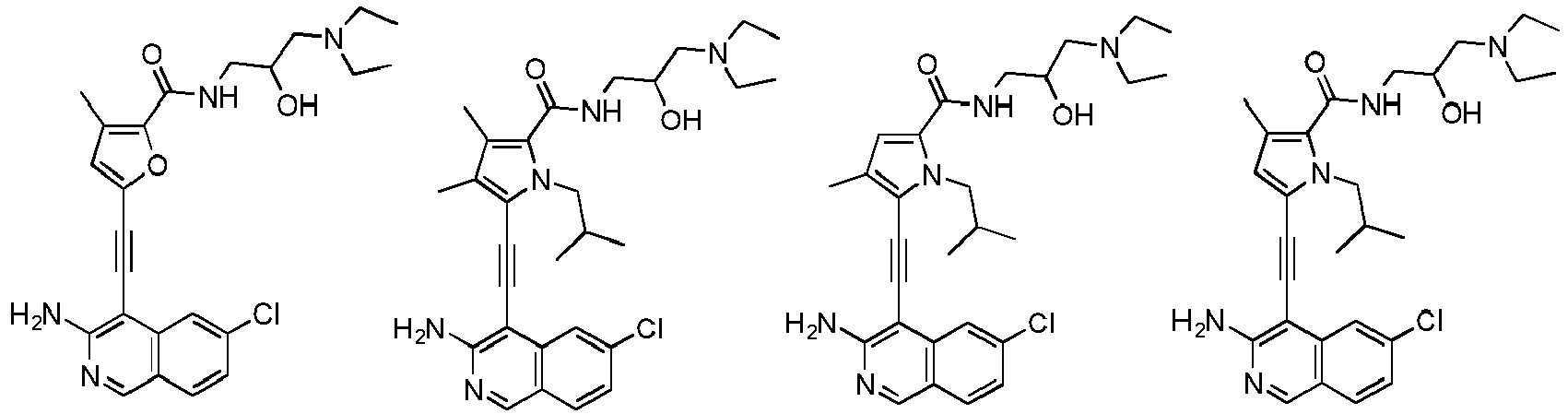


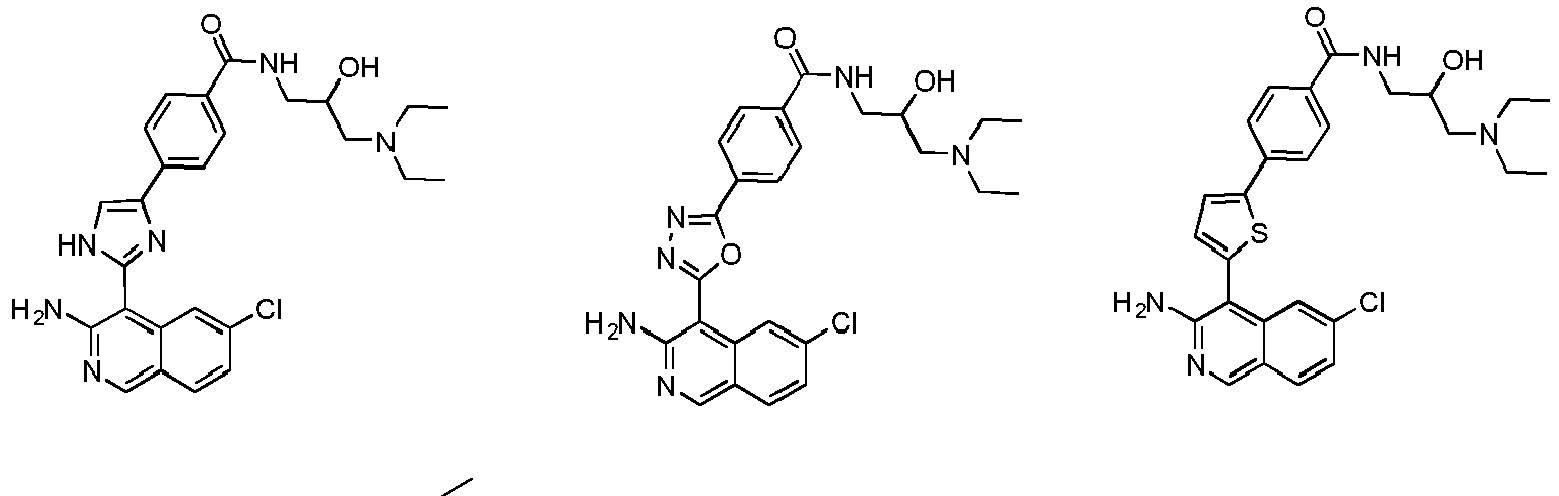
- In some embodiments, the compound is the invention is


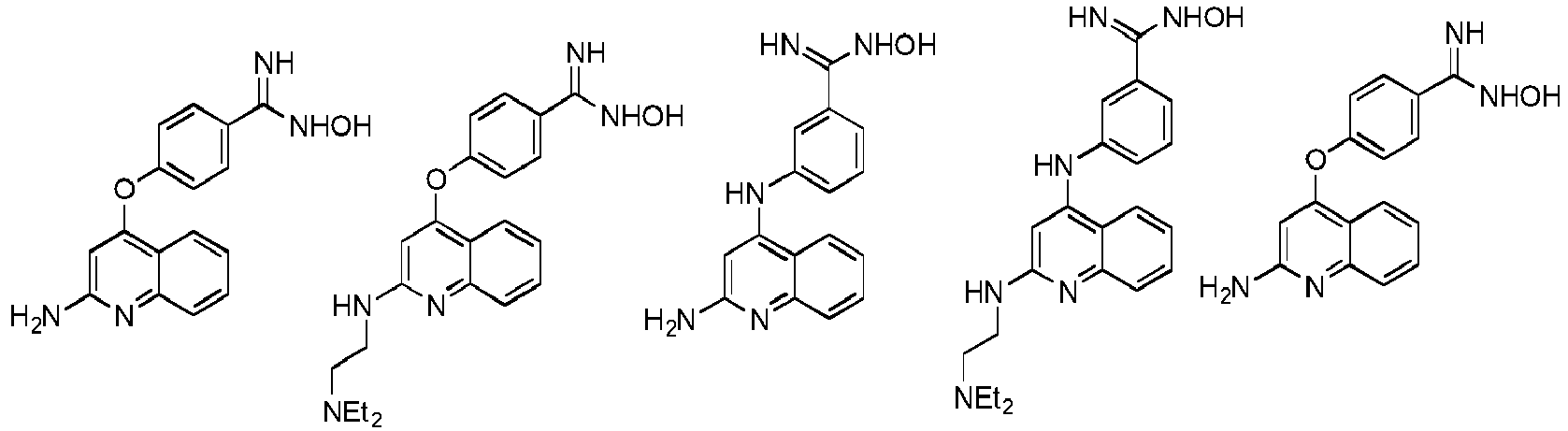

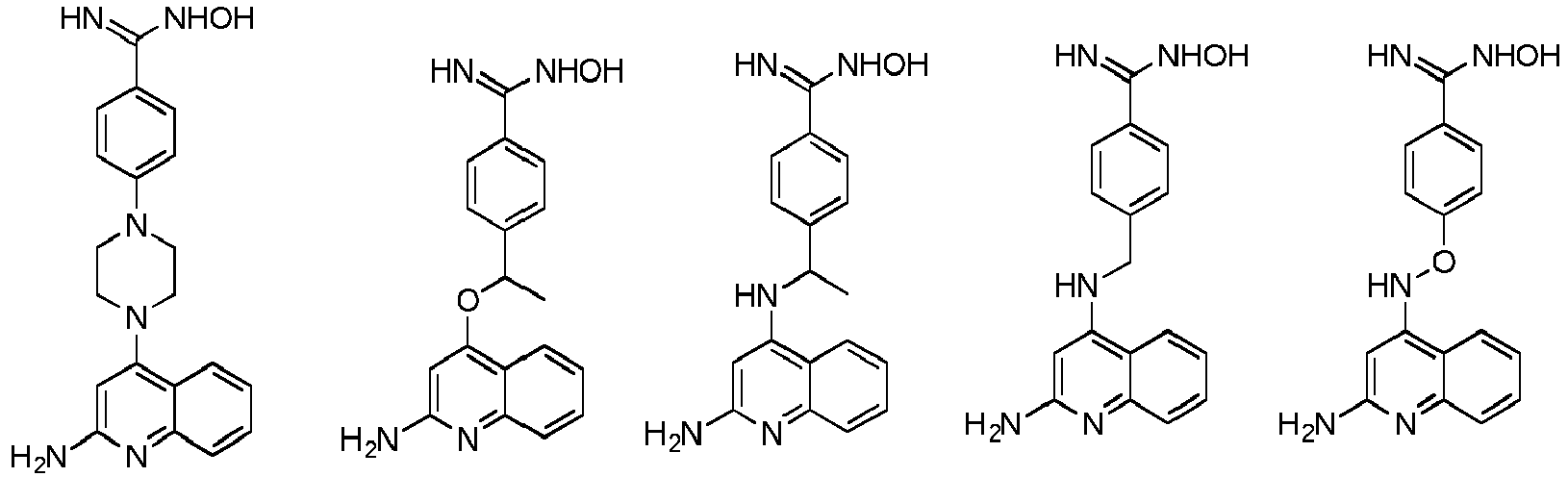
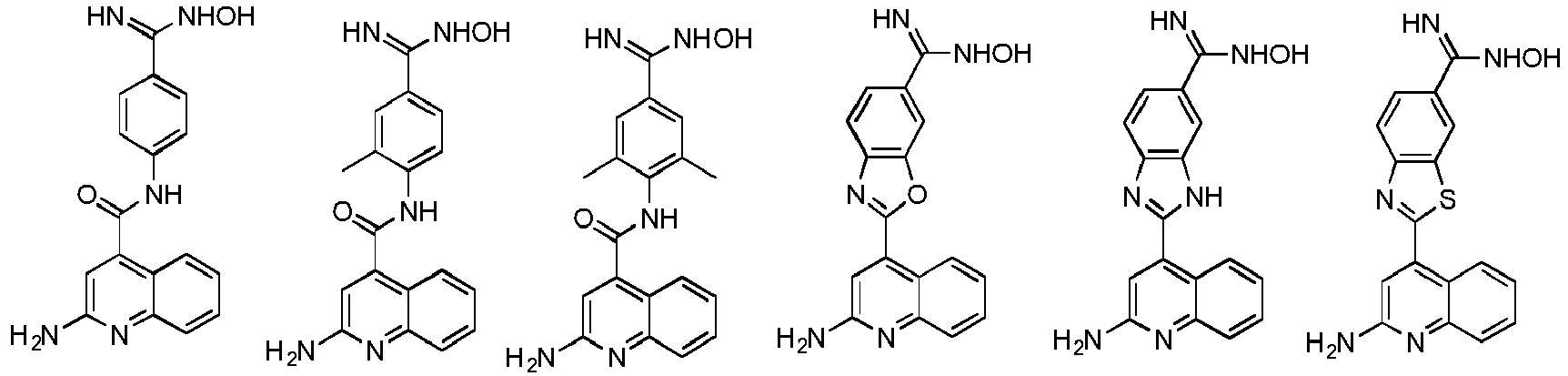


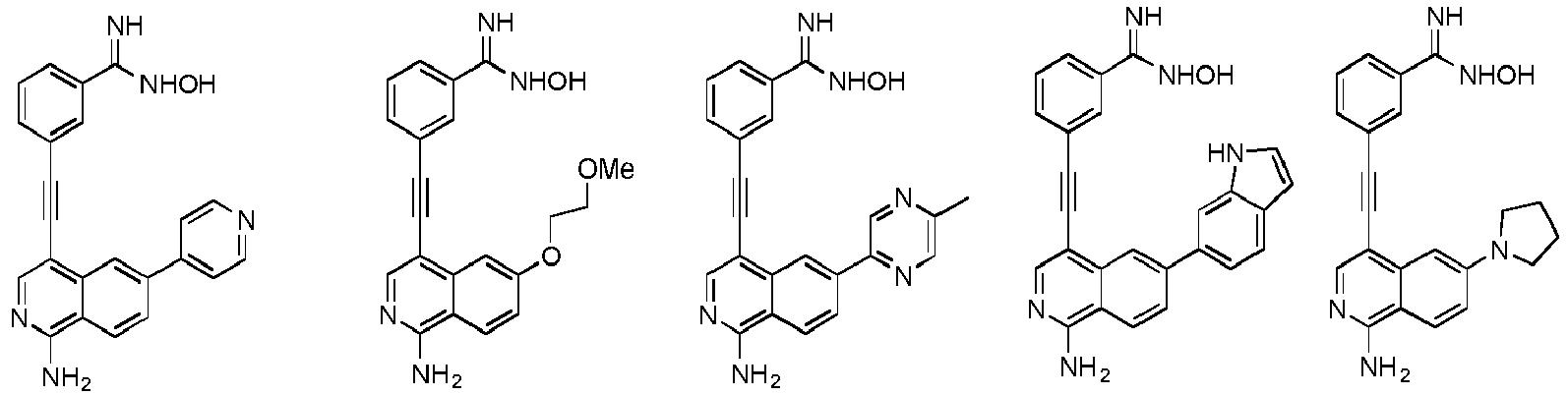
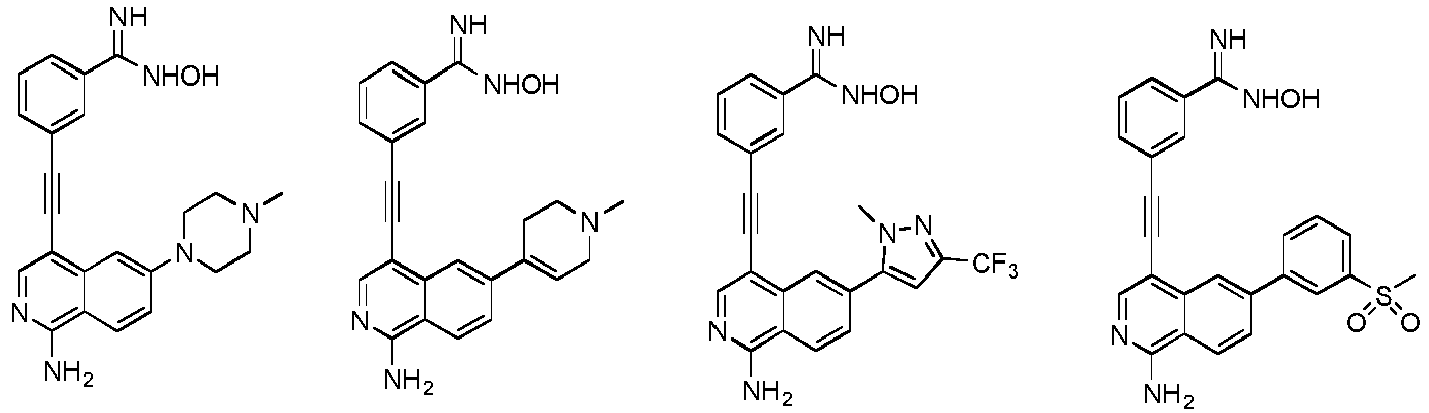


- In some embodiments, the compound of formula (I) of the invention is represented by a compound of formulas Va - Vf

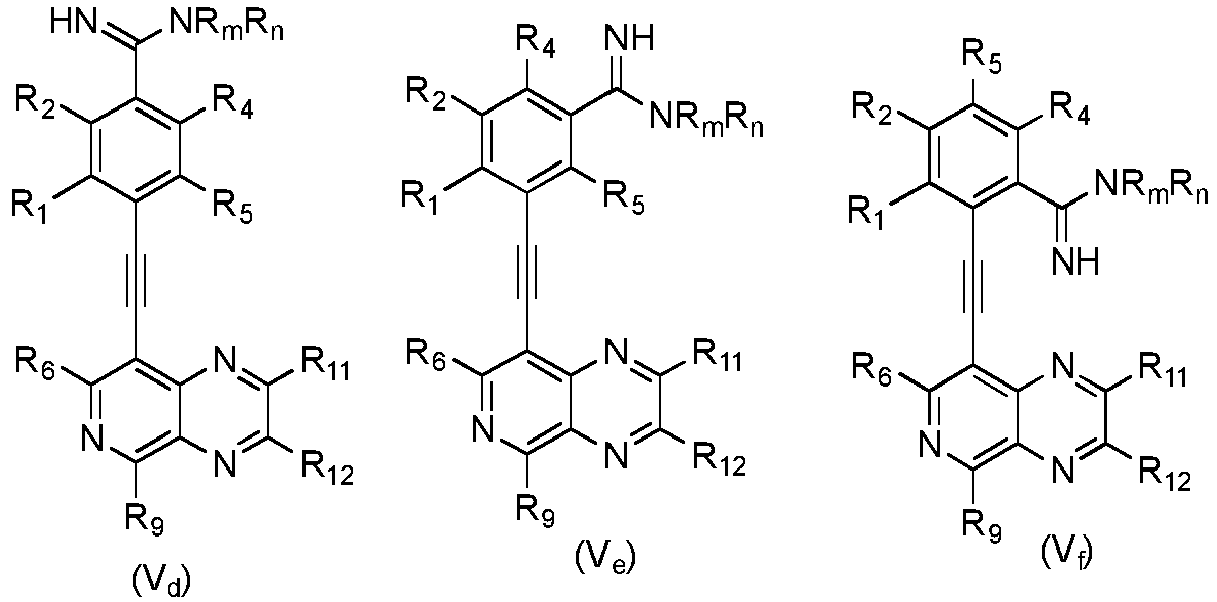
- R1, R2, R4, and R8 are each independently H, alkyl, alkenyl, alkynyl, halo, nitro, OH, SH, CN, O-alkyl, haloalkyl, O-haloalkyl, S-alkyl, (CO)-alkyl, (CO)-alkenyl, NRaRb, NH(CO)-alkyl, NH(CO)ORc, NH(CO)NRaRb, (CO)ORc, (CO)NRaRb, SO2NRaRb, cycloalkyl, heterocycloalkyl, aryl, or heteroaryl; and
- R11 and R12 are each independently H, alkyl, alkenyl, alkynyl, halo, nitro, OH, SH, CN, O-alkyl, haloalkyl, O-haloalkyl, S-alkyl, (CO)-alkyl, (CO)-alkenyl, NRaRb, (CO)ORc, (CO)NRaRb, SO2NRaRb, -C(CH3)(=N-NHC(NH)NH2, cycloalkyl, heterocycloalkyl, aryl, and heteroaryl, wherein alkyl, alkenyl, alkynyl cycloalkyl, heterocycloalkyl, aryl, and heteroaryl are each optionally substituted with amino, alkylamino, dialkylamino, -NH(CO)-alkyl, or -NH(CO)-alkenyl.
- In some embodiments, the compound of formula (I) of the invention is represented by a compound of formulas VIa-VIc

- R', R1, R2, R4, and R5 are each independently H, alkyl, alkenyl, alkynyl, halo, nitro, OH, SH, CN, O-alkyl, haloalkyl, O-haloalkyl, S-alkyl, (CO)-alkyl, (CO)-alkenyl, NRaRb, NH(CO)-alkyl, NH(CO)ORc, NH(CO)NRaRb, (CO)ORc, (CO)NRaRb, SO2NRaRb, cycloalkyl, heterocycloalkyl, aryl, or heteroaryl, wherein each R' is the same or different;
- R11 and R12 are each independently H, alkyl, alkenyl, alkynyl, halo, nitro, OH, SH, CN, O-alkyl, haloalkyl, O-haloalkyl, S-alkyl, (CO)-alkyl, (CO)-alkenyl, NRaRb, (CO)ORc, (CO)NRaRb, SO2NRaRb, -C(CH3)(=N-NHC(NH)NH2, cycloalkyl, heterocycloalkyl, aryl, and heteroaryl, wherein alkyl, alkenyl, alkynyl cycloalkyl, heterocycloalkyl, aryl, and heteroaryl are each optionally substituted with amino, alkylamino, dialkylamino, -NH(CO)-alkyl, or -NH(CO)-alkenyl; and
- R14 is H, alkyl, (CO)-alkyl, (CO)ORc, (CO)NRaRb, or SO2NRaRb.
- In some embodiments, the compound of formula (I) of the invention is represented by a compound of formulas VIIa-VTIc

- R1, R2, R4, R5, R16, R17, R18, and R19 are each independently H, alkyl, alkenyl, alkynyl, halo, nitro, OH, SH, CN, O-alkyl, haloalkyl, O-haloalkyl, S-alkyl, (CO)-alkyl, (CO)-alkenyl, NRaRb, NH(CO)-alkyl, NH(CO)ORc, NH(CO)NRaRb, (CO)ORc, (CO)NRaRb, SO2NRaRb, cycloalkyl, heterocycloalkyl, aryl, or heteroaryl;
- R11 and R12 are each independently H, alkyl, alkenyl, alkynyl, halo, nitro, OH, SH, CN, O-alkyl, haloalkyl, O-haloalkyl, S-alkyl, (CO)-alkyl, (CO)-alkenyl, NRaRb, (CO)ORc, (CO)NRaRb, SO2NRaRb, -C(CH3)(=N-NHC(NH)NH2, cycloalkyl, heterocycloalkyl, aryl, and heteroaryl, wherein alkyl, alkenyl, alkynyl cycloalkyl, heterocycloalkyl, aryl, and heteroaryl are each optionally substituted with amino, alkylamino, dialkylamino, -NH(CO)-alkyl, or -NH(CO)-alkenyl; and
- R14 is H, alkyl, (CO)-alkyl, (CO)ORc, (CO)NRaRb, or SO2NRaRb.
- In some embodiments, the compound of formula (I) of the invention is represented by a compound of formulas VTIIa-VIIIf


- E is O, S, or NR14;
- R1, R2, R4, and R5 are each independently H, alkyl, alkenyl, alkynyl, halo, nitro, OH, SH, CN, O-alkyl, haloalkyl, O-haloalkyl, S-alkyl, (CO)-alkyl, (CO)-alkenyl, NRaRb, NH(CO)-alkyl, NH(CO)ORc, NH(CO)NRaRb, (CO)ORc, (CO)NRaRb, SO2NRaRb, cycloalkyl, heterocycloalkyl, aryl, or heteroaryl; and
- R14 and R15 are each independently H, alkyl, (CO)-alkyl, (CO)ORc, (CO)NRaRb, or SO2NRaRb.
- In some embodiments, the compound of formula (I) of the invention is represented by a compound of formulas IXa-IXf


- E is O, S, or NR14;
- R1, R2, R4, and R5 are each independently H, alkyl, alkenyl, alkynyl, halo, nitro, OH, SH, CN, O-alkyl, haloalkyl, O-haloalkyl, S-alkyl, (CO)-alkyl, (CO)-alkenyl, NRaRb, NH(CO)-alkyl, NH(CO)ORc, NH(CO)NRaRb, (CO)ORc, (CO)NRaRb, SO2NRaRb, cycloalkyl, heterocycloalkyl, aryl, or heteroaryl; and
- R14 and R15 are each independently H, alkyl, (CO)-alkyl, (CO)ORc, (CO)NRaRb, or SO2NRaRb.
- In some embodiments, the compound of formula (I) of the invention is represented by a compound of formulas Xa-Xf

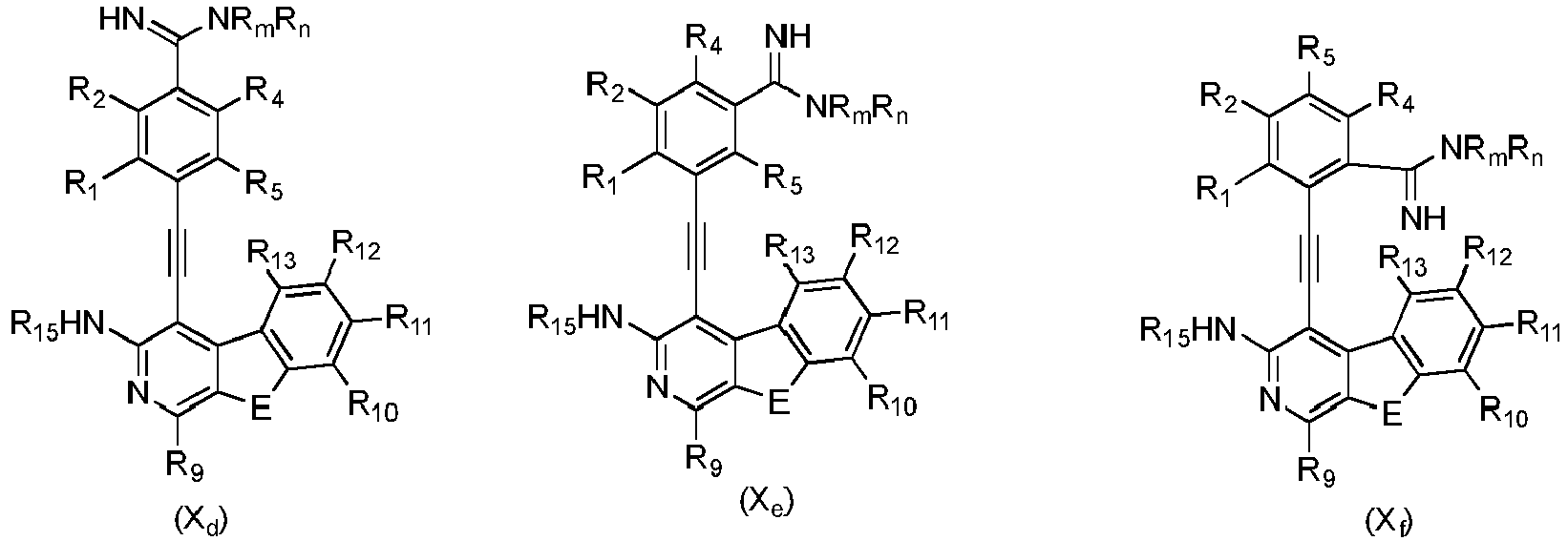
- E is O, S, or NR14;
- R1, R2, R4, R5, R10, and R13 are each independently H, alkyl, alkenyl, alkynyl, halo, nitro, OH, SH, CN, O-alkyl, haloalkyl, O-haloalkyl, S-alkyl, (CO)-alkyl, (CO)-alkenyl, NRaRb, NH(CO)-alkyl, NH(CO)ORc, NH(CO)NRaRb, (CO)ORc, (CO)NRaRb, SO2NRaRb, cycloalkyl, heterocycloalkyl, aryl, or heteroaryl;
- R11 and R12 are each independently H, alkyl, alkenyl, alkynyl, halo, nitro, OH, SH, CN, O-alkyl, haloalkyl, O-haloalkyl, S-alkyl, (CO)-alkyl, (CO)-alkenyl, NRaRb, (CO)ORc, (CO)NRaRb, SO2NRaRb, -C(CH3)(=N-NHC(NH)NH2, cycloalkyl, heterocycloalkyl, aryl, and heteroaryl, wherein alkyl, alkenyl, alkynyl cycloalkyl, heterocycloalkyl, aryl, and heteroaryl are each optionally substituted with amino, alkylamino, dialkylamino, -NH(CO)-alkyl, or -NH(CO)-alkenyl; and
- R14 and R15 are each independently H, alkyl, (CO)-alkyl, (CO)ORc, (CO)NRaRb, or SO2NRaRb.
- In some embodiments, the compound of formula (I) of the invention is represented by a compound of formulas XIa-XIf


- E is O, S, or NR14;
- R1, R2, R4, and R5 are each independently H, alkyl, alkenyl, alkynyl, halo, nitro, OH, SH, CN, O-alkyl, haloalkyl, O-haloalkyl, S-alkyl, (CO)-alkyl, (CO)-alkenyl, NRaRb, NH(CO)-alkyl, NH(CO)ORc, NH(CO)NRaRb, (CO)ORc, (CO)NRaRb, SO2NRaRb, cycloalkyl, heterocycloalkyl, aryl, or heteroaryl; and
- R14 and R15 are each independently H, alkyl, (CO)-alkyl, (CO)ORc, (CO)NRaRb, or SO2NRaRb.
- The compound of the invention can be prepared by the methods known in the art and the methods in the reaction schemes and experiments as described herein.
-
Scheme 1 provides a general reaction scheme for the preparation of the compounds of the invention through a halogenation reaction, followed by functionalization.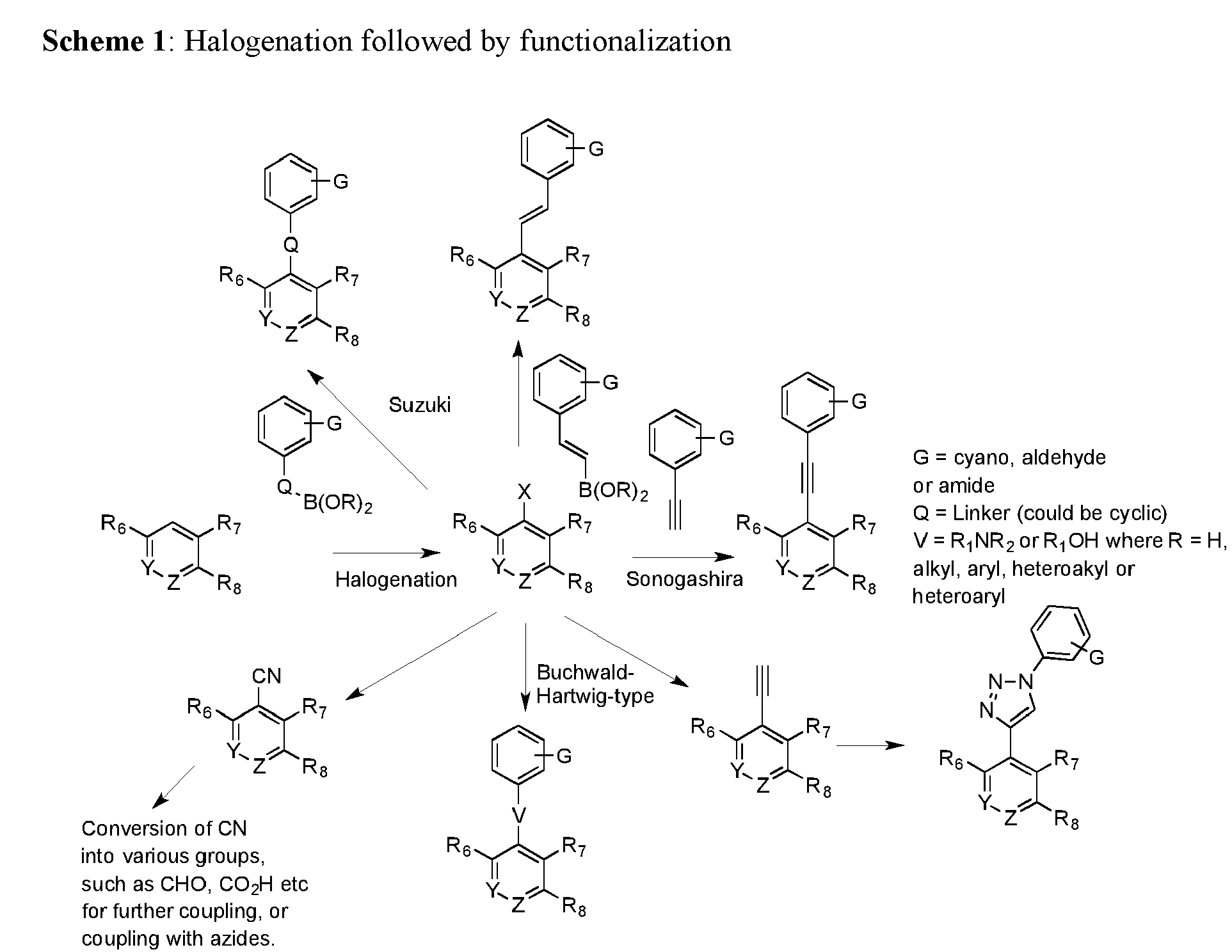
- For alkynes-containing compounds, a compound of the invention can be prepared via Sonogashira methodology as described in
Scheme 2.


-
Scheme 3 describes the preparation of a compound of the invention via Suzuki coupling.

- A compound of the invention can be prepared by functionalization of isoquinoline amine according to
Scheme 4.


-
Scheme 5 provides a general synthetic strategy for synthesis of functionalized 1-amino or 2-amino or 3-amino isoquinoline, quinoline/quinazoline and isoquinolines using quinoline or isoquinoline or quinazoline amine as nucleophile.


-
Scheme 6 provides a general synthetic strategy for synthesis of 4-Substituted isoquinolines, quinolones and quinazolines.
-
Scheme 7 provides synthesis of target compounds via Sonogashira coupling.
- A general synthetic strategy for displacement of halogen on quinoline or isoquinoline or quinazoline for preparation of compounds of the invention is described in
Figure 7 . - In some embodiments, the compounds of the invention are described in
Figures 4-6 . - In some embodiments, the compounds of the invention are readily prepared via Sonogashira or Suzuki coupling of iodo arenes with alkynes or alkene boronates, catalyzed by Pd(PPh3)2Cl2 (Sonogashira) or Pd(PPh3)4 (Suzuki) (e.g., in Table 4) as demonstrated in
Scheme 8. Scheme 8: Synthesis of alkyne and alkene analogs of the compound of the invention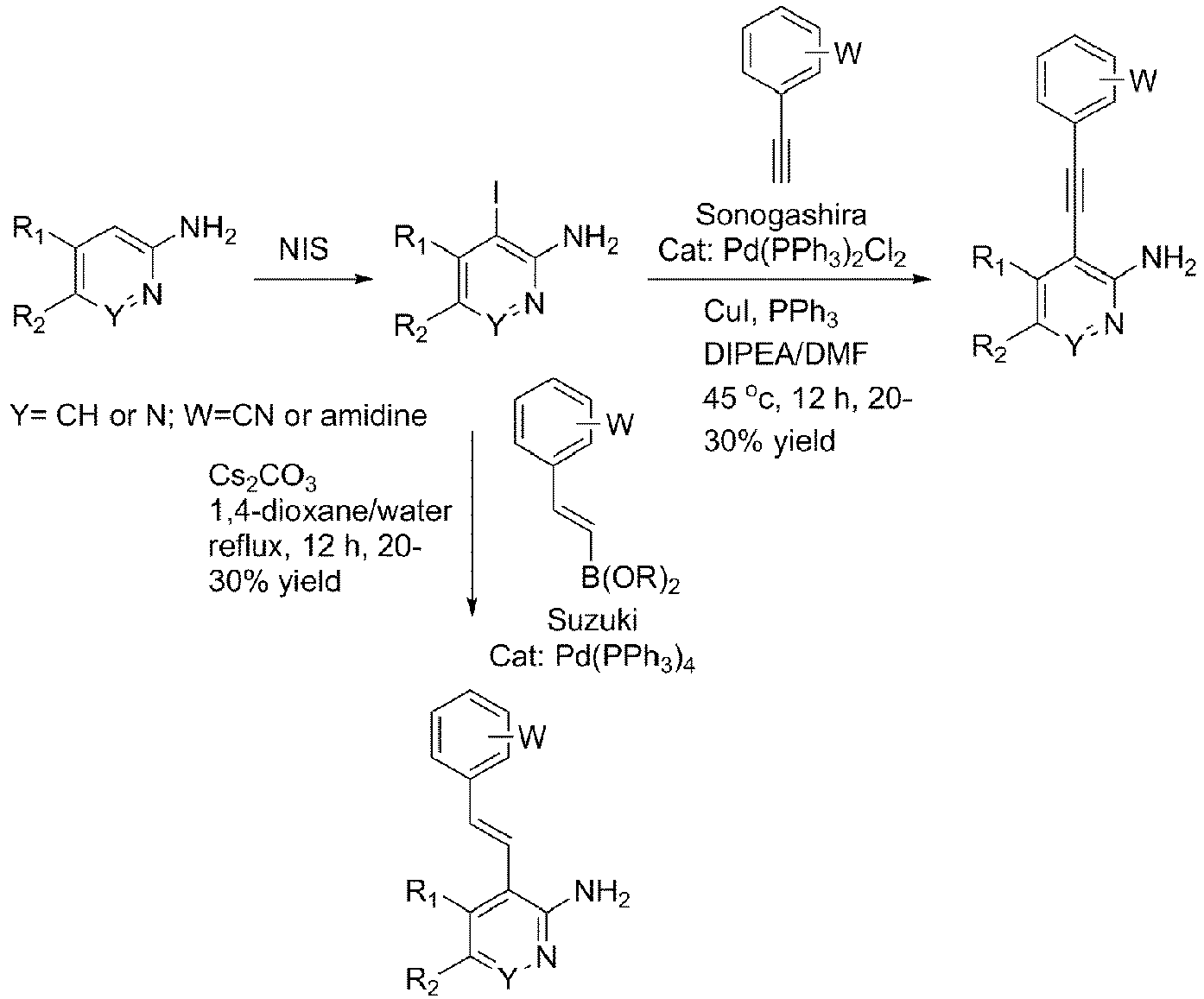
- In the compounds of the invention, the nature and substitution pattern on the amide and amidine head groups remarkably affect the anticancer properties of the compounds. By systematically varying the amide and amidine functionalities, the compounds have been identified that are about two orders of magnitude more potent than the compounds previously reported by
Sintim et al. (PCT/US2015/041551 ). - As described in
Figure 1 , in the compounds of the invention, the length of the amide head group, substitution pattern and relative position to the alkyne moiety remarkably affects the anticancer activity against MV4-11 cell line (AML cell line). For example, the nature of the amide group in the molecules shown inFigure 1 had a dramatic effect on the anticancer activities of the molecules tested. - For example, compounds HSM1669, M731, and HSM1684 differed from each other by a simple methylene group (CH2) yet the anticancer activities against AML are 260 nM (HSM1669), 36 nM (HSM731) and 71 nM (HSM1684). It appears that anticancer potency increases with an additional methylene group (HSM1669 to M731) but then decreases when another methylene group is added (M731 to HSM1684). Further, depending on the nature of the amide linker, the relative positions of the alkyne and amide moieties appear to affect anticancer potencies. For example, the relationship between M731 and HSM1688 (para vs meta substitution) is similar to that between HSD79 and HSD82 but whereas the anticancer activity of M731 is higher than that of HSM1688 (36 nM versus 250 nM; almost a fold difference), and that of HSD79 and HSD82 are similar (108 nM versus 150 nM). This indicates that the effect of substitution pattern of the benzamide part on anticancer activity (para vs. meta vs. ortho) is context dependent.
- For the para analogs M731, HSM1692 and HSD79 (analogs differing at the 4* position) the anticancer activities (IC50) against MV4-11 are 36 nM, 450 nM, and 108 nM, pointing to the essentiality of a nitrogen group at this 4* position. However, for the meta analogs HSM1688 and HSD82, the IC50 values are 250 nM for HSM1688 (nitrogen at the 4* position) and 150 nM for HSD82 (carbon at the 4* position). Thus, putting a hydroxyl group at the 2-position of M731 (to give HSM1702) remarkably affected the anticancer property (compare IC50 of 36 nM for M731 vs. 3 nM for HSM1702; an order of magnitude difference).
- As used herein, all compounds starting with MXC are the same as HSM, N-I = HSN, and DGBI = HSD.
- At various places in the present specification, substituents of compounds of the invention are disclosed in groups or in ranges. It is specifically intended that the invention include each and every individual subcombination of the members of such groups and ranges. For example, the term "C1-5 alkyl" is specifically intended to individually disclose methyl, ethyl, C3 alkyl, C4 alkyl, and C5 alkyl.
- It is further intended that the compounds of the invention are stable. As used herein "stable" refers to a compound that is sufficiently robust to survive isolation to a useful degree of purity from a reaction mixture, and preferably capable of formulation into an efficacious therapeutic agent. It is further appreciated that certain features of the invention, which are, for clarity, described in the context of separate embodiments, can also be provided in combination in a single embodiment. Conversely, various features of the invention which are, for brevity, described in the context of a single embodiment, can also be provided separately or in any suitable subcombination.
- Unless defined otherwise, all technical and scientific terms used herein have the same meaning as commonly understood to one of ordinary skill in the art.
- In some embodiments, the term "about" can allow for a degree of variability in a value or range, for example, within 10%, within 5%, or within 1% of a stated value or of a stated limit of a range.
- In some embodiments, the term "alkyl" is meant to refer to a saturated hydrocarbon group which is straight-chained or branched. Example alkyl groups include methyl (Me), ethyl (Et), propyl (e.g., n-propyl and isopropyl), butyl (e.g., n-butyl, isobutyl, t-butyl), pentyl (e.g., n-pentyl, isopentyl, neopentyl), and the like. An alkyl group can contain from 1 to about 20, from 2 to about 20, from 1 to about 10, from 1 to about 8, from 1 to about 6, from 1 to about 4, or from 1 to about 3 carbon atoms.
- As used herein, in some embodiments, the term "alkenyl" refers to an unsaturated monovalent chain of carbon atoms including at least one double bond, which may be optionally branched. It is understood that in embodiments that include alkenyl, illustrative variations of those embodiments include lower alkenyl, such as C2-C6, C2-C4 alkenyl, and the like.
- As used herein, in some embodiments, the term "alkynyl" refers to an unsaturated monovalent chain of carbon atoms including at least one triple bond, which may be optionally branched. It is understood that in embodiments that include alkynyl, illustrative variations of those embodiments include lower alkynyl, such as C2-C6, C2-C4 alkynyl, and the like.
- In some embodiments, "cycloalkyl" refers to non-aromatic carbocycles including cyclized alkyl, alkenyl, and alkynyl groups. Cycloalkyl groups can include mono- or polycyclic (e.g., having 2, 3 or 4 fused rings) ring systems, including spirocycles. In some embodiments, cycloalkyl groups can have from 3 to about 20 carbon atoms, 3 to about 14 carbon atoms, 3 to about 10 carbon atoms, or 3 to 7 carbon atoms. Cycloalkyl groups can further have 0, 1, 2, or 3 double bonds and/or 0, 1, or 2 triple bonds. Also included in the definition of cycloalkyl are moieties that have one or more aromatic rings fused (i.e., having a bond in common with) to the cycloalkyl ring, for example, benzo derivatives of cyclopentane, cyclopentene, cyclohexane, and the like. A cycloalkyl group having one or more fused aromatic rings can be attached through either the aromatic or non-aromatic portion. One or more ring-forming carbon atoms of a cycloalkyl group can be oxidized, for example, having an oxo or sulfido substituent. Example cycloalkyl groups include cyclopropyl, cyclobutyl, cyclopentyl, cyclohexyl, cycloheptyl, cyclopentenyl, cyclohexenyl, cyclohexadienyl, cycloheptatrienyl, norbornyl, norpinyl, norcarnyl, adamantyl, and the like.
- In some embodiments, "aryl" refers to monocyclic or polycyclic (e.g., having 2, 3 or 4 fused rings) aromatic hydrocarbons such as, for example, phenyl, naphthyl, anthracenyl, phenanthrenyl, and the like. In some embodiments, an aryl group has from 6 to about 20 carbon atoms.
- In some embodiments, "heteroaryl" refers to an aromatic heterocycle having at least one heteroatom ring member such as sulfur, oxygen, or nitrogen. Heteroaryl groups include monocyclic and polycyclic (e.g., having 2, 3 or 4 fused rings) systems. Any ring-forming N atom in a heteroaryl group can also be oxidized to form an N-oxo moiety. Examples of heteroaryl groups include without limitation, pyridyl, N-oxopyridyl, pyrimidinyl, pyrazinyl, pyridazinyl, triazinyl, furyl, quinolyl, isoquinolyl, thienyl, imidazolyl, thiazolyl, indolyl, pyrryl, oxazolyl, benzofuryl, benzothienyl, benzthiazolyl, isoxazolyl, pyrazolyl, triazolyl, tetrazolyl, indazolyl, 1,2,4-thiadiazolyl, isothiazolyl, benzothienyl, purinyl, carbazolyl, benzimidazolyl, indolinyl, and the like. In some embodiments, the heteroaryl group has from 1 to about 20 carbon atoms, and in further embodiments from about 3 to about 20 carbon atoms. In some embodiments, the heteroaryl group contains 3 to about 14, 3 to about 7, or 5 to 6 ring-forming atoms. In some embodiments, the heteroaryl group has 1 to about 4, 1 to about 3, or 1 to 2 heteroatoms. In some embodiments, "heteroaryl" may be optionally substituted at any one or more positions capable of bearing a hydrogen atom.
- In some embodiments, "heterocycloalkyl" refers to a non-aromatic heterocycle where one or more of the ring-forming atoms are a heteroatom such as an O, N, or S atom. Heterocycloalkyl groups can include mono- or polycyclic (e.g., having 2, 3 or 4 fused rings) ring systems as well as spirocycles. Example heterocycloalkyl groups include morpholino, thiomorpholino, piperazinyl, tetrahydrofuranyl, tetrahydrothienyl, 2,3-dihydrobenzofuryl, 1,3-benzodioxole, benzo-1,4-dioxane, piperidinyl, pyrrolidinyl, isoxazolidinyl, isothiazolidinyl, pyrazolidinyl, oxazolidinyl, thiazolidinyl, imidazolidinyl, and the like. Also included in the definition of heterocycloalkyl are moieties that have one or more aromatic rings fused (i.e., having a bond in common with) to the nonaromatic heterocyclic ring, for example phthalimidyl, naphthalimidyl, and benzo derivatives of heterocycles. A heterocycloalkyl group having one or more fused aromatic rings can be attached though either the aromatic or non-aromatic portion. Also included in the definition of heterocycloalkyl are moieties where one or more ring-forming atoms are substituted by 1 or 2 oxo or sulfido groups. In some embodiments, the heterocycloalkyl group has from 1 to about 20 carbon atoms, and in further embodiments from about 3 to about 20 carbon atoms. In some embodiments, the heterocycloalkyl group contains 3 to about 20, 3 to about 14, 3 to about 7, or 5 to 6 ring-forming atoms. In some embodiments, the heterocycloalkyl group has 1 to about 4, 1 to about 3, or 1 to 2 heteroatoms. In some embodiments, the heterocycloalkyl group contains 0 to 3 double bonds. In some embodiments, the heterocycloalkyl group contains 0 to 2 triple bonds.
- In some embodiments, "halo" or "halogen" includes fluoro, chloro, bromo, and iodo. A "halogen-substitution" or "halo" substitution designates replacement of one or more hydrogen atoms with F, CI, Br or I.
- In some embodiments, "haloalkyl" refers to an alkyl group having one or more halogen substituents. Example haloalkyl groups include CF3, C2F5, CHF2, CCl3, CHCl2, C2Cl5, and the like.
- It is understood that each of alkyl, cycloalkyl, alkenyl, cycloalkenyl, alkylene, and heterocycle may be optionally substituted with independently selected groups such as alkyl, haloalkyl, hydroxyalkyl, aminoalkyl, carboxylic acid and derivatives thereof, including esters, amides, and nitrites, hydroxy, alkoxy, acyloxy, amino, alky and dialkylamino, acylamino, thio, and the like, and combinations thereof.
- In some embodiments, the term "substituted" refers to the replacement of a hydrogen moiety with a non-hydrogen moiety in a molecule or group. It can refer to "mono-substituted" or "poly-substituted." The term "mono-substituted" or "poly-substituted" means substituted with one or more than one substituent up to the valence of the substituted group. For example, a mono-substituted group can be substituted with 1 substituent, and a poly-substituted group can be substituted with 2, 3, 4, or 5 substituents. When a list of possible substituents is provided, the substituents can be independently selected from that group.
- The term "optionally substituted," or "optional substituents," as used herein, means that the groups in question are either unsubstituted or substituted with one or more of the substituents specified. When the groups in question are substituted with more than one substituent, the substituents may be the same or different. Such other functional groups illustratively include, but are not limited to, amino, hydroxyl, CN, halo, thiol, alkyl, haloalkyl, heteroalkyl, aryl, arylalkyl, arylheteroalkyl, heteroaryl, heteroarylalkyl, heteroarylheteroalkyl, nitro, sulfonic acids and derivatives thereof, carboxylic acids and derivatives thereof, and the like. Illustratively, any of amino, hydroxyl, CH, thiol, alkyl, haloalkyl, heteroalkyl, aryl, arylalkyl, arylheteroalkyl, heteroaryl, heteroarylalkyl, heteroarylheteroalkyl, and/or sulfonic acid is optionally substituted. In some embodiments, the functional groups are the substituents described herein for any one of variables. Furthermore, when using the terms "independently," "independently are," and "independently selected from" mean that the groups in question may be the same or different. Certain of the herein defined terms may occur more than once in the structure, and upon such occurrence each term shall be defined independently of the other.
- In each of the foregoing and each of the following embodiments, it is to be understood that the formulas also include any and all hydrates and/or solvates of the compound formulas. It is appreciated that certain functional groups, such as the hydroxy, amino, and like groups form complexes and/or coordination compounds with water and/or various solvents, in the various physical forms of the compounds. Accordingly, the above formulas are to be understood to include and represent those various hydrates and/or solvates.
- The compounds described herein can be asymmetric (e.g., having one or more stereocenters). All stereoisomers, such as enantiomers and diastereomers, are intended unless otherwise indicated. Compounds of the present invention that contain asymmetrically substituted carbon atoms can be isolated in optically active or racemic forms. Methods on how to prepare optically active forms from optically active starting materials are known in the art, such as by resolution of racemic mixtures or by stereoselective synthesis. Many geometric isomers of olefins, C=N double bonds, and the like can also be present in the compounds described herein, and all such stable isomers are contemplated in the present invention. Cis and trans geometric isomers of the compounds of the present invention are described and may be isolated as a mixture of isomers or as separated isomeric forms.
- In the case of the compounds which contain an asymmetric carbon atom, the invention relates to the D form, the L form, and D,L mixtures and also, where more than one asymmetric carbon atom is present, to the diastereomeric forms. Those compounds of the invention which contain asymmetric carbon atoms, and which as a rule accrue as racemates, can be separated into the optically active isomers in a known manner, for example using an optically active acid. However, it is also possible to use an optically active starting substance from the outset, with a corresponding optically active or diastereomeric compound then being obtained as the end product.
- Compounds of the invention also include tautomeric forms. Tautomeric forms result from the swapping of a single bond with an adjacent double bond together with the concomitant migration of a proton. Tautomeric forms include prototropic tautomers which are isomeric protonation states having the same empirical formula and total charge. Example prototropic tautomers include ketone - enol pairs, amide - imidic acid pairs, lactam - lactim pairs, amide - imidic acid pairs, enamine - imine pairs, and annular forms where a proton can occupy two or more positions of a heterocyclic system, for example, 1H- and 3H-imidazole, 1H-, 2H- and 4H- 1,2,4-triazole, 1H- and 2H- isoindole, and 1H- and 2H-pyrazole. Tautomeric forms can be in equilibrium or sterically locked into one form by appropriate substitution.
- Compounds of the invention can also include all isotopes of atoms occurring in the intermediates or final compounds. Isotopes include those atoms having the same atomic number but different mass numbers. For example, isotopes of hydrogen include tritium and deuterium.
- In some embodiments, the term "compound" as used herein, is meant to include all stereoisomers, geometric isomers, tautomers, and isotopes of the structures depicted.
- In some embodiments, the compound of the invention is substantially isolated. By "substantially isolated" is meant that the compound is at least partially or substantially separated from the environment in which it was formed or detected. Partial separation can include, for example, a composition enriched in the compound of the invention. Substantial separation can include compositions containing at least about 50%, at least about 60%, at least about 70%, at least about 80%, at least about 90%, at least about 95%, at least about 97%, or at least about 99% by weight of the compound of the invention, or salt thereof. Methods for isolating compounds and their salts are routine in the art.
- In some embodiments, as used herein, the term "therapeutically effective amount" refers to the amount of active compound or pharmaceutical agent that elicits the biological or medicinal response in a tissue system, animal or human that is being sought by a researcher, veterinarian, medical doctor or other clinicians, which includes alleviation of the symptoms of the disease or disorder being treated. In one aspect, the therapeutically effective amount is that which may treat or alleviate the disease or symptoms of the disease at a reasonable benefit/risk ratio applicable to any medical treatment.
- In addition, it is appreciated that there is an interrelationship of dosages determined for humans and those dosages determined for animals, including test animals (illustratively based on milligrams per meter squared of body surface) as described by Freireich, E. J., et al., Cancer Chemother. Rep. 1966, 50 (4), 219, the disclosure of which is incorporated herein by reference. Body surface area may be approximately determined from patient height and weight (see, e.g., Scientific Tables, Geigy Pharmaceuticals, Ardley, New York, pages 537-538 (1970)). A therapeutically effective amount of the compounds described herein may be defined as any amount useful for inhibiting the growth of (or killing) a population of malignant cells or cancer cells, such as may be found in a patient in need of relief from such cancer or malignancy. Typically, such effective amounts range from about 5 mg/kg to about 500 mg/kg, from about 5 mg/kg to about 250 mg/kg, and/or from about 5 mg/kg to about 150 mg/kg of compound per patient body weight. It is appreciated that effective doses may also vary depending on the route of administration, optional excipient usage, and the possibility of co-usage of the compound with other conventional and nonconventional therapeutic treatments, including other anti-tumor agents, radiation therapy, and the like.
- In some embodiments, the phrase "pharmaceutically acceptable" is employed herein to refer to those compounds, materials, compositions, and/or dosage forms which are, within the scope of sound medical judgment, suitable for use in contact with the tissues of human beings and animals without excessive toxicity, irritation, allergic response, or other problem or complication, commensurate with a reasonable benefit/risk ratio.
- The compound of the present invention also includes "pharmaceutically acceptable salts" of the compounds described herein. As used herein, "pharmaceutically acceptable salts" refers to derivatives of the disclosed compounds wherein the parent compound is modified by converting an existing acid or base moiety to its salt form. Examples of pharmaceutically acceptable salts include, but are not limited to, mineral or organic acid salts of basic residues such as amines; alkali or organic salts of acidic residues such as carboxylic acids; and the like. The pharmaceutically acceptable salts of the compound of the invention include the conventional non-toxic salts of the parent compound formed, for example, from non-toxic inorganic or organic acids. The pharmaceutically acceptable salts of the compound of the invention can be synthesized from the parent compound which contains a basic or acidic moiety by conventional chemical methods. Generally, such salts can be prepared by reacting the free acid or base forms of these compounds with a stoichiometric amount of the appropriate base or acid in water or in an organic solvent, or in a mixture of the two; generally, nonaqueous media like ether, ethyl acetate, ethanol, isopropanol, or acetonitrile are preferred.
- The pharmaceutically acceptable salts of the compound of the invention can be obtained by converting derivatives which possess tertiary amino groups into the corresponding quaternary ammonium salts in a manner known per se using quaternizing agents. Examples of suitable quaternizing agents are alkyl halides, such as methyl iodide, ethyl bromide, and n-propyl chloride, and also arylalkyl halides, such as benzyl chloride or 2-phenylethyl bromide.
- The "subject" used here refers to an animal or a human. In some embodiment, the term "subject" refers to a human. A pharmaceutical composition comprising a compound of
claim 1, or a pharmaceutically acceptable salt, N-oxide, hydrate, solvate, tautomer, or optical isomer thereof, and a pharmaceutically acceptable carrier or diluent. - In another aspect, the present invention features a pharmaceutical composition comprising a compound of the invention as described herein, or a pharmaceutically acceptable salt, N-oxide, hydrate, solvate, tautomer, or optical isomer thereof, and a pharmaceutically acceptable carrier or diluent.
- In some embodiment, the pharmaceutical composition includes a therapeutically effective amount of the one or more compounds for treating a cancer patient. It is to be understood that the composition may include other component and/or ingredients, including, but not limited to, other therapeutically active compounds, and/or one or more pharmaceutically acceptable carriers, diluents, excipients, and the like.
- The term "pharmaceutically acceptable carrier" or "pharmaceutically acceptable diluent" is art-recognized and refers to a pharmaceutically-acceptable material, composition or vehicle, such as a liquid or solid filler, diluent, excipient, solvent or encapsulating material, involved in carrying or transporting any subject composition or component thereof. Each carrier must be "acceptable" in the sense of being compatible with the subject composition and its components and not injurious to the patient. Some examples of materials which may serve as pharmaceutically acceptable carriers include: (1) sugars, such as lactose, glucose and sucrose; (2) starches, such as corn starch and potato starch; (3) cellulose, and its derivatives, such as sodium carboxymethyl cellulose, ethyl cellulose and cellulose acetate; (4) powdered tragacanth; (5) malt; (6) gelatin; (7) talc; (8) excipients, such as cocoa butter and suppository waxes; (9) oils, such as peanut oil, cottonseed oil, safflower oil, sesame oil, olive oil, corn oil and soybean oil; (10) glycols, such as propylene glycol; (11) polyols, such as glycerin, sorbitol, mannitol and polyethylene glycol; (12) esters, such as ethyl oleate and ethyl laurate; (13) agar; (14) buffering agents, such as magnesium hydroxide and aluminum hydroxide; (15) alginic acid; (16) pyrogen-free water; (17) isotonic saline; (18) Ringer's solution; (19) ethyl alcohol; (20) phosphate buffer solutions; and (21) other non-toxic compatible substances employed in pharmaceutical formulations.
- A therapeutically effective dose of a compound according to the invention is used, in addition to physiologically acceptable carriers, diluents and/or adjuvants for producing a pharmaceutical composition. The dose of the active compound can vary depending on the route of administration, the age and weight of the patient, the nature and severity of the diseases to be treated, and similar factors. The daily dose can be given as a single dose, which is to be administered once, or be subdivided into two or more daily doses, and is as a rule 0.001-2000 mg. Particular preference is given to administering daily doses of 0.1-500 mg, e.g. 0.1-100 mg.
- Suitable administration forms are oral, parenteral, intravenous, transdermal, topical, inhalative, intranasal and sublingual preparations. Particular preference is given to using oral, parenteral, e.g. intravenous or intramuscular, intranasal, e.g. dry powder or sublingual preparations of the compounds according to the invention. The customary galenic preparation forms, such as tablets, sugar-coated tablets, capsules, dispersible powders, granulates, aqueous solutions, alcohol-containing aqueous solutions, aqueous or oily suspensions, syrups, juices or drops, are used.
- Solid medicinal forms can comprise inert components and carrier substances, such as calcium carbonate, calcium phosphate, sodium phosphate, lactose, starch, mannitol, alginates, gelatine, guar gum, magnesium stearate, aluminium stearate, methyl cellulose, talc, highly dispersed silicic acids, silicone oil, higher molecular weight fatty acids, (such as stearic acid), gelatine, agar agar or vegetable or animal fats and oils, or solid high molecular weight polymers (such as polyethylene glycol); preparations which are suitable for oral administration can comprise additional flavorings and/or sweetening agents, if desired.
- Liquid medicinal forms can be sterilized and/or, where appropriate, comprise auxiliary substances, such as preservatives, stabilizers, wetting agents, penetrating agents, emulsifiers, spreading agents, solubilizers, salts, sugars or sugar alcohols for regulating the osmotic pressure or for buffering, and/or viscosity regulators. Examples of such additives are tartrate and citrate buffers, ethanol and sequestering agents (such as ethylenediaminetetraacetic acid and its nontoxic salts). High molecular weight polymers, such as liquid polyethylene oxides, microcrystalline celluloses, carboxymethyl celluloses, polyvinylpyrrolidones, dextrans or gelatine, are suitable for regulating the viscosity. Examples of solid carrier substances are starch, lactose, mannitol, methyl cellulose, talc, highly dispersed silicic acids, high molecular weight fatty acids (such as stearic acid), gelatine, agar agar, calcium phosphate, magnesium stearate, animal and vegetable fats, and solid high molecular weight polymers, such as polyethylene glycol.
- Oily suspensions for parenteral or topical applications can be vegetable synthetic or semisynthetic oils, such as liquid fatty acid esters having in each case from 8 to 22 C atoms in the fatty acid chains, for example palmitic acid, lauric acid, tridecanoic acid, margaric acid, stearic acid, arachidic acid, myristic acid, behenic acid, pentadecanoic acid, linoleic acid, elaidic acid, brasidic acid, erucic acid or oleic acid, which are esterified with monohydric to trihydric alcohols having from 1 to 6 C atoms, such as methanol, ethanol, propanol, butanol, pentanol or their isomers, glycol or glycerol. Examples of such fatty acid esters are commercially available miglyols, isopropyl myristate, isopropyl palmitate, isopropyl stearate, PEG 6-capric acid, caprylic/capric acid esters of saturated fatty alcohols, polyoxyethylene glycerol trioleates, ethyl oleate, waxy fatty acid esters, such as artificial ducktail gland fat, coconut fatty acid isopropyl ester, oleyl oleate, decyl oleate, ethyl lactate, dibutyl phthalate, diisopropyl adipate, polyol fatty acid esters, inter alia. Silicone oils of differing viscosity, or fatty alcohols, such as isotridecyl alcohol, 2-octyldodecanol, cetylstearyl alcohol or oleyl alcohol, or fatty acids, such as oleic acid, are also suitable. It is furthermore possible to use vegetable oils, such as castor oil, almond oil, olive oil, sesame oil, cotton seed oil, groundnut oil or soybean oil.
- Suitable solvents, gelatinizing agents and solubilizers are water or watermiscible solvents. Examples of suitable substances are alcohols, such as ethanol or isopropyl alcohol, benzyl alcohol, 2-octyldodecanol, polyethylene glycols, phthalates, adipates, propylene glycol, glycerol, di- or tripropylene glycol, waxes, methyl cellosolve, cellosolve, esters, morpholines, dioxane, dimethyl sulphoxide, dimethylformamide, tetrahydrofuran, cyclohexanone, etc.
- Mixtures of gelatinizing agents and film-forming agents are also perfectly possible. In this case, use is made, in particular, of ionic macromolecules such as sodium carboxymethyl cellulose, polyacrylic acid, polymethacrylic acid and their salts, sodium amylopectin semiglycolate, alginic acid or propylene glycol alginate as the sodium salt, gum arabic, xanthan gum, guar gum or carrageenan. The following can be used as additional formulation aids: glycerol, paraffin of differing viscosity, triethanolamine, collagen, allantoin and novantisolic acid. Use of surfactants, emulsifiers or wetting agents, for example of Na lauryl sulphate, fatty alcohol ether sulphates, di-Na-N-lauryl-β-iminodipropionate, polyethoxylated castor oil or sorbitan monooleate, sorbitan monostearate, polysorbates (e.g. Tween), cetyl alcohol, lecithin, glycerol monostearate, polyoxyethylene stearate, alkylphenol polyglycol ethers, cetyltrimethylammonium chloride or mono-/dialkylpolyglycol ether orthophosphoric acid monoethanolamine salts can also be required for the formulation. Stabilizers, such as montmorillonites or colloidal silicic acids, for stabilizing emulsions or preventing the breakdown of active substances such as antioxidants, for example tocopherols or butylhydroxyanisole, or preservatives, such as p-hydroxybenzoic acid esters, can likewise be used for preparing the desired formulations.
- Preparations for parenteral administration can be present in separate dose unit forms, such as ampoules or vials. Use is preferably made of solutions of the active compound, preferably aqueous solution and, in particular, isotonic solutions and also suspensions. These injection forms can be made available as ready-to-use preparations or only be prepared directly before use, by mixing the active compound, for example the lyophilisate, where appropriate containing other solid carrier substances, with the desired solvent or suspending agent.
- Intranasal preparations can be present as aqueous or oily solutions or as aqueous or oily suspensions. They can also be present as lyophilisates which are prepared before use using the suitable solvent or suspending agent.
- Inhalable preparations can present as powders, solutions or suspensions. Preferably, inhalable preparations are in the form of powders, e.g. as a mixture of the active ingredient with a suitable formulation aid such as lactose.
- The preparations are produced, aliquoted and sealed under the customary antimicrobial and aseptic conditions.
- As indicated above, a compound of the invention may be administered as a combination therapy with further active agents, e.g. therapeutically active compounds useful in the treatment of cancer, for example, prostate cancer, ovarian cancer, lung cancer, or breast cancer. In some embodiments, the cancer is acute myeloid leukemia, chronic myeloid leukemia, ovarian cancer, cervical cancer, pancreatic cancer, breast cancer, brain cancer, skin cancer, lung cancer, prostate cancer, Lymphoma, Leukemia, colon cancer, head cancer, neck cancer, thyroid cancer, kidney cancer, liver cancer and stomach cancer. For a combination therapy, the active ingredients may be formulated as compositions containing several active ingredients in a single dose form and/or as kits containing individual active ingredients in separate dose forms. The active ingredients used in combination therapy may be coadministered or administered separately.
- It is another aspect of the invention that a compound of the invention as described herein is a protein kinase inhibitor. Thus, the present invention features a method of inhibiting a protein kinase, wherein the method comprises contacting the protein kinase with an effective amount of a compound of the invention. In some embodiments, such protein kinase includes, but is not limited to, FLT3 and TrkC. In some embodiments, the protein kinase is Abli, Abl2, AFK, ALK, AMPK group, ATM, ATR, Aurora A, Aurora B, Axl, BCKDK, BLK, BMPR1B, BMX, Brk, BRSK1, BTK, CaM-KIalpha, CaM-KIIalpha, CaMKK group, CaM-KIV, CaM-KKalpha, CaM-KKbeta, CCDPK, CCRK, CDK1,CDK11, CDK2, CDK4, CDK5, CDK6, CDK7, CDK9, CDK group, CDPK, Chak1, CHK1, CHK2, CK1 alpha, CK1 delta, CK1 epsilon, CK1 group, CK2 alpha, CK2 beta, CK2 group, CLK1,CSF1R, Csk, DAPK1, DAPK2, DAPK3, DAPK group, DCAMKL1, DMPK group, DNA-PK, DYRK1A, DYRK1B, DYRK2, DYRK3, eEF2K, Eg3 kinase, EGFR, EIF2AK2, EphA2, EphA3, EphA4, EphA8, EphB1, EphB2, EphB3, EphB5, ErbB2, FAK, Fer, Fes, FGFR1, FGFR3, FGFR4, FGFR group, Fgr, FLT1, FLT3, FLT4, Fyn,GRK-1, GRK-2, GRK-3, GRK-4, GRK-5, GRK-6, GPX_group, GSK-3alpha, GSK-3beta, GSK-3_group, HCK, HIPK2, HIPK3, HRI, ICK, IGF1R, IKK-alpha, IKK-beta, IKK-epsilon ILK, InsR, IPL1, IRAK1, IRAK4, ITK, JAK1, JAK2, JAK3, JAK_group, JNK_group, KDR, KIS, Kit, KSR1, Lck, LIMK1, LIMK2, LKB1, LOK, Lyn, MAP2K1, MAP2K2, MAP2K3, MAP2K4, MAP2K6, MAP2K7, MAPK2 group, MAP3K1, MAP3K11, MAP3K14, MAP3K5, MAP3K7, MAP3K8, MAPK3 group, MAP4K1, MAP4K2, MAP4K4, MAPK1, MAPK10, MAPK11, MAPK12, MAPK13, MAPK14, MAPK3, MAPK4, MAPK6, MAPK7, MAPK8, MAPK9, MAPK_group, MAPKAPK2, MARK_group, Mer, Met, MHCK, MLCK group, Mnk1, Mnk2, MOS, MRCKa, MST1, MST3, mTOR, NDR1, NDR2, NEK1, NEK2, NEK6, NEK9, NEK group, NLK, NuaK1, p37 kinase, p38 group, p70S6K, p70S6Kb, P70S6K_group, PAK1, PAK2, PAK3, PAK5, PAK6, PAK_group, PASK, P-CIP2, PCTAIRE1, PDGFR alpha, PDGFR beta, PDGFR group, PDHK1, PDHK2, PDHK3, PDHK4, PDK-1, PDK-2, PDK group, PHK_group, PIK3CA, PIK3CB, PIK3CD, PIK3CG, Pim-1, PKA alpha, Pka_group, PKB beta, PKB_group, PKC alpha, PKC beta, PKC delta, PKC epsilon, PKC eta, PKC gamma, PKC iota, PKC theta, PKC zeta, PKC group, PKD1, PKD2, PKD3, PKG1/cGK-I, PKG2/cGK-II, PKG2/cGK_group, PKN1, PLK1, PLK2, PLK3, PRP4, PYK2, RAF1, Ret, ROCK1, ROCK2, Ron, RPL10, RSK-1, RSK-2, RSK-3, RSK-5, SDK1, SGK_group, SIK, Sky, Src, Src group, STLK3, Syk, TBK1, Tec, TESK1, TESK2, TGFbR1, TGFbR2, Tie1, Tie2, Titin kinase, TNK2, TRKA, TRKB, tropomyosin kinase, TSSK3, TXK, Tyk2, TYK2, VRK1, Wee1, Wnk1, WNK1, Yes, ZAP70. In some embodiments, each possibility represents a separate embodiment of the present invention.
- It is a further aspect of the invention that a compound of the invention as described herein can be used for treating, inhibiting, suppressing, or reducing the severity of a disease or a disorder associated with a protein kinase, wherein the method comprises administering to the subject in need thereof a therapeutically effective amount of a compound of the invention, or a pharmaceutically acceptable salt, N-oxide, hydrate, solvate, tautomer, or optical isomer thereof. In some embodiments, the protein kinase is one known in the art. In some embodiments, the protein kinase includes, but is not limited to, FLT3 and TrkC. In some embodiments, the protein kinase is Abl, Abl2, AFK, ALK, AMPK_group, ATM, ATR, Aurora A, Aurora B, Axl, BCKDK, BLK, BMPR1B, BMX, Brk, BRSK1, BTK, CaM-KIalpha, CaM-KIIalpha, CaMKK group, CaM-KIV, CaM-KKalpha, CaM-KKbeta, CCDPK, CCRK, CDK1,CDK11, CDK2, CDK4, CDK5, CDK6, CDK7, CDK9, CDK group, CDPK, Chak1, CHK1, CHK2, CK1 alpha, CK1 delta, CK1 epsilon, CK1 group, CK2 alpha, CK2 beta, CK2 group, CLK1,CSF1R, Csk, DAPK1, DAPK2, DAPK3, DAPK_group, DCAMKL1, DMPK group, DNA-PK, DYRK1A, DYRK1B, DYRK2, DYRK3, eEF2K, Eg3 kinase, EGFR, EIF2AK2, EphA2, EphA3, EphA4, EphA8, EphB1, EphB2, EphB3, EphB5, ErbB2, FAK, Fer, Fes, FGFR1, FGFR3, FGFR4, FGFR group, Fgr, FLT1, FLT3, FLT4, Fyn,GRK-1, GRK-2, GRK-3, GRK-4, GRK-5, GRK-6, GPX_group, GSK-3alpha, GSK-3beta, GSK-3_group, HCK, HIPK2, HIPK3, HRI, ICK, IGF1R, IKK-alpha, IKK-beta, IKK-epsilon ILK, InsR, IPL1, IRAK1, IRAK4, ITK, JAK1, JAK2, JAK3, JAK_group, JNK_group, KDR, KIS, Kit, KSR1, Lck, LIMK1, LIMK2, LKB1, LOK, Lyn, MAP2K1, MAP2K2, MAP2K3, MAP2K4, MAP2K6, MAP2K7, MAPK2 group, MAP3K1, MAP3K11, MAP3K14, MAP3K5, MAP3K7, MAP3K8, MAPK3 group, MAP4K1, MAP4K2, MAP4K4, MAPK1, MAPK10, MAPK11, MAPK12, MAPK13, MAPK14, MAPK3, MAPK4, MAPK6, MAPK7, MAPK8, MAPK9, MAPK_group, MAPKAPK2, MARK_group, Mer, Met, MHCK, MLCK_group, Mnk1, Mnk2, MOS, MRCKa, MST1, MST3, mTOR, NDR1, NDR2, NEK1, NEK2, NEK6, NEK9, NEK group, NLK, NuaK1, p37 kinase, p38 group, p70S6K, p70S6Kb, P70S6K_group, PAK1, PAK2, PAK3, PAK5, PAK6, PAK_group, PASK, P-CIP2, PCTAIRE1, PDGFR alpha, PDGFR beta, PDGFR group, PDHK1, PDHK2, PDHK3, PDHK4, PDK-1, PDK-2, PDK group, PHK_group, PIK3CA, PIK3CB, PIK3CD, PIK3CG, Pim-1, PKA alpha, Pka_group, PKB beta, PKB_group, PKC alpha, PKC beta, PKC delta, PKC epsilon, PKC eta, PKC gamma, PKC iota, PKC theta, PKC zeta, PKC group, PKD1, PKD2, PKD3, PKG1/cGK-I, PKG2/cGK-II, PKG2/cGK group, PKN1, PLK1, PLK2, PLK3, PRP4, PYK2, RAF1, Ret, ROCK1, ROCK2, Ron, RPL10, RSK-1, RSK-2, RSK-3, RSK-5, SDK1, SGK_group, SIK, Sky, Src, Src group, STLK3, Syk, TBK1, Tec, TESK1, TESK2, TGFbR1, TGFbR2, Tie1, Tie2, Titin kinase, TNK2, TRKA, TRKB, tropomyosin kinase, TSSK3, TXK, Tyk2, TYK2, VRK1, Wee1, Wnk1, WNK1, Yes, ZAP70. In some embodiments, each possibility represents a separate embodiment of the present invention.
- In some embodiments, the disease or disorder associated with a protein kinase includes, but is not limited to, cancer, diabetes, malaria, viral infections (such as HIV), cardiovascular and hypertension, CNS and neurodegeneration (such as Alzheimer's, Parkinson, manic depression, supranuclear palsy), osteoporosis, inflammation and autoimmune (such as rheumatoid arthritis, myelofibrosis, inflammatory bowel disease, Crohn's disease, colitis, psoriasis, systemic lupus erythematosus, keratoconjunctivitis sicca), allergy (general allergic disease, allergic asthma, allergic rhinitis). In some embodiments, the disease or disorder associated with a protein kinase is cancer, diabetes, malaria, viral infections, cardiovascular and hypertension, CNS and neurodegeneration, osteoporosis, pulmonary fibrosis, retinitis pigmentosis, Wet macular degeneration, Duchenne muscular dystrophy, diabetic eye disease, inflammation and autoimmune, or allergy. In some embodiments, the disease or disorder associated with a protein kinase is cancer.
- In another aspect, the invention is directed to a method of treating, inhibiting, suppressing, or reducing the severity of cancer in a subject in need thereof, wherein the method comprises administering to the subject a therapeutically effective amount of a compound as described herein, or a pharmaceutically acceptable salt, N-oxide, hydrate, solvate, tautomer, or optical isomer thereof, or a pharmaceutical composition containing one or more of the compounds as described herein.
- In some embodiments, the invention disclosed herein relates to a method for the treatment of a cancer patient wherein abnormal kinase activities are implicated by administrating a therapeutically effective amount of a compound disclosed herein to the patient in need of relief from said cancer. It is appreciated herein that the compounds described herein may be used alone or in combination with other compounds useful for treating cancer, including those compounds that may be therapeutically effective by the same or different modes of action. It is appreciated herein that the compounds described herein may be used in combination with other compounds that are administered to treat other symptoms of cancer, such as nausea, vomiting, pain, etc.
- In some embodiments, the cancer is selected from the group consisting of acute myeloid leukemia, chronic myeloid leukemia, ovarian cancer, cervical cancer, pancreatic cancer, breast cancer, brain cancer, skin cancer, lung cancer, prostate cancer, Lymphoma, Leukemia, colon cancer, head cancer, neck cancer, thyroid cancer, kidney cancer, liver cancer and stomach cancer. In some embodiments, the cancer is acute myeloid leukemia.
- It is another aspect of the invention that a compound of the invention as described herein can be used for treating, inhibiting, suppressing, or reducing the severity of cancer in a subject, wherein the method comprises administering to the subject in need thereof a therapeutically effective amount of a compound of the invention, or a pharmaceutically acceptable salt, N-oxide, hydrate, solvate, tautomer, or optical isomer thereof, or a pharmaceutical composition containing one or more of the compounds as described herein. In some embodiments, the cancer that can be treated, inhibited, suppressed, or reduced the severity of by a compound of the invention as described anywhere herein includes, but is not limited to, ovarian cancer, pancreatic cancer, breast cancer, brain cancer, skin cancer, lung cancer, prostate cancer, Lymphoma, Leukemia, colon cancer, head cancer, neck cancer, and stomach cancer. In some embodiments, the cancer that can be treated, inhibited, suppressed, or reduced the severity of by a compound of the invention as described anywhere herein includes, but is not limited to, acute myeloid leukemia, chronic myeloid leukemia, ovarian cancer, cervical cancer, pancreatic cancer, breast cancer, brain cancer, skin cancer, lung cancer, prostate cancer, Lymphoma, Leukemia, colon cancer, head cancer, neck cancer, thyroid cancer, kidney cancer, liver cancer and stomach cancer. In some embodiments, the cander is breast cancer. In other embodiments, the cancer is ovarian cancer. In some embodiments, the cancer is prostate cancer. In some embodiments, the cancer is acute myeloid leukemia.
- It is yet another aspect of the invention that a compound of the invention as described herein is a protein kinase inhibitor. The compound of the invention can be used for treating, inhibiting, suppressing, or reducing the severity of a disease or a disorder associated with protein kinase, wherein the method comprises administering to the subject in need thereof a therapeutically effective amount of a compound of invnention, or a pharmaceutically acceptable salt, N-oxide, hydrate, solvate, tautomer, or optical isomer thereof. In some embodiments, the protein kinase is one known in the art. In some embodiments, the protein kinase includes, but is not limited to, FLT3 and TrkC.
- In some embodiments, the protein kinase is Abl, Abl2, AFK, ALK, AMPK group, ATM, ATR, Aurora A, Aurora B, Axl, BCKDK, BLK, BMPR1B, BMX, Brk, BRSK1, BTK, CaM-KIalpha, CaM-KIIalpha, CaMKK group, CaM-KIV, CaM-KKalpha, CaM-KKbeta, CCDPK, CCRK, CDK1,CDK11, CDK2, CDK4, CDK5, CDK6, CDK7, CDK9, CDK group, CDPK, Chak1, CHK1, CHK2, CK1 alpha, CK1 delta, CK1 epsilon, CK1 group, CK2 alpha, CK2_beta, CK2 group, CLK1,CSF1R, Csk, DAPK1, DAPK2, DAPK3, DAPK group, DCAMKL1, DMPK group, DNA-PK, DYRK1A, DYRK1B, DYRK2, DYRK3, eEF2K, Eg3 kinase, EGFR, EIF2AK2, EphA2, EphA3, EphA4, EphA8, EphB1, EphB2, EphB3, EphB5, ErbB2, FAK, Fer, Fes, FGFR1, FGFR3, FGFR4, FGFR group, Fgr, FLT1, FLT3, FLT4, Fyn,GPX-1, GRK-2, GRK-3, GRK-4, GRK-5, GRK-6, GRK group, GSK-3alpha, GSK-3beta, GSK-3 group, HCK, HIPK2, HIPK3, HRI, ICK, IGF1R, IKK-alpha, IKK-beta, IKK-epsilon ILK, InsR, IPL1, IRAK1, IRAK4, ITK, JAK1, JAK2, JAK3, JAK_group, JNK_group, KDR, KIS, Kit, KSR1, Lck, LIMK1, LIMK2, LKB1, LOK, Lyn, MAP2K1, MAP2K2, MAP2K3, MAP2K4, MAP2K6, MAP2K7, MAPK2 group, MAP3K1, MAP3K11, MAP3K14, MAP3K5, MAP3K7, MAP3K8, MAPK3 group, MAP4K1, MAP4K2, MAP4K4, MAPK1, MAPK10, MAPK11, MAPK12, MAPK13, MAPK14, MAPK3, MAPK4, MAPK6, MAPK7, MAPK8, MAPK9, MAPK_group, MAPKAPK2, MARK_group, Mer, Met, MHCK, MLCK group, Mnk1,
Mnk2, MOS, MRCKa, MST1, MST3, mTOR, NDR1, NDR2, NEK1, NEK2, NEK6, NEK9, NEK group, NLK, NuaK1, p37 kinase, p38 group, p70S6K, p70S6Kb, P70S6K_group, PAK1, PAK2, PAK3, PAK5, PAK6, PAK_group, PASK, P-CIP2, PCTAIRE1, PDGFR alpha, PDGFR beta, PDGFR group, PDHK1, PDHK2, PDHK3, PDHK4, PDK-1, PDK-2, PDK group, PHK_group, PIK3CA, PIK3CB, PIK3CD, PIK3CG, Pim-1, PKA alpha, Pka_group, PKB beta, PKB_group, PKC alpha, PKC beta, PKC delta, PKC epsilon, PKC eta, PKC gamma, PKC iota, PKC theta, PKC zeta, PKC group, PKD1, PKD2, PKD3, PKG1/cGK-I, PKG2/cGK-II, PKG2/cGK_group, PKN1, PLK1, PLK2, PLK3, PRP4, PYK2, RAF1, Ret, ROCK1, ROCK2, Ron, RPL10, RSK-1, RSK-2, RSK-3, RSK-5, SDK1, SGK_group, SIK, Sky, Src, Src group, STLK3, Syk, TBK1, Tec, TESK1, TESK2, TGFbR1, TGFbR2, Tie1, Tie2, Titin kinase, TNK2, TRKA, TRKB, tropomyosin kinase, TSSK3, TXK, Tyk2, TYK2, VRK1, Wee1, Wnk1, WNK1, Yes, ZAP70. In some embodiments, each possibility represents a separate embodiment of the present invention. - In some embodiemtns, the disease or disorder associated with protein kinase includes those known in the art. In certain embodiments, the disease or disorder associated with protein kinase is cancer, diabetes, malaria, viral infections (such as HIV), cardiovascular and hypertension, CNS and neurodegeneration (such as Alzheimer's, Parkinson, manic depression, supranuclear palsy), osteoporosis, inflammation and autoimmune (such as rheumatoid arthritis, myelofibrosis, inflammatory bowel disease, Crohn's disease, colitis, psoriasis, systemic lupus erythematosus, keratoconjunctivitis sicca), allergy (general allergic disease, allergic asthma, allergic rhinitis). In some embodiments, each possibility represents a separate embodiment of the present invention. In other embodiments, the compound of the invention can be used for treating bacterial infections. In some embodiments, the disease or disorder associated with protein kinase is cancer, diabetes, malaria, viral infections, cardiovascular and hypertension, CNS and neurodegeneration, osteoporosis, pulmonary fibrosis, retinitis pigmentosis, Wet macular degeneration, Duchenne muscular dystrophy, diabetic eye disease, inflammation and autoimmune, or allergy. In some embodiments, the compound of the invention can be used for treating cancer, for example, acute myeloid leukemia, chronic myeloid leukemia, ovarian cancer, cervical cancer, pancreatic cancer, breast cancer, brain cancer, skin cancer, lung cancer, prostate cancer, Lymphoma, Leukemia, colon cancer, head cancer, neck cancer, thyroid cancer, kidney cancer, liver cancer and stomach cancer. In some embodiments, the cancer is breast cancer. In other embodiments, the cancer is ovarian cancer. In some embodiments, the cancer is prostate cancer. In some embodiments, the cancer is acute myeloid leukemia.
- It is another aspect of the invention that a compound of the invention can be used for treating, inhibiting, suppressing, or reducing the severity of acute myeloid leukemia in a subject, wherein the method comprises administering to said subject a therapeutically effective amount of a compound of the invention, or a pharmaceutically acceptable salt, N-oxide, hydrate, solvate, tautomer, or optical isomer thereof.
- It is a further aspect of the invention the compounds of the invention exhibits low nanomolar IC50 values in the tests for their anticancer properties, which are desired for clinical translation. The compound of the invention is a kinase (especially FLT3, c-Kit, and TrK) inhibitor. For example, the compound of the invention inhibits kinases, such as FLT3, TrkC, and c-Kit at the protein level. In some embodiments, a compound of the invention shows potent anticancer activities (low nanomolar IC50 values) against acute myeloid leukemia. In some embodiments, a compound of the invention is also active against other cancer cell lines, such as pancreatic, breast, and ovarian cancers. In some embodiments, the cancer is acute myeloid leukemia, chronic myeloid leukemia, ovarian cancer, cervical cancer, pancreatic cancer, breast cancer, brain cancer, skin cancer, lung cancer, prostate cancer, Lymphoma, Leukemia, colon cancer, head cancer, neck cancer, thyroid cancer, kidney cancer, liver cancer and stomach cancer. In some embodiments, the cancer is breast cancer. In other embodiments, the cancer is ovarian cancer. In some embodiments, the cancer is prostate cancer. In some embodiments, the cancer is acute myeloid leukemia.
- In addition to targeting FLT-3, a compound of the invention also inhibits other protein kinase TrkC as well as c-MyC and Ras oncogenic proteins. Due to the multi-targeting of oncogenic drivers, the compound of the invention has superior performance against AML with mutant FLT-3 than what is known in the art. Moreover, due to its multi targeting nature, a compound of the invention is also effective against other cancer cell lines, for example, ovarian cancer, pancreatic cancer, breast cancer, brain cancer, skin cancer, lung cancer, prostate cancer, Lymphoma, Leukemia, colon cancer, head cancer, neck cancer, and stomach cancer. In some embodiments, the cancer is breast cancer. In some embodiments, the cancer that can be treated, inhibited, suppressed, or reduced the severity of by a compound of the invention as described anywhere herein includes, but is not limited to, acute myeloid leukemia, chronic myeloid leukemia, ovarian cancer, cervical cancer, pancreatic cancer, breast cancer, brain cancer, skin cancer, lung cancer, prostate cancer, Lymphoma, Leukemia, colon cancer, head cancer, neck cancer, thyroid cancer, kidney cancer, liver cancer and stomach cancer. In other embodiments, the cancer is ovarian cancer. In some embodiments, the cancer is prostate cancer. In some embodiments, the cancer is acute myeloid leukemia.
- The compound of the invention inhibits the proliferation of several cancer cell lines at nano molar concentrations. Further, the compound of the invention inhibits protein kinase FLT-3 phosphorylation and also inhibits the proliferation of FLT-3 driven cancers, such as MV4-11 (an acute myeloid leukemia) with low (e.g., single digit nanomolar) IC50 values. A compound of the invention as a potent kinase inhibitor can be used to treat cancers, malaria, arthritis, diseases related to the immune system and other diseased states that kinases play key roles in disease establishment or progression.
- It will be appreciated by persons skilled in the art that the present invention is not limited by what has been particularly shown and described herein above. Rather the scope of the present invention includes both combinations and subcombinations of the various features described hereinabove as well as variations and modifications which would occur to persons skilled in the art upon reading the specification and which are not in the prior art.
- The details of one or more embodiments of the invention are set forth in the accompanying the description below. Other features, objects, and advantages of the invention will be apparent from the description and drawings, and from the claims.
- Solvents and reagents were purchased from commercial vendors and were used without further purification. 1H NMR spectra were recorded at 500 MHz, using a Bruker Avance 500 spectrometers with a CryoProbe.
- ESI-MS experiments were performed using an Agilent MSD/TOF mass spectrometer at the Bindley Bioscience Center Metabolomics Facility (Purdue University). The instrument was calibrated to a resolution of 10000 with a 10% valley between peaks using the appropriate polypropylene glycol standards.
- Analytical thin layer chromatography was carried out on
silica gel 60 F254 plastic-backed TLC plates. Compounds were visualized with both short and long wavelength UV light and iodine/silica gel staining unless otherwise specified. Flash column chromatography was performed using Teledyne Isco's Combi-Flash Rf+ with RediSep Rf silica gel disposable flash coumns, 40-60 microns (Catalog # 692203304). For purities estimated by HPLC, the major peak accounted for ≥95% of the combined total peak area when monitored by a UV detector at 254 nm unless otherwise specified. All yields refer to isolated compounds. - Quizartinib (>99.5% purity) and crenolanib (>99.5% purity) were purchased from Chemietek.com. Unless otherwise noted, all materials were obtained from commercial suppliers and used as obtained. Solvents were purchased from Sigma and used directly without purification. NMR spectra were recorded on a Bruker 400, 500 or 600 MHz spectrometer at ambient temperature. Chemical shifts are reported in parts per million (δ) and are calibrated using residual undeuterated solvent as an internal reference. Data for 1H NMR spectra are reported as follows: chemical shift (δ ppm) (multiplicity, coupling constant (Hz), integration). Multiplicities are reported as follows: s = singlet, d = doublet, t = triplet, q = quartet, m = multiplet, br = broad, or combinations thereof.
- The Reaction Biology Corporation (www.reactionbiology.com, Malvern, PA) HotSpot assay platform was used to measure kinase/inhibitor interactions exactly as previously described. Kinase and substrate were mixed in a buffer containing 20 mM HEPES pH 7.5, 10 mM MgCl2, 1 mM EGTA, 0.02% Brij35, 0.02 mg/mL BSA, 0.1 mM Na3VO4, 2 mM DTT and 1% DMSO. Single-dose of compounds (500 nM) were then added to each reaction mixture. After 20-minute incubation, ATP (Sigma) and [γ-33P] ATP (Perkin Elmer) were added at a final total concentration of 100 µM for
addition 2 hours at room temperature, followed by spotting onto P81 ion exchange cellulose chromatography paper (Whatman, Inc.). Filter paper was washed in 0.75% phosphoric acid to remove unincorporated ATP. Percent remaining kinase activity of a vehicle (DMSO) containing kinase reaction was calculated for each kinase/inhibitor pair using Prism 5 (GraphPad). - The docking package CANDOCK1 was used to identify docking poses of HSW630-1 in the binding site of FLT3 kinases. The structure of FLT3 was obtained from the protein databank (PDB# 4XUF). The entire protein was considered flexible. No binding site was provided to CANDOCK and the location of this site was determined by the program automatically. CANDOCK used default parameters with interactive flexibility with a maximum iteration of 10 and only the top 2% of the top seed values were used to generate full ligands.
- Molm-14 cells were the kind gift of Dr. Mark Levis from Johns Hopkins University. THP-1, MV4-11, K-562 and MRC-5A cells were purchased from ATCC (ATCC, Manassas, VA). All cell lines were grown in 37°C with 5% CO2 atmosphere with RPMI 1640 (Life technologies, Carlsbad, CA) supplemented with heat-inactivated 10% (V/V) fetal bovine serum. Cell lines were grown and maintained according to ATCC recommendations.
- Cell lines were seeded into 96-well plates the afternoon prior to treatment. Approximately 18 hours later, compounds were semi-serially diluted in dimethyl sulfoxide (DMSO) and then growth medium, and added to cells. Plates were incubated for 72 hours prior to addition of Alamar Blue (Life Technologies, Carlsbad, CA). Plates were read after 4 additional hours of incubation at 37°C using a Bio-Tek Synergy HT plate reader (Bio-Tek, Winooski, VT). Data was analyzed and graphed using GraphPad Prism Software (Graphpad, La Jolla, CA).
- To determine inhibition at 100 nM or 1 mM, 96-well plates were seeded the afternoon before treatment. Plates were then treated with compound diluted in dimethyl sulfoxide (DMSO) as well as a DMSO control the following day for 72 hours. After this time the plates were then treated with 10 µL of CellTiter-Blue Cell Viability Assay (Promega, Madison, WI) for 4 hours. Then the plates were read on a plate reader (Bio-Tek, Winooski, VT). Data was analyzed on Excel as a percent of the DMSO vehicle.
- Midostaurin hydrate (control compound) was purchased from Sigma-Aldrich (St. Louis, MO), >98% HPLC purity and used without further purification. Cell lines were seeded into 96-well plates the afternoon prior to treatment. Approximately 18 hours later, compounds were diluted in dimethyl sulfoxide (DMSO) and added to cells. Plates were incubated for 72 hours and cells viability determined with CellTiter-Blue Cell Viability Assay (Promega, Madison, WI). Plates were read after 4 additional hours of incubation at 37 °C using plate reader (Bio-Tek, Winooski, VT). Data was analyzed and graphed using GraphPad Prism Software (Graphpad, La Jolla, CA).
- Effect of HSW630-1 on protein expression was tested in the MV4-11 leukemia cell line. Total protein extracts were prepared using RIPA buffer (SIGMA) supplemented with Complete Mini™ protease inhibitor and PHOStop™ phosphatase inhibitors (Roche). Equal amounts of proteins (up to 25 µg) were separated on 4-12% NuPAGE gels in 1X MOPS or 1x MES buffer (Invitrogen) and transferred onto PVDF membranes (Millipore). The membrane was blocked with 5% dry milk in 1X TBS/0.1% Tween 20 (TBST) for at least 1 h at room temperature and incubated with human specific primary antibodies: FLT3, Phospho-FLT3, c-Myc (Cell Signaling Technologies), KRAS (Santa Cruz), or mouse anti-β-actin (SIGMA) overnight at 4°C. The membrane was washed 3 times in TBST and incubated with a horseradish peroxidase-conjugated secondary anti-rabbit or anti-mouse antibody (Cell Signaling Technologies) for 1 h at room temperature. Blots were again washed and the signal was detected with SuperSignal West Femto Chemiluminescent Substrate (Pierce) and exposed to HyBlot CL® autoradiography film (Denville).
-

- In a 50 ml round bottom flask, 50 mg 6-bromo-isoquinolin-3-amine, 10 mol% Bis(triphenylphosphine)palladium(II) dichloride, 10 mol% triphenylphosphine were added, purged with nitrogen three times before 5 ml anhydrous DMF was added. Stirred at 45 °C, stirred for another 5 minutes before the corresponding alkyne was added via syringe in 1ml anhydrous DMF in 2 minutes. 2 ml DIPEA was added and stirred overnight. After TCL showed the reaction was completed, equal volume of distilled water was added, and extracted with DCM three times (50ml *3), washed with brine and dried with anhydrous sodium sulfate, removed solvents. Pure product was obtained by Combi-flash using 100% DCM to 35% MeOH.
-
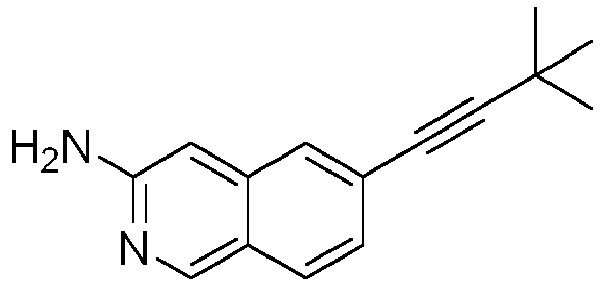
- 1H NMR (500 MHz, DMSO) δ 8.78 (d, J = 19.0 Hz, 1H), 7.80 - 7.64 (m, 1H), 7.53 (s, 1H), 7.09 (ddd, J = 97.0, 8.5, 1.5 Hz, 1H), 6.55 (d, J = 3.7 Hz, 1H), 6.05 (d, J = 62.4 Hz, 2H), 1.28 (s, 9H).LR-MS(ESI) m/z calcd for C15H16N2 ([M+H]+) 225.1 found 225.3.
-
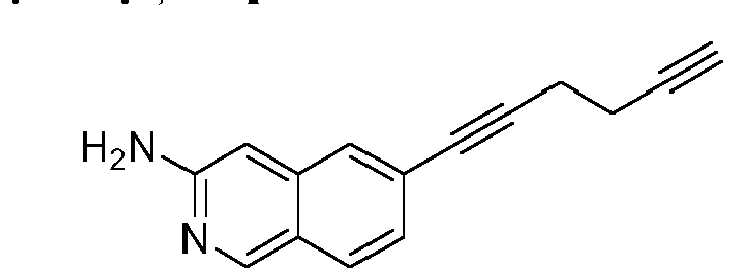
- LR-MS(ESI) m/z calcd for C15H12N2 ([M+H]+) 221.1 found 221.1.
-

- LR-MS(ESI) m/z calcd for C14H12N2 ([M+H]+) 209.1 found 209.1.
-

- 1H NMR (500 MHz, CDCl3) δ 7.72 - 7.63 (m, 2H), 7.54 (dd, J = 7.6, 1.2 Hz, 1H), 7.46 (td, J = 7.6, 2.8 Hz, 1H), 7.26 (s, 1H), 3.50 (s, 2H), 2.56 (d, J = 7.2 Hz, 4H), 1.07 (t, J = 7.2 Hz, 6H).LR-MS(ESI) m/z calcd for C16H19N3 ([M+H]+) 254.2 found 254.2.
-

- LR-MS(ESI) m/z calcd for C15H16N2 ([M+H]+) 225.1 found 225.6.
-

- LR-MS(ESI) m/z calcd for C11H8N2 ([M+H]+) 169.1 found 169.5.
-

- 1H NMR (500 MHz, MeOD) δ 8.72 (s, 1H), 7.97 (s, 1H), 7.81 - 7.45 (m, 3H), 7.15 (dd, J = 8.5, 1.1 Hz, 1H), 6.71 (s, 1H), 4.08 (s, 2H), 1.47 (s, 9H); 13C NMR (126 MHz, DMSO) δ 157.45, 155.76, 151.79, 138.47, 128.62, 127.88, 124.22, 124.08, 121.69, 97.05, 89.51, 82.19, 78.78, 30.65, 28.66.LR-MS(ESI) m/z calcd for C17H19N3O2 ([M+H]+) 298.1 found 298.4.
-
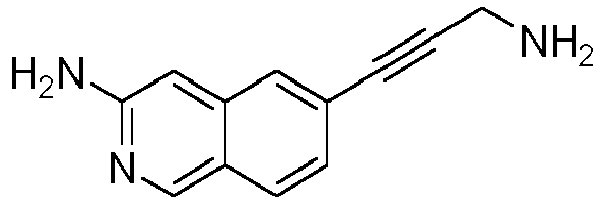
- LR-MS(ESI) m/z calcd for C12H11N3 ([M+H]+) 198.0 found 198.6.
-

- LR-MS(ESI) m/z calcd for C15H13N3 ([M+H]+) 236.1 found 236.6.
-

- To a 50 ml round bottom flask, 1 eq 6-chloro-isoquinolin-3-amine was dissolved in concentrated sulfuric acid at room temperature, after stirred the mixture for 5 minutes, sodium nitrate was added all at once, and the mixture was stirred overnight. After TLC showed the reaction was completed, 100 ml cooled water was added, and extracted with DCM three times (50ml *3), washed with brine and dried with anhydrous sodium sulfate, removed solvents. The crude product was directly treated with 100 ml aqueous sodium hydroxide and 5 eq of sodium dithionite was added and the mixture was stirred overnight. After TLC showed the reaction was completed, equal volume of distilled water was added, and extracted with DCM three times (50ml *3), washed with brine and dried with anhydrous sodium sulfate, removed solvents. Pure product was obtained by Combi-flash using 100% DCM to 35% MeOH.
-

- LR-MS(ESI) m/z calcd for C9H6ClN3O2 ([M+H]+) 224.1 found 224.4.
-

- LR-MS(ESI) m/z calcd for C9H8ClN3 ([M+H]+) 194.0 found 194.2.
-

- To a 50 ml round bottom flask, 1 eq pyridine-2,4,5-triamine was dissolved in anhydrous ethanol at room temperature, after stirred the mixture for 5 minutes, oxalaldehyde was added all at once, and the mixture was stirred overnight. After TLC showed the reaction was completed, 100 ml cooled water was added, and extracted with DCM three times (50ml *3), washed with brine and dried with anhydrous sodium sulfate, removed solvents. Pure product was obtained by Combi-flash using 100% DCM to 35% MeOH.

- LR-MS(ESI) m/z calcd for C7H6N4 ([M+H]+) 147.0 found 147.1.
-

- In a 50 ml round bottom flask, 50 mg 6-bromo-isoquinolin-3-amine, 10 mol% tetrakis(triphenylphosphine)palladium(0), 1 mol% zinc, 1.5 eq zinc cyanide were added, purged with nitrogen three times before 5 ml anhydrous DMF was added. Stirred at 80 °C overnight. After TCL shows the reaction is completed, equal volume of distilled water was added, and extracted with DCM three times (50ml *3), washed with brine and dried with anhydrous sodium sulfate, removed solvents. Pure product was obtained by Combi-flash using 100% DCM to 35% MeOH.

- 1H NMR (500 MHz, DMSO) δ 8.95 (s, 1H), 8.18 (s, 1H), 7.67 - 7.50 (m, 2H), 7.35 (dd, J = 8.4, 1.3 Hz, 1H), 6.69 (s, 1H), 6.32 (s, 2H); LR-MS(ESI) m/z calcd for C10H7N3 ([M+H]+) 170.1 found 170.6.
-


- In a 250 ml round bottom flask, 579 mg 1eq 6-chloroisoquinolin-3-amine was dissolved in 150 ml anhydrous MeOH at 0 °C and stirred for 5 minutes before 675 mg NIS was added in portions slowly in 10 minutes. Stop the reaction by remove all solvents when TLC showed the reaction was completed (usually within 15 minutes). 420 mg 6-chloro-4-iodoisoquinolin-3-amine was obtained either by flash column or Combi-flash using 100% hexane -100% ethyl acetate.
- In a 100 ml round bottom flask, 290 mg 1eq 4-ethynylbenzoic acid was dissolved in 50 ml anhydrous DCM at 0 °C, 800 mg of HBTU was added and stirred for another 10 minutes before 1.1 eq of the corresponding amine was added. After 30 seconds, 1 eq. of DIPEA was added and the mixture was stirred overnight. After TLC showed the reaction was completed, stop the reaction by adding equal volume of distilled water. Extracted with DCM three times (50ml *3), washed with brine and dried with anhydrous sodium sulfate, removed solvents. Pure benzamide was obtained by Combi-flash using 100% DCM to 20% MeOH.
- In a 50 ml round bottom flask, 50 mg 6-chloro-4-iodoisoquinolin-3-amine, 10 mol% Bis(triphenylphosphine)palladium(II) dichloride, 10 mol% triphenylphosphine were added, purged with nitrogen three times before 5 ml anhydrous DMF was added. Stirred at 45 °C for another 5 minutes before the corresponding benzamide was added via syringe in 1ml anhydrous DMF in 2 minutes. 2 ml DIPEA was added and stirred overnight. After TCL shows the reaction is completed, equal volume of distilled water was added, and extracted with DCM three times (50ml *3), washed with brine and dried with anhydrous sodium sulfate, removed solvents. Pure product was obtained by Combi-flash using 100% DCM to 35% MeOH.
-

- LR-MS(ESI) m/z calcd for C16H20N2O2 ([M+H]+) 273.2, found. 273.8
-

- LR-MS(ESI) m/z calcd for C14H18N2O ([M+H]+) 231.1, found 231.6.
-

- LR-MS(ESI) m/z calcd for C17H23N3O ([M+H]+) 286.1, found 286.4.
-

- LR-MS(ESI) m/z calcd for C21H23N3O ([M+H]+) 334.2, found 334.4.
-

- LR-MS(ESI) m/z calcd for C13H16N2O ([M+H]+) 217.1, found 217.2.
-

- LR-MS(ESI) m/z calcd for C16H20N2O ([M+H]+) 257.1, found 257.3.
-

- LR-MS(ESI) m/z calcd for C17H22N2O ([M+H]+) 271.2, found 271.6.
-

- LR-MS(ESI) m/z calcd for C16H22N2O ([M+H]+) 259.2, found 259.6.
-

- 1H NMR (500 MHz, CDCl3) δ 7.73 (d, J = 8.5 Hz, 2H), 7.54 (d, J = 8.5 Hz, 2H), 3.62 - 3.51 (m, 4H), 3.39 (s, 3H), 1.90 (dd, J = 6.5, 5.5 Hz, 2H); 13C NMR (126 MHz, CDCl3) δ 166.40, 134.78, 132.22, 126.82, 125.06, 82.61, 79.31, 72.19, 58.99, 39.01, 28.58. LR-MS(ESI) m/z calcd for C13H15NO2 ([M+H]+) 218.1, found 218.3.
-

- LR-MS(ESI) m/z calcd for C21H29N3O3 ([M+H]+) 217.1, found 271.3.
-

- LR-MS(ESI) m/z calcd for C14H18N2O2 ([M+H]+) 217.1, found 217.5.
-
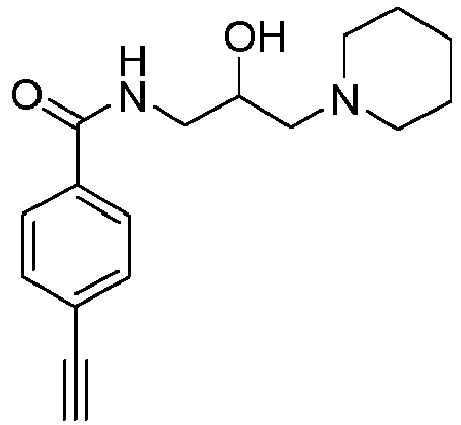
- LR-MS(ESI) m/z calcd for C17H22N2O2 ([M+H]+) 287.2, found 287.4.
-

- LR-MS(ESI) m/z calcd for C17H22N2O ([M+H]+) 271.1, found 270.2.
-

- LR-MS(ESI) m/z calcd for C25H19N5O ([M+H]+) 406.2, found 406.4.
-

- 1H NMR (500 MHz, Chloroform-d) δ 7.74 (d, J = 8.2 Hz, 2H), 7.53 (d, J = 8.2 Hz, 2H), 7.13 (s, 1H), 3.52 (q, J = 5.7 Hz, 2H), 3.18 (s, 1H), 2.56 (t, J = 6.0 Hz, 2H), 2.45 (s, 4H), 1.59 (p, J = 5.6 Hz, 4H), 1.46 (t, J = 6.0 Hz, 2H); 13C NMR (126 MHz, CDCl3) δ 166.53, 134.67, 132.24, 126.97, 125.14, 82.87, 79.34, 56.94, 54.24, 36.38, 25.89, 24.22.
-

- 1H NMR (500 MHz, Chloroform-d) δ 7.64 (d, J = 8.4 Hz, 2H), 7.51 (d, J = 8.5 Hz, 2H), 7.01 (d, J = 8.3 Hz, 2H), 6.66 (d, J = 8.3 Hz, 2H), 6.11 (s, 1H), 3.65 (q, J = 6.6 Hz, 2H), 3.18 (s, 1H), 2.81 (t, J = 6.8Hz, 2H); 13C NMR (126 MHz, CDCl3) δ 166.57, 145.01, 134.71, 132.29, 129.66, 128.54, 126.80, 125.22, 115.50, 82.78, 79.40, 41.37, 34.72.
-

- 1H NMR (500 MHz, Chloroform-d) δ 7.51 (d, J = 8.1 Hz, 2H), 7.33 (d, J = 8.3 Hz, 2H), 4.57 - 4.59 (2H), 3.69 (s, 2H), 3.14 (s, 1H), 3.08 (s, 1H), 2.95 (s, 1H), 1.99 (d, J = 47.4 Hz, 2H), 1.44 - 1.25 (11H); 13C NMR (126 MHz, CDCl3) δ 169.60, 155.05, 136.10, 132.26, 126.91, 123.63, 82.81, 79.67, 78.71, 47.88, 33.11, 32.15, 28.39.
-

- 1H NMR (500 MHz, Chloroform-d) δ 7.52 (dd, J = 6.0, 2.3 Hz, 1H), 7.49 (s, 1H), 7.40 - 7.32 (m, 2H), 4.59 - 4.49 (NH & NH-CH, 2H), 3.69 (s, 2H), 3.11 (s, C≡C-H & N-CH aHb, 2H), 2.96 (s, N-CHa H b 1H), 2.05-1.94 (2H), 1.45-1.28 (-(CH 3)3 & CH 2, 11H); 13C NMR (126 MHz, CDCl3) δ 169.33, 155.04, 136.23, 133.24, 130.38, 128.67, 127.16, 122.62, 82.71, 79.67, 78.23, 47.89, 38.63, 32.15, 28.39.
-

- 1H NMR (500 MHz, Chloroform-d) δ 7.50 (d, J = 7.8 Hz, 2H), 7.34 (d, J = 8.1 Hz, 2H), 4.72 (s, 1H), 3.73 (s, 1H), 3.13 (s, 1H), 2.98 (s, 1H), 2.74 (s, 1H), 2.53 (s, 5H), 1.93 (s, 1H), 1.77 (s, 1H), 1.63 - 1.40 (m, 7H); 13C NMR (126 MHz, CDCl3) δ 169.41, 136.33, 132.23, 126.90, 123.49, 82.85, 78.62, 62.54, 50.29, 26.18, 24.55.
-

- 1H NMR (500 MHz, Chloroform-d) δ 7.73 (d, J = 8.4 Hz, 2H), 7.51 (d, J = 8.3 Hz, 2H), 7.24 (d, J = 8.5 Hz, 2H), 6.87 (d, J = 8.5 Hz, 2H), 6.53 (t, J = 5.7 Hz, 1H), 4.54 (d, J = 5.5 Hz, 2H), 4.06 (t, J = 5.7 Hz, 2H), 3.18 (s, 1H), 2.76 (t, J = 5.6 Hz, 2H), 2.36 (s, 6H); 13C NMR (126 MHz, CDCl3) δ 166.46, 158.31, 134.42, 132.27, 130.28, 129.31, 126.98, 125.34, 114.85, 82.76, 79.52, 65.83, 58.17, 45.76, 43.69.
-

- 1H NMR (500 MHz, Chloroform-d) δ 8.85 (s, 1H), 8.10 (s, 1H), 8.03 (dd, J = 7.8, 1.5 Hz, 1H), 7.55 (dd, J = 7.5, 1.4 Hz, 1H), 7.36 (t, J = 7.8 Hz, 1H), 3.85 (q, J = 5.5 Hz, 2H), 3.19 (t, J= 5 Hz, 2H), 3.08 (bs, 5H), 1.97 (s, 4H), 1.61 (s, 2H); 13C NMR (126 MHz, CDCl3) δ 166.99, 135.09, 133.60, 131.58, 128.62, 127.79, 122.51, 82.82, 78.10, 57.71, 54.32, 34.83, 22.86, 22.08.
-

- 1H NMR (500 MHz, DMSO-d 6) δ 8.66 (t, J = 5.6 Hz, 1H), 7.82 (d, J = 8.3 Hz, 2H), 7.60 - 7.49 (m, 3H), 6.82 (s, 1H), 4.36 (s, 1H), 3.50 - 3.43 (m, 2H), 2.74 (t, J = 7.5 Hz, 2H); 13C NMR (126 MHz, DMSO) δ 165.73, 135.16, 135.12, 132.11, 127.89, 124.76, 117.11, 83.38, 83.27, 27.29.
-

- 1H NMR (500 MHz, DMSO-d 6) δ 8.31 (d, J = 7.9 Hz, 1H), 7.82 (d, J = 7.9 Hz, 2H), 7.53 (d, J = 7.9 Hz, 2H), 6.75 (d, J = 8.0 Hz, 1H), 4.36 (s, 1H), 3.74 - 3.61 (m, 1H), 3.18 (m, 1H), 1.81 - 1.73 (m, 4H), 1.36 (m, 11H), 1.26 - 1.14 (m, 2H); 13C NMR (126 MHz, DMSO) δ 165.07, 155.33, 135.19, 132.00, 128.02, 124.69, 83.40, 83.23, 77.87, 49.04, 48.30, 31.91, 31.44, 28.74.
-

- 1H NMR (500 MHz, Chloroform-d) δ 11.53 (s, 1H), 8.27 (d, J = 8.3 Hz, 1H), 7.71 (d, J = 8.0 Hz, 2H), 7.54 (d, J = 8.3 Hz, 2H), 5.90 (d, J = 7.9 Hz, 1H), 3.99 (d, J = 45.1 Hz, 1H), 3.19 (s, 1H), 2.15 - 2.10 (m, 4H), 1.50 (d, J = 4.7 Hz, 18H), 1.38 (q, J= 5.2, 4.6 Hz, 4H); 13C NMR (126 MHz, CDCl3) δ 165.99, 163.78, 155.58, 153.30, 134.70, 132.29, 126.86, 125.29, 83.15, 82.77, 79.45, 79.25, 48.23, 48.14, 31.54, 31.50, 28.32, 28.12.
-

- To a 50 ml round bottom, 1eq 4-ethynylbenzaldehyde was dissolved in tBuOH and 1 eq of the corresponding diamine was added all at once, stirred for 1 hour at room temperature. 1.1 eq of iodine and 3 eq of potassium carbonate were added and the mixture was reflux overnight. After TCL shows the reaction is completed, equal volume of distilled water was added, and extracted with DCM three times (50ml *3), washed with brine and dried with anhydrous sodium sulfate, removed solvents. Pure product was obtained by Combi-flash using 100% DCM to 35% MeOH.
-

- LR-MS(ESI) m/z calcd for C14H14N2 ([M+H]+) 211.1 found 211.3.
-

- LR-MS(ESI) m/z calcd for C11H10N2 ([M+H]+) 171.1 found 171.3.
-

- LR-MS(ESI) m/z calcd for C18H23N3 ([M+H]+) 282.2 found 282.4.
-

- LR-MS(ESI) m/z calcd for C17H21N3O ([M+H]+) 211.1 found 211.3.
-

- LR-MS(ESI) m/z calcd for C13H14N2 ([M+H]+) 199.1 found 199.2.
-

- 1H NMR (500 MHz, MeOD) δ 8.79 (s, 1H), 7.93-7.82 (m, 4H), 7.76 (d, J = 8.4 Hz, 2H), 7.25 (dd, J = 8.6, 1.9 Hz, 1H), 3.72 (t, J = 4.6 Hz, 4H), 3.47 (t, J = 6.9 Hz, 2H), 2.58-2.49 (m, 6H), 1.93-1.81 (m, 2H); 13C NMR (125 MHz, MeOD) δ 167.91, 157.55,151.88,138.75,138.03, 133.81, 131.01, 130.33, 127.09, 126.33, 123.67, 121.30, 120.77, 99.21, 90.21, 84.49, 66.25, 56.38, 53.35, 38.16, 25.52; LR-MS(ESI) m/z calcd for C25H26ClN4O2 ([M+H]+) 449.2, found 449.3.
-

- 1H NMR (500 MHz, DMSO) δ 10.34 (s, 1H), 8.91 (s, 1H), 8.03 (d, J = 8.3 Hz, 2H), 7.96-7.85 (m, 3H), 7.74 (d, J = 8.4 Hz, 2H), 7.32-7.20 (m, 3H), 6.88 (s, 2H), 3.43 (s, 2H), 2.63-2.31 (m, 8H), 2.24 (s, 3H); 13C NMR (125 MHz, DMSO) δ 165.16, 158.79, 153.44, 138.78, 138.45, 137.47, 134.50, 131.64, 129.62, 128.32, 126.51, 123.54, 121.35, 120.76, 120.63, 99.58, 88.35, 86.33, 61.88, 54.71, 52.25, 45.47; LR-MS(ESI) m/z calcd for C30H29ClN5O ([M+H]+) 510.2, found 510.5.
-

- 1H NMR (500 MHz, DMSO) δ 8.92 (s, 1H), 7.96 (d, J = 8.6 Hz, 1H), 7.93-7.81 (m, 5H), 7.28 (dd, J = 8.6, 1.8 Hz, 1H), 6.85 (s, 2H), 3.68 (s, 4H); 13C NMR (125 MHz, DMSO) δ 163.73, 158.70, 153.30, 138.73, 137.42, 131.64, 131.56, 129.45, 127.78, 125.60, 123.52, 121.33, 120.61, 99.69, 88.45, 85.91, 49.51; LR-MS(ESI) m/z calcd for C20H15ClN4 ([M+H]+) 347.1, found 347.4.
-

- 1H NMR (500 MHz, DMSO) δ 8.90 (s, 1H), 8.64 (t, J = 5.4 Hz, 1H), 8.16 (s, 1H), 7.92 (dd, J = 18.9, 8.2 Hz, 2H), 7.86 (d, J = 1.3 Hz, 1H), 7.82 (d, J = 7.9 Hz, 1H), 7.52 (t, J = 7.7 Hz, 1H), 7.26 (dd, J = 8.6, 1.9 Hz, 1H), 6.82 (s, 2H), 3.30 (dd, J = 12.8, 6.7 Hz, 2H), 2.35 (t, J = 7.1 Hz, 2H), 2.19 (s, 6H), 1.73-1.60 (m, 2H); 13C NMR (125 MHz, DMSO) δ 165.99, 158.69, 153.15, 138.77, 137.37, 135.51, 134.23, 131.58, 130.35, 129.09, 127.53, 123.49, 123.45, 121.30, 120.63, 99.47, 88.53, 84.37, 57.13, 45.32, 38.16, 27.21; LR-MS(ESI) m/z calcd for C23H24ClN4O ([M+H]+) 407.2, found 407.2.
-

- 1H NMR (500 MHz, MeOD) δ 8.80 (s, 1H), 7.97-7.84 (m, 4H), 7.77 (dd, J = 5.8, 4.1 Hz, 2H), 7.26 (dd, J = 8.7, 2.0 Hz, 1H), 3.50 (t, J = 6.8 Hz, 2H), 3.33 (dt, J = 3.3, 1.6 Hz, 4H), 2.86-2.80 (m, 2H), 1.94 (d, J = 3.6 Hz, 6H); 13C NMR (125 MHz, MeOD) δ 168.08, 157.58, 151.92, 138.76, 138.05, 133.59, 131.02, 130.36, 127.13, 126.43, 123.68, 121.30, 120.79, 99.19, 90.18, 84.55, 53.68, 53.37, 37.58,27.33, 22.74; LR-MS(ESI) m/z calcd for C25H26ClN4O ([M+H]+) 433.2, found 433.4.
-

- 1H NMR (500 MHz, MeOD) δ 8.76 (s, 1H), 7.90-7.87 (m, 1H), 7.87-7.84 (m, 2H), 7.82 (d, J = 8.6 Hz, 1H), 7.75-7.71 (m, 2H), 7.22 (dd, J = 8.6, 2.0 Hz, 1H), 3.44 (t, J = 6.9 Hz, 2H), 2.77-2.37 (m, 10H), 2.28 (s, 3H), 1.83 (dd, J = 14.5, 7.2 Hz, 2H); 13C NMR (125 MHz, MeOD) δ 167.90, 157.57, 151.90, 138.77, 138.05, 133.85, 131.03, 130.36, 127.13, 126.34, 123.68, 121.32, 120.79, 99.23, 90.21, 84.51, 55.88, 54.24, 52.27, 44.56, 38.25, 25.80; LR-MS(ESI) m/z calcd for C26H29ClN5O ([M+H]+) 462.2, found 462.2.
-

- 1H NMR (500 MHz, MeOD) δ 8.81 (s, 1H), 7.95 (s, 1H), 7.93 (d, J = 1.9 Hz, 2H), 7.87 (d, J = 8.8 Hz, 1H), 7.78 (d, J = 8.5 Hz, 2H), 7.27 (dd, J = 8.6, 2.0 Hz, 1H), 3.54 (t, J = 6.6 Hz, 2H), 3.33 (dt, J = 3.3, 1.6 Hz, 6H), 3.22-3.17 (m, 2H), 1.91 (s, 6H); 13C NMR (125 MHz, MeOD) δ 168.53, 157.63, 152.01, 137.98, 133.10, 131.06, 130.41, 127.33, 125.30, 123.70, 121.29, 117.28, 110.55, 99.15, 90.11, 86.23, 84.74, 54.45, 52.95,36.48, 24.18, 22.99, 21.36; LR-MS(ESI) m/z calcd for C26H28ClN4O ([M+H]+) 447.2, found 447.3.
-

- 1H NMR (500 MHz, MeOD) δ 7.92 (s, 1H), 7.90 (s, 1H), 7.86 (d, J = 8.7 Hz, 1H), 7.76 (d, J= 8.3 Hz, 1H), 7.43 (s, 2H), 7.26 (dd, J = 8.6, 1.9 Hz, 1H), 3.45 (t, J= 6.9 Hz, 2H), 3.21-3.12 (m, 2H), 2.91 (s, 6H), 1.82 (dt, J = 12.0, 8.0 Hz, 2H), 1.77-1.68 (m, 2H), 1.49 (dt, J = 15.0, 7.7 Hz, 2H); 13C NMR (125 MHz, MeOD) δ 167.99, 157.58, 151.86, 138.75, 138.05, 133.79, 131.02, 130.40, 127.16, 126.31, 125.93, 124.96, 123.70, 121.29, 99.25, 84.50, 57.52, 44.62, 42.04, 39.07, 28.53, 23.85, 23.35; LR-MS(ESI) m/z calcd for C25H28ClN4O ([M+H]+) 435.2, found 435.3.
-

- 1H NMR (500 MHz, MeOD) δ 8.79 (s, 1H), 7.92 (s, 2H), 7.90 (s, 1H), 7.85 (d, J = 8.7 Hz, 1H), 7.76 (d, J = 8.4 Hz, 2H), 7.25 (dd, J = 8.6, 1.9 Hz, 1H), 4.05-3.94 (m, 1H), 3.55 (dd, J = 13.6, 4.8 Hz, 1H), 3.42-3.35 (m, 1H), 2.47-2.43 (m, 2H), 2.33 (s, 6H); 13C NMR (125 MHz, MeOD) δ 168.24, 157.56, 151.88, 138.76, 138.05, 133.69, 131.00, 130.34, 127.18, 126.38, 123.67, 121.30, 120.78, 99.22, 90.21, 84.49, 67.43, 63.23, 44.75, 44.70; LR-MS(ESI) m/z calcd for C23H24ClN4O2 ([M+H]+) 423.2, found 423.3.
-

- 1H NMR (500 MHz, MeOD) δ 8.84 (s, 1H), 7.94 (d, J = 1.6 Hz, 1H), 7.89 (d, J = 8.7 Hz, 1H), 7.85 (d, J = 8.4 Hz, 2H), 7.80 (d, J = 8.4 Hz, 2H), 7.28 (dd, J = 8.6, 1.9 Hz, 1H); LR-MS(ESI) m/z calcd for C18H11ClN3 ([M+H]+) 304.1, found 304.1.
-

- 1H NMR (500 MHz, DMSO) δ 8.90 (d, J = 0.4 Hz, 1H), 8.61 (s, 1H), 7.98 (d, J = 2.0 Hz, 1H), 7.93 (d, J = 8.6Hz, 1H), 7.88 (dd, J = 7.7, 0.9 Hz, 1H), 7.58 - 7.50 (m, 2H), 7.46 (td, J = 7.5, 1.3 Hz, 1H), 7.26 (dd, J = 8.6, 2.0 Hz, 1H), 6.92 (s, 2H), 2.51 (dt, J = 3.6, 1.8 Hz, 3H), 2.30 - 2.21 (m, 2H), 2.16 (s, 4H), 1.71 - 1.59 (m, 2H), 1.42 - 1.30 (m, 4H), 1.27 (d, J = 4.7 Hz, 2H); 13C NMR (126 MHz, DMSO) δ 168.30, 159.29, 153.12, 138.80, 138.68, 137.32, 132.81, 131.37, 130.23, 128.44, 127.80, 123.43, 121.69, 121.39, 120.54, 98.53, 88.83, 87.85, 56.93, 54.41, 39.65, 39.48, 38.55, 26.68, 26.00, 24.55.
-

- 1H NMR (500 MHz, DMSO) δ 8.92 (d, J = 0.8 Hz, 1H), 7.96 (d, J = 8.6 Hz, 1H), 7.92-7.77 (m, 8H), 7.71 (d, J = 8.4 Hz, 1H), 7.29 (dd, J = 8.6, 2.0 Hz, 1H), 6.85 (s, 2H), 3.65 (d, J = 7.2 Hz, 2H), 3.30 (s, 2H), 1.89 (q, J = 7.1 Hz, 2H); LR-MS(ESI) m/z calcd for C29H22ClN4O3([M+H]+) 509.1, found 509.4.
-

- 1H NMR (500 MHz, MeOD) δ 8.71 (s, 1H), 7.93 (d, J = 1.9 Hz, 1H), 7.88-7.79 (m, 2H), 7.73 (d, J = 8.6 Hz, 1H), 7.69-7.61 (m, 2H), 7.21 (dd, J = 8.6, 2.0 Hz, 1H), 3.45 (t, J = 6.7 Hz, 2H), 3.34-3.29 (m, 2H), 1.79-1.72 (m, 2H); 13C NMR (125 MHz, MeOD) δ 168.26, 157.20, 151.91, 139.19, 138.80, 134.19, 131.71, 130.49, 127.61, 126.43, 124.90, 122.52, 121.36, 100.08, 91.97, 85.03, 37.61, 33.97, 29.93, 25.19; LR-MS(ESI) m/z calcd for C21H19ClN4ONa 378.12, found 401.30.
-

- 1H NMR (500 MHz, Methanol-d 4) δ 8.77 (s, 1H), 7.91 - 7.86 (m, 3H), 7.83 (d, J = 8.6 Hz, 1H), 7.73 (d, J = 8.3 Hz, 2H), 7.33 (d, J = 8.8 Hz, 2H), 7.23 (dd, J = 8.6, 2.0 Hz, 1H), 6.97 (d, J = 8.7 Hz, 1H), 4.53 (s, 2H), 4.29 - 4.16 (m, 2H), 3.23 (t, J = 5.3 Hz, 2H), 2.70 (s, 6H); 13C NMR (126 MHz, MeOD) δ 167.81, 157.59, 157.41, 151.93, 138.77, 138.06, 133.75, 131.87, 131.04, 130.38, 128.70, 127.21, 126.40, 123.69, 121.31, 120.80, 114.31, 99.24, 90.21, 84.52, 63.25, 56.96, 43.32, 42.63.
-

- 1H NMR (500 MHz, DMSO-d 6) δ 8.90 (s, 1H), 7.94 (d, J = 8.6 Hz, 1H), 7.85 (d, J = 20 Hz, 1H), 7.81 (d, J = 8.3 Hz, 2H), 7.40 (dd, J = 8.4, 3. 0 Hz, 2H), 7.26 (dd, J = 8.7, 1.9 Hz, 1H), 6.88 (d, J = 8.0 Hz, 1H), 6.82 (s, 2H), 4.29 (s, 1H), 3.09 (s, 1H), 1.75 (d, J = 41.7 Hz, 3H), 1.37 (d, J = 2.5 Hz, 11H); 13C NMR (126 MHz, DMSO) δ 168.85, 158.68, 155.29, 153.24, 138.78, 137.40, 136.17, 133.07, 131.82, 127.42, 124.44, 123.50, 121.32, 120.62, 99.47, 88.47, 85.12, 78.13, 55.38, 47.59, 40.50, 40.43, 40.33, 40.16, 40.00, 39.83, 39.66, 39.50, 28.72.
-

- 1H NMR (500 MHz, Methanol-d 4) δ 8.78 (s, 1H), 7.90 (s, 1H), 7.85 (d, J = 8.6 Hz, 1H), 7.78 - 7.74 (m, 2H), 7.50 (d, J = 7.7 Hz, 1H), 7.46 (d, J = 7.8 Hz, 1H), 7.24 (dd, J = 8.6, 2.1 Hz, 1H), 3.61 (t, J = 7.1 Hz, 1H), 3.31 (t, J = 1.9 Hz, 3H), 3.10 (s, 1H), 2.87 - 2.71 (m, 3H), 2.42 (s, 2H), 2.27 (t, J = 7.7 Hz, 1H), 2.06 - 1.96 (m, 1H), 1.85 - 1.67 (m, 3H), 1.65 - 1.50 (m, 3H), 1.45 (s, 1H), 1.27 (s, 1H); 13C NMR (126 MHz, MeOD) δ 171.93, 157.57, 151.87, 138.80, 138.04, 135.93, 135.54, 131.28, 131.14, 130.39, 127.00, 126.68, 124.89, 123.68, 121.31, 120.81, 99.13, 90.22, 83.82, 55.35, 53.78, 53.65, 48.12, 47.94, 47.77, 47.60, 47.44, 47.27, 47.09, 45.25, 36.78, 31.99, 29.36, 24.83, 24.30, 23.39, 22.82, 22.67.
-

- 1H NMR (500 MHz, DMSO-d 6) δ 8.90 (s, 1H), 8.29 (d, J = 7.9 Hz, 1H), 7.94 (d, J = 8.6 Hz, 1H), 7.91 - 7.85 (m, 3H), 7.83 (d, J = 8.1 Hz, 2H), 7.26 (d, J = 8.6 Hz, 1H), 6.84 (s, 2H), 6.74 (d, J = 8.0 Hz, 1H), 3.71 (dt, J= 7.7, 3.8 Hz, 1H), 1.83 (d, J = 13.4 Hz, 1H), 1.37 (s, 11H), 1.25 (dd, J = 23.9, 12.4 Hz, 2H). 13C NMR (126 MHz, DMSO) δ 165.22, 158.74, 155.35, 153.34, 138.76, 137.43, 134.36, 131.51, 127.88, 125.95, 123.53, 121.34, 120.63, 99.62, 88.41, 85.90, 77.87, 49.10, 48.33, 40.50, 40.33, 40.16, 40.00, 39.83, 39.66, 39.50, 31.96, 31.51, 28.75.
-

- 1H NMR (500 MHz, DMSO-d 6) δ 8.90 (s, 1H), 8.59 (t, J = 5.6 Hz, 1H), 7.94 (d, J = 8.6 Hz, 1H), 7.90 - 7.80 (m, 5H), 7.26 (dd, J = 8.7, 2.1 Hz, 1H), 6.93 - 6.78 (m, 4H), 6.49 (d, J = 8.2 Hz, 2H), 4.84 (s, 2H), 3.43 - 3.36 (m, 2H), 2.69 - 2.63 (m, 2H); 13C NMR (126 MHz, DMSO) δ 165.82, 158.74, 153.34, 147.29, 138.77, 137.44, 134.38, 132.91, 131.61, 129.49, 127.75, 126.79, 125.97, 123.53, 121.35, 120.63, 114.48, 99.60, 88.43, 85.90, 41.99, 34.92.
-

- 1H NMR (500 MHz, Methanol-d 4) δ 8.79 (s, 1H), 7.91 (d, J = 12.6 Hz, 1H), 7.88-7.81 (m, 1H), 7.78 - 7.72 (m, 2H), 7.48 (d, J = 8.3 Hz, 2H), 7.25 (d, J = 8.3 Hz, 1H), 4.74 (s, 1H), 3.85 (s, 1H), 3.17 (s, 1H), 2.82 (d, J = 33.4 Hz, 6H), 2.07 (s, 1H), 1.93 (s, 1H), 1.72 -1.53 (m, 8H); 13C NMR (126 MHz, MeOD) δ 170.27, 157.59, 151.86, 138.83, 138.07, 135.31, 131.20, 130.31, 126.91, 124.93, 123.74, 121.37, 120.93, 99.16, 90.41, 83.88, 62.58, 49.95, 48.11, 47.94, 47.77, 47.60, 47.43, 47.26, 47.09, 24.78, 23.31.
-

- 1H NMR (500 MHz, DMSO-d 6) δ 8.90 (s, 1H), 8.53 (s, 1H), 8.15 (s, 3H), 7.94 (d, J = 8.6 Hz, 1H), 7.83 (d, J = 8.5 Hz, 2H), 7.42 (d, J = 8.3 Hz, 2H), 7.26 (m, 1H), 6.84 (s, 2H), 4.46 (s, 1H), 3.31 (s, 1H), 2.87 (s, 1H), 2.48 (d, J = 2.7 Hz, 2H), 1.99 (s, 1H), 1.91 - 1.87 (m, 1H), 1.47 (s, 2H); 13C NMR (126 MHz, DMSO) δ 169.10, 158.67, 153.30, 138.78, 137.43, 135.77, 131.85, 131.62, 127.45, 124.63, 123.52, 121.29, 120.60, 99.44, 88.41, 85.23, 47.82, 40.40, 40.33, 40.23, 40.07, 39.90, 39.73, 39.57, 39.40
-

- 1H NMR (500 MHz, DMSO-d 6) δ 8.90 (s, 1H), 8.48 (s, 1H), 7.93 (d, J = 8.6 Hz, 1H), 7.90 (d, J = 8.2 Hz, 2H), 7.87 (d, J = 2.0 Hz, 1H), 7.83 (d, J = 8.1 Hz, 2H), 7.26 (dd, J = 8.6, 2.1 Hz, 1H), 6.71 (s, 2H), 3.45 (s, 2H), 3.2 (s, 2H), 2.59 (s, 4H), 1.56 (s, 4H), 1.41 (s, 2H); 13C NMR (126 MHz, DMSO) δ 166.08, 158.73, 153.28, 138.80, 137.45, 134.28, 131.59, 131.53, 127.82, 126.09, 123.57, 121.38, 120.73, 99.62, 88.62, 85.96, 57.62, 54.17, 25.44, 23.93.
-

- 1H NMR (500 MHz, DMSO-d 6) δ 8.90 (s, 1H), 8.69 (t, J = 5.6 Hz, 1H), 7.94 (d, J = 8.6 Hz, 1H), 7.91 - 7.82 (m, 5H), 7.68 (s, 1H), 7.26 (dd, J = 8.6, 2.1 Hz, 1H), 6.88 (d, J = 9.5 Hz, 3H), 3.54 - 3.43 (m, 2H), 2.78 (t, J = 7.5 Hz, 2H); 13C NMR (126 MHz, DMSO) δ 165.89, 158.75, 153.37, 138.76, 137.44, 135.09, 134.77, 134.22, 131.62, 127.76, 126.05, 123.53, 121.34, 120.60, 117.03, 99.59, 88.35, 85.96, 27.18.
-

- 1H NMR (500 MHz, DMSO-d 6) δ 8.90 (s, 1H), 8.38 (d, J = 7.7 Hz, 1H), 8.02 - 7.92 (m, 4H), 7.91 - 7.81 (m, 5H), 7.27 (dd, J = 8.7, 1.8 Hz, 1H), 6.84 (s, 2H), 3.72 (s, 1H), 2.99 (s, 1H), 1.94 (d, J = 34.4 Hz, 4H), 1.42 (q, J = 9.1, 8.4 Hz, 4H); 13C NMR (126 MHz, DMSO) δ 165.37, 153.37, 138.76, 137.43, 134.24, 131.52, 127.91, 126.03, 123.53, 121.32, 120.63, 118.96, 116.57, 99.60, 88.38, 85.96, 49.13, 47.87, 30.33, 29.72.
-

- 1H NMR (500 MHz, Methanol-d 4) δ 8.77 (s, 1H), 7.91 - 7.86 (m, 3H), 7.83 (d, J = 8.6 Hz, 1H), 7.73 (d, J = 8.3 Hz, 2H), 7.33 (d, J = 8.8 Hz, 2H), 7.23 (dd, J = 8.6, 2.0 Hz, 1H), 6.97 (d, J = 8.7 Hz, 1H), 4.53 (s, 2H), 4.29 - 4.16 (m, 2H), 3.23 (t, J = 5.3 Hz, 2H), 2.70 (s, 6H); 13C NMR (126 MHz, MeOD) δ 167.81, 157.59, 157.41, 151.93, 138.77, 138.06, 133.75, 131.87, 131.04, 130.38, 128.70, 127.21, 126.40, 123.69, 121.31, 120.80, 114.31, 99.24, 90.21, 84.52, 63.25, 56.96, 43.32, 42.63.
-

- 1H NMR (500 MHz, DMSO-d 6) δ 8.90 (s, 1H), 8.69 (t, J = 5.6 Hz, 1H), 8.17 (d, J = 1.8 Hz, 1H), 7.95 - 7.81 (m, 4H), 7.53 (dd, J = 16.1, 8.2 Hz, 2H), 7.26 (dd, J = 8.6, 2.1 Hz, 1H), 6.82 (d, J = 12.8 Hz, 3H), 3.50 (td, J = 7.6, 5.6 Hz, 2H), 2.78 (t, J = 7.5 Hz, 2H); 13C NMR (126 MHz, DMSO) δ 166.01, 158.68, 153.15, 138.77, 137.40, 135.50, 135.15, 134.26, 131.58, 130.39, 129.10, 127.53, 123.51, 123.45, 121.31, 120.63, 99.47, 88.54, 84.38, 40.47, 40.30, 40.14, 40.05, 39.97, 39.80, 39.64, 39.47, 27.35.
-

- 1H NMR (500 MHz, DMSO-d 6) δ 8.90 (s, 1H), 8.64 (t, J = 5.7 Hz, 1H), 8.22 (d, J = 1.8 Hz, 1H), 7.98 - 7.81 (m, 4H), 7.52 (t, J = 7.8 Hz, 1H), 7.26 (dd, J = 8.6, 2.1 Hz, 1H), 6.81 (s, 2H), 5.09 (s, 1H), 3.89 - 3.83 (m, 1H), 3.42 (dt, J = 13.4, 5.5 Hz, 1H), 3.23 - 3.16 (m, 1H), 2.54 (dd, J = 12.4, 5.0 Hz, 1H), 2.45 (dd, J = 12.6, 7.6 Hz, 1H), 2.34 (s, 6H); 13C NMR (126 MHz, DMSO) δ 166.28, 158.70, 153.17, 138.76, 137.38,135.32, 134.31, 131.60, 130.51, 129.08, 127.68, 123.51, 123.42, 121.30, 120.63, 99.47, 88.53, 84.38, 66.77, 63.21, 45.55, 45.00.
-

- 1H NMR (500 MHz, Methanol-d 4) δ 8.73 (s, 1H), 7.85 (d, J = 2.0 Hz, 1H), 7.78 (d, J = 8.6 Hz, 1H), 7.71 (d, J = 8.3 Hz, 2H), 7.45 (d, J = 8.1 Hz, 2H), 7.19 (dd, J = 8.6, 2.1 Hz, 1H), 4.50 (s, 1H), 4.18 (q, J = 4.1 Hz, 1H), 3.70 (s, 1H), 3.24 (s, 1H), 3.08 (s, 1H), 2.08 (s, 1H), 1.96 (s, 1H), 1.49 (d, J = 25.7 Hz, 20H); 13C NMR (126 MHz, MeOD) δ 170.34, 163.15, 157.51, 155.43, 152.89, 151.81, 138.72, 137.98, 135.23, 131.22, 130.31, 126.90, 124.85, 123.66, 121.34, 120.74, 99.19, 90.27, 83.89, 83.30, 79.08, 48.13, 47.96, 47.80, 47.63, 47.45, 47.37, 47.28, 47.11, 31.72, 30.94, 27.20, 26.86.
- The majority of isoquinolines used are commercially available but can also be synthesized following the scheme below.

- Diethoxyacetonitrile (15.5 mmol, 1 eq) was added to sodium methoxide solution, 25% w/t in methanol and stirred for 24 hours at rt. Corresponding amine (0.9 eq) was added and stirred for additional 24 hours at rt. The reaction mixture was then concentrated under vacuum. The flask was then placed on ice, followed by addition of concentrated sulfuric acid to reach final concentration as 1 M. The reaction was allowed to stir for additional 48 hours and then neutralized by 4 M potassium hydroxide solution to pH ∼ 7. The resulting precipitate was collected and extracted with CH2Cl2 for three times. The combined organic layers were washed with brine, dried over Na2SO4 and concentrated under reduced pressure. Crude product was subject to purification by silica gel column chromatography.
-

- Following the described general procedure, brown solid was obtained. 1H NMR (400 MHz, MeOD) δ 8.84 (s, 1H), 7.92 (d, J=8.8 Hz, 1H), 7.83 (s, 1H), 7.31-7.29 (m, 1H), 6.84 (s, 1H). 13C NMR (100 MHz, MeOD) δ 158.36, 152.70, 139.69, 133.63, 133.32, 133.00, 132.68, 130.74, 126.98, 124.99, 124.28, 123.63, 123.58, 118.73, 118.70, 100.92. LRMS (ESI+) [M+H] calcd for C10H8F3N2 213.1, found 213.4.
-

- Following the described general procedure, brown solid (370 mg, 13% yield) was obtained. 1H NMR (500 MHz, MeOD) δ 8.67 (s, 1H), 7.72 (d, J=8.8 Hz, 1H), 7.46 (s, 1H), 7.36-7.34 (m, 1H), 6.80 (s, 1H), 1.37 (s, 9H). 13C NMR (126 MHz, MeOD) δ 157.62, 155.86, 151.94, 141.81, 130.20, 129.78, 129.36, 124.15, 121.35, 102.05, 124.28, 36.86, 32.10. LRMS (ESI+) [M+H] calcd for C13H17N2 201.1, found 201.2.
-

- Following the described general procedure, brown solid was obtained. 1H NMR (500 MHz, D6-DMSO) δ 8.79 (s, 1H), 7.78 (s, 1H), 7.71 (d, J = 8.6 Hz, 1H), 7.20 (d, J = 8.4 Hz, 1H), 6.54 (s, 1H), 6.10 (s, 2H). 13C NMR (126 MHz, DMSO) δ 157.62, 152.25, 140.12, 130.54, 126.41, 124.95, 124.69, 121.13, 96.35.
-

- Following the described general procedure, brown solid was obtained. 1H NMR (500 MHz, D6-DMSO) δ 8.80 (s, 1H), 7.79 (d, J = 8.6 Hz, 1H), 7.60 (s, 1H), 7.08 (d, J = 8.4 Hz, 1H), 6.55 (s, 1H), 6.10 (s, 2H). 13C NMR (126 MHz, DMSO) δ 157.68, 152.13, 139.71, 135.50, 130.58, 123.11, 122.47, 121.02, 96.56.
-

- To a solution of ethynyl benzoic acid (200 mg, 1.37 mmol, 1 equiv) in CH2Cl2 (10 mL) at 0 °C was added HBTU (623 mg, 1.64 mmol, 1.2 equiv), amine (1. 64 mmol, 1.2 equiv) and DIPEA (0.67 mL, 4.11 mmol, 3 equiv). The reaction was moved to room temperature and stirred for 12 h. Subsequently, reaction mixture was diluted with CH2Cl2 (40 mL) and washed with water (2 × 40 mL). The combined organic layer were dried over anhydrous sodium sulphate, filtered and concentrated in vacuo to obtain crude compound. The compound was purified by flash column chromatography.
- A solution of iodo, bromo or chloro compound (100 mg, 0.33 mmol, 1 equiv), Pd catalyst (5 mol%), CuI (5 mol%) and Triphenylphosphine (10 mg, 0.04 mmol, 0.1 equiv) in Triethylamine (1 mL, 7.2 mmol, 22 equiv) was de-oxygenated using steam of Argon gas. A de-oxygenated solution of alkyne (0.49 mmol, 1.5 equiv) in DMF (3 mL) was added slowly over a period of 15 min to the solution and the reaction temperature was increased to 70 °C and allowed to stir 12 h. The reaction was quenched by addition of NH4Cl (5 mL) at room temperature. The crude compound was extracted using EtOAc (3 × 40 mL). Combined organic layers were dried over anhydrous sodium sulphate , filtered and concentrated in vacuo. The pure product was obtained by flash column chromatography.
-

- 2, 4-dibromoquinoline (550mg), N2,N2-diethylethane-1,2-diamine (240mg), Cs2CO3 (650mg) and DMSO (4mL) were placed in a round bottle and the mixture was heated to 150 °C for 12h. The mixture was cooled to room temperature and purified using flash chromatography. 1H NMR (500 MHz, CDCl3) δ 7.92 (d, J = 8.3 Hz, 1H), 7.79 (d, J = 8.3 Hz, 1H), 7.72 - 7.65 (m, 1H), 7.49 (td, J = 7.8, 3.7 Hz, 1H), 6.55 (s, 1H), 6.46 (s, 1H), 3.29 (d, J = 4.7 Hz, 2H), 2.87 (t, J = 6.0 Hz, 2H), 2.67 (m, 6H), 1.14 (s, 6H). 13C NMR (126 MHz, CDCl3) δ 151.10, 148.16, 143.39, 129.85, 128.80, 125.00, 119.99, 118.15, 101.86, 50.29, 46.41, 40.90, 11.96.
-

- 1H NMR (500 MHz, DMSO-d 6) δ 8.52 (t, J = 5.7 Hz, 1H), 8.27 (d, J = 8.3 Hz, 1H), 8.15 (s, 1H), 8.10 (d, J = 7.8 Hz, 1H), 7.89 (d, J = 8.4 Hz, 2H), 7.78 (t, J = 7.6 Hz, 1H), 7.67 (d, J = 8.4 Hz, 2H), 7.57 (t, J = 70 Hz, 1H), 7.38 (s, 2H), 4.73 (s, 1H), 3.76 (s, 1H), 3.42 (dt, J = 13.2, 5.3 Hz, 1H), 3.15 (t, J = 6.1 Hz, 1H), 2.27 (dd, J = 12.4, 5.9 Hz, 1H), 2.23 - 2.20 (m, 1H), 2.17 (s, 6H); 13C NMR (126 MHz, DMSO) δ 166.08, 158.20, 147.78, 136.41, 134.02, 131.56, 131.16, 128.03, 126.78, 126.29, 124.93, 116.72, 102.89, 93.24, 89.28, 67.52, 64.33, 46.35, 45.28; HRMS (ESI+): calcd. for C23H25N4O2 (MH+) 389.1978, found 389.2018.
-

- 1H NMR (500 MHz, DMSO) δ 8.27 (d, J = 8.3 Hz, 1H), 8.17 - 8.06 (m, 2H), 7.85 (d, J = 7.9 Hz, 2H), 7.77 (t, J = 7.5 Hz, 1H), 7.63 (d, J = 7.9 Hz, 2H), 7.57 (d, J = 7.5 Hz, 1H), 7.37 (s, 2H), 6.97 (s, 1H), 3.34 (s, 4H); 13C NMR (126 MHz, DMSO) δ 163.54, 158.16, 147.64, 136.44, 131.55, 131.16, 130.38, 127.82, 126.78, 125.34, 124.94, 116.75, 103.03, 93.42, 88.87, 55.48, 44.89; HR-MS(ESI) m/z calcd for C20H17N4 ([M+H]+) 313.1453, found 313.1455.
-

- 1H NMR (500 MHz, DMSO) δ 8.03 (dd, J = 8.1, 0.8 Hz, 1H), 7.91 (d, J = 8.4 Hz, 2H), 7.76 (d, J = 8.4 Hz, 2H), 7.57 - 7.44 (m, 2H), 7.26 (ddd, J = 8.1, 6.7, 1.4 Hz, 1H), 7.00 (s, 1H), 6.59 (s, 2H), 3.62 (s, 4H); 13C NMR (126 MHz, DMSO) δ 163.40, 158.16, 148.49, 132.19, 131.72, 130.37, 129.10, 127.95, 126.24, 125.64, 123.57, 122.52, 122.00, 115.50, 96.07, 86.97; HR-MS(ESI) m/z calcd for C20H17N4 ([M+H]+) 313.1453, found 313.1487.
-

- 1H NMR (500 MHz, DMSO-d 6) δ 7.96 (q, J = 8.5 Hz, 4H), 7.28 (s, 1H), 6.87 (s, 1H), 6.61 (s, 2H), 3.90(d, J = 1.1 Hz, 6H): 13C NMR (126 MHz, DMSO) δ 160.53, 156.96, 150.97, 148.83, 147.55, 133.48, 133.27, 125.91, 118.74, 115.15, 112.82, 104.86, 103.86, 93.27, 89.06, 56.41, 56.07.
-

- 1H NMR (500 MHz, Methanol-d 4) δ 8.01 (d, J = 7.9 Hz, 2H), 7.82 (d, J = 8.0 Hz, 2H), 7.71 (d, J = 7.9 Hz, 2H), 7.63 (t, J = 7.9 Hz, 1H), 7.33 - 7.28 (m, 1H), 3.58 (s, 2H), 2.81 (s, 3H), 1.38 (s, 6H): 13C NMR (126 MHz, MeOD) δ 159.31, 155.78, 138.09, 132.19, 131.08, 130.90, 127.89, 127.26, 126.88, 126.16, 123.20, 122.87, 121.33, 98.53, 89.81, 85.93, 62.63, 60.86, 27.24, 20.69.
-

- 1H NMR (500 MHz, DMSO-d 6) δ 8.03 (d, J = 9.9 Hz, 3H), 7.97 (d, J = 8.3 Hz, 1H), 7.93 (s, 1H), 7.30 (s, 1H), 6.88 (s, 1H), 6.61 (s, 2H), 3.91 (d, J = 5.2 Hz, 6H), 3.77 (s, 2H), 1.46 (s, 3H), 1.44 (s, 3H); 13C NMR (126 MHz, DMSO) δ 162.00, 160.54, 156.99, 150.99, 148.86, 147.57, 133.71, 133.39, 129.33, 126.80, 126.12, 115.15, 104.90, 93.45, 89.08, 62.12, 57.30, 56.45, 56.15, 27.94.
-

- 1H NMR (500 MHz, DMSO-d 6) δ 8.19 (d, J = 1.6 Hz, 1H), 7.87 (d, J = 1.8 Hz, 1H), 7.62 (d, J = 8.0 Hz, 1H), 7.30 (s, 1H), 6.88 (s, 1H), 6.62 (s, 2H), 3.89 (d, J = 8.4 Hz, 6H), 2.66 (s, 3H); 13C NMR (126 MHz, DMSO) δ 160.55, 156.88, 150.90, 149.12, 147.52, 146.97, 136.34, 133.89, 131.60, 122.56, 118.50, 115.11, 110.06, 104.88, 103.93, 91.52, 91.36, 56.05, 46.02, 21.44.
-

- 1H NMR (500 MHz, Methanol-d 4) δ 8.90 (d, J = 4.5 Hz, 1H), 8.43 (dd, J = 8.5, 1.4 Hz, 1H), 8.11 (dt, J = 8.5, 0.9 Hz, 1H), 8.03 -7.93 (m, 4H), 7.88 (ddd, J = 8.4, 6.9, 1.4 Hz, 1H), 7.80 - 7.76 (m, 2H), 3.90 (s, 2H), 1.58 (s, 6H); 13C NMR (126 MHz, Methanol-d 4) δ 164.44, 150.83, 148.75, 133.95, 131.87, 129.97, 129.69, 129.25, 128.76, 126.90, 125.44, 124.58, 97.95, 89.29, 63.32, 58.53, 27.92.
-

- 1H NMR (500 MHz, Methanol-d 4) δ 9.02 (dd, J = 4.4, 1.7 Hz, 1H), 8.66 (dd, J = 8.4, 1.7 Hz, 1H), 8.32 (s, 1H), 7.82 (q, J = 8.2 Hz, 4H), 7.61 (dd, J = 8.4, 4.4 Hz, 1H), 5.12 (s, 1H), 3.71 (s, 2H), 1.46 (s, 6H); 13C NMR (126 MHz, Methanol-d 4) δ 164.13, 161.49, 159.71, 155.45, 152.66, 151.48, 134.89, 132.41, 130.64, 128.36, 127.87, 122.96, 114.17, 107.49, 94.02, 88.07, 49.85, 28.75; HRMS (M+H): Calc. 342.1640, Observed 342.1715.
-

- 1H NMR (500 MHz, Methanol-d 4) δ 9.24 - 8.97 (m, 1H), 7.91 (dt, J = 8.5, 0.9 Hz, 1H), 7.86 - 7.76 (m, 2H), 7.77 - 7.66 (m, 2H), 7.52 (dd, J = 8.5, 7.4 Hz, 1H), 7.29 (dd, J = 7.4, 0.9 Hz, 1H), 3.52 (s, 2H), 1.35 (s, 6H); 13C NMR (126 MHz, MeOD) δ 163.98, 158.77, 149.57, 140.95, 134.17, 132.71, 132.40, 130.81, 128.54, 127.13, 124.58, 123.58, 120.72, 100.91, 92.85, 85.89, 64.15, 62.96, 28.73.
-

- 1H NMR (500 MHz, Methanol-d 4) δ 7.92 (d, J = 8.9 Hz, 1H), 7.85 (d, J = 1.9 Hz, 1H), 7.82 - 7.77 (m, 2H), 7.63 (dd, J = 8.6, 1.9 Hz, 1H), 7.61 - 7.56 (m, 2H), 7.51 (d, J = 8.7 Hz, 1H), 6.86 (d, J = 8.9 Hz, 1H), 3.51 (s, 2H), 1.34 (s, 6H); 13C NMR (126 MHz, MeOD) δ 164.02, 161.48, 160.37, 148.44, 139.04, 133.44, 132.41, 132.35, 131.00, 128.47, 127.32, 125.80, 124.28, 117.56, 114.36, 92.45, 89.03, 28.75; HRMS (M+H): Calc. 341.1688, Observed 341.1769.
-

- 1H NMR (500 MHz, Methanol-d 4) δ 8.77 - 8.53 (m, 1H), 7.86 - 7.78 (m, 2H), 7.74 (dt, J = 1.7, 0.9 Hz, 1H), 7.72 - 7.64 (m, 3H), 7.12 (dd, J = 8.3, 1.6 Hz, 1H), 3.52 (s, 2H), 2.51 (d, J = 1.0 Hz, 3H), 1.35 (s, 6H); 13C NMR (126 MHz, MeOD) δ 163.57, 157.57, 152.04, 143.52, 139.34, 132.07, 130.30, 129.16, 128.21, 126.93, 126.67, 122.82, 122.27, 100.25, 92.73, 86.20, 78.93, 78.86, 78.67, 78.41, 63.84, 62.72, 30.43, 28.72, 22.56; HRMS (M+H): Calc. 355.1844, Observed 355.1916.
-

- 1H NMR (500 MHz, Methanol-d 4) δ 8.36 - 8.24 (m, 1H), 8.06 - 7.98 (m, 1H), 7.84 (s, 1H), 7.78 - 7.73 (m, 2H), 7.65 - 7.59 (m, 4H), 3.45 (s, 2H), 1.28 (s, 6H); 13C NMR (126 MHz, MeOD) δ 163.89, 142.29, 132.54, 131.14, 131.06, 130.87, 130.11, 129.52, 128.56, 127.66, 127.45, 126.74, 126.16, 122.66, 92.31, 90.05, 64.17, 63.00.
-

- 1H NMR (500 MHz, Methanol-d 4) δ 8.23 - 8.14 (m, 2H), 8.08 (s, 1H), 7.87 - 7.78 (m, 3H), 7.70 - 7.64 (m, 2H), 7.60 (ddd, J = 8.3, 6.9, 1.2 Hz, 1H), 5.49 (s, 2H), 3.57 (s, 2H), 1.38 (s, 6H); 13C NMR (126 MHz, MeOD) δ 164.54, 159.39, 147.42, 137.83, 134.32, 132.91, 132.66, 131.63, 129.47, 128.04, 125.99, 125.24, 122.89, 118.25, 111.11, 105.33, 93.32, 91.86, 63.17, 58.59, 27.93.
-

- 1H NMR(500 MHz, DMSO-d 6) δ 9.79 (s, 1H), 8.05 (dd, J = 8.1, 1.4 Hz, 1H), 7.99 (d, J = 1.8 Hz, 1H), 7.81 (dt, J = 7.9, 1.4 Hz, 1H), 7.72 (dt, J = 7.7, 1.3 Hz, 1H), 7.60 - 7.46 (m, 3H), 7.29 (ddd, J = 8.1, 6.7, 1.4 Hz, 1H), 7.01 (s, 1H), 6.60 (s, 2H), 5.97 (s, 2H); 13C NMR (126 MHz, DMSO) δ 157.63, 149.91, 147.89, 133.96, 132.08, 129.91, 128.82, 128.77, 128.57, 126.52, 125.69, 125.12, 122.07, 121.55, 121.32, 114.96, 95.87, 85.10, 54.92.
-

- 1H NMR(500 MHz, DMSO-d 6) δ 8.12 (s, 1H), 8.05 (dd, J = 8.1, 1.4 Hz, 1H), 8.03 - 7.92 (m, 2H), 7.87 - 7.75 (m, 2H), 7.56 - 7.50 (m, 3H), 7.28 (ddd, J = 8.1, 6.7, 1.4 Hz, 1H), 7.02 (s, 1H), 6.60 (s, 2H); 13C NMR (126 MHz, DMSO) δ 166.98, 157.65, 147.98, 134.78, 131.73, 129.92, 128.52, 127.92, 125.75, 125.16, 124.13, 122.08, 121.49, 115.12, 109.23, 95.34, 86.75.
-

- 1H NMR (500 MHz, DMSO-d 6) δ 9.07 (t, J = 6.0 Hz, 1H), 8.17 (d, J= 1.9 Hz, 1H), 8.03 (dd, J = 8.1, 1.4 Hz, 1H), 7.88 (dd, J= 8.0, 2.0 Hz, 1H), 7.59 - 7.46 (m, 3H), 7.28 (ddd, J = 8.1, 6.6, 1.5 Hz, 1H), 7.23 (d, J = 8.6 Hz, 2H), 7.02 (s, 1H), 6.88 (d, J = 8.7 Hz, 2H), 6.57 (s, 2H), 4.40 (d, J= 5.9 Hz, 2H), 3.99 (t, J= 5.8 Hz, 2H), 2.59 (s, 5H), 2.18 (s, 6H); 13C NMR (126 MHz, DMSO) δ 165.40, 158.17, 157.90, 148.52, 143.70, 132.80, 131.97, 131.21, 130.43, 130.34, 129.23, 129.14, 128.96, 126.28, 125.47, 122.53, 121.92, 121.84, 115.57, 114.74, 94.59, 89.81, 66.22, 58.13, 45.98, 42.62, 20.93.
-

- 1H NMR (500 MHz, DMSO-d 6) δ 9.25 (s, 1H), 9.16 (s, 1H), 8.11 (d, J = 2.4 Hz, 1H), 8.02 (d, J = 8.1 Hz, 1H), 7.69 - 7.56 (m, 6H), 7.54 - 7.50 (m, 2H), 7.25 (t, J = 7.3 Hz, 1H), 6.96 (s, 1H), 6.53 (s, 2H); 13C NMR (126 MHz, DMSO) δ 158.16, 152.64, 148.49, 141.06, 139.56, 133.74, 133.20, 132.51, 130.23, 129.63, 127.31, 127.07, 126.22, 125.66, 123.74, 123.06, 122.38, 122.18, 118.90, 117.44, 115.11, 97.07, 84.72; HRMS (ESI+): calcd. for C25H17ClF3N4O (MH+) 481.1043, found 481.1034.
-

- 1H NMR (500 MHz, DMSO-d 6) δ 10.56 (s, 1H), 8.29 (d, J = 1.9 Hz, 1H), 8.21 (d, J = 2.2 Hz, 1H), 8.06 (dd, J = 8.0, 1.3 Hz, 2H), 7.97 (dd, J = 8.0, 2.0 Hz, 1H), 7.70 (d, J = 8.5 Hz, 1H), 7.61 - 7.48 (m, 3H), 7.29 (ddd, J = 8.1, 6.6, 1.6 Hz, 1H), 7.05 (s, 1H), 6.59 (s, 2H), 3.55 (s, 2H), 3.15 (s, 2H), 2.63 (s, 3H), 2.37 (s, 6H), 2.14 (s, 3H); 13C NMR (126 MHz, DMSO) δ 165.06, 158.17, 148.54, 144.50, 138.60, 132.83, 132.59, 131.69, 131.59, 130.59, 130.36, 129.40, 129.19, 127.74, 126.30, 125.50, 124.00, 122.55, 121.99, 121.92, 117.76, 115.63, 94.42, 90.11, 57.92, 55.19, 53.15, 49.06, 46.17, 21.04; HRMS (ESI+): calcd. for C32H31F3N5O (MH+) 558.2481, found 558.2479.
-

- 1H NMR (500 MHz, DMSO) δ 8.08 (d, J = 8.0 Hz, 1H), 7.89 (d, J = 7.8 Hz, 1H), 7.75 (s, 1H), 7.58 - 7.47 (m, 2H), 7.29 (dd, J = 10.9, 4.0 Hz, 1H), 7.05 (s, 1H), 6.66 (s, 2H), 3.61 (s, 2H), 1.38 (s, 6H); 13C NMR (126 MHz, DMSO) δ 160.58, 157.18, 147.84, 140.91, 131.91, 131.34, 130.86, 128.05, 127.64, 125.57, 124.22, 122.68, 122.44, 105.95, 94.97, 87.12, 29.08.
-

- 1H NMR (500 MHz, DMSO) δ 9.92 (d, J = 9.2 Hz, 1H), 8.80 (dd, J = 17.4, 8.5 Hz, 1H), 8.23 - 8.05 (m, 2H), 8.00 - 7.92 (m, 2H), 7.63 - 7.55 (m, 2H), 7.39 - 7.26 (m, 1H), 6.86 - 6.73 (m, 2H), 6.10 - 5.90 (m, 2H); 13C NMR (126 MHz, DMSO) δ 164.26, 163.24, 158.07, 150.41, 149.43, 137.22, 130.31, 128.79, 127.17, 126.73, 126.57, 126.02, 123.66, 123.12, 118.17, 113.60.
-

- 1H NMR (500 MHz, DMSO-d 6) δ 10.79 (s, 1H), 8.36 (s, 1H), 8.14 (s, 2H), 7.90 (s, 2H), 7.75 - 7.53 (m, 2H), 7.00 (s, 1H), 3.92 (s, 6H); HRMS (ESI+): calcd. for C17H16N5O2 (MH+) 322.1304, found 322.1314.
-

- 1H NMR (500 MHz, DMSO-d 6) δ 9.79 (s, 1H), 9.62 (s, 1H), 8.02 - 7.88 (m, 2H), 7.82 (s, 1H), 7.43 (dt, J = 7.8, 1.5 Hz, 1H), 7.40 - 7.35 (m, 1H), 6.81 (d, J = 28.2 Hz, 3H), 5.79 (s, 2H), 3.87 (s, 6H); 13C NMR (126 MHz, DMSO) δ 158.43, 157.29, 155.27, 151.25, 146.28, 139.16, 134.27, 128.75, 124.18, 121.69, 120.61, 104.28, 103.53, 102.56, 56.70, 56.20; HRMS (ESI+): calcd. for C17H19N6O3 (MH+) 355.1519, found 355.1515.
-

- 1H NMR (500 MHz, DMSO-d 6) δ 10.57 (s, 1H), 10.53 (s, 1H), 8.09 (s, 1H), 7.69 (q, J = 8.7 Hz, 6H), 6.96 (s, 1H), 3.90 (s, 6H), 3.32 (t, J = 5.1 Hz, 6H), 3.22 (s, 2H), 2.94 (t, J = 7.4 Hz, 2H), 1.89 - 1.67 (m, 4H); 13C NMR (126 MHz, DMSO) δ 168.38, 158.76, 155.79, 154.43, 147.14, 136.86, 133.30, 125.16, 119.70, 105.48, 103.00, 99.20, 74.35, 60.46, 58.49, 57.06, 56.53, 52.63, 31.05, 22.92, 21.87; HRMS (ESI+): calcd. for C24H31N6O3 (MH+) 451.2458, found 451.2452.
-

- 1H NMR (500 MHz, DMSO-d 6) δ 9.60 (s, 1H), 7.65 (d, J = 8.6 Hz, 2H), 7.13 (d, J = 8.6 Hz, 2H), 6.69 (s, 1H), 6.20 (s, 1H), 6.13 (s, 2H), 5.78 (s, 2H), 3.77 (s, 3H), 3.45 (s, 3H), 3.13 (s, 3H); 13C NMR (126 MHz, DMSO) δ 162.04, 159.86, 154.14, 151.52, 150.71, 149.48, 144.06, 130.25, 127.08, 124.86, 106.11, 105.37, 105.15, 55.84, 54.91, 41.42.
-

- 1H NMR (500 MHz, DMSO-d 6) δ 9.08 (t, J = 5.9 Hz, 1H), 8.20 (d, J= 1.9 Hz, 1H), 7.91 (dd, J = 8.0, 1.9 Hz, 1H), 7.50 (d, J = 8.1 Hz, 1H), 7.32 (s, 1H), 7.23 (d, J = 8.6 Hz, 2H), 6.94 - 6.82 (m, 3H), 6.57 (s, 2H), 4.39 (d, J = 5.8 Hz, 2H), 4.00 (t, J = 5.8 Hz, 2H), 3.90 (s, 3H), 3.87 (s, 3H), 2.64 (s, 3H), 2.58 (t, J= 5.8 Hz, 2H), 2.18 (s, 6H); 13C NMR (126 MHz, DMSO) δ 165.27, 160.60, 157.92, 156.78, 150.80, 149.56, 147.42, 144.21, 132.93, 131.91, 131.79, 130.59, 129.58, 129.14, 121.11, 115.01, 114.74, 104.91, 103.96, 93.55, 90.21, 66.24, 58.14, 56.39, 55.91, 46.00, 42.63, 20.97.
-

- 1H NMR (500 MHz, DMSO-d 6) δ 10.58 (s, 1H), 8.33 (d, J = 1.9 Hz, 1H), 8.20 (d, J = 2.2 Hz, 1H), 8.06 (d, J = 8.6 Hz, 1H), 8.00 (dd, J = 8.0, 2.0 Hz, 1H), 7.70 (d, J = 8.5 Hz, 1H), 7.58 (d, J = 8.1 Hz, 1H), 7.34 (s, 1H), 6.88 (s, 1H), 6.59 (s, 2H), 3.90 (d, J = 7.0 Hz, 6H), 3.56 (s, 2H), 2.68 (s, 3H), 2.42 (s, 8H), 2.22 (s, 3H); 13C NMR (126 MHz, DMSO) δ 164.87, 160.60, 156.81, 150.83, 149.49, 147.45, 145.04, 138.64, 132.83, 132.46, 132.10, 131.75, 130.75, 130.05, 123.94, 121.26, 117.71, 115.03, 104.91, 103.95, 93.31, 90.47, 57.80, 56.40, 55.94, 54.94, 52.74, 45.72, 21.08.
-

- 1H NMR (500 MHz, Chloroform-d) δ 8.80 (s, 1H), 7.99 (d, J = 1.9 Hz, 1H), 7.77 (m, 3H), 7.71 (d, J= 8.4 Hz, 1H), 7.66 (d, J = 8.4 Hz, 2H), 7.25 (d, J = 2.0 Hz, 1H), 4.05 (t, J = 6.2 Hz, 2H), 2.60 (s, 2H), 2.46 - 2.33 (bs, 4H), 1.43 - 1.33 (m, 6H), 1.24 - 1.22 (m, 1H), 1.06 (m, 2H), 0.67 (m, 2H); 13C NMR (126 MHz, CDCl3) δ 177.24, 173.16, 157.02, 152.12, 138.68, 138.29, 136.20, 131.63, 131.29, 130.06, 129.42, 126.83, 124.68, 122.36, 121.32, 99.58, 85.80, 57.62, 54.47, 29.71, 25.70, 24.19, 18.50, 11.76, 9.43.
-

- 1H NMR (500 MHz, DMSO-d 6) δ 9.25 (s, 1H), 9.03 (s, 1H), 8.11 (d, J = 2.6 Hz, 1H), 8.01 (d, J = 8.1 Hz, 1H), 7.87 (s, 1H), 7.65 (dd, J = 8.7, 2.5 Hz, 1H), 7.61 (d, J = 8.8 Hz, 1H), 7.53 (d, J = 5.5 Hz, 2H), 7.49 (d, J = 8.0 Hz, 1H), 7.40 (t, J = 7.8 Hz, 1H), 7.34 (d, J = 7.5 Hz, 1H), 7.27 (t, J = 7.2 Hz, 1H), 7.03 (s, 1H), 6.58 (s, 2H); 13C NMR (126 MHz, DMSO) δ 158.13, 152.89, 148.48, 140.17, 139.66, 132.48, 130.31, 129.96, 129.21, 127.30, 127.06, 126.30, 126.18, 125.52, 124.36, 123.72, 122.98, 122.49, 122.26, 122.19, 121.82, 120.46, 117.40, 96.54, 85.25.
-
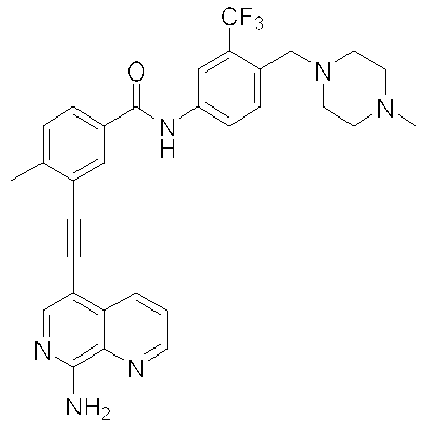
- 1H NMR (500 MHz, DMSO-d 6) δ 10.57 (s, 1H), 8.88 (dd, J = 4.3, 1.6 Hz, 1H), 8.46 (dd, J = 8.3, 1.6 Hz, 1H), 8.28 - 8.19 (m, 3H), 8.08 (d, J = 8.5 Hz, 1H), 7.89 (dd, J = 8.0, 2.0 Hz, 1H), 7.85 (dd, J = 8.4, 4.2 Hz, 1H), 7.69 (d, J = 8.5 Hz, 1H), 7.53 (s, 2H), 7.50 (d, J = 8.1 Hz, 1H), 3.57 (s, 2H), 2.60 (s, 3H), 2.48 (bs, merged with DMSO, 8H), 2.29 (s, 3H); 13C NMR (126 MHz, DMSO) δ 165.32, 158.56, 149.70, 148.18, 143.41, 138.78, 133.14, 132.64, 132.52, 132.21, 131.73, 131.36, 130.82, 130.33, 128.05, 127.99, 127.75, 127.06, 124.00, 123.42, 117.76, 102.11, 91.74, 90.52, 57.69, 54.64, 52.27, 45.89, 21.19.
-

- 1H NMR (500 MHz, DMSO-d 6) δ 9.02 (t, J = 6.0 Hz, 1H), 8.87 (dd, J = 4.2, 1.6 Hz, 1H), 8.42 (dd, J = 8.4, 1.6 Hz, 1H), 8.21 (s, 1H), 8.09 (d, J = 1.8 Hz, 1H), 7.84 (dd, J = 8.4, 4.2 Hz, 1H), 7.78 (dd, J = 8.0, 1.9 Hz, 1H), 7.51 (s, 2H), 7.42 (d, J = 8.0 Hz, 1H), 7.23 (d, J = 8.6 Hz, 2H), 6.88 (d, J = 8.7 Hz, 2H), 4.39 (d, J = 5.9 Hz, 2H), 4.00 (t, J = 5.8 Hz, 2H), 2.61 (t, J = 5.8 Hz, 2H), 2.56 (s, 3H), 2.20 (s, 6H); 13C NMR (126 MHz, DMSO) δ 165.64, 158.51, 157.85, 149.68, 148.09, 142.60, 133.08, 132.67, 132.52, 132.08, 131.34, 130.43, 130.16, 129.13, 127.58, 127.04, 123.25, 114.73, 102.18, 91.86, 90.14, 66.09, 58.05, 45.89, 42.58, 21.08.
-
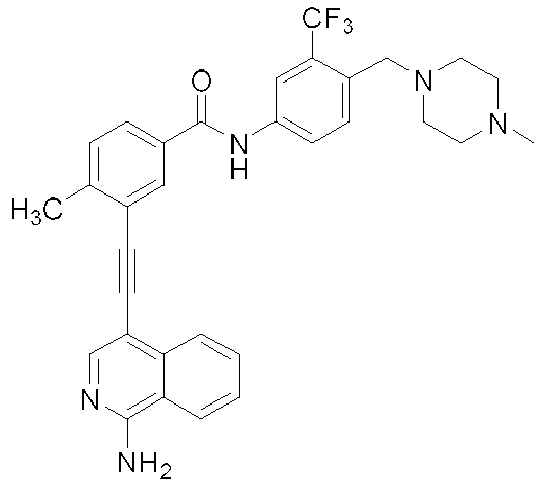
- 1H NMR (500 MHz, DMSO-d 6) δ 10.52 (s, 1H), 8.29 (d, J = 8.3 Hz, 1H), 8.21 (d, J = 2.2 Hz, 1H), 8.19 (s, 2H), 8.11 (d, J = 8.7 Hz, 1H), 8.06 (d, J = 8.5 Hz, 1H), 7.86 (dd, J = 7.9, 1.9 Hz, 1 H), 7.80 (t, J = 7.5 Hz, 1 H), 7.69 (d, J = 8.5 Hz, 1 H), 7.57 (t, J = 7.6 Hz, 1H), 7.50 (d, J = 80 Hz, 1H), 7.38 (s, 2H), 3.55 (s, 2H), 3.15 (d, J = 3.7 Hz, 1H), 2.61 (s, 3H), 2.37 (s, 7H), 2.14 (s, 3H); 13C NMR (126 MHz, DMSO) δ 165.34, 158.17, 147.70, 143.30, 138.67, 136.38, 132.66, 132.52, 131.68, 131.60, 130.62, 130.33, 127.87, 126.77, 125.00, 124.78, 123.99, 123.69, 117.74, 116.76, 103.16, 91.94, 91.71, 57.93, 55.20, 53.18, 46.20, 21.20.
-

- 1H NMR (500 MHz, DMSO-d 6) δ 10.54 (s, 1H), 8.92 (d, J = 0.8 Hz, 1H), 8.38 (d, J = 2.0 Hz, 1H), 8.21 (d, J = 2.2 Hz, 1H), 8.05 (dd, J = 8.5, 2.2 Hz, 1H), 7.96 (d, J = 8.6 Hz, 1H), 7.88 (dd, J = 8.0, 2.0 Hz, 2H), 7.70 (d, J = 8.6 Hz, 1H), 7.51 (d, J = 8.1 Hz, 1H), 7.28 (dd, J = 8.6, 2.0 Hz, 1H), 6.78 (s, 2H), 3.55 (s, 2H), 3.15 (d, J = 3.8 Hz, 1H), 2.63 (s, 3H), 2.37 (s, 7H), 2.16 (s, 3H); 13C NMR (126 MHz, DMSO) δ 165.55, 158.55, 153.20, 143.27, 138.74, 138.69, 137.39, 132.82, 132.47, 131.70, 131.64, 131.49, 130.20, 128.05, 127.74, 125.90, 123.93, 123.48, 121.34, 120.68, 117.69, 98.17, 88.78, 88.59, 57.89, 55.14, 53.07, 46.08, 21.28; HRMS (ESI+): calcd. for C32H30F3N5O (MH+) 592.2091, found 592.2091.
-

- 1H NMR (500 MHz, DMSO-d 6) δ 10.54 (s, 1H), 8.90 (s, 1H), 8.36 (d, J = 1.9 Hz, 1H), 8.21 (s, 1H), 8.06 (d, J = 8.5 Hz, 1H), 7.95 (d, J = 8.4 Hz, 1H), 7.91 (d, J = 8.1 Hz, 1H), 7.87 (dd, J = 7.9, 2.0 Hz, 1H), 7.69 (t, J = 7.7 Hz, 2H), 7.51 (d, J = 8.0 Hz, 1H), 7.28 (d, J = 7.8 Hz, 1H), 6.55 (s, 2H), 3.56 (s, 2H), 3.37 (s, 1H), 2.64 (s, 3H), 2.38 (bs, 7H), 2.17 (s, 3H); 13C NMR (126 MHz, DMSO) δ 165.57, 158.02, 153.10, 143.26, 138.70, 137.86, 132.79, 132.46, 132.20, 131.72, 131.37, 130.19, 129.16, 127.93, 127.75, 123.95, 123.66, 123.15, 122.71, 122.45, 97.88, 89.69, 89.38, 57.88, 55.11, 53.02, 46.02, 21.37.
-

- 1H NMR (500 MHz, DMSO-d 6) δ 10.53 (s, 1H), 9.10 (s, 1H), 8.37 (d, J = 2.0 Hz, 1H), 8.20 (d, J = 2.2 Hz, 1H), 8.05 (dd, J = 8.5, 2.2 Hz, 1H), 7.94 (d, J = 8.5 Hz, 1H), 7.88 (dd, J = 8.0, 2.0 Hz, 1H), 7.70 (d, J = 8.5 Hz, 1H), 7.63 (dd, J = 8.5, 7.4 Hz, 1H), 7.51 (d, J = 8.0 Hz, 1H), 7.38 (dd, J = 7.4, 0.9 Hz, 1H), 6.82 (s, 2H), 3.56 (s, 2H), 2.63 (s, 3H), 2.39 (s, 8H), 2.18 (s, 3H); 13C NMR (126 MHz, DMSO) δ 165.53, 158.44, 148.96, 143.46, 139.61, 138.69, 132.79, 132.62, 132.44, 132.38, 131.72, 131.57, 130.20, 128.14, 125.89, 123.94, 123.45, 123.38, 122.60, 118.91, 117.70, 117.65, 98.37, 90.06, 88.65, 57.86, 55.07, 52.96, 45.96, 21.37.
-

- 1H NMR (500 MHz, Methanol-d 4) δ 8.73 (s, 1H), 8.05 (d, J = 2.0 Hz, 1H), 7.88 (d, J = 1.9 Hz, 1H), 7.79 (d, J = 8.7 Hz, 1H), 7.71 (dd, J = 7.9, 2.0 Hz, 1H), 7.37 (d, J = 80 Hz, 1H), 7.20 (dd, J = 8.7, 2.0 Hz, 1H), 3.54 (t, J = 7.0 Hz, 2H), 2.86 - 2.78 (m, 2H), 2.74 (q, J = 7.2 Hz, 4H), 2.60 (s, 3H), 1.13 (t, J = 7.2 Hz, 6H); 13C NMR (126 MHz, MeOD) δ 167.88, 157.31, 151.62, 142.91, 138.56, 137.95, 131.86, 130.31, 130.09, 129.53, 126.86, 123.66, 123.18, 121.37, 120.81, 98.11, 90.75, 87.08, 51.21, 46.89, 36.67, 19.97, 9.87; HRMS (ESI+): calcd. for C25H28ClN4O (MH+) 435.1952, found 435.1952.
-

- 1H NMR (500 MHz, Methanol-d 4) δ 8.67 (s, 1H), 8.00 (d, J = 2.0 Hz, 1H), 7.81 (d, J = 20 Hz, 1H), 7.72 (d, J = 8.6 Hz, 1H), 7.67 (dd, J = 7.9, 2.0 Hz, 1H), 7.30 (d, J = 80 Hz, 1H), 7.14 (dd, J = 8.6, 1.9 Hz, 1H), 3.54 (t, J = 6.9 Hz, 2H), 2.62 (t, J = 6.9 Hz, 2H), 2.55 (bs, 7H), 1.63 (p, J= 5.6 Hz, 4H), 1.48 (s, 2H); 13C NMR (126 MHz, MeOD) δ 167.67, 157.22, 151.52, 142.74, 138.47, 137.87, 131.86, 130.23, 130.03, 129.45, 126.84, 123.62, 123.11, 121.39, 120.76, 98.20, 90.85, 87.12, 57.54, 54.11, 36.37, 25.05, 23.61, 20.02; HRMS (ESI+): calcd. for C26H28ClN4O (MH+) 447.1952, found 447.1946.
-

- 1H NMR (500 MHz, DMSO-d 6) δ 10.53 (s, 1H), 8.34 (d, J = 1.9 Hz, 1H), 8.21 (d, J = 2.2 Hz, 1H), 8.06 (d, J = 7.9 Hz, 1H), 8.02 (d, J = 8.3 Hz, 1H), 7.97 (d, J = 8.4 Hz, 1H), 7.85 (dd, J = 7.9, 2.0 Hz, 1H), 7.70 (d, J = 8.5 Hz, 1H), 7.66 (t, J = 7.6 Hz, 1H), 7.50 (d, J = 8.1 Hz, 1H), 7.28 (ddd, J = 8.2, 6.8, 1.2 Hz, 1H), 6.44 (s, 2H), 3.58 (s, 2H), 2.77 (s, 3H), 2.63 (s, 3H), 2.57 - 2.37 (bs, 8H, merged with solvent), 2.29 (s, 3H); 13C NMR (126 MHz, DMSO) δ 165.60, 159.76, 156.89, 143.08, 138.78, 138.07, 132.75, 132.23, 131.77, 131.73, 131.19, 130.17, 127.73, 127.17, 123.95, 123.85, 123.29, 122.93, 121.10, 117.68, 97.47, 89.85, 88.16, 57.72, 54.77, 52.44, 49.07, 22.52, 21.39.
-

- 1H NMR (500 MHz, DMSO-d 6) δ 10.54 (s, 1H), 8.81 (d, J = 0.7 Hz, 1H), 8.35 (d, J = 2.0 Hz, 1H), 8.21 (d, J = 2.2 Hz, 1H), 8.05 (dd, J = 8.5, 2.2 Hz, 1H), 7.87 (dd, J = 8.0, 2.0 Hz, 1H), 7.80 (d, J = 8.3 Hz, 1H), 7.74 - 7.72 (m, 1H), 7.70 (d, J = 8.6 Hz, 1H), 7.51 (d, J = 8.1 Hz, 1H), 7.13 (dd, J = 8.3, 1.5 Hz, 1H), 6.48 (s, 2H), 3.56 (s, 2H), 2.65 (s, 3H), 2.47 (s, 3H), 2.37 (bs, 8H), 2.15 (s, 3H); 13C NMR (126 MHz, DMSO) δ 165.58, 158.09, 152.60, 143.24, 142.22, 138.70, 138.16, 132.79, 132.50, 131.72, 131.33, 130.21, 129.01, 127.88, 125.91, 125.34, 123.94, 123.74, 121.73, 120.96, 117.69, 97.80, 89.57, 89.32, 57.92, 55.20, 53.16, 46.19, 22.50, 21.33.
-

- 1H NMR (500 MHz, DMSO-d 6) δ 10.73 (s, 1H), 8.93 (s, 1H), 8.40 (d, J = 2.0 Hz, 1H), 8.30 (s, 1H), 8.15 (s, 1H), 7.96 (d, J = 8.6 Hz, 1H), 7.89 (q, J = 1.3, 0.7 Hz, 2H), 7.73 (s, 1H), 7.54 (d, J= 8.1 Hz, 1H), 7.49 (s, 1H), 7.28 (dd, J = 8.6, 2.0 Hz, 1H), 6.93 (d, J = 22.1 Hz, 1H), 6.79 (s, 2H), 2.65 (s, 3H), 2.17 (s, 3H); 13C NMR (126 MHz, DMSO) δ 165.82, 162.76, 158.57, 153.26, 151.29, 143.66, 141.74, 138.75, 138.43, 137.41, 132.46, 131.66, 131.50, 131.20, 130.34, 128.07, 125.19, 123.59, 123.51, 121.32, 120.68, 115.35, 114.71, 112.14, 108.27, 103.70, 98.06, 88.71, 21.31, 14.07.
-

- 1H NMR (500 MHz, DMSO-d 6) δ 10.71 (s, 1H), 8.95 (d, J = 2.3 Hz, 1H), 8.94 (s, 1H), 8.71 (d, J= 2.3 Hz, 1H), 8.19 (d, J = 2.2 Hz, 1H), 8.04 (dd, J = 8.5, 2.2 Hz, 1H), 7.96 (d, J = 8.6 Hz, 1H), 7.87 (d, J = 2.0 Hz, 1H), 7.72 (d, J = 8.5 Hz, 1H), 7.29 (dd, J = 8.6, 2.0 Hz, 1H), 6.92 (s, 2H), 3.56 (s, 2H), 2.84 (s, 3H), 2.38 (s, 8H), 2.17 (s, 3H); 13C NMR (126 MHz, DMSO) δ 164.32, 162.10, 158.88, 153.71, 147.25, 138.80, 138.65, 138.39, 137.55, 132.83, 131.81, 131.70, 128.17, 127.81, 125.85, 123.97, 123.55, 121.28, 120.62, 119.14, 117.69, 96.27, 90.91, 88.11, 57.88, 55.13, 53.06, 46.07, 24.37.
-

- 1H NMR (500 MHz, DMSO-d 6) δ 10.47 (s, 1H), 8.92 (s, 1H), 8.34 (d, J = 1.9 Hz, 1H), 7.96 (d, J = 8.7 Hz, 1H), 7.94 (s, 2H), 7.88 (d, J = 1.9 Hz, 1H), 7.84 (dd, J = 8.0, 2.0 Hz, 1H), 7.52 (d, J = 8.1 Hz, 1H), 7.28 (dd, J = 8.6, 2.0 Hz, 1H), 6.79 (s, 2H), 4.02 (t, J = 5.9 Hz, 2H), 2.68 (t, J = 5.9 Hz, 2H), 2.63 (s, 3H), 2.23 (s, 6H); 13C NMR (126 MHz, DMSO) δ 165.52, 158.57, 153.24, 147.01, 146.90, 143.45, 138.75, 137.40, 136.77, 132.60, 131.66, 131.46, 130.27, 128.63, 128.50, 128.02, 123.52, 121.33, 120.70, 113.72, 98.09, 88.73, 72.09, 58.71, 45.95, 21.29.
-

- 1H NMR (500 MHz, DMSO-d 6) δ 10.32 (s, 1H), 8.92 (s, 1H), 8.50 (d, J = 2.7 Hz, 1H), 8.36 (d, J = 1.8 Hz, 1H), 8.03 (dd, J = 8.9, 2.7 Hz, 1H), 7.96 (d, J = 8.6 Hz, 1H), 7.89 (s, 1H), 7.86 (d, J = 7.9 Hz, 1H), 7.50 (d, J = 8.0 Hz, 1H), 7.28 (dd, J = 8.6, 2.0 Hz, 1H), 6.82 (d, J = 8.9 Hz, 1H), 6.79 (s, 2H), 4.30 (t, J = 5.9 Hz, 2H), 2.63 (s, 3H), 2.59 (t, J = 5.9 Hz, 2H), 2.19 (s, 6H); 13C NMR (126 MHz, DMSO) δ 165.24, 159.98, 158.55, 153.20, 143.06, 139.32, 138.75, 137.39, 133.09, 132.85, 131.66, 131.42, 130.36, 130.18, 127.96, 123.50, 121.34, 120.68, 110.71, 98.21, 88.80, 88.55, 63.90, 58.13, 45.98, 21.27.
-

- 1H NMR (500 MHz, DMSO-d 6) δ 10.53 (s, 1H), 8.91 (s, 1H), 8.38 (d, J = 1.9 Hz, 1H), 8.27 (s, 1H), 8.20 (d, J = 2.2 Hz, 1H), 8.05 (d, J = 7.1 Hz, 2H), 7.88 (dd, J = 7.9, 2.0 Hz, 1H), 7.70 (d, J = 8.5 Hz, 1H), 7.51 (d, J = 8.1 Hz, 1H), 6.91 (s, 2H), 3.55 (s, 2H), 2.63 (s, 3H), 2.37 (s, 8H), 2.15 (s, 3H); 13C NMR (126 MHz, DMSO) δ 165.55, 158.60, 152.47, 143.36, 138.68, 137.06, 135.39, 132.84, 132.50, 131.72, 131.59, 130.67, 130.21, 128.14, 127.75, 124.96, 124.01, 123.94, 123.34, 121.29, 117.68, 98.38, 88.45, 88.16, 57.91, 55.17, 53.11, 46.13, 21.27.
-

- 1H NMR (500 MHz, Methanol-d 4) δ 8.93 (s, 1H), 8.37 (d, J = 1.9 Hz, 1H), 8.25 (d, J = 2.2 Hz, 1H), 8.10 - 8.02 (m, 2H), 7.95 (dd, J = 8.0, 2.0 Hz, 1H), 7.81 (d, J = 8.4 Hz, 1H), 7.66 (dd, J = 10.6, 2.4 Hz, 1H), 7.57 (d, J = 8.0 Hz, 1H), 7.19 (td, J = 8.8, 2.5 Hz, 1H), 3.69 (s, 2H), 2.74 (s, 3H), 2.56 (s, 8H), 2.35 (s, 3H); 13C NMR (126 MHz, MeOD) δ 165.94, 163.90, 157.90, 152.39, 143.40, 139.79, 138.30, 132.68, 132.55, 132.45, 132.37, 131.40, 130.88, 129.95, 127.77, 123.71, 123.45, 117.68, 113.24, 113.04, 109.71, 106.14, 105.96, 98.05, 88.03, 57.65, 54.78, 52.42, 44.91, 20.48.
-

- 1H NMR (500 MHz, DMSO-d 6) δ 10.49 (s, 1H), 8.29 (s, 1H), 7.97 (dd, J = 8.1, 1.9 Hz, 1H), 7.94 (s, 2H), 7.58 (d, J = 8.1 Hz, 1H), 7.33 (s, 1H), 6.88 (s, 1H), 6.58 (s, 2H), 4.03 (t, J = 5.9 Hz, 2H), 3.90 (d, J = 7.5 Hz, 6H), 2.70 (t, J = 5.9 Hz, 2H), 2.67 (s, 3H), 2.24 (s, 6H); 13C NMR (126 MHz, DMSO) δ 164.81, 160.60, 156.82, 150.85, 149.47, 147.46, 147.06, 145.21, 136.68, 132.59, 132.09, 130.80, 130.00, 128.50, 121.33, 120.74, 115.04, 104.91, 103.95, 93.22, 90.54, 71.98, 58.65, 56.41, 55.95, 45.88, 21.10.
-

- 1H NMR (500 MHz, DMSO-d 6) δ 10.37 (s, 1H), 8.50 (d, J = 2.7 Hz, 1H), 8.31 (d, J = 2.0 Hz, 1H), 8.04 (dd, J = 8.9, 2.7 Hz, 1H), 7.99 (dd, J = 8.0, 2.0 Hz, 1H), 7.57 (d, J = 8.1 Hz, 1H), 7.34 (s, 1H), 6.88 (s, 1H), 6.83 (d, J= 8.9 Hz, 1H), 6.59 (s, 2H), 4.31 (t, J = 5.9 Hz, 2H), 3.90 (s, 3H), 3.89 (s, 3H), 2.68 (s, 3H), 2.60 (s, 2H), 2.20 (s, 6H); 13C NMR (126 MHz, DMSO) δ 164.54, 160.61, 160.02, 156.82, 150.84, 149.52, 147.46, 144.83, 139.33, 133.08, 132.86, 132.03, 130.73, 130.29, 129.97, 121.24, 115.04, 110.71, 104.92, 103.96, 93.38, 90.46, 63.86, 58.09, 56.41, 55.96, 45.94, 21.08.
-

- 1H NMR (500 MHz, Methanol-d 4) δ 8.20 (s, 1H), 8.12 (s, 2H), 7.94 (d, J= 7.6 Hz, 1H), 7.88 (d, J = 9.2 Hz, 1H), 7.73 (d, J = 8.4 Hz, 1H), 7.41 (d, J = 8.1 Hz, 1H), 3.71 (s, 3H), 3.64 (s, 2H), 2.73-2.43 (11H), 2.34 (s, 3H); 13C NMR (126 MHz, MeOD) δ 165.96, 160.53, 145.12, 140.63, 137.87, 132.48, 132.25, 131.53, 131.14, 129.77, 128.84, 128.53, 127.15, 125.42, 123.53, 121.30, 117.67, 117.62, 94.14, 87.90, 57.44, 54.52, 52.07, 44.38, 28.40, 19.54.
-

- 1H NMR (500 MHz, DMSO-d 6) δ 10.94 (s, 1H), 8.96 (s, 1H), 8.69 (s, 1H), 8.57 (s, 1H), 8.38 (d, J = 2.2 Hz, 1H), 8.16 (d, J = 7.9 Hz, 1H), 7.97 (d, J = 8.6 Hz, 1H), 7.87 (s, 1H), 7.69 (d, J = 8.5 Hz, 1H), 7.29 (dd, J = 8.6, 2.0 Hz, 1H), 7.11 (s, 2H), 3.55 (s, 2H), 2.65 (s, 3H), 2.38 (s, 8H), 2.16 (s, 3H); 13C NMR (126 MHz, DMSO) δ 163.27, 159.25, 154.54, 149.38, 148.11, 139.01, 138.02, 137.74, 137.12, 132.94, 132.73, 131.78, 131.60, 124.35, 124.17, 123.57, 121.26, 120.59, 117.99, 96.18, 94.13, 87.32, 57.90, 55.17, 53.11, 46.12, 18.19.
-

- 1H NMR (500 MHz, DMSO-d 6) δ 10.56 (s, 1H), 9.09 (s, 1H), 8.38 (s, 1H), 8.20 (s, 1H), 8.03 (dd, J = 16.2, 8.2 Hz, 2H), 7.70 (d, J = 8.5 Hz, 1H), 7.59 (d, J = 8.0 Hz, 1H), 7.56 (s, 1H), 7.40 (s, 1H), 4.02 (s, 3H), 4.00 (s, 3H), 3.55 (s, 2H), 2.71 (s, 3H), 2.39 (bs, 8H), 2.15 (s, 3H); 13C NMR (126 MHz, DMSO) δ 164.82, 156.92, 153.87, 151.69, 148.28, 147.81, 145.23, 138.58, 132.86, 132.61, 132.23, 131.73, 130.80, 130.29, 123.96, 121.18, 121.07, 117.70, 107.19, 103.15, 95.41, 90.31, 57.90, 56.40, 55.16, 53.10, 46.12, 21.12.
-

- 1H NMR (500 MHz, DMSO-d 6) δ 10.58 (s, 1H), 8.25 (s, 1H), 8.21 (d, J = 2.2 Hz, 1H), 8.11 (s, 1H), 8.06 (d, J = 8.5 Hz, 1H), 7.98 (dd, J = 8.0, 1.9 Hz, 1H), 7.70 (d, J = 8.5 Hz, 1H), 7.55 (d, J = 8.1 Hz, 1H), 6.52 (s, 2H), 3.56 (s, 2H), 2.60 (s, 3H), 2.38 (s, 8H), 2.17 (s, 3H). 13C NMR (126 MHz, DMSO) δ 164.93, 160.92, 155.15, 145.09, 142.20, 140.44, 138.62, 132.73, 132.55, 131.71, 131.57, 130.64, 129.74, 128.07, 127.74, 125.89, 124.01, 121.53, 117.74, 92.44, 90.21, 57.88, 55.12, 53.03, 46.04, 20.84.
-

- 1H NMR (500 MHz, DMSO-d 6) δ 10.32 (s, 1H), 8.29 (d, J = 2.0 Hz, 1H), 7.98 (dd, J = 8.0, 1.9 Hz, 1H), 7.94 (d, J = 2.5 Hz, 1H), 7.66 (dd, J = 9.0, 2.6 Hz, 1H), 7.56 (d, J = 8.1 Hz, 1H), 7.34 (s, 1H), 7.17 (d, J = 9.0 Hz, 1H), 6.88 (s, 1H), 6.59 (s, 2H), 4.12 (t, J = 5.7 Hz, 2H), 3.90 (s, 3H), 3.89 (s, 3H), 2.67 (s, 5H), 2.25 (s, 6H); 13C NMR (126 MHz, DMSO) δ 164.36, 160.60, 156.81, 150.83, 150.60, 149.52, 147.45, 144.77, 133.25, 133.06, 132.02, 130.69, 129.94, 122.36, 121.30, 121.22, 120.59, 115.04, 114.40, 104.91, 103.96, 93.40, 90.44, 67.84, 57.93, 56.40, 55.95, 46.10, 21.07.
-

- 1H NMR (500 MHz, DMSO-d 6) δ 10.26 (s, 1H), 8.92 (s, 1H), 8.35 (s, 1H), 7.96 (d, J = 8.6 Hz, 1H), 7.89 (d, J = 2.0 Hz, 1H), 7.85 (dd, J = 8.0, 2.0 Hz, 1H), 7.72 (d, J = 8.4 Hz, 2H), 7.49 (d, J = 8.0 Hz, 1H), 7.28 (dd, J = 8.6, 2.0 Hz, 1H), 7.26 (d, J = 8.2 Hz, 2H), 6.78 (s, 2H), 3.43 (s, 2H), 2.63 (s, 3H), 2.42 (bs, 8H), 2.23 (s, 3H). 13C NMR (126 MHz, DMSO) δ 165.21, 158.53, 153.18, 142.89, 138.75, 138.46, 137.38, 133.34, 131.66, 131.44, 130.12, 129.62, 128.01, 123.50, 123.37, 121.34, 120.68, 120.63, 98.27, 88.83, 88.49, 61.93, 54.85, 52.42, 45.44, 21.25.
-

- 1H NMR (500 MHz, DMSO-d 6) δ 10.85 (s, 1H), 8.98 (s, 1H), 8.35 (d, J = 2.2 Hz, 1H), 8.17 (d, J = 8.5 Hz, 1H), 8.06 - 8.00 (m, 2H), 7.99 (d, J = 8.6 Hz, 1H), 7.94 (s, 1H), 7.72 (d, J = 8.6 Hz, 1H), 7.31 (dd, J = 8.6, 2.0 Hz, 1H), 6.88 (s, 2H), 3.57 (s, 2H), 2.66 (s, 3H), 2.38 (s, 8H), 2.16 (s, 3H); 13C NMR (126 MHz, DMSO) δ 163.02, 159.17, 154.17, 148.08, 141.92, 139.53, 139.39, 138.90, 137.89, 137.71, 132.82, 131.75, 131.67, 124.16, 123.76, 121.94, 121.42, 120.71, 117.96, 97.81, 88.52, 87.59, 57.90, 55.13, 53.07, 46.07, 19.94.
-

- 1H NMR (500 MHz, DMSO-d 6) δ 10.55 (s, 1H), 8.31 (d, J = 2.0 Hz, 1H), 8.20 (d, J = 2.2 Hz, 1H), 8.07 (d, J = 1.2 Hz, 1H), 8.05 (dd, J = 8.5, 2.3 Hz, 1H), 7.99 (dd, J = 8.0, 2.0 Hz, 1H), 7.70 (d, J = 8.6 Hz, 1H), 7.57 (d, J = 8.1 Hz, 1H), 6.91 (s, 2H), 3.55 (s, 2H), 2.61 (s, 3H), 2.38 (s, 8H), 2.15 (s, 3H); 13C NMR (126 MHz, DMSO) δ 164.93, 162.69, 157.33, 145.26, 138.57, 133.48, 132.88, 132.64, 132.14, 131.73, 130.69, 130.15, 125.89, 124.00, 120.96, 109.69, 108.67, 92.11, 90.25, 57.92, 55.19, 53.15, 46.17, 20.90.
-

- 1H NMR (500 MHz, DMSO-d 6) δ 10.57 (s, 1H), 8.32 (d, J = 2.0 Hz, 1H), 8.21 (d, J = 2.2 Hz, 1H), 8.09 (s, 1H), 8.05 (dd, J = 8.5, 2.2 Hz, 1H), 8.00 (dd, J = 8.0, 2.0 Hz, 1H), 7.70 (d, J = 8.5 Hz, 1H), 7.57 (d, J = 8.1 Hz, 1H), 7.06 (s, 2H), 3.80 (s, 3H), 3.56 (s, 2H), 2.60 (s, 3H), 2.40 (s, 8H), 2.20 (s, 3H); 13C NMR (126 MHz, DMSO) δ 164.92, 162.68, 155.49, 145.39, 145.30, 138.61, 132.87, 132.58, 132.23, 131.74, 130.69, 130.21, 127.76, 125.88, 124.00, 120.86, 117.74, 109.03, 92.39, 90.05, 57.83, 55.00, 52.83, 45.83, 33.58, 20.90.

- 1H NMR (500 MHz, Chloroform-d) δ 8.79 (s, 1H), 7.98 (d, J = 1.9 Hz, 1H), 7.82 (dd, J = 8.9, 5.6 Hz, 1H), 7.65 (dd, J = 7.9, 2.0 Hz, 1H), 7.61 (dd, J = 10.4, 2.5 Hz, 1H), 7.37 (d, J = 80 Hz, 1H), 7.07 (td, J = 8.6, 2.4 Hz, 1H), 6.52 (s, 1H), 5.25 (bs, 2H), 3.61 (q, J = 5.9 Hz, 2H), 3.18- 3.03 (m, 8H), 2.81 (t, J = 6.1 Hz, 2H), 2.64 (s, 3H); 13C NMR (126 MHz, CDCl3) δ 166.75, 156.68, 151.74, 143.25, 132.13, 131.61, 131.53, 130.30, 130.06, 126.71, 123.56, 120.38, 114.22, 114.01, 107.15, 106.96, 98.35, 87.81, 55.53, 50.81, 37.01, 29.71, 21.30.
- 1H NMR (500 MHz, DMSO-d 6) δ 8.50 (t, J = 5.6 Hz, 1H), 8.15 (d, J = 1.9 Hz, 1H), 7.86 (dd, J = 8.0, 1.9 Hz, 1H), 7.49 (d, J = 8.1 Hz, 1H), 7.32 (s, 1H), 6.87 (s, 1H), 6.58 (s, 2H), 3.90 (s, 3H), 3.88 (s, 3H), 3.36 (q, J = 6.6 Hz, 2H), 2.63 (s, 3H), 2.42 (t, J = 7.1 Hz, 2H), 2.36 (bs, 4H), 1.47 (p, J = 5.6 Hz, 4H), 1.36 (bs, 2H); 13C NMR (126 MHz, DMSO) δ 165.27, 160.60, 156.79, 150.80, 149.57, 147.43, 144.10, 133.07, 131.65, 130.54, 129.48, 121.07, 115.01, 104.91, 103.96, 93.56, 90.21, 58.14, 56.40, 55.93, 54.57, 37.52, 26.07, 24.52, 20.97.
-

- 1H NMR (500 MHz, Chloroform-d) δ 9.14 (s, 1H), 8.16 (d, J = 1.9 Hz, 1H), 7.81 (dd, J = 8.0, 1.9 Hz, 1H), 7.57 (s, 1H), 7.38 (d, J = 8.0 Hz, 1H), 7.33 (s, 1H), 7.25 (s, 1H), 4.08 (s, 3H), 4.08 (s, 3H), 3.59 (q, J = 5.4 Hz, 2H), 2.70 (s, 3H), 2.65 (t, J = 5.9 Hz, 2H), 2.54 (s, 4H), 1.67 - 1.63 (m, 4H), 1.48 (bs, 2H); 13C NMR (126 MHz, CDCl3) δ 166.27, 156.49, 153.78, 151.27, 148.58, 148.39, 144.26, 132.64, 131.68, 130.08, 128.56, 121.63, 121.53, 106.82, 103.20, 95.62, 89.89, 57.22, 56.58, 56.37, 54.35, 36.31, 25.54, 24.04, 21.09.
-

- 1H NMR (500 MHz, DMSO-d 6) δ 10.29 (s, 1H), 8.88 (dd, J = 4.2, 1.6 Hz, 1H), 8.46 (dd, J = 8.4, 1.6 Hz, 1H), 8.24 (s, 1H), 8.16 (d, J = 2.0 Hz, 1H), 7.88 - 7.82 (m, 2H), 7.69 (dd, J = 15.1, 2.4 Hz, 1H), 7.52 (s, 2H), 7.50 - 7.45 (m, 2H), 7.06 - 6.99 (m, 1H), 2.98 (s, 4H), 2.59 (s, 3H), 2.48 (s, 4H, merged with DMSO peak), 2.23 (s, 3H); 13C NMR (126 MHz, DMSO) δ 164.82, 158.56, 153.76, 149.71, 148.18, 143.13, 136.19, 134.41, 133.14, 132.97, 132.53, 131.37, 130.69, 130.28, 127.94, 127.07, 123.37, 119.55, 116.79, 109.07, 102.13, 91.80, 90.46, 55.12, 50.58, 46.15, 21.17.
-
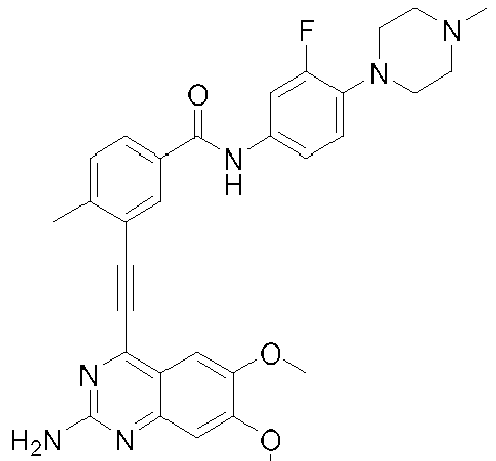
- 1H NMR (500 MHz, DMSO-d 6) δ 10.34 (s, 1H), 8.29 (d, J = 2.0 Hz, 1H), 7.98 (dd, J = 8.0, 2.0 Hz, 1H), 7.70 (dd, J = 15.1, 2.4 Hz, 1H), 7.57 (d, J = 8.1 Hz, 1H), 7.46 (dd, J = 8.7, 1.5 Hz, 1H), 7.34 (s, 1H), 7.07 - 6.98 (m, 1H), 6.88 (s, 1H), 6.59 (s, 2H), 3.91 (s, 3H), 3.89 (s, 3H), 2.97 (s, 4H), 2.67 (s, 3H), 2.46 (s, 4H), 2.21 (s, 3H); 13C NMR (126 MHz, DMSO) δ 164.36, 160.61, 156.81, 153.74, 150.83, 149.52, 147.46, 144.75, 136.25, 133.13, 132.01, 130.70, 129.97, 121.20, 119.57, 116.74, 115.04, 109.03, 108.82, 104.92, 103.97, 93.41, 90.43, 56.41, 55.96, 55.18, 50.66, 46.26, 21.07.
-

- 1H NMR (500 MHz, DMSO-d 6) δ 10.21 (s, 1H), 8.29 (d, J = 1.9 Hz, 1H), 7.98 (dd, J = 8.0, 2.0 Hz, 1H), 7.67 (d, J = 9.1 Hz, 2H), 7.56 (d, J = 8.1 Hz, 1H), 7.35 (s, 1H), 6.93 (d, J = 9.1 Hz, 2H), 6.88 (s, 1H), 6.59 (s, 2H), 4.02 (t, J = 5.9 Hz, 2H), 3.91 (s, 3H), 3.89 (s, 3H), 2.67 (s, 3H), 2.60 (t, J = 5.8 Hz, 2H), 2.20 (s, 6H); 13C NMR (126 MHz, DMSO) δ 164.16, 160.61, 156.81, 155.32, 150.83, 149.56, 147.45, 144.50, 133.44, 132.55, 132.00, 130.64, 129.92, 122.38, 121.15, 115.04, 114.84, 104.92, 103.98, 93.52, 90.37, 66.42, 58.22, 56.41, 55.96, 46.06, 21.04.
-

- 1H NMR (500 MHz, DMSO-d 6) δ 10.68 (s, 1H), 8.94 (d, J = 2.3 Hz, 1H), 8.88 (dd, J = 4.2, 1.6 Hz, 1H), 8.51 (d, J = 2.2 Hz, 1H), 8.47 (dd, J = 8.3, 1.6 Hz, 1H), 8.27 (s, 1H), 8.20 (d, J = 2.2 Hz, 1H), 8.04 (dd, J = 8.5, 2.2 Hz, 1H), 7.72 (d, J = 8.5 Hz, 1H), 7.60 (s, 2H), 3.56 (s, 2H), 2.81 (s, 3H), 2.39 (s, 8H), 2.19 (s, 3H); 13C NMR (126 MHz, DMSO) δ 164.07, 162.31, 158.81, 149.79, 148.63, 147.41, 138.39, 137.88, 133.13, 132.79, 132.48, 131.80, 131.35, 127.97, 127.14, 124.00, 118.93, 117.74, 101.58, 92.83, 90.00, 57.84, 55.05, 52.93, 45.94, 24.30.
-
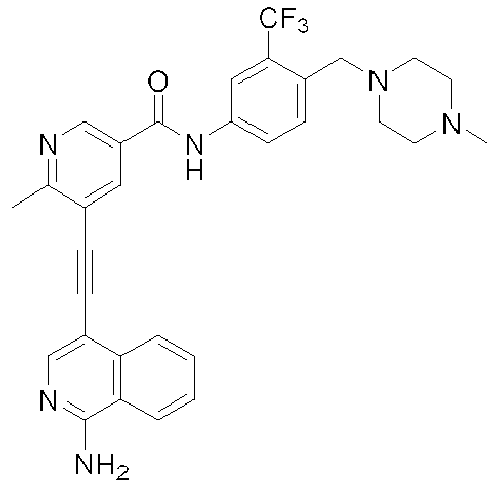
- 1H NMR (500 MHz, DMSO-d 6) δ 10.66 (s, 1H), 8.93 (d, J = 2.3 Hz, 1H), 8.48 (d, J = 2.3 Hz, 1H), 8.29 (d, J = 8.1 Hz, 1H), 8.22 (s, 1H), 8.20 (d, J = 2.2 Hz, 1H), 8.11 (d, J = 8.1 Hz, 1H), 8.04 (dd, J = 8.4, 2.2 Hz, 1H), 7.81 (ddd, J = 8.1, 6.9, 1.2 Hz, 1H), 7.72 (d, J = 8.5 Hz, 1H), 7.58 (ddd, J = 8.3, 6.9, 1.3 Hz, 1H), 7.45 (s, 2H), 3.56 (s, 2H), 2.81 (s, 3H), 2.37 (s, 8H), 2.14 (s, 3H); 13C NMR (126 MHz, DMSO) δ 164.08, 162.21, 158.42, 148.15, 147.27, 138.36, 137.64, 136.33, 132.87, 131.78, 131.71, 127.95, 126.86, 125.03, 124.74, 124.00, 119.15, 117.74, 116.71, 102.62, 94.26, 89.98, 57.91, 55.20, 53.18, 46.21, 24.30.
-
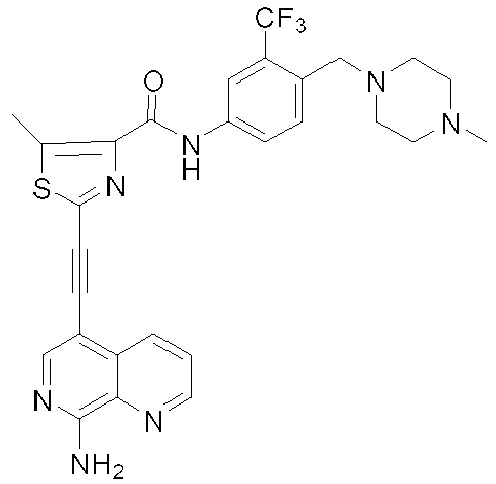
- 1H NMR (500 MHz, Methanol-d 4) δ 8.85 (dd, J = 4.3, 1.6 Hz, 1H), 8.41 (dd, J = 8.3, 1.6 Hz, 1H), 8.19 (d, J = 2.2 Hz, 1H), 8.16 (s, 1H), 7.89 (dd, J = 8.5, 2.2 Hz, 1H), 7.77 (dd, J = 8.4, 4.2 Hz, 1H), 7.72 (d, J = 8.5 Hz, 1H), 3.64 (s, 2H), 2.85 (s, 3H), 2.54 (s, 8H), 2.32 (s, 3H); 13C NMR (126 MHz, MeOD) δ 160.63, 158.73, 149.46, 147.71, 143.98, 143.00, 137.35, 132.56, 132.43, 131.13, 128.57, 126.49, 123.10, 117.26, 101.20, 90.03, 85.49, 57.45, 54.54, 52.12, 44.43, 11.54.
-
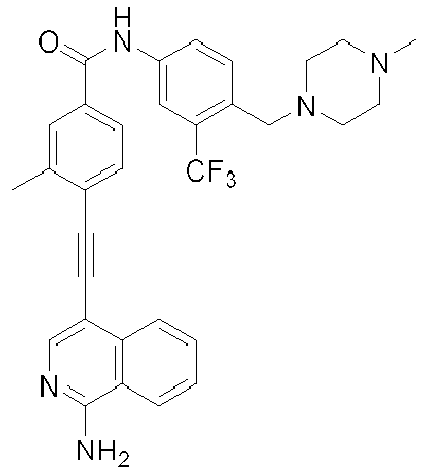
- 1H NMR (500 MHz, Methanol-d 4) δ 8.18 (t, J = 8.7 Hz, 2H), 8.11 (d, J = 21.9 Hz, 2H), 7.93 (d, J = 8.5 Hz, 1H), 7.88 (s, 1H), 7.80 (t, J = 8.4 Hz, 2H), 7.75 (d, J = 8.5 Hz, 1H), 7.65 (d, J = 8.0 Hz, 1H), 7.59 (t, J = 7.8 Hz, 1H), 3.64 (s, 2H), 2.66 (s, 3H), 2.51 (s, 8H), 2.29 (s, 3H); 13C NMR (126 MHz, MeOD) δ 166.84, 157.63, 145.29, 139.48, 137.88, 136.44, 133.42, 132.59, 131.24, 131.15, 131.10, 128.31, 127.22, 126.52, 124.78, 124.69, 123.78, 123.57, 117.71, 116.91, 104.82, 92.18, 91.36, 57.51, 54.59, 52.29, 44.58, 19.87.
-

- 1H NMR (500 MHz, Methanol-d 4) δ 8.79 (s, 1H), 8.14 (s, 1H), 7.95 (m, 2H), 7.90 (s, 1H), 7.85 (d, J = 8.7 Hz, 1H), 7.81 (dd, J = 8.0, 1.8 Hz, 1H), 7.76 (m, 2H), 7.25 (dd, J = 8.7, 2.0 Hz, 1H), 3.67 (s, 2H), 2.69 (s, 3H), 2.61 (bs, 8H), 2.40 (s, 3H); 13C NMR (126 MHz, MeOD) δ 166.72, 157.47, 151.95, 139.46, 138.68, 138.09, 137.94, 133.86, 132.42, 131.49, 131.19, 130.41, 128.39, 126.61, 124.88, 123.71, 123.59, 121.38, 120.85, 117.78, 98.24, 90.49, 88.94, 57.39, 54.44, 51.86, 44.17, 20.04.
-

- 1H NMR (500 MHz, Methanol-d 4) δ 8.18 (t, J = 9.3 Hz, 2H), 8.13 (d, J = 2.3 Hz, 1H), 8.08 (s, 1H), 7.98 (d, J = 8.6 Hz, 2H), 7.94 (dd, J = 8.4, 2.3 Hz, 1H), 7.81 (ddd, J = 8.2, 6.9, 1.2 Hz, 1H), 7.76 (d, J = 8.5 Hz, 1H), 7.71 (d, J = 8.6 Hz, 2H), 7.60 (ddd, J = 8.3, 7.0, 1.3 Hz, 1H), 3.65 (s, 2H), 2.52 (s, 8H), 2.30 (s, 3H); 13C NMR (126 MHz, MeOD) δ 166.67, 157.66, 145.36, 137.86, 136.51, 133.47, 132.65, 131.18, 131.12, 130.88, 128.83, 127.54, 126.53, 124.72, 123.75, 123.61, 117.76, 116.90, 104.56, 92.42, 88.07, 57.50, 54.58, 52.27, 44.56.
-

- 1H NMR (500 MHz, DMSO-d 6) δ 10.56 (s, 1H), 8.92 (s, 1H), 8.21 (s, 1H), 8.06 (s, 1H), 8.04 (d, J = 8.3 Hz, 2H), 7.99 - 7.91 (m, 3H), 7.89 (s, 1H), 7.70 (d, J = 8.5 Hz, 1H), 7.28 (dd, J = 8.6, 2.0 Hz, 1H), 6.89 (s, 2H), 3.56 (s, 2H), 2.38 (s, 8H), 2.17 (s, 3H); 13C NMR (126 MHz, DMSO) δ 165.49, 158.82, 153.50, 138.78, 138.64, 137.48, 133.93, 132.55, 131.71, 131.61, 128.35, 126.85, 124.05, 123.56, 121.34, 120.62, 117.77, 99.50, 88.25, 86.55, 57.88, 55.11, 53.02, 46.03.
-

- 1H NMR (500 MHz, DMSO-d 6) δ 10.53 (s, 1H), 8.88 (d, J = 4.3 Hz, 1H), 8.45 (d, J = 8.4 Hz, 1H), 8.24 (s, 1H), 8.21 (d, J = 8.8 Hz, 2H), 8.09 - 8.04 (m, 1H), 7.87 (d, J = 9.2 Hz, 1H), 7.86 - 7.82 (m, 1H), 7.72 (d, J = 8.5 Hz, 1H), 7.53 (s, 2H), 7.51 (d, J = 8.0 Hz, 1H), 3.62-3.52 (m, 6H), 2.60 (s, 3H), 2.37 (s, 4H); 13C NMR (126 MHz, DMSO) δ 165.33, 158.56, 149.71, 148.19, 143.43, 138.75, 133.12, 132.67, 132.52, 132.00, 131.83, 131.35, 130.78, 130.34, 128.04, 127.84, 127.06, 125.88, 123.94, 123.42, 117.74, 102.10, 91.74, 90.53, 66.69, 58.33, 53.76, 21.19.
-

- 1H NMR (500 MHz, DMSO-d 6) δ 10.52 (s, 1H), 8.88 (dd, J = 4.2, 1.6 Hz, 1H), 8.46 (dd, J = 8.3, 1.6 Hz, 1H), 8.24 (s, 1H), 8.20 (dd, J = 4.0, 2.1 Hz, 2H), 8.06 (dd, J = 8.5, 2.2 Hz, 1H), 7.86 (ddd, J = 12.6, 8.1, 3.1 Hz, 2H), 7.70 (d, J = 8.5 Hz, 1H), 7.53 (s, 2H), 7.51 (d, J = 8.1 Hz, 1H), 3.55 (s, 2H), 2.60 (s, 3H), 2.47-2.23 (bs, 10H), 0.97 (t, J = 7.1 Hz, 3H); 13C NMR (126 MHz, DMSO) δ 165.32, 158.57, 149.71, 148.19, 143.42, 138.65, 133.12, 132.69, 132.52, 131.67, 131.36, 130.79, 130.34, 128.03, 127.71, 127.07, 123.98, 123.72, 123.42, 117.73, 102.10, 91.74, 90.53, 57.93, 53.27, 52.82, 52.03, 21.19, 12.45.
-

- 1H NMR (500 MHz, DMSO-d 6) δ 10.50 (s, 1H), 8.31 - 8.27 (m, 2H), 8.23 (s, 1H), 8.06 (dd, J = 8.5, 2.2 Hz, 1H), 8.03 (d, J = 8.3 Hz, 1H), 7.79 (ddd, J = 8.2, 6.9, 1.2 Hz, 1H), 7.66 (d, J = 8.5 Hz, 1H), 7.58 (ddd, J = 8.3, 6.9, 1.2 Hz, 1H), 7.50 (s, 2H), 7.13 (s, 1H), 4.10 (s, 3H), 3.55 (s, 2H), 2.39 (bs, 8H), 2.19 (s, 3H); 13C NMR(126 MHz, DMSO) δ 160.11, 158.62, 148.44, 145.71, 138.34, 136.18, 132.29, 131.82, 131.59, 128.01, 126.93, 125.04, 124.68, 123.96, 117.70, 116.61, 110.76, 101.63, 95.36, 80.85, 57.85, 55.06, 52.93, 45.94, 38.36.
-

- 1H NMR (500 MHz, DMSO-d 6) δ 10.53 (s, 1H), 8.38 (d, J = 0.7 Hz, 1H), 8.19 (d, J = 2.3 Hz, 1H), 8.09 (d, J = 2.0 Hz, 1H), 8.04 (dd, J = 8.5, 2.2 Hz, 1H), 7.89 (dd, J = 8.0, 2.0 Hz, 1H), 7.69 (d, J = 8.5 Hz, 1H), 7.49 (d, J = 8.1 Hz, 1H), 7.07 (s, 2H), 6.84 (d, J = 0.8 Hz, 1H), 3.55 (s, 2H), 2.54 (s, 3H), 2.38 (s, 8H), 2.18 (s, 3H); 13C NMR (126 MHz, DMSO) δ 165.18, 159.51, 153.13, 143.94, 138.63, 132.70, 132.49, 131.71, 130.83, 130.43, 128.54, 127.74, 123.98, 122.52, 122.29, 117.69, 116.64, 111.01, 106.74, 92.10, 89.37, 57.86, 55.09, 52.99, 46.00, 20.93.
- 6-chloroisoquinolin-3-amine (3.2 mmol) was iodinated by N-Iodosuccinimide (675 mg) and purified by flash column (part 1). 4-ethynylbenzaldehyde (1 eq) was dissolved in tert-butyl alcohol and the corresponding diamine (1 eq) was added and stirred for 1 hour at room temperature. 1.1 eq of iodine and 3 eq of potassium carbonate were added and the mixture was reflux overnight. Crude product was subject to column purification (part 2). Pure part 1 (50 mg), 10 mol% Bis(triphenylphosphine)palladium(II) dichloride, 10 mol% triphenylphosphine were added, purged with nitrogen three times before anhydrous DMF (5 mL) was added. The reaction mixture was stirred at 45 °C for another 5 minutes before the corresponding pure part 2 (1.1 eq) was added via syringe in 1ml anhydrous DMF in 2 minutes. DIPEA (2 mL) was subsequently added and stirred overnight. Crude product was subject to column purification.
- Following the same procedure above, 6-chloroisoquinolin-3-amine (3.2 mmol) was iodinated by N-Iodosuccinimide (675 mg) and purified by flash column. To a solution of iodo compound (1 equiv), Pd(PPh3)4 (20 mol%) and cesium carbonate (1 equiv) in 1,4-dioxane/water (1 mL) were de-oxygenated using steam of Argon gas. A de-oxygenated solution of 4-vinylbenzonitrile (0.49 mmol, 1.5 equiv) in DMF (3 mL) was added slowly over a period of 15 min to the solution and the reaction temperature was increased to 70 °C and allowed to stir 12 h. The reaction was quenched by addition of water (5 mL) at room temperature and subject to flash column purification. After purification, it was dissolved in 2 mL absolute ethanol and 1 mL of hydroxylamine solution was added and reflux for 6 hours. After TLC showed complete consumption of starting material, ethanol was removed in vacuo and pure product was obtained by flash column chromatography.
-

- Following the described general procedure IV, yellow solid was obtained. 1H NMR (500 MHz, DMSO-d6) δ 8.92 (s, 1H), 7.96 (d, J = 8.6 Hz, 1H), 7.93-7.81 (m, 5H), 7.28 (dd, J = 8.6, 1.8 Hz, 1H), 6.85 (s, 2H), 3.68 (s, 4H); 13C NMR (125 MHz, DMSO-d6) δ 163.73, 158.70, 153.30, 138.73, 137.42, 131.64, 131.56, 129.45, 127.78, 125.60, 123.52, 121.33, 120.61, 99.69, 88.45, 85.91, 49.51; HRMS (ESI+) [M+H] calcd for C20H16ClN4 347.1063, found 347.1057.
-

- Following the described general procedure IV, yellow solid was obtained. 1H NMR (500 MHz, DMSO-d6) δ 8.93 (s, 1H), 7.99-7.78 (m, 6H), 7.29 (dd, J = 8.6, 2.0 Hz, 1H), 6.86 (s, 2H), 3.53-3.46 (m, 2H), 3.42 (dd, J = 7.9, 3.1 Hz, 2H), 3.25-3.16 (m, 2H), 2.38 (dd, J = 24.1, 22.3 Hz, 6H), 1.55-1.47 (m, 4H), 1.39 (s, 2H); 13C NMR (126 MHz, DMSO-d6) δ 206.36, 166.05, 158.59, 157.55, 153.58, 138.92, 137.12, 133.90, 131.37, 128.40, 126.15, 123.15, 121.23, 120.71, 99.32, 88.09, 86.12, 72.35, 67.21, 60.93, 54.76, 45.46, 32.08, 26.11, 23.84; HRMS (ESI+) [M+H] calcd for C27H29ClN5 458.2111, found 458.2110.
-

- Following the described general procedure IV, yellow solid was obtained. 1H NMR (500 MHz, MeOD) δ 8.83 (s, 1H), 7.88 (ddd, J = 62.4, 45.2, 5.0 Hz, 6H), 7.29 (dd, J = 8.7, 1.9 Hz, 1H), 4.05-3.90 (m, 1H), 3.67 (dd, J = 11.9, 8.0 Hz, 1H), 3.53 (dd, J = 18.2, 7.9 Hz, 1H), 1.10-0.98 (m, 1H), 0.66-0.29 (m, 4H). HRMS (ESI+) [M+H] calcd for C23H20ClN4 387.1376, found 387.1.
-
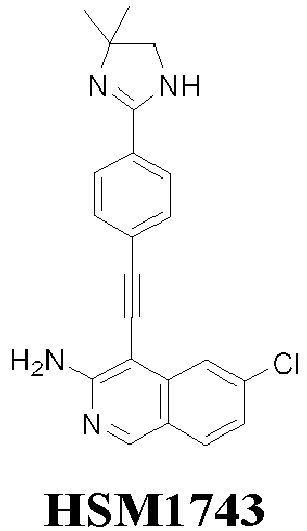
- Following the described general procedure IV, yellow solid was obtained. 1H NMR (500 MHz, MeOD) δ 8.75 (s, 1H), 7.88 (d, J = 1.2 Hz, 1H), 7.81 (d, J = 7.4 Hz, 3H), 7.70 (d, J = 8.2 Hz, 2H), 7.22 (dd, J = 8.7, 1.9 Hz, 1H), 3.53 (s, 2H), 1.35 (s, 6H); 13C NMR (126 MHz, MeOD) δ 162.62, 157.51, 151.80, 138.75, 138.02, 131.01, 130.32, 129.49, 127.18, 125.73, 123.67, 121.34, 120.78, 99.38, 90.34, 84.27, 62.77, 61.61, 27.34; HRMS (ESI+) [M+H] calcd for C22H20ClN4 350.1376, found 375.1368.
-

- Following the described general procedure IV, yellow solid was obtained. 1H NMR (500 MHz, MeOD) δ 8.27 (s, 1H), 7.90 (d, J = 8.5 Hz, 2H), 7.79 (d, J = 8.5 Hz, 2H), 7.53 (d, J = 2.9 Hz, 1H), 6.50 (dd, J = 2.8, 0.7 Hz, 1H), 3.96 (s, 4H); 13C NMR (126 MHz, MeOD) δ 165.52, 153.08, 143.40, 136.88, 133.96, 132.14, 131.63, 131.27, 128.33, 128.20, 127.85, 99.54, 96.35, 87.85, 41.16; HRMS (ESI+) [M+H] calcd for C18H16N5 302.1406, found 302.1399.
-

- Following the described general procedure IV, yellow solid was obtained. 1H NMR (500 MHz, DMSO-d6) δ 8.19 (d, J = 8.5 Hz, 1H), 8.03 (d, J = 2.1 Hz, 1H), 7.91 (d, J = 11.9 Hz, 3H), 7.75 - 7.68 (m, 1H), 7.56 - 7.48 (m, 1H), 7.11 (d, J = 17.1 Hz, 3H), 3.62 (s, 4H); 13C NMR (126 MHz, DMSO-d6) δ 163.46, 157.83, 145.17, 132.88, 132.59, 132.25, 131.49, 130.35, 127.69, 127.32, 126.36, 125.17, 124.06, 123.77, 103.13, 94.50, 83.62, 41.23; HRMS(ESI+) [M+H] calcd for C19H16N5 314.1406, found 314.1396.
-

- Following the described general procedure IV, yellow solid was obtained. 1H NMR (500 MHz, DMSO-d6) δ 8.91 (s, 1H), 7.91 (ddd, J = 12.4, 9.9, 5.0 Hz, 6H), 7.26 (d, J = 8.6 Hz, 1H), 6.95 (s, 2H); 13C NMR (126 MHz, DMSO-d6) δ 159.04, 153.96, 138.83, 137.63, 132.78, 132.41, 131.61, 128.36, 123.61, 121.33, 120.58, 119.18, 110.60, 98.86, 88.51, 87.73; HRMS (ESI+) [M+H] calcd for C18H11ClN3 304.0642, found 304.1411.
-
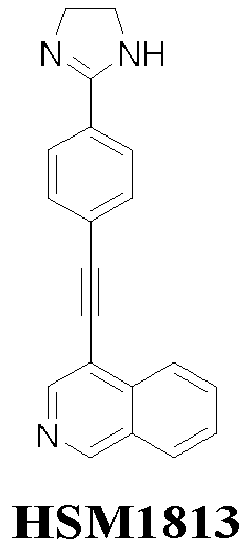
- Following the described general procedure IV, yellow solid was obtained. 1H NMR (500 MHz, DMSO-d6) δ 9.37 (s, 1H), 8.79 (s, 1H), 8.35 (d, J = 8.2 Hz, 1H), 8.24 (d, J = 8.0 Hz, 1H), 7.96 (dd, J = 19.4, 7.8 Hz, 3H), 7.81 (dd, J = 13.7, 7.7 Hz, 3H), 3.65 (s, 4H); 13C NMR (126 MHz, DMSO-d6) δ 163.43, 153.15, 146.66, 134.95, 132.48, 131.96, 131.31, 128.96, 128.85, 127.93, 127.85, 124.84, 124.02, 115.01, 96.65, 86.36, 50.06. HRMS (ESI+) [M+H] calcd for C20H16N3 298.1344, found 298.1341.
-

- Following the described general procedure IV, yellow solid was obtained. 1H NMR (500 MHz, DMSO-d6) δ 9.75 (s, 1H), 8.92 (s, 1H), 8.04 (s, 1H), 7.96 (d, J= 8.6 Hz, 1H), 7.88 (s, 1H), 7.78 (d, J = 7.5 Hz, 1H), 7.72 (d, J = 7.8 Hz, 1H), 7.46 (t, J = 7.7 Hz, 1H), 7.28 (d, J = 8.5 Hz, 1H), 6.80 (s, 2H), 5.93 (s, 2H); 13C NMR (126 MHz, DMSO-d6) δ 158.57, 153.00, 150.66, 138.73, 137.33, 134.15, 132.13, 131.55, 128.89, 128.65, 125.84, 123.48, 123.22, 121.31, 120.63, 99.88, 88.73, 83.91. HRMS (ESI+) [M+H] calcd for C18H14ClN4O 337.0856, found 337.0873.
-

- Following the described general procedure IV, yellow solid was obtained. 1H NMR (500 MHz, DMSO-d6) δ 9.79 (s, 1H), 8.91 (s, 1H), 7.95 (d, J = 8.6 Hz, 1H), 7.88 (d, J = 1.4 Hz, 1H), 7.80 - 7.72 (m, 4H), 7.27 (dd, J = 8.6, 1.9 Hz, 1H), 6.80 (s, 2H), 5.90 (s, 2H); 13C NMR (126 MHz, DMSO-d6) δ 158.53, 153.00, 150.71, 138.69, 137.32, 133.41, 131.53, 125.81, 123.66, 123.47, 121.35, 120.62, 99.94, 88.76, 84.85. HRMS (ESI+) [M+H] calcd for C18H14ClN4O 337.0856, found 337.0865.
-

- Following the described synthesis procedure V, yellow solid was obtained. 1H NMR 500 MHz, DMSO-d6) δ 9.66 (d, J = 6.2 Hz, 1H), 8.88 - 8.75 (m, 1H), 7.89 (dt, J = 17.8, 5.5 Hz, 2H), 7.77 - 7.63 (m, 4H), 7.33 (t, J = 17.4 Hz, 1H), 7.28 - 7.09 (m, 1H), 7.06 - 6.94 (m, 1H), 6.24 (s, 2H), 5.83 (s, 2H), 13C NMR (126 MHz, DMSO-d6) δ 154.75, 151.48, 151.00, 138.28, 136.75, 136.24, 134.02, 132.80, 131.32, 126.82, 125.88, 122.80, 122.59, 121.50, 121.20, 104.46, HRMS (ESI+) [M+H] calcd for C18H16ClN4O 339.1013, found 339.1010.
- Cells were added to 96 well plates at 2000 cells per well for adherent lines and 4000 cells per well for suspension lines and kept in an incubator overnight. The following day the plates were treated with compounds to give rise to the final concentrations of; 100 µM, 10 µM, 5
µM 1 µM, 500 nM, 100 nM, 10 nM, 10 pM. The plates were then stored in the incubator for 72 hours. On the third day the cells were assayed with 20 µL of CellTiter- Blue Cell Viability Assay per well and were incubated for 4 hours. After 4 hours' fluorescence intensity was taken on a plate reader: Excitation: 560/10 Emission: 590/10. IC50 analysis was performed onGraphPad Prism 7.Table 1: Selected IC50 values against AML cell line, MV4-11 Compound IC50 against MV4-11/uM HSM1661 0.016 HSM1611 0.840 HSM1617 0.770 HSM1651 0.008 HSM1688 0.250 HSM1669 0.260 M731 0.036 HSM1674 0.110 HSM1673 0.011 HSM1692 0.450 HSM1693 0.030 HSM1702 0.003 HSM1683 0.003 HSM1684 0.071 HSM1690 3.090 HSM1717 0.050 HSM1721 0.015 HSM1725 0.008 HSN105 0.061 HSN122 0.009 HSN129 0.008 HSN135 0.033 HSN136 0.095 HSN137 0.006 HSD48 0.028 Table 2: IC50 against MV4-11 (AML cell line) Compound IC50 (nM) HSM1683 42.1 ± 1.3 HSM1693 14.8 ± 1.4 HSM1702 5.5 ± 1.3 HSM1662 6.2 ± 1.3 HSM1673 25.0 ± 1.4 - The Reaction Biology Corporation (www.reactionbiology.com, Malvern, PA) HotSpot assay platform was used to measure kinase/inhibitor interactions exactly as previously described. Kinase and substrate were mixed in a buffer containing 20 mM HEPES pH 7.5, 10 mM MgCl2, 1 mM EGTA, 0.02% Brij35, 0.02 mg/mL BSA, 0.1 mM Na3VO4, 2 mM DTT and 1% DMSO. Single-dose of compounds (500 nM) were then added to each reaction mixture. After 20-minute incubation, ATP (Sigma) and [γ-33P] ATP (Perkin Elmer) were added at a final total concentration of 100 µM for
addition 2 hours at room temperature, followed by spotting onto P81 ion exchange cellulose chromatography paper (Whatman, Inc.). Filter paper was washed in 0.75% phosphoric acid to remove unincorporated ATP. Percent remaining kinase activity of a vehicle (DMSO) containing kinase reaction was calculated for each kinase/inhibitor pair using Prism 5 (GraphPad). At a concentration of 500 nM, HSM1856 inhibits 70% of BTK (Bruton's tyrosine kinase) activity and HSN325 blocks 96% of RET activity. - IC50 proliferation assay - Cell lines and primary cells were seeded into 96-well plates the afternoon prior to treatment. Approximately 18 hours later, compounds were semi-serially diluted in dimethyl sulfoxide (DMSO) and then growth medium, and added to cells. Plates were incubated for 72 hours prior to addition of Alamar Blue (Life Technologies, Carlsbad, CA). Plates were read after 4 additional hours of incubation at 37°C using a Bio-Tek Synergy HT plate reader (Bio-Tek, Winooski, VT). Data was analyzed and graphed using GraphPad Prism Software (Graphpad, La Jolla, CA). Experimental results are summarized in Table 3.
Table 3: Anti-Tumor Activities of Selected Compound Compound Cell line - MV4-11 Cell line - K562 HSN248 0.225 µM 0.007 µM HSN178 0.171 µM 1.443 µM HSN247 0.154 µM 0.025 µM HSM1702 0.071 µM 5.057 µM HSN315 0.54 µM 0.203 µM HSN316 0.759 µM 0.759 µM HSN317 n/a* 1.483 µM HSN285 0.722 µM 1.102 µM HSN286 0.0004 µM n/a HSN325 0.135 µM 0.444 µM HSN334 0.001 µM 0.006 µM HSN353 0.003 µM 0.005 µM HSN352 0.003 µM 0.002 µM HSN356 0.0004 µM 0.002 µM HSM1795 0.1 µM n/a HSM1856 0.025 µM n/a *n/a: not determined. - The compounds of the invention are µFLT3 inhibitors (Table 4 for percentage enzymatic inhibition at 0.5 µM compounds). Detailed characterization of one of HSM1651 revealed that it inhibited FLT3, FLT3 ITD and FLT3 D835Y with IC50 values of 40 nM, 100 nM and 56 nM respectively (
Figure 8A ).Table 4: FLT3 inhibition profile and anti-proliferative activities of the compounds of the innvention against different leukemia cancer cell lines. Entry Structure % Inhibition of kinases FLT3 at 500 nM Anti-proliferative effects in leukemia panel (µM) NV4-11a MOLM14b THP-1c K-562d HL60 e1 
92 0.15 ± 0.01a 0.15 ± 0.01b 1.20 ± 0.20c 3.00 ± 0.96d 2 
60 0.05 ± 0.01a 0.11 ± 0.02b 1.85 ± 0.92c 1.39 ± 0.01d 3.05 ± 0.07e 3 
43 0.30 ± 0.20a 0.10 ± 0.02b 4 
51 0.08 ± 0.02a 0.30 ± 0.08b 5 
56 0.07 ± 0.02a 0.30 ± 0.01b 6 
1 > 5a > 5b 7 
34 > 5a > 5b 8 
6 > 5a > 5b 9 
21 > 5a > 5b 10 
36 > 5a > 5b 11* 
61 0.04 ± 0.01a 0.05 ± 0.03b 12* 
54 0.02 ± 0.01a 0.06 ± 0.01b 13* 
41 0.35±1.17a 14 
98 0.001 ± 0.001a 0.001 ± 0.001b 15 
99 0.005 ± 0.001a 0.004 ± 0.001b a-e: these correlate the cell lines tested to respective IC50.
*hydroxyamidines may be acting as prodrugs of amidines in these cellular assays. - The compounds of the invention inhibited c-Kit and TrkC enzymes. Table 5 provides % inhibition of TrkC/c-Kit activities by compounds with stable linkers at concentration of 500 nM, in the presence of 100 µM radiolabeled ATP.
Table 5: % Inhibition of Trkc/C-Kit Activities Entry Compound name % inhibition of TrkC at 500 nM % inhibition of c-Kit at 500 nM 1 HSW630-1 99% 68% 2 HSM1651 64% 83% 3 HSM1703 49% 60% 4 HSM1721 52% 80% 5 HSM1743 44% 78% 7 HSM1611 16% 63% 8 HSM1796 7% 3% 9 HSM1798 11% 15% 10 HSM1813 17% 39% 11 HSM1820 74% 86% 12 HSM1819 80% 82% 13 HSM1859 42% 62% - The compounds of the invention could also potently inhibit AML cell lines (Table 5). Western analysis of MV4-11, treated with HSM1651, revealed that FLT3 phosphorylation as well as the downstream STAT5 phosphorylation were reduced in the presence of HSM1651 (
Figures 8B and 8C ). A few of the alkyne analogs have respectable anti-proliferative properties (HSM1819 has an IC50 value of 20 nM, which is only four times less potent than crenolanib (IC50 = 5 nM), which proceeded to clinical trials). Regarding structure-activity-relationship studies of the alkyne/alkene analogs, it appears that modifications to the isoquinoline ring greatly affected both kinase inhibition and anti-proliferative activity. For the alkyne series, HSM1813 (H at 3-position and also lacking Cl at 6-position) was not a potent inhibitor of MV4-11 proliferation (Table 5, entry 10). HSM1651 (amino at 3-position and Cl at 6-position) is a good inhibitor of MV4-11 and MOLM-14 proliferation whereas compounds HSM1781, 1798 and 1796, which differed from HSM1651 at the isoquinoline part, are ineffective anti-proliferative agents in AML cell lines. The amidine group also appears to be important for anti-proliferative activity. The cyano analog HSM1611 is ineffective against MV4-11 and MOLM-14 whereas the hydroxyamidine analog (HSM1819), which is derived from HSM1611, is a very potent anti-proliferative in AML cell lines. The hydroxyamidine HSM1819 inhibits FLT3 and FLT3 ITD with IC50 of 217 and 240 nM, respectively, in vitro. HSM1820, another hydroxyamidine analogue, inhibits FLT3 and FLT3 ITD with IC50 of 359 and 350 nM, respectively, in vitro. - Antiproliferative activities against AML cell line, MV4-11 (a FLT3-driven cell line) and three other solid tumors (MCF7, breast; HCT116, colon and HeLa) have been investigated (Tables 6A and 6B and
Figure 10 ).Table 6A: Percent Inhibition of cancer cell line proliferation in the presence of compounds (1 µM) Comp ound HS N21 0 HS N20 4 HSM 1669 HSM 1812 HS N13 7 HSM 1673 HSM 1683 HS N10 5 HSM 1610 HSM 1674 HS N17 7 HSM 1702 HS N18 4 HSM 1750 HS N14 5 HS N13 9 HS N13 5 HSM 1773 code A3 A4 A5 A6 A7 A9 A10 A1 1 A12 A13 A1 4 A15 A1 6 A17 A2 0 A2 2 A2 3 A24 MV-4-11 10 0 77 83 92 99 98 95 88 90 93 91 99 97 93 99 95 10 0 93 HCT 116 6 21 46 17 60 28 10 40 39 14 15 33 38 20 35 32 21 24 HeLa 16 22 20 97 20 38 49 1 20 8 1 17 51 11 11 35 0 24 MCF-7 1 20 98 100 74 56 57 12 29 36 46 100 92 17 6 60 35 43 Table 6B: Percent Inhibition of cancer cell line proliferation in the presence of compounds (1 µM) Comp ound HSM 1692 HSN 136 HSN 129 HS N99 HSM 1661 HSM 1688 HSN 161 HSN 189 HSM 1751 HSN 157 HSN 174 HSM 1717 HSN 247 HSN 248 HSN 178 HSN 185 HSN 315 HSN 286 code A25 A26 A27 A28 A29 B8 B15 B16 B17 B20 B22 C10 D6 D7 D15 D16 D28 D30 MV-4-11 81 86 99 97 90 74 97 95 91 96 85 82 58 98 98 97 83 99 HCT 116 29 38 29 20 0 43 18 7 32 12 28 33 54 76 97 67 66 100 HeLa 0 0 22 6 1 64 70 18 23 33 10 2 100 100 100 99 100 100 MCF-7 22 33 37 42 96 33 91 49 47 21 40 76 100 100 100 100 100 100 - From these cell proliferation studies, MV4-11 appeared to be more sensitive to the compounds than the other cell lines (Table 6A). At 1 µM, most of the compounds could inhibit MV4-11 significantly. To identify group of compounds potently inhibiting cancer cell proliferation, a lower concentration of compounds (100 nM) were used to screen against MV4-11 (
Figure 10 ). From these experiments, potent amide compounds A7, A10, A15, A16, A18, A20, B15 and D30 (as indicated by ***,Figure 10 ) were selected. At 100 nM, these selected compounds inhibited MV4-11 at similar levels to midostaurin, a pan kinase inhibitor that recently completely a Phase III clinical trials (Figure 10 ). Typically amides that contain basic amines are included in compound libraries to improve aqueous solubility but it appears that the presence of a basic amine in the side chain of the compounds also facilitated the actual inhibition of MV4-11 proliferation. For example, compounds A1, A2, A21 and A25, which did not have a basic amine side chain, were inactive against MV4-11 whereas many of the other compounds containing a basic amine chain were active against MV4-11. Stability of the active compounds, in the presence of mouse liver microsomes revealed that compounds with the D substitution pattern (such as D30) preformed much better in the liver microsomal stability assay compared to the other analogs. - Compound D30 contains 1-methyl-4-(2-(trifluoromethyl)benzyl)piperazine group, which is found in many kinase inhibitors, including ponatinib. Ponatinib, which is used to treat imatinib-resistant CML, has been shown to inhibit FLT3-driven AML. Unfortunately ponatinib causes adverse cardiovascular effects (Gainor, J.F., et al. Oncologist, 20(8), 847-848 (2015)) and it is now given with a black box warning and as a last resort drug against CML (Talbert, D.R., et al., Toxicol. Sci, 143 (1), 147-155 (2015). In 2014 it was withdrawn from the US market due to blood clotting and cardiovascular adverse effects and therefore it might not be an ideal drug to advance for AML treatment (especially for elderly patients). Therefore further analogs of D30 were investigated if the kinase selectivity of compounds containing the 1-methyl-4-(2-(trifluoromethyl)benzyl)piperazine group could be modulated via a judicious substitution on the isoquinoline core or use of isoquinoline isomers. Compounds HSN352, HSN353, HSN334, HSN356, HSN285 and HSN325 (containing 3-aminoisoquinoline, 1-aminoisoquinoline, 2-aminoquinoline and 2-aminoquinazoline,
Figure 11 ) were prepared via the Sonogashira coupling. These compounds' proliferation inhibition (IC50) against MV4-11 and MOLM-14 (FLT3-driven AML cell lines) were determined (Table 6B). - HSN286 had an IC50 against MV-4-11 and MOLM-14 of 0.5 nM and 0.7 nM respectively (Table 7). 1-Aminoisoquinoline analogs, HSN334 and HSN356, were also potent proliferation inhibitors of MV4-11 and MOLM-14. The degrees of AML proliferation inhibition by the isoquinoline compounds were similar to (or even slightly better than) midostaurin (Table 7). In general, there was a good correlation between the percentage inhibition of FLT3 enzymatic reaction (obtained as percentage inhibition at 500 nM compound, Reaction Biology) and the inhibition of AML cell lines MV4-11 and MOLM-14 proliferation. Not all of the aminoquinoline compounds were potent inhibitors of the AML cell lines proliferation. For example, HSN248, HSN178, HSN247, MXC1702 and HSN315 that also contained the 2-aminoquinoline core were only moderate inhibitors of AML proliferation or FLT3 enzymatic activity. However, the 1-methyl-4-(2-(trifluoromethyl)benzyl)piperazine moiety (
Figure 11 ) is not the sole determinant of FLT3 inhibition. The 2-aminoquinolines and quinazoline analogs, HSN285 and HSN325, both contain this moiety but they were neither potent inhibitors of FLT3 nor active against MV4-11 or MOLM-14 cell lines. Therefore it appears that the potencies of these compounds are due to the combined or synergistic effects of the 1-methyl-4-(2-(trifluoromethyl)benzyl)piperazine moiety (found in ponatinib) and the aminoisoquinoline moiety.Table 7: IC50 (proliferation) and FMS- like tyrosein kinase 3 inhibition of activityCompound % inhibition of FLT3 activity (500 nM) ICso (nM) MV4-11 MOLM14 HSN248 (D7) 73 % 181 ± 6.5 180 ± 7.8 HSN178 (D15) 66% 144 ± 2.6 187 ± 5.5 HSN247 (D6) 74% 154 ± 7.1 129 ± 8.2 HSM1702 (A15) 66% 71 ± 1.1 102 ± 11 HSN315 (D28) 32% 549 ± 7.4 523 ± 6.4 HSN285 28% 721 ± 5.8 415 ± 6.9 HSN286 (D30) 97% 0.49 ± 0.02 0.72 ± 0.02 HSN325 33 % 135 ± 5.87 456 ± 15 HSN334 99% 1.38 ± 0.1 1.61 ± 0.02 HSN353 94% 3.45 ± 0.04 1.97 ± 0.1 HSN352 93 % 3.09 ± 0.1 3.01 ± 0.1 HSN356 98% 0.42 ± 0.02 0.62 ± 0.02 Midostaurin 98 %a 18.5 ± 2.5 7.37 ± 0.1 a- % FLT3 inhibition at 412 nM. - To test for selectivity, HSN286 was tested against various other cancer lines as well as a normal cell line (MRC5, lung fibroblast cell line) (
Figure 12 ). When tested against Kasumi-1, a non- FLT3 AML line, the IC50 of HSN286 was determined to be over 10000 nM. The IC50 values for compound HSN286 against HL60, an acute promyelocytic leukemia cell line and THP1 (another non-FLT3-driven AML line) were 2156 nM and 2315 nM respectively (i.e. more than 2000X less active against these cell lines when compared to FLT3-driven cell lines MV4-11 or MOLM-14). In addition, the IC50 of compound HSN286 against MRC5 is 1266 nM (over 1000X less compared to IC50 for MV4-11 or MOLM-14). It therefore appears that HSN286 is selective (at least amongst the cell lines tested) for FLT3-driven leukemia. - Docking [25] of HSN 286, 334, 356 and 248 to the inactive conformer of FLT3 (a crystal structure of the potent FLT3 inhibitor, quizartinib, was solved in complex with FLT3, PDB # 4xuf), revealed that the compounds bind to both the ATP binding site and neighboring site (
Figure 13 ). The binding of the compounds partly overlap with the quizartinib binding site, but there are some differences in the binding modes (Figures 14 and15 ). - Although the current drugs on the market or in clinical trials are relatively successful in killing the AML leukemia cells, they currently are unable to deal with secondary mutations that occur after TKI treatment, such as FLT3 (D385V). The binding of HSN286, HSN336, HSN334, HSN248 and HSN247 with several FLT3 secondary mutations (Table 8) was investigated. Interestingly, HSN356 could bind to FLT3 (D835V) with a Kd of 19 nM, whereas a similar compound, HSN334, was a poor binder of FLT3 (D835V) with a Kd of 120 nM (Table 8).
Table 8: Kd for isoquinoline analogs binding to FLT3, FLT3-ITD, and FLT3 (D835V), determined via DiscoverX Kd Elect service HSN286 HSN356 HSN334 HSN178 HSN248 FLT3 6.5 nM 1.3 nM 5.1 nM 53 nM 47 nM FLT 3 (IDT) 27.6 nM 6.7 nM 19 nM 450 nM 330 nM FLT3 (D835V) 120 nM 19 nM 120 nM ND ND - Most kinase inhibitors that have found clinical success have been multikinase inhibitors. For example, sorafenib, used to treat kidney cancer, hepatocellular carcinoma and radioiodine-resistant thyroid cancers, also inhibits several kinases, such as RAF, MEK, ERK, VEGFR, PDGFR, FLT3, c-KIT, FGFR-1, DDR2. Dasatinib, another multikinase inhibitor is a first line treatment for CML and Ph+ ALL inhibits multitudes of kinase. This includes BCR-ABL, YES, EPHA8, c-KIT, SRC, LCK, DDR2, FRK, FYN, ARG, BTK, HCK. Despite the promiscuity of these multikinase inhibitors, safe and tolerable doses have been found for cancer treatment. The successes of these multikinase inhibitors could be derived, in part, from the simultaneous inhibition of different kinases axes.
- Further, it was investigated if HSN286 and its analogs also inhibited other cancer-related kinases. In addition to FLT3, the Src-family kinases (such as BLK, FGR, FYN, HCK, LYN, SRC and YES) have been shown to play critical roles in leukemia. Lopez et al. recently demonstrated that CDK6 overexpression in FTL3-ITD positive AML is achieved via the Src-family kinase, HCK (Lopez, S., et al., Oncotarget, 7(23), 51163-51173 (2016)). HCK is expressed more in human primary leukemic stem cells than in human normal hematopoietic stem cells. A study showed that when HCK is targeted with small molecules the drug resistance is reduced (Ishikawa, F. et al., Sci. Transl. Med., 5(181), 181 (2013)). Other protein kinases such as SYK, BRAF, p38 (p38MAPK), PDGFRα/β, FGFR1, RET, FLT4, Tie2 have also been linked to leukemia. All this data further strengthen the consensus in the field that leukemia is a heterogeneous disease and hence targeting the aforementioned multiple kinase pathways could lead to a better outcome. Thus, it was tested if HSN286 and analogs were also targeting kinases that play critical roles in AML. The kinase screening services Reaction Biology and DiscoverX were used to characterize the inhibition of kinase activity (enzymatic activity in the presence of 500 nM of compounds). HSN286 and analogs potently inhibit FLT3 and the Src-family kinases but not other kinases such as Aurora A, CDK6 or PIK3Ca. (Table 9). The inhibition of the Src-kinase family could be important clinically because these kinases are downstream of FLT3. In the event of FLT3 mutation, the inhibition of the Src-family kinases could still lead to proliferation inhibition.
Table 9: Kd (nM) determined via DiscoverX Kd Elect service Kinase HSN286 HSN356 AURKA >30000 5100 BLK 3.9 1.2 CDK6 28000 ND CDK9 2300 ND FAK 5100 4700 FGR 7 7.9 FLT3 7.2 1.3 FYN 28 38 HCK 3.6 2.5 KIT 42 7.2 LYN 11 5.4 PIK3CA 26000 >30000 PIM1 11000 19000 PLK1 >30000 9600 SRC 16 15 - In addition to the binding assays (Table 9), IC50 values for the inhibition of FLT3 kinase enzymatic activity by midostaurin, HSN286, 334 and 356 were determined. All of the four compounds could inhibit FLT3 with low nanomolar values, although midostaurin and HSN356 were better than HSN286 and HSN334 (
Figure 16 ). Midostaurin and HSN356 inhibited FLT3 and FLT3 ITD with single digit IC50 values. However in the case of Src kinase, HSN286 was the most potent (IC50 of 4.5 nM). HSN356 is also an effective inhibitor of Src kinase with a IC50 of 14.9 nM - To determine if the phosphorylation of FLT3, SRC kinase and downstream effectors or kinases (such as STAT3 [44], STAT5 [45] and p-38 [46]) could be affected by the compounds, Western Blot analysis was performed on total protein obtained from MV4-11 treated with HSN286 for FLT3/phosphorylated FLT3, STAT5/phosphorylated STAT5, STAT3/phosphorylated STAT3 as well as SRC kinase/phosphorylated SRC and p-38/phosphorylated p-38 to ascertain that one could indeed target FLT3 and associated signaling axis in cells (target engagement or confirmation,
Figure 17 ). In line with the in-vitro kinase inhibition data, the phosphorylation of FLT3, STAT5, STAT3 and p-38 could be inhibited by HSN286 (Figure 17 ). The level of SRC kinase increased over time (amount at the 48 h time point is greater than at the 6 and 24 h time points). Unfortunately the bands for the phosphorylated SRC kinase are blurred despite repeated attempts to get clearer bands. Despite the technical challenge with the phospho-SRC Western, it is conclusive that at the 48 h time point, the level of unphosphorylated SRC kinase increases as the compound HSN286 is added (compare band corresponding to vehicle to 9 and 45 nM HSN286 inFigure 17 ). From the above Western analyses, it is confirmed that the proliferation inhibition of MV4-11 is due to the inhibition of FLT3 signaling axis. - The compounds of the invention are novel FLT3 inhibitors which can inhibit the problematic D835 secondary mutants. 4-alkyne substituted aminoisoquinolines (readily obtained via Sonogashira coupling) but not the related quinolines, were potent FLT3 and SRC-kinase inhibitors. Extensive structure-activity relationship (SAR) studies revealed that the FLT3 inhibition profiles and anti-proliferative activities against FLT3-driven cancer cell lines, MV4-11 and MOLM-14 were dictated by the substitution pattern and nature of benzamide. The SAR studies have led to the identification of 3-amino and 1-aminoisoquinoline benzamides, compounds D30 (HSN286), HSN334 and HSN356 as potent FLT3 kinase inhibitors. Some of these novel kinase inhibitors also inhibit the proliferation of FLT3-driven AML cell lines at concentrations as low as 500 pM. In addition to FLT3, the compounds were identified that also inhibit the Src-family kinases and FGFR kinases. It is also shown that one could combine different isoquinolines with 1-methyl-4-(2-(trifluoromethyl)benzyl)piperazine group (a privileged moiety in kinase inhibitors) to develop analogs that have different kinase selectivities (a kind of "plug-and-play" strategy). This has unveiled a new class of aminoisoquinoline benzamide kinase inhibitors, which have a high potential for clinical translation.
- Substitution pattern of aminoisoquinolines play important role in kinase binding, in-vitro and in-vivo efficacy of compounds (
Figure 18 ). Table 10 provides the binding constant, Kd (DiscoverX KdElect) of compounds against FLT3, ABL1 and clinically relevant mutants that lead to drug resistance.Table 10: Binding constant of compounds of the invention (Kd unit = nM) Compound FLT3(ITD) FLT3(ITD, F691L) ABL1 phosphorylated ABL1 non-phosphorylated ABL1(T315I) non-phosphorylated HSN356 6.7 28 1.2 2.5 2.4 HSN334 19 nd 12 4.4 nd HSN286 26 110 7.9 7.2 29 HSN461 7.9 91 nd nd nd HSN459 5.6 17 nd nd nd HSN431 4.8 57 nd nd nd HSN248 330 100 2.2 0.29 520 - From the data in the Kd Table 10, it is clear that it is possible to tune the activity of the claimed compounds towards a specific kinase or drug-resistant mutant. These compounds can therefore be developed against drug-resistant AML (such as AML harboring FLT3 (ITD, F691L) mutation or CML (harboring T315I) mutation.
- To further illustrate the tenability of the claimed compounds, the inhibition of enzymatic activities of several kinases was evaluated by compounds that differ in substitution pattern (
Figure 19 and Tables 11-16) (500 nM of compounds were used, (Reaction Biology, Malvern, PA).Table 11: Percentage Kinase Inhibition Data: HSN286, HSN325 and HSM1702 HSN286 HSN325 HSM1702 AKT1 0 0 13 AKT2 3 0 18 ALK 0 2 7 Aurora A 0 0 19 AXL 3 3 0 BLK 100 30 10 BRAF 97 38 3 BRK 92 0 18 BTK 41 4 5 c-MER 0 0 6 c-Met 20 15 4 c-Src 99 30 9 CDK1/cyclin E 0 0 13 CDK2/cyclin A 0 0 18 CDK4/cyclin D1 0 0 16 CDK6/cyclin D3 7 0 50 CDK9/cyclin K 24 7 53 CDK9/cyclin T1 0 0 41 CDK9/cyclin T2 0 0 65 CSK 93 0 1 CTK/MATK 0 5 0 DDR2 77 81 0 DNA-PK 0 0 ND EGFR 44 0 0 EPHA3 96 6 0 EPHA5 96 30 4 EPHB2 96 3 5 ERBB2/HER2 25 4 0 ERBB4/HER4 71 7 0 ERK1 0 0 5 FAK/PTK2 0 0 6 FER 0 12 0 FGFR1 98 58 11 FGR 100 39 6 FLT1/VEGFR1 86 42 0 FLT3 97 34 66 FLT4/VEGFR3 98 42 10 FMS 99 93 35 FRK/PTK5 95 49 0 FYN 100 10 16 HCK 95 18 2 HIPK1 0 0 42 IGF1R 0 0 3 IKKa/CHUK 36 6 0 IR 16 9 9 IRR/INSRR 0 0 10 ITK 0 1 0 JAK2 67 0 0 JNK1 7 0 0 KDR/VEGFR2 95 90 9 KSR1 0 0 0 LRRK2 6 0 40 LYN 98 69 6 LYN B 95 35 0 MEK1 0 2 0 MEKK1 6 4 4 MELK 27 0 12 MKK7 0 6 0 MST4 0 0 0 MUSK 13 0 35 P38a/MAPK14 81 5 0 PAK1 0 0 1 PDGFRa 93 53 48 PDK1/PDHK1 0 1 0 PIM1 0 0 34 PKCa 5 5 3 PKD2/PRKD2 7 0 6 RAF1 94 92 5 RET 100 96 15 ROCK1 0 3 0 RON/MST1R 0 0 0 ROS/ROS 1 10 0 15 RSK2 0 0 7 SYK 0 0 4 TAOK1 0 0 12 TGFBR2 15 0 0 TIE2/TEK 97 47 8 TRKB 79 0 40 TRKC 91 4 81 TYK2 0 0 2 YES/YES 1 100 41 13 ZAP70 0 0 0 - Other Percentage Kinase Inhibition Data: HSN286, HSN325 and HSM1702 HSN286 c-kit (61), DAPK1 (9), FGFR2 (96), FGFR3 (88), FGFR4 (82), MEKK2 (52), PDGFRb (96), RIPK2 (25), RIPK3 (96), RIPK4 (32); HSM1702 c-kit (83).
Table 12: Percentage Kinase Inhibition Data on HSN334, HSN356 and HSN285 HSN334 HSN356 HSN285 AKT1 0 0 0 ALK 0 0 1 AXL 5 4 0 BRAF 96 100 64 BTK 46 65 0 c-kit 73 87 31 c- MER 0 0 3 c- Met 14 15 23 EGFR 61 59 0 EPHA5 97 96 0 EPHB2 98 100 3 ERBB2/HER2 31 64 0 FGFR1 96 96 0 FGR 100 99 0 FLT1/VEGFR1 79 94 3 FLT3 100 99 28 FLT4/VEGFR3 79 94 6 KDR/VEGFR2 94 97 15 PDGFRa 86 92 30 PKCa 0 0 6 RAF1 96 100 90 ROS/ ROS 10 0 0 TIE2/TEK 99 100 0 TRKB 41 75 0 TRKC ND 59 0 YES/ YES 1100 100 0 - Other Percentage Kinase Inhibition Data: HSN334, HSN356 and HSN285
- HSN334 RET (100);
- HSN356 RET (100);
- The in-vitro efficacies of HSN356, HSN334, HSN286, HSN461 and HSN431 against AML cell line MV4-11 are similar (all have IC50 < 1 nM against MV4-11) yet the compounds have differing potencies in-vivo. For example HSN286 and HSN286 are both 3-aminoisoquinolines but HSN286 is not efficacious in-vivo whereas HSN431 is efficacious (
Figure 20 ). Also HSN334 only differs from HSN356 and HSN461 via a carbon to nitrogen but the percent survival of mice injected with MV4-11 cell lines of HSN334 is different from both HSN356 and HSN461. - Method: Six week old female NSG mice were injected intravenously with 1x10⁶ logarithimically growing MV4-11 cells expressing luciferase (MV4-11). Luciferase expressing leukemia cells were imaged using the IVIS Xenogen system (Perkin Elmer, Waltham MA). On day of imaging, mice are injected IP with 150 mg/kg luciferin (Perkin Elmer, Waltham, MA), anaesthetized and then placed in imaging chamber. Maximal luminescence is recorded and then averaged among each treatment group. Ten days post cell injection, mice were imaged and then sorted into groups so that leukemic burden was similar and dosing started. Mice were dosed either with vehicle (10% DMSO/10
% Tween 20/80% saline) or 25 mg/kg of compounds three times per week for the duration of the experiment. Mice were weighed and observed five days per week and imaged once per week. - In addition to AML, the compounds of the invention are also active against several other cancers. For example the claimed compounds are active against lung cancer (Table 17). This is to be expected since the compounds can be tuned to inhibit different kinases, which drive specific tumors (Tables 11-16).
Table 17: IC50 against NCI H1703 (NSCLC)/ nM Compound IC50 against NCI H1703 (NSCLC)/ nM HSN356 88 HSN379 13 HSN334 98 HSN286 50 HSN459 38 HSN461 157 HSN431 247 - The compounds of the invention potently inhibit proliferation of K562 cell lines (CML) (Table 18).
Table 18: Inhibition of Proliferation of K562 Cell Lines (CML) HSL41 30.1 ± 0.19 nM HSL45 25.3 ± 0.1 nM HSL58 94.5 ± 0.1 nM HSN178 1443 ± 0.21 nM HSN285 1102 ± 0.08 nM HSN316 913 ± 0.1 nM HSN334 6.1 ± 0.1 nM HSN356 1.8 ± 0.03 nM HSL43 10.1 ± 0.1 nM HSL47 161.1 ± 0.11 nM HSL64 1932 ± 0.41 nM HSN247 25.7 ± 0.31 nM HSN286 3.5 ± 0.02 nM HSN317 1483 ± 0.1 nM HSN352 2.4 ± 0.06 nM HSN375 8.8 ± 0.4 nM HSL44 43.5 ± 0.14 nM HSL56 95.4 ± 0.23 nM HSM1702 5057 ± 0.45 nM HSN248 7.0 ± 0.1 nM HSN315 203 ± 0.1 nM HSN325 44 ± 0.1 nM HSN353 5.2 ± 0.02 nM HSN393 7.3 ± 0.04 nM - While the inventions have been illustrated and described in detail in the drawings and foregoing description, the same is to be considered as illustrative and not restrictive in character, it being understood that only certain embodiments have been shown and described and that all changes and modifications that come within the spirit of the invention are desired to be.
-
- 1. A compound represented by a compound of formula (IV)

- W is NR', alkene, alkyne, C1-8 alkyl, heteroalkyl containing 1-8 carbon and hetero atoms, cycloalkyl, hetereocycloalkyl, aryl, or heteroaryl, wherein cycloalkyl, hetereocycloalkyl, aryl, and heteroaryl optionally form a fused aryl or heteroaryl group with Ring A;
- U, Y, and Z are each N or CR6, wherein R6 is H or NRaRb;
- R7 and R8 are each independently H, alkyl, alkenyl, alkynyl, halo, nitro, ORc, SRc, CN, haloalkyl, O-haloalkyl, (CO)Rd, NRaRb, NH(CO)Rd, NH(CO)ORc, NH(CO)NRaRb, (CO)ORc, (CO)NRaRb, SO2NRaRb, cycloalkyl, heterocycloalkyl, aryl, or heteroaryl;
- or R7 and R8, together with the carbon atoms to which they are attached, form a cycloalkyl, heterocycloalkyl, aryl, or heteroaryl group, each optionally substituted with substituents independently selected from the group consisting of alkyl, cycloalkyl, alkenyl, alkynyl, halo, nitro, ORc, SRc, CN, haloalkyl, O-haloalkyl, NRaRb, (CO)Rd, (CO)ORc, (CO)NRaRb, SO2NRaRb, and - C(CH3)(=N-NHC(NH)NH2;
- Ring A is a 5- or 6-membered aryl or heteroaryl group, wherein Ring A is optionally substituted with substituents selected from the group consisting of alkyl, alkenyl, alkynyl, cycloalkyl, heterocycloalkyl, halo, nitro, ORc, SRc, CN, haloalkyl, O-haloalkyl, NRmRn, (CO)Rd, (CO)ORc, SO2NRmRn, (CO)NRmRn, C(NH)NRmRn, NH(CO)Rd, NH(CO)ORc, NH(CO)NRmRn, aryl, and heteroaryl;
- Rm and Rn are each independently
- H, OH,
- alkyl, -(CH2)p-T, -aryl-(CH2)p-T, -(CH2)p-aryl-T, -heteroaryl-(CH2)p-T, -(CH2)p-heteroaryl-T, each optionally substituted with alkyl, halo, nitro, CN, haloalkyl, O-haloalkyl, ORc, SRc, NRaRb, (CO)Rd, NH(CO)Rd, NH(CO)ORc, NH(CO)NRaRb, NHC(NH)NH2, (CO)ORc, (CO)NRaRb, SO2NRaRb, arylamino, or heteroarylamino,
- or Rm and Rn, together with the nitrogen atom they are attached, form a heterocycloalkyl group, optionally substituted with alkyl, cycloalkyl, heterocycloalkyl, aryl, heteroaryl, halo, nitro, CN, ORc, SRc, CORd, NRaRb, NH(CO)Rd, NH(CO)ORc, NH(CO)NRaRb, a guanidine group, (CO)ORc, or (CO)NRaRb;
- T is NRaRb, ORc, SRc, O-(CH2)q-NRaRb, cycloalkyl, heterocycloalkyl, aryl, heteroaryl, a guanidine group, or an isonicotinimidamide group;
- R' is H, alkyl, or cycloalkyl;
- Ra, Rb, Rc, and Rd are each independently H, alkyl, alkenyl, cycloalkyl, heterocycloalkyl, aryl, heteroaryl, -(CH2)q-cycloalkyl, -(CH)q-heterocycloalkyl, -(CH2)q-aryl, -(CH)q-heteroaryl, - (CO)-alkyl, -(CO)-cycloalkyl, -(CO)-heterocycloalkyl, -(SO2)-alkyl, -(SO2)-cycloalkyl, or -(SO2)-heterocycloalkyl, or Ra and Rb, together with the nitrogen atom to which they are attached, form a heterocycloalkyl group, wherein cycloalkyl, heterocycloalkyl, aryl and heteroaryl are each optioncally substituted with a group consisting of alkyl, halo, nitro, CN, haloalkyl, O-haloalkyl, OH, O-alkyl, SH, S-alkyl, NH2, NH(alkyl), and N(alkyl)2; and
- p and q are each independently 0-8;
- 2. The compound of enumerated
embodiment 1, wherein said compound of formula (IV) is represented by a compound of formula (V)
- W is NR', -C≡C-, or a heterocycloalkyl group containing a 5- or 6-membered ring, wherein R' is H or alkyl;
- U, Y, and Z are each N or CR6, wherein R6 is H or NRaRb;
- V, U1, Y1, and Z1 are each N or CR6';
- R1, R2, and R6' are each independently H, alkyl, cycloalkyl, halo, nitro, ORc, SRc, CN, haloalkyl, O-haloalkyl, or NRaRb;
- R3, R4, and R5 are each independently H, alkyl, cycloalkyl, heterocycloalkyl, halo, nitro, ORc, SRc, CN, haloalkyl, O-haloalkyl, NRmRn, (CO)Rd, (CO)ORc, SO2NRmRn, (CO)NRmRn, C(NH)NRmRn, NH(CO)Rd, NH(CO)ORc, NH(CO)NRmRn, aryl, or heteroaryl;
- Rm and Rn are each independently
- H, OH,
- alkyl, -(CH2)p-T, -aryl-(CH2)p-T, -(CH2)p-aryl-T, -heteroaryl-(CH2)p-T, -(CH2)p-heteroaryl-T, each optionally substituted with alkyl, cycloalkyl, halo, nitro, CN, haloalkyl, O-haloalkyl, ORc, SRc, (CO)Rd, NRaRb, NH(CO)Rd, NH(CO)ORc, NH(CO)NRaRb, NHC(NH)NH2, (CO)ORc, (CO)NRaRb, and SO2NRaRb,
- or Rm and Rn, together with the nitrogen atom they are attached, form a heterocycloalkyl group, optionally substituted with alkyl, cycloalkyl, heterocycloalkyl, aryl, heteroaryl, halo, nitro, CN, ORc, SRc, CORd, NRaRb, NH(CO)Rd, NH(CO)ORc, NH(CO)NRaRb, a guanidine group, (CO)ORc, and (CO)NRaRb;
- T is NRaRb, ORc, SRc, O-(CH2)q-NRaRb, cycloalkyl, heterocycloalkyl, aryl, heteroaryl, a guanidine group, or an isonicotinimidamide group;
- Ra, Rb, Rc, and Rd are each independently H, alkyl, alkenyl, cycloalkyl, heterocycloalkyl, aryl, heteroaryl, -(CH2)q-cycloalkyl, -(CH)q-heterocycloalkyl, -(CH2)q-aryl, -(CH)q-heteroaryl, - (CO)-alkyl, -(CO)-cycloalkyl, or -(CO)-heterocycloalkyl, or Ra and Rb, together with the nitrogen atom to which they are attached, form a heterocycloalkyl group, wherein cycloalkyl, heterocycloalkyl, aryl and heteroaryl are each optioncally substituted with a group consisting of alkyl, halo, nitro, CN, haloalkyl, O-haloalkyl, OH, O-alkyl, SH, S-alkyl, NH2, NH(alkyl), and N(alkyl)2; and
- p and q are each independently 0-5;
- 3. The compound of enumerated
embodiment 2, wherein R6 is NRaRb. - 4. The compound of enumerated
embodiment 2, wherein one of R3, R4, and R5 is heterocycloalkyl, CN, NRmRn, (CO)Rd, (CO)ORc, SO2NRmRn, (CO)NRmRn, C(NH)NRmRn, or NH(CO)Rd. - 5. The compound of enumerated
embodiment 2, wherein one of R3, R4, and R5 is (CO)NRmRn. - 6. The compound of enumerated
embodiment 5, wherein Rm is H and Rn is -(CH2)p-T, -aryl-(CH2)p-T, -(CH2)p-aryl-T, or -heteroaryl-(CH2)p-T, each optionally substituted with alkyl, halo, and ORc. - 7. The compound of enumerated
embodiment 6, wherein T is NRaRb, O-(CH2)q-NRaRb, heterocycloalkyl, aryl, or heteroaryl. - 8. The comound of enumerated
embodiment 5, wherein Rm and Rn, together with the nitrogen atom they are attached, form a heterocycloalkyl group, optionally substituted with alkyl, cycloalkyl, heterocycloalkyl, NRaRb, NH(CO)Rd, NH(CO)ORc, and NH(CO)NRaRb. - 9. The compound of enumerated
embodiment 2, wherein R1 and R2 are each independently H, alkyl, halo, CN, ORc, SRc, or NRaRb. - 10. The compound of enumerated
embodiment 1, wherein said compound is a compound of the following formula:


- R1, R2 R10, R11, R12, and R13 are each independently H, alkyl, cycloalkyl, halo, nitro, ORc, SRc, CN, haloalkyl, O-haloalkyl, or NRaRb;
- R3, R4, and R5 are each independently H, alkyl, cycloalkyl, heterocycloalkyl, halo, nitro, ORc, SRc, CN, haloalkyl, O-haloalkyl, NRmRn, (CO)Rd, (CO)ORc, SO2NRmRn, (CO)NRmRn, C(NH)NRmRn, NH(CO)Rd, NH(CO)ORc, NH(CO)NRmRn, aryl, or heteroaryl;
- R6 is H or NRaRb;
- Rm and Rn are each independently
- H, OH,
- alkyl, -(CH2)p-T, -aryl-(CH2)p-T, -(CH2)p-aryl-T, -heteroaryl-(CH2)p-T, -(CH2)p-heteroaryl-T, each optionally substituted with alkyl, cycloalkyl, halo, nitro, CN, haloalkyl, O-haloalkyl, ORc, SRc, (CO)Rd, NRaRb, NH(CO)Rd, NH(CO)ORc, NH(CO)NRaRb, NHC(NH)NH2, (CO)ORc, (CO)NRaRb, and SO2NRaRb,
- or Rm and Rn, together with the nitrogen atom they are attached, form a heterocycloalkyl group, optionally substituted with alkyl, cycloalkyl, heterocycloalkyl, aryl, heteroaryl, halo, nitro, CN, ORc, SRc, CORd, NRaRb, NH(CO)Rd, NH(CO)ORc, NH(CO)NRaRb, a guanidine group, (CO)ORc, and (CO)NRaRb;
- T is NRaRb, ORc, SRc, O-(CH2)q-NRaRb, cycloalkyl, heterocycloalkyl, aryl, heteroaryl, a guanidine group, or an isonicotinimidamide group;
- Ra, Rb, Rc, and Rd are each independently H, alkyl, alkenyl, cycloalkyl, heterocycloalkyl, aryl, heteroaryl, -(CH2)q-cycloalkyl, -(CH)q-heterocycloalkyl, -(CH2)q-aryl, -(CH)q-heteroaryl, - (CO)-alkyl, -(CO)-cycloalkyl, or -(CO)-heterocycloalkyl, or Ra and Rb, together with the nitrogen atom to which they are attached, form a heterocycloalkyl group, wherein cycloalkyl, heterocycloalkyl, aryl and heteroaryl are each optioncally substituted with a group consisting of alkyl, halo, nitro, CN, haloalkyl, O-haloalkyl, OH, O-alkyl, SH, S-alkyl, NH2, NH(alkyl), and N(alkyl)2; and
- p and q are each independently 0-5;
- 11. The compound of enumerated
embodiment 1, wherein said compound is a compound of the following formula: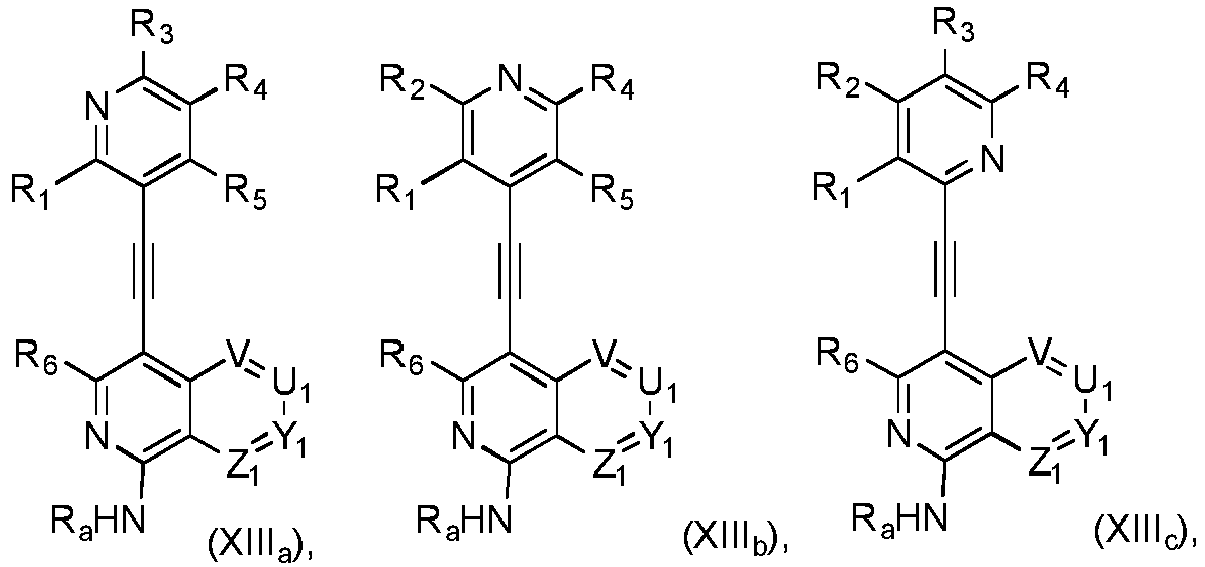

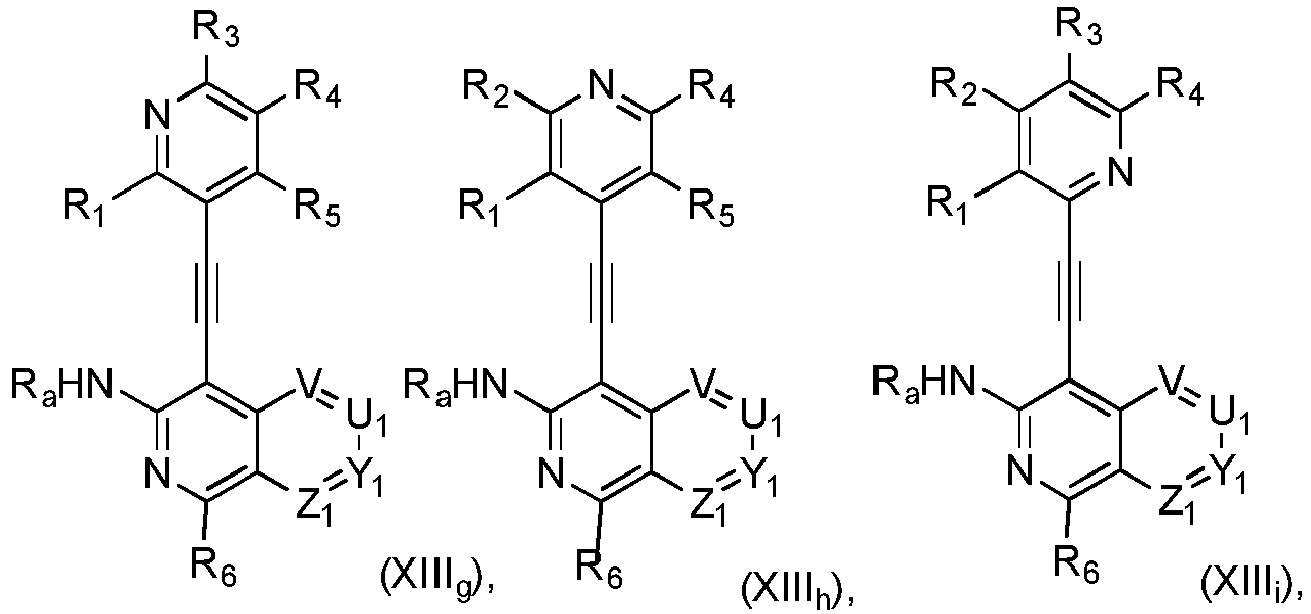
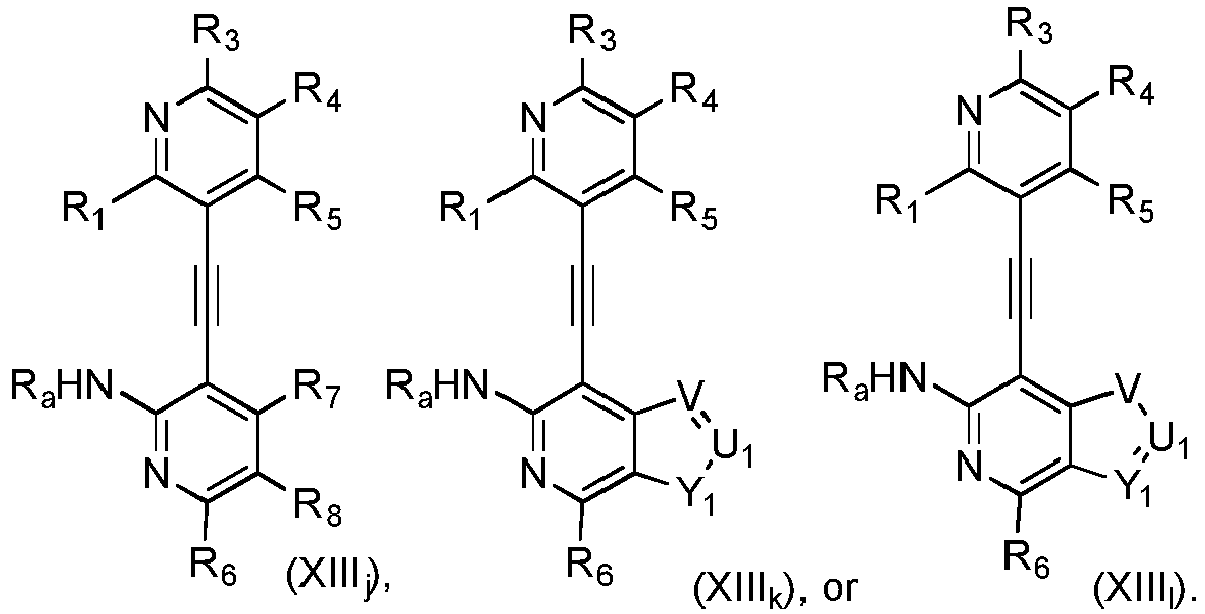
- V, U1, Y1, and Z1 are each N or CR6';
- R1, R2, and R6' are each independently H, alkyl, cycloalkyl, halo, nitro, ORc, SRc, CN, haloalkyl, O-haloalkyl, or NRaRb;
- R3, R4, and R5 are each independently H, alkyl, cycloalkyl, heterocycloalkyl, halo, nitro, ORc, SRc, CN, haloalkyl, O-haloalkyl, NRmRn, (CO)Rd, (CO)ORc, SO2NRmRn, (CO)NRmRn, C(NH)NRmRn, NH(CO)Rd, NH(CO)ORc, NH(CO)NRmRn, aryl, or heteroaryl;
- R6 is H or NRaRb;
- R7 and R8 are each independently H, alkyl, alkenyl, alkynyl, halo, nitro, ORc, SRc, CN, haloalkyl, O-haloalkyl, (CO)Rd, NRaRb, NH(CO)Rd, NH(CO)ORc, NH(CO)NRaRb, (CO)ORc, (CO)NRaRb, SO2NRaRb, cycloalkyl, heterocycloalkyl, aryl, or heteroaryl;
- Rm and Rn are each independently
- H, OH,
- alkyl, -(CH2)p-T, -aryl-(CH2)p-T, -(CH2)p-aryl-T, -heteroaryl-(CH2)p-T, -(CH2)p-heteroaryl-T, each optionally substituted with alkyl, cycloalkyl, halo, nitro, CN, haloalkyl, O-haloalkyl, ORc, SRc, (CO)Rd, NRaRb, NH(CO)Rd, NH(CO)ORc, NH(CO)NRaRb, NHC(NH)NH2, (CO)ORc, (CO)NRaRb, and SO2NRaRb,
- or Rm and Rn, together with the nitrogen atom they are attached, form a heterocycloalkyl group, optionally substituted with alkyl, cycloalkyl, heterocycloalkyl, aryl, heteroaryl, halo, nitro, CN, ORc, SRc, CORd, NRaRb, NH(CO)Rd, NH(CO)ORc, NH(CO)NRaRb, a guanidine group, (CO)ORc, and (CO)NRaRb;
- T is NRaRb, ORc, SRc, O-(CH2)q-NRaRb, cycloalkyl, heterocycloalkyl, aryl, heteroaryl, a guanidine group, or an isonicotinimidamide group;
- Ra, Rb, Rc, and Rd are each independently H, alkyl, alkenyl, cycloalkyl, heterocycloalkyl, aryl, heteroaryl, -(CH2)q-cycloalkyl, -(CH)q-heterocycloalkyl, -(CH2)q-aryl, -(CH)q-heteroaryl, - (CO)-alkyl, -(CO)-cycloalkyl, or -(CO)-heterocycloalkyl, or Ra and Rb, together with the nitrogen atom to which they are attached, form a heterocycloalkyl group, wherein cycloalkyl, heterocycloalkyl, aryl and heteroaryl are each optioncally substituted with a group consisting of alkyl, halo, nitro, CN, haloalkyl, O-haloalkyl, OH, O-alkyl, SH, S-alkyl, NH2, NH(alkyl), and N(alkyl)2; and
- p and q are each independently 0-5;
- 12. The compound of enumerated
embodiment 1, wherein said compound is a compound of the following formula:


- V, U1, Y1, and Z1 are each N or CR6';
- R1, R2, and R6' are each independently H, alkyl, cycloalkyl, halo, nitro, ORc, SRc, CN, haloalkyl, O-haloalkyl, or NRaRb;
- R3, R4, and R5 are each independently H, alkyl, cycloalkyl, heterocycloalkyl, halo, nitro, ORc, SRc, CN, haloalkyl, O-haloalkyl, NRmRn, (CO)Rd, (CO)ORc, SO2NRmRn, (CO)NRmRn, C(NH)NRmRn, NH(CO)Rd, NH(CO)ORc, NH(CO)NRmRn, aryl, or heteroaryl;
- R6 is H or NRaRb;
- R7 and R8 are each independently H, alkyl, alkenyl, alkynyl, halo, nitro, ORc, SRc, CN, haloalkyl, O-haloalkyl, (CO)Rd, NRaRb, NH(CO)Rd, NH(CO)ORc, NH(CO)NRaRb, (CO)ORc, (CO)NRaRb, SO2NRaRb, cycloalkyl, heterocycloalkyl, aryl, or heteroaryl;
- Rm and Rn are each independently
- H, OH,
- alkyl, -(CH2)p-T, -aryl-(CH2)p-T, -(CH2)p-aryl-T, -heteroaryl-(CH2)p-T, -(CH2)p-heteroaryl-T, each optionally substituted with alkyl, cycloalkyl, halo, nitro, CN, haloalkyl, O-haloalkyl, ORc, SRc, (CO)Rd, NRaRb, NH(CO)Rd, NH(CO)ORc, NH(CO)NRaRb, NHC(NH)NH2, (CO)ORc, (CO)NRaRb, and SO2NRaRb,
- or Rm and Rn, together with the nitrogen atom they are attached, form a heterocycloalkyl group, optionally substituted with alkyl, cycloalkyl, heterocycloalkyl, aryl, heteroaryl, halo, nitro, CN, ORc, SRc, CORd, NRaRb, NH(CO)Rd, NH(CO)ORc, NH(CO)NRaRb, a guanidine group, (CO)ORc, and (CO)NRaRb;
- T is NRaRb, ORc, SRc, O-(CH2)q-NRaRb, cycloalkyl, heterocycloalkyl, aryl, heteroaryl, a guanidine group, or an isonicotinimidamide group;
- Ra, Rb, Rc, and Rd are each independently H, alkyl, alkenyl, cycloalkyl, heterocycloalkyl, aryl, heteroaryl, -(CH2)q-cycloalkyl, -(CH)q-heterocycloalkyl, -(CH2)q-aryl, -(CH)q-heteroaryl, - (CO)-alkyl, -(CO)-cycloalkyl, or -(CO)-heterocycloalkyl, or Ra and Rb, together with the nitrogen atom to which they are attached, form a heterocycloalkyl group, wherein cycloalkyl, heterocycloalkyl, aryl and heteroaryl are each optioncally substituted with a group consisting of alkyl, halo, nitro, CN, haloalkyl, O-haloalkyl, OH, O-alkyl, SH, S-alkyl, NH2, NH(alkyl), and N(alkyl)2; and
- p and q are each independently 0-5;
- 13. The compound of enumerated
embodiment 1, wherein said compound is a compound of formula (XV)
- R' is H or alkyl;
- R1, R2, R10, R11, R12, and R13 are each independently H, alkyl, cycloalkyl, halo, nitro, ORc, SRc, CN, haloalkyl, O-haloalkyl, or NRaRb;
- R3, R4, and R5 are each independently H, alkyl, cycloalkyl, heterocycloalkyl, halo, nitro, ORc, SRc, CN, haloalkyl, O-haloalkyl, NRmRn, (CO)Rd, (CO)ORc, SO2NRmRn, (CO)NRmRn, C(NH)NRmRn, NH(CO)Rd, NH(CO)ORc, NH(CO)NRmRn, aryl, or heteroaryl;
- Rm and Rn are each independently
- H, OH,
- alkyl, -(CH2)p-T, -aryl-(CH2)p-T, -(CH2)p-aryl-T, -heteroaryl-(CH2)p-T, -(CH2)p-heteroaryl-T, each optionally substituted with alkyl, cycloalkyl, halo, nitro, CN, haloalkyl, O-haloalkyl, ORc, SRc, (CO)Rd, NRaRb, NH(CO)Rd, NH(CO)ORc, NH(CO)NRaRb, NHC(NH)NH2, (CO)ORc, (CO)NRaRb, and SO2NRaRb,
- or Rm and Rn, together with the nitrogen atom they are attached, form a heterocycloalkyl group, optionally substituted with alkyl, cycloalkyl, heterocycloalkyl, aryl, heteroaryl, halo, nitro, CN, ORc, SRc, CORd, NRaRb, NH(CO)Rd, NH(CO)ORc, NH(CO)NRaRb, a guanidine group, (CO)ORc, and (CO)NRaRb;
- T is NRaRb, ORc, SRc, O-(CH2)q-NRaRb, cycloalkyl, heterocycloalkyl, aryl, heteroaryl, a guanidine group, or an isonicotinimidamide group;
- Ra, Rb, Rc, and Rd are each independently H, alkyl, alkenyl, cycloalkyl, heterocycloalkyl, aryl, heteroaryl, -(CH2)q-cycloalkyl, -(CH)q-heterocycloalkyl, -(CH2)q-aryl, -(CH)q-heteroaryl, - (CO)-alkyl, -(CO)-cycloalkyl, or -(CO)-heterocycloalkyl, or Ra and Rb, together with the nitrogen atom to which they are attached, form a heterocycloalkyl group, wherein cycloalkyl, heterocycloalkyl, aryl and heteroaryl are each optioncally substituted with a group consisting of alkyl, halo, nitro, CN, haloalkyl, O-haloalkyl, OH, O-alkyl, SH, S-alkyl, NH2, NH(alkyl), and N(alkyl)2; and
- p and q are each independently 0-5.
- 14. The compound of enumerated
embodiment 1, wherein said compound is


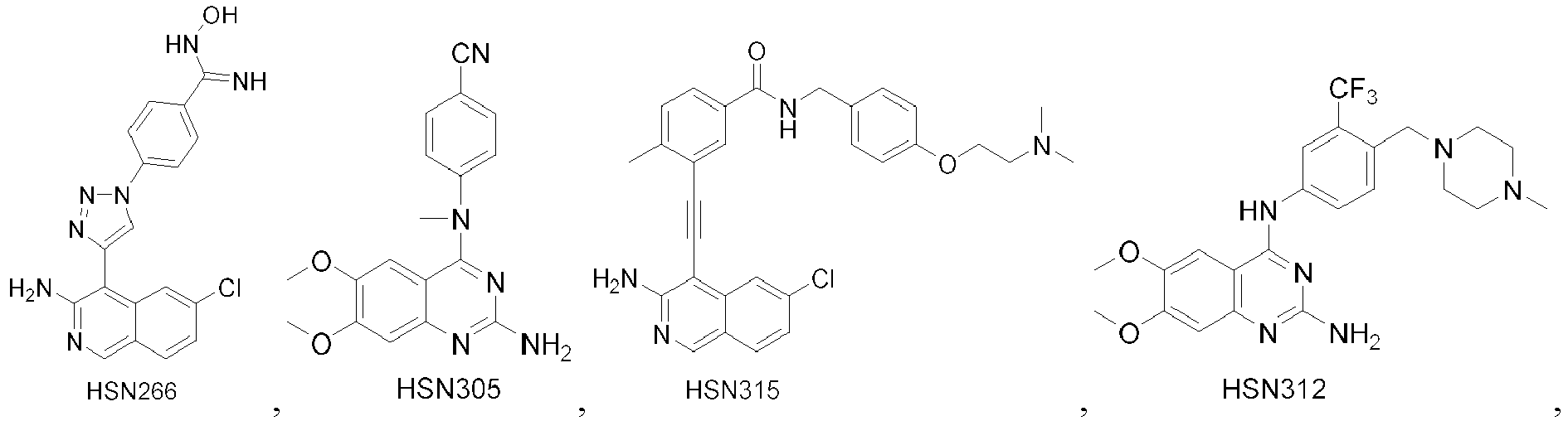


- 15. A pharmaceutical composition comprising a compound of any one of enumerated embodiments 1-14, or a pharmaceutically acceptable salt, N-oxide, hydrate, solvent, tautomer, or optical isomer thereof, and a pharmaceutically acceptable carrier or diluent.
- 16. A method of treating, inhibiting, suppressing, or reducing the severity of cancer in a subject in need thereof, wherein the method comprises administering to the subject a therapeutically effective amount of a compound of any one of enumerated embodiments 1-14, or a pharmaceutically acceptable salt, N-oxide, hydrate, solvate, tautomer, or optical isomer thereof, or a pharmaceutical composition of enumerated
embodiment 15. - 17. The method of enumerated
embodiment 16, wherein said cancer is selected from the group consisting of acute myeloid leukemia, chronic myeloid leukemia, ovarian cancer, cervical cancer, pancreatic cancer, breast cancer, brain cancer, skin cancer, lung cancer, prostate cancer, Lymphoma, Leukemia, colon cancer, head cancer, neck cancer, thyroid cancer, kidney cancer, liver cancer, and stomach cancer. - 18. A method of treating, inhibiting, suppressing, or reducing the severity of a disease or a disorder associated with protein kinase in a subject in need thereof, wherein the method comprises administering to the subject a therapeutically effective amount of a compound of any one of enumerated embodiment 1-14, or a pharmaceutically acceptable salt, N-oxide, hydrate, solvate, tautomer, or optical isomer thereof, or a pharmaceutical composition of enumerated
embodiment 15. - 19. The method of enumerated embodiment 18, wherein said protein kinase is Abl, Abl2, AFK, ALK, AMPK group, ATM, ATR, Aurora A, Aurora B, Axl, BCKDK, BLK, BMPR1B, BMX, Brk, BRSK1, BTK, CaM-KIalpha, CaM-KIIalpha, CaMKK group, CaM-KIV, CaM-KKalpha, CaM-KKbeta, CCDPK, CCRK,CDK1, CDK11, CDK2,CDK4,CDK5, CDK6, CDK7, CDK9, CDK_group, CDPK, Chak1, CHK1, CHK2, CK1 alpha, CK1 delta, CK1 epsilon, CK1_group, CK2 alpha, CK2_beta, CK2 group, CLK1,CSF1R, Csk, DAPK1, DAPK2, DAPK3, DAPK_group, DCAMKL1, DMPK group, DNA-PK, DYRK1A, DYRK1B, DYRK2, DYRK3, eEF2K, Eg3 kinase, EGFR, EIF2AK2, EphA2, EphA3, EphA4, EphA8, EphB1, EphB2, EphB3, EphB5, ErbB2, FAK, Fer, Fes, FGFR1, FGFR3, FGFR4, FGFR group, Fgr, FLT1, FLT3, FLT4, Fyn,GRK-1, GRK-2, GRK-3, GRK-4, GRK-5, GRK-6, GPX_group, GSK-3alpha, GSK-3beta, GSK-3 group, HCK, HIPK2, HIPK3, HRI, ICK, IGF1R, IKK-alpha, IKK-beta, IKK-epsilon ILK, InsR, IPL1, IRAK1, IRAK4, ITK, JAK1, JAK2, JAK3, JAK_group, JNK_group, KDR, KIS, Kit, KSR1, Lck, LIMK1, LIMK2, LKB1, LOK, Lyn, MAP2K1, MAP2K2, MAP2K3, MAP2K4, MAP2K6, MAP2K7, MAPK2_group, MAP3K1, MAP3K11, MAP3K14, MAP3K5, MAP3K7, MAP3K8, MAPK3_group, MAP4K1, MAP4K2, MAP4K4, MAPK1, MAPK10, MAPK11, MAPK12, MAPK13, MAPK14, MAPK3, MAPK4, MAPK6, MAPK7, MAPK8, MAPK9, MAPK group, MAPKAPK2, MARK group, Mer, Met, MHCK, MLCK_group, Mnk1,Mnk2, MOS, MRCKa, MST1, MST3, mTOR, NDR1, NDR2, NEK1, NEK2, NEK6, NEK9, NEK group, NLK, NuaK1, p37 kinase, p38 group, p70S6K, p70S6Kb, P70S6K_group, PAK1, PAK2, PAK3, PAK5, PAK6, PAK_group, PASK, P-CIP2, PCTAIRE1, PDGFR alpha, PDGFR beta, PDGFR group, PDHK1, PDHK2, PDHK3, PDHK4, PDK-1, PDK-2, PDK_group, PHK group, PIK3CA, PIK3CB, PIK3CD, PIK3CG, Pim-1, PKA alpha, Pka group, PKB beta, PKB group, PKC alpha, PKC beta, PKC delta, PKC epsilon, PKC eta, PKC gamma, PKC iota, PKC theta, PKC zeta, PKC group, PKD1, PKD2, PKD3, PKG1/cGK-I, PKG2/cGK-II, PKG2/cGK_group, PKN1, PLK1, PLK2, PLK3, PRP4, PYK2, RAF1, Ret, ROCK1, ROCK2, Ron, RPL10, RSK-1, RSK-2, RSK-3, RSK-5, SDK1, SGK group, SIK, Sky, Src, Src group, STLK3, Syk, TBK1, Tec, TESK1, TESK2, TGFbR1, TGFbR2, Tie1, Tie2, Titin kinase, TNK2, TRKA, TRKB, tropomyosin kinase, TSSK3, TXK, Tyk2, TYK2, VRK1, Wee1, Wnk1, WNK1, Yes, or ZAP70.
- 20. The method of enumerated
embodiment 18, wherein said disease or disorder is cancer, diabetes, malaria, viral infections, cardiovascular and hypertension, CNS and neurodegeneration, osteoporosis, pulmonary fibrosis, retinitis pigmentosis, Wet macular degeneration, Duchenne muscular dystrophy, diabetic eye disease, inflammation and autoimmune, or allergy.
| HSN248 | |
| c-kit | 93 |
| c- | 23 |
| | 9 |
| FLT3 | 73 |
| RET | 52 |
| TRKC | 83 |
| HSN178 | |
| c- | 1 |
| | 3 |
| FLT3 | 67 |
| | 0 |
| HSN247 | |
| c-kit | 86 |
| c- | 3 |
| | 6 |
| | 75 |
| | 3 |
| TRKC | 77 |
| HSN353 | HSN352 | |
| c-kit | 82 | 78 |
| c-Src | 98 | 100 |
| FGFR1 | 93 | 100 |
| FLT3 | 94 | 93 |
Claims (12)
- A compound having the formula (XIIIa):
 V, U1, and Y1, are CR6' and Z1 is N;R1, and R6' are each independently H, alkyl, cycloalkyl, halo, nitro, ORc, SRc, CN, haloalkyl, O-haloalkyl, or NRaRb;R3, and R5 are each independently H, alkyl, cycloalkyl, heterocycloalkyl, halo, nitro, ORc, SRc, CN, haloalkyl, O-haloalkyl, NRmRn, (CO)Rd, (CO)ORc, SO2NRmRn, (CO)NRmRn, C(NH)NRmRn, NH(CO)Rd, NH(CO)ORc, NH(CO)NRmRn, aryl, or heteroaryl;R4 is heterocycloalkyl, NRmRn, (CO)Rd, (CO)ORc, SO2NRmRn, (CO)NRmRn, C(NH)NRmRn, NH(CO)Rd, NH(CO)ORc, or NH(CO)NRmRn;R6 is H;Rm and Rn are each independentlyH, OH,alkyl, -(CH2)p-T, -aryl-(CH2)p-T, -(CH2)p-aryl-T, -heteroaryl-(CH2)p-T, -(CH2)p-heteroaryl-T, each optionally substituted with alkyl, cycloalkyl, halo, nitro, CN, haloalkyl, O-haloalkyl, ORc, SRc, (CO)Rd, NRaRb, NH(CO)Rd, NH(CO)ORc, NH(CO)NRaRb, NHC(NH)NH2, (CO)ORc, (CO)NRaRb, and SO2NRaRb,or Rm and Rn, together with the nitrogen atom they are attached, form a heterocycloalkyl group, optionally substituted with alkyl, cycloalkyl, heterocycloalkyl, aryl, heteroaryl, halo, nitro, CN, ORc, SRc, CORd, NRaRb, NH(CO)Rd, NH(CO)ORc, NH(CO)NRaRb, a guanidine group, (CO)ORc, and (CO)NRaRb;T is NRaRb, ORc, SRc, O-(CH2)q-NRaRb, cycloalkyl, heterocycloalkyl, aryl, heteroaryl, a guanidine group, or an isonicotinimidamide group;Ra, Rb, Rc, and Rd are each independently H, alkyl, alkenyl, cycloalkyl, heterocycloalkyl, aryl, heteroaryl, -(CH2)q-cycloalkyl, -(CH)q-heterocycloalkyl, -(CH2)q-aryl,-(CH)q-heteroaryl, -(CO)-alkyl, -(CO)-cycloalkyl, or -(CO)-heterocycloalkyl, or Ra and Rb, together with the nitrogen atom to which they are attached, form a heterocycloalkyl group, wherein cycloalkyl, heterocycloalkyl, aryl and heteroaryl are each optionally substituted with a group consisting of alkyl, halo, nitro, CN, haloalkyl, O-haloalkyl, OH, O-alkyl, SH, S-alkyl, NH2, NH(alkyl), and N(alkyl)2; andp and q are each independently 0-5;or a pharmaceutically acceptable salt, N-oxide, hydrate, solvate, tautomer, or optical isomer thereof.
 - The compound of claim 1, wherein R4 is (CO)NRmRn.
- The compound of claim 1 or 2, wherein R6' is H.
- The compound of any preceding claim, wherein R4 is:

- The compound of any preceding claim wherein R3 and R5 are each independently H, alkyl, cycloalkyl, heterocycloalkyl, halo, nitro, ORc, SRc, CN, haloalkyl, O-haloalkyl.
- The compound of claim 5, wherein R3 and R5 are each independently H.
- The compound of any preceding claim, wherein R1 is H, alkyl, halo, CN, ORc, SRc, or NRaRb..
- The compound of claim 1 selected from the group:


- A pharmaceutical composition comprising a compound of any one of claims 1 to 8, or a pharmaceutically acceptable salt, N-oxide, hydrate, or solvate thereof, and a pharmaceutically acceptable carrier or diluent.
- A compound according to any one of claims 1 to 8, or a pharmaceutically acceptable salt, N-oxide, hydrate, or solvate thereof, or a pharmaceutical composition of claim 9, for use in treating, inhibiting, suppressing, or reducing the severity of cancer in a subject in need thereof.
- The compound or pharmaceutical composition for use of claim 10, wherein said cancer is selected from the group consisting of acute myeloid leukemia, chronic myeloid leukemia and Leukemia.
- The compound of any one of claims 1 to 8 or a pharmaceutically acceptable salt, N-oxide, hydrate, or solvate thereof, or a pharmaceutical composition of claim 9, for use in treating, inhibiting, suppressing, or reducing the severity of a disease or a disorder associated with protein kinase in a subject in need thereof, wherein said disease or disorder is cancer.
Applications Claiming Priority (4)
| Application Number | Priority Date | Filing Date | Title |
|---|---|---|---|
| US201662375154P | 2016-08-15 | 2016-08-15 | |
| US201762461295P | 2017-02-21 | 2017-02-21 | |
| PCT/US2017/046843 WO2018035072A1 (en) | 2016-08-15 | 2017-08-15 | 4-substituted aminoisoquinoline derivatives |
| EP17841957.8A EP3496717A4 (en) | 2016-08-15 | 2017-08-15 | 4-SUBSTITUTED AMINOISOCHINOLINE DERIVATIVES |
Related Parent Applications (1)
| Application Number | Title | Priority Date | Filing Date |
|---|---|---|---|
| EP17841957.8A Division EP3496717A4 (en) | 2016-08-15 | 2017-08-15 | 4-SUBSTITUTED AMINOISOCHINOLINE DERIVATIVES |
Publications (2)
| Publication Number | Publication Date |
|---|---|
| EP4011882A1 true EP4011882A1 (en) | 2022-06-15 |
| EP4011882B1 EP4011882B1 (en) | 2025-03-05 |
Family
ID=61196993
Family Applications (2)
| Application Number | Title | Priority Date | Filing Date |
|---|---|---|---|
| EP17841957.8A Withdrawn EP3496717A4 (en) | 2016-08-15 | 2017-08-15 | 4-SUBSTITUTED AMINOISOCHINOLINE DERIVATIVES |
| EP22150686.8A Active EP4011882B1 (en) | 2016-08-15 | 2017-08-15 | 4-substituted aminoisoquinoline derivatives |
Family Applications Before (1)
| Application Number | Title | Priority Date | Filing Date |
|---|---|---|---|
| EP17841957.8A Withdrawn EP3496717A4 (en) | 2016-08-15 | 2017-08-15 | 4-SUBSTITUTED AMINOISOCHINOLINE DERIVATIVES |
Country Status (6)
| Country | Link |
|---|---|
| US (3) | US11001559B2 (en) |
| EP (2) | EP3496717A4 (en) |
| JP (1) | JP7562256B2 (en) |
| CN (1) | CN109843294A (en) |
| CA (2) | CA3033752C (en) |
| WO (1) | WO2018035072A1 (en) |
Cited By (3)
| Publication number | Priority date | Publication date | Assignee | Title |
|---|---|---|---|---|
| US12084458B2 (en) | 2021-02-19 | 2024-09-10 | Sudo Biosciences Limited | Substituted pyridines, pyridazines, and pyrimidines as TYK2 inhibitors |
| US12122785B2 (en) | 2021-02-19 | 2024-10-22 | Sudo Biosciences Limited | Substituted pyridines, pyridazines, pyrimidines, and 1,2,4-triazines as TYK2 inhibitors |
| US12600721B2 (en) | 2021-02-19 | 2026-04-14 | Sudo Biosciences Limited | TYK2 inhibitors and uses thereof |
Families Citing this family (22)
| Publication number | Priority date | Publication date | Assignee | Title |
|---|---|---|---|---|
| US20170283445A1 (en) * | 2016-04-05 | 2017-10-05 | University Of South Carolina | Small Molecule Inhibitors Selective For Polo-Like Kinase Proteins |
| CN108456163A (en) * | 2017-02-20 | 2018-08-28 | 中国科学院上海药物研究所 | Compound and its preparation method and application containing adjacent amino heteroaryl cycloalkynyl radical |
| CA3087972C (en) | 2018-01-18 | 2023-01-10 | Array Biopharma Inc. | Substituted pyrazolyl[4,3-c]pyridinecompounds as ret kinase inhibitors |
| EP3740491A1 (en) | 2018-01-18 | 2020-11-25 | Array Biopharma, Inc. | Substituted pyrrolo[2,3-d]pyrimidines compounds as ret kinase inhibitors |
| WO2020023846A1 (en) * | 2018-07-27 | 2020-01-30 | Arcus Biosciences, Inc. | Pyridone a2r antagonists |
| CA3224985C (en) | 2018-07-31 | 2025-11-18 | Loxo Oncology, Inc. | Spray-dried dispersions, formulations, and polymorphs of (s)-5-amino-3-(4-((5-fluoro-2-methoxybenzamido)methyl)phenyl)-1-(1,1,1-trifluoropropan-2-yl)-1h-pyrazole-4-carboxamide |
| JP7474752B2 (en) * | 2018-09-12 | 2024-04-25 | パデュー リサーチ ファウンデイション | Alkynylnicotinamide compounds as kinase inhibitors |
| CN113454070A (en) * | 2018-09-30 | 2021-09-28 | 豪夫迈·罗氏有限公司 | Cinnoline compounds and their use for the treatment of HPK 1-dependent disorders such as cancer |
| US11014908B2 (en) | 2018-11-29 | 2021-05-25 | Pfizer Inc. | Chemical compounds |
| EP3886854A4 (en) | 2018-11-30 | 2022-07-06 | Nuvation Bio Inc. | PYRROLE AND PYRAZOLE COMPOUNDS AND METHODS OF USE THEREOF |
| CA3117854A1 (en) * | 2018-12-07 | 2020-06-11 | Sunshine Lake Pharma Co., Ltd. | Ret inhibitors, pharmaceutical compositions and uses thereof |
| EP3891148A4 (en) * | 2018-12-07 | 2022-09-07 | Sunshine Lake Pharma Co., Ltd. | RET INHIBITORS, PHARMACEUTICAL COMPOSITIONS AND USES THEREOF |
| EP3986559A1 (en) * | 2019-06-24 | 2022-04-27 | BenevolentAI Bio Limited | New compounds and methods |
| EP4153568A4 (en) * | 2020-05-19 | 2024-05-29 | Purdue Research Foundation | Continuous flow sonogashira coupling synthesis method |
| WO2021262915A1 (en) * | 2020-06-24 | 2021-12-30 | Purdue Research Foundation | 2,3-disubstituted pyrido[3,4-b]pyrazine-containing compounds as kinase inhibitors |
| KR20220009349A (en) * | 2020-07-14 | 2022-01-24 | 보로노이바이오 주식회사 | aryl or heteroaryl derivatives, and pharmaceutical composition thereof for use in preventing or treating kinase-related disease |
| EP4186901A4 (en) * | 2020-07-23 | 2024-06-12 | Cytosinlab Therapeutics Co., Ltd. | ASSOCIATED WITH KINASE INHIBITORY EFFECT |
| KR20220099503A (en) * | 2021-01-05 | 2022-07-13 | 주식회사 비투에스바이오 | Heteroaryl-ethynyl derivative compounds, and uses thereof |
| WO2023169453A1 (en) * | 2022-03-11 | 2023-09-14 | 中国科学院上海药物研究所 | Heteroaromatic ring-containing alkynyl compound, and preparation method therefor and use thereof |
| WO2023196930A2 (en) * | 2022-04-06 | 2023-10-12 | Purdue Research Foundation | Nicotinamide- and benzamide-based compounds, conjugates, and compositions as inhibitors of translational- and transcriptional-related kinases |
| CN115851946B (en) * | 2022-11-24 | 2023-09-01 | 中山大学孙逸仙纪念医院 | Application of CaMKI serving as therapeutic target in preparation of pancreatic cancer therapeutic drug |
| WO2025064853A1 (en) * | 2023-09-20 | 2025-03-27 | Momentum Therapeutics, Inc. | Ripk3 inhibitors and methods of use |
Citations (1)
| Publication number | Priority date | Publication date | Assignee | Title |
|---|---|---|---|---|
| WO2014194667A1 (en) * | 2013-06-05 | 2014-12-11 | 中国科学院上海药物研究所 | Alkynyl heterocyclic compound and uses thereof |
Family Cites Families (20)
| Publication number | Priority date | Publication date | Assignee | Title |
|---|---|---|---|---|
| US4216212A (en) * | 1978-06-08 | 1980-08-05 | The Procter & Gamble Company | Pyrazolidine anti-inflammatory composition and methods of use |
| EP0495982B1 (en) * | 1989-10-11 | 1996-06-12 | Teijin Limited | Bicyclic pyrimidine derivative, method of producing the same, and pharmaceutical preparation containing the same as active ingredient |
| WO2003024931A1 (en) | 2001-09-14 | 2003-03-27 | Merck & Co., Inc. | Tyrosine kinase inhibitors |
| WO2005003100A2 (en) | 2003-07-03 | 2005-01-13 | Myriad Genetics, Inc. | 4-arylamino-quinazolines as activators of caspases and inducers of apoptosis |
| US7776869B2 (en) | 2004-10-18 | 2010-08-17 | Amgen Inc. | Heteroaryl-substituted alkyne compounds and method of use |
| US7737279B2 (en) | 2005-05-10 | 2010-06-15 | Bristol-Myers Squibb Company | 1,6-dihydro-1,3,5,6-tetraaza-as-indacene based tricyclic compounds and pharmaceutical compositions comprising same |
| WO2007133560A2 (en) * | 2006-05-08 | 2007-11-22 | Ariad Pharmaceuticals, Inc. | Acetylenic heteroaryl compounds |
| WO2008009078A2 (en) | 2006-07-20 | 2008-01-24 | Gilead Sciences, Inc. | 4,6-dl- and 2,4,6-trisubstituted quinazoline derivatives useful for treating viral infections |
| EP2231282A1 (en) | 2008-01-22 | 2010-09-29 | Merck Patent GmbH | Protein kinase inhibitors and use thereof |
| CA2727103A1 (en) | 2008-07-03 | 2010-01-07 | Merck Patent Gmbh | Naphthyridinones as aurora kinase inhibitors |
| US8383094B2 (en) | 2008-10-01 | 2013-02-26 | Bristol-Myers Squibb Company | Hepatitis C virus inhibitors |
| AR076332A1 (en) | 2009-04-21 | 2011-06-01 | Boehringer Ingelheim Int | HETEROCICLIC DERIVATIVES OF 5-ALQUINIL-PIRIDINAS, PHARMACEUTICAL COMPOSITIONS THAT INCLUDE THEM AND USE OF THE SAME FOR THE TREATMENT AND / OR PREVENTION OF CANCER, INFLAMMATORY PROCESSES, AUTOIMMUNES, AND / OR INFECTIONS. |
| JP2013506691A (en) | 2009-10-02 | 2013-02-28 | バーテックス ファーマシューティカルズ インコーポレイテッド | Pyrazole inhibitors of phosphatidylinositol 3-kinase |
| US8815893B2 (en) * | 2010-02-22 | 2014-08-26 | Merck Patent Gmbh | Hetarylaminonaphthyridines |
| CN101885722B (en) | 2010-07-01 | 2013-07-24 | 中国科学院广州生物医药与健康研究院 | Heterocycle alkyne and benzene compound, medicinal composition and application thereof |
| WO2012097479A1 (en) * | 2011-01-21 | 2012-07-26 | Abbott Laboratories | Bicyclic inhibitors of anaphastic lymphoma kinase |
| CN103030637A (en) | 2011-10-10 | 2013-04-10 | 上海恒瑞医药有限公司 | Imidazole quinoline derivative, and pharmaceutically acceptable salts thereof, preparation method thereof and application thereof on medicines |
| EP2828250B1 (en) | 2012-03-19 | 2021-03-10 | Imperial College Innovations Limited | Quinazoline compounds and their use in therapy |
| GB2522226A (en) | 2014-01-17 | 2015-07-22 | Agency Science Tech & Res | Heteroaryl alkyne derivatives and uses thereof |
| US10130625B2 (en) * | 2014-07-22 | 2018-11-20 | University Of Maryland, College Park | Linked diaryl compounds with anticancer properties and methods of using the same |
-
2017
- 2017-08-15 EP EP17841957.8A patent/EP3496717A4/en not_active Withdrawn
- 2017-08-15 WO PCT/US2017/046843 patent/WO2018035072A1/en not_active Ceased
- 2017-08-15 US US16/325,022 patent/US11001559B2/en active Active
- 2017-08-15 CN CN201780063496.9A patent/CN109843294A/en active Pending
- 2017-08-15 EP EP22150686.8A patent/EP4011882B1/en active Active
- 2017-08-15 CA CA3033752A patent/CA3033752C/en active Active
- 2017-08-15 JP JP2019508936A patent/JP7562256B2/en active Active
- 2017-08-15 CA CA3158951A patent/CA3158951A1/en active Pending
-
2021
- 2021-03-01 US US17/187,931 patent/US20210198208A1/en not_active Abandoned
-
2024
- 2024-09-17 US US18/887,654 patent/US20250084039A1/en active Pending
Patent Citations (1)
| Publication number | Priority date | Publication date | Assignee | Title |
|---|---|---|---|---|
| WO2014194667A1 (en) * | 2013-06-05 | 2014-12-11 | 中国科学院上海药物研究所 | Alkynyl heterocyclic compound and uses thereof |
Non-Patent Citations (9)
| Title |
|---|
| "Scientific Tables, Geigy Pharmaceuticals", 1970, ARDLEY, pages: 537 - 538 |
| DATABASE WPI [online] THOMSON SCIENTIFIC, LONDON, GB; 2014, "New alkynyl heterocyclic compounds used in pharmaceutical composition for preparing medicine for treating cancer e.g. non-small cell lung cancer, small-cell lung cancer, and lung squanous cell carcinoma", XP002796116, Database accession no. 2014-W26428 * |
| FREIREICH, E. J. ET AL., CANCER CHEMOTHER. REP., vol. 50, no. 4, 1966, pages 219 |
| GAINOR, J.F. ET AL., ONCOLOGIST, vol. 20, no. 8, 2015, pages 847 - 848 |
| GAINOR, J.F. ET AL.: "Ponatinib: Accelerated Disapproval", ONCOLOGIST, vol. 20, no. 8, 2015, pages 847 - 848 |
| ISHIKAWA, F. ET AL., SCI. TRANSL. MED., vol. 5, no. 181, 2013, pages 181 |
| LAROCQUE ET AL.: "Aminoisoquinoline benzamides, FLT3 and Src-family kinase inhibitors, potently inhibit proliferation of acute myeloid leukemia cell lines", FUTURE MED. CHEM., vol. 9, no. 11, 11 May 2017 (2017-05-11), GB, pages 1213 - 1225, XP055917543, ISSN: 1756-8919, Retrieved from the Internet <URL:http://dx.doi.org/10.4155/fmc-2017-0067> DOI: 10.4155/fmc-2017-0067 * |
| LOPEZ, S. ET AL., ONCOTARGET, vol. 7, no. 23, 2016, pages 51163 - 51173 |
| TALBERT, D.R. ET AL., TOXICOL. SCI, vol. 143, no. 1, 2015, pages 147 - 155 |
Cited By (4)
| Publication number | Priority date | Publication date | Assignee | Title |
|---|---|---|---|---|
| US12084458B2 (en) | 2021-02-19 | 2024-09-10 | Sudo Biosciences Limited | Substituted pyridines, pyridazines, and pyrimidines as TYK2 inhibitors |
| US12103937B2 (en) | 2021-02-19 | 2024-10-01 | Sudo Biosciences Limited | Substituted pyridines and pyridazines as TYK2 inhibitors |
| US12122785B2 (en) | 2021-02-19 | 2024-10-22 | Sudo Biosciences Limited | Substituted pyridines, pyridazines, pyrimidines, and 1,2,4-triazines as TYK2 inhibitors |
| US12600721B2 (en) | 2021-02-19 | 2026-04-14 | Sudo Biosciences Limited | TYK2 inhibitors and uses thereof |
Also Published As
| Publication number | Publication date |
|---|---|
| US20210198208A1 (en) | 2021-07-01 |
| CA3033752C (en) | 2022-05-31 |
| JP7562256B2 (en) | 2024-10-07 |
| US20190177278A1 (en) | 2019-06-13 |
| EP4011882B1 (en) | 2025-03-05 |
| JP2019527725A (en) | 2019-10-03 |
| WO2018035072A1 (en) | 2018-02-22 |
| CN109843294A (en) | 2019-06-04 |
| EP3496717A1 (en) | 2019-06-19 |
| EP3496717A4 (en) | 2020-01-15 |
| US11001559B2 (en) | 2021-05-11 |
| US20250084039A1 (en) | 2025-03-13 |
| CA3033752A1 (en) | 2018-02-22 |
| CA3158951A1 (en) | 2018-02-22 |
Similar Documents
| Publication | Publication Date | Title |
|---|---|---|
| US20250084039A1 (en) | 4-substituted aminoisoquinoline derivatives | |
| US20240368184A1 (en) | PIKfyve Inhibitors | |
| JP7427098B2 (en) | 7-amino-3,4-dihydropyrimidopyrimidin-2-one derivatives having protein kinase inhibitory activity and therapeutic pharmaceutical compositions containing the same | |
| EP2499117B1 (en) | A compound, a process for its preparation, a pharmaceutical composition, use of a compound, a method for modulating or regulating serine/threonine kinases and a serine/threonine kinases modulating agent | |
| EP3004060B1 (en) | Compounds for kinase modulation, and indications therefor | |
| EP3929195A1 (en) | Novel pyrido[3,4-d]pyrimidin-8-one derivative having protein kinase inhibitory activity, and pharmaceutical composition for preventing, alleviating, or treating cancer, comprising same | |
| EP4010330B1 (en) | Quinoline derivatives as protein kinase inhibitors | |
| RU2550346C2 (en) | New chemical compounds (versions) and using them for treating oncological diseases | |
| AU2018326721A1 (en) | Compounds and compositions for IRE1 inhibition | |
| US10059717B2 (en) | Urea compounds containing 3,4-dihydropyrimido[4,5-D]pyrimidin-2(1H)-one skeleton as protein kinase inhibitors | |
| HK40076911A (en) | 4-substituted aminoisoquinoline derivatives | |
| US11530221B2 (en) | Pyrimido[4,5-d]pyrimidin-2-one derivatives as protein kinase inhibitors | |
| US20230219934A1 (en) | 2,3-disubstituted pyrido[3,4-b]pyrazine-containing compounds as kinase inhibitors | |
| KR102329723B1 (en) | NOVEL PYRIMIDO[4,5-d]PYRIMIDIN-2-ONE DERIVATIVES AS PROTEIN KINASE INHIBITORS | |
| KR20260027534A (en) | Novel compounds for inhibiting RET kinase, the manufacturing method thereof and uses therof | |
| KR20220041462A (en) | Novel quinazoline derivatives having FLT3-inhibitory activity and use thereof | |
| HK40076637A (en) | Quinoline derivatives as protein kinase inhibitors | |
| HK40076637B (en) | Quinoline derivatives as protein kinase inhibitors | |
| KR20180106597A (en) | Novel [1,2,4]triazolo[4,3-a]quinoxaline amino phenyl derivatives or pharmaceutically acceptable salts thereof, preparation method therof and pharmaceutical composition for use in preventing or treating bromodomain extra-terminal(BET) protein activity related diseases containing the same as an active ingredient |
Legal Events
| Date | Code | Title | Description |
|---|---|---|---|
| PUAI | Public reference made under article 153(3) epc to a published international application that has entered the european phase |
Free format text: ORIGINAL CODE: 0009012 |
|
| STAA | Information on the status of an ep patent application or granted ep patent |
Free format text: STATUS: THE APPLICATION HAS BEEN PUBLISHED |
|
| AC | Divisional application: reference to earlier application |
Ref document number: 3496717 Country of ref document: EP Kind code of ref document: P |
|
| AK | Designated contracting states |
Kind code of ref document: A1 Designated state(s): AL AT BE BG CH CY CZ DE DK EE ES FI FR GB GR HR HU IE IS IT LI LT LU LV MC MK MT NL NO PL PT RO RS SE SI SK SM TR |
|
| STAA | Information on the status of an ep patent application or granted ep patent |
Free format text: STATUS: REQUEST FOR EXAMINATION WAS MADE |
|
| 17P | Request for examination filed |
Effective date: 20221215 |
|
| RBV | Designated contracting states (corrected) |
Designated state(s): AL AT BE BG CH CY CZ DE DK EE ES FI FR GB GR HR HU IE IS IT LI LT LU LV MC MK MT NL NO PL PT RO RS SE SI SK SM TR |
|
| REG | Reference to a national code |
Ref country code: HK Ref legal event code: DE Ref document number: 40076911 Country of ref document: HK |
|
| STAA | Information on the status of an ep patent application or granted ep patent |
Free format text: STATUS: EXAMINATION IS IN PROGRESS |
|
| 17Q | First examination report despatched |
Effective date: 20231211 |
|
| GRAP | Despatch of communication of intention to grant a patent |
Free format text: ORIGINAL CODE: EPIDOSNIGR1 |
|
| STAA | Information on the status of an ep patent application or granted ep patent |
Free format text: STATUS: GRANT OF PATENT IS INTENDED |
|
| INTG | Intention to grant announced |
Effective date: 20241022 |
|
| RAP3 | Party data changed (applicant data changed or rights of an application transferred) |
Owner name: PURDUE RESEARCH FOUNDATION |
|
| GRAS | Grant fee paid |
Free format text: ORIGINAL CODE: EPIDOSNIGR3 |
|
| GRAA | (expected) grant |
Free format text: ORIGINAL CODE: 0009210 |
|
| STAA | Information on the status of an ep patent application or granted ep patent |
Free format text: STATUS: THE PATENT HAS BEEN GRANTED |
|
| AC | Divisional application: reference to earlier application |
Ref document number: 3496717 Country of ref document: EP Kind code of ref document: P |
|
| AK | Designated contracting states |
Kind code of ref document: B1 Designated state(s): AL AT BE BG CH CY CZ DE DK EE ES FI FR GB GR HR HU IE IS IT LI LT LU LV MC MK MT NL NO PL PT RO RS SE SI SK SM TR |
|
| REG | Reference to a national code |
Ref country code: GB Ref legal event code: FG4D |
|
| REG | Reference to a national code |
Ref country code: CH Ref legal event code: EP |
|
| REG | Reference to a national code |
Ref country code: IE Ref legal event code: FG4D |
|
| REG | Reference to a national code |
Ref country code: DE Ref legal event code: R096 Ref document number: 602017088246 Country of ref document: DE |
|
| PG25 | Lapsed in a contracting state [announced via postgrant information from national office to epo] |
Ref country code: RS Free format text: LAPSE BECAUSE OF FAILURE TO SUBMIT A TRANSLATION OF THE DESCRIPTION OR TO PAY THE FEE WITHIN THE PRESCRIBED TIME-LIMIT Effective date: 20250605 |
|
| PG25 | Lapsed in a contracting state [announced via postgrant information from national office to epo] |
Ref country code: FI Free format text: LAPSE BECAUSE OF FAILURE TO SUBMIT A TRANSLATION OF THE DESCRIPTION OR TO PAY THE FEE WITHIN THE PRESCRIBED TIME-LIMIT Effective date: 20250305 |
|
| REG | Reference to a national code |
Ref country code: NL Ref legal event code: MP Effective date: 20250305 |
|
| PG25 | Lapsed in a contracting state [announced via postgrant information from national office to epo] |
Ref country code: ES Free format text: LAPSE BECAUSE OF FAILURE TO SUBMIT A TRANSLATION OF THE DESCRIPTION OR TO PAY THE FEE WITHIN THE PRESCRIBED TIME-LIMIT Effective date: 20250305 |
|
| REG | Reference to a national code |
Ref country code: LT Ref legal event code: MG9D |
|
| PG25 | Lapsed in a contracting state [announced via postgrant information from national office to epo] |
Ref country code: NO Free format text: LAPSE BECAUSE OF FAILURE TO SUBMIT A TRANSLATION OF THE DESCRIPTION OR TO PAY THE FEE WITHIN THE PRESCRIBED TIME-LIMIT Effective date: 20250605 |
|
| PG25 | Lapsed in a contracting state [announced via postgrant information from national office to epo] |
Ref country code: HR Free format text: LAPSE BECAUSE OF FAILURE TO SUBMIT A TRANSLATION OF THE DESCRIPTION OR TO PAY THE FEE WITHIN THE PRESCRIBED TIME-LIMIT Effective date: 20250305 |
|
| PG25 | Lapsed in a contracting state [announced via postgrant information from national office to epo] |
Ref country code: LV Free format text: LAPSE BECAUSE OF FAILURE TO SUBMIT A TRANSLATION OF THE DESCRIPTION OR TO PAY THE FEE WITHIN THE PRESCRIBED TIME-LIMIT Effective date: 20250305 |
|
| PG25 | Lapsed in a contracting state [announced via postgrant information from national office to epo] |
Ref country code: BG Free format text: LAPSE BECAUSE OF FAILURE TO SUBMIT A TRANSLATION OF THE DESCRIPTION OR TO PAY THE FEE WITHIN THE PRESCRIBED TIME-LIMIT Effective date: 20250305 Ref country code: GR Free format text: LAPSE BECAUSE OF FAILURE TO SUBMIT A TRANSLATION OF THE DESCRIPTION OR TO PAY THE FEE WITHIN THE PRESCRIBED TIME-LIMIT Effective date: 20250606 |
|
| REG | Reference to a national code |
Ref country code: AT Ref legal event code: MK05 Ref document number: 1772881 Country of ref document: AT Kind code of ref document: T Effective date: 20250305 |
|
| PG25 | Lapsed in a contracting state [announced via postgrant information from national office to epo] |
Ref country code: NL Free format text: LAPSE BECAUSE OF FAILURE TO SUBMIT A TRANSLATION OF THE DESCRIPTION OR TO PAY THE FEE WITHIN THE PRESCRIBED TIME-LIMIT Effective date: 20250305 |
|
| PG25 | Lapsed in a contracting state [announced via postgrant information from national office to epo] |
Ref country code: SE Free format text: LAPSE BECAUSE OF FAILURE TO SUBMIT A TRANSLATION OF THE DESCRIPTION OR TO PAY THE FEE WITHIN THE PRESCRIBED TIME-LIMIT Effective date: 20250305 |
|
| PG25 | Lapsed in a contracting state [announced via postgrant information from national office to epo] |
Ref country code: SM Free format text: LAPSE BECAUSE OF FAILURE TO SUBMIT A TRANSLATION OF THE DESCRIPTION OR TO PAY THE FEE WITHIN THE PRESCRIBED TIME-LIMIT Effective date: 20250305 |
|
| PG25 | Lapsed in a contracting state [announced via postgrant information from national office to epo] |
Ref country code: PT Free format text: LAPSE BECAUSE OF FAILURE TO SUBMIT A TRANSLATION OF THE DESCRIPTION OR TO PAY THE FEE WITHIN THE PRESCRIBED TIME-LIMIT Effective date: 20250707 |
|
| PGFP | Annual fee paid to national office [announced via postgrant information from national office to epo] |
Ref country code: DE Payment date: 20250929 Year of fee payment: 9 |
|
| PG25 | Lapsed in a contracting state [announced via postgrant information from national office to epo] |
Ref country code: IT Free format text: LAPSE BECAUSE OF FAILURE TO SUBMIT A TRANSLATION OF THE DESCRIPTION OR TO PAY THE FEE WITHIN THE PRESCRIBED TIME-LIMIT Effective date: 20250305 Ref country code: PL Free format text: LAPSE BECAUSE OF FAILURE TO SUBMIT A TRANSLATION OF THE DESCRIPTION OR TO PAY THE FEE WITHIN THE PRESCRIBED TIME-LIMIT Effective date: 20250305 |
|
| PGFP | Annual fee paid to national office [announced via postgrant information from national office to epo] |
Ref country code: GB Payment date: 20250929 Year of fee payment: 9 |
|
| PG25 | Lapsed in a contracting state [announced via postgrant information from national office to epo] |
Ref country code: AT Free format text: LAPSE BECAUSE OF FAILURE TO SUBMIT A TRANSLATION OF THE DESCRIPTION OR TO PAY THE FEE WITHIN THE PRESCRIBED TIME-LIMIT Effective date: 20250305 |
|
| PGFP | Annual fee paid to national office [announced via postgrant information from national office to epo] |
Ref country code: FR Payment date: 20250925 Year of fee payment: 9 |
|
| PG25 | Lapsed in a contracting state [announced via postgrant information from national office to epo] |
Ref country code: EE Free format text: LAPSE BECAUSE OF FAILURE TO SUBMIT A TRANSLATION OF THE DESCRIPTION OR TO PAY THE FEE WITHIN THE PRESCRIBED TIME-LIMIT Effective date: 20250305 Ref country code: CZ Free format text: LAPSE BECAUSE OF FAILURE TO SUBMIT A TRANSLATION OF THE DESCRIPTION OR TO PAY THE FEE WITHIN THE PRESCRIBED TIME-LIMIT Effective date: 20250305 |
|
| PG25 | Lapsed in a contracting state [announced via postgrant information from national office to epo] |
Ref country code: RO Free format text: LAPSE BECAUSE OF FAILURE TO SUBMIT A TRANSLATION OF THE DESCRIPTION OR TO PAY THE FEE WITHIN THE PRESCRIBED TIME-LIMIT Effective date: 20250305 |
|
| PG25 | Lapsed in a contracting state [announced via postgrant information from national office to epo] |
Ref country code: SK Free format text: LAPSE BECAUSE OF FAILURE TO SUBMIT A TRANSLATION OF THE DESCRIPTION OR TO PAY THE FEE WITHIN THE PRESCRIBED TIME-LIMIT Effective date: 20250305 |
|
| PG25 | Lapsed in a contracting state [announced via postgrant information from national office to epo] |
Ref country code: IS Free format text: LAPSE BECAUSE OF FAILURE TO SUBMIT A TRANSLATION OF THE DESCRIPTION OR TO PAY THE FEE WITHIN THE PRESCRIBED TIME-LIMIT Effective date: 20250705 |
|
| REG | Reference to a national code |
Ref country code: DE Ref legal event code: R097 Ref document number: 602017088246 Country of ref document: DE |
|
| PLBE | No opposition filed within time limit |
Free format text: ORIGINAL CODE: 0009261 |
|
| STAA | Information on the status of an ep patent application or granted ep patent |
Free format text: STATUS: NO OPPOSITION FILED WITHIN TIME LIMIT |
|
| PG25 | Lapsed in a contracting state [announced via postgrant information from national office to epo] |
Ref country code: DK Free format text: LAPSE BECAUSE OF FAILURE TO SUBMIT A TRANSLATION OF THE DESCRIPTION OR TO PAY THE FEE WITHIN THE PRESCRIBED TIME-LIMIT Effective date: 20250305 |
|
| REG | Reference to a national code |
Ref country code: CH Ref legal event code: L10 Free format text: ST27 STATUS EVENT CODE: U-0-0-L10-L00 (AS PROVIDED BY THE NATIONAL OFFICE) Effective date: 20260114 |
|
| 26N | No opposition filed |
Effective date: 20251208 |
|
| REG | Reference to a national code |
Ref country code: CH Ref legal event code: H13 Free format text: ST27 STATUS EVENT CODE: U-0-0-H10-H13 (AS PROVIDED BY THE NATIONAL OFFICE) Effective date: 20260324 |
|
| PG25 | Lapsed in a contracting state [announced via postgrant information from national office to epo] |
Ref country code: MC Free format text: LAPSE BECAUSE OF FAILURE TO SUBMIT A TRANSLATION OF THE DESCRIPTION OR TO PAY THE FEE WITHIN THE PRESCRIBED TIME-LIMIT Effective date: 20250305 |
|
| PG25 | Lapsed in a contracting state [announced via postgrant information from national office to epo] |
Ref country code: LU Free format text: LAPSE BECAUSE OF NON-PAYMENT OF DUE FEES Effective date: 20250815 |
|
| PG25 | Lapsed in a contracting state [announced via postgrant information from national office to epo] |
Ref country code: CH Free format text: LAPSE BECAUSE OF NON-PAYMENT OF DUE FEES Effective date: 20250831 |