EP4011238A1 - Hair holder, method for manufacturing hair holder, and hair treatment method using hair holder - Google Patents
Hair holder, method for manufacturing hair holder, and hair treatment method using hair holder Download PDFInfo
- Publication number
- EP4011238A1 EP4011238A1 EP20852747.3A EP20852747A EP4011238A1 EP 4011238 A1 EP4011238 A1 EP 4011238A1 EP 20852747 A EP20852747 A EP 20852747A EP 4011238 A1 EP4011238 A1 EP 4011238A1
- Authority
- EP
- European Patent Office
- Prior art keywords
- hair
- hair holder
- sheet
- holder according
- mpa
- Prior art date
- Legal status (The legal status is an assumption and is not a legal conclusion. Google has not performed a legal analysis and makes no representation as to the accuracy of the status listed.)
- Granted
Links
Images


Classifications
-
- A—HUMAN NECESSITIES
- A45—HAND OR TRAVELLING ARTICLES
- A45D—HAIRDRESSING OR SHAVING EQUIPMENT; EQUIPMENT FOR COSMETICS OR COSMETIC TREATMENTS, e.g. FOR MANICURING OR PEDICURING
- A45D2/00—Hair-curling or hair-waving appliances ; Appliances for hair dressing treatment not otherwise provided for
- A45D2/12—Hair winders or hair curlers for use parallel to the scalp, i.e. flat-curlers
- A45D2/14—Hair winders or hair curlers for use parallel to the scalp, i.e. flat-curlers of single-piece type, e.g. stiff rods or tubes with or without cord, band, or the like as hair-fastening means
- A45D2/18—Flexible curlers
-
- A—HUMAN NECESSITIES
- A45—HAND OR TRAVELLING ARTICLES
- A45D—HAIRDRESSING OR SHAVING EQUIPMENT; EQUIPMENT FOR COSMETICS OR COSMETIC TREATMENTS, e.g. FOR MANICURING OR PEDICURING
- A45D2/00—Hair-curling or hair-waving appliances ; Appliances for hair dressing treatment not otherwise provided for
- A45D2/02—Hair winders or hair curlers for use substantially perpendicular to the scalp, i.e. steep-curlers
- A45D2/08—Hair winders or hair curlers for use substantially perpendicular to the scalp, i.e. steep-curlers of hollow type
-
- A—HUMAN NECESSITIES
- A45—HAND OR TRAVELLING ARTICLES
- A45D—HAIRDRESSING OR SHAVING EQUIPMENT; EQUIPMENT FOR COSMETICS OR COSMETIC TREATMENTS, e.g. FOR MANICURING OR PEDICURING
- A45D7/00—Processes of waving, straightening or curling hair
-
- A—HUMAN NECESSITIES
- A45—HAND OR TRAVELLING ARTICLES
- A45D—HAIRDRESSING OR SHAVING EQUIPMENT; EQUIPMENT FOR COSMETICS OR COSMETIC TREATMENTS, e.g. FOR MANICURING OR PEDICURING
- A45D7/00—Processes of waving, straightening or curling hair
- A45D7/02—Processes of waving, straightening or curling hair thermal
-
- A—HUMAN NECESSITIES
- A45—HAND OR TRAVELLING ARTICLES
- A45D—HAIRDRESSING OR SHAVING EQUIPMENT; EQUIPMENT FOR COSMETICS OR COSMETIC TREATMENTS, e.g. FOR MANICURING OR PEDICURING
- A45D7/00—Processes of waving, straightening or curling hair
- A45D7/06—Processes of waving, straightening or curling hair combined chemical and thermal
-
- D—TEXTILES; PAPER
- D04—BRAIDING; LACE-MAKING; KNITTING; TRIMMINGS; NON-WOVEN FABRICS
- D04H—MAKING TEXTILE FABRICS, e.g. FROM FIBRES OR FILAMENTARY MATERIAL; FABRICS MADE BY SUCH PROCESSES OR APPARATUS, e.g. FELTS, NON-WOVEN FABRICS; COTTON-WOOL; WADDING ; NON-WOVEN FABRICS FROM STAPLE FIBRES, FILAMENTS OR YARNS, BONDED WITH AT LEAST ONE WEB-LIKE MATERIAL DURING THEIR CONSOLIDATION
- D04H1/00—Non-woven fabrics formed wholly or mainly of staple fibres or like relatively short fibres
- D04H1/40—Non-woven fabrics formed wholly or mainly of staple fibres or like relatively short fibres from fleeces or layers composed of fibres without existing or potential cohesive properties
- D04H1/42—Non-woven fabrics formed wholly or mainly of staple fibres or like relatively short fibres from fleeces or layers composed of fibres without existing or potential cohesive properties characterised by the use of certain kinds of fibres insofar as this use has no preponderant influence on the consolidation of the fleece
- D04H1/4326—Condensation or reaction polymers
- D04H1/435—Polyesters
-
- D—TEXTILES; PAPER
- D04—BRAIDING; LACE-MAKING; KNITTING; TRIMMINGS; NON-WOVEN FABRICS
- D04H—MAKING TEXTILE FABRICS, e.g. FROM FIBRES OR FILAMENTARY MATERIAL; FABRICS MADE BY SUCH PROCESSES OR APPARATUS, e.g. FELTS, NON-WOVEN FABRICS; COTTON-WOOL; WADDING ; NON-WOVEN FABRICS FROM STAPLE FIBRES, FILAMENTS OR YARNS, BONDED WITH AT LEAST ONE WEB-LIKE MATERIAL DURING THEIR CONSOLIDATION
- D04H1/00—Non-woven fabrics formed wholly or mainly of staple fibres or like relatively short fibres
- D04H1/70—Non-woven fabrics formed wholly or mainly of staple fibres or like relatively short fibres characterised by the method of forming fleeces or layers, e.g. reorientation of fibres
- D04H1/76—Non-woven fabrics formed wholly or mainly of staple fibres or like relatively short fibres characterised by the method of forming fleeces or layers, e.g. reorientation of fibres otherwise than in a plane, e.g. in a tubular way
-
- D—TEXTILES; PAPER
- D04—BRAIDING; LACE-MAKING; KNITTING; TRIMMINGS; NON-WOVEN FABRICS
- D04H—MAKING TEXTILE FABRICS, e.g. FROM FIBRES OR FILAMENTARY MATERIAL; FABRICS MADE BY SUCH PROCESSES OR APPARATUS, e.g. FELTS, NON-WOVEN FABRICS; COTTON-WOOL; WADDING ; NON-WOVEN FABRICS FROM STAPLE FIBRES, FILAMENTS OR YARNS, BONDED WITH AT LEAST ONE WEB-LIKE MATERIAL DURING THEIR CONSOLIDATION
- D04H3/00—Non-woven fabrics formed wholly or mainly of yarns or like filamentary material of substantial length
- D04H3/005—Synthetic yarns or filaments
- D04H3/009—Condensation or reaction polymers
- D04H3/011—Polyesters
-
- D—TEXTILES; PAPER
- D04—BRAIDING; LACE-MAKING; KNITTING; TRIMMINGS; NON-WOVEN FABRICS
- D04H—MAKING TEXTILE FABRICS, e.g. FROM FIBRES OR FILAMENTARY MATERIAL; FABRICS MADE BY SUCH PROCESSES OR APPARATUS, e.g. FELTS, NON-WOVEN FABRICS; COTTON-WOOL; WADDING ; NON-WOVEN FABRICS FROM STAPLE FIBRES, FILAMENTS OR YARNS, BONDED WITH AT LEAST ONE WEB-LIKE MATERIAL DURING THEIR CONSOLIDATION
- D04H3/00—Non-woven fabrics formed wholly or mainly of yarns or like filamentary material of substantial length
- D04H3/08—Non-woven fabrics formed wholly or mainly of yarns or like filamentary material of substantial length characterised by the method of strengthening or consolidating
- D04H3/16—Non-woven fabrics formed wholly or mainly of yarns or like filamentary material of substantial length characterised by the method of strengthening or consolidating with bonds between thermoplastic filaments produced in association with filament formation, e.g. immediately following extrusion
Definitions
- the present invention relates to a hair holder, a method for manufacturing the hair holder, and a hair treatment method using the hair holder.
- Hair holders used for applying curls to hair bundles are known in the art. Applicant has previously proposed a hair holder including a tubular body constructed in such a manner that a hair bundle is insertable therethrough (Patent Literature 1).
- Patent Literature 2 relating to a technology separate from a hair holder, discloses that a polyester film can be provided with good heat resistance in cases where the storage modulus in dynamic viscoelasticity, as measured under predetermined conditions, is greater than a predetermined value.
- Applicant has also proposed a hair holder wherein a reinforcement member is provided to a tubular body through which a hair bundle is to be inserted (Patent Literature 3).
- Patent Literature 4 relating to a technology separate from a hair holder, discloses that heat resistance can be improved by heating amorphous polyethylene terephthalate, which has a low crystallization degree, with superheated water vapor to thereby increase the crystallization degree.
- the present invention relates to a hair holder comprising a tubular body which has a first opening located at one end and a second opening located at the other end.
- the tubular body is constructed in such a manner that a hair bundle is insertable from the first opening toward the second opening.
- the hair holder has a longitudinal direction and a width direction orthogonal to the longitudinal direction.
- the hair holder is constructed in such a manner that the hair holder can be rolled up along the longitudinal direction.
- the hair holder includes a first sheet to be located on an inner side in a state where the hair holder is rolled up, and a second sheet to be located on an outer side in a state where the hair holder is rolled up.
- one or both of the first sheet and the second sheet satisfies at least one of condition (1) or (2) below:
- the present invention also relates to a method for manufacturing a hair holder including a tubular body being constructed in such a manner that a hair bundle is insertable from an opening at one end toward an opening at the other end and being in a rolled-up state.
- the hair holder includes a first sheet located on an inner side in the rolled-up state and a second sheet located on an outer side, wherein one or both of the first sheet and the second sheet includes a polyester-based nonwoven fabric.
- the method for manufacturing a hair holder includes a roll-up step of rolling up the hair holder.
- the method for manufacturing a hair holder includes a heating step of applying heat of 120°C or higher while retaining the rolled-up state of the hair holder.
- the present invention also relates to a method for treating hair employing the aforementioned hair holder.
- the method includes inserting a hair bundle into the hair holder, and then rolling up the hair holder.
- the method includes heating the hair bundle to 80°C or higher while retaining the rolled-up state of the hair holder.
- the polyester film disclosed in Patent Literature 2 is used for an electrical insulating sheet, an adhesive sheet, etc., and is different from a hair holder in terms of technical field.
- the document discloses the storage modulus in dynamic viscoelasticity measured at 100°C, but does not disclose the storage modulus measured at 150°C.
- changes occur in the physical properties of resin at the resin's glass transition point, melting point, etc.
- the resin's physical properties may change drastically, and the storage modulus at 100°C may not necessarily be in a proportional relationship with the storage modulus at 150°C.
- the document neither discloses nor suggests anything about problems specific to hair holders used for permanent waving performed by applying heat of 100°C or higher, nor about methods for solving such problems. Further, although the document discloses the use of polyester for a film, it discloses nothing about the use of polyester for a nonwoven fabric.
- the hair holder disclosed in Patent Literature 3 is not intended for application of heat while being retained in its rolled-up state.
- the hair holder disclosed therein involves issues concerning the hair holder's spontaneous roll-up force, and is not intended for application of heat while being retained in its rolled-up state.
- the document describes nothing about applying heat of a predetermined temperature or higher in a method for manufacturing the hair holder.
- Patent Literature 4 discloses a heat-resistant transparent container formed by using amorphous polyethylene terephthalate, which belongs to a different technical field from hair holders.
- the amorphous polyethylene terephthalate sheet disclosed in the document is not used as-is in the form of a sheet, but is heated and completely molten to manufacture a container, and thus belongs to a different technical field from hair holders.
- the document describes that the container exhibits transparency and heat resistance as a result of drawing the sheet and thermally fixing the same by heating it to 130°C to 200°C.
- Patent Literature 4 In the field of polymeric materials, it is known that drawing of a transparent polymeric film creates, within the film, fibrils and voids oriented in the stress directions, which causes crazing, or whitening, because the refractive index of the void/fibril portions is different from that of other portions. It is thought that the technology disclosed in Patent Literature 4 is for suppressing crazing.
- the document neither describes nor suggests anything about problems specific to hair holders provided with sheets including nonwoven fabrics. To begin with, the sheet constituting the hair holder of the present invention is a nonwoven fabric, and therefore transparency is not required. Further, the document neither describes nor suggests anything about the curling/waving effect, which is specific to hair holders for applying firm curls to hair bundles.
- the present invention relates a hair holder capable of maintaining its rolled-up state even when heat is applied while the hair holder is retained in a rolled-up state, and a hair treatment method using the same.
- the present invention also relates to a method for manufacturing such a hair holder.
- the hair holder of the invention is used for applying a curly shape to a hair bundle.
- the hair holder of the invention is primarily used for treating hair on the human head.
- Figs. 1(a) and 1(b) illustrate an embodiment of a hair holder of the invention.
- the hair holder 1 illustrated in Figs. 1(a) and 1(b) includes a tubular body 2 constructed in such a manner that a hair bundle H is insertable from an opening 1a at one end toward an opening 1b at the other end.
- the hair holder 1 has a longitudinal direction X and a width direction Y orthogonal to the longitudinal direction X.
- the hair holder 1 includes two sheets-i.e., a first sheet 21 and a second sheet 22-forming an outer surface of the hair holder 1.
- the two sheets 21, 22 extend in the longitudinal direction X.
- the hair holder 1 has a flat shape in which the two sheets 21, 22 are layered on one another.
- the first sheet 21 is to be located on the inner side in a state where the hair holder 1 is rolled up, whereas the second sheet 22 is to be located on the outer side in a state where the hair holder is rolled up.
- the hair holder 1 includes: a pair of lateral-side joined portions 24, 24 formed by joining the first sheet 21 and the second sheet 22; and a tubular portion 26 located between the pair of lateral-side joined portions 24, 24.
- the pair of lateral-side joined portions 24, 24 is formed at the respective lateral side edge portions along the hair holder 1's longitudinal direction X.
- the tubular portion 26 is constructed in such a manner that a hair bundle H is insertable therethrough between the opening 1a at one end and the opening 1b at the other end in the longitudinal direction X.
- the hair holder 1's longitudinal direction X corresponds to the direction in which the hair bundle H is inserted.
- the lateral-side joined portions 24, 24 are formed by sewing with a sewing machine etc., which has a higher joining strength than fusion-bonding such as heat sealing etc.
- both lateral side edge portions along the hair holder 1's longitudinal direction X are parallel to one another.
- the lateral side edge portions do not have to be parallel to one another.
- the width between the lateral side edge portions becomes gradually wider from the opening 1a at one end toward the opening 1b at the other end.
- the hair holder 1 has a shape that widens from the opening 1a at one end toward the opening 1b at the other end.
- the hair holder 1 is constructed in such a manner that it can be rolled up along the longitudinal direction X.
- the hair holder 1 is constructed in such a manner that it rolls up automatically.
- the hair holder 1 may be constructed in such a manner that it is rolled up manually.
- An example of an automatically rolling-up construction may include a construction wherein the hair holder 1 is initially rolled up in a state where no tension is applied in the longitudinal direction X to the hair holder 1, and after the hair holder 1 is stretched out and a hair bundle is inserted therethrough and then the stretched-out state is released, the hair holder 1 rolls up spontaneously together with the hair bundle.
- Such a construction can be achieved by making one or both of the two sheets 21, 22 constituting the hair holder 1 from a shape memory sheet that remembers the rolled-up state of the hair holder 1.
- the shape memory sheet may be made, for example, by bonding together films having different thermal contraction rates.
- the hair holder 1 includes an extension portion 4 on the opening 1a side.
- the extension portion is formed by the first sheet 21 extending outward in the longitudinal direction X from the tubular body 2.
- the extension portion 4 is formed integrally with the first sheet 21. Providing the hair holder 1 with the extension portion 4 enables a hair bundle to be inserted into the tubular portion 26 more easily.
- the extension portion 4 may be formed by a sheet separate from the first sheet 21. Alternatively, the hair holder 1 does not have to include an extension portion.
- the hair holder 1 includes a fixing member 5 for retaining the hair holder's rolled-up state.
- the fixing member 5 is arranged on the outer surface of the extension portion 4.
- the fixing member 5 is detachably engageable to the outer surface of the second sheet 22.
- the fixing member 5 is arranged so as to oppose a portion of the outer surface of the second sheet 22, and is joined to a portion of the outer surface. In this way, the hair holder 1 can be maintained in the form of the hair bundle holding body 3.
- Examples of the fixing member may include a sheet engagement member, a joining member, etc.
- Examples of the sheet engagement member may include a snap fastener, a male member of a mechanical fastener, etc.
- Examples of the joining member may include a magnet, an adherend-selective adhesive tape that joins only with specific substances.
- the rolled-up state of the hair holder 1 is accomplished by rolling up the hair holder together with the hair bundle.
- the hair holder 1 in a rolled-up state is also referred to as a hair bundle holding body 3.
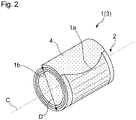
- Fig. 2 illustrates an example of a hair bundle holding body 3.
- the opening 1b is located on the center axis C side.
- Inventors have diligently studied means capable of maintaining a rolled-up state even when heat is applied while the hair holder is retained in its rolled-up state. As a result, Inventors have found that the form of the hair bundle holding body 3 can be maintained, even when heat is applied thereto, by using, for one or both of the two sheets 21, 22, a sheet including a polyester-based nonwoven fabric and whose storage modulus E' in dynamic viscoelasticity is equal to or greater than a predetermined value. Polyester starts to soften with an increase in temperature and its storage modulus E' decreases.
- Storage modulus E' is a physical property representing elastic characteristics. With a greater storage modulus E' at high temperatures, polyester maintains its glass state and does not transition to a viscoelastic state; thus, the polyester-based nonwoven fabric can maintain its shape. That is, the polyester-based nonwoven fabric can maintain its rolled-up state.
- the polyester-based nonwoven fabric can maintain its rolled-up state even when heat is applied thereto due to its high storage modulus E', the polyester-based nonwoven fabric is able to remember the shape of the hair bundle holding body 3 while maintaining its rolled-up state, even when it is cooled in this state. Thus, even after being used once, it can still maintain a shape suitable for rolling up hair.
- the aforementioned sheet has excellent durability and can be used repeatedly.
- the present invention uses the aforementioned sheet, which satisfies such conditions, for one or both of the two sheets 21, 22.
- one of the first sheet 21 and the second sheet 22 is a sheet that satisfies at least one of: the following numerical range for storage modulus E' in dynamic viscoelasticity measured at 100°C at a frequency of 1 Hz; or the following numerical range for storage modulus E' measured at 150°C at a frequency of 1 Hz. It is more preferable that both sheets 21, 22 satisfy both the following numerical range for storage modulus E' measured at 100°C at a frequency of 1 Hz (also referred to hereinafter as "condition (1)”), and the following numerical range for storage modulus E' measured at 150°C at a frequency of 1 Hz (also referred to hereinafter as "condition (2)").
- the temperatures for the storage modulus E' are defined at 100°C and 150°C because the temperature range employed for a heated permanent-waving treatment is typically from 100°C to 150°C, and thus it is thought appropriate to define the storage modulus E' at 100°C and 150°C in order to stably use the hair holder of the invention within the aforementioned temperature range.
- the high storage modulus E' of the hair holder's sheet(s) contributes to both enabling: (i) the hair holder to be maintained in a rolled-up state even when heat is applied while the hair holder is retained in its rolled-up state; and (ii) the hair holder to be used repeatedly.
- the first sheet 21 satisfies the following numerical range for the storage modulus E' measured at 150°C at a frequency of 1 Hz.
- the second sheet 22 satisfies the following numerical range for the storage modulus E' measured at 100°C at a frequency of 1 Hz.
- first sheet 21 and the second sheet 22 it is preferable that at least the first sheet 21, which is located on the inner side in the rolled-up state, satisfies both the conditions (1) and (2), and more preferable that both sheets 21, 22 satisfy both the conditions (1) and (2).
- the storage modulus E' in dynamic viscoelasticity measured under the condition of 100°C at a frequency of 1 Hz is preferably 50 MPa or greater, more preferably 70 MPa or greater, even more preferably 90 MPa or greater.
- the upper limit value of the storage modulus E' measured at 100°C at a frequency of 1 Hz is, the more preferable it is from the viewpoint of heat resistance, but from the viewpoint of softness, the upper limit value is preferably 200 MPa or less, more preferably 100 MPa or less, even more preferably 96.5 MPa or less.
- the storage modulus E' measured at 100°C at a frequency of 1 Hz is preferably from 50 to 200 MPa, more preferably from 70 to 200 MPa, even more preferably from 90 to 200 MPa.
- the storage modulus E' in dynamic viscoelasticity measured under the condition of 150°C at a frequency of 1 Hz is preferably 19.2 MPa or greater, more preferably 20 MPa or greater, further preferably 30 MPa or greater, even more preferably 35 MPa or greater, further more preferably 40 MPa or greater.
- the upper limit value of the storage modulus E' measured at 150°C at a frequency of 1 Hz is, the more preferable it is from the viewpoint of heat resistance, but from the viewpoint of softness, the upper limit value is preferably 80 MPa or less, more preferably 50 MPa or less, even more preferably 45 MPa or less.
- the storage modulus E' measured at 150°C at a frequency of 1 Hz is preferably from 19.2 to 80 MPa, more preferably from 20 to 80 MPa, even more preferably from 30 to 80 MPa, further more preferably from 40 to 80 MPa.
- the storage modulus E' in conditions (1) and (2) is measured according to the following method.
- the temperature for measuring the storage modulus E' has been set to 100°C or 150°C as a result of measuring the temperature of the sheet forming the hair holder 1's innermost surface (about 150°C)-i.e., the surface that contacts a perm rod internally provided with an electrothermal heater-and the temperature of the sheet forming the outermost surface (about 100°C), when the heating temperature was set to 150°C, which is typically employed for performing hair treatment while heating the hair holder by using a perm rod internally provided with an electrothermal heater.
- a dynamic viscoelasticity system (DMS6100 from SII NanoTechnology Inc.) is used.
- a 10-mm wide, 20-mm long rectangular sample is cut out from each of the first sheet 21 and the second sheet 22. These rectangular samples are subjected to measurement at a frequency of 1 Hz in tensile mode while raising the temperature from 20°C to 300°C at a rate of 10°C per minute, to find the storage modulus E' at 100°C and 150°C.
- one of the sheets may be constituted only by a polyester-based nonwoven fabric, or may include a polyester-based nonwoven fabric and a nonwoven fabric made from fibers of another type of polymer. From the viewpoint of allowing the rolled-up state to be maintained easily and also from the viewpoint of adjustment of the heating temperature in the roll-up step, it is preferable that both sheets 21, 22 are constituted only by a polyester-based nonwoven fabric.
- the polyester-based nonwoven fabric may contain fibers of a polyester including, as repeating units, an ester of an aromatic dicarboxylic acid and a saturated aliphatic alcohol.
- polyesters may include polyethylene terephthalate, polytrimethylene terephthalate, polybutylene terephthalate, polyethylene naphthalate, polybutylene naphthalate, etc.
- One type of fiber may be used singly, or two or more types may be used in combination.
- conjugate fibers containing two or more types of the aforementioned polyesters may be used.
- nonwoven fabric including fibers containing polyethylene terephthalate.
- the polyester-based nonwoven fabric may be constituted only by polyester fibers, or may include polyester fibers and fibers made from another type of polymer.
- the polyester-based nonwoven fabric is constituted only by polyester fibers.
- the polyester-based nonwoven fabric includes fibers containing polyethylene terephthalate
- the fibers containing polyethylene terephthalate include an amorphous portion. In this way, even better heat resistance and softness can be imparted to the hair bundle holding body 3. Whether or not there is an amorphous portion is verified by the following method.
- An "amorphous portion" is a portion wherein the polymer's orientation or interval is nonuniform.
- a differential scanning calorimeter "PYRIS Diamond DSC” from PerkinElmer, Inc. is used.
- a 6.9-mg sample is taken out from the hair holder.
- the sample is enclosed in an aluminum closed-type cell and the cell is set to the device's holder.
- the temperature is raised from 25°C to 300°C at a rate of 10°C per minute, to measure the heat quantity. It is known that, at the glass transition point, a change occurs in heat quantity in accordance with the temperature rise. So, the presence/absence of a glass transition point is determined based on the change in heat quantity, and thereby the presence/absence of an amorphous portion is evaluated.
- the glass transition point is a physical property specific to an amorphous region of a resin; a glass transition point is typically observed in amorphous polyesters, but is also observed in cases where a crystalline polyester includes an amorphous region.
- Whether or not one of the two sheets 21, 22 includes a nonwoven fabric can be determined by observation with a microscope. Whether or not the fibers used in the nonwoven fabric are polyester fibers can be analyzed by infrared absorption spectrometry using FT-IR. The type of polyester fiber can be identified by the nuclear magnetic resonance method or pyrolytic analysis, and measurement can be performed according to the method described in the following document.
- no exothermic peak is observed preferably within a range of 110°C or higher, more preferably 100°C or higher.
- no exothermic peak is observed preferably within a range of 200°C or lower, more preferably 300°C or lower.
- polyester resin may undergo crystallization. So, "no exothermic peak is observed within this temperature range" means that the polyester has a high degree of crystallization.
- the exothermic peak is measured according to the method described further below.
- an endothermic peak in differential scanning calorimetry is observed within a range from 100°C to 220°C.
- the aforementioned endothermic peak is observed preferably within a range of 145°C or higher, more preferably 170°C or higher, even more preferably 180°C or higher.
- the endothermic peak is ascribable to the thermal hysteresis of a polyester-based resin.
- the amount of heat absorption calculated from the area of the endothermic curve within the range from 100°C to 220°C is preferably from 0.1 to 10 J/g, more preferably from 0.5 to 5 J/g.
- the amount of heat absorption calculated from the area of the endothermic curve within the range from 120°C to 220°C is preferably from 0.1 to 10 J/g, more preferably from 0.5 to 5 J/g.
- the endothermic peak is measured according to the following method.
- a differential scanning calorimeter "PYRIS Diamond DSC” from PerkinElmer, Inc. is used.
- a 6.9-mg sample is taken out from the hair holder.
- the sample is enclosed in an aluminum closed-type cell and the cell is set to the device's holder.
- the temperature is raised from 25°C to 300°C at a rate of 10°C per minute, to measure the heat quantity.
- the polyester-based nonwoven fabric partially includes embossed portions for fixing the constituent fibers together. Providing embossed portions is effective in suppressing the amount of deformation, upon application of external force, not only in the hair holder 1's non-heated state, but also in the hair holder 1's heated state.
- nonwoven fabrics including embossed portion may include spunbonded nonwoven fabrics obtained by spunbonding, embossed fabrics made using an embossing roller, etc.
- the polyester-based nonwoven fabric has a basis weight of preferably 50 g/m 2 or greater, more preferably 70 g/m 2 or greater, even more preferably 90 g/m 2 or greater.
- the basis weight is preferably 300 g/m 2 or less, more preferably 200 g/m 2 or less, even more preferably 150 g/m 2 or less.
- the basis weight is preferably from 50 to 300 g/m 2 , more preferably from 70 to 200 g/m 2 , even more preferably from 90 to 150 g/m 2 .
- planar-view shape of the embossed portion is not particularly limited, and may be, for example, circular, polygonal, elliptic, etc.
- the area per each embossed portion is preferably 0.01 mm 2 or greater, more preferably 0.1 mm 2 or greater, even more preferably 0.8 mm 2 or greater.
- the aforementioned area is preferably 5 mm 2 or less, more preferably 2 mm 2 or less, even more preferably 1 mm 2 or less.
- the aforementioned area is preferably from 0.01 to 5 mm 2 , more preferably from 0.1 to 2 mm 2 , even more preferably from 0.8 to 1 mm 2 .
- the embossed ratio which is the ratio of the total area found by summing up respective areas of the embossed portions within a 10 ⁇ 10 mm region in the nonwoven fabric, is preferably 10% or greater, more preferably 15% or greater, even more preferably 25% or greater.
- the aforementioned embossed ratio is preferably 50% or less, more preferably 35% or less.
- the aforementioned embossed ratio is preferably from 10% to 50%, more preferably from 15% to 35%, even more preferably from 25% to 35%.
- the dimensions etc. of the hair holder 1 can be determined as appropriate depending on hair length, the location where curls are to be formed, the amount of the hair bundle to be inserted, etc., and are preferably within the following ranges.
- the length L1 (see Fig. 1(b) ) of the hair holder 1 in the longitudinal direction X is preferably 50 mm or greater, more preferably 100 mm or greater.
- the length L1 is preferably 400 mm or less, more preferably 350 mm or less.
- the length L1 is preferably from 50 to 400 mm, more preferably from 100 to 350 mm.
- the length L1 of the hair holder 1 in the longitudinal direction X is the total length of the extension portion 4 and the tubular body 2 in the longitudinal direction X.
- the length L2 (see Fig. 1(b) ) of the tubular body 2 in the longitudinal direction X is preferably 45 mm or greater, more preferably 90 mm or greater.
- the length L2 is preferably 300 mm or less, more preferably 275 mm or less.
- the length L2 is preferably from 45 to 300 mm, more preferably from 90 to 275 mm.
- the length W1 (see Fig. 1(b) ) of the hair holder 1 in the width direction Y is preferably 25 mm or greater, more preferably 30 mm or greater.
- the length W1 is preferably 200 mm or less, more preferably 150 mm or less.
- the length W1 is preferably from 25 to 200 mm, more preferably from 30 to 150 mm.
- the length W2 (see Fig. 1(b) ), in the width direction Y, of the opening 1b at the other end is preferably 10 mm or greater, more preferably 20 mm or greater.
- the length W2 is preferably 195 mm or less, more preferably 145 mm or less.
- the length W2 is preferably from 10 to 195 mm, more preferably from 20 to 145 mm.
- the outer diameter D (see Fig. 2 ) of the hair bundle holding body 3 is not particularly limited, and can be set as appropriate depending on the amount of the hair bundle, the length of the hair bundle, etc. From the viewpoint of workability at the time of roll-up, it is preferable that the outer diameter D is preferably 10 mm or greater, more preferably 15 mm or greater.
- the outer diameter D is preferably 60 mm or less, more preferably 50 mm or less.
- the outer diameter D is preferably from 10 to 60 mm, more preferably from 15 to 50 mm.
- the outer diameter D is the maximum length on a cross section in the radial direction orthogonal to the center axis direction of the hair holder 1 that has been rolled up and formed into a roll shape.
- the maximum length is measured by excluding regions in the roll-shaped tubular body 2 that have risen up, where the layers of the tubular body 2 do not contact/overlap one another.
- a permanent waving agent typically includes a first agent containing a reductive substance such as a thioglycolic acid salt, cysteine, etc., and a second agent containing an oxidizing substance such as a bromic acid salt, hydrogen peroxide, etc.
- two rectangular sheets are prepared. Of the two sheets, one or both of the sheets is/are preferably a polyester-based nonwoven fabric.
- the two sheets are layered on top of each other by placing one sheet on the other sheet, and the sheets' lateral sides, which extend along the longitudinal direction, are integrated.
- the method then includes a roll-up step (also referred to hereinafter as "first step") in which the integrated sheets are rolled up.
- a roll-up step also referred to hereinafter as "first step” in which the integrated sheets are rolled up.
- the method then includes a heating step (also referred to hereinafter as "second step") in which heat treatment is performed under the following conditions while retaining the rolled-up state.
- a heating step also referred to hereinafter as "second step” in which heat treatment is performed under the following conditions while retaining the rolled-up state.
- the heat to be applied in the second step is preferably 300°C or lower, more preferably 250°C or lower, from the viewpoint of performing heat treatment without causing the polyester-based nonwoven fabric to melt or thermally deform.
- the application of heat in the second step may be performed in a dry state, or a method of immersion in an oil bath may be adopted. Note that, in cases of employing an oil bath for heating, the oil needs to be removed after heating.
- heat to the hair holder in its rolled-up state by employing superheated vapor heated to a temperature equal to or above the boiling point.
- the heating time is faster compared to heating in a dry state, and productivity is improved compared to heating with an oil bath.
- heating in a dry state is preferable compared to heating with an oil bath or superheated vapor from the viewpoint that it does not require a step for removing oil, water, etc., after heating and is thus favorable in terms of workability.
- the superheated vapor is typically superheated water vapor.
- the heating time for applying heat is preferably within 1 minute, more preferably within 45 seconds. From the viewpoint of reliably imparting the aforementioned storage modulus E' to the hair holder, it is preferable to perform heating for at least 20 seconds.
- the heating time for applying heat is preferably within 60 minutes, more preferably within 30 minutes. From the viewpoint of reliably imparting the aforementioned storage modulus E' to the hair holder, it is preferable to perform heating for at least 55 minutes.
- the roll-up step and the heating step may be performed in different locations and/or may be performed with a time interval therebetween. From the viewpoint of improving productivity of the hair holder, it is preferable to perform the roll-up step and the heating step consecutively, without interposing another step therebetween.
- the hair treatment method preferably includes a step (a) of inserting a hair bundle H into the tubular portion 26 of the hair holder 1.
- the hair treatment method preferably includes a step (b) of rolling up the hair holder 1 together with the hair bundle H inserted into the tubular portion 26, to thereby form a hair bundle holding body 3 in a rolled-up state.
- the hair treatment method preferably includes a step (c) of heating the hair bundle holding body 3.
- the hair of the hair bundle H is preferably hair on the human head.
- the hair bundle H in the step (c), can be heated to 80°C or higher while being retained in a rolled-up state.
- the hair holder 1 one or both of the two sheets 21, 22 has/have a storage modulus E' that is equal to or above the aforementioned value.
- the hair holder 1 has excellent durability and can be used repeatedly.
- the hair holder 1 of the invention can achieve such effects as that deformation of the hair holder, which may be caused by the effect of the permanent waving agent and heat, is suppressed, and the hair holder can be used repeatedly.
- the hair holder 1 is designed such that, even when heated to a temperature higher than 80°C, or 90°C or higher, or even 100°C or higher, during the treatment step, the rolled-up state can be retained and durability is not impaired.
- the hair holder is heated to 80°C or higher using an electrothermal heater.
- the electrothermal heater is removed after the permanent waving treatment.
- the hair holder of the invention can achieve such effects as that the electrothermal heater can be removed not only after the permanent waving treatment, but at a discretionary timing.
- the first sheet 21 which is located on the inner side when rolled up and contacts the perm rod, is a sheet having a storage modulus E' equal to or above the aforementioned value.
- the hair holder of the invention is not limited to the foregoing embodiments, and modifications can be made as appropriate, so long as they do not depart from the gist of the invention.
- the surface of a sheet constituting the tubular body 2 may have projections and depressions by being subjected to embossing etc., or may be flat.
- Examples 1 to 6 and Comparative Examples 1 to 4 For the two sheets constituting the hair holder, "Smash (registered trademark)" from Asahi Kasei Corporation was used. This sheet is a nonwoven fabric including polyethylene terephthalate as material fibers and made by spunbonding. The basis weight of the nonwoven fabric was 100 g/m 2 . The area per each embossed portion was 0.8 mm 2 , and the embossed ratio was 30%. This sheet was used to prepare the hair holder having the shape illustrated in Figs. 1(a) and 1(b) .
- the length L1 was 300 mm
- the tubular body's length L2 was 250 mm
- the tubular body's length W1 was 86 mm
- the length W2 of the opening at the other end was 76 mm.
- the hair holder was rolled up such that the outer diameter D was 26 mm, and while retaining this state, heat of respective temperatures shown in Table 1 below was applied, to prepare the respective hair holders of the Examples and Comparative Examples. In all of the Examples and Comparative Examples, heat was applied in a dry state. In all of the Examples and Comparative Examples, the heat was applied for 20 minutes.
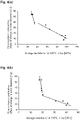
- heat resistance was evaluated for the hair holders of the Examples and Comparative Examples. Heat resistance was evaluated according to the following evaluation criteria. The evaluation results are shown in Table 1 below and Figs. 4(a) and 4(b) . If evaluation is to be performed in a state where hair is actually inserted in the hair holder, it is difficult to prepare hair samples in which the pieces of hair to be inserted have the identical diameter, hardness, etc. Therefore, instead of evaluating hair holders with hair inserted therethrough, the heat resistance of each hair holder was evaluated according to the following method. It can be judged that, if the heat resistance of the hair holder is high, the rolled-up state of the hair holder, having hair inserted therethrough, can be maintained and also the hair holder can be used repeatedly.
- Fig. 4(a) clearly show that the slope of the ratio of change in outer diameter changes greatly when the storage modulus E' at 100°C at a frequency of 1 Hz is 50 MPa or greater, and the ratio of change in outer diameter tends to stabilize.
- Fig. 4(b) clearly show that the slope of the ratio of change in outer diameter changes greatly when the storage modulus E' at 150°C at a frequency of 1 Hz is 19.2 MPa or greater, and the ratio of change in outer diameter tends to stabilize.
- the results show that the hair holders of Examples 3 to 6, wherein the storage modulus E' at 150°C at a frequency of 1 Hz is 30 MPa or greater, have especially good heat resistance.
- the hair holders of Examples 1 to 6 can be expected to be able to maintain the hair holders' rolled-up state even when heat is applied while retaining the rolled-up state, and thereby impart a firm curly shape to a hair bundle.
- the hair holder according to the present invention can maintain its rolled-up state, even when heat is applied thereto while being retained in its rolled-up state.
Landscapes
- Engineering & Computer Science (AREA)
- Textile Engineering (AREA)
- Chemical & Material Sciences (AREA)
- Chemical Kinetics & Catalysis (AREA)
- Physics & Mathematics (AREA)
- Thermal Sciences (AREA)
- Hair Curling (AREA)
- Cosmetics (AREA)
- Nonwoven Fabrics (AREA)
Abstract
Description
- The present application claims the benefit of priority from International Application No.
PCT/JP2019/031729 filed August 9, 2019 PCT/JP2019/031729 - The present invention relates to a hair holder, a method for manufacturing the hair holder, and a hair treatment method using the hair holder.
- Hair holders used for applying curls to hair bundles are known in the art. Applicant has previously proposed a hair holder including a tubular body constructed in such a manner that a hair bundle is insertable therethrough (Patent Literature 1).
-
Patent Literature 2, relating to a technology separate from a hair holder, discloses that a polyester film can be provided with good heat resistance in cases where the storage modulus in dynamic viscoelasticity, as measured under predetermined conditions, is greater than a predetermined value. - Applicant has also proposed a hair holder wherein a reinforcement member is provided to a tubular body through which a hair bundle is to be inserted (Patent Literature 3).
-
Patent Literature 4, relating to a technology separate from a hair holder, discloses that heat resistance can be improved by heating amorphous polyethylene terephthalate, which has a low crystallization degree, with superheated water vapor to thereby increase the crystallization degree. -
- Patent Literature 1:
WO 2019/131734 - Patent Literature 2:
US 2018/044507A1 - Patent Literature 3:
JP 2005-246040A - Patent Literature 4:
JP 2012-245700A - The present invention relates to a hair holder comprising a tubular body which has a first opening located at one end and a second opening located at the other end. The tubular body is constructed in such a manner that a hair bundle is insertable from the first opening toward the second opening. The hair holder has a longitudinal direction and a width direction orthogonal to the longitudinal direction. Preferably, in one embodiment, the hair holder is constructed in such a manner that the hair holder can be rolled up along the longitudinal direction. Preferably, in one embodiment, the hair holder includes a first sheet to be located on an inner side in a state where the hair holder is rolled up, and a second sheet to be located on an outer side in a state where the hair holder is rolled up. Preferably, in the hair holder of the invention, one or both of the first sheet and the second sheet satisfies at least one of condition (1) or (2) below:
- (1) the sheet includes a polyester-based nonwoven fabric, and the sheet's storage modulus E' in dynamic viscoelasticity measured at 100°C at a frequency of 1 Hz is 50 MPa or greater.
- (2) the sheet includes a polyester-based nonwoven fabric, and the sheet's storage modulus E' in dynamic viscoelasticity measured at 150°C at a frequency of 1 Hz is 19.2 MPa or greater.
- The present invention also relates to a method for manufacturing a hair holder including a tubular body being constructed in such a manner that a hair bundle is insertable from an opening at one end toward an opening at the other end and being in a rolled-up state.
- Preferably, in one embodiment, the hair holder includes a first sheet located on an inner side in the rolled-up state and a second sheet located on an outer side, wherein one or both of the first sheet and the second sheet includes a polyester-based nonwoven fabric.
- Preferably, in one embodiment, the method for manufacturing a hair holder includes a roll-up step of rolling up the hair holder.
- Preferably, in one embodiment, the method for manufacturing a hair holder includes a heating step of applying heat of 120°C or higher while retaining the rolled-up state of the hair holder.
- The present invention also relates to a method for treating hair employing the aforementioned hair holder.
- Preferably, in one embodiment, the method includes inserting a hair bundle into the hair holder, and then rolling up the hair holder.
- Preferably, in one embodiment, the method includes heating the hair bundle to 80°C or higher while retaining the rolled-up state of the hair holder.
- Other features of the present invention are disclosed through the claims and the following description.
-
- [
Fig. 1] Fig. 1 illustrates a front view (a) and a rear view (b) illustrating an embodiment of a hair holder of the present invention. - [
Fig. 2] Fig. 2 is a perspective view illustrating a hair bundle holding body of the hair holder illustrated inFigs. 1(a) and 1(b) . - [
Fig. 3] Figs. 3(a) to 3(c) are diagrams sequentially illustrating steps for applying a curly shape to a hair bundle by using the hair holder illustrated inFigs. 1(a) and 1(b) . - [
Fig. 4] Fig. 4(a) is a graph showing a relationship between the storage modulus E' in dynamic viscoelasticity measured at 100°C at a frequency of 1 Hz and heat resistance evaluation for the respective hair holders obtained in the Examples and Comparative Examples, andFig. 4(b) is a graph showing a relationship between the storage modulus E' in dynamic viscoelasticity measured at 150°C at a frequency of 1 Hz and heat resistance evaluation for the respective hair holders obtained in the Examples and Comparative Examples. - In the present Description, in cases where an upper limit value or a lower limit value of a numerical value, or upper and lower limit values of a range, is/are defined, the upper limit value and lower limit value themselves are to be included. Further, it is to be construed that the Description describes, even if not explicitly stated, all numerical values/numerical ranges equal to or below an upper limit value of a numerical value, or equal to or above a lower limit value, or within a range between upper and lower limit values.
- In the present Description, "a," "an," etc., are construed to mean "one or more."
- From the above and below disclosure of the present Description, it is understood that various modifications and/or alterations of the present invention are possible. It should thus be understood that the present invention is workable within the technical scope based on the recitations of the present scope of claims, even with embodiments that are not explicitly described in the present Description.
- The entire disclosure of each of the aforementioned Patent Literatures is incorporated herein by reference.
- To apply a firm curly shape to a hair bundle, heat may be applied while retaining a hair holder in a rolled-up state. The hair holder disclosed in
Patent Literature 1, however, is not intended for application of heat while being retained in its rolled-up state. The document describes nothing about using the hair holder stably in a temperature range (100°C to 150°C) used for permanent waving by applying heat. - The polyester film disclosed in
Patent Literature 2 is used for an electrical insulating sheet, an adhesive sheet, etc., and is different from a hair holder in terms of technical field. The document discloses the storage modulus in dynamic viscoelasticity measured at 100°C, but does not disclose the storage modulus measured at 150°C. In the field of polymeric materials, it is known that changes occur in the physical properties of resin at the resin's glass transition point, melting point, etc. Thus, in cases where the glass transition point, melting point, etc., exist in a range between 100°C and 150°C, the resin's physical properties may change drastically, and the storage modulus at 100°C may not necessarily be in a proportional relationship with the storage modulus at 150°C. The document neither discloses nor suggests anything about problems specific to hair holders used for permanent waving performed by applying heat of 100°C or higher, nor about methods for solving such problems. Further, although the document discloses the use of polyester for a film, it discloses nothing about the use of polyester for a nonwoven fabric. - The hair holder disclosed in
Patent Literature 3 is not intended for application of heat while being retained in its rolled-up state. The hair holder disclosed therein involves issues concerning the hair holder's spontaneous roll-up force, and is not intended for application of heat while being retained in its rolled-up state. The document describes nothing about applying heat of a predetermined temperature or higher in a method for manufacturing the hair holder. -
Patent Literature 4 discloses a heat-resistant transparent container formed by using amorphous polyethylene terephthalate, which belongs to a different technical field from hair holders. The amorphous polyethylene terephthalate sheet disclosed in the document is not used as-is in the form of a sheet, but is heated and completely molten to manufacture a container, and thus belongs to a different technical field from hair holders. The document describes that the container exhibits transparency and heat resistance as a result of drawing the sheet and thermally fixing the same by heating it to 130°C to 200°C. In the field of polymeric materials, it is known that drawing of a transparent polymeric film creates, within the film, fibrils and voids oriented in the stress directions, which causes crazing, or whitening, because the refractive index of the void/fibril portions is different from that of other portions. It is thought that the technology disclosed inPatent Literature 4 is for suppressing crazing. The document, however, neither describes nor suggests anything about problems specific to hair holders provided with sheets including nonwoven fabrics. To begin with, the sheet constituting the hair holder of the present invention is a nonwoven fabric, and therefore transparency is not required. Further, the document neither describes nor suggests anything about the curling/waving effect, which is specific to hair holders for applying firm curls to hair bundles. - The present invention relates a hair holder capable of maintaining its rolled-up state even when heat is applied while the hair holder is retained in a rolled-up state, and a hair treatment method using the same.
- The present invention also relates to a method for manufacturing such a hair holder.
- A hair holder according to the present invention will be described below according to preferred embodiments thereof with reference to the drawings.
- The hair holder of the invention is used for applying a curly shape to a hair bundle.
- The hair holder of the invention is primarily used for treating hair on the human head.
-
Figs. 1(a) and 1(b) illustrate an embodiment of a hair holder of the invention. - The
hair holder 1 illustrated inFigs. 1(a) and 1(b) includes atubular body 2 constructed in such a manner that a hair bundle H is insertable from anopening 1a at one end toward anopening 1b at the other end. Thehair holder 1 has a longitudinal direction X and a width direction Y orthogonal to the longitudinal direction X. - Typically, the
hair holder 1 includes two sheets-i.e., afirst sheet 21 and a second sheet 22-forming an outer surface of thehair holder 1. The twosheets - Typically, the
hair holder 1 has a flat shape in which the twosheets - The
first sheet 21 is to be located on the inner side in a state where thehair holder 1 is rolled up, whereas thesecond sheet 22 is to be located on the outer side in a state where the hair holder is rolled up. - The
hair holder 1 includes: a pair of lateral-side joinedportions first sheet 21 and thesecond sheet 22; and atubular portion 26 located between the pair of lateral-side joinedportions portions hair holder 1's longitudinal direction X. - The
tubular portion 26 is constructed in such a manner that a hair bundle H is insertable therethrough between theopening 1a at one end and theopening 1b at the other end in the longitudinal direction X. Thehair holder 1's longitudinal direction X corresponds to the direction in which the hair bundle H is inserted. - From the viewpoint of preventing peeling from the joined portions at the time of heating to perform hair treatment, it is preferable that the lateral-side joined
portions - In the embodiment illustrated in
Figs. 1(a) and 1(b) , both lateral side edge portions along thehair holder 1's longitudinal direction X are parallel to one another. Instead, the lateral side edge portions do not have to be parallel to one another. In such cases, it is preferable that the width between the lateral side edge portions becomes gradually wider from theopening 1a at one end toward theopening 1b at the other end. Stated differently, it is preferable that, in a planar view, thehair holder 1 has a shape that widens from theopening 1a at one end toward theopening 1b at the other end. - Preferably, the
hair holder 1 is constructed in such a manner that it can be rolled up along the longitudinal direction X. Preferably, thehair holder 1 is constructed in such a manner that it rolls up automatically. Instead, thehair holder 1 may be constructed in such a manner that it is rolled up manually. - An example of an automatically rolling-up construction may include a construction wherein the
hair holder 1 is initially rolled up in a state where no tension is applied in the longitudinal direction X to thehair holder 1, and after thehair holder 1 is stretched out and a hair bundle is inserted therethrough and then the stretched-out state is released, thehair holder 1 rolls up spontaneously together with the hair bundle. - Such a construction can be achieved by making one or both of the two
sheets hair holder 1 from a shape memory sheet that remembers the rolled-up state of thehair holder 1. - The shape memory sheet may be made, for example, by bonding together films having different thermal contraction rates.
- As illustrated in
Figs. 1(a) and 1(b) , thehair holder 1 includes anextension portion 4 on theopening 1a side. The extension portion is formed by thefirst sheet 21 extending outward in the longitudinal direction X from thetubular body 2. Theextension portion 4 is formed integrally with thefirst sheet 21. Providing thehair holder 1 with theextension portion 4 enables a hair bundle to be inserted into thetubular portion 26 more easily. Theextension portion 4 may be formed by a sheet separate from thefirst sheet 21. Alternatively, thehair holder 1 does not have to include an extension portion. - Preferably, the
hair holder 1 includes a fixingmember 5 for retaining the hair holder's rolled-up state. - Preferably, the fixing
member 5 is arranged on the outer surface of theextension portion 4. - Preferably, the fixing
member 5 is detachably engageable to the outer surface of thesecond sheet 22. - In the hair
bundle holding body 3, the fixingmember 5 is arranged so as to oppose a portion of the outer surface of thesecond sheet 22, and is joined to a portion of the outer surface. In this way, thehair holder 1 can be maintained in the form of the hairbundle holding body 3. - Examples of the fixing member may include a sheet engagement member, a joining member, etc. Examples of the sheet engagement member may include a snap fastener, a male member of a mechanical fastener, etc. Examples of the joining member may include a magnet, an adherend-selective adhesive tape that joins only with specific substances.
- After a hair bundle has been inserted from the
opening 1a toward theopening 1b, the rolled-up state of thehair holder 1 is accomplished by rolling up the hair holder together with the hair bundle. Hereinbelow, thehair holder 1 in a rolled-up state is also referred to as a hairbundle holding body 3. -
Fig. 2 illustrates an example of a hairbundle holding body 3. In the hairbundle holding body 3 illustrated in the figure, theopening 1b is located on the center axis C side. By applying heat to the hair bundle in the state illustrated in the figure, curls can be applied to the hair bundle. - Inventors have diligently studied means capable of maintaining a rolled-up state even when heat is applied while the hair holder is retained in its rolled-up state. As a result, Inventors have found that the form of the hair
bundle holding body 3 can be maintained, even when heat is applied thereto, by using, for one or both of the twosheets bundle holding body 3's rolled-up state can be maintained during heating. Storage modulus E' is a physical property representing elastic characteristics. With a greater storage modulus E' at high temperatures, polyester maintains its glass state and does not transition to a viscoelastic state; thus, the polyester-based nonwoven fabric can maintain its shape. That is, the polyester-based nonwoven fabric can maintain its rolled-up state. Since the polyester-based nonwoven fabric can maintain its rolled-up state even when heat is applied thereto due to its high storage modulus E', the polyester-based nonwoven fabric is able to remember the shape of the hairbundle holding body 3 while maintaining its rolled-up state, even when it is cooled in this state. Thus, even after being used once, it can still maintain a shape suitable for rolling up hair. - Further, Inventors have found that the aforementioned sheet has excellent durability and can be used repeatedly.
- The present invention uses the aforementioned sheet, which satisfies such conditions, for one or both of the two
sheets - From the viewpoint of making the aforementioned effect more significant, it is preferable that one of the
first sheet 21 and thesecond sheet 22 is a sheet that satisfies at least one of: the following numerical range for storage modulus E' in dynamic viscoelasticity measured at 100°C at a frequency of 1 Hz; or the following numerical range for storage modulus E' measured at 150°C at a frequency of 1 Hz. It is more preferable that bothsheets - The temperatures for the storage modulus E' are defined at 100°C and 150°C because the temperature range employed for a heated permanent-waving treatment is typically from 100°C to 150°C, and thus it is thought appropriate to define the storage modulus E' at 100°C and 150°C in order to stably use the hair holder of the invention within the aforementioned temperature range.
- In the hair holder of the invention, the high storage modulus E' of the hair holder's sheet(s) contributes to both enabling: (i) the hair holder to be maintained in a rolled-up state even when heat is applied while the hair holder is retained in its rolled-up state; and (ii) the hair holder to be used repeatedly.
- From the viewpoint of favorably maintaining the rolled-up state at high temperatures for applying firm curls/waves, it is even preferable that the
first sheet 21 satisfies the following numerical range for the storage modulus E' measured at 150°C at a frequency of 1 Hz. - From the viewpoint of favorably maintaining the rolled-up state at relatively low temperatures giving consideration to burden on the hair, it is even preferable that the
second sheet 22 satisfies the following numerical range for the storage modulus E' measured at 100°C at a frequency of 1 Hz. - Of the
first sheet 21 and thesecond sheet 22, it is preferable that at least thefirst sheet 21, which is located on the inner side in the rolled-up state, satisfies both the conditions (1) and (2), and more preferable that bothsheets - From the viewpoint of favorably maintaining the rolled-up state at relatively low temperatures giving consideration to burden on the hair, it is preferable that, in the condition (1), the storage modulus E' in dynamic viscoelasticity measured under the condition of 100°C at a frequency of 1 Hz is preferably 50 MPa or greater, more preferably 70 MPa or greater, even more preferably 90 MPa or greater.
- In the condition (1), the higher the upper limit value of the storage modulus E' measured at 100°C at a frequency of 1 Hz is, the more preferable it is from the viewpoint of heat resistance, but from the viewpoint of softness, the upper limit value is preferably 200 MPa or less, more preferably 100 MPa or less, even more preferably 96.5 MPa or less.
- In the condition (1), the storage modulus E' measured at 100°C at a frequency of 1 Hz is preferably from 50 to 200 MPa, more preferably from 70 to 200 MPa, even more preferably from 90 to 200 MPa.
- From the viewpoint of favorably maintaining the rolled-up state at high temperatures for applying firm curls/waves, it is preferable that, in the condition (2), the storage modulus E' in dynamic viscoelasticity measured under the condition of 150°C at a frequency of 1 Hz is preferably 19.2 MPa or greater, more preferably 20 MPa or greater, further preferably 30 MPa or greater, even more preferably 35 MPa or greater, further more preferably 40 MPa or greater.
- In the condition (2), the higher the upper limit value of the storage modulus E' measured at 150°C at a frequency of 1 Hz is, the more preferable it is from the viewpoint of heat resistance, but from the viewpoint of softness, the upper limit value is preferably 80 MPa or less, more preferably 50 MPa or less, even more preferably 45 MPa or less.
- In the condition (2), the storage modulus E' measured at 150°C at a frequency of 1 Hz is preferably from 19.2 to 80 MPa, more preferably from 20 to 80 MPa, even more preferably from 30 to 80 MPa, further more preferably from 40 to 80 MPa.
- The storage modulus E' in conditions (1) and (2) is measured according to the following method. The temperature for measuring the storage modulus E' has been set to 100°C or 150°C as a result of measuring the temperature of the sheet forming the
hair holder 1's innermost surface (about 150°C)-i.e., the surface that contacts a perm rod internally provided with an electrothermal heater-and the temperature of the sheet forming the outermost surface (about 100°C), when the heating temperature was set to 150°C, which is typically employed for performing hair treatment while heating the hair holder by using a perm rod internally provided with an electrothermal heater. - A dynamic viscoelasticity system (DMS6100 from SII NanoTechnology Inc.) is used. A 10-mm wide, 20-mm long rectangular sample is cut out from each of the
first sheet 21 and thesecond sheet 22. These rectangular samples are subjected to measurement at a frequency of 1 Hz in tensile mode while raising the temperature from 20°C to 300°C at a rate of 10°C per minute, to find the storage modulus E' at 100°C and 150°C. - Of the two
sheets sheets - The polyester-based nonwoven fabric may contain fibers of a polyester including, as repeating units, an ester of an aromatic dicarboxylic acid and a saturated aliphatic alcohol.
- Examples of such polyesters may include polyethylene terephthalate, polytrimethylene terephthalate, polybutylene terephthalate, polyethylene naphthalate, polybutylene naphthalate, etc. One type of fiber may be used singly, or two or more types may be used in combination. Alternatively or additionally, conjugate fibers containing two or more types of the aforementioned polyesters may be used.
- Among the above, from the viewpoint of excellent heat resistance, it is preferable to use a nonwoven fabric including fibers containing polyethylene terephthalate.
- The polyester-based nonwoven fabric may be constituted only by polyester fibers, or may include polyester fibers and fibers made from another type of polymer. Preferably, the polyester-based nonwoven fabric is constituted only by polyester fibers.
- In cases where the polyester-based nonwoven fabric includes fibers containing polyethylene terephthalate, it is even preferable that the fibers containing polyethylene terephthalate include an amorphous portion. In this way, even better heat resistance and softness can be imparted to the hair
bundle holding body 3. Whether or not there is an amorphous portion is verified by the following method. An "amorphous portion" is a portion wherein the polymer's orientation or interval is nonuniform. - A differential scanning calorimeter "PYRIS Diamond DSC" from PerkinElmer, Inc. is used. A 6.9-mg sample is taken out from the hair holder. The sample is enclosed in an aluminum closed-type cell and the cell is set to the device's holder. The temperature is raised from 25°C to 300°C at a rate of 10°C per minute, to measure the heat quantity. It is known that, at the glass transition point, a change occurs in heat quantity in accordance with the temperature rise. So, the presence/absence of a glass transition point is determined based on the change in heat quantity, and thereby the presence/absence of an amorphous portion is evaluated. The glass transition point is a physical property specific to an amorphous region of a resin; a glass transition point is typically observed in amorphous polyesters, but is also observed in cases where a crystalline polyester includes an amorphous region.
- Whether or not one of the two
sheets - Toshinori ANDO and one other, "Examination of effective analysis methods for discrimination of polytrimethylene terephthalate", Reports of the Central Customs Laboratory, Vol. 59, Central Customs Laboratory, Ministry of Finance, December 2019, pp. 119-126, Internet.

- From the viewpoint of imparting even better heat resistance and softness to the hair
bundle holding body 3, it is preferable that, in one of the twosheets - From the viewpoint of imparting heat resistance, it is preferable that no exothermic peak is observed preferably within a range of 110°C or higher, more preferably 100°C or higher.
- From the viewpoint of imparting softness, it is preferable that no exothermic peak is observed preferably within a range of 200°C or lower, more preferably 300°C or lower.
- From the viewpoint of imparting both heat resistance and softness, it is further preferable that, in both
sheets - In this temperature range, polyester resin may undergo crystallization. So, "no exothermic peak is observed within this temperature range" means that the polyester has a high degree of crystallization. The exothermic peak is measured according to the method described further below.
- From the viewpoint of imparting even better heat resistance and softness to the hair
bundle holding body 3, it is preferable that, in one of the twosheets - From the viewpoint of imparting heat resistance, it is preferable that the aforementioned endothermic peak is observed preferably within a range of 145°C or higher, more preferably 170°C or higher, even more preferably 180°C or higher.
- From the viewpoint of imparting heat resistance and softness, it is preferable that, in both
sheets - The endothermic peak is ascribable to the thermal hysteresis of a polyester-based resin.
- From the viewpoint of imparting heat resistance and softness, it is preferable that, as regards the endothermic peak, the amount of heat absorption calculated from the area of the endothermic curve within the range from 100°C to 220°C is preferably from 0.1 to 10 J/g, more preferably from 0.5 to 5 J/g.
- Particularly, from the viewpoint of imparting heat resistance and softness, it is preferable that, as regards the endothermic peak, the amount of heat absorption calculated from the area of the endothermic curve within the range from 120°C to 220°C is preferably from 0.1 to 10 J/g, more preferably from 0.5 to 5 J/g.
- The endothermic peak is measured according to the following method.
- A differential scanning calorimeter "PYRIS Diamond DSC" from PerkinElmer, Inc. is used. A 6.9-mg sample is taken out from the hair holder. The sample is enclosed in an aluminum closed-type cell and the cell is set to the device's holder. The temperature is raised from 25°C to 300°C at a rate of 10°C per minute, to measure the heat quantity.
- It is preferable that the polyester-based nonwoven fabric partially includes embossed portions for fixing the constituent fibers together. Providing embossed portions is effective in suppressing the amount of deformation, upon application of external force, not only in the
hair holder 1's non-heated state, but also in thehair holder 1's heated state. - Examples of nonwoven fabrics including embossed portion may include spunbonded nonwoven fabrics obtained by spunbonding, embossed fabrics made using an embossing roller, etc.
- From the viewpoint of maintaining rigidity as a hair holder and also achieving good absorptivity of permanent waving agents, it is preferable that the polyester-based nonwoven fabric has a basis weight of preferably 50 g/m2 or greater, more preferably 70 g/m2 or greater, even more preferably 90 g/m2 or greater.
- From the viewpoint of achieving good roll-up properties while achieving good permeability of permanent waving solutions, it is preferable that the basis weight is preferably 300 g/m2 or less, more preferably 200 g/m2 or less, even more preferably 150 g/m2 or less.
- The basis weight is preferably from 50 to 300 g/m2, more preferably from 70 to 200 g/m2, even more preferably from 90 to 150 g/m2.
- The planar-view shape of the embossed portion is not particularly limited, and may be, for example, circular, polygonal, elliptic, etc.
- From the viewpoint of achieving good permeability of permanent waving agents, it is preferable that the area per each embossed portion is preferably 0.01 mm2 or greater, more preferably 0.1 mm2 or greater, even more preferably 0.8 mm2 or greater.
- From the viewpoint of achieving good absorptivity of permanent waving agents, it is preferable that the aforementioned area is preferably 5 mm2 or less, more preferably 2 mm2 or less, even more preferably 1 mm2 or less.
- The aforementioned area is preferably from 0.01 to 5 mm2, more preferably from 0.1 to 2 mm2, even more preferably from 0.8 to 1 mm2.
- From the viewpoint of achieving good permeability of permanent waving agents, it is preferable that the embossed ratio, which is the ratio of the total area found by summing up respective areas of the embossed portions within a 10×10 mm region in the nonwoven fabric, is preferably 10% or greater, more preferably 15% or greater, even more preferably 25% or greater.
- From the viewpoint of achieving good absorptivity of permanent waving agents, it is preferable that the aforementioned embossed ratio is preferably 50% or less, more preferably 35% or less.
- The aforementioned embossed ratio is preferably from 10% to 50%, more preferably from 15% to 35%, even more preferably from 25% to 35%.
- The dimensions etc. of the
hair holder 1 can be determined as appropriate depending on hair length, the location where curls are to be formed, the amount of the hair bundle to be inserted, etc., and are preferably within the following ranges. - From the viewpoint of reliably holding the hair bundle and applying curls/waves to the hair bundle, it is preferable that the length L1 (see
Fig. 1(b) ) of thehair holder 1 in the longitudinal direction X is preferably 50 mm or greater, more preferably 100 mm or greater. - From the viewpoint of allowing the hair bundle to extend through the tubular body easily, it is preferable that the length L1 is preferably 400 mm or less, more preferably 350 mm or less.
- The length L1 is preferably from 50 to 400 mm, more preferably from 100 to 350 mm. The length L1 of the
hair holder 1 in the longitudinal direction X is the total length of theextension portion 4 and thetubular body 2 in the longitudinal direction X. - From the viewpoint of reliably holding the hair bundle and applying curls/waves to the hair bundle, it is preferable that the length L2 (see
Fig. 1(b) ) of thetubular body 2 in the longitudinal direction X is preferably 45 mm or greater, more preferably 90 mm or greater. - From the viewpoint of allowing the hair bundle to extend through the tubular body easily, it is preferable that the length L2 is preferably 300 mm or less, more preferably 275 mm or less.
- The length L2 is preferably from 45 to 300 mm, more preferably from 90 to 275 mm.
- From the viewpoint of allowing the hair bundle to extend through the tubular body easily, it is preferable that the length W1 (see
Fig. 1(b) ) of thehair holder 1 in the width direction Y is preferably 25 mm or greater, more preferably 30 mm or greater. - From the viewpoint of suppressing the hair bundle from spreading inside the tubular body to thereby apply curls/waves uniformly, it is preferable that the length W1 is preferably 200 mm or less, more preferably 150 mm or less.
- The length W1 is preferably from 25 to 200 mm, more preferably from 30 to 150 mm.
- From the viewpoint of allowing the hair bundle to extend through the tubular body easily, it is preferable that the length W2 (see
Fig. 1(b) ), in the width direction Y, of theopening 1b at the other end is preferably 10 mm or greater, more preferably 20 mm or greater. - From the viewpoint of suppressing the hair bundle from spreading inside the tubular body to thereby apply curls/waves uniformly, it is preferable that the length W2 is preferably 195 mm or less, more preferably 145 mm or less.
- The length W2 is preferably from 10 to 195 mm, more preferably from 20 to 145 mm.
- The outer diameter D (see
Fig. 2 ) of the hairbundle holding body 3 is not particularly limited, and can be set as appropriate depending on the amount of the hair bundle, the length of the hair bundle, etc. From the viewpoint of workability at the time of roll-up, it is preferable that the outer diameter D is preferably 10 mm or greater, more preferably 15 mm or greater. - From the viewpoint of favorably applying a curly shape to a hair bundle, it is preferable that the outer diameter D is preferably 60 mm or less, more preferably 50 mm or less.
- The outer diameter D is preferably from 10 to 60 mm, more preferably from 15 to 50 mm.
- The outer diameter D is the maximum length on a cross section in the radial direction orthogonal to the center axis direction of the
hair holder 1 that has been rolled up and formed into a roll shape. The maximum length is measured by excluding regions in the roll-shapedtubular body 2 that have risen up, where the layers of thetubular body 2 do not contact/overlap one another. - In cases of using a hair treatment agent at the time of applying a curly shape to the hair bundle H, the type of hair treatment agent is not particularly limited, and any agent can be used discretionarily, such as a commercially available permanent waving agent, etc. A permanent waving agent typically includes a first agent containing a reductive substance such as a thioglycolic acid salt, cysteine, etc., and a second agent containing an oxidizing substance such as a bromic acid salt, hydrogen peroxide, etc.
- Next, a method for manufacturing a hair holder according to the present invention will be described.
- First, two rectangular sheets are prepared. Of the two sheets, one or both of the sheets is/are preferably a polyester-based nonwoven fabric.
- Next, preferably, the two sheets are layered on top of each other by placing one sheet on the other sheet, and the sheets' lateral sides, which extend along the longitudinal direction, are integrated.
- Preferably, the method then includes a roll-up step (also referred to hereinafter as "first step") in which the integrated sheets are rolled up.
- Preferably, the method then includes a heating step (also referred to hereinafter as "second step") in which heat treatment is performed under the following conditions while retaining the rolled-up state.
- From the viewpoint of imparting a storage modulus E' of 50 MPa or greater at 100°C at a frequency of 1 Hz, in the second step, it is preferable to apply heat of 120°C or higher, and more preferably apply heat of 140°C or higher, while retaining the aforementioned rolled-up state.
- Further, from the viewpoint of imparting a storage modulus E' of 19.2 MPa or greater at 150°C at a frequency of 1 Hz, in the second step, it is preferable to apply heat of 160°C or higher, and more preferably apply heat of 180°C or higher, while retaining the aforementioned rolled-up state.
- The heat to be applied in the second step is preferably 300°C or lower, more preferably 250°C or lower, from the viewpoint of performing heat treatment without causing the polyester-based nonwoven fabric to melt or thermally deform.
- The application of heat in the second step may be performed in a dry state, or a method of immersion in an oil bath may be adopted. Note that, in cases of employing an oil bath for heating, the oil needs to be removed after heating.
- From this viewpoint, it is preferable to apply heat to the hair holder in its rolled-up state by employing superheated vapor heated to a temperature equal to or above the boiling point. By employing superheated vapor, the heating time is faster compared to heating in a dry state, and productivity is improved compared to heating with an oil bath. On the other hand, heating in a dry state is preferable compared to heating with an oil bath or superheated vapor from the viewpoint that it does not require a step for removing oil, water, etc., after heating and is thus favorable in terms of workability.
- The superheated vapor is typically superheated water vapor.
- In cases of heating with an oil bath or superheated vapor, it is preferable that the heating time for applying heat is preferably within 1 minute, more preferably within 45 seconds. From the viewpoint of reliably imparting the aforementioned storage modulus E' to the hair holder, it is preferable to perform heating for at least 20 seconds.
- In cases of heating in a dry state, it is preferable that the heating time for applying heat is preferably within 60 minutes, more preferably within 30 minutes. From the viewpoint of reliably imparting the aforementioned storage modulus E' to the hair holder, it is preferable to perform heating for at least 55 minutes.
- The roll-up step and the heating step may be performed in different locations and/or may be performed with a time interval therebetween. From the viewpoint of improving productivity of the hair holder, it is preferable to perform the roll-up step and the heating step consecutively, without interposing another step therebetween.
- Next, with reference to
Fig. 3 , a hair treatment method using the hair holder of the invention will be described. - The hair treatment method preferably includes a step (a) of inserting a hair bundle H into the
tubular portion 26 of thehair holder 1. - The hair treatment method preferably includes a step (b) of rolling up the
hair holder 1 together with the hair bundle H inserted into thetubular portion 26, to thereby form a hairbundle holding body 3 in a rolled-up state. - The hair treatment method preferably includes a step (c) of heating the hair
bundle holding body 3. - The hair of the hair bundle H is preferably hair on the human head.
- In the hair treatment method of the present invention, in the step (c), the hair bundle H can be heated to 80°C or higher while being retained in a rolled-up state. In the
hair holder 1, one or both of the twosheets bundle holding body 3 can be maintained. As a result, a firm curly shape can be imparted to the hair bundle H. - In addition, the
hair holder 1 has excellent durability and can be used repeatedly. - From the viewpoint of imparting an even firmer curly shape to the hair bundle H, it is preferable to heat the hair bundle H in a state applied with a permanent waving agent. Usually, when a hair holder is used with a permanent waving agent applied thereto, the hair holder may deform due to the effect of the permanent waving agent and heat, which may make it impossible to maintain the hair holder's rolled-up state or may result in an increase in the outer diameter D. In contrast, using the
hair holder 1 of the invention can achieve such effects as that deformation of the hair holder, which may be caused by the effect of the permanent waving agent and heat, is suppressed, and the hair holder can be used repeatedly. - The
hair holder 1 is designed such that, even when heated to a temperature higher than 80°C, or 90°C or higher, or even 100°C or higher, during the treatment step, the rolled-up state can be retained and durability is not impaired. - In cases of heating the hair bundle H in a state applied with a permanent waving agent, it is preferable that the hair holder is heated to 80°C or higher using an electrothermal heater. Usually, in cases where a hair holder is heated with an electrothermal heater, the electrothermal heater is removed after the permanent waving treatment. In contrast, the hair holder of the invention can achieve such effects as that the electrothermal heater can be removed not only after the permanent waving treatment, but at a discretionary timing.
- In cases of heating with a perm rod internally provided with an electrothermal heater, it is preferable that, of the two
sheets first sheet 21, which is located on the inner side when rolled up and contacts the perm rod, is a sheet having a storage modulus E' equal to or above the aforementioned value. - The hair holder of the invention is not limited to the foregoing embodiments, and modifications can be made as appropriate, so long as they do not depart from the gist of the invention.
- For example, the surface of a sheet constituting the
tubular body 2 may have projections and depressions by being subjected to embossing etc., or may be flat. - The present invention will be described in further detail below according to Examples. The scope of the present invention, however, is not limited to the following Examples.
- Examples 1 to 6 and Comparative Examples 1 to 4:
For the two sheets constituting the hair holder, "Smash (registered trademark)" from Asahi Kasei Corporation was used. This sheet is a nonwoven fabric including polyethylene terephthalate as material fibers and made by spunbonding. The basis weight of the nonwoven fabric was 100 g/m2. The area per each embossed portion was 0.8 mm2, and the embossed ratio was 30%. This sheet was used to prepare the hair holder having the shape illustrated inFigs. 1(a) and 1(b) . The length L1 was 300 mm, the tubular body's length L2 was 250 mm, the tubular body's length W1 was 86 mm, and the length W2 of the opening at the other end was 76 mm. Next, the hair holder was rolled up such that the outer diameter D was 26 mm, and while retaining this state, heat of respective temperatures shown in Table 1 below was applied, to prepare the respective hair holders of the Examples and Comparative Examples. In all of the Examples and Comparative Examples, heat was applied in a dry state. In all of the Examples and Comparative Examples, the heat was applied for 20 minutes. - For each of the hair holders of the Examples and Comparative Examples, the storage modulus E', the presence/absence of an amorphous portion, and the exothermic peak and endothermic peak were measured according to the aforementioned methods. The results are shown in Table 1 below.
- As regards performance evaluation, heat resistance was evaluated for the hair holders of the Examples and Comparative Examples. Heat resistance was evaluated according to the following evaluation criteria. The evaluation results are shown in Table 1 below and
Figs. 4(a) and 4(b) . If evaluation is to be performed in a state where hair is actually inserted in the hair holder, it is difficult to prepare hair samples in which the pieces of hair to be inserted have the identical diameter, hardness, etc. Therefore, instead of evaluating hair holders with hair inserted therethrough, the heat resistance of each hair holder was evaluated according to the following method. It can be judged that, if the heat resistance of the hair holder is high, the rolled-up state of the hair holder, having hair inserted therethrough, can be maintained and also the hair holder can be used repeatedly. - Evaluation of Heat Resistance:
The hair holder was rolled up so that its outer diameter was 26 mm, and heat of 140°C was applied for 15 minutes to the hair holder in the rolled-up state. Then, the outer diameter of the hair holder was measured. The ratio of change in outer diameter was found according to the following equation (1), and the value was employed as a yardstick to evaluate heat resistance. The smaller the value of the ratio of change in outer diameter, the higher the heat resistance.
- It should be noted that, in cases where the end portion on the
opening 1a side as illustrated inFig. 2 separates from the rolled-up hair holder after heating and the end portion no longer depicts an arc, then that portion is excluded when measuring the outer diameter after heating.[Table 1] Unit Example 1 Example 2 Example 3 Example 4 Example 5 Example 6 Comparative Example 1 Comparative Example 2 Comparative Example 3 Comparative Example 4 Temperature applied in rolled-up state °C 125 145 165 185 205 155 85 105 115 100 Storage modulus E' at 100°C, 1 Hz MPa 57.2 64.9 97.0 96.2 93.5 90.1 25.8 31.0 34.2 28.1 Storage modulus E' at 150°C, 1 Hz MPa 19.2 20.3 37.3 41.2 40.1 31.2 18.2 19.1 19.0 17.2 Presence/absence of amorphous portion - Present Present Present Present Present Present Present Present Present Present Temperature of occurrence of exothermic peak °C - - - - - - 117 118 - 118 Temperature of occurrence of endothemic peak °C 128 150 171 190 210 160 - - - - Heat resistance evaluation - 34.6% 26.9% 15.4% 11.5% 7.7% 15.4% - 53.8% 38.5% 53.8% - The results of Table 1 clearly show that the hair holders of Examples 1 to 6 have a small ratio of change in outer diameter and good heat resistance compared to the hair holders of Comparative Examples 1 to 4.
- Further, the results shown in
Fig. 4(a) clearly show that the slope of the ratio of change in outer diameter changes greatly when the storage modulus E' at 100°C at a frequency of 1 Hz is 50 MPa or greater, and the ratio of change in outer diameter tends to stabilize. Similarly, the results shown inFig. 4(b) clearly show that the slope of the ratio of change in outer diameter changes greatly when the storage modulus E' at 150°C at a frequency of 1 Hz is 19.2 MPa or greater, and the ratio of change in outer diameter tends to stabilize. - Particularly, the results show that the hair holders of Examples 3 to 6, wherein the storage modulus E' at 150°C at a frequency of 1 Hz is 30 MPa or greater, have especially good heat resistance. Thus, the hair holders of Examples 1 to 6 can be expected to be able to maintain the hair holders' rolled-up state even when heat is applied while retaining the rolled-up state, and thereby impart a firm curly shape to a hair bundle.
- The hair holder according to the present invention can maintain its rolled-up state, even when heat is applied thereto while being retained in its rolled-up state.
Claims (30)
- A hair holder comprising a tubular body wherein:the tubular body has a first opening located at one end and a second opening located at the other end;the tubular body is constructed in such a manner that a hair bundle is insertable from the first opening toward the second opening;the hair holder has a longitudinal direction and a width direction orthogonal to the longitudinal direction;the hair holder is constructed in such a manner that the hair holder can be rolled up along the longitudinal direction;the hair holder comprisesa first sheet to be located on an inner side in a state where the hair holder is rolled up, anda second sheet to be located on an outer side in a state where the hair holder is rolled up; andone or both of the first sheet and the second sheet satisfies at least one of condition (1) or (2) below:(1) the sheet includes a polyester-based nonwoven fabric, and the sheet's storage modulus E' in dynamic viscoelasticity measured at 100°C at a frequency of 1 Hz is 50 MPa or greater.(2) the sheet includes a polyester-based nonwoven fabric, and the sheet's storage modulus E' in dynamic viscoelasticity measured at 150°C at a frequency of 1 Hz is 19.2 MPa or greater.
- The hair holder according to claim 1, wherein the first sheet satisfies the condition (2).
- The hair holder according to claim 1 or 2, wherein the second sheet satisfies the condition (1).
- The hair holder according to any one of claims 1 to 3, wherein the storage modulus E' in dynamic viscoelasticity measured at 100°C at a frequency of 1 Hz is 70 MPa or greater.
- The hair holder according to any one of claims 1 to 4, wherein the storage modulus E' in dynamic viscoelasticity measured at 100°C at a frequency of 1 Hz is 90 MPa or greater.
- The hair holder according to any one of claims 1 to 5, wherein the storage modulus E' in dynamic viscoelasticity measured at 100°C at a frequency of 1 Hz is 200 MPa or less, preferably 100 MPa or less, more preferably 96.5 MPa or less.
- The hair holder according to any one of claims 1 to 6, wherein the storage modulus E' in dynamic viscoelasticity measured at 150°C at a frequency of 1 Hz is 20 MPa or greater, preferably 30 MPa or greater, more preferably 35 MPa or greater, even more preferably 40 MPa or greater.
- The hair holder according to any one of claims 1 to 7, wherein the storage modulus E' in dynamic viscoelasticity measured at 150°C at a frequency of 1 Hz is 80 MPa or less, preferably 50 MPa or less, more preferably 45 MPa or less.
- The hair holder according to any one of claims 1 to 8, wherein, in the one or both of the first sheet and the second sheet, no exothermic peak in differential scanning calorimetry is observed within a range from 125°C to 170°C, and of preferably 110°C or higher, more preferably 100°C or higher, and of preferably 200°C or lower, more preferably 300°C or lower.
- The hair holder according to any one of claims 1 to 9, wherein, in the one or both of the first sheet and the second sheet, an endothermic peak in differential scanning calorimetry is observed within a range from 100°C to 220°C, and of preferably 145°C or higher, more preferably 170°C or higher, even more preferably 180°C or higher.
- The hair holder according to any one of claims 1 to 10, wherein the polyester-based nonwoven fabric includes a fiber containing polyethylene terephthalate.
- The hair holder according to claim 11, wherein the fiber containing polyethylene terephthalate includes an amorphous portion.
- The hair holder according to any one of claims 1 to 12, wherein the polyester-based nonwoven fabric partially includes embossed portions.
- The hair holder according to claim 13, wherein the polyester-based nonwoven fabric is a spunbonded nonwoven fabric.
- The hair holder according to claim 13 or 14, wherein an area per each of the embossed portions is from 0.01 to 5 mm2, and preferably 0.1 mm2 or greater, more preferably 0.8 mm2 or greater, and preferably 2 mm2 or less, more preferably 1 mm2 or less.
- The hair holder according to any one of claims 13 to 15, wherein an embossed ratio, which is a total area found by summing up respective areas of the embossed portions within a 10×10 mm region in the polyester-based nonwoven fabric, is from 10% to 50%, and preferably 15% or greater, more preferably 25% or greater, and preferably 35% or less.
- The hair holder according to any one of claims 1 to 16, wherein the polyester-based nonwoven fabric has a basis weight of from 50 to 300 g/m2, and preferably 70 g/m2 or greater, more preferably 90 g/m2 or greater, and preferably 200 g/m2 or less, more preferably 150 g/m2 or less.
- A method for manufacturing a hair holder including a tubular body wherein:the tubular body is constructed in such a manner that a hair bundle is insertable from an opening located at one end toward an opening located at the other end and which is in a rolled-up state;the hair holder includes a first sheet located on an inner side in the rolled-up state and a second sheet located on an outer side;one or both of the first sheet and the second sheet is made from a polyester-based nonwoven fabric; andthe method comprisesa roll-up step of rolling up the hair holder, anda heating step of applying heat of 120°C or higher while retaining the rolled-up state of the hair holder.
- The method for manufacturing a hair holder according to claim 18, wherein, in the heating step, heat of 140°C or higher is applied.
- The method for manufacturing a hair holder according to claim 18, wherein, in the heating step, heat of 160°C or higher is applied.
- The method for manufacturing a hair holder according to claim 18, wherein, in the heating step, heat of 180°C or higher is applied.
- The method for manufacturing a hair holder according to any one of claims 18 to 21, wherein, in the heating step, heat of 300°C or lower, preferably 250°C or lower, is applied.
- The method for manufacturing a hair holder according to any one of claims 18 to 22, wherein the roll-up step and the heating step are performed consecutively.
- The method for manufacturing a hair holder according to any one of claims 18 to 23, wherein the polyester-based nonwoven fabric partially includes embossed portions.
- The method for manufacturing a hair holder according to any one of claims 18 to 24, wherein the polyester-based nonwoven fabric includes a fiber containing polyethylene terephthalate.
- The method for manufacturing a hair holder according to claim 25, wherein the fiber containing polyethylene terephthalate includes an amorphous portion.
- A method for treating hair employing the hair holder according to any one of claims 1 to 17, comprising:inserting a hair bundle into the hair holder;rolling up the hair holder; andheating the hair bundle to 80°C or higher while retaining the rolled-up state of the hair holder.
- The method for treating hair according to claim 27, wherein the heating is performed in a state where a permanent waving agent is applied to the hair bundle.
- The method for treating hair according to claim 28, wherein the heating is performed by using an electrothermal heater.
- The method for treating hair according to any one of claims 27 to 29, wherein the hair is hair on human head.
Applications Claiming Priority (2)
| Application Number | Priority Date | Filing Date | Title |
|---|---|---|---|
| JP2019031729 | 2019-08-09 | ||
| PCT/JP2020/029828 WO2021029278A1 (en) | 2019-08-09 | 2020-08-04 | Hair holder, method for manufacturing hair holder, and hair treatment method using hair holder |
Publications (3)
| Publication Number | Publication Date |
|---|---|
| EP4011238A1 true EP4011238A1 (en) | 2022-06-15 |
| EP4011238A4 EP4011238A4 (en) | 2023-08-23 |
| EP4011238B1 EP4011238B1 (en) | 2025-10-01 |
Family
ID=74571034
Family Applications (1)
| Application Number | Title | Priority Date | Filing Date |
|---|---|---|---|
| EP20852747.3A Active EP4011238B1 (en) | 2019-08-09 | 2020-08-04 | Hair holder, method for manufacturing hair holder, and hair treatment method using hair holder |
Country Status (6)
| Country | Link |
|---|---|
| US (1) | US20230189955A1 (en) |
| EP (1) | EP4011238B1 (en) |
| JP (1) | JP6947945B2 (en) |
| CN (1) | CN114173604B (en) |
| TW (1) | TWI787641B (en) |
| WO (1) | WO2021029278A1 (en) |
Family Cites Families (16)
| Publication number | Priority date | Publication date | Assignee | Title |
|---|---|---|---|---|
| GB458825A (en) * | 1934-07-05 | 1936-12-28 | Zotos Corp | Improvements in pads for use in the permanent waving of the hair |
| JPH0764020B2 (en) * | 1989-05-12 | 1995-07-12 | 帝人株式会社 | Biaxially oriented polyester film |
| KR100538507B1 (en) * | 2001-09-18 | 2005-12-23 | 아사히 가세이 셍이 가부시키가이샤 | Polyester Composite Fiber Pirn and Production Method Therefor |
| WO2005067761A1 (en) * | 2004-01-15 | 2005-07-28 | Kao Corporation | Hair holding instrument |
| JP4484637B2 (en) | 2004-02-02 | 2010-06-16 | 花王株式会社 | Hair retainer |
| JP2005218735A (en) * | 2004-02-09 | 2005-08-18 | Kao Corp | Hair retainer |
| JP2006068263A (en) * | 2004-09-02 | 2006-03-16 | Kao Corp | Hair retainer |
| JP4484638B2 (en) * | 2004-09-03 | 2010-06-16 | 花王株式会社 | Hair retainer |
| TWM280159U (en) * | 2005-04-18 | 2005-11-11 | Chien-Chen Mao | External clip warm-keeping device using for cooperating electrothermal roller |
| US20080302381A1 (en) * | 2005-09-12 | 2008-12-11 | Kao Corporation | Hair Holder |
| CN1849961A (en) * | 2006-05-25 | 2006-10-25 | 崔政 | Hot-aie perming-hair method and apparatus |
| JP5586527B2 (en) | 2011-05-27 | 2014-09-10 | 中本パックス株式会社 | Manufacturing method of heat-resistant transparent container |
| JP6686877B2 (en) * | 2015-03-05 | 2020-04-22 | 東レ株式会社 | Polyester film and electrical insulation sheet using it, wind power generator, adhesive tape |
| US9844252B2 (en) * | 2015-06-17 | 2017-12-19 | Paula Joyce Kraszewski | Hair curling system and method that utilizes bi-stable ribbon springs |
| CN106667810A (en) * | 2017-01-19 | 2017-05-17 | 广州市高爵化妆品有限公司 | Hair conditioner containing hydrolyzed rhodophycea extract and betaine |
| TW201929719A (en) * | 2017-12-26 | 2019-08-01 | 日商花王股份有限公司 | Hair-holding instrument |
-
2020
- 2020-08-04 CN CN202080053686.4A patent/CN114173604B/en active Active
- 2020-08-04 JP JP2020563793A patent/JP6947945B2/en active Active
- 2020-08-04 WO PCT/JP2020/029828 patent/WO2021029278A1/en not_active Ceased
- 2020-08-04 US US17/622,987 patent/US20230189955A1/en active Pending
- 2020-08-04 EP EP20852747.3A patent/EP4011238B1/en active Active
- 2020-08-07 TW TW109126920A patent/TWI787641B/en active
Also Published As
| Publication number | Publication date |
|---|---|
| EP4011238B1 (en) | 2025-10-01 |
| WO2021029278A1 (en) | 2021-02-18 |
| TW202112271A (en) | 2021-04-01 |
| EP4011238A4 (en) | 2023-08-23 |
| CN114173604A (en) | 2022-03-11 |
| US20230189955A1 (en) | 2023-06-22 |
| JPWO2021029278A1 (en) | 2021-09-13 |
| CN114173604B (en) | 2024-10-18 |
| JP6947945B2 (en) | 2021-10-13 |
| TWI787641B (en) | 2022-12-21 |
Similar Documents
| Publication | Publication Date | Title |
|---|---|---|
| RU2500844C2 (en) | Non-woven fabric and method of its production | |
| EP1704791A1 (en) | Hair holding instrument | |
| RU2583395C2 (en) | Articles including membrane made of expanded polytetrafluoroethylene with wound thin fibres | |
| Pantoja et al. | Shape memory properties of polystyrene-block-poly (ethylene-co-butylene)-block-polystyrene (SEBS) ABA triblock copolymer thermoplastic elastomers | |
| EP3358071B1 (en) | Method for producing a layered article | |
| EP3708335B1 (en) | Structural body, and method for manufacturing same | |
| CA2503349A1 (en) | Medical devices utilizing modified shape memory alloy | |
| EP4011238B1 (en) | Hair holder, method for manufacturing hair holder, and hair treatment method using hair holder | |
| Zhou et al. | 4D printing high temperature shape-memory poly (ether–ether–ketone) | |
| EP3245991B1 (en) | Non-woven fabric for absorbent article | |
| WO2006092835A1 (en) | Automotive ceiling material and method for molding thereof | |
| JP2017015610A (en) | Instrument for collecting mucus from nasal cavity or throat | |
| US10260135B2 (en) | Hyperelastic needles | |
| Grillard et al. | How polymers lose memory with age | |
| JP5831840B2 (en) | Stretchable nonwoven fabric and method for producing the same | |
| JP4484637B2 (en) | Hair retainer | |
| JP4484638B2 (en) | Hair retainer | |
| JP5828550B2 (en) | Nonwoven manufacturing method | |
| JP2013036740A (en) | Implement for sampling mucus from nasal cavity or throat | |
| US11559124B2 (en) | Hair holding tool and method for manufacturing same | |
| JP4602097B2 (en) | Elastic nonwoven fabric for patch | |
| RU2709388C2 (en) | Improvement of superelastic needles | |
| DE102011000679B4 (en) | Adaptive shape memory polymer gloves and method of programming | |
| Ouyang et al. | Fluorine-free composite nanofibrous membrane with enhanced far-infrared emissivity, waterproofness, and breathability via electrospinning/spray process | |
| CN119278015B (en) | Composite sheets for absorbent materials |
Legal Events
| Date | Code | Title | Description |
|---|---|---|---|
| STAA | Information on the status of an ep patent application or granted ep patent |
Free format text: STATUS: THE INTERNATIONAL PUBLICATION HAS BEEN MADE |
|
| PUAI | Public reference made under article 153(3) epc to a published international application that has entered the european phase |
Free format text: ORIGINAL CODE: 0009012 |
|
| STAA | Information on the status of an ep patent application or granted ep patent |
Free format text: STATUS: REQUEST FOR EXAMINATION WAS MADE |
|
| 17P | Request for examination filed |
Effective date: 20220112 |
|
| AK | Designated contracting states |
Kind code of ref document: A1 Designated state(s): AL AT BE BG CH CY CZ DE DK EE ES FI FR GB GR HR HU IE IS IT LI LT LU LV MC MK MT NL NO PL PT RO RS SE SI SK SM TR |
|
| DAV | Request for validation of the european patent (deleted) | ||
| DAX | Request for extension of the european patent (deleted) | ||
| A4 | Supplementary search report drawn up and despatched |
Effective date: 20230721 |
|
| RIC1 | Information provided on ipc code assigned before grant |
Ipc: D04H 3/011 20120101ALI20230717BHEP Ipc: A45D 7/02 20060101ALI20230717BHEP Ipc: A45D 2/18 20060101AFI20230717BHEP |
|
| GRAP | Despatch of communication of intention to grant a patent |
Free format text: ORIGINAL CODE: EPIDOSNIGR1 |
|
| STAA | Information on the status of an ep patent application or granted ep patent |
Free format text: STATUS: GRANT OF PATENT IS INTENDED |
|
| INTG | Intention to grant announced |
Effective date: 20250415 |
|
| GRAS | Grant fee paid |
Free format text: ORIGINAL CODE: EPIDOSNIGR3 |
|
| P01 | Opt-out of the competence of the unified patent court (upc) registered |
Free format text: CASE NUMBER: APP_24384/2025 Effective date: 20250522 |
|
| GRAA | (expected) grant |
Free format text: ORIGINAL CODE: 0009210 |
|
| STAA | Information on the status of an ep patent application or granted ep patent |
Free format text: STATUS: THE PATENT HAS BEEN GRANTED |
|
| AK | Designated contracting states |
Kind code of ref document: B1 Designated state(s): AL AT BE BG CH CY CZ DE DK EE ES FI FR GB GR HR HU IE IS IT LI LT LU LV MC MK MT NL NO PL PT RO RS SE SI SK SM TR |
|
| REG | Reference to a national code |
Ref country code: GB Ref legal event code: FG4D Ref country code: CH Ref legal event code: F10 Free format text: ST27 STATUS EVENT CODE: U-0-0-F10-F00 (AS PROVIDED BY THE NATIONAL OFFICE) Effective date: 20251001 |
|
| REG | Reference to a national code |
Ref country code: IE Ref legal event code: FG4D |
|
| REG | Reference to a national code |
Ref country code: DE Ref legal event code: R096 Ref document number: 602020059866 Country of ref document: DE |
|
| REG | Reference to a national code |
Ref country code: NL Ref legal event code: MP Effective date: 20251001 |
|
| REG | Reference to a national code |
Ref country code: AT Ref legal event code: MK05 Ref document number: 1841622 Country of ref document: AT Kind code of ref document: T Effective date: 20251001 |
|
| PG25 | Lapsed in a contracting state [announced via postgrant information from national office to epo] |
Ref country code: NL Free format text: LAPSE BECAUSE OF FAILURE TO SUBMIT A TRANSLATION OF THE DESCRIPTION OR TO PAY THE FEE WITHIN THE PRESCRIBED TIME-LIMIT Effective date: 20251001 |
|
| PG25 | Lapsed in a contracting state [announced via postgrant information from national office to epo] |
Ref country code: ES Free format text: LAPSE BECAUSE OF FAILURE TO SUBMIT A TRANSLATION OF THE DESCRIPTION OR TO PAY THE FEE WITHIN THE PRESCRIBED TIME-LIMIT Effective date: 20251001 |
|
| REG | Reference to a national code |
Ref country code: LT Ref legal event code: MG9D |
|
| PG25 | Lapsed in a contracting state [announced via postgrant information from national office to epo] |
Ref country code: NO Free format text: LAPSE BECAUSE OF FAILURE TO SUBMIT A TRANSLATION OF THE DESCRIPTION OR TO PAY THE FEE WITHIN THE PRESCRIBED TIME-LIMIT Effective date: 20260101 |
|
| PG25 | Lapsed in a contracting state [announced via postgrant information from national office to epo] |
Ref country code: AT Free format text: LAPSE BECAUSE OF FAILURE TO SUBMIT A TRANSLATION OF THE DESCRIPTION OR TO PAY THE FEE WITHIN THE PRESCRIBED TIME-LIMIT Effective date: 20251001 Ref country code: FI Free format text: LAPSE BECAUSE OF FAILURE TO SUBMIT A TRANSLATION OF THE DESCRIPTION OR TO PAY THE FEE WITHIN THE PRESCRIBED TIME-LIMIT Effective date: 20251001 Ref country code: HR Free format text: LAPSE BECAUSE OF FAILURE TO SUBMIT A TRANSLATION OF THE DESCRIPTION OR TO PAY THE FEE WITHIN THE PRESCRIBED TIME-LIMIT Effective date: 20251001 |
|
| PG25 | Lapsed in a contracting state [announced via postgrant information from national office to epo] |
Ref country code: RS Free format text: LAPSE BECAUSE OF FAILURE TO SUBMIT A TRANSLATION OF THE DESCRIPTION OR TO PAY THE FEE WITHIN THE PRESCRIBED TIME-LIMIT Effective date: 20260101 |
|
| PG25 | Lapsed in a contracting state [announced via postgrant information from national office to epo] |
Ref country code: IS Free format text: LAPSE BECAUSE OF FAILURE TO SUBMIT A TRANSLATION OF THE DESCRIPTION OR TO PAY THE FEE WITHIN THE PRESCRIBED TIME-LIMIT Effective date: 20260201 |
|
| PG25 | Lapsed in a contracting state [announced via postgrant information from national office to epo] |
Ref country code: PT Free format text: LAPSE BECAUSE OF FAILURE TO SUBMIT A TRANSLATION OF THE DESCRIPTION OR TO PAY THE FEE WITHIN THE PRESCRIBED TIME-LIMIT Effective date: 20260202 Ref country code: CZ Free format text: LAPSE BECAUSE OF FAILURE TO SUBMIT A TRANSLATION OF THE DESCRIPTION OR TO PAY THE FEE WITHIN THE PRESCRIBED TIME-LIMIT Effective date: 20251001 |
|
| PG25 | Lapsed in a contracting state [announced via postgrant information from national office to epo] |
Ref country code: PL Free format text: LAPSE BECAUSE OF FAILURE TO SUBMIT A TRANSLATION OF THE DESCRIPTION OR TO PAY THE FEE WITHIN THE PRESCRIBED TIME-LIMIT Effective date: 20251001 |
|
| PG25 | Lapsed in a contracting state [announced via postgrant information from national office to epo] |
Ref country code: LV Free format text: LAPSE BECAUSE OF FAILURE TO SUBMIT A TRANSLATION OF THE DESCRIPTION OR TO PAY THE FEE WITHIN THE PRESCRIBED TIME-LIMIT Effective date: 20251001 |
|
| PG25 | Lapsed in a contracting state [announced via postgrant information from national office to epo] |
Ref country code: BG Free format text: LAPSE BECAUSE OF FAILURE TO SUBMIT A TRANSLATION OF THE DESCRIPTION OR TO PAY THE FEE WITHIN THE PRESCRIBED TIME-LIMIT Effective date: 20251001 |