EP4009237B1 - Procédé et système de codage optimisé d'impulsions pour réseaux neuronaux à impulsions - Google Patents
Procédé et système de codage optimisé d'impulsions pour réseaux neuronaux à impulsions Download PDFInfo
- Publication number
- EP4009237B1 EP4009237B1 EP21159673.9A EP21159673A EP4009237B1 EP 4009237 B1 EP4009237 B1 EP 4009237B1 EP 21159673 A EP21159673 A EP 21159673A EP 4009237 B1 EP4009237 B1 EP 4009237B1
- Authority
- EP
- European Patent Office
- Prior art keywords
- spike
- optimized
- encoding
- hardware processors
- initial encoded
- Prior art date
- Legal status (The legal status is an assumption and is not a legal conclusion. Google has not performed a legal analysis and makes no representation as to the accuracy of the status listed.)
- Active
Links
Images





Classifications
-
- G—PHYSICS
- G06—COMPUTING OR CALCULATING; COUNTING
- G06N—COMPUTING ARRANGEMENTS BASED ON SPECIFIC COMPUTATIONAL MODELS
- G06N3/00—Computing arrangements based on biological models
- G06N3/02—Neural networks
- G06N3/04—Architecture, e.g. interconnection topology
- G06N3/049—Temporal neural networks, e.g. delay elements, oscillating neurons or pulsed inputs
-
- G—PHYSICS
- G06—COMPUTING OR CALCULATING; COUNTING
- G06N—COMPUTING ARRANGEMENTS BASED ON SPECIFIC COMPUTATIONAL MODELS
- G06N3/00—Computing arrangements based on biological models
- G06N3/02—Neural networks
- G06N3/08—Learning methods
-
- G—PHYSICS
- G06—COMPUTING OR CALCULATING; COUNTING
- G06N—COMPUTING ARRANGEMENTS BASED ON SPECIFIC COMPUTATIONAL MODELS
- G06N3/00—Computing arrangements based on biological models
- G06N3/02—Neural networks
- G06N3/08—Learning methods
- G06N3/09—Supervised learning
Definitions
- the disclosure herein generally relates to spiking neural networks, and, more particularly, to a method and a system for optimized spike encoding for spiking neural networks for signal reconstruction.
- SNNs Spiking Neural Networks
- SNNs have gained a lot of popularity for its energy and data efficient edge computing.
- SNNs have several applications that include image classification, time-series forecasting, gesture recognition from video, etc.,
- the spiking neural network is inspired by information processing solutions of the biological brain, wherein the information travels between the processing units in the form of binary spiking.
- the real world measurements/input signals provide analog (continuous or discrete ) signals; therefore, it is necessary to implement an encoding method to convert the input signal to spike events. Hence it is extremely important to generate a spike train from the input signal before feeding to the SNN.
- the efficiency of the SNN systems is subject to optimal encoding of the real-valued signals into spike trains while retaining maximum possible information content.
- the pre-processing (encoding) of input signal for SNN is performed using several methods of which popular ones are - (i) capturing input data in an efficient SNN-compatible manner using modern sensor hardware, and, (ii) using efficient soft encoding techniques on the captured input data.
- popular ones are - (i) capturing input data in an efficient SNN-compatible manner using modern sensor hardware, and, (ii) using efficient soft encoding techniques on the captured input data.
- the method of using modern sensor hardware for capturing real world stimuli is not very efficient but expensive.
- the encoding techniques include (i) rate coding, based on neuron firing rate, and (ii) temporal coding, based on the timing of the spike.
- the encoding techniques does not ensure retention of maximum information, thus making the pre-processing of the input data for SNN less efficient.
- PETRO BALINT ET AL "Selection and Optimization of Temporal Spike Encoding Methods for Spiking Neural Networks", IEEE TRANSACTIONS ON NEURAL NETWORKS AND LEARNING SYSTEMS, IEEE, vol. 31, no. 2, February 2020, pages 358-370, ISSN: 2162-237X provides a systematic quantitative and qualitative analysis and guidelines for optimal temporal encoding.
- a method for optimized spike encoding for spiking neural networks includes receiving a plurality of input signals from a data source wherein an input signal of the plurality of input signals is a time series signal and the data source comprises of a plurality of sensors.
- the method further includes introducing a Gaussian noise into the plurality of input signals to obtain a plurality of Gaussian noise introduced signals.
- the method further includes generating a plurality of initial encoded spike trains from the plurality of Gaussian noise introduced signals based on an encoding technique.
- the method further includes computing a mutual information (MI) between (i) the plurality of Gaussian noise introduced signals and the (ii) the plurality of initial encoded spike trains based on a MI computation technique, wherein the MI is computed across an entire length of an initial encoded spike train from amongst the plurality of initial encoded spike trains.
- the method further includes optimizing the mutual information (MI) through an optimization technique by varying the Gaussian noise in the plurality of Gaussian noise introduced signals.
- the method further includes identifying an initial encoded spike train among the plurality of initial encoded spike trains to obtain an optimized spike train wherein the optimized spike train is identified based on a pre-defined criterion of the MI.
- the method further includes feeding the optimized spike train to a spiking neural network (SNN) for training the SNN for atleast a task.
- SNN spiking neural network
- a system for optimized spike encoding for spiking neural networks includes a memory storing instructions, one or more communication interfaces; and one or more hardware processors coupled to the memory via the one or more communication interfaces, wherein the one or more hardware processors are configured by the instructions for receiving receive a plurality of input signals from a data source, via a one or more hardware processors, wherein an input signal of the plurality of input signals is a time series signal and the data source comprises of a plurality of sensors.
- the system is further configured to introduce a Gaussian noise into the plurality of input signals, via the one or more hardware processors, to obtain a plurality of Gaussian noise introduced signals.
- the system is further configured to generate a plurality of initial encoded spike trains from the plurality of Gaussian noise introduced signals, via the one or more hardware processors, based on an encoding technique.
- the system is further configured to compute a mutual information (MI), via the one or more hardware processors, between (i) the plurality of Gaussian noise introduced signals and the (ii) the plurality of initial encoded spike trains based on a MI computation technique, wherein the MI is computed across an entire length of the plurality of initial encoded spike train.
- the system is further configured to optimize the mutual information (MI), via the one or more hardware processors, through an optimization technique by varying the plurality of Gaussian noise.
- the system is further configured to identify an initial encoded spike train among the plurality of initial encoded spike trains to obtain the optimized spike train, via the one or more hardware processors, wherein the optimized spike train is identified based on a pre-defined criteria of the MI.
- the system is further configured to and feed the optimized spike train, via the one or more hardware processors, to a spiking neural network (SNN) for training the SNN for a task.
- SNN spiking neural network
- a non-transitory computer readable medium for optimized spike encoding for spiking neural networks includes receiving a plurality of input signals from a data source wherein an input signal of the plurality of input signals is a time series signal and the data source comprises of a plurality of sensors.
- the program further includes introducing a Gaussian noise into the plurality of input signals to obtain a plurality of Gaussian noise introduced signals.
- the program further includes generating a plurality of initial encoded spike trains from the plurality of Gaussian noise introduced signals based on an encoding technique.
- the program further includes computing a mutual information (MI) between (i) the plurality of Gaussian noise introduced signals and the (ii) the plurality of initial encoded spike trains based on a MI computation technique, wherein the MI is computed across an entire length of an initial encoded spike train from amongst the plurality of initial encoded spike trains.
- the program further includes optimizing the mutual information (MI) through an optimization technique by varying the Gaussian noise in the plurality of Gaussian noise introduced signals.
- the program further includes identifying an initial encoded spike train among the plurality of initial encoded spike trains to obtain an optimized spike train wherein the optimized spike train is identified based on a pre-defined criterion of the MI.
- the program further includes feeding the optimized spike train to a spiking neural network (SNN) for training the SNN for atleast a task.
- SNN spiking neural network
- FIG.1 through FIG.6 where similar reference characters denote corresponding features consistently throughout the figures, there are shown preferred embodiments and these embodiments are described in the context of the following exemplary system and/or method.
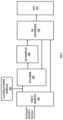
- FIG.1 is a functional block diagram of a system 100 for optimized spike encoding for spiking neural networks in accordance with some embodiments of the present disclosure.
- the system 100 includes a processor(s) 104, communication interface device(s), alternatively referred as input/output (I/O) interface(s) 106, and one or more data storage devices or a memory 102 operatively coupled to the processor(s) 104.
- the system 100 with one or more hardware processors is configured to execute functions of one or more functional blocks of the system 100.
- the processor(s) 104 can be one or more hardware processors 104.
- the one or more hardware processors 104 can be implemented as one or more microprocessors, microcomputers, microcontrollers, digital signal processors, central processing units, state machines, logic circuitries, and/or any devices that manipulate signals based on operational instructions.
- the one or more hardware processors 104 is configured to fetch and execute computer-readable instructions stored in the memory 102.
- the system 100 can be implemented in a variety of computing systems including laptop computers, notebooks, hand-held devices such as mobile phones, workstations, mainframe computers, servers, a network cloud and the like.
- the I/O interface(s) 106 can include a variety of software and hardware interfaces, for example, a web interface, a graphical user interface, a touch user interface (TUI) and the like and can facilitate multiple communications within a wide variety of networks N/W and protocol types, including wired networks, for example, LAN, cable, etc., and wireless networks, such as WLAN, cellular, or satellite.
- the I/O interface (s) 106 can include one or more ports for connecting a number of devices (nodes) of the system 100 to one another or to another server.
- the memory 102 may include any computer-readable medium known in the art including, for example, volatile memory, such as static random access memory (SRAM) and dynamic random access memory (DRAM), and/or non-volatile memory, such as read only memory (ROM), erasable programmable ROM, flash memories, hard disks, optical disks, and magnetic tapes.
- volatile memory such as static random access memory (SRAM) and dynamic random access memory (DRAM)
- DRAM dynamic random access memory
- non-volatile memory such as read only memory (ROM), erasable programmable ROM, flash memories, hard disks, optical disks, and magnetic tapes.
- the memory 102 may include a database 108.
- the memory 102 may comprise information pertaining to input(s)/output(s) of each step performed by the processor(s) 104 of the system 100 and methods of the present disclosure.
- the database 108 may be external (not shown) to the system 100 and coupled to the system via the I/O interface 106. Functions of the components of system 100 are explained in conjunction with functional overview of the system 100 in FIG.2 and flow diagram of FIGS.3A and 3B for optimized spike encoding for spiking neural networks.
- the system 100 supports various connectivity options such as BLUETOOTH ® , USB, ZigBee and other cellular services.
- the network environment enables connection of various components of the system 100 using any communication link including Internet, WAN, MAN, and so on.
- the system 100 is implemented to operate as a stand-alone device.
- the system 100 may be implemented to work as a loosely coupled device to a smart computing environment. The components and functionalities of the system 100 are described further in detail.
- the system 100 for optimized spike encoding for spiking neural networks is configured to receive a plurality of input signals from a data source, via a Input module 202, wherein an input signal of the plurality of input signals is a time series signal and the data source comprises of a plurality of sensors.
- the system 100 further includes a Gaussian noise module 204 configured for introducing a Gaussian noise into the plurality of input signals to obtain a plurality of Gaussian noise introduced signals.
- the system 100 further includes an Encoder 206 configured for generating a plurality of initial encoded spike trains from the plurality of Gaussian noise introduced signals based on an encoding technique.
- the system 100 further includes a MI Module 208 configured for computing a mutual information (MI) between (i) the plurality of Gaussian noise introduced signals and the (ii) the plurality of initial encoded spike trains based on a joint probability mass function (PMF) and a marginal PMF based on a MI computation technique, wherein the MI is computed across an entire length of the plurality of initial encoded spike train.
- the system 100 further includes a MI Optimizer 210 configured for optimizing the mutual information (MI) through an optimization technique by varying the plurality of Gaussian noise.
- the MI Optimizer 210 is also configured for identifying an initial encoded spike train among the plurality of initial encoded spike trains to obtain the optimized spike train, wherein the optimized spike train is identified based on a pre-defined criteria of the MI.
- the system 100 is further configured for feeding the optimized spike train to a spiking neural network (SNN) 212 for training the SNN 212 for performing a plurality of tasks.
- SNN spiking neural network
- the various modules of the system 100 for optimized spike encoding for spiking neural networks are implemented as at least one of a logically self-contained part of a software program, a self-contained hardware component, and/or, a self-contained hardware component with a logically self-contained part of a software program embedded into each of the hardware component that when executed perform the above method described herein.
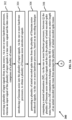
- FIG.3A and FIG.3B are an exemplary flow diagram illustrating a method 300 for using the system 100 of FIG.1 according to an embodiment of the present disclosure.
- a plurality of input signals is received from a data source, via the one or more hardware processors in the input module 202.
- the plurality of input signals comprises of several input signals , wherein each the input signal is a time series signal and the data source comprise of a plurality of sensors.
- the encoding techniques includes a non-temporal neural coding schemes that comprises a Poisson encoding technique, a Bernoulli encoding technique.
- the mutual information (MI) is optimized, via the one or more hardware processors in the MI Optimizer 210, through an optimization technique by varying the plurality of Gaussian noise.
- an initial encoded spike train is identified among the plurality of initial encoded spike trains to obtain the optimized spike train, via the one or more hardware processors in the MI Optimizer 210.
- the optimized spike train is identified based on a pre-defined criterion of the MI.
- the pre-defined criteria of the MI is defined as the initial encoded spike train comprising a maximum MI among the plurality of initial encoded spike trains.
- the process of identification of the optimized spike train is maximizing mutual information (MI) between the initial encoded spike trains and the plurality of input signals by varying the plurality of Gaussian noise.
- the optimized spike train is fed, via the one or more hardware processors, to a SNN 212 for training the SNN for a task.
- the task to be performed by the SNN is signal re-construction.
- the SNN is trained to learn temporal dynamics of the optimized spike train.
- the post-synaptic trace of the SNN is then fed into a Linear Regression module with corresponding real values from the input signal as labels to learn (during training) and then to reconstruct the data from the unseen parts of it during validation.
- An experiment has been conducted using the time series signal includes a Mackey-Glass Time series (MGS), wherein the MGS is a non-linear chaotic time-series generated by a delay differential equation.
- MGS Mackey-Glass Time series
- Each dataset of the MGS has been partitioned into a training set and a testing set based on a pre-defined train : test ratio.
- the training set is encoded by the disclosed method of optimizing the mutual information. Further for each case, the encoded training set is used to train a spiking reservoir network (SNN) to reconstruct the time series and then the reconstruction score was measured using the testing set.
- the reconstruction efficiency of the SNN is measured using a Coefficient of determination Score) metric , also referred as reconstruction score.
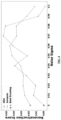
- the FIG.5 illustrates the mutual information score varies with respect to different Gaussian noise ( ⁇ ).
- the corresponding spike train is considered as the optimized spike train which carries maximum information about MGS time series data.
- the effect of increasing noise (and in turn changing MI) on the learning capability of SNN on a Linear Regression module can be observed in terms of reconstruction score for the validation part of the time series data.
- FIG.6 illustrates the effect of increasing noise on reconstruction score (for MGS)
- the reconstruction performance of the SNN improves when compared to base encoding with the increase of noise.
- the reconstruction score decreases due to high noise and eventually comes below the performance of the base encoding.
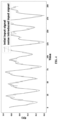
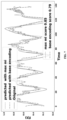
- the FIG.7 illustrates the reconstructed signal for the MGS data, wherein the reconstructed signal for the MGS test data is plotted with time in x-axis and the signal in y-axis.
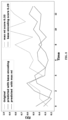
- FIG.8 is a graph illustrating an example scenario of comparison between an input signal (shampoo sales data set ), a reconstructed signal of the input signal using a base encoding technique and a reconstructed signal of the input signal using the disclosed optimized encoding.
- the input signal, the reconstructed signal of the input signal using a base encoding technique and a reconstructed signal of the input signal for the shampoo sales test data is plotted with time in x-axis and the signal in y-axis.
- FIG.9 is a graph illustrating an example scenario of comparison between an input signal (sun spot data set ), a reconstructed signal of the input signal using a base encoding technique and a reconstructed signal of the input signal using the disclosed optimized encoding.
- the input signal, the reconstructed signal of the input signal using a base encoding technique and a reconstructed signal of the input signal for the shampoo sales test data is plotted with time in x-axis and the signal in y-axis.
- FIG.10 is a graph illustrating an example scenario of comparison between an input signal (Bike Sharing data set ), a reconstructed signal of the input signal using a base encoding technique and a reconstructed signal of the input signal using the disclosed optimized encoding.
- the input signal, the reconstructed signal of the input signal using a base encoding technique and a reconstructed signal of the input signal for the shampoo sales test data is plotted with time in x-axis and the signal in y-axis.
- Table 1 MI and reconstruction score for the MGS, the shampoo sales, the sun spot and the bike sharing for base encoding technique (B) and the disclosed maximizing MI technique (MI).
- Table 1 MI and reconstruction score for the MGS, the shampoo sales, the sun spot and the bike sharing for base encoding technique (B) and the disclosed maximizing MI technique (MI).
- the disclosed MI based encoding technique achieved higher reconstruction scores (maximum 8%, 14%, 4%, 10% for MGS, Shampoo sales, Sunspot & Bike sharing dataset respectively) than the base encoding technique.
- This disclosure generally relates optimized spike encoding for spiking neural networks(SNNs).
- the SNN processes data in spike train format, whereas the real world measurements/input signals are in analog ( continuous or discrete ) signal format; therefore, it is necessary to convert the input signal to a spike train format before feeding the input signal to the SNNs.
- One of the challenges during conversion of the input signal to the spike train format is to ensure retention of maximum information between the input signal to the spike train format.
- the disclosure reveals an optimized encoding method to convert the input signal to optimized spike train for spiking neural networks.
- the disclosed optimized encoding approach enables maximizing mutual information between the input signal and optimized spike train by introducing an optimal Gaussian noise that augments the entire input signal data.
- the hardware device can be any kind of device which can be programmed including e.g. any kind of computer like a server or a personal computer, or the like, or any combination thereof.
- the device may also include means which could be e.g. hardware means like e.g. an application-specific integrated circuit (ASIC), a field-programmable gate array (FPGA), or a combination of hardware and software means, e.g.
- ASIC application-specific integrated circuit
- FPGA field-programmable gate array
- the means can include both hardware means and software means.
- the method embodiments described herein could be implemented in hardware and software.
- the device may also include software means.
- the embodiments may be implemented on different hardware devices, e.g. using a plurality of CPUs.
- the embodiments herein can comprise hardware and software elements.
- the embodiments that are implemented in software include but are not limited to, firmware, resident software, microcode, etc.
- the functions performed by various components described herein may be implemented in other components or combinations of other components.
- a computer-usable or computer readable medium can be any apparatus that can comprise, store, communicate, propagate, or transport the program for use by or in connection with the instruction execution system, apparatus, or device.
- a computer-readable storage medium refers to any type of physical memory on which information or data readable by a processor may be stored.
- a computer-readable storage medium may store instructions for execution by one or more processors, including instructions for causing the processor(s) to perform steps or stages consistent with the embodiments described herein.
- the term "computer-readable medium” should be understood to include tangible items and exclude carrier waves and transient signals, i.e., be non-transitory. Examples include random access memory (RAM), read-only memory (ROM), volatile memory, nonvolatile memory, hard drives, CD ROMs, DVDs, flash drives, disks, and any other known physical storage media.
Landscapes
- Engineering & Computer Science (AREA)
- Theoretical Computer Science (AREA)
- Physics & Mathematics (AREA)
- Data Mining & Analysis (AREA)
- General Health & Medical Sciences (AREA)
- Biomedical Technology (AREA)
- Biophysics (AREA)
- Computational Linguistics (AREA)
- Life Sciences & Earth Sciences (AREA)
- Evolutionary Computation (AREA)
- Artificial Intelligence (AREA)
- Molecular Biology (AREA)
- Computing Systems (AREA)
- General Engineering & Computer Science (AREA)
- General Physics & Mathematics (AREA)
- Mathematical Physics (AREA)
- Software Systems (AREA)
- Health & Medical Sciences (AREA)
- Compression, Expansion, Code Conversion, And Decoders (AREA)
Claims (6)
- Procédé mis en oeuvre par processeur pour un codage de crête optimisé pour des réseaux neuronaux de crête (300) pour une reconstruction de signal comprenant :la réception d'une pluralité de signaux d'entrée à partir d'une source de données, via un ou plusieurs processeurs matériels (104), dans lequel chaque signal d'entrée de la pluralité de signaux d'entrée est un signal de série temporelle et la source de données comprend une pluralité de capteurs (302), et dans lequel le signal de série temporelle est une série temporelle de Mackey-Glass (MGS) ayant une série temporelle chaotique non linéaire générée par une équation différentielle de retard ;l'introduction d'un bruit gaussien dans la pluralité de signaux d'entrée, via les un ou plusieurs processeurs matériels (104), pour obtenir une pluralité de signaux de bruit gaussien introduits (304) ;la génération d'une pluralité de trains de crêtes codés initiaux à partir de la pluralité de signaux de bruit gaussien introduits, via les un ou plusieurs processeurs matériels (104), sur la base d'une technique de codage (306) ;le calcul d'une information mutuelle (MI), via les un ou plusieurs processeurs matériels (104), entre (i) la pluralité de signaux de bruit gaussien introduits et (ii) la pluralité de trains de crêtes codés initiaux sur la base d'une technique de calcul de MI, dans lequel le MI est calculé sur une longueur entière d'un train de crêtes codé initial parmi la pluralité de trains de crêtes codés initiaux, et dans lequel l'information mutuelle est une mesure d'un contenu d'information dans la pluralité de trains de crêtes codés initiaux générés via un codage de la pluralité de signaux d'entrée (308) ;l'optimisation de l'information mutuelle (MI), via les un ou plusieurs processeurs matériels (104), par l'intermédiaire d'une technique d'optimisation qui maximise le MI en faisant varier le bruit gaussien dans la pluralité de signaux de bruit gaussien introduits (310) ;l'identification d'un train de crêtes codé initial parmi la pluralité de trains de crêtes codés initiaux pour obtenir un train de crêtes optimisé, via les un ou plusieurs processeurs matériels (104), dans lequel le train de crêtes optimisé est identifié sur la base d'un critère prédéfini défini comme déterminant le train de crêtes codé initial comprenant un maximum du MI optimisé parmi la pluralité de trains de crêtes codés initiaux (312) ; etl'apprentissage, via les un ou plusieurs processeurs matériels (104), d'un réseau neuronal de crête (SNN) en utilisant le train de crêtes optimisé, dans lequel le SNN est entraîné pour apprendre une dynamique temporelle du train de crêtes optimisé, et une trace post-synaptique du SNN est ensuite introduite dans un module de régression linéaire avec des valeurs réelles correspondantes à partir du signal d'entrée respectif en tant qu'étiquettes pour apprendre pendant l'apprentissage et pour reconstruire les données à partir des parties invisibles du signal d'entrée respectif pendant une validation.
- Procédé selon la revendication 1, dans lequel la technique de codage comprend un schéma de codage neuronal non temporel qui comprend une technique de codage de Poisson, une technique de codage de Bernoulli.
- Procédé selon la revendication 1, la technique de calcul de MI est exprimée mathématiquement comme illustré ci-dessous :


 PX (x) est la probabilité qu'une variable aléatoire X prenne la valeur x,PY (y) est la probabilité qu'une variable aléatoire Y prenne la valeur y,H est l'entropie,I est l'information mutuelle, etPXY (x, y) est un PMF joint de deux variables aléatoires X et Y.
 - Procédé selon la revendication 1, dans lequel la technique d'optimisation est exprimée mathématiquement comme illustré ci-dessous :
maximizeσ I(T σ; S) S est la pluralité de signaux d'entrée,T est le train de crêtes codé initial,σ est le bruit guassien,T σ est le bruit guassien introduit par le train de crêtes initial codé, et I est l'information mutuelle.
 - Système (100), comprenant :une interface d'entrée/sortie (106) ;une ou plusieurs mémoires (102) ; etun ou plusieurs processeurs matériels (104), les une ou plusieurs mémoires (102) étant couplées aux un ou plusieurs processeurs matériels (104), dans lequel les un ou plusieurs processeurs matériels (104) sont configurés pour exécuter des instructions programmées stockées dans les une ou plusieurs mémoires (102), pour réaliser le procédé selon l'une quelconque des revendications 1 à 4.
- Support lisible par ordinateur non transitoire sur lequel est incorporé un programme lisible par ordinateur pour un codage de crête optimisé pour des réseaux neuronaux de crête, dans lequel le programme lisible par ordinateur, lorsqu'il est exécuté par un ou plusieurs processeurs matériels, amène à réaliser le procédé selon l'une quelconque des revendications 1 à 4.
Applications Claiming Priority (1)
| Application Number | Priority Date | Filing Date | Title |
|---|---|---|---|
| IN202021052964 | 2020-12-04 |
Publications (3)
| Publication Number | Publication Date |
|---|---|
| EP4009237A1 EP4009237A1 (fr) | 2022-06-08 |
| EP4009237C0 EP4009237C0 (fr) | 2025-07-02 |
| EP4009237B1 true EP4009237B1 (fr) | 2025-07-02 |
Family
ID=74797861
Family Applications (1)
| Application Number | Title | Priority Date | Filing Date |
|---|---|---|---|
| EP21159673.9A Active EP4009237B1 (fr) | 2020-12-04 | 2021-02-26 | Procédé et système de codage optimisé d'impulsions pour réseaux neuronaux à impulsions |
Country Status (2)
| Country | Link |
|---|---|
| US (1) | US12307360B2 (fr) |
| EP (1) | EP4009237B1 (fr) |
Families Citing this family (2)
| Publication number | Priority date | Publication date | Assignee | Title |
|---|---|---|---|---|
| EP4213073A1 (fr) * | 2022-01-14 | 2023-07-19 | Tata Consultancy Services Limited | Système et procédé de prévision en ligne chronologique à l'aide d'un réservoir de pointe |
| US12524496B2 (en) * | 2022-01-24 | 2026-01-13 | Bank Of America Corporation | Dynamic access control using machine learning |
Family Cites Families (3)
| Publication number | Priority date | Publication date | Assignee | Title |
|---|---|---|---|---|
| US9104186B2 (en) * | 2012-06-04 | 2015-08-11 | Brain Corporation | Stochastic apparatus and methods for implementing generalized learning rules |
| US9111225B2 (en) * | 2012-02-08 | 2015-08-18 | Qualcomm Incorporated | Methods and apparatus for spiking neural computation |
| EP3743856A4 (fr) * | 2018-01-23 | 2021-10-27 | HRL Laboratories, LLC | Procédé et système de codage et d'apprentissage distribués dans des réseaux neuromorphes permettant une reconnaissance de motifs |
-
2021
- 2021-02-26 EP EP21159673.9A patent/EP4009237B1/fr active Active
- 2021-03-01 US US17/187,912 patent/US12307360B2/en active Active
Non-Patent Citations (1)
| Title |
|---|
| PETRO BALINT ET AL: "Selection and Optimization of Temporal Spike Encoding Methods for Spiking Neural Networks", IEEE TRANSACTIONS ON NEURAL NETWORKS AND LEARNING SYSTEMS, IEEE, USA, vol. 31, no. 2, 1 February 2020 (2020-02-01), pages 358 - 370, XP011770164, ISSN: 2162-237X, [retrieved on 20200205], DOI: 10.1109/TNNLS.2019.2906158 * |
Also Published As
| Publication number | Publication date |
|---|---|
| US20220222522A1 (en) | 2022-07-14 |
| US12307360B2 (en) | 2025-05-20 |
| EP4009237C0 (fr) | 2025-07-02 |
| EP4009237A1 (fr) | 2022-06-08 |
Similar Documents
| Publication | Publication Date | Title |
|---|---|---|
| US11461847B2 (en) | Applying a trained model to predict a future value using contextualized sentiment data | |
| CN108920654B (zh) | 一种问答文本语义匹配的方法和装置 | |
| CN107122327B (zh) | 一种利用训练数据训练模型的方法和训练系统 | |
| US20190303943A1 (en) | User classification using a deep forest network | |
| CN109214436A (zh) | 一种针对目标场景的预测模型训练方法及装置 | |
| US20100293117A1 (en) | Method and system for facilitating batch mode active learning | |
| CN113064930A (zh) | 数据仓库的冷热数据识别方法、装置及电子设备 | |
| US10743821B2 (en) | Anomaly detection by self-learning of sensor signals | |
| CN110348471B (zh) | 异常对象识别方法、装置、介质及电子设备 | |
| EP4009237B1 (fr) | Procédé et système de codage optimisé d'impulsions pour réseaux neuronaux à impulsions | |
| CN110363084A (zh) | 一种上课状态检测方法、装置、存储介质及电子 | |
| CN111428757A (zh) | 模型训练方法、异常数据检测方法、装置和电子设备 | |
| CN117611352A (zh) | 一种车险理赔处理方法、装置、计算机设备及存储介质 | |
| US20160035026A1 (en) | Online trading systems and methods | |
| EP3444759B1 (fr) | Génération de classe rare synthétique par préservation d'identité morphologique | |
| CN108550019B (zh) | 一种简历筛选方法及装置 | |
| US12210589B2 (en) | System and method for label generation for timeseries classification | |
| CN111401908A (zh) | 交易行为类型确定方法、装置及设备 | |
| CN114782960B (zh) | 模型训练方法、装置、计算机设备及计算机可读存储介质 | |
| CN112989185B (zh) | 信息推送方法、装置、计算机设备及存储介质 | |
| CN109660676A (zh) | 异常对象的识别方法、装置及设备 | |
| CN113095805B (zh) | 对象识别方法、装置、计算机系统及可读存储介质 | |
| EP4239530A1 (fr) | Procédé et système d'optimisation de codage de pics à base d'informations mutuelles (mi) de données à variables multiples | |
| US12444179B2 (en) | Model training method and model training system | |
| Raman et al. | Economic Imbalance: Predicting Financial Stress Using Deep Learning Techniques |
Legal Events
| Date | Code | Title | Description |
|---|---|---|---|
| PUAI | Public reference made under article 153(3) epc to a published international application that has entered the european phase |
Free format text: ORIGINAL CODE: 0009012 |
|
| STAA | Information on the status of an ep patent application or granted ep patent |
Free format text: STATUS: THE APPLICATION HAS BEEN PUBLISHED |
|
| AK | Designated contracting states |
Kind code of ref document: A1 Designated state(s): AL AT BE BG CH CY CZ DE DK EE ES FI FR GB GR HR HU IE IS IT LI LT LU LV MC MK MT NL NO PL PT RO RS SE SI SK SM TR |
|
| STAA | Information on the status of an ep patent application or granted ep patent |
Free format text: STATUS: REQUEST FOR EXAMINATION WAS MADE |
|
| 17P | Request for examination filed |
Effective date: 20220817 |
|
| RBV | Designated contracting states (corrected) |
Designated state(s): AL AT BE BG CH CY CZ DE DK EE ES FI FR GB GR HR HU IE IS IT LI LT LU LV MC MK MT NL NO PL PT RO RS SE SI SK SM TR |
|
| STAA | Information on the status of an ep patent application or granted ep patent |
Free format text: STATUS: EXAMINATION IS IN PROGRESS |
|
| 17Q | First examination report despatched |
Effective date: 20230510 |
|
| GRAP | Despatch of communication of intention to grant a patent |
Free format text: ORIGINAL CODE: EPIDOSNIGR1 |
|
| STAA | Information on the status of an ep patent application or granted ep patent |
Free format text: STATUS: GRANT OF PATENT IS INTENDED |
|
| INTG | Intention to grant announced |
Effective date: 20250317 |
|
| GRAS | Grant fee paid |
Free format text: ORIGINAL CODE: EPIDOSNIGR3 |
|
| GRAA | (expected) grant |
Free format text: ORIGINAL CODE: 0009210 |
|
| STAA | Information on the status of an ep patent application or granted ep patent |
Free format text: STATUS: THE PATENT HAS BEEN GRANTED |
|
| AK | Designated contracting states |
Kind code of ref document: B1 Designated state(s): AL AT BE BG CH CY CZ DE DK EE ES FI FR GB GR HR HU IE IS IT LI LT LU LV MC MK MT NL NO PL PT RO RS SE SI SK SM TR |
|
| REG | Reference to a national code |
Ref country code: GB Ref legal event code: FG4D |
|
| REG | Reference to a national code |
Ref country code: CH Ref legal event code: EP |
|
| REG | Reference to a national code |
Ref country code: IE Ref legal event code: FG4D |
|
| U01 | Request for unitary effect filed |
Effective date: 20250702 |
|
| U07 | Unitary effect registered |
Designated state(s): AT BE BG DE DK EE FI FR IT LT LU LV MT NL PT RO SE SI Effective date: 20250708 |
|
| PG25 | Lapsed in a contracting state [announced via postgrant information from national office to epo] |
Ref country code: IS Free format text: LAPSE BECAUSE OF FAILURE TO SUBMIT A TRANSLATION OF THE DESCRIPTION OR TO PAY THE FEE WITHIN THE PRESCRIBED TIME-LIMIT Effective date: 20251102 |
|
| PG25 | Lapsed in a contracting state [announced via postgrant information from national office to epo] |
Ref country code: NO Free format text: LAPSE BECAUSE OF FAILURE TO SUBMIT A TRANSLATION OF THE DESCRIPTION OR TO PAY THE FEE WITHIN THE PRESCRIBED TIME-LIMIT Effective date: 20251002 |
|
| PG25 | Lapsed in a contracting state [announced via postgrant information from national office to epo] |
Ref country code: HR Free format text: LAPSE BECAUSE OF FAILURE TO SUBMIT A TRANSLATION OF THE DESCRIPTION OR TO PAY THE FEE WITHIN THE PRESCRIBED TIME-LIMIT Effective date: 20250702 |
|
| PG25 | Lapsed in a contracting state [announced via postgrant information from national office to epo] |
Ref country code: GR Free format text: LAPSE BECAUSE OF FAILURE TO SUBMIT A TRANSLATION OF THE DESCRIPTION OR TO PAY THE FEE WITHIN THE PRESCRIBED TIME-LIMIT Effective date: 20251003 |
|
| PG25 | Lapsed in a contracting state [announced via postgrant information from national office to epo] |
Ref country code: CZ Free format text: LAPSE BECAUSE OF FAILURE TO SUBMIT A TRANSLATION OF THE DESCRIPTION OR TO PAY THE FEE WITHIN THE PRESCRIBED TIME-LIMIT Effective date: 20250702 |
|
| PG25 | Lapsed in a contracting state [announced via postgrant information from national office to epo] |
Ref country code: PL Free format text: LAPSE BECAUSE OF FAILURE TO SUBMIT A TRANSLATION OF THE DESCRIPTION OR TO PAY THE FEE WITHIN THE PRESCRIBED TIME-LIMIT Effective date: 20250702 |
|
| PG25 | Lapsed in a contracting state [announced via postgrant information from national office to epo] |
Ref country code: RS Free format text: LAPSE BECAUSE OF FAILURE TO SUBMIT A TRANSLATION OF THE DESCRIPTION OR TO PAY THE FEE WITHIN THE PRESCRIBED TIME-LIMIT Effective date: 20251002 |
|
| PG25 | Lapsed in a contracting state [announced via postgrant information from national office to epo] |
Ref country code: ES Free format text: LAPSE BECAUSE OF FAILURE TO SUBMIT A TRANSLATION OF THE DESCRIPTION OR TO PAY THE FEE WITHIN THE PRESCRIBED TIME-LIMIT Effective date: 20250702 |