EP4008534B1 - Verfahren zur herstellung einer holmkappe für ein windturbinenblatt - Google Patents
Verfahren zur herstellung einer holmkappe für ein windturbinenblatt Download PDFInfo
- Publication number
- EP4008534B1 EP4008534B1 EP20211522.6A EP20211522A EP4008534B1 EP 4008534 B1 EP4008534 B1 EP 4008534B1 EP 20211522 A EP20211522 A EP 20211522A EP 4008534 B1 EP4008534 B1 EP 4008534B1
- Authority
- EP
- European Patent Office
- Prior art keywords
- guide member
- gap
- insert
- spar cap
- fibre material
- Prior art date
- Legal status (The legal status is an assumption and is not a legal conclusion. Google has not performed a legal analysis and makes no representation as to the accuracy of the status listed.)
- Active
Links
Images


Classifications
-
- B—PERFORMING OPERATIONS; TRANSPORTING
- B29—WORKING OF PLASTICS; WORKING OF SUBSTANCES IN A PLASTIC STATE IN GENERAL
- B29C—SHAPING OR JOINING OF PLASTICS; SHAPING OF MATERIAL IN A PLASTIC STATE, NOT OTHERWISE PROVIDED FOR; AFTER-TREATMENT OF THE SHAPED PRODUCTS, e.g. REPAIRING
- B29C33/00—Moulds or cores; Details thereof or accessories therefor
- B29C33/30—Mounting, exchanging or centering
- B29C33/306—Exchangeable mould parts, e.g. cassette moulds, mould inserts
-
- B—PERFORMING OPERATIONS; TRANSPORTING
- B29—WORKING OF PLASTICS; WORKING OF SUBSTANCES IN A PLASTIC STATE IN GENERAL
- B29C—SHAPING OR JOINING OF PLASTICS; SHAPING OF MATERIAL IN A PLASTIC STATE, NOT OTHERWISE PROVIDED FOR; AFTER-TREATMENT OF THE SHAPED PRODUCTS, e.g. REPAIRING
- B29C33/00—Moulds or cores; Details thereof or accessories therefor
- B29C33/44—Moulds or cores; Details thereof or accessories therefor with means for, or specially constructed to facilitate, the removal of articles, e.g. of undercut articles
- B29C33/48—Moulds or cores; Details thereof or accessories therefor with means for, or specially constructed to facilitate, the removal of articles, e.g. of undercut articles with means for collapsing or disassembling
-
- B—PERFORMING OPERATIONS; TRANSPORTING
- B29—WORKING OF PLASTICS; WORKING OF SUBSTANCES IN A PLASTIC STATE IN GENERAL
- B29C—SHAPING OR JOINING OF PLASTICS; SHAPING OF MATERIAL IN A PLASTIC STATE, NOT OTHERWISE PROVIDED FOR; AFTER-TREATMENT OF THE SHAPED PRODUCTS, e.g. REPAIRING
- B29C70/00—Shaping composites, i.e. plastics material comprising reinforcements, fillers or preformed parts, e.g. inserts
- B29C70/04—Shaping composites, i.e. plastics material comprising reinforcements, fillers or preformed parts, e.g. inserts comprising reinforcements only, e.g. self-reinforcing plastics
- B29C70/28—Shaping operations therefor
- B29C70/40—Shaping or impregnating by compression not applied
- B29C70/42—Shaping or impregnating by compression not applied for producing articles of definite length, i.e. discrete articles
- B29C70/44—Shaping or impregnating by compression not applied for producing articles of definite length, i.e. discrete articles using isostatic pressure, e.g. pressure difference-moulding, vacuum bag-moulding, autoclave-moulding or expanding rubber-moulding
- B29C70/443—Shaping or impregnating by compression not applied for producing articles of definite length, i.e. discrete articles using isostatic pressure, e.g. pressure difference-moulding, vacuum bag-moulding, autoclave-moulding or expanding rubber-moulding and impregnating by vacuum or injection
-
- B—PERFORMING OPERATIONS; TRANSPORTING
- B29—WORKING OF PLASTICS; WORKING OF SUBSTANCES IN A PLASTIC STATE IN GENERAL
- B29C—SHAPING OR JOINING OF PLASTICS; SHAPING OF MATERIAL IN A PLASTIC STATE, NOT OTHERWISE PROVIDED FOR; AFTER-TREATMENT OF THE SHAPED PRODUCTS, e.g. REPAIRING
- B29C70/00—Shaping composites, i.e. plastics material comprising reinforcements, fillers or preformed parts, e.g. inserts
- B29C70/04—Shaping composites, i.e. plastics material comprising reinforcements, fillers or preformed parts, e.g. inserts comprising reinforcements only, e.g. self-reinforcing plastics
- B29C70/28—Shaping operations therefor
- B29C70/40—Shaping or impregnating by compression not applied
- B29C70/42—Shaping or impregnating by compression not applied for producing articles of definite length, i.e. discrete articles
- B29C70/44—Shaping or impregnating by compression not applied for producing articles of definite length, i.e. discrete articles using isostatic pressure, e.g. pressure difference-moulding, vacuum bag-moulding, autoclave-moulding or expanding rubber-moulding
- B29C70/446—Moulding structures having an axis of symmetry or at least one channel, e.g. tubular structures, frames
-
- B—PERFORMING OPERATIONS; TRANSPORTING
- B29—WORKING OF PLASTICS; WORKING OF SUBSTANCES IN A PLASTIC STATE IN GENERAL
- B29C—SHAPING OR JOINING OF PLASTICS; SHAPING OF MATERIAL IN A PLASTIC STATE, NOT OTHERWISE PROVIDED FOR; AFTER-TREATMENT OF THE SHAPED PRODUCTS, e.g. REPAIRING
- B29C70/00—Shaping composites, i.e. plastics material comprising reinforcements, fillers or preformed parts, e.g. inserts
- B29C70/04—Shaping composites, i.e. plastics material comprising reinforcements, fillers or preformed parts, e.g. inserts comprising reinforcements only, e.g. self-reinforcing plastics
- B29C70/28—Shaping operations therefor
- B29C70/54—Component parts, details or accessories; Auxiliary operations, e.g. feeding or storage of prepregs or SMC after impregnation or during ageing
- B29C70/541—Positioning reinforcements in a mould, e.g. using clamping means for the reinforcement
-
- B—PERFORMING OPERATIONS; TRANSPORTING
- B29—WORKING OF PLASTICS; WORKING OF SUBSTANCES IN A PLASTIC STATE IN GENERAL
- B29D—PRODUCING PARTICULAR ARTICLES FROM PLASTICS OR FROM SUBSTANCES IN A PLASTIC STATE
- B29D99/00—Subject matter not provided for in other groups of this subclass
- B29D99/0025—Producing blades or the like, e.g. blades for turbines, propellers, or wings
- B29D99/0028—Producing blades or the like, e.g. blades for turbines, propellers, or wings hollow blades
-
- B—PERFORMING OPERATIONS; TRANSPORTING
- B29—WORKING OF PLASTICS; WORKING OF SUBSTANCES IN A PLASTIC STATE IN GENERAL
- B29C—SHAPING OR JOINING OF PLASTICS; SHAPING OF MATERIAL IN A PLASTIC STATE, NOT OTHERWISE PROVIDED FOR; AFTER-TREATMENT OF THE SHAPED PRODUCTS, e.g. REPAIRING
- B29C2791/00—Shaping characteristics in general
- B29C2791/004—Shaping under special conditions
- B29C2791/006—Using vacuum
-
- B—PERFORMING OPERATIONS; TRANSPORTING
- B29—WORKING OF PLASTICS; WORKING OF SUBSTANCES IN A PLASTIC STATE IN GENERAL
- B29K—INDEXING SCHEME ASSOCIATED WITH SUBCLASSES B29B, B29C OR B29D, RELATING TO MOULDING MATERIALS OR TO MATERIALS FOR MOULDS, REINFORCEMENTS, FILLERS OR PREFORMED PARTS, e.g. INSERTS
- B29K2031/00—Use of polyvinylesters or derivatives thereof as moulding material
-
- B—PERFORMING OPERATIONS; TRANSPORTING
- B29—WORKING OF PLASTICS; WORKING OF SUBSTANCES IN A PLASTIC STATE IN GENERAL
- B29K—INDEXING SCHEME ASSOCIATED WITH SUBCLASSES B29B, B29C OR B29D, RELATING TO MOULDING MATERIALS OR TO MATERIALS FOR MOULDS, REINFORCEMENTS, FILLERS OR PREFORMED PARTS, e.g. INSERTS
- B29K2033/00—Use of polymers of unsaturated acids or derivatives thereof as moulding material
- B29K2033/04—Polymers of esters
-
- B—PERFORMING OPERATIONS; TRANSPORTING
- B29—WORKING OF PLASTICS; WORKING OF SUBSTANCES IN A PLASTIC STATE IN GENERAL
- B29K—INDEXING SCHEME ASSOCIATED WITH SUBCLASSES B29B, B29C OR B29D, RELATING TO MOULDING MATERIALS OR TO MATERIALS FOR MOULDS, REINFORCEMENTS, FILLERS OR PREFORMED PARTS, e.g. INSERTS
- B29K2063/00—Use of EP, i.e. epoxy resins or derivatives thereof, as moulding material
-
- B—PERFORMING OPERATIONS; TRANSPORTING
- B29—WORKING OF PLASTICS; WORKING OF SUBSTANCES IN A PLASTIC STATE IN GENERAL
- B29K—INDEXING SCHEME ASSOCIATED WITH SUBCLASSES B29B, B29C OR B29D, RELATING TO MOULDING MATERIALS OR TO MATERIALS FOR MOULDS, REINFORCEMENTS, FILLERS OR PREFORMED PARTS, e.g. INSERTS
- B29K2105/00—Condition, form or state of moulded material or of the material to be shaped
- B29K2105/06—Condition, form or state of moulded material or of the material to be shaped containing reinforcements, fillers or inserts
-
- B—PERFORMING OPERATIONS; TRANSPORTING
- B29—WORKING OF PLASTICS; WORKING OF SUBSTANCES IN A PLASTIC STATE IN GENERAL
- B29K—INDEXING SCHEME ASSOCIATED WITH SUBCLASSES B29B, B29C OR B29D, RELATING TO MOULDING MATERIALS OR TO MATERIALS FOR MOULDS, REINFORCEMENTS, FILLERS OR PREFORMED PARTS, e.g. INSERTS
- B29K2305/00—Use of metals, their alloys or their compounds, as reinforcement
-
- B—PERFORMING OPERATIONS; TRANSPORTING
- B29—WORKING OF PLASTICS; WORKING OF SUBSTANCES IN A PLASTIC STATE IN GENERAL
- B29K—INDEXING SCHEME ASSOCIATED WITH SUBCLASSES B29B, B29C OR B29D, RELATING TO MOULDING MATERIALS OR TO MATERIALS FOR MOULDS, REINFORCEMENTS, FILLERS OR PREFORMED PARTS, e.g. INSERTS
- B29K2307/00—Use of elements other than metals as reinforcement
- B29K2307/04—Carbon
-
- B—PERFORMING OPERATIONS; TRANSPORTING
- B29—WORKING OF PLASTICS; WORKING OF SUBSTANCES IN A PLASTIC STATE IN GENERAL
- B29K—INDEXING SCHEME ASSOCIATED WITH SUBCLASSES B29B, B29C OR B29D, RELATING TO MOULDING MATERIALS OR TO MATERIALS FOR MOULDS, REINFORCEMENTS, FILLERS OR PREFORMED PARTS, e.g. INSERTS
- B29K2309/00—Use of inorganic materials not provided for in groups B29K2303/00 - B29K2307/00, as reinforcement
- B29K2309/08—Glass
-
- B—PERFORMING OPERATIONS; TRANSPORTING
- B29—WORKING OF PLASTICS; WORKING OF SUBSTANCES IN A PLASTIC STATE IN GENERAL
- B29K—INDEXING SCHEME ASSOCIATED WITH SUBCLASSES B29B, B29C OR B29D, RELATING TO MOULDING MATERIALS OR TO MATERIALS FOR MOULDS, REINFORCEMENTS, FILLERS OR PREFORMED PARTS, e.g. INSERTS
- B29K2311/00—Use of natural products or their composites, not provided for in groups B29K2201/00 - B29K2309/00, as reinforcement
-
- B—PERFORMING OPERATIONS; TRANSPORTING
- B29—WORKING OF PLASTICS; WORKING OF SUBSTANCES IN A PLASTIC STATE IN GENERAL
- B29K—INDEXING SCHEME ASSOCIATED WITH SUBCLASSES B29B, B29C OR B29D, RELATING TO MOULDING MATERIALS OR TO MATERIALS FOR MOULDS, REINFORCEMENTS, FILLERS OR PREFORMED PARTS, e.g. INSERTS
- B29K2677/00—Use of PA, i.e. polyamides, e.g. polyesteramides or derivatives thereof, for preformed parts, e.g. for inserts
- B29K2677/10—Aromatic polyamides [polyaramides] or derivatives thereof
-
- B—PERFORMING OPERATIONS; TRANSPORTING
- B29—WORKING OF PLASTICS; WORKING OF SUBSTANCES IN A PLASTIC STATE IN GENERAL
- B29L—INDEXING SCHEME ASSOCIATED WITH SUBCLASS B29C, RELATING TO PARTICULAR ARTICLES
- B29L2031/00—Other particular articles
- B29L2031/08—Blades for rotors, stators, fans, turbines or the like, e.g. screw propellers
- B29L2031/082—Blades, e.g. for helicopters
- B29L2031/085—Wind turbine blades
-
- F—MECHANICAL ENGINEERING; LIGHTING; HEATING; WEAPONS; BLASTING
- F03—MACHINES OR ENGINES FOR LIQUIDS; WIND, SPRING, OR WEIGHT MOTORS; PRODUCING MECHANICAL POWER OR A REACTIVE PROPULSIVE THRUST, NOT OTHERWISE PROVIDED FOR
- F03D—WIND MOTORS
- F03D1/00—Wind motors with rotation axis substantially parallel to the air flow entering the rotor
- F03D1/06—Rotors
- F03D1/065—Rotors characterised by their construction elements
- F03D1/0675—Rotors characterised by their construction elements of the blades
-
- Y—GENERAL TAGGING OF NEW TECHNOLOGICAL DEVELOPMENTS; GENERAL TAGGING OF CROSS-SECTIONAL TECHNOLOGIES SPANNING OVER SEVERAL SECTIONS OF THE IPC; TECHNICAL SUBJECTS COVERED BY FORMER USPC CROSS-REFERENCE ART COLLECTIONS [XRACs] AND DIGESTS
- Y02—TECHNOLOGIES OR APPLICATIONS FOR MITIGATION OR ADAPTATION AGAINST CLIMATE CHANGE
- Y02P—CLIMATE CHANGE MITIGATION TECHNOLOGIES IN THE PRODUCTION OR PROCESSING OF GOODS
- Y02P70/00—Climate change mitigation technologies in the production process for final industrial or consumer products
- Y02P70/50—Manufacturing or production processes characterised by the final manufactured product
Definitions
- the present invention relates to a method of manufacturing a spar cap for a wind turbine blade.
- Wind power provides a clean and environmentally friendly source of energy.
- Wind turbines usually comprise a tower, generator, gearbox, nacelle, and one or more rotor blades.
- the wind turbine blades capture kinetic energy of wind using known airfoil principles.
- Modern wind turbines may have rotor blades that exceed 90 meters in length.
- Wind turbine blades are usually manufactured by forming two shell parts or shell halves from layers of woven fabric or fibre and resin.
- Spar caps which are also called main laminates, are placed or integrated in the shell halves and may be combined with shear webs or spar beams to form structural support members. Spar caps or main laminates may be joined to, or integrated within, the inside of the suction side and pressure side halves of the shell.
- Pultrusion is a continuous process in which fibres are pulled through a supply of liquid resin and then heated in an open chamber where the resin is cured. Such pultruded strips can be cut to any desired length.
- DE 10 2012 223 707 A1 discloses a shaping device for producing a T-rod for a rotor blade of a wind turbine, which has a web support section and at least one T-shaped web foot section provided at one end of the web support section, wherein the shaping device comprises a main shape and at least one insert.
- EP 2 308 670 A1 discloses a fixing device for fixating a segment of a wind turbine blade to a mold, wherein the blade segment has a fixating portion.
- the fixing device comprises: a first portion for removably fixating the blade segment at its fixating portion to the mold and a second portion for fixating the fixing device to the mold.
- WO 2011/113812 A1 discloses a method for manufacturing a composite material article, comprising providing a mould, placing at least one layer of bulk fiber material on the mould, placing, at an edge of the bulk fiber material layer, a flange element partially overlapping the bulk fiber material layer, and partially extending so as to form a flange, and curing bulk resin on the mould.
- WO 2014/096004 A2 relates to a method of manufacturing an aerodynamic shell part for a wind turbine blade, comprising providing a first mould part, laying up fibre-reinforcement material and optionally also sandwich core material in the first mould, arranging one or more inserts having an exterior shape corresponding to at least sides of the recess of the aerodynamic shell part, and supplying resin to said fibre-reinforcement material and optional sandwich core material.
- a method of manufacturing a fibre-reinforced spar cap for a wind turbine blade comprising the steps of providing a mould, fastening a first guide member and a second guide member to the mould for providing a moulding cavity in between the first and second guide members, arranging a fibre material within the moulding cavity, such that a first gap is provided between the fibre material and the first guide member, and a second gap is provided between the fibre material and second guide member, placing a vacuum foil over the fibre material and the first and second guide members, such that the vacuum foil extends into the first and second gap, inserting a first insert into the first gap on top of the vacuum foil, inserting a second insert into the second gap on top of the vacuum foil, infusing resin into the fibre material to form a fibre-reinforced polymer, curing the resin-infused fibre material to form the fibre-reinforced spar cap, removing the first and second inserts and the vacuum foil, and demould
- the wind turbine blade usually has a pressure side and a suction side, and a leading edge and a trailing edge with a chord having a chord length extending therebetween, the wind turbine blade extending in a spanwise direction between a root end and a tip end.
- one or more spar caps can be installed in the pressure side shell half and in the suction side shell half of the blade, and a flapwise extending shear web can be arranged in between the opposing spar caps of the two shell halves.
- the pressure side shell half and the suction side shell half are manufactured over the entire length of the wind turbine blade, i.e. over their entire final length.
- Each shell half may comprise longitudinally/spanwise extending spar caps, also called main laminates, preferably comprising reinforcement fibres such as glass fibres, carbon fibres, aramid fibres, metallic fibres, such as steel fibres, or plant fibres, or mixtures thereof.
- the shell halves will typically be produced by infusing a fibre lay-up of fibre material with a resin such as epoxy, polyester or vinyl ester.
- the spar caps or main laminates are usually affixed to the inner faces of the shell halves.
- the spar cap or the fibre material arranged in the spar cap mould prior to resin infusion, has a longitudinally extending top surface and an opposing longitudinally extending bottom surface, and first and second longitudinally extending lateral surfaces.
- the distance between the top and bottom surface usually defines the thickness of the spar cap.
- the top and bottom surfaces of the spar cap are typically vertically separated, whereas the first and the second lateral surfaces are transversely separated.
- the spar cap can have the shape of a rectangular plate or a slab.
- the spar cap usually has a rectangular shaped cross-section when sectioned normally to the longitudinal or spanwise extension.
- the spar cap of the present invention comprises a plurality of strips of pultruded fibre material, extending generally in a longitudinal/spanwise direction of the spar cap.
- the pultruded strips of the spar cap preferably have a length of at least 30 meters, such as at least 40 meters, or at least 50 meters.
- each strip contains a carbon fibre material.
- each strip contains a glass fibre material.
- each strip contains a glass fibre material and a carbon fibre material.
- the strips may not contain any polymer when laying up the strips in the spar cap mould.
- the mould is typically a spar cap mould having an upper surface including a moulding surface. Usually, the mould will extend along a longitudinal direction, with a length of at least 20 meters.
- the mould may be made of or comprise a composite material and/or may comprise a metal material.
- the first guide member and the second guide member are fastened, preferably releasably fastened, to the mould for providing a moulding cavity in between the first and second guide members.
- the first guide member may extend in the longitudinal direction of the mould closer to a first edge of the mould, and the second guide member may extend in the longitudinal direction of the mould closer to the second edge of the mould. It is preferred that the first and second guide members extend along the longitudinal direction of the mould, substantially parallel to each other.
- the first guide member may extend along a first lateral edge of the spar cap or fibre material, the first lateral edge of the spar cap or fibre material facing the trailing edge of the blade when arranged in the blade shell
- the second guide member may extend along a second lateral edge of the spar cap or fibre material, the second lateral edge of the spar cap or fibre material facing the leading edge of the blade when arranged in the blade shell.
- the first guide member and the second guide member are guide rails.
- each guide member comprises an upstand, such as an upright structure or substantially vertically extending structure, forming the longitudinally extending guide surface.
- each of the guide members has a substantially L-shaped cross section, or a skewed or compressed L-shaped cross section.
- the guide members have a triangular cross section.
- the guide members have a prism cross section. It is preferred that each guide member has substantially horizontal section, which can be fastened to the mould, and a substantially vertical section extending from the mould in a substantially vertical or upward direction. In other embodiments, each of the guide members has a triangular cross section.
- the first and second guide members extend along the longitudinal direction of the mould, preferably substantially parallel to the lateral edges of the mould.
- the first and second guide members extend along substantially the entire length of the mould, and preferably along substantially the entire length of the spar cap.
- the insert may have a length of at least 25 meters, such as at least 50 meters or at least 70 meters.
- the first and second guide members are bolted to the mould.
- one or more bolts can be inserted into each guide member, preferably extending into receiving holes in the mould.
- the guide members can be fastened to the mould by one or more screws, adhesives, snap connections, or other fastening means.
- the transverse distance between the first and second guide members is at least 1 metre, such as at least 5 metres or at least 8 meters.
- the transverse distance between the two guide members at the moulding surface should accommodate more than the width of the spar cap to be manufactured, such as at least an additional 5% or an additional 10% as compared to the width of the spar cap or fibre material arranged in between the guide members.
- a fibre material is arranged within the moulding cavity, usually in between and along the first and second guide members, such that a first gap is provided between the fibre material and the first guide member, preferably at the moulding surface, and a second gap is provided between the fibre material and second guide member, preferably at the moulding surface.
- the respective gaps increase in width when moving from the moulding surface in an upward directions.
- the respective gaps may be substantially V-shaped or substantially wedge-shaped.
- the transverse distance between the fibre material and the respective guide member is between 1 and 100 mm, preferably between 1 and 50 mm, at the moulding surface.
- the transverse distance between the fibre material and the respective guide member preferably increases when moving upwardly from the moulding surface.
- the transverse distance between the fibre material and the respective guide member is preferably between 10 and 1000 mm, such as between 20 and 500 mm.
- the fibre material may comprise dry fiber fabrics, prepreg fiber materials and/or pultruded rods or strips of fibre material, such as one or more strips of carbon fibre pultrusions.
- the fibre material comprises a plurality of strips of fibre material arranged into adjacent stacks of strips. Each stack of strips may comprise 2-30, such as 3-20 strips, e.g. strips of pultruded fibre material, successively arranged on top of each other. Thus, each stack will usually extend in a longitudinal/spanwise direction of the spar cap.
- the strips comprise pultruded strips, preferably pultruded strips comprising a fibre material, preferably carbon fibres.
- the first guide member comprises a longitudinally extending guide surface
- the second guide member comprises a longitudinally extending guide surface facing the guide surface of the first guide member, the guide surface of the first guide member diverging from the guide surface of the second guide member in an upward direction.
- the respective guide surfaces together form a funnel shape towards the moulding surface.
- the guide surface of the first guide member may diverge from the guide surface of the second guide member in an upward direction, the planes in which the respective guide surfaces 65, 67 lie forming an angle. Said angle is preferably not larger than 90°, more preferably not larger than 45°.
- the spar cap has first and second longitudinally extending lateral surfaces, wherein the first guide member comprises a longitudinally extending guide surface forming an acute angle with the first lateral surface of the spar cap, and wherein the second guide member comprises a longitudinally extending guide surface forming an acute angle with the second lateral surface of the spar cap.
- Said respective acute angles are preferably not larger than 45°.
- a vacuum foil is placed over the fibre material and the first and second guide members, such that the vacuum foil extends into the first and second gap.
- the vacuum foil is preferably arranged between the guide members and the fibre material, held in place by the inserts.
- the vacuum foil may be any vacuum-tight film. Lateral sealing of the moulding cavity can be ensured by applying an adhesive film or roll at the side of the mould, such as tacky tape.
- a first insert is inserted into the first gap on top of the vacuum foil, and a second insert is inserted into the second gap on top of the vacuum foil.
- the vacuum foil will be pushed into the respective gaps when inserting the inserts, such that the inserts are placed above the vacuum foil, i.e. outside of the moulding cavity into which resin is infused.
- the first and second inserts are rigid inserts.
- the inserts are preferably wedge-shaped, i.e. tapering to a thin edge at one end thereof.
- the inserts can be made of a polymer material, e.g. a polymer material comprising silicone.
- the inserts are 3-d printed.
- each insert comprises a silicone material.
- each insert comprises high density polyethylene (HDPE) and a silicone material.
- the insert is substantially wedge-shaped.
- the insert has a triangular cross section or a trapezoid cross section.
- the insert may have a length of at least 10 meters, such as at least 20 meters or at least 50 meters, with a triangular or trapezoid cross section.
- the inserts extend along substantially the entire length of the spar cap. It is preferred that the insert tapers towards one end as seen in its cross section. The tapered end of the insert is preferably the end that is inserted into the gap.
- the first insert is squeezed into the first gap, and the second insert is squeezed into the second gap. This will typically be done by a substantially vertical, downward movement of the rigids into the respective gap.
- the vacuum foil is squeezed into the respective gaps.
- Resin for example an epoxy resin
- Resin is infused into the fibre material to form a fibre-reinforced polymer, followed by curing the resin-infused fibre material to form the fibre-reinforced spar cap, and removing the first and second inserts and the vacuum foil.
- the resin infusion is step is preferably performed by Vacuum Assisted Resin Transfer Moulding (VARTM), wherein the vacuum foil or vacuum bag is arranged on top of the fibre material, sealing against the mould, thereby forming a mould cavity containing the fibre material of the spar cap.
- Resin inlets and vacuum outlets can be connected to the mould cavity.
- the mould cavity is evacuated via the vacuum outlets so as to form negative pressure in the mould cavity.
- this is done prior to the step of inserting the first and second inserts into the respective gap. This helps consolidating the fibre material and sucking the vacuum foil into the gaps.
- liquid resin can be supplied typically via resin inlets. The resin can thus be forced into the mould cavity due to the pressure differential and impregnates the fibre material of the spar cab. When the fibre material has been fully impregnated, the resin is cured in order to form the final spar cap.
- the fibre-reinforced spar cap can be demoulded from the mould.
- the demoulding step can be carried out particularly efficiently when the guide surface of the first guide member diverges from the guide surface of the second guide member in an upward direction, creating a funnel-shaped upwardly open space, from which the spar cap can be demoulded without substantial damage.
- the present invention relates to a mould assembly for manufacturing a fibre-reinforced spar cap for a wind turbine blade, the mould assembly comprising a mould, a first guide member comprising an upstand and a second guide member comprising an upstand, the first and second guide members being fastened to the mould for providing a moulding cavity in between the first and second guide members, a fibre material arranged within the moulding cavity, such that a first gap is provided between the fibre material and the first guide member, and a second gap is provided between the fibre material and second guide member, a vacuum foil placed over the fibre material and the first and second guide members, such that the vacuum foil extends into the first and second gap, a first wedge-shape insert for insertion into the moulding cavity, wherein the first wedge-shape insert is inserted into the first gap on top of the vacuum foil, and a second wedge-shape insert for insertion into the moulding cavity, wherein the second wedge-shape insert is inserted into the second gap on top of the vacuum foil.
- each of the guide members may have a substantially L-shaped cross section, or a skewed or compressed L-shaped cross section.
- the guide members have a triangular cross section.
- the guide members have a prism cross section. It is preferred that each guide member has substantially horizontal section, which can be fastened to the mould, and a substantially vertical section extending from the mould in a substantially vertical or upward direction. In other embodiments, each of the guide members has a triangular cross section.
- the first and second guide members extend along the longitudinal direction of the mould, preferably substantially parallel to the lateral edges of the mould.
- first and second guide members extend along substantially the entire length of the mould, and preferably along substantially the entire length of the spar cap.
- the insert may have a length of at least 25 meters, such as at least 50 meters or at least 70 meters.
- the first and second guide members are bolted to the mould.
- one or more bolts can be inserted into each guide member, preferably extending into receiving holes in the mould.
- the guide members can be fastened to the mould by one or more screws, adhesives, snap connections, or other fastening means.
- each insert comprises a silicone material.
- each insert comprises high density polyethylene (HDPE) and a silicone material.
- the insert is substantially wedge-shaped.
- the insert has a triangular cross section or a trapezoid cross section.
- the insert may have a length of at least 10 meters, such as at least 20 meters or at least 50 meters, with a triangular or trapezoid cross section. It is preferred that the insert tapers towards one end as seen in its cross section.
- the present invention relates to a wind turbine blade comprising a spar cap according to the present invention.
- the present invention relates to a method of manufacturing a wind turbine blade having a profiled contour including a pressure side and a suction side, and a leading edge and a trailing edge with a chord having a chord length extending therebetween, the wind turbine blade extending in a spanwise direction between a root end and a tip end, the method comprising the steps of manufacturing one or more spar caps according to the method of the present invention, arranging a plurality of blade components in a blade mould, assembling the one or more spar caps in the blade mould relative to the plurality of blade components, the spar cap comprising a plurality of strips of fibre material arranged into adjacent stacks of strips, and infusing resin into the one or more spar caps and the plurality of blade components to form a wind turbine blade shell part.
- the present invention relates to a wind turbine blade obtainable by the method according to the present invention.
- spanwise is used to describe the orientation of a measurement or element along the blade from its root end to its tip end. In some embodiments, spanwise is the direction along the longitudinal axis and longitudinal extent of the wind turbine blade.
- the term "longitudinal” generally means a direction running parallel to the maximum linear dimension, typically the longitudinal axis, of, for example the spar cap or the spar cap mould.
- the longitudinal direction of the spar cap usually coincides with the spanwise direction of the blade, when the spar cap is arranged within the blade.
- Fig. 1 illustrates a conventional modern upwind wind turbine according to the so-called "Danish concept" with a tower 4, a nacelle 6 and a rotor with a substantially horizontal rotor shaft.
- the rotor includes a hub 8 and three blades 10 extending radially from the hub 8, each having a blade root 16 nearest the hub and a blade tip 14 farthest from the hub 8.
- the rotor has a radius denoted R.
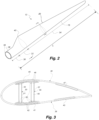
- Fig. 2 shows a schematic view of a wind turbine blade 10.
- the wind turbine blade 10 has the shape of a conventional wind turbine blade and comprises a root region 30 closest to the hub, a profiled or an airfoil region 34 farthest away from the hub and a transition region 32 between the root region 30 and the airfoil region 34.
- the blade 10 comprises a leading edge 18 facing the direction of rotation of the blade 10, when the blade is mounted on the hub, and a trailing edge 20 facing the opposite direction of the leading edge 18.
- the airfoil region 34 (also called the profiled region) has an ideal or almost ideal blade shape with respect to generating lift, whereas the root region 30 due to structural considerations has a substantially circular or elliptical cross-section, which for instance makes it easier and safer to mount the blade 10 to the hub.
- the diameter (or the chord) of the root region 30 may be constant along the entire root area 30.
- the transition region 32 has a transitional profile gradually changing from the circular or elliptical shape of the root region 30 to the airfoil profile of the airfoil region 34.
- the chord length of the transition region 32 typically increases with increasing distance r from the hub.
- the airfoil region 34 has an airfoil profile with a chord extending between the leading edge 18 and the trailing edge 20 of the blade 10. The width of the chord decreases with increasing distance r from the hub.
- a shoulder 40 of the blade 10 is defined as the position, where the blade 10 has its largest chord length.
- the shoulder 40 is typically provided at the boundary between the transition region 32 and the airfoil region 34.
- Fig. 2 also illustrates the longitudinal extent L, length or longitudinal axis of the blade.
- chords of different sections of the blade normally do not lie in a common plane, since the blade may be twisted and/or curved (i.e. pre-bent), thus providing the chord plane with a correspondingly twisted and/or curved course, this being most often the case in order to compensate for the local velocity of the blade being dependent on the radius from the hub.
- the blade is typically made from a pressure side shell part 36 and a suction side shell part 38 that are glued to each other along bond lines at the leading edge 18 and the trailing edge of the blade 20.
- Fig. 3 shows a schematic view of a cross section of the blade along the line I-I shown in Fig. 2 .
- the blade 10 comprises a pressure side shell part 36 and a suction side shell part 38.
- the pressure side shell part 36 comprises a spar cap 41, also called a main laminate, which constitutes a load bearing part of the pressure side shell part 36.
- the spar cap 41 comprises a plurality of fibre layers 42 mainly comprising unidirectional fibres aligned along the longitudinal direction of the blade in order to provide stiffness to the blade.
- the suction side shell part 38 also comprises a spar cap 45 comprising a plurality of fibre layers 46.
- the pressure side shell part 36 may also comprise a sandwich core material 43 typically made of balsawood or foamed polymer and sandwiched between a number of fibre-reinforced skin layers.
- the sandwich core material 43 is used to provide stiffness to the shell in order to ensure that the shell substantially maintains its aerodynamic profile during rotation of the blade.
- the suction side shell part 38 may also comprise a sandwich core material 47.
- the spar cap 41 of the pressure side shell part 36 and the spar cap 45 of the suction side shell part 38 are connected via a first shear web 50 and a second shear web 55.
- the shear webs 50, 55 are in the shown embodiment shaped as substantially I-shaped webs.
- the first shear web 50 comprises a shear web body and two web foot flanges.
- the shear web body comprises a sandwich core material 51, such as balsawood or foamed polymer, covered by a number of skin layers 52 made of a number of fibre layers.
- the blade shells 36, 38 may comprise further fibre-reinforcement at the leading edge and the trailing edge. Typically, the shell parts 36, 38 are bonded to each other via glue flanges.
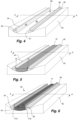
- Figs. 4-9 illustrate various steps of the method of the present invention.
- a first guide member 64 and a second guide member 66 are fastened to the moulding surface 90 of a mould 62. This can be advantageously be done by using bolts 88, as shown in the cross sectional view of Fig. 7 .
- the guide members 64, 66 comprise respective upstands 84, 86 forming respective longitudinally extending guide surface 65, 67.
- a moulding cavity 68 is provided in between the first and second guide members 64, 66.
- the first guide member 64 comprises a longitudinally extending guide surface 65
- the second guide member 66 comprises a longitudinally extending guide surface 67 facing the guide surface 65 of the first guide member 64.
- the guide surface 65 of the first guide member diverges from the guide surface 67 of the second guide member in an upward direction, the planes in which the respective guide surfaces 65, 67 lie forming an angle ⁇ .
- a fibre material 70 is placed within the moulding cavity 68, such that a first gap 72 is provided between the fibre material 70 and the first guide member 64, and a second gap 74 is provided between the fibre material 70 and the second guide member 66.
- the fibre material comprises a plurality of strips 82 of fibre material arranged into adjacent stacks of strips, such as pultruded fibre strips. As best seen in Fig.
- the fibre material 70 or the final spar cap 41 has first and second longitudinally extending lateral surfaces 41a, 41b, wherein the first guide member 64 comprises a longitudinally extending guide surface 65 forming an acute angle ⁇ 1 with the first lateral surface 41a of the spar cap, and wherein the second guide member 66 comprises a longitudinally extending guide surface 67 forming an acute angle ⁇ 2 with the second lateral surface 41b of the spar cap.
- a vacuum foil 76 is placed over the fibre material 70/41 and the first and second guide members 64, 66, such that the vacuum foil 76 extends into the first and second gap 72, 74.
- the vacuum foil is omitted in the perspective view in Fig. 6 .
- a first wedge-shaped insert 78 is inserted into the first gap 72 on top of the vacuum foil, and a second wedge-shaped insert 80 is inserted into the second gap 74 on top of the vacuum foil. This can be done by squeezing the first insert 78 into the first gap, and by squeezing the second insert 80 into the second gap.
- the first and second guide members 64, 66 and the first and second inserts 78, 80 extend along substantially the entire length Ls of the spar cap 41.
Landscapes
- Engineering & Computer Science (AREA)
- Mechanical Engineering (AREA)
- Chemical & Material Sciences (AREA)
- Composite Materials (AREA)
- Wind Motors (AREA)
- Moulding By Coating Moulds (AREA)
Claims (15)
- Verfahren zum Herstellen einer faserverstärkten Holmkappe (41) für einen Windkraftanlagenflügel, wobei das Verfahren folgende Schritte umfasst:Bereitstellen eines Formwerkzeugs (62),Befestigen eines ersten Führungselements (64) und eines zweiten Führungselements (66) an dem Formwerkzeug, um eine Formungshöhlung (68) zwischen dem ersten und dem zweiten Führungselement bereitzustellen,Anordnen eines Fasermaterials (70) in der Formungshöhlung, sodass ein erster Zwischenraum (72) zwischen dem Fasermaterial und dem ersten Führungselement bereitgestellt wird und ein zweiter Zwischenraum (74) zwischen dem Fasermaterial und dem zweiten Führungselement bereitgestellt wird,Platzieren einer Vakuumfolie (76) über das Fasermaterial und das erste und das zweite Führungselement, sodass sich die Vakuumfolie (76) in den ersten und den zweiten Zwischenraum (72, 74) erstreckt,Einsetzen eines ersten Einsatzes (78) auf der Vakuumfolie in den ersten Zwischenraum (72),Einsetzen eines zweiten Einsatzes (80) auf der Vakuumfolie in den zweiten Zwischenraum (74),Infundieren des Fasermaterials mit Harz, um ein mit Harz infundiertes Fasermaterial zu bilden,Aushärten des mit Harz infundierten Fasermaterials, um die faserverstärkte Holmkappe (41) zu bilden,Entfernen des ersten und des zweiten Einsatzes (78, 80) und der Vakuumfolie (76) undAusformen der faserverstärkten Holmkappe aus dem Formwerkzeug.
- Verfahren nach Anspruch 1, wobei das erste Führungselement (64) eine sich längs erstreckende Führungsfläche (65) umfasst und wobei das zweite Führungselement (66) eine der Führungsfläche (65) des ersten Führungselements (64) zugwandte, sich längs erstreckende Führungsfläche (67) umfasst, wobei sich die Führungsfläche (65) des ersten Führungselements in einer Aufwärtsrichtung von der Führungsfläche (67) des zweiten Führungselements entfernt.
- Verfahren nach Anspruch 1, wobei die Holmkappe (41) eine erste und eine zweite sich längs erstreckende seitliche Oberfläche (41a, 41b) aufweist, wobei das erste Führungselement eine sich längs erstreckende Führungsfläche (65) umfasst, die mit der ersten seitlichen Oberfläche (41a) der Holmkappe einen spitzen Winkel (β1) bildet, und wobei das zweite Führungselement eine sich längs erstreckende Führungsfläche (67) umfasst, die mit der zweiten seitlichen Oberfläche (41b) der Holmkappe einen spitzen Winkel (β2) bildet.
- Verfahren nach einem der vorangehenden Ansprüche, wobei der Schritt des Einsetzens des ersten Einsatzes (78) auf der Vakuumfolie in den ersten Zwischenraum (72) das Quetschen des ersten Einsatzes in den ersten Zwischenraum umfasst und wobei der Schritt des Einsetzens des zweiten Einsatzes (80) auf der Vakuumfolie in den zweiten Zwischenraum (74) das Quetschen des zweiten Einsatzes in den zweiten Zwischenraum umfasst.
- Verfahren nach einem der vorangehenden Ansprüche, wobei das Fasermaterial eine Vielzahl von Streifen (82) aus Fasermaterial umfasst, die zu benachbarten Stapeln von Streifen angeordnet sind.
- Verfahren nach einem der vorangehenden Ansprüche, wobei das Führungselement eine Aufkantung (84, 86) umfasst, die die sich längs erstreckende Führungsfläche (65, 67) bildet.
- Verfahren nach einem der vorangehenden Ansprüche, wobei das Führungselement einen im Wesentlichen L-förmigen Querschnitt oder einen dreieckigen Querschnitt aufweist.
- Verfahren nach einem der vorangehenden Ansprüche, wobei sich das erste und das zweite Führungselement entlang im Wesentlichen der gesamten Länge (Ls) der Holmkappe (41) erstrecken.
- Verfahren nach einem der vorangehenden Ansprüche, wobei das erste und das zweite Führungselement an das Formwerkzeug geschraubt werden.
- Verfahren nach einem der vorangehenden Ansprüche, wobei der Einsatz ein Silikonmaterial umfasst.
- Verfahren nach einem der vorangehenden Ansprüche, wobei der Einsatz Polyethylen hoher Dichte (HDPE) und ein Silikonmaterial umfasst.
- Verfahren nach einem der vorangehenden Ansprüche, wobei der Einsatz im Wesentlichen keilförmig ist.
- Verfahren nach einem der vorangehenden Ansprüche, wobei der Einsatz einen dreieckigen Querschnitt oder einen trapezförmigen Querschnitt aufweist.
- Verfahren nach einem der vorangehenden Ansprüche, wobei sich die Einsätze entlang im Wesentlichen der gesamten Länge (Ls) der Holmkappe erstrecken.
- Formwerkzeuganordnung (90) zum Herstellen einer faserverstärkten Holmkappe (41) für einen Windkraftanlagenflügel, wobei die Formwerkzeuganordnung Folgendes umfasst:ein Formwerkzeug (62),ein erstes Führungselement (64), das eine Aufkantung (84) umfasst, und ein zweites Führungselement (66), das eine Aufkantung (86) umfasst, wobei das erste und das zweite Führungselement an dem Formwerkzeug befestigt sind, um eine Formungshöhlung (86) zwischen dem ersten und dem zweiten Führungselement bereitzustellen,ein Fasermaterial (70), das in der Formungshöhlung angeordnet ist, sodass ein erster Zwischenraum (72) zwischen dem Fasermaterial und dem ersten Führungselement bereitgestellt ist und ein zweiter Zwischenraum (74) zwischen dem Fasermaterial und dem zweiten Führungselement bereitgestellt ist,eine Vakuumfolie (76), die über das Fasermaterial und das erste und das zweite Führungselement platziert ist, sodass sich die Vakuumfolie (76) in den ersten und den zweiten Zwischenraum (72, 74) erstreckt,einen ersten keilförmigen Einsatz (78) zum Einsetzen in die Formungshöhlung, wobei der erste keilförmige Einsatz auf der Vakuumfolie in den ersten Zwischenraum (72) eingesetzt ist undeinen zweiten keilförmigen Einsatz (80) zum Einsetzen in die Formungshöhlung, wobei der zweite keilförmige Einsatz auf der Vakuumfolie in den zweiten Zwischenraum (74) eingesetzt ist.
Priority Applications (6)
| Application Number | Priority Date | Filing Date | Title |
|---|---|---|---|
| ES20211522T ES3041518T3 (en) | 2020-12-03 | 2020-12-03 | Method of manufacturing a spar cap for a wind turbine blade |
| EP20211522.6A EP4008534B1 (de) | 2020-12-03 | 2020-12-03 | Verfahren zur herstellung einer holmkappe für ein windturbinenblatt |
| DK20211522.6T DK4008534T3 (da) | 2020-12-03 | 2020-12-03 | Fremgangsmåde til fremstilling af en bjælkeflange til en vindmøllevinge |
| PCT/EP2021/083610 WO2022117578A1 (en) | 2020-12-03 | 2021-11-30 | Method of manufacturing a spar cap for a wind turbine blade |
| US18/039,315 US20240001632A1 (en) | 2020-12-03 | 2021-11-30 | Method of manufacturing a spar cap for a wind turbine blade |
| CN202180081557.0A CN116547131A (zh) | 2020-12-03 | 2021-11-30 | 制造用于风力涡轮机叶片的翼梁帽的方法 |
Applications Claiming Priority (1)
| Application Number | Priority Date | Filing Date | Title |
|---|---|---|---|
| EP20211522.6A EP4008534B1 (de) | 2020-12-03 | 2020-12-03 | Verfahren zur herstellung einer holmkappe für ein windturbinenblatt |
Publications (2)
| Publication Number | Publication Date |
|---|---|
| EP4008534A1 EP4008534A1 (de) | 2022-06-08 |
| EP4008534B1 true EP4008534B1 (de) | 2025-06-18 |
Family
ID=73698623
Family Applications (1)
| Application Number | Title | Priority Date | Filing Date |
|---|---|---|---|
| EP20211522.6A Active EP4008534B1 (de) | 2020-12-03 | 2020-12-03 | Verfahren zur herstellung einer holmkappe für ein windturbinenblatt |
Country Status (6)
| Country | Link |
|---|---|
| US (1) | US20240001632A1 (de) |
| EP (1) | EP4008534B1 (de) |
| CN (1) | CN116547131A (de) |
| DK (1) | DK4008534T3 (de) |
| ES (1) | ES3041518T3 (de) |
| WO (1) | WO2022117578A1 (de) |
Families Citing this family (2)
| Publication number | Priority date | Publication date | Assignee | Title |
|---|---|---|---|---|
| BR112023020557A2 (pt) * | 2021-04-07 | 2023-12-05 | Lm Wind Power As | Método para fabricar uma carcaça de uma lâmina de turbina eólica |
| US11958216B2 (en) * | 2021-12-17 | 2024-04-16 | Rohr, Inc. | Modular tooling systems and methods |
Family Cites Families (13)
| Publication number | Priority date | Publication date | Assignee | Title |
|---|---|---|---|---|
| US3146148A (en) * | 1957-11-08 | 1964-08-25 | Gen Dynamics Corp | Apparatus for fabricating composite structures |
| JP2871795B2 (ja) * | 1990-03-13 | 1999-03-17 | 富士重工業株式会社 | 複合材部品成形型 |
| BR0009055A (pt) * | 1999-03-18 | 2002-01-08 | David H Stewart | Método de fabrico de parte moldada numa prensa e máquina para moldar uma parte |
| US6332769B1 (en) * | 1999-09-23 | 2001-12-25 | Alan Bashor | Universal dunnage tray mold |
| US6413074B1 (en) * | 1999-09-28 | 2002-07-02 | Composix Corporation | Assembly for molding plastic material |
| US8511362B2 (en) * | 2009-01-16 | 2013-08-20 | Edwin H. Kintz | Consolidating and curing of thermoset composite parts by pressing between a heated rigid mold and customized rubber-faced mold |
| EP2705943A1 (de) * | 2009-10-12 | 2014-03-12 | Vestas Wind Systems A/S | Fixiervorrichtung |
| US20110146906A1 (en) * | 2009-12-18 | 2011-06-23 | The Boeing Company | Double Vacuum Cure Processing of Composite Parts |
| WO2011113812A1 (en) * | 2010-03-15 | 2011-09-22 | Vestas Wind Systems A/S | Improved wind turbine blade spar |
| CN104981338B (zh) * | 2012-12-18 | 2018-03-23 | Lm Wp 专利控股有限公司 | 包括带有凹部和预制梁帽的空气动力学叶片壳体的风力涡轮机叶片 |
| DE102012223707A1 (de) * | 2012-12-19 | 2014-06-26 | Sgl Carbon Se | Variable Formvorrichtung zur Herstellung eines T-Stegs für ein Rotorblatt einer Windenergieanlage und ein Verfahren zu deren Herstellung |
| CN103640231B (zh) * | 2013-12-17 | 2016-02-10 | 沈阳飞机工业(集团)有限公司 | 组合式真空袋外定位装置及其定位方法 |
| US10527023B2 (en) * | 2017-02-09 | 2020-01-07 | General Electric Company | Methods for manufacturing spar caps for wind turbine rotor blades |
-
2020
- 2020-12-03 ES ES20211522T patent/ES3041518T3/es active Active
- 2020-12-03 EP EP20211522.6A patent/EP4008534B1/de active Active
- 2020-12-03 DK DK20211522.6T patent/DK4008534T3/da active
-
2021
- 2021-11-30 WO PCT/EP2021/083610 patent/WO2022117578A1/en not_active Ceased
- 2021-11-30 CN CN202180081557.0A patent/CN116547131A/zh active Pending
- 2021-11-30 US US18/039,315 patent/US20240001632A1/en active Pending
Also Published As
| Publication number | Publication date |
|---|---|
| CN116547131A (zh) | 2023-08-04 |
| ES3041518T3 (en) | 2025-11-12 |
| EP4008534A1 (de) | 2022-06-08 |
| DK4008534T3 (da) | 2025-09-22 |
| WO2022117578A1 (en) | 2022-06-09 |
| US20240001632A1 (en) | 2024-01-04 |
Similar Documents
| Publication | Publication Date | Title |
|---|---|---|
| US11607826B2 (en) | Method of manufacturing at least two preforms for moulding a wind turbine blade | |
| EP2934857B1 (de) | Windturbinenschaufel mit aerodynamischer schaufelverkleidung mit aussparung und vorgefertigter holmkappe | |
| EP3212375B1 (de) | Schernetzformungssystem mit variablen formplatten | |
| EP4212324B1 (de) | Herstellung einer sparrenkappe für windturbinenschaufeln | |
| EP3468786B1 (de) | Verfahren zur herstellung einer windturbinenschaufel | |
| EP3423266B1 (de) | Verfahren zum formen eines mantelteils einer windturbinenschaufel | |
| EP3548261B1 (de) | Verfahren und system zur herstellung eines scherstegs für eine windturbinenschaufel | |
| EP4008534B1 (de) | Verfahren zur herstellung einer holmkappe für ein windturbinenblatt | |
| US12290995B2 (en) | Guide member for guiding a shear web of wind turbine blade | |
| WO2020089024A1 (en) | A wind turbine blade with a plurality of shear webs | |
| US12466144B2 (en) | Precured fibrous strip for a load-carrying structure for a wind turbine blade | |
| US12071925B2 (en) | Wind turbine blade with reinforcing structure | |
| US20240399678A1 (en) | Spar cap for a wind turbine blade | |
| EP3564019B1 (de) | Verfahren zur herstellung einer windturbinenschaufel |
Legal Events
| Date | Code | Title | Description |
|---|---|---|---|
| PUAI | Public reference made under article 153(3) epc to a published international application that has entered the european phase |
Free format text: ORIGINAL CODE: 0009012 |
|
| STAA | Information on the status of an ep patent application or granted ep patent |
Free format text: STATUS: THE APPLICATION HAS BEEN PUBLISHED |
|
| AK | Designated contracting states |
Kind code of ref document: A1 Designated state(s): AL AT BE BG CH CY CZ DE DK EE ES FI FR GB GR HR HU IE IS IT LI LT LU LV MC MK MT NL NO PL PT RO RS SE SI SK SM TR |
|
| STAA | Information on the status of an ep patent application or granted ep patent |
Free format text: STATUS: REQUEST FOR EXAMINATION WAS MADE |
|
| 17P | Request for examination filed |
Effective date: 20221205 |
|
| RBV | Designated contracting states (corrected) |
Designated state(s): AL AT BE BG CH CY CZ DE DK EE ES FI FR GB GR HR HU IE IS IT LI LT LU LV MC MK MT NL NO PL PT RO RS SE SI SK SM TR |
|
| P01 | Opt-out of the competence of the unified patent court (upc) registered |
Effective date: 20230522 |
|
| GRAP | Despatch of communication of intention to grant a patent |
Free format text: ORIGINAL CODE: EPIDOSNIGR1 |
|
| STAA | Information on the status of an ep patent application or granted ep patent |
Free format text: STATUS: GRANT OF PATENT IS INTENDED |
|
| RIC1 | Information provided on ipc code assigned before grant |
Ipc: B29L 31/08 20060101ALN20250107BHEP Ipc: F03D 1/06 20060101ALI20250107BHEP Ipc: B29C 33/48 20060101ALI20250107BHEP Ipc: B29C 70/54 20060101ALI20250107BHEP Ipc: B29C 33/30 20060101ALI20250107BHEP Ipc: B29D 99/00 20100101ALI20250107BHEP Ipc: B29C 70/44 20060101AFI20250107BHEP |
|
| INTG | Intention to grant announced |
Effective date: 20250117 |
|
| RIC1 | Information provided on ipc code assigned before grant |
Ipc: B29L 31/08 20060101ALN20250110BHEP Ipc: F03D 1/06 20060101ALI20250110BHEP Ipc: B29C 33/48 20060101ALI20250110BHEP Ipc: B29C 70/54 20060101ALI20250110BHEP Ipc: B29C 33/30 20060101ALI20250110BHEP Ipc: B29D 99/00 20100101ALI20250110BHEP Ipc: B29C 70/44 20060101AFI20250110BHEP |
|
| GRAS | Grant fee paid |
Free format text: ORIGINAL CODE: EPIDOSNIGR3 |
|
| GRAA | (expected) grant |
Free format text: ORIGINAL CODE: 0009210 |
|
| STAA | Information on the status of an ep patent application or granted ep patent |
Free format text: STATUS: THE PATENT HAS BEEN GRANTED |
|
| AK | Designated contracting states |
Kind code of ref document: B1 Designated state(s): AL AT BE BG CH CY CZ DE DK EE ES FI FR GB GR HR HU IE IS IT LI LT LU LV MC MK MT NL NO PL PT RO RS SE SI SK SM TR |
|
| REG | Reference to a national code |
Ref country code: GB Ref legal event code: FG4D |
|
| REG | Reference to a national code |
Ref country code: CH Ref legal event code: EP |
|
| REG | Reference to a national code |
Ref country code: DE Ref legal event code: R096 Ref document number: 602020052863 Country of ref document: DE |
|
| REG | Reference to a national code |
Ref country code: CH Ref legal event code: EP |
|
| REG | Reference to a national code |
Ref country code: IE Ref legal event code: FG4D |
|
| REG | Reference to a national code |
Ref country code: DK Ref legal event code: T3 Effective date: 20250917 |
|
| PG25 | Lapsed in a contracting state [announced via postgrant information from national office to epo] |
Ref country code: FI Free format text: LAPSE BECAUSE OF FAILURE TO SUBMIT A TRANSLATION OF THE DESCRIPTION OR TO PAY THE FEE WITHIN THE PRESCRIBED TIME-LIMIT Effective date: 20250618 |
|
| REG | Reference to a national code |
Ref country code: LT Ref legal event code: MG9D |
|
| PG25 | Lapsed in a contracting state [announced via postgrant information from national office to epo] |
Ref country code: GR Free format text: LAPSE BECAUSE OF FAILURE TO SUBMIT A TRANSLATION OF THE DESCRIPTION OR TO PAY THE FEE WITHIN THE PRESCRIBED TIME-LIMIT Effective date: 20250919 Ref country code: NO Free format text: LAPSE BECAUSE OF FAILURE TO SUBMIT A TRANSLATION OF THE DESCRIPTION OR TO PAY THE FEE WITHIN THE PRESCRIBED TIME-LIMIT Effective date: 20250918 |
|
| PG25 | Lapsed in a contracting state [announced via postgrant information from national office to epo] |
Ref country code: BG Free format text: LAPSE BECAUSE OF FAILURE TO SUBMIT A TRANSLATION OF THE DESCRIPTION OR TO PAY THE FEE WITHIN THE PRESCRIBED TIME-LIMIT Effective date: 20250618 |
|
| PG25 | Lapsed in a contracting state [announced via postgrant information from national office to epo] |
Ref country code: HR Free format text: LAPSE BECAUSE OF FAILURE TO SUBMIT A TRANSLATION OF THE DESCRIPTION OR TO PAY THE FEE WITHIN THE PRESCRIBED TIME-LIMIT Effective date: 20250618 |
|
| PG25 | Lapsed in a contracting state [announced via postgrant information from national office to epo] |
Ref country code: RS Free format text: LAPSE BECAUSE OF FAILURE TO SUBMIT A TRANSLATION OF THE DESCRIPTION OR TO PAY THE FEE WITHIN THE PRESCRIBED TIME-LIMIT Effective date: 20250918 |
|
| REG | Reference to a national code |
Ref country code: NL Ref legal event code: MP Effective date: 20250618 |
|
| PG25 | Lapsed in a contracting state [announced via postgrant information from national office to epo] |
Ref country code: LV Free format text: LAPSE BECAUSE OF FAILURE TO SUBMIT A TRANSLATION OF THE DESCRIPTION OR TO PAY THE FEE WITHIN THE PRESCRIBED TIME-LIMIT Effective date: 20250618 |
|
| REG | Reference to a national code |
Ref country code: ES Ref legal event code: FG2A Ref document number: 3041518 Country of ref document: ES Kind code of ref document: T3 Effective date: 20251112 |
|
| PG25 | Lapsed in a contracting state [announced via postgrant information from national office to epo] |
Ref country code: NL Free format text: LAPSE BECAUSE OF FAILURE TO SUBMIT A TRANSLATION OF THE DESCRIPTION OR TO PAY THE FEE WITHIN THE PRESCRIBED TIME-LIMIT Effective date: 20250618 |
|
| PG25 | Lapsed in a contracting state [announced via postgrant information from national office to epo] |
Ref country code: PT Free format text: LAPSE BECAUSE OF FAILURE TO SUBMIT A TRANSLATION OF THE DESCRIPTION OR TO PAY THE FEE WITHIN THE PRESCRIBED TIME-LIMIT Effective date: 20251020 |
|
| REG | Reference to a national code |
Ref country code: AT Ref legal event code: MK05 Ref document number: 1803843 Country of ref document: AT Kind code of ref document: T Effective date: 20250618 |
|
| PG25 | Lapsed in a contracting state [announced via postgrant information from national office to epo] |
Ref country code: IS Free format text: LAPSE BECAUSE OF FAILURE TO SUBMIT A TRANSLATION OF THE DESCRIPTION OR TO PAY THE FEE WITHIN THE PRESCRIBED TIME-LIMIT Effective date: 20251018 |
|
| PGFP | Annual fee paid to national office [announced via postgrant information from national office to epo] |
Ref country code: DE Payment date: 20251126 Year of fee payment: 6 |
|
| PGFP | Annual fee paid to national office [announced via postgrant information from national office to epo] |
Ref country code: GB Payment date: 20251120 Year of fee payment: 6 |
|
| PG25 | Lapsed in a contracting state [announced via postgrant information from national office to epo] |
Ref country code: AT Free format text: LAPSE BECAUSE OF FAILURE TO SUBMIT A TRANSLATION OF THE DESCRIPTION OR TO PAY THE FEE WITHIN THE PRESCRIBED TIME-LIMIT Effective date: 20250618 Ref country code: SM Free format text: LAPSE BECAUSE OF FAILURE TO SUBMIT A TRANSLATION OF THE DESCRIPTION OR TO PAY THE FEE WITHIN THE PRESCRIBED TIME-LIMIT Effective date: 20250618 |
|
| PGFP | Annual fee paid to national office [announced via postgrant information from national office to epo] |
Ref country code: DK Payment date: 20251119 Year of fee payment: 6 |
|
| PGFP | Annual fee paid to national office [announced via postgrant information from national office to epo] |
Ref country code: FR Payment date: 20251119 Year of fee payment: 6 |