EP4008340A1 - Compositions for treating celiac sprue disease - Google Patents
Compositions for treating celiac sprue disease Download PDFInfo
- Publication number
- EP4008340A1 EP4008340A1 EP21167722.4A EP21167722A EP4008340A1 EP 4008340 A1 EP4008340 A1 EP 4008340A1 EP 21167722 A EP21167722 A EP 21167722A EP 4008340 A1 EP4008340 A1 EP 4008340A1
- Authority
- EP
- European Patent Office
- Prior art keywords
- residue
- seq
- amino acid
- acid sequence
- viii
- Prior art date
- Legal status (The legal status is an assumption and is not a legal conclusion. Google has not performed a legal analysis and makes no representation as to the accuracy of the status listed.)
- Withdrawn
Links
- 208000015943 Coeliac disease Diseases 0.000 title claims abstract description 47
- 239000000203 mixture Substances 0.000 title claims abstract description 19
- 208000037265 diseases, disorders, signs and symptoms Diseases 0.000 title description 9
- 238000000034 method Methods 0.000 claims abstract description 30
- 108090000765 processed proteins & peptides Proteins 0.000 claims description 182
- 102000004196 processed proteins & peptides Human genes 0.000 claims description 150
- 229920001184 polypeptide Polymers 0.000 claims description 142
- 125000003275 alpha amino acid group Chemical group 0.000 claims description 69
- 150000007523 nucleic acids Chemical class 0.000 claims description 28
- 239000008194 pharmaceutical composition Substances 0.000 claims description 23
- 102000039446 nucleic acids Human genes 0.000 claims description 19
- 108020004707 nucleic acids Proteins 0.000 claims description 19
- 239000013604 expression vector Substances 0.000 claims description 16
- 239000003937 drug carrier Substances 0.000 claims description 6
- 230000000694 effects Effects 0.000 description 36
- 102000004190 Enzymes Human genes 0.000 description 29
- 108090000790 Enzymes Proteins 0.000 description 29
- 229940088598 enzyme Drugs 0.000 description 29
- 108090000623 proteins and genes Proteins 0.000 description 24
- 108010068370 Glutens Proteins 0.000 description 23
- 235000021312 gluten Nutrition 0.000 description 23
- 108010061711 Gliadin Proteins 0.000 description 20
- 102000004169 proteins and genes Human genes 0.000 description 19
- 235000018102 proteins Nutrition 0.000 description 17
- 239000000758 substrate Substances 0.000 description 16
- 239000000872 buffer Substances 0.000 description 15
- RAXXELZNTBOGNW-UHFFFAOYSA-N imidazole Natural products C1=CNC=N1 RAXXELZNTBOGNW-UHFFFAOYSA-N 0.000 description 15
- 102000035195 Peptidases Human genes 0.000 description 13
- 108091005804 Peptidases Proteins 0.000 description 13
- FAPWRFPIFSIZLT-UHFFFAOYSA-M Sodium chloride Chemical compound [Na+].[Cl-] FAPWRFPIFSIZLT-UHFFFAOYSA-M 0.000 description 12
- 239000004365 Protease Substances 0.000 description 11
- 210000004027 cell Anatomy 0.000 description 11
- 230000014509 gene expression Effects 0.000 description 11
- 230000015556 catabolic process Effects 0.000 description 10
- 238000006731 degradation reaction Methods 0.000 description 10
- DHMQDGOQFOQNFH-UHFFFAOYSA-N Glycine Chemical compound NCC(O)=O DHMQDGOQFOQNFH-UHFFFAOYSA-N 0.000 description 9
- WHUUTDBJXJRKMK-UHFFFAOYSA-N Glutamic acid Natural products OC(=O)C(N)CCC(O)=O WHUUTDBJXJRKMK-UHFFFAOYSA-N 0.000 description 8
- CKLJMWTZIZZHCS-REOHCLBHSA-N L-aspartic acid Chemical compound OC(=O)[C@@H](N)CC(O)=O CKLJMWTZIZZHCS-REOHCLBHSA-N 0.000 description 8
- 230000035772 mutation Effects 0.000 description 8
- 210000002784 stomach Anatomy 0.000 description 8
- 235000001014 amino acid Nutrition 0.000 description 6
- 201000010099 disease Diseases 0.000 description 6
- 239000012154 double-distilled water Substances 0.000 description 6
- 239000000047 product Substances 0.000 description 6
- 238000000746 purification Methods 0.000 description 6
- 239000011780 sodium chloride Substances 0.000 description 6
- 208000024891 symptom Diseases 0.000 description 6
- 206010061218 Inflammation Diseases 0.000 description 5
- ZDXPYRJPNDTMRX-VKHMYHEASA-N L-glutamine Chemical compound OC(=O)[C@@H](N)CCC(N)=O ZDXPYRJPNDTMRX-VKHMYHEASA-N 0.000 description 5
- 108010038807 Oligopeptides Proteins 0.000 description 5
- 102000015636 Oligopeptides Human genes 0.000 description 5
- ONIBWKKTOPOVIA-UHFFFAOYSA-N Proline Natural products OC(=O)C1CCCN1 ONIBWKKTOPOVIA-UHFFFAOYSA-N 0.000 description 5
- 229940024606 amino acid Drugs 0.000 description 5
- 150000001413 amino acids Chemical class 0.000 description 5
- 238000003556 assay Methods 0.000 description 5
- 150000001875 compounds Chemical class 0.000 description 5
- 239000007857 degradation product Substances 0.000 description 5
- 108091007735 digestive proteases Proteins 0.000 description 5
- 230000003301 hydrolyzing effect Effects 0.000 description 5
- 230000004054 inflammatory process Effects 0.000 description 5
- 235000019419 proteases Nutrition 0.000 description 5
- 210000000813 small intestine Anatomy 0.000 description 5
- 238000002560 therapeutic procedure Methods 0.000 description 5
- 239000011534 wash buffer Substances 0.000 description 5
- JKMHFZQWWAIEOD-UHFFFAOYSA-N 2-[4-(2-hydroxyethyl)piperazin-1-yl]ethanesulfonic acid Chemical compound OCC[NH+]1CCN(CCS([O-])(=O)=O)CC1 JKMHFZQWWAIEOD-UHFFFAOYSA-N 0.000 description 4
- 101710087459 Gamma-gliadin Proteins 0.000 description 4
- 239000004471 Glycine Substances 0.000 description 4
- 239000007995 HEPES buffer Substances 0.000 description 4
- 241000209219 Hordeum Species 0.000 description 4
- 235000007340 Hordeum vulgare Nutrition 0.000 description 4
- 230000003197 catalytic effect Effects 0.000 description 4
- 230000008859 change Effects 0.000 description 4
- 238000000502 dialysis Methods 0.000 description 4
- 230000029087 digestion Effects 0.000 description 4
- 238000009472 formulation Methods 0.000 description 4
- ZDXPYRJPNDTMRX-UHFFFAOYSA-N glutamine Natural products OC(=O)C(N)CCC(N)=O ZDXPYRJPNDTMRX-UHFFFAOYSA-N 0.000 description 4
- 230000028993 immune response Effects 0.000 description 4
- 230000002163 immunogen Effects 0.000 description 4
- 239000007974 sodium acetate buffer Substances 0.000 description 4
- 230000001225 therapeutic effect Effects 0.000 description 4
- HZWWPUTXBJEENE-UHFFFAOYSA-N 5-amino-2-[[1-[5-amino-2-[[1-[2-amino-3-(4-hydroxyphenyl)propanoyl]pyrrolidine-2-carbonyl]amino]-5-oxopentanoyl]pyrrolidine-2-carbonyl]amino]-5-oxopentanoic acid Chemical compound C1CCC(C(=O)NC(CCC(N)=O)C(=O)N2C(CCC2)C(=O)NC(CCC(N)=O)C(O)=O)N1C(=O)C(N)CC1=CC=C(O)C=C1 HZWWPUTXBJEENE-UHFFFAOYSA-N 0.000 description 3
- 206010000060 Abdominal distension Diseases 0.000 description 3
- WEVYAHXRMPXWCK-UHFFFAOYSA-N Acetonitrile Chemical compound CC#N WEVYAHXRMPXWCK-UHFFFAOYSA-N 0.000 description 3
- 239000004475 Arginine Substances 0.000 description 3
- FBPFZTCFMRRESA-FSIIMWSLSA-N D-Glucitol Natural products OC[C@H](O)[C@H](O)[C@@H](O)[C@H](O)CO FBPFZTCFMRRESA-FSIIMWSLSA-N 0.000 description 3
- FBPFZTCFMRRESA-JGWLITMVSA-N D-glucitol Chemical compound OC[C@H](O)[C@@H](O)[C@H](O)[C@H](O)CO FBPFZTCFMRRESA-JGWLITMVSA-N 0.000 description 3
- PEDCQBHIVMGVHV-UHFFFAOYSA-N Glycerine Chemical compound OCC(O)CO PEDCQBHIVMGVHV-UHFFFAOYSA-N 0.000 description 3
- 150000008575 L-amino acids Chemical class 0.000 description 3
- ODKSFYDXXFIFQN-BYPYZUCNSA-N L-arginine Chemical compound OC(=O)[C@@H](N)CCCN=C(N)N ODKSFYDXXFIFQN-BYPYZUCNSA-N 0.000 description 3
- FFEARJCKVFRZRR-BYPYZUCNSA-N L-methionine Chemical compound CSCC[C@H](N)C(O)=O FFEARJCKVFRZRR-BYPYZUCNSA-N 0.000 description 3
- 102000057297 Pepsin A Human genes 0.000 description 3
- 108090000284 Pepsin A Proteins 0.000 description 3
- VMHLLURERBWHNL-UHFFFAOYSA-M Sodium acetate Chemical compound [Na+].CC([O-])=O VMHLLURERBWHNL-UHFFFAOYSA-M 0.000 description 3
- 229930006000 Sucrose Natural products 0.000 description 3
- CZMRCDWAGMRECN-UGDNZRGBSA-N Sucrose Chemical compound O[C@H]1[C@H](O)[C@@H](CO)O[C@@]1(CO)O[C@@H]1[C@H](O)[C@@H](O)[C@H](O)[C@@H](CO)O1 CZMRCDWAGMRECN-UGDNZRGBSA-N 0.000 description 3
- 241000209140 Triticum Species 0.000 description 3
- 235000021307 Triticum Nutrition 0.000 description 3
- 102000004142 Trypsin Human genes 0.000 description 3
- 108090000631 Trypsin Proteins 0.000 description 3
- 238000010521 absorption reaction Methods 0.000 description 3
- 230000002378 acidificating effect Effects 0.000 description 3
- 239000013543 active substance Substances 0.000 description 3
- ODKSFYDXXFIFQN-UHFFFAOYSA-N arginine Natural products OC(=O)C(N)CCCNC(N)=N ODKSFYDXXFIFQN-UHFFFAOYSA-N 0.000 description 3
- 229960003121 arginine Drugs 0.000 description 3
- 239000003795 chemical substances by application Substances 0.000 description 3
- 235000005911 diet Nutrition 0.000 description 3
- 230000037213 diet Effects 0.000 description 3
- 230000008030 elimination Effects 0.000 description 3
- 238000003379 elimination reaction Methods 0.000 description 3
- -1 elixirs Substances 0.000 description 3
- 239000012149 elution buffer Substances 0.000 description 3
- 230000002496 gastric effect Effects 0.000 description 3
- 230000007062 hydrolysis Effects 0.000 description 3
- 238000006460 hydrolysis reaction Methods 0.000 description 3
- 238000011534 incubation Methods 0.000 description 3
- 229930182817 methionine Natural products 0.000 description 3
- 238000010369 molecular cloning Methods 0.000 description 3
- 239000008188 pellet Substances 0.000 description 3
- 229940111202 pepsin Drugs 0.000 description 3
- 239000013612 plasmid Substances 0.000 description 3
- 230000017854 proteolysis Effects 0.000 description 3
- 230000028043 self proteolysis Effects 0.000 description 3
- 239000000243 solution Substances 0.000 description 3
- 239000000600 sorbitol Substances 0.000 description 3
- 239000003381 stabilizer Substances 0.000 description 3
- 239000005720 sucrose Substances 0.000 description 3
- 239000006228 supernatant Substances 0.000 description 3
- 239000003826 tablet Substances 0.000 description 3
- 239000012588 trypsin Substances 0.000 description 3
- CFKMVGJGLGKFKI-UHFFFAOYSA-N 4-chloro-m-cresol Chemical compound CC1=CC(O)=CC=C1Cl CFKMVGJGLGKFKI-UHFFFAOYSA-N 0.000 description 2
- TYMLOMAKGOJONV-UHFFFAOYSA-N 4-nitroaniline Chemical compound NC1=CC=C([N+]([O-])=O)C=C1 TYMLOMAKGOJONV-UHFFFAOYSA-N 0.000 description 2
- 108091026890 Coding region Proteins 0.000 description 2
- 102000016911 Deoxyribonucleases Human genes 0.000 description 2
- 108010053770 Deoxyribonucleases Proteins 0.000 description 2
- 206010012735 Diarrhoea Diseases 0.000 description 2
- 108010010256 Dietary Proteins Proteins 0.000 description 2
- 102000015781 Dietary Proteins Human genes 0.000 description 2
- SQUHHTBVTRBESD-UHFFFAOYSA-N Hexa-Ac-myo-Inositol Natural products CC(=O)OC1C(OC(C)=O)C(OC(C)=O)C(OC(C)=O)C(OC(C)=O)C1OC(C)=O SQUHHTBVTRBESD-UHFFFAOYSA-N 0.000 description 2
- ONIBWKKTOPOVIA-BYPYZUCNSA-N L-Proline Chemical compound OC(=O)[C@@H]1CCCN1 ONIBWKKTOPOVIA-BYPYZUCNSA-N 0.000 description 2
- ODKSFYDXXFIFQN-BYPYZUCNSA-P L-argininium(2+) Chemical compound NC(=[NH2+])NCCC[C@H]([NH3+])C(O)=O ODKSFYDXXFIFQN-BYPYZUCNSA-P 0.000 description 2
- DCXYFEDJOCDNAF-REOHCLBHSA-N L-asparagine Chemical compound OC(=O)[C@@H](N)CC(N)=O DCXYFEDJOCDNAF-REOHCLBHSA-N 0.000 description 2
- AGPKZVBTJJNPAG-WHFBIAKZSA-N L-isoleucine Chemical compound CC[C@H](C)[C@H](N)C(O)=O AGPKZVBTJJNPAG-WHFBIAKZSA-N 0.000 description 2
- ROHFNLRQFUQHCH-YFKPBYRVSA-N L-leucine Chemical compound CC(C)C[C@H](N)C(O)=O ROHFNLRQFUQHCH-YFKPBYRVSA-N 0.000 description 2
- COLNVLDHVKWLRT-QMMMGPOBSA-N L-phenylalanine Chemical compound OC(=O)[C@@H](N)CC1=CC=CC=C1 COLNVLDHVKWLRT-QMMMGPOBSA-N 0.000 description 2
- OUYCCCASQSFEME-QMMMGPOBSA-N L-tyrosine Chemical compound OC(=O)[C@@H](N)CC1=CC=C(O)C=C1 OUYCCCASQSFEME-QMMMGPOBSA-N 0.000 description 2
- KDXKERNSBIXSRK-UHFFFAOYSA-N Lysine Natural products NCCCCC(N)C(O)=O KDXKERNSBIXSRK-UHFFFAOYSA-N 0.000 description 2
- CSNNHWWHGAXBCP-UHFFFAOYSA-L Magnesium sulfate Chemical compound [Mg+2].[O-][S+2]([O-])([O-])[O-] CSNNHWWHGAXBCP-UHFFFAOYSA-L 0.000 description 2
- 102000016943 Muramidase Human genes 0.000 description 2
- 108010014251 Muramidase Proteins 0.000 description 2
- 108010062010 N-Acetylmuramoyl-L-alanine Amidase Proteins 0.000 description 2
- 206010060860 Neurological symptom Diseases 0.000 description 2
- ISWSIDIOOBJBQZ-UHFFFAOYSA-N Phenol Chemical compound OC1=CC=CC=C1 ISWSIDIOOBJBQZ-UHFFFAOYSA-N 0.000 description 2
- 241000209056 Secale Species 0.000 description 2
- 235000007238 Secale cereale Nutrition 0.000 description 2
- KZSNJWFQEVHDMF-UHFFFAOYSA-N Valine Natural products CC(C)C(N)C(O)=O KZSNJWFQEVHDMF-UHFFFAOYSA-N 0.000 description 2
- 208000007502 anemia Diseases 0.000 description 2
- 210000004102 animal cell Anatomy 0.000 description 2
- 229960003589 arginine hydrochloride Drugs 0.000 description 2
- WPYMKLBDIGXBTP-UHFFFAOYSA-N benzoic acid Chemical compound OC(=O)C1=CC=CC=C1 WPYMKLBDIGXBTP-UHFFFAOYSA-N 0.000 description 2
- 230000008033 biological extinction Effects 0.000 description 2
- 230000037396 body weight Effects 0.000 description 2
- 239000004067 bulking agent Substances 0.000 description 2
- 238000006243 chemical reaction Methods 0.000 description 2
- OSASVXMJTNOKOY-UHFFFAOYSA-N chlorobutanol Chemical compound CC(C)(O)C(Cl)(Cl)Cl OSASVXMJTNOKOY-UHFFFAOYSA-N 0.000 description 2
- 229910017052 cobalt Inorganic materials 0.000 description 2
- 239000010941 cobalt Substances 0.000 description 2
- GUTLYIVDDKVIGB-UHFFFAOYSA-N cobalt atom Chemical compound [Co] GUTLYIVDDKVIGB-UHFFFAOYSA-N 0.000 description 2
- 230000000295 complement effect Effects 0.000 description 2
- 230000000593 degrading effect Effects 0.000 description 2
- 238000004925 denaturation Methods 0.000 description 2
- 230000036425 denaturation Effects 0.000 description 2
- 238000001514 detection method Methods 0.000 description 2
- 238000011161 development Methods 0.000 description 2
- 235000021245 dietary protein Nutrition 0.000 description 2
- 239000003085 diluting agent Substances 0.000 description 2
- 239000003814 drug Substances 0.000 description 2
- 239000000839 emulsion Substances 0.000 description 2
- 238000002474 experimental method Methods 0.000 description 2
- 206010016256 fatigue Diseases 0.000 description 2
- 239000000499 gel Substances 0.000 description 2
- 238000004128 high performance liquid chromatography Methods 0.000 description 2
- HNDVDQJCIGZPNO-UHFFFAOYSA-N histidine Natural products OC(=O)C(N)CC1=CN=CN1 HNDVDQJCIGZPNO-UHFFFAOYSA-N 0.000 description 2
- 208000034783 hypoesthesia Diseases 0.000 description 2
- 238000001727 in vivo Methods 0.000 description 2
- 230000001939 inductive effect Effects 0.000 description 2
- CDAISMWEOUEBRE-GPIVLXJGSA-N inositol Chemical compound O[C@H]1[C@H](O)[C@@H](O)[C@H](O)[C@H](O)[C@@H]1O CDAISMWEOUEBRE-GPIVLXJGSA-N 0.000 description 2
- 229960000367 inositol Drugs 0.000 description 2
- 108010049331 kumamolysin Proteins 0.000 description 2
- 239000007788 liquid Substances 0.000 description 2
- 239000007937 lozenge Substances 0.000 description 2
- 239000012139 lysis buffer Substances 0.000 description 2
- 239000004325 lysozyme Substances 0.000 description 2
- 235000010335 lysozyme Nutrition 0.000 description 2
- 229960000274 lysozyme Drugs 0.000 description 2
- RLSSMJSEOOYNOY-UHFFFAOYSA-N m-cresol Chemical compound CC1=CC=CC(O)=C1 RLSSMJSEOOYNOY-UHFFFAOYSA-N 0.000 description 2
- BDAGIHXWWSANSR-UHFFFAOYSA-N methanoic acid Natural products OC=O BDAGIHXWWSANSR-UHFFFAOYSA-N 0.000 description 2
- LXCFILQKKLGQFO-UHFFFAOYSA-N methylparaben Chemical compound COC(=O)C1=CC=C(O)C=C1 LXCFILQKKLGQFO-UHFFFAOYSA-N 0.000 description 2
- 230000003278 mimic effect Effects 0.000 description 2
- 235000015097 nutrients Nutrition 0.000 description 2
- QWVGKYWNOKOFNN-UHFFFAOYSA-N o-cresol Chemical compound CC1=CC=CC=C1O QWVGKYWNOKOFNN-UHFFFAOYSA-N 0.000 description 2
- IWDCLRJOBJJRNH-UHFFFAOYSA-N p-cresol Chemical compound CC1=CC=C(O)C=C1 IWDCLRJOBJJRNH-UHFFFAOYSA-N 0.000 description 2
- 208000035824 paresthesia Diseases 0.000 description 2
- 239000000546 pharmaceutical excipient Substances 0.000 description 2
- 239000006187 pill Substances 0.000 description 2
- 230000003389 potentiating effect Effects 0.000 description 2
- 239000000843 powder Substances 0.000 description 2
- 239000003755 preservative agent Substances 0.000 description 2
- 230000002335 preservative effect Effects 0.000 description 2
- 210000001236 prokaryotic cell Anatomy 0.000 description 2
- QELSKZZBTMNZEB-UHFFFAOYSA-N propylparaben Chemical compound CCCOC(=O)C1=CC=C(O)C=C1 QELSKZZBTMNZEB-UHFFFAOYSA-N 0.000 description 2
- 235000019833 protease Nutrition 0.000 description 2
- 238000011002 quantification Methods 0.000 description 2
- 230000004044 response Effects 0.000 description 2
- CDAISMWEOUEBRE-UHFFFAOYSA-N scyllo-inosotol Natural products OC1C(O)C(O)C(O)C(O)C1O CDAISMWEOUEBRE-UHFFFAOYSA-N 0.000 description 2
- 239000001632 sodium acetate Substances 0.000 description 2
- 235000017281 sodium acetate Nutrition 0.000 description 2
- 238000002415 sodium dodecyl sulfate polyacrylamide gel electrophoresis Methods 0.000 description 2
- 239000007787 solid Substances 0.000 description 2
- 239000000126 substance Substances 0.000 description 2
- 239000004094 surface-active agent Substances 0.000 description 2
- 239000000725 suspension Substances 0.000 description 2
- 239000006188 syrup Substances 0.000 description 2
- 235000020357 syrup Nutrition 0.000 description 2
- 238000001890 transfection Methods 0.000 description 2
- 238000012546 transfer Methods 0.000 description 2
- 230000003612 virological effect Effects 0.000 description 2
- 208000016261 weight loss Diseases 0.000 description 2
- 230000004580 weight loss Effects 0.000 description 2
- HDTRYLNUVZCQOY-UHFFFAOYSA-N α-D-glucopyranosyl-α-D-glucopyranoside Natural products OC1C(O)C(O)C(CO)OC1OC1C(O)C(O)C(O)C(CO)O1 HDTRYLNUVZCQOY-UHFFFAOYSA-N 0.000 description 1
- JNYAEWCLZODPBN-JGWLITMVSA-N (2r,3r,4s)-2-[(1r)-1,2-dihydroxyethyl]oxolane-3,4-diol Chemical compound OC[C@@H](O)[C@H]1OC[C@H](O)[C@H]1O JNYAEWCLZODPBN-JGWLITMVSA-N 0.000 description 1
- ZORQXIQZAOLNGE-UHFFFAOYSA-N 1,1-difluorocyclohexane Chemical compound FC1(F)CCCCC1 ZORQXIQZAOLNGE-UHFFFAOYSA-N 0.000 description 1
- BFSVOASYOCHEOV-UHFFFAOYSA-N 2-diethylaminoethanol Chemical compound CCN(CC)CCO BFSVOASYOCHEOV-UHFFFAOYSA-N 0.000 description 1
- OSWFIVFLDKOXQC-UHFFFAOYSA-N 4-(3-methoxyphenyl)aniline Chemical compound COC1=CC=CC(C=2C=CC(N)=CC=2)=C1 OSWFIVFLDKOXQC-UHFFFAOYSA-N 0.000 description 1
- NJYVEMPWNAYQQN-UHFFFAOYSA-N 5-carboxyfluorescein Chemical compound C12=CC=C(O)C=C2OC2=CC(O)=CC=C2C21OC(=O)C1=CC(C(=O)O)=CC=C21 NJYVEMPWNAYQQN-UHFFFAOYSA-N 0.000 description 1
- XZIIFPSPUDAGJM-UHFFFAOYSA-N 6-chloro-2-n,2-n-diethylpyrimidine-2,4-diamine Chemical compound CCN(CC)C1=NC(N)=CC(Cl)=N1 XZIIFPSPUDAGJM-UHFFFAOYSA-N 0.000 description 1
- 208000004998 Abdominal Pain Diseases 0.000 description 1
- 102000007469 Actins Human genes 0.000 description 1
- 108010085238 Actins Proteins 0.000 description 1
- 241001442202 Alicyclobacillus sendaiensis Species 0.000 description 1
- 201000004384 Alopecia Diseases 0.000 description 1
- 208000019901 Anxiety disease Diseases 0.000 description 1
- 208000006820 Arthralgia Diseases 0.000 description 1
- DCXYFEDJOCDNAF-UHFFFAOYSA-N Asparagine Natural products OC(=O)C(N)CC(N)=O DCXYFEDJOCDNAF-UHFFFAOYSA-N 0.000 description 1
- 206010003591 Ataxia Diseases 0.000 description 1
- 208000023275 Autoimmune disease Diseases 0.000 description 1
- 239000005711 Benzoic acid Substances 0.000 description 1
- GHXZTYHSJHQHIJ-UHFFFAOYSA-N Chlorhexidine Chemical compound C=1C=C(Cl)C=CC=1NC(N)=NC(N)=NCCCCCCN=C(N)N=C(N)NC1=CC=C(Cl)C=C1 GHXZTYHSJHQHIJ-UHFFFAOYSA-N 0.000 description 1
- 102000008186 Collagen Human genes 0.000 description 1
- 108010035532 Collagen Proteins 0.000 description 1
- 206010010774 Constipation Diseases 0.000 description 1
- 208000034656 Contusions Diseases 0.000 description 1
- 206010010904 Convulsion Diseases 0.000 description 1
- 102000005927 Cysteine Proteases Human genes 0.000 description 1
- 108010005843 Cysteine Proteases Proteins 0.000 description 1
- FBPFZTCFMRRESA-KVTDHHQDSA-N D-Mannitol Chemical compound OC[C@@H](O)[C@@H](O)[C@H](O)[C@H](O)CO FBPFZTCFMRRESA-KVTDHHQDSA-N 0.000 description 1
- 150000008574 D-amino acids Chemical class 0.000 description 1
- 108020004414 DNA Proteins 0.000 description 1
- 206010012205 Delayed puberty Diseases 0.000 description 1
- 201000004624 Dermatitis Diseases 0.000 description 1
- 229920002307 Dextran Polymers 0.000 description 1
- 108010016626 Dipeptides Proteins 0.000 description 1
- UPEZCKBFRMILAV-JNEQICEOSA-N Ecdysone Natural products O=C1[C@H]2[C@@](C)([C@@H]3C([C@@]4(O)[C@@](C)([C@H]([C@H]([C@@H](O)CCC(O)(C)C)C)CC4)CC3)=C1)C[C@H](O)[C@H](O)C2 UPEZCKBFRMILAV-JNEQICEOSA-N 0.000 description 1
- 241000588724 Escherichia coli Species 0.000 description 1
- 241001198387 Escherichia coli BL21(DE3) Species 0.000 description 1
- CTKXFMQHOOWWEB-UHFFFAOYSA-N Ethylene oxide/propylene oxide copolymer Chemical compound CCCOC(C)COCCO CTKXFMQHOOWWEB-UHFFFAOYSA-N 0.000 description 1
- WQZGKKKJIJFFOK-GASJEMHNSA-N Glucose Natural products OC[C@H]1OC(O)[C@H](O)[C@@H](O)[C@@H]1O WQZGKKKJIJFFOK-GASJEMHNSA-N 0.000 description 1
- 102000003886 Glycoproteins Human genes 0.000 description 1
- 108090000288 Glycoproteins Proteins 0.000 description 1
- 208000012766 Growth delay Diseases 0.000 description 1
- 102100036243 HLA class II histocompatibility antigen, DQ alpha 1 chain Human genes 0.000 description 1
- 108010047762 HLA-DQ8 antigen Proteins 0.000 description 1
- 108010086786 HLA-DQA1 antigen Proteins 0.000 description 1
- QNAYBMKLOCPYGJ-REOHCLBHSA-N L-alanine Chemical compound C[C@H](N)C(O)=O QNAYBMKLOCPYGJ-REOHCLBHSA-N 0.000 description 1
- QIVBCDIJIAJPQS-VIFPVBQESA-N L-tryptophane Chemical compound C1=CC=C2C(C[C@H](N)C(O)=O)=CNC2=C1 QIVBCDIJIAJPQS-VIFPVBQESA-N 0.000 description 1
- KZSNJWFQEVHDMF-BYPYZUCNSA-N L-valine Chemical compound CC(C)[C@H](N)C(O)=O KZSNJWFQEVHDMF-BYPYZUCNSA-N 0.000 description 1
- ROHFNLRQFUQHCH-UHFFFAOYSA-N Leucine Natural products CC(C)CC(N)C(O)=O ROHFNLRQFUQHCH-UHFFFAOYSA-N 0.000 description 1
- GDBQQVLCIARPGH-UHFFFAOYSA-N Leupeptin Natural products CC(C)CC(NC(C)=O)C(=O)NC(CC(C)C)C(=O)NC(C=O)CCCN=C(N)N GDBQQVLCIARPGH-UHFFFAOYSA-N 0.000 description 1
- 239000004472 Lysine Substances 0.000 description 1
- 229930195725 Mannitol Natural products 0.000 description 1
- 208000007101 Muscle Cramp Diseases 0.000 description 1
- 206010028817 Nausea and vomiting symptoms Diseases 0.000 description 1
- 208000009869 Neu-Laxova syndrome Diseases 0.000 description 1
- 241000736107 Novosphingobium capsulatum Species 0.000 description 1
- 108010077850 Nuclear Localization Signals Proteins 0.000 description 1
- 108091028043 Nucleic acid sequence Proteins 0.000 description 1
- 208000007117 Oral Ulcer Diseases 0.000 description 1
- 229920001213 Polysorbate 20 Polymers 0.000 description 1
- 229920001219 Polysorbate 40 Polymers 0.000 description 1
- 229920001214 Polysorbate 60 Polymers 0.000 description 1
- 229920002642 Polysorbate 65 Polymers 0.000 description 1
- 229920002651 Polysorbate 85 Polymers 0.000 description 1
- 102000056251 Prolyl Oligopeptidases Human genes 0.000 description 1
- 101710178372 Prolyl endopeptidase Proteins 0.000 description 1
- MTCFGRXMJLQNBG-UHFFFAOYSA-N Serine Natural products OCC(N)C(O)=O MTCFGRXMJLQNBG-UHFFFAOYSA-N 0.000 description 1
- IYFATESGLOUGBX-YVNJGZBMSA-N Sorbitan monopalmitate Chemical compound CCCCCCCCCCCCCCCC(=O)OC[C@@H](O)[C@H]1OC[C@H](O)[C@H]1O IYFATESGLOUGBX-YVNJGZBMSA-N 0.000 description 1
- HVUMOYIDDBPOLL-XWVZOOPGSA-N Sorbitan monostearate Chemical compound CCCCCCCCCCCCCCCCCC(=O)OC[C@@H](O)[C@H]1OC[C@H](O)[C@H]1O HVUMOYIDDBPOLL-XWVZOOPGSA-N 0.000 description 1
- 239000004147 Sorbitan trioleate Substances 0.000 description 1
- PRXRUNOAOLTIEF-ADSICKODSA-N Sorbitan trioleate Chemical compound CCCCCCCC\C=C/CCCCCCCC(=O)OC[C@@H](OC(=O)CCCCCCC\C=C/CCCCCCCC)[C@H]1OC[C@H](O)[C@H]1OC(=O)CCCCCCC\C=C/CCCCCCCC PRXRUNOAOLTIEF-ADSICKODSA-N 0.000 description 1
- 239000004098 Tetracycline Substances 0.000 description 1
- AYFVYJQAPQTCCC-UHFFFAOYSA-N Threonine Natural products CC(O)C(N)C(O)=O AYFVYJQAPQTCCC-UHFFFAOYSA-N 0.000 description 1
- 239000004473 Threonine Substances 0.000 description 1
- HDTRYLNUVZCQOY-WSWWMNSNSA-N Trehalose Natural products O[C@@H]1[C@@H](O)[C@@H](O)[C@@H](CO)O[C@@H]1O[C@@H]1[C@H](O)[C@@H](O)[C@@H](O)[C@@H](CO)O1 HDTRYLNUVZCQOY-WSWWMNSNSA-N 0.000 description 1
- 239000007983 Tris buffer Substances 0.000 description 1
- QIVBCDIJIAJPQS-UHFFFAOYSA-N Tryptophan Natural products C1=CC=C2C(CC(N)C(O)=O)=CNC2=C1 QIVBCDIJIAJPQS-UHFFFAOYSA-N 0.000 description 1
- 208000027418 Wounds and injury Diseases 0.000 description 1
- IJCWFDPJFXGQBN-RYNSOKOISA-N [(2R)-2-[(2R,3R,4S)-4-hydroxy-3-octadecanoyloxyoxolan-2-yl]-2-octadecanoyloxyethyl] octadecanoate Chemical compound CCCCCCCCCCCCCCCCCC(=O)OC[C@@H](OC(=O)CCCCCCCCCCCCCCCCC)[C@H]1OC[C@H](O)[C@H]1OC(=O)CCCCCCCCCCCCCCCCC IJCWFDPJFXGQBN-RYNSOKOISA-N 0.000 description 1
- 239000002250 absorbent Substances 0.000 description 1
- 230000002745 absorbent Effects 0.000 description 1
- 239000008351 acetate buffer Substances 0.000 description 1
- 238000007792 addition Methods 0.000 description 1
- 239000002671 adjuvant Substances 0.000 description 1
- 239000000443 aerosol Substances 0.000 description 1
- 235000004279 alanine Nutrition 0.000 description 1
- HDTRYLNUVZCQOY-LIZSDCNHSA-N alpha,alpha-trehalose Chemical compound O[C@@H]1[C@@H](O)[C@H](O)[C@@H](CO)O[C@@H]1O[C@@H]1[C@H](O)[C@@H](O)[C@H](O)[C@@H](CO)O1 HDTRYLNUVZCQOY-LIZSDCNHSA-N 0.000 description 1
- UPEZCKBFRMILAV-UHFFFAOYSA-N alpha-Ecdysone Natural products C1C(O)C(O)CC2(C)C(CCC3(C(C(C(O)CCC(C)(C)O)C)CCC33O)C)C3=CC(=O)C21 UPEZCKBFRMILAV-UHFFFAOYSA-N 0.000 description 1
- 125000000539 amino acid group Chemical group 0.000 description 1
- 230000036506 anxiety Effects 0.000 description 1
- 235000009582 asparagine Nutrition 0.000 description 1
- 229960001230 asparagine Drugs 0.000 description 1
- 235000003704 aspartic acid Nutrition 0.000 description 1
- 230000010310 bacterial transformation Effects 0.000 description 1
- 230000008901 benefit Effects 0.000 description 1
- 229960000686 benzalkonium chloride Drugs 0.000 description 1
- 229960003872 benzethonium Drugs 0.000 description 1
- 235000010233 benzoic acid Nutrition 0.000 description 1
- CADWTSSKOVRVJC-UHFFFAOYSA-N benzyl(dimethyl)azanium;chloride Chemical compound [Cl-].C[NH+](C)CC1=CC=CC=C1 CADWTSSKOVRVJC-UHFFFAOYSA-N 0.000 description 1
- WQZGKKKJIJFFOK-VFUOTHLCSA-N beta-D-glucose Chemical compound OC[C@H]1O[C@@H](O)[C@H](O)[C@@H](O)[C@@H]1O WQZGKKKJIJFFOK-VFUOTHLCSA-N 0.000 description 1
- OQFSQFPPLPISGP-UHFFFAOYSA-N beta-carboxyaspartic acid Natural products OC(=O)C(N)C(C(O)=O)C(O)=O OQFSQFPPLPISGP-UHFFFAOYSA-N 0.000 description 1
- 208000024330 bloating Diseases 0.000 description 1
- 239000008280 blood Substances 0.000 description 1
- 210000004369 blood Anatomy 0.000 description 1
- 238000009835 boiling Methods 0.000 description 1
- 239000001506 calcium phosphate Substances 0.000 description 1
- 229910000389 calcium phosphate Inorganic materials 0.000 description 1
- 235000011010 calcium phosphates Nutrition 0.000 description 1
- 229940041514 candida albicans extract Drugs 0.000 description 1
- 239000002775 capsule Substances 0.000 description 1
- 210000000170 cell membrane Anatomy 0.000 description 1
- 238000005119 centrifugation Methods 0.000 description 1
- 238000012512 characterization method Methods 0.000 description 1
- 229960003260 chlorhexidine Drugs 0.000 description 1
- 229960004926 chlorobutanol Drugs 0.000 description 1
- 229960002242 chlorocresol Drugs 0.000 description 1
- 239000003593 chromogenic compound Substances 0.000 description 1
- 239000013611 chromosomal DNA Substances 0.000 description 1
- 239000007979 citrate buffer Substances 0.000 description 1
- 238000003776 cleavage reaction Methods 0.000 description 1
- 230000007012 clinical effect Effects 0.000 description 1
- 238000000975 co-precipitation Methods 0.000 description 1
- 229920001436 collagen Polymers 0.000 description 1
- 238000002648 combination therapy Methods 0.000 description 1
- 239000002299 complementary DNA Substances 0.000 description 1
- 238000005094 computer simulation Methods 0.000 description 1
- 238000010276 construction Methods 0.000 description 1
- 239000012059 conventional drug carrier Substances 0.000 description 1
- 238000012258 culturing Methods 0.000 description 1
- 235000018417 cysteine Nutrition 0.000 description 1
- XUJNEKJLAYXESH-UHFFFAOYSA-N cysteine Natural products SCC(N)C(O)=O XUJNEKJLAYXESH-UHFFFAOYSA-N 0.000 description 1
- 230000009089 cytolysis Effects 0.000 description 1
- 230000006378 damage Effects 0.000 description 1
- 230000007547 defect Effects 0.000 description 1
- 230000007123 defense Effects 0.000 description 1
- 238000012217 deletion Methods 0.000 description 1
- 230000037430 deletion Effects 0.000 description 1
- 210000003298 dental enamel Anatomy 0.000 description 1
- 239000008121 dextrose Substances 0.000 description 1
- SIYLLGKDQZGJHK-UHFFFAOYSA-N dimethyl-(phenylmethyl)-[2-[2-[4-(2,4,4-trimethylpentan-2-yl)phenoxy]ethoxy]ethyl]ammonium Chemical compound C1=CC(C(C)(C)CC(C)(C)C)=CC=C1OCCOCC[N+](C)(C)CC1=CC=CC=C1 SIYLLGKDQZGJHK-UHFFFAOYSA-N 0.000 description 1
- 208000035475 disorder Diseases 0.000 description 1
- 201000006549 dyspepsia Diseases 0.000 description 1
- UPEZCKBFRMILAV-JMZLNJERSA-N ecdysone Chemical compound C1[C@@H](O)[C@@H](O)C[C@]2(C)[C@@H](CC[C@@]3([C@@H]([C@@H]([C@H](O)CCC(C)(C)O)C)CC[C@]33O)C)C3=CC(=O)[C@@H]21 UPEZCKBFRMILAV-JMZLNJERSA-N 0.000 description 1
- 238000004520 electroporation Methods 0.000 description 1
- 238000005516 engineering process Methods 0.000 description 1
- 238000001952 enzyme assay Methods 0.000 description 1
- 208000001780 epistaxis Diseases 0.000 description 1
- 210000003527 eukaryotic cell Anatomy 0.000 description 1
- 230000005284 excitation Effects 0.000 description 1
- 239000000284 extract Substances 0.000 description 1
- 235000013312 flour Nutrition 0.000 description 1
- 235000013305 food Nutrition 0.000 description 1
- 230000037406 food intake Effects 0.000 description 1
- 235000019253 formic acid Nutrition 0.000 description 1
- 210000001035 gastrointestinal tract Anatomy 0.000 description 1
- 239000007903 gelatin capsule Substances 0.000 description 1
- 235000013922 glutamic acid Nutrition 0.000 description 1
- 239000004220 glutamic acid Substances 0.000 description 1
- 125000000404 glutamine group Chemical group N[C@@H](CCC(N)=O)C(=O)* 0.000 description 1
- 108010050792 glutenin Proteins 0.000 description 1
- 230000013595 glycosylation Effects 0.000 description 1
- 238000006206 glycosylation reaction Methods 0.000 description 1
- 239000001963 growth medium Substances 0.000 description 1
- 229960000789 guanidine hydrochloride Drugs 0.000 description 1
- PJJJBBJSCAKJQF-UHFFFAOYSA-N guanidinium chloride Chemical compound [Cl-].NC(N)=[NH2+] PJJJBBJSCAKJQF-UHFFFAOYSA-N 0.000 description 1
- 208000024963 hair loss Diseases 0.000 description 1
- 230000003676 hair loss Effects 0.000 description 1
- 239000008241 heterogeneous mixture Substances 0.000 description 1
- 238000000589 high-performance liquid chromatography-mass spectrometry Methods 0.000 description 1
- 230000002779 inactivation Effects 0.000 description 1
- 210000003000 inclusion body Anatomy 0.000 description 1
- 230000002401 inhibitory effect Effects 0.000 description 1
- 230000005764 inhibitory process Effects 0.000 description 1
- 208000014674 injury Diseases 0.000 description 1
- 238000003780 insertion Methods 0.000 description 1
- 230000037431 insertion Effects 0.000 description 1
- 230000010354 integration Effects 0.000 description 1
- 230000000968 intestinal effect Effects 0.000 description 1
- 210000000936 intestine Anatomy 0.000 description 1
- 229960000310 isoleucine Drugs 0.000 description 1
- AGPKZVBTJJNPAG-UHFFFAOYSA-N isoleucine Natural products CCC(C)C(N)C(O)=O AGPKZVBTJJNPAG-UHFFFAOYSA-N 0.000 description 1
- BPHPUYQFMNQIOC-NXRLNHOXSA-N isopropyl beta-D-thiogalactopyranoside Chemical compound CC(C)S[C@@H]1O[C@H](CO)[C@H](O)[C@H](O)[C@H]1O BPHPUYQFMNQIOC-NXRLNHOXSA-N 0.000 description 1
- 229930027917 kanamycin Natural products 0.000 description 1
- 229960000318 kanamycin Drugs 0.000 description 1
- SBUJHOSQTJFQJX-NOAMYHISSA-N kanamycin Chemical compound O[C@@H]1[C@@H](O)[C@H](O)[C@@H](CN)O[C@@H]1O[C@H]1[C@H](O)[C@@H](O[C@@H]2[C@@H]([C@@H](N)[C@H](O)[C@@H](CO)O2)O)[C@H](N)C[C@@H]1N SBUJHOSQTJFQJX-NOAMYHISSA-N 0.000 description 1
- 229930182823 kanamycin A Natural products 0.000 description 1
- GDBQQVLCIARPGH-ULQDDVLXSA-N leupeptin Chemical compound CC(C)C[C@H](NC(C)=O)C(=O)N[C@@H](CC(C)C)C(=O)N[C@H](C=O)CCCN=C(N)N GDBQQVLCIARPGH-ULQDDVLXSA-N 0.000 description 1
- 108010052968 leupeptin Proteins 0.000 description 1
- 239000002502 liposome Substances 0.000 description 1
- 238000004895 liquid chromatography mass spectrometry Methods 0.000 description 1
- 230000004807 localization Effects 0.000 description 1
- 229910052943 magnesium sulfate Inorganic materials 0.000 description 1
- 239000000594 mannitol Substances 0.000 description 1
- 235000010355 mannitol Nutrition 0.000 description 1
- 238000004519 manufacturing process Methods 0.000 description 1
- 238000005259 measurement Methods 0.000 description 1
- 230000001404 mediated effect Effects 0.000 description 1
- 239000002609 medium Substances 0.000 description 1
- 230000003821 menstrual periods Effects 0.000 description 1
- 229910052751 metal Inorganic materials 0.000 description 1
- 239000002184 metal Substances 0.000 description 1
- 150000002739 metals Chemical class 0.000 description 1
- 239000004292 methyl p-hydroxybenzoate Substances 0.000 description 1
- 235000010270 methyl p-hydroxybenzoate Nutrition 0.000 description 1
- 229960002216 methylparaben Drugs 0.000 description 1
- 238000002156 mixing Methods 0.000 description 1
- 238000012544 monitoring process Methods 0.000 description 1
- 230000007935 neutral effect Effects 0.000 description 1
- 239000002674 ointment Substances 0.000 description 1
- 230000003287 optical effect Effects 0.000 description 1
- 230000007170 pathology Effects 0.000 description 1
- 230000006320 pegylation Effects 0.000 description 1
- 229960003742 phenol Drugs 0.000 description 1
- WVDDGKGOMKODPV-ZQBYOMGUSA-N phenyl(114C)methanol Chemical compound O[14CH2]C1=CC=CC=C1 WVDDGKGOMKODPV-ZQBYOMGUSA-N 0.000 description 1
- COLNVLDHVKWLRT-UHFFFAOYSA-N phenylalanine Natural products OC(=O)C(N)CC1=CC=CC=C1 COLNVLDHVKWLRT-UHFFFAOYSA-N 0.000 description 1
- PDTFCHSETJBPTR-UHFFFAOYSA-N phenylmercuric nitrate Chemical compound [O-][N+](=O)O[Hg]C1=CC=CC=C1 PDTFCHSETJBPTR-UHFFFAOYSA-N 0.000 description 1
- 239000008363 phosphate buffer Substances 0.000 description 1
- 229940044519 poloxamer 188 Drugs 0.000 description 1
- 229920001993 poloxamer 188 Polymers 0.000 description 1
- 230000008488 polyadenylation Effects 0.000 description 1
- 239000000256 polyoxyethylene sorbitan monolaurate Substances 0.000 description 1
- 235000010486 polyoxyethylene sorbitan monolaurate Nutrition 0.000 description 1
- 239000000244 polyoxyethylene sorbitan monooleate Substances 0.000 description 1
- 235000010482 polyoxyethylene sorbitan monooleate Nutrition 0.000 description 1
- 239000000249 polyoxyethylene sorbitan monopalmitate Substances 0.000 description 1
- 235000010483 polyoxyethylene sorbitan monopalmitate Nutrition 0.000 description 1
- 239000001818 polyoxyethylene sorbitan monostearate Substances 0.000 description 1
- 235000010989 polyoxyethylene sorbitan monostearate Nutrition 0.000 description 1
- 239000001816 polyoxyethylene sorbitan tristearate Substances 0.000 description 1
- 235000010988 polyoxyethylene sorbitan tristearate Nutrition 0.000 description 1
- 229940068977 polysorbate 20 Drugs 0.000 description 1
- 229940101027 polysorbate 40 Drugs 0.000 description 1
- 229940113124 polysorbate 60 Drugs 0.000 description 1
- 229940099511 polysorbate 65 Drugs 0.000 description 1
- 229920000053 polysorbate 80 Polymers 0.000 description 1
- 229940068968 polysorbate 80 Drugs 0.000 description 1
- 229940113171 polysorbate 85 Drugs 0.000 description 1
- 238000011533 pre-incubation Methods 0.000 description 1
- 230000002265 prevention Effects 0.000 description 1
- 238000012545 processing Methods 0.000 description 1
- 230000001737 promoting effect Effects 0.000 description 1
- 230000000069 prophylactic effect Effects 0.000 description 1
- 235000010232 propyl p-hydroxybenzoate Nutrition 0.000 description 1
- 239000004405 propyl p-hydroxybenzoate Substances 0.000 description 1
- 229960003415 propylparaben Drugs 0.000 description 1
- 238000002731 protein assay Methods 0.000 description 1
- 238000001742 protein purification Methods 0.000 description 1
- 230000002797 proteolythic effect Effects 0.000 description 1
- 238000003259 recombinant expression Methods 0.000 description 1
- 230000001105 regulatory effect Effects 0.000 description 1
- 238000011160 research Methods 0.000 description 1
- 239000011347 resin Substances 0.000 description 1
- 229920005989 resin Polymers 0.000 description 1
- 230000007017 scission Effects 0.000 description 1
- 230000003248 secreting effect Effects 0.000 description 1
- 108090000797 sedolisin Proteins 0.000 description 1
- 238000000527 sonication Methods 0.000 description 1
- 229940100515 sorbitan Drugs 0.000 description 1
- 229940035044 sorbitan monolaurate Drugs 0.000 description 1
- 239000001593 sorbitan monooleate Substances 0.000 description 1
- 235000011069 sorbitan monooleate Nutrition 0.000 description 1
- 229940035049 sorbitan monooleate Drugs 0.000 description 1
- 239000001570 sorbitan monopalmitate Substances 0.000 description 1
- 235000011071 sorbitan monopalmitate Nutrition 0.000 description 1
- 229940031953 sorbitan monopalmitate Drugs 0.000 description 1
- 239000001587 sorbitan monostearate Substances 0.000 description 1
- 235000011076 sorbitan monostearate Nutrition 0.000 description 1
- 229940035048 sorbitan monostearate Drugs 0.000 description 1
- 235000019337 sorbitan trioleate Nutrition 0.000 description 1
- 229960000391 sorbitan trioleate Drugs 0.000 description 1
- 239000001589 sorbitan tristearate Substances 0.000 description 1
- 235000011078 sorbitan tristearate Nutrition 0.000 description 1
- 229960004129 sorbitan tristearate Drugs 0.000 description 1
- 238000009987 spinning Methods 0.000 description 1
- 239000007921 spray Substances 0.000 description 1
- 238000010561 standard procedure Methods 0.000 description 1
- 239000012058 sterile packaged powder Substances 0.000 description 1
- 150000003431 steroids Chemical class 0.000 description 1
- 238000006467 substitution reaction Methods 0.000 description 1
- 229960002180 tetracycline Drugs 0.000 description 1
- 229930101283 tetracycline Natural products 0.000 description 1
- 235000019364 tetracycline Nutrition 0.000 description 1
- 150000003522 tetracyclines Chemical class 0.000 description 1
- 239000002562 thickening agent Substances 0.000 description 1
- RTKIYNMVFMVABJ-UHFFFAOYSA-L thimerosal Chemical compound [Na+].CC[Hg]SC1=CC=CC=C1C([O-])=O RTKIYNMVFMVABJ-UHFFFAOYSA-L 0.000 description 1
- 229940033663 thimerosal Drugs 0.000 description 1
- 238000010361 transduction Methods 0.000 description 1
- 230000026683 transduction Effects 0.000 description 1
- QORWJWZARLRLPR-UHFFFAOYSA-H tricalcium bis(phosphate) Chemical compound [Ca+2].[Ca+2].[Ca+2].[O-]P([O-])([O-])=O.[O-]P([O-])([O-])=O QORWJWZARLRLPR-UHFFFAOYSA-H 0.000 description 1
- LENZDBCJOHFCAS-UHFFFAOYSA-N tris Chemical compound OCC(N)(CO)CO LENZDBCJOHFCAS-UHFFFAOYSA-N 0.000 description 1
- 239000012137 tryptone Substances 0.000 description 1
- OUYCCCASQSFEME-UHFFFAOYSA-N tyrosine Natural products OC(=O)C(N)CC1=CC=C(O)C=C1 OUYCCCASQSFEME-UHFFFAOYSA-N 0.000 description 1
- 239000004474 valine Substances 0.000 description 1
- 239000013598 vector Substances 0.000 description 1
- 239000003981 vehicle Substances 0.000 description 1
- 239000013603 viral vector Substances 0.000 description 1
- 230000000007 visual effect Effects 0.000 description 1
- XLYOFNOQVPJJNP-UHFFFAOYSA-N water Substances O XLYOFNOQVPJJNP-UHFFFAOYSA-N 0.000 description 1
- 239000012138 yeast extract Substances 0.000 description 1
Images


Classifications
-
- C—CHEMISTRY; METALLURGY
- C12—BIOCHEMISTRY; BEER; SPIRITS; WINE; VINEGAR; MICROBIOLOGY; ENZYMOLOGY; MUTATION OR GENETIC ENGINEERING
- C12N—MICROORGANISMS OR ENZYMES; COMPOSITIONS THEREOF; PROPAGATING, PRESERVING, OR MAINTAINING MICROORGANISMS; MUTATION OR GENETIC ENGINEERING; CULTURE MEDIA
- C12N9/00—Enzymes; Proenzymes; Compositions thereof; Processes for preparing, activating, inhibiting, separating or purifying enzymes
- C12N9/14—Hydrolases (3)
- C12N9/48—Hydrolases (3) acting on peptide bonds (3.4)
- C12N9/50—Proteinases, e.g. Endopeptidases (3.4.21-3.4.25)
- C12N9/52—Proteinases, e.g. Endopeptidases (3.4.21-3.4.25) derived from bacteria or Archaea
-
- A—HUMAN NECESSITIES
- A61—MEDICAL OR VETERINARY SCIENCE; HYGIENE
- A61P—SPECIFIC THERAPEUTIC ACTIVITY OF CHEMICAL COMPOUNDS OR MEDICINAL PREPARATIONS
- A61P1/00—Drugs for disorders of the alimentary tract or the digestive system
- A61P1/04—Drugs for disorders of the alimentary tract or the digestive system for ulcers, gastritis or reflux esophagitis, e.g. antacids, inhibitors of acid secretion, mucosal protectants
-
- A—HUMAN NECESSITIES
- A61—MEDICAL OR VETERINARY SCIENCE; HYGIENE
- A61P—SPECIFIC THERAPEUTIC ACTIVITY OF CHEMICAL COMPOUNDS OR MEDICINAL PREPARATIONS
- A61P29/00—Non-central analgesic, antipyretic or antiinflammatory agents, e.g. antirheumatic agents; Non-steroidal antiinflammatory drugs [NSAID]
-
- A—HUMAN NECESSITIES
- A61—MEDICAL OR VETERINARY SCIENCE; HYGIENE
- A61P—SPECIFIC THERAPEUTIC ACTIVITY OF CHEMICAL COMPOUNDS OR MEDICINAL PREPARATIONS
- A61P37/00—Drugs for immunological or allergic disorders
-
- A—HUMAN NECESSITIES
- A61—MEDICAL OR VETERINARY SCIENCE; HYGIENE
- A61P—SPECIFIC THERAPEUTIC ACTIVITY OF CHEMICAL COMPOUNDS OR MEDICINAL PREPARATIONS
- A61P37/00—Drugs for immunological or allergic disorders
- A61P37/02—Immunomodulators
-
- A—HUMAN NECESSITIES
- A61—MEDICAL OR VETERINARY SCIENCE; HYGIENE
- A61P—SPECIFIC THERAPEUTIC ACTIVITY OF CHEMICAL COMPOUNDS OR MEDICINAL PREPARATIONS
- A61P37/00—Drugs for immunological or allergic disorders
- A61P37/02—Immunomodulators
- A61P37/06—Immunosuppressants, e.g. drugs for graft rejection
-
- A—HUMAN NECESSITIES
- A61—MEDICAL OR VETERINARY SCIENCE; HYGIENE
- A61P—SPECIFIC THERAPEUTIC ACTIVITY OF CHEMICAL COMPOUNDS OR MEDICINAL PREPARATIONS
- A61P43/00—Drugs for specific purposes, not provided for in groups A61P1/00-A61P41/00
-
- C—CHEMISTRY; METALLURGY
- C12—BIOCHEMISTRY; BEER; SPIRITS; WINE; VINEGAR; MICROBIOLOGY; ENZYMOLOGY; MUTATION OR GENETIC ENGINEERING
- C12N—MICROORGANISMS OR ENZYMES; COMPOSITIONS THEREOF; PROPAGATING, PRESERVING, OR MAINTAINING MICROORGANISMS; MUTATION OR GENETIC ENGINEERING; CULTURE MEDIA
- C12N9/00—Enzymes; Proenzymes; Compositions thereof; Processes for preparing, activating, inhibiting, separating or purifying enzymes
- C12N9/14—Hydrolases (3)
- C12N9/48—Hydrolases (3) acting on peptide bonds (3.4)
- C12N9/50—Proteinases, e.g. Endopeptidases (3.4.21-3.4.25)
- C12N9/64—Proteinases, e.g. Endopeptidases (3.4.21-3.4.25) derived from animal tissue
-
- C—CHEMISTRY; METALLURGY
- C12—BIOCHEMISTRY; BEER; SPIRITS; WINE; VINEGAR; MICROBIOLOGY; ENZYMOLOGY; MUTATION OR GENETIC ENGINEERING
- C12N—MICROORGANISMS OR ENZYMES; COMPOSITIONS THEREOF; PROPAGATING, PRESERVING, OR MAINTAINING MICROORGANISMS; MUTATION OR GENETIC ENGINEERING; CULTURE MEDIA
- C12N9/00—Enzymes; Proenzymes; Compositions thereof; Processes for preparing, activating, inhibiting, separating or purifying enzymes
- C12N9/14—Hydrolases (3)
- C12N9/48—Hydrolases (3) acting on peptide bonds (3.4)
- C12N9/50—Proteinases, e.g. Endopeptidases (3.4.21-3.4.25)
- C12N9/64—Proteinases, e.g. Endopeptidases (3.4.21-3.4.25) derived from animal tissue
- C12N9/6421—Proteinases, e.g. Endopeptidases (3.4.21-3.4.25) derived from animal tissue from mammals
- C12N9/6489—Metalloendopeptidases (3.4.24)
-
- A—HUMAN NECESSITIES
- A61—MEDICAL OR VETERINARY SCIENCE; HYGIENE
- A61K—PREPARATIONS FOR MEDICAL, DENTAL OR TOILETRY PURPOSES
- A61K38/00—Medicinal preparations containing peptides
-
- C—CHEMISTRY; METALLURGY
- C12—BIOCHEMISTRY; BEER; SPIRITS; WINE; VINEGAR; MICROBIOLOGY; ENZYMOLOGY; MUTATION OR GENETIC ENGINEERING
- C12Y—ENZYMES
- C12Y304/00—Hydrolases acting on peptide bonds, i.e. peptidases (3.4)
- C12Y304/21—Serine endopeptidases (3.4.21)
- C12Y304/21048—Cerevisin (3.4.21.48)
Definitions
- Celiac sprue is a highly prevalent disease in which dietary proteins found in wheat, barley, and rye products known as 'glutens' evoke an immune response in the small intestine of genetically predisposed individuals. The resulting inflammation can lead to the degradation of the villi of the small intestine, impeding the absorption of nutrients. Symptoms can appear in early childhood or later in life, and range widely in severity, from diarrhea, fatigue and weight loss to abdominal distension, anemia, and neurological symptoms. There are currently no effective therapies for this lifelong disease except the total elimination of glutens from the diet. Although celiac sprue remains largely underdiagnosed, its' prevalence in the US and Europe is estimated at 0.5-1.0% of the population. The identification of suitable naturally-occurring enzymes as oral therapeutics for celiac disease is difficult due to the stringent physical and chemical requirements to specifically and efficiently degrade gluten-derived peptides in the harsh and highly acidic environment of the human digestive tract.
- the invention provides methods for treating celiac sprue, comprising administering to a subject with celiac sprue an amount effective to treat the celiac sprue of one or more polypeptides comprising or consisting of the amino acid sequence of a polypeptide selected from the group consisting of SEQ ID NOS: 75, 74, 76-89, 95, 97-98, 102-111, or processed versions thereof.
- the one or more polypeptides comprise one or more polypeptides comprising or consisting of the amino acid sequence of a polypeptide selected from the group consisting of SEQ ID NOs: 75, 74, 77, 78, 82, 88, 98, 105, 111, or processed versions thereof.
- the one or more polypeptides comprise a polypeptide with the amino acid sequence of SEQ ID NO: 89.
- the invention provides isolated polypeptides selected from the group consisting of the following polypeptides, or processed versions thereof:
- the invention provides nucleic acids encoding the polypeptides of the invention, nucleic acid expression vectors comprising the isolated nucleic acids of the invention, and recombinant host cells comprising the nucleic acid expression vectors of the invention.
- compositions comprising
- the invention provides pharmaceutical compositions, comprising the isolated polypeptides, nucleic acids, expression vectors, host cells, or compositions of the invention, together with a pharmaceutically acceptable carrier.
- amino acid residues are abbreviated as follows: alanine (Ala; A), asparagine (Asn; N), aspartic acid (Asp; D), arginine (Arg; R), cysteine (Cys; C), glutamic acid (Glu; E), glutamine (Gln; Q), glycine (Gly; G), histidine (His; H), isoleucine (Ile; I), leucine (Leu; L), lysine (Lys; K), methionine (Met; M), phenylalanine (Phe; F), proline (Pro; P), serine (Ser; S), threonine (Thr; T), tryptophan (Trp; W), tyrosine (Tyr; Y), and valine (Val; V).
- the present invention provides methods for treating celiac sprue, comprising administering to a subject with celiac sprue an amount effective to treat the celiac sprue of one or more polypeptides comprising or consisting of the amino acid sequence of a polypeptide selected from the group consisting of the following, or processed versions thereof:
- the polypeptides disclosed herein are Kumamolisin homologue polypeptides and modified versions thereof that have been identified as having similar, improved, or complementary activity compared to Kumamolisin-As in hydrolyzing proline (P)- and glutamine (Q)-rich components of gluten known as 'gliadins' believed responsible for the bulk of the immune response in most celiac sprue patients. Numerous other Kumamolisin homologues tested by the inventors possessed little or no such gliadin hydrolyzing activity. Thus, the polypeptides disclosed herein can be used to treat celiac sprue.
- the amino acid sequences disclosed herein are for the preprocessed version of the polypeptides, which may hydrolyze their substrates in a processed form. Thus, use of the processed versions of the polypeptides are covered herein. As will be understood by those of skill in the art, the exact processing of the polypeptides may differ from one cell type or set of conditions to another. In one embodiment, the processed forms of the homologues are devoid of the residues shown in Table 1 below, which is a comparison of the residues of Kummamolisin and the homologues disclosed herein that are present in the pre-processed form but not in the processed form.
- the one or more polypeptides are selected from the group consisting of the following, or processed versions thereof
- the one or more polypeptides comprise one or more polypeptides comprising or consisting of the amino acid sequence of a polypeptide selected from the group consisting of SEQ ID NOs: 74, 75, 77, 78, 82, 88, 98, 105, 111, or processed versions thereof.
- the one or more polypeptides comprise a polypeptide that comprises or consists of the amino acid sequence: Homologue 4 mutant
- the methods may comprise administration of the one or more polypeptides together with any other suitable active agent to treat celiac sprue.
- the methods further comprise administering to the subject an amount of one or more further polypeptides comprising an amino acid sequence selected from the group consisting of:
- the one or more further polypeptides have been disclosed for use in treating celiac sprue (see WO2013/023151 ).
- the further polypeptides are either the processed version of Kumamolisin-As (SEQ ID NO:67) or the preprocessed version of Kumamolisin-As (SEQ ID NO:33), or modified versions thereof, which are known as a member of the sedolisin family of serine-carboxyl peptidases, and utilizes the key catalytic triad Ser 278 -Glu 78 -Asp 32 in its processed form to hydrolyze its substrate (Ser 467 -Glu 267 -Asp 271 in the pre-processed form) Its maximal activity is at pH ⁇ 4.0.
- the further polypeptides may comprise one or more amino acid changes from SEQ ID NO: 67 (wild type processed Kumamolisin-As) at one or more residues selected from the group consisting of residues 73, 102, 103, 104, 130, 165, 168, 169, 172, and 179 (numbering based on the wild type processed Kumamolisin-As amino acid sequence).
- the one or more changes relative to the wild type processed Kumamolisin-As amino acid sequence may be selected from the group consisting of: Wild type Residue# AA change S73 K, G N102 D T103 S D104 A, T, N G130 S S165 N T168 A D169 N, G Q172 D D179 S, H
- the one or more changes relative to the wild type processed Kumamolisin-As amino acid sequence may include at least N102D. In another embodiment the one or more changes relative to the wild type Kumamolisin-As amino acid sequence may include at least N102D and D169N or D169G. In another embodiment the one or more changes relative to the wild type Kumamolisin-As amino acid sequence may include at least N102D, D169G, and D179H. In another embodiment the one or more changes relative to the wild type Kumamolisin-As amino acid sequence may include at least S73K, D104T, N102D, G130S, D169G, and D179H.
- the further polypeptides may comprise one or more amino acid changes from SEQ ID NO: 33 (wild type pre-processed Kumamolisin-As) at one or more residues selected from the group consisting of residues 119, 262, 291, 292, 293, 319, 354, 357, 358, 361, and 368 (numbering based on the wild type pre-processed Kumamolisin-As amino acid sequence).
- the one or more changes relative to the wild type Kumamolisin-As amino acid sequence may be selected from the group consisting of: Wild type Residue# AA change V119 D S262 K, G N291 D T292 S D293 A, T, N G319 S S354 N T357 A D358 N, G Q361 D D368 S, H
- the one or more changes relative to the wild type Kumamolisin-As amino acid sequence may include at least N291D. In another embodiment the one or more changes relative to the wild type Kumamolisin-As amino acid sequence may include at least N291D and 358N or 358G. In another embodiment the one or more changes relative to the wild type Kumamolisin-As amino acid sequence may include at least N291D, 358G, and 368H. In another embodiment the one or more changes relative to the wild type Kumamolisin-As amino acid sequence may include at least V119D, S262K, D293T, N291D, G319S, D358G, and D368H.
- polypeptide differs in its full length amino acid sequence by 25% or less (including any amino acid substitutions, deletions, additions, or insertions) from the polypeptide defined by SEQ ID NO:1 or 35.
- the one or more further polypeptides comprise or consist of an amino acid sequence at least 75% identical to any one of SEQ ID NOS:2-33 or 36-67, or, alternatively, 2-32 or 36-66.
- the polypeptides represented by these SEQ ID NOS are specific examples of polypeptides with improved protease activity at pH 4 against the oligopeptide PQPQLP (SEQ ID NO: 34) (a substrate representative of gliadin) compared to wild type Kumamolisin-As.
- the one or more further polypeptides comprise or consist of an amino acid sequence at least 76%, 77%, 78%, 79%, 80%, 81%, 82%, 83%, 84%, 85%, 86%, 87%, 88%, 89%, 90%, 91%, 92%, 92%, 93%, 94%, 95%, 96%, 97%, 98%, or 99% identical to an amino acid sequence according to any one of SEQ ID NOS:36-66.
- the one or more polypeptides comprise or consist of an amino acid sequence according to any one of SEQ ID NOS: 2-33 or 36-67 or, alternatively, 2-32 or 36-66.
- the one or more further polypeptide comprises or consists of a polypeptide comprising the amino acid sequence shown below (KumaMax TM ): MSDMFXPWKEGEEARAVLQGHARAQAPQAVDKGPVAGDERMAVTVVLRRQRAG ELAAHVERQAAIAPHAREHLKREAFAASHGASLDDFAELRRFADAHGLALDRANVA AGTAVLSGPDDAINRAFGVELRHFDHPDGSYRSYLGEVTVPASIAPMIEAVLGLDTR PVARPHFRMQRRAEGGFEARSQAAAPTAYTPLDVAQAYQFPEGLDGQGQCIAIIELG GGYDEASLAQYFASLGVPAPQVVSVSVDGASNQPTGDPKGPDGEVELDIEVAGALA PGAKFAVYFAPDTTAGFLDAITTAIHDPTLKPSVVSISWSGPEDSWTSAAIAAMNRAF LDAAALGVTVLAAAGDSGSTGGEQDGLYHVHFPAASPYVLACGGTRLVASG
- the method comprises administering Homologue 4 or full length mutant Homologue 4 (SEQ ID NOs: 75, 89, and/or 98), or processed versions thereof, together with the one or more of the further polypeptides disclosed herein, including but not limited to KumaMa TM x (SEQ ID NO: 90), or a processed version thereof.
- Homologue 4 SEQ ID NO: 98
- has increased activity against ⁇ -gliadin peptide amino acid sequence IQPQQPAQL (SEQ ID NO: 92)
- Kumamolisin polypeptides amino acid sequence IQPQQPAQL
- administering may provide an improved therapy for gluten digestion.
- Homologue 4 SEQ ID NO: 98
- one or more Kumamolisin polypeptides such as KumaMax TM (SEQ ID NO: 90), or a processed version thereof
- KumaMax TM SEQ ID NO: 90
- the Homologue 4 polypeptide comprises or consists of the full length Hom 4 mutant (SEQ ID NO: 89) or a processed version thereof, which is shown in the examples below to provide significantly improved activity against degradation products of gluten in the stomach that have been specifically linked to celiac disease: the 33mer peptide (LQLQPFPQPQLPYPQPQLPYPQPQLPYPQPQPF (SEQ ID NO: 72)) and the 26mer peptide (FLQPQQPFPQQPQQPYPQQPQPFPQ (SEQ ID NO: 73)).
- the method comprises administering Homologue 1 (SEQ ID NO: 74), Homologue 6 (SEQ ID NO: 77), and/or the Homologue 6 mutant (SEQ ID NO: 78), or processed versions thereof, together with the one or more of the further polypeptides disclosed herein, including but not limited to KumaMax TM (SEQ ID NO: 90), or a processed version thereof.
- Homologue 1 SEQ ID NO: 74
- Homologue 6 mutant demonstrates optimal activity at a pH level below that of the other homologues and the further Kumamolisin related polypeptides.
- Homologue 1 SEQ ID NO: 74
- Homologue 6 SEQ ID NO: 77
- Homologue 6 mutant SEQ ID NO: 78
- processed versions thereof can be used alone in appropriate pH environments, or used in combination with the one or more further polypeptides to expand the pH profile of the one or more further polypeptides, to for example, more accurately mimic the pH of the stomach.
- the method comprises administering Homologue 26 (SEQ ID NO: 88 or 111) or a processed version thereof, together with the one or more further polypeptides, including but not limited to KumaMax TM (SEQ ID NO: 90), or a processed version thereof.
- Homologue 26 SEQ ID NO:111
- has very strong activity in breaking down the 33mer gliadin peptide and thus can be used for treating celiac sprue disease, either alone or on combination with the one or more further polypeptides, including but not limited to KumaMax TM (SEQ ID NO: 90).
- Celiac sprue also known as celiac disease or gluten intolerance
- celiac disease or gluten intolerance is a highly prevalent disease in which dietary proteins found in wheat, barley, and rye products known as 'glutens' evoke an immune response in the small intestine of genetically predisposed individuals. The resulting inflammation can lead to the degradation of the villi of the small intestine, impeding the absorption of nutrients.
- Symptoms can appear in early childhood or later in life, and range widely in severity, from diarrhea, fatigue, weight loss, abdominal pain, bloating, excessive gas, indigestion, constipation, abdominal distension, nausea/vomiting, anemia, bruising easily, depression, anxiety, growth delay in children, hair loss, dermatitis, missed menstrual periods, mouth ulcers, muscle cramps, joint pain, nosebleeds, seizures, tingling or numbness in hands or feet, delayed puberty, defects in tooth enamel, and neurological symptoms such as ataxia or paresthesia.
- There are currently no effective therapies for this lifelong disease except the total elimination of glutens from the diet.
- celiac sprue remains largely underdiagnosed, its' prevalence in the US and Europe is estimated at 0.5-1.0% of the population.
- treating celiac sprue means accomplishing one or more of the following: (a) reducing the severity of celiac sprue; (b) limiting or preventing development of symptoms characteristic of celiac sprue; (c) inhibiting worsening of symptoms characteristic of celiac sprue; (d) limiting or preventing recurrence of celiac sprue in patients that have previously had the disorder; (e) limiting or preventing recurrence of symptoms in patients that were previously symptomatic for celiac sprue; and (f) limiting development of celiac sprue in a subject at risk of developing celiac sprue, or not yet showing the clinical effects of celiac sprue.
- the subject to be treated according to the methods of the invention may be any subject suffering from celiac sprue, including human subjects.
- the subject may be one already suffering from symptoms or one who is asymptomatic.
- the subject may have an HLA-DQ2 serotype; in another embodiment, the subject may have an HLA-DQA serotype.
- Polypeptides with increased activity against ⁇ -gliadin (Homologues 1, 4, 5, and 9 (SEQ ID NOs: 74, 75, 76, 79, 89, 98, 99, and 102)) may be particularly useful for treating subjects with an HLA-DQ8 serotype.
- Polypeptides with increased activity against ⁇ 2-gliadin and ⁇ 9-gliadin and/or the 33-mer and 26-mer degradation products of gluten described herein may be particularly useful for treating subjects with an HLA-DQ2 serotype.
- an “amount effective” refers to an amount of the polypeptide that is effective for treating celiac sprue.
- the polypeptides are typically formulated as a pharmaceutical composition, such as those disclosed above, and can be administered via any suitable route, including orally, parentally, by inhalation spray, or topically in dosage unit formulations containing conventional pharmaceutically acceptable carriers, adjuvants, and vehicles.
- the pharmaceutical compositions and formulations are orally administered, such as by tablets, pills, lozenges, elixirs, suspensions, emulsions, solutions, or syrups.
- Dosage regimens can be adjusted to provide the optimum desired response (e.g., a therapeutic or prophylactic response).
- a suitable dosage range may, for instance, be 0.1 ug/kg-100 mg/kg body weight; alternatively, it may be 0.5 ug/kg to 50 mg/kg; 1 ug/kg to 25 mg/kg, or 5 ug/kg to 10 mg/kg body weight.
- the polypeptides can be delivered in a single bolus, or may be administered more than once (e.g., 2, 3, 4, 5, or more times) as determined by an attending physician.
- the present invention provides isolated polypeptides selected from the group consisting of the following polypeptides, or processed versions thereof.
- polypeptides may be processed versions of the recited polypeptides; the presently claimed polypeptides include any such processed versions of the recited polypeptides. Processed versions of the polypeptides are as defined above.
- the isolated polypeptide comprises the amino acid sequence of a polypeptide selected from Homologues 4, Homolog 6 mutant, and Homologs 13 and 26, or processed versions thereof. In another embodiment, the isolated polypeptide comprises the amino acid sequence of Hom 4 mutant:
- the polypeptides disclosed herein have been identified as having similar, improved, or complementary activity compared to Kumamolisin-related poypeptides in hydrolyzing proline (P)- and glutamine (Q)-rich components of gluten known as 'gliadins' believed responsible for the bulk of the immune response in most celiac sprue patients. Numerous other Kumamolisin homologues tested by the inventors possessed little or no such gliadin hydrolyzing activity. Thus, the polypeptides can be used to treat celiac sprue.
- the polypeptides of this aspect of the invention degrade gliadins at various pHs. Such degradation occurs under the conditions disclosed in the examples that follow.
- polypeptide is used in its broadest sense to refer to a sequence of subunit amino acids, whether naturally occurring or of synthetic origin.
- the polypeptides of the invention may comprise L-amino acids, D-amino acids (which are resistant to L-amino acid-specific proteases in vivo), or a combination of D- and L-amino acids.
- the polypeptides described herein may be chemically synthesized or recombinantly expressed.
- the polypeptides may be linked to other compounds to promote an increased half-life in vivo, such as by PEGylation, HESylation, PASylation, or glycosylation.
- polypeptides may be linked to any other suitable linkers, including but not limited to any linkers that can be used for purification or detection (such as FLAG or His tags).
- compositions comprising
- the one or more further polypeptides can be any as described above.
- the one or more further polypeptides may comprise or consist of an amino acid sequence at least 75%, 80%, 85%, 90%, 95%, or 100% identical to any one of SEQ ID NOS:2-33 or 36-67, or, alternatively, 2-32 or 36-66.
- the one or more further polypeptides comprise or consist of KumaMax TM (SEQ ID NO: 90), or a processed version thereof.
- the composition comprises Homologue 4 (SEQ ID NO: 75 or 98) or full length mutant Homologue 4 (SEQ ID NO: 89), or processed versions thereof, together with the one or more of the further polypeptides disclosed herein, including but not limited to KumaMax TM (SEQ ID NO: 90), or a processed version thereof.
- the composition comprises SEQ ID NO: 74, SEQ ID NO: 77, and/or SEQ ID NO: 78 (Homologue 1, Homologue 6, and/or the Homologue 6 mutant), or processed versions thereof, together with the one or more of the further polypeptides disclosed herein, including but not limited to KumaMax TM (SEQ ID NO: 90), or a processed version thereof.
- the method comprises administering SEQ ID NO: 88 and/or 111 (Homologue 26) or a processed version thereof, together with the one or more further polypeptides, including but not limited to KumaMax TM (SEQ ID NO: 90), or a processed version thereof.
- the present invention provides isolated nucleic acids encoding the polypeptide of any aspect or embodiment of the invention.
- the isolated nucleic acid sequence may comprise RNA or DNA.
- isolated nucleic acids are those that have been removed from their normal surrounding nucleic acid sequences in the genome or in cDNA sequences.
- Such isolated nucleic acid sequences may comprise additional sequences useful for promoting expression and/or purification of the encoded protein, including but not limited to polyA sequences, modified Kozak sequences, and sequences encoding epitope tags, export signals, and secretory signals, nuclear localization signals, and plasma membrane localization signals. It will be apparent to those of skill in the art, based on the teachings herein, what nucleic acid sequences will encode the polypeptides of the invention.
- the present invention provides nucleic acid expression vectors comprising the isolated nucleic acid of any embodiment of the invention operatively linked to a suitable control sequence.
- “Recombinant expression vector” includes vectors that operatively link a nucleic acid coding region or gene to any control sequences capable of effecting expression of the gene product.
- "Control sequences" operably linked to the nucleic acid sequences of the invention are nucleic acid sequences capable of effecting the expression of the nucleic acid molecules. The control sequences need not be contiguous with the nucleic acid sequences, so long as they function to direct the expression thereof.
- intervening untranslated yet transcribed sequences can be present between a promoter sequence and the nucleic acid sequences and the promoter sequence can still be considered "operably linked" to the coding sequence.
- Other such control sequences include, but are not limited to, polyadenylation signals, termination signals, and ribosome binding sites.
- Such expression vectors can be of any type known in the art, including but not limited plasmid and viral-based expression vectors.
- control sequence used to drive expression of the disclosed nucleic acid sequences in a mammalian system may be constitutive (driven by any of a variety of promoters, including but not limited to, CMV, SV40, RSV, actin, EF) or inducible (driven by any of a number of inducible promoters including, but not limited to, tetracycline, ecdysone, steroid-responsive).
- inducible promoters including, but not limited to, tetracycline, ecdysone, steroid-responsive.
- the expression vector must be replicable in the host organisms either as an episome or by integration into host chromosomal DNA.
- the expression vector comprises a plasmid.
- the invention is intended to include other expression vectors that serve equivalent functions, such as viral vectors.
- the present invention provides recombinant host cells comprising the nucleic acid expression vectors of the invention.
- the host cells can be either prokaryotic or eukaryotic.
- the cells can be transiently or stably transfected or transduced.
- Such transfection and transduction of expression vectors into prokaryotic and eukaryotic cells can be accomplished via any technique known in the art, including but not limited to standard bacterial transformations, calcium phosphate co-precipitation, electroporation, or liposome mediated-, DEAE dextran mediated-, polycationic mediated-, or viral mediated transfection.
- a method of producing a polypeptide according to the invention is an additional part of the invention.
- the method comprises the steps of (a) culturing a host according to this aspect of the invention under conditions conducive to the expression of the polypeptide, and (b) optionally, recovering the expressed polypeptide.
- the expressed polypeptide can be recovered from the cell free extract, cell pellet, or recovered from the culture medium. Methods to purify recombinantly expressed polypeptides are well known to the man skilled in the art.
- the present invention provides pharmaceutical compositions, comprising the polypeptide, nucleic acid, nucleic acid expression vector, the recombinant host cell, or composition of any aspect or embodiment of the invention, together with a pharmaceutically acceptable carrier.
- the pharmaceutical compositions of the invention can be used, for example, in the methods of the invention described below.
- the pharmaceutical composition may comprise in addition to the polypeptides, nucleic acids, etc. of the invention (a) a lyoprotectant; (b) a surfactant; (c) a bulking agent; (d) a tonicity adjusting agent; (e) a stabilizer; (f) a preservative and/or (g) a buffer.
- the buffer in the pharmaceutical composition is a Tris buffer, a histidine buffer, a phosphate buffer, a citrate buffer or an acetate buffer.
- the pharmaceutical composition may also include a lyoprotectant, e.g. sucrose, sorbitol or trehalose.
- the pharmaceutical composition includes a preservative e.g.
- the pharmaceutical composition includes a bulking agent, like glycine.
- the pharmaceutical composition includes a surfactant e.g., polysorbate-20, polysorbate-40, polysorbate- 60, polysorbate-65, polysorbate-80 polysorbate-85, poloxamer-188, sorbitan monolaurate, sorbitan monopalmitate, sorbitan monostearate, sorbitan monooleate, sorbitan trilaurate, sorbitan tristearate, sorbitan trioleate, or a combination thereof.
- the pharmaceutical composition may also include a tonicity adjusting agent, e.g., a compound that renders the formulation substantially isotonic or isoosmotic with human blood.
- Exemplary tonicity adjusting agents include sucrose, sorbitol, glycine, methionine, mannitol, dextrose, inositol, sodium chloride, arginine and arginine hydrochloride.
- the pharmaceutical composition additionally includes a stabilizer, e.g., a molecule which, when combined with a protein of interest substantially prevents or reduces chemical and/or physical instability of the protein of interest in lyophilized or liquid form.
- Exemplary stabilizers include sucrose, sorbitol, glycine, inositol, sodium chloride, methionine, arginine, and arginine hydrochloride.
- polypeptides, nucleic acids, etc. of the invention may be the sole active agent in the pharmaceutical composition, or the composition may further comprise one or more other active agents suitable for an intended use.
- compositions described herein generally comprise a combination of a compound described herein and a pharmaceutically acceptable carrier, diluent, or excipient. Such compositions are substantially free of non-pharmaceutically acceptable components, i.e. , contain amounts of non-pharmaceutically acceptable components lower than permitted by US regulatory requirements at the time of filing this application.
- the composition if the compound is dissolved or suspended in water, the composition further optionally comprises an additional pharmaceutically acceptable carrier, diluent, or excipient.
- the pharmaceutical compositions described herein are solid pharmaceutical compositions (e.g ., tablet, capsules, etc .).
- compositions can be prepared in a manner well known in the pharmaceutical art, and can be administered by any suitable route.
- the pharmaceutical compositions and formulations are designed for oral administration.
- Conventional pharmaceutical carriers, aqueous, powder or oily bases, thickeners and the like may be necessary or desirable.
- compositions can be in any suitable form, including but not limited to tablets, pills, powders, lozenges, sachets, cachets, elixirs, suspensions, emulsions, solutions, syrups, aerosols (as a solid or in a liquid medium), ointments containing, for example, up to 10% by weight of the active compound, soft and hard gelatin capsules, sterile injectable solutions, and sterile packaged powders.
- Celiac disease is an autoimmune disorder that afflicts approximately 1% of the population (1, 2). This disease is characterized by an inflammatory reaction to gluten, the major protein in wheat flour, and to related proteins in barley and rye (2).
- Gluten is composed of a heterogeneous mixture of the glycoproteins gliadin and glutenin (3).
- ⁇ -gliadin is partially degraded by gastric and intestinal proteases to oligopeptides, which are resistant to further proteolysis due to their unusually high proline and glutamine content (3).
- Immunogenic oligopeptides that result from incomplete proteolysis are enriched in the PQ motif (4, 5), which stimulate inflammation and injury in the intestine of people with Celiac disease.
- the only treatment for this disease is complete elimination of gluten from the diet, which is difficult to attain due to the ubiquity of this protein in modern food products (6).
- Oral enzyme therapy in which orally administered proteases are employed to hydrolyze immunogenic peptides before they are capable of triggering inflammation is currently being explored as a treatment for gluten intolerance.
- proteases have been considered due to their specificity for cleavage after either proline or glutamine residues.
- these enzymes often demonstrate characteristics that hinder their use in OET for gluten degradation.
- Most of these peptidases exhibit optimal catalytic activity at neutral pH; however, the pH of the human stomach ranges from 2 to 4. These enzymes are therefore most active when they reach the pH-neutral small intestine, which is too late for effective prevention of Celiac disease as this is the site where gluten-derived pathology develops.
- several of these enzymes demonstrate instability in the low pH of the human stomach, are susceptible to proteolysis by digestive proteases, or require extensive refolding procedures during their purification, which are all characteristics that hamper efforts for clinical use.
- the ideal protease for the application of OET in the treatment of gluten intolerance would combine the following traits: optimal activity at low pH, easy purification, stability under the conditions of the human stomach, and high specificity for amino acid motifs found in gluten-derived immunogenic oligopeptides.
- KumaMax TM An exemplary computationally designed enzyme, designated KumaMax TM , exhibited over 100-fold increased proteolytic activity and an 800-fold switch in substrate specificity for the targeted PQ motif compared to wild-type KumaWT.
- KumaMax TM demonstrates resistance to common gastric proteases and is produced at high yields in E. coli without the need for refolding.
- the inventors tested a large number of Kumamolisin homologues obtained from a wide variety of organisms for activity in degrading gliadin proteins. They share the catalytic triad present in Kumamolisin-As (Ser 467 -Glu 267 -Asp 271 in the Kumamolisin-As pre-processed form).
- the purified homologue were incubated with protein with purified peptides that represent the immunogenic regions throughout gliadin, which is the problematic fraction of gluten for celiac patients.
- Homologues were assessed for their ability to break down a fluorescent analogue of gliadin, a hexapeptide (QPQLPY (SEQ ID NO: 91)) that was conjugated to a fluorophore and a quencher, in simulated lab gastric conditions (NaOAc buffer pH 4.0 at 37°C). The rate of degradation can be calculated from measurement of the fluorescence signal over time. The activity was compared to that of Kumamolisin (denoted below as KWT). Kumamolisin has some activity breaking down these gliadin substrates. Exemplary results are shown in Figure 1 . As can be noted, only a subset of the homologues (1, 2, 4, 8, and 9) tested had activity comparable to or better than Kumamolisin under these conditions.
- Kumamolisin and KumaMax TM have fairly low levels of activity against the ⁇ -gliadin peptide, while Homologue 4 has increased activity against this peptide, suggesting that Homologue 4, alone or in combination therapy with Kumamolisin-related polypeptides, may be an effective therapy for gluten digestion.
- KumaMax TM mutations in the homologues inspired us to make these three active-site mutations alone on the Kumamolisin background (note that KumaMax TM contains a total of 7 mutations from Kumamolisin, but only 3 are within the active site).
- This mutant which only contains these active-site mutations, is called the K3 mutant below.
- the data are provided in Table 4 and Figure 3 .
- homologues 13 and 26 demonstrated significant activity against the 33mer peptide; see Figure 4 .
- homologue 26 in its wild type form had very strong activity comparable to KumaMax TM at breaking down the 33mer peptide.
- Homologue 4 SEQ ID NO:75
- Homologue 4 mutant SEQ ID NO: 89
- 13 and 26 can be used as therapeutics to treat celiac disease.
- Homologue 26 SEQ ID NOL 88
- KumaMax TM SEQ ID NO: 90
- Homologue 4 demonstrated increased activity with the mutations that were made to KumaMax TM .
- pH profiles from these homologues suggest that these homologues, alone or in combination, can expand the pH range of therapeutic efficacy in the human stomach.
- 500 uL of the overnight culture was added to 500 mL autoinduction media (5 g tryptone, 2.5 g yeast extract, 465 mL ddH 2 O), and shaken at 37° C for roughly 4 hours, then the autoinduction components were added (500 uL MgSO 4 , 500 uL 1000x trace metals, 25 mL 20x NPS, 10 mL 20x 5052, 500 uL 50 mg/mL Kan). The cultures were then shaken at 18° C for 30 hours before being spun down.
- autoinduction media 5 g tryptone, 2.5 g yeast extract, 465 mL ddH 2 O
- Pellets were resuspended in 10 mL 1x PBS, then lysed via sonication with 5 mL lysis buffer (50 mM HEPES, 500 mM NaCl, 1 mM bME, 2 mg/mL lysozyme, 0.2 mg/mL DNase, ddH 2 O) and spun down. The proteins were then purified over 1mL TALON cobalt affinity columns.
- 5 lysis buffer 50 mM HEPES, 500 mM NaCl, 1 mM bME, 2 mg/mL lysozyme, 0.2 mg/mL DNase, ddH 2 O
- KumaMax, KumaWT, and SC Pep were washed three times with 20 mL wash buffer (10 mM imidazole, 50 mM HEPES, 500 mM NaCl, 1mM bME, ddH 2 O), and then eluted in 15 mL of elution buffer (200 mM imidazole, 50 mM HEPES, 500 mM NaCl, 1mM bME).
- EP-B2 had to be refolded on the column, so after lysis the pellets were resuspended in 10 mL of EP-B2 buffer, which differs from the wash buffer only in that it is diluted in guanidine hydrochloride instead of ddH 2 O to allow for denaturation of the EP-B2 inclusion bodies. This resuspension was pelleted, and the supernatant (containing denatured EP-B2) was filtered with a 0.8 ⁇ m filter onto the column. EP-B2 was washed once with 20 mL of the EP-B2 buffer, before being washed twice with 20 mL of the wash buffer to refold the protein on the column.
- Protein was eluted with 15 ml of the elution buffer. All proteins were concentrated from 15 mL down to ⁇ 500 uL, then dialyzed once in 1 L dialysis buffer (20% glycerol, 50 mM HEPES, 500 mM NaCl, 1 mM bME). Protein concentration was calculated spectrophotometrically with extinction coefficients of 53,985 M -1 cm -1 for Kuma WT and all Kuma WT variants, 152,290 M -1 cm -1 for SC Pep, and 58,245 M -1 cm -1 for EP-B2.
- the variants of Kumamolisin-As that displayed the most activity on the FQ substrate in the activity screen were sequenced, then purified in small scale. 500 uL of TB+K an overnight cultures were added to 50 mL TB+K an and grown at 37° C until reaching an optical density of 0.5-0.8. IPTG was added to 0.5 mM, and the cultures were expressed at 22° C for 16-24 hours.
- the cells were spun down, resuspended in 500 uL of wash buffer (1x PBS, 5 mM imidazole, ddH 2 O), transferred to a 2 mL Eppendorf tube, and lysed in 1 mL lysis buffer (1x PBS, 5 mM imidazole, 2x Bug Buster TM , 2 mg/mL lysozyme, 0.2 mg/mL DNase, ddH 2 O). After centrifugation, the supernatant was decanted into a fresh tube. Columns with 200 uL of TALON cobalt resin were placed in Eppendorf tubes, and the supernatant was poured over the columns and rocked for 20 minutes before spinning down and discarding the flow-through.
- wash buffer (1x PBS, 5 mM imidazole, ddH 2 O
- 1x PBS, 5 mM imidazole, 2x Bug Buster TM 2 mg/mL lysozyme, 0.2 mg/
- the proteins were washed three times with 500 uL wash buffer, discarding the flow-through between washes. Enzymes were eluted in 200 uL elution buffer (1x PBS, 200 mM imidazole, dd H 2 O), and concentrations were calculated spectrophotometrically using an extinction coefficient of 53,985 M -1 cm -1 .
- the Kurnamolisin-As mutants were incubated for 15 minutes in pH 4 100 mM sodium acetate buffer. Enzyme was added to 5 ⁇ M substrate so that the final protein concentration was 0.0125 mg/mL. The fluorescence was measured at 30-second intervals for 1 hour.
- Enzyme variant proclivity for gluten degradation was measured by hydrolysis of the fluorescently quenched ⁇ -gliadin hexapeptide analogue QXL520-PQPQLP-K(5-FAM)-NH2 (FQ) (SEQ ID NO: 69) as a substrate. Each enzyme was incubated at room temperature for 15 minutes in 100 mM pH 4 sodium acetate buffer.
- fluorescent substrate After 15 minutes, 50 uL of fluorescent substrate was added ranging in final concentration between 100, 50, 25, 12.5, 6.25, and 0 ⁇ M peptide, and maintaining concentrations of 0.05 ⁇ M KumaMax TM , 0.5 ⁇ M Kuma WT, 0.5 ⁇ M SC Pep, and 0.5 ⁇ M EP-B2 across all variations in substrate concentration.
- the plate was read immediately on the spectrophotometer for an hour, using 455 nm wavelength for excitation and reading 485 nm wavelength for emission.
- the enzymes were also tested for specificity to different dipeptide motifs using a variety of chromogenic substrates that release p-nitroaniline (pNA) upon hydrolysis: [Suc-APQ-pNA], [Suc-AQP-pNA], [Suc-APE-pNA], and [Suc-APR-pNA]. Again, each enzyme was incubated at room temperature for 15 minutes in 100 mM pH 4 sodium acetate buffer. After 15 minutes, 20 uL of substrate was added to the enzyme incubation so that the final concentrations of substrate ranged between 1000, 500, 250, 125, 62.5, 31.25, 15.625, and 0 ⁇ M, and all enzymes being tested ended in a concentration of 0.5 ⁇ M. The plate was read immediately on the spectrophotometer for an hour, monitoring absorption by the reactions at 385nm.
- pNA p-nitroaniline
- the standard curve for the fluorescent peptide involved mixing substrate and product together at varying concentrations in pH 4 buffer. Substrate concentrations were 100, 50, 25, 12.5, 6.25, and 0 ⁇ M, and product concentrations were 20, 5, 1.25, 0.3125, 0.078125, 0 ⁇ M.
- the standard curve for the absorbent peptide involved product concentrations of 100, 50, 25, 12.5, 6.25, 3.125, 1.5625, 0.78125, 0.390625, 0.1953125, 0.09765625, and 0 ⁇ M diluted in pH 4 buffer.
- Enzyme stability was determined in the presence the digestive proteases, pepsin and trypsin.
- Kuma WT, KumaMax TM , SC Pep, and EP-B2 were incubated in buffer matching the native pH environment of each digestive protease. pH 3.5 100 mM sodium acetate was used to pre-incubate the enzymes for pepsin digestion assays, and pH 7.5 dialysis buffer (see "Protein Expression and Purification") for the trypsin digestion assays. Each experimental enzyme was incubated at 37° C for 15 minutes in each buffer, at a concentration of 0.2 mg/mL.
- the rate of protein self-proteolysis was determined at pH 4 and 7.5 in the absence of pepsin or trypsin. Each enzyme, at a concentration of 0.2 mg/mL, was incubated in pH 4 100 mM sodium acetate and pH 7.5 dialysis buffer. At 20, 40, and 60 minutes, timepoints were taken. SDS was added, and the aliquots were boiled for 5 minutes to ensure denaturation of the enzymes and inhibition of further self-proteolysis. Again, an SDS-PAGE gel in conjunction with ImageJ allowed quantification of enzyme self-proteolysis.
- Enzyme activity on full-length ⁇ 9-gliadin was measured using high-performance liquid-chromatography mass spectrometry.
- 7 ⁇ L of pH 4 1M sodium acetate buffer was added to 28 ⁇ L of 5 ⁇ M enzyme, and incubated alongside separate tubes of 3 ⁇ L gliadin at 37° C for 15 minutes.
- 27 ⁇ L of each enzyme mixture, and 27 ⁇ L of dialysis buffer as a control were added to each tube of gliadin. These were incubated once more at 37° C, and 5 ⁇ L samples were taken at 10, 20, 30, 40, and 50 minutes.
- Each timepoint sample was quenched in 95 ⁇ L of 80% acetonitrile with 1% formic acid and approximately 33 ⁇ M leupeptin. The samples were analyzed on the HPLC to compare gliadin degradation by the different proteases over time.
Landscapes
- Health & Medical Sciences (AREA)
- Life Sciences & Earth Sciences (AREA)
- Chemical & Material Sciences (AREA)
- Engineering & Computer Science (AREA)
- Bioinformatics & Cheminformatics (AREA)
- Organic Chemistry (AREA)
- General Health & Medical Sciences (AREA)
- Medicinal Chemistry (AREA)
- Zoology (AREA)
- Genetics & Genomics (AREA)
- Wood Science & Technology (AREA)
- Biomedical Technology (AREA)
- Veterinary Medicine (AREA)
- Public Health (AREA)
- Animal Behavior & Ethology (AREA)
- Pharmacology & Pharmacy (AREA)
- Immunology (AREA)
- Chemical Kinetics & Catalysis (AREA)
- General Chemical & Material Sciences (AREA)
- Nuclear Medicine, Radiotherapy & Molecular Imaging (AREA)
- Biotechnology (AREA)
- General Engineering & Computer Science (AREA)
- Biochemistry (AREA)
- Microbiology (AREA)
- Molecular Biology (AREA)
- Pain & Pain Management (AREA)
- Rheumatology (AREA)
- Transplantation (AREA)
- Medicines That Contain Protein Lipid Enzymes And Other Medicines (AREA)
- Peptides Or Proteins (AREA)
- Micro-Organisms Or Cultivation Processes Thereof (AREA)
- Enzymes And Modification Thereof (AREA)
Abstract
Description
- This application claims priority to
U.S. Provisional Patent Application Serial No. 61/865,787 filed August 14, 2013 - This invention was made with government support under
HR0011 -08-1-0085 - Celiac sprue is a highly prevalent disease in which dietary proteins found in wheat, barley, and rye products known as 'glutens' evoke an immune response in the small intestine of genetically predisposed individuals. The resulting inflammation can lead to the degradation of the villi of the small intestine, impeding the absorption of nutrients. Symptoms can appear in early childhood or later in life, and range widely in severity, from diarrhea, fatigue and weight loss to abdominal distension, anemia, and neurological symptoms. There are currently no effective therapies for this lifelong disease except the total elimination of glutens from the diet. Although celiac sprue remains largely underdiagnosed, its' prevalence in the US and Europe is estimated at 0.5-1.0% of the population. The identification of suitable naturally-occurring enzymes as oral therapeutics for celiac disease is difficult due to the stringent physical and chemical requirements to specifically and efficiently degrade gluten-derived peptides in the harsh and highly acidic environment of the human digestive tract.
- In one aspect, the invention provides methods for treating celiac sprue, comprising administering to a subject with celiac sprue an amount effective to treat the celiac sprue of one or more polypeptides comprising or consisting of the amino acid sequence of a polypeptide selected from the group consisting of SEQ ID NOS: 75, 74, 76-89, 95, 97-98, 102-111, or processed versions thereof. In one embodiment, the one or more polypeptides comprise one or more polypeptides comprising or consisting of the amino acid sequence of a polypeptide selected from the group consisting of SEQ ID NOs: 75, 74, 77, 78, 82, 88, 98, 105, 111, or processed versions thereof. In a further embodiment, the one or more polypeptides comprise a polypeptide with the amino acid sequence of SEQ ID NO: 89.
- In another aspect, the invention provides isolated polypeptides selected from the group consisting of the following polypeptides, or processed versions thereof:
- (a) SEQ ID NO: 95, wherein one, two, three, four, five, six, seven, eight, nine, ten, or all eleven of the following are true: (i) AA residue 116 is V or D; (ii) AA residue 255 is S, K, or G; (iii) AA residue 284 is D; (iv) AA residue 285 is T; (v) AA residue 286 is A, T, or N; (vi) AA residue 312 is S; (vii) AA residue 347 is N; (viii) AA residue 350 is T or A; (ix) AA residue 351 is N or G; (x) AA residue 354 is D; and (xi) AA residue 361 is S or H;
- (b) SEQ ID NO: 75, wherein one, two, three, four, five, six, seven, eight, nine, ten, or all eleven of the following are true: (i) AA residue 106 is D; (ii) AA residue 246 is S, K, or G; (iii) AA residue 275 is D; (iv) AA residue 276 is S; (v) AA residue 277 is A, T, or N; (vi) AA residue 303 is S; (vii) AA residue 338 is S; (viii) AA residue 341 is T or A; (ix) AA residue 342 is N or G; (x) AA residue 345 is Q or D; and (xi) AA residue 352 is S or H;
- (c) SEQ ID NO: 76, wherein one, two, three, four, five, six, seven, eight, nine, ten, or all eleven of the following are true: (i) AA residue 120 is D; (ii) AA residue 259 is S, K, or G; (iii) AA residue 288 is D; (iv) AA residue 289 is T; (v) AA residue 290 is A, T, or N; (vi) AA residue 316 is S; (vii) AA residue 351 is S or N; (viii) AA residue 354 is A; (ix) AA residue 355 is N or G; (x) AA residue 358 is D; and (xi) AA residue 365 is S or H;
- (d) SEQ ID NO: 78;
- (e) SEQ ID NO: 79, wherein one, two, three, four, five, six, seven, eight, nine, ten, or all eleven of the following are true: (i) AA residue 107 is V or D; (ii) AA residue 245 is S, K, or G; (iii) AA residue 274 is D; (iv) AA residue 275 is T; (v) AA residue 276 is A, T, or N; (vi) AA residue 302 is S; (vii) AA residue 337 is S or N; (viii) AA residue 340 is T or A; (ix) AA residue 341 is N or G; (x) AA residue 344 is Q or D; and (xi) AA residue 351 is S or H;
- (f) SEQ ID NO: 80, wherein one, two, three, four, five, six, seven, eight, nine, ten, or all eleven of the following are true: (i) AA residue 76 is V or D; (ii) AA residue 206 is S, K, or G; (iii) AA residue 235 is D; (iv) AA residue 236 is S; (v) AA residue 237 is A, T, or N; (vi) AA residue 262 is S; (vii) AA residue 297 is S or N; (viii) AA residue 300 is T or A; (ix) AA residue 301 is N or G; (x) AA residue 302 is Q or D; and (xi) AA residue 309 is S or H;
- (g) SEQ ID NO: 81, wherein one, two, three, four, five, six, seven, eight, nine, ten, or all eleven of the following are true: (i) AA residue 105 is D; (ii) AA residue 244 is S or K; (iii) AA residue 272 is D; (iv) AA residue 273 is S; (v) AA residue 274 is A, T, or N; (vi) AA residue 299 is S; (vii) AA residue 334 is N; (viii) AA residue 337 is T or A; (ix) AA residue 338 is N or G; (x) AA residue 341 is Q or D; and (xi) AA residue 348 is S or H;
- (h) SEQ ID NO: 82, wherein one, two, three, four, five, six, seven, eight, nine, ten, or all eleven of the following are true: (i) AA residue 106 is V or D; (ii) AA residue 244 is S, K, or G; (iii) AA residue 273 is D; (iv) AA residue 274 is T; (v) AA residue 275 is A, T, or N; (vi) AA residue 301 is S; (vii) AA residue 336 is N; (viii) AA residue 339 is T or A; (ix) AA residue 340 is N or G; (x) AA residue 343 is D; and (viii) AA residue 350 is S or H;
- (i) SEQ ID NO: 83, wherein one, two, three, four, five, six, seven, eight, nine, ten, or all eleven of the following are true: (i) AA residue 107 is V or D; (ii) AA residue 245 is S, K, or G; (iii) AA residue 274 is D; (iv) AA residue 275 is T; (v) AA residue 276 is A, T, or N; (vi) AA residue 302 is S; (vii) AA residue 337 is N; (viii) AA residue 340 is T or A; (ix) AA residue 341 is N or G; (x) AA residue 344 is Q or D; and (xi) AA residue 351 is S or H;
- (j) SEQ ID NO: 84, wherein one, two, three, four, five, six, seven, eight, nine, ten, or all eleven of the following are true: (i) AA residue 104 is V or D; (ii) AA residue 241 is S, K, or G; (iii) AA residue 270 is D; (iv) AA residue 271 is S; (v) AA residue 272 is D, A, T, or N; (vi) AA residue 398 is S; (vii)
AA residue 33 is S; (viii) AA residue 336 is A; (ix) AA residue 337 is N or G; (x) AA residue 340 is D; and (xi) AA residue 347 is S or H; - (k) SEQ ID NO: 85, wherein one, two, three, four, five, six, seven, eight, nine, ten, or all eleven of the following are true: (i) AA residue 104 is D; (ii) AA residue 245 is S, K, or G; (iii) AA residue 274 is D; (iv) AA residue 275 is S; (v) AA residue 276 is A, T, or N; (vi) AA residue 302 is S; (vii) AA residue 337 is S or N; (viii) AA residue 340 is T or A; (ix) AA residue 341 is N or G; (x) AA residue 344 is Q or D; and (xi) AA residue 351 is S or H;
- (l) SEQ ID NO: 86, wherein one, two, three, four, five, six, seven, eight, nine, ten, or all eleven of the following are true: (i) AA residue 118 is V or D; (ii) AA residue 250 is K, or G; (iii) AA residue 279 is D; (iv) AA residue 280 is S; (v) AA residue 281 is A, T, or N; (vi) AA residue 307 is S; (vii) AA residue 342 is S or N; (viii) AA residue 345 is A; (ix) AA residue 346 is N or G; (x) AA residue 349 is Q or D; and (xi) AA residue 356 is S or H;
- (m) SEQ ID NO: 87, wherein one, two, three, four, five, six, seven, eight, nine, ten, or all eleven of the following are true: (i) AA residue 121 is V or D; (ii) AA residue 253 is S, K, or G; (iii) AA residue 282 is D; (iv) AA residue 283 is S; (v) AA residue 284 is A, T, or N; (vi) AA residue 310 is S; (vii) AA residue 345 is S; (viii) AA residue 348 is T or A; (ix) AA residue 349 is N or G; (x) AA residue 352 is Q or D; and (xi) AA residue 357 is S or H;
- (n) SEQ ID NO: 88, wherein one, two, three, four, five, six, seven, eight, nine, or all ten of the following are true: (i) AA residue 111 is S, K, or G; (ii) AA residue 139 is D; (iii) AA residue 140 is T or S; (iv) AA residue 141 is D, A, T, or N; (v) AA residue 164 is S; (vi) AA residue 199 is S or N; (vii) AA residue 202 is T or A; (viii) AA residue 203 is N or G; (ix) AA residue 204 is Q or D; and (x) AA residue 211 is S or H; and
- (o) SEQ ID NO:89.
- In other aspects, the invention provides nucleic acids encoding the polypeptides of the invention, nucleic acid expression vectors comprising the isolated nucleic acids of the invention, and recombinant host cells comprising the nucleic acid expression vectors of the invention. of
- In a still further aspect, the invention provides compositions, comprising
- (a) one or more polypeptides comprising the amino acid sequence of a polypeptide selected from the group consisting of SEQ ID NOs: 74-89, 95, 97-99, and 102-111, or processed versions thereof; and
- (b) one or more further polypeptides comprising an amino acid sequence selected from the group consisting of:
- (A) an amino acid sequence at least 75% identical to the amino acid sequence of SEQ ID NO:35, wherein
- (i) the polypeptide degrades a PQPQLP (SEQ ID NO:34) peptide at pH 4; and
- (ii) residue 278 is Ser, residue 78 is Glu, and residue 82 is Asp
- (B) an an amino acid sequence at least 75% identical to the amino acid sequence of SEQ ID NO:1, wherein
- (i) the polypeptide degrades a PQPQLP (SEQ ID NO:34) peptide at pH 4; and
- (ii) residue 467 is Ser, residue 267 is Glu, and residue 271 is Asp.
- (A) an amino acid sequence at least 75% identical to the amino acid sequence of SEQ ID NO:35, wherein
- In a further aspect, the invention provides pharmaceutical compositions, comprising the isolated polypeptides, nucleic acids, expression vectors, host cells, or compositions of the invention, together with a pharmaceutically acceptable carrier.
-
-
Figure 1 is a graph showing the activity of various polypeptides to break down a fluorescent analogue of gliadin that was conjugated to a fluorophore and a quencher. X-axis: specific homologue number. KWT = Kumamolisin-As. Y axis: arbitrary enzyme units. -
Figure 2 is a graph showing polypeptide activity in breaking down a fluorescent analogue of gliadin at various pH levels. SC PEP: prolyl endopeptidase from Sphingomonas capsulata. WT: Kumamolisin-As. Max: KumaMax™. Blue bars represent optimal protease activity at the indicated pH level. -
Figure 3 is a graph showing the activity of various polypeptides to break down two peptides that are degradation products of gluten. On the X-axis is time in minutes, and the Y-axis is fraction of peptide remaining. Max = KumaMax™; K3 = Kumamolisin-As active site mutant; H4M = Homologue 4 (SEQ ID NO: 75) KumaMax™-mutant; 33 = 33mer peptide (SEQ ID NO: 72); 26 = 26mer peptide (SEQ ID NO: 73). -
Figure 4 is a graph showing the activity of various additional polypeptides to break down the 33mer peptide degradation product of gluten (SEQ ID NO: 72). - All references cited are herein incorporated by reference in their entirety. Within this application, unless otherwise stated, the techniques utilized may be found in any of several well-known references such as: Molecular Cloning: A Laboratory Manual (Sambrook, et al., 1989, Cold Spring Harbor Laboratory Press), Gene Expression Technology (Methods in Enzymology, Vol. 185, edited by D. Goeddel, 1991. Academic Press, San Diego, CA), "Guide to Protein Purification" in Methods in Enzymology (M.P. Deutshcer, ed., (1990) Academic Press, Inc.); PCR Protocols: A Guide to Methods and Applications (Innis, et al. 1990. Academic Press, San Diego, CA), Culture of Animal Cells: A Manual of Basic Technique, 2nd Ed. (R.I. Freshney. 1987. Liss, Inc. New York, NY), Gene Transfer and Expression Protocols, pp. 109-128, ed. E.J. Murray, The Humana Press Inc., Clifton, N.J.), and the Ambion 1998 Catalog (Ambion, Austin, TX).
- As used herein, the singular forms "a", "an" and "the" include plural referents unless the context clearly dictates otherwise. "And" as used herein is interchangeably used with "or" unless expressly stated otherwise.
- As used herein, amino acid residues are abbreviated as follows: alanine (Ala; A), asparagine (Asn; N), aspartic acid (Asp; D), arginine (Arg; R), cysteine (Cys; C), glutamic acid (Glu; E), glutamine (Gln; Q), glycine (Gly; G), histidine (His; H), isoleucine (Ile; I), leucine (Leu; L), lysine (Lys; K), methionine (Met; M), phenylalanine (Phe; F), proline (Pro; P), serine (Ser; S), threonine (Thr; T), tryptophan (Trp; W), tyrosine (Tyr; Y), and valine (Val; V).
- All embodiments of any aspect of the invention can be used in combination, unless the context clearly dictates otherwise.
- In a first aspect, the present invention provides methods for treating celiac sprue, comprising administering to a subject with celiac sprue an amount effective to treat the celiac sprue of one or more polypeptides comprising or consisting of the amino acid sequence of a polypeptide selected from the group consisting of the following, or processed versions thereof:
-
Homologue 1
-
Homologue 2
- Homologue 4

-
Homologue 5
- Homologue 6


- Homologue 6 mutant:

- Homologue 9

- Homologue 10


- Homologue 12

- Homologue 13

- Homologue 14

- Homologue 15

- Homologue 16


- Homologue 17

-
Homologue 19and
-
Homologue 26

- The polypeptides disclosed herein are Kumamolisin homologue polypeptides and modified versions thereof that have been identified as having similar, improved, or complementary activity compared to Kumamolisin-As in hydrolyzing proline (P)- and glutamine (Q)-rich components of gluten known as 'gliadins' believed responsible for the bulk of the immune response in most celiac sprue patients. Numerous other Kumamolisin homologues tested by the inventors possessed little or no such gliadin hydrolyzing activity. Thus, the polypeptides disclosed herein can be used to treat celiac sprue. The amino acid sequences disclosed herein are for the preprocessed version of the polypeptides, which may hydrolyze their substrates in a processed form. Thus, use of the processed versions of the polypeptides are covered herein. As will be understood by those of skill in the art, the exact processing of the polypeptides may differ from one cell type or set of conditions to another. In one embodiment, the processed forms of the homologues are devoid of the residues shown in Table 1 below, which is a comparison of the residues of Kummamolisin and the homologues disclosed herein that are present in the pre-processed form but not in the processed form.
Table 1 Pre-Protein Kumamolisin 1-189 Hom 11-148 Hom 21-182 Hom 4 1-174 Hom 51-187 Hom 6 1-157 Hom 9 1-173 Hom 10 1-135 Hom 12 1-171 Hom 13 1-172 Hom 14 1-173 Hom 15 1-169 Hom 16 1-173 Hom 17 1-178 Hom 191-181 Hom 261-42 - In one embodiment, the one or more polypeptides are selected from the group consisting of the following, or processed versions thereof
- Homologue 1 (NCBI YP_005536585)

- Homologue 2 (NCBI ZP_04943175)

- Homologue 4 (NCBI ZP_10028298)


- Homologue 5 (NCBI ZP_09078202)

- Homologue 6 (NCBI YP_003109679)

- Homologue #6 mutant:


- Homologue 9 (NCBI YP_005042475)

- Homologue 10 (NCBI YP_711059)

- Homologue 12 (NCBI YP_003658449)


- Homologue 13 (NCBI YP_004348568)

- Homologue 14 (NCBI YP_001861188)

- Homologue 15 (NCBI YP_002754884)

- Homologue 16 (NCBI YP_003387700)

- Homologue 17 (NCBI YP_004216463)


- Homologue 19 (NCBI YP_005056054)
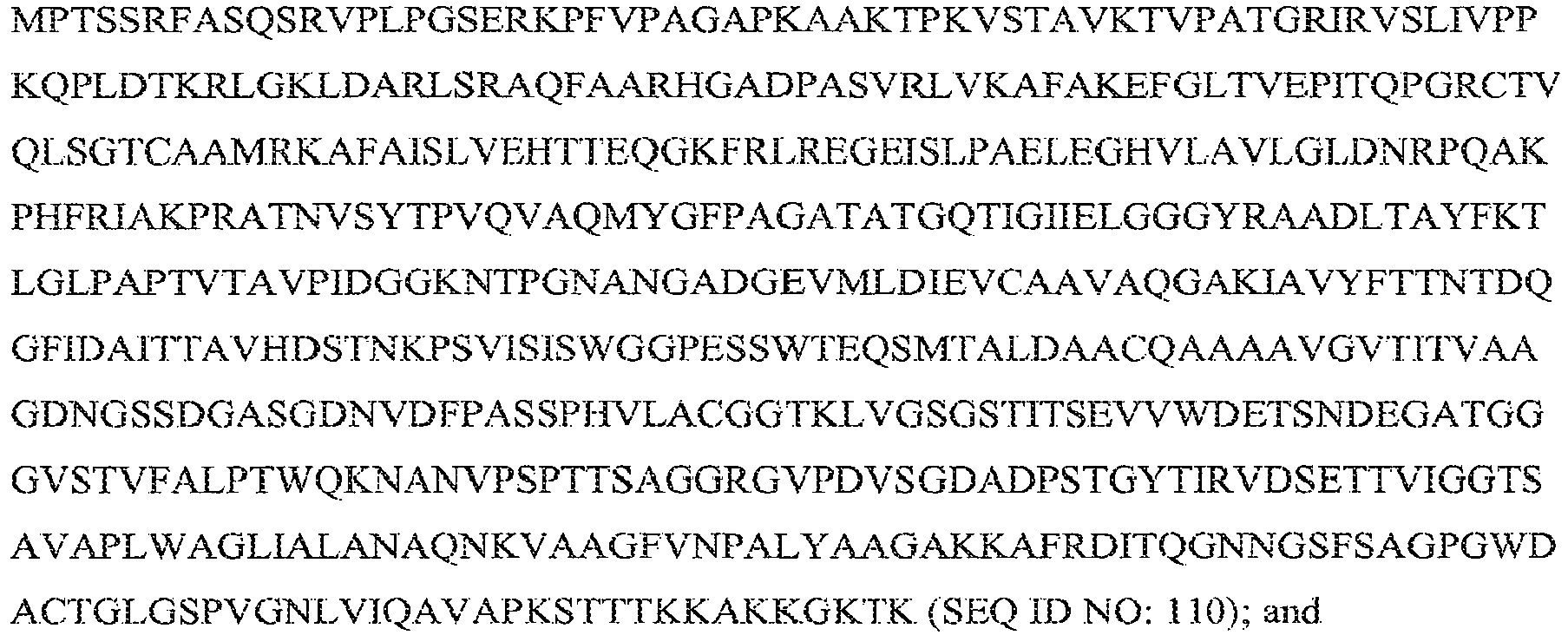
- Homologue 26 (NCBI YP_004030750)

- In one embodiment, the one or more polypeptides comprise one or more polypeptides comprising or consisting of the amino acid sequence of a polypeptide selected from the group consisting of SEQ ID NOs: 74, 75, 77, 78, 82, 88, 98, 105, 111, or processed versions thereof. In a further embodiment, the one or more polypeptides comprise a polypeptide that comprises or consists of the amino acid sequence:
Homologue 4 mutant

- The methods may comprise administration of the one or more polypeptides together with any other suitable active agent to treat celiac sprue. In various non-limiting embodiments, the methods further comprise administering to the subject an amount of one or more further polypeptides comprising an amino acid sequence selected from the group consisting of:
- (A) an amino acid sequence at least 75%, 80%, 85%, 90%, 95%, or 100% identical to the amino acid sequence of SEQ ID NO:35, wherein
- (i) the polypeptide degrades a PQPQLP (SEQ ID NO:34) peptide at pH 4; and
- (ii) residue 278 is Ser, residue 78 is Glu, and residue 82 is Asp
- (B) an an amino acid sequence at least 75%, 80%, 85%, 90%, 95%, or 100% identical to the amino acid sequence of SEQ ID NO:1, wherein
- (i) the polypeptide degrades a PQPQLP (SEQ ID NO:34) peptide at pH 4; and
- (ii) residue 467 is Ser, residue 267 is Glu, and residue 271 is Asp.
- The one or more further polypeptides have been disclosed for use in treating celiac sprue (see
WO2013/023151 ). The further polypeptides are either the processed version of Kumamolisin-As (SEQ ID NO:67) or the preprocessed version of Kumamolisin-As (SEQ ID NO:33), or modified versions thereof, which are known as a member of the sedolisin family of serine-carboxyl peptidases, and utilizes the key catalytic triad Ser278-Glu78-Asp32 in its processed form to hydrolyze its substrate (Ser467-Glu267-Asp271 in the pre-processed form) Its maximal activity is at pH ∼4.0. While the native substrate for Kumamolisin-As is unknown, it has been previously shown to degrade collagen under acidic conditions. In addition, this enzyme has been shown to be thermostable, with an ideal temperature at 60°C, but still showing significant activity at 37°C. - The further polypeptides may comprise one or more amino acid changes from SEQ ID NO: 67 (wild type processed Kumamolisin-As) at one or more residues selected from the group consisting of residues 73, 102, 103, 104, 130, 165, 168, 169, 172, and 179 (numbering based on the wild type processed Kumamolisin-As amino acid sequence). In non-limiting embodiments, the one or more changes relative to the wild type processed Kumamolisin-As amino acid sequence (SEQ ID NO:67) may be selected from the group consisting of:
Wild type Residue# AA change S73 K, G N102 D T103 S D104 A, T, N G130 S S165 N T168 A D169 N, G Q172 D D179 S, H - In various further non-limiting embodiments, the one or more changes relative to the wild type processed Kumamolisin-As amino acid sequence may include at least N102D. In another embodiment the one or more changes relative to the wild type Kumamolisin-As amino acid sequence may include at least N102D and D169N or D169G. In another embodiment the one or more changes relative to the wild type Kumamolisin-As amino acid sequence may include at least N102D, D169G, and D179H. In another embodiment the one or more changes relative to the wild type Kumamolisin-As amino acid sequence may include at least S73K, D104T, N102D, G130S, D169G, and D179H.
- The further polypeptides may comprise one or more amino acid changes from SEQ ID NO: 33 (wild type pre-processed Kumamolisin-As) at one or more residues selected from the group consisting of residues 119, 262, 291, 292, 293, 319, 354, 357, 358, 361, and 368 (numbering based on the wild type pre-processed Kumamolisin-As amino acid sequence). In non-limiting embodiments, the one or more changes relative to the wild type Kumamolisin-As amino acid sequence may be selected from the group consisting of:
Wild type Residue# AA change V119 D S262 K, G N291 D T292 S D293 A, T, N G319 S S354 N T357 A D358 N, G Q361 D D368 S, H - In various further non-limiting embodiments, the one or more changes relative to the wild type Kumamolisin-As amino acid sequence may include at least N291D. In another embodiment the one or more changes relative to the wild type Kumamolisin-As amino acid sequence may include at least N291D and 358N or 358G. In another embodiment the one or more changes relative to the wild type Kumamolisin-As amino acid sequence may include at least N291D, 358G, and 368H. In another embodiment the one or more changes relative to the wild type Kumamolisin-As amino acid sequence may include at least V119D, S262K, D293T, N291D, G319S, D358G, and D368H.
- As used herein, "at least 75% identical" means that the polypeptide differs in its full length amino acid sequence by 25% or less (including any amino acid substitutions, deletions, additions, or insertions) from the polypeptide defined by SEQ ID NO:1 or 35.
- In various further embodiments, the one or more further polypeptides comprise or consist of an amino acid sequence at least 75% identical to any one of SEQ ID NOS:2-33 or 36-67, or, alternatively, 2-32 or 36-66. The polypeptides represented by these SEQ ID NOS are specific examples of polypeptides with improved protease activity at pH 4 against the oligopeptide PQPQLP (SEQ ID NO: 34) (a substrate representative of gliadin) compared to wild type Kumamolisin-As. In various preferred embodiment, the one or more further polypeptides comprise or consist of an amino acid sequence at least 76%, 77%, 78%, 79%, 80%, 81%, 82%, 83%, 84%, 85%, 86%, 87%, 88%, 89%, 90%, 91%, 92%, 92%, 93%, 94%, 95%, 96%, 97%, 98%, or 99% identical to an amino acid sequence according to any one of SEQ ID NOS:36-66. In a further embodiment the one or more polypeptides comprise or consist of an amino acid sequence according to any one of SEQ ID NOS: 2-33 or 36-67 or, alternatively, 2-32 or 36-66.
- In one embodiment, the one or more further polypeptide comprises or consists of a polypeptide comprising the amino acid sequence shown below (KumaMax™): MSDMFXPWKEGEEARAVLQGHARAQAPQAVDKGPVAGDERMAVTVVLRRQRAG ELAAHVERQAAIAPHAREHLKREAFAASHGASLDDFAELRRFADAHGLALDRANVA AGTAVLSGPDDAINRAFGVELRHFDHPDGSYRSYLGEVTVPASIAPMIEAVLGLDTR PVARPHFRMQRRAEGGFEARSQAAAPTAYTPLDVAQAYQFPEGLDGQGQCIAIIELG GGYDEASLAQYFASLGVPAPQVVSVSVDGASNQPTGDPKGPDGEVELDIEVAGALA PGAKFAVYFAPDTTAGFLDAITTAIHDPTLKPSVVSISWSGPEDSWTSAAIAAMNRAF LDAAALGVTVLAAAGDSGSTGGEQDGLYHVHFPAASPYVLACGGTRLVASGGRTAQ EWWNDGPDGGATGGGVSRIFPLPAWQEHANVPPSANPGASSGRGVPDLAGNADPA TGYEVVIDGEATVIGGTSAVAPLFAALVARINQKLGKAVGYLNPTLYQLPADVFHDI TEGNNDIANRAQIYQAGPGWDPCTGLGSPTGVRLLQALLPSASQPQP (SEQ IDNO: 90), or a processed version thereof.
- In one embodiment, the method comprises administering Homologue 4 or full length mutant Homologue 4 (SEQ ID NOs: 75, 89, and/or 98), or processed versions thereof, together with the one or more of the further polypeptides disclosed herein, including but not limited to KumaMa™x (SEQ ID NO: 90), or a processed version thereof. As shown in the examples that follow, Homologue 4 (SEQ ID NO: 98) has increased activity against γ-gliadin peptide (amino acid sequence IQPQQPAQL (SEQ ID NO: 92)) compared to Kumamolisin polypeptides. Thus, administering a combination of Homologue 4 (SEQ ID NO: 98) or a processed version thereof and one or more Kumamolisin polypeptides (such as KumaMax™ (SEQ ID NO: 90), or a processed version thereof) may provide an improved therapy for gluten digestion. In a further embodiment, the Homologue 4 polypeptide comprises or consists of the full length Hom 4 mutant (SEQ ID NO: 89) or a processed version thereof, which is shown in the examples below to provide significantly improved activity against degradation products of gluten in the stomach that have been specifically linked to celiac disease: the 33mer peptide (LQLQPFPQPQLPYPQPQLPYPQPQLPYPQPQPF (SEQ ID NO: 72)) and the 26mer peptide (FLQPQQPFPQQPQQPYPQQPQQPFPQ (SEQ ID NO: 73)).
- In another embodiment, the method comprises administering Homologue 1 (SEQ ID NO: 74), Homologue 6 (SEQ ID NO: 77), and/or the Homologue 6 mutant (SEQ ID NO: 78), or processed versions thereof, together with the one or more of the further polypeptides disclosed herein, including but not limited to KumaMax™ (SEQ ID NO: 90), or a processed version thereof. As demonstrated in the examples that follow, Homologue 1 (SEQ ID NO: 74) is optimally active through
pH 5, and the Homologue 6 mutant demonstrates optimal activity at a pH level below that of the other homologues and the further Kumamolisin related polypeptides. As a result, Homologue 1 (SEQ ID NO: 74), Homologue 6 (SEQ ID NO: 77), and/or the Homologue 6 mutant (SEQ ID NO: 78), or processed versions thereof can be used alone in appropriate pH environments, or used in combination with the one or more further polypeptides to expand the pH profile of the one or more further polypeptides, to for example, more accurately mimic the pH of the stomach. - In a further embodiment, the method comprises administering Homologue 26 (SEQ ID NO: 88 or 111) or a processed version thereof, together with the one or more further polypeptides, including but not limited to KumaMax™ (SEQ ID NO: 90), or a processed version thereof. As shown in the examples that follow, Homologue 26 (SEQ ID NO:111) has very strong activity in breaking down the 33mer gliadin peptide, and thus can be used for treating celiac sprue disease, either alone or on combination with the one or more further polypeptides, including but not limited to KumaMax™ (SEQ ID NO: 90).
- Celiac sprue (also known as celiac disease or gluten intolerance) is a highly prevalent disease in which dietary proteins found in wheat, barley, and rye products known as 'glutens' evoke an immune response in the small intestine of genetically predisposed individuals. The resulting inflammation can lead to the degradation of the villi of the small intestine, impeding the absorption of nutrients. Symptoms can appear in early childhood or later in life, and range widely in severity, from diarrhea, fatigue, weight loss, abdominal pain, bloating, excessive gas, indigestion, constipation, abdominal distension, nausea/vomiting, anemia, bruising easily, depression, anxiety, growth delay in children, hair loss, dermatitis, missed menstrual periods, mouth ulcers, muscle cramps, joint pain, nosebleeds, seizures, tingling or numbness in hands or feet, delayed puberty, defects in tooth enamel, and neurological symptoms such as ataxia or paresthesia. There are currently no effective therapies for this lifelong disease except the total elimination of glutens from the diet. Although celiac sprue remains largely underdiagnosed, its' prevalence in the US and Europe is estimated at 0.5-1.0% of the population.
- As used herein, "treating celiac sprue" means accomplishing one or more of the following: (a) reducing the severity of celiac sprue; (b) limiting or preventing development of symptoms characteristic of celiac sprue; (c) inhibiting worsening of symptoms characteristic of celiac sprue; (d) limiting or preventing recurrence of celiac sprue in patients that have previously had the disorder; (e) limiting or preventing recurrence of symptoms in patients that were previously symptomatic for celiac sprue; and (f) limiting development of celiac sprue in a subject at risk of developing celiac sprue, or not yet showing the clinical effects of celiac sprue.
- The subject to be treated according to the methods of the invention may be any subject suffering from celiac sprue, including human subjects. The subject may be one already suffering from symptoms or one who is asymptomatic.
- In one embodiment, the subject may have an HLA-DQ2 serotype; in another embodiment, the subject may have an HLA-DQA serotype. Polypeptides with increased activity against γ-gliadin (
Homologues - As used herein, an "amount effective" refers to an amount of the polypeptide that is effective for treating celiac sprue. The polypeptides are typically formulated as a pharmaceutical composition, such as those disclosed above, and can be administered via any suitable route, including orally, parentally, by inhalation spray, or topically in dosage unit formulations containing conventional pharmaceutically acceptable carriers, adjuvants, and vehicles. In a preferred embodiment, the pharmaceutical compositions and formulations are orally administered, such as by tablets, pills, lozenges, elixirs, suspensions, emulsions, solutions, or syrups.
- Dosage regimens can be adjusted to provide the optimum desired response (e.g., a therapeutic or prophylactic response). A suitable dosage range may, for instance, be 0.1 ug/kg-100 mg/kg body weight; alternatively, it may be 0.5 ug/kg to 50 mg/kg; 1 ug/kg to 25 mg/kg, or 5 ug/kg to 10 mg/kg body weight. The polypeptides can be delivered in a single bolus, or may be administered more than once (e.g., 2, 3, 4, 5, or more times) as determined by an attending physician.
- In another aspect, the present invention provides isolated polypeptides selected from the group consisting of the following polypeptides, or processed versions thereof.
-
Homologue 2 wherein one, two, three, four, five, six, seven, eight, nine, ten, or all eleven of the following are true: (i) AA residue 116 is V or D; (ii) AA residue 255 is S, K, or G; (iii) AA residue 284 is D; (iv) AA residue 285 is T; (v) AA residue 286 is A, T, or N; (vi) AA residue 312 is S; (vii) AA residue 347 is N; (viii) AA residue 350 is T or A; (ix) AA residue 351 is N or G; (x) AA residue 354 is D; and (xi) AA residue 361 is S or H;
- Homologue 4 wherein one, two, three, four, five, six, seven, eight, nine, ten, or all eleven of the following are true: (i) AA residue 106 is D; (ii) AA residue 246 is S, K, or G; (iii) AA residue 275 is D; (iv) AA residue 276 is S; (v) AA residue 277 is A, T, or N; (vi) AA residue 303 is S; (vii) AA residue 338 is S; (viii) AA residue 341 is T or A; (ix) AA residue 342 is N or G; (x) AA residue 345 is Q or D; and (xi) AA residue 352 is S or H;

-
Homologue 5 wherein one, two, three, four, five, six, seven, eight, nine, ten, or all eleven of the following are true: (i) AA residue 120 is D; (ii) AA residue 259 is S, K, or G; (iii) AA residue 288 is D; (iv) AA residue 289 is T; (v) AA residue 290 is A, T, or N; (vi) AA residue 316 is S; (vii) AA residue 351 is S or N; (viii) AA residue 354 is A; (ix) AA residue 355 is N or G; (x) AA residue 358 is D; and (xi) AA residue 365 is S or H;
- Homologue #6 mutant:
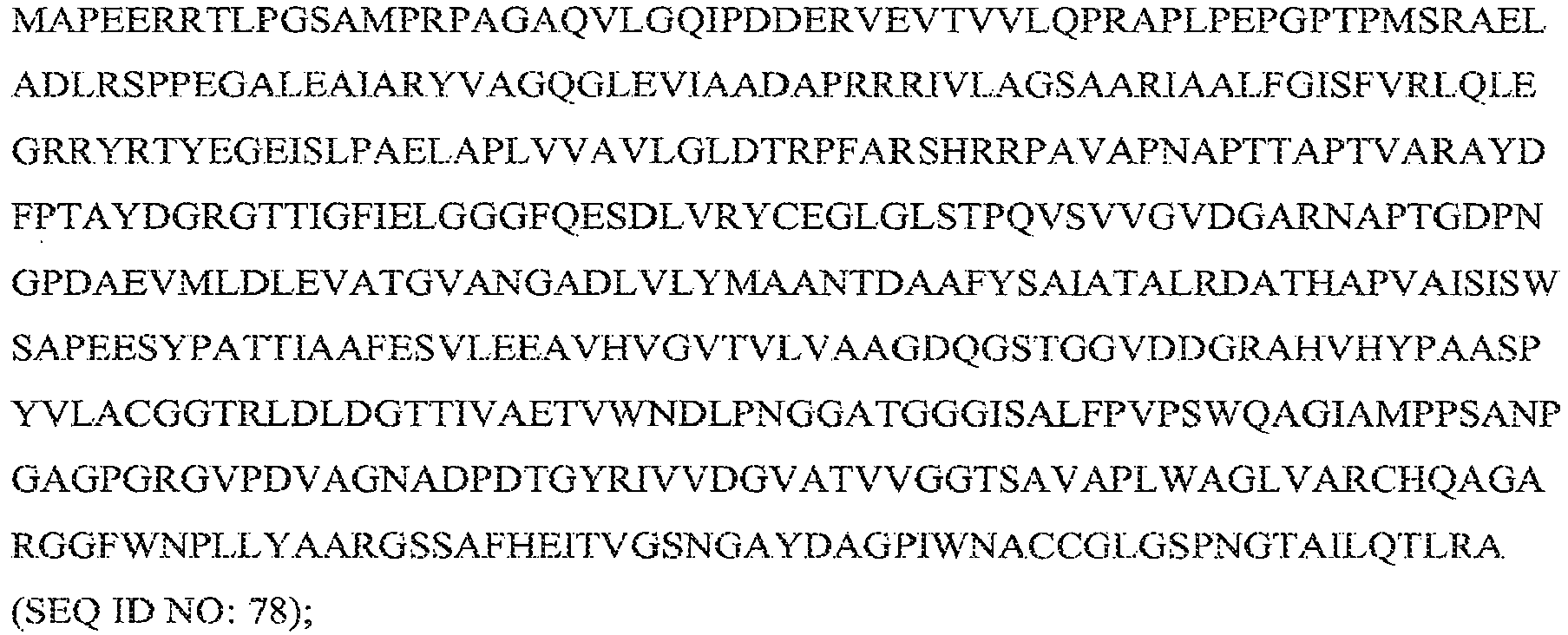
- Homologue 9
 wherein one, two, three, four, five, six, seven, eight, nine, ten, or all eleven of the following are true: (i) AA residue 107 is V or D; (ii) AA residue 245 is S, K, or G; (iii) AA residue 274 is D; (iv) AA residue 275 is T; (v) AA residue 276 is A, T, or N; (vi) AA residue 302 is S; (vii) AA residue 337 is S or N; (viii) AA residue 340 is T or A; (ix) AA residue 341 is N or G; (x) AA residue 344 is Q or D; and (xi) AA residue 351 is S or H;
- Homologue 10 wherein one, two, three, four, five, six, seven, eight, nine, ten, or all eleven of the following are true: (i) AA residue 76 is V or D; (ii) AA residue 206 is S, K, or G; (iii) AA residue 235 is D; (iv) AA residue 236 is S; (v) AA residue 237 is A, T, or N; (vi) AA residue 262 is S; (vii) AA residue 297 is S or N; (viii) AA residue 300 is T or A; (ix) AA residue 301 is N or G; (x) AA residue 302 is Q or D; and (xi) AA residue 309 is S or H;

- Homologue 12
 wherein one, two, three, four, five, six, seven, eight, nine, ten, or all eleven of the following are true: (i) AA residue 105 is D; (ii) AA residue 244 is S or K; (iii) AA residue 272 is D; (iv) AA residue 273 is S; (v) AA residue 274 is A, T, or N; (vi) AA residue 299 is S; (vii) AA residue 334 is N; (viii) AA residue 337 is T or A; (ix) AA residue 338 is N or G; (x) AA residue 341 is Q or D; and (xi) AA residue 348 is S or H;
- Homologue 13 wherein one, two, three, four, five, six, seven, eight, nine, ten, or all eleven of the following are true: (i) AA residue 106 is V or D; (ii) AA residue 244 is S, K, or G; (iii) AA residue 273 is D; (iv) AA residue 274 is T; (v) AA residue 275 is A, T, or N; (vi) AA residue 301 is S; (vii) AA residue 336 is N; (viii) AA residue 339 is T or A; (ix) AA residue 340 is N or G; (x) AA residue 343 is D; and (viii) AA residue 350 is S or H;

- Homologue 14
 wherein one, two, three, four, five, six, seven, eight, nine, ten, or all eleven of the following are true: (i) AA residue 107 is V or D; (ii) AA residue 245 is S, K, or G; (iii) AA residue 274 is D; (iv) AA residue 275 is T; (v) AA residue 276 is A, T, or N; (vi) AA residue 302 is S; (vii) AA residue 337 is N; (viii) AA residue 340 is T or A; (ix) AA residue 341 is N or G; (x) AA residue 344 is Q or D; and (xi) AA residue 351 is S or H;
- Homologue 15 wherein one, two, three, four, five, six, seven, eight, nine, ten, or all eleven of the following are true: (i) AA residue 104 is V or D; (ii) AA residue 241 is S, K, or G; (iii) AA residue 270 is D; (iv) AA residue 271 is S; (v) AA residue 272 is D, A, T, or N; (vi) AA residue 398 is S; (vii)

AA residue 33 is S; (viii) AA residue 336 is A; (ix) AA residue 337 is N or G; (x) AA residue 340 is D; and (xi) AA residue 347 is S or H; - Homologue 16 wherein one, two, three, four, five, six, seven, eight, nine, ten, or all eleven of the following are true: (i) AA residue 104 is D; (ii) AA residue 245 is S, K, or G; (iii) AA residue 274 is D; (iv) AA residue 275 is S; (v) AA residue 276 is A, T, or N; (vi) AA residue 302 is S; (vii) AA residue 337 is S or N; (viii) AA residue 340 is T or A; (ix) AA residue 341 is N or G; (x) AA residue 344 is Q or D; and (xi) AA residue 351 is S or H;

- Homologue 17 wherein one, two, three, four, five, six, seven, eight, nine, ten, or all eleven of the following are true: (i) AA residue 118 is V or D; (ii) AA residue 250 is K, or G; (iii) AA residue 279 is D; (iv) AA residue 280 is S; (v) AA residue 281 is A, T, or N; (vi) AA residue 307 is S; (vii) AA residue 342 is S or N; (viii) AA residue 345 is A; (ix) AA residue 346 is N or G; (x) AA residue 349 is Q or D; and (xi) AA residue 356 is S or H;

-
Homologue 19wherein one, two, three, four, five, six, seven, eight, nine, ten, or all eleven of the following are true: (i) AA residue 121 is V or D; (ii) AA residue 253 is S, K, or G; (iii) AA residue 282 is D; (iv) AA residue 283 is S; (v) AA residue 284 is A, T, or N; (vi) AA residue 310 is S; (vii) AA residue 345 is S; (viii) AA residue 348 is T or A; (ix) AA residue 349 is N or G; (x) AA residue 352 is Q or D; and (xi) AA residue 357 is S or H; and
-
Homologue 26wherein one, two, three, four, five, six, seven, eight, nine, or all ten of the following are true: (i) AA residue 111 is S, K, or G; (ii) AA residue 139 is D; (iii) AA residue 140 is T or S; (iv) AA residue 141 is D, A, T, or N; (v) AA residue 164 is S; (vi) AA residue 199 is S or N; (vii) AA residue 202 is T or A; (viii) AA residue 203 is N or G; (ix) AA residue 204 is Q or D; and (x) AA residue 211 is S or H.
- The polypeptides may be processed versions of the recited polypeptides; the presently claimed polypeptides include any such processed versions of the recited polypeptides. Processed versions of the polypeptides are as defined above.
- In one embodiment, the isolated polypeptide comprises the amino acid sequence of a polypeptide selected from Homologues 4, Homolog 6 mutant, and Homologs 13 and 26, or processed versions thereof. In another embodiment, the isolated polypeptide comprises the amino acid sequence of Hom 4 mutant:

- The polypeptides disclosed herein have been identified as having similar, improved, or complementary activity compared to Kumamolisin-related poypeptides in hydrolyzing proline (P)- and glutamine (Q)-rich components of gluten known as 'gliadins' believed responsible for the bulk of the immune response in most celiac sprue patients. Numerous other Kumamolisin homologues tested by the inventors possessed little or no such gliadin hydrolyzing activity. Thus, the polypeptides can be used to treat celiac sprue. The polypeptides of this aspect of the invention degrade gliadins at various pHs. Such degradation occurs under the conditions disclosed in the examples that follow.
- As used throughout the present application, the term "polypeptide" is used in its broadest sense to refer to a sequence of subunit amino acids, whether naturally occurring or of synthetic origin. The polypeptides of the invention may comprise L-amino acids, D-amino acids (which are resistant to L-amino acid-specific proteases in vivo), or a combination of D- and L-amino acids. The polypeptides described herein may be chemically synthesized or recombinantly expressed. The polypeptides may be linked to other compounds to promote an increased half-life in vivo, such as by PEGylation, HESylation, PASylation, or glycosylation. Such linkage can be covalent or non-covalent as is understood by those of skill in the art. The polypeptides may be linked to any other suitable linkers, including but not limited to any linkers that can be used for purification or detection (such as FLAG or His tags).
- In a further aspect, the invention provides compositions, comprising
- (a) one or more polypeptides comprising the amino acid sequence of a polypeptide selected from the group consisting of SEQ ID NOs: 74-78, 80-88, 95, 97-99, and 102-111, or processed versions thereof; and
- (b) one or more further polypeptides comprising an amino acid sequence selected from the group consisting of:
- (A) an amino acid sequence at least 75%, 80%, 85%, 90%, 95%, or 100% identical to the amino acid sequence of SEQ ID NO:35, wherein
- (i) the polypeptide degrades a PQPQLP (SEQ ID NO:34) peptide at pH 4; and
- (ii) residue 278 is Ser, residue 78 is Glu, and residue 82 is Asp
- (B) an an amino acid sequence at least 75%, 80%, 85%, 90%, 95%, or 100% identical to the amino acid sequence of SEQ ID NO:1, wherein
- (i) the polypeptide degrades a PQPQLP (SEQ ID NO:34) peptide at pH 4; and
- (ii) residue 467 is Ser, residue 267 is Glu, and residue 271 is Asp.
- (A) an amino acid sequence at least 75%, 80%, 85%, 90%, 95%, or 100% identical to the amino acid sequence of SEQ ID NO:35, wherein
- The one or more further polypeptides can be any as described above. For example, the one or more further polypeptides may comprise or consist of an amino acid sequence at least 75%, 80%, 85%, 90%, 95%, or 100% identical to any one of SEQ ID NOS:2-33 or 36-67, or, alternatively, 2-32 or 36-66. In another embodiment, the one or more further polypeptides comprise or consist of KumaMax™ (SEQ ID NO: 90), or a processed version thereof.
- In one embodiment, the composition comprises Homologue 4 (SEQ ID NO: 75 or 98) or full length mutant Homologue 4 (SEQ ID NO: 89), or processed versions thereof, together with the one or more of the further polypeptides disclosed herein, including but not limited to KumaMax™ (SEQ ID NO: 90), or a processed version thereof. In another embodiment, the composition comprises SEQ ID NO: 74, SEQ ID NO: 77, and/or SEQ ID NO: 78 (
Homologue 1, Homologue 6, and/or the Homologue 6 mutant), or processed versions thereof, together with the one or more of the further polypeptides disclosed herein, including but not limited to KumaMax™ (SEQ ID NO: 90), or a processed version thereof. In a further embodiment, the method comprises administering SEQ ID NO: 88 and/or 111 (Homologue 26) or a processed version thereof, together with the one or more further polypeptides, including but not limited to KumaMax™ (SEQ ID NO: 90), or a processed version thereof. - In another aspect, the present invention provides isolated nucleic acids encoding the polypeptide of any aspect or embodiment of the invention. The isolated nucleic acid sequence may comprise RNA or DNA. As used herein, "isolated nucleic acids" are those that have been removed from their normal surrounding nucleic acid sequences in the genome or in cDNA sequences. Such isolated nucleic acid sequences may comprise additional sequences useful for promoting expression and/or purification of the encoded protein, including but not limited to polyA sequences, modified Kozak sequences, and sequences encoding epitope tags, export signals, and secretory signals, nuclear localization signals, and plasma membrane localization signals. It will be apparent to those of skill in the art, based on the teachings herein, what nucleic acid sequences will encode the polypeptides of the invention.
- In a further aspect, the present invention provides nucleic acid expression vectors comprising the isolated nucleic acid of any embodiment of the invention operatively linked to a suitable control sequence. "Recombinant expression vector" includes vectors that operatively link a nucleic acid coding region or gene to any control sequences capable of effecting expression of the gene product. "Control sequences" operably linked to the nucleic acid sequences of the invention are nucleic acid sequences capable of effecting the expression of the nucleic acid molecules. The control sequences need not be contiguous with the nucleic acid sequences, so long as they function to direct the expression thereof. Thus, for example, intervening untranslated yet transcribed sequences can be present between a promoter sequence and the nucleic acid sequences and the promoter sequence can still be considered "operably linked" to the coding sequence. Other such control sequences include, but are not limited to, polyadenylation signals, termination signals, and ribosome binding sites. Such expression vectors can be of any type known in the art, including but not limited plasmid and viral-based expression vectors. The control sequence used to drive expression of the disclosed nucleic acid sequences in a mammalian system may be constitutive (driven by any of a variety of promoters, including but not limited to, CMV, SV40, RSV, actin, EF) or inducible (driven by any of a number of inducible promoters including, but not limited to, tetracycline, ecdysone, steroid-responsive). The construction of expression vectors for use in transfecting prokaryotic cells is also well known in the art, and thus can be accomplished via standard techniques. (See, for example, Sambrook, Fritsch, and Maniatis, in: Molecular Cloning, A Laboratory Manual, Cold Spring Harbor Laboratory Press, 1989; Gene Transfer and Expression Protocols, pp. 109-128, ed. E.J. Murray, The Humana Press Inc., Clifton, N.J.), and the Ambion 1998 Catalog (Ambion, Austin, TX). The expression vector must be replicable in the host organisms either as an episome or by integration into host chromosomal DNA. In a preferred embodiment, the expression vector comprises a plasmid. However, the invention is intended to include other expression vectors that serve equivalent functions, such as viral vectors.
- In another aspect, the present invention provides recombinant host cells comprising the nucleic acid expression vectors of the invention. The host cells can be either prokaryotic or eukaryotic. The cells can be transiently or stably transfected or transduced. Such transfection and transduction of expression vectors into prokaryotic and eukaryotic cells can be accomplished via any technique known in the art, including but not limited to standard bacterial transformations, calcium phosphate co-precipitation, electroporation, or liposome mediated-, DEAE dextran mediated-, polycationic mediated-, or viral mediated transfection. (See, for example, Molecular Cloning: A Laboratory Manual (Sambrook, et al., 1989, Cold Spring Harbor Laboratory Press; Culture of Animal Cells: A Manual of Basic Technique, 2nd Ed. (R.I. Freshney. 1987. Liss, Inc. New York, NY). A method of producing a polypeptide according to the invention is an additional part of the invention. The method comprises the steps of (a) culturing a host according to this aspect of the invention under conditions conducive to the expression of the polypeptide, and (b) optionally, recovering the expressed polypeptide. The expressed polypeptide can be recovered from the cell free extract, cell pellet, or recovered from the culture medium. Methods to purify recombinantly expressed polypeptides are well known to the man skilled in the art.
- In a still further aspect, the present invention provides pharmaceutical compositions, comprising the polypeptide, nucleic acid, nucleic acid expression vector, the recombinant host cell, or composition of any aspect or embodiment of the invention, together with a pharmaceutically acceptable carrier. The pharmaceutical compositions of the invention can be used, for example, in the methods of the invention described below. The pharmaceutical composition may comprise in addition to the polypeptides, nucleic acids, etc. of the invention (a) a lyoprotectant; (b) a surfactant; (c) a bulking agent; (d) a tonicity adjusting agent; (e) a stabilizer; (f) a preservative and/or (g) a buffer.
- In some embodiments, the buffer in the pharmaceutical composition is a Tris buffer, a histidine buffer, a phosphate buffer, a citrate buffer or an acetate buffer. The pharmaceutical composition may also include a lyoprotectant, e.g. sucrose, sorbitol or trehalose. In certain embodiments, the pharmaceutical composition includes a preservative e.g. benzalkonium chloride, benzethonium, chlorohexidine, phenol, m-cresol, benzyl alcohol, methylparaben, propylparaben, chlorobutanol, o-cresol, p-cresol, chlorocresol, phenylmercuric nitrate, thimerosal, benzoic acid, and various mixtures thereof. In other embodiments, the pharmaceutical composition includes a bulking agent, like glycine. In yet other embodiments, the pharmaceutical composition includes a surfactant e.g., polysorbate-20, polysorbate-40, polysorbate- 60, polysorbate-65, polysorbate-80 polysorbate-85, poloxamer-188, sorbitan monolaurate, sorbitan monopalmitate, sorbitan monostearate, sorbitan monooleate, sorbitan trilaurate, sorbitan tristearate, sorbitan trioleate, or a combination thereof. The pharmaceutical composition may also include a tonicity adjusting agent, e.g., a compound that renders the formulation substantially isotonic or isoosmotic with human blood. Exemplary tonicity adjusting agents include sucrose, sorbitol, glycine, methionine, mannitol, dextrose, inositol, sodium chloride, arginine and arginine hydrochloride. In other embodiments, the pharmaceutical composition additionally includes a stabilizer, e.g., a molecule which, when combined with a protein of interest substantially prevents or reduces chemical and/or physical instability of the protein of interest in lyophilized or liquid form. Exemplary stabilizers include sucrose, sorbitol, glycine, inositol, sodium chloride, methionine, arginine, and arginine hydrochloride.
- The polypeptides, nucleic acids, etc. of the invention may be the sole active agent in the pharmaceutical composition, or the composition may further comprise one or more other active agents suitable for an intended use.
- The pharmaceutical compositions described herein generally comprise a combination of a compound described herein and a pharmaceutically acceptable carrier, diluent, or excipient. Such compositions are substantially free of non-pharmaceutically acceptable components, i.e., contain amounts of non-pharmaceutically acceptable components lower than permitted by US regulatory requirements at the time of filing this application. In some embodiments of this aspect, if the compound is dissolved or suspended in water, the composition further optionally comprises an additional pharmaceutically acceptable carrier, diluent, or excipient. In other embodiments, the pharmaceutical compositions described herein are solid pharmaceutical compositions (e.g., tablet, capsules, etc.).
- These compositions can be prepared in a manner well known in the pharmaceutical art, and can be administered by any suitable route. In a preferred embodiment, the pharmaceutical compositions and formulations are designed for oral administration. Conventional pharmaceutical carriers, aqueous, powder or oily bases, thickeners and the like may be necessary or desirable.
- The pharmaceutical compositions can be in any suitable form, including but not limited to tablets, pills, powders, lozenges, sachets, cachets, elixirs, suspensions, emulsions, solutions, syrups, aerosols (as a solid or in a liquid medium), ointments containing, for example, up to 10% by weight of the active compound, soft and hard gelatin capsules, sterile injectable solutions, and sterile packaged powders.
- Celiac disease is an autoimmune disorder that afflicts approximately 1% of the population (1, 2). This disease is characterized by an inflammatory reaction to gluten, the major protein in wheat flour, and to related proteins in barley and rye (2). Gluten is composed of a heterogeneous mixture of the glycoproteins gliadin and glutenin (3). Upon ingestion, α-gliadin is partially degraded by gastric and intestinal proteases to oligopeptides, which are resistant to further proteolysis due to their unusually high proline and glutamine content (3). Immunogenic oligopeptides that result from incomplete proteolysis are enriched in the PQ motif (4, 5), which stimulate inflammation and injury in the intestine of people with Celiac disease. Currently the only treatment for this disease is complete elimination of gluten from the diet, which is difficult to attain due to the ubiquity of this protein in modern food products (6).
- Oral enzyme therapy (GET) in which orally administered proteases are employed to hydrolyze immunogenic peptides before they are capable of triggering inflammation is currently being explored as a treatment for gluten intolerance. For this purpose, several different proteases have been considered due to their specificity for cleavage after either proline or glutamine residues. However, these enzymes often demonstrate characteristics that hinder their use in OET for gluten degradation. Most of these peptidases exhibit optimal catalytic activity at neutral pH; however, the pH of the human stomach ranges from 2 to 4. These enzymes are therefore most active when they reach the pH-neutral small intestine, which is too late for effective prevention of Celiac disease as this is the site where gluten-derived pathology develops. Additionally, several of these enzymes demonstrate instability in the low pH of the human stomach, are susceptible to proteolysis by digestive proteases, or require extensive refolding procedures during their purification, which are all characteristics that hamper efforts for clinical use.
- The ideal protease for the application of OET in the treatment of gluten intolerance would combine the following traits: optimal activity at low pH, easy purification, stability under the conditions of the human stomach, and high specificity for amino acid motifs found in gluten-derived immunogenic oligopeptides. We previously identified a protease that is highly active in acidic conditions, Kumamolisin-As (KutmaWT) from the acidophilic bacterium Alicyclobacillus sendaiensis, and used computational modeling tools to engineer it toward the desired oligopeptide specificity. An exemplary computationally designed enzyme, designated KumaMax™, exhibited over 100-fold increased proteolytic activity and an 800-fold switch in substrate specificity for the targeted PQ motif compared to wild-type KumaWT. In addition, KumaMax™ demonstrates resistance to common gastric proteases and is produced at high yields in E. coli without the need for refolding. The previously designed proteins were assessed for catalytic activity against a PQLP (SEQ ID NO: 68) peptide; exemplary results are provided in Table 2
Table 2 Mutations to Wild Type Kumamolysin-As (Preprocessed) Fold Change in Activity of PQ Hydrolysis Relative to Wild Type Kumamolysin-As Wild Type (WT) 1.0 T357A 2.0 G319S, D368S 2.0 D358G 3.0 D293A 3.0 D358N 4.0 G319S, S354N, D358G, D368H 5.0 D358G, D368H 6.0 G319S, D358G, D368H 7.0 N291D, Q361D 7.5 S354N, D358G, D368H 9.0 N291D 10.0 N291D, D293A, Q361D, D358N 14.8 N291D, D293A 15.0 N291D, D293A, D358G, Q361D 15.0 N291D, D358N 18.9 N291D, Q361D, D358G 20.0 N291D, G319S, D358G, Q361D, D368H 23.1 N291D, D293A, D358N 24.0 S262G, T292S, N291D, G319S, D358G, D368H 29.0 N291D, D293A, G319S, D358G, Q361D, D368H 40.9 T292S, N291D, G319S, D358G, D368H 49.0 N291D, G319S, S354N, D358G, Q361D, D368H 50.0 N291D, G319S, S354N, D358G, D368H 54.6 N291D, D293A, G319S, S354N, D358G, Q361D, D368H 58.0 D293T, N291D, G319S, D358G, D368H 58.0 S262K, D293N, N291D, G319S, D358G, D368H 62.0 N291D, G319S, D358G, D368H 93.0 V119D, S262K, D293T, N291D, G319S, D358G, D368H 120.0 - Table 2. Fold change in hydrolytic activity on PQ motif of all purified and sequenced mutants, relative to wild type Kumamolysin-As. These are the fold-change results for all mutants that were purified, sequenced, and tested against wild-type Kumamolysin in the pure protein assay. The assay took place at pH 4, with enzyme final concentration of 0.0125mg/mL and substrate concentration of 5µM.
- In the present study, the inventors tested a large number of Kumamolisin homologues obtained from a wide variety of organisms for activity in degrading gliadin proteins. They share the catalytic triad present in Kumamolisin-As (Ser467-Glu267-Asp271 in the Kumamolisin-As pre-processed form). In order to assess the relative abilities of these homologues to target gluten, the purified homologue were incubated with protein with purified peptides that represent the immunogenic regions throughout gliadin, which is the problematic fraction of gluten for celiac patients.
- Homologues were assessed for their ability to break down a fluorescent analogue of gliadin, a hexapeptide (QPQLPY (SEQ ID NO: 91)) that was conjugated to a fluorophore and a quencher, in simulated lab gastric conditions (NaOAc buffer pH 4.0 at 37°C). The rate of degradation can be calculated from measurement of the fluorescence signal over time. The activity was compared to that of Kumamolisin (denoted below as KWT). Kumamolisin has some activity breaking down these gliadin substrates. Exemplary results are shown in
Figure 1 . As can be noted, only a subset of the homologues (1, 2, 4, 8, and 9) tested had activity comparable to or better than Kumamolisin under these conditions. - In a further study, the pH levels were varied and the homologues tested for activity at the different pH levels. The data is shown in
Figure 2 . Most of the homologues tested demonstrated activities within the pH range of both Kumamolisin (designated below as "WT") and KumaMax™ (designated as "Max"). Interestingly, two of the homologues had expanded pH ranges compared to Kumamolisin.Homologue 1, was optimally active throughpH 5, and Homologue 6 demonstrated optimal activity at a pH level below that of the other homologues and Kumamolisin/KumaMax, explaining why no activity was seen for this homologue in the fluorescent experiment conducted at pH 4. This indicates thathomologues 1 and 6 could be used, for example, to expand the pH profile of Kumamolisin-related polypeptides, to more closely mimic pH conditions in the stomach. - We further tested the ability of these homologues to break down different non-fluorescently-labeled peptides that had been linked to celiac disease. Results are provided in Table 3; + and - represents a visual indication of the homologue's ability to break down the indicated peptide: - < +/- < ++/- < + < ++ < +++ < ++++. The number is the % of peptide that is degraded by the homologue after an 80-min incubation (so the smaller the number, the more effective the homologue); (undetect) means that the peptide was below detection limit after 80 min.
- As can be seen, Kumamolisin and KumaMax™ have fairly low levels of activity against the γ-gliadin peptide, while Homologue 4 has increased activity against this peptide, suggesting that Homologue 4, alone or in combination therapy with Kumamolisin-related polypeptides, may be an effective therapy for gluten digestion.
Table 3 Homolog ue # γ-gliadin (IQPQQPA QL) (SEQ ID NO: 92) α2-gliadin (PQPQLPYSQPQ PFR) (SEQ ID NO: 93) α9-gliadin (QLQPFPQPQ LPY) (SEQ ID NO: 70) Glia_56-79 (LQLQPFPQPQLPYPQ PQLPY) (SEQ ID NO: 94) 1 ++/-; 29% ++ (undetect) - ; 80% ++; 1.6% 2 +/-; 65% ++ (undetect) ++/-; 37%; ++; 0.2% 3 -; 108% -; 123% -; 116% -; 1 04% 4 +; 12% ++ (undetect) ++/-; 25%; ++; 0.6% 5 ++/-; 40% ++ (undetect) ++/-; 34%; ++; 0.4% 6 -; 102% -; 87% -; 114% -; 85% -; 106% -; 109% -; 115% -; 101% 8 -; 92% ++ (undetect) -; 105% ++/-; 34% 9 ++/-; 32% ++ (undetect) +/-; 62% +; 9% Kumamoli sin (WT) ++/-; 39% ++ (undetect) ++; 2%; +++; 0.2% Max +/-; 55% +/-; 65%; ++; 0.9% ++++ - Since these are homologues of Kumamolisin with a low percentage of sequence identity, we made the same mutations in homologues as were made to Kumamolisin in order to generate KumaMax. We tested the activities of these homologues on two peptides that are degradation products of gluten in the stomach and have been specifically linked to celiac disease: the 33mer peptide (LQLQPFPQPQLPYPQPQLPYPQPQLPYPQPQPF(SEQ ID NO: 72)) and the 26mer peptide (FLQPQQPFPQQPQQPYPQQPQQPFPQ (SEQ ID NO: 73)). In particular, the 33mer peptide has been strongly linked to celiac disease. Additionally, the KumaMax™ mutations in the homologues inspired us to make these three active-site mutations alone on the Kumamolisin background (note that KumaMax™ contains a total of 7 mutations from Kumamolisin, but only 3 are within the active site). This mutant, which only contains these active-site mutations, is called the K3 mutant below. The data are provided in Table 4 and
Figure 3 . We found that several these homologues demonstrated activity against these two very important peptides, and interestingly, that on Homologue 4 (SEQ ID NO: 75) the KumaMax™ (SEQ ID NO: 90) mutations increased activity against both peptides; in fact, the Homologue 4 Mutant (SEQ ID NO: 89) is the best overall enzyme tested in the experiment shown below, which includes KumaMax™ (SEQ ID NO: 90). This also shows that the K3 mutant could also be combined with KumaMax™ (SEQ ID NO: 90) to generate a more potent therapeutic. (NA = No Activity).Table 4 Homologue 33mer 26mer KumaMax 0.1% 26 % K3 Mutant 26% 5% KumaWT 18% NA Hom # 1 46% NA Hom # 1 Max NA NA Hom # 2 31% NA Hom # 2 Max 29% NA Hom #4 38% NA Hom #4 Max 10% 19 % Hom # 5 NA NA Hom # 5 Max NA NA Hom #9 NA 52% Hom #9 Max NA 60% Hom #10 NA NA Hom #10 Max NA NA - Further studies were done using additional homologues of Kumamolisin. A subset of these homologues (homologues 13 and 26) demonstrated significant activity against the 33mer peptide; see
Figure 4 . In particular,homologue 26 in its wild type form had very strong activity comparable to KumaMax™ at breaking down the 33mer peptide. - We then looked at the profile of digested 33mers via HPLC after a 60 minute incubation; degrading the 33-mer at more than one location provides a significant therapeutic advantage. Wild type Kumamolysin degrades the 33-mer down at only a single location (WT-like), while KumaMax™ degrades the 33-mer at multiple locations (Max-like). The data are shown in Table 5.
Table 5 Homologue Degradation pattern of 33mer (60 min) H4 WT-like H12 WT-like H13 Max-like H14 WT-like - minor H15 WT-like H16 WT-like H17 WT-like - minor H18 Undegraded H19 WT -like - minor H21 Undegraded H22 Undegraded H23 Undegraded H24 Undegraded H25 Undegraded H26 Max-like H27 Undegraded - An overall summary of the data is that several homologues, including Homologue 4 (SEQ ID NO:75) and the Homologue 4 mutant (SEQ ID NO: 89)), 13, and 26, can be used as therapeutics to treat celiac disease. Homologue 26 (SEQ ID NOL 88) is almost as potent as KumaMax™ (SEQ ID NO: 90) and this is in the absence of any engineering, and Homologue 4 (demonstrated increased activity with the mutations that were made to KumaMax™. Furthermore, pH profiles from these homologues (in particular, Homologue 6 (including the Homologue 6 mutant) and Homologue 1) suggest that these homologues, alone or in combination, can expand the pH range of therapeutic efficacy in the human stomach.
- The genes encoding each protein of interest, harbored in the pET29b plasmid, were transformed into Escherichia coli BL21 (DE3) cells. Individual colonies were picked, inoculated into Terrific Broth™ with 50 µg/µL Kanamycin (TB+Kan), and incubated overnight at 37° C. 500 uL of the overnight culture was added to 500 mL autoinduction media (5 g tryptone, 2.5 g yeast extract, 465 mL ddH2O), and shaken at 37° C for roughly 4 hours, then the autoinduction components were added (500 uL MgSO4, 500 uL 1000x trace metals, 25 mL 20x NPS, 10 mL 20x 5052, 500
uL 50 mg/mL Kan). The cultures were then shaken at 18° C for 30 hours before being spun down. Pellets were resuspended in 10 mL 1x PBS, then lysed via sonication with 5 mL lysis buffer (50 mM HEPES, 500 mM NaCl, 1 mM bME, 2 mg/mL lysozyme, 0.2 mg/mL DNase, ddH2O) and spun down. The proteins were then purified over 1mL TALON cobalt affinity columns. KumaMax, KumaWT, and SC Pep were washed three times with 20 mL wash buffer (10 mM imidazole, 50 mM HEPES, 500 mM NaCl, 1mM bME, ddH2O), and then eluted in 15 mL of elution buffer (200 mM imidazole, 50 mM HEPES, 500 mM NaCl, 1mM bME). EP-B2 had to be refolded on the column, so after lysis the pellets were resuspended in 10 mL of EP-B2 buffer, which differs from the wash buffer only in that it is diluted in guanidine hydrochloride instead of ddH2O to allow for denaturation of the EP-B2 inclusion bodies. This resuspension was pelleted, and the supernatant (containing denatured EP-B2) was filtered with a 0.8µm filter onto the column. EP-B2 was washed once with 20 mL of the EP-B2 buffer, before being washed twice with 20 mL of the wash buffer to refold the protein on the column. Protein was eluted with 15 ml of the elution buffer. All proteins were concentrated from 15 mL down to ∼500 uL, then dialyzed once in 1 L dialysis buffer (20% glycerol, 50 mM HEPES, 500 mM NaCl, 1 mM bME). Protein concentration was calculated spectrophotometrically with extinction coefficients of 53,985 M-1cm-1 for Kuma WT and all Kuma WT variants, 152,290 M-1cm-1 for SC Pep, and 58,245 M-1cm-1 for EP-B2. - The variants of Kumamolisin-As that displayed the most activity on the FQ substrate in the activity screen were sequenced, then purified in small scale. 500 uL of TB+K an overnight cultures were added to 50 mL TB+K an and grown at 37° C until reaching an optical density of 0.5-0.8. IPTG was added to 0.5 mM, and the cultures were expressed at 22° C for 16-24 hours. The cells were spun down, resuspended in 500 uL of wash buffer (1x PBS, 5 mM imidazole, ddH2O), transferred to a 2 mL Eppendorf tube, and lysed in 1 mL lysis buffer (1x PBS, 5 mM imidazole, 2x Bug Buster™, 2 mg/mL lysozyme, 0.2 mg/mL DNase, ddH2O). After centrifugation, the supernatant was decanted into a fresh tube. Columns with 200 uL of TALON cobalt resin were placed in Eppendorf tubes, and the supernatant was poured over the columns and rocked for 20 minutes before spinning down and discarding the flow-through. The proteins were washed three times with 500 uL wash buffer, discarding the flow-through between washes. Enzymes were eluted in 200 uL elution buffer (1x PBS, 200 mM imidazole, dd H2O), and concentrations were calculated spectrophotometrically using an extinction coefficient of 53,985 M-1cm-1.
- For the assay, the Kurnamolisin-As mutants were incubated for 15 minutes in pH 4 100 mM sodium acetate buffer. Enzyme was added to 5 µM substrate so that the final protein concentration was 0.0125 mg/mL. The fluorescence was measured at 30-second intervals for 1 hour.
- Enzyme variant proclivity for gluten degradation was measured by hydrolysis of the fluorescently quenched α-gliadin hexapeptide analogue QXL520-PQPQLP-K(5-FAM)-NH2 (FQ) (SEQ ID NO: 69) as a substrate. Each enzyme was incubated at room temperature for 15 minutes in 100 mM pH 4 sodium acetate buffer. After 15 minutes, 50 uL of fluorescent substrate was added ranging in final concentration between 100, 50, 25, 12.5, 6.25, and 0 µM peptide, and maintaining concentrations of 0.05 µM KumaMax™, 0.5 µM Kuma WT, 0.5 µM SC Pep, and 0.5 µM EP-B2 across all variations in substrate concentration. The plate was read immediately on the spectrophotometer for an hour, using 455 nm wavelength for excitation and reading 485 nm wavelength for emission.
- The enzymes were also tested for specificity to different dipeptide motifs using a variety of chromogenic substrates that release p-nitroaniline (pNA) upon hydrolysis: [Suc-APQ-pNA], [Suc-AQP-pNA], [Suc-APE-pNA], and [Suc-APR-pNA]. Again, each enzyme was incubated at room temperature for 15 minutes in 100 mM pH 4 sodium acetate buffer. After 15 minutes, 20 uL of substrate was added to the enzyme incubation so that the final concentrations of substrate ranged between 1000, 500, 250, 125, 62.5, 31.25, 15.625, and 0 µM, and all enzymes being tested ended in a concentration of 0.5 µM. The plate was read immediately on the spectrophotometer for an hour, monitoring absorption by the reactions at 385nm.
- The standard curve for the fluorescent peptide involved mixing substrate and product together at varying concentrations in pH 4 buffer. Substrate concentrations were 100, 50, 25, 12.5, 6.25, and 0 µM, and product concentrations were 20, 5, 1.25, 0.3125, 0.078125, 0 µM.
- The standard curve for the absorbent peptide involved product concentrations of 100, 50, 25, 12.5, 6.25, 3.125, 1.5625, 0.78125, 0.390625, 0.1953125, 0.09765625, and 0 µM diluted in pH 4 buffer.
- Enzyme stability was determined in the presence the digestive proteases, pepsin and trypsin. Kuma WT, KumaMax™, SC Pep, and EP-B2 were incubated in buffer matching the native pH environment of each digestive protease. pH 3.5 100 mM sodium acetate was used to pre-incubate the enzymes for pepsin digestion assays, and pH 7.5 dialysis buffer (see "Protein Expression and Purification") for the trypsin digestion assays. Each experimental enzyme was incubated at 37° C for 15 minutes in each buffer, at a concentration of 0.2 mg/mL.
- After pre-incubation in the appropriate buffer, 0.1 mg/mL digestive protease was added. The reactions were done in triplicate, and were incubated at 37° C for 30 minutes. Adding SDS and boiling for 5 minutes ensured digestive protease inactivation. An SDS-PAGE gel allowed quantification of enzyme degradation, using ImageJ.
- The rate of protein self-proteolysis was determined at pH 4 and 7.5 in the absence of pepsin or trypsin. Each enzyme, at a concentration of 0.2 mg/mL, was incubated in pH 4 100 mM sodium acetate and pH 7.5 dialysis buffer. At 20, 40, and 60 minutes, timepoints were taken. SDS was added, and the aliquots were boiled for 5 minutes to ensure denaturation of the enzymes and inhibition of further self-proteolysis. Again, an SDS-PAGE gel in conjunction with ImageJ allowed quantification of enzyme self-proteolysis.
- Enzyme activity on full-length α9-gliadin was measured using high-performance liquid-chromatography mass spectrometry. For each enzyme, 7 µL of pH 4 1M sodium acetate buffer was added to 28 µL of 5 µM enzyme, and incubated alongside separate tubes of 3 µL gliadin at 37° C for 15 minutes. Next 27 µL of each enzyme mixture, and 27 µL of dialysis buffer as a control, were added to each tube of gliadin. These were incubated once more at 37° C, and 5 µL samples were taken at 10, 20, 30, 40, and 50 minutes. Each timepoint sample was quenched in 95 µL of 80% acetonitrile with 1% formic acid and approximately 33 µM leupeptin. The samples were analyzed on the HPLC to compare gliadin degradation by the different proteases over time.
-
- 1. Armstrong, M.J., Hegade, V.S. & Robins, G. Advances in coeliac disease. Curr Opin Gastroenterol 28, 104-12 (2012).
- 2. Sollid, L.M. Coeliac disease: dissecting a complex inflammatory disorder. ).
- 3. Wieser, H. Chemistry of gluten proteins. Food Microbiol 24, 115-9 (2007).
- 4. Shan, L. et al. Structural basis for gluten intolerance in celiac sprue. Science 297, 2275-9 (2002).
- 5. Shan, L. Identification and analysis of multivalent proteolytically resistant peptides from gluten: implicatoins for celiac sprue. Journal of Proteome Research (2005).
- 6. Chand, N. & Mihas, A.A. Celiac disease: current concepts in diagnosis and treatment. ).
- 7. Shan, L., Marti, T., Sollid, L.M., Gray, G.M. & Khosla, C. Comparative biochemical analysis of three bacterial prolyl endopeptidases: implications for coeliac sprue. Biochem J 383, 311-8 (2004).
- 8. Siegel, M. et al. Rational design of combination enzyme therapy for celiac sprue. Chem Biol 13, 649-58 (2006).
- 9. Stepniak, D. et al. Highly efficient gluten degradation with a newly identified prolyl endoprotease: implications for celiac disease. Am J Physiol Gastrointest Liver Physiol 291, G621-9 (2006).
- 10. Ehren, J. et al. A food-grade enzyme preparation with modest gluten detoxification properties. PLoS One 4, e6313 (2009).
- 11. Bethune, M.T., Strop, P., Tang, Y., Sollid, L.M. & Khosla, C. Heterologous expression, purification, refolding, and structural-functional characterization of EP-B2, a self-activating barley cysteine endoprotease. Chem Biol 13, 637-47 (2006).
- 12. Okubo, A. et al. Processing, catalytic activity and crystal structures of kumamolisin-As with an engineered active site. FEBS J 273, 2563-76 (2006).
- 13. Gardner, J.D., Ciociola, A.A. & Robinson, M. Measurement of meal-stimulated gastric acid secretion by in vivo gastric autotitration. J Appl Physiol 92, 427-34 (2002).
- 14. Wlodawer, A. et al. Crystallographic and biochemical investigations of kumamolism-As, a serine-carboxyl peptidase with collagenase activity. J Biol Chem 279, 21500-10 (2004).
- 15. Ehren, J., Govindarajan, S., Moron, B., Minshull, J. & Khosla, C. Protein engineering of improved prolyl endopeptidases for celiac sprue therapy. Protein Eng Des Sel 21, 699-707 (2008).
- 16. Bethune, M.T. & Khosla, C. Oral enzyme therapy for celiac sprue. Methods Enzymol 502,241-71 (2012).
- 17. Gass, J., Vora, H., Bethune, M.T., Gray, G.M. & Khosla, C. Effect of barley endoprotease EP-B2 on gluten digestion in the intact rat. J Pharmacol Exp Ther 318, 1178-86 (2006).
- 18. Vora, H., McIntire, J., Kumar, P., Deshpande, M. & Khosla, C. A scaleable manufacturing process for pro-EP-B2, a cysteine protease from barley indicated for celiac sprue. Biotechnol Bioeng 98, 177-85 (2007).


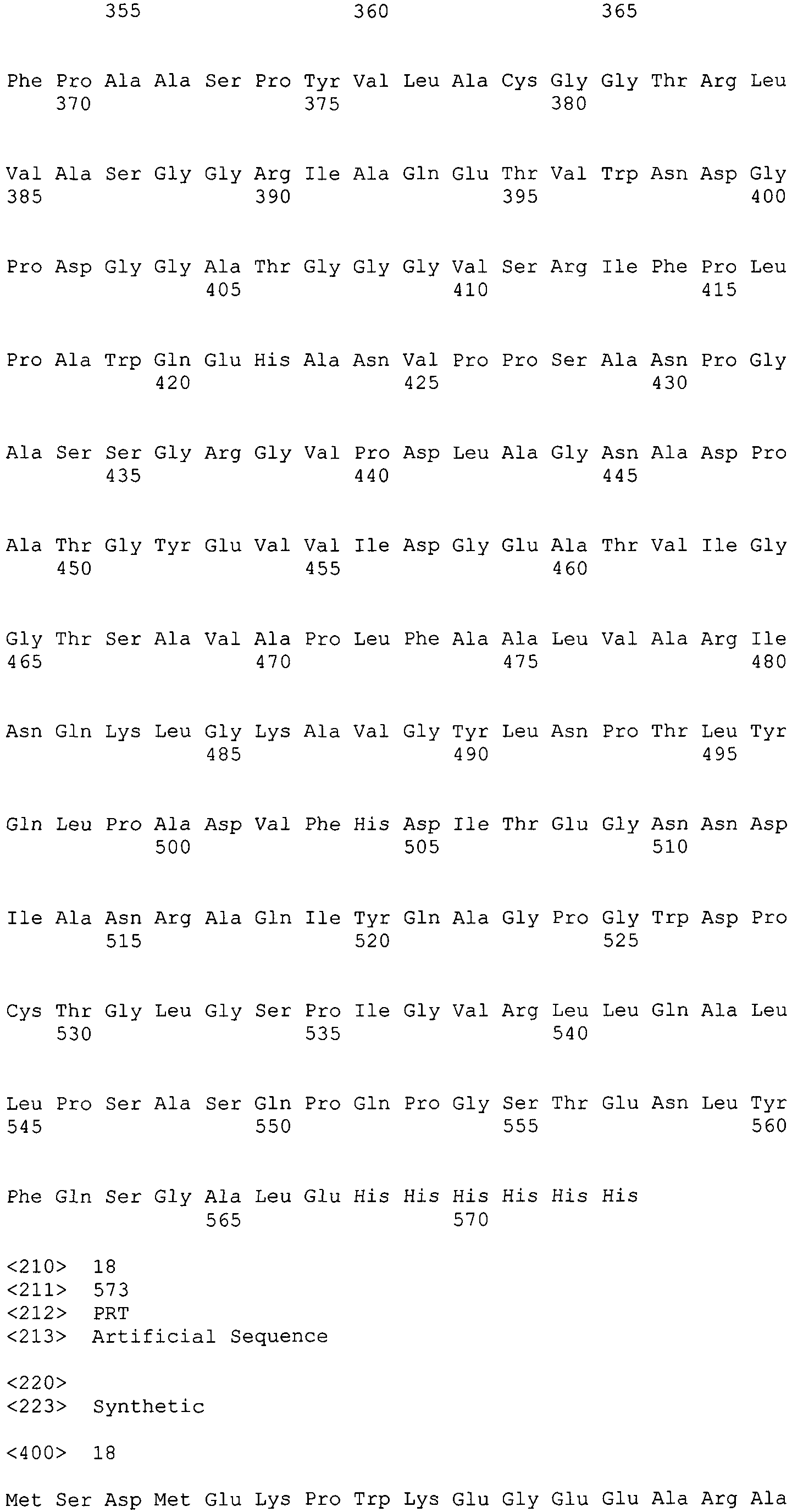


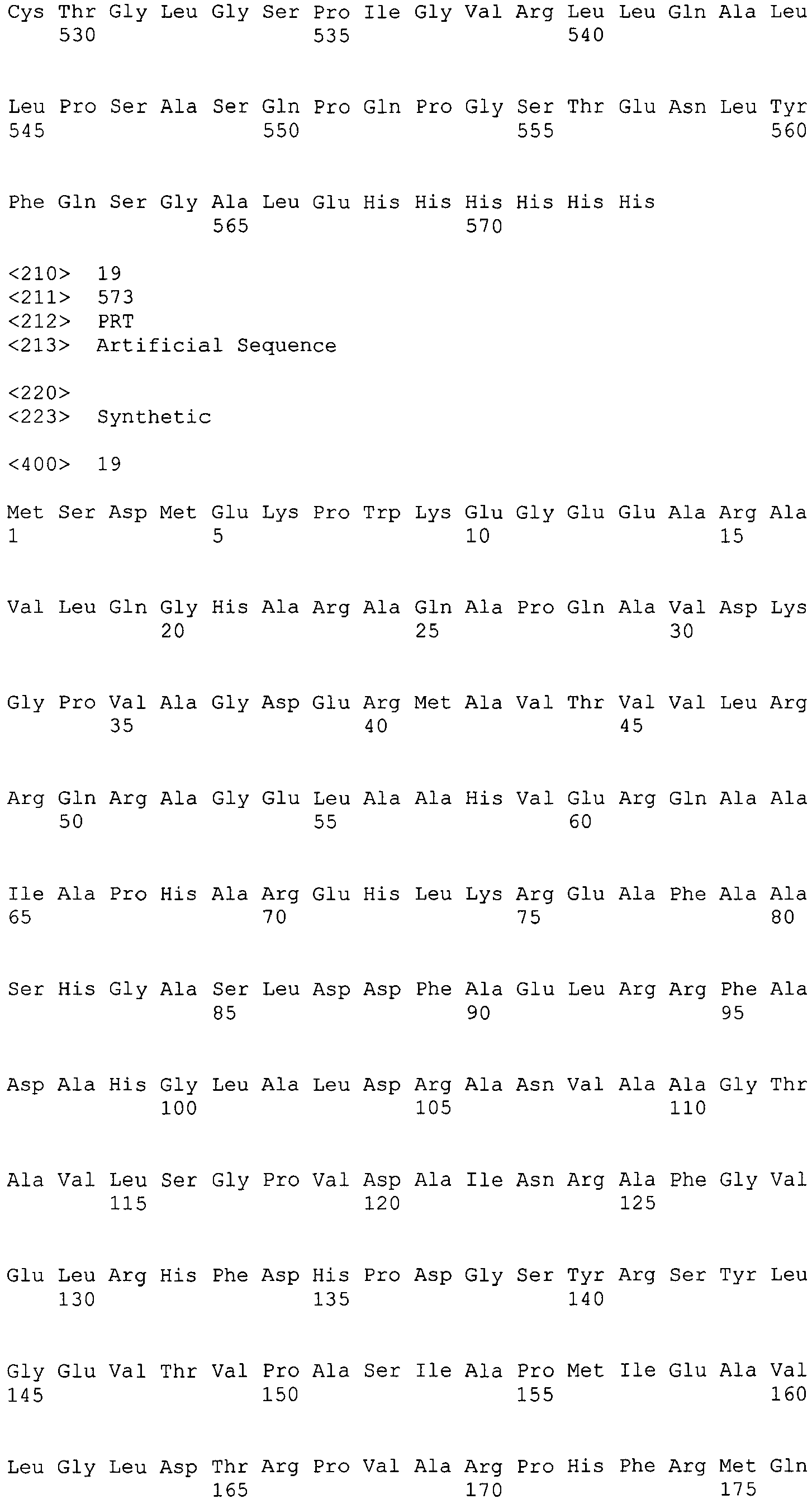


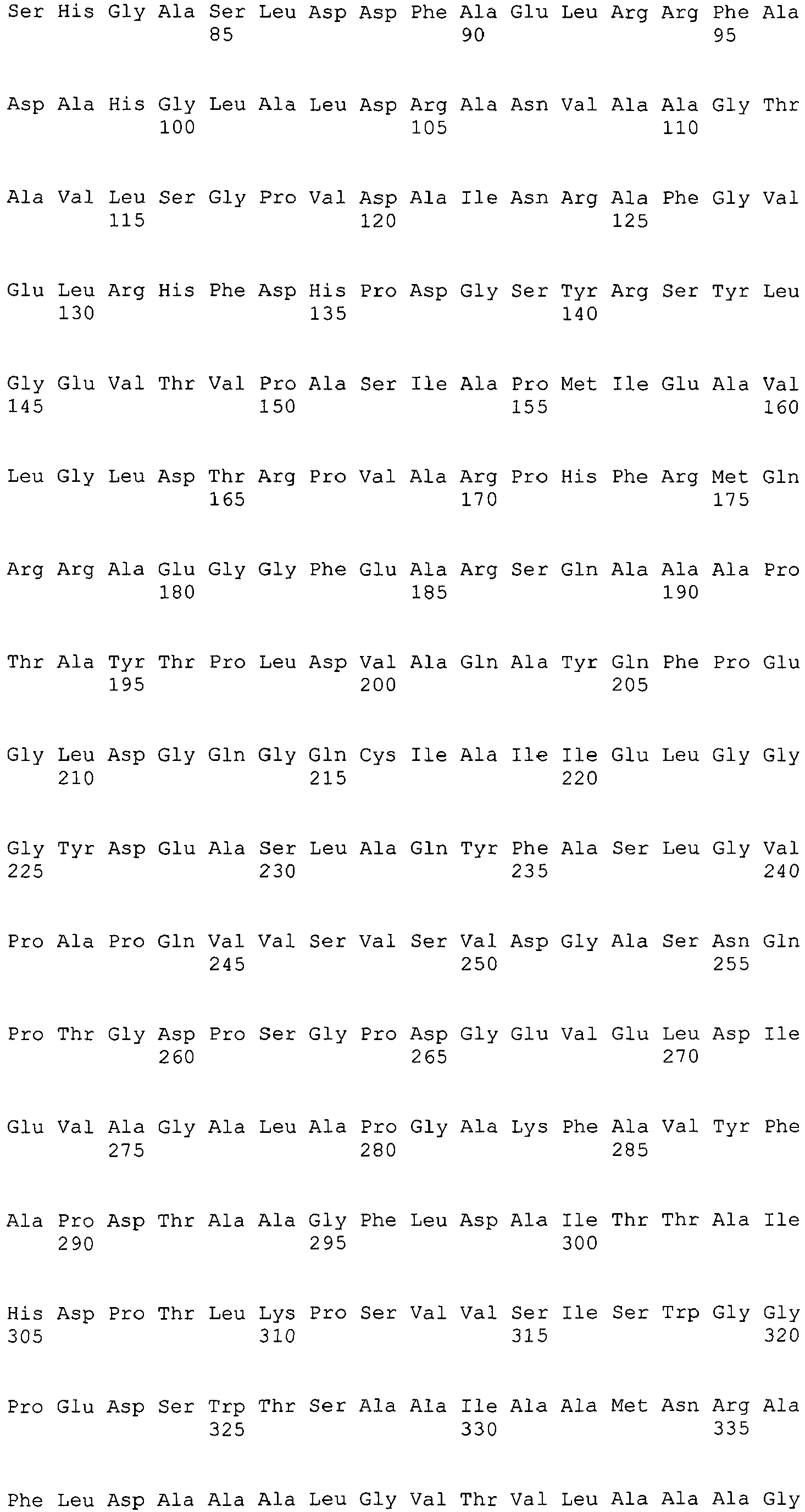


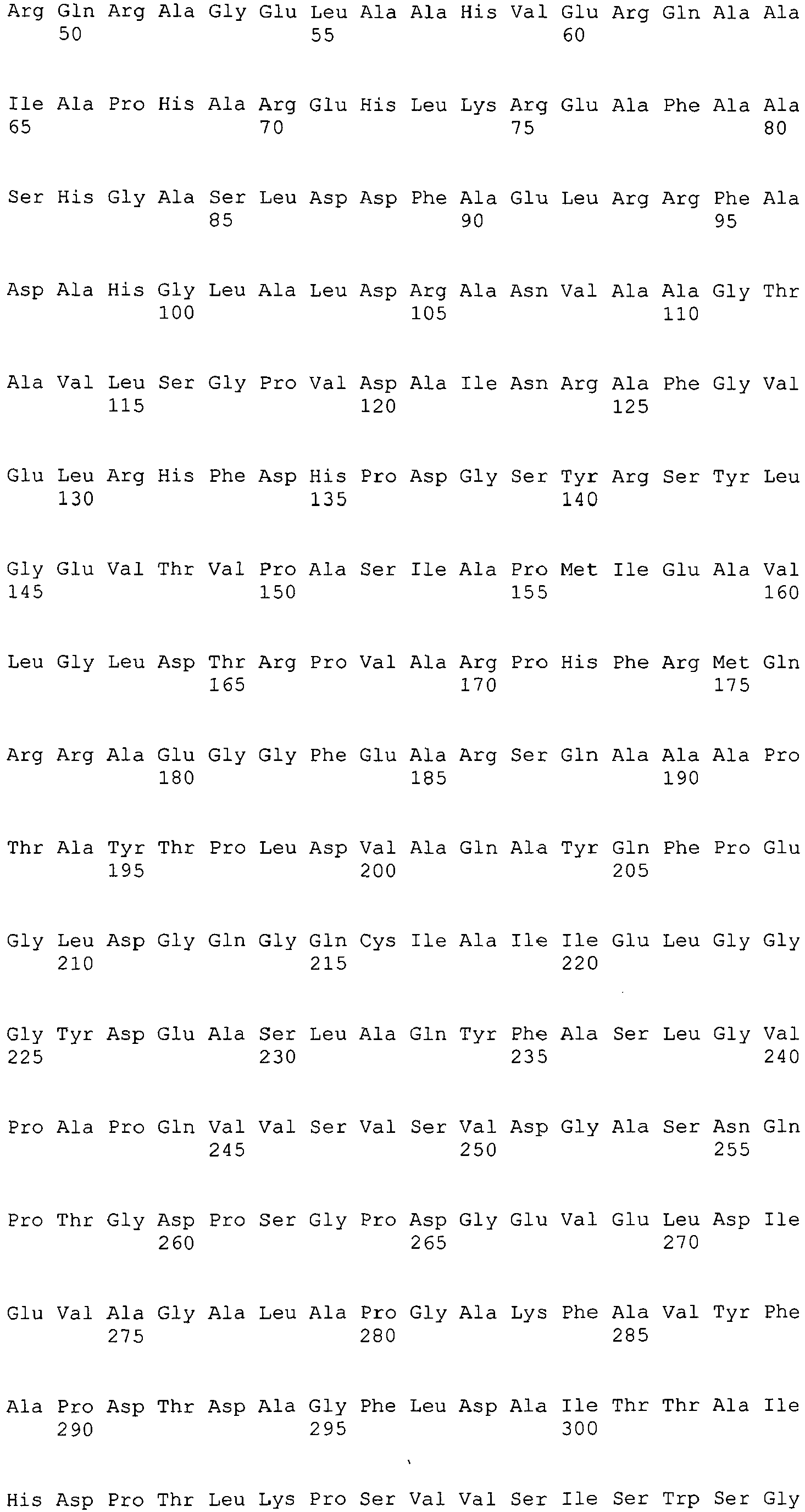


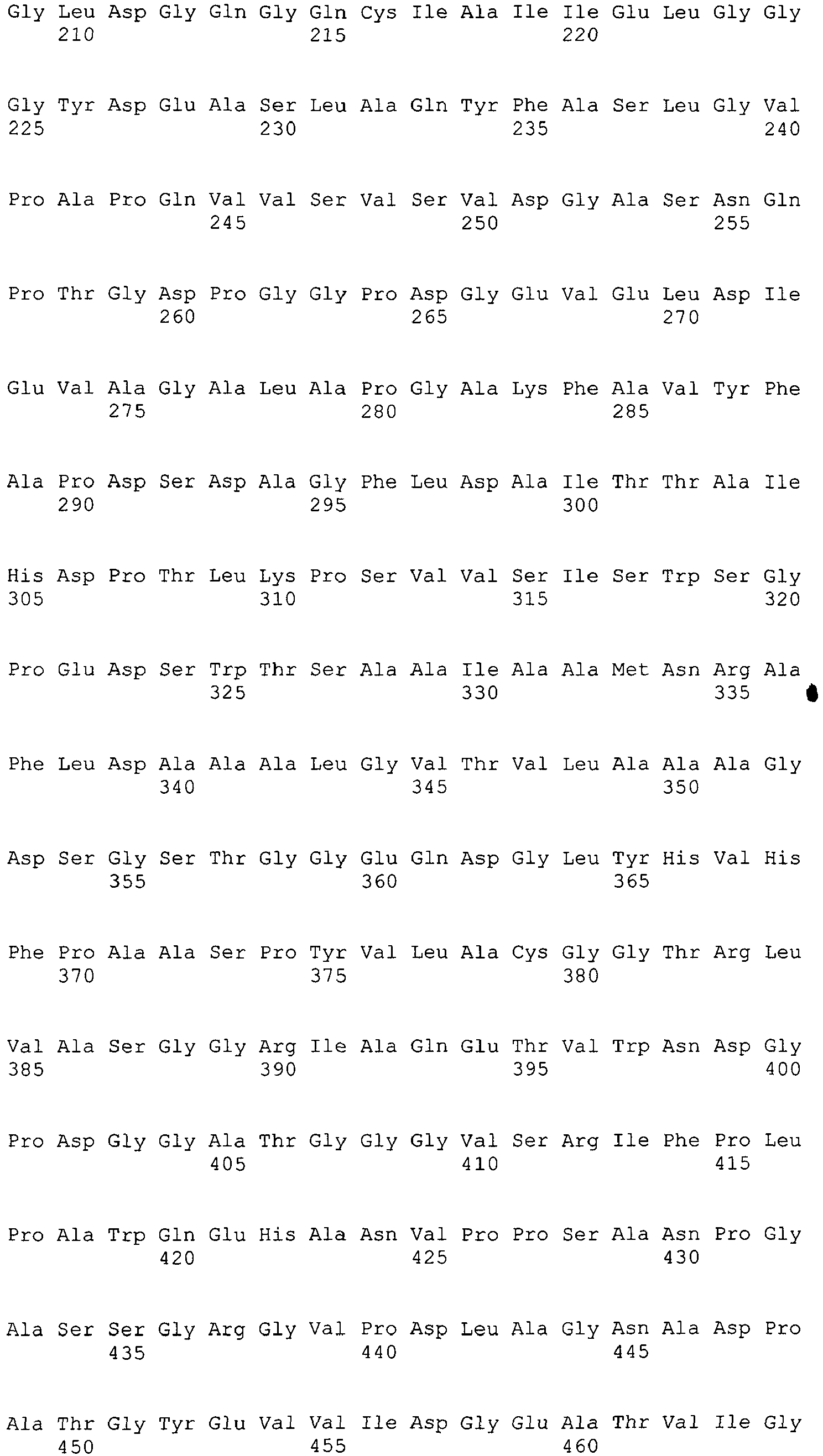


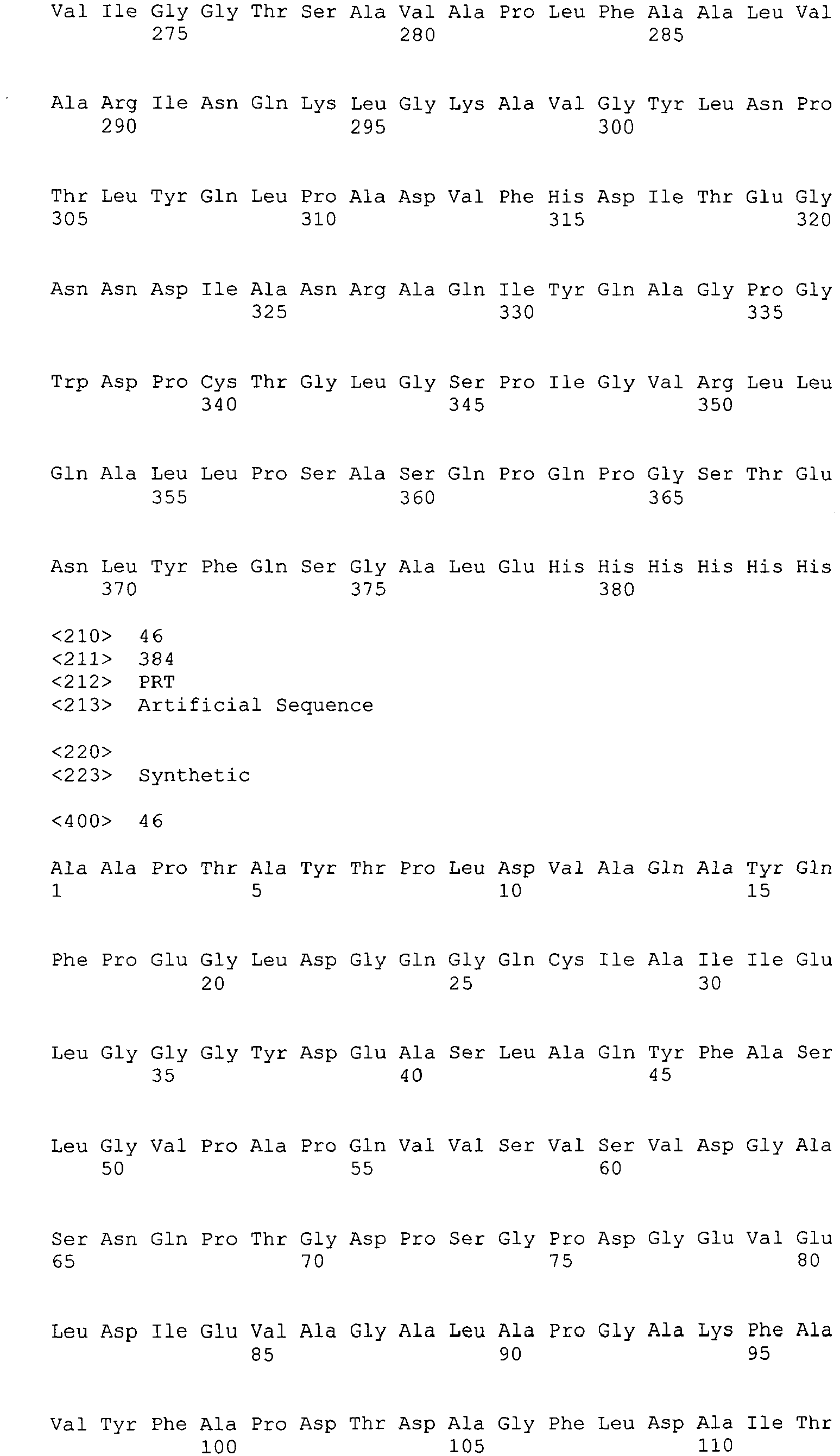


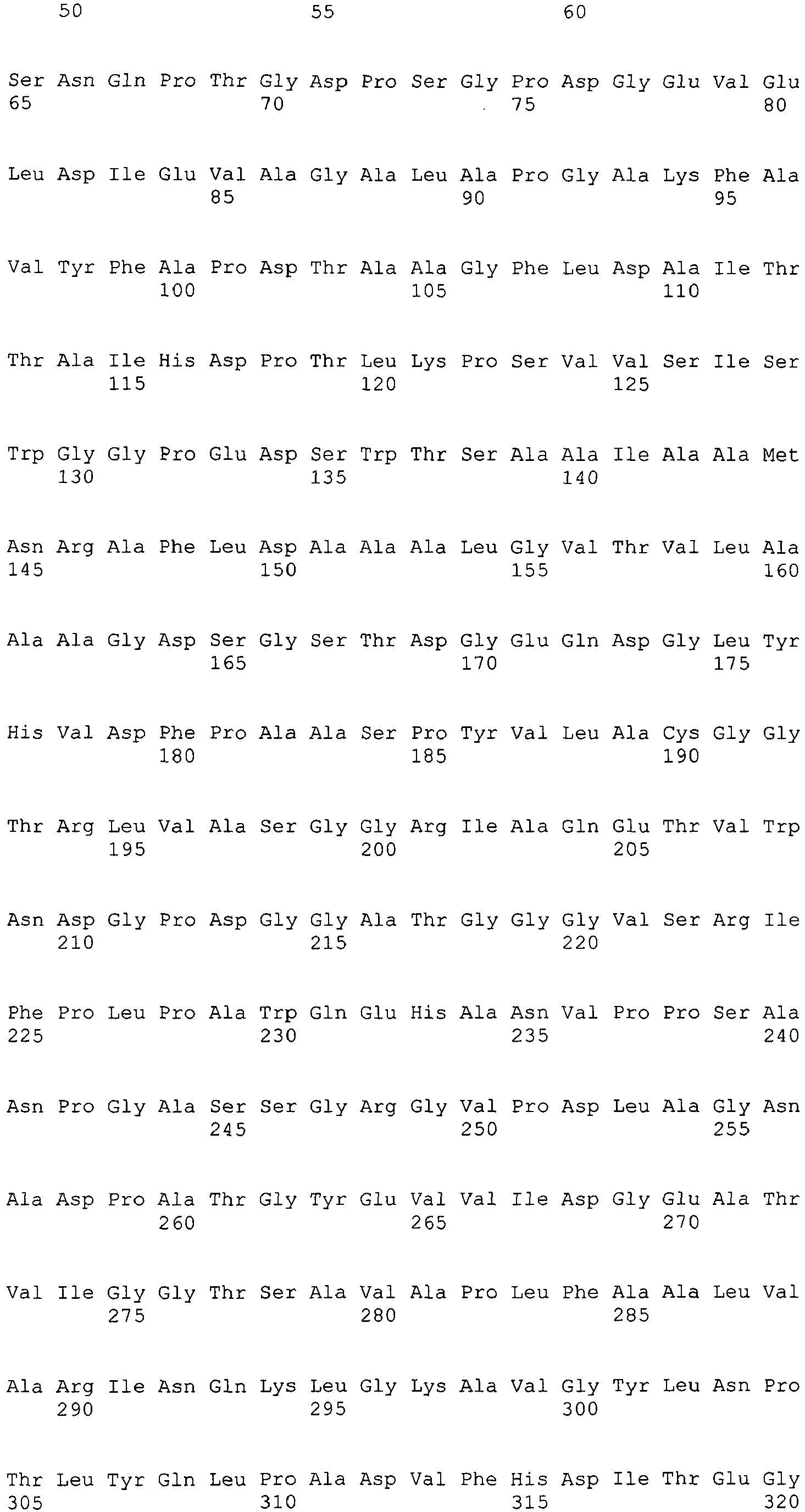


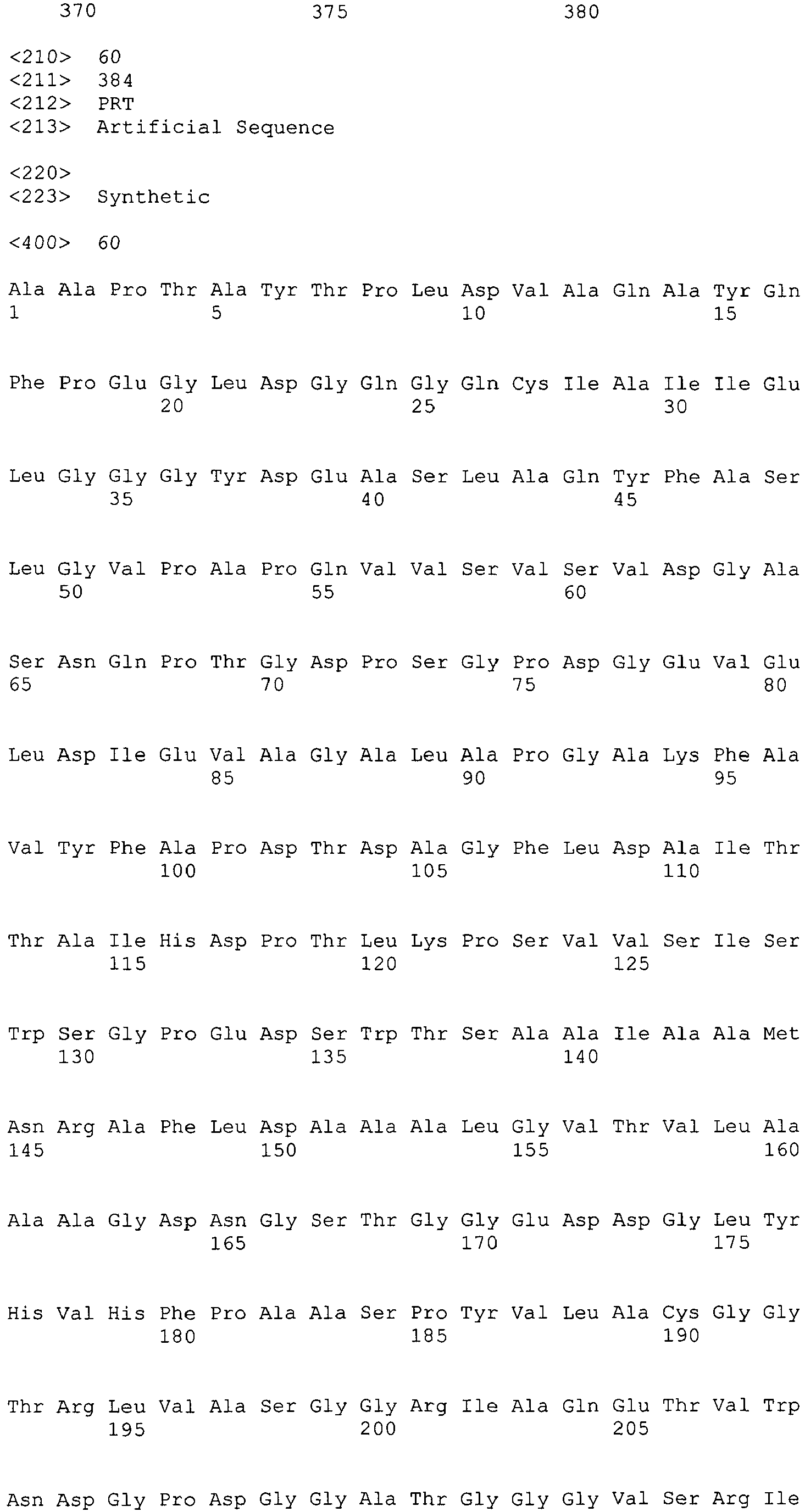

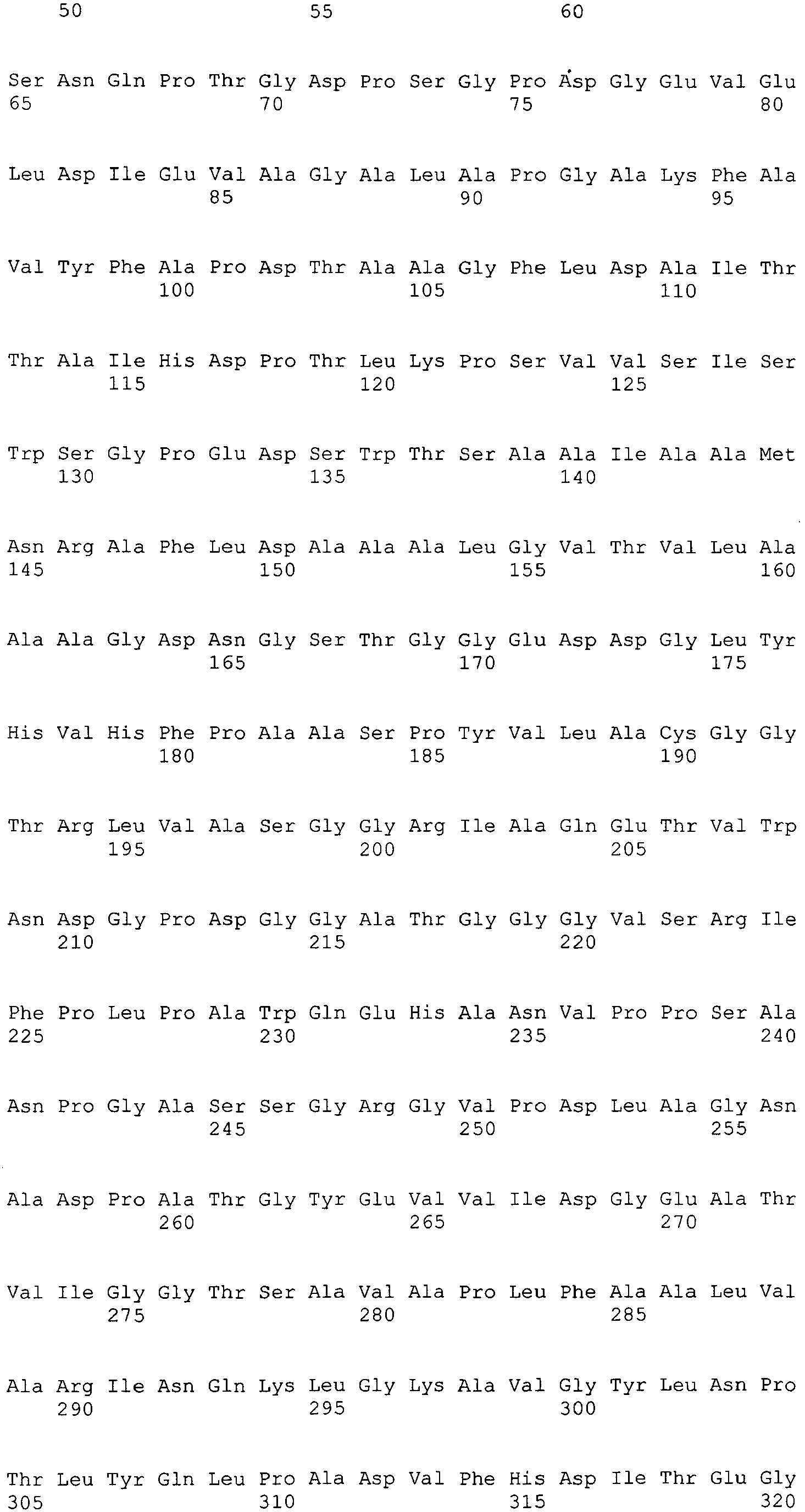


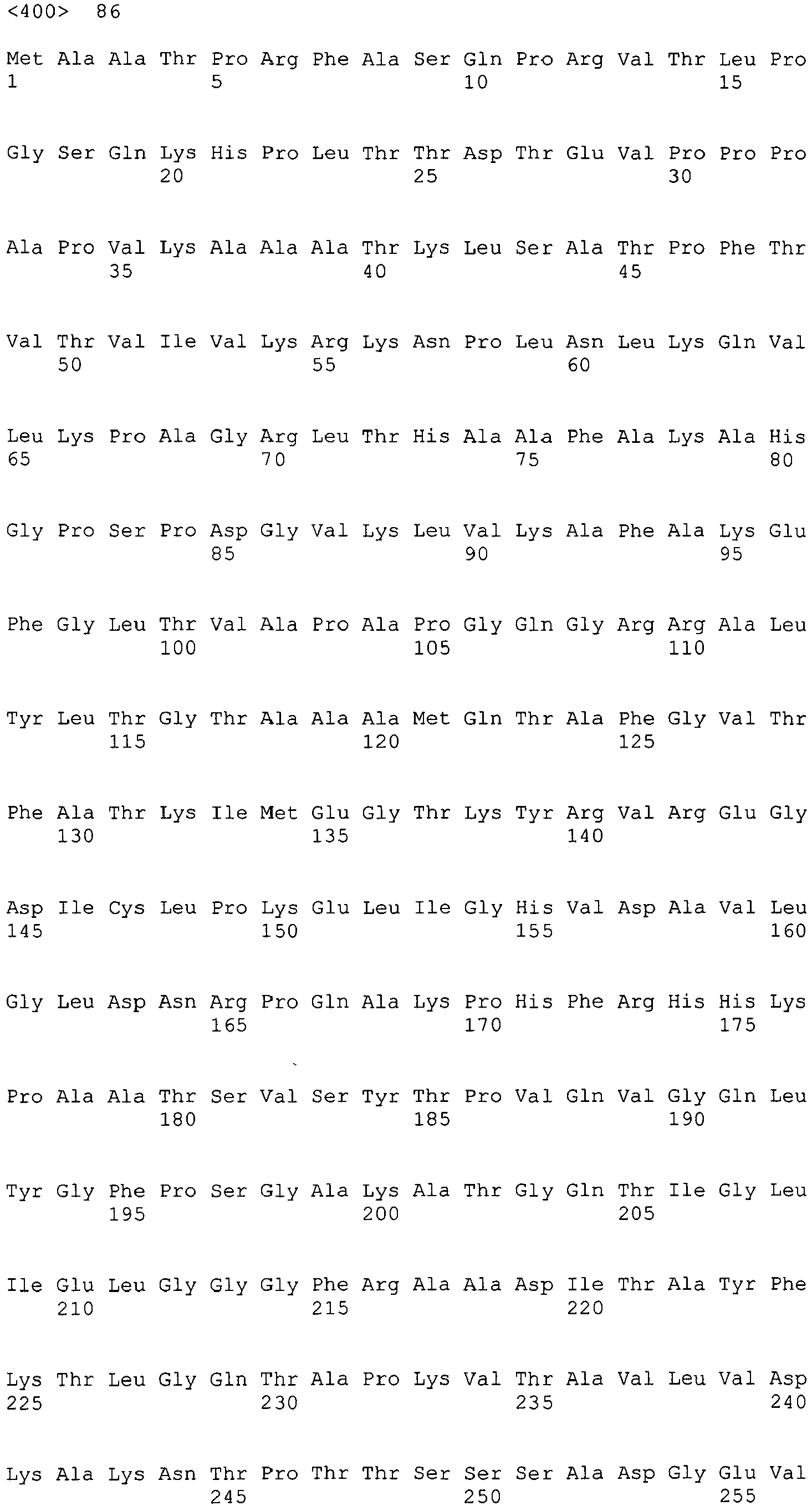


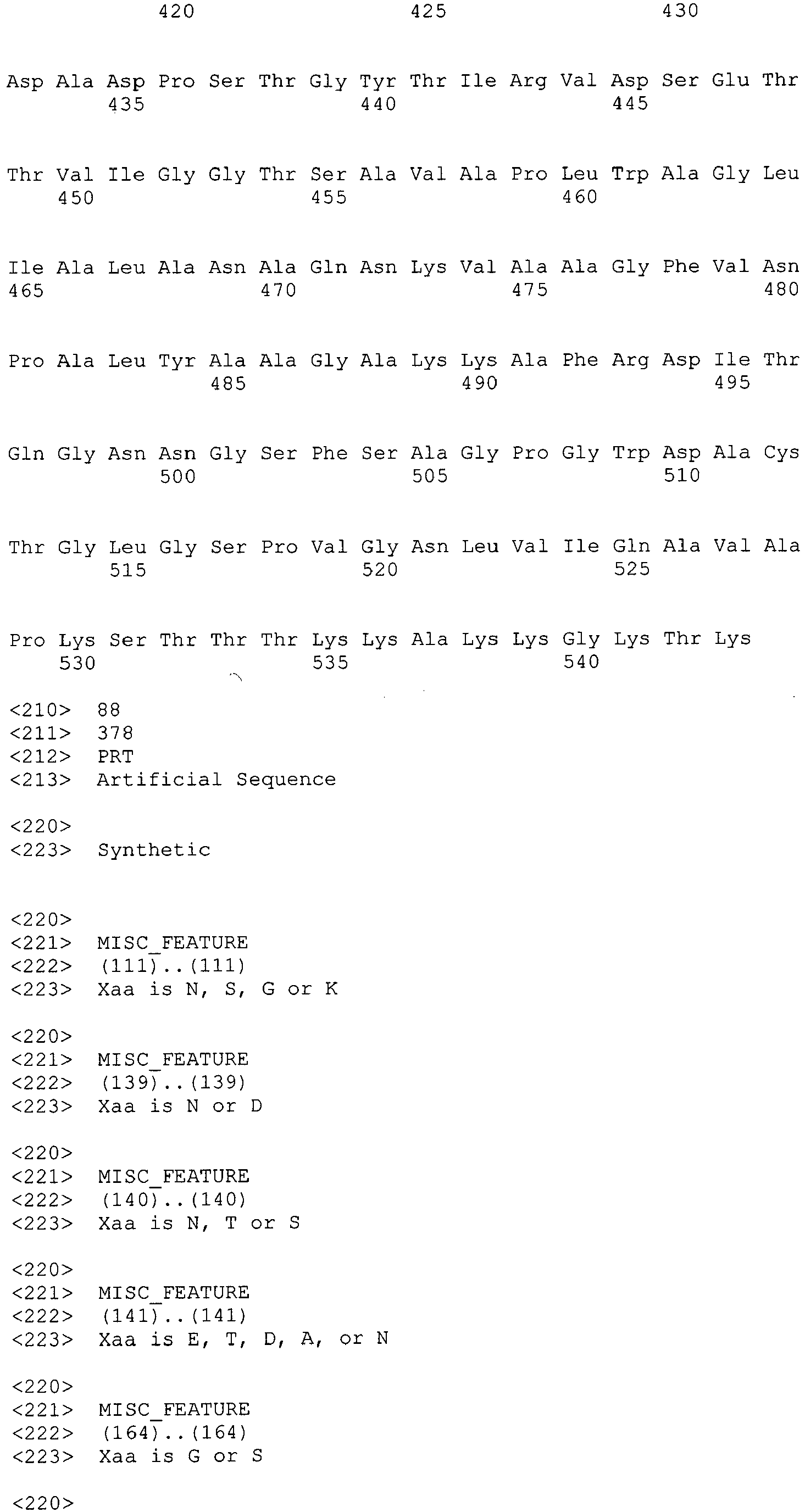


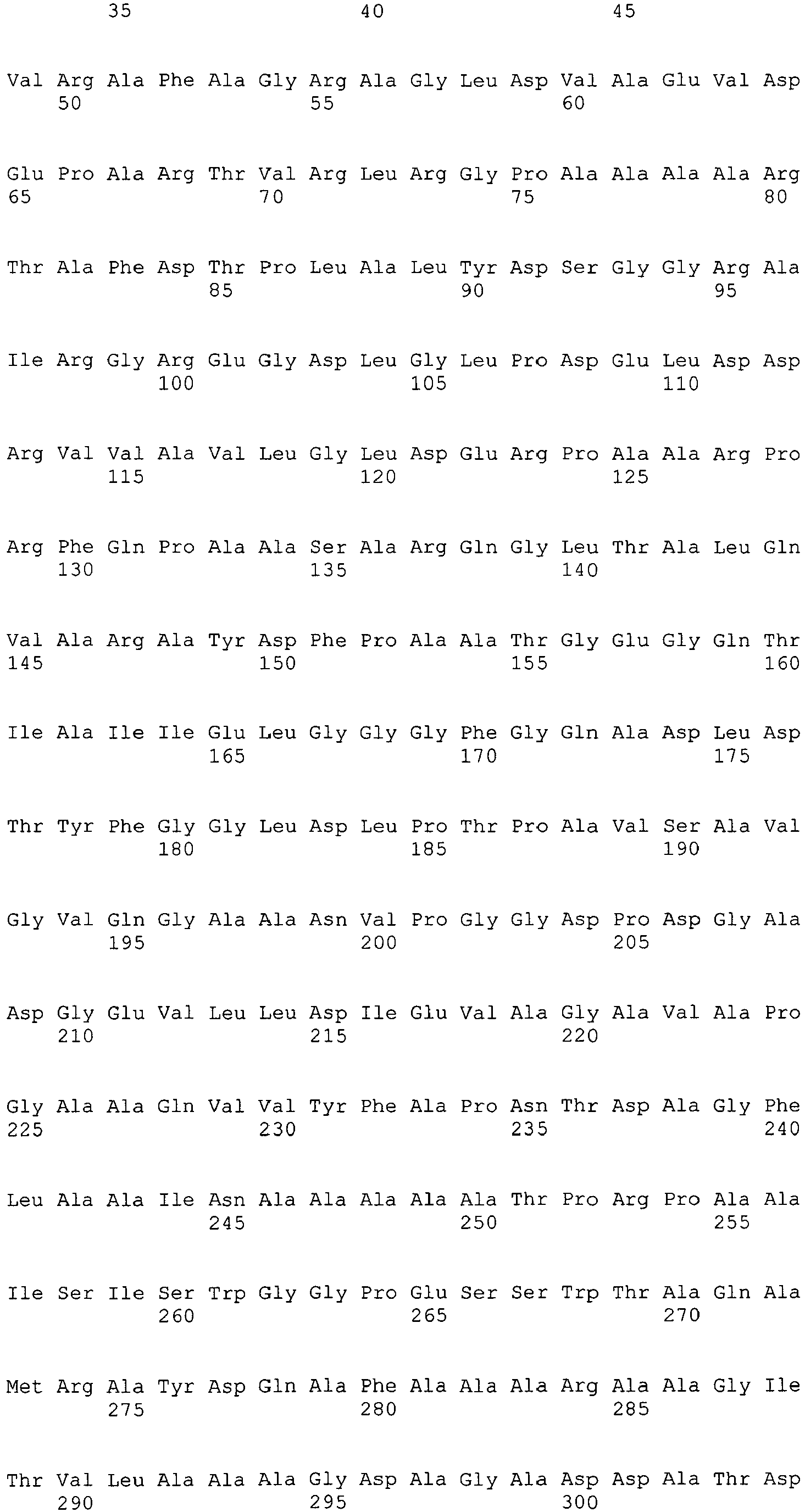


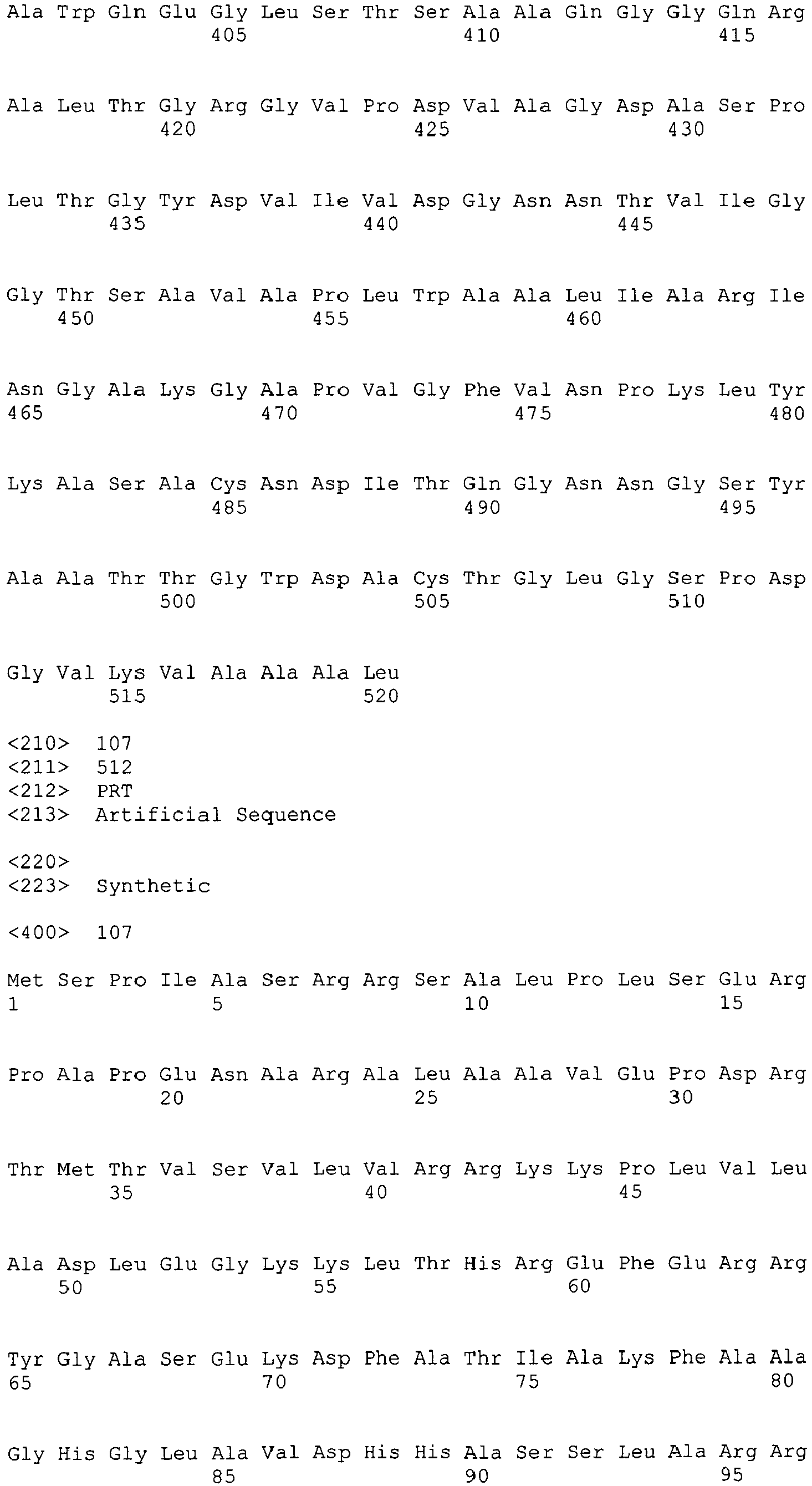


Claims (15)
- A method for treating celiac sprue, comprising administering to a subject with celiac sprue an amount effective to treat the celiac sprue of one or more polypeptides comprising or consisting of the amino acid sequence of a polypeptide selected from the group consisting of SEQ ID NOs: 75, 74, 76-89, 95, 97-98, 102-111, or processed versions thereof.
- The method of claim 1, wherein the one or more polypeptides comprise one or more polypeptides comprising or consisting of the amino acid sequence of a polypeptide selected from the group consisting of SEQ ID NOs: 75, 74, 77, 78, 82, 88, 98, 105, 111, or processed versions thereof.
- The method of claim 1 or 2, wherein the one or more polypeptides comprise a polypeptide with the amino acid sequence of SEQ ID NO: 89.
- The method of any one of claims 1-3, further comprising administering to the subject an amount of one or more further polypeptides comprising an amino acid sequence selected from the group consisting of:(A) an amino acid sequence at least 75% identical to the amino acid sequence of SEQ ID NO:35, wherein(i) the polypeptide degrades a PQPQLP (SEQ ID NO:34) peptide at pH 4; and(ii) residue 278 is Ser, residue 78 is Glu, and residue 82 is Asp(B) an amino acid sequence at least 75% identical to the amino acid sequence of SEQ ID NO: 1, wherein(i) the polypeptide degrades a PQPQLP (SEQ ID NO:34) peptide at pH 4; and(ii) residue 467 is Ser, residue 267 is Glu, and residue 271 is Asp.
- The method of claim 4, wherein the one or more further polypeptides comprise an amino acid sequence at least 85% identical, at least 95% identical, or at least 100% identical to the amino acid sequence of SEQ ID NO: 1 or SEQ ID NO: 35.
- The method of any one of claims 1-5, wherein the one or more further polypeptides comprise the amino acid sequence of any one of SEQ ID NO:2-33 or 36-67,optionally wherein the one or more further polypeptides comprises the amino acid sequence of SEQ ID NO: 90,optionally wherein the one or more polypeptides comprise SEQ ID NO: 75, SEQ ID NO: 89, and/or SEQ ID NO:98, or processed versions thereof,optionally wherein the one or more polypeptides comprise SEQ ID NO: 74, 77, and/or 78, or processed versions thereof,or optionally wherein the one or more polypeptides comprise SEQ ID NO: 88 and/or SEQ ID NO: 111, or processed versions thereof.
- The method of any one of claims 1-6, wherein the polypeptide and, when present, the further polypeptide, are administered orally.
- An isolated polypeptide selected from the group consisting of a polypeptide comprising the amino acid sequence selected from the following group, or processed versions thereof:(a) SEQ ID NO: 95, wherein one, two, three, four, five, six, seven, eight, nine, ten, or all eleven of the following are true: (i) AA residue 116 is V or D; (ii) AA residue 255 is S, K, or O; (iii) AA residue 284 is D; (iv) AA residue 285 is T; (v) AA residue 286 is A, T, or N; (vi) AA residue 312 is S; (vii) AA residue 347 is N; (viii) AA residue 350 is T or A; (ix) AA residue 351 is N or G; (x) AA residue 354 is D; and (xi) AA residue 361 is S or H; (b) SEQ ID NO: 75, wherein one, two, three, four, five, six, seven, eight, nine, ten, or all eleven of the following are true: (i) AA residue 106 is D; (ii) AA residue 246 is S, K, or G; (iii) AA residue 275 is D; (iv) AA residue 276 is S; (v) AA residue 277 is A, T, or N; (vi) AA residue 303 is S; (vii) AA residue 338 is S; (viii) AA residue 341 is T or A; (ix) AA residue 342 is N or G; (x) AA residue 345 is Q or D; and (xi) AA residue 352 is S or H;(c) SEQ ID NO: 76, wherein one, two, three, four, five, six, seven, eight, nine, ten, or all eleven of the following are true: (i) AA residue 120 is D; (ii) AA residue 259 is S, K, or G; (iii) AA residue 288 is D; (iv) AA residue 289 is T; (v) AA residue 290 is A, T, or N; (vi) AA residue 316 is S; (vii) AA residue 351 is S or N; (viii) AA residue 354 is A; (ix) AA residue 355 is N or G; (x) AA residue 358 is D; and (xi) AA residue 365 is S or H;(d) SEQ ID NO: 78;(e) SEQ ID NO: 79, wherein one, two, three, four, five, six, seven, eight, nine, ten, or all eleven of the following are true: (i) AA residue 107 is V or D; (ii) AA residue 245 is S, K, or G; (iii) AA residue 274 is D; (iv) AA residue 275 is T; (v) AA residue 276 is A, T, or N; (vi) AA residue 302 is S; (vii) AA residue 337 is S or N; (viii) AA residue 340 is T or A; (ix) AA residue 341 is N or G; (x) AA residue 344 is Q or D; and (xi) AA residue 351 is S or H;(f) SEQ ID NO: 80, wherein one, two, three, four, five, six, seven, eight, nine, ten, or all eleven of the following are true: (i) AA residue 76 is V or D; (ii) AA residue 206 is S, K, or G; (iii) AA residue 235 is D; (iv) AA residue 236 is S; (v) AA residue 237 is A, T, or N; (vi) AA residue 262 is S; (vii) AA residue 297 is S or N; (viii) AA residue 300 is T or A; (ix) AA residue 301 is N or G; (x) AA residue 302 is Q or D; and (xi) AA residue 309 is S or H;(g) SEQ ID NO: 81, wherein one, two, three, four, five, six, seven, eight, nine, ten, or all eleven of the following are true: (i) AA residue 105 is D; (ii) AA residue 244 is S or K; (iii) AA residue 272 is D; (iv) AA residue 273 is S; (v) AA residue 274 is A, T, or N; (vi) AA residue 299 is S; (vii) AA residue 334 is N; (viii) AA residue 337 is T or A: (ix) AA residue 338 is N or G; (x) AA residue 341 is Q or D; and (xi) AA residue 348 is S or H;(h) SEQ ID NO: 82, wherein one, two, three, four, five, six, seven, eight, nine, ten, or all eleven of the following are true: (i) AA residue 106 is V or D; (ii) AA residue 244 is S, K, or G; (iii) AA residue 273 is D; (iv) AA residue 274 is T: (v) AA residue 275 is A, T, or N; (vi) AA residue 301 is S; (vii) AA residue 336 is N; (viii) AA residue 339 is T or A; (ix) AA residue 340 is N or G; (x) AA residue 343 is D; and (viii) AA residue 350 is S or H; (i) SEQ ID NO: 83, wherein one, two, three, four, five, six, seven, eight, nine, ten, or all eleven of the following are true: (i) AA residue 107 is V or D; (ii) AA residue 245 is S, K, or G; (iii) AA residue 274 is D; (iv) AA residue 275 is T; (v) AA residue 276 is A, T, or N; (vi) AA residue 302 is S; (vii) AA residue 337 is N; (viii) AA residue 340 is T or A; (ix) AA residue 341 is N or G; (x) AA residue 344 is Q or D; and (xi) AA residue 351 is S or H;(i) SEQ ID NO: 83, wherein one, two, three, four, five, six, seven, eight, nine, ten, or all eleven of the following are true: (i) AA residue 107 is V or D; (ii) AA residue 245 is S, K, or G; (iii) AA residue 274 is D; (iv) AA residue 275 is T; (v) AA residue 276 is A, T, or N; (vi) AA residue 302 is S; (vii) AA residue 337 is N; (viii) AA residue 340 is T or A; (ix) AA residue 341 is N or G; (x) AA residue 344 is Q or D; and (xi) AA residue 351 is S or H(j) SEQ ID NO: 84, wherein one, two, three, four, five, six, seven, eight, nine, ten, or all eleven of the following are true: (i) AA residue 104 is V or D; (ii) AA residue 241 is S, K, or G; (iii) AA residue 270 is D; (iv) AA residue 271 is S; (v) AA residue 272 is D, A, T, or N; (vi) AA residue 298 is S; (vii) AA residue 333 is S; (viii) AA residue 336 is A; (ix) AA residue 337 is N or G; (x) AA residue 340 is D; and (xi) AA residue 347 is S or H;(k) SEQ ID NO: 85, wherein one, two, three, four, five, six, seven, eight, nine, ten, or all eleven of the following are true: (i) AA residue 104 is D; (ii) AA residue 245 is S, K, or G; (iii) AA residue 274 is D; (iv) AA residue 275 is S; (v) AA residue 276 is A, T, or N; (vi) AA residue 302 is S; (vii) AA residue 337 is S or N; (viii) AA residue 340 is T or A; (ix) AA residue 341 is N or G; (x) AA residue 344 is Q or D; and (xi) AA residue 351 is S or H;(l) SEQ ID NO: 86, wherein one, two, three, four, five, six, seven, eight, nine, ten, or all eleven of the following are true: (i) AA residue 118 is V or D; (ii) AA residue 250 is K, or G; (iii) AA residue 279 is D; (iv) AA residue 280 is S; (v) AA residue 281 is A, T, or N; (vi) AA residue 307 is S; (vii) AA. residue 342 is S or N; (viii) AA residue 345 is A; (ix) AA residue 346 is N or G; (x) AA residue 349 is Q or D; and (xi) AA residue 356 is S or H;(m) SEQ ID NO: 87, wherein one, two, three, four, five, six, seven, eight, nine, ten, or a il eleven of the following are true: (i) AA residue 121 is V or D; (ii) AA residue 253 is S, K, or G; (iii) AA residue 282 is D; (iv) AA residue 283 is S; (v) AA residue 284 is A, T, or N; (vi) AA residue 310 is S; (vii) AA residue 345 is S; (viii) AA residue 348 is T or A; (ix) AA residue 349 is N or G; (x) AA residue 352 is Q or D; and (xi) AA residue 357 is S or H;(n) SEQ ID NO: 88, wherein one, two, three, four, five, six, seven, eight, nine, or all ten of the following are true: (i) AA residue 111 is S, K, or G; (ii) AA residue 139 is D; (iii) AA residue 140 is T or S; (iv) AA residue 141 is D, A, T, or N; (v) AA residue 164 is S; (vi) AA residue 199 is S or N; (vii) AA residue 202 is T or A; (viii) AA residue 203 is N or G; (ix) AA residue 204 is Q or D; and (x) AA residue 211 is S or H; and(o) SEQ ID NO:89.
- The isolated polypeptide of claim 8, selected from the group consisting of the following, or processed versions thereof:(i) SEQ ID NO: 75, wherein one, two, three, four, five, six, seven, eight, nine, ten, or all eleven of the following are true: (i) AA residue 106 is D; (ii) AA residue 246 is S, K, or G; (iii) AA residue 275 is D; (iv) AA residue 276 is S; (v) AA residue 277 is A, T, or N; (vi) AA residue 303 is S; (vii) AA residue 338 is S; (viii) AA residue 341 is T or A; (ix) AA residue 342 is N or G; (x) AA residue 345 is Q or D; and (xi) AA residue 352 is S or H;(ii) SEQ ID NO: 78;(iii) SEQ ID NO: 82, wherein one, two, three, four, five, six, seven, eight, nine, ten, or all eleven of the following are true: (i) AA residue 106 is V or D; (ii) AA residue 244 is S, K, or G; (iii) AA residue 273 is D; (iv) AA residue 274 is T; (v) AA residue 275 is A, T, or N; (vi) AA residue 301 is S; (vii) AA residue 336 is N; (viii) AA residue 339 is T or A; (ix) AA residue 340 is N or G; (x) AA residue 343 is D; and (viii) AA residue 350 is S or H;(iv) SEQ ID NO: 88, wherein one, two, three, four, five, six, seven, eight, nine, or all ten of the following are true: (i) AA residue 111 is S, K, or G; (ii) AA residue 139 is D; (iii) AA residue 140 is T or S; (iv) AA residue 141 is D, A, T, or N; (v) AA residue 164 is S; (vi) AA. residue 199 is S or N; (vii) AA residue 202 is T or A; (viii) AA residue 203 is N or G; (ix) AA residue 204 is Q or D; and (x) AA residue 211 is S or H; and(v) SEQ ID NO:89,optionally wherein the isolated polypeptide comprises the amino acid sequence of SEQ ID NO: 89, SEQ ID NO: 78, or a processed version thereof.
- A nucleic acid encoding the polypeptide of claim 8 or 9.
- A nucleic acid expression vector comprising the nucleic acid of claim 10.
- A recombinant host cell comprising the nucleic acid expression vector of claim 11.
- A composition, comprising(a) one or more polypeptides comprising the amino acid sequence of a polypeptide selected from the group consisting of SEQ ID NOs: 74-89, 95, 97-99, and 102-111, or processed versions thereof; and(b) one or more further polypeptides comprising an amino acid sequence selected from the group consisting of:(A) an amino acid sequence at least 75% identical to the amino acid sequence of SEQ ID NO:35, wherein(i) the polypeptide degrades a PQPQLP (SEQ ID NO:34) peptide at pH 4; and(ii) residue 278 is Ser, residue 78 is Glu, and residue 82 is Asp(B) an amino acid sequence at least 75% identical to the amino acid sequence of SEQ ID NO: 1, wherein(i) the polypeptide degrades a PQPQLP (SEQ ID NO:34) peptide at pH 4; and(ii) residue 467 is Ser, residue 267 is Glu, and residue 271 is Asp.
- The composition of claim 13, wherein the one or more polypeptides comprise SEQ ID NO: 75, SEQ ID NO: 89, and/or SEQ ID NO:98, or processed versions thereof,optionally wherein the one or more polypeptides comprise SEQ ID NO: 74, 77, and/or 78, or processed versions thereof,optionally wherein the one or more polypeptides comprise SEQ ID NO: 88 and/or SEQ ID NO: 111, or processed versions thereof,optionally wherein the one or more further polypeptides comprise the amino acid sequence of SEQ ID NO: 1 and/or SEQ ID NO: 35,optionally wherein the one or more further polypeptides comprise the amino acid sequence of any one of SEQ ID NO:2-33 or 36-67,or optionally wherein the one or more further polypeptides comprises the amino acid sequence of SEQ ID NO:90, or a processed version thereof.
- A pharmaceutical composition, comprising the isolated polypeptide of claim 8 or 9 or the composition of claim 13 or 14, and a pharmaceutically acceptable carrier, optionally, the pharmaceutical composition is formulated for oral delivery.
Applications Claiming Priority (4)
| Application Number | Priority Date | Filing Date | Title |
|---|---|---|---|
| US201361865787P | 2013-08-14 | 2013-08-14 | |
| EP18195982.6A EP3520808B1 (en) | 2013-08-14 | 2014-08-13 | Compositions for treating celiac sprue disease |
| PCT/US2014/050835 WO2015023728A1 (en) | 2013-08-14 | 2014-08-13 | Compositions and methods for treating celiac sprue disease |
| EP14756186.4A EP3033100B1 (en) | 2013-08-14 | 2014-08-13 | Compositions for treating celiac sprue disease |
Related Parent Applications (3)
| Application Number | Title | Priority Date | Filing Date |
|---|---|---|---|
| EP18195982.6A Division EP3520808B1 (en) | 2013-08-14 | 2014-08-13 | Compositions for treating celiac sprue disease |
| EP14756186.4A Division EP3033100B1 (en) | 2013-08-14 | 2014-08-13 | Compositions for treating celiac sprue disease |
| PCT/US2014/050835 Previously-Filed-Application WO2015023728A1 (en) | 2013-08-14 | 2014-08-13 | Compositions and methods for treating celiac sprue disease |
Publications (1)
| Publication Number | Publication Date |
|---|---|
| EP4008340A1 true EP4008340A1 (en) | 2022-06-08 |
Family
ID=51422171
Family Applications (3)
| Application Number | Title | Priority Date | Filing Date |
|---|---|---|---|
| EP14756186.4A Active EP3033100B1 (en) | 2013-08-14 | 2014-08-13 | Compositions for treating celiac sprue disease |
| EP21167722.4A Withdrawn EP4008340A1 (en) | 2013-08-14 | 2014-08-13 | Compositions for treating celiac sprue disease |
| EP18195982.6A Active EP3520808B1 (en) | 2013-08-14 | 2014-08-13 | Compositions for treating celiac sprue disease |
Family Applications Before (1)
| Application Number | Title | Priority Date | Filing Date |
|---|---|---|---|
| EP14756186.4A Active EP3033100B1 (en) | 2013-08-14 | 2014-08-13 | Compositions for treating celiac sprue disease |
Family Applications After (1)
| Application Number | Title | Priority Date | Filing Date |
|---|---|---|---|
| EP18195982.6A Active EP3520808B1 (en) | 2013-08-14 | 2014-08-13 | Compositions for treating celiac sprue disease |
Country Status (8)
| Country | Link |
|---|---|
| US (5) | US10266815B2 (en) |
| EP (3) | EP3033100B1 (en) |
| JP (2) | JP6517204B2 (en) |
| CN (2) | CN105555300A (en) |
| AU (1) | AU2014306716B2 (en) |
| CA (1) | CA2918347A1 (en) |
| ES (1) | ES2702907T3 (en) |
| WO (1) | WO2015023728A1 (en) |
Families Citing this family (9)
| Publication number | Priority date | Publication date | Assignee | Title |
|---|---|---|---|---|
| CA2882502A1 (en) | 2011-08-10 | 2013-02-14 | University Of Washington Through Its Center For Commercialization | Compositions and methods for treating celiac sprue disease |
| CN105555300A (en) * | 2013-08-14 | 2016-05-04 | 华盛顿大学商业中心 | Compositions and methods for treating sprue |
| PE20180509A1 (en) | 2015-06-08 | 2018-03-09 | Univ Washington | COMPOSITIONS AND METHODS TO TREAT CELIAC DISEASE |
| KR102686572B1 (en) * | 2016-12-22 | 2024-07-19 | 에베 누트리찌온 게엠베하 | stable protease variants |
| US20200383351A1 (en) * | 2018-10-26 | 2020-12-10 | The Regents Of The University Of California | Use of proteolytic enzymes to enhance protein bioavailability |
| US20250064903A1 (en) * | 2020-10-30 | 2025-02-27 | University Of Washington | Compositions and methods for treating celiac sprue disease |
| WO2023147350A1 (en) | 2022-01-26 | 2023-08-03 | Digestiva, Inc. | Blood glucose stabilizing methods and compositions |
| WO2025068987A1 (en) | 2023-09-28 | 2025-04-03 | Takeda Pharmaceutical Company Limited | A method of producing a kumamolisin-as polypeptide |
| CN119570766B (en) * | 2025-02-08 | 2025-05-16 | 上海锴泰生物科技有限公司 | Collagenase mutant, gene fragment, recombinant plasmid, recombinant expression system, collagen peptide, and preparation method and use thereof |
Citations (2)
| Publication number | Priority date | Publication date | Assignee | Title |
|---|---|---|---|---|
| WO2013023151A2 (en) | 2011-08-10 | 2013-02-14 | University Of Washington Through Its Center For Commercialization | Compositions and methods for treating celiac sprue disease |
| WO2013083338A1 (en) * | 2011-12-06 | 2013-06-13 | Fondazione Istituto Insubrico Di Ricerca Per La Vita | New proteases able to hydrolyze gluten peptides and proteins at acidic ph, from the actinomycete actinoallomurus |
Family Cites Families (19)
| Publication number | Priority date | Publication date | Assignee | Title |
|---|---|---|---|---|
| FR2688229B1 (en) | 1992-03-09 | 1995-06-23 | Ulice Soc | PROCESS FOR THE ENZYMATIC SYNTHESIS OF ALKYL ESTERS OF PEPTIDES, PRODUCTS THUS OBTAINED AND USE OF SAID PRODUCTS. |
| JP2002078489A (en) | 2000-09-04 | 2002-03-19 | Daiwa Kasei Kk | New acid protease with serine residue relating to activity expression |
| US8143210B2 (en) | 2002-02-14 | 2012-03-27 | The Board Of Trustees Of The Leland Stanford Junior University | Enzyme treatment of foodstuffs for celiac sprue |
| ES2361993T5 (en) | 2002-02-14 | 2014-12-09 | The Board Of Trustees Of The Leland Stanford Junior University | Enzyme treatment of food products for celiac disease |
| US7320788B2 (en) | 2002-02-14 | 2008-01-22 | The Board Of Trustees Of The Leland Stanford Junior University | Enzyme treatment of foodstuffs for Celiac Sprue |
| WO2004045392A2 (en) | 2002-11-20 | 2004-06-03 | The Board Of Trustees Of The Leland Stanford Junior University | Diagnostic method for celiac sprue |
| US7265093B2 (en) | 2002-05-14 | 2007-09-04 | The Board Of Trustees Of The Leland Stanford Junior University | Drug therapy for Celiac Sprue |
| US7462688B2 (en) | 2002-05-14 | 2008-12-09 | The Board Of Trustees Of The Leland Stanford Junior University | Peptides for diagnostic and therapeutic methods for celiac sprue |
| AU2003234597A1 (en) | 2002-05-14 | 2003-12-02 | The Board Of Trustees Of The Leland Stanford Junior University | Drug therapy for celiac sprue |
| US7202216B2 (en) | 2002-05-14 | 2007-04-10 | The Board Of Trustees Of The Leland Stanford Junior University | Drug therapy for celiac sprue |
| US7579313B2 (en) | 2003-11-18 | 2009-08-25 | The Board Of Trustees Of The Leland Stanford Junior University | Transglutaminase inhibitors and methods of use thereof |
| US7563864B2 (en) | 2004-04-26 | 2009-07-21 | Celiac Sprue Research Foundation | Prolyl endopeptidase mediated destruction of T cell epitopes in whole gluten |
| US7534426B2 (en) | 2004-04-26 | 2009-05-19 | The Board Of Trustees Of The Leland Stanford Junior University | Glutenase enzyme assays |
| US7628985B2 (en) | 2004-04-26 | 2009-12-08 | The Board Of Regents Of The Leland Stanford Junior University | Therapeutic enzyme formulations and uses thereof in celiac sprue and/or dermatitis herpetoformis |
| EP1600141B1 (en) | 2004-05-24 | 2013-04-17 | 3M Deutschland GmbH | Collagenolytic active enzyme containing compositions for the treatment of dental caries |
| EP1726643A1 (en) | 2005-05-27 | 2006-11-29 | Direvo Biotech AG | Method for the provision, identification and selection of proteases with altered sensitivity to activity-modulating substances |
| NZ591025A (en) | 2008-08-21 | 2013-01-25 | Alvine Pharmaceuticals Inc | Formulation for oral administration of proteins |
| CN105555300A (en) * | 2013-08-14 | 2016-05-04 | 华盛顿大学商业中心 | Compositions and methods for treating sprue |
| PE20180509A1 (en) | 2015-06-08 | 2018-03-09 | Univ Washington | COMPOSITIONS AND METHODS TO TREAT CELIAC DISEASE |
-
2014
- 2014-08-13 CN CN201480050953.7A patent/CN105555300A/en active Pending
- 2014-08-13 JP JP2016534809A patent/JP6517204B2/en active Active
- 2014-08-13 EP EP14756186.4A patent/EP3033100B1/en active Active
- 2014-08-13 EP EP21167722.4A patent/EP4008340A1/en not_active Withdrawn
- 2014-08-13 CA CA2918347A patent/CA2918347A1/en active Pending
- 2014-08-13 AU AU2014306716A patent/AU2014306716B2/en not_active Ceased
- 2014-08-13 EP EP18195982.6A patent/EP3520808B1/en active Active
- 2014-08-13 WO PCT/US2014/050835 patent/WO2015023728A1/en not_active Ceased
- 2014-08-13 US US14/911,630 patent/US10266815B2/en active Active
- 2014-08-13 CN CN202411556825.1A patent/CN119424620A/en active Pending
- 2014-08-13 ES ES14756186T patent/ES2702907T3/en active Active
-
2019
- 2019-03-21 US US16/360,190 patent/US10487318B1/en active Active
- 2019-04-17 JP JP2019078216A patent/JP6764555B2/en active Active
- 2019-11-22 US US16/693,057 patent/US11008558B2/en active Active
-
2021
- 2021-04-14 US US17/230,230 patent/US20210246437A1/en not_active Abandoned
-
2023
- 2023-07-24 US US18/357,617 patent/US20240158774A1/en not_active Abandoned
Patent Citations (2)
| Publication number | Priority date | Publication date | Assignee | Title |
|---|---|---|---|---|
| WO2013023151A2 (en) | 2011-08-10 | 2013-02-14 | University Of Washington Through Its Center For Commercialization | Compositions and methods for treating celiac sprue disease |
| WO2013083338A1 (en) * | 2011-12-06 | 2013-06-13 | Fondazione Istituto Insubrico Di Ricerca Per La Vita | New proteases able to hydrolyze gluten peptides and proteins at acidic ph, from the actinomycete actinoallomurus |
Non-Patent Citations (24)
| Title |
|---|
| "Methods in Enzymology", vol. 185, 1990, ACADEMIC PRESS, INC., article "Guide to Protein Purification" |
| AMBION, CATALOG, 1998, pages 109 - 128 |
| AMBION, CATALOG, September 1998 (1998-09-01), pages 109 - 128 |
| ARMSTRONG, M.J.HEGADE, V.S.ROBINS, G.: "Advances in coeliac disease", CURR OPIN GASTROENTEROL, vol. 28, 2012, pages 104 - 12 |
| BETHUNE, M.T.KHOSLA, C: "Oral enzyme therapy for celiac sprue", METHODS ENZYMOL, vol. 502, 2012, pages 241 - 71 |
| BETHUNE, M.T.STROP, P.TANG, Y.SOLLID, L.M.KHOSLA, C.: "Heterologous expression, purification, refolding, and structural-functional characterization of EP-B2, a self-activating barley cysteine endoprotease", CHEM BIOL, vol. 13, 2006, pages 637 - 47, XP025131801, DOI: 10.1016/j.chembiol.2006.04.008 |
| CHAND, N. & MIHAS, A.A.: "Celiac disease: current concepts in diagnosis and treatment.", J CFIN GASTROENTEROL, vol. 40, 2006, pages 3 - 14 |
| EHREN, J ET AL.: "A food-grade enzyme preparation with modest gluten detoxification properties", PLOS ONE, vol. 4, 2009, pages e6313 |
| EHREN, J.GOVINDARAJAN, S.MORON, B.MINSHULL, J.KHOSLA, C.: "Protein engineering of improved prolyl endopeptidases for celiac sprue therapy", PROTEIN ENG DES SEL, vol. 21, 2008, pages 699 - 707, XP055042785, DOI: 10.1093/protein/gzn050 |
| GARDNER, J.D., CIOCIOLA, A.A. & ROBINSON, M.: "Measurement of meal-stimulated gastric acid secretion by in vivo gastric autotitration.", J APPL PHYSIOL, vol. 92, 2002, pages 427 - 34 |
| GASS, J.VORA, H.BETHUNE, M.T.GRAY, G.M.KHOSLA C.: "Effect of barley endoprotease EP-B2 on gluten digestion in the intact rat", J PHARMACOL EXP THER, vol. 318, 2006, pages 1178 - 86, XP009143876, DOI: 10.1124/jpet.106.104315 |
| INNIS ET AL.: "PCR Protocols: A Guide to Methods and Applications", 1990, ACADEMIC PRESS |
| OKUBO, A. ET AL.: "Processing, catalytic activity and crystal structures of kumamolisin-As with an engineered active site", FEBS,J, vol. 273, 2006, pages 2563 - 76, XP055042482, DOI: 10.1111/j.1742-4658.2006.05266.x |
| R.I. FRESHNEY.: "Culture of Animal Cells: A Manual of Basic Technique", 1987, LISS, INC |
| SAMBROOKFRITSCHMANIATIS: "Molecular Cloning, A Laboratory Manual", 1989, COLD SPRING HARBOR LABORATORY PRESS |
| SHAN, L ET AL.: "Structural basis for gluten intolerance in celiac sprue", SCIENCE, vol. 297, 2002, pages 2275 - 9 |
| SHAN, L.MARTI, T.SOLLID, L.M.GRAY, G.M.KHOSLA, C.: "Comparative biochemical analysis of three bacterial prolyl endopeptidases: implications for coeliac sprue", BIOCHEM J, vol. 383, 2004, pages 311 - 8, XP055545335, DOI: 10.1042/BJ20040907 |
| SHAN, L: "Identification and analysis of multivalent proteolytically resistant peptides from gluten: implicatoins for celiac sprue", JOURNAL OF PROTEOME RESEARCH, 2005 |
| SIEGEL, M.: "Rational design of combination enzyme therapy for celiac sprue.", CHEM BIOL, vol. 13, 2006, pages 649 - 58, XP025131802, DOI: 10.1016/j.chembiol.2006.04.009 |
| SOLLID, L.M.: "Coeliac disease: dissecting a complex inflammatory disorder", NAT REV IMMUNOL, vol. 2, 2002, pages 647 - 55 |
| STEPNIAK, D.: "Highly efficient gluten degradation with a newly identified prolyl endoprotease: implications for celiac disease.", AM J PHYSIOL GASTROINTEST LIVER PHYSIOL, vol. 291, 2006, pages G621 - 9, XP002741636, DOI: 10.1152/ajpgi.00034.2006 |
| VORA, H.MCINTIRE, J.KUMAR, P.DESHPANDE, M.KHOSLA, C.: "A scaleable manufacturing process for pro-EP-B2, a cysteine protease from barley indicated for celiac sprue", BIOTECHNOL BIOENG, vol. 98, 2007, pages 177 - 85, XP009143875, DOI: 10.1002/bit.21423 |
| WIESER, H: "Chemistry of gluten proteins", FOOD MICROBIOL, vol. 24, 2007, pages 115 - 9, XP005660884, DOI: 10.1016/j.fm.2006.07.004 |
| WLODAWER, A ET AL.: "Crystallog aphic and biochemical investigations of kumamolism-As, a serine-carboxyl peptidase with collagenase activity", J BIOL CHEM, vol. 279, 2004, pages 21500 - 10 |
Also Published As
| Publication number | Publication date |
|---|---|
| JP6517204B2 (en) | 2019-05-22 |
| CN119424620A (en) | 2025-02-14 |
| US20200123521A1 (en) | 2020-04-23 |
| ES2702907T3 (en) | 2019-03-06 |
| JP2019135252A (en) | 2019-08-15 |
| US10487318B1 (en) | 2019-11-26 |
| CA2918347A1 (en) | 2015-02-19 |
| WO2015023728A1 (en) | 2015-02-19 |
| EP3520808B1 (en) | 2021-04-21 |
| AU2014306716B2 (en) | 2020-01-30 |
| EP3520808A1 (en) | 2019-08-07 |
| US20240158774A1 (en) | 2024-05-16 |
| JP2016528253A (en) | 2016-09-15 |
| CN105555300A (en) | 2016-05-04 |
| EP3033100B1 (en) | 2018-10-03 |
| US20160194621A1 (en) | 2016-07-07 |
| AU2014306716A1 (en) | 2016-02-18 |
| US11008558B2 (en) | 2021-05-18 |
| EP3033100A1 (en) | 2016-06-22 |
| JP6764555B2 (en) | 2020-10-07 |
| US20210246437A1 (en) | 2021-08-12 |
| US10266815B2 (en) | 2019-04-23 |
Similar Documents
| Publication | Publication Date | Title |
|---|---|---|
| US20240158774A1 (en) | Compositions and Methods for Treating Celiac Sprue Disease | |
| US12544430B2 (en) | Compositions and methods for treating celiac sprue disease |
Legal Events
| Date | Code | Title | Description |
|---|---|---|---|
| PUAI | Public reference made under article 153(3) epc to a published international application that has entered the european phase |
Free format text: ORIGINAL CODE: 0009012 |
|
| STAA | Information on the status of an ep patent application or granted ep patent |
Free format text: STATUS: THE APPLICATION HAS BEEN PUBLISHED |
|
| AC | Divisional application: reference to earlier application |
Ref document number: 3033100 Country of ref document: EP Kind code of ref document: P Ref document number: 3520808 Country of ref document: EP Kind code of ref document: P |
|
| AK | Designated contracting states |
Kind code of ref document: A1 Designated state(s): AL AT BE BG CH CY CZ DE DK EE ES FI FR GB GR HR HU IE IS IT LI LT LU LV MC MK MT NL NO PL PT RO RS SE SI SK SM TR |
|
| STAA | Information on the status of an ep patent application or granted ep patent |
Free format text: STATUS: THE APPLICATION IS DEEMED TO BE WITHDRAWN |
|
| 18D | Application deemed to be withdrawn |
Effective date: 20221209 |
|
| P01 | Opt-out of the competence of the unified patent court (upc) registered |
Effective date: 20230519 |