EP4006902B1 - Extraktion von merkmalen zwischen kanälen zur audiotrennung - Google Patents
Extraktion von merkmalen zwischen kanälen zur audiotrennung Download PDFInfo
- Publication number
- EP4006902B1 EP4006902B1 EP20844066.9A EP20844066A EP4006902B1 EP 4006902 B1 EP4006902 B1 EP 4006902B1 EP 20844066 A EP20844066 A EP 20844066A EP 4006902 B1 EP4006902 B1 EP 4006902B1
- Authority
- EP
- European Patent Office
- Prior art keywords
- channel
- dimensional
- inter
- sound source
- mixed audio
- Prior art date
- Legal status (The legal status is an assumption and is not a legal conclusion. Google has not performed a legal analysis and makes no representation as to the accuracy of the status listed.)
- Active
Links
Images

Classifications
-
- G—PHYSICS
- G10—MUSICAL INSTRUMENTS; ACOUSTICS
- G10L—SPEECH ANALYSIS TECHNIQUES OR SPEECH SYNTHESIS; SPEECH RECOGNITION; SPEECH OR VOICE PROCESSING TECHNIQUES; SPEECH OR AUDIO CODING OR DECODING
- G10L19/00—Speech or audio signals analysis-synthesis techniques for redundancy reduction, e.g. in vocoders; Coding or decoding of speech or audio signals, using source filter models or psychoacoustic analysis
- G10L19/008—Multichannel audio signal coding or decoding using interchannel correlation to reduce redundancy, e.g. joint-stereo, intensity-coding or matrixing
-
- G—PHYSICS
- G10—MUSICAL INSTRUMENTS; ACOUSTICS
- G10L—SPEECH ANALYSIS TECHNIQUES OR SPEECH SYNTHESIS; SPEECH RECOGNITION; SPEECH OR VOICE PROCESSING TECHNIQUES; SPEECH OR AUDIO CODING OR DECODING
- G10L21/00—Speech or voice signal processing techniques to produce another audible or non-audible signal, e.g. visual or tactile, in order to modify its quality or its intelligibility
- G10L21/02—Speech enhancement, e.g. noise reduction or echo cancellation
- G10L21/0272—Voice signal separating
- G10L21/0308—Voice signal separating characterised by the type of parameter measurement, e.g. correlation techniques, zero crossing techniques or predictive techniques
-
- G—PHYSICS
- G06—COMPUTING OR CALCULATING; COUNTING
- G06N—COMPUTING ARRANGEMENTS BASED ON SPECIFIC COMPUTATIONAL MODELS
- G06N3/00—Computing arrangements based on biological models
- G06N3/02—Neural networks
- G06N3/04—Architecture, e.g. interconnection topology
- G06N3/045—Combinations of networks
-
- G—PHYSICS
- G06—COMPUTING OR CALCULATING; COUNTING
- G06N—COMPUTING ARRANGEMENTS BASED ON SPECIFIC COMPUTATIONAL MODELS
- G06N3/00—Computing arrangements based on biological models
- G06N3/02—Neural networks
- G06N3/04—Architecture, e.g. interconnection topology
- G06N3/045—Combinations of networks
- G06N3/0455—Auto-encoder networks; Encoder-decoder networks
-
- G—PHYSICS
- G06—COMPUTING OR CALCULATING; COUNTING
- G06N—COMPUTING ARRANGEMENTS BASED ON SPECIFIC COMPUTATIONAL MODELS
- G06N3/00—Computing arrangements based on biological models
- G06N3/02—Neural networks
- G06N3/04—Architecture, e.g. interconnection topology
- G06N3/0464—Convolutional networks [CNN, ConvNet]
-
- G—PHYSICS
- G06—COMPUTING OR CALCULATING; COUNTING
- G06N—COMPUTING ARRANGEMENTS BASED ON SPECIFIC COMPUTATIONAL MODELS
- G06N3/00—Computing arrangements based on biological models
- G06N3/02—Neural networks
- G06N3/08—Learning methods
-
- G—PHYSICS
- G06—COMPUTING OR CALCULATING; COUNTING
- G06N—COMPUTING ARRANGEMENTS BASED ON SPECIFIC COMPUTATIONAL MODELS
- G06N3/00—Computing arrangements based on biological models
- G06N3/02—Neural networks
- G06N3/08—Learning methods
- G06N3/09—Supervised learning
-
- G—PHYSICS
- G10—MUSICAL INSTRUMENTS; ACOUSTICS
- G10L—SPEECH ANALYSIS TECHNIQUES OR SPEECH SYNTHESIS; SPEECH RECOGNITION; SPEECH OR VOICE PROCESSING TECHNIQUES; SPEECH OR AUDIO CODING OR DECODING
- G10L15/00—Speech recognition
- G10L15/06—Creation of reference templates; Training of speech recognition systems, e.g. adaptation to the characteristics of the speaker's voice
- G10L15/063—Training
-
- G—PHYSICS
- G10—MUSICAL INSTRUMENTS; ACOUSTICS
- G10L—SPEECH ANALYSIS TECHNIQUES OR SPEECH SYNTHESIS; SPEECH RECOGNITION; SPEECH OR VOICE PROCESSING TECHNIQUES; SPEECH OR AUDIO CODING OR DECODING
- G10L21/00—Speech or voice signal processing techniques to produce another audible or non-audible signal, e.g. visual or tactile, in order to modify its quality or its intelligibility
- G10L21/02—Speech enhancement, e.g. noise reduction or echo cancellation
- G10L21/0272—Voice signal separating
-
- G—PHYSICS
- G10—MUSICAL INSTRUMENTS; ACOUSTICS
- G10L—SPEECH ANALYSIS TECHNIQUES OR SPEECH SYNTHESIS; SPEECH RECOGNITION; SPEECH OR VOICE PROCESSING TECHNIQUES; SPEECH OR AUDIO CODING OR DECODING
- G10L25/00—Speech or voice analysis techniques not restricted to a single one of groups G10L15/00 - G10L21/00
- G10L25/03—Speech or voice analysis techniques not restricted to a single one of groups G10L15/00 - G10L21/00 characterised by the type of extracted parameters
-
- G—PHYSICS
- G10—MUSICAL INSTRUMENTS; ACOUSTICS
- G10L—SPEECH ANALYSIS TECHNIQUES OR SPEECH SYNTHESIS; SPEECH RECOGNITION; SPEECH OR VOICE PROCESSING TECHNIQUES; SPEECH OR AUDIO CODING OR DECODING
- G10L25/00—Speech or voice analysis techniques not restricted to a single one of groups G10L15/00 - G10L21/00
- G10L25/27—Speech or voice analysis techniques not restricted to a single one of groups G10L15/00 - G10L21/00 characterised by the analysis technique
- G10L25/30—Speech or voice analysis techniques not restricted to a single one of groups G10L15/00 - G10L21/00 characterised by the analysis technique using neural networks
-
- H—ELECTRICITY
- H04—ELECTRIC COMMUNICATION TECHNIQUE
- H04S—STEREOPHONIC SYSTEMS
- H04S3/00—Systems employing more than two channels, e.g. quadraphonic
- H04S3/02—Systems employing more than two channels, e.g. quadraphonic of the matrix type, i.e. in which input signals are combined algebraically, e.g. after having been phase shifted with respect to each other
-
- H—ELECTRICITY
- H04—ELECTRIC COMMUNICATION TECHNIQUE
- H04S—STEREOPHONIC SYSTEMS
- H04S5/00—Pseudo-stereo systems, e.g. in which additional channel signals are derived from monophonic signals by means of phase shifting, time delay or reverberation
Definitions
- This application relates to audio processing technologies, and in particular, to an inter-channel feature extraction method of a multi-channel multi-sound source mixed audio signal, an audio separation method and apparatus of a multi-channel multi-sound source mixed audio signal, a computing device, a computer-readable storage medium, and a multi-sound source audio separation system.
- time-frequency sparsity and masking of speech signals Due to the effects of time-frequency sparsity and masking of speech signals, classic multi-speaker mixed speech separation methods are mostly performed in a time-frequency domain. For example, a time-frequency mask is estimated for each sound source, and a mask value of each time-frequency unit represents a degree of dominance of the sound source or a probability of dominance of the sound source.
- methods based on the time-frequency domain entail complex phase estimation and phase reconstruction problems, limiting improvement of the performance.
- inter-channel features of the time-frequency domain for example, a time difference between two ears, a phase difference between two ears, and an intensity difference between two ears
- End-to-End Multi-Channel Speech Separation discusses an end-to-end model for multi-channel speech separation.
- the model includes an integrated waveform-in waveform-out separation system in a single neural network architecture with a reformulated short time Fourier transform (STFT) and inter-channel phase difference (IPD) as a function of time-domain convolution with a special kernel.
- STFT short time Fourier transform
- IPD inter-channel phase difference
- an audio separation method of a multi-channel multi-sound source mixed audio signal including: transforming one of a plurality of channel components of the multi-channel multi-sound source mixed audio signal into a single-channel multi-sound source mixed audio representation in a feature space; performing a two-dimensional dilated convolution on the multi-channel multi-sound source mixed audio signal to extract a plurality of inter-channel features based on a plurality of different values of an inter-channel dilation coefficient z and/or a plurality of different values of an inter-channel stride p and at least one parallel two-dimensional convolutional layer, the inter-channel dilation coefficient is a quantity of intervals of channels taken to calculate the inter-channel features, the inter-channel stride is a stride size by which convolution kernels move when the convolution kernels traversed an input data matrix, the multi-channel multi-sound source mixed audio signal comprising C channel components, each channel component comprising S sampling points, C and S being integers greater than or equal to
- an audio separation apparatus of a multi-channel multi-sound source mixed audio signal including: an encoder module, configured to transform one of a plurality of channel components of the multi-channel multi-sound source mixed audio signal into a single-channel multi-sound source mixed audio representation in a feature space; an inter-channel feature extraction module, configured to perform a two-dimensional dilated convolution on the multi-channel multi-sound source mixed audio signal to extract a plurality of inter-channel features based on a plurality of different values of an inter-channel dilation coefficient z and/or a plurality of different values of an inter-channel stride p and at least one parallel two-dimensional convolutional layer, the inter-channel dilation coefficient is a quantity of intervals of channels taken to calculate the inter-channel features, the inter-channel stride is a stride size by which convolution kernels move when the convolution kernels traversed an input data matrix, the multi-channel multi-sound source mixed audio signal comprising C channel components, each channel component comprising
- a computing device including a processor and a memory, the memory storing instructions, the instructions, when executed on the processor, causing the processor to perform any one of implementations in the foregoing audio separation method.
- a computer-readable storage medium storing instructions, the instructions, when executed on a processor, causing the processor to perform any one of implementations in the foregoing audio separation method.
- a multi-sound source audio separation system including: an acoustic sensor array, configured to obtain a multi-channel multi-sound source mixed audio signal; and the computing device as described above.
- a two-dimensional dilated convolution may automatically learn inter-channel features. Compared with the solution of manually extracting general inter-channel features, this method speeds up a network training process and improves the real-time performance of a system. In a setting scenario, the performance of the system can be improved.
- an end-to-end neural network is constructed and two-dimensional dilated convolution kernels are initialized in a training phase, so that difference information between channels can be better found and encoded.
- inter-channel cues are integrated, and the nonlinear fitting ability of a neural network is used to learn more discriminative feature representations, thereby providing a better separation effect.
- AI Artificial Intelligence
- AI is a theory, a method, a technology, and an application system that use a digital computer or a machine controlled by the digital computer to simulate, extend, and expand human intelligence, perceive an environment, obtain knowledge, and use knowledge to obtain an optimal result.
- AI is a comprehensive technology in computer science and attempts to understand the essence of intelligence and produce a new intelligent machine that can react in a manner similar to human intelligence.
- AI is to study the design principles and implementation methods of various intelligent machines, to enable the machines to have the functions of perception, reasoning, and decision-making.
- the AI technology is a comprehensive discipline, and relates to a wide range of fields including both hardware-level technologies and software-level technologies.
- the basic AI technologies generally include technologies such as a sensor, a dedicated AI chip, cloud computing, distributed storage, a big data processing technology, an operating/interaction system, and electromechanical integration.
- AI software technologies mainly include several major directions such as a computer vision (CV) technology, a speech processing technology, a natural language processing (NLP) technology, and machine learning (ML)/deep learning.
- CV computer vision
- NLP natural language processing
- ML machine learning
- CV is a science that studies how to use a machine to "see”. To be more specific, CV performs recognition, tracking, and measurement on a target using a camera and a computer instead of human eyes, and further performs graphics processing, so that the computer processes the target into an image suitable for human eyes to observe, or an image suitable for being transmitted to an instrument for detection. As a scientific discipline, CV studies related theories and technologies and attempts to establish an AI system that can obtain information from images or multidimensional data.
- the CV technologies generally include technologies such as image processing, image recognition, image semantic understanding, image retrieval, optical character recognition (OCR), video processing, video semantic understanding, video content/behavior recognition, three-dimensional (3D) object reconstruction, a 3D technology, virtual reality, augmented reality, synchronous positioning, and map construction, and further include biological feature recognition technologies such as common face recognition and fingerprint recognition.
- technologies such as image processing, image recognition, image semantic understanding, image retrieval, optical character recognition (OCR), video processing, video semantic understanding, video content/behavior recognition, three-dimensional (3D) object reconstruction, a 3D technology, virtual reality, augmented reality, synchronous positioning, and map construction, and further include biological feature recognition technologies such as common face recognition and fingerprint recognition.
- ASR automatic speech recognition
- TTS text-to-speech
- NLP is an important direction in the fields of computer science and AI. NLP studies various theories and methods for implementing effective communication between human and computers through natural languages. NLP is a science that integrates linguistics, computer science and mathematics. Therefore, studies in this field relate to natural languages, that is, languages used by people in daily life, and NLP is closely related to linguistic studies.
- the NLP technology generally includes technologies such as text processing, semantic understanding, machine translation, robot question and answer, and knowledge graph.
- ML is an interapprity involving a plurality of disciplines such as the probability theory, statistics, approximation theory, convex analysis, algorithm complexity theory, and the like. ML specializes in studying how a computer simulates or implements a human learning behavior to obtain new knowledge or skills, and reorganize an existing knowledge structure, so as to keep improving its performance. ML is the core of AI, is a basic way to make the computer intelligent, and is applied to various fields of AI. ML and deep learning generally include technologies such as an artificial neural network, a belief network, reinforcement learning, transfer learning, inductive learning, and learning from demonstrations.
- Autonomous driving technologies usually include high-precision maps, environment perception, behavior decision-making, path planning, motion control, and other technologies.
- Self-determined driving technology has a wide range of application prospects.
- the AI technology is studied and applied in a plurality of fields such as a common smart home, a smart wearable device, a virtual assistant, a smart speaker, smart marketing, unmanned driving, automatic driving, an unmanned aerial vehicle, a robot, smart medical care, and smart customer service. It is believed that with the development of technologies, the AI technology will be applied to more fields, and play an increasingly important role.
- FIG. 1 is a schematic diagram of an exemplary system 100 to which an audio separation method according to an embodiment of this application is applicable.
- the system 100 includes an acoustic sensor array 110 and a computing device 120.
- the acoustic sensor array 110 includes a plurality of acoustic sensors, for example, a microphone (MIC) for picking up audio signals (for example, speech signals) from a plurality of sound sources (for example, users 102a, 102b, and 102c). Each acoustic sensor is a "channel".
- the acoustic sensor array 110 may be integrated in the computing device 120. In other embodiments, the acoustic sensor array 110 may be spatially separated from the computing device 120.
- the plurality of acoustic sensors may be located in different physical locations, for example, distributed in different corners of a room.
- the computing device 120 may receive, from the acoustic sensor array 110 via a direct connection 130 (a wired or wireless connection), a multi-channel multi-sound source mixed audio signal (for example, speech signals of the users 102a, 102b, and 102c) picked up by the acoustic sensor array 110.
- a direct connection 130 a wired or wireless connection
- the computing device 120 may communicate with the acoustic sensor array 110 via a network 140.
- the network 140 include a local area network (LAN), a wide area network (WAN), a personal area network (PAN), and/or a combination of communication networks such as the internet.
- the computing device 120 includes at least one communication interface 121 capable of communicating via the direct connection 130 and/or the network 140.
- a communication interface may be one or more of the following: any type of network interface (for example, a network interface card (NIC)), a wired or wireless (for example, IEEE 802.11 wireless LAN (WLAN)) interface, a worldwide interoperability for microwave access (Wi-MAX) interface, an Ethernet interface, a universal serial bus (USB) interface, a cellular network interface, a Bluetooth TM interface, a near field communication (NFC) interface, and the like.
- NIC network interface card
- Wi-MAX worldwide interoperability for microwave access
- Ethernet interface for example, a universal serial bus (USB) interface, a cellular network interface, a Bluetooth TM interface, a near field communication (NFC) interface, and the like.
- USB universal serial bus
- Bluetooth TM Bluetooth TM interface
- NFC near field communication
- the computing device 120 further includes an audio separation apparatus 122 for separating a multi-channel multi-sound source mixed audio signal received from the acoustic sensor array 110 to obtain respective audio signals of sound sources.
- the audio separation apparatus 122 may be used to separate respective speech signals of users 102a, 102b, and 102c from a mixed voice signal picked up by the acoustic sensor array 110.
- the computing device 120 is applicable to speech interaction in complex acoustic scenarios, for example, a virtual front desk, a smart speaker, and a smart TV
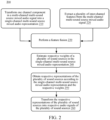
- FIG. 2 is a flowchart of an audio separation method 200 according to an embodiment of this application.
- the system 100 may be operated according to the method 200 in the embodiments.
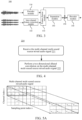
- FIG. 3 is a schematic block diagram of an audio separation apparatus 300 according to an embodiment of this application.
- the audio separation apparatus 300 is an example of the audio separation apparatus 122 in FIG. 1 .
- the method 200 of FIG. 2 is described below with reference to FIG. 3 .
- Step 210 Transform one of a plurality of channel components of a multi-channel multi-sound source mixed audio signal into a single-channel multi-sound source mixed audio representation in a feature space.
- Step 210 may be implemented by an encoder module 310.
- the multi-channel multi-sound source mixed audio signal and the plurality of channel components thereof are time-domain signals, and each channel component is a time-domain mixed signal of respective audio signals of a plurality of sound sources.
- the encoder module 310 includes a one-dimensional convolutional layer.
- a channel component x(t) is inputted into the encoder module 310, and the encoder module 310 decomposes a time-domain mixed signal x(t) into a series of basis functions to obtain a non-negative representation w in a feature space.
- Step 220 Perform a two-dimensional dilated convolution on the multi-channel multi-sound source mixed audio signal to extract a plurality of inter-channel features.
- Step 220 may be implemented by an inter-channel feature extraction module 320.
- the inter-channel feature extraction module 320 includes one or more two-dimensional convolutional layers, and each two-dimensional convolutional layer includes corresponding n two-dimensional convolution kernels of the same size. If there is only one two-dimensional convolutional layer, a dilated convolution is performed on the multi-channel multi-sound source mixed audio signal and n two-dimensional convolution kernels of the two-dimensional convolutional layer to generate n feature maps as inter-channel features. If there are a plurality of two-dimensional convolutional layers, the plurality of two-dimensional convolutional layers are parallel, and two-dimensional convolution kernels of different two-dimensional convolutional layers may have the same size or different sizes.
- the multi-channel multi-sound source mixed audio signal is inputted into the different two-dimensional convolutional layers for a dilated convolution, so that each layer in the different two-dimensional convolutional layers generates n feature maps as inter-channel features.
- the feature maps indicate difference information between channels, and the difference information implies spatial distribution information of a plurality of sound sources.
- the same two-dimensional convolutional layer may generate a plurality of inter-channel features by changing an inter-channel dilation coefficient and/or an inter-channel stride.
- the inter-channel dilation coefficient is a quantity of intervals of the channels corresponding to the obtained inter-channel features. That is, one channel is taken from channels of a quantity the same as the inter-channel dilation coefficient to calculate the inter-channel features. For example, when the inter-channel dilation coefficient is z, selected channel numbers are z, 2z, 3z, and the like, and obtained inter-channel features are features between channels z, 2z, 3z, and the like.
- the stride defines the stride size of convolution kernels when the convolution kernels are traversed in an input data matrix.
- FIG. 4 is a flowchart of operation of step 220.
- step 221 Receive the multi-channel multi-sound source mixed audio signal.
- the multi-channel multi-sound source mixed audio signal acquired by the acoustic sensor array 110 in FIG. 1 and cached in the memory is inputted into the inter-channel feature extraction module 320.
- Step 222 Perform a two-dimensional dilated convolution on the multi-channel multi-sound source mixed audio signal.
- the multi-channel multi-sound source mixed audio signal is inputted into one or more two-dimensional convolutional layers of the inter-channel feature extraction module 320, and the two-dimensional dilated convolution is performed on the multi-channel multi-sound source mixed audio signal based on a plurality of different values of the inter-channel dilation coefficient and/or a plurality of different values of the inter-channel stride.
- the multi-channel multi-sound source mixed audio signal includes C channel components, each channel component includes S sampling points, and C and S are integers greater than or equal to 2.
- the multi-channel multi-sound source mixed audio signal is convolved with n two-dimensional convolution kernels with a size of h ⁇ l to generate n feature maps, h being the height of each two-dimensional convolution kernel, l being the length of each two-dimensional convolution kernel, l ⁇ S.
- the stride of each convolution kernel is set to (p, q), where p is a stride between channels, q is a stride on a sampling point, and the inter-channel dilation coefficient is set to z, 1 ⁇ z ⁇ C.
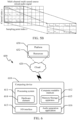
- FIG. 5A is a schematic diagram of a two-dimensional dilated convolution when the inter-channel dilation coefficient is 1.
- the same two-dimensional convolutional layer may generate different inter-channel features by changing an inter-channel dilation coefficient and/or an inter-channel stride. This may find inter-channel features of different combinations of non-adjacent channels (for example, a channel 1 and a channel 3, a channel 1 and a channel 4).
- FIG. 5B is a schematic diagram of a two-dimensional dilated convolution when the inter-channel dilation coefficient z is 2.
- the inter-channel dilation coefficient z may take another value to find more inter-channel features of combinations of non-adjacent channels, which is not repeated herein.
- steps 210 and 220 are shown as being performed in parallel, this application is not limited thereto. In other embodiments, steps 210 and 220 may be performed sequentially.
- Step 230 Perform a feature fusion on the single-channel multi-sound source mixed audio representation obtained in step 210 and the plurality of inter-channel features obtained in step 220 to obtain a fused multi-channel multi-sound source mixed audio feature.
- Step 230 may be implemented by a feature fusion module 330.
- the feature fusion module 330 includes a linear layer (for example, a fully connected layer), so that features are simply concatenated.
- the feature fusion method is not limited to concatenation, but may include, for example, sum, through a projection layer, and the like. Accordingly, in an alternative embodiment, the feature fusion module 330 may include a convolutional layer or a mapping layer.
- Step 240 Estimate respective weights of a plurality of sound sources in the single-channel multi-sound source mixed audio representation based on the fused multi-channel multi-sound source mixed audio feature.
- Step 240 may be implemented by a separation module 340.
- the separation module 340 includes a plurality of stacked depthwise separable dilated convolution networks.
- the convolutional networks may be connected to a 1 ⁇ 1 convolutional layer at last.
- the size of a mask value indicates a degree of contribution of a sound source i to a non-negative representation w, that is, a weight that the sound source i occupies in a single-channel mixed audio representation.
- step 240 is shown in FIG. 2 as being performed after step 230 and the feature fusion module 330 and separation module 340 are correspondingly shown as being separated from each other in FIG. 3 , this application is not limited thereto.
- the feature fusion (step 230) may be completed during the separation (step 240).
- feature fusion is performed after a convolutional network of the separation module 340, and a fused feature continues to pass through the remaining convolutional networks.
- the feature fusion module 330 may be used as a network layer and may be embedded between a plurality of convolutional networks of the separation module 340.
- step 250 Obtain respective representations of the plurality of sound sources according to the single-channel multi-sound source mixed audio representation and the respective weights.
- Step 250 may be implemented by a weighting module 350.
- Step 260 Transform the respective representations of the plurality of sound sources into respective audio signals of the plurality of sound sources.
- Step 260 may be implemented by a decoder module 360.
- the decoder module 360 includes a one-dimensional convolutional layer.
- each module discussed herein may be divided into a plurality of modules, and/or at least some functions of the plurality of modules may be combined into a single module.
- the specific modules that perform an action discussed herein include the specific module itself performing the action, or alternatively the specific modules call or otherwise access another component or module that performs the action (or performs the action in combination with the specific modules). Therefore, the specific modules that perform the action may include the specific modules that perform the action itself and/or another module that is called or otherwise accessed by the specific modules that perform the action.
- a computing device may only include the inter-channel feature extraction module 320 and provide the n feature maps to another computing device for the computing device to use the n feature maps to separate audio signals of sound sources from the multi-channel multi-sound source mixed audio signal.
- the encoder module 310, the inter-channel feature extraction module 320, the feature fusion module 330, the separation module 340, the weighting module 350, and the decoder module 360 described above with reference to FIG. 2 and FIG. 3 are implemented as an end-to-end neural network. Through end-to-end automatic learning of inter-channel features, the real-time performance of the system can be improved.
- the initialization of two-dimensional convolution kernels used in the inter-channel feature extraction module 320 has an impact on the learning and extraction of inter-channel features.
- Commonly used initialization methods include a Gaussian distribution initialization, a Xavier initialization, a uniform distribution initialization and the like.
- convolution kernel coefficients belonging to channels obey the same distribution.
- the channels may not have a numerical correlation, that is, a value obtained by adding numerical values at corresponding positions of feature maps of each channel may not have a clear physical meaning.
- the size of the two-dimensional convolution kernel h ⁇ l may have different values.
- the end-to-end neural network may be trained to better find and encode difference information between channels.
- multi-channel multi-sound source mixed audio data for training is established.
- the single-channel multi-sound source mixed audio data may be simulated into multi-channel multi-sound source mixed audio data by changing parameters such as a room reverberation, a room size, and a sound source spatial location.
- the original audio data s i ( t ) of the sound sources may be used as supervision data.
- a training criterion based on permutation invariant training (PIT) may be used.
- the audio data ⁇ ⁇ (i) ( t ) and the original audio data s i ( t ) estimated by using the neural network are used to calculate scores of paired combinations of estimated audio-original audio for different sound sources, where ⁇ ( i ) represents a paired combination, and a negative value of a score of a paired combination with the highest score is used as a loss function of the neural network.
- a scale-invariant speech-to-distortion ratio may be calculated as a score.
- SI-SDR Permutation Invariant Training of Deep Models for Speaker-Independent Multi-talker Speech Separation
- FIG. 6 shows an exemplary system generally at 600, which includes an exemplary computing device 610 that can implement technologies described herein.
- the computing device 610 is an example of the computing device 120 in FIG. 1 .
- the computing device 610 may be a variety of different types of devices such as a server of a service provider, a device associated with a client (for example, a client device), a system on a chip, and/or any other suitable computing device or computing system.
- Examples of the computing device 610 include, but are not limited to: a desktop computer, a server computer, a laptop or a netbook computer, a mobile device (for example, a tablet computer or a phablet device, a cellular phone or another wireless phone (for example, a smart phone), a notebook computer, a mobile station, a wearable device (for example, glasses, a watch), an entertainment device (for example, an entertainment appliance, a set-top box communicatively coupled to a display device, and a game console), a television or another display device, a car computer.
- a mobile device for example, a tablet computer or a phablet device, a cellular phone or another wireless phone (for example, a smart phone)
- the computing device 610 may range from full-resource devices with a large amount of memory and processor resources (for example, a personal computer and a game console) to low-resource devices with limited memory and/or processing resources (for example, a conventional set-top box and a handheld game console).
- full-resource devices with a large amount of memory and processor resources for example, a personal computer and a game console
- low-resource devices with limited memory and/or processing resources for example, a conventional set-top box and a handheld game console.
- the exemplary computing device 610 as illustrated includes a processing system 611, one or more computer-readable media 612, and one or more input/output (I/O) interfaces 613 communicatively coupled to each other.
- the computing device 610 may include a system bus or another data and command transfer system that couples various components to each other.
- the system bus may include any one or a combination of different bus structures such as a memory bus or memory controller, a peripheral bus, a universal serial bus, and/or a processor or local bus using any one of various bus architectures.
- Various other examples are also contemplated, such as control and data lines.
- the processing system 611 represents a function of performing one or more operations using hardware. Therefore, the processing system 611 is illustrated as including a hardware element 614 that may be configured as a processor, a functional block, or the like. This may include a dedicated integrated circuit (IC) implemented in hardware or another logic device formed using one or more semiconductors.
- the hardware element 614 is not limited to a material forming the element or a processing mechanism employed therein.
- the processor may be composed of semiconductor(s) and/or transistors (for example, electronic ICs).
- processor-executable instructions may be electronically executable instructions.
- the computer-readable medium 612 is illustrated as including a memory/storage apparatus 615.
- the memory/storage apparatus 615 represents the memory/storage capacity associated with one or more computer-readable media.
- the memory/storage apparatus 615 may include a volatile medium (for example, a random access memory (RAM)) and/or a nonvolatile medium (for example, a read-only memory (ROM), a flash memory, an optical disc, a magnetic disk).
- the memory/storage apparatus 615 may include fixed media (for example, a RAM, a ROM, or a fixed hard drive) and a removable medium (for example, a flash memory, a removable hard drive, an optical disc).
- the computer-readable medium 612 may be configured in various other ways as further described below.
- the one or more I/O interfaces 613 represent functions that allow the user to enter commands and information into the computing device 610 and also allow various I/O devices to be used to display information to the user and/or other components or devices.
- the input device include a keyboard, a cursor control device (for example, a mouse), a microphone (for example, for voice input), a scanner, a touch function (for example, a capacitive sensor or another sensor configured to detect physical touch), a camera (for example, visible or invisible wavelengths (for example, infrared frequencies) may be used to detect a motion that does not involve touch as a gesture), and the like.
- Examples of the output device include a display device (for example, a monitor or a projector), a speaker, a printer, a network card, a tactile response device, and the like. Therefore, the computing device 610 may be configured in various ways as described further below to support user interaction.
- the computing device 610 further includes an audio separation application 616.
- the audio separation application 616 may be stored in the memory/storage apparatus 615 as computer program instructions.
- the audio separation application 616 is an example of the audio separation apparatus 122 in FIG. 1 .
- modules include a routine, a program, an object, an element, a component, a data structure, and the like for executing a particular task or implementing a particular abstract data type.
- module generally refer to software, firmware, hardware, or a combination thereof.
- the features of the technologies described herein are platform-independent, which means that the technologies may be implemented on various computing platforms with various processors.
- the computer-readable medium may include various media that may be accessed by the computing device 610.
- the computer-readable medium may include a "computer-readable storage medium” and a "computer-readable signal medium”.
- the "computer-readable storage medium” refers to a medium and/or device, and/or a tangible storage apparatus capable of permanently storing information. Therefore, the computer-readable storage medium refers to a non-signal bearing medium.
- the computer-readable storage medium is hardware such as a storage device implemented by methods or technologies including volatile and nonvolatile, removable and non-removable media and/or suitable for storing information (for example, computer-readable instructions, data structures, program modules, logic elements/circuits, or other data).
- Examples of the computer-readable storage medium may include, but are not limited to, a RAM, a ROM, an EEPROM, a flash memory or other memory technologies, a CD -ROM, a digital versatile disk (DVD) or another optical storage apparatus, a hard disk, a cassette tape, a magnetic tape, a disk storage apparatus or other magnetic storage devices, or other storage devices, a tangible medium, or an article suitable for storing desired information and accessible by a computer.
- the "computer-readable signal medium” refers to a signal-bearing medium configured to transmit instructions to hardware of the computing device 610, such as via a network.
- the signal medium may typically embody computer-readable instructions, data structures, program modules, or other data in a modulated data signal such as a carrier wave, a data signal, or other transmission mechanisms.
- the signal medium further includes any information transmission medium.
- modulated data signal refers to a signal that encodes information in the signal in such a way to set or change one or more of a feature thereof.
- a communication medium includes such as a wired network or a wired medium in direct connection, and a wireless medium such as acoustic, RF, infrared, and other wireless media.
- the hardware element 614 and the computer-readable medium 612 represent instructions, modules, programmable device logic and/or fixed device logic implemented in hardware, which in some embodiments can be used to implement at least some aspects of the technique described herein.
- the hardware component may include an IC or a system on a chip, an application-specific integrated circuit (ASIC), a field programmable gate array (FPGA), a complex programmable logic device (CPLD), and other implementations in silicon or components of other hardware devices.
- the hardware element can serve as a processing device that executes a program task defined by instructions, modules, and/or logic embodied by the hardware element, and as a hardware device that stores instructions for execution, for example, as previously described computer-readable storage medium.
- the foregoing combinations may also be used to implement the techniques and modules described herein. Therefore, software, hardware or program modules and other program modules may be implemented as one or more instructions and/or logic embodied by one or more hardware elements 614 on some form of the computer-readable storage medium.
- the computing device 610 may be configured to implement a specific instruction and/or function corresponding to a software and/or hardware module. Therefore, for example, by using the computer-readable storage medium and/or hardware element 614 of the processing system, the module may be implemented at least partially in hardware to implement the module as a module executable by the computing device 610 as software.
- the instruction and/or function may be executable/operable by one or more articles (for example, one or more computing devices 610 and/or processing systems 611) to implement the techniques, modules, and examples described herein.
- the techniques described herein can be supported by the configurations of the computing device 610 and are not limited to specific examples of the techniques described herein. This function can also be implemented in whole or in part on a "cloud" 620 by using a distributed system, for example, through a platform 630 as described below.
- the cloud 620 includes and/or represents the platform 630 for resources 632.
- the platform 630 abstracts an underlying function of hardware (for example, a server) and software resources of the cloud 620.
- the resources 632 may include an application and/or data that may be used when computer processing is performed on a server remote from the computing device 610.
- the resources 632 may further include a service provided via the internet and/or via a subscriber network such as a cellular or Wi-Fi network.
- the platform 630 may abstract resources and functions to connect the computing device 610 to other computing devices.
- the platform 630 may further be used for classification of abstract resources to provide a corresponding level of classification of a requirement encountered for the resources 632 implemented via the platform 630. Therefore, in the interconnected device embodiment, the implementation of the functions described herein may be distributed throughout the system 600. For example, the functions may be implemented partially on the computing device 610 and via the platform 630 that abstracts the functions of the cloud 620.
Landscapes
- Engineering & Computer Science (AREA)
- Physics & Mathematics (AREA)
- Health & Medical Sciences (AREA)
- Computational Linguistics (AREA)
- Theoretical Computer Science (AREA)
- Artificial Intelligence (AREA)
- Multimedia (AREA)
- Acoustics & Sound (AREA)
- Human Computer Interaction (AREA)
- Audiology, Speech & Language Pathology (AREA)
- Evolutionary Computation (AREA)
- Signal Processing (AREA)
- Mathematical Physics (AREA)
- Biophysics (AREA)
- General Physics & Mathematics (AREA)
- General Engineering & Computer Science (AREA)
- Software Systems (AREA)
- Computing Systems (AREA)
- Molecular Biology (AREA)
- General Health & Medical Sciences (AREA)
- Data Mining & Analysis (AREA)
- Biomedical Technology (AREA)
- Life Sciences & Earth Sciences (AREA)
- Quality & Reliability (AREA)
- Circuit For Audible Band Transducer (AREA)
- Stereophonic System (AREA)
Claims (14)
- Verfahren zur Audiotrennung eines Mehrkanal-Mehrtonquellen-Mischaudiosignals, das von einer Computervorrichtung unter Verwendung eines künstlichen neuronalen Netzes durchgeführt wird, wobei das Verfahren umfasst:Transformieren einer von mehreren Kanalkomponenten des Mehrkanal-Mehrtonquellen-Mischaudiosignals in eine Einkanal-Mehrtonquellen-Mischaudiodarstellung in einem Merkmalsraum;Durchführen einer zweidimensionalen dilatierten Faltung an dem Mehrkanal-Mehrtonquellen-Mischaudiosignal, um eine Vielzahl von Zwischenkanalmerkmalen zu extrahieren, die auf einer Vielzahl von unterschiedlichen Werten eines Zwischenkanaldilatationskoeffizienten z und/oder einer Vielzahl von unterschiedlichen Werten einer Zwischenkanalschrittweite p und mindestens einer parallelen zweidimensionalen Faltungsschicht basieren, der Zwischenkanaldilatationskoeffizient eine Menge von Intervallen von Kanälen ist, die genommen werden, um die Zwischenkanalmerkmale zu berechnen, die Zwischenkanalschrittweite eine Schrittweiten-Größe ist, um die sich Faltungskerne bewegen, wenn die Faltungskerne eine Eingangsdatenmatrix durchlaufen, wobei das Mehrkanal-Mehrtonquellen-Mischaudiosignal C Kanalkomponenten umfasst, wobei jede Kanalkomponente S Abtastpunkte umfasst, wobei C und S ganze Zahlen größer oder gleich 2 sind, wobei jede zweidimensionale Faltungsschicht entsprechende n zweidimensionale Faltungskerne der gleichen Größe umfasst, wobei eine Länge jedes zweidimensionalen Faltungskerns kleiner oder gleich S ist, für jeden Wert des Zwischenkanaldilatationskoeffizienten z und/oder jeden Wert der Zwischenkanalschrittweite p, jede zweidimensionale Faltungsschicht eine zweidimensionale dilatierte Faltung an dem Mehrkanal-Mehrtonquellen-Mischaudiosignal und den entsprechenden n zweidimensionalen Faltungskernen der gleichen Größe durchführt, um entsprechende n Merkmalskarten als ein entsprechendes Zwischenkanalmerkmal zu erzeugen, wobei z und n ganze Zahlen sind, 1 ≤ z < C, und n ≥ 1;Durchführen einer Merkmalsfusion an der Einkanal-Mehrtonquellen-Mischaudiodarstellung und der Vielzahl von Zwischenkanalmerkmalen, um ein fusioniertes Mehrkanal-Mehrtonquellen-Mischaudiomerkmal zu erhalten;Schätzen jeweiliger Gewichte einer Vielzahl von Tonquellen in der Einkanal-Mehrtonquellen-Mischaudiodarstellung auf der Grundlage des fusionierten Mehrkanal-Mehrtonquellen-Mischaudiomerkmals;Erhalten jeweiliger Darstellungen der Vielzahl von Tonquellen gemäß der Einkanal-Mehrtonquellen-Mischaudiodarstellung und den jeweiligen Gewichtungen; undUmwandeln der jeweiligen Darstellungen der Vielzahl von Tonquellen in jeweilige Audiosignale der Vielzahl von Tonquellen.
- Verfahren nach Anspruch 1, wobei das künstliche neuronale Netz als ein neuronales Ende-zu-Ende-Netz implementiert ist, und
für jede zweidimensionale Faltungsschicht die n zweidimensionalen Faltungskerne der gleichen Größe in einer Trainingsphase des durchgängigen neuronalen Netzes gemäß der folgenden Lösung initialisiert werden:mit w n',l',0=1, w n',l',1=-1, w n',l',h' =0, n' = 1, 2, ..., n, l' = 0, 1, ..., l-1, h' = 2, 3, ..., h-1,wobei h eine Höhe jedes zweidimensionalen Faltungskerns in der zweidimensionalen Faltungsschicht ist, l eine Länge jedes zweidimensionalen Faltungskerns in der zweidimensionalen Faltungsschicht ist, w n',l',h' einen Wert eines (n')ten zweidimensionalen Faltungskerns an einer Position (l', h') darstellt. - Verfahren nach Anspruch 1, wobei für jede zweidimensionale Faltungsschicht die n zweidimensionalen Faltungskerne der gleichen Größe in einer Trainingsphase des neuronalen Ende-zu-Ende-Netzes gemäß der folgenden Lösung initialisiert werden:mit w n',l',0~N(µ, σ2), 0=- w n',l',0, w n',l',h' =0, n' = 1, 2, ..., n, l' = 0, 1, ..., l-1, h' = 2, 3, ..., h-1, wobei N(µ, σ2) eine Gaußsche Verteilung mit einem Mittelwert von µ und einer Varianz von σ2 ist,wobei h eine Höhe jedes zweidimensionalen Faltungskerns in der zweidimensionalen Faltungsschicht ist, l eine Länge jedes zweidimensionalen Faltungskerns in der zweidimensionalen Faltungsschicht ist, w n',l',h' einen Wert eines (n')ten zweidimensionalen Faltungskerns an einer Position (l', h') darstellt.
- Verfahren nach Anspruch 1, wobei für jede zweidimensionale Faltungsschicht die n zweidimensionalen Faltungskerne der gleichen Größe in einer Trainingsphase des neuronalen Ende-zu-Ende-Netzes gemäß der folgenden Lösung initialisiert werden:mit w n',l',0~N(µ, σ2), w n',l',1=-λw n',l',0, w n',l',h' =0, n' = 1, 2, ..., n, l' = 0, 1, ..., l-1, h' = 2, 3, ..., h-1, wobei N(µ, σ2) eine Gaußsche Verteilung mit einem Mittelwert von µ und einer Varianz von σ2 ist und λ ein lernbarer Netzparameter ist,wobei h eine Höhe jedes zweidimensionalen Faltungskerns in der zweidimensionalen Faltungsschicht ist, l eine Länge jedes zweidimensionalen Faltungskerns in der zweidimensionalen Faltungsschicht ist, w n',l',h' einen Wert eines (n')ten zweidimensionalen Faltungskerns an einer Position (l', h') darstellt.
- Verfahren nach Anspruch 1, wobei für jede zweidimensionale Faltungsschicht die n zweidimensionalen Faltungskerne der gleichen Größe in einer Trainingsphase des neuronalen Ende-zu-Ende-Netzes gemäß der folgenden Lösung initialisiert werden:mit w n',l',0~N(µ, σ2), w n',l',1=-λl' w n',l',0, w n',l',h' =0, n' = 1, 2, ..., n, l' = 0, 1, ..., l-1, h' = 2, 3, ..., h-1, wobei N(µ, σ2) eine Gaußsche Verteilung mit einem Mittelwert von µ und einer Varianz von σ2 ist, λl' ein lernbarer Netzparameter ist und mit l' variiert,wobei h eine Höhe jedes zweidimensionalen Faltungskerns in der zweidimensionalen Faltungsschicht ist, l eine Länge jedes zweidimensionalen Faltungskerns in der zweidimensionalen Faltungsschicht ist, w n',l',h' einen Wert eines (n')ten zweidimensionalen Faltungskerns an einer Position (I', h') darstellt.
- Verfahren nach Anspruch 1, wobeidie mindestens eine zweidimensionale Faltungsschicht eine Vielzahl paralleler zweidimensionaler Faltungsschichten umfasst, undfür verschiedene zweidimensionale Faltungsschichten in der Vielzahl von zweidimensionalen Faltungsschichten der zweidimensionalen Faltungskerne unterschiedliche Größen hat.
- Verfahren nach Anspruch 1, wobeidas künstliche neuronale Netz als ein neuronales Ende-zu-Ende-Netz implementiert ist, unddas Audiotrennungsverfahren ferner eine Trainingsphase eines Trainings des neuronalen Ende-zu-Ende-Netzes umfasst, wobei die Trainingsphase umfasst:Erstellen, basierend auf Original-Audiodaten si (t) einer Vielzahl von verschiedenen Tonquellen, von Mehrkanal-Mehrtonquellen-Mischaudiodaten zum Trainieren, wobei i = 1, 2, ..., I, wobei I eine Gesamtmenge der verschiedenen Tonquellen ist; undTrainieren des neuronalen Ende-zu-Ende-Netzes unter Verwendung der Mehrkanal-Mehrtonquellen-Mischaudiodaten als der Trainingsdatensatz und unter Verwendung der Original-Audiodaten si (t) als Überwachungsdaten basierend auf einem Permutationsinvarianz-Trainingskriterium, Audiodaten ŝ θ(i)(t) die durch das neuronale Ende-zu-Ende-Netz geschätzt werden und die ursprünglichen Audiodaten si (t) werden verwendet, um Scores von gepaarten Kombinationen von geschätzten Audio-Original-Audio für die verschiedenen Tonquellen zu berechnen, θ(i) eine gepaarte Kombination repräsentiert, wobei ein negativer Wert eines Scores einer gepaarten Kombination mit dem höchsten Score als eine Verlustfunktion des neuronalen Ende-zu-Ende-Netzes verwendet wird.
- Vorrichtung zur Audiotrennung eines Mehrkanal-Mehrtonquellen-Mischaudiosignals, wobei die Vorrichtung umfasst:ein Kodiermodul, das so konfiguriert ist, dass es eine von mehreren Kanalkomponenten des Mehrkanal-Mehrtonquellen-Mischaudiosignals in eine Einkanal-Mehrtonquellen-Mischaudiodarstellung in einem Merkmalsraum transformiert;ein Modul zur Extraktion von Merkmalen zwischen den Kanälen, das so konfiguriert ist, dass es eine zweidimensionale dilatierte Faltung des Mehrkanal-Mehrtonquellen-Mischaudiosignals durchführt, um eine Vielzahl von Merkmalen zwischen den Kanälen zu extrahieren, die auf einer Vielzahl von unterschiedlichen Werten eines Zwischenkanaldilatationskoeffizienten z und/oder einer Vielzahl von unterschiedlichen Werten einer Zwischenkanalschrittweite p und mindestens einer parallelen zweidimensionalen Faltungsschicht basieren, der Zwischenkanaldilatationskoeffizient eine Menge von Intervallen von Kanälen ist, die genommen werden, um die Zwischenkanal-Merkmale zu berechnen, die Zwischenkanalschrittweite eine Schrittweiten-Größe ist, um die sich Faltungskerne bewegen, wenn die Faltungskerne eine Eingangsdatenmatrix durchlaufen, wobei das Mehrkanal-Mehrtonquellen-Mischaudiosignal C Kanalkomponenten umfasst, wobei jede Kanalkomponente S Abtastpunkte umfasst, wobei C und S ganze Zahlen größer oder gleich 2 sind, wobei jede zweidimensionale Faltungsschicht entsprechende n zweidimensionale Faltungskerne der gleichen Größe umfasst, wobei eine Länge jedes zweidimensionalen Faltungskerns kleiner oder gleich S ist, für jeden Wert des Zwischenkanaldilatationskoeffizienten z und/oder jeden Wert der Zwischenkanalschrittweite p, jede zweidimensionale Faltungsschicht eine zweidimensionale dilatierte Faltung an dem Mehrkanal-Mehrtonquellen-Mischaudiosignal und den entsprechenden n zweidimensionalen Faltungskernen der gleichen Größe durchführt, um entsprechende n Merkmalskarten als ein entsprechendes Zwischenkanalmerkmal zu erzeugen, wobei z und n ganze Zahlen sind, 1 ≤ z < C, und n ≥ 1;ein Merkmalsfusionsmodul, das so konfiguriert ist, dass es eine Merkmalsfusion an der Einkanal-Mehrtonquellen-Mischaudiodarstellung und der Vielzahl von Zwischenkanalmerkmalen durchführt, um ein fusioniertes Mehrkanal-Mehrtonquellen-Mischaudiomerkmal zu erhalten;ein Trennungsmodul, das so konfiguriert ist, dass es jeweilige Gewichtungen einer Vielzahl von Tonquellen in der Einkanal-Mehrtonquellen-Mischaudiodarstellung auf der Grundlage des fusionierten Mehrkanal-Mehrtonquellen-Mischaudiomerkmals schätzt;ein Gewichtungsmodul, das so konfiguriert ist, dass es jeweilige Darstellungen der mehreren Tonquellen gemäß der Einkanal-Mehrtonquellen-Mischaudiodarstellung und den jeweiligen Gewichtungen erhält; undein Dekodermodul, das so konfiguriert ist, dass es die jeweiligen Darstellungen der mehreren Tonquellen in jeweilige Audiosignale der mehreren Tonquellen umwandelt.
- Vorrichtung nach Anspruch 8, wobei das Kodiermodul, das Modul zur Extraktion von Merkmalen zwischen den Kanälen, das Merkmalsfusionsmodul, das Trennungsmodul, das Gewichtungsmodul und das Dekodermodul als ein neuronales Ende-zu-Ende-Netz implementiert sind.
- Vorrichtung nach Anspruch 9, wobeidas Kodiermodul und das Dekodermodul jeweils eine eindimensionale Faltungsschicht umfassen,das Modul zur Extraktion von Merkmalen zwischen den Kanälen mindestens eine parallele zweidimensionale Faltungsschicht umfasst,das Merkmalsfusionsmodul eine lineare Schicht, eine Faltungsschicht oder eine Abbildungsschicht umfasst, unddas Trennungsmodul eine Vielzahl von gestapelten, in der Tiefe trennbaren dilatierten Faltungsnetzen umfasst.
- Vorrichtung nach Anspruch 8, wobei das Merkmalsfusionsmodul und das Trennungsmodul voneinander getrennt sind; oder
das Merkmalsfusionsmodul zwischen die mehreren gestapelten, in der Tiefe trennbaren dilatierten Faltungsnetze des Trennungsmodul eingebettet ist. - Rechenvorrichtung, die einen Prozessor und einen Speicher umfasst, wobei der Speicher Befehle speichert und die Befehle, wenn sie auf dem Prozessor ausgeführt werden, den Prozessor veranlassen, das Verfahren nach einem der Ansprüche 1 bis 7 durchzuführen.
- Computerlesbares Speichermedium, das Befehle speichert, wobei die Befehle, wenn sie auf einem Prozessor ausgeführt werden, den Prozessor veranlassen, das Verfahren nach einem der Ansprüche 1 bis 7 durchzuführen.
- Audio-Trennsystem für mehrere Tonquellen, das umfasst:ein akustisches Sensorarray, das so konfiguriert ist, dass es ein Mehrkanal-Mehrtonquellen-Mischaudiosignal von mehreren Tonquellen erhält; unddie Rechenvorrichtung nach Anspruch 12.
Applications Claiming Priority (2)
| Application Number | Priority Date | Filing Date | Title |
|---|---|---|---|
| CN201910671562.1A CN110400575B (zh) | 2019-07-24 | 2019-07-24 | 通道间特征提取方法、音频分离方法和装置、计算设备 |
| PCT/CN2020/100064 WO2021012929A1 (zh) | 2019-07-24 | 2020-07-03 | 通道间特征提取方法、音频分离方法和装置、计算设备 |
Publications (3)
| Publication Number | Publication Date |
|---|---|
| EP4006902A1 EP4006902A1 (de) | 2022-06-01 |
| EP4006902A4 EP4006902A4 (de) | 2022-08-17 |
| EP4006902B1 true EP4006902B1 (de) | 2023-09-27 |
Family
ID=68324922
Family Applications (1)
| Application Number | Title | Priority Date | Filing Date |
|---|---|---|---|
| EP20844066.9A Active EP4006902B1 (de) | 2019-07-24 | 2020-07-03 | Extraktion von merkmalen zwischen kanälen zur audiotrennung |
Country Status (4)
| Country | Link |
|---|---|
| US (1) | US11908483B2 (de) |
| EP (1) | EP4006902B1 (de) |
| CN (1) | CN110400575B (de) |
| WO (1) | WO2021012929A1 (de) |
Families Citing this family (26)
| Publication number | Priority date | Publication date | Assignee | Title |
|---|---|---|---|---|
| CN110400575B (zh) | 2019-07-24 | 2024-03-29 | 腾讯科技(深圳)有限公司 | 通道间特征提取方法、音频分离方法和装置、计算设备 |
| US11854571B2 (en) * | 2019-11-29 | 2023-12-26 | Samsung Electronics Co., Ltd. | Method, device and electronic apparatus for transmitting and receiving speech signal |
| CN113994427A (zh) * | 2020-02-07 | 2022-01-28 | 谷歌有限责任公司 | 通过预测以讲话者表示为条件的隔离音频信号在音频记录中按来源分离语音 |
| CN111326168B (zh) * | 2020-03-25 | 2023-08-22 | 合肥讯飞数码科技有限公司 | 语音分离方法、装置、电子设备和存储介质 |
| CN111798866B (zh) * | 2020-07-13 | 2024-07-19 | 商汤集团有限公司 | 音频处理网络的训练及立体声重构方法和装置 |
| CN112489675A (zh) * | 2020-11-13 | 2021-03-12 | 北京云从科技有限公司 | 一种多通道盲源分离方法、装置、机器可读介质及设备 |
| CN112927701B (zh) * | 2021-02-05 | 2024-07-16 | 商汤集团有限公司 | 样本生成、神经网络生成、音频信号生成方法及装置 |
| CN112949508B (zh) * | 2021-03-08 | 2024-07-19 | 咪咕文化科技有限公司 | 模型训练方法、行人检测方法、电子设备及可读存储介质 |
| CN115134042A (zh) * | 2021-03-25 | 2022-09-30 | 中兴通讯股份有限公司 | 网络参数集合信息传输方法、装置、终端、基站和介质 |
| CN113239942A (zh) * | 2021-05-21 | 2021-08-10 | 佛山育脉科技有限公司 | 基于卷积运算的图像特征提取方法、装置及可读存储介质 |
| CN113488063B (zh) * | 2021-07-02 | 2023-12-19 | 国网江苏省电力有限公司电力科学研究院 | 一种基于混合特征及编码解码的音频分离方法 |
| CN113823273B (zh) * | 2021-07-23 | 2024-02-13 | 腾讯科技(深圳)有限公司 | 音频信号处理方法、装置、电子设备及存储介质 |
| CN113870891B (zh) * | 2021-09-26 | 2024-12-31 | 平安科技(深圳)有限公司 | 语音提取方法、系统、装置及存储介质 |
| CN114299961B (zh) * | 2021-09-27 | 2025-03-14 | 腾讯科技(深圳)有限公司 | 语音识别方法、装置、设备、存储介质及程序产品 |
| CN113990303B (zh) * | 2021-10-08 | 2024-04-12 | 华南理工大学 | 基于多分辨率空洞深度可分卷积网络的环境声音辨识方法 |
| CN113963715B (zh) * | 2021-11-09 | 2024-09-03 | 清华大学 | 语音信号的分离方法、装置、电子设备及存储介质 |
| CN114550743B (zh) * | 2022-02-23 | 2024-05-28 | 平安科技(深圳)有限公司 | 一种语音增强方法、装置、计算机设备及存储介质 |
| CN115294997B (zh) * | 2022-06-30 | 2024-10-29 | 北京达佳互联信息技术有限公司 | 语音处理方法、装置、电子设备及存储介质 |
| CN116434780A (zh) | 2023-04-14 | 2023-07-14 | 威盛电子股份有限公司 | 具备多读音纠错功能的语言学习系统 |
| CN116434779A (zh) * | 2023-04-14 | 2023-07-14 | 威盛电子股份有限公司 | 语言学习系统 |
| CN117711423B (zh) * | 2024-02-05 | 2024-05-10 | 西北工业大学 | 联合听觉场景分析与深度学习的混合水声信号分离方法及系统 |
| CN118942451B (zh) * | 2024-07-09 | 2025-12-09 | 平安科技(深圳)有限公司 | 语音识别方法和装置、计算机设备及存储介质 |
| CN119599950B (zh) * | 2024-11-05 | 2025-09-16 | 中国人民解放军中部战区总医院 | 基于mri影像中腰椎区域的检测方法、装置及设备 |
| CN119722697B (zh) * | 2024-11-06 | 2025-10-17 | 河海大学 | 乳房肿块的分割方法及系统 |
| CN119559961B (zh) * | 2024-12-02 | 2025-11-11 | 山西天河云计算有限公司 | 一种深度神经网络辅助的机械声源实时分离方法与系统 |
| CN120015050B (zh) * | 2025-02-12 | 2025-11-07 | 北京科技大学 | 一种基于多通道声信号的融合分离方法及系统 |
Family Cites Families (15)
| Publication number | Priority date | Publication date | Assignee | Title |
|---|---|---|---|---|
| US8577678B2 (en) * | 2010-03-11 | 2013-11-05 | Honda Motor Co., Ltd. | Speech recognition system and speech recognizing method |
| US8908874B2 (en) * | 2010-09-08 | 2014-12-09 | Dts, Inc. | Spatial audio encoding and reproduction |
| CN103165136A (zh) * | 2011-12-15 | 2013-06-19 | 杜比实验室特许公司 | 音频处理方法及音频处理设备 |
| WO2013166439A1 (en) * | 2012-05-04 | 2013-11-07 | Setem Technologies, Llc | Systems and methods for source signal separation |
| EP2731359B1 (de) * | 2012-11-13 | 2015-10-14 | Sony Corporation | Audioverarbeitungsvorrichtung, Verfahren und Programm |
| US9788119B2 (en) * | 2013-03-20 | 2017-10-10 | Nokia Technologies Oy | Spatial audio apparatus |
| US10014002B2 (en) * | 2016-02-16 | 2018-07-03 | Red Pill VR, Inc. | Real-time audio source separation using deep neural networks |
| US11373672B2 (en) * | 2016-06-14 | 2022-06-28 | The Trustees Of Columbia University In The City Of New York | Systems and methods for speech separation and neural decoding of attentional selection in multi-speaker environments |
| KR102393948B1 (ko) * | 2017-12-11 | 2022-05-04 | 한국전자통신연구원 | 다채널 오디오 신호에서 음원을 추출하는 장치 및 그 방법 |
| CN108805278B (zh) | 2018-05-15 | 2022-03-08 | 成都理想境界科技有限公司 | 一种应用于深度学习的特征提取方法及系统 |
| CN109839612B (zh) * | 2018-08-31 | 2022-03-01 | 大象声科(深圳)科技有限公司 | 基于时频掩蔽和深度神经网络的声源方向估计方法及装置 |
| CN109830245B (zh) * | 2019-01-02 | 2021-03-12 | 北京大学 | 一种基于波束成形的多说话者语音分离方法及系统 |
| CN110032926B (zh) * | 2019-02-22 | 2021-05-11 | 哈尔滨工业大学(深圳) | 一种基于深度学习的视频分类方法以及设备 |
| CN110400575B (zh) * | 2019-07-24 | 2024-03-29 | 腾讯科技(深圳)有限公司 | 通道间特征提取方法、音频分离方法和装置、计算设备 |
| CN115668367A (zh) * | 2020-05-29 | 2023-01-31 | 索尼集团公司 | 音频源分离和音频配音 |
-
2019
- 2019-07-24 CN CN201910671562.1A patent/CN110400575B/zh active Active
-
2020
- 2020-07-03 EP EP20844066.9A patent/EP4006902B1/de active Active
- 2020-07-03 WO PCT/CN2020/100064 patent/WO2021012929A1/zh not_active Ceased
-
2021
- 2021-08-12 US US17/401,125 patent/US11908483B2/en active Active
Also Published As
| Publication number | Publication date |
|---|---|
| CN110400575B (zh) | 2024-03-29 |
| WO2021012929A1 (zh) | 2021-01-28 |
| EP4006902A4 (de) | 2022-08-17 |
| CN110400575A (zh) | 2019-11-01 |
| US11908483B2 (en) | 2024-02-20 |
| US20210375294A1 (en) | 2021-12-02 |
| EP4006902A1 (de) | 2022-06-01 |
Similar Documents
| Publication | Publication Date | Title |
|---|---|---|
| EP4006902B1 (de) | Extraktion von merkmalen zwischen kanälen zur audiotrennung | |
| KR102071582B1 (ko) | 딥 뉴럴 네트워크(Deep Neural Network)를 이용하여 문장이 속하는 클래스(class)를 분류하는 방법 및 장치 | |
| US12182191B2 (en) | Text classification method and apparatus, device, and computer-readable storage medium | |
| CN112990296B (zh) | 基于正交相似度蒸馏的图文匹配模型压缩与加速方法及系统 | |
| CN110609955B (zh) | 一种视频推荐的方法及相关设备 | |
| Ojha et al. | Sign language to text and speech translation in real time using convolutional neural network | |
| WO2022007823A1 (zh) | 一种文本数据处理方法及装置 | |
| CN112233698B (zh) | 人物情绪识别方法、装置、终端设备及存储介质 | |
| US20160371254A1 (en) | Method for assigning semantic information to word through learning using text corpus | |
| CN109859772A (zh) | 情绪识别方法、装置及计算机可读存储介质 | |
| RU2720359C1 (ru) | Способ и оборудование распознавания эмоций в речи | |
| WO2024255641A1 (zh) | 一种模型的训练方法、训练数据的获取方法及相关设备 | |
| CN118093840B (zh) | 视觉问答方法、装置、设备及存储介质 | |
| CN112216307A (zh) | 语音情感识别方法以及装置 | |
| Dahanayaka et al. | A multi-modular approach for sign language and speech recognition for deaf-mute people | |
| KR20240131944A (ko) | 입모양을 기반으로 하는 얼굴 이미지 생성 방법, 모델의 트레이닝 방법 및 기기 | |
| CN117021114A (zh) | 机器人的控制方法及装置 | |
| CN115116470B (zh) | 音频处理方法、装置、计算机设备和存储介质 | |
| CN118715525A (zh) | 使用生成神经网络的计算有效率的提炼 | |
| Iwahashi | Interactive learning of spoken words and their meanings through an audio-visual interface | |
| CN119558372A (zh) | 生成式模型的微调方法、装置、设备、介质及产品 | |
| CN115186083A (zh) | 一种数据处理方法、装置、服务器、存储介质及产品 | |
| Singh et al. | Human perception based criminal identification through human robot interaction | |
| KR102828691B1 (ko) | 의미 유사도 기반 응답 획득 장치 및 방법 | |
| US20260051316A1 (en) | Spatially aware audio-augmented conversational agents |
Legal Events
| Date | Code | Title | Description |
|---|---|---|---|
| STAA | Information on the status of an ep patent application or granted ep patent |
Free format text: STATUS: THE INTERNATIONAL PUBLICATION HAS BEEN MADE |
|
| PUAI | Public reference made under article 153(3) epc to a published international application that has entered the european phase |
Free format text: ORIGINAL CODE: 0009012 |
|
| STAA | Information on the status of an ep patent application or granted ep patent |
Free format text: STATUS: REQUEST FOR EXAMINATION WAS MADE |
|
| 17P | Request for examination filed |
Effective date: 20210716 |
|
| AK | Designated contracting states |
Kind code of ref document: A1 Designated state(s): AL AT BE BG CH CY CZ DE DK EE ES FI FR GB GR HR HU IE IS IT LI LT LU LV MC MK MT NL NO PL PT RO RS SE SI SK SM TR |
|
| RAP3 | Party data changed (applicant data changed or rights of an application transferred) |
Owner name: TENCENT TECHNOLOGY (SHENZHEN) COMPANY LIMITED |
|
| A4 | Supplementary search report drawn up and despatched |
Effective date: 20220720 |
|
| RIC1 | Information provided on ipc code assigned before grant |
Ipc: G10L 21/028 20130101ALI20220714BHEP Ipc: G10L 21/0272 20130101ALI20220714BHEP Ipc: G06N 3/08 20060101ALI20220714BHEP Ipc: G06N 3/04 20060101ALI20220714BHEP Ipc: G10L 21/0308 20130101AFI20220714BHEP |
|
| DAV | Request for validation of the european patent (deleted) | ||
| DAX | Request for extension of the european patent (deleted) | ||
| REG | Reference to a national code |
Ref country code: DE Ref legal event code: R079 Free format text: PREVIOUS MAIN CLASS: G10L0025030000 Ipc: G10L0021030800 Ref country code: DE Ref legal event code: R079 Ref document number: 602020018433 Country of ref document: DE Free format text: PREVIOUS MAIN CLASS: G10L0025030000 Ipc: G10L0021030800 |
|
| GRAP | Despatch of communication of intention to grant a patent |
Free format text: ORIGINAL CODE: EPIDOSNIGR1 |
|
| STAA | Information on the status of an ep patent application or granted ep patent |
Free format text: STATUS: GRANT OF PATENT IS INTENDED |
|
| RIC1 | Information provided on ipc code assigned before grant |
Ipc: G06N 3/08 20060101ALI20230616BHEP Ipc: G06N 3/045 20230101ALI20230616BHEP Ipc: G10L 21/0308 20130101AFI20230616BHEP |
|
| INTG | Intention to grant announced |
Effective date: 20230711 |
|
| GRAS | Grant fee paid |
Free format text: ORIGINAL CODE: EPIDOSNIGR3 |
|
| GRAA | (expected) grant |
Free format text: ORIGINAL CODE: 0009210 |
|
| STAA | Information on the status of an ep patent application or granted ep patent |
Free format text: STATUS: THE PATENT HAS BEEN GRANTED |
|
| AK | Designated contracting states |
Kind code of ref document: B1 Designated state(s): AL AT BE BG CH CY CZ DE DK EE ES FI FR GB GR HR HU IE IS IT LI LT LU LV MC MK MT NL NO PL PT RO RS SE SI SK SM TR |
|
| REG | Reference to a national code |
Ref country code: GB Ref legal event code: FG4D |
|
| REG | Reference to a national code |
Ref country code: CH Ref legal event code: EP |
|
| REG | Reference to a national code |
Ref country code: DE Ref legal event code: R096 Ref document number: 602020018433 Country of ref document: DE |
|
| REG | Reference to a national code |
Ref country code: IE Ref legal event code: FG4D |
|
| REG | Reference to a national code |
Ref country code: LT Ref legal event code: MG9D |
|
| PG25 | Lapsed in a contracting state [announced via postgrant information from national office to epo] |
Ref country code: GR Free format text: LAPSE BECAUSE OF FAILURE TO SUBMIT A TRANSLATION OF THE DESCRIPTION OR TO PAY THE FEE WITHIN THE PRESCRIBED TIME-LIMIT Effective date: 20231228 |
|
| PG25 | Lapsed in a contracting state [announced via postgrant information from national office to epo] |
Ref country code: SE Free format text: LAPSE BECAUSE OF FAILURE TO SUBMIT A TRANSLATION OF THE DESCRIPTION OR TO PAY THE FEE WITHIN THE PRESCRIBED TIME-LIMIT Effective date: 20230927 Ref country code: RS Free format text: LAPSE BECAUSE OF FAILURE TO SUBMIT A TRANSLATION OF THE DESCRIPTION OR TO PAY THE FEE WITHIN THE PRESCRIBED TIME-LIMIT Effective date: 20230927 Ref country code: NO Free format text: LAPSE BECAUSE OF FAILURE TO SUBMIT A TRANSLATION OF THE DESCRIPTION OR TO PAY THE FEE WITHIN THE PRESCRIBED TIME-LIMIT Effective date: 20231227 Ref country code: LV Free format text: LAPSE BECAUSE OF FAILURE TO SUBMIT A TRANSLATION OF THE DESCRIPTION OR TO PAY THE FEE WITHIN THE PRESCRIBED TIME-LIMIT Effective date: 20230927 Ref country code: LT Free format text: LAPSE BECAUSE OF FAILURE TO SUBMIT A TRANSLATION OF THE DESCRIPTION OR TO PAY THE FEE WITHIN THE PRESCRIBED TIME-LIMIT Effective date: 20230927 Ref country code: HR Free format text: LAPSE BECAUSE OF FAILURE TO SUBMIT A TRANSLATION OF THE DESCRIPTION OR TO PAY THE FEE WITHIN THE PRESCRIBED TIME-LIMIT Effective date: 20230927 Ref country code: GR Free format text: LAPSE BECAUSE OF FAILURE TO SUBMIT A TRANSLATION OF THE DESCRIPTION OR TO PAY THE FEE WITHIN THE PRESCRIBED TIME-LIMIT Effective date: 20231228 Ref country code: FI Free format text: LAPSE BECAUSE OF FAILURE TO SUBMIT A TRANSLATION OF THE DESCRIPTION OR TO PAY THE FEE WITHIN THE PRESCRIBED TIME-LIMIT Effective date: 20230927 |
|
| REG | Reference to a national code |
Ref country code: NL Ref legal event code: MP Effective date: 20230927 |
|
| REG | Reference to a national code |
Ref country code: AT Ref legal event code: MK05 Ref document number: 1616234 Country of ref document: AT Kind code of ref document: T Effective date: 20230927 |
|
| PG25 | Lapsed in a contracting state [announced via postgrant information from national office to epo] |
Ref country code: NL Free format text: LAPSE BECAUSE OF FAILURE TO SUBMIT A TRANSLATION OF THE DESCRIPTION OR TO PAY THE FEE WITHIN THE PRESCRIBED TIME-LIMIT Effective date: 20230927 |
|
| PG25 | Lapsed in a contracting state [announced via postgrant information from national office to epo] |
Ref country code: IS Free format text: LAPSE BECAUSE OF FAILURE TO SUBMIT A TRANSLATION OF THE DESCRIPTION OR TO PAY THE FEE WITHIN THE PRESCRIBED TIME-LIMIT Effective date: 20240127 |
|
| PG25 | Lapsed in a contracting state [announced via postgrant information from national office to epo] |
Ref country code: AT Free format text: LAPSE BECAUSE OF FAILURE TO SUBMIT A TRANSLATION OF THE DESCRIPTION OR TO PAY THE FEE WITHIN THE PRESCRIBED TIME-LIMIT Effective date: 20230927 |
|
| PG25 | Lapsed in a contracting state [announced via postgrant information from national office to epo] |
Ref country code: ES Free format text: LAPSE BECAUSE OF FAILURE TO SUBMIT A TRANSLATION OF THE DESCRIPTION OR TO PAY THE FEE WITHIN THE PRESCRIBED TIME-LIMIT Effective date: 20230927 |
|
| PG25 | Lapsed in a contracting state [announced via postgrant information from national office to epo] |
Ref country code: SM Free format text: LAPSE BECAUSE OF FAILURE TO SUBMIT A TRANSLATION OF THE DESCRIPTION OR TO PAY THE FEE WITHIN THE PRESCRIBED TIME-LIMIT Effective date: 20230927 Ref country code: RO Free format text: LAPSE BECAUSE OF FAILURE TO SUBMIT A TRANSLATION OF THE DESCRIPTION OR TO PAY THE FEE WITHIN THE PRESCRIBED TIME-LIMIT Effective date: 20230927 Ref country code: IS Free format text: LAPSE BECAUSE OF FAILURE TO SUBMIT A TRANSLATION OF THE DESCRIPTION OR TO PAY THE FEE WITHIN THE PRESCRIBED TIME-LIMIT Effective date: 20240127 Ref country code: ES Free format text: LAPSE BECAUSE OF FAILURE TO SUBMIT A TRANSLATION OF THE DESCRIPTION OR TO PAY THE FEE WITHIN THE PRESCRIBED TIME-LIMIT Effective date: 20230927 Ref country code: EE Free format text: LAPSE BECAUSE OF FAILURE TO SUBMIT A TRANSLATION OF THE DESCRIPTION OR TO PAY THE FEE WITHIN THE PRESCRIBED TIME-LIMIT Effective date: 20230927 Ref country code: CZ Free format text: LAPSE BECAUSE OF FAILURE TO SUBMIT A TRANSLATION OF THE DESCRIPTION OR TO PAY THE FEE WITHIN THE PRESCRIBED TIME-LIMIT Effective date: 20230927 Ref country code: AT Free format text: LAPSE BECAUSE OF FAILURE TO SUBMIT A TRANSLATION OF THE DESCRIPTION OR TO PAY THE FEE WITHIN THE PRESCRIBED TIME-LIMIT Effective date: 20230927 Ref country code: SK Free format text: LAPSE BECAUSE OF FAILURE TO SUBMIT A TRANSLATION OF THE DESCRIPTION OR TO PAY THE FEE WITHIN THE PRESCRIBED TIME-LIMIT Effective date: 20230927 Ref country code: PT Free format text: LAPSE BECAUSE OF FAILURE TO SUBMIT A TRANSLATION OF THE DESCRIPTION OR TO PAY THE FEE WITHIN THE PRESCRIBED TIME-LIMIT Effective date: 20240129 |
|
| PG25 | Lapsed in a contracting state [announced via postgrant information from national office to epo] |
Ref country code: PL Free format text: LAPSE BECAUSE OF FAILURE TO SUBMIT A TRANSLATION OF THE DESCRIPTION OR TO PAY THE FEE WITHIN THE PRESCRIBED TIME-LIMIT Effective date: 20230927 Ref country code: IT Free format text: LAPSE BECAUSE OF FAILURE TO SUBMIT A TRANSLATION OF THE DESCRIPTION OR TO PAY THE FEE WITHIN THE PRESCRIBED TIME-LIMIT Effective date: 20230927 |
|
| REG | Reference to a national code |
Ref country code: DE Ref legal event code: R097 Ref document number: 602020018433 Country of ref document: DE |
|
| PG25 | Lapsed in a contracting state [announced via postgrant information from national office to epo] |
Ref country code: DK Free format text: LAPSE BECAUSE OF FAILURE TO SUBMIT A TRANSLATION OF THE DESCRIPTION OR TO PAY THE FEE WITHIN THE PRESCRIBED TIME-LIMIT Effective date: 20230927 |
|
| PG25 | Lapsed in a contracting state [announced via postgrant information from national office to epo] |
Ref country code: DK Free format text: LAPSE BECAUSE OF FAILURE TO SUBMIT A TRANSLATION OF THE DESCRIPTION OR TO PAY THE FEE WITHIN THE PRESCRIBED TIME-LIMIT Effective date: 20230927 |
|
| PLBE | No opposition filed within time limit |
Free format text: ORIGINAL CODE: 0009261 |
|
| STAA | Information on the status of an ep patent application or granted ep patent |
Free format text: STATUS: NO OPPOSITION FILED WITHIN TIME LIMIT |
|
| 26N | No opposition filed |
Effective date: 20240628 |
|
| PG25 | Lapsed in a contracting state [announced via postgrant information from national office to epo] |
Ref country code: SI Free format text: LAPSE BECAUSE OF FAILURE TO SUBMIT A TRANSLATION OF THE DESCRIPTION OR TO PAY THE FEE WITHIN THE PRESCRIBED TIME-LIMIT Effective date: 20230927 |
|
| PG25 | Lapsed in a contracting state [announced via postgrant information from national office to epo] |
Ref country code: SI Free format text: LAPSE BECAUSE OF FAILURE TO SUBMIT A TRANSLATION OF THE DESCRIPTION OR TO PAY THE FEE WITHIN THE PRESCRIBED TIME-LIMIT Effective date: 20230927 |
|
| PG25 | Lapsed in a contracting state [announced via postgrant information from national office to epo] |
Ref country code: BG Free format text: LAPSE BECAUSE OF FAILURE TO SUBMIT A TRANSLATION OF THE DESCRIPTION OR TO PAY THE FEE WITHIN THE PRESCRIBED TIME-LIMIT Effective date: 20230927 |
|
| PG25 | Lapsed in a contracting state [announced via postgrant information from national office to epo] |
Ref country code: BG Free format text: LAPSE BECAUSE OF FAILURE TO SUBMIT A TRANSLATION OF THE DESCRIPTION OR TO PAY THE FEE WITHIN THE PRESCRIBED TIME-LIMIT Effective date: 20230927 |
|
| PG25 | Lapsed in a contracting state [announced via postgrant information from national office to epo] |
Ref country code: MC Free format text: LAPSE BECAUSE OF FAILURE TO SUBMIT A TRANSLATION OF THE DESCRIPTION OR TO PAY THE FEE WITHIN THE PRESCRIBED TIME-LIMIT Effective date: 20230927 |
|
| REG | Reference to a national code |
Ref country code: CH Ref legal event code: PL |
|
| PG25 | Lapsed in a contracting state [announced via postgrant information from national office to epo] |
Ref country code: LU Free format text: LAPSE BECAUSE OF NON-PAYMENT OF DUE FEES Effective date: 20240703 |
|
| PG25 | Lapsed in a contracting state [announced via postgrant information from national office to epo] |
Ref country code: LU Free format text: LAPSE BECAUSE OF NON-PAYMENT OF DUE FEES Effective date: 20240703 |
|
| PG25 | Lapsed in a contracting state [announced via postgrant information from national office to epo] |
Ref country code: BE Free format text: LAPSE BECAUSE OF NON-PAYMENT OF DUE FEES Effective date: 20240731 Ref country code: CH Free format text: LAPSE BECAUSE OF NON-PAYMENT OF DUE FEES Effective date: 20240731 |
|
| REG | Reference to a national code |
Ref country code: BE Ref legal event code: MM Effective date: 20240731 |
|
| PG25 | Lapsed in a contracting state [announced via postgrant information from national office to epo] |
Ref country code: IE Free format text: LAPSE BECAUSE OF NON-PAYMENT OF DUE FEES Effective date: 20240703 |
|
| PGFP | Annual fee paid to national office [announced via postgrant information from national office to epo] |
Ref country code: DE Payment date: 20250722 Year of fee payment: 6 |
|
| PGFP | Annual fee paid to national office [announced via postgrant information from national office to epo] |
Ref country code: GB Payment date: 20250724 Year of fee payment: 6 |
|
| PGFP | Annual fee paid to national office [announced via postgrant information from national office to epo] |
Ref country code: FR Payment date: 20250722 Year of fee payment: 6 |
|
| PG25 | Lapsed in a contracting state [announced via postgrant information from national office to epo] |
Ref country code: CY Free format text: LAPSE BECAUSE OF FAILURE TO SUBMIT A TRANSLATION OF THE DESCRIPTION OR TO PAY THE FEE WITHIN THE PRESCRIBED TIME-LIMIT; INVALID AB INITIO Effective date: 20200703 |