EP4006830A1 - Learning device, method, and program, region of interest extracting device, method, and program, and learned extraction model - Google Patents
Learning device, method, and program, region of interest extracting device, method, and program, and learned extraction model Download PDFInfo
- Publication number
- EP4006830A1 EP4006830A1 EP20844578.3A EP20844578A EP4006830A1 EP 4006830 A1 EP4006830 A1 EP 4006830A1 EP 20844578 A EP20844578 A EP 20844578A EP 4006830 A1 EP4006830 A1 EP 4006830A1
- Authority
- EP
- European Patent Office
- Prior art keywords
- image
- decoder
- learning
- discriminator
- encoder
- Prior art date
- Legal status (The legal status is an assumption and is not a legal conclusion. Google has not performed a legal analysis and makes no representation as to the accuracy of the status listed.)
- Granted
Links
Images



Classifications
-
- A—HUMAN NECESSITIES
- A61—MEDICAL OR VETERINARY SCIENCE; HYGIENE
- A61B—DIAGNOSIS; SURGERY; IDENTIFICATION
- A61B6/00—Apparatus or devices for radiation diagnosis; Apparatus or devices for radiation diagnosis combined with radiation therapy equipment
- A61B6/52—Devices using data or image processing specially adapted for radiation diagnosis
- A61B6/5211—Devices using data or image processing specially adapted for radiation diagnosis involving processing of medical diagnostic data
-
- A—HUMAN NECESSITIES
- A61—MEDICAL OR VETERINARY SCIENCE; HYGIENE
- A61B—DIAGNOSIS; SURGERY; IDENTIFICATION
- A61B6/00—Apparatus or devices for radiation diagnosis; Apparatus or devices for radiation diagnosis combined with radiation therapy equipment
- A61B6/52—Devices using data or image processing specially adapted for radiation diagnosis
- A61B6/5211—Devices using data or image processing specially adapted for radiation diagnosis involving processing of medical diagnostic data
- A61B6/5229—Devices using data or image processing specially adapted for radiation diagnosis involving processing of medical diagnostic data combining image data of a patient, e.g. combining a functional image with an anatomical image
- A61B6/5247—Devices using data or image processing specially adapted for radiation diagnosis involving processing of medical diagnostic data combining image data of a patient, e.g. combining a functional image with an anatomical image combining images from an ionising-radiation diagnostic technique and a non-ionising radiation diagnostic technique, e.g. X-ray and ultrasound
-
- G—PHYSICS
- G06—COMPUTING OR CALCULATING; COUNTING
- G06V—IMAGE OR VIDEO RECOGNITION OR UNDERSTANDING
- G06V10/00—Arrangements for image or video recognition or understanding
- G06V10/20—Image preprocessing
- G06V10/25—Determination of region of interest [ROI] or a volume of interest [VOI]
-
- G—PHYSICS
- G06—COMPUTING OR CALCULATING; COUNTING
- G06V—IMAGE OR VIDEO RECOGNITION OR UNDERSTANDING
- G06V10/00—Arrangements for image or video recognition or understanding
- G06V10/40—Extraction of image or video features
-
- G—PHYSICS
- G06—COMPUTING OR CALCULATING; COUNTING
- G06V—IMAGE OR VIDEO RECOGNITION OR UNDERSTANDING
- G06V10/00—Arrangements for image or video recognition or understanding
- G06V10/70—Arrangements for image or video recognition or understanding using pattern recognition or machine learning
- G06V10/77—Processing image or video features in feature spaces; using data integration or data reduction, e.g. principal component analysis [PCA] or independent component analysis [ICA] or self-organising maps [SOM]; Blind source separation
- G06V10/7715—Feature extraction, e.g. by transforming the feature space, e.g. multi-dimensional scaling [MDS]; Mappings, e.g. subspace methods
-
- A—HUMAN NECESSITIES
- A61—MEDICAL OR VETERINARY SCIENCE; HYGIENE
- A61B—DIAGNOSIS; SURGERY; IDENTIFICATION
- A61B6/00—Apparatus or devices for radiation diagnosis; Apparatus or devices for radiation diagnosis combined with radiation therapy equipment
- A61B6/02—Arrangements for diagnosis sequentially in different planes; Stereoscopic radiation diagnosis
- A61B6/03—Computed tomography [CT]
-
- G—PHYSICS
- G06—COMPUTING OR CALCULATING; COUNTING
- G06V—IMAGE OR VIDEO RECOGNITION OR UNDERSTANDING
- G06V2201/00—Indexing scheme relating to image or video recognition or understanding
- G06V2201/03—Recognition of patterns in medical or anatomical images
Definitions
- the present disclosure relates to a learning apparatus, a learning method, and a learning program that perform learning of an extraction model which extracts a region of interest from an image, a region-of-interest extraction apparatus, a region-of-interest extraction method, and a region-of-interest extraction program that extract a region of interest from an image, and a learned extraction model.
- GAN Generative adversarial networks that alternately perform learning of a generator which creates data and a discriminator which identifies data
- GAN Generative adversarial networks
- Ian J. Goodfellow, Jean Pouget-Abadie, Mehdi Mirza, Bing Xu, David Warde-Farley, Sherjil Ozair, Aaron Courville, Yoshua Bengio "Generative Adversarial Nets", arXiv: 1406.2661 describes research on GAN. According to GAN, learning of a generative model that generates highly accurate data based on the characteristics of data for learning can be performed.
- a region of interest such as an organ and a lesion included in such a medical image has also been automatically extracted.
- a technique has been proposed in which learning of a machine learning model such as a neural network is performed by using an image for learning and a ground-truth mask of the region of interest, and the region of interest is extracted from an input image.
- image representation formats are also different from each other.
- the density is different between a CT image and an MRI image even in a case where a tissue of a human body that is included in an image is the same.
- the MRI image has various imaging conditions such as a T1-weighted image, a T2-weighted image, a fat-suppressed image, and a diffusion-weighted image, and the representation format differs depending on the imaging conditions.
- adipose tissue For example, on the T1-weighted image, predominantly adipose tissue appears white, water, humoral components, and cysts appear black, and tumors appear slightly black. Further, on the T2-weighted image, not only adipose tissue but also water, humoral components, and cysts appear white. Therefore, in order to extract a region of interest made to correspond to the medical images of various representation formats, it is necessary to prepare a ground-truth mask for each representation format of the medical image, that is, for each domain, and perform learning of a machine learning model.
- the present disclosure has been made in view of the above circumstances, and an object thereof is to make it possible to extract a region of interest that is included in a target image regardless of a representation format of the target image.
- a first learning apparatus is a learning apparatus of an extraction model that extracts a region of interest from images having a plurality of different representation formats
- the learning unit may make the encoder derive a feature map of the second virtual image in response to an input of the second virtual image
- the learning unit may perform learning of the second decoder on the basis of the extraction result of the region of interest and the ground-truth mask.
- the extraction model may further have a third discriminator that discriminates the representation format of the first image input to the encoder on the basis of the feature map, and that outputs a third discrimination result
- the learning unit may perform learning of the encoder and the third discriminator on the basis of the third discrimination result.
- a second learning apparatus is a learning apparatus of an extraction model that extracts a region of interest from images having a plurality of different representation formats
- the image may be a three-dimensional medical image
- the representation format may include representation formats of a CT image and an MRI image.
- the representation format may include at least one representation format of a T1-weighted image, a T2-weighted image, a diffusion-weighted image, a FLAIR image, a T1-weighted image before contrast enhancement, or a T1-weighted image after contrast enhancement, in an MRI image.
- a region-of-interest extraction apparatus comprises an extraction unit that extracts a region of interest of an image of any representation format from the image, in which an encoder and a second decoder in an extraction model learned by the first or second learning apparatus according to the present disclosure are provided.
- a learned extraction model according to the present disclosure comprises an encoder and a second decoder in an extraction model learned by the first or second learning apparatus according to the present disclosure.
- a first learning method is a learning method of an extraction model that extracts a region of interest from images having a plurality of different representation formats
- a second learning method is a learning method of an extraction model that extracts a region of interest from images having a plurality of different representation formats
- a region-of-interest extraction method comprises extracting a region of interest of an image of any representation format from the image, in which an encoder and a second decoder in an extraction model learned by the first or second learning method according to the present disclosure are provided.
- the first and second learning methods and the region-of-interest extraction method according to the present disclosure may be provided as programs to be executed by a computer.
- a third learning apparatus is a learning apparatus of an extraction model that extracts a region of interest from images having a plurality of different representation formats, the learning apparatus comprising:
- a fourth learning apparatus is a learning apparatus of an extraction model that extracts a region of interest from images having a plurality of different representation formats, the learning apparatus comprising:
- Another region-of-interest extraction apparatus comprises: a memory that stores a command to be executed by a computer; and a processor configured to execute the stored command, in which the processor executes a process including functioning as an encoder and a second decoder in an extraction model learned by the first or second learning method according to the present disclosure, and extracting a region of interest of an image of any representation format from the image.
- a region of interest included in a target image can be extracted regardless of a representation format of the target image.
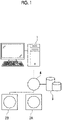
- Fig. 1 is a hardware configuration diagram showing an outline of a diagnosis support system to which a learning apparatus and a region-of-interest extraction apparatus according to a first embodiment of the present disclosure are applied.
- a learning apparatus and region-of-interest extraction apparatus hereinafter, represented by a region-of-interest extraction apparatus
- a plurality of three-dimensional image capturing apparatuses 2A and 2B, and an image storage server 3 according to the first embodiment are connected to communicate with one another via a network 4.
- the three-dimensional image capturing apparatuses 2A and 2B are apparatuses each of which images an area to be diagnosed of a subject and generates a three-dimensional image representing the area, and specific examples thereof include a CT apparatus, an MRI apparatus, and a positron emission tomography (PET) apparatus.
- PET positron emission tomography
- the three-dimensional image capturing apparatus 2A is a CT apparatus
- the three-dimensional image capturing apparatus 2B is an MRI apparatus
- the three-dimensional image capturing apparatuses 2A and 2B generate a CT image and an MRI image including the area to be diagnosed of the subject, as a three-dimensional image, respectively.
- the three-dimensional image capturing apparatus 2B generates a T1-weighted image and a T2-weighted image, as an MRI image.
- the three-dimensional image consists of a plurality of tomographic images.
- the three-dimensional image is acquired in a case where the abdomen of the subject is imaged, and the liver included in the abdomen is a region of interest to be extracted.
- image representation formats are also different from each other.
- the density is different between a CT image and an MRI image even in a case where a tissue of a human body that is included in an image is the same.
- representation formats are different between the T1-weighted image and the T2-weighted image even in a case where the same MRI image is used. Specifically, on the T1-weighted image, predominantly adipose tissue appears white, water, humoral components, and cysts appear black, and tumors appear slightly black.
- the CT image, the T1-weighted image, and the T2-weighted image are images having different representation formats from each other.
- the representation format corresponds to a domain
- different representation formats are synonymous with different domains.
- the image storage server 3 is a computer that stores and manages various data and comprises a large-capacity external storage device and database management software.
- the image storage server 3 communicates with another apparatus via a wired or wireless network 4 to transmit and receive image data and the like.
- the image storage server 3 acquires various data including the image data of the three-dimensional image generated by the three-dimensional image capturing apparatus 2 via the network, and stores and manages the acquired data on a recording medium such as a large-capacity external storage device.
- a storage format of the image data and the communication between the apparatuses via the network 4 are based on a protocol such as digital imaging and communication in medicine (DICOM).
- DICOM digital imaging and communication in medicine
- the image storage server 3 also stores and manages an image for learning that is used to perform learning of an extraction model, which will be described later.
- the region-of-interest extraction apparatus 1 including the learning apparatus of the present embodiment is an apparatus in which a learning program and a region-of-interest extraction program of the first embodiment are installed on one computer.
- the computer may be a workstation or a personal computer directly operated by a doctor who makes diagnosis, or may be a server computer connected to the workstation or the personal computer via a network.
- the learning program and the region-of-interest extraction program are stored on a storage device of a server computer connected to the network or on network storage so as to be accessible from the outside, and are downloaded and installed on a computer that the doctor uses according to a request.
- the learning program and the region-of-interest extraction program are recorded on a recording medium, such as a digital versatile disc (DVD) or a compact disc read only memory (CD-ROM), and are distributed and installed on a computer from the recording medium.
- DVD digital versatile disc
- CD-ROM compact disc read only memory
- Fig. 2 is a diagram showing a schematic configuration of the region-of-interest extraction apparatus which is realized with the learning program and the region-of-interest extraction program installed on a computer.
- the region-of-interest extraction apparatus 1 comprises a central processing unit (CPU) 11, a memory 12, and a storage 13, as a standard workstation configuration.
- a display unit 14 such as a liquid crystal display
- an input unit 15, such as a keyboard and a mouse are connected to the region-of-interest extraction apparatus 1.
- the storage 13 includes a hard disk drive or the like, and stores a target image as a region-of-interest extraction target, which is acquired from the image storage server 3 via the network 4, an image for learning that is used to perform learning of an extraction model 30, which will be described later, and various information including information required for processing.
- the learning program and the region-of-interest extraction program are stored on the memory 12.
- the learning program defines information acquisition processing of acquiring an image for learning that is used to perform learning of an extraction model, a target image as a region-of-interest extraction target, and various information that is used to perform learning and extract a region of interest, and learning processing of performing learning of the extraction model.
- the region-of-interest extraction program defines extraction processing of extracting a region of interest included in the target image as a region-of-interest extraction target, which is acquired by the information acquisition processing, labeling processing of labeling the region of interest included in the target image according to an extraction result of the region of interest, and display control processing of displaying the labeled target image on the display unit 14.
- the CPU 11 executes the processing in accordance with the learning program and the region-of-interest extraction program, so that the computer functions as an information acquisition unit 21, a learning unit 22, an extraction unit 23, a labeling unit 24, and a display control unit 25.
- the information acquisition unit 21 acquires, as the target image, a three-dimensional image of the abdomen of the subject, from the image storage server 3 via an interface (not shown) connected to the network.
- the information acquisition unit 21 also acquires an image for learning and a ground-truth mask, which will be described later. Further, the information acquisition unit 21 acquires various information that is used to perform learning by the learning unit 22.
- the information that is used to perform learning is, for example, information on the representation format after conversion of the image for learning (that is, the target), which will be described later.
- the learning unit 22 performs learning of an extraction model that extracts a region of interest from images having a plurality of different representation formats.
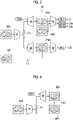
- Figs. 3 and 4 are schematic block diagrams showing the configuration of the extraction model according to the first embodiment.
- the extraction model 30 has an encoder 31, a first decoder 32, a first discriminator 33, a second decoder 34, and a second discriminator 35.
- the encoder 31, the first decoder 32, and the first discriminator 33 included in the extraction model 30 constitute a domain conversion network that is used to convert the representation format of an input image, that is, convert the domain.
- the encoder 31, the second decoder 34, and the second discriminator 35 included in the extraction model 30 constitute a region extraction network that is used to extract a region of interest from the input image.
- the encoder 31 is shared in the domain conversion network and the region extraction network.
- the domain conversion network constitutes generative adversarial networks (GAN).
- GAN comprises a "generator” that creates data and a "discriminator” that identifies data.
- the combination of the encoder 31 and the first decoder 32 corresponds to the generator, and the first discriminator 33 corresponds to the discriminator.
- the region extraction network also constitutes generative adversarial networks, and the combination of the encoder 31 and the second decoder 34 corresponds to the generator, and the second discriminator 35 corresponds to the discriminator.
- the encoder 31 consists of a convolutional neural network (CNN), which is one of multi-layer neural networks in which a plurality of processing layers are hierarchically connected, and derives a feature map representing a feature amount of an input image. Specifically, as shown in Fig. 3 , in a case where a first image GR1 of a first representation format is input, the encoder 31 derives a feature map F1 representing the feature amount of the first image GR1.
- the first image GR1 is an actual image (real image) generated by the three-dimensional image capturing apparatuses 2A and 2B.
- a convolutional neural network consists of a plurality of convolutional layers.
- the convolutional layer performs convolution processing using various kernels on an image that is input, and outputs a feature map consisting of feature amount data obtained by the convolution processing.
- the number of channels of the first convolutional layer (that is, the input layer) is 48 or more, but the number is not limited thereto.
- the convolutional layer applies the kernel to the entire input image or feature map output from the previous processing layer, while shifting the pixel of interest of the kernel.
- the convolutional layer applies an activation function such as a sigmoid function to the convolution value, and outputs a feature map F1.
- an activation function such as a sigmoid function
- the kernel is applied to the input image or feature map while being shifted by two or more strides during the convolution processing.
- a plurality of types of images having different representation formats that is, different domains, such as a CT image, a T1-weighted image, and a T2-weighted image, are used for learning of the extraction model 30.
- a label indicating the representation format is given to the image that is input, as a class label.
- the first image GR1 shown in Fig. 3 is given a class label indicating a representation format class of the first image GR1.
- the images that are used at the time of learning are prepared with and without a ground-truth mask.
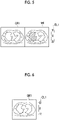
- Fig. 5 is a diagram showing an example of the first image GR1 having a ground-truth mask M1
- Fig. 6 is a diagram showing an example of the first image GR1 having no ground-truth mask.
- the first image GR1 shown in Figs. 5 and 6 is given a class label CL1.
- the class label CL1 is a vector having three elements that are used to identify the classes of the three representation formats, and the element to which 1 is assigned indicates the representation format of the image.
- the three elements indicate a CT image, a T1-weighted image, and a T2-weighted image from the top.
- the representation format is a CT image.
- the representation format is a T2-weighted image.
- the representation format given to the image that is input is denoted by a first representation format.
- the first decoder 32 converts the first representation format of the input image into a second representation format different from the first representation format on the basis of the feature map, to derive a virtual image. That is, as shown in Fig. 3 , in a case where the feature map F1 of the first image GR1 is input, the first decoder 32 converts the first representation format of the first image GR1 into a second representation format different from the first representation format, to derive a second virtual image GV2.
- the first representation format corresponds to the source domain that is the conversion source
- the second representation format corresponds to the target domain that is the conversion destination. For this reason, information TD2 on the target domain, which is the second representation format, is input to the first decoder 32.
- the second representation format is input from, for example, the input unit 15.
- the information TD2 on the second representation format is a vector indicating the class label of the second representation format, and has the same three elements as in the class label CL1.
- the first decoder 32 has a plurality of deconvolutional layers.
- the deconvolutional layer performs the same processing as the convolutional layer of the encoder 31, but applies the kernel for the deconvolution operation to the feature map while upsampling the input feature map.
- the first decoder 32 performs processing of converting the representation format of the first image GR1 into the second representation format while increasing the resolution of the feature map F1 output by the encoder 31 to the resolution of the first image GR1, to derive the second virtual image GV2 of the second representation format.
- the first discriminator 33 consists of, for example, a convolutional neural network, and discriminates the representation format of the input image and whether the input image is a real image or a virtual image generated by the first decoder 32, and outputs a first discrimination result.
- the first discrimination result includes a discrimination result RF1 as to whether the input image is a real image or a virtual image.
- the first discrimination result includes a discrimination result DC1 on the representation format of the input image.
- the real image is not an image generated by the first decoder 32 but an image generated by the three-dimensional image generation apparatuses 2A and 2B, so to speak, a genuine image.
- the discrimination result RF1 is correct, and in a case where the first discriminator 33 discriminates that the input real image is a virtual image, the discrimination result RF1 is incorrect.
- the discrimination result RF1 is incorrect, and in a case where the first discriminator 33 discriminates that the input virtual image is a virtual image, the discrimination result RF1 is correct.
- the learning unit 22 derives a loss on the basis of the discrimination result RF1 output by the first discriminator 33.
- the loss is referred to as an adversarial loss.
- the adversarial loss in the first discriminator 33 is denoted by a first loss L1.
- the discrimination result DC1 is correct, and if the first discriminator 33 discriminates that the representation format is an image other than the CT image, the discrimination result DC1 is incorrect.
- the representation format of the input image is a T2-weighted image
- the discrimination result DC1 is correct, and if the first discriminator 33 discriminates that the representation format is an image other than the T2-weighted image, the discrimination result DC1 is incorrect.
- the second image GR2 which is a real image, is input to the first discriminator 33.
- the virtual image derived by the first decoder 32 is input to the first discriminator 33, and the discrimination result DC1 is output.
- the second virtual image GV2 is generated by using the T2-weighted image as the second representation format.
- the discrimination result DC1 is correct and if the discrimination result DC1 is a CT image or T1-weighted image other than the T2-weighted image, the discrimination result DC1 is incorrect.
- the discrimination result DC1 output from the first discriminator 33 is referred to as a discrimination result DC1d
- the discrimination result DC1g is referred to as a discrimination result DC1g.
- the learning unit 22 derives losses on the basis of the discrimination results DCld and DC1g output by the first discriminator 33.
- the loss is referred to as a classification loss.
- the classification losses derived on the basis of the discrimination results DCld and DC1g are denoted by second losses L2d and L2g, respectively.
- the discrimination results DCld and DC1g may be represented by the discrimination result DC1
- the second losses L2d and L2g may be represented by the second loss L2.
- the second virtual image GV2 is input to the encoder 31, the feature map F1 derived by the encoder 31 is input to the first decoder 32, and information TD1 on the first representation format of the first image GR1 is further input to the first decoder 32.
- the first decoder 32 derives a first virtual image GV1. It is desirable that the first virtual image GV1 derived in this way completely matches the first image GR1, but there is a difference between the first virtual image GV1 that has been subjected to processing by the encoder 31 and the first decoder 32 and the first image GR1.
- the learning unit 22 derives the difference between the first virtual image GV1 and the first image GR1, as a loss.
- the loss is referred to as a cycle loss.
- the cycle loss is denoted by a third loss L3.
- the learning unit 22 performs learning of the first discriminator 33 so that the first discriminator 33 correctly discriminates the discrimination result RF1 as to whether the input image is a real image or a virtual image generated by the first decoder 32 and correctly discriminates the discrimination result DCld on the representation format of the input image. That is, learning of the first discriminator 33 is performed so that the first loss L1 is maximized and the second loss L2d is minimized. Specifically, learning of the first discriminator 33 is performed so that -L1 + L2d is a predetermined threshold value or less.
- the learning unit 22 performs learning of the first decoder 32 so that the first decoder 32 derives a virtual image of the representation format designated from the input image, for which the first discriminator 33 incorrectly discriminates the discrimination result RF1 and correctly discriminates the discrimination result DC1g. Further, the learning unit 22 performs learning of the encoder 31 so that the encoder 31 derives the feature map F1 from which a virtual image for which the first discriminator 33 incorrectly discriminates the discrimination result RF1 and correctly discriminates the discrimination result DC1 can be generated. That is, learning of the encoder 31 and the first decoder 32 is performed so that the first loss L1 and the second loss L2g are minimized. Specifically, learning of the encoder 31 and the first decoder 32 is performed so that L1 + L2g is a predetermined threshold value or less.
- the learning unit 22 performs learning of the first decoder 32 so that the first virtual image GV1 generated from the second virtual image GV2 matches the first image GR1. Further, the learning unit 22 performs learning of the encoder 31 so that the encoder 31 derives the feature map F1 from which the first decoder 32 can derive the first virtual image GV1 that matches the first image GR1. That is, learning of the encoder 31 and the first decoder 32 is performed so that the third loss L3 is minimized. Specifically, learning of the encoder 31 and the first decoder 32 is performed so that L3 is a predetermined threshold value or less.
- the encoder 31 and the first decoder 32, and the first discriminator 33 improve the accuracy thereof with each other, and the first discriminator 33 can more accurately discriminate a real image or a virtual image even in a case where an image of any representation format is input.
- the encoder 31 and the first decoder 32 can generate a virtual image closer to a genuine representation format image, which is not discriminated by the first discriminator 33.
- Fig. 7 is a diagram showing representation formats of real images that are input and representation formats of converted virtual images.
- the leftmost column is the real images that are input
- the representation formats are a CT image, a T1-weighted image, and a T1-weighted image in order from the top.
- the virtual images of the converted representation formats are shown from the second to fourth columns on the left side.
- the representation formats are a CT image, a T1-weighted image, and a T2-weighted image, in order from the second column on the left side.
- a virtual image close to a representation format as instructed is generated regardless of the representation format of the real image that is input.
- the second decoder 34 extracts a region of interest of the image input to the encoder 31 by using the feature map derived by the encoder 31. Specifically, as shown in Fig. 3 , the second decoder 34 extracts the region of interest of the first image GR1 by using the feature map F1 of the first image GR1.
- the second decoder 34 consists of a convolutional neural network having a plurality of deconvolutional layers.
- the second decoder 34 performs processing of deriving the probability of being the region of interest included in the first image GR1 (liver in the present embodiment), and extracting a pixel in which the probability is a threshold value or more, as the region of interest, while increasing the resolution of the feature map F1 output by the encoder 31 to the resolution of the first image GR1. As a result, as shown in Fig. 3 , the second decoder 34 outputs an extraction result PM1 of a liver in the first image GR1.
- the learning unit 22 derives a difference between the extraction result PM1 of the region of interest output by the second decoder 34 and the ground-truth mask M1, as a loss.
- the loss is referred to as a task loss.
- the task loss is denoted by a fourth loss L4.
- the second discriminator 35 consists of, for example, a convolutional neural network, and discriminates whether the extraction result PM1 of the region of interest by the second decoder 34 is an extraction result of the first image GR1 with the ground-truth mask M1 as shown in Fig. 5 or an extraction result of the first image GR1 without the ground-truth mask as shown in Fig. 6 , and outputs a second discrimination result RF2.
- a convolutional neural network discriminates whether the extraction result PM1 of the region of interest by the second decoder 34 is an extraction result of the first image GR1 with the ground-truth mask M1 as shown in Fig. 5 or an extraction result of the first image GR1 without the ground-truth mask as shown in Fig. 6 , and outputs a second discrimination result RF2.
- the second discriminator 35 discriminates the first image GR1 with the ground-truth mask, the second discrimination result RF2 is incorrect, and if the second discriminator 35 discriminates the first image GR1 without the ground-truth mask, the second discrimination result RF2 is correct.
- the learning unit 22 derives a loss on the basis of the output of the second discriminator 35 with regard to the second discrimination result RF2.
- the loss is referred to as an adversarial loss.
- the adversarial loss in the second discriminator 35 is denoted by a fifth loss L5.
- the learning unit 22 performs learning of the second discriminator 35 so that the second discriminator 35 correctly discriminates the second discrimination result RF2 as to whether the extraction result is the extraction result of the first image GR1 with the ground-truth mask or the extraction result of the first image GR1 without the ground-truth mask. That is, learning of the second discriminator 35 is performed so that the fifth loss L5 is maximized. Specifically, learning of the second discriminator 35 is performed so that -L5 is a predetermined threshold value or less.
- learning is performed by alternately using the first image GR1 with the ground-truth mask and the first image GR1 without the ground-truth mask.
- the learning unit 22 performs learning of the second decoder 34 so that the extraction result PM1 matches the ground-truth mask M1 in a case where the feature map F1 of the first image GR1 with the ground-truth mask M1 is input. Further, the learning unit 22 performs learning of the encoder 31 so that the encoder 31 derives the feature map F1 from which the extraction result PM1 that matches the ground-truth mask M1 can be obtained. That is, learning of the encoder 31 and the second decoder 34 is performed so that the fourth loss L4 is minimized. Specifically, learning of the encoder 31 and the second decoder 34 is performed so that L4 is a predetermined threshold value or less.
- the learning unit 22 performs learning of the second decoder 34 so that second decoder 34 outputs the extraction result PM1 for which the second discriminator 35 incorrectly discriminates the second discrimination result RF2. Further, the learning unit 22 performs learning of the encoder 31 so that the encoder 31 derives the feature map F1 from which the extraction result PM1 for which the second discriminator 35 incorrectly discriminates the second discrimination result RF2 is output. That is, learning of the encoder 31 and the first decoder 32 is performed so that the fifth loss L5 is minimized. Specifically, learning of the encoder 31 and the first decoder 32 is performed so that L5 is a predetermined threshold value or less.
- the encoder 31 and the first decoder 32, and the first discriminator 33 improve the accuracy thereof with each other, and the second discriminator 35 can more accurately discriminate whether the input image has the ground-truth mask or no ground-truth mask.
- the encoder 31 and the second decoder 34 can output the more accurate extraction result of the region of interest, in which the presence or absence of the ground-truth mask is not discriminated by the second discriminator 35, regardless of the image with or without the ground-truth mask.
- the extraction model 30 that extracts a region of interest included in the target image is constructed regardless of the representation format of the target image.
- the encoder 31 and the second decoder 34 in the extraction model 30 that has been learned are applied to the extraction unit 23 as a learned extraction model 40.
- the extraction unit 23 extracts the region of interest included in the target image by using the learned extraction model 40 and outputs the extraction result.
- the labeling unit 24 labels the region of interest included in the target image on the basis of the extraction result of the region of interest output by the extraction unit 23.
- Fig. 8 is a diagram showing a display screen of the labeled target image. As shown in Fig. 8 , the target image 51 is displayed on the display screen 60, and labeling 52 is performed on the region of interest in the target image 51. Although hatching is used for the labeling 52 shown in Fig. 8 , the labeling may be performed by changing color, surrounding the region of interest with a line, or the like.
- Fig. 9 is a flowchart showing learning processing performed in the first embodiment. It is assumed that the first image GR1 for learning and the ground-truth mask M1 in a case of the presence of a ground-truth mask are acquired from the image storage server 3 by the information acquisition unit 21 and are stored on the storage 13. First, the learning unit 22 acquires the first image GR1 for learning stored on the storage 13 (Step ST1). The learning unit 22 makes the encoder 31 derive the feature map F1 in response to the input of the first image GR1 (Step ST2).
- the learning unit 22 makes the first decoder 32 derive the second virtual image GV2 in response to the input of the feature map F1 and the information TD2 on the second representation format (Step ST3). Then, the learning unit 22 makes the first discriminator 33 output the discrimination result RF1 and the discrimination result DC1, which are a first discrimination result, in response to the input of the second image GR2 or the second virtual image GV2 (output of the first discrimination result, Step ST4).
- the learning unit 22 derives the first loss L1 and the second loss L2 on the basis of the first discrimination result. Further, the learning unit 22 makes the encoder 31 derive the feature map of the second virtual image GV2 in response to the input of the second virtual image GV2, and makes the first decoder 32 output the first virtual image GV1 in response to the input of the feature map of the second virtual image GV2. Then, the learning unit 22 derives the third loss L3 from the first image GR1 and the first virtual image GV1 (loss derivation; Step ST5).
- the learning unit 22 performs learning of the encoder 31, the first decoder 32, and the first discriminator 33 on the basis of the first loss L1, the second loss L2, and the third loss L3 (first learning, Step ST6).
- the learning unit 22 makes the second decoder 34 output the extraction result PM1 of the region of interest in response to the input of the feature map F1 (Step ST7). Further, the learning unit 22 makes the second discriminator 35 output the second discrimination result RF2 in response to the input of the extraction result PM1 (Step ST8). Then, the learning unit 22 derives the fifth loss L5 on the basis of the second discrimination result RF2. In a case where the first image GR1 has the ground-truth mask M1, the learning unit 22 derives the fourth loss L4 (loss derivation; Step ST9).
- the learning unit 22 performs learning of the encoder 31, the second decoder 34, and the second discriminator 35 on the basis of the fourth loss L4 (if any) and the fifth loss L5 (second learning, Step ST10). Then, the process returns to Step ST1, a next first image GR1 for learning is acquired from the storage 13, and the processing of Steps ST1 to ST10 is repeated. As a result, the extraction model 30 that has been learned is constructed.
- the processing of Steps ST3 to ST6 and the processing of Steps ST7 to ST10 may be performed in parallel, and the processing of Steps ST7 to ST10 may be performed before the processing of Steps ST3 to ST6.
- the learning unit 22 repeats learning until the various losses L1 to L5 become a predetermined threshold value or less, but may repeat learning a predetermined number of times.
- Fig. 10 is a flowchart of region-of-interest extraction processing performed in the present embodiment.
- the information acquisition unit 21 acquires the target image (Step ST11), and the extraction unit 23 outputs the extraction result of the region of interest included in the target image (Step ST12).
- the labeling unit 24 performs labeling 52 of the region of interest included in the target image 51 on the basis of the extraction result of the region of interest (Step ST13).
- the display control unit 25 displays the labeled target image on the display unit 14 (Step ST14), and the processing ends.
- the representation format of the input image and whether the input image is a real image or a virtual image generated by the first decoder 32 are discriminated, and the first discrimination result is output. Further, whether the extraction result PM1 of the region of interest by the second decoder 34 is the extraction result of the first image with the ground-truth mask or the extraction result of a first image without the ground-truth mask is discriminated, and the second discrimination result is output. Then, learning of the encoder 31, the first decoder 32, and the first discriminator 33 is performed on the basis of the first discrimination result, and learning of the encoder 31, the second decoder 34, and the second discriminator 35 is performed on the basis of the second discrimination result.
- the encoder 31 and the first decoder 32, and the first discriminator 33 improve the accuracy thereof with each other, and the first discriminator 33 can more accurately discriminate a real image or a virtual image even in a case where an image of any representation format is input. Further, the encoder 31 and the first decoder 32 can generate a virtual image closer to a genuine representation format image, which is not discriminated by the first discriminator 33. Further, the encoder 31 and the first decoder 32, and the first discriminator 33 improve the accuracy thereof with each other, and the second discriminator 35 can more accurately discriminate whether the input image has the ground-truth mask or no ground-truth mask.
- the encoder 31 and the second decoder 34 can output the more accurate extraction result of the region of interest, in which the presence or absence of the ground-truth mask is not discriminated by the second discriminator 35, regardless of the image with or without the ground-truth mask.
- the learned extraction model 40 having the learned encoder 31 and second decoder 34 is used to make it possible to extract a region of interest included in a target image regardless of the representation format of the target image, without preparation of a model for each representation format as in the method described in Judy Hoffman, Eric Tzeng, Taesung Park, Jun-Yan Zhu, Phillip Isola, Kate Saenko, Alexei A.
- Fig. 11 is a schematic block diagram showing a configuration of an extraction model according to the second embodiment.
- the same reference numerals are assigned to the same configurations as those in Fig. 3 , and detailed description thereof will be omitted.
- the second embodiment is different from the first embodiment in that an extraction model 30A in the second embodiment comprises a third discriminator 36 instead of the second discriminator 35.
- the encoder 31 and the third discriminator 36 constitute GAN. Since learning of the first decoder 32, the first discriminator 33, and the second decoder 34 is the same as that of the first embodiment, detailed description thereof will be omitted here.
- the third discriminator 36 consists of, for example, a convolutional neural network, and discriminates the representation format of the input image on the basis of the feature map output by the encoder 31, and outputs a third discrimination result DC2. That is, as shown in Fig. 11 , the third discriminator 36 discriminates from which representation format image the feature map F1 of the first image GR1 derived by the encoder 31 is derived, and outputs the third discrimination result DC2. For example, in a case where the representation format of the input image is a CT image, if the third discriminator 36 discriminates a CT image, the third discrimination result DC2 is correct, and if the third discriminator 36 discriminates an image other than the CT image, the third discrimination result DC2 is incorrect.
- the third discrimination result DC2 is a T2-weighted image
- the third discrimination result DC2 is correct
- the third discrimination result DC2 is a CT image or T1-weighted image other than the T2-weighted image
- the third discrimination result DC2 is incorrect.
- the learning unit 22 derives a loss on the basis of the output of the third discriminator 36 with regard to the third discrimination result DC2.
- the loss is referred to as a classification loss.
- the classification loss is denoted by a sixth loss L6.
- the learning unit 22 performs learning of the third discriminator 36 so that the third discriminator 36 correctly discriminates the third discrimination result DC2 on the representation format of the input image. Further, the learning unit 22 performs learning of the encoder 31 so that the encoder 31 derives the feature map F1 from which the third discriminator 36 incorrectly discriminates the third discrimination result DC2. That is, learning of the encoder 31 and the third discriminator 36 is performed so that the first loss L1 and the sixth loss L6 are minimized. Specifically, learning of the encoder 31 and the third discriminator 36 is performed so that L1 + L6 is a predetermined threshold value or less.
- the encoder 31 and the third discriminator 36 improve the accuracy thereof with each other, and the third discriminator 36 can more accurately discriminate the representation format no matter what kind of image is input.
- the encoder 31 can generate the same feature map F1 regardless of the representation format, which is not discriminated by the third discriminator 36, no matter what kind of image is input.
- the second decoder 34 can extract the region of interest regardless of the representation format of the image input to the extraction model 30A.
- the representation format of the input image and whether the input image is a real image or a virtual image generated by the first decoder 32 are discriminated and the first discrimination result is output, and the representation format of the input image is discriminated on the basis of the feature map F1 derived by the encoder 31 and the third discrimination result is output. Then, learning of the encoder 31, the first decoder 32, and the first discriminator 33 is performed on the basis of the first discrimination result, and learning of the encoder 31 and the third discriminator 36 is performed on the basis of the third discrimination result. Therefore, as in the first embodiment, the region of interest included in the target image can be extracted regardless of the representation format of the target image.
- the third discriminator 36 may be provided without omitting the second discriminator 35.
- the encoder 31 and the second decoder 34 included in the extraction models 30A and 30B that have been learned are used as the learned extraction model 40.
- the region of interest is extracted from the three-dimensional image of the abdomen of the human body, but the present disclosure is not limited thereto.
- the technique of the present disclosure can be applied to extraction of a region of interest from a simple X-ray image, an ultrasound image, or the like, in addition to a three-dimensional image such as a CT image or an MRI image.
- the T1-weighted image and the T2-weighted image are used as an MRI image, but the present disclosure is not limited thereto.
- the MRI image at least one representation format of a T1-weighted image, a T2-weighted image, a diffusion-weighted image, a FLAIR image, a T1-weighted image before contrast enhancement, or a T1-weighted image after contrast enhancement may be included.
- the liver is extracted as a region of interest, but the present disclosure is not limited thereto.
- the techniques of the present disclosure can also be applied to a case where regions of various structures in the human body, such as lungs, heart, kidneys, and brain, are extracted as a region of interest, in addition to the liver.
- the various processors include, for example, a programmable logic device (PLD), such as a field programmable gate array (FPGA), which is a processor having a changeable circuit configuration after manufacture, and a dedicated electrical circuit, such as an application specific integrated circuit (ASIC), which is a processor having a dedicated circuit configuration designed to perform specific processing, in addition to the CPU, which is a general-purpose processor that executes software (programs) to function as various processing units, as described above.
- PLD programmable logic device
- FPGA field programmable gate array
- ASIC application specific integrated circuit
- One processing unit may be constituted of one of the various processors or may be constituted of a combination of two or more processors of the same type or different types (for example, a combination of a plurality of FPGAs and a combination of a CPU and an FPGA). Further, the plurality of processing units may constitute one processor.
- a first example of the configuration in which the plurality of processing units are constituted of one processor is an aspect in which one or more CPUs and software are combined to constitute one processor and the processor functions as a plurality of processing units.
- a representative example of the aspect is a computer such as a client and server.
- a second example of the configuration is an aspect in which a processor that implements all of the functions of a system including the plurality of processing units with one integrated circuit (IC) chip is used.
- IC integrated circuit
- a representative example of the aspect is a system on chip (SoC).
- SoC system on chip
- circuitry in which circuit elements, such as semiconductor elements, are combined may be used.
Landscapes
- Engineering & Computer Science (AREA)
- Health & Medical Sciences (AREA)
- Life Sciences & Earth Sciences (AREA)
- Physics & Mathematics (AREA)
- Medical Informatics (AREA)
- Theoretical Computer Science (AREA)
- Computer Vision & Pattern Recognition (AREA)
- Multimedia (AREA)
- General Physics & Mathematics (AREA)
- General Health & Medical Sciences (AREA)
- Public Health (AREA)
- High Energy & Nuclear Physics (AREA)
- Biomedical Technology (AREA)
- Heart & Thoracic Surgery (AREA)
- Molecular Biology (AREA)
- Surgery (AREA)
- Animal Behavior & Ethology (AREA)
- Pathology (AREA)
- Nuclear Medicine, Radiotherapy & Molecular Imaging (AREA)
- Veterinary Medicine (AREA)
- Optics & Photonics (AREA)
- Radiology & Medical Imaging (AREA)
- Biophysics (AREA)
- Artificial Intelligence (AREA)
- Computing Systems (AREA)
- Databases & Information Systems (AREA)
- Evolutionary Computation (AREA)
- Software Systems (AREA)
- Image Analysis (AREA)
- Apparatus For Radiation Diagnosis (AREA)
- Magnetic Resonance Imaging Apparatus (AREA)
Abstract
Description
- The present disclosure relates to a learning apparatus, a learning method, and a learning program that perform learning of an extraction model which extracts a region of interest from an image, a region-of-interest extraction apparatus, a region-of-interest extraction method, and a region-of-interest extraction program that extract a region of interest from an image, and a learned extraction model.
- Generative adversarial networks (GAN) that alternately perform learning of a generator which creates data and a discriminator which identifies data have been proposed. For example, Ian J. Goodfellow, Jean Pouget-Abadie, Mehdi Mirza, Bing Xu, David Warde-Farley, Sherjil Ozair, Aaron Courville, Yoshua Bengio "Generative Adversarial Nets", arXiv: 1406.2661 describes research on GAN. According to GAN, learning of a generative model that generates highly accurate data based on the characteristics of data for learning can be performed.
- Further, Judy Hoffman, Eric Tzeng, Taesung Park, Jun-Yan Zhu, Phillip Isola, Kate Saenko, Alexei A. Efros, Trevor Darrell "CyCADA: Cycle-Consistent Adversarial Domain Adaptation", arXiv: 1711.03213 also proposes a technique of performing domain adaptation between two different domains, a source and a target. The method described in Judy Hoffman, Eric Tzeng, Taesung Park, Jun-Yan Zhu, Phillip Isola, Kate Saenko, Alexei A. Efros, Trevor Darrell "CyCADA: Cycle-Consistent Adversarial Domain Adaptation", arXiv: 1711.03213 is based on an idea that learning is performed so that feature spaces of a source image and a target image are close to each other, and with the method described in Judy Hoffman, Eric Tzeng, Taesung Park, Jun-Yan Zhu, Phillip Isola, Kate Saenko, Alexei A. Efros, Trevor Darrell "CyCADA: Cycle-Consistent Adversarial Domain Adaptation", arXiv: 1711.03213, use of a source domain with sufficient training labels enables learning of a target domain with no or few training labels with high accuracy.
- Further, Yunjey Choi, Minje Choi, Munyoung Kim, Jung-Woo Ha, Sunghun Kim, Jaegul Choo "StarGAN: Unified Generative Adversarial Networks for Multi-Domain Image-to-Image Translation", arXiv: 1711.09020 proposes a network that realizes multimodal domain conversion by using a single generator and discriminator. In the method described in Yunjey Choi, Minje Choi, Munyoung Kim, Jung-Woo Ha, Sunghun Kim, Jaegul Choo "StarGAN: Unified Generative Adversarial Networks for Multi-Domain Image-to-Image Translation", arXiv: 1711.09020, various facial expressions (for example, blonde hair, black hair, smiling face, angry face, and the like) in an image to be converted (for example, a person's face image) are simultaneously given to an input of the generator as domain labels, and in the discriminator, not only the authenticity of the input image but also the domain, that is, the facial expressions are determined, so that learning of the generator and the discriminator is performed.
- Meanwhile, in the medical field, advances in various modalities such as a computed tomography (CT) apparatus and a magnetic resonance imaging (MRI) apparatus have made it possible to perform diagnostic imaging using a higher quality medical image. A region of interest such as an organ and a lesion included in such a medical image has also been automatically extracted. For example, a technique has been proposed in which learning of a machine learning model such as a neural network is performed by using an image for learning and a ground-truth mask of the region of interest, and the region of interest is extracted from an input image.
- Incidentally, in a medical image, in a case where modalities that generate images, such as a CT apparatus and an MRI apparatus, are different from each other, image representation formats are also different from each other. For example, the density is different between a CT image and an MRI image even in a case where a tissue of a human body that is included in an image is the same. Further, the MRI image has various imaging conditions such as a T1-weighted image, a T2-weighted image, a fat-suppressed image, and a diffusion-weighted image, and the representation format differs depending on the imaging conditions. For example, on the T1-weighted image, predominantly adipose tissue appears white, water, humoral components, and cysts appear black, and tumors appear slightly black. Further, on the T2-weighted image, not only adipose tissue but also water, humoral components, and cysts appear white. Therefore, in order to extract a region of interest made to correspond to the medical images of various representation formats, it is necessary to prepare a ground-truth mask for each representation format of the medical image, that is, for each domain, and perform learning of a machine learning model. However, in a case where the ground-truth mask is prepared for each domain, a great cost is required for creating the ground-truth mask, collecting images, adjusting the parameters of the machine learning model at the time of learning, and the like. In this case, it is conceivable to apply the methods described in Judy Hoffman, Eric Tzeng, Taesung Park, Jun-Yan Zhu, Phillip Isola, Kate Saenko, Alexei A. Efros, Trevor Darrell "CyCADA: Cycle-Consistent Adversarial Domain Adaptation", arXiv: 1711.03213 and Yunjey Choi, Minje Choi, Munyoung Kim, Jung-Woo Ha, Sunghun Kim, Jaegul Choo "StarGAN: Unified Generative Adversarial Networks for Multi-Domain Image-to-Image Translation", arXiv: 1711.09020 to the extraction of the region of interest from the medical image.
- However, the method described in Judy Hoffman, Eric Tzeng, Taesung Park, Jun-Yan Zhu, Phillip Isola, Kate Saenko, Alexei A. Efros, Trevor Darrell "CyCADA: Cycle-Consistent Adversarial Domain Adaptation", arXiv: 1711.03213 is applied only to one-to-one domain conversion of one source and one target. Therefore, in order to make the region of interest correspond to medical images having various representation formats, it is necessary to prepare a model for each combination of the domains, that is, representation formats. Further, in the method described in Yunjey Choi, Minje Choi, Munyoung Kim, Jung-Woo Ha, Sunghun Kim, Jaegul Choo "StarGAN: Unified Generative Adversarial Networks for Multi-Domain Image-to-Image Translation", arXiv: 1711.09020, the method described in Yunjey Choi, Minje Choi, Munyoung Kim, Jung-Woo Ha, Sunghun Kim, Jaegul Choo "StarGAN: Unified Generative Adversarial Networks for Multi-Domain Image-to-Image Translation", arXiv: 1711.09020 can be applied only to processing of converting an image. Furthermore, the method described in Yunjey Choi, Minje Choi, Munyoung Kim, Jung-Woo Ha, Sunghun Kim, Jaegul Choo "StarGAN: Unified Generative Adversarial Networks for Multi-Domain Image-to-Image Translation", arXiv: 1711.09020 requires a domain label for an input of a generator at the time of discrimination.
- The present disclosure has been made in view of the above circumstances, and an object thereof is to make it possible to extract a region of interest that is included in a target image regardless of a representation format of the target image.
- A first learning apparatus according to the present disclosure is a learning apparatus of an extraction model that extracts a region of interest from images having a plurality of different representation formats,
- in which the extraction model has
- an encoder that extracts a feature amount of a first image of a first representation format to derive a feature map of the first image,
- a first decoder that derives a second virtual image of a second representation format different from the representation format of the first image on the basis of the feature map,
- a first discriminator that discriminates a representation format of an input image and whether the input image is a real image or a virtual image generated by the first decoder, and outputs a first discrimination result,
- a second decoder that extracts a region of interest of the first image on the basis of the feature map, and
- a second discriminator that discriminates whether an extraction result of the region of interest by the second decoder is an extraction result of a first image with ground-truth mask or an extraction result of a first image without ground-truth mask, and outputs a second discrimination result, and
- the learning apparatus comprises a learning unit that performs learning of the encoder, the first decoder, and the first discriminator on the basis of the first discrimination result, and that performs learning of the encoder, the second decoder, and the second discriminator on the basis of the second discrimination result.
- In the first learning apparatus according to the present disclosure, the learning unit may make the encoder derive a feature map of the second virtual image in response to an input of the second virtual image,
- make the first decoder derive a first virtual image of the first representation format on the basis of the feature map of the second virtual image, and
- perform learning of the encoder, the first decoder, and the first discriminator on the basis of a difference between the first image and the first virtual image.
- Further, in the first learning apparatus according to the present disclosure, in a case where the first image has a ground-truth mask for the region of interest, the learning unit may perform learning of the second decoder on the basis of the extraction result of the region of interest and the ground-truth mask.
- In addition, in the first learning apparatus according to the present disclosure, the extraction model may further have a third discriminator that discriminates the representation format of the first image input to the encoder on the basis of the feature map, and that outputs a third discrimination result, and
the learning unit may perform learning of the encoder and the third discriminator on the basis of the third discrimination result. - A second learning apparatus according to the present disclosure is a learning apparatus of an extraction model that extracts a region of interest from images having a plurality of different representation formats,
- in which the extraction model has
- an encoder that extracts a feature amount of a first image of a first representation format to derive a feature map of the first image,
- a first decoder that derives a second virtual image of a second representation format different from the representation format of the first image on the basis of the feature map,
- a first discriminator that discriminates a representation format of an input image and whether the input image is a real image or a virtual image generated by the first decoder, and outputs a first discrimination result,
- a second decoder that extracts a region of interest of the first image on the basis of the feature map, and
- a third discriminator that discriminates the representation format of the first image input to the encoder on the basis of the feature map, and outputs a third discrimination result, and
- the learning apparatus comprises a learning unit that performs learning of the encoder, the first decoder, and the first discriminator on the basis of the first discrimination result, and that performs learning of the encoder and the third discriminator on the basis of the third discrimination result.
- In the first and second learning apparatuses according to the present disclosure, the image may be a three-dimensional medical image, and the representation format may include representation formats of a CT image and an MRI image.
- Further, in the first and second learning apparatuses according to the present disclosure, the representation format may include at least one representation format of a T1-weighted image, a T2-weighted image, a diffusion-weighted image, a FLAIR image, a T1-weighted image before contrast enhancement, or a T1-weighted image after contrast enhancement, in an MRI image.
- A region-of-interest extraction apparatus according to the present disclosure comprises an extraction unit that extracts a region of interest of an image of any representation format from the image, in which an encoder and a second decoder in an extraction model learned by the first or second learning apparatus according to the present disclosure are provided.
- A learned extraction model according to the present disclosure comprises an encoder and a second decoder in an extraction model learned by the first or second learning apparatus according to the present disclosure.
- A first learning method according to the present disclosure is a learning method of an extraction model that extracts a region of interest from images having a plurality of different representation formats,
- in which the extraction model has
- an encoder that extracts a feature amount of a first image of a first representation format to derive a feature map of the first image,
- a first decoder that derives a second virtual image of a second representation format different from the representation format of the first image on the basis of the feature map,
- a first discriminator that discriminates a representation format of an input image and whether the input image is a real image or a virtual image generated by the first decoder, and outputs a first discrimination result,
- a second decoder that extracts a region of interest of the first image on the basis of the feature map, and
- a second discriminator that discriminates whether an extraction result of the region of interest by the second decoder is an extraction result of a first image with ground-truth mask or an extraction result of a first image without ground-truth mask, and outputs a second discrimination result, and
- the learning method comprises:
- performing learning of the encoder, the first decoder, and the first discriminator on the basis of the first discrimination result; and
- performing learning of the encoder, the second decoder, and the second discriminator on the basis of the second discrimination result.
- A second learning method according to the present disclosure is a learning method of an extraction model that extracts a region of interest from images having a plurality of different representation formats,
- in which the extraction model has
- an encoder that extracts a feature amount of a first image of a first representation format to derive a feature map of the first image,
- a first decoder that derives a second virtual image of a second representation format different from the representation format of the first image on the basis of the feature map,
- a first discriminator that discriminates a representation format of an input image and whether the input image is a real image or a virtual image generated by the first decoder, and outputs a first discrimination result,
- a second decoder that extracts a region of interest of the first image on the basis of the feature map, and
- a third discriminator that discriminates the representation format of the first image input to the encoder on the basis of the feature map, and outputs a third discrimination result, and
- the learning method comprises:
- performing learning of the encoder, the first decoder, and the first discriminator on the basis of the first discrimination result; and
- performing learning of the encoder and the third discriminator on the basis of the third discrimination result.
- A region-of-interest extraction method according to the present disclosure comprises extracting a region of interest of an image of any representation format from the image, in which an encoder and a second decoder in an extraction model learned by the first or second learning method according to the present disclosure are provided.
- The first and second learning methods and the region-of-interest extraction method according to the present disclosure may be provided as programs to be executed by a computer.
- A third learning apparatus according to the present disclosure is a learning apparatus of an extraction model that extracts a region of interest from images having a plurality of different representation formats, the learning apparatus comprising:
- a memory that stores a command to be executed by a computer; and
- a processor configured to execute the stored command,
- in which the extraction model has
- an encoder that extracts a feature amount of a first image of a first representation format to derive a feature map of the first image,
- a first decoder that derives a second virtual image of a second representation format different from the representation format of the first image on the basis of the feature map,
- a first discriminator that discriminates a representation format of an input image and whether the input image is a real image or a virtual image generated by the first decoder, and outputs a first discrimination result,
- a second decoder that extracts a region of interest of the first image on the basis of the feature map, and
- a second discriminator that discriminates whether an extraction result of the region of interest by the second decoder is an extraction result of a first image with ground-truth mask or an extraction result of a first image without ground-truth mask, and outputs a second discrimination result, and
- the processor executes a process including
performing learning of the encoder, the first decoder, and the first discriminator on the basis of the first discrimination result, and performing learning of the encoder, the second decoder, and the second discriminator on the basis of the second discrimination result. - A fourth learning apparatus according to the present disclosure is a learning apparatus of an extraction model that extracts a region of interest from images having a plurality of different representation formats, the learning apparatus comprising:
- a memory that stores a command to be executed by a computer; and
- a processor configured to execute the stored command,
- in which the extraction model has
- an encoder that extracts a feature amount of a first image of a first representation format to derive a feature map of the first image,
- a first decoder that derives a second virtual image of a second representation format different from the representation format of the first image on the basis of the feature map,
- a first discriminator that discriminates a representation format of an input image and whether the input image is a real image or a virtual image generated by the first decoder, and outputs a first discrimination result,
- a second decoder that extracts a region of interest of the first image on the basis of the feature map, and
- a third discriminator that discriminates the representation format of the first image input to the encoder on the basis of the feature map, and outputs a third discrimination result, and
- the processor executes a process including
performing learning of the encoder, the first decoder, and the first discriminator on the basis of the first discrimination result, and performing learning of the encoder and the third discriminator on the basis of the third discrimination result. - Another region-of-interest extraction apparatus according to the present disclosure comprises: a memory that stores a command to be executed by a computer; and
a processor configured to execute the stored command, in which the processor executes a process including
functioning as an encoder and a second decoder in an extraction model learned by the first or second learning method according to the present disclosure, and extracting a region of interest of an image of any representation format from the image. - According to the present disclosure, a region of interest included in a target image can be extracted regardless of a representation format of the target image.
-
-
Fig. 1 is a hardware configuration diagram showing an outline of a diagnosis support system to which a learning apparatus and a region-of-interest extraction apparatus according to a first embodiment of the present disclosure are applied. -
Fig. 2 is a diagram showing a schematic configuration of the region-of-interest extraction apparatus according to the first embodiment of the present disclosure. -
Fig. 3 is a schematic block diagram showing a configuration of an extraction model according to the first embodiment. -
Fig. 4 is a schematic block diagram showing a configuration of the extraction model according to the first embodiment. -
Fig. 5 is a diagram showing an example of a first image having a ground-truth mask. -
Fig. 6 is a diagram showing an example of a first image having no ground-truth mask. -
Fig. 7 is a diagram showing representation formats of real images that are input and representation formats of converted virtual images. -
Fig. 8 is a diagram showing a labeled target image. -
Fig. 9 is a flowchart showing learning processing performed in the first embodiment. -
Fig. 10 is a flowchart showing region-of-interest extraction processing performed in a second embodiment. -
Fig. 11 is a schematic block diagram showing a configuration of an extraction model according to the second embodiment. -
Fig. 12 is a schematic block diagram showing a configuration of an extraction model according to a third embodiment. - Hereinafter, embodiments of the present disclosure will be described with reference to the drawings.
Fig. 1 is a hardware configuration diagram showing an outline of a diagnosis support system to which a learning apparatus and a region-of-interest extraction apparatus according to a first embodiment of the present disclosure are applied. As shown inFig. 1 , in the diagnosis support system, a learning apparatus and region-of-interest extraction apparatus (hereinafter, represented by a region-of-interest extraction apparatus) 1, a plurality of three-dimensionalimage capturing apparatuses image storage server 3 according to the first embodiment are connected to communicate with one another via a network 4. - The three-dimensional
image capturing apparatuses image capturing apparatuses image storage server 3. In the present embodiment, the three-dimensionalimage capturing apparatus 2A is a CT apparatus, and the three-dimensionalimage capturing apparatus 2B is an MRI apparatus, and the three-dimensionalimage capturing apparatuses image capturing apparatus 2B generates a T1-weighted image and a T2-weighted image, as an MRI image. The three-dimensional image consists of a plurality of tomographic images. Further, in the present embodiment, the three-dimensional image is acquired in a case where the abdomen of the subject is imaged, and the liver included in the abdomen is a region of interest to be extracted. - Here, in a medical image, in a case where modalities that are acquired, such as a CT apparatus and an MRI apparatus, are different from each other, image representation formats are also different from each other. For example, the density is different between a CT image and an MRI image even in a case where a tissue of a human body that is included in an image is the same. Further, representation formats are different between the T1-weighted image and the T2-weighted image even in a case where the same MRI image is used. Specifically, on the T1-weighted image, predominantly adipose tissue appears white, water, humoral components, and cysts appear black, and tumors appear slightly black. Further, on the T2-weighted image, not only adipose tissue but also water, humoral components, and cysts appear white. Therefore, the CT image, the T1-weighted image, and the T2-weighted image are images having different representation formats from each other. In the present embodiment, the representation format corresponds to a domain, and different representation formats are synonymous with different domains.
- The
image storage server 3 is a computer that stores and manages various data and comprises a large-capacity external storage device and database management software. Theimage storage server 3 communicates with another apparatus via a wired or wireless network 4 to transmit and receive image data and the like. Specifically, theimage storage server 3 acquires various data including the image data of the three-dimensional image generated by the three-dimensional image capturing apparatus 2 via the network, and stores and manages the acquired data on a recording medium such as a large-capacity external storage device. A storage format of the image data and the communication between the apparatuses via the network 4 are based on a protocol such as digital imaging and communication in medicine (DICOM). Further, in the present embodiment, theimage storage server 3 also stores and manages an image for learning that is used to perform learning of an extraction model, which will be described later. - The region-of-
interest extraction apparatus 1 including the learning apparatus of the present embodiment is an apparatus in which a learning program and a region-of-interest extraction program of the first embodiment are installed on one computer. The computer may be a workstation or a personal computer directly operated by a doctor who makes diagnosis, or may be a server computer connected to the workstation or the personal computer via a network. The learning program and the region-of-interest extraction program are stored on a storage device of a server computer connected to the network or on network storage so as to be accessible from the outside, and are downloaded and installed on a computer that the doctor uses according to a request. Alternatively, the learning program and the region-of-interest extraction program are recorded on a recording medium, such as a digital versatile disc (DVD) or a compact disc read only memory (CD-ROM), and are distributed and installed on a computer from the recording medium. -
Fig. 2 is a diagram showing a schematic configuration of the region-of-interest extraction apparatus which is realized with the learning program and the region-of-interest extraction program installed on a computer. As shown inFig. 2 , the region-of-interest extraction apparatus 1 comprises a central processing unit (CPU) 11, amemory 12, and astorage 13, as a standard workstation configuration. Further, adisplay unit 14, such as a liquid crystal display, and aninput unit 15, such as a keyboard and a mouse, are connected to the region-of-interest extraction apparatus 1. - The
storage 13 includes a hard disk drive or the like, and stores a target image as a region-of-interest extraction target, which is acquired from theimage storage server 3 via the network 4, an image for learning that is used to perform learning of anextraction model 30, which will be described later, and various information including information required for processing. - Further, the learning program and the region-of-interest extraction program are stored on the
memory 12. As processing to be executed by theCPU 11, the learning program defines information acquisition processing of acquiring an image for learning that is used to perform learning of an extraction model, a target image as a region-of-interest extraction target, and various information that is used to perform learning and extract a region of interest, and learning processing of performing learning of the extraction model. - As processing to be executed by the
CPU 11, the region-of-interest extraction program defines extraction processing of extracting a region of interest included in the target image as a region-of-interest extraction target, which is acquired by the information acquisition processing, labeling processing of labeling the region of interest included in the target image according to an extraction result of the region of interest, and display control processing of displaying the labeled target image on thedisplay unit 14. - The
CPU 11 executes the processing in accordance with the learning program and the region-of-interest extraction program, so that the computer functions as aninformation acquisition unit 21, alearning unit 22, anextraction unit 23, alabeling unit 24, and adisplay control unit 25. - The
information acquisition unit 21 acquires, as the target image, a three-dimensional image of the abdomen of the subject, from theimage storage server 3 via an interface (not shown) connected to the network. Theinformation acquisition unit 21 also acquires an image for learning and a ground-truth mask, which will be described later. Further, theinformation acquisition unit 21 acquires various information that is used to perform learning by thelearning unit 22. The information that is used to perform learning is, for example, information on the representation format after conversion of the image for learning (that is, the target), which will be described later. - The
learning unit 22 performs learning of an extraction model that extracts a region of interest from images having a plurality of different representation formats.Figs. 3 and 4 are schematic block diagrams showing the configuration of the extraction model according to the first embodiment. As shown inFigs. 3 and 4 , theextraction model 30 has anencoder 31, afirst decoder 32, afirst discriminator 33, asecond decoder 34, and asecond discriminator 35. Theencoder 31, thefirst decoder 32, and thefirst discriminator 33 included in theextraction model 30 constitute a domain conversion network that is used to convert the representation format of an input image, that is, convert the domain. Further, theencoder 31, thesecond decoder 34, and thesecond discriminator 35 included in theextraction model 30 constitute a region extraction network that is used to extract a region of interest from the input image. In the present embodiment, theencoder 31 is shared in the domain conversion network and the region extraction network. - In the present embodiment, the domain conversion network constitutes generative adversarial networks (GAN). The GAN comprises a "generator" that creates data and a "discriminator" that identifies data. In the present embodiment, the combination of the
encoder 31 and thefirst decoder 32 corresponds to the generator, and thefirst discriminator 33 corresponds to the discriminator. - Further, in the present embodiment, the region extraction network also constitutes generative adversarial networks, and the combination of the
encoder 31 and thesecond decoder 34 corresponds to the generator, and thesecond discriminator 35 corresponds to the discriminator. - The
encoder 31 consists of a convolutional neural network (CNN), which is one of multi-layer neural networks in which a plurality of processing layers are hierarchically connected, and derives a feature map representing a feature amount of an input image. Specifically, as shown inFig. 3 , in a case where a first image GR1 of a first representation format is input, theencoder 31 derives a feature map F1 representing the feature amount of the first image GR1. In the present embodiment, the first image GR1 is an actual image (real image) generated by the three-dimensionalimage capturing apparatuses - A convolutional neural network consists of a plurality of convolutional layers. The convolutional layer performs convolution processing using various kernels on an image that is input, and outputs a feature map consisting of feature amount data obtained by the convolution processing. In the present embodiment, the number of channels of the first convolutional layer (that is, the input layer) is 48 or more, but the number is not limited thereto. The kernel has an n × n pixel size (for example, n = 3), and each element is weighted. Specifically, weight such as a differential filter by which the edge of the input image is weighted is set. The convolutional layer applies the kernel to the entire input image or feature map output from the previous processing layer, while shifting the pixel of interest of the kernel. Furthermore, the convolutional layer applies an activation function such as a sigmoid function to the convolution value, and outputs a feature map F1. In the present embodiment, since the convolutional neural network does not have a pooling layer, the kernel is applied to the input image or feature map while being shifted by two or more strides during the convolution processing.
- Here, in the present embodiment, a plurality of types of images having different representation formats, that is, different domains, such as a CT image, a T1-weighted image, and a T2-weighted image, are used for learning of the
extraction model 30. At the time of learning, a label indicating the representation format is given to the image that is input, as a class label. For example, the first image GR1 shown inFig. 3 is given a class label indicating a representation format class of the first image GR1. In addition, the images that are used at the time of learning are prepared with and without a ground-truth mask.Fig. 5 is a diagram showing an example of the first image GR1 having a ground-truth mask M1, andFig. 6 is a diagram showing an example of the first image GR1 having no ground-truth mask. The first image GR1 shown inFigs. 5 and 6 is given a class label CL1. - In the present embodiment, the class label CL1 is a vector having three elements that are used to identify the classes of the three representation formats, and the element to which 1 is assigned indicates the representation format of the image. In
Figs. 5 and 6 , the three elements indicate a CT image, a T1-weighted image, and a T2-weighted image from the top. In the first image GR1 shown inFig. 5 , since 1 is assigned to the uppermost element of the class label CL1, the representation format is a CT image. Further, in the first image GR1 shown inFig. 6 , since 1 is assigned to the third element of the class label, the representation format is a T2-weighted image. In the present embodiment, the representation format given to the image that is input is denoted by a first representation format. - The
first decoder 32 converts the first representation format of the input image into a second representation format different from the first representation format on the basis of the feature map, to derive a virtual image. That is, as shown inFig. 3 , in a case where the feature map F1 of the first image GR1 is input, thefirst decoder 32 converts the first representation format of the first image GR1 into a second representation format different from the first representation format, to derive a second virtual image GV2. The first representation format corresponds to the source domain that is the conversion source, and the second representation format corresponds to the target domain that is the conversion destination. For this reason, information TD2 on the target domain, which is the second representation format, is input to thefirst decoder 32. The second representation format is input from, for example, theinput unit 15. The information TD2 on the second representation format is a vector indicating the class label of the second representation format, and has the same three elements as in the class label CL1. - The
first decoder 32 has a plurality of deconvolutional layers. The deconvolutional layer performs the same processing as the convolutional layer of theencoder 31, but applies the kernel for the deconvolution operation to the feature map while upsampling the input feature map. Specifically, as shown inFig. 3 , thefirst decoder 32 performs processing of converting the representation format of the first image GR1 into the second representation format while increasing the resolution of the feature map F1 output by theencoder 31 to the resolution of the first image GR1, to derive the second virtual image GV2 of the second representation format. - The
first discriminator 33 consists of, for example, a convolutional neural network, and discriminates the representation format of the input image and whether the input image is a real image or a virtual image generated by thefirst decoder 32, and outputs a first discrimination result. The first discrimination result includes a discrimination result RF1 as to whether the input image is a real image or a virtual image. Further, the first discrimination result includes a discrimination result DC1 on the representation format of the input image. Here, the real image is not an image generated by thefirst decoder 32 but an image generated by the three-dimensionalimage generation apparatuses - Therefore, in a case where the
first discriminator 33 discriminates that the input real image is a real image, the discrimination result RF1 is correct, and in a case where thefirst discriminator 33 discriminates that the input real image is a virtual image, the discrimination result RF1 is incorrect. Alternatively, in a case where thefirst discriminator 33 discriminates that the input virtual image is a real image, the discrimination result RF1 is incorrect, and in a case where thefirst discriminator 33 discriminates that the input virtual image is a virtual image, the discrimination result RF1 is correct. In the present embodiment, as shown inFig. 3 , in a case where the second virtual image GV2 is input to thefirst discriminator 33 at the time of learning, if the discrimination result RF1 is a virtual image, the discrimination result RF1 is correct, and if the discrimination result is a real image, the discrimination result RF1 is incorrect. Further, as shown inFig. 3 , in a case where a second image GR2 which is a real image is input to thefirst discriminator 33 at the time of learning, if the discrimination result RF1 is a real image, the discrimination result RF1 is correct, and if the discrimination result is a virtual image, the discrimination result RF1 is incorrect. - The
learning unit 22 derives a loss on the basis of the discrimination result RF1 output by thefirst discriminator 33. The loss is referred to as an adversarial loss. In the present embodiment, the adversarial loss in thefirst discriminator 33 is denoted by a first loss L1. - Further, in a case where the representation format of the input image is a CT image, if the
first discriminator 33 discriminates that the representation format is a CT image, the discrimination result DC1 is correct, and if thefirst discriminator 33 discriminates that the representation format is an image other than the CT image, the discrimination result DC1 is incorrect. Alternatively, in a case where the representation format of the input image is a T2-weighted image, if thefirst discriminator 33 discriminates that the representation format is a T2-weighted image, the discrimination result DC1 is correct, and if thefirst discriminator 33 discriminates that the representation format is an image other than the T2-weighted image, the discrimination result DC1 is incorrect. In the present embodiment, in a case where learning of thefirst discriminator 33 for making thefirst discriminator 33 output the discrimination result DC1 is performed, the second image GR2, which is a real image, is input to thefirst discriminator 33. - On the other hand, in the present embodiment, in order to perform learning of the
encoder 31 and thefirst decoder 32 as described later, the virtual image derived by thefirst decoder 32 is input to thefirst discriminator 33, and the discrimination result DC1 is output. For example, in the present embodiment, the second virtual image GV2 is generated by using the T2-weighted image as the second representation format. Therefore, in a case where the second virtual image GV2 which is a T2-weighted image is input to thefirst discriminator 33, if the discrimination result DC1 is a T2-weighted image, the discrimination result DC1 is correct and if the discrimination result DC1 is a CT image or T1-weighted image other than the T2-weighted image, the discrimination result DC1 is incorrect. In the following description, in order to perform learning of thefirst discriminator 33, the discrimination result DC1 output from thefirst discriminator 33 is referred to as a discrimination result DC1d, and in order to perform learning of theencoder 31 and thefirst decoder 32, the discrimination result DC1 output from thefirst discriminator 33 is referred to as a discrimination result DC1g. - The
learning unit 22 derives losses on the basis of the discrimination results DCld and DC1g output by thefirst discriminator 33. The loss is referred to as a classification loss. In the present embodiment, the classification losses derived on the basis of the discrimination results DCld and DC1g are denoted by second losses L2d and L2g, respectively. In the following description, the discrimination results DCld and DC1g may be represented by the discrimination result DC1, and the second losses L2d and L2g may be represented by the second loss L2. - Meanwhile, in the present embodiment, as shown in
Fig. 4 , the second virtual image GV2 is input to theencoder 31, the feature map F1 derived by theencoder 31 is input to thefirst decoder 32, and information TD1 on the first representation format of the first image GR1 is further input to thefirst decoder 32. With this, thefirst decoder 32 derives a first virtual image GV1. It is desirable that the first virtual image GV1 derived in this way completely matches the first image GR1, but there is a difference between the first virtual image GV1 that has been subjected to processing by theencoder 31 and thefirst decoder 32 and the first image GR1. In the present embodiment, thelearning unit 22 derives the difference between the first virtual image GV1 and the first image GR1, as a loss. The loss is referred to as a cycle loss. In the present embodiment, the cycle loss is denoted by a third loss L3. - In the present embodiment, the
learning unit 22 performs learning of thefirst discriminator 33 so that thefirst discriminator 33 correctly discriminates the discrimination result RF1 as to whether the input image is a real image or a virtual image generated by thefirst decoder 32 and correctly discriminates the discrimination result DCld on the representation format of the input image. That is, learning of thefirst discriminator 33 is performed so that the first loss L1 is maximized and the second loss L2d is minimized. Specifically, learning of thefirst discriminator 33 is performed so that -L1 + L2d is a predetermined threshold value or less. - Further, the
learning unit 22 performs learning of thefirst decoder 32 so that thefirst decoder 32 derives a virtual image of the representation format designated from the input image, for which thefirst discriminator 33 incorrectly discriminates the discrimination result RF1 and correctly discriminates the discrimination result DC1g. Further, thelearning unit 22 performs learning of theencoder 31 so that theencoder 31 derives the feature map F1 from which a virtual image for which thefirst discriminator 33 incorrectly discriminates the discrimination result RF1 and correctly discriminates the discrimination result DC1 can be generated. That is, learning of theencoder 31 and thefirst decoder 32 is performed so that the first loss L1 and the second loss L2g are minimized. Specifically, learning of theencoder 31 and thefirst decoder 32 is performed so that L1 + L2g is a predetermined threshold value or less. - Further, the
learning unit 22 performs learning of thefirst decoder 32 so that the first virtual image GV1 generated from the second virtual image GV2 matches the first image GR1. Further, thelearning unit 22 performs learning of theencoder 31 so that theencoder 31 derives the feature map F1 from which thefirst decoder 32 can derive the first virtual image GV1 that matches the first image GR1. That is, learning of theencoder 31 and thefirst decoder 32 is performed so that the third loss L3 is minimized. Specifically, learning of theencoder 31 and thefirst decoder 32 is performed so that L3 is a predetermined threshold value or less. - As the learning progresses, the
encoder 31 and thefirst decoder 32, and thefirst discriminator 33 improve the accuracy thereof with each other, and thefirst discriminator 33 can more accurately discriminate a real image or a virtual image even in a case where an image of any representation format is input. On the other hand, theencoder 31 and thefirst decoder 32 can generate a virtual image closer to a genuine representation format image, which is not discriminated by thefirst discriminator 33. -
Fig. 7 is a diagram showing representation formats of real images that are input and representation formats of converted virtual images. InFig. 7 , the leftmost column is the real images that are input, and the representation formats are a CT image, a T1-weighted image, and a T1-weighted image in order from the top. Further, the virtual images of the converted representation formats are shown from the second to fourth columns on the left side. The representation formats are a CT image, a T1-weighted image, and a T2-weighted image, in order from the second column on the left side. According to the present embodiment, as shown inFig. 7 , a virtual image close to a representation format as instructed is generated regardless of the representation format of the real image that is input. - Meanwhile, the
second decoder 34 extracts a region of interest of the image input to theencoder 31 by using the feature map derived by theencoder 31. Specifically, as shown inFig. 3 , thesecond decoder 34 extracts the region of interest of the first image GR1 by using the feature map F1 of the first image GR1. Thesecond decoder 34 consists of a convolutional neural network having a plurality of deconvolutional layers. Thesecond decoder 34 performs processing of deriving the probability of being the region of interest included in the first image GR1 (liver in the present embodiment), and extracting a pixel in which the probability is a threshold value or more, as the region of interest, while increasing the resolution of the feature map F1 output by theencoder 31 to the resolution of the first image GR1. As a result, as shown inFig. 3 , thesecond decoder 34 outputs an extraction result PM1 of a liver in the first image GR1. - In a case where the first image GR1 has a ground-truth mask M1, as shown in
Fig. 3 , thelearning unit 22 derives a difference between the extraction result PM1 of the region of interest output by thesecond decoder 34 and the ground-truth mask M1, as a loss. The loss is referred to as a task loss. In the present embodiment, the task loss is denoted by a fourth loss L4. - The
second discriminator 35 consists of, for example, a convolutional neural network, and discriminates whether the extraction result PM1 of the region of interest by thesecond decoder 34 is an extraction result of the first image GR1 with the ground-truth mask M1 as shown inFig. 5 or an extraction result of the first image GR1 without the ground-truth mask as shown inFig. 6 , and outputs a second discrimination result RF2. Here, as shown inFig. 3 , in a case where the extraction result PM1 for the first image GR1 having the ground-truth mask M1 is input, if thesecond discriminator 35 discriminates the first image GR1 with the ground-truth mask, the second discrimination result RF2 is correct, and if thesecond discriminator 35 discriminates the first image GR1 without the ground-truth mask, the second discrimination result RF2 is incorrect. On the other hand, in a case where the extraction result PM1 for the first image GR1 having no ground-truth mask M1 is input, if thesecond discriminator 35 discriminates the first image GR1 with the ground-truth mask, the second discrimination result RF2 is incorrect, and if thesecond discriminator 35 discriminates the first image GR1 without the ground-truth mask, the second discrimination result RF2 is correct. Thelearning unit 22 derives a loss on the basis of the output of thesecond discriminator 35 with regard to the second discrimination result RF2. The loss is referred to as an adversarial loss. In the present embodiment, the adversarial loss in thesecond discriminator 35 is denoted by a fifth loss L5. - In the present embodiment, the
learning unit 22 performs learning of thesecond discriminator 35 so that thesecond discriminator 35 correctly discriminates the second discrimination result RF2 as to whether the extraction result is the extraction result of the first image GR1 with the ground-truth mask or the extraction result of the first image GR1 without the ground-truth mask. That is, learning of thesecond discriminator 35 is performed so that the fifth loss L5 is maximized. Specifically, learning of thesecond discriminator 35 is performed so that -L5 is a predetermined threshold value or less. - In the present embodiment, at the time of learning, learning is performed by alternately using the first image GR1 with the ground-truth mask and the first image GR1 without the ground-truth mask.
- Further, the
learning unit 22 performs learning of thesecond decoder 34 so that the extraction result PM1 matches the ground-truth mask M1 in a case where the feature map F1 of the first image GR1 with the ground-truth mask M1 is input. Further, thelearning unit 22 performs learning of theencoder 31 so that theencoder 31 derives the feature map F1 from which the extraction result PM1 that matches the ground-truth mask M1 can be obtained. That is, learning of theencoder 31 and thesecond decoder 34 is performed so that the fourth loss L4 is minimized. Specifically, learning of theencoder 31 and thesecond decoder 34 is performed so that L4 is a predetermined threshold value or less. - Further, the
learning unit 22 performs learning of thesecond decoder 34 so thatsecond decoder 34 outputs the extraction result PM1 for which thesecond discriminator 35 incorrectly discriminates the second discrimination result RF2. Further, thelearning unit 22 performs learning of theencoder 31 so that theencoder 31 derives the feature map F1 from which the extraction result PM1 for which thesecond discriminator 35 incorrectly discriminates the second discrimination result RF2 is output. That is, learning of theencoder 31 and thefirst decoder 32 is performed so that the fifth loss L5 is minimized. Specifically, learning of theencoder 31 and thefirst decoder 32 is performed so that L5 is a predetermined threshold value or less. - As the learning progresses, the
encoder 31 and thefirst decoder 32, and thefirst discriminator 33 improve the accuracy thereof with each other, and thesecond discriminator 35 can more accurately discriminate whether the input image has the ground-truth mask or no ground-truth mask. On the other hand, theencoder 31 and thesecond decoder 34 can output the more accurate extraction result of the region of interest, in which the presence or absence of the ground-truth mask is not discriminated by thesecond discriminator 35, regardless of the image with or without the ground-truth mask. - With learning of the
extraction model 30 performed by thelearning unit 22 as described above, in a case where the target image as a region-of-interest extraction target is input, theextraction model 30 that extracts a region of interest included in the target image is constructed regardless of the representation format of the target image. In the present embodiment, theencoder 31 and thesecond decoder 34 in theextraction model 30 that has been learned are applied to theextraction unit 23 as a learnedextraction model 40. - In a case where the target image is input, the
extraction unit 23 extracts the region of interest included in the target image by using the learnedextraction model 40 and outputs the extraction result. - The
labeling unit 24 labels the region of interest included in the target image on the basis of the extraction result of the region of interest output by theextraction unit 23. - The
display control unit 25 displays the labeled target image on thedisplay unit 14.Fig. 8 is a diagram showing a display screen of the labeled target image. As shown inFig. 8 , thetarget image 51 is displayed on thedisplay screen 60, andlabeling 52 is performed on the region of interest in thetarget image 51. Although hatching is used for thelabeling 52 shown inFig. 8 , the labeling may be performed by changing color, surrounding the region of interest with a line, or the like. - Next, processing performed in the first embodiment will be described.
Fig. 9 is a flowchart showing learning processing performed in the first embodiment. It is assumed that the first image GR1 for learning and the ground-truth mask M1 in a case of the presence of a ground-truth mask are acquired from theimage storage server 3 by theinformation acquisition unit 21 and are stored on thestorage 13. First, thelearning unit 22 acquires the first image GR1 for learning stored on the storage 13 (Step ST1). Thelearning unit 22 makes theencoder 31 derive the feature map F1 in response to the input of the first image GR1 (Step ST2). Further, thelearning unit 22 makes thefirst decoder 32 derive the second virtual image GV2 in response to the input of the feature map F1 and the information TD2 on the second representation format (Step ST3). Then, thelearning unit 22 makes thefirst discriminator 33 output the discrimination result RF1 and the discrimination result DC1, which are a first discrimination result, in response to the input of the second image GR2 or the second virtual image GV2 (output of the first discrimination result, Step ST4). - Next, the
learning unit 22 derives the first loss L1 and the second loss L2 on the basis of the first discrimination result. Further, thelearning unit 22 makes theencoder 31 derive the feature map of the second virtual image GV2 in response to the input of the second virtual image GV2, and makes thefirst decoder 32 output the first virtual image GV1 in response to the input of the feature map of the second virtual image GV2. Then, thelearning unit 22 derives the third loss L3 from the first image GR1 and the first virtual image GV1 (loss derivation; Step ST5). - Further, the
learning unit 22 performs learning of theencoder 31, thefirst decoder 32, and thefirst discriminator 33 on the basis of the first loss L1, the second loss L2, and the third loss L3 (first learning, Step ST6). - Meanwhile, the
learning unit 22 makes thesecond decoder 34 output the extraction result PM1 of the region of interest in response to the input of the feature map F1 (Step ST7). Further, thelearning unit 22 makes thesecond discriminator 35 output the second discrimination result RF2 in response to the input of the extraction result PM1 (Step ST8). Then, thelearning unit 22 derives the fifth loss L5 on the basis of the second discrimination result RF2. In a case where the first image GR1 has the ground-truth mask M1, thelearning unit 22 derives the fourth loss L4 (loss derivation; Step ST9). - Further, the
learning unit 22 performs learning of theencoder 31, thesecond decoder 34, and thesecond discriminator 35 on the basis of the fourth loss L4 (if any) and the fifth loss L5 (second learning, Step ST10). Then, the process returns to Step ST1, a next first image GR1 for learning is acquired from thestorage 13, and the processing of Steps ST1 to ST10 is repeated. As a result, theextraction model 30 that has been learned is constructed. The processing of Steps ST3 to ST6 and the processing of Steps ST7 to ST10 may be performed in parallel, and the processing of Steps ST7 to ST10 may be performed before the processing of Steps ST3 to ST6. - The
learning unit 22 repeats learning until the various losses L1 to L5 become a predetermined threshold value or less, but may repeat learning a predetermined number of times. - Next, region-of-interest extraction processing performed in the present embodiment will be described.
Fig. 10 is a flowchart of region-of-interest extraction processing performed in the present embodiment. Theinformation acquisition unit 21 acquires the target image (Step ST11), and theextraction unit 23 outputs the extraction result of the region of interest included in the target image (Step ST12). Next, thelabeling unit 24 performs labeling 52 of the region of interest included in thetarget image 51 on the basis of the extraction result of the region of interest (Step ST13). Then, thedisplay control unit 25 displays the labeled target image on the display unit 14 (Step ST14), and the processing ends. - As described above, in the present embodiment, the representation format of the input image and whether the input image is a real image or a virtual image generated by the
first decoder 32 are discriminated, and the first discrimination result is output. Further, whether the extraction result PM1 of the region of interest by thesecond decoder 34 is the extraction result of the first image with the ground-truth mask or the extraction result of a first image without the ground-truth mask is discriminated, and the second discrimination result is output. Then, learning of theencoder 31, thefirst decoder 32, and thefirst discriminator 33 is performed on the basis of the first discrimination result, and learning of theencoder 31, thesecond decoder 34, and thesecond discriminator 35 is performed on the basis of the second discrimination result. - Therefore, as the learning progresses as described above, the
encoder 31 and thefirst decoder 32, and thefirst discriminator 33 improve the accuracy thereof with each other, and thefirst discriminator 33 can more accurately discriminate a real image or a virtual image even in a case where an image of any representation format is input. Further, theencoder 31 and thefirst decoder 32 can generate a virtual image closer to a genuine representation format image, which is not discriminated by thefirst discriminator 33. Further, theencoder 31 and thefirst decoder 32, and thefirst discriminator 33 improve the accuracy thereof with each other, and thesecond discriminator 35 can more accurately discriminate whether the input image has the ground-truth mask or no ground-truth mask. Furthermore, theencoder 31 and thesecond decoder 34 can output the more accurate extraction result of the region of interest, in which the presence or absence of the ground-truth mask is not discriminated by thesecond discriminator 35, regardless of the image with or without the ground-truth mask. - Therefore, the learned
extraction model 40 having the learnedencoder 31 andsecond decoder 34 is used to make it possible to extract a region of interest included in a target image regardless of the representation format of the target image, without preparation of a model for each representation format as in the method described in Judy Hoffman, Eric Tzeng, Taesung Park, Jun-Yan Zhu, Phillip Isola, Kate Saenko, Alexei A. Efros, Trevor Darrell "CyCADA: Cycle-Consistent Adversarial Domain Adaptation", arXiv: 1711.03213 and without an input of the domain labels at the time of extraction as in the method described in Yunjey Choi, Minje Choi, Munyoung Kim, Jung-Woo Ha, Sunghun Kim, Jaegul Choo "StarGAN: Unified Generative Adversarial Networks for Multi-Domain Image-to-Image Translation", arXiv: 1711.09020. - Next, a second embodiment of the present disclosure will be described.
Fig. 11 is a schematic block diagram showing a configuration of an extraction model according to the second embodiment. InFig. 11 , the same reference numerals are assigned to the same configurations as those inFig. 3 , and detailed description thereof will be omitted. The second embodiment is different from the first embodiment in that anextraction model 30A in the second embodiment comprises athird discriminator 36 instead of thesecond discriminator 35. In the second embodiment, theencoder 31 and thethird discriminator 36 constitute GAN. Since learning of thefirst decoder 32, thefirst discriminator 33, and thesecond decoder 34 is the same as that of the first embodiment, detailed description thereof will be omitted here. - The
third discriminator 36 consists of, for example, a convolutional neural network, and discriminates the representation format of the input image on the basis of the feature map output by theencoder 31, and outputs a third discrimination result DC2. That is, as shown inFig. 11 , thethird discriminator 36 discriminates from which representation format image the feature map F1 of the first image GR1 derived by theencoder 31 is derived, and outputs the third discrimination result DC2. For example, in a case where the representation format of the input image is a CT image, if thethird discriminator 36 discriminates a CT image, the third discrimination result DC2 is correct, and if thethird discriminator 36 discriminates an image other than the CT image, the third discrimination result DC2 is incorrect. Further, in a case where the representation format of the input image is a T2-weighted image, if the third discrimination result DC2 is a T2-weighted image, the third discrimination result DC2 is correct, and if the third discrimination result DC2 is a CT image or T1-weighted image other than the T2-weighted image, the third discrimination result DC2 is incorrect. Thelearning unit 22 derives a loss on the basis of the output of thethird discriminator 36 with regard to the third discrimination result DC2. The loss is referred to as a classification loss. In the present embodiment, the classification loss is denoted by a sixth loss L6. - In the second embodiment, the
learning unit 22 performs learning of thethird discriminator 36 so that thethird discriminator 36 correctly discriminates the third discrimination result DC2 on the representation format of the input image. Further, thelearning unit 22 performs learning of theencoder 31 so that theencoder 31 derives the feature map F1 from which thethird discriminator 36 incorrectly discriminates the third discrimination result DC2. That is, learning of theencoder 31 and thethird discriminator 36 is performed so that the first loss L1 and the sixth loss L6 are minimized. Specifically, learning of theencoder 31 and thethird discriminator 36 is performed so that L1 + L6 is a predetermined threshold value or less. - As the learning progresses, the
encoder 31 and thethird discriminator 36 improve the accuracy thereof with each other, and thethird discriminator 36 can more accurately discriminate the representation format no matter what kind of image is input. On the other hand, theencoder 31 can generate the same feature map F1 regardless of the representation format, which is not discriminated by thethird discriminator 36, no matter what kind of image is input. Further, as a result, thesecond decoder 34 can extract the region of interest regardless of the representation format of the image input to theextraction model 30A. - As described above, in the second embodiment, the representation format of the input image and whether the input image is a real image or a virtual image generated by the
first decoder 32 are discriminated and the first discrimination result is output, and the representation format of the input image is discriminated on the basis of the feature map F1 derived by theencoder 31 and the third discrimination result is output. Then, learning of theencoder 31, thefirst decoder 32, and thefirst discriminator 33 is performed on the basis of the first discrimination result, and learning of theencoder 31 and thethird discriminator 36 is performed on the basis of the third discrimination result. Therefore, as in the first embodiment, the region of interest included in the target image can be extracted regardless of the representation format of the target image. - In the first embodiment, as in an
extraction model 30B shown inFig. 12 , thethird discriminator 36 may be provided without omitting thesecond discriminator 35. - Here, also in the second embodiment, the
encoder 31 and thesecond decoder 34 included in theextraction models extraction model 40. - Further, in each of the above-described embodiments, the region of interest is extracted from the three-dimensional image of the abdomen of the human body, but the present disclosure is not limited thereto. The technique of the present disclosure can be applied to extraction of a region of interest from a simple X-ray image, an ultrasound image, or the like, in addition to a three-dimensional image such as a CT image or an MRI image.
- Further, in each of the above-described embodiments, the T1-weighted image and the T2-weighted image are used as an MRI image, but the present disclosure is not limited thereto. As the MRI image, at least one representation format of a T1-weighted image, a T2-weighted image, a diffusion-weighted image, a FLAIR image, a T1-weighted image before contrast enhancement, or a T1-weighted image after contrast enhancement may be included.
- Further, in each of the above-described embodiments, the liver is extracted as a region of interest, but the present disclosure is not limited thereto. The techniques of the present disclosure can also be applied to a case where regions of various structures in the human body, such as lungs, heart, kidneys, and brain, are extracted as a region of interest, in addition to the liver.
- Further, in the above-described embodiment, for example, as a hardware structure of a processing unit that executes various processing, such as the
information acquisition unit 21, thelearning unit 22, theextraction unit 23, thelabeling unit 24, and thedisplay control unit 25, the following various processors may be used. The various processors include, for example, a programmable logic device (PLD), such as a field programmable gate array (FPGA), which is a processor having a changeable circuit configuration after manufacture, and a dedicated electrical circuit, such as an application specific integrated circuit (ASIC), which is a processor having a dedicated circuit configuration designed to perform specific processing, in addition to the CPU, which is a general-purpose processor that executes software (programs) to function as various processing units, as described above. - One processing unit may be constituted of one of the various processors or may be constituted of a combination of two or more processors of the same type or different types (for example, a combination of a plurality of FPGAs and a combination of a CPU and an FPGA). Further, the plurality of processing units may constitute one processor.
- A first example of the configuration in which the plurality of processing units are constituted of one processor is an aspect in which one or more CPUs and software are combined to constitute one processor and the processor functions as a plurality of processing units. A representative example of the aspect is a computer such as a client and server. A second example of the configuration is an aspect in which a processor that implements all of the functions of a system including the plurality of processing units with one integrated circuit (IC) chip is used. A representative example of the aspect is a system on chip (SoC). As described above, as the hardware structure of various processing units, one or more of the various processors are used.
- Furthermore, as the hardware structure of the various processors, more specifically, an electrical circuit (circuitry) in which circuit elements, such as semiconductor elements, are combined may be used.
-
- 1: region-of-interest extraction apparatus
- 2: three-dimensional image capturing apparatus
- 3: image storage server
- 4: network
- 11: CPU
- 12: memory
- 13: storage
- 14: display
- 15: input unit
- 21: information acquisition unit
- 22: learning unit
- 23: extraction unit
- 24: labeling unit
- 25: display control unit
- 30, 30A, 30B: extraction model
- 31: encoder
- 32: first decoder
- 33: first discriminator
- 34: second decoder
- 35: second discriminator
- 36: third discriminator
- 40: learned extraction model
- 51: target image
- 52: labeling
- 60: display screen
- DC1, DC2d, DC2g, DC3, RF1, RF2: discrimination result
- F1: feature map
- GR1: first image
- GR2: second image
- GV1: first virtual image
- GV2: second virtual image
- L1 to L6: loss
- M1: ground-truth mask
- PM1: extraction result
Claims (15)
- A learning apparatus of an extraction model that extracts a region of interest from images having a plurality of different representation formats,wherein the extraction model hasan encoder that extracts a feature amount of a first image of a first representation format to derive a feature map of the first image,a first decoder that derives a second virtual image of a second representation format different from the representation format of the first image on the basis of the feature map,a first discriminator that discriminates a representation format of an input image and whether the input image is a real image or a virtual image generated by the first decoder, and outputs a first discrimination result,a second decoder that extracts a region of interest of the first image on the basis of the feature map, anda second discriminator that discriminates whether an extraction result of the region of interest by the second decoder is an extraction result of a first image with ground-truth mask or an extraction result of a first image without ground-truth mask, and outputs a second discrimination result, andthe learning apparatus comprises a learning unit that performs learning of the encoder, the first decoder, and the first discriminator on the basis of the first discrimination result, and that performs learning of the encoder, the second decoder, and the second discriminator on the basis of the second discrimination result.
- The learning apparatus according to claim 1,
wherein the learning unit makes the encoder derive a feature map of the second virtual image in response to an input of the second virtual image,makes the first decoder derive a first virtual image of the first representation format on the basis of the feature map of the second virtual image, andperforms learning of the encoder, the first decoder, and the first discriminator on the basis of a difference between the first image and the first virtual image. - The learning apparatus according to claim 1 or 2,
wherein in a case where the first image has a ground-truth mask for the region of interest, the learning unit performs learning of the second decoder on the basis of the extraction result of the region of interest and the ground-truth mask. - The learning apparatus according to any one of claims 1 to 3,wherein the extraction model further has a third discriminator that discriminates the representation format of the first image input to the encoder on the basis of the feature map, and that outputs a third discrimination result, andthe learning unit performs learning of the encoder and the third discriminator on the basis of the third discrimination result.
- A learning apparatus of an extraction model that extracts a region of interest from images having a plurality of different representation formats,wherein the extraction model hasan encoder that extracts a feature amount of a first image of a first representation format to derive a feature map of the first image,a first decoder that derives a second virtual image of a second representation format different from the representation format of the first image on the basis of the feature map,a first discriminator that discriminates a representation format of an input image and whether the input image is a real image or a virtual image generated by the first decoder, and outputs a first discrimination result,a second decoder that extracts a region of interest of the first image on the basis of the feature map, anda third discriminator that discriminates the representation format of the first image input to the encoder on the basis of the feature map, and outputs a third discrimination result, andthe learning apparatus comprises a learning unit that performs learning of the encoder, the first decoder, and the first discriminator on the basis of the first discrimination result, and that performs learning of the encoder and the third discriminator on the basis of the third discrimination result.
- The learning apparatus according to any one of claims 1 to 5,
wherein the image is a three-dimensional medical image, and the representation format includes representation formats of a CT image and an MRI image. - The learning apparatus according to claim 6,
wherein the representation format includes at least one representation format of a T1-weighted image, a T2-weighted image, a diffusion-weighted image, a FLAIR image, a T1-weighted image before contrast enhancement, or a T1-weighted image after contrast enhancement, in an MRI image. - A region-of-interest extraction apparatus comprising:an extraction unit that extracts a region of interest of an image of any representation format from the image,wherein an encoder and a second decoder in an extraction model learned by the learning apparatus according to any one of claims 1 to 7 are provided.
- A learned extraction model comprising:an encoder and a second decoder in an extraction model learned by the learning apparatus according to any one of claims 1 to 7.
- A learning method of an extraction model that extracts a region of interest from images having a plurality of different representation formats,wherein the extraction model hasan encoder that extracts a feature amount of a first image of a first representation format to derive a feature map of the first image,a first decoder that derives a second virtual image of a second representation format different from the representation format of the first image on the basis of the feature map,a first discriminator that discriminates a representation format of an input image and whether the input image is a real image or a virtual image generated by the first decoder, and outputs a first discrimination result,a second decoder that extracts a region of interest of the first image on the basis of the feature map, anda second discriminator that discriminates whether an extraction result of the region of interest by the second decoder is an extraction result of a first image with ground-truth mask or an extraction result of a first image without ground-truth mask, and outputs a second discrimination result, andthe learning method comprises:performing learning of the encoder, the first decoder, and the first discriminator on the basis of the first discrimination result; andperforming learning of the encoder, the second decoder, and the second discriminator on the basis of the second discrimination result.
- A learning method of an extraction model that extracts a region of interest from images having a plurality of different representation formats,wherein the extraction model hasan encoder that extracts a feature amount of a first image of a first representation format to derive a feature map of the first image,a first decoder that derives a second virtual image of a second representation format different from the representation format of the first image on the basis of the feature map,a first discriminator that discriminates a representation format of an input image and whether the input image is a real image or a virtual image generated by the first decoder, and outputs a first discrimination result,a second decoder that extracts a region of interest of the first image on the basis of the feature map, anda third discriminator that discriminates the representation format of the first image input to the encoder on the basis of the feature map, and outputs a third discrimination result, andthe learning method comprises:performing learning of the encoder, the first decoder, and the first discriminator on the basis of the first discrimination result; andperforming learning of the encoder and the third discriminator on the basis of the third discrimination result.
- A region-of-interest extraction method comprising:extracting a region of interest of an image of any representation format from the image,wherein an encoder and a second decoder in an extraction model learned by the learning method according to claim 10 or 11 are provided.
- A learning program causing a computer to execute a learning method of an extraction model that extracts a region of interest from images having a plurality of different representation formats,wherein the extraction model hasan encoder that extracts a feature amount of a first image of a first representation format to derive a feature map of the first image,a first decoder that derives a second virtual image of a second representation format different from the representation format of the first image on the basis of the feature map,a first discriminator that discriminates a representation format of an input image and whether the input image is a real image or a virtual image generated by the first decoder, and outputs a first discrimination result,a second decoder that extracts a region of interest of the first image on the basis of the feature map, anda second discriminator that discriminates whether an extraction result of the region of interest by the second decoder is an extraction result of a first image with ground-truth mask or an extraction result of a first image without ground-truth mask, and outputs a second discrimination result, andthe learning program causes the computer to execute a process comprising:performing learning of the encoder, the first decoder, and the first discriminator on the basis of the first discrimination result; andperforming learning of the encoder, the second decoder, and the second discriminator on the basis of the second discrimination result.
- A learning program causing a computer to execute a learning method of an extraction model that extracts a region of interest from images having a plurality of different representation formats,wherein the extraction model hasan encoder that extracts a feature amount of a first image of a first representation format to derive a feature map of the first image,a first decoder that derives a second virtual image of a second representation format different from the representation format of the first image on the basis of the feature map,a first discriminator that discriminates a representation format of an input image and whether the input image is a real image or a virtual image generated by the first decoder, and outputs a first discrimination result,a second decoder that extracts a region of interest of the first image on the basis of the feature map, anda third discriminator that discriminates the representation format of the first image input to the encoder on the basis of the feature map, and outputs a third discrimination result, andthe learning program causes the computer to execute a process comprising:performing learning of the encoder, the first decoder, and the first discriminator on the basis of the first discrimination result; andperforming learning of the encoder and the third discriminator on the basis of the third discrimination result.
- A region-of-interest extraction program causing a computer to execute a process comprising:extracting a region of interest of an image of any representation format from the image,wherein an encoder and a second decoder in an extraction model learned by the learning method according to claim 10 or 11 are provided.
Applications Claiming Priority (2)
| Application Number | Priority Date | Filing Date | Title |
|---|---|---|---|
| JP2019137033 | 2019-07-25 | ||
| PCT/JP2020/028415 WO2021015231A1 (en) | 2019-07-25 | 2020-07-22 | Learning device, method, and program, region of interest extracting device, method, and program, and learned extraction model |
Publications (3)
| Publication Number | Publication Date |
|---|---|
| EP4006830A1 true EP4006830A1 (en) | 2022-06-01 |
| EP4006830A4 EP4006830A4 (en) | 2022-09-28 |
| EP4006830B1 EP4006830B1 (en) | 2026-03-18 |
Family
ID=74194213
Family Applications (1)
| Application Number | Title | Priority Date | Filing Date |
|---|---|---|---|
| EP20844578.3A Active EP4006830B1 (en) | 2019-07-25 | 2020-07-22 | Learning device, method, and program, region of interest extracting device, method, and program, and learned extraction model |
Country Status (4)
| Country | Link |
|---|---|
| US (1) | US12608900B2 (en) |
| EP (1) | EP4006830B1 (en) |
| JP (1) | JP7203978B2 (en) |
| WO (1) | WO2021015231A1 (en) |
Families Citing this family (5)
| Publication number | Priority date | Publication date | Assignee | Title |
|---|---|---|---|---|
| EP3767536B1 (en) * | 2019-07-17 | 2025-02-19 | Naver Corporation | Latent code for unsupervised domain adaptation |
| US11657292B1 (en) * | 2020-01-15 | 2023-05-23 | Architecture Technology Corporation | Systems and methods for machine learning dataset generation |
| KR102159052B1 (en) * | 2020-05-12 | 2020-09-23 | 주식회사 폴라리스쓰리디 | Method and apparatus for classifying image |
| CN113077491B (en) * | 2021-04-02 | 2023-05-02 | 安徽大学 | RGBT target tracking method based on cross-modal sharing and specific representation form |
| CN114581558B (en) * | 2022-02-25 | 2023-07-07 | 北京百度网讯科技有限公司 | Image processing method, device, equipment and storage medium |
Family Cites Families (4)
| Publication number | Priority date | Publication date | Assignee | Title |
|---|---|---|---|---|
| US10346974B2 (en) * | 2017-05-18 | 2019-07-09 | Toshiba Medical Systems Corporation | Apparatus and method for medical image processing |
| US10753997B2 (en) * | 2017-08-10 | 2020-08-25 | Siemens Healthcare Gmbh | Image standardization using generative adversarial networks |
| US10482600B2 (en) | 2018-01-16 | 2019-11-19 | Siemens Healthcare Gmbh | Cross-domain image analysis and cross-domain image synthesis using deep image-to-image networks and adversarial networks |
| EP3807814A4 (en) * | 2018-06-15 | 2022-03-16 | Subtle Medical, Inc. | SYSTEMS AND METHODS FOR STANDARDIZATION OF MAGNETIC RESONANCE IMAGING USING DEEP LEARNING |
-
2020
- 2020-07-22 EP EP20844578.3A patent/EP4006830B1/en active Active
- 2020-07-22 WO PCT/JP2020/028415 patent/WO2021015231A1/en not_active Ceased
- 2020-07-22 JP JP2021534066A patent/JP7203978B2/en active Active
-
2022
- 2022-01-19 US US17/578,465 patent/US12608900B2/en active Active
Also Published As
| Publication number | Publication date |
|---|---|
| JP7203978B2 (en) | 2023-01-13 |
| EP4006830A4 (en) | 2022-09-28 |
| JPWO2021015231A1 (en) | 2021-01-28 |
| US12608900B2 (en) | 2026-04-21 |
| US20220139062A1 (en) | 2022-05-05 |
| WO2021015231A1 (en) | 2021-01-28 |
| EP4006830B1 (en) | 2026-03-18 |
Similar Documents
| Publication | Publication Date | Title |
|---|---|---|
| EP4006830B1 (en) | Learning device, method, and program, region of interest extracting device, method, and program, and learned extraction model | |
| Faragallah et al. | A comprehensive survey analysis for present solutions of medical image fusion and future directions | |
| Tomar et al. | Self-attentive spatial adaptive normalization for cross-modality domain adaptation | |
| Iqbal et al. | Generative adversarial networks and its applications in the biomedical image segmentation: a comprehensive survey | |
| US10803354B2 (en) | Cross-modality image synthesis | |
| US12254553B2 (en) | Learning device, learning method, learning program, image generation device, image generation method, image generation program, and image generation model | |
| US11816833B2 (en) | Method for reconstructing series of slice images and apparatus using same | |
| JP7129869B2 (en) | Disease area extraction device, method and program | |
| CN104346821A (en) | Automatic Planning For Medical Imaging | |
| JP2022077991A (en) | Medical image processing apparatus, medical image processing method, medical image processing program, model training apparatus, and training method | |
| JP7662654B2 (en) | Learning device, method and program, image generating device, method and program, trained model, virtual image, and recording medium | |
| JP6945493B2 (en) | Medical image processing equipment, methods and programs | |
| JP2021140769A (en) | Medical information processing apparatus, medical information processing method, and medical information processing program | |
| JP2024155904A (en) | Image data processing device and method | |
| KR20200116278A (en) | Method for determining sex and age of subject from dental image and apparatus using the same | |
| Pavarut et al. | Improving kidney tumor classification with multi-modal medical images recovered partially by conditional CycleGAN | |
| Amara et al. | Augmented reality for medical practice: a comparative study of deep learning models for ct-scan segmentation | |
| Athreya et al. | Ultrasound image enhancement using CycleGAN and perceptual loss | |
| CN115965785A (en) | Image segmentation method, device, equipment, program product and medium | |
| KR20230094671A (en) | Method for outputting Intra-cranial volume segmentation information and apparatus therefor | |
| Afnaan et al. | Hybrid deep learning framework for bidirectional medical image synthesis | |
| Chen et al. | Structure-enhanced unsupervised domain adaptation for ct whole-brain segmentation | |
| Hu et al. | Anatomy-Aware Self-Supervised Learning for Aligned Multi-Modal Medical Data. | |
| WO2020246192A1 (en) | Correction instructed region displaying device, method and program | |
| Raza et al. | CycleGAN with mutual information loss constraint generates structurally aligned CT images from functional EIT images |
Legal Events
| Date | Code | Title | Description |
|---|---|---|---|
| STAA | Information on the status of an ep patent application or granted ep patent |
Free format text: STATUS: THE INTERNATIONAL PUBLICATION HAS BEEN MADE |
|
| PUAI | Public reference made under article 153(3) epc to a published international application that has entered the european phase |
Free format text: ORIGINAL CODE: 0009012 |
|
| STAA | Information on the status of an ep patent application or granted ep patent |
Free format text: STATUS: REQUEST FOR EXAMINATION WAS MADE |
|
| 17P | Request for examination filed |
Effective date: 20220118 |
|
| AK | Designated contracting states |
Kind code of ref document: A1 Designated state(s): AL AT BE BG CH CY CZ DE DK EE ES FI FR GB GR HR HU IE IS IT LI LT LU LV MC MK MT NL NO PL PT RO RS SE SI SK SM TR |
|
| A4 | Supplementary search report drawn up and despatched |
Effective date: 20220829 |
|
| RIC1 | Information provided on ipc code assigned before grant |
Ipc: G06V 10/40 20220101ALI20220823BHEP Ipc: A61B 6/03 20060101ALI20220823BHEP Ipc: G06T 7/00 20170101AFI20220823BHEP |
|
| DAV | Request for validation of the european patent (deleted) | ||
| DAX | Request for extension of the european patent (deleted) | ||
| STAA | Information on the status of an ep patent application or granted ep patent |
Free format text: STATUS: EXAMINATION IS IN PROGRESS |
|
| 17Q | First examination report despatched |
Effective date: 20240626 |
|
| REG | Reference to a national code |
Ref country code: DE Ref legal event code: R079 Free format text: PREVIOUS MAIN CLASS: G06T0007000000 Ipc: G06V0010250000 Ref country code: DE Ref legal event code: R079 Ref document number: 602020068939 Country of ref document: DE Free format text: PREVIOUS MAIN CLASS: G06T0007000000 Ipc: G06V0010250000 |
|
| GRAP | Despatch of communication of intention to grant a patent |
Free format text: ORIGINAL CODE: EPIDOSNIGR1 |
|
| STAA | Information on the status of an ep patent application or granted ep patent |
Free format text: STATUS: GRANT OF PATENT IS INTENDED |
|
| RIC1 | Information provided on ipc code assigned before grant |
Ipc: G06V 10/25 20220101AFI20251118BHEP Ipc: G06V 10/77 20220101ALI20251118BHEP Ipc: G06V 10/40 20220101ALI20251118BHEP Ipc: A61B 6/00 20060101ALN20251118BHEP Ipc: A61B 6/03 20060101ALN20251118BHEP |
|
| RIC1 | Information provided on ipc code assigned before grant |
Ipc: G06V 10/25 20220101AFI20251128BHEP Ipc: G06V 10/77 20220101ALI20251128BHEP Ipc: G06V 10/40 20220101ALI20251128BHEP Ipc: A61B 6/00 20060101ALN20251128BHEP Ipc: A61B 6/03 20060101ALN20251128BHEP |
|
| INTG | Intention to grant announced |
Effective date: 20251212 |
|
| GRAS | Grant fee paid |
Free format text: ORIGINAL CODE: EPIDOSNIGR3 |
|
| GRAA | (expected) grant |
Free format text: ORIGINAL CODE: 0009210 |
|
| STAA | Information on the status of an ep patent application or granted ep patent |
Free format text: STATUS: THE PATENT HAS BEEN GRANTED |
|
| AK | Designated contracting states |
Kind code of ref document: B1 Designated state(s): AL AT BE BG CH CY CZ DE DK EE ES FI FR GB GR HR HU IE IS IT LI LT LU LV MC MK MT NL NO PL PT RO RS SE SI SK SM TR |
|
| REG | Reference to a national code |
Ref country code: CH Ref legal event code: F10 Free format text: ST27 STATUS EVENT CODE: U-0-0-F10-F00 (AS PROVIDED BY THE NATIONAL OFFICE) Effective date: 20260318 Ref country code: GB Ref legal event code: FG4D |
|
| REG | Reference to a national code |
Ref country code: DE Ref legal event code: R096 Ref document number: 602020068939 Country of ref document: DE |
|
| P01 | Opt-out of the competence of the unified patent court (upc) registered |
Free format text: CASE NUMBER: UPC_APP_0008072_4006830/2026 Effective date: 20260226 |
|
| REG | Reference to a national code |
Ref country code: IE Ref legal event code: FG4D |