EP4006670A1 - Method for generating quality prediction model, quality prediction model, quality prediction method, method for manufacturing metal material, device for generating quality prediction model, and quality prediction device - Google Patents
Method for generating quality prediction model, quality prediction model, quality prediction method, method for manufacturing metal material, device for generating quality prediction model, and quality prediction device Download PDFInfo
- Publication number
- EP4006670A1 EP4006670A1 EP20844507.2A EP20844507A EP4006670A1 EP 4006670 A1 EP4006670 A1 EP 4006670A1 EP 20844507 A EP20844507 A EP 20844507A EP 4006670 A1 EP4006670 A1 EP 4006670A1
- Authority
- EP
- European Patent Office
- Prior art keywords
- metal material
- quality
- quality prediction
- prediction model
- manufacturing condition
- Prior art date
- Legal status (The legal status is an assumption and is not a legal conclusion. Google has not performed a legal analysis and makes no representation as to the accuracy of the status listed.)
- Pending
Links
Images





Classifications
-
- G—PHYSICS
- G05—CONTROLLING; REGULATING
- G05B—CONTROL OR REGULATING SYSTEMS IN GENERAL; FUNCTIONAL ELEMENTS OF SUCH SYSTEMS; MONITORING OR TESTING ARRANGEMENTS FOR SUCH SYSTEMS OR ELEMENTS
- G05B19/00—Program-control systems
- G05B19/02—Program-control systems electric
- G05B19/418—Total factory control, i.e. centrally controlling a plurality of machines, e.g. direct or distributed numerical control [DNC], flexible manufacturing systems [FMS], integrated manufacturing systems [IMS] or computer integrated manufacturing [CIM]
-
- G—PHYSICS
- G05—CONTROLLING; REGULATING
- G05B—CONTROL OR REGULATING SYSTEMS IN GENERAL; FUNCTIONAL ELEMENTS OF SUCH SYSTEMS; MONITORING OR TESTING ARRANGEMENTS FOR SUCH SYSTEMS OR ELEMENTS
- G05B19/00—Program-control systems
- G05B19/02—Program-control systems electric
- G05B19/418—Total factory control, i.e. centrally controlling a plurality of machines, e.g. direct or distributed numerical control [DNC], flexible manufacturing systems [FMS], integrated manufacturing systems [IMS] or computer integrated manufacturing [CIM]
- G05B19/41885—Total factory control, i.e. centrally controlling a plurality of machines, e.g. direct or distributed numerical control [DNC], flexible manufacturing systems [FMS], integrated manufacturing systems [IMS] or computer integrated manufacturing [CIM] characterised by modeling, simulation of the manufacturing system
-
- B—PERFORMING OPERATIONS; TRANSPORTING
- B21—MECHANICAL METAL-WORKING WITHOUT ESSENTIALLY REMOVING MATERIAL; PUNCHING METAL
- B21B—ROLLING OF METAL
- B21B37/00—Control devices or methods specially adapted for metal-rolling mills or the work produced thereby
-
- C—CHEMISTRY; METALLURGY
- C21—METALLURGY OF IRON
- C21D—MODIFYING THE PHYSICAL STRUCTURE OF FERROUS METALS; GENERAL DEVICES FOR HEAT TREATMENT OF FERROUS OR NON-FERROUS METALS OR ALLOYS; MAKING METAL MALLEABLE, e.g. BY DECARBURISATION OR TEMPERING
- C21D11/00—Process control or regulation for heat treatments
-
- C—CHEMISTRY; METALLURGY
- C21—METALLURGY OF IRON
- C21D—MODIFYING THE PHYSICAL STRUCTURE OF FERROUS METALS; GENERAL DEVICES FOR HEAT TREATMENT OF FERROUS OR NON-FERROUS METALS OR ALLOYS; MAKING METAL MALLEABLE, e.g. BY DECARBURISATION OR TEMPERING
- C21D8/00—Modifying the physical properties of ferrous metals or ferrous alloys by deformation combined with, or followed by, heat treatment
- C21D8/02—Modifying the physical properties of ferrous metals or ferrous alloys by deformation combined with, or followed by, heat treatment during manufacturing of plates or strips
- C21D8/0221—Modifying the physical properties of ferrous metals or ferrous alloys by deformation combined with, or followed by, heat treatment during manufacturing of plates or strips characterised by the working steps
-
- G—PHYSICS
- G01—MEASURING; TESTING
- G01N—INVESTIGATING OR ANALYSING MATERIALS BY DETERMINING THEIR CHEMICAL OR PHYSICAL PROPERTIES
- G01N33/00—Investigating or analysing materials by specific methods not covered by groups G01N1/00 - G01N31/00
- G01N33/20—Metals
-
- G—PHYSICS
- G05—CONTROLLING; REGULATING
- G05B—CONTROL OR REGULATING SYSTEMS IN GENERAL; FUNCTIONAL ELEMENTS OF SUCH SYSTEMS; MONITORING OR TESTING ARRANGEMENTS FOR SUCH SYSTEMS OR ELEMENTS
- G05B13/00—Adaptive control systems, i.e. systems automatically adjusting themselves to have a performance which is optimum according to some preassigned criterion
- G05B13/02—Adaptive control systems, i.e. systems automatically adjusting themselves to have a performance which is optimum according to some preassigned criterion electric
- G05B13/0265—Adaptive control systems, i.e. systems automatically adjusting themselves to have a performance which is optimum according to some preassigned criterion electric the criterion being a learning criterion
-
- G—PHYSICS
- G05—CONTROLLING; REGULATING
- G05B—CONTROL OR REGULATING SYSTEMS IN GENERAL; FUNCTIONAL ELEMENTS OF SUCH SYSTEMS; MONITORING OR TESTING ARRANGEMENTS FOR SUCH SYSTEMS OR ELEMENTS
- G05B19/00—Program-control systems
- G05B19/02—Program-control systems electric
- G05B19/418—Total factory control, i.e. centrally controlling a plurality of machines, e.g. direct or distributed numerical control [DNC], flexible manufacturing systems [FMS], integrated manufacturing systems [IMS] or computer integrated manufacturing [CIM]
- G05B19/41875—Total factory control, i.e. centrally controlling a plurality of machines, e.g. direct or distributed numerical control [DNC], flexible manufacturing systems [FMS], integrated manufacturing systems [IMS] or computer integrated manufacturing [CIM] characterised by quality surveillance of production
-
- G—PHYSICS
- G06—COMPUTING OR CALCULATING; COUNTING
- G06F—ELECTRIC DIGITAL DATA PROCESSING
- G06F30/00—Computer-aided design [CAD]
- G06F30/20—Design optimisation, verification or simulation
- G06F30/27—Design optimisation, verification or simulation using machine learning, e.g. artificial intelligence, neural networks, support vector machines [SVM] or training a model
-
- G—PHYSICS
- G06—COMPUTING OR CALCULATING; COUNTING
- G06N—COMPUTING ARRANGEMENTS BASED ON SPECIFIC COMPUTATIONAL MODELS
- G06N20/00—Machine learning
-
- G—PHYSICS
- G06—COMPUTING OR CALCULATING; COUNTING
- G06Q—INFORMATION AND COMMUNICATION TECHNOLOGY [ICT] SPECIALLY ADAPTED FOR ADMINISTRATIVE, COMMERCIAL, FINANCIAL, MANAGERIAL OR SUPERVISORY PURPOSES; SYSTEMS OR METHODS SPECIALLY ADAPTED FOR ADMINISTRATIVE, COMMERCIAL, FINANCIAL, MANAGERIAL OR SUPERVISORY PURPOSES, NOT OTHERWISE PROVIDED FOR
- G06Q10/00—Administration; Management
- G06Q10/04—Forecasting or optimisation specially adapted for administrative or management purposes, e.g. linear programming or "cutting stock problem"
-
- G—PHYSICS
- G06—COMPUTING OR CALCULATING; COUNTING
- G06Q—INFORMATION AND COMMUNICATION TECHNOLOGY [ICT] SPECIALLY ADAPTED FOR ADMINISTRATIVE, COMMERCIAL, FINANCIAL, MANAGERIAL OR SUPERVISORY PURPOSES; SYSTEMS OR METHODS SPECIALLY ADAPTED FOR ADMINISTRATIVE, COMMERCIAL, FINANCIAL, MANAGERIAL OR SUPERVISORY PURPOSES, NOT OTHERWISE PROVIDED FOR
- G06Q50/00—Information and communication technology [ICT] specially adapted for implementation of business processes of specific business sectors, e.g. utilities or tourism
- G06Q50/04—Manufacturing
-
- C—CHEMISTRY; METALLURGY
- C21—METALLURGY OF IRON
- C21D—MODIFYING THE PHYSICAL STRUCTURE OF FERROUS METALS; GENERAL DEVICES FOR HEAT TREATMENT OF FERROUS OR NON-FERROUS METALS OR ALLOYS; MAKING METAL MALLEABLE, e.g. BY DECARBURISATION OR TEMPERING
- C21D8/00—Modifying the physical properties of ferrous metals or ferrous alloys by deformation combined with, or followed by, heat treatment
- C21D8/02—Modifying the physical properties of ferrous metals or ferrous alloys by deformation combined with, or followed by, heat treatment during manufacturing of plates or strips
- C21D8/0221—Modifying the physical properties of ferrous metals or ferrous alloys by deformation combined with, or followed by, heat treatment during manufacturing of plates or strips characterised by the working steps
- C21D8/0226—Hot rolling
-
- C—CHEMISTRY; METALLURGY
- C21—METALLURGY OF IRON
- C21D—MODIFYING THE PHYSICAL STRUCTURE OF FERROUS METALS; GENERAL DEVICES FOR HEAT TREATMENT OF FERROUS OR NON-FERROUS METALS OR ALLOYS; MAKING METAL MALLEABLE, e.g. BY DECARBURISATION OR TEMPERING
- C21D8/00—Modifying the physical properties of ferrous metals or ferrous alloys by deformation combined with, or followed by, heat treatment
- C21D8/02—Modifying the physical properties of ferrous metals or ferrous alloys by deformation combined with, or followed by, heat treatment during manufacturing of plates or strips
- C21D8/0221—Modifying the physical properties of ferrous metals or ferrous alloys by deformation combined with, or followed by, heat treatment during manufacturing of plates or strips characterised by the working steps
- C21D8/0236—Cold rolling
-
- C—CHEMISTRY; METALLURGY
- C21—METALLURGY OF IRON
- C21D—MODIFYING THE PHYSICAL STRUCTURE OF FERROUS METALS; GENERAL DEVICES FOR HEAT TREATMENT OF FERROUS OR NON-FERROUS METALS OR ALLOYS; MAKING METAL MALLEABLE, e.g. BY DECARBURISATION OR TEMPERING
- C21D9/00—Heat treatment, e.g. annealing, hardening, quenching or tempering, adapted for particular articles; Furnaces therefor
- C21D9/46—Heat treatment, e.g. annealing, hardening, quenching or tempering, adapted for particular articles; Furnaces therefor for sheet metals
-
- G—PHYSICS
- G05—CONTROLLING; REGULATING
- G05B—CONTROL OR REGULATING SYSTEMS IN GENERAL; FUNCTIONAL ELEMENTS OF SUCH SYSTEMS; MONITORING OR TESTING ARRANGEMENTS FOR SUCH SYSTEMS OR ELEMENTS
- G05B2219/00—Program-control systems
- G05B2219/30—Nc systems
- G05B2219/32—Operator till task planning
- G05B2219/32194—Quality prediction
-
- G—PHYSICS
- G05—CONTROLLING; REGULATING
- G05B—CONTROL OR REGULATING SYSTEMS IN GENERAL; FUNCTIONAL ELEMENTS OF SUCH SYSTEMS; MONITORING OR TESTING ARRANGEMENTS FOR SUCH SYSTEMS OR ELEMENTS
- G05B2219/00—Program-control systems
- G05B2219/30—Nc systems
- G05B2219/32—Operator till task planning
- G05B2219/32339—Object oriented modeling, design, analysis, implementation, simulation language
-
- G—PHYSICS
- G05—CONTROLLING; REGULATING
- G05B—CONTROL OR REGULATING SYSTEMS IN GENERAL; FUNCTIONAL ELEMENTS OF SUCH SYSTEMS; MONITORING OR TESTING ARRANGEMENTS FOR SUCH SYSTEMS OR ELEMENTS
- G05B2219/00—Program-control systems
- G05B2219/30—Nc systems
- G05B2219/45—Nc applications
- G05B2219/45234—Thin flat workpiece, sheet metal machining
-
- G—PHYSICS
- G06—COMPUTING OR CALCULATING; COUNTING
- G06F—ELECTRIC DIGITAL DATA PROCESSING
- G06F2119/00—Details relating to the type or aim of the analysis or the optimisation
- G06F2119/18—Manufacturability analysis or optimisation for manufacturability
-
- G—PHYSICS
- G06—COMPUTING OR CALCULATING; COUNTING
- G06N—COMPUTING ARRANGEMENTS BASED ON SPECIFIC COMPUTATIONAL MODELS
- G06N20/00—Machine learning
- G06N20/20—Ensemble learning
-
- Y—GENERAL TAGGING OF NEW TECHNOLOGICAL DEVELOPMENTS; GENERAL TAGGING OF CROSS-SECTIONAL TECHNOLOGIES SPANNING OVER SEVERAL SECTIONS OF THE IPC; TECHNICAL SUBJECTS COVERED BY FORMER USPC CROSS-REFERENCE ART COLLECTIONS [XRACs] AND DIGESTS
- Y02—TECHNOLOGIES OR APPLICATIONS FOR MITIGATION OR ADAPTATION AGAINST CLIMATE CHANGE
- Y02P—CLIMATE CHANGE MITIGATION TECHNOLOGIES IN THE PRODUCTION OR PROCESSING OF GOODS
- Y02P90/00—Enabling technologies with a potential contribution to greenhouse gas [GHG] emissions mitigation
- Y02P90/02—Total factory control, e.g. smart factories, flexible manufacturing systems [FMS] or integrated manufacturing systems [IMS]
Definitions
- the present invention relates to a quality prediction model generation method, a quality prediction model, a quality prediction method, a metal material manufacturing method, a quality prediction model generation device, and a quality prediction device.
- record values of manufacturing conditions for each process are collected in detail in the longitudinal direction of the metal material by sensors.
- the record values of manufacturing conditions collected in such detail have not been effectively utilized, which limits the improvement in prediction accuracy of the quality of metal materials.
- the present invention has been made in consideration of the above, and it is an object of the present invention to provide a quality prediction model generation method, a quality prediction model, a quality prediction method, a metal material manufacturing method, a quality prediction model generation device, and a quality prediction device capable of predicting quality with respect to a certain manufacturing condition with high accuracy.
- each of the predetermined areas is determined based on a travel distance of the metal material in a conveyance direction in each process.
- a third collection step collects at least one or more of whether a leading end and a trailing end of the metal material have been interchanged in each process, whether a front face and a back face of the metal material have been interchanged in each process, and a cutting position of the metal material in each process
- the storage step identifies the predetermined areas by taking into account, on the metal material in each process, at least one or more of whether the leading end and the trailing end have been interchanged, whether the front face and the back face have been interchanged, and the cutting position, and stores the manufacturing condition of each process and the quality of the metal material produced under the manufacturing condition in association with each other for each of the predetermined areas.
- the storage step identifies the predetermined area by evaluating a volume of the metal material from the leading end, and stores the manufacturing condition of each process and the quality of the metal material manufactured under the manufacturing condition in association with each other for each of the predetermined areas.
- the model generation step generates the quality prediction model using machine learning including linear regression, local regression, principal component regression, PLS regression, a neural network, a regression tree, a random forest, and XGBoost.
- a quality prediction model according to the present invention is generated by the quality prediction model generation method.
- a quality prediction method includes predicting quality of a metal material manufactured under a certain manufacturing condition for each of the predetermined areas using a quality prediction model generated by the quality prediction model generation method.
- a metal material manufacturing method includes: fixing a manufacturing condition confirmed during manufacturing; predicting quality of a metal material manufactured under the fixed manufacturing condition for each of predetermined areas by the quality prediction method; and changing the manufacturing condition of a subsequent process based on a predicted result.
- the changing the manufacturing condition is performed such that the quality of the manufactured material in every predetermined area included over an entire length of the metal material is within a predetermined control range.
- a quality prediction model generation device for a metal material manufactured through one or more processes includes: a collecting unit configured to collect a manufacturing condition of each of the processes for each of predetermined areas of the metal material; an evaluating unit configured to evaluate and collect quality of the metal material manufactured through each process for each of the predetermined areas; a storing unit configured to store the manufacturing condition of each process and the quality of the metal material manufactured under the manufacturing condition in association with each other for each of the predetermined areas; and a generating unit configured to generate a quality prediction model that predicts quality of the metal material for each of the predetermined areas based on the stored manufacturing condition for each of the predetermined areas in each process.
- a quality prediction device configured to predict quality of a metal material manufactured under a certain manufacturing condition for each of the predetermined areas using a quality prediction model generated by the quality prediction model generation device.
- the quality of the metal material with respect to a certain manufacturing condition can be predicted more accurately than it is conventionally.
- a quality prediction model generation method, a quality prediction model, a quality prediction method, a metal material manufacturing method, a quality prediction model generation device, and a quality prediction device will be described with reference to the drawings.
- the quality prediction device is a device for predicting the quality of a metal material that is manufactured through one or more processes.
- a metal material in the present embodiment include a steel product, such as a semi-finished product such as a slab, and a product such as a steel sheet manufactured by rolling the slab.
- a quality prediction device 1 is, specifically, implemented by a general-purpose information processing device such as a personal computer or a workstation, and includes main components such as a processor consisting of, for example, a central processing unit (CPU), and a memory (main memory) consisting of a random access memory (RAM), a read only memory (ROM), and the like.
- main components such as a processor consisting of, for example, a central processing unit (CPU), and a memory (main memory) consisting of a random access memory (RAM), a read only memory (ROM), and the like.
- the quality prediction device 1 includes the manufacturing record collection section 11, the manufacturing record edition section 12, a leading-trailing end interchange record collection section 13, a front-back face interchange record collection section 14, a cutting record collection section 15, an integrated process record edition section 16, a record database 17, a model generation section 18, and a prediction section 19.
- the quality prediction model generation device includes the elements of the quality prediction device 1 excluding the prediction section 19. The following also describes the quality prediction model generation device in the description of the quality prediction device 1.
- a sensor not illustrated in the drawings, is connected to the manufacturing record collection section 11.
- the manufacturing record collection section 11 collects a manufacturing record of each process according to the measurement cycle of the sensor, and outputs the record to the integrated process record edition section 16.
- the aforementioned "manufacturing record” includes a manufacturing condition of each process and the quality of a metal material manufactured through each process. Examples of the aforementioned “manufacturing condition” include the composition, temperature, pressure, plate thickness, and threading speed of the metal material in each process. In addition, examples of the aforementioned "quality of metal material” include tensile strength and defect contamination rate (the number of defects appearing per unit length).
- a manufacturing condition of each process collected by the manufacturing record collection section 11 includes not only an actual measured value of the manufacturing condition measured by the sensor, but also a preset value of the manufacturing condition. In other words, no sensor may be installed in some processes. In such cases, a set value is collected as a manufacturing record instead of a record value.
- the manufacturing record collection section 11 collects a manufacturing condition of each process for each of predetermined areas of the metal material. In addition, the manufacturing record collection section 11 evaluates and collects the quality of the metal material manufactured through each process for each of the predetermined areas described above.
- the "predetermined area” mentioned above refers to a certain area in the longitudinal direction of a metal material when the metal material is a slab or steel sheet, for example. This predetermined area is determined based on the travel distance (threading speed) of the metal material based on the conveyance direction in each process. Specific processing by the manufacturing record collection section 11 will be described later (refer to FIG. 2 ).
- the premise is that the data on the manufacturing record of each process (hereinafter referred to as "record data") is collected by this one manufacturing record collection section 11.
- record data the data on the manufacturing record of each process
- a plurality of manufacturing record collection sections 11 may be provided to match the number of processes, and the record data of the processes may be collected by the respective manufacturing record collection sections 11.
- the manufacturing record edition section 12 edits the record data of each process input from the manufacturing record collection section 11.
- the manufacturing record edition section 12 edits the record data collected in units of time by the manufacturing record collection section 11 into record data in units of the length of the metal material, and outputs the data to the integrated process record edition section 16. Specific processing by the manufacturing record edition section 12 will be described later (refer to FIG. 2 ) .
- a material loading machine for loading the metal material in each process which is not illustrated in the drawings, is connected to the leading-trailing end interchange record collection section 13.
- the leading-trailing end interchange record collection section 13 collects record data on whether the leading end and the trailing end of the metal material have been interchanged (reversed) when the metal material from a previous process is loaded for a subsequent process. Then, the leading-trailing end interchange record collection section 13 outputs, to the integrated process record edition section 16, the record data on whether the leading end and the trailing end of the metal material have been interchanged.
- the material loading machine described above is connected to the front-back face interchange record collection section 14.
- the front-back face interchange record collection section 14 collects record data on whether the front face and the back face of the metal material have been interchanged (reversed) when the metal material from a previous process is loaded for a subsequent process. Then, the front-back face interchange record collection section 14 outputs, to the integrated process record edition section 16, the record data on whether the front face and the back face of the metal material have been interchanged.
- a cutting machine for cutting the leading end portion and the trailing end portion of the metal material which is not illustrated in the drawings, is connected to the cutting record collection section 15.
- the cutting record collection section 15 collects record data such as a cutting position (distance from the leading end of the metal material at the time of cutting) and the number of cuts (hereinafter referred to as "cutting position and others") for each metal material.
- the cutting record collection section 15 then outputs the record data on the cutting position and others of the metal material to the integrated process record edition section 16.
- each of the leading-trailing end interchange record collection section 13, the front-back face interchange record collection section 14, and the cutting record collection section 15 may be provided, or a plurality of each of these sections may be provided to match the number of processes.
- the integrated process record edition section 16 edits the record data input from the manufacturing record edition section 12, the leading-trailing end interchange record collection section 13, the front-back face interchange record collection section 14, and the cutting record collection section 15.
- the integrated process record edition section 16 stores, in the record database 17, the manufacturing condition of each process and the quality of the metal material manufactured under this manufacturing condition in association with each other for each of the predetermined areas.
- the integrated process record edition section 16 identifies a predetermined area while taking into account, for every metal material in each process, whether the leading end and the trailing end have been interchanged, whether the front face and the back face have been interchanged, and the cutting position.
- the integrated process record edition section 16 then stores, in the record database 17, the manufacturing condition of each process and the quality of the metal material manufactured under this manufacturing condition in association with each other for each of the predetermined areas in a form that is able to distinguish, for the material in each process, whether the leading end and the trailing end have been interchanged, whether the front face and the back face have been interchanged, and the cutting position.
- the integrated process record edition section 16 identifies a predetermined area by evaluating the volume of the metal material from the leading end, and stores, in the record database 17, the manufacturing condition of each process and the quality of the metal material manufactured under this manufacturing condition in association with each other for each of the predetermined areas.
- This record database 17 stores therein the record data edited by the integrated process record edition section 16.
- the model generation section 18 generates a quality prediction model that predicts the quality of a metal material for each of predetermined areas based on the manufacturing condition for each of the predetermined areas in each process stored in the record database 17.
- the model generation section 18 uses, for example, XGBoost as a machine learning method.
- XGBoost Various other methods of machine learning can be used, such as linear regression, local regression, principal component regression, PLS regression, a neural network, a regression tree, and a random forest.
- the prediction section 19 uses the quality prediction model generated by the model generation section 18 to predict the quality of a metal material manufactured under a certain manufacturing condition for each of predetermined areas.
- the metal material to be predicted is a slab
- conventional methods predict the quality of the entire slab
- the present embodiment can predict the quality of the slab for each of predetermined areas in the length direction.
- a quality prediction method and a quality prediction model generation method according to the present embodiment will be explained with reference to FIG. 2 to FIG. 7 .
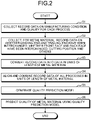
- the quality prediction method according to the present embodiment performs the processing of step S1 to step S6 illustrated in FIG. 2 .
- the quality prediction model generation method according to the present embodiment performs the processing of step S1 to step S5 excluding step S6 illustrated in FIG. 2 .
- the manufacturing record collection section 11 collects record data on a manufacturing condition and quality for each process (step S1).
- the manufacturing record collection section 11 collects the record data on the manufacturing condition and quality for each metal material and for each process.
- the record data collected by the manufacturing record collection section 11 is, for example, data in which the record values (or set values) of a plurality of manufacturing conditions are arranged by time, as illustrated in the table in FIG. 3 .
- the record data illustrated in FIG. 3 includes times t 1 , t 2 ..., the speeds of a metal material (threading speed) v 1 , v 2 ..., and a plurality of manufacturing conditions x 1 1 , x 1 2 ..., x 2 1 , x 2 2 ... measured by sensors at the respective times.
- the record data collected in the final process of a plurality of processes includes an item related to the quality of the metal material in addition to the items illustrated in the FIG. 3 .
- the leading-trailing end interchange record collection section 13, the front-back face interchange record collection section 14, and the cutting record collection section 15 collect record data on whether the leading end and the trailing end of the metal material have been interchanged in each process, whether the front face and the back face of the metal material have been interchanged in each process, and the cutting position and others of the metal material in each process (step S2).
- the manufacturing record edition section 12 then converts the record data collected by the manufacturing record collection section 11 into data in units of the length of the metal material (step S3).
- the manufacturing record edition section 12 converts the record data collected in units of time, as illustrated in FIG. 3 , into record data in units of the length of the metal material, as illustrated in FIG. 4 .
- the following describes a method of converting the record data in FIG. 3 into the record data in FIG. 4 .
- the manufacturing record edition section 12 calculates the position of the metal material at each time in FIG. 3 , using the principle that multiplying time and speed (threading speed) records in distance.
- the manufacturing record edition section 12 detects the leading end and the trailing end of the metal material using a function that record data is recorded when the metal material is passing by the sensors installed for each process, and missing values are recorded when the metal material is not passing.
- the manufacturing record edition section 12 creates record data corresponding to positions of the metal material from the leading end to the trailing end, except for the time when the metal material is not passing by the sensor.
- the data is in units of the length of the metal material, but not in a fixed cycle.
- the data is converted into record data in units of the length of the metal material and in a fixed cycle by, for example, linear interpolation.
- linear interpolation in each process, when the threading speed of the metal material is slow, the record data that can be collected becomes finer, and when the threading speed of the metal material is fast, the record data that can be collected becomes coarser. Therefore, interpolation as described above is used to align the granularity of the record data.
- the manufacturing record edition section 12 performs the above processing to create the record data in units of the length of the metal material as illustrated in FIG. 4 .
- the integrated process record edition section 16 combines the record data of all processes, aligning them in units of the length of the metal material (step S4).
- the integrated process record edition section 16 combines the record data of the manufacturing conditions and the quality of the metal material in all the processes while aligning them in units of the length of the metal material at the output side of the final process based on the record data in units of the length of the metal material created by the manufacturing record edition section 12, and the record data on whether the leading end and the trailing end of the metal material have been interchanged, whether the front face and the back face of the metal material have been interchanged, and the cutting position and others of the metal material collected by the leading-trailing end interchange record collection section 13, the front-back face interchange record collection section 14, and the cutting record collection section 15, respectively.
- the integrated process record edition section 16 associates the manufacturing conditions of each process with the quality of the metal material manufactured under these manufacturing conditions for each of predetermined areas in the length direction of the metal material, and stores them in the record database 17.
- the following describes an example of processing by the integrated process record edition section 16.
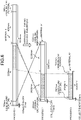
- a case is considered in which a metal material (material) is manufactured through process 1, process 2, and process 3 as illustrated in FIG. 5 .
- Processes 1 through 3 are rolling processes, for example, and the longitudinal length of the material increases with each process.
- material A is divided into material A1 and material A2 when moving from process 1 to process 2
- material A1 is divided into material A11 and material A12 when moving from process 2 to process 3.
- FIG. 6 illustrates an image of the materials in each process, focusing on part B in FIG. 5 .
- the manufacturing record collection section 11 collects record data for M1 items, for example, X 1 1 to X 1 M1 , every 50 mm in an area of 5300 mm in length from the leading end to the trailing end.
- the cutting record collection section 15 collects record data indicating that the leading end portion from 0 mm (leading end) to 250 mm has been truncated, material A1 has been taken from 250 mm to 3300 mm, material A2 has been taken from 3300 mm to 4950 mm, and the trailing end portion from 4950 mm to 5300 mm (trailing end) has been truncated.
- the leading-trailing end interchange record collection section 13 collects the record data of "the leading and trailing end interchanged".
- the manufacturing record collection section 11 collects record data for M2 items, for example, X 2 1 to X 2 M2 , every 100 mm in an area of 68000 mm in length from the leading end to the trailing end.
- the cutting record collection section 15 collects record data indicating that the leading end portion from 0 mm (leading end) to 500 mm has been truncated, material A11 has been taken from 500 mm to 34500 mm, material A12 has been taken from 34500 mm to 66800 mm, and the trailing end portion from 66800 mm to 68000 mm (trailing end) has been truncated.
- the leading-trailing end interchange record collection section 13 collects the record data of "the leading and trailing ends not interchanged".
- the manufacturing record collection section 11 collects record data for M3 items, for example, X 3 1 to X 3 M3 , every 500 mm in an area of 65000 mm in length from the leading end to the trailing end.
- the cutting record collection section 15 collects record data indicating that the leading end portion from 0 mm (leading end) to 2500 mm has been truncated, material A11 has been taken from 2500 mm to 59700 mm, and the trailing end portion from 59700 mm to 65000 mm (trailing end) has been truncated.
- the integrated process record edition section 16 scales the material lengths in process 2 and process 1 to match the material length in process 3, the final process, as illustrated in FIG. 5 (refer to the dashed line in FIG. 5 ).
- the integrated process record edition section 16 identifies the position from which each metal material was taken, while taking into account the leading end portion and the trailing end portion truncated in each process, and, for the predetermined area of each metal material in the final process, associates the quality in the predetermined area with the manufacturing conditions of all processes in that predetermined area, and stores them in the record database 17. For example, in FIG. 6 , the shaded area from which material A11 was taken in the final process, process 3, is identified back to material A1 in process 2 and material A in process 1. By repeating such processing for all metal materials, as illustrated in FIG. 7 , record data on the manufacturing conditions (and quality) of metal materials in all processes are aligned and combined in units of the length of the metal materials. The following description returns back to FIG. 2 and continues.
- the model generation section 18 generates a quality prediction model that predicts the quality of a metal material for each of predetermined areas based on the manufacturing condition for each of the predetermined areas in each process (step S4). Then, the prediction section 19 uses the quality prediction model generated by the model generation section 18 to predict the quality of a metal material manufactured under a certain manufacturing condition for each of predetermined areas (step S5).
- the quality prediction model generation method by generating a quality prediction model that associates a manufacturing condition of each process with the quality of a metal material manufactured under the manufacturing condition for each of predetermined areas, the quality of a metal material with respect to a certain manufacturing condition can be predicted more accurately than it is conventionally.
- the quality prediction model generation method, the quality prediction model, the quality prediction method, the quality prediction model generation device, and the quality prediction device combines the record data of the manufacturing condition (and quality) of all processes while aligning them in units of the length of the metal material at the output side of the final process, by taking into account, for each process, whether the leading end and the trailing end of the metal material have been interchanged, whether the front face and the back face of the metal material have been interchanged, and the cutting position and others.
- the record data of the manufacturing condition that are collected in detail in the longitudinal direction of the metal material by sensors, is effectively used to predict quality, so that the quality can be predicted with higher accuracy than it is conventionally.
- the quality prediction method according to the present embodiment is applied to a manufacturing method of a metal material, for example, the following processing is performed.
- the quality prediction method according to the present embodiment to a manufacturing method of a metal material, the final quality of the metal material can be predicted at a stage during manufacturing and a manufacturing condition can be changed accordingly, and thus the quality of the metal material to be manufactured is improved.
- the quality prediction method according to the present embodiment was applied to the prediction of tensile strength of a highly workable high-strength cold-rolled steel sheet, which is a type of cold-rolled thin steel sheet.
- the objective variable (quality) of the quality prediction in this example is the tensile strength of a product (highly workable high-strength cold-rolled steel sheet), and the explanatory variables (manufacturing conditions) are the chemical composition of the metal material in the smelting process, the temperature of the metal material in the casting process, the temperature of the metal material in the heating process, the temperature of the metal material in the hot rolling process, the temperature of the metal material in the cooling process, the temperature of the metal material in the cold rolling process, the temperature of the metal material in the annealing process, and others.
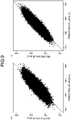
- prediction results were compared between a case where prediction was made based on a conventional record database (refer to FIG. 8(a) ) in which one representative value, such as an average value, for each manufacturing condition and each quality is stored for each product, and a case where prediction was made based on a quality prediction model generated from a record database (refer to FIG. 8(b) ) of the quality prediction method according to the present embodiment.
- the number of samples in the record database was 40000, the number of explanatory variables was 45, and the prediction method used was local regression.
- the prediction error by the quality prediction method according to the present embodiment was confirmed that the root mean square error (RMSE) can be reduced by 23% compared to the prediction error by the conventional quality prediction method (refer to FIG. 9(a) ).
- RMSE root mean square error
- the quality prediction method according to the present embodiment was also applied to the prediction of the front and back surface hardness of a thick steel sheet.
- the objective variable is the front and back surface hardness of a product
- the explanatory variables are the chemical composition in the smelting process, the front and back surface temperatures in the casting process, the front and back surface temperatures in the heating process, the front and back surface temperatures in the rolling process, the front and back surface temperatures in the cooling process, and others.
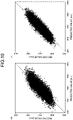
- Prediction records were compared between a case where prediction was made based on a conventional record database (refer to FIG. 8(a) ) in which one representative value, such as an average value, for each manufacturing condition and each quality is stored for each product, and a case where prediction was made based on a quality prediction model generated from a record database (refer to FIG. 8(b) ) of the quality prediction method according to the present embodiment.
- the number of samples in the record database was 10000, the number of explanatory variables was 30, and the prediction method used was linear regression.
- the prediction error by the quality prediction method according to the present embodiment was confirmed that the RMSE can be reduced by 26% compared to the prediction error by the conventional quality prediction method (refer to FIG. 10(a) ).
- the quality prediction method according to the present embodiment was also applied to the prediction of front and back surface defects of a hot-dip galvanized steel sheet, which is a type of cold-rolled thin steel sheet.
- the objective variable was the presence or absence of the front and back surface defects on the product, and the explanatory variables are the chemical composition in the smelting process, the front and back surface temperatures, the meniscus flow rate, and the molten metal surface level in the casting process, the front and back surface temperatures in the heating process, the front and back surface temperatures in the hot rolling process, the front and back surface temperatures in the cooling process, the acid concentration and acid temperature in the pickling process, the front and back surface temperatures in the cold pressing process, the front and back surface temperatures in the annealing process, the amount of plating adhesion and the degree of alloying in the plating process, and others.
- Prediction records were compared between a case where prediction was made based on a conventional record database (refer to FIG. 8(a) ) in which one representative value, such as an average value, for each manufacturing condition and each quality is stored for each product, and a case where prediction was made based on a quality prediction model generated from a record database (refer to FIG. 8(b) ) of the quality prediction method according to the present embodiment.
- the number of samples in the record database was 4,000, the number of explanatory variables was 250, and the prediction method used was decision trees.
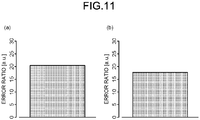
- FIG. 11 it was confirmed that the error ratio by the quality prediction method according to the present embodiment (refer to FIG. 11(b) ) can be reduced by 14% compared to the error ratio by the conventional quality prediction method (refer to FIG. 11(a) ).
- the quality prediction method according to the present embodiment was also applied to the prediction of tensile strength of a high-strength cold-rolled steel sheet, which is a type of cold-rolled thin steel sheet, and a manufacturing condition of a subsequent process was changed based on the prediction records.
- the following describes an example of changing the post-annealing cooling temperature, which is a manufacturing condition for the final stage of the cold rolling process, at a stage in manufacturing where the record values of manufacturing conditions of the steel making process, the hot rolling process, and up to a stage previous to the final stage of the rolling process have been obtained.
- the tensile strength values at positions in the total length of the product predicted using the quality prediction method according to the present embodiment are presented as follows: y ⁇ 1 , y ⁇ 2 , ⁇ y ⁇ L
- y LL and y UL are the lower and upper control limits of tensile strength, respectively, and ⁇ * is the optimal solution of this optimization problem.
- This optimization problem can be solved by a mathematical programming method such as the branch-and-bound method. By changing the cooling temperature after the annealing temperature by ⁇ *, it is possible to obtain a cold-rolled steel sheet in which the tensile strength of the entire length does not fall outside the control range, that is, there is no quality defect over the entire length.
- the record data stored in the record database of the quality prediction method according to the present embodiment can be combined in a manner that hardness or defect presence can be retroactively combined with detailed manufacturing conditions of all processes, while taking into account the record data on whether the leading end and the trailing end have been interchanged, whether the front face and the back face have been interchanged, and the cutting position and others in each predetermined area of the metal material in the final process. Then, based on the quality prediction model generated from the record database so constructed, a predicted value under a certain manufacturing condition is calculated, making it possible to predict the quality of a metal material with high accuracy.
- the quality prediction model generation method, the quality prediction model, the quality prediction method, the metal material manufacturing method, the quality prediction model generation device, and the quality prediction device according to the present invention have been described in detail in the descriptions of embodiments and examples.
- the purpose of the present invention is, however, not limited to these descriptions, and should be broadly interpreted based on the descriptions in the scope of the claims.
- various changes and modifications based on these descriptions are also included in the gist of the present invention.
- the integrated process record edition section 16 identifies a predetermined area by taking into account, for every metal material in each process, whether the leading end and the trailing end have been interchanged, whether the front face and the back face have been interchanged, and the cutting position; however, not all of the processes of interchanging the leading and trailing ends of the metal material, interchanging the front and back faces of the metal material, and cutting the metal material are necessarily included in some cases. Therefore, the integrated process record edition section 16 may identify the predetermined area by taking into account at least one or more of the record data on: whether the leading end and the trailing end of the metal material have been interchanged; whether the front face and the back face of the metal material have been interchanged; and the cutting position of the metal material.
Landscapes
- Engineering & Computer Science (AREA)
- Physics & Mathematics (AREA)
- General Physics & Mathematics (AREA)
- Chemical & Material Sciences (AREA)
- Theoretical Computer Science (AREA)
- Evolutionary Computation (AREA)
- Software Systems (AREA)
- Artificial Intelligence (AREA)
- General Engineering & Computer Science (AREA)
- Medical Informatics (AREA)
- Computer Vision & Pattern Recognition (AREA)
- Health & Medical Sciences (AREA)
- Automation & Control Theory (AREA)
- Manufacturing & Machinery (AREA)
- Business, Economics & Management (AREA)
- Quality & Reliability (AREA)
- Mechanical Engineering (AREA)
- Life Sciences & Earth Sciences (AREA)
- Crystallography & Structural Chemistry (AREA)
- Metallurgy (AREA)
- Computer Hardware Design (AREA)
- Organic Chemistry (AREA)
- Materials Engineering (AREA)
- Thermal Sciences (AREA)
- Geometry (AREA)
- General Health & Medical Sciences (AREA)
- Strategic Management (AREA)
- Human Resources & Organizations (AREA)
- Economics (AREA)
- Computing Systems (AREA)
- Mathematical Physics (AREA)
- Data Mining & Analysis (AREA)
- Pathology (AREA)
- Biochemistry (AREA)
- Food Science & Technology (AREA)
- Immunology (AREA)
- Medicinal Chemistry (AREA)
- Analytical Chemistry (AREA)
- Tourism & Hospitality (AREA)
- General Business, Economics & Management (AREA)
Abstract
Description
- The present invention relates to a quality prediction model generation method, a quality prediction model, a quality prediction method, a metal material manufacturing method, a quality prediction model generation device, and a quality prediction device.
- For methods of predicting quality with respect to certain requirement conditions, for example, there is a known method of calculating the distances between a plurality of past observed conditions stored in a record database and a desired requirement condition, calculating the weights of observed data (record data) based on the calculated distances, creating a function for fitting the neighborhood of the requirement condition based on the calculated weights, and predicting quality with respect to the requirement condition using the created function (refer to
Patent Literature 1 to 8, for example). -
- Patent Literature 1:
Japanese Patent Application Laid-open No. 2004-355189 - Patent Literature 2:
Japanese Patent Application Laid-open No. 2006-309709 - Patent Literature 3:
Japanese Patent Application Laid-open No. 2008-112288 - Patent Literature 4:
Japanese Patent Application Laid-open No. 2009-230412 - Patent Literature 5:
Japanese Patent Application Laid-open No. 2014-013560 - Patent Literature 6:
Japanese Patent Application Laid-open No. 2014-071858 - Patent Literature 7:
Japanese Patent Application Laid-open No. 2014-071859 - Patent Literature 8:
Japanese Patent Application Laid-open No. 2017-120638 - In the methods disclosed in
Patent Literature 1 to 8, quality with respect to a certain requirement condition is calculated from data stored in a record database. This record database stores therein the record values of a plurality of manufacturing conditions and the record values of the quality of a metal material manufactured under these manufacturing conditions. As each of these manufacturing conditions and quality for one metal material, one representative value such as an average value is stored. - On the other hand, record values of manufacturing conditions for each process are collected in detail in the longitudinal direction of the metal material by sensors. However, in conventional techniques, the record values of manufacturing conditions collected in such detail have not been effectively utilized, which limits the improvement in prediction accuracy of the quality of metal materials.
- The present invention has been made in consideration of the above, and it is an object of the present invention to provide a quality prediction model generation method, a quality prediction model, a quality prediction method, a metal material manufacturing method, a quality prediction model generation device, and a quality prediction device capable of predicting quality with respect to a certain manufacturing condition with high accuracy.
- In order to solve the above-described problem and achieve the object, a quality prediction model generation method according to the present invention for a metal material manufactured through one or more processes includes: a first collection step of collecting a manufacturing condition of each of the processes for each of predetermined areas of the metal material; a second collection step of evaluating and collecting quality of the metal material manufactured through each process for each of the predetermined areas; a storage step of storing the manufacturing condition of each process and the quality of the metal material manufactured under the manufacturing condition in association with each other for each of the predetermined areas; and a model generation step of generating a quality prediction model that predicts quality of the metal material for each of the predetermined areas based on the stored manufacturing condition for each of the predetermined areas in each process.
- Moreover, in the above-described quality prediction model generation method according to the present invention, each of the predetermined areas is determined based on a travel distance of the metal material in a conveyance direction in each process.
- Moreover, in the above-described quality prediction model generation method according to the present invention, before the storage step, a third collection step collects at least one or more of whether a leading end and a trailing end of the metal material have been interchanged in each process, whether a front face and a back face of the metal material have been interchanged in each process, and a cutting position of the metal material in each process, and the storage step identifies the predetermined areas by taking into account, on the metal material in each process, at least one or more of whether the leading end and the trailing end have been interchanged, whether the front face and the back face have been interchanged, and the cutting position, and stores the manufacturing condition of each process and the quality of the metal material produced under the manufacturing condition in association with each other for each of the predetermined areas.
- Moreover, in the above-described quality prediction model generation method according to the present invention, in a case where a shape of the metal material is deformed by going through each process, the storage step identifies the predetermined area by evaluating a volume of the metal material from the leading end, and stores the manufacturing condition of each process and the quality of the metal material manufactured under the manufacturing condition in association with each other for each of the predetermined areas.
- Moreover, in the above-described quality prediction model generation method according to the present invention, the model generation step generates the quality prediction model using machine learning including linear regression, local regression, principal component regression, PLS regression, a neural network, a regression tree, a random forest, and XGBoost.
- In order to solve the above-described problem and achieve the object, a quality prediction model according to the present invention is generated by the quality prediction model generation method.
- In order to solve the above-described problem and achieve the object, a quality prediction method according to the present invention includes predicting quality of a metal material manufactured under a certain manufacturing condition for each of the predetermined areas using a quality prediction model generated by the quality prediction model generation method.
- In order to solve the above-described problem and achieve the object, a metal material manufacturing method according to the present invention includes: fixing a manufacturing condition confirmed during manufacturing; predicting quality of a metal material manufactured under the fixed manufacturing condition for each of predetermined areas by the quality prediction method; and changing the manufacturing condition of a subsequent process based on a predicted result.
- Moreover, in the above-described metal material manufacturing method according to the present invention, the changing the manufacturing condition is performed such that the quality of the manufactured material in every predetermined area included over an entire length of the metal material is within a predetermined control range.
- In order to solve the above-described problem and achieve the object, a quality prediction model generation device for a metal material manufactured through one or more processes according to the present invention includes: a collecting unit configured to collect a manufacturing condition of each of the processes for each of predetermined areas of the metal material; an evaluating unit configured to evaluate and collect quality of the metal material manufactured through each process for each of the predetermined areas; a storing unit configured to store the manufacturing condition of each process and the quality of the metal material manufactured under the manufacturing condition in association with each other for each of the predetermined areas; and a generating unit configured to generate a quality prediction model that predicts quality of the metal material for each of the predetermined areas based on the stored manufacturing condition for each of the predetermined areas in each process.
- In order to solve the above-described problem and achieve the object, a quality prediction device according to the present invention is configured to predict quality of a metal material manufactured under a certain manufacturing condition for each of the predetermined areas using a quality prediction model generated by the quality prediction model generation device.
- According to the present invention, by generating a quality prediction model that associates a manufacturing condition of each process with the quality of a metal material manufactured under the manufacturing condition for each of predetermined areas, the quality of the metal material with respect to a certain manufacturing condition can be predicted more accurately than it is conventionally.
-
-
FIG. 1 is a block diagram illustrating a configuration of a quality prediction model generation device and a quality prediction device according to an embodiment of the present invention. -
FIG. 2 is a flowchart illustrating a flow of a quality prediction model generation method and a quality prediction method according to the embodiment of the present invention. -
FIG. 3 is a chart illustrating an example of record data collected by a manufacturingrecord collection section 11 in the quality prediction model generation method according to the embodiment of the present invention. -
FIG. 4 is a chart illustrating an example of record data edited by a manufacturingrecord edition section 12 in the quality prediction model generation method according to the embodiment of the present invention. -
FIG. 5 is a diagram illustrating an example case in which metal materials are manufactured through a plurality of processes in the quality prediction model generation method according to the embodiment of the present invention. -
FIG. 6 is a diagram illustrating an example of metal materials in each process in the quality prediction model generation method according to the embodiment of the present invention. -
FIG. 7 is a chart illustrating an example of record data edited by an integrated process record edition section in the quality prediction model generation method according to the embodiment of the present invention. -
FIG. 8 is a diagram schematically illustrating structures of a conventional record database and a record database of the present invention. -
FIG. 9 includes charts illustrating prediction errors of a conventional method and a method of the present invention in predicting the tensile strength of a highly workable high-strength cold-rolled steel sheet. -
FIG. 10 includes charts illustrating prediction errors of the conventional method and the method of the present invention in predicting the front and back surface hardness of a thick steel sheet. -
FIG. 11 includes charts illustrating error ratios of the conventional method and the method of the present invention in predicting the front and back surface defects of a hot-dip galvanized steel sheet. - A quality prediction model generation method, a quality prediction model, a quality prediction method, a metal material manufacturing method, a quality prediction model generation device, and a quality prediction device according to an embodiment of the present invention will be described with reference to the drawings.
- A configuration of the quality prediction device and the quality prediction model generation device according to the present embodiment will be explained with reference to
FIG. 1 . The quality prediction device is a device for predicting the quality of a metal material that is manufactured through one or more processes. Examples of a metal material in the present embodiment include a steel product, such as a semi-finished product such as a slab, and a product such as a steel sheet manufactured by rolling the slab. - A
quality prediction device 1 is, specifically, implemented by a general-purpose information processing device such as a personal computer or a workstation, and includes main components such as a processor consisting of, for example, a central processing unit (CPU), and a memory (main memory) consisting of a random access memory (RAM), a read only memory (ROM), and the like. - As illustrated in
FIG. 1 , thequality prediction device 1 includes the manufacturingrecord collection section 11, the manufacturingrecord edition section 12, a leading-trailing end interchangerecord collection section 13, a front-back face interchangerecord collection section 14, a cuttingrecord collection section 15, an integrated processrecord edition section 16, arecord database 17, amodel generation section 18, and aprediction section 19. Note that the quality prediction model generation device according to the present embodiment includes the elements of thequality prediction device 1 excluding theprediction section 19. The following also describes the quality prediction model generation device in the description of thequality prediction device 1. - A sensor, not illustrated in the drawings, is connected to the manufacturing
record collection section 11. The manufacturingrecord collection section 11 collects a manufacturing record of each process according to the measurement cycle of the sensor, and outputs the record to the integrated processrecord edition section 16. The aforementioned "manufacturing record" includes a manufacturing condition of each process and the quality of a metal material manufactured through each process. Examples of the aforementioned "manufacturing condition" include the composition, temperature, pressure, plate thickness, and threading speed of the metal material in each process. In addition, examples of the aforementioned "quality of metal material" include tensile strength and defect contamination rate (the number of defects appearing per unit length). - A manufacturing condition of each process collected by the manufacturing
record collection section 11 includes not only an actual measured value of the manufacturing condition measured by the sensor, but also a preset value of the manufacturing condition. In other words, no sensor may be installed in some processes. In such cases, a set value is collected as a manufacturing record instead of a record value. - The manufacturing
record collection section 11 collects a manufacturing condition of each process for each of predetermined areas of the metal material. In addition, the manufacturingrecord collection section 11 evaluates and collects the quality of the metal material manufactured through each process for each of the predetermined areas described above. The "predetermined area" mentioned above refers to a certain area in the longitudinal direction of a metal material when the metal material is a slab or steel sheet, for example. This predetermined area is determined based on the travel distance (threading speed) of the metal material based on the conveyance direction in each process. Specific processing by the manufacturingrecord collection section 11 will be described later (refer toFIG. 2 ). - In the configuration illustrated in
FIG. 1 , only one manufacturingrecord collection section 11 is provided, and the premise is that the data on the manufacturing record of each process (hereinafter referred to as "record data") is collected by this one manufacturingrecord collection section 11. For example, however, a plurality of manufacturingrecord collection sections 11 may be provided to match the number of processes, and the record data of the processes may be collected by the respective manufacturingrecord collection sections 11. - The manufacturing
record edition section 12 edits the record data of each process input from the manufacturingrecord collection section 11. In other words, the manufacturingrecord edition section 12 edits the record data collected in units of time by the manufacturingrecord collection section 11 into record data in units of the length of the metal material, and outputs the data to the integrated processrecord edition section 16. Specific processing by the manufacturingrecord edition section 12 will be described later (refer toFIG. 2 ) . - A material loading machine for loading the metal material in each process, which is not illustrated in the drawings, is connected to the leading-trailing end interchange
record collection section 13. Through the material loading machine, the leading-trailing end interchangerecord collection section 13 collects record data on whether the leading end and the trailing end of the metal material have been interchanged (reversed) when the metal material from a previous process is loaded for a subsequent process. Then, the leading-trailing end interchangerecord collection section 13 outputs, to the integrated processrecord edition section 16, the record data on whether the leading end and the trailing end of the metal material have been interchanged. - The material loading machine described above is connected to the front-back face interchange
record collection section 14. Through the material loading machine, the front-back face interchangerecord collection section 14 collects record data on whether the front face and the back face of the metal material have been interchanged (reversed) when the metal material from a previous process is loaded for a subsequent process. Then, the front-back face interchangerecord collection section 14 outputs, to the integrated processrecord edition section 16, the record data on whether the front face and the back face of the metal material have been interchanged. - A cutting machine for cutting the leading end portion and the trailing end portion of the metal material, which is not illustrated in the drawings, is connected to the cutting
record collection section 15. Through the cutting machine, the cuttingrecord collection section 15 collects record data such as a cutting position (distance from the leading end of the metal material at the time of cutting) and the number of cuts (hereinafter referred to as "cutting position and others") for each metal material. The cuttingrecord collection section 15 then outputs the record data on the cutting position and others of the metal material to the integrated processrecord edition section 16. - As with the aforementioned manufacturing
record collection section 11, only one of each of the leading-trailing end interchangerecord collection section 13, the front-back face interchangerecord collection section 14, and the cuttingrecord collection section 15 may be provided, or a plurality of each of these sections may be provided to match the number of processes. - The integrated process
record edition section 16 edits the record data input from the manufacturingrecord edition section 12, the leading-trailing end interchangerecord collection section 13, the front-back face interchangerecord collection section 14, and the cuttingrecord collection section 15. The integrated processrecord edition section 16 stores, in therecord database 17, the manufacturing condition of each process and the quality of the metal material manufactured under this manufacturing condition in association with each other for each of the predetermined areas. - The integrated process
record edition section 16 identifies a predetermined area while taking into account, for every metal material in each process, whether the leading end and the trailing end have been interchanged, whether the front face and the back face have been interchanged, and the cutting position. The integrated processrecord edition section 16 then stores, in therecord database 17, the manufacturing condition of each process and the quality of the metal material manufactured under this manufacturing condition in association with each other for each of the predetermined areas in a form that is able to distinguish, for the material in each process, whether the leading end and the trailing end have been interchanged, whether the front face and the back face have been interchanged, and the cutting position. - Furthermore, when each process is a rolling process, for example, and the shape of a metal material is deformed as it goes through each process, the integrated process
record edition section 16 identifies a predetermined area by evaluating the volume of the metal material from the leading end, and stores, in therecord database 17, the manufacturing condition of each process and the quality of the metal material manufactured under this manufacturing condition in association with each other for each of the predetermined areas. Thisrecord database 17 stores therein the record data edited by the integrated processrecord edition section 16. - The
model generation section 18 generates a quality prediction model that predicts the quality of a metal material for each of predetermined areas based on the manufacturing condition for each of the predetermined areas in each process stored in therecord database 17. Themodel generation section 18 uses, for example, XGBoost as a machine learning method. Various other methods of machine learning can be used, such as linear regression, local regression, principal component regression, PLS regression, a neural network, a regression tree, and a random forest. - The
prediction section 19 uses the quality prediction model generated by themodel generation section 18 to predict the quality of a metal material manufactured under a certain manufacturing condition for each of predetermined areas. For example, when the metal material to be predicted is a slab, while conventional methods predict the quality of the entire slab, the present embodiment can predict the quality of the slab for each of predetermined areas in the length direction. - A quality prediction method and a quality prediction model generation method according to the present embodiment will be explained with reference to
FIG. 2 to FIG. 7 . The quality prediction method according to the present embodiment performs the processing of step S1 to step S6 illustrated inFIG. 2 . The quality prediction model generation method according to the present embodiment performs the processing of step S1 to step S5 excluding step S6 illustrated inFIG. 2 . - First, the manufacturing
record collection section 11 collects record data on a manufacturing condition and quality for each process (step S1). The manufacturingrecord collection section 11 collects the record data on the manufacturing condition and quality for each metal material and for each process. - The record data collected by the manufacturing
record collection section 11 is, for example, data in which the record values (or set values) of a plurality of manufacturing conditions are arranged by time, as illustrated in the table inFIG. 3 . The record data illustrated inFIG. 3 includes times t1, t2..., the speeds of a metal material (threading speed) v1, v2..., and a plurality of manufacturing conditions x1 1, x1 2..., x2 1, x2 2... measured by sensors at the respective times. The record data collected in the final process of a plurality of processes includes an item related to the quality of the metal material in addition to the items illustrated in theFIG. 3 . - Then, the leading-trailing end interchange
record collection section 13, the front-back face interchangerecord collection section 14, and the cuttingrecord collection section 15 collect record data on whether the leading end and the trailing end of the metal material have been interchanged in each process, whether the front face and the back face of the metal material have been interchanged in each process, and the cutting position and others of the metal material in each process (step S2). - The manufacturing
record edition section 12 then converts the record data collected by the manufacturingrecord collection section 11 into data in units of the length of the metal material (step S3). In other words, the manufacturingrecord edition section 12 converts the record data collected in units of time, as illustrated inFIG. 3 , into record data in units of the length of the metal material, as illustrated inFIG. 4 . The following describes a method of converting the record data inFIG. 3 into the record data inFIG. 4 . - First, the manufacturing
record edition section 12 calculates the position of the metal material at each time inFIG. 3 , using the principle that multiplying time and speed (threading speed) records in distance. Next, the manufacturingrecord edition section 12 detects the leading end and the trailing end of the metal material using a function that record data is recorded when the metal material is passing by the sensors installed for each process, and missing values are recorded when the metal material is not passing. Next, the manufacturingrecord edition section 12 creates record data corresponding to positions of the metal material from the leading end to the trailing end, except for the time when the metal material is not passing by the sensor. - The data, as it is, is in units of the length of the metal material, but not in a fixed cycle. Thus, the data is converted into record data in units of the length of the metal material and in a fixed cycle by, for example, linear interpolation. In other words, in each process, when the threading speed of the metal material is slow, the record data that can be collected becomes finer, and when the threading speed of the metal material is fast, the record data that can be collected becomes coarser. Therefore, interpolation as described above is used to align the granularity of the record data. The manufacturing
record edition section 12 performs the above processing to create the record data in units of the length of the metal material as illustrated inFIG. 4 . - Then, the integrated process
record edition section 16 combines the record data of all processes, aligning them in units of the length of the metal material (step S4). The integrated processrecord edition section 16 combines the record data of the manufacturing conditions and the quality of the metal material in all the processes while aligning them in units of the length of the metal material at the output side of the final process based on the record data in units of the length of the metal material created by the manufacturingrecord edition section 12, and the record data on whether the leading end and the trailing end of the metal material have been interchanged, whether the front face and the back face of the metal material have been interchanged, and the cutting position and others of the metal material collected by the leading-trailing end interchangerecord collection section 13, the front-back face interchangerecord collection section 14, and the cuttingrecord collection section 15, respectively. - In this way, the integrated process
record edition section 16 associates the manufacturing conditions of each process with the quality of the metal material manufactured under these manufacturing conditions for each of predetermined areas in the length direction of the metal material, and stores them in therecord database 17. The following describes an example of processing by the integrated processrecord edition section 16. - For example, a case is considered in which a metal material (material) is manufactured through
process 1,process 2, andprocess 3 as illustrated inFIG. 5 .Processes 1 through 3 are rolling processes, for example, and the longitudinal length of the material increases with each process. As illustrated inFIG. 5 , material A is divided into material A1 and material A2 when moving fromprocess 1 toprocess 2, and material A1 is divided into material A11 and material A12 when moving fromprocess 2 toprocess 3. -
FIG. 6 illustrates an image of the materials in each process, focusing on part B inFIG. 5 . For example, for material A inprocess 1, the manufacturingrecord collection section 11 collects record data for M1 items, for example, X1 1 to X1 M1, every 50 mm in an area of 5300 mm in length from the leading end to the trailing end. For material A, the cuttingrecord collection section 15 collects record data indicating that the leading end portion from 0 mm (leading end) to 250 mm has been truncated, material A1 has been taken from 250 mm to 3300 mm, material A2 has been taken from 3300 mm to 4950 mm, and the trailing end portion from 4950 mm to 5300 mm (trailing end) has been truncated. - Then, for material A1 in
process 2, the leading-trailing end interchangerecord collection section 13 collects the record data of "the leading and trailing end interchanged". For material A1, the manufacturingrecord collection section 11 collects record data for M2 items, for example, X2 1 to X2 M2, every 100 mm in an area of 68000 mm in length from the leading end to the trailing end. For material A1, the cuttingrecord collection section 15 collects record data indicating that the leading end portion from 0 mm (leading end) to 500 mm has been truncated, material A11 has been taken from 500 mm to 34500 mm, material A12 has been taken from 34500 mm to 66800 mm, and the trailing end portion from 66800 mm to 68000 mm (trailing end) has been truncated. - Then, for material A11 in
process 3, the leading-trailing end interchangerecord collection section 13 collects the record data of "the leading and trailing ends not interchanged". For material A11, the manufacturingrecord collection section 11 collects record data for M3 items, for example, X3 1 to X3 M3, every 500 mm in an area of 65000 mm in length from the leading end to the trailing end. For material A11, the cuttingrecord collection section 15 collects record data indicating that the leading end portion from 0 mm (leading end) to 2500 mm has been truncated, material A11 has been taken from 2500 mm to 59700 mm, and the trailing end portion from 59700 mm to 65000 mm (trailing end) has been truncated. - In order to combine the record data of all processes, which are collected in detail in the longitudinal direction by sensors not illustrated in the drawings, in units of the length of the metal materials in the final process, while taking into account, for every metal material in each process, the record data on whether the leading end and the trailing end have been interchanged, whether the front face and the back face have been interchanged, and the cutting position and others, the integrated process
record edition section 16 scales the material lengths inprocess 2 andprocess 1 to match the material length inprocess 3, the final process, as illustrated inFIG. 5 (refer to the dashed line inFIG. 5 ). - The integrated process
record edition section 16 then identifies the position from which each metal material was taken, while taking into account the leading end portion and the trailing end portion truncated in each process, and, for the predetermined area of each metal material in the final process, associates the quality in the predetermined area with the manufacturing conditions of all processes in that predetermined area, and stores them in therecord database 17. For example, inFIG. 6 , the shaded area from which material A11 was taken in the final process,process 3, is identified back to material A1 inprocess 2 and material A inprocess 1. By repeating such processing for all metal materials, as illustrated inFIG. 7 , record data on the manufacturing conditions (and quality) of metal materials in all processes are aligned and combined in units of the length of the metal materials. The following description returns back toFIG. 2 and continues. - The
model generation section 18 generates a quality prediction model that predicts the quality of a metal material for each of predetermined areas based on the manufacturing condition for each of the predetermined areas in each process (step S4). Then, theprediction section 19 uses the quality prediction model generated by themodel generation section 18 to predict the quality of a metal material manufactured under a certain manufacturing condition for each of predetermined areas (step S5). - According to the quality prediction model generation method, the quality prediction model, the quality prediction method, the quality prediction model generation device, and the quality prediction device according to the present embodiment as described above, by generating a quality prediction model that associates a manufacturing condition of each process with the quality of a metal material manufactured under the manufacturing condition for each of predetermined areas, the quality of a metal material with respect to a certain manufacturing condition can be predicted more accurately than it is conventionally.
- In other words, the quality prediction model generation method, the quality prediction model, the quality prediction method, the quality prediction model generation device, and the quality prediction device according to the present embodiment combines the record data of the manufacturing condition (and quality) of all processes while aligning them in units of the length of the metal material at the output side of the final process, by taking into account, for each process, whether the leading end and the trailing end of the metal material have been interchanged, whether the front face and the back face of the metal material have been interchanged, and the cutting position and others. Thus, the record data of the manufacturing condition that are collected in detail in the longitudinal direction of the metal material by sensors, is effectively used to predict quality, so that the quality can be predicted with higher accuracy than it is conventionally.
- When the quality prediction method according to the present embodiment is applied to a manufacturing method of a metal material, for example, the following processing is performed. First, a manufacturing condition confirmed during manufacturing of the metal material is fixed, and then the quality of the metal material manufactured under the fixed manufacturing condition is predicted for each of predetermined areas by the quality prediction method according to the present embodiment. Second, the manufacturing condition of a subsequent process is then changed based on the predicted results. The manufacturing condition is changed such that the quality of the manufactured metal material in every predetermined area included over the entire length of the metal material is within a predetermined control range. Thus, by applying the quality prediction method according to the present embodiment to a manufacturing method of a metal material, the final quality of the metal material can be predicted at a stage during manufacturing and a manufacturing condition can be changed accordingly, and thus the quality of the metal material to be manufactured is improved.
- Examples of the quality prediction method according to the present embodiment will be explained. In an example, the quality prediction method according to the present embodiment was applied to the prediction of tensile strength of a highly workable high-strength cold-rolled steel sheet, which is a type of cold-rolled thin steel sheet.
- The objective variable (quality) of the quality prediction in this example is the tensile strength of a product (highly workable high-strength cold-rolled steel sheet), and the explanatory variables (manufacturing conditions) are the chemical composition of the metal material in the smelting process, the temperature of the metal material in the casting process, the temperature of the metal material in the heating process, the temperature of the metal material in the hot rolling process, the temperature of the metal material in the cooling process, the temperature of the metal material in the cold rolling process, the temperature of the metal material in the annealing process, and others.
- In this example, prediction results were compared between a case where prediction was made based on a conventional record database (refer to
FIG. 8(a) ) in which one representative value, such as an average value, for each manufacturing condition and each quality is stored for each product, and a case where prediction was made based on a quality prediction model generated from a record database (refer toFIG. 8(b) ) of the quality prediction method according to the present embodiment. The number of samples in the record database was 40000, the number of explanatory variables was 45, and the prediction method used was local regression. As a record of the prediction, as illustrated inFIG. 9 , the prediction error by the quality prediction method according to the present embodiment (refer toFIG. 9(b) ) was confirmed that the root mean square error (RMSE) can be reduced by 23% compared to the prediction error by the conventional quality prediction method (refer toFIG. 9(a) ). - The quality prediction method according to the present embodiment was also applied to the prediction of the front and back surface hardness of a thick steel sheet. The objective variable is the front and back surface hardness of a product, and the explanatory variables are the chemical composition in the smelting process, the front and back surface temperatures in the casting process, the front and back surface temperatures in the heating process, the front and back surface temperatures in the rolling process, the front and back surface temperatures in the cooling process, and others.
- Prediction records were compared between a case where prediction was made based on a conventional record database (refer to
FIG. 8(a) ) in which one representative value, such as an average value, for each manufacturing condition and each quality is stored for each product, and a case where prediction was made based on a quality prediction model generated from a record database (refer toFIG. 8(b) ) of the quality prediction method according to the present embodiment. The number of samples in the record database was 10000, the number of explanatory variables was 30, and the prediction method used was linear regression. As a record of the prediction, as illustrated inFIG. 10 , the prediction error by the quality prediction method according to the present embodiment (refer toFIG. 10(b) ) was confirmed that the RMSE can be reduced by 26% compared to the prediction error by the conventional quality prediction method (refer toFIG. 10(a) ). - The quality prediction method according to the present embodiment was also applied to the prediction of front and back surface defects of a hot-dip galvanized steel sheet, which is a type of cold-rolled thin steel sheet. The objective variable was the presence or absence of the front and back surface defects on the product, and the explanatory variables are the chemical composition in the smelting process, the front and back surface temperatures, the meniscus flow rate, and the molten metal surface level in the casting process, the front and back surface temperatures in the heating process, the front and back surface temperatures in the hot rolling process, the front and back surface temperatures in the cooling process, the acid concentration and acid temperature in the pickling process, the front and back surface temperatures in the cold pressing process, the front and back surface temperatures in the annealing process, the amount of plating adhesion and the degree of alloying in the plating process, and others.
- Prediction records were compared between a case where prediction was made based on a conventional record database (refer to
FIG. 8(a) ) in which one representative value, such as an average value, for each manufacturing condition and each quality is stored for each product, and a case where prediction was made based on a quality prediction model generated from a record database (refer toFIG. 8(b) ) of the quality prediction method according to the present embodiment. The number of samples in the record database was 4,000, the number of explanatory variables was 250, and the prediction method used was decision trees. As a record of the prediction, as illustrated inFIG. 11 , it was confirmed that the error ratio by the quality prediction method according to the present embodiment (refer toFIG. 11(b) ) can be reduced by 14% compared to the error ratio by the conventional quality prediction method (refer toFIG. 11(a) ). - The quality prediction method according to the present embodiment was also applied to the prediction of tensile strength of a high-strength cold-rolled steel sheet, which is a type of cold-rolled thin steel sheet, and a manufacturing condition of a subsequent process was changed based on the prediction records. The following describes an example of changing the post-annealing cooling temperature, which is a manufacturing condition for the final stage of the cold rolling process, at a stage in manufacturing where the record values of manufacturing conditions of the steel making process, the hot rolling process, and up to a stage previous to the final stage of the rolling process have been obtained.
- On the basis of the record values of the manufacturing conditions of the steel making process, the hot rolling process, and up to the stage previous to the final stage of the cold rolling process, and a reference value of the post-annealing cooling temperature, which is a manufacturing condition for the final stage of the cold rolling process, the tensile strength values at positions in the total length of the product predicted using the quality prediction method according to the present embodiment are presented as follows:

- When the cooling temperature after the annealing temperature changes by Δµ from the reference value, the amounts of change in tensile strength at the positions in the total length of the product predicted using the quality prediction method according to the present embodiment are presented as follows:

- On the basis of the above, the optimization problem expressed in the following equation (1) is solved:

- Here, in the above equation (1), yLL and yUL are the lower and upper control limits of tensile strength, respectively, and Δµ* is the optimal solution of this optimization problem. This optimization problem can be solved by a mathematical programming method such as the branch-and-bound method. By changing the cooling temperature after the annealing temperature by Δµ*, it is possible to obtain a cold-rolled steel sheet in which the tensile strength of the entire length does not fall outside the control range, that is, there is no quality defect over the entire length.
- As described above, the record data stored in the record database of the quality prediction method according to the present embodiment can be combined in a manner that hardness or defect presence can be retroactively combined with detailed manufacturing conditions of all processes, while taking into account the record data on whether the leading end and the trailing end have been interchanged, whether the front face and the back face have been interchanged, and the cutting position and others in each predetermined area of the metal material in the final process. Then, based on the quality prediction model generated from the record database so constructed, a predicted value under a certain manufacturing condition is calculated, making it possible to predict the quality of a metal material with high accuracy.
- The quality prediction model generation method, the quality prediction model, the quality prediction method, the metal material manufacturing method, the quality prediction model generation device, and the quality prediction device according to the present invention have been described in detail in the descriptions of embodiments and examples. The purpose of the present invention is, however, not limited to these descriptions, and should be broadly interpreted based on the descriptions in the scope of the claims. In addition, it goes without saying that various changes and modifications based on these descriptions are also included in the gist of the present invention.
- For example, in the aforementioned embodiment, the integrated process
record edition section 16 identifies a predetermined area by taking into account, for every metal material in each process, whether the leading end and the trailing end have been interchanged, whether the front face and the back face have been interchanged, and the cutting position; however, not all of the processes of interchanging the leading and trailing ends of the metal material, interchanging the front and back faces of the metal material, and cutting the metal material are necessarily included in some cases. Therefore, the integrated processrecord edition section 16 may identify the predetermined area by taking into account at least one or more of the record data on: whether the leading end and the trailing end of the metal material have been interchanged; whether the front face and the back face of the metal material have been interchanged; and the cutting position of the metal material. -
- 1
- quality prediction device
- 11
- manufacturing record collection section
- 12
- manufacturing record edition section
- 13
- leading-trailing end interchange record collection section
- 14
- front-back face interchange record collection section
- 15
- cutting record collection section
- 16
- integrated process record edition section
- 17
- record database
- 18
- model generation section
- 19
- prediction section
Claims (11)
- A quality prediction model generation method for a metal material manufactured through one or more processes, the method comprising:a first collection step of collecting a manufacturing condition of each of the processes for each of predetermined areas of the metal material;a second collection step of evaluating and collecting quality of the metal material manufactured through each process for each of the predetermined areas;a storage step of storing the manufacturing condition of each process and the quality of the metal material manufactured under the manufacturing condition in association with each other for each of the predetermined areas; anda model generation step of generating a quality prediction model that predicts quality of the metal material for each of the predetermined areas based on the stored manufacturing condition for each of the predetermined areas in each process.
- The quality prediction model generation method according to claim 1, wherein each of the predetermined areas is determined based on a travel distance of the metal material in a conveyance direction in each process.
- The quality prediction model generation method according to claim 1 or 2, comprising, before the storage step, a third collection step of collecting at least one or more of whether a leading end and a trailing end of the metal material have been interchanged in each process, whether a front face and a back face of the metal material have been interchanged in each process, and a cutting position of the metal material in each process, wherein
the storage step identifies the predetermined areas by taking into account, on the metal material in each process, at least one or more of whether the leading end and the trailing end have been interchanged, whether the front face and the back face have been interchanged, and the cutting position, and stores the manufacturing condition of each process and the quality of the metal material produced under the manufacturing condition in association with each other for each of the predetermined areas. - The quality prediction model generation method according to claim 1 or 2, whereinin a case where a shape of the metal material is deformed by going through each process,the storage step identifies the predetermined area by evaluating a volume of the metal material from the leading end, and stores the manufacturing condition of each process and the quality of the metal material manufactured under the manufacturing condition in association with each other for each of the predetermined areas.
- The quality prediction model generation method according to claim 1 or 2, wherein the model generation step generates the quality prediction model using machine learning including linear regression, local regression, principal component regression, PLS regression, a neural network, a regression tree, a random forest, and XGBoost.
- A quality prediction model generated by the quality prediction model generation method according to any one of claims 1 to 5.
- A quality prediction method comprising
predicting quality of a metal material manufactured under a certain manufacturing condition for each of the predetermined areas using a quality prediction model generated by the quality prediction model generation method according to any one of claims 1 to 5. - A metal material manufacturing method comprising:fixing a manufacturing condition confirmed during manufacturing;predicting quality of a metal material manufactured under the fixed manufacturing condition for each of predetermined areas by the quality prediction method according to claim 7; andchanging the manufacturing condition of a subsequent process based on a predicted result.
- The metal material manufacturing method according to claim 8, wherein the changing the manufacturing condition is performed such that the quality of the manufactured material in every predetermined area included over an entire length of the metal material is within a predetermined control range.
- A quality prediction model generation device for a metal material manufactured through one or more processes, the device comprising:a collecting unit configured to collect a manufacturing condition of each of the processes for each of predetermined areas of the metal material;an evaluating unit configured to evaluate and collect quality of the metal material manufactured through each process for each of the predetermined areas;a storing unit configured to store the manufacturing condition of each process and the quality of the metal material manufactured under the manufacturing condition in association with each other for each of the predetermined areas; anda generating unit configured to generate a quality prediction model that predicts quality of the metal material for each of the predetermined areas based on the stored manufacturing condition for each of the predetermined areas in each process.
- A quality prediction device configured to predict quality of a metal material manufactured under a certain manufacturing condition for each of the predetermined areas using a quality prediction model generated by the quality prediction model generation device according to claim 10.
Applications Claiming Priority (2)
| Application Number | Priority Date | Filing Date | Title |
|---|---|---|---|
| JP2019134701 | 2019-07-22 | ||
| PCT/JP2020/022637 WO2021014804A1 (en) | 2019-07-22 | 2020-06-09 | Method for generating quality prediction model, quality prediction model, quality prediction method, method for manufacturing metal material, device for generating quality prediction model, and quality prediction device |
Publications (2)
| Publication Number | Publication Date |
|---|---|
| EP4006670A1 true EP4006670A1 (en) | 2022-06-01 |
| EP4006670A4 EP4006670A4 (en) | 2022-09-14 |
Family
ID=74193371
Family Applications (1)
| Application Number | Title | Priority Date | Filing Date |
|---|---|---|---|
| EP20844507.2A Pending EP4006670A4 (en) | 2019-07-22 | 2020-06-09 | QUALITY PREDICTION MODEL PRODUCING METHOD, QUALITY PREDICTION MODEL, QUALITY PREDICTION METHOD, METALLIC MATERIAL MANUFACTURING METHOD, QUALITY PREDICTION MODEL PRODUCING DEVICE AND QUALITY PREDICTION DEVICE |
Country Status (8)
| Country | Link |
|---|---|
| US (1) | US20220261520A1 (en) |
| EP (1) | EP4006670A4 (en) |
| JP (1) | JP7207547B2 (en) |
| KR (2) | KR102939974B1 (en) |
| CN (1) | CN114144738B (en) |
| MX (1) | MX2022000808A (en) |
| TW (1) | TWI759770B (en) |
| WO (1) | WO2021014804A1 (en) |
Families Citing this family (15)
| Publication number | Priority date | Publication date | Assignee | Title |
|---|---|---|---|---|
| JP7610102B2 (en) * | 2021-01-12 | 2025-01-08 | 日本製鉄株式会社 | Prediction device, learning device, prediction program, and learning program |
| BR112023019829A2 (en) * | 2021-04-05 | 2023-11-07 | Jfe Steel Corp | STEEL TUBE LOSS OF CIRCULARITY PREDICTION METHOD, STEEL TUBE LOSS OF CIRCULARITY CONTROL METHOD, STEEL TUBE MANUFACTURE METHOD, STEEL TUBE LOSS OF CIRCULARITY PREDICTION MODEL GENERATION METHOD AND DEVICE PREDICTION OF LOSS OF CIRCULARITY OF STEEL TUBE |
| MX2023015324A (en) | 2021-06-25 | 2024-01-23 | Jfe Steel Corp | Steel sheet non-plating defect prediction method, steel sheet defect reduction method, method for manufacturing hot-dip galvanized steel sheet, and method for generating steel sheet non-plating defect prediction model. |
| JP7544000B2 (en) * | 2021-08-19 | 2024-09-03 | Jfeスチール株式会社 | Quality defect cause extraction method and quality defect cause extraction device |
| JP7493128B2 (en) * | 2021-08-19 | 2024-05-31 | Jfeスチール株式会社 | Operation condition presentation method and operation condition presentation device |
| JP7484845B2 (en) * | 2021-08-19 | 2024-05-16 | Jfeスチール株式会社 | Quality prediction model creation method, quality prediction method, operation condition presentation method, quality prediction model creation device, quality prediction device, and operation condition presentation device |
| CN114595623A (en) * | 2021-12-30 | 2022-06-07 | 华能上海燃机发电有限责任公司 | A method and system for predicting the reference value of unit equipment based on XGBoost algorithm |
| EP4276550A1 (en) * | 2022-05-12 | 2023-11-15 | Primetals Technologies Austria GmbH | Method and computer system for controlling a process of a metallurgical plant |
| JP2024011327A (en) * | 2022-07-14 | 2024-01-25 | 日本製鉄株式会社 | Prediction device, learning device, prediction program, and learning program |
| CN117631613A (en) * | 2022-08-24 | 2024-03-01 | 上海宝信软件股份有限公司 | Integrated ironmaking batching method with configurable process flow and process prediction models |
| EP4339715A1 (en) * | 2022-09-13 | 2024-03-20 | Siempelkamp Maschinen- und Anlagenbau GmbH | Method for generating a mathematical model for predicting at least one quality characteristic of a building material board |
| CN116757031B (en) * | 2023-06-15 | 2024-02-09 | 中南大学 | Multi-factor analysis method and device for influencing metal-metal bonding performance |
| WO2025115302A1 (en) | 2023-11-27 | 2025-06-05 | Jfeスチール株式会社 | Quality prediction model generation method, metal material quality prediction method, metal material manufacturing method, metal material manufacturing condition presentation method, quality prediction model generation device, metal material quality prediction device, metal material manufacturing condition presentation device, and metal material manufacturing system |
| JP7715316B1 (en) * | 2024-04-08 | 2025-07-30 | Jfeスチール株式会社 | METALLIC MATERIAL QUALITY PREDICTION MODEL GENERATION METHOD, METALLIC MATERIAL QUALITY PREDICTION METHOD, METALLIC MATERIAL MANUFACTURING METHOD, QUALITY PREDICTION MODEL GENERATION METHOD, DATA PROCESSING METHOD, METALLIC MATERIAL QUALITY PREDICTION MODEL GENERATION DEVICE, METALLIC MATERIAL QUALITY PREDICTION DEVICE AND DATA PROCESSING DEVICE |
| WO2025215895A1 (en) * | 2024-04-08 | 2025-10-16 | Jfeスチール株式会社 | Metal material quality prediction model generation method, metal material quality prediction method, metal material manufacturing method, quality prediction model generation method, data processing method, metal material quality prediction model generation device, metal material quality prediction device, and data processing device |
Family Cites Families (66)
| Publication number | Priority date | Publication date | Assignee | Title |
|---|---|---|---|---|
| EP0865890A4 (en) * | 1996-08-08 | 1999-05-26 | Bridgestone Corp | Method of designing multicomponent material, optimization analyzer and storage medium on which multicomponent material optimization analysis program is recorded |
| TW567132B (en) | 2000-06-08 | 2003-12-21 | Mirle Automation Corp | Intelligent control method for injection molding machine |
| JP2002157282A (en) * | 2000-11-20 | 2002-05-31 | Toshiba Corp | Method and apparatus for estimating man-hours and storage medium |
| JP4477269B2 (en) | 2001-12-28 | 2010-06-09 | Jfeスチール株式会社 | Method and system for removing defective front and rear end portions of coil material |
| JP4474847B2 (en) | 2003-05-28 | 2010-06-09 | Jfeスチール株式会社 | Result prediction device |
| JP4495960B2 (en) * | 2003-12-26 | 2010-07-07 | キヤノンItソリューションズ株式会社 | Model creation device for the relationship between process and quality |
| TWI267012B (en) * | 2004-06-03 | 2006-11-21 | Univ Nat Cheng Kung | Quality prognostics system and method for manufacturing processes |
| CN1913984B (en) * | 2004-10-14 | 2012-10-10 | 东芝三菱电机产业系统株式会社 | Method of controlling material quality on rolling, forging or straightening line, and apparatus therefor |
| JP2006309709A (en) | 2005-03-30 | 2006-11-09 | Jfe Steel Kk | Result prediction device, control device and quality design device |
| KR100709000B1 (en) * | 2005-10-04 | 2007-04-18 | 주식회사 포스코 | On-line prediction system of stainless steel casting quality and predictive method using the same |
| JP4681426B2 (en) * | 2005-11-15 | 2011-05-11 | 新日本製鐵株式会社 | Apparatus and method for analyzing relation between operation and quality in manufacturing process, computer program, and computer-readable recording medium |
| WO2007080688A1 (en) * | 2006-01-13 | 2007-07-19 | Jfe Steel Corporation | Prediction formula making device and prediction formula making method |
| JP2008112288A (en) | 2006-10-30 | 2008-05-15 | Jfe Steel Kk | Prediction formula creation device, result prediction device, quality design device, prediction formula creation method, and product manufacturing method |
| JP4966826B2 (en) * | 2007-11-09 | 2012-07-04 | 株式会社日立製作所 | Winding temperature control device and control method |
| JP5167891B2 (en) | 2008-03-21 | 2013-03-21 | Jfeスチール株式会社 | Result prediction apparatus and product quality prediction method using the same |
| US8137483B2 (en) * | 2008-05-20 | 2012-03-20 | Fedchun Vladimir A | Method of making a low cost, high strength, high toughness, martensitic steel |
| JP5516390B2 (en) * | 2010-12-24 | 2014-06-11 | 新日鐵住金株式会社 | Quality prediction apparatus, quality prediction method, program, and computer-readable recording medium |
| EP2520992B1 (en) * | 2011-05-02 | 2014-04-16 | Autoform Engineering GmbH | Method and computer system for characterizing a sheet metal part |
| JP5867349B2 (en) * | 2011-09-21 | 2016-02-24 | 新日鐵住金株式会社 | Quality prediction apparatus, operation condition determination method, quality prediction method, computer program, and computer-readable storage medium |
| JP5382104B2 (en) * | 2011-12-20 | 2014-01-08 | Jfeスチール株式会社 | Panel evaluation method |
| US9275334B2 (en) * | 2012-04-06 | 2016-03-01 | Applied Materials, Inc. | Increasing signal to noise ratio for creation of generalized and robust prediction models |
| JP5979066B2 (en) | 2012-06-04 | 2016-08-24 | Jfeスチール株式会社 | Result prediction apparatus and result prediction method |
| JP2014071858A (en) | 2012-10-02 | 2014-04-21 | Jfe Steel Corp | Result prediction method and result prediction device |
| JP2014071859A (en) | 2012-10-02 | 2014-04-21 | Jfe Steel Corp | Result prediction method and result prediction device |
| GB201302743D0 (en) * | 2013-02-18 | 2013-04-03 | Rolls Royce Plc | Method and system for designing a material |
| WO2015054637A1 (en) * | 2013-10-10 | 2015-04-16 | Scoperta, Inc. | Methods of selecting material compositions and designing materials having a target property |
| US9274036B2 (en) * | 2013-12-13 | 2016-03-01 | King Fahd University Of Petroleum And Minerals | Method and apparatus for characterizing composite materials using an artificial neural network |
| DE102014224461A1 (en) * | 2014-01-22 | 2015-07-23 | Sms Siemag Ag | Process for the optimized production of metallic steel and iron alloys in hot rolling and heavy plate mills by means of a microstructure simulator, monitor and / or model |
| US20160034614A1 (en) * | 2014-08-01 | 2016-02-04 | GM Global Technology Operations LLC | Materials property predictor for cast aluminum alloys |
| WO2016038705A1 (en) * | 2014-09-10 | 2016-03-17 | 東芝三菱電機産業システム株式会社 | Rolling simulation device |
| JP6086155B2 (en) * | 2014-10-10 | 2017-03-01 | Jfeスチール株式会社 | Material property value estimation method, material property value estimation device, and steel strip manufacturing method |
| CN107430352B (en) * | 2015-03-25 | 2020-01-21 | Asml荷兰有限公司 | Measurement method, measurement apparatus and device manufacturing method |
| GB2536939A (en) * | 2015-04-01 | 2016-10-05 | Isis Innovation | Method for designing alloys |
| KR102098034B1 (en) * | 2015-08-12 | 2020-04-08 | 에이에스엠엘 네델란즈 비.브이. | Inspection device, inspection method and manufacturing method |
| JP6508185B2 (en) | 2015-12-24 | 2019-05-08 | Jfeスチール株式会社 | Result prediction device and result prediction method |
| US11144842B2 (en) * | 2016-01-20 | 2021-10-12 | Robert Bosch Gmbh | Model adaptation and online learning for unstable environments |
| CN109074051B (en) * | 2016-03-28 | 2021-06-11 | 三菱电机株式会社 | Quality management apparatus, quality management method, and recording medium |
| JP6630640B2 (en) * | 2016-07-12 | 2020-01-15 | 株式会社日立製作所 | Material creation device and material creation method |
| JP6889173B2 (en) * | 2016-09-30 | 2021-06-18 | 株式会社Uacj | Aluminum product characteristic prediction device, aluminum product characteristic prediction method, control program, and recording medium |
| US10830747B2 (en) * | 2016-10-26 | 2020-11-10 | Northwestern University | System and method for predicting fatigue strength of alloys |
| US10281902B2 (en) * | 2016-11-01 | 2019-05-07 | Xometry, Inc. | Methods and apparatus for machine learning predictions of manufacture processes |
| TWI625615B (en) * | 2016-11-29 | 2018-06-01 | 財團法人工業技術研究院 | Prediction model building method and associated predicting method and computer software product |
| EP3361315A1 (en) * | 2017-02-09 | 2018-08-15 | ASML Netherlands B.V. | Inspection apparatus and method of inspecting structures |
| IL270977B2 (en) * | 2017-05-31 | 2024-01-01 | Asml Netherlands Bv | Methods and device for predicting performance of measurement method, measurement method and device |
| JP2017201321A (en) * | 2017-06-29 | 2017-11-09 | 日本電子材料株式会社 | Probe card guide plate and probe card guide plate manufacturing method |
| JP6953990B2 (en) | 2017-10-17 | 2021-10-27 | 日本製鉄株式会社 | Quality prediction device and quality prediction method |
| US12346834B2 (en) * | 2018-01-22 | 2025-07-01 | International Business Machines Corporation | Free-form production based on causal predictive models |
| JP6888577B2 (en) * | 2018-03-30 | 2021-06-16 | オムロン株式会社 | Control device, control method, and control program |
| US12066417B2 (en) * | 2018-06-29 | 2024-08-20 | Nec Corporation | Learning model generation support apparatus, learning model generation support method, and computer-readable recording medium |
| US11347910B1 (en) * | 2018-07-25 | 2022-05-31 | Hexagon Manufacturing Intelligence, Inc. | Computerized prediction for determining composite material strength |
| WO2020043525A1 (en) * | 2018-08-28 | 2020-03-05 | Asml Netherlands B.V. | Systems and methods of optimal metrology guidance |
| US20210357555A1 (en) * | 2018-09-14 | 2021-11-18 | Northwestern University | Data-driven representation and clustering discretization method and system for design optimization and/or performance prediction of material systems and applications of same |
| US11494587B1 (en) * | 2018-10-23 | 2022-11-08 | NTT DATA Services, LLC | Systems and methods for optimizing performance of machine learning model generation |
| CN112912884B (en) * | 2018-10-30 | 2023-11-21 | 株式会社力森诺科 | Material designing apparatus, material designing method, and material designing program |
| JP6963119B2 (en) * | 2018-10-31 | 2021-11-05 | 昭和電工株式会社 | Thermodynamic Equilibrium Predictor, Prediction Method, and Prediction Program |
| JP7056592B2 (en) * | 2019-01-17 | 2022-04-19 | Jfeスチール株式会社 | Manufacturing specification determination method, manufacturing method, and manufacturing specification determination device for metal materials |
| WO2020152750A1 (en) * | 2019-01-21 | 2020-07-30 | Jfeスチール株式会社 | Design assistance method for metal material, prediction model generation method, metal material manufacturing method, and design assistance device |
| US11915105B2 (en) * | 2019-02-05 | 2024-02-27 | Imagars Llc | Machine learning to accelerate alloy design |
| US11461519B2 (en) * | 2019-06-24 | 2022-10-04 | Nanyang Technological University | Machine learning techniques for estimating mechanical properties of materials |
| EP4027260A4 (en) * | 2019-09-06 | 2023-09-27 | Resonac Corporation | MATERIAL DESIGN APPARATUS, MATERIAL DESIGN METHOD AND MATERIAL DESIGN PROGRAM |
| JP2021174385A (en) * | 2020-04-28 | 2021-11-01 | 三菱重工業株式会社 | Model optimizer, model optimization method, and program |
| EP3916496B1 (en) * | 2020-05-29 | 2025-01-01 | ABB Schweiz AG | An industrial process model generation system |
| JP7479251B2 (en) * | 2020-09-08 | 2024-05-08 | 株式会社日立製作所 | Computer system and information processing method |
| JP7687831B2 (en) * | 2021-03-01 | 2025-06-03 | 株式会社Uacj | Manufacturing support system for predicting properties of alloy materials, method for generating prediction model and computer program |
| EP4310719A4 (en) * | 2021-03-17 | 2025-02-26 | Resonac Corporation | METHODS FOR PREDICTING MATERIAL PROPERTIES AND MODEL GENERATION METHODS |
| TWI834520B (en) * | 2022-10-31 | 2024-03-01 | 黃金洲 | Method for establishing a model for analyzing the correlation degree of the white robe effect and its computing device, and a method for analyzing the correlation degree of the white robe effect and its computing device |
-
2020
- 2020-06-09 KR KR1020217040258A patent/KR102939974B1/en active Active
- 2020-06-09 US US17/621,801 patent/US20220261520A1/en active Pending
- 2020-06-09 CN CN202080051295.9A patent/CN114144738B/en active Active
- 2020-06-09 JP JP2021534591A patent/JP7207547B2/en active Active
- 2020-06-09 WO PCT/JP2020/022637 patent/WO2021014804A1/en not_active Ceased
- 2020-06-09 MX MX2022000808A patent/MX2022000808A/en unknown
- 2020-06-09 KR KR1020257004051A patent/KR20250023602A/en active Pending
- 2020-06-09 EP EP20844507.2A patent/EP4006670A4/en active Pending
- 2020-06-19 TW TW109120768A patent/TWI759770B/en active
Also Published As
| Publication number | Publication date |
|---|---|
| US20220261520A1 (en) | 2022-08-18 |
| TW202113521A (en) | 2021-04-01 |
| MX2022000808A (en) | 2022-02-16 |
| CN114144738B (en) | 2025-03-25 |
| TWI759770B (en) | 2022-04-01 |
| JP7207547B2 (en) | 2023-01-18 |
| KR102939974B1 (en) | 2026-03-16 |
| KR20250023602A (en) | 2025-02-18 |
| KR20220007653A (en) | 2022-01-18 |
| EP4006670A4 (en) | 2022-09-14 |
| JPWO2021014804A1 (en) | 2021-11-04 |
| WO2021014804A1 (en) | 2021-01-28 |
| CN114144738A (en) | 2022-03-04 |
Similar Documents
| Publication | Publication Date | Title |
|---|---|---|
| EP4006670A1 (en) | Method for generating quality prediction model, quality prediction model, quality prediction method, method for manufacturing metal material, device for generating quality prediction model, and quality prediction device | |
| JP7251687B2 (en) | Quality abnormality analysis method, metal material manufacturing method, and quality abnormality analysis device | |
| JP4383493B2 (en) | Material information providing method and material information using method of high-tensile steel sheet with TS of 780 MPa or more | |
| Brlić et al. | Mathematical modeling of the influence parameters during formation and propagation of the Lüders bands | |
| KR102589428B1 (en) | Methods and electronic devices, associated computer programs, manufacturing methods and equipment for controlling the manufacture of a group of final metal product(s) from a group of intermediate metal product(s) | |
| Tschimpke et al. | Statistical methods for predicting of the quality of aluminum ingots | |
| CN119446332A (en) | A method and related equipment for online prediction and diagnosis of process data of steel | |
| Li et al. | Constitutive model development of aluminum alloy 1100 for elevated temperature forming process | |
| KR20250150054A (en) | Monitoring method for steel processing lines, related electronic devices and steel processing lines | |
| TWI916223B (en) | Methods for generating quality prediction models for metal materials, methods for predicting the quality of metal materials, methods for estimating quality influencing factors of metal materials, manufacturing methods for metal materials, methods for generating quality prediction models for metal materials, apparatus for generating quality prediction models for metal materials, apparatus for predicting the quality of metal materials, and apparatus for estimating quality influencing factors of metal materials. | |
| JP7715316B1 (en) | METALLIC MATERIAL QUALITY PREDICTION MODEL GENERATION METHOD, METALLIC MATERIAL QUALITY PREDICTION METHOD, METALLIC MATERIAL MANUFACTURING METHOD, QUALITY PREDICTION MODEL GENERATION METHOD, DATA PROCESSING METHOD, METALLIC MATERIAL QUALITY PREDICTION MODEL GENERATION DEVICE, METALLIC MATERIAL QUALITY PREDICTION DEVICE AND DATA PROCESSING DEVICE | |
| JP5577581B2 (en) | Material assurance system based on temperature history of thick steel plates | |
| JP2013140127A (en) | Method for predicting hardness in vicinity of welded part and method for maintaining vicinity of welded part | |
| Theeb et al. | Six Sigma framework methodology for deep drawing process improvement | |
| WO2026048122A1 (en) | Metal material quality prediction model generating method, metal material quality prediction method, metal material quality influencing factor estimation method, metal material manufacturing method, metal material quality prediction model generating device, metal material quality predicting device, and metal material quality influencing factor estimating device | |
| WO2025215895A1 (en) | Metal material quality prediction model generation method, metal material quality prediction method, metal material manufacturing method, quality prediction model generation method, data processing method, metal material quality prediction model generation device, metal material quality prediction device, and data processing device | |
| TWI916183B (en) | Methods for generating quality prediction models for metal materials, methods for predicting the quality of metal materials, methods for manufacturing metal materials, methods for generating quality prediction models, data processing methods, apparatus for generating quality prediction models for metal materials, apparatus for predicting the quality of metal materials and data processing apparatus for data processing. | |
| TW202540911A (en) | Quality prediction model generation method for metal materials, quality prediction method for metal materials, quality influencing factor estimation method for metal materials, manufacturing method for metal materials, quality prediction model generation method, quality prediction model generation device for metal materials, quality prediction device for metal materials, and quality influencing factor estimation device for metal materials | |
| JP4926883B2 (en) | Method for providing material information of shipped steel plate and method for using material information of shipped steel plate | |
| Ahmels et al. | Investigation of Material Flow During Linear Flow Splitting Using Tracer Diffusion Experiments and Finite‐Element Simulations | |
| JP5577583B2 (en) | Online quality assurance system for thick steel plates | |
| Xu et al. | Empirical validation of size effects in sub-sized tensile specimens for nuclear structural materials | |
| TW202609480A (en) | Methods for generating quality prediction models for metallic materials, methods for predicting the quality of metallic materials, methods for estimating quality influencing factors of metallic materials, manufacturing methods for metallic materials, apparatus for generating quality prediction models for metallic materials, apparatus for predicting the quality of metallic materials, and apparatus for estimating quality influencing factors of metallic materials. | |
| Wigley | Property prediction of continuous annealed steels | |
| CN120782032A (en) | Method, device, equipment and medium for predicting finished product strip steel performance |
Legal Events
| Date | Code | Title | Description |
|---|---|---|---|
| STAA | Information on the status of an ep patent application or granted ep patent |
Free format text: STATUS: THE INTERNATIONAL PUBLICATION HAS BEEN MADE |
|
| PUAI | Public reference made under article 153(3) epc to a published international application that has entered the european phase |
Free format text: ORIGINAL CODE: 0009012 |
|
| STAA | Information on the status of an ep patent application or granted ep patent |
Free format text: STATUS: REQUEST FOR EXAMINATION WAS MADE |
|
| 17P | Request for examination filed |
Effective date: 20211229 |
|
| AK | Designated contracting states |
Kind code of ref document: A1 Designated state(s): AL AT BE BG CH CY CZ DE DK EE ES FI FR GB GR HR HU IE IS IT LI LT LU LV MC MK MT NL NO PL PT RO RS SE SI SK SM TR |
|
| A4 | Supplementary search report drawn up and despatched |
Effective date: 20220816 |
|
| RIC1 | Information provided on ipc code assigned before grant |
Ipc: B21B 37/00 20060101ALN20220809BHEP Ipc: C21D 8/02 20060101ALN20220809BHEP Ipc: G05B 13/02 20060101ALI20220809BHEP Ipc: G05B 19/418 20060101AFI20220809BHEP |
|
| DAV | Request for validation of the european patent (deleted) | ||
| DAX | Request for extension of the european patent (deleted) | ||
| STAA | Information on the status of an ep patent application or granted ep patent |
Free format text: STATUS: EXAMINATION IS IN PROGRESS |
|
| 17Q | First examination report despatched |
Effective date: 20240521 |
|
| GRAP | Despatch of communication of intention to grant a patent |
Free format text: ORIGINAL CODE: EPIDOSNIGR1 |
|
| STAA | Information on the status of an ep patent application or granted ep patent |
Free format text: STATUS: GRANT OF PATENT IS INTENDED |
|
| RIC1 | Information provided on ipc code assigned before grant |
Ipc: G05B 19/418 20060101AFI20260114BHEP Ipc: G05B 13/02 20060101ALI20260114BHEP Ipc: C21D 11/00 20060101ALI20260114BHEP Ipc: B21B 37/00 20060101ALN20260114BHEP Ipc: C21D 8/0221 20260101ALN20260114BHEP Ipc: C21D 9/46 20060101ALN20260114BHEP |
|
| INTG | Intention to grant announced |
Effective date: 20260130 |