EP4006061A1 - Catalyst system for olefin polymerization and use thereof - Google Patents
Catalyst system for olefin polymerization and use thereof Download PDFInfo
- Publication number
- EP4006061A1 EP4006061A1 EP20847748.9A EP20847748A EP4006061A1 EP 4006061 A1 EP4006061 A1 EP 4006061A1 EP 20847748 A EP20847748 A EP 20847748A EP 4006061 A1 EP4006061 A1 EP 4006061A1
- Authority
- EP
- European Patent Office
- Prior art keywords
- alkyl
- compound
- group
- formula
- aryl
- Prior art date
- Legal status (The legal status is an assumption and is not a legal conclusion. Google has not performed a legal analysis and makes no representation as to the accuracy of the status listed.)
- Pending
Links
- 239000003054 catalyst Substances 0.000 title claims abstract description 112
- 150000001336 alkenes Chemical class 0.000 title claims abstract description 33
- JRZJOMJEPLMPRA-UHFFFAOYSA-N olefin Natural products CCCCCCCC=C JRZJOMJEPLMPRA-UHFFFAOYSA-N 0.000 title claims abstract description 33
- 238000006116 polymerization reaction Methods 0.000 title claims abstract description 32
- -1 polypropylene Polymers 0.000 claims abstract description 159
- 150000001875 compounds Chemical class 0.000 claims abstract description 119
- 229910052739 hydrogen Inorganic materials 0.000 claims description 60
- 239000001257 hydrogen Substances 0.000 claims description 60
- 229910052736 halogen Inorganic materials 0.000 claims description 57
- 150000002367 halogens Chemical class 0.000 claims description 57
- 239000011949 solid catalyst Substances 0.000 claims description 49
- 125000004169 (C1-C6) alkyl group Chemical group 0.000 claims description 40
- 125000003545 alkoxy group Chemical group 0.000 claims description 39
- 229940126062 Compound A Drugs 0.000 claims description 38
- NLDMNSXOCDLTTB-UHFFFAOYSA-N Heterophylliin A Natural products O1C2COC(=O)C3=CC(O)=C(O)C(O)=C3C3=C(O)C(O)=C(O)C=C3C(=O)OC2C(OC(=O)C=2C=C(O)C(O)=C(O)C=2)C(O)C1OC(=O)C1=CC(O)=C(O)C(O)=C1 NLDMNSXOCDLTTB-UHFFFAOYSA-N 0.000 claims description 38
- 125000003118 aryl group Chemical group 0.000 claims description 37
- 125000001424 substituent group Chemical group 0.000 claims description 37
- 125000000753 cycloalkyl group Chemical group 0.000 claims description 34
- 125000003710 aryl alkyl group Chemical group 0.000 claims description 32
- 150000002431 hydrogen Chemical class 0.000 claims description 31
- 229910052749 magnesium Inorganic materials 0.000 claims description 31
- 239000011777 magnesium Substances 0.000 claims description 31
- 125000000008 (C1-C10) alkyl group Chemical group 0.000 claims description 30
- 125000003837 (C1-C20) alkyl group Chemical group 0.000 claims description 29
- UFHFLCQGNIYNRP-UHFFFAOYSA-N Hydrogen Chemical compound [H][H] UFHFLCQGNIYNRP-UHFFFAOYSA-N 0.000 claims description 27
- 238000000034 method Methods 0.000 claims description 27
- RTAQQCXQSZGOHL-UHFFFAOYSA-N Titanium Chemical compound [Ti] RTAQQCXQSZGOHL-UHFFFAOYSA-N 0.000 claims description 26
- 125000002877 alkyl aryl group Chemical group 0.000 claims description 26
- 125000002887 hydroxy group Chemical group [H]O* 0.000 claims description 25
- 125000000217 alkyl group Chemical group 0.000 claims description 24
- RTZKZFJDLAIYFH-UHFFFAOYSA-N ether Substances CCOCC RTZKZFJDLAIYFH-UHFFFAOYSA-N 0.000 claims description 23
- 125000000956 methoxy group Chemical group [H]C([H])([H])O* 0.000 claims description 22
- 125000006736 (C6-C20) aryl group Chemical group 0.000 claims description 21
- FYYHWMGAXLPEAU-UHFFFAOYSA-N Magnesium Chemical compound [Mg] FYYHWMGAXLPEAU-UHFFFAOYSA-N 0.000 claims description 19
- 125000003178 carboxy group Chemical group [H]OC(*)=O 0.000 claims description 19
- 239000010936 titanium Substances 0.000 claims description 18
- 125000000041 C6-C10 aryl group Chemical group 0.000 claims description 17
- 229910052719 titanium Inorganic materials 0.000 claims description 17
- IJGRMHOSHXDMSA-UHFFFAOYSA-N Atomic nitrogen Chemical compound N#N IJGRMHOSHXDMSA-UHFFFAOYSA-N 0.000 claims description 16
- 125000005842 heteroatom Chemical group 0.000 claims description 16
- 125000002924 primary amino group Chemical group [H]N([H])* 0.000 claims description 15
- 125000003342 alkenyl group Chemical group 0.000 claims description 14
- 125000000592 heterocycloalkyl group Chemical group 0.000 claims description 14
- 229920006395 saturated elastomer Polymers 0.000 claims description 14
- 229910052782 aluminium Inorganic materials 0.000 claims description 13
- 239000000203 mixture Substances 0.000 claims description 13
- 239000000460 chlorine Substances 0.000 claims description 12
- VGGSQFUCUMXWEO-UHFFFAOYSA-N Ethene Chemical compound C=C VGGSQFUCUMXWEO-UHFFFAOYSA-N 0.000 claims description 11
- 239000005977 Ethylene Substances 0.000 claims description 11
- 150000001299 aldehydes Chemical class 0.000 claims description 11
- 229910052801 chlorine Inorganic materials 0.000 claims description 11
- 125000001997 phenyl group Chemical group [H]C1=C([H])C([H])=C(*)C([H])=C1[H] 0.000 claims description 11
- QQONPFPTGQHPMA-UHFFFAOYSA-N propylene Natural products CC=C QQONPFPTGQHPMA-UHFFFAOYSA-N 0.000 claims description 11
- 125000004805 propylene group Chemical group [H]C([H])([H])C([H])([*:1])C([H])([H])[*:2] 0.000 claims description 11
- WKBOTKDWSSQWDR-UHFFFAOYSA-N Bromine atom Chemical compound [Br] WKBOTKDWSSQWDR-UHFFFAOYSA-N 0.000 claims description 10
- 125000000304 alkynyl group Chemical group 0.000 claims description 10
- WPYMKLBDIGXBTP-UHFFFAOYSA-N benzoic acid Chemical compound OC(=O)C1=CC=CC=C1 WPYMKLBDIGXBTP-UHFFFAOYSA-N 0.000 claims description 10
- 125000006374 C2-C10 alkenyl group Chemical group 0.000 claims description 9
- 125000002950 monocyclic group Chemical group 0.000 claims description 9
- 229910052757 nitrogen Inorganic materials 0.000 claims description 9
- 125000003367 polycyclic group Chemical group 0.000 claims description 9
- 125000004209 (C1-C8) alkyl group Chemical group 0.000 claims description 8
- 125000005913 (C3-C6) cycloalkyl group Chemical group 0.000 claims description 8
- 125000003358 C2-C20 alkenyl group Chemical group 0.000 claims description 8
- 229910052799 carbon Inorganic materials 0.000 claims description 8
- 229910052731 fluorine Inorganic materials 0.000 claims description 8
- 125000005843 halogen group Chemical group 0.000 claims description 8
- 125000005865 C2-C10alkynyl group Chemical group 0.000 claims description 7
- 229910052794 bromium Inorganic materials 0.000 claims description 7
- 125000001183 hydrocarbyl group Chemical group 0.000 claims description 7
- 229910000077 silane Inorganic materials 0.000 claims description 7
- XAGFODPZIPBFFR-UHFFFAOYSA-N aluminium Chemical compound [Al] XAGFODPZIPBFFR-UHFFFAOYSA-N 0.000 claims description 6
- GDTBXPJZTBHREO-UHFFFAOYSA-N bromine Substances BrBr GDTBXPJZTBHREO-UHFFFAOYSA-N 0.000 claims description 6
- 125000001309 chloro group Chemical group Cl* 0.000 claims description 6
- 229920000098 polyolefin Polymers 0.000 claims description 6
- VOITXYVAKOUIBA-UHFFFAOYSA-N triethylaluminium Chemical compound CC[Al](CC)CC VOITXYVAKOUIBA-UHFFFAOYSA-N 0.000 claims description 6
- ZCYVEMRRCGMTRW-UHFFFAOYSA-N 7553-56-2 Chemical group [I] ZCYVEMRRCGMTRW-UHFFFAOYSA-N 0.000 claims description 5
- ZTQSADJAYQOCDD-UHFFFAOYSA-N ginsenoside-Rd2 Natural products C1CC(C2(CCC3C(C)(C)C(OC4C(C(O)C(O)C(CO)O4)O)CCC3(C)C2CC2O)C)(C)C2C1C(C)(CCC=C(C)C)OC(C(C(O)C1O)O)OC1COC1OCC(O)C(O)C1O ZTQSADJAYQOCDD-UHFFFAOYSA-N 0.000 claims description 5
- 125000004435 hydrogen atom Chemical group [H]* 0.000 claims description 5
- 229910052740 iodine Inorganic materials 0.000 claims description 5
- 125000004178 (C1-C4) alkyl group Chemical group 0.000 claims description 4
- LIKMAJRDDDTEIG-UHFFFAOYSA-N 1-hexene Chemical compound CCCCC=C LIKMAJRDDDTEIG-UHFFFAOYSA-N 0.000 claims description 4
- WSSSPWUEQFSQQG-UHFFFAOYSA-N 4-methyl-1-pentene Chemical compound CC(C)CC=C WSSSPWUEQFSQQG-UHFFFAOYSA-N 0.000 claims description 4
- 125000000882 C2-C6 alkenyl group Chemical group 0.000 claims description 4
- 125000003601 C2-C6 alkynyl group Chemical group 0.000 claims description 4
- 125000001313 C5-C10 heteroaryl group Chemical group 0.000 claims description 4
- OKTJSMMVPCPJKN-UHFFFAOYSA-N Carbon Chemical compound [C] OKTJSMMVPCPJKN-UHFFFAOYSA-N 0.000 claims description 4
- ZAMOUSCENKQFHK-UHFFFAOYSA-N Chlorine atom Chemical compound [Cl] ZAMOUSCENKQFHK-UHFFFAOYSA-N 0.000 claims description 4
- 150000001335 aliphatic alkanes Chemical class 0.000 claims description 4
- 125000002947 alkylene group Chemical group 0.000 claims description 4
- 125000000732 arylene group Chemical group 0.000 claims description 4
- 125000004104 aryloxy group Chemical group 0.000 claims description 4
- 150000001721 carbon Chemical group 0.000 claims description 4
- 125000002993 cycloalkylene group Chemical group 0.000 claims description 4
- 125000001153 fluoro group Chemical group F* 0.000 claims description 4
- 150000002576 ketones Chemical class 0.000 claims description 4
- 229910052760 oxygen Inorganic materials 0.000 claims description 4
- 229910052698 phosphorus Inorganic materials 0.000 claims description 4
- 229910052710 silicon Inorganic materials 0.000 claims description 4
- 229910052717 sulfur Inorganic materials 0.000 claims description 4
- PXGOKWXKJXAPGV-UHFFFAOYSA-N Fluorine Chemical compound FF PXGOKWXKJXAPGV-UHFFFAOYSA-N 0.000 claims description 3
- OAICVXFJPJFONN-UHFFFAOYSA-N Phosphorus Chemical compound [P] OAICVXFJPJFONN-UHFFFAOYSA-N 0.000 claims description 3
- XUIMIQQOPSSXEZ-UHFFFAOYSA-N Silicon Chemical compound [Si] XUIMIQQOPSSXEZ-UHFFFAOYSA-N 0.000 claims description 3
- NINIDFKCEFEMDL-UHFFFAOYSA-N Sulfur Chemical compound [S] NINIDFKCEFEMDL-UHFFFAOYSA-N 0.000 claims description 3
- QVGXLLKOCUKJST-UHFFFAOYSA-N atomic oxygen Chemical compound [O] QVGXLLKOCUKJST-UHFFFAOYSA-N 0.000 claims description 3
- LYCAIKOWRPUZTN-UHFFFAOYSA-N ethylene glycol Natural products OCCO LYCAIKOWRPUZTN-UHFFFAOYSA-N 0.000 claims description 3
- 125000003983 fluorenyl group Chemical group C1(=CC=CC=2C3=CC=CC=C3CC12)* 0.000 claims description 3
- 239000011737 fluorine Substances 0.000 claims description 3
- WGCNASOHLSPBMP-UHFFFAOYSA-N hydroxyacetaldehyde Natural products OCC=O WGCNASOHLSPBMP-UHFFFAOYSA-N 0.000 claims description 3
- 239000001301 oxygen Substances 0.000 claims description 3
- 239000011574 phosphorus Substances 0.000 claims description 3
- 239000010703 silicon Substances 0.000 claims description 3
- 239000011593 sulfur Substances 0.000 claims description 3
- MCULRUJILOGHCJ-UHFFFAOYSA-N triisobutylaluminium Chemical compound CC(C)C[Al](CC(C)C)CC(C)C MCULRUJILOGHCJ-UHFFFAOYSA-N 0.000 claims description 3
- 125000006657 (C1-C10) hydrocarbyl group Chemical group 0.000 claims description 2
- 125000006552 (C3-C8) cycloalkyl group Chemical group 0.000 claims description 2
- 125000006835 (C6-C20) arylene group Chemical group 0.000 claims description 2
- 108010021119 Trichosanthin Proteins 0.000 claims description 2
- 150000001412 amines Chemical group 0.000 claims description 2
- ANVURUAGPDCRFI-UHFFFAOYSA-N amino(nitro)cyanamide Chemical compound N#CN(N)[N+]([O-])=O ANVURUAGPDCRFI-UHFFFAOYSA-N 0.000 claims description 2
- HQMRIBYCTLBDAK-UHFFFAOYSA-M bis(2-methylpropyl)alumanylium;chloride Chemical compound CC(C)C[Al](Cl)CC(C)C HQMRIBYCTLBDAK-UHFFFAOYSA-M 0.000 claims description 2
- JNGZXGGOCLZBFB-IVCQMTBJSA-N compound E Chemical compound N([C@@H](C)C(=O)N[C@@H]1C(N(C)C2=CC=CC=C2C(C=2C=CC=CC=2)=N1)=O)C(=O)CC1=CC(F)=CC(F)=C1 JNGZXGGOCLZBFB-IVCQMTBJSA-N 0.000 claims description 2
- YNLAOSYQHBDIKW-UHFFFAOYSA-M diethylaluminium chloride Chemical compound CC[Al](Cl)CC YNLAOSYQHBDIKW-UHFFFAOYSA-M 0.000 claims description 2
- UAIZDWNSWGTKFZ-UHFFFAOYSA-L ethylaluminum(2+);dichloride Chemical compound CC[Al](Cl)Cl UAIZDWNSWGTKFZ-UHFFFAOYSA-L 0.000 claims description 2
- 125000002485 formyl group Chemical group [H]C(*)=O 0.000 claims description 2
- FVIZARNDLVOMSU-UHFFFAOYSA-N ginsenoside K Natural products C1CC(C2(CCC3C(C)(C)C(O)CCC3(C)C2CC2O)C)(C)C2C1C(C)(CCC=C(C)C)OC1OC(CO)C(O)C(O)C1O FVIZARNDLVOMSU-UHFFFAOYSA-N 0.000 claims description 2
- 125000001072 heteroaryl group Chemical group 0.000 claims description 2
- 125000005647 linker group Chemical group 0.000 claims description 2
- 230000000379 polymerizing effect Effects 0.000 claims description 2
- LVTJOONKWUXEFR-FZRMHRINSA-N protoneodioscin Natural products O(C[C@@H](CC[C@]1(O)[C@H](C)[C@@H]2[C@]3(C)[C@H]([C@H]4[C@@H]([C@]5(C)C(=CC4)C[C@@H](O[C@@H]4[C@H](O[C@H]6[C@@H](O)[C@@H](O)[C@@H](O)[C@H](C)O6)[C@@H](O)[C@H](O[C@H]6[C@@H](O)[C@@H](O)[C@@H](O)[C@H](C)O6)[C@H](CO)O4)CC5)CC3)C[C@@H]2O1)C)[C@H]1[C@H](O)[C@H](O)[C@H](O)[C@@H](CO)O1 LVTJOONKWUXEFR-FZRMHRINSA-N 0.000 claims description 2
- VALAJCQQJWINGW-UHFFFAOYSA-N tri(propan-2-yl)alumane Chemical compound CC(C)[Al](C(C)C)C(C)C VALAJCQQJWINGW-UHFFFAOYSA-N 0.000 claims description 2
- SQBBHCOIQXKPHL-UHFFFAOYSA-N tributylalumane Chemical compound CCCC[Al](CCCC)CCCC SQBBHCOIQXKPHL-UHFFFAOYSA-N 0.000 claims description 2
- ORYGRKHDLWYTKX-UHFFFAOYSA-N trihexylalumane Chemical compound CCCCCC[Al](CCCCCC)CCCCCC ORYGRKHDLWYTKX-UHFFFAOYSA-N 0.000 claims description 2
- LFXVBWRMVZPLFK-UHFFFAOYSA-N trioctylalumane Chemical compound CCCCCCCC[Al](CCCCCCCC)CCCCCCCC LFXVBWRMVZPLFK-UHFFFAOYSA-N 0.000 claims description 2
- CNWZYDSEVLFSMS-UHFFFAOYSA-N tripropylalumane Chemical compound CCC[Al](CCC)CCC CNWZYDSEVLFSMS-UHFFFAOYSA-N 0.000 claims description 2
- 238000005984 hydrogenation reaction Methods 0.000 abstract description 13
- 238000007334 copolymerization reaction Methods 0.000 abstract description 8
- 239000004743 Polypropylene Substances 0.000 abstract description 4
- 229920001155 polypropylene Polymers 0.000 abstract description 4
- 239000000155 melt Substances 0.000 abstract description 3
- YXFVVABEGXRONW-UHFFFAOYSA-N Toluene Chemical compound CC1=CC=CC=C1 YXFVVABEGXRONW-UHFFFAOYSA-N 0.000 description 33
- 238000002360 preparation method Methods 0.000 description 30
- YMWUJEATGCHHMB-UHFFFAOYSA-N Dichloromethane Chemical compound ClCCl YMWUJEATGCHHMB-UHFFFAOYSA-N 0.000 description 24
- 230000000052 comparative effect Effects 0.000 description 24
- VLKZOEOYAKHREP-UHFFFAOYSA-N n-Hexane Chemical compound CCCCCC VLKZOEOYAKHREP-UHFFFAOYSA-N 0.000 description 24
- 238000006243 chemical reaction Methods 0.000 description 21
- TWRXJAOTZQYOKJ-UHFFFAOYSA-L Magnesium chloride Chemical compound [Mg+2].[Cl-].[Cl-] TWRXJAOTZQYOKJ-UHFFFAOYSA-L 0.000 description 19
- 239000000243 solution Substances 0.000 description 18
- 150000003609 titanium compounds Chemical class 0.000 description 16
- 239000000047 product Substances 0.000 description 15
- 150000002681 magnesium compounds Chemical class 0.000 description 11
- XJDNKRIXUMDJCW-UHFFFAOYSA-J titanium tetrachloride Chemical compound Cl[Ti](Cl)(Cl)Cl XJDNKRIXUMDJCW-UHFFFAOYSA-J 0.000 description 11
- 239000011259 mixed solution Substances 0.000 description 10
- 229920000642 polymer Polymers 0.000 description 10
- UHOVQNZJYSORNB-UHFFFAOYSA-N Benzene Chemical compound C1=CC=CC=C1 UHOVQNZJYSORNB-UHFFFAOYSA-N 0.000 description 9
- LFQSCWFLJHTTHZ-UHFFFAOYSA-N Ethanol Chemical compound CCO LFQSCWFLJHTTHZ-UHFFFAOYSA-N 0.000 description 9
- HEMHJVSKTPXQMS-UHFFFAOYSA-M Sodium hydroxide Chemical compound [OH-].[Na+] HEMHJVSKTPXQMS-UHFFFAOYSA-M 0.000 description 9
- 230000000694 effects Effects 0.000 description 9
- 229910001629 magnesium chloride Inorganic materials 0.000 description 9
- 239000007787 solid Substances 0.000 description 9
- IMNFDUFMRHMDMM-UHFFFAOYSA-N N-Heptane Chemical compound CCCCCCC IMNFDUFMRHMDMM-UHFFFAOYSA-N 0.000 description 8
- 238000003756 stirring Methods 0.000 description 8
- 238000005406 washing Methods 0.000 description 8
- BQWORYKVVNTRAW-UHFFFAOYSA-N heptane-3,5-diol Chemical compound CCC(O)CC(O)CC BQWORYKVVNTRAW-UHFFFAOYSA-N 0.000 description 7
- YIWUKEYIRIRTPP-UHFFFAOYSA-N 2-ethylhexan-1-ol Chemical compound CCCCC(CC)CO YIWUKEYIRIRTPP-UHFFFAOYSA-N 0.000 description 6
- BHPDSAAGSUWVMP-UHFFFAOYSA-N 3,3-bis(methoxymethyl)-2,6-dimethylheptane Chemical compound COCC(C(C)C)(COC)CCC(C)C BHPDSAAGSUWVMP-UHFFFAOYSA-N 0.000 description 6
- HEDRZPFGACZZDS-UHFFFAOYSA-N Chloroform Chemical compound ClC(Cl)Cl HEDRZPFGACZZDS-UHFFFAOYSA-N 0.000 description 6
- DKMROQRQHGEIOW-UHFFFAOYSA-N Diethyl succinate Chemical compound CCOC(=O)CCC(=O)OCC DKMROQRQHGEIOW-UHFFFAOYSA-N 0.000 description 6
- DTQVDTLACAAQTR-UHFFFAOYSA-N Trifluoroacetic acid Chemical compound OC(=O)C(F)(F)F DTQVDTLACAAQTR-UHFFFAOYSA-N 0.000 description 6
- 239000007788 liquid Substances 0.000 description 6
- 230000035945 sensitivity Effects 0.000 description 6
- QCOAPBRVQHMEPF-UHFFFAOYSA-N bis(2-methylpropyl) butanedioate Chemical compound CC(C)COC(=O)CCC(=O)OCC(C)C QCOAPBRVQHMEPF-UHFFFAOYSA-N 0.000 description 5
- 238000001035 drying Methods 0.000 description 5
- 150000002148 esters Chemical class 0.000 description 5
- 239000007789 gas Substances 0.000 description 5
- 239000012442 inert solvent Substances 0.000 description 5
- 230000037048 polymerization activity Effects 0.000 description 5
- 238000010008 shearing Methods 0.000 description 5
- 125000004432 carbon atom Chemical group C* 0.000 description 4
- SJJCABYOVIHNPZ-UHFFFAOYSA-N cyclohexyl-dimethoxy-methylsilane Chemical compound CO[Si](C)(OC)C1CCCCC1 SJJCABYOVIHNPZ-UHFFFAOYSA-N 0.000 description 4
- DIOQZVSQGTUSAI-UHFFFAOYSA-N decane Chemical compound CCCCCCCCCC DIOQZVSQGTUSAI-UHFFFAOYSA-N 0.000 description 4
- 239000003701 inert diluent Substances 0.000 description 4
- 239000012074 organic phase Substances 0.000 description 4
- 239000002244 precipitate Substances 0.000 description 4
- 239000002904 solvent Substances 0.000 description 4
- 239000000725 suspension Substances 0.000 description 4
- 125000006832 (C1-C10) alkylene group Chemical group 0.000 description 3
- XEKOWRVHYACXOJ-UHFFFAOYSA-N Ethyl acetate Chemical compound CCOC(C)=O XEKOWRVHYACXOJ-UHFFFAOYSA-N 0.000 description 3
- 229910003074 TiCl4 Inorganic materials 0.000 description 3
- 230000003197 catalytic effect Effects 0.000 description 3
- 238000001816 cooling Methods 0.000 description 3
- 239000002612 dispersion medium Substances 0.000 description 3
- 125000001495 ethyl group Chemical group [H]C([H])([H])C([H])([H])* 0.000 description 3
- 239000000706 filtrate Substances 0.000 description 3
- 125000000959 isobutyl group Chemical group [H]C([H])([H])C([H])(C([H])([H])[H])C([H])([H])* 0.000 description 3
- 125000001449 isopropyl group Chemical group [H]C([H])([H])C([H])(*)C([H])([H])[H] 0.000 description 3
- DLEDOFVPSDKWEF-UHFFFAOYSA-N lithium butane Chemical compound [Li+].CCC[CH2-] DLEDOFVPSDKWEF-UHFFFAOYSA-N 0.000 description 3
- 125000002496 methyl group Chemical group [H]C([H])([H])* 0.000 description 3
- MZRVEZGGRBJDDB-UHFFFAOYSA-N n-Butyllithium Substances [Li]CCCC MZRVEZGGRBJDDB-UHFFFAOYSA-N 0.000 description 3
- 125000004108 n-butyl group Chemical group [H]C([H])([H])C([H])([H])C([H])([H])C([H])([H])* 0.000 description 3
- 125000004123 n-propyl group Chemical group [H]C([H])([H])C([H])([H])C([H])([H])* 0.000 description 3
- 125000004957 naphthylene group Chemical group 0.000 description 3
- 239000003960 organic solvent Substances 0.000 description 3
- 239000012071 phase Substances 0.000 description 3
- NLKNQRATVPKPDG-UHFFFAOYSA-M potassium iodide Chemical compound [K+].[I-] NLKNQRATVPKPDG-UHFFFAOYSA-M 0.000 description 3
- 238000011085 pressure filtration Methods 0.000 description 3
- 125000000999 tert-butyl group Chemical group [H]C([H])([H])C(*)(C([H])([H])[H])C([H])([H])[H] 0.000 description 3
- XLYOFNOQVPJJNP-UHFFFAOYSA-N water Substances O XLYOFNOQVPJJNP-UHFFFAOYSA-N 0.000 description 3
- AXUIEEPFBMGZLS-UHFFFAOYSA-N (4-benzoyloxy-3-methylpentan-2-yl) benzoate Chemical compound C=1C=CC=CC=1C(=O)OC(C)C(C)C(C)OC(=O)C1=CC=CC=C1 AXUIEEPFBMGZLS-UHFFFAOYSA-N 0.000 description 2
- HDCPAWWIFPIIQB-UHFFFAOYSA-N (5-benzoyloxy-4,4-dimethylheptan-3-yl) benzoate Chemical compound C=1C=CC=CC=1C(=O)OC(CC)C(C)(C)C(CC)OC(=O)C1=CC=CC=C1 HDCPAWWIFPIIQB-UHFFFAOYSA-N 0.000 description 2
- UGVIHDDRPUSMBC-UHFFFAOYSA-N (5-benzoyloxy-4,6-dimethylheptan-3-yl) benzoate Chemical compound C=1C=CC=CC=1C(=O)OC(C(C)C)C(C)C(CC)OC(=O)C1=CC=CC=C1 UGVIHDDRPUSMBC-UHFFFAOYSA-N 0.000 description 2
- MISPJWXLQJXWHM-UHFFFAOYSA-N (5-benzoyloxy-4-ethylheptan-3-yl) benzoate Chemical compound C=1C=CC=CC=1C(=O)OC(CC)C(CC)C(CC)OC(=O)C1=CC=CC=C1 MISPJWXLQJXWHM-UHFFFAOYSA-N 0.000 description 2
- VVMMFVMLTGBMTQ-UHFFFAOYSA-N (5-benzoyloxy-6,6-dimethylheptan-3-yl) benzoate Chemical compound C=1C=CC=CC=1C(=O)OC(CC)CC(C(C)(C)C)OC(=O)C1=CC=CC=C1 VVMMFVMLTGBMTQ-UHFFFAOYSA-N 0.000 description 2
- IIYIECVYGJTMQU-UHFFFAOYSA-N (5-benzoyloxy-6-methylheptan-3-yl) benzoate Chemical compound C=1C=CC=CC=1C(=O)OC(CC)CC(C(C)C)OC(=O)C1=CC=CC=C1 IIYIECVYGJTMQU-UHFFFAOYSA-N 0.000 description 2
- OPASQUXNJYNOCO-UHFFFAOYSA-N 4-(1-benzoyloxypropyl)octan-3-yl benzoate Chemical compound C=1C=CC=CC=1C(=O)OC(CC)C(CCCC)C(CC)OC(=O)C1=CC=CC=C1 OPASQUXNJYNOCO-UHFFFAOYSA-N 0.000 description 2
- JKKDDLAPNLMFHW-UHFFFAOYSA-N 4-benzoyloxypentan-2-yl benzoate Chemical compound C=1C=CC=CC=1C(=O)OC(C)CC(C)OC(=O)C1=CC=CC=C1 JKKDDLAPNLMFHW-UHFFFAOYSA-N 0.000 description 2
- ASFLIXVTLOHGHE-UHFFFAOYSA-N 5-benzoyloxyheptan-3-yl benzoate Chemical compound C=1C=CC=CC=1C(=O)OC(CC)CC(CC)OC(=O)C1=CC=CC=C1 ASFLIXVTLOHGHE-UHFFFAOYSA-N 0.000 description 2
- POWFRZFDXPVABI-UHFFFAOYSA-N 6-methylheptane-2,4-diol Chemical compound CC(C)CC(O)CC(C)O POWFRZFDXPVABI-UHFFFAOYSA-N 0.000 description 2
- KCXZNSGUUQJJTR-UHFFFAOYSA-N Di-n-hexyl phthalate Chemical compound CCCCCCOC(=O)C1=CC=CC=C1C(=O)OCCCCCC KCXZNSGUUQJJTR-UHFFFAOYSA-N 0.000 description 2
- UFWIBTONFRDIAS-UHFFFAOYSA-N Naphthalene Chemical compound C1=CC=CC2=CC=CC=C21 UFWIBTONFRDIAS-UHFFFAOYSA-N 0.000 description 2
- OFBQJSOFQDEBGM-UHFFFAOYSA-N Pentane Chemical compound CCCCC OFBQJSOFQDEBGM-UHFFFAOYSA-N 0.000 description 2
- WCUXLLCKKVVCTQ-UHFFFAOYSA-M Potassium chloride Chemical compound [Cl-].[K+] WCUXLLCKKVVCTQ-UHFFFAOYSA-M 0.000 description 2
- 238000009835 boiling Methods 0.000 description 2
- 239000003795 chemical substances by application Substances 0.000 description 2
- 238000013329 compounding Methods 0.000 description 2
- DOIRQSBPFJWKBE-UHFFFAOYSA-N dibutyl phthalate Chemical compound CCCCOC(=O)C1=CC=CC=C1C(=O)OCCCC DOIRQSBPFJWKBE-UHFFFAOYSA-N 0.000 description 2
- FLKPEMZONWLCSK-UHFFFAOYSA-N diethyl phthalate Chemical compound CCOC(=O)C1=CC=CC=C1C(=O)OCC FLKPEMZONWLCSK-UHFFFAOYSA-N 0.000 description 2
- JQCXWCOOWVGKMT-UHFFFAOYSA-N diheptyl phthalate Chemical compound CCCCCCCOC(=O)C1=CC=CC=C1C(=O)OCCCCCCC JQCXWCOOWVGKMT-UHFFFAOYSA-N 0.000 description 2
- MGWAVDBGNNKXQV-UHFFFAOYSA-N diisobutyl phthalate Chemical compound CC(C)COC(=O)C1=CC=CC=C1C(=O)OCC(C)C MGWAVDBGNNKXQV-UHFFFAOYSA-N 0.000 description 2
- IPKKHRVROFYTEK-UHFFFAOYSA-N dipentyl phthalate Chemical compound CCCCCOC(=O)C1=CC=CC=C1C(=O)OCCCCC IPKKHRVROFYTEK-UHFFFAOYSA-N 0.000 description 2
- MQHNKCZKNAJROC-UHFFFAOYSA-N dipropyl phthalate Chemical compound CCCOC(=O)C1=CC=CC=C1C(=O)OCCC MQHNKCZKNAJROC-UHFFFAOYSA-N 0.000 description 2
- 239000011521 glass Substances 0.000 description 2
- 150000002366 halogen compounds Chemical class 0.000 description 2
- 230000002140 halogenating effect Effects 0.000 description 2
- PNDPGZBMCMUPRI-UHFFFAOYSA-N iodine Chemical compound II PNDPGZBMCMUPRI-UHFFFAOYSA-N 0.000 description 2
- 125000001972 isopentyl group Chemical group [H]C([H])([H])C([H])(C([H])([H])[H])C([H])([H])C([H])([H])* 0.000 description 2
- 239000007791 liquid phase Substances 0.000 description 2
- GPSDUZXPYCFOSQ-UHFFFAOYSA-N m-toluic acid Chemical compound CC1=CC=CC(C(O)=O)=C1 GPSDUZXPYCFOSQ-UHFFFAOYSA-N 0.000 description 2
- 239000002609 medium Substances 0.000 description 2
- 238000002156 mixing Methods 0.000 description 2
- 125000003136 n-heptyl group Chemical group [H]C([H])([H])C([H])([H])C([H])([H])C([H])([H])C([H])([H])C([H])([H])C([H])([H])* 0.000 description 2
- 125000000740 n-pentyl group Chemical group [H]C([H])([H])C([H])([H])C([H])([H])C([H])([H])C([H])([H])* 0.000 description 2
- 125000001624 naphthyl group Chemical group 0.000 description 2
- 125000001971 neopentyl group Chemical group [H]C([*])([H])C(C([H])([H])[H])(C([H])([H])[H])C([H])([H])[H] 0.000 description 2
- 239000003921 oil Substances 0.000 description 2
- LPNBBFKOUUSUDB-UHFFFAOYSA-N p-toluic acid Chemical compound CC1=CC=C(C(O)=O)C=C1 LPNBBFKOUUSUDB-UHFFFAOYSA-N 0.000 description 2
- 239000002245 particle Substances 0.000 description 2
- 239000002685 polymerization catalyst Substances 0.000 description 2
- IOLCXVTUBQKXJR-UHFFFAOYSA-M potassium bromide Chemical compound [K+].[Br-] IOLCXVTUBQKXJR-UHFFFAOYSA-M 0.000 description 2
- 238000001556 precipitation Methods 0.000 description 2
- 229920002545 silicone oil Polymers 0.000 description 2
- 125000003944 tolyl group Chemical group 0.000 description 2
- STCOOQWBFONSKY-UHFFFAOYSA-N tributyl phosphate Chemical compound CCCCOP(=O)(OCCCC)OCCCC STCOOQWBFONSKY-UHFFFAOYSA-N 0.000 description 2
- NOAIBMQZUGBONL-UHFFFAOYSA-N (1,3-dimethoxy-2-methylpropan-2-yl)benzene Chemical compound COCC(C)(COC)C1=CC=CC=C1 NOAIBMQZUGBONL-UHFFFAOYSA-N 0.000 description 1
- HPOWOWTVWZELDK-UHFFFAOYSA-N (1,3-dimethoxy-2-methylpropan-2-yl)cyclohexane Chemical compound COCC(C)(COC)C1CCCCC1 HPOWOWTVWZELDK-UHFFFAOYSA-N 0.000 description 1
- HBMODDNTUPGVFW-UHFFFAOYSA-N (1,3-dimethoxy-2-phenylpropan-2-yl)benzene Chemical compound C=1C=CC=CC=1C(COC)(COC)C1=CC=CC=C1 HBMODDNTUPGVFW-UHFFFAOYSA-N 0.000 description 1
- FSPCNXFZPIRBTB-UHFFFAOYSA-N (2-benzoyloxy-3,6-dimethylphenyl) benzoate Chemical compound C=1C=CC=CC=1C(=O)OC=1C(C)=CC=C(C)C=1OC(=O)C1=CC=CC=C1 FSPCNXFZPIRBTB-UHFFFAOYSA-N 0.000 description 1
- GBMGZWZFFDWLGC-UHFFFAOYSA-N (2-benzoyloxy-4-tert-butylphenyl) benzoate Chemical compound C=1C=CC=CC=1C(=O)OC1=CC(C(C)(C)C)=CC=C1OC(=O)C1=CC=CC=C1 GBMGZWZFFDWLGC-UHFFFAOYSA-N 0.000 description 1
- GXNXZJMAFGKLQI-UHFFFAOYSA-N (2-benzoyloxy-5-tert-butyl-3-methylphenyl) benzoate Chemical compound C=1C=CC=CC=1C(=O)OC=1C(C)=CC(C(C)(C)C)=CC=1OC(=O)C1=CC=CC=C1 GXNXZJMAFGKLQI-UHFFFAOYSA-N 0.000 description 1
- LVTPRIAGCBEGPW-UHFFFAOYSA-N (2-benzoyloxyphenyl) benzoate Chemical compound C=1C=CC=CC=1C(=O)OC1=CC=CC=C1OC(=O)C1=CC=CC=C1 LVTPRIAGCBEGPW-UHFFFAOYSA-N 0.000 description 1
- MEPSBRTXOHFWCF-UHFFFAOYSA-N (2-cyclohexyl-1,3-dimethoxypropan-2-yl)cyclohexane Chemical compound C1CCCCC1C(COC)(COC)C1CCCCC1 MEPSBRTXOHFWCF-UHFFFAOYSA-N 0.000 description 1
- BEDHCUAJOBASSZ-UHFFFAOYSA-N (2-cyclopentyl-1,3-dimethoxypropan-2-yl)cyclopentane Chemical compound C1CCCC1C(COC)(COC)C1CCCC1 BEDHCUAJOBASSZ-UHFFFAOYSA-N 0.000 description 1
- ZOLYZUOLHFXYQD-UHFFFAOYSA-N (3,4-diethoxyphenyl)methanol Chemical compound CCOC1=CC=C(CO)C=C1OCC ZOLYZUOLHFXYQD-UHFFFAOYSA-N 0.000 description 1
- YUSIFTKKBCLPAD-UHFFFAOYSA-N (3,4-dimethoxyphenyl)-phenylmethanol Chemical compound C1=C(OC)C(OC)=CC=C1C(O)C1=CC=CC=C1 YUSIFTKKBCLPAD-UHFFFAOYSA-N 0.000 description 1
- RNWGIMBQHWREFU-UHFFFAOYSA-N (5-benzoyloxy-2,2,6,6-tetramethylheptan-3-yl) benzoate Chemical compound C=1C=CC=CC=1C(=O)OC(C(C)(C)C)CC(C(C)(C)C)OC(=O)C1=CC=CC=C1 RNWGIMBQHWREFU-UHFFFAOYSA-N 0.000 description 1
- BUCBXHLZGJGGCA-UHFFFAOYSA-N (5-benzoyloxy-2,6-dimethylheptan-3-yl) benzoate Chemical compound C=1C=CC=CC=1C(=O)OC(C(C)C)CC(C(C)C)OC(=O)C1=CC=CC=C1 BUCBXHLZGJGGCA-UHFFFAOYSA-N 0.000 description 1
- BUFHWUIQCOYWJF-UHFFFAOYSA-N (5-benzoyloxy-4,4-dimethyloctan-3-yl) benzoate Chemical compound C=1C=CC=CC=1C(=O)OC(CC)C(C)(C)C(CCC)OC(=O)C1=CC=CC=C1 BUFHWUIQCOYWJF-UHFFFAOYSA-N 0.000 description 1
- ORGLYAYBXMZVAV-UHFFFAOYSA-N (5-benzoyloxy-4-butyloctan-3-yl) benzoate Chemical compound C=1C=CC=CC=1C(=O)OC(CCC)C(CCCC)C(CC)OC(=O)C1=CC=CC=C1 ORGLYAYBXMZVAV-UHFFFAOYSA-N 0.000 description 1
- UCYYLAMYFFDGJB-UHFFFAOYSA-N (5-benzoyloxy-4-ethyl-4-methylheptan-3-yl) benzoate Chemical compound C=1C=CC=CC=1C(=O)OC(CC)C(C)(CC)C(CC)OC(=O)C1=CC=CC=C1 UCYYLAMYFFDGJB-UHFFFAOYSA-N 0.000 description 1
- PMWVFSWUEQEGCJ-UHFFFAOYSA-N (5-benzoyloxy-4-ethyl-4-methyloctan-3-yl) benzoate Chemical compound C=1C=CC=CC=1C(=O)OC(CC)C(C)(CC)C(CCC)OC(=O)C1=CC=CC=C1 PMWVFSWUEQEGCJ-UHFFFAOYSA-N 0.000 description 1
- RAMDWQXDLFRDBH-UHFFFAOYSA-N (5-benzoyloxy-4-ethyl-6-methylheptan-3-yl) benzoate Chemical compound C=1C=CC=CC=1C(=O)OC(C(C)C)C(CC)C(CC)OC(=O)C1=CC=CC=C1 RAMDWQXDLFRDBH-UHFFFAOYSA-N 0.000 description 1
- QMGMGHXBGNOJMD-UHFFFAOYSA-N (5-benzoyloxy-4-ethyloctan-3-yl) benzoate Chemical compound C=1C=CC=CC=1C(=O)OC(CC)C(CC)C(CCC)OC(=O)C1=CC=CC=C1 QMGMGHXBGNOJMD-UHFFFAOYSA-N 0.000 description 1
- QLDKOQJYGKBTEW-UHFFFAOYSA-N (5-benzoyloxy-4-methyl-4-propylheptan-3-yl) benzoate Chemical compound C=1C=CC=CC=1C(=O)OC(CC)C(C)(CCC)C(CC)OC(=O)C1=CC=CC=C1 QLDKOQJYGKBTEW-UHFFFAOYSA-N 0.000 description 1
- YVVDKVRIXQXQGL-UHFFFAOYSA-N (5-benzoyloxy-4-methylheptan-3-yl) benzoate Chemical compound C=1C=CC=CC=1C(=O)OC(CC)C(C)C(CC)OC(=O)C1=CC=CC=C1 YVVDKVRIXQXQGL-UHFFFAOYSA-N 0.000 description 1
- WLHWKRGOKDDQNU-UHFFFAOYSA-N (5-benzoyloxy-4-methyloctan-3-yl) benzoate Chemical compound C=1C=CC=CC=1C(=O)OC(CC)C(C)C(CCC)OC(=O)C1=CC=CC=C1 WLHWKRGOKDDQNU-UHFFFAOYSA-N 0.000 description 1
- BRUAPAODBHIIME-UHFFFAOYSA-N (5-benzoyloxy-4-propylheptan-3-yl) benzoate Chemical compound C=1C=CC=CC=1C(=O)OC(CC)C(CCC)C(CC)OC(=O)C1=CC=CC=C1 BRUAPAODBHIIME-UHFFFAOYSA-N 0.000 description 1
- CCDYRQJEEJXSGW-UHFFFAOYSA-N (5-benzoyloxy-4-propyloctan-3-yl) benzoate Chemical compound C=1C=CC=CC=1C(=O)OC(CC)C(CCC)C(CCC)OC(=O)C1=CC=CC=C1 CCDYRQJEEJXSGW-UHFFFAOYSA-N 0.000 description 1
- XTOLJLHPCKTDBE-UHFFFAOYSA-N (5-benzoyloxy-5-ethylheptan-3-yl) benzoate Chemical compound C=1C=CC=CC=1C(=O)OC(CC)CC(CC)(CC)OC(=O)C1=CC=CC=C1 XTOLJLHPCKTDBE-UHFFFAOYSA-N 0.000 description 1
- REFZFCGEQBVWRZ-UHFFFAOYSA-N (5-benzoyloxy-6-ethyl-2-methyloctan-3-yl) benzoate Chemical compound C=1C=CC=CC=1C(=O)OC(C(CC)CC)CC(C(C)C)OC(=O)C1=CC=CC=C1 REFZFCGEQBVWRZ-UHFFFAOYSA-N 0.000 description 1
- ILGNOFOLEBPBBK-UHFFFAOYSA-N (5-benzoyloxy-6-methyl-4-propylheptan-3-yl) benzoate Chemical compound C=1C=CC=CC=1C(=O)OC(C(C)C)C(CCC)C(CC)OC(=O)C1=CC=CC=C1 ILGNOFOLEBPBBK-UHFFFAOYSA-N 0.000 description 1
- JMIAETZIWWMVSF-UHFFFAOYSA-N (6-benzoyloxy-5,5-dimethylnonan-4-yl) benzoate Chemical compound C=1C=CC=CC=1C(=O)OC(CCC)C(C)(C)C(CCC)OC(=O)C1=CC=CC=C1 JMIAETZIWWMVSF-UHFFFAOYSA-N 0.000 description 1
- GWSKTIMWRDPCFN-UHFFFAOYSA-N (6-benzoyloxy-5-butylnonan-4-yl) benzoate Chemical compound C=1C=CC=CC=1C(=O)OC(CCC)C(CCCC)C(CCC)OC(=O)C1=CC=CC=C1 GWSKTIMWRDPCFN-UHFFFAOYSA-N 0.000 description 1
- RMIXBBPINOVODR-UHFFFAOYSA-N (6-benzoyloxy-5-ethyl-7-methyloctan-4-yl) benzoate Chemical compound C=1C=CC=CC=1C(=O)OC(C(C)C)C(CC)C(CCC)OC(=O)C1=CC=CC=C1 RMIXBBPINOVODR-UHFFFAOYSA-N 0.000 description 1
- XBPADSFPRJOKNF-UHFFFAOYSA-N (6-benzoyloxy-5-ethylnonan-4-yl) benzoate Chemical compound C=1C=CC=CC=1C(=O)OC(CCC)C(CC)C(CCC)OC(=O)C1=CC=CC=C1 XBPADSFPRJOKNF-UHFFFAOYSA-N 0.000 description 1
- DWNRZZOZTVXCFT-UHFFFAOYSA-N (6-benzoyloxy-5-methylnonan-4-yl) benzoate Chemical compound C=1C=CC=CC=1C(=O)OC(CCC)C(C)C(CCC)OC(=O)C1=CC=CC=C1 DWNRZZOZTVXCFT-UHFFFAOYSA-N 0.000 description 1
- BZHRLSHCNNKLHX-UHFFFAOYSA-N (6-benzoyloxy-5-phenylnonan-4-yl) benzoate Chemical compound C=1C=CC=CC=1C(=O)OC(CCC)C(C=1C=CC=CC=1)C(CCC)OC(=O)C1=CC=CC=C1 BZHRLSHCNNKLHX-UHFFFAOYSA-N 0.000 description 1
- RMGIRHJKNXLSAH-UHFFFAOYSA-N (6-benzoyloxy-5-propylnonan-4-yl) benzoate Chemical compound C=1C=CC=CC=1C(=O)OC(CCC)C(CCC)C(CCC)OC(=O)C1=CC=CC=C1 RMGIRHJKNXLSAH-UHFFFAOYSA-N 0.000 description 1
- ZPWNCBGJRCGIKO-UHFFFAOYSA-N (6-benzoyloxy-6-ethyl-5-methylnonan-4-yl) benzoate Chemical compound C=1C=CC=CC=1C(=O)OC(CC)(CCC)C(C)C(CCC)OC(=O)C1=CC=CC=C1 ZPWNCBGJRCGIKO-UHFFFAOYSA-N 0.000 description 1
- 125000006702 (C1-C18) alkyl group Chemical group 0.000 description 1
- 125000006527 (C1-C5) alkyl group Chemical group 0.000 description 1
- 125000006376 (C3-C10) cycloalkyl group Chemical group 0.000 description 1
- HHGPZISECHQRLO-UHFFFAOYSA-N 1,1-bis(methoxymethyl)-2-methyl-4-phenylindene Chemical compound COCC1(COC)C(C)=CC2=C1C=CC=C2C1=CC=CC=C1 HHGPZISECHQRLO-UHFFFAOYSA-N 0.000 description 1
- FXWFWIIEIAUQHQ-UHFFFAOYSA-N 1,1-bis(methoxymethyl)-2-phenylindene Chemical compound C=1C2=CC=CC=C2C(COC)(COC)C=1C1=CC=CC=C1 FXWFWIIEIAUQHQ-UHFFFAOYSA-N 0.000 description 1
- OSTKQRYZSROERR-UHFFFAOYSA-N 1,1-bis(methoxymethyl)-3,6-dimethylindene Chemical compound C1=C(C)C=C2C(COC)(COC)C=C(C)C2=C1 OSTKQRYZSROERR-UHFFFAOYSA-N 0.000 description 1
- ZZPVNMUQOQQUHU-UHFFFAOYSA-N 1,1-bis(methoxymethyl)-4,7-dimethylindene Chemical compound CC1=CC=C(C)C2=C1C(COC)(COC)C=C2 ZZPVNMUQOQQUHU-UHFFFAOYSA-N 0.000 description 1
- SLWKIVRKLSDJDJ-UHFFFAOYSA-N 1,1-bis(methoxymethyl)-4-phenyl-2h-naphthalene Chemical compound C12=CC=CC=C2C(COC)(COC)CC=C1C1=CC=CC=C1 SLWKIVRKLSDJDJ-UHFFFAOYSA-N 0.000 description 1
- REYOVQKLCXXZTD-UHFFFAOYSA-N 1,1-bis(methoxymethyl)-4-phenylindene Chemical compound COCC1(COC)C=CC2=C1C=CC=C2C1=CC=CC=C1 REYOVQKLCXXZTD-UHFFFAOYSA-N 0.000 description 1
- UQGOQZUZKNXSTQ-UHFFFAOYSA-N 1,1-bis(methoxymethyl)-7-phenylindene Chemical compound C=12C(COC)(COC)C=CC2=CC=CC=1C1=CC=CC=C1 UQGOQZUZKNXSTQ-UHFFFAOYSA-N 0.000 description 1
- VJTYHGPEEHLNGJ-UHFFFAOYSA-N 1,1-bis(methoxymethyl)-7-propan-2-ylindene Chemical compound C1=CC(C(C)C)=C2C(COC)(COC)C=CC2=C1 VJTYHGPEEHLNGJ-UHFFFAOYSA-N 0.000 description 1
- ILXXAZBXJLMEQM-UHFFFAOYSA-N 1,1-bis(methoxymethyl)indene Chemical compound C1=CC=C2C(COC)(COC)C=CC2=C1 ILXXAZBXJLMEQM-UHFFFAOYSA-N 0.000 description 1
- CELOJHLXFPSJPH-UHFFFAOYSA-N 1,3-dimethoxypropan-2-ylbenzene Chemical compound COCC(COC)C1=CC=CC=C1 CELOJHLXFPSJPH-UHFFFAOYSA-N 0.000 description 1
- NOWCPSTWMDNKTI-UHFFFAOYSA-N 1,3-dimethoxypropan-2-ylcyclohexane Chemical compound COCC(COC)C1CCCCC1 NOWCPSTWMDNKTI-UHFFFAOYSA-N 0.000 description 1
- SCTKUNIIBPPKNV-UHFFFAOYSA-N 1,8-dichloro-9,9-bis(methoxymethyl)fluorene Chemical compound C12=CC=CC(Cl)=C2C(COC)(COC)C2=C1C=CC=C2Cl SCTKUNIIBPPKNV-UHFFFAOYSA-N 0.000 description 1
- PEKQXDFNLCXEIG-UHFFFAOYSA-N 1,8-difluoro-9,9-bis(methoxymethyl)fluorene Chemical compound C12=CC=CC(F)=C2C(COC)(COC)C2=C1C=CC=C2F PEKQXDFNLCXEIG-UHFFFAOYSA-N 0.000 description 1
- LDUUYUXZUXHPEU-UHFFFAOYSA-N 1-(1,3-dimethoxypropan-2-yl)-2-fluorobenzene Chemical compound COCC(COC)C1=CC=CC=C1F LDUUYUXZUXHPEU-UHFFFAOYSA-N 0.000 description 1
- NCTNEBZFFHGOIK-UHFFFAOYSA-N 1-(1,3-dimethoxypropan-2-yl)naphthalene Chemical compound C1=CC=C2C(C(COC)COC)=CC=CC2=C1 NCTNEBZFFHGOIK-UHFFFAOYSA-N 0.000 description 1
- ZYMZXWBTTGQLKR-UHFFFAOYSA-N 1-[amino(dibutyl)silyl]butane Chemical compound CCCC[Si](N)(CCCC)CCCC ZYMZXWBTTGQLKR-UHFFFAOYSA-N 0.000 description 1
- LOIDZCCUOOVZFG-UHFFFAOYSA-N 1-[amino(dipropyl)silyl]propane Chemical compound CCC[Si](N)(CCC)CCC LOIDZCCUOOVZFG-UHFFFAOYSA-N 0.000 description 1
- HHQNEWIEMMLWON-UHFFFAOYSA-N 1-[amino-bis(2-methylpropyl)silyl]-2-methylpropane Chemical compound CC(C)C[Si](N)(CC(C)C)CC(C)C HHQNEWIEMMLWON-UHFFFAOYSA-N 0.000 description 1
- HPFWUWXYBFOJAD-UHFFFAOYSA-N 1-chloro-4-(1,3-dimethoxypropan-2-yl)benzene Chemical compound COCC(COC)C1=CC=C(Cl)C=C1 HPFWUWXYBFOJAD-UHFFFAOYSA-N 0.000 description 1
- PUBYKMSPAJMOGX-UHFFFAOYSA-N 1-chloro-4-[2-(4-chlorophenyl)-1,3-dimethoxypropan-2-yl]benzene Chemical compound C=1C=C(Cl)C=CC=1C(COC)(COC)C1=CC=C(Cl)C=C1 PUBYKMSPAJMOGX-UHFFFAOYSA-N 0.000 description 1
- OUPPKRIDJAMCCA-UHFFFAOYSA-N 1-methoxy-2-(methoxymethyl)-2,3-dimethylbutane Chemical compound COCC(C)(C(C)C)COC OUPPKRIDJAMCCA-UHFFFAOYSA-N 0.000 description 1
- ROSQVPGTZCDBOC-UHFFFAOYSA-N 1-methoxy-2-(methoxymethyl)-2,4-dimethylpentane Chemical compound COCC(C)(COC)CC(C)C ROSQVPGTZCDBOC-UHFFFAOYSA-N 0.000 description 1
- XAGXJWYEHBCLPN-UHFFFAOYSA-N 1-methoxy-2-(methoxymethyl)-2-methylbutane Chemical compound COCC(C)(CC)COC XAGXJWYEHBCLPN-UHFFFAOYSA-N 0.000 description 1
- SVJCEDKUVMVBKM-UHFFFAOYSA-N 1-methoxy-2-(methoxymethyl)-2-methylpentane Chemical compound CCCC(C)(COC)COC SVJCEDKUVMVBKM-UHFFFAOYSA-N 0.000 description 1
- NGMVWDKVVMVTTM-UHFFFAOYSA-N 1-methoxy-2-(methoxymethyl)-3-methylbutane Chemical compound COCC(C(C)C)COC NGMVWDKVVMVTTM-UHFFFAOYSA-N 0.000 description 1
- FDLMLTYTOFIPCK-UHFFFAOYSA-N 1-methoxy-2-(methoxymethyl)-3-methylpentane Chemical compound CCC(C)C(COC)COC FDLMLTYTOFIPCK-UHFFFAOYSA-N 0.000 description 1
- PPHMKLXXVBJEHR-UHFFFAOYSA-N 1-methoxy-2-(methoxymethyl)hexane Chemical compound CCCCC(COC)COC PPHMKLXXVBJEHR-UHFFFAOYSA-N 0.000 description 1
- PXORBAGTGTXORO-UHFFFAOYSA-N 1-phenyl-1h-indene Chemical compound C1=CC2=CC=CC=C2C1C1=CC=CC=C1 PXORBAGTGTXORO-UHFFFAOYSA-N 0.000 description 1
- OONQZFJQVHEJFR-UHFFFAOYSA-N 2,3,6,7-tetrafluoro-1,1-bis(methoxymethyl)indene Chemical compound C1=C(F)C(F)=C2C(COC)(COC)C(F)=C(F)C2=C1 OONQZFJQVHEJFR-UHFFFAOYSA-N 0.000 description 1
- IJELOUNJJDDDAU-UHFFFAOYSA-N 2,3-dicyclopentyl-5,5-bis(methoxymethyl)cyclopenta-1,3-diene Chemical compound C1CCCC1C1=CC(COC)(COC)C=C1C1CCCC1 IJELOUNJJDDDAU-UHFFFAOYSA-N 0.000 description 1
- YFMSMTQCPYCXDM-UHFFFAOYSA-N 2,3-dimethoxy-1,1-bis(methoxymethyl)indene Chemical compound C1=CC=C2C(COC)(COC)C(OC)=C(OC)C2=C1 YFMSMTQCPYCXDM-UHFFFAOYSA-N 0.000 description 1
- LDAYPNRUDRHPCA-UHFFFAOYSA-N 2,7-dicyclopentyl-9,9-bis(methoxymethyl)fluorene Chemical compound C1=C2C(COC)(COC)C3=CC(C4CCCC4)=CC=C3C2=CC=C1C1CCCC1 LDAYPNRUDRHPCA-UHFFFAOYSA-N 0.000 description 1
- 125000004493 2-methylbut-1-yl group Chemical group CC(C*)CC 0.000 description 1
- 125000003229 2-methylhexyl group Chemical group [H]C([H])([H])C([H])([H])C([H])([H])C([H])([H])C([H])(C([H])([H])[H])C([H])([H])* 0.000 description 1
- 125000005916 2-methylpentyl group Chemical group 0.000 description 1
- 125000001494 2-propynyl group Chemical group [H]C#CC([H])([H])* 0.000 description 1
- SBWACGDKPKXCRS-UHFFFAOYSA-N 3,3-bis(methoxymethyl)-2,2,4,4-tetramethylpentane Chemical compound COCC(C(C)(C)C)(C(C)(C)C)COC SBWACGDKPKXCRS-UHFFFAOYSA-N 0.000 description 1
- FXPIHWVISVNIIK-UHFFFAOYSA-N 3,3-bis(methoxymethyl)-2,4-dimethylheptane Chemical compound CCCC(C)C(COC)(COC)C(C)C FXPIHWVISVNIIK-UHFFFAOYSA-N 0.000 description 1
- HYNSSLXYPGIRFR-UHFFFAOYSA-N 3,3-bis(methoxymethyl)-2,4-dimethylhexane Chemical compound CCC(C)C(COC)(COC)C(C)C HYNSSLXYPGIRFR-UHFFFAOYSA-N 0.000 description 1
- FJZBADSJNSFVDO-UHFFFAOYSA-N 3,3-bis(methoxymethyl)-2,4-dimethylpentane Chemical compound COCC(C(C)C)(C(C)C)COC FJZBADSJNSFVDO-UHFFFAOYSA-N 0.000 description 1
- RGHIYOCUMCUWAQ-UHFFFAOYSA-N 3,3-bis(methoxymethyl)-2,5-dimethylhexane Chemical compound COCC(COC)(CC(C)C)C(C)C RGHIYOCUMCUWAQ-UHFFFAOYSA-N 0.000 description 1
- MRCDMWYOQNUJCM-UHFFFAOYSA-N 3,3-bis(methoxymethyl)cyclohexa-1,4-diene Chemical compound COCC1(COC)C=CCC=C1 MRCDMWYOQNUJCM-UHFFFAOYSA-N 0.000 description 1
- SKWKIEFIPVHTHJ-UHFFFAOYSA-N 3,3-bis(methoxymethyl)pentane Chemical compound COCC(CC)(CC)COC SKWKIEFIPVHTHJ-UHFFFAOYSA-N 0.000 description 1
- 125000003469 3-methylhexyl group Chemical group [H]C([H])([H])C([H])([H])C([H])([H])C([H])(C([H])([H])[H])C([H])([H])C([H])([H])* 0.000 description 1
- 125000005917 3-methylpentyl group Chemical group 0.000 description 1
- JOUCABCJPVTXNS-UHFFFAOYSA-N 4,4-bis(methoxymethyl)-1-phenyl-1h-naphthalene Chemical compound C12=CC=CC=C2C(COC)(COC)C=CC1C1=CC=CC=C1 JOUCABCJPVTXNS-UHFFFAOYSA-N 0.000 description 1
- LBLBZVROWJKOOY-UHFFFAOYSA-N 4,4-bis(methoxymethyl)-2,2,6,6-tetramethylheptane Chemical compound COCC(COC)(CC(C)(C)C)CC(C)(C)C LBLBZVROWJKOOY-UHFFFAOYSA-N 0.000 description 1
- PVWCLOAAEFMTLH-UHFFFAOYSA-N 4,4-bis(methoxymethyl)-2,6-dimethylheptane Chemical compound COCC(COC)(CC(C)C)CC(C)C PVWCLOAAEFMTLH-UHFFFAOYSA-N 0.000 description 1
- LOGBQWSMOBPZEA-UHFFFAOYSA-N 4,4-bis(methoxymethyl)-3,5-dimethylheptane Chemical compound CCC(C)C(COC)(COC)C(C)CC LOGBQWSMOBPZEA-UHFFFAOYSA-N 0.000 description 1
- HYQOOSOUIBCSFW-UHFFFAOYSA-N 4,4-bis(methoxymethyl)-3,5-dimethyloctane Chemical compound CCCC(C)C(COC)(COC)C(C)CC HYQOOSOUIBCSFW-UHFFFAOYSA-N 0.000 description 1
- JOSMEUSYCRYVOC-UHFFFAOYSA-N 4,4-bis(methoxymethyl)-3h-phenanthrene Chemical compound C1=CC=CC2=C3C(COC)(COC)CC=CC3=CC=C21 JOSMEUSYCRYVOC-UHFFFAOYSA-N 0.000 description 1
- WOLQDDKBJWHVQK-UHFFFAOYSA-N 4,4-bis(methoxymethyl)heptane Chemical compound CCCC(CCC)(COC)COC WOLQDDKBJWHVQK-UHFFFAOYSA-N 0.000 description 1
- NKRBDCCVOYGPPM-UHFFFAOYSA-N 4,5,6,7-tetrafluoro-1,1-bis(methoxymethyl)indene Chemical compound FC1=C(F)C(F)=C(F)C2=C1C(COC)(COC)C=C2 NKRBDCCVOYGPPM-UHFFFAOYSA-N 0.000 description 1
- CWVKCYDPJZCDMC-UHFFFAOYSA-N 4-ethyl-1-methoxy-2-(methoxymethyl)-2-methyloctane Chemical compound CCCCC(CC)CC(C)(COC)COC CWVKCYDPJZCDMC-UHFFFAOYSA-N 0.000 description 1
- VIJVFTUOJNTXCA-UHFFFAOYSA-N 4-ethyl-1-methoxy-2-(methoxymethyl)octane Chemical compound CCCCC(CC)CC(COC)COC VIJVFTUOJNTXCA-UHFFFAOYSA-N 0.000 description 1
- UURZCHPNAPLYER-UHFFFAOYSA-N 4-tert-butyl-9,9-bis(methoxymethyl)fluorene Chemical compound C1=CC=C(C(C)(C)C)C2=C1C(COC)(COC)C1=CC=CC=C12 UURZCHPNAPLYER-UHFFFAOYSA-N 0.000 description 1
- DNQBFNSYXQGWEA-UHFFFAOYSA-N 5,5-bis(methoxymethyl)cyclopenta-1,3-diene Chemical compound COCC1(COC)C=CC=C1 DNQBFNSYXQGWEA-UHFFFAOYSA-N 0.000 description 1
- UAVYNJZKEVSSFO-UHFFFAOYSA-N 5,5-bis(methoxymethyl)nonane Chemical compound CCCCC(COC)(COC)CCCC UAVYNJZKEVSSFO-UHFFFAOYSA-N 0.000 description 1
- YFBQIUNHGZYHKD-UHFFFAOYSA-N 5-(1-methoxyethyl)-5-(methoxymethyl)-1,2,3,4-tetramethylcyclopenta-1,3-diene Chemical compound COCC1(C(C)OC)C(C)=C(C)C(C)=C1C YFBQIUNHGZYHKD-UHFFFAOYSA-N 0.000 description 1
- GJLQZOPUIIUVGL-UHFFFAOYSA-N 6-benzoyloxynonan-4-yl benzoate Chemical compound C=1C=CC=CC=1C(=O)OC(CCC)CC(CCC)OC(=O)C1=CC=CC=C1 GJLQZOPUIIUVGL-UHFFFAOYSA-N 0.000 description 1
- BWDBEAQIHAEVLV-UHFFFAOYSA-N 6-methylheptan-1-ol Chemical compound CC(C)CCCCCO BWDBEAQIHAEVLV-UHFFFAOYSA-N 0.000 description 1
- VLXMQJNMOCEIRK-UHFFFAOYSA-N 7,7-bis(methoxymethyl)bicyclo[2.2.1]hepta-2,5-diene Chemical compound C1=CC2C=CC1C2(COC)COC VLXMQJNMOCEIRK-UHFFFAOYSA-N 0.000 description 1
- ZVZZZVGNDBKCQC-UHFFFAOYSA-N 7,7-bis(methoxymethyl)cyclohepta-1,3,5-triene Chemical compound COCC1(COC)C=CC=CC=C1 ZVZZZVGNDBKCQC-UHFFFAOYSA-N 0.000 description 1
- TYYSEGNSDSKJDW-UHFFFAOYSA-N 7-cyclohexyl-1,1-bis(methoxymethyl)indene Chemical compound C=12C(COC)(COC)C=CC2=CC=CC=1C1CCCCC1 TYYSEGNSDSKJDW-UHFFFAOYSA-N 0.000 description 1
- OEGBIJMAWUHNFV-UHFFFAOYSA-N 7-cyclopentyl-1,1-bis(methoxymethyl)indene Chemical compound C=12C(COC)(COC)C=CC2=CC=CC=1C1CCCC1 OEGBIJMAWUHNFV-UHFFFAOYSA-N 0.000 description 1
- OQYGKBOREGNKLC-UHFFFAOYSA-N 7-tert-butyl-1,1-bis(methoxymethyl)-2-methylindene Chemical compound C1=CC(C(C)(C)C)=C2C(COC)(COC)C(C)=CC2=C1 OQYGKBOREGNKLC-UHFFFAOYSA-N 0.000 description 1
- XBHBMIOEDQWGPY-UHFFFAOYSA-N 7-tert-butyl-1,1-bis(methoxymethyl)indene Chemical compound C1=CC(C(C)(C)C)=C2C(COC)(COC)C=CC2=C1 XBHBMIOEDQWGPY-UHFFFAOYSA-N 0.000 description 1
- MGQOPBZMDMTUQK-UHFFFAOYSA-N 9,9-bis(methoxymethyl)-1,2,3,4-tetrahydrofluorene Chemical compound C12=CC=CC=C2C(COC)(COC)C2=C1CCCC2 MGQOPBZMDMTUQK-UHFFFAOYSA-N 0.000 description 1
- ZWINORFLMHROGF-UHFFFAOYSA-N 9,9-bis(methoxymethyl)fluorene Chemical compound C1=CC=C2C(COC)(COC)C3=CC=CC=C3C2=C1 ZWINORFLMHROGF-UHFFFAOYSA-N 0.000 description 1
- NLXLAEXVIDQMFP-UHFFFAOYSA-N Ammonia chloride Chemical compound [NH4+].[Cl-] NLXLAEXVIDQMFP-UHFFFAOYSA-N 0.000 description 1
- BSVAYWCHJIHABL-UHFFFAOYSA-N CCCO[SiH](OCCC)C=C Chemical compound CCCO[SiH](OCCC)C=C BSVAYWCHJIHABL-UHFFFAOYSA-N 0.000 description 1
- XODPUTMTXCTKLE-UHFFFAOYSA-N COC(C=CC(C(C1=CC=CC=C1)O)=C1)=C1I Chemical compound COC(C=CC(C(C1=CC=CC=C1)O)=C1)=C1I XODPUTMTXCTKLE-UHFFFAOYSA-N 0.000 description 1
- ZUGOSPHJWZAGBH-UHFFFAOYSA-N CO[SiH](OC)C=C Chemical compound CO[SiH](OC)C=C ZUGOSPHJWZAGBH-UHFFFAOYSA-N 0.000 description 1
- UXVMQQNJUSDDNG-UHFFFAOYSA-L Calcium chloride Chemical compound [Cl-].[Cl-].[Ca+2] UXVMQQNJUSDDNG-UHFFFAOYSA-L 0.000 description 1
- UNMYWSMUMWPJLR-UHFFFAOYSA-L Calcium iodide Chemical compound [Ca+2].[I-].[I-] UNMYWSMUMWPJLR-UHFFFAOYSA-L 0.000 description 1
- 239000004215 Carbon black (E152) Substances 0.000 description 1
- VEXZGXHMUGYJMC-UHFFFAOYSA-M Chloride anion Chemical compound [Cl-] VEXZGXHMUGYJMC-UHFFFAOYSA-M 0.000 description 1
- VGCXGMAHQTYDJK-UHFFFAOYSA-N Chloroacetyl chloride Chemical compound ClCC(Cl)=O VGCXGMAHQTYDJK-UHFFFAOYSA-N 0.000 description 1
- SVKKEKNENWCQAE-UHFFFAOYSA-N ClC(CCC[O-])(Cl)Cl.[Ti+4].ClC(CCC[O-])(Cl)Cl.ClC(CCC[O-])(Cl)Cl.ClC(CCC[O-])(Cl)Cl Chemical compound ClC(CCC[O-])(Cl)Cl.[Ti+4].ClC(CCC[O-])(Cl)Cl.ClC(CCC[O-])(Cl)Cl.ClC(CCC[O-])(Cl)Cl SVKKEKNENWCQAE-UHFFFAOYSA-N 0.000 description 1
- MQIUGAXCHLFZKX-UHFFFAOYSA-N Di-n-octyl phthalate Natural products CCCCCCCCOC(=O)C1=CC=CC=C1C(=O)OCCCCCCCC MQIUGAXCHLFZKX-UHFFFAOYSA-N 0.000 description 1
- BRLQWZUYTZBJKN-UHFFFAOYSA-N Epichlorohydrin Chemical compound ClCC1CO1 BRLQWZUYTZBJKN-UHFFFAOYSA-N 0.000 description 1
- 239000004593 Epoxy Substances 0.000 description 1
- VEXZGXHMUGYJMC-UHFFFAOYSA-N Hydrochloric acid Chemical compound Cl VEXZGXHMUGYJMC-UHFFFAOYSA-N 0.000 description 1
- CHUNFFDZYMOAEZ-UHFFFAOYSA-N N-[tris(2-methylpropyl)silyl]ethanamine Chemical compound C(C)N[Si](CC(C)C)(CC(C)C)CC(C)C CHUNFFDZYMOAEZ-UHFFFAOYSA-N 0.000 description 1
- MSGSGKCGOBUEPM-UHFFFAOYSA-N N-[tris(2-methylpropyl)silyl]methanamine Chemical compound CN[Si](CC(C)C)(CC(C)C)CC(C)C MSGSGKCGOBUEPM-UHFFFAOYSA-N 0.000 description 1
- 239000005662 Paraffin oil Substances 0.000 description 1
- LGRFSURHDFAFJT-UHFFFAOYSA-N Phthalic anhydride Natural products C1=CC=C2C(=O)OC(=O)C2=C1 LGRFSURHDFAFJT-UHFFFAOYSA-N 0.000 description 1
- VRDIULHPQTYCLN-UHFFFAOYSA-N Prothionamide Chemical compound CCCC1=CC(C(N)=S)=CC=N1 VRDIULHPQTYCLN-UHFFFAOYSA-N 0.000 description 1
- BOTDANWDWHJENH-UHFFFAOYSA-N Tetraethyl orthosilicate Chemical compound CCO[Si](OCC)(OCC)OCC BOTDANWDWHJENH-UHFFFAOYSA-N 0.000 description 1
- VDZDYDLIDXQASZ-UHFFFAOYSA-N [1-cyclohexyl-3-methoxy-2-(methoxymethyl)propan-2-yl]cyclohexane Chemical compound C1CCCCC1C(COC)(COC)CC1CCCCC1 VDZDYDLIDXQASZ-UHFFFAOYSA-N 0.000 description 1
- AMDVEEKNUQSFMN-UHFFFAOYSA-N [1-methoxy-2-(methoxymethyl)-3-methylbutan-2-yl]benzene Chemical compound COCC(COC)(C(C)C)C1=CC=CC=C1 AMDVEEKNUQSFMN-UHFFFAOYSA-N 0.000 description 1
- PQIDFVXMOZQINS-UHFFFAOYSA-N [1-methoxy-2-(methoxymethyl)-3-methylbutan-2-yl]cyclohexane Chemical compound COCC(COC)(C(C)C)C1CCCCC1 PQIDFVXMOZQINS-UHFFFAOYSA-N 0.000 description 1
- XMYDKOZNENQEHO-UHFFFAOYSA-N [1-methoxy-2-(methoxymethyl)-3-methylbutan-2-yl]cyclopentane Chemical compound COCC(COC)(C(C)C)C1CCCC1 XMYDKOZNENQEHO-UHFFFAOYSA-N 0.000 description 1
- FQRCETUIJFMCNV-UHFFFAOYSA-N [1-methoxy-2-(methoxymethyl)-3-methylpentan-2-yl]benzene Chemical compound CCC(C)C(COC)(COC)C1=CC=CC=C1 FQRCETUIJFMCNV-UHFFFAOYSA-N 0.000 description 1
- IHLHFXVNTFWZRQ-UHFFFAOYSA-N [1-methoxy-2-(methoxymethyl)-3-methylpentan-2-yl]cyclohexane Chemical compound CCC(C)C(COC)(COC)C1CCCCC1 IHLHFXVNTFWZRQ-UHFFFAOYSA-N 0.000 description 1
- NELZYGXHSKMGPM-UHFFFAOYSA-N [1-methoxy-2-(methoxymethyl)-3-methylpentan-2-yl]cyclopentane Chemical compound CCC(C)C(COC)(COC)C1CCCC1 NELZYGXHSKMGPM-UHFFFAOYSA-N 0.000 description 1
- XHGYQNSJWDRDBT-UHFFFAOYSA-N [2,2-bis(methoxymethyl)-3-methylbutyl]benzene Chemical compound COCC(COC)(C(C)C)CC1=CC=CC=C1 XHGYQNSJWDRDBT-UHFFFAOYSA-N 0.000 description 1
- ZVGIBQMBZHWERX-UHFFFAOYSA-N [2-(cyclohexylmethyl)-3-methoxy-2-(methoxymethyl)propyl]cyclohexane Chemical compound C1CCCCC1CC(COC)(COC)CC1CCCCC1 ZVGIBQMBZHWERX-UHFFFAOYSA-N 0.000 description 1
- RHYNZEFEZLMHIL-UHFFFAOYSA-N [2-benzoyloxy-3,5-di(propan-2-yl)phenyl] benzoate Chemical compound C=1C=CC=CC=1C(=O)OC=1C(C(C)C)=CC(C(C)C)=CC=1OC(=O)C1=CC=CC=C1 RHYNZEFEZLMHIL-UHFFFAOYSA-N 0.000 description 1
- URYLLQVLNOEEBA-UHFFFAOYSA-N [2-benzyl-3-methoxy-2-(methoxymethyl)propyl]benzene Chemical compound C=1C=CC=CC=1CC(COC)(COC)CC1=CC=CC=C1 URYLLQVLNOEEBA-UHFFFAOYSA-N 0.000 description 1
- WVEZHRZEAFZJOI-UHFFFAOYSA-N [3-methoxy-2-(methoxymethyl)-1-phenylpropyl]benzene Chemical compound C=1C=CC=CC=1C(C(COC)COC)C1=CC=CC=C1 WVEZHRZEAFZJOI-UHFFFAOYSA-N 0.000 description 1
- UKEUPAFEWAEVGQ-UHFFFAOYSA-N [3-methoxy-2-(methoxymethyl)-2-methylpropyl]benzene Chemical compound COCC(C)(COC)CC1=CC=CC=C1 UKEUPAFEWAEVGQ-UHFFFAOYSA-N 0.000 description 1
- JXQCBJLNEGKSCN-UHFFFAOYSA-N [4-methoxy-3-(methoxymethyl)butyl]benzene Chemical compound COCC(COC)CCC1=CC=CC=C1 JXQCBJLNEGKSCN-UHFFFAOYSA-N 0.000 description 1
- AWLBWJXVYGYRNY-UHFFFAOYSA-N [4-methoxy-3-(methoxymethyl)butyl]cyclohexane Chemical compound COCC(COC)CCC1CCCCC1 AWLBWJXVYGYRNY-UHFFFAOYSA-N 0.000 description 1
- IFKPQKNFYPMKNL-UHFFFAOYSA-N [5-cyclohexyl-3,3-bis(methoxymethyl)pentyl]cyclohexane Chemical compound C1CCCCC1CCC(COC)(COC)CCC1CCCCC1 IFKPQKNFYPMKNL-UHFFFAOYSA-N 0.000 description 1
- CNBYWYZDZCIMDP-UHFFFAOYSA-N [amino(diethyl)silyl]ethane Chemical compound CC[Si](N)(CC)CC CNBYWYZDZCIMDP-UHFFFAOYSA-N 0.000 description 1
- KOOADCGQJDGAGA-UHFFFAOYSA-N [amino(dimethyl)silyl]methane Chemical compound C[Si](C)(C)N KOOADCGQJDGAGA-UHFFFAOYSA-N 0.000 description 1
- 239000002253 acid Substances 0.000 description 1
- 230000032683 aging Effects 0.000 description 1
- 125000005234 alkyl aluminium group Chemical group 0.000 description 1
- HSFWRNGVRCDJHI-UHFFFAOYSA-N alpha-acetylene Natural products C#C HSFWRNGVRCDJHI-UHFFFAOYSA-N 0.000 description 1
- 125000002178 anthracenyl group Chemical group C1(=CC=CC2=CC3=CC=CC=C3C=C12)* 0.000 description 1
- 125000004429 atom Chemical group 0.000 description 1
- 230000009286 beneficial effect Effects 0.000 description 1
- 125000001797 benzyl group Chemical group [H]C1=C([H])C([H])=C(C([H])=C1[H])C([H])([H])* 0.000 description 1
- BJQHLKABXJIVAM-UHFFFAOYSA-N bis(2-ethylhexyl) phthalate Chemical compound CCCCC(CC)COC(=O)C1=CC=CC=C1C(=O)OCC(CC)CCCC BJQHLKABXJIVAM-UHFFFAOYSA-N 0.000 description 1
- 229910052796 boron Inorganic materials 0.000 description 1
- YHWCPXVTRSHPNY-UHFFFAOYSA-N butan-1-olate;titanium(4+) Chemical compound [Ti+4].CCCC[O-].CCCC[O-].CCCC[O-].CCCC[O-] YHWCPXVTRSHPNY-UHFFFAOYSA-N 0.000 description 1
- 125000004369 butenyl group Chemical group C(=CCC)* 0.000 description 1
- JHIWVOJDXOSYLW-UHFFFAOYSA-N butyl 2,2-difluorocyclopropane-1-carboxylate Chemical compound CCCCOC(=O)C1CC1(F)F JHIWVOJDXOSYLW-UHFFFAOYSA-N 0.000 description 1
- 229910001622 calcium bromide Inorganic materials 0.000 description 1
- 239000001110 calcium chloride Substances 0.000 description 1
- 229910001628 calcium chloride Inorganic materials 0.000 description 1
- WGEFECGEFUFIQW-UHFFFAOYSA-L calcium dibromide Chemical compound [Ca+2].[Br-].[Br-] WGEFECGEFUFIQW-UHFFFAOYSA-L 0.000 description 1
- 229910001640 calcium iodide Inorganic materials 0.000 description 1
- 229940046413 calcium iodide Drugs 0.000 description 1
- 239000007795 chemical reaction product Substances 0.000 description 1
- 239000003153 chemical reaction reagent Substances 0.000 description 1
- RCTYPNKXASFOBE-UHFFFAOYSA-M chloromercury Chemical compound [Hg]Cl RCTYPNKXASFOBE-UHFFFAOYSA-M 0.000 description 1
- 238000004587 chromatography analysis Methods 0.000 description 1
- 238000007796 conventional method Methods 0.000 description 1
- 229920001577 copolymer Polymers 0.000 description 1
- 125000001995 cyclobutyl group Chemical group [H]C1([H])C([H])([H])C([H])(*)C1([H])[H] 0.000 description 1
- 125000000113 cyclohexyl group Chemical group [H]C1([H])C([H])([H])C([H])([H])C([H])(*)C([H])([H])C1([H])[H] 0.000 description 1
- XUCKQPJKYWZURJ-UHFFFAOYSA-N cyclohexyl(dimethoxy)silane Chemical compound CO[SiH](OC)C1CCCCC1 XUCKQPJKYWZURJ-UHFFFAOYSA-N 0.000 description 1
- QEPVYYOIYSITJK-UHFFFAOYSA-N cyclohexyl-ethyl-dimethoxysilane Chemical compound CC[Si](OC)(OC)C1CCCCC1 QEPVYYOIYSITJK-UHFFFAOYSA-N 0.000 description 1
- 125000001511 cyclopentyl group Chemical group [H]C1([H])C([H])([H])C([H])([H])C([H])(*)C1([H])[H] 0.000 description 1
- YRMPTIHEUZLTDO-UHFFFAOYSA-N cyclopentyl(trimethoxy)silane Chemical compound CO[Si](OC)(OC)C1CCCC1 YRMPTIHEUZLTDO-UHFFFAOYSA-N 0.000 description 1
- 125000001559 cyclopropyl group Chemical group [H]C1([H])C([H])([H])C1([H])* 0.000 description 1
- YPENMAABQGWRBR-UHFFFAOYSA-N dibutyl(dimethoxy)silane Chemical compound CCCC[Si](OC)(OC)CCCC YPENMAABQGWRBR-UHFFFAOYSA-N 0.000 description 1
- JWCYDYZLEAQGJJ-UHFFFAOYSA-N dicyclopentyl(dimethoxy)silane Chemical compound C1CCCC1[Si](OC)(OC)C1CCCC1 JWCYDYZLEAQGJJ-UHFFFAOYSA-N 0.000 description 1
- ZZNQQQWFKKTOSD-UHFFFAOYSA-N diethoxy(diphenyl)silane Chemical compound C=1C=CC=CC=1[Si](OCC)(OCC)C1=CC=CC=C1 ZZNQQQWFKKTOSD-UHFFFAOYSA-N 0.000 description 1
- AHUXYBVKTIBBJW-UHFFFAOYSA-N dimethoxy(diphenyl)silane Chemical compound C=1C=CC=CC=1[Si](OC)(OC)C1=CC=CC=C1 AHUXYBVKTIBBJW-UHFFFAOYSA-N 0.000 description 1
- JVUVKQDVTIIMOD-UHFFFAOYSA-N dimethoxy(dipropyl)silane Chemical compound CCC[Si](OC)(OC)CCC JVUVKQDVTIIMOD-UHFFFAOYSA-N 0.000 description 1
- IBWXKMBLEOLOLY-UHFFFAOYSA-N dimethoxy(prop-2-enyl)silicon Chemical compound CO[Si](OC)CC=C IBWXKMBLEOLOLY-UHFFFAOYSA-N 0.000 description 1
- NHYFIJRXGOQNFS-UHFFFAOYSA-N dimethoxy-bis(2-methylpropyl)silane Chemical compound CC(C)C[Si](OC)(CC(C)C)OC NHYFIJRXGOQNFS-UHFFFAOYSA-N 0.000 description 1
- VHPUZTHRFWIGAW-UHFFFAOYSA-N dimethoxy-di(propan-2-yl)silane Chemical compound CO[Si](OC)(C(C)C)C(C)C VHPUZTHRFWIGAW-UHFFFAOYSA-N 0.000 description 1
- OANIYCQMEVXZCJ-UHFFFAOYSA-N ditert-butyl(dimethoxy)silane Chemical compound CO[Si](OC)(C(C)(C)C)C(C)(C)C OANIYCQMEVXZCJ-UHFFFAOYSA-N 0.000 description 1
- 230000001804 emulsifying effect Effects 0.000 description 1
- XMKVMJPCDLDMTQ-UHFFFAOYSA-N ethenyl(diethoxy)silane Chemical compound CCO[SiH](C=C)OCC XMKVMJPCDLDMTQ-UHFFFAOYSA-N 0.000 description 1
- MASNVFNHVJIXLL-UHFFFAOYSA-N ethenyl(ethoxy)silicon Chemical compound CCO[Si]C=C MASNVFNHVJIXLL-UHFFFAOYSA-N 0.000 description 1
- FWDBOZPQNFPOLF-UHFFFAOYSA-N ethenyl(triethoxy)silane Chemical compound CCO[Si](OCC)(OCC)C=C FWDBOZPQNFPOLF-UHFFFAOYSA-N 0.000 description 1
- NKSJNEHGWDZZQF-UHFFFAOYSA-N ethenyl(trimethoxy)silane Chemical compound CO[Si](OC)(OC)C=C NKSJNEHGWDZZQF-UHFFFAOYSA-N 0.000 description 1
- NNBRCHPBPDRPIT-UHFFFAOYSA-N ethenyl(tripropoxy)silane Chemical compound CCCO[Si](OCCC)(OCCC)C=C NNBRCHPBPDRPIT-UHFFFAOYSA-N 0.000 description 1
- RIFGWPKJUGCATF-UHFFFAOYSA-N ethyl chloroformate Chemical compound CCOC(Cl)=O RIFGWPKJUGCATF-UHFFFAOYSA-N 0.000 description 1
- 125000002534 ethynyl group Chemical group [H]C#C* 0.000 description 1
- 238000001914 filtration Methods 0.000 description 1
- 238000012685 gas phase polymerization Methods 0.000 description 1
- 125000003707 hexyloxy group Chemical group [H]C([H])([H])C([H])([H])C([H])([H])C([H])([H])C([H])([H])C([H])([H])O* 0.000 description 1
- 238000009775 high-speed stirring Methods 0.000 description 1
- 229930195733 hydrocarbon Natural products 0.000 description 1
- 150000002430 hydrocarbons Chemical class 0.000 description 1
- IXCSERBJSXMMFS-UHFFFAOYSA-N hydrogen chloride Substances Cl.Cl IXCSERBJSXMMFS-UHFFFAOYSA-N 0.000 description 1
- 229910000041 hydrogen chloride Inorganic materials 0.000 description 1
- 238000009776 industrial production Methods 0.000 description 1
- 239000004615 ingredient Substances 0.000 description 1
- 239000011630 iodine Substances 0.000 description 1
- 125000004491 isohexyl group Chemical group C(CCC(C)C)* 0.000 description 1
- 239000003350 kerosene Substances 0.000 description 1
- OTCKOJUMXQWKQG-UHFFFAOYSA-L magnesium bromide Chemical compound [Mg+2].[Br-].[Br-] OTCKOJUMXQWKQG-UHFFFAOYSA-L 0.000 description 1
- 229910001623 magnesium bromide Inorganic materials 0.000 description 1
- BLQJIBCZHWBKSL-UHFFFAOYSA-L magnesium iodide Chemical compound [Mg+2].[I-].[I-] BLQJIBCZHWBKSL-UHFFFAOYSA-L 0.000 description 1
- 229910001641 magnesium iodide Inorganic materials 0.000 description 1
- BVMVBWXWNFWCLX-UHFFFAOYSA-M magnesium;ethanolate;iodide Chemical compound [I-].CCO[Mg+] BVMVBWXWNFWCLX-UHFFFAOYSA-M 0.000 description 1
- HTJCTGUUGHHFRJ-UHFFFAOYSA-M magnesium;methanolate;iodide Chemical compound [Mg+2].[I-].[O-]C HTJCTGUUGHHFRJ-UHFFFAOYSA-M 0.000 description 1
- XGITVAYMIKUXIN-UHFFFAOYSA-M magnesium;propane;iodide Chemical compound [Mg+2].[I-].C[CH-]C XGITVAYMIKUXIN-UHFFFAOYSA-M 0.000 description 1
- 239000000463 material Substances 0.000 description 1
- 238000002844 melting Methods 0.000 description 1
- 230000008018 melting Effects 0.000 description 1
- NGYIMTKLQULBOO-UHFFFAOYSA-L mercury dibromide Chemical compound Br[Hg]Br NGYIMTKLQULBOO-UHFFFAOYSA-L 0.000 description 1
- QKEOZZYXWAIQFO-UHFFFAOYSA-M mercury(1+);iodide Chemical compound [Hg]I QKEOZZYXWAIQFO-UHFFFAOYSA-M 0.000 description 1
- VNWKTOKETHGBQD-UHFFFAOYSA-N methane Natural products C VNWKTOKETHGBQD-UHFFFAOYSA-N 0.000 description 1
- 239000000178 monomer Substances 0.000 description 1
- 125000001280 n-hexyl group Chemical group C(CCCCC)* 0.000 description 1
- ZHTYXHNEXCGDHH-UHFFFAOYSA-N n-tributylsilylethanamine Chemical compound CCCC[Si](CCCC)(CCCC)NCC ZHTYXHNEXCGDHH-UHFFFAOYSA-N 0.000 description 1
- WQEPWMLKNIEQPU-UHFFFAOYSA-N n-tributylsilylmethanamine Chemical compound CCCC[Si](CCCC)(CCCC)NC WQEPWMLKNIEQPU-UHFFFAOYSA-N 0.000 description 1
- LMSCAPYDLTUYDG-UHFFFAOYSA-N n-triethylsilylethanamine Chemical compound CCN[Si](CC)(CC)CC LMSCAPYDLTUYDG-UHFFFAOYSA-N 0.000 description 1
- JAAJZAZGSITFIK-UHFFFAOYSA-N n-triethylsilylmethanamine Chemical compound CC[Si](CC)(CC)NC JAAJZAZGSITFIK-UHFFFAOYSA-N 0.000 description 1
- KXPPDWYTBLMTPL-UHFFFAOYSA-N n-trimethylsilylethanamine Chemical compound CCN[Si](C)(C)C KXPPDWYTBLMTPL-UHFFFAOYSA-N 0.000 description 1
- DUZKCWBZZYODQJ-UHFFFAOYSA-N n-trimethylsilylmethanamine Chemical compound CN[Si](C)(C)C DUZKCWBZZYODQJ-UHFFFAOYSA-N 0.000 description 1
- TWLIJKFFGKLYFH-UHFFFAOYSA-N n-tripropylsilylethanamine Chemical compound CCC[Si](CCC)(CCC)NCC TWLIJKFFGKLYFH-UHFFFAOYSA-N 0.000 description 1
- XGZGYCYXZIQGFP-UHFFFAOYSA-N n-tripropylsilylmethanamine Chemical compound CCC[Si](CCC)(CCC)NC XGZGYCYXZIQGFP-UHFFFAOYSA-N 0.000 description 1
- VIKNJXKGJWUCNN-XGXHKTLJSA-N norethisterone Chemical compound O=C1CC[C@@H]2[C@H]3CC[C@](C)([C@](CC4)(O)C#C)[C@@H]4[C@@H]3CCC2=C1 VIKNJXKGJWUCNN-XGXHKTLJSA-N 0.000 description 1
- XNGIFLGASWRNHJ-UHFFFAOYSA-N o-dicarboxybenzene Natural products OC(=O)C1=CC=CC=C1C(O)=O XNGIFLGASWRNHJ-UHFFFAOYSA-N 0.000 description 1
- TVMXDCGIABBOFY-UHFFFAOYSA-N octane Chemical compound CCCCCCCC TVMXDCGIABBOFY-UHFFFAOYSA-N 0.000 description 1
- 125000004365 octenyl group Chemical group C(=CCCCCCC)* 0.000 description 1
- 150000002903 organophosphorus compounds Chemical class 0.000 description 1
- FFFLABUGDFDEBD-UHFFFAOYSA-N pent-4-enoxysilane Chemical compound [SiH3]OCCCC=C FFFLABUGDFDEBD-UHFFFAOYSA-N 0.000 description 1
- 125000003538 pentan-3-yl group Chemical group [H]C([H])([H])C([H])([H])C([H])(*)C([H])([H])C([H])([H])[H] 0.000 description 1
- 125000002255 pentenyl group Chemical group C(=CCCC)* 0.000 description 1
- 235000019271 petrolatum Nutrition 0.000 description 1
- 239000003208 petroleum Substances 0.000 description 1
- 125000005561 phenanthryl group Chemical group 0.000 description 1
- 125000000843 phenylene group Chemical group C1(=C(C=CC=C1)*)* 0.000 description 1
- 125000000286 phenylethyl group Chemical group [H]C1=C([H])C([H])=C(C([H])=C1[H])C([H])([H])C([H])([H])* 0.000 description 1
- 239000001103 potassium chloride Substances 0.000 description 1
- 235000011164 potassium chloride Nutrition 0.000 description 1
- BYOIQYHAYWYSCZ-UHFFFAOYSA-N prop-2-enoxysilane Chemical compound [SiH3]OCC=C BYOIQYHAYWYSCZ-UHFFFAOYSA-N 0.000 description 1
- 125000004368 propenyl group Chemical group C(=CC)* 0.000 description 1
- 125000001725 pyrenyl group Chemical group 0.000 description 1
- 230000005855 radiation Effects 0.000 description 1
- 238000010992 reflux Methods 0.000 description 1
- 125000002914 sec-butyl group Chemical group [H]C([H])([H])C([H])([H])C([H])(*)C([H])([H])[H] 0.000 description 1
- 238000000926 separation method Methods 0.000 description 1
- 238000007613 slurry method Methods 0.000 description 1
- 239000007790 solid phase Substances 0.000 description 1
- 238000005507 spraying Methods 0.000 description 1
- 238000010998 test method Methods 0.000 description 1
- LFQCEHFDDXELDD-UHFFFAOYSA-N tetramethyl orthosilicate Chemical compound CO[Si](OC)(OC)OC LFQCEHFDDXELDD-UHFFFAOYSA-N 0.000 description 1
- JMXKSZRRTHPKDL-UHFFFAOYSA-N titanium ethoxide Chemical compound [Ti+4].CC[O-].CC[O-].CC[O-].CC[O-] JMXKSZRRTHPKDL-UHFFFAOYSA-N 0.000 description 1
- UBZYKBZMAMTNKW-UHFFFAOYSA-J titanium tetrabromide Chemical compound Br[Ti](Br)(Br)Br UBZYKBZMAMTNKW-UHFFFAOYSA-J 0.000 description 1
- NLLZTRMHNHVXJJ-UHFFFAOYSA-J titanium tetraiodide Chemical compound I[Ti](I)(I)I NLLZTRMHNHVXJJ-UHFFFAOYSA-J 0.000 description 1
- YONPGGFAJWQGJC-UHFFFAOYSA-K titanium(iii) chloride Chemical compound Cl[Ti](Cl)Cl YONPGGFAJWQGJC-UHFFFAOYSA-K 0.000 description 1
- JCVQKRGIASEUKR-UHFFFAOYSA-N triethoxy(phenyl)silane Chemical compound CCO[Si](OCC)(OCC)C1=CC=CC=C1 JCVQKRGIASEUKR-UHFFFAOYSA-N 0.000 description 1
- UMFJXASDGBJDEB-UHFFFAOYSA-N triethoxy(prop-2-enyl)silane Chemical compound CCO[Si](CC=C)(OCC)OCC UMFJXASDGBJDEB-UHFFFAOYSA-N 0.000 description 1
- LFRDHGNFBLIJIY-UHFFFAOYSA-N trimethoxy(prop-2-enyl)silane Chemical compound CO[Si](OC)(OC)CC=C LFRDHGNFBLIJIY-UHFFFAOYSA-N 0.000 description 1
- LGROXJWYRXANBB-UHFFFAOYSA-N trimethoxy(propan-2-yl)silane Chemical compound CO[Si](OC)(OC)C(C)C LGROXJWYRXANBB-UHFFFAOYSA-N 0.000 description 1
- HQYALQRYBUJWDH-UHFFFAOYSA-N trimethoxy(propyl)silane Chemical compound CCC[Si](OC)(OC)OC HQYALQRYBUJWDH-UHFFFAOYSA-N 0.000 description 1
- 125000000391 vinyl group Chemical group [H]C([*])=C([H])[H] 0.000 description 1
- 229920002554 vinyl polymer Polymers 0.000 description 1
Classifications
-
- C—CHEMISTRY; METALLURGY
- C07—ORGANIC CHEMISTRY
- C07C—ACYCLIC OR CARBOCYCLIC COMPOUNDS
- C07C47/00—Compounds having —CHO groups
- C07C47/52—Compounds having —CHO groups bound to carbon atoms of six—membered aromatic rings
- C07C47/575—Compounds having —CHO groups bound to carbon atoms of six—membered aromatic rings containing ether groups, groups, groups, or groups
-
- C—CHEMISTRY; METALLURGY
- C08—ORGANIC MACROMOLECULAR COMPOUNDS; THEIR PREPARATION OR CHEMICAL WORKING-UP; COMPOSITIONS BASED THEREON
- C08F—MACROMOLECULAR COMPOUNDS OBTAINED BY REACTIONS ONLY INVOLVING CARBON-TO-CARBON UNSATURATED BONDS
- C08F10/00—Homopolymers and copolymers of unsaturated aliphatic hydrocarbons having only one carbon-to-carbon double bond
- C08F10/04—Monomers containing three or four carbon atoms
- C08F10/06—Propene
-
- C—CHEMISTRY; METALLURGY
- C08—ORGANIC MACROMOLECULAR COMPOUNDS; THEIR PREPARATION OR CHEMICAL WORKING-UP; COMPOSITIONS BASED THEREON
- C08F—MACROMOLECULAR COMPOUNDS OBTAINED BY REACTIONS ONLY INVOLVING CARBON-TO-CARBON UNSATURATED BONDS
- C08F10/00—Homopolymers and copolymers of unsaturated aliphatic hydrocarbons having only one carbon-to-carbon double bond
-
- C—CHEMISTRY; METALLURGY
- C07—ORGANIC CHEMISTRY
- C07C—ACYCLIC OR CARBOCYCLIC COMPOUNDS
- C07C43/00—Ethers; Compounds having groups, groups or groups
- C07C43/02—Ethers
- C07C43/20—Ethers having an ether-oxygen atom bound to a carbon atom of a six-membered aromatic ring
- C07C43/21—Ethers having an ether-oxygen atom bound to a carbon atom of a six-membered aromatic ring containing rings other than six-membered aromatic rings
-
- C—CHEMISTRY; METALLURGY
- C08—ORGANIC MACROMOLECULAR COMPOUNDS; THEIR PREPARATION OR CHEMICAL WORKING-UP; COMPOSITIONS BASED THEREON
- C08F—MACROMOLECULAR COMPOUNDS OBTAINED BY REACTIONS ONLY INVOLVING CARBON-TO-CARBON UNSATURATED BONDS
- C08F110/00—Homopolymers of unsaturated aliphatic hydrocarbons having only one carbon-to-carbon double bond
- C08F110/02—Ethene
-
- C—CHEMISTRY; METALLURGY
- C08—ORGANIC MACROMOLECULAR COMPOUNDS; THEIR PREPARATION OR CHEMICAL WORKING-UP; COMPOSITIONS BASED THEREON
- C08F—MACROMOLECULAR COMPOUNDS OBTAINED BY REACTIONS ONLY INVOLVING CARBON-TO-CARBON UNSATURATED BONDS
- C08F110/00—Homopolymers of unsaturated aliphatic hydrocarbons having only one carbon-to-carbon double bond
- C08F110/04—Monomers containing three or four carbon atoms
- C08F110/06—Propene
-
- C—CHEMISTRY; METALLURGY
- C08—ORGANIC MACROMOLECULAR COMPOUNDS; THEIR PREPARATION OR CHEMICAL WORKING-UP; COMPOSITIONS BASED THEREON
- C08F—MACROMOLECULAR COMPOUNDS OBTAINED BY REACTIONS ONLY INVOLVING CARBON-TO-CARBON UNSATURATED BONDS
- C08F210/00—Copolymers of unsaturated aliphatic hydrocarbons having only one carbon-to-carbon double bond
- C08F210/04—Monomers containing three or four carbon atoms
- C08F210/06—Propene
-
- C—CHEMISTRY; METALLURGY
- C08—ORGANIC MACROMOLECULAR COMPOUNDS; THEIR PREPARATION OR CHEMICAL WORKING-UP; COMPOSITIONS BASED THEREON
- C08F—MACROMOLECULAR COMPOUNDS OBTAINED BY REACTIONS ONLY INVOLVING CARBON-TO-CARBON UNSATURATED BONDS
- C08F210/00—Copolymers of unsaturated aliphatic hydrocarbons having only one carbon-to-carbon double bond
- C08F210/16—Copolymers of ethene with alpha-alkenes, e.g. EP rubbers
-
- C—CHEMISTRY; METALLURGY
- C08—ORGANIC MACROMOLECULAR COMPOUNDS; THEIR PREPARATION OR CHEMICAL WORKING-UP; COMPOSITIONS BASED THEREON
- C08F—MACROMOLECULAR COMPOUNDS OBTAINED BY REACTIONS ONLY INVOLVING CARBON-TO-CARBON UNSATURATED BONDS
- C08F4/00—Polymerisation catalysts
- C08F4/42—Metals; Metal hydrides; Metallo-organic compounds; Use thereof as catalyst precursors
- C08F4/44—Metals; Metal hydrides; Metallo-organic compounds; Use thereof as catalyst precursors selected from light metals, zinc, cadmium, mercury, copper, silver, gold, boron, gallium, indium, thallium, rare earths or actinides
- C08F4/60—Metals; Metal hydrides; Metallo-organic compounds; Use thereof as catalyst precursors selected from light metals, zinc, cadmium, mercury, copper, silver, gold, boron, gallium, indium, thallium, rare earths or actinides together with refractory metals, iron group metals, platinum group metals, manganese, rhenium technetium or compounds thereof
- C08F4/62—Refractory metals or compounds thereof
- C08F4/64—Titanium, zirconium, hafnium or compounds thereof
- C08F4/642—Component covered by group C08F4/64 with an organo-aluminium compound
- C08F4/6423—Component of C08F4/64 containing at least two different metals
- C08F4/6426—Component of C08F4/64 containing at least two different metals containing aluminium
-
- C—CHEMISTRY; METALLURGY
- C08—ORGANIC MACROMOLECULAR COMPOUNDS; THEIR PREPARATION OR CHEMICAL WORKING-UP; COMPOSITIONS BASED THEREON
- C08F—MACROMOLECULAR COMPOUNDS OBTAINED BY REACTIONS ONLY INVOLVING CARBON-TO-CARBON UNSATURATED BONDS
- C08F4/00—Polymerisation catalysts
- C08F4/42—Metals; Metal hydrides; Metallo-organic compounds; Use thereof as catalyst precursors
- C08F4/44—Metals; Metal hydrides; Metallo-organic compounds; Use thereof as catalyst precursors selected from light metals, zinc, cadmium, mercury, copper, silver, gold, boron, gallium, indium, thallium, rare earths or actinides
- C08F4/60—Metals; Metal hydrides; Metallo-organic compounds; Use thereof as catalyst precursors selected from light metals, zinc, cadmium, mercury, copper, silver, gold, boron, gallium, indium, thallium, rare earths or actinides together with refractory metals, iron group metals, platinum group metals, manganese, rhenium technetium or compounds thereof
- C08F4/62—Refractory metals or compounds thereof
- C08F4/64—Titanium, zirconium, hafnium or compounds thereof
- C08F4/646—Catalysts comprising at least two different metals, in metallic form or as compounds thereof, in addition to the component covered by group C08F4/64
- C08F4/6465—Catalysts comprising at least two different metals, in metallic form or as compounds thereof, in addition to the component covered by group C08F4/64 containing silicium
-
- C—CHEMISTRY; METALLURGY
- C08—ORGANIC MACROMOLECULAR COMPOUNDS; THEIR PREPARATION OR CHEMICAL WORKING-UP; COMPOSITIONS BASED THEREON
- C08F—MACROMOLECULAR COMPOUNDS OBTAINED BY REACTIONS ONLY INVOLVING CARBON-TO-CARBON UNSATURATED BONDS
- C08F4/00—Polymerisation catalysts
- C08F4/42—Metals; Metal hydrides; Metallo-organic compounds; Use thereof as catalyst precursors
- C08F4/44—Metals; Metal hydrides; Metallo-organic compounds; Use thereof as catalyst precursors selected from light metals, zinc, cadmium, mercury, copper, silver, gold, boron, gallium, indium, thallium, rare earths or actinides
- C08F4/60—Metals; Metal hydrides; Metallo-organic compounds; Use thereof as catalyst precursors selected from light metals, zinc, cadmium, mercury, copper, silver, gold, boron, gallium, indium, thallium, rare earths or actinides together with refractory metals, iron group metals, platinum group metals, manganese, rhenium technetium or compounds thereof
- C08F4/62—Refractory metals or compounds thereof
- C08F4/64—Titanium, zirconium, hafnium or compounds thereof
- C08F4/647—Catalysts containing a specific non-metal or metal-free compound
- C08F4/649—Catalysts containing a specific non-metal or metal-free compound organic
-
- C—CHEMISTRY; METALLURGY
- C08—ORGANIC MACROMOLECULAR COMPOUNDS; THEIR PREPARATION OR CHEMICAL WORKING-UP; COMPOSITIONS BASED THEREON
- C08F—MACROMOLECULAR COMPOUNDS OBTAINED BY REACTIONS ONLY INVOLVING CARBON-TO-CARBON UNSATURATED BONDS
- C08F4/00—Polymerisation catalysts
- C08F4/42—Metals; Metal hydrides; Metallo-organic compounds; Use thereof as catalyst precursors
- C08F4/44—Metals; Metal hydrides; Metallo-organic compounds; Use thereof as catalyst precursors selected from light metals, zinc, cadmium, mercury, copper, silver, gold, boron, gallium, indium, thallium, rare earths or actinides
- C08F4/60—Metals; Metal hydrides; Metallo-organic compounds; Use thereof as catalyst precursors selected from light metals, zinc, cadmium, mercury, copper, silver, gold, boron, gallium, indium, thallium, rare earths or actinides together with refractory metals, iron group metals, platinum group metals, manganese, rhenium technetium or compounds thereof
- C08F4/62—Refractory metals or compounds thereof
- C08F4/64—Titanium, zirconium, hafnium or compounds thereof
- C08F4/647—Catalysts containing a specific non-metal or metal-free compound
- C08F4/649—Catalysts containing a specific non-metal or metal-free compound organic
- C08F4/6494—Catalysts containing a specific non-metal or metal-free compound organic containing oxygen
-
- C—CHEMISTRY; METALLURGY
- C07—ORGANIC CHEMISTRY
- C07C—ACYCLIC OR CARBOCYCLIC COMPOUNDS
- C07C2603/00—Systems containing at least three condensed rings
- C07C2603/92—Systems containing at least three condensed rings with a condensed ring system consisting of at least two mutually uncondensed aromatic ring systems, linked by an annular structure formed by carbon chains on non-adjacent positions of the aromatic system, e.g. cyclophanes
-
- Y—GENERAL TAGGING OF NEW TECHNOLOGICAL DEVELOPMENTS; GENERAL TAGGING OF CROSS-SECTIONAL TECHNOLOGIES SPANNING OVER SEVERAL SECTIONS OF THE IPC; TECHNICAL SUBJECTS COVERED BY FORMER USPC CROSS-REFERENCE ART COLLECTIONS [XRACs] AND DIGESTS
- Y02—TECHNOLOGIES OR APPLICATIONS FOR MITIGATION OR ADAPTATION AGAINST CLIMATE CHANGE
- Y02P—CLIMATE CHANGE MITIGATION TECHNOLOGIES IN THE PRODUCTION OR PROCESSING OF GOODS
- Y02P20/00—Technologies relating to chemical industry
- Y02P20/50—Improvements relating to the production of bulk chemicals
- Y02P20/52—Improvements relating to the production of bulk chemicals using catalysts, e.g. selective catalysts
Definitions
- the present invention relates to the petrochemical field, and in particular, to a catalyst system for olefin polymerization and an olefin polymerization method.
- WO03002617 discloses a catalyst component and a catalyst for olefin polymerization obtainable by using a monocarboxylic acid ester and a dicarboxylic acid ester in conjunction.
- This catalyst has good hydrogen modulation sensitivity, but its stereospecificity and polymerization activity are still not very high.
- a catalyst with excellent comprehensive properties that is, a catalyst with relatively high stereospecificity while maintaining high activity, so that the olefin polymer has a relatively high isotactic index and relatively low ash.
- the inventors of the invention have found that by introducing a twelve-membered ring compound with a specific structure as a cocatalyst in the olefin polymerization process, and using it in conjunction with a Ziegler Natta-type main catalyst, the polymerization activity and stereospecificity of the catalyst can be significantly improved. Based on this finding, the invention is proposed.
- the invention provides a catalyst system for olefin polymerization, which includes a main catalyst and a cocatalyst, wherein the cocatalyst includes a twelve-membered ring compound represented by formula (M), wherein, in the formula (M), R 1 -R 16 are the same or different, each independently selected from a group consisting of hydrogen, hydroxyl, halogen, cyano, nitro, amino, amine, aldehyde, carboxyl, ketone, alkoxy and hydrocarbyl, and when two adjacent groups on a benzene ring are each selected from a group consisting of alkoxy and hydrocarbyl, the two adjacent groups may optionally form a ring with each other, the ring selected from a group consisting of a saturated or unsaturated monocyclic ring, a saturated or unsaturated polycyclic ring and a combination thereof; R 17 to R 24 are the same or different, each independently selected from a group consisting of hydrogen and
- the main catalyst includes (i) a solid catalyst component containing magnesium, titanium, halogen and an internal electron donor compound, and (ii) an organic aluminum compound; and optionally (iii) an external electron donor compound.
- a solid catalyst component containing magnesium, titanium, halogen and an internal electron donor compound and (ii) an organic aluminum compound; and optionally (iii) an external electron donor compound.
- an external electron donor compound indicates that "(iii) an external electron donor compound” may or may not be present in the main catalyst.
- the main catalyst contains the external electron donor compound. According to some other embodiments of the catalyst system of the invention, the main catalyst does not contain the external electron donor compound.
- R 1 -R 16 are the same or different, each independently selected from a group consisting of hydrogen, hydroxyl, halogen, cyano, nitro, amino, mono-C 1 -C 10 alkyl amine, bis-C 1 -C 10 alkyl amine, C 1 -C 10 aldehyde, C 1 -C 10 carboxyl, R a C(O)-, R a O-, C 1 -C 20 alkyl, C 2 -C 20 alkenyl, C 2 -C 20 alkynyl , C 3 -C 20 cycloalkyl, C 6 -C 20 aryl, C 7 -C 20 aralkyl, 4-12-membered heterocycloalkyl and C 5 -C 20 heteroaryl, and when two adjacent groups on a benzene ring are each selected from a group consisting of R a C(O)-, R a O-,
- R a is selected from a group consisting of C 1 -C 20 alkyl, C 2 -C 20 alkenyl, C 2 -C 20 alkynyl, C 3 -C 20 cycloalkyl, C 6 -C 20 aryl, C 7 -C 20 aralkyl, 4-12-membered heterocycloalkyl and C 5 -C 20 heteroaryl.
- R 17 to R 24 are the same or different, and are each independently selected from a group consisting of hydrogen, C 1 -C 10 alkyl, C 2 -C 10 alkenyl, C 2 -C 10 alkynyl, C 3 -C 8 cycloalkyl, C 6 -C 10 aryl, C 7 -C 20 aralkyl, 4-12-membered heterocycloalkyl and C 5 -C 20 heteroaryl.
- any one of the alkyl, alkenyl, alkynyl, cycloalkyl, aryl, aralkyl, heterocycloalkyl and heteroaryl may be optionally substituted by one or more substituents.
- the substituents are selected from a group consisting of alkyl, alkoxyl, hydroxyl, halogen, cyano, nitro, amino, alkyl substituted amino, aldehyde, carboxyl and a heteroatom-containing group.
- the substituents are selected from a group consisting of C 1 -C 10 alkyl, C 1 -C 10 alkoxyl, hydroxyl, halogen, cyano, nitro, amino, mono-C 1 -C 10 alkyl amine, bis-C 1 -C 10 alkyl amine, C 1 -C 10 aldehyde, C 1 -C 10 carboxyl and a heteroatom-containing group.
- the substituents are selected from a group consisting of C 1 -C 6 alkyl, C 1 -C 6 alkoxyl, hydroxyl, fluorine, chlorine, bromine, iodine, cyano, nitro, amino, mono-C 1 -C 6 alkyl amine, bis-C 1 -C 6 alkyl amine, C 1 -C 6 aldehyde and C 1 -C 6 carboxyl.
- R 1 to R 16 are the same or different, and are each independently selected from a group consisting of hydrogen, hydroxyl, halogen, cyano, nitro, amino, mono-C 1 -C 6 alkyl amine, bis-C 1 -C 6 alkyl amine, C 1 -C 6 aldehyde, C 1 -C 6 carboxyl, R a C(O)-, R a O-, C 1 -C 6 alkyl, C 2 -C 6 alkenyl, C 2 -C 6 alkynyl, C 3 -C 6 cycloalkyl, C 6 -C 10 aryl, C 7 -C 10 aralkyl, 4-6-membered heterocycloalkyl and C 5 -C 10 heteroaryl, wherein R a is selected from a group consisting of C 1 -C 6 alkyl, C 2 -C 6 alkenyl, C 2 -
- R 1 to R 16 are the same or different, and are each independently selected from a group consisting of hydrogen, hydroxyl, amino, halogen, C 1 -C 6 aldehyde, C 1 -C 6 alkoxyl and halogen substituted C 1 -C 6 alkoxyl.
- R 1 to R 16 are not hydrogen at the same time.
- R 1 , R 4 , R 5 , R 8 , R 9 , R 12 , R 13 and R 16 are each independently selected from a group consisting of hydrogen and C 1 -C 6 alkyl.
- R 2 , R 3 , R 6 , R 7 , R 10 , R 11 , R 14 and R 15 are each independently selected from a group consisting of hydroxyl, amino, halogen, C 1 -C 6 aldehyde, C 1 -C 6 alkoxyl, and halogen substituted C 1 -C 6 alkoxyl.
- R 17 to R 24 are each independently selected from a group consisting of hydrogen and C 1 -C 10 alkyl, preferably selected from a group consisting of hydrogen and C 1 -C 6 alkyl, and more preferably selected from a group consisting of hydrogen and C 1 -C 4 alkyl.
- R 17 to R 24 are all hydrogen, and the general formula is as follows,
- the twelve-membered ring compound represented by the formula (M) is represented by formula (N),
- the twelve-membered ring compound represented by the formula (M) may be selected from one or more of the following compounds:
- the internal electron donor compound is selected from one or more of an aromatic carboxylic acid ester compound, a diether compound, an alcohol ester compound, a succinate compound and a ketone compound.
- the internal electron donor compound includes an alcohol ester compound and one or more compounds selected from a group consisting of a diether compound, an aromatic carboxylic acid ester compound, a succinate compound and a ketone compound.
- a molar ratio of the alcohol ester compound to the one or more compounds selected from a group consisting of a diether compound, an aromatic carboxylic acid ester compound, a succinate compound and a ketone compound is 1:(0.02-50).
- the internal electron donor compound includes a succinate compound and one or more compounds selected from a group consisting of a diether compound, an aromatic carboxylic acid ester compound, an alcohol ester compound and a ketone compound.
- a molar ratio of the succinate compound to the one or more compounds selected from a group consisting of a diether compound, an aromatic carboxylic acid ester compound, an alcohol ester compound and a ketone compound is 1:(0.02-50).
- the alcohol ester compound is a glycol ester compound represented by formula B, wherein, in the formula B, R 1 and R 2 are the same or different, each independently selected from a group consisting of C 1 -C 20 alkyl, C 2 -C 20 alkenyl, C 3 -C 20 cycloalkyl, C 6 -C 20 aryl, C 7 -C 20 alkaryl, C 7 -C 20 aralkyl and C 10 -C 20 fused ring aryl, and preferably each independently selected from a group consisting of C 1 -C 10 alkyl, C 2 -C 10 alkenyl, C 3 -C 10 cycloalkyl, C 6 -C 10 aryl, C 7 -C 10 alkaryl, C 7 -C 10 aralkyl and C 10 -C 15 fused ring aryl, the alkyl, alkenyl, cycloalkyl, aryl, alka
- R 1 and R 2 are the same or different, and are each independently selected from a group consisting of C 1 -C 10 alkyl, C 2 -C 10 alkenyl, C 2 -C 10 alkynyl, C 3 -C 20 cycloalkyl, C 6 -C 20 aryl, C 7 -C 20 aralkyl and C 7 -C 20 alkaryl, the alkyl, alkenyl, cycloalkyl, aryl, aralkyl or alkaryl optionally subsitituted by one or more substituents selected from a group consisting of halogen, C 1 -C 10 alkyl and C1-C 10 alkoxyl.
- M is selected from a group consisting of C 1 -C 10 alkylene, C 3 -C 10 cycloalkylene and C 6 -C 10 arylene, the alkylene, cycloalkylene and/or the arylene optionally substituted by a substituent selected from a group consisting of C 1 -C 10 alkyl, C 1 -C 10 alkoxyl and halogen.
- R 1 is phenyl or substituted phenyl, such as phenyl substituted by C 1 -C 6 alkyl, C 1 -C 6 alkoxyl, hydroxyl or halogen.
- R 2 is phenyl or substituted phenyl, such as phenyl substituted by C 1 -C 6 alkyl, C 1 -C 6 alkoxyl, hydroxyl or halogen.
- M is C 1 -C 10 alkylene or substituted C 1 -C 10 alkylene, such as alkylene substituted by C 1 -C 6 alkyl, C 1 -C 6 alkoxyl, hydroxyl or halogen.
- M is benzylidene, substituted phenylene, naphthylene, or substituted naphthylene, such as phenylene or naphthylene substituted by C 1 -C 6 alkyl, C 1 -C 6 alkoxyl, hydroxyl or halogen.
- the alcohol ester compound is a glycol ester compound represented by formula C, wherein, in the formula C, R 1 and R 2 are the same or different, and are each independently selected from a group consisting of C 1 -C 10 alkyl, C 2 -C 10 alkenyl, C 2 -C 10 alkynyl, C 3 -C 20 cycloalkyl, C 6 -C 20 aryl, C 7 -C 20 aralkyl and C 7 -C 20 alkaryl, the alkyl, alkenyl, cycloalkyl, aryl, aralkyl or alkaryl optionally substituted by one or more substituents selected from a group consisting of halogen, C 1 -C 6 alkyl and C 1 -C 6 alkoxyl; R 3 , R 4 , R 5 , R 6 and R 1 -R 2n are the same or different, and are each independently selected from a group consisting of hydrogen, hal
- brackets indicates that n carbon atoms are bonded, wherein each carbon atom is connected with two substituents, i.e., a portion composed of R 1 , R 2 , R 3 ...R 2n .
- n 1, 2, 3, 4, 5 and 6, is respectively as follows:
- the alcohol ester compound is selected from a group consisting of 2,4-pentanediol dibenzoate, 3-methyl-2,4-pentanediol dibenzoate, 3,5-heptanediol dibenzoate, 4-ethyl-3,5-heptanediol dibenzoate, 3,5-heptanediol di-p-methyl benzoate, 3,5-heptanediol di-o-methyl benzoate, 3,5-heptanediol di-p-chlorobenzoate, 3,5-heptanediol di-o-chlorobenzoate, 3,5-heptanediol di-p-methoxy benzoate, 3,5-heptanediol di-o-methoxy benzoate, 3,5-heptanediol di-m-methoxy benzoate, 2-methyl-3,5-heptanediol dibenzoate, 3-methyl-2,4-
- each R 3 is the same or different, which is independently C 1 -C 8 alkyl, C 5 -C 10 cycloalkyl, C 6 -C 15 aryl, C 7 -C 15 alkaryl or C 7 -C 15 aralkyl, and hydrogen on the carbon of the C 1 -C 8 alkyl, C 3 -C 10 branched alkyl, C 5 -C 10 cycloalkyl, C 6 -C 15 aryl, C 7 -C 15 alkaryl or C 7 -C 15 aralkyl may be optionally substituted by a substituent selected from a group consisting of an alkane and a halogen atom, and preferably substituted by one or more substituents selected from a group consisting of C 1 -C 6 alkyl, a fluorine atom, a chlorine atom
- the aromatic carboxylic acid ester compound is a phthalic acid carboxylic acid ester.
- the aromatic carboxylic acid ester compound is selected from at least one of diethyl phthalate, dipropyl phthalate, diisobutyl phthalate, di-n-butyl phthalate, dipentyl phthalate, dihexyl phthalate, diheptyl phthalate and dioctyl phthalate.
- the structure of the succinate compound is as shown in formula G, wherein, in the formula G, R 1 and R 2 are the same or different, each independently selected from a group consisting of a C 1 -C 20 alkyl group, a C 3 -C 20 cycloalkyl group, a C 6 -C 20 aryl group, a C 7 -C 20 arylalkyl group or a C 7 -C 20 alkylaryl group, optionally containing a heteroatom; and R 3 , R 4 , R 5 and R 6 are the same or different, each independently selected from a group consisting of hydrogen, a C 1 -C 20 alkyl group, a cycloalkyl group, an aryl group, an arylalkyl group or an alkylaryl group, optionally containing a heteroatom, and the groups may be connected to form a ring.
- R 1 and R 2 are the same or different, each independently selected from a group consisting of a C 1 -C 20
- R 1 and R 2 are the same or different, each independently selected from a group consisting of a C 1 -C 10 alkyl group, a C 3 -C 10 cycloalkyl group, a C 6 -C 10 aryl group, a C 7 -C 10 arylalkyl group or a C 7 -C 10 alkylaryl group, optionally containing a heteroatom; and R 3 , R 4 , R 5 and R 6 are the same or different and are each independently selected from a group consisting of hydrogen, C 1 -C 10 alkyl, C 3 -C 10 cycloalkyl, C 6 -C 10 aryl, C 6 -C 10 arylalkyl or C 6 -C 10 alkylaryl.
- the succinate compound is selected from a group consisting of 2,3-bis(2-ethylbutyl)diethyl succinate, 2,3-diethyl-2-isopropyl diethyl succinate, 2,3-diisopropyl diethyl succinate, 2,3-di-tert-butyl diethyl succinate, 2,3-diisobutyl diethyl succinate, 2,3-(bistrimethylsilyl) diethyl succinate, 2-(3,3,3-trifluoropropyl)-3-methyl diethyl succinate, 2,3-dineopentyl diethyl succinate, 2,3-diisopentyl diethyl succinate, 2,3-(1-trifluoromethyl-ethyl)diethyl succinate, 2-isopropyl-3-isobutyl diethyl succinate, 2-tert-butyl-3-isopropyl diethyl
- the external electron donor compound is selected from one or more of a silane compound, an ester compound, an ether compound, and a ketone compound, preferably, the ther compound is a diether compound.
- the structure of the silane compound is shown in formula D: wherein in the formula D, R 1 to R 4 are the same or different, each independently selected from a group consisting of hydrogen, C 1 -C 10 alkyl, C 2 -C 10 alkenyl, C 1 -C 10 alkoxyl, C 2 -C 10 enyloxy, C 2 -C 10 alkynyl, C 2 -C 10 ynoxy, C 3 -C 10 cycloalkyl, C 6 -C 15 aryl, C 3 -C 10 cycloalkoxyl, C 6 -C 15 aryloxyl and amino, and the alkyl, alkenyl, alkynyl, alkoxyl, enyloxy, ynoxy, cycloalkyl, aryl, cycloalkoxyl, aryloxyl and amino may be optionally subsitituted by one or more substituents selected from a group consist
- R 1 to R 4 are the same or different, each independently selected from a group consisting of hydrogen, C 1 -C 6 alkyl, C 3 -C 6 cycloalkyl, C 6 -C 10 aryl and amino, and the alkyl, cycloalkyl, aryl and amino may be optionally substituted by one or more substituents selected from a group consisting of halogen, C 1 -C 6 alkyl, C 3 -C 6 cycloalkyl, C 6 -C 10 aryl and amino.
- the silane compound is selected from at least one of tetramethoxysilane, tetraethoxysilane, diisopropyldimethoxysilane, isopropyltrimethoxysilane, di-n-propyldimethoxysilane, n-propyltrimethoxysilane, di-n-butyldimethoxysilane, di-tert-butyldimethoxysilane, diisobutyldimethoxysilane, cyclopentyltrimethoxysilane , dicyclopentyldimethoxysilane, cyclohexylmethyldimethoxysilane, cyclohexyldimethoxysilane, cyclohexylethyldimethoxysilane, diphenyldimethoxysilane, diphenyldiethoxysilane, phenyltriethoxysilane, phenyldimeth
- the diether compound that can be used as an internal electron donor compound and/or an external electron donor compound is a 1,3-diether compound represented by formula E, wherein, in the formula E, R I, R II , R III , R IV , R V and R VI are the same or different, and are each independently selected from a group consisting of hydrogen, halogen, C 1 -C 20 alkyl, C 3 -C 20 cycloalkyl, C 6 -C 20 aryl, C 7 -C 20 aralkyl and C 7 -C 20 alkaryl; R VII and R VIII are the same or different, and are each independently selected from a group consisting of C 1 -C 20 alkyl, C 3 -C 20 cycloalkyl, C 6 -C 20 aryl, C 7 -C 20 aralkyl and C 7 -C 20 alkaryl, wherein any one of the alkyl, alkenyl, alkynyl,
- R I , R II , R III , R IV , R V and R VI are the same or different, and are each independently selected from a group consisting of hydrogen, halogen, C 1 -C 18 alkyl, C 3 -C 18 cycloalkyl, C 6 -C 15 aryl, C 7 -C 18 aralkyl and C 7 -C 18 alkaryl.
- R I , R II , R III , R IV , R V and R VI are the same or different, and are each independently selected from a group consisting of hydrogen, halogen, C 1 -C 10 alkyl, C 3 -C 10 cycloalkyl, C 6 -C 10 aryl, C 7 -C 10 aralkyl and C 7 -C 10 alkaryl.
- R VII and R VIII are the same or different, and are each independently selected from a group consisting of hydrogen, halogen, C 1 -C 10 alkyl, C 3 -C 10 cycloalkyl, C 6 -C 10 aryl, C 7 -C 10 aralkyl and C 7 -C 10 alkaryl.
- R VII and R VIII are each independently selected from a group consisting of hydrogen, halogen, C 1 -C 10 alkyl, C 3 -C 10 cycloalkyl, C 6 -C 10 aryl, C 7 -C 10 aralkyl and C 7 -C 10 alkaryl.
- R III and R IV are bonded to each other to form a saturated or unsaturated monocyclic or polycyclic ring.
- R VII and R VIII are each independently C 1 -C 10 alkyl.
- the diether compound is selected from at least one of 2-isopropyl-2-isopentyl-1,3-dimethoxypropane, 2-(2-ethylhexyl) 1,3 -dimethoxypropane, 2-isopropyl-1,3-dimethoxypropane, 2-butyl-1,3 -dimethoxypropane, 2-sec-butyl-1,3 -dimethoxypropane, 2-cyclohexyl-1,3 -dimethoxypropane, 2-phenyl-1,3 -dimethoxypropane, 2-(2-phenylethyl)-1,3-dimethoxypropane, 2-(2-cyclohexylethyl)-1,3-dimethoxypropane, 2-(p-chlorophenyl)-1,3-dimethoxypropane, 2-(diphenylmethyl)-1,3-dimethoxypropane, 2-(1-
- a molar ratio of the twelve-membered ring compound represented by formula (M) to the external electron donor compound is 1:100-100:1, preferably 1:50-50:1, and more preferably 1:20-20:1.
- the organic aluminum compound is an alkyl aluminum compound.
- the general formula of the alkyl aluminum compound is AlR 3 , wherein each R is independently selected from a group cponsisting of hydrogen, halogen, C 1 -C 20 alkyl, C 1 -C 20 alkoxyl or halogenated C 1 -C 20 alkyl, and at least one of three Rs is C 1 -C 20 alkyl or halogenated C 1 -C 20 alkyl.
- the general formula of the alkyl aluminum compound is AlR 3 , wherein each R is independently selected from a group consisting of hydrogen, halogen, C 1 -C 10 alkyl, C 1 -C 10 alkoxyl or halogenated C 1 -C 10 alkyl, and at least one of three Rs is C 1 -C 10 alkyl or halogenated C 1 -C 10 alkyl.
- the organic aluminum compound preferably includes one or more selected from a group consisting of tri alkyl aluminum, dialkylaluminum chloride, monoalkylaluminum dichloride, and alkylaluminoxane.
- the alkyl aluminum compound is one or more of triethyl aluminum, tri-n-propyl aluminum, tri-isopropyl aluminum, tri-n-butyl aluminum, tri-isobutyl aluminum, tri-n-hexyl aluminum, tri-n-octyl aluminum, triisobutyl aluminum, diethyl aluminum monohydrogen, diisobutyl aluminum monohydrogen, diethyl aluminum chloride, diisobutyl aluminum chloride, ethyl aluminum dichloride, Al(n-C 6 H 13 ) 3 and Al(n-C 8 H 17 ) 3 .
- a molar ratio of the twelve-membered ring compound represented by formula (M) to the organic aluminum compound in terms of aluminum is 1:(0.1-500), and preferably 1:(1-200).
- a molar ratio of the solid catalyst component in terms of a titanium element to the organic aluminum compound in terms of aluminum is 1:(5-5000), and preferably 1:(20-2000).
- a molar ratio of the external electron donor compound to the titanium element in the solid catalyst component is (0-500):1, preferably (0.01-200):1, and more preferably (0.1-100):1.
- the weight ratio of the titanium element, the magnesium element, and the internal electron donor compound in the solid catalyst component is 1:(5-25):(2-15).
- the solid catalyst component includes titanium, magnesium and an internal electron donor, and is a reaction product of a titanium compound, a magnesium compound and an internal electron donor.
- the method for preparing a solid catalyst component may be carried out according to a method conventionally used in the art.
- a method conventionally used in the art For example, reference may be made to the methods disclosed in CN1506384 , CN1091748 , CN85100997 , CN102399326A , US4540679 , etc., the disclosure of which is incorporated herein by reference.
- the method of preparing a solid catalyst component includes but is not limited to the following methods.
- Method 1 An inert solvent is added to the magnesium compound followed by adding an organic epoxy compound and an organic phosphorus compound. After dissolving, a precipitation aid and a titanium compound are added to precipitate a solid. An internal electron donor is added to attach it to the solid, and then the treatment with titanium tetrahalide and an inert diluent is performed to obtain the solid catalyst component.
- Method 2 In an inert solvent such as decane or toluene, etc., a solid magnesium compound is dissolved in an organic alcohol compound such as 2-ethylhexanol. After dissolving, a precipitation aid and a titanium compound are added to precipitate a solid. An internal electron donor is added to attach it to the solid, and then the treatment with the titanium compound and an inert diluent is performed to obtain the solid catalyst component.
- an inert solvent such as decane or toluene, etc.
- Method 3 A magnesium halide alcoholate is dispersed into a titanium compound at a low temperature (for example, below -5°C) followed by raising the temperture to a high temperature (for example, above 50°C). An internal electron donor compound is added in the temperature raising process followed by filteration. The resulting precipitate is treated with a titanium compound and is wahshed to obtain the solid catalyst component.
- a low temperature for example, below -5°C
- a high temperature for example, above 50°C
- Method 4 A magnesium alkoxide carrier and an inert diluent are formulated into a suspension, and then the suspension is reacted with a mixture formed by a titanium compound and an inert diluent followed by filteration. The resulting precipitate is contacted and reacted with the titanium compound and an internal electron donor compound. The precipitate is washed to obtain the solid catalyst component.
- a titanium compound or a mixture of a titanium compound and an inert solvent pre-cooled to -15°C to -40°C is mixed with a magnesium compound, and the temperature of the mixture is raised to 90-110°C in stages and maintained for 0.1-2 hours.
- An internal electron donor is added in the temperature raising process.
- the solid-liquid separation is performed, and the resulting solid phase is treated with the titanium compound again for at least 2 times, washed with a solvent, and finally vacuum dried to obtain the solid catalyst component.
- the magnesium compound may be various magnesium compounds conventionally used in the preparation of an olefin polymerization catalyst in the art.
- the magnesium compound may be selected from at least one of magnesium dihalide, magnesium alkoxide, magnesium alkyl, a hydrate of magnesium dihalide, an alcoholate of magnesium dihalide, and a derivative in which one halogen atom in the magnesium dihalide molecule is substituted by alkoxy or halogenated alkoxy.
- the magnesium compound is an alcoholate of magnesium dihalide.
- the alcoholate of magnesium dihalide has a spherical magnesium alcoholate represented by formula (I), MgX 2 ⁇ m(R'OH) ⁇ nE ⁇ qH 2 O Formula (I) wherein, in the formula (I), X is chlorine or bromine; R' is C 1 -C 4 alkyl (for example, methyl, ethyl, n-propyl, isopropyl, n-butyl, isobutyl and tert-butyl), and m is 0.5-4.0; E is an ether or ester electron donor compound, and n is 0-1.0, wherein the ether or ester may be an ether or ester known as an electron donor in the art, and may also be the internal electron donor and/or external electron donor used in the invention; and q is 0-0.8.
- formula (I) MgX 2 ⁇ m(R'OH) ⁇ nE ⁇ qH 2 O Formula (I) wherein, in the formula (I), X is chlorine or bromine; R
- X is chlorine or bromine
- R' is C 1 -C 4 alkyl
- m is 1.5-3.5
- n and q are both zero.
- the magnesium compound is MgCl 2 ⁇ m(CH 3 CH 2 OH), and m is 1.5-3.5.
- the preparation method of the alcoholate of magnesium dihalide may be performed according to a known method in the art.
- the preparation method of the alcoholate of magnesium dihalide includes: (1) mixing anhydrous magnesium dihalide with an alcohol compound (R'OH), and performing the reaction at 90-140°C to obtain an alcoholate of magnesium halide; (2) shearing the alcoholate of magnesium halide in a dispersion medium, and performing cooling in an inert medium after the shearing to obtain the spherical alcoholate of magnesium halide.
- the mixing ratio of the anhydrous magnesium dihalide and the alcohol compound may be determined according to the actually required ratio of the alcohol compound loaded on the anhydrous magnesium dihalide.
- the dispersion medium may be a hydrocarbon inert solvent, such as kerosene, white oil, silicone oil, paraffin oil, petroleum jelly and the like.
- the inert medium may be selected from a group consisting of pentane, hexane, heptane, petroleum ether, raffinate and the like.
- the shearing refers to the shearing of the alcoholate of magnesium halide by external shearing force, e.g., a high-speed stirring method (such as CN1330086 ), a spraying method (such as US6020279 ) and a supergravity rotating bed (such as CN1580136A ) and an emulsifying pelletizer method ( CN1463990A ), etc.
- the resulting spherical alcoholate of magnesium halide is further subjected to washing and drying steps.
- the magnesium alkoxide according to the invention is obtained by reacting metallic magnesium, ethanol, isooctyl alcohol (2-ethylhexanol) and a mixed halogenating agent under an inert atmosphere.
- the mixed halogenating agent is a combination of halogen and a halogen compound.
- the non-limiting selection of the halogen and the halogen compound includes iodine, bromine, chlorine, magnesium chloride, magnesium bromide, magnesium iodide, potassium chloride, potassium bromide, potassium iodide, calcium chloride, calcium bromide, calcium iodide, mercury chloride, mercury bromide, mercury iodide, ethoxymagnesium iodide, methoxymagnesium iodide, isopropylmagnesium iodide, hydrogen chloride, chloroacetyl chloride and so on.
- the titanium compound may be various titanium compounds conventionally used in the preparation of an olefin polymerization catalyst in the art.
- the titanium compound has a structure represented by formula (II), Ti(OR ⁇ ) 4-k X k Formula (II) wherein, in the formula (II), R ⁇ is C 1 -C 20 alkyl, and X is F, Cl or Br; and k is an integer of 0-4.
- R ⁇ is C 1 -C 10 alkyl.
- R ⁇ is C 1 -C 5 alkyl.
- R ⁇ is methyl, ethyl, n-propyl, isopropyl, n-butyl, isobutyl, tert-butyl, n-pentyl, isopentyl and neopentyl.
- the titanium compound is selected from at least one of titanium tetrachloride, titanium tetrabromide, titanium tetraiodide, titanium tetrabutoxide, titanium tetraethoxide, titanium monochlorotributoxide, titanium chlorodibutoxide, titanium trichlorobutoxide, titanium monochlorotriethoxide, titanium dichlorodiethoxide, titanium trichloromonoethoxide and titanium trichloride.
- the titanium compound is titanium tetrachloride.
- the invention also provides a prepolymerized catalyst composition for olefin polymerization, which comprises the catalyst system described in the first aspect and a prepolymer obtained by olefin prepolymerization.
- a prepolymerization multiple of the prepolymer is 0.1-1000 g olefin polymer/g solid catalyst component.
- a prepolymerization multiple of the prepolymer is 0.2-500 g olefin polymer/g solid catalyst component.
- a prepolymerization multiple of the prepolymer is 0.5-20 g olefin polymer/g solid catalyst component.
- the temperature of the pre-polymerization is -20-80°C, and the polymerization pressure is preferably 0-5 MPa.
- the temperature of the prepolymerization is 0-50°C.
- the prepolymerization is performed in a liquid or gas phase.
- the invention also provides a method for olefin polymerization, comprising: polymerizing an olefin in the presence of the catalyst system according to the first aspect and/or the prepolymerized catalyst composition according to the second aspect.
- the olefin is selected from one or more of ethylene, propylene, 1-butene, 4-methyl-1-pentene and 1-hexene.
- the olefin is ethylene, propylene, or a mixture of ethylene and propylene.
- the catalyst system of the invention may be directly added to the reactor for use in the polymerization process, or the catalyst system and the prepolymerized catalyst composition obtained by olefin prepolymerization are added to the reactor for the polymerization reaction.
- the olefin polymerization reaction may be carried out according to a known polymerization method, may be carried out in a liquid phase or gas phase, may also be carried out under the operation of a combination of liquid phase and gas phase polymerization stages, and may also be carried out using conventional techniques such as a slurry method, a gas phase fluidized bed, etc.
- conditions of the polymerization include a temperature of 0-150°C, time of 0.2-5 hours, and a pressure of 0.01-10 MPa.
- conditions of the polymerization include a temperature of 50-90°C, time of 0.3-2 hours, and a pressure of 0.02-5 MPa.
- the polymerization may be carried out in the presence of a solvent.
- concentration of the catalyst system in the solvent may be 0.1 ⁇ 10 -5 -5 ⁇ 10 -5 mol/L.
- the concentration of the catalyst system in the solvent may be 0.2 ⁇ 10 -5 -2 ⁇ 10 -5 mol/L.
- hydrocarbyl may be selected from a group consisting of alkyl, cycloalkyl, alkenyl, alkynyl, aryl, aralkyl and alkaryl.
- alkyl refers to straight-chain alkyl or branched-chain alkyl, non-limiting examples of which include methyl, ethyl, n-propyl, isopropyl, n-butyl, sec-butyl, isobutyl, tert-butyl, n-pentyl, 1-ethylpropyl, 2-methylbutyl, 3-methylbutyl, 2,2-dimethylpropyl, n-hexyl, 2-methylpentyl, 3-methylpentyl, 4-methylpentyl, n-heptyl, 2-methylhexyl, 3-methylhexyl, 4-methylhexyl, 5-methylhexyl, n-heptyl, n-octyl, n-nonyl, n-decyl, tetrahydrogeranyl, n-dodecyl, n-tridecyl, n-tetradecy
- alkenyl may include but are not limited to, vinyl, propenyl, butenyl, pentenyl and octenyl.
- alkynyl may include but are not limited to, ethynyl and propargyl.
- examples of cycloalkyl may include but are not limited to, cyclopropyl, cyclobutyl, cyclopentyl, cyclohexyl, 4-methylcyclohexyl, 4-ethylcyclohexyl, 4-n-propylcyclohexyl, 4-n-butylcyclohexyl, cycloundecyl and cyclododecyl.
- halogen examples include but are not limited to, fluorine, chlorine, bromine and iodine.
- examples of aryl may include but are not limited to, phenyl, methylphenyl, ethylphenyl, 4-tert-butylphenyl and naphthyl.
- aralkyl refers to an alkyl group having an aryl substituent. Examples may include but are not limited to, phenylmethyl, phenylethyl, phenyl n-propyl, phenyl n-butyl, phenyl tert-butyl and phenyl isopropyl.
- alkaryl refers to an aryl group having an alkyl substituent with 7-20 carbon atoms, examples of which may include but are not limited to, methylphenyl and ethylphenyl.
- examples of alkoxyl may include but are not limited to, methoxy, ethoxy, n-propoxy, isopropoxy, n-butoxy, sec-butoxy, isobutoxy, isopropoxy, n-butoxy, sec-butoxy, isobutoxy, tert-butoxy, n-pentoxy, isopentoxy, tert-pentoxy, and hexyloxy.
- fused ring aryl may include but are not limited to, naphthyl, anthracenyl, phenanthryl and pyrenyl.
- the heteroatom refers to an atom commonly contained in a molecular structure other than a halogen atom, a carbon atom and a hydrogen atom, such as O, N, S, P, Si, B, etc.
- the beneficial effects of the invention When the catalyst system provided by the invention is used for olefin polymerization, the stereospecificity, catalytic activity and hydrogen modulation sensitivity are all relatively good. According to the above characteristics of the catalyst provided by the invention, the catalyst system provided by the invention is particularly suitable for preparing a polypropylene product with high stereoregularity and low ash, and the melt index of the product can be adjusted in a relatively wide range by adjusting the amount of hydrogenation. The catalyst system provided by the invention is also suitable for a copolymerization system to improve the copolymerization yield.
- This preparation example is used to illustrate the preparation of a magnesium compound.
- Anhydrous magnesium chloride and ethanol were mixed according to the molar ratio of 1:2.6, and the temperature was raised to 120°C to perform the reaction so as to form a magnesium chloride alcoholate melt.
- the resulting melt was stirred in the dispersion media white oil and silicone oil at high speed and was then put into the cooled hexane to form spherical magnesium chloride alcoholate particles.
- the resulting particles were washed and dried to obtain a spherical magnesium chloride alcoholate carrier.
- This preparation example is used to illustrate the preparation of a solid catalyst component.
- This preparation example is used to illustrate the preparation of a solid catalyst component.
- This preparation example is used to illustrate the preparation of a solid catalyst component.
- This preparation example is used to illustrate the preparation of magnesium alkoxide.
- This preparation example is used to illustrate the preparation of a solid catalyst component.
- 10 g of the magnesium alkoxide compound of the Preparation Example 6, 50 mL of toluene, 3 mmol of 2,3-diisopropyl diethyl succinate and 3 mmol of 3,5-heptanediol dibenzoate were taken and formulated into a suspension.
- 40 mL of toluene and 60 mL of titanium tetrachloride were added. The temperature was raised to 80°C, and then the formulated suspension was added to the kettle. The temperature was kept constant for 1 hour, and was slowly raised to 110°C.
- a diethyl ether solution (100mL) containing P 2 O 5 (57.5 g) was stirred and dropwise added to a mixed solution of 3-iodo-4-methoxybenzhydrol (23 g)/diethyl ether. In reflux, stirring is stopped. 3 days later, the diethyl ether was spin-dried. The resulting product was dissolved in dichloromethane and passed through the column. After the filtrate was spin-dried, the resulting product was recrystallized with a mixed solution of diethyl ether/dichloromethane (95/5) to obtain 1.3 g of compound N.
- the resulting product was discharged, and the weight of the polymer was weighed.
- the activity of the catalyst was obtained by calculation. Meanwhile, the isotactic index of the polymer was measured. The results are shown in Table 1.
- Example 1 It is basically the same as Example 1, except that the amount of hydrogenation is 20 mNL. The results are shown in Table 1.
- Example 1 It is basically the same as Example 1, except that the compound A is replaced with equimolar compound P. The results are shown in Table 1.
- Example 2 It is basically the same as Example 2, except that the compound A is replaced with equimolar compound N. The results are shown in Table 1.
- Example 1 It is basically the same as Example 1, except that the compound A is not added. The results are shown in Table 1.
- Example 2 It is basically the same as Example 2, except that the compound A is not added. The results are shown in Table 1.
- Example 2 It is basically the same as Example 2, except that the compound A is replaced with equimolar C-Donor.
- the results are shown in Table 1.
- Example 1 It is basically the same as Example 1, except that the compound A is replaced with equimolar Donor 1. The results are shown in Table 1.
- Example 6 It is basically the same as Example 6, except that the solid catalyst component is replaced from Z1 to Z2, and the Donor 1 is replaced with equimolar C-Donor. The results are shown in Table 1.
- Example 7 It is basically the same as Example 7, except that the compound B is not added. The results are shown in Table 1.
- Example 7 It is basically the same as Example 7, except that the solid catalyst component is replaced from Z2 to Z4, and the amount of hydrogenation is changed to 20 mNL. The results are shown in Table 1.
- Example 9 Example Solid catalyst component External electron donor Cocatalyst Amount of hydrogenation (mNL) Activity (kgPP/gCat) Isotactic index (%)
- Example 1 Z1 - Compound A 4 65 98.7
- Example 2 Z1 - Compound A 20 69 95.9
- Example 3 Z1 - Compound P 4 68 97.6
- Example 4 Z1 - Compound N 20 69 95.8 Comparative Example 1 Z1 - - 4 56 96.5 Comparative Example 2 Z1 - - 20 63 95.3
- Example 5 Z1 C-Donor Compound A 20 72 96.3
- Comparative Example 3 Z1 C-Donor - 20 47 96.0
- Example 6 Z1 Donor 1 Compound B 4 65 98.9 Comparative Example 4 Z1 Donor 1 - 4 41 97.5
- Example 7 Z2 C-Donor Compound B 4 115 97.1 Comparative Example 5 Z2 C-Donor - 4 77 97.0
- Example 8 Z4 C
- Example 2 It is basically the same as Example 1, except that the compound A is replaced with equimolar compound B. The results are shown in Table 2.
- Example 2 It is basically the same as Example 1, except that the compound A is replaced with equimolar C-Donor. The results are shown in Table 2.
- Example 2 It is basically the same as Example 2, except that a part of the compound A is replaced with equimolar C-Donor. In this example, the molar ratio of the compound A to the C-Donor is 1:1. The results are shown in Table 2.
- Example 2 It is basically the same as Example 2, except that a part of the compound A is replaced with equimolar C-Donor.
- the molar ratio of the compound A to the C-Donor is 1:9. The results are shown in Table 2.
- Example 10 It is basically the same as Example 10, except that the compound A is replaced with equimolar compound B. The results are shown in Table 2.
- Example 12 It is basically the same as Example 12, except that the C-Donor is replaced with equimolar Donor 1, and the amount of hydrogenation is changed to 4 mNL.
- the results are shown in Table 2.
- Example 2 It is basically the same as Example 2, except that the solid catalyst component is replaced from Z1 to Z2. The results are shown in Table 2.
- Example 10 It is basically the same as Example 10, except that the solid catalyst component is replaced from Z1 to Z2. The results are shown in Table 2.
- Example 9 It is basically the same as Example 9, except that the solid catalyst component is replaced from Z1 to Z2. The results are shown in Table 2.
- Example 16 It is basically the same as Example 16, except that the amount of hydrogenation is changed to 20 mNL. The results are shown in Table 2.
- Example 13 It is basically the same as Example 13, except that the solid catalyst component is replaced from Z1 to Z2, and the Donor 1 is replaced with equimolar C-Donor.
- the results are shown in Table 2.
- Example 18 It is basically the same as Example 18, except that the amount of hydrogenation is changed to 20 mNL. The results are shown in Table 2.
- Example 9 It is basically the same as Example 9, except that the solid catalyst component is replaced from Z1 to Z3. The results are shown in Table 2.
- Example 20 It is basically the same as Example 20, except that the amount of hydrogenation is changed to 20 mNL. The results are shown in Table 2.
- Example 21 It is basically the same as Example 21, except that the compound B is replaced with equimolar compound O.
- the results are shown in Table 2.
- Example 20 It is basically the same as Example 20, except that the compound B is replaced with equimolar C-Donor.
- the results are shown in Table 2.
- Example 21 It is basically the same as Example 21, except that the solid catalyst component is replaced from Z3 to Z4. The results are shown in Table 2.
- Example 9 Example Solid catalyst compone nt External electron donor Cocatalyst Molar ratio of cocatalyst: external electron donor Amount of hydroge nation (mNL) Activity (kgPP/gC at) Isotactic index (%) Weight-average molecul ar weight (ten thousand )
- Example 9 Z1 - Compound B - 4 70 97.8 58 Comparati ve
- Example 7 Z1 C-Donor - - 4 42 97.6 61
- Example 10 Z1 C-Donor Compound A 1:1 20 78 96.5 42
- Example 11 Z1 C-Donor Compound A 1:9 20 70 96.2 43
- Example 12 Z1 C-Donor Compound B 1:1 20 96 95.8 36 Comparati ve
- Example 3 Z1 C-Donor - - 20 47 96.0 45
- Example 13 Z1 Donor 1 Compound B 1:1 4 60 98.7 58 Comparati ve
- the catalyst system provided by the invention when used for olefin polymerization, especially propylene polymerization, the stereospecificity, catalytic activity and hydrogen modulation sensitivity are all relatively good.
- the catalyst system containing a twelve-membered ring compound represented by the formula (M) as a cocatalyst has improved hydrogen modulation sensitivity, significantly improved polymerization activity, and a relatively good isotactic index of the polymer.
- the silane compound or the diether compound is added to the catalyst system as an external electron donor, the isotactic index of the product is further improved.
- the catalyst system provided by the invention is particularly suitable for preparing a polypropylene product with high stereoregularity and low ash, and the melt index of the product may be adjusted in a relatively wide range by adjusting the amount of hydrogenation.
- a 48-channel parallel pressure reactor (the reaction volume is 20 ml) was displaced with hydrogen.
- the reactor was filled with propylene gas to 1 MPa, and 5 ml of liquid propylene was added.
- triethylaluminum in terms of the aluminum element
- compound A solid catalyst component (in terms of the titanium element) molar ratio of 250:25:1, triethylaluminum, compound A, and a heptane solution of the solid catalyst component Z1 were added successively and formulated into a mixed solution.
- a certain amount of the mixed solution (containing 0.02 mg of the solid catalyst component) was taken and injected into the reactor.
- the reaction was performed at 70°C for 40 minutes.
- the system was displaced with a mixture of ethylene and propylene (the volume ratio of ethylene and propylene is 1:1), and the reaction was performed at 80°C with a controlled pressure of 0.7Mpa for 20 minutes.
- the resulting product was discharged, and the weight of the polymer was weighed.
- the activity of the catalyst was obtained by calculation. Meanwhile, the ethylene content of the polymer was measured. The results are shown in Table 3.
- Example 25 It is basically the same as Example 25, except that the compound A is replaced with equimolar C-donor.
- the results are shown in Table 3.
- Example 25 It is basically the same as Example 25, except that a part of the compound A is replaced with equimolar C-Donor. In this example, the molar ratio of the compound A to the C-Donor is 1:1. The results are shown in Table 3.
- Example 26 It is basically the same as Example 26, except that the molar ratio of the compound A to the C-Donor is 1:9. The results are shown in Table 3.
- Example 25 It is basically the same as Example 25, except that the solid catalyst component Z1 is replaced with solid catalyst component Z2.
- the results are shown in Table 3.
- Example 28 The only difference from Example 28 lies in that the compound A is replaced with equimolar compound B. The results are shown in Table 3.
- Example 28 The only difference from Example 28 lies that the compound A is replaced with equimolar C-donor.
- Table 3 Example Solid catalyst component External electron donor Cocatalyst Molar ratio of cocatalyst: external electron donor Activity (kgPP/gCat) Ethylene content (wt%)
- Example 25 Z1 - Compound A - 60 6.3 Comparative Example 11 Z1 C-Donor - - 42 6.4
- Example 26 Z1 C-Donor Compound A 1:1 80 6.3
- Example 27 Z1 C-Donor Compound A 1:9 76 6.3
- Example 28 Z2 - Compound A - 80 4.6
- Example 29 Z2 - Compound B - 100 Comparative Example 12
- Z2 C-Donor - - 62 4.7 Note: C-Donor: cyclohexylmethyldimethoxysilane; the ethylene content refers to content of a -CH 2 CH 2 - unit derived from an ethylene monomer in the polymer.
- the catalyst system provided by the invention is used for olefin copolymerization, especially ethylene and propylene copolymerization, compared with C-Donor as an external electron donor, the ethylene content of the copolymer obtained from the catalyst system containing the twelve-membered ring represented by the formula (M) as a cocatalyst, is equivalent, and the polymerization activity is improved.
- the catalyst system provided by the invention is also suitable for a copolymerization system to improve the copolymerization yield.
Landscapes
- Chemical & Material Sciences (AREA)
- Organic Chemistry (AREA)
- Health & Medical Sciences (AREA)
- Chemical Kinetics & Catalysis (AREA)
- Medicinal Chemistry (AREA)
- Polymers & Plastics (AREA)
- Engineering & Computer Science (AREA)
- Materials Engineering (AREA)
- Emergency Medicine (AREA)
- Transition And Organic Metals Composition Catalysts For Addition Polymerization (AREA)
- Organic Low-Molecular-Weight Compounds And Preparation Thereof (AREA)
Abstract
Description
- This application claims the priority of the application documents submitted on July 26, 2019:
- 1. Chinese patent application
CN201910684095.6 - 2. Chinese patent application
CN 201910684053.2 - 3. Chinese patent application
CN 201910684239.8 - 4. Chinese patent application
CN 201910684103.7 - The entirety of the above documents is incorporated herein by reference.
- The present invention relates to the petrochemical field, and in particular, to a catalyst system for olefin polymerization and an olefin polymerization method.
- As is well-known, when a solid titanium catalyst component with magnesium, titanium, halogen and an electron donor compound as basic ingredients is used in an olefin polymerization reaction, due to the different characteristics of a different electron donor, some catalyst systems have relatively high catalytic activity; some catalyst systems have relatively good hydrogen modulation sensitivity; and some catalyst systems have relatively high stereospecificity. The industrial production of olefin polymer greatly requires a catalyst with excellent comprehensive properties, especially with high activity and high hydrogen modulation sensitivity simultaneously with high stereospecificity. The stereospecificity of the catalyst determines the isotactic index of a polymer, and the isotactic index is an important property index of the polymer. The higher the isotactic index of polypropylene is, the higher the degree of regularity and the crystallinity thereof are. Mechanical properties of the product such as hardness, stiffness, modulus, fracture, yield strength, etc. have all been increased, and melting point, thermal stability, aging resistance and radiation resistance have also been improved accordingly. Therefore, in order to improve the stereospecificity of the catalyst, researchers have been conducting a lot of research work. In some research, compounding two (or more than two) electron donors is used to make up for the shortcomings of a single electron donor, thereby improving the properties of the catalyst. However, the effect of the compounding is not a simple superposition of the properties of several electron donors. For example,
WO03002617 - Therefore, it is still a problem to be solved urgently that a catalyst with excellent comprehensive properties is developed, that is, a catalyst with relatively high stereospecificity while maintaining high activity, so that the olefin polymer has a relatively high isotactic index and relatively low ash.
- The inventors of the invention have found that by introducing a twelve-membered ring compound with a specific structure as a cocatalyst in the olefin polymerization process, and using it in conjunction with a Ziegler Natta-type main catalyst, the polymerization activity and stereospecificity of the catalyst can be significantly improved. Based on this finding, the invention is proposed.
- In a first aspect, the invention provides a catalyst system for olefin polymerization, which includes a main catalyst and a cocatalyst, wherein the cocatalyst includes a twelve-membered ring compound represented by formula (M),

- In this application, "optional" or "optionally" indicates that the object described is or is not present.
- According to an embodiment of the catalyst system of the invention, the main catalyst includes (i) a solid catalyst component containing magnesium, titanium, halogen and an internal electron donor compound, and (ii) an organic aluminum compound; and optionally (iii) an external electron donor compound. "Optionally (iii) an external electron donor compound" indicates that "(iii) an external electron donor compound" may or may not be present in the main catalyst.
- According to some embodiments of the catalyst system of the invention, the main catalyst contains the external electron donor compound. According to some other embodiments of the catalyst system of the invention, the main catalyst does not contain the external electron donor compound.
- According to an embodiment of the catalyst system of the invention, in the formula (M), R1-R16 are the same or different, each independently selected from a group consisting of hydrogen, hydroxyl, halogen, cyano, nitro, amino, mono-C1-C10 alkyl amine, bis-C1-C10 alkyl amine, C1-C10 aldehyde, C1-C10 carboxyl, RaC(O)-, RaO-, C1-C20 alkyl, C2-C20 alkenyl, C2-C20 alkynyl , C3-C20 cycloalkyl, C6-C20 aryl, C7-C20 aralkyl, 4-12-membered heterocycloalkyl and C5-C20 heteroaryl, and when two adjacent groups on a benzene ring are each selected from a group consisting of RaC(O)-, RaO-, C1-C20 alkyl, C2-C20 alkenyl, C2-C20 alkynyl, C3-C20 cycloalkyl, C6-C20 aryl, C7-C20 aralkyl, 4-12-membered heterocycloalkyl and C5-C20 heteroaryl, the two adjacent groups may optionally form a ring with each other, the ring selected from a group consisting of a saturated or unsaturated monocyclic ring, a saturated or unsaturated polycyclic ring and a combination thereof.
- According to an embodiment of the catalyst system of the invention, in the formula (M), Ra is selected from a group consisting of C1-C20 alkyl, C2-C20 alkenyl, C2-C20 alkynyl, C3-C20 cycloalkyl, C6-C20 aryl, C7-C20 aralkyl, 4-12-membered heterocycloalkyl and C5-C20 heteroaryl.
- According to an embodiment of the catalyst system of the invention, in the formula (M), R17 to R24 are the same or different, and are each independently selected from a group consisting of hydrogen, C1-C10 alkyl, C2-C10 alkenyl, C2-C10 alkynyl, C3-C8 cycloalkyl, C6-C10 aryl, C7-C20 aralkyl, 4-12-membered heterocycloalkyl and C5-C20 heteroaryl.
- According to an embodiment of the catalyst system of the invention, in the formula (M), any one of the alkyl, alkenyl, alkynyl, cycloalkyl, aryl, aralkyl, heterocycloalkyl and heteroaryl may be optionally substituted by one or more substituents.
- According to an embodiment of the catalyst system of the invention, in the formula (M), the substituents are selected from a group consisting of alkyl, alkoxyl, hydroxyl, halogen, cyano, nitro, amino, alkyl substituted amino, aldehyde, carboxyl and a heteroatom-containing group. Preferably, the substituents are selected from a group consisting of C1-C10 alkyl, C1-C10 alkoxyl, hydroxyl, halogen, cyano, nitro, amino, mono-C1-C10 alkyl amine, bis-C1-C10 alkyl amine, C1-C10 aldehyde, C1-C10 carboxyl and a heteroatom-containing group. More preferably, the substituents are selected from a group consisting of C1-C6 alkyl, C1-C6 alkoxyl, hydroxyl, fluorine, chlorine, bromine, iodine, cyano, nitro, amino, mono-C1-C6 alkyl amine, bis-C1-C6 alkyl amine, C1-C6 aldehyde and C1-C6 carboxyl.
- According to an embodiment of the catalyst system of the invention, in the formula (M), R1 to R16 are the same or different, and are each independently selected from a group consisting of hydrogen, hydroxyl, halogen, cyano, nitro, amino, mono-C1-C6 alkyl amine, bis-C1-C6 alkyl amine, C1-C6 aldehyde, C1-C6 carboxyl, RaC(O)-, RaO-, C1-C6 alkyl, C2-C6 alkenyl, C2-C6 alkynyl, C3-C6 cycloalkyl, C6-C10 aryl, C7-C10 aralkyl, 4-6-membered heterocycloalkyl and C5-C10 heteroaryl, wherein Ra is selected from a group consisting of C1-C6 alkyl, C2-C6 alkenyl, C2-C6 alkynyl, C3-C6 cycloalkyl, C6-C10 aryl, C7-C10 aralkyl, 4-6-membered heterocycloalkyl and C5-C10 heteroaryl.
- According to an embodiment of the catalyst system of the invention, in the formula (M), R1 to R16 are the same or different, and are each independently selected from a group consisting of hydrogen, hydroxyl, amino, halogen, C1-C6 aldehyde, C1-C6 alkoxyl and halogen substituted C1-C6 alkoxyl.
- According to an embodiment of the catalyst system of the invention, in the formula (M), R1 to R16 are not hydrogen at the same time.
- According to an embodiment of the catalyst system of the invention, in the formula (M), R1, R4, R5, R8, R9, R12, R13 and R16 are each independently selected from a group consisting of hydrogen and C1-C6 alkyl. R2, R3, R6, R7, R10, R11, R14 and R15 are each independently selected from a group consisting of hydroxyl, amino, halogen, C1-C6 aldehyde, C1-C6 alkoxyl, and halogen substituted C1-C6 alkoxyl.
- According to an embodiment of the catalyst system of the invention, in the formula (M), R17 to R24 are each independently selected from a group consisting of hydrogen and C1-C10 alkyl, preferably selected from a group consisting of hydrogen and C1-C6 alkyl, and more preferably selected from a group consisting of hydrogen and C1-C4 alkyl.
- According to some examples, in the formula (M), R17 to R24 are all hydrogen, and the general formula is as follows,

- According to an embodiment of the catalyst system of the invention, the twelve-membered ring compound represented by the formula (M) is represented by formula (N),

- Specifically, the twelve-membered ring compound represented by the formula (M) may be selected from one or more of the following compounds:
- Compound A: in the formula (N), R2=R3=R6=R7=R10=R11=R14=R15=OCH3;
- Compound B: in the formula (N), R2=R3=R6=R7=R10=R11= R14=R15=OCH2CH3;
- Compound C: in the formula (N), R2=R3=R6=R7=R10=R11=R14=R15=OCH2CH2CH3;
- Compound D: in the formula (N), R2=R3=R6=R7=R10=R11=R14=R15=OCH(CH3)2;
- Compound E: in the formula (N), R2=R3=R6=R7=R10=R11=R14=R15=OCH2CH2CH2CH3;
- Compound F: in the formula (N), R2=R6=R10=R14=OCH3 and R3=R7=R11=R15=OCH2CH3;
- Compound G: in the formula (N), R2=R6=R10=R14=OCH3 and R3=R7=R11=R15=OCH2CH2CH3;
- Compound H: in the formula (N), R2=R6=R10=R14=OCH3 and R3=R7=R11=R15=OCH2CH2CH2CH3,
- Compound I: in the formula (N), R2=R3=R6=R7=R10=R11=R14=R15=OH;
- Compound J: in the formula (N), R2=R6=R10=R14=OCH3 and R3=R7=R11=R15=OH;
- Compound K: in the formula (N), R2=R6=R10=R14=OCH3 and R3=R7=R11=R15=NH2;
- Compound L: in the formula (N), R2=R6=R10=R14=OCH3 and R3=R7=R11=R15=Cl;
- Compound M: in the formula (N), R2=R6=R10=R14=OCH3 and R3=R7=R11=R15=Br;
- Compound N: in the formula (N), R2=R6=R10=R14=OCH3 and R3=R7=R11=R15=I;
- Compound O: in the formula (N), R2=R6=R10=R14=OCH3 and R3=R7=R11=R15=CHO;
- Compound P: in the formula (N), R2=R6=R10=R14=OCH3 and R3=R7=R11=R15=OCH2CH2CH2Br;
- Compound Q: in the formula (N), R2=R3=R6=R7=R10=R11=R14=R15=OCH2CH2Cl; and
- Compound R: in the formula (N), R2=R6=R10=R14=OH and R3=R7=R11=R15=OCH2CH3.
- According to an embodiment of the catalyst system of the invention, the internal electron donor compound is selected from one or more of an aromatic carboxylic acid ester compound, a diether compound, an alcohol ester compound, a succinate compound and a ketone compound.
- According to an embodiment of the catalyst system of the invention, the internal electron donor compound includes an alcohol ester compound and one or more compounds selected from a group consisting of a diether compound, an aromatic carboxylic acid ester compound, a succinate compound and a ketone compound. According to an embodiment of the catalyst system of the invention, a molar ratio of the alcohol ester compound to the one or more compounds selected from a group consisting of a diether compound, an aromatic carboxylic acid ester compound, a succinate compound and a ketone compound is 1:(0.02-50).
- According to an embodiment of the catalyst system of the invention, the internal electron donor compound includes a succinate compound and one or more compounds selected from a group consisting of a diether compound, an aromatic carboxylic acid ester compound, an alcohol ester compound and a ketone compound. According to some examples, a molar ratio of the succinate compound to the one or more compounds selected from a group consisting of a diether compound, an aromatic carboxylic acid ester compound, an alcohol ester compound and a ketone compound is 1:(0.02-50).
- According to an embodiment of the catalyst system of the invention, the alcohol ester compound is a glycol ester compound represented by formula B,

- According to some preferred embodiments of the invention, in the formula B, R1 and R2 are the same or different, and are each independently selected from a group consisting of C1-C10 alkyl, C2-C10 alkenyl, C2-C10 alkynyl, C3-C20 cycloalkyl, C6-C20 aryl, C7-C20 aralkyl and C7-C20 alkaryl, the alkyl, alkenyl, cycloalkyl, aryl, aralkyl or alkaryl optionally subsitituted by one or more substituents selected from a group consisting of halogen, C1-C10 alkyl and C1-C10 alkoxyl.
- According to some preferred embodiments of the invention, in the formula B, M is selected from a group consisting of C1-C10 alkylene, C3-C10 cycloalkylene and C6-C10 arylene, the alkylene, cycloalkylene and/or the arylene optionally substituted by a substituent selected from a group consisting of C1-C10 alkyl, C1-C10 alkoxyl and halogen.
- According to some examples, R1 is phenyl or substituted phenyl, such as phenyl substituted by C1-C6 alkyl, C1-C6 alkoxyl, hydroxyl or halogen.
- According to some examples, R2 is phenyl or substituted phenyl, such as phenyl substituted by C1-C6 alkyl, C1-C6 alkoxyl, hydroxyl or halogen.
- According to some examples, M is C1-C10 alkylene or substituted C1-C10 alkylene, such as alkylene substituted by C1-C6 alkyl, C1-C6 alkoxyl, hydroxyl or halogen.
- According to some examples, M is benzylidene, substituted phenylene, naphthylene, or substituted naphthylene, such as phenylene or naphthylene substituted by C1-C6 alkyl, C1-C6 alkoxyl, hydroxyl or halogen.
- According to some preferred embodiments of the invention, the alcohol ester compound is a glycol ester compound represented by formula C,


- Those skilled in the art readily understand that when n is 0, the formula C is as follows:

- Those skilled in the art readily understand that n is 1, 2, 3, 4, 5 and 6,


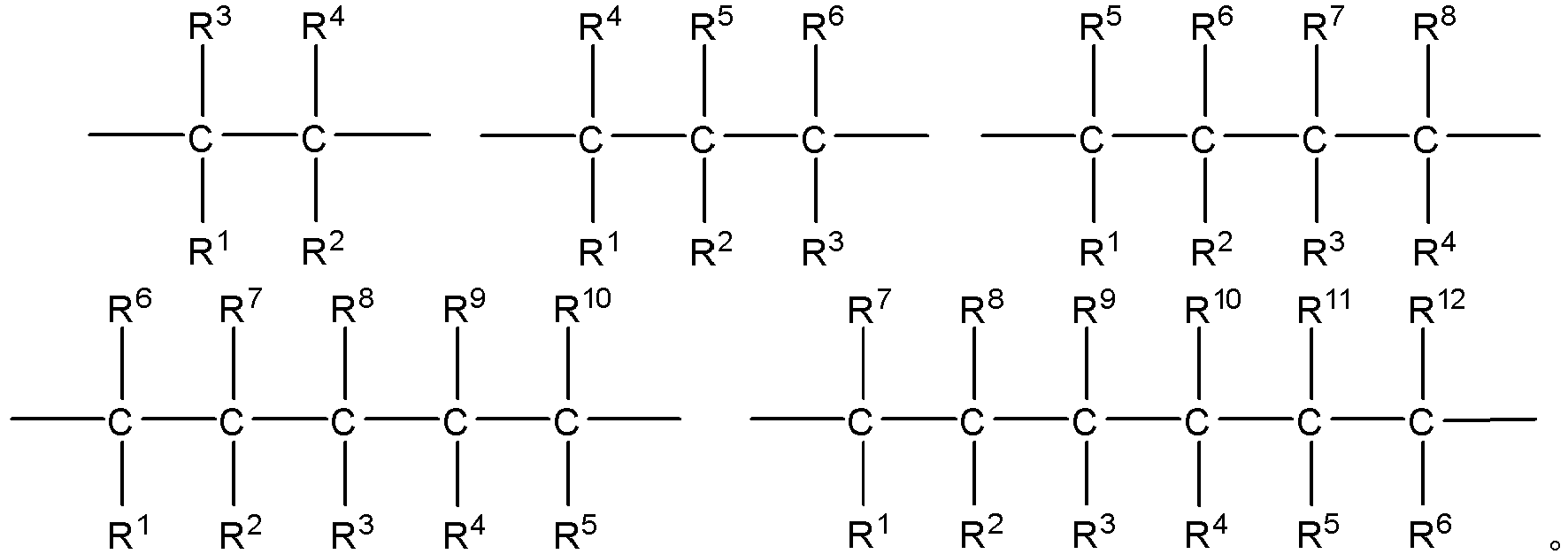
- According to some preferred embodiments of the invention, the alcohol ester compound is selected from a group consisting of 2,4-pentanediol dibenzoate, 3-methyl-2,4-pentanediol dibenzoate, 3,5-heptanediol dibenzoate, 4-ethyl-3,5-heptanediol dibenzoate, 3,5-heptanediol di-p-methyl benzoate, 3,5-heptanediol di-o-methyl benzoate, 3,5-heptanediol di-p-chlorobenzoate, 3,5-heptanediol di-o-chlorobenzoate, 3,5-heptanediol di-p-methoxy benzoate, 3,5-heptanediol di-o-methoxy benzoate, 3,5-heptanediol di-m-methoxy benzoate, 2-methyl-3,5-heptanediol dibenzoate, 4-methyl-3,5-heptanediol dibenzoate, 6-methyl-3,5-heptanediol dibenzoate, 4-ethyl-3,5-heptanediol dibenzoate, 5-ethyl-3,5-heptanediol dibenzoate, 4-propyl-3,5-heptanediol dibenzoate, 4-butyl-3,5-heptanediol dibenzoate, 2,4-dimethyl-3,5-heptanediol dibenzoate, 2,6-dimethyl-3,5-heptanediol dibenzoate, 4,4-dimethyl-3,5-heptanediol dibenzoate, 6,6-dimethyl-3,5-heptanediol dibenzoate, 4,6-dimethyl-3,5-heptanediol dibenzoate, 4,4-dimethyl-3,5-heptanediol dibenzoate, 6,6-dimethyl-3,5-heptanediol dibenzoate, 2-methyl-4-ethyl-3,5-heptanediol dibenzoate, 4-methyl-4-ethyl-3,5-heptanediol dibenzoate, 2-methyl-4-propyl-3,5-heptanediol dibenzoate, 4-methyl-4-propyl-3,5-heptanediol dibenzoate, 6-methyl-2,4-heptanediol bis(p-chlorobenzoic acid) ester, 6-methyl-2,4-heptanediol bis(p-toluic acid)ester, 6-methyl-2,4-heptanediol bis(m-toluic acid acid)ester, 2,2,6,6-tetramethyl-3,5-heptanediol dibenzoate, 4-methyl-3,5-octanediol dibenzoate, 4-ethyl-3,5-octanediol dibenzoate, 4-propyl-3,5-octanediol dibenzoate, 4-butyl-3,5-octanediol dibenzoate, 4,4-dimethyl-3,5-octanediol dibenzoate, 4-methyl-4-ethyl-3,5-octanediol dibenzoate, 2-methyl-4-ethyl-3,5-octanediol dibenzoate, 2-methyl-6-ethyl-3,5-octanediol dibenzoate, 5-methyl-4,6 nonanediol dibenzoate, 5-ethyl-4,6 nonanediol dibenzoate, 5-propyl-4,6 nonanediol dibenzoate, 5-butyl-4,6 nonanediol dibenzoate, 5,5-dimethyl-4,6 nonanediol dibenzoate, 5-methyl-4-ethyl-4,6 nonanediol dibenzoate, 5-phenyl-4,6-nonanediol dibenzoate, 4,6-nonanediol dibenzoate and 4-butyl-3,5-heptanediol dibenzoate, 1,2-phenylene dibenzoate, 3-methyl-5-tert-butyl-1,2-phenylene dibenzoate, 3,5-diisopropyl-1,2-phenylene dibenzoate, 3,6-dimethyl-1,2-phenylene dibenzoate, 4-tert-butyl-1,2-phenylene dibenzoate, 1,2-naphthalene dibenzoate, 2,3-naphthalene dibenzoate, dibenzoic acid-1,8-naphthyl ester, di-4-methylbenzoic acid-1,8-naphthyl ester, di-3-methylbenzoic acid-1,8-naphthyl ester, di-2-methylbenzoic acid-1,8-naphthyl ester, di-4-ethylbenzoic acid-1,8-naphthyl ester, di-4-n-propylbenzoic acid-1,8-naphthyl ester, di-4-isopropylbenzoic acid-1,8-naphthyl ester, di-4-n-butylbenzoic acid-1,8-naphthyl ester, di-4-isobutylbenzoic acid-1,8-naphthyl ester, di-4-tert-butylbenzoic acid-1,8-naphthyl ester, di-4-phenylbenzoic acid-1,8-naphthyl ester, di-4-fluorobenzoic acid-1,8-naphthyl ester, di-3-fluorobenzoic acid-1,8-naphthyl ester and di-2-fluorobenzoic acid-1,8-naphthyl ester.
- According to an embodiment of the catalyst system of the invention, the structure of the aromatic carboxylic acid ester compound is as shown in formula F:

- According to a preferred embodiment of the invention, the aromatic carboxylic acid ester compound is a phthalic acid carboxylic acid ester.
- According to a preferred embodiment of the invention, the aromatic carboxylic acid ester compound is selected from at least one of diethyl phthalate, dipropyl phthalate, diisobutyl phthalate, di-n-butyl phthalate, dipentyl phthalate, dihexyl phthalate, diheptyl phthalate and dioctyl phthalate.
- According to an embodiment of the catalyst system of the invention, the structure of the succinate compound is as shown in formula G,

- According to a preferred embodiment of the invention, in the formula G, R1 and R2 are the same or different, each independently selected from a group consisting of a C1-C10 alkyl group, a C3-C10 cycloalkyl group, a C6-C10 aryl group, a C7-C10 arylalkyl group or a C7-C10 alkylaryl group, optionally containing a heteroatom; and R3, R4, R5 and R6 are the same or different and are each independently selected from a group consisting of hydrogen, C1-C10 alkyl, C3-C10 cycloalkyl, C6-C10 aryl, C6-C10 arylalkyl or C6-C10 alkylaryl.
- According to a preferred embodiment of the invention, the succinate compound is selected from a group consisting of 2,3-bis(2-ethylbutyl)diethyl succinate, 2,3-diethyl-2-isopropyl diethyl succinate, 2,3-diisopropyl diethyl succinate, 2,3-di-tert-butyl diethyl succinate, 2,3-diisobutyl diethyl succinate, 2,3-(bistrimethylsilyl) diethyl succinate, 2-(3,3,3-trifluoropropyl)-3-methyl diethyl succinate, 2,3-dineopentyl diethyl succinate, 2,3-diisopentyl diethyl succinate, 2,3-(1-trifluoromethyl-ethyl)diethyl succinate, 2-isopropyl-3-isobutyl diethyl succinate, 2-tert-butyl-3-isopropyl diethyl succinate, 2-isopropyl-3-cyclohexyl diethyl succinate, 2-isopentyl-3-cyclohexyl diethyl succinate, 2,2,3,3-tetramethyl diethyl succinate, 2,2,3,3-tetraethyl diethyl succinate, 2,2,3,3-tetrapropyl diethyl succinate, 2,3-diethyl-2,3-diisopropyl diethyl succinate, 2,3-diisobutyl bis(2-ethylbutyl) succinate, 2,3-diethyl-2-isopropyl diisobutyl succinate, 2,3-diisopropyl diisobutyl succinate, 2,3-di-tert-butyl diisobutyl succinate, 2,3-diisobutyl diisobutyl succinate, 2,3-(bistrimethylsilyl)diisobutyl succinate, 2-(3,3,3-trifluoropropyl)-3-diisobutyl methylsuccinate, 2,3-dineopentyl diisobutyl succinate, 2,3-diisopentyl diisobutyl succinate, 2,3-(1-trifluoromethyl-ethyl) diisobutyl succinate, 2-isopropyl-3-isobutyl diisobutyl succinate, 2-tert-butyl-3-isopropyl diisobutyl succinate, 2-isopropyl-3-cyclohexyl diisobutyl succinate, 2-isopentyl-3-cyclohexyl diisobutyl succinate, 2,2,3,3-tetramethyl diisobutyl succinate, 2,2,3,3-tetraethyl diisobutyl succinate, 2,2,3,3-tetrapropyl diisobutyl succinate and 2,3-diethyl-2,3-diisopropyl diisobutyl disuccinate; and preferably selected from a group consisting of 2,3-diisopropyl diethyl succinate, 2,3-di-tert-butyl diethyl succinate, 2,3-diisobutyl diethyl succinate and 2,3-diisopropyl diisobutyl succinate.
- According to some embodiments, the external electron donor compound is selected from one or more of a silane compound, an ester compound, an ether compound, and a ketone compound, preferably, the ther compound is a diether compound.
- According to an embodiment of the catalyst system of the invention, the structure of the silane compound is shown in formula D:

- According to a preferred embodiment of the invention, in the formula D, R1 to R4 are the same or different, each independently selected from a group consisting of hydrogen, C1-C6 alkyl, C3-C6 cycloalkyl, C6-C10 aryl and amino, and the alkyl, cycloalkyl, aryl and amino may be optionally substituted by one or more substituents selected from a group consisting of halogen, C1-C6 alkyl, C3-C6 cycloalkyl, C6-C10 aryl and amino.
- According to a preferred embodiment of the invention, the silane compound is selected from at least one of tetramethoxysilane, tetraethoxysilane, diisopropyldimethoxysilane, isopropyltrimethoxysilane, di-n-propyldimethoxysilane, n-propyltrimethoxysilane, di-n-butyldimethoxysilane, di-tert-butyldimethoxysilane, diisobutyldimethoxysilane, cyclopentyltrimethoxysilane , dicyclopentyldimethoxysilane, cyclohexylmethyldimethoxysilane, cyclohexyldimethoxysilane, cyclohexylethyldimethoxysilane, diphenyldimethoxysilane, diphenyldiethoxysilane, phenyltriethoxysilane, vinylmethoxysilane, vinylethoxysilane, vinylpropoxysilane, vinyldimethoxysilane, vinyl diethoxysilane, vinyl dipropoxysilane, vinyltrimethoxysilane, vinyltriethoxysilane, vinyltripropoxysilane, allylmethoxysilane, allylethoxysilane, allylpropoxysilane, allyldimethoxysilane, allyldiethoxysilane, allyldipropoxysilane, allyltrimethoxysilane, allyltriethoxysilane , allyltripropoxysilane, aminotrimethylsilane, aminotriethylsilane, aminotripropylsilane, aminotri-n-butylsilane, aminotriisobutylsilane, methylaminotrimethylsilane, methylaminotriethylsilane, methylaminotripropylsilane, methylaminotri-n-butylsilane, methylaminotriisobutylsilane, ethylaminotrimethylsilane, ethylaminotriethylsilane, ethylaminotripropylsilane, ethylaminotri-n-butylsilane and ethylaminotriisobutylsilane.
- According to an embodiment of the catalyst system of the invention, the diether compound that can be used as an internal electron donor compound and/or an external electron donor compound is a 1,3-diether compound represented by formula E,

- According to a preferred embodiment of the invention, in the formula E, RI, RII, RIII, RIV, RV and RVI are the same or different, and are each independently selected from a group consisting of hydrogen, halogen, C1-C18 alkyl, C3-C18 cycloalkyl, C6-C15 aryl, C7-C18 aralkyl and C7-C18 alkaryl.
- According to a preferred embodiment of the invention, in the formula E, RI, RII, RIII, RIV, RV and RVI are the same or different, and are each independently selected from a group consisting of hydrogen, halogen, C1-C10 alkyl, C3-C10 cycloalkyl, C6-C10 aryl, C7-C10 aralkyl and C7-C10 alkaryl.
- According to a preferred embodiment of the invention, in the formula E, RVII and RVIII are the same or different, and are each independently selected from a group consisting of hydrogen, halogen, C1-C10 alkyl, C3-C10 cycloalkyl, C6-C10 aryl, C7-C10 aralkyl and C7-C10 alkaryl.
- According to a preferred embodiment of the invention, in the formula E, RVII and RVIII are each independently selected from a group consisting of hydrogen, halogen, C1-C10 alkyl, C3-C10 cycloalkyl, C6-C10 aryl, C7-C10 aralkyl and C7-C10 alkaryl.
- According to a preferred embodiment of the invention, in the formula E, RIII and RIV are bonded to each other to form a saturated or unsaturated monocyclic or polycyclic ring.
- According to a preferred embodiment of the invention, in the formula E, RVII and RVIII are each independently C1-C10 alkyl.
- According to a preferred embodiment of the invention, the diether compound is selected from at least one of 2-isopropyl-2-isopentyl-1,3-dimethoxypropane, 2-(2-ethylhexyl) 1,3 -dimethoxypropane, 2-isopropyl-1,3-dimethoxypropane, 2-butyl-1,3 -dimethoxypropane, 2-sec-butyl-1,3 -dimethoxypropane, 2-cyclohexyl-1,3 -dimethoxypropane, 2-phenyl-1,3 -dimethoxypropane, 2-(2-phenylethyl)-1,3-dimethoxypropane, 2-(2-cyclohexylethyl)-1,3-dimethoxypropane, 2-(p-chlorophenyl)-1,3-dimethoxypropane, 2-(diphenylmethyl)-1,3-dimethoxypropane, 2-(1-naphthyl)-1,3-dimethoxypropane, 2-(2-fluorophenyl)-1,3-dimethoxypropane, 2,2-dicyclohexyl-1,3-dimethoxypropane, 2,2-dicyclopentyl-1,3 -dimethoxypropane, 2,2-diethyl-1,3 -dimethoxypropane, 2,2-dipropyl-1,3-dimethoxypropane, 2,2-diisopropyl-1,3-dimethoxypropane, 2,2-dibutyl-1,3 -dimethoxypropane, 2-methyl-2-propyl-1,3 -dimethoxypropane, 2-methyl-2-benzyl-1,3 -dimethoxypropane, 2-methyl-2-ethyl-1,3 -dimethoxypropane, 2-methyl-2-isopropyl-1,3 -dimethoxypropane, 2-methyl-2-phenyl-1,3-dimethoxypropane, 2-methyl-2-cyclohexyl-1,3-dimethoxypropane, 2,2-bis(p-chlorophenyl)-1,3-dimethoxypropane, 2,2-bis(2-cyclohexylethyl)-1,3-dimethoxypropane, 2-methyl-2-isobutyl-1,3-dimethoxypropane, 2-methyl-2-(2-ethylhexyl)-1,3-dimethoxypropane, 2,2-diisobutyl-1,3-dimethoxypropane, 2,2-diphenyl-1,3-dimethoxypropane, 2,2-dibenzyl-1,3 -dimethoxypropane, 2,2-bis(cyclohexylmethyl)-1,3-dimethoxypropane, 2-isobutyl-2-isopropyl-1,3-dimethoxypropane, 2-(1-methylbutyl)-2-isopropyl-1,3-dimethoxypropane, 2-(1-methylbutyl)-2-sec-butyl-1,3-dimethoxypropane, 2,2-di-sec-butyl-1,3-dimethoxypropane, 2,2-di-tert-butyl-1,3-dimethoxypropane, 2,2-dineopentyl-1,3-dimethoxypropane, 2-isopropyl-2-isopentyl-1,3-dimethoxypropane, 2-isopropyl-2-phenyl-1,3 -dimethoxypropane, 2-phenyl-2-sec-butyl-1,3-dimethoxypropane, 2-isopropyl-2-benzyl-1,3-dimethoxypropane, 2-isopropyl-2-cyclopentyl-1,3-dimethoxypropane, 2-cyclopentyl-2-sec-butyl-1,3-dimethoxypropane, 2-cyclohexyl-2-isopropyl-1,3-dimethoxypropane, 2-sec-butyl-2-cyclohexyl-1,3-dimethoxypropane, 2-isopropyl-2-sec-butyl-1,3-dimethoxypropane, 2-cyclohexyl-2-cyclohexylmethyl-1,3-dimethoxypropane, 1,1-bis(methoxymethyl)-cyclopentadiene, 1,1-bis(methoxymethyl)-2,3,4,5,-tetramethylcyclopentadiene, 1,1-bis(methoxymethyl)-2,3,4,5,-tetramethylcyclopentadiene, 1,1-bis(methoxymethyl)-2,3,4,5,-tetraphenylcyclopentadiene, 1,1-bis(methoxymethyl)-2,3,4,5,-tetrafluorocyclopentadiene, 1,1-bis(methoxymethyl)-3,4-dicyclopentylcyclopentadiene, 1,1-bis(methoxymethyl)indene, 1,1-bis(methoxymethyl)-2,3-dimethoxyindene, 1,1-bis(methoxymethyl)-2,3,6,7-tetrafluoroindene, 1,1-bis(methoxymethyl)-4,5,6,7-tetrafluoroindene, 1,1-bis(methoxymethyl) 4,7-dimethylindene, 1,1-bis(methoxymethyl)-3,6-dimethylindene, 1,1-bis(methoxymethyl)-4-phenylindene, 1,1-bis(methoxymethyl)-4-phenyl-2-methylindene, 1,1-bis(methoxymethyl)-4-tetracyclohexylindene, 1,1-bis(methoxymethyl)-7-(3,3,3-trifluoropropyl)phenylindene, 1,1-bis(methoxymethyl)-7-cyclopentylindene, 1,1-bis(methoxymethyl)-7-isopropylindene, 1,1-bis(methoxymethyl)-7-cyclohexylindene, 1,1-bis(methoxymethyl)-7-tert-butylindene, 1,1-bis(methoxymethyl)-7-tert-butyl-2-methylindene, 1,1-bis(methoxymethyl)-7-phenylindene, 1,1-bis(methoxymethyl)-2-phenylindene, 9,9-bis(methoxymethyl)fluorene, 9,9-bis(methoxymethyl)-2,7-dicyclopentylfluorene, 9,9-bis(methoxymethyl)-1,8-dichlorofluorene, 9,9-bis(methoxymethyl)-1,8-difluorofluorene, 9,9-bis(methoxymethyl)-1,2,3,4-tetrahydrofluorene, 9,9-bis(methoxymethyl)-4-tert-butylfluorene, 1,1-bis-(methoxymethyl)-2,5-cyclohexadiene, 1,1-bis-(methoxymethyl)-benzonaphthalene, 7,7-bis-(methoxymethyl)-2,5-norbornadiene, 9,9-bis-(methoxymethyl)-1,4-methanedihydronaphthalene, 9,9-bis-(methoxymethyl)-1,4-methanedihydroanthracene, 4,4-bis-(methoxymethyl)-1-phenyl-1,4-dihydronaphthalene, 4,4-bis-(methoxymethyl)-1-phenyl-3,4-dihydronaphthalene, 5,5-bis-(methoxymethyl)-1,3,6-cycloheptatriene and 1-methoxymethyl-1-(1'-methoxyethyl)-2,3,4,5-tetramethylcyclopentadiene.
- According to an embodiment of the catalyst system of the invention, a molar ratio of the twelve-membered ring compound represented by formula (M) to the external electron donor compound is 1:100-100:1, preferably 1:50-50:1, and more preferably 1:20-20:1.
- According to an embodiment of the catalyst system of the invention, the organic aluminum compound is an alkyl aluminum compound. According to a preferred embodiment of the invention, the general formula of the alkyl aluminum compound is AlR3, wherein each R is independently selected from a group cponsisting of hydrogen, halogen, C1-C20 alkyl, C1-C20 alkoxyl or halogenated C1-C20 alkyl, and at least one of three Rs is C1-C20 alkyl or halogenated C1-C20 alkyl. According to a preferred embodiment of the invention, the general formula of the alkyl aluminum compound is AlR3, wherein each R is independently selected from a group consisting of hydrogen, halogen, C1-C10 alkyl, C1-C10 alkoxyl or halogenated C1-C10 alkyl, and at least one of three Rs is C1-C10 alkyl or halogenated C1-C10 alkyl. Specifically, the organic aluminum compound preferably includes one or more selected from a group consisting of tri alkyl aluminum, dialkylaluminum chloride, monoalkylaluminum dichloride, and alkylaluminoxane.
- According to a preferred embodiment of the invention, the alkyl aluminum compound is one or more of triethyl aluminum, tri-n-propyl aluminum, tri-isopropyl aluminum, tri-n-butyl aluminum, tri-isobutyl aluminum, tri-n-hexyl aluminum, tri-n-octyl aluminum, triisobutyl aluminum, diethyl aluminum monohydrogen, diisobutyl aluminum monohydrogen, diethyl aluminum chloride, diisobutyl aluminum chloride, ethyl aluminum dichloride, Al(n-C6H13)3 and Al(n-C8H17)3.
- According to an embodiment of the catalyst system of the invention, a molar ratio of the twelve-membered ring compound represented by formula (M) to the organic aluminum compound in terms of aluminum is 1:(0.1-500), and preferably 1:(1-200).
- According to an embodiment of the catalyst system of the invention, a molar ratio of the solid catalyst component in terms of a titanium element to the organic aluminum compound in terms of aluminum is 1:(5-5000), and preferably 1:(20-2000).
- According to some embodiments of the catalyst system of the invention, a molar ratio of the external electron donor compound to the titanium element in the solid catalyst component is (0-500):1, preferably (0.01-200):1, and more preferably (0.1-100):1.
- According to an embodiment of the catalyst system of the invention, the weight ratio of the titanium element, the magnesium element, and the internal electron donor compound in the solid catalyst component is 1:(5-25):(2-15).
- According to the invention, the solid catalyst component includes titanium, magnesium and an internal electron donor, and is a reaction product of a titanium compound, a magnesium compound and an internal electron donor.
- In the invention, the method for preparing a solid catalyst component may be carried out according to a method conventionally used in the art. For example, reference may be made to the methods disclosed in
CN1506384 ,CN1091748 ,CN85100997 ,CN102399326A ,US4540679 , etc., the disclosure of which is incorporated herein by reference. - In the invention, the method of preparing a solid catalyst component includes but is not limited to the following methods.
- Method 1: An inert solvent is added to the magnesium compound followed by adding an organic epoxy compound and an organic phosphorus compound. After dissolving, a precipitation aid and a titanium compound are added to precipitate a solid. An internal electron donor is added to attach it to the solid, and then the treatment with titanium tetrahalide and an inert diluent is performed to obtain the solid catalyst component.
- Method 2: In an inert solvent such as decane or toluene, etc., a solid magnesium compound is dissolved in an organic alcohol compound such as 2-ethylhexanol. After dissolving, a precipitation aid and a titanium compound are added to precipitate a solid. An internal electron donor is added to attach it to the solid, and then the treatment with the titanium compound and an inert diluent is performed to obtain the solid catalyst component.
- Method 3: A magnesium halide alcoholate is dispersed into a titanium compound at a low temperature (for example, below -5°C) followed by raising the temperture to a high temperature (for example, above 50°C). An internal electron donor compound is added in the temperature raising process followed by filteration. The resulting precipitate is treated with a titanium compound and is wahshed to obtain the solid catalyst component.
- Method 4: A magnesium alkoxide carrier and an inert diluent are formulated into a suspension, and then the suspension is reacted with a mixture formed by a titanium compound and an inert diluent followed by filteration. The resulting precipitate is contacted and reacted with the titanium compound and an internal electron donor compound. The precipitate is washed to obtain the solid catalyst component.
- According to some embodiments of the invention, a titanium compound or a mixture of a titanium compound and an inert solvent (an inert solvent such as hexane, heptane, octane, decane, toluene, etc.) pre-cooled to -15°C to -40°C is mixed with a magnesium compound, and the temperature of the mixture is raised to 90-110°C in stages and maintained for 0.1-2 hours. An internal electron donor is added in the temperature raising process. Then the solid-liquid separation is performed, and the resulting solid phase is treated with the titanium compound again for at least 2 times, washed with a solvent, and finally vacuum dried to obtain the solid catalyst component.
- According to the invention, the magnesium compound may be various magnesium compounds conventionally used in the preparation of an olefin polymerization catalyst in the art. For example, the magnesium compound may be selected from at least one of magnesium dihalide, magnesium alkoxide, magnesium alkyl, a hydrate of magnesium dihalide, an alcoholate of magnesium dihalide, and a derivative in which one halogen atom in the magnesium dihalide molecule is substituted by alkoxy or halogenated alkoxy. According to a preferred embodiment of the invention, the magnesium compound is an alcoholate of magnesium dihalide.
- According to a preferred embodiment of the invention, the alcoholate of magnesium dihalide has a spherical magnesium alcoholate represented by formula (I),
MgX2·m(R'OH)·nE·qH2O Formula (I)
wherein, in the formula (I), X is chlorine or bromine; R' is C1-C4 alkyl (for example, methyl, ethyl, n-propyl, isopropyl, n-butyl, isobutyl and tert-butyl), and m is 0.5-4.0; E is an ether or ester electron donor compound, and n is 0-1.0, wherein the ether or ester may be an ether or ester known as an electron donor in the art, and may also be the internal electron donor and/or external electron donor used in the invention; and q is 0-0.8. - According to a preferred embodiment of the invention, in the formula (I), X is chlorine or bromine; R' is C1-C4 alkyl, and m is 1.5-3.5; and n and q are both zero.
- According to a preferred embodiment of the invention, the magnesium compound is MgCl2·m(CH3CH2OH), and m is 1.5-3.5.
- According to some embodiments of the invention, the preparation method of the alcoholate of magnesium dihalide may be performed according to a known method in the art. For example, reference may be made to the method disclosed in
CN1330086A . - According to a preferred embodiment of the invention, the preparation method of the alcoholate of magnesium dihalide includes: (1) mixing anhydrous magnesium dihalide with an alcohol compound (R'OH), and performing the reaction at 90-140°C to obtain an alcoholate of magnesium halide; (2) shearing the alcoholate of magnesium halide in a dispersion medium, and performing cooling in an inert medium after the shearing to obtain the spherical alcoholate of magnesium halide. The mixing ratio of the anhydrous magnesium dihalide and the alcohol compound may be determined according to the actually required ratio of the alcohol compound loaded on the anhydrous magnesium dihalide. The dispersion medium may be a hydrocarbon inert solvent, such as kerosene, white oil, silicone oil, paraffin oil, petroleum jelly and the like. The inert medium may be selected from a group consisting of pentane, hexane, heptane, petroleum ether, raffinate and the like. The shearing refers to the shearing of the alcoholate of magnesium halide by external shearing force, e.g., a high-speed stirring method (such as
CN1330086 ), a spraying method (such asUS6020279 ) and a supergravity rotating bed (such asCN1580136A ) and an emulsifying pelletizer method (CN1463990A ), etc. - According to a preferred embodiment of the invention, in order to further improve the purity of the magnesium compound, the resulting spherical alcoholate of magnesium halide is further subjected to washing and drying steps.
- The magnesium alkoxide according to the invention is obtained by reacting metallic magnesium, ethanol, isooctyl alcohol (2-ethylhexanol) and a mixed halogenating agent under an inert atmosphere. The mixed halogenating agent is a combination of halogen and a halogen compound. The non-limiting selection of the halogen and the halogen compound includes iodine, bromine, chlorine, magnesium chloride, magnesium bromide, magnesium iodide, potassium chloride, potassium bromide, potassium iodide, calcium chloride, calcium bromide, calcium iodide, mercury chloride, mercury bromide, mercury iodide, ethoxymagnesium iodide, methoxymagnesium iodide, isopropylmagnesium iodide, hydrogen chloride, chloroacetyl chloride and so on.
- According to the invention, the titanium compound may be various titanium compounds conventionally used in the preparation of an olefin polymerization catalyst in the art. According to a preferred embodiment of the invention, the titanium compound has a structure represented by formula (II),
Ti(ORʺ)4-kXk Formula (II)
wherein, in the formula (II), Rʺ is C1-C20 alkyl, and X is F, Cl or Br; and k is an integer of 0-4. - According to a preferred embodiment of the invention, in the formula (II), Rʺ is C1-C10 alkyl.
- According to a preferred embodiment of the invention, in the formula (II), Rʺ is C1-C5 alkyl.
- According to a preferred embodiment of the invention, for example, in the formula (II), Rʺ is methyl, ethyl, n-propyl, isopropyl, n-butyl, isobutyl, tert-butyl, n-pentyl, isopentyl and neopentyl.
- According to a preferred embodiment of the invention, in the formula (II), X is Cl.
- According to a preferred embodiment of the invention, the titanium compound is selected from at least one of titanium tetrachloride, titanium tetrabromide, titanium tetraiodide, titanium tetrabutoxide, titanium tetraethoxide, titanium monochlorotributoxide, titanium chlorodibutoxide, titanium trichlorobutoxide, titanium monochlorotriethoxide, titanium dichlorodiethoxide, titanium trichloromonoethoxide and titanium trichloride.
- According to a preferred embodiment of the invention, the titanium compound is titanium tetrachloride.
- In a second aspect, the invention also provides a prepolymerized catalyst composition for olefin polymerization, which comprises the catalyst system described in the first aspect and a prepolymer obtained by olefin prepolymerization.
- According to some embodiments of the invention, a prepolymerization multiple of the prepolymer is 0.1-1000 g olefin polymer/g solid catalyst component.
- According to some preferred embodiments of the invention, a prepolymerization multiple of the prepolymer is 0.2-500 g olefin polymer/g solid catalyst component.
- According to some preferred embodiments of the invention, a prepolymerization multiple of the prepolymer is 0.5-20 g olefin polymer/g solid catalyst component.
- According to some embodiments of the invention, the temperature of the pre-polymerization is -20-80°C, and the polymerization pressure is preferably 0-5 MPa.
- According to some preferred embodiments of the invention, the temperature of the prepolymerization is 0-50°C.
- According to some embodiments of the invention, the prepolymerization is performed in a liquid or gas phase.
- In a third aspect, the invention also provides a method for olefin polymerization, comprising: polymerizing an olefin in the presence of the catalyst system according to the first aspect and/or the prepolymerized catalyst composition according to the second aspect.
- According to an embodiment of the method for olefin polymerization according to the invention, the general formula of the olefin is CH2=CHR, wherein R is hydrogen or C1-C8 alkyl, and preferably hydrogen or C1-C6 alkyl. Preferably, the olefin is selected from one or more of ethylene, propylene, 1-butene, 4-methyl-1-pentene and 1-hexene. According to some examples, the olefin is ethylene, propylene, or a mixture of ethylene and propylene.
- According to the invention, the catalyst system of the invention may be directly added to the reactor for use in the polymerization process, or the catalyst system and the prepolymerized catalyst composition obtained by olefin prepolymerization are added to the reactor for the polymerization reaction.
- According to the invention, the olefin polymerization reaction may be carried out according to a known polymerization method, may be carried out in a liquid phase or gas phase, may also be carried out under the operation of a combination of liquid phase and gas phase polymerization stages, and may also be carried out using conventional techniques such as a slurry method, a gas phase fluidized bed, etc.
- According to some preferred embodiments of the invention, conditions of the polymerization include a temperature of 0-150°C, time of 0.2-5 hours, and a pressure of 0.01-10 MPa.
- According to some preferred embodiments of the invention, conditions of the polymerization include a temperature of 50-90°C, time of 0.3-2 hours, and a pressure of 0.02-5 MPa.
- According to the invention, the polymerization may be carried out in the presence of a solvent. In terms of the titanium element in the solid catalyst component, the concentration of the catalyst system in the solvent may be 0.1×10⁻⁵-5×10⁻⁵ mol/L.
- According to some preferred embodiments of the invention, in terms of the titanium element in the solid catalyst component, the concentration of the catalyst system in the solvent may be 0.2×10⁻⁵-2×10⁻⁵ mol/L.
- In the invention, hydrocarbyl may be selected from a group consisting of alkyl, cycloalkyl, alkenyl, alkynyl, aryl, aralkyl and alkaryl.
- In the invention, alkyl refers to straight-chain alkyl or branched-chain alkyl, non-limiting examples of which include methyl, ethyl, n-propyl, isopropyl, n-butyl, sec-butyl, isobutyl, tert-butyl, n-pentyl, 1-ethylpropyl, 2-methylbutyl, 3-methylbutyl, 2,2-dimethylpropyl, n-hexyl, 2-methylpentyl, 3-methylpentyl, 4-methylpentyl, n-heptyl, 2-methylhexyl, 3-methylhexyl, 4-methylhexyl, 5-methylhexyl, n-heptyl, n-octyl, n-nonyl, n-decyl, tetrahydrogeranyl, n-dodecyl, n-tridecyl, n-tetradecyl, n-pentadecyl, n-hexadecyl, n-octadecyl, n-nonadecyl and n-eicosyl.
- In the invention, examples of alkenyl may include but are not limited to, vinyl, propenyl, butenyl, pentenyl and octenyl.
- In the invention, examples of alkynyl may include but are not limited to, ethynyl and propargyl.
- In the invention, examples of cycloalkyl may include but are not limited to, cyclopropyl, cyclobutyl, cyclopentyl, cyclohexyl, 4-methylcyclohexyl, 4-ethylcyclohexyl, 4-n-propylcyclohexyl, 4-n-butylcyclohexyl, cycloundecyl and cyclododecyl.
- In the invention, examples of halogen include but are not limited to, fluorine, chlorine, bromine and iodine.
- In the invention, examples of aryl may include but are not limited to, phenyl, methylphenyl, ethylphenyl, 4-tert-butylphenyl and naphthyl.
- In the invention, aralkyl refers to an alkyl group having an aryl substituent. Examples may include but are not limited to, phenylmethyl, phenylethyl, phenyl n-propyl, phenyl n-butyl, phenyl tert-butyl and phenyl isopropyl.
- In the invention, alkaryl refers to an aryl group having an alkyl substituent with 7-20 carbon atoms, examples of which may include but are not limited to, methylphenyl and ethylphenyl.
- In the invention, examples of alkoxyl may include but are not limited to, methoxy, ethoxy, n-propoxy, isopropoxy, n-butoxy, sec-butoxy, isobutoxy, isopropoxy, n-butoxy, sec-butoxy, isobutoxy, tert-butoxy, n-pentoxy, isopentoxy, tert-pentoxy, and hexyloxy.
- In the invention, examples of fused ring aryl may include but are not limited to, naphthyl, anthracenyl, phenanthryl and pyrenyl.
- In the invention, the heteroatom refers to an atom commonly contained in a molecular structure other than a halogen atom, a carbon atom and a hydrogen atom, such as O, N, S, P, Si, B, etc.
- The beneficial effects of the invention:
When the catalyst system provided by the invention is used for olefin polymerization, the stereospecificity, catalytic activity and hydrogen modulation sensitivity are all relatively good. According to the above characteristics of the catalyst provided by the invention, the catalyst system provided by the invention is particularly suitable for preparing a polypropylene product with high stereoregularity and low ash, and the melt index of the product can be adjusted in a relatively wide range by adjusting the amount of hydrogenation. The catalyst system provided by the invention is also suitable for a copolymerization system to improve the copolymerization yield. - The embodiments of the invention will be explained in details with reference to examples, but those skilled in the art will understand that the following examples are only used to illustrate the invention and should not be regarded as limiting the scope of the invention. If specific conditions are not indicated in an example, it shall be carried out in accordance with conventional conditions or conditions recommended by the manufacturer. If the manufacturer is not indicated for the reagents or instruments used, they are all conventional products that may be purchased commercially.
-
- 1. Polymerization activity of the catalyst: it is obtained by dividing the amount of the polymer obtained in a certain period of time (in kg) with the amount of the catalyst added (in g).
- 2. Weight average molecular weight: it is measured by high temperature sol permeation chromatography with reference to the standard
GB/T 36214.4-2018 - 3. Isotactic index of the polymer: it is performed with reference to the standard
GB/T 2412-2008 - 4. Ethylene content: it is measured by Fourier Infrared Spectrometer VERTEX70.
- A mixed solution of 3,4-dimethoxybenzhydrol (5g)/dichloromethane (20mL) was dropwise added to a dichloromethane (200mL) solution of trifluoroacetic acid (25mL). After the dropwise addition was completed, the reaction continued in the ice bath for 4 hours. The reaction solution was neutralized with a sodium hydroxide solution. The organic phase was separated followed by complete drainage. The resulting product was washed with water and an organic solvent many times, and was recrystallized in chloroform (80 mL)/benzene (30 mL) to obtain 2.5 g of compound A.

- This preparation example is used to illustrate the preparation of a magnesium compound.
- Anhydrous magnesium chloride and ethanol were mixed according to the molar ratio of 1:2.6, and the temperature was raised to 120°C to perform the reaction so as to form a magnesium chloride alcoholate melt. The resulting melt was stirred in the dispersion media white oil and silicone oil at high speed and was then put into the cooled hexane to form spherical magnesium chloride alcoholate particles. The resulting particles were washed and dried to obtain a spherical magnesium chloride alcoholate carrier.
- This preparation example is used to illustrate the preparation of a solid catalyst component.
- In a 300 ml glass reaction flask with stirring which had been fully displaced by high-purity nitrogen, 100ml of titanium tetrachloride was added followed by cooling to -20°C. 8g of the spherical magnesium chloride alcoholate prepared in the Preparation Example 2 was added followed by slowly raising the temperature to 110°C. In the temperature raising process, 6 mmol of 2-isopropyl-2-isopentyl-1,3-dimethoxypropane was added as an internal electron donor. After the temperature was kept at 110°C for 0.5h, the liquid was filtered off, and titanium tetrachloride was added for the treatment twice. Then, washing with hexane was performed five times. After drying in vacuum, titanium-containing solid catalyst component Z1 with titanium content of 2.4 wt% was obtained.
- This preparation example is used to illustrate the preparation of a solid catalyst component.
- In a 300 ml glass reaction flask with stirring which had been fully displaced by high-purity nitrogen, 100ml of titanium tetrachloride was added followed by cooling to -20°C. 8g of the spherical magnesium chloride alcoholate prepared in the Preparation Example 2 was added followed by slowly raising the temperature to 110°C. In the temperature raising process, 3 mmol of 2,4-pentanediol dibenzoate and 3 mmol of 2-isopropyl-2-isopentyl-1,3-dimethoxypropane were added as internal electron donors. After the temperature was kept at 110°C for 0.5h, the liquid was filtered off, and titanium tetrachloride was added for the treatment twice. Then, washing with hexane was performed five times. After drying in vacuum, titanium-containing solid catalyst component Z2 with titanium content of 2.7 wt% was obtained.
- This preparation example is used to illustrate the preparation of a solid catalyst component.
- In a reactor which had been fully displaced by high-purity nitrogen, 6.0 g of magnesium chloride, 119 ml of toluene, 5 ml of epichlorohydrin and 15.6 ml of tributyl phosphate (TBP) were added successively. The temperature was raised to 50°C with stirring, then continue stirring at 50°C for 2.5 hours, and the solid was completely dissolved. 1.7 g of phthalic anhydride was added, then continue stirring at 50°C for 1 hour. The solution was cooled to below -25°C. 70ml of TiCl4 was dropwise added within 1 hour and the temperature was slowly raised to 80°C. In the temperature raising process, a solid was gradually precipitated. 6 mmol of 3-methyl-2,4- pentanediol dibenzoate was added as an internal electron donor, and the temperature was maintained for 1 hour. After filtration, 80 ml of toluene was added and washing was performed twice to obtain a solid precipitate. Then, 60 ml of toluene and 40 ml of TiCl4 were added, and the temperature was raised to 100°C. The treatment was performed for 2 hours. After the filtrate was drained off, 60 ml of toluene and 40 ml of TiCl4 were added again, and the temperature was raised to 100°C. The treatment was performed for 2 hours. The filtrate was drained off. 60 ml of toluene was added. Washing was performed 3 times in a boiling state. 60 ml of hexane was then added. Washing was performed twice in a boiling state. 60 ml of hexane was added. After washing was performed twice at room temperature, solid catalyst component Z3 with titanium content of 2.5wt% was obtained.
- This preparation example is used to illustrate the preparation of magnesium alkoxide.
- After a 16 L pressure-resistant reactor with a stirrer was fully displaced with nitrogen, 10 L of ethanol, 300 mL of 2-ethylhexanol, 11.2 g of iodine, 8 g of magnesium chloride and 640 g of magnesium powder were added to the reactor. While stirring, the system was heated to 75°C and refluxed for the reaction until no more hydrogen was discharged. The reaction was stopped. The mixture was washed with 3 L of ethanol, filtered, and dried to obtain magnesium alkoxide.
- This preparation example is used to illustrate the preparation of a solid catalyst component.
10 g of the magnesium alkoxide compound of the Preparation Example 6, 50 mL of toluene, 3 mmol of 2,3-diisopropyl diethyl succinate and 3 mmol of 3,5-heptanediol dibenzoate were taken and formulated into a suspension. In a 300 mL reaction kettle that had been repeatedly displaced by high-purity nitrogen, 40 mL of toluene and 60 mL of titanium tetrachloride were added. The temperature was raised to 80°C, and then the formulated suspension was added to the kettle. The temperature was kept constant for 1 hour, and was slowly raised to 110°C. The temperature was kept constant for 2 hours. After pressure filtration, a mixed solution of 78 mL of toluene and 52 mL of titanium tetrachloride was added followed by the stirring treatment at 110°C for 1 hour. Such treatment was carried out 3 times. After pressure filtration, washing with hexane was performed 4 times in 150 mL each time. The pressure filtration and drying were performed to obtain solid catalyst component Z4 with titanium content of 2.5 wt%. - A mixed solution of 3,4-diethoxybenzyl alcohol (5.8 g)/dichloromethane (20 mL) was dropwise added to a dichloromethane (200 mL) solution of trifluoroacetic acid (25 mL). After the dropwise addition was completed, the reaction continued in the ice bath for 4 hours. The reaction solution was neutralized with a sodium hydroxide solution. The organic phase was separated followed by complete drainage. The resulting product was washed with water and an organic solvent many times, and was recrystallized in chloroform (80 mL)/benzene (30 mL) to obtain 1.5 g of compound B.

- A mixed solution of 3-methoxy-4-bromopropoxybenzyl alcohol (7 g)/dichloromethane (20 mL) was dropwise added to a dichloromethane (200 mL) solution of trifluoroacetic acid (25 mL). After the dropwise addition was completed, the reaction continued in the ice bath for 4 hours. The reaction solution was neutralized with a sodium hydroxide solution. The organic phase was separated followed by complete drainage. The resulting product was washed with water and an organic solvent many times, and was recrystallized in chloroform (80 mL)/benzene (30 mL) to obtain 1.7 g of compound P.

- A diethyl ether solution (100mL) containing P2O5 (57.5 g) was stirred and dropwise added to a mixed solution of 3-iodo-4-methoxybenzhydrol (23 g)/diethyl ether. In reflux, stirring is stopped. 3 days later, the diethyl ether was spin-dried. The resulting product was dissolved in dichloromethane and passed through the column. After the filtrate was spin-dried, the resulting product was recrystallized with a mixed solution of diethyl ether/dichloromethane (95/5) to obtain 1.3 g of compound N.

- 2 mL of a toluene solution containing n-BuLi (5 mmol of n-BuLi) was added to 25 mL of a THF solution (containing 0.5 g of the compound N) at -80°C. After 1 hour, the reaction solution was heated to 0°C. After stirred at room temperature for 1 hour, the reaction solution was quickly cooled to -70°C. 2 mL of ethyl chloroformate was added. The reaction solution was returned to the room temperature and stirred for 3 hours. The remaining n-BuLi was neutralized with NH4Cl. The organic phase was extracted with ethyl acetate, and 0.14 g of compound O was obtained after drying.

- 4 mNL (mNL represents a milli standard liter) of hydrogen was added to a 48-channel parallel pressure reactor (the reaction volume is 20 ml). The reactor was filled with propylene gas to 1 MPa, and 5 ml of liquid propylene was added. According to the triethylaluminum (in terms of the aluminum element): compound A: solid catalyst component Z1 (in terms of the titanium element) molar ratio of 500:20:1, triethylaluminum, compound A, and a heptane solution of the solid catalyst component Z1 were added successively and formulated into a mixed solution. A certain amount of the mixed solution (containing 0.02 mg of the solid catalyst component) was taken and injected into the reactor. The reaction was performed at 70°C for 1 hour.
- The resulting product was discharged, and the weight of the polymer was weighed. The activity of the catalyst was obtained by calculation. Meanwhile, the isotactic index of the polymer was measured. The results are shown in Table 1.
- It is basically the same as Example 1, except that the amount of hydrogenation is 20 mNL. The results are shown in Table 1.
- It is basically the same as Example 1, except that the compound A is replaced with equimolar compound P. The results are shown in Table 1.
- It is basically the same as Example 2, except that the compound A is replaced with equimolar compound N. The results are shown in Table 1.
- It is basically the same as Example 1, except that the compound A is not added. The results are shown in Table 1.
- It is basically the same as Example 2, except that the compound A is not added. The results are shown in Table 1.
- It is basically the same as Example 2, except that the compound A is replaced with equimolar C-Donor. The results are shown in Table 1.
- It is basically the same as Comparative Example 3, except that compound A in an equimolar amount with the C-Donor is additionally added. The results are shown in Table 1.
- It is basically the same as Example 1, except that the compound A is replaced with equimolar Donor 1. The results are shown in Table 1.
- It is basically the same as Comparative Example 4, except that compound B in an equimolar amount with the Donor 1 is additionally added. The results are shown in Table 1.
- It is basically the same as Example 6, except that the solid catalyst component is replaced from Z1 to Z2, and the Donor 1 is replaced with equimolar C-Donor. The results are shown in Table 1.
- It is basically the same as Example 7, except that the compound B is not added. The results are shown in Table 1.
- It is basically the same as Example 7, except that the solid catalyst component is replaced from Z2 to Z4, and the amount of hydrogenation is changed to 20 mNL. The results are shown in Table 1.
- It is basically the same as Example 8, except that the compound B is not added. The results are shown in Table 1.
Table 1 Example Solid catalyst component External electron donor Cocatalyst Amount of hydrogenation (mNL) Activity (kgPP/gCat) Isotactic index (%) Example 1 Z1 - Compound A 4 65 98.7 Example 2 Z1 - Compound A 20 69 95.9 Example 3 Z1 - Compound P 4 68 97.6 Example 4 Z1 - Compound N 20 69 95.8 Comparative Example 1 Z1 - - 4 56 96.5 Comparative Example 2 Z1 - - 20 63 95.3 Example 5 Z1 C-Donor Compound A 20 72 96.3 Comparative Example 3 Z1 C-Donor - 20 47 96.0 Example 6 Z1 Donor 1 Compound B 4 65 98.9 Comparative Example 4 Z1 Donor 1 - 4 41 97.5 Example 7 Z2 C-Donor Compound B 4 115 97.1 Comparative Example 5 Z2 C-Donor - 4 77 97.0 Example 8 Z4 C-Donor Compound B 20 47 95.8 Comparative Example 6 Z4 C-Donor - 20 35 95.5 Note: C-Donor: cyclohexylmethyldimethoxysilane;
Donor 1: 2-isopropyl-2-isopentyl-1,3-dimethoxypropane. - It can be seen from Table 1 that for the catalyst system with or without an external electron donor, when it is used in the polymerization of propylene, the addition of the twelve-membered ring compound represented by the formula (M) as a cocatalyst can significantly improve the activity of the catalyst. In addition, the isotactic index of the polymerization product has also been improved.
- It is basically the same as Example 1, except that the compound A is replaced with equimolar compound B. The results are shown in Table 2.
- It is basically the same as Example 1, except that the compound A is replaced with equimolar C-Donor. The results are shown in Table 2.
- It is basically the same as Example 2, except that a part of the compound A is replaced with equimolar C-Donor. In this example, the molar ratio of the compound A to the C-Donor is 1:1. The results are shown in Table 2.
- It is basically the same as Example 2, except that a part of the compound A is replaced with equimolar C-Donor. In this example, the molar ratio of the compound A to the C-Donor is 1:9. The results are shown in Table 2.
- It is basically the same as Example 10, except that the compound A is replaced with equimolar compound B. The results are shown in Table 2.
- It is basically the same as Example 12, except that the C-Donor is replaced with equimolar Donor 1, and the amount of hydrogenation is changed to 4 mNL. The results are shown in Table 2.
- It is basically the same as Example 2, except that the solid catalyst component is replaced from Z1 to Z2. The results are shown in Table 2.
- It is basically the same as Example 10, except that the solid catalyst component is replaced from Z1 to Z2. The results are shown in Table 2.
- It is basically the same as Example 9, except that the solid catalyst component is replaced from Z1 to Z2. The results are shown in Table 2.
- It is basically the same as Example 16, except that the amount of hydrogenation is changed to 20 mNL. The results are shown in Table 2.
- It is basically the same as Example 13, except that the solid catalyst component is replaced from Z1 to Z2, and the Donor 1 is replaced with equimolar C-Donor. The results are shown in Table 2.
- It is basically the same as Example 18, except that the amount of hydrogenation is changed to 20 mNL. The results are shown in Table 2.
- It is basically the same as Comparative Example 5, except that the amount of hydrogenation is changed to 20 mNL. The results are shown in Table 2.
- It is basically the same as Example 9, except that the solid catalyst component is replaced from Z1 to Z3. The results are shown in Table 2.
- It is basically the same as Example 20, except that the amount of hydrogenation is changed to 20 mNL. The results are shown in Table 2.
- It is basically the same as Example 21, except that the compound B is replaced with equimolar compound O. The results are shown in Table 2.
- It is basically the same as Example 20, except that the compound B is replaced with equimolar C-Donor. The results are shown in Table 2.
- It is basically the same as Comparative Example 9, except that the amount of hydrogenation is changed to 20 mNL. The results are shown in Table 2.
- It is basically the same as Example 21, except that the solid catalyst component is replaced from Z3 to Z4. The results are shown in Table 2.
- It is basically the same as Example 12, except that the solid catalyst component is replaced from Z1 to Z4. The results are shown in Table 2.
Table 2 Example Solid catalyst compone nt External electron donor Cocatalyst Molar ratio of cocatalyst: external electron donor Amount of hydroge nation (mNL) Activity (kgPP/gC at) Isotactic index (%) Weight-average molecul ar weight (ten thousand ) Example 9 Z1 - Compound B - 4 70 97.8 58 Comparati ve Example 7 Z1 C-Donor - - 4 42 97.6 61 Example 10 Z1 C-Donor Compound A 1:1 20 78 96.5 42 Example 11 Z1 C-Donor Compound A 1:9 20 70 96.2 43 Example 12 Z1 C-Donor Compound B 1:1 20 96 95.8 36 Comparati ve Example 3 Z1 C-Donor - - 20 47 96.0 45 Example 13 Z1 Donor 1 Compound B 1:1 4 60 98.7 58 Comparati ve Example 4 Z1 Donor 1 - - 4 41 97.5 60 Example 14 Z2 - Compound A - 20 103 96.2 37 Example 15 Z2 C-Donor Compound A 1:1 20 109 96.6 44 Example 16 Z2 - Compound B - 4 82 96.7 80 Example 17 Z2 - Compound B - 20 119 95.3 45 Example 18 Z2 C-Donor Compound B 1:1 4 113 97.1 70 Example 19 Z2 C-Donor Compound B 1:1 20 120 95.8 46 Comparati ve Example 5 Z2 C-Donor - - 4 77 97.0 82 Comparati ve Example 8 Z2 C-Donor - - 20 86 96.4 48 Example 20 Z3 - Compound B - 4 45 98.8 78 Example 21 Z3 - Compound B - 20 50 98.0 57 Example 22 Z3 - Compound O - 20 43 97.5 55 Comparati ve Example 9 Z3 C-Donor - - 4 35 98.5 84 Comparati Z3 C-Donor - - 20 37 97.8 60 ve Example 10 Example 23 Z4 - Compound B - 20 51 95.4 50 Example 24 Z4 C-Donor Compound B 1:1 20 44 96.0 52 Comparati ve Example 6 Z4 C-Donor - - 20 35 95.5 56 Note: C-Donor: cyclohexylmethyldimethoxysilane;
Donor 1: 2-isopropyl-2-isopentyl-1,3-dimethoxypropane. - It can be seen from Table 2 that when the catalyst system provided by the invention is used for olefin polymerization, especially propylene polymerization, the stereospecificity, catalytic activity and hydrogen modulation sensitivity are all relatively good. Compared with a catalyst system containing a silane compound or a diether compound as an external electron donor, the catalyst system containing a twelve-membered ring compound represented by the formula (M) as a cocatalyst has improved hydrogen modulation sensitivity, significantly improved polymerization activity, and a relatively good isotactic index of the polymer. When the silane compound or the diether compound is added to the catalyst system as an external electron donor, the isotactic index of the product is further improved. According to the above characteristics of the catalyst provided by the invention, the catalyst system provided by the invention is particularly suitable for preparing a polypropylene product with high stereoregularity and low ash, and the melt index of the product may be adjusted in a relatively wide range by adjusting the amount of hydrogenation.
- A 48-channel parallel pressure reactor (the reaction volume is 20 ml) was displaced with hydrogen. The reactor was filled with propylene gas to 1 MPa, and 5 ml of liquid propylene was added. According to the triethylaluminum (in terms of the aluminum element): compound A: solid catalyst component (in terms of the titanium element) molar ratio of 250:25:1, triethylaluminum, compound A, and a heptane solution of the solid catalyst component Z1 were added successively and formulated into a mixed solution. A certain amount of the mixed solution (containing 0.02 mg of the solid catalyst component) was taken and injected into the reactor. The reaction was performed at 70°C for 40 minutes. The system was displaced with a mixture of ethylene and propylene (the volume ratio of ethylene and propylene is 1:1), and the reaction was performed at 80°C with a controlled pressure of 0.7Mpa for 20 minutes.
- The resulting product was discharged, and the weight of the polymer was weighed. The activity of the catalyst was obtained by calculation. Meanwhile, the ethylene content of the polymer was measured. The results are shown in Table 3.
- It is basically the same as Example 25, except that the compound A is replaced with equimolar C-donor. The results are shown in Table 3.
- It is basically the same as Example 25, except that a part of the compound A is replaced with equimolar C-Donor. In this example, the molar ratio of the compound A to the C-Donor is 1:1. The results are shown in Table 3.
- It is basically the same as Example 26, except that the molar ratio of the compound A to the C-Donor is 1:9. The results are shown in Table 3.
- It is basically the same as Example 25, except that the solid catalyst component Z1 is replaced with solid catalyst component Z2. The results are shown in Table 3.
- The only difference from Example 28 lies in that the compound A is replaced with equimolar compound B. The results are shown in Table 3.
- The only difference from Example 28 lies that the compound A is replaced with equimolar C-donor. The results are shown in Table 3.
Table 3 Example Solid catalyst component External electron donor Cocatalyst Molar ratio of cocatalyst: external electron donor Activity (kgPP/gCat) Ethylene content (wt%) Example 25 Z1 - Compound A - 60 6.3 Comparative Example 11 Z1 C-Donor - - 42 6.4 Example 26 Z1 C-Donor Compound A 1:1 80 6.3 Example 27 Z1 C-Donor Compound A 1:9 76 6.3 Example 28 Z2 - Compound A - 80 4.6 Example 29 Z2 - Compound B - 100 4.5 Comparative Example 12 Z2 C-Donor - - 62 4.7 Note: C-Donor: cyclohexylmethyldimethoxysilane; the ethylene content refers to content of a -CH2CH2- unit derived from an ethylene monomer in the polymer. - It can be seen from Table 3 that when the catalyst system provided by the invention is used for olefin copolymerization, especially ethylene and propylene copolymerization, compared with C-Donor as an external electron donor, the ethylene content of the copolymer obtained from the catalyst system containing the twelve-membered ring represented by the formula (M) as a cocatalyst, is equivalent, and the polymerization activity is improved. According to the above characteristics of the catalyst provided by the invention, the catalyst system provided by the invention is also suitable for a copolymerization system to improve the copolymerization yield.
- It should be noted that the above-mentioned examples are only used to explain the invention, and do not constitute any limitation to the invention. The invention may be modified within the scope of the claims of the invention as stipulated, and the invention may be revised without departing from the scope and spirit of the invention. Although the invention described therein relates to specific methods, materials and examples, it does not mean that the invention is limited to the specific examples disclosed therein. On the contrary, the invention can be extended to all other methods and use with the same function.
Claims (19)
- A catalyst system for olefin polymerization, comprising a main catalyst and a cocatalyst, wherein the cocatalyst comprises a twelve-membered ring compound represented by formula (M),

- The catalyst system according to claim 1, characterized in that the main catalyst comprises (i) a solid catalyst component containing magnesium, titanium, halogen and an internal electron donor compound; (ii) an organic aluminum compound; and optionally (iii) an external electron donor compound.
- The catalyst system according to claim 2, characterized in that a molar ratio of the external electron donor compound to the titanium element in the solid catalyst component is (0-500):1, preferably (0.01-200):1, and more preferably (0.1-100):1.
- The catalyst system according to any one of claims 1 to 3, characterized in that,in the formula (M), R1-R16 are the same or different, each independently selected from a group consisting of hydrogen, hydroxyl, halogen, cyano, nitro, amino, mono-C1-C10 alkyl amine, bis-C1-C10 alkyl amine, C1-C10 aldehyde, C1-C10 carboxyl, RaC(O)-, RaO-, C1-C20 alkyl, C2-C20 alkenyl, C2-C20 alkynyl , C3-C20 cycloalkyl, C6-C20 aryl, C7-C20 aralkyl, 4-12-membered heterocycloalkyl and C5-C20 heteroaryl, and when two adjacent groups on a benzene ring are each selected from a group consisting of RaC(O)-, RaO-, C1-C20 alkyl, C2-C20 alkenyl, C2-C20 alkynyl, C3-C20 cycloalkyl, C6-C20 aryl, C7-C20 aralkyl, 4-12-membered heterocycloalkyl and C5-C20 heteroaryl, the two adjacent groups may optionally form a ring with each other, the ring selected from a group consisting of a saturated or unsaturated monocyclic ring, a saturated or unsaturated polycyclic ring and a combination thereof,wherein Ra is selected from a group consisting of C1-C20 alkyl, C2-C20 alkenyl, C2-C20 alkynyl, C3-C20 cycloalkyl, C6-C20 aryl, C7-C20 aralkyl, 4-12-membered heterocycloalkyl and C5-C20 heteroaryl; andR17 to R24 are the same or different, each independently selected from a group consisting of hydrogen, C1-C10 alkyl, C2-C10 alkenyl, C2-C10 alkynyl, C3-C8 cycloalkyl, C6-C10 aryl, C7-C20 aralkyl, 4-12-membered heterocycloalkyl and C5-C20 heteroaryl, andany one of the alkyl, alkenyl, alkynyl, cycloalkyl, aryl, aralkyl, heterocycloalkyl and heteroaryl may be optionally substituted by one or more substituents.
- The catalyst system according to any one of claims 1 to 4, characterized in that, in the formula (M), the substituents are selected from a group consisting of alkyl, alkoxyl, hydroxyl, halogen, cyano, nitro, amino, alkyl substituted amino, aldehyde, carboxyl and a heteroatom-containing group; preferably, the substituents are selected from a group consisting of C1-C10 alkyl, C1-C10 alkoxyl, hydroxyl, halogen, cyano, nitro, amino, mono-C1-C10 alkyl amine, bis-C1-C10 alkyl amine, C1-C10 aldehyde, C1-C10 carboxyl and a heteroatom-containing group; and more preferably, the substituents are selected from a group consisting of C1-C6 alkyl, C1-C6 alkoxyl, hydroxyl, fluorine, chlorine, bromine, iodine, cyano, nitro, amino, mono-C1-C6 alkyl amine, bis-C1-C6 alkyl amine, C1-C6 aldehyde and C1-C6 carboxyl.
- The catalyst system according to any one of claims 1 to 5, characterized in that, in the formula (M), R1 to R16 are the same or different, and are each independently selected from a group consisting of hydrogen, hydroxyl, halogen, cyano, nitro, amino, mono-C1-C6 alkyl amine, bis-C1-C6 alkyl amine, C1-C6 aldehyde, C1-C6 carboxyl, RaC(O)-, RaO-, C1-C6 alkyl, C2-C6 alkenyl, C2-C6 alkynyl, C3-C6 cycloalkyl, C6-C10 aryl, C7-C10 aralkyl, 4-6-membered heterocycloalkyl and C5-C10 heteroaryl, wherein Ra is selected from a group consisting of C1-C6 alkyl, C2-C6 alkenyl, C2-C6 alkynyl, C3-C6 cycloalkyl, C6-C10 aryl, C7-C10 aralkyl, 4-6-membered heterocycloalkyl and C5-C10 heteroaryl;preferably, R1 to R16 are selected from a group consisting of hydrogen, hydroxyl, amino, halogen, C1-C6 aldehyde, C1-C6 alkoxyl and halogen substituted C1-C6 alkoxyl; andpreferably, R1 to R16 are not hydrogen at the same time.
- The catalyst system according to any one of claims 1 to 6, characterized in that, in the formula (M), R1, R4, R5, R8, R9, R12, R13 and R16 are each independently selected from a group consisting of hydrogen and C1-C6 alkyl; R2, R3, R6, R7, R10, R11, R14 and R15 are each independently selected from a group consisting of hydroxyl, amino, halogen, C1-C6 aldehyde, C1-C6 alkoxyl and halogen substituted C1-C6 alkoxyl.
- The catalyst system according to any one of claims 1 to 7, characterized in that, in the formula (M), R17 to R24 are each independently selected from a group consisting of hydrogen and C1-C10 alkyl, preferably selected from a group consisting of hydrogen and C1-C6 alkyl, and more preferably selected from a group consisting of hydrogen and C1-C4 alkyl.
- The catalyst system according to any one of claims 1 to 8, characterized in that, the twelve-membered ring compound represented by the formula (M) is represented by formula (N),
 Compound A: in the formula (N), R2=R3=R6=R7=R10=R11=R14=R15=OCH3;Compound B: in the formula (N), R2=R3=R6=R7=R10=R11= R14=R15=OCH2CH3;Compound C: in the formula (N), R2=R3=R6=R7=R10=R11=R14=R15=OCH2CH2CH3;Compound D: in the formula (N), R2=R3=R6=R7=R10=R11=R14=R15=OCH(CH3)2;Compound E: in the formula (N), R2=R3=R6=R7=R10=R11=R14=R15=OCH2CH2CH2CH3;Compound F: in the formula (N), R2=R6=R10=R14=OCH3 and R3=R7=R11=R15=OCH2CH3;Compound G: in the formula (N), R2=R6=R10=R14=OCH3 and R3=R7=R11=R15=OCH2CH2CH3;Compound H: in the formula (N), R2=R6=R10=R14=OCH3 and R3=R7=R11=R15=OCH2CH2CH2CH3;Compound I: in the formula (N), R2=R3=R6=R7=R10=R11=R14=R15=OH;Compound J: in the formula (N), R2=R6=R10=R14=OCH3 and R3=R7=R11=R15=OH;Compound K: in the formula (N), R2=R6=R10=R14=OCH3 and R3=R7=R11=R15=NH2;Compound L: in the formula (N), R2=R6=R10=R14=OCH3 and R3=R7=R11=R15=Cl;Compound M: in the formula (N), R2=R6=R10=R14=OCH3 and R3=R7=R11=R15=Br;Compound N: in the formula (N), R2=R6=R10=R14=OCH3 and R3=R7=R11=R15=I;Compound O: in the formula (N), R2=R6=R10=R14=OCH3 and R3=R7=R11=R15=CHO;Compound P: in the formula (N), R2=R6=R10=R14=OCH3 and R3=R7=R11=R15=OCH2CH2CH2Br;Compound Q: in the formula (N), R2=R3=R6=R7=R10=R11=R14=R15=OCH2CH2Cl; andCompound R: in the formula (N), R2=R6=R10=R14=OH and R3=R7=R11=R15=OCH2CH3.
 - The catalyst system according to any one of claims 2 to 9, characterized in that the internal electron donor compound is selected from one or more of a diether compound, an alcohol ester compound, an aromatic carboxylic acid ester compound, a succinate compound or a ketone compound.
- The catalyst system according to claim 10, characterized in that,the alcohol ester compound is a glycol ester compound represented by formula B,
 the diether compound is a 1,3-diether compound represented by formula E,
 a structure of the aromatic carboxylic acid ester compound is as shown in formula F:
 a structure of the succinate compound is as shown in formula G,
- The catalyst system according to any one of claims 2 to 11, characterized in that, the external electron donor compound is selected from one or more of a silane compound, an ester compound, an ether compound or a ketone compound.
- The catalyst system according to claim 12, characterized in that, a structure of the silane compound is shown in formula D:
 wherein in the formula D, R1 to R4 are the same or different, each independently selected from a group consisting of hydrogen, C1-C10 alkyl, C2-C10 alkenyl, C1-C10 alkoxyl, C2-C10 enyloxy, C2-C10 alkynyl, C2-C10 ynoxy, C3-C10 cycloalkyl, C6-C15 aryl, C3-C10 cycloalkoxyl, C6-C15 aryloxyl and amino, wherein the alkyl, alkenyl, alkynyl, alkoxyl, enyloxy, ynoxy, cycloalkyl, aryl, cycloalkoxyl, aryloxyl and amino may be optionally subsitituted by one or more substituents selected from a group consisting of halogen, C1-C6 alkyl, C3-C6 cycloalkyl, C6-C10 aryl and amino; andthe ether compound is the 1,3-diether compound represented by the formula E,
 wherein, in the formula E, RI, RII, RIII, RIV, RV and RVI are the same or different, and are each independently selected from a group consisting of hydrogen, halogen, C1-C20 alkyl, C3-C20 cycloalkyl, C6-C20 aryl, C7-C20 aralkyl and C7-C20 alkaryl; RVII and RVIII are the same or different, and are each independently selected from a group consisting of C1-C20 alkyl, C3-C20 cycloalkyl, C6-C20 aryl, C7-C20 aralkyl and C7-C20 alkaryl, wherein any one of the alkyl, alkenyl, alkynyl, cycloalkyl, aryl, aralkyl and alkaryl may be optionally substituted by one or more substituents which are selected from a group consisting of hydroxyl, halogen, cyano, nitro, amino, mono-C1-C10 alkyl amine, bis-C1-C10 alkyl amine, aldehyde, carboxyl and a heteroatom; or, two or more of RI, RII, RIII, RIV, RV and RVI are bonded to each other to form a saturated or unsaturated monocyclic or polycyclic ring, such as a fluorene ring.
 - The catalyst system according to any one of claims 2 to 13, characterized in that, a molar ratio of the twelve-membered ring compound represented by the formula (M) to the external electron donor compound is 1:100-100:1, preferably 1:50-50:1, and more preferably 1:20-20:1.
- The catalyst system according to any one of claims 2 to 14, characterized in that, the organic aluminum compound is an alkyl aluminum compound; prerferably, a general formula of the alkyl aluminum compound is AlR3, wherein each R is independently selected from a group cponsisting of hydrogen, halogen, C1-C20 alkyl, C1-C20 alkoxyl or halogenated C1-C20 alkyl, and at least one of three Rs is C1-C20 alkyl; more preferably, the general formula of the alkyl aluminum compound is AlR3, wherein each R is independently selected from a group consisting of hydrogen, halogen, C1-C10 alkyl, C1-C10 alkoxyl or halogenated C1-C10 alkyl, and at least one of the three Rs is C1-C10 alkyl; and
further preferably, the alkyl aluminum compound is one or more of triethyl aluminum, tri-n-propyl aluminum, tri-isopropyl aluminum, tri-n-butyl aluminum, tri-isobutyl aluminum, tri-n-hexyl aluminum, tri-n-octyl aluminum, diethyl aluminum monohydrogen, diisobutyl aluminum monohydrogen, diethyl aluminum chloride, diisobutyl aluminum chloride, ethyl aluminum dichloride, Al(n-C6H13)3 and Al(n-C8H17)3. - The catalyst system according to any one of claims 2 to 15, characterized in that, a molar ratio of the twelve-membered ring compound represented by the formula (M) to the organic aluminum compound in terms of aluminum is 1:(0.1-500), and preferably 1:(1-200); and
a molar ratio of the solid catalyst component in terms of the titanium element to the organic aluminum compound in terms of aluminum is 1:(5-5000), and preferably 1:(20-2000). - A prepolymerized catalyst composition for olefin polymerization, which comprises the catalyst system according to any one of claims 1 to 16 and a prepolymer obtained by the olefin prepolymerization, preferably a prepolymerization multiple of the prepolymer being 0.1-1000 g olefin polymer/g solid catalyst component.
- A method for olefin polymerization, comprising: polymerizing an olefin having a general formula of CH2=CHR in the presence of the catalyst system according to any one of claims 1 to 16 and/or the prepolymerized catalyst composition according to claim 17, wherein R is hydrogen or C1-C8 alkyl, and preferably hydrogen or C1-C6 alkyl.
- The method according to claim 18, characterized in that, the olefin is selected from one or more of ethylene, propylene, 1-butene, 4-methyl-1-pentene and 1-hexene; and preferably ethylene, propylene, or a mixture of the ethylene and the propylene.
Applications Claiming Priority (5)
| Application Number | Priority Date | Filing Date | Title |
|---|---|---|---|
| CN201910684239.8A CN112300311B (en) | 2019-07-26 | 2019-07-26 | Catalyst for olefin polymerization and olefin polymerization method |
| CN201910684053.2A CN112300303B (en) | 2019-07-26 | 2019-07-26 | Catalyst system for olefin polymerization and application thereof |
| CN201910684095.6A CN112300302B (en) | 2019-07-26 | 2019-07-26 | Twelve-membered ring compound and application thereof |
| CN201910684103.7A CN112300304B (en) | 2019-07-26 | 2019-07-26 | Catalyst system for olefin polymerization and prepolymerized catalyst composition |
| PCT/CN2020/104513 WO2021018042A1 (en) | 2019-07-26 | 2020-07-24 | Catalyst system for olefin polymerization and use thereof |
Publications (2)
| Publication Number | Publication Date |
|---|---|
| EP4006061A1 true EP4006061A1 (en) | 2022-06-01 |
| EP4006061A4 EP4006061A4 (en) | 2023-08-09 |
Family
ID=74230204
Family Applications (1)
| Application Number | Title | Priority Date | Filing Date |
|---|---|---|---|
| EP20847748.9A Pending EP4006061A4 (en) | 2019-07-26 | 2020-07-24 | CATALYST SYSTEM FOR OLEFIN POLYMERIZATION AND USE |
Country Status (6)
| Country | Link |
|---|---|
| US (1) | US11840508B2 (en) |
| EP (1) | EP4006061A4 (en) |
| JP (1) | JP7641945B2 (en) |
| KR (1) | KR102946642B1 (en) |
| MY (1) | MY205516A (en) |
| WO (1) | WO2021018042A1 (en) |
Family Cites Families (17)
| Publication number | Priority date | Publication date | Assignee | Title |
|---|---|---|---|---|
| US4540679A (en) | 1984-03-23 | 1985-09-10 | Amoco Corporation | Magnesium hydrocarbyl carbonate supports |
| CN1006071B (en) | 1985-04-01 | 1989-12-13 | 中国石油化工总公司 | Catalyst systems for olefin polymerization and copolymerization |
| CN1036011C (en) | 1993-03-29 | 1997-10-01 | 中国石油化工总公司 | Spherical catalyst component for olefin polymerization, preparation method and application, and spherical catalyst |
| TW400342B (en) | 1994-09-06 | 2000-08-01 | Chisso Corp | A process for producing a solid catalyst component for olefin polymerization and a process for producing an olefin polymer |
| US5968865A (en) * | 1997-12-10 | 1999-10-19 | Union Carbide Chemicals & Plastics Technology Corporation | Electron donor containing compositions |
| CN1151183C (en) | 2000-06-15 | 2004-05-26 | 中国石油化工股份有限公司 | Spherical catalyst components used for polymerization or copolymerization of olefin and its catalyst |
| DE60232745D1 (en) | 2001-06-26 | 2009-08-06 | Basell Poliolefine Srl | Process for the preparation of catalyst components for olefin polymerization |
| CN1463990A (en) | 2002-06-10 | 2003-12-31 | 营口市向阳催化剂有限责任公司 | Process for preparing olefin polymerization ball type catalytic component and carrier |
| CN1216920C (en) | 2002-12-11 | 2005-08-31 | 北京燕化高新技术股份有限公司 | Prepn process of polypropylene catalyst |
| JP4046005B2 (en) | 2003-05-12 | 2008-02-13 | 株式会社デンソー | Electric motor drive device and electric power steering device |
| CN1267508C (en) | 2003-08-08 | 2006-08-02 | 中国石油化工股份有限公司 | Magnesium halide/alcohol addition compound and its preparing method and use |
| JP5109227B2 (en) * | 2005-01-31 | 2012-12-26 | 株式会社カネカ | Process for producing expandable styrene resin particles and expandable styrene resin particles obtained from the process |
| US8344079B2 (en) * | 2007-12-31 | 2013-01-01 | Basf Corporation | Molar ratio modifications to larger polyolefin catalysts |
| CN102399326B (en) | 2010-09-16 | 2013-08-14 | 中国石油化工股份有限公司 | Solid catalyst component for olefin polymerization, and catalyst thereof |
| JP7038797B2 (en) * | 2017-07-19 | 2022-03-18 | 中国石油化工股▲ふん▼有限公司 | Olefin polymerization catalyst containing cyclotribellatrilen and its derivatives |
| CN110016094B (en) * | 2018-01-10 | 2021-05-11 | 中国石油化工股份有限公司 | Solid catalyst component and catalyst system for olefin polymerization and olefin polymerization process |
| CN110016093B (en) * | 2018-01-10 | 2021-05-11 | 中国石油化工股份有限公司 | Solid catalyst component and catalyst system for olefin polymerization and olefin polymerization process |
-
2020
- 2020-07-24 JP JP2022505317A patent/JP7641945B2/en active Active
- 2020-07-24 EP EP20847748.9A patent/EP4006061A4/en active Pending
- 2020-07-24 MY MYPI2022000500A patent/MY205516A/en unknown
- 2020-07-24 KR KR1020227006721A patent/KR102946642B1/en active Active
- 2020-07-24 WO PCT/CN2020/104513 patent/WO2021018042A1/en not_active Ceased
- 2020-07-24 US US17/629,300 patent/US11840508B2/en active Active
Also Published As
| Publication number | Publication date |
|---|---|
| EP4006061A4 (en) | 2023-08-09 |
| WO2021018042A1 (en) | 2021-02-04 |
| KR20220042414A (en) | 2022-04-05 |
| JP2022542156A (en) | 2022-09-29 |
| MY205516A (en) | 2024-10-24 |
| JP7641945B2 (en) | 2025-03-07 |
| KR102946642B1 (en) | 2026-03-31 |
| US20220251016A1 (en) | 2022-08-11 |
| US11840508B2 (en) | 2023-12-12 |
Similar Documents
| Publication | Publication Date | Title |
|---|---|---|
| EP3397658B1 (en) | Non-phthalate catalyst system and its use in the polymerization of olefins | |
| WO2015043526A1 (en) | Catalyst composition for olefin polymerization and application of same | |
| CN108570120B (en) | Solid catalyst component containing o-phenylenediamine compounds, catalyst and application thereof | |
| CN108517021B (en) | A kind of solid catalyst component suitable for producing wide molecular weight distribution polymer, catalyst and application thereof | |
| CN108517022A (en) | For the ingredient of solid catalyst and its catalyst of olefinic polymerization and application | |
| WO2018161854A1 (en) | Solid catalyst component for use in olefin polymerisation, catalyst, and application thereof | |
| CN112661883B (en) | Solid catalyst component for preparing polyolefin, catalyst system and application thereof | |
| CN112661882B (en) | Application of cyclohexene-1,2-dicarboxylic acid ester compound | |
| CN111234068B (en) | Catalyst system for olefin polymerization and use thereof | |
| CN113754801B (en) | Solid catalyst for preparing olefin polymer and solid catalyst system | |
| US11840508B2 (en) | Catalyst system for olefin polymerization and use thereof | |
| CN113754802B (en) | Catalyst system for olefin polymerization reaction and prepolymerization catalyst composition | |
| CN107417819B (en) | Solid catalyst component for olefin polymerization, catalyst and application thereof | |
| CN106543310B (en) | A kind of olefin polymerization catalyst system and its application | |
| CN114456286B (en) | Catalyst system for olefin polymerization and application thereof | |
| CN112300304B (en) | Catalyst system for olefin polymerization and prepolymerized catalyst composition | |
| CN112661881B (en) | Olefin polymerization catalyst component, catalyst system and olefin polymerization method | |
| CN111234062B (en) | Catalyst system for olefin polymerization and use thereof | |
| RU2815481C2 (en) | Catalyst system designed for olefin polymerisation and its application | |
| CN119331139B (en) | A catalyst component for olefin polymerization, the catalyst, and its application. | |
| CN113754803A (en) | Catalyst system and application thereof as catalyst for olefin polymerization | |
| CN112300302B (en) | Twelve-membered ring compound and application thereof | |
| CN116134057A (en) | Production method of solid catalyst component for olefin polymerization, solid catalyst component for olefin polymerization, catalyst for olefin polymerization, production method of catalyst for olefin polymerization, and production method of olefin polymer | |
| CN112300311B (en) | Catalyst for olefin polymerization and olefin polymerization method | |
| CN112300303B (en) | Catalyst system for olefin polymerization and application thereof |
Legal Events
| Date | Code | Title | Description |
|---|---|---|---|
| STAA | Information on the status of an ep patent application or granted ep patent |
Free format text: STATUS: THE INTERNATIONAL PUBLICATION HAS BEEN MADE |
|
| PUAI | Public reference made under article 153(3) epc to a published international application that has entered the european phase |
Free format text: ORIGINAL CODE: 0009012 |
|
| STAA | Information on the status of an ep patent application or granted ep patent |
Free format text: STATUS: REQUEST FOR EXAMINATION WAS MADE |
|
| 17P | Request for examination filed |
Effective date: 20220209 |
|
| AK | Designated contracting states |
Kind code of ref document: A1 Designated state(s): AL AT BE BG CH CY CZ DE DK EE ES FI FR GB GR HR HU IE IS IT LI LT LU LV MC MK MT NL NO PL PT RO RS SE SI SK SM TR |
|
| DAV | Request for validation of the european patent (deleted) | ||
| DAX | Request for extension of the european patent (deleted) | ||
| REG | Reference to a national code |
Ref country code: DE Ref legal event code: R079 Free format text: PREVIOUS MAIN CLASS: C08F0004649000 Ipc: C08F0010060000 |
|
| A4 | Supplementary search report drawn up and despatched |
Effective date: 20230712 |
|
| RIC1 | Information provided on ipc code assigned before grant |
Ipc: C08F 110/06 20060101ALI20230706BHEP Ipc: C08F 210/06 20060101ALI20230706BHEP Ipc: C08F 4/649 20060101ALI20230706BHEP Ipc: C08F 10/06 20060101AFI20230706BHEP |
|
| STAA | Information on the status of an ep patent application or granted ep patent |
Free format text: STATUS: EXAMINATION IS IN PROGRESS |
|
| 17Q | First examination report despatched |
Effective date: 20250128 |