EP4004124B1 - TECHNOLOGY FOR FAST-CURING COATS - Google Patents
TECHNOLOGY FOR FAST-CURING COATS Download PDFInfo
- Publication number
- EP4004124B1 EP4004124B1 EP20847880.0A EP20847880A EP4004124B1 EP 4004124 B1 EP4004124 B1 EP 4004124B1 EP 20847880 A EP20847880 A EP 20847880A EP 4004124 B1 EP4004124 B1 EP 4004124B1
- Authority
- EP
- European Patent Office
- Prior art keywords
- composition
- weight
- paint
- optically transmissive
- coating
- Prior art date
- Legal status (The legal status is an assumption and is not a legal conclusion. Google has not performed a legal analysis and makes no representation as to the accuracy of the status listed.)
- Active
Links
Images
Classifications
-
- B—PERFORMING OPERATIONS; TRANSPORTING
- B05—SPRAYING OR ATOMISING IN GENERAL; APPLYING FLUENT MATERIALS TO SURFACES, IN GENERAL
- B05B—SPRAYING APPARATUS; ATOMISING APPARATUS; NOZZLES
- B05B7/00—Spraying apparatus for discharge of liquids or other fluent materials from two or more sources, e.g. of liquid and air, of powder and gas
- B05B7/14—Spraying apparatus for discharge of liquids or other fluent materials from two or more sources, e.g. of liquid and air, of powder and gas designed for spraying particulate materials
- B05B7/1481—Spray pistols or apparatus for discharging particulate material
- B05B7/149—Spray pistols or apparatus for discharging particulate material with separate inlets for a particulate material and a liquid to be sprayed
- B05B7/1495—Spray pistols or apparatus for discharging particulate material with separate inlets for a particulate material and a liquid to be sprayed and with separate outlets for the particulate material and the liquid
-
- B—PERFORMING OPERATIONS; TRANSPORTING
- B05—SPRAYING OR ATOMISING IN GENERAL; APPLYING FLUENT MATERIALS TO SURFACES, IN GENERAL
- B05D—PROCESSES FOR APPLYING FLUENT MATERIALS TO SURFACES, IN GENERAL
- B05D3/00—Pretreatment of surfaces to which liquids or other fluent materials are to be applied; After-treatment of applied coatings, e.g. intermediate treating of an applied coating preparatory to subsequent applications of liquids or other fluent materials
- B05D3/06—Pretreatment of surfaces to which liquids or other fluent materials are to be applied; After-treatment of applied coatings, e.g. intermediate treating of an applied coating preparatory to subsequent applications of liquids or other fluent materials by exposure to radiation
- B05D3/061—Pretreatment of surfaces to which liquids or other fluent materials are to be applied; After-treatment of applied coatings, e.g. intermediate treating of an applied coating preparatory to subsequent applications of liquids or other fluent materials by exposure to radiation using U.V.
- B05D3/065—After-treatment
- B05D3/067—Curing or cross-linking the coating
-
- C—CHEMISTRY; METALLURGY
- C09—DYES; PAINTS; POLISHES; NATURAL RESINS; ADHESIVES; COMPOSITIONS NOT OTHERWISE PROVIDED FOR; APPLICATIONS OF MATERIALS NOT OTHERWISE PROVIDED FOR
- C09D—COATING COMPOSITIONS, e.g. PAINTS, VARNISHES OR LACQUERS; FILLING PASTES; CHEMICAL PAINT OR INK REMOVERS; INKS; CORRECTING FLUIDS; WOODSTAINS; PASTES OR SOLIDS FOR COLOURING OR PRINTING; USE OF MATERIALS THEREFOR
- C09D133/00—Coating compositions based on homopolymers or copolymers of compounds having one or more unsaturated aliphatic radicals, each having only one carbon-to-carbon double bond, and at least one being terminated by only one carboxyl radical, or of salts, anhydrides, esters, amides, imides, or nitriles thereof; Coating compositions based on derivatives of such polymers
- C09D133/04—Homopolymers or copolymers of esters
- C09D133/14—Homopolymers or copolymers of esters of esters containing halogen, nitrogen, sulfur or oxygen atoms in addition to the carboxy oxygen
-
- C—CHEMISTRY; METALLURGY
- C09—DYES; PAINTS; POLISHES; NATURAL RESINS; ADHESIVES; COMPOSITIONS NOT OTHERWISE PROVIDED FOR; APPLICATIONS OF MATERIALS NOT OTHERWISE PROVIDED FOR
- C09D—COATING COMPOSITIONS, e.g. PAINTS, VARNISHES OR LACQUERS; FILLING PASTES; CHEMICAL PAINT OR INK REMOVERS; INKS; CORRECTING FLUIDS; WOODSTAINS; PASTES OR SOLIDS FOR COLOURING OR PRINTING; USE OF MATERIALS THEREFOR
- C09D5/00—Coating compositions, e.g. paints, varnishes or lacquers, characterised by their physical nature or the effects produced; Filling pastes
- C09D5/004—Reflecting paints; Signal paints
-
- C—CHEMISTRY; METALLURGY
- C09—DYES; PAINTS; POLISHES; NATURAL RESINS; ADHESIVES; COMPOSITIONS NOT OTHERWISE PROVIDED FOR; APPLICATIONS OF MATERIALS NOT OTHERWISE PROVIDED FOR
- C09D—COATING COMPOSITIONS, e.g. PAINTS, VARNISHES OR LACQUERS; FILLING PASTES; CHEMICAL PAINT OR INK REMOVERS; INKS; CORRECTING FLUIDS; WOODSTAINS; PASTES OR SOLIDS FOR COLOURING OR PRINTING; USE OF MATERIALS THEREFOR
- C09D7/00—Features of coating compositions, not provided for in group C09D5/00; Processes for incorporating ingredients in coating compositions
- C09D7/40—Additives
- C09D7/60—Additives non-macromolecular
- C09D7/63—Additives non-macromolecular organic
-
- C—CHEMISTRY; METALLURGY
- C09—DYES; PAINTS; POLISHES; NATURAL RESINS; ADHESIVES; COMPOSITIONS NOT OTHERWISE PROVIDED FOR; APPLICATIONS OF MATERIALS NOT OTHERWISE PROVIDED FOR
- C09D—COATING COMPOSITIONS, e.g. PAINTS, VARNISHES OR LACQUERS; FILLING PASTES; CHEMICAL PAINT OR INK REMOVERS; INKS; CORRECTING FLUIDS; WOODSTAINS; PASTES OR SOLIDS FOR COLOURING OR PRINTING; USE OF MATERIALS THEREFOR
- C09D7/00—Features of coating compositions, not provided for in group C09D5/00; Processes for incorporating ingredients in coating compositions
- C09D7/40—Additives
- C09D7/66—Additives characterised by particle size
- C09D7/69—Particle size larger than 1000 nm
-
- E—FIXED CONSTRUCTIONS
- E01—CONSTRUCTION OF ROADS, RAILWAYS, OR BRIDGES
- E01C—CONSTRUCTION OF, OR SURFACES FOR, ROADS, SPORTS GROUNDS, OR THE LIKE; MACHINES OR AUXILIARY TOOLS FOR CONSTRUCTION OR REPAIR
- E01C23/00—Auxiliary devices or arrangements for constructing, repairing, reconditioning, or taking-up road or like surfaces
- E01C23/14—Auxiliary devices or arrangements for constructing, repairing, reconditioning, or taking-up road or like surfaces for heating or drying foundation, paving, or materials thereon, e.g. paint
-
- E—FIXED CONSTRUCTIONS
- E01—CONSTRUCTION OF ROADS, RAILWAYS, OR BRIDGES
- E01C—CONSTRUCTION OF, OR SURFACES FOR, ROADS, SPORTS GROUNDS, OR THE LIKE; MACHINES OR AUXILIARY TOOLS FOR CONSTRUCTION OR REPAIR
- E01C23/00—Auxiliary devices or arrangements for constructing, repairing, reconditioning, or taking-up road or like surfaces
- E01C23/16—Devices for marking-out, applying, or forming traffic or like markings on finished paving; Protecting fresh markings
- E01C23/20—Devices for marking-out, applying, or forming traffic or like markings on finished paving; Protecting fresh markings for forming markings in situ
- E01C23/22—Devices for marking-out, applying, or forming traffic or like markings on finished paving; Protecting fresh markings for forming markings in situ by spraying
-
- E—FIXED CONSTRUCTIONS
- E01—CONSTRUCTION OF ROADS, RAILWAYS, OR BRIDGES
- E01F—ADDITIONAL WORK, SUCH AS EQUIPPING ROADS OR THE CONSTRUCTION OF PLATFORMS, HELICOPTER LANDING STAGES, SIGNS, SNOW FENCES, OR THE LIKE
- E01F9/00—Arrangement of road signs or traffic signals; Arrangements for enforcing caution
- E01F9/50—Road surface markings; Kerbs or road edgings, specially adapted for alerting road users
- E01F9/506—Road surface markings; Kerbs or road edgings, specially adapted for alerting road users characterised by the road surface marking material, e.g. comprising additives for improving friction or reflectivity; Methods of forming, installing or applying markings in, on or to road surfaces
- E01F9/518—Road surface markings; Kerbs or road edgings, specially adapted for alerting road users characterised by the road surface marking material, e.g. comprising additives for improving friction or reflectivity; Methods of forming, installing or applying markings in, on or to road surfaces formed in situ, e.g. by painting, by casting into the road surface or by deforming the road surface
-
- E—FIXED CONSTRUCTIONS
- E01—CONSTRUCTION OF ROADS, RAILWAYS, OR BRIDGES
- E01F—ADDITIONAL WORK, SUCH AS EQUIPPING ROADS OR THE CONSTRUCTION OF PLATFORMS, HELICOPTER LANDING STAGES, SIGNS, SNOW FENCES, OR THE LIKE
- E01F9/00—Arrangement of road signs or traffic signals; Arrangements for enforcing caution
- E01F9/50—Road surface markings; Kerbs or road edgings, specially adapted for alerting road users
- E01F9/506—Road surface markings; Kerbs or road edgings, specially adapted for alerting road users characterised by the road surface marking material, e.g. comprising additives for improving friction or reflectivity; Methods of forming, installing or applying markings in, on or to road surfaces
- E01F9/524—Reflecting elements specially adapted for incorporation in or application to road surface markings
-
- C—CHEMISTRY; METALLURGY
- C08—ORGANIC MACROMOLECULAR COMPOUNDS; THEIR PREPARATION OR CHEMICAL WORKING-UP; COMPOSITIONS BASED THEREON
- C08K—Use of inorganic or non-macromolecular organic substances as compounding ingredients
- C08K5/00—Use of organic ingredients
- C08K5/36—Sulfur-, selenium-, or tellurium-containing compounds
- C08K5/37—Thiols
-
- C—CHEMISTRY; METALLURGY
- C09—DYES; PAINTS; POLISHES; NATURAL RESINS; ADHESIVES; COMPOSITIONS NOT OTHERWISE PROVIDED FOR; APPLICATIONS OF MATERIALS NOT OTHERWISE PROVIDED FOR
- C09D—COATING COMPOSITIONS, e.g. PAINTS, VARNISHES OR LACQUERS; FILLING PASTES; CHEMICAL PAINT OR INK REMOVERS; INKS; CORRECTING FLUIDS; WOODSTAINS; PASTES OR SOLIDS FOR COLOURING OR PRINTING; USE OF MATERIALS THEREFOR
- C09D133/00—Coating compositions based on homopolymers or copolymers of compounds having one or more unsaturated aliphatic radicals, each having only one carbon-to-carbon double bond, and at least one being terminated by only one carboxyl radical, or of salts, anhydrides, esters, amides, imides, or nitriles thereof; Coating compositions based on derivatives of such polymers
- C09D133/04—Homopolymers or copolymers of esters
Definitions
- the present disclosure relates a paint composition, additives and methods of application for high speed curing of a painted coating on a substrate, and in particular paint for road marking purposes.
- the power of the UV light source required to achieve the 10 to 30 second dry time can only be provided by a high power fusion or arc lamp.
- Such lamps are fundamentally fragile and require enormous amounts of power. In a road marking environment, this means a very large power generator must be incorporated onto the road marking vehicle. The electrical generators are costly to run, physically large and therefore difficult to incorporate onto road marking vehicles.
- the fusion lamp must be positioned at about 50 mm (2") to the paint when applied to a road. Due to the fragility of the fusion lamp, they are easily broken by bumps in the road causing the road marking vehicle to strike the lamp on the road, breaking it, or even simply breaking due to movement while in use.
- EP 1 923 406 A1 discloses a resin composition which can be cured by visible light and whose cured product is not colored or little colored, said composition comprising a phosphine oxide compound represented by the following general formula (1):
- R 1 represents alkyl, alkenyl, alkynyl, cycloalkyl, cycloalkenyl, substituted or unsubstituted aryl, substituted or unsubstituted heteroaryl, substituted or unsubstituted aralkyl, or substituted or unsubstituted aralkenyl; and R 2 , R 3 , R 4 , R 5 , R 6 , R 7 , R 8 and R 9 , which may be the same or different, each represent a hydrogen atom, a halogen atom, alkyl, alkenyl, substituted or unsubstituted aralkyl, or substituted or unsubstituted aralkenyl, and two adjacent groups among R 2 , R 3 , R 4 , R 5 , R 6 , R 7 , R 8 and R 9 may form a hydrocarbon ring together with the two carbon atoms adjacent thereto) and an unsaturated compound.
- X is branched C 3 -C 20 alkyl or C 3 -C 8 cycloalkyl
- X1 is hydrogen, linear C 1 -C 20 alkyl, branched C 3 -C 20 alkyl or C 3 -C 8 cycloalkyl; with the proviso that the sum of the carbon atoms in X and X1 is at least 4
- Y is linear C 1 -C 20 alkyl, branched C 3 -C 10 alkyl or C 3 -C 8 cycloalkyl
- A- is a non-nucleophilic anion, selected from the group (BF 4 )-, (SbF 6 )-, (PF 6 )- , (B(C 6 F 5 )) 4 -, C 1 -C 20 alkylsulfonate, C 2 -C 20 haloalkylsulfonate, unsubstituted C 6 -C 10 arylsulfonate,
- JP 2009/042751 A discloses a photosensitive composition including a compound represented by a general formula (I) and the curable composition contains the compound of the general formula (I) and a polymerizable compound,
- R, R 1 and R 2 each independently represent a hydrogen atom or a monovalent substituent.
- EP 1 826 200 A2 discloses a compound represented by the following formula (I), a photopolymerizable composition containing (A) a photopolymerization initiator represented by the formula (I) and (B) a radical polymerizable monomer, a color filter produced by using the photopolymerizable composition, and a process for producing the color filter.
- EP 2 792 723 B1 discloses a photocurable resin composition containing an acrylate-based oligomer component as component (a), an acrylic-based monomer component as component (b), a plasticizer component as component (c), and a photopolymerization initiator component as component (d).
- the total amount of the component (a) and the component (b) contained in the photocurable resin composition is 25 to 80% by mass, and the amount of the plasticizer component as the component (c) contained in the photocurable resin composition is 65 to 10% by mass.
- the component (c) contains a solid tackifier (1) and a liquid plasticizing component (2), and the mass ratio of the tackifier (1) to the liquid plasticizing component (2) is in the range of 60 to 30 : 30 to 10.
- US 2012/269963 A1 discloses a formulation for marking roadways which can be used as cold plastic and which comprises at least 1% by weight, preferably at least 2.5% by weight, particularly preferably at least 5% by weight, of calcium oxide.
- the calcium oxide is added as a constituent of an inorganic mixture to the formulation.
- Said inorganic mixture is composed of at least 30% by weight, preferably at least 40% by weight, particularly preferably at least 50% by weight, of calcium oxide.
- US 9 206 333 B2 discloses a method of producing a trafficway marking, the method including applying a cold plastic to a trafficway surface, to obtain the trafficway marking, where, in less than 5 minutes after the applying, the trafficway marking can withstand the passage of traffic, and where the cold plastic includes from 15% to 45% by weight of a reactive resin; from 1% to 5% by weight of a mixture comprising an initiator; from 7% to 15% by weight of an inorganic pigment; and from 50% to 60% by weight of a mineral filler.
- CA 2 253 054 A1 discloses a photocurable paint composition for road markings, comprising (A) a compound having an ethylenically unsaturated group, (B) a filler, (C) a cationic dye represented by formula (1): D + •A 1 - , wherein D + represents a cation having an absorption maximum wavelength in the wavelength region of from 400 to 1200 nm, and A 1 - represents an optional anion, (D) a quaternary organic borate-type sensitizer represented by formula (2):
- R 1 , R 2 , R 3 and R 4 each independently represents an alkyl group, an aryl group, an aralkyl group, an alkenyl group, an alkynyl group, a silyl group, a heterocyclic group or a halogen atom, and Z + represents an optional cation) and (E) an ultraviolet radical polymerization initiator capable of generating a radical upon absorption of light at a wavelength of 400 nm or less, or additionally comprising (F) glass beads.
- the present invention relates to a road marking composition as defined in claim 1.
- a road marking paint composition for painting a coating of a thickness up to 400 ⁇ m, when cured, on a road substrate adapted for accelerated cure by exposure to UV light, the composition comprising a paint formulation comprising: multifunctional acrylate oligomer in a concentration of between about 10 and 40% by weight; one or more of a multi and/or mono functional monomer of a concentration between about 15 and 50% by weight; a photoinitiator; thiol and/or mercaptan; and an acid functional acrylate; wherein the paint composition further comprises a first optically transmissive component, comprising a material adapted for substantial transparency to incident light of at least 365 to 405 nm mixed; and wherein the coating comprises a second optically transmissive component, comprising a material adapted for substantial transparency to incident light of at least 365 to 405 nm, the second optically transmissive component preferably comprising a surface density of between about 500 and 700 g/m 2 .
- a paint composition for painting a coating on a substrate adapted for accelerated cure by exposure to UV light, the composition comprising a paint formulation comprising: multifunctional acrylate oligomer in a concentration of between about 10 and 40% by weight; one or more of a multi and/or mono functional monomer of a concentration between about 15 and 50% by weight; a photoinitiator; thiol and/or mercaptan; and an acid functional acrylate.
- the paint composition further comprises a first optically transmissive component, comprising a particulate material adapted for substantial transparency to incident light of at least 365 to 405 nm.
- the first optically transmissive component comprises quartz, nepheline syenite and/or feldspar filler.
- the first optically transmissive component are from 1 to 70 microns diameter.
- the first optically transmissive component are up to 50 microns diameter.
- the first optically transmissive component is combined with the paint before painting the coating on the substrate.
- the paint composition further comprises a second optically transmissive component, comprising a material adapted for substantial transparency to incident light of at least 365 to 405 nm.
- the second optically transmissive component is generally spherical with an average diameter of from about 850 microns to about 1400 microns.
- the second optically transmissive component is adapted for combination with the paint formulation after application of the coating to the substrate.
- the second optically transmissive component is applied at a surface density which substantially inhibits oxygen from contacting the coating.
- the acid functional acrylate is about 0.5 to 3% by weight.
- the paint formulation further comprises a heat stabiliser constituent.
- the heat stabiliser constituent comprises about 0.1 to 0.5% by weight.
- the paint formulation further comprises a wetting agent constituent.
- the wetting agent constituent comprises about 0.5 to 1% by weight.
- the paint formulation further comprises a waxes constituent.
- the waxes constituent comprises about 0.3 to 0.6% by weight.
- the paint formulation further comprises a matting agent or precipitated silica constituent.
- the matting agent or precipitated silica constituent comprises about 1 to 5% by weight.
- the paint formulation further comprises a modified clays constituent.
- the modified clays constituent comprises about 0.5 to 2% by weight.
- the paint formulation further comprises pigments and/or fillers adapted to colour the paint formulation.
- the pigments and/or fillers comprise one or more of titanium dioxide and/or organic yellow and/or orange pigments.
- the titanium dioxide comprises about 5 to 13% by weight.
- the yellow and/or orange organic pigments comprises about 0.1 to 10%.
- the one or more multifunctional acrylate oligomer comprises one or more of epoxy acrylate, polyester acrylate and/or urethane acrylate.
- the multi and/or mono functional monomers comprises at least one of isobornyl acrylate, hexanedioldiacrylate, versatic acid, vinyl ester, lauryl acrylate, tetra hydroxy furfuryl acrylate and/or phenoxy ethyl acrylate.
- the photoinitiator comprises bisacylphosphine oxide.
- the bisacylphosphine oxide comprises about 1 to 4% by weight.
- the paint formulation further comprises a defoamer in a range of about 0.1 to 0.5% by weight.
- the thiol and/or mercaptan comprises about 1 to 4% by weight.
- the coating has a film thickness of up to about 400 micrometres when cured.
- the UV light has a wavelength in the range of about 365 to 405 nanometres.
- the UV light comprises by one or more LED components.
- the invention relates to a road marking system as defined in claim 13.
- the invention relates to a method of painting a coating on a substrate as defined in attached claim 14, comprising the steps of: spraying the paint formulation as defined in any one of claims 1-12to form the coating on the substrate; then applying the second optically transmissive component to the coating, wherein the second optically transmissive component is applied at a surface density of between about 500 and 700 g/m 2 such that the coating is substantially shielded from environmental air; then exposing the coating and applied second optically transmissive component to a UV light from a UV light source.
- the invention relates to any one or more of the above statements in combination with any one or more of any of the other statements.
- Other preferred aspects of the invention may become apparent from the following description which is given by way of example only and with reference to the accompanying drawings.
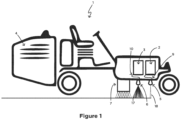
- Figure 1 is a side view of an exemplary ground surface marker.
- Embodiments of the invention discussed herein relate to a paint composition which can be rapidly cured by a low power light source.
- cured by an LED light source which is comparatively low power compared to an arc or fusion light source.
- an LED light source has significant advantages in terms of manufacturing and operation costs, and an inherent robustness given their sold state nature.
- an LED light source has been historically unsuitable for paint curing in a road marking application because achieving the required optical power from an LED light source was not possible - only a fusion lamp could provide the optical power to dry paint in seconds.
- an LED light source for the present application comprises a cluster of many individual LED sources. In cases where one or some LEDs are damaged in use, the cluster may be cheaply and easily repaired by replacing the individual components within a cluster, rather than the entire light source as would be the case for an arc or fusion lamp light source.
- An LED light source for example, generates about 1.2 to 1.8 W/cm 2 , whereas a Fusion or arc light source will generate around 2.5 to 3.0 W/cm 2 .
- the electrical power consumed by the LED light source is about 10% that of the fusion light source.
- the lifespan of an arc or fusion light source is about 5000 hours per bulb. Comparatively, an LED light source has a lifespan closer to 25000 hours.
- a paint reactive to the power output of a LED based light source offers key advantages.
- the paint composition of preferred embodiments is able to be fully cured in less than three seconds.
- a road marking vehicle is able to cross a road, paint the required lines within the time required for a traffic light phase. This means that disruption to traffic is substantially avoided.
- conventional road marking equipment has required a road or portion of a road to be closed to traffic - typically by arranging traffic cones and diverting traffic.
- conventional road marking requires numerous support workers to manage traffic and traffic management devices, as well as the painting equipment and process itself.
- the deployment of workers to manage traffic and traffic cones, and the time required to paint a level 1 rural road intersection comprising of lead in line, limit line, arrow and symbol using convention paint would take around 100 minutes, including the time required for: 40 minutes to establish the site; 10 minutes to paint; 40 minutes to dry; 10 minutes to disestablish the site.
- the paint composition of the present invention can be applied at speeds of up to 20 km/h with substantially instant cure. Subsequently use of the present invention may not require any traffic diversion or road closure, and in some cases significantly reduces the need to numerous support workers.
- to paint the same level 1 rural road intersection comprising of lead in line, limit line, arrow and symbol would take around 60 minutes, including the time for: 40 minutes establishment of site; 10 minutes to paint; up to 3 seconds drying time; disestablishment of site 10 minutes. This is a total saving of 40 minutes per intersection.
- the multifunctional acrylate oligomer has a concentration of between about 10 and 40% by weight.
- the concentration may be one of about 9 to 39% (not according to the invention) or 10 to 38%; 11 to 37%; 12 to 36%; 13 to 37%; 14 to 38%; 15 to 37%; 16 to 36%; 17 to 35%; 18 to 34%; 19 to 33%; 20 to 32%; 21 to 31%; 22 to 30%; 23 to 29%; 24 to 28%; or 25 to 27% (according to the invention).
- the one or more multifunctional acrylate oligomer is selected from a group of one or more of epoxy acrylate, polyester acrylate and/or urethane acrylate.
- the desired form of paint application is to spray to a surface. Therefore, the concentration of the multifunctional acrylate oligomer may be varied to optimise the spray-ability of the paint depending on viscosity and ability to reduce to spray-able consistency.
- the one or more multi and/or mono functional monomer is selected from a group including isobornyl acrylate, hexanedioldiacrylate, versatic acid, vinyl ester, lauryl acrylate, tetra hydroxy furfuryl acrylate and/or phenoxy ethyl acrylate.
- a selection may be made based on good diluting power, weather-ability, hydrolytic stability, adhesion to glass and mineral substrates.
- the multi and/or mono functional monomer is utilised to dilute to application viscosity whilst maintaining the 100% solids status.
- the one or more multi and/or mono functional monomer includes a combination of epoxy acrylate at a concentration of about 10 to 20% by weight for efficient cure and toughness; polyvinyl chloride of about 2 to 10% by weight for adhesion and flexibility, isobornyl acrylate of about 15 to 30% by weight for spray-ability and adhesion, hexanedioldiacrylate of about 4 to 10% by weight for cure efficiency, versatic acid vinyl ester of about 1 to 7% by weight for matting orientation, weatherability and hydrolytic stability, and acid functional acrylate of about 0.5 to 3% by weight for glass bead reception and adhesion to bitumen and chip thereby avoiding the need for a primer (except for applications on to some problematic substrates such as concrete substrates).
- the particular combination of multi and/or mono functional monomers may be adjusted according to the desired properties of the paint. For example, increasing the concentration of a particular multi and/or mono functional monomer will offer improvements in the paint characteristics provided and adjustment may be required depending on, for example, the charactieristics of the surface material being painted.
- epoxy acrylate affects efficient cure and toughness
- polyvinyl chloride affects adhesion and flexibility
- isobornyl acrylate affects spray-ability and adhesion
- hexanedioldiacrylate of affects cure efficiency
- versatic acid vinyl ester affects matting orientation
- acid functional acrylate affects glass bead reception and adhesion.
- the multi and/or mono functional monomer has a concentration of about 15 to 50% by weight.
- the concentration may be one of about 16 to 49%; 17 to 48%; 18 to 47%; 19 to 46%; 20 to 45%; 21 to 46%; 22 to 47%; 23 to 46%; 24 to 45%; 25 to 44%; 26 to 43%; 27 to 42%; 28 to 41%; 29 to 40%; 30 to 39%; 31 to 38%; 32 to 37%; 33 to 36%; or 34 to 35% by weight.
- the photoinitiator comprises bisacylphosphine oxide which has good reception of 365-405 nanometer light.
- the bisacylphosphine oxide comprises about 1 to 4% by weight. However, in alternative embodiments, the concentration may be between about 1.5 to 3.5; 2 to 3; or about 2.5% by weight.
- the thiol and/or mercaptan comprises about 1 to 4% by weight.
- the concentration may be between about 1.5 to 3.5; 2 to 3; or about 2.5% by weight.
- the thiol and/or mercaptan offers an advantage of improving the adhesion of the paint to glass beads which may be incorporated into the paint and/or added to applied paint before the paint is cured.
- constituents form the fundamental constituents of the paint
- further constituents may be added to the paint for practical purposes.
- a heat stabiliser constituent, wetting agent, waxes, a matting agent, modified clays and/or a defoamer may be added to enhance practical circumstances such as spray-ability, stability of the paint mixture during storage, suitability for use with certain types of spray pumps and the like.
- the paint is sprayed onto a surface in use, and a pump is used to pressurise the paint for spraying.
- Pumps for paint spraying applications typically generate heat which is transferred to the paint.
- a heat stabiliser constituent is added to the paint formulation.
- the heat stabiliser constituent is added in a range of about 0.1 to 0.5% by weight.
- the concentration may be between about 0.2 and 0.4%, or about 0.3% by weight.
- the paint formulation further comprises of waxes constituent which act to lubricate the pump.
- the waxes constituent comprises about 0.3 to 0.6% by weight.
- the concentration may be about 0.4 to 0.5% or 0.45% by weight.
- the acid functional acrylate functions as a cure stabiliser to keep the formulation stable in storage by maintaining a low pH which assists with shelf life extension.
- the paint formulation further includes a matting agent or precipitated silica constituent.
- the matting agent or precipitated silica constituent comprises about 1 to 5% by weight. However, in alternative embodiments, the concentration may be between about 1.5 to 3.5; 2 to 3; or about 2.5% by weight.
- a matting agent may be added to control the gloss or surface smoothness of the paint when applied.
- the paint formulation further includes a modified clays constituent to control antisettle behaviour.
- the modified clays constituent may be between about 0.5 to 2% by weight.
- the concentration may be between about 1 to 1.5; or about 1.25% by weight.
- the paint formulation further includes a defoamer in a range of about 0.1 to 0.5% by weight.
- concentration may be between about 0.2 to 0.4; or 0.3% by weight.
- the paint formulation further includes pigments and/or fillers adapted to colour the paint formulation.
- the paint formulation may have added the pigments and/or fillers such as one or more of titanium dioxide and/or organic yellow and/or orange pigments so that a desired paint colour is produced.
- Pigments and fillers are selected for white formulations (Titanium Dioxide) and other colours such as yellow (organic yellow and orange pigments) to maximise colour but minimise absorbance of UV light.
- exemplary embodiments of the paint include titanium dioxide at a concentration of between about 5 and 13% by weight.
- exemplary embodiments include yellow and/or orange organic pigments of between about 0.1 and 10% by weight.
- suitable pigments known to control paint colours as are understood by those skilled in the art.
- optically transmissive filter particles are included in the paint composition to provide particular advantages.
- Exemplary forms of the filler is an optically transmissive particle selected from a group of one or more of Feldspar, quartz, crushed glass, nepheline syenite, and/or mica.
- other materials offering transparency in at least the 365 to 405 nm region of the optical spectrum may be possible.
- One particular advantage of the exemplary fillers added to the composition is to improve UV light penetration ability.
- the aforementioned fillers improve the curing process by spacing of the colour pigments and not reacting with the acid functional additives.
- the distribution of optically transmissive filler within the paint composition provides for an optical pathway for UV rays incident a sprayed coating. The optical pathway through the depth of the painted coating therefore allows for a thicker than conventional UV-cured coating to be sprayed and successfully cured in a matter of seconds.
- a thicker painted coating is often desirable to provide a longer duration between repainting intervals
- a conventional UV cured painted coating may have its painted coating thickness limited by the UV light penetration depth, which may be as little as 100 microns.
- Current waterborne products need to be applied at around 550 ⁇ m wet film to achieve an about 300 ⁇ m dry film painted coating thickness.
- such a thickness takes several hours to dry and involves significant traffic management costs.
- the long dry time is susceptible to weather disruptions - if the painted were to be rained on within hours after application, the paint may be ruined and have to be reapplied.
- the paint of the present invention is able to be painted with a cured coating thickness of up to 400 microns is achievable as facilitated by the light paths formed by the filler.
- the filler particle components are generally angular with an average particle size which may range from about 1 to 70 microns.
- the filler is ideally added to the paint composition during manufacture, or at least before the paint is sprayed. In this way, the filler is interspersed within the paint with a substantially even distribution.
- the filler is 25 to 38% by weight and is best used with precipitated silica and the aforementioned modified clays to reduce settling on storage.
- a second optically transmissive component is added to the paint composition.
- the second component is added to the surface of the paint after application by spraying.
- the second optically transmissive component is sprayed over a freshly sprayed paint, then the combination is subject to UV light for curing.
- the second optically transmissive component is a material adapted for substantial transparency to incident light of at least 365 to 405 nm and is selected from a group of one or more of glass beads, angled glass and/or quartz agglomerates.
- the second optically transmissive component is generally spherical with an average diameter of from about 100 to 850 microns and/or 850 to 1400 microns.
- the second optically transmissive components performs several tasks - first is to substantially inhibit oxygen from the painted coating on the substrate which may otherwise cause slowing of the UV cure process.
- the second optically transmissive component is ideally applied at a surface density of at least about 300 grams per square metre, and optimally between about 400 and 500 grams per square metre.
- a further task of the second optically transmissive component is to provide retroreflective properties: In a road marking application, it is desirable for painted lines to be at least somewhat retroreflective such that the lines a highly visible to oncoming traffic. To achieve good retroreflective properties, the second optically transmissive component is ideally applied at a surface density of at least about 300 grams per square metre, and optimally between about 400 and 500 grams per square metre.
- a further task of the second optically transmissive component is to facilitate light penetration into a painted coating and to couple light into the first optically transmissive components which are interspersed within the coating.
- the second optically transmissive component is ideally applied at a surface density of at least about 300 grams per square metre, and optimally between about 400 and 700 grams per square metre.
- the second optically transmissive component are glass beads, such as glass beads selected from a group including one or more of Type A, B, C or D glass beads.
- Other retroreflective composites may also be used where substantially similar functionally equivalent optical properties are exhibited.
- any Type of glass bead and/or composite may be combined to provide the second optically transmissive components applied as a surface layer to a painted coating on a substrate.
- a surface density of 400 to 500 grams per square metre is used for a painted coating thickness of about 150 to 250 microns.
- a surface density of 500 to 700 grams per square metre is used for a painted coating thickness of about 250 to 400 microns.
- a mix of type B and type D glass beads is used.
- the paint formulation further comprises a wetting agent constituent to adjust surface energy and ensure slight wrap-around, or wicking, of glass beads on the coating surface.
- the wicking acts to mechanically fasten the beads into the paint by extending more than halfway about the periphery of the bead while adequate surface area of the bead remains exposed such that retroreflective characteristics are not substantially impacted. Further, the wicking enhances skid resistance of the painted coating. Furthermore, the wicking effect allows for substantially higher wear resistance caused by the enhanced mechanical stability of the beads.
- the wetting agent constituent is about 0.5 to 1% by weight.
- pigments and fillers are dispersed in the monomer and oligomer at high tip speed on dispersers until temperature reaches about 40 degrees Celsius, then monomers are added to cool before adding heat sensitive components.
- the paint is packed off into polyethylene/propylene containers or epoxy lined drums and pails labelled with class 9 labels and skin irritant insignia.
- exemplary embodiments of the invention which have been described is a paint which is able to be sprayed but highly thixotropic virtually 100% solids (UV convertible) liquid designed to coat various road surfaces without running off peaks of aggregate in the wet state before receiving retro-reflective glass beads and substantially immediate cure.
- UV convertible virtually 100% solids
- Methods of painting a road making use of the paint composition of the above described embodiments typically include the steps of spraying the paint to form a painted coating on the road.
- the spray equipment may be airless or may be designed to optimise sprayability of the paint such by application of a pump suitable for spraying paint containing the first optically transmissive components.
- the painted substrate and coating with the surface layer of second optically transmissive components are exposed to UV light for accelerated curing.
- the UV light source can be a LED based light source for efficient use of available electrical power and environmental robustness.
- Figure 1 An example of a ground surface marker vehicle, such as a road marking vehicle is shown in Figure 1 .
- the vehicle 1 has a paint tank 2, a bead container 3, a pump (not shown), a generator 4, a paint applicator, for example a spray gun 5, a bead applicator, for example a bead dispenser 6, and a UV light module 7.
- the marking vehicle 1 is typically used to apply paint to a road to either create new road markings or to repaint existing road markings that are fading.
- the marking vehicle 1 may also be used for surfaces in off-road situations, for example for applying markings in car parks, schools, shopping centres factories, and warehouses.
- the container 3 is filled with beads and the tank 2 is filled with paint.
- a paint hose 9 connects the paint tank 2 to the spray gun 5.
- the hose 9 is preferably high pressure, polytetrafluoroethylene (“PTFE”)/Teflon TM - lined, and light-shielded.
- a suitable pump is a low shear, high pressure pump capable of delivering paint from the tank 2 to the spray gun 5 within a range of 1-3000 pounds per square inch (“PSI”) (6894,76-20,68•10 6 Pa).
- PSI pounds per square inch
- the paint spray gun 5 is preferably an automatic, airless spray gun with PTFE/Teflon TM low sheer seals. However other types of spray gun are also suitable, for example an air pressurised spray gun.
- the pump is able to deliver paint from the tank 2 to and from the spray gun 5.
- a bead hose 10 connects the bead container 3 to the dispenser 6.
- the container 3 is filled with reflectors in the form of beads such as conventional glass beads.
- the beads can be fed to the dispenser 6 by a pressure feeder (not shown). Alternatively, the beads can be moved to the dispenser 6 under gravity.
- the marking vehicle 1 is driven by the operator to the correct position on the road.
- the operator determines the correct position by aligning the marking vehicle 1 as described above.
- the operator drives forward and activates the pump, spray gun 5, bead dispenser 6 and the generator 4 to power the UV light module 7.
- the pump feeds paint to the spray gun 5 which applies paint to the road.
- the dry film thickness may be adjusted by the size of the spray tip and by the speed that the paint is applied.
- beads are fed to the dispenser 6, which is positioned behind the spray gun 5, and the beads are sprayed onto the road and are fully or partially embedded into wet paint as the marker 1 moves forward.
- the UV light module 7, 11 powered by the generator 4, then passes over the bead-embedded paint and causes drying of the paint with embedded beads normally within about 0.5 to 1.5 seconds.
- the two bead dispensers 6 are mounted one behind the other, dispensing larger beads (for example, Type D beads) first followed by smaller beads (for example, Type B beads) after which the UV light causes drying of the paint with embedded beads of different sizes.
- larger beads for example, Type D beads
- smaller beads for example, Type B beads
Landscapes
- Engineering & Computer Science (AREA)
- Chemical & Material Sciences (AREA)
- Architecture (AREA)
- Civil Engineering (AREA)
- Structural Engineering (AREA)
- Organic Chemistry (AREA)
- Materials Engineering (AREA)
- Wood Science & Technology (AREA)
- Life Sciences & Earth Sciences (AREA)
- Physics & Mathematics (AREA)
- Plasma & Fusion (AREA)
- Nanotechnology (AREA)
- Paints Or Removers (AREA)
- Application Of Or Painting With Fluid Materials (AREA)
- Road Repair (AREA)
- Road Signs Or Road Markings (AREA)
Description
- The present disclosure relates a paint composition, additives and methods of application for high speed curing of a painted coating on a substrate, and in particular paint for road marking purposes.
- In this specification, where reference has been made to external sources of information, including patent specifications and other documents, this is generally for the purpose of providing a context for discussing the features of the present invention. Unless stated otherwise, reference to such sources of information is not to be construed, in any jurisdiction, as an admission that such sources of information are prior art or form part of the common general knowledge in the art.
- In the road marking industry, it is commonplace for at least a portion of road to be closed to traffic while painted lines are applied. The road is closed so that the road marking equipment can be operated safely, the road marking workers can be separated from active traffic, and also so that painted lines can dry before being exposed to traffic. Some forms of paint used for the painted lines can require up to 24 hours to fully cure to a state where traffic can be endured. This means the road must be closed for a significant amount of time.
- There have been some efforts made to reduce the time required for paint to dry and therefore the requirement for significant supporting closures. For example,
US patent 4415603 reports a paint which is able to be cured in a time of 10 to 30 seconds by exposure to a strong UV light source. However, the strength of the light source required has prevented commercial application of this technology. - Firstly, the power of the UV light source required to achieve the 10 to 30 second dry time can only be provided by a high power fusion or arc lamp. Such lamps are fundamentally fragile and require enormous amounts of power. In a road marking environment, this means a very large power generator must be incorporated onto the road marking vehicle. The electrical generators are costly to run, physically large and therefore difficult to incorporate onto road marking vehicles. Further, the fusion lamp must be positioned at about 50 mm (2") to the paint when applied to a road. Due to the fragility of the fusion lamp, they are easily broken by bumps in the road causing the road marking vehicle to strike the lamp on the road, breaking it, or even simply breaking due to movement while in use.
-
EP 1 923 406 A1 discloses a resin composition which can be cured by visible light and whose cured product is not colored or little colored, said composition comprising a phosphine oxide compound represented by the following general formula (1):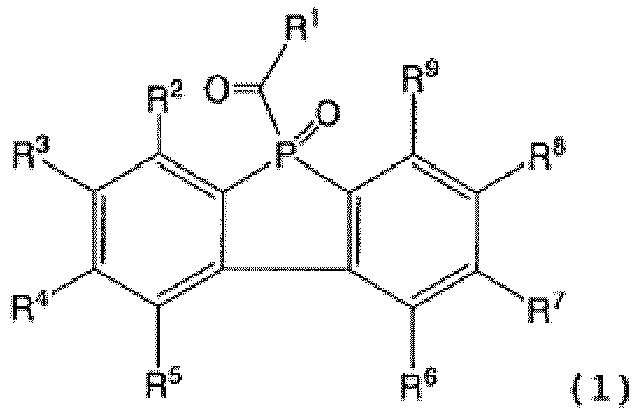
- In the formula (1), R1 represents alkyl, alkenyl, alkynyl, cycloalkyl, cycloalkenyl, substituted or unsubstituted aryl, substituted or unsubstituted heteroaryl, substituted or unsubstituted aralkyl, or substituted or unsubstituted aralkenyl; and R2, R3, R4, R5, R6, R7, R8 and R9, which may be the same or different, each represent a hydrogen atom, a halogen atom, alkyl, alkenyl, substituted or unsubstituted aralkyl, or substituted or unsubstituted aralkenyl, and two adjacent groups among R2, R3, R4, R5, R6, R7, R8 and R9 may form a hydrocarbon ring together with the two carbon atoms adjacent thereto) and an unsaturated compound.
-
DE 100 63 066 A1 discloses radiation-sensitive compositions comprising (a1) a cationically or acid-catalytically polymerisable or crosslinkable compound or (a2) a compound that increases its solubility in a developer under the action of acid; and (b) at least one diaryliodonium salt of formula I:
- In the formula (I), X is branched C3-C20 alkyl or C3-C8 cycloalkyl; X1 is hydrogen, linear C1-C20 alkyl, branched C3-C20 alkyl or C3-C8 cycloalkyl; with the proviso that the sum of the carbon atoms in X and X1 is at least 4; Y is linear C1-C20 alkyl, branched C3-C10 alkyl or C3-C8 cycloalkyl; A- is a non-nucleophilic anion, selected from the group (BF4)-, (SbF6)-, (PF6)- , (B(C6F5))4-, C1-C20 alkylsulfonate, C2-C20 haloalkylsulfonate, unsubstituted C6-C10 arylsulfonate, camphor- sulfonate, and C6-C10 arylsulfonate substituted by halogen, NO2, C1-C12 alkyl, C1-C12 halo-alkyl, C1-C12 alkoxy or by COOR1; and R1 is C1-C20 alkyl, phenyl, benzyl; or phenyl mono- or poly-substituted by C1-C12 alkyl, C1-C12 alkoxy or by halogen; with the proviso that the two phenyl rings on the iodine atom are not identically substituted, have high sensitivity, high storage stability, good solubility and a low tendency to crystallise.
-
JP 2009/042751 A 
- In the formula (I), R, R1 and R2 each independently represent a hydrogen atom or a monovalent substituent.
-
EP 1 826 200 A2 ) discloses a compound represented by the following formula (I), a photopolymerizable composition containing (A) a photopolymerization initiator represented by the formula (I) and (B) a radical polymerizable monomer, a color filter produced by using the photopolymerizable composition, and a process for producing the color filter.
- In the formula (I), R1' represents a substituent containing an aromatic ring or heteroaromatic ring; R1a is an alkyl group having at least one substituent selected from the following group A, R2a represents an alkanoyl group, an alkenoyl group, an aryloyl group, an alkoxycarbonyl group, an aryloxycarbonyl group, a heterocyclic oxycarbonyl group, a heteroaryloxycarbonyl group, an alkylthiocarbonyl group, an arylthiocarbonyl group, a heterocyclic thiocarbonyl group, a heteroarylthiocarbonyl group, or -CO-CO-Rd wherein Rd represents an aromatic or heteroaromatic group which may have a substituent; and n represents an integer of 1 to 6.
-
EP 2 792 723 B1 -
US 2012/269963 A1 discloses a formulation for marking roadways which can be used as cold plastic and which comprises at least 1% by weight, preferably at least 2.5% by weight, particularly preferably at least 5% by weight, of calcium oxide. The calcium oxide is added as a constituent of an inorganic mixture to the formulation. Said inorganic mixture is composed of at least 30% by weight, preferably at least 40% by weight, particularly preferably at least 50% by weight, of calcium oxide. -
US 9 206 333 B2 -
CA 2 253 054 A1
- In the formula (2), R1, R2, R3 and R4 each independently represents an alkyl group, an aryl group, an aralkyl group, an alkenyl group, an alkynyl group, a silyl group, a heterocyclic group or a halogen atom, and Z+ represents an optional cation) and (E) an ultraviolet radical polymerization initiator capable of generating a radical upon absorption of light at a wavelength of 400 nm or less, or additionally comprising (F) glass beads.
- It is therefore an object of the present invention to improve upon the prior art, or at least provide the public with a useful choice.
- In one aspect, the present invention relates to a road marking composition as defined in claim 1.
- According to some aspects consistent with the invention, a road marking paint composition is disclosed for painting a coating of a thickness up to 400 µm, when cured, on a road substrate adapted for accelerated cure by exposure to UV light, the composition comprising a paint formulation comprising: multifunctional acrylate oligomer in a concentration of between about 10 and 40% by weight; one or more of a multi and/or mono functional monomer of a concentration between about 15 and 50% by weight; a photoinitiator; thiol and/or mercaptan; and an acid functional acrylate; wherein the paint composition further comprises a first optically transmissive component, comprising a material adapted for substantial transparency to incident light of at least 365 to 405 nm mixed; and wherein the coating comprises a second optically transmissive component, comprising a material adapted for substantial transparency to incident light of at least 365 to 405 nm, the second optically transmissive component preferably comprising a surface density of between about 500 and 700 g/m2. The road marking paint will typically also include one or more additives to impart colour to the paint, such as pigments and/or fillers.
- According to some aspects consistent with the invention, a paint composition is disclosed for painting a coating on a substrate adapted for accelerated cure by exposure to UV light, the composition comprising a paint formulation comprising: multifunctional acrylate oligomer in a concentration of between about 10 and 40% by weight; one or more of a multi and/or mono functional monomer of a concentration between about 15 and 50% by weight; a photoinitiator; thiol and/or mercaptan; and an acid functional acrylate.
- According to the invention, the paint composition further comprises a first optically transmissive component, comprising a particulate material adapted for substantial transparency to incident light of at least 365 to 405 nm.
- According to the invention, the first optically transmissive component comprises quartz, nepheline syenite and/or feldspar filler.
Preferably, the first optically transmissive component are from 1 to 70 microns diameter. - In some embodiments, the first optically transmissive component are up to 50 microns diameter.
- According to the invention, the first optically transmissive component is combined with the paint before painting the coating on the substrate.
- According to the invention, the paint composition further comprises a second optically transmissive component, comprising a material adapted for substantial transparency to incident light of at least 365 to 405 nm.
- According to the invention, the second optically transmissive component further comprises at least one or glass beads, angled glass and/or quartz agglomerates.
- Preferably, the second optically transmissive component is generally spherical with an average diameter of from about 850 microns to about 1400 microns.
- Preferably, the second optically transmissive component is adapted for combination with the paint formulation after application of the coating to the substrate.
- Preferably, the second optically transmissive component is applied at a surface density of about 400 to 500 grams per square metre.
- Preferably, the second optically transmissive component is applied at a surface density which substantially inhibits oxygen from contacting the coating.
- According to the invention, the acid functional acrylate is about 0.5 to 3% by weight.
- Preferably, the paint formulation further comprises a heat stabiliser constituent.
- Preferably, the heat stabiliser constituent comprises about 0.1 to 0.5% by weight.
- Preferably, the paint formulation further comprises a wetting agent constituent.
- Preferably, the wetting agent constituent comprises about 0.5 to 1% by weight.
- Preferably, the paint formulation further comprises a waxes constituent.
- Preferably, the waxes constituent comprises about 0.3 to 0.6% by weight.
- Preferably, the paint formulation further comprises a matting agent or precipitated silica constituent.
- Preferably, the matting agent or precipitated silica constituent comprises about 1 to 5% by weight.
- Preferably, the paint formulation further comprises a modified clays constituent.
- Preferably, the modified clays constituent comprises about 0.5 to 2% by weight.
- Preferably, the paint formulation further comprises pigments and/or fillers adapted to colour the paint formulation.
- Preferably, the pigments and/or fillers comprise one or more of titanium dioxide and/or organic yellow and/or orange pigments.
- Preferably, the titanium dioxide comprises about 5 to 13% by weight.
- Preferably, the yellow and/or orange organic pigments comprises about 0.1 to 10%.
- According to the invention, the one or more multifunctional acrylate oligomer comprises one or more of epoxy acrylate, polyester acrylate and/or urethane acrylate.
- According to the invention, the multi and/or mono functional monomers comprises at least one of isobornyl acrylate, hexanedioldiacrylate, versatic acid, vinyl ester, lauryl acrylate, tetra hydroxy furfuryl acrylate and/or phenoxy ethyl acrylate.
- According to the invention, the photoinitiator comprises bisacylphosphine oxide.
- According to the invention, the bisacylphosphine oxide comprises about 1 to 4% by weight.
- Preferably, the paint formulation further comprises a defoamer in a range of about 0.1 to 0.5% by weight.
- According to the invention, the thiol and/or mercaptan comprises about 1 to 4% by weight.
- According to the invention, the coating has a film thickness of up to about 400 micrometres when cured.
- Preferably, the UV light has a wavelength in the range of about 365 to 405 nanometres.
- Preferably, the UV light comprises by one or more LED components.
- According to a second aspect, the invention relates to a road marking system as defined in claim 13.
- According to a third aspect, the invention relates to a method of painting a coating on a substrate as defined in attached claim 14, comprising the steps of: spraying the paint formulation as defined in any one of claims 1-12to form the coating on the substrate; then applying the second optically transmissive component to the coating, wherein the second optically transmissive component is applied at a surface density of between about 500 and 700 g/m2 such that the coating is substantially shielded from environmental air; then exposing the coating and applied second optically transmissive component to a UV light from a UV light source.
- In preferred embodiments, the invention relates to any one or more of the above statements in combination with any one or more of any of the other statements. Other preferred aspects of the invention may become apparent from the following description which is given by way of example only and with reference to the accompanying drawings.
- The entire disclosures of all applications, patents and publications, cited above and below, if any, are hereby incorporated by reference. Preferred aspects of this invention may also be said to consist in the parts, elements and features referred to or indicated in the specification of the application, individually or collectively, and any or all combinations of any two or more of said parts, elements or features, and where specific integers are mentioned herein which have known equivalents in the art to which this invention relates, such known equivalents are deemed to be incorporated herein as if individually set forth.
- As used herein, the singular forms "a," "an," and "the" are intended to include the plural forms as well, unless expressly stated otherwise. It will be further understood that the terms "includes," "comprises," "including," and/or "comprising," when used in this specification, specify the presence of stated features, integers, steps, operations, elements, and/or components, but do not preclude the presence or addition of one or more other features, integers, steps, operations, elements, components, and/or groups thereof It will be understood that when an element is referred to as being "connected" or "coupled" to another element, it can be directly connected or coupled to the other element or intervening elements may be present. As used herein, the term "and/or" includes any and all combinations of one or more of the associated listed items.
- To those skilled in the art to which the invention relates, many changes in construction and widely differing embodiments and applications of the invention will suggest themselves without departing from the scope of the invention as defined in the appended claims. The disclosures and the descriptions herein are purely illustrative and are not intended to be in any sense limiting.
- The invention can be better understood with reference to the following drawings. The elements of the drawings are not necessarily to scale relative to each other, emphasis instead being placed upon clearly illustrating the principles of the invention. Furthermore, like reference numerals designate corresponding parts throughout the views.
-
Figure 1 is a side view of an exemplary ground surface marker. - Exemplary methods and systems are described herein. It should be understood that the word "exemplary" is used herein to mean "serving as an example, instance, or illustration." Any embodiment or feature described herein as "exemplary" or "illustrative" is not necessarily to be construed as preferred or advantageous over other embodiments or features. More generally, the embodiments described herein are not meant to be limiting. It will be readily understood that certain aspects of the disclosed systems and methods can be arranged and combined in a wide variety of different configurations, all of which are contemplated herein.
- Embodiments of the invention discussed herein relate to a paint composition which can be rapidly cured by a low power light source. In particular, cured by an LED light source which is comparatively low power compared to an arc or fusion light source. Compared to a fusion or arc light source, an LED light source has significant advantages in terms of manufacturing and operation costs, and an inherent robustness given their sold state nature. However, an LED light source has been historically unsuitable for paint curing in a road marking application because achieving the required optical power from an LED light source was not possible - only a fusion lamp could provide the optical power to dry paint in seconds.
- Rather than rely on improvements in optical power which can be extracted from an LED light source or other adapted technology, the inventors have developed a paint composition which instead is operable for cure by an optical power in the range which can be provided by readily available LEDs.
- The ability to use LEDs as a light source achieves commercial viability of a light-curable paint for road marking application. Firstly because the electrical power required to drive such an LED light is small and can easily be incorporated onto existing road marking equipment; and secondly, because LEDs are substantially more robust than a fusion lamp. Furthermore, an LED light source for the present application comprises a cluster of many individual LED sources. In cases where one or some LEDs are damaged in use, the cluster may be cheaply and easily repaired by replacing the individual components within a cluster, rather than the entire light source as would be the case for an arc or fusion lamp light source.
- An LED light source, for example, generates about 1.2 to 1.8 W/cm2, whereas a Fusion or arc light source will generate around 2.5 to 3.0 W/cm2. However, the electrical power consumed by the LED light source is about 10% that of the fusion light source. Further, the lifespan of an arc or fusion light source is about 5000 hours per bulb. Comparatively, an LED light source has a lifespan closer to 25000 hours. Clearly then, a paint reactive to the power output of a LED based light source offers key advantages.
- The paint composition of preferred embodiments is able to be fully cured in less than three seconds. In some cases, a road marking vehicle is able to cross a road, paint the required lines within the time required for a traffic light phase. This means that disruption to traffic is substantially avoided.
- Practically, use of conventional road marking equipment has required a road or portion of a road to be closed to traffic - typically by arranging traffic cones and diverting traffic. Further, conventional road marking requires numerous support workers to manage traffic and traffic management devices, as well as the painting equipment and process itself. The deployment of workers to manage traffic and traffic cones, and the time required to paint a level 1 rural road intersection comprising of lead in line, limit line, arrow and symbol using convention paint would take around 100 minutes, including the time required for: 40 minutes to establish the site; 10 minutes to paint; 40 minutes to dry; 10 minutes to disestablish the site.
- By way of comparison, the paint composition of the present invention can be applied at speeds of up to 20 km/h with substantially instant cure. Subsequently use of the present invention may not require any traffic diversion or road closure, and in some cases significantly reduces the need to numerous support workers. By way of comparison, to paint the same level 1 rural road intersection comprising of lead in line, limit line, arrow and symbol would take around 60 minutes, including the time for: 40 minutes establishment of site; 10 minutes to paint; up to 3 seconds drying time; disestablishment of
site 10 minutes. This is a total saving of 40 minutes per intersection. - According to a first exemplary embodiment, there is paint composition for painting a coating on a substrate and the paint composition is adapted for accelerated cure by exposure to UV light. The composition comprises a paint formulation which is enhanced by combination with one or more types of optical components. The paint composition includes at least:
- multifunctional acrylate oligomer;
- one or more of a multi and/or mono functional monomer;
- a photoinitiator;
- thiol and/or mercaptan; and
- an acid functional acrylate.
- According to the invention, the multifunctional acrylate oligomer has a concentration of between about 10 and 40% by weight. However, in alternative embodiments, the concentration may be one of about 9 to 39% (not according to the invention) or 10 to 38%; 11 to 37%; 12 to 36%; 13 to 37%; 14 to 38%; 15 to 37%; 16 to 36%; 17 to 35%; 18 to 34%; 19 to 33%; 20 to 32%; 21 to 31%; 22 to 30%; 23 to 29%; 24 to 28%; or 25 to 27% (according to the invention).
- The one or more multifunctional acrylate oligomer is selected from a group of one or more of epoxy acrylate, polyester acrylate and/or urethane acrylate. The desired form of paint application is to spray to a surface. Therefore, the concentration of the multifunctional acrylate oligomer may be varied to optimise the spray-ability of the paint depending on viscosity and ability to reduce to spray-able consistency.
- According to the invention, the one or more multi and/or mono functional monomer is selected from a group including isobornyl acrylate, hexanedioldiacrylate, versatic acid, vinyl ester, lauryl acrylate, tetra hydroxy furfuryl acrylate and/or phenoxy ethyl acrylate. A selection may be made based on good diluting power, weather-ability, hydrolytic stability, adhesion to glass and mineral substrates. In exemplary embodiments, the multi and/or mono functional monomer is utilised to dilute to application viscosity whilst maintaining the 100% solids status.
- In one exemplary embodiment, the one or more multi and/or mono functional monomer includes a combination of epoxy acrylate at a concentration of about 10 to 20% by weight for efficient cure and toughness; polyvinyl chloride of about 2 to 10% by weight for adhesion and flexibility, isobornyl acrylate of about 15 to 30% by weight for spray-ability and adhesion, hexanedioldiacrylate of about 4 to 10% by weight for cure efficiency, versatic acid vinyl ester of about 1 to 7% by weight for matting orientation, weatherability and hydrolytic stability, and acid functional acrylate of about 0.5 to 3% by weight for glass bead reception and adhesion to bitumen and chip thereby avoiding the need for a primer (except for applications on to some problematic substrates such as concrete substrates).
- The particular combination of multi and/or mono functional monomers may be adjusted according to the desired properties of the paint. For example, increasing the concentration of a particular multi and/or mono functional monomer will offer improvements in the paint characteristics provided and adjustment may be required depending on, for example, the charactieristics of the surface material being painted. Generally, epoxy acrylate affects efficient cure and toughness; polyvinyl chloride affects adhesion and flexibility, isobornyl acrylate affects spray-ability and adhesion, hexanedioldiacrylate of affects cure efficiency, versatic acid vinyl ester affects matting orientation, weatherability and hydrolytic stability, and acid functional acrylate affects glass bead reception and adhesion.
- According to the invention, the multi and/or mono functional monomer has a concentration of about 15 to 50% by weight. However, in alternative embodiments, the concentration may be one of about 16 to 49%; 17 to 48%; 18 to 47%; 19 to 46%; 20 to 45%; 21 to 46%; 22 to 47%; 23 to 46%; 24 to 45%; 25 to 44%; 26 to 43%; 27 to 42%; 28 to 41%; 29 to 40%; 30 to 39%; 31 to 38%; 32 to 37%; 33 to 36%; or 34 to 35% by weight.
- According to the invention, the photoinitiator comprises bisacylphosphine oxide which has good reception of 365-405 nanometer light. The bisacylphosphine oxide comprises about 1 to 4% by weight. However, in alternative embodiments, the concentration may be between about 1.5 to 3.5; 2 to 3; or about 2.5% by weight.
- According to the invention, the thiol and/or mercaptan comprises about 1 to 4% by weight. However, in alternative embodiments, the concentration may be between about 1.5 to 3.5; 2 to 3; or about 2.5% by weight. Further, the thiol and/or mercaptan offers an advantage of improving the adhesion of the paint to glass beads which may be incorporated into the paint and/or added to applied paint before the paint is cured.
- While the above constituents form the fundamental constituents of the paint, further constituents may be added to the paint for practical purposes. For example, one or more of a heat stabiliser constituent, wetting agent, waxes, a matting agent, modified clays and/or a defoamer may be added to enhance practical circumstances such as spray-ability, stability of the paint mixture during storage, suitability for use with certain types of spray pumps and the like.
- In exemplary applications, the paint is sprayed onto a surface in use, and a pump is used to pressurise the paint for spraying. Pumps for paint spraying applications typically generate heat which is transferred to the paint. To prevent the paint curing or partially curing in the pump or surrounding heated areas, a heat stabiliser constituent is added to the paint formulation. In exemplary embodiments, the heat stabiliser constituent is added in a range of about 0.1 to 0.5% by weight. However, in alternative embodiments, the concentration may be between about 0.2 and 0.4%, or about 0.3% by weight.
- To further aid suitability for use with pumps which generate significant heat in use, in some embodiments, the paint formulation further comprises of waxes constituent which act to lubricate the pump. In some embodiments, the waxes constituent comprises about 0.3 to 0.6% by weight. However, in alternative embodiments, the concentration may be about 0.4 to 0.5% or 0.45% by weight.
- The acid functional acrylate functions as a cure stabiliser to keep the formulation stable in storage by maintaining a low pH which assists with shelf life extension.
- In some exemplary embodiments the paint formulation further includes a matting agent or precipitated silica constituent. In some embodiments, the matting agent or precipitated silica constituent comprises about 1 to 5% by weight. However, in alternative embodiments, the concentration may be between about 1.5 to 3.5; 2 to 3; or about 2.5% by weight. A matting agent may be added to control the gloss or surface smoothness of the paint when applied.
- In some exemplary embodiments the paint formulation further includes a modified clays constituent to control antisettle behaviour. In some embodiments, the modified clays constituent may be between about 0.5 to 2% by weight. However, in alternative embodiments, the concentration may be between about 1 to 1.5; or about 1.25% by weight.
- In some exemplary embodiments the paint formulation further includes a defoamer in a range of about 0.1 to 0.5% by weight. However, in alternative embodiments, the concentration may be between about 0.2 to 0.4; or 0.3% by weight.
- Many commercial applications of the above described paint formulation require that the paint be a defined colour. For example, in a road environment, white, yellow and orange colours are most desired. Therefore, in some exemplary embodiments, the paint formulation further includes pigments and/or fillers adapted to colour the paint formulation.
- For example, the paint formulation may have added the pigments and/or fillers such as one or more of titanium dioxide and/or organic yellow and/or orange pigments so that a desired paint colour is produced. Pigments and fillers are selected for white formulations (Titanium Dioxide) and other colours such as yellow (organic yellow and orange pigments) to maximise colour but minimise absorbance of UV light.
- For a white paint, exemplary embodiments of the paint include titanium dioxide at a concentration of between about 5 and 13% by weight. For a yellow or orange paint, exemplary embodiments include yellow and/or orange organic pigments of between about 0.1 and 10% by weight. Many other colours are achievable by the use of suitable pigments known to control paint colours as are understood by those skilled in the art.
- In some embodiments of the paint used for common road marking applications, optically transmissive filter particles are included in the paint composition to provide particular advantages. Exemplary forms of the filler is an optically transmissive particle selected from a group of one or more of Feldspar, quartz, crushed glass, nepheline syenite, and/or mica. However, other materials offering transparency in at least the 365 to 405 nm region of the optical spectrum may be possible.
- One particular advantage of the exemplary fillers added to the composition is to improve UV light penetration ability. The aforementioned fillers improve the curing process by spacing of the colour pigments and not reacting with the acid functional additives. Further, the distribution of optically transmissive filler within the paint composition provides for an optical pathway for UV rays incident a sprayed coating. The optical pathway through the depth of the painted coating therefore allows for a thicker than conventional UV-cured coating to be sprayed and successfully cured in a matter of seconds.
- A thicker painted coating is often desirable to provide a longer duration between repainting intervals A conventional UV cured painted coating may have its painted coating thickness limited by the UV light penetration depth, which may be as little as 100 microns. Current waterborne products need to be applied at around 550 µm wet film to achieve an about 300 µm dry film painted coating thickness. However, such a thickness takes several hours to dry and involves significant traffic management costs. Further, the long dry time is susceptible to weather disruptions - if the painted were to be rained on within hours after application, the paint may be ruined and have to be reapplied. However, in addition to the almost instant cure time, the paint of the present invention is able to be painted with a cured coating thickness of up to 400 microns is achievable as facilitated by the light paths formed by the filler.
- To further optimise the advantages of the filler, the filler particle components are generally angular with an average particle size which may range from about 1 to 70 microns. The filler is ideally added to the paint composition during manufacture, or at least before the paint is sprayed. In this way, the filler is interspersed within the paint with a substantially even distribution. In exemplary embodiments, the filler is 25 to 38% by weight and is best used with precipitated silica and the aforementioned modified clays to reduce settling on storage.
- According to the invention, a second optically transmissive component is added to the paint composition. However, the second component is added to the surface of the paint after application by spraying. For example, the second optically transmissive component is sprayed over a freshly sprayed paint, then the combination is subject to UV light for curing.
- Again, the second optically transmissive component is a material adapted for substantial transparency to incident light of at least 365 to 405 nm and is selected from a group of one or more of glass beads, angled glass and/or quartz agglomerates.
- In some embodiments, the second optically transmissive component is generally spherical with an average diameter of from about 100 to 850 microns and/or 850 to 1400 microns.
- The second optically transmissive components performs several tasks - first is to substantially inhibit oxygen from the painted coating on the substrate which may otherwise cause slowing of the UV cure process. For this task, the second optically transmissive component is ideally applied at a surface density of at least about 300 grams per square metre, and optimally between about 400 and 500 grams per square metre.
- A further task of the second optically transmissive component is to provide retroreflective properties: In a road marking application, it is desirable for painted lines to be at least somewhat retroreflective such that the lines a highly visible to oncoming traffic. To achieve good retroreflective properties, the second optically transmissive component is ideally applied at a surface density of at least about 300 grams per square metre, and optimally between about 400 and 500 grams per square metre.
- A further task of the second optically transmissive component is to facilitate light penetration into a painted coating and to couple light into the first optically transmissive components which are interspersed within the coating. Again, the second optically transmissive component is ideally applied at a surface density of at least about 300 grams per square metre, and optimally between about 400 and 700 grams per square metre.
- In some exemplary embodiments, the second optically transmissive component are glass beads, such as glass beads selected from a group including one or more of Type A, B, C or D glass beads. Other retroreflective composites may also be used where substantially similar functionally equivalent optical properties are exhibited. In some embodiments, any Type of glass bead and/or composite may be combined to provide the second optically transmissive components applied as a surface layer to a painted coating on a substrate.
- To optimise the advantages of the second optically transmissive components, a surface density of 400 to 500 grams per square metre is used for a painted coating thickness of about 150 to 250 microns. Or, a surface density of 500 to 700 grams per square metre is used for a painted coating thickness of about 250 to 400 microns. In some embodiments, a mix of type B and type D glass beads is used.
- To further optimise the paint composition, including the first and or second optically transmissive components, the paint formulation further comprises a wetting agent constituent to adjust surface energy and ensure slight wrap-around, or wicking, of glass beads on the coating surface. The wicking acts to mechanically fasten the beads into the paint by extending more than halfway about the periphery of the bead while adequate surface area of the bead remains exposed such that retroreflective characteristics are not substantially impacted. Further, the wicking enhances skid resistance of the painted coating. Furthermore, the wicking effect allows for substantially higher wear resistance caused by the enhanced mechanical stability of the beads. In some exemplary embodiments, the wetting agent constituent is about 0.5 to 1% by weight.
- During manufacture, pigments and fillers are dispersed in the monomer and oligomer at high tip speed on dispersers until temperature reaches about 40 degrees Celsius, then monomers are added to cool before adding heat sensitive components. The paint is packed off into polyethylene/propylene containers or epoxy lined drums and pails labelled with class 9 labels and skin irritant insignia.
- Therefore, exemplary embodiments of the invention which have been described is a paint which is able to be sprayed but highly thixotropic virtually 100% solids (UV convertible) liquid designed to coat various road surfaces without running off peaks of aggregate in the wet state before receiving retro-reflective glass beads and substantially immediate cure. For practical application, operators will set paint spraying equipment to evenly distribute 180-250 micron layers of paint and run application machines at pre-set speeds depending on the number of UV lamps employed to ensure good through cure after bead application.
- Cures time of 1.5 seconds at a dry coating thickness of 300 µm have been demonstrated, when combined with a mixture of Type B and D glass beads as a surface layer.
- The need for an adhesion primer to be applied to a road surface before application of the paint is avoided, meaning single coat of paint can be sprayed paint coat except for the aforementioned concrete substances.
- Methods of painting a road making use of the paint composition of the above described embodiments typically include the steps of spraying the paint to form a painted coating on the road. The spray equipment may be airless or may be designed to optimise sprayability of the paint such by application of a pump suitable for spraying paint containing the first optically transmissive components.
- Once the paint is applied to the road surface substrate, the second optically transmissive component is applied to the surface of the painted coating. The second optically transmissive component is preferably applied at a surface density of between about 500 and 700 g/m2 such that the coating is substantially shielded from environmental air. Practically, road marking equipment will have two spray guns in proximate locale, a first spray gun for applying the paint and combined first optically transmissive components to the road, and a second bead spray gun for spraying the second optically transmissive components to follow the surface of the painted substrate.
- Subsequently, the painted substrate and coating with the surface layer of second optically transmissive components are exposed to UV light for accelerated curing. As mentioned, the UV light source can be a LED based light source for efficient use of available electrical power and environmental robustness.
- An example of a ground surface marker vehicle, such as a road marking vehicle is shown in
Figure 1 . Other details of marker apparatus are described in New Zealand patent 743780, the contents of which are incorporated by reference. In particular,Figure 1 shows an exemplary arrangement and alignment of a paint spraying nozzle, a glass bead spraying nozzle and UV light source are shown. The vehicle 1 has apaint tank 2, a bead container 3, a pump (not shown), a generator 4, a paint applicator, for example a spray gun 5, a bead applicator, for example a bead dispenser 6, and aUV light module 7. The marking vehicle 1 is typically used to apply paint to a road to either create new road markings or to repaint existing road markings that are fading. The marking vehicle 1 may also be used for surfaces in off-road situations, for example for applying markings in car parks, schools, shopping centres factories, and warehouses. In use, the container 3 is filled with beads and thetank 2 is filled with paint. - A paint hose 9 connects the
paint tank 2 to the spray gun 5. The hose 9 is preferably high pressure, polytetrafluoroethylene ("PTFE")/Teflon™- lined, and light-shielded. A suitable pump is a low shear, high pressure pump capable of delivering paint from thetank 2 to the spray gun 5 within a range of 1-3000 pounds per square inch ("PSI") (6894,76-20,68•106 Pa). The paint spray gun 5 is preferably an automatic, airless spray gun with PTFE/Teflon™ low sheer seals. However other types of spray gun are also suitable, for example an air pressurised spray gun. The pump is able to deliver paint from thetank 2 to and from the spray gun 5. Abead hose 10 connects the bead container 3 to the dispenser 6. The container 3 is filled with reflectors in the form of beads such as conventional glass beads. The beads can be fed to the dispenser 6 by a pressure feeder (not shown). Alternatively, the beads can be moved to the dispenser 6 under gravity. - The
UV light module 7 comprises a housing which preferably contains an LED UV light which is in turn powered, for example, by the generator 4. The UV light source is ideally surrounded by a light blocking device such as fringe of coarse bristles 13. The bristles 13 may be similar to those used in commercial and automotive dust, spray and light barriers. - In the preferred embodiment, to apply or to reapply road markings the marking vehicle 1 is driven by the operator to the correct position on the road. The operator determines the correct position by aligning the marking vehicle 1 as described above.
- The operator drives forward and activates the pump, spray gun 5, bead dispenser 6 and the generator 4 to power the
UV light module 7. The pump feeds paint to the spray gun 5 which applies paint to the road. The dry film thickness may be adjusted by the size of the spray tip and by the speed that the paint is applied. At the same time beads are fed to the dispenser 6, which is positioned behind the spray gun 5, and the beads are sprayed onto the road and are fully or partially embedded into wet paint as the marker 1 moves forward. TheUV light module 7, 11 powered by the generator 4, then passes over the bead-embedded paint and causes drying of the paint with embedded beads normally within about 0.5 to 1.5 seconds. - Alternatively, there are two bead containers feeding beads of alternative sizes to two corresponding bead dispensers. The two bead dispensers 6 are mounted one behind the other, dispensing larger beads (for example, Type D beads) first followed by smaller beads (for example, Type B beads) after which the UV light causes drying of the paint with embedded beads of different sizes.
- From the foregoing it will be appreciated that, although specific embodiments have been described herein for purposes of illustration, various modifications may be made without deviating from the spirit and scope of the invention. Accordingly, the invention is not limited except as by the appended claims and the elements recited therein. In addition, while certain aspects of the invention are presented below in certain claim forms, the inventors contemplate the various aspects of the invention in any available claim form. For example, while only some aspects of the invention may currently be recited as being embodied in a computer-readable medium, other aspects may likewise be so embodied.
Claims (15)
- A road marking composition for application of a coating up to 400 µm thickness on a substrate, the composition comprising a paint formulation adapted for accelerated cure by exposure to UV light and spray application, and a surface coating adapted for partial cover of the paint formulation the paint formulation comprising:• multifunctional acrylate oligomer comprising one or more of epoxy acrylate, polyester acrylate, and/or urethane acrylate having a concentration of between about 10 and 40% by weight;• one or more of a multi and/or mono functional acrylate monomer comprising at least one of of isobornyl acrylate, hexanedioldiacrylate, versatic acid, vinyl ester, lauryl acrylate, tetra hydroxy furfuryl acrylate and/or phenoxy ethyl acrylate having a concentration between about 15 and 50% by weight;• a photoinitiator comprises bisacylphosphine oxide of about 1 to 4% by weight;• thiol and/or mercaptan of about 1 to 4% by weight;• an acid functional acrylate of about 0.5 to 3% by weight• a first optically transmissive component, comprising quartz, nepheline syenite and/or feldspar filler adapted for substantial transparency to incident light of at least 365 to 405 nm; andwherein the surface coating comprises:• a second optically transmissive component, comprising glass beads, angled glass and/or quartz agglomerates adapted for substantial transparency to incident light of at least 365 to 405 nm.
- A composition as claimed in claim 1, wherein the first optically transmissive component are from 1 to 70 microns diameter.
- A composition as claimed in claim 1 or claim 2, wherein the second optically transmissive component is generally spherical with an average diameter of from about 850 microns to about 1400 microns.
- A composition as claimed in any one of claims 1 to 3, wherein the second optically transmissive component is adapted for combination with the paint formulation after application of the coating to the substrate.
- A composition as claimed in any one of claims 1 to 4, wherein the second optically transmissive component is applied at a surface density of about 400 to 500 grams per square metre.
- A composition as claimed in any one of claims 1 to 5, wherein the second optically transmissive component is applied at a surface density which substantially inhibits oxygen from contacting the coating.
- A composition as claimed in any one of claims 1 to 6, wherein the paint formulation further comprises a heat stabiliser constituent
of about 0.1 to 0.5 % by weight. - A composition as claimed in any one of claims 1 to 7, wherein the paint formulation further comprises a wetting agent constituent
of about 0.5 to 1% by weight. - A composition as claimed in any one of claims 1 to 8, wherein the paint formulation further comprises a waxes constituent
of about 0.3 to 0.6 % by weight. - A composition as claimed in any one of claims 1 to 9, wherein the paint formulation further comprises a matting agent or precipitated silica constituent
of about 1 to 5 % by weight. - A composition as claimed in any one of claims 1 to 10, wherein the paint formulation further comprises a modified clays constituent
of about 0.5 to 2 % by weight. - A composition as claimed in any one of claims 1 to 11, wherein the paint formulation further comprises a defoamer in a range of about 0.1 to 0.5 % by weight.
- A road marking system comprising an LED UV light source of between 1.2 to 1.8 W/cm2 and a road marking composition as claimed in any one of claims 1 to 12,
wherein the LED UV light source is adapted to cure the road marking composition when sprayed on the substrate. - A method of painting a coating on a substrate, comprising the steps of:spraying the paint formulation as defined in any one of claims 1 to 12 to form the coating on the substrate; thenapplying the second optically transmissive component to the coating,wherein the second optically transmissive component is applied at a surface density of between about 500 and 700 g/m2 such that the coating is substantially shielded from environmental air; thenexposing the coating and applied second optically transmissive component to a UV light from a UV light source.
- The method as claimed in claim 14, wherein the UV light has a wavelength in the range of about 365 to 405 nanometres.
Priority Applications (4)
| Application Number | Priority Date | Filing Date | Title |
|---|---|---|---|
| SI202030643T SI4004124T1 (en) | 2019-07-30 | 2020-07-30 | Rapid cure paint technology |
| SM20250270T SMT202500270T1 (en) | 2019-07-30 | 2020-07-30 | Rapid cure paint technology |
| HRP20250861TT HRP20250861T1 (en) | 2019-07-30 | 2020-07-30 | Rapid cure paint technology |
| RS20250704A RS67012B1 (en) | 2019-07-30 | 2020-07-30 | Rapid cure paint technology |
Applications Claiming Priority (2)
| Application Number | Priority Date | Filing Date | Title |
|---|---|---|---|
| NZ75589919 | 2019-07-30 | ||
| PCT/NZ2020/050080 WO2021020975A1 (en) | 2019-07-30 | 2020-07-30 | Rapid cure paint technology |
Publications (3)
| Publication Number | Publication Date |
|---|---|
| EP4004124A1 EP4004124A1 (en) | 2022-06-01 |
| EP4004124A4 EP4004124A4 (en) | 2023-08-02 |
| EP4004124B1 true EP4004124B1 (en) | 2025-04-30 |
Family
ID=74228970
Family Applications (1)
| Application Number | Title | Priority Date | Filing Date |
|---|---|---|---|
| EP20847880.0A Active EP4004124B1 (en) | 2019-07-30 | 2020-07-30 | TECHNOLOGY FOR FAST-CURING COATS |
Country Status (14)
| Country | Link |
|---|---|
| US (1) | US11773545B2 (en) |
| EP (1) | EP4004124B1 (en) |
| JP (1) | JP7212202B2 (en) |
| AU (1) | AU2020321843A1 (en) |
| CA (1) | CA3145513A1 (en) |
| DK (1) | DK4004124T3 (en) |
| FI (1) | FI4004124T3 (en) |
| HR (1) | HRP20250861T1 (en) |
| LT (1) | LT4004124T (en) |
| PL (1) | PL4004124T3 (en) |
| PT (1) | PT4004124T (en) |
| RS (1) | RS67012B1 (en) |
| SI (1) | SI4004124T1 (en) |
| WO (1) | WO2021020975A1 (en) |
Families Citing this family (3)
| Publication number | Priority date | Publication date | Assignee | Title |
|---|---|---|---|---|
| US20220242442A1 (en) * | 2021-02-03 | 2022-08-04 | John S. McNeely | Drive trajectory system and device |
| JP2025133344A (en) * | 2024-03-01 | 2025-09-11 | 株式会社幸和道路 | Self-propelled road marking vehicle |
| AU2024203049A1 (en) * | 2024-05-08 | 2025-11-27 | Lynch, Jason MR | A road marker |
Citations (7)
| Publication number | Priority date | Publication date | Assignee | Title |
|---|---|---|---|---|
| US4076671A (en) | 1975-01-24 | 1978-02-28 | Rohm And Haas Company | Fast curing resinous compositions |
| US6211260B1 (en) | 1997-11-05 | 2001-04-03 | Showa Denko K.K. | Photocurable paint composition for road markings |
| WO2008141743A1 (en) | 2007-05-21 | 2008-11-27 | Hexion Specialty Chemicals Research Belgium S.A. | Photocurable compositions for road marking paint |
| WO2012006199A1 (en) | 2010-07-09 | 2012-01-12 | Dsm Ip Assets B.V. | Colored radiation curable coatings for concrete floors |
| US9206333B2 (en) | 2009-07-16 | 2015-12-08 | Evonik Roehm Gmbh | Binding agent for producing road markings ready quickly for traffic |
| WO2016030538A1 (en) | 2014-08-29 | 2016-03-03 | Van Wijhe Beheer B.V. | Multilayer radiation-curable coating for indoor and outdoor application |
| NZ743780A (en) | 2018-06-25 | 2019-09-27 | Lynch Jason | A ground surface marker and method for surface marking |
Family Cites Families (20)
| Publication number | Priority date | Publication date | Assignee | Title |
|---|---|---|---|---|
| FR2489178A1 (en) | 1980-08-28 | 1982-03-05 | Commissariat Energie Atomique | METHOD FOR PAINTING A SUBSTRATE AND ITS APPLICATION TO ROAD MARKING |
| JPS5863761A (en) * | 1981-10-12 | 1983-04-15 | Hitachi Chem Co Ltd | Protection of traffic paint |
| JPH0610319A (en) * | 1992-06-26 | 1994-01-18 | Arakawa Chem Ind Co Ltd | Road sign and its formation |
| JPH10183020A (en) * | 1996-12-24 | 1998-07-07 | Kictec:Kk | Road marking paint composition |
| JPH11236517A (en) * | 1997-11-05 | 1999-08-31 | Atomix Co Ltd | Photocurable road marking paint composition |
| JP2001026728A (en) * | 1999-07-13 | 2001-01-30 | Showa Denko Kk | Photocurable road marking paint composition |
| JP3485506B2 (en) * | 1999-09-03 | 2004-01-13 | 昭和高分子株式会社 | Curable resin composition for reinforcing drainage road pavement and method for curing the same |
| SG98433A1 (en) * | 1999-12-21 | 2003-09-19 | Ciba Sc Holding Ag | Iodonium salts as latent acid donors |
| JPWO2007018287A1 (en) * | 2005-08-11 | 2009-02-19 | 協和発酵ケミカル株式会社 | Resin composition |
| TWI406840B (en) * | 2006-02-24 | 2013-09-01 | Fujifilm Corp | Oxime derivative, photopolymerizable composition, color filter, and process for producing the same |
| CN101349865B (en) * | 2007-07-17 | 2012-10-03 | 富士胶片株式会社 | Photosensitive composition, curable composition, color filter and method for producing color filter |
| DE102009046251A1 (en) * | 2009-10-30 | 2011-05-19 | Evonik Röhm Gmbh | Reactive 1-component road markings |
| DE102010002123A1 (en) | 2010-01-26 | 2011-07-28 | Evonik Röhm GmbH, 64293 | Formulations for the production of road markings with adhesion on dry and moist soil |
| EP2433716A1 (en) * | 2010-09-22 | 2012-03-28 | Hexagon Technology Center GmbH | Surface spraying device with a nozzle control mechanism and a corresponding method |
| DE102011003317A1 (en) * | 2011-01-28 | 2012-08-02 | Evonik Röhm Gmbh | Impact-modified reaction resin |
| JP5994618B2 (en) | 2012-12-14 | 2016-09-21 | デクセリアルズ株式会社 | Photocurable resin composition and method for producing image display device using the same |
| DE102013206116A1 (en) * | 2013-04-08 | 2014-10-09 | Evonik Industries Ag | New road markings to support the perception of the surroundings of vehicles |
| KR101631228B1 (en) * | 2015-06-18 | 2016-06-17 | 휴먼코리아 주식회사 | A printing construction method of a building indoor and outdoor surfaces |
| CN105368281A (en) * | 2015-11-24 | 2016-03-02 | 武汉广益交通科技股份有限公司 | Photosensitivity illuminating light-reflecting marking paint |
| CN106752488B (en) * | 2016-08-31 | 2018-11-13 | 重庆南方漆业有限公司 | Road sign reflectorised paint and preparation method thereof |
-
2020
- 2020-07-30 SI SI202030643T patent/SI4004124T1/en unknown
- 2020-07-30 EP EP20847880.0A patent/EP4004124B1/en active Active
- 2020-07-30 DK DK20847880.0T patent/DK4004124T3/en active
- 2020-07-30 RS RS20250704A patent/RS67012B1/en unknown
- 2020-07-30 AU AU2020321843A patent/AU2020321843A1/en active Pending
- 2020-07-30 CA CA3145513A patent/CA3145513A1/en active Pending
- 2020-07-30 FI FIEP20847880.0T patent/FI4004124T3/en active
- 2020-07-30 WO PCT/NZ2020/050080 patent/WO2021020975A1/en not_active Ceased
- 2020-07-30 HR HRP20250861TT patent/HRP20250861T1/en unknown
- 2020-07-30 JP JP2022505559A patent/JP7212202B2/en active Active
- 2020-07-30 PT PT208478800T patent/PT4004124T/en unknown
- 2020-07-30 LT LTEPPCT/NZ2020/050080T patent/LT4004124T/en unknown
- 2020-07-30 PL PL20847880.0T patent/PL4004124T3/en unknown
-
2022
- 2022-01-28 US US17/649,323 patent/US11773545B2/en active Active
Patent Citations (7)
| Publication number | Priority date | Publication date | Assignee | Title |
|---|---|---|---|---|
| US4076671A (en) | 1975-01-24 | 1978-02-28 | Rohm And Haas Company | Fast curing resinous compositions |
| US6211260B1 (en) | 1997-11-05 | 2001-04-03 | Showa Denko K.K. | Photocurable paint composition for road markings |
| WO2008141743A1 (en) | 2007-05-21 | 2008-11-27 | Hexion Specialty Chemicals Research Belgium S.A. | Photocurable compositions for road marking paint |
| US9206333B2 (en) | 2009-07-16 | 2015-12-08 | Evonik Roehm Gmbh | Binding agent for producing road markings ready quickly for traffic |
| WO2012006199A1 (en) | 2010-07-09 | 2012-01-12 | Dsm Ip Assets B.V. | Colored radiation curable coatings for concrete floors |
| WO2016030538A1 (en) | 2014-08-29 | 2016-03-03 | Van Wijhe Beheer B.V. | Multilayer radiation-curable coating for indoor and outdoor application |
| NZ743780A (en) | 2018-06-25 | 2019-09-27 | Lynch Jason | A ground surface marker and method for surface marking |
Non-Patent Citations (34)
| Title |
|---|
| "The IUPAC Compendium of Chemical Terminology : The Gold Book", 24 February 2014, INTERNATIONAL UNION OF PURE AND APPLIED CHEMISTRY (IUPAC), article ANONYMOUS: "oligomer molecule : The Gold Book", XP093365667, DOI: 10.1351/goldbook.T06359 |
| ANONYMOUS: "DAMAR HIGHWAY INSTACURE WHITE (Version No: 7.10)", DAMAR INDUSTRIES LIMITED, 18 October 2022 (2022-10-18), XP093366690 |
| ANONYMOUS: "DAMAR ROAD SAFETY SYSTEMS", DAMAR, 1 January 2025 (2025-01-01), XP093365686, Retrieved from the Internet <URL:https://damarindustries.com/road-safety-systems/> |
| ANONYMOUS: "Linking Higher Measures of Retroreflectivity with Extended Durability and Safety Improvements - TECHNICAL BULLETIN No 109", POTTERS; 2014 PAVEMENT MARKING SERIES, 1 January 2014 (2014-01-01), XP093366699, Retrieved from the Internet <URL:https://coastline.net.nz/wp-content/uploads/2025/03/POTTERS-TECHNICAL-BULLETIN-No-109_Linking-Higher-Measures-of-Retroreflectivity-with-Extended-Durability-and-Visibility-Safety_2014-Series-V5.pdf> |
| ANONYMOUS: "Technische Lieferbedingungen für Markierungsmaterialien TL M 06", FORSCHUNGSGESELLSCHAFT FÜR STRASSEN- UND VERKEHRSWESEN, ARBEITSGRUPPE VERKEHRSFÜHRUNG UND VERKEHRSSICHERHEIT, 1 January 2006 (2006-01-01), XP093366703 |
| ANONYMOUS: "UV curing Technology in Traffic Line Marking", ARAZSHIMIFAM.COM, 3 October 2025 (2025-10-03), XP093366683, Retrieved from the Internet <URL: https://arazshimifam.com/en/uv-curing-technology/> |
| ANONYMOUS: "UV LED WHITE ROAD PAINT (Version No: 1.3)", DAMAR INDUSTRIES LIMITED, 2 September 2016 (2016-09-02), XP093366685 |
| ANONYMOUS: "Versatic Acids", HEXION, 1 January 2017 (2017-01-01), XP093365673, Retrieved from the Internet <URL:https://www.hexion.com/our-products/products-by-chemistry/versatic-acids-and-derivatives/versatic-acids> |
| CARLSON PAUL J, PARK EUN SUG, ANDERSEN CARL K: "Paper No. 09-0488 THE BENEFITS OF PAVEMENT MARKINGS: A RENEWED PERSPECTIVE BASED ON RECENT AND ONGOING RESEARCH (Paper No. 09-0488 )", TEXAS TRANSPORTATION INSTITUTE; OFFICE OF SAFETY RESEARCH AND DEVELOPMENT, 1 August 2008 (2008-08-01), XP093366695, Retrieved from the Internet <URL:https://highways.dot.gov/sites/fhwa.dot.gov/files/2022-09/no090488.pdf> |
| D11 - PRINT OF WEBPAGE HTTPS://COASTLINE.NET.NZ/CONTACT- US/10/12/2025 |
| D14A - NY4 - NZTA - VEHICLE HISTORY N.A. |
| D14B - LB585 - NZTA - VEHICLE HISTORY N.A. |
| D20 - 2012 ADDITIVES HANDBOOK - PCI 2012 |
| D24B - UV&EB TECHNICAL CONFERENCE PROCEEDINGS – 2016 (CITING DOCUMENT D22A IN SECTION "COMPOSITES") |
| D25B - UV&EB TECHNICAL CONFERENCE PROCEEDINGS – 2010 (CITING DOCUMENT D23A IN SECTION "FORMULATION OF COATINGS"), 24/05/2010 |
| D32A - PRINT OF WEBPAGE HTTPS://WWW.YOUTUBE.COM/WATCH?V=SYJBO3P9GDY; 09/12/2025 |
| D32c - Screenshots of video D12b n.a. |
| D32D - SOURCE CODE OF THE WEBPAGE : HTTPS://WWW.YOUTUBE.COM/WATCH?V=SYJBO3P9GDY; 10-12-2025 |
| D33 - Text of the application as filed – WO2021/020975 04/02/2021 |
| D5 - FELDSPAR - MINERALOGY, IDENTIFICATION, USES (BRITANNICA), 2025 |
| D6 - PRESENTATION OF THE INSTACURE TECHNOLOGY (FREELY AVAILABLE ON HTTPS://COASTLINE.NET.NZ/WP-CONTENT/UPLOADS/2025/02/INSTACURE-PRESENTATION-DECEMBER-2025-DRAFT1.PDF); (DATE?) |
| D8A - PRINT OF WEBPAGE HTTPS://COASTLINE.NET.NZ/VIDEO/INSTACURE/ 09/12/2025 |
| D8b - Video posted on: https://coastline.net.nz/video/instacure/ 10/12/2025 (video coming also per post) |
| D8c - Screenshots of the video D8b n.a. |
| D8D - SOURCE CODE OF THE WEBPAGE : HTTPS://COASTLINE.NET.NZ/VIDEO/INSTACURE/ |
| D9B - EXCERPT FROM THE IPONZ (INTELECTUEL PROPERTY OFFICE OF NEW ZEALAND) ONLINE REGISTER – PAGE NZ743780 |
| DAMAR INDUSTRIES: "Faststripes & Instacure", 4 September 2019 (2019-09-04), XP093366706, Retrieved from the Internet <URL:https://www.youtube.com/watch?v=syJbO3p9GdY> |
| DANU SUGIARTO, DARSONO †, MARSONGKO: "UV-curing of titanium dioxide pigmented epoxy acrylate coating on ceramic tiles", CERAMIC SOCIETY OF JAPAN. JOURNAL, NIPPON SERAMIKKUSU KYOKAI, TOKYO, JP, vol. 116, no. 1356, 1 January 2008 (2008-01-01), Tokyo, JP , pages 896 - 903, XP093366710, ISSN: 1882-0743, DOI: 10.2109/jcersj2.116.896 |
| HUANG KANGQIANG, CHEN LI, DENG JIEGUAN, XIONG JIANWEN: "Enhanced Visible‐Light Photocatalytic Performance of Nanosized Anatase TiO 2 Doped with CdS Quantum Dots for Cancer‐Cell Treatment", JOURNAL OF NANOMATERIALS, HINDAWI PUBLISHING CORPORATION, US, vol. 2012, no. 1, 1 January 2012 (2012-01-01), US , XP093366679, ISSN: 1687-4110, DOI: 10.1155/2012/720491 |
| O'BRIEN ALLISON K., CRAMER NEIL B., BOWMAN CHRISTOPHER N.: "Oxygen inhibition in thiol–acrylate photopolymerizations", JOURNAL OF POLYMER SCIENCE PART A: POLYMER CHEMISTRY, JOHN WILEY & SONS, INC., US, vol. 44, no. 6, 15 March 2006 (2006-03-15), US , pages 2007 - 2014, XP093366678, ISSN: 0887-624X, DOI: 10.1002/pola.21304 |
| ODENT B E: "mémento roches et minéraux industriels - feldspaths et roches à feldspathoïdes", MINISTÈRE DE L'INDUSTRIE, DES POSTES ET TÉLÉCOMMUNICATIONS ET DU COMMERCE EXTÉRIEU, 1 December 1994 (1994-12-01), XP093366677, Retrieved from the Internet <URL:https://www.mineralinfo.fr/sites/default/files/documents/2021-03/feldspath_rr-38221-fr_1994.pdf> |
| VAN REMORTEL S.P., RATCLIFF R E, KRAGTEN D D: "Advancements in Transparent Ultrafine Mineral Filler Technologies for UV/EB Performance, Economics, and Cure Rate", UNIMIN CORPORATION, 1 January 2016 (2016-01-01), XP093366673, Retrieved from the Internet <URL:https://www.radtech.org/proceedings/2016/papers/technical-conference/Composites/Advancements%20in%20Transparent%20Ultrafine%20Mineral%20Filler%20Technologies%20for%20UV-EB%20Performance,%20Economics%20and%20Cure%20Rate.pdf> |
| VAN REMORTEL SCOTT, RATCLIFF ROBERT E: "Ultrafine Nepheline Syenite as a Durable and Transparent Additive to Accelerate Radiation Cure", PAINT AND COATINGS INDUSTRY, WESTERN TRADE PUBL., CANOGA PARK, CA, US, vol. 27, no. 3, 1 March 2011 (2011-03-01), US , pages 27, XP093366692, ISSN: 0884-3848 |
| W.A. GREEN: "Industrial Photoinitiators, A technical Guide", 1 January 2010, CRC PRESS , Boca Raton, FL, USA , ISBN: 978-1-4398-2745-1, article W. ARTHUR GREEN: "Chapter 2 A little chemistry", pages: 17 - 46, XP009565839 |
Also Published As
| Publication number | Publication date |
|---|---|
| WO2021020975A1 (en) | 2021-02-04 |
| EP4004124A4 (en) | 2023-08-02 |
| SI4004124T1 (en) | 2025-09-30 |
| JP2022535152A (en) | 2022-08-04 |
| PL4004124T3 (en) | 2025-08-25 |
| AU2020321843A1 (en) | 2022-02-24 |
| FI4004124T3 (en) | 2025-07-24 |
| US11773545B2 (en) | 2023-10-03 |
| LT4004124T (en) | 2025-08-11 |
| EP4004124A1 (en) | 2022-06-01 |
| JP7212202B2 (en) | 2023-01-24 |
| HRP20250861T1 (en) | 2025-09-26 |
| US20220145555A1 (en) | 2022-05-12 |
| RS67012B1 (en) | 2025-08-29 |
| DK4004124T3 (en) | 2025-08-18 |
| PT4004124T (en) | 2025-07-25 |
| CA3145513A1 (en) | 2021-02-04 |
Similar Documents
| Publication | Publication Date | Title |
|---|---|---|
| US11773545B2 (en) | Rapid cure paint technology | |
| KR101153864B1 (en) | Room temperature hardening paint composition for road line and construction method using the same | |
| CN1179004C (en) | Method for producing quick dried multi-component water based composition | |
| RU2737160C2 (en) | Sealant from reactive resin for marking based on cold-hard plastic material, which provides low level of contamination | |
| NL8600792A (en) | METHOD FOR MODIFYING THE WETABILITY OF GLASS BEADS, GLASS BEADS, POLYMERIC MATERIAL CONTAINING SUCH GLASS BEADS AND METHOD FOR APPLYING REFLECTIVE MARKS ON A SURFACE. | |
| CN109071976A (en) | Radiation curable ink preparation | |
| CN101003043A (en) | Method for producing versatile plastic products especially with a abrasion-resistant surface | |
| EP2148905A1 (en) | Photocurable compositions for road marking paint | |
| KR102261217B1 (en) | Method for manufacturing a tape type road-line | |
| KR101837148B1 (en) | Thermoplastic paint composition for road marking using high luminance luminescent pigments | |
| US3900605A (en) | Method of forming traffic markers having short track-free times | |
| WO2007056820A1 (en) | Luminescent paint composition | |
| ES3036647T3 (en) | Rapid cure paint technology | |
| CN110951295B (en) | Reactive resin sealing material for multifunctional markers | |
| KR20180009378A (en) | Composition for road marking | |
| KR102520772B1 (en) | Paint composition for surface sign of paved road, construction method using the same and construction apparatus | |
| KR100352666B1 (en) | Method for road line marking | |
| KR20120043351A (en) | Method of preparing photoluminescent retroreflective bead for road sign in the rain | |
| JPH05156614A (en) | Method and device of constructing road surface marking material for melting and road surface marking line drawn by using the same | |
| JPH0610319A (en) | Road sign and its formation | |
| US10822755B1 (en) | Ground surface marker and method for surface marking | |
| WO2012112993A2 (en) | Method and system for forming a reflective surface | |
| JP5284748B2 (en) | Fluorescent marking material and road marking structure using fluorescent marking material | |
| WO2010014929A2 (en) | Process for forming a reflective surface | |
| KR101636866B1 (en) | Paint composition for road marking and manufacturing method thereof |
Legal Events
| Date | Code | Title | Description |
|---|---|---|---|
| REG | Reference to a national code |
Ref country code: HR Ref legal event code: TUEP Ref document number: P20250861T Country of ref document: HR |
|
| STAA | Information on the status of an ep patent application or granted ep patent |
Free format text: STATUS: THE INTERNATIONAL PUBLICATION HAS BEEN MADE |
|
| PUAI | Public reference made under article 153(3) epc to a published international application that has entered the european phase |
Free format text: ORIGINAL CODE: 0009012 |
|
| STAA | Information on the status of an ep patent application or granted ep patent |
Free format text: STATUS: REQUEST FOR EXAMINATION WAS MADE |
|
| 17P | Request for examination filed |
Effective date: 20220225 |
|
| AK | Designated contracting states |
Kind code of ref document: A1 Designated state(s): AL AT BE BG CH CY CZ DE DK EE ES FI FR GB GR HR HU IE IS IT LI LT LU LV MC MK MT NL NO PL PT RO RS SE SI SK SM TR |
|
| DAV | Request for validation of the european patent (deleted) | ||
| DAX | Request for extension of the european patent (deleted) | ||
| A4 | Supplementary search report drawn up and despatched |
Effective date: 20230629 |
|
| RIC1 | Information provided on ipc code assigned before grant |
Ipc: E01C 23/14 20060101ALI20230623BHEP Ipc: E01C 23/22 20060101ALI20230623BHEP Ipc: E01F 9/524 20160101ALI20230623BHEP Ipc: E01F 9/518 20160101ALI20230623BHEP Ipc: C09D 7/45 20180101ALI20230623BHEP Ipc: C09D 5/00 20060101AFI20230623BHEP |
|
| STAA | Information on the status of an ep patent application or granted ep patent |
Free format text: STATUS: EXAMINATION IS IN PROGRESS |
|
| 17Q | First examination report despatched |
Effective date: 20240327 |
|
| GRAP | Despatch of communication of intention to grant a patent |
Free format text: ORIGINAL CODE: EPIDOSNIGR1 |
|
| STAA | Information on the status of an ep patent application or granted ep patent |
Free format text: STATUS: GRANT OF PATENT IS INTENDED |
|
| INTG | Intention to grant announced |
Effective date: 20241128 |
|
| GRAS | Grant fee paid |
Free format text: ORIGINAL CODE: EPIDOSNIGR3 |
|
| GRAA | (expected) grant |
Free format text: ORIGINAL CODE: 0009210 |
|
| STAA | Information on the status of an ep patent application or granted ep patent |
Free format text: STATUS: THE PATENT HAS BEEN GRANTED |
|
| AK | Designated contracting states |
Kind code of ref document: B1 Designated state(s): AL AT BE BG CH CY CZ DE DK EE ES FI FR GB GR HR HU IE IS IT LI LT LU LV MC MK MT NL NO PL PT RO RS SE SI SK SM TR |
|
| P01 | Opt-out of the competence of the unified patent court (upc) registered |
Free format text: CASE NUMBER: APP_14669/2025 Effective date: 20250326 |
|
| REG | Reference to a national code |
Ref country code: CH Ref legal event code: EP Ref country code: GB Ref legal event code: FG4D |
|
| REG | Reference to a national code |
Ref country code: IE Ref legal event code: FG4D |
|
| REG | Reference to a national code |
Ref country code: DE Ref legal event code: R096 Ref document number: 602020050568 Country of ref document: DE |
|
| REG | Reference to a national code |
Ref country code: FI Ref legal event code: FGE |
|
| REG | Reference to a national code |
Ref country code: PT Ref legal event code: SC4A Ref document number: 4004124 Country of ref document: PT Date of ref document: 20250725 Kind code of ref document: T Free format text: AVAILABILITY OF NATIONAL TRANSLATION Effective date: 20250721 |
|
| REG | Reference to a national code |
Ref country code: SE Ref legal event code: TRGR |
|
| PGFP | Annual fee paid to national office [announced via postgrant information from national office to epo] |
Ref country code: HU Payment date: 20250725 Year of fee payment: 6 |
|
| REG | Reference to a national code |
Ref country code: NL Ref legal event code: FP |
|
| PGFP | Annual fee paid to national office [announced via postgrant information from national office to epo] |
Ref country code: NL Payment date: 20250716 Year of fee payment: 6 Ref country code: LU Payment date: 20250716 Year of fee payment: 6 |
|
| REG | Reference to a national code |
Ref country code: DK Ref legal event code: T3 Effective date: 20250806 |
|
| REG | Reference to a national code |
Ref country code: GR Ref legal event code: EP Ref document number: 20250401462 Country of ref document: GR Effective date: 20250808 |
|
| REG | Reference to a national code |
Ref country code: HR Ref legal event code: ODRP Ref document number: P20250861T Country of ref document: HR Payment date: 20250724 Year of fee payment: 6 |
|
| REG | Reference to a national code |
Ref country code: ES Ref legal event code: FG2A Ref document number: 3036647 Country of ref document: ES Kind code of ref document: T3 Effective date: 20250923 |
|
| REG | Reference to a national code |
Ref country code: SK Ref legal event code: T3 Ref document number: E 46776 Country of ref document: SK |
|
| REG | Reference to a national code |
Ref country code: HR Ref legal event code: T1PR Ref document number: P20250861 Country of ref document: HR |
|
| PGFP | Annual fee paid to national office [announced via postgrant information from national office to epo] |
Ref country code: SM Payment date: 20250801 Year of fee payment: 6 |
|
| PGFP | Annual fee paid to national office [announced via postgrant information from national office to epo] |
Ref country code: FI Payment date: 20250716 Year of fee payment: 6 Ref country code: ES Payment date: 20250805 Year of fee payment: 6 Ref country code: PT Payment date: 20250723 Year of fee payment: 6 |
|
| PGFP | Annual fee paid to national office [announced via postgrant information from national office to epo] |
Ref country code: DK Payment date: 20250721 Year of fee payment: 6 Ref country code: LT Payment date: 20250717 Year of fee payment: 6 Ref country code: DE Payment date: 20250722 Year of fee payment: 6 |
|
| PGFP | Annual fee paid to national office [announced via postgrant information from national office to epo] |
Ref country code: MC Payment date: 20250717 Year of fee payment: 6 Ref country code: NO Payment date: 20250718 Year of fee payment: 6 Ref country code: GR Payment date: 20250722 Year of fee payment: 6 |
|
| PGFP | Annual fee paid to national office [announced via postgrant information from national office to epo] |
Ref country code: IT Payment date: 20250729 Year of fee payment: 6 Ref country code: PL Payment date: 20250723 Year of fee payment: 6 Ref country code: TR Payment date: 20250726 Year of fee payment: 6 |
|
| REG | Reference to a national code |
Ref country code: EE Ref legal event code: FG4A Ref document number: E025176 Country of ref document: EE Effective date: 20250717 |
|
| PGFP | Annual fee paid to national office [announced via postgrant information from national office to epo] |
Ref country code: BG Payment date: 20250717 Year of fee payment: 6 Ref country code: BE Payment date: 20250716 Year of fee payment: 6 Ref country code: GB Payment date: 20250716 Year of fee payment: 6 |
|
| PGFP | Annual fee paid to national office [announced via postgrant information from national office to epo] |
Ref country code: HR Payment date: 20250724 Year of fee payment: 6 |
|
| PGFP | Annual fee paid to national office [announced via postgrant information from national office to epo] |
Ref country code: AL Payment date: 20250730 Year of fee payment: 6 Ref country code: FR Payment date: 20250716 Year of fee payment: 6 Ref country code: AT Payment date: 20250716 Year of fee payment: 6 |
|
| PGFP | Annual fee paid to national office [announced via postgrant information from national office to epo] |
Ref country code: MT Payment date: 20250722 Year of fee payment: 6 Ref country code: SE Payment date: 20250716 Year of fee payment: 6 Ref country code: CH Payment date: 20250801 Year of fee payment: 6 |
|
| PGFP | Annual fee paid to national office [announced via postgrant information from national office to epo] |
Ref country code: IE Payment date: 20250716 Year of fee payment: 6 Ref country code: EE Payment date: 20250724 Year of fee payment: 6 Ref country code: CZ Payment date: 20250723 Year of fee payment: 6 Ref country code: RS Payment date: 20250722 Year of fee payment: 6 |
|
| PGFP | Annual fee paid to national office [announced via postgrant information from national office to epo] |
Ref country code: RO Payment date: 20250724 Year of fee payment: 6 |
|
| PGFP | Annual fee paid to national office [announced via postgrant information from national office to epo] |
Ref country code: SK Payment date: 20250722 Year of fee payment: 6 |
|
| PGFP | Annual fee paid to national office [announced via postgrant information from national office to epo] |
Ref country code: IS Payment date: 20250805 Year of fee payment: 6 |
|
| REG | Reference to a national code |
Ref country code: HU Ref legal event code: AG4A Ref document number: E072020 Country of ref document: HU |
|
| PGFP | Annual fee paid to national office [announced via postgrant information from national office to epo] |
Ref country code: LV Payment date: 20250722 Year of fee payment: 6 |
|
| PGFP | Annual fee paid to national office [announced via postgrant information from national office to epo] |
Ref country code: SI Payment date: 20250723 Year of fee payment: 6 |
|
| PGFP | Annual fee paid to national office [announced via postgrant information from national office to epo] |
Ref country code: MK Payment date: 20250721 Year of fee payment: 6 |
|
| PGFP | Annual fee paid to national office [announced via postgrant information from national office to epo] |
Ref country code: CY Payment date: 20250725 Year of fee payment: 6 |
|
| REG | Reference to a national code |
Ref country code: DE Ref legal event code: R026 Ref document number: 602020050568 Country of ref document: DE |
|
| PLBI | Opposition filed |
Free format text: ORIGINAL CODE: 0009260 |
|
| PLAX | Notice of opposition and request to file observation + time limit sent |
Free format text: ORIGINAL CODE: EPIDOSNOBS2 |
|
| REG | Reference to a national code |
Ref country code: CH Ref legal event code: L10 Free format text: ST27 STATUS EVENT CODE: U-0-0-L10-L00 (AS PROVIDED BY THE NATIONAL OFFICE) Effective date: 20260211 |
|
| 26 | Opposition filed |
Opponent name: REGIMBEAU Effective date: 20260129 |