EP4003963B1 - Pyrazole derivatives for controlling arthropods - Google Patents
Pyrazole derivatives for controlling arthropods Download PDFInfo
- Publication number
- EP4003963B1 EP4003963B1 EP20747384.4A EP20747384A EP4003963B1 EP 4003963 B1 EP4003963 B1 EP 4003963B1 EP 20747384 A EP20747384 A EP 20747384A EP 4003963 B1 EP4003963 B1 EP 4003963B1
- Authority
- EP
- European Patent Office
- Prior art keywords
- halogen
- alkyl
- substituted
- group
- linear
- Prior art date
- Legal status (The legal status is an assumption and is not a legal conclusion. Google has not performed a legal analysis and makes no representation as to the accuracy of the status listed.)
- Active
Links
Classifications
-
- C—CHEMISTRY; METALLURGY
- C07—ORGANIC CHEMISTRY
- C07D—HETEROCYCLIC COMPOUNDS
- C07D403/00—Heterocyclic compounds containing two or more hetero rings, having nitrogen atoms as the only ring hetero atoms, not provided for by group C07D401/00
- C07D403/02—Heterocyclic compounds containing two or more hetero rings, having nitrogen atoms as the only ring hetero atoms, not provided for by group C07D401/00 containing two hetero rings
- C07D403/04—Heterocyclic compounds containing two or more hetero rings, having nitrogen atoms as the only ring hetero atoms, not provided for by group C07D401/00 containing two hetero rings directly linked by a ring-member-to-ring-member bond
-
- C—CHEMISTRY; METALLURGY
- C07—ORGANIC CHEMISTRY
- C07D—HETEROCYCLIC COMPOUNDS
- C07D231/00—Heterocyclic compounds containing 1,2-diazole or hydrogenated 1,2-diazole rings
- C07D231/02—Heterocyclic compounds containing 1,2-diazole or hydrogenated 1,2-diazole rings not condensed with other rings
- C07D231/10—Heterocyclic compounds containing 1,2-diazole or hydrogenated 1,2-diazole rings not condensed with other rings having two or three double bonds between ring members or between ring members and non-ring members
- C07D231/12—Heterocyclic compounds containing 1,2-diazole or hydrogenated 1,2-diazole rings not condensed with other rings having two or three double bonds between ring members or between ring members and non-ring members with only hydrogen atoms, hydrocarbon or substituted hydrocarbon radicals, directly attached to ring carbon atoms
-
- A—HUMAN NECESSITIES
- A01—AGRICULTURE; FORESTRY; ANIMAL HUSBANDRY; HUNTING; TRAPPING; FISHING
- A01N—PRESERVATION OF BODIES OF HUMANS OR ANIMALS OR PLANTS OR PARTS THEREOF; BIOCIDES, e.g. AS DISINFECTANTS, AS PESTICIDES OR AS HERBICIDES; PEST REPELLANTS OR ATTRACTANTS; PLANT GROWTH REGULATORS
- A01N43/00—Biocides, pest repellants or attractants, or plant growth regulators containing heterocyclic compounds
- A01N43/48—Biocides, pest repellants or attractants, or plant growth regulators containing heterocyclic compounds having rings with two nitrogen atoms as the only ring hetero atoms
- A01N43/56—1,2-Diazoles; Hydrogenated 1,2-diazoles
-
- A—HUMAN NECESSITIES
- A01—AGRICULTURE; FORESTRY; ANIMAL HUSBANDRY; HUNTING; TRAPPING; FISHING
- A01N—PRESERVATION OF BODIES OF HUMANS OR ANIMALS OR PLANTS OR PARTS THEREOF; BIOCIDES, e.g. AS DISINFECTANTS, AS PESTICIDES OR AS HERBICIDES; PEST REPELLANTS OR ATTRACTANTS; PLANT GROWTH REGULATORS
- A01N53/00—Biocides, pest repellants or attractants, or plant growth regulators containing cyclopropane carboxylic acids or derivatives thereof
-
- A—HUMAN NECESSITIES
- A61—MEDICAL OR VETERINARY SCIENCE; HYGIENE
- A61P—SPECIFIC THERAPEUTIC ACTIVITY OF CHEMICAL COMPOUNDS OR MEDICINAL PREPARATIONS
- A61P33/00—Antiparasitic agents
- A61P33/14—Ectoparasiticides, e.g. scabicides
-
- A—HUMAN NECESSITIES
- A01—AGRICULTURE; FORESTRY; ANIMAL HUSBANDRY; HUNTING; TRAPPING; FISHING
- A01N—PRESERVATION OF BODIES OF HUMANS OR ANIMALS OR PLANTS OR PARTS THEREOF; BIOCIDES, e.g. AS DISINFECTANTS, AS PESTICIDES OR AS HERBICIDES; PEST REPELLANTS OR ATTRACTANTS; PLANT GROWTH REGULATORS
- A01N2300/00—Combinations or mixtures of active ingredients covered by classes A01N27/00 - A01N65/48 with other active or formulation relevant ingredients, e.g. specific carrier materials or surfactants, covered by classes A01N25/00 - A01N65/48
Definitions
- the present invention relates to novel halogen-substituted compounds, to processes for their preparation and to their use for controlling animal pests, in particular arthropods and especially insects and arachnids.
- Halogenated carboxamides with insecticidal and ectoparasiticidal activity are described in EP 1911751 , WO 2012/069366 , WO 2012/080376 , WO 2012/107434 , WO 2012/175474 , WO2014/122083 and WO2015/067647 .
- Combinations of halogenated carboxamides for the treatment of animal pests have been described in WO 2016/174052 . Further reference is made to Wo2019/030359 , WO2019/030358 , WO2019/068819 , WO2016/174049 , WO2016/020441 .
- prodrug concept In cases where the efficacy of a drug is limited by its physicochemical properties, a prodrug concept may be used.
- Prodrugs are defined as bioreversible derivatives of the corresponding parent drugs. This means that the prodrug carries a cleavable group, a so called pro-moiety. This group facilitates administration, absorption into the body and distribution in the treated animal or human. The pro-moiety is cleaved by biological or chemical transformations in the patient's body liberating the parent drug once the prodrug has been absorbed.
- a general overview of prodrug concepts can be found, for instance, in a review article by J. Rautio, H. Kumpulainen, T. Heimbach, R. Oliyai, D.
- Attachment points are usually functional groups of the parent drug which allow the bioreversible chemical modification, for instance hydroxyl groups, carboxylic acid groups, amino groups, amides or other.
- a recent example of carbamate linkers attached to an amide group can be found in C. Liu, J. Lin, G. Everlof, C. Gesenberg, H. Zhang, P.H. Marathe, M. Malley, M.A. Gallella, M. McKinnon, J.H. Dodd, J.C. Barrish, G.L. Schieven, K. Leftheris, Bioorg. Med. Chem. Lett. 2013, 23, 3028-3033 .
- WO 2020/007704 (PCT application PCT/EP2019/067165 claiming priority from European patent application no. 18181950.9 ) describes prodrugs of halogen-substituted compounds and their use for controlling animal pests, in particular arthropods and especially insects and arachnids.
- a further object of the present invention was to provide novel compounds with high ectoparasiticidal, in particular insecticidal and/or acaricidal, systemic activity and improved bioavailability compared to known compounds.
- the systemic release of the active principle of the novel compounds should occur at a suitable point of time or over a suitable time period to achieve improved systemic activity in the treatment.
- a further object of the present invention was to provide novel compounds with high insecticidal and ectoparasiticidal systemic activity and enhanced solubility in formulations for use as a medicament for subcutaneous administration.
- the novel compounds should also not be toxic or release toxic groups upon administration.
- the new compounds further exhibit and can therefore be employed particularly well in the animal health sector.
- arachnids are a class (Arachnida) of joint-legged invertebrate animals (arthropods), in the subphylum Chelicerata.
- a preferred subclass of the arachnids are acari (or acarina) which comprise in particular mites and ticks.
- substituted means that one or more hydrogen atoms on the designated atom or group are replaced with a selection from the indicated group, provided that the designated atom's normal valency under the existing circumstances is not exceeded. Combinations of substituents and/or variables are permissible.
- optionally substituted means that the number of substituents can be equal to or different from zero. Unless otherwise indicated, it is possible that optionally substituted groups are substituted with as many optional substituents as can be accommodated by replacing a hydrogen atom with a non-hydrogen substituent on any available carbon or nitrogen atom. Commonly, it is possible for the number of optional substituents, when present, to be 1, 2, 3, 4 or 5, in particular 1, 2 or 3.
- the term "one or more”, e.g. in the definition of the substituents of the compounds of general formula (I) of the present invention, means "1, 2, 3, 4 or 5, particularly 1, 2, 3 or 4, more particularly 1, 2 or 3, even more particularly 1 or 2".
- the position via which a respective subsituent is connected to the rest of the molecule may in a drawn structure be depicted by a star sign [*] in said substituent.
- halogen atom means a fluorine, chlorine, bromine or iodine atom, particularly a fluorine, chlorine or bromine atom, more particularly chlorine and/or fluorine.
- C 1 -C 4 -alkanediyl represents a divalent straight-chained (linear) or branched alkanediyl radical having from 1 to 4, preferably 1, 2 or 3, or 2, 3 or 4, more preferably 2 or 3, carbon atoms.
- C 2 -C 4 -alkanediyl represents a divalent straight-chained (linear) or branched alkanediyl radical having from 2 to 4, preferably 2 or 3 carbon atoms.
- methylene 1,2-ethanediyl, ethane-1,1-diyl, 1,3-propylene (1,3-propanediyl), propane-1,1-diyl, propane-1,2-diyl, propane-2,2-diyl, 1,4-butylene (1,4-butanediyl), butane-1,2-diyl, butane-1,3-diyl, butane-2,3-diyl.
- C 2 -C 4 -alkenediyl represents a divalent straight-chained (linear) or branched alkenediyl radical, which contains one double bond, having 2, 3 or 4 carbon atoms, preferably 2 or 3, more preferably 2 carbon atoms.
- ethenyl or "vinyl”
- prop-2-en-1-yl or “allyl”
- prop-1-en-1-yl but-3-enyl
- but-2-enyl but-1-enyl
- prop-1-en-2-yl or “isopropenyl”
- 2-methylprop-2-enyl 1-methylprop-2-enyl
- 2-methylprop-1-enyl 2-methylprop-1-enyl or 1-methylprop-1-enyl.
- C 2 -C 4 -alkynediyl represents a divalent straight-chained (linear) alkenediyl radical, which contains one triple bond, having 2, 3 or 4 carbon atoms.
- the following may be mentioned as preferred examples: ethynyl, prop-1-ynyl, prop-2-ynyl (or “propargyl”), but-1-ynyl, but-2-ynyl, but-3-ynyl or 1-methylprop-2-ynyl.
- said alkynyl group is prop-1-ynyl or prop-2-ynyl.
- a linear C 1 -C 4 -alkanediyl or C 2 -C 4 -alkanediyl group or a C 2 -C 4 -alkenediyl or a C 2 -C 4 -alkynediyl group may be substituted with one or more groups independently selected from halogen (as defined above), C 1 -C 4 -alkyl and C 3 -C 6 -cycloalkyl.
- a linear C 1 -C 4 -alkanediyl group or a C 2 -C 4 -alkanediyl group, which is substituted with one or more groups selected from C 1 -C 4 -alkyl comprises in particular a 1,2-dimethyl-ethanediyl group, a 2,2-dimethyl-ethanediyl group, a 1,1-dimethyl-1,3-propanediyl group, a 2,2-dimethyl-1,3-propanediyl group, a 3,3-dimethyl-1,3-propanediyl group, a 1,2-dimethyl-1,3-propanediyl group, a 1,3-dimethyl-1,3-propanediyl group and a 2,3-dimethyl-1,3-propanediyl group.
- a 2,2-dimethyl-ethanediyl group is preferred.
- a respective group is
- n and m are independently 0, 1, 2 or 3.
- n and m are independently 0, 1 or 2. More preferably one of n and m is 0 and the other one is 1.
- C 3 -C 7 -cycloalkanediyl represents a divalent monocyclic hydrocarbon radical having from 3 to 7, preferably from 3 to 6 ring carbon atoms. Examples are the following groups: and
- phenylene represents a divalent monocyclic aromatic radical having 6 ring carbon atoms
- C 5 -C 6 -heteroarenediyl represents a divalent monocyclic heteroaromatic radical, wherein 1, 2 or 3 ring carbon atoms are replaced by a heteroatom, preferably by a heteroatom from the group consisting of N, O and S.
- Cs-Cs bicycloalkanediyl represents a divalent bicyclic radical having 5 to 8 carbon ring carbon atoms.
- Said C 3 -C 7 -cycloalkanediyl, phenylene, C 5 -C 6 -heteroarenediyl and C 5 -C 8 bicycloalkanediyl groups may be substituted with one or more groups independently selected from halogen, cyano and C 1 -C 4 -alkyl, each as defined herein.
- C 1 -C 6 -alkyl comprises linear and branched, saturated, monovalent hydrocarbon group having 1, 2, 3, 4, 5 or 6 carbon atoms.
- C 1 -C 4 -alkyl comprises linear and branched, saturated, monovalent hydrocarbon group having 1, 2, 3, or 4 carbon atoms.
- C 1 -C 3 -alkyl comprises linear and branched, saturated, monovalent hydrocarbon group having 1, 2 or 3 carbon atoms.
- alkyl-groups examples are a methyl, ethyl, n -propyl, isopropyl, n -butyl, sec -butyl, isobutyl, a tert -butyl group etc., or an isomer thereof. Most preferred are methyl, ethyl, and n-propyl.
- C 3 -C 6 -cycloalkyl means a saturated, monovalent, monocyclic hydrocarbon ring which contains 3, 4, 5 or 6 carbon atoms.
- C 3 -C 5 -cycloalkyl means a saturated, monovalent, monocyclic hydrocarbon ring which contains 3, 4 or 5 carbon atoms.
- Said C 3 -C 6 -cycloalkyl groups are for example, a monocyclic hydrocarbon ring, e.g. a cyclopropyl, cyclobutyl, cyclopentyl or cyclohexyl group.
- said cycloalkyl group contains 3, 5 or 6 carbon atoms and is e.g . cyclopropyl, cyclopentyl or cyclohexyl.
- C 1 -C 6 -alkoxy represents a straight-chain or branched O-alkyl having 1 to 6 carbon atoms, for example methoxy, ethoxy, n-propoxy, isopropoxy, n-butoxy, isobutoxy, s-butoxy and t-butoxy. Preference is also given to alkoxy groups having 1 to 4 carbon atoms.
- the inventive alkoxy groups may be substituted by one or more identical or different radicals.
- C 1 -C 6 -alkylsulphanyl represents straight-chain or branched S-alkyl having 1 to 6 carbon atoms, for example methylthio, ethylthio, n-propylthio, isopropylthio, n-butylthio, isobutylthio, s-butylthio and t-butylthio. Preference is also given to alkylsulphanyl groups having 1 to 4 carbon atoms.
- the inventive alkylsulphanyl groups may be substituted by one or more identical or different radicals.
- C 1 -C 6 -alkylsulphinyl represents straight-chain or branched alkylsulphinyl having 1 to 6 carbon atoms, for example methylsulphinyl, ethylsulphinyl, n-propylsulphinyl, isopropylsulphinyl, n-butylsulphinyl, isobutylsulphinyl, s-butylsulphinyl and t-butylsulphinyl. Preference is also given to alkylsulphinyl groups having 1 to 4 carbon atoms.
- the inventive alkylsulphinyl groups may be substituted by one or more identical or different radicals.
- alkylsulphonyl represents straight-chain or branched alkylsulphonyl having 1 to 6 carbon atoms, for example methylsulphonyl, ethylsulphonyl, n-propylsulphonyl, isopropylsulphonyl, n-butylsulphonyl, isobutylsulphonyl, s-butylsulphonyl and t-butylsulphonyl. Preference is also given to alkylsulphonyl groups having 1 to 4 carbon atoms.
- the inventive alkylsulphonyl groups may be substituted by one or more identical or different radicals.
- halogen-substituted C 1 -C 6 -alkyl represents C 1 -C 6 -alkyl, C 1 -C 6 -alkoxy and C 3 -C 6 -cycloalkyl groups as defined above, which are mono- or polysubstituted by halogen up to the maximum possible number of substituents.
- groups are also referred to as halo groups (for example haloalkyl).
- the halogen atoms may be the same or different, and may all be bonded to one carbon atom or may be bonded to a plurality of carbon atoms.
- Halogen is especially fluorine, chlorine, bromine or iodine, preferably fluorine, chlorine or bromine and more preferably fluorine.
- halogen-substituted groups are monohalocycloalkyl such as 1-fluorocyclopropyl, 2-fluorocyclopropyl or 1-fluorocyclobutyl, monohaloalkyl such as 2-chloroethyl, 2-fluoroethyl, 1-chloroethyl, 1-fluoroethyl, chloromethyl, or fluoromethyl; perhaloalkyl such as trichloromethyl or trifluoromethyl or CF 2 CF 3 , polyhaloalkyl such as difluoromethyl, 2-fluoro-2-chloroethyl, dichloromethyl, 1,1,2,2-tetrafluoroethyl or 2,2,2-trifluoroethyl.
- monohaloalkyl such as 2-chloroethyl, 2-fluoroethyl, 1-chloroethyl, 1-fluoroethyl, chloromethyl, or fluoromethyl
- haloalkyls are trichloromethyl, chlorodifluoromethyl, dichlorofluoromethyl, chloromethyl, bromomethyl, 1-fluoroethyl, 2-fluoroethyl, 2,2-difluoroethyl, 2,2,2-trifluoroethyl, 2,2,2-trichloroethyl, 2-chloro-2,2-difluoroethyl, pentafluoroethyl, 3,3,3-trifluoropropyl and pentafluoro-t-butyl.
- haloalkyls having 1 to 4 carbon atoms and 1 to 9, preferably 1 to 5, identical or different halogen atoms selected from fluorine, chlorine and bromine, preferably from fluorine.
- Particular preference is given to haloalkyls having 1 or 2 carbon atoms and 1 to 5 identical or different halogen atoms selected from fluorine and chlorine, such as, inter alia, difluoromethyl, trifluoromethyl or 2,2-difluoroethyl.
- halogen-substituted compounds are haloalkoxy such as OCF 3 , OCHF 2 , OCH 2 F, OCF 2 CF 3 , OCH 2 CF 3 , OCH 2 CHF 2 and OCH 2 CH 2 Cl, haloalkylsulphanyls such as difluoromethylthio, trifluoromethylthio, trichloromethylthio, chlorodifluoromethylthio, 1-fluoroethylthio, 2-fluoroethylthio, 2,2-difluoroethylthio, 1,1,2,2-tetrafluoroethylthio, 2,2,2-trifluoroethylthio or 2-chloro-1,1,2-trifluoroethylthio, haloalkylsulphinyls such as difluoromethylsulphinyl, trifluoromethylsulphinyl, trichloromethylsulphinyl, chlorodi
- N- C 1 -C 6 -alkylamino represents an amino group substituted with one or two C 1 -C 6 -groups or an amino group substituted with one C 1 -C 3 -alkoxy group and one C 1 -C 4 -alkyl group, each as defined above.
- the inventive alkylcarbonyls may be substituted by one or more identical or different radicals.
- C 2 -C 6 -alkenyl represents straight-chain or branched hydrocarbons preferably having 2 to 6 carbon atoms and at least one double bond, for example vinyl, 2-propenyl, 2-butenyl, 3-butenyl, 1-methyl-2-propenyl, 2-methyl-2-propenyl, 2-pentenyl, 3-pentenyl, 4-pentenyl, 1-methyl-2-butenyl, 2-methyl-2-butenyl, 3-methyl-2-butenyl, 1-methyl-3-butenyl, 2-methyl-3-butenyl, 3-methyl-3-butenyl, 1,1-dimethyl-2-propenyl, 1,2-dimethyl-2-propenyl, 1-ethyl-2-propenyl, 2-hexenyl, 3-hexenyl, 4-hexenyl, 5-hexenyl, 1-methyl-2-pentenyl, 2-methyl-2-pentenyl, 3-methyl-2-pentenyl, 4-methyl-2-pentenyl, 1-
- alkenyls having 2 to 4 carbon atoms such as, inter alia, 2-propenyl, 2-butenyl or 1-methyl-2-propenyl.
- inventive alkenyls may be substituted by one or more identical or different radicals.
- C 2 -C 6 - alkynyl represents straight-chain or branched hydrocarbons preferably having 2 to 6 carbon atoms and at least one triple bond, for example 2-propynyl, 2-butynyl, 3-butynyl, 1-methyl-2-propynyl, 2-pentynyl, 3-pentynyl, 4-pentynyl, 1-methyl-3-butynyl, 2-methyl-3-butynyl, 1-methyl-2-butynyl, 1,1-dimethyl-2-propynyl, 1-ethyl-2-propynyl, 2-hexynyl, 3-hexynyl, 4-hexynyl, 5-hexynyl, 1-methyl-2-pentynyl, 1-methyl-3-pentynyl, 1-methyl-4-pentynyl, 2-methyl-3-pentynyl, 2-methyl-4-pentynyl, 3-methyl-4-pentyny
- alkynyls having 2 to 4 carbon atoms such as, inter alia, ethynyl, 2-propynyl or 2-butynyl-2-propenyl.
- inventive alkynyls may be substituted by one or more identical or different radicals.
- aryl represents a mono-, bi- or polycyclic aromatic system having preferably 6 to 14, especially 6 to 10, ring carbon atoms, for example phenyl, naphthyl, anthryl, phenanthrenyl, preferably phenyl.
- aryl also represents polycyclic systems such as tetrahydronaphthyl, indenyl, indanyl, fluorenyl, biphenyl, where the bonding site is on the aromatic system.
- the inventive aryl groups may be substituted by one or more identical or different radicals.
- heteroaryl or “heteroaryl” represents heteroaromatic compounds, i.e. completely unsaturated aromatic heterocyclic compounds having at least one ring in which at least one carbon atom is replaced by a heteroatom, preferably by a heteroatom from the group consisting of N, O, S, P, B, Si, Se, and which may be unsubstituted or substituted, where the bonding site is on a ring atom.
- the heteroaryl ring contains preferably 3 to 9 ring atoms, especially 3 to 6 ring atoms, more preferably 5 to 7 ring atoms, and one or more, preferably 1 to 4, especially 1, 2 or 3, heteroatoms in the heteroaryl ring, preferably from the group consisting of N, O, and S, although no two oxygen atoms should be directly adjacent.
- the heteroaryl rings usually contain not more than 4 nitrogen atoms and/or not more than 2 oxygen atoms and/or not more than 2 sulphur atoms. Particular preference is given to 5- to 7-membered rings having 1 to 3, preferably 1 or 2, identical or different heteroatoms from the group above.
- Inventive heteroaryls are, for example, furyl, thienyl, pyrazolyl, imidazolyl, 1,2,3- and 1,2,4-triazolyl, isoxazolyl, thiazolyl, isothiazolyl, 1,2,3-, 1,3,4-, 1,2,4- and 1,2,5-oxadiazolyl, azepinyl, pyrrolyl, pyridyl, pyridazinyl, pyrimidinyl, pyrazinyl, 1,3,5-, 1,2,4- and 1,2,3-triazinyl, 1,2,4-, 1,3,2-, 1,3,6- and 1,2,6-oxazinyl, oxepinyl, thiepinyl, 1,2,4-triazolonyl and 1,2,4-diazepinyl.
- the inventive heteroaryl groups may also be substituted by one or more identical or different radicals
- Preferred substituents of the aryl and heteroaryl groups are selected from hydroxy, halogen, cyano, nitro, amino, C 1 -C 3 -alkyl, C 1 -C 3 -alkoxy, hydroxycarbonyl, alkoxycarbonyl, alkylcarbamoyl, cycloalkylcarbamoyl, phenyl and 1-pyrrolidinyl.
- substituents Y and L have the meaning as defined above in the various aspects of the present invention.
- the substituent Y in the compounds of formula (I) as defined anywhere herein is selected from a group (T 1 ) as defined herein, in particular a group (T1-1) or (T1-2), each as defined anywhere herein.
- the substituent Y in the compounds of formula (I) as defined anywhere herein is selected from a group (T 2 ) as defined herein, in particular a group (T1-1) or (T1-2), each as defined anywhere herein
- Preferred compounds according to formula (I) of the present invention are those of Examples 6, 7, 8, 13, 14. More preferred compounds according to formula (I) of the present invention are those of Examples 8 and 13.
- Salts of the inventive compounds that are suitable in accordance with the invention are all customary non-toxic salts, preferably agriculturally and/or physiologically acceptable salts.
- salts with inorganic bases for example alkali metal salts (e.g. sodium, potassium or caesium salts), alkaline earth metal salts (e.g. calcium or magnesium salts), ammonium salts or salts with organic bases, in particular with organic amines, for example triethylammonium, dicyclohexylammonium, N,N-dibenzylethylenediammonium, pyridinium, picolinium or ethanolammonium salts.
- salts of the compounds of the present invention are pharmaceutically acceptable salts.
- the present invention includes all possible crystalline forms, or polymorphs, of the compounds of the present invention, either as single polymorph, or as a mixture of more than one polymorph, in any ratio.
- the present invention includes all such hydrates or solvates of the compounds and their salts, to the extent applicable.
- the compounds of the formula (I) may be in the form of geometric and/or optically active isomers or corresponding isomer mixtures in different compositions.
- These stereoisomers are, for example, enantiomers, diastereomers, atropisomers, tautomers or geometric isomers. Accordingly, the invention encompasses both pure stereoisomers and any mixtures of these isomers.
- the novel compounds according to the present invention are particularly suitable for the use as medicaments, in particular for the use as medicaments for the treatment of animals.
- the novel compounds according to the present invention are particularly suitable for the use as medicaments to act against animal parasites, especially ectoparasites, such as insects and arachnids or else.
- Ectoparasites are typically and preferably arthropods, especially insects such as flies (biting and licking), parasitic fly larvae, sucking lice, biting lice, fleas and the like; or acari such as ticks, for example hard ticks or soft ticks, or mites such as scab mites, bird mites and the like, and also aquatic ectoparasites such as copepods.
- the novel compounds of the present invention are particularly suitable to act against ticks, fleas, lice, flies and mites.
- novel compounds of the formula (I) having favourable homeotherm toxicity are suitable for controlling parasites which occur in animal breeding and animal husbandry in livestock including aquaculture, breeding animals, zoo animals, laboratory animals, experimental animals and domestic animals. They are active against all or specific stages of development of the parasites.
- Agricultural livestock include, for example, mammals such as sheep, goats, horses, donkeys, camels, buffalo, rabbits, reindeer, fallow deer, and particularly cattle and pigs; poultry such as turkeys, ducks, geese, and particularly chickens; fish and crustaceans, for example in aquaculture.
- mammals such as sheep, goats, horses, donkeys, camels, buffalo, rabbits, reindeer, fallow deer, and particularly cattle and pigs
- poultry such as turkeys, ducks, geese, and particularly chickens
- fish and crustaceans for example in aquaculture.
- Domestic animals include, for example, mammals, such as hamsters, guinea pigs, rats, mice, chinchillas, ferrets, and particularly dogs, cats, cage birds, reptiles, amphibians and aquarium fish.
- Preferred companion animals are cats and dogs.
- the compounds of the formula (I) are administered to mammals.
- the compounds of formula (I) are administered to cats.
- the compounds of formula (I) are administered to dogs.
- Use of the compounds of the formula (I) for the control of animal parasites is intended to reduce or prevent illness, cases of deaths and reductions in performance (in the case of meat, milk, wool, hides, eggs, honey and the like), such that more economical and simpler animal keeping is enabled and better animal well-being is achievable.
- control means that the compounds of the formula (I) are effective in reducing the incidence of the particular parasite in an animal infected with such parasites to an innocuous degree. More specifically, “controlling” in the present context means that the compound of the formula (I) can kill the respective parasite, inhibit its growth, or inhibit its proliferation.
- These parasites include: From the order of the Anoplurida, for example, Haematopinus spp., Linognathus spp., Pediculus spp., Phthirus spp., Solenopotes spp.; specific examples are: Linognathus setosus, Linognathus vituli, Linognathus ovillus, Linognathus oviformis, Linognathus pedalis, Linognathus stenopsis, Haematopinus asini macrocephalus, Haematopinus eurysternus, Haematopinus suis, Pediculus humanus capitis, Pediculus humanus corporis, Phylloera vastatrix, Phthirus pubis, Solenopotes capillatus;
- Nematocerina and Brachycerina for example, Aedes spp., Anopheles spp., Culex spp., Simulium spp., Eusimulium spp., Phlebotomus spp., Lutzomyia spp., Culicoides spp., Chrysops spp., Odagmia spp., Wilhelmia spp., Hybomitra spp., Atylotus spp., Tabanus spp., Haematopota spp., Philipomyia spp., Braula spp., Musca spp., Hydrotaea spp., Stomoxys spp., Haematobia spp., Morellia spp., Fannia spp., Glossina spp., Calliphora s
- Pulex spp. Ctenocephalides spp., Tunga spp., Xenopsylla spp., Ceratophyllus spp.
- specific examples are: Ctenocephalides canis, Ctenocephalides felis, Pulex irritans, Tunga penetrans, Xenopsylla cheopis;
- Actinedida Prostigmata
- Acaridida Acaridida
- Acarapis spp. Cheyletiella spp., Ornitrocheyletia spp., Myobia spp., Psorergates spp., Demodex spp., Trombicula spp., Listrophorus spp., Acarus spp., Tyrophagus spp., Caloglyphus spp., Hypodectes spp., Pterolichus spp., Psoroptes spp., Chorioptes spp., Otodectes spp., Sarcoptes spp., Notoedres spp., Knemidocoptes spp., Cytodites spp.
- parasites are selected from:
- inventive active ingredients can be employed directly when they are used for the treatment of animals. They are preferably employed (administered) in the form of pharmaceutical compositions which may comprise pharmaceutically acceptable excipients, solvents and/or auxiliaries known in the prior art.
- novel active compounds of the present invention may be administered in a known manner, by enteral administration in the form of, for example, tablets, capsules, potions, drenches, granules, pastes, boluses, the feed-through process and suppositories, by parenteral administration, for example by injection (intramuscular, subcutaneous, intravenous, intraperitoneal inter alia), implants, by nasal administration, by dermal administration in the form, for example, of dipping or bathing, spraying, pouring on and spotting on, washing and powdering, and also with the aid of moulded articles containing the active ingredient, such as collars, earmarks, tailmarks, limb bands, halters, marking devices, etc.
- the novel compounds of the present invention are administered by subcutaneous or oral administration, more preferably by subcutaneous administration (injection).
- novel active compounds of the present invention can be formulated in any suitable administration form for oral and subcutaneous (injectable) administration known in the prior art.
- the effective dosage of the compounds of the present invention can readily be determined for treatment of each desired indication.
- the amount of the active ingredient to be administered in the treatment of one of these conditions can vary widely according to such considerations as the particular compound and dosage unit employed, the mode of administration, the period of treatment, the age and sex of the subject treated, and the nature and extent of the condition treated.
- the content of the novel active compounds of the present invention in formulations for the use (unit dosage) according to the present invention may vary within wide limits.
- the active compound concentration of the application forms may be from 0.00000001 to 98% by weight of active compound, preferably from 0.00001 to 98 % by weight, more preferably from 0.001 to 98 % by weight.
- the pharmaceutical compositions of the present invention may comprise the novel compounds of the invention in amounts from 0.01 to 98% by weight of active compound, preferably from 0.1 to 98 % by weight. , more preferably from 0.5 to 90 % by weight.
- compositions of the present invention may comprise the novel compounds of the invention in amounts from 0.001 to 95 % by weight of active compound, preferably from 0.01 to 95% by weight, preferably from 0.1 to 50 % by weight, more preferably from 5 to 30 % by weight.
- the total amount of the active ingredient to be administered will generally range from about 0.01 to 200 mg/kg body weight per application, preferably in the range of from 0.1 to 100 mg/kg body weight per application, more preferably of from 0.5 to 75 mg/kg body weight per application, more preferably in the range of from 1.0 to 50 mg/kg body weight and most preferably in the range of from 2.0 to 20 mg/kg body weight per application.
- the average dosage for administration by infusion techniques or by injection including intravenous, intramuscular, and in particular subcutaneous injections will preferably be within the aforesaid ranges.
- the average dosage for oral administration will preferably be within the aforesaid ranges.
- Clinically useful dosing or administration intervals will range from one application per month to one application every two years, preferably the treatment interval is from one application every three months to one application every two years, more preferred treatment intervals are from one application every six months to one application every two years. Further preferred dosing or administration intervals will range from one application per month to one application every year, preferably one application every three months to one application every year, more preferably one application every four months to one application every year, in particular one application every six months to one application every year. According to a further embodiment the application interval may be from one application every nine months to one application per year.
- drug holidays in which a subject is not dosed with a drug for a certain period of time, to be beneficial to the overall balance between pharmacological effect and tolerability.
- the specific initial and continuing dosage regimen, administered amount of active compound and the particular dosing interval will vary for each subject according to the nature and severity of the condition as determined by the attending diagnostician, the activity of the specific compound employed, the age and general condition of the subject, time of administration, route of administration, rate of excretion of the drug, drug combinations, and the like.
- the desired mode of treatment and number of doses of a compound of the present invention or a pharmaceutically acceptable salt or composition thereof can be ascertained by those skilled in the art using conventional treatment tests.
- novel active compounds of the present invention can be used in combination with suitable synergists, repellents or other active ingredients, for example acaricides, insecticides, anthelmintics, anti-protozoal agents.
- the compounds of the present invention can be used in combination with chloride channel activators or modulators from the class of the macrocylic lactones, in particular avermectins/milbemycins, e.g. abamectin, doramectin, emamectin benzoate, eprinomectin, ivermectin, latidectin, lepimectin, milbemycin oxime, milbemectin, moxidectin and selamectin, particular preference is given here, for applications against ectoparasites, to doramectin, eprinomectin, ivermectin, milbemycin oxime, moxidectin or selamectin.
- avermectins/milbemycins e.g. abamectin, doramectin, emamectin benzoate, eprinome
- the compounds of the present invention can be used in combination with antigens for vaccination purposes.
- vaccines which may be combined with the compounds of the present invention are against leptospirosis, infectious tracheobronchitis, leishmaniasis or lyme borreliosis (lyme disease).
- novel compounds (I) according to the present invention can be synthesised in a process comprising the step of reacting a compound (A) with a group (B) wherein
- Such process may further comprise one of the following preliminary steps:
- the reaction is carried out in a solvent in the presence of a base.
- Dipolar aprotic solvents such as DMF, THF, acetonitrile, or pyridine can be used.
- the base may be an amine base like e..g. DIPEA, TEA, DMAP.
- pyridine serves both as the solvent and the base.
- PG may represent hydrogeh, however, it is preferred, that PG represents a suitable protecting group, for instance, a tert-butyl group.
- suitable protecting groups are described in P.G. Wuts, Greene's Protective Groups in Organic Synthesis, Wiley 2014 .
- Strong bases can be used, for instance alkali metal tert -butylates, alkali metal hydride bases, metal amide bases, bis(trimethyldisilyl)amide (HMDS) bases, amidine bases or phosphazene bases.
- HMDS bis(trimethyldisilyl)amide
- amidine bases or phosphazene bases phosphazene bases.
- sodium hydride or NaHMDS or KHMDS is used.
- the reaction is generally carried out in a solvent, usually in a polar aprotic solvent such as THF, diethyl ether, DMF or a mixture of a polar aprotic solvent and other solvents.
- a polar aprotic solvent such as THF, diethyl ether, DMF or a mixture of a polar aprotic solvent and other solvents.
- PG represents a protecting group, leading to the protected intermediate compounds (C).
- the protecting group PG is cleaved to provide the compound of the invention of structure (I).
- PG is a tert -butyl group and is removed by treating compound (C) with a solution of hydrochloric acid in 1,4 dioxane or with a solution of TFA in dichloromethane.
- a strong base as, for instance an alkali metal tert -butylate, an alkali metal hydride, a metal amide base, a bis(trimethyldisilyl)amide (HMDS) base, an amidine base or a phosphazene base.
- KHMDS is used.
- the reaction is generally carried out in a solvent, usually in a polar aprotic solvent such as THF, diethyl ether, DMF or a mixture of a polar aprotic solvent and other solvents.
- a polar aprotic solvent such as THF, diethyl ether, DMF or a mixture of a polar aprotic solvent and other solvents.
- the resulting compound (A-2) is then converted into the hydroxymethyl compound (A-3) by careful removal of the tert- butyl carbonate moiety with an acid such as TFA.
- This reaction is usually carried out in a solvent such as DCM.
- PG is a tert .butyl ester
- selectivity of carbonate cleavage over the cleavage of PG can be obtained by keeping the reaction time short enough and carrying the reaction out at room temperature or below.
- the compound (B-1) is activated by converting it into the corresponding acid chloride with a method known in the art, preferentially by using oxalic chloride and a catalytic amount of DMF in dichloromethane.
- the acid chloride is then reacted with compound (A-3) in the presence of a base, preferably an amine base such as DIPEA, TEA or pyridine in an appropriate solvent such as THF, DMF, DCM.
- compound (B-1) can be activated by a coupling agent such as HATU, TCTU or other reagents known in the art and then be reacted with compound (A-3) in the presence of a base such as DIPEA, TEA or pyridine in an appropriate solvent such as, for instance, THF, DMF or DCM.
- a coupling agent such as HATU, TCTU or other reagents known in the art
- compound (A-3) in the presence of a base such as DIPEA, TEA or pyridine in an appropriate solvent such as, for instance, THF, DMF or DCM.
- PG represents a protecting group, leading to the protected intermediate compounds (C).
- the protecting group PG is cleaved to provide the compound of the invention of structure (I).
- PG is a tert -butyl group and is removed by treating compound (C) with a solution of hydrochloric acid in 1,4 dioxane or with a solution of TFA in dichloromethane.
- the invention further relates to the intermediate compounds obtainable in the process according to the present invention, such as in particular intermediate compounds of the to formula (B-1) or (B-2): or according to formula (C): wherein
- the column used was a Shim-pack XR-ODS, 2.2 ⁇ m, 3.0 ⁇ 50 mm. A linear gradient was applied, starting at 95% A (A: 0.05% TFA in water) and ending at 100 % B (B: 0.05% TFA in acetonitrile) over 4.70 min with a total run time of 5.00 min.
- the column temperature was at 45 °C with the flow rate of 1.20 mL/min.
- the column used was a Shim-pack XR-ODS, 2.2 ⁇ m, 3.0 ⁇ 50 mm. A linear gradient was applied, starting at 95% A (A: 0.05% TFA in water) and ending at 100 % B (B: 0.05% TFA in acetonitrile) over 1.70 min with a total run time of 2.00 min.
- the column temperature was at 40 °C with the flow rate of 1.20 mL/min.
- the column used was a Kinetex EVO C18 100A, 2.6 ⁇ m, 3.0 ⁇ 50 mm. A linear gradient was applied, starting at 90 % A (A: 0.03% NH 3 H 2 O in water) and ending at 95% B (B: acetonitrile) over 1.70 min with a total run time of 2.00 min.
- the column temperature was at 40 °C with the flow rate of 1.20 mL/min.
- 5-tert-butoxy-5-oxopentanoic acid (CAS RN 63128-51-8 , 400 mg, 2.13 mmol) and sodium hydrogen carbonate (714 mg, 8.5 mmol) were dissolved in a mixture of dichloromethane (20 mL) and water (20 mL), tetrabutylammonium hydrogen sulfate ((72 mg, 213 ⁇ mol) was added and the mixture was stirred at 0 °C for 10 min. Then, a solution of chloromethyl sulfurochloridate (290 ⁇ l, 2.9 mmol) in dichloromethane (5.0 mL) was added dropwise. The ice bath was removed and stirring was maintained for 16 h.
- tert -Butyl 4-(2-chloro-2-oxoethyl)benzoic acid (CAS RN 732308-82-6 , 118 mg, 0.5 mmol) was dissolved in DCM (2.0 mL), the mixture was cooled to 0 °C. Then, oxalic chloride (87 ⁇ L, 1.0 mmol) and DMF (2.5 ⁇ L) were added. The mixture was stirred for 30 min, then the solvent was evaporated at room temperature under vacuum. The resulting tert -butyl 4-(2-chloro-2-oxoethyl)benzoate (127 mg, 500 ⁇ mol) was taken up into THF (1.0 mL).
- Citric acid buffer solution pH 3.0 commercially available citric acid buffer (pH 3) from Fluka (art. No 31046) was used containing 8.47 g of citric acid, 3.49 g of sodium chloride and 0.82 g of sodium hydroxide.
- the calibration curve is obtained from solution B by further diluting with acetonitrile/water 8:2 with target concentrations of 1.2 -12 - 60 - 600 ng/mL and injecting these four solutions for MS measurement.
- Solution B is utilized for MS method optimization.
- PBS-Puffer 6.18g sodium chloride and 3.96 g sodium dihydrogen phosphate are dissolved in 1L aqua dist., the pH is adjusted to 6.5 with 1N sodium hydroxide.
- LC-MSMS optimization The following configurations were used for optimization AB Sciex TRIPLE QUAD 4500, Agilent 1260 Infinity (G1312B), degasser (G4225A), column oven (G1316C and G1316A), CTC Analytics PAL injection system HTS-xt Eluent A: 0.5 mL formic acid (50 % strength)/ L water, Eluent B: 0.5 mL formic acid (50 % strength) / L acetonitrile time [min] flow [ ⁇ L/min] %B 0.00 200 70 0.08 200 70 0.09 25 70 0.60 25 70 0.65 200 70 1.10 200 70 Autosampler: without auto inject ahead setting; column: stainless steel capillary, oven temperature: 22°C; flow rate: flow gradient, injected volume: 2 ⁇ L.
- test compound 1 mg was dissolved in 0.5 mL acetonitrile/dimethylsulfoxide 9:1.
- HPLC vial was shaken and treated with ultrasound. 20 ⁇ L of this solution were added to 1 mL of rat plasma (Li-heparin plasma, Hannover-Janvier rat, RjHan male) with vortexing at a temperature of 37 °C. Aliquots (100 ⁇ L each) were taken at 0.17, 0.5, 1, 1.5, 2 and 4 hours. Each aliquot was transferred to a vial containing 300 ⁇ L of acetonitrile/ citric acid buffer pH 3 8:2. These solutions were centrifuged at 5000 rpm for 10 minutes.
- the supernatant was analysed by HPLC (Method 8) to determine the amount of the test compound.
- the reaction mixture was analysed by method 9 (HPLC-MS) at the final timepoint. Both decrease of the prodrug concentration and increase of parent drug concentration were monitored. All data is given as percent area of the prodrug at t 0 .
- Parent Drug A means 2-Chlor-5- ⁇ 1-[2-chlor-4-(1,1,1,2,3,3,3-heptafluorpropan-2-yl)-6-(trifluormethoxy)phenyl]-1 H -pyrazol-4-yl ⁇ - N -(1-cyanocyclopropyl)benzamide ( CAS-RN 1771742-44-9 ).
- Parent Drug B means 2-chloro- N -(1-cyanocyclopropyl)-5-[2'-methyl-5'-(pentafluoroethyl)-4'-(trifluoromethyl)-2'H-[1,3'-bipyrazol]-4-yl]benzamide (CAS-RN 1621436-41-6)
- test substances are dissolved in appropriate formulation vehicles (ethanol, dimethyl sulfoxide, PEG400, glycerol formal etc.), or mixtures thereof.
- appropriate formulation vehicles ethanol, dimethyl sulfoxide, PEG400, glycerol formal etc.
- the test substances are then administered to rats or dogs intravenously, orally or subcutaneously.
- the intravenous application is performed as bolus.
- Administered doses range usually between 0.1 to 5 mg/kg, however, doses for subcutaneous and oral administration can exceed this range up to doses of 30 mg/kg.
- Blood samples are retrieved via a catheter, exsanguination or venous puncture in vials containing appropriate anticoagulants, such as lithium heparinate or potassium EDTA. Plasma is generated from the blood via centrifugation.
- Blood samples are taken over an appropriate time interval, usually lasting up to 144h after administration. If necessary, samples from later time points can also be taken. If possible, time points are chosen so that the initial absorption phase, the maximum plasma concentration (Cmax), and exposure within a certain time interval (AUC(0-t))aer described. Furthermore, it is possible to also retrieve organ-, tissue- and urine samples .
- the quantitative measurement of the test substances in the samples is performed using calibration curves in the respective matrices.
- the protein content of the samples is precipitated using acetonitrile or methanol. Thereafter, the samples are separated using HPLC in combination with reversed phase chromatography columns. The HPLC system is coupled to a triple quadrupole mass spectrometer via an electrospray interface. The evaluation of the plasma concentration / time profiles are afterwards evaluated using a validated pharmacokinetics evaluation program.
- Exposure of parent drug A within a certain time interval displayed as AUC(0-t) in tables 4-6 was used to assess conversion of prodrug to drug and absorption of prodrug compared to parent drug in vivo, respectively. Comparison of exposures after intravenous administration of parent drug A and prodrugs showed the amount of prodrug which was converted into parent. Comparison of exposures after subcutaneous or oral administration of parent drug and prodrugs additionally showed altered absorption characteristics of prodrugs compared to parent. Relative bioavailability (F rel ) was used to describe the exposure of parent drug after prodrug administration compared to the exposure of parent drug after direct administration of compound A which was normalised to 100 %.
- F rel Relative bioavailability
- Table 4 AUC of parent drug A after intravenous administration of example prodrugs and after intravenous administration of parent drug A Units Concentration of Parent Drug A after admin. of Parent Drug A
- Example 13 Example 8 Parent Drug A Admin Route iv bolus Species Rat Dog AUC(0-144 h) norm kg ⁇ h/L 11 7.3 12 AUC(0-72 h) norm kg ⁇ h/L 6.0
- Table 5 AUC of parent drug A after subcutaneous administration of example prodrugs and after subcutaneous administration of parent drug A Units Concentration of Parent Drug A after admin.
- Example 13 Example 8 Parent Drug A Admin Route sc Species Rat Dog AUC(0-144 h) norm kg h/L 1.7 5.9 6.7 AUC(0-384 h) norm kg h/L 1.0 F rel * % 100 347 394 100 ⁇ F rel calculated based on AUC(0-t)norm Table 6: AUC of parent drug A after oral administration of example prodrugs and after oral administration of parent drug A Units Concentration of Parent Drug A after admin. of Example 1 Parent Drug A Admin Route po Species Rat Dose Admin Unit Dose Admin mg/kg AUC(0-24)norm kg ⁇ h/L F * % *F calculated based on AUC(0-24) norm
- Rats were infested with 30 Dermacentor variabilis nymphs on study days -2, 7, 14, 21, 28, 35 and 30 adult Ctenocephalides fleas on study days -1, 8, 15, 22, 29, 36.
- Percent efficacy was calculated as arithmetic mean parasite numbers as life attached tick numbers and live flea numbers of the respective study group in comparison to parasite counts on a placebo-treated control group. Infestation of groups with less than 75% efficacy on two consecutive counting occasions will terminated for the respective parasite.
- Example Compound 13 11.97 sc Ctenocephalides felis adult 100 97 96 79 57 51 na Dermacentor variabilis nymph 100 100 99 77 59 49 na
- Example Compound 9 12.22 sc Ctenocephalides felis adult 100 97 96 97 91 46 na Dermacentor variabilis nymph 99 100 96 98 85 49 na
- Example Compound 11 12.84 sc Ctenocephalides felis adult 100 100 100 100 97 76 na Dermacentor variabilis nymph 100 100 100 100 96 71 na
- Example Compound 3 12.74 sc Ctenocephalides felis adult 100 100 100 96 80 55 na Dermacentor variabilis nymph 99 98 93 96 85 48 na
- Dogs are infested with ectoparasites according to table on study 1 day prior to counting for fleas, 2 days prior to counting for RS, IR, DV ticks and 3 days prior to counting for AA ticks.
- dogs are placed in an individually labeled box with grid windows. The ticks are released onto the back of the dogs and are allowed to disperse and move into the hair without disturbance. The dog remains in the box for approximately 120 minutes with the lid closed and the light switched off in the room.
- flea infestations flea containers are opened in the animal's cage and fleas are applied on the dog's back between the shoulders.
- Tick counts including removal of I. ricinus, R. sanguineus and D. variabilis are conducted 48( ⁇ 4) hours after the infestation.
- Tick counts including removal of A. americanum are conducted 72( ⁇ 4) hours after the infestation.
- Flea counts are conducted 24( ⁇ 4) hours after the infestation.
- percent efficacy is calculated as arithmetic mean parasite numbers as life attached and live free tick numbers and live flea numbers of the respective study group in comparison to parasite counts on a placebo non-treated control group.
Landscapes
- Organic Chemistry (AREA)
- Chemical & Material Sciences (AREA)
- Life Sciences & Earth Sciences (AREA)
- Health & Medical Sciences (AREA)
- General Health & Medical Sciences (AREA)
- Environmental Sciences (AREA)
- Engineering & Computer Science (AREA)
- Dentistry (AREA)
- Pest Control & Pesticides (AREA)
- Wood Science & Technology (AREA)
- Zoology (AREA)
- Agronomy & Crop Science (AREA)
- Plant Pathology (AREA)
- Veterinary Medicine (AREA)
- General Chemical & Material Sciences (AREA)
- Chemical Kinetics & Catalysis (AREA)
- Tropical Medicine & Parasitology (AREA)
- Medicinal Chemistry (AREA)
- Nuclear Medicine, Radiotherapy & Molecular Imaging (AREA)
- Pharmacology & Pharmacy (AREA)
- Animal Behavior & Ethology (AREA)
- Public Health (AREA)
- Pharmaceuticals Containing Other Organic And Inorganic Compounds (AREA)
- Agricultural Chemicals And Associated Chemicals (AREA)
- Plural Heterocyclic Compounds (AREA)
- Organic Low-Molecular-Weight Compounds And Preparation Thereof (AREA)
Description
- The present invention relates to novel halogen-substituted compounds, to processes for their preparation and to their use for controlling animal pests, in particular arthropods and especially insects and arachnids.
- Halogenated carboxamides with insecticidal and ectoparasiticidal activity are described in
EP 1911751 ,WO 2012/069366 ,WO 2012/080376 ,WO 2012/107434 ,WO 2012/175474 ,WO2014/122083 andWO2015/067647 . Combinations of halogenated carboxamides for the treatment of animal pests have been described inWO 2016/174052 . Further reference is made toWo2019/030359 ,WO2019/030358 ,WO2019/068819 ,WO2016/174049 ,WO2016/020441 . - Besides the aforementioned classes, also other compounds with ectoparasiticidal activity are well-known in the art. Common to these molecules of a number of different molecular modes of action is that none of them exerts a broad arthropodicidal effect over a period of more than three months. Commercial use of prolonged broad arthropodicidal activity can only be found in constant release approaches as used in collars (e.g. deltamethrin in Scalibor® or flumethrin/imidacloprid in Seresto®). A convenient one-time parenteral application with broad arthropod control is not marketed or shown to work in practice to date. Reasons for failure in that area can be found in short halflife, low solubility, low bioavailability, insufficient stability, incomplete arthropod parasite spectrum, local and systemic side effects. A multitude of these parameters need to be improved to lead to a successful approach to fulfil the need of a systemic treatment of ectoparasites with an extended term of efficacy.
- In cases where the efficacy of a drug is limited by its physicochemical properties, a prodrug concept may be used. Prodrugs are defined as bioreversible derivatives of the corresponding parent drugs. This means that the prodrug carries a cleavable group, a so called pro-moiety. This group facilitates administration, absorption into the body and distribution in the treated animal or human.The pro-moiety is cleaved by biological or chemical transformations in the patient's body liberating the parent drug once the prodrug has been absorbed. A general overview of prodrug concepts can be found, for instance, in a review article by J. Rautio, H. Kumpulainen, T. Heimbach, R. Oliyai, D. Oh, T. Järvinen, J. Savolainen, Nature Reviews Drug Discovery 2008, 255-270. In many cases, the administration of a drug is limited by its poor aqueous solubility which can impact both oral and, even more so, parenteral administration. Prodrugs have been described for both oral and intravenous applications of drugs whereas little is known about prodrugs for subcutaneous use (see V.J. Stella, K.W. Nti-Addae, Advanced Drug Delivery Reviews 2007, 59, 677-694). Many prodrugs use an attachment group of the parent drug to link the pro-moiety via a linker group and optionally spacer groups. Attachment points are usually functional groups of the parent drug which allow the bioreversible chemical modification, for instance hydroxyl groups, carboxylic acid groups, amino groups, amides or other. A recent example of carbamate linkers attached to an amide group can be found in C. Liu, J. Lin, G. Everlof, C. Gesenberg, H. Zhang, P.H. Marathe, M. Malley, M.A. Gallella, M. McKinnon, J.H. Dodd, J.C. Barrish, G.L. Schieven, K. Leftheris, Bioorg. Med. Chem. Lett. 2013, 23, 3028-3033.
- Besides carbamates, also carbonate esters are occasionally described as linkers in the prodrug literature, e.g. for the modification of a pyridyl group (see E. Binderup, F. Björkling, P.V. Hjranaa, S. Latini, B. Balther, M. Carlsen, L. Binderup, Bioorg. Med. Chem. Lett. 2005, 15, 2491-2494). N,O-acetals have been used to join carboxylic acid groups onto some heterocycles, e.g. hydantoins (see S.A..Varia, S. Schuller, K.B. Sloan, V. Stella, J.Pharm. Sci 1984, 73, 1068-1073)., pyrimidinediones (see
WO 2018/121678 ), pyrrolidinediones (see,WO 2001/027106 ,WO 2019/079721 , piperidinedione (WO 9737988 WO 2001/090103 ), fluoroxindoles (US 2005/0203089 ,WO 2011/031979 ). -
WO 2020/007704 (PCT applicationPCT/EP2019/067165 European patent application no. 18181950.9 - It was an object of the present invention to provide novel compounds with high insecticidal and ectoparasiticidal systemic activity and enhanced solubility. A further object of the present invention was to provide novel compounds with high ectoparasiticidal, in particular insecticidal and/or acaricidal, systemic activity and improved bioavailability compared to known compounds. It was a further object of the present invention to provide novel compounds with high ectoparasiticidal, in particular insecticidal and/or acaricidal, systemic activity having sufficient stability in formulations for pharmaceutical administration. It was a further object of the present invention to provide novel compounds with high insecticidal and ectoparasiticidal systemic activity with optimum balance of stability in formulations for pharmaceutical administration and systemic release properties to release the active principle of the novel compounds under systemic conditions in the body. In a further object of the present invention the systemic release of the active principle of the novel compounds should occur at a suitable point of time or over a suitable time period to achieve improved systemic activity in the treatment. A further object of the present invention was to provide novel compounds with high insecticidal and ectoparasiticidal systemic activity and enhanced solubility in formulations for use as a medicament for subcutaneous administration. The novel compounds should also not be toxic or release toxic groups upon administration.
- The inventors of the present invention now surprisingly found that with the new compounds of the present invention the disadvantages of the prior art can be avoided and the objects described above can be solved.
- Accordingly, the new compounds further exhibit and can therefore be employed particularly well in the animal health sector.
- The present invention can be described in particular by the following embodiments:
- [1] In a first aspect the invention relates to compounds of formula (I)

- L is linear C1-C4 alkanediyl, C2-C4 alkenediyl or C2-C4 alkynediyl, each of which may be substituted with one or more groups independently selected from halogen, C1-C4 alkyl and C3-C6 cycloalkyl, wherein two C1-C4-alkyl substituents may form a ring together with the carbon atom to which they are bonded; or
- a moiety (CH2)n-X-(CH2)m wherein
- n and m are independently 0, 1 or 2 and
- X is selected from a group X1, X2, X3 or X4, wherein
- X1 is C3-C7-cycloalkanediyl, which is optionally substituted with 1 to 3 substituents selected from halogen, cyano, and C1-C4 alkyl, wherein (CH2)n- and (CH2)m- may be attached either to the same or to different carbon atoms of X1; or
- X2 is phenylene, which is optionally substituted with 1 to 4 substituents selected from halogen, cyano, and C1-C4 alkyl; or
- X3 is C5-C6-heteroarenediyl, which is optionally substituted with 1, 2 or 3 substituents selected from halogen, cyano, and C1-C4 alkyl; or
- X4 is C5-C8 bicycloalkanediyl, which is optionally substituted with 1 to 4 substituents selected from halogen, cyano, and C1-C4 alkyl wherein (CH2)n- and (CH2)m- may be attached either to the same or to different carbon atoms of X4; and
- Y is selected from a group (T1)

- wherein
- R1, R2 and R3 are each independently selected from hydrogen, halogen, cyano, nitro, linear or branched C1-C6-alkyl, C3-C6-cycloalkyl, C1-C6-alkoxy, halogen-substituted linear or branched C1-C6-alkyl, halogen-substituted C1-C6-alkoxy, halogen substituted C3-C6-cycloalkyl, C1-C6-alkylsulphanyl, C1-C6-alkylsulphinyl, C1-C6-alkylsulphonyl, N-C1-C6-alkylamino, N,N-di-C1-C6-alkylamino, N-C1-C3-alkoxy-C1-C4-alkylamino and 1-pyrrolidinyl
or from a group (T2)
- wherein
- Z1 and Z2 are each independently selected from hydrogen, halogen, cyano, nitro, linear or branched C1-C6-alkyl, C3-C6-cycloalkyl, C1-C6-alkoxy, C1-C6-alkylcarbonyl, halogen-substituted linear or branched C1-C6-alkyl, halogen-substituted C1-C6-alkoxy, halogen substituted C3-C6-cycloalkyl, C1-C6-alkylsulphanyl, C1-C6-alkylsulphinyl, C1-C6-alkylsulphonyl, N-C1-C6-alkylamino, N,N-di-C1 -C6-alkylamino, N-C1-C3-alkoxy-C1-C4-alkylamino and 1-pyrrolidinyl; and
- Z3 represents hydrogen, linear or branched C1-C6-alkyl, C3-C6-cycloalkyl, C2-C6-alkenyl, C2-C6-alkynyl, aryl or hetaryl, each of which may be substituted with 1 to 5 substituents selected from hydroxy, halogen, cyano, nitro, amino, C1-C3-alkyl, C1-C3-alkoxy, hydroxycarbonyl, alkoxycarbonyl, alkylcarbamoyl, cycloalkylcarbamoyl and phenyl;
- and to the salts thereof.
- [2] In a further aspect the invention relates to compounds of formula (I) as defined in [1], wherein
- L is linear C1-C4 alkanediyl or C2-C4 alkenediyl, each of which may be substituted with one or more groups independently selected from halogen, C1-C4 alkyl and C3-C6 cycloalkyl, wherein two C1-C4-alkyl substituents may form a ring together with the carbon atom to which they are bonded; or
- a moiety (CH2)n-X-(CH2)m wherein
- n and m are independently 0, 1 or 2 and
- X is selected from a group X1, X2, X3 or X4 as defined in [1]; and
- Y is selected from a group (T1) or (T2) as defined in [1];
- and the salts thereof.
- [3] In a further aspect the invention relates to compounds of formula (I) as defined in [1] or [2], wherein
- L is linear C1-C4 alkanediyl or C2-C4 alkenediyl, each of which may be substituted with one or more groups independently selected from halogen, C1-C4 alkyl and C3-C6 cycloalkyl, wherein two C1-C4-alkyl substituents may form a ring together with the carbon atom to which they are bonded; or
- a moiety (CH2)n-X-(CH2)m wherein
- n and m are independently 0, 1 or 2 and
- X is selected from a group X1 or X2 as defined in [1]; and
- Y is selected from a group (T1) or (T2) as defined in [1];
- and the salts thereof.
- [4] In a further aspect the invention relates to compounds of formula (I) as defined in [1] to [3], wherein
- Y is selected from a group (T1)

- R1, R2 and R3 are each independently selected from hydrogen, halogen, linear or branched C1-C3-alkyl, C3-C6-cycloalkyl, C1-C3-alkoxy, linear or branched halogen-substituted C1-C3-alkyl, halogen-substituted C1-C3-alkoxy, halogen substituted C3-C6-cycloalkyl, and 1-pyrrolidinyl,
- preferably R1, R2 and R3 are each independently selected from halogen, linear or branched halogen-substituted C1-C3-alkyl, and halogen-substituted C1-C3-alkoxy;
or from a group (T2)
- wherein
- Z1 represents linear or branched C1-C3-alkyl, C3-C6-cycloalkyl, C1-C3-alkoxy,
- which may independently of one another be substituted with 1 to 5 substituents selected from hydroxy, halogen, cyano, nitro, C1-C3-alkyl, and C1-C3-alkoxy;
- preferably Z1 represents linear or branched C1-C3-alkyl or C3-C6-cycloalkyl, which may independently of one another be substituted with 1 to 5 halogen substituents;
- Z2 represents halogen, cyano, nitro, amino, or linear or branched C1-C6-alkyl, C1-C6-alkylcarbonyl, C1-C6-alkylsulphanyl, C1-C6-alkylsulphinyl, C1-C6-alkylsulphonyl, which may independently of one another be substituted with 1 to 5 substituents selected from hydroxy, halogen, cyano, nitro, C1-C3-alkyl, and C1-C3-alkoxy;
- preferably Z2 represents linear or branched C1-C3-alkyl, which may be substituted with 1 to 5 halogen substituents, preferably with 1 to 3 halogen substituents, more preferably trifluoromethyl or Z2 represents nitro, methylsulphanyl, methylsulphinyl, methylsulphonyl, fluorine, chlorine, bromine, iodine; and
- Z3 represents hydrogen or linear or branched C1-C6-alkyl, C3-C6-cycloalkyl, C2-C6-alkenyl, C2-C6-alkynyl, aryl or hetaryl, which may independently of one another be substituted with 1 to 5 substituents selected from hydroxy, halogen, cyano, nitro, C1-C3-alkyl, and C1-C3-alkoxy;
- preferably Z3 represents hydrogen or linear or branched C1-C6-alkyl which may be substituted with 1 to 5 substituents selected from hydroxy, halogen, C1-C3-alkyl, and C1-C3-alkoxy;
- and the salts thereof.
- Y is selected from a group (T1)
- [5] In a further aspect the invention relates to compounds of formula (I) as defined in [1] to [4], wherein
- Y is selected from a group (T1)

- R1 is halogen, preferably fluorine, bromine or chlorine, more preferably chlorine;
- R2 is linear or branched C1-C3-alkyl substituted with 1 to 7 halogen, preferably linear or branched C1-C3-alkyl substituted with 1 to 7 fluorine, more preferably CF3, C2F5 or C3F7; and
- R3 is C1-C3-alkoxy substituted with 1 to 3 halogen, preferably C1-C3-alkoxy substituted with 1 to 3 fluorine, more preferably OCF3, OC2F5 or OC3F7;
- or from a group (T2)

- wherein
- Z1 represents linear or branched C1-C3-alkyl or C3-C6-cycloalkyl, substituted with 1 to 5 halogen substituents, preferably trifluoromethyl, 1-chlorocyclopropyl, 1-fluorocyclopropyl or pentafluoroethyl, more preferably trifluoromethyl or pentafluoroethyl;
- Z2 represents linear or branched C1-C3-alkyl substituted with 1 to 3 halogen substituents, nitro, methylsulphanyl, methylsulphinyl, methylsulphonyl, fluorine, chlorine, bromine, or iodine;
- preferably Z2 represents linear or branched C1-C3-alkyl substituted with 1 to 3 fluorine, more preferably trifluoromethyl; and
- Z3 represents hydrogen or linear or branched C1-C6-alkyl, preferably linear or branched C1-C6-alkyl, more preferably hydrogen, methyl, ethyl, or n-propyl;
- and the salts thereof.
- Y is selected from a group (T1)
- [6] In a further aspect the invention relates to compounds of formula (I) as defined in any one of the preceding aspects [1] to [5], wherein
- L is linear C2-C4 alkanediyl or C2-C4 alkenediyl, each of which may be substituted with one or more groups independently selected from halogen and C1-C4 alkyl;
- and the salts thereof.
- [7] In a further aspect the invention relates to compounds of formula (I) as defined in any one of the preceding aspects [1] to [6], wherein.
- L is a moiety (CH2)n-X1-(CH2)m wherein
- n and m are independently 0, 1 or 2 and
- X1 is C3-C6-cycloalkanediyl, which is optionally substituted with 1 to 3 substituents selected from halogen, cyano, and C1-C4 alkyl, wherein (CH2)n- and (CH2)m- may be attached either to the same or to different carbon atoms of X1;
- and the salts thereof.
- [8] In a further aspect the invention relates to compounds of formula (I) as defined in any one of the preceding aspects [1] to [7], wherein
- L is a moiety (CH2)n-X2-(CH2)m wherein
- n and m are independently 0, 1 or 2 and
- X2 is phenylene which is optionally substituted with 1 to 4 substituents selected from halogen, cyano, and C1-C4 alkyl;
- and the salts thereof.
- [9] In a further aspect the invention relates to compounds of formula (I) as defined in any one of the preceding aspects [1] to [8], wherein
- L is linear C2-C3 alkanediyl, which may be substituted with one or more groups independently selected from halogen, C1-C4 alkyl and C3-C6 cycloalkyl, wherein two C1-C4-alkyl substituents may form a ring together with the carbon atom to which they are bonded
- and the salts thereof.
- [10] In a further aspect the invention relates to compounds of formula (I) as defined in any one of the preceding aspects [1] to [8], wherein
- L is linear C2-C3 alkanediyl, which may be substituted with one or two C1-C4 alkyl groups, preferably with one or two methyl groups;
- and the salts thereof.
- [11] In a further aspect the invention relates to compounds of formula (I) as defined in any one of the preceding aspects [1] to [8], wherein
- L is linear C2-C3 alkenediyl, preferably ethenediyl, which may be substituted with one or more groups independently selected from halogen, C1-C4 alkyl and C3-C6 cycloalkyl, wherein two C1-C4-alkyl substituents may form a ring together with the carbon atom to which they are bonded
- and the salts thereof.
- [12] In a further aspect the invention relates to compounds of formula (I) as defined in any one of the preceding aspects [1] to [8] and [11], wherein
- L is linear C2-C3 alkenediyl, preferably ethenediyl;
- and the salts thereof.
- [13] In a further aspect the invention relates to compounds of formula (I) as defined in any one of the preceding aspects [1] to [8], wherein
- L is a moiety (CH2)n-X-(CH2)m wherein n and m are independently 0 or 1;
- and the salts thereof.
- [14] In a further aspect the invention relates to compounds of formula (I) as defined in any one of the preceding aspects [1] to [8] and [13], wherein
- L is a moiety (CH2)n-X1-(CH2)m
- wherein n and m are independently 0, 1 or 2; and
- X1 is C3- or C6-cycloalkanediyl, which is optionally substituted with 1 to 3 substituents selected from halogen, cyano, and C1-C4 alkyl, wherein (CH2)n- and (CH2)m- may be attached either to the same or to different carbon atoms of X1;
- and the salts thereof.
- [15] In a further aspect the invention relates to compounds of formula (I) as defined in any one of the preceding aspects [1] to [8] and [13], wherein
- L is a moiety (CH2)n-X2-(CH2)m
- wherein n and m are independently 0, 1 or 2; and
- X2 is phenylene, which is optionally substituted with 1, 2 or 3 substituents selected from halogen, cyano, and C1-C4 alkyl;
- and the salts thereof.
- [16] In a further aspect the invention relates to compounds of formula (I) as defined in any one of the preceding aspects [1] to [15], wherein
- Y is selected from a group (T1)

- wherein
- R1, R2 and R3 are each independently selected from hydrogen, halogen, linear or branched C1-C6-alkyl, C1-C6-alkoxy, halogen-substituted linear or branched C1-C6-alkyl, and halogen-substituted C1-C6-alkoxy;
- preferably
- R1 is halogen, preferably fluorine, bromine or chlorine, more preferably chlorine;
- R2 is linear or branched C1-C3-alkyl substituted with 1 to 7 halogen, preferably linear or branched C1-C3-alkyl substituted with 1 to 7 fluorine, more preferably CF3, C2F5 or C3F7; and
- R3 is C1-C3-alkoxy substituted with 1 to 3 halogen, preferably C1-C3-alkoxy substituted with 1 to 3 fluorine, more preferably OCF3, OC2F5 or OC3F7and the salts thereof.
- Y is selected from a group (T1)
- [17] In a further aspect the invention relates to compounds of formula (I) as defined in any one of the preceding aspects [1] to [15], wherein
- Y is selected from a group (T2)

- wherein
- Z1 and Z2 are each independently selected from hydrogen, halogen, linear or branched C1-C6-alkyl, and halogen-substituted linear or branched C1-C6-alkyl; and
- Z3 represents hydrogen and linear or branched C1-C6-alkyl, preferably methyl, ethyl, or n-propyl;
- preferably
- Z1 represents linear or branched C1-C3-alkyl or C3-C6-cycloalkyl, substituted with 1 to 5 halogen substituents, preferably trifluoromethyl, 1-chlorocyclopropyl, 1-fluorocyclopropyl or pentafluoroethyl, more preferably trifluoromethyl or pentafluoroethyl;
- Z2 represents linear or branched C1-C3-alkyl substituted with 1 to 3 halogen substituents, nitro, methylsulphanyl, methylsulphinyl, methylsulphonyl, fluorine, chlorine, bromine, or iodine;
- more preferably Z2 represents linear or branched C1-C3-alkyl substituted with 1 to 3 fluorine, more preferably trifluoromethyl; and
- Z3 represents hydrogen or linear or branched C1-C6-alkyl, preferably linear or branched C1-C6-alkyl, more preferably hydrogen, methyl, ethyl, or n-propy
- and the salts thereof.
- Y is selected from a group (T2)
- [18] In a further aspect the invention relates to compounds of formula (I) as defined in any one of the preceding aspects [1] to [17]
wherein- Y is selected from a group (T1)

- wherein
- R1
- is chlorine;
- R2
- is CF3, C2F5 or C3F7 and
- R3
- is OCF3, OC2F5 or OC3F7;
- or from a group (T2)

- wherein
- Z1
- represents trifluoromethyl or pentafluoroethyl;
- Z2
- represents trifluoromethyl; and
- Z3
- represents hydrogen, methyl, ethyl, or n-propyl;
- and the salts thereof.
- Y is selected from a group (T1)
- [19] In a further aspect the invention relates to compounds of formula (I) as defined in [1] to [18], wherein the group (T1) is represented by one of the following groups (T1-1), (T1-2) or (T2-1):

- [20] In a further aspect the invention relates to compounds of formula (I) as defined in any one of the preceding aspects [1] to [19],
- wherein (T1) is represented by the following group (T1-1):

- and the salts thereof.
- wherein (T1) is represented by the following group (T1-1):
- [21] In a further aspect the invention relates to compounds of formula (I) as defined in any one of the preceding aspects [1] to [19],
- wherein (T1) is represented by the following group (T1-2):

- and the salts thereof.
- wherein (T1) is represented by the following group (T1-2):
- [22] In a further aspect the invention relates to compounds of formula (I) as defined in any one of the preceding aspects [1] to [19],
- wherein (T2) is represented by the following group (T2-1):
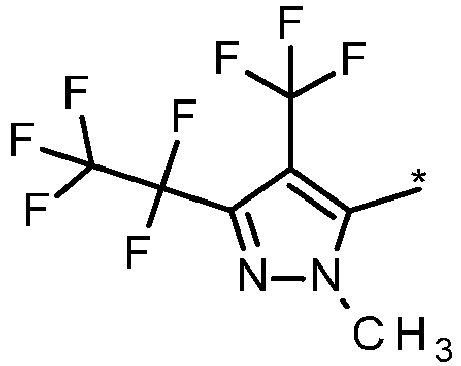

- and the salts thereof.
- wherein (T2) is represented by the following group (T2-1):
- [23] In a further aspect the invention relates to compounds of formula (I) as defined in any one of the preceding aspects [1] to [22], which are in the form of salts, solvates, N-oxides and tautomeric forms thereof.
- [24] In a further aspect the invention relates to compounds of formula (I) as defined in any one of the preceding aspects [1] to [23], which are selected from
- 2-({[{2-Chloro-5-[2'-methyl-5'-(pentafluoroethyl)-4'-(trifluoromethyl)-2'H-[1,3'-bipyrazol]-4-yl]benzoyl}(1-cyanocyclopropyl)amino]methoxy}carbonyl)cyclopropane-1-carboxylic acid;
- 4-{[{2-Chloro-5-[2'-methyl-5'-(pentafluoroethyl)-4'-(trifluoromethyl)-2'H-[1,3'-bipyrazol]-4-yl]benzoyl} (1-cyanocyclopropyl)amino]methoxy} -2,2-dimethyl-4-oxobutanoic acid;
- 4-({[(2-Chloro-5-{1-[2-chloro-4-(1,1,1,2,3,3,3-heptafluoropropan-2-yl)-6-(trifluoromethoxy)phenyl]-1H-pyrazol-4-yl}benzoyl)(1-cyanocyclopropyl)amino]methoxy}carbonyl)benzoic acid;
- 5-{[{2-Chloro-5-[2'-methyl-5'-(pentafluoroethyl)-4'-(trifluoromethyl)-2'H-[1,3'-bipyrazol]-4-yl]benzoyl}(1-cyanocyclopropyl)amino]methoxy}-5-oxopentanoic acid;
- 1-({[{2-Chloro-5-[2'-methyl-5'-(pentafluoroethyl)-4'-(trifluoromethyl)-2'H-[1,3'-bipyrazol]-4-yl]benzoyl}(1-cyanocyclopropyl)amino]methoxy}carbonyl)cyclopropane-1-carboxylic acid;
- 4-{[{2-Chloro-5-[2'-methyl-5'-(pentafluoroethyl)-4'-(trifluoromethyl)-2'H-[1,3'-bipyrazol]-4-yl]benzoyl} (1-cyanocyclopropyl)amino]methoxy} -4-oxobutanoic acid;
- (2E)-4-{[{2-Chloro-5-[2'-methyl-5'-(pentafluoroethyl)-4'-(trifluoromethyl)-2'H-[1,3'-bipyrazol]-4-yl]benzoyl} (1-cyanocyclopropyl)amino]methoxy} -4-oxobut-2-enoic acid;
- 4-{ [(2-Chloro-5-{ 1-[2-chloro-4-(1,1,1,2,3,3,3-heptafluoropropan-2-yl)-6-(trifluoromethoxy)phenyl]-1H-pyrazol-4-yl}benzoyl)(1-cyanocyclopropyl)amino]methoxy}-4-oxobutanoic acid;
- 5-{[(2-Chloro-5-{1-[2-chloro-4-(1,1,1,2,3,3,3-heptafluoropropan-2-yl)-6-(trifluoromethoxy)phenyl]-1H-pyrazol-4-yl}benzoyl)(1-cyanocyclopropyl)amino]methoxy}-5-oxopentanoic acid;
- 4-({[{2-Chloro-5-[2'-methyl-5'-(pentafluoroethyl)-4'-(trifluoromethyl)-2'H-[1,3'-bipyrazol]-4-yl]benzoyl} (1-cyanocyclopropyl)amino]methoxy}carbonyl)benzoic acid;
- (trans)-4-({ [(2-Chloro-5-{ 1-[2-chloro-4-(1,1,1,2,3,3,3-heptafluoropropan-2-yl)-6-(trifluoromethoxy)phenyl]-1H-pyrazol-4-yl}benzoyl)(1-cyanocyclopropyl)amino]methoxy}carbonyl)cyclohexane-1-carboxylic acid;
- (trans)-4-({[{2-Chloro-5-[2'-methyl-5'-(pentafluoroethyl)-4'-(trifluoromethyl)-2'H-[l,3'-bipyrazol]-4-yl]benzoyl}(1-cyanocyclopropyl)amino]methoxy}carbonyl)cyclohexane-1-carboxylic acid;
- (2E)-4-{[(2-Chloro-5-{1-[2-chloro-4-(1,1,1,2,3,3,3-heptafluoropropan-2-yl)-6-(trifluoromethoxy)phenyl]-1H-pyrazol-4-yl}benzoyl)(1-cyanocyclopropyl)amino]methoxy}-4-oxobut-2-enoic acid;
- 4-1[(2-Chloro-5-11-[2-chloro-4-(1,1,1,2,3,3,3-heptafluoropropan-2-yl)-6-(trifluoromethoxy)phenyl]-1H-pyrazol-4-yl}benzoyl)(1-cyanocyclopropyl)amino]methoxy}-2,2-dimethyl-4-oxobutanoic acid; and
- 4-(2-{ [(2-Chloro-5-{ 1-[2-chloro-4-(1,1,1,2,3,3,3-heptafluoropropan-2-yl)-6-(trifluoromethoxy)phenyl]-1H-pyrazol-4-yl}benzoyl)(1-cyanocyclopropyl)amino]methoxy}-2-oxoethyl)benzoic acid;
- and the salts solvates, N-oxides and tautomeric forms thereof.
- [25] In a further aspect the invention relates to compounds of formula (I) as defined in any one of the preceding aspects [1] to [24], which are for use as medicaments.
- [26] In a further aspect the invention relates to pharmaceutical compositions comprising at least one compound according to any of the preceding aspects [1] to [25].
- [27] In a further aspect the invention relates to pharmaceutical compositions according to aspect [26], comprising at least one further component selected from auxiliaries, excipients and/or solvents.
- [28] In a further aspect the invention relates to pharmaceutical compositions according to aspect [26] or [27], comprising at least one additional pharmaceutically active agent.
- [29] In a further aspect the invention relates to pharmaceutical compositions according to aspect [28], wherein the at least one additional pharmaceutically active agent is selected from the group of active agents with ectoparasiticidal activity, in particular with insecticidal and/or acaricidal activity, or from the group of antigens for vaccination purposes.
- [30] In a further aspect the invention relates to pharmaceutical compositions according to any of the preceding aspects [26] to [29], which are in the form of an injectable formulation.
- [31] In a further aspect the invention relates to pharmaceutical compositions according to any of the preceding aspects [26] to [29], which are in the form of a formulation for oral administration.
- [32] In a further aspect the invention relates to the compounds or the pharmaceutical compositions according to any of the preceding aspects for use as a medicament for subcutaneous application.
- [33] In a further aspect the invention relates to the compounds or the pharmaceutical compositions according to any of the preceding aspects for oral application.
- [34] In a further aspect the invention relates to the compounds or the pharmaceutical compositions according to any of the preceding aspects for use in treating animals.
- [35] In a further aspect the invention relates to the compounds or the pharmaceutical compositions for use according to to aspect [34], wherein the animals to be treated are selected from companion animals.
- [36] In a further aspect the invention relates to the compounds or the pharmaceutical compositions for use according to to aspect [34] or [35], wherein the companion animals are selected from cats and dogs, preferably from dogs.
- [37] In a further aspect the invention relates to compounds or the pharmaceutical compositions according to any one of the preceding aspects for use in controlling insects and arachnids.
- [38] In a further aspect the invention relates to the use according to aspect [37], wherein the arachnids are selected from the group of Chelicerata.
- [39] In a further aspect the invention relates to the use according to aspect [37] or [38], wherein the insects are selected from the group consisting of lice, mosquitoes, flies and fleas and arachnids are selected from acari, in particular from the group consisting of ticks, and mites.
- [40] In a further aspect the invention relates to the use of the compounds as defined in any one of the preceding aspects for preparing pharmaceutical compositions for controlling parasites on animals.
- [41] In a further aspect the invention relates to the use of the compounds or the pharmaceutical compositions according to any one of the preceding aspects with treatment intervals of 3 months to two years, preferably 4 months to one year.
- [42] In a further aspect the invention relates to the use of the compounds or the pharmaceutical compositions according to aspect [41], wherein the treatment intervals are 6 months to one year, preferably 9 months to one year.
- [43] In a further aspect the invention relates to the use of the compounds or the pharmaceutical compositions according to any of the preceding aspects, wherein the total amount of the compounds as defined in any one of the preceding aspects to be administered is in the range of from 0.01 to 200 mg/kg body weight per application, preferably in the range of from 0.1 to 100 mg/kg body weight per application, more preferably of from 0.5 to 75 mg/kg body weight per application, more preferably in the range of from 1.0 to 50 mg/kg body weight per application, most preferably in the range of from 2.0 to 20 mg/kg body weight per application.
- [44] In a further aspect the invention relates to a process for preparing the compounds according to any of the preceding aspects comprising the step of reacting a compound (A)


- Y and L have the meaning as defined in any one of the preceding aspects and wherein PG represents a protecting group or hydrogen to form the compounds according to formula (I),
- and wherein in cases wherein PG is not hydrogen, deprotection is carried out to form the compounds (I).
- [45] In a further aspect the invention relates to the process according to aspect [44] further comprising the preliminary step of preparing the group (B) by reacting a compound (b) to form compound (B)

- [46] In a further aspect the invention relates to intermediate compounds according to formula (B-1) and (B-2),

- L
- has the meaning as defined in any one of the preceding aspects and
- PG
- represents a tert-butyl group.
- [47] In a further aspect the invention relates to intermediate compounds according to formula (C),

In a further aspect the invention relates to intermediates of formula (A-3)
- [48] In a further aspect the invention relates to intermediate compounds selected from those described in the Examples infra, such as in particular intermediate compounds (B-1) selected from intermediate compounds 20A; intermediate compounds (B-2) selected from intermediate compounds 1A, 3A, 5A, 7A, 9A, 11A, 13A, 15A and 21A infra; intermediate compounds (C) selected from intermediate compounds 2A, 4A, 6A, 8A, 10A, 12A, 14A, 16A, 17A, 18A, 22A, 23A, 24A, 25A, 26A and 28A infra; or intermediate compounds (A-3) selected from intermediate compounds 27A infra.
- "Arachnids" are a class (Arachnida) of joint-legged invertebrate animals (arthropods), in the subphylum Chelicerata. A preferred subclass of the arachnids are acari (or acarina) which comprise in particular mites and ticks.
- The term "substituted" means that one or more hydrogen atoms on the designated atom or group are replaced with a selection from the indicated group, provided that the designated atom's normal valency under the existing circumstances is not exceeded. Combinations of substituents and/or variables are permissible.
- The term "optionally substituted" means that the number of substituents can be equal to or different from zero. Unless otherwise indicated, it is possible that optionally substituted groups are substituted with as many optional substituents as can be accommodated by replacing a hydrogen atom with a non-hydrogen substituent on any available carbon or nitrogen atom. Commonly, it is possible for the number of optional substituents, when present, to be 1, 2, 3, 4 or 5, in particular 1, 2 or 3.
- As used herein, the term "one or more", e.g. in the definition of the substituents of the compounds of general formula (I) of the present invention, means "1, 2, 3, 4 or 5, particularly 1, 2, 3 or 4, more particularly 1, 2 or 3, even more particularly 1 or 2".
- As used herein, the position via which a respective subsituent is connected to the rest of the molecule may in a drawn structure be depicted by a star sign [*] in said substituent.
- The term "comprising" when used in the specification includes "consisting of".
- If within the present text any item is referred to as "as mentioned herein", it means that it may be mentioned anywhere in the present text.
- The terms as mentioned in the present text have the following meanings:
The term "halogen atom" means a fluorine, chlorine, bromine or iodine atom, particularly a fluorine, chlorine or bromine atom, more particularly chlorine and/or fluorine. - The term "C1-C4-alkanediyl" represents a divalent straight-chained (linear) or branched alkanediyl radical having from 1 to 4, preferably 1, 2 or 3, or 2, 3 or 4, more preferably 2 or 3, carbon atoms. The term "C2-C4-alkanediyl" represents a divalent straight-chained (linear) or branched alkanediyl radical having from 2 to 4, preferably 2 or 3 carbon atoms. The following may be mentioned as preferred examples: methylene, 1,2-ethanediyl, ethane-1,1-diyl, 1,3-propylene (1,3-propanediyl), propane-1,1-diyl, propane-1,2-diyl, propane-2,2-diyl, 1,4-butylene (1,4-butanediyl), butane-1,2-diyl, butane-1,3-diyl, butane-2,3-diyl. Preferred are methylene, 1,2-ethanediyl and 1,3-propylene (1,3-propanediyl), more preferred are 1,2-ethanediyl and 1,3-propylene (1,3-propanediyl).
- The term "C2-C4-alkenediyl" represents a divalent straight-chained (linear) or branched alkenediyl radical, which contains one double bond, having 2, 3 or 4 carbon atoms, preferably 2 or 3, more preferably 2 carbon atoms. The following may be mentioned as preferred examples: ethenyl (or "vinyl"), prop-2-en-1-yl (or "allyl"), prop-1-en-1-yl, but-3-enyl, but-2-enyl, but-1-enyl, prop-1-en-2-yl (or "isopropenyl"), 2-methylprop-2-enyl, 1-methylprop-2-enyl, 2-methylprop-1-enyl or 1-methylprop-1-enyl. Preferred are ethenyl and allyl, more preferred is ethenyl.
- The term "C2-C4-alkynediyl" represents a divalent straight-chained (linear) alkenediyl radical, which contains one triple bond, having 2, 3 or 4 carbon atoms. The following may be mentioned as preferred examples: ethynyl, prop-1-ynyl, prop-2-ynyl (or "propargyl"), but-1-ynyl, but-2-ynyl, but-3-ynyl or 1-methylprop-2-ynyl. Particularly, said alkynyl group is prop-1-ynyl or prop-2-ynyl.
- In the present invention a linear C1-C4-alkanediyl or C2-C4-alkanediyl group or a C2-C4-alkenediyl or a C2-C4-alkynediyl group may be substituted with one or more groups independently selected from halogen (as defined above), C1-C4-alkyl and C3-C6-cycloalkyl. For example, a linear C1-C4-alkanediyl group or a C2-C4-alkanediyl group, which is substituted with one or more groups selected from C1-C4-alkyl comprises in particular a 1,2-dimethyl-ethanediyl group, a 2,2-dimethyl-ethanediyl group, a 1,1-dimethyl-1,3-propanediyl group, a 2,2-dimethyl-1,3-propanediyl group, a 3,3-dimethyl-1,3-propanediyl group, a 1,2-dimethyl-1,3-propanediyl group, a 1,3-dimethyl-1,3-propanediyl group and a 2,3-dimethyl-1,3-propanediyl group. A 2,2-dimethyl-ethanediyl group is preferred.
- In the case of a C1-C4-alkanediyl group or a C2-C4-alkanediyl group which may be substituted with one or more C1-C4-alkyl substituents, it is also possible that two C1-C4-alkyl substituents form a ring together with the carbon atom to which they are bonded. Respective groups comprise in particular the following groups:

- Preferably a respective group is

- Therein n and m are independently 0, 1, 2 or 3. Preferably n and m are independently 0, 1 or 2. More preferably one of n and m is 0 and the other one is 1.
- The term "C3-C7-cycloalkanediyl" represents a divalent monocyclic hydrocarbon radical having from 3 to 7, preferably from 3 to 6 ring carbon atoms. Examples are the following groups:



- Therein, the following groups are preferred:

- The term "phenylene" represents a divalent monocyclic aromatic radical having 6 ring carbon atoms
The term "C5-C6-heteroarenediyl" represents a divalent monocyclic heteroaromatic radical, wherein 1, 2 or 3 ring carbon atoms are replaced by a heteroatom, preferably by a heteroatom from the group consisting of N, O and S. - The term "Cs-Cs bicycloalkanediyl" represents a divalent bicyclic radical having 5 to 8 carbon ring carbon atoms.
- Said C3-C7-cycloalkanediyl, phenylene, C5-C6-heteroarenediyl and C5-C8 bicycloalkanediyl groups may be substituted with one or more groups independently selected from halogen, cyano and C1-C4-alkyl, each as defined herein.
- The term "C1-C6-alkyl" comprises linear and branched, saturated, monovalent hydrocarbon group having 1, 2, 3, 4, 5 or 6 carbon atoms. The term "C1-C4-alkyl" comprises linear and branched, saturated, monovalent hydrocarbon group having 1, 2, 3, or 4 carbon atoms. The term "C1-C3-alkyl" comprises linear and branched, saturated, monovalent hydrocarbon group having 1, 2 or 3 carbon atoms. Examples of the respective alkyl-groups are a methyl, ethyl, n-propyl, isopropyl, n-butyl, sec-butyl, isobutyl, a tert-butyl group etc., or an isomer thereof. Most preferred are methyl, ethyl, and n-propyl.
- The term "C3-C6-cycloalkyl" means a saturated, monovalent, monocyclic hydrocarbon ring which contains 3, 4, 5 or 6 carbon atoms. The term "C3-C5-cycloalkyl" means a saturated, monovalent, monocyclic hydrocarbon ring which contains 3, 4 or 5 carbon atoms. Said C3-C6-cycloalkyl groups are for example, a monocyclic hydrocarbon ring, e.g. a cyclopropyl, cyclobutyl, cyclopentyl or cyclohexyl group. Particularly, said cycloalkyl group contains 3, 5 or 6 carbon atoms and is e.g. cyclopropyl, cyclopentyl or cyclohexyl.
- The term "C1-C6-alkoxy" represents a straight-chain or branched O-alkyl having 1 to 6 carbon atoms, for example methoxy, ethoxy, n-propoxy, isopropoxy, n-butoxy, isobutoxy, s-butoxy and t-butoxy. Preference is also given to alkoxy groups having 1 to 4 carbon atoms. The inventive alkoxy groups may be substituted by one or more identical or different radicals.
- The term " C1-C6-alkylsulphanyl" represents straight-chain or branched S-alkyl having 1 to 6 carbon atoms, for example methylthio, ethylthio, n-propylthio, isopropylthio, n-butylthio, isobutylthio, s-butylthio and t-butylthio. Preference is also given to alkylsulphanyl groups having 1 to 4 carbon atoms. The inventive alkylsulphanyl groups may be substituted by one or more identical or different radicals.
- The term " C1-C6-alkylsulphinyl" represents straight-chain or branched alkylsulphinyl having 1 to 6 carbon atoms, for example methylsulphinyl, ethylsulphinyl, n-propylsulphinyl, isopropylsulphinyl, n-butylsulphinyl, isobutylsulphinyl, s-butylsulphinyl and t-butylsulphinyl. Preference is also given to alkylsulphinyl groups having 1 to 4 carbon atoms. The inventive alkylsulphinyl groups may be substituted by one or more identical or different radicals.
- The term "alkylsulphonyl" represents straight-chain or branched alkylsulphonyl having 1 to 6 carbon atoms, for example methylsulphonyl, ethylsulphonyl, n-propylsulphonyl, isopropylsulphonyl, n-butylsulphonyl, isobutylsulphonyl, s-butylsulphonyl and t-butylsulphonyl. Preference is also given to alkylsulphonyl groups having 1 to 4 carbon atoms. The inventive alkylsulphonyl groups may be substituted by one or more identical or different radicals.
- The terms "halogen-substituted C1-C6-alkyl", "halogen-substituted C1-C6-alkoxy" and "halogen-substituted C3-C6-cycloalkyl" represent C1-C6-alkyl, C1-C6-alkoxy and C3-C6-cycloalkyl groups as defined above, which are mono- or polysubstituted by halogen up to the maximum possible number of substituents. Such groups are also referred to as halo groups (for example haloalkyl). In the case of polysubstitution by halogen, the halogen atoms may be the same or different, and may all be bonded to one carbon atom or may be bonded to a plurality of carbon atoms. Halogen is especially fluorine, chlorine, bromine or iodine, preferably fluorine, chlorine or bromine and more preferably fluorine. More particularly, halogen-substituted groups are monohalocycloalkyl such as 1-fluorocyclopropyl, 2-fluorocyclopropyl or 1-fluorocyclobutyl, monohaloalkyl such as 2-chloroethyl, 2-fluoroethyl, 1-chloroethyl, 1-fluoroethyl, chloromethyl, or fluoromethyl; perhaloalkyl such as trichloromethyl or trifluoromethyl or CF2CF3, polyhaloalkyl such as difluoromethyl, 2-fluoro-2-chloroethyl, dichloromethyl, 1,1,2,2-tetrafluoroethyl or 2,2,2-trifluoroethyl. Further examples of haloalkyls are trichloromethyl, chlorodifluoromethyl, dichlorofluoromethyl, chloromethyl, bromomethyl, 1-fluoroethyl, 2-fluoroethyl, 2,2-difluoroethyl, 2,2,2-trifluoroethyl, 2,2,2-trichloroethyl, 2-chloro-2,2-difluoroethyl, pentafluoroethyl, 3,3,3-trifluoropropyl and pentafluoro-t-butyl. Preference is given to haloalkyls having 1 to 4 carbon atoms and 1 to 9, preferably 1 to 5, identical or different halogen atoms selected from fluorine, chlorine and bromine, preferably from fluorine. Particular preference is given to haloalkyls having 1 or 2 carbon atoms and 1 to 5 identical or different halogen atoms selected from fluorine and chlorine, such as, inter alia, difluoromethyl, trifluoromethyl or 2,2-difluoroethyl. Further examples of halogen-substituted compounds are haloalkoxy such as OCF3, OCHF2, OCH2F, OCF2CF3, OCH2CF3, OCH2CHF2 and OCH2CH2Cl, haloalkylsulphanyls such as difluoromethylthio, trifluoromethylthio, trichloromethylthio, chlorodifluoromethylthio, 1-fluoroethylthio, 2-fluoroethylthio, 2,2-difluoroethylthio, 1,1,2,2-tetrafluoroethylthio, 2,2,2-trifluoroethylthio or 2-chloro-1,1,2-trifluoroethylthio, haloalkylsulphinyls such as difluoromethylsulphinyl, trifluoromethylsulphinyl, trichloromethylsulphinyl, chlorodifluoromethylsulphinyl, 1-fluoroethylsulphinyl, 2-fluoroethylsulphinyl, 2,2-difluoroethylsulphinyl, 1,1,2,2-tetrafluoroethylsulphinyl, 2,2,2-trifluoroethylsulphinyl and 2-chloro-1,1,2-trifluoroethylsulphinyl, haloalkylsulphinyls such as difluoromethylsulphinyl, trifluoromethylsulphinyl, trichloromethylsulphinyl, chlorodifluoromethylsulphinyl, 1-fluoroethylsulphinyl, 2-fluoroethylsulphinyl, 2,2-difluoroethylsulphinyl, 1,1,2,2-tetrafluoroethylsulphinyl, 2,2,2-trifluoroethylsulphinyl and 2-chloro-1,1,2-trifluoroethylsulphinyl, haloalkylsulphonyl groups such as difluoromethylsulphonyl, trifluoromethylsulphonyl, trichloromethylsulphonyl, chlorodifluoromethylsulphonyl, 1-fluoroethylsulphonyl, 2-fluoroethylsulphonyl, 2,2-difluoroethylsulphonyl, 1,1,2,2-tetrafluoroethylsulphonyl, 2,2,2-trifluoroethylsulphonyl and 2-chloro-1,1,2-trifluoroethylsulphonyl. Most preferred fluorinated alkyl groups are CF3, C2F5 and C3F7 and most preferred fluorinated alkoxy groups are OCF3, OC2F5 and OC3F7.
- The terms "N-C1-C6-alkylamino", "N,N-di-C1-C6-alkylamino", and "N-C1-C3-alkoxy-C1-C4-alkylamino" represent an amino group substituted with one or two C1-C6-groups or an amino group substituted with one C1-C3-alkoxy group and one C1-C4-alkyl group, each as defined above.
- The term " C1-C6-alkylcarbonyl" represents straight-chain or branched alkyl-C(=O) having 2 to 7 carbon atoms such as methylcarbonyl, ethylcarbonyl, n-propylcarbonyl, isopropylcarbonyl, s-butylcarbonyl and t-butylcarbonyl. Preference is also given to alkylcarbonyls having 1 to 4 carbon atoms. The inventive alkylcarbonyls may be substituted by one or more identical or different radicals.
- The term "C2-C6-alkenyl" represents straight-chain or branched hydrocarbons preferably having 2 to 6 carbon atoms and at least one double bond, for example vinyl, 2-propenyl, 2-butenyl, 3-butenyl, 1-methyl-2-propenyl, 2-methyl-2-propenyl, 2-pentenyl, 3-pentenyl, 4-pentenyl, 1-methyl-2-butenyl, 2-methyl-2-butenyl, 3-methyl-2-butenyl, 1-methyl-3-butenyl, 2-methyl-3-butenyl, 3-methyl-3-butenyl, 1,1-dimethyl-2-propenyl, 1,2-dimethyl-2-propenyl, 1-ethyl-2-propenyl, 2-hexenyl, 3-hexenyl, 4-hexenyl, 5-hexenyl, 1-methyl-2-pentenyl, 2-methyl-2-pentenyl, 3-methyl-2-pentenyl, 4-methyl-2-pentenyl, 3-methyl-3-pentenyl, 4-methyl-3-pentenyl, 1-methyl-4-pentenyl, 2-methyl-4-pentenyl, 3-methyl-4-pentenyl, 4-methyl-4-pentenyl, 1,1-dimethyl-2-butenyl, 1,1-dimethyl-3-butenyl, 1,2-dimethyl-2-butenyl, 1,2-dimethyl-3-butenyl, 1,3-dimethyl-2-butenyl, 2,2-dimethyl-3-butenyl, 2,3-dimethyl-2-butenyl, 2,3-dimethyl-3-butenyl, 1-ethyl-2-butenyl, 1-ethyl-3-butenyl, 2-ethyl-2-butenyl, 2-ethyl-3-butenyl, 1,1,2-trimethyl-2-propenyl, 1-ethyl-1-methyl-2-propenyl and 1-ethyl-2-methyl-2-propenyl. Preference is also given to alkenyls having 2 to 4 carbon atoms such as, inter alia, 2-propenyl, 2-butenyl or 1-methyl-2-propenyl. The inventive alkenyls may be substituted by one or more identical or different radicals.
- The term " C2-C6- alkynyl" represents straight-chain or branched hydrocarbons preferably having 2 to 6 carbon atoms and at least one triple bond, for example 2-propynyl, 2-butynyl, 3-butynyl, 1-methyl-2-propynyl, 2-pentynyl, 3-pentynyl, 4-pentynyl, 1-methyl-3-butynyl, 2-methyl-3-butynyl, 1-methyl-2-butynyl, 1,1-dimethyl-2-propynyl, 1-ethyl-2-propynyl, 2-hexynyl, 3-hexynyl, 4-hexynyl, 5-hexynyl, 1-methyl-2-pentynyl, 1-methyl-3-pentynyl, 1-methyl-4-pentynyl, 2-methyl-3-pentynyl, 2-methyl-4-pentynyl, 3-methyl-4-pentynyl, 4-methyl-2-pentynyl, 1,1-dimethyl-3-butynyl, 1,2-dimethyl-3-butynyl, 2,2-dimethyl-3-butynyl, 1-ethyl-3-butynyl, 2-ethyl-3-butynyl, 1-ethyl-1-methyl-2-propynyl and 2,5-hexadiynyl. Preference is also given to alkynyls having 2 to 4 carbon atoms such as, inter alia, ethynyl, 2-propynyl or 2-butynyl-2-propenyl. The inventive alkynyls may be substituted by one or more identical or different radicals.
- The term "aryl" represents a mono-, bi- or polycyclic aromatic system having preferably 6 to 14, especially 6 to 10, ring carbon atoms, for example phenyl, naphthyl, anthryl, phenanthrenyl, preferably phenyl. In addition, aryl also represents polycyclic systems such as tetrahydronaphthyl, indenyl, indanyl, fluorenyl, biphenyl, where the bonding site is on the aromatic system. The inventive aryl groups may be substituted by one or more identical or different radicals.
- The term "hetaryl" or "heteroaryl" represents heteroaromatic compounds, i.e. completely unsaturated aromatic heterocyclic compounds having at least one ring in which at least one carbon atom is replaced by a heteroatom, preferably by a heteroatom from the group consisting of N, O, S, P, B, Si, Se, and which may be unsubstituted or substituted, where the bonding site is on a ring atom. Unless defined differently, the heteroaryl ring contains preferably 3 to 9 ring atoms, especially 3 to 6 ring atoms, more preferably 5 to 7 ring atoms, and one or more, preferably 1 to 4, especially 1, 2 or 3, heteroatoms in the heteroaryl ring, preferably from the group consisting of N, O, and S, although no two oxygen atoms should be directly adjacent. The heteroaryl rings usually contain not more than 4 nitrogen atoms and/or not more than 2 oxygen atoms and/or not more than 2 sulphur atoms. Particular preference is given to 5- to 7-membered rings having 1 to 3, preferably 1 or 2, identical or different heteroatoms from the group above. Inventive heteroaryls are, for example, furyl, thienyl, pyrazolyl, imidazolyl, 1,2,3- and 1,2,4-triazolyl, isoxazolyl, thiazolyl, isothiazolyl, 1,2,3-, 1,3,4-, 1,2,4- and 1,2,5-oxadiazolyl, azepinyl, pyrrolyl, pyridyl, pyridazinyl, pyrimidinyl, pyrazinyl, 1,3,5-, 1,2,4- and 1,2,3-triazinyl, 1,2,4-, 1,3,2-, 1,3,6- and 1,2,6-oxazinyl, oxepinyl, thiepinyl, 1,2,4-triazolonyl and 1,2,4-diazepinyl. The inventive heteroaryl groups may also be substituted by one or more identical or different radicals
- Preferred substituents of the aryl and heteroaryl groups are selected from hydroxy, halogen, cyano, nitro, amino, C1-C3-alkyl, C1-C3-alkoxy, hydroxycarbonyl, alkoxycarbonyl, alkylcarbamoyl, cycloalkylcarbamoyl, phenyl and 1-pyrrolidinyl.
- Preferably the substituents Y and L have the meaning as defined above in the various aspects of the present invention.
- In a particularly preferred aspect of the invention the substituent Y in the compounds of formula (I) as defined anywhere herein is selected from a group (T1) as defined herein, in particular a group (T1-1) or (T1-2), each as defined anywhere herein. In an alternative aspect, of the invention the substituent Y in the compounds of formula (I) as defined anywhere herein is selected from a group (T2) as defined herein, in particular a group (T1-1) or (T1-2), each as defined anywhere herein
- Particularly preferred Examples of the present invention are listed in aspect [24] above and as shown in the Examples below. Preferred compounds according to formula (I) of the present invention are those of Examples 6, 7, 8, 13, 14. More preferred compounds according to formula (I) of the present invention are those of Examples 8 and 13.
- Salts of the inventive compounds that are suitable in accordance with the invention, for example salts with bases, are all customary non-toxic salts, preferably agriculturally and/or physiologically acceptable salts. Preference is given to salts with inorganic bases, for example alkali metal salts (e.g. sodium, potassium or caesium salts), alkaline earth metal salts (e.g. calcium or magnesium salts), ammonium salts or salts with organic bases, in particular with organic amines, for example triethylammonium, dicyclohexylammonium, N,N-dibenzylethylenediammonium, pyridinium, picolinium or ethanolammonium salts. Preferably salts of the compounds of the present invention are pharmaceutically acceptable salts.
- Furthermore, the present invention includes all possible crystalline forms, or polymorphs, of the compounds of the present invention, either as single polymorph, or as a mixture of more than one polymorph, in any ratio.
- The compounds of the present invention and their salts - to the extent applicable -can exist as a hydrate, or as a solvate, wherein the compounds of the present invention contain water or polar solvents (for example methanol or ethanol), respectively, as structural element of the crystal lattice of the compounds. It is possible for the amount of polar solvents, in particular water, to exist in a stoichiometric or non-stoichiometric ratio. In the case of stoichiometric solvates, e.g. a hydrate, hemi-, (semi-), mono-, sesqui-, di-, tri-, tetra-, penta- etc. solvates or hydrates, respectively, are possible. The present invention includes all such hydrates or solvates of the compounds and their salts, to the extent applicable.
- Depending on the nature of the substituents, the compounds of the formula (I) may be in the form of geometric and/or optically active isomers or corresponding isomer mixtures in different compositions. These stereoisomers are, for example, enantiomers, diastereomers, atropisomers, tautomers or geometric isomers. Accordingly, the invention encompasses both pure stereoisomers and any mixtures of these isomers.
- The novel compounds according to the present invention are particularly suitable for the use as medicaments, in particular for the use as medicaments for the treatment of animals. The novel compounds according to the present invention are particularly suitable for the use as medicaments to act against animal parasites, especially ectoparasites, such as insects and arachnids or else. Ectoparasites are typically and preferably arthropods, especially insects such as flies (biting and licking), parasitic fly larvae, sucking lice, biting lice, fleas and the like; or acari such as ticks, for example hard ticks or soft ticks, or mites such as scab mites, bird mites and the like, and also aquatic ectoparasites such as copepods. The novel compounds of the present invention are particularly suitable to act against ticks, fleas, lice, flies and mites.
- The novel compounds of the formula (I) having favourable homeotherm toxicity are suitable for controlling parasites which occur in animal breeding and animal husbandry in livestock including aquaculture, breeding animals, zoo animals, laboratory animals, experimental animals and domestic animals. They are active against all or specific stages of development of the parasites.
- Agricultural livestock include, for example, mammals such as sheep, goats, horses, donkeys, camels, buffalo, rabbits, reindeer, fallow deer, and particularly cattle and pigs; poultry such as turkeys, ducks, geese, and particularly chickens; fish and crustaceans, for example in aquaculture.
- Domestic animals (also indicated as companion animals) include, for example, mammals, such as hamsters, guinea pigs, rats, mice, chinchillas, ferrets, and particularly dogs, cats, cage birds, reptiles, amphibians and aquarium fish. Preferred companion animals are cats and dogs.
- In a preferred embodiment, the compounds of the formula (I) are administered to mammals.
- In a preferred embodiment the compounds of formula (I) are administered to cats.
- In a preferred embodiment the compounds of formula (I) are administered to dogs.
- Use of the compounds of the formula (I) for the control of animal parasites is intended to reduce or prevent illness, cases of deaths and reductions in performance (in the case of meat, milk, wool, hides, eggs, honey and the like), such that more economical and simpler animal keeping is enabled and better animal well-being is achievable.
- In relation to the animal health field, the term "control" or "controlling" means that the compounds of the formula (I) are effective in reducing the incidence of the particular parasite in an animal infected with such parasites to an innocuous degree. More specifically, "controlling" in the present context means that the compound of the formula (I) can kill the respective parasite, inhibit its growth, or inhibit its proliferation.
- These parasites include:
From the order of the Anoplurida, for example, Haematopinus spp., Linognathus spp., Pediculus spp., Phthirus spp., Solenopotes spp.; specific examples are: Linognathus setosus, Linognathus vituli, Linognathus ovillus, Linognathus oviformis, Linognathus pedalis, Linognathus stenopsis, Haematopinus asini macrocephalus, Haematopinus eurysternus, Haematopinus suis, Pediculus humanus capitis, Pediculus humanus corporis, Phylloera vastatrix, Phthirus pubis, Solenopotes capillatus; - From the order of the Mallophagida and the suborders Amblycerina and Ischnocerina, for example, Trimenopon spp., Menopon spp., Trinoton spp., Bovicola spp., Werneckiella spp., Lepikentron spp., Damalina spp., Trichodectes spp., Felicola spp.; specific examples are: Bovicola bovis, Bovicola ovis, Bovicola limbata, Damalina bovis, Trichodectes canis, Felicola subrostratus, Bovicola caprae, Lepikentron ovis, Werneckiella equi;
- From the order of the Diptera and the suborders Nematocerina and Brachycerina, for example, Aedes spp., Anopheles spp., Culex spp., Simulium spp., Eusimulium spp., Phlebotomus spp., Lutzomyia spp., Culicoides spp., Chrysops spp., Odagmia spp., Wilhelmia spp., Hybomitra spp., Atylotus spp., Tabanus spp., Haematopota spp., Philipomyia spp., Braula spp., Musca spp., Hydrotaea spp., Stomoxys spp., Haematobia spp., Morellia spp., Fannia spp., Glossina spp., Calliphora spp., Lucilia spp., Chrysomyia spp., Wohlfahrtia spp., Sarcophaga spp., Oestrus spp., Hypoderma spp., Gasterophilus spp., Hippobosca spp., Lipoptena spp., Melophagus spp., Rhinoestrus spp., Tipula spp.; specific examples are: Aedes aegypti, Aedes albopictus, Aedes taeniorhynchus, Anopheles gambiae, Anopheles maculipennis, Calliphora erythrocephala, Chrysozona pluvialis, Culex quinquefasciatus, Culex pipiens, Culex tarsalis, Fannia canicularis, Sarcophaga carnaria, Stomoxys calcitrans, Tipula paludosa, Lucilia cuprina, Lucilia sericata, Simulium reptans, Phlebotomus papatasi, Phlebotomus longipalpis, Odagmia ornata, Wilhelmia equina, Boophthora erythrocephala, Tabanus bromius, Tabanus spodopterus, Tabanus atratus, Tabanus sudeticus, Hybomitra ciurea, Chrysops caecutiens, Chrysops relictus, Haematopota pluvialis, Haematopota italica, Musca autumnalis, Musca domestica, Haematobia irritans irritans, Haematobia irritans exigua, Haematobia stimulans, Hydrotaea irritans, Hydrotaea albipuncta, Chrysomya chloropyga, Chrysomya bezziana, Oestrus ovis, Hypoderma bovis, Hypoderma lineatum, Przhevalskiana silenus, Dermatobia hominis, Melophagus ovinus, Lipoptena capreoli, Lipoptena cervi, Hippobosca variegata, Hippobosca equina, Gasterophilus intestinalis, Gasterophilus haemorroidalis, Gasterophilus inermis, Gasterophilus nasalis, Gasterophilus nigricornis, Gasterophilus pecorum, Braula coeca;
- From the order of the Siphonapterida, for example, Pulex spp., Ctenocephalides spp., Tunga spp., Xenopsylla spp., Ceratophyllus spp.; specific examples are: Ctenocephalides canis, Ctenocephalides felis, Pulex irritans, Tunga penetrans, Xenopsylla cheopis;
- From the order of the Heteropterida, for example, Cimex spp., Triatoma spp., Rhodnius spp., Panstrongylus spp.
- From the order of the Blattarida, for example, Blatta orientalis, Periplaneta americana, Blattela germanica and Supella spp. (e.g. Suppella longipalpa);
- From the subclass of the Acari (Acarina) and the orders of the Meta- and Mesostigmata, for example, Argas spp., Ornithodorus spp., Otobius spp., Ixodes spp., Amblyomma spp., Rhipicephalus (Boophilus) spp., Dermacentor spp., Haemophysalis spp., Hyalomma spp., Dermanyssus spp., Rhipicephalus spp. (the original genus of multihost ticks), Omithonyssus spp., Pneumonyssus spp., Raillietia spp., Pneumonyssus spp., Stemostoma spp., Varroa spp., Acarapis spp.; specific examples are: Argas persicus, Argas reflexus, Ornithodorus moubata, Otobius megnini, Rhipicephalus (Boophilus) microplus, Rhipicephalus (Boophilus) decoloratus, Rhipicephalus (Boophilus) annulatus, Rhipicephalus (Boophilus) calceratus, Hyalomma anatolicum, Hyalomma aegypticum, Hyalomma marginatum, Hyalomma transiens, Rhipicephalus evertsi, Ixodes ricinus, Ixodes hexagonus, Ixodes canisuga, Ixodes pilosus, Ixodes rubicundus, Ixodes scapularis, Ixodes holocyclus, Haemaphysalis concinna, Haemaphysalis punctata, Haemaphysalis cinnabarina, Haemaphysalis otophila, Haemaphysalis leachi, Haemaphysalis longicorni, Dermacentor marginatus, Dermacentor reticulatus, Dermacentor pictus, Dermacentor albipictus, Dermacentor andersoni, Dermacentor variabilis, Hyalomma mauritanicum, Rhipicephalus sanguineus, Rhipicephalus bursa, Rhipicephalus appendiculatus, Rhipicephalus capensis, Rhipicephalus turanicus, Rhipicephalus zambeziensis, Amblyomma americanum, Amblyomma variegatum, Amblyomma maculatum, Amblyomma hebraeum, Amblyomma cajennense, Dermanyssus gallinae, Ornithonyssus bursa, Omithonyssus sylviarum, Varroa jacobsoni;
- From the order of the Actinedida (Prostigmata) and Acaridida (Astigmata), for example, Acarapis spp., Cheyletiella spp., Ornithocheyletia spp., Myobia spp., Psorergates spp., Demodex spp., Trombicula spp., Listrophorus spp., Acarus spp., Tyrophagus spp., Caloglyphus spp., Hypodectes spp., Pterolichus spp., Psoroptes spp., Chorioptes spp., Otodectes spp., Sarcoptes spp., Notoedres spp., Knemidocoptes spp., Cytodites spp. and Laminosioptes spp.; specific examples are: Cheyletiella yasguri, Cheyletiella blakei, Demodex canis, Demodex bovis, Demodex ovis, Demodex caprae, Demodex equi, Demodex caballi, Demodex suis, Neotrombicula autumnalis, Neotrombicula desaleri, Neoschongastia xerothermobia, Trombicula akamushi, Otodectes cynotis, Notoedres cati, Sarcoptis canis, Sarcoptes bovis, Sarcoptes ovis, Sarcoptes rupicaprae (=S. caprae), Sarcoptes equi, Sarcoptes suis, Psoroptes ovis, Psoroptes cuniculi, Psoroptes equi, Chorioptes bovis, Psoergates ovis, Pneumonyssoidic mange, Pneumonyssoides caninum, Acarapis woodi.
- From the subclass of the copepods with the order of the Siphonostomatoida in particular the genera Lepeophtheirus and Caligus; the species Lepeophtheirus salmonis, Caligus elongates and Caligus clemensi may be mentioned by way of example and with particular preference.
- According to a preferred embodiment the parasites are selected from the following group of ectoparsite species:
- Fleas: Ctenocephalides spp.;
- Ticks: Amblyomma spp., Dermacentor spp., Rhipicephalus spp., Ixodes spp., Haemaphysalis spp., Hyalomma spp.;
- Mites: Demodex spp., Otodectes spp., Sarcoptes spp.; and
- Lice: Linognathus spp,.
- More particularly the parasites are selected from:
- Fleas: Ctenocephalides felis, Ctenocephalides canis;
- Ticks: Ixodes scapularis, Ixodes ricinus, Dermacentor variabilis, Amblyomma americanum, Rhipicephalus sanguineus, Dermacentor reticulatus, Ixodes holocyclus, Ixodes hexagonus, Haemaphysalis longicornis;
- Mites: Otodectes cynotis, Sarcoptes scabiei, Demodex canis; and
- Lice: Linognathus setosus.
- In general, the inventive active ingredients can be employed directly when they are used for the treatment of animals. They are preferably employed (administered) in the form of pharmaceutical compositions which may comprise pharmaceutically acceptable excipients, solvents and/or auxiliaries known in the prior art.
- The novel active compounds of the present invention may be administered in a known manner, by enteral administration in the form of, for example, tablets, capsules, potions, drenches, granules, pastes, boluses, the feed-through process and suppositories, by parenteral administration, for example by injection (intramuscular, subcutaneous, intravenous, intraperitoneal inter alia), implants, by nasal administration, by dermal administration in the form, for example, of dipping or bathing, spraying, pouring on and spotting on, washing and powdering, and also with the aid of moulded articles containing the active ingredient, such as collars, earmarks, tailmarks, limb bands, halters, marking devices, etc. Preferably the novel compounds of the present invention are administered by subcutaneous or oral administration, more preferably by subcutaneous administration (injection).
- The novel active compounds of the present invention can be formulated in any suitable administration form for oral and subcutaneous (injectable) administration known in the prior art.
- Based upon standard laboratory techniques known to evaluate compounds useful for controlling parasites on animals, by standard toxicity tests and by standard pharmacological assays for the determination of treatment of the conditions identified above in animals, and by comparison of these results with the results of known active ingredients or medicaments that are used to treat these conditions, the effective dosage of the compounds of the present invention can readily be determined for treatment of each desired indication. The amount of the active ingredient to be administered in the treatment of one of these conditions can vary widely according to such considerations as the particular compound and dosage unit employed, the mode of administration, the period of treatment, the age and sex of the subject treated, and the nature and extent of the condition treated.
- The content of the novel active compounds of the present invention in formulations for the use (unit dosage) according to the present invention may vary within wide limits. The active compound concentration of the application forms may be from 0.00000001 to 98% by weight of active compound, preferably from 0.00001 to 98 % by weight, more preferably from 0.001 to 98 % by weight. More preferably, the pharmaceutical compositions of the present invention may comprise the novel compounds of the invention in amounts from 0.01 to 98% by weight of active compound, preferably from 0.1 to 98 % by weight. , more preferably from 0.5 to 90 % by weight. The pharmaceutical compositions of the present invention may comprise the novel compounds of the invention in amounts from 0.001 to 95 % by weight of active compound, preferably from 0.01 to 95% by weight, preferably from 0.1 to 50 % by weight, more preferably from 5 to 30 % by weight.
- The total amount of the active ingredient to be administered will generally range from about 0.01 to 200 mg/kg body weight per application, preferably in the range of from 0.1 to 100 mg/kg body weight per application, more preferably of from 0.5 to 75 mg/kg body weight per application, more preferably in the range of from 1.0 to 50 mg/kg body weight and most preferably in the range of from 2.0 to 20 mg/kg body weight per application.
- In particular, the average dosage for administration by infusion techniques or by injection, including intravenous, intramuscular, and in particular subcutaneous injections will preferably be within the aforesaid ranges.
- The average dosage for oral administration will preferably be within the aforesaid ranges.
- Clinically useful dosing or administration intervals will range from one application per month to one application every two years, preferably the treatment interval is from one application every three months to one application every two years, more preferred treatment intervals are from one application every six months to one application every two years. Further preferred dosing or administration intervals will range from one application per month to one application every year, preferably one application every three months to one application every year, more preferably one application every four months to one application every year, in particular one application every six months to one application every year. According to a further embodiment the application interval may be from one application every nine months to one application per year.
- In addition, it is possible for "drug holidays", in which a subject is not dosed with a drug for a certain period of time, to be beneficial to the overall balance between pharmacological effect and tolerability.
- Of course the specific initial and continuing dosage regimen, administered amount of active compound and the particular dosing interval will vary for each subject according to the nature and severity of the condition as determined by the attending diagnostician, the activity of the specific compound employed, the age and general condition of the subject, time of administration, route of administration, rate of excretion of the drug, drug combinations, and the like. The desired mode of treatment and number of doses of a compound of the present invention or a pharmaceutically acceptable salt or composition thereof can be ascertained by those skilled in the art using conventional treatment tests.
- In order to broaden the spectrum of activity, the novel active compounds of the present invention can be used in combination with suitable synergists, repellents or other active ingredients, for example acaricides, insecticides, anthelmintics, anti-protozoal agents.
- For example the compounds of the present invention can be used in combination with chloride channel activators or modulators from the class of the macrocylic lactones, in particular avermectins/milbemycins, e.g. abamectin, doramectin, emamectin benzoate, eprinomectin, ivermectin, latidectin, lepimectin, milbemycin oxime, milbemectin, moxidectin and selamectin, particular preference is given here, for applications against ectoparasites, to doramectin, eprinomectin, ivermectin, milbemycin oxime, moxidectin or selamectin.
- Further, the the compounds of the present invention can be used in combination with antigens for vaccination purposes. Examples for vaccines which may be combined with the compounds of the present invention are against leptospirosis, infectious tracheobronchitis, leishmaniasis or lyme borreliosis (lyme disease).
- The novel compounds (I) according to the present invention can be synthesised in a process comprising the step of reacting a compound (A)


- Rx represents hydrogen and Ry represents a -CH2-Cl group or
- Rx represents a -CH2-OH group and Ry represents hydrogen;
- wherein
- Y and L have the meaning as defined anywhere herein and wherein PG represents a protecting group or hydrogen to form the compounds according to formula (I),
- and wherein in cases wherein PG is not hydrogen, deprotection is carried out to form the compounds (I).
- Such process may further comprise one of the following preliminary steps:
- in the case that Rx represents hydrogen and Ry represents a -CH2-Cl group the preliminary step of preparing the group (B) with Ry = -CH2-Cl (compound (B-2)) from a compound (B-1)

- in the case that Rx represents a -CH2-OH group and Ry represents hydrogen the preliminary step of
- preparing the group (A) with Rx = -CH2-OH (compound A-3)) from a compound (A-1) via an intermediate compound (A-2)

- The resulting alternative preparation processes are further illustrated in the general Schemes 1 and 2 as shown below.


- The group (B) with Ry = -CH2-Cl (indicated as compound (B-2)) may be prepared from a monoprotected dicarboxylic acid compound (B-1) by treatment with chloromethyl carbonochloridate to form the chloromethyl ester compounds (B-2). The reaction is carried out in a solvent in the presence of a base. Dipolar aprotic solvents such as DMF, THF, acetonitrile, or pyridine can be used. The base may be an amine base like e..g. DIPEA, TEA, DMAP. In a preferred case, pyridine serves both as the solvent and the base. As defined herein, PG may represent hydrogeh, however, it is preferred, that PG represents a suitable protecting group, for instance, a tert-butyl group. Other suitable protecting groups are described in P.G. Wuts, Greene's Protective Groups in Organic Synthesis, Wiley 2014 .
- The compound of the formula (I) is formed by treating a compound (A) with Rx = hydrogen (indicated as compound (A-1)) with a base followed by reaction with the chloromethyl ester compound of formula (B-2). Strong bases can be used, for instance alkali metal tert-butylates, alkali metal hydride bases, metal amide bases, bis(trimethyldisilyl)amide (HMDS) bases, amidine bases or phosphazene bases. In a preferred case, sodium hydride or NaHMDS or KHMDS is used. The reaction is generally carried out in a solvent, usually in a polar aprotic solvent such as THF, diethyl ether, DMF or a mixture of a polar aprotic solvent and other solvents. If PG is hydrogen, this leads directly to the compounds (I) of the present invention. However, in a preferred aspect of the invention PG represents a protecting group, leading to the protected intermediate compounds (C). In such cases, the protecting group PG is cleaved to provide the compound of the invention of structure (I). In a particularly preferred case, PG is a tert-butyl group and is removed by treating compound (C) with a solution of hydrochloric acid in 1,4 dioxane or with a solution of TFA in dichloromethane.

- The group (A) with Rx = -CH2-OH (indicated as compound (A-3)) may be prepared by coupling an amide compound according to formula (A-1) with tert-butyl chloromethyl carbonate (CAS RN 35180-02-0) using a strong base as, for instance an alkali metal tert-butylate, an alkali metal hydride, a metal amide base, a bis(trimethyldisilyl)amide (HMDS) base, an amidine base or a phosphazene base. In a preferred case, KHMDS is used. The reaction is generally carried out in a solvent, usually in a polar aprotic solvent such as THF, diethyl ether, DMF or a mixture of a polar aprotic solvent and other solvents. The resulting compound (A-2) is then converted into the hydroxymethyl compound (A-3) by careful removal of the tert-butyl carbonate moiety with an acid such as TFA. This reaction is usually carried out in a solvent such as DCM. In case PG is a tert.butyl ester, selectivity of carbonate cleavage over the cleavage of PG can be obtained by keeping the reaction time short enough and carrying the reaction out at room temperature or below.
- The compound of the formula (I) is formed by coupling a compound (A) with Rx = -CH2-OH (indicated as compound (A-3)) with a carboxylic acid compound (B-1). To this end, the compound (B-1) is activated by converting it into the corresponding acid chloride with a method known in the art, preferentially by using oxalic chloride and a catalytic amount of DMF in dichloromethane. The acid chloride is then reacted with compound (A-3) in the presence of a base, preferably an amine base such as DIPEA, TEA or pyridine in an appropriate solvent such as THF, DMF, DCM.
- Alternatively, compound (B-1) can be activated by a coupling agent such as HATU, TCTU or other reagents known in the art and then be reacted with compound (A-3) in the presence of a base such as DIPEA, TEA or pyridine in an appropriate solvent such as, for instance, THF, DMF or DCM.
- If PG is hydrogen, this leads directly to the compounds (I) of the present invention. However, in a preferred aspect of the invention PG represents a protecting group, leading to the protected intermediate compounds (C). In such cases, the protecting group PG is cleaved to provide the compound of the invention of structure (I). In a particularly preferred case, PG is a tert-butyl group and is removed by treating compound (C) with a solution of hydrochloric acid in 1,4 dioxane or with a solution of TFA in dichloromethane.
- In the above described Schemes 1 and 2 the groups L, Y and PG have the meanind as defined anywhere herein.
- As mentioned above, the invention further relates to the intermediate compounds obtainable in the process according to the present invention, such as in particular intermediate compounds of the to formula (B-1) or (B-2):


- L
- has the meaning as defined in any one of the preceding aspects and
- PG
- represents a tert-butyl group.
- Specific examples of intermediate compounds according to the formulae (B-1), (B-2) and (C) are further shown in the following Examples.
-
- AA
- Amblyomma americanus (parasitology)
- abs.
- Absolute
- Ac
- Acetyl
- aq.
- Aqueous, aqueous solution
- AUC
- Area under the curve (in Pharmacokinetics)
- cat.
- Catalytic
- CF
- Ctenocephalides felis (parasitology)
- CI
- Chemical ionisation (mass spectroscopy)
- cone
- Concentrated
- d
- Doublet (NMR)
- d
- Day(s)
- dd
- Doublet of doublet (NMR)
- DCM
- Dichloromethane
- DIPEA
- N,N,-diisopropylethylamine (Hünig's base)
- DMAP
- 4-Dimethylaminopyridine
- DMF
- N,N-dimethylformamide
- DMSO
- Dimethylsulfoxide
- dt
- Doublet of triplet (NMR)
- DV
- Dermacentor variabilis (parasitology)
- ent
- Enantiomeric
- eq.
- Equivalent(s)
- ESI
- Electrospray-ionisation (mass spectroscopy)
- F
- Bioavailability (in Pharmacokinetics)
- GC
- Gas chromatography
- GC/MS
- Gas chromatography coupled to mass spectroscopy
- h
- Hour(s)
- HATU
- O-(7-Azabenzotriazol-1-yl)-N,N,N,N'-tetramethyluronium-hexafluorophosphate
- HMDS
- Bis(trimethyldisilyl)amide formerly also referred to as hexamethyldisilazide, counterion in strongly basic salts such as LiHMDS, NaHMDS, KHMDS
- HPLC
- High pressure liquid chromatography
- iPr
- Isopropyl
- IR
- Ixodes rhicinus (parasitology)
- iv
- Intravenous (PK)
- KHMDS
- Potassium bis(trimethyldisilyl)amide
- LC
- Liquid chromatography
- LC-MS
- Liquid chromatography coupled to mass spectroscopy
- LiHMDS
- Lithium bis(trimethyldisilyl)amide
- Lit.
- Literature
- m
- Multiplet (NMR)
- Me
- Methyl
- min
- Minute(s)
- MS
- Mass spectroscopy
- MTBE
- tert-Butyl methyl ether
- na
- Not analysed
- NaHMDS
- Sodium bis(trimethyldisilyl)amide
- NMP
- N-Methyl-2-pyrrolidone
- NMR
- Nuclear magnetic resonance spectroscopy
- PBS
- Phosphate buffered saline
- PEG
- Polyethylene glycol
- PK
- Pharmacokinetics
- Pr
- Propyl
- q (or quart)
- Quartet (NMR)
- qd
- Quartet of doublet (NMR)
- quant.
- quantitative (referring to chemical yield)
- quint
- Quintet (NMR)
- rac
- racemic
- RP
- reverse phase (for liquid chromatography)
- RS
- Rhipicephalus sanguineus (parasitology)
- Rt
- Retention time (chromatography)
- s
- Singulet (NMR)
- sc
- Subcutaneous (PK and pharmacology)
- SD
- Study day (pharmacology)
- sept
- Septet (NMR)
- t
- Triplet (NMR)
- t
- Time point (during an experiment)
- t0
- Time point at beginning of an experiment
- TBTU
- O-(Benzotriazol-1-yl)-N,N,N',N'-tetramethyluronium-tetra-fluoroborate
- tBu
- tert.-Butyl
- td
- Triplett of doublett (NMR)
- TEA
- triethylamine
- TFA
- Trifluoro acetic acid
- THF
- Tetrahydrofuran
- UV
- Ultraviolett-spectroscopy
- Instrument: Agilent MS Quad 6150;HPLC: Agilent 1290; Column: Waters Acquity UPLC HSS T3 1.8 µm 50 × 2.1 mm; Eluent A: 1 l water + 0.25 mL 99%ige Formic acid , Eluent B: 1 l Acetonitrile + 0.25 mL 99%ige Formic acid; Gradient: 0.0 min 90 % A → 0.3 min 90 % A → 1.7 min 5% A → 3.0 min 5% A Column temperature: 50°C; Flow: 1,20 mL/min; UV-Detektion: 205 - 305 nm.
- Instrument: Waters ACQUITY SQD UPLC System; Column: Waters Acquity UPLC HSS T3 1.8 µm 50 × 1 mm; eluent A: 1 l water + 0.25 mL 99%ige formic acid , eluent B: 1 L acetonitrile + 0.25 mL 99% formic acid; gradient: 0.0 min 90 % A → 1.2 min 5% A → 2.0 min 5% A column temperature: 50°C; flow: 0.40 mL/min; UV-detection: 210 nm.
- Instrument MS: Thermo Scientific FT-MS; instrument UHPLC+: Thermo Scientific UltiMate 3000; Column: Waters, HSST3, 2.1 × 75 mm, C18 1.8 µm; eluent A: 1 L water + 0.01 % formic acid; eluent B: 1 L acetonitrile + 0.01 % formic acid; gradient: 0.0 min 10 % B → 2.5 min 95% B → 3.5 min 95% B; column temperature: 50°C; flow: 0.90 mL/min; UV-detection: 210 nm/ Optimum Integration Path 210-300 nm
- Instrument: Waters ACQUITY SQD UPLC System; Column: Waters Acquity UPLC HSS T3 1.8 µm 50 × 1 mm; eluent A: 1 L water + 0.25 mL 99% formic acid , eluent B: 1 L acetonitrile+ 0.25 mL 99% formic acid; gradient: 0.0 min 95% A → 6.0 min 5% A → 7.5 min 5% A column temperature: 50°C; flow: 0.35 mL/min; UV-Detection: 210 nm.
- The column used was a Shim-pack XR-ODS, 2.2 µm, 3.0 × 50 mm. A linear gradient was applied, starting at 95% A (A: 0.05% TFA in water) and ending at 100 % B (B: 0.05% TFA in acetonitrile) over 4.70 min with a total run time of 5.00 min. The column temperature was at 45 °C with the flow rate of 1.20 mL/min.
- The column used was a Shim-pack XR-ODS, 2.2 µm, 3.0 × 50 mm. A linear gradient was applied, starting at 95% A (A: 0.05% TFA in water) and ending at 100 % B (B: 0.05% TFA in acetonitrile) over 1.70 min with a total run time of 2.00 min. The column temperature was at 40 °C with the flow rate of 1.20 mL/min.
- The column used was a Kinetex EVO C18 100A, 2.6 µm, 3.0 × 50 mm. A linear gradient was applied, starting at 90 % A (A: 0.03% NH3H2O in water) and ending at 95% B (B: acetonitrile) over 1.70 min with a total run time of 2.00 min. The column temperature was at 40 °C with the flow rate of 1.20 mL/min.
- Instrument: HP 1260 Infinity HPLC System with G4212B diode array detector; column: Kromasil 100 C18ec 5 µm 250 × 4 mm; eluent A: 1 L water + 1.0 mL TFA, eluent B: 1 L acetonitrile+ 1.0 mL TFA; gradient: 0.0 min 98% A → 1.0 min 98% A → 8.0 min 30 % A → 16.0 min 30 % A → 19.0 min 2% A → 20.0 min 2% A → 23.0 min 98% A → 25.0 min 30 % A, column temperature: 37°C; flow: 1.5 mL/min; UV-Detection: 214 nm, injection volume 10 µL.
- Instrument: HP 1200 Infinity HPLC System with G1315B diode array detector; Waters MS QuattroMicro (ESI+/ESI-) column: Kromasil 100 C18ec 5 µm 250 × 4 mm; eluent A: 1 L water + 0.5 mL 50 % HCOOH, eluent B: 1 L acetonitrile+ 0.5 mL 50 % HCOOH; gradient: 0.0 min 98% A → 1.0 min 98% A → 8.0 min 30 % A → 16.0 min 30 % A → 19.0 min 2% A - 20.0 min 2% A → 23.0 min 98% A → 25.0 min 30 % A, column temperature: 37°C; flow: 1.5 mL/min; UV-Detection: 214 nm, injection volume 10 µL
- Instrument: HP 1260 Infinity HPLC System with G4212B diode array detector; column: Nucleodur 100 C18ec 3 µm 50 × 2 mm; eluent A: 1 L water + 1.0 mL TFA, eluent B: 1 L acetonitrile+ 1.0 mL TFA; gradient: 0.0 min 98% A (0.75 ml/min) → 1.0 min 98%A (0.75 ml/min) → 15.0 min 5 % A (0.75 ml/min) → 17.5 min 5 % A (0.75 ml/min) → 17.7 min 98% A (1.5 ml/min) → 18.2 min 98% A (1.5 ml/min) → 18.5 min 98% A (1.0 ml/min) → 19.0 min 98% A (0.75 ml/min), column temperature: 37°C; UV-Detection: 214 nm, injection volume 6 µL.
- 2-Chlor-5-{1-[2-chlor-4-(1,1,1,2,3,3,3-heptafluorpropan-2-yl)-6-(trifluormethoxy)phenyl]-1H-pyrazol-4-yl}-N-(1-cyanocyclopropyl)benzamide (CAS-RN 1771742-44-9) was synthesised as described in
WO2015/067646 A1 . - 2-Chloro-N-(1-cyanocyclopropyl)-5-[2'-methyl-5'-(pentafluoroethyl)-4'-(trifluoromethyl)-2'H-[1,3'-bipyrazol]-4-yl]benzamide (CAS RN 1621436-41-6) was synthesised as described in
WO2016/026789A1 . - (2E)-4-tert-Butoxy-4-oxobut-2-enic acid (CAS RN 135355-96-3) was synthesised according to the method published by P.A. Clarke, R.L. Davie S. Peace, Tetrahedron Lett. 2002, 43, 2753-2756.
- 2-(tert-Butoxycarbonyl)cyclopropane-1-carboxylic acid (mixture of isomers, CAS RN 1378831-04-9 was prepared according to the method described in
WO2008/123207A1 . - 2-Chloro-N-(1-cyanocyclopropyl)-5-[2'-methyl-5'-(pentafluoroethyl)-4'-(trifluoromethyl)-2'H-[1,3'-bipyrazol]-4-yl]benzamide (CAS-RN 1621436-41-6) was prepared according to procedures described in
WO 2014/122083 A1 ,WO 2015/078846 A1 andWO2015/181139A1 . - 4-tert-Butoxy-3,3-dimethyl-4-oxobutanoic acid (CAS RN 660423-00-7) was prepared according to a method described in
WO2004/014881A1 . -

- 1H-NMR (600 MHz, DMSO-d6) δ [ppm]: 1.393 (0.81), 1.411 (16.00), 1.418 (1.02), 5.841 (0.42), 5.852 (1.72), 5.858 (1.72), 5.868 (0.42).
-

- 2-Chloro-N-(1-cyanocyclopropyl)-5-[2'-methyl-5'-(pentafluoroethyl)-4'-(trifluoromethyl)-2'H-[1,3'-bipyrazol]-4-yl]benzamide (138 mg, 250 µmol) was dissolved in dry THF (4.0 mL). This solution was cooled to -45°C on an acetone - dry ice bath. Potassium bis(trimethylsilyl)amide (800 µL, 0.50 M solution in toluene, 400 µmol) was added dropwise and the mixture was stirred 30 min. at -45 °C. Then, sodium iodide (19 mg, 125 µmol) and a solution of tert-butyl chloromethyl cyclopropane-1,2-dicarboxylate (intermediate 1A, 88.0 mg, 375 µmol) in THF (4.0 mL) was added, the dry ice bath was removed and the mixture was stirred at room temperature for 60 min. The solvent was distilled and the residue was purified by preparative HPLC (RP C-18 10 µm water-acetonitrile gradient with 0.01 % TFA in both eluents, 90: 10->5:95) to give 132 mg (100 % purity, 70 % yield) of the title compound.
- LC-MS Method 4): Rt = 4.87 min; MS (ESIpos): m/z = 695 [M+M-C4H8]++
- 1H-NMR (600 MHz, DMSO-d6) δ [ppm]: 1.383 (16.00), 1.405 (0.43), 1.756 (0.92), 1.958 (0.47), 3.824 (9.34), 5.747 (1.04), 7.847 (0.71), 7.858 (1.42), 8.567 (1.04), 8.832 (0.97).
-

- 4-tert-Butoxy-3,3-dimethyl-4-oxobutanoic acid (CAS RN 660423-00-7, 600 mg, 2.97 mmol) and sodium hydrogen carbonate (997 mg, 11.9 mmol) were dissolved in a mixture of dichloromethane (18 mL) and water (18 mL), tetrabutylammonium hydrogen sulfate (101 mg, 297 µmol) was added and the mixture was stirred at 0 °C for 10 min. Then, a solution of chloromethyl sulfurochloridate (410 µl, 4.0 mmol) in dichloromethane (5.0 mL) was added dropwise. The ice bath was removed and stirring was maintained for 16 h. Dichloromethane was added and the phases were separated. The organic phase was washed with brine, dried over anhydrous sodium sulfate and the solvent was distilled. The crude product was purified by chromatography on silica gel with a gradient of cyclohexane - ethyl acetate to yield 488 mg (100 % purity, 66 % yield) of the title compound.
- 1H-NMR (400 MHz, DMSO-d6) δ [ppm]: 1.161 (9.39), 1.189 (0.68), 1.372 (16.00), 2.624 (3.10), 5.836 (3.78).
-

- 2-Chloro-N-(1-cyanocyclopropyl)-5-[2'-methyl-5'-(pentafluoroethyl)-4'-(trifluoromethyl)-2'H-[1,3'-bipyrazol]-4-yl]benzamide (138 mg, 250 µmol) was dissolved in dry THF (4.0 mL). This solution was cooled to -45°C on an acetone - dry ice bath. Potassium bis(trimethylsilyl)amide (800 µL, 0.50 M solution in toluene, 400 µmol) was added dropwise and the mixture was stirred 30 min. at -45 °C. Then, sodium iodide (19 mg, 125 µmol) and a solution of 1-tert-butyl 4-(chloromethyl) 2,2-dimethylbutanedioate (intermediate 3A, 94.0 mg, 375 µmol) in THF (4.0 mL) was added, the dry ice bath was removed and the mixture was stirred at room temperature for 60 min. The solvent was distilled and the residue was purified by preparative HPLC (RP C-18 10 µm water-acetonitrile gradient with 0.01 % TFA in both eluents, 90: 10->5:95) to give 112 mg (100 % purity, 58 % yield) of the title compound.
- LC-MS Method 4): Rt = 5.05 min; MS (ESIpos): m/z = 711 [M+H-C4H8]++
-

- 4-(tert-Butoxycarbonyl)benzoic acid (CAS RN 20576-82-3, 222 mg, 1.00 mmol) and sodium hydrogen carbonate (336 mg, 4.0 mmol) were dissolved in a mixture of dichloromethane (6.0 mL) and water (6.0 mL), tetrabutylammonium hydrogen sulfate (34.0 mg, 100 µmol) was added and the mixture was stirred at 0 °C for 10 min. Then, a solution of chloromethyl sulfurochloridate (140 µl, 1.4 mmol) in dichloromethane (1.5 mL) was added dropwise. The ice bath was removed and stirring was maintained for 16 h. Dichloromethane was added and the phases were separated. The organic phase was washed with brine, dried over anhydrous sodium sulfate and the solvent was distilled. The crude product was purified by chromatography on silica gel with a gradient of cyclohexane - ethyl acetate to yield 249 mg (100 % purity, 92 % yield)
- 1H-NMR (400 MHz, DMSO-d6) δ [ppm]: 1.569 (16.00), 6.131 (3.99), 8.052 (0.78), 8.069 (0.48), 8.074 (1.85), 8.111 (1.75), 8.116 (0.47), 8.133 (0.83).
-

- 2-Chloro-5-{1-[2-chloro-4-(1,1,1,2,3,3,3-heptafluoropropan-2-yl)-6-(trifluoromethoxy)phenyl]-1H-pyrazol-4-yl}-N(1-cyanocyclopropyl)benzamide (162 mg, 250 µmol) was dissolved in dry THF (4.0 mL). This solution was cooled to -45°C on an acetone - dry ice bath. Potassium bis(trimethylsilyl)amide (800 µL, 0.50 M solution in toluene, 400 µmol) was added dropwise and the mixture was stirred 30 min. at -45 °C. Then, sodium iodide (19 mg, 125 µmol) and a solution of tert-butyl chloromethyl benzene-1,4-dicarboxylate (intermediate 5A, 102 mg, 375 µmol) in THF (4.0 mL) was added, the dry ice bath was removed and the mixture was stirred at room temperature for 60 min. The solvent was distilled and the residue was purified by preparative HPLC (RP C-18 10 µm water-acetonitrile gradient with 0.01 % TFA in both eluents, 90: 10->5:95) to give 167 mg (100 % purity, 76 % yield)
- LC-MS Method 4): Rt = 5.54 min; MS (ESIpos): m/z = 883 [M+H]+
- 1H-NMR (400 MHz, DMSO-d6) δ [ppm]: -0.008 (1.45), 0.008 (1.64), 1.234 (0.61), 1.356 (1.75), 1.537 (16.00), 1.560 (0.94), 1.803 (0.91), 7.592 (0.49), 7.614 (0.61), 7.801 (0.58), 7.821 (0.52), 7.866 (0.89), 7.923 (1.35), 7.966 (0.77), 7.986 (1.33), 8.033 (1.25), 8.053 (0.80), 8.191 (1.52), 8.195 (1.49), 8.384 (2.08), 8.748 (1.68).
-

- 5-tert-butoxy-5-oxopentanoic acid (CAS RN 63128-51-8, 400 mg, 2.13 mmol) and sodium hydrogen carbonate (714 mg, 8.5 mmol) were dissolved in a mixture of dichloromethane (20 mL) and water (20 mL), tetrabutylammonium hydrogen sulfate ((72 mg, 213 µmol) was added and the mixture was stirred at 0 °C for 10 min. Then, a solution of chloromethyl sulfurochloridate (290 µl, 2.9 mmol) in dichloromethane (5.0 mL) was added dropwise. The ice bath was removed and stirring was maintained for 16 h. Dichloromethane was added and the phases were separated. The organic phase was washed with brine, dried over anhydrous sodium sulfate and the solvent was distilled. The crude product was purified by chromatography on silica gel with a gradient of cyclohexane - ethyl acetate to give 379 mg (75 % yield) of the title compound.
- 1H-NMR (600 MHz, DMSO-d6) δ [ppm]: 1.390 (0.50), 1.398 (16.00), 1.739 (0.73), 1.751 (1.08), 1.763 (0.76), 2.238 (0.86), 2.250 (1.56), 2.262 (0.77), 2.430 (0.84), 2.442 (1.56), 2.455 (0.78), 5.839 (3.82).
-

- 2-Chloro-N-(1-cyanocyclopropyl)-5-[2'-methyl-5'-(pentafluoroethyl)-4'-(trifluoromethyl)-2'H-[1,3'-bipyrazol]-4-yl]benzamide (187 mg, 338 µmol) was dissolved in dry THF (6.0 mL). This solution was cooled to -45°C on an acetone - dry ice bath. Potassium bis(trimethylsilyl)amide (1.0 ml, 540 µmol, 0.50 M solution in toluene, 507 µmol) was added dropwise and the mixture was stirred 30 min. at -45 °C. Then, sodium iodide (25.3 mg, 169 µmol) and a solution of tert-butyl chloromethyl pentanedioate (intermediate 7A, 120 mg, 507 µmol) in THF (4.0 mL) was added, the dry ice bath was removed and the mixture was stirred at room temperature for 4 h. The solvent was distilled and the residue was purified by preparative HPLC (RP C-18 10 µm water-acetonitrile gradient with 0.01 % TFA in both eluents, 90: 10->5:95) to give 102 mg (40 % yield) of the title compound.
- LC-MS Method 4): Rt = 4.79 min; MS (ESIneg): m/z = 751 [M-H]-
- 1H-NMR (400 MHz, DMSO-d6) δ [ppm]: 1.235 (0.55), 1.361 (16.00), 1.386 (0.81), 1.651 (0.56), 1.670 (0.76), 1.688 (0.58), 1.750 (0.80), 2.154 (0.53), 2.172 (0.97), 2.190 (0.52), 2.312 (0.48), 2.330 (0.86), 2.348 (0.44), 2.524 (0.47), 3.823 (5.90), 5.754 (0.45), 7.610 (0.50), 7.630 (0.61), 7.829 (0.81), 7.842 (0.65), 7.863 (0.50), 8.571 (1.04), 8.839 (1.02).
-

- 1-(tert-Butoxycarbonyl)cyclopropane-1-carboxylic acid (CAS RN 1268842-79-0, 541 mg, 2.90 mmol) and sodium hydrogen carbonate (976 mg, 11.6 mmol) were dissolved in a mixture of dichloromethane (18 mL) and water (18 mL). Tetrabutylammonium hydrogen sulfate (98.6 mg, 290 µmol) was added and the mixture was stirred at 0 °C for 10 min. Then, a solution of chloromethyl sulfurochloridate (400 µl, 3.9 mmol) in dichloromethane (2.0 mL) was added dropwise. The ice bath was removed and stirring was maintained for 16 h. Dichloromethane was added and the phases were separated. The organic phase was washed with brine, dried over anhydrous sodium sulfate and the solvent was distilled. The crude product was purified by chromatography on silica gel with a gradient of cyclohexane - ethyl acetate to give 428 mg (63 % yield) of the title compound.
- 1H-NMR (600 MHz, DMSO-d6) δ [ppm]: 1.172 (0.73), 1.366 (5.60), 1.418 (16.00), 5.893 (3.55).
-

- 2-Chloro-N-(1-cyanocyclopropyl)-5-[2'-methyl-5'-(pentafluoroethyl)-4'-(trifluoromethyl)-2'H-[1,3'-bipyrazol]-4-yl]benzamide (188 mg, 341 µmol) was dissolved in dry THF (6.0 mL). This solution was cooled to -45°C on an acetone - dry ice bath. Potassium bis(trimethylsilyl)amide (1.0 ml, 540 µmol, 0.50 M solution in toluene, 507 µmol) was added dropwise and the mixture was stirred 30 min. at -45 °C. Then, sodium iodide (25 mg, 169 µmol) and a solution of 1-tert-butyl 1-(chloromethyl) cyclopropane-1,1-dicarboxylate (intermediate 9A, 120 mg, 511 µmol) in THF (6.0 mL) was added, the dry ice bath was removed and the mixture was stirred at room temperature for 3 h. The solvent was distilled and the residue was purified by preparative HPLC (RP C-18 10 µm water-acetonitrile gradient with 0.01 % TFA in both eluents, 90: 10->5:95) to give 130 mg (51 % yield) of the title compound.
- LC-MS Method 4): Rt = 4.80 min; MS (ESIneg): m/z = 749 [M-H]-
- 1H-NMR (400 MHz, DMSO-d6) δ [ppm]: -0.023 (0.52), -0.008 (0.66), 0.008 (0.66), 1.235 (1.13), 1.283 (3.27), 1.290 (3.17), 1.339 (16.00), 1.356 (2.76), 1.416 (1.63), 1.758 (1.35), 2.073 (7.32), 3.820 (12.13), 7.622 (0.89), 7.643 (1.02), 7.809 (1.28), 7.842 (0.94), 7.864 (0.81), 8.546 (1.95), 8.818 (1.83).
-

- 4-tert-Butoxy-4-oxobutanoic acid (CAS RN 15026-17-2, 697 mg, 4.00 mmol) and sodium hydrogen carbonate (1.34 g, 16.0 mmol) were dissolved in a mixture of dichloromethane (31 mL) and water (31 mL). Tetrabutylammonium hydrogen sulfate (136 mg, 400 µmol) was added and the mixture was stirred at 0 °C for 10 min. Then, a solution of chloromethyl sulfurochloridate (550 µl, 5.4 mmol) in dichloromethane (4.0 mL) was added dropwise. The ice bath was removed and stirring was maintained for 16 h. Dichloromethane was added and the phases were separated. The organic phase was washed with brine, dried over anhydrous sodium sulfate and the solvent was distilled. The crude product was purified by chromatography on silica gel with a gradient of cyclohexane - ethyl acetate to give 750 mg (100 % purity, 84 % yield) of the title compound.
- 1H-NMR (600 MHz, DMSO-d6) δ [ppm]: 1.389 (16.00), 2.483 (0.59), 2.504 (1.23), 2.597 (0.91), 2.605 (0.57), 2.609 (0.96), 2.619 (0.56), 5.844 (3.89).
-

- 2-Chloro-N-(1-cyanocyclopropyl)-5-[2'-methyl-5'-(pentafluoroethyl)-4'-(trifluoromethyl)-2'H-[1,3'-bipyrazol]-4-yl]benzamide (227 mg, 410 µmol) was dissolved in dry THF (7.0 mL). This solution was cooled to -45°C on an acetone - dry ice bath. Potassium bis(trimethylsilyl)amide (1.3 ml, 0.50 M solution in toluene, 660 µmol) was added dropwise and the mixture was stirred 30 min. at -45 °C. Then, sodium iodide (31 mg, 205 µmol) and a solution of tert-Butyl chloromethyl butanedioate (intermediate 11A, 147 mg, 615 µmol) in THF (7.0 mL) was added, the dry ice bath was removed and the mixture was stirred at room temperature for 2 h. The solvent was distilled and the residue was purified by preparative HPLC (RP C-18 10 µm water-acetonitrile gradient with 0.01 % TFA in both eluents, 90:10->5:95) to give 189 mg (100 % purity, 62 % yield) of the title compound.
- LC-MS Method 4): Rt = 4.70 min; MS (ESIpos): m/z = 683 [M+H]+
- 1H-NMR (400 MHz, DMSO-d6) δ [ppm]: -0.008 (0.79), 0.008 (0.84), 1.235 (0.45), 1.330 (16.00), 1.367 (1.07), 1.380 (0.87), 1.418 (0.87), 1.748 (1.06), 2.073 (2.95), 2.411 (1.32), 2.427 (1.06), 3.823 (9.89), 7.611 (0.68), 7.632 (0.83), 7.842 (2.41), 7.863 (0.83), 8.575 (1.77), 8.838 (1.68).
-

- (2E)-4-tert-butoxy-4-oxobut-2-enoic acid (CAS RN 135355-96-3, 1.72 g, 10.0 mmol) and sodium hydrogen carbonate (3.36 g, 40.0 mmol) were dissolved in a mixture of dichloromethane (62 mL) and water (62 mL). Tetrabutylammonium hydrogen sulfate (340 mg, 1000 µmol) was added and the mixture was stirred at 0 °C for 10 min. Then, a solution of chloromethyl sulfurochloridate (1.4 ml, 13 mmol) in dichloromethane (7.0 mL) was added dropwise. The ice bath was removed and stirring was maintained for 16 h. Dichloromethane was added and the phases were separated. The organic phase was washed with brine, dried over anhydrous sodium sulfate and the solvent was distilled. The crude product was purified by chromatography on silica gel with a gradient of cyclohexane - ethyl acetate to give 2.05 g (100 % purity, 93 % yield) of the title compound.
- LC-MS Method 1): Rt = 1.34 min; MS (ESIpos): m/z = 165 [M+H-C4H8]+
- 1H-NMR (600 MHz, DMSO-d6) δ [ppm]: 1.469 (16.00), 5.970 (4.04), 6.723 (0.51), 6.750 (1.50), 6.775 (1.54), 6.801 (0.50).
-

- 2-Chloro-N-(1-cyanocyclopropyl)-5-[2'-methyl-5'-(pentafluoroethyl)-4'-(trifluoromethyl)-2'H-[1,3'-bipyrazol]-4-yl]benzamide (224 mg, 405 µmol) was dissolved in dry THF (7.0 mL). This solution was cooled to -45°C on an acetone - dry ice bath. Potassium bis(trimethylsilyl)amide (1.3 ml, 0.50 M solution in toluene, 660 µmol) was added dropwise and the mixture was stirred 30 min. at -45 °C. Then, sodium iodide (31 mg, 205 µmol) and a solution of tert-butyl chloromethyl (2E)-but-2-enedioate (intermediate 13A, 134 mg, 608 µmol) in THF (7.0 mL) was added, the dry ice bath was removed and the mixture was stirred at room temperature for 2 h. The solvent was distilled and the residue was purified by preparative HPLC (RP C-18 10 µm water-acetonitrile gradient with 0.01 % TFA in both eluents, 90: 10->5:95) to give 180 mg (100 % purity, 60 % yield) of the title compound.
- LC-MS Method 4): Rt = 4.84 min; MS (ESIpos): m/z = 736 [M+H]+
- 1H-NMR (400 MHz, DMSO-d6) δ [ppm]: -0.008 (1.21), 0.008 (1.33), 1.235 (0.61), 1.433 (16.00), 1.445 (4.03), 1.456 (1.86), 1.777 (1.03), 2.524 (0.63), 3.820 (10.03), 6.612 (0.90), 6.675 (0.92), 6.714 (0.46), 7.619 (0.72), 7.640 (0.80), 7.852 (0.78), 7.873 (0.70), 7.901 (1.24), 8.558 (2.06), 8.828 (1.62).
-

- 4-tert-Butoxy-4-oxobutanoic acid (CAS RN 15026-17-2, 697 mg, 4.00 mmol) and sodium hydrogen carbonate (1.34 g, 16.0 mmol) were dissolved in a mixture of dichloromethane (31 mL) and water (31 mL). Tetrabutylammonium hydrogen sulfate (136 mg, 400 µmol) was added and the mixture was stirred at 0 °C for 10 min. Then, a solution of chloromethyl sulfurochloridate (550 µl, 5.4 mmol) in dichloromethane (4.0 mL) was added dropwise. The ice bath was removed and stirring was maintained for 16 h. Dichloromethane was added and the phases were separated. The organic phase was washed with brine, dried over anhydrous sodium sulfate and the solvent was distilled. The crude product was purified by chromatography on silica gel with a gradient of cyclohexane - ethyl acetate to give 750 mg (100 % purity, 84 % yield) of the title compound.
- 1H-NMR (600 MHz, DMSO-d6) δ [ppm]: 1.389 (16.00), 2.483 (0.59), 2.504 (1.23), 2.597 (0.91), 2.605 (0.57), 2.609 (0.96), 2.619 (0.56), 5.844 (3.89).
-

- 2-Chloro-5-{1-[2-chloro-4-(1,1,1,2,3,3,3-heptafluoropropan-2-yl)-6-(trifluoromethoxy)phenyl]-1H-pyrazol-4-yl}-N-(1-cyanocyclopropyl)benzamide (649 mg, 1.00 mmol) was dissolved in dry THF (16 mL). This solution was cooled to -45°C on an acetone - dry ice bath. Potassium bis(trimethylsilyl)amide (3.2 ml, 0.50 M solution in toluene, 1.6 mmol) was added dropwise and the mixture was stirred 30 min. at -45 °C. Then, sodium iodide (74.9 mg, 500 µmol) and a solution of tert-butyl chloromethyl butanedioate (intermediate 15A, 334 mg, 1.50 mmol) in THF (16 mL) was added, the dry ice bath was removed and the mixture was stirred at room temperature for 40 min. The solvent was distilled and the residue was purified by preparative HPLC (RP C-18 10 µm water-acetonitrile gradient with 0.01 % TFA in both eluents, 90: 10->5:95) to give 520 mg (62 % yield) of the title compound.
- LC-MS Method 4): Rt = 5.13 min; MS (ESIpos): m/z = 835 [M+H]+
- 1H-NMR (500 MHz, DMSO-d6) δ [ppm]: -0.007 (1.44), 0.007 (0.95), 1.327 (16.00), 1.357 (4.14), 1.377 (1.34), 1.746 (0.90), 2.185 (0.45), 2.412 (1.39), 2.425 (1.02), 3.352 (11.10), 3.361 (8.28), 7.593 (0.76), 7.609 (0.87), 7.806 (2.19), 7.824 (0.76), 7.946 (1.67), 8.219 (1.90), 8.222 (1.86), 8.464 (1.81), 8.783 (1.67).
-

- 2-Chloro-5-{1-[2-chloro-4-(1,1,1,2,3,3,3-heptafluoropropan-2-yl)-6-(trifluoromethoxy)phenyl]-1H-pyrazol-4-yl}-N-(1-cyanocyclopropyl)benzamide (162 mg, 250 µmol) was dissolved in dry THF (4.0 mL). This solution was cooled to -45°C on an acetone - dry ice bath. Potassium bis(trimethylsilyl)amide (800 µl 0.50 M solution in toluene, 400 µmol) was added dropwise and the mixture was stirred 30 min. at -45 °C. Then, sodium iodide (19 mg, 125 µmol) and a solution of tert-butyl chloromethyl pentanedioate (intermediate 7A, 88.8 mg, 375 µmol) in THF (4.0 mL) was added, the dry ice bath was removed and the mixture was stirred at room temperature for 40 min. The solvent was distilled and the residue was purified by preparative HPLC (RP C-18 10 µm water-acetonitrile gradient with 0.01 % TFA in both eluents, 90: 10->5:95) to give 171 mg (81 % yield) of the title compound.
- LC-MS Method 4): Rt = 5.21 min; MS (ESIpos): m/z = 849 [M+H]+
- 1H-NMR (400 MHz, DMSO-d6) δ [ppm]: 1.358 (16.00), 1.378 (0.50), 1.676 (0.44), 1.744 (0.47), 2.170 (0.55), 2.328 (0.45), 7.787 (0.45), 7.938 (0.63), 8.210 (0.72), 8.214 (0.70), 8.454 (0.57), 8.775 (0.54).
-

- 2-Chloro-N-(1-cyanocyclopropyl)-5-[2'-methyl-5'-(pentafluoroethyl)-4'-(trifluoromethyl)-2'H-[1,3'-bipyrazol]-4-yl]benzamide (138 mg, 250 µmol) was dissolved in dry THF (4.0 mL). This solution was cooled to -45°C on an acetone - dry ice bath. Potassium bis(trimethylsilyl)amide (800 µl 0.50 M solution in toluene, 400 µmol) was added dropwise and the mixture was stirred 30 min. at -45 °C. Then, sodium iodide (19 mg, 125 µmol) and a solution of tert-butyl chloromethyl benzene-1,4-dicarboxylate (intermediate 5A, 102 mg, 375 µmol) in THF (4.0 mL) was added, the dry ice bath was removed and the mixture was stirred at room temperature for 2 h. The solvent was distilled and the residue was purified by preparative HPLC (RP C-18 10 µm water-acetonitrile gradient with 0.01 % TFA in both eluents, 90:10->5:95) to give 157 mg (100 % purity, 80 % yield) of the title compound.
- LC-MS (Method 4): Rt = 5.02 min; MS (ESIpos): m/z = 787 [M+H]+
- 1H-NMR (600 MHz, DMSO-d6) δ [ppm]: 1.359 (2.27), 1.545 (16.00), 1.562 (0.77), 1.812 (0.96), 2.072 (7.74), 3.788 (4.47), 7.617 (0.48), 7.631 (0.55), 7.840 (0.53), 7.854 (0.50), 7.883 (0.85), 7.979 (0.79), 7.992 (1.23), 8.033 (1.15), 8.046 (0.82), 8.488 (1.60), 8.785 (3.02).
-

- 1H-NMR (600 MHz, DMSO-d6) δ [ppm]: 1.310 (0.95), 1.329 (0.97), 1.382 (16.00), 1.877 (0.52), 1.890 (0.54), 3.342 (5.51).
-

- 1H-NMR (500 MHz, DMSO-d6) δ [ppm]: 1.286 (0.48), 1.296 (0.61), 1.306 (0.48), 1.380 (16.00), 1.872 (0.43), 1.884 (0.46).
-

- 1H-NMR (500 MHz, DMSO-d6) δ [ppm]: 1.313 (0.40), 1.337 (1.12), 1.357 (1.20), 1.385 (16.00), 1.876 (0.46), 1.886 (0.43), 1.896 (0.64), 1.913 (0.67), 1.922 (0.41), 1.933 (0.42), 5.847 (3.70).
-

- 2-Chloro-5-{1-[2-chloro-4-(1,1,1,2,3,3,3-heptafluoropropan-2-yl)-6-(trifluoromethoxy)phenyl]-1H-pyrazol-4-yl}-N-(1-cyanocyclopropyl)benzamide (162 mg, 250 µmol) was dissolved in dry THF (4.0 mL). This solution was cooled to -45°C on an acetone - dry ice bath. Potassium bis(trimethylsilyl)amide (800 µl 0.50 M solution in toluene, 400 µmol) was added dropwise and the mixture was stirred 30 min. at -45 °C. Then, sodium iodide (19 mg, 125 µmol) and a solution of tert-butyl chloromethyl (trans)-cyclohexane-1,4-dicarboxylate (intermediate 21A, , 104 mg, 375 µmol) in THF (4.0 mL) was added, the dry ice bath was removed and the mixture was stirred at room temperature for 40 min. The solvent was distilled and the residue was purified by preparative HPLC (RP C-18 10 µm water-acetonitrile gradient with 0.01 % TFA in both eluents, 90:10->5:95) to give 204 mg (100 % purity, 92 % yield) of the title compound.
- LC-MS Method 4): Rt = 5.47 min; MS (ESIneg): m/z = 887 [M-H]-
- 1H-NMR (400 MHz, DMSO-d6) δ [ppm]: 1.235 (1.31), 1.248 (1.16), 1.355 (16.00), 1.750 (0.83), 1.812 (0.66), 1.858 (0.76), 2.524 (0.46), 3.476 (0.99), 7.591 (0.57), 7.612 (0.69), 7.784 (1.02), 7.798 (0.81), 7.819 (0.59), 7.927 (1.28), 8.199 (1.42), 8.203 (1.38), 8.478 (1.21), 8.797 (1.17).
-

- 2-Chloro-N-(1-cyanocyclopropyl)-5-[2'-methyl-5'-(pentafluoroethyl)-4'-(trifluoromethyl)-2'H-[1,3'-bipyrazol]-4-yl]benzamide (138 mg, 250 µmol) was dissolved in dry THF (4.0 mL). This solution was cooled to -45°C on an acetone - dry ice bath. Potassium bis(trimethylsilyl)amide (800 µl 0.50 M solution in toluene, 400 µmol) was added dropwise and the mixture was stirred 30 min. at -45 °C. Then, sodium iodide (19 mg, 125 µmol) and a solution of tert-butyl chloromethyl (trans)-cyclohexane-1,4-dicarboxylate (intermediate 21A, 104 mg, 375 µmol) in THF (4.0 mL) was added, the dry ice bath was removed and the mixture was stirred at room temperature for 40 min. The solvent was distilled and the residue was purified by preparative HPLC (RP C-18 10 µm water-acetonitrile gradient with 0.01 % TFA in both eluents, 90: 10->5:95) to give 157 mg (79 % yield) of the title compound.
- LC-MS Method 4): Rt = 5.11 min; MS (ESIpos): m/z = 737 [M+H-C2H8]++
- 1H-NMR (600 MHz, DMSO-d6) δ [ppm]: 1.236 (0.83), 1.251 (1.11), 1.360 (16.00), 1.383 (0.62), 1.457 (0.43), 1.753 (0.69), 1.806 (0.57), 1.857 (0.67), 2.070 (1.13), 2.183 (0.52), 3.361 (0.44), 3.819 (9.21), 7.618 (0.59), 7.632 (0.69), 7.810 (0.92), 7.840 (0.61), 7.854 (0.58), 8.587 (1.20), 8.849 (1.16).
-

- 2-Chloro-5-{1-[2-chloro-4-(1,1,1,2,3,3,3-heptafluoropropan-2-yl)-6-(trifluoromethoxy)phenyl]-1H-pyrazol-4-yl}-N-(1-cyanocyclopropyl)benzamide (162 mg, 250 µmol) was dissolved in dry THF (4.0 mL). This solution was cooled to -45°C on an acetone - dry ice bath. Potassium bis(trimethylsilyl)amide (800 µl 0.50 M solution in toluene, 400 µmol) was added dropwise and the mixture was stirred 30 min. at -45 °C. Then, sodium iodide (19 mg, 125 µmol) and a solution of tert-butyl chloromethyl (2E)-but-2-enedioate (intermediate 13A, 83 mg, 375 µmol) in THF (4.0 mL) was added, the dry ice bath was removed and the mixture was stirred at room temperature for 40 min. The solvent was distilled and the residue was purified by preparative HPLC (RP C-18 10 µm water-acetonitrile gradient with 0.01 % TFA in both eluents, 90:10->5:95) to give 165 mg (100 % purity, 79 % yield) of the title compound.
- LC-MS Method 4): Rt = 5.30 min; MS (ESIpos): m/z = 833 [M+H]+
- 1H-NMR (400 MHz, DMSO-d6) δ [ppm]: 1.356 (3.45), 1.427 (16.00), 1.769 (1.02), 2.184 (0.43), 6.631 (0.87), 6.687 (0.86), 6.726 (0.42), 7.595 (0.64), 7.616 (0.73), 7.811 (0.80), 7.831 (0.69), 7.871 (1.18), 7.927 (1.75), 8.200 (1.97), 8.204 (1.94), 8.437 (2.38), 8.765 (1.44).
-

- 2-Chloro-5-{1-[2-chloro-4-(1,1,1,2,3,3,3-heptafluoropropan-2-yl)-6-(trifluoromethoxy)phenyl]-1H-pyrazol-4-yl}-N-(1-cyanocyclopropyl)benzamide (162 mg, 250 µmol) was dissolved in dry THF (4.0 mL). This solution was cooled to -45°C on an acetone - dry ice bath. Potassium bis(trimethylsilyl)amide (800 µl 0.50 M solution in toluene, 400 µmol) was added dropwise and the mixture was stirred 30 min. at -45 °C. Then, sodium iodide (19 mg, 125 µmol) and a solution of 1-tert-butyl 4-(chloromethyl) 2,2-dimethylbutanedioate (intermediate 3A, 94.0 mg, 375 µmol) in THF (4.0 mL) was added, the dry ice bath was removed and the mixture was stirred at room temperature for 40 min. The solvent was distilled and the residue was purified by preparative HPLC (RP C-18 10 µm water-acetonitrile gradient with 0.01 % TFA in both eluents, 90:10->5:95) to give 156 mg (100 % purity, 72 % yield) of the title compound.
- LC-MS Method 4): Rt = 5.42 min; MS (ESIpos): m/z = 863 [M+H]+
- 1H-NMR (400 MHz, DMSO-d6) δ [ppm]: 0.996 (0.44), 1.058 (5.32), 1.186 (0.43), 1.235 (0.77), 1.280 (16.00), 1.364 (0.71), 1.737 (1.21), 2.523 (1.78), 7.582 (0.80), 7.603 (1.00), 7.776 (1.40), 7.796 (1.07), 7.817 (0.90), 7.937 (2.08), 8.213 (2.35), 8.217 (2.24), 8.448 (1.91), 8.763 (1.75).
-

- 2-Chloro-5-{1-[2-chloro-4-(1,1,1,2,3,3,3-heptafluoropropan-2-yl)-6-(trifluoromethoxy)phenyl]-1H-pyrazol-4-yl}-N-(1-cyanocyclopropyl)benzamide (325 mg, 500 µmol) was dissolved in THF (16 mL) and the mixture was cooled to -45 °C on an acetone - dry ice bath. Potassium bis(trimethylsilyl)amide (1.4 mL, 0.50 M, 700 µmol) was added dropwise and the mixture was stirred 30 min. at -45 °C. Then, sodium iodide (38 mg, 250 µmol) and a solution of tert-butyl chloromethyl carbonate (CAS RN 35180-02-0, 125 mg, 750 µmol) in THF 8.0 mL) was added, the dry ice bath was removed and the mixture was stirred at room temperature over night. The mixture was poured into conc. aqueous ammonium chloride and extracted with ethyl acetate. The organic extract was dried over anhydrous sodium sulfate, filtered and evaporated. The residue was purified by preparative HPLC (RP C-18 10 µm water-acetonitrile gradient with 0.01 % TFA in both eluents, 90:10->5:95) to give 220 mg (100 % purity, 56 % yield) of the title compound.
- LC-MS Method 4): Rt = 5.06 min; MS (ESIpos): m/z = 779 [M+H]+
- 1H-NMR (400 MHz, DMSO-d6) δ [ppm]: -0.008 (1.99), 0.008 (2.71), 1.157 (0.81), 1.175 (1.56), 1.193 (0.77), 1.235 (0.98), 1.320 (16.00), 1.356 (3.15), 1.476 (1.03), 1.750 (1.42), 1.988 (2.62), 3.477 (3.98), 4.021 (0.62), 4.039 (0.61), 7.588 (0.94), 7.609 (1.14), 7.773 (1.54), 7.798 (1.17), 7.819 (0.99), 7.939 (2.24), 8.212 (2.57), 8.447 (1.99), 8.776 (1.94).
-

- LC-MS Method 4): Rt = 4.20 min; MS (ESIpos): m/z = 679 [M+H]+
- 1H-NMR (600 MHz, DMSO-d6) δ [ppm]: -0.021 (0.45), 0.005 (0.82), 0.999 (1.09), 1.005 (1.03), 1.012 (0.49), 1.235 (1.03), 1.242 (2.99), 1.246 (3.56), 1.259 (0.79), 1.287 (5.91), 1.296 (16.00), 1.307 (0.84), 1.314 (1.50), 1.320 (1.40), 1.326 (0.79), 1.502 (2.04), 1.686 (5.48), 2.075 (2.75), 2.387 (0.47), 2.426 (0.82), 2.655 (0.69), 3.385 (8.66), 4.597 (2.36), 6.336 (1.07), 6.699 (1.03), 7.563 (6.91), 7.577 (7.78), 7.663 (0.54), 7.696 (0.47), 7.710 (0.51), 7.742 (1.07), 7.745 (1.46), 7.761 (10.40), 7.774 (6.34), 7.777 (5.13), 7.788 (5.09), 7.791 (4.49), 7.883 (0.75), 7.939 (9.99), 8.086 (0.43), 8.213 (11.43), 8.390 (0.75), 8.455 (14.52), 8.481 (0.41), 8.703 (0.77), 8.759 (1.98), 8.777 (13.74), 8.808 (0.64), 9.049 (1.18).
-
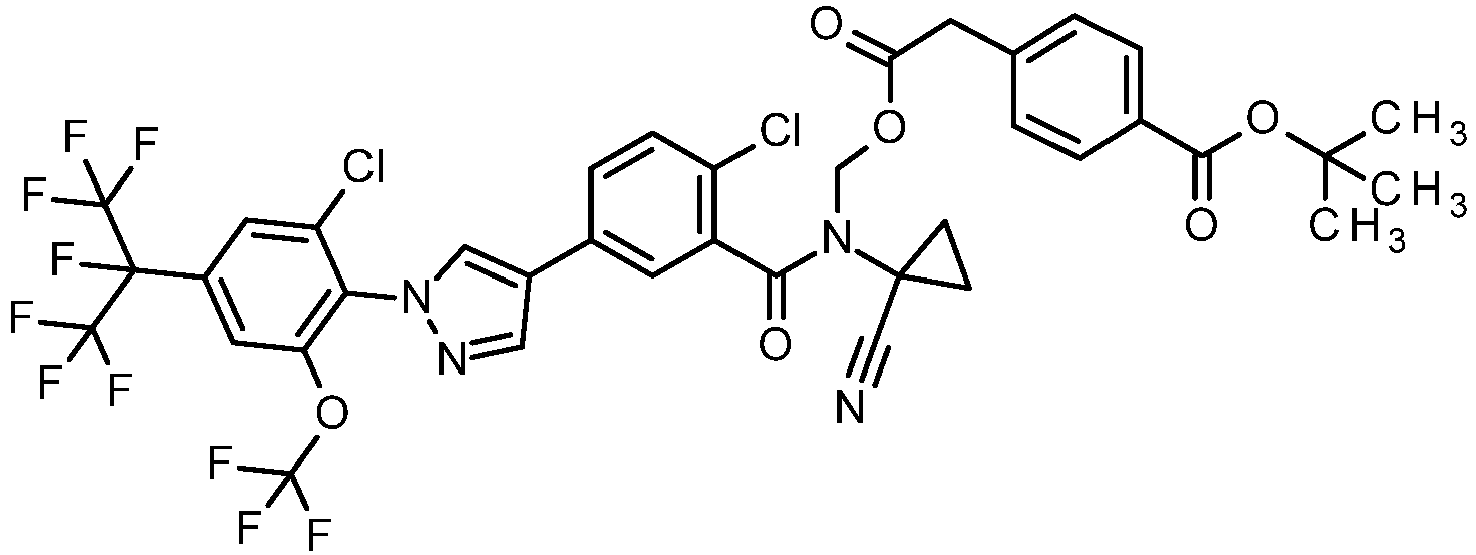
- LC-MS Method 4): Rt = 5.45 min; MS (ESIpos): m/z = 897 [M+H]+
- 1H-NMR (600 MHz, DMSO-d6) δ [ppm]: 1.236 (0.43), 1.358 (0.82), 1.522 (16.00), 1.534 (1.43), 1.539 (1.43), 1.542 (0.62), 1.544 (0.49), 1.551 (1.16), 1.562 (1.09), 7.778 (0.42), 7.797 (0.56), 7.919 (0.60), 8.191 (0.67), 8.194 (0.66).
-

- LC-MS Method 4): Rt = 3.93 min; MS (ESIpos): m/z = 695 [M+H]+
- 1H-NMR (600 MHz, DMSO-d6) δ [ppm]: 1.275 (0.45), 1.757 (1.79), 1.977 (0.87), 3.820 (16.00), 7.611 (0.72), 7.626 (0.84), 7.843 (2.66), 7.854 (1.28), 8.563 (1.63), 8.832 (1.88).
-
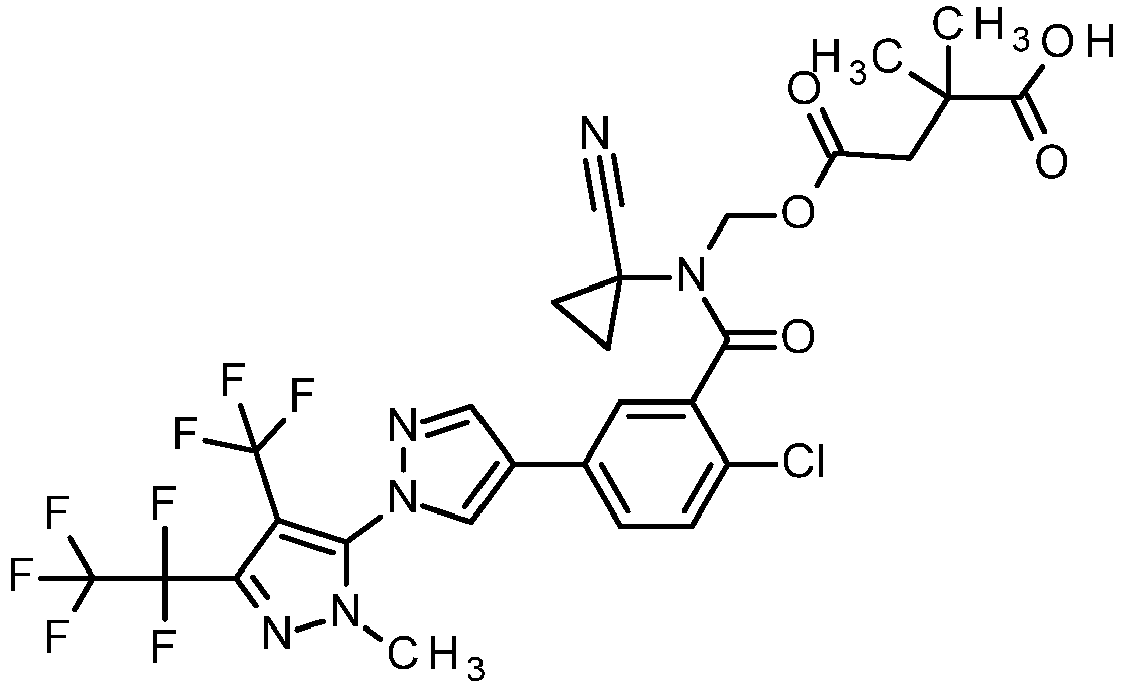
- 1-tert-Butyl 4-{[{2-chloro-5-[2'-methyl-5'-(pentafluoroethyl)-4'-(trifluoromethyl)-2'H-[1,3'-bipyrazol]-4-yl]benzoyl}(1-cyanocyclopropyl)amino]methyl} 2,2-dimethylbutanedioate (intermediate 4A, 108 mg, 141 µmol) was dissolved in 30 % TFA in DCM (11.0 mL) and stirred at ambient temperature for 20 min. The volatiles were evaporated and the residue was purified by preparative HPLC (RP C-18 10 µm acetonitrile-water gradient with 0.01 % TFA in both eluents, 10:90->95:5). 92.0 mg (100 % purity, 92 % yield) of the title compound were obtained.
- LC-MS Method 4): Rt = 4.12 min; MS (ESIneg): m/z = 711 [M+H]-
- 1H-NMR (600 MHz, DMSO-d6) δ [ppm]: 1.029 (0.88), 1.084 (5.58), 1.220 (0.52), 1.740 (2.04), 3.817 (16.00), 7.608 (1.01), 7.622 (1.21), 7.794 (1.65), 7.836 (1.09), 7.850 (1.11), 8.560 (2.17), 8.824 (2.13).
-

- LC-MS Method 4): Rt = 4.51 min; MS (ESIpos): m/z = 827 [M+H]+
- 1H-NMR (600 MHz, DMSO-d6) δ [ppm]: -0.020 (0.42), 1.037 (0.70), 1.235 (1.05), 1.279 (1.52), 1.299 (1.43), 1.550 (0.86), 1.598 (1.32), 1.727 (1.27), 1.806 (6.13), 2.086 (3.27), 2.387 (0.73), 2.426 (0.92), 2.521 (1.49), 2.524 (1.27), 2.578 (0.44), 2.615 (0.70), 2.655 (0.84), 3.820 (1.49), 5.461 (1.01), 5.655 (1.03), 6.994 (0.92), 7.079 (0.97), 7.164 (0.86), 7.598 (2.90), 7.611 (3.38), 7.807 (3.69), 7.820 (3.38), 7.877 (5.30), 7.910 (10.37), 8.016 (4.26), 8.029 (8.62), 8.047 (8.33), 8.182 (11.52), 8.185 (11.52), 8.387 (15.08), 8.725 (16.00), 8.768 (0.42).
-

- LC-MS Method 4): Rt = 3.85 min; MS (ESIpos): m/z = 697 [M+H]+
- 1H-NMR (600 MHz, DMSO-d6) δ [ppm]: 1.237 (0.59), 1.399 (2.97), 1.504 (0.42), 1.671 (1.32), 1.683 (1.75), 1.695 (1.34), 1.748 (2.12), 2.085 (0.73), 2.182 (1.29), 2.194 (2.22), 2.206 (1.22), 2.343 (1.88), 2.384 (0.47), 2.423 (0.62), 2.652 (0.47), 3.334 (1.31), 3.818 (16.00), 7.610 (1.11), 7.624 (1.27), 7.821 (1.88), 7.841 (1.36), 7.854 (1.22), 8.564 (2.37), 8.831 (2.29).
-

- 1-tert-Butyl 1-{[{2-chloro-5-[2'-methyl-5'-(pentafluoroethyl)-4'-(trifluoromethyl)-2'H-[1,3'-bipyrazol]-4-yl]benzoyl}(1-cyanocyclopropyl)amino]methyl} cyclopropane-1,1-dicarboxylate (intermediate 10A, 130 mg, 173 µmol) was dissolved in 30 % TFA in DCM (10.0 mL) and stirred at ambient temperature for 5 min. The volatiles were evaporated and the residue was purified by preparative HPLC (RP C-18 10 µm acetonitrile-water gradient with 0.01 % TFA in both eluents, 10:90->95:5). 20.0 mg (100 % purity, 17 % yield) of the title compound were obtained.
- LC-MS Method 4): Rt = 3.95 min; MS (ESIneg): m/z = 693 [M-H]-
- 1H-NMR (600 MHz, DMSO-d6) δ [ppm]: 1.314 (3.72), 1.749 (1.69), 3.818 (16.00), 7.620 (0.85), 7.634 (0.99), 7.799 (1.37), 7.841 (1.02), 7.854 (0.96), 8.534 (2.70), 8.798 (3.09).
-

- LC-MS Method 4): Rt = 3.80 min; MS (ESIneg): m/z = 681 [M-H]-
- 1H-NMR (600 MHz, DMSO-d6) δ [ppm]: 1.747 (1.80), 2.432 (1.91), 2.442 (1.45), 3.819 (16.00), 7.611 (0.98), 7.625 (1.12), 7.823 (1.70), 7.840 (1.16), 7.854 (1.06), 8.563 (2.19), 8.828 (2.20).
-
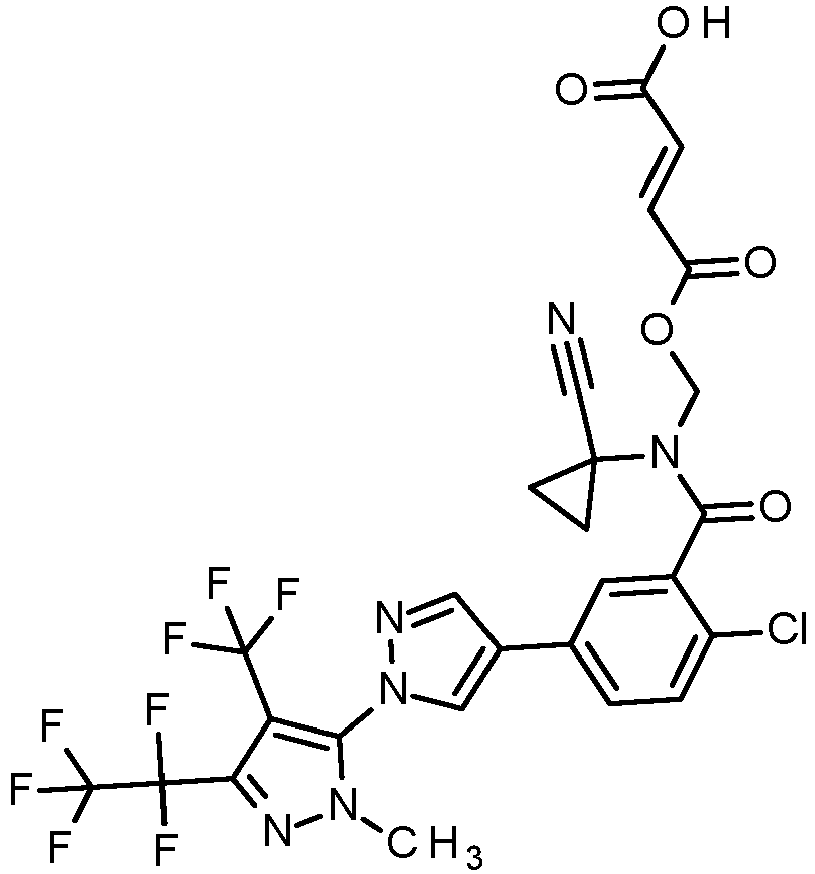
- LC-MS Method 4): Rt = 3.87 min; MS (ESIpos): m/z = 681 [M+H]+
- 1H-NMR (400 MHz, DMSO-d6) δ [ppm]: -0.008 (0.59), 0.008 (0.54), 1.533 (0.46), 1.672 (0.45), 1.776 (1.79), 2.367 (0.43), 2.670 (0.40), 3.815 (16.00), 5.472 (0.41), 6.605 (0.58), 6.644 (1.35), 6.706 (1.40), 6.745 (0.67), 7.619 (1.01), 7.639 (1.23), 7.844 (1.22), 7.872 (2.13), 8.551 (3.72), 8.830 (2.87).
-

- LC-MS (Method 4): Rt = 4.12 min; MS (ESIpos): m/z = 779 [M+H]+
- 1H-NMR (400 MHz, DMSO-d6) δ [ppm]: -0.008 (2.35), 0.008 (2.63), 1.138 (1.03), 1.185 (0.66), 1.235 (0.47), 1.510 (2.35), 1.614 (2.21), 1.742 (10.18), 2.073 (2.49), 2.328 (1.08), 2.366 (1.17), 2.430 (9.99), 2.446 (8.68), 2.670 (1.45), 2.710 (1.17), 5.234 (2.16), 5.319 (2.25), 7.587 (5.21), 7.607 (6.48), 7.790 (11.45), 7.817 (6.10), 7.938 (14.22), 8.209 (16.00), 8.213 (15.72), 8.454 (13.09), 8.774 (12.06), 12.240 (11.92).
-

- LC-MS Method 4): Rt = 4.32 min; MS (ESIpos): m/z = 793 [M+H]+
- 1H-NMR (400 MHz, DMSO-d6) δ [ppm]: -0.149 (0.89), -0.008 (6.59), 0.008 (8.73), 0.146 (0.81), 1.045 (0.44), 1.185 (0.52), 1.235 (0.52), 1.508 (2.41), 1.668 (6.72), 1.686 (9.54), 1.704 (7.92), 1.746 (10.88), 2.132 (0.78), 2.180 (6.64), 2.198 (11.82), 2.216 (6.35), 2.328 (6.85), 2.343 (9.83), 2.360 (5.62), 2.671 (1.23), 2.711 (0.97), 3.503 (4.13), 5.200 (1.91), 5.338 (1.93), 5.642 (0.47), 7.587 (6.07), 7.607 (7.32), 7.787 (10.30), 7.799 (8.78), 7.821 (6.35), 7.937 (14.12), 8.209 (16.00), 8.454 (13.39), 8.777 (12.58), 12.068 (0.73).
-

- LC-MS Method 4): Rt = 3.98 min; MS (ESIpos): m/z = 731 [M+H]+
- 1H-NMR (600 MHz, DMSO-d6) δ [ppm]: 0.005 (1.03), 1.594 (0.68), 1.739 (0.71), 1.811 (3.35), 2.385 (0.64), 2.423 (0.71), 2.464 (0.97), 2.515 (1.43), 2.518 (1.49), 2.522 (1.28), 2.571 (0.67), 2.613 (0.59), 2.652 (0.58), 3.787 (16.00), 5.463 (0.59), 5.636 (0.61), 7.618 (1.64), 7.632 (1.84), 7.838 (1.81), 7.850 (1.67), 7.899 (2.84), 8.032 (6.15), 8.039 (6.28), 8.493 (6.62), 8.781 (12.17).
-

- LC-MS (Method 4): Rt = 4.53 min; MS (ESIpos): m/z = 833 [M+H]+
- 1H-NMR (600 MHz, DMSO-d6) δ [ppm]: -0.022 (0.46), 1.186 (0.66), 1.235 (2.53), 1.275 (11.76), 1.490 (2.27), 1.646 (1.98), 1.755 (7.94), 1.855 (7.10), 1.878 (8.46), 2.083 (3.29), 2.257 (3.19), 2.388 (0.58), 2.427 (0.69), 2.656 (0.50), 3.516 (3.90), 5.167 (1.92), 5.347 (1.90), 7.598 (6.53), 7.612 (7.29), 7.796 (12.66), 7.815 (5.93), 7.934 (14.16), 8.207 (16.00), 8.480 (13.20), 8.791 (13.11).
-

- LC-MS Method 4): Rt = 4.05 min; MS (ESIpos): m/z = 737 [M+H]+
- 1H-NMR (600 MHz, DMSO-d6) δ [ppm]: 1.237 (0.83), 1.275 (2.13), 1.322 (0.41), 1.754 (1.62), 1.871 (1.47), 2.086 (0.62), 2.255 (0.56), 3.817 (16.00), 7.619 (1.06), 7.632 (1.23), 7.822 (1.75), 7.837 (1.20), 7.852 (1.09), 8.585 (2.12), 8.840 (2.12).
-
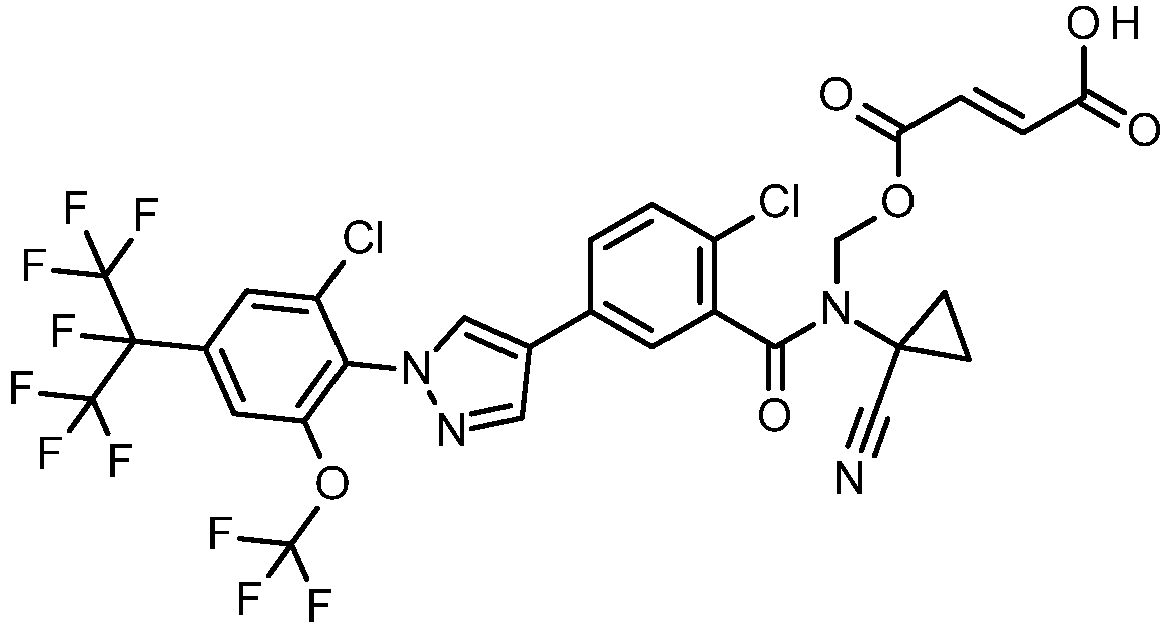
- LC-MS (Method 4): Rt = 4.20 min; MS (ESIpos): m/z = 777 [M+H]+
- 1H-NMR (500 MHz, DMSO-d6) δ [ppm]: -0.022 (0.47), 0.007 (0.67), 1.236 (1.09), 1.446 (1.07), 1.547 (1.73), 1.661 (1.69), 1.770 (7.51), 2.363 (0.75), 2.637 (0.56), 4.316 (0.51), 5.354 (1.42), 5.469 (1.47), 6.620 (2.51), 6.652 (4.53), 6.679 (0.98), 6.725 (4.75), 6.757 (2.85), 7.596 (3.84), 7.613 (4.42), 7.806 (5.07), 7.823 (5.15), 7.837 (6.95), 7.926 (12.85), 8.197 (14.82), 8.201 (14.26), 8.433 (16.00), 8.716 (0.64), 8.761 (9.91), 13.231 (0.44).
-

- 1-tert-butyl 4-{[(2-chloro-5-{1-[2-chloro-4-(1,1,1,2,3,3,3-heptafluoropropan-2-yl)-6-(trifluoromethoxy) phenyl]-1H-pyrazol-4-yl}benzoyl)(1-cyanocyclopropyl)amino]methyl} 2,2-dimethylbutanedioate (152 mg, 176 µmol) was dissolved in 30 % TFA in DCM (15 mL) and stirred at ambient temperature for 20 min. The volatiles were evaporated and the residue was purified by preparative HPLC (RP C-18 10 µm acetonitrile-water gradient with 0.01 % TFA in both eluents, 10:90->95:5). 128 mg (100 % purity, 90 % yield) of the title compound were obtained.
- LC-MS Method 4): Rt = 4.53 min; MS (ESIpos): m/z = 807 [M+H]+
- 1H-NMR (400 MHz, DMSO-d6) δ [ppm]: -0.008 (2.23), 0.008 (2.59), 1.026 (1.30), 1.082 (16.00), 1.214 (1.38), 1.234 (1.16), 1.515 (1.07), 1.613 (1.03), 1.736 (4.66), 2.073 (1.52), 2.328 (0.74), 2.367 (0.52), 2.670 (1.19), 2.710 (0.61), 5.183 (0.78), 5.342 (0.76), 7.583 (2.35), 7.604 (2.91), 7.765 (3.95), 7.793 (2.94), 7.813 (2.55), 7.937 (6.21), 8.212 (7.04), 8.215 (6.76), 8.451 (5.46), 8.770 (5.16), 12.186 (1.60
-

- LC-MS Method 4): Rt = 4.49 min; MS (ESIpos): m/z = 841 [M+H]+
- 1H-NMR (600 MHz, DMSO-d6) δ [ppm]: 1.236 (0.41), 1.489 (1.51), 1.624 (1.47), 1.746 (7.08), 2.086 (0.45), 2.386 (0.73), 2.424 (1.55), 2.520 (1.63), 2.523 (1.83), 2.573 (0.49), 2.577 (0.61), 2.613 (0.69), 2.653 (1.47), 3.561 (0.73), 3.774 (6.31), 3.907 (0.69), 5.241 (1.22), 5.368 (1.22), 7.306 (7.86), 7.319 (8.39), 7.452 (0.61), 7.580 (3.91), 7.594 (4.44), 7.805 (13.96), 7.826 (11.11), 7.839 (9.61), 7.922 (13.84), 8.194 (16.00), 8.197 (15.35), 8.462 (8.71), 8.771 (8.59), 12.860 (0.61).
- Preparation of the PBS buffer solution pH 7.4: 90g sodium chloride, 13.61 g potassium dihydrogen phosphate, 83.35 g 1M aqueous sodium hydroxide were dissolved in water. More water was added up to a total volume of 1L. This solution was diluted 1: 10 with water. Eventually, pH was adjusted to pH 7.4 by the addition of phosphoric acid.
- Citric acid buffer solution pH 3.0: commercially available citric acid buffer (pH 3) from Fluka (art. No 31046) was used containing 8.47 g of citric acid, 3.49 g of sodium chloride and 0.82 g of sodium hydroxide.
- 2 - 4 mg of the test compound are dissolved in DMSO to reach a concentration of 50 g/L (solution A). To 10 µL of this solution 960 µL PBS buffer pH 6.5 are added (final concentration: 515 µg/l); the mixture is shaken for 24h at rt in a 96 well plate. An aliquot is centrifuged at 42000 rpm für 30 min. The supernatant is diluted with acetonitrile/water (8:2) 1:10 and 1:1000 resp. This diluted samples are analyzed by LC-MSMS.
- Calibration: 10 µL of solution A are diluted with 823 µL DMSO (final concentration: 600 µg/mL), which is further diluted with acetonitrile/water 8:2 by a factor of 100 (provides solution B).
- The calibration curve is obtained from solution B by further diluting with acetonitrile/water 8:2 with target concentrations of 1.2 -12 - 60 - 600 ng/mL and injecting these four solutions for MS measurement.
- MS method optimization: Solution B is utilized for MS method optimization.
- PBS-Puffer: 6.18g sodium chloride and 3.96 g sodium dihydrogen phosphate are dissolved in 1L aqua dist., the pH is adjusted to 6.5 with 1N sodium hydroxide.
-
LC-MSMS optimization: The following configurations were used for optimization
AB Sciex TRIPLE QUAD 4500, Agilent 1260 Infinity (G1312B), degasser (G4225A), column oven (G1316C and G1316A), CTC Analytics PAL injection system HTS-xt
Eluent A: 0.5 mL formic acid (50 % strength)/ L water, Eluent B: 0.5 mL formic acid (50 % strength) / L acetonitriletime [min] flow [µL/min] %B 0.00 200 70 0.08 200 70 0.09 25 70 0.60 25 70 0.65 200 70 1.10 200 70
Autosampler: without auto inject ahead setting; column: stainless steel capillary, oven temperature: 22°C; flow rate: flow gradient, injected volume: 2 µL.
Waters Quattro Micro MS, Agilent 1100 (G1312A), degasser (G1322A), column oven (G1316A), CTC Analytics PAL injection system HTS, eluents as abovetime [min] flow [µL/min] %B 0.00 250 70 1.50 250 70 0.09 25 70
Autosampler with auto inject ahead setting; column: stainless steel capillary, oven temperature: 22°C, flow rate: flow gradient, injected volume: 5 µL.
MS method: Flow Injection Analysis (FIA) for optimization ("MS-OPTI"); ionization mode ABSciex-MS: ESI-pos/neg, Waters-MS: ESI-pos - The following conditions were used for quantification:
Eluent A, B as above
ABSciex-MStime [min] %A %B 0 90 10 0.5 5 95 0.84 5 95 0.85 90 10 1.22 90 10 - Autosampler without auto inject ahead setting, column: Waters OASIS HLB, 2.1 x 20 mm, 25 µ, column temperature: 30°C, flow rate: 2.5 mL/min, injected volume: 2 µL, Splitter (before MS) 1:20.
- Autosampler: with auto inject ahead setting, column: stainless steel capillary, column: Waters OASIS HLB, 2,1 x 20 mm, 25 µ, column temperature: 30°C, flow rate: 2,5 mL/min, injected volume: 5 µL, Splitter (before MS) 1:20, MS method: Multiple Reaction Monitoring (MRM).
Table 0: Solubility of example compounds at pH 6.5 Example No mg/mL 1 331 2 71 3 3 4 179 5 171 6 200 8 12 9 10 10 31 11 5 12 46 13 18 14 5 15 5 - 0.15 mg of the test compound were dissolved in 0.1 mL dimethylsulfoxide and 0.4 mL acetonitrile. For complete dissolution, the HPLC vial with the sample solution was shaken and treated with ultrasound. Then, 1.0 mL of PBS buffer solution pH 7.4 was added and the sample was vortexed.The sample solution was analysed by HPLC (method 8) to determine the amount of the test compound at a particular time over a period of 24 h at 37 °C. The peak areas, given as percentage of total area, are used for quantification. In addition, the reaction mixture was analysed by method 9 (HPLC-MS) at the final timepoint.
Table 1: Stability of example compounds at pH 7.4 Example No % Recovery after 24 h 1 100 2 55 3 99 4 100 5 71 6 90 7 96 8 95 9 100 10 100 11 100 12 100 13 97 14 63 15 100 - 1 mg of the test compound was dissolved in 0.5 mL acetonitrile/dimethylsulfoxide 9:1. For complete dissolution the HPLC vial was shaken and treated with ultrasound. 20 µL of this solution were added to 1 mL of rat plasma (Li-heparin plasma, Hannover-Janvier rat, RjHan male) with vortexing at a temperature of 37 °C. Aliquots (100 µL each) were taken at 0.17, 0.5, 1, 1.5, 2 and 4 hours. Each aliquot was transferred to a vial containing 300 µL of acetonitrile/ citric acid buffer pH 3 8:2. These solutions were centrifuged at 5000 rpm for 10 minutes. The supernatant was analysed by HPLC (Method 8) to determine the amount of the test compound. In addition, the reaction mixture was analysed by method 9 (HPLC-MS) at the final timepoint. Both decrease of the prodrug concentration and increase of parent drug concentration were monitored. All data is given as percent area of the prodrug at t0.
- Parent Drug A means 2-Chlor-5-{1-[2-chlor-4-(1,1,1,2,3,3,3-heptafluorpropan-2-yl)-6-(trifluormethoxy)phenyl]-1H-pyrazol-4-yl}-N-(1-cyanocyclopropyl)benzamide (CAS-RN 1771742-44-9).

-

Table 2: Degradation of prodrugs in rat plasma: and release of parent drug % Recovery of prodrug at different time points Parent Drug % Parent Drug Example No 0.17 h 0.5 h 1h 1.5 h 2h 4h 4h 1 93 88 80 74 66 49 B 53 3 100 100 100 100 100 100 A 0 4 73 42 18 9 0 0 B 109 7 84 58 26 10 4 0 B 78 8 96 95 93 92 90 86 A 14 9 89 77 66 56 48 29 A 71 10 99 98 96 94 92 85 B 16 11 98 96 92 89 86 74 A 26 12 (∗) 91 70 49 33 22 0 B 104 13 96 85 63 49 35 14 A 65 15 94 81 62 47 36 10 A 91 (*): HPLC conditions: Method 10 - 1 mg of the test compound was dissolved in 0.5 mL acetonitrile/dimethylsulfoxide 9:1. For complete dissolution the HPLC vial was shaken and treated with ultrasound. 20 µL of this solution were added to 1 mL of dog plasma (Beagle, male; EDTA stabilized) under vortexing at a temperature of 37 °C. Aliquots (100 µL each) were taken at 0.17, 0.5, 1, 1.5, 2 and 4 hours. Each aliquot was transferred to a vial containing 300 µL of acetonitrile/ citric acid buffer pH 3 80:20. These solutions were centrifuged at 5000 rpm for 10 minutes. The supernatant was analysed by HPLC (Method 8) to determine the amount of the test compound. In addition, the reaction mixture was analysed by method 9 (HPLC-MS) at the final timepoint.
- Both decrease of the prodrug concentration and increase of parent drug concentration were monitored. All data is given as percent area of the prodrug at t0.
Table 3: Degradation of prodrugs in dog plasma % Recovery at indicated time points Parent Drug % Parent Drug Example No 0.17 h 0.5 h 1h 1.5 h 2h 4h 4h 13 95 79 51 33 18 0 A 79 - To evaluate the pharmacokinetics of test substances in vivo, these test substances are dissolved in appropriate formulation vehicles (ethanol, dimethyl sulfoxide, PEG400, glycerol formal etc.), or mixtures thereof. The test substances are then administered to rats or dogs intravenously, orally or subcutaneously. The intravenous application is performed as bolus. Administered doses range usually between 0.1 to 5 mg/kg, however, doses for subcutaneous and oral administration can exceed this range up to doses of 30 mg/kg. Blood samples are retrieved via a catheter, exsanguination or venous puncture in vials containing appropriate anticoagulants, such as lithium heparinate or potassium EDTA. Plasma is generated from the blood via centrifugation. Blood samples are taken over an appropriate time interval, usually lasting up to 144h after administration. If necessary, samples from later time points can also be taken. If possible, time points are chosen so that the initial absorption phase, the maximum plasma concentration (Cmax), and exposure within a certain time interval (AUC(0-t))aer described. Furthermore, it is possible to also retrieve organ-, tissue- and urine samples . The quantitative measurement of the test substances in the samples is performed using calibration curves in the respective matrices. The protein content of the samples is precipitated using acetonitrile or methanol. Thereafter, the samples are separated using HPLC in combination with reversed phase chromatography columns. The HPLC system is coupled to a triple quadrupole mass spectrometer via an electrospray interface. The evaluation of the plasma concentration / time profiles are afterwards evaluated using a validated pharmacokinetics evaluation program.
- Exposure of parent drug A within a certain time interval displayed as AUC(0-t) in tables 4-6 was used to assess conversion of prodrug to drug and absorption of prodrug compared to parent drug in vivo, respectively. Comparison of exposures after intravenous administration of parent drug A and prodrugs showed the amount of prodrug which was converted into parent. Comparison of exposures after subcutaneous or oral administration of parent drug and prodrugs additionally showed altered absorption characteristics of prodrugs compared to parent. Relative bioavailability (Frel) was used to describe the exposure of parent drug after prodrug administration compared to the exposure of parent drug after direct administration of compound A which was normalised to 100 %.
Table 4: AUC of parent drug A after intravenous administration of example prodrugs and after intravenous administration of parent drug A Units Concentration of Parent Drug A after admin. of Parent Drug A Example 13 Example 8 Parent Drug A Admin Route iv bolus Species Rat Dog AUC(0-144 h)norm kg·h/L 11 7.3 12 AUC(0-72 h)norm kg·h/L 6.0 Table 5: AUC of parent drug A after subcutaneous administration of example prodrugs and after subcutaneous administration of parent drug A Units Concentration of Parent Drug A after admin. of Parent Drug A Example 13 Example 8 Parent Drug A Admin Route sc Species Rat Dog AUC(0-144 h)norm kg h/L 1.7 5.9 6.7 AUC(0-384 h)norm kg h/L 1.0 Frel* % 100 347 394 100 ∗Frel calculated based on AUC(0-t)norm Table 6: AUC of parent drug A after oral administration of example prodrugs and after oral administration of parent drug A Units Concentration of Parent Drug A after admin. of Example 1 Parent Drug A Admin Route po Species Rat Dose Admin Unit Dose Admin mg/kg AUC(0-24)norm kg·h/L F* % *F calculated based on AUC(0-24)norm - Compounds were dissolved in the appropriate volume of glycerol formal (p.a.) just before application to the animals (dose volume was adjusted to 0.03 mL/kg bodyweight). 5 rats per group were either injected intraperitoneally or subcutaneously.
- Rats were infested with 30 Dermacentor variabilis nymphs on study days -2, 7, 14, 21, 28, 35 and 30 adult Ctenocephalides fleas on study days -1, 8, 15, 22, 29, 36.
- Parasite counts were performed on study days 2, 9, 16, 23, 30, 37.
- Percent efficacy was calculated as arithmetic mean parasite numbers as life attached tick numbers and live flea numbers of the respective study group in comparison to parasite counts on a placebo-treated control group. Infestation of groups with less than 75% efficacy on two consecutive counting occasions will terminated for the respective parasite.
- Both SC subcutaneous (sc) prodrug treatments (example 1 and example 4) are superior in their flea and tick efficacy on rats over the parent drug also injected subcutaneously.
Table 7: In-vivo Efficacy of parent drug A and prodrug examples formulations applied i.p. or sc in rats Example Dose [mg/kg] Applicat. type Parasite SD2 SD9 SD16 SD23 SD30 SD37 SD42 Parent Drug A 10 ip Ctenocephalides felis adult 84 68 71 na na na na Dermacentor variabilis nymph 96 87 83 93 53 32 na sc Ctenocephalides felis adult 53 44 na na na na na Dermacentor variabilis nymph 72 61 na na na na na Table 8: In-vivo Efficacy of novel prodrug examples formulations applied sc in rats Example Dose [mg/kg] Applicat. type Parasite SD2 SD9 SD16 SD23 SD30 SD37 SD42 Example Compound 13 11.97 sc Ctenocephalides felis adult 100 97 96 79 57 51 na Dermacentor variabilis nymph 100 100 99 77 59 49 na Example Compound 9 12.22 sc Ctenocephalides felis adult 100 97 96 97 91 46 na Dermacentor variabilis nymph 99 100 96 98 85 49 na Example Compound 11 12.84 sc Ctenocephalides felis adult 100 100 100 100 97 76 na Dermacentor variabilis nymph 100 100 100 100 96 71 na Example Compound 3 12.74 sc Ctenocephalides felis adult 100 100 100 96 80 55 na Dermacentor variabilis nymph 99 98 93 96 85 48 na Example Compound 8 12.00 sc Ctenocephalides felis adult 100 99 100 100 97 88 78 Dermacentor variabilis nymph 100 100 99 100 100 100 92 Example Compound 15 12.96 sc Ctenocephalides felis adult 100 100 100 99 96 81 75 Dermacentor variabilis nymph 100 100 100 100 100 100 96 - Compounds are dissolved in the appropriate volume of glycerol formal (p.a.) just before application to the animals (dose volume is adjusted to 0.1 mL/kg bodyweight). Dogs are injected intravenously respective subcutaneously (see table 8 for details).
- Dogs are infested with ectoparasites according to table on study 1 day prior to counting for fleas, 2 days prior to counting for RS, IR, DV ticks and 3 days prior to counting for AA ticks. For this purpose, dogs are placed in an individually labeled box with grid windows. The ticks are released onto the back of the dogs and are allowed to disperse and move into the hair without disturbance. The dog remains in the box for approximately 120 minutes with the lid closed and the light switched off in the room. For flea infestations, flea containers are opened in the animal's cage and fleas are applied on the dog's back between the shoulders.
- Tick counts including removal of I. ricinus, R. sanguineus and D. variabilis are conducted 48(±4) hours after the infestation. Tick counts including removal of A. americanum are conducted 72(±4) hours after the infestation. Flea counts are conducted 24(±4) hours after the infestation.
- On each parasite assessment day percent efficacy is calculated as arithmetic mean parasite numbers as life attached and live free tick numbers and live flea numbers of the respective study group in comparison to parasite counts on a placebo non-treated control group.
Claims (16)
- Compounds of formula (I)
 L is linear C1-C4 alkanediyl, C2-C4 alkenediyl or C2-C4 alkynediyl, each of which may be substituted with one or more groups independently selected from halogen, C1-C4 alkyl and C3-C6-cycloalkyl, wherein two C1-C4-alkyl substituents may form a ring together with the carbon atom to which they are bonded; ora moiety (CH2)n-X-(CH2)m whereinn and m are independently 0, 1 or 2 andX is selected from a group X1, X2, X3 or X4, whereinX1 is C3-C7-cycloalkanediyl, which is optionally substituted with 1 to 3 substituents selected from halogen, cyano, and C1-C4 alkyl, wherein (CH2)n- and (CH2)m- may be attached either to the same or to different carbon atoms of X1; orX2 is phenylene, which is optionally substituted with 1 to 4 substituents selected from halogen, cyano, and C1-C4 alkyl; orX3 is C5-C6-heteroarenediyl, which is optionally substituted with 1, 2 or 3 substituents selected from halogen, cyano, and C1-C4 alkyl; orX4 is C5-C8 bicycloalkanediyl, which is optionally substituted with 1 to 4 substituents selected from halogen, cyano, and C1-C4 alkyl wherein (CH2)n- and (CH2)m- may be attached either to the same or to different carbon atoms of X4; andY is selected from a group (T1)
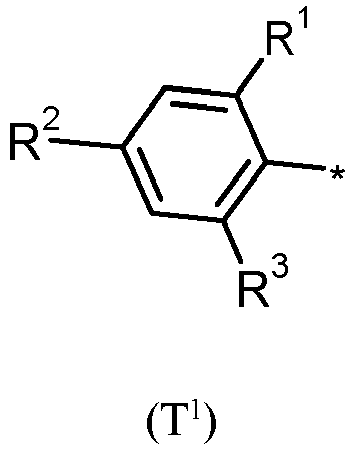 whereinR1, R2 and R3 are each independently selected from hydrogen, halogen, cyano, nitro, linear or branched C1-C6-alkyl, C3-C6-cycloalkyl, C1-C6-alkoxy, halogen-substituted linear or branched C1-C6-alkyl, halogen-substituted C1-C6-alkoxy, halogen substituted C3-C6-cycloalkyl, C1-C6-alkylsulphanyl, Ci-Ce-alkylsulphinyl, C1-C6-alkylsulphonyl, N-C1-C6-alkylamino, N,N-di-C1-C6-alkylamino, N-C1-C3-alkoxy-C1-C4-alkylamino and 1-pyrrolidinylor from a group (T2)
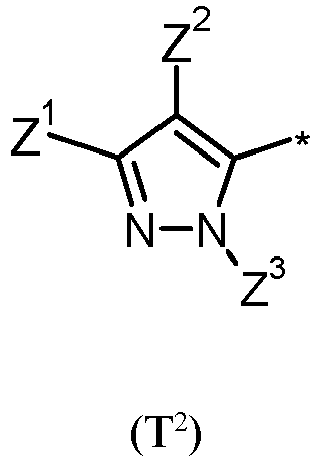 whereinZ1 and Z2 are each independently selected from hydrogen, halogen, cyano, nitro, linear or branched Ci-Ce-alkyl, C3-C6-cycloalkyl, C1-C6-alkoxy, C1-C6-alkylcarbonyl, halogen-substituted linear or branched C1-C6-alkyl, halogen-substituted Ci-Ce-alkoxy, halogen substituted C3-C6-cycloalkyl, C1-C6-alkylsulphanyl, C1-C6-alkylsulphinyl, C1-C6-alkylsulphonyl, N-C1-C6-alkylamino, N,N-di-C1-C6-alkylamino, N-C1-C3-alkoxy-C1-C4-alkylamino and 1-pyrrolidinyl; andZ3 represents hydrogen, linear or branched C1-C6-alkyl, C3-C6-cycloalkyl, C2-C6-alkenyl, C2-C6-alkynyl, aryl or hetaryl, each of which may be substituted with 1 to 5 substituents selected from hydroxy, halogen, cyano, nitro, amino, C1-C3-alkyl, C1-C3-alkoxy, hydroxycarbonyl, alkoxycarbonyl, alkylcarbamoyl, cycloalkylcarbamoyl and phenyl;and the salts thereof.
 - Compounds according to claim 1, whereinL is linear C1-C4 alkanediyl or C2-C4 alkenediyl, each of which may be substituted with one or more groups independently selected from halogen, C1-C4 alkyl and C3-C6 cycloalkyl, wherein two C1-C4-alkyl substituents may form a ring together with the carbon atom to which they are bonded; ora moiety (CH2)n-X-(CH2)m whereinn and m are independently 0, 1 or 2 andX is selected from a group X1, X2, X3 or X4 as defined in claim 1; andY is selected from a group (T1) or (T2) as defined in claim 1;and the salts thereof.
- Compounds according to claim 1 or 2, whereinL is linear C1-C4 alkanediyl or C2-C4 alkenediyl, each of which may be substituted with one or more groups independently selected from halogen, C1-C4 alkyl and C3-C6 cycloalkyl, wherein two C1-C4-alkyl substituents may form a ring together with the carbon atom to which they are bonded; ora moiety (CH2)n-X-(CH2)m whereinn and m are independently 0, 1 or 2 andX is selected from a group X1 or X2 as defined in claim 1; andY is selected from a group (T1) or (T2) as defined in claim 1;and the salts thereof.
- Compounds according to claim 1, 2 or 3, whereinY is selected from a group (T1)
 R1, R2 and R3 are each independently selected from hydrogen, halogen, linear or branched C1-C3-alkyl, C3-C6-cycloalkyl, C1-C3-alkoxy, linear or branched halogen-substituted C1-C3-alkyl, halogen-substituted C1-C3-alkoxy, halogen substituted C3-C6-cycloalkyl, and 1-pyrrolidinyl;or from a group (T2)
 whereinZ1 represents linear or branched C1-C3-alkyl, C3-C6-cycloalkyl, C1-C3-alkoxy,which may independently of one another be substituted with 1 to 5 substituents selected from hydroxy, halogen, cyano, nitro, C1-C3-alkyl, and C1-C3-alkoxy;Z2 represents halogen, cyano, nitro, amino, or linear or branched C1-C6-alkyl, C1-C6-alkylcarbonyl, C1-C6-alkylsulphanyl, C1-C6-alkylsulphinyl, C1-C6-alkylsulphonyl, which may independently of one another be substituted with 1 to 5 substituents selected from hydroxy, halogen, cyano, nitro, C1-C3-alkyl, and C1-C3-alkoxy;
andZ3 represents hydrogen or linear or branched C1-C6-alkyl, C3-C6-cycloalkyl, C2-C6-alkenyl, C2-C6-alkynyl, aryl or hetaryl, which may independently of one another be substituted with 1 to 5 substituents selected from hydroxy, halogen, cyano, nitro, C1-C3-alkyl, and C1-C3-alkoxy;and the salts thereof. - Compounds according to claim 1, 2, 3 or 4, whereinY is selected from a group (T1)
 whereinR1 is halogen;R2 is linear or branched C1-C3-alkyl substituted with 1 to 7 halogen; andR3 is C1-C3-alkoxy substituted with 1 to 3 halogen;or from a group (T2)
 whereinZ1 represents linear or branched C1-C3-alkyl or C3-C6-cycloalkyl, substituted with 1 to 5 halogen substituents;Z2 represents linear or branched C1-C3-alkyl substituted with 1 to 3 halogen substituents, nitro, methylsulphanyl, methylsulphinyl, methylsulphonyl, fluorine, chlorine, bromine, or iodine;
andZ3 represents hydrogen or linear or branched C1-C6-alkyl;and the salts thereof. - Compounds according to any one of the preceding claims, wherein the group (T1) is represented by one of the following groups (T1-1), (T1-2) or (T2-1):

- Compounds according to any one of the preceding claims, whereinL is linear C2-C4 alkanediyl or C2-C4 alkenediyl, each of which may be substituted with one or more groups independently selected from halogen and C1-C4 alkyl;and the salts thereof.
- Compounds according to any one of the preceding claims, whereinL is a moiety (CH2)n-X1-(CH2)m whereinn and m are independently 0, 1 or 2 andX1 is C3-C6-cycloalkanediyl, which is optionally substituted with 1 to 3 substituents selected from halogen, cyano, and C1-C4 alkyl, wherein (CH2)n- and (CH2)m- may be attached either to the same or to different carbon atoms of X1;and the salts thereof.
- Compounds according to any one of the preceding claims, whereinL is a moiety (CH2)n-X2-(CH2)m whereinn and m are independently 0, 1 or 2 andX2 is phenylene, which is optionally substituted with 1 to 4 substituents selected from halogen, cyano, and C1-C4 alkyl;and the salts thereof.
- Compounds according to any one of the preceding claims for use as medicaments.
- Pharmaceutical composition comprising at least one compound according to any one of the preceding claims, which optionally comprises at least one further component selected from auxiliaries, excipients, solvents and/or at least one additional pharmaceutically active agent.
- Pharmaceutical composition according to claim 11 for use as a medicament for subcutaneous or oral application.
- The compounds according to any one of the claims 1 to 9 or the pharmaceutical composition according to claims 11 or 12 for use in controlling parasites on animals.
- Process for preparing the compounds according to any of the claims 1 to 9, comprising the step of reacting a compound (A)
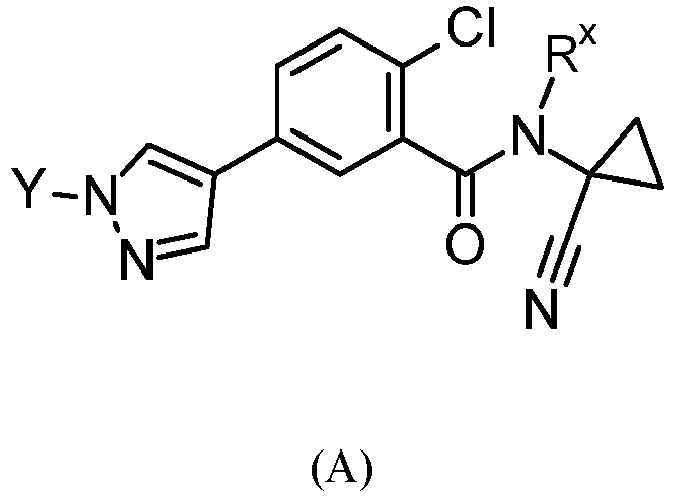 with a group (B)
 whereinRx represents hydrogen and Ry represents a -CH2-C1 group orRx represents a -CH2-OH group and Ry represents hydrogen;whereinY and L have the meaning as defined in any one of the preceding claims and wherein PG represents a protecting group or hydrogen to form the compounds according to formula (I),and wherein in cases wherein PG is not hydrogen, deprotection is carried out to form the compounds (I).
 - Process according to claim 14, further comprisingin the case that Rx represents hydrogen and Ry represents a -CH2-C1 group the preliminary step of preparing the group (B) with Ry = -CH2-C1 (compound (B-2)) from a compound (B-1)
 in the case that Rx represents a -CH2-OH group and Ry represents hydrogen the preliminary step ofpreparing the group (A) with Rx = -CH2-OH (compound A-3)) from a compound (A-1) via an intermediate compound (A-2)
- Intermediate compounds according to formula (C)
 wherein Y and L have the meaning as defined in any one of the preceding claims and wherein PG represents a tert-butyl group;or according to formula (A-3)
 wherein Y has the meaning as defined in any one of the preceding claims.
Applications Claiming Priority (2)
| Application Number | Priority Date | Filing Date | Title |
|---|---|---|---|
| EP19188857.7A EP3771711A1 (en) | 2019-07-29 | 2019-07-29 | Pyrazole derivatives for controlling arthropods |
| PCT/EP2020/071158 WO2021018849A1 (en) | 2019-07-29 | 2020-07-27 | Pyrazole derivatives for controlling arthropods |
Publications (2)
| Publication Number | Publication Date |
|---|---|
| EP4003963A1 EP4003963A1 (en) | 2022-06-01 |
| EP4003963B1 true EP4003963B1 (en) | 2023-08-16 |
Family
ID=67514351
Family Applications (2)
| Application Number | Title | Priority Date | Filing Date |
|---|---|---|---|
| EP19188857.7A Ceased EP3771711A1 (en) | 2019-07-29 | 2019-07-29 | Pyrazole derivatives for controlling arthropods |
| EP20747384.4A Active EP4003963B1 (en) | 2019-07-29 | 2020-07-27 | Pyrazole derivatives for controlling arthropods |
Family Applications Before (1)
| Application Number | Title | Priority Date | Filing Date |
|---|---|---|---|
| EP19188857.7A Ceased EP3771711A1 (en) | 2019-07-29 | 2019-07-29 | Pyrazole derivatives for controlling arthropods |
Country Status (12)
| Country | Link |
|---|---|
| US (1) | US20220306585A1 (en) |
| EP (2) | EP3771711A1 (en) |
| JP (1) | JP2022542681A (en) |
| KR (1) | KR20220042162A (en) |
| CN (1) | CN114423740A (en) |
| AU (1) | AU2020319819A1 (en) |
| BR (1) | BR112022001507A2 (en) |
| CA (1) | CA3147498A1 (en) |
| MX (1) | MX2022001140A (en) |
| TW (1) | TW202120480A (en) |
| UY (1) | UY38813A (en) |
| WO (1) | WO2021018849A1 (en) |
Families Citing this family (2)
| Publication number | Priority date | Publication date | Assignee | Title |
|---|---|---|---|---|
| CN116947864A (en) * | 2023-07-07 | 2023-10-27 | 南昌大学 | A kind of synthesis method of 6-substituted indolinone compounds |
| CN120021628A (en) * | 2023-11-21 | 2025-05-23 | 沈阳化工大学 | A pyrazole compound and its application |
Family Cites Families (27)
| Publication number | Priority date | Publication date | Assignee | Title |
|---|---|---|---|---|
| DE19613976C1 (en) | 1996-04-09 | 1997-11-20 | Gruenenthal Gmbh | Thalidomide prodrugs with immunomodulatory effects |
| CA2385071A1 (en) | 1999-10-12 | 2001-04-19 | Norman Kong | Substituted pyrroles as antiproliferative agents for the treatment of cancer |
| MY128449A (en) | 2000-05-24 | 2007-02-28 | Sugen Inc | Prodrugs of 3-(pyrrol-2-ylmethylidene)-2-indolinone derivatives |
| AR040847A1 (en) | 2002-08-09 | 2005-04-20 | Astrazeneca Ab | 1,2,4-OXADIAZOLES AS METABOTROPIC GLUTAMATE RECEPTORS MODULATORS, FOR THE TREATMENT OF NEUROLOGICAL AND PSYCHIATRIC DISORDERS |
| US7169803B2 (en) | 2004-03-15 | 2007-01-30 | Bristol-Myers Squibb Company | N-substituted prodrugs of fluorooxindoles |
| CA2612976C (en) | 2005-06-21 | 2012-04-10 | Mitsui Chemicals, Inc. | Amide derivative and insecticide containing the same |
| EP2141147A1 (en) | 2007-03-26 | 2010-01-06 | Astellas Pharma Inc. | Ornithine derivative |
| KR20120104521A (en) | 2009-09-11 | 2012-09-21 | 사일린 파마슈티칼스, 인크 | Pharmaceutically useful heterocycle-substituted lactams |
| WO2012069366A1 (en) | 2010-11-23 | 2012-05-31 | Syngenta Participations Ag | Insecticidal compounds |
| WO2012080376A1 (en) | 2010-12-17 | 2012-06-21 | Syngenta Participations Ag | Insecticidal compounds |
| UY33895A (en) | 2011-02-09 | 2012-09-28 | Syngenta Participations Ag | INSECTICIDE COMPOUNDS, METHOD FOR COMBAT AND CONTROL INSECTS, MUSHROOMS, NEMATODES OR MOLUSCES, AND INSECTICIDE, ACARICIDE OR NEMATICIDE COMPOSITION |
| WO2012175474A1 (en) | 2011-06-20 | 2012-12-27 | Syngenta Participations Ag | 1,2,3 triazole pesticides |
| JP6321042B2 (en) | 2013-02-06 | 2018-05-09 | バイエル・クロップサイエンス・アクチェンゲゼルシャフト | New halogen-substituted compounds |
| RU2712092C2 (en) | 2013-11-05 | 2020-01-24 | Байер Кропсайенс Акциенгезельшафт | Substituted benzamides for arthropoda control |
| JP6678581B2 (en) | 2013-11-27 | 2020-04-08 | バイエル・アニマル・ヘルス・ゲゼルシャフト・ミット・ベシュレンクテル・ハフツングBayer Animal Health Gmbh | Process for the preparation of 5-fluoro-1H-pyrazoles |
| TWI694066B (en) | 2014-05-27 | 2020-05-21 | 德商拜耳動物保健有限公司 | Process for the preparation of 5-fluoro-1h-pyrazoles starting from hexafluoropropene |
| AR101448A1 (en) * | 2014-08-08 | 2016-12-21 | Bayer Cropscience Ag | HALOGEN SUBSTITUTED COMPOUNDS |
| JP6676038B2 (en) | 2014-08-19 | 2020-04-08 | バイエル・アニマル・ヘルス・ゲゼルシャフト・ミット・ベシュレンクテル・ハフツングBayer Animal Health Gmbh | Process for the preparation of 5-fluoro-1H-pyrazoles starting from hexafluoropropene |
| WO2016174049A1 (en) * | 2015-04-30 | 2016-11-03 | Bayer Animal Health Gmbh | Anti-parasitic combinations including halogen-substituted compounds |
| UY36652A (en) | 2015-04-30 | 2016-11-30 | Bayer Animal Health Gmbh | ANTIPARASITICAL COMBINATIONS |
| WO2018121678A1 (en) | 2016-12-29 | 2018-07-05 | 广东东阳光药业有限公司 | Prodrug of antiviral nucleoside analogues, and composition and use thereof |
| US11252963B2 (en) * | 2017-08-11 | 2022-02-22 | Syngenta Participations Ag | Pesticidally active pyrazole derivatives |
| AR112673A1 (en) * | 2017-08-11 | 2019-11-27 | Syngenta Participations Ag | PYRAZOLE DERIVATIVES ACTIVE AS PESTICIDES |
| WO2019068819A1 (en) * | 2017-10-06 | 2019-04-11 | Syngenta Participations Ag | Pesticidally active pyrrole derivatives |
| TWI791054B (en) * | 2017-10-18 | 2023-02-01 | 德商拜耳廠股份有限公司 | Active compound combinations having insecticidal/acaricidal properties |
| SG11202003452XA (en) | 2017-10-20 | 2020-05-28 | Eagle Res Labs Limited | Dantrolene prodrugs and methods of their use |
| EP3590927A1 (en) | 2018-07-05 | 2020-01-08 | Bayer Animal Health GmbH | Novel compounds for controlling arthropods |
-
2019
- 2019-07-29 EP EP19188857.7A patent/EP3771711A1/en not_active Ceased
-
2020
- 2020-07-27 US US17/630,829 patent/US20220306585A1/en not_active Abandoned
- 2020-07-27 AU AU2020319819A patent/AU2020319819A1/en not_active Abandoned
- 2020-07-27 TW TW109125248A patent/TW202120480A/en unknown
- 2020-07-27 MX MX2022001140A patent/MX2022001140A/en unknown
- 2020-07-27 WO PCT/EP2020/071158 patent/WO2021018849A1/en not_active Ceased
- 2020-07-27 KR KR1020227006073A patent/KR20220042162A/en not_active Withdrawn
- 2020-07-27 BR BR112022001507A patent/BR112022001507A2/en not_active IP Right Cessation
- 2020-07-27 JP JP2022505590A patent/JP2022542681A/en not_active Withdrawn
- 2020-07-27 CA CA3147498A patent/CA3147498A1/en active Pending
- 2020-07-27 CN CN202080067893.5A patent/CN114423740A/en active Pending
- 2020-07-27 EP EP20747384.4A patent/EP4003963B1/en active Active
- 2020-07-29 UY UY0001038813A patent/UY38813A/en not_active Application Discontinuation
Also Published As
| Publication number | Publication date |
|---|---|
| CN114423740A (en) | 2022-04-29 |
| UY38813A (en) | 2021-01-29 |
| TW202120480A (en) | 2021-06-01 |
| EP3771711A1 (en) | 2021-02-03 |
| US20220306585A1 (en) | 2022-09-29 |
| CA3147498A1 (en) | 2021-02-04 |
| KR20220042162A (en) | 2022-04-04 |
| AU2020319819A1 (en) | 2022-02-17 |
| JP2022542681A (en) | 2022-10-06 |
| BR112022001507A2 (en) | 2022-03-22 |
| EP4003963A1 (en) | 2022-06-01 |
| WO2021018849A1 (en) | 2021-02-04 |
| MX2022001140A (en) | 2022-02-16 |
Similar Documents
| Publication | Publication Date | Title |
|---|---|---|
| EP3818047B1 (en) | Novel compounds for controlling arthropods | |
| EP2253617A1 (en) | Halogenated compounds as pesticides | |
| WO2016174049A1 (en) | Anti-parasitic combinations including halogen-substituted compounds | |
| AU2023266446A1 (en) | Phenylpyrazole compound and application thereof | |
| AU2020338765A1 (en) | Isophthalamide compound and use thereof | |
| US20220306585A1 (en) | Pyrazole derivatives for controlling arthropods | |
| JP2026034787A (en) | Process for preparing 2-chloro-n-(1-cyanocyclopropyl)-5-[2'-methyl-5'-(pentafluoroethyl)-4'-(trifluoromethyl)-2'h-1,3'-bipyrazol-4-yl]benzamide | |
| HK40118597A (en) | Method for preparing 2-chloro-n-(1-cyanocyclopropyl)-5-[2'-methyl-5'-(pentafluoroethyl)-4'-(trifluoromethyl)-2'h-1,3'-bipyrazol-4-yl]benzamide | |
| WO2026046235A1 (en) | Phenylpyrazole compound and use thereof | |
| HK40085027A (en) | Method for preparing 2-chloro-n-(1-cyanocyclopropyl)-5-[2'-methyl-5'-(pentafluoroethyl)-4'-(trifluoromethyl)-2'h-1,3'-bipyrazol-4-yl]benzamide | |
| HK40085027B (en) | Method for preparing 2-chloro-n-(1-cyanocyclopropyl)-5-[2'-methyl-5'-(pentafluoroethyl)-4'-(trifluoromethyl)-2'h-1,3'-bipyrazol-4-yl]benzamide | |
| WO2026046224A1 (en) | Phenylpyrazole compounds and use thereof | |
| CN103857663A (en) | Pesticidal diaryl - heterocyclyl derivatives |
Legal Events
| Date | Code | Title | Description |
|---|---|---|---|
| STAA | Information on the status of an ep patent application or granted ep patent |
Free format text: STATUS: UNKNOWN |
|
| STAA | Information on the status of an ep patent application or granted ep patent |
Free format text: STATUS: THE INTERNATIONAL PUBLICATION HAS BEEN MADE |
|
| PUAI | Public reference made under article 153(3) epc to a published international application that has entered the european phase |
Free format text: ORIGINAL CODE: 0009012 |
|
| STAA | Information on the status of an ep patent application or granted ep patent |
Free format text: STATUS: REQUEST FOR EXAMINATION WAS MADE |
|
| 17P | Request for examination filed |
Effective date: 20220125 |
|
| AK | Designated contracting states |
Kind code of ref document: A1 Designated state(s): AL AT BE BG CH CY CZ DE DK EE ES FI FR GB GR HR HU IE IS IT LI LT LU LV MC MK MT NL NO PL PT RO RS SE SI SK SM TR |
|
| DAV | Request for validation of the european patent (deleted) | ||
| DAX | Request for extension of the european patent (deleted) | ||
| GRAP | Despatch of communication of intention to grant a patent |
Free format text: ORIGINAL CODE: EPIDOSNIGR1 |
|
| STAA | Information on the status of an ep patent application or granted ep patent |
Free format text: STATUS: GRANT OF PATENT IS INTENDED |
|
| INTG | Intention to grant announced |
Effective date: 20230227 |
|
| GRAS | Grant fee paid |
Free format text: ORIGINAL CODE: EPIDOSNIGR3 |
|
| GRAA | (expected) grant |
Free format text: ORIGINAL CODE: 0009210 |
|
| STAA | Information on the status of an ep patent application or granted ep patent |
Free format text: STATUS: THE PATENT HAS BEEN GRANTED |
|
| AK | Designated contracting states |
Kind code of ref document: B1 Designated state(s): AL AT BE BG CH CY CZ DE DK EE ES FI FR GB GR HR HU IE IS IT LI LT LU LV MC MK MT NL NO PL PT RO RS SE SI SK SM TR |
|
| RAP3 | Party data changed (applicant data changed or rights of an application transferred) |
Owner name: ELANCO ANIMAL HEALTH GMBH |
|
| REG | Reference to a national code |
Ref country code: CH Ref legal event code: EP |
|
| REG | Reference to a national code |
Ref country code: DE Ref legal event code: R096 Ref document number: 602020015896 Country of ref document: DE |
|
| REG | Reference to a national code |
Ref country code: IE Ref legal event code: FG4D |
|
| REG | Reference to a national code |
Ref country code: LT Ref legal event code: MG9D |
|
| REG | Reference to a national code |
Ref country code: NL Ref legal event code: MP Effective date: 20230816 |
|
| REG | Reference to a national code |
Ref country code: AT Ref legal event code: MK05 Ref document number: 1599953 Country of ref document: AT Kind code of ref document: T Effective date: 20230816 |
|
| PG25 | Lapsed in a contracting state [announced via postgrant information from national office to epo] |
Ref country code: GR Free format text: LAPSE BECAUSE OF FAILURE TO SUBMIT A TRANSLATION OF THE DESCRIPTION OR TO PAY THE FEE WITHIN THE PRESCRIBED TIME-LIMIT Effective date: 20231117 |
|
| PG25 | Lapsed in a contracting state [announced via postgrant information from national office to epo] |
Ref country code: IS Free format text: LAPSE BECAUSE OF FAILURE TO SUBMIT A TRANSLATION OF THE DESCRIPTION OR TO PAY THE FEE WITHIN THE PRESCRIBED TIME-LIMIT Effective date: 20231216 |
|
| PG25 | Lapsed in a contracting state [announced via postgrant information from national office to epo] |
Ref country code: SE Free format text: LAPSE BECAUSE OF FAILURE TO SUBMIT A TRANSLATION OF THE DESCRIPTION OR TO PAY THE FEE WITHIN THE PRESCRIBED TIME-LIMIT Effective date: 20230816 Ref country code: RS Free format text: LAPSE BECAUSE OF FAILURE TO SUBMIT A TRANSLATION OF THE DESCRIPTION OR TO PAY THE FEE WITHIN THE PRESCRIBED TIME-LIMIT Effective date: 20230816 Ref country code: PT Free format text: LAPSE BECAUSE OF FAILURE TO SUBMIT A TRANSLATION OF THE DESCRIPTION OR TO PAY THE FEE WITHIN THE PRESCRIBED TIME-LIMIT Effective date: 20231218 Ref country code: NO Free format text: LAPSE BECAUSE OF FAILURE TO SUBMIT A TRANSLATION OF THE DESCRIPTION OR TO PAY THE FEE WITHIN THE PRESCRIBED TIME-LIMIT Effective date: 20231116 Ref country code: NL Free format text: LAPSE BECAUSE OF FAILURE TO SUBMIT A TRANSLATION OF THE DESCRIPTION OR TO PAY THE FEE WITHIN THE PRESCRIBED TIME-LIMIT Effective date: 20230816 Ref country code: LV Free format text: LAPSE BECAUSE OF FAILURE TO SUBMIT A TRANSLATION OF THE DESCRIPTION OR TO PAY THE FEE WITHIN THE PRESCRIBED TIME-LIMIT Effective date: 20230816 Ref country code: LT Free format text: LAPSE BECAUSE OF FAILURE TO SUBMIT A TRANSLATION OF THE DESCRIPTION OR TO PAY THE FEE WITHIN THE PRESCRIBED TIME-LIMIT Effective date: 20230816 Ref country code: IS Free format text: LAPSE BECAUSE OF FAILURE TO SUBMIT A TRANSLATION OF THE DESCRIPTION OR TO PAY THE FEE WITHIN THE PRESCRIBED TIME-LIMIT Effective date: 20231216 Ref country code: HR Free format text: LAPSE BECAUSE OF FAILURE TO SUBMIT A TRANSLATION OF THE DESCRIPTION OR TO PAY THE FEE WITHIN THE PRESCRIBED TIME-LIMIT Effective date: 20230816 Ref country code: GR Free format text: LAPSE BECAUSE OF FAILURE TO SUBMIT A TRANSLATION OF THE DESCRIPTION OR TO PAY THE FEE WITHIN THE PRESCRIBED TIME-LIMIT Effective date: 20231117 Ref country code: FI Free format text: LAPSE BECAUSE OF FAILURE TO SUBMIT A TRANSLATION OF THE DESCRIPTION OR TO PAY THE FEE WITHIN THE PRESCRIBED TIME-LIMIT Effective date: 20230816 Ref country code: AT Free format text: LAPSE BECAUSE OF FAILURE TO SUBMIT A TRANSLATION OF THE DESCRIPTION OR TO PAY THE FEE WITHIN THE PRESCRIBED TIME-LIMIT Effective date: 20230816 |
|
| PG25 | Lapsed in a contracting state [announced via postgrant information from national office to epo] |
Ref country code: PL Free format text: LAPSE BECAUSE OF FAILURE TO SUBMIT A TRANSLATION OF THE DESCRIPTION OR TO PAY THE FEE WITHIN THE PRESCRIBED TIME-LIMIT Effective date: 20230816 |
|
| PG25 | Lapsed in a contracting state [announced via postgrant information from national office to epo] |
Ref country code: ES Free format text: LAPSE BECAUSE OF FAILURE TO SUBMIT A TRANSLATION OF THE DESCRIPTION OR TO PAY THE FEE WITHIN THE PRESCRIBED TIME-LIMIT Effective date: 20230816 |
|
| PG25 | Lapsed in a contracting state [announced via postgrant information from national office to epo] |
Ref country code: SM Free format text: LAPSE BECAUSE OF FAILURE TO SUBMIT A TRANSLATION OF THE DESCRIPTION OR TO PAY THE FEE WITHIN THE PRESCRIBED TIME-LIMIT Effective date: 20230816 Ref country code: RO Free format text: LAPSE BECAUSE OF FAILURE TO SUBMIT A TRANSLATION OF THE DESCRIPTION OR TO PAY THE FEE WITHIN THE PRESCRIBED TIME-LIMIT Effective date: 20230816 Ref country code: ES Free format text: LAPSE BECAUSE OF FAILURE TO SUBMIT A TRANSLATION OF THE DESCRIPTION OR TO PAY THE FEE WITHIN THE PRESCRIBED TIME-LIMIT Effective date: 20230816 Ref country code: EE Free format text: LAPSE BECAUSE OF FAILURE TO SUBMIT A TRANSLATION OF THE DESCRIPTION OR TO PAY THE FEE WITHIN THE PRESCRIBED TIME-LIMIT Effective date: 20230816 Ref country code: DK Free format text: LAPSE BECAUSE OF FAILURE TO SUBMIT A TRANSLATION OF THE DESCRIPTION OR TO PAY THE FEE WITHIN THE PRESCRIBED TIME-LIMIT Effective date: 20230816 Ref country code: CZ Free format text: LAPSE BECAUSE OF FAILURE TO SUBMIT A TRANSLATION OF THE DESCRIPTION OR TO PAY THE FEE WITHIN THE PRESCRIBED TIME-LIMIT Effective date: 20230816 Ref country code: SK Free format text: LAPSE BECAUSE OF FAILURE TO SUBMIT A TRANSLATION OF THE DESCRIPTION OR TO PAY THE FEE WITHIN THE PRESCRIBED TIME-LIMIT Effective date: 20230816 |
|
| REG | Reference to a national code |
Ref country code: DE Ref legal event code: R097 Ref document number: 602020015896 Country of ref document: DE |
|
| PLBE | No opposition filed within time limit |
Free format text: ORIGINAL CODE: 0009261 |
|
| STAA | Information on the status of an ep patent application or granted ep patent |
Free format text: STATUS: NO OPPOSITION FILED WITHIN TIME LIMIT |
|
| 26N | No opposition filed |
Effective date: 20240517 |
|
| PG25 | Lapsed in a contracting state [announced via postgrant information from national office to epo] |
Ref country code: IT Free format text: LAPSE BECAUSE OF FAILURE TO SUBMIT A TRANSLATION OF THE DESCRIPTION OR TO PAY THE FEE WITHIN THE PRESCRIBED TIME-LIMIT Effective date: 20230816 Ref country code: SI Free format text: LAPSE BECAUSE OF FAILURE TO SUBMIT A TRANSLATION OF THE DESCRIPTION OR TO PAY THE FEE WITHIN THE PRESCRIBED TIME-LIMIT Effective date: 20230816 |
|
| PG25 | Lapsed in a contracting state [announced via postgrant information from national office to epo] |
Ref country code: BG Free format text: LAPSE BECAUSE OF FAILURE TO SUBMIT A TRANSLATION OF THE DESCRIPTION OR TO PAY THE FEE WITHIN THE PRESCRIBED TIME-LIMIT Effective date: 20230816 |
|
| PG25 | Lapsed in a contracting state [announced via postgrant information from national office to epo] |
Ref country code: BG Free format text: LAPSE BECAUSE OF FAILURE TO SUBMIT A TRANSLATION OF THE DESCRIPTION OR TO PAY THE FEE WITHIN THE PRESCRIBED TIME-LIMIT Effective date: 20230816 |
|
| REG | Reference to a national code |
Ref country code: DE Ref legal event code: R119 Ref document number: 602020015896 Country of ref document: DE |
|
| PG25 | Lapsed in a contracting state [announced via postgrant information from national office to epo] |
Ref country code: MC Free format text: LAPSE BECAUSE OF FAILURE TO SUBMIT A TRANSLATION OF THE DESCRIPTION OR TO PAY THE FEE WITHIN THE PRESCRIBED TIME-LIMIT Effective date: 20230816 |
|
| REG | Reference to a national code |
Ref country code: CH Ref legal event code: PL |
|
| PG25 | Lapsed in a contracting state [announced via postgrant information from national office to epo] |
Ref country code: LU Free format text: LAPSE BECAUSE OF NON-PAYMENT OF DUE FEES Effective date: 20240727 |
|
| GBPC | Gb: european patent ceased through non-payment of renewal fee |
Effective date: 20240727 |
|
| PG25 | Lapsed in a contracting state [announced via postgrant information from national office to epo] |
Ref country code: LU Free format text: LAPSE BECAUSE OF NON-PAYMENT OF DUE FEES Effective date: 20240727 |
|
| PG25 | Lapsed in a contracting state [announced via postgrant information from national office to epo] |
Ref country code: DE Free format text: LAPSE BECAUSE OF NON-PAYMENT OF DUE FEES Effective date: 20250201 |
|
| PG25 | Lapsed in a contracting state [announced via postgrant information from national office to epo] |
Ref country code: BE Free format text: LAPSE BECAUSE OF NON-PAYMENT OF DUE FEES Effective date: 20240731 Ref country code: CH Free format text: LAPSE BECAUSE OF NON-PAYMENT OF DUE FEES Effective date: 20240731 |
|
| PG25 | Lapsed in a contracting state [announced via postgrant information from national office to epo] |
Ref country code: FR Free format text: LAPSE BECAUSE OF NON-PAYMENT OF DUE FEES Effective date: 20240731 |
|
| PG25 | Lapsed in a contracting state [announced via postgrant information from national office to epo] |
Ref country code: GB Free format text: LAPSE BECAUSE OF NON-PAYMENT OF DUE FEES Effective date: 20240727 |
|
| REG | Reference to a national code |
Ref country code: BE Ref legal event code: MM Effective date: 20240731 |
|
| PG25 | Lapsed in a contracting state [announced via postgrant information from national office to epo] |
Ref country code: IE Free format text: LAPSE BECAUSE OF NON-PAYMENT OF DUE FEES Effective date: 20240727 |
|
| PG25 | Lapsed in a contracting state [announced via postgrant information from national office to epo] |
Ref country code: CY Free format text: LAPSE BECAUSE OF FAILURE TO SUBMIT A TRANSLATION OF THE DESCRIPTION OR TO PAY THE FEE WITHIN THE PRESCRIBED TIME-LIMIT; INVALID AB INITIO Effective date: 20200727 |
|
| PG25 | Lapsed in a contracting state [announced via postgrant information from national office to epo] |
Ref country code: HU Free format text: LAPSE BECAUSE OF FAILURE TO SUBMIT A TRANSLATION OF THE DESCRIPTION OR TO PAY THE FEE WITHIN THE PRESCRIBED TIME-LIMIT; INVALID AB INITIO Effective date: 20200727 |