EP4002179B1 - Schutz der integrität von messdaten, die von einer sensorvorrichtung erfasst werden - Google Patents
Schutz der integrität von messdaten, die von einer sensorvorrichtung erfasst werden Download PDFInfo
- Publication number
- EP4002179B1 EP4002179B1 EP20208137.8A EP20208137A EP4002179B1 EP 4002179 B1 EP4002179 B1 EP 4002179B1 EP 20208137 A EP20208137 A EP 20208137A EP 4002179 B1 EP4002179 B1 EP 4002179B1
- Authority
- EP
- European Patent Office
- Prior art keywords
- sensor device
- measurement data
- aggregate value
- signature
- value
- Prior art date
- Legal status (The legal status is an assumption and is not a legal conclusion. Google has not performed a legal analysis and makes no representation as to the accuracy of the status listed.)
- Active
Links
Images

Classifications
-
- G—PHYSICS
- G06—COMPUTING OR CALCULATING; COUNTING
- G06F—ELECTRIC DIGITAL DATA PROCESSING
- G06F21/00—Security arrangements for protecting computers, components thereof, programs or data against unauthorised activity
- G06F21/60—Protecting data
- G06F21/64—Protecting data integrity, e.g. using checksums, certificates or signatures
-
- H—ELECTRICITY
- H04—ELECTRIC COMMUNICATION TECHNIQUE
- H04L—TRANSMISSION OF DIGITAL INFORMATION, e.g. TELEGRAPHIC COMMUNICATION
- H04L9/00—Cryptographic mechanisms or cryptographic arrangements for secret or secure communications; Network security protocols
- H04L9/08—Key distribution or management, e.g. generation, sharing or updating, of cryptographic keys or passwords
- H04L9/0816—Key establishment, i.e. cryptographic processes or cryptographic protocols whereby a shared secret becomes available to two or more parties, for subsequent use
- H04L9/0819—Key transport or distribution, i.e. key establishment techniques where one party creates or otherwise obtains a secret value, and securely transfers it to the other(s)
-
- G—PHYSICS
- G05—CONTROLLING; REGULATING
- G05B—CONTROL OR REGULATING SYSTEMS IN GENERAL; FUNCTIONAL ELEMENTS OF SUCH SYSTEMS; MONITORING OR TESTING ARRANGEMENTS FOR SUCH SYSTEMS OR ELEMENTS
- G05B23/00—Testing or monitoring of control systems or parts thereof
- G05B23/02—Electric testing or monitoring
- G05B23/0205—Electric testing or monitoring by means of a monitoring system capable of detecting and responding to faults
- G05B23/0218—Electric testing or monitoring by means of a monitoring system capable of detecting and responding to faults characterised by the fault detection method dealing with either existing or incipient faults
- G05B23/0221—Preprocessing measurements, e.g. data collection rate adjustment; Standardization of measurements; Time series or signal analysis, e.g. frequency analysis or wavelets; Trustworthiness of measurements; Indexes therefor; Measurements using easily measured parameters to estimate parameters difficult to measure; Virtual sensor creation; De-noising; Sensor fusion; Unconventional preprocessing inherently present in specific fault detection methods like PCA-based methods
-
- G—PHYSICS
- G06—COMPUTING OR CALCULATING; COUNTING
- G06F—ELECTRIC DIGITAL DATA PROCESSING
- G06F21/00—Security arrangements for protecting computers, components thereof, programs or data against unauthorised activity
- G06F21/50—Monitoring users, programs or devices to maintain the integrity of platforms, e.g. of processors, firmware or operating systems
- G06F21/57—Certifying or maintaining trusted computer platforms, e.g. secure boots or power-downs, version controls, system software checks, secure updates or assessing vulnerabilities
-
- G—PHYSICS
- G06—COMPUTING OR CALCULATING; COUNTING
- G06F—ELECTRIC DIGITAL DATA PROCESSING
- G06F8/00—Arrangements for software engineering
- G06F8/60—Software deployment
- G06F8/65—Updates
-
- H—ELECTRICITY
- H04—ELECTRIC COMMUNICATION TECHNIQUE
- H04L—TRANSMISSION OF DIGITAL INFORMATION, e.g. TELEGRAPHIC COMMUNICATION
- H04L63/00—Network architectures or network communication protocols for network security
- H04L63/12—Applying verification of the received information
- H04L63/123—Applying verification of the received information received data contents, e.g. message integrity
-
- H—ELECTRICITY
- H04—ELECTRIC COMMUNICATION TECHNIQUE
- H04L—TRANSMISSION OF DIGITAL INFORMATION, e.g. TELEGRAPHIC COMMUNICATION
- H04L9/00—Cryptographic mechanisms or cryptographic arrangements for secret or secure communications; Network security protocols
- H04L9/32—Cryptographic mechanisms or cryptographic arrangements for secret or secure communications; Network security protocols including means for verifying the identity or authority of a user of the system or for message authentication, e.g. authorization, entity authentication, data integrity or data verification, non-repudiation, key authentication or verification of credentials
- H04L9/3236—Cryptographic mechanisms or cryptographic arrangements for secret or secure communications; Network security protocols including means for verifying the identity or authority of a user of the system or for message authentication, e.g. authorization, entity authentication, data integrity or data verification, non-repudiation, key authentication or verification of credentials using cryptographic hash functions
- H04L9/3242—Cryptographic mechanisms or cryptographic arrangements for secret or secure communications; Network security protocols including means for verifying the identity or authority of a user of the system or for message authentication, e.g. authorization, entity authentication, data integrity or data verification, non-repudiation, key authentication or verification of credentials using cryptographic hash functions involving keyed hash functions, e.g. message authentication codes [MACs], CBC-MAC or HMAC
-
- H—ELECTRICITY
- H04—ELECTRIC COMMUNICATION TECHNIQUE
- H04L—TRANSMISSION OF DIGITAL INFORMATION, e.g. TELEGRAPHIC COMMUNICATION
- H04L9/00—Cryptographic mechanisms or cryptographic arrangements for secret or secure communications; Network security protocols
- H04L9/32—Cryptographic mechanisms or cryptographic arrangements for secret or secure communications; Network security protocols including means for verifying the identity or authority of a user of the system or for message authentication, e.g. authorization, entity authentication, data integrity or data verification, non-repudiation, key authentication or verification of credentials
- H04L9/3247—Cryptographic mechanisms or cryptographic arrangements for secret or secure communications; Network security protocols including means for verifying the identity or authority of a user of the system or for message authentication, e.g. authorization, entity authentication, data integrity or data verification, non-repudiation, key authentication or verification of credentials involving digital signatures
Definitions
- the present invention relates to the authentication of measurement data that are acquired by sensor devices and transmitted over process control networks.
- Automated industrial plans typically comprise many field devices that are in a direct relationship with an industrial production process. Many of these field devices comprises sensors that are used to acquire measurement data. The measurement data is transmitted over a process control network to a server or other entity that stores and/or evaluates the measurement data.
- Some acquired measurement data is critical in the sense that financial gain might be derived from a deliberate forgery of this measurement data, so it needs to be protected against such forgery.
- sensor devices may be used to monitor compliance of an industrial plant with environmental regulations.
- industrial processes may use controlled substances that require permits to handle and must be accounted for end-to-end. If such measurement data is forged, this may allow operation of the plant in violation of environmental regulations for more profit, or the theft of the controlled substance.
- WO 2019/086 969 A1 discloses techniques for establishing secure communication between a condition monitoring device of an electrical machine and a portable device for monitoring condition of the electrical machine. From measurements of electrical and/or mechanical parameters of the machine, an encryption key for securing the communication between the condition monitoring device and the portable device.
- the Trusted Computing Group Specification Architecture Overview available online at https://trustedcomputinggroup.org/wp-content/uploads/ TCG_1 4 Architecture_Overview.pdf, discloses a framework for verifying the integrity of computing systems, and also locking private cryptographic keys to a successful verification, by means of a trusted platform module, TPM.
- TPM trusted platform module
- measurement values that are indicative of the integrity may be aggregated in a measurement digest whose signature may then be verified.
- WO 2020/083 732 A1 discloses an authentication module for sensor data that is configured to obtain data from at least one sensor, compress this data to a compressed product, and output an attestation that comprises this compressed product and optionally a pointer to the sensor data or a part thereof.
- Cryptographic operations are expensive in terms of computing resources, which tend to be limited on the side of the field device.
- This objective is achieved by a method for protecting the integrity of measurement data and by a corresponding method for authenticating so-protected measurement data.
- the invention provides a method for protecting the integrity of measurement data acquired by a sensor device.
- This method comprises computing aggregate values of measurement data by means of a predetermined aggregation function that takes measurement data as a mandatory argument and a previously generated aggregate value as an optional argument.
- the sensor device determines whether an aggregate value has already been generated. If an aggregate value has not yet been obtained, a new aggregate value is created by feeding the measurement data to the aggregation function. If there already is an aggregate value, this is fed to the aggregation function together with the new measurement data to obtain an updated aggregate value.
- Such predetermined condition may, for example, comprise that:
- the sensor device computes a signature of the aggregate value using a secret key of the sensor device.
- This signature is outputted via a communication interface of the sensor device, and/or it is stored in a memory. Such memory may reside inside or outside the sensor device.
- the aggregate value may be cleared, and with the next acquired measurement data, a new aggregate value may be created.
- secret is not to be considered limiting with respect to the encryption scheme.
- the encryption scheme used for signing may be symmetric, so that the signature may be verified with the same secret key.
- the encryption scheme used for signing may also be asymmetric, so that the signature may be verified with a public key corresponding to the secret key.
- a "secret key” is merely a key that no unauthorized third party has access to, and may belong to any suitable encryption scheme.
- the signing operation is a much more computationally expensive operation than the updating of the aggregate value.
- the updating of a hash value as an aggregate value may take on the order of milliseconds, whereas the signing of such a hash value may take on the order of seconds. Therefore, much resource consumption may be saved by aggregating a number of measurement values and then signing the aggregate value. If the signature of the aggregate value is successfully verified, this means that all the measurement values that have gone into this aggregate value are authentic. If the signature is not successfully verified, this means that one or more of those measurement values may have been corrupted and/or tampered with.
- the number of measurement values that goes into the aggregate value may be used to set a trade-off between the saving of computing resources on the one hand, and the temporal resolution with which invalid measurement values may be pinpointed on the other hand.
- the measurement values may be needed at a quite frequent pace for the purpose of ad-hoc process control, a need to authenticate the measurement values may arise only infrequently. For example, if the measurement data represent emissions of pollution or the whereabouts of controlled substances, a need to authenticate them may only arise upon a spot check by the regulatory authority. For such a purpose, it may be sufficient to combine several hours, or even an entire day, of measurement values into one single aggregate value that is then signed.
- a measurement value cannot be authenticated individually. Rather, at least one aggregate value in which the measurement value is comprised needs to be re-computed, and a signature obtained from whatever source needs to be verified based on the assumption that this re-computed aggregated value was what was actually signed by the sensor device. That is, part of the burden of ensuring the authenticity of the measurement data is shifted from the sensor device that produces a signature to the device that later authenticates a given set of measurement data using a given signature.
- the aggregating function is a hash function that maps measurement data, or a combination of the measurement data with one or more further arguments, to a hash value of fixed size as an aggregate value.
- a hash function is cryptographically secure in the sense that it is very hard to find two distinct input values that are mapped to the same output value by the hash function. If the signature of such a hash value is successfully verified, this is an even better guarantee that all the measurement data that has gone into this hash value is authentic.
- the aggregating function further takes configuration information of the sensor device as a further argument.
- This configuration information controls the behavior of the sensor device, and/or the acquiring of measurement data by the sensor device. In this manner, successful verification of the signature of the aggregate value also ensures that the configuration of the sensor device was in a certain defined state at the time the measurement data was acquired.
- the configuration information may, for example, be communicated from the sensor device to a device that authenticates the measurement data, or stored in a place where such authenticating device can retrieve it. But this is not required. Rather, the authenticating device may also compute the aggregate value and verify the signature based on nominal and/or expected values of the configuration information. For example, when setting up the sensor device using certain configuration information, this configuration information may be saved for later verification of signatures.
- the configuration of the sensor device may also be detected if the configuration of the sensor device deviates from a certain expected or nominal state, intentionally or unintentionally. Such deviation may cause measurement values not to be comparable to previously acquired measurement values in a meaningful manner.
- the concentration of the bacteria or enzymes may not be measurable directly. Rather, such concentration may be measured indirectly in terms of the activity that unfolds on a test reagent when a sample containing the bacteria and/or enzymes is brought in contact with the test reagent.
- concentration may be measured indirectly in terms of the activity that unfolds on a test reagent when a sample containing the bacteria and/or enzymes is brought in contact with the test reagent.
- This is a particularly sensitive way of determining the concentration of enzymes because an unit of enzyme is not "used up" when catalyzing a reaction in one unit of the test reagent. Rather, one and the same unit of enzyme may be used over and over for catalyzing reactions in further units of the test reagent, resulting in a large amplification of the measurement signal.
- a critical parameter in such an activity measurement is the temperature at which the measurement is performed.
- One and the same enzyme may exhibit a lot more activity at 37°C than at 20°C. Therefore, if the reaction temperature in the sensor device should normally be set to 20°C and the further processing of the measurement data is based on the assumption that the reaction temperature is 20°C, a configuration of the sensor device to a reaction temperature of 37°C will cause measurement values with the correct measurement unit to be outputted, but the interpretation of these measurement values will be wrong.
- the configuration may comprise one or more of:
- attempts to deliberately disguise overly high emissions of pollutants or a theft of a controlled substance may comprise altering the schedule of the measurements in order to create a suitable temporal "blind spot".
- a manipulation of the firmware may be used for the same purpose.
- configuration information in the computation of the aggregate value may also help to detect accidental configuration changes. For example, an operator who physically visits the sensor device in the plant and wishes to have the current temperature measurement values displayed in Kelvin rather than in °C may press the wrong key that switches the data acquisition, rather than just the display, from °C to Kelvin. If the temperature to be monitored is a rather high absolute temperature, like the temperature inside a furnace, the wrong value that is off by 273,15 K might still appear plausible at first sight.
- the predetermined condition that triggers the computing of a signature may be made dependent on a utilization of at least one processing resource of the sensor device that is needed for the computing of a signature. In this manner, signatures may be computed as often as it is possible without disturbing the primary function of the sensor device.
- the sensor device may also comprise one or more actors that act upon the industrial process in which measurement data are acquired.
- a stirrer process module may comprise multiple valves for feeding educts into a reaction vessel and draining product from this vessel, a motor for driving a stirrer inside the vessel, a heater for heating the vessel to a desired temperature, and also a thermometer for sensing the temperature inside the vessel, all orchestrated by a single CPU. There may be times at which the process is running without an acute need for action, so that the CPU is almost idle and most of its capacity may be used for computing signatures.
- the aggregation function may take an epoch index as a further argument.
- This epoch index may, for example, initially start out at 0 or 1. It is incremented each time the predetermined condition is met and a signature is computed. This may, for example, be used to check whether measurement data that is submitted for authentication is complete, making it harder to suppress a portion of the measurement data.
- pharmaceutical compounds or other substances in their purest form may have an astronomical value per unit volume (up to several 100,000 € for a single beaker of substance), but that value may be lost instantly if the prescribed manufacturing protocol is violated. For example, if the substance has been heated too hot in one of the processing steps of the manufacturing protocol, it is no longer fit for medical use and must be discarded. In case of such a mishap, it may appear financially attractive to just "forget” about it and continue processing the substance as if nothing happened.
- the signature can only be verified successfully if everything that has gone into the computation of the aggregate value that was signed - measurement data, configuration information, epoch index, and whatever else - is exactly the same when the aggregate value is later reconstructed and it is checked whether this aggregate value has been validly signed.
- the communication interface of the sensor device that is used for outputting the signature is configured to output data from the sensor device, but not configured to accept the inputting of data to the sensor device.
- the communication interface cannot be misused to maliciously take over control of the sensor device by deliberately sending invalid data to the sensor device.
- an attacker might attempt to send more data to the sensor device than it expects in order to trigger a "buffer overflow" attack and execute arbitrary code on the sensor device.
- the attacker might also strive for such a goal by supplying out-of-bounds values, such as a timestamp with a minute field above 60 or a negative setpoint for the rotation speed of a stirrer. Every software that accepts untrusted input is in principle vulnerable to such attack unless each and every untrusted input is properly sanitized prior to use.
- the communication interface may encode data that is outputted from the sensor device in a value of the current that the communication interface, and/or the sensor device, draws from a current loop, such as a 4-20 mA current loop. There is no way of feeding back information to the sensor device on such an interface.
- the sensor device may output, through the communication interface, at least part of the data from which the sensor device computes aggregate values.
- This data may comprise the measurement data, configuration data, epoch indices, and any other information that has gone into the aggregate values that were then signed. But a device that authenticates given measurement data based on a given signature may obtain all these pieces of information from whatever source, even from multiple sources. For example, the measurement values may be obtained from some memory where the sensor device previously put them, but the signature on some aggregate value may be created later on demand by the sensor device.
- the invention also provides a method for authenticating measurement data that has been acquired by a sensor device and protected using the method described before. That is, a given signature that has been generated for some aggregate value derived from this measurement data is available.
- the method therefore starts with obtaining the measurement data and at least one signature of an aggregate value that depends on this measurement data. Based at least in part on the measurement data, the aggregate value is reconstructed. That is, to the measurement data and all the other information that has gone into the determining of the aggregate value on the side of the sensor device, the same predetermined aggregation function is applied that was also applied on the side of the sensor device.
- the signature is verified against the reconstructed aggregate value. That is, it is determined whether the obtained signature is a valid signature of the reconstructed aggregate value. This means that if either the reconstructed aggregate value does not correspond to the aggregate value that was previously obtained on the side of the sensor device, or the signature was not made with the correct secret key of the sensor device, the verification of the signature will fail.
- the signature verification may be performed using the same secret key that was used on the side of the sensor device if the signature algorithm is symmetric, or with a public key corresponding to the secret key of the sensor device if the signature algorithm is asymmetric.
- the reconstructing is based at least in part on candidate values for the measurement data and/or for further arguments from which the aggregate value is derived. If the signature verification is not successful, new candidate values are determined, and a new aggregate value is reconstructed based at least in part on the new candidate values.
- an aggregate value may be any number between 2 and 100 measurement values.
- An aggregate value may then be reconstructed first from 2 measurement values, then from 3 measurement values, and so on until the given signature can be successfully verified on such an aggregate value. Once the signature is successfully verified, this indicates at the same time how many measurement values were aggregated on the side of the sensor device.
- such a situation may arise if the computation of signatures on the side of the sensor device is performed "back to back"; i.e., a computation of a new signature using otherwise idle CPU cycles is started as soon as the previous computation has finished.
- the authenticating device has no way of knowing which measurement values went into the signed aggregate value, because this depends on the utilization of the CPU of the sensor device. So the authenticating device needs to try candidate compositions of measurement values until the signature eventually verifies successfully.
- An analogous process may be performed with epoch indices or with configuration information of the sensor device that has gone into the aggregate value. For example, if a thermometer may be configured to measure in either °C, Kelvin or °F, then an aggregate value may be determined first for a configuration to measure in °C, then for a configuration to measure in Kelvin, and then for a configuration to measure in °F.
- these constituents may span a multi-dimensional search space that may need to be exhaustively searched until the signature is successfully verified. But this search may be performed by an arbitrarily powerful computing system that receives the measurement data and the signature.
- the sensor device that generates the signature typically has very limited computing capabilities.
- an industrial plant typically comprises a very large number of sensor devices, so the extra cost of equipping a sensor device with more computing power is multiplied by this large number of devices.
- Another reason is energy consumption.
- Sensor devices that output their measurement values by means of the current they draw from a current loop are also powered by that current loop. In a 4-20 mA current loop system, this means that at times, there may be only 4 mA available to power the entire sensor device. Energy is even scarcer in wireless sensor devices that are battery powered.
- the methods described here may be embodied in a software that may be loaded onto a sensor device, a process controller or any other suitable computing device.
- the invention therefore also relates to a computer program with machine-readable instructions that, when executed by one or more computers, upgrade the one or more computers to the interface device described above.
- the computer program may, for example, be marketed on a non-transitory computer-readable storage medium or in the form of a download product that, e.g., allows instant fulfillment after a purchase in an online store. Therefore, the invention also relates to a non-transitory computer-readable storage medium or a download product with the computer program. The invention also relates to one or more computers with the computer program, and/or with the non-transitory computer storage medium and/or download product.
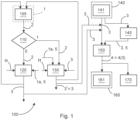
- Figure 1 is a schematic flow chart of an embodiment of the method 100 for protecting the integrity of measurement data 2.
- the method 100 reacts to the event 105 that a record of measurement data 2 has been acquired by a sensor device 1.
- step 110 it is then determined by the sensor device 1 whether an aggregate value 3 of records of measurement data 2 has already been generated. If this is not the case (truth value 0), the measurement data 2, optionally together with configuration information 1a of the sensor device 1 and/or a running epoch index 5, is mapped, by means of a predetermined aggregation function H, to a newly generated aggregate value 3 that at this time relates to only one single record of measurement data 2. If, however, an aggregate value 3 already exists (truth value 1 at diamond 110), then the same aggregation function H is used in step 130 to update the aggregate value 3.
- an aggregate value 3 that previously related to n records of measurement data 2 is transformed into a new aggregate value 3' that relates to n+1 records of measurement data 3.
- akin to step 120 if an epoch index 5 is used, this may go into the updated aggregate value 3' as well.
- configuration information 1a of the sensor device 1 may go into the updated aggregate value 3'. If this configuration information 1a has been updated since the last update of the aggregate value 3, such updated configuration information 1a may be used.
- the method 100 also reacts to the event 140 that a predetermined condition is met, such as expiry of a predetermined time period, generation of a certain number of new aggregate values 3', or a specific request for a signature 4 from another device 10 that wishes to authenticate the measurement data 2.
- a predetermined condition such as the time period or the number of new aggregate values 3', may be dependent on the utilization of a processing resource of the sensor device 1 that is needed for the computing of a signature 4.
- a running epoch index 5 may be updated in block 145 in response to the predetermined condition being met.
- a signature 4 of the aggregate value 3 is computed using a secret key of the sensor device 1.
- This signature 4 may then be outputted via a communication interface of the sensor device 1 in step 160, and/or stored in a memory inside or outside the sensor device 1 in step 170.
- a device 10 that shall perform such authenticating gets hold of the measurement data 2 and the signature 4 from whatever source.
- other information that has gone into the aggregate value 3 such as an epoch index 5 or configuration information 1a, may be outputted as well to aid the authenticating.
- FIG. 2 is a schematic flow chart of the method 200 for authenticating measurement data 2 that has been protected using the method 100 described above.
- step 210 the measurement data 2 and at least one signature 4 of an aggregate value 3 that depends on this measurement data 2 are obtained.
- the aggregate value 3 is reconstructed based at least in part on the measurement data 2. Theoretically, the aggregate value 3 could be obtained from whatever source in step 210 as well and immediately used instead of reconstructing it. However, always reconstructing the aggregate value 3 in step 220 is better for security because this reconstructing proves that the aggregate value 3 actually belongs to the supplied measurement data 2. With such proof, successful verification of the signature 4 against the aggregate value 3 also implies the sought authenticity of the measurement data 2.
- step 230 the signature 4 is verified against the aggregate value 3. If this verification is successful (truth value 1), it is determined in step 240 that the measurement data 2 is authentic.
- the reconstructing 220 of the aggregate value 3 may be based on candidate values C for the measurement data 2 and/or for further arguments from which the aggregate value 3 is derived. That is, if some of this information is not known for sure, it may be searched for by trying candidate values C: If the verification fails (truth value 0 at diamond 230), then new candidate values C* may be determined in step 250. These new candidate values C* may be fed back to the reconstructing of the aggregate value 3 in block 221, so that a new aggregate value results. The given signature 4 can then be verified against this new candidate value 3.
- Figure 3 illustrates the cooperation of a sensor device 1 and a device 10 that is to authenticate measurement data 2.
- the sensor device 1 computes an aggregate value 3 from records of measurement data 2, configuration information 1a of the sensor device, and a running epoch index 5 as per steps 120 and 130 of method 100.
- the sensor device 1 computes the signature 4 of this aggregate value 3 using its secret key as per step 150 of method 100.
- the measurement data 2 and the signature 4 may be supplied from the sensor device 1 to the device 10 that wishes to authenticate the measurement data 2.
- the configuration information 1a may even be supplied from the authenticating device 10 to the sensor device 1, for example, if the authenticating device 10 is a process controller that is connected to the same network as the sensor device 1.
- the aggregate value 3 is reconstructed from the measurement data 2, the configuration information 1a and the epoch index 5 as per step 220 of the method 200.
- the signature 4 is then verified against the reconstructed aggregate value 3 as per step 230 of the method 200.
Landscapes
- Engineering & Computer Science (AREA)
- Computer Security & Cryptography (AREA)
- Theoretical Computer Science (AREA)
- General Engineering & Computer Science (AREA)
- Software Systems (AREA)
- Signal Processing (AREA)
- Computer Networks & Wireless Communication (AREA)
- Physics & Mathematics (AREA)
- General Physics & Mathematics (AREA)
- Computer Hardware Design (AREA)
- General Health & Medical Sciences (AREA)
- Bioethics (AREA)
- Health & Medical Sciences (AREA)
- Automation & Control Theory (AREA)
- Power Engineering (AREA)
- Computing Systems (AREA)
- Arrangements For Transmission Of Measured Signals (AREA)
- Storage Device Security (AREA)
Claims (14)
- Verfahren (100) zum Schützen der Integrität von Messdaten (2), die mit einem Sensorgerät (1) aufgenommen wurden, umfassend:• in Antwort darauf, dass Messdaten (2) aufgenommen wurden (105), Ermitteln (110), ob bereits ein aggregierter Wert (3) erzeugt wurde, durch das Sensorgerät (1), und:∘ wenn ein aggregierter Wert (3) noch nicht erzeugt wurde, Abbilden (120) der Messdaten (2) auf einen aggregieren Wert (3) mittels einer vorgegebenen Aggregations-Funktion (H), die Messdaten (2) als verpflichtendes Argument und einen zuvor erzeugten aggregierten Wert (3) als optionales Argument nimmt; wohingegen,∘ wenn ein aggregierter Wert (3) bereits erzeugt wurde, Abbilden (130) der Kombination dieses aggregierten Werts (3) und der Messdaten (2) auf einen neuen aggregierten Wert (3') mittels der besagten Aggregations-Funktion (H); und• in Antwort darauf, dass eine vorgegebene Bedingung (140) erfüllt ist,∘ Berechnen (150) einer Signatur (4) des aggregierten Werts (3) unter Verwendung eines geheimen Schlüssels des Sensorgeräts (1); und∘ Ausgeben (160) der Signatur (4) über eine Kommunikationsschnittstelle des Sensorgeräts (1), und/oder∘ Speichern (170) der Signatur (4) in einem Speicher,• wobei die vorgegebene Bedingung (140) umfasst, dass eine vorherige Berechnung einer vorherigen Signatur (4) abgeschlossen ist.
- Verfahren (100) nach Anspruch 1, wobei die Aggregations-Funktion (H) eine Hash-Funktion ist, die Messdaten (2), oder eine Kombination der Messdaten (2) mit einem oder mehreren weiteren Argumenten, auf einen Hashwert einer festen Größe als aggregierten Wert (3) abbildet.
- Verfahren (100) nach einem der Ansprüche 1 bis 2, wobei die Aggregations-Funktion (H) weiterhin Konfigurations-Information (1a) des Sensorgeräts (1) als weiteres Argument nimmt, wobei besagte Konfigurations-Information (1a) das Verhalten des Sensorgeräts (1), und/oder das Aufnehmen von Messdaten (2) durch das Sensorgerät (1), steuert.
- Verfahren (100) nach Anspruch 3, wobei die Konfigurations-Information (1a) ein oder mehrere von:• einem Messbereich des Sensorgeräts (1);• einer vom Sensorgerät (1) verwendeten Maßeinheit;• einem Zeitplan, anhand dessen das Sensorgerät (1) Messdaten (2) aufnimmt;• einem oder mehreren Verarbeitungsschritten, die das Sensorgerät (1) auf mindestens ein Sensorsignal, und/oder auf die Messdaten (2), anwendet; und• mindestens einem Teil der Firmware des Sensorgeräts (1), und/oder einem hierauf berechneten Hashwert,beinhaltet.
- Verfahren (100) nach einem der Ansprüche 1 bis 4, wobei die vorgegebene Bedingung (140) weiterhin umfasst, dass:• eine vorgegebene Zeitspanne abgelaufen ist; und/oder• für eine vorgegebene Anzahl von Malen ein neuer aggregierter Wert (3') erzeugt worden ist; und/oder• das Sensorgerät (1) von einem anderen Gerät (10) eine Anforderung einer Signatur (4) empfangen hat.
- Verfahren (100) nach einem der Ansprüche 1 bis 5, wobei die vorgegebene Bedingung (140) von einer Auslastung mindestens einer Verarbeitungs-Ressource des Sensorgeräts (1), die für die Berechnung einer Signatur (4) benötigt wird, abhängig gemacht wird (141).
- Verfahren (100) nach einem der Ansprüche 1 bis 6, wobei die Aggregations-Funktion (H) einen Epochen-Index (5) als weiteres Argument nimmt, und wobei das Verfahren (100) weiterhin umfasst, in Antwort darauf, dass die vorgegebene Bedingung (140) erfüllt ist: den besagten Epochen-Index (5) zu inkrementieren (145).
- Verfahren (100) nach einem der Ansprüche 1 bis 7, wobei die Kommunikationsschnittstelle des Sensorgeräts (1), die für das Ausgeben (160) der Signatur (4) verwendet wird, dazu ausgebildet ist, Daten vom Sensorgerät (1) auszugeben, aber nicht dazu ausgebildet ist, das Eingeben von Daten in das Sensorgerät (1) zu akzeptieren.
- Verfahren (100) nach Anspruch 8, wobei die Kommunikationsschnittstelle (1) Daten, die vom Sensorgerät (1) ausgegeben werden, in einen Wert des Stroms kodiert, den die Kommunikationsschnittstelle, und/oder das Sensorgerät (1), aus einer Stromschleife zieht.
- Verfahren (100) nach einem der Ansprüche 1 bis 9, weiterhin umfassend Ausgeben (161) mindestens eines Teils der Daten, aus denen das Sensorgerät (1) aggregierte Werte (3) berechnet, über die Kommunikationsschnittstelle.
- Verfahren (200) zum Authentifizieren von Messdaten (2), die von einem Sensorgerät (1) aufgenommen wurden und mit dem Verfahren (100) nach einem der Ansprüche 1 bis 10 geschützt wurden, umfassend:• Beschaffen (210) der Messdaten (2) und mindestens einer Signatur (4) eines aggregierten Werts (3), der von diesen Messdaten (2) abhängt;• Rekonstruieren (220) des aggregierten Werts (3) basierend mindestens zum Teil auf den Messdaten (2);• Verifizieren (230) der Signatur (4) gegen den rekonstruierten aggregierten Wert (3); und• wenn diese Verifikation erfolgreich ist, Feststellen (240), dass die Messdaten (2) authentisch sind,wobei das Rekonstruieren (220) mindestens zum Teil auf Kandidaten-Werten (C) für die Messdaten (2) und/oder für weitere Argumente, aus denen der aggregierte Wert (3) abgeleitet wird, basiert (221), und wobei das Verfahren weiterhin umfasst: wenn die Verifikation nicht erfolgreich ist, Ermitteln (250) neuer Kandidaten-Werte (C*) und Rekonstruieren (220) eines neuen Kandidaten-Werts (3) basierend mindestens zum Teil auf den neuen Kandidaten-Werten (C*), wobei die Kandidaten-Werte (C) und neuen Kandidaten-Werte (C*) jeweils Vermutungen dahingehend repräsentieren, was zur Zeit der Berechnung der Signatur in den aggregierten Wert (3) eingeflossen ist.
- Computerprogramm, umfassend maschinenlesbare Anweisungen, die, wenn sie von einem oder mehreren Computern, und/oder von einem Sensorgerät, ausgeführt werden, den einen oder die mehreren Computer, und/oder das Sensorgerät (1), dazu veranlassen, ein Verfahren (100, 200) nach einem der Ansprüche 1 bis 11 auszuführen.
- Nicht-flüchtiges Speichermedium und/oder Downloadprodukt mit dem Computerprogramm nach Anspruch 12.
- Ein oder mehrere Computer, und/oder ein Sensorgerät, mit dem Computerprogramm nach Anspruch 12, und/oder mit dem nichtflüchtigen Speichermedium und/oder Downloadprodukt nach Anspruch 13.
Priority Applications (3)
| Application Number | Priority Date | Filing Date | Title |
|---|---|---|---|
| EP20208137.8A EP4002179B1 (de) | 2020-11-17 | 2020-11-17 | Schutz der integrität von messdaten, die von einer sensorvorrichtung erfasst werden |
| US17/523,013 US12132822B2 (en) | 2020-11-17 | 2021-11-10 | Protecting the integrity of measurement data acquired by a sensor device |
| CN202111360221.6A CN114510744B (zh) | 2020-11-17 | 2021-11-17 | 保护由传感器装置获取的测量数据的完整性 |
Applications Claiming Priority (1)
| Application Number | Priority Date | Filing Date | Title |
|---|---|---|---|
| EP20208137.8A EP4002179B1 (de) | 2020-11-17 | 2020-11-17 | Schutz der integrität von messdaten, die von einer sensorvorrichtung erfasst werden |
Publications (2)
| Publication Number | Publication Date |
|---|---|
| EP4002179A1 EP4002179A1 (de) | 2022-05-25 |
| EP4002179B1 true EP4002179B1 (de) | 2025-01-01 |
Family
ID=73475860
Family Applications (1)
| Application Number | Title | Priority Date | Filing Date |
|---|---|---|---|
| EP20208137.8A Active EP4002179B1 (de) | 2020-11-17 | 2020-11-17 | Schutz der integrität von messdaten, die von einer sensorvorrichtung erfasst werden |
Country Status (3)
| Country | Link |
|---|---|
| US (1) | US12132822B2 (de) |
| EP (1) | EP4002179B1 (de) |
| CN (1) | CN114510744B (de) |
Families Citing this family (2)
| Publication number | Priority date | Publication date | Assignee | Title |
|---|---|---|---|---|
| US20220382257A1 (en) * | 2021-05-28 | 2022-12-01 | Phillips 66 Company | Industrial controls with a combination of wireless and direct connection |
| EP4542428B1 (de) * | 2023-10-20 | 2025-12-31 | Testo SE & Co. KGaA | Verfahren zur aufzeichnung und verifikation von messwerten sowie dazugehörige einrichtungen und messanordnung |
Family Cites Families (28)
| Publication number | Priority date | Publication date | Assignee | Title |
|---|---|---|---|---|
| NL9102144A (nl) | 1991-12-20 | 1993-07-16 | Nederlanden Staat | Werkwijze en stelsel voor het groepsgewijs waarmerken van digitale gegevens. |
| DE19940341A1 (de) * | 1999-08-25 | 2001-03-01 | Kolja Vogel | Verfahren zum Schutz von Daten |
| WO2008014002A2 (en) * | 2006-07-28 | 2008-01-31 | Brown University | Super-efficient verification of dynamic outsourced databases |
| US9411970B2 (en) * | 2011-08-19 | 2016-08-09 | Microsoft Technology Licensing, Llc | Sealing secret data with a policy that includes a sensor-based constraint |
| US10263841B1 (en) * | 2014-05-13 | 2019-04-16 | Senseware, Inc. | System, method and apparatus for configuring a node in a sensor network |
| US11722365B2 (en) * | 2014-05-13 | 2023-08-08 | Senseware, Inc. | System, method and apparatus for configuring a node in a sensor network |
| EP3149651B1 (de) * | 2014-06-02 | 2020-04-29 | Robert Bosch GmbH | System und verfahren zur sicheren überprüfung von auditprotokollen |
| EP3202103B1 (de) * | 2014-09-30 | 2021-06-16 | Telefonaktiebolaget LM Ericsson (publ) | Verfahren zur handhabung von daten in einem datennetz |
| CN104967517B (zh) | 2015-07-24 | 2018-03-20 | 电子科技大学 | 一种用于无线传感器的网络数据聚合方法 |
| US10230529B2 (en) * | 2015-07-31 | 2019-03-12 | Microsft Technology Licensing, LLC | Techniques to secure computation data in a computing environment |
| US9736122B2 (en) * | 2015-09-02 | 2017-08-15 | International Business Machines Corporation | Bluesalt security |
| US10439998B2 (en) * | 2015-09-22 | 2019-10-08 | Bernard Wishard | Autonomous sensor system with intrinsic asymmetric encryption |
| JP7421766B2 (ja) * | 2015-11-13 | 2024-01-25 | バッジ インコーポレイテッド | 公開キー/プライベートキーバイオメトリック認証システム |
| US10765329B2 (en) * | 2016-05-02 | 2020-09-08 | Topera, Inc. | System and method to define an aggregated stability map of a rotational source over a plurality of time intervals associated with a biological rhythm disorder |
| US10630655B2 (en) * | 2017-05-18 | 2020-04-21 | Robert Bosch Gmbh | Post-quantum secure private stream aggregation |
| WO2019086969A1 (en) | 2017-11-01 | 2019-05-09 | Abb Schweiz Ag | Condition monitoring device and method for secure communication |
| EP3561709B1 (de) * | 2018-04-25 | 2020-07-29 | Siemens Aktiengesellschaft | Datenverarbeitungsvorrichtung, system und verfahren zum nachweis oder zur überprüfung der sicherheit einer datenverarbeitungsvorrichtung |
| US11099539B2 (en) * | 2018-05-17 | 2021-08-24 | Ut-Battelle, Llc | Multi-sensor agent devices |
| US10764058B2 (en) * | 2018-06-29 | 2020-09-01 | Intel Corporation | Secure aggregation of IoT messages |
| DE102018126533A1 (de) * | 2018-10-24 | 2020-04-30 | Basler Ag | Beglaubigungsmodul für Sensordaten |
| CN109862114B (zh) * | 2019-03-12 | 2021-08-10 | 南京邮电大学 | 一种基于雾计算的安全车辆群智感知方法 |
| CN109981289B (zh) | 2019-03-26 | 2020-03-31 | 电子科技大学 | 隐式证书下的椭圆曲线数字签名算法的批认证方法 |
| US11719563B2 (en) * | 2019-07-03 | 2023-08-08 | Red Hat, Inc. | Distributed anomaly detection using combinable measurement value summaries |
| CN111211903B (zh) * | 2019-12-02 | 2021-06-11 | 中国矿业大学 | 基于雾计算和保护隐私的移动群体感知数据报告去重方法 |
| US11719451B2 (en) * | 2019-12-23 | 2023-08-08 | Johnson Controls Tyco IP Holdings LLP | Building system with early fault detection |
| US10846372B1 (en) * | 2019-12-31 | 2020-11-24 | Onu Technology Inc. | Systems and methods for trustless proof of possession and transmission of secured data |
| CN111372243B (zh) * | 2020-03-18 | 2023-05-12 | 南京邮电大学 | 基于雾联盟链的安全分布式聚合与访问系统及方法 |
| US12386807B2 (en) * | 2020-10-06 | 2025-08-12 | The Board Of Trustees Of The Leland Stanford Junior University | System and method implementing a distributed audit trail |
-
2020
- 2020-11-17 EP EP20208137.8A patent/EP4002179B1/de active Active
-
2021
- 2021-11-10 US US17/523,013 patent/US12132822B2/en active Active
- 2021-11-17 CN CN202111360221.6A patent/CN114510744B/zh active Active
Also Published As
| Publication number | Publication date |
|---|---|
| US20220158827A1 (en) | 2022-05-19 |
| CN114510744B (zh) | 2025-05-27 |
| EP4002179A1 (de) | 2022-05-25 |
| CN114510744A (zh) | 2022-05-17 |
| US12132822B2 (en) | 2024-10-29 |
Similar Documents
| Publication | Publication Date | Title |
|---|---|---|
| AU2021231439B2 (en) | Storage and communication environment for cryptographic tags | |
| CN100386740C (zh) | 用于检测计算机系统中的安全漏洞的系统和方法 | |
| US8667263B2 (en) | System and method for measuring staleness of attestation during booting between a first and second device by generating a first and second time and calculating a difference between the first and second time to measure the staleness | |
| US8127146B2 (en) | Transparent trust validation of an unknown platform | |
| US20030037231A1 (en) | Proving BIOS trust in a TCPA compliant system | |
| EP2397959B1 (de) | System und Verfahren für die N-Ary-Lokalität in einem Sicherheits-Koprozessor | |
| US20100082984A1 (en) | Protocol-Independent Remote Attestation And Sealing | |
| US20110116637A1 (en) | Methods, systems, and computer program products for automatically verifying and populating digital certificates in an encryption keystore | |
| CN106022136B (zh) | 信息处理装置及该装置的控制方法 | |
| WO2021215998A1 (en) | An ownership data management system and method | |
| US20140195812A1 (en) | Cryptographically secure authentication device, system and method | |
| Nguyen et al. | Cloud-based secure logger for medical devices | |
| CN106790045B (zh) | 一种基于云环境分布式虚拟机代理装置及数据完整性保障方法 | |
| CN114257376B (zh) | 数字证书更新方法、装置、计算机设备和存储介质 | |
| JP5074709B2 (ja) | 対象機器、機器管理システム、機器管理方法および外部装置 | |
| EP4002179B1 (de) | Schutz der integrität von messdaten, die von einer sensorvorrichtung erfasst werden | |
| US20040153646A1 (en) | Distributed control of integrity measurement using a trusted fixed token | |
| US20230289478A1 (en) | Generating signed measurements | |
| JP7478440B2 (ja) | 情報処理方法及び情報処理システム | |
| CN111934882B (zh) | 基于区块链的身份认证方法、装置、电子设备及存储介质 | |
| Boeck et al. | Towards more trustable log files for digital forensics by means of “trusted computing” | |
| CN105868657B (zh) | 装置和用于安全地操作该装置的方法 | |
| CN118138254B (zh) | 一种基于区块链技术的数字货币身份认证系统 | |
| CN107209506A (zh) | 安全的产品标识和校验 | |
| CN118784282B (zh) | 一种信息处理方法及装置 |
Legal Events
| Date | Code | Title | Description |
|---|---|---|---|
| PUAI | Public reference made under article 153(3) epc to a published international application that has entered the european phase |
Free format text: ORIGINAL CODE: 0009012 |
|
| STAA | Information on the status of an ep patent application or granted ep patent |
Free format text: STATUS: THE APPLICATION HAS BEEN PUBLISHED |
|
| AK | Designated contracting states |
Kind code of ref document: A1 Designated state(s): AL AT BE BG CH CY CZ DE DK EE ES FI FR GB GR HR HU IE IS IT LI LT LU LV MC MK MT NL NO PL PT RO RS SE SI SK SM TR |
|
| STAA | Information on the status of an ep patent application or granted ep patent |
Free format text: STATUS: REQUEST FOR EXAMINATION WAS MADE |
|
| 17P | Request for examination filed |
Effective date: 20221019 |
|
| RBV | Designated contracting states (corrected) |
Designated state(s): AL AT BE BG CH CY CZ DE DK EE ES FI FR GB GR HR HU IE IS IT LI LT LU LV MC MK MT NL NO PL PT RO RS SE SI SK SM TR |
|
| GRAP | Despatch of communication of intention to grant a patent |
Free format text: ORIGINAL CODE: EPIDOSNIGR1 |
|
| STAA | Information on the status of an ep patent application or granted ep patent |
Free format text: STATUS: GRANT OF PATENT IS INTENDED |
|
| RIC1 | Information provided on ipc code assigned before grant |
Ipc: H04L 9/32 20060101ALI20240607BHEP Ipc: G05B 23/02 20060101ALI20240607BHEP Ipc: G06F 21/57 20130101ALI20240607BHEP Ipc: H04L 9/40 20220101ALI20240607BHEP Ipc: G06F 21/64 20130101AFI20240607BHEP |
|
| INTG | Intention to grant announced |
Effective date: 20240703 |
|
| GRAJ | Information related to disapproval of communication of intention to grant by the applicant or resumption of examination proceedings by the epo deleted |
Free format text: ORIGINAL CODE: EPIDOSDIGR1 |
|
| STAA | Information on the status of an ep patent application or granted ep patent |
Free format text: STATUS: REQUEST FOR EXAMINATION WAS MADE |
|
| GRAP | Despatch of communication of intention to grant a patent |
Free format text: ORIGINAL CODE: EPIDOSNIGR1 |
|
| STAA | Information on the status of an ep patent application or granted ep patent |
Free format text: STATUS: GRANT OF PATENT IS INTENDED |
|
| INTC | Intention to grant announced (deleted) | ||
| INTG | Intention to grant announced |
Effective date: 20240905 |
|
| GRAS | Grant fee paid |
Free format text: ORIGINAL CODE: EPIDOSNIGR3 |
|
| GRAA | (expected) grant |
Free format text: ORIGINAL CODE: 0009210 |
|
| STAA | Information on the status of an ep patent application or granted ep patent |
Free format text: STATUS: THE PATENT HAS BEEN GRANTED |
|
| RIN1 | Information on inventor provided before grant (corrected) |
Inventor name: KOHNHAEUSER, FLORIAN Inventor name: FINSTER, SOEREN |
|
| AK | Designated contracting states |
Kind code of ref document: B1 Designated state(s): AL AT BE BG CH CY CZ DE DK EE ES FI FR GB GR HR HU IE IS IT LI LT LU LV MC MK MT NL NO PL PT RO RS SE SI SK SM TR |
|
| REG | Reference to a national code |
Ref country code: GB Ref legal event code: FG4D |
|
| REG | Reference to a national code |
Ref country code: CH Ref legal event code: EP |
|
| REG | Reference to a national code |
Ref country code: DE Ref legal event code: R096 Ref document number: 602020043969 Country of ref document: DE |
|
| REG | Reference to a national code |
Ref country code: IE Ref legal event code: FG4D |
|
| REG | Reference to a national code |
Ref country code: LT Ref legal event code: MG9D |
|
| REG | Reference to a national code |
Ref country code: NL Ref legal event code: MP Effective date: 20250101 |
|
| REG | Reference to a national code |
Ref country code: AT Ref legal event code: MK05 Ref document number: 1757019 Country of ref document: AT Kind code of ref document: T Effective date: 20250101 |
|
| PG25 | Lapsed in a contracting state [announced via postgrant information from national office to epo] |
Ref country code: NL Free format text: LAPSE BECAUSE OF FAILURE TO SUBMIT A TRANSLATION OF THE DESCRIPTION OR TO PAY THE FEE WITHIN THE PRESCRIBED TIME-LIMIT Effective date: 20250101 |
|
| PG25 | Lapsed in a contracting state [announced via postgrant information from national office to epo] |
Ref country code: FI Free format text: LAPSE BECAUSE OF FAILURE TO SUBMIT A TRANSLATION OF THE DESCRIPTION OR TO PAY THE FEE WITHIN THE PRESCRIBED TIME-LIMIT Effective date: 20250101 |
|
| PG25 | Lapsed in a contracting state [announced via postgrant information from national office to epo] |
Ref country code: PL Free format text: LAPSE BECAUSE OF FAILURE TO SUBMIT A TRANSLATION OF THE DESCRIPTION OR TO PAY THE FEE WITHIN THE PRESCRIBED TIME-LIMIT Effective date: 20250101 |
|
| PG25 | Lapsed in a contracting state [announced via postgrant information from national office to epo] |
Ref country code: ES Free format text: LAPSE BECAUSE OF FAILURE TO SUBMIT A TRANSLATION OF THE DESCRIPTION OR TO PAY THE FEE WITHIN THE PRESCRIBED TIME-LIMIT Effective date: 20250101 |
|
| PG25 | Lapsed in a contracting state [announced via postgrant information from national office to epo] |
Ref country code: NO Free format text: LAPSE BECAUSE OF FAILURE TO SUBMIT A TRANSLATION OF THE DESCRIPTION OR TO PAY THE FEE WITHIN THE PRESCRIBED TIME-LIMIT Effective date: 20250401 Ref country code: IS Free format text: LAPSE BECAUSE OF FAILURE TO SUBMIT A TRANSLATION OF THE DESCRIPTION OR TO PAY THE FEE WITHIN THE PRESCRIBED TIME-LIMIT Effective date: 20250501 |
|
| PG25 | Lapsed in a contracting state [announced via postgrant information from national office to epo] |
Ref country code: HR Free format text: LAPSE BECAUSE OF FAILURE TO SUBMIT A TRANSLATION OF THE DESCRIPTION OR TO PAY THE FEE WITHIN THE PRESCRIBED TIME-LIMIT Effective date: 20250101 |
|
| PG25 | Lapsed in a contracting state [announced via postgrant information from national office to epo] |
Ref country code: LV Free format text: LAPSE BECAUSE OF FAILURE TO SUBMIT A TRANSLATION OF THE DESCRIPTION OR TO PAY THE FEE WITHIN THE PRESCRIBED TIME-LIMIT Effective date: 20250101 Ref country code: PT Free format text: LAPSE BECAUSE OF FAILURE TO SUBMIT A TRANSLATION OF THE DESCRIPTION OR TO PAY THE FEE WITHIN THE PRESCRIBED TIME-LIMIT Effective date: 20250502 |
|
| PG25 | Lapsed in a contracting state [announced via postgrant information from national office to epo] |
Ref country code: GR Free format text: LAPSE BECAUSE OF FAILURE TO SUBMIT A TRANSLATION OF THE DESCRIPTION OR TO PAY THE FEE WITHIN THE PRESCRIBED TIME-LIMIT Effective date: 20250402 Ref country code: BG Free format text: LAPSE BECAUSE OF FAILURE TO SUBMIT A TRANSLATION OF THE DESCRIPTION OR TO PAY THE FEE WITHIN THE PRESCRIBED TIME-LIMIT Effective date: 20250101 |
|
| PG25 | Lapsed in a contracting state [announced via postgrant information from national office to epo] |
Ref country code: AT Free format text: LAPSE BECAUSE OF FAILURE TO SUBMIT A TRANSLATION OF THE DESCRIPTION OR TO PAY THE FEE WITHIN THE PRESCRIBED TIME-LIMIT Effective date: 20250101 |
|
| PG25 | Lapsed in a contracting state [announced via postgrant information from national office to epo] |
Ref country code: CZ Free format text: LAPSE BECAUSE OF FAILURE TO SUBMIT A TRANSLATION OF THE DESCRIPTION OR TO PAY THE FEE WITHIN THE PRESCRIBED TIME-LIMIT Effective date: 20250101 |
|
| PG25 | Lapsed in a contracting state [announced via postgrant information from national office to epo] |
Ref country code: SE Free format text: LAPSE BECAUSE OF FAILURE TO SUBMIT A TRANSLATION OF THE DESCRIPTION OR TO PAY THE FEE WITHIN THE PRESCRIBED TIME-LIMIT Effective date: 20250101 |
|
| REG | Reference to a national code |
Ref country code: DE Ref legal event code: R097 Ref document number: 602020043969 Country of ref document: DE |
|
| PG25 | Lapsed in a contracting state [announced via postgrant information from national office to epo] |
Ref country code: SM Free format text: LAPSE BECAUSE OF FAILURE TO SUBMIT A TRANSLATION OF THE DESCRIPTION OR TO PAY THE FEE WITHIN THE PRESCRIBED TIME-LIMIT Effective date: 20250101 |
|
| PG25 | Lapsed in a contracting state [announced via postgrant information from national office to epo] |
Ref country code: DK Free format text: LAPSE BECAUSE OF FAILURE TO SUBMIT A TRANSLATION OF THE DESCRIPTION OR TO PAY THE FEE WITHIN THE PRESCRIBED TIME-LIMIT Effective date: 20250101 |
|
| PG25 | Lapsed in a contracting state [announced via postgrant information from national office to epo] |
Ref country code: IT Free format text: LAPSE BECAUSE OF FAILURE TO SUBMIT A TRANSLATION OF THE DESCRIPTION OR TO PAY THE FEE WITHIN THE PRESCRIBED TIME-LIMIT Effective date: 20250101 |
|
| PG25 | Lapsed in a contracting state [announced via postgrant information from national office to epo] |
Ref country code: EE Free format text: LAPSE BECAUSE OF FAILURE TO SUBMIT A TRANSLATION OF THE DESCRIPTION OR TO PAY THE FEE WITHIN THE PRESCRIBED TIME-LIMIT Effective date: 20250101 |
|
| PG25 | Lapsed in a contracting state [announced via postgrant information from national office to epo] |
Ref country code: RO Free format text: LAPSE BECAUSE OF FAILURE TO SUBMIT A TRANSLATION OF THE DESCRIPTION OR TO PAY THE FEE WITHIN THE PRESCRIBED TIME-LIMIT Effective date: 20250101 |
|
| PG25 | Lapsed in a contracting state [announced via postgrant information from national office to epo] |
Ref country code: SK Free format text: LAPSE BECAUSE OF FAILURE TO SUBMIT A TRANSLATION OF THE DESCRIPTION OR TO PAY THE FEE WITHIN THE PRESCRIBED TIME-LIMIT Effective date: 20250101 |
|
| PLBE | No opposition filed within time limit |
Free format text: ORIGINAL CODE: 0009261 |
|
| STAA | Information on the status of an ep patent application or granted ep patent |
Free format text: STATUS: NO OPPOSITION FILED WITHIN TIME LIMIT |
|
| 26N | No opposition filed |
Effective date: 20251002 |
|
| PGFP | Annual fee paid to national office [announced via postgrant information from national office to epo] |
Ref country code: DE Payment date: 20251119 Year of fee payment: 6 |
|
| PGFP | Annual fee paid to national office [announced via postgrant information from national office to epo] |
Ref country code: GB Payment date: 20251121 Year of fee payment: 6 |