EP4001850B1 - Multiplikative anpassung der rechten und linken lage für ausrichtungstransfer - Google Patents
Multiplikative anpassung der rechten und linken lage für ausrichtungstransfer Download PDFInfo
- Publication number
- EP4001850B1 EP4001850B1 EP21195294.0A EP21195294A EP4001850B1 EP 4001850 B1 EP4001850 B1 EP 4001850B1 EP 21195294 A EP21195294 A EP 21195294A EP 4001850 B1 EP4001850 B1 EP 4001850B1
- Authority
- EP
- European Patent Office
- Prior art keywords
- imu
- ins
- measured
- attitude
- module
- Prior art date
- Legal status (The legal status is an assumption and is not a legal conclusion. Google has not performed a legal analysis and makes no representation as to the accuracy of the status listed.)
- Active
Links
Images


Classifications
-
- G—PHYSICS
- G01—MEASURING; TESTING
- G01C—MEASURING DISTANCES, LEVELS OR BEARINGS; SURVEYING; NAVIGATION; GYROSCOPIC INSTRUMENTS; PHOTOGRAMMETRY OR VIDEOGRAMMETRY
- G01C25/00—Manufacturing, calibrating, cleaning, or repairing instruments or devices referred to in the other groups of this subclass
- G01C25/005—Manufacturing, calibrating, cleaning, or repairing instruments or devices referred to in the other groups of this subclass initial alignment, calibration or starting-up of inertial devices
Definitions
- the airborne equipment may include a pedestal having an antenna or other narrow beam equipment configured to transmit and/or receive signals to and from a remote target, such as an aircraft, satellite or ground station.
- a remote target such as an aircraft, satellite or ground station.
- the alignment of the ARU to the INS is costly and can take considerable time.
- the ARU equipment will typically include an inertial measurement unit (IMU).
- IMU inertial measurement unit
- the ARU could be mounted at the base of the antenna pedestal or it could be mounted attached to the antenna reflector.
- the ARU further includes computing hardware and software to compute attitude for the antenna.
- Document EP 2 927 744 discloses an image capture system that comprises an image capture device driven by a motor to a desired angle.
- a gyro senses a rate and a system senses an angle of the image capture device relative to a surface.
- a control removes a gyro bias error estimated by the system in real time for correcting a position of the image capture device.
- An IMU is an electronic device that outputs measured body rates such as acceleration rates, angular rates etc. This is able to be performed inasmuch as the IMU includes equipment such as various accelerometers, gyroscopes, and/or magnetometers. This allows for outputting rotation rates for roll, pitch, and heading of the platform.
- the traditional mechanical IMU's have been mostly replaced by modern IMU's that are open to an array of options from the high end fiber optic gyro and ring laser systems to very simple and low cost microelectromechanical systems (MEMS) based solutions.
- MEMS microelectromechanical systems
- the accelerometers and gyroscopes used in modern IMUs rarely exceed tactical grade levels.
- a measured body rotation rate may drift by an amount of 0.1° per minute (as a turn on to turn on stability for a tactical grade MEMS IMU).
- the output of the IMU is integrated over time, the result is a significant absolute position drift.
- a high end INS contains an IMU that is typically in the navigation grade category.
- the INS includes accelerometers and gyroscopes (and often other sensors including a GPS, a barometer, etc.).
- the higher grade equipment in an INS allows integration over a significant amount of time and then coupled with other sensors, that integrated attitude can be compared with the accelerometers which determine which orientation is down.
- the earth rate can be sensed and in combination with position from a GPS, the heading of the platform can be determined.
- An INS includes computing hardware and software that allows the INS to output actual three-dimensional velocities and three-dimensional angles including actual roll, pitch and heading, and system position on the earth in all three axes.
- the INS outputs actual velocities and navigation grade (sometimes treated as absolute) positional angles. Taken together, the positional angles are referred to as attitude.
- systems may use an IMU mounted on a mobile platform to attempt to orient the ARU to match the attitude of the INS dedicated for platform navigation.
- the IMU has a bias in rotation rate associated with it.
- the IMU and INS will not have a matching attitude, which needs to be accounted for and compensated out of the algorithms.
- mounting the IMU to the platform and mounting the navigation dedicated INS is done differently each time it is performed. That is, there can be variations in how IMUs are mounted to different pieces of the platform and variations in how different INS units are mounted. Thus, there are inherent attitude differences simply based on how mounting is performed of IMUs and navigation systems.
- One embodiment illustrated herein includes a method of matching attitude of an IMU mounted on antenna equipment, as part of an ARU, with attitude of an INS mounted some distance away on a different part of the aircraft or other mobile platform.
- the method includes receiving measured body rotation rates from an IMU serving as a portion of a dedicated ARU.
- the method further includes receiving measured orientations from the INS.
- the method further includes estimating a rotation rate bias of one or more of the body rotation rates by using differences over time between a change in orientation of the IMU determined by integrating the measured body rotation rates and using the integrated measured body rotation rates over time; and a change in orientation of the INS determined using the measured orientations over time.
- the method further includes compensating for the estimated rotation rate bias.
- the method further includes from the orientation of the IMU determined from the measured body rotation rates and the measured orientations of the INS, determining attitude mismatching caused by initial condition mismatching and attitude mismatching caused by issues related to mounting the IMU and mounting the INS.
- the method further includes compensating for the attitude mismatching.
- the method further includes slaving the IMU attitude to the INS.
- Embodiments illustrated herein are able to orient a dedicated ARU having an IMU to a platform INS by compensating for various issues including IMU rotation rate bias, initial attitude differences, and mounting differences. That is, embodiments can receive as input measured body rotation rates from an IMU, and INS attitude information. Using this information, embodiments can compensate for rotation rate bias of the IMU. Additionally, embodiments can compensate for differences in initial attitude between the IMU mounted on the airborne antenna equipment and the aircraft (or other mobile platform) dedicated INS. Further, embodiments can compensate for mounting differences between IMUs and INSs. This approach can be implemented in some embodiments using only the attitude information while excluding coordinating the accelerometers, as is commonly done in other systems. Thus, some embodiments herein can perform attitude matching by using only the measured attitudes, while specifically excluding matching by coordinating accelerometers in IMUs and INS.
- Figure 1 illustrates an environment 100.
- ARU 102 includes an IMU 108 coupled to a computing system 114 for performing various computations and corrections.
- the IMU 108 is coupled to a pedestal 104 directly or coupled to an antenna 106 such that the IMU is able to be tilted in 3 dimensions.
- the IMU 108 is able to output the rotation rate at which tilting occurs in the various axes. That is, the IMU 108 is able to output angular changes in X, Y, and Z axes. Note that while X, Y, and Z axes are used here in this example, it should be appreciated that other coordinate systems may be used, in addition or alternatively.
- FIG 1 further illustrates a dedicated platform INS 112 which in this case is an aircraft INS.
- the INS 112 has an attitude that is dependent on an attitude of the mobile platform 110. Further, the INS 112 is able to output actual, navigation grade angle angular positioning including angular positioning corresponding to roll pitch, and heading (or yaw). The information regarding attitude output by the INS 112 corresponds to the attitude of the platform 110 as the INS 112 is typically statically mounted to the platform 110.
- the attitude of antenna 106 (as indicated by the IMU 108) to match the attitude of the platform 110. This can be done, for example, to implement a bore site from the antenna 106 to a target 120, where the target may be a satellite, aircraft, ground equipment, or other platform having communication hardware.
- the IMU 108 may be implemented using gyroscopes and accelerometers which are of a lower grade, such that the IMU 108 has a rotation rate bias.
- the IMU 108 may output a rotation bias that is 0.1° per minute (or some other value) higher than the actual rotation rate of change of the IMU 108 as the pedestal 104 changes the angular position of the IMU 108. This introduces a difficulty in being able to match the attitude of the ARU102 (and in particular, the attitude of the IMU 108) to the attitude of the dedicated INS 112.
- the IMU 108 and INS 112 may be out of alignment. This initial misalignment will need to be corrected.
- the IMU 108 when the IMU 108 is mounted to the antenna 106 or other portion of the antenna equipment, it is likely mounted differently than how the INS 112 is mounted to the platform 110. This will cause additional difficulties as the attitudes of the IMU 108 and INS 112 may be misaligned, even when the antenna 106 and the platform 110 are in attitude alignment, due to the different mounting.
- Figure 1 illustrates a computing system 114 implemented at the antenna reference unit 102.
- the computing system 114 is able to receive the change in angular rotation rate information from the IMU 108 as well as the navigation grade angular position information from the INS 112.
- the computing system 114 may include a modem or other communication hardware that is able to receive data from the IMU 108 and to receive data from the INS 112 that is transmitted to the antenna reference unit 102.
- the computing system 114 is then able to apply various corrections resulting from measured rotation rate bias offsets (to correct for rotation rate bias), initial condition attitude mismatches, and full attitude mismatching, which are eventually used to slave the attitude of the IMU 108 to the attitude of the INS 112. That is, the computing system 114 is able to compensate for rotation rate bias of the IMU 108, initial condition attitude mismatches, and attitude mismatches due to the differences in mounting of the IMU 108 and the INS 112. Additionally, the computing system 114 may be able to use movement of the platform 110, and even potentially movement of the antenna reference unit 102.
- the antenna reference unit 102 is not necessarily in a static location, but rather can move relative flexure between the mounting location of the antenna equipment and the mounting location of the platform (aircraft) INS 110.
- the IMU 108 of the ARU 102 may be mounted on the antenna reflector rather than on a fixed location on the platform 110.
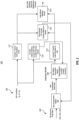
- FIG. 2 an example system 200, implemented in the computing system 114 is illustrated.
- navigation grade attitude data is received from the INS 112. As shown in the illustrated example, the data is received as navigation grade angular position data for angles of roll, pitch, and heading: ⁇ R , ⁇ P , and ⁇ H respectively.
- measured angular rotation rates are received reporting on rate of rotation changes in X, Y and Z axes: ⁇ X , ⁇ Y , and ⁇ Z respectively.
- Figure 2 illustrates a bias compensation module 206 which receives as input the measured angular rotation rates ⁇ X , ⁇ Y , and ⁇ Z .
- the bias compensation module 206 is able to compensate for the rate bias of the measured rotation rates from the IMU 108. This is particularly important as these biases can be exacerbated as other processes are performed.
- the system 200 includes an integration module 208.
- the integration module 208 is used to compute an absolute attitude of the IMU 108 by integrating the IMU measured rotation rates over time. If there is a bias on these measured rotation rates, then that bias will be amplified, and will continue to grow as iterative integration is performed by the integration module 208.
- the bias compensation module 206 removes this bias to prevent amplification by the integration module 208.
- the bias compensation module 206 determines how much correction to apply to the rotation rates provided by the IMU 108 based on a bias estimate determined by a rotational difference module 210 which estimates a rotational difference between the INS 112 and the IMU 108.
- the inputs are an amount of rotation that occurred after the same T seconds for the INS 112 and the IMU. A low frequency difference in rotation will identify a bias.
- the rotational difference module 210 further includes a low-pass filter to isolate the rotational differences that are caused by a bias, resulting in a slowly changing rotational difference between the INS 112 and the IMU from rotational differences existing for other reasons, such a sudden attitude changes for the INS 112. That is, the bias estimate is determined based on an output of a low-pass filter (the output therefore being caused by slowly changing differences) of rotational differences between the INS attitude and the IMU attitude.
- the output of the rotational difference module 210 is provided to the bias compensation module 206, which can remove the bias from the data provided by the IMU at 204.
- the inputs to the bias estimate module 210 are the outputs from computed orientations of the INS T second delta orientation module 212 and the IMU T second delta orientation module 214.
- Figure 2 illustrates the INS T second delta orientation module 212 which computes the change in orientation of the INS after T seconds.
- the IMU T second delta orientation module 214 computes the change in orientation of the IMU after T seconds.
- the T seconds should be the same T seconds.
- INS data is often delayed as compared to IMU data.
- the INS has a latency when compared to the IMU. Indeed, this latency is one of the reasons a dedicated IMU may be needed so as to provide faster response for antenna equipment.
- data from the IMU is buffered, and the latency is determined.
- previously captured samples of IMU data corresponding to currently captured INS data may need to be compared.
- a latency (for example in terms of time, which may correspond to a predetermined number of samples) may need to be determined, and sample matching performed to ensure that samples from the INS and IMU correspond to each other for the actual time when the result of the samples was caused (i.e., by INS or IMU rotation), rather than the time when the samples were taken.
- the output from the INS T second delta orientation module 212 and the output from the INS T second delta orientation module 214 are provided to the delta attitude matching module 216 which generates the signals needed to be provided to the controls 116 to cause the attitude of the IMU 108 to match the attitude of the INS 112. That is, the delta attitude matching module 216 can be used to slave the IMU attitude to the INS attitude. In this case, no low pass filter need be applied. Indeed, in some embodiments, a high pass filter can be applied in the delta attitude matching module 216 to filter out rotational differences caused by the bias.
- Figure 2 illustrates an initial condition computation module 218.
- the initial condition computation module 218 receives as input the INS orientation information input at 202 as well as the IMU orientation information as computed by the integration module 208 operating on the measured rotation rates from the IMU illustrated at 204. This allows the system 200 to compute the difference between the initial orientations of the INS and the IMU. As noted, this difference can be caused by differences in orientation at startup, as well as differences in orientation due to disparities when mounting the INS on the platform and the IMU on the antenna. This difference information can be fed back to the integration module 208 to correct for the initial differences between the attitude of the IMU 108 and the INS 112.
- ⁇ X is the IMU measured delta angle measured around the X axis
- ⁇ Y is the IMU measured delta angle measured around the Y axis
- ⁇ Z is the IMU measured delta angle measured around the Z axis.
- ⁇ is the eigenaxis rotation angle of the unit quaternion, q IMUi .
- q IMUi is the output of the integration module 208.
- this illustrates an algorithm that can be used to update the rotation of the IMU.
- the algorithm is performed as an iterative loop where each sample from the IMU is placed into this algorithm and the change from the existing IMU is determined from the resulting rotation.
- the module 208 is Initialized to a quaternion of [ 1, 0, 0,0].
- the following illustrates an algorithm performed by the bias compensation module 206.
- inputs are received from the rotational difference module 210.
- ⁇ LPFx , ⁇ LPFy , and ⁇ LPFz are outputs from the rotational difference module 210.
- ⁇ x ⁇ y ⁇ z ⁇ x + a s ⁇ 4 ⁇ X ⁇ ⁇ LBFx ⁇ y + a s ⁇ 4 ⁇ Y ⁇ ⁇ LBFy ⁇ z + a s ⁇ 4 ⁇ Z ⁇ ⁇ LBFz
- the filtered difference is applied to update the bias value for the next time through the loop.
- ⁇ are settable scale factors that determine how fast attitude matching between the INS and IMU converge, where faster convergence can be traded for accuracy.
- the following illustrates the algorithms used to apply rotational adjustments between the INS and IMU that is computed by the attitude matching module 216, which implements an alignment filter.
- inputs are received from the INS T second delta orientation module 212 and the IMU T second delta orientation module 214.
- ⁇ INSx , ⁇ INSy , and ⁇ INSz are the outputs from the INS T second delta orientation module 212 and ⁇ IMUx , ⁇ IMUy , and ⁇ IMUz are the outputs from the IMU T second delta orientation module 214.
- V ⁇ IMU a s ⁇ X a s ⁇ Y a s ⁇ Z
- a c " and "a s " are normalization factors to covert from delta INS angles to quaternions.
- the a s in the V IMU and the "a s " in the V INS are different normalization factors computed based on the imu and INS measurements respectively.
- S u represents the rotational error between INS and the IMU.
- the x is the cross product operator.
- the cross product is used to compute the rotation error between the INS and IMU orientations.
- the quaternion Q i is a partial rotation between the instantaneous measurement of INS and the instantaneous measurement of the IMU.
- the rotation is 1/ ⁇ 3 of the total rotation between the two measurements. Cumulating many Q i partial rotations over a series of many measurements behaves as a low pass filter. The cumulated Q i 's should converge a low pass filtered estimate of the orientation difference between the IMU and the INS.
- Q Rot is the accumulation of Q i values. It forms a low pass filtered estimate of the rotational difference (alignment error) between the IMU and the INS.
- the coordinate system is setup for these algorithms so that the body frame of the INS is matched to the body frame of the IMU. Not the other way around. The result is that the IMU output and the INS output will not match exactly as they do in other systems. In the same coordinate system they would match exactly but since they are not in the same coordinate system they do not match.
- the resulting impact is that as the IMU frame aligns with the INS frame such that the pointing vector will match the IMU frame.
- the alignment filter is particularly novel.
- the filter includes the ability to create a matrix between the IMU and the INS.
- the alignment filter requires motion in order to converge and will converge faster under extreme motion of the INS and/or IMU.
- Q INS is the INS orientation
- Q IMU is the IMU orientation
- * is the conjugate operation
- Q adjust is the instantaneous orientation difference between the IMU and the INS.
- Q adjust Tau 1 q 2 q 3 q 4
- Q adjust Q adjust / ⁇ Q adjust ⁇
- module 218 is a second low pass filter with tuning parameter tau 2 .
- Q bias is initialized as the identity unit quaternion.
- the output of module 218 is Q bias which is used to correct for errors in the initialization of the IMU (as well as slowing changing IMU integration errors not corrected by the bias correction).
- Q bias q adjust 1 Tau 2 + q bias 1 q adjust 2 Tau 2 + q bias 2 q adjust 3 Tau 2 + q bias 3 q adjust 4 Tau 2 + q bias 4
- Some embodiments are configured to sample the IMU 108 and the INS 112 at least a 20 Hz sample rate.
- some embodiments are configured to sample the IMU 108 and the INS 112 at least 10 Hz, as rates lower than this often require more accurate iMU technology.
- sample rate may be selected based on a determination of the timing jitter.
- the timing jitter should within about +/- 30 ms max variation.
- embodiments may be implemented to have a timing jitter that is an order of magnitude lower than that.
- ⁇ 1 is the value that is used to scale the alignment adjust matrix. This can be conceptualized as a direct change to the current values reduced by this factor. In one embodiment, this was selected to be a value of 10.
- ⁇ 2 is the value that is used to scale the bias values. This can be conceptualized as an integrator on the difference between the IMU and the INS. In one embodiment, this was selected to be a value of 150.
- ⁇ 3 is the value that is used to scale the alignment filter, where the lower the number the faster the alignment. It should be noted that the previous 2 tau values have to complete before this value will actually align. In one embodiment, this was selected to be a value of 8.
- ⁇ 4 is the value that is used to scale bias offsets. This should happen later in the process than when other filters are applied so as not to have an impact on the other filters. This value should in general be significantly higher than on any of the other filters. In one embodiment, this was selected to be a value of 1000.
- the tau values will have a significant impact on the behavior of the filter and in particular on the timeline. Without high quality data on the timing characteristics of the entire system these values will need to be changeable.
- the filter needs to know how many IMU messages need to be averaged and compared with the INS values. It is recommended that embodiments use the number that is closest to the average number of samples measured on the hardware over a long duration.
- Buffer Size (depends on system latency) - Buffer size is determined based on latency. In particular, a buffer will be needed to store IMU values until current INS values corresponding with buffered IMU values can be used for the algorithms above. Thus, the buffer will need to be sized to collect a sufficient number of IMU samples to allow this to occur.
- embodiments illustrated herein implement a two-term transfer of alignment between a master navigation device (e.g., INS 112) and a slaved navigation device (e.g., IMU 108).
- a master navigation device e.g., INS 112
- a slaved navigation device e.g., IMU 108
- One of the terms is applied as a right multiplicative correction and the other as a left multiplicative correction.
- the two corrections serve different purposes.
- One correction will align the integrated angular velocities of the two navigation devices and the other will correct for both error in the initial condition of the slave's orientation and additional errors that were introduced by intermediate steps in the alignment prior to convergence of the integrated angular velocities.
- Some embodiments can be implemented under the following conditions: Fixed relative alignment (with an unknown fixed rotational offset error) between master and slave navigation device. This is useful for determining real time misalignment corrections between master and slave navigation devices.
- Variable but known relative alignment (with the exception of an unknown rotational offset) between master and slave navigation device. This has application to providing real time corrections to the orientation of a slave navigation device that is moving on a pedestal relative to the master navigation device.
- Variable but known relative alignment (with the exception of an unknown rotational offset) between a stationary lab fixture and a slave navigation device.
- the stationary lab fixture is used as a pseudo master navigation device and the slave navigation device mounted on a moving pedestal is slaved to the fixture's static orientation. This is useful for determining alignment parameters offline in a laboratory environment to precalibrate for the alignment errors.
- This approach also has application to slaving to a master navigation device in which the said master navigation device is slowly drifting due to a GPS denied environment. That is, GPS signals may be jammed, blocked, unreadable, or otherwise unavailable.
- a tracking antenna can provide an outer loop correction to the master navigator's position while the transfer of alignment described above provides an inner loop correction to the relative orientation of the slaved navigation device.
- some embodiments can facilitate the use of mems-based navigation devices as an ARU on a moving platform when a navigation grade INS is located at a remote location on the same platform. This allows for the possibility of known relative motion between the ARU (and in particular the IMU 108) and the INS.
- Some embodiments of the invention allow for accurate low beamwidth antenna pointing while using an inexpensive ARU without the utilization of velocity or acceleration measurements.
- the body frame is often of interest because the origin and the axes remain fixed relative to the aircraft. This means that the relative orientation of the Earth and body frames describes the aircraft attitude Roll Pitch Heading.
- the method 300 includes acts for matching attitude of an IMU serving as a dedicated antenna reference unit slaved to a master INS mounted at a different location on the same platform.
- the method 300 includes receiving measured body rotation rates from the (act 302). An example of this is illustrated at 204 in Figure 2 .
- the method 300 further includes receiving measured orientations from a platform INS (act 304). An example of this is illustrated at 202 in Figure 2 .
- the method 300 further includes estimating a rotation rate bias of one or more of the body rotation rates (act 306). This is done by using differences over time between a change in orientation of the IMU determined by integrating the measured body rotation rates and using the integrated measured body rotation rates over time, and a change in orientation of the INS determined using the measured orientations over time. An example of this is illustrated in Figure 2 by the actions of the bias estimation module.
- the method 300 further includes compensating for the estimated rotation rate bias (act 308).
- An example of this is illustrated at the bias compensation module 206.
- the method 300 further includes from the measured body rotation rates and the measured orientations, determining attitude mismatching caused by initial condition mismatching and attitude mismatching caused by issues related to mounting the IMU to the ground equipment and mounting the INS to the airborne target (act 310).
- attitude mismatching caused by initial condition mismatching and attitude mismatching caused by issues related to mounting the IMU to the ground equipment and mounting the INS to the airborne target (act 310).
- An example of this is illustrated in Figure 2 where the initial condition computation module 218 performs this functionality.
- the method 300 further includes compensating for the attitude mismatching (act 312).
- Figure 2 illustrates that this can be performed at the integration module 208.
- the method 300 further includes slaving the IMU attitude to the INS attitude by controlling the IMU to have changes in attitude of the IMU, as determined by integrating the measured body rotation rates and using the integrated measured body rotation rates over time, match changes in attitude of the INS, as determined by using the measured orientations over time (act 314).
- Figure 2 illustrates that this can be performed by the attitude matching module 216.
- the method 300 may further include buffering the measured body rotation rates from the IMU and using measured body rotation rates that were received previous in time to when the measured orientations from the INS were received to compensate for latency in the INS.
- the method 300 may be practiced where the method is performed in a GPS denied environment.
- the method 300 may be practiced where the method is performed without matching individual accelerometers between the IMU and INS.
- the method 300 may be practiced where one or more instances of compensating for the estimated rotation rate bias is performed prior to integrating the measured body rotation rates.
- the method 300 may be practiced where the differences over time used when estimating a rotation rate bias are obtained from a low pass filter.
- Figure 2 illustrates that a low-pass filter can be used in the bias estimate module 210.
- the method 300 may be practiced where the measured body rotation rates from the IMU and the measured orientations from master INS mounted are obtained using sample rates.
- the method 300 may be practiced where quaternion representations of attitude are used.
- the method 300 may be practiced where direction cosine matrices representations of attitude are used.
- the methods may be practiced by a computer system including one or more processors and computer-readable media such as computer memory.
- the computer memory may store computer-executable instructions that when executed by one or more processors cause various functions to be performed, such as the acts recited in the embodiments.
- Embodiments of the present invention may comprise or utilize a special purpose or general-purpose computer including computer hardware, as discussed in greater detail below.
- Embodiments within the scope of the present invention also include physical and other computer-readable media for carrying or storing computer-executable instructions and/or data structures.
- Such computer-readable media can be any available media that can be accessed by a general purpose or special purpose computer system.
- Computer-readable media that store computer-executable instructions are physical storage media.
- Computer-readable media that carry computer-executable instructions are transmission media.
- embodiments of the invention can comprise at least two distinctly different kinds of computer-readable media: physical computer-readable storage media and transmission computer-readable media.
- Physical computer-readable storage media includes RAM, ROM, EEPROM, CD-ROM or other optical disk storage (such as CDs, DVDs, etc.), magnetic disk storage or other magnetic storage devices, or any other medium which can be used to store desired program code means in the form of computer-executable instructions or data structures and which can be accessed by a general purpose or special purpose computer.
- a "network” is defined as one or more data links that enable the transport of electronic data between computer systems and/or modules and/or other electronic devices.
- a network or another communications connection can include a network and/or data links which can be used to carry desired program code means in the form of computer-executable instructions or data structures and which can be accessed by a general purpose or special purpose computer. Combinations of the above are also included within the scope of computer-readable media.
- program code means in the form of computer-executable instructions or data structures can be transferred automatically from transmission computer-readable media to physical computer-readable storage media (or vice versa).
- program code means in the form of computer-executable instructions or data structures received over a network or data link can be buffered in RAM within a network interface module (e.g., a "NIC"), and then eventually transferred to computer system RAM and/or to less volatile computer-readable physical storage media at a computer system.
- NIC network interface module
- computer-readable physical storage media can be included in computer system components that also (or even primarily) utilize transmission media.
- Computer-executable instructions comprise, for example, instructions and data which cause a general purpose computer, special purpose computer, or special purpose processing device to perform a certain function or group of functions.
- the computer-executable instructions may be, for example, binaries, intermediate format instructions such as assembly language, or even source code.
- the invention may be practiced in network computing environments with many types of computer system configurations, including, personal computers, desktop computers, laptop computers, message processors, hand-held devices, multi-processor systems, microprocessor-based or programmable consumer electronics, network PCs, minicomputers, mainframe computers, mobile telephones, PDAs, pagers, routers, switches, and the like.
- the invention may also be practiced in distributed system environments where local and remote computer systems, which are linked (either by hardwired data links, wireless data links, or by a combination of hardwired and wireless data links) through a network, both perform tasks.
- program modules may be located in both local and remote memory storage devices.
- the functionality described herein can be performed, at least in part, by one or more hardware logic components.
- illustrative types of hardware logic components include Field-programmable Gate Arrays (FPGAs), Application-specific Integrated Circuits (ASICs), Application-specific Standard Products (ASSPs), System-on-a-chip systems (SOCs), Complex Programmable Logic Devices (CPLDs), etc.
Landscapes
- Engineering & Computer Science (AREA)
- Manufacturing & Machinery (AREA)
- Physics & Mathematics (AREA)
- General Physics & Mathematics (AREA)
- Radar, Positioning & Navigation (AREA)
- Remote Sensing (AREA)
- Position Fixing By Use Of Radio Waves (AREA)
Claims (10)
- Ein Verfahren (300) zum Anpassen der Ausrichtung einer IMU (108), die als dedizierte Antennenreferenzeinheit (102) verwendet wird und sich an einem ersten Ort auf der Plattform (110) befindet, an die Lage des Plattform-INS (112), das sich an einem zweiten Ort auf der Plattform (110) befindet, wobei sich der erste Ort von dem zweiten Ort auf der Plattform (110) unterscheidet, wobei das Verfahren umfasst:Empfangen von gemessenen Körperdrehzahlen von einer IMU (108);Empfangen der gemessenen Orientierungen vom INS (112);Schätzen einer Drehratenverzerrung einer oder mehrerer der Körperdrehraten durch Verwendung von Unterschieden über die Zeit zwischen einer Änderung der Ausrichtung der IMU (108), die durch Integrieren der gemessenen Körperdrehzahlen und Verwenden der integrierten gemessenen Körperdrehzahlen über die Zeit bestimmt wird; und einer Änderung der Ausrichtung des INS (112), die unter Verwendung der gemessenen Ausrichtungen über die Zeit bestimmt wird;Ausgleichen der geschätzten Verzerrung der Drehzahl;Bestimmen aus einer Orientierung der IMU (108), die aus den gemessenen Körperdrehzahlen und den gemessenen Orientierungen des INS (112) bestimmt wird, der Lagefehlanpassung, die durch eine Fehlanpassung der Anfangsbedingungen verursacht wird, und der Lagefehlanpassung, die durch Probleme im Zusammenhang mit der Montage der IMU (108) relativ zum INS (112) verursacht wird;Kompensation der Fehlanpassung der Ausrichtung; undAnpassen der Lage der IMU (108) an die Lage des INS (112) durch Steuern der IMU (108), damit Änderungen der Lage der IMU (108), die durch Integrieren der gemessenen Körperdrehzahlen und Verwenden der integrierten gemessenen Körperdrehzahlen über die Zeit bestimmt werden, mit Änderungen der Lage des INS (112) übereinstimmen, die durch Verwenden der gemessenen Ausrichtungen über die Zeit bestimmt werden.
- Das Verfahren nach Anspruch 1, das ferner das Puffern der gemessenen Körperdrehzahlen von der IMU (108) und die Verwendung gemessener Körperdrehzahlen, die zeitlich vor dem Empfang der gemessenen Orientierungen vom INS (112) empfangen wurden, umfasst, um eine Latenz im INS (112) zu kompensieren.
- Das Verfahren nach Anspruch 1, wobei das Verfahren in einer Umgebung ohne GPS durchgeführt wird.
- Das Verfahren nach Anspruch 1, wobei das Verfahren ohne Abgleich einzelner Beschleunigungsmesser zwischen der IMU (108) und dem INS (112) durchgeführt wird.
- Das Verfahren nach Anspruch 1, wobei eine oder mehrere Kompensationen der geschätzten Körperdrehzahlen-Verzerrung vor der Integration der gemessenen Körperdrehzahlen durchgeführt werden.
- Das Verfahren nach Anspruch 1, wobei die zeitlichen Differenzen, die bei der Schätzung einer Körperdrehzahlen-Verzerrung verwendet werden, aus einem Tiefpassfilter gewonnen werden.
- Das Verfahren nach Anspruch 1, wobei die gemessenen Körperdrehzahlen von der IMU (108) und die gemessenen Orientierungen vom INS (112) unter Verwendung von Abtastraten von mindestens 10 Hz erhalten werden.
- Ein System zur Anpassung der Lage einer IMU (108) an die Lage eines INS (112), wobei das System Folgendes umfasst:ein Verzerrungskompensationsmodul (206), das so konfiguriert ist, dass es gemessene Körperdrehzahlen von einer IMU (108) empfängt und eine Verzerrung der empfangenen gemessenen Körperdrehzahlen kompensiert;ein INS T zweites Delta-Orientierungsmodul (212), das so konfiguriert ist, dass es gemessene Orientierungen von einem Plattform-INS (112) empfängt, und so konfiguriert ist, dass es Änderungen der Orientierung des INS (112) über die Zeit der gemessenen Orientierungen berechnet;ein Integrationsmodul (208), das mit dem Vorspannungskompensationsmodul (206) gekoppelt und so konfiguriert ist, dass es vorspannungskompensierte Körperrotationsraten von dem Vorspannungskompensationsmodul empfängt; undferner so konfiguriert ist, dass es die vorspannungskompensierten Körperrotationsraten über die Zeit integriert;ein IMU T zweites Delta-Orientierungsmodul (214), das mit dem Integrationsmodul (208) gekoppelt ist, konfiguriert ist, um integrierte Ergebnisse von dem Integrationsmodul (208) zu empfangen, und ferner konfiguriert ist, um gemessene Änderungen in der Orientierung über die Zeit der IMU (108) unter Verwendung der integrierten Ergebnisse zu berechnen;ein Rotationsdifferenzmodul (210), das mit dem zweiten Delta-Orientierungsmodul (212) des INS T gekoppelt ist, um die gemessenen Orientierungsänderungen des INS (112) zu empfangen, und das zweite Delta-Orientierungsmodul (214) der IMU T, um die gemessenen Orientierungsänderungen der IMU (108) zu empfangen, wobei das Rotationsdifferenzmodul (210) so konfiguriert ist, dass es eine Körperdrehzahlen-Verzerrung einer oder mehrerer der Körperdrehzahlen unter Verwendung der gemessenen Orientierungsänderungen des INS (112) und der gemessenen Orientierungsänderungen der IMU (108) schätzt;wobei das Rotationsdifferenzmodul (210) mit dem Verzerrungsausgleichsmodul (206) gekoppelt ist, so dass das Verzerrungsausgleichsmodul (206) die geschätzte Körperdrehzahlen-Verzerrung verwendet, um die geschätzte Körperdrehzahlen-Verzerrung zu kompensieren;ein Modul (218) zur Berechnung des Anfangszustands, das mit dem Integrationsmodul (208) gekoppelt und so konfiguriert ist, dass es die gemessenen Orientierungen von dem INS (112) und die Orientierungen der IMU (108) von dem Integrationsmodul (208) empfängt, wobei das Modul (218) zur Berechnung des Anfangszustands so konfiguriert ist, dass es eine Fehlanpassung der Lage zwischen der IMU (108) und dem INS (112) bestimmt, die durch eine Fehlanpassung des Anfangszustands verursacht wird;wobei das Modul (218) zur Berechnung der Anfangsbedingungen mit dem Integrationsmodul (208) gekoppelt ist, und wobei das Integrationsmodul (208) so konfiguriert ist, dass es die Fehlanpassung der Anfangsbedingungen kompensiert;ein Lageanpassungsmodul (216), das mit dem zweiten Delta-Orientierungsmodul (212) von INS T gekoppelt ist, um die gemessenen Änderungen in der Orientierung des INS (112) zu empfangen, und das zweite Delta-Orientierungsmodul (214) von IMU T, um die gemessenen Änderungen in der Orientierung der IMU (108) zu empfangen, wobei das Lageanpassungsmodul (216) so konfiguriert ist, dass es eine Montagefehlanpassung zwischen der IMU (108) und INS (112) kompensiert, die durch Probleme im Zusammenhang mit der Montage der IMU (108) und der Montage des INS (112) verursacht wird, und dass es die Lage der IMU (108) an die Lage des INS (112) anpasst; undwobei sich die IMU (108) an einer ersten Stelle auf einer Plattform (110) befindet und sich das INS (112) an einer zweiten Stelle auf der Plattform (110) befindet, wobei die erste Stelle von der zweiten Stelle auf der Plattform (110) verschieden ist.
- Das System nach Anspruch 8, das ferner einen Puffer umfasst, der mit dem Bias-Kompensationsmodul (206) gekoppelt und so konfiguriert ist, dass er die gemessenen Körperrotationsraten von der IMU (108) puffert, so dass gemessene Körperdrehzahlen, die zeitlich vor dem Empfang der gemessenen Orientierungen vom INS (112) empfangen wurden, verwendet werden können, um eine Latenz im INS (112) zu kompensieren.
- Das System nach Anspruch 8, wobei das Rotationsdifferenzmodul (210) einen Tiefpassfilter umfasst, so dass die bei der Schätzung einer Körperdrehzahlen-Verzerrung verwendeten zeitlichen Differenzen aus dem Tiefpassfilter gewonnen werden.
Applications Claiming Priority (1)
| Application Number | Priority Date | Filing Date | Title |
|---|---|---|---|
| US202017097856A | 2020-11-13 | 2020-11-13 |
Publications (2)
| Publication Number | Publication Date |
|---|---|
| EP4001850A1 EP4001850A1 (de) | 2022-05-25 |
| EP4001850B1 true EP4001850B1 (de) | 2023-11-29 |
Family
ID=78086978
Family Applications (1)
| Application Number | Title | Priority Date | Filing Date |
|---|---|---|---|
| EP21195294.0A Active EP4001850B1 (de) | 2020-11-13 | 2021-09-07 | Multiplikative anpassung der rechten und linken lage für ausrichtungstransfer |
Country Status (1)
| Country | Link |
|---|---|
| EP (1) | EP4001850B1 (de) |
Families Citing this family (1)
| Publication number | Priority date | Publication date | Assignee | Title |
|---|---|---|---|---|
| CN116295512B (zh) * | 2022-12-27 | 2025-08-22 | 广东汇天航空航天科技有限公司 | 一种导航设备的标定方法、装置、飞行器、存储介质 |
Family Cites Families (4)
| Publication number | Priority date | Publication date | Assignee | Title |
|---|---|---|---|---|
| US5527003A (en) * | 1994-07-27 | 1996-06-18 | Litton Systems, Inc. | Method for in-field updating of the gyro thermal calibration of an intertial navigation system |
| US9568321B2 (en) * | 2010-04-19 | 2017-02-14 | Honeywell International Inc. | Systems and methods for determining inertial navigation system faults |
| US20150358522A1 (en) * | 2014-03-31 | 2015-12-10 | Goodrich Corporation | Stabilization Of Gyro Drift Compensation For Image Capture Device |
| CN109443385B (zh) * | 2018-11-13 | 2022-07-29 | 中国兵器装备集团自动化研究所有限公司 | 一种动中通天线的惯导安装误差自动标定方法 |
-
2021
- 2021-09-07 EP EP21195294.0A patent/EP4001850B1/de active Active
Also Published As
| Publication number | Publication date |
|---|---|
| EP4001850A1 (de) | 2022-05-25 |
Similar Documents
| Publication | Publication Date | Title |
|---|---|---|
| US20220171077A1 (en) | Simultaneous tracking and navigation using leo satellite signals | |
| US7076342B2 (en) | Attitude sensing apparatus for determining the attitude of a mobile unit | |
| US6459990B1 (en) | Self-contained positioning method and system thereof for water and land vehicles | |
| US6622091B2 (en) | Method and system for calibrating an IG/GP navigational system | |
| EP3617656B1 (de) | Trägheitsnavigationssystem | |
| CN113203418A (zh) | 基于序贯卡尔曼滤波的gnssins视觉融合定位方法及系统 | |
| US7978133B1 (en) | GPS gyro calibration | |
| EP2557394B1 (de) | System zur Verarbeitung von Impulssignalen innerhalb eines Trägheitsnavigationssystems | |
| US9026362B2 (en) | Position calculating method and position calculating device | |
| US20090030608A1 (en) | System and method for high accuracy relative navigation | |
| EP1913337B1 (de) | Selbstkalibration für ein trägheitsinstrument auf der basis eines echtzeit-bias-schätzers | |
| Li et al. | A low-cost attitude heading reference system by combination of GPS and magnetometers and MEMS inertial sensors for mobile applications | |
| CN113532428B (zh) | 数据处理方法、装置、动中通终端和计算机可读存储介质 | |
| EP4001850B1 (de) | Multiplikative anpassung der rechten und linken lage für ausrichtungstransfer | |
| Gharib et al. | Error analysis of dead reckoning navigation system by considering uncertainties in an underwater vehicle's sensors | |
| US20070010920A1 (en) | Automatic piloting device for rotary wing aircraft | |
| Cannon et al. | Low-cost INS/GPS integration: Concepts and testing | |
| US10274317B2 (en) | Method and apparatus for determination of misalignment between device and vessel using radius of rotation | |
| US12270658B2 (en) | Method for harmonising two inertial measurement units with one another and navigation system implementing this method | |
| US20060054745A1 (en) | Thermal deformation determination for payload pointing using space-based beacon | |
| CN114280656A (zh) | 一种gnss系统的测姿方法和系统 | |
| US20260009645A1 (en) | Collaborative navigation method for vehicles having navigation solutions of different accuracies | |
| CN121740054B (en) | Self-adaptive integrated navigation method based on geometric precision factors | |
| US20060169845A1 (en) | In-orbit satellite sensor alignment determination | |
| Gothard et al. | Lessons learned on a low-cost global navigation system for the Surrogate Semiautonomous Vehicle (SSV) |
Legal Events
| Date | Code | Title | Description |
|---|---|---|---|
| PUAI | Public reference made under article 153(3) epc to a published international application that has entered the european phase |
Free format text: ORIGINAL CODE: 0009012 |
|
| STAA | Information on the status of an ep patent application or granted ep patent |
Free format text: STATUS: REQUEST FOR EXAMINATION WAS MADE |
|
| 17P | Request for examination filed |
Effective date: 20210907 |
|
| AK | Designated contracting states |
Kind code of ref document: A1 Designated state(s): AL AT BE BG CH CY CZ DE DK EE ES FI FR GB GR HR HU IE IS IT LI LT LU LV MC MK MT NL NO PL PT RO RS SE SI SK SM TR |
|
| GRAP | Despatch of communication of intention to grant a patent |
Free format text: ORIGINAL CODE: EPIDOSNIGR1 |
|
| STAA | Information on the status of an ep patent application or granted ep patent |
Free format text: STATUS: GRANT OF PATENT IS INTENDED |
|
| INTG | Intention to grant announced |
Effective date: 20230620 |
|
| GRAS | Grant fee paid |
Free format text: ORIGINAL CODE: EPIDOSNIGR3 |
|
| GRAA | (expected) grant |
Free format text: ORIGINAL CODE: 0009210 |
|
| STAA | Information on the status of an ep patent application or granted ep patent |
Free format text: STATUS: THE PATENT HAS BEEN GRANTED |
|
| AK | Designated contracting states |
Kind code of ref document: B1 Designated state(s): AL AT BE BG CH CY CZ DE DK EE ES FI FR GB GR HR HU IE IS IT LI LT LU LV MC MK MT NL NO PL PT RO RS SE SI SK SM TR |
|
| P01 | Opt-out of the competence of the unified patent court (upc) registered |
Effective date: 20231025 |
|
| REG | Reference to a national code |
Ref country code: GB Ref legal event code: FG4D |
|
| REG | Reference to a national code |
Ref country code: CH Ref legal event code: EP |
|
| REG | Reference to a national code |
Ref country code: IE Ref legal event code: FG4D |
|
| REG | Reference to a national code |
Ref country code: DE Ref legal event code: R096 Ref document number: 602021007237 Country of ref document: DE |
|
| REG | Reference to a national code |
Ref country code: LT Ref legal event code: MG9D |
|
| REG | Reference to a national code |
Ref country code: NL Ref legal event code: MP Effective date: 20231129 |
|
| PG25 | Lapsed in a contracting state [announced via postgrant information from national office to epo] |
Ref country code: GR Free format text: LAPSE BECAUSE OF FAILURE TO SUBMIT A TRANSLATION OF THE DESCRIPTION OR TO PAY THE FEE WITHIN THE PRESCRIBED TIME-LIMIT Effective date: 20240301 |
|
| PG25 | Lapsed in a contracting state [announced via postgrant information from national office to epo] |
Ref country code: IS Free format text: LAPSE BECAUSE OF FAILURE TO SUBMIT A TRANSLATION OF THE DESCRIPTION OR TO PAY THE FEE WITHIN THE PRESCRIBED TIME-LIMIT Effective date: 20240329 |
|
| PG25 | Lapsed in a contracting state [announced via postgrant information from national office to epo] |
Ref country code: LT Free format text: LAPSE BECAUSE OF FAILURE TO SUBMIT A TRANSLATION OF THE DESCRIPTION OR TO PAY THE FEE WITHIN THE PRESCRIBED TIME-LIMIT Effective date: 20231129 |
|
| PG25 | Lapsed in a contracting state [announced via postgrant information from national office to epo] |
Ref country code: ES Free format text: LAPSE BECAUSE OF FAILURE TO SUBMIT A TRANSLATION OF THE DESCRIPTION OR TO PAY THE FEE WITHIN THE PRESCRIBED TIME-LIMIT Effective date: 20231129 |
|
| PG25 | Lapsed in a contracting state [announced via postgrant information from national office to epo] |
Ref country code: LT Free format text: LAPSE BECAUSE OF FAILURE TO SUBMIT A TRANSLATION OF THE DESCRIPTION OR TO PAY THE FEE WITHIN THE PRESCRIBED TIME-LIMIT Effective date: 20231129 Ref country code: IS Free format text: LAPSE BECAUSE OF FAILURE TO SUBMIT A TRANSLATION OF THE DESCRIPTION OR TO PAY THE FEE WITHIN THE PRESCRIBED TIME-LIMIT Effective date: 20240329 Ref country code: GR Free format text: LAPSE BECAUSE OF FAILURE TO SUBMIT A TRANSLATION OF THE DESCRIPTION OR TO PAY THE FEE WITHIN THE PRESCRIBED TIME-LIMIT Effective date: 20240301 Ref country code: ES Free format text: LAPSE BECAUSE OF FAILURE TO SUBMIT A TRANSLATION OF THE DESCRIPTION OR TO PAY THE FEE WITHIN THE PRESCRIBED TIME-LIMIT Effective date: 20231129 Ref country code: BG Free format text: LAPSE BECAUSE OF FAILURE TO SUBMIT A TRANSLATION OF THE DESCRIPTION OR TO PAY THE FEE WITHIN THE PRESCRIBED TIME-LIMIT Effective date: 20240229 |
|
| REG | Reference to a national code |
Ref country code: AT Ref legal event code: MK05 Ref document number: 1636547 Country of ref document: AT Kind code of ref document: T Effective date: 20231129 |
|
| PG25 | Lapsed in a contracting state [announced via postgrant information from national office to epo] |
Ref country code: NL Free format text: LAPSE BECAUSE OF FAILURE TO SUBMIT A TRANSLATION OF THE DESCRIPTION OR TO PAY THE FEE WITHIN THE PRESCRIBED TIME-LIMIT Effective date: 20231129 |
|
| PG25 | Lapsed in a contracting state [announced via postgrant information from national office to epo] |
Ref country code: SE Free format text: LAPSE BECAUSE OF FAILURE TO SUBMIT A TRANSLATION OF THE DESCRIPTION OR TO PAY THE FEE WITHIN THE PRESCRIBED TIME-LIMIT Effective date: 20231129 Ref country code: RS Free format text: LAPSE BECAUSE OF FAILURE TO SUBMIT A TRANSLATION OF THE DESCRIPTION OR TO PAY THE FEE WITHIN THE PRESCRIBED TIME-LIMIT Effective date: 20231129 Ref country code: PL Free format text: LAPSE BECAUSE OF FAILURE TO SUBMIT A TRANSLATION OF THE DESCRIPTION OR TO PAY THE FEE WITHIN THE PRESCRIBED TIME-LIMIT Effective date: 20231129 Ref country code: NO Free format text: LAPSE BECAUSE OF FAILURE TO SUBMIT A TRANSLATION OF THE DESCRIPTION OR TO PAY THE FEE WITHIN THE PRESCRIBED TIME-LIMIT Effective date: 20240229 Ref country code: NL Free format text: LAPSE BECAUSE OF FAILURE TO SUBMIT A TRANSLATION OF THE DESCRIPTION OR TO PAY THE FEE WITHIN THE PRESCRIBED TIME-LIMIT Effective date: 20231129 Ref country code: LV Free format text: LAPSE BECAUSE OF FAILURE TO SUBMIT A TRANSLATION OF THE DESCRIPTION OR TO PAY THE FEE WITHIN THE PRESCRIBED TIME-LIMIT Effective date: 20231129 Ref country code: HR Free format text: LAPSE BECAUSE OF FAILURE TO SUBMIT A TRANSLATION OF THE DESCRIPTION OR TO PAY THE FEE WITHIN THE PRESCRIBED TIME-LIMIT Effective date: 20231129 |
|
| PG25 | Lapsed in a contracting state [announced via postgrant information from national office to epo] |
Ref country code: DK Free format text: LAPSE BECAUSE OF FAILURE TO SUBMIT A TRANSLATION OF THE DESCRIPTION OR TO PAY THE FEE WITHIN THE PRESCRIBED TIME-LIMIT Effective date: 20231129 |
|
| PG25 | Lapsed in a contracting state [announced via postgrant information from national office to epo] |
Ref country code: AT Free format text: LAPSE BECAUSE OF FAILURE TO SUBMIT A TRANSLATION OF THE DESCRIPTION OR TO PAY THE FEE WITHIN THE PRESCRIBED TIME-LIMIT Effective date: 20231129 Ref country code: CZ Free format text: LAPSE BECAUSE OF FAILURE TO SUBMIT A TRANSLATION OF THE DESCRIPTION OR TO PAY THE FEE WITHIN THE PRESCRIBED TIME-LIMIT Effective date: 20231129 |
|
| PG25 | Lapsed in a contracting state [announced via postgrant information from national office to epo] |
Ref country code: SK Free format text: LAPSE BECAUSE OF FAILURE TO SUBMIT A TRANSLATION OF THE DESCRIPTION OR TO PAY THE FEE WITHIN THE PRESCRIBED TIME-LIMIT Effective date: 20231129 |
|
| PG25 | Lapsed in a contracting state [announced via postgrant information from national office to epo] |
Ref country code: SM Free format text: LAPSE BECAUSE OF FAILURE TO SUBMIT A TRANSLATION OF THE DESCRIPTION OR TO PAY THE FEE WITHIN THE PRESCRIBED TIME-LIMIT Effective date: 20231129 Ref country code: SK Free format text: LAPSE BECAUSE OF FAILURE TO SUBMIT A TRANSLATION OF THE DESCRIPTION OR TO PAY THE FEE WITHIN THE PRESCRIBED TIME-LIMIT Effective date: 20231129 Ref country code: RO Free format text: LAPSE BECAUSE OF FAILURE TO SUBMIT A TRANSLATION OF THE DESCRIPTION OR TO PAY THE FEE WITHIN THE PRESCRIBED TIME-LIMIT Effective date: 20231129 Ref country code: IT Free format text: LAPSE BECAUSE OF FAILURE TO SUBMIT A TRANSLATION OF THE DESCRIPTION OR TO PAY THE FEE WITHIN THE PRESCRIBED TIME-LIMIT Effective date: 20231129 Ref country code: EE Free format text: LAPSE BECAUSE OF FAILURE TO SUBMIT A TRANSLATION OF THE DESCRIPTION OR TO PAY THE FEE WITHIN THE PRESCRIBED TIME-LIMIT Effective date: 20231129 Ref country code: DK Free format text: LAPSE BECAUSE OF FAILURE TO SUBMIT A TRANSLATION OF THE DESCRIPTION OR TO PAY THE FEE WITHIN THE PRESCRIBED TIME-LIMIT Effective date: 20231129 Ref country code: CZ Free format text: LAPSE BECAUSE OF FAILURE TO SUBMIT A TRANSLATION OF THE DESCRIPTION OR TO PAY THE FEE WITHIN THE PRESCRIBED TIME-LIMIT Effective date: 20231129 Ref country code: AT Free format text: LAPSE BECAUSE OF FAILURE TO SUBMIT A TRANSLATION OF THE DESCRIPTION OR TO PAY THE FEE WITHIN THE PRESCRIBED TIME-LIMIT Effective date: 20231129 |
|
| PG25 | Lapsed in a contracting state [announced via postgrant information from national office to epo] |
Ref country code: PT Free format text: LAPSE BECAUSE OF FAILURE TO SUBMIT A TRANSLATION OF THE DESCRIPTION OR TO PAY THE FEE WITHIN THE PRESCRIBED TIME-LIMIT Effective date: 20240401 |
|
| PG25 | Lapsed in a contracting state [announced via postgrant information from national office to epo] |
Ref country code: PT Free format text: LAPSE BECAUSE OF FAILURE TO SUBMIT A TRANSLATION OF THE DESCRIPTION OR TO PAY THE FEE WITHIN THE PRESCRIBED TIME-LIMIT Effective date: 20240401 |
|
| REG | Reference to a national code |
Ref country code: DE Ref legal event code: R097 Ref document number: 602021007237 Country of ref document: DE |
|
| PLBE | No opposition filed within time limit |
Free format text: ORIGINAL CODE: 0009261 |
|
| STAA | Information on the status of an ep patent application or granted ep patent |
Free format text: STATUS: NO OPPOSITION FILED WITHIN TIME LIMIT |
|
| PG25 | Lapsed in a contracting state [announced via postgrant information from national office to epo] |
Ref country code: SI Free format text: LAPSE BECAUSE OF FAILURE TO SUBMIT A TRANSLATION OF THE DESCRIPTION OR TO PAY THE FEE WITHIN THE PRESCRIBED TIME-LIMIT Effective date: 20231129 |
|
| PG25 | Lapsed in a contracting state [announced via postgrant information from national office to epo] |
Ref country code: SI Free format text: LAPSE BECAUSE OF FAILURE TO SUBMIT A TRANSLATION OF THE DESCRIPTION OR TO PAY THE FEE WITHIN THE PRESCRIBED TIME-LIMIT Effective date: 20231129 |
|
| 26N | No opposition filed |
Effective date: 20240830 |
|
| PG25 | Lapsed in a contracting state [announced via postgrant information from national office to epo] |
Ref country code: MC Free format text: LAPSE BECAUSE OF FAILURE TO SUBMIT A TRANSLATION OF THE DESCRIPTION OR TO PAY THE FEE WITHIN THE PRESCRIBED TIME-LIMIT Effective date: 20231129 |
|
| REG | Reference to a national code |
Ref country code: CH Ref legal event code: PL |
|
| PG25 | Lapsed in a contracting state [announced via postgrant information from national office to epo] |
Ref country code: LU Free format text: LAPSE BECAUSE OF NON-PAYMENT OF DUE FEES Effective date: 20240907 |
|
| REG | Reference to a national code |
Ref country code: BE Ref legal event code: MM Effective date: 20240930 |
|
| PG25 | Lapsed in a contracting state [announced via postgrant information from national office to epo] |
Ref country code: BE Free format text: LAPSE BECAUSE OF NON-PAYMENT OF DUE FEES Effective date: 20240930 |
|
| PG25 | Lapsed in a contracting state [announced via postgrant information from national office to epo] |
Ref country code: CH Free format text: LAPSE BECAUSE OF NON-PAYMENT OF DUE FEES Effective date: 20240930 |
|
| PG25 | Lapsed in a contracting state [announced via postgrant information from national office to epo] |
Ref country code: IE Free format text: LAPSE BECAUSE OF NON-PAYMENT OF DUE FEES Effective date: 20240907 |
|
| PG25 | Lapsed in a contracting state [announced via postgrant information from national office to epo] |
Ref country code: FI Free format text: LAPSE BECAUSE OF FAILURE TO SUBMIT A TRANSLATION OF THE DESCRIPTION OR TO PAY THE FEE WITHIN THE PRESCRIBED TIME-LIMIT Effective date: 20231129 |
|
| PGFP | Annual fee paid to national office [announced via postgrant information from national office to epo] |
Ref country code: DE Payment date: 20250929 Year of fee payment: 5 |
|
| PGFP | Annual fee paid to national office [announced via postgrant information from national office to epo] |
Ref country code: GB Payment date: 20250929 Year of fee payment: 5 |
|
| PGFP | Annual fee paid to national office [announced via postgrant information from national office to epo] |
Ref country code: FR Payment date: 20250925 Year of fee payment: 5 |
|
| PG25 | Lapsed in a contracting state [announced via postgrant information from national office to epo] |
Ref country code: CY Free format text: LAPSE BECAUSE OF FAILURE TO SUBMIT A TRANSLATION OF THE DESCRIPTION OR TO PAY THE FEE WITHIN THE PRESCRIBED TIME-LIMIT; INVALID AB INITIO Effective date: 20210907 |
|
| PG25 | Lapsed in a contracting state [announced via postgrant information from national office to epo] |
Ref country code: HU Free format text: LAPSE BECAUSE OF FAILURE TO SUBMIT A TRANSLATION OF THE DESCRIPTION OR TO PAY THE FEE WITHIN THE PRESCRIBED TIME-LIMIT; INVALID AB INITIO Effective date: 20210907 |