EP4001582A1 - Systems and methods for reducing spread of contagion in passenger vehicles - Google Patents
Systems and methods for reducing spread of contagion in passenger vehicles Download PDFInfo
- Publication number
- EP4001582A1 EP4001582A1 EP21210271.9A EP21210271A EP4001582A1 EP 4001582 A1 EP4001582 A1 EP 4001582A1 EP 21210271 A EP21210271 A EP 21210271A EP 4001582 A1 EP4001582 A1 EP 4001582A1
- Authority
- EP
- European Patent Office
- Prior art keywords
- barrier
- passenger
- retainer
- contagion
- recited
- Prior art date
- Legal status (The legal status is an assumption and is not a legal conclusion. Google has not performed a legal analysis and makes no representation as to the accuracy of the status listed.)
- Withdrawn
Links
- 238000000034 method Methods 0.000 title claims description 9
- 230000004888 barrier function Effects 0.000 claims abstract description 110
- 230000007246 mechanism Effects 0.000 claims abstract description 6
- 239000000463 material Substances 0.000 claims description 12
- 238000011012 sanitization Methods 0.000 claims description 6
- 238000004519 manufacturing process Methods 0.000 claims description 3
- 238000009420 retrofitting Methods 0.000 claims description 3
- 239000000126 substance Substances 0.000 claims description 3
- 244000052769 pathogen Species 0.000 description 4
- 239000004744 fabric Substances 0.000 description 3
- 230000001717 pathogenic effect Effects 0.000 description 3
- 230000001105 regulatory effect Effects 0.000 description 2
- 230000001988 toxicity Effects 0.000 description 2
- 231100000419 toxicity Toxicity 0.000 description 2
- 208000025721 COVID-19 Diseases 0.000 description 1
- 230000008901 benefit Effects 0.000 description 1
- 230000006872 improvement Effects 0.000 description 1
- 208000015181 infectious disease Diseases 0.000 description 1
- 230000002401 inhibitory effect Effects 0.000 description 1
- 230000000116 mitigating effect Effects 0.000 description 1
- 230000004048 modification Effects 0.000 description 1
- 238000012986 modification Methods 0.000 description 1
- 229920003023 plastic Polymers 0.000 description 1
- 239000004033 plastic Substances 0.000 description 1
- 229920000642 polymer Polymers 0.000 description 1
- 230000009467 reduction Effects 0.000 description 1
Images


Classifications
-
- B—PERFORMING OPERATIONS; TRANSPORTING
- B64—AIRCRAFT; AVIATION; COSMONAUTICS
- B64D—EQUIPMENT FOR FITTING IN OR TO AIRCRAFT; FLIGHT SUITS; PARACHUTES; ARRANGEMENT OR MOUNTING OF POWER PLANTS OR PROPULSION TRANSMISSIONS IN AIRCRAFT
- B64D11/00—Passenger or crew accommodation; Flight-deck installations not otherwise provided for
- B64D11/0023—Movable or removable cabin dividers, e.g. for class separation
-
- B—PERFORMING OPERATIONS; TRANSPORTING
- B64—AIRCRAFT; AVIATION; COSMONAUTICS
- B64D—EQUIPMENT FOR FITTING IN OR TO AIRCRAFT; FLIGHT SUITS; PARACHUTES; ARRANGEMENT OR MOUNTING OF POWER PLANTS OR PROPULSION TRANSMISSIONS IN AIRCRAFT
- B64D11/00—Passenger or crew accommodation; Flight-deck installations not otherwise provided for
- B64D11/06—Arrangements of seats, or adaptations or details specially adapted for aircraft seats
- B64D11/0606—Arrangements of seats, or adaptations or details specially adapted for aircraft seats with privacy shells, screens, separators or the like
-
- B—PERFORMING OPERATIONS; TRANSPORTING
- B60—VEHICLES IN GENERAL
- B60R—VEHICLES, VEHICLE FITTINGS, OR VEHICLE PARTS, NOT OTHERWISE PROVIDED FOR
- B60R21/00—Arrangements or fittings on vehicles for protecting or preventing injuries to occupants or pedestrians in case of accidents or other traffic risks
- B60R21/02—Occupant safety arrangements or fittings, e.g. crash pads
- B60R21/06—Safety nets, transparent sheets, curtains, or the like, e.g. between occupants and glass
-
- B—PERFORMING OPERATIONS; TRANSPORTING
- B64—AIRCRAFT; AVIATION; COSMONAUTICS
- B64D—EQUIPMENT FOR FITTING IN OR TO AIRCRAFT; FLIGHT SUITS; PARACHUTES; ARRANGEMENT OR MOUNTING OF POWER PLANTS OR PROPULSION TRANSMISSIONS IN AIRCRAFT
- B64D11/00—Passenger or crew accommodation; Flight-deck installations not otherwise provided for
- B64D2011/0053—Cabin passenger reading lights
Definitions
- the present disclosure relates to reducing the spread of contagion, e.g., in passenger vehicles.
- the COVID-19 pandemic has underscored the importance of pathogen reduction aboard high occupancy passenger vehicles, such as aircraft, busses, and trains. Effective mitigation of pathogen spread onboard such vehicles is an important way to reduce risk of infection to passengers.
- a system for preventing spread of contagion in a passenger vehicle includes: a barrier housing configured to mount to a first surface in the passenger vehicle, a retractable barrier housed in the barrier housing configured to move between a deployed position and a retracted position, a retraction mechanism operatively connected to the retractable barrier within the barrier housing configured to bias the retractable barrier to the retracted position, and a barrier retainer configured to mount to a second surface in the passenger vehicle opposite the first surface to retain the retractable barrier in the deployed position.
- the retractable barrier can include a free end configured to be pulled by a user.
- the barrier retainer can include at least one of a magnetic retainer, a spring-loaded retainer, a clip retainer, a knob retainer, a recess retainer, and/or a lever retainer, where the free end of the retractable barrier can be shaped to mate with the barrier retainer.
- the first surface can be an overhead compartment of a passenger service unit, and the second surface can be an arm rest between respective passenger service units.
- the barrier housing can include at least one of a reading light, a switch to activate the reading light, and/or a service call button.
- the first surface can be an arm rest between respective passenger service units, and the second surface can be an overhead compartment of a passenger service unit.
- the first surface can be a seat back of a forward facing seat and the second surface can be an arm rest between respective passenger service units.
- the first surface can be an arm rest between respective passenger service units and the second surface can be a seat back of a forward facing seat.
- the first surface can include an overhead compartment of a passenger service unit and the second surface can include a seat back of a forward facing seat configured to provide a barrier between passenger rows.
- the barrier housing can be mounted to or integral with the first surface, and the barrier retainer can be mounted to or integral with the second surface.
- the retractable barrier can be made of a material configured to be torn in an emergency event. In certain embodiments, the retractable barrier can be made of a material configured to be sanitized with chemical cleaners. In certain embodiments, the retractable barrier can configured to provide privacy between passenger service units. In certain embodiments, the retractable barrier can be transparent, translucent, and/or opaque.
- a passenger vehicle can include a plurality of passenger service units arranged in rows along an aisle of the passenger vehicle and one or more systems for preventing spread of contagion mounted between each passenger unit.
- the one or more systems for preventing spread of contagion can include any one or all, or any combination of the features as described herein.
- the passenger vehicle can include an aircraft, a bus, or a train.
- a method for reducing spread of contagion in a passenger vehicle can include installing one or more systems for preventing spread of contagion between one or more passenger units, the one or more systems for preventing spread of contagion being as described herein.
- installing can include retrofitting an existing passenger vehicle with the one or more systems for preventing spread of contagion.
- installing can include manufacturing the passenger vehicle to include the one or more systems for preventing spread of contagion integral with passenger service unit architecture.
- FIG. 1a an illustrative view of an embodiment of a system in accordance with the disclosure is shown in Fig. 1a and is designated generally by reference character 100.
- FIGs. 1b-3f Other embodiments and/or aspects of this disclosure are shown in Figs. 1b-3f.
- Certain embodiments described herein can be used to mitigate the spread of pathogens between users in an enclosed space, for example passengers in a passenger vehicle.
- a passenger vehicle 10 e.g., a high occupancy vehicle such as an aircraft, a bus, a train, or the like
- a passenger vehicle 10 can include a plurality of passenger service units 12 arranged in rows 14 along an aisle 16 of the passenger vehicle 10. Any other suitable arrangement of passenger units 12 (e.g., offset or staggering units) is contemplated herein.
- One or more systems 100 for preventing spread of contagion can be mounted between each passenger unit 12, for example as shown in Fig. 1a and 1b .
- the one or more systems 100 for preventing spread of contagion can include a barrier housing 102 configured to be included in (e.g., disposed on or integral with) a first surface 104 in the passenger vehicle 10.
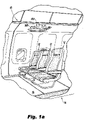
- a retractable barrier 106 can be housed within in the barrier housing 102, configured to move between a retracted position (e.g., as shown in Fig. 1a ) and a deployed position (e.g., as shown in Fig. 1b ). In the retracted position, the retractable barrier 106 can be nearly entirely within the housing 102, with the exception of a free end 108 that remains external to the housing 102 in the retracted position.
- the retractable barrier 106 can be pulled from the housing 102 to create a pathogen barrier between passenger units 12 (e.g., as shown in Fig. 1b ).
- a retraction mechanism 110 can be included in the barrier housing 102 operatively connected to the retractable barrier 106, configured to bias the retractable barrier 106 to the retracted position.
- the retraction mechanism 110 can include any suitable biasing member, for example a spring and roller, that is configured to automatically retract the barrier 106 when the barrier is not held in place either by a user 101 or a barrier retainer 112.
- the barrier retainer 112 can be configured included in (e.g., disposed on or integral with) a second surface 114 in the passenger vehicle 10 opposite the first surface 104 to retain the retractable barrier 106 in the deployed position, for example using the free end 108.
- the free end 108 can be shaped so as to be to be pulled by the user 101, against the force F of the retraction mechanism 110.
- the barrier retainer 102 can include at least one of a magnetic retainer, a spring-loaded retainer, a clip retainer, a knob retainer, a recess retainer, and/or a lever retainer, where the free end 108 of the retractable barrier 106 can be shaped complimentary to the barrier retainer 112 to mate with the barrier retainer 112.
- the free end 108 can have a circular cross section, configured to mate with an external ( Fig. 4 ) or internal ( Fig. 5 ) c-clip or a c-shaped groove in the second surface 114.
- Figs. 4 an external
- Fig. 5 internal
- the free end 108 may contain recesses 116 configured to accept protrusions or knobs 118 of the barrier retainer 112.
- the free end 108 may have an elliptical cross section configured to seat within an elliptical groove in the barrier retainer, and can be held in place by a spring or protrusion 120.
- the free end 108 may contain a ball spring 122 configured to seat within depressions 124 of the barrier retainer 112.
- the free end 108 may also be shaped to offer better grip to a user when pulling, for example, the free end may include finger depressions 126 having a rough surface.
- the first surface 104 can be an overhead compartment of the passenger service unit 112, and the second surface 114 can be an arm rest between respective passenger service units 12, as shown.
- the retractable barrier 106 can be pulled downward from the overhead compartment to latch to the barrier retainer 112 on or in the corresponding armrest.
- the barrier housing 102 can include at least one of a reading light 128, a switch 130 to activate the reading light 128, and/or a service call button.
- the first surface 104 can instead be the arm rest and the second surface 114 can be the overhead compartment, where the retractable barrier 106 is pulled upward, from the arm rest to latch to the barrier retainer 112 on or in the corresponding compartment.
- the first surface 104 can be a seat back of a forward facing seat and the second surface 114 can be some portion of the arm rest, where the barrier 106 is pulled from the forward facing seat, toward the user 101 to latch to the barrier retainer 112 on or in the corresponding arm rest.
- the reverse can be true, where the first surface 104 can be the arm rest and the second surface 114 can be the seat back of the forward facing seat so that the barrier 106 is pulled from the barrier housing 102 on or in the arm rest, towards the seatback of the forward facing seat, to latch to the barrier retainer 112 on or in the forward facing seat.
- the first surface 104 can be the overhead compartment and the second surface 114 can be the seat back of a forward facing seat, configured to provide a barrier between passenger rows 14.
- the reverse can be true.
- the retractable barrier 106 can be deployed in a similar manner to that shown in the Figs. 1a-2 and described herein.
- the retractable barrier 106 can be made to be easily retracted or torn in an emergency event.
- the barrier retainer 112 can be configured as a quick release where little force is required to release the free end 108.
- the retractable barrier 106 itself can be made of a material configured to be easily torn if in the deployed position during an emergency event, or the barrier may include a perforation at one end to facilitate tearing in an emergency event.
- the retractable barrier 106 can be made of a material configured to be sanitized with chemical cleaners (e.g., conventional sanitizing cleaners and/or heavy duty sanitizing cleaners).
- the retractable barrier 106 can be configured to provide privacy between passenger service units 12, for example the retractable barrier 106 can be made of a transparent, translucent, and/or opaque material. In certain embodiments, the barrier 106 may include a combination of transparent, translucent, and/or opaque finishes.
- a method for reducing spread of contagion in a passenger vehicle can include installing one or more systems for preventing spread of contagion (e.g., system 100) between one or more passenger units, the one or more systems for preventing spread of contagion including any suitable combination of features as described herein.
- installing can include retrofitting an existing passenger vehicle with the one or more systems for preventing spread of contagion, for example mounting the barrier housing and barrier retainers to the existing architecture.
- installing can include manufacturing the passenger vehicle to include the one or more systems for preventing spread of contagion integral with passenger service unit architecture.
- passenger cabin screens can be included in a passenger jet, for example, to prevent spread of contagion.
- Retractable screens can be included between passenger jet seats to act as a barrier between passengers to help prevent and/or mitigate the spread of contagions in-flight.
- the screens can be made of a flexible fabric material that is easily cleaned/sanitized.
- the housing can include a spring retraction allows screens to be raised rapidly to facilitate emergency evacuation of the aircraft.
- the flexible screens could also be pushed out of way easily to facilitate emergency evacuation.
- the material of the retractable barrier can include any of a range of flexible or elastomeric sheet plastics with properties that meet regulatory requirements for flammability and toxicity in a fire.
- the material could also be woven with polymer threading, for instance consistent with passenger seat fabrics that meet regulatory requirements for flammability and toxicity in a fire. Any other suitable fabric or material is contemplated herein.
- the retracted screens are stored in a container that can feature a reading light and reading light switch. When deployed, the screens can attach to an arm rest with simple catch. In embodiments, the screens can be used for privacy as well as contagion inhibiting.
- the screens can be made of FAA certification compliant materials, can be retrofitted or added in newly constructed aircraft, can be made to tear easily for emergency purposes.
- any suitable type of latch or catch can be used, e.g., magnetic, spring-loaded clip, knob, lever, or the like, as shown and described.
- any numerical values disclosed herein can be exact values or can be values within a range. Further, any terms of approximation (e.g., “about”, “approximately”, “around”) used in this disclosure can mean the stated value within a range. For example, in certain embodiments, the range can be within (plus or minus) 20%, or within 10%, or within 5%, or within 2%, or within any other suitable percentage or number as appreciated by those having ordinary skill in the art (e.g., for known tolerance limits or error ranges).
- a reference to "A and/or B", when used in conjunction with open-ended language such as “comprising” can refer, in one embodiment, to A only (optionally including elements other than B); in another embodiment, to B only (optionally including elements other than A); in yet another embodiment, to both A and B (optionally including other elements); etc.
Landscapes
- Engineering & Computer Science (AREA)
- Aviation & Aerospace Engineering (AREA)
- Seats For Vehicles (AREA)
- Vehicle Step Arrangements And Article Storage (AREA)
Abstract
Description
- This application claims priority to and the benefit of
U.S. Provisional Application No. 63/117,628, filed November 24, 2020 - The present disclosure relates to reducing the spread of contagion, e.g., in passenger vehicles.
- The COVID-19 pandemic has underscored the importance of pathogen reduction aboard high occupancy passenger vehicles, such as aircraft, busses, and trains. Effective mitigation of pathogen spread onboard such vehicles is an important way to reduce risk of infection to passengers.
- There remains a need in the art for more efficient systems and methods to reduce or prevent the spread of contagion between passengers. This disclosure provides a solution for this need.
- In accordance with at least one aspect of this disclosure, a system for preventing spread of contagion in a passenger vehicle includes: a barrier housing configured to mount to a first surface in the passenger vehicle, a retractable barrier housed in the barrier housing configured to move between a deployed position and a retracted position, a retraction mechanism operatively connected to the retractable barrier within the barrier housing configured to bias the retractable barrier to the retracted position, and a barrier retainer configured to mount to a second surface in the passenger vehicle opposite the first surface to retain the retractable barrier in the deployed position. In certain embodiments, the retractable barrier can include a free end configured to be pulled by a user. In embodiments, the barrier retainer can include at least one of a magnetic retainer, a spring-loaded retainer, a clip retainer, a knob retainer, a recess retainer, and/or a lever retainer, where the free end of the retractable barrier can be shaped to mate with the barrier retainer.
- In certain embodiments, the first surface can be an overhead compartment of a passenger service unit, and the second surface can be an arm rest between respective passenger service units. In certain such embodiments, the barrier housing can include at least one of a reading light, a switch to activate the reading light, and/or a service call button. In certain embodiments, the first surface can be an arm rest between respective passenger service units, and the second surface can be an overhead compartment of a passenger service unit. In certain embodiments, the first surface can be a seat back of a forward facing seat and the second surface can be an arm rest between respective passenger service units. In certain embodiments, the first surface can be an arm rest between respective passenger service units and the second surface can be a seat back of a forward facing seat. In certain embodiments, the first surface can include an overhead compartment of a passenger service unit and the second surface can include a seat back of a forward facing seat configured to provide a barrier between passenger rows. In certain embodiments, the barrier housing can be mounted to or integral with the first surface, and the barrier retainer can be mounted to or integral with the second surface.
- In certain embodiments, the retractable barrier can be made of a material configured to be torn in an emergency event. In certain embodiments, the retractable barrier can be made of a material configured to be sanitized with chemical cleaners. In certain embodiments, the retractable barrier can configured to provide privacy between passenger service units. In certain embodiments, the retractable barrier can be transparent, translucent, and/or opaque.
- In accordance with at least one aspect of this disclosure, a passenger vehicle can include a plurality of passenger service units arranged in rows along an aisle of the passenger vehicle and one or more systems for preventing spread of contagion mounted between each passenger unit. In embodiments, the one or more systems for preventing spread of contagion can include any one or all, or any combination of the features as described herein. In certain embodiments, the passenger vehicle can include an aircraft, a bus, or a train.
- In accordance with at least one aspect of this disclosure, a method for reducing spread of contagion in a passenger vehicle, can include installing one or more systems for preventing spread of contagion between one or more passenger units, the one or more systems for preventing spread of contagion being as described herein. In certain embodiments, installing can include retrofitting an existing passenger vehicle with the one or more systems for preventing spread of contagion. In certain embodiments, installing can include manufacturing the passenger vehicle to include the one or more systems for preventing spread of contagion integral with passenger service unit architecture.
- These and other features of the embodiments of the subject disclosure will become more readily apparent to those skilled in the art from the following detailed description taken in conjunction with the drawings.
- So that those skilled in the art to which the subject disclosure appertains will readily understand how to make and use the devices and methods of the subject disclosure without undue experimentation, embodiments thereof will be described in detail herein below with reference to certain figures, wherein:
-
Fig. 1a is a schematic perspective view of a passenger vehicle in accordance with this disclosure, showing a row of passenger units in the passenger vehicle and a system for preventing spread of contagion in a retracted position; -
Fig. 1b is a schematic perspective view of the passenger vehicle ofFig. 1 , showing the system for preventing spread of contagion in a deployed position; -
Fig. 2 is a schematic perspective view of the system for preventing spread of contagion begin deployed by a user; -
Fig. 3 is a schematic perspective view of an embodiment of the system for preventing spread of contagion, showing a barrier retainer; -
Fig. 4 is a schematic perspective view of an embodiment of the system for preventing spread of contagion, showing another barrier retainer; -
Fig. 5 is a schematic perspective view of an embodiment of the system for preventing spread of contagion, showing another barrier retainer; -
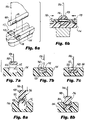
Fig. 6a is a schematic perspective view of an embodiment of the system for preventing spread of contagion, showing another barrier retainer; -
Fig. 6b is a schematic front end cross sectional view of the embodiment of the system ofFig. 6a ; -
Fig. 7a is a schematic front end cross sectional view of an embodiment of the system for preventing spread of contagion, showing another barrier retainer; -
Fig. 7b is a schematic front end cross sectional view of the embodiment of the system ofFig. 7a , showing engagement of a retractable barrier with the barrier retainer; -
Fig. 7c is a schematic front end cross sectional view of the embodiment of the system ofFig. 7a , showing engagement of the retractable barrier with the barrier retainer; -
Fig. 8a is a schematic front end cross sectional view of an embodiment of the system for preventing spread of contagion, showing another barrier retainer and -
Fig. 8b is a schematic front end cross sectional view of the embodiment of the system ofFig 8a , showing engagement of a retractable barrier with the barrier retainer. - Reference will now be made to the drawings wherein like reference numerals identify similar structural features or aspects of the subject disclosure. For purposes of explanation and illustration, and not limitation, an illustrative view of an embodiment of a system in accordance with the disclosure is shown in
Fig. 1a and is designated generally byreference character 100. Other embodiments and/or aspects of this disclosure are shown in Figs. 1b-3f. Certain embodiments described herein can be used to mitigate the spread of pathogens between users in an enclosed space, for example passengers in a passenger vehicle. - Referring to
Figs. 1a-2 , in accordance with at least one aspect of this disclosure, a passenger vehicle 10 (e.g., a high occupancy vehicle such as an aircraft, a bus, a train, or the like) can include a plurality ofpassenger service units 12 arranged inrows 14 along anaisle 16 of thepassenger vehicle 10. Any other suitable arrangement of passenger units 12 (e.g., offset or staggering units) is contemplated herein. One ormore systems 100 for preventing spread of contagion can be mounted between eachpassenger unit 12, for example as shown inFig. 1a and1b . - Referring to
Fig. 2 , the one ormore systems 100 for preventing spread of contagion can include abarrier housing 102 configured to be included in (e.g., disposed on or integral with) afirst surface 104 in thepassenger vehicle 10. Aretractable barrier 106 can be housed within in thebarrier housing 102, configured to move between a retracted position (e.g., as shown inFig. 1a ) and a deployed position (e.g., as shown inFig. 1b ). In the retracted position, theretractable barrier 106 can be nearly entirely within thehousing 102, with the exception of afree end 108 that remains external to thehousing 102 in the retracted position. In the deployed position, theretractable barrier 106 can be pulled from thehousing 102 to create a pathogen barrier between passenger units 12 (e.g., as shown inFig. 1b ). Aretraction mechanism 110 can be included in thebarrier housing 102 operatively connected to theretractable barrier 106, configured to bias theretractable barrier 106 to the retracted position. Theretraction mechanism 110 can include any suitable biasing member, for example a spring and roller, that is configured to automatically retract thebarrier 106 when the barrier is not held in place either by auser 101 or abarrier retainer 112. - Turning now to
Figs. 3-8b , thebarrier retainer 112 can be configured included in (e.g., disposed on or integral with) asecond surface 114 in thepassenger vehicle 10 opposite thefirst surface 104 to retain theretractable barrier 106 in the deployed position, for example using thefree end 108. Thefree end 108 can be shaped so as to be to be pulled by theuser 101, against the force F of theretraction mechanism 110. Thebarrier retainer 102 can include at least one of a magnetic retainer, a spring-loaded retainer, a clip retainer, a knob retainer, a recess retainer, and/or a lever retainer, where thefree end 108 of theretractable barrier 106 can be shaped complimentary to thebarrier retainer 112 to mate with thebarrier retainer 112. For example, as shown inFigs. 4 and 5 , thefree end 108 can have a circular cross section, configured to mate with an external (Fig. 4 ) or internal (Fig. 5 ) c-clip or a c-shaped groove in thesecond surface 114. As shown inFigs. 3 ,6a, and 6b , thefree end 108 may containrecesses 116 configured to accept protrusions orknobs 118 of thebarrier retainer 112. As shown inFigs. 7a-7c , thefree end 108 may have an elliptical cross section configured to seat within an elliptical groove in the barrier retainer, and can be held in place by a spring orprotrusion 120. As shown inFigs. 8a-8b , thefree end 108 may contain aball spring 122 configured to seat withindepressions 124 of thebarrier retainer 112. Thefree end 108 may also be shaped to offer better grip to a user when pulling, for example, the free end may include finger depressions 126 having a rough surface. - In certain embodiments, the
first surface 104 can be an overhead compartment of thepassenger service unit 112, and thesecond surface 114 can be an arm rest between respectivepassenger service units 12, as shown. In this example, theretractable barrier 106 can be pulled downward from the overhead compartment to latch to thebarrier retainer 112 on or in the corresponding armrest. Additionally, when thebarrier housing 102 is included overhead, thebarrier housing 102 can include at least one of areading light 128, aswitch 130 to activate thereading light 128, and/or a service call button. - In certain embodiments, the
first surface 104 can instead be the arm rest and thesecond surface 114 can be the overhead compartment, where theretractable barrier 106 is pulled upward, from the arm rest to latch to thebarrier retainer 112 on or in the corresponding compartment. In certain embodiments, thefirst surface 104 can be a seat back of a forward facing seat and thesecond surface 114 can be some portion of the arm rest, where thebarrier 106 is pulled from the forward facing seat, toward theuser 101 to latch to thebarrier retainer 112 on or in the corresponding arm rest. In certain embodiments, the reverse can be true, where thefirst surface 104 can be the arm rest and thesecond surface 114 can be the seat back of the forward facing seat so that thebarrier 106 is pulled from thebarrier housing 102 on or in the arm rest, towards the seatback of the forward facing seat, to latch to thebarrier retainer 112 on or in the forward facing seat. In certain embodiments, thefirst surface 104 can be the overhead compartment and thesecond surface 114 can be the seat back of a forward facing seat, configured to provide a barrier betweenpassenger rows 14. In certain embodiments, the reverse can be true. In this embodiment, theretractable barrier 106 can be deployed in a similar manner to that shown in theFigs. 1a-2 and described herein. - In certain embodiments, the
retractable barrier 106 can be made to be easily retracted or torn in an emergency event. For example, thebarrier retainer 112 can be configured as a quick release where little force is required to release thefree end 108. In certain embodiments, theretractable barrier 106 itself can be made of a material configured to be easily torn if in the deployed position during an emergency event, or the barrier may include a perforation at one end to facilitate tearing in an emergency event. In certain embodiments, theretractable barrier 106 can be made of a material configured to be sanitized with chemical cleaners (e.g., conventional sanitizing cleaners and/or heavy duty sanitizing cleaners). In certain embodiments, theretractable barrier 106 can be configured to provide privacy betweenpassenger service units 12, for example theretractable barrier 106 can be made of a transparent, translucent, and/or opaque material. In certain embodiments, thebarrier 106 may include a combination of transparent, translucent, and/or opaque finishes. - In accordance with at least one aspect of this disclosure, a method for reducing spread of contagion in a passenger vehicle (e.g., vehicle 10), can include installing one or more systems for preventing spread of contagion (e.g., system 100) between one or more passenger units, the one or more systems for preventing spread of contagion including any suitable combination of features as described herein. In certain embodiments, installing can include retrofitting an existing passenger vehicle with the one or more systems for preventing spread of contagion, for example mounting the barrier housing and barrier retainers to the existing architecture. In certain embodiments, installing can include manufacturing the passenger vehicle to include the one or more systems for preventing spread of contagion integral with passenger service unit architecture.
- In embodiments, passenger cabin screens (e.g., barrier 106) can be included in a passenger jet, for example, to prevent spread of contagion. Retractable screens can be included between passenger jet seats to act as a barrier between passengers to help prevent and/or mitigate the spread of contagions in-flight. In embodiments, the screens can be made of a flexible fabric material that is easily cleaned/sanitized. In embodiments, the housing can include a spring retraction allows screens to be raised rapidly to facilitate emergency evacuation of the aircraft. In embodiments, the flexible screens could also be pushed out of way easily to facilitate emergency evacuation. For example, the material of the retractable barrier can include any of a range of flexible or elastomeric sheet plastics with properties that meet regulatory requirements for flammability and toxicity in a fire. In certain embodiments, the material could also be woven with polymer threading, for instance consistent with passenger seat fabrics that meet regulatory requirements for flammability and toxicity in a fire. Any other suitable fabric or material is contemplated herein.
- In embodiments, the retracted screens are stored in a container that can feature a reading light and reading light switch. When deployed, the screens can attach to an arm rest with simple catch. In embodiments, the screens can be used for privacy as well as contagion inhibiting. The screens can be made of FAA certification compliant materials, can be retrofitted or added in newly constructed aircraft, can be made to tear easily for emergency purposes. In embodiments, any suitable type of latch or catch can be used, e.g., magnetic, spring-loaded clip, knob, lever, or the like, as shown and described.
- Those having ordinary skill in the art understand that any numerical values disclosed herein can be exact values or can be values within a range. Further, any terms of approximation (e.g., "about", "approximately", "around") used in this disclosure can mean the stated value within a range. For example, in certain embodiments, the range can be within (plus or minus) 20%, or within 10%, or within 5%, or within 2%, or within any other suitable percentage or number as appreciated by those having ordinary skill in the art (e.g., for known tolerance limits or error ranges).
- The articles "a", "an", and "the" as used herein and in the appended claims are used herein to refer to one or to more than one (i.e., to at least one) of the grammatical object of the article unless the context clearly indicates otherwise. By way of example, "an element" means one element or more than one element.
- The phrase "and/or," as used herein in the specification and in the claims, should be understood to mean "either or both" of the elements so conjoined, i.e., elements that are conjunctively present in some cases and disjunctively present in other cases. Multiple elements listed with "and/or" should be construed in the same fashion, i.e., "one or more" of the elements so conjoined. Other elements may optionally be present other than the elements specifically identified by the "and/or" clause, whether related or unrelated to those elements specifically identified. Thus, as a non-limiting example, a reference to "A and/or B", when used in conjunction with open-ended language such as "comprising" can refer, in one embodiment, to A only (optionally including elements other than B); in another embodiment, to B only (optionally including elements other than A); in yet another embodiment, to both A and B (optionally including other elements); etc.
- As used herein in the specification and in the claims, "or" should be understood to have the same meaning as "and/or" as defined above. For example, when separating items in a list, "or" or "and/or" shall be interpreted as being inclusive, i.e., the inclusion of at least one, but also including more than one, of a number or list of elements, and, optionally, additional unlisted items. Only terms clearly indicated to the contrary, such as "only one of' or "exactly one of," or, when used in the claims, "consisting of," will refer to the inclusion of exactly one element of a number or list of elements. In general, the term "or" as used herein shall only be interpreted as indicating exclusive alternatives (i.e., "one or the other but not both") when preceded by terms of exclusivity, such as "either," "one of," "only one of," or "exactly one of."
- Any suitable combination(s) of any disclosed embodiments and/or any suitable portion(s) thereof are contemplated herein as appreciated by those having ordinary skill in the art in view of this disclosure.
- The embodiments of the present disclosure, as described above and shown in the drawings, provide for improvement in the art to which they pertain. While the apparatus and methods of the subject disclosure have been shown and described, those skilled in the art will readily appreciate that changes and/or modifications may be made thereto without departing from the scope of the invention as defined by the claims.
Claims (14)
- A system for preventing spread of contagion in a passenger vehicle (10), comprising:a barrier housing (102) configured to mount to a first surface (104) in the passenger vehicle;a retractable barrier (106) housed in the barrier housing configured to move between a deployed position and a retracted position;a retraction mechanism (110) operatively connected to the retractable barrier within the barrier housing configured to bias the retractable barrier to the retracted position; anda barrier retainer (112) configured to mount to a second surface (114) in the passenger vehicle opposite the first surface to retain the retractable barrier in the deployed position.
- The system as recited in claim 1, wherein the first surface (104) is an overhead compartment of a passenger service unit, and wherein the second surface (114) is an arm rest between respective passenger service units configured to provide a barrier between the respective passenger service units.
- The system as recited in claim 2, wherein the barrier housing (102) further includes a reading light (128) and a switch (130) to activate the reading light.
- The system as recited in claim 1, wherein the first surface (104) is an arm rest between respective passenger service units and wherein the second surface (114) is overhead compartment of a passenger service unit configured to provide a barrier between the respective passenger service units; or wherein the first surface is an overhead compartment of a passenger service unit, and wherein the second surface is a seat back of a forward facing seat configured to provide a barrier between passenger rows; or wherein the first surface is an arm rest between respective passenger service units and wherein the second surface is a seat back of a forward facing seat configured to provide a barrier between the respective passenger service units; or wherein the first surface is a seat back of a forward facing seat and wherein the second surface is an arm rest between respective passenger service units configured to provide a barrier between the respective passenger service units.
- The system as recited in claim 1, wherein the barrier housing (102) is integral with the first surface, and wherein the barrier retainer is integral with the second surface.
- The system as recited in any preceding claim, wherein the retractable barrier (106) is of a material configured to be torn in an emergency event, and/or of a material configured to be sanitized with chemical cleaners.
- The system as recited in any preceding claim, wherein the barrier retainer includes at least one of a magnetic retainer, a spring-loaded retainer, a clip retainer, a knob retainer, a recess retainer, and/or a lever retainer.
- The system as recited in claim 7, wherein the retractable barrier further includes a free end (108) configured to be pulled by a user and shaped to mate with the barrier retainer.
- A passenger vehicle, comprising:a plurality of passenger service units (12) arranged in rows (14) along an aisle (16) of the passenger vehicle (10); andone or more systems (100) for preventing spread of contagion, as claimed in any preceding claim, mounted between each passenger unit.
- The passenger vehicle as recited in claim 9, further comprising an overhead compartment on a ceiling of the passenger vehicle, wherein the first surface is the overhead compartment of a passenger service unit; and/or further comprising a plurality of armrests, arranged between each passenger service unit, wherein the second surface is the respective arm rest between respective passenger service units; or further comprising:an overhead compartment, wherein the barrier housing is integral with the overhead compartment; anda plurality of armrests, arranged between each passenger service unit, wherein the barrier retainer is integral with a respective arm rest.
- The passenger vehicle as recited in claim 9 or 10, wherein the passenger vehicle includes an aircraft, a bus, or a train.
- A method for reducing spread of contagion in a passenger vehicle, comprising:
installing one or more systems (100) as claimed in any of claims 1 to 8 for preventing spread of contagion between one or more passenger units. - The method as recited in claim 12, wherein installing includes retrofitting an existing passenger vehicle with the one or more systems for preventing spread of contagion.
- The method as recited in claim 13, wherein installing includes manufacturing the passenger vehicle to include the one or more systems for preventing spread of contagion integral with passenger service unit architecture.
Applications Claiming Priority (1)
| Application Number | Priority Date | Filing Date | Title |
|---|---|---|---|
| US202063117628P | 2020-11-24 | 2020-11-24 |
Publications (1)
| Publication Number | Publication Date |
|---|---|
| EP4001582A1 true EP4001582A1 (en) | 2022-05-25 |
Family
ID=78789747
Family Applications (1)
| Application Number | Title | Priority Date | Filing Date |
|---|---|---|---|
| EP21210271.9A Withdrawn EP4001582A1 (en) | 2020-11-24 | 2021-11-24 | Systems and methods for reducing spread of contagion in passenger vehicles |
Country Status (2)
| Country | Link |
|---|---|
| US (1) | US20220161930A1 (en) |
| EP (1) | EP4001582A1 (en) |
Cited By (1)
| Publication number | Priority date | Publication date | Assignee | Title |
|---|---|---|---|---|
| US20220151390A1 (en) * | 2020-08-21 | 2022-05-19 | Exemplis Llc | Chair ganger with interpersonal shield |
Families Citing this family (3)
| Publication number | Priority date | Publication date | Assignee | Title |
|---|---|---|---|---|
| US11623750B2 (en) * | 2020-06-03 | 2023-04-11 | Adient Aerospace, Llc | Screen carrier arrangement and passenger seat arrangement |
| US12479388B2 (en) * | 2023-01-20 | 2025-11-25 | GM Global Technology Operations LLC | Collapsible privacy partition for a vehicle |
| US12534179B2 (en) * | 2023-06-16 | 2026-01-27 | The Boeing Company | Barrier door for an aircraft |
Citations (7)
| Publication number | Priority date | Publication date | Assignee | Title |
|---|---|---|---|---|
| US20060001302A1 (en) * | 2004-04-07 | 2006-01-05 | Sven Achilles | Vehicle seat system, especially for aircraft |
| JP2012236447A (en) * | 2011-05-10 | 2012-12-06 | Toyota Motor Corp | Apparatus for partitioning vehicle compartment |
| US9027880B2 (en) * | 2009-01-23 | 2015-05-12 | Airbus Operations Gmbh | Screen for a passenger cabin |
| FR3070940A1 (en) * | 2017-09-11 | 2019-03-15 | Faurecia Interieur Industrie | VEHICLE COMPRISING AT LEAST ONE RETRACTABLE SEPARATION SCREEN FOR SEPARATING SEATS FROM THE VEHICLE |
| EP3643615A1 (en) * | 2018-10-25 | 2020-04-29 | Recaro Aircraft Seating GmbH & Co. KG | Aeroplane seating device |
| JP3228119U (en) * | 2020-07-01 | 2020-10-08 | ミハラ自動車株式会社 | Ventilators and vehicles |
| EP3750807A1 (en) * | 2019-06-10 | 2020-12-16 | Be Aerospace, Inc. | Compact retractable partition |
Family Cites Families (2)
| Publication number | Priority date | Publication date | Assignee | Title |
|---|---|---|---|---|
| DE102004061471B4 (en) * | 2004-12-21 | 2007-09-06 | Recaro Aircraft Seating Gmbh & Co. Kg | Passenger seat, in particular passenger seat, and passenger seating group, in particular passenger seating group |
| US10059238B1 (en) * | 2017-05-30 | 2018-08-28 | Ford Global Technologies, Llc | Vehicle seating assembly |
-
2021
- 2021-11-23 US US17/534,035 patent/US20220161930A1/en not_active Abandoned
- 2021-11-24 EP EP21210271.9A patent/EP4001582A1/en not_active Withdrawn
Patent Citations (7)
| Publication number | Priority date | Publication date | Assignee | Title |
|---|---|---|---|---|
| US20060001302A1 (en) * | 2004-04-07 | 2006-01-05 | Sven Achilles | Vehicle seat system, especially for aircraft |
| US9027880B2 (en) * | 2009-01-23 | 2015-05-12 | Airbus Operations Gmbh | Screen for a passenger cabin |
| JP2012236447A (en) * | 2011-05-10 | 2012-12-06 | Toyota Motor Corp | Apparatus for partitioning vehicle compartment |
| FR3070940A1 (en) * | 2017-09-11 | 2019-03-15 | Faurecia Interieur Industrie | VEHICLE COMPRISING AT LEAST ONE RETRACTABLE SEPARATION SCREEN FOR SEPARATING SEATS FROM THE VEHICLE |
| EP3643615A1 (en) * | 2018-10-25 | 2020-04-29 | Recaro Aircraft Seating GmbH & Co. KG | Aeroplane seating device |
| EP3750807A1 (en) * | 2019-06-10 | 2020-12-16 | Be Aerospace, Inc. | Compact retractable partition |
| JP3228119U (en) * | 2020-07-01 | 2020-10-08 | ミハラ自動車株式会社 | Ventilators and vehicles |
Non-Patent Citations (1)
| Title |
|---|
| TAYLOR FIELDS: "Restaurant in Rome Tests a Plexiglass Table Divider to Prevent COVID-19 | iHeart", 23 April 2020 (2020-04-23), pages 1 - 3, XP055899174, Retrieved from the Internet <URL:https://www.iheart.com/content/2020-04-23-restaurant-in-rome-tests-a-plexiglass-table-divider-to-prevent-covid-19/> [retrieved on 20220309] * |
Cited By (2)
| Publication number | Priority date | Publication date | Assignee | Title |
|---|---|---|---|---|
| US20220151390A1 (en) * | 2020-08-21 | 2022-05-19 | Exemplis Llc | Chair ganger with interpersonal shield |
| US11534003B2 (en) * | 2020-08-21 | 2022-12-27 | Exemplis Llc | Chair ganger with interpersonal shield |
Also Published As
| Publication number | Publication date |
|---|---|
| US20220161930A1 (en) | 2022-05-26 |
Similar Documents
| Publication | Publication Date | Title |
|---|---|---|
| EP4001582A1 (en) | Systems and methods for reducing spread of contagion in passenger vehicles | |
| US12330791B2 (en) | Door assembly slide unit disengagement system | |
| US11142321B2 (en) | Aircraft door and privacy panel assemblies | |
| EP3003858B1 (en) | Leg restraint device for side-seated vehicle occupants | |
| US8550143B2 (en) | Curtain support assembly with integrated storage facility in a cabin of a vehicle | |
| US8197165B2 (en) | Fastening device for fastening a movable element | |
| EP3209561B1 (en) | Arrangement with a partitioning device in a cabin of a vehicle and aircraft with a cabin and such an arrangement | |
| WO2013142183A1 (en) | Cantilevered tray table and aircraft passenger suite including the same | |
| US8146864B2 (en) | Locking device for sliding doors of aircraft, especially of helicopters | |
| US20100140996A1 (en) | Auxiliary seat for a motor vehicle | |
| EP4051592B1 (en) | Passenger seat unit with foldable door | |
| EP3543128A1 (en) | Storage pocket | |
| EP4217274B1 (en) | Slide-out tray table with interlock assembly | |
| EP3819217B1 (en) | Upholstery cover retention assembly | |
| US20240101258A1 (en) | Dual operation emergency passage egress system | |
| US10941589B1 (en) | Lock | |
| US11731752B1 (en) | Removable aircraft fuselage expansion window | |
| US20230110736A1 (en) | Aircraft storage retainer | |
| EP3838757B1 (en) | Crew rest compartment stair closure mechanism | |
| US20250115358A1 (en) | Cockpit secondary barrier | |
| WO2025052112A1 (en) | Lock for an aircraft cockpit barrier | |
| EP3851378A1 (en) | Flexible actuation assembly for an aircraft component | |
| WO2013031473A1 (en) | Seatbelt device | |
| WO2007137360A1 (en) | Head support for emergency landing |
Legal Events
| Date | Code | Title | Description |
|---|---|---|---|
| PUAI | Public reference made under article 153(3) epc to a published international application that has entered the european phase |
Free format text: ORIGINAL CODE: 0009012 |
|
| STAA | Information on the status of an ep patent application or granted ep patent |
Free format text: STATUS: THE APPLICATION HAS BEEN PUBLISHED |
|
| AK | Designated contracting states |
Kind code of ref document: A1 Designated state(s): AL AT BE BG CH CY CZ DE DK EE ES FI FR GB GR HR HU IE IS IT LI LT LU LV MC MK MT NL NO PL PT RO RS SE SI SK SM TR |
|
| STAA | Information on the status of an ep patent application or granted ep patent |
Free format text: STATUS: REQUEST FOR EXAMINATION WAS MADE |
|
| 17P | Request for examination filed |
Effective date: 20221125 |
|
| RBV | Designated contracting states (corrected) |
Designated state(s): AL AT BE BG CH CY CZ DE DK EE ES FI FR GB GR HR HU IE IS IT LI LT LU LV MC MK MT NL NO PL PT RO RS SE SI SK SM TR |
|
| STAA | Information on the status of an ep patent application or granted ep patent |
Free format text: STATUS: THE APPLICATION IS DEEMED TO BE WITHDRAWN |
|
| 18D | Application deemed to be withdrawn |
Effective date: 20221126 |