EP3999815B1 - Load leveling boost supply for magnetic flowmeter - Google Patents
Load leveling boost supply for magnetic flowmeter Download PDFInfo
- Publication number
- EP3999815B1 EP3999815B1 EP20720243.3A EP20720243A EP3999815B1 EP 3999815 B1 EP3999815 B1 EP 3999815B1 EP 20720243 A EP20720243 A EP 20720243A EP 3999815 B1 EP3999815 B1 EP 3999815B1
- Authority
- EP
- European Patent Office
- Prior art keywords
- current
- coil
- voltage
- supply
- magnetic flowmeter
- Prior art date
- Legal status (The legal status is an assumption and is not a legal conclusion. Google has not performed a legal analysis and makes no representation as to the accuracy of the status listed.)
- Active
Links
Images



Classifications
-
- G—PHYSICS
- G01—MEASURING; TESTING
- G01F—MEASURING VOLUME, VOLUME FLOW, MASS FLOW OR LIQUID LEVEL; METERING BY VOLUME
- G01F1/00—Measuring the volume flow or mass flow of fluid or fluent solid material wherein the fluid passes through a meter in a continuous flow
- G01F1/56—Measuring the volume flow or mass flow of fluid or fluent solid material wherein the fluid passes through a meter in a continuous flow by using electric or magnetic effects
- G01F1/58—Measuring the volume flow or mass flow of fluid or fluent solid material wherein the fluid passes through a meter in a continuous flow by using electric or magnetic effects by electromagnetic flowmeters
- G01F1/586—Measuring the volume flow or mass flow of fluid or fluent solid material wherein the fluid passes through a meter in a continuous flow by using electric or magnetic effects by electromagnetic flowmeters constructions of coils, magnetic circuits, accessories therefor
-
- G—PHYSICS
- G01—MEASURING; TESTING
- G01F—MEASURING VOLUME, VOLUME FLOW, MASS FLOW OR LIQUID LEVEL; METERING BY VOLUME
- G01F1/00—Measuring the volume flow or mass flow of fluid or fluent solid material wherein the fluid passes through a meter in a continuous flow
- G01F1/56—Measuring the volume flow or mass flow of fluid or fluent solid material wherein the fluid passes through a meter in a continuous flow by using electric or magnetic effects
- G01F1/58—Measuring the volume flow or mass flow of fluid or fluent solid material wherein the fluid passes through a meter in a continuous flow by using electric or magnetic effects by electromagnetic flowmeters
- G01F1/60—Circuits therefor
-
- H—ELECTRICITY
- H02—GENERATION; CONVERSION OR DISTRIBUTION OF ELECTRIC POWER
- H02J—ELECTRIC POWER NETWORKS; CIRCUIT ARRANGEMENTS OR SYSTEMS FOR SUPPLYING OR DISTRIBUTING ELECTRIC POWER; SYSTEMS FOR STORING ELECTRIC ENERGY
- H02J7/00—Circuit arrangements for charging or discharging batteries or for supplying loads from batteries
- H02J7/865—Battery or charger load switching, e.g. concurrent charging and load supply
-
- G—PHYSICS
- G01—MEASURING; TESTING
- G01F—MEASURING VOLUME, VOLUME FLOW, MASS FLOW OR LIQUID LEVEL; METERING BY VOLUME
- G01F15/00—Details of, or accessories for, apparatus of groups G01F1/00 - G01F13/00 insofar as such details or appliances are not adapted to particular types of such apparatus
- G01F15/06—Indicating or recording devices
- G01F15/065—Indicating or recording devices with transmission devices, e.g. mechanical
- G01F15/066—Indicating or recording devices with transmission devices, e.g. mechanical involving magnetic transmission devices
Definitions
- Embodiments of the present disclosure relate to magnetic flowmeters and, more specifically, to techniques for controlling the current used to generate a magnetic field used in flow rate measurements.
- Precise and accurate flow control is critical to a wide range of fluid processing applications, including bulk fluid handling, food and beverage preparation, chemistry and pharmaceuticals, water and air distribution, hydrocarbon extraction and processing, environmental control, and a range of manufacturing techniques utilizing thermoplastics, thin films, glues, resins and other fluid materials, for example.
- Flow rate measurement technologies used in each particular application depend upon the fluids involved, and on the relevant process pressures, temperatures and flow rates.
- Exemplary flow rate measuring technologies include turbine devices that measure flow as a function of mechanical rotation, pitot sensors and differential pressure devices that measure flow as a function of the Bernoulli effect or pressure drop across a flow restriction, vortex and Coriolis devices that measure flow as a function of vibrational effects, and mass flowmeters that measure flow as a function of thermal conductivity.
- Magnetic flowmeters are distinguished from these technologies by characterizing a flow based on Faraday's Law, which depends upon electromagnetic interactions rather than mechanical or thermodynamic effects. In particular, magnetic flowmeters rely upon the conductivity of the process fluid, and the electromotive force (EMF) induced as the fluid flows through a region of magnetic field.
- EMF electromotive force
- Conventional magnetic flowmeters include a sensor (or pipe) section and a transmitter section.
- the transmitter section includes a coil driver that drives a current through a coil of the sensor section to generate a magnetic field across the pipe section.
- the magnetic field induces the EMF or potential difference (voltage) across the flow that is proportional to the velocity of the flow.
- the magnetic flowmeter measures the flow rate based on the voltage difference, which is detected by the sensor section.
- Magnetic flowmeters must work with large inductive switching loads. These inductive loads cause large swings in current through the load. This creates extreme challenges on the internal power supplies. If the dynamic loads are not managed properly, they can cause input current surges to the transmitter which produce potential supply challenges for the power systems use to power the magnetic flowmeter.
- the accuracy of the flow rate measurement depends on many factors, one of which is the accurate generation of the magnetic field across the flow.
- An operating setpoint directs the coil driver to generate the current that will produce a desired magnetic field across the flow.
- the current may be periodically sampled to ensure that it matches the operating setpoint.
- US 4,784,000 A describes a magnetic flowmeter system comprising flow tube, two coils for generating a magnetic field across the tube, and circuitry for driving the coil and sensing flow.
- the circuitry comprises a transformer that includes a pair of secondary windings. The number of the two windings is selected to provide a relatively low voltage and a relatively high voltage to the coil.
- US 5,325,728 A describes an electromagnetic flowmeter comprising a base unit comprising a flow channel, in which an insert is placed.
- the insert comprises a plurality of male terminals that are configured to engage slide terminals of the base unit.
- a coil drover circuit for creating a magnetic field in the flow meter comprises a two-level constant current source.
- WO 2009/008974 A1 describes an analysis circuit for an electromagnetic flow tube and transmitter.
- the circuit comprises a regulated current driver that is summed up at a node with a voltage booster source to form a coil drive current.
- a switch bridge comprising configured to alternate the direction of the coil drive current as it passes through the coil.
- WO 2009/154112 A1 describes an electromagnetic flow meter for detecting a flow rate of a fluid by the capacitance method.
- the flow meter comprises a switching circuit configured to convert a supplied DC power from a primary side into a predetermined power by a transformer based on a switching control circuit.
- the converted power is output to a secondary side in that an output current can be arbitrarily set by the switching circuit.
- a magnetic flowmeter for measuring a fluid flow is provided by claim 1.
- the magnetic flowmeter includes a flow tube assembly receiving the flow and having a coil with first and second coil wires for receiving a coil current and responsively producing a magnetic field thereby generating an EMF in the fluid representative of a flow rate.
- An EMF sensor is arranged to sense the EMF and generate an output indicating the flow rate.
- Current supply circuitry applies a current supply signal to the coil.
- a load leveling boost supply provides power to the current supply circuitry.
- power scavenging circuitry recovers power from the coil.
- Magnetic flowmeters utilize a current through the sensor (coil) to develop a magnetic field, and as a conductive fluid passes through this field, an electric field that is proportional to the flow rate is produced, in accordance to Faradays' Law.
- the current is reversed periodically (known as the Coil Frequency) and, in the simplest case, an average voltage is obtained to determine the flow rate.
- the Coil Frequency the current is reversed periodically
- an average voltage is obtained to determine the flow rate.
- a back-emf is generated that is proportional to the current and the inductance of the coil in the flow sensor. This back-emf causes the regulated power supply that powers the sensor to momentarily lose the ability to regulate the output voltage.
- the present invention includes techniques and circuits that regulate the current to a constant value.
- the invention integrates load leveling circuitry into a boost supply to remove/reduce dynamic current surges. Additionally, the circuitry captures the counter EMF energy stored in the inductive load and reuses this energy on the next switching cycle.
- the invention includes a magnetic flowmeter which includes a load leveling boost power supply circuit.
- the invention further includes a scavenging circuit which is configured to reuse the back EMF which is generated in a flow tube coil following a current reversal cycle.
- FIG. 1 is a simplified diagram of an exemplary industrial process measurement system 98, in accordance with embodiments of the present disclosure.
- the system 98 may be used in the processing of a material (e.g., process medium) to transform the material from a less valuable state into more valuable and useful products, such as petroleum, chemicals, paper, food, etc.
- a material e.g., process medium
- the system 98 may be used in an oil refinery that performs industrial processes that can process crude oil into gasoline, fuel oil, and other petrochemicals.
- the system 98 includes a pulsed direct current (DC) magnetic flowmeter 100 that is configured to sense a flow rate of a process fluid flow 101, such as through a pipe or flow tube 102, for example.
- the magnetic flowmeter 100 includes an electromotive force (EMF) sensor (107 in FIG. 2 ) and flowmeter electronics (transmitter) 106.
- EMF electromotive force
- the sensor is generally configured to measure or sense the flow rate of the fluid flow 101.
- the electronics 106 are generally configured to control the applied magnetic field to measure the flow rate, and optionally communicate the measured flow rate to an external computing device 111, such as a computerized control unit, which may be remotely located from the flowmeter 100, such as in a control room 113 of the system 98.
- the electronics 106 may communicate with the external computing device 111 over a suitable process control loop.
- the process control loop includes a physical communication link, such as a two-wire control loop 115, or a wireless communication link. Communications between the external computing device 111 and the flowmeter 100 may be performed over the control loop 115 in accordance with conventional analog and/or digital communication protocols.
- the two-wire control loop 115 includes a 4-20 milliamp control loop, in which a process variable may be represented by a level of a loop current I L flowing through the two-wire control loop 115.
- Exemplary digital communication protocols include the modulation of digital signals onto the analog current level of the two-wire control loop 115, such as in accordance with the HART ® communication standard.
- Exemplary wireless versions of the process control loop include, for example, a wireless mesh network protocol, such as WirelessHART ® (IEC 62591) or ISA 100.11a (IEC 62734), or another wireless communication protocol, such as WiFi, LoRa, Sigfox, BLE, or any other suitable protocol.
- a wireless mesh network protocol such as WirelessHART ® (IEC 62591) or ISA 100.11a (IEC 62734)
- another wireless communication protocol such as WiFi, LoRa, Sigfox, BLE, or any other suitable protocol.
- Power may be supplied to the magnetic flowmeter 100 from any suitable power source.
- the magnetic flowmeter 100 may be wholly powered by the loop current I L flowing through the control loop 115.
- One or more power supplies may also be utilized to power the process magnetic flowmeter 100, such as an internal or an external battery.
- An electrical power generator e.g., solar panel, a wind power generator, etc.
- most flowmeters typically operate in what is known as a "four-wire" configuration in which two wires are used to provide the process control loop 115 and a second pair of wires are used to provide power to the flowmeter.
- the power can be provided by a local DC power source and is useful in providing the relatively large amount of power required to generate a strong magnetic field in the flow of process fluid.
- FIG. 2 is a simplified block diagram of magnetic flowmeter 100.
- Magnetic flowmeter 100 includes flow tube 102 configured to receive a flow of process fluid therethrough.
- a coil 104 is positioned in the flow tube 102 and is configured to apply a magnetic field for the moving process fluid.
- Electrodes 107 are carried in the flow tube 102 and are exposed to the process fluid. These electrodes 107 sense an EMF generated in response to the magnetic field applied to the moving process fluid. As discussed above, this EMF is proportional to the flow rate of the process fluid.
- a differential amplifier 108 is configured to sense and amplify the voltage difference generated between the two electrodes 107.
- the differential amplifier 108 includes an analog to digital converter which provides a digital output related to the sensed EMF.
- the output from element 108 is related to the sensed EMF which in turn is proportional to the flow rate of the process fluid.
- Measurement circuitry 110 receives the output from differential amplifier 108 and provides an output related to the flow of the process fluid.
- the measurement circuitry 110 can be implemented in digital and/or analog circuitry and can include a microprocessor or the like.
- the output from measurement circuitry 110 is of the type used in a process control environment.
- the output can comprise an output on a two-wire process control loop including, for example, a 4-20 mA process control loop.
- the control loop may operate in accordance with the HART ® communication protocol, a Fieldbus protocol, or other hardwired protocol.
- the process control loop can also comprise a wireless control loop in which signals are communicated wirelessly. In some configurations, the same process control loop is used to provide power to the magnetic flowmeter 100.
- the current applied to the coil 104 of the magnetic flow tube 102 is controlled by current supply circuitry 120.
- current supply circuitry 120 operates as a load leveling boost supply.
- the current supply circuitry 120 includes a power source 122 which provides an input voltage V In and an input current I IN which is applied to an inductor L1.
- the output of inductor L1 can be selectively shorted to electrical ground using switch SW1 which is formed by a gate driver 124 and a transistor switch 126.
- Power source 122 can be loaded internally or externally to the device.
- the circuitry can reduce or eliminate current surges drawn from a power source 122.
- Inductor L1, diode D1, capacitor C1 along with switch SW1 operate to provide a boost power supply configuration in which a DC input voltage V IN is boosted to a higher voltage V1.
- the transient current through the inductor causes the voltage to increase beyond that provided by the power supply 122.
- Capacitor C1 operates to smooth voltage spikes.
- the voltage V1 is connected to an H-bridge driver 128 through diode D2.
- Diodes D1 and D2 are connected to electrical ground through capacitors C1 and C2 respectively.
- a controller 130 is configured to sense a feedback voltage V FB using resistors R1 and R2.
- the H-bridge driver 128 includes switches 140 which are controlled by measurement circuitry 110 in accordance with known techniques. More specifically, by alternating operation of switches on either side of the H-bridge 128, the direction of the current applied to the coil 104 through a low pass filter 142 can be switched.
- the controller 130 is configured to sense a current (I In ) applied to the H-bridge using a current sensor 132 through a low pass filter 150 as well as the current output of the H-bridge (I Out ) using current sensor 134 through low pass filter 152.
- a current (I In ) applied to the H-bridge using a current sensor 132 through a low pass filter 150 as well as the current output of the H-bridge (I Out ) using current sensor 134 through low pass filter 152.
- FIG. 3 which includes amplifiers 160, 162 and 164.
- Differential amplifier 160 provides an output related to a difference between the input and output currents.
- Amplifier 162 amplifies this current difference based upon a voltage reference V ref .
- the amplified output from amplifier 162 is then compared to the feedback voltage V fb and a control output is applied to switch SW1.
- the Load-levelling Boost Supply 120 operates in a boost switching power supply configuration that takes an input voltage V IN , and steps it up (boosts it) to a higher output voltage V1 or V2.
- the net output current I OUT must be determined. For the majority of the cycle, current is flowing out of the boost circuit. However, during the back-emf time when the direction of current through coil 104 is reversed, the current flows back into the boost circuit.
- the actual boost load current is the time-averaged sum of these two currents (the net load current).
- the low pass filter 152 is used to average the net load current over multiple coil frequency transitions. As such, it is a very low frequency filter.
- the output voltage V2 increases, and the control circuit 130 detects that the voltage V2 is too high. When this occurs, the controller 130 controls the output by lowering the duty cycle of switch SW1. Blocking diode D2 is used with an additional capacitor C2 on the output of the circuit to "absorb" this reverse current. The extra current is stored in capacitor C2 and reused during the next cycle of the H-bridge 128. Note that the output voltage V2 must be able to increase over the entire Coil Frequency cycle. Therefore, the output voltage V2 is not a well-regulated voltage.
- the control circuit 130 for the boost circuit 120 forces the boost to stay on to supply the load current I LOAD that is needed. This is done by allowing the output voltage V2 to increase while the boost would normally be off, to thereby keep the input current constant. If the net load current is not used, and only the output current is monitored, the net energy stored in the system will keep increasing with each cycle, and the voltage will increase out of control.
- FIG. 4 is a graph showing amplitude of V 1 , V 2 , Sense 2 and I IN versus time for the circuit shown in FIG. 2 and illustrates the operation of the controller 130 as discussed above.
- the input current of the boost from the supply source V in varies indirectly with the supply voltage given a constant output load.
- the Switch SW1 126 turns on, it causes current to flow through the inductor L1. This current causes energy to be stored in the inductor L1.
- the time that the inductor L1 and SW1 126 are on is known as the on-time, and the remainder of the switching cycle is referred to as the off-time. Diode D1 is reversed biased, and therefore does not conduct.
- diode D1 is forward biased and the energy stored in the inductor L1 is allowed to flow to the output and charge capacitor C1.
- the average of this current through D1 is the Boost Supply's load current (Current Sense 1).
- the load current is independent of the input supply voltage Vin. By sensing the load current (Current Sense 2) and forcing the net current to be the same as the load current sensed at Current Sense 2, the current in to the supply (I in ) will be continuous and nearly constant as shown in FIG. 4 .
- the input I IN current is actively controlled to reduce or eliminate large, periodic current surges which can range from zero (0) Amps input, to many Amps input in a matter of milliseconds. This can be considered a DC Power Factor Correction circuit.
- capacitor C 2 provides power scavenging circuitry to store power from a coil when a direction of a drive current is reversed.
- other power storage and scavenging techniques can be used including those which is an inductor or a battery.
- a boost power supply is provided by inductor L1, diode D1, switch SW1 and capacitor C1.
- a time average of the load current is provided using low pass filter 152.
- the output current from the boost supply is also sensed and applied to a low pass filter 150 which has a shorter time constant than low pass filter 152.
- the controller 130 compares these two filtered signals and controls operation of the switch SW1 to maintain the input current I IN at a relatively constant level as illustrated in FIG. 4 .
Landscapes
- Physics & Mathematics (AREA)
- Electromagnetism (AREA)
- Fluid Mechanics (AREA)
- General Physics & Mathematics (AREA)
- Engineering & Computer Science (AREA)
- Power Engineering (AREA)
- Measuring Volume Flow (AREA)
Description
- Embodiments of the present disclosure relate to magnetic flowmeters and, more specifically, to techniques for controlling the current used to generate a magnetic field used in flow rate measurements.
- Precise and accurate flow control is critical to a wide range of fluid processing applications, including bulk fluid handling, food and beverage preparation, chemistry and pharmaceuticals, water and air distribution, hydrocarbon extraction and processing, environmental control, and a range of manufacturing techniques utilizing thermoplastics, thin films, glues, resins and other fluid materials, for example. Flow rate measurement technologies used in each particular application depend upon the fluids involved, and on the relevant process pressures, temperatures and flow rates.
- Exemplary flow rate measuring technologies include turbine devices that measure flow as a function of mechanical rotation, pitot sensors and differential pressure devices that measure flow as a function of the Bernoulli effect or pressure drop across a flow restriction, vortex and Coriolis devices that measure flow as a function of vibrational effects, and mass flowmeters that measure flow as a function of thermal conductivity. Magnetic flowmeters are distinguished from these technologies by characterizing a flow based on Faraday's Law, which depends upon electromagnetic interactions rather than mechanical or thermodynamic effects. In particular, magnetic flowmeters rely upon the conductivity of the process fluid, and the electromotive force (EMF) induced as the fluid flows through a region of magnetic field.
- Conventional magnetic flowmeters include a sensor (or pipe) section and a transmitter section. The transmitter section includes a coil driver that drives a current through a coil of the sensor section to generate a magnetic field across the pipe section. The magnetic field induces the EMF or potential difference (voltage) across the flow that is proportional to the velocity of the flow. The magnetic flowmeter measures the flow rate based on the voltage difference, which is detected by the sensor section.
- Magnetic flowmeters must work with large inductive switching loads. These inductive loads cause large swings in current through the load. This creates extreme challenges on the internal power supplies. If the dynamic loads are not managed properly, they can cause input current surges to the transmitter which produce potential supply challenges for the power systems use to power the magnetic flowmeter.
- The accuracy of the flow rate measurement depends on many factors, one of which is the accurate generation of the magnetic field across the flow. An operating setpoint directs the coil driver to generate the current that will produce a desired magnetic field across the flow. The current may be periodically sampled to ensure that it matches the operating setpoint.
-
US 4,784,000 A describes a magnetic flowmeter system comprising flow tube, two coils for generating a magnetic field across the tube, and circuitry for driving the coil and sensing flow. The circuitry comprises a transformer that includes a pair of secondary windings. The number of the two windings is selected to provide a relatively low voltage and a relatively high voltage to the coil. -
US 5,325,728 A describes an electromagnetic flowmeter comprising a base unit comprising a flow channel, in which an insert is placed. The insert comprises a plurality of male terminals that are configured to engage slide terminals of the base unit. A coil drover circuit for creating a magnetic field in the flow meter comprises a two-level constant current source. -
WO 2009/008974 A1 describes an analysis circuit for an electromagnetic flow tube and transmitter. The circuit comprises a regulated current driver that is summed up at a node with a voltage booster source to form a coil drive current. A switch bridge comprising configured to alternate the direction of the coil drive current as it passes through the coil. -
WO 2009/154112 A1 describes an electromagnetic flow meter for detecting a flow rate of a fluid by the capacitance method. The flow meter comprises a switching circuit configured to convert a supplied DC power from a primary side into a predetermined power by a transformer based on a switching control circuit. The converted power is output to a secondary side in that an output current can be arbitrarily set by the switching circuit. - A magnetic flowmeter for measuring a fluid flow is provided by claim 1. The magnetic flowmeter includes a flow tube assembly receiving the flow and having a coil with first and second coil wires for receiving a coil current and responsively producing a magnetic field thereby generating an EMF in the fluid representative of a flow rate. An EMF sensor is arranged to sense the EMF and generate an output indicating the flow rate. Current supply circuitry applies a current supply signal to the coil. A load leveling boost supply provides power to the current supply circuitry. In another aspect, additionally, power scavenging circuitry recovers power from the coil.
- This Summary is provided to introduce a selection of concepts in a simplified form that are further described below in the Detailed Description. This Summary is not intended to identify key features or essential features of the claimed subject matter, nor is it intended to be used as an aid in determining the scope of the claimed subject matter. The claimed subject matter is not limited to implementations that solve any or all disadvantages noted in the Background.
-
-
FIG. 1 is a simplified diagram of an exemplary industrial process measurement system, in accordance with embodiments of the present disclosure. -
FIG. 2 is a simplified circuit diagram of a magnetic flowmeter. -
FIG. 3 is a circuit diagram of a power controller ofFIG. 1 . -
FIG. 4 is a graph of showing waveforms of a power supply ofFIG. 1 . - Embodiments of the present disclosure are described more fully hereinafter with reference to the accompanying drawings. Elements that are identified using the same or similar reference characters refer to the same or similar elements. The various embodiments of the present disclosure may, however, be embodied in many different forms and should not be construed as limited to the embodiments set forth herein. Rather, these embodiments are provided so that this disclosure will be thorough and complete, and will fully convey the scope of the present disclosure to those skilled in the art.
- Specific details are given in the following description to provide a thorough understanding of the embodiments. However, it is understood by those of ordinary skill in the art that the embodiments may be practiced without these specific details. For example, circuits, systems, networks, processes, frames, supports, connectors, motors, processors, and other components may not be shown, or shown in block diagram form, in order to avoid obscuring the embodiments in unnecessary detail.
- Magnetic flowmeters utilize a current through the sensor (coil) to develop a magnetic field, and as a conductive fluid passes through this field, an electric field that is proportional to the flow rate is produced, in accordance to Faradays' Law. To cancel out offsets in the system, the current is reversed periodically (known as the Coil Frequency) and, in the simplest case, an average voltage is obtained to determine the flow rate. During the current reversal, a back-emf is generated that is proportional to the current and the inductance of the coil in the flow sensor. This back-emf causes the regulated power supply that powers the sensor to momentarily lose the ability to regulate the output voltage. As the magnitude of the back-emf increases, it can actually cause the power supply to turn off. When this happens, the power supply must very quickly turn back on and deliver a large current to keep the system regulated and to complete the current reversal. The current surges on the power supply system can be extreme and are not well supported by typical power systems. The present invention includes techniques and circuits that regulate the current to a constant value. The invention integrates load leveling circuitry into a boost supply to remove/reduce dynamic current surges. Additionally, the circuitry captures the counter EMF energy stored in the inductive load and reuses this energy on the next switching cycle.
- The invention includes a magnetic flowmeter which includes a load leveling boost power supply circuit. In another aspect, the invention further includes a scavenging circuit which is configured to reuse the back EMF which is generated in a flow tube coil following a current reversal cycle.
-
FIG. 1 is a simplified diagram of an exemplary industrialprocess measurement system 98, in accordance with embodiments of the present disclosure. Thesystem 98 may be used in the processing of a material (e.g., process medium) to transform the material from a less valuable state into more valuable and useful products, such as petroleum, chemicals, paper, food, etc. For example, thesystem 98 may be used in an oil refinery that performs industrial processes that can process crude oil into gasoline, fuel oil, and other petrochemicals. - The
system 98 includes a pulsed direct current (DC)magnetic flowmeter 100 that is configured to sense a flow rate of aprocess fluid flow 101, such as through a pipe or flowtube 102, for example. Themagnetic flowmeter 100 includes an electromotive force (EMF) sensor (107 inFIG. 2 ) and flowmeter electronics (transmitter) 106. The sensor is generally configured to measure or sense the flow rate of thefluid flow 101. Theelectronics 106 are generally configured to control the applied magnetic field to measure the flow rate, and optionally communicate the measured flow rate to anexternal computing device 111, such as a computerized control unit, which may be remotely located from theflowmeter 100, such as in acontrol room 113 of thesystem 98. - The
electronics 106 may communicate with theexternal computing device 111 over a suitable process control loop. In some embodiments, the process control loop includes a physical communication link, such as a two-wire control loop 115, or a wireless communication link. Communications between theexternal computing device 111 and theflowmeter 100 may be performed over thecontrol loop 115 in accordance with conventional analog and/or digital communication protocols. In some embodiments, the two-wire control loop 115 includes a 4-20 milliamp control loop, in which a process variable may be represented by a level of a loop current IL flowing through the two-wire control loop 115. Exemplary digital communication protocols include the modulation of digital signals onto the analog current level of the two-wire control loop 115, such as in accordance with the HART® communication standard. Other purely digital techniques may also be employed including FieldBus and Profibus communication protocols. Exemplary wireless versions of the process control loop include, for example, a wireless mesh network protocol, such as WirelessHART® (IEC 62591) or ISA 100.11a (IEC 62734), or another wireless communication protocol, such as WiFi, LoRa, Sigfox, BLE, or any other suitable protocol. - Power may be supplied to the
magnetic flowmeter 100 from any suitable power source. For example, themagnetic flowmeter 100 may be wholly powered by the loop current IL flowing through thecontrol loop 115. One or more power supplies may also be utilized to power the processmagnetic flowmeter 100, such as an internal or an external battery. An electrical power generator (e.g., solar panel, a wind power generator, etc.) may also be used to power themagnetic flowmeter 100, or charge a power supply used by themagnetic flowmeter 100. However, most flowmeters typically operate in what is known as a "four-wire" configuration in which two wires are used to provide theprocess control loop 115 and a second pair of wires are used to provide power to the flowmeter. The power can be provided by a local DC power source and is useful in providing the relatively large amount of power required to generate a strong magnetic field in the flow of process fluid. -
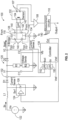
FIG. 2 is a simplified block diagram ofmagnetic flowmeter 100.Magnetic flowmeter 100 includesflow tube 102 configured to receive a flow of process fluid therethrough. Acoil 104 is positioned in theflow tube 102 and is configured to apply a magnetic field for the moving process fluid.Electrodes 107 are carried in theflow tube 102 and are exposed to the process fluid. Theseelectrodes 107 sense an EMF generated in response to the magnetic field applied to the moving process fluid. As discussed above, this EMF is proportional to the flow rate of the process fluid. - In the configuration illustrated in
FIG. 2 , adifferential amplifier 108 is configured to sense and amplify the voltage difference generated between the twoelectrodes 107. In one configuration, thedifferential amplifier 108 includes an analog to digital converter which provides a digital output related to the sensed EMF. In either case, the output fromelement 108 is related to the sensed EMF which in turn is proportional to the flow rate of the process fluid. -
Measurement circuitry 110 receives the output fromdifferential amplifier 108 and provides an output related to the flow of the process fluid. Themeasurement circuitry 110 can be implemented in digital and/or analog circuitry and can include a microprocessor or the like. In one configuration, the output frommeasurement circuitry 110 is of the type used in a process control environment. For example, as discussed above, the output can comprise an output on a two-wire process control loop including, for example, a 4-20 mA process control loop. The control loop may operate in accordance with the HART® communication protocol, a Fieldbus protocol, or other hardwired protocol. Further, the process control loop can also comprise a wireless control loop in which signals are communicated wirelessly. In some configurations, the same process control loop is used to provide power to themagnetic flowmeter 100. - The current applied to the
coil 104 of themagnetic flow tube 102 is controlled bycurrent supply circuitry 120. As discussed herein,current supply circuitry 120 operates as a load leveling boost supply. - The
current supply circuitry 120 includes apower source 122 which provides an input voltage VIn and an input current IIN which is applied to an inductor L1. The output of inductor L1 can be selectively shorted to electrical ground using switch SW1 which is formed by agate driver 124 and atransistor switch 126.Power source 122 can be loaded internally or externally to the device. The circuitry can reduce or eliminate current surges drawn from apower source 122. Inductor L1, diode D1, capacitor C1 along with switch SW1 operate to provide a boost power supply configuration in which a DC input voltage VIN is boosted to a higher voltage V1. The transient current through the inductor causes the voltage to increase beyond that provided by thepower supply 122. Capacitor C1 operates to smooth voltage spikes. The voltage V1 is connected to an H-bridge driver 128 through diode D2. Diodes D1 and D2 are connected to electrical ground through capacitors C1 and C2 respectively. Further, acontroller 130 is configured to sense a feedback voltage VFB using resistors R1 and R2. The H-bridge driver 128 includesswitches 140 which are controlled bymeasurement circuitry 110 in accordance with known techniques. More specifically, by alternating operation of switches on either side of the H-bridge 128, the direction of the current applied to thecoil 104 through alow pass filter 142 can be switched. - The
controller 130 is configured to sense a current (IIn) applied to the H-bridge using acurrent sensor 132 through alow pass filter 150 as well as the current output of the H-bridge (IOut) usingcurrent sensor 134 throughlow pass filter 152. One example configuration of thecontroller 130 is shown inFIG. 3 which includesamplifiers Differential amplifier 160 provides an output related to a difference between the input and output currents.Amplifier 162 amplifies this current difference based upon a voltage reference Vref. The amplified output fromamplifier 162 is then compared to the feedback voltage Vfb and a control output is applied to switch SW1. - During operation, the Load-levelling
Boost Supply 120 operates in a boost switching power supply configuration that takes an input voltage VIN, and steps it up (boosts it) to a higher output voltage V1 or V2. In order to level the input current IIN, the net output current IOUT must be determined. For the majority of the cycle, current is flowing out of the boost circuit. However, during the back-emf time when the direction of current throughcoil 104 is reversed, the current flows back into the boost circuit. The actual boost load current is the time-averaged sum of these two currents (the net load current). Thelow pass filter 152 is used to average the net load current over multiple coil frequency transitions. As such, it is a very low frequency filter. - If a back-emf current does flow back into the
boost circuit 120, the output voltage V2 increases, and thecontrol circuit 130 detects that the voltage V2 is too high. When this occurs, thecontroller 130 controls the output by lowering the duty cycle of switch SW1. Blocking diode D2 is used with an additional capacitor C2 on the output of the circuit to "absorb" this reverse current. The extra current is stored in capacitor C2 and reused during the next cycle of the H-bridge 128. Note that the output voltage V2 must be able to increase over the entire Coil Frequency cycle. Therefore, the output voltage V2 is not a well-regulated voltage. - Now that the net load current (ILOAD) is determined, the
control circuit 130 for theboost circuit 120 forces the boost to stay on to supply the load current ILOAD that is needed. This is done by allowing the output voltage V2 to increase while the boost would normally be off, to thereby keep the input current constant. If the net load current is not used, and only the output current is monitored, the net energy stored in the system will keep increasing with each cycle, and the voltage will increase out of control. -
FIG. 4 is a graph showing amplitude of V1, V2,Sense 2 and IIN versus time for the circuit shown inFIG. 2 and illustrates the operation of thecontroller 130 as discussed above. The input current of the boost from the supply source Vin varies indirectly with the supply voltage given a constant output load. When theSwitch SW1 126 turns on, it causes current to flow through the inductor L1. This current causes energy to be stored in the inductor L1. The time that the inductor L1 andSW1 126 are on is known as the on-time, and the remainder of the switching cycle is referred to as the off-time. Diode D1 is reversed biased, and therefore does not conduct. During the off-time, diode D1 is forward biased and the energy stored in the inductor L1 is allowed to flow to the output and charge capacitor C1. The average of this current through D1 is the Boost Supply's load current (Current Sense 1). The load current is independent of the input supply voltage Vin. By sensing the load current (Current Sense 2) and forcing the net current to be the same as the load current sensed atCurrent Sense 2, the current in to the supply (Iin) will be continuous and nearly constant as shown inFIG. 4 . - With this configuration, the input IIN current is actively controlled to reduce or eliminate large, periodic current surges which can range from zero (0) Amps input, to many Amps input in a matter of milliseconds. This can be considered a DC Power Factor Correction circuit.
- Although the present invention has been described with reference to preferred embodiments, workers skilled in the art will recognize that changes may be made in form and detail without departing from the scope of the invention, which is defined by the appended claims. In the configuration shown herein, capacitor C2 provides power scavenging circuitry to store power from a coil when a direction of a drive current is reversed. However, other power storage and scavenging techniques can be used including those which is an inductor or a battery. With the configuration set forth herein, a boost power supply is provided by inductor L1, diode D1, switch SW1 and capacitor C1. A time average of the load current is provided using
low pass filter 152. The output current from the boost supply is also sensed and applied to alow pass filter 150 which has a shorter time constant thanlow pass filter 152. Thecontroller 130 compares these two filtered signals and controls operation of the switch SW1 to maintain the input current IIN at a relatively constant level as illustrated inFIG. 4 .
Claims (8)
- A magnetic flowmeter (100) for measuring a fluid flow, comprising:a flow tube assembly (102) receiving the fluid flow and having a coil (104) with first and second coil wires for receiving a coil current and responsively producing a magnetic field thereby generating an EMF in the fluid representative of a flow rate;an EMF sensor (107) arranged to sense the EMF and generate an output indicating the flow rate;an H-bridge driver (128) configured to apply a current supply signal to the coil (104) and switch the direction of the current applied to the coil (104); anda load leveling boost supply (120) configured to provide power to the H-bridge driver (128) and condition the input current (IIN) from a DC source, wherein the load leveling boost supply (120) is coupled to an input voltage (VIN) and is configured to apply a voltage (V1) to the coil (104) which is greater than an input voltage (VIN),wherein the load leveling boost supply (120) includes:a switch (SW1) configured to selectively couple an inductor (L1) to electrical ground and thereby generate the voltage (V1) which is greater than the input voltage (VIN), wherein the H-bridge driver (128) is connected to the voltage (V1), anda controller (130) configured to sense the input current (IIN) using a first current sensor (132) through a first low pass filter (150) and a current output (IOut) of the H-bridge driver (128) using a second sensor (134) through a second low pass filter (152), wherein the controller (130) is configured to compare signals of the first and second current sensor (132, 134) and control operation of the switch (SW1) to maintain the input current (IIN) at a relatively constant level.
- The magnetic flowmeter of claim 1 wherein the H-bridge driver (128) includes first and second switches (140) which couple the first and second coil wires respectively to a first supply conductor, and third and fourth switches (140) which couple the first and second coil wires respectively to a second supply conductor.
- The magnetic flowmeter of claim 1 wherein the load leveling boost supply (120) includes a power storage element configured to scavenge power from the coil when a direction of the current supply signal through the coil is reversed.
- The magnetic flowmeter of claim 1 wherein the controller (130) is configured to sense a feedback voltage (Vfb) using a first resistor (R1) and a second resistor (R2).
- The magnetic flowmeter of claim 4, wherein a differential amplifier (160) of the controller (130) provides an output related to a current difference between the input current (Iin) and the output current (Iout), wherein a second amplifier (162) of the controller (130) is configured to amplify the current difference based upon a voltage reference (Vref), wherein the controller (130) is configured to compare the amplified current difference to the feedback voltage (Vfb) and apply a control output to the switch (SW1).
- The magnetic flowmeter of claim 1 wherein the load leveling boost supply (120) includes a diode to prevent current from the coil from flowing into components of the load leveling boost supply when a direction of the current supply signal applied to the coil is reversed.
- The magnetic flowmeter of claim 1 wherein the load leveling boost supply (120) includes a voltage sensor to sense a back EMF flowing from the coil into the load leveling boost supply due to a reversal in a direction of the current supply signal flowing through the coil.
- The magnetic flowmeter of claim 3, wherein the power storage element comprises a capacitor.
Applications Claiming Priority (3)
| Application Number | Priority Date | Filing Date | Title |
|---|---|---|---|
| US201962896130P | 2019-09-05 | 2019-09-05 | |
| US16/727,357 US11333537B2 (en) | 2019-09-05 | 2019-12-26 | Load leveling boost supply for magnetic flowmeter |
| PCT/US2020/024656 WO2021045800A1 (en) | 2019-09-05 | 2020-03-25 | Load leveling boost supply for magnetic flowmeter |
Publications (2)
| Publication Number | Publication Date |
|---|---|
| EP3999815A1 EP3999815A1 (en) | 2022-05-25 |
| EP3999815B1 true EP3999815B1 (en) | 2025-01-15 |
Family
ID=74849946
Family Applications (1)
| Application Number | Title | Priority Date | Filing Date |
|---|---|---|---|
| EP20720243.3A Active EP3999815B1 (en) | 2019-09-05 | 2020-03-25 | Load leveling boost supply for magnetic flowmeter |
Country Status (4)
| Country | Link |
|---|---|
| US (1) | US11333537B2 (en) |
| EP (1) | EP3999815B1 (en) |
| JP (1) | JP7504199B2 (en) |
| WO (1) | WO2021045800A1 (en) |
Families Citing this family (1)
| Publication number | Priority date | Publication date | Assignee | Title |
|---|---|---|---|---|
| DE102024123787A1 (en) * | 2024-08-20 | 2026-02-26 | Endress+Hauser Flowtec Ag | Magnetic-inductive flowmeter and method for checking for a short circuit |
Citations (1)
| Publication number | Priority date | Publication date | Assignee | Title |
|---|---|---|---|---|
| EP2167922B1 (en) * | 2007-07-10 | 2019-09-04 | Micro Motion, Inc. | Noise diagnosis of operating conditions for an electromagnetic flowmeter |
Family Cites Families (50)
| Publication number | Priority date | Publication date | Assignee | Title |
|---|---|---|---|---|
| JPS5434863A (en) | 1977-08-24 | 1979-03-14 | Hokushin Electric Works | Excitation method of electromagnetic flowmeter |
| US4167871A (en) | 1978-06-02 | 1979-09-18 | Fischer & Porter Co. | Bi-directional electromagnetic flowmeter |
| US4229703A (en) | 1979-02-12 | 1980-10-21 | Varian Associates, Inc. | Zero reference and offset compensation circuit |
| DE3204573A1 (en) | 1982-02-10 | 1983-08-18 | Turbo-Werk Messtechnik GmbH, 5000 Köln | Circuit arrangement for generating a pulsating magnetic field in the exciter coil of an inductive flow meter |
| JPS58172516A (en) * | 1982-04-02 | 1983-10-11 | Yamatake Honeywell Co Ltd | Electromagnetic flowmeter |
| US4563904A (en) * | 1984-09-12 | 1986-01-14 | Fischer & Porter Company | Excitation circuit for electromagnetic flowmeter |
| US4784000A (en) | 1987-01-15 | 1988-11-15 | Emerson Electric Co. | Magnetic flowmeter coil driver and method |
| US4916381A (en) * | 1988-05-12 | 1990-04-10 | Rosemount Inc. | Current source for a variable load with an inductive component |
| JPH0695031B2 (en) * | 1988-10-31 | 1994-11-24 | 株式会社島津製作所 | Electromagnetic flow meter |
| CA2306666A1 (en) | 1989-09-20 | 1991-03-21 | Rosemount Inc. | Conversion circuit for an electromagnetic flow transmitter |
| JPH03122523A (en) | 1989-10-05 | 1991-05-24 | Yamatake Honeywell Co Ltd | Electromagnetic flowmeter |
| US5372045A (en) * | 1993-02-12 | 1994-12-13 | Rosemount Inc. | Bridge pulse controlled constant current driver for magnetic flowmeter |
| US5325728A (en) | 1993-06-22 | 1994-07-05 | Medtronic, Inc. | Electromagnetic flow meter |
| US5639970A (en) | 1995-07-17 | 1997-06-17 | Rosemount Inc. | Current selection circuitry for magnetic flowmeter |
| GB2309308B (en) | 1996-01-17 | 2000-12-06 | Abb Kent Taylor Ltd | Calibration of flow meters |
| CN1103904C (en) | 1996-05-10 | 2003-03-26 | 株式会社日立制作所 | Outdoor heat exchanger unit and air-conditioner using the unit |
| DE19621132A1 (en) | 1996-05-24 | 1997-11-27 | Bailey Fischer & Porter Gmbh | Method and device for magnetic-inductive flow measurement |
| US5874818A (en) | 1997-06-11 | 1999-02-23 | Agile Systems, Inc. | Method and apparatus for sensing load current in a motor controller |
| US8467986B2 (en) | 1997-11-26 | 2013-06-18 | Invensys Systems, Inc. | Drive techniques for a digital flowmeter |
| GB2332527B (en) | 1997-12-19 | 2002-10-30 | Abb Kent Taylor Ltd | Electromagnetic flowmeter |
| DE19917268B4 (en) | 1999-04-16 | 2005-07-14 | Siemens Flow Instruments A/S | Method for checking an electromagnetic flowmeter and electromagnetic flowmeter arrangement |
| DE19917261C5 (en) | 1999-04-16 | 2010-09-09 | Siemens Flow Instruments A/S | Electromagnetic flowmeter arrangement |
| US6505517B1 (en) * | 1999-07-23 | 2003-01-14 | Rosemount Inc. | High accuracy signal processing for magnetic flowmeter |
| JP4300562B2 (en) | 2000-03-30 | 2009-07-22 | 横河電機株式会社 | Electromagnetic flow meter |
| JP4378765B2 (en) | 2000-12-26 | 2009-12-09 | 横河電機株式会社 | Excitation circuit of electromagnetic flow meter |
| GB2378761B (en) | 2001-04-25 | 2005-11-30 | Abb Metering Ltd | Flow meter |
| JP4110442B2 (en) | 2001-05-14 | 2008-07-02 | 横河電機株式会社 | Electromagnetic flow meter |
| DE102004046238A1 (en) | 2004-09-22 | 2006-03-23 | Endress + Hauser Flowtec Ag | Magnetic-inductive flowmeter |
| US7260486B2 (en) | 2004-09-22 | 2007-08-21 | Endress + Hauser Flowtec Ag | Method for operating and/or reviewing a magneto-inductive flow meter |
| WO2009154112A1 (en) | 2008-06-20 | 2009-12-23 | 株式会社キーエンス | Two-wire electromagnetic flow meter |
| US7779702B2 (en) | 2008-11-03 | 2010-08-24 | Rosemount Inc. | Flow disturbance compensation for magnetic flowmeter |
| US7921733B2 (en) | 2009-03-05 | 2011-04-12 | Rosemount Inc. | Magnetic flowmeter with coil ground path detection |
| US9182258B2 (en) | 2011-06-28 | 2015-11-10 | Rosemount Inc. | Variable frequency magnetic flowmeter |
| US8590361B1 (en) * | 2012-01-27 | 2013-11-26 | Onicon, Inc. | Magnetic flow meters with automatic field maintenance |
| US9696188B2 (en) | 2013-03-14 | 2017-07-04 | Rosemount Inc. | Magnetic flowmeter with automatic adjustment based on sensed complex impedance |
| US9395221B2 (en) | 2013-09-26 | 2016-07-19 | Rosemount Inc. | Magnetic flowmeter with saturation detection of the measurement circuitry |
| US10075246B2 (en) | 2013-09-26 | 2018-09-11 | Micro Motion, Inc. | Optical isolator mounted in printed circuit board recess |
| US9175993B2 (en) | 2013-09-26 | 2015-11-03 | Rosemount Inc. | Industrial process field device with low power optical isolator |
| US10663331B2 (en) | 2013-09-26 | 2020-05-26 | Rosemount Inc. | Magnetic flowmeter with power limit and over-current detection |
| US9163968B2 (en) | 2013-09-26 | 2015-10-20 | Rosemount Inc. | Magnetic flowmeter with drive signal diagnostics |
| US9228869B2 (en) | 2013-09-26 | 2016-01-05 | Rosemount Inc. | Industrial process variable transmitter with isolated power scavenging intrinsically safe pulse output circuitry |
| US10641627B2 (en) | 2013-12-20 | 2020-05-05 | Rosemount Inc. | Magnetic flowmeter with automatic operating setpoint selection |
| JP6212426B2 (en) | 2014-03-31 | 2017-10-11 | アズビル株式会社 | Electromagnetic flow meter |
| RU2584384C2 (en) | 2014-07-31 | 2016-05-20 | Открытое акционерное общество "Арзамасский приборостроительный завод имени П.И. Пландина"-ОАО "АПЗ" | Method of measuring flow rate of electroconductive liquids |
| CN106796130B (en) | 2015-06-30 | 2020-10-13 | 罗斯蒙特公司 | Magnetic flowmeter with automatic in-situ self-cleaning function |
| CN107478279A (en) | 2016-06-08 | 2017-12-15 | 西尼尔(南京)过程控制有限公司 | Electromagnetic flowmeter and its excitation voltage regulation method |
| JP6806532B2 (en) | 2016-11-09 | 2021-01-06 | アズビル株式会社 | Excitation circuit of electromagnetic flowmeter, and electromagnetic flowmeter |
| RU2645834C1 (en) | 2017-04-04 | 2018-02-28 | Общество с ограниченной ответственностью "ТБН энергосервис" | Method and device for determining consumption in large diameter pipelines |
| EP3649438A1 (en) | 2017-07-07 | 2020-05-13 | Apator Miitors ApS | Electromagnetic flow meter |
| CN107560676A (en) | 2017-09-01 | 2018-01-09 | 郑州欧尚德电子技术有限公司 | A kind of Full-digital circuit micro-consumption wireless network intelligent flow converter |
-
2019
- 2019-12-26 US US16/727,357 patent/US11333537B2/en active Active
-
2020
- 2020-03-25 EP EP20720243.3A patent/EP3999815B1/en active Active
- 2020-03-25 JP JP2022514246A patent/JP7504199B2/en active Active
- 2020-03-25 WO PCT/US2020/024656 patent/WO2021045800A1/en not_active Ceased
Patent Citations (1)
| Publication number | Priority date | Publication date | Assignee | Title |
|---|---|---|---|---|
| EP2167922B1 (en) * | 2007-07-10 | 2019-09-04 | Micro Motion, Inc. | Noise diagnosis of operating conditions for an electromagnetic flowmeter |
Also Published As
| Publication number | Publication date |
|---|---|
| JP2022547035A (en) | 2022-11-10 |
| EP3999815A1 (en) | 2022-05-25 |
| US20210072055A1 (en) | 2021-03-11 |
| US11333537B2 (en) | 2022-05-17 |
| WO2021045800A1 (en) | 2021-03-11 |
| JP7504199B2 (en) | 2024-06-21 |
Similar Documents
| Publication | Publication Date | Title |
|---|---|---|
| US5572416A (en) | Isolated input current sense means for high power factor rectifier | |
| EP4025882B1 (en) | Continuously adaptive digital coil driver for magnetic flowmeter | |
| EP3518407B1 (en) | An apparatus and method for linearization of the control inputs for a dual output resonant converter | |
| JPH0377932B2 (en) | ||
| CN101465609B (en) | Output power supervisory circuit and control circuit for AC/DC converting circuit | |
| EP3518410B1 (en) | An apparatus and method for improved small load performance of a dual output resonant converter | |
| US20200295662A1 (en) | Apparatus and method for a dual output resonant converter to ensure full power range for both outputs | |
| EP3999815B1 (en) | Load leveling boost supply for magnetic flowmeter | |
| US20190229629A1 (en) | An apparatus and method for adaptively setting the proper range for the vcm control variable based upon clipping of the main regulation loop | |
| EP3015830B1 (en) | Standard signal generator | |
| CN112444296B (en) | Load balancing boost power supply for magnetic flowmeter | |
| KR102660771B1 (en) | Load current feedforward schemes for current-mode controlled power converters | |
| EP0509830B1 (en) | Electromagnetic flowmeter | |
| JP6276678B2 (en) | Standard signal generator | |
| US11204268B2 (en) | Magnetic flowmeter having a programmable bi-directional current generator | |
| EP2672616A2 (en) | DC current sensing utilizing a current transformer | |
| WO2021045922A1 (en) | Continuously adaptive digital coil driver for magnetic flowmeter | |
| WO2021045930A1 (en) | Magnetic flowmeter having a programmable bi-directional current generator | |
| JPH0157400B2 (en) | ||
| CS211000B1 (en) | Rotary angle sensor connection with DC output |
Legal Events
| Date | Code | Title | Description |
|---|---|---|---|
| STAA | Information on the status of an ep patent application or granted ep patent |
Free format text: STATUS: UNKNOWN |
|
| STAA | Information on the status of an ep patent application or granted ep patent |
Free format text: STATUS: THE INTERNATIONAL PUBLICATION HAS BEEN MADE |
|
| PUAI | Public reference made under article 153(3) epc to a published international application that has entered the european phase |
Free format text: ORIGINAL CODE: 0009012 |
|
| STAA | Information on the status of an ep patent application or granted ep patent |
Free format text: STATUS: REQUEST FOR EXAMINATION WAS MADE |
|
| 17P | Request for examination filed |
Effective date: 20220216 |
|
| AK | Designated contracting states |
Kind code of ref document: A1 Designated state(s): AL AT BE BG CH CY CZ DE DK EE ES FI FR GB GR HR HU IE IS IT LI LT LU LV MC MK MT NL NO PL PT RO RS SE SI SK SM TR |
|
| DAV | Request for validation of the european patent (deleted) | ||
| DAX | Request for extension of the european patent (deleted) | ||
| GRAP | Despatch of communication of intention to grant a patent |
Free format text: ORIGINAL CODE: EPIDOSNIGR1 |
|
| STAA | Information on the status of an ep patent application or granted ep patent |
Free format text: STATUS: GRANT OF PATENT IS INTENDED |
|
| RIC1 | Information provided on ipc code assigned before grant |
Ipc: G01F 15/06 20220101ALN20240801BHEP Ipc: G01F 1/60 20060101AFI20240801BHEP |
|
| INTG | Intention to grant announced |
Effective date: 20240816 |
|
| GRAS | Grant fee paid |
Free format text: ORIGINAL CODE: EPIDOSNIGR3 |
|
| GRAA | (expected) grant |
Free format text: ORIGINAL CODE: 0009210 |
|
| STAA | Information on the status of an ep patent application or granted ep patent |
Free format text: STATUS: THE PATENT HAS BEEN GRANTED |
|
| AK | Designated contracting states |
Kind code of ref document: B1 Designated state(s): AL AT BE BG CH CY CZ DE DK EE ES FI FR GB GR HR HU IE IS IT LI LT LU LV MC MK MT NL NO PL PT RO RS SE SI SK SM TR |
|
| REG | Reference to a national code |
Ref country code: CH Ref legal event code: EP Ref country code: GB Ref legal event code: FG4D |
|
| REG | Reference to a national code |
Ref country code: DE Ref legal event code: R096 Ref document number: 602020044783 Country of ref document: DE |
|
| REG | Reference to a national code |
Ref country code: IE Ref legal event code: FG4D |
|
| REG | Reference to a national code |
Ref country code: NL Ref legal event code: MP Effective date: 20250115 |
|
| PG25 | Lapsed in a contracting state [announced via postgrant information from national office to epo] |
Ref country code: NL Free format text: LAPSE BECAUSE OF FAILURE TO SUBMIT A TRANSLATION OF THE DESCRIPTION OR TO PAY THE FEE WITHIN THE PRESCRIBED TIME-LIMIT Effective date: 20250115 |
|
| PG25 | Lapsed in a contracting state [announced via postgrant information from national office to epo] |
Ref country code: RS Free format text: LAPSE BECAUSE OF FAILURE TO SUBMIT A TRANSLATION OF THE DESCRIPTION OR TO PAY THE FEE WITHIN THE PRESCRIBED TIME-LIMIT Effective date: 20250415 |
|
| PG25 | Lapsed in a contracting state [announced via postgrant information from national office to epo] |
Ref country code: FI Free format text: LAPSE BECAUSE OF FAILURE TO SUBMIT A TRANSLATION OF THE DESCRIPTION OR TO PAY THE FEE WITHIN THE PRESCRIBED TIME-LIMIT Effective date: 20250115 |
|
| PG25 | Lapsed in a contracting state [announced via postgrant information from national office to epo] |
Ref country code: PL Free format text: LAPSE BECAUSE OF FAILURE TO SUBMIT A TRANSLATION OF THE DESCRIPTION OR TO PAY THE FEE WITHIN THE PRESCRIBED TIME-LIMIT Effective date: 20250115 |
|
| PG25 | Lapsed in a contracting state [announced via postgrant information from national office to epo] |
Ref country code: ES Free format text: LAPSE BECAUSE OF FAILURE TO SUBMIT A TRANSLATION OF THE DESCRIPTION OR TO PAY THE FEE WITHIN THE PRESCRIBED TIME-LIMIT Effective date: 20250115 |
|
| REG | Reference to a national code |
Ref country code: LT Ref legal event code: MG9D |
|
| PG25 | Lapsed in a contracting state [announced via postgrant information from national office to epo] |
Ref country code: IS Free format text: LAPSE BECAUSE OF FAILURE TO SUBMIT A TRANSLATION OF THE DESCRIPTION OR TO PAY THE FEE WITHIN THE PRESCRIBED TIME-LIMIT Effective date: 20250515 Ref country code: NO Free format text: LAPSE BECAUSE OF FAILURE TO SUBMIT A TRANSLATION OF THE DESCRIPTION OR TO PAY THE FEE WITHIN THE PRESCRIBED TIME-LIMIT Effective date: 20250415 |
|
| REG | Reference to a national code |
Ref country code: AT Ref legal event code: MK05 Ref document number: 1760105 Country of ref document: AT Kind code of ref document: T Effective date: 20250115 |
|
| PG25 | Lapsed in a contracting state [announced via postgrant information from national office to epo] |
Ref country code: HR Free format text: LAPSE BECAUSE OF FAILURE TO SUBMIT A TRANSLATION OF THE DESCRIPTION OR TO PAY THE FEE WITHIN THE PRESCRIBED TIME-LIMIT Effective date: 20250115 |
|
| PG25 | Lapsed in a contracting state [announced via postgrant information from national office to epo] |
Ref country code: LV Free format text: LAPSE BECAUSE OF FAILURE TO SUBMIT A TRANSLATION OF THE DESCRIPTION OR TO PAY THE FEE WITHIN THE PRESCRIBED TIME-LIMIT Effective date: 20250115 Ref country code: PT Free format text: LAPSE BECAUSE OF FAILURE TO SUBMIT A TRANSLATION OF THE DESCRIPTION OR TO PAY THE FEE WITHIN THE PRESCRIBED TIME-LIMIT Effective date: 20250515 |
|
| PG25 | Lapsed in a contracting state [announced via postgrant information from national office to epo] |
Ref country code: BG Free format text: LAPSE BECAUSE OF FAILURE TO SUBMIT A TRANSLATION OF THE DESCRIPTION OR TO PAY THE FEE WITHIN THE PRESCRIBED TIME-LIMIT Effective date: 20250115 Ref country code: GR Free format text: LAPSE BECAUSE OF FAILURE TO SUBMIT A TRANSLATION OF THE DESCRIPTION OR TO PAY THE FEE WITHIN THE PRESCRIBED TIME-LIMIT Effective date: 20250416 |
|
| PGFP | Annual fee paid to national office [announced via postgrant information from national office to epo] |
Ref country code: CH Payment date: 20250401 Year of fee payment: 6 |
|
| PG25 | Lapsed in a contracting state [announced via postgrant information from national office to epo] |
Ref country code: AT Free format text: LAPSE BECAUSE OF FAILURE TO SUBMIT A TRANSLATION OF THE DESCRIPTION OR TO PAY THE FEE WITHIN THE PRESCRIBED TIME-LIMIT Effective date: 20250115 |
|
| PG25 | Lapsed in a contracting state [announced via postgrant information from national office to epo] |
Ref country code: SE Free format text: LAPSE BECAUSE OF FAILURE TO SUBMIT A TRANSLATION OF THE DESCRIPTION OR TO PAY THE FEE WITHIN THE PRESCRIBED TIME-LIMIT Effective date: 20250115 |
|
| PG25 | Lapsed in a contracting state [announced via postgrant information from national office to epo] |
Ref country code: SM Free format text: LAPSE BECAUSE OF FAILURE TO SUBMIT A TRANSLATION OF THE DESCRIPTION OR TO PAY THE FEE WITHIN THE PRESCRIBED TIME-LIMIT Effective date: 20250115 |
|
| PG25 | Lapsed in a contracting state [announced via postgrant information from national office to epo] |
Ref country code: DK Free format text: LAPSE BECAUSE OF FAILURE TO SUBMIT A TRANSLATION OF THE DESCRIPTION OR TO PAY THE FEE WITHIN THE PRESCRIBED TIME-LIMIT Effective date: 20250115 |
|
| PG25 | Lapsed in a contracting state [announced via postgrant information from national office to epo] |
Ref country code: MC Free format text: LAPSE BECAUSE OF FAILURE TO SUBMIT A TRANSLATION OF THE DESCRIPTION OR TO PAY THE FEE WITHIN THE PRESCRIBED TIME-LIMIT Effective date: 20250115 |
|
| PG25 | Lapsed in a contracting state [announced via postgrant information from national office to epo] |
Ref country code: IT Free format text: LAPSE BECAUSE OF FAILURE TO SUBMIT A TRANSLATION OF THE DESCRIPTION OR TO PAY THE FEE WITHIN THE PRESCRIBED TIME-LIMIT Effective date: 20250115 |
|
| REG | Reference to a national code |
Ref country code: DE Ref legal event code: R097 Ref document number: 602020044783 Country of ref document: DE |
|
| PG25 | Lapsed in a contracting state [announced via postgrant information from national office to epo] |
Ref country code: CZ Free format text: LAPSE BECAUSE OF FAILURE TO SUBMIT A TRANSLATION OF THE DESCRIPTION OR TO PAY THE FEE WITHIN THE PRESCRIBED TIME-LIMIT Effective date: 20250115 Ref country code: EE Free format text: LAPSE BECAUSE OF FAILURE TO SUBMIT A TRANSLATION OF THE DESCRIPTION OR TO PAY THE FEE WITHIN THE PRESCRIBED TIME-LIMIT Effective date: 20250115 |
|
| PG25 | Lapsed in a contracting state [announced via postgrant information from national office to epo] |
Ref country code: RO Free format text: LAPSE BECAUSE OF FAILURE TO SUBMIT A TRANSLATION OF THE DESCRIPTION OR TO PAY THE FEE WITHIN THE PRESCRIBED TIME-LIMIT Effective date: 20250115 |
|
| PG25 | Lapsed in a contracting state [announced via postgrant information from national office to epo] |
Ref country code: SK Free format text: LAPSE BECAUSE OF FAILURE TO SUBMIT A TRANSLATION OF THE DESCRIPTION OR TO PAY THE FEE WITHIN THE PRESCRIBED TIME-LIMIT Effective date: 20250115 |
|
| RAP4 | Party data changed (patent owner data changed or rights of a patent transferred) |
Owner name: MICRO MOTION, INC. |
|
| PG25 | Lapsed in a contracting state [announced via postgrant information from national office to epo] |
Ref country code: LU Free format text: LAPSE BECAUSE OF NON-PAYMENT OF DUE FEES Effective date: 20250325 |
|
| PLBE | No opposition filed within time limit |
Free format text: ORIGINAL CODE: 0009261 |
|
| STAA | Information on the status of an ep patent application or granted ep patent |
Free format text: STATUS: NO OPPOSITION FILED WITHIN TIME LIMIT |
|
| REG | Reference to a national code |
Ref country code: CH Ref legal event code: L10 Free format text: ST27 STATUS EVENT CODE: U-0-0-L10-L00 (AS PROVIDED BY THE NATIONAL OFFICE) Effective date: 20251126 |
|
| REG | Reference to a national code |
Ref country code: BE Ref legal event code: MM Effective date: 20250331 |
|
| 26N | No opposition filed |
Effective date: 20251016 |
|
| GBPC | Gb: european patent ceased through non-payment of renewal fee |
Effective date: 20250415 |
|
| PG25 | Lapsed in a contracting state [announced via postgrant information from national office to epo] |
Ref country code: GB Free format text: LAPSE BECAUSE OF NON-PAYMENT OF DUE FEES Effective date: 20250415 |
|
| PG25 | Lapsed in a contracting state [announced via postgrant information from national office to epo] |
Ref country code: FR Free format text: LAPSE BECAUSE OF NON-PAYMENT OF DUE FEES Effective date: 20250331 |
|
| PG25 | Lapsed in a contracting state [announced via postgrant information from national office to epo] |
Ref country code: BE Free format text: LAPSE BECAUSE OF NON-PAYMENT OF DUE FEES Effective date: 20250331 |
|
| PG25 | Lapsed in a contracting state [announced via postgrant information from national office to epo] |
Ref country code: IE Free format text: LAPSE BECAUSE OF NON-PAYMENT OF DUE FEES Effective date: 20250325 |
|
| REG | Reference to a national code |
Ref country code: CH Ref legal event code: U11 Free format text: ST27 STATUS EVENT CODE: U-0-0-U10-U11 (AS PROVIDED BY THE NATIONAL OFFICE) Effective date: 20260401 |
|
| PGFP | Annual fee paid to national office [announced via postgrant information from national office to epo] |
Ref country code: DE Payment date: 20260219 Year of fee payment: 7 |