EP3998557A1 - Audio signal processing method, model training method, and related apparatus - Google Patents
Audio signal processing method, model training method, and related apparatus Download PDFInfo
- Publication number
- EP3998557A1 EP3998557A1 EP20911413.1A EP20911413A EP3998557A1 EP 3998557 A1 EP3998557 A1 EP 3998557A1 EP 20911413 A EP20911413 A EP 20911413A EP 3998557 A1 EP3998557 A1 EP 3998557A1
- Authority
- EP
- European Patent Office
- Prior art keywords
- audio
- signal
- input signal
- howling
- audio input
- Prior art date
- Legal status (The legal status is an assumption and is not a legal conclusion. Google has not performed a legal analysis and makes no representation as to the accuracy of the status listed.)
- Granted
Links
Images





Classifications
-
- G—PHYSICS
- G10—MUSICAL INSTRUMENTS; ACOUSTICS
- G10L—SPEECH ANALYSIS TECHNIQUES OR SPEECH SYNTHESIS; SPEECH RECOGNITION; SPEECH OR VOICE PROCESSING TECHNIQUES; SPEECH OR AUDIO CODING OR DECODING
- G10L21/00—Speech or voice signal processing techniques to produce another audible or non-audible signal, e.g. visual or tactile, in order to modify its quality or its intelligibility
- G10L21/003—Changing voice quality, e.g. pitch or formants
- G10L21/007—Changing voice quality, e.g. pitch or formants characterised by the process used
-
- H—ELECTRICITY
- H04—ELECTRIC COMMUNICATION TECHNIQUE
- H04R—LOUDSPEAKERS, MICROPHONES, GRAMOPHONE PICK-UPS OR LIKE ACOUSTIC ELECTROMECHANICAL TRANSDUCERS; ELECTRIC HEARING AIDS; PUBLIC ADDRESS SYSTEMS
- H04R3/00—Circuits for transducers
- H04R3/02—Circuits for transducers for preventing acoustic reaction, i.e. acoustic oscillatory feedback
-
- G—PHYSICS
- G10—MUSICAL INSTRUMENTS; ACOUSTICS
- G10L—SPEECH ANALYSIS TECHNIQUES OR SPEECH SYNTHESIS; SPEECH RECOGNITION; SPEECH OR VOICE PROCESSING TECHNIQUES; SPEECH OR AUDIO CODING OR DECODING
- G10L21/00—Speech or voice signal processing techniques to produce another audible or non-audible signal, e.g. visual or tactile, in order to modify its quality or its intelligibility
- G10L21/02—Speech enhancement, e.g. noise reduction or echo cancellation
- G10L21/0208—Noise filtering
- G10L21/0216—Noise filtering characterised by the method used for estimating noise
- G10L21/0232—Processing in the frequency domain
-
- G—PHYSICS
- G06—COMPUTING OR CALCULATING; COUNTING
- G06N—COMPUTING ARRANGEMENTS BASED ON SPECIFIC COMPUTATIONAL MODELS
- G06N20/00—Machine learning
-
- G—PHYSICS
- G06—COMPUTING OR CALCULATING; COUNTING
- G06N—COMPUTING ARRANGEMENTS BASED ON SPECIFIC COMPUTATIONAL MODELS
- G06N3/00—Computing arrangements based on biological models
- G06N3/02—Neural networks
- G06N3/04—Architecture, e.g. interconnection topology
- G06N3/044—Recurrent networks, e.g. Hopfield networks
-
- G—PHYSICS
- G06—COMPUTING OR CALCULATING; COUNTING
- G06N—COMPUTING ARRANGEMENTS BASED ON SPECIFIC COMPUTATIONAL MODELS
- G06N3/00—Computing arrangements based on biological models
- G06N3/02—Neural networks
- G06N3/04—Architecture, e.g. interconnection topology
- G06N3/044—Recurrent networks, e.g. Hopfield networks
- G06N3/0442—Recurrent networks, e.g. Hopfield networks characterised by memory or gating, e.g. long short-term memory [LSTM] or gated recurrent units [GRU]
-
- G—PHYSICS
- G06—COMPUTING OR CALCULATING; COUNTING
- G06N—COMPUTING ARRANGEMENTS BASED ON SPECIFIC COMPUTATIONAL MODELS
- G06N3/00—Computing arrangements based on biological models
- G06N3/02—Neural networks
- G06N3/08—Learning methods
-
- G—PHYSICS
- G06—COMPUTING OR CALCULATING; COUNTING
- G06N—COMPUTING ARRANGEMENTS BASED ON SPECIFIC COMPUTATIONAL MODELS
- G06N3/00—Computing arrangements based on biological models
- G06N3/02—Neural networks
- G06N3/08—Learning methods
- G06N3/09—Supervised learning
-
- G—PHYSICS
- G10—MUSICAL INSTRUMENTS; ACOUSTICS
- G10L—SPEECH ANALYSIS TECHNIQUES OR SPEECH SYNTHESIS; SPEECH RECOGNITION; SPEECH OR VOICE PROCESSING TECHNIQUES; SPEECH OR AUDIO CODING OR DECODING
- G10L21/00—Speech or voice signal processing techniques to produce another audible or non-audible signal, e.g. visual or tactile, in order to modify its quality or its intelligibility
- G10L21/02—Speech enhancement, e.g. noise reduction or echo cancellation
- G10L21/0208—Noise filtering
- G10L21/0216—Noise filtering characterised by the method used for estimating noise
-
- G—PHYSICS
- G10—MUSICAL INSTRUMENTS; ACOUSTICS
- G10L—SPEECH ANALYSIS TECHNIQUES OR SPEECH SYNTHESIS; SPEECH RECOGNITION; SPEECH OR VOICE PROCESSING TECHNIQUES; SPEECH OR AUDIO CODING OR DECODING
- G10L21/00—Speech or voice signal processing techniques to produce another audible or non-audible signal, e.g. visual or tactile, in order to modify its quality or its intelligibility
- G10L21/02—Speech enhancement, e.g. noise reduction or echo cancellation
- G10L21/0208—Noise filtering
- G10L21/0264—Noise filtering characterised by the type of parameter measurement, e.g. correlation techniques, zero crossing techniques or predictive techniques
-
- G—PHYSICS
- G10—MUSICAL INSTRUMENTS; ACOUSTICS
- G10L—SPEECH ANALYSIS TECHNIQUES OR SPEECH SYNTHESIS; SPEECH RECOGNITION; SPEECH OR VOICE PROCESSING TECHNIQUES; SPEECH OR AUDIO CODING OR DECODING
- G10L21/00—Speech or voice signal processing techniques to produce another audible or non-audible signal, e.g. visual or tactile, in order to modify its quality or its intelligibility
- G10L21/02—Speech enhancement, e.g. noise reduction or echo cancellation
- G10L21/0316—Speech enhancement, e.g. noise reduction or echo cancellation by changing the amplitude
-
- G—PHYSICS
- G10—MUSICAL INSTRUMENTS; ACOUSTICS
- G10L—SPEECH ANALYSIS TECHNIQUES OR SPEECH SYNTHESIS; SPEECH RECOGNITION; SPEECH OR VOICE PROCESSING TECHNIQUES; SPEECH OR AUDIO CODING OR DECODING
- G10L21/00—Speech or voice signal processing techniques to produce another audible or non-audible signal, e.g. visual or tactile, in order to modify its quality or its intelligibility
- G10L21/02—Speech enhancement, e.g. noise reduction or echo cancellation
- G10L21/0316—Speech enhancement, e.g. noise reduction or echo cancellation by changing the amplitude
- G10L21/0324—Details of processing therefor
- G10L21/0332—Details of processing therefor involving modification of waveforms
-
- G—PHYSICS
- G10—MUSICAL INSTRUMENTS; ACOUSTICS
- G10L—SPEECH ANALYSIS TECHNIQUES OR SPEECH SYNTHESIS; SPEECH RECOGNITION; SPEECH OR VOICE PROCESSING TECHNIQUES; SPEECH OR AUDIO CODING OR DECODING
- G10L25/00—Speech or voice analysis techniques not restricted to a single one of groups G10L15/00 - G10L21/00
- G10L25/03—Speech or voice analysis techniques not restricted to a single one of groups G10L15/00 - G10L21/00 characterised by the type of extracted parameters
- G10L25/18—Speech or voice analysis techniques not restricted to a single one of groups G10L15/00 - G10L21/00 characterised by the type of extracted parameters the extracted parameters being spectral information of each sub-band
-
- G—PHYSICS
- G10—MUSICAL INSTRUMENTS; ACOUSTICS
- G10L—SPEECH ANALYSIS TECHNIQUES OR SPEECH SYNTHESIS; SPEECH RECOGNITION; SPEECH OR VOICE PROCESSING TECHNIQUES; SPEECH OR AUDIO CODING OR DECODING
- G10L25/00—Speech or voice analysis techniques not restricted to a single one of groups G10L15/00 - G10L21/00
- G10L25/03—Speech or voice analysis techniques not restricted to a single one of groups G10L15/00 - G10L21/00 characterised by the type of extracted parameters
- G10L25/21—Speech or voice analysis techniques not restricted to a single one of groups G10L15/00 - G10L21/00 characterised by the type of extracted parameters the extracted parameters being power information
-
- G—PHYSICS
- G10—MUSICAL INSTRUMENTS; ACOUSTICS
- G10L—SPEECH ANALYSIS TECHNIQUES OR SPEECH SYNTHESIS; SPEECH RECOGNITION; SPEECH OR VOICE PROCESSING TECHNIQUES; SPEECH OR AUDIO CODING OR DECODING
- G10L25/00—Speech or voice analysis techniques not restricted to a single one of groups G10L15/00 - G10L21/00
- G10L25/27—Speech or voice analysis techniques not restricted to a single one of groups G10L15/00 - G10L21/00 characterised by the analysis technique
- G10L25/30—Speech or voice analysis techniques not restricted to a single one of groups G10L15/00 - G10L21/00 characterised by the analysis technique using neural networks
-
- H—ELECTRICITY
- H04—ELECTRIC COMMUNICATION TECHNIQUE
- H04M—TELEPHONIC COMMUNICATION
- H04M9/00—Arrangements for interconnection not involving centralised switching
- H04M9/08—Two-way loud-speaking telephone systems with means for conditioning the signal, e.g. for suppressing echoes for one or both directions of traffic
- H04M9/082—Two-way loud-speaking telephone systems with means for conditioning the signal, e.g. for suppressing echoes for one or both directions of traffic using echo cancellers
-
- G—PHYSICS
- G06—COMPUTING OR CALCULATING; COUNTING
- G06N—COMPUTING ARRANGEMENTS BASED ON SPECIFIC COMPUTATIONAL MODELS
- G06N3/00—Computing arrangements based on biological models
- G06N3/02—Neural networks
- G06N3/04—Architecture, e.g. interconnection topology
- G06N3/045—Combinations of networks
Definitions
- the present disclosure relates to computer technologies, and in particular, to audio signal processing.
- a microphone at a local terminal may collect an audio signal originated from a speaker at an opposite terminal, and the audio signal loops in the voice call between the local terminal and the opposite terminal.
- the audio signal becomes a howling due to continual loop gain.
- a frequency shifter or a phase shifter for processing an input audio at the local terminal may be used to remove audio components having a phase same as the howling, thereby suppressing the howling.
- the present disclosure provides an audio signal processing method which can locate a howling point effectively and suppress howling, thereby improving accuracy of audio signal processing.
- an embodiment of the present disclosure provides an audio signal processing method, which may be applied to a system or a program including an audio signal processing function in a terminal device, and specifically includes:
- an audio signal processing apparatus including:
- an embodiment of the present disclosure provides a method for training a machine learning model, including: acquiring a reference signal and a voice sample signal, the reference signal being a howling signal determined based on at least two variable elements, the variable elements including a program category, a program running period, or a program running location, and the acquired signal being used for indicating an effective voice in a call;
- a fourth aspect of the present disclosure provides an apparatus for training a machine learning model, including: an acquisition unit, configured to acquire a reference signal and a voice sample signal, the reference signal being a howling signal determined based on at least two variable elements, the variable elements including a program category, a program running period, or a program running location, and the acquired signal being used for indicating an effective voice in a call process;
- a fifth aspect of the present disclosure provides a computer device, including: a memory, a processor, and a bus system, the memory being configured to store program code; and the processor being configured to perform, according to instructions in the program code, the audio signal processing method according to the above aspect, or the method for training the machine learning model according to the above aspect.
- a sixth aspect of the present disclosure provides a computer-readable storage medium, the storage medium being configured to store a computer program, and the computer program being configured to implement the audio signal processing method according to the above aspect, or the method for training the machine learning model according to the above aspect.
- an embodiment of the present disclosure provides a computer program product including instructions, the computer program product, when running on a computer, causing the computer to perform the audio signal processing method according to the aspect above, or the method for training the machine learning model according to the above aspect.
- the embodiments of the present disclosure have the following advantages:
- a first audio input signal is obtained; then the first audio input signal is inputted into a machine learning model to obtain a first gain value for processing a frequency band in which an effective audio signal is located; the first audio input signal is processed according to the first gain value to obtain a second audio input signal; next the second audio input signal is checked to obtain a second howling point, the second howling point being used for indicating a howling point in a frequency band corresponding to an ineffective audio signal in the second audio input signal; and the second audio input signal is processed according to a second gain value to obtain an audio output signal, the second gain value being used for indicating a suppression parameter for the second howling point.
- the howling is suppressed for the audio input signal at an initial stage and therefore will not loop with gains.
- the embodiments of the present disclosure provide an audio signal processing method and a related apparatus, which may be applied to a system or a program including an audio signal processing function in a terminal device.
- a first audio input signal is obtained; then the first audio input signal is inputted into a machine learning model to obtain a first gain value for processing a frequency band in which an effective audio signal is located; the first audio input signal is processed according to the first gain value to obtain a second audio input signal; next the second audio input signal is checked to obtain a second howling point, the second howling point being used for indicating a howling point in a frequency band corresponding to an ineffective audio signal; and the second audio input signal is processed according to a second gain value to obtain an audio output signal, the second gain value being used for indicating a suppression parameter for the second howling point.
- the howling is suppressed for the audio input signal at an initial stage and therefore will not loop with gains. Due to indication of howling points in the machine learning model, the convenience of model calculation, and further processing on the unprocessed howling point by using the second gain value, a rapid and thorough process of the howling suppression is implemented without affecting the effective audio signal, so that the accuracy and efficiency in audio processing are improved.
- Howling in a case that a sound signal acquired by a microphone is amplified by a speaker and then picked up again by the microphone, the signal is continuously superimposed and amplified in a feedback loop and an oscillation cycle is generated by a positive feedback, therefore the howling occurs.
- Howling point a frequency point in an audio signal at which loop gain is greater than or equal to 1.
- Effective audio signal a target audio in the audio signal, such as a voice signal in a voice call.
- Ineffective audio signal an interference audio in the audio signal, such as background noise or an echo.
- Gain value a degree of change in processing an audio signal at a specified frequency band, used for indicating a suppression factor applied on an audio signal corresponding to a howling point in a howling suppression scenario.
- Pitch period a time period from opening to closing of vocal cords in human vocalization, a parameter that may be used for indicating the effective audio signal.
- Machine learning model a model used for adjusting a parameter based on a given sample, so that an output has characteristics similar to the given sample.
- Power spectrum the change of signal power as frequency varies, namely, the distribution of signal power in frequency domain.
- ADC Analog-to-digital converter
- Recurrent neural network (RNN) model a recursive neural network that takes data sequence as an input and recurs in an evolution direction of the sequence, in which all nodes (recurrent units) are connected in a chain.
- CNN Convolutional neural network
- a convolutional neural network has a characterization learning capability and can classify input information in a translation-invariant manner according to a hierarchical structure thereof.
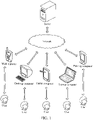
- FIG. 1 is a diagram of network architecture for running an audio signal processing system.
- the audio signal processing system can perform audio signal processing on a plurality of information sources.
- a terminal is connected to a server through a network to receive an audio signal sent by another terminal, and perform the audio signal processing method provided by the present disclosure on the received signal to suppress howling and obtain an audio output, so that an audio interaction between multiple terminals is implemented.
- FIG. 1 is a diagram of network architecture for running an audio signal processing system.
- the audio signal processing system can perform audio signal processing on a plurality of information sources.
- a terminal is connected to a server through a network to receive an audio signal sent by another terminal, and perform the audio signal processing method provided by the present disclosure on the received signal to suppress howling and obtain an audio output, so that an audio interaction between multiple terminals is implemented.
- FIG. 1 is a diagram of network architecture for running an audio signal processing system.
- a terminal is connected to a server through a network to receive an audio signal sent by another terminal, and perform the audio signal processing
- more or fewer types of terminal devices may be involved in the audio signal processing in actual scenarios, and the specific number and types depend on the actual scenarios, which is not limited herein.
- one server is shown in FIG. 1 , but in actual scenarios multiple servers may be involved, especially in a scenario of multi-content application interaction, and the specific number of servers depends on the actual scenario.
- the audio signal processing method provided in this embodiment may be performed offline. In other words, no server is involved in the audio signal processing. In this case, the terminal conducts local audio signal interaction with another terminal, and then performs audio signal processing between the terminals.
- the audio signal processing system may be run on a personal mobile terminal, for example, as an application such as a voice plug-in for a game, or may be run on a server, or may be run as a third-party device to perform audio signal processing, to obtain an audio signal processing result corresponding to an information source.
- the audio signal processing system may be run in the foregoing devices as a program, or be run in the foregoing devices as a system component, or may be used as a type of cloud service program.
- the specific operation mode depends on actual scenarios, which is not limited herein.
- a microphone at a local terminal may an audio signal originated from a speaker at an opposite terminal, and the audio signal loops in the voice call between the local terminal and the opposite terminal.
- the audio signal becomes a howling due to continual loop gain.
- a frequency shifter or a phase shifter for processing an input audio at the local terminal may be used to remove audio components having a phase same as the howling, thereby suppressing the howling.
- the scheme of using the frequency shifter or the phase shifter requires a long processing time and is not suitable for real-time processing of voice call.
- the phase removal fixed at the howling point causes damage to the sound quality of the effective audio and affects the accuracy in audio processing.
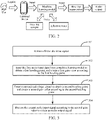
- FIG. 2 is a process architecture diagram of audio signal processing according to an embodiment of the present disclosure.
- a terminal device acquires voice of a user and converts the voice into an audio signal.
- the audio signal is input into a trained machine learning model, to determine and suppress a howling point, perform gain control for an unprocessed howling point, so as to obtain a howling-suppressed audio signal as an output.
- the method provided by the present disclosure may be written as a program, which is used as a processing logic in a hardware system, or as an audio signal processing apparatus, to implement the processing logic in an integrated or externally connected manner.
- the audio signal processing apparatus obtains a first audio input signal; then inputs the first audio input signal into a machine learning model to obtain a first gain value for processing a frequency band in which an effective audio signal is located; processes the first audio input signal according to the first gain value to obtain a second audio input signal; checks the second audio input signal to obtain a second howling point, the second howling point being used for indicating a howling point in a frequency band corresponding to an ineffective audio signal; and processes the second audio input signal according to a second gain value to obtain an audio output signal, the second gain value being used for indicating a suppression parameter for the second howling point.
- the howling is suppressed for the audio input signal at an initial stage and therefore will not loop with gains. Due to indication of a howling point in the machine learning model, the convenience of model calculation, and further processing on the unprocessed howling point by using the second gain value, a rapid and thorough process of the howling suppression is implemented without affecting the effective audio signal, so that the accuracy and efficiency in audio processing are improved.
- FIG. 3 is a flowchart of an audio signal processing method according to an embodiment of the present disclosure. The method includes at least the following steps.
- the first audio input signal may be an audio signal initially obtained when a voice call is started, or may be an audio signal obtained after a call lasts for a period of time.
- the howling generates when an audio signal continuously gains in a feedback loop, i.e., due to accumulated feedback gains.
- the feedback loop include a microphone at a local terminal and a speaker at an opposite terminal. Therefore, an audio signal at a different time period may have different accumulated feedback gain.
- the audio signal processing method provided by the present disclosure may be invoked immediately, or may be invoked after the feedback gain becomes greater than or equal to 1 since the generation of howling requires a feedback gain of the audio signal in the loop to be greater than or equal to 1.
- the obtained first audio input signal may be an amplified signal.
- an acquired signal which may be acquired by a microphone or another acquisition device, is obtained; the acquired signal is converted into a digital signal, for example, by an ADC; the digital signal is inputted to an amplifier to obtain the first audio input signal. Because the first audio input signal is amplified, it is convenient for a user to listen and convenient for a subsequent howling point filtering process in the present disclosure.
- the acquired signal from the acquisition device may contain obvious noise, such as a signal with a frequency far beyond voice range.
- noise filtering may be performed.
- the digital signal is inputted into an amplifier to obtain an amplified signal; then the amplified signal is processed according to a filter parameter to obtain a filtered amplified signal; and the filtered amplified signal is transformed into frequency domain by Fourier transformation to obtain the first audio input signal.
- the filter parameter may be a fixed value, or may be set according to a frequency band corresponding to common noise in historical records.
- the first audio input signal is input into a machine learning model to obtain a first howling point, and a first gain value is obtained according to the first howling point.
- the first howling point is used for indicating a howling point in a frequency band corresponding to an effective audio signal in the first audio input signal; and the first gain value is used for indicating a suppression parameter for the first howling point.
- the first audio input signal is processed according to the first gain value to obtain a second audio input signal.
- the machine learning model is trained with a plurality of training signals, the training signals include a plurality of howling point samples, and the first howling point is used for indicating the howling point in the frequency band corresponding to the effective audio signal.
- feature extraction may be performed by determining a plurality of features in the audio input signal. These features may be selected from features of the effective audio signal, for example, frequency band distribution, a position of a pitch period, a signal fluctuation frequency, or the like. Then the extracted features are inputted into the machine learning model to determine a corresponding first howling point. Accordingly, a first gain value corresponding to the first howling point is determined.
- the feature extraction may be performed based on the effective audio signal.
- the feature extraction is performed based on parameter feature of the effective audio signal, for example, Mel-scale frequency cepstral coefficient (MFCC) of the effective audio signal, or mathematical transformation of the coefficient.
- the feature extraction is performed based on biological feature of the effective audio signal, for example, a pitch period of the effective audio signal, because an audio signal of the human voice below 500 Hz has a pitch period while a howling signal does not.
- the feature extraction is performed based on waveform feature of the effective audio signal, for example, the fluctuation of the effective audio signal in a specific frequency band, because the effective audio signal has a feature of short-term stability.
- the effective audio signal may be distinguished from the signal corresponding to the howling point, so that the machine learning model can learn the features of the effective audio signal and can have improved accuracy in extracting the effective audio signal.
- the features listed above are exemplary.
- the feature may be indicative of the effective audio signal, or indicative of the howling signal, or indicative of feature distinguishing the effective audio signal from the howling signal, which is not limited herein.
- the first audio input signal may be adjusted to a target frequency for transformation into the frequency domain.
- a sampling rate of 16 KHz is commonly used for voice call on mobile phone, and therefore the target frequency is adjusted to 16 KHz; then a plurality of sampling points in the first audio input signal transformed into the frequency domain are determined; and a plurality of audio features are extracted based on the sampling points.
- the input signal is processed in multiple threads and the efficiency for audio processing is improved.
- the input signal may be divided with a window function.
- the first audio input signal transformed into the frequency domain is divided based on the window function to obtain a plurality of sub-bands; and then a plurality of sampling points in the sub-bands are determined.
- the window function may be a rectangular window, a Gaussian window, a Kaiser window, or the like, and the specific form of the function depends on an actual scenario.
- a second audio input signal is checked to obtain a second howling point, and a second gain value is obtained according to the second howling point.
- the first gain values correspond to a plurality of howling points in the first audio input signal, each howling point corresponds to a plurality of frequency bands, and a set of these frequency bands is called a sub-band. Therefore, the first gain values may include a plurality of gain values for howling suppression, each being a floating-point number within the range from 0 to 1.
- the first gain values are inputted into the first audio input signal, and each sub-band is multiplied by an attenuation gain for howling suppression corresponding to be sub-band, so as to obtain a result, i.e., the second audio input signal, with the machine having learned howling suppression.
- the second howling point is used for indicating a howling point in a frequency band corresponding to an ineffective audio signal in the second audio input signal, that is, the howling point that does not belong to the frequency band corresponding to the effective audio signal. Because there may be a howling point corresponding to a frequency band of an unprocessed ineffective audio signal in machine model training, a secondary gain processing is performed to detect the second howling point.
- the second howling point may be detected by: obtaining a power spectrum corresponding to the second audio input signal; detecting, in the power spectrum, an extreme value such as a maximum power value in the power spectrum, or a value range set based on the maximum power value; determining a corresponding candidate frequency point, which may be a howling point, according to the extreme value; and determining the second howling point according to the candidate frequency point. That is, phase and feedback gain of the candidate frequency point are detected, and in a case that the phase is consistent and the feedback gain is greater than or equal to 1, the candidate frequency point is determined as the second howling point.
- the change of gains of frequency points can be visually determined because the power corresponding to a howling point is usually greater than the power of a general frequency point, so that the accuracy in howling point recognition is improved.
- the second howling point may be determined based on a peak-to-average ratio, that is, a plurality of frequency points adjacent to the candidate frequency point are obtained to determine a candidate range; then an average frequency value of the frequency points in the candidate range is determined to obtain the peak-to-average ratio; and in a case that the peak-to-average ratio is greater than a howling threshold, the candidate frequency point is determined as the second howling point.
- the howling points may be determined by the peak-to-average ratio, so that a range of reference is expanded and the accuracy in howling point recognition is further improved.
- the howling points may appear periodically, the howling points may also be determined by statistical analysis of a historical record. For example, in a possible scenario, the howling points tend to be concentrated in a frequency band above 2 KHz, and the energy of the voice signal is mainly concentrated in a frequency band below 2 KHz. Then the howling points are determined based on the peak-to-average ratio; or further check may be performed based on locations where the howling points appear in the historical record. For example, in a case that the howling points are concentrated in 2 KHz to 3 KHz in the historical record, secondary detection is performed on this range in the next howling point recognition. For the specific manner of check, reference may be made to the recognition based on the extreme value of the power spectrum or the peak-to-average ratio as described above.
- the frequency band where the howling points are concentrated depends on a specific scenario, that is, in different scenarios the howling points may be concentrated in higher or lower frequency band.
- the description herein is only to illustrate the method for obtaining the howling points based on analysis of the historical record, and the disclosure is not limited herewith.
- the second audio input signal is processed according to the second gain value to obtain an audio output signal.
- the second gain value is used for indicating a suppression parameter for the second howling point, that is, a suppression factor applied on a frequency band corresponding to the second howling point.
- the secondary filtering of howling point ensures the accuracy and the significant effect of howling suppression.
- the second gain value may be empirically set to a floating-point value ranging from 0 to 1, or may be calculated based on the energy of upper and lower adjacent sub-bands.
- a processed signal may be transformed into time domain to be subjected to notch processing, which is a type of filter, to further eliminate the howling points.
- a first audio input signal is obtained; then the first audio input signal is inputted into a machine learning model to obtain a first gain value for processing a frequency band in which an effective audio signal is located; the first audio input signal is processed according to the first gain value to obtain a second audio input signal; next the second audio input signal is checked to obtain a second howling point, the second howling point being used for indicating a howling point in a frequency band corresponding to an ineffective audio signal in the second audio input signal; and the second audio input signal is processed according to a second gain value to obtain an audio output signal, the second gain value being used for indicating a suppression parameter for the second howling point.
- the howling is suppressed for the audio input signal at an initial stage and therefore will not loop with gains. Due to the indication of a howling point in the machine learning model, the convenience of model calculation, and further processing on the unprocessed howling point by using the second gain value, a rapid and thorough process of the howling suppression is implemented without affecting the effective audio signal, so that the accuracy and efficiency in audio processing are improved.
- FIG. 4 is a flowchart of another audio signal processing method according to an embodiment of the present disclosure, and the method includes at least the following steps.
- a first audio input signal is obtained.
- the first audio input signal is inputted into a machine learning model to obtain a first gain value.
- the first audio input signal is processed according to the first gain value to obtain a second audio input signal.
- the second audio input signal is checked to obtain a second howling point.
- steps 401 to 404 are similar to steps 301 to 304 in the embodiment of FIG. 3 , and for related features and description, reference may be made to the description above, which are not repeated herein.
- the second audio input signal is checked for voice protection.
- the voice protection is to ensure the integrity of the effective audio signal.
- feature information in the effective audio signal is first obtained, the feature information being determined based on waveform features indicated by the effective audio signal. For example, for the waveform feature indicated by the effective audio signal, a voiced sound has formants and an unvoiced sound has large high-frequency energy and a stable energy slope with respect to frequency axis. Then the corresponding effective audio signal in the second audio input signal is detected according to the feature information.
- a lock operation is further performed on the effective audio signal, the lock operation being used for indicating an object on which the second gain value does not act.
- a processing frequency band corresponding to the second gain value may include the effective audio signal which is locked in this step so as not to be subjected to the gain processing.
- the voice protection for the effective audio signal may also be performed based on a historical record indicating a voice frequency band.
- frequency band distribution of the effective audio signal is recorded, and frequency bands with a large distribution weight are detected and filtered one by one.
- the second audio input signal is processed according to a second gain value.
- gained frames associated with howling points corresponding to the second gain value may be smoothed.
- the gains of the adjacent frames are more proximately in linear distribution, the abrupt audio change is reduced, the audio output signal sounds smoother, and user experience is improved.
- the audio output signal is obtained by multiplying the gain parameter g ⁇ ain 2( m,k ) in step 407 by a value of a corresponding frequency point.
- the accuracy and resolution of the audio output signal are improved by detecting and locking the effective audio signal.
- the gains of the adjacent frames are more proximately in the linear distribution, the abrupt audio change is reduced, the audio output signal sounds smoother, and the user experience is improved.
- FIG. 5 is a schematic diagram of a scenario for audio signal processing according to an embodiment of the present disclosure.
- a scenario in which a microphone acquires and amplifies a voice signal for playback, is shown.
- a sound source microphone
- the amplification device microphone
- the sound signal acquired by the microphone is amplified by the speaker and then picked up again by the microphone.
- the signal is continuously superimposed and amplified in a feedback loop and an oscillation cycle is generated by a positive feedback, which results in howling.
- G(s) is the input signal acquired by the microphone
- F(s) is the sound wave signal fed back to the speaker
- G(w0) is the phase of the input signal acquired by the microphone
- F(w0) is the phase of the sound wave signal fed back to the speaker
- n is an integer parameter.
- the audio signal processing method provided by the present disclosure may be performed in an amplifier.
- the audio signal processing process in the embodiment of FIG. 3 or FIG. 4 is immediately performed, and then an output signal is transmitted to the speaker for playback. As this cycle repeats, the howling can be suppressed.
- FIG. 6 is a schematic diagram of another scenario for audio signal processing according to an embodiment of the present disclosure, showing a loop in a scenario in which the terminal outputs sound loudly.
- the sound from the speaker of the terminal on the right is picked up by the microphone of the terminal on the left.
- the sound is sent to the terminal via a network and is played via the speaker. Then the sound is picked up again by the microphone of the terminal on the left.
- a loop gain is greater than or equal to 1 at a certain frequency point and the phase is positive, a howling point is formed at this point.
- FIG. 7 is a flowchart of another audio signal processing method according to an embodiment of the present disclosure, and the method includes at least the following steps.
- an audio signal of a target frequency is inputted, and the audio signal is divided into frames at every 20 milliseconds.
- the target frequency may be set to 16 KHz.
- the audio signal is windowed and transformed into frequency domain by Fourier transformation.
- the window function may be a rectangular window, a Gaussian window, a Kaiser window, or the like, and the specific form of the function depends on an actual scenario.
- the feature values may include 22 Mel-scale frequency cepstral coefficients, for which reference may be made to a parameter in a voice recognition process, that is, the effective audio signal; the feature values may further include first-order or second-order derivatives of the first 6 coefficients used for indicating voice features; the feature values may further include a pitch period, because a voiced sound of a voice signal has a pitch period while a howling signal does not at a frequency below 500 Hz; and the feature values may further include the detection of a non-stable feature value because the voice is short-term stable.
- a first gain value is calculated with a RNN model.
- the machine learning model is a RNN model for modeling time series rather than for considering only input and output frames.
- the specific process of obtaining the first gain value is similar to step 302 in the embodiment of FIG. 3 , which is not repeated herein.
- steps 705-708 are similar to steps 303-305 in the embodiment of FIG. 3 , and for related features and descriptions, reference may be made to the above, which are not repeated herein.
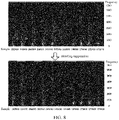
- FIG. 8 shows a comparison of audio signal processing according to an embodiment of the present disclosure, where an upper diagram is a spectrogram of the input signal before the howling suppression, and a lower diagram is a spectrogram of the signal after the howling suppression. It can be seen from the comparison that the clutter around the peak of the sample is significantly reduced, that is, howling has been suppressed by the audio processing method provided in the present disclosure before the howling is generated.
- FIG. 9 is a flowchart of another audio signal processing method according to an embodiment of the present disclosure, and the method includes at least the following steps.
- the start instruction of the game may be a triggering of starting the game or starting a thread of a certain scene in the game, for example, entering of a battle scene.
- the feature element is a physical or virtual button for activating a voice call function.
- FIG. 10 is a schematic diagram of an interface of an audio signal processing method according to an embodiment of the present disclosure. A feature element A1 in the game interface is shown. Once any of the buttons is triggered, the audio processing method in the embodiment of FIG. 3 or FIG. 4 is invoked.
- FIG. 11 is a schematic diagram of an interface in another audio signal processing method according to an embodiment of the present disclosure, in which users are in a public voice scene B2. At this time, once a feature element B 1 is triggered, the audio processing method in the embodiment of FIG. 3 or FIG. 4 is invoked.
- the audio signal subjected to the howling suppression is utilized to realize a clear voice call between two or more users.
- the users can make a clearer voice call without affecting the communication due to howling, so that the user experience and the accuracy of a voice call are ensured in a scenario such as the game that requires high-efficiency and high-quality voice.
- FIG. 12 is a flowchart of a machine learning model training method according to an embodiment of the present disclosure, and the method includes at least the following steps.
- a reference signal and a voice sample signal are acquired.
- the reference signal is a howling signal determined based on at least two variable elements, the variable elements including a program category, a program running period, or a program running location; and the voice sample signal is used for indicating an effective voice in a voice call progress.
- the program category in the variable elements may be training samples in different game scenarios of different games, such as Honor of Kings or Game for Peace.
- the program running period indicates a time period in which the training samples are acquired.
- a voice call function is usually activated in a game during a time period from 8 pm to 9 pm, and the voice call is relatively intense, which may be additionally marked to generate the training samples.
- the program running location is geographic information of the voice acquisition.
- the training samples are acquired at different geographic locations such as a market, a classroom, or a bedroom.
- the training samples are acquired under various conditions, and the howling points in the training samples are marked, so that a diversity of the training samples is ensured. Because the acquired signal is used as a voice sample, the machine learning model has a good performance in recognizing howling point(s) in voice frequency band.
- a feature training set is generated according to the reference signal and the acquired signal.
- the signals acquired under the different factors are assigned with labels and are classified, and corresponding howling points are marked to generate the feature training set.
- the feature training set is inputted into a machine learning model to perform at least one round of training, to obtain a trained machine learning model.
- FIG. 13 is a schematic flowchart of training of a machine learning model according to an embodiment of the present disclosure.
- An RNN model including 3-level gated recurrence units (GRUs) is shown.
- the GRU has two additional gates, where a reset gate determines whether to memorize a current state for calculating a new state, and an update gate determines how much to change the current state according to a new input. In a case that the update gate is closed, the GRU can remember training information for a long time.
- the GRU at the first layer has a 42-dimensional input, and outputs a 24-dimensional feature and a voice activity detection (VAD) flag.
- the GRU at the second layer inputs the initial 42-dimensional feature and the 24-dimensional feature outputted by the first layer to output a 48-dimensional feature, for estimating a howling signal.
- a third layer inputs the initial 42-dimensional feature and the 42-dimensional feature outputted by the second layer to obtain an output; and adjusts the output according to a gain value in a training sample to update a model parameter, thereby implementing training of the RNN model.
- the training process in the present disclosure may also be applied to a deep neural network model or a convolutional neural network model, which is not repeated herein.
- the howling point distribution and a corresponding first gain value can be obtained after the audio signal is inputted into the machine learning model, and the accuracy of howling suppression in the voice frequency band is ensured.
- FIG. 14 is a schematic structural diagram of an audio signal processing apparatus according to an embodiment of the present disclosure, and the audio signal processing apparatus 1400 includes:
- the input unit 1402 is specifically configured to transform the audio input signal into frequency domain, to extract a plurality of audio features, the audio features being determined based on features of the effective audio signal or a howling sample.
- the input unit 1402 is specifically configured to input the audio features into the machine learning model to determine the first howling point.
- the input unit 1402 is specifically configured to determine the first gain value according to the first howling point.
- the input unit 1402 is specifically configured to process the first audio input signal according to the first gain value to obtain the second audio input signal.
- the detection unit 1403 is configured to check the second audio input signal to obtain the second howling point, and obtain the second gain value according to the second howling point, the second howling point being used for indicating the howling point in the frequency band corresponding to the ineffective audio signal in the second audio input signal.
- the processing unit 1404 is configured to process the second audio input signal according to the second gain value to obtain the audio output signal.
- the input unit 1402 is specifically configured to transform the audio input signal into frequency domain, to extract the plurality of audio features, the audio features being determined based on features of the effective audio signal or the howling sample.
- the input unit 1402 is specifically configured to input the audio features into the machine learning model to determine the first howling point.
- the input unit 1402 is specifically configured to obtain the first gain value according to the first howling point.
- the input unit 1402 is specifically configured to adjust the first audio input signal to a target frequency for transformation into the frequency domain.
- the input unit 1402 is specifically configured to determine a plurality of sampling points in the first audio input signal transformed into the frequency domain.
- the input unit 1402 is specifically configured to extract the plurality of audio features based on the sampling points.
- the input unit 1402 is specifically configured to divide, based on a window function, the first audio input signal transformed into the frequency domain to obtain a plurality of sub-bands.
- the input unit 1402 is specifically configured to determine the plurality of sampling points in the sub-bands.
- the detection unit 1403 is specifically configured to obtain a power spectrum corresponding to the second audio input signal.
- the detection unit 1403 is specifically configured to detect an extreme value in the power spectrum and determine a corresponding candidate frequency point.
- the detection unit 1403 is specifically configured to determine the second howling point according to the candidate frequency point.
- the detection unit 1403 is specifically configured to process the second howling point according to the second gain value to obtain the audio output signal.
- the detection unit 1403 is specifically configured to obtain a plurality of frequency points adjacent to the candidate frequency point to determine a candidate range.
- the detection unit 1403 is specifically configured to determine an average value of the frequency points in the candidate range to obtain a peak-to-average ratio
- the detection unit 1403 is specifically configured to determine the candidate frequency point as the second howling point in a case that the peak-to-average ratio is greater than a howling threshold.
- the detection unit 1403 is further configured to obtain feature information in the effective audio signal, the feature information being determined based on a waveform feature indicated by the effective audio signal, and the effective audio signal being used for indicating a voice sample.
- the detection unit 1403 is specifically configured to detect the effective audio signal in the second audio input signal according to the feature information.
- the detection unit 1403 is specifically configured to perform a locking operation on the effective audio signal, the locking operation being used for indicating an object on which the second gain value does not act.
- the processing unit 1404 is specifically configured to determine a plurality of gained frames corresponding to the second howling point. the processing unit 1404 is specifically configured to process the gained frames according to a smoothing formula to update the audio output signal.
- the obtaining unit 1401 is specifically configured to obtain an acquired signal
- the obtaining unit 1401 is specifically configured to input the digital signal into the amplifier to obtain an amplified signal
- the audio signal processing method is applied to a voice call in a game
- the obtaining unit 1401 is specifically configured to detect triggering of a feature element, the feature element being an element in a game interface; and the obtaining unit 1401 is specifically configured to obtain the first audio input signal in a case that the feature element is triggered.
- a first audio input signal is obtained; then the first audio input signal is inputted into a machine learning model to obtain a first gain value for processing a frequency band in which an effective audio signal is located; the first audio input signal is processed according to the first gain value to obtain a second audio input signal; next the second audio input signal is checked to obtain a second howling point, the second howling point being used for indicating a howling point in a frequency band corresponding to an ineffective audio signal in the second audio input signal; and the second audio input signal is processed according to a second gain value to obtain an audio output signal, the second gain value being used for indicating a suppression parameter for the second howling point.
- the howling is suppressed for the audio input signal at an initial stage and therefore will not loop with gains.
- FIG. 15 is a schematic structural diagram of an apparatus for training machine learning model according to an embodiment of the present disclosure.
- the apparatus includes: an acquisition unit 1501, configured to acquire a reference signal and a voice sample signal, the reference signal being a howling signal determined based on at least two variable elements, the variable elements including a program category, a program running period, or a program running location, and the acquired signal being used for indicating an effective voice in a call process;
- FIG. 16 is a schematic structural diagram of another terminal device according to an embodiment of the present disclosure. To facilitate the description, only parts related to the embodiments of the present disclosure are shown. For specific technical details that are not described, reference may be to the method in the embodiments of the present disclosure.
- the terminal may be any terminal device such as a mobile phone, a tablet computer, a personal digital assistant (PDA), a point of sales (POS), an on-board computer or the like.
- PDA personal digital assistant
- POS point of sales
- the terminal being a mobile phone is used as an example.
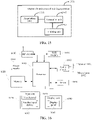
- FIG. 16 is a partial structural diagram of a mobile phone related to a terminal according to an embodiment of the present disclosure.
- the mobile phone includes: a radio frequency (RF) circuit 1610, a memory 1620, an input unit 1630, a display unit 1640, a sensor 1650, an audio circuit 1660, a wireless fidelity (WiFi) module 1670, a processor 1680, and a power supply 1690.
- RF radio frequency
- the RF circuit 1610 may be configured to receive and send signals during an information receiving and sending process or a call process. Specifically, the RF circuit 1610 receives downlink information from a base station, then delivers the downlink information to the processor 1680 for processing, and sends designed uplink data to the base station. Usually, the RF circuit 1610 includes, but not limited to, an antenna, at least one amplifier, a transceiver, a coupler, a low noise amplifier (LNA), and a duplexer. In addition, the RF circuit 1610 may communicate with a network and another device through wireless communication.
- LNA low noise amplifier
- the memory 1620 may be configured to store software programs and modules.
- the processor 1680 runs the software programs and the modules stored in the memory 1620, to implement various functional applications and data processing of the mobile phone.
- the input unit 1630 may be configured to receive input digit or character information, and generate a key signal input related to the user setting and function control of the mobile phone.
- the input unit 1630 may include a touch panel 1631 and another input device 1632.
- the display unit 1640 may be configured to display information inputted by the user or information provided for the user, and various menus of the mobile phone.
- the mobile phone may further include at least one sensor 1650 such as an optical sensor, a motion sensor, and other sensors.
- at least one sensor 1650 such as an optical sensor, a motion sensor, and other sensors.
- the audio circuit 1660, a speaker 1661, and a microphone 1662 may provide audio interfaces between the user and the mobile phone.
- the audio circuit 1660 may convert received audio data into an electrical signal and transmit the electrical signal to the speaker 1661.
- the speaker 1661 converts the electrical signal into a sound signal for output.
- the microphone 1662 converts an acquired sound signal into an electrical signal.
- the audio circuit 1660 receives the electrical signal, converts the electrical signal into audio data, and outputs the audio data to the processor 1680 for processing. Then, the processor transmits the audio data to, for example, another mobile phone through the RF circuit 1610, or outputs the audio data to the memory 1620 for further processing.
- WiFi is a short-range wireless transmission technology.
- FIG. 16 shows the WiFi module 1670, it can be understood that the Wi-Fi module is not a necessary component of the mobile phone, and the Wi-Fi module may be omitted as required without changing the essence of the present disclosure is not changed.
- the processor 1680 is a control center of the mobile phone, and is connected to various parts of the mobile phone through various interfaces and lines. By running or executing software programs and/or modules stored in the memory 1620, and invoking data stored in the memory 1620, the processor performs various functions of the mobile phone and performs data processing, so that the entire mobile phone is monitored.
- the processor 1680 included in the terminal further has a function of performing each step of the above audio signal processing method or the model training method.
- FIG. 17 is a schematic structural diagram of a server according to an embodiment of the present disclosure.
- the server 1700 may vary greatly due to different configurations or performance, and may include one or more central processing units (CPUs) 1722 and a memory 1732, and one or more storage media 1730 that store application programs 1742 or data 1744.
- CPUs central processing units
- the server 1700 may further include one or more power supplies 1726, one or more wired or wireless network interfaces 1750, one or more input/output interfaces 1758, and/or one or more operating systems 1741.
- the steps performed by the model training apparatus in the foregoing embodiments may be based on the server structure shown in FIG. 17 .
- the embodiments of the present disclosure further provide a computer-readable storage medium having a computer program stored thereon, the computer program being configured to implement the steps performed by the audio signal processing apparatus in the foregoing method described in the embodiments of FIG. 2 to FIG. 13 .
- the embodiments of the present disclosure further provide a computer program product including audio signal processing instructions, the computer program product, when running on a computer, causing the computer to perform the steps performed by the audio signal processing apparatus in the foregoing method described in the embodiments of FIG. 2 to FIG. 13 .
- the embodiments of the present disclosure further provide an audio signal processing system.
- the audio signal processing system may include the audio signal processing apparatus described in the embodiment of FIG. 14 or the terminal device in FIG. 16 .
- the integrated unit When the integrated unit is implemented in the form of a software functional unit and sold or used as an independent product, the integrated unit may be stored in a computer-readable storage medium. Based on such an understanding, the technical solutions of the present disclosure or the part contributing to the related art, or all or some of the technical solutions may be implemented in the form of a software product.
- the computer software product is stored in a storage medium and includes several instructions for instructing a computer device (which may be a personal computer, an audio signal processing apparatus, a network device, or the like) to perform all or some of the steps of the methods described in the embodiments of the present disclosure.
Landscapes
- Engineering & Computer Science (AREA)
- Physics & Mathematics (AREA)
- Health & Medical Sciences (AREA)
- Computational Linguistics (AREA)
- Signal Processing (AREA)
- Theoretical Computer Science (AREA)
- Acoustics & Sound (AREA)
- Human Computer Interaction (AREA)
- Multimedia (AREA)
- Audiology, Speech & Language Pathology (AREA)
- Quality & Reliability (AREA)
- Software Systems (AREA)
- Evolutionary Computation (AREA)
- Artificial Intelligence (AREA)
- General Engineering & Computer Science (AREA)
- Computing Systems (AREA)
- General Physics & Mathematics (AREA)
- General Health & Medical Sciences (AREA)
- Mathematical Physics (AREA)
- Data Mining & Analysis (AREA)
- Molecular Biology (AREA)
- Biomedical Technology (AREA)
- Life Sciences & Earth Sciences (AREA)
- Biophysics (AREA)
- Otolaryngology (AREA)
- Computer Vision & Pattern Recognition (AREA)
- Medical Informatics (AREA)
- Spectroscopy & Molecular Physics (AREA)
- Circuit For Audible Band Transducer (AREA)
- Telephone Function (AREA)
Abstract
Description
- This application claims priority to
Chinese Patent Application No. 202010023045.6, entitled "AUDIO SIGNAL PROCESSING METHOD, MODEL TRAINING METHOD, AND RELATED APPARATUSES" filed on January 9, 2020 - The present disclosure relates to computer technologies, and in particular, to audio signal processing.
- With the development of technologies related to mobile terminals, more smart devices are used in people's daily life, and making a voice call through a smart device is particularly common. However, during a call process, a microphone at a local terminal may collect an audio signal originated from a speaker at an opposite terminal, and the audio signal loops in the voice call between the local terminal and the opposite terminal. Especially during a short-range voice call process, the audio signal becomes a howling due to continual loop gain.
- Generally, a frequency shifter or a phase shifter for processing an input audio at the local terminal may be used to remove audio components having a phase same as the howling, thereby suppressing the howling.
- In view of the previous description, the present disclosure provides an audio signal processing method which can locate a howling point effectively and suppress howling, thereby improving accuracy of audio signal processing.
- According to one aspect, an embodiment of the present disclosure provides an audio signal processing method, which may be applied to a system or a program including an audio signal processing function in a terminal device, and specifically includes:
- obtaining a first audio input signal;
- inputting the first audio input signal into a machine learning model to obtain a first howling point; obtaining a first gain value according to the first howling point, the first howling point being used for indicating a howling point in a frequency band corresponding to an effective audio signal in the first audio input signal, and the first gain value being used for indicating a suppression parameter for the first howling point; and processing the first audio input signal according to the first gain value to obtain a second audio input signal;
- checking the second audio input signal to obtain a second howling point, and obtaining a second gain value according to the second howling point, the second howling point being used for indicating a howling point in a frequency band corresponding to an ineffective audio signal in the second audio input signal; and
- processing the second audio input signal according to the second gain value to obtain an audio output signal.
- According to another aspect, an embodiment of the present disclosure provides an audio signal processing apparatus, including:
- an obtaining unit, configured to obtain a first audio input signal;
- an input unit, configured to input the first audio input signal into a machine learning model to obtain a first howling point; to obtain a first gain value according to the first howling point, the first howling point being used for indicating a howling point in a frequency band corresponding to an effective audio signal in the first audio input signal, and the first gain value being used for indicating a suppression parameter for the first howling point; and to process the first audio input signal according to the first gain value to obtain a second audio input signal;
- a detection unit, configured to check the second audio input signal to obtain a second howling point, and to obtain a second gain value according to the second howling point, the second howling point being used for indicating a howling point in a frequency band corresponding to an ineffective audio signal in the second audio input signal; and
- a processing unit, configured to process the second audio input signal according to the second gain value to obtain an audio output signal.
- According to another aspect, an embodiment of the present disclosure provides a method for training a machine learning model, including: acquiring a reference signal and a voice sample signal, the reference signal being a howling signal determined based on at least two variable elements, the variable elements including a program category, a program running period, or a program running location, and the acquired signal being used for indicating an effective voice in a call;
- generating a feature training set according to the reference signal and the acquired signal; and
- inputting the feature training set into the machine learning model for performing at least one round of training to obtain a trained machine learning model, the trained machine learning model being used for determining a corresponding howling point and gain value according to an audio input signal.
- A fourth aspect of the present disclosure provides an apparatus for training a machine learning model, including: an acquisition unit, configured to acquire a reference signal and a voice sample signal, the reference signal being a howling signal determined based on at least two variable elements, the variable elements including a program category, a program running period, or a program running location, and the acquired signal being used for indicating an effective voice in a call process;
- a generation unit, configured to generate a feature training set according to the reference signal and the acquired signal; and
- a training unit, configured to input the feature training set into the machine learning model for performing at least one round of training to obtain a trained machine learning model, the trained machine learning model being used for determining a corresponding howling point and gain value according to an audio input signal.
- A fifth aspect of the present disclosure provides a computer device, including: a memory, a processor, and a bus system, the memory being configured to store program code; and the processor being configured to perform, according to instructions in the program code, the audio signal processing method according to the above aspect, or the method for training the machine learning model according to the above aspect.
- A sixth aspect of the present disclosure provides a computer-readable storage medium, the storage medium being configured to store a computer program, and the computer program being configured to implement the audio signal processing method according to the above aspect, or the method for training the machine learning model according to the above aspect.
- According to still another aspect, an embodiment of the present disclosure provides a computer program product including instructions, the computer program product, when running on a computer, causing the computer to perform the audio signal processing method according to the aspect above, or the method for training the machine learning model according to the above aspect.
- As can be seen from the technical solutions above, the embodiments of the present disclosure have the following advantages:
- A first audio input signal is obtained; then the first audio input signal is inputted into a machine learning model to obtain a first gain value for processing a frequency band in which an effective audio signal is located; the first audio input signal is processed according to the first gain value to obtain a second audio input signal; next the second audio input signal is checked to obtain a second howling point, the second howling point being used for indicating a howling point in a frequency band corresponding to an ineffective audio signal in the second audio input signal; and the second audio input signal is processed according to a second gain value to obtain an audio output signal, the second gain value being used for indicating a suppression parameter for the second howling point. In this way, the howling is suppressed for the audio input signal at an initial stage and therefore will not loop with gains. Due to the indication of howling points in the machine learning model, the convenience of model calculation, and further processing on the unprocessed howling point by using the second gain value, a rapid and thorough process of the howling suppression is implemented without affecting the effective audio signal, so that the accuracy and efficiency in audio processing are improved.
-
-
FIG. 1 is a diagram of network architecture for running an audio signal processing system. -
FIG. 2 is a process architecture diagram of audio signal processing according to an embodiment of the present disclosure. -
FIG. 3 is a flowchart of an audio signal processing method according to an embodiment of the present disclosure. -
FIG. 4 is a flowchart of another audio signal processing method according to an embodiment of the present disclosure. -
FIG. 5 is a schematic diagram of a scenario for audio signal processing according to an embodiment of the present disclosure. -
FIG. 6 is a schematic diagram of another scenario for audio signal processing according to an embodiment of the present disclosure. -
FIG. 7 is a flowchart of another audio signal processing method according to an embodiment of the present disclosure. -
FIG. 8 is a comparison diagram of audio signal processing according to an embodiment of the present disclosure. -
FIG. 9 is a flowchart of another audio signal processing method according to an embodiment of the present disclosure. -
FIG. 10 is a schematic diagram of an interface of an audio signal processing method according to an embodiment of the present disclosure. -
FIG. 11 is a schematic diagram of an interface of another audio signal processing method according to an embodiment of the present disclosure. -
FIG. 12 is a flowchart of a machine learning model training method according to an embodiment of the present disclosure. -
FIG. 13 is a schematic flowchart of training of a machine learning model according to an embodiment of the present disclosure. -
FIG. 14 is a schematic structural diagram of an audio signal processing apparatus according to an embodiment of the present disclosure. -
FIG. 15 is a schematic structural diagram of a machine learning model training apparatus according to an embodiment of the present disclosure. -
FIG. 16 is a schematic structural diagram of a terminal device according to an embodiment of the present disclosure. -
FIG. 17 is a schematic structural diagram of a server according to an embodiment of the present disclosure. - The embodiments of the present disclosure provide an audio signal processing method and a related apparatus, which may be applied to a system or a program including an audio signal processing function in a terminal device. A first audio input signal is obtained; then the first audio input signal is inputted into a machine learning model to obtain a first gain value for processing a frequency band in which an effective audio signal is located; the first audio input signal is processed according to the first gain value to obtain a second audio input signal; next the second audio input signal is checked to obtain a second howling point, the second howling point being used for indicating a howling point in a frequency band corresponding to an ineffective audio signal; and the second audio input signal is processed according to a second gain value to obtain an audio output signal, the second gain value being used for indicating a suppression parameter for the second howling point. In this way, the howling is suppressed for the audio input signal at an initial stage and therefore will not loop with gains. Due to indication of howling points in the machine learning model, the convenience of model calculation, and further processing on the unprocessed howling point by using the second gain value, a rapid and thorough process of the howling suppression is implemented without affecting the effective audio signal, so that the accuracy and efficiency in audio processing are improved.
- First, some terms to be used in the embodiments of the present disclosure are described as follows.
- Howling: in a case that a sound signal acquired by a microphone is amplified by a speaker and then picked up again by the microphone, the signal is continuously superimposed and amplified in a feedback loop and an oscillation cycle is generated by a positive feedback, therefore the howling occurs.
- Howling point: a frequency point in an audio signal at which loop gain is greater than or equal to 1.
- Effective audio signal: a target audio in the audio signal, such as a voice signal in a voice call.
- Ineffective audio signal: an interference audio in the audio signal, such as background noise or an echo.
- Gain value: a degree of change in processing an audio signal at a specified frequency band, used for indicating a suppression factor applied on an audio signal corresponding to a howling point in a howling suppression scenario.
- Pitch period: a time period from opening to closing of vocal cords in human vocalization, a parameter that may be used for indicating the effective audio signal.
- Machine learning model: a model used for adjusting a parameter based on a given sample, so that an output has characteristics similar to the given sample.
- Power spectrum: the change of signal power as frequency varies, namely, the distribution of signal power in frequency domain.
- Analog-to-digital converter (ADC): an electronic component configured to convert an analog signal into a digital signal.
- Recurrent neural network (RNN) model: a recursive neural network that takes data sequence as an input and recurs in an evolution direction of the sequence, in which all nodes (recurrent units) are connected in a chain.
- Convolutional neural network (CNN) model: a convolutional neural network has a characterization learning capability and can classify input information in a translation-invariant manner according to a hierarchical structure thereof.
- It is to be understood that the audio signal processing method provided by the present disclosure may be applied to a system or a program including an audio signal processing function in a terminal device, for example, as a voice plug-in for a game. Specifically, an audio signal processing system may be run in network architecture as shown in
FIG. 1. FIG. 1 is a diagram of network architecture for running an audio signal processing system. As shown, the audio signal processing system can perform audio signal processing on a plurality of information sources. A terminal is connected to a server through a network to receive an audio signal sent by another terminal, and perform the audio signal processing method provided by the present disclosure on the received signal to suppress howling and obtain an audio output, so that an audio interaction between multiple terminals is implemented. It can be understood that although a variety of terminal devices are shown inFIG. 1 , more or fewer types of terminal devices may be involved in the audio signal processing in actual scenarios, and the specific number and types depend on the actual scenarios, which is not limited herein. In addition, one server is shown inFIG. 1 , but in actual scenarios multiple servers may be involved, especially in a scenario of multi-content application interaction, and the specific number of servers depends on the actual scenario. - The audio signal processing method provided in this embodiment may be performed offline. In other words, no server is involved in the audio signal processing. In this case, the terminal conducts local audio signal interaction with another terminal, and then performs audio signal processing between the terminals.
- It can be understood that the audio signal processing system may be run on a personal mobile terminal, for example, as an application such as a voice plug-in for a game, or may be run on a server, or may be run as a third-party device to perform audio signal processing, to obtain an audio signal processing result corresponding to an information source. The audio signal processing system may be run in the foregoing devices as a program, or be run in the foregoing devices as a system component, or may be used as a type of cloud service program. The specific operation mode depends on actual scenarios, which is not limited herein.
- With the development of technologies related to mobile terminals, more smart devices are used in people's daily life, and making a voice call through a smart device is particularly common. However, during a call process, a microphone at a local terminal may an audio signal originated from a speaker at an opposite terminal, and the audio signal loops in the voice call between the local terminal and the opposite terminal. Especially during a short-range voice call, the audio signal becomes a howling due to continual loop gain.
- Generally, a frequency shifter or a phase shifter for processing an input audio at the local terminal may be used to remove audio components having a phase same as the howling, thereby suppressing the howling.
- However, the scheme of using the frequency shifter or the phase shifter requires a long processing time and is not suitable for real-time processing of voice call. Moreover, the phase removal fixed at the howling point causes damage to the sound quality of the effective audio and affects the accuracy in audio processing.
- To resolve the foregoing problems, the present disclosure provides an audio signal processing method, which is applied to a process framework of audio signal processing shown in
FIG. 2. FIG. 2 is a process architecture diagram of audio signal processing according to an embodiment of the present disclosure. First, a terminal device acquires voice of a user and converts the voice into an audio signal. The audio signal is input into a trained machine learning model, to determine and suppress a howling point, perform gain control for an unprocessed howling point, so as to obtain a howling-suppressed audio signal as an output. - It can be understood that the method provided by the present disclosure may be written as a program, which is used as a processing logic in a hardware system, or as an audio signal processing apparatus, to implement the processing logic in an integrated or externally connected manner. As an implementation, the audio signal processing apparatus obtains a first audio input signal; then inputs the first audio input signal into a machine learning model to obtain a first gain value for processing a frequency band in which an effective audio signal is located; processes the first audio input signal according to the first gain value to obtain a second audio input signal; checks the second audio input signal to obtain a second howling point, the second howling point being used for indicating a howling point in a frequency band corresponding to an ineffective audio signal; and processes the second audio input signal according to a second gain value to obtain an audio output signal, the second gain value being used for indicating a suppression parameter for the second howling point. In this way, the howling is suppressed for the audio input signal at an initial stage and therefore will not loop with gains. Due to indication of a howling point in the machine learning model, the convenience of model calculation, and further processing on the unprocessed howling point by using the second gain value, a rapid and thorough process of the howling suppression is implemented without affecting the effective audio signal, so that the accuracy and efficiency in audio processing are improved.
- With reference to the process architecture, the audio signal processing method in the present disclosure is described below.
FIG. 3 is a flowchart of an audio signal processing method according to an embodiment of the present disclosure. The method includes at least the following steps. - In 301: a first audio input signal is obtained.
- In this embodiment, the first audio input signal may be an audio signal initially obtained when a voice call is started, or may be an audio signal obtained after a call lasts for a period of time. Specifically, the howling generates when an audio signal continuously gains in a feedback loop, i.e., due to accumulated feedback gains. The feedback loop include a microphone at a local terminal and a speaker at an opposite terminal. Therefore, an audio signal at a different time period may have different accumulated feedback gain. The audio signal processing method provided by the present disclosure may be invoked immediately, or may be invoked after the feedback gain becomes greater than or equal to 1 since the generation of howling requires a feedback gain of the audio signal in the loop to be greater than or equal to 1.
- Optionally, the obtained first audio input signal may be an amplified signal. Specifically, an acquired signal, which may be acquired by a microphone or another acquisition device, is obtained; the acquired signal is converted into a digital signal, for example, by an ADC; the digital signal is inputted to an amplifier to obtain the first audio input signal. Because the first audio input signal is amplified, it is convenient for a user to listen and convenient for a subsequent howling point filtering process in the present disclosure.
- In addition, the acquired signal from the acquisition device may contain obvious noise, such as a signal with a frequency far beyond voice range. In this case, noise filtering may be performed. Specifically, the digital signal is inputted into an amplifier to obtain an amplified signal; then the amplified signal is processed according to a filter parameter to obtain a filtered amplified signal; and the filtered amplified signal is transformed into frequency domain by Fourier transformation to obtain the first audio input signal. The filter parameter may be a fixed value, or may be set according to a frequency band corresponding to common noise in historical records.
- In 302: the first audio input signal is input into a machine learning model to obtain a first howling point, and a first gain value is obtained according to the first howling point.
- In this embodiment, the first howling point is used for indicating a howling point in a frequency band corresponding to an effective audio signal in the first audio input signal; and the first gain value is used for indicating a suppression parameter for the first howling point. The first audio input signal is processed according to the first gain value to obtain a second audio input signal. In addition, the machine learning model is trained with a plurality of training signals, the training signals include a plurality of howling point samples, and the first howling point is used for indicating the howling point in the frequency band corresponding to the effective audio signal.
- Because howling points differ from effective audio in frequency band distribution or energy features, feature extraction may be performed by determining a plurality of features in the audio input signal. These features may be selected from features of the effective audio signal, for example, frequency band distribution, a position of a pitch period, a signal fluctuation frequency, or the like. Then the extracted features are inputted into the machine learning model to determine a corresponding first howling point. Accordingly, a first gain value corresponding to the first howling point is determined.
- Specifically, the feature extraction may be performed based on the effective audio signal. According to a first aspect, the feature extraction is performed based on parameter feature of the effective audio signal, for example, Mel-scale frequency cepstral coefficient (MFCC) of the effective audio signal, or mathematical transformation of the coefficient. According to a second aspect, the feature extraction is performed based on biological feature of the effective audio signal, for example, a pitch period of the effective audio signal, because an audio signal of the human voice below 500 Hz has a pitch period while a howling signal does not. According to a third aspect, the feature extraction is performed based on waveform feature of the effective audio signal, for example, the fluctuation of the effective audio signal in a specific frequency band, because the effective audio signal has a feature of short-term stability. Through the feature extraction, the effective audio signal may be distinguished from the signal corresponding to the howling point, so that the machine learning model can learn the features of the effective audio signal and can have improved accuracy in extracting the effective audio signal.
- The features listed above are exemplary. The feature may be indicative of the effective audio signal, or indicative of the howling signal, or indicative of feature distinguishing the effective audio signal from the howling signal, which is not limited herein.
- Optionally, considering different frequencies for acquiring the input signal in different scenarios, the first audio input signal may be adjusted to a target frequency for transformation into the frequency domain. For example, a sampling rate of 16 KHz is commonly used for voice call on mobile phone, and therefore the target frequency is adjusted to 16 KHz; then a plurality of sampling points in the first audio input signal transformed into the frequency domain are determined; and a plurality of audio features are extracted based on the sampling points. In this way, the input signal is processed in multiple threads and the efficiency for audio processing is improved.
- In addition, in the process of transforming the first audio input signal from a time domain into the frequency domain, for better periodicity of the time domain signal required in the Fourier transform and less signal omission, the input signal may be divided with a window function. In other words, the first audio input signal transformed into the frequency domain is divided based on the window function to obtain a plurality of sub-bands; and then a plurality of sampling points in the sub-bands are determined. The window function may be a rectangular window, a Gaussian window, a Kaiser window, or the like, and the specific form of the function depends on an actual scenario.
- In 303: a second audio input signal is checked to obtain a second howling point, and a second gain value is obtained according to the second howling point.
- In this embodiment, the first gain values correspond to a plurality of howling points in the first audio input signal, each howling point corresponds to a plurality of frequency bands, and a set of these frequency bands is called a sub-band. Therefore, the first gain values may include a plurality of gain values for howling suppression, each being a floating-point number within the range from 0 to 1. The first gain values are inputted into the first audio input signal, and each sub-band is multiplied by an attenuation gain for howling suppression corresponding to be sub-band, so as to obtain a result, i.e., the second audio input signal, with the machine having learned howling suppression.
- It can be understood that the second howling point is used for indicating a howling point in a frequency band corresponding to an ineffective audio signal in the second audio input signal, that is, the howling point that does not belong to the frequency band corresponding to the effective audio signal. Because there may be a howling point corresponding to a frequency band of an unprocessed ineffective audio signal in machine model training, a secondary gain processing is performed to detect the second howling point.
- Specifically, the second howling point may be detected by: obtaining a power spectrum corresponding to the second audio input signal; detecting, in the power spectrum, an extreme value such as a maximum power value in the power spectrum, or a value range set based on the maximum power value; determining a corresponding candidate frequency point, which may be a howling point, according to the extreme value; and determining the second howling point according to the candidate frequency point. That is, phase and feedback gain of the candidate frequency point are detected, and in a case that the phase is consistent and the feedback gain is greater than or equal to 1, the candidate frequency point is determined as the second howling point. Through the determining of the extreme value in the power spectrum, the change of gains of frequency points can be visually determined because the power corresponding to a howling point is usually greater than the power of a general frequency point, so that the accuracy in howling point recognition is improved.
- Optionally, the second howling point may be determined based on a peak-to-average ratio, that is, a plurality of frequency points adjacent to the candidate frequency point are obtained to determine a candidate range; then an average frequency value of the frequency points in the candidate range is determined to obtain the peak-to-average ratio; and in a case that the peak-to-average ratio is greater than a howling threshold, the candidate frequency point is determined as the second howling point. To avoid the impact of extreme values caused by accidental events on the recognition, the howling points may be determined by the peak-to-average ratio, so that a range of reference is expanded and the accuracy in howling point recognition is further improved.
- Optionally, because the howling points may appear periodically, the howling points may also be determined by statistical analysis of a historical record. For example, in a possible scenario, the howling points tend to be concentrated in a frequency band above 2 KHz, and the energy of the voice signal is mainly concentrated in a frequency band below 2 KHz. Then the howling points are determined based on the peak-to-average ratio; or further check may be performed based on locations where the howling points appear in the historical record. For example, in a case that the howling points are concentrated in 2 KHz to 3 KHz in the historical record, secondary detection is performed on this range in the next howling point recognition. For the specific manner of check, reference may be made to the recognition based on the extreme value of the power spectrum or the peak-to-average ratio as described above.
- It can be understood that, the frequency band where the howling points are concentrated depends on a specific scenario, that is, in different scenarios the howling points may be concentrated in higher or lower frequency band. The description herein is only to illustrate the method for obtaining the howling points based on analysis of the historical record, and the disclosure is not limited herewith.
- In 304, the second audio input signal is processed according to the second gain value to obtain an audio output signal.
- In this embodiment, the second gain value is used for indicating a suppression parameter for the second howling point, that is, a suppression factor applied on a frequency band corresponding to the second howling point. The secondary filtering of howling point ensures the accuracy and the significant effect of howling suppression. The second gain value may be empirically set to a floating-point value ranging from 0 to 1, or may be calculated based on the energy of upper and lower adjacent sub-bands.
- In addition, after the second audio input signal is processed according to the second gain value, a processed signal may be transformed into time domain to be subjected to notch processing, which is a type of filter, to further eliminate the howling points.
- In the foregoing embodiments, a first audio input signal is obtained; then the first audio input signal is inputted into a machine learning model to obtain a first gain value for processing a frequency band in which an effective audio signal is located; the first audio input signal is processed according to the first gain value to obtain a second audio input signal; next the second audio input signal is checked to obtain a second howling point, the second howling point being used for indicating a howling point in a frequency band corresponding to an ineffective audio signal in the second audio input signal; and the second audio input signal is processed according to a second gain value to obtain an audio output signal, the second gain value being used for indicating a suppression parameter for the second howling point. In this way, the howling is suppressed for the audio input signal at an initial stage and therefore will not loop with gains. Due to the indication of a howling point in the machine learning model, the convenience of model calculation, and further processing on the unprocessed howling point by using the second gain value, a rapid and thorough process of the howling suppression is implemented without affecting the effective audio signal, so that the accuracy and efficiency in audio processing are improved.
- In the foregoing embodiments, the process of audio signal processing is described. However, the effective audio signal may be affected in the secondary howling suppression. To avoid such a situation, reference is made to
FIG. 4. FIG. 4 is a flowchart of another audio signal processing method according to an embodiment of the present disclosure, and the method includes at least the following steps. - In 401, a first audio input signal is obtained.
- In 402, the first audio input signal is inputted into a machine learning model to obtain a first gain value.
- In 403, the first audio input signal is processed according to the first gain value to obtain a second audio input signal.
- In 404, the second audio input signal is checked to obtain a second howling point.
- In this embodiment, steps 401 to 404 are similar to
steps 301 to 304 in the embodiment ofFIG. 3 , and for related features and description, reference may be made to the description above, which are not repeated herein. - In 405, the second audio input signal is checked for voice protection.
- In this embodiment, the voice protection is to ensure the integrity of the effective audio signal. Specifically, feature information in the effective audio signal is first obtained, the feature information being determined based on waveform features indicated by the effective audio signal. For example, for the waveform feature indicated by the effective audio signal, a voiced sound has formants and an unvoiced sound has large high-frequency energy and a stable energy slope with respect to frequency axis. Then the corresponding effective audio signal in the second audio input signal is detected according to the feature information. A lock operation is further performed on the effective audio signal, the lock operation being used for indicating an object on which the second gain value does not act. In other words, a processing frequency band corresponding to the second gain value may include the effective audio signal which is locked in this step so as not to be subjected to the gain processing.
- Optionally, the voice protection for the effective audio signal may also be performed based on a historical record indicating a voice frequency band. In other words, frequency band distribution of the effective audio signal is recorded, and frequency bands with a large distribution weight are detected and filtered one by one.
- In 406, the second audio input signal is processed according to a second gain value.
- In 407, a frame processed according to the second gain value is smoothed.
- In this embodiment, to prevent a harsh audio output signal caused by a large difference of suppression gains between frames, that is, an abrupt audio change, gained frames associated with howling points corresponding to the second gain value may be smoothed. Specifically, a gained frame and adjacent frames may be processed with the following formula:

where α is a smooth factor ranging from 0 to 1; g̃ain2(m-1,k) is a suppression gain of a previous frame; m is a frame index; and k is a frequency point index. In the formula above, by adjusting a gain difference between adjacent frames, the gains of the adjacent frames are more proximately in linear distribution, the abrupt audio change is reduced, the audio output signal sounds smoother, and user experience is improved. - In 408, an audio output signal is obtained.
- In this embodiment, the audio output signal is obtained by multiplying the gain parameter g̃ain2(m,k) in
step 407 by a value of a corresponding frequency point. - In the foregoing embodiments, the accuracy and resolution of the audio output signal are improved by detecting and locking the effective audio signal. In addition, by smoothing the gain parameter of adjacent gained frames, the gains of the adjacent frames are more proximately in the linear distribution, the abrupt audio change is reduced, the audio output signal sounds smoother, and the user experience is improved.
- In the foregoing embodiments, the audio processing method for howling suppression is described. With reference to specific scenarios, the audio processing method for howling suppression is described below.
FIG. 5 is a schematic diagram of a scenario for audio signal processing according to an embodiment of the present disclosure. A scenario, in which a microphone acquires and amplifies a voice signal for playback, is shown. Because a sound source (microphone) is too close to an amplification device (speaker), the sound signal acquired by the microphone is amplified by the speaker and then picked up again by the microphone. Hence the signal is continuously superimposed and amplified in a feedback loop and an oscillation cycle is generated by a positive feedback, which results in howling. A function of the oscillation generated in the positive feedback may be: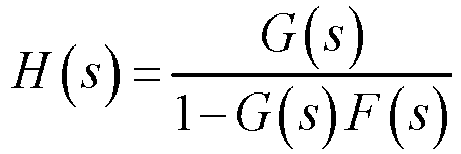
- Correspondingly, the generation of howling requires that a phase of an input signal acquired by the microphone in the feedback loop is the same as a phase of a sound wave signal fed back to the speaker, that is:


- In this scenario, the audio signal processing method provided by the present disclosure may be performed in an amplifier. In other words, after an audio signal acquired by the microphone is transmitted to the amplifier, the audio signal processing process in the embodiment of
FIG. 3 orFIG. 4 is immediately performed, and then an output signal is transmitted to the speaker for playback. As this cycle repeats, the howling can be suppressed. - Another possible scenario is shown in
FIG. 6. FIG. 6 is a schematic diagram of another scenario for audio signal processing according to an embodiment of the present disclosure, showing a loop in a scenario in which the terminal outputs sound loudly. In a case that two terminals are close to each other, the sound from the speaker of the terminal on the right is picked up by the microphone of the terminal on the left. After pre-processing and signal conversion, the sound is sent to the terminal via a network and is played via the speaker. Then the sound is picked up again by the microphone of the terminal on the left. As this cycle repeats, when a loop gain is greater than or equal to 1 at a certain frequency point and the phase is positive, a howling point is formed at this point. - The howling suppression is described below with reference to a specific example.
FIG. 7 is a flowchart of another audio signal processing method according to an embodiment of the present disclosure, and the method includes at least the following steps. - In 701, an audio signal of a target frequency is inputted, and the audio signal is divided into frames at every 20 milliseconds.
- In this embodiment, considering that a mobile phone voice call is generally processed at a sampling rate of 16 KHz, the target frequency may be set to 16 KHz.
- In 702, transformation into frequency domain is performed.
- In this embodiment, the audio signal is windowed and transformed into frequency domain by Fourier transformation. The window function may be a rectangular window, a Gaussian window, a Kaiser window, or the like, and the specific form of the function depends on an actual scenario.
- In 703, 42 feature values are extracted.
- In this embodiment, the feature values may include 22 Mel-scale frequency cepstral coefficients, for which reference may be made to a parameter in a voice recognition process, that is, the effective audio signal; the feature values may further include first-order or second-order derivatives of the first 6 coefficients used for indicating voice features; the feature values may further include a pitch period, because a voiced sound of a voice signal has a pitch period while a howling signal does not at a frequency below 500 Hz; and the feature values may further include the detection of a non-stable feature value because the voice is short-term stable.
- In 704, a first gain value is calculated with a RNN model.
- In this embodiment, the machine learning model is a RNN model for modeling time series rather than for considering only input and output frames. The specific process of obtaining the first gain value is similar to step 302 in the embodiment of
FIG. 3 , which is not repeated herein. - In 705, howling suppression is performed with the first gain value at a first howling point.
- In 706, a second howling point is detected, and a second gain value is obtained.
- In 707, howling suppression is performed with the second gain value.
- In 708, transformation into time domain is performed and an audio signal is outputted.
- In this embodiment, steps 705-708 are similar to steps 303-305 in the embodiment of
FIG. 3 , and for related features and descriptions, reference may be made to the above, which are not repeated herein. - With reference to the foregoing embodiments, a howling suppression result shown in
FIG. 8 can be obtained.FIG. 8 shows a comparison of audio signal processing according to an embodiment of the present disclosure, where an upper diagram is a spectrogram of the input signal before the howling suppression, and a lower diagram is a spectrogram of the signal after the howling suppression. It can be seen from the comparison that the clutter around the peak of the sample is significantly reduced, that is, howling has been suppressed by the audio processing method provided in the present disclosure before the howling is generated. - In the foregoing embodiments, the audio signal processing process is described. The following description is made in a specific scenario of game application.
FIG. 9 is a flowchart of another audio signal processing method according to an embodiment of the present disclosure, and the method includes at least the following steps. - In 901, a start instruction of a game is obtained.
- In this embodiment, the start instruction of the game may be a triggering of starting the game or starting a thread of a certain scene in the game, for example, entering of a battle scene.
- In 902, howling suppression is performed once a feature element is triggered.
- In this embodiment, the feature element is a physical or virtual button for activating a voice call function.
FIG. 10 is a schematic diagram of an interface of an audio signal processing method according to an embodiment of the present disclosure. A feature element A1 in the game interface is shown. Once any of the buttons is triggered, the audio processing method in the embodiment ofFIG. 3 orFIG. 4 is invoked. - In addition, the audio processing method in the present disclosure is not only applicable in a voice call between two users, but may also be applied in a voice call among a plurality of users.
FIG. 11 is a schematic diagram of an interface in another audio signal processing method according to an embodiment of the present disclosure, in which users are in a public voice scene B2. At this time, once afeature element B 1 is triggered, the audio processing method in the embodiment ofFIG. 3 orFIG. 4 is invoked. - In 903, a processed audio signal is outputted.
- In this embodiment, the audio signal subjected to the howling suppression is utilized to realize a clear voice call between two or more users.
- By virtue of the howling suppression performed on the audio signal between users in the game, the users can make a clearer voice call without affecting the communication due to howling, so that the user experience and the accuracy of a voice call are ensured in a scenario such as the game that requires high-efficiency and high-quality voice.
- In the foregoing embodiments, a machine learning model is applied. The machine learning model is pre-trained. The method may be performed by an audio processing device, which may be a terminal device or a server. The trained machine learning model may be applied to the foregoing audio signal processing solution. The scenario is described below.
FIG. 12 is a flowchart of a machine learning model training method according to an embodiment of the present disclosure, and the method includes at least the following steps. - In 1201, a reference signal and a voice sample signal are acquired.
- In this embodiment, the reference signal is a howling signal determined based on at least two variable elements, the variable elements including a program category, a program running period, or a program running location; and the voice sample signal is used for indicating an effective voice in a voice call progress.
- It can be understood that the program category in the variable elements may be training samples in different game scenarios of different games, such as Honor of Kings or Game for Peace. The program running period indicates a time period in which the training samples are acquired. For example, a voice call function is usually activated in a game during a time period from 8 pm to 9 pm, and the voice call is relatively intense, which may be additionally marked to generate the training samples. In addition, the program running location is geographic information of the voice acquisition. For example, the training samples are acquired at different geographic locations such as a market, a classroom, or a bedroom.
- The training samples are acquired under various conditions, and the howling points in the training samples are marked, so that a diversity of the training samples is ensured. Because the acquired signal is used as a voice sample, the machine learning model has a good performance in recognizing howling point(s) in voice frequency band.
- In 1202, a feature training set is generated according to the reference signal and the acquired signal.
- In this embodiment, the signals acquired under the different factors are assigned with labels and are classified, and corresponding howling points are marked to generate the feature training set.
- In 1203, the feature training set is inputted into a machine learning model to perform at least one round of training, to obtain a trained machine learning model.
- In this embodiment, the trained machine learning model is used for determining a howling point and a gain value according to the audio input signal. Specifically,
FIG. 13 is a schematic flowchart of training of a machine learning model according to an embodiment of the present disclosure. An RNN model including 3-level gated recurrence units (GRUs) is shown. Compared with a simple recurrence unit, the GRU has two additional gates, where a reset gate determines whether to memorize a current state for calculating a new state, and an update gate determines how much to change the current state according to a new input. In a case that the update gate is closed, the GRU can remember training information for a long time. First, the GRU at the first layer has a 42-dimensional input, and outputs a 24-dimensional feature and a voice activity detection (VAD) flag. The GRU at the second layer inputs the initial 42-dimensional feature and the 24-dimensional feature outputted by the first layer to output a 48-dimensional feature, for estimating a howling signal. A third layer inputs the initial 42-dimensional feature and the 42-dimensional feature outputted by the second layer to obtain an output; and adjusts the output according to a gain value in a training sample to update a model parameter, thereby implementing training of the RNN model. - The training process in the present disclosure may also be applied to a deep neural network model or a convolutional neural network model, which is not repeated herein.
- Through the process of training the machine learning model, the howling point distribution and a corresponding first gain value can be obtained after the audio signal is inputted into the machine learning model, and the accuracy of howling suppression in the voice frequency band is ensured.
- To practice the foregoing solutions in the embodiments of the present disclosure, related apparatuses for implementing the foregoing solutions are further provided below.
FIG. 14 is a schematic structural diagram of an audio signal processing apparatus according to an embodiment of the present disclosure, and the audiosignal processing apparatus 1400 includes: - an obtaining
unit 1401 configured to obtain a first audio input signal; - an
input unit 1402 configured to input the first audio input signal into a machine learning model to obtain a first gain value, the first gain value being used for indicating a suppression parameter for a first howling point in the first audio input signal, and the first howling point being used for indicating a howling point in a frequency band corresponding to an effective audio signal; - a
detection unit 1403 configured to process the first audio input signal according to the first gain value to obtain a second audio input signal; and - a
processing unit 1404 configured to process the second audio input signal according to a second gain value to obtain an audio output signal, the second gain value being used for indicating a suppression parameter for a second howling point, and the second howling point being used for indicating a howling point in a frequency band corresponding to an ineffective audio signal. - Optionally, in some possible implementations of the present disclosure, the
input unit 1402 is specifically configured to transform the audio input signal into frequency domain, to extract a plurality of audio features, the audio features being determined based on features of the effective audio signal or a howling sample. - The
input unit 1402 is specifically configured to input the audio features into the machine learning model to determine the first howling point. - The
input unit 1402 is specifically configured to determine the first gain value according to the first howling point. - The
input unit 1402 is specifically configured to process the first audio input signal according to the first gain value to obtain the second audio input signal. - The
detection unit 1403 is configured to check the second audio input signal to obtain the second howling point, and obtain the second gain value according to the second howling point, the second howling point being used for indicating the howling point in the frequency band corresponding to the ineffective audio signal in the second audio input signal. - The
processing unit 1404 is configured to process the second audio input signal according to the second gain value to obtain the audio output signal. - Optionally, the
input unit 1402 is specifically configured to transform the audio input signal into frequency domain, to extract the plurality of audio features, the audio features being determined based on features of the effective audio signal or the howling sample. - The
input unit 1402 is specifically configured to input the audio features into the machine learning model to determine the first howling point. - The
input unit 1402 is specifically configured to obtain the first gain value according to the first howling point. - Optionally, in some possible implementations of the present disclosure, the
input unit 1402 is specifically configured to adjust the first audio input signal to a target frequency for transformation into the frequency domain. - The
input unit 1402 is specifically configured to determine a plurality of sampling points in the first audio input signal transformed into the frequency domain. - The
input unit 1402 is specifically configured to extract the plurality of audio features based on the sampling points. - Optionally, in some possible implementations of the present disclosure, the
input unit 1402 is specifically configured to divide, based on a window function, the first audio input signal transformed into the frequency domain to obtain a plurality of sub-bands. - The
input unit 1402 is specifically configured to determine the plurality of sampling points in the sub-bands. - Optionally, in some possible implementations of the present disclosure, the
detection unit 1403 is specifically configured to obtain a power spectrum corresponding to the second audio input signal. - The
detection unit 1403 is specifically configured to detect an extreme value in the power spectrum and determine a corresponding candidate frequency point. - The
detection unit 1403 is specifically configured to determine the second howling point according to the candidate frequency point. - The
detection unit 1403 is specifically configured to process the second howling point according to the second gain value to obtain the audio output signal. - Optionally, in some possible implementations of the present disclosure, the
detection unit 1403 is specifically configured to obtain a plurality of frequency points adjacent to the candidate frequency point to determine a candidate range. - The
detection unit 1403 is specifically configured to determine an average value of the frequency points in the candidate range to obtain a peak-to-average ratio; and - The
detection unit 1403 is specifically configured to determine the candidate frequency point as the second howling point in a case that the peak-to-average ratio is greater than a howling threshold. - Optionally, in some possible implementations of the present disclosure, the
detection unit 1403 is further configured to obtain feature information in the effective audio signal, the feature information being determined based on a waveform feature indicated by the effective audio signal, and the effective audio signal being used for indicating a voice sample. - The
detection unit 1403 is specifically configured to detect the effective audio signal in the second audio input signal according to the feature information. - The
detection unit 1403 is specifically configured to perform a locking operation on the effective audio signal, the locking operation being used for indicating an object on which the second gain value does not act. - Optionally, in some possible implementations of the present disclosure, the
processing unit 1404 is specifically configured to determine a plurality of gained frames corresponding to the second howling point.
theprocessing unit 1404 is specifically configured to process the gained frames according to a smoothing formula to update the audio output signal. - Optionally, in some possible implementations of the present disclosure, the obtaining
unit 1401 is specifically configured to obtain an acquired signal; - the obtaining
unit 1401 is specifically configured to convert the acquired signal into a digital signal; and - the obtaining
unit 1401 is specifically configured to input the digital signal into an amplifier to obtain the first audio input signal. - Optionally, in some possible implementations of the present disclosure, the obtaining
unit 1401 is specifically configured to input the digital signal into the amplifier to obtain an amplified signal; - the obtaining
unit 1401 is specifically configured to process the amplified signal according to a filter parameter to obtain a filtered amplified signal; and - the obtaining
unit 1401 is specifically configured to Fourier transform the filtered amplified signal into frequency domain to obtain the first audio input signal. - Optionally, in some possible implementations of the present disclosure, the audio signal processing method is applied to a voice call in a game, and the obtaining
unit 1401 is specifically configured to detect triggering of a feature element, the feature element being an element in a game interface; and
the obtainingunit 1401 is specifically configured to obtain the first audio input signal in a case that the feature element is triggered. - A first audio input signal is obtained; then the first audio input signal is inputted into a machine learning model to obtain a first gain value for processing a frequency band in which an effective audio signal is located; the first audio input signal is processed according to the first gain value to obtain a second audio input signal; next the second audio input signal is checked to obtain a second howling point, the second howling point being used for indicating a howling point in a frequency band corresponding to an ineffective audio signal in the second audio input signal; and the second audio input signal is processed according to a second gain value to obtain an audio output signal, the second gain value being used for indicating a suppression parameter for the second howling point. In this way, the howling is suppressed for the audio input signal at an initial stage and therefore will not loop with gains. Due to indication of howling points in the machine learning model, the convenience of model calculation, and further processing on the unprocessed howling point by using the second gain value, a rapid and thorough process of the howling suppression is implemented without affecting the effective audio signal, so that the accuracy and efficiency in audio processing are improved.
- The present disclosure further provides an
apparatus 1500 for training machine learning model.FIG. 15 is a schematic structural diagram of an apparatus for training machine learning model according to an embodiment of the present disclosure. The apparatus includes: anacquisition unit 1501, configured to acquire a reference signal and a voice sample signal, the reference signal being a howling signal determined based on at least two variable elements, the variable elements including a program category, a program running period, or a program running location, and the acquired signal being used for indicating an effective voice in a call process; - a
generation unit 1502, configured to generate a feature training set according to the reference signal and the acquired signal; and - a
training unit 1503, configured to input the feature training set into a machine learning model for at least one round of training, to obtain a trained machine learning model, the trained machine learning model being used for determining a howling point and gain value according to an audio input signal. - The embodiments of the present disclosure further provide a terminal device.
FIG. 16 is a schematic structural diagram of another terminal device according to an embodiment of the present disclosure. To facilitate the description, only parts related to the embodiments of the present disclosure are shown. For specific technical details that are not described, reference may be to the method in the embodiments of the present disclosure. The terminal may be any terminal device such as a mobile phone, a tablet computer, a personal digital assistant (PDA), a point of sales (POS), an on-board computer or the like. The terminal being a mobile phone is used as an example. -
FIG. 16 is a partial structural diagram of a mobile phone related to a terminal according to an embodiment of the present disclosure. Referring toFIG. 16 , the mobile phone includes: a radio frequency (RF)circuit 1610, amemory 1620, aninput unit 1630, adisplay unit 1640, asensor 1650, anaudio circuit 1660, a wireless fidelity (WiFi)module 1670, aprocessor 1680, and apower supply 1690. A person skilled in the art can understand that the structure of the mobile phone shown inFIG. 16 does not constitute a limitation on the mobile phone, and the mobile phone may include more or fewer components than those shown in the figure, or some components may be combined, or a different component deployment may be used. - The following describes the components of the mobile phone in detail with reference to
FIG. 16 . - The
RF circuit 1610 may be configured to receive and send signals during an information receiving and sending process or a call process. Specifically, theRF circuit 1610 receives downlink information from a base station, then delivers the downlink information to theprocessor 1680 for processing, and sends designed uplink data to the base station. Usually, theRF circuit 1610 includes, but not limited to, an antenna, at least one amplifier, a transceiver, a coupler, a low noise amplifier (LNA), and a duplexer. In addition, theRF circuit 1610 may communicate with a network and another device through wireless communication. - The
memory 1620 may be configured to store software programs and modules. Theprocessor 1680 runs the software programs and the modules stored in thememory 1620, to implement various functional applications and data processing of the mobile phone. - The
input unit 1630 may be configured to receive input digit or character information, and generate a key signal input related to the user setting and function control of the mobile phone. Specifically, theinput unit 1630 may include atouch panel 1631 and anotherinput device 1632. - The
display unit 1640 may be configured to display information inputted by the user or information provided for the user, and various menus of the mobile phone. - The mobile phone may further include at least one
sensor 1650 such as an optical sensor, a motion sensor, and other sensors. - The
audio circuit 1660, aspeaker 1661, and amicrophone 1662 may provide audio interfaces between the user and the mobile phone. Theaudio circuit 1660 may convert received audio data into an electrical signal and transmit the electrical signal to thespeaker 1661. Thespeaker 1661 converts the electrical signal into a sound signal for output. On the other hand, themicrophone 1662 converts an acquired sound signal into an electrical signal. Theaudio circuit 1660 receives the electrical signal, converts the electrical signal into audio data, and outputs the audio data to theprocessor 1680 for processing. Then, the processor transmits the audio data to, for example, another mobile phone through theRF circuit 1610, or outputs the audio data to thememory 1620 for further processing. - WiFi is a short-range wireless transmission technology. Although
FIG. 16 shows theWiFi module 1670, it can be understood that the Wi-Fi module is not a necessary component of the mobile phone, and the Wi-Fi module may be omitted as required without changing the essence of the present disclosure is not changed. - The
processor 1680 is a control center of the mobile phone, and is connected to various parts of the mobile phone through various interfaces and lines. By running or executing software programs and/or modules stored in thememory 1620, and invoking data stored in thememory 1620, the processor performs various functions of the mobile phone and performs data processing, so that the entire mobile phone is monitored. - In the embodiments of the present disclosure, the
processor 1680 included in the terminal further has a function of performing each step of the above audio signal processing method or the model training method. - The embodiments of the present disclosure further provide a server.
FIG. 17 is a schematic structural diagram of a server according to an embodiment of the present disclosure. Theserver 1700 may vary greatly due to different configurations or performance, and may include one or more central processing units (CPUs) 1722 and amemory 1732, and one ormore storage media 1730 thatstore application programs 1742 ordata 1744. - The
server 1700 may further include one ormore power supplies 1726, one or more wired orwireless network interfaces 1750, one or more input/output interfaces 1758, and/or one ormore operating systems 1741. - The steps performed by the model training apparatus in the foregoing embodiments may be based on the server structure shown in
FIG. 17 . - The embodiments of the present disclosure further provide a computer-readable storage medium having a computer program stored thereon, the computer program being configured to implement the steps performed by the audio signal processing apparatus in the foregoing method described in the embodiments of
FIG. 2 to FIG. 13 . - The embodiments of the present disclosure further provide a computer program product including audio signal processing instructions, the computer program product, when running on a computer, causing the computer to perform the steps performed by the audio signal processing apparatus in the foregoing method described in the embodiments of
FIG. 2 to FIG. 13 . - The embodiments of the present disclosure further provide an audio signal processing system. The audio signal processing system may include the audio signal processing apparatus described in the embodiment of
FIG. 14 or the terminal device inFIG. 16 . - A person skilled in the art can clearly understand that for convenience and conciseness of description, for specific working processes of the foregoing systems, devices and units, reference may be made to the corresponding processes in the foregoing method embodiments, and details are not described herein again.
- It should be understood that the system, apparatus, and method disclosed in several embodiments of the present disclosure may be implemented in other manners.
- When the integrated unit is implemented in the form of a software functional unit and sold or used as an independent product, the integrated unit may be stored in a computer-readable storage medium. Based on such an understanding, the technical solutions of the present disclosure or the part contributing to the related art, or all or some of the technical solutions may be implemented in the form of a software product. The computer software product is stored in a storage medium and includes several instructions for instructing a computer device (which may be a personal computer, an audio signal processing apparatus, a network device, or the like) to perform all or some of the steps of the methods described in the embodiments of the present disclosure.
- The foregoing embodiments are merely intended for describing the technical solutions of the present disclosure, but not for limiting the present disclosure. Although the present disclosure is described in detail with reference to the foregoing embodiments, persons of ordinary skill in the art are to understand that they may still make modifications to the technical solutions described in the foregoing embodiments or make equivalent replacements to some technical features thereof, without departing from the spirit and scope of the technical solutions of the embodiments of the present disclosure.
Claims (16)
- An audio signal processing method, performed by a terminal device, the method comprising:obtaining a first audio input signal;inputting the first audio input signal into a machine learning model to obtain a first howling point, and obtaining a first gain value according to the first howling point, the first howling point being used for indicating a howling point in a frequency band corresponding to an effective audio signal in the first audio input signal, and the first gain value being used for indicating a suppression parameter for the first howling point;processing the first audio input signal according to the first gain value to obtain a second audio input signal;checking the second audio input signal to obtain a second howling point, and obtaining a second gain value according to the second howling point, the second howling point being used for indicating a howling point in a frequency band corresponding to an ineffective audio signal in the second audio input signal; andprocessing the second audio input signal according to the second gain value to obtain an audio output signal.
- The method according to claim 1, the inputting the first audio input signal into a machine learning model to obtain a first howling point, and obtaining a first gain value according to the first howling point comprising:transforming the first audio input signal into frequency domain to extract a plurality of audio features, the audio features being determined based on features of the effective audio signal;inputting a first audio feature into the machine learning model to determine the first howling point; andobtaining the first gain value according to the first howling point.
- The method according to claim 2, the transforming the first audio input signal into frequency domain to extract a plurality of audio features comprising:adjusting the first audio input signal to a target frequency for transformation into the frequency domain;determining a plurality of sampling points in the first audio input signal transformed into the frequency domain; andextracting the plurality of audio features based on the sampling points.
- The method according to claim 3, the determining a plurality of sampling points in the first audio input signal transformed into the frequency domain comprising:dividing, based on a window function, the first audio input signal transformed into the frequency domain to obtain a plurality of sub-bands; anddetermining the plurality of sampling points in the sub-bands.
- The method according to claim 1, the processing the second audio input signal according to the second gain value to obtain an audio output signal comprising:obtaining a power spectrum corresponding to the second audio input signal;detecting an extreme value in the power spectrum, and determining a candidate frequency point corresponding to the extreme value;determining the second howling point according to the candidate frequency point; andprocessing the second howling point according to the second gain value to obtain the audio output signal.
- The method according to claim 5, the determining the second howling point according to the candidate frequency point comprising:obtaining a plurality of frequency points adjacent to the candidate frequency point to determine a candidate range;determining an average frequency value of the frequency points in the candidate range to obtain a peak-to-average ratio; anddetermining the candidate frequency point as the second howling point in a case that the peak-to-average ratio is greater than a howling threshold.
- The method according to claim 5, after the determining the second howling point according to the candidate frequency point, further comprising:obtaining feature information in the effective audio signal, the feature information being determined based on a waveform feature indicated by the effective audio signal;detecting the corresponding effective audio signal in the second audio input signal according to the feature information; andperforming a lock operation on the effective audio signal, the lock operation being used for indicating an object on which the second gain value does not act.
- The method according to claim 5, further comprising:determining a plurality of gained frames corresponding to the second howling point; andprocessing the gained frames according to a smoothing formula to update the audio output signal.
- The method according to any one of claims 1 to 8, the audio signal processing method being applied to a voice call in a game, and the obtaining a first audio input signal comprising:detecting triggering of a feature element, the feature element being an element in an interface of the game; andobtaining the first audio input signal in a case that the feature element is triggered.
- The method according to any one of claims 1 to 8, the machine learning model being a recurrent neural network model, and the first audio input signal and the audio output signal being applied in a voice call of the terminal device.
- A method for training a machine learning model, performed by an audio processing device, the method comprising:acquiring a reference signal and a voice sample signal, the reference signal being a howling signal determined based on at least two variable elements, the variable elements comprising a program category, a program running period, or a program running location, and the acquired signal being used for indicating an effective voice in a call;generating a feature training set according to the reference signal and the acquired signal; andinputting the feature training set into the machine learning model for performing at least one round of training to obtain a trained machine learning model, the trained machine learning model being used for determining a corresponding howling point and gain value according to an audio input signal.
- An audio signal processing apparatus comprising:an obtaining unit configured to obtain a first audio input signal;an input unit configured to input the first audio input signal into a machine learning model to obtain a first howling point; to obtain a first gain value according to the first howling point, the first howling point being used for indicating a howling point in a frequency band corresponding to an effective audio signal in the first audio input signal, and the first gain value being used for indicating a suppression parameter for the first howling point; and to process the first audio input signal according to the first gain value to obtain a second audio input signal;a detection unit configured to check the second audio input signal to obtain a second howling point, and to obtain a second gain value according to the second howling point, the second howling point being used for indicating a howling point in a frequency band corresponding to an ineffective audio signal in the second audio input signal; anda processing unit, configured to process the second audio input signal according to the second gain value to obtain an audio output signal.
- An apparatus for training a machine learning model, the apparatus comprising:an acquisition unit configured to acquire a reference signal and a voice sample signal, the reference signal being a howling signal determined based on at least two variable elements, the variable elements comprising a program category, a program running period, or a program running location, and the acquired signal being used for indicating an effective voice in a call;a generation unit configured to generate a feature training set according to the reference signal and the acquired signal; anda training unit configured to input the feature training set into the machine learning model for performing at least one round of training to obtain a trained machine learning model, the trained machine learning model being used for determining a corresponding howling point and gain value according to an audio input signal.
- A computer device comprising a processor and a memory,
the memory being configured to store program codes; and the processor being configured to perform, according to instructions in the program codes, the audio signal processing method according to any one of claims 1 to 10, or the method for training the machine learning model according to claim 11. - A computer-readable storage medium storing with a computer program, the computer program being configured to implement the audio signal processing method according to any one of claims 1 to 10, or the method for training the machine learning model according to claim 11.
- A computer program product comprising instructions, the computer program product, when running on a computer, causing the computer to perform the audio signal processing method according to any one of claims 1 to 10, or the method for training the machine learning model according to claim 11.
Applications Claiming Priority (2)
| Application Number | Priority Date | Filing Date | Title |
|---|---|---|---|
| CN202010023045.6A CN111210021B (en) | 2020-01-09 | 2020-01-09 | An audio signal processing method, a model training method, and related devices |
| PCT/CN2020/124244 WO2021139327A1 (en) | 2020-01-09 | 2020-10-28 | Audio signal processing method, model training method, and related apparatus |
Publications (3)
| Publication Number | Publication Date |
|---|---|
| EP3998557A1 true EP3998557A1 (en) | 2022-05-18 |
| EP3998557A4 EP3998557A4 (en) | 2022-10-26 |
| EP3998557B1 EP3998557B1 (en) | 2023-08-16 |
Family
ID=70789591
Family Applications (1)
| Application Number | Title | Priority Date | Filing Date |
|---|---|---|---|
| EP20911413.1A Active EP3998557B1 (en) | 2020-01-09 | 2020-10-28 | Audio signal processing method and related apparatus |
Country Status (4)
| Country | Link |
|---|---|
| US (1) | US12080315B2 (en) |
| EP (1) | EP3998557B1 (en) |
| CN (1) | CN111210021B (en) |
| WO (1) | WO2021139327A1 (en) |
Cited By (2)
| Publication number | Priority date | Publication date | Assignee | Title |
|---|---|---|---|---|
| WO2024206654A1 (en) * | 2023-03-30 | 2024-10-03 | Qualcomm Incorporated | Machine learning-based feedback cancellation |
| US12520080B2 (en) | 2023-03-30 | 2026-01-06 | Qualcomm Incorporated | Audio processing based on target signal-to-noise ratio |
Families Citing this family (26)
| Publication number | Priority date | Publication date | Assignee | Title |
|---|---|---|---|---|
| CN111210021B (en) * | 2020-01-09 | 2023-04-14 | 腾讯科技(深圳)有限公司 | An audio signal processing method, a model training method, and related devices |
| CN111768795B (en) * | 2020-07-09 | 2024-08-30 | 腾讯科技(深圳)有限公司 | Noise suppression method, device, equipment and storage medium for voice signal |
| US20230267947A1 (en) * | 2020-07-31 | 2023-08-24 | Dolby Laboratories Licensing Corporation | Noise reduction using machine learning |
| CN114333749B (en) * | 2020-09-30 | 2025-07-15 | 腾讯科技(深圳)有限公司 | Howling suppression method, device, computer equipment and storage medium |
| CN112309417B (en) * | 2020-10-22 | 2023-07-07 | 瓴盛科技有限公司 | Method, device, system and readable medium for processing audio signal with wind noise suppression |
| CN112669868B (en) * | 2020-12-23 | 2021-11-26 | 广州智讯通信系统有限公司 | Voice howling suppression method, device and storage medium based on command scheduling system |
| CN113473316B (en) * | 2021-06-30 | 2023-01-31 | 苏州科达科技股份有限公司 | Audio signal processing method, device and storage medium |
| CN113891217B (en) * | 2021-11-08 | 2024-05-31 | 易兆微电子(杭州)股份有限公司 | Howling suppression method, device, electronic device and storage medium |
| CN114067837B (en) * | 2021-11-15 | 2025-05-27 | 杭州网易智企科技有限公司 | Howling detection method and device, medium and computing equipment |
| CN113921023B (en) * | 2021-12-14 | 2022-04-08 | 北京百瑞互联技术有限公司 | Bluetooth audio squeal suppression method, device, medium and Bluetooth equipment |
| CN114267370A (en) * | 2021-12-28 | 2022-04-01 | 上海富瀚微电子股份有限公司 | Howling suppression method and device based on frequency domain processing |
| CN114822479B (en) * | 2022-04-08 | 2025-04-04 | 深圳市龙芯威半导体科技有限公司 | Signal howling suppression method, device, computer equipment and storage medium |
| CN114827833B (en) * | 2022-04-13 | 2025-08-22 | 展讯通信(上海)有限公司 | Howling suppression method, device, chip and electronic equipment |
| CN116233697B (en) * | 2022-04-19 | 2023-09-05 | 中国科学院声学研究所 | Acoustic feedback suppression method and system based on deep learning |
| CN115101086A (en) * | 2022-05-25 | 2022-09-23 | 北京声智科技有限公司 | Audio processing model training method, device, equipment and medium |
| CN115223584B (en) * | 2022-09-19 | 2022-12-09 | 腾讯科技(深圳)有限公司 | Audio data processing method, device, equipment and storage medium |
| CN115567864B (en) * | 2022-12-02 | 2024-03-01 | 浙江华创视讯科技有限公司 | Microphone gain adjusting method and device, storage medium and electronic equipment |
| CN116320133A (en) * | 2023-03-31 | 2023-06-23 | Oppo广东移动通信有限公司 | Audio playback method, device, electronic device and storage medium |
| CN116543793B (en) * | 2023-05-05 | 2025-12-30 | 小米科技(武汉)有限公司 | Methods, devices, electronic equipment, and storage media for detecting howling voice signals |
| CN116546408A (en) * | 2023-05-06 | 2023-08-04 | 上海联影微电子科技有限公司 | Feedback suppression method, device and storage medium |
| US12562183B2 (en) * | 2023-05-17 | 2026-02-24 | Tencent America LLC | Deep learning for joint acoustic echo and acoustic howling suppression in hybrid meetings |
| US20240404542A1 (en) * | 2023-06-01 | 2024-12-05 | Tencent America LLC | Deep ahs: a deep learning approach to acoustic howling suppression |
| CN117316175B (en) * | 2023-11-28 | 2024-01-30 | 山东放牛班动漫有限公司 | Intelligent encoding storage method and system for cartoon data |
| CN117351925B (en) * | 2023-12-06 | 2024-04-12 | 科大讯飞(苏州)科技有限公司 | Howling suppression method, device, electronic equipment and storage medium |
| US12579970B2 (en) | 2024-05-06 | 2026-03-17 | Motorola Solutions, Inc. | Device, system and method for retraining a microphonic noise compensation model |
| CN119673149B (en) * | 2025-02-18 | 2025-10-21 | 深圳市龙芯威半导体科技有限公司 | Audio recognition method, device, computer equipment and storage medium |
Family Cites Families (17)
| Publication number | Priority date | Publication date | Assignee | Title |
|---|---|---|---|---|
| JP2728120B2 (en) * | 1995-01-24 | 1998-03-18 | 日本電気株式会社 | Echo canceller device |
| SG98435A1 (en) * | 2000-12-08 | 2003-09-19 | Nanyang Polytechnic | A method for detecting and removing howling |
| JP4681163B2 (en) * | 2001-07-16 | 2011-05-11 | パナソニック株式会社 | Howling detection and suppression device, acoustic device including the same, and howling detection and suppression method |
| US8144895B2 (en) * | 2005-05-18 | 2012-03-27 | Panasonic Corporation | Howling control apparatus and acoustic apparatus |
| KR20150043858A (en) * | 2013-10-15 | 2015-04-23 | 한국전자통신연구원 | Apparatus and methdo for howling suppression |
| CN105872910A (en) * | 2016-03-23 | 2016-08-17 | 成都普创通信技术股份有限公司 | Audio signal squeaking detection method |
| EP3301675B1 (en) * | 2016-09-28 | 2019-08-21 | Panasonic Intellectual Property Corporation of America | Parameter prediction device and parameter prediction method for acoustic signal processing |
| EP3474280B1 (en) * | 2017-10-19 | 2021-07-07 | Goodix Technology (HK) Company Limited | Signal processor for speech signal enhancement |
| CN108449493B (en) * | 2018-03-12 | 2020-06-26 | Oppo广东移动通信有限公司 | Voice call data processing method and device, storage medium and mobile terminal |
| CN109121057B (en) * | 2018-08-30 | 2020-11-06 | 北京聆通科技有限公司 | Intelligent hearing aid method and system |
| CN109637552A (en) * | 2018-11-29 | 2019-04-16 | 河北远东通信系统工程有限公司 | A kind of method of speech processing for inhibiting audio frequency apparatus to utter long and high-pitched sounds |
| CN109461455B (en) * | 2018-11-30 | 2022-08-30 | 维沃移动通信(深圳)有限公司 | System and method for eliminating howling |
| CN109831732A (en) | 2019-02-25 | 2019-05-31 | 天津大学 | Intelligent chauvent's criterion device and method based on smart phone |
| CN109788400B (en) * | 2019-03-06 | 2020-12-18 | 哈尔滨工业大学(深圳) | A neural network howling suppression method, system and storage medium for digital hearing aids |
| CN110234051B (en) * | 2019-06-27 | 2021-08-27 | 中科上声(苏州)电子有限公司 | Howling prevention sound amplification method and system based on deep learning |
| CN110536215B (en) * | 2019-09-09 | 2021-06-29 | 普联技术有限公司 | Method and apparatus for audio signal processing, calculation device, and storage medium |
| CN111210021B (en) * | 2020-01-09 | 2023-04-14 | 腾讯科技(深圳)有限公司 | An audio signal processing method, a model training method, and related devices |
-
2020
- 2020-01-09 CN CN202010023045.6A patent/CN111210021B/en active Active
- 2020-10-28 WO PCT/CN2020/124244 patent/WO2021139327A1/en not_active Ceased
- 2020-10-28 EP EP20911413.1A patent/EP3998557B1/en active Active
-
2022
- 2022-03-22 US US17/700,862 patent/US12080315B2/en active Active
Cited By (2)
| Publication number | Priority date | Publication date | Assignee | Title |
|---|---|---|---|---|
| WO2024206654A1 (en) * | 2023-03-30 | 2024-10-03 | Qualcomm Incorporated | Machine learning-based feedback cancellation |
| US12520080B2 (en) | 2023-03-30 | 2026-01-06 | Qualcomm Incorporated | Audio processing based on target signal-to-noise ratio |
Also Published As
| Publication number | Publication date |
|---|---|
| US20220215853A1 (en) | 2022-07-07 |
| EP3998557A4 (en) | 2022-10-26 |
| CN111210021B (en) | 2023-04-14 |
| CN111210021A (en) | 2020-05-29 |
| US12080315B2 (en) | 2024-09-03 |
| EP3998557B1 (en) | 2023-08-16 |
| WO2021139327A1 (en) | 2021-07-15 |
Similar Documents
| Publication | Publication Date | Title |
|---|---|---|
| EP3998557B1 (en) | Audio signal processing method and related apparatus | |
| US10504539B2 (en) | Voice activity detection systems and methods | |
| US12380895B2 (en) | Analysing speech signals | |
| CN108597496B (en) | Voice generation method and device based on generation type countermeasure network | |
| US11475907B2 (en) | Method and device of denoising voice signal | |
| US20200227071A1 (en) | Analysing speech signals | |
| CN100490314C (en) | Audio signal processing for speech communication | |
| US6990446B1 (en) | Method and apparatus using spectral addition for speaker recognition | |
| US12597433B2 (en) | Speech signal enhancement method and apparatus, and electronic device | |
| CN105118522B (en) | Noise detection method and device | |
| US20060100866A1 (en) | Influencing automatic speech recognition signal-to-noise levels | |
| US20240407342A1 (en) | Method, system, and device for classifying feeding intensity of fish school | |
| US11081115B2 (en) | Speaker recognition | |
| CN112382301A (en) | Noise-containing voice gender identification method and system based on lightweight neural network | |
| US5768392A (en) | Blind adaptive filtering of unknown signals in unknown noise in quasi-closed loop system | |
| US20230186943A1 (en) | Voice activity detection method and apparatus, and storage medium | |
| CN113724692B (en) | A method for audio acquisition and anti-interference processing of telephone scenes based on voiceprint features | |
| CN116612778B (en) | Echo and noise suppression method, related device and medium | |
| JP2001520764A (en) | Speech analysis system | |
| CN116312561A (en) | A method, system and device for voiceprint recognition, authentication, noise reduction and voice enhancement of personnel in a power dispatching system | |
| LU507134B1 (en) | Intelligent voice recognition method and system for ar helmets | |
| CN113593604A (en) | Method, device and storage medium for detecting audio quality | |
| CN115273909A (en) | Voice activity detection method, device, equipment and computer readable storage medium | |
| CN117998254B (en) | Broken sound restoration method, device and storage medium | |
| CN110689875A (en) | Language identification method and device and readable storage medium |
Legal Events
| Date | Code | Title | Description |
|---|---|---|---|
| STAA | Information on the status of an ep patent application or granted ep patent |
Free format text: STATUS: THE INTERNATIONAL PUBLICATION HAS BEEN MADE |
|
| PUAI | Public reference made under article 153(3) epc to a published international application that has entered the european phase |
Free format text: ORIGINAL CODE: 0009012 |
|
| STAA | Information on the status of an ep patent application or granted ep patent |
Free format text: STATUS: REQUEST FOR EXAMINATION WAS MADE |
|
| 17P | Request for examination filed |
Effective date: 20220209 |
|
| AK | Designated contracting states |
Kind code of ref document: A1 Designated state(s): AL AT BE BG CH CY CZ DE DK EE ES FI FR GB GR HR HU IE IS IT LI LT LU LV MC MK MT NL NO PL PT RO RS SE SI SK SM TR |
|
| RAP3 | Party data changed (applicant data changed or rights of an application transferred) |
Owner name: TENCENT TECHNOLOGY (SHENZHEN) COMPANY LIMITED |
|
| A4 | Supplementary search report drawn up and despatched |
Effective date: 20220927 |
|
| RIC1 | Information provided on ipc code assigned before grant |
Ipc: G06N 3/04 20060101ALN20220921BHEP Ipc: H04R 3/02 20060101ALI20220921BHEP Ipc: G06N 3/08 20060101ALI20220921BHEP Ipc: G10L 21/0316 20130101ALI20220921BHEP Ipc: G06N 20/00 20190101ALI20220921BHEP Ipc: H04M 9/08 20060101AFI20220921BHEP |
|
| REG | Reference to a national code |
Ref country code: DE Ref legal event code: R079 Free format text: PREVIOUS MAIN CLASS: G06N0020000000 Ipc: H04M0009080000 Ref country code: DE Ref legal event code: R079 Ref document number: 602020015994 Country of ref document: DE Free format text: PREVIOUS MAIN CLASS: G06N0020000000 Ipc: H04M0009080000 |
|
| GRAP | Despatch of communication of intention to grant a patent |
Free format text: ORIGINAL CODE: EPIDOSNIGR1 |
|
| STAA | Information on the status of an ep patent application or granted ep patent |
Free format text: STATUS: GRANT OF PATENT IS INTENDED |
|
| DAV | Request for validation of the european patent (deleted) | ||
| DAX | Request for extension of the european patent (deleted) | ||
| RIC1 | Information provided on ipc code assigned before grant |
Ipc: G06N 3/04 20060101ALN20230308BHEP Ipc: G06N 3/044 20230101ALI20230308BHEP Ipc: H04R 3/02 20060101ALI20230308BHEP Ipc: G06N 3/08 20060101ALI20230308BHEP Ipc: G10L 21/0316 20130101ALI20230308BHEP Ipc: G06N 20/00 20190101ALI20230308BHEP Ipc: H04M 9/08 20060101AFI20230308BHEP |
|
| INTG | Intention to grant announced |
Effective date: 20230329 |
|
| GRAS | Grant fee paid |
Free format text: ORIGINAL CODE: EPIDOSNIGR3 |
|
| GRAA | (expected) grant |
Free format text: ORIGINAL CODE: 0009210 |
|
| STAA | Information on the status of an ep patent application or granted ep patent |
Free format text: STATUS: THE PATENT HAS BEEN GRANTED |
|
| AK | Designated contracting states |
Kind code of ref document: B1 Designated state(s): AL AT BE BG CH CY CZ DE DK EE ES FI FR GB GR HR HU IE IS IT LI LT LU LV MC MK MT NL NO PL PT RO RS SE SI SK SM TR |
|
| REG | Reference to a national code |
Ref country code: CH Ref legal event code: EP |
|
| REG | Reference to a national code |
Ref country code: DE Ref legal event code: R096 Ref document number: 602020015994 Country of ref document: DE |
|
| REG | Reference to a national code |
Ref country code: IE Ref legal event code: FG4D |
|
| REG | Reference to a national code |
Ref country code: LT Ref legal event code: MG9D |
|
| REG | Reference to a national code |
Ref country code: NL Ref legal event code: MP Effective date: 20230816 |
|
| REG | Reference to a national code |
Ref country code: AT Ref legal event code: MK05 Ref document number: 1601216 Country of ref document: AT Kind code of ref document: T Effective date: 20230816 |
|
| PG25 | Lapsed in a contracting state [announced via postgrant information from national office to epo] |
Ref country code: GR Free format text: LAPSE BECAUSE OF FAILURE TO SUBMIT A TRANSLATION OF THE DESCRIPTION OR TO PAY THE FEE WITHIN THE PRESCRIBED TIME-LIMIT Effective date: 20231117 |
|
| PG25 | Lapsed in a contracting state [announced via postgrant information from national office to epo] |
Ref country code: IS Free format text: LAPSE BECAUSE OF FAILURE TO SUBMIT A TRANSLATION OF THE DESCRIPTION OR TO PAY THE FEE WITHIN THE PRESCRIBED TIME-LIMIT Effective date: 20231216 |
|
| PG25 | Lapsed in a contracting state [announced via postgrant information from national office to epo] |
Ref country code: SE Free format text: LAPSE BECAUSE OF FAILURE TO SUBMIT A TRANSLATION OF THE DESCRIPTION OR TO PAY THE FEE WITHIN THE PRESCRIBED TIME-LIMIT Effective date: 20230816 Ref country code: RS Free format text: LAPSE BECAUSE OF FAILURE TO SUBMIT A TRANSLATION OF THE DESCRIPTION OR TO PAY THE FEE WITHIN THE PRESCRIBED TIME-LIMIT Effective date: 20230816 Ref country code: PT Free format text: LAPSE BECAUSE OF FAILURE TO SUBMIT A TRANSLATION OF THE DESCRIPTION OR TO PAY THE FEE WITHIN THE PRESCRIBED TIME-LIMIT Effective date: 20231218 Ref country code: NO Free format text: LAPSE BECAUSE OF FAILURE TO SUBMIT A TRANSLATION OF THE DESCRIPTION OR TO PAY THE FEE WITHIN THE PRESCRIBED TIME-LIMIT Effective date: 20231116 Ref country code: NL Free format text: LAPSE BECAUSE OF FAILURE TO SUBMIT A TRANSLATION OF THE DESCRIPTION OR TO PAY THE FEE WITHIN THE PRESCRIBED TIME-LIMIT Effective date: 20230816 Ref country code: LV Free format text: LAPSE BECAUSE OF FAILURE TO SUBMIT A TRANSLATION OF THE DESCRIPTION OR TO PAY THE FEE WITHIN THE PRESCRIBED TIME-LIMIT Effective date: 20230816 Ref country code: LT Free format text: LAPSE BECAUSE OF FAILURE TO SUBMIT A TRANSLATION OF THE DESCRIPTION OR TO PAY THE FEE WITHIN THE PRESCRIBED TIME-LIMIT Effective date: 20230816 Ref country code: IS Free format text: LAPSE BECAUSE OF FAILURE TO SUBMIT A TRANSLATION OF THE DESCRIPTION OR TO PAY THE FEE WITHIN THE PRESCRIBED TIME-LIMIT Effective date: 20231216 Ref country code: HR Free format text: LAPSE BECAUSE OF FAILURE TO SUBMIT A TRANSLATION OF THE DESCRIPTION OR TO PAY THE FEE WITHIN THE PRESCRIBED TIME-LIMIT Effective date: 20230816 Ref country code: GR Free format text: LAPSE BECAUSE OF FAILURE TO SUBMIT A TRANSLATION OF THE DESCRIPTION OR TO PAY THE FEE WITHIN THE PRESCRIBED TIME-LIMIT Effective date: 20231117 Ref country code: FI Free format text: LAPSE BECAUSE OF FAILURE TO SUBMIT A TRANSLATION OF THE DESCRIPTION OR TO PAY THE FEE WITHIN THE PRESCRIBED TIME-LIMIT Effective date: 20230816 Ref country code: AT Free format text: LAPSE BECAUSE OF FAILURE TO SUBMIT A TRANSLATION OF THE DESCRIPTION OR TO PAY THE FEE WITHIN THE PRESCRIBED TIME-LIMIT Effective date: 20230816 |
|
| PG25 | Lapsed in a contracting state [announced via postgrant information from national office to epo] |
Ref country code: PL Free format text: LAPSE BECAUSE OF FAILURE TO SUBMIT A TRANSLATION OF THE DESCRIPTION OR TO PAY THE FEE WITHIN THE PRESCRIBED TIME-LIMIT Effective date: 20230816 |
|
| PG25 | Lapsed in a contracting state [announced via postgrant information from national office to epo] |
Ref country code: ES Free format text: LAPSE BECAUSE OF FAILURE TO SUBMIT A TRANSLATION OF THE DESCRIPTION OR TO PAY THE FEE WITHIN THE PRESCRIBED TIME-LIMIT Effective date: 20230816 |
|
| PG25 | Lapsed in a contracting state [announced via postgrant information from national office to epo] |
Ref country code: SM Free format text: LAPSE BECAUSE OF FAILURE TO SUBMIT A TRANSLATION OF THE DESCRIPTION OR TO PAY THE FEE WITHIN THE PRESCRIBED TIME-LIMIT Effective date: 20230816 Ref country code: RO Free format text: LAPSE BECAUSE OF FAILURE TO SUBMIT A TRANSLATION OF THE DESCRIPTION OR TO PAY THE FEE WITHIN THE PRESCRIBED TIME-LIMIT Effective date: 20230816 Ref country code: ES Free format text: LAPSE BECAUSE OF FAILURE TO SUBMIT A TRANSLATION OF THE DESCRIPTION OR TO PAY THE FEE WITHIN THE PRESCRIBED TIME-LIMIT Effective date: 20230816 Ref country code: EE Free format text: LAPSE BECAUSE OF FAILURE TO SUBMIT A TRANSLATION OF THE DESCRIPTION OR TO PAY THE FEE WITHIN THE PRESCRIBED TIME-LIMIT Effective date: 20230816 Ref country code: DK Free format text: LAPSE BECAUSE OF FAILURE TO SUBMIT A TRANSLATION OF THE DESCRIPTION OR TO PAY THE FEE WITHIN THE PRESCRIBED TIME-LIMIT Effective date: 20230816 Ref country code: CZ Free format text: LAPSE BECAUSE OF FAILURE TO SUBMIT A TRANSLATION OF THE DESCRIPTION OR TO PAY THE FEE WITHIN THE PRESCRIBED TIME-LIMIT Effective date: 20230816 Ref country code: SK Free format text: LAPSE BECAUSE OF FAILURE TO SUBMIT A TRANSLATION OF THE DESCRIPTION OR TO PAY THE FEE WITHIN THE PRESCRIBED TIME-LIMIT Effective date: 20230816 |
|
| REG | Reference to a national code |
Ref country code: DE Ref legal event code: R097 Ref document number: 602020015994 Country of ref document: DE |
|
| PG25 | Lapsed in a contracting state [announced via postgrant information from national office to epo] |
Ref country code: MC Free format text: LAPSE BECAUSE OF FAILURE TO SUBMIT A TRANSLATION OF THE DESCRIPTION OR TO PAY THE FEE WITHIN THE PRESCRIBED TIME-LIMIT Effective date: 20230816 |
|
| REG | Reference to a national code |
Ref country code: CH Ref legal event code: PL |
|
| REG | Reference to a national code |
Ref country code: BE Ref legal event code: MM Effective date: 20231031 |
|
| PG25 | Lapsed in a contracting state [announced via postgrant information from national office to epo] |
Ref country code: LU Free format text: LAPSE BECAUSE OF NON-PAYMENT OF DUE FEES Effective date: 20231028 |
|
| PLBE | No opposition filed within time limit |
Free format text: ORIGINAL CODE: 0009261 |
|
| STAA | Information on the status of an ep patent application or granted ep patent |
Free format text: STATUS: NO OPPOSITION FILED WITHIN TIME LIMIT |
|
| PG25 | Lapsed in a contracting state [announced via postgrant information from national office to epo] |
Ref country code: LU Free format text: LAPSE BECAUSE OF NON-PAYMENT OF DUE FEES Effective date: 20231028 |
|
| PG25 | Lapsed in a contracting state [announced via postgrant information from national office to epo] |
Ref country code: CH Free format text: LAPSE BECAUSE OF NON-PAYMENT OF DUE FEES Effective date: 20231031 |
|
| 26N | No opposition filed |
Effective date: 20240517 |
|
| PG25 | Lapsed in a contracting state [announced via postgrant information from national office to epo] |
Ref country code: IT Free format text: LAPSE BECAUSE OF FAILURE TO SUBMIT A TRANSLATION OF THE DESCRIPTION OR TO PAY THE FEE WITHIN THE PRESCRIBED TIME-LIMIT Effective date: 20230816 Ref country code: CH Free format text: LAPSE BECAUSE OF NON-PAYMENT OF DUE FEES Effective date: 20231031 Ref country code: SI Free format text: LAPSE BECAUSE OF FAILURE TO SUBMIT A TRANSLATION OF THE DESCRIPTION OR TO PAY THE FEE WITHIN THE PRESCRIBED TIME-LIMIT Effective date: 20230816 |
|
| PG25 | Lapsed in a contracting state [announced via postgrant information from national office to epo] |
Ref country code: BE Free format text: LAPSE BECAUSE OF NON-PAYMENT OF DUE FEES Effective date: 20231031 |
|
| PG25 | Lapsed in a contracting state [announced via postgrant information from national office to epo] |
Ref country code: IE Free format text: LAPSE BECAUSE OF NON-PAYMENT OF DUE FEES Effective date: 20231028 |
|
| PG25 | Lapsed in a contracting state [announced via postgrant information from national office to epo] |
Ref country code: IE Free format text: LAPSE BECAUSE OF NON-PAYMENT OF DUE FEES Effective date: 20231028 |
|
| PG25 | Lapsed in a contracting state [announced via postgrant information from national office to epo] |
Ref country code: BG Free format text: LAPSE BECAUSE OF FAILURE TO SUBMIT A TRANSLATION OF THE DESCRIPTION OR TO PAY THE FEE WITHIN THE PRESCRIBED TIME-LIMIT Effective date: 20230816 |
|
| PG25 | Lapsed in a contracting state [announced via postgrant information from national office to epo] |
Ref country code: BG Free format text: LAPSE BECAUSE OF FAILURE TO SUBMIT A TRANSLATION OF THE DESCRIPTION OR TO PAY THE FEE WITHIN THE PRESCRIBED TIME-LIMIT Effective date: 20230816 |
|
| PG25 | Lapsed in a contracting state [announced via postgrant information from national office to epo] |
Ref country code: CY Free format text: LAPSE BECAUSE OF FAILURE TO SUBMIT A TRANSLATION OF THE DESCRIPTION OR TO PAY THE FEE WITHIN THE PRESCRIBED TIME-LIMIT; INVALID AB INITIO Effective date: 20201028 |
|
| PG25 | Lapsed in a contracting state [announced via postgrant information from national office to epo] |
Ref country code: HU Free format text: LAPSE BECAUSE OF FAILURE TO SUBMIT A TRANSLATION OF THE DESCRIPTION OR TO PAY THE FEE WITHIN THE PRESCRIBED TIME-LIMIT; INVALID AB INITIO Effective date: 20201028 |
|
| PG25 | Lapsed in a contracting state [announced via postgrant information from national office to epo] |
Ref country code: TR Free format text: LAPSE BECAUSE OF FAILURE TO SUBMIT A TRANSLATION OF THE DESCRIPTION OR TO PAY THE FEE WITHIN THE PRESCRIBED TIME-LIMIT Effective date: 20230816 |
|
| PGFP | Annual fee paid to national office [announced via postgrant information from national office to epo] |
Ref country code: DE Payment date: 20251020 Year of fee payment: 6 |
|
| PGFP | Annual fee paid to national office [announced via postgrant information from national office to epo] |
Ref country code: GB Payment date: 20251024 Year of fee payment: 6 |
|
| PGFP | Annual fee paid to national office [announced via postgrant information from national office to epo] |
Ref country code: FR Payment date: 20251017 Year of fee payment: 6 |