EP3998359A1 - Low-strength steel sheet for hot stamping, hot-stamped component, and method for manufacturing hot-stamped component - Google Patents
Low-strength steel sheet for hot stamping, hot-stamped component, and method for manufacturing hot-stamped component Download PDFInfo
- Publication number
- EP3998359A1 EP3998359A1 EP20856767.7A EP20856767A EP3998359A1 EP 3998359 A1 EP3998359 A1 EP 3998359A1 EP 20856767 A EP20856767 A EP 20856767A EP 3998359 A1 EP3998359 A1 EP 3998359A1
- Authority
- EP
- European Patent Office
- Prior art keywords
- steel sheet
- hot
- less
- hot stamping
- low
- Prior art date
- Legal status (The legal status is an assumption and is not a legal conclusion. Google has not performed a legal analysis and makes no representation as to the accuracy of the status listed.)
- Pending
Links
Images
Classifications
-
- C—CHEMISTRY; METALLURGY
- C21—METALLURGY OF IRON
- C21D—MODIFYING THE PHYSICAL STRUCTURE OF FERROUS METALS; GENERAL DEVICES FOR HEAT TREATMENT OF FERROUS OR NON-FERROUS METALS OR ALLOYS; MAKING METAL MALLEABLE, e.g. BY DECARBURISATION OR TEMPERING
- C21D8/00—Modifying the physical properties of ferrous metals or ferrous alloys by deformation combined with, or followed by, heat treatment
- C21D8/02—Modifying the physical properties of ferrous metals or ferrous alloys by deformation combined with, or followed by, heat treatment during manufacturing of plates or strips
-
- C—CHEMISTRY; METALLURGY
- C21—METALLURGY OF IRON
- C21D—MODIFYING THE PHYSICAL STRUCTURE OF FERROUS METALS; GENERAL DEVICES FOR HEAT TREATMENT OF FERROUS OR NON-FERROUS METALS OR ALLOYS; MAKING METAL MALLEABLE, e.g. BY DECARBURISATION OR TEMPERING
- C21D7/00—Modifying the physical properties of iron or steel by deformation
- C21D7/13—Modifying the physical properties of iron or steel by deformation by hot working
-
- C—CHEMISTRY; METALLURGY
- C22—METALLURGY; FERROUS OR NON-FERROUS ALLOYS; TREATMENT OF ALLOYS OR NON-FERROUS METALS
- C22C—ALLOYS
- C22C38/00—Ferrous alloys, e.g. steel alloys
- C22C38/004—Very low carbon steels, i.e. having a carbon content of less than 0,01%
-
- B—PERFORMING OPERATIONS; TRANSPORTING
- B21—MECHANICAL METAL-WORKING WITHOUT ESSENTIALLY REMOVING MATERIAL; PUNCHING METAL
- B21D—WORKING OR PROCESSING OF SHEET METAL OR METAL TUBES, RODS OR PROFILES WITHOUT ESSENTIALLY REMOVING MATERIAL; PUNCHING METAL
- B21D22/00—Shaping without cutting, by stamping, spinning, or deep-drawing
- B21D22/02—Stamping using rigid devices or tools
-
- C—CHEMISTRY; METALLURGY
- C21—METALLURGY OF IRON
- C21D—MODIFYING THE PHYSICAL STRUCTURE OF FERROUS METALS; GENERAL DEVICES FOR HEAT TREATMENT OF FERROUS OR NON-FERROUS METALS OR ALLOYS; MAKING METAL MALLEABLE, e.g. BY DECARBURISATION OR TEMPERING
- C21D1/00—General methods or devices for heat treatment, e.g. annealing, hardening, quenching or tempering
- C21D1/02—Hardening articles or materials formed by forging or rolling, with no further heating beyond that required for the formation
-
- C—CHEMISTRY; METALLURGY
- C21—METALLURGY OF IRON
- C21D—MODIFYING THE PHYSICAL STRUCTURE OF FERROUS METALS; GENERAL DEVICES FOR HEAT TREATMENT OF FERROUS OR NON-FERROUS METALS OR ALLOYS; MAKING METAL MALLEABLE, e.g. BY DECARBURISATION OR TEMPERING
- C21D1/00—General methods or devices for heat treatment, e.g. annealing, hardening, quenching or tempering
- C21D1/18—Hardening; Quenching with or without subsequent tempering
-
- C—CHEMISTRY; METALLURGY
- C21—METALLURGY OF IRON
- C21D—MODIFYING THE PHYSICAL STRUCTURE OF FERROUS METALS; GENERAL DEVICES FOR HEAT TREATMENT OF FERROUS OR NON-FERROUS METALS OR ALLOYS; MAKING METAL MALLEABLE, e.g. BY DECARBURISATION OR TEMPERING
- C21D1/00—General methods or devices for heat treatment, e.g. annealing, hardening, quenching or tempering
- C21D1/62—Quenching devices
- C21D1/673—Quenching devices for die quenching
-
- C—CHEMISTRY; METALLURGY
- C21—METALLURGY OF IRON
- C21D—MODIFYING THE PHYSICAL STRUCTURE OF FERROUS METALS; GENERAL DEVICES FOR HEAT TREATMENT OF FERROUS OR NON-FERROUS METALS OR ALLOYS; MAKING METAL MALLEABLE, e.g. BY DECARBURISATION OR TEMPERING
- C21D6/00—Heat treatment of ferrous alloys
- C21D6/005—Heat treatment of ferrous alloys containing Mn
-
- C—CHEMISTRY; METALLURGY
- C21—METALLURGY OF IRON
- C21D—MODIFYING THE PHYSICAL STRUCTURE OF FERROUS METALS; GENERAL DEVICES FOR HEAT TREATMENT OF FERROUS OR NON-FERROUS METALS OR ALLOYS; MAKING METAL MALLEABLE, e.g. BY DECARBURISATION OR TEMPERING
- C21D6/00—Heat treatment of ferrous alloys
- C21D6/008—Heat treatment of ferrous alloys containing Si
-
- C—CHEMISTRY; METALLURGY
- C21—METALLURGY OF IRON
- C21D—MODIFYING THE PHYSICAL STRUCTURE OF FERROUS METALS; GENERAL DEVICES FOR HEAT TREATMENT OF FERROUS OR NON-FERROUS METALS OR ALLOYS; MAKING METAL MALLEABLE, e.g. BY DECARBURISATION OR TEMPERING
- C21D8/00—Modifying the physical properties of ferrous metals or ferrous alloys by deformation combined with, or followed by, heat treatment
- C21D8/02—Modifying the physical properties of ferrous metals or ferrous alloys by deformation combined with, or followed by, heat treatment during manufacturing of plates or strips
- C21D8/0221—Modifying the physical properties of ferrous metals or ferrous alloys by deformation combined with, or followed by, heat treatment during manufacturing of plates or strips characterised by the working steps
-
- C—CHEMISTRY; METALLURGY
- C21—METALLURGY OF IRON
- C21D—MODIFYING THE PHYSICAL STRUCTURE OF FERROUS METALS; GENERAL DEVICES FOR HEAT TREATMENT OF FERROUS OR NON-FERROUS METALS OR ALLOYS; MAKING METAL MALLEABLE, e.g. BY DECARBURISATION OR TEMPERING
- C21D8/00—Modifying the physical properties of ferrous metals or ferrous alloys by deformation combined with, or followed by, heat treatment
- C21D8/02—Modifying the physical properties of ferrous metals or ferrous alloys by deformation combined with, or followed by, heat treatment during manufacturing of plates or strips
- C21D8/0221—Modifying the physical properties of ferrous metals or ferrous alloys by deformation combined with, or followed by, heat treatment during manufacturing of plates or strips characterised by the working steps
- C21D8/0226—Hot rolling
-
- C—CHEMISTRY; METALLURGY
- C21—METALLURGY OF IRON
- C21D—MODIFYING THE PHYSICAL STRUCTURE OF FERROUS METALS; GENERAL DEVICES FOR HEAT TREATMENT OF FERROUS OR NON-FERROUS METALS OR ALLOYS; MAKING METAL MALLEABLE, e.g. BY DECARBURISATION OR TEMPERING
- C21D8/00—Modifying the physical properties of ferrous metals or ferrous alloys by deformation combined with, or followed by, heat treatment
- C21D8/02—Modifying the physical properties of ferrous metals or ferrous alloys by deformation combined with, or followed by, heat treatment during manufacturing of plates or strips
- C21D8/0221—Modifying the physical properties of ferrous metals or ferrous alloys by deformation combined with, or followed by, heat treatment during manufacturing of plates or strips characterised by the working steps
- C21D8/0236—Cold rolling
-
- C—CHEMISTRY; METALLURGY
- C21—METALLURGY OF IRON
- C21D—MODIFYING THE PHYSICAL STRUCTURE OF FERROUS METALS; GENERAL DEVICES FOR HEAT TREATMENT OF FERROUS OR NON-FERROUS METALS OR ALLOYS; MAKING METAL MALLEABLE, e.g. BY DECARBURISATION OR TEMPERING
- C21D8/00—Modifying the physical properties of ferrous metals or ferrous alloys by deformation combined with, or followed by, heat treatment
- C21D8/02—Modifying the physical properties of ferrous metals or ferrous alloys by deformation combined with, or followed by, heat treatment during manufacturing of plates or strips
- C21D8/0221—Modifying the physical properties of ferrous metals or ferrous alloys by deformation combined with, or followed by, heat treatment during manufacturing of plates or strips characterised by the working steps
- C21D8/0242—Flattening; Dressing; Flexing
-
- C—CHEMISTRY; METALLURGY
- C21—METALLURGY OF IRON
- C21D—MODIFYING THE PHYSICAL STRUCTURE OF FERROUS METALS; GENERAL DEVICES FOR HEAT TREATMENT OF FERROUS OR NON-FERROUS METALS OR ALLOYS; MAKING METAL MALLEABLE, e.g. BY DECARBURISATION OR TEMPERING
- C21D8/00—Modifying the physical properties of ferrous metals or ferrous alloys by deformation combined with, or followed by, heat treatment
- C21D8/02—Modifying the physical properties of ferrous metals or ferrous alloys by deformation combined with, or followed by, heat treatment during manufacturing of plates or strips
- C21D8/0247—Modifying the physical properties of ferrous metals or ferrous alloys by deformation combined with, or followed by, heat treatment during manufacturing of plates or strips characterised by the heat treatment
- C21D8/0263—Modifying the physical properties of ferrous metals or ferrous alloys by deformation combined with, or followed by, heat treatment during manufacturing of plates or strips characterised by the heat treatment following hot rolling
-
- C—CHEMISTRY; METALLURGY
- C21—METALLURGY OF IRON
- C21D—MODIFYING THE PHYSICAL STRUCTURE OF FERROUS METALS; GENERAL DEVICES FOR HEAT TREATMENT OF FERROUS OR NON-FERROUS METALS OR ALLOYS; MAKING METAL MALLEABLE, e.g. BY DECARBURISATION OR TEMPERING
- C21D9/00—Heat treatment, e.g. annealing, hardening, quenching or tempering, adapted for particular articles; Furnaces therefor
- C21D9/46—Heat treatment, e.g. annealing, hardening, quenching or tempering, adapted for particular articles; Furnaces therefor for sheet metals
-
- C—CHEMISTRY; METALLURGY
- C22—METALLURGY; FERROUS OR NON-FERROUS ALLOYS; TREATMENT OF ALLOYS OR NON-FERROUS METALS
- C22C—ALLOYS
- C22C38/00—Ferrous alloys, e.g. steel alloys
- C22C38/001—Ferrous alloys, e.g. steel alloys containing N
-
- C—CHEMISTRY; METALLURGY
- C22—METALLURGY; FERROUS OR NON-FERROUS ALLOYS; TREATMENT OF ALLOYS OR NON-FERROUS METALS
- C22C—ALLOYS
- C22C38/00—Ferrous alloys, e.g. steel alloys
- C22C38/002—Ferrous alloys, e.g. steel alloys containing In, Mg, or other elements not provided for in one single group C22C38/001 - C22C38/60
-
- C—CHEMISTRY; METALLURGY
- C22—METALLURGY; FERROUS OR NON-FERROUS ALLOYS; TREATMENT OF ALLOYS OR NON-FERROUS METALS
- C22C—ALLOYS
- C22C38/00—Ferrous alloys, e.g. steel alloys
- C22C38/02—Ferrous alloys, e.g. steel alloys containing silicon
-
- C—CHEMISTRY; METALLURGY
- C22—METALLURGY; FERROUS OR NON-FERROUS ALLOYS; TREATMENT OF ALLOYS OR NON-FERROUS METALS
- C22C—ALLOYS
- C22C38/00—Ferrous alloys, e.g. steel alloys
- C22C38/04—Ferrous alloys, e.g. steel alloys containing manganese
-
- C—CHEMISTRY; METALLURGY
- C22—METALLURGY; FERROUS OR NON-FERROUS ALLOYS; TREATMENT OF ALLOYS OR NON-FERROUS METALS
- C22C—ALLOYS
- C22C38/00—Ferrous alloys, e.g. steel alloys
- C22C38/06—Ferrous alloys, e.g. steel alloys containing aluminium
-
- C—CHEMISTRY; METALLURGY
- C22—METALLURGY; FERROUS OR NON-FERROUS ALLOYS; TREATMENT OF ALLOYS OR NON-FERROUS METALS
- C22C—ALLOYS
- C22C38/00—Ferrous alloys, e.g. steel alloys
- C22C38/12—Ferrous alloys, e.g. steel alloys containing tungsten, tantalum, molybdenum, vanadium, or niobium
-
- C—CHEMISTRY; METALLURGY
- C22—METALLURGY; FERROUS OR NON-FERROUS ALLOYS; TREATMENT OF ALLOYS OR NON-FERROUS METALS
- C22C—ALLOYS
- C22C38/00—Ferrous alloys, e.g. steel alloys
- C22C38/14—Ferrous alloys, e.g. steel alloys containing titanium or zirconium
-
- B—PERFORMING OPERATIONS; TRANSPORTING
- B21—MECHANICAL METAL-WORKING WITHOUT ESSENTIALLY REMOVING MATERIAL; PUNCHING METAL
- B21D—WORKING OR PROCESSING OF SHEET METAL OR METAL TUBES, RODS OR PROFILES WITHOUT ESSENTIALLY REMOVING MATERIAL; PUNCHING METAL
- B21D22/00—Shaping without cutting, by stamping, spinning, or deep-drawing
- B21D22/02—Stamping using rigid devices or tools
- B21D22/022—Stamping using rigid devices or tools by heating the blank or stamping associated with heat treatment
-
- C—CHEMISTRY; METALLURGY
- C21—METALLURGY OF IRON
- C21D—MODIFYING THE PHYSICAL STRUCTURE OF FERROUS METALS; GENERAL DEVICES FOR HEAT TREATMENT OF FERROUS OR NON-FERROUS METALS OR ALLOYS; MAKING METAL MALLEABLE, e.g. BY DECARBURISATION OR TEMPERING
- C21D2211/00—Microstructure comprising significant phases
- C21D2211/005—Ferrite
-
- C—CHEMISTRY; METALLURGY
- C21—METALLURGY OF IRON
- C21D—MODIFYING THE PHYSICAL STRUCTURE OF FERROUS METALS; GENERAL DEVICES FOR HEAT TREATMENT OF FERROUS OR NON-FERROUS METALS OR ALLOYS; MAKING METAL MALLEABLE, e.g. BY DECARBURISATION OR TEMPERING
- C21D2251/00—Treating composite or clad material
- C21D2251/02—Clad material
Definitions
- the present invention relates to a low-strength steel sheet for hot stamping, a hot stamped member obtained using a low-strength steel sheet for hot stamping, and a method for manufacturing the hot stamped member, especially to a low-strength steel sheet for hot stamping having excellent safety at the time of collision and a high yield ratio YR represented by a ratio (YS/TS) of yield stress YS to tensile strength TS in a region where the tensile strength TS after a heat treatment is 500 to 800 MPa, a hot stamped member obtained using such a low-strength steel sheet for hot stamping, and a method for manufacturing the hot stamped member.
- collision safety From the viewpoint of reducing the weight of motor vehicles and securing safety at the time of collision (hereinafter referred to as "collision safety"), steel sheets having a high strength and a high yield ratio YR are required. Because of the deterioration in cold press moldability due to the increased strength of steel sheets, a hot stamping technology has been proposed in which a steel sheet is press-molded in a heated state to achieve both moldability and high strength at the same time.
- Hot stamped members manufactured by such a technology mainly have a tensile strength TS of 1.5 GPa class or higher.
- various hot stamped members having a tensile strength TS of 1.5 GPa or less have been proposed, such as steel members having a tensile strength TS of 500 MPa or more as presented in Patent Literature 1, high-strength members having a tensile strength TS of 600 to 1000 MPa class as presented in Patent Literature 2, and steel members having a tensile strength TS of 700 to 1300 MPa class as presented in Patent Literature 3.
- the present invention was made in view of circumstances as described above, and an object thereof is to provide a low-strength steel sheet for hot stamping, from which a hot stamped member having a yield ratio YR of 70% or more and a tensile strength TS of 500 to 800 MPa can be manufactured without largely depending on the hot stamping process, a hot stamped member obtained using such a low-strength steel sheet for hot stamping, and a method for manufacturing the hot stamped member.
- the present inventors diligently conducted studies from the viewpoint of realizing a low-strength steel sheet for hot stamping, from which a hot stamped member can be manufactured without largely depending on the hot stamping process.
- the austenite fraction is lowered during a heat treatment such as hot stamping and the following actions (1) and (2) are exerted when the Ac 3 point (°C) of a steel sheet is increased by appropriately adjusting the chemical composition, the contents of elements that improve the hardenability are decreased, and the steel sheet has a microstructure mainly composed of ferrite, and the present invention was completed by further conducting studies based on such findings.
- an aspect of the present invention is a low-strength steel sheet for hot stamping, the steel sheet containing, in % by mass:
- Equation (1) [C], [Si], [Mn], [P], [Al], and [Ti] are values denoting percentage contents of C, Si, Mn, P, Al, and Ti in terms of % by mass, respectively.
- the inventors conducted studies from various angles in order to achieve the object. As a result, it was found that the object is brilliantly achieved when the Ac 3 point (°C) of a steel sheet is increased by appropriately adjusting the chemical composition and the steel sheet has a microstructure mainly composed of ferrite, whereby the present invention was completed.
- a low-strength steel sheet for hot stamping from which a hot stamped member having a yield ratio YR of 70% or more and a tensile strength TS of 500 to 800 MPa can be manufactured without largely depending on the hot stamping process.
- % in the chemical composition means % by mass.
- the low-strength steel sheet for hot stamping of the present embodiment satisfies C: 0.005% to 0.12%, Si: 0.50% to 2.0%, Mn: 0.50% or less (not including 0%), Al: 0.010% to 1.0%, P: 0.1000% or less (not including 0%), S: 0.0100 % or less (not including 0%), N: 0.0100% or less (not including 0%), and O: 0.0100% or less (not including 0%).
- C is an element that secures the strength of steel sheets.
- C is also an element that facilitates the generation of martensite in the microstructure after a heat treatment by lowering the Ac 3 point and increases the strength of hot stamped members.
- the amount of C is preferably 0.10% or less, more preferably 0.08% or less.
- an excessive decrease in the amount of C leads to an increase in the manufacturing cost, and thus the amount of C is set to 0.005% or more.
- the amount of C is preferably 0.007% or more, more preferably 0.010% or more.
- Si is an important element in order to raise the Ac 3 point, to decrease the austenite fraction during heat treatment, and to decrease the hot stamping process dependence of hot stamped members. Si is also an element that contributes to the strength securing of hot stamped members by the solid solution strengthening of ferrite.
- the amount of Si is set to 0.50% or more.
- the amount of Si is preferably 0.70% or more, more preferably 1.0% or more.
- the amount of Si is thus set to 2.0% or less.
- the amount of Si is preferably 1.8% or less, more preferably 1.6% or less.
- Mn lowers the Ac 3 point and is thus an unfavorable element in the present invention.
- Mn is also an element that increases the austenite fraction during heat treatment and enhances the hot stamping process dependence of hot stamped members. Furthermore, Mn enhances hardenability, facilitates the generation of martensite in the microstructure of hot stamped members, and lowers the yield ratio YR of hot stamped members.
- the amount of Mn is set to 0.50% or less.
- the amount of Mn is preferably 0.40% or less, more preferably 0.30% or less.
- an excessive decrease in the amount of Mn leads to an increase in the manufacturing cost, and thus the amount of Mn is set to more than 0%.
- the lower limit of the amount of Mn is preferably 0.005% or more, more preferably 0.01% or more.
- Al is an element that acts as a deoxidizer.
- Al, as Si is an element that raises the Ac 3 point, decreases the austenite fraction during heat treatment, and decreases the hot stamping process dependence of hot stamped members.
- Al is also an element that is dissolved in ferrite to form a solid solution and contributes to the strength securing of hot stamped members by the solid solution strengthening of ferrite.
- the amount of Al is set to 0.010% or more.
- the amount of Al is preferably 0.020% or more, more preferably 0.025% or more.
- an excessive content of Al leads to an increase in the manufacturing cost, and thus the amount of Al is set to 1.0% or less.
- the amount of Al is preferably 0.80% or less, more preferably 0.70% or less.
- P is an element that is unavoidably contained and is an element that deteriorates the weldability of steel sheets. P is also an element having an effect of contributing to the solid solution strengthening of ferrite phase. In order to exert such effects and not to deteriorate the weldability of steel sheets, the amount of P is set to 0.1000% or less. The amount of P is preferably 0.0500% or less, more preferably 0.0200% or less. P is an impurity that is unavoidably mixed into steel, and it is impossible to decrease the amount of P to 0% in industrial production, and P is usually contained at 0.0005% or more.
- S is an element that is unavoidably contained and deteriorates the weldability of steel sheets.
- the amount of S is thus set to 0.0100% or less.
- the amount of S is preferably 0.0080% or less, more preferably 0.0050% or less. It is more preferable that the amount of S is as small as possible, and thus the lower limit of the amount of S is not particularly limited. However, it is impossible to decrease the amount of S to 0% in industrial production, and S is usually contained at 0.0001 % or more.
- N is an element that is unavoidably contained, and N forms AlN and diminishes the effect of solute Al when being contained in an excessive amount.
- the amount of N is thus set to 0.0100% or less.
- the amount of N is preferably 0.0080% or less, more preferably 0.0050% or less. It is more preferable that the amount of N is as small as possible, and thus the lower limit of the amount of N is not particularly limited. However, it is impossible to decrease the amount of N to 0% in industrial production, and N is usually contained at 0.0001% or more.
- O is an element that is unavoidably contained, and O forms an oxide when being contained in an excessive amount, and lowers the amount of solute Si to cause a decrease in the strength of ferrite.
- the amount of O is thus set to 0.0100% or less.
- the amount of O is preferably 0.0050% or less, more preferably 0.0030% or less. It is more preferable that the amount of O is as small as possible, and thus the lower limit of the amount of O is not particularly limited. However, it is impossible to decrease the amount of O to 0% in industrial production, and O is usually contained at 0.0001% or more.
- the basic components of the low-strength steel sheet for hot stamping of the present embodiment are as described above, and the remainder is iron and unavoidable impurities other than P, S, N, and O described above.
- unavoidable impurities mixing of tramp elements (Pb, Bi, Sb, Sn, and the like) introduced depending on the situations of raw materials, materials, manufacturing equipment and the like is permitted as long as the effects of the present invention are not impaired.
- the low-strength steel sheet for hot stamping of the present embodiment may further contain at least one of Ti and Nb as another element, and the properties of the steel sheet are further improved by containing these elements.
- Ti and Nb are carbide forming elements and are elements that contribute to the micronization of the microstructure of steel sheets. As the microstructure of steel sheets is micronized, reverse transformation during heat treatment is promoted, but the generation of ferrite can be promoted during cooling in the hot stamping process, and the ferrite fraction in the hot stamped member can be increased. Such an effect increases as the content of Ti and Nb increases, but there is a disadvantage that the cold rollability deteriorates when Ti and Nb are excessively contained. From this point of view, Ti and Nb are both contained at 0.10% or less. The contents of Ti and Nb are preferably 0.07% or less, more preferably 0.05% or less. One of Ti and Nb may be contained, or both of Ti and Nb may be contained. The lower limits of the contents of Ti and Nb are not limited since the effects are exerted when Ti and Nb are contained in small amounts, and Ti and Nb are preferably contained at 0.005% or more in order to exert the effects more effectively.
- the low-strength steel sheet for hot stamping of the present embodiment has an Ac 3 point (°C) of 890°C or more as represented by the following Equation (1).
- Ac 3 point ° C 910 ⁇ 203 ⁇ C 1 / 2 + 44.7 ⁇ Si ⁇ 30 ⁇ Mn + 700 ⁇ P + 400 ⁇ Al + 400 ⁇ Ti
- Equation (1) [C], [Si], [Mn], [P], [Al], and [Ti] are values denoting percentage contents of C, Si, Mn, P, Al, and Ti in terms of % by mass, respectively.
- Equation (1) is a simplified equation of the following Equation (2) in consideration of the kinds of elements contained. Namely, in the low-strength steel sheet for hot stamping of the present embodiment, the attention is paid to Si and Al that increase the Ac 3 point (°C) and have less concern about deterioration in other properties, and the amounts of C, Mn and the like that decrease the Ac 3 point (°C) are decreased.
- Equation (2) [C], [Ni], [Si], [V], [Mo], [W], [Mn], [Cr], [Cu], [P], [Al] and [Ti] are values denoting the percentage contents of C, Ni, Si, V, Mo, W, Mn, Cr, Cu, P, Al, As and Ti in terms of % by mass, respectively.
- the area ratio of ferrite at a depth to be 1/4 of the steel sheet thickness is 80% or more.
- the measurement point of the area ratio of ferrite is set to the depth to be 1/4 of the steel sheet thickness because it is the point where the most typical properties of the steel sheet are exhibited.
- the area ratio of ferrite is a value measured by point counting.
- This point counting is a method applied for calculation of the area percentage between a mixed microstructure and ferrite crystal grains when a microstructure other than ferrite is mixed, and is a method in which a photograph of the surface to be inspected (a surface exposed to a depth to be 1/4 of the steel sheet thickness) is taken, a prescribed grid line is placed on the taken photograph, and the number of lattice point centers occupied by ferrite crystal grains is counted. In Examples described later, the point counting was performed under the condition that the number of cells (squares) partitioned by grid lines was 100.
- an optical microscope or a scanning microscope is used properly (magnification: a range of 400 to 1000) depending on the size of ferrite crystal grains, but the numerical values measured do not change.
- the area ratio of ferrite in the low-strength steel sheet for hot stamping of the present embodiment is 80% or more from this point of view.
- the area ratio of ferrite is preferably 84% or more, more preferably 86% or more.
- the area ratio of ferrite may be 100%.
- the area ratio of ferrite is 80% or more, and pearlite, bainite, and martensite mentioned above as microstructures other than ferrite may be contained in small amounts. Alternatively, residual austenite may be contained.
- B has an action of suppressing the generation and growth of polygonal ferrite from the austenite grain boundaries, and as a result, acts to decrease the area ratio of ferrite. It is preferable not to contain elements, such as B, that decrease the ferrite area ratio, as much as possible. However, it is permissible to contain elements that decrease the ferrite area ratio in a range in which adverse effects as mentioned above are not exerted, for example, at 0.0005% or less.
- the low-strength steel sheet for hot stamping of the present embodiment includes hot rolled steel sheets and cold rolled steel sheets, and these hot rolled steel sheets and cold rolled steel sheets may have a hot dip-galvanized layer (GI: Hot Dip-Galvanized) or a hot dip-galvannealed layer (GA: Alloyed Hot Dip-Galvanized), and the present invention also includes hot dip-galvanized steel sheets (GI steel sheets) and hot dip-galvannealed steel sheets (GA steel sheets).
- GI Hot Dip-Galvanized
- GA Alloyed Hot Dip-Galvanized
- the low-strength steel sheet for hot stamping of the present embodiment contains, in % by mass, C: 0.005% to 0.12%, Si: 0.50% to 2.0%, Mn: 0.50% or less (not including 0%), Al: 0.010% to 1.0%, P: 0.1000% or less (not including 0%), S: 0.0100% or less (not including 0%), N: 0.0100% or less (not including 0%), O: 0.0100% or less (not including 0%), and iron and unavoidable impurities as the remainder, in which the Ac 3 point (°C) represented by Equation (1) is 890°C or more and the area ratio of ferrite at a depth to be 1/4 of the steel sheet thickness is 80% or more.
- the low-strength steel sheet for hot stamping of the present embodiment can further contain at least one of Ti: 0.10% or less (not including 0%) and Nb: 0.10% or less (not including 0%), and the properties of the steel sheet are further improved depending on the components contained.
- the low-strength steel sheet for hot stamping of the present embodiment is useful as a steel sheet for manufacturing a tailored blank member by combining with a steel sheet having a tensile strength of 1000 MPa or more after a heat treatment.
- the heating temperature before press molding is set to the single-phase temperature of austenite (namely, a temperature higher than the Ac 3 point).
- the steel sheet heated to the temperature region is then press-molded while being cooled by the mold to be formed into a hot pressed member.
- the Ac 3 point of the steel sheet is usually set to a temperature lower than 860°C. Therefore, when the low-strength steel sheet for hot stamping of the present embodiment is subjected to tailored blank by combining with a steel sheet having a tensile strength of 1000 MPa or more after a heat treatment by welding or the like, then heating is performed to a temperature range of 860°C or more and the Ac 3 point or less of the low-strength steel sheet for hot stamping, and then hot stamping is performed, a tailored blank material having a region where the tensile strength is 1000 MPa or more and a region where the tensile strength is 500 to 800 MPa is obtained.
- the heating temperature range described above becomes the austenite region and martensite and bainite are generated during subsequent cooling to make the steel sheet high-strength.
- the heating temperature range described above becomes the two-phase region of austenite and ferrite, and the generation of martensite and bainite is suppressed during subsequent cooling and the microstructure mainly composed of ferrite is formed to make the steel sheet low-strength.
- the heating temperature before press molding is set to the single-phase temperature of austenite, specifically in the temperature range of 900°C ⁇ 50°C.
- the heating temperature range during hot stamping may be appropriately set within the temperature range of 900°C + 50°C depending on the Ac 3 point of each steel sheet to be subjected to tailored blank.
- the hot stamped member obtained using the low-strength steel sheet for hot stamping of the present embodiment is a hot stamped member exhibiting properties that the yield ratio is 70% or more and the tensile strength is 500 to 800 MPa.
- the thickness of the hot rolled steel sheet of Experiment No. 8 is the thickness after the surface was ground by 0.2 mm and the scale was removed.
- the area ratio of ferrite (hereinafter referred to as "ferrite fraction") was measured by the point counting described above, and a heat treatment assuming a hot stamping process was performed, and the tensile properties of the steel sheets after the heat treatment were evaluated by the following method.
- the heat treatment conditions at this time were performed by a heat treatment simulator based on the following References 1 and 2.
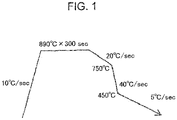
- the heat treatment pattern assuming a hot stamping process is schematically illustrated in FIG. 1 .
- Reference 1 Conference Proceedings of the Society of Automotive Engineers of Japan, No.72-07, p.14
- Reference 2 Metal Forming, steel research int. 79 (2008), No. 2, p. 81
- the heat treatment pattern illustrated in FIG. 1 indicates that the steel sheet is heated to 890°C at a heating rate of 10°C/sec, held at that temperature for 300 seconds, then cooled to 750°C at a cooling rate of 20°C/sec, cooled to 450°C at a cooling rate of 40°C/sec, and then further cooled to room temperature (25°C) at a cooling rate of about 5°C/sec.
- the tensile strength TS and yield stress YS were determined by collecting JIS No. 5 test pieces (sheet-shaped test pieces) and conducting a tensile test in conformity with JIS Z 2241: 2011. At this time, with regard to the yield stress YS, the upper yield point UYP was measured when a clear yield point appeared, and 0.2% proof stress ⁇ 0.2 was determined based on the JIS provision when the yield point did not appear. As the acceptance criteria, a tensile strength TS in a range of 500 to 800 MPa and a yield ratio YR of 70% or more were determined as acceptance.
- Experiment Nos. 1 to 4 are examples of the present invention in which the chemical composition, the Ac 3 transformation point (°C) and the ferrite fraction are within the ranges prescribed in the present invention, and it can be seen that a tensile strength TS of 500 to 800 MPa after a heat treatment and a yield ratio YR of 70% or more were secured in Experiment Nos. 1 to 4.
- Experiment Nos. 5 to 8 are comparative examples that do not satisfy any of the requirements prescribed in the present invention, and desired properties was not obtained in Experiment Nos. 5 to 8.
- Experiment No. 5 is an example obtained using steel type E in which the amount of Mn is excessive (the amount of B is also excessive), and is a steel sheet having an Ac 3 transformation point (°C) lower than 890°C and a low ferrite fraction, and the yield ratio YR of the steel sheet after a heat treatment is less than 70%.
- 6 is an example obtained using steel type F in which the amount of Si is small and the amount of Mn is excessive (the amount of B is also excessive), and is a steel sheet having an Ac 3 transformation point (°C) lower than 890°C and a low ferrite fraction, and the yield ratio YR of the steel sheet after a heat treatment is less than 70%.
- Experiment No. 7 is an example applied to GA steel sheet, but is obtained using steel type G in which the amount of Si is small and the amount of Mn is excessive, and is a steel sheet having an Ac 3 transformation point (°C) lower than 890°C and a low ferrite fraction, and the yield ratio YR of the steel sheet after a heat treatment is less than 70%.
- Experiment No. 8 is an example applied to a hot rolled steel sheet, but is obtained using steel type H in which the amount of Si is small and the amount of Mn is excessive, and is a steel sheet having an Ac 3 transformation point (°C) lower than 890°C and a low ferrite fraction, and the yield ratio YR of the steel sheet after a heat treatment is less than 70%.
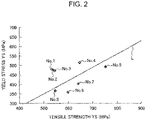
- the line L denotes the boundary line where the yield ratio YR is 70%
- the upper region including the line L indicates that the yield ratio YR is 70% or more
- the region below the line L indicates that the yield ratio YR is less than 70%.
- "Experiment No.” is abbreviated as "No.”.
- the present invention has a wide range of industrial applicability in the technical field related to steel sheets for hot stamping and hot stamped members.
Landscapes
- Chemical & Material Sciences (AREA)
- Engineering & Computer Science (AREA)
- Mechanical Engineering (AREA)
- Materials Engineering (AREA)
- Metallurgy (AREA)
- Organic Chemistry (AREA)
- Physics & Mathematics (AREA)
- Thermal Sciences (AREA)
- Crystallography & Structural Chemistry (AREA)
- Heat Treatment Of Sheet Steel (AREA)
- Heat Treatment Of Articles (AREA)
- Shaping Metal By Deep-Drawing, Or The Like (AREA)
Abstract
Description
- The present invention relates to a low-strength steel sheet for hot stamping, a hot stamped member obtained using a low-strength steel sheet for hot stamping, and a method for manufacturing the hot stamped member, especially to a low-strength steel sheet for hot stamping having excellent safety at the time of collision and a high yield ratio YR represented by a ratio (YS/TS) of yield stress YS to tensile strength TS in a region where the tensile strength TS after a heat treatment is 500 to 800 MPa, a hot stamped member obtained using such a low-strength steel sheet for hot stamping, and a method for manufacturing the hot stamped member.
- From the viewpoint of reducing the weight of motor vehicles and securing safety at the time of collision (hereinafter referred to as "collision safety"), steel sheets having a high strength and a high yield ratio YR are required. Because of the deterioration in cold press moldability due to the increased strength of steel sheets, a hot stamping technology has been proposed in which a steel sheet is press-molded in a heated state to achieve both moldability and high strength at the same time.
- Hot stamped members manufactured by such a technology mainly have a tensile strength TS of 1.5 GPa class or higher. However, in recent years, various hot stamped members having a tensile strength TS of 1.5 GPa or less have been proposed, such as steel members having a tensile strength TS of 500 MPa or more as presented in Patent Literature 1, high-strength members having a tensile strength TS of 600 to 1000 MPa class as presented in Patent Literature 2, and steel members having a tensile strength TS of 700 to 1300 MPa class as presented in Patent Literature 3.
- In all of the hot stamped members proposed so far, it is attempted to control the microstructure by the hot stamping process and the tensile strength TS is controlled. For these reasons, it is the actual situation that the tensile strength TS of hot stamped members is greatly dependent on the hot stamping process. It is conceivable to control the tensile strength TS of the steel sheet so as to increase by addition of alloying elements so that the tensile strength TS is not dependent on the hot stamping process.
- In most of the technologies proposed so far, it is usually attempted to increase the strength by containing a hard microstructure such as martensite. However, it is impossible to increase the yield ratio YR by increasing the strength through such microstructure control, and a heat treatment such as tempering is required in order to increase the yield stress YS from the viewpoint of improving collision safety.
- The present invention was made in view of circumstances as described above, and an object thereof is to provide a low-strength steel sheet for hot stamping, from which a hot stamped member having a yield ratio YR of 70% or more and a tensile strength TS of 500 to 800 MPa can be manufactured without largely depending on the hot stamping process, a hot stamped member obtained using such a low-strength steel sheet for hot stamping, and a method for manufacturing the hot stamped member.
-
- Patent Literature 1:
JP 5,726,419 B2 - Patent Literature 2:
JP 4,452,157 B2 - Patent Literature 3:
JP 4,427,462 B2 - The present inventors diligently conducted studies from the viewpoint of realizing a low-strength steel sheet for hot stamping, from which a hot stamped member can be manufactured without largely depending on the hot stamping process. As a result, it was found that the austenite fraction is lowered during a heat treatment such as hot stamping and the following actions (1) and (2) are exerted when the Ac3 point (°C) of a steel sheet is increased by appropriately adjusting the chemical composition, the contents of elements that improve the hardenability are decreased, and the steel sheet has a microstructure mainly composed of ferrite, and the present invention was completed by further conducting studies based on such findings.
- (1) Obtaining a predetermined strength without largely depending on the hot stamping process by diminishing the microstructural changes during the hot stamping process as much as possible, and
- (2) Being able to improve the yield ratio YR by making it difficult for a martensite structure to be generated in the microstructure after a heat treatment.
- Namely, an aspect of the present invention is a low-strength steel sheet for hot stamping, the steel sheet containing, in % by mass:
- C: 0.005% to 0.12%,
- Si: 0.50% to 2.0%,
- Mn: 0.50% or less (not including 0%),
- Al: 0.010% to 1.0%,
- P: 0.1000% or less (not including 0%),
- S: 0.0100% or less (not including 0%),
- N: 0.0100% or less (not including 0%),
- O: 0.0100% or less (not including 0%), and
- iron and unavoidable impurities as a remainder,
- in which an Ac3 point (°C) represented by the following Equation (1) is 890°C or more, and an area ratio of ferrite at a depth to be 1/4 of a steel sheet thickness is 80% or more.
- In Equation (1), [C], [Si], [Mn], [P], [Al], and [Ti] are values denoting percentage contents of C, Si, Mn, P, Al, and Ti in terms of % by mass, respectively.
- The objects, features and advantages of the present invention will be apparent from the following detailed description and accompanying drawings.
-
-
FIG. 1 is a schematic diagram illustrating a heat treatment pattern assuming a hot stamping process. -
FIG. 2 is a graph illustrating a relation between a tensile strength TS and a yield stress YS after a heat treatment. - The inventors conducted studies from various angles in order to achieve the object. As a result, it was found that the object is brilliantly achieved when the Ac3 point (°C) of a steel sheet is increased by appropriately adjusting the chemical composition and the steel sheet has a microstructure mainly composed of ferrite, whereby the present invention was completed.
- In the present invention, it is possible to realize a low-strength steel sheet for hot stamping, from which a hot stamped member having a yield ratio YR of 70% or more and a tensile strength TS of 500 to 800 MPa can be manufactured without largely depending on the hot stamping process.
- The reason why the chemical composition is set as described above in the low-strength steel sheet for hot stamping of the present embodiment is as follows. Hereinafter, % in the chemical composition means % by mass.
- The low-strength steel sheet for hot stamping of the present embodiment satisfies C: 0.005% to 0.12%, Si: 0.50% to 2.0%, Mn: 0.50% or less (not including 0%), Al: 0.010% to 1.0%, P: 0.1000% or less (not including 0%), S: 0.0100 % or less (not including 0%), N: 0.0100% or less (not including 0%), and O: 0.0100% or less (not including 0%).
- C is an element that secures the strength of steel sheets. C is also an element that facilitates the generation of martensite in the microstructure after a heat treatment by lowering the Ac3 point and increases the strength of hot stamped members. When the amount of such C becomes excessive, a decrease in the yield ratio YR of hot stamped members is caused, and the upper limit of the amount of C is thus required to be set to 0.12% or less. The amount of C is preferably 0.10% or less, more preferably 0.08% or less. On the other hand, an excessive decrease in the amount of C leads to an increase in the manufacturing cost, and thus the amount of C is set to 0.005% or more. The amount of C is preferably 0.007% or more, more preferably 0.010% or more.
- Si is an important element in order to raise the Ac3 point, to decrease the austenite fraction during heat treatment, and to decrease the hot stamping process dependence of hot stamped members. Si is also an element that contributes to the strength securing of hot stamped members by the solid solution strengthening of ferrite. In order to exert these effects, the amount of Si is set to 0.50% or more. The amount of Si is preferably 0.70% or more, more preferably 1.0% or more. However, when the amount of Si becomes excessive, deterioration in the pickling property during steel sheet manufacture and deterioration in the plating property are caused. The amount of Si is thus set to 2.0% or less. The amount of Si is preferably 1.8% or less, more preferably 1.6% or less.
- Mn lowers the Ac3 point and is thus an unfavorable element in the present invention. Mn is also an element that increases the austenite fraction during heat treatment and enhances the hot stamping process dependence of hot stamped members. Furthermore, Mn enhances hardenability, facilitates the generation of martensite in the microstructure of hot stamped members, and lowers the yield ratio YR of hot stamped members. Hence, the amount of Mn is set to 0.50% or less. The amount of Mn is preferably 0.40% or less, more preferably 0.30% or less. On the other hand, an excessive decrease in the amount of Mn leads to an increase in the manufacturing cost, and thus the amount of Mn is set to more than 0%. The lower limit of the amount of Mn is preferably 0.005% or more, more preferably 0.01% or more.
- Al is an element that acts as a deoxidizer. Al, as Si, is an element that raises the Ac3 point, decreases the austenite fraction during heat treatment, and decreases the hot stamping process dependence of hot stamped members. Al is also an element that is dissolved in ferrite to form a solid solution and contributes to the strength securing of hot stamped members by the solid solution strengthening of ferrite. In order to exert these effects, the amount of Al is set to 0.010% or more. The amount of Al is preferably 0.020% or more, more preferably 0.025% or more. However, an excessive content of Al leads to an increase in the manufacturing cost, and thus the amount of Al is set to 1.0% or less. The amount of Al is preferably 0.80% or less, more preferably 0.70% or less.
- P is an element that is unavoidably contained and is an element that deteriorates the weldability of steel sheets. P is also an element having an effect of contributing to the solid solution strengthening of ferrite phase. In order to exert such effects and not to deteriorate the weldability of steel sheets, the amount of P is set to 0.1000% or less. The amount of P is preferably 0.0500% or less, more preferably 0.0200% or less. P is an impurity that is unavoidably mixed into steel, and it is impossible to decrease the amount of P to 0% in industrial production, and P is usually contained at 0.0005% or more.
- S is an element that is unavoidably contained and deteriorates the weldability of steel sheets. The amount of S is thus set to 0.0100% or less. The amount of S is preferably 0.0080% or less, more preferably 0.0050% or less. It is more preferable that the amount of S is as small as possible, and thus the lower limit of the amount of S is not particularly limited. However, it is impossible to decrease the amount of S to 0% in industrial production, and S is usually contained at 0.0001 % or more.
- N is an element that is unavoidably contained, and N forms AlN and diminishes the effect of solute Al when being contained in an excessive amount. The amount of N is thus set to 0.0100% or less. The amount of N is preferably 0.0080% or less, more preferably 0.0050% or less. It is more preferable that the amount of N is as small as possible, and thus the lower limit of the amount of N is not particularly limited. However, it is impossible to decrease the amount of N to 0% in industrial production, and N is usually contained at 0.0001% or more.
- O is an element that is unavoidably contained, and O forms an oxide when being contained in an excessive amount, and lowers the amount of solute Si to cause a decrease in the strength of ferrite. The amount of O is thus set to 0.0100% or less. The amount of O is preferably 0.0050% or less, more preferably 0.0030% or less. It is more preferable that the amount of O is as small as possible, and thus the lower limit of the amount of O is not particularly limited. However, it is impossible to decrease the amount of O to 0% in industrial production, and O is usually contained at 0.0001% or more.
- The basic components of the low-strength steel sheet for hot stamping of the present embodiment are as described above, and the remainder is iron and unavoidable impurities other than P, S, N, and O described above. As these unavoidable impurities, mixing of tramp elements (Pb, Bi, Sb, Sn, and the like) introduced depending on the situations of raw materials, materials, manufacturing equipment and the like is permitted as long as the effects of the present invention are not impaired.
- The low-strength steel sheet for hot stamping of the present embodiment may further contain at least one of Ti and Nb as another element, and the properties of the steel sheet are further improved by containing these elements.
- Ti and Nb are carbide forming elements and are elements that contribute to the micronization of the microstructure of steel sheets. As the microstructure of steel sheets is micronized, reverse transformation during heat treatment is promoted, but the generation of ferrite can be promoted during cooling in the hot stamping process, and the ferrite fraction in the hot stamped member can be increased. Such an effect increases as the content of Ti and Nb increases, but there is a disadvantage that the cold rollability deteriorates when Ti and Nb are excessively contained. From this point of view, Ti and Nb are both contained at 0.10% or less. The contents of Ti and Nb are preferably 0.07% or less, more preferably 0.05% or less. One of Ti and Nb may be contained, or both of Ti and Nb may be contained. The lower limits of the contents of Ti and Nb are not limited since the effects are exerted when Ti and Nb are contained in small amounts, and Ti and Nb are preferably contained at 0.005% or more in order to exert the effects more effectively.
- The low-strength steel sheet for hot stamping of the present embodiment has an Ac3 point (°C) of 890°C or more as represented by the following Equation (1).

- In Equation (1), [C], [Si], [Mn], [P], [Al], and [Ti] are values denoting percentage contents of C, Si, Mn, P, Al, and Ti in terms of % by mass, respectively.
- "Leslie Steel Materials Science" (Maruzen Co., Ltd., May 31, 1985, p. 273) states that the Ac3 point (°C) is calculated from the following Equation (2). Equation (1) is a simplified equation of the following Equation (2) in consideration of the kinds of elements contained. Namely, in the low-strength steel sheet for hot stamping of the present embodiment, the attention is paid to Si and Al that increase the Ac3 point (°C) and have less concern about deterioration in other properties, and the amounts of C, Mn and the like that decrease the Ac3 point (°C) are decreased.

- In Equation (2), [C], [Ni], [Si], [V], [Mo], [W], [Mn], [Cr], [Cu], [P], [Al] and [Ti] are values denoting the percentage contents of C, Ni, Si, V, Mo, W, Mn, Cr, Cu, P, Al, As and Ti in terms of % by mass, respectively.
- In the low-strength steel sheet for hot stamping of the present embodiment, it is required that the area ratio of ferrite at a depth to be 1/4 of the steel sheet thickness is 80% or more. The measurement point of the area ratio of ferrite is set to the depth to be 1/4 of the steel sheet thickness because it is the point where the most typical properties of the steel sheet are exhibited.
- In the present embodiment, the area ratio of ferrite is a value measured by point counting. This point counting is a method applied for calculation of the area percentage between a mixed microstructure and ferrite crystal grains when a microstructure other than ferrite is mixed, and is a method in which a photograph of the surface to be inspected (a surface exposed to a depth to be 1/4 of the steel sheet thickness) is taken, a prescribed grid line is placed on the taken photograph, and the number of lattice point centers occupied by ferrite crystal grains is counted. In Examples described later, the point counting was performed under the condition that the number of cells (squares) partitioned by grid lines was 100. For the microstructure observation when the area ratio of ferrite is determined, an optical microscope or a scanning microscope is used properly (magnification: a range of 400 to 1000) depending on the size of ferrite crystal grains, but the numerical values measured do not change.
- By appropriately controlling the design of the chemical composition as described above and increasing the area ratio of ferrite in the steel sheet, it is possible to decrease the microstructure fraction containing C such as pearlite, bainite, and martensite that are preferentially reverse transformed to austenite. By increasing the ferrite area ratio in the steel sheet, the reverse transformation to austenite can be delayed, the austenite fraction during heat treatment can be decreased, the yield stress YS can be secured and the yield YR ratio can be increased without extremely increasing the tensile strength TS of the steel sheet after the heat treatment.
- It is required that the area ratio of ferrite in the low-strength steel sheet for hot stamping of the present embodiment is 80% or more from this point of view. The area ratio of ferrite is preferably 84% or more, more preferably 86% or more. Alternatively, the area ratio of ferrite may be 100%. In the low-strength steel sheet for hot stamping of the present embodiment, it is only required that the area ratio of ferrite is 80% or more, and pearlite, bainite, and martensite mentioned above as microstructures other than ferrite may be contained in small amounts. Alternatively, residual austenite may be contained.
- From the gist, it is preferable not to contain elements that may decrease the area ratio of ferrite as much as possible. For example, B has an action of suppressing the generation and growth of polygonal ferrite from the austenite grain boundaries, and as a result, acts to decrease the area ratio of ferrite. It is preferable not to contain elements, such as B, that decrease the ferrite area ratio, as much as possible. However, it is permissible to contain elements that decrease the ferrite area ratio in a range in which adverse effects as mentioned above are not exerted, for example, at 0.0005% or less.
- The low-strength steel sheet for hot stamping of the present embodiment includes hot rolled steel sheets and cold rolled steel sheets, and these hot rolled steel sheets and cold rolled steel sheets may have a hot dip-galvanized layer (GI: Hot Dip-Galvanized) or a hot dip-galvannealed layer (GA: Alloyed Hot Dip-Galvanized), and the present invention also includes hot dip-galvanized steel sheets (GI steel sheets) and hot dip-galvannealed steel sheets (GA steel sheets).
- The present specification discloses various aspects of a technology as described above, but the main technology is summarized below.
- The low-strength steel sheet for hot stamping of the present embodiment contains, in % by mass, C: 0.005% to 0.12%, Si: 0.50% to 2.0%, Mn: 0.50% or less (not including 0%), Al: 0.010% to 1.0%, P: 0.1000% or less (not including 0%), S: 0.0100% or less (not including 0%), N: 0.0100% or less (not including 0%), O: 0.0100% or less (not including 0%), and iron and unavoidable impurities as the remainder, in which the Ac3 point (°C) represented by Equation (1) is 890°C or more and the area ratio of ferrite at a depth to be 1/4 of the steel sheet thickness is 80% or more.
- By adopting such a configuration, it is possible to realize a low-strength steel sheet for hot stamping, from which a hot stamped member having a yield ratio of 70% or more and a tensile strength of 500 to 800 MPa can be manufactured without largely depending on the hot stamping process.
- The low-strength steel sheet for hot stamping of the present embodiment can further contain at least one of Ti: 0.10% or less (not including 0%) and Nb: 0.10% or less (not including 0%), and the properties of the steel sheet are further improved depending on the components contained.
- The low-strength steel sheet for hot stamping of the present embodiment is useful as a steel sheet for manufacturing a tailored blank member by combining with a steel sheet having a tensile strength of 1000 MPa or more after a heat treatment. In a normal hot stamping process, the heating temperature before press molding is set to the single-phase temperature of austenite (namely, a temperature higher than the Ac3 point). The steel sheet heated to the temperature region is then press-molded while being cooled by the mold to be formed into a hot pressed member.
- In a steel sheet having a tensile strength of 1000 MPa or more after a heat treatment, the Ac3 point of the steel sheet is usually set to a temperature lower than 860°C. Therefore, when the low-strength steel sheet for hot stamping of the present embodiment is subjected to tailored blank by combining with a steel sheet having a tensile strength of 1000 MPa or more after a heat treatment by welding or the like, then heating is performed to a temperature range of 860°C or more and the Ac3 point or less of the low-strength steel sheet for hot stamping, and then hot stamping is performed, a tailored blank material having a region where the tensile strength is 1000 MPa or more and a region where the tensile strength is 500 to 800 MPa is obtained.
- Namely, in a steel sheet having a tensile strength of 1000 MPa or more after a heat treatment, the heating temperature range described above becomes the austenite region and martensite and bainite are generated during subsequent cooling to make the steel sheet high-strength. In the low-strength steel sheet for hot stamping of the present embodiment, the heating temperature range described above becomes the two-phase region of austenite and ferrite, and the generation of martensite and bainite is suppressed during subsequent cooling and the microstructure mainly composed of ferrite is formed to make the steel sheet low-strength. As described above, in the hot stamping process, the heating temperature before press molding is set to the single-phase temperature of austenite, specifically in the temperature range of 900°C ± 50°C. However, in the present invention, the heating temperature range during hot stamping may be appropriately set within the temperature range of 900°C + 50°C depending on the Ac3 point of each steel sheet to be subjected to tailored blank.
- As is clear from the gist, by including heating the low-strength steel sheet for hot stamping of the present embodiment to the Ac3 point (°C) or less and subjecting the heated steel sheet to hot stamping, it is possible to manufacture not only tailored blank materials but also hot stamped members exerting desired properties. Namely, the hot stamped member obtained using the low-strength steel sheet for hot stamping of the present embodiment is a hot stamped member exhibiting properties that the yield ratio is 70% or more and the tensile strength is 500 to 800 MPa.
- Hereinafter, the effects of the present invention will be specifically described based on Examples, but the following Examples are not intended to limit the present invention, and any design change according to the gist described above and to be described below is included in the technical scope of the present invention.
- Various steel materials having the chemical compositions (steel types A to H) presented in Table 1 below were manufactured, and various steel sheets (Experiment Nos. 1 to 8) were fabricated under the hot rolling conditions presented in Table 2 below. The steel types A to F presented in Table 1 below are examples prepared in a laboratory, and steel types G and H are materials prepared by a real manufacturing equipment. The Ac3 points presented in Table 1 are the values calculated based on Equation (1). In Table 1, the column of [-] means that it is not added or it is less than the measurement limit. P, S, N, and O are unavoidable impurities as described above, and the values presented in the columns of P, S, N, and O mean amounts unavoidably contained. The thickness of the GA steel sheet of Experiment No. 7 is the thickness after the surface was ground by 0.2 mm and the alloyed hot dip-galvanized layer was removed. The thickness of the hot rolled steel sheet of Experiment No. 8 is the thickness after the surface was ground by 0.2 mm and the scale was removed.
[Table 1] Steel type Chemical composition (% by mass) Ac3 point (°C) Remark C Si Mn Al P S N O Ti Nb B A 0.05 1.2 0.2 0.035 0.0100 0.0016 0.0031 0.0012 - - 0.0002 933 Prepared in laboratory B 0.05 1.2 0.2 0.035 0.0100 0.0016 0.0031 0.0010 - 0.05 - 934 Prepared in laboratory C 0.09 1.2 0.2 0.037 0.0120 0.0016 0.0025 0.0008 - - - 921 Prepared in laboratory D 0.05 1.2 0.2 0.487 0.0100 0.0014 0.0040 0.0011 - - - 1116 Prepared in laboratory E 0.04 1.2 2.2 0.034 0.0110 0.0019 0.0032 0.0006 0.03 - 0.0016 888 Prepared in laboratory F 0.06 0.02 1.5 0.035 0.0090 0.0020 0.0027 0.0015 0.07 0.05 0.0015 864 Prepared in laboratory G 0.07 0.01 2.1 0.040 0.0400 0.0400 0.0027 0.0016 - 0.05 - 838 Prepared by real equipment H 0.08 0.02 1.4 0.038 0.0380 0.0380 0.0042 0.0009 - 0.03 - 854 Prepared by real equipment [Table 2] Experiment No. Steel type Hot rolling conditions Steel sheet thickness (mm) Type of steel sheet Finishing temperature (°C) Holding temperature corresponding to coiling temperature (°C) 1 A 900±20 650 1.4 Cold rolled steel sheet 2 B 3 C 4 D 5 E 6 F 7 G 890 560 1.0 GA steel sheet 8 H 860 to 880 500 to 550 2.1 Hot rolled steel sheet - With respect to the obtained various steel sheets, the area ratio of ferrite (hereinafter referred to as "ferrite fraction") was measured by the point counting described above, and a heat treatment assuming a hot stamping process was performed, and the tensile properties of the steel sheets after the heat treatment were evaluated by the following method. The heat treatment conditions at this time were performed by a heat treatment simulator based on the following References 1 and 2. The heat treatment pattern assuming a hot stamping process is schematically illustrated in
FIG. 1 . Reference 1: Conference Proceedings of the Society of Automotive Engineers of Japan, No.72-07, p.14
Reference 2: Metal Forming, steel research int. 79 (2008), No. 2, p. 81 - The heat treatment pattern illustrated in
FIG. 1 indicates that the steel sheet is heated to 890°C at a heating rate of 10°C/sec, held at that temperature for 300 seconds, then cooled to 750°C at a cooling rate of 20°C/sec, cooled to 450°C at a cooling rate of 40°C/sec, and then further cooled to room temperature (25°C) at a cooling rate of about 5°C/sec. - The tensile strength TS and yield stress YS were determined by collecting JIS No. 5 test pieces (sheet-shaped test pieces) and conducting a tensile test in conformity with JIS Z 2241: 2011. At this time, with regard to the yield stress YS, the upper yield point UYP was measured when a clear yield point appeared, and 0.2% proof stress σ0.2 was determined based on the JIS provision when the yield point did not appear. As the acceptance criteria, a tensile strength TS in a range of 500 to 800 MPa and a yield ratio YR of 70% or more were determined as acceptance.
- The results of these are presented in Table 3 below together with the applied steel types (steel types A to H).
[Table 3] Experiment No. Steel type Ferrite fraction (% by area) Tensile properties of steel sheet after heat treatment Tensile strength TS (MPa) Upper yield point UYP or 0.2% proof stress σ0.2 (MPa) Yield ratio YR (%) 1 A 95 545 473 87 2 B 99 532 480 90 3 C 91 541 474 88 4 D 97 646 515 80 5 E 31 753 493 65 6 F 20 598 360 60 7 G 72 640 404 63 8 H 64 546 368 67 - From the results, it can be considered as follows. Experiment Nos. 1 to 4 are examples of the present invention in which the chemical composition, the Ac3 transformation point (°C) and the ferrite fraction are within the ranges prescribed in the present invention, and it can be seen that a tensile strength TS of 500 to 800 MPa after a heat treatment and a yield ratio YR of 70% or more were secured in Experiment Nos. 1 to 4.
- In contrast, Experiment Nos. 5 to 8 are comparative examples that do not satisfy any of the requirements prescribed in the present invention, and desired properties was not obtained in Experiment Nos. 5 to 8. Specifically, Experiment No. 5 is an example obtained using steel type E in which the amount of Mn is excessive (the amount of B is also excessive), and is a steel sheet having an Ac3 transformation point (°C) lower than 890°C and a low ferrite fraction, and the yield ratio YR of the steel sheet after a heat treatment is less than 70%. Experiment No. 6 is an example obtained using steel type F in which the amount of Si is small and the amount of Mn is excessive (the amount of B is also excessive), and is a steel sheet having an Ac3 transformation point (°C) lower than 890°C and a low ferrite fraction, and the yield ratio YR of the steel sheet after a heat treatment is less than 70%.
- Experiment No. 7 is an example applied to GA steel sheet, but is obtained using steel type G in which the amount of Si is small and the amount of Mn is excessive, and is a steel sheet having an Ac3 transformation point (°C) lower than 890°C and a low ferrite fraction, and the yield ratio YR of the steel sheet after a heat treatment is less than 70%. Experiment No. 8 is an example applied to a hot rolled steel sheet, but is obtained using steel type H in which the amount of Si is small and the amount of Mn is excessive, and is a steel sheet having an Ac3 transformation point (°C) lower than 890°C and a low ferrite fraction, and the yield ratio YR of the steel sheet after a heat treatment is less than 70%.
- Based on these results, the relation between the tensile strength TS and the yield stress YS after a heat treatment is illustrated in
FIG. 2 . InFIG. 2 , the line L denotes the boundary line where the yield ratio YR is 70%, the upper region including the line L indicates that the yield ratio YR is 70% or more, and the region below the line L indicates that the yield ratio YR is less than 70%. InFIG. 2 , "Experiment No." is abbreviated as "No.". - As is clear from the results, in the examples of the present invention (Nos. 1 to 4), it can be seen that hot stamped members (steel sheets after heat treatment) having a yield ratio of 70% or more and a tensile strength TS of 500 to 800 MPa can be manufactured without largely depending on the hot stamping process.
- This application is based on
Japanese Patent Application No. 2019-154727 filed on August 27, 2019 - In order to express the present invention, the present invention has been described above appropriately and sufficiently through the embodiments with reference to specific examples and the like. However, it should be recognized by those skilled in the art that changes and/or improvements of the above-described embodiments can be readily made. Accordingly, changes or improvements made by those skilled in the art shall be construed as being included in the scope of the claims unless otherwise the changes or improvements are at the level which departs from the scope of the appended claims.
- The present invention has a wide range of industrial applicability in the technical field related to steel sheets for hot stamping and hot stamped members.

Claims (5)
- A low-strength steel sheet for hot stamping, the steel sheet comprising, in % by mass:C: 0.005% to 0.12%,Si: 0.50% to 2.0%,Mn: 0.50% or less (not including 0%),Al: 0.010% to 1.0%,P: 0.1000% or less (not including 0%),S: 0.0100% or less (not including 0%),N: 0.0100% or less (not including 0%),O: 0.0100% or less (not including 0%), andiron and unavoidable impurities as a remainder,wherein an Ac3 point (°C) represented by the following Equation (1) is 890°C or more, and an area ratio of ferrite at a depth to be 1/4 of a steel sheet thickness is 80% or more:
 in Equation (1), [C], [Si], [Mn], [P], [Al], and [Ti] are values denoting percentage contents of C, Si, Mn, P, Al, and Ti in terms of % by mass, respectively.
 - The low-strength steel sheet for hot stamping according to claim 1, wherein the steel sheet further comprises at least one of Ti: 0.10% or less (not including 0%) and Nb: 0.10% or less (not including 0%).
- The low-strength steel sheet for hot stamping according to claim 1 or 2, which is for manufacturing a tailored blank member by combining the low-strength steel sheet with a steel sheet having a tensile strength of 1000 MPa or more after a heat treatment.
- A method for manufacturing a hot stamped member, the method comprising heating the low-strength steel sheet for hot stamping according to any one of claims 1 to 3 to the Ac3 point (°C) or less and performing hot stamping.
- A hot stamped member obtained using the low-strength steel sheet for hot stamping according to any one of claims 1 to 3.
Applications Claiming Priority (2)
| Application Number | Priority Date | Filing Date | Title |
|---|---|---|---|
| JP2019154727A JP7235621B2 (en) | 2019-08-27 | 2019-08-27 | Steel plate for low-strength hot stamping, hot stamped parts, and method for manufacturing hot stamped parts |
| PCT/JP2020/031118 WO2021039499A1 (en) | 2019-08-27 | 2020-08-18 | Low-strength steel sheet for hot stamping, hot-stamped component, and method for manufacturing hot-stamped component |
Publications (2)
| Publication Number | Publication Date |
|---|---|
| EP3998359A1 true EP3998359A1 (en) | 2022-05-18 |
| EP3998359A4 EP3998359A4 (en) | 2023-04-19 |
Family
ID=74678773
Family Applications (1)
| Application Number | Title | Priority Date | Filing Date |
|---|---|---|---|
| EP20856767.7A Pending EP3998359A4 (en) | 2019-08-27 | 2020-08-18 | LOW STRENGTH HOT STAMPED STEEL SHEET, HOT STAMPED COMPONENT, AND METHOD OF MAKING HOT STAMPED COMPONENT |
Country Status (8)
| Country | Link |
|---|---|
| US (1) | US20220298592A1 (en) |
| EP (1) | EP3998359A4 (en) |
| JP (1) | JP7235621B2 (en) |
| KR (2) | KR20220035961A (en) |
| CN (1) | CN114258434B (en) |
| CA (1) | CA3150774A1 (en) |
| MX (1) | MX2022002260A (en) |
| WO (1) | WO2021039499A1 (en) |
Families Citing this family (1)
| Publication number | Priority date | Publication date | Assignee | Title |
|---|---|---|---|---|
| CN121874656A (en) * | 2026-03-20 | 2026-04-17 | 鞍钢股份有限公司 | An economical high-surface-quality, high-formability automotive steel and its production method |
Family Cites Families (23)
| Publication number | Priority date | Publication date | Assignee | Title |
|---|---|---|---|---|
| CA2283924C (en) * | 1997-03-17 | 2006-11-28 | Nippon Steel Corporation | Dual-phase type high-strength steel sheets having high impact energy absorption properties and a method of producing the same |
| JPH11104750A (en) * | 1997-09-30 | 1999-04-20 | Nissan Motor Co Ltd | Press forming method of butt weld plate |
| JP4520549B2 (en) * | 1999-06-23 | 2010-08-04 | 新日本製鐵株式会社 | Press forming method of different material tailored blanks with excellent formability |
| JP4316842B2 (en) * | 2002-07-26 | 2009-08-19 | アイシン高丘株式会社 | Method for manufacturing tailored blank press molded products |
| JP2004270029A (en) * | 2003-02-18 | 2004-09-30 | Nippon Steel Corp | Galvanized steel sheet with excellent zinc volatility |
| TWI290586B (en) * | 2003-09-24 | 2007-12-01 | Nippon Steel Corp | Hot rolled steel sheet and method of producing the same |
| JP4452157B2 (en) | 2004-02-06 | 2010-04-21 | 新日本製鐵株式会社 | 600-1200 MPa class high-strength member for automobiles with excellent strength uniformity in the member and method for producing the same |
| JP4427462B2 (en) | 2005-01-21 | 2010-03-10 | 新日本製鐵株式会社 | Steel member for vehicle and method for manufacturing the same |
| JP4757022B2 (en) * | 2005-12-28 | 2011-08-24 | 住友軽金属工業株式会社 | High strength and toughness aluminum alloy extruded material and forged material excellent in corrosion resistance, and method for producing the extruded material and forged material |
| BRPI0621704B1 (en) * | 2006-05-16 | 2014-08-19 | Jfe Steel Corporation | HOT-HIGH-RESISTANT STEEL SHEET AND METHOD FOR PRODUCTION |
| WO2008110670A1 (en) | 2007-03-14 | 2008-09-18 | Arcelormittal France | Steel for hot working or quenching with a tool having an improved ductility |
| JP5825082B2 (en) * | 2011-12-12 | 2015-12-02 | Jfeスチール株式会社 | High yield ratio high strength cold-rolled steel sheet with excellent elongation and stretch flangeability and its manufacturing method |
| JP5316634B2 (en) * | 2011-12-19 | 2013-10-16 | Jfeスチール株式会社 | High-strength steel sheet with excellent workability and method for producing the same |
| BR112014017100B1 (en) * | 2012-01-13 | 2019-04-24 | Nippon Steel & Sumitomo Metal Corporation | HOT STAMPED STEEL AND METHOD FOR HOT STAMPED PRODUCTION |
| JP5476452B2 (en) * | 2012-11-27 | 2014-04-23 | トヨタ自動車株式会社 | High strength, high toughness aluminum alloy forging material with excellent corrosion resistance, its manufacturing method, and suspension parts |
| CN105074038B (en) * | 2013-04-02 | 2016-12-14 | 新日铁住金株式会社 | Heat stamping and shaping body, cold-rolled steel sheet and the manufacture method of heat stamping and shaping body |
| JP6121292B2 (en) * | 2013-09-05 | 2017-04-26 | 株式会社神戸製鋼所 | High-strength steel sheet having high yield ratio and formability and manufacturing method thereof |
| RU2648104C2 (en) * | 2013-09-18 | 2018-03-22 | Ниппон Стил Энд Сумитомо Метал Корпорейшн | Hot-stamp detail and method of its production |
| PL3255169T3 (en) * | 2015-03-30 | 2019-11-29 | Nippon Steel & Sumitomo Metal Corp | STEEL HARDENED FOR COLD FORGING |
| KR102119017B1 (en) * | 2016-03-11 | 2020-06-04 | 제이에프이 스틸 가부시키가이샤 | High strength cold rolled thin steel sheet and method for manufacturing the same |
| EP3533886A4 (en) * | 2016-10-31 | 2020-04-01 | Nippon Steel Corporation | METHOD FOR PRODUCING STEEL ELEMENT, AND STEEL ELEMENT |
| CA3077793A1 (en) * | 2017-10-02 | 2019-04-11 | Nippon Steel Corporation | Hot stamped product, steel sheet for hot stamp, and manufacturing method thereof |
| JP7007953B2 (en) | 2018-03-12 | 2022-01-25 | 株式会社三共 | Slot machine |
-
2019
- 2019-08-27 JP JP2019154727A patent/JP7235621B2/en active Active
-
2020
- 2020-08-18 KR KR1020227006022A patent/KR20220035961A/en not_active Ceased
- 2020-08-18 WO PCT/JP2020/031118 patent/WO2021039499A1/en not_active Ceased
- 2020-08-18 MX MX2022002260A patent/MX2022002260A/en unknown
- 2020-08-18 CN CN202080058196.3A patent/CN114258434B/en active Active
- 2020-08-18 US US17/636,803 patent/US20220298592A1/en active Pending
- 2020-08-18 CA CA3150774A patent/CA3150774A1/en active Pending
- 2020-08-18 EP EP20856767.7A patent/EP3998359A4/en active Pending
- 2020-08-18 KR KR1020257016329A patent/KR20250073567A/en active Pending
Also Published As
| Publication number | Publication date |
|---|---|
| EP3998359A4 (en) | 2023-04-19 |
| KR20250073567A (en) | 2025-05-27 |
| KR20220035961A (en) | 2022-03-22 |
| MX2022002260A (en) | 2022-03-22 |
| CN114258434B (en) | 2022-12-23 |
| CN114258434A (en) | 2022-03-29 |
| BR112022003304A2 (en) | 2022-05-24 |
| JP7235621B2 (en) | 2023-03-08 |
| JP2021031745A (en) | 2021-03-01 |
| WO2021039499A1 (en) | 2021-03-04 |
| US20220298592A1 (en) | 2022-09-22 |
| CA3150774A1 (en) | 2021-03-04 |
Similar Documents
| Publication | Publication Date | Title |
|---|---|---|
| EP3372703B1 (en) | Ultra-high strength steel plate having excellent formability and hole-expandability, and method for manufacturing same | |
| EP2053140B1 (en) | High-strength steel sheets and processes for production of the same | |
| KR101779305B1 (en) | Austenitic stainless steel sheet and method for producing same | |
| US20120237388A1 (en) | Austenitic stainless steel sheet and a method for its manufacture | |
| EP2792762B1 (en) | High-yield-ratio high-strength cold-rolled steel sheet and method for producing same | |
| EP3438313A1 (en) | Nb-containing ferritic stainless steel sheet and manufacturing method therefor | |
| CN115003839A (en) | Steel plate and method of making the same | |
| EP3392361A1 (en) | Thick steel plate having excellent cryogenic toughness | |
| EP3327164B1 (en) | Hot-dip galvanized steel sheet and hot-dip galvannealed steel sheet with excellent aging-resistance properties and bake hardenability, and method for manufacturing same | |
| CN102712963A (en) | Method for producing hot-rolled high carbon steel sheet | |
| EP3450586A1 (en) | Ultrahigh-strength and high-ductility steel sheet having excellent yield ratio and manufacturing method therefor | |
| CN105378133B (en) | High-carbon hot-rolled steel sheet and manufacturing method thereof | |
| EP3559295B1 (en) | An object comprising a duplex stainless steel and the use thereof | |
| EP3239335B1 (en) | Ferritic stainless steel having excellent ductility and method for manufacturing same | |
| JP4682806B2 (en) | Ferritic stainless steel cold-rolled steel sheet excellent in press formability and manufacturing method thereof | |
| JP6361402B2 (en) | Duplex stainless steel for spring and method for producing the same | |
| US20220298592A1 (en) | Low-strength steel sheet for hot stamping, hot-stamped component, and method for manufacturing hot-stamped component | |
| EP3088545B1 (en) | Quenched steel sheet having excellent strength and ductility and method for manufacturing same | |
| EP3572546B1 (en) | High-strength cold-rolled steel sheet and method for manufacturing the same | |
| EP3760755A1 (en) | Steel plate for hot stamping | |
| EP4431631A1 (en) | Austenitic stainless steel and manufacturing method therefor | |
| KR20190077672A (en) | Ferritic stainless steel excellent in ridging property | |
| EP4613904A1 (en) | Ferritic stainless steel for construction applications and method for producing same | |
| RU2789798C1 (en) | Low-strength steel sheet for hot stamping, hot-stamped component and hot-stamped component production method | |
| KR101082158B1 (en) | Fabricating method for ferritic stainless steel |
Legal Events
| Date | Code | Title | Description |
|---|---|---|---|
| STAA | Information on the status of an ep patent application or granted ep patent |
Free format text: STATUS: THE INTERNATIONAL PUBLICATION HAS BEEN MADE |
|
| PUAI | Public reference made under article 153(3) epc to a published international application that has entered the european phase |
Free format text: ORIGINAL CODE: 0009012 |
|
| STAA | Information on the status of an ep patent application or granted ep patent |
Free format text: STATUS: REQUEST FOR EXAMINATION WAS MADE |
|
| 17P | Request for examination filed |
Effective date: 20220208 |
|
| AK | Designated contracting states |
Kind code of ref document: A1 Designated state(s): AL AT BE BG CH CY CZ DE DK EE ES FI FR GB GR HR HU IE IS IT LI LT LU LV MC MK MT NL NO PL PT RO RS SE SI SK SM TR |
|
| DAV | Request for validation of the european patent (deleted) | ||
| DAX | Request for extension of the european patent (deleted) | ||
| REG | Reference to a national code |
Ref country code: DE Ref legal event code: R079 Free format text: PREVIOUS MAIN CLASS: C21D0009000000 Ipc: C22C0038020000 |
|
| A4 | Supplementary search report drawn up and despatched |
Effective date: 20230320 |
|
| RIC1 | Information provided on ipc code assigned before grant |
Ipc: B21D 22/02 20060101ALN20230315BHEP Ipc: C21D 1/02 20060101ALI20230315BHEP Ipc: C21D 1/673 20060101ALI20230315BHEP Ipc: C21D 1/18 20060101ALI20230315BHEP Ipc: C21D 7/13 20060101ALI20230315BHEP Ipc: C21D 8/02 20060101ALI20230315BHEP Ipc: C21D 6/00 20060101ALI20230315BHEP Ipc: C21D 9/46 20060101ALI20230315BHEP Ipc: C22C 38/12 20060101ALI20230315BHEP Ipc: C22C 38/14 20060101ALI20230315BHEP Ipc: C22C 38/00 20060101ALI20230315BHEP Ipc: C22C 38/06 20060101ALI20230315BHEP Ipc: C22C 38/04 20060101ALI20230315BHEP Ipc: C22C 38/02 20060101AFI20230315BHEP |
|
| RAP3 | Party data changed (applicant data changed or rights of an application transferred) |
Owner name: KABUSHIKI KAISHA KOBE SEIKO SHO (KOBE STEEL, LTD.) |
|
| RIN1 | Information on inventor provided before grant (corrected) |
Inventor name: ASAI, TATSUYA Inventor name: HAMAMOTO, SAE |