EP3997985A1 - Dried rice gel production method and dried rice gel - Google Patents
Dried rice gel production method and dried rice gel Download PDFInfo
- Publication number
- EP3997985A1 EP3997985A1 EP20837499.1A EP20837499A EP3997985A1 EP 3997985 A1 EP3997985 A1 EP 3997985A1 EP 20837499 A EP20837499 A EP 20837499A EP 3997985 A1 EP3997985 A1 EP 3997985A1
- Authority
- EP
- European Patent Office
- Prior art keywords
- rice gel
- rice
- hardened
- gel
- dried
- Prior art date
- Legal status (The legal status is an assumption and is not a legal conclusion. Google has not performed a legal analysis and makes no representation as to the accuracy of the status listed.)
- Withdrawn
Links
- 241000209094 Oryza Species 0.000 title claims abstract description 447
- 235000007164 Oryza sativa Nutrition 0.000 title claims abstract description 447
- 235000009566 rice Nutrition 0.000 title claims abstract description 447
- 238000004519 manufacturing process Methods 0.000 title claims abstract description 47
- 239000002994 raw material Substances 0.000 claims abstract description 85
- 238000001035 drying Methods 0.000 claims description 77
- XLYOFNOQVPJJNP-UHFFFAOYSA-N water Substances O XLYOFNOQVPJJNP-UHFFFAOYSA-N 0.000 claims description 54
- 238000007710 freezing Methods 0.000 claims description 44
- 230000008014 freezing Effects 0.000 claims description 41
- 238000005520 cutting process Methods 0.000 claims description 32
- 238000006297 dehydration reaction Methods 0.000 claims description 30
- 230000018044 dehydration Effects 0.000 claims description 29
- 238000010257 thawing Methods 0.000 claims description 21
- 229920000856 Amylose Polymers 0.000 claims description 20
- 238000010438 heat treatment Methods 0.000 claims description 19
- 238000010907 mechanical stirring Methods 0.000 claims description 10
- 230000000717 retained effect Effects 0.000 claims description 7
- 239000000499 gel Substances 0.000 description 298
- 238000000034 method Methods 0.000 description 118
- 230000008569 process Effects 0.000 description 114
- 230000008859 change Effects 0.000 description 37
- 238000001816 cooling Methods 0.000 description 16
- 229920002472 Starch Polymers 0.000 description 14
- 235000019698 starch Nutrition 0.000 description 14
- 239000008107 starch Substances 0.000 description 14
- 238000006243 chemical reaction Methods 0.000 description 13
- 238000003756 stirring Methods 0.000 description 11
- 239000000463 material Substances 0.000 description 10
- 239000012488 sample solution Substances 0.000 description 10
- 238000012790 confirmation Methods 0.000 description 9
- 238000010411 cooking Methods 0.000 description 6
- 235000013305 food Nutrition 0.000 description 6
- 238000012360 testing method Methods 0.000 description 6
- 230000000052 comparative effect Effects 0.000 description 5
- 229910052739 hydrogen Inorganic materials 0.000 description 5
- 239000001257 hydrogen Substances 0.000 description 5
- 238000005259 measurement Methods 0.000 description 5
- 235000021067 refined food Nutrition 0.000 description 5
- 238000003860 storage Methods 0.000 description 5
- 108090000790 Enzymes Proteins 0.000 description 4
- 102000004190 Enzymes Human genes 0.000 description 4
- 238000002835 absorbance Methods 0.000 description 4
- 235000008429 bread Nutrition 0.000 description 4
- 229940088598 enzyme Drugs 0.000 description 4
- 239000000243 solution Substances 0.000 description 4
- LFQSCWFLJHTTHZ-UHFFFAOYSA-N Ethanol Chemical compound CCO LFQSCWFLJHTTHZ-UHFFFAOYSA-N 0.000 description 3
- WQZGKKKJIJFFOK-GASJEMHNSA-N Glucose Chemical compound OC[C@H]1OC(O)[C@H](O)[C@@H](O)[C@@H]1O WQZGKKKJIJFFOK-GASJEMHNSA-N 0.000 description 3
- HEMHJVSKTPXQMS-UHFFFAOYSA-M Sodium hydroxide Chemical compound [OH-].[Na+] HEMHJVSKTPXQMS-UHFFFAOYSA-M 0.000 description 3
- 238000007654 immersion Methods 0.000 description 3
- 239000007788 liquid Substances 0.000 description 3
- 238000002156 mixing Methods 0.000 description 3
- 239000000523 sample Substances 0.000 description 3
- 235000013322 soy milk Nutrition 0.000 description 3
- CSCPPACGZOOCGX-UHFFFAOYSA-N Acetone Chemical compound CC(C)=O CSCPPACGZOOCGX-UHFFFAOYSA-N 0.000 description 2
- 241000894006 Bacteria Species 0.000 description 2
- 108010015776 Glucose oxidase Proteins 0.000 description 2
- 239000004366 Glucose oxidase Substances 0.000 description 2
- 230000008901 benefit Effects 0.000 description 2
- 235000009508 confectionery Nutrition 0.000 description 2
- 230000000694 effects Effects 0.000 description 2
- 238000011156 evaluation Methods 0.000 description 2
- 229940116332 glucose oxidase Drugs 0.000 description 2
- 235000019420 glucose oxidase Nutrition 0.000 description 2
- 238000004898 kneading Methods 0.000 description 2
- 239000000203 mixture Substances 0.000 description 2
- 239000007981 phosphate-citrate buffer Substances 0.000 description 2
- 230000009467 reduction Effects 0.000 description 2
- 239000012085 test solution Substances 0.000 description 2
- 108010073178 Glucan 1,4-alpha-Glucosidase Proteins 0.000 description 1
- 102100022624 Glucoamylase Human genes 0.000 description 1
- 108010064851 Plant Proteins Proteins 0.000 description 1
- 244000184734 Pyrus japonica Species 0.000 description 1
- 230000032683 aging Effects 0.000 description 1
- 235000020194 almond milk Nutrition 0.000 description 1
- 230000001580 bacterial effect Effects 0.000 description 1
- 230000015572 biosynthetic process Effects 0.000 description 1
- 239000012267 brine Substances 0.000 description 1
- 235000021329 brown rice Nutrition 0.000 description 1
- 235000012970 cakes Nutrition 0.000 description 1
- 238000005119 centrifugation Methods 0.000 description 1
- 235000020197 coconut milk Nutrition 0.000 description 1
- 230000006835 compression Effects 0.000 description 1
- 238000007906 compression Methods 0.000 description 1
- 235000020247 cow milk Nutrition 0.000 description 1
- 239000013078 crystal Substances 0.000 description 1
- 230000003247 decreasing effect Effects 0.000 description 1
- 235000005911 diet Nutrition 0.000 description 1
- 230000037213 diet Effects 0.000 description 1
- 238000002036 drum drying Methods 0.000 description 1
- 238000005516 engineering process Methods 0.000 description 1
- 238000010304 firing Methods 0.000 description 1
- 238000004108 freeze drying Methods 0.000 description 1
- 239000008103 glucose Substances 0.000 description 1
- 125000004435 hydrogen atom Chemical class [H]* 0.000 description 1
- 235000015243 ice cream Nutrition 0.000 description 1
- 230000006872 improvement Effects 0.000 description 1
- 239000004615 ingredient Substances 0.000 description 1
- 235000015110 jellies Nutrition 0.000 description 1
- 239000008274 jelly Substances 0.000 description 1
- 230000007774 longterm Effects 0.000 description 1
- 235000012054 meals Nutrition 0.000 description 1
- 235000012149 noodles Nutrition 0.000 description 1
- 230000000474 nursing effect Effects 0.000 description 1
- 239000002245 particle Substances 0.000 description 1
- 235000020245 plant milk Nutrition 0.000 description 1
- 235000021118 plant-derived protein Nutrition 0.000 description 1
- 239000000843 powder Substances 0.000 description 1
- 238000002360 preparation method Methods 0.000 description 1
- 238000012545 processing Methods 0.000 description 1
- 238000001953 recrystallisation Methods 0.000 description 1
- HPALAKNZSZLMCH-UHFFFAOYSA-M sodium;chloride;hydrate Chemical compound O.[Na+].[Cl-] HPALAKNZSZLMCH-UHFFFAOYSA-M 0.000 description 1
- 238000001694 spray drying Methods 0.000 description 1
- 239000000126 substance Substances 0.000 description 1
- 230000007704 transition Effects 0.000 description 1
- 238000009834 vaporization Methods 0.000 description 1
- 230000008016 vaporization Effects 0.000 description 1
Images


Classifications
-
- A—HUMAN NECESSITIES
- A23—FOODS OR FOODSTUFFS; TREATMENT THEREOF, NOT COVERED BY OTHER CLASSES
- A23L—FOODS, FOODSTUFFS OR NON-ALCOHOLIC BEVERAGES, NOT OTHERWISE PROVIDED FOR; PREPARATION OR TREATMENT THEREOF
- A23L7/00—Cereal-derived products; Malt products; Preparation or treatment thereof
- A23L7/10—Cereal-derived products
- A23L7/109—Types of pasta, e.g. macaroni or noodles
-
- A—HUMAN NECESSITIES
- A23—FOODS OR FOODSTUFFS; TREATMENT THEREOF, NOT COVERED BY OTHER CLASSES
- A23L—FOODS, FOODSTUFFS OR NON-ALCOHOLIC BEVERAGES, NOT OTHERWISE PROVIDED FOR; PREPARATION OR TREATMENT THEREOF
- A23L7/00—Cereal-derived products; Malt products; Preparation or treatment thereof
- A23L7/10—Cereal-derived products
-
- A—HUMAN NECESSITIES
- A21—BAKING; EDIBLE DOUGHS
- A21D—TREATMENT OF FLOUR OR DOUGH FOR BAKING, e.g. BY ADDITION OF MATERIALS; BAKING; BAKERY PRODUCTS
- A21D13/00—Finished or partly finished bakery products
- A21D13/04—Products made from materials other than rye or wheat flour
- A21D13/047—Products made from materials other than rye or wheat flour from cereals other than rye or wheat, e.g. rice
-
- A—HUMAN NECESSITIES
- A23—FOODS OR FOODSTUFFS; TREATMENT THEREOF, NOT COVERED BY OTHER CLASSES
- A23B—PRESERVATION OF FOODS, FOODSTUFFS OR NON-ALCOHOLIC BEVERAGES; CHEMICAL RIPENING OF FRUIT OR VEGETABLES
- A23B2/00—Preservation of foods or foodstuffs, in general
- A23B2/80—Freezing; Subsequent thawing; Cooling
-
- A—HUMAN NECESSITIES
- A23—FOODS OR FOODSTUFFS; TREATMENT THEREOF, NOT COVERED BY OTHER CLASSES
- A23B—PRESERVATION OF FOODS, FOODSTUFFS OR NON-ALCOHOLIC BEVERAGES; CHEMICAL RIPENING OF FRUIT OR VEGETABLES
- A23B2/00—Preservation of foods or foodstuffs, in general
- A23B2/90—Preservation of foods or foodstuffs, in general by drying or kilning; Subsequent reconstitution
-
- A—HUMAN NECESSITIES
- A23—FOODS OR FOODSTUFFS; TREATMENT THEREOF, NOT COVERED BY OTHER CLASSES
- A23B—PRESERVATION OF FOODS, FOODSTUFFS OR NON-ALCOHOLIC BEVERAGES; CHEMICAL RIPENING OF FRUIT OR VEGETABLES
- A23B2/00—Preservation of foods or foodstuffs, in general
- A23B2/90—Preservation of foods or foodstuffs, in general by drying or kilning; Subsequent reconstitution
- A23B2/92—Freeze drying
-
- A—HUMAN NECESSITIES
- A23—FOODS OR FOODSTUFFS; TREATMENT THEREOF, NOT COVERED BY OTHER CLASSES
- A23L—FOODS, FOODSTUFFS OR NON-ALCOHOLIC BEVERAGES, NOT OTHERWISE PROVIDED FOR; PREPARATION OR TREATMENT THEREOF
- A23L7/00—Cereal-derived products; Malt products; Preparation or treatment thereof
- A23L7/10—Cereal-derived products
- A23L7/143—Cereal granules or flakes to be cooked and eaten hot, e.g. oatmeal; Reformed rice products
-
- A—HUMAN NECESSITIES
- A23—FOODS OR FOODSTUFFS; TREATMENT THEREOF, NOT COVERED BY OTHER CLASSES
- A23L—FOODS, FOODSTUFFS OR NON-ALCOHOLIC BEVERAGES, NOT OTHERWISE PROVIDED FOR; PREPARATION OR TREATMENT THEREOF
- A23L7/00—Cereal-derived products; Malt products; Preparation or treatment thereof
- A23L7/10—Cereal-derived products
- A23L7/143—Cereal granules or flakes to be cooked and eaten hot, e.g. oatmeal; Reformed rice products
- A23L7/148—Cereal granules or flakes to be cooked and eaten hot, e.g. oatmeal; Reformed rice products made from wholegrain or grain pieces without preparation of meal or dough
-
- A—HUMAN NECESSITIES
- A23—FOODS OR FOODSTUFFS; TREATMENT THEREOF, NOT COVERED BY OTHER CLASSES
- A23L—FOODS, FOODSTUFFS OR NON-ALCOHOLIC BEVERAGES, NOT OTHERWISE PROVIDED FOR; PREPARATION OR TREATMENT THEREOF
- A23L7/00—Cereal-derived products; Malt products; Preparation or treatment thereof
- A23L7/10—Cereal-derived products
- A23L7/161—Puffed cereals, e.g. popcorn or puffed rice
- A23L7/174—Preparation of puffed cereals from wholegrain or grain pieces without preparation of meal or dough
- A23L7/183—Preparation of puffed cereals from wholegrain or grain pieces without preparation of meal or dough by heating without using a pressure release device
- A23L7/187—Discontinuously-working apparatus
-
- A—HUMAN NECESSITIES
- A23—FOODS OR FOODSTUFFS; TREATMENT THEREOF, NOT COVERED BY OTHER CLASSES
- A23L—FOODS, FOODSTUFFS OR NON-ALCOHOLIC BEVERAGES, NOT OTHERWISE PROVIDED FOR; PREPARATION OR TREATMENT THEREOF
- A23L7/00—Cereal-derived products; Malt products; Preparation or treatment thereof
- A23L7/10—Cereal-derived products
- A23L7/198—Dry unshaped finely divided cereal products, not provided for in groups A23L7/117 - A23L7/196 and A23L29/00, e.g. meal, flour, powder, dried cereal creams or extracts
-
- A—HUMAN NECESSITIES
- A23—FOODS OR FOODSTUFFS; TREATMENT THEREOF, NOT COVERED BY OTHER CLASSES
- A23V—INDEXING SCHEME RELATING TO FOODS, FOODSTUFFS OR NON-ALCOHOLIC BEVERAGES AND LACTIC OR PROPIONIC ACID BACTERIA USED IN FOODSTUFFS OR FOOD PREPARATION
- A23V2002/00—Food compositions, function of food ingredients or processes for food or foodstuffs
Definitions
- the present invention relates to a production method of dried rice gel and dried rice gel.
- Patent Literature 1 describes a gel-form material (rice gel) obtained by adding more than 1.5 times as much water to high-amylose rice and performing heating, and subjecting the gelatinized rice thus obtained to mechanical stirring.
- the rice gel in Patent Literature 1 exhibits good hardness and texture by itself, and still maintains the good hardness and texture after storage, and thus can be used as a raw material of processed food that appeals for applications such as food for elderly people, a nursing meal, low-GI food, and diet food.
- advantage of reducing water content of rice gel includes reduction in transport cost by weight saving.
- Patent Literature 1 Japanese Patent Laid-open Publication No. 2013-70663
- an object of the present invention is to provide a production method of dried rice gel that facilitates removal of water and enables efficient drying of rice gel, and dried rice gel.
- the production method of dried rice gel includes a process of increasing Young's modulus of raw material rice gel to harden the raw material rice gel and obtaining hardened rice gel, and a process of drying the hardened rice gel and obtaining dried rice gel.
- the dried rice gel is obtained by increasing Young's modulus of raw material rice gel, thereby obtaining hardened rice gel which is the raw material rice gel being hardened, and drying the hardened rice gel.
- removal of water is facilitated, thus enabling efficient drying of rice gel.
- the present invention relates to a production method of dried rice gel.
- rice gel used as a raw material for dried rice gel may be referred to as raw material rice gel for discriminating from dried rice gel.
- Raw material rice gel according to an embodiment of the present invention is a gel-form material derived by, e.g., heating high-amylose rice with water in an amount of one or more the amount of the high-amylose rice, and mechanically stirring a gelatinized material obtained by ⁇ -conversion of starch contained in the high-amylose rice.
- ⁇ conversion means that a water molecule penetrates between starch molecular chains, thereby cutting off a hydrogen bond between the molecular chains and destroying a crystalline structure.
- raw material rice gel is preferably rice gel obtained by subjecting gelatinized rice to mechanical stirring, the gelatinized rice being derived by adding water in an amount of more than 1.5 times the amount of high-amylose rice to the high-amylose rice and performing heating.
- raw material rice gel is formed of high-amylose rice having an amylose content of 20% or more by mass.
- the varieties of high-amylose rice may be either Japonica or Indica, and include, for example, Momi-roman, Yume-toiro, Hoshi-yutaka, Hoshi-nishiki, Mire-nishiki, Chugoku 134, Koshino-kaori, Mizuho-chikara. Among the varieties described above, Momi-roman or Yume-toiro is preferably used.
- High-amylose rice may be polished to any degree, and be in any form of brown rice, semi-polished rice, or white rice. A mixture of two or more different types of high-amylose rice can also be used.
- Raw material rice gel used in the embodiment is obtained by subjecting gelatinized rice to mechanical stirring.
- Starch contained in dried rice is in a crystal state, and referred to as ⁇ -converted starch.
- ⁇ conversion means hardening of starch.
- ⁇ conversion may also be referred to as aging.
- ⁇ conversion means separating starch molecular chains from a water molecule, generating a hydrogen bond between the molecular chains, and partially leading to recrystallization.
- a hydrogen bond is formed between starch molecular chains of ⁇ -converted starch.
- Rice in which starch contained therein is ⁇ converted is herein referred to as gelatinized rice. Furthermore, addition of water to dried rice and heating for obtaining gelatinized rice is herein referred to as rice cooking.
- the amount of water used in rice cooking depends on amylose content in rice, but is typically 1 or more times the amount of dried rice, particularly preferably 1 or more times the amount to 6 or less times the amount, and more preferably 2 or more times the amount to 4 or less times the amount.
- the amount of water within the range described above allows the degree of viscosity of rice gel to be maintained in a proper range.
- dried rice Prior to rice cooking, dried rice may be immersed into water.
- the immersion time is not particularly limited and typically about 10 minutes or more to 120 minutes or less; but in winter season, during which water absorbency or moisture content rate of rice is relatively low, it may also be desirable to immerse for a time beyond the range described above.
- heating means can be used such as a rice cooker, a pan, a pressure pan, an electromagnetic cooker (such as an IH cooker), a microwave, or a steam oven.
- the conditions of heating such as temperature, pressure, and time also vary depending on means of heating, quantity of water, and the like, and is difficult to identify unambiguously, but is adjusted appropriately to time in which ⁇ conversion sufficiently proceeds without burning and sticking rice.
- the conditions may be adjusted in accordance with the mode of condition integrated into a heating means (e.g., a rice gruel mode).
- the lower limit of temperature is typically 25°C or more, preferably 60°C or more, and particularly preferably 80°C or more.
- the upper limit is 130°C or less, preferably 120°C or less, and more preferably 100°C or less. Heating may be performed along with not only heating but also pressurization, and the temperature condition in this case may also be preferably a condition out of the range described above.
- the water used for rice cooking should just be a liquid form, and water, ingredient other than water (e.g., cow milk, plant-based milk such as soymilk (plain soymilk, processed soymilk), coconut milk, or almond milk, or plant protein), and a mixture thereof can be appropriately selected and used.
- water, ingredient other than water e.g., cow milk, plant-based milk such as soymilk (plain soymilk, processed soymilk), coconut milk, or almond milk, or plant protein
- the degree of ⁇ conversion of gelatinized rice is preferably greater than 95%. This is because phase transition to a gel state is unlikely to occur when the degree of ⁇ conversion of gelatinized rice is below the range described above.
- Subjecting gelatinized rice to mechanical stirring provides raw material rice gel used in the embodiment.
- Mechanical stirring means stirring that can destroy a tissue by physical motion, and differs from just mixing.
- Mechanical stirring should just be performed using e.g., a stirring machine such as a food processor, a homogenizer, a mixer, a kneader, a kneading machine, or an extruder. It is preferable that the stirring machine have a large torque, because stirring would not be prevented even in increasing viscosity of gelatinized rice during mechanical stirring.
- Examples of the stirring machines having a large torque include a cutter mixer (e.g., Robot Coupe, BLIXER-5Plus, FMI Corporation).
- the conditions of mechanical stirring can be determined appropriately depending on the state of gelatinized rice, the type of a stirring device, and the like.
- rotation speed at no load is preferably 1,000 rpm or more to 3,000 rpm or less, more preferably 1,200 rpm or more to 2,000 rpm or less, and even more preferably 1,500 rpm or more to 1,800 rpm or less.
- optimum conditions can be selected appropriately such as decreasing rotation speed and correspondingly taking a long time, or pressure forming along with stirring with a low-speed screw at about 60 rpm.
- Hardness of raw material rice gel can be comprehensively evaluated by complex elastic modulus G*.
- Complex elastic modulus G* is a sum of an elasticity component and a viscosity component and means general hardness, as described in Japanese Patent No. 5840904 B2 .
- Complex elastic modulus G* is specifically shown with the length of a vector as set with storage elastic modulus G' as X-axis and loss elastic modulus G" as Y-axis.
- Storage elastic modulus G' is information on elasticity.
- Loss elastic modulus G" is information on viscosity.
- the complex elastic modulus G* of raw material rice gel is preferably 1000 Pa or more, and particularly preferably 1500 Pa or more. If the complex elastic modulus G* is too low, the hardness of the rice gel is insufficient, thus potentially failing to provide food with a desired mouthfeel. In contrast, if the complex elastic modulus G* is too high, the rice gel is excessively hard, thus possibly leading to inconvenience such as preventing uniform mixing of the rice gel and other materials, or placing much burden on a stirring apparatus even in achieving uniform mixing.
- Texture of raw material rice gel can be comprehensively evaluated with tan ⁇ .
- ⁇ means an angle between a vector of complex elastic modulus G* and storage elastic modulus G' (X-axis).
- Lower tan ⁇ indicates higher characteristics as an elastic body. This means that the characteristics as an elastic body, in which deformation is generated depending on applied force but is restored to the original form upon removal of the applied force, is made higher. In contrast, higher tan ⁇ indicates higher characteristics as a viscous body. This means that the characteristics as a viscous body, in which deformation is generated depending on applied force and is not restored to the original form even after removal of the applied force, is made higher.
- the viscosity/elasticity ratio, tan ⁇ , of raw material rice gel is preferably 0.3 or less, and particularly preferably 0.2 or less.
- FIG. 1 is a flow chart showing the production method of dried rice gel according to the embodiment. As shown in FIG. 1 , the production method of dried rice gel includes process S1 and process S2.
- Young's modulus of raw material rice gel is increased to harden the raw material rice gel, thereby obtaining hardened rice gel.
- Young's modulus of the hardened rice gel increases relative to Young's modulus of the raw material rice gel. This facilitates removal of water from the hardened rice gel. Consequently, according to the embodiment, it is possible to dry hardened rice gel efficiently. This is demonstrated by Example 1 to Example 12 described later.
- hardened rice gel is obtained by hardening raw material rice gel so as to cause Young's modulus of the raw material rice gel to exceeds a predetermined value (hereinafter, written as "predetermined value TH"). Young's modulus of the hardened rice gel is therefore a predetermined value TH or more. Consequently, according to the embodiment, removal of water from hardened rice gel is further facilitated, thus enabling more efficient drying. This is demonstrated by Example 6 to Example 11 described later.
- process S1 may referred to as "Young's modulus increasing process” or “hardening process”.
- Hardened rice gel obtained by a Young's modulus increasing process is potentially ⁇ converted.
- starch of the hardened rice gel is potentially ⁇ converted.
- hardening in a Young's modulus increasing process means that Young's modulus of hardened rice gel becomes higher than Young's modulus of raw material rice gel.
- hardening in a Young's modulus increasing process means that hardened rice gel becomes harder relative to raw material rice gel.
- hardening in a Young's modulus increasing process means that raw material rice gel is hardened so as to cause Young's modulus of the raw material rice gel to exceed a predetermined value TH.
- a predetermined value TH of Young's modulus is e.g., a value of 5 kilopascal or more.
- a predetermined value TH of Young's modulus is preferably a value of 25 kilopascal or more, more preferably a value of 150 kilopascal or more, more preferably a value of 164 kilopascal or more, and more preferably a value of 300 kilopascal or more.
- a predetermined value TH of Young's modulus is more preferably a value of 400 kilopascal or more, more preferably a value of 444 kilopascal or more, more preferably a value of 500 kilopascal or more, more preferably a value of 600 kilopascal or more, and more preferably a value of 700 kilopascal or more.
- the greater a predetermined value TH of Young's modulus is, the more preferable it is.
- the greater Young's modulus of hardened rice gel derived by a Young's modulus increasing process is, the more facilitated removal of water from hardened rice gel is, thus enabling more efficient drying. This is demonstrated by Example 5 to Example 12 described later.
- the upper limit of a predetermined value TH of Young's modulus is not particularly limited, but may be e.g., 1000 kilopascal or 1500 kilopascal.
- a term and temperature for increasing Young's modulus of raw material rice gel and obtaining hardened rice gel in a Young's modulus increasing process may referred to as “hardening period” and “hardening temperature”, respectively.
- Young's modulus of raw material rice gel is increased to harden raw material rice gel at a hardening temperature for a hardening period, thereby obtaining hardened rice gel.
- Young's modulus of the hardened rice gel thus obtained is defined by the hardening period and the hardening temperature.
- raw material rice gel is placed under a normal temperature environment, thereby increasing Young's modulus of the raw material rice gel to harden the raw material rice gel, and obtaining hardened rice gel.
- raw material rice gel is placed under a normal temperature environment, thereby hardening the raw material rice gel so as to cause Young's modulus of the raw material rice gel to exceed a predetermined value TH, and obtaining hardened rice gel.
- Normal temperature refers to temperature in a condition with neither heating nor cooling from an outer system.
- hardening temperature is normal temperature.
- a period for placing raw material rice gel under a normal temperature environment i.e., a hardening period of raw material rice gel under a normal temperature environment is not particularly limited, as long as Young's modulus of a part or the whole of raw material rice gel exceeds a predetermined value TH.
- the upper limit of a hardening period of raw material rice gel under a normal temperature environment is not particularly limited, but is e.g., 3 years.
- a Young's modulus increasing process it is preferable to cool raw material rice gel, thereby accelerating increase in Young's modulus of raw material rice gel. That means that, in Young's modulus increasing process, it is preferable to cool raw material rice gel, thereby increasing Young's modulus of raw material rice gel to harden raw material rice gel, and obtaining hardened rice gel.
- a period for obtaining hardened rice gel i.e., a hardening period can be shortened. Consequently, it is possible to improve productivity of hardened rice gel.
- raw material rice gel is cooled, thereby hardening raw material rice gel so as to cause Young's modulus of raw material rice gel to excess a predetermined value TH, and obtaining hardened rice gel.
- Cooling temperature in a Young's modulus increasing process is not particularly limited, but is e.g., lower than normal temperature, preferably -1°C or more to 18°C or less, and more preferably 0°C or more to 10°C or less. This is because increase in Young's modulus of raw material rice gel is potentially unlikely to occur when cooling temperature is e.g., below -1°C. This is also because bacteria and the like potentially propagate when cooling temperature is e.g., above 18°C.
- hardening temperature is cooling temperature.
- the lower limit of a hardening period of raw material rice gel by cooling i.e., the lower limit of a cooling period in a Young's modulus increasing process is not particularly limited, but preferably 0.5 hours or more, and more preferably 20 hours or more. This is because Young's modulus is potentially likely to increase insufficiently when a cooling period is below 0.5 hours.
- the lower limit of a cooling period is more preferably 7 days or more, more preferably 15 days or more, more preferably 30 days or more, more preferably 60 days or more, more preferably 90 days or more, more preferably 200 days or more, more preferably 300 days or more, and more preferably 388 days or more.
- the upper limit of a cooling period is not particularly limited, but is e.g., 3 years.
- any combination of cooling temperature and a cooling period may be employed as long as Young's modulus of a part or the whole of rice gel increases.
- the process is preferably performed at -1°C or more to 18°C or less for 0.5 hours or more, and more preferably performed at 0°C or more to 10°C or less for 20 hours or more.
- process S2 may be referred to as "drying process”.
- Drying herein means removal of water by vaporization.
- Examples of means for performing drying in a drying process include heat treatment, blast (cold blast, hot blast) treatment, microwave irradiation, spray drying, freeze drying, and drum drying, and these can be used alone or in combination of two or more types. Among them, preferred is drying in low temperature such as cool blast drying.
- Temperature in drying is not particularly limited, but is preferably 50°C or less, at which starch would not be gelatinized, and more preferably 30°C or less.
- humidity in drying is desirably a low value wherever possible. Particularly, it is preferably 50% or less, and more preferably 10% or less.
- Drying should just be performed so as to provide a water content of rice gel of 20% or less, preferably 10% or less, and more preferably 5% or less.
- the production method of dried rice gel according to the embodiment may include, between a Young's modulus increasing process and a drying process, one or more processes that performs a treatment for hardened rice gel obtained in a Young's modulus increasing process.
- drying is performed for hardened rice gel that received a treatment in a process between the Young's modulus increasing process and the drying process.
- an object to be dried in a drying process may be hardened rice gel itself obtained in a Young's modulus increasing process, or hardened rice gel that received a treatment in a process between a Young's modulus increasing process and a drying process.
- FIG. 2 is a flow chart showing another example of the production method of dried rice gel according to the embodiment.
- the production method of dried rice gel includes process S 11-process S16.
- process S11 Young's modulus of raw material rice gel is increased to harden the raw material rice gel, thereby obtaining hardened rice gel.
- process S11 is the same as process S1 in FIG. 1 , which is a Young's modulus increasing process.
- process S12 the hardened rice gel is cut.
- process S12 may be referred to as "cutting process”.
- a cutting process for cutting hardened rice gel before a drying process for obtaining dried rice gel (process S16). Inclusion of a cutting process and enlargement of the surface area of hardened rice gel allow efficient removal of water of the hardened rice gel.
- hardened rice gel may be cut into any shapes as long as the surface area of hardened rice gel is enlarged. It may be cut into any shape such as a sheet shape, a thread shape, a flake shape, a particle shape, or a powder shape, as long as the surface area is enlarged.
- An apparatus to be used for cutting may also be selected freely, for example, cutting may be made into sheet shapes with a slicer or the like, or by grating with a grater or the like. Among them, grating is preferred.
- hardened rice gel is frozen in process S13.
- process S13 may be referred to as "freezing process”.
- a freezing process for freezing hardened rice gel before a drying process for obtaining dried rice gel (process S16). Inclusion of a freezing process causes hardened rice gel to change into a sponge form, thus allowing efficient removal of water.
- Examples of means for performing freezing in a freezing process include placement under a low-temperature atmosphere such as in a freezer, immersion into liquid hydrogen, and immersion in alcohol brine, and these may be used alone or in combination of two or more types. Among them, preferred is placement under a low-temperature atmosphere such as in a freezer.
- Freezing temperature is not particularly limited, but is preferably -20°C or more to -1°C or less, and more preferably -10°C or more to -1°C or less. Additionally, for example, freezing temperature in a freezing process is preferably lower than hardening temperature in a Young's modulus increasing process.
- process S14 hardened rice gel is thawed in process S14.
- thawing is performed for post-cutting, post-freezing hardened rice gel.
- process S14 may be referred to as "thawing process”.
- a thawing process for thawing hardened rice gel after a freezing process for freezing the hardened rice gel.
- Inclusion of a thawing process allows improving removal efficiency of water by a dehydration process described later.
- hardened rice gel is thawed at thawing temperature higher than cooling temperature of a freezing process.
- dehydration is performed for hardened rice gel in process S15.
- dehydration is performed for post-cutting, post-freezing, post-thawing hardened rice gel.
- process S15 may be referred to as "dehydration process”.
- Dehydration herein refers to applying a physical treatment, such as pressurization, to hardened rice gel, and means removing water remaining in a liquid state, from hardened rice gel. That is, dehydration refers to a concept different from "drying" described above.
- Examples of means for dehydration include pressurization such as compression or application of load, and centrifugation, and these may be used alone or in combination of two or more types. Among them, pressurization is preferred.
- hardened rice gel is dried to obtain dried rice gel in process S16.
- post-cutting, post-freezing, post-thawing, post-dehydration hardened rice gel is thawed.
- process S16 is the same as process S2 in FIG. 1 , which is a drying process.
- the cutting process, freezing process, thawing process, and dehydration process as described above may be included in any order before a drying process, provided that the thawing process is performed after the freezing process.
- the production method of dried rice gel may also include any one process, any two processes, or any three processes of a cutting process, a freezing process, a thawing process, and a dehydration process between a Young's modulus increasing process and a drying process, provided that the thawing process can be included in the production method of dried rice gel if the production method of dried rice gel includes the freezing process.
- an order of processes to be performed between a Young's modulus increasing process and a drying process is not particularly limited.
- the production method of dried rice gel may also include another process to perform a treatment for hardened rice gel between a Young's modulus increasing process and a drying process.
- a dehydration process after a freezing process.
- a freezing process when a freezing process is included before a dehydration process, it is preferable to perform dehydration after thawing hardened rice gel thus frozen.
- hardened rice gel that experienced a freezing process has changed to a spongy form, and thawing and dehydration of the hardened rice gel thus changed to a spongy form provides removal of a larger amount of water.
- the dehydration process removes water in amount of preferably 30 wt% or more of hardened rice gel, or 40 wt% of hardened rice gel.
- a dehydration process after a cutting process and a freezing process. This is because two effects, conversion to a spongy form by freezing and enlargement of the surface area by cutting, provide efficient removal of water. In this case, a freezing process and a cutting process should just be included in any order.
- a freezing process after a cutting process it is more preferable to include a freezing process after a cutting process, and to further include a dehydration process after the freezing process.
- cutting in advance leads to increase in the surface area of hardened rice gel, thus allowing freezing in a short time.
- hardened rice gel in a frozen state is so hard that cutting is very difficult; and as well, even if cutting is performed after thawing, a time for freezing must be provided, thus making production complicated.
- inclusion a freezing process after a cutting process allows avoidance of such problems.
- the dried rice gel according to the embodiment is obtained by increasing Young's modulus of raw material rice gel, thereby obtaining hardened rice gel which is the raw material rice gel being hardened, and then drying the hardened rice gel.
- hardened rice gel be cut before drying of the hardened rice gel.
- hardened rice gel be frozen before drying of the hardened rice gel.
- hardened rice gel be thawed after freezing of the hardened rice gel.
- hardened rice gel be dehydrated before drying of the hardened rice gel.
- Adding water to the dried rice gel produced by the production method of dried rice gel according to the embodiment and then heating can provide rice gel with the same hardness and texture as raw material rice gel.
- adding water to the dried rice gel and then heating and stirring can provide rice gel with the same hardness and texture as an undried one.
- hardness and texture of raw material rice gel is as described above.
- the dried rice gel exhibits the same hardness and texture as raw material rice gel by addition of water and heating, and thus can be utilized for a variety of food with taking advantage of such hardness and texture.
- the dried rice gel allows intended improvement of mouthfeel and texture of processed food.
- An example of the processed food can be confectionery (rice cake sweets, manju, cake, ice cream, jelly, or the like), rice, bread, noodle, or the like.
- the dried rice gel may be used after addition of water and heating to be reconstituted to the same condition as raw material rice gel in advance, or may be used with remaining in a dried form.
- the dried rice gel added with remaining in a dried form is reconstituted to the same condition as an undried one by water in processed food and heat in processing, thereby improving mouthfeel and texture of processed food.
- the dried rice gel in a dried form is added in kneading of materials, then fermented and fired, thereby reconstituting the dried rice gel to the same condition as an undried one by water in bread dough and heat in firing, and improving mouthfeel and texture of bread.
- Rice gelée As raw material rice gel, a material was prepared that was phase-transited to a gel form by mechanically stirring cooked rice derived by cooking white rice with an amylose content of 25% or more and water in a proportion of 1:2 by weight (product name: Rice gelée Hard, manufacturer: Rice Technology Kawachi Co., Ltd., hereinafter referred to as Rice gelée).
- the hardened rice gel was retained and frozen at -18°C for 40 hours (freezing process).
- the hardened rice gel thus frozen was retained and thawed at 10°C for 6 hours (thawing process), and further dehydrated with application of a load of 50 g/cm 2 for 10 minutes (dehydration process).
- the dehydration removed water in an amount of 7.1 wt% of the hardened rice gel.
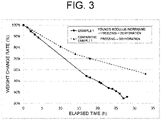
- the hardened rice gel thus dehydrated was weighed to about 250 g in a flat bat, and dried in a dehydrator set to a temperature of 60°C and a humidity of 0% (drying process). Elapsed time from the start of drying (drying time: hour) and weight change rate (%) of hardened rice gel according to Example 1 are shown in FIG. 3 and FIG.
- Weight change rate of hardened rice gel is shown as ((weight of hardened rice gel at measurement after the start of drying)/(weight of hardened rice gel before the start of drying)) ⁇ 100. Less weight change rate of hardened rice gel indicates less weight of hardened rice gel caused by removal of water by drying. In short, weight change rate is to be an index indicating the degree of dryness of hardened rice gel. This represents that the lower weight change rate of hardened rice gel is, the drier it is. Accordingly, as shown in FIG. 3 and FIG. 4 , less weight change rate of hardened rice gel suggested that drying removes water from hardened rice gel to lead to less weight of hardened rice gel.
- Drying test was performed in the same manner as Example 1 except for not performing a treatment for increasing Young's modulus of Rice gelée.
- Rice gelée was directly frozen, dehydrated, and then dried, without obtaining hardened rice gel.
- Elapsed time from the start of drying (drying time) and weight change rate of Rice gelée are shown in FIG. 3 .
- Weight change rate of Rice gelée according to Comparative Example 1 is shown as ((weight of Rice gelée at measurement after the start of drying)/(weight of Rice gelée before the start of drying)) ⁇ 100.
- Less weight change rate of Rice gelée indicates less weight of Rice gelée caused by removal of water by drying.
- weight change rate is to be an index indicating the degree of dryness of Rice gelée. This represents that the lower weight change rate of Rice gelée is, the drier it is. Accordingly, as shown in FIG. 3 , less weight change rate of Rice gelée suggested that drying removes water from Rice gelée to lead to less weight of Rice gelée.
- Example 1 As shown in FIG. 3 , referring to the same elapsed time (e.g., 25 hours) in Example 1 and Comparative Example 1, the weight change rate of hardened rice gel according to Example 1 was less than the weight change rate of Rice gelée according to Comparative Example 1. In other words, confirmation was provided that performing a Young's modulus increasing process in Example 1 enables efficient drying of rice gel.
- the hardened rice gel was cut by grating with a grater, and the cut material was weighed to about 250 g in a flat bat and dried under the same condition as Example 1. Drying time and weight change rate are shown in FIG. 4 .
- the hardened rice gel was cut under the same condition as Example 2, and the cut material was frozen, thawed, and dehydrated under the same condition as Example 1.
- the dehydration removed water in an amount of 7.8 wt % of the hardened rice gel.
- the hardened rice gel thus dehydrated was weighed to about 250 g in a flat bat, and dried under the same condition as Example 1. Drying time and weight change rate are shown in FIG. 4 .
- the hardened rice gel was dehydrated.
- the hardened rice gel thus dehydrated was weighed to about 250 g in a flat bat, and dried under the same condition as Example 1. Drying time and weight change rate are shown in FIG. 4 .
- Example 4 referring to the same elapsed time (e.g., 25 hours) in Example 1 to Example 4, the weight change rates of hardened rice gel according to Example 2 to Example 4 were less than the weight change rate of hardened rice gel according to Example 1. In other words, confirmation was provided that performing a freezing process and/or a cutting process in addition to a Young's modulus increasing process enables more efficient drying of rice gel.
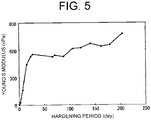
- Example 5 hardened rice gel was obtained by increasing Young's modulus of raw material rice gel with changing hardening period (cooling period, in particular).
- raw material rice gel was the same Rice gelée as the raw material rice gel according to Example 1.
- a treatment for increasing Young's modulus of Rice gelée was performed by placing Rice gelée under an environment at 8°C just for each hardening period (Young's modulus increasing process).
- Young's modulus of the hardened rice gel thus obtained was measured for each hardening period of Rice gelée.
- a softness measurement system Softmeasure (HGOP-ST1-XY), Horiuchi Electronics Co., Ltd.
- the raw material rice gel according to Example 6 was the same Rice gelée as the raw material rice gel according to Example 1.
- the hardened rice gel thus obtained was cut by grating with a grater.
- the hardened rice gel thus grated was retained and frozen at -18°C for 48 hours (freezing process).
- the hardened rice gel thus frozen was retained and thawed at 5°C for 12 hours (thawing process), and further dehydrated with application of a load of 50 g/cm 2 for 10 minutes (dehydration process).
- the hardened rice gel thus dehydrated was weighed to about 10 g in a flat bat, and dried in a dehydrator set to a temperature of 60°C and a humidity of 0% (drying process).
- As the dehydrator an infrared moisture meter (model number or product name, Kett Electric Laboratory) was used.
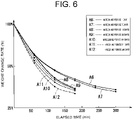
- Elapsed time from the start of drying (drying time: minute) and weight change rate (%) of hardened rice gel are shown in FIG. 6 .
- Definition of weight change rate of hardened rice gel is the same as the definition of weight change rate of hardened rice gel according to Example 1. Accordingly, this suggests that the less weight change rate of hardened rice gel is, the drier it is.
- curve A6 represents weight change rate of hardened rice gel according to Example 6. As shown by curve A6 in FIG. 6 , less weight change rate of hardened rice gel in Example 6 suggested that drying removes water from hardened rice gel to lead to less weight of hardened rice gel.
- Example 7 to Example 12 a treatment for increasing Young's modulus of Rice gelée, cutting, freezing, thawing, and dehydration were performed under the same condition as Example 6 except for having difference in a hardening period of Rice gelée.
- hardening periods of Rice gelée in the treatment for increasing Young's modulus were 7 days for Example 7, 15 days for Example 8, 22 days for Example 9, 91 days for Example 10, 211 days for Example 11, and 388 days for Example 12.
- Elapsed time from the start of drying (drying time) and weight change rate of hardened rice gel are shown in FIG. 6 . In FIG.
- curve A7 represents weight change rate of the hardened rice gel according to Example 7
- curve A8 represents weight change rate of the hardened rice gel according to Example 8
- curve A9 represents weight change rate of the hardened rice gel according to Example 9
- curve A10 represents weight change rate of the hardened rice gel according to Example 10
- curve A11 represents weight change rate of the hardened rice gel according to Example 11
- curve A12 represents weight change rate of the hardened rice gel according to Example 12.
- Example 5 in FIG. 5 and Example 6 to Example 12 in FIG. 6 provided confirmation that the larger Young's modulus of hardened rice gel is, the larger weight change rate of hardened rice gel by drying is. In other words, confirmation was provided that the larger Young's modulus of hardened rice gel is, the more efficiently rice gel can be dried.
- Example 6 when a hardening period was extended from a day (Example 6: A6) to 15 days (Example 8: A8), weight change rate of hardened rice gel was significantly reduced at the same elapsed time (e.g., 150 minutes). In other words, confirmation was provided that when a hardening period is extended from a day to 15 days, rice gel can be dramatically efficiently dried. Meanwhile, as shown in Table 1 and FIG. 5 , Young's modulus of hardened rice gel in a hardening period of a day was 5 kPa, and Young's modulus of hardened rice gel in a hardening period of 15 days was 444 kPa. Accordingly, confirmation was provided that in Example 8, Young's modulus of hardened rice gel was significantly larger compared with that of Example 6, and that 444 kPa or more provides dramatically efficient drying of rice gel.
- Example 8 Young's modulus of hardened rice gel was significantly larger compared with that of Example 6, and that 444 kPa or more provides dramatically efficient drying of rice
- Example 6 when a hardening period was extended from a day (Example 6: A6) to 7 days (Example 7: A7), weight change rate of hardened rice gel was reduced at the same elapsed time (e.g., 150 minutes). In other words, confirmation was provided that when a hardening period is extended from a day to 7 days, rice gel can be more efficiently dried.
- Table 1 and FIG. 5 Young's modulus of hardened rice gel in a hardening period of a day is 5 kPa, and Young's modulus of hardened rice gel in a hardening period of 7 days was 164 kPa. Accordingly, confirmation was provided that in Example 7, Young's modulus of hardened rice gel was significantly larger compared with that of Example 6, and that 164 kPa or more provides efficient drying of rice gel.
- Evaluation of the degree of ⁇ conversion can be performed by Method 2 for glucoamylase.
- a material dehydrated with ethanol and acetone and passed through a sieve (an aperture of 150 pm) is set as a sample.
- a phosphate citrate buffer and an enzyme solution were added to the sample, and incubated to obtain a sample solution S. Meanwhile, a sodium hydroxide solution, the phosphate citrate buffer, and the enzyme solution were added to the sample and incubated to obtain a sample solution R.
- the amounts of grape sugar in the sample solution S and the sample solution R thus obtained are measured by a glucose oxidase method (Glucose CII Test Wako, manufactured by FUJIFILM Wako Pure Chemical Corporation).
- a material with addition of an inactivated enzyme instead of the enzyme solution is set as each test solution blank, and the amount of grape sugar of each of the test solution blanks is also measured by the glucose oxidase method.
- degree of a converion % AS ⁇ BSB / AR ⁇ BRB ⁇ 100
- a production method of dried rice gel according to an embodiment of the present invention includes a Young's modulus increasing process and a drying process. Moreover, in the production method of dried rice gel, it is preferred:
- the present invention relates to a production method of dried rice gel and dried rice gel, and has industrial applicability.
Landscapes
- Life Sciences & Earth Sciences (AREA)
- Engineering & Computer Science (AREA)
- Food Science & Technology (AREA)
- Chemical & Material Sciences (AREA)
- Polymers & Plastics (AREA)
- Health & Medical Sciences (AREA)
- Nutrition Science (AREA)
- Wood Science & Technology (AREA)
- Zoology (AREA)
- Jellies, Jams, And Syrups (AREA)
- Cereal-Derived Products (AREA)
Abstract
Description
- The present invention relates to a production method of dried rice gel and dried rice gel.
- In recent years, there has been need for increasing demand for and expanding application of rice, and finding a potential of rice.
Patent Literature 1 describes a gel-form material (rice gel) obtained by adding more than 1.5 times as much water to high-amylose rice and performing heating, and subjecting the gelatinized rice thus obtained to mechanical stirring. The rice gel inPatent Literature 1 exhibits good hardness and texture by itself, and still maintains the good hardness and texture after storage, and thus can be used as a raw material of processed food that appeals for applications such as food for elderly people, a nursing meal, low-GI food, and diet food. - However, such rice gel contains a large amount of water, and thus is likely to propagate bacteria and the like and not suitable for long-term storage. Then, it has been demanded to reduce water amount of rice gel by drying.
- In addition, advantage of reducing water content of rice gel includes reduction in transport cost by weight saving.
- However, since rice gel contains a large amount of water as described above, it has been a problem to require a great deal of energy for drying rice gel.
- Patent Literature 1:
Japanese Patent Laid-open Publication No. 2013-70663 - Accordingly, an object of the present invention is to provide a production method of dried rice gel that facilitates removal of water and enables efficient drying of rice gel, and dried rice gel.
- According to an aspect of the present invention, the production method of dried rice gel includes a process of increasing Young's modulus of raw material rice gel to harden the raw material rice gel and obtaining hardened rice gel, and a process of drying the hardened rice gel and obtaining dried rice gel.
- According to another aspect of the present invention, the dried rice gel is obtained by increasing Young's modulus of raw material rice gel, thereby obtaining hardened rice gel which is the raw material rice gel being hardened, and drying the hardened rice gel.
- According to an embodiment of the present invention, removal of water is facilitated, thus enabling efficient drying of rice gel.
-
-
FIG. 1 is a flow chart showing an example of a production method of dried rice gel according to an embodiment of the present invention. -
FIG. 2 is a flow chart showing another example of a production method of dried rice gel according to an embodiment of the present invention. -
FIG. 3 is a graph showing results of drying tests in Example 1 and Comparative Example 1 of the present invention. -
FIG. 4 is a graph showing results of drying tests in Example 1 to Example 4 of the present invention. -
FIG. 5 is a graph showing relation between a hardening period and Young's modulus of raw material rice gel according to Example 5 of the present invention. -
FIG. 6 is a graph showing results of drying tests in Example 6 to Example 12 of the present invention. - The present invention relates to a production method of dried rice gel. Herein, rice gel used as a raw material for dried rice gel may be referred to as raw material rice gel for discriminating from dried rice gel.
- Raw material rice gel according to an embodiment of the present invention is a gel-form material derived by, e.g., heating high-amylose rice with water in an amount of one or more the amount of the high-amylose rice, and mechanically stirring a gelatinized material obtained by α-conversion of starch contained in the high-amylose rice. α conversion means that a water molecule penetrates between starch molecular chains, thereby cutting off a hydrogen bond between the molecular chains and destroying a crystalline structure. For example, raw material rice gel is preferably rice gel obtained by subjecting gelatinized rice to mechanical stirring, the gelatinized rice being derived by adding water in an amount of more than 1.5 times the amount of high-amylose rice to the high-amylose rice and performing heating. Additionally, for example, raw material rice gel is formed of high-amylose rice having an amylose content of 20% or more by mass.
- The varieties of high-amylose rice may be either Japonica or Indica, and include, for example, Momi-roman, Yume-toiro, Hoshi-yutaka, Hoshi-nishiki, Mire-nishiki, Chugoku 134, Koshino-kaori, Mizuho-chikara. Among the varieties described above, Momi-roman or Yume-toiro is preferably used. High-amylose rice may be polished to any degree, and be in any form of brown rice, semi-polished rice, or white rice. A mixture of two or more different types of high-amylose rice can also be used.
- Raw material rice gel used in the embodiment is obtained by subjecting gelatinized rice to mechanical stirring.
- Starch contained in dried rice is in a crystal state, and referred to as β-converted starch. In a broad sense, β conversion means hardening of starch. β conversion may also be referred to as aging. In a narrow sense, β conversion means separating starch molecular chains from a water molecule, generating a hydrogen bond between the molecular chains, and partially leading to recrystallization. In short, a hydrogen bond is formed between starch molecular chains of β-converted starch. Once water is added to dried rice and then heated, a water molecule penetrates into a space in a crystalline structure of β-converted starch of dried rice, thereby cutting off a hydrogen bond between starch molecular chains and extending the starch molecular chains in water. This phenomenon is referred to as α conversion (gelatinization).
- Rice in which starch contained therein is α converted is herein referred to as gelatinized rice. Furthermore, addition of water to dried rice and heating for obtaining gelatinized rice is herein referred to as rice cooking.
- The amount of water used in rice cooking depends on amylose content in rice, but is typically 1 or more times the amount of dried rice, particularly preferably 1 or more times the amount to 6 or less times the amount, and more preferably 2 or more times the amount to 4 or less times the amount. The amount of water within the range described above allows the degree of viscosity of rice gel to be maintained in a proper range.
- Prior to rice cooking, dried rice may be immersed into water. The immersion time is not particularly limited and typically about 10 minutes or more to 120 minutes or less; but in winter season, during which water absorbency or moisture content rate of rice is relatively low, it may also be desirable to immerse for a time beyond the range described above.
- For rice cooking, known heating means can be used such as a rice cooker, a pan, a pressure pan, an electromagnetic cooker (such as an IH cooker), a microwave, or a steam oven.
- The conditions of heating such as temperature, pressure, and time also vary depending on means of heating, quantity of water, and the like, and is difficult to identify unambiguously, but is adjusted appropriately to time in which α conversion sufficiently proceeds without burning and sticking rice. For example, the conditions may be adjusted in accordance with the mode of condition integrated into a heating means (e.g., a rice gruel mode). In the heating temperature, the lower limit of temperature is typically 25°C or more, preferably 60°C or more, and particularly preferably 80°C or more. The upper limit is 130°C or less, preferably 120°C or less, and more preferably 100°C or less. Heating may be performed along with not only heating but also pressurization, and the temperature condition in this case may also be preferably a condition out of the range described above.
- The water used for rice cooking should just be a liquid form, and water, ingredient other than water (e.g., cow milk, plant-based milk such as soymilk (plain soymilk, processed soymilk), coconut milk, or almond milk, or plant protein), and a mixture thereof can be appropriately selected and used.
- The degree of α conversion of gelatinized rice is preferably greater than 95%. This is because phase transition to a gel state is unlikely to occur when the degree of α conversion of gelatinized rice is below the range described above.
- Subjecting gelatinized rice to mechanical stirring provides raw material rice gel used in the embodiment.
- Mechanical stirring means stirring that can destroy a tissue by physical motion, and differs from just mixing. Mechanical stirring should just be performed using e.g., a stirring machine such as a food processor, a homogenizer, a mixer, a kneader, a kneading machine, or an extruder. It is preferable that the stirring machine have a large torque, because stirring would not be prevented even in increasing viscosity of gelatinized rice during mechanical stirring. Examples of the stirring machines having a large torque include a cutter mixer (e.g., Robot Coupe, BLIXER-5Plus, FMI Corporation).
- The conditions of mechanical stirring can be determined appropriately depending on the state of gelatinized rice, the type of a stirring device, and the like. For example, rotation speed at no load is preferably 1,000 rpm or more to 3,000 rpm or less, more preferably 1,200 rpm or more to 2,000 rpm or less, and even more preferably 1,500 rpm or more to 1,800 rpm or less. Moreover, optimum conditions can be selected appropriately such as decreasing rotation speed and correspondingly taking a long time, or pressure forming along with stirring with a low-speed screw at about 60 rpm.
- Hardness of raw material rice gel can be comprehensively evaluated by complex elastic modulus G*. Complex elastic modulus G* is a sum of an elasticity component and a viscosity component and means general hardness, as described in
Japanese Patent No. 5840904 B2 - The complex elastic modulus G* of raw material rice gel is preferably 1000 Pa or more, and particularly preferably 1500 Pa or more. If the complex elastic modulus G* is too low, the hardness of the rice gel is insufficient, thus potentially failing to provide food with a desired mouthfeel. In contrast, if the complex elastic modulus G* is too high, the rice gel is excessively hard, thus possibly leading to inconvenience such as preventing uniform mixing of the rice gel and other materials, or placing much burden on a stirring apparatus even in achieving uniform mixing.
- Texture of raw material rice gel can be comprehensively evaluated with tan δ. A viscosity/elasticity ratio, tan δ, is specifically calculated from the formula tan δ = G"/G'. δ means an angle between a vector of complex elastic modulus G* and storage elastic modulus G' (X-axis).
- Lower tan δ indicates higher characteristics as an elastic body. This means that the characteristics as an elastic body, in which deformation is generated depending on applied force but is restored to the original form upon removal of the applied force, is made higher. In contrast, higher tan δ indicates higher characteristics as a viscous body. This means that the characteristics as a viscous body, in which deformation is generated depending on applied force and is not restored to the original form even after removal of the applied force, is made higher.
- The viscosity/elasticity ratio, tan δ, of raw material rice gel is preferably 0.3 or less, and particularly preferably 0.2 or less.
- Then, referring to
FIG. 1 , description will be made for an example of the production method of dried rice gel according to the embodiment.FIG. 1 is a flow chart showing the production method of dried rice gel according to the embodiment. As shown inFIG. 1 , the production method of dried rice gel includes process S1 and process S2. - In process S1, Young's modulus of raw material rice gel is increased to harden the raw material rice gel, thereby obtaining hardened rice gel. In other words, Young's modulus of the hardened rice gel increases relative to Young's modulus of the raw material rice gel. This facilitates removal of water from the hardened rice gel. Consequently, according to the embodiment, it is possible to dry hardened rice gel efficiently. This is demonstrated by Example 1 to Example 12 described later.
- Preferably, in process S1, hardened rice gel is obtained by hardening raw material rice gel so as to cause Young's modulus of the raw material rice gel to exceeds a predetermined value (hereinafter, written as "predetermined value TH"). Young's modulus of the hardened rice gel is therefore a predetermined value TH or more. Consequently, according to the embodiment, removal of water from hardened rice gel is further facilitated, thus enabling more efficient drying. This is demonstrated by Example 6 to Example 11 described later.
- Hereinafter, process S1 may referred to as "Young's modulus increasing process" or "hardening process". Hardened rice gel obtained by a Young's modulus increasing process is potentially β converted. In other words, starch of the hardened rice gel is potentially β converted.
- The term "hardening" in a Young's modulus increasing process means that Young's modulus of hardened rice gel becomes higher than Young's modulus of raw material rice gel. In other words, "hardening" in a Young's modulus increasing process means that hardened rice gel becomes harder relative to raw material rice gel. Preferably, "hardening" in a Young's modulus increasing process means that raw material rice gel is hardened so as to cause Young's modulus of the raw material rice gel to exceed a predetermined value TH.
- A predetermined value TH of Young's modulus is e.g., a value of 5 kilopascal or more. A predetermined value TH of Young's modulus is preferably a value of 25 kilopascal or more, more preferably a value of 150 kilopascal or more, more preferably a value of 164 kilopascal or more, and more preferably a value of 300 kilopascal or more. Furthermore, a predetermined value TH of Young's modulus is more preferably a value of 400 kilopascal or more, more preferably a value of 444 kilopascal or more, more preferably a value of 500 kilopascal or more, more preferably a value of 600 kilopascal or more, and more preferably a value of 700 kilopascal or more. Thus, the greater a predetermined value TH of Young's modulus is, the more preferable it is. In other words, the greater Young's modulus of hardened rice gel derived by a Young's modulus increasing process is, the more facilitated removal of water from hardened rice gel is, thus enabling more efficient drying. This is demonstrated by Example 5 to Example 12 described later.
- Here, the upper limit of a predetermined value TH of Young's modulus is not particularly limited, but may be e.g., 1000 kilopascal or 1500 kilopascal.
- Hereinafter, a term and temperature for increasing Young's modulus of raw material rice gel and obtaining hardened rice gel in a Young's modulus increasing process may referred to as "hardening period" and "hardening temperature", respectively. In a Young's modulus increasing process, Young's modulus of raw material rice gel is increased to harden raw material rice gel at a hardening temperature for a hardening period, thereby obtaining hardened rice gel. Young's modulus of the hardened rice gel thus obtained is defined by the hardening period and the hardening temperature.
- For example, in a Young's modulus increasing process, raw material rice gel is placed under a normal temperature environment, thereby increasing Young's modulus of the raw material rice gel to harden the raw material rice gel, and obtaining hardened rice gel. Preferably, for example, in a Young's modulus increasing process, raw material rice gel is placed under a normal temperature environment, thereby hardening the raw material rice gel so as to cause Young's modulus of the raw material rice gel to exceed a predetermined value TH, and obtaining hardened rice gel. Normal temperature refers to temperature in a condition with neither heating nor cooling from an outer system. Here, when hardened rice gel is obtained under a normal temperature environment, hardening temperature is normal temperature.
- A period for placing raw material rice gel under a normal temperature environment, i.e., a hardening period of raw material rice gel under a normal temperature environment is not particularly limited, as long as Young's modulus of a part or the whole of raw material rice gel exceeds a predetermined value TH. In addition, the upper limit of a hardening period of raw material rice gel under a normal temperature environment is not particularly limited, but is e.g., 3 years.
- In a Young's modulus increasing process, it is preferable to cool raw material rice gel, thereby accelerating increase in Young's modulus of raw material rice gel. That means that, in Young's modulus increasing process, it is preferable to cool raw material rice gel, thereby increasing Young's modulus of raw material rice gel to harden raw material rice gel, and obtaining hardened rice gel. In this preferable example, a period for obtaining hardened rice gel, i.e., a hardening period can be shortened. Consequently, it is possible to improve productivity of hardened rice gel. More preferably, in a Young's modulus increasing process, raw material rice gel is cooled, thereby hardening raw material rice gel so as to cause Young's modulus of raw material rice gel to excess a predetermined value TH, and obtaining hardened rice gel.
- Cooling temperature in a Young's modulus increasing process is not particularly limited, but is e.g., lower than normal temperature, preferably -1°C or more to 18°C or less, and more preferably 0°C or more to 10°C or less. This is because increase in Young's modulus of raw material rice gel is potentially unlikely to occur when cooling temperature is e.g., below -1°C. This is also because bacteria and the like potentially propagate when cooling temperature is e.g., above 18°C. Here, when hardened rice gel is obtained under a cooling environment, hardening temperature is cooling temperature.
- The lower limit of a hardening period of raw material rice gel by cooling, i.e., the lower limit of a cooling period in a Young's modulus increasing process is not particularly limited, but preferably 0.5 hours or more, and more preferably 20 hours or more. This is because Young's modulus is potentially likely to increase insufficiently when a cooling period is below 0.5 hours. In addition, the lower limit of a cooling period is more preferably 7 days or more, more preferably 15 days or more, more preferably 30 days or more, more preferably 60 days or more, more preferably 90 days or more, more preferably 200 days or more, more preferably 300 days or more, and more preferably 388 days or more. Meanwhile, the upper limit of a cooling period is not particularly limited, but is e.g., 3 years.
- In a Young's modulus increasing process, any combination of cooling temperature and a cooling period may be employed as long as Young's modulus of a part or the whole of rice gel increases. However, in view of bacterial growth control, cost reduction, and the like, the process is preferably performed at -1°C or more to 18°C or less for 0.5 hours or more, and more preferably performed at 0°C or more to 10°C or less for 20 hours or more.
- Referring back to
FIG. 1 , hardened rice gel is dried to obtain dried rice gel in process S2. Hereinafter, process S2 may be referred to as "drying process". - Drying herein means removal of water by vaporization.
- Examples of means for performing drying in a drying process include heat treatment, blast (cold blast, hot blast) treatment, microwave irradiation, spray drying, freeze drying, and drum drying, and these can be used alone or in combination of two or more types. Among them, preferred is drying in low temperature such as cool blast drying.
- Temperature in drying is not particularly limited, but is preferably 50°C or less, at which starch would not be gelatinized, and more preferably 30°C or less. In addition, humidity in drying is desirably a low value wherever possible. Particularly, it is preferably 50% or less, and more preferably 10% or less.
- Drying should just be performed so as to provide a water content of rice gel of 20% or less, preferably 10% or less, and more preferably 5% or less.
- Here, the production method of dried rice gel according to the embodiment may include, between a Young's modulus increasing process and a drying process, one or more processes that performs a treatment for hardened rice gel obtained in a Young's modulus increasing process. In this case, in the drying process, drying is performed for hardened rice gel that received a treatment in a process between the Young's modulus increasing process and the drying process. Accordingly, an object to be dried in a drying process may be hardened rice gel itself obtained in a Young's modulus increasing process, or hardened rice gel that received a treatment in a process between a Young's modulus increasing process and a drying process.
- Next, referring to
FIG. 2 , description will be made for another example of the production method of dried rice gel according to the embodiment.FIG. 2 is a flow chart showing another example of the production method of dried rice gel according to the embodiment. As shown inFIG. 2 , the production method of dried rice gel includes process S 11-process S16. - In process S11, Young's modulus of raw material rice gel is increased to harden the raw material rice gel, thereby obtaining hardened rice gel. Particularly, process S11 is the same as process S1 in
FIG. 1 , which is a Young's modulus increasing process. - In process S12, the hardened rice gel is cut. Hereinafter, process S12 may be referred to as "cutting process".
- In the production method of dried rice gel according to the embodiment, it is preferable to include a cutting process for cutting hardened rice gel, before a drying process for obtaining dried rice gel (process S16). Inclusion of a cutting process and enlargement of the surface area of hardened rice gel allow efficient removal of water of the hardened rice gel.
- In a cutting process, hardened rice gel may be cut into any shapes as long as the surface area of hardened rice gel is enlarged. It may be cut into any shape such as a sheet shape, a thread shape, a flake shape, a particle shape, or a powder shape, as long as the surface area is enlarged. An apparatus to be used for cutting may also be selected freely, for example, cutting may be made into sheet shapes with a slicer or the like, or by grating with a grater or the like. Among them, grating is preferred.
- Referring back to
FIG. 2 , hardened rice gel is frozen in process S13. In the example inFIG. 2 , hardened rice gel after cutting is frozen. Hereinafter, process S13 may be referred to as "freezing process". - In the production method of dried rice gel according to the embodiment, it is preferable to include a freezing process for freezing hardened rice gel, before a drying process for obtaining dried rice gel (process S16). Inclusion of a freezing process causes hardened rice gel to change into a sponge form, thus allowing efficient removal of water.
- Examples of means for performing freezing in a freezing process include placement under a low-temperature atmosphere such as in a freezer, immersion into liquid hydrogen, and immersion in alcohol brine, and these may be used alone or in combination of two or more types. Among them, preferred is placement under a low-temperature atmosphere such as in a freezer.
- Freezing temperature is not particularly limited, but is preferably -20°C or more to -1°C or less, and more preferably -10°C or more to -1°C or less. Additionally, for example, freezing temperature in a freezing process is preferably lower than hardening temperature in a Young's modulus increasing process.
- Referring back to
FIG. 2 , hardened rice gel is thawed in process S14. In the example inFIG. 2 , thawing is performed for post-cutting, post-freezing hardened rice gel. Hereinafter, process S14 may be referred to as "thawing process". - In the production method of dried rice gel according to the embodiment, it is preferable to include a thawing process for thawing hardened rice gel, after a freezing process for freezing the hardened rice gel. Inclusion of a thawing process allows improving removal efficiency of water by a dehydration process described later. In a thawing process, hardened rice gel is thawed at thawing temperature higher than cooling temperature of a freezing process.
- Referring back to
FIG. 2 , dehydration is performed for hardened rice gel in process S15. In the example inFIG. 2 , dehydration is performed for post-cutting, post-freezing, post-thawing hardened rice gel. Hereinafter, process S15 may be referred to as "dehydration process". - In the production method of dried rice gel according to the embodiment, it is preferable to include a dehydration process for performing dehydration for hardened rice gel, before a drying process for obtaining dried rice gel.
- Dehydration herein refers to applying a physical treatment, such as pressurization, to hardened rice gel, and means removing water remaining in a liquid state, from hardened rice gel. That is, dehydration refers to a concept different from "drying" described above.
- Examples of means for dehydration include pressurization such as compression or application of load, and centrifugation, and these may be used alone or in combination of two or more types. Among them, pressurization is preferred.
- Referring back to
FIG. 2 , hardened rice gel is dried to obtain dried rice gel in process S16. In the example inFIG. 2 , post-cutting, post-freezing, post-thawing, post-dehydration hardened rice gel is thawed. In particular, process S16 is the same as process S2 inFIG. 1 , which is a drying process. - In the production method of dried rice gel according to the embodiment, the cutting process, freezing process, thawing process, and dehydration process as described above may be included in any order before a drying process, provided that the thawing process is performed after the freezing process. The production method of dried rice gel may also include any one process, any two processes, or any three processes of a cutting process, a freezing process, a thawing process, and a dehydration process between a Young's modulus increasing process and a drying process, provided that the thawing process can be included in the production method of dried rice gel if the production method of dried rice gel includes the freezing process. In addition, an order of processes to be performed between a Young's modulus increasing process and a drying process is not particularly limited. The production method of dried rice gel may also include another process to perform a treatment for hardened rice gel between a Young's modulus increasing process and a drying process.
- In the production method of dried rice gel according to the embodiment, it is preferable to include a dehydration process after a cutting process. This is because enlargement of the surface area of hardened rice gel by cutting allows efficiently removing water of hardened rice gel.
- In the production method of dried rice gel according to the embodiment, it is preferable to include a dehydration process after a freezing process. This is because hardened rice gel that experiences a freezing process changes into a sponge form, and dehydration of the hardened rice gel thus changed into a sponge form provides removal of a large amount of water. Specifically, when a freezing process is included before a dehydration process, it is preferable to perform dehydration after thawing hardened rice gel thus frozen. This is because hardened rice gel that experienced a freezing process has changed to a spongy form, and thawing and dehydration of the hardened rice gel thus changed to a spongy form provides removal of a larger amount of water. In spite of depending on a freezing condition, when a dehydration process is included after a freezing process, the dehydration process removes water in amount of preferably 30 wt% or more of hardened rice gel, or 40 wt% of hardened rice gel.
- In the production method of dried rice gel according to the embodiment, it is more preferable to include a dehydration process after a cutting process and a freezing process. This is because two effects, conversion to a spongy form by freezing and enlargement of the surface area by cutting, provide efficient removal of water. In this case, a freezing process and a cutting process should just be included in any order.
- In the production method of dried rice gel according to the embodiment, it is more preferable to include a freezing process after a cutting process, and to further include a dehydration process after the freezing process. This is because cutting in advance leads to increase in the surface area of hardened rice gel, thus allowing freezing in a short time. Furthermore, if cutting is performed after a freezing process, hardened rice gel in a frozen state is so hard that cutting is very difficult; and as well, even if cutting is performed after thawing, a time for freezing must be provided, thus making production complicated. However, inclusion a freezing process after a cutting process allows avoidance of such problems.
- As described with reference to
FIG. 1 and FIG. 2 so far, the dried rice gel according to the embodiment is obtained by increasing Young's modulus of raw material rice gel, thereby obtaining hardened rice gel which is the raw material rice gel being hardened, and then drying the hardened rice gel. In this case, it is preferable to accelerate increase in Young's modulus of raw material rice gel by cooling raw material rice gel. Furthermore, it is preferable that hardened rice gel be cut before drying of the hardened rice gel. It is preferable that hardened rice gel be frozen before drying of the hardened rice gel. It is preferable that hardened rice gel be thawed after freezing of the hardened rice gel. It is preferable that hardened rice gel be dehydrated before drying of the hardened rice gel. - Adding water to the dried rice gel produced by the production method of dried rice gel according to the embodiment and then heating can provide rice gel with the same hardness and texture as raw material rice gel. In particular, adding water to the dried rice gel and then heating and stirring can provide rice gel with the same hardness and texture as an undried one. Here, hardness and texture of raw material rice gel is as described above.
- The dried rice gel exhibits the same hardness and texture as raw material rice gel by addition of water and heating, and thus can be utilized for a variety of food with taking advantage of such hardness and texture. In other words, the dried rice gel allows intended improvement of mouthfeel and texture of processed food. An example of the processed food can be confectionery (rice cake sweets, manju, cake, ice cream, jelly, or the like), rice, bread, noodle, or the like.
- The dried rice gel may be used after addition of water and heating to be reconstituted to the same condition as raw material rice gel in advance, or may be used with remaining in a dried form. In other words, the dried rice gel added with remaining in a dried form is reconstituted to the same condition as an undried one by water in processed food and heat in processing, thereby improving mouthfeel and texture of processed food. For example, in production of bread, the dried rice gel in a dried form is added in kneading of materials, then fermented and fired, thereby reconstituting the dried rice gel to the same condition as an undried one by water in bread dough and heat in firing, and improving mouthfeel and texture of bread.
- The present invention will be specifically described with reference to the following examples, but the present invention is not limited to the following examples.
- As raw material rice gel, a material was prepared that was phase-transited to a gel form by mechanically stirring cooked rice derived by cooking white rice with an amylose content of 25% or more and water in a proportion of 1:2 by weight (product name: Rice gelée Hard, manufacturer: Rice Technology Kawachi Co., Ltd., hereinafter referred to as Rice gelée).
- First, a treatment for increasing Young's modulus of Rice gelée thus prepared was performed (Young's modulus increasing process) to obtain hardened rice gel. In particular, Rice gelée was retained at 10°C (hardening temperature) for 48 hours (hardening period) or more to obtain hardened rice gel.
- The hardened rice gel was retained and frozen at -18°C for 40 hours (freezing process). The hardened rice gel thus frozen was retained and thawed at 10°C for 6 hours (thawing process), and further dehydrated with application of a load of 50 g/cm2 for 10 minutes (dehydration process). The dehydration removed water in an amount of 7.1 wt% of the hardened rice gel. The hardened rice gel thus dehydrated was weighed to about 250 g in a flat bat, and dried in a dehydrator set to a temperature of 60°C and a humidity of 0% (drying process). Elapsed time from the start of drying (drying time: hour) and weight change rate (%) of hardened rice gel according to Example 1 are shown in
FIG. 3 andFIG. 4 . Weight change rate of hardened rice gel is shown as ((weight of hardened rice gel at measurement after the start of drying)/(weight of hardened rice gel before the start of drying)) × 100. Less weight change rate of hardened rice gel indicates less weight of hardened rice gel caused by removal of water by drying. In short, weight change rate is to be an index indicating the degree of dryness of hardened rice gel. This represents that the lower weight change rate of hardened rice gel is, the drier it is. Accordingly, as shown inFIG. 3 andFIG. 4 , less weight change rate of hardened rice gel suggested that drying removes water from hardened rice gel to lead to less weight of hardened rice gel. - Drying test was performed in the same manner as Example 1 except for not performing a treatment for increasing Young's modulus of Rice gelée. In other words, Rice gelée was directly frozen, dehydrated, and then dried, without obtaining hardened rice gel. Elapsed time from the start of drying (drying time) and weight change rate of Rice gelée are shown in
FIG. 3 . Weight change rate of Rice gelée according to Comparative Example 1 is shown as ((weight of Rice gelée at measurement after the start of drying)/(weight of Rice gelée before the start of drying)) × 100. Less weight change rate of Rice gelée indicates less weight of Rice gelée caused by removal of water by drying. In short, weight change rate is to be an index indicating the degree of dryness of Rice gelée. This represents that the lower weight change rate of Rice gelée is, the drier it is. Accordingly, as shown inFIG. 3 , less weight change rate of Rice gelée suggested that drying removes water from Rice gelée to lead to less weight of Rice gelée. - As shown in
FIG. 3 , referring to the same elapsed time (e.g., 25 hours) in Example 1 and Comparative Example 1, the weight change rate of hardened rice gel according to Example 1 was less than the weight change rate of Rice gelée according to Comparative Example 1. In other words, confirmation was provided that performing a Young's modulus increasing process in Example 1 enables efficient drying of rice gel. - First, a treatment for increasing Young's modulus of Rice gelée was performed under the same condition as Example 1 to obtain hardened rice gel.
- The hardened rice gel was cut by grating with a grater, and the cut material was weighed to about 250 g in a flat bat and dried under the same condition as Example 1. Drying time and weight change rate are shown in
FIG. 4 . - First, a treatment for increasing Young's modulus of Rice gelée was performed under the same condition as Example 1 to obtain hardened rice gel.
- The hardened rice gel was cut under the same condition as Example 2, and the cut material was frozen, thawed, and dehydrated under the same condition as Example 1. The dehydration removed water in an amount of 7.8 wt % of the hardened rice gel. The hardened rice gel thus dehydrated was weighed to about 250 g in a flat bat, and dried under the same condition as Example 1. Drying time and weight change rate are shown in
FIG. 4 . - First, a treatment for increasing Young's modulus of Rice gelée was performed under the same condition as Example 1 to obtain hardened rice gel.
- The hardened rice gel was dehydrated. The hardened rice gel thus dehydrated was weighed to about 250 g in a flat bat, and dried under the same condition as Example 1. Drying time and weight change rate are shown in
FIG. 4 . - As shown in
FIG. 4 , referring to the same elapsed time (e.g., 25 hours) in Example 1 to Example 4, the weight change rates of hardened rice gel according to Example 2 to Example 4 were less than the weight change rate of hardened rice gel according to Example 1. In other words, confirmation was provided that performing a freezing process and/or a cutting process in addition to a Young's modulus increasing process enables more efficient drying of rice gel. - In Example 5, hardened rice gel was obtained by increasing Young's modulus of raw material rice gel with changing hardening period (cooling period, in particular). In particular, raw material rice gel was the same Rice gelée as the raw material rice gel according to Example 1. Then, a treatment for increasing Young's modulus of Rice gelée was performed by placing Rice gelée under an environment at 8°C just for each hardening period (Young's modulus increasing process). Furthermore, Young's modulus of the hardened rice gel thus obtained was measured for each hardening period of Rice gelée. For measurement of Young's modulus, a softness measurement system (Softmeasure (HGOP-ST1-XY), Horiuchi Electronics Co., Ltd.) was used. Measurement results of Young's modulus are shown in Table 1, Table 2, and
FIG. 5 . InFIG. 5 , the abscissa axis represents a hardening period (day) of raw material rice gel, and the longitudinal axis represents Young's modulus (kilopascal: kPa). - As shown in Table 1, Table 2, and
FIG. 5 , the longer hardening period was, the larger Young's modulus of hardened rice gel was, in general. Here, Young's modulus at a hardening period of 0 (zero) day (3 kPa) was Young's modulus of Rice gelée in a condition without performing a treatment for increasing Young's modulus.[Table 1] Hardening period (day) 0 1 2 7 15 23 27 66 Young's modulus (kPa) 3 5 29 164 444 531 556 528 [Table 2] Hardening period (day) 71 88 106 122 141 162 179 204 Young's modulus (kPa) 545 532 617 626 672 641 657 779 - The raw material rice gel according to Example 6 was the same Rice gelée as the raw material rice gel according to Example 1.
- First, a treatment for increasing Young's modulus of Rice gelée prepared was performed to obtain hardened rice gel (Young's modulus increasing process). In particular, Rice gelée was retained at 6°C (hardening temperature) for a day (hardening period).
- The hardened rice gel thus obtained was cut by grating with a grater. The hardened rice gel thus grated was retained and frozen at -18°C for 48 hours (freezing process). The hardened rice gel thus frozen was retained and thawed at 5°C for 12 hours (thawing process), and further dehydrated with application of a load of 50 g/cm2 for 10 minutes (dehydration process). The hardened rice gel thus dehydrated was weighed to about 10 g in a flat bat, and dried in a dehydrator set to a temperature of 60°C and a humidity of 0% (drying process). As the dehydrator, an infrared moisture meter (model number or product name, Kett Electric Laboratory) was used. Elapsed time from the start of drying (drying time: minute) and weight change rate (%) of hardened rice gel are shown in
FIG. 6 . Definition of weight change rate of hardened rice gel is the same as the definition of weight change rate of hardened rice gel according to Example 1. Accordingly, this suggests that the less weight change rate of hardened rice gel is, the drier it is. InFIG. 6 , curve A6 represents weight change rate of hardened rice gel according to Example 6. As shown by curve A6 inFIG. 6 , less weight change rate of hardened rice gel in Example 6 suggested that drying removes water from hardened rice gel to lead to less weight of hardened rice gel. - In Example 7 to Example 12, a treatment for increasing Young's modulus of Rice gelée, cutting, freezing, thawing, and dehydration were performed under the same condition as Example 6 except for having difference in a hardening period of Rice gelée. In these cases, hardening periods of Rice gelée in the treatment for increasing Young's modulus were 7 days for Example 7, 15 days for Example 8, 22 days for Example 9, 91 days for Example 10, 211 days for Example 11, and 388 days for Example 12. Elapsed time from the start of drying (drying time) and weight change rate of hardened rice gel are shown in
FIG. 6 . InFIG. 6 , curve A7 represents weight change rate of the hardened rice gel according to Example 7; curve A8 represents weight change rate of the hardened rice gel according to Example 8; curve A9 represents weight change rate of the hardened rice gel according to Example 9; curve A10 represents weight change rate of the hardened rice gel according to Example 10; curve A11 represents weight change rate of the hardened rice gel according to Example 11, curve A12 represents weight change rate of the hardened rice gel according to Example 12. - As shown in
FIG. 6 , referring to the same elapsed time (e.g., 150 hours) in Example 6 to Example 12, the longer a hardening period of Rice gelée is, the less the weight change rate of the hardened rice gel was, in general. In other words, confirmation was provided that the longer a hardening period of Rice gelée was, the more efficiently rice gel can be dried. Meanwhile, as shown inFIG. 5 , the longer a hardening period of Rice gelée was, the larger Young's modulus of the hardened rice gel was. Accordingly, Example 5 inFIG. 5 and Example 6 to Example 12 inFIG. 6 provided confirmation that the larger Young's modulus of hardened rice gel is, the larger weight change rate of hardened rice gel by drying is. In other words, confirmation was provided that the larger Young's modulus of hardened rice gel is, the more efficiently rice gel can be dried. - Specifically, as shown in
FIG. 6 , when a hardening period was extended from a day (Example 6: A6) to 15 days (Example 8: A8), weight change rate of hardened rice gel was significantly reduced at the same elapsed time (e.g., 150 minutes). In other words, confirmation was provided that when a hardening period is extended from a day to 15 days, rice gel can be dramatically efficiently dried. Meanwhile, as shown in Table 1 andFIG. 5 , Young's modulus of hardened rice gel in a hardening period of a day was 5 kPa, and Young's modulus of hardened rice gel in a hardening period of 15 days was 444 kPa. Accordingly, confirmation was provided that in Example 8, Young's modulus of hardened rice gel was significantly larger compared with that of Example 6, and that 444 kPa or more provides dramatically efficient drying of rice gel. - Moreover, for example, as shown in
FIG. 6 , as shown inFIG. 6 , when a hardening period was extended from a day (Example 6: A6) to 7 days (Example 7: A7), weight change rate of hardened rice gel was reduced at the same elapsed time (e.g., 150 minutes). In other words, confirmation was provided that when a hardening period is extended from a day to 7 days, rice gel can be more efficiently dried. Meanwhile, as shown in Table 1 andFIG. 5 , Young's modulus of hardened rice gel in a hardening period of a day is 5 kPa, and Young's modulus of hardened rice gel in a hardening period of 7 days was 164 kPa. Accordingly, confirmation was provided that in Example 7, Young's modulus of hardened rice gel was significantly larger compared with that of Example 6, and that 164 kPa or more provides efficient drying of rice gel. - Embodiments and examples of the present invention have been described with reference to the drawings so far. However, the present invention is not limited to the embodiments and examples described above, and can be performed in various aspects in the range without departing from its spirit.
- Evaluation of the degree of α conversion can be performed by
Method 2 for glucoamylase. - A material dehydrated with ethanol and acetone and passed through a sieve (an aperture of 150 pm) is set as a sample.
- A phosphate citrate buffer and an enzyme solution were added to the sample, and incubated to obtain a sample solution S. Meanwhile, a sodium hydroxide solution, the phosphate citrate buffer, and the enzyme solution were added to the sample and incubated to obtain a sample solution R. The amounts of grape sugar in the sample solution S and the sample solution R thus obtained are measured by a glucose oxidase method (Glucose CII Test Wako, manufactured by FUJIFILM Wako Pure Chemical Corporation).
- Additionally, in preparation of the sample solution S and the sample solution R, a material with addition of an inactivated enzyme instead of the enzyme solution is set as each test solution blank, and the amount of grape sugar of each of the test solution blanks is also measured by the glucose oxidase method.
- The degree of α conversion is measured in accordance with the following formula:

- AS: absorbance of a sample solution S; AR: absorbance of a sample solution R
- BSB: blank absorbance of a sample solution S; BRB: blank absorbance of a sample solution R
- The application further discloses supplementary note as below. Here, the following supplementary note shall not limit the present invention.
- A production method of dried rice gel according to an embodiment of the present invention includes a Young's modulus increasing process and a drying process. Moreover, in the production method of dried rice gel, it is preferred:
- (1) that a freezing process for freezing hardened rice gel be included before the drying process,
- (2) that a cutting process for cutting hardened rice gel be included before the drying process,
- (3) that a dehydration process for removing water from hardened rice gel by a physical means be included before the drying process,
- (4) that the Young's modulus increasing process be performed by retaining raw material rice gel at a temperature of -1°C or more to 18°C or less for 0.5 hours or more,
- (5) that the raw material rice gel be formed of high-amylose rice having an amylose content of 20% or more, and
- (6) that the raw material rice gel be rice gel obtained by subjecting gelatinized rice to mechanical stirring, the gelatinized rice being derived by adding more than 1.5 times as much water to the high-amylose rice and performing heating.
- The present invention relates to a production method of dried rice gel and dried rice gel, and has industrial applicability.
Claims (15)
- A production method of dried rice gel comprising:increasing Young's modulus of raw material rice gel to harden the raw material rice gel, and obtaining hardened rice gel, anddrying the hardened rice gel and obtaining dried rice gel.
- The production method of dried rice gel according to claim 1, wherein in the obtaining the hardened rice gel, the hardened rice gel is obtained by hardening the raw material rice gel in such manner that the Young's modulus of the raw material rice gel is above a predetermined value.
- The production method of dried rice gel according to claim 2, wherein the predetermined value is a value of 160 kilopascal or more.
- The production method of dried rice gel according to claim 2, wherein the predetermined value is a value of 440 kilopascal or more.
- The production method of dried rice gel according to any one of claim 1 to claim 4, wherein in the obtaining the hardened rice gel, the raw material rice gel is cooled, thereby accelerating increase in Young's modulus of the raw material rice gel.
- The production method of dried rice gel according to any one of claim 1 to claim 5, wherein in the obtaining the hardened rice gel, the raw material rice gel is retained at a temperature of -1°C or more to 18°C or less for 0.5 hours or more.
- The production method of dried rice gel according to any one of claim 1 to claim 6, further comprising freezing the hardened rice gel before the obtaining the dried rice gel.
- The production method of dried rice gel according to claim 7, further comprising thawing the hardened rice gel after the freezing the hardened rice gel.
- The production method of dried rice gel according to any one of claim 1 to claim 8, further comprising cutting the hardened rice gel before the obtaining the dried rice gel.
- The production method of dried rice gel according to any one of claim 1 to claim 9, further comprising performing dehydration for the hardened rice gel before the obtaining the dried rice gel.
- The production method of dried rice gel according to any one of claim 1 to claim 10,
wherein the raw material rice gel comprises high-amylose rice with an amylose content of 20% or more. - The production method of dried rice gel according to claim 11, wherein the raw material rice gel is rice gel obtained by subjecting gelatinized rice to mechanical stirring, the gelatinized rice being derived by adding water in an amount of more than 1.5 times the amount of high-amylose rice to the high-amylose rice and performing heating.
- A dried rice gel provided by increasing Young's modulus of raw material rice gel, thereby obtaining hardened rice gel which is the raw material rice gel being hardened, and then drying the hardened rice gel.
- The dried rice gel according to claim 13, wherein the hardened rice gel is frozen before drying of the hardened rice gel.
- The dried rice gel according to claim 13 or claim 14, wherein the hardened rice gel is dehydrated before drying of the hardened rice gel.
Applications Claiming Priority (2)
| Application Number | Priority Date | Filing Date | Title |
|---|---|---|---|
| JP2019126945 | 2019-07-08 | ||
| PCT/JP2020/026571 WO2021006273A1 (en) | 2019-07-08 | 2020-07-07 | Dried rice gel production method and dried rice gel |
Publications (2)
| Publication Number | Publication Date |
|---|---|
| EP3997985A1 true EP3997985A1 (en) | 2022-05-18 |
| EP3997985A4 EP3997985A4 (en) | 2023-07-26 |
Family
ID=74113767
Family Applications (1)
| Application Number | Title | Priority Date | Filing Date |
|---|---|---|---|
| EP20837499.1A Withdrawn EP3997985A4 (en) | 2019-07-08 | 2020-07-07 | PROCESS FOR PREPARING A DRIED RICE GEL AND DRIED RICE GEL |
Country Status (5)
| Country | Link |
|---|---|
| US (1) | US20220256896A1 (en) |
| EP (1) | EP3997985A4 (en) |
| JP (1) | JPWO2021006273A1 (en) |
| CN (1) | CN114025624A (en) |
| WO (1) | WO2021006273A1 (en) |
Family Cites Families (12)
| Publication number | Priority date | Publication date | Assignee | Title |
|---|---|---|---|---|
| JPS5840904B2 (en) | 1979-07-05 | 1983-09-08 | 株式会社デンソー | How to connect a slip ring to a rotating shaft |
| JPH0198460A (en) * | 1987-10-09 | 1989-04-17 | Fushimi Seiyakushiyo:Kk | Non-calorific dried food |
| JPH03164149A (en) * | 1989-11-24 | 1991-07-16 | Masayuki Matsumoto | Production of dried food |
| JP3008626B2 (en) * | 1991-12-27 | 2000-02-14 | 株式会社佐竹製作所 | Fast-cooked rice and method for producing the same |
| KR101189641B1 (en) * | 2010-04-27 | 2012-10-12 | 씨제이제일제당 (주) | Process for preparing dried pre-gelatinized rice |
| JP5840904B2 (en) | 2011-09-28 | 2016-01-06 | 国立研究開発法人農業・食品産業技術総合研究機構 | Manufacturing method of rice processing material |
| JP5953489B2 (en) * | 2011-12-19 | 2016-07-20 | 伊那食品工業株式会社 | Method for producing rice-like food and rice-like food obtained thereby |
| WO2014199961A1 (en) * | 2013-06-10 | 2014-12-18 | 独立行政法人農業・食品産業技術総合研究機構 | Method for manufacturing processed food material or processed food |
| JP6010006B2 (en) * | 2013-09-30 | 2016-10-19 | 国立研究開発法人農業・食品産業技術総合研究機構 | Natural food additives and their uses |
| CN106071688A (en) * | 2016-06-17 | 2016-11-09 | 中国农业大学 | A kind of high-resistance starch Rice & peanut milk and preparation method thereof |
| JP2018023330A (en) * | 2016-08-10 | 2018-02-15 | 三栄源エフ・エフ・アイ株式会社 | Instant food |
| CN109890218A (en) * | 2016-11-10 | 2019-06-14 | 洋马株式会社 | Rice gel manufacture system and rice gel manufacturing method |
-
2020
- 2020-07-07 CN CN202080044335.7A patent/CN114025624A/en active Pending
- 2020-07-07 WO PCT/JP2020/026571 patent/WO2021006273A1/en not_active Ceased
- 2020-07-07 JP JP2021530704A patent/JPWO2021006273A1/ja active Pending
- 2020-07-07 EP EP20837499.1A patent/EP3997985A4/en not_active Withdrawn
- 2020-07-07 US US17/625,334 patent/US20220256896A1/en not_active Abandoned
Also Published As
| Publication number | Publication date |
|---|---|
| US20220256896A1 (en) | 2022-08-18 |
| JPWO2021006273A1 (en) | 2021-01-14 |
| WO2021006273A1 (en) | 2021-01-14 |
| EP3997985A4 (en) | 2023-07-26 |
| CN114025624A (en) | 2022-02-08 |
Similar Documents
| Publication | Publication Date | Title |
|---|---|---|
| Mihhalevski et al. | Structural changes of starch during baking and staling of rye bread | |
| JP5166224B2 (en) | Baked goods | |
| CN100421576C (en) | Slowly digestable starch product | |
| Hager et al. | Physical and molecular changes during the storage of gluten-free rice and oat bread | |
| KR102857872B1 (en) | Fibre-rich malto-oligosaccharides with low glucose bioavailability, method of production thereof and uses of same in human and animal nutrition | |
| Li | Unraveling the complexities of starch retrogradation: insights from kinetics, molecular interactions, and influences of food ingredients | |
| US20200392256A1 (en) | Starch with high dietary fiber content suitably usable in foods and beverages | |
| JP5166207B2 (en) | Baked goods | |
| KR101892878B1 (en) | Bakery product with excellent slicability and method for producing same | |
| JP6130283B2 (en) | Food composition derived from bran bran and method for producing the same | |
| Guo et al. | Effects of color protection and enzymatic hydrolysis on the microstructure, digestibility, solubility and swelling degree of chestnut flour | |
| JP2015149930A (en) | Water retention agent for food product | |
| KR20180062625A (en) | Method for Manufacturing Corn Based Snack Food | |
| KR101063000B1 (en) | Manufacturing Method of Waxy Rice Cake Using Non-glutinous Rice and Tapioca Alpha Starch | |
| US20220256896A1 (en) | Dried gel production method and dried rice gel | |
| JP5746845B2 (en) | Fertilizer block with excellent resistance to cold thawing | |
| Yovchev et al. | Effect of Jerusalem artichoke flour on wheat dough physical and mechanical properties | |
| CN112655880A (en) | Preparation method of fructus cannabis and corn noodles | |
| RU2614373C1 (en) | Zefir production method | |
| US3589909A (en) | Gum confections containing dextrose and 5-15 d. e. starch hydrolysate | |
| CN107846909A (en) | The filler and include these baked product that the baking of energy constant is stablized | |
| Li et al. | Characterization of Digestion Resistance Sweet Potato Starch Phosphodiester. | |
| JP2016026477A (en) | Curing accelerator for starch gelatinized dough | |
| JP2018027041A (en) | Rice cake food | |
| KR20100036487A (en) | A producing method for drying persimmon powder |
Legal Events
| Date | Code | Title | Description |
|---|---|---|---|
| STAA | Information on the status of an ep patent application or granted ep patent |
Free format text: STATUS: THE INTERNATIONAL PUBLICATION HAS BEEN MADE |
|
| PUAI | Public reference made under article 153(3) epc to a published international application that has entered the european phase |
Free format text: ORIGINAL CODE: 0009012 |
|
| STAA | Information on the status of an ep patent application or granted ep patent |
Free format text: STATUS: REQUEST FOR EXAMINATION WAS MADE |
|
| 17P | Request for examination filed |
Effective date: 20220124 |
|
| AK | Designated contracting states |
Kind code of ref document: A1 Designated state(s): AL AT BE BG CH CY CZ DE DK EE ES FI FR GB GR HR HU IE IS IT LI LT LU LV MC MK MT NL NO PL PT RO RS SE SI SK SM TR |
|
| DAV | Request for validation of the european patent (deleted) | ||
| DAX | Request for extension of the european patent (deleted) | ||
| A4 | Supplementary search report drawn up and despatched |
Effective date: 20230628 |
|
| RIC1 | Information provided on ipc code assigned before grant |
Ipc: A23L 7/148 20160101ALI20230622BHEP Ipc: A23L 7/143 20160101ALI20230622BHEP Ipc: A21D 13/047 20170101ALI20230622BHEP Ipc: A23L 7/187 20160101ALI20230622BHEP Ipc: A23L 7/109 20160101ALI20230622BHEP Ipc: A23L 3/40 20060101ALI20230622BHEP Ipc: A23L 3/36 20060101ALI20230622BHEP Ipc: A23L 7/10 20160101AFI20230622BHEP |
|
| STAA | Information on the status of an ep patent application or granted ep patent |
Free format text: STATUS: THE APPLICATION HAS BEEN WITHDRAWN |
|
| 18W | Application withdrawn |
Effective date: 20240823 |