EP3997326B1 - Répartiteur d'air pour moteurs à combustion thermique - Google Patents
Répartiteur d'air pour moteurs à combustion thermique Download PDFInfo
- Publication number
- EP3997326B1 EP3997326B1 EP20750330.1A EP20750330A EP3997326B1 EP 3997326 B1 EP3997326 B1 EP 3997326B1 EP 20750330 A EP20750330 A EP 20750330A EP 3997326 B1 EP3997326 B1 EP 3997326B1
- Authority
- EP
- European Patent Office
- Prior art keywords
- air distributor
- main body
- main
- perforated structure
- end segment
- Prior art date
- Legal status (The legal status is an assumption and is not a legal conclusion. Google has not performed a legal analysis and makes no representation as to the accuracy of the status listed.)
- Active
Links
Images

Classifications
-
- F—MECHANICAL ENGINEERING; LIGHTING; HEATING; WEAPONS; BLASTING
- F02—COMBUSTION ENGINES; HOT-GAS OR COMBUSTION-PRODUCT ENGINE PLANTS
- F02M—SUPPLYING COMBUSTION ENGINES IN GENERAL WITH COMBUSTIBLE MIXTURES OR CONSTITUENTS THEREOF
- F02M35/00—Combustion-air cleaners, air intakes, intake silencers, or induction systems specially adapted for, or arranged on, internal-combustion engines
- F02M35/10—Air intakes; Induction systems
- F02M35/10006—Air intakes; Induction systems characterised by the position of elements of the air intake system in direction of the air intake flow, i.e. between ambient air inlet and supply to the combustion chamber
- F02M35/10072—Intake runners
-
- F—MECHANICAL ENGINEERING; LIGHTING; HEATING; WEAPONS; BLASTING
- F02—COMBUSTION ENGINES; HOT-GAS OR COMBUSTION-PRODUCT ENGINE PLANTS
- F02M—SUPPLYING COMBUSTION ENGINES IN GENERAL WITH COMBUSTIBLE MIXTURES OR CONSTITUENTS THEREOF
- F02M35/00—Combustion-air cleaners, air intakes, intake silencers, or induction systems specially adapted for, or arranged on, internal-combustion engines
- F02M35/10—Air intakes; Induction systems
- F02M35/10006—Air intakes; Induction systems characterised by the position of elements of the air intake system in direction of the air intake flow, i.e. between ambient air inlet and supply to the combustion chamber
- F02M35/10078—Connections of intake systems to the engine
-
- F—MECHANICAL ENGINEERING; LIGHTING; HEATING; WEAPONS; BLASTING
- F02—COMBUSTION ENGINES; HOT-GAS OR COMBUSTION-PRODUCT ENGINE PLANTS
- F02M—SUPPLYING COMBUSTION ENGINES IN GENERAL WITH COMBUSTIBLE MIXTURES OR CONSTITUENTS THEREOF
- F02M35/00—Combustion-air cleaners, air intakes, intake silencers, or induction systems specially adapted for, or arranged on, internal-combustion engines
- F02M35/10—Air intakes; Induction systems
- F02M35/1034—Manufacturing and assembling intake systems
- F02M35/10354—Joining multiple sections together
-
- F—MECHANICAL ENGINEERING; LIGHTING; HEATING; WEAPONS; BLASTING
- F02—COMBUSTION ENGINES; HOT-GAS OR COMBUSTION-PRODUCT ENGINE PLANTS
- F02M—SUPPLYING COMBUSTION ENGINES IN GENERAL WITH COMBUSTIBLE MIXTURES OR CONSTITUENTS THEREOF
- F02M35/00—Combustion-air cleaners, air intakes, intake silencers, or induction systems specially adapted for, or arranged on, internal-combustion engines
- F02M35/10—Air intakes; Induction systems
- F02M35/104—Intake manifolds
Definitions
- the present invention relates to an air distributor for thermal combustion engines, in particular for supercharged engines.
- an air distributor also called an intake manifold, includes an air inlet and several air outlets intended to be connected to a cylinder head of an engine to bring to each cylinder of the engine the air necessary for the combustion of the fuel.
- the air coming from the air filter enters the distributor through the air inlet, either directly in the case of so-called naturally aspirated engines, or via a turbocharger in the case of supercharged engines.
- the air is then directed to an internal volume of the distributor and from this internal volume to the air outlets via outlet ducts.
- outlet ducts can have a variable geometry depending on the engines.
- these outlet ducts are generally short and substantially straight.
- This specific configuration makes it possible to produce the air distributor by assembling two separate plastic parts, obtained by an injection molding process for example. Currently, the assembly of these two parts is carried out by vibration welding.
- a first drawback is the need to use a dedicated welding method that is specific to each type of distributor.
- a second drawback is the need for precise and rigorous adjustment during the welding process due to the very high pressures applied to the parts to be assembled.
- a third drawback is the appearance of particles within the distributor due to the friction of the two parts to be assembled during the welding process. Since these particles can cause significant damage to the engine, it is generally mandatory to completely clean the air distributor before fixing it to the cylinder head. All of these drawbacks therefore make it impossible to produce an air distributor in a simple and inexpensive manner, while respecting increasingly stringent cleanliness criteria.
- the present invention therefore aims to propose an air distributor which does not have the aforementioned drawbacks, and, in particular, an air distributor which is both simple and inexpensive to manufacture, and which has a level of cleanliness which complies with current standards.
- the air distributor of the present invention may be formed by assembling two separate parts, namely a main body and an internal cover, fixed together only by mechanical fixing means.
- the problems associated with the use of a vibration welding assembly method will thus be avoided.
- the openwork structure arranged between the main body and the internal cover will improve the sealing and mechanical retention of the assembly thus produced, thereby improving the performance of the distributor compared to a distributor assembled by vibration welding.
- the invention also relates to a motor vehicle with a thermal combustion engine equipped with an air distributor as defined above.
- upstream and downstream refer to the direction of airflow inside the air distributor under normal operating conditions.
- an air distributor has an air inlet at its upstream end and a plurality of air outlets at its downstream end.
- longitudinal refers to directions oriented in the upstream/downstream direction and the term lateral refers to directions oriented perpendicular to the upstream/downstream direction.
- an air distributor 1 according to an embodiment of the invention.
- the air distributor 1 is formed of two separate parts, namely a main body 2 and an internal cover 3, said parts being connected to each other by means of mechanical fixing means, in particular by clipping.
- This purely mechanical fixing method makes it possible to avoid the drawbacks linked to the welding fixing method, as mentioned above.
- the main body 2 has a through cavity 4 inside which the internal cover 3 is housed.
- the through cavity 4 opens, on one side, onto a first opening 5 formed in an upstream wall 6 of the main body 1 and, on the other side, onto a second opening 7 formed in a downstream wall 8 of the main body 1.
- the first opening 5 defines the air inlet of the air distributor 1 and has a substantially circular shape.
- the second opening 7 has an oblong shape, as shown in the figure 2 , said oblong shape being configured to allow the passage of the internal cover 3.
- the inner cover 3 in the fully assembled configuration of the air distributor 1, the inner cover 3 is positioned completely inside the through cavity 4 of the main body 2, a downstream wall 12 of said inner cover 3 being substantially coplanar with the downstream wall 8 of the main body 2 and an upstream wall 11 of said inner cover 3 facing an inner wall 9 of the main body 2, which delimits the through cavity 4.
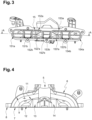
- the inner 9 and upstream 11 walls each have a curved profile that can be similar to that of one side of a violin, such that the upstream wall 11 of the inner cover 3 makes it possible to define, in combination with the inner wall 9 of the main body 2, two outlet ducts 21, 24 arranged respectively at each of the lateral ends of the air distributor 1, as illustrated in FIG. figure 3 .
- Two other outlet ducts 22, 23 of the air distributor 1, arranged between the outlet ducts 21, 24, are defined by longitudinal openings 13 and 14, formed through the internal cover 3.
- the spacing between the outlet ducts 21 to 24 will advantageously be defined to correspond to that of corresponding inlet ducts of the cylinder head, so that, when the air distributor 1 is fixed on the cylinder head, each of the outlet ducts 21 to 24 will make it possible to fluidically connect the air inlet 5 with one of the inlet ducts of the cylinder head, which will open onto one of the cylinders of the engine.
- the main body 2 and the internal cover 3 are configured to form at least one groove 15 opening onto the outer face of the air distributor 1 which is intended to come into contact with the cylinder head of the engine, said outer face being defined by the downstream walls 8 and 12 of the body main cover 2 and inner cover 3.
- the groove 15 is formed of several main segments 151, 152, 153 and 154 spaced along a lateral direction, said main segments having a substantially annular shape. Two directly adjacent main segments, respectively 151 and 152, 152 and 153, and 153 and 154, being connected to each other by a pair of intermediate segments with a rectilinear profile, respectively 155-155', 156-156' and 157-157'.
- Each of the main segments 151 and 154 is formed of a first end segment 151a and 154a having substantially a partially annular shape and a second end segment 151b and 154b also having a partially annular shape, said second end segment 151b and 154b being contiguous to said first end segment 151a and 154a.
- the first end segment 151a and 154a is defined solely by the main body 2 and the second end segment 151b and 154b is defined solely by the inner cover 3.
- each of the main segments 152 and 153 is formed of a first end segment 152a and 153a having a substantially partially annular shape, a second end segment 152b and 153b also having a partially annular shape, said second end segment 152b and 153b being contiguous to said first end segment 152a and 153a, a third end segment 152a' and 153a' having a substantially partially annular shape, said third end segment 152a' and 153a' being contiguous to said second end segment 152b and 153b, a fourth end segment 152a' and 153a' having a substantially partially annular shape, said fourth end segment 152b and 153b being contiguous to said fourth end segment 152b and 153b, and a fourth end segment 152a' and 153a' having a substantially partially annular shape, said fourth end segment 152b and 153b being contiguous to said fourth end segment 152b and 153b, and a fourth end segment 152a' and 153a'
- end segments 152b' and 153b' also having a partially annular shape, said fourth end segment 152b' and 153b' being contiguous to said third end segment 152a' and 153a' and to said first end segment 152a and 153a.
- the first and third end segments 152a, 152a' and 153a, 153a' are defined solely by the main body 2 and the second and fourth end segments 152b, 152b' and 153b, 153b' are defined solely by the inner cover 3.
- the groove 15 is thus configured to accommodate an openwork structure 10 shown in the figure 2 .
- Said openwork structure 10 is notably formed of several main portions 101, 102, 103 and 104 of substantially annular shape, each of said main portions 101 to 104 respectively surrounding an end part of the outlet conduits 21 to 24, said main portions 101 to 104 being connected to each other by intermediate portions 105, 105', 106, 106', 107, 107'.
- each of the main portions 101 to 104 is, in the fully assembled configuration of the air distributor 1, housed respectively in one of the main segments 151 to 154 of the groove 15 and each of the portions intermediate segments 105 to 107 and 105' to 107' is housed respectively in one of the intermediate segments 155 to 157 and 155' to 157' of the groove 15.
- the openwork structure 10 will participate in the mechanical maintenance of the internal cover 3 on the main body 2, given that each of the main portions 101 to 104 surrounds both at least one end segment 151a, 152a, 152a', 153a, 153a' and/or 154a defined by the main body 2 only and at least one end segment 151b, 152b, 152b', 153b, 153b' and/or 154b defined by the internal cover 3 only.
- the material constituting the perforated structure 10 in particular by forming the perforated structure 10 in an elastomeric material having increased resistance to gasoline and oil vapors, in particular made of a material comprising at least 80% fluoroelastomers, it will also be possible to thus ensure a gas-tight seal between the air distributor 1 and the cylinder head of the engine, as well as between the outlet ducts 21 to 24.
- This seal can be advantageously reinforced by configuring the groove 15 such that its width in a lateral direction is slightly greater than that of the perforated structure 10 and its height in the longitudinal direction is slightly less than that of the perforated structure 10. In this way, when fixing the air distributor 1 to the cylinder head of the engine, the perforated structure 10, sandwiched between the lower face of the air distributor 1 and the upper face of the cylinder head, will deform so as to completely fill the free space defined by groove 15.
Landscapes
- Engineering & Computer Science (AREA)
- Chemical & Material Sciences (AREA)
- Combustion & Propulsion (AREA)
- Mechanical Engineering (AREA)
- General Engineering & Computer Science (AREA)
- Manufacturing & Machinery (AREA)
- Cylinder Crankcases Of Internal Combustion Engines (AREA)
Description
- La présente invention concerne un répartiteur d'air pour moteurs à combustion thermique, notamment pour moteurs suralimentés.
- Classiquement, un répartiteur d'air, aussi appelé collecteur d'admission, comprend une entrée d'air et plusieurs sorties d'air destinées à être connectées à une culasse d'un moteur pour amener à chaque cylindre du moteur l'air nécessaire à la combustion du carburant. L'air en provenance du filtre à air pénètre dans le répartiteur par l'entrée d'air, soit directement dans le cas de moteurs dits atmosphériques, soit via un turbocompresseur dans le cas de moteurs suralimentés. L'air est dirigé ensuite vers un volume interne du répartiteur et de ce volume interne vers les sorties d'air via des conduits de sortie. Ces conduits de sortie peuvent avoir une géométrie variable selon les moteurs.
EP 2772623 A1 ,US 2007/017468 A1 etEP 3379051 A1 décrivent de tels répartiteurs. - En particulier, dans le cas d'un moteur suralimenté, ces conduits de sortie sont généralement courts et sensiblement rectilignes. Cette configuration spécifique permet de réaliser le répartiteur d'air par l'assemblage de deux parties distinctes en matière plastique, obtenues par un procédé de moulage par injection par exemple. Actuellement, l'assemblage de ces deux parties s'opère par soudure vibration.
- Ce procédé de soudure vibration présente toutefois plusieurs inconvénients. Un premier inconvénient est la nécessité d'utiliser un moyen de soudure dédié qui est spécifique à chaque type de répartiteur. Un deuxième inconvénient est le besoin d'une mise au point précise et rigoureuse lors du procédé de soudure du fait des pressions très élevées appliquées sur les parties à assembler. Un troisième inconvénient est l'apparition de particules au sein du répartiteur du fait du frottement des deux parties à assembler lors du procédé de soudure. Ces particules pouvant générer des dommages importants dans le moteur, il est généralement obligatoire d'effectuer un nettoyage complet du répartiteur d'air avant sa fixation sur la culasse. L'ensemble de ces inconvénients ne permet donc pas de réaliser un répartiteur d'air de manière simple et peu onéreuse, tout en respectant des critères de propreté de plus en plus drastiques.
- La présente invention vise donc à proposer un répartiteur d'air ne présentant pas les inconvénients susmentionnés, et, en particulier, un répartiteur d'air qui soit à la fois simple et peu onéreux à fabriquer, et possédant un niveau de propreté conforme aux standards en vigueur.
- A cet effet, l'invention a pour objet un répartiteur d'air selon la revendication 1. Ledit répartiteur d'air est destiné à être fixé sur une culasse d'un moteur à combustion thermique, ledit répartiteur d'air comprenant un orifice d'entrée débouchant dans un volume interne dudit répartiteur d'air et une pluralité de conduits de sortie destinés chacun à relier ledit volume interne à un cylindre respectif du moteur. Le répartiteur d'air comprend :
- un corps principal définissant l'orifice d'entrée, et au moins partiellement le volume interne et la pluralité de conduits de sortie,
- un couvercle interne définissant au moins partiellement la pluralité de conduits de sortie, ledit couvercle interne étant fixé sur le corps principal par l'intermédiaire de moyens de fixation mécanique, et
- une structure ajourée d'un seul tenant disposée entre le corps principal et le couvercle interne, ladite structure ajourée étant configurée pour, d'une part, assurer l'étanchéité aux gaz entre le répartiteur d'air et la culasse du moteur, ainsi qu'entre les conduits de sortie, et, d'autre part, participer au maintien mécanique du couvercle interne avec le corps principal.
- Ainsi configuré, le répartiteur d'air de la présente invention pourra être formé par l'assemblage de deux parties distinctes, à savoir un corps principal et un couvercle interne, fixés ensemble uniquement par des moyens de fixation mécanique. Les problèmes liés à l'utilisation d'un procédé d'assemblage par soudure vibration seront ainsi évités. Par ailleurs, la structure ajourée disposée entre le corps principal et le couvercle interne permettra d'améliorer l'étanchéité et le maintien mécanique de l'assemblage ainsi réalisé, améliorant ainsi les performances du répartiteur par rapport à un répartiteur assemblé par soudure vibration.
- Le répartiteur d'air de l'invention comprend les caractéristiques suivantes :
- le corps principal et le couvercle interne sont configurés pour former au moins une rainure débouchant sur une face extérieure du répartiteur d'air qui est destinée à venir au contact de la culasse du moteur, ladite rainure étant apte à loger au moins partiellement ladite structure ajourée.
- la rainure comprend une pluralité de segments principaux de forme annulaire, chacun des segments principaux entourant l'un des conduits de sortie, lesdits segments principaux étant reliés par une pluralité de segments intermédiaires à profil rectiligne.
- chaque segment principal de la rainure comprend au moins un premier segment d'extrémité possédant sensiblement une forme partiellement annulaire et au moins un deuxième segment d'extrémité possédant également une forme partiellement annulaire, ledit deuxième segment d'extrémité étant contigu audit premier segment d'extrémité, et en ce que le premier segment est défini uniquement par le corps principal et le deuxième segment d'extrémité est défini uniquement par le couvercle interne.
- De plus, le répartiteur d'air de l'invention pourra comprendre une ou plusieurs des caractéristiques additionnelles suivantes, prises isolément ou de manière combinée :
- la rainure possède une largeur légèrement supérieure à celle de la structure ajourée et une hauteur légèrement inférieure à celle de la structure ajourée de manière à permettre la déformation de la structure ajourée lors de la fixation du répartiteur d'air sur la culasse du moteur.
- la structure ajourée comprend plusieurs portions principales de forme sensiblement annulaire, chacune desdites portions principales entourant une partie d'extrémité des conduits de sortie de telle sorte qu'elles assurent ainsi l'étanchéité aux gaz entre le répartiteur d'air et la culasse du moteur, ainsi qu'entre les conduits de sortie, lesdites portions principales étant reliées entre elles par portions intermédiaires de telle sorte que la structure ajourée participe ainsi au maintien mécanique du couvercle interne avec le corps principal.
- le couvercle interne est fixé sur le corps principal par clippage.
- la structure ajourée est constituée d'un matériau élastomère comprenant, de préférence, 80 % de fluoroélastomères.
- L'invention concerne également un véhicule automobile à moteur à combustion thermique équipé d'un répartiteur d'air tel que défini précédemment.
- L'invention sera davantage comprise à la lecture de la description non limitative qui va suivre, faite en référence aux figures ci-annexées.
- la
figure 1 est une vue en perspective d'un répartiteur d'air selon l'invention. - la
figure 2 est une vue en perspective éclatée du répartiteur d'air de lafigure 1 . - la
figure 3 est une vue de dessous, côté culasse, du répartiteur d'air de lafigure 1 . - la
figure 4 est une vue en coupe transversale du répartiteur selon l'invention selon le plan de coupe AA indiqué sur lafigure 3 . - Dans les paragraphes qui suivent, les termes amont et aval font référence au sens de circulation du flux d'air à l'intérieur du répartiteur d'air dans les conditions normales d'utilisation de celui-ci. Ainsi, selon cette convention, un répartiteur d'air possède à son extrémité amont une entrée d'air et à son extrémité aval une pluralité de sorties d'air. Par ailleurs, le terme longitudinal fait référence à des directions orientées dans le sens amont/aval et le terme latéral fait référence à des directions orientées perpendiculairement au sens amont/aval.
- En référence aux
figures 1 et 2 , il est représenté un répartiteur d'air 1 selon un mode de réalisation de l'invention. Le répartiteur d'air 1 est formé de deux parties distinctes, à savoir un corps principal 2 et un couvercle interne 3, lesdites parties étant connectées entre elles par l'intermédiaire de moyens de fixation mécanique, notamment par clippage. Ce mode de fixation uniquement mécanique permet d'éviter les inconvénients liés au mode de fixation par soudure, tels qu'évoqués précédemment. Comme représenté sur lafigure 4 , le corps principal 2 possède un cavité traversante 4 à l'intérieur de laquelle vient se loger le couvercle interne 3. La cavité traversante 4 débouche, d'un côté, sur une première ouverture 5 formée dans une paroi amont 6 du corps principal 1 et, de l'autre côté, sur une deuxième ouverture 7 formée dans une paroi aval 8 du corps principal 1. La première ouverture 5 définit l'entrée d'air du répartiteur d'air 1 et possède sensiblement une forme circulaire. La deuxième ouverture 7 possède une forme oblongue, comme représenté sur lafigure 2 , ladite forme oblongue étant configurée pour permettre le passage du couvercle interne 3. Ainsi, comme illustré sur lafigure 4 , dans la configuration totalement assemblée du répartiteur d'air 1, le couvercle interne 3 vient se positionner totalement à l'intérieur de la cavité traversante 4 du corps principal 2, une paroi aval 12 dudit couvercle interne 3 étant sensiblement coplanaire avec la paroi aval 8 du corps principal 2 et une paroi amont 11 dudit couvercle interne 3 faisant face à une paroi interne 9 du corps principal 2, qui délimite la cavité traversante 4. Les parois interne 9 et amont 11 possèdent chacune un profil courbe pouvant s'apparenter à celle d'un côté d'un violon, de sorte que la paroi amont 11 du couvercle interne 3 permet de définir, en combinaison avec la paroi interne 9 du corps principal 2, deux conduits de sortie 21, 24 disposés respectivement à chacune des extrémités latérales du répartiteur d'air 1, comme illustré sur lafigure 3 . Deux autres conduits de sortie 22, 23 du répartiteur d'air 1, disposés entre les conduits de sortie 21, 24, sont définis quant à eux par des ouvertures longitudinales 13 et 14, formées à travers le couvercle interne 3. L'espacement entre les conduits de sortie 21 à 24 sera avantageusement défini pour correspondre à celui de conduits d'entrée correspondants de la culasse, de sorte que, lorsque le répartiteur d'air 1 sera fixé sur la culasse, chacun des conduits de sortie 21 à 24 permettra de relier fluidiquement l'entrée d'air 5 avec l'un des conduits d'entrée de la culasse, lequel débouchera sur un des cylindres du moteur. - Comme représenté sur la
figure 3 , le corps principal 2 et le couvercle interne 3 sont configurés pour former au moins une rainure 15 débouchant sur la face extérieure du répartiteur d'air 1 qui est destinée à venir au contact de la culasse du moteur, ladite face extérieure étant définie par les parois aval 8 et 12 du corps principal 2 et du couvercle interne 3. Comme représenté sur lafigure 1 , la rainure 15 est formée de plusieurs segments principaux 151, 152, 153 et 154 espacés le long d'une direction latérale, lesdits segments principaux possédant une forme sensiblement annulaire. Deux segments principaux directement adjacents, respectivement 151 et 152, 152 et 153, et 153 et 154, étant reliées entre eux par une paire de segments intermédiaires à profil rectiligne, respectivement 155-155', 156-156' et 157-157'. Chacun des segments principaux 151 et 154 est formé d'un premier segment d'extrémité 151a et 154a possédant sensiblement une forme partiellement annulaire et d'un deuxième segment d'extrémité 151b et 154b possédant également une forme partiellement annulaire, ledit deuxième segment d'extrémité 151b et 154b étant contigu audit premier segment d'extrémité 151a et 154a. Le premier segment d'extrémité 151a et 154a est défini uniquement par le corps principal 2 et le deuxième segment d'extrémité 151b et 154 b est défini uniquement par le couvercle interne 3. De façon similaire, chacun des segments principaux 152 et 153 est formé d'un premier segment d'extrémité 152a et 153a possédant sensiblement une forme partiellement annulaire, d'un deuxième segment d'extrémité 152b et 153b possédant également une forme partiellement annulaire, ledit deuxième segment d'extrémité 152b et 153b étant contigu audit premier segment d'extrémité 152a et 153a, d'un troisième segment d'extrémité 152a' et 153a' possédant sensiblement une forme partiellement annulaire, ledit troisième segment d'extrémité 152a' et 153a' étant contigu audit deuxième segment d'extrémité 152b et 153b, d'un quatrième segment d'extrémité 152b' et 153b' possédant également une forme partiellement annulaire, ledit quatrième segment d'extrémité 152b' et 153b' étant contigu audit troisième segment d'extrémité 152a' et 153a' et audit premier segment d'extrémité 152a et 153a. Les premier et troisième segments d'extrémité 152a, 152a' et 153a, 153a' sont définis uniquement par le corps principal 2 et les deuxième et quatrième segments d'extrémité 152b, 152b' et 153b, 153b' sont définis uniquement par le couvercle interne 3. - La rainure 15 est ainsi configurée pour loger une structure ajourée 10 représentée sur la
figure 2 . Ladite structure ajourée 10 est notamment formée de plusieurs portions principales 101, 102, 103 et 104 de forme sensiblement annulaire, chacune desdites portions principales 101 à 104 entourant respectivement une partie d'extrémité des conduits de sortie 21 à 24, lesdites portions principales 101 à 104 étant reliées entre elles par des portions intermédiaires 105, 105', 106, 106', 107, 107'. Comme représenté sur lafigure 1 , chacune des portions principales 101 à 104 est, dans la configuration totalement assemblée du répartiteur d'air 1, logée respectivement dans un des segments principaux 151 à 154 de la rainure 15 et chacune des portions intermédiaires 105 à 107 et 105' à 107' est logée respectivement dans un des segments intermédiaires 155 à 157 et 155' à 157' de la rainure 15. Ainsi configurée, la structure ajourée 10 participera au maintien mécanique du couvercle interne 3 sur le corps principal 2, étant donné que chacune des portions principales 101 à 104 entoure à la fois au moins un segment d'extrémité 151a, 152a, 152a', 153a, 153a' et/ou 154a défini par le corps principal 2 uniquement et au moins un segment d'extrémité 151b, 152b, 152b', 153b, 153b' et/ou 154b défini par le couvercle interne 3 uniquement. Par ailleurs, en choisissant correctement le matériau constitutif de la structure ajourée 10, en particulier en formant la structure ajourée 10 dans un matériau élastomère possédant une résistance accrue aux vapeurs d'essence et d'huile, notamment constituée d'un matériau comprenant au moins 80 % de fluoroélastomères, il sera également possible d'assurer ainsi une étanchéité aux gaz entre le répartiteur d'air 1 et la culasse du moteur, ainsi qu'entre les conduits de sortie 21 à 24. Cette étanchéité pourra être avantageusement renforcée en configurant la rainure 15 de telle sorte que sa largeur dans une direction latérale soit légèrement supérieure à celle de la structure ajourée 10 et que sa hauteur dans la direction longitudinale soit légèrement inférieure à celle de la structure ajourée 10. De cette façon, lors de la fixation du répartiteur d'air 1 sur la culasse du moteur, la structure ajourée 10, prise en sandwich entre la face inférieure du répartiteur d'air 1 et la face supérieure de la culasse, se déformera de manière à remplir totalement l'espace libre défini par la rainure 15.
Claims (6)
- Répartiteur d'air (1) destiné à être fixé sur une culasse d'un moteur à combustion thermique, ledit répartiteur d'air (1) comprenant un orifice d'entrée (5) débouchant dans un volume interne (4) dudit répartiteur d'air (1) et une pluralité de conduits de sortie (21-24) destinés chacun à relier ledit volume interne (4) à un cylindre respectif du moteur, dans lequel le répartiteur d'air (1) comprend :- un corps principal (2) définissant l'orifice d'entrée (5), et au moins partiellement le volume interne (4) et la pluralité de conduits de sortie (21-24),- un couvercle interne (3) définissant au moins partiellement la pluralité de conduits de sortie (21-24), ledit couvercle interne (3) étant fixé sur le corps principal (2) par l'intermédiaire de moyens de fixation mécanique, et- une structure ajourée (10) d'un seul tenant disposée entre le corps principal (2) et le couvercle interne (3), ladite structure ajourée (10) étant configurée pour, d'une part, assurer l'étanchéité aux gaz entre le répartiteur d'air (1) et la culasse du moteur, ainsi qu'entre les conduits de sortie (21-24), et, d'autre part, participer au maintien mécanique du couvercle interne (3) avec le corps principal (2),et dans lequel- le corps principal (2) et le couvercle interne (3) sont configurés pour former au moins une rainure (15) débouchant sur une face extérieure du répartiteur d'air (1) qui est destinée à venir au contact de la culasse du moteur, ladite rainure (15) étant apte à loger au moins partiellement ladite structure ajourée (10),- la rainure (15) comprend une pluralité de segments principaux (151-154) de forme annulaire, chacun des segments principaux (151-154) entourant l'un des conduits de sortie (21-24), lesdits segments principaux (151-154) étant reliés par une pluralité de segments intermédiaires (155-157 ; 155'-157') à profil rectiligne,caractérisé en ce que chaque segment principal (151-154) de la rainure (15) comprend au moins un premier segment d'extrémité (151a, 152a, 152a', 153a, 153a', 154a) possédant sensiblement une forme partiellement annulaire et au moins un deuxième segment d'extrémité (151b, 152b, 152b', 153b, 153b', 154b) possédant également une forme partiellement annulaire, ledit deuxième segment d'extrémité (151b, 152b, 152b', 153b, 153b', 154b) étant contigu audit premier segment d'extrémité (151a, 152a, 152a', 153a, 153a', 154a), et le premier segment d'extrémité (151a, 152a, 152a', 153a, 153a', 154a) est défini uniquement par le corps principal (2) et le deuxième segment d'extrémité (151b, 152b, 152b', 153b, 153b', 154b) est défini uniquement par le couvercle interne (3).
- Répartiteur d'air (1) selon la revendication 1, caractérisé en ce que la rainure (15) possède une largeur légèrement supérieure à celle de la structure ajourée (10) et une hauteur légèrement inférieure à celle de la structure ajourée (10) de manière à permettre la déformation de la structure ajourée (10) lors de la fixation du répartiteur d'air (1) sur la culasse du moteur.
- Répartiteur d'air (1) selon la revendication 1 ou la revendication 2, caractérisé en ce que la structure ajourée (10) comprend plusieurs portions principales (101-104) de forme sensiblement annulaire, chacune desdites portions principales (101-104) entourant une partie d'extrémité des conduits de sortie (21-24) de telle sorte qu'elles assurent ainsi l'étanchéité aux gaz entre le répartiteur d'air (1) et la culasse du moteur, ainsi qu'entre les conduits de sortie (21-24), lesdites portions principales (101-104) étant reliées entre elles par des portions intermédiaires (105-107 ; 105'-107') de telle sorte que la structure ajourée (10) participe ainsi au maintien mécanique du couvercle interne (3) avec le corps principal (2).
- Répartiteur d'air (1) selon l'une des revendications précédentes, caractérisé en ce que le couvercle interne (3) est fixé sur le corps principal (2) par clippage.
- Répartiteur d'air (1) selon l'une des revendications précédentes, caractérisé en ce que la structure ajourée (10) est constituée d'un matériau élastomère comprenant, de préférence, au moins 80 % de fluoroélastomères.
- Véhicule automobile à moteur à combustion thermique équipé d'un répartiteur d'air (1) selon l'une quelconque des revendications précédentes.
Applications Claiming Priority (2)
| Application Number | Priority Date | Filing Date | Title |
|---|---|---|---|
| FR1907872A FR3098554B1 (fr) | 2019-07-12 | 2019-07-12 | Répartiteur d’air pour moteurs à combustion thermique |
| PCT/FR2020/051216 WO2021009441A1 (fr) | 2019-07-12 | 2020-07-08 | Répartiteur d'air pour moteurs à combustion thermique |
Publications (2)
| Publication Number | Publication Date |
|---|---|
| EP3997326A1 EP3997326A1 (fr) | 2022-05-18 |
| EP3997326B1 true EP3997326B1 (fr) | 2024-09-04 |
Family
ID=67875758
Family Applications (1)
| Application Number | Title | Priority Date | Filing Date |
|---|---|---|---|
| EP20750330.1A Active EP3997326B1 (fr) | 2019-07-12 | 2020-07-08 | Répartiteur d'air pour moteurs à combustion thermique |
Country Status (4)
| Country | Link |
|---|---|
| EP (1) | EP3997326B1 (fr) |
| FR (1) | FR3098554B1 (fr) |
| HU (1) | HUE068824T2 (fr) |
| WO (1) | WO2021009441A1 (fr) |
Citations (1)
| Publication number | Priority date | Publication date | Assignee | Title |
|---|---|---|---|---|
| EP3379051A1 (fr) * | 2015-11-20 | 2018-09-26 | Nissan Motor Co., Ltd. | Dispositif d'admission d'air pour moteur à combustion interne |
Family Cites Families (3)
| Publication number | Priority date | Publication date | Assignee | Title |
|---|---|---|---|---|
| US7231898B2 (en) * | 2005-07-20 | 2007-06-19 | Siemens Canada Limited | Intake manifold cross talk sealing |
| EP2772623B1 (fr) * | 2013-02-28 | 2017-08-23 | MAHLE Filter Systems Japan Corporation | Système d'entrée d'air pour moteur à combustion interne |
| KR101877132B1 (ko) * | 2016-11-23 | 2018-07-10 | 주식회사 현대케피코 | 엔진의 흡기장치 |
-
2019
- 2019-07-12 FR FR1907872A patent/FR3098554B1/fr active Active
-
2020
- 2020-07-08 EP EP20750330.1A patent/EP3997326B1/fr active Active
- 2020-07-08 HU HUE20750330A patent/HUE068824T2/hu unknown
- 2020-07-08 WO PCT/FR2020/051216 patent/WO2021009441A1/fr not_active Ceased
Patent Citations (1)
| Publication number | Priority date | Publication date | Assignee | Title |
|---|---|---|---|---|
| EP3379051A1 (fr) * | 2015-11-20 | 2018-09-26 | Nissan Motor Co., Ltd. | Dispositif d'admission d'air pour moteur à combustion interne |
Also Published As
| Publication number | Publication date |
|---|---|
| WO2021009441A1 (fr) | 2021-01-21 |
| HUE068824T2 (hu) | 2025-01-28 |
| FR3098554A1 (fr) | 2021-01-15 |
| FR3098554B1 (fr) | 2021-07-02 |
| EP3997326A1 (fr) | 2022-05-18 |
Similar Documents
| Publication | Publication Date | Title |
|---|---|---|
| CA2644306C (fr) | Vanne de decharge dans une turbomachine | |
| EP2588782A1 (fr) | Vanne de circulation de fluide | |
| FR2891886A1 (fr) | Dispositif de regulation a clapet et collecteur d'admission comprenant au moins un tel dispositif | |
| FR2986847A1 (fr) | Clapet anti-retour a membrane | |
| EP2513463B1 (fr) | Cadre avant pour une structure d'inverseur de poussée à grilles de déviation | |
| EP2088303B1 (fr) | Procédé de réalisation d'une plaque support pour corps de clapets et plaque support | |
| FR2871844A1 (fr) | Montage etanche d'un distributeur de turbine haute pression sur une extremite d'une chambre de combustion dans une turbine a gaz | |
| EP2255867A1 (fr) | Répartiteur d'admission muni d'un dispositif d'injection et de diffusion de fluide gazeux | |
| EP3997326B1 (fr) | Répartiteur d'air pour moteurs à combustion thermique | |
| EP1517032A1 (fr) | Volet chaud commande de tuyere axisymetrique de turboreacteur | |
| EP3877640B1 (fr) | Joint d'étanchéité pour nacelle de turboréacteur d'aéronef | |
| WO2002088533A1 (fr) | Dispositif d'obturation de conduits d'admission d'air d'un moteur | |
| EP1957787B1 (fr) | Repartiteur d air d alimentation pour moteur a combustion interne | |
| FR2875266A1 (fr) | Collecteur d'echappement pour moteur a combustion interne | |
| FR2995026A1 (fr) | Cadre avant pour une structure d'inverseur de poussee a grilles de deviation | |
| EP1966478B1 (fr) | Ensemble comportant un dispositif d'attenuation des bruits et un conduit d'air d'un bloc moteur raccordes de maniere etanche par encliquetage | |
| WO2018050999A1 (fr) | Chambre de combustion pour turbomachine comprenant des moyens pour améliorer le refroidissement d'une paroi annulaire dans le sillage d'un obstacle | |
| EP3449198B1 (fr) | Collecteur et dispositif de refroidissement associe | |
| FR3068080B1 (fr) | Nacelle d'aeronef comportant un volet inverseur et un joint | |
| FR2819557A1 (fr) | Collecteur ou repartiteur d'admission pour moteur thermique et procede de fabrication | |
| FR2905159A1 (fr) | Dispositif de regulation a clapet et collecteur d'admission comprenant au moins un tel dispositif. | |
| EP3221571A1 (fr) | Dispositif formant joint d'étanchéité pour une vanne de décharge dans une turbomachine | |
| EP1158159A1 (fr) | Collecteur ou répartiteur d'admission à plusieurs tubulures | |
| FR3009023A1 (fr) | Boitier papillon et moteur a combustion interne comprenant un tel boitier papillon | |
| FR3154531A1 (fr) | Composant acoustique en une seule pièce avec des cellules acoustiques désalignées |
Legal Events
| Date | Code | Title | Description |
|---|---|---|---|
| STAA | Information on the status of an ep patent application or granted ep patent |
Free format text: STATUS: UNKNOWN |
|
| STAA | Information on the status of an ep patent application or granted ep patent |
Free format text: STATUS: THE INTERNATIONAL PUBLICATION HAS BEEN MADE |
|
| PUAI | Public reference made under article 153(3) epc to a published international application that has entered the european phase |
Free format text: ORIGINAL CODE: 0009012 |
|
| STAA | Information on the status of an ep patent application or granted ep patent |
Free format text: STATUS: REQUEST FOR EXAMINATION WAS MADE |
|
| 17P | Request for examination filed |
Effective date: 20220103 |
|
| AK | Designated contracting states |
Kind code of ref document: A1 Designated state(s): AL AT BE BG CH CY CZ DE DK EE ES FI FR GB GR HR HU IE IS IT LI LT LU LV MC MK MT NL NO PL PT RO RS SE SI SK SM TR |
|
| DAV | Request for validation of the european patent (deleted) | ||
| DAX | Request for extension of the european patent (deleted) | ||
| STAA | Information on the status of an ep patent application or granted ep patent |
Free format text: STATUS: EXAMINATION IS IN PROGRESS |
|
| 17Q | First examination report despatched |
Effective date: 20230622 |
|
| RAP3 | Party data changed (applicant data changed or rights of an application transferred) |
Owner name: NOVARES FRANCE |
|
| GRAP | Despatch of communication of intention to grant a patent |
Free format text: ORIGINAL CODE: EPIDOSNIGR1 |
|
| STAA | Information on the status of an ep patent application or granted ep patent |
Free format text: STATUS: GRANT OF PATENT IS INTENDED |
|
| INTG | Intention to grant announced |
Effective date: 20240312 |
|
| GRAS | Grant fee paid |
Free format text: ORIGINAL CODE: EPIDOSNIGR3 |
|
| GRAA | (expected) grant |
Free format text: ORIGINAL CODE: 0009210 |
|
| STAA | Information on the status of an ep patent application or granted ep patent |
Free format text: STATUS: THE PATENT HAS BEEN GRANTED |
|
| AK | Designated contracting states |
Kind code of ref document: B1 Designated state(s): AL AT BE BG CH CY CZ DE DK EE ES FI FR GB GR HR HU IE IS IT LI LT LU LV MC MK MT NL NO PL PT RO RS SE SI SK SM TR |
|
| REG | Reference to a national code |
Ref country code: GB Ref legal event code: FG4D Free format text: NOT ENGLISH |
|
| REG | Reference to a national code |
Ref country code: CH Ref legal event code: EP |
|
| REG | Reference to a national code |
Ref country code: IE Ref legal event code: FG4D Free format text: LANGUAGE OF EP DOCUMENT: FRENCH |
|
| REG | Reference to a national code |
Ref country code: DE Ref legal event code: R096 Ref document number: 602020037114 Country of ref document: DE |
|
| REG | Reference to a national code |
Ref country code: LT Ref legal event code: MG9D |
|
| REG | Reference to a national code |
Ref country code: NL Ref legal event code: MP Effective date: 20240904 |
|
| PG25 | Lapsed in a contracting state [announced via postgrant information from national office to epo] |
Ref country code: NO Free format text: LAPSE BECAUSE OF FAILURE TO SUBMIT A TRANSLATION OF THE DESCRIPTION OR TO PAY THE FEE WITHIN THE PRESCRIBED TIME-LIMIT Effective date: 20241204 |
|
| PG25 | Lapsed in a contracting state [announced via postgrant information from national office to epo] |
Ref country code: PL Free format text: LAPSE BECAUSE OF FAILURE TO SUBMIT A TRANSLATION OF THE DESCRIPTION OR TO PAY THE FEE WITHIN THE PRESCRIBED TIME-LIMIT Effective date: 20240904 Ref country code: GR Free format text: LAPSE BECAUSE OF FAILURE TO SUBMIT A TRANSLATION OF THE DESCRIPTION OR TO PAY THE FEE WITHIN THE PRESCRIBED TIME-LIMIT Effective date: 20241205 Ref country code: FI Free format text: LAPSE BECAUSE OF FAILURE TO SUBMIT A TRANSLATION OF THE DESCRIPTION OR TO PAY THE FEE WITHIN THE PRESCRIBED TIME-LIMIT Effective date: 20240904 |
|
| PG25 | Lapsed in a contracting state [announced via postgrant information from national office to epo] |
Ref country code: BG Free format text: LAPSE BECAUSE OF FAILURE TO SUBMIT A TRANSLATION OF THE DESCRIPTION OR TO PAY THE FEE WITHIN THE PRESCRIBED TIME-LIMIT Effective date: 20240904 |
|
| PG25 | Lapsed in a contracting state [announced via postgrant information from national office to epo] |
Ref country code: LV Free format text: LAPSE BECAUSE OF FAILURE TO SUBMIT A TRANSLATION OF THE DESCRIPTION OR TO PAY THE FEE WITHIN THE PRESCRIBED TIME-LIMIT Effective date: 20240904 |
|
| PG25 | Lapsed in a contracting state [announced via postgrant information from national office to epo] |
Ref country code: HR Free format text: LAPSE BECAUSE OF FAILURE TO SUBMIT A TRANSLATION OF THE DESCRIPTION OR TO PAY THE FEE WITHIN THE PRESCRIBED TIME-LIMIT Effective date: 20240904 |
|
| PG25 | Lapsed in a contracting state [announced via postgrant information from national office to epo] |
Ref country code: RS Free format text: LAPSE BECAUSE OF FAILURE TO SUBMIT A TRANSLATION OF THE DESCRIPTION OR TO PAY THE FEE WITHIN THE PRESCRIBED TIME-LIMIT Effective date: 20241204 Ref country code: ES Free format text: LAPSE BECAUSE OF FAILURE TO SUBMIT A TRANSLATION OF THE DESCRIPTION OR TO PAY THE FEE WITHIN THE PRESCRIBED TIME-LIMIT Effective date: 20240904 |
|
| REG | Reference to a national code |
Ref country code: HU Ref legal event code: AG4A Ref document number: E068824 Country of ref document: HU |
|
| PG25 | Lapsed in a contracting state [announced via postgrant information from national office to epo] |
Ref country code: RS Free format text: LAPSE BECAUSE OF FAILURE TO SUBMIT A TRANSLATION OF THE DESCRIPTION OR TO PAY THE FEE WITHIN THE PRESCRIBED TIME-LIMIT Effective date: 20241204 Ref country code: PL Free format text: LAPSE BECAUSE OF FAILURE TO SUBMIT A TRANSLATION OF THE DESCRIPTION OR TO PAY THE FEE WITHIN THE PRESCRIBED TIME-LIMIT Effective date: 20240904 Ref country code: NO Free format text: LAPSE BECAUSE OF FAILURE TO SUBMIT A TRANSLATION OF THE DESCRIPTION OR TO PAY THE FEE WITHIN THE PRESCRIBED TIME-LIMIT Effective date: 20241204 Ref country code: LV Free format text: LAPSE BECAUSE OF FAILURE TO SUBMIT A TRANSLATION OF THE DESCRIPTION OR TO PAY THE FEE WITHIN THE PRESCRIBED TIME-LIMIT Effective date: 20240904 Ref country code: HR Free format text: LAPSE BECAUSE OF FAILURE TO SUBMIT A TRANSLATION OF THE DESCRIPTION OR TO PAY THE FEE WITHIN THE PRESCRIBED TIME-LIMIT Effective date: 20240904 Ref country code: GR Free format text: LAPSE BECAUSE OF FAILURE TO SUBMIT A TRANSLATION OF THE DESCRIPTION OR TO PAY THE FEE WITHIN THE PRESCRIBED TIME-LIMIT Effective date: 20241205 Ref country code: FI Free format text: LAPSE BECAUSE OF FAILURE TO SUBMIT A TRANSLATION OF THE DESCRIPTION OR TO PAY THE FEE WITHIN THE PRESCRIBED TIME-LIMIT Effective date: 20240904 Ref country code: ES Free format text: LAPSE BECAUSE OF FAILURE TO SUBMIT A TRANSLATION OF THE DESCRIPTION OR TO PAY THE FEE WITHIN THE PRESCRIBED TIME-LIMIT Effective date: 20240904 Ref country code: BG Free format text: LAPSE BECAUSE OF FAILURE TO SUBMIT A TRANSLATION OF THE DESCRIPTION OR TO PAY THE FEE WITHIN THE PRESCRIBED TIME-LIMIT Effective date: 20240904 |
|
| REG | Reference to a national code |
Ref country code: AT Ref legal event code: MK05 Ref document number: 1720635 Country of ref document: AT Kind code of ref document: T Effective date: 20240904 |
|
| PG25 | Lapsed in a contracting state [announced via postgrant information from national office to epo] |
Ref country code: NL Free format text: LAPSE BECAUSE OF FAILURE TO SUBMIT A TRANSLATION OF THE DESCRIPTION OR TO PAY THE FEE WITHIN THE PRESCRIBED TIME-LIMIT Effective date: 20240904 |
|
| PG25 | Lapsed in a contracting state [announced via postgrant information from national office to epo] |
Ref country code: IS Free format text: LAPSE BECAUSE OF FAILURE TO SUBMIT A TRANSLATION OF THE DESCRIPTION OR TO PAY THE FEE WITHIN THE PRESCRIBED TIME-LIMIT Effective date: 20250104 Ref country code: PT Free format text: LAPSE BECAUSE OF FAILURE TO SUBMIT A TRANSLATION OF THE DESCRIPTION OR TO PAY THE FEE WITHIN THE PRESCRIBED TIME-LIMIT Effective date: 20250106 |
|
| PG25 | Lapsed in a contracting state [announced via postgrant information from national office to epo] |
Ref country code: RO Free format text: LAPSE BECAUSE OF FAILURE TO SUBMIT A TRANSLATION OF THE DESCRIPTION OR TO PAY THE FEE WITHIN THE PRESCRIBED TIME-LIMIT Effective date: 20240904 Ref country code: SM Free format text: LAPSE BECAUSE OF FAILURE TO SUBMIT A TRANSLATION OF THE DESCRIPTION OR TO PAY THE FEE WITHIN THE PRESCRIBED TIME-LIMIT Effective date: 20240904 |
|
| PG25 | Lapsed in a contracting state [announced via postgrant information from national office to epo] |
Ref country code: EE Free format text: LAPSE BECAUSE OF FAILURE TO SUBMIT A TRANSLATION OF THE DESCRIPTION OR TO PAY THE FEE WITHIN THE PRESCRIBED TIME-LIMIT Effective date: 20240904 Ref country code: AT Free format text: LAPSE BECAUSE OF FAILURE TO SUBMIT A TRANSLATION OF THE DESCRIPTION OR TO PAY THE FEE WITHIN THE PRESCRIBED TIME-LIMIT Effective date: 20240904 |
|
| PG25 | Lapsed in a contracting state [announced via postgrant information from national office to epo] |
Ref country code: CZ Free format text: LAPSE BECAUSE OF FAILURE TO SUBMIT A TRANSLATION OF THE DESCRIPTION OR TO PAY THE FEE WITHIN THE PRESCRIBED TIME-LIMIT Effective date: 20240904 |
|
| PG25 | Lapsed in a contracting state [announced via postgrant information from national office to epo] |
Ref country code: SK Free format text: LAPSE BECAUSE OF FAILURE TO SUBMIT A TRANSLATION OF THE DESCRIPTION OR TO PAY THE FEE WITHIN THE PRESCRIBED TIME-LIMIT Effective date: 20240904 Ref country code: IT Free format text: LAPSE BECAUSE OF FAILURE TO SUBMIT A TRANSLATION OF THE DESCRIPTION OR TO PAY THE FEE WITHIN THE PRESCRIBED TIME-LIMIT Effective date: 20240904 |
|
| REG | Reference to a national code |
Ref country code: DE Ref legal event code: R097 Ref document number: 602020037114 Country of ref document: DE |
|
| PG25 | Lapsed in a contracting state [announced via postgrant information from national office to epo] |
Ref country code: DK Free format text: LAPSE BECAUSE OF FAILURE TO SUBMIT A TRANSLATION OF THE DESCRIPTION OR TO PAY THE FEE WITHIN THE PRESCRIBED TIME-LIMIT Effective date: 20240904 |
|
| PLBE | No opposition filed within time limit |
Free format text: ORIGINAL CODE: 0009261 |
|
| STAA | Information on the status of an ep patent application or granted ep patent |
Free format text: STATUS: NO OPPOSITION FILED WITHIN TIME LIMIT |
|
| PGFP | Annual fee paid to national office [announced via postgrant information from national office to epo] |
Ref country code: FR Payment date: 20250630 Year of fee payment: 6 |
|
| PGFP | Annual fee paid to national office [announced via postgrant information from national office to epo] |
Ref country code: HU Payment date: 20250708 Year of fee payment: 6 |
|
| 26N | No opposition filed |
Effective date: 20250605 |
|
| PG25 | Lapsed in a contracting state [announced via postgrant information from national office to epo] |
Ref country code: SE Free format text: LAPSE BECAUSE OF FAILURE TO SUBMIT A TRANSLATION OF THE DESCRIPTION OR TO PAY THE FEE WITHIN THE PRESCRIBED TIME-LIMIT Effective date: 20240904 |
|
| REG | Reference to a national code |
Ref country code: DE Ref legal event code: R119 Ref document number: 602020037114 Country of ref document: DE |
|
| REG | Reference to a national code |
Ref country code: CH Ref legal event code: H13 Free format text: ST27 STATUS EVENT CODE: U-0-0-H10-H13 (AS PROVIDED BY THE NATIONAL OFFICE) Effective date: 20260224 |
|
| PG25 | Lapsed in a contracting state [announced via postgrant information from national office to epo] |
Ref country code: LU Free format text: LAPSE BECAUSE OF NON-PAYMENT OF DUE FEES Effective date: 20250708 |
|
| GBPC | Gb: european patent ceased through non-payment of renewal fee |
Effective date: 20250708 |
|
| REG | Reference to a national code |
Ref country code: BE Ref legal event code: MM Effective date: 20250731 |
|
| PG25 | Lapsed in a contracting state [announced via postgrant information from national office to epo] |
Ref country code: GB Free format text: LAPSE BECAUSE OF NON-PAYMENT OF DUE FEES Effective date: 20250708 |
|
| PG25 | Lapsed in a contracting state [announced via postgrant information from national office to epo] |
Ref country code: DE Free format text: LAPSE BECAUSE OF NON-PAYMENT OF DUE FEES Effective date: 20260203 |
|
| PG25 | Lapsed in a contracting state [announced via postgrant information from national office to epo] |
Ref country code: BE Free format text: LAPSE BECAUSE OF NON-PAYMENT OF DUE FEES Effective date: 20250731 |
|
| PG25 | Lapsed in a contracting state [announced via postgrant information from national office to epo] |
Ref country code: CH Free format text: LAPSE BECAUSE OF NON-PAYMENT OF DUE FEES Effective date: 20250731 |