EP3997077B1 - Novel bio-based diols from sustainable raw materials, uses thereof to make diglycidyl ethers, and their coatings - Google Patents
Novel bio-based diols from sustainable raw materials, uses thereof to make diglycidyl ethers, and their coatings Download PDFInfo
- Publication number
- EP3997077B1 EP3997077B1 EP20837542.8A EP20837542A EP3997077B1 EP 3997077 B1 EP3997077 B1 EP 3997077B1 EP 20837542 A EP20837542 A EP 20837542A EP 3997077 B1 EP3997077 B1 EP 3997077B1
- Authority
- EP
- European Patent Office
- Prior art keywords
- diglycidyl ether
- mhz
- amine
- cdcl
- diol
- Prior art date
- Legal status (The legal status is an assumption and is not a legal conclusion. Google has not performed a legal analysis and makes no representation as to the accuracy of the status listed.)
- Active
Links
Classifications
-
- C—CHEMISTRY; METALLURGY
- C07—ORGANIC CHEMISTRY
- C07D—HETEROCYCLIC COMPOUNDS
- C07D307/00—Heterocyclic compounds containing five-membered rings having one oxygen atom as the only ring hetero atom
- C07D307/02—Heterocyclic compounds containing five-membered rings having one oxygen atom as the only ring hetero atom not condensed with other rings
- C07D307/34—Heterocyclic compounds containing five-membered rings having one oxygen atom as the only ring hetero atom not condensed with other rings having two or three double bonds between ring members or between ring members and non-ring members
- C07D307/38—Heterocyclic compounds containing five-membered rings having one oxygen atom as the only ring hetero atom not condensed with other rings having two or three double bonds between ring members or between ring members and non-ring members with substituted hydrocarbon radicals attached to ring carbon atoms
- C07D307/40—Radicals substituted by oxygen atoms
- C07D307/42—Singly bound oxygen atoms
-
- C—CHEMISTRY; METALLURGY
- C07—ORGANIC CHEMISTRY
- C07D—HETEROCYCLIC COMPOUNDS
- C07D407/00—Heterocyclic compounds containing two or more hetero rings, at least one ring having oxygen atoms as the only ring hetero atoms, not provided for by group C07D405/00
- C07D407/14—Heterocyclic compounds containing two or more hetero rings, at least one ring having oxygen atoms as the only ring hetero atoms, not provided for by group C07D405/00 containing three or more hetero rings
-
- C—CHEMISTRY; METALLURGY
- C08—ORGANIC MACROMOLECULAR COMPOUNDS; THEIR PREPARATION OR CHEMICAL WORKING-UP; COMPOSITIONS BASED THEREON
- C08G—MACROMOLECULAR COMPOUNDS OBTAINED OTHERWISE THAN BY REACTIONS ONLY INVOLVING UNSATURATED CARBON-TO-CARBON BONDS
- C08G59/00—Polycondensates containing more than one epoxy group per molecule; Macromolecules obtained by polymerising compounds containing more than one epoxy group per molecule using curing agents or catalysts which react with the epoxy groups
- C08G59/02—Polycondensates containing more than one epoxy group per molecule
- C08G59/04—Polycondensates containing more than one epoxy group per molecule of polyhydroxy compounds with epihalohydrins or precursors thereof
-
- C—CHEMISTRY; METALLURGY
- C08—ORGANIC MACROMOLECULAR COMPOUNDS; THEIR PREPARATION OR CHEMICAL WORKING-UP; COMPOSITIONS BASED THEREON
- C08G—MACROMOLECULAR COMPOUNDS OBTAINED OTHERWISE THAN BY REACTIONS ONLY INVOLVING UNSATURATED CARBON-TO-CARBON BONDS
- C08G59/00—Polycondensates containing more than one epoxy group per molecule; Macromolecules obtained by polymerising compounds containing more than one epoxy group per molecule using curing agents or catalysts which react with the epoxy groups
- C08G59/18—Macromolecules obtained by polymerising compounds containing more than one epoxy group per molecule using curing agents or catalysts which react with the epoxy groups ; e.g. general methods of curing
- C08G59/20—Macromolecules obtained by polymerising compounds containing more than one epoxy group per molecule using curing agents or catalysts which react with the epoxy groups ; e.g. general methods of curing characterised by the epoxy compounds used
- C08G59/22—Di-epoxy compounds
-
- C—CHEMISTRY; METALLURGY
- C08—ORGANIC MACROMOLECULAR COMPOUNDS; THEIR PREPARATION OR CHEMICAL WORKING-UP; COMPOSITIONS BASED THEREON
- C08G—MACROMOLECULAR COMPOUNDS OBTAINED OTHERWISE THAN BY REACTIONS ONLY INVOLVING UNSATURATED CARBON-TO-CARBON BONDS
- C08G59/00—Polycondensates containing more than one epoxy group per molecule; Macromolecules obtained by polymerising compounds containing more than one epoxy group per molecule using curing agents or catalysts which react with the epoxy groups
- C08G59/18—Macromolecules obtained by polymerising compounds containing more than one epoxy group per molecule using curing agents or catalysts which react with the epoxy groups ; e.g. general methods of curing
- C08G59/20—Macromolecules obtained by polymerising compounds containing more than one epoxy group per molecule using curing agents or catalysts which react with the epoxy groups ; e.g. general methods of curing characterised by the epoxy compounds used
- C08G59/22—Di-epoxy compounds
- C08G59/26—Di-epoxy compounds heterocyclic
-
- C—CHEMISTRY; METALLURGY
- C08—ORGANIC MACROMOLECULAR COMPOUNDS; THEIR PREPARATION OR CHEMICAL WORKING-UP; COMPOSITIONS BASED THEREON
- C08G—MACROMOLECULAR COMPOUNDS OBTAINED OTHERWISE THAN BY REACTIONS ONLY INVOLVING UNSATURATED CARBON-TO-CARBON BONDS
- C08G59/00—Polycondensates containing more than one epoxy group per molecule; Macromolecules obtained by polymerising compounds containing more than one epoxy group per molecule using curing agents or catalysts which react with the epoxy groups
- C08G59/18—Macromolecules obtained by polymerising compounds containing more than one epoxy group per molecule using curing agents or catalysts which react with the epoxy groups ; e.g. general methods of curing
- C08G59/40—Macromolecules obtained by polymerising compounds containing more than one epoxy group per molecule using curing agents or catalysts which react with the epoxy groups ; e.g. general methods of curing characterised by the curing agents used
- C08G59/50—Amines
- C08G59/504—Amines containing an atom other than nitrogen belonging to the amine group, carbon and hydrogen
-
- C—CHEMISTRY; METALLURGY
- C09—DYES; PAINTS; POLISHES; NATURAL RESINS; ADHESIVES; COMPOSITIONS NOT OTHERWISE PROVIDED FOR; APPLICATIONS OF MATERIALS NOT OTHERWISE PROVIDED FOR
- C09D—COATING COMPOSITIONS, e.g. PAINTS, VARNISHES OR LACQUERS; FILLING PASTES; CHEMICAL PAINT OR INK REMOVERS; INKS; CORRECTING FLUIDS; WOODSTAINS; PASTES OR SOLIDS FOR COLOURING OR PRINTING; USE OF MATERIALS THEREFOR
- C09D163/00—Coating compositions based on epoxy resins; Coating compositions based on derivatives of epoxy resins
-
- C—CHEMISTRY; METALLURGY
- C08—ORGANIC MACROMOLECULAR COMPOUNDS; THEIR PREPARATION OR CHEMICAL WORKING-UP; COMPOSITIONS BASED THEREON
- C08G—MACROMOLECULAR COMPOUNDS OBTAINED OTHERWISE THAN BY REACTIONS ONLY INVOLVING UNSATURATED CARBON-TO-CARBON BONDS
- C08G2650/00—Macromolecular compounds obtained by reactions forming an ether link in the main chain of the macromolecule
- C08G2650/28—Macromolecular compounds obtained by reactions forming an ether link in the main chain of the macromolecule characterised by the polymer type
- C08G2650/50—Macromolecular compounds obtained by reactions forming an ether link in the main chain of the macromolecule characterised by the polymer type containing nitrogen, e.g. polyetheramines or Jeffamines(r)
Definitions
- cellulosic biomass provides access to compounds with a furan skeleton.
- HMF 5-hydroxymethyl furfural
- FDCA 2,5-furandicarboxylic acid
- HMF has two functional groups at different oxidation states that can be selectively manipulated to provide access to other furan-based monomers.
- Diformylfuran (DFF) is readily available by selective oxidation of HMF.
- the diols are useful monomers in the synthesis of a variety of polymers [ Mou et al., ACS Sustainable Chem. Eng. 2016, 4(12):7118-7129 ]. For example, they are used extensively in the synthesis of polyesters [ Li et al., J. Polym. Sci., Part A: Polym. Chem. 2018, 56:968-976 ]. Also, the glycidyl ethers derived from diols can be cured with diamines to furnish epoxies.
- the different diols currently used extensively in polymer synthesis are (1) aliphatic diols, (2) bisphenols, and (3) mixed diols.
- CN 103 880 791 A teaches a method for synthesizing 2-benzyl furan-4-methanol from a hydroxyl-protected 4-hydroxymethyl-furan-2-formaldehyde.
- USA Fuentes et al., Chem. Central J. 2012, 6(151 ) discloses a ruthenium-catalyzed synthesis of a diol based on a furan-based diketone.
- US 2012/220742 A1 teaches furan-based curable compounds derived from biomass, a solvent-free curable composition, and a method for preparing thereof.
- the invention relates to novel diols derived from 5-hydroxymethyl furfural (HMF), diformyl furan (DFF), or derivatives thereof.
- the invention also relates to the synthesis of the diols.
- the invention further relates to diglycidyl ethers derived from diols, including the diols of the invention.
- the invention also relates to the synthesis of the diglycidyl ethers.
- the invention also relates to composites and adhesives containing the diglycidyl ethers.
- the invention further relates to curable coating compositions containing the diglycidyl ethers with amine curing agents, useful for object coating with the curable coating compositions.
- the invention relates to a diol having the following structure: wherein R 2 is n-butyl, c-pentyl, allyl, or benzyl.
- the diol from which the diglycidyl ethers of the invention may be derived, have the following structure:
- alkyl refers to a linear, branched, saturated hydrocarbon group, such as methyl, ethyl, n-propyl, iso-propyl, n-butyl, iso-butyl, tert-butyl, pentyl, hexyl, and the like.
- alkenyl refers to a linear, branched hydrocarbon group containing at least one double bond, such as ethenyl, n-propenyl, iso-propenyl, n-butenyl, isobutenyl, pentenyl, hexenyl, and the like.
- aryl refers to an aromatic substituent containing a single aromatic ring or multiple aromatic rings that are fused together, directly linked, or indirectly linked (such that the different aromatic rings are bound to a common group such as a methylene or ethylene moiety).
- Preferred aryl groups contain 5 to 24 carbon atoms, and particularly preferred aryl groups contain 6 to 10 carbon atoms.
- Exemplary aryl groups contain one aromatic ring or two fused or linked aromatic rings, e.g., phenyl (Ph), naphthyl, biphenyl, diphenylether, diphenylamine, benzophenone, phenanthryl, and the like.
- the diol, from which the diglycidyl ethers of the invention may be derived preferably has the following structure: wherein R 1 and R 2 are as defined above.
- R 1 and R 2 are both methyl, ethyl, n-butyl, c-pentyl, allyl, or benzyl.
- the diol, from which the diglycidyl ethers of the invention may be derived also preferably has the following structure: wherein R 2 is as defined above.
- R 2 is n-butyl, t-butyl, c-pentyl, allyl, or benzyl.
- the diol, from which the diglycidyl ethers of the invention may be derived also preferably has the following structure:
- the invention also relates to a method of making the diols of the invention, comprising, consisting essentially of, or consisting of:
- the Grignard reagent is RMgCl, wherein R is n-butyl, c-pentyl, allyl, or benzyl.
- the invention also relates to a diglycidyl ether having the following structure:
- the diglycidyl ethers have the following structure: wherein R 2 is as defined above.
- R 2 is methyl or phenyl.
- the diglycidyl ethers also have the following structure: wherein R 1 and R 2 are as defined above.
- R 1 and R 2 are both methyl, n-butyl, or allyl.
- the diglycidyl ether also has following structure:
- the invention also relates to a method for making the diglycidyl ethers of the invention comprising, consisting essentially of, or consisting of: reacting a diol with epichlorohydrin under conditions sufficient to form the diglycidyl ether, wherein the diol has the following structure: wherein R 1 , R 2 , R 3 , and R 4 are independently selected from the group consisting of H, C 1 -C 6 alkyl, C 1 -C 6 alkenyl, aryl, and C 1 -C 6 alkyl-aryl.
- the diols used in the methods for making the diglycidyl ethers of the invention cannot have the following structure: or
- the invention also relates to a composite or adhesive comprising, consisting essentially of, or consisting of at least one diglycidyl ether of the invention.
- the invention further relates to a curable coating composition
- a curable coating composition comprising, consisting essentially of, or consisting of:
- the amine is an aliphatic, an aromatic, a cycloaliphatic, or a polyether amine.
- the aliphatic amine may be Priamine 1075, 1,8-diaminooctane, diethylenetriamine, or tetraethylenepentamine;
- the aromatic amine may be m-xylylenediamine;
- the cycloaliphatic amine may be 1,3-bis(aminomethyl)cyclohexane, isophorone diamine, or bis(p-aminocyclohexyl) methane;
- the polyether amine may be JEFFAMINE EDR-148 (XTJ-504), JEFFAMINE D-400, JEFFAMINE D-230, or JEFFAMINE T-403.
- the curable coating compositions of the invention may be coated onto a substrate and cured using techniques known in the art.
- the substrate can be any common substrate such as paper, polyester films such as polyethylene and polypropylene, metals such as aluminum and steel, glass, urethane elastomers, primed (painted) substrates, and the like.
- a curable coating composition of the invention may further contain coating additives.
- coating additives include, but are not limited to, one or more leveling, rheology, and flow control agents such as silicones, fluorocarbons, or cellulosics; extenders; reactive coalescing aids such as those described in U.S. Pat. No.
- plasticizers flatting agents; pigment wetting and dispersing agents and surfactants; ultraviolet (UV) absorbers; UV light stabilizers; tinting pigments; colorants; defoaming and antifoaming agents; anti-settling, anti-sag and bodying agents; anti-skinning agents; anti-flooding and anti-floating agents; biocides, fungicides and mildewcides; corrosion inhibitors; thickening agents; or coalescing agents.
- UV absorbers ultraviolet (UV) absorbers
- UV light stabilizers tinting pigments
- colorants defoaming and antifoaming agents
- anti-settling, anti-sag and bodying agents anti-skinning agents
- anti-flooding and anti-floating agents biocides, fungicides and mildewcides
- corrosion inhibitors thickening agents; or coalescing agents.
- Solvents may also be added to the curable coating formulation in order to reduce the viscosity.
- Hydrocarbon, ester, ketone, ether, ether-ester, alcohol, or ether-alcohol type solvents may be used individually or in mixtures.
- solvents can include, but are not limited to, benzene, toluene, xylene, aromatic 100, aromatic 150, acetone, methylethyl ketone, methyl amyl ketone, butyl acetate, t-butyl acetate, tetrahydrofuran, diethyl ether, ethylethoxy propionate, isopropanol, butanol, butoxyethanol, etc.
- the invention can be used in a cured coating composition, wherein the curable coating composition of the invention is cured at ambient conditions or by heating.
- the invention also can be used in an object coated with the curable coating composition of the invention.
- HMF Hydrochloride
- Diethyl ether was dissolving it in diethyl ether and drying with anhydrous sodium sulfate and decolorizing with Norrit A.
- the compound was stored in a freezer prior to use.
- Diformylfuran (2) was synthesized by oxidation of pure HMF with manganese dioxide and ethyl acetate as a solvent (Scheme 1). The product was recrystallized from iso-propanol before use.
- the formyl group in HMF was converted to a secondary alcohol by the addition of a Grignard reagent.
- Several variables such as solvent, temperature, stoichiometry and counterion of the Grignard reagent were investigated for obtaining the product diols in high purity and yield.
- Table 1 lists isolated yields for the unsymmetrical diol . 6.
- the table also lists the physical state of the diol. As can be discerned from the table, the diols are obtained in excellent yield from the Grignard addition. Also, most of the compounds have not been reported previously (References are given for known compounds in Table 1).
- the product diols were extensively characterized by spectroscopic techniques. The synthesis of diols from HMF is shown Scheme 3 ("R" defined in Table 1).
- a tertiary diol 11 (not part of the invention) was synthesized from by the addition of excess methylmagnesium chloride to FDCA diethyl ester 4 in 85% yield (Scheme 7).
- the solid diol was not stable and underwent dehydration readily. However, the compound could be stored in a freezer without decomposition.
- a solution of substrate (3 mmol, dissolved to form a 0.1 M solution in inhibitor-free drysolv THF) was added dropwise via syringe into the dry 50 mL round bottom flask reaction vessel. The reaction was monitored by TLC, until the reaction was complete (1-2 h). To quench the reaction, 6 mL of 0.1 M trisodium citrate (aq) was added via syringe. The reaction mixture was filtered through filter paper, then the THF was removed in vacuo. The resulting oil was then diluted with ethyl acetate (40 mL) and washed with brine (10 mL x 3) in a 60 mL separatory funnel. The organic layer was dried over sodium sulfate, then filtered, and solvent removed in vacuo to obtain the diol product in 85% yield.
- Formulations from the diglycidyl ether bis-epoxymonomers and EPON 828 were prepared with four types of amine curatives (total twelve amine curatives listed in Table 6) to investigate the reactivity of the diglycidyl ether bis-epoxymonomers towards different amine curatives and simultaneously the impact of the nature of amine curative on the properties of the cured coatings.
- amine curatives total twelve amine curatives listed in Table 6
- Preparation for the dye extraction method was carried out by punching out 10 mm epoxy primed aluminum discs and affixing them to a 4" ⁇ 8" aluminum panel in a 6 ⁇ 11 array format. 75 ⁇ L of each formulation was deposited on six discs using an Eppendorf repeat pipettor. Coatings were then allowed to dry overnight under ambient conditions. Array panels were then cured at room temperature for 7 days, 60 °C and 100 °C using preheated oven for 1 h., 3 h., or 6 h. to evaluate the optimum curing condition.
- Dye extraction was performed by adding 500 ⁇ L of toluene to each well of the microtiter plate using an Eppendorf repeat pipettor. Toluene was quickly added to each row of the microtiter plate with 15 s intervals between the rows. Formulations were allowed to soak for 10 min on an orbital shaker, then 150 uL of each extraction sample was collected and transferred to a 96 well microtiter plate using a 6-channel, adjustable spacing, multichannel pipette. Each row of two sets with three replicates was collected at the same time, aspirating twice to ensure a homogenous mixture. The timing of collection for each individual formulation was held to 15 second intervals to ensure that the soaking time was precise. Fluorescence measurements (415ex/471em) of all extraction samples using a TECAN Saffire2 plate reader were taken immediately following collection.
- Depth sensing indentation also called instrumented indentation or nanoindentation, was performed using a Hysitron Tribolndenter with automation (9 samples per run) using a diamond Berkovich tip. Since accurate determination of the elastic modulus from the indentation load-displacement responses requires flat sample surfaces, indentation was performed mostly near the center of the coated discs. Before every indent, the indenter was held in contact with the surface, to allow for piezoactuator stabilization (35 s) and drift correction (40 s), at a contact load of only 0.5 mN to prevent any deformation prior to the indentation experiment. The drift rate (typically 0.1 nm s21) was automatically determined over the last 20 s of the 40 s period.
- the tip After lifting the tip up to 30 nm and re-approaching the surface (surface detection at a load of 0.5 mN), the tip was loaded to maximum load of 300 ⁇ N in 5 s, held at maximum load for 5 s and unloaded in 5 s. Nine measurements with a spacing of 60 ⁇ m apart were performed per sample and the first one was left out from the analysis to further reduce the influence of drift.
- Thermal properties of the cured coatings were characterized using Q1000 Modulated Differential Scanning Calorimeter from TA Instruments with a cooling limit up to -90 °C. About 6-8 mg of the cured film was scraped out from the disc and the following heat/cool/heat regime was used: the sample was first equilibrated at 23 °C and then cooled to -10°C at 10 °C/minute, held at -10°C for 2 min and heated to 100°C at 10 °C/minute.
- Drying time was measured according to ASTM D 1640. Due to small size of the coated discs dry-to-touch time was recorded when the coating no longer adheres to the finger and does not rub up appreciably when the finger was lightly rubbed across the surface.
- Epoxy equivalent weight (EEW, g/eq.) of the diglycidyl ether bis-epoxymonomers and EPON 828 resin were evaluated by titrating epoxy samples with 0.0925 N solution of HBr in glacial acetic acid; 1 wt.% solution of crystal violet in acetic acid was used as an indicator.
- EEW value was calculated using the following equation (1) and the values are reported in Table 7, where W is the sample mass in grams, N is the normality of HBr solution, and V is the volume of HBr solution used for titration in mL.
- EEW 100 ⁇ W N ⁇ V Table 7.
- Epoxy equivalent weight (EEW, g/eq.) of the diglycidyl ether bis-epoxymonomers and EPON 828 resin Asterisk (*) identifies compounds not being part of the invention. Resin EEW (g/eq) GLY 13/16* 165.85 GLY 23/24 148.92 GLY 17 157.18 GLY 25 158.23 EPON 828* 190
- Drying time was measured as a preliminary study to estimate the reactivity of the novel diglycidyl ether bis-epoxymonomers towards various amine curatives. See Table 8. Drying time of EPON 828 was measured with the curatives as a reference. Table 8. Drying time of diglycidyl ether bis-epoxymonomers and EPON 828 with amine curatives. Asterisk (*) identifies compounds not being part of the invention.
- Dye extraction results of coatings formulated from GLY 13/16 (not part of the invention) with amine curatives Curing Temperature (°C) RT 60 100 Curing Time 7 Days 1h. 3h. 6h. 1h. 3h. 6h. TEG-DA (XTJ-504) 204 214 152 129 168 124 142 Jeff. t403 3463 3611 3519 2492 2858 2473 1665 Jeff.
- Konig pendulum hardness measurements were carried out on the coatings made by reacting the diglycidyl ethers with the amine curing agents at room temperature (RT) and elevated temperatures for the times indicated. Higher pendulum hardness value indicates a harder coating. Table 14. Pendulum hardness of coatings formulated from GLY 23/24 with amine curatives. Curing Temperature (°C) RT 60 100 Curing Time 7 Days 1h. 3h. 6h. 1h. 3h. 6h.
- Pendulum hardness results of coatings formulated from GLY 17 with amine curatives Curing Temperature (°C) RT 60 100 Curing Time 7 Days 1h. 3h. 6h. 1h. 3h. 6h. TEG-DA (XTJ-504) 6 6 7 14 7 13 W Jeffamine t403 86 66 150 171 85 152 178 Jeffamine D-230 NI Jeffamine D-400 PACM 44 113 109 116 152 174 176 1,3-BAC 39 38 36 42 71 140 173 IPDA 80 130 140 146 152 192 202 Xylene diamine 9 14 20 30 10 27 88 Diethylenetriamine 4 7 9 9 36 88 134 Tetraethylenepentamine NI Priamine 1075 PS, T 1,8 DA Octane 4 11 14 15 13 17 20 NI- Not included in the study PS- Phase separated T- Tacky Table 17.
- Pendulum hardness results of coatings formulated from GLY 25 with amine curatives Curing Temperature (°C) RT 60 100 Curing Time 7 Days 1h. 3h. 6h. 1h. 3h. 6h. TEG-DA (XTJ-504) NI Jeffamine t403 9 11 11 11 9 12 13 Jeffamine D-230 NI Jeffamine D-400 PACM 30 107 50 27 83 127 169 1,3-BAC 9 25 27 31 42 125 123 IPDA 30 18 17 13 11 9 10 Xylene diamine 7 6 7 38 40 38 45 Diethylenetriamine NI Tetraethylenepentamine Priamine 1075 PS 1,8 DA Octane 158 159 152 157 127 174 169 NI- Not included in the study PS- Phase separated Table 18.
- Pendulum hardness of coatings formulated from EPON 828 (not part of the invention) with amine curatives Curing Temperature (°C) RT 60 100 Curing Time 7 Days 1h. 3h. 6h. 1h. 3h. 6h. TEG-DA (XTJ-504) 13 33 22 46 85 93 95 Jeffamine t403 140 135 180 87 147 176 167 Jeffamine D-230 171 195 178 212 139 180 107 PACM 151 107 160 159 155 157 153 1,3-BAC 130 140 138 136 131 135 138 IPDA 133 89 150 175 160 171 166 Xylene diamine 56 49 104 92 118 137 134 Diethylenetriamine 9 35 44 48 78 107 117 Tetraethylenepentamine 32 32 82 71 122 159 121 Priamine 1075 HW 1,8 DA Octane HW- Highly Wrinkled
- Curing Temperature (°C) RT 60 100 Curing Time 7 Days 3h. 3h.
- TEG-DA (XTJ-504) 14 15 17 Jeffamine t403 38 40 60 Jeffamine D-230 11 12 14 Jeffamine D-400 NI PACM 39 50 63 1,3-BAC 15 22 45 IPDA 41 54 57 Xylene diamine 6 13 42 Diethylenetriamine 16 19 39 Tetraethylenepentamine 32 36 39 Priamine 1075 PS 1,8 DA Octane 7 15 19 PS-Phase separated NI- Not included in the study Table 21.
- Curing Temperature (°C) RT 60 100 Curing Time 7 Days 1h. 3h. 6h.
Landscapes
- Chemical & Material Sciences (AREA)
- Organic Chemistry (AREA)
- Health & Medical Sciences (AREA)
- Chemical Kinetics & Catalysis (AREA)
- Medicinal Chemistry (AREA)
- Polymers & Plastics (AREA)
- Life Sciences & Earth Sciences (AREA)
- Engineering & Computer Science (AREA)
- Materials Engineering (AREA)
- Wood Science & Technology (AREA)
- Organic Low-Molecular-Weight Compounds And Preparation Thereof (AREA)
Description
- This application claims priority to
U.S. Application No. 62/871,387, filed July 8, 2019 - This invention was made with government support under grant IIA-1355466 awarded by the National Science Foundation. The U.S. government has certain rights in the invention.
- The development of green chemical methods for the synthesis of novel monomers for polymer applications has received intense scrutiny in the past two decades. Furthermore, the use of bio-based feedstocks for monomer synthesis has become important due to the projected depletion of fossil fuels in the near future [Kucherov et al., ACS Sustainable Chemistry & Engineering 2018, 6(7):8064-8092; Isikgor et al., Polymer Chemistry 2015, 6(25):4497-4559; Delidovich et al., Chemical Reviews 2016, 116(3):1540-1599; Mülhaupt et al., Macromolecular Chemistry and Physics 2013, 214(2):159-174; Galbis et al., Chemical Reviews 2016, 116(3):1600-1636]. Diols serve as important monomers for the synthesis of a variety of polymers such as polyesters and polyurethanes. Currently, most of the diols used in polymer applications are derived from petroleum.
- Of the three important sources of biomass, cellulosic biomass provides access to compounds with a furan skeleton. Two compounds derived from cellulose, 5-hydroxymethyl furfural (HMF) [Yu et al., Bioresource Technology 2017, 238:716-732; van Putten et al., Chemical Reviews 2013, 113(3):1499-1597] and 2,5-furandicarboxylic acid (FDCA) [Jong et al., Furandicarboxylic Acid (FDCA), A Versatile Building Block for a Very Interesting Class of Polyesters. In Biobased Monomers, Polymers, and Materials, American Chemical Society: 2012; Vol. 1105, pp 1-13; Sousa et al., Polymer Chemistry 2015, 6(33):5961-5983], have been identified as the top feedstock compounds for monomer synthesis. HMF has two functional groups at different oxidation states that can be selectively manipulated to provide access to other furan-based monomers. Diformylfuran (DFF) is readily available by selective oxidation of HMF.
- The diols are useful monomers in the synthesis of a variety of polymers [Mou et al., ACS Sustainable Chem. Eng. 2016, 4(12):7118-7129]. For example, they are used extensively in the synthesis of polyesters [Li et al., J. Polym. Sci., Part A: Polym. Chem. 2018, 56:968-976]. Also, the glycidyl ethers derived from diols can be cured with diamines to furnish epoxies. The different diols currently used extensively in polymer synthesis are (1) aliphatic diols, (2) bisphenols, and (3) mixed diols. In contrast, the use of diol monomers derived from cellulosic biomass with a furan skeleton has received only limited attention. Zhang Lin et al., Chin J. of Med. Chem. 2012, 22(5):349-355 discloses 5-hydroxymethyl-2-furfural derivatives, including a t-butyl substituted diol compound.
US 2004/229935 A1 teaches anti cancer agents and inhibitors of tubulin polymerization including furan, thiophenem thiazole, oxazole or imidazole derivatives.CN 103 880 791 A teaches a method for synthesizing 2-benzyl furan-4-methanol from a hydroxyl-protected 4-hydroxymethyl-furan-2-formaldehyde. José Fuentes et al., Chem. Central J. 2012, 6(151) discloses a ruthenium-catalyzed synthesis of a diol based on a furan-based diketone.US 2012/220742 A1 teaches furan-based curable compounds derived from biomass, a solvent-free curable composition, and a method for preparing thereof. - The invention relates to novel diols derived from 5-hydroxymethyl furfural (HMF), diformyl furan (DFF), or derivatives thereof. The invention also relates to the synthesis of the diols.
- The invention further relates to diglycidyl ethers derived from diols, including the diols of the invention. The invention also relates to the synthesis of the diglycidyl ethers. The invention also relates to composites and adhesives containing the diglycidyl ethers.
- The invention further relates to curable coating compositions containing the diglycidyl ethers with amine curing agents, useful for object coating with the curable coating compositions.
- The invention relates to a diol having the following structure:

- The diol, from which the diglycidyl ethers of the invention may be derived, have the following structure:

- wherein R1, R2, R3, and R4 are independently selected from the group consisting of H, C1-C6 alkyl, C1-C6alkenyl, aryl, and C1-C6alkyl-aryl,
- with the proviso that the diol cannot have the following structure:


- As used herein, the term "alkyl" refers to a linear, branched, saturated hydrocarbon group, such as methyl, ethyl, n-propyl, iso-propyl, n-butyl, iso-butyl, tert-butyl, pentyl, hexyl, and the like.
- As used herein, the term "alkenyl" refers to a linear, branched hydrocarbon group containing at least one double bond, such as ethenyl, n-propenyl, iso-propenyl, n-butenyl, isobutenyl, pentenyl, hexenyl, and the like.
- As used herein, the term "aryl" refers to an aromatic substituent containing a single aromatic ring or multiple aromatic rings that are fused together, directly linked, or indirectly linked (such that the different aromatic rings are bound to a common group such as a methylene or ethylene moiety). Preferred aryl groups contain 5 to 24 carbon atoms, and particularly preferred aryl groups contain 6 to 10 carbon atoms. Exemplary aryl groups contain one aromatic ring or two fused or linked aromatic rings, e.g., phenyl (Ph), naphthyl, biphenyl, diphenylether, diphenylamine, benzophenone, phenanthryl, and the like.
- The diol, from which the diglycidyl ethers of the invention may be derived, preferably has the following structure:

- The diol, from which the diglycidyl ethers of the invention may be derived, also preferably has the following structure:

- The diol, from which the diglycidyl ethers of the invention may be derived, also preferably has the following structure:

- The invention also relates to a method of making the diols of the invention, comprising, consisting essentially of, or consisting of:
- reacting 5-hydroxymethyl furfural (HMF), diformyl furan (DFF), or a derivative thereof with a Grignard reagent,
- under conditions sufficient to form the diol.
- Preferably, the Grignard reagent is RMgCl, wherein R is n-butyl, c-pentyl, allyl, or benzyl.
- The invention also relates to a diglycidyl ether having the following structure:

- wherein R1, R2, R3, and R4 are independently selected from the group consisting of H, C1-C6 alkyl, C1-C6alkenyl, aryl, and C1-C6alkyl-aryl,
- with the proviso that R1, R2, R3, and R4 cannot all be H.
- Preferably, the diglycidyl ethers have the following structure:

- Preferably, the diglycidyl ethers also have the following structure:

- Preferably, the diglycidyl ether also has following structure:

- The invention also relates to a method for making the diglycidyl ethers of the invention comprising, consisting essentially of, or consisting of:
reacting a diol with epichlorohydrin under conditions sufficient to form the diglycidyl ether,
wherein the diol has the following structure: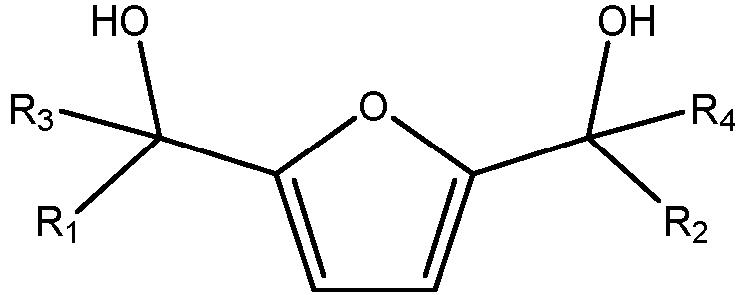
- Preferably, the diols used in the methods for making the diglycidyl ethers of the invention cannot have the following structure:


- The invention also relates to a composite or adhesive comprising, consisting essentially of, or consisting of at least one diglycidyl ether of the invention.
- The invention further relates to a curable coating composition comprising, consisting essentially of, or consisting of:
- a) at least one diglycidyl ether of the invention; and
- b) an amine.
- Preferably, the amine is an aliphatic, an aromatic, a cycloaliphatic, or a polyether amine. For example, the aliphatic amine may be Priamine 1075, 1,8-diaminooctane, diethylenetriamine, or tetraethylenepentamine; the aromatic amine may be m-xylylenediamine; the cycloaliphatic amine may be 1,3-bis(aminomethyl)cyclohexane, isophorone diamine, or bis(p-aminocyclohexyl) methane; and the polyether amine may be JEFFAMINE EDR-148 (XTJ-504), JEFFAMINE D-400, JEFFAMINE D-230, or JEFFAMINE T-403.
- The curable coating compositions of the invention may be coated onto a substrate and cured using techniques known in the art. The substrate can be any common substrate such as paper, polyester films such as polyethylene and polypropylene, metals such as aluminum and steel, glass, urethane elastomers, primed (painted) substrates, and the like.
- Pigments and other additives known in the art to control coating rheology and surface properties can also be incorporated in a curable coating composition of the invention. For example, a curable coating composition of the invention may further contain coating additives. Such coating additives include, but are not limited to, one or more leveling, rheology, and flow control agents such as silicones, fluorocarbons, or cellulosics; extenders; reactive coalescing aids such as those described in
U.S. Pat. No. 5,349,026 ; plasticizers; flatting agents; pigment wetting and dispersing agents and surfactants; ultraviolet (UV) absorbers; UV light stabilizers; tinting pigments; colorants; defoaming and antifoaming agents; anti-settling, anti-sag and bodying agents; anti-skinning agents; anti-flooding and anti-floating agents; biocides, fungicides and mildewcides; corrosion inhibitors; thickening agents; or coalescing agents. Specific examples of such additives can be found in Raw Materials Index, published by the National Paint & Coatings Association, 1500 Rhode Island Avenue, N.W., Washington, D.C. 20005. Further examples of such additives may be found inU.S. Pat. No. 5,371,148 . - Solvents may also be added to the curable coating formulation in order to reduce the viscosity. Hydrocarbon, ester, ketone, ether, ether-ester, alcohol, or ether-alcohol type solvents may be used individually or in mixtures. Examples of solvents can include, but are not limited to, benzene, toluene, xylene, aromatic 100, aromatic 150, acetone, methylethyl ketone, methyl amyl ketone, butyl acetate, t-butyl acetate, tetrahydrofuran, diethyl ether, ethylethoxy propionate, isopropanol, butanol, butoxyethanol, etc.
- The invention can be used in a cured coating composition, wherein the curable coating composition of the invention is cured at ambient conditions or by heating.
- The invention also can be used in an object coated with the curable coating composition of the invention.
- Commercially available HMF was purified by column chromatography or by dissolving it in diethyl ether and drying with anhydrous sodium sulfate and decolorizing with Norrit A. The compound was stored in a freezer prior to use. Diformylfuran (2) was synthesized by oxidation of pure HMF with manganese dioxide and ethyl acetate as a solvent (Scheme 1). The product was recrystallized from iso-propanol before use.

- Fischer esterification of 2,5-furandicarboxylic acid (FDCA) 3 with ethanol provided the diethyl ester 4 in high yield. The diol, 2,5-bihydroxymethylfuran (5) was synthesized by sodium borohydride reduction of HMF 1 in ethanol (Scheme 2) [Li et al., ACS Sustainable Chem. Eng. 2017, 5(12):11752-11760; Vijjamarri et al., ACS Sustainable Chem. Eng. 2018, 6(2):2491-2497].

- The formyl group in HMF was converted to a secondary alcohol by the addition of a Grignard reagent. Several variables such as solvent, temperature, stoichiometry and counterion of the Grignard reagent were investigated for obtaining the product diols in high purity and yield. Table 1 lists isolated yields for the unsymmetrical diol .6. The table also lists the physical state of the diol. As can be discerned from the table, the diols are obtained in excellent yield from the Grignard addition. Also, most of the compounds have not been reported previously (References are given for known compounds in Table 1). The product diols were extensively characterized by spectroscopic techniques. The synthesis of diols from HMF is shown Scheme 3 ("R" defined in Table 1).
- Typical experimental procedure: A reaction vessel containing solution of purchased Grignard reagent (6.6 mmol, diluted from 1.0 -3.4 M to a 0.5 M solution in inhibitor-free drysolv THF) was flushed with N2 and kept under positive N2 pressure. A solution of HMF (3 mmol) dissolved to form a 0.2 M solution in inhibitor-free drysolv THF) was added dropwise via syringe into the dry 50 mL round bottom flask reaction vessel. The reaction was monitored by TLC, until the reaction was complete (1-2 h). To quench the reaction, 6 mL of 0.1 M trisodium citrate (aq) was added via syringe. The reaction mixture was filtered through filter paper, then the THF was removed in vacuo. The resulting oil was then diluted with ethyl acetate (40 mL) and washed with brine (10 mL x 3) in a 60 mL separatory funnel. The organic layer was dried over sodium sulfate, then filtered and solvent removed in vacuo to obtain the product.

Table 1. Synthesis of unsymmetrical Diols from HMF: Yield and Physical State; Asterisk (*) identifies diols not being part of the invention Entry R Yield (%) State Reference 1* Methyl (6a) 77 liquid Finiels, A. et al., Studies in Surface Science and Catalysis, 135(Zeolites and Mesoporous Materials at the Dawn of the 21st Century), 3612-3619; 2001 2* Ethyl (6b) 91 liquid Nishimura, Shun; Ebitani, Koki, Jpn. Kokai Tokkyo Koho (2018), JP 2018193353 A 20181206 - 3 n-Butyl (6c) 94 liquid - 4* t-Butyl (6d) 95 liquid 5 c-Pentyl (6e) 78 liquid - 6 Allyl (6f) 88 liquid 7* Phenyl (6g) 87 solid Rajmohan, Rajamani et al., RSC Advances, 5(121), 100401-100407; 2015 8 Benzyl (6h) 80 liquid - - Compound 6a: 1H (400 MHz, CDCl3) δ 6.20 (d, J = 3.2 Hz, 1H), 6.15 (d, J = 3.1 Hz, 1H), 4.83 (q, J = 6.6 Hz, 1H), 4.54 (s, 2H), 3.01 (s, 2H), 1.51 (d, 6.6 Hz, 3H); 13C (101 MHz, CDCl3) δ 157.5, 153.3, 108.2, 105.8, 63.3, 57.1, 21.0. FTIR (neat) cm-1 3316, 2979, 2932, 1635, 1557, 1369, 1320,1239, 1187, 1072. HRMS calculated for C7H10O3Na: 165.0528; Found: 165.0537.
- Compound 6b: 1H (400 MHz, CDCl3) δ 6.17 (d, J = 3.2 Hz, 1H), 6.13 (d, J = 2.8 Hz, 1H), 4.50 (s, 3H), 3.46 (s, 1H), 3.29 (s, 1H), 1.94 - 1.75 (m, 2H), 0.93 (t, J = 7.4 Hz, 3H); 13C (101 MHz, CDCl3) δ 156.5, 153.3, 108.7, 106.5, 69.0, 57.0, 28.3, 10.0. FTIR (neat) cm-1 3304, 2965, 2933, 2876, 1556, 1378, 1318, 1242, 1183, 960. HRMS calculated for C8H12O3Na: 179.0684; Found: 179.0730.
- Compound 6c: 1H (400 MHz, CDCl3) δ 6.20 (d, J = 3.1 Hz, 1H), 6.15 (d, J = 3 Hz, 1H), 4.61 (t, J = 6.9 Hz, 1H), 4.53 (s, 2H), 2.93 (s, 1H), 2.82 (s, 1H), 1.83 (dtd, J = 8.0, 6.3, 1.2 Hz, 2H), 1.42 - 1.30(m, 4H), 0.91 (t, J = 7.0 Hz, 3H); 13C (101 MHz, CDCl3) δ156.9, 153.3, 108.2, 106.4, 67.6, 57.2, 35.0, 27.7, 22.4, 14.0. FTIR (neat) cm-1 3315, 2955, 2931, 2861, 1724, 1559, 1457, 1377, 1243, 1182. HRMS calculated for C10H16O3Na: 207.0997; Found: 207.0982.
- Compound 6d: 1H (400 MHz, CDCl3) δ 6.24 (d, J = 3.1 Hz, 1H), 6.17 (d, J = 3.1 Hz, 1H), 4.57 (s, 2H), 4.35 (s, 1H), 2.25 (s, 2H), 0.98 (s, 9H); 13C (101 MHz, CDCl3) δ 155.7, 152.8, 108.2, 107.8, 76.4, 57.4, 35.7, 25.8. FTIR (neat) cm-1 3396, 2955, 2870, 1723, 1552, 1479, 1464, 1394, 1364, 1197. HRMS calculated for C10H16O3Na: 207.0997; Found: 207.0997
- Compound 6e: 1H (400 MHz, CDCl3) δ 6.19 (d, J = 3.1 Hz, 1H), 6.15 (d, J = 3.1 Hz, 1H), 4.53 (s, 2H), 4.37 (d, J = 8.6 Hz, 1H), 2.85 (s, 1H), 2.74 (s, 1H), 2.37 (q, J = 8.1 Hz, 1H), 1.90 - 1.84 (m, 1H), 1.66-1.47 (m, 6H), 1.25 - 1.18 (m, 1H); 13C (101 MHz, CDCl3) δ 156.7,153.2, 108.2, 106.9, 71.8, 57.3, 44.4, 29.2, 25.5. FTIR (neat) cm-1 3327, 2949, 2867, 1704, 1559, 1449, 1362, 1311, 1885, 931. HRMS calculated for C11H16O3 Na: 219.0997; Found: 219.0999.
- Compound 6f: 1H (400 MHz, CDCl3) δ 6.19 (d, J = 3.2 Hz, 1H), 6.16 (d, J = 3.2 Hz, 1H), 5.80 (td, J = 17.2, 7.0 Hz, 1H), 5.18 - 5.11 (m, 2H), 4.67 (t, J = 6.5 Hz, 1H), 4.51 (s, 2H), 3.26 (s, 1H), 3.20 (s, 1H), 2.59 (t, J = 7.2 Hz, 2H); 13C (101 MHz, CDCl3) δ156.0, 153.4, 133.8, 118.3, 108.3, 106.8, 66.9, 57.2, 39.8. FTIR (neat) cm-1 3320, 2923, 1641, 1557, 1416, 1316, 1182, 916, 860, 793. HRMS calculated for C9H12O3Na: 191.0684; Found: 191.0721.
- Compound 6g: 1H NMR (400 MHz, DMSO-d6) δ 7.41 (dd, J = 8.3, 1.3 Hz, 2H), 7.37 - 7.32 (m, 2H), 7.30 - 7.24 (m, 1H), 6.18 (d, J = 3.1 Hz, 1H), 6.04 (d, J = 3.1 Hz, 1H), 5.96 (d, J = 5.0 Hz, 1H), 5.65 (d, J = 5.0 Hz, 1H), 5.15 (t, J = 5.7 Hz, 1H), 4.33 (d, J = 5.7 Hz, 2H); 13C NMR (101 MHz, DMSO-d6) δ 157.1, 155.1, 143.1, 128.4, 127.6, 127.0, 107.8, 107.3, 68.9, 56.1. FTIR (neat) cm-1 3242, 2881, 1601, 1555, 1491, 1452, 1291, 1263, 1193, 1008. HRMS calculated for C12H12O3Na: 227.0684; Found: 227.0686.
- Compound 6h: 1H NMR (400 MHz, CDCl3) δ 7.31 -7.17 (m, 5H), 6.17 (d, J = 3.1 Hz, 1H), 6.12 (d,J = 3.1 Hz, 1H), 4.84 (dd, J = 7.9, 5.9 Hz, 1H), 4.51 (s, 2H), 3.31 (s, 1H), 3.13 (qd, J = 13.7, 6.9 Hz, 2H), 2.76 (s, 1H); 13C NMR (101 MHz, CDCl3) δ 155.7, 153.4, 137.5, 129.4, 128.4, 126.6, 108.4, 107.1, 68.6, 57.2, 42.0. FTIR (neat) cm-1 3379, 3027, 2922, 1702, 1602, 1495, 1453, 1416, 1360, 1221. HRMS calculated for C13H14O3Na: 241.0841; Found: 241.0839.
- Reaction of DFF 2 with excess Grignard reagent gave access to diols 7 (Scheme 4) ("R" defined in Table 2). Table 2 lists the isolated yield of the symmetric diols. As can be seen from the table, the diols are produced in high yields and all of them are liquids. Another noteworthy feature of the diols is that most of them are new compounds. The diols are produced as a mixture of meso and DL products. The products were extensively characterized by spectroscopic techniques. No attempt was made to ascribe chemical shifts to meso and DL products.
- Typical experimental procedure: A reaction vessel containing solution of purchased Grignard reagent (6.6 mmol, diluted from 1.0 -3.4 M to a 0.5 M solution in inhibitor-free drysolv THF) was flushed with N2 and kept under positive N2 pressure. A solution of DFF (3 mmol) dissolved to form a 0.2 M solution in inhibitor-free drysolv THF) was added dropwise via syringe into the dry 50 mL round bottom flask reaction vessel. The reaction was monitored by TLC, until the reaction was complete (1-2 h). To quench the reaction, 6 mL of 0.1 M trisodium citrate (aq) was added via syringe. The reaction mixture was filtered through filter paper, then the THF was removed in vacuo. The resulting oil was then diluted with ethyl acetate (40 mL) and washed with brine (10 mL x 3) in a 60 mL separatory funnel. The organic layer was dried over sodium sulfate, then filtered and solvent removed in vacuo to obtain the product.
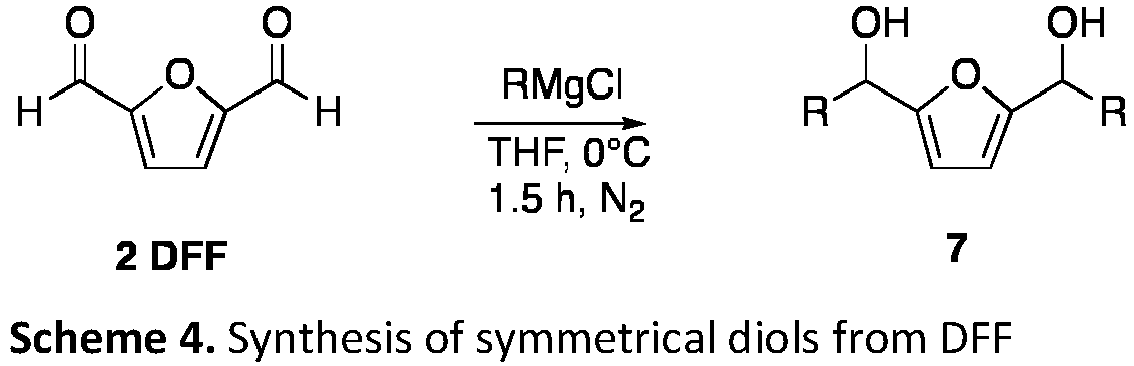
Table 2. Synthesis of symmetrical diols (not part of the invention) from DFF: Yield and Physical State Entry R Yield (%) State Reference 1 Methyl (7a) 98 liquid - 2 Ethyl (7b) 95 liquid - 3 n-Butyl (7c) 90 liquid - 4 t-Butyl (7d) 94 liquid Fuentes, Jose A. et al., Chemistry Central Journal (2012), 6, 151. 5 c-Pentyl (7e) 95 liquid - 6 Allyl (7f) 80 liquid - 7 Benzyl (7g) 83 liquid - - Compound 7a: 1H (400 MHz, CDCl3) δ 6.15 (d, J = 1.3 Hz, 2H), 4.84 (q, J = 6.6 Hz, 2H), 2.79 (s, 2H), 1.52 (d, J = 6.6 Hz, 6H); 13C (101 MHz, CDCl3) δ 156.9, 105.6, 63.5, 21.0. FTIR (neat) cm-1 3391, 2980, 2934, 1764, 1702, 1446, 1370, 1302, 1238, 1192. HRMS calculated for C8H12O3Na: 179.0684; Found: 179.0713.
- Compound 7b: 1H (400 MHz, CDCl3) δ 6.13 (s, 2H), 4.51 (t, J = 6.8 Hz, 2H), 2.94 (s, 2H), 1.86 1.79 (h, 7.2 Hz, 4H), 0.93 (t, J = 7.4 Hz, 6H); 13C (101 MHz, CDCl3) δ 195.9, 106.3, 69.0, 28.4, 9.9. FTIR (neat) cm-1 3316, 2964, 2934, 2876, 1557, 1456, 1377, 1315, 1187, 1094. HRMS calculated for C10H16O3Na: 207.0997; Found: 207.1007.
- Compound 7c: 1H (400 MHz, CDCl3) δ 6.19 (d, J = 3.1 Hz, 1H), 6.14 (d, J = 3.1 Hz, 1H), 4.60 (t, J = 6.9 Hz, 2H), 2.96 (s, 2H), 1.83 (q, J = 7.4 Hz, 4H), 1.44 - 1.29 (m, 8H), 0.91 (t, J = 7.0 Hz, 6H); 13C (101 MHz, CDCl3) δ 156.0, 106.1, 67.4, 36.9, 27.7, 22.4, 13.9. FTIR (neat) cm-1 3337, 2955, 2930, 2860, 1725, 1557, 1457, 1376, 1242, 1104. HRMS calculated for C14H24O3Na: 263.1623; Found: 263.1639.
- Compound 7d: 1H NMR (400 MHz, CDCl3) δ 6.19 (s, 1H), 6.17 (s, 1H), 4.36 (s, 1H), 4.34 (s, 1H), 2.49 (s, 2H), 0.97 (m, 18H); 13C NMR (101 MHz, CDCl3) δ 154.6, 107.5, 76.4, 35.7, 25.8. FTIR (neat) cm-1 3429, 3101, 2956, 2871, 1561, 1513, 1413, 1365, 1241, 1189. HRMS calculated for C14H24O3Na: 263.1623; Found: 263.1628.
- Compound 7e: 1H (400 MHz, CDCl3) δ 6.20 (d, J = 3.1 Hz, 1H), 6.15 (d, J = 3.1 Hz, 1H), 4.53 (s, 1H), 4.37 (d, J = 8.7 Hz, 1H), 2.86 (s, 1H), 2.72 (s, 1H), 2.37 (q, J = 8.2 Hz, 2H), 1.91 - 1.85 (m, 2H), 1.65 - 1.47 (m, 12H), 1.25 - 1.19 (m, 2H); 13C (101 MHz, CDCl3) δ 156.6, 153.2, 108.2, 106.9, 71.8, 57.3, 44.4, 29.3, 29.2, 25.6, 25.5. FTIR (neat) cm-1 3332, 2951, 2867, 1710, 1650, 1450, 1187, 1011, 794, 622. HRMS calculated for C16H24O3Na: 287.1623; Found: 287.1623.
- Compound 7f: 1H (400 MHz, CDCl3) δ 6.20 (s, 2H), 5.88 - 5.76 (m, 2H), 5.21 (q, 1.8 Hz, 2H), 5.17 (m, 1H), 5.14 (m, 1Hf), 4.73 (t, J = 5.9 Hz, 3H), 2.62 (m, 3H), 2.39 (s, 2H); 13C (101 MHz, CDCl3) δ 155.4, 133.8, 118.3, 106.6, 66.9, 39.9. FTIR (neat) cm-1 3309, 3076, 2914, 1640, 1431, 1310, 1186, 859, 794, 643. HRMS calculated for C12H16O3N2: 231.0997; Found: 231.1004.
- Compound 7g: 1H NMR (400 MHz, CDCl3) δ7.39 - 7.20 (m, 10H), 6.15 (d, J = 3.1 Hz, 2H), 4.91 (ddd, J = 8.0, 5.6, 3.8 Hz, 2H), 3.20 - 3.10 (s, 4H), 1.91 (s, 2H); 13C NMR (101 MHz, CDCl3) δ 155.2, 137.3, 129.4, 128.5, 126.7, 107.1, 68.7, 42.1. FTIR (neat) cm-1 3346, 2955, 2905, 2869, 1682, 1557, 1479, 1462, 1389, 1365. HRMS calculated for C20H20O3Na: 331.1310; Found: 331.1311.
- The formation of glycidyl ethers began by synthesizing a known compound as shown in Scheme 5. Treatment of bishydroxymethylfuran 5 with epichlorohydrin, 50% NaOH, tetra n-butylammonium bromide (TBABr, catalyst) at 50 °C gave the diglycidyl ether 8 not part of the invention in 85% isolated yield. The physical and spectral characteristics of 8 were in complete agreement with those reported in the literature [Shen et al., Ind. Eng. Chem. Res. 2017, 56(38):10929-10938; Ding et al., ACS Sustainable Chem. Eng. 2017, 5(9):7792-7799; Hu et al., Macromolecules 2014, 47(10):3332-3342].
-

- Compound 8: 1H NMR (400 MHz, CDCl3) δ 6.31 (s, 2H), 4.58 - 4.43 (m, 4H), 3.78 (dd, J = 11.5, 3.1 Hz, 2H), 3.46 (dd, J = 11.5, 5.9 Hz, 2H), 3.17 (ddt, J = 5.8, 4.1, 2.9 Hz, 2H), 2.81 (dd, J = 5.0, 4.2 Hz, 2H), 2.63 (dd, J = 5.0, 2.7 Hz, 2H); 13C NMR (101 MHz, CDCl3) δ 151.8, 110.3, 70.7, 65.1, 50.7, 44.3; FTIR (neat) cm-1 2930, 2871, 1734, 1636, 1457, 1373, 1243, 1090, 929, 855.
- After establishing reaction conditions for glycidation, the synthesis of diglycidyl ethers of unsymmetrical diols 6 was undertaken (Scheme 6) ("R" defined in Table 3). The goal was to prepare a diverse set of diglycidyl ethers and evaluate them in epoxy formation using different diamines. The reaction with diol 6 was optimized to obtain the diglycidyl ether 9 in high yield (Table 3). The products were characterized by spectroscopy. The NMR spectra of the products were complex because of the presence of multiple chiral centers. Two different sources for epichlorohydrin were evaluated. A 100% biobased epichlorohydrin gave diglycidyl ethers with a better impurity profile.
- Typical experimental procedure: A 50 mL round bottom flask reaction vessel under N2, containing 50 w/v % NaOH, aq. (4.0 g in 4 mL DI H2O), tetrabutylammonium bromide (32.2 mg, 0.1 mmol) and epichlorohydrin (20 mL) was placed in a 50 °C water bath. Before stirring and placing reaction vessel into hot oil bath, a solution of diol (1 mmol) in epichlorohydrin (10 mL) was added to the reaction vessel dropwise. The vessel was lowered into the hot oil bath (50 °C) and stirring started. The reaction was monitored via TLC, and upon completion (2-14 h), the hot reaction mixture was poured over ice. The resulting liquid was transferred to a 125 mL separatory funnel and diluted with ethyl acetate (40 mL). Then the aqueous layer was removed and the organic layer was washed with brine (20 mL x 3). The organic layer was dried over magnesium sulfate, filtered through filter paper, and then the organic solvent was removed in vacuo to obtain the diglycidyl ether.

Table 3. Diglycidyl ethers derived from unsymmetrical diols 6 ENTRY R YIELD (%) 1 Methyl (9a) 92 2 Phenyl (9b) 80 - Compound 9a: 1H NMR (400 MHz, CDCl3) δ 6.28 (d, J = 3.0 Hz, 1H), 6.23 (d, J = 3.2 Hz, 1H), 4.56 - 4.43 (m, 3H), 3.76 (dd, J = 12.3, 3.1 Hz, 1H), 3.65 (ddd, J = 20.7, 11.4, 3.3 Hz, 1H), 3.48 - 3.29 (m, 2H), 3.15 (dq, J = 6.0, 3.0 Hz, 1H), 3.10 (dq, J = 7.6, 3.9, 3.3 Hz, 1H), 2.80 - 2.75 (m, 2H), 2.63 - 2.52 (m, 2H), 1.52 (dd, J = 8.6, 6.6 Hz, 3H); 13C NMR (101 MHz, CDCl3) δ 155.7, 155.5, 151.1, 151.0, 110.1, 110.0, 107.9, 107.7, 71.1, 71.0, 70.6, 69.5, 68.6, 65.1, 50.9, 50.7, 44.6, 44.4, 44.2, 19.7, 19.5; 13C-DEPT-135 (101 MHz, CDCl3) δ 110.0 (CH2), 107.9 (CH2), 107.7 (CH2), 71.1 (CH2), 71.0 (CH/CH3), 69.5 (CH/CH3), 68.6 (CH/CH3), 65.1 (CH/CH3), 50.7 (CH2), 44.6(CH/CH3), 44.4(CH/CH3), 44.2 (CH/CH3), 19.7 (CH2), 19.7 (CH2); 1H- 13C HSQC (400 MHz/101MHz, CDCl13) δ (6.28, 110.1), (6.23, 107.8), (4.54, 71.1), (4.50, 65.1), (3.77, 70.6), (3.68, 69.5), (3.44, 70.6), (3.33, 69.5), (3.15, 50.7), (2.78, 44.3), (2.62, 44.3), (2.54, 44.4), (1.52, 19.7). FTIR (neat) cm-1 2986, 2867, 1711, 1443, 1372, 1322, 1252, 1090, 1013, 911. HRMS calculated for C13H18O5Na: 277.1052; Found: 277.1062.
- Compound 9b: 1H NMR (400 MHz, CDCl3) δ 7.45 - 7.29 (m, 5H), 6.26 (d, J = 3.1 Hz, 1H), 6.11 - 6.06 (m, 1H), 5.48 (d, J = 2.8 Hz, 1H), 4.54 - 4.44 (m, 2H), 3.75 (ddd, J = 18.9, 11.4, 3.2 Hz, 2H), 3.58 - 3.38 (m, 2H), 3.22 - 3.11 (m, 2H), 2.80 - 2.75 (m, 2H), 2.62 - 2.56 (m, 2H); 13C NMR (101 MHz, CDCl3) δ 154.6, 154.5, 151.6, 138.7, 138.6, 128.4, 128.1, 128.1, 127.3, 127.1, 110.2, 109.5, 109.3, 77.5, 70.5, 69.8, 69.5, 65.1, 50.8, 50.6, 44.4; 13C-DEPT-135 (101 MHz, CDCl3) δ 128.4(CH/CH3), 127.3(CH/CH3), 127.1(CH/CH3), 110.2(CH/CH3), 109.5(CH/CH3), 109.3(CH/CH3), 77.5(CH/CH3), 70.5(CH2), 69.8(CH2), 69.56(CH2), 65.1(CH2), 50.7(CH/CH3), 50.6(CH/CH3), 44.4(CH2); 1H- 13C HSQC (400 MHz/101MHz, CDCl3) δ (7.44, 127.2), (7.37, 128.2), (6.27, 110.2), (6.09, 109.5), (5.48, 77.5), (4.49, 65.1), (3.76, 69.6), (3.74, 70.5), (3.62, 69.8), (3.55, 70.5), (3.48, 69.6), (3.42, 70.5), (3.20, 50.7), (3.13, 50.6), (2.77, 44.4), (2.59, 44.3). FTIR (neat) cm-1 2998, 2921, 1555, 1494, 1452, 1334, 1252,1060, 1021, 845. HRMS calculated for C18H20O5Na: 339.1208; Found: 339.1208.
- The diglycidyl ethers of symmetrical diols 7 were also synthesized (Scheme 7) ("R" defined in Table 4). The reactions were slightly less efficient as compared to reactions with unsymmetrical diols (Table 4). The products were fully characterized by spectroscopy.

Table 4. Diglycidyl ethers derived from symmetrical diols 7 ENTRY R YIELD (%) 1 Methyl (10a) 65 2 Allyl (10b) 74 3 n-Butyl (10c) 82 - Compound 10a: 1H NMR (400 MHz, CDCl3) δ 6.22 (s, 2H), 4.54 (p, J = 6.5 Hz, 2H), 3.64 (ddd, J = 16.4, 11.4, 3.3 Hz, 2H), 3.54 - 3.30 (m, 2H), 3.15 - 3.06 (m, 1H), 2.84 - 2.74 (m, 2H), 2.63 (dd, J = 4.8, 2.8 Hz, 2H), 2.59 - 2.51 (m, 1H), 1.59 - 1.46 (t, J = 6.6 Hz, 6H); 13C-DEPT-135 (101 MHz, CDCl3) δ 155.0, 107.6, 71.1, 69.5, 68.6, 50.9, 44.4, 19.4; FTIR (neat) cm-1 3061, 2985, 2928, 2864, 1446, 1372, 1253, 1089, 913, 851. HRMS calculated for C14H20O5Na: 291.1208; found:
Compound 10b: 1H NMR (400 MHz, CDCl3) δ 6.25 (q, J = 1.6 Hz, 2H), 5.76 (dqd, J = 17.2, 6.9, 3.5 Hz, 2H), 5.18 - 4.96 (m, 4H), 4.48 - 4.34 (m, 2H), 3.72 - 3.55 (m, 2H), 3.47 (dt, J = 11.5, 4.4 Hz, 1H), 3.32 (ddd, J = 11.4, 6.1, 2.4 Hz, 1H), 3.11 (tt, J = 8.5, 4.8 Hz, 1H), 2.78 (q, J = 4.7 Hz, 2H), 2.75 - 2.49 (m, 6H); 13C NMR (101 MHz, CDCl3) δ 153.7, 133.8, 117.4, 108.8, 108.6, 75.1, 75.0, 69.6, 68.8, 50.8, 50.6, 44.6, 44.3, 38.5; 13C-DEPT-135 (101 MHz, CDCl3) δ 133.9(CH2), 117.4(CH/CH3), 108.9(CH2), 108.6(CH2), 75.2(CH2), 74.9(CH2), 69.6(CH/CH3), 68.7(CH/CH3), 50.9(CH2), 50.6(CH2), 44.6(CH/CH3), 44.3(CH/CH3), 38.5(CH/CH3); 1H- 13C HSQC (400 MHz/101MHz, CDCl13) δ (6.25, 108.8), (5.76, 133.7), (5.12, 117.3), (5.06, 117.3), (4.40, 75.0), (3.71, 69.5), (3.59, 68.8), (3.48, 68.7), (3.33, 69.5), (3.10, 50.8), (2.79, 44.5), (2.68, 38.5), (2.64, 44.5), (2.53, 44.3). FTIR (neat) cm-1 3074, 2998, 2918, 1641, 1431, 1316, 1252, 1160, 1190, 992. HRMS calculated for C18H24O5Na: 343.1521; found: 343.1519. - Compound 10c: 1H NMR (400 MHz, CDCl3) δ 6.21 (t, J = 1.8 Hz, 2H), 4.31 (dt, J = 13.8, 7.0 Hz, 2H), 3.65 - 3.50 (m, 2H), 3.48 - 3.35 (m, 2H), 3.29 (ddt, J = 11.4, 6.1, 1.8 Hz, 2H), 3.08 (tq, J = 7.9, 3.8 Hz, 2H), 2.75 (q, J = 4.9 Hz, 2H), 2.60 (dd, J = 5.1, 2.7 Hz, 2H), 2.50 (dt, J = 5.1, 2.7 Hz, 4H), 1.97 - 1.72 (m, 4H), 1.44 -1.10 (m, 6H), 0.87 (t, J = 7.1 Hz, 2H); 13C NMR (101 MHz, CDCl3) δ 154.2, 108.3, 75.4, 69.5, 68.7, 50.9, 50.6, 44.6, 44.3, 33.7, 27.7, 22.4, 13.9; 13C-DEPT-135 (101 MHz, CDCl3) δ 108.5 (CH/CH3), 75.7 (CH/CH3), 69.5 (CH2), 68.7(CH2), 50.9(CH/CH3), 50.6(CH/CH3), 44.6 (CH2), 44.3 (CH2), 33.7(CH2), 27.7(CH2), 22.44(CH2), 13.9(CH/CH3); 1H- 13C HSQC (400 MHz/101MHz, CDCl13) δ (6.21, 108.0), (4.32, 75.5), (3.62, 69.5), (3.54, 68.7), (3.45, 68.7), (3.29, 69.5), (3.07, 50.8), (2.75, 44.5), (2.60, 44.6), (2.50, 44.3), (1.89, 33.7), (1.82, 33.7), (1.34, 27.7), (1.33, 22.4), (1.21, 27.6), (0.88, 14.0). FTIR (neat) cm-1 2955, 2930, 2861, 1466, 1379, 1320, 1253, 1090, 1013, 795. HRMS calculated for C20H32O5Na: 375.2147; found: 375.2146.
- A tertiary diol 11 (not part of the invention) was synthesized from by the addition of excess methylmagnesium chloride to FDCA diethyl ester 4 in 85% yield (Scheme 7). The solid diol was not stable and underwent dehydration readily. However, the compound could be stored in a freezer without decomposition.

- Compound 11: 1H (400 MHz, CDCl3) δ 6.09 (s, 2 H), 2.49 (s, 2 H), 1.58 (s, 12 H); 13C (101 MHz, CDCl3) δ 159.0, 104.0, 68.7, 28.5. FTIR (neat) cm-1 3362, 2979, 2900, 1375, 1267, 1164, 1115, 1022, 959, 840. HRMS calculated for C10H16O3Na: 207.0997; Found: 207.0994.
- The glycidation of 11 to provide diglycidyl ether 12 was successful and gave the product in 75% yield (Scheme 8). It is interesting to note highly hindered ether such as 12 could be accessed. However, the glycidation was slow as compared to reactions with less hindered alcohols.

- Compound 12: 1H NMR (400 MHz, CDCl3) δ 6.17 (d, J = 3.2 Hz, 1H), 6.12 (d, J = 3.2 Hz, 1H), 3.37 (dd, J = 11.0, 3.7 Hz, 2H), 3.22 (dd, J = 11.0, 5.5 Hz, 2H), 3.06 - 2.99 (m, 2H), 2.75 (t, 5 Hz, 2H), 2.53 (dd, J = 5.1, 2.7 Hz, 2H), 1.59 (s, 6H), 1.56 (s, 6H); 13C NMR (101 MHz, CDCl3) δ 159.87, 155.8, 107.5, 103.7, 73.3, 68.7, 64.4, 51.0, 44.9, 28.5, 25.7. FTIR (neat) cm-1 2968, 2905, 1375, 1350, 1252, 1168, 1112, 1018, 963, 837. HRMS calculated for C16H24O5Na: 319.1521; found: 319.1513.
- To evaluate the curing ability of the diglycidyl ether bis-epoxymonomers with four different types of amine curatives, high throughput and conventional methods were used to extract maximum property information of the crosslinked networks with minimal material in a short period of time. The properties of the networks formed from the novel diglycidyl ether bis-epoxymonomers as a function of curative type, cure temperature, and time of curing are disclosed. For comparison, commercial BPA based epoxy resin EPON 828 (Momentive) was used as reference. To evaluate the relative crosslink density of the crosslink networks high throughput dye extraction and nano-indentation technique were used. Conventional methods such as König pendulum hardness and differential scanning calorimetry (DSC) were used to further evaluate the crosslinked networks.
- The materials used are described in Table 5.
Table 5. Starting materials Chemical Designation Vendor Bisphenol A diglycidyl ether EPON 828 Momentive Perylene, 98+% Perylene Alfa Aesar Toluene Toluene BDH Chemicals Methyl ethyl ketone, 99% MEK Alfa Aesar Perylene, 98+%, Perylene Alfa Aesar Aluminum panels 4"×8" Aluminum panels Q-LAB polypropylene microtiter plates Evergreen Scientific. - Formulations from the diglycidyl ether bis-epoxymonomers and EPON 828 were prepared with four types of amine curatives (total twelve amine curatives listed in Table 6) to investigate the reactivity of the diglycidyl ether bis-epoxymonomers towards different amine curatives and simultaneously the impact of the nature of amine curative on the properties of the cured coatings. To evaluate the relative performance of curatives towards crosslinking, the dye extraction method previously reported by Bach et al. [Bach et al., Farbe Lack 2002, 108:30; 2. Bach et al., in High-Throughput Analysis: A Tool for Combinatorial Materials Science, eds. R. A. Potyrailo and E. J. Amis, Springer US, Boston, MA, 2003, pp. 525-549.] was used. Prior to making formulations, a 3 mM solution of perylene dye in toluene was prepared. A representative procedure for making dye incorporated formulation of EPON 828 with isophorone diamine as curative is as follows: 1.14 g of EPON 828 resin was transferred into a 20 mL glass vial, where, 2.56 mL of methyl ethyl ketone (MEK) solvent and 202 µL of perylene dye solution were subsequently added and mixed using Teflon coated magnetic stir bar at 900 rpm on multi-position magnetic stirring plates for 25 min. Next, 0.26 g of isophorone diamine (Epoxy to amine ratio was 1:1) was added to the mixture and mixed for another 20 min prior to deposition on primed aluminum discs. For all the formulations and the amount of dye per formulation unit volume was kept constant.


- Preparation for the dye extraction method was carried out by punching out 10 mm epoxy primed aluminum discs and affixing them to a 4" × 8" aluminum panel in a 6 × 11 array format. 75 µL of each formulation was deposited on six discs using an Eppendorf repeat pipettor. Coatings were then allowed to dry overnight under ambient conditions. Array panels were then cured at room temperature for 7 days, 60 °C and 100 °C using preheated oven for 1 h., 3 h., or 6 h. to evaluate the optimum curing condition. After curing, three discs from each set (same formulation and curing regime) were transferred into 24 well (6x4) polypropylene microtiter plates, each row of wells containing two sets of discs. The discs were affixed to the bottom of each well with double-sided tape and were allowed to adhere for 18+ hours prior to dye extraction.
- Dye extraction was performed by adding 500 µL of toluene to each well of the microtiter plate using an Eppendorf repeat pipettor. Toluene was quickly added to each row of the microtiter plate with 15 s intervals between the rows. Formulations were allowed to soak for 10 min on an orbital shaker, then 150 uL of each extraction sample was collected and transferred to a 96 well microtiter plate using a 6-channel, adjustable spacing, multichannel pipette. Each row of two sets with three replicates was collected at the same time, aspirating twice to ensure a homogenous mixture. The timing of collection for each individual formulation was held to 15 second intervals to ensure that the soaking time was precise. Fluorescence measurements (415ex/471em) of all extraction samples using a TECAN Saffire2 plate reader were taken immediately following collection.
- Depth sensing indentation, also called instrumented indentation or nanoindentation, was performed using a Hysitron Tribolndenter with automation (9 samples per run) using a diamond Berkovich tip. Since accurate determination of the elastic modulus from the indentation load-displacement responses requires flat sample surfaces, indentation was performed mostly near the center of the coated discs. Before every indent, the indenter was held in contact with the surface, to allow for piezoactuator stabilization (35 s) and drift correction (40 s), at a contact load of only 0.5 mN to prevent any deformation prior to the indentation experiment. The drift rate (typically 0.1 nm s21) was automatically determined over the last 20 s of the 40 s period. After lifting the tip up to 30 nm and re-approaching the surface (surface detection at a load of 0.5 mN), the tip was loaded to maximum load of 300 µN in 5 s, held at maximum load for 5 s and unloaded in 5 s. Nine measurements with a spacing of 60 µm apart were performed per sample and the first one was left out from the analysis to further reduce the influence of drift.
- Thermal properties of the cured coatings were characterized using Q1000 Modulated Differential Scanning Calorimeter from TA Instruments with a cooling limit up to -90 °C. About 6-8 mg of the cured film was scraped out from the disc and the following heat/cool/heat regime was used: the sample was first equilibrated at 23 °C and then cooled to -10°C at 10 °C/minute, held at -10°C for 2 min and heated to 100°C at 10 °C/minute.
- König pendulum hardness was measured according to ASTM D 4366-16 by sticking two cured coated discs on a steel panel on top of which steel balls of the pendulum were placed; the result was reported in seconds.
- Drying time was measured according to ASTM D 1640. Due to small size of the coated discs dry-to-touch time was recorded when the coating no longer adheres to the finger and does not rub up appreciably when the finger was lightly rubbed across the surface.
- Epoxy equivalent weight (EEW, g/eq.) of the diglycidyl ether bis-epoxymonomers and EPON 828 resin were evaluated by titrating epoxy samples with 0.0925 N solution of HBr in glacial acetic acid; 1 wt.% solution of crystal violet in acetic acid was used as an indicator. EEW value was calculated using the following equation (1) and the values are reported in Table 7, where W is the sample mass in grams, N is the normality of HBr solution, and V is the volume of HBr solution used for titration in mL.

Table 7. Epoxy equivalent weight (EEW, g/eq.) of the diglycidyl ether bis-epoxymonomers and EPON 828 resin. Asterisk (*) identifies compounds not being part of the invention. Resin EEW (g/eq) GLY 13/16* 
165.85 GLY 23/24 
148.92 GLY 17 
157.18 GLY 25 
158.23 EPON 828* 190 - Drying time was measured as a preliminary study to estimate the reactivity of the novel diglycidyl ether bis-epoxymonomers towards various amine curatives. See Table 8. Drying time of EPON 828 was measured with the curatives as a reference.
Table 8. Drying time of diglycidyl ether bis-epoxymonomers and EPON 828 with amine curatives. Asterisk (*) identifies compounds not being part of the invention. Dry-to-touch time (hr.) Amine Curatives EPON 828* GLY 23/24 GLY 17 GLY 13/16* GLY 25 TEG-DA (XTJ-504) 16 PS 18 14 NI Jeffamine t403 13 42 23 24 33 Jeffamine D-230 25 77 24 17 56 Jeffamine D-400 NI 91 28 NI 62 PACM 8 18 22 15 19 1,3-BAC 8 17 20 22 16 IPDA 11 16 22 12 16 Xylene diamine 5 22 28 13.5 20 Diethylenetriamine 6 PS 20 16 17 Tetraethylenepentamine 5 PS 23 18 21 Priamine 1075 PS PS PS PS PS 1,8 DA Octane 6 17 20 14 15 S - Phase separation
NI - Not included in the study - The dye extraction method described previously was used to estimate the relative crosslink density of the coatings. Higher values of dye extraction are related to lower crosslinked coatings and vice versa. The tables below show the dye extraction results for coatings made from the diglycidyl ethers and amine curing agents cured under room temperature (RT) conditions as well as at elevated temperatures for the times shown.
Table 9. Dye extraction results of coatings formulated from GLY 23/24 with amine curatives. Curing Temperature (°C) RT 60 100 Curing Time 7 Days 1h. 3h. 6h. 1h. 3h. 6h. TEG-DA (XTJ-504) 20578 20991 20042 20125 16544 15915 14557 Jeffamine t403 16333 14895 14522 16578 14166 13552 15073 Jeffamine D-230 20123 18786 19086 21048 16687 16101 17574 Jeffamine D-400 21019 20998 21705 24856 21326 20358 21549 PACM 11116 10935 10700 13334 10545 9585 10708 1,3-BAC 13703 14280 14332 16715 14072 13036 14344 IPDA 18306 13541 12157 13322 12930 11862 13441 Xylene diamine 15516 12031 11821 12910 13804 13590 14816 Diethylenetriamine 15139 14594 16254 20919 17731 19418 21345 Tetraethylenepentamine 17050 16644 17776 25250 22196 19136 13935 Priamine 1075 24208 20580 20400 22766 19842 18530 19752 1,8 DA Octane 12018 6414 5302 5205 7972 8954 7946 Table 10. Dye extraction results of coatings formulated from GLY 13/16 (not part of the invention) with amine curatives. Curing Temperature (°C) RT 60 100 Curing Time 7 Days 1h. 3h. 6h. 1h. 3h. 6h. TEG-DA (XTJ-504) 204 214 152 129 168 124 142 Jeff. t403 3463 3611 3519 2492 2858 2473 1665 Jeff. D-230 8819 9187 9554 9955 8043 7003 7356 Jeff.D-400 NI PACM 304 1525 760 126 213 61 107 1,3-BAC 1376 324 250 426 679 234 124 IPDA 127 136 84 54 127 103 77 Xylene diamine 174 72 92 100 170 120 91 DETA 341 105 111 105 76 81 78 TEPA 703 126 748 148 548 166 525 Priamine 1075 44637 45440 46136 48543 37621 33993 30476 1,8 DA Octane 272 608 529 326 693 196 152 NI - Not included in the study Table 11. Dye extraction results of coatings formulated from GLY 17 with amine curatives. Curing Temperature (°C) RT 60 100 Curing Time 7 Days 1h. 3h. 6h. 1h. 3h. 6h. TEG-DA (XTJ-504) 738 2114 2604 3033 4141 3087 2258 Jeffamine t403 3720 3663 3703 2608 3016 2542 2072 Jeffamine D-230 27621 28338 28333 27862 23012 18084 13276 Jeffamine D-400 38468 40511 40735 40689 36651 32086 30629 PACM 3500 2994 2906 641 1145 286 130 1,3-BAC 2321 2042 790 163 6012 5233 4326 IPDA 2863 6772 7299 702 1885 203 116 Xylene diamine 7401 1100 1100 956 15431 23468 13669 Diethylenetriamine 931 1121 1409 678 1363 309 342 Tetraethylenepentamine 29781 25886 25229 27807 3889 1879 1293 Priamine 1075 44422 44165 44577 45501 40452 38352 35642 1,8 DA Octane 20532 12378 10432 8193 6087 6035 6005 Table 12. Dye extraction results of coatings formulated from GLY 25 with amine curatives. Curing Temperature (°C) RT 60 100 Curing Time 7 Days 1h. 3h. 6h. 1h. 3h. 6h. TEG-DA (XTJ-504) NI Jeffamine t403 17277 16437 17283 15196 15751 15142 13292 Jeffamine D-230 12654 13080 14141 13358 9596 10105 10171 Jeffamine D-400 34037 35898 35054 36861 31008 28581 28691 PACM 3493 9923 7238 6320 11110 9384 7539 1,3-BAC 13117 13626 13394 11472 8623 2590 1397 IPDA 15948 15468 15904 15007 13542 11417 11280 Xylene diamine 2167 2264 2782 1396 7190 4469 2173 Diethylenetriamine 9138 5968 6416 5996 1483 1882 607 Tetraethylenepentamine 14755 10584 4889 4971 867 879 820 Priamine 1075 37500 32975 48161 45077 37220 35820 31653 1,8 DA Octane 1124 1811 2098 2595 1704 726 679 NI - Not included in the study Table 13. Dye extraction results of coatings formulated from EPON 828 (not part of the invention) with amine curatives. Curing Temperature (°C) RT 60 100 Curing Time 7 Days 1h. 3h. 6h. 1h. 3h. 6h. TEG-DA (XTJ-504) 8648 1153 1124 1358 1124 887 501 Jeffamine t403 568 13751 3867 353 336 64 68 Jeffamine D-230 1327 17265 4245 247 212 115 96 PACM 1107 247 227 211 37 36 35 1,3-BAC 628 1172 917 1331 189 123 108 IPDA 132 426 130 84 44 56 36 Xylene diamine 8704 91 90 84 72 55 42 Diethylenetriamine 11478 7004 5431 3014 1198 885 487 Tetraethylenepentamine 18994 1604 391 643 425 335 338 Priamine 1075 5075 31762 31543 29461 26349 22649 23601 1,8 DA Octane 13289 995 488 157 589 63 63 - Konig pendulum hardness measurements were carried out on the coatings made by reacting the diglycidyl ethers with the amine curing agents at room temperature (RT) and elevated temperatures for the times indicated. Higher pendulum hardness value indicates a harder coating.
Table 14. Pendulum hardness of coatings formulated from GLY 23/24 with amine curatives. Curing Temperature (°C) RT 60 100 Curing Time 7 Days 1h. 3h. 6h. 1h. 3h. 6h. TEG-DA (XTJ-504) PS, T Jeffamine t403 27 19 21 25 25 22 24 Jeffamine D-230 16 19 22 20 18 19 21 Jeffamine D-400 31 28 33 43 26 39 53 PACM 29 10 36 33 43 54 61 1,3-BAC 8 5 11 14 7 11 15 IPDA 10 25 91 97 61 66 83 Xylene diamine 12 8 7 9 4 4 5, W Diethylenetriamine PS, W Tetraethylenepentamine Priamine 1075 PS, T 1,8 DA Octane 17 24 32 19 21 15 19 PS- Phase separated
T- Tacky
W- WrinkledTable 15. Pendulum hardness results of coatings formulated from GLY 13/16 (not part of the invention) with amine curatives. Curing Temperature (°C) RT 60 100 Curing Time 7 Days 1h. 3h. 6h. 1h. 3h. 6h. TEG-DA (XTJ-504) 8 7 7 7 11 17 19 Jeffamine t403 75 59 134 143 44 154 153 Jeffamine D-230 10 7 7 9 7 7 11 Jeffamine D-400 NI PACM 32 163 173 191 173 151 177 1,3-BAC 7 13 20 23 61 95 108 IPDA 185 186 187 195 154 193 200 Xylene diamine 13 12 17 18 17 63 68 Diethylenetriamine 14 12 13 17 26 79 105 Tetraethylenepentamine 28 9 25 36 141 179 183 Priamine 1075 PS 1,8 DA Octane 15 16 18 13 17 22 28 NI- Not included in the study
PS- Phase separatedTable 16. Pendulum hardness results of coatings formulated from GLY 17 with amine curatives. Curing Temperature (°C) RT 60 100 Curing Time 7 Days 1h. 3h. 6h. 1h. 3h. 6h. TEG-DA (XTJ-504) 6 6 7 14 7 13 W Jeffamine t403 86 66 150 171 85 152 178 Jeffamine D-230 NI Jeffamine D-400 PACM 44 113 109 116 152 174 176 1,3-BAC 39 38 36 42 71 140 173 IPDA 80 130 140 146 152 192 202 Xylene diamine 9 14 20 30 10 27 88 Diethylenetriamine 4 7 9 9 36 88 134 Tetraethylenepentamine NI Priamine 1075 PS, T 1,8 DA Octane 4 11 14 15 13 17 20 NI- Not included in the study
PS- Phase separated
T- TackyTable 17. Pendulum hardness results of coatings formulated from GLY 25 with amine curatives. Curing Temperature (°C) RT 60 100 Curing Time 7 Days 1h. 3h. 6h. 1h. 3h. 6h. TEG-DA (XTJ-504) NI Jeffamine t403 9 11 11 11 9 12 13 Jeffamine D-230 NI Jeffamine D-400 PACM 30 107 50 27 83 127 169 1,3-BAC 9 25 27 31 42 125 123 IPDA 30 18 17 13 11 9 10 Xylene diamine 7 6 7 38 40 38 45 Diethylenetriamine NI Tetraethylenepentamine Priamine 1075 PS 1,8 DA Octane 158 159 152 157 127 174 169 NI- Not included in the study
PS- Phase separatedTable 18. Pendulum hardness of coatings formulated from EPON 828 (not part of the invention) with amine curatives. Curing Temperature (°C) RT 60 100 Curing Time 7 Days 1h. 3h. 6h. 1h. 3h. 6h. TEG-DA (XTJ-504) 13 33 22 46 85 93 95 Jeffamine t403 140 135 180 87 147 176 167 Jeffamine D-230 171 195 178 212 139 180 107 PACM 151 107 160 159 155 157 153 1,3-BAC 130 140 138 136 131 135 138 IPDA 133 89 150 175 160 171 166 Xylene diamine 56 49 104 92 118 137 134 Diethylenetriamine 9 35 44 48 78 107 117 Tetraethylenepentamine 32 32 82 71 122 159 121 Priamine 1075 HW 1,8 DA Octane HW- Highly Wrinkled -
Table 19. Glass transition temperature (Tg) of coatings formulated from GLY 23/24 with amine cu ratives. Curing Temperature (°C) RT 60 100 Curing Time 7 Days 3h. 3h. TEG-DA (XTJ-504) -1 3 5 Jeffamine t403 5 6 7 Jeffamine D-230 -1 -1 12 Jeffamine D-400 -3 0 40 PACM 30 29 32 1,3-BAC 56 21 19 IPDA 25 38 34 Xylene diamine 9 13 20 Diethylenetriamine PS Tetraethylenepentamine Priamine 1075 1,8 DA Octane 13 12 15 PS-Phase separated Table 20. Glass transition temperature (Tg) of coatings formulated from GLY 13/16 (not part of the invention with amine curatives. Curing Temperature (°C) RT 60 100 Curing Time 7 Days 3h. 3h. TEG-DA (XTJ-504) 14 15 17 Jeffamine t403 38 40 60 Jeffamine D-230 11 12 14 Jeffamine D-400 NI PACM 39 50 63 1,3-BAC 15 22 45 IPDA 41 54 57 Xylene diamine 6 13 42 Diethylenetriamine 16 19 39 Tetraethylenepentamine 32 36 39 Priamine 1075 PS 1,8 DA Octane 7 15 19 PS-Phase separated
NI- Not included in the studyTable 21. Glass transition temperature (Tg) of coatings formulated from GLY 17 with amine cu ratives. Curing Temperature (°C) RT 60 100 Curing Time 7 Days 1h. 3h. 6h. 1h. 3h. 6h. TEG-DA (XTJ-504) -6 1 3 6 20 23 27 Jeffamine t403 39 36 39 40 40 41 45 Jeffamine D-230 NI Jeffamine D-400 PACM 33 31 39 41 39 39 41 1,3-BAC 34 32 39 33 36 42 47 IPDA -8 41 42 42 42 52 59 Xylene diamine 7 25 30 27 21 26 30 Diethylenetriamine 13 17 19 26 33 37 37 Tetraethylenepentamine NI Priamine 1075 1,8 DA Octane 29 8 16 26 26 27 30 NI- Not included in the study Table 22. Glass transition temperature (Tg) of coatings formulated from GLY 25 with amine cu ratives. Curing Temperature (°C) RT 60 100 Curing Time 7 Days 1h. 3h. 6h. 1h. 3h. 6h. TEG-DA (XTJ-504) NI Jeffamine t403 3 3 3 5 3 2 3 Jeffamine D-230 NI Jeffamine D-400 PACM 14 9 23 28 27 29 33 1,3-BAC 16 15 28 29 25 30 35 IPDA 33 17 20 29 31 33 35 Xylene diamine 17 11 16 35 27 30 31 Diethylenetriamine NI Tetraethylenepentamine Priamine 1075 1,8 DA Octane -4 -4 4 11 6 11 21 NI- Not included in the study Table 23. Glass transition temperature (Tg) of coatings formulated from EPON 828 (not part of the invention) with amine curatives. Curing Temperature (°C) RT 60 100 Curing Time 7 Days 3h. 3h. TEG-DA (XTJ-504) 52 54 54 Jeffamine t403 53 58 63 Jeffamine D-230 47 56 57 Jeffamine D-400 50 49 51 PACM 47 49 51 1,3-BAC 44 46 48 IPDA 48 53 55 Xylene diamine 53 60 61 Diethylenetriamine 53 58 62 Tetraethylenepentamine 23 34 39 Priamine 1075 36 45 54 1,8 DA Octane 52 55 61 -


Claims (15)
- A diol having the following structure:

- A method of making a diol of claim 1, comprising, consisting essentially of, or consisting of:reacting 5-hydroxymethyl furfural (HMF), diformyl furan (DFF), or a derivative thereof with a Grignard reagent,under conditions sufficient to form the diol.
- The method of claim 2, wherein the Grignard reagent is RMgCl, wherein R is n-butyl, c-pentyl, allyl, or benzyl.
- A diglycidyl ether having the following structure:
 wherein R1, R2, R3, and R4 are independently selected from the group consisting of H, C1-C6 alkyl, C1-C6 alkenyl, aryl, and C1-C6alkyl-aryl,with the proviso that R1, R2, R3, and R4 cannot all be H.
 - The diglycidyl ether of claim 4 having the following structure:

- The diglycidyl ether of claim 5, wherein R2 is methyl or phenyl.
- The diglycidyl ether of claim 4 having the following structure:

- The diglycidyl ether of claim 7, wherein R1 and R2 are both methyl, n-butyl, or allyl.
- The diglycidyl ether of claim 4 having the following structure:

- A method for making the diglycidyl ether of any of claims 4-9, comprising, consisting essentially of, or consisting of:reacting a diol with epichlorohydrin under conditions sufficient to form the diglycidyl ether,wherein the diol has the following structure:wherein R1, R2, R3, and R4 are independently selected from the group consisting of H, C1-C6 alkyl, C1-C6alkenyl, aryl, and C1-C6alkyl-aryl.

- The method of claim 10, wherein the diol cannot have the following structure:


- A curable coating composition comprising, consisting essentially of, or consisting of:a) at least one diglycidyl ether of any of claims 4-9; andb) an amine.
- The curable coating composition of claim 12, wherein the amine is an aliphatic, an aromatic, a cycloaliphatic, or a polyether amine.
- The curable coating composition of claim 13, wherein the aliphatic amine is 1,8-diaminooctane, diethylenetriamine, or tetraethylenepentamine;the aromatic amine is m-xylylenediamine; orthe cycloaliphatic amine is 1,3-bis(aminomethyl)cyclohexane, isophorone diamine, or bis(p-aminocyclohexyl) methane.
- A composite or adhesive comprising, consisting essentially of, or consisting of at least one diglycidyl ether of any of claims 4-9.
Applications Claiming Priority (2)
| Application Number | Priority Date | Filing Date | Title |
|---|---|---|---|
| US201962871387P | 2019-07-08 | 2019-07-08 | |
| PCT/US2020/040918 WO2021007171A1 (en) | 2019-07-08 | 2020-07-06 | Novel bio-based diols from sustainable raw materials, uses thereof to make diglycidyl ethers, and their coatings |
Publications (3)
| Publication Number | Publication Date |
|---|---|
| EP3997077A1 EP3997077A1 (en) | 2022-05-18 |
| EP3997077A4 EP3997077A4 (en) | 2023-08-30 |
| EP3997077B1 true EP3997077B1 (en) | 2025-05-21 |
Family
ID=74114084
Family Applications (1)
| Application Number | Title | Priority Date | Filing Date |
|---|---|---|---|
| EP20837542.8A Active EP3997077B1 (en) | 2019-07-08 | 2020-07-06 | Novel bio-based diols from sustainable raw materials, uses thereof to make diglycidyl ethers, and their coatings |
Country Status (3)
| Country | Link |
|---|---|
| US (1) | US11691956B2 (en) |
| EP (1) | EP3997077B1 (en) |
| WO (1) | WO2021007171A1 (en) |
Families Citing this family (2)
| Publication number | Priority date | Publication date | Assignee | Title |
|---|---|---|---|---|
| US12497391B2 (en) | 2021-06-16 | 2025-12-16 | Braskem S.A. | Furanic diglycidyl ethers and esters and use thereof |
| CN118930504A (en) * | 2024-07-23 | 2024-11-12 | 苏州亚科科技股份有限公司 | A method for preparing dialkyl 2,5-furandicarboxylate |
Family Cites Families (11)
| Publication number | Priority date | Publication date | Assignee | Title |
|---|---|---|---|---|
| JPH03101671A (en) * | 1989-09-14 | 1991-04-26 | Mitsubishi Kasei Corp | Method for producing optically active alcohol |
| US5349026A (en) | 1992-11-20 | 1994-09-20 | Rohm And Haas Company | Reactive coalescents |
| US5371148A (en) | 1993-06-23 | 1994-12-06 | Union Carbide Chemicals & Plastics Technology Corporation | Reactive polymers having pendant flexible side chains prepared from ethylenically unsaturated carbodiimides |
| US6734207B2 (en) | 2001-04-20 | 2004-05-11 | Parker Hughes Institute | Cytotoxic compounds |
| JP2007238570A (en) | 2006-03-10 | 2007-09-20 | Kyoto Univ | Phosphor compound, process for producing the same, and cyclic phosphor compound |
| KR101116450B1 (en) * | 2009-09-08 | 2012-03-07 | 학교법인 선목학원 | Biomass-derived curable compound, solvent-free curable composition, and method of preparing thereof |
| EP2436711A1 (en) | 2010-10-01 | 2012-04-04 | Resopal Gmbh | Biocomposite board |
| US10077332B2 (en) | 2013-07-03 | 2018-09-18 | Rhodia Operations | Curable composition and process for the manufacture of an epoxy thermoset |
| CN103880791B (en) * | 2014-03-26 | 2016-04-13 | 中国科学技术大学 | A kind of synthetic method of 2-benzyl furans-4-methyl alcohol |
| FR3021656B1 (en) | 2014-05-28 | 2017-11-24 | Roquette Freres | PROCESS FOR MANUFACTURING FURANIC GLYCIDYL ETHERS COMPOSITIONS, COMPOSITIONS OBTAINED AND USES THEREOF |
| JP2018193353A (en) | 2017-05-22 | 2018-12-06 | 国立大学法人北陸先端科学技術大学院大学 | Method for producing furan derivative |
-
2020
- 2020-07-06 US US17/623,405 patent/US11691956B2/en active Active
- 2020-07-06 EP EP20837542.8A patent/EP3997077B1/en active Active
- 2020-07-06 WO PCT/US2020/040918 patent/WO2021007171A1/en not_active Ceased
Also Published As
| Publication number | Publication date |
|---|---|
| WO2021007171A1 (en) | 2021-01-14 |
| US11691956B2 (en) | 2023-07-04 |
| EP3997077A4 (en) | 2023-08-30 |
| US20220372009A1 (en) | 2022-11-24 |
| EP3997077A1 (en) | 2022-05-18 |
Similar Documents
| Publication | Publication Date | Title |
|---|---|---|
| Chrysanthos et al. | Preparation and properties of bio-based epoxy networks derived from isosorbide diglycidyl ether | |
| Bu et al. | Fully bio-based epoxy resins derived from magnolol and varying furan amines: Cure kinetics, superior mechanical and thermal properties | |
| Cornille et al. | Syntheses of epoxyurethane polymers from isocyanate free oligo-polyhydroxyurethane | |
| Mazurek-Budzyńska et al. | Bis (cyclic carbonate) based on d-mannitol, d-sorbitol and di (trimethylolpropane) in the synthesis of non-isocyanate poly (carbonate-urethane) s | |
| KR102652122B1 (en) | Method for producing polymers with urethane groups | |
| JP5486536B2 (en) | Polymerizable compound | |
| EP3486238B1 (en) | Polyfunctional oxetane derivatives for preparing cationic photocurable compositions | |
| US20130036939A1 (en) | Novel acetoacetoxy and enamine compounds and coatings therefrom | |
| US8480800B2 (en) | Aminoalcohol compounds, precursors, and methods of preparation and use | |
| US11691956B2 (en) | Bio-based diols from sustainable raw materials, uses thereof to make diglycidyl ethers, and their coatings | |
| TW553924B (en) | Preparation of hydroxyalkylcarbamates from six-membered cyclic carbonates | |
| JPH06263676A (en) | New cyclohexyl group-containing glycidyl ether | |
| Shah et al. | Synthesis and characterisation of cycloaliphatic and aromatic amines based cardanol benzoxazines: a comparative study | |
| EP4423163B1 (en) | Biobased amine curing agent for curable compositions | |
| JP5591856B2 (en) | (Meth) acrylamide compound precursor | |
| TWI802679B (en) | Compound containing unsaturated double bond, oxygen absorber using same, and resin composition | |
| EP3116864B1 (en) | Epoxy resin compositions | |
| EP1360250A2 (en) | Single component room temperature curable low voc epoxy coatings | |
| DE4024466A1 (en) | THERMAL CURABLE MIXTURES | |
| WO2016143737A1 (en) | Novel polyamine compound and method for producing same, epoxy-resin curing agent using same, epoxy resin composition, and epoxy-resin cured article | |
| HUT63140A (en) | Substituted 1,5-pentanediols, process for producing and re-forming them | |
| US20230227685A1 (en) | Bio-based furanic di(meth)acrylates as reactive diluents for uv curable coatings | |
| CN110951310B (en) | Use of carbamates as organic solvents | |
| US11952498B2 (en) | Colored functionalized [2,2] paracyclophane and colored chemical film | |
| CN115286637B (en) | Triazabridged ring compounds, intermediate compounds thereof, preparation method and application |
Legal Events
| Date | Code | Title | Description |
|---|---|---|---|
| STAA | Information on the status of an ep patent application or granted ep patent |
Free format text: STATUS: THE INTERNATIONAL PUBLICATION HAS BEEN MADE |
|
| PUAI | Public reference made under article 153(3) epc to a published international application that has entered the european phase |
Free format text: ORIGINAL CODE: 0009012 |
|
| STAA | Information on the status of an ep patent application or granted ep patent |
Free format text: STATUS: REQUEST FOR EXAMINATION WAS MADE |
|
| 17P | Request for examination filed |
Effective date: 20220207 |
|
| AK | Designated contracting states |
Kind code of ref document: A1 Designated state(s): AL AT BE BG CH CY CZ DE DK EE ES FI FR GB GR HR HU IE IS IT LI LT LU LV MC MK MT NL NO PL PT RO RS SE SI SK SM TR |
|
| DAV | Request for validation of the european patent (deleted) | ||
| DAX | Request for extension of the european patent (deleted) | ||
| A4 | Supplementary search report drawn up and despatched |
Effective date: 20230727 |
|
| RIC1 | Information provided on ipc code assigned before grant |
Ipc: C09D 163/00 20060101ALI20230721BHEP Ipc: C08G 59/50 20060101ALI20230721BHEP Ipc: C08G 59/04 20060101ALI20230721BHEP Ipc: C08G 59/26 20060101ALI20230721BHEP Ipc: C08G 59/22 20060101ALI20230721BHEP Ipc: C07D 307/44 20060101ALI20230721BHEP Ipc: C07D 307/42 20060101ALI20230721BHEP Ipc: C07D 307/40 20060101AFI20230721BHEP |
|
| STAA | Information on the status of an ep patent application or granted ep patent |
Free format text: STATUS: EXAMINATION IS IN PROGRESS |
|
| 17Q | First examination report despatched |
Effective date: 20240723 |
|
| REG | Reference to a national code |
Ref country code: DE Ref legal event code: R079 Free format text: PREVIOUS MAIN CLASS: C07D0307400000 Ipc: C07D0407140000 Ref country code: DE Ref legal event code: R079 Ref document number: 602020051758 Country of ref document: DE Free format text: PREVIOUS MAIN CLASS: C07D0307400000 Ipc: C07D0407140000 |
|
| GRAP | Despatch of communication of intention to grant a patent |
Free format text: ORIGINAL CODE: EPIDOSNIGR1 |
|
| STAA | Information on the status of an ep patent application or granted ep patent |
Free format text: STATUS: GRANT OF PATENT IS INTENDED |
|
| INTG | Intention to grant announced |
Effective date: 20250102 |
|
| RIC1 | Information provided on ipc code assigned before grant |
Ipc: C09D 163/00 20060101ALI20241213BHEP Ipc: C08G 59/50 20060101ALI20241213BHEP Ipc: C08G 59/26 20060101ALI20241213BHEP Ipc: C08G 59/22 20060101ALI20241213BHEP Ipc: C08G 59/04 20060101ALI20241213BHEP Ipc: C07D 307/42 20060101ALI20241213BHEP Ipc: C07D 407/14 20060101AFI20241213BHEP |
|
| GRAS | Grant fee paid |
Free format text: ORIGINAL CODE: EPIDOSNIGR3 |
|
| GRAA | (expected) grant |
Free format text: ORIGINAL CODE: 0009210 |
|
| STAA | Information on the status of an ep patent application or granted ep patent |
Free format text: STATUS: THE PATENT HAS BEEN GRANTED |
|
| AK | Designated contracting states |
Kind code of ref document: B1 Designated state(s): AL AT BE BG CH CY CZ DE DK EE ES FI FR GB GR HR HU IE IS IT LI LT LU LV MC MK MT NL NO PL PT RO RS SE SI SK SM TR |
|
| REG | Reference to a national code |
Ref country code: GB Ref legal event code: FG4D |
|
| REG | Reference to a national code |
Ref country code: CH Ref legal event code: EP |
|
| REG | Reference to a national code |
Ref country code: DE Ref legal event code: R096 Ref document number: 602020051758 Country of ref document: DE |
|
| P01 | Opt-out of the competence of the unified patent court (upc) registered |
Free format text: CASE NUMBER: APP_22312/2025 Effective date: 20250512 |
|
| REG | Reference to a national code |
Ref country code: IE Ref legal event code: FG4D |
|
| REG | Reference to a national code |
Ref country code: NL Ref legal event code: FP |
|
| PGFP | Annual fee paid to national office [announced via postgrant information from national office to epo] |
Ref country code: NL Payment date: 20250620 Year of fee payment: 6 |
|
| PG25 | Lapsed in a contracting state [announced via postgrant information from national office to epo] |
Ref country code: FI Free format text: LAPSE BECAUSE OF FAILURE TO SUBMIT A TRANSLATION OF THE DESCRIPTION OR TO PAY THE FEE WITHIN THE PRESCRIBED TIME-LIMIT Effective date: 20250521 Ref country code: ES Free format text: LAPSE BECAUSE OF FAILURE TO SUBMIT A TRANSLATION OF THE DESCRIPTION OR TO PAY THE FEE WITHIN THE PRESCRIBED TIME-LIMIT Effective date: 20250521 Ref country code: PT Free format text: LAPSE BECAUSE OF FAILURE TO SUBMIT A TRANSLATION OF THE DESCRIPTION OR TO PAY THE FEE WITHIN THE PRESCRIBED TIME-LIMIT Effective date: 20250922 |
|
| PGFP | Annual fee paid to national office [announced via postgrant information from national office to epo] |
Ref country code: DE Payment date: 20250603 Year of fee payment: 6 |
|
| REG | Reference to a national code |
Ref country code: LT Ref legal event code: MG9D |
|
| PG25 | Lapsed in a contracting state [announced via postgrant information from national office to epo] |
Ref country code: GR Free format text: LAPSE BECAUSE OF FAILURE TO SUBMIT A TRANSLATION OF THE DESCRIPTION OR TO PAY THE FEE WITHIN THE PRESCRIBED TIME-LIMIT Effective date: 20250822 Ref country code: NO Free format text: LAPSE BECAUSE OF FAILURE TO SUBMIT A TRANSLATION OF THE DESCRIPTION OR TO PAY THE FEE WITHIN THE PRESCRIBED TIME-LIMIT Effective date: 20250821 |
|
| PG25 | Lapsed in a contracting state [announced via postgrant information from national office to epo] |
Ref country code: PL Free format text: LAPSE BECAUSE OF FAILURE TO SUBMIT A TRANSLATION OF THE DESCRIPTION OR TO PAY THE FEE WITHIN THE PRESCRIBED TIME-LIMIT Effective date: 20250521 |
|
| PG25 | Lapsed in a contracting state [announced via postgrant information from national office to epo] |
Ref country code: BG Free format text: LAPSE BECAUSE OF FAILURE TO SUBMIT A TRANSLATION OF THE DESCRIPTION OR TO PAY THE FEE WITHIN THE PRESCRIBED TIME-LIMIT Effective date: 20250521 |
|
| PG25 | Lapsed in a contracting state [announced via postgrant information from national office to epo] |
Ref country code: HR Free format text: LAPSE BECAUSE OF FAILURE TO SUBMIT A TRANSLATION OF THE DESCRIPTION OR TO PAY THE FEE WITHIN THE PRESCRIBED TIME-LIMIT Effective date: 20250521 |
|
| PGFP | Annual fee paid to national office [announced via postgrant information from national office to epo] |
Ref country code: FR Payment date: 20250721 Year of fee payment: 6 |
|
| PG25 | Lapsed in a contracting state [announced via postgrant information from national office to epo] |
Ref country code: RS Free format text: LAPSE BECAUSE OF FAILURE TO SUBMIT A TRANSLATION OF THE DESCRIPTION OR TO PAY THE FEE WITHIN THE PRESCRIBED TIME-LIMIT Effective date: 20250821 |
|
| PG25 | Lapsed in a contracting state [announced via postgrant information from national office to epo] |
Ref country code: IS Free format text: LAPSE BECAUSE OF FAILURE TO SUBMIT A TRANSLATION OF THE DESCRIPTION OR TO PAY THE FEE WITHIN THE PRESCRIBED TIME-LIMIT Effective date: 20250921 |
|
| PG25 | Lapsed in a contracting state [announced via postgrant information from national office to epo] |
Ref country code: LV Free format text: LAPSE BECAUSE OF FAILURE TO SUBMIT A TRANSLATION OF THE DESCRIPTION OR TO PAY THE FEE WITHIN THE PRESCRIBED TIME-LIMIT Effective date: 20250521 |
|
| REG | Reference to a national code |
Ref country code: AT Ref legal event code: MK05 Ref document number: 1796687 Country of ref document: AT Kind code of ref document: T Effective date: 20250521 |
|
| PG25 | Lapsed in a contracting state [announced via postgrant information from national office to epo] |
Ref country code: SM Free format text: LAPSE BECAUSE OF FAILURE TO SUBMIT A TRANSLATION OF THE DESCRIPTION OR TO PAY THE FEE WITHIN THE PRESCRIBED TIME-LIMIT Effective date: 20250521 Ref country code: DK Free format text: LAPSE BECAUSE OF FAILURE TO SUBMIT A TRANSLATION OF THE DESCRIPTION OR TO PAY THE FEE WITHIN THE PRESCRIBED TIME-LIMIT Effective date: 20250521 Ref country code: AT Free format text: LAPSE BECAUSE OF FAILURE TO SUBMIT A TRANSLATION OF THE DESCRIPTION OR TO PAY THE FEE WITHIN THE PRESCRIBED TIME-LIMIT Effective date: 20250521 |
|
| PG25 | Lapsed in a contracting state [announced via postgrant information from national office to epo] |
Ref country code: CZ Free format text: LAPSE BECAUSE OF FAILURE TO SUBMIT A TRANSLATION OF THE DESCRIPTION OR TO PAY THE FEE WITHIN THE PRESCRIBED TIME-LIMIT Effective date: 20250521 |
|
| PG25 | Lapsed in a contracting state [announced via postgrant information from national office to epo] |
Ref country code: EE Free format text: LAPSE BECAUSE OF FAILURE TO SUBMIT A TRANSLATION OF THE DESCRIPTION OR TO PAY THE FEE WITHIN THE PRESCRIBED TIME-LIMIT Effective date: 20250521 |
|
| PG25 | Lapsed in a contracting state [announced via postgrant information from national office to epo] |
Ref country code: SK Free format text: LAPSE BECAUSE OF FAILURE TO SUBMIT A TRANSLATION OF THE DESCRIPTION OR TO PAY THE FEE WITHIN THE PRESCRIBED TIME-LIMIT Effective date: 20250521 Ref country code: RO Free format text: LAPSE BECAUSE OF FAILURE TO SUBMIT A TRANSLATION OF THE DESCRIPTION OR TO PAY THE FEE WITHIN THE PRESCRIBED TIME-LIMIT Effective date: 20250521 |
|
| PG25 | Lapsed in a contracting state [announced via postgrant information from national office to epo] |
Ref country code: IT Free format text: LAPSE BECAUSE OF FAILURE TO SUBMIT A TRANSLATION OF THE DESCRIPTION OR TO PAY THE FEE WITHIN THE PRESCRIBED TIME-LIMIT Effective date: 20250521 |
|
| REG | Reference to a national code |
Ref country code: CH Ref legal event code: H13 Free format text: ST27 STATUS EVENT CODE: U-0-0-H10-H13 (AS PROVIDED BY THE NATIONAL OFFICE) Effective date: 20260224 Ref country code: DE Ref legal event code: R097 Ref document number: 602020051758 Country of ref document: DE |
|
| PG25 | Lapsed in a contracting state [announced via postgrant information from national office to epo] |
Ref country code: LU Free format text: LAPSE BECAUSE OF NON-PAYMENT OF DUE FEES Effective date: 20250706 |
|
| REG | Reference to a national code |
Ref country code: BE Ref legal event code: MM Effective date: 20250731 |
|
| PLBE | No opposition filed within time limit |
Free format text: ORIGINAL CODE: 0009261 |
|
| STAA | Information on the status of an ep patent application or granted ep patent |
Free format text: STATUS: NO OPPOSITION FILED WITHIN TIME LIMIT |
|
| REG | Reference to a national code |
Ref country code: CH Ref legal event code: L10 Free format text: ST27 STATUS EVENT CODE: U-0-0-L10-L00 (AS PROVIDED BY THE NATIONAL OFFICE) Effective date: 20260402 |
|
| PG25 | Lapsed in a contracting state [announced via postgrant information from national office to epo] |
Ref country code: BE Free format text: LAPSE BECAUSE OF NON-PAYMENT OF DUE FEES Effective date: 20250731 |
|
| PG25 | Lapsed in a contracting state [announced via postgrant information from national office to epo] |
Ref country code: CH Free format text: LAPSE BECAUSE OF NON-PAYMENT OF DUE FEES Effective date: 20250731 |
|
| 26N | No opposition filed |
Effective date: 20260224 |
|
| GBPC | Gb: european patent ceased through non-payment of renewal fee |
Effective date: 20250821 |