EP3995364B1 - Backup power system - Google Patents
Backup power system Download PDFInfo
- Publication number
- EP3995364B1 EP3995364B1 EP20837217.7A EP20837217A EP3995364B1 EP 3995364 B1 EP3995364 B1 EP 3995364B1 EP 20837217 A EP20837217 A EP 20837217A EP 3995364 B1 EP3995364 B1 EP 3995364B1
- Authority
- EP
- European Patent Office
- Prior art keywords
- load
- power storage
- charging circuit
- charging
- controller
- Prior art date
- Legal status (The legal status is an assumption and is not a legal conclusion. Google has not performed a legal analysis and makes no representation as to the accuracy of the status listed.)
- Active
Links
Images

Classifications
-
- H—ELECTRICITY
- H02—GENERATION; CONVERSION OR DISTRIBUTION OF ELECTRIC POWER
- H02J—ELECTRIC POWER NETWORKS; CIRCUIT ARRANGEMENTS OR SYSTEMS FOR SUPPLYING OR DISTRIBUTING ELECTRIC POWER; SYSTEMS FOR STORING ELECTRIC ENERGY
- H02J7/00—Circuit arrangements for charging or discharging batteries or for supplying loads from batteries
- H02J7/34—Parallel operation in networks using both storage and other DC sources, e.g. providing buffering
- H02J7/342—The other DC source being a battery actively interacting with the first one, i.e. battery to battery charging
-
- H—ELECTRICITY
- H02—GENERATION; CONVERSION OR DISTRIBUTION OF ELECTRIC POWER
- H02J—ELECTRIC POWER NETWORKS; CIRCUIT ARRANGEMENTS OR SYSTEMS FOR SUPPLYING OR DISTRIBUTING ELECTRIC POWER; SYSTEMS FOR STORING ELECTRIC ENERGY
- H02J9/00—Circuit arrangements for emergency or stand-by power supply, e.g. for emergency lighting
- H02J9/04—Circuit arrangements for emergency or stand-by power supply, e.g. for emergency lighting in which the distribution system is disconnected from the normal source and connected to a standby source
- H02J9/06—Circuit arrangements for emergency or stand-by power supply, e.g. for emergency lighting in which the distribution system is disconnected from the normal source and connected to a standby source with automatic change-over, e.g. UPS systems
- H02J9/061—Circuit arrangements for emergency or stand-by power supply, e.g. for emergency lighting in which the distribution system is disconnected from the normal source and connected to a standby source with automatic change-over, e.g. UPS systems for DC powered loads
-
- B—PERFORMING OPERATIONS; TRANSPORTING
- B60—VEHICLES IN GENERAL
- B60R—VEHICLES, VEHICLE FITTINGS, OR VEHICLE PARTS, NOT OTHERWISE PROVIDED FOR
- B60R16/00—Electric or fluid circuits specially adapted for vehicles and not otherwise provided for; Arrangement of elements of electric or fluid circuits specially adapted for vehicles and not otherwise provided for
- B60R16/02—Electric or fluid circuits specially adapted for vehicles and not otherwise provided for; Arrangement of elements of electric or fluid circuits specially adapted for vehicles and not otherwise provided for electric constitutive elements
- B60R16/03—Electric or fluid circuits specially adapted for vehicles and not otherwise provided for; Arrangement of elements of electric or fluid circuits specially adapted for vehicles and not otherwise provided for electric constitutive elements for supply of electrical power to vehicle subsystems or for
-
- H—ELECTRICITY
- H02—GENERATION; CONVERSION OR DISTRIBUTION OF ELECTRIC POWER
- H02J—ELECTRIC POWER NETWORKS; CIRCUIT ARRANGEMENTS OR SYSTEMS FOR SUPPLYING OR DISTRIBUTING ELECTRIC POWER; SYSTEMS FOR STORING ELECTRIC ENERGY
- H02J1/00—Circuit arrangements for DC mains or DC distribution networks
- H02J1/10—Parallel operation of DC sources
- H02J1/106—Parallel operation of DC sources for load balancing, symmetrisation, or sharing
-
- H—ELECTRICITY
- H02—GENERATION; CONVERSION OR DISTRIBUTION OF ELECTRIC POWER
- H02J—ELECTRIC POWER NETWORKS; CIRCUIT ARRANGEMENTS OR SYSTEMS FOR SUPPLYING OR DISTRIBUTING ELECTRIC POWER; SYSTEMS FOR STORING ELECTRIC ENERGY
- H02J7/00—Circuit arrangements for charging or discharging batteries or for supplying loads from batteries
- H02J7/855—Circuit arrangements for charging or discharging batteries or for supplying loads from batteries with circuits adapted for supplying loads from the battery
-
- H—ELECTRICITY
- H02—GENERATION; CONVERSION OR DISTRIBUTION OF ELECTRIC POWER
- H02J—ELECTRIC POWER NETWORKS; CIRCUIT ARRANGEMENTS OR SYSTEMS FOR SUPPLYING OR DISTRIBUTING ELECTRIC POWER; SYSTEMS FOR STORING ELECTRIC ENERGY
- H02J7/00—Circuit arrangements for charging or discharging batteries or for supplying loads from batteries
- H02J7/865—Battery or charger load switching, e.g. concurrent charging and load supply
-
- H—ELECTRICITY
- H02—GENERATION; CONVERSION OR DISTRIBUTION OF ELECTRIC POWER
- H02J—ELECTRIC POWER NETWORKS; CIRCUIT ARRANGEMENTS OR SYSTEMS FOR SUPPLYING OR DISTRIBUTING ELECTRIC POWER; SYSTEMS FOR STORING ELECTRIC ENERGY
- H02J7/00—Circuit arrangements for charging or discharging batteries or for supplying loads from batteries
- H02J7/90—Regulation of charging or discharging current or voltage
- H02J7/96—Regulation of charging or discharging current or voltage in response to battery voltage
-
- H—ELECTRICITY
- H02—GENERATION; CONVERSION OR DISTRIBUTION OF ELECTRIC POWER
- H02J—ELECTRIC POWER NETWORKS; CIRCUIT ARRANGEMENTS OR SYSTEMS FOR SUPPLYING OR DISTRIBUTING ELECTRIC POWER; SYSTEMS FOR STORING ELECTRIC ENERGY
- H02J2105/00—Networks for supplying or distributing electric power characterised by their spatial reach or by the load
- H02J2105/30—Networks for supplying or distributing electric power characterised by their spatial reach or by the load the load networks being external to vehicles, i.e. exchanging power with vehicles
- H02J2105/33—Networks for supplying or distributing electric power characterised by their spatial reach or by the load the load networks being external to vehicles, i.e. exchanging power with vehicles exchanging power with road vehicles
- H02J2105/37—Networks for supplying or distributing electric power characterised by their spatial reach or by the load the load networks being external to vehicles, i.e. exchanging power with vehicles exchanging power with road vehicles exchanging power with electric vehicles [EV] or with hybrid electric vehicles [HEV]
-
- H—ELECTRICITY
- H02—GENERATION; CONVERSION OR DISTRIBUTION OF ELECTRIC POWER
- H02J—ELECTRIC POWER NETWORKS; CIRCUIT ARRANGEMENTS OR SYSTEMS FOR SUPPLYING OR DISTRIBUTING ELECTRIC POWER; SYSTEMS FOR STORING ELECTRIC ENERGY
- H02J2207/00—Details of circuit arrangements for charging or discharging batteries or supplying loads from batteries
- H02J2207/50—Charging of capacitors, supercapacitors, ultra-capacitors or double layer capacitors
Definitions
- the present disclosure relates to backup power systems used in various vehicles.
- a conventional backup power device that includes a vehicle battery, a charging circuit connected to the vehicle battery, and power storage, electric power to be output from a backup power supply in the event of an emergency is supplied from the vehicle battery to the power storage through the charging circuit at normal times.
- Patent Literature (PTL) 1 and 2 are known as related art document information pertaining to the present disclosure.
- a backup power system includes: a battery; a charging circuit electrically connected to the battery; power storage configured to be charged by the charging circuit; a first load electrically connected to the power storage; a second load electrically connected to the power storage; and a controller configured to control the charging circuit.
- the controller detects at least one of an input current at the charging circuit and a charging voltage at the power storage in response to a start signal input to the controller.
- the controller causes the input current at the charging circuit to increase at a first rate of change in response to the start signal.
- the controller When the controller detects an increase in the charging voltage at the power storage up to a first voltage at which driving of the first load is possible, the controller causes the charging circuit to cause the input current at the charging circuit to increase at a second rate of change lower than the first rate of change.
- the charging circuit is controlled by the controller to cause the input current to increase at the second rate of change, and the charging voltage at the power storage increases up to a second voltage at which driving of both the first load and the second load is possible.
- the charging circuit needs to supply the electric power to the power storage using a large amount of electric power or electric current.
- a device supporting a large amount of electric power or electric current needs to be used in the charging circuit.
- the backup power device is large in size.
- the backup power system according to the present disclosure enables miniaturization.
- FIG. 1 is a circuit block diagram illustrating the configuration of a backup power system according to an exemplary embodiment of the present disclosure.
- Backup power system 1 includes: backup power device 20 including power storage 4 and charging circuit 5; battery 2 connected to input terminal 3 of backup power device 20; loads 7 and 8 connected to output terminal 6 of backup power device 20; and controller 9.
- controller 9 is included in backup power device 20 in the present exemplary embodiment, but this is not necessarily required; it is sufficient that controller 9 be included in backup power system 1.
- Battery 2 according to the present exemplary embodiment is a vehicle battery installed in vehicle 10.
- power storage 4 according to the present exemplary embodiment is a capacitor power storage device capable of charging and discharging with high electric current density, such as an electric double-layer capacitor and a lithium-ion capacitor.
- a secondary battery including, but not limited to the capacitor power storage device, is possible.
- Battery 2 is connected to input terminal 3.
- Charging circuit 5 is connected between input terminal 3 and power storage 4.
- Output terminal 6 is connected to power storage 4 and outputs electric power stored in power storage 4.
- Output terminal 6 is connected to load 7 and load 8.
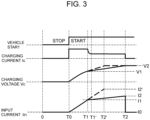
- backup power system 1 First, the outline of backup power system 1 will be described with reference to FIG. 1 and FIG. 3 . Note that details of backup power system 1 will be described later with reference to FIG. 2 and FIG. 3 .
- Controller 9 is capable of detecting both of input current Iin at charging circuit 5 and a charging voltage at power storage 4 or at least one of input current Iin at charging circuit 5 and the charging voltage at power storage 4. Furthermore, controller 9 is capable of receiving start signal SG1. Moreover, controller 9 is capable of controlling the operation of charging circuit 5.
- Controller 9 receives start signal SG1 and thereby operates charging circuit 5.
- Input current Iin is changed by controller 9 controlling the operation of charging circuit 5.
- First, input current Iin is increased at the first rate of change.
- charging circuit 5 increases charging voltage Vc at power storage 4 up to first voltage V1 at which driving of load 7 is enabled.
- the second rate of change is smaller in value than the first rate of change.
- Second voltage V2 is charging voltage Vc at power storage 4 at which driving of both load 7 and load 8 is enabled.
- the rate of increase of input current Iin at charging circuit 5 per unit time is reduced upon completion of charging of one load (load 7 in the present exemplary embodiment) among a plurality of loads (loads 7 and 8 in the present exemplary embodiment).
- the completion of charging of a load herein indicates a point in time when electric power supply from the load becomes available.
- the maximum value of an electric current flowing to charging circuit 5 is reduced.
- the electric current capacity of a device used in charging circuit 5 can be reduced, making it possible to miniaturize backup power system 1.
- backup power system 1 details of backup power system 1 will be described with reference to the circuit block diagram in FIG. 2 illustrating the configuration of vehicle 10 in which backup power system 1 according to an exemplary embodiment of the present disclosure is disposed and the operating characteristic diagram in FIG. 3 illustrating the operation of backup power system 1 according to the exemplary embodiment.
- Backup power system 1 is disposed in vehicle 10 (vehicle body 11). When an occupant operates start operator 12, start signal SG1 is transmitted from start operator 12 to controller 9.
- start signal SG1 is transmitted from start operator 12 to controller 9
- vehicle 10 is activated. Furthermore, at time T0, charging circuit 5 starts operating according to an instruction from controller 9. When charging circuit 5 starts operating, battery 2 starts charging power storage 4 with electric power.
- controller 9 may control input current Iin using an electric current output from charging circuit 5 (charging current Ic). Furthermore, controller 9 may control charging current Ic on the output side using input current Iin at charging circuit 5. Moreover, controller 9 may directly control input current Iin at charging circuit 5. Furthermore, controller 9 may control input current Iin using charging voltage Vc at power storage 4. Moreover, controller 9 may control charging current Ic using charging voltage Vc at power storage 4.
- Controller 9 controls charging circuit 5 so as to cause input current Iin to increase from I0 to I1 between time T0 and time T1.
- the first rate of change corresponding to the rate of increase of input current Iin between time T0 and time T1 is (I1 - I0) / (T1 - T0).
- the voltage at power storage 4 reaches first voltage V1 at time T1.
- load 7 can be driven using the electric power stored in power storage 4.
- Input current Iin at time T0 that is, I0, may have any value and may be zero.
- load 7 has a function, the operation of which is given priority over load 8.
- vehicle 10 is propelled by electric power
- load 7 is a device that operates to protect occupants from electric power of vehicle propelling power storage (not illustrated in the drawings) if vehicle 10 has an accident.
- Examples of the device for protecting occupants from the electric power of the vehicle propelling power storage include a device for cutting off the electric power of the vehicle propelling power storage (not illustrated in the drawings) and a device for causing a propelling load (not illustrated in the drawings) to consume electric power temporarily stored in a propelling power converter (not illustrated in the drawings) to which the electric power of the vehicle propelling power storage (not illustrated in the drawings) is supplied.
- Load 8 which comes later than load 7 in the activation sequence in vehicle 10, is a device that operates to protect occupants at the stage following the operation of load 7.
- load 8 is a device that operates to allow occupants to safely escape out of vehicle 10 at said stage following the operation of load 7.
- Examples of the device for protecting occupants at the stage following the operation of load 7 may include a device that operates to unlock the doors of vehicle body 11.
- An alternative example may be a device that operates to open the door latches of vehicle body 11.
- discharging circuit 13 may be disposed between power storage 4 and output terminal 6. Electric power may be supplied from output terminal 6 to loads 7 and 8 after charging voltage Vc at power storage 4 is increased using discharging circuit 13. This makes it possible to drive loads 7 and 8 having various functions.
- charging current Ic is a constant current between time T0 and time T1 in the present exemplary embodiment. Note that charging current Ic may be an electric current that is reduced over time between time T0 and time T1.
- controller 9 performs control such that input current Iin continuously increases from I1 to I2 until time T2.
- the second rate of change corresponding to the rate of increase of input current Iin between time T1 and time T2 is (I2 - I1) / (T2 - T1), which is smaller in value than the first rate of change mentioned earlier.
- Time T2 is the time at which charging voltage Vc at power storage 4 reaches second voltage V2.
- charging current Ic is a constant current between time T1 and time T2 in the present exemplary embodiment. Note that charging current Ic may be an electric current that is reduced over time between time T1 and time T2.
- FIG. 3 indicates, by dashed lines, trajectories that input current Iin and charging voltage Vc at power storage 4 would take if input current Iin kept increasing at the first rate of change.
- charging voltage Vc at power storage 4 reaches second voltage V2 at time T2', which is earlier than time T2.
- input current Iin at time T2' is I2' which is greater than I2 mentioned earlier.
- load 7 and load 8 are ranked in priority order, and in the case where power storage 4 is charged using charging circuit 5, the increase in the input current at charging circuit 5 per unit time is reduced upon completion of charging of one load given priority among the plurality of loads, namely, load 7 and load 8, to a level at which electric power can be supplied.
- the maximum value of an electric current flowing to charging circuit 5 is reduced. Accordingly, the electric current capacity of a device used in charging circuit 5 can be reduced, making it possible to miniaturize backup power system 1.
- the switch of input current Iin from the first rate of change to the second rate of change at time T1 may be a continuous change from the first rate of change at time T1 to time T1' later than time T1. This makes it possible to shorten the required period between time T1 and time T2. As a result, driving of both load 7 and load 8 with the electric power stored in power storage 4 is enabled at an early stage.
- backup power system 1 includes backup power device 20 and backup power device 20 includes power storage 4, charging circuit 5, and controller 9 in order to facilitate understanding.
- backup power device 20 is not essential; backup power system 1 may include power storage 4, charging circuit 5, controller 9, battery 2, load 7, and load 8.
- a portion of a connection line between charging circuit 5 and battery 2 may be regarded as input terminal 3, and a portion of a connection line between load 7 (or load 8) and power storage 4 may be regarded as output terminal 6.
- the input terminal of charging circuit 5 may be regarded as input terminal 3
- the output terminal of discharging circuit 13 may be regarded as output terminal 6.
- load 7 and power storage 4 are connected to each other via a circuit including, but not limited to discharging circuit 13. This is also the case for load 8.
- loads 7 and 8 are described as the load connected to output terminal 6, but three or more loads may be connected to output terminal 6.
- the backup power system according to the present disclosure has the advantageous effect of enabling miniaturization and is useful in various vehicles.
Landscapes
- Engineering & Computer Science (AREA)
- Power Engineering (AREA)
- Business, Economics & Management (AREA)
- Emergency Management (AREA)
- Mechanical Engineering (AREA)
- Charge And Discharge Circuits For Batteries Or The Like (AREA)
- Secondary Cells (AREA)
Description
- The present disclosure relates to backup power systems used in various vehicles.
- Hereinafter, a conventional backup power device will be described. In a conventional backup power device that includes a vehicle battery, a charging circuit connected to the vehicle battery, and power storage, electric power to be output from a backup power supply in the event of an emergency is supplied from the vehicle battery to the power storage through the charging circuit at normal times.
- Note that Patent Literature (PTL) 1 and 2, for example, are known as related art document information pertaining to the present disclosure.
-
- PTL 1: International Publication No.
2013-125170 - PTL 2:
JP 2014-233142 - A backup power system according to the present disclosure includes: a battery; a charging circuit electrically connected to the battery; power storage configured to be charged by the charging circuit; a first load electrically connected to the power storage; a second load electrically connected to the power storage; and a controller configured to control the charging circuit. The controller detects at least one of an input current at the charging circuit and a charging voltage at the power storage in response to a start signal input to the controller. The controller causes the input current at the charging circuit to increase at a first rate of change in response to the start signal. When the controller detects an increase in the charging voltage at the power storage up to a first voltage at which driving of the first load is possible, the controller causes the charging circuit to cause the input current at the charging circuit to increase at a second rate of change lower than the first rate of change. The charging circuit is controlled by the controller to cause the input current to increase at the second rate of change, and the charging voltage at the power storage increases up to a second voltage at which driving of both the first load and the second load is possible.
-
-
FIG. 1 is a circuit block diagram illustrating the configuration of a backup power system according to an exemplary embodiment of the present disclosure. -
FIG. 2 is a circuit block diagram illustrating a vehicle in which a backup power system according to an exemplary embodiment of the present disclosure is disposed. -
FIG. 3 is an operating characteristic diagram illustrating the operation of a backup power system according to an exemplary embodiment of the present disclosure. - Hereinafter, an exemplary embodiment of the present disclosure will be described with reference to the drawings.
- With a conventional backup power device such as that described above, in the case of storing a large amount of electric power into the power storage in a short time, the charging circuit needs to supply the electric power to the power storage using a large amount of electric power or electric current. This means that a device supporting a large amount of electric power or electric current needs to be used in the charging circuit. As a result, the backup power device is large in size. The backup power system according to the present disclosure enables miniaturization.
-
FIG. 1 is a circuit block diagram illustrating the configuration of a backup power system according to an exemplary embodiment of the present disclosure.Backup power system 1 includes:backup power device 20 includingpower storage 4 andcharging circuit 5;battery 2 connected toinput terminal 3 ofbackup power device 20;loads 7 and 8 connected tooutput terminal 6 ofbackup power device 20; andcontroller 9. - Note that
controller 9 is included inbackup power device 20 in the present exemplary embodiment, but this is not necessarily required; it is sufficient thatcontroller 9 be included inbackup power system 1. -
Battery 2 according to the present exemplary embodiment is a vehicle battery installed invehicle 10. One example ofpower storage 4 according to the present exemplary embodiment is a capacitor power storage device capable of charging and discharging with high electric current density, such as an electric double-layer capacitor and a lithium-ion capacitor. Furthermore, the use of a secondary battery including, but not limited to the capacitor power storage device, is possible. -
Battery 2 is connected toinput terminal 3.Charging circuit 5 is connected betweeninput terminal 3 andpower storage 4.Output terminal 6 is connected topower storage 4 and outputs electric power stored inpower storage 4.Output terminal 6 is connected to load 7 andload 8. - First, the outline of
backup power system 1 will be described with reference toFIG. 1 andFIG. 3 . Note that details ofbackup power system 1 will be described later with reference toFIG. 2 andFIG. 3 . -
Controller 9 is capable of detecting both of input current Iin atcharging circuit 5 and a charging voltage atpower storage 4 or at least one of input current Iin atcharging circuit 5 and the charging voltage atpower storage 4. Furthermore,controller 9 is capable of receiving start signal SG1. Moreover,controller 9 is capable of controlling the operation ofcharging circuit 5. -
Controller 9 receives start signal SG1 and thereby operatescharging circuit 5. Input current Iin is changed bycontroller 9 controlling the operation ofcharging circuit 5. First, input current Iin is increased at the first rate of change. Subsequently,charging circuit 5 increases charging voltage Vc atpower storage 4 up to first voltage V1 at which driving of load 7 is enabled. After charging voltage Vc atpower storage 4 is increased up to first voltage V1, input current Iin is increased at the second rate of change until charging voltage Vc atpower storage 4 reaches second voltage V2. The second rate of change is smaller in value than the first rate of change. Second voltage V2 is charging voltage Vc atpower storage 4 at which driving of both load 7 andload 8 is enabled. - With the above configuration and operation, in the case where
power storage 4 is charged usingcharging circuit 5, the rate of increase of input current Iin atcharging circuit 5 per unit time is reduced upon completion of charging of one load (load 7 in the present exemplary embodiment) among a plurality of loads (loads 7 and 8 in the present exemplary embodiment). Note that the completion of charging of a load herein indicates a point in time when electric power supply from the load becomes available. Thus, the maximum value of an electric current flowing to chargingcircuit 5 is reduced. In the present exemplary embodiment, the electric current capacity of a device used incharging circuit 5 can be reduced, making it possible to miniaturizebackup power system 1. - Next, details of
backup power system 1 will be described with reference to the circuit block diagram inFIG. 2 illustrating the configuration ofvehicle 10 in whichbackup power system 1 according to an exemplary embodiment of the present disclosure is disposed and the operating characteristic diagram inFIG. 3 illustrating the operation ofbackup power system 1 according to the exemplary embodiment. -
Backup power system 1 is disposed in vehicle 10 (vehicle body 11). When an occupant operatesstart operator 12, start signal SG1 is transmitted fromstart operator 12 tocontroller 9. - At time T0 at which start signal SG1 is transmitted from
start operator 12 tocontroller 9,vehicle 10 is activated. Furthermore, at time T0,charging circuit 5 starts operating according to an instruction fromcontroller 9. When chargingcircuit 5 starts operating,battery 2 starts chargingpower storage 4 with electric power. - Note that
controller 9 may control input current Iin using an electric current output from charging circuit 5 (charging current Ic). Furthermore,controller 9 may control charging current Ic on the output side using input current Iin atcharging circuit 5. Moreover,controller 9 may directly control input current Iin atcharging circuit 5. Furthermore,controller 9 may control input current Iin using charging voltage Vc atpower storage 4. Moreover,controller 9 may control charging current Ic using charging voltage Vc atpower storage 4. -
Controller 9controls charging circuit 5 so as to cause input current Iin to increase from I0 to I1 between time T0 and time T1. The first rate of change corresponding to the rate of increase of input current Iin between time T0 and time T1 is (I1 - I0) / (T1 - T0). The voltage atpower storage 4 reaches first voltage V1 at time T1. When charging voltage Vc atpower storage 4 is greater than or equal to first voltage V1, load 7 can be driven using the electric power stored inpower storage 4. Input current Iin at time T0, that is, I0, may have any value and may be zero. - In the present exemplary embodiment, load 7 has a function, the operation of which is given priority over
load 8. For example,vehicle 10 is propelled by electric power, and load 7 is a device that operates to protect occupants from electric power of vehicle propelling power storage (not illustrated in the drawings) ifvehicle 10 has an accident. Examples of the device for protecting occupants from the electric power of the vehicle propelling power storage (not illustrated in the drawings) include a device for cutting off the electric power of the vehicle propelling power storage (not illustrated in the drawings) and a device for causing a propelling load (not illustrated in the drawings) to consume electric power temporarily stored in a propelling power converter (not illustrated in the drawings) to which the electric power of the vehicle propelling power storage (not illustrated in the drawings) is supplied. -
Load 8, which comes later than load 7 in the activation sequence invehicle 10, is a device that operates to protect occupants at the stage following the operation of load 7. Alternatively,load 8 is a device that operates to allow occupants to safely escape out ofvehicle 10 at said stage following the operation of load 7. Examples of the device for protecting occupants at the stage following the operation of load 7 may include a device that operates to unlock the doors of vehicle body 11. An alternative example may be a device that operates to open the door latches of vehicle body 11. - Furthermore, as illustrated in
FIG. 2 , dischargingcircuit 13 may be disposed betweenpower storage 4 andoutput terminal 6. Electric power may be supplied fromoutput terminal 6 toloads 7 and 8 after charging voltage Vc atpower storage 4 is increased using dischargingcircuit 13. This makes it possible to driveloads 7 and 8 having various functions. - As illustrated in
FIG. 3 , charging current Ic is a constant current between time T0 and time T1 in the present exemplary embodiment. Note that charging current Ic may be an electric current that is reduced over time between time T0 and time T1. - Next, after the voltage at
power storage 4 reaches first voltage V1 at time T1,controller 9 performs control such that input current Iin continuously increases from I1 to I2 until time T2. The second rate of change corresponding to the rate of increase of input current Iin between time T1 and time T2 is (I2 - I1) / (T2 - T1), which is smaller in value than the first rate of change mentioned earlier. Time T2 is the time at which charging voltage Vc atpower storage 4 reaches second voltage V2. When charging voltage Vc atpower storage 4 is greater than or equal to second voltage V2, both load 7 andload 8 can be driven using the electric power stored inpower storage 4. - As illustrated in
FIG. 3 , charging current Ic is a constant current between time T1 and time T2 in the present exemplary embodiment. Note that charging current Ic may be an electric current that is reduced over time between time T1 and time T2. - For the sake of comparison,
FIG. 3 indicates, by dashed lines, trajectories that input current Iin and charging voltage Vc atpower storage 4 would take if input current Iin kept increasing at the first rate of change. In the case where input current Iin keeps increasing at the first rate of change, charging voltage Vc atpower storage 4 reaches second voltage V2 at time T2', which is earlier than time T2. Meanwhile, input current Iin at time T2' is I2' which is greater than I2 mentioned earlier. Therefore, in the case of continuously increasing input current Iin at the first rate of change, it is necessary to increase the electric current capacity of chargingcircuit 5, and in the case of disposing a protection circuit (not illustrated in the drawings), such as a fuse, between chargingcircuit 5 andbattery 2, it is necessary to increase the electric current capacity of the protection circuit (not illustrated in the drawings). - In this working example, load 7 and
load 8 are ranked in priority order, and in the case wherepower storage 4 is charged using chargingcircuit 5, the increase in the input current at chargingcircuit 5 per unit time is reduced upon completion of charging of one load given priority among the plurality of loads, namely, load 7 andload 8, to a level at which electric power can be supplied. Thus, the maximum value of an electric current flowing to chargingcircuit 5 is reduced. Accordingly, the electric current capacity of a device used in chargingcircuit 5 can be reduced, making it possible to miniaturizebackup power system 1. - Furthermore, when the operation of electric power supply from
backup power system 1 to load 7 is preferentially made available after the start ofvehicle 10, the operation of at least load 7 is possible even if an emergency occurs invehicle 10 shortly after the start ofvehicle 10. This makes it possible to ensure the safety ofvehicle 10 and occupants invehicle 10. - The switch of input current Iin from the first rate of change to the second rate of change at time T1 may be a continuous change from the first rate of change at time T1 to time T1' later than time T1. This makes it possible to shorten the required period between time T1 and time T2. As a result, driving of both load 7 and
load 8 with the electric power stored inpower storage 4 is enabled at an early stage. - The present exemplary embodiment is described using a configuration in which
backup power system 1 includesbackup power device 20 andbackup power device 20 includespower storage 4, chargingcircuit 5, andcontroller 9 in order to facilitate understanding. However,backup power device 20 is not essential;backup power system 1 may includepower storage 4, chargingcircuit 5,controller 9,battery 2, load 7, andload 8. In the case wherebackup power device 20 is not provided, for example, a portion of a connection line between chargingcircuit 5 andbattery 2 may be regarded asinput terminal 3, and a portion of a connection line between load 7 (or load 8) andpower storage 4 may be regarded asoutput terminal 6. Alternatively, the input terminal of chargingcircuit 5 may be regarded asinput terminal 3, and the output terminal of dischargingcircuit 13 may be regarded asoutput terminal 6. - Note that there are cases where load 7 and
power storage 4 are connected to each other via a circuit including, but not limited to dischargingcircuit 13. This is also the case forload 8. - In the present exemplary embodiment, two loads (loads 7 and 8) are described as the load connected to
output terminal 6, but three or more loads may be connected tooutput terminal 6. - The backup power system according to the present disclosure has the advantageous effect of enabling miniaturization and is useful in various vehicles.
-
- 1
- backup power system
- 2
- battery
- 3
- input terminal
- 4
- power storage
- 5
- charging circuit
- 6
- output terminal
- 7
- load
- 8
- load
- 9
- controller
- 10
- vehicle
- 11
- vehicle body
- 12
- start operator
- 13
- discharging circuit
- 20
- backup power device
- Ic
- charging current
- Iin
- input current
- Vc
- charging voltage
Claims (3)
- A backup power system (1), comprising:a battery (2);a charging circuit (5) electrically connected to the battery (2);power storage (4) configured to be charged by the charging circuit (5);a first load (7) electrically connected to the power storage (4);a second load (8) electrically connected to the power storage (4); anda controller (9) configured to control the charging circuit (5), whereinthe controller (9) detects at least one of an input current at the charging circuit (5) and a charging voltage at the power storage (4) in response to a start signal input to the controller (9),the controller (9) causes the input current at the charging circuit (5) to increase at a first rate of change in response to the start signal,when the controller (9) detects an increase in the charging voltage at the power storage (4) up to a first voltage at which driving of the first load (7) is possible, the controller causes the charging circuit (5) to cause the input current at the charging circuit (5) to increase at a second rate of change lower than the first rate of change, andthe charging circuit (5) is controlled by the controller to cause the input current to increase at the second rate of change, and the charging voltage at the power storage (4) increases up to a second voltage at which driving of both the first load (7) and the second load (8) is possible.
- The backup power system according to claim 1, wherein
the input current is switched to continuously change from the first rate of change to the second rate of change. - The backup power system according to claim 1 or 2, further comprising:a discharging circuit (13), whereinthe first load (7) and the second load (8) are connected to the power storage (4) via the discharging circuit (13).
Applications Claiming Priority (2)
| Application Number | Priority Date | Filing Date | Title |
|---|---|---|---|
| JP2019125987 | 2019-07-05 | ||
| PCT/JP2020/021953 WO2021005924A1 (en) | 2019-07-05 | 2020-06-03 | Backup power system |
Publications (3)
| Publication Number | Publication Date |
|---|---|
| EP3995364A1 EP3995364A1 (en) | 2022-05-11 |
| EP3995364A4 EP3995364A4 (en) | 2022-08-31 |
| EP3995364B1 true EP3995364B1 (en) | 2025-01-29 |
Family
ID=74114642
Family Applications (1)
| Application Number | Title | Priority Date | Filing Date |
|---|---|---|---|
| EP20837217.7A Active EP3995364B1 (en) | 2019-07-05 | 2020-06-03 | Backup power system |
Country Status (5)
| Country | Link |
|---|---|
| US (1) | US11962183B2 (en) |
| EP (1) | EP3995364B1 (en) |
| JP (1) | JP7462135B2 (en) |
| CN (1) | CN114025996B (en) |
| WO (1) | WO2021005924A1 (en) |
Families Citing this family (1)
| Publication number | Priority date | Publication date | Assignee | Title |
|---|---|---|---|---|
| CN120659266A (en) * | 2024-03-15 | 2025-09-16 | 台达电子工业股份有限公司 | Cabinet electric power bridging structure and electric power bus bridging device thereof |
Family Cites Families (11)
| Publication number | Priority date | Publication date | Assignee | Title |
|---|---|---|---|---|
| JP2009171694A (en) * | 2008-01-15 | 2009-07-30 | Nisshinbo Holdings Inc | Charger |
| US8427003B2 (en) * | 2009-06-30 | 2013-04-23 | Panasonic Corporation | Electric power supply device |
| US9013056B2 (en) | 2012-02-22 | 2015-04-21 | Panasonic Intellectual Property Management Co., Ltd. | Backup power source device and automobile equipped with same |
| JP2014143814A (en) * | 2013-01-23 | 2014-08-07 | Technova:Kk | Non-contact charging device and charging method |
| JP6160249B2 (en) * | 2013-05-29 | 2017-07-12 | 日産自動車株式会社 | Vehicle control device |
| JP6451708B2 (en) * | 2016-09-06 | 2019-01-16 | 株式会社オートネットワーク技術研究所 | In-vehicle backup device |
| EP3518373B1 (en) * | 2016-09-20 | 2020-11-18 | Panasonic Intellectual Property Management Co., Ltd. | Power source device and vehicle equipped with power source device |
| JP6705357B2 (en) * | 2016-10-14 | 2020-06-03 | 株式会社オートネットワーク技術研究所 | In-vehicle backup device |
| JP6673138B2 (en) * | 2016-10-19 | 2020-03-25 | 株式会社オートネットワーク技術研究所 | Backup device for vehicles |
| JP7159565B2 (en) * | 2018-02-07 | 2022-10-25 | 株式会社オートネットワーク技術研究所 | Power supply control device, power supply control method and computer program |
| JP6950628B2 (en) * | 2018-06-21 | 2021-10-13 | 株式会社オートネットワーク技術研究所 | In-vehicle power supply control device, in-vehicle power supply device, and vehicle control method |
-
2020
- 2020-06-03 JP JP2021530528A patent/JP7462135B2/en active Active
- 2020-06-03 US US17/612,892 patent/US11962183B2/en active Active
- 2020-06-03 EP EP20837217.7A patent/EP3995364B1/en active Active
- 2020-06-03 CN CN202080046041.8A patent/CN114025996B/en active Active
- 2020-06-03 WO PCT/JP2020/021953 patent/WO2021005924A1/en not_active Ceased
Also Published As
| Publication number | Publication date |
|---|---|
| EP3995364A1 (en) | 2022-05-11 |
| CN114025996B (en) | 2024-08-20 |
| US11962183B2 (en) | 2024-04-16 |
| CN114025996A (en) | 2022-02-08 |
| JPWO2021005924A1 (en) | 2021-01-14 |
| US20220224148A1 (en) | 2022-07-14 |
| EP3995364A4 (en) | 2022-08-31 |
| WO2021005924A1 (en) | 2021-01-14 |
| JP7462135B2 (en) | 2024-04-05 |
Similar Documents
| Publication | Publication Date | Title |
|---|---|---|
| EP3561982B1 (en) | Power redundancy system | |
| EP3528360B1 (en) | Power supply system | |
| EP3726694B1 (en) | Vehicle-mounted power supply apparatus | |
| CN115377945B (en) | Battery protection devices, battery systems, vehicles, and battery protection methods | |
| EP3708404B1 (en) | Direct current power supply circuit mounted in working vehicle | |
| US10780851B2 (en) | Power source device and vehicle equipped with power source device | |
| JP2004260903A (en) | In-vehicle power supply system | |
| EP3960523B1 (en) | Working vehicle | |
| EP3995364B1 (en) | Backup power system | |
| US20240001875A1 (en) | Power supply control device, control method, and storage medium | |
| JP2020089080A (en) | Electrical power system and control unit thereof | |
| JP3551586B2 (en) | Capacitor discharge circuit | |
| JP7675356B2 (en) | Vehicle power cutoff system | |
| US7346444B2 (en) | Power supply for vehicle | |
| CN110431047A (en) | In-vehicle power supply device and vehicle equipped with the in-vehicle power supply device | |
| EP4068547B1 (en) | Vehicle-mounted battery system | |
| US20160221523A1 (en) | Airbag control unit, power network, and method for controlling a voltage network in a motor vehicle | |
| JP6998543B2 (en) | In-vehicle power supply and vehicle equipped with it | |
| JP7281587B1 (en) | Electric vehicle charging/discharging device | |
| EP3708436B1 (en) | Vehicle-mounted power source device | |
| JP2025071389A (en) | Electric vehicle equipped with multiple drive batteries | |
| JP2025002214A (en) | Electrical power system | |
| CN121487852A (en) | Electric power networks in motor vehicles, motor vehicles, and methods for operating electric power networks. |
Legal Events
| Date | Code | Title | Description |
|---|---|---|---|
| STAA | Information on the status of an ep patent application or granted ep patent |
Free format text: STATUS: THE INTERNATIONAL PUBLICATION HAS BEEN MADE |
|
| PUAI | Public reference made under article 153(3) epc to a published international application that has entered the european phase |
Free format text: ORIGINAL CODE: 0009012 |
|
| STAA | Information on the status of an ep patent application or granted ep patent |
Free format text: STATUS: REQUEST FOR EXAMINATION WAS MADE |
|
| 17P | Request for examination filed |
Effective date: 20211108 |
|
| AK | Designated contracting states |
Kind code of ref document: A1 Designated state(s): AL AT BE BG CH CY CZ DE DK EE ES FI FR GB GR HR HU IE IS IT LI LT LU LV MC MK MT NL NO PL PT RO RS SE SI SK SM TR |
|
| A4 | Supplementary search report drawn up and despatched |
Effective date: 20220803 |
|
| RIC1 | Information provided on ipc code assigned before grant |
Ipc: B60R 16/03 20060101ALI20220728BHEP Ipc: H02J 9/00 20060101ALI20220728BHEP Ipc: H02J 7/10 20060101ALI20220728BHEP Ipc: H02J 7/00 20060101ALI20220728BHEP Ipc: B60R 16/033 20060101AFI20220728BHEP |
|
| DAV | Request for validation of the european patent (deleted) | ||
| DAX | Request for extension of the european patent (deleted) | ||
| GRAP | Despatch of communication of intention to grant a patent |
Free format text: ORIGINAL CODE: EPIDOSNIGR1 |
|
| STAA | Information on the status of an ep patent application or granted ep patent |
Free format text: STATUS: GRANT OF PATENT IS INTENDED |
|
| INTG | Intention to grant announced |
Effective date: 20240819 |
|
| GRAS | Grant fee paid |
Free format text: ORIGINAL CODE: EPIDOSNIGR3 |
|
| GRAA | (expected) grant |
Free format text: ORIGINAL CODE: 0009210 |
|
| STAA | Information on the status of an ep patent application or granted ep patent |
Free format text: STATUS: THE PATENT HAS BEEN GRANTED |
|
| P01 | Opt-out of the competence of the unified patent court (upc) registered |
Free format text: CASE NUMBER: APP_65741/2024 Effective date: 20241212 |
|
| AK | Designated contracting states |
Kind code of ref document: B1 Designated state(s): AL AT BE BG CH CY CZ DE DK EE ES FI FR GB GR HR HU IE IS IT LI LT LU LV MC MK MT NL NO PL PT RO RS SE SI SK SM TR |
|
| REG | Reference to a national code |
Ref country code: GB Ref legal event code: FG4D |
|
| REG | Reference to a national code |
Ref country code: CH Ref legal event code: EP |
|
| REG | Reference to a national code |
Ref country code: DE Ref legal event code: R096 Ref document number: 602020045590 Country of ref document: DE |
|
| REG | Reference to a national code |
Ref country code: IE Ref legal event code: FG4D |
|
| REG | Reference to a national code |
Ref country code: NL Ref legal event code: MP Effective date: 20250129 |
|
| PG25 | Lapsed in a contracting state [announced via postgrant information from national office to epo] |
Ref country code: NL Free format text: LAPSE BECAUSE OF FAILURE TO SUBMIT A TRANSLATION OF THE DESCRIPTION OR TO PAY THE FEE WITHIN THE PRESCRIBED TIME-LIMIT Effective date: 20250129 |
|
| PG25 | Lapsed in a contracting state [announced via postgrant information from national office to epo] |
Ref country code: RS Free format text: LAPSE BECAUSE OF FAILURE TO SUBMIT A TRANSLATION OF THE DESCRIPTION OR TO PAY THE FEE WITHIN THE PRESCRIBED TIME-LIMIT Effective date: 20250429 |
|
| PG25 | Lapsed in a contracting state [announced via postgrant information from national office to epo] |
Ref country code: FI Free format text: LAPSE BECAUSE OF FAILURE TO SUBMIT A TRANSLATION OF THE DESCRIPTION OR TO PAY THE FEE WITHIN THE PRESCRIBED TIME-LIMIT Effective date: 20250129 |
|
| PG25 | Lapsed in a contracting state [announced via postgrant information from national office to epo] |
Ref country code: PL Free format text: LAPSE BECAUSE OF FAILURE TO SUBMIT A TRANSLATION OF THE DESCRIPTION OR TO PAY THE FEE WITHIN THE PRESCRIBED TIME-LIMIT Effective date: 20250129 |
|
| PGFP | Annual fee paid to national office [announced via postgrant information from national office to epo] |
Ref country code: DE Payment date: 20250618 Year of fee payment: 6 |
|
| PG25 | Lapsed in a contracting state [announced via postgrant information from national office to epo] |
Ref country code: ES Free format text: LAPSE BECAUSE OF FAILURE TO SUBMIT A TRANSLATION OF THE DESCRIPTION OR TO PAY THE FEE WITHIN THE PRESCRIBED TIME-LIMIT Effective date: 20250129 |
|
| REG | Reference to a national code |
Ref country code: LT Ref legal event code: MG9D |
|
| PG25 | Lapsed in a contracting state [announced via postgrant information from national office to epo] |
Ref country code: NO Free format text: LAPSE BECAUSE OF FAILURE TO SUBMIT A TRANSLATION OF THE DESCRIPTION OR TO PAY THE FEE WITHIN THE PRESCRIBED TIME-LIMIT Effective date: 20250429 Ref country code: IS Free format text: LAPSE BECAUSE OF FAILURE TO SUBMIT A TRANSLATION OF THE DESCRIPTION OR TO PAY THE FEE WITHIN THE PRESCRIBED TIME-LIMIT Effective date: 20250529 |
|
| REG | Reference to a national code |
Ref country code: AT Ref legal event code: MK05 Ref document number: 1763164 Country of ref document: AT Kind code of ref document: T Effective date: 20250129 |
|
| PG25 | Lapsed in a contracting state [announced via postgrant information from national office to epo] |
Ref country code: HR Free format text: LAPSE BECAUSE OF FAILURE TO SUBMIT A TRANSLATION OF THE DESCRIPTION OR TO PAY THE FEE WITHIN THE PRESCRIBED TIME-LIMIT Effective date: 20250129 |
|
| PG25 | Lapsed in a contracting state [announced via postgrant information from national office to epo] |
Ref country code: LV Free format text: LAPSE BECAUSE OF FAILURE TO SUBMIT A TRANSLATION OF THE DESCRIPTION OR TO PAY THE FEE WITHIN THE PRESCRIBED TIME-LIMIT Effective date: 20250129 Ref country code: PT Free format text: LAPSE BECAUSE OF FAILURE TO SUBMIT A TRANSLATION OF THE DESCRIPTION OR TO PAY THE FEE WITHIN THE PRESCRIBED TIME-LIMIT Effective date: 20250529 |
|
| PG25 | Lapsed in a contracting state [announced via postgrant information from national office to epo] |
Ref country code: GR Free format text: LAPSE BECAUSE OF FAILURE TO SUBMIT A TRANSLATION OF THE DESCRIPTION OR TO PAY THE FEE WITHIN THE PRESCRIBED TIME-LIMIT Effective date: 20250430 Ref country code: BG Free format text: LAPSE BECAUSE OF FAILURE TO SUBMIT A TRANSLATION OF THE DESCRIPTION OR TO PAY THE FEE WITHIN THE PRESCRIBED TIME-LIMIT Effective date: 20250129 |
|
| PG25 | Lapsed in a contracting state [announced via postgrant information from national office to epo] |
Ref country code: AT Free format text: LAPSE BECAUSE OF FAILURE TO SUBMIT A TRANSLATION OF THE DESCRIPTION OR TO PAY THE FEE WITHIN THE PRESCRIBED TIME-LIMIT Effective date: 20250129 |
|
| PG25 | Lapsed in a contracting state [announced via postgrant information from national office to epo] |
Ref country code: SE Free format text: LAPSE BECAUSE OF FAILURE TO SUBMIT A TRANSLATION OF THE DESCRIPTION OR TO PAY THE FEE WITHIN THE PRESCRIBED TIME-LIMIT Effective date: 20250129 |
|
| PG25 | Lapsed in a contracting state [announced via postgrant information from national office to epo] |
Ref country code: SM Free format text: LAPSE BECAUSE OF FAILURE TO SUBMIT A TRANSLATION OF THE DESCRIPTION OR TO PAY THE FEE WITHIN THE PRESCRIBED TIME-LIMIT Effective date: 20250129 |
|
| PG25 | Lapsed in a contracting state [announced via postgrant information from national office to epo] |
Ref country code: DK Free format text: LAPSE BECAUSE OF FAILURE TO SUBMIT A TRANSLATION OF THE DESCRIPTION OR TO PAY THE FEE WITHIN THE PRESCRIBED TIME-LIMIT Effective date: 20250129 |
|
| PG25 | Lapsed in a contracting state [announced via postgrant information from national office to epo] |
Ref country code: IT Free format text: LAPSE BECAUSE OF FAILURE TO SUBMIT A TRANSLATION OF THE DESCRIPTION OR TO PAY THE FEE WITHIN THE PRESCRIBED TIME-LIMIT Effective date: 20250129 |
|
| PG25 | Lapsed in a contracting state [announced via postgrant information from national office to epo] |
Ref country code: EE Free format text: LAPSE BECAUSE OF FAILURE TO SUBMIT A TRANSLATION OF THE DESCRIPTION OR TO PAY THE FEE WITHIN THE PRESCRIBED TIME-LIMIT Effective date: 20250129 Ref country code: CZ Free format text: LAPSE BECAUSE OF FAILURE TO SUBMIT A TRANSLATION OF THE DESCRIPTION OR TO PAY THE FEE WITHIN THE PRESCRIBED TIME-LIMIT Effective date: 20250129 |
|
| PG25 | Lapsed in a contracting state [announced via postgrant information from national office to epo] |
Ref country code: RO Free format text: LAPSE BECAUSE OF FAILURE TO SUBMIT A TRANSLATION OF THE DESCRIPTION OR TO PAY THE FEE WITHIN THE PRESCRIBED TIME-LIMIT Effective date: 20250129 |
|
| PG25 | Lapsed in a contracting state [announced via postgrant information from national office to epo] |
Ref country code: SK Free format text: LAPSE BECAUSE OF FAILURE TO SUBMIT A TRANSLATION OF THE DESCRIPTION OR TO PAY THE FEE WITHIN THE PRESCRIBED TIME-LIMIT Effective date: 20250129 |
|
| REG | Reference to a national code |
Ref country code: DE Ref legal event code: R097 Ref document number: 602020045590 Country of ref document: DE |
|
| PLBE | No opposition filed within time limit |
Free format text: ORIGINAL CODE: 0009261 |
|
| STAA | Information on the status of an ep patent application or granted ep patent |
Free format text: STATUS: NO OPPOSITION FILED WITHIN TIME LIMIT |
|
| REG | Reference to a national code |
Ref country code: CH Ref legal event code: L10 Free format text: ST27 STATUS EVENT CODE: U-0-0-L10-L00 (AS PROVIDED BY THE NATIONAL OFFICE) Effective date: 20251210 |
|
| 26N | No opposition filed |
Effective date: 20251030 |
|
| REG | Reference to a national code |
Ref country code: CH Ref legal event code: H13 Free format text: ST27 STATUS EVENT CODE: U-0-0-H10-H13 (AS PROVIDED BY THE NATIONAL OFFICE) Effective date: 20260127 |
|
| PG25 | Lapsed in a contracting state [announced via postgrant information from national office to epo] |
Ref country code: MC Free format text: LAPSE BECAUSE OF FAILURE TO SUBMIT A TRANSLATION OF THE DESCRIPTION OR TO PAY THE FEE WITHIN THE PRESCRIBED TIME-LIMIT Effective date: 20250129 |
|
| PG25 | Lapsed in a contracting state [announced via postgrant information from national office to epo] |
Ref country code: LU Free format text: LAPSE BECAUSE OF NON-PAYMENT OF DUE FEES Effective date: 20250603 |
|
| GBPC | Gb: european patent ceased through non-payment of renewal fee |
Effective date: 20250603 |
|
| REG | Reference to a national code |
Ref country code: BE Ref legal event code: MM Effective date: 20250630 |
|
| PG25 | Lapsed in a contracting state [announced via postgrant information from national office to epo] |
Ref country code: GB Free format text: LAPSE BECAUSE OF NON-PAYMENT OF DUE FEES Effective date: 20250603 |
|
| PG25 | Lapsed in a contracting state [announced via postgrant information from national office to epo] |
Ref country code: IE Free format text: LAPSE BECAUSE OF NON-PAYMENT OF DUE FEES Effective date: 20250603 |
|
| PG25 | Lapsed in a contracting state [announced via postgrant information from national office to epo] |
Ref country code: BE Free format text: LAPSE BECAUSE OF NON-PAYMENT OF DUE FEES Effective date: 20250630 |
|
| PG25 | Lapsed in a contracting state [announced via postgrant information from national office to epo] |
Ref country code: FR Free format text: LAPSE BECAUSE OF NON-PAYMENT OF DUE FEES Effective date: 20250630 |
|
| PG25 | Lapsed in a contracting state [announced via postgrant information from national office to epo] |
Ref country code: CH Free format text: LAPSE BECAUSE OF NON-PAYMENT OF DUE FEES Effective date: 20250630 |