EP3993955B1 - Power tool operator protection system and method - Google Patents
Power tool operator protection system and method Download PDFInfo
- Publication number
- EP3993955B1 EP3993955B1 EP20737624.5A EP20737624A EP3993955B1 EP 3993955 B1 EP3993955 B1 EP 3993955B1 EP 20737624 A EP20737624 A EP 20737624A EP 3993955 B1 EP3993955 B1 EP 3993955B1
- Authority
- EP
- European Patent Office
- Prior art keywords
- power tool
- operator
- protection
- wearable
- protection system
- Prior art date
- Legal status (The legal status is an assumption and is not a legal conclusion. Google has not performed a legal analysis and makes no representation as to the accuracy of the status listed.)
- Active
Links
Images


Classifications
-
- A—HUMAN NECESSITIES
- A41—WEARING APPAREL
- A41D—OUTERWEAR; PROTECTIVE GARMENTS; ACCESSORIES
- A41D13/00—Professional, industrial or sporting protective garments, e.g. surgeons' gowns or garments protecting against blows or punches
- A41D13/0002—Details of protective garments not provided for in groups A41D13/0007 - A41D13/1281
-
- B—PERFORMING OPERATIONS; TRANSPORTING
- B23—MACHINE TOOLS; METAL-WORKING NOT OTHERWISE PROVIDED FOR
- B23Q—DETAILS, COMPONENTS, OR ACCESSORIES FOR MACHINE TOOLS, e.g. ARRANGEMENTS FOR COPYING OR CONTROLLING; MACHINE TOOLS IN GENERAL CHARACTERISED BY THE CONSTRUCTION OF PARTICULAR DETAILS OR COMPONENTS; COMBINATIONS OR ASSOCIATIONS OF METAL-WORKING MACHINES, NOT DIRECTED TO A PARTICULAR RESULT
- B23Q11/00—Accessories fitted to machine tools for keeping tools or parts of the machine in good working condition or for cooling work; Safety devices specially combined with or arranged in, or specially adapted for use in connection with, machine tools
- B23Q11/0078—Safety devices protecting the operator, e.g. against accident or noise
- B23Q11/0082—Safety devices protecting the operator, e.g. against accident or noise by determining whether the operator is in a dangerous position
-
- B—PERFORMING OPERATIONS; TRANSPORTING
- B25—HAND TOOLS; PORTABLE POWER-DRIVEN TOOLS; MANIPULATORS
- B25F—COMBINATION OR MULTI-PURPOSE TOOLS NOT OTHERWISE PROVIDED FOR; DETAILS OR COMPONENTS OF PORTABLE POWER-DRIVEN TOOLS NOT PARTICULARLY RELATED TO THE OPERATIONS PERFORMED AND NOT OTHERWISE PROVIDED FOR
- B25F5/00—Details or components of portable power-driven tools not particularly related to the operations performed and not otherwise provided for
-
- A—HUMAN NECESSITIES
- A41—WEARING APPAREL
- A41D—OUTERWEAR; PROTECTIVE GARMENTS; ACCESSORIES
- A41D27/00—Details of garments or of their making
-
- A—HUMAN NECESSITIES
- A42—HEADWEAR
- A42B—HATS; HEAD COVERINGS
- A42B3/00—Helmets; Helmet covers ; Other protective head coverings
- A42B3/04—Parts, details or accessories of helmets
- A42B3/0406—Accessories for helmets
- A42B3/0433—Detecting, signalling or lighting devices
- A42B3/046—Means for detecting hazards or accidents
-
- B—PERFORMING OPERATIONS; TRANSPORTING
- B27—WORKING OR PRESERVING WOOD OR SIMILAR MATERIAL; NAILING OR STAPLING MACHINES IN GENERAL
- B27G—ACCESSORY MACHINES OR APPARATUS FOR WORKING WOOD OR SIMILAR MATERIALS; TOOLS FOR WORKING WOOD OR SIMILAR MATERIALS; SAFETY DEVICES FOR WOOD WORKING MACHINES OR TOOLS
- B27G19/00—Safety guards or devices specially adapted for wood saws; Auxiliary devices facilitating proper operation of wood saws
- B27G19/003—Safety guards or devices specially adapted for wood saws; Auxiliary devices facilitating proper operation of wood saws for chain saws
-
- B—PERFORMING OPERATIONS; TRANSPORTING
- B27—WORKING OR PRESERVING WOOD OR SIMILAR MATERIAL; NAILING OR STAPLING MACHINES IN GENERAL
- B27G—ACCESSORY MACHINES OR APPARATUS FOR WORKING WOOD OR SIMILAR MATERIALS; TOOLS FOR WORKING WOOD OR SIMILAR MATERIALS; SAFETY DEVICES FOR WOOD WORKING MACHINES OR TOOLS
- B27G21/00—Safety guards or devices specially designed for other wood-working machines auxiliary devices facilitating proper operation of said wood-working machines
-
- F—MECHANICAL ENGINEERING; LIGHTING; HEATING; WEAPONS; BLASTING
- F16—ENGINEERING ELEMENTS AND UNITS; GENERAL MEASURES FOR PRODUCING AND MAINTAINING EFFECTIVE FUNCTIONING OF MACHINES OR INSTALLATIONS; THERMAL INSULATION IN GENERAL
- F16P—SAFETY DEVICES IN GENERAL; SAFETY DEVICES FOR PRESSES
- F16P3/00—Safety devices acting in conjunction with the control or operation of a machine; Control arrangements requiring the simultaneous use of two or more parts of the body
-
- F—MECHANICAL ENGINEERING; LIGHTING; HEATING; WEAPONS; BLASTING
- F16—ENGINEERING ELEMENTS AND UNITS; GENERAL MEASURES FOR PRODUCING AND MAINTAINING EFFECTIVE FUNCTIONING OF MACHINES OR INSTALLATIONS; THERMAL INSULATION IN GENERAL
- F16P—SAFETY DEVICES IN GENERAL; SAFETY DEVICES FOR PRESSES
- F16P3/00—Safety devices acting in conjunction with the control or operation of a machine; Control arrangements requiring the simultaneous use of two or more parts of the body
- F16P3/12—Safety devices acting in conjunction with the control or operation of a machine; Control arrangements requiring the simultaneous use of two or more parts of the body with means, e.g. feelers, which in case of the presence of a body part of a person in or near the danger zone influence the control or operation of the machine
- F16P3/14—Safety devices acting in conjunction with the control or operation of a machine; Control arrangements requiring the simultaneous use of two or more parts of the body with means, e.g. feelers, which in case of the presence of a body part of a person in or near the danger zone influence the control or operation of the machine the means being photocells or other devices sensitive without mechanical contact
-
- G—PHYSICS
- G01—MEASURING; TESTING
- G01B—MEASURING LENGTH, THICKNESS OR SIMILAR LINEAR DIMENSIONS; MEASURING ANGLES; MEASURING AREAS; MEASURING IRREGULARITIES OF SURFACES OR CONTOURS
- G01B21/00—Measuring arrangements or details thereof, where the measuring technique is not covered by the other groups of this subclass, unspecified or not relevant
-
- G—PHYSICS
- G01—MEASURING; TESTING
- G01S—RADIO DIRECTION-FINDING; RADIO NAVIGATION; DETERMINING DISTANCE OR VELOCITY BY USE OF RADIO WAVES; LOCATING OR PRESENCE-DETECTING BY USE OF THE REFLECTION OR RERADIATION OF RADIO WAVES; ANALOGOUS ARRANGEMENTS USING OTHER WAVES
- G01S13/00—Systems using the reflection or reradiation of radio waves, e.g. radar systems; Analogous systems using reflection or reradiation of waves whose nature or wavelength is irrelevant or unspecified
- G01S13/02—Systems using reflection of radio waves, e.g. primary radar systems; Analogous systems
- G01S13/06—Systems determining position data of a target
-
- G—PHYSICS
- G01—MEASURING; TESTING
- G01S—RADIO DIRECTION-FINDING; RADIO NAVIGATION; DETERMINING DISTANCE OR VELOCITY BY USE OF RADIO WAVES; LOCATING OR PRESENCE-DETECTING BY USE OF THE REFLECTION OR RERADIATION OF RADIO WAVES; ANALOGOUS ARRANGEMENTS USING OTHER WAVES
- G01S19/00—Satellite radio beacon positioning systems; Determining position, velocity or attitude using signals transmitted by such systems
- G01S19/38—Determining a navigation solution using signals transmitted by a satellite radio beacon positioning system
- G01S19/39—Determining a navigation solution using signals transmitted by a satellite radio beacon positioning system the satellite radio beacon positioning system transmitting time-stamped messages, e.g. GPS [Global Positioning System], GLONASS [Global Orbiting Navigation Satellite System] or GALILEO
- G01S19/42—Determining position
- G01S19/43—Determining position using carrier phase measurements, e.g. kinematic positioning; using long or short baseline interferometry
-
- G—PHYSICS
- G08—SIGNALLING
- G08B—SIGNALLING SYSTEMS, e.g. PERSONAL CALLING SYSTEMS; ORDER TELEGRAPHS; ALARM SYSTEMS
- G08B21/00—Alarms responsive to a single specified undesired or abnormal condition and not otherwise provided for
- G08B21/02—Alarms for ensuring the safety of persons
-
- A—HUMAN NECESSITIES
- A41—WEARING APPAREL
- A41D—OUTERWEAR; PROTECTIVE GARMENTS; ACCESSORIES
- A41D2600/00—Uses of garments specially adapted for specific purposes
- A41D2600/20—Uses of garments specially adapted for specific purposes for working activities
-
- B—PERFORMING OPERATIONS; TRANSPORTING
- B27—WORKING OR PRESERVING WOOD OR SIMILAR MATERIAL; NAILING OR STAPLING MACHINES IN GENERAL
- B27B—SAWS FOR WOOD OR SIMILAR MATERIAL; COMPONENTS OR ACCESSORIES THEREFOR
- B27B17/00—Chain saws; Equipment therefor
-
- G—PHYSICS
- G01—MEASURING; TESTING
- G01C—MEASURING DISTANCES, LEVELS OR BEARINGS; SURVEYING; NAVIGATION; GYROSCOPIC INSTRUMENTS; PHOTOGRAMMETRY OR VIDEOGRAMMETRY
- G01C19/00—Gyroscopes; Turn-sensitive devices using vibrating masses; Turn-sensitive devices without moving masses; Measuring angular rate using gyroscopic effects
-
- G—PHYSICS
- G01—MEASURING; TESTING
- G01C—MEASURING DISTANCES, LEVELS OR BEARINGS; SURVEYING; NAVIGATION; GYROSCOPIC INSTRUMENTS; PHOTOGRAMMETRY OR VIDEOGRAMMETRY
- G01C19/00—Gyroscopes; Turn-sensitive devices using vibrating masses; Turn-sensitive devices without moving masses; Measuring angular rate using gyroscopic effects
- G01C19/02—Rotary gyroscopes
- G01C19/04—Details
-
- G—PHYSICS
- G01—MEASURING; TESTING
- G01P—MEASURING LINEAR OR ANGULAR SPEED, ACCELERATION, DECELERATION, OR SHOCK; INDICATING PRESENCE, ABSENCE, OR DIRECTION, OF MOVEMENT
- G01P15/00—Measuring acceleration; Measuring deceleration; Measuring shock, i.e. sudden change of acceleration
-
- G—PHYSICS
- G01—MEASURING; TESTING
- G01P—MEASURING LINEAR OR ANGULAR SPEED, ACCELERATION, DECELERATION, OR SHOCK; INDICATING PRESENCE, ABSENCE, OR DIRECTION, OF MOVEMENT
- G01P15/00—Measuring acceleration; Measuring deceleration; Measuring shock, i.e. sudden change of acceleration
- G01P15/02—Measuring acceleration; Measuring deceleration; Measuring shock, i.e. sudden change of acceleration by making use of inertia forces using solid seismic masses
-
- G—PHYSICS
- G01—MEASURING; TESTING
- G01S—RADIO DIRECTION-FINDING; RADIO NAVIGATION; DETERMINING DISTANCE OR VELOCITY BY USE OF RADIO WAVES; LOCATING OR PRESENCE-DETECTING BY USE OF THE REFLECTION OR RERADIATION OF RADIO WAVES; ANALOGOUS ARRANGEMENTS USING OTHER WAVES
- G01S19/00—Satellite radio beacon positioning systems; Determining position, velocity or attitude using signals transmitted by such systems
- G01S19/38—Determining a navigation solution using signals transmitted by a satellite radio beacon positioning system
- G01S19/39—Determining a navigation solution using signals transmitted by a satellite radio beacon positioning system the satellite radio beacon positioning system transmitting time-stamped messages, e.g. GPS [Global Positioning System], GLONASS [Global Orbiting Navigation Satellite System] or GALILEO
- G01S19/42—Determining position
Definitions
- the present invention relates to a power tool operator protection system, and to a method of protecting an operator of a handheld power tool from injury.
- US 2010/0064532 A1 suggests a power tool operator protection system intended for protecting a chainsaw operator from cutting him/herself.
- the system keeps track of the separation distances between sensors placed on the chainsaw cutting bar and the operator's body, and stops the power tool if the separation distances fall within a threshold.
- a power tool operator protection system comprising a plurality of wearable position sensors configured to be worn by an operator of a handheld power tool; a power tool position sensor configured to detect the position of a handheld power tool; and processing equipment configured to: receive position data from the wearable position sensors and the power tool position sensor; based on the position data received from the wearable position sensors, generate a model of the operator, the model representing the operator's posture and being based on the mutual positions of the respective wearable sensors relative to each other; associate each limb of a plurality of limbs of the operator, as represented by the model, with a respective protection volume; based on the position data received from the power tool position sensor, determine a position of a working implement of the power tool; and, based on the position and/or motion of the power tool in relation to the protection volume indicating an imminent danger that the working implement enters a protection volume, generate a protection signal.
- the protection signal may alert a user or activate a safety function of the tool, such that the risk of accidents due to the working implement engaging with the body of the operator may be reduced.
- the processing equipment may be configured to generate the protection signal based on the working implement having already entered the boundaries of the protection volume. According to other embodiments, the protection signal may be generated already when the working implement is adjacent to the protection volume.
- the wearable position sensors may be configured to communicate wirelessly with the processing equipment.
- the power tool position sensor may be configured to communicate wirelessly with the processing equipment.
- the processing equipment may be mechanically integrated with, and wired to, the power tool position sensor or the wearable position sensors.
- the model of the operator may be a skeleton model, or any other suitable representation of the operator which allows defining the operator's posture.
- the processing equipment may further be configured to associate the working implement of the power tool with a working implement model; and determine whether there is an imminent danger that the working implement model overlaps with a protection volume.
- the geometry of the power tool may be accounted for, such that it may be possible to work with e.g. an elongate working implement closer to the body.
- the working implement model may represent the working implement in one, two, or three dimensions.
- the power tool position sensor can be mounted to a portion of the power tool which is geometrically separated from the working implement, while still allowing accurate triggering of a protection signal.
- the power tool position sensor may be allowed to enter the protection volumes without triggering the generation of a protection signal, as long as the model of the power tool's working implement remains outside the protection volumes.
- the processing equipment may further be configured to associate the working implement of the power tool with a working implement volume; and determine whether there is an imminent danger that the working implement volume overlaps with a protection volume.
- the processing equipment may further be configured to: determine a speed at which the working implement approaches a protection volume, and adapt a safety distance for generating the protection signal based on the determined speed.
- the operator may be permitted to operate the power tool with the working implement close to the body without generating any protection signals, while still maintaining a high level of safety.
- a substantial fraction of chainsaw kickback incidents are initiated with the guide bar relatively far from the operator's body, and a relatively early generation of a protection signal in response to such an incident may increase operator safety.
- the processing equipment may be configured to, based on the protection signal, stop the working implement of the power tool.
- the working implement may be allowed to continue at a reduced power, or a mechanical guard element may be actuated to prevent contact between the working implement and the operator's body.
- the processing equipment may be configured to, based on the protection signal, generate an alert to the operator.
- the alert may, for example, be an audible alert, which may be transmitted via e.g. a buzzer or speaker; a visual alert, which may be transmitted via e.g. a display unit or a light source; or a haptic alert, which may be transmitted via e.g. a vibrator.
- the processing equipment may be configured to take different control actions associated with different respective safety distance. By way of example, the processing equipment may issue an audible warning signal when the working implement is at a first, relatively longer, distance from the protection volume, and stop the working implement when the working implement is at a second, relatively shorter distance from the protection volume.
- each of the operator's legs may be associated with a respective protection volume.
- the operator's head may be associated with a respective protection volume.
- the operator's torso may be associated with a respective protection volume.
- each of the operator's arms may be associated with a respective protection volume.
- each of the position sensors may be configured to determine an absolute position in space.
- each respective position sensor of said position sensors may be configured to determine a relative position in space, said relative position being relative to the other position sensors.
- the power tool position sensor is further configured to detect an orientation of the power tool. Thereby, if the power tool position sensor is not attached directly to the working implement, a more accurate position of the working implement may be obtained.
- each of the wearable position sensors may be configured to detect a respective orientation. Thereby, the number of wearable sensors for determining the operator's posture may be reduced.
- each of said wearable position sensors may comprise an inertial measurement unit, such as a gyroscope or an accelerometer.
- the positions of the wearable position sensors may be tracked from a known starting position.
- the positions of the wearable positions may be calibrated based on the operator's movements, without any known starting position, by fitting the operator's movements to a kinematic model of the operator.
- the power tool position sensor may operate in the same manner.
- the power tool operator protection system may comprise a GNSS, global navigation satellite system, receiver.
- each of the wearable position sensors may comprise a GNSS receiver.
- the power tool position sensor may comprise a GNSS receiver.
- the power tool operator protection system may further comprise an RTK, real-time kinematic, base station, wherein each of said wearable position sensors comprises an RTK enabled GNSS receiver.
- the RTK base station may be configured to transmit correction data for resolving any position ambiguity of the GNSS signal.
- the base station may be positioned on e.g. a parked forestry terrain vehicle, or on other forestry equipment, such as on a portable tool case for handheld forestry tools.
- the power tool operator protection system may further comprise a plurality of radio beacons, wherein each of said wearable position sensors comprises a respective radio interface, the position of the wearable position sensors being determined by detected distances from the respective wearable position sensors to each of said radio beacons.
- the power tool position sensor may operate in the same manner.
- Each radio beacon may be configured to transmit a respective radio signal to the position sensors.
- each beacon may be configured to receive a radio signal from each respective position sensor.
- the position of each limb may be determined based on input from several different sensors. Data from different sensors may be fused using various techniques, such as SLAM, simultaneous localization and mapping. Moreover, position data from sensors carried by one limb may be used for determining the position of another limb.
- the processing equipment may be configured to determine the position of one body part based on position data from a wearable position sensor attached to another body part.
- the relative positions of the operator's foot and head combined with a model representing the lengths of the operator's torso and the upper and lower parts of the operator's leg, may be enough for determining within a certain statistical confidence operator's posture, including the operator's knee bending angle and the positions of the upper and lower parts of the operator's legs.
- the motions of the operator's limbs are typically interrelated, such that not all limbs need to be provided with wearable sensors for generating a complete kinematic model, the model having an at least reasonable statistical confidence, of the operator's body.
- the positions or motions of the limbs and body parts not provided with respective wearable sensors may be determined by feeding the wearable sensor data to e.g. an artificial neural network or any other suitable Al, artificial intelligence, implementation.
- the power tool operator protection system may further comprise an electronically actuated working implement brake connected to the power tool, wherein the working implement brake is configured to, based on the protection signal, mechanically engage to stop a motion of the working implement.
- the handheld power tool may be a handheld cutting tool such as a chainsaw.
- the handheld power tool may be e.g. a hedge trimmer.
- the power tool position sensor may be fixedly attached to the power tool.
- the power tool position sensor may be integrated within a power tool housing.
- the wearable position sensors may be integrated into workwear such as a jacket, trousers, gloves, or boots.
- the workwear may be protection wear configured to mechanically protect the operator from injury.
- the protection wear may, for example, be chainsaw protection wear, such as a chainsaw protection helmet, chainsaw protection trousers, or chainsaw protection boots.
- the processing equipment may also be configured to: receive position data from wearable position sensors worn by an adjacent person; based on the position data received from the wearable position sensors of the adjacent person, generate a model of the adjacent person, the model representing the adjacent person's posture and being based on the mutual positions of the respective wearable sensors of the adjacent person relative to each other; associate each limb of a plurality of limbs of the adjacent person, as represented by the model of the adjacent person, with a respective protection volume of the adjacent person; and based on the position and/or motion of the power tool in relation to the protection volume of the adjacent person indicating an imminent danger that the working implement enters a protection volume of the adjacent person, generate a protection signal.
- the wearable sensors of the adjacent person may be of the same type as the wearable sensors of the operator, and the model and protection volumes of the adjacent person may be generated in the same manner.
- a method of protecting an operator of a handheld power tool from injury comprising: receiving position data from wearable position sensors worn by the operator; receiving position data from a power tool position sensor; based on the position data received from the wearable position sensors, generating a model of the operator, the model (26) representing the operator's posture and being based on the mutual positions of the respective wearable sensors relative to each other; associating each limb of a plurality of limbs of the operator, as represented by the model, with a respective protection volume; based on the position data received from the power tool position sensor, determining a position of a working implement of the power tool; and based on the position and/or motion of the power tool in relation to the protection volume indicating an imminent danger that the working implement enters a protection volume, generating a protection signal.
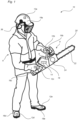
- Fig. 1 illustrates a chainsaw operator 6 operating a chainsaw 8.
- the operator 6 is protected by a power tool operator protection system 10 comprising a plurality of wearable position sensors 12a-e, integrated into the operator's workwear, and a power tool position sensor 14 integrated within the housing 9 of the chainsaw 8.
- the wearable position sensors 12a-e are embodied as accelerometers, and are as such configured to identify any movement as well as the orientation of the respective sensor 12a-e in relation to the vertical direction.
- the wearable sensors 12a-e are integrated into the operator's chainsaw protection helmet 16a, protection gloves 16b-c, and protection boots 16d-e, respectively.
- the power tool position sensor 14 is co-located with a controller 18 of the power tool operator protection system 10. Also the power tool position sensor 14 is embodied as an accelerometer, and thereby senses the motion as well as orientation of the sensor 14.
- the controller 18 is configured to wirelessly receive position data from the wearable position sensors 12a-e, and to receive the position of the power tool position sensor 14 and, based on the position data received from the wearable position sensors 12a-e and the power tool position sensor 14, generate a model of the operator 6 and chainsaw 8 in a manner which will be elucidated further below.
- the chainsaw 8 comprises an endless saw chain 20 configured to be rotated about the periphery of a guide bar 22 by a drive motor (not shown) located within the housing 9 of the chainsaw 8.
- An electronically actuatable chain brake 24 is operatively connected to the controller 18, allowing the controller 18 to activate the chain brake 24 to stop the saw chain 20.
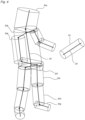
- the wearable position sensors 12a-e transmit motion data to the controller 18 which, based on the movement pattern, fits the position sensors 12a-e onto an operator skeleton model 26 representing the operator 6, which is illustrated in Fig. 2 .
- the operator skeleton model 26 comprises a plurality of rigid bars 25 interconnected by a plurality of joints 27.
- the model may further comprise respective constraints associated with each of the joints, such as available bending directions and bending angle ranges.
- the controller 18 detects the motion of the chainsaw 8 and automatically fits the position of the chainsaw 8 to the operator skeleton model 26.
- the chainsaw position may be fitted to the operator's skeleton model 26 based on the relative positions between the sensors 12b, 12c in the gloves 16b, 16c, such that a working implement skeleton model 28, representing the saw chain 20, may be obtained and positioned in relation to the operator skeleton model 26.
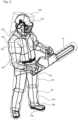
- the controller 18 associates the operator skeleton model 26 with a plurality of protection volumes 30a-30g, wherein each protection volume encloses a respective body part of the operator 6.
- the operator's head 32a may be associated with a respective head protection volume 30a
- the operator's torso 32b may be associated with a respective torso protection volume 30b
- each of the operator's legs 32c may be associated with two respective leg protection volumes 30c, 30d
- each of the operator's arms 32e may be associated with two respective arm protection volumes 30e, 30f
- each of the operator's feet 32g may be associated with a respective foot protection volume 30g.
- each of the protection volumes 30a-g has a circular-cylindrical shape centred around a respective rigid bar 25 ( Fig. 2 ) of the skeleton model 26, even though other shapes are also possible.
- the cylindrical protection volumes 30a-g may have different respective radii depending on the body parts they're associated with. Moreover, the radii may be set based on e.g. the size of the workwear, which size the workwear may be configured to wirelessly communicate to the controller 18.
- the controller associates the saw chain 20 with a working implement volume 34 enclosing the guide bar 22 and saw chain 20.
- the working implement volume 34 has a circular-cylindrical shape centred on the working implement skeleton model 28.
- Fig. 4 illustrates the skeleton models 26, 28 along with the protection volumes 30a-g.
- the controller 18 identifies such an overlap, it generates a protection signal.
- the protection signal is wirelessly transmitted to a speaker within an ear cup 36 ( Fig. 1 ) of the operator's hearing protection.
- the protection signal activates the electronically actuatable chain brake 24, to immediately stop the saw chain 20.
- the controller 18 determines that the working implement volume 34 approaches a protection volume 30a-g at a speed exceeding a limit speed, the controller 18 generates the protection signal already when the working implement volume 34 has come within a safety distance from the protection volume 30a-g.
- the safety distance may be set depending on the speed at which the working implement volume 34 approaches the protection volume 30a-g.
- the power tool operator protection system 10 may also be used for protecting other people near the operator.
- An adjacent person (not illustrated), such as another chainsaw operator, may wear a similar set of wearable sensors, which may transmit position data to the controller 18. Based on position data from the wearable sensors of the adjacent person, the controller 18 may generate a similar skeleton model of the adjacent person, and associate that model with respective protection volumes of the limbs of the adjacent person.
- the flow chart of Fig. 5 illustrates a method of operating the power tool operator protection system 10.
- step 501 position data is received from the wearable position sensors 12a-e worn by the operator 6.
- step 502 position data is received from the power tool position sensor 14.
- a model 26 of the operator 6, representing the operator's posture and being based on the mutual positions of the respective wearable sensors 12a-e, is generated based on the position data received from the wearable position sensors 12a-e.
- each limb of a plurality of limbs of the operator 6 is associated with a respective protection volume 30a-g.
- step 505 a position of the working implement 20 of the power tool 8 is determined based on the position data received from the power tool position sensor 14.
- a protection signal is generated in response to the position and/or motion of the power tool 8 in relation to the protection volume 30a-g indicating an imminent danger that the working implement 20 enters a protection volume 30a-g.
Landscapes
- Engineering & Computer Science (AREA)
- Mechanical Engineering (AREA)
- Life Sciences & Earth Sciences (AREA)
- Radar, Positioning & Navigation (AREA)
- Remote Sensing (AREA)
- Forests & Forestry (AREA)
- Wood Science & Technology (AREA)
- General Engineering & Computer Science (AREA)
- General Physics & Mathematics (AREA)
- Physics & Mathematics (AREA)
- Textile Engineering (AREA)
- Computer Networks & Wireless Communication (AREA)
- Business, Economics & Management (AREA)
- Physical Education & Sports Medicine (AREA)
- General Health & Medical Sciences (AREA)
- Health & Medical Sciences (AREA)
- Emergency Management (AREA)
- Professional, Industrial, Or Sporting Protective Garments (AREA)
- Sawing (AREA)
- Gloves (AREA)
- Helmets And Other Head Coverings (AREA)
- Auxiliary Devices For Machine Tools (AREA)
- Portable Power Tools In General (AREA)
Description
- The present invention relates to a power tool operator protection system, and to a method of protecting an operator of a handheld power tool from injury.
-
US 2010/0064532 A1 suggests a power tool operator protection system intended for protecting a chainsaw operator from cutting him/herself. The system keeps track of the separation distances between sensors placed on the chainsaw cutting bar and the operator's body, and stops the power tool if the separation distances fall within a threshold. However, there is a need for an even more efficient, accurate, and reliable protection system. - It is an object of the present invention to solve, or at least mitigate, parts or all of the above mentioned problems. To this end, there is provided a power tool operator protection system comprising a plurality of wearable position sensors configured to be worn by an operator of a handheld power tool; a power tool position sensor configured to detect the position of a handheld power tool; and processing equipment configured to: receive position data from the wearable position sensors and the power tool position sensor; based on the position data received from the wearable position sensors, generate a model of the operator, the model representing the operator's posture and being based on the mutual positions of the respective wearable sensors relative to each other; associate each limb of a plurality of limbs of the operator, as represented by the model, with a respective protection volume; based on the position data received from the power tool position sensor, determine a position of a working implement of the power tool; and, based on the position and/or motion of the power tool in relation to the protection volume indicating an imminent danger that the working implement enters a protection volume, generate a protection signal. The protection signal may alert a user or activate a safety function of the tool, such that the risk of accidents due to the working implement engaging with the body of the operator may be reduced. According to an embodiment, the processing equipment may be configured to generate the protection signal based on the working implement having already entered the boundaries of the protection volume. According to other embodiments, the protection signal may be generated already when the working implement is adjacent to the protection volume. The wearable position sensors may be configured to communicate wirelessly with the processing equipment. Similarly, the power tool position sensor may be configured to communicate wirelessly with the processing equipment. Alternatively, the processing equipment may be mechanically integrated with, and wired to, the power tool position sensor or the wearable position sensors. The model of the operator may be a skeleton model, or any other suitable representation of the operator which allows defining the operator's posture.
- According to embodiments, the processing equipment may further be configured to associate the working implement of the power tool with a working implement model; and determine whether there is an imminent danger that the working implement model overlaps with a protection volume. Thereby, the geometry of the power tool may be accounted for, such that it may be possible to work with e.g. an elongate working implement closer to the body. The working implement model may represent the working implement in one, two, or three dimensions. Moreover, the power tool position sensor can be mounted to a portion of the power tool which is geometrically separated from the working implement, while still allowing accurate triggering of a protection signal. By way of example, the power tool position sensor may be allowed to enter the protection volumes without triggering the generation of a protection signal, as long as the model of the power tool's working implement remains outside the protection volumes.
- According to embodiments, the processing equipment may further be configured to associate the working implement of the power tool with a working implement volume; and determine whether there is an imminent danger that the working implement volume overlaps with a protection volume.
- According to embodiments, the processing equipment may further be configured to: determine a speed at which the working implement approaches a protection volume, and adapt a safety distance for generating the protection signal based on the determined speed. Thereby, the operator may be permitted to operate the power tool with the working implement close to the body without generating any protection signals, while still maintaining a high level of safety. A substantial fraction of chainsaw kickback incidents are initiated with the guide bar relatively far from the operator's body, and a relatively early generation of a protection signal in response to such an incident may increase operator safety.
- According to some embodiments, the processing equipment may be configured to, based on the protection signal, stop the working implement of the power tool. According to other embodiments, the working implement may be allowed to continue at a reduced power, or a mechanical guard element may be actuated to prevent contact between the working implement and the operator's body.
- According to embodiments, the processing equipment may be configured to, based on the protection signal, generate an alert to the operator. The alert may, for example, be an audible alert, which may be transmitted via e.g. a buzzer or speaker; a visual alert, which may be transmitted via e.g. a display unit or a light source; or a haptic alert, which may be transmitted via e.g. a vibrator. The processing equipment may be configured to take different control actions associated with different respective safety distance. By way of example, the processing equipment may issue an audible warning signal when the working implement is at a first, relatively longer, distance from the protection volume, and stop the working implement when the working implement is at a second, relatively shorter distance from the protection volume.
- According to embodiments, each of the operator's legs may be associated with a respective protection volume. Optionally, the operator's head may be associated with a respective protection volume. Optionally, the operator's torso may be associated with a respective protection volume. Optionally, each of the operator's arms may be associated with a respective protection volume.
- According to embodiments, each of the position sensors may be configured to determine an absolute position in space.
- According to embodiments, each respective position sensor of said position sensors may be configured to determine a relative position in space, said relative position being relative to the other position sensors.
- According to an embodiment, the power tool position sensor is further configured to detect an orientation of the power tool. Thereby, if the power tool position sensor is not attached directly to the working implement, a more accurate position of the working implement may be obtained. Similarly, each of the wearable position sensors may be configured to detect a respective orientation. Thereby, the number of wearable sensors for determining the operator's posture may be reduced.
- According to embodiments, each of said wearable position sensors may comprise an inertial measurement unit, such as a gyroscope or an accelerometer. Thereby, the positions of the wearable position sensors may be tracked from a known starting position. Alternatively, the positions of the wearable positions may be calibrated based on the operator's movements, without any known starting position, by fitting the operator's movements to a kinematic model of the operator. Optionally, also the power tool position sensor may operate in the same manner.
- According to embodiments, the power tool operator protection system may comprise a GNSS, global navigation satellite system, receiver. Optionally, each of the wearable position sensors may comprise a GNSS receiver. Still optionally, the power tool position sensor may comprise a GNSS receiver.
- According to embodiments, the power tool operator protection system may further comprise an RTK, real-time kinematic, base station, wherein each of said wearable position sensors comprises an RTK enabled GNSS receiver. The RTK base station may be configured to transmit correction data for resolving any position ambiguity of the GNSS signal. The base station may be positioned on e.g. a parked forestry terrain vehicle, or on other forestry equipment, such as on a portable tool case for handheld forestry tools.
- According to embodiments, the power tool operator protection system may further comprise a plurality of radio beacons, wherein each of said wearable position sensors comprises a respective radio interface, the position of the wearable position sensors being determined by detected distances from the respective wearable position sensors to each of said radio beacons. Optionally, also the power tool position sensor may operate in the same manner. Each radio beacon may be configured to transmit a respective radio signal to the position sensors. Alternatively or additionally, each beacon may be configured to receive a radio signal from each respective position sensor.
- According to embodiments, the position of each limb may be determined based on input from several different sensors. Data from different sensors may be fused using various techniques, such as SLAM, simultaneous localization and mapping. Moreover, position data from sensors carried by one limb may be used for determining the position of another limb.
- According to embodiments, the processing equipment may be configured to determine the position of one body part based on position data from a wearable position sensor attached to another body part. By way of example, the relative positions of the operator's foot and head, combined with a model representing the lengths of the operator's torso and the upper and lower parts of the operator's leg, may be enough for determining within a certain statistical confidence operator's posture, including the operator's knee bending angle and the positions of the upper and lower parts of the operator's legs. Moreover, the motions of the operator's limbs are typically interrelated, such that not all limbs need to be provided with wearable sensors for generating a complete kinematic model, the model having an at least reasonable statistical confidence, of the operator's body. The positions or motions of the limbs and body parts not provided with respective wearable sensors may be determined by feeding the wearable sensor data to e.g. an artificial neural network or any other suitable Al, artificial intelligence, implementation.
- According to embodiments, the power tool operator protection system may further comprise an electronically actuated working implement brake connected to the power tool, wherein the working implement brake is configured to, based on the protection signal, mechanically engage to stop a motion of the working implement.
- According to embodiments, the handheld power tool may be a handheld cutting tool such as a chainsaw. Alternatively, the handheld power tool may be e.g. a hedge trimmer.
- According to embodiments, the power tool position sensor may be fixedly attached to the power tool.
- According to embodiments, the power tool position sensor may be integrated within a power tool housing.
- According to embodiments, the wearable position sensors may be integrated into workwear such as a jacket, trousers, gloves, or boots.
- According to embodiments, the workwear may be protection wear configured to mechanically protect the operator from injury. The protection wear may, for example, be chainsaw protection wear, such as a chainsaw protection helmet, chainsaw protection trousers, or chainsaw protection boots.
- According to embodiments, the processing equipment may also be configured to: receive position data from wearable position sensors worn by an adjacent person; based on the position data received from the wearable position sensors of the adjacent person, generate a model of the adjacent person, the model representing the adjacent person's posture and being based on the mutual positions of the respective wearable sensors of the adjacent person relative to each other; associate each limb of a plurality of limbs of the adjacent person, as represented by the model of the adjacent person, with a respective protection volume of the adjacent person; and based on the position and/or motion of the power tool in relation to the protection volume of the adjacent person indicating an imminent danger that the working implement enters a protection volume of the adjacent person, generate a protection signal. Thereby, also people adjacent to the operator of the power tool may be protected from injury. The wearable sensors of the adjacent person may be of the same type as the wearable sensors of the operator, and the model and protection volumes of the adjacent person may be generated in the same manner.
- According to a second aspect, parts or all of the above mentioned problems are solved, or at least mitigated, by a method of protecting an operator of a handheld power tool from injury, the method comprising: receiving position data from wearable position sensors worn by the operator; receiving position data from a power tool position sensor; based on the position data received from the wearable position sensors, generating a model of the operator, the model (26) representing the operator's posture and being based on the mutual positions of the respective wearable sensors relative to each other; associating each limb of a plurality of limbs of the operator, as represented by the model, with a respective protection volume; based on the position data received from the power tool position sensor, determining a position of a working implement of the power tool; and based on the position and/or motion of the power tool in relation to the protection volume indicating an imminent danger that the working implement enters a protection volume, generating a protection signal.
- It is noted that embodiments of the invention may be embodied by all possible combinations of features recited in the claims. Further, it will be appreciated that the various embodiments described for the power tool operator protection system defined hereinabove are all combinable with the method as defined in accordance with the second aspect, and vice versa.
- The above, as well as additional objects, features and advantages of the present invention, will be better understood through the following illustrative and nonlimiting detailed description of preferred embodiments of the present invention, with reference to the appended drawings, where the same reference numerals will be used for similar elements, wherein:
-
Fig. 1 is a schematic view in perspective of a personal protection system applied to a chainsaw operator operating a chainsaw; -
Fig. 2 is a schematic view in perspective of skeleton models applied to the operator and chainsaw ofFig. 1 ; -
Fig. 3 is a schematic view in perspective of a plurality of protection volumes and a working implement volume applied to the operator and chainsaw ofFig. 1 ; -
Fig. 4 is a schematic view in perspective of the skeleton models, protection volumes, and working implement volume ofFigs 2 and3 ; -
Fig. 5 is a flow chart illustrating a method of protecting an operator of a handheld power tool from injury. - All the figures are schematic, not necessarily to scale, and generally only show parts which are necessary in order to elucidate the embodiments, wherein other parts may be omitted.
-
Fig. 1 illustrates achainsaw operator 6 operating achainsaw 8. Theoperator 6 is protected by a power tooloperator protection system 10 comprising a plurality ofwearable position sensors 12a-e, integrated into the operator's workwear, and a powertool position sensor 14 integrated within the housing 9 of thechainsaw 8. Thewearable position sensors 12a-e are embodied as accelerometers, and are as such configured to identify any movement as well as the orientation of therespective sensor 12a-e in relation to the vertical direction. Thewearable sensors 12a-e are integrated into the operator'schainsaw protection helmet 16a,protection gloves 16b-c, andprotection boots 16d-e, respectively. - The power
tool position sensor 14 is co-located with acontroller 18 of the power tooloperator protection system 10. Also the powertool position sensor 14 is embodied as an accelerometer, and thereby senses the motion as well as orientation of thesensor 14. Thecontroller 18 is configured to wirelessly receive position data from thewearable position sensors 12a-e, and to receive the position of the powertool position sensor 14 and, based on the position data received from thewearable position sensors 12a-e and the powertool position sensor 14, generate a model of theoperator 6 andchainsaw 8 in a manner which will be elucidated further below. - The
chainsaw 8 comprises anendless saw chain 20 configured to be rotated about the periphery of aguide bar 22 by a drive motor (not shown) located within the housing 9 of thechainsaw 8. An electronicallyactuatable chain brake 24 is operatively connected to thecontroller 18, allowing thecontroller 18 to activate thechain brake 24 to stop thesaw chain 20. - When the
operator 6 moves his limbs, thewearable position sensors 12a-e transmit motion data to thecontroller 18 which, based on the movement pattern, fits theposition sensors 12a-e onto anoperator skeleton model 26 representing theoperator 6, which is illustrated inFig. 2 . Thereby, once fit to theoperator skeleton model 26, the positions of theposition sensors 12a-e relative to each other have been determined, and any change in position of any of thewearable position sensors 12a-e will be updated by the respectivewearable position sensors 12a-e transmitting their motion data to thecontroller 18. Theoperator skeleton model 26 comprises a plurality ofrigid bars 25 interconnected by a plurality ofjoints 27. The model may further comprise respective constraints associated with each of the joints, such as available bending directions and bending angle ranges. - Similarly, when the
operator 6 grabs thechainsaw 8 by the chainsaw handles, and starts moving it, thecontroller 18 detects the motion of thechainsaw 8 and automatically fits the position of thechainsaw 8 to theoperator skeleton model 26. The chainsaw position may be fitted to the operator'sskeleton model 26 based on the relative positions between thesensors gloves skeleton model 28, representing thesaw chain 20, may be obtained and positioned in relation to theoperator skeleton model 26. Once the working implementskeleton model 28 has been positioned in relation to theoperator skeleton model 26, any change in position of thesaw chain 20 in relation to theoperator 6 will be updated by the powertool position sensor 14 by transmitting its motion data to thecontroller 18. - Turning now to
Fig. 3 , once theskeleton models controller 18 associates theoperator skeleton model 26 with a plurality ofprotection volumes 30a-30g, wherein each protection volume encloses a respective body part of theoperator 6. By way of example, the operator'shead 32a may be associated with a respectivehead protection volume 30a, the operator'storso 32b may be associated with a respectivetorso protection volume 30b; each of the operator'slegs 32c may be associated with two respectiveleg protection volumes arms 32e may be associated with two respectivearm protection volumes foot protection volume 30g. In the illustrated example, each of theprotection volumes 30a-g has a circular-cylindrical shape centred around a respective rigid bar 25 (Fig. 2 ) of theskeleton model 26, even though other shapes are also possible. Thecylindrical protection volumes 30a-g may have different respective radii depending on the body parts they're associated with. Moreover, the radii may be set based on e.g. the size of the workwear, which size the workwear may be configured to wirelessly communicate to thecontroller 18. - Similarly, the controller associates the
saw chain 20 with a working implementvolume 34 enclosing theguide bar 22 and sawchain 20. Also the working implementvolume 34 has a circular-cylindrical shape centred on the working implementskeleton model 28. -
Fig. 4 illustrates theskeleton models protection volumes 30a-g. When any part of the working implementvolume 34 overlaps with aprotection volume 30a-g, there is an imminent danger that thesaw chain 20 may enter theprotection volume 30a-g. As soon as thecontroller 18 identifies such an overlap, it generates a protection signal. The protection signal is wirelessly transmitted to a speaker within an ear cup 36 (Fig. 1 ) of the operator's hearing protection. Moreover, the protection signal activates the electronicallyactuatable chain brake 24, to immediately stop thesaw chain 20. Moreover, whenever thecontroller 18 determines that the working implementvolume 34 approaches aprotection volume 30a-g at a speed exceeding a limit speed, thecontroller 18 generates the protection signal already when the working implementvolume 34 has come within a safety distance from theprotection volume 30a-g. The safety distance may be set depending on the speed at which the working implementvolume 34 approaches theprotection volume 30a-g. - The power tool operator protection system 10 (
Fig. 1 ) may also be used for protecting other people near the operator. An adjacent person (not illustrated), such as another chainsaw operator, may wear a similar set of wearable sensors, which may transmit position data to thecontroller 18. Based on position data from the wearable sensors of the adjacent person, thecontroller 18 may generate a similar skeleton model of the adjacent person, and associate that model with respective protection volumes of the limbs of the adjacent person. - The flow chart of
Fig. 5 illustrates a method of operating the power tooloperator protection system 10. - In
step 501, position data is received from thewearable position sensors 12a-e worn by theoperator 6. - In
step 502, position data is received from the powertool position sensor 14. - In
step 503, amodel 26 of theoperator 6, representing the operator's posture and being based on the mutual positions of the respectivewearable sensors 12a-e, is generated based on the position data received from thewearable position sensors 12a-e. - In
step 504, each limb of a plurality of limbs of theoperator 6 is associated with arespective protection volume 30a-g. - In
step 505, a position of the working implement 20 of thepower tool 8 is determined based on the position data received from the powertool position sensor 14. - In
step 506, a protection signal is generated in response to the position and/or motion of thepower tool 8 in relation to theprotection volume 30a-g indicating an imminent danger that the working implement 20 enters aprotection volume 30a-g. - The invention has mainly been described above with reference to a few embodiments. However, as is readily appreciated by a person skilled in the art, other embodiments than the ones disclosed above are equally possible within the scope of the invention, as defined by the appended patent claims. In the claims, the word "comprising" does not exclude other elements or steps, and the indefinite article "a" or "an" does not exclude a plurality.
Claims (23)
- A power tool operator protection system (10) comprisinga plurality of wearable position sensors (12a-e) configured to be worn by an operator (6) of a handheld power tool (8);a power tool position sensor (14) configured to detect the position of a handheld power tool (8); andprocessing equipment (18) configured to:receive position data from the wearable position sensors (12a-e) and the power tool position sensor (14);based on the position data received from the wearable position sensors (12a-e), generate a model (26) of the operator (6), the model (26) representing the operator's posture and being based on the mutual positions of the respective wearable sensors (12a-e) relative to each other;associate each limb (32a; 32c; 32e) of a plurality of limbs (32a, 32c, 32e) of the operator (6), as represented by the model (26), with a respective protection volume (30a; 30c, 30d; 30e, 30f);based on the position data received from the power tool position sensor (14), determine a position of a working implement (20) of the power tool (8); andbased on the position and/or motion of the power tool (8) in relation to the protection volume (30a; 30c, 30d; 30e, 30f) indicating an imminent danger that the working implement (20) enters a protection volume (30a; 30c, 30d; 30e, 30f), generate a protection signal.
- The power tool operator protection system according to claim 1, wherein the processing equipment (18) is further configured toassociate the working implement (20) of the power tool (8) with a working implement model (28); anddetermine whether there is an imminent danger that the working implement model (28) overlaps with a protection volume (30a; 30c, 30d; 30e, 30f).
- The power tool operator protection system according to any of the preceding claims, wherein the processing equipment (18) is further configured toassociate the working implement (20) of the power tool (8) with a working implement volume (34); anddetermine whether there is an imminent danger that the working implement volume (34) overlaps with a protection volume (30a; 30c, 30d; 30e, 30f).
- The power tool operator protection system according to any of the preceding claims, wherein the processing equipment (18) is further configured to:determine a speed at which the working implement (20) approaches a protection volume (30a; 30c, 30d; 30e, 30f), andadapt a safety distance for generating the protection signal based on the determined speed.
- The power tool operator protection system according to any of the preceding claims, wherein the processing equipment (18) is configured to, based on the protection signal, stop the working implement (20) of the power tool (8).
- The power tool operator protection system according to any of the preceding claims, wherein the processing equipment (18) is configured to, based on the protection signal, generate an alert to the operator (6).
- The power tool operator protection system according to any of the preceding claims, wherein each of the operator's legs (32c) is associated with a respective protection volume (30c, 30d).
- The power tool operator protection system according to any of the preceding claims, wherein the position sensors (12a-e) are configured to determine an absolute position in space.
- The power tool operator protection system according to any of the preceding claims, wherein each respective position sensor (12a; 12b; 12c; 12d; 12e) of said position sensors (30a; 30c, 30d; 30e, 30f) is configured to determine a relative position in space, said relative position being relative to the other position sensors.
- The power tool operator protection system according to any of the preceding claims, wherein the power tool position sensor (14) is further configured to detect an orientation of the power tool (8).
- The power tool operator protection system according to any of the preceding claims, wherein each of said wearable position sensors (12a-e) comprises an inertial measurement unit, such as a gyroscope or an accelerometer.
- The power tool operator protection system according to any of the preceding claims, further comprising an RTK, real-time kinematic, base station, wherein each of said wearable position sensors comprises an RTK enabled GNSS receiver.
- The power tool operator protection system according to any of the preceding claims, further comprising a plurality of radio beacons, wherein each of said wearable position sensors (12a-e) comprises a respective radio interface, the position of the wearable position sensors being determined by detected distances from the respective wearable position sensors to each of said radio beacons.
- The power tool operator protection system according to any of the preceding claims, wherein the position of each limb (32a; 32c, 32d; 32e, 32f) is determined based on input from several different sensors (12a-e).
- The power tool operator protection system according to any of the preceding claims, wherein the processing equipment (18) is configured to determine the position of one body part (32c) based on position data from a wearable position sensor (12e) attached to another body part (32g).
- The power tool operator protection system according to any of the preceding claims, further comprising an electronically actuated working implement brake (24) connectable to the power tool (8), wherein the working implement brake (24) is configured to, based on the protection signal, mechanically engage to stop a motion of the working implement (20).
- The power tool operator protection system according to any of the preceding claims, wherein the handheld power tool (8) is a handheld cutting tool such as a chainsaw.
- The power tool operator protection system according to any of the preceding claims, wherein the power tool position sensor (14) is suitable to be integrated within a power tool housing (9).
- The power tool operator protection system according to any of the preceding claims, wherein the wearable position sensors (12a-e) are suitable to be integrated into workwear (16a-e) such as a jacket, trousers, gloves (16b, 16c), headwear (16a) or boots (16d, 16e).
- The power tool operator protection system according to claim 19, wherein the workwear (16a-e) is protection wear configured to mechanically protect the operator from injury.
- The power tool operator protection system according to claim 20, wherein the protection wear (16a-e) is chainsaw protection wear, such as a chainsaw protection helmet (16a), chainsaw protection trousers, or chainsaw protection boots.
- The power tool operator protection system according to any of the preceding claims, wherein the processing equipment (18) configured to:receive position data from wearable position sensors worn by an adjacent person;based on the position data received from the wearable position sensors of the adjacent person, generate a model of the adjacent person, the model representing the adjacent person's posture and being based on the mutual positions of the respective wearable sensors of the adjacent person relative to each other;associate each limb of a plurality of limbs of the adjacent person, as represented by the model of the adjacent person, with a respective protection volume of the adjacent person; andbased on the position and/or motion of the power tool (8) in relation to the protection volume of the adjacent person indicating an imminent danger that the working implement (20) enters a protection volume of the adjacent person, generate a protection signal.
- A method of protecting an operator (6) of a handheld power tool (8) from injury, the method comprising:receiving position data from wearable position sensors (12a-e) worn by the operator (6);receiving position data from a power tool position sensor (14);based on the position data received from the wearable position sensors (12a-e), generating a model (26) of the operator (6), the model (26) representing the operator's posture and being based on the mutual positions of the respective wearable sensors (12a-e) relative to each other;associating each limb (32a; 32c; 32e) of a plurality of limbs (32a, 32c, 32e) of the operator (6), as represented by the model (26), with a respective protection volume (30a; 30c, 30d; 30e, 30f);based on the position data received from the power tool position sensor (14), determining a position of a working implement (20) of the power tool (8); andbased on the position and/or motion of the power tool (8) in relation to the protection volume (30a; 30c, 30d; 30e, 30f) indicating an imminent danger that the working implement enters a protection volume (30a; 30c, 30d; 30e, 30f), generating a protection signal.
Applications Claiming Priority (2)
| Application Number | Priority Date | Filing Date | Title |
|---|---|---|---|
| SE1950847A SE1950847A1 (en) | 2019-07-04 | 2019-07-04 | Power tool operator protection system and method |
| PCT/SE2020/050679 WO2021002794A1 (en) | 2019-07-04 | 2020-06-29 | Power tool operator protection system and method |
Publications (2)
| Publication Number | Publication Date |
|---|---|
| EP3993955A1 EP3993955A1 (en) | 2022-05-11 |
| EP3993955B1 true EP3993955B1 (en) | 2023-07-26 |
Family
ID=71527894
Family Applications (1)
| Application Number | Title | Priority Date | Filing Date |
|---|---|---|---|
| EP20737624.5A Active EP3993955B1 (en) | 2019-07-04 | 2020-06-29 | Power tool operator protection system and method |
Country Status (7)
| Country | Link |
|---|---|
| US (1) | US12172254B2 (en) |
| EP (1) | EP3993955B1 (en) |
| JP (1) | JP2022538980A (en) |
| CN (1) | CN113950265B (en) |
| AU (1) | AU2020300357A1 (en) |
| SE (1) | SE1950847A1 (en) |
| WO (1) | WO2021002794A1 (en) |
Families Citing this family (7)
| Publication number | Priority date | Publication date | Assignee | Title |
|---|---|---|---|---|
| GB2587774A (en) * | 2019-06-10 | 2021-04-14 | Sutherland Greig | Arborist apparatus |
| JP1710821S (en) * | 2021-08-05 | 2022-03-25 | Portable electric hammer drill body | |
| JP7627892B2 (en) * | 2021-09-17 | 2025-02-07 | パナソニックIpマネジメント株式会社 | Power tool system, power tool, power tool control method, and program |
| US20230364821A1 (en) * | 2022-05-12 | 2023-11-16 | Chain Orthopedics, Llc | Controls, Feedback, Cutting Variations, and Accessories for Chain Saws |
| DE202022102628U1 (en) * | 2022-05-13 | 2022-05-30 | Einhell Germany Ag | Protection system for a power tool |
| WO2024099932A1 (en) * | 2022-11-07 | 2024-05-16 | Husqvarna Ab | System for protecting an operator of a power tool having infrared sensors |
| WO2025262448A1 (en) | 2024-06-18 | 2025-12-26 | Innovation Fabrication Commercialisation Infaco | Portable power cutting tool with contactless security system and control process of safety system |
Family Cites Families (64)
| Publication number | Priority date | Publication date | Assignee | Title |
|---|---|---|---|---|
| FR2712837B1 (en) | 1993-11-22 | 1996-04-12 | Daniel Delmas | Protection and safety device for user of cutting tools. |
| AU5847496A (en) | 1995-05-24 | 1996-12-11 | New Zealand Logging Industry Research Association Incorporated, The | Improvements in safety equipment for motor driven saws |
| EP0850385B1 (en) | 1995-09-25 | 2002-10-02 | Jorn Sorensen | A method and a device for sensing the distance between a first object and a second object |
| AU2011236043C1 (en) | 1999-10-01 | 2015-08-06 | Sawstop Holding Llc | Safety systems for power equipment |
| DE60238424D1 (en) | 2001-07-11 | 2011-01-05 | Black & Decker Inc | Safety mechanisms for a power tool |
| FR2831476A1 (en) | 2001-10-26 | 2003-05-02 | Jean Pierre Loubes | Hand protection for power secateur user has proximity warning when free hand is close to cutter jaws |
| DE10227749A1 (en) | 2002-06-21 | 2004-01-15 | Robert Jagst | Electronic personal injury protection device for powered saws, has contactless sensor(s) for detecting operator's electrical smog radiation field with/without threshold switch, and shut-off device |
| FR2846729B1 (en) | 2002-11-04 | 2005-02-04 | Manulatex France | PROGRAMMABLE PROTECTION AND SECURITY DEVICE FOR MOTORIZED TOOLS |
| US20040181951A1 (en) | 2003-03-17 | 2004-09-23 | Wittke Edward R. | Chain saw safety system |
| WO2005099981A1 (en) | 2004-04-14 | 2005-10-27 | Werner Harrer | Chain saw |
| EP1836434A2 (en) | 2004-12-09 | 2007-09-26 | Ident Technology AG | Equipment safety system for the protected operation of dangerous motor equipment, in particular gardening equipment and tools |
| DE102006002668A1 (en) | 2005-05-18 | 2007-07-05 | Klaus Schlamann | Safety device for working with power saws, has transmitter, controller, receiver and signal transmission carrier which are connected functionally to each other |
| US20070085502A1 (en) | 2005-10-13 | 2007-04-19 | Cargill, Incorporated | Braking system and method |
| DE102005049130A1 (en) | 2005-10-14 | 2007-04-19 | Robert Bosch Gmbh | Hand tool |
| WO2007060698A1 (en) * | 2005-11-25 | 2007-05-31 | Tessitura Tele Metalliche Rossi Oliviero & C. Srl. | Device for protection from accidents |
| DE102006014819A1 (en) | 2006-03-29 | 2007-10-04 | Dolmar Gmbh | Power tool e.g. power chain saw, controlling method, involves detecting approximation of sensor in clothing article e.g. jacket, to sensor in power tool, and causing or triggering brake action of tool unit by controller/latter sensor |
| DE102006058749A1 (en) | 2006-12-12 | 2008-06-19 | Robert Bosch Gmbh | Hand tool protective device |
| DE102007032221A1 (en) | 2007-07-11 | 2009-01-15 | Robert Bosch Gmbh | Machine tool and method with a machine tool |
| DE102007035822A1 (en) | 2007-07-31 | 2009-02-05 | Robert Bosch Gmbh | Automatic safety shutdown of tools or implements |
| US20100064532A1 (en) * | 2007-07-31 | 2010-03-18 | Edward Raymond Wittke | Chain saw 3D relative positional monitoring and anti-kickback actuation system |
| DE202010004458U1 (en) | 2010-03-24 | 2011-08-11 | Wilhelm Altendorf Gmbh & Co Kg | Safety device to prevent accidents at work on sawing machines, in particular circular saws, as well as circular saw |
| DE102010030825A1 (en) | 2010-07-01 | 2012-01-05 | Hilti Aktiengesellschaft | Hand tool |
| CA2807990A1 (en) | 2010-08-11 | 2012-02-16 | Blount, Inc. | Kickback detection method and apparatus |
| ITMI20101566A1 (en) | 2010-08-24 | 2012-02-25 | Redcap Technology S R L | CAPACITIVE SAFETY SYSTEM FOR CHAINSAWS AND CUTTING TOOLS |
| IT1401533B1 (en) | 2010-08-24 | 2013-07-26 | Redcap Technology S R L | LOCKING DEVICE WITH OPERATION CONTROLLED FOR PORTABLE CUTTING TOOLS AND ITS CUTTING TOOL. |
| NZ579017A (en) | 2010-11-09 | 2012-07-27 | Jaedon Entpr Ltd | Clothing with electrically conducting material |
| WO2012098609A1 (en) * | 2011-01-17 | 2012-07-26 | パナソニック株式会社 | Safety device and preliminary action determination method |
| JP2012148359A (en) | 2011-01-17 | 2012-08-09 | Panasonic Corp | Safety apparatus for electric power tool and method for determining preliminary action |
| WO2012177751A1 (en) | 2011-06-21 | 2012-12-27 | Ansell Limited | Method and apparatus for controlling equipment activation |
| WO2013080233A1 (en) | 2011-12-01 | 2013-06-06 | Redcap Technology S.R.L. | Safety device applicable to chainsaws |
| US10462898B2 (en) | 2012-09-11 | 2019-10-29 | L.I.F.E. Corporation S.A. | Physiological monitoring garments |
| US20140166323A1 (en) * | 2012-09-16 | 2014-06-19 | J. Carl Cooper | Kickback Reduction for Power Tools and Machines |
| DE102013221128A1 (en) * | 2013-10-17 | 2015-04-23 | Robert Bosch Gmbh | Device for protection against injury to an operator by a machine tool and method for this purpose |
| US10442107B2 (en) | 2013-11-12 | 2019-10-15 | Sawstop Holding Llc | Control systems for power tools |
| US10161566B2 (en) | 2013-11-18 | 2018-12-25 | Robert Bosch Tool Corporation | Power tool with capacitive injury mitigation system |
| WO2015140770A2 (en) | 2014-03-20 | 2015-09-24 | Steelpro- Engenharia Industrial Lda | Wearable safety device and system for sawing, cutting and milling machines |
| US11117204B2 (en) | 2014-05-06 | 2021-09-14 | Husqvarna Ab | Power tool |
| KR101668693B1 (en) | 2014-10-29 | 2016-10-27 | 김정훈 | Electromotion pruning scissors |
| WO2016124415A1 (en) | 2015-02-05 | 2016-08-11 | Koninklijke Philips N.V. | Safety system, workflow management system, safety method and computer program product |
| WO2016127936A1 (en) * | 2015-02-10 | 2016-08-18 | 苏州宝时得电动工具有限公司 | Wearable device and system |
| US9855005B2 (en) * | 2015-04-22 | 2018-01-02 | Samsung Electronics Co., Ltd. | Wearable posture advisory system |
| CA2992896A1 (en) * | 2015-07-20 | 2017-01-26 | Jobsafe Systems Inc. | Automated system and process for providing personal safety |
| KR101713622B1 (en) | 2015-10-02 | 2017-03-08 | 신형식 | pruning shears |
| US9776847B2 (en) * | 2015-10-14 | 2017-10-03 | Recon Dynamics, Llc | Comprehensive worksite and transportation safety system |
| DE102015226190A1 (en) * | 2015-12-21 | 2017-06-22 | Robert Bosch Gmbh | System with at least one machine tool and with at least one mobile sensor device |
| EP3432782A4 (en) | 2016-03-24 | 2019-11-13 | Warwick Mills, Inc. | ALERT SYSTEM AND SECURITY MEASUREMENT THAT CAN BE USED |
| CN206085226U (en) | 2016-04-12 | 2017-04-12 | 张生 | Electric chain saw |
| WO2017183414A1 (en) | 2016-04-22 | 2017-10-26 | 三菱電機株式会社 | Object manipulation device and object manipulation method |
| WO2017197308A1 (en) | 2016-05-12 | 2017-11-16 | One Million Metrics Corp. | System and method for monitoring safety and productivity of physical tasks |
| CH712468A1 (en) | 2016-05-17 | 2017-11-30 | Felco Motion Sa | System and method of safety for a power tool. |
| WO2017210091A1 (en) | 2016-05-31 | 2017-12-07 | Sd3, Llc | Detection systems for power tools with active injury mitigation technology |
| US10807219B2 (en) | 2016-09-07 | 2020-10-20 | Milwaukee Electric Tool Corporation | Depth and angle sensor attachment for a power tool |
| US10646139B2 (en) | 2016-12-05 | 2020-05-12 | Intel Corporation | Body movement tracking |
| EP3616860B1 (en) | 2018-08-31 | 2022-12-07 | Zanon S.R.L. | Safety device for electric cutting tool and electric cutting tool with the safety device |
| US10865941B2 (en) | 2018-11-20 | 2020-12-15 | Dennis E. Lewis | Safety system and method for power tools |
| DE102018222393A1 (en) | 2018-12-20 | 2020-06-25 | Robert Bosch Gmbh | Hand tool with at least one safety brake device |
| DE102018251705A1 (en) | 2018-12-27 | 2020-07-02 | Robert Bosch Gmbh | Hand tool |
| DE102019103778A1 (en) | 2019-02-14 | 2020-08-20 | Nicolas Klaus Sebastian Lenzmann | System and method for the automatic shutdown of a hand-operated tool |
| US11829519B1 (en) * | 2019-02-28 | 2023-11-28 | Meta Platforms Technologies, Llc | Systems, methods, and apparatuses for a wearable control device to facilitate performance of manufacturing and various motor tasks |
| GB2587774A (en) | 2019-06-10 | 2021-04-14 | Sutherland Greig | Arborist apparatus |
| DE102019211894A1 (en) | 2019-08-08 | 2021-02-11 | Robert Bosch Gmbh | Braking device of a chainsaw and method for protecting an operator |
| DE102020207520A1 (en) | 2019-09-02 | 2021-03-04 | Robert Bosch Gesellschaft mit beschränkter Haftung | Machine tool device |
| DE102020206756A1 (en) | 2019-09-02 | 2021-03-04 | Robert Bosch Gesellschaft mit beschränkter Haftung | Machine tool device |
| CN212634532U (en) | 2020-05-09 | 2021-03-02 | 广东海狮达科技有限公司 | Lithium battery electric chain saw |
-
2019
- 2019-07-04 SE SE1950847A patent/SE1950847A1/en not_active IP Right Cessation
-
2020
- 2020-06-29 JP JP2021574860A patent/JP2022538980A/en active Pending
- 2020-06-29 CN CN202080041914.6A patent/CN113950265B/en active Active
- 2020-06-29 AU AU2020300357A patent/AU2020300357A1/en not_active Abandoned
- 2020-06-29 US US17/615,740 patent/US12172254B2/en active Active
- 2020-06-29 WO PCT/SE2020/050679 patent/WO2021002794A1/en not_active Ceased
- 2020-06-29 EP EP20737624.5A patent/EP3993955B1/en active Active
Also Published As
| Publication number | Publication date |
|---|---|
| US12172254B2 (en) | 2024-12-24 |
| SE543197C2 (en) | 2020-10-20 |
| US20220241920A1 (en) | 2022-08-04 |
| AU2020300357A1 (en) | 2021-12-23 |
| SE1950847A1 (en) | 2020-10-20 |
| WO2021002794A1 (en) | 2021-01-07 |
| CN113950265B (en) | 2023-08-04 |
| JP2022538980A (en) | 2022-09-07 |
| CN113950265A (en) | 2022-01-18 |
| EP3993955A1 (en) | 2022-05-11 |
Similar Documents
| Publication | Publication Date | Title |
|---|---|---|
| EP3993955B1 (en) | Power tool operator protection system and method | |
| US10535280B2 (en) | Multi-function electronic guidance system for persons with restricted vision | |
| CN105637281B (en) | Device for protecting an operator from damage to a machine tool and method therefor | |
| US11052544B2 (en) | Safety device for machine tools | |
| US9851434B2 (en) | Method and navigation system for assisting a visually impaired user to safely walk around obstructions and impediments | |
| US7755744B1 (en) | Environment sensor that conveys information about objects in the vicinity of the visually impaired user | |
| US11000716B2 (en) | Distance-learning safety retraction lanyard | |
| US10251788B1 (en) | Assisting the visually impaired | |
| US10117802B2 (en) | Blind dog navigation system | |
| CN101750972A (en) | Garment for use near autonomous machines | |
| JP2023522283A (en) | Systems for protecting power tool operators | |
| WO2008060664A2 (en) | Location and tracking of people with combined use of rf infrascture and dead reckoning modules | |
| CN107049718B (en) | Obstacle avoidance device | |
| SathyaNarayanan et al. | IoT based smart walking cane for typhlotic with voice assistance | |
| KR20160125215A (en) | The drone, the route guidance drone set and the method of route guidance using them | |
| US20190110530A1 (en) | Personal airbag device for preventing bodily injury | |
| WO2017035032A1 (en) | System and method for gesture activated responder lighting and information center | |
| US8825389B1 (en) | Mobility device and method for guiding the visually impaired | |
| CN108294391A (en) | A kind of crash helmet or cap | |
| US20220414416A1 (en) | Real-Time Position Tracking and Alerting | |
| JP2006015435A (en) | Security robot | |
| KR20160065532A (en) | Method and system for guiding blind person | |
| KR101775562B1 (en) | Variable type protective device for blind animal and protective and method using the same | |
| KR20170004142A (en) | GPS pedestrian navigation and location-based awareness Alarms sound for the visually impaired | |
| JP4839939B2 (en) | Autonomous mobile device |
Legal Events
| Date | Code | Title | Description |
|---|---|---|---|
| STAA | Information on the status of an ep patent application or granted ep patent |
Free format text: STATUS: UNKNOWN |
|
| STAA | Information on the status of an ep patent application or granted ep patent |
Free format text: STATUS: THE INTERNATIONAL PUBLICATION HAS BEEN MADE |
|
| PUAI | Public reference made under article 153(3) epc to a published international application that has entered the european phase |
Free format text: ORIGINAL CODE: 0009012 |
|
| STAA | Information on the status of an ep patent application or granted ep patent |
Free format text: STATUS: REQUEST FOR EXAMINATION WAS MADE |
|
| 17P | Request for examination filed |
Effective date: 20211221 |
|
| AK | Designated contracting states |
Kind code of ref document: A1 Designated state(s): AL AT BE BG CH CY CZ DE DK EE ES FI FR GB GR HR HU IE IS IT LI LT LU LV MC MK MT NL NO PL PT RO RS SE SI SK SM TR |
|
| DAV | Request for validation of the european patent (deleted) | ||
| DAX | Request for extension of the european patent (deleted) | ||
| GRAP | Despatch of communication of intention to grant a patent |
Free format text: ORIGINAL CODE: EPIDOSNIGR1 |
|
| STAA | Information on the status of an ep patent application or granted ep patent |
Free format text: STATUS: GRANT OF PATENT IS INTENDED |
|
| INTG | Intention to grant announced |
Effective date: 20230228 |
|
| GRAS | Grant fee paid |
Free format text: ORIGINAL CODE: EPIDOSNIGR3 |
|
| GRAA | (expected) grant |
Free format text: ORIGINAL CODE: 0009210 |
|
| STAA | Information on the status of an ep patent application or granted ep patent |
Free format text: STATUS: THE PATENT HAS BEEN GRANTED |
|
| AK | Designated contracting states |
Kind code of ref document: B1 Designated state(s): AL AT BE BG CH CY CZ DE DK EE ES FI FR GB GR HR HU IE IS IT LI LT LU LV MC MK MT NL NO PL PT RO RS SE SI SK SM TR |
|
| REG | Reference to a national code |
Ref country code: CH Ref legal event code: EP |
|
| REG | Reference to a national code |
Ref country code: DE Ref legal event code: R096 Ref document number: 602020014510 Country of ref document: DE |
|
| REG | Reference to a national code |
Ref country code: IE Ref legal event code: FG4D |
|
| REG | Reference to a national code |
Ref country code: LT Ref legal event code: MG9D |
|
| P01 | Opt-out of the competence of the unified patent court (upc) registered |
Effective date: 20231021 |
|
| REG | Reference to a national code |
Ref country code: NL Ref legal event code: MP Effective date: 20230726 |
|
| REG | Reference to a national code |
Ref country code: AT Ref legal event code: MK05 Ref document number: 1591420 Country of ref document: AT Kind code of ref document: T Effective date: 20230726 |
|
| PG25 | Lapsed in a contracting state [announced via postgrant information from national office to epo] |
Ref country code: NL Free format text: LAPSE BECAUSE OF FAILURE TO SUBMIT A TRANSLATION OF THE DESCRIPTION OR TO PAY THE FEE WITHIN THE PRESCRIBED TIME-LIMIT Effective date: 20230726 |
|
| PG25 | Lapsed in a contracting state [announced via postgrant information from national office to epo] |
Ref country code: GR Free format text: LAPSE BECAUSE OF FAILURE TO SUBMIT A TRANSLATION OF THE DESCRIPTION OR TO PAY THE FEE WITHIN THE PRESCRIBED TIME-LIMIT Effective date: 20231027 |
|
| PG25 | Lapsed in a contracting state [announced via postgrant information from national office to epo] |
Ref country code: IS Free format text: LAPSE BECAUSE OF FAILURE TO SUBMIT A TRANSLATION OF THE DESCRIPTION OR TO PAY THE FEE WITHIN THE PRESCRIBED TIME-LIMIT Effective date: 20231126 |
|
| PG25 | Lapsed in a contracting state [announced via postgrant information from national office to epo] |
Ref country code: SE Free format text: LAPSE BECAUSE OF FAILURE TO SUBMIT A TRANSLATION OF THE DESCRIPTION OR TO PAY THE FEE WITHIN THE PRESCRIBED TIME-LIMIT Effective date: 20230726 Ref country code: RS Free format text: LAPSE BECAUSE OF FAILURE TO SUBMIT A TRANSLATION OF THE DESCRIPTION OR TO PAY THE FEE WITHIN THE PRESCRIBED TIME-LIMIT Effective date: 20230726 Ref country code: PT Free format text: LAPSE BECAUSE OF FAILURE TO SUBMIT A TRANSLATION OF THE DESCRIPTION OR TO PAY THE FEE WITHIN THE PRESCRIBED TIME-LIMIT Effective date: 20231127 Ref country code: NO Free format text: LAPSE BECAUSE OF FAILURE TO SUBMIT A TRANSLATION OF THE DESCRIPTION OR TO PAY THE FEE WITHIN THE PRESCRIBED TIME-LIMIT Effective date: 20231026 Ref country code: LV Free format text: LAPSE BECAUSE OF FAILURE TO SUBMIT A TRANSLATION OF THE DESCRIPTION OR TO PAY THE FEE WITHIN THE PRESCRIBED TIME-LIMIT Effective date: 20230726 Ref country code: LT Free format text: LAPSE BECAUSE OF FAILURE TO SUBMIT A TRANSLATION OF THE DESCRIPTION OR TO PAY THE FEE WITHIN THE PRESCRIBED TIME-LIMIT Effective date: 20230726 Ref country code: IS Free format text: LAPSE BECAUSE OF FAILURE TO SUBMIT A TRANSLATION OF THE DESCRIPTION OR TO PAY THE FEE WITHIN THE PRESCRIBED TIME-LIMIT Effective date: 20231126 Ref country code: HR Free format text: LAPSE BECAUSE OF FAILURE TO SUBMIT A TRANSLATION OF THE DESCRIPTION OR TO PAY THE FEE WITHIN THE PRESCRIBED TIME-LIMIT Effective date: 20230726 Ref country code: GR Free format text: LAPSE BECAUSE OF FAILURE TO SUBMIT A TRANSLATION OF THE DESCRIPTION OR TO PAY THE FEE WITHIN THE PRESCRIBED TIME-LIMIT Effective date: 20231027 Ref country code: FI Free format text: LAPSE BECAUSE OF FAILURE TO SUBMIT A TRANSLATION OF THE DESCRIPTION OR TO PAY THE FEE WITHIN THE PRESCRIBED TIME-LIMIT Effective date: 20230726 Ref country code: AT Free format text: LAPSE BECAUSE OF FAILURE TO SUBMIT A TRANSLATION OF THE DESCRIPTION OR TO PAY THE FEE WITHIN THE PRESCRIBED TIME-LIMIT Effective date: 20230726 |
|
| PG25 | Lapsed in a contracting state [announced via postgrant information from national office to epo] |
Ref country code: PL Free format text: LAPSE BECAUSE OF FAILURE TO SUBMIT A TRANSLATION OF THE DESCRIPTION OR TO PAY THE FEE WITHIN THE PRESCRIBED TIME-LIMIT Effective date: 20230726 |
|
| PG25 | Lapsed in a contracting state [announced via postgrant information from national office to epo] |
Ref country code: ES Free format text: LAPSE BECAUSE OF FAILURE TO SUBMIT A TRANSLATION OF THE DESCRIPTION OR TO PAY THE FEE WITHIN THE PRESCRIBED TIME-LIMIT Effective date: 20230726 |
|
| REG | Reference to a national code |
Ref country code: DE Ref legal event code: R097 Ref document number: 602020014510 Country of ref document: DE |
|
| PG25 | Lapsed in a contracting state [announced via postgrant information from national office to epo] |
Ref country code: SM Free format text: LAPSE BECAUSE OF FAILURE TO SUBMIT A TRANSLATION OF THE DESCRIPTION OR TO PAY THE FEE WITHIN THE PRESCRIBED TIME-LIMIT Effective date: 20230726 Ref country code: RO Free format text: LAPSE BECAUSE OF FAILURE TO SUBMIT A TRANSLATION OF THE DESCRIPTION OR TO PAY THE FEE WITHIN THE PRESCRIBED TIME-LIMIT Effective date: 20230726 Ref country code: ES Free format text: LAPSE BECAUSE OF FAILURE TO SUBMIT A TRANSLATION OF THE DESCRIPTION OR TO PAY THE FEE WITHIN THE PRESCRIBED TIME-LIMIT Effective date: 20230726 Ref country code: EE Free format text: LAPSE BECAUSE OF FAILURE TO SUBMIT A TRANSLATION OF THE DESCRIPTION OR TO PAY THE FEE WITHIN THE PRESCRIBED TIME-LIMIT Effective date: 20230726 Ref country code: DK Free format text: LAPSE BECAUSE OF FAILURE TO SUBMIT A TRANSLATION OF THE DESCRIPTION OR TO PAY THE FEE WITHIN THE PRESCRIBED TIME-LIMIT Effective date: 20230726 Ref country code: CZ Free format text: LAPSE BECAUSE OF FAILURE TO SUBMIT A TRANSLATION OF THE DESCRIPTION OR TO PAY THE FEE WITHIN THE PRESCRIBED TIME-LIMIT Effective date: 20230726 Ref country code: SK Free format text: LAPSE BECAUSE OF FAILURE TO SUBMIT A TRANSLATION OF THE DESCRIPTION OR TO PAY THE FEE WITHIN THE PRESCRIBED TIME-LIMIT Effective date: 20230726 |
|
| PG25 | Lapsed in a contracting state [announced via postgrant information from national office to epo] |
Ref country code: IT Free format text: LAPSE BECAUSE OF FAILURE TO SUBMIT A TRANSLATION OF THE DESCRIPTION OR TO PAY THE FEE WITHIN THE PRESCRIBED TIME-LIMIT Effective date: 20230726 |
|
| PLBE | No opposition filed within time limit |
Free format text: ORIGINAL CODE: 0009261 |
|
| STAA | Information on the status of an ep patent application or granted ep patent |
Free format text: STATUS: NO OPPOSITION FILED WITHIN TIME LIMIT |
|
| 26N | No opposition filed |
Effective date: 20240429 |
|
| PG25 | Lapsed in a contracting state [announced via postgrant information from national office to epo] |
Ref country code: SI Free format text: LAPSE BECAUSE OF FAILURE TO SUBMIT A TRANSLATION OF THE DESCRIPTION OR TO PAY THE FEE WITHIN THE PRESCRIBED TIME-LIMIT Effective date: 20230726 |
|
| PGFP | Annual fee paid to national office [announced via postgrant information from national office to epo] |
Ref country code: FR Payment date: 20240507 Year of fee payment: 5 |
|
| PG25 | Lapsed in a contracting state [announced via postgrant information from national office to epo] |
Ref country code: BG Free format text: LAPSE BECAUSE OF FAILURE TO SUBMIT A TRANSLATION OF THE DESCRIPTION OR TO PAY THE FEE WITHIN THE PRESCRIBED TIME-LIMIT Effective date: 20230726 |
|
| PG25 | Lapsed in a contracting state [announced via postgrant information from national office to epo] |
Ref country code: BG Free format text: LAPSE BECAUSE OF FAILURE TO SUBMIT A TRANSLATION OF THE DESCRIPTION OR TO PAY THE FEE WITHIN THE PRESCRIBED TIME-LIMIT Effective date: 20230726 |
|
| PG25 | Lapsed in a contracting state [announced via postgrant information from national office to epo] |
Ref country code: MC Free format text: LAPSE BECAUSE OF FAILURE TO SUBMIT A TRANSLATION OF THE DESCRIPTION OR TO PAY THE FEE WITHIN THE PRESCRIBED TIME-LIMIT Effective date: 20230726 |
|
| REG | Reference to a national code |
Ref country code: CH Ref legal event code: PL |
|
| PG25 | Lapsed in a contracting state [announced via postgrant information from national office to epo] |
Ref country code: LU Free format text: LAPSE BECAUSE OF NON-PAYMENT OF DUE FEES Effective date: 20240629 |
|
| GBPC | Gb: european patent ceased through non-payment of renewal fee |
Effective date: 20240629 |
|
| PG25 | Lapsed in a contracting state [announced via postgrant information from national office to epo] |
Ref country code: IE Free format text: LAPSE BECAUSE OF NON-PAYMENT OF DUE FEES Effective date: 20240629 |
|
| PG25 | Lapsed in a contracting state [announced via postgrant information from national office to epo] |
Ref country code: BE Free format text: LAPSE BECAUSE OF NON-PAYMENT OF DUE FEES Effective date: 20240630 Ref country code: CH Free format text: LAPSE BECAUSE OF NON-PAYMENT OF DUE FEES Effective date: 20240630 |
|
| PG25 | Lapsed in a contracting state [announced via postgrant information from national office to epo] |
Ref country code: GB Free format text: LAPSE BECAUSE OF NON-PAYMENT OF DUE FEES Effective date: 20240629 |
|
| REG | Reference to a national code |
Ref country code: BE Ref legal event code: MM Effective date: 20240630 |
|
| PGFP | Annual fee paid to national office [announced via postgrant information from national office to epo] |
Ref country code: DE Payment date: 20250512 Year of fee payment: 6 |
|
| PG25 | Lapsed in a contracting state [announced via postgrant information from national office to epo] |
Ref country code: CY Free format text: LAPSE BECAUSE OF FAILURE TO SUBMIT A TRANSLATION OF THE DESCRIPTION OR TO PAY THE FEE WITHIN THE PRESCRIBED TIME-LIMIT; INVALID AB INITIO Effective date: 20200629 |
|
| PG25 | Lapsed in a contracting state [announced via postgrant information from national office to epo] |
Ref country code: HU Free format text: LAPSE BECAUSE OF FAILURE TO SUBMIT A TRANSLATION OF THE DESCRIPTION OR TO PAY THE FEE WITHIN THE PRESCRIBED TIME-LIMIT; INVALID AB INITIO Effective date: 20200629 |
|
| PG25 | Lapsed in a contracting state [announced via postgrant information from national office to epo] |
Ref country code: FR Free format text: LAPSE BECAUSE OF NON-PAYMENT OF DUE FEES Effective date: 20250630 |