EP3989812B1 - Multi wavelength breath analyzing system and method - Google Patents
Multi wavelength breath analyzing system and method Download PDFInfo
- Publication number
- EP3989812B1 EP3989812B1 EP20735704.7A EP20735704A EP3989812B1 EP 3989812 B1 EP3989812 B1 EP 3989812B1 EP 20735704 A EP20735704 A EP 20735704A EP 3989812 B1 EP3989812 B1 EP 3989812B1
- Authority
- EP
- European Patent Office
- Prior art keywords
- absorption
- wavelength
- preselected
- wavelength band
- infrared detector
- Prior art date
- Legal status (The legal status is an assumption and is not a legal conclusion. Google has not performed a legal analysis and makes no representation as to the accuracy of the status listed.)
- Active
Links
Images




Classifications
-
- A—HUMAN NECESSITIES
- A61—MEDICAL OR VETERINARY SCIENCE; HYGIENE
- A61B—DIAGNOSIS; SURGERY; IDENTIFICATION
- A61B5/00—Measuring for diagnostic purposes; Identification of persons
- A61B5/08—Measuring devices for evaluating the respiratory organs
- A61B5/082—Evaluation by breath analysis, e.g. determination of the chemical composition of exhaled breath
-
- G—PHYSICS
- G01—MEASURING; TESTING
- G01J—MEASUREMENT OF INTENSITY, VELOCITY, SPECTRAL CONTENT, POLARISATION, PHASE OR PULSE CHARACTERISTICS OF INFRARED, VISIBLE OR ULTRAVIOLET LIGHT; COLORIMETRY; RADIATION PYROMETRY
- G01J3/00—Spectrometry; Spectrophotometry; Monochromators; Measuring colours
- G01J3/02—Details
- G01J3/0205—Optical elements not provided otherwise, e.g. optical manifolds, diffusers, windows
- G01J3/021—Optical elements not provided otherwise, e.g. optical manifolds, diffusers, windows using plane or convex mirrors, parallel phase plates, or particular reflectors
-
- G—PHYSICS
- G01—MEASURING; TESTING
- G01J—MEASUREMENT OF INTENSITY, VELOCITY, SPECTRAL CONTENT, POLARISATION, PHASE OR PULSE CHARACTERISTICS OF INFRARED, VISIBLE OR ULTRAVIOLET LIGHT; COLORIMETRY; RADIATION PYROMETRY
- G01J3/00—Spectrometry; Spectrophotometry; Monochromators; Measuring colours
- G01J3/28—Investigating the spectrum
- G01J3/30—Measuring the intensity of spectral lines directly on the spectrum itself
- G01J3/36—Investigating two or more bands of a spectrum by separate detectors
-
- G—PHYSICS
- G01—MEASURING; TESTING
- G01J—MEASUREMENT OF INTENSITY, VELOCITY, SPECTRAL CONTENT, POLARISATION, PHASE OR PULSE CHARACTERISTICS OF INFRARED, VISIBLE OR ULTRAVIOLET LIGHT; COLORIMETRY; RADIATION PYROMETRY
- G01J3/00—Spectrometry; Spectrophotometry; Monochromators; Measuring colours
- G01J3/28—Investigating the spectrum
- G01J3/42—Absorption spectrometry; Double beam spectrometry; Flicker spectrometry; Reflection spectrometry
-
- G—PHYSICS
- G01—MEASURING; TESTING
- G01N—INVESTIGATING OR ANALYSING MATERIALS BY DETERMINING THEIR CHEMICAL OR PHYSICAL PROPERTIES
- G01N21/00—Investigating or analysing materials by the use of optical means, i.e. using sub-millimetre waves, infrared, visible or ultraviolet light
- G01N21/01—Arrangements or apparatus for facilitating the optical investigation
- G01N21/03—Cuvette constructions
- G01N21/031—Multipass arrangements
-
- G—PHYSICS
- G01—MEASURING; TESTING
- G01N—INVESTIGATING OR ANALYSING MATERIALS BY DETERMINING THEIR CHEMICAL OR PHYSICAL PROPERTIES
- G01N21/00—Investigating or analysing materials by the use of optical means, i.e. using sub-millimetre waves, infrared, visible or ultraviolet light
- G01N21/17—Systems in which incident light is modified in accordance with the properties of the material investigated
- G01N21/25—Colour; Spectral properties, i.e. comparison of effect of material on the light at two or more different wavelengths or wavelength bands
- G01N21/31—Investigating relative effect of material at wavelengths characteristic of specific elements or molecules, e.g. atomic absorption spectrometry
- G01N21/314—Investigating relative effect of material at wavelengths characteristic of specific elements or molecules, e.g. atomic absorption spectrometry with comparison of measurements at specific and non-specific wavelengths
-
- G—PHYSICS
- G01—MEASURING; TESTING
- G01N—INVESTIGATING OR ANALYSING MATERIALS BY DETERMINING THEIR CHEMICAL OR PHYSICAL PROPERTIES
- G01N21/00—Investigating or analysing materials by the use of optical means, i.e. using sub-millimetre waves, infrared, visible or ultraviolet light
- G01N21/17—Systems in which incident light is modified in accordance with the properties of the material investigated
- G01N21/25—Colour; Spectral properties, i.e. comparison of effect of material on the light at two or more different wavelengths or wavelength bands
- G01N21/31—Investigating relative effect of material at wavelengths characteristic of specific elements or molecules, e.g. atomic absorption spectrometry
- G01N21/35—Investigating relative effect of material at wavelengths characteristic of specific elements or molecules, e.g. atomic absorption spectrometry using infrared light
- G01N21/3504—Investigating relative effect of material at wavelengths characteristic of specific elements or molecules, e.g. atomic absorption spectrometry using infrared light for analysing gases, e.g. multi-gas analysis
-
- G—PHYSICS
- G01—MEASURING; TESTING
- G01N—INVESTIGATING OR ANALYSING MATERIALS BY DETERMINING THEIR CHEMICAL OR PHYSICAL PROPERTIES
- G01N30/00—Investigating or analysing materials by separation into components using adsorption, absorption or similar phenomena or using ion-exchange, e.g. chromatography or field flow fractionation
- G01N30/02—Column chromatography
- G01N30/62—Detectors specially adapted therefor
- G01N30/74—Optical detectors
-
- G—PHYSICS
- G01—MEASURING; TESTING
- G01N—INVESTIGATING OR ANALYSING MATERIALS BY DETERMINING THEIR CHEMICAL OR PHYSICAL PROPERTIES
- G01N30/00—Investigating or analysing materials by separation into components using adsorption, absorption or similar phenomena or using ion-exchange, e.g. chromatography or field flow fractionation
- G01N30/02—Column chromatography
- G01N30/86—Signal analysis
- G01N30/8603—Signal analysis with integration or differentiation
- G01N30/8617—Filtering, e.g. Fourier filtering
-
- G—PHYSICS
- G01—MEASURING; TESTING
- G01N—INVESTIGATING OR ANALYSING MATERIALS BY DETERMINING THEIR CHEMICAL OR PHYSICAL PROPERTIES
- G01N30/00—Investigating or analysing materials by separation into components using adsorption, absorption or similar phenomena or using ion-exchange, e.g. chromatography or field flow fractionation
- G01N30/02—Column chromatography
- G01N30/86—Signal analysis
- G01N30/8624—Detection of slopes or peaks; baseline correction
- G01N30/8631—Peaks
-
- G—PHYSICS
- G01—MEASURING; TESTING
- G01J—MEASUREMENT OF INTENSITY, VELOCITY, SPECTRAL CONTENT, POLARISATION, PHASE OR PULSE CHARACTERISTICS OF INFRARED, VISIBLE OR ULTRAVIOLET LIGHT; COLORIMETRY; RADIATION PYROMETRY
- G01J3/00—Spectrometry; Spectrophotometry; Monochromators; Measuring colours
- G01J3/12—Generating the spectrum; Monochromators
- G01J2003/1226—Interference filters
-
- G—PHYSICS
- G01—MEASURING; TESTING
- G01N—INVESTIGATING OR ANALYSING MATERIALS BY DETERMINING THEIR CHEMICAL OR PHYSICAL PROPERTIES
- G01N21/00—Investigating or analysing materials by the use of optical means, i.e. using sub-millimetre waves, infrared, visible or ultraviolet light
- G01N21/17—Systems in which incident light is modified in accordance with the properties of the material investigated
- G01N21/25—Colour; Spectral properties, i.e. comparison of effect of material on the light at two or more different wavelengths or wavelength bands
- G01N21/31—Investigating relative effect of material at wavelengths characteristic of specific elements or molecules, e.g. atomic absorption spectrometry
- G01N21/314—Investigating relative effect of material at wavelengths characteristic of specific elements or molecules, e.g. atomic absorption spectrometry with comparison of measurements at specific and non-specific wavelengths
- G01N2021/3166—Investigating relative effect of material at wavelengths characteristic of specific elements or molecules, e.g. atomic absorption spectrometry with comparison of measurements at specific and non-specific wavelengths using separate detectors and filters
-
- G—PHYSICS
- G01—MEASURING; TESTING
- G01N—INVESTIGATING OR ANALYSING MATERIALS BY DETERMINING THEIR CHEMICAL OR PHYSICAL PROPERTIES
- G01N30/00—Investigating or analysing materials by separation into components using adsorption, absorption or similar phenomena or using ion-exchange, e.g. chromatography or field flow fractionation
- G01N30/02—Column chromatography
- G01N2030/022—Column chromatography characterised by the kind of separation mechanism
- G01N2030/025—Gas chromatography
-
- G—PHYSICS
- G01—MEASURING; TESTING
- G01N—INVESTIGATING OR ANALYSING MATERIALS BY DETERMINING THEIR CHEMICAL OR PHYSICAL PROPERTIES
- G01N33/00—Investigating or analysing materials by specific methods not covered by groups G01N1/00 - G01N31/00
- G01N33/48—Biological material, e.g. blood, urine; Haemocytometers
- G01N33/483—Physical analysis of biological material
- G01N33/497—Physical analysis of biological material of gaseous biological material, e.g. breath
- G01N33/4972—Determining alcohol content
Definitions
- the present invention relates to a breath analyzing system and method.
- the invention relates to a breath analyzing system and method arranged to provide absorption information in at least two different wavelength bands and using the information from the wavelength bands to identify an unidentified substance from a set of preselected substances.
- Breath analyzing equipment is becoming increasingly common, not at least in vehicles as a measure to detect and prevent driving under the influence of intoxicating substances.
- the breath analyzing equipment may be a stand-alone, even handheld, unit that gives a measured value of the content of a substance or substances in the driver's breath.
- breath analyzing equipment may be part of a system wherein also including equipment for identifying the driver and/or immobilizing the vehicle.
- Such breath analyzing equipment is typically permanently mounted in the vehicle and may be an integral part of the dashboard, for example.
- Breath analyzing equipment may also be stationary systems used to control access to a work area, a vehicle fleet depot or the like.
- breath analyzer that has an appropriate sensitivity, is reliable and provides a reasonable fast analysis is far from trivial. This is especially true if the breath analyzing equipment should be able to detect a plurality of substances and not being disturbed by variation in moisture, CO 2 content etc. Breath analyzing equipment that fulfills these requirements are described in for example US7919754 and US9746454 , hereby incorporated by reference.
- Breath alcohol analyzers based on non-dispersive infrared (NDIR) sensors commonly operate in the 9.4-9.6 ⁇ m wavelength range, as exemplified in the above referred patents.
- NDIR non-dispersive infrared
- ethyl alcohol has a strong absorption band with minor cross sensitivity to other substances.
- the object of the invention is to provide a breath analyzing system and method of operation that overcomes the drawbacks of operating in the 9.4-9.6 ⁇ m wavelength range and is suitable for being used in the field.
- the breath analysis apparatus for non-dispersive breath analysis operating in a preselected wavelength range of an unidentified substance , the breath analysis apparatus comprises:
- the breath analysis apparatus further comprises a control unit arranged to receive at least the first and second absorption signals, the control unit configured to determine an absorption comparative value representing a comparison at least between the absorption in the first wavelength band and the absorption in the second wavelength band and a total absorption value representing a total absorption in the combined first wavelength band and the second wavelength band, and to compare the absorption comparative value and the total absorption value with tabulated data for a preselected set of substances arranged with corresponding values, and identifying the unidentified substance as the substance from the set of preselected substances representing the best match in terms of the absorption comparative values and the total absorption values.
- the breath analysis apparatus further comprises an auxiliary sensor unit configured to identify the reception of a human breath sample by means of peak detection of at least one tracer gas and determining a tracer gas concentration value.
- the control unit is typically configured to also determine breath concentration value of the identified substance using the tracer gas concentration value.
- the preselected transition wavelength of the measuring cell, ⁇ t is given by transition wavelength of the first interference filter, ⁇ 1 , the first interference filter being a high-pass filter and transmitting wavelengths above the preselected transition wavelength, ⁇ t , to the first infrared detector and passing wavelengths below the preselected transition wavelength, ⁇ t , to at least the second infrared detector.
- the first interference filter is a low-pass filter transmitting wavelengths below the preselected transition wavelength, ⁇ t , to the first infrared detector and passing wavelengths above the preselected transition wavelength, ⁇ t , to at least the second infrared detector.
- the non-dispersive spectroscopy is infrared non-dispersive spectroscopy and the preselected wavelength range is 3.3 to 3.6 ⁇ m.
- the method further comprises a step of identifying the reception of a human breath sample by means of peak detection of at least one tracer gas and determining a tracer gas concentration value.
- a breath concentration value of the identified substance may be determined using the tracer gas concentration value.
- an error indication is issued.
- a subset from the set of preselected substances has been predefined and a further step of determining a breath concentration value of the identified substance wherein the tracer gas concentration value is utilized is performed only if the identified substance is one of the substances in the subset.
- the predefined subset typically comprises substances for which regulations defining a maximum allowed concentration in breath or blood exists.
- the absorption comparative value is a ratio between the absorption in the first wavelength band and the absorption in the second wavelength band.
- the total absorption is the sum of the absorption in the first wavelength band and the second wavelength band normalized with the tracer gas concentration value.
- the tabulated data for the preselected set of substances has been arranged as tensor elements with coordinates representing absorption comparative values and a total absorption values for respective substance
- the step of comparing and determining comprises arranging the absorption comparative value and the total absorption value of the unidentified substance as coordinates in a corresponding multidimensional tensor, and quantifying the distance from the coordinates of the unidentified substance to at least a portion of the substances in the set of preselected substances and selecting the closest substance as the identified substance.
- the distances may be quantified by calculating the magnitudes and directions of the multidimensional tensors.
- the measuring cells first preselected transition wavelength, ⁇ t 1 ,is given by the transition wavelength of the first interference filter, ⁇ 1 , and the second preselected transition wavelength, ⁇ t2 , is given by the transition wavelength of the second interference filter, ⁇ 2 .
- the inventors have realized that a careful selection of a limited number of wavelength bands within the 3.3-3.6 ⁇ m range is sufficient to identify and discern between a substantial number of substances that are either known volatile substances, target substances" or substances that are commonly known to disturb the measurements of target substances.
- Fig. 3a shows the two spectra, 32 and 33 associated with the embodiment using only one interference filter, in this case a high-pass interference filter with a transition wavelength, ⁇ 1 , of 3.5 ⁇ m.
- the overlapping portion is depending on how sharp the transition is at the transition wavelength.
- Fig. 3b shows the three spectra, 31', 32' and 33' associated with the embodiment a second interference filter and a further infrared detector (without filter), the second interference filter having a transition wavelength at 3.4 ⁇ m.
- Both the embodiment referring to Fig 3b and 3c give two transition wavelengths at 3.4 and 3.5 ⁇ m, dividing the wavelength range 3.3-3.6 into three wavelength bands.
- spectroscopic data from thirty substances, representing a preselected set of substances have been combined with the filter spectra 31'/31", 32'/32" and 33'/33" to simulate absorption signals from the various wavelength bands, all normalized to ethanol (EtOH).
- the substances have been selected to represent gases which could be present in human breath for both endogenous and exogenous reasons.
- the spectroscopic data were obtained from Pacific Northwest National Laboratory, USA.
- Table 1 The six columns of Table 1 represent name of substance (left column), normalized absorption of the three wavelength bands (columns 2-4), the combined normalized absorption of the bands 3.4-3.5 ⁇ m and 3.5-3.6 ⁇ m (column 5), and the ratio between the absorption of the bands (column 6).
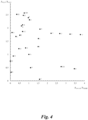
- Fig. 4 is a graph using the data in column 5 in table 1 as x-axis and column 6 as y-axis.
- Each substance is represented by their coordinates in this two-dimensional graph.
- the coordinates are uniquely related to any one of the substances, although some of them are clustering in certain areas.
- To each coordinate a tensor can assigned and the magnitude and direction of the tensor is a unique property of each one of the listed substances and can be used to identified an unidentified substance.
- a tensor can assigned and the magnitude and direction of the tensor is a unique property of each one of the listed substances and can be used to identified an unidentified substance.
- ethyl alcohol its closest neighbors in the graph are isopropyl alcohol and methyl alcohol.
- the embodiment in relation to Fig 3c utilizing three wavelength bands is an extension by which a third dimension is added to the graph of Fig. 4 .
- This implementation is useful to avoid the tendency of coordinate clustering illustrated in the graph of Fig. 4 , and to improve the reliability of substance identification.
- a subset from the set of preselected substances has been predefined.
- the predefined subset could be a set of detectable substances for which legal regulations, limit values stipulated by an industrial standard, limits imposed by an employer or equivalent exists. Such substances will be referred to as substances for which a regulation defining a maximum allowed concentration in breath or blood exists.
- a further step of the method, step 67 comprises checking if the identified substance is one of the substances in the predefined subset. The step of determining a breath concentration value of the identified substance wherein the tracer gas concentration value is utilized may be performed only if the identified substance is in the subset.
- the tabulated data for the preselected set of substances has been arranged as tensor elements with coordinates representing absorption comparative values and a total absorption values for respective substance
- the steps of comparing 64 and determining 65 comprises arranging the absorption comparative value and the total absorption value of the unidentified substance as coordinates in a corresponding multidimensional tensor, and quantifying the distance from the coordinates of the unidentified substance to at least a portion of the substances in the set of preselected substances and selecting the closest substance as the identified substance.
- Computationally this can be done by a number of known routines, for example transformation of the coordinates of the tensor to place the coordinates of the unidentified substance in origo and calculating the distances to the other substances.
- the distances may be quantified by calculating the magnitudes and directions of the multidimensional tensors.
- the preselected transition wavelength , ⁇ t is between 3.3 and 3.6 ⁇ m, and preferably between 3.4 and 3.5 ⁇ m.
- the control unit 10 of the breath analysis apparatus 100 is configured to control and/or perform the method according to the invention.
- the control unit 10 is configured to receive the signals (61) discussed in the method according to the invention and to perform the steps of determining an absorption comparative value 62, determining a total absorption value 63, comparing the absorption comparative value and the total absorption value with tabulated data 64 and identifying 65.
- the control unit 10 may further be configured to identify the reception of a human breath sample 60a and to determine tracer gas concentration value 60b.
- the first interference filter 7 is arranged in the optical path and configured to transmit a first wavelength band within the preselected wavelength range through the filter to be passed on to the first infrared detector 6 while reflecting a second wavelength band within the preselected wavelength range to be passed on to a second infrared detector 8, thereby the first infrared detector is configured to generate a first absorption signal, A 1 , corresponding to the first wavelength band and the second infrared detector is configured to generate a second absorption signal, A 2 , corresponding to the second wavelength band.
- the control unit 10 is arranged to receive at least the first and second absorption signals and to output a result indicating the quantified presence or absence of the unidentified substance within the breath sample.
- the control unit 10 is configured to determine an absorption comparative value representing a comparison at least between the absorption in the first wavelength band and the absorption in the second wavelength band and a total absorption value representing a total absorption in at least the combined first wavelength band and the second wavelength band, and to compare the absorption comparative value and the total absorption value with tabulated data for a preselected set of substances arranged with corresponding values, and identifying the unidentified substance as the substance from the set of preselected substances representing the best match in terms of the absorption comparative values and the total absorption values.
Landscapes
- Physics & Mathematics (AREA)
- Health & Medical Sciences (AREA)
- Life Sciences & Earth Sciences (AREA)
- Spectroscopy & Molecular Physics (AREA)
- General Physics & Mathematics (AREA)
- Chemical & Material Sciences (AREA)
- Pathology (AREA)
- General Health & Medical Sciences (AREA)
- Immunology (AREA)
- Analytical Chemistry (AREA)
- Biochemistry (AREA)
- Engineering & Computer Science (AREA)
- Biomedical Technology (AREA)
- Molecular Biology (AREA)
- Biophysics (AREA)
- Urology & Nephrology (AREA)
- Hematology (AREA)
- Food Science & Technology (AREA)
- Medicinal Chemistry (AREA)
- Surgery (AREA)
- Animal Behavior & Ethology (AREA)
- Veterinary Medicine (AREA)
- Public Health (AREA)
- Medical Informatics (AREA)
- Physiology (AREA)
- Pulmonology (AREA)
- Heart & Thoracic Surgery (AREA)
- Algebra (AREA)
- Mathematical Physics (AREA)
- Mathematical Analysis (AREA)
- Pure & Applied Mathematics (AREA)
- Mathematical Optimization (AREA)
- Investigating Or Analysing Materials By Optical Means (AREA)
Description
- The present invention relates to a breath analyzing system and method. In particular the invention relates to a breath analyzing system and method arranged to provide absorption information in at least two different wavelength bands and using the information from the wavelength bands to identify an unidentified substance from a set of preselected substances.
- Breath analyzing equipment is becoming increasingly common, not at least in vehicles as a measure to detect and prevent driving under the influence of intoxicating substances. The breath analyzing equipment may be a stand-alone, even handheld, unit that gives a measured value of the content of a substance or substances in the driver's breath. Alternatively, breath analyzing equipment may be part of a system wherein also including equipment for identifying the driver and/or immobilizing the vehicle. Such breath analyzing equipment is typically permanently mounted in the vehicle and may be an integral part of the dashboard, for example. Breath analyzing equipment may also be stationary systems used to control access to a work area, a vehicle fleet depot or the like.
- To provide a breath analyzer that has an appropriate sensitivity, is reliable and provides a reasonable fast analysis is far from trivial. This is especially true if the breath analyzing equipment should be able to detect a plurality of substances and not being disturbed by variation in moisture, CO2 content etc. Breath analyzing equipment that fulfills these requirements are described in for example
US7919754 andUS9746454 - Breath alcohol analyzers based on non-dispersive infrared (NDIR) sensors commonly operate in the 9.4-9.6 µm wavelength range, as exemplified in the above referred patents. In this wavelength range ethyl alcohol has a strong absorption band with minor cross sensitivity to other substances. There are, however, challenges related to signal resolution, availability of infrared sources and detectors with adequate performance, and bulky design related to the long optical paths required.
- Operation in the 3.3-3.6 µm range offers several advantages but has been hampered by high cross sensitivity to many substances which may occur in breath due to endogenous or exogenous origin. Current state of the art breath alcohol analyzers operating in the 3.3-3.6 µm range are typically equipped with a chopper wheel with several optical filters to perform the analysis.
US 4,268,751 discloses a breath alcohol analyzer with a chopper wheel with several optical filters and has the capability of distinguishing between ethyl alcohol and acetone by means of two narrow-band filters at 3.39 and 3.48 µm. The chopper wheel design, incorporating plurality of moving parts, is not suitable outside a laboratory environment. Additionally a multiplicity of narrow-band filters such as described in "Determination of ethanol in breath for legal purposes using a five-filter infrared analyzer: studies on response to volatile interfering substances", A.W. Jones et al., JOURNAL OF BREATH RESEARCH, vol. 2, no. 2, 1 June 2008 (2008-06-01), would be needed to discern between more substances than ethyl alcohol and acetone. This would make the detector even more complicated, costly and unsuited for vehicle mounted or handheld devices. - The object of the invention is to provide a breath analyzing system and method of operation that overcomes the drawbacks of operating in the 9.4-9.6 µm wavelength range and is suitable for being used in the field.
- This is achieved by the breath analyzing method as defined in
claim 1, and the breath analysis apparatus as defined inclaim 18. - The breath analysis apparatus according to the invention for non-dispersive breath analysis operating in a preselected wavelength range of an unidentified substance , the breath analysis apparatus comprises:
- a measuring cell comprising non-dispersive infrared elements , the measuring cell comprising:
- a source configured to transmit an infrared beam and at least first detector (6) and a second detector of infrared radiation within said wavelength range,
- at least two concave mirrors arranged to control an infrared beam from said source to traverse the cell multiple times, thereby extending the optical path well beyond the physical dimensions of the cell,
- a first interference filter with a first characteristic transition wavelength combined with a first infrared detector arranged in the optical path and configured to transmit a first wavelength band within the preselected wavelength range through the filter to the first infrared detector while reflecting a second wavelength band within the preselected wavelength range to be passed on to a second infrared detector, thereby the first infrared detector is configured to generate a first absorption signal associated to the first wavelength band and the second infrared detector is configured to generate a second absorption signal associated to the second wavelength band, wherein the first and second wavelength bands are at least to a major part separated by a preselected transition wavelength, λ1, in the wavelength range between 3.3 and 3.6 µm, and preferably between 3.4 and 3.5 µm.
- According to the invention the breath analysis apparatus further comprises a control unit arranged to receive at least the first and second absorption signals, the control unit configured to determine an absorption comparative value representing a comparison at least between the absorption in the first wavelength band and the absorption in the second wavelength band and a total absorption value representing a total absorption in the combined first wavelength band and the second wavelength band, and to compare the absorption comparative value and the total absorption value with tabulated data for a preselected set of substances arranged with corresponding values, and identifying the unidentified substance as the substance from the set of preselected substances representing the best match in terms of the absorption comparative values and the total absorption values. According to an aspect of the invention the breath analysis apparatus further comprises an auxiliary sensor unit configured to identify the reception of a human breath sample by means of peak detection of at least one tracer gas and determining a tracer gas concentration value. The control unit is typically configured to also determine breath concentration value of the identified substance using the tracer gas concentration value.
- The method according to the invention of identifying an unidentified substance from a set of preselected substances during breath analysis of a human breath sample in a measuring cell using non-dispersive spectroscopy in a preselected wavelength range comprises the steps of:
- recording at least a first signal from a first infrared detector and a second signal from a second infrared detector, wherein the first signal represents the absorption in a first wavelength band in the in the preselected wavelength range and the second signal represents the absorption in a second wavelength band in the preselected wavelength range, wherein the first and second wavelength bands are at least to a major part separated by a preselected transition wavelength, λt;
- determining an absorption comparative value representing a comparison of at least the absorption in the first wavelength band and the absorption in the second wavelength band; and
- determining a total absorption value representing a total absorption in the combined first wavelength band and the second wavelength band;
- comparing the absorption comparative value and the total absorption value with tabulated data for the preselected set of substances arranged with corresponding values, and
- identifying the unidentified substance as the substance from the set of preselected substances representing the best match in terms of the absorption comparative values and the total absorption values.
- According to the invention the preselected transition wavelength of the measuring cell, λt, is given by transition wavelength of the first interference filter, λ1, the first interference filter being a high-pass filter and transmitting wavelengths above the preselected transition wavelength, λt, to the first infrared detector and passing wavelengths below the preselected transition wavelength, λt, to at least the second infrared detector. Alternatively the first interference filter is a low-pass filter transmitting wavelengths below the preselected transition wavelength, λt, to the first infrared detector and passing wavelengths above the preselected transition wavelength, λt, to at least the second infrared detector.
- According to an aspect of the invention the non-dispersive spectroscopy is infrared non-dispersive spectroscopy and the preselected wavelength range is 3.3 to 3.6 µm.
- According to an aspect of the invention the method further comprises a step of identifying the reception of a human breath sample by means of peak detection of at least one tracer gas and determining a tracer gas concentration value. A breath concentration value of the identified substance may be determined using the tracer gas concentration value.
- According to an aspect of the invention if the identified substance is not ethanol, an error indication is issued.
- According to an aspect of the invention a subset from the set of preselected substances has been predefined and a further step of determining a breath concentration value of the identified substance wherein the tracer gas concentration value is utilized is performed only if the identified substance is one of the substances in the subset. The predefined subset typically comprises substances for which regulations defining a maximum allowed concentration in breath or blood exists.
- According to an aspect of the invention the absorption comparative value is a ratio between the absorption in the first wavelength band and the absorption in the second wavelength band. According to an aspect of the invention the total absorption is the sum of the absorption in the first wavelength band and the second wavelength band normalized with the tracer gas concentration value.
- According to an aspect of the invention the tabulated data for the preselected set of substances has been arranged as tensor elements with coordinates representing absorption comparative values and a total absorption values for respective substance, and the step of comparing and determining comprises arranging the absorption comparative value and the total absorption value of the unidentified substance as coordinates in a corresponding multidimensional tensor, and quantifying the distance from the coordinates of the unidentified substance to at least a portion of the substances in the set of preselected substances and selecting the closest substance as the identified substance. The distances may be quantified by calculating the magnitudes and directions of the multidimensional tensors.
- According to an aspect of the invention if a deviation in magnitude and direction between the unidentified substance and the identified substance is larger than a predetermined value, a notification is issued that identification of the unidentified substance could not be performed.
- According to an aspect of the invention the preselected transition wavelength, λt, is between 3.3 and 3.6 µm, and preferably between 3.4 and 3.5 µm.
- According to an aspect of the invention the first wavelength band and the second wavelengths band overlaps partly.
- According to an aspect of the invention a specific target substance has been preselected and by that selection a number of potential interfering substances are identified, and the selection of interferences filters, as well as the numbers of filters and detectors, has been performed to optimize the separation of the target substance from the identified potential interfering substances. The specific target substance is typically ethyl alcohol and the identified potential interfering substances includes at least one of the substances: methyl alcohol, acetone, isopropyl alcohol and 1-propanol
- According to an aspect of the method according to invention of the of recording comprises recording a first signal from a first infrared detector provided with a first interference filter with a first characterizing transition wavelength, a second signal from a second infrared detector provided with a second interference filter with a second characterizing transition wavelength and a third signal from a third infrared detector, wherein the first signal represents the absorption in a first wavelength band, the second signal represents the absorption in a second wavelength band and the third signal represents the absorption in a third wavelength band in the preselected wavelength range, wherein the first and second wavelength bands are at least to a major part separated by a preselected first transition wavelength, λ1, corresponding to the first transition wavelength associated with the first interference filter and the second and third wavelength bands are at least to major part separated by a preselected second transition wavelength, λ2, corresponding to the second transition wavelength associated with the second interference filter; and
in the steps of determining the absorption comparative value and the total absorption value, the absorption values of the first, second and third wavelength bands are utilized. - According to an aspect of the invention the breath analysis apparatus further comprises:
- a second interference filter with a characteristic transition wavelength combined with the second infrared detector; and
- a third infrared detector, and the control unit is configured to:
- record a first signal from a first infrared detector, a second signal from a second infrared detector and a third signal from a third infrared detector, wherein the first signal represents the absorption in a first wavelength band, the second signal represents the absorption in a second wavelength band and the third signal represents the absorption in a third wavelength band in the preselected wavelength range, wherein the first and second bands are at least to a major part separated by the preselected first transition wavelength, λ1, and wherein the second and third bands are at least to a major part separated by the preselected second transition wavelength, λ1, given by the characteristic transition wavelength of the second interference filter; and
- to determine the absorption comparative value representing a comparison between the absorption in the first wavelength band, the absorption in the second wavelength band and the absorption in the third wavelength band and the total absorption value represents a total absorption in the combined first wavelength band, the second wavelength band and the third wavelength band.
- Thanks to the invention it is possible to provide a breath analysis apparatus operating in the 3.3-3.6 µm range. Thereby the breath analysis apparatus for non-dispersive breath analysis can be made in a compact format due to a shorter optical path. It is further possible to use components such as radiation sources and detectors that are less costly than in higher wavelength ranges.
- One advantage afforded by the present invention is to identify a substance from a set of preselected substances in a efficient manner and with equipment that is comparably simple, and therefore robust and less costly compared to prior art techniques.
- One further advantage is that it is possible to provide an accurate and reproducible separation of the 3.3-3.6 µm wavelength range into a first and second wavelength band by the uses of only one interference filter.
- One further advantage is that it is possible to identify and discern between ethyl alcohol (ethanol) and a number of known "disturbing substances" by dividing the 3.3-3.6 µm wavelength range into only a first and second wavelength band and compare the absorption values according to the invention.
- In the following, the invention will be described in more detail, by way of example only, with regard to non-limiting embodiments thereof, reference being made to the accompanying drawings.
-
-
Fig. 1 is a schematic illustration of a breath analysis apparatus according to the present invention; -
Fig. 2 is a graph showing absorption of ethyl alcohol in the 3.3-3.6 µm wavelength range; -
Fig. 3a is a graph showing interference filter characteristics with one interference filter with a cutoff wavelengths of 3.5 µm, 3b is a graph showing interference filter characteristics with two interference filter with a cutoff wavelengths of 3.5 µm 3.4 µm respectively, and 3c 3b is a graph showing bandpass interference filter characteristics with two interference filter with bandpass wavelengths centered around 3.35, 3.45 and 3.55 µm, respectively; -
Fig. 4 is a graph illustrating the mapping of absorption characteristics of selected substances based on data of Table 1; -
Fig. 5a-e are schematic graphs illustrated the timing pattern of breath related signals; and -
Fig 6 is a flowchart of the method according to the present invention. - Terms such as "top", "bottom", upper", lower", "below", "above" etc are used merely with reference to the geometry of the embodiment of the invention shown in the drawings and/or during normal operation of the helmet and are not intended to limit the invention in any manner.
- The
breath analysis apparatus 100 according to the invention is schematically depicted inFig. 1 , and comprises a non-dispersive infrared (NDIR)measurement cell 1. The measuringcell 1 is configured to be operative in a preselected wavelength range, the preselected wavelength range typically governing the majority of other design parameters such as light source, detectors, filters, optical path etc. The measuringcell 1 according to the invention intended for detection of ethyl alcohol is optimized for a wavelength range of 3.3 to 3.6 µm.Fig 2 shows the absorption spectrum of ethyl alcohol in the wavelength range of 3.3-3.6 µm The double peaks indicate that the CH bonds are affected by the presence of an OR-group in one of the two carbon atoms of the molecule. In the spectra of other substances, it is possible to find other characteristics of the spectrum connecting to the molecular structure. - As apparent for the skilled person a breath analysis apparatus also comprises for example a housing, a mouthpiece, air ducts, a power unit and typically one or more fans and steerable vents. The basic designs of breath analysis apparatuses for different purposes, e.g. stationary, handheld and vehicle mounted are known in the art, for example from
US7919754 andUS9746454 - The
breath analysis apparatus 100 is provided with aninlet portion 100a for receiving a breath sample from a human being and an outlet portion 100b for the breath sample to exit from the measuringcell 1. The breath sample is passing through the measuringcell 1 as indicated by the vertical arrows at the inlet and outlet portions 1a, 1b of the measuringcell 1. A beam of infrared radiation, indicated by dashed lines, is passing through the measuring cell in the transverse direction, starting from thelight source 5 and being reflected multiple times I, II, III, IV, V, VI, VII VIII byconcave mirrors - The
light source 5 is an IR source being a black body emitter or light emitting diode, LED, operating within the preselected wavelength range. A suitable LED is made from multiple hetero-structures of III-V compounds with various constitution to operate as active layer and layers transparent to the emitted radiation. Both black body emitters, such as dedicated light bulbs and LEDs fulfill the necessary requirements for acting as suitable emitters in the system according to the invention. - The measuring
cell 1 is provided with at least a firstinfrared detector 6 provided with afirst interference filter 7 to precisely control the transmission and reflection of the infrared radiation. The transmitted portion of the infrared radiation is received by the first infrared detector and the reflected portion will after a number of reflections by theconcave mirrors infrared detector 8. The infrared detectors/interference filters are typically provided on or near one of theconcave mirrors infrared detector 8 may be provided with a second interference filter 9 and further infrared detectors may be provided in the measuringcell 1. The interference filters 7, 9 typically include a transparent substrate with a multilayer thin film structure in which the layers have interchanging high and low index of refraction. The effect of this multilayer structure is to control the transmission and reflection properties of the filter. The transition wavelength, λt, is selectable by choice of materials and thicknesses of the multilayer structure. Typically interference filters suitable in the measuringcell 1 are high-pass or low-pass filters characterized by a transition wavelength λ above which the filter is transmitting (reflecting) radiation, and below which the filter is reflecting (transmitting). The transition wavelength may also be referred to as the cut-off wavelength. Alternatively the interference filters are bandpass filters which transmit wavelengths in a defined portion of the spectra and reflects outside of that defined portion. Suitable filters are commercially available. The first and second wavelength bands should to the major part not overlap, although a minor overlapping portion is acceptable. The selection of first and second wavelength band will be further discussed below. - According to one embodiment of the invention the first and second wavelength bands are completely separated. This may be achieved by using bandpass interference filters for the first and second interference filters with their transmitting portions sufficiently far apart. According to one embodiment of the invention the first and second wavelength bands overlap at the most 20 %, and preferably at the most 10%.
- According to one embodiment of the invention the
first interference filter 7 is a high-pass or low-pass filter with a characteristic transition wavelength, λ1, and the secondinfrared detector 8 is not combined with any interference filter. The measuringcell 1 will facilitate detection in a first wavelength band and in a second wavelength band with only thefirst interference filter 7. The measuringcell 1 will be characterized by a preselected transition wavelength, λt, separating the first and second wavelength bands. The preselected transition wavelength, λt, is in this configuration given solely by the transition wavelength of the first interference filter, λ1. - To achieve a separation of the preselected wavelength range into two bands using only one interference filter could be advantageous according to some aspect since it is a simple and robust design and high reproducibility between different measuring
cells 1 could be expected. This is of particular importance since the method of the invention utilizes comparison with tabulated values in the performed analysis to identify an unidentified substance. This comparison is sensitive to variations in the cells preselected transition wavelength, λt, and therefore a simple, yet stable, configuration is advantageous. - According to one embodiment of the invention the measuring
cell 1 is provided with afirst interference filter 7 with a first transition wavelength, λ1, a secondinfrared detector 8 provided with a second interference filters 9 with a second transition wavelength, λ2, and a third infrared detector (not shown). Similar to what has been described above the measuringcell 1 will in this embodiment have a first, a second and a third wavelength band defining three regions in the preselected wavelength range 3.3 to 3.6 µm. The measuringcell 1 is characterized by a first preselected transition wavelength, λt1, separating the first and second wavelength band and a second preselected transition wavelength, λt2, separating the second and third wavelength band. The measuring cells first preselected transition wavelength, λt1,is given by the transition wavelength of the first interference filter, λ1, and the second preselected transition wavelength, λt2, is given by the transition wavelength of the second interference filter, λ2. - Detectors covering the 3.3-3.6 µm band are commercially available. Such detectors are typically photonic devices, e g photodiodes, having selective properties regarding responsivity to infrared radiation compared to e g thermopiles which are sensitive also to thermal effects due to convection or conduction.
- Typical dimensions of the measuring
cell 1 range between 14 x 16 x 6 mm and 90 x 50 x 30 mm with an optical path of 300 - 1000 mm depending on the actual application. - The measuring
cell 1 may include anauxiliary sensor unit 11 with sensors 12 and control elements 13 with the objective of identifying a human breath and controlling the air flow through the measuring cell. These elements could preferably include means for the detection and quantification of a tracer gas, for example carbon dioxide or water vapor, which is inherently included in human breath. - The signals to and from the measuring
cell 1 are controlled by ancontrol unit 10 which is capable of real time signal processing and to execute preloaded and/or downloaded instructions. Thecontrol unit 10 may also be provided with communication means or connected to communications means for communication with for example a vehicle communication unit, a remote server etc. The communication may be wireless or wirebound. - As discussed in the background section a challenge in using the 3.3-3.6 µm range is the overlap of absorption signal between substances that could be present in a person's breath sample or in the environment wherein the sample is taken. The latter is particularly problematic if so called passive breath analysis is utilized, i.e. breath analysis performed without the person blowing into a mouthpiece. It has commonly been believed that a detailed spectrum analysis measurement, as exemplified in
Fig. 2 , is needed to discern for example ethyl alcohol from acetone or methyl alcohol. This requires expensive and complicated equipment. The inventors have realized that a careful selection of a limited number of wavelength bands within the 3.3-3.6 µm range is sufficient to identify and discern between a substantial number of substances that are either known volatile substances, target substances" or substances that are commonly known to disturb the measurements of target substances. -
Fig. 3a shows the two spectra, 32 and 33 associated with the embodiment using only one interference filter, in this case a high-pass interference filter with a transition wavelength, λ1, of 3.5 µm. The overlapping portion is depending on how sharp the transition is at the transition wavelength. -
Fig. 3b shows the three spectra, 31', 32' and 33' associated with the embodiment a second interference filter and a further infrared detector (without filter), the second interference filter having a transition wavelength at 3.4 µm. - As discussed previously also bandpass interference filters could be used and
Fig. 3c illustrates an embodiment wherein each three sensors are provided with bandpass interference filters: I thefirst interference filter 7 is configured to have the characteristic transmission illustrated bycurve 33", i.e. a center wavelength of 3.55 µm and a width of 0.10 µm. Interference filter 9 is configured to have the characteristic transmission illustrated bycurve 32", i.e. a center wavelength of 3.45 µm and a width of 0.10 µm. The third 9 is configured to have the characteristic transmission illustrated bycurve 31", i.e. a center wavelength of 3.35 µm and a width of 0.10 µm. - Both the embodiment referring to
Fig 3b and 3c give two transition wavelengths at 3.4 and 3.5 µm, dividing the wavelength range 3.3-3.6 into three wavelength bands. - In table 1 spectroscopic data from thirty substances, representing a preselected set of substances, have been combined with the filter spectra 31'/31", 32'/32" and 33'/33" to simulate absorption signals from the various wavelength bands, all normalized to ethanol (EtOH). The substances have been selected to represent gases which could be present in human breath for both endogenous and exogenous reasons. The spectroscopic data were obtained from Pacific Northwest National Laboratory, USA.
- The six columns of Table 1 represent name of substance (left column), normalized absorption of the three wavelength bands (columns 2-4), the combined normalized absorption of the bands 3.4-3.5 µm and 3.5-3.6 µm (column 5), and the ratio between the absorption of the bands (column 6).
-
Fig. 4 is a graph using the data incolumn 5 in table 1 as x-axis andcolumn 6 as y-axis. Each substance is represented by their coordinates in this two-dimensional graph. The coordinates are uniquely related to any one of the substances, although some of them are clustering in certain areas. To each coordinate a tensor can assigned and the magnitude and direction of the tensor is a unique property of each one of the listed substances and can be used to identified an unidentified substance. With the objective of identifying a certain unidentified substance, for example ethyl alcohol, its closest neighbors in the graph are isopropyl alcohol and methyl alcohol. Even though the magnitudes of their respective tensors do not differ very much, they may be distinguished from each other by different directions in the two-dimensional graph. Conversely, the tensors of 1-propanol and pentane have almost the same direction as that of ethyl alcohol, but their magnitudes differ significantly. - The embodiment described in relation to
figures 1 and3a-b utilizing one interference filter provides absorption signals which may directly be compared to the graph ofFig. 4 . From absorption signals from a breath sample comprising one or more unidentified substances, its coordinates can be calculated and compared with the library obtained fromcolumns - The embodiment in relation to
Fig 3c utilizing three wavelength bands is an extension by which a third dimension is added to the graph ofFig. 4 . This implementation is useful to avoid the tendency of coordinate clustering illustrated in the graph ofFig. 4 , and to improve the reliability of substance identification. - These embodiments are illustrating the basic principle of using a multidimensional property to be represented as a tensor having the rank of the actual dimensionality of the implementation, the first and second embodiment having rank two and three, respectively.
-
Fig. 5a-e shows a typical timing pattern of signals from two consecutive breath samples obtained from theauxiliary sensor unit 11, seeFig. 1 and from the measuringcell 1. Peaks of carbon dioxide CO2 (a), water vapor H2O (b), air flow (c), and the NDIR bands below (d) and above 3.5 µm (e) occur almost simultaneously. By recording these signals their origin from a human breath can be established. The signal baselines between breaths provide important information concerning eventual background concentration of any of the key substances. - The method of identifying an unidentified substance from a set of preselected substances is illustrated in the flowchart of
Fig. 6 . The method is performed during breath analysis of a human breath sample in a measuring cell according to the invention with a preselected wavelength range, and the method comprises the steps of: - 61: recording at least a first signal from a first infrared detector provided with a first interference filter and second signal from a second infrared detector, wherein the first signal represents the absorption, A1 , in a first wavelength band in the in the preselected wavelength range and the second signal represents the absorption in a second wavelength band, A2 , in the preselected wavelength range, wherein the first and second wavelength bands are at least to a major part separated and a preselected transition wavelength, λt, is separating the first and second wavelength band
- 62: determining an absorption comparative value representing a comparison of at least the absorption, A1 , in the first wavelength band and the absorption, A2 , in the second wavelength band;
- 63: determining a total absorption value representing a total absorption in at least the combined first wavelength band and the second wavelength band;
- 64: comparing the absorption comparative value and the total absorption value with tabulated data for the preselected set of substances arranged with corresponding values;
- 65: identifying the unidentified substance as the substance from the set of preselected substances representing the best match in terms of the absorption comparative values and the total absorption values.
- According to one embodiment the first infrared detector is provided with a first interference filter and the preselected transition wavelength, λ1, is the transition wavelength of the first interference filter thereby transmitting wavelengths above/below the preselected transition wavelength, λ1, to the first infrared detector and passing wavelengths below/above the preselected transition wavelength, λ1, to at least the second infrared detector. If wavelengths above/below the transmission wavelength is transmitted or reflected by the
first interference filter 7 depends on if a high-pass or a low-pass configuration is utilized. - According to one embodiment, if the identified substance is not a predetermined target substance, for example ethyl alcohol, the method comprises the additional step,
step 66, of issuing an error signal or message. Such an error message could include instructions to the user to move closer to the detector, to use a mouthpiece, if the first attempt was using passive detection, for example. - Typically the method also comprises a step,
step 60a, of identifying the reception of a human breath sample by means of peak detection of at least one tracer gas, for example carbon dioxide and/or water vapor and a step,step 60b, of determining a tracer gas concentration value. This is preferably performed utilizing theauxiliary sensor unit 11. The identification of the reception of a human breath sample is used as a trigger for the further steps, which is exemplified inFig. 5 . In a step 67 a breath concentration value of the identified substance may be determined using the tracer gas concentration value is utilized. - According to one embodiment the absorption comparative value is a ratio between the absorption in the first wavelength band and the absorption in the second wavelength band, for example the ratio: A1 /A2.
- According to one embodiment the total absorption is the sum, A1 +A2 , of the absorption in the first wavelength band and the second wavelength band preferably normalized with the tracer gas concentration value.
- According to one embodiment a subset from the set of preselected substances has been predefined. The predefined subset could be a set of detectable substances for which legal regulations, limit values stipulated by an industrial standard, limits imposed by an employer or equivalent exists. Such substances will be referred to as substances for which a regulation defining a maximum allowed concentration in breath or blood exists. A further step of the method,
step 67, comprises checking if the identified substance is one of the substances in the predefined subset. The step of determining a breath concentration value of the identified substance wherein the tracer gas concentration value is utilized may be performed only if the identified substance is in the subset. - According to one embodiment and with reference to the discussion referring to Table 1 and
Fig. 4 , the tabulated data for the preselected set of substances has been arranged as tensor elements with coordinates representing absorption comparative values and a total absorption values for respective substance The steps of comparing 64 and determining 65 comprises arranging the absorption comparative value and the total absorption value of the unidentified substance as coordinates in a corresponding multidimensional tensor, and quantifying the distance from the coordinates of the unidentified substance to at least a portion of the substances in the set of preselected substances and selecting the closest substance as the identified substance. Computationally this can be done by a number of known routines, for example transformation of the coordinates of the tensor to place the coordinates of the unidentified substance in origo and calculating the distances to the other substances. The distances may be quantified by calculating the magnitudes and directions of the multidimensional tensors. - According to one embodiment if a deviation in magnitude and direction between the unidentified substance and the identified substance is larger than a predetermined value, a notification is issued that identification of the unidentified substance could not be performed.
- According to one embodiment the preselected transition wavelength ,λt, is between 3.3 and 3.6 µm, and preferably between 3.4 and 3.5 µm.
- As discussed referring to Table 1 and
Fig. 4 the choice of the characteristics of the interferences filters, as well as the numbers of filters (detectors) greatly effects the multidimensional separation of substances. According to one embodiment a specific target substance is identified, for example ethyl alcohol, and the selection of interferences filters, as well as the numbers of filters, is done to optimize the separation of the target substance from known "close neighbors". According to one embodiment the specific target is ethyl alcohol and the filter parameters are selected to give a first preselected transition wavelength, λt1, of 3.5 µm. Alternatively the filter parameters are selected to give a first preselected transition wavelength, λt, of 3.5 µm and a second preselected transition wavelength, λt2, of 3.4 µm. - The
control unit 10 of thebreath analysis apparatus 100 according to the invention is configured to control and/or perform the method according to the invention. In particular thecontrol unit 10 is configured to receive the signals (61) discussed in the method according to the invention and to perform the steps of determining an absorptioncomparative value 62, determining atotal absorption value 63, comparing the absorption comparative value and the total absorption value with tabulateddata 64 and identifying 65. Thecontrol unit 10 may further be configured to identify the reception of ahuman breath sample 60a and to determine tracergas concentration value 60b. - According to one embodiment of the
breath analysis apparatus 100 according to the invention, thefirst interference filter 7 is arranged in the optical path and configured to transmit a first wavelength band within the preselected wavelength range through the filter to be passed on to the firstinfrared detector 6 while reflecting a second wavelength band within the preselected wavelength range to be passed on to a secondinfrared detector 8, thereby the first infrared detector is configured to generate a first absorption signal, A1 , corresponding to the first wavelength band and the second infrared detector is configured to generate a second absorption signal, A2 , corresponding to the second wavelength band. Thecontrol unit 10 is arranged to receive at least the first and second absorption signals and to output a result indicating the quantified presence or absence of the unidentified substance within the breath sample. Thecontrol unit 10 is configured to determine an absorption comparative value representing a comparison at least between the absorption in the first wavelength band and the absorption in the second wavelength band and a total absorption value representing a total absorption in at least the combined first wavelength band and the second wavelength band, and to compare the absorption comparative value and the total absorption value with tabulated data for a preselected set of substances arranged with corresponding values, and identifying the unidentified substance as the substance from the set of preselected substances representing the best match in terms of the absorption comparative values and the total absorption values. - The embodiments described above are to be understood as illustrative examples of the system and method of the present invention. It will be understood that those skilled in the art that various modifications, combinations and changes may be made to the embodiments. In particular, different part solutions in the different embodiments can be combined in other configurations, where technically possible.
Substance Ref 3.30-3.40 µm 3.40-3.50 µm 3.50-3.60 µm A3.4-3.6 /A EtOH A<3.5 /A>3.5 Acetone B 0.37 0.15 0.17 0.16 0.94 Acetaldehyde C 0.16 0.19 2.96 1.58 0.06 Benzene D 0.12 0.02 0.06 0.04 0.33 Butyl acetate E 1.96 1.36 0.57 0.97 2.39 Carbon dioxide* F 0.00 0.00 0.00 0 - Carbon monoxide* G 0.00 0.00 0.00 0 - Diethyl ether H 1.77 2.16 4.74 3.45 0.46 Ethanol (EtOH) A 1.00 (norm) 1.00 (norm) 1.00 (norm) 1.0 (norm) 1.0 (norm) Ethyl acetate I 1.07 0.37 0.22 0.30 1.68 1-propanol J 1.45 1.69 1.30 1.50 1.30 Ethyl benzene K 1.29 0.81 0.39 0.60 2.08 Ethyl tert-butyl ether L 3.00 1.86 1.16 1.51 1.60 Furfuryl alcohol M 0.26 0.50 0.41 0.46 1.22 Isopropyl alcohol N 1.53 0.91 0.73 0.82 1.25 Methane O 0.43 0.11 0.06 0.09 1.83 Methyl alcohol P 0.79 0.73 1.46 1.09 0.50 Methyl ethyl ketone Q 0.93 0.64 0.37 0.51 1.73 m-Xylene R 1.03 0.99 0.40 0.70 2.48 n-Butane S 2.42 2.12 1.08 1.60 1.96 n-Heptane T 3.11 4.11 2.32 3.22 1.77 n-Hexane U 2.89 3.43 1.92 2.67 1.79 Octane V 3.32 4.80 2.75 3.78 1.75 o-Xylene X 1.05 0.89 0.42 0.66 2.12 Pentane Y 2.72 2.82 1.57 2.20 1.80 Propane Z 2.17 1.43 0.62 1.03 2.31 p-Xylene BB 1.17 1.08 0.42 0.75 2.57 t-Butyl alcohol CC 1.98 0.86 0.46 0.66 1.87 Tetrahydrofuran DD 1.93 1.93 3.55 2.74 0.54 Toluene EE 0.57 0.48 0.19 0.34 2.52 Water FF 0.0007 0.00003 0.00004 0.00004 0.75 - Table 1 Absorption characteristics of selected substances relative to ethanol using three filters with center wavelengths 3.35, 3.45, and 3.55 µm, respectively defined by
Fig. 3 . Absorption data from Pacific Northwest National Laboratory, USA were used in the calculations. The entity A3.4-3.6 /AEtOH is the total absorption within the wavelength range 3.4 -3.6 µm normalized to the corresponding absorption of ethanol. A<3.5 /A>3.5 is the ratio between the absorption in the wavelength bands below and above 3.5 µm. * Carbon dioxide and Carbon monoxide do not show any absorption in these wavelength ranges and are not included in the graph ofFig. 4 .
Claims (27)
- Method of identifying an unidentified substance from a set of preselected substances during breath analysis of a human breath sample in a measuring cell using non-dispersive spectroscopy in a preselected wavelength range, the method comprising the steps of:- (61) recording at least a first signal from a first infrared detector and a second signal from a second infrared detector, wherein the first signal represents the absorption in a first wavelength band in the preselected wavelength range and the second signal represents the absorption in a second wavelength band in the preselected wavelength range, wherein the first and second wavelength bands are at least to a major part separated by a preselected transition wavelength, λt;- (62) determining an absorption comparative value representing a comparison of at least the absorption in the first wavelength band and the absorption in the second wavelength band; and- (63) determining a total absorption value representing a total absorption in the combined first wavelength band and the second wavelength band;- (64) comparing the absorption comparative value and the total absorption value with tabulated data for the preselected set of substances arranged with corresponding values, and- (65) identifying the unidentified substance as the substance from the set of preselected substances representing the best match in terms of the absorption comparative values and the total absorption values, and- wherein the first infrared detector is provided with a first interference filter with a transition wavelength, λ1, and the preselected transition wavelength of the measuring cell, λt, is given by transition wavelength of the first interference filter, λ1, the first interference filter transmitting wavelengths above the preselected transition wavelength, λt, to the first infrared detector and passing wavelengths below the preselected transition wavelength, λt, to at least the second infrared detector, or- wherein the first infrared detector is provided with a first interference filter with a transition wavelength, λ1, and the preselected transition wavelength of the measuring cell, λt, is given by transition wavelength of the first interference filter, λ1, the first interference filter transmitting wavelengths below the preselected transition wavelength, λt, to the first infrared detector and passing wavelengths above the preselected transition wavelength, λt, to at least the second infrared detector.
- The method according to claim 1, wherein the non-dispersive spectroscopy is infrared non-dispersive spectroscopy and the preselected wavelength range is 3.3 to 3.6 µm.
- The method according to any of the preceding claims, further comprising a step of identifying the reception of a human breath sample (60) by means of peak detection of at least one tracer gas and determining a tracer gas concentration value.
- The method according to claim 3, further comprising a step of determining a breath concentration value of the identified substance (67) wherein the tracer gas concentration value is utilized.
- The method according to any of the preceding claims, wherein, if the identified substance is not ethanol, an error indication is issued.
- The method according to any of the preceding claims, wherein a subset from the set of preselected substances has been predefined and a further step of determining a breath concentration value of the identified substance wherein the tracer gas concentration value is utilized is performed only if the identified substance is one of the substances in the subset.
- The method according to claim 6, wherein the predefined subset comprises substances for which regulations defining a maximum allowed concentration in breath or blood exists.
- The method according to any of the preceding claims, wherein the absorption comparative value is a ratio between the absorption in the first wavelength band and the absorption in the second wavelength band.
- The method according to claim 3, wherein the total absorption is the sum of the absorption in the first wavelength band and the second wavelength band normalized with the tracer gas concentration value.
- The method according to any of the preceding claims, wherein the tabulated data for the preselected set of substances has been arranged as tensor elements with coordinates representing absorption comparative values and a total absorption values for respective substance, and the step of comparing (64) and determining (65) comprises arranging the absorption comparative value and the total absorption value of the unidentified substance as coordinates in a corresponding multidimensional tensor, and quantifying the distance from the coordinates of the unidentified substance to at least a portion of the substances in the set of preselected substances and selecting the closest substance as the identified substance.
- The method according to claim 10, wherein the distances are quantified by calculating the magnitudes and directions of the multidimensional tensors.
- The method according to claim 11, wherein, if a deviation in magnitude and direction between the unidentified substance and the identified substance is larger than a predetermined value, a notification is issued that identification of the unidentified substance could not be performed.
- The method according to any of the preceding claims, wherein the preselected transition wavelength, λt, is between 3.3 and 3.6 µm, and preferably between 3.4 and 3.5 µm.
- The method according to any of the preceding claims, wherein the first wavelength band and the second wavelengths band overlaps partly.
- The method according to any of claims 1-14, wherein in the step of recording comprises recording a first signal from a first infrared detector provided with a first interference filter with a first characterizing transition wavelength, a second signal from a second infrared detector provided with a second interference filter with a second characterizing transition wavelength and a third signal from a third infrared detector, wherein the first signal represents the absorption in a first wavelength band, the second signal represents the absorption in a second wavelength band and the third signal represents the absorption in a third wavelength band in the preselected wavelength range, wherein the first and second wavelength bands are at least to a major part separated by a preselected first transition wavelength, λ1, corresponding to the first transition wavelength associated with the first interference filter and the second and third wavelength bands are at least to major part separated by a preselected second transition wavelength, λ2, corresponding to the second transition wavelength associated with the second interference filter; and
in the steps of determining the absorption comparative value (62) and the total absorption value (63), the absorption values of the first, second and third wavelength bands are utilized. - The method according to claim 1, wherein a specific target substance has been preselected and by that selection a number of potential interfering substances are identified, and the selection of interferences filters, as well as the numbers of filters and detectors, has been performed to optimize the separation of the target substance from the identified potential interfering substances.
- The method according to claim 16, wherein a specific target substance is ethyl alcohol has been preselected and the identified potential interfering substances includes at least one of the substances: methyl alcohol, acetone, isopropyl alcohol and 1-propanol.
- A breath analysis apparatus (100) for non-dispersive breath analysis operating in a preselected wavelength range of an unidentified substance, the breath analysis apparatus comprising:- a measuring cell (1) comprising non-dispersive infrared elements , the measuring cell comprising:- a source (5) configured to transmit an infrared beam;- at least first detector (6) and a second detector (8) of infrared radiation within said wavelength range,- at least two concave mirrors (2, 3, 4) arranged to control an infrared beam from said source to traverse the cell multiple times, thereby extending the optical path well beyond the physical dimensions of the cell (1),- a first interference filter (7) with a first characteristic transition wavelength combined with a first infrared detector (6) arranged in the optical path of the measuring cell (1) and configured to transmit a first wavelength band within the preselected wavelength range through the filter to the first infrared detector (6) while reflecting a second wavelength band within the preselected wavelength range to be passed on to a second infrared detector (8), thereby the first infrared detector (6) is configured to generate a first absorption signal associated to the first wavelength band and the second infrared detector (8) is configured to generate a second absorption signal associated to the second wavelength band, wherein the first and second wavelength bands are at least to a major part separated by a preselected transition wavelength , λ1, in the wavelength range between 3.3 and 3.6 µm, and preferably between 3.4 and 3.5 µm, the breath analysis apparatus (100) further comprising- a control unit (10) arranged to receive at least the first and second absorption signals, the control unit configured to determine an absorption comparative value representing a comparison at least between the absorption in the first wavelength band and the absorption in the second wavelength band and a total absorption value representing a total absorption in the combined first wavelength band and the second wavelength band, and to compare the absorption comparative value and the total absorption value with tabulated data for a preselected set of substances arranged with corresponding values, and identifying the unidentified substance as the substance from the set of preselected substances representing the best match in terms of the absorption comparative values and the total absorption values., and wherein the preselected transition wavelength, λt, is the characteristic transition wavelength, λ1, of the first interference filter (7), and wherein the first interference filter (7) is a high-pass filter transmitting wavelengths above the preselected transition wavelength, λt, to the first infrared detector and passing wavelengths below the preselected transition wavelength, λt, to at least the second infrared detector, or wherein the first interference filter (7) is a low-pass filter transmitting wavelengths above the preselected transition wavelength, λt, to the first infrared detector and passing wavelengths above the preselected transition wavelength, λt, to at least the second infrared detector.
- The breath analysis apparatus according to claim 18, further comprising an auxiliary sensor unit (11) configured to identify the reception of a human breath sample by means of peak detection of at least one tracer gas and determining a tracer gas concentration value.
- The breath analysis apparatus according to claim 18, wherein the control unit (10) is configured to determine breath concentration value of the identified substance using the tracer gas concentration value.
- The breath analysis apparatus according to claim 18, wherein, if the identified substance is not ethanol, the control unit (10) is configured to issue an error indication.
- The breath analysis apparatus according to claim 18, wherein the control unit (10) performs the determination of a breath concentration value of the identified substance only if the identified substance is one of the substances in a predefined subset from the set of preselected substances.
- The breath analysis apparatus according to claim 22, wherein the predefined subset comprises substances for which regulation defining a maximum allowed concentration in breath or blood exists.
- The breath analysis apparatus according to any of claims 18 to 22, wherein the absorption comparative value is a ratio between the absorption in the first wavelength band and the absorption in the second wavelength band.
- The breath analysis apparatus according to claim 23, wherein the total absorption is the sum of the absorption in the first wavelength band and the second wavelength band normalized with the tracer gas concentration value.
- The breath analysis apparatus according to any of claims 18 to 25, wherein the first wavelength band and the second wavelengths band overlaps partly.
- The breath analysis apparatus according to any of claims 18 to 26, further comprising:- a second interference filter (9) with a characteristic transition wavelength combined with the second infrared detector (8); and- a third infrared detector; andwherein the control unit is configured to:- record a first signal from a first infrared detector, a second signal from a second infrared detector and a third signal from a third infrared detector, wherein the first signal represents the absorption in a first wavelength band, the second signal represents the absorption in a second wavelength band and the third signal represents the absorption in a third wavelength band in the preselected wavelength range, wherein the first and second bands are at least to a major part separated by the preselected first transition wavelength, λ1, and wherein the second and third bands are at least to a major part separated by the preselected second transition wavelength, λ1, given by the characteristic transition wavelength of the second interference filter (9); and- to determine the absorption comparative value representing a comparison between the absorption in the first wavelength band, the absorption in the second wavelength band and the absorption in the third wavelength band and the total absorption value represents a total absorption in the combined first wavelength band, the second wavelength band and the third wavelength band.
Applications Claiming Priority (2)
| Application Number | Priority Date | Filing Date | Title |
|---|---|---|---|
| SE1950781A SE544050C2 (en) | 2019-06-25 | 2019-06-25 | Multi wavelength breath analyzing system and method |
| PCT/SE2020/050657 WO2020263168A1 (en) | 2019-06-25 | 2020-06-24 | Multi wavelength breath analyzing system and method |
Publications (2)
| Publication Number | Publication Date |
|---|---|
| EP3989812A1 EP3989812A1 (en) | 2022-05-04 |
| EP3989812B1 true EP3989812B1 (en) | 2024-12-11 |
Family
ID=71409472
Family Applications (1)
| Application Number | Title | Priority Date | Filing Date |
|---|---|---|---|
| EP20735704.7A Active EP3989812B1 (en) | 2019-06-25 | 2020-06-24 | Multi wavelength breath analyzing system and method |
Country Status (5)
| Country | Link |
|---|---|
| US (1) | US20220244241A1 (en) |
| EP (1) | EP3989812B1 (en) |
| CN (1) | CN114222526B (en) |
| SE (1) | SE544050C2 (en) |
| WO (1) | WO2020263168A1 (en) |
Families Citing this family (8)
| Publication number | Priority date | Publication date | Assignee | Title |
|---|---|---|---|---|
| ES2971862T3 (en) * | 2018-10-12 | 2024-06-10 | Amphenol Thermometrics Inc | NDIR sensor, sampling method and breath analysis system |
| TWI843300B (en) * | 2022-11-28 | 2024-05-21 | 神匠創意股份有限公司 | Gas Sensing Device |
| SE548033C2 (en) * | 2022-12-16 | 2026-01-13 | Automotive Coalition For Traffic Safety Inc | Multipass spectroscopic absorption cell and gas sensor comprising such |
| US12523603B2 (en) * | 2023-03-14 | 2026-01-13 | Asahi Kasei Microdevices Corporation | Optical concentration measuring apparatus |
| SE547676C2 (en) * | 2023-06-22 | 2025-11-04 | Senseair Ab | Spectroscopic gas sensor comprising a multipass absorption cell |
| SE547675C2 (en) | 2023-06-22 | 2025-11-04 | Senseair Ab | A robust high sensitivity spectroscopic gas sensor |
| WO2025193138A1 (en) | 2024-03-13 | 2025-09-18 | Senseair Ab | Spectroscopic gas sensor |
| WO2025193139A1 (en) | 2024-03-13 | 2025-09-18 | Senseair Ab | Spectroscopic gas sensor |
Family Cites Families (17)
| Publication number | Priority date | Publication date | Assignee | Title |
|---|---|---|---|---|
| US3792272A (en) * | 1973-01-12 | 1974-02-12 | Omicron Syst Corp | Breath test device for organic components, including alcohol |
| US4268751A (en) | 1979-04-02 | 1981-05-19 | Cmi Incorporated | Infrared breath analyzer |
| US5464982A (en) * | 1994-03-21 | 1995-11-07 | Andros Incorporated | Respiratory gas analyzer |
| US5721430A (en) * | 1995-04-13 | 1998-02-24 | Engelhard Sensor Technologies Inc. | Passive and active infrared analysis gas sensors and applicable multichannel detector assembles |
| US6844554B2 (en) * | 2002-06-28 | 2005-01-18 | Instrumentarium Corp. | Method and arrangement for determining the concentration of a gas component in a gas mixture |
| WO2005057188A1 (en) * | 2003-12-12 | 2005-06-23 | Elt Inc. | Gas sensor |
| GB2441781B (en) * | 2006-09-13 | 2010-05-19 | Autoliv Dev | Breath analyser |
| GB2442980B (en) * | 2006-10-18 | 2011-11-23 | Autoliv Dev | Improvements in or relating to detection of substances in a subject |
| US8183527B2 (en) * | 2006-12-28 | 2012-05-22 | Kabushiki Kaisha Toyota Chuo Kenkyusho | Gas detecting method and gas detecting apparatus |
| EP2395915B1 (en) * | 2009-02-10 | 2019-01-16 | Hok Instrument AB | Breath analysis |
| SE535674C2 (en) | 2010-11-09 | 2012-11-06 | Hoek Instr Ab | Multifunctional exhalation analyzer |
| PL236747B1 (en) * | 2012-05-29 | 2021-02-08 | Airoptic Spolka Z Ograniczona Odpowiedzialnoscia | Method and apparatus for remote detection of the alcohol vapor in the atmosphere |
| SE536782C2 (en) * | 2012-08-24 | 2014-08-05 | Automotive Coalition For Traffic Safety Inc | Exhalation test system with high accuracy |
| SE536784C2 (en) * | 2012-08-24 | 2014-08-05 | Automotive Coalition For Traffic Safety Inc | Exhalation test system |
| US9823237B2 (en) * | 2015-06-05 | 2017-11-21 | Automotive Coalition For Traffic Safety, Inc. | Integrated breath alcohol sensor system |
| US20160371590A1 (en) * | 2015-06-16 | 2016-12-22 | Lunatech, Llc | Longitudinal Health And Predictive Modeling From Air Analyzer And Treatment System |
| US9915520B2 (en) * | 2015-09-14 | 2018-03-13 | Thorlabs, Inc. | Apparatus and methods for one or more wavelength swept lasers and the detection of signals thereof |
-
2019
- 2019-06-25 SE SE1950781A patent/SE544050C2/en unknown
-
2020
- 2020-06-24 WO PCT/SE2020/050657 patent/WO2020263168A1/en not_active Ceased
- 2020-06-24 US US17/621,862 patent/US20220244241A1/en active Pending
- 2020-06-24 CN CN202080057049.4A patent/CN114222526B/en active Active
- 2020-06-24 EP EP20735704.7A patent/EP3989812B1/en active Active
Also Published As
| Publication number | Publication date |
|---|---|
| WO2020263168A1 (en) | 2020-12-30 |
| SE544050C2 (en) | 2021-11-23 |
| EP3989812A1 (en) | 2022-05-04 |
| SE1950781A1 (en) | 2020-12-26 |
| CN114222526B (en) | 2024-09-06 |
| CN114222526A (en) | 2022-03-22 |
| US20220244241A1 (en) | 2022-08-04 |
Similar Documents
| Publication | Publication Date | Title |
|---|---|---|
| US20220244241A1 (en) | Multi wavelength breath analyzing system and method | |
| US7911605B2 (en) | Multivariate optical elements for optical analysis system | |
| US7834999B2 (en) | Optical analysis system and optical train | |
| US8862445B2 (en) | Selecting spectral elements and components for optical analysis systems | |
| EP2169384B1 (en) | IR gas sensor with simplified beam splitter. | |
| US8352205B2 (en) | Multivariate optical elements for nonlinear calibration | |
| US20090073433A1 (en) | Optical analysis system and methods for operating multivariate optical elements in a normal incidence orientation | |
| Meléndez et al. | Spectrally selective gas cell for electrooptical infrared compact multigas sensor | |
| CN105300912A (en) | System for monitoring a variety of dangerous gases based on absorption spectrum remote sensing technology | |
| CN108426832A (en) | Concentration detection method, the apparatus and system of multicomponent gas | |
| US20130276509A1 (en) | Optical gas analyzer device having means for calibrating the frequency spectrum | |
| EP1036311B1 (en) | Gas detection apparatus using a combined infrared source and high temperature bolometer | |
| CN101813519A (en) | Stray light correction method of spectrograph | |
| CN118891498A (en) | Spectrometer with built-in calibration path | |
| CN112782118B (en) | A multi-channel methane leak optical telemetry device and measurement method | |
| CN118150513A (en) | A methane imaging system based on Fabry-Perot correlation spectroscopy | |
| EP3615919B1 (en) | Apparatus and method for measuring concentration of multiple gases in a headspace of closed containers for food or pharmaceuticals using tdlas | |
| CN117871450B (en) | Cross interference processing method in non-dispersive infrared gas detection | |
| US20060109470A1 (en) | Measuring environmental parameters | |
| JP6061031B2 (en) | Spectroscopic analysis system and method | |
| CN118961646A (en) | Multi-component greenhouse gas detection system and method based on laser spectral imaging | |
| CA3130795C (en) | Spectrometer system and method for testing of same | |
| JPH0560687A (en) | Infrared analyzer | |
| JPH08122246A (en) | Spectroscopic analyzer | |
| US6710873B2 (en) | Temperature-independent measurements of gas concentration |
Legal Events
| Date | Code | Title | Description |
|---|---|---|---|
| STAA | Information on the status of an ep patent application or granted ep patent |
Free format text: STATUS: UNKNOWN |
|
| STAA | Information on the status of an ep patent application or granted ep patent |
Free format text: STATUS: THE INTERNATIONAL PUBLICATION HAS BEEN MADE |
|
| PUAI | Public reference made under article 153(3) epc to a published international application that has entered the european phase |
Free format text: ORIGINAL CODE: 0009012 |
|
| STAA | Information on the status of an ep patent application or granted ep patent |
Free format text: STATUS: REQUEST FOR EXAMINATION WAS MADE |
|
| 17P | Request for examination filed |
Effective date: 20211221 |
|
| AK | Designated contracting states |
Kind code of ref document: A1 Designated state(s): AL AT BE BG CH CY CZ DE DK EE ES FI FR GB GR HR HU IE IS IT LI LT LU LV MC MK MT NL NO PL PT RO RS SE SI SK SM TR |
|
| DAV | Request for validation of the european patent (deleted) | ||
| DAX | Request for extension of the european patent (deleted) | ||
| P01 | Opt-out of the competence of the unified patent court (upc) registered |
Effective date: 20230707 |
|
| GRAP | Despatch of communication of intention to grant a patent |
Free format text: ORIGINAL CODE: EPIDOSNIGR1 |
|
| STAA | Information on the status of an ep patent application or granted ep patent |
Free format text: STATUS: GRANT OF PATENT IS INTENDED |
|
| INTG | Intention to grant announced |
Effective date: 20240709 |
|
| RIN1 | Information on inventor provided before grant (corrected) |
Inventor name: ROEDJEGARD, HENRIK Inventor name: MARTIN, HANS Inventor name: HOEK, BERTIL Inventor name: LJUNGBLAD, JONAS |
|
| GRAS | Grant fee paid |
Free format text: ORIGINAL CODE: EPIDOSNIGR3 |
|
| GRAA | (expected) grant |
Free format text: ORIGINAL CODE: 0009210 |
|
| STAA | Information on the status of an ep patent application or granted ep patent |
Free format text: STATUS: THE PATENT HAS BEEN GRANTED |
|
| AK | Designated contracting states |
Kind code of ref document: B1 Designated state(s): AL AT BE BG CH CY CZ DE DK EE ES FI FR GB GR HR HU IE IS IT LI LT LU LV MC MK MT NL NO PL PT RO RS SE SI SK SM TR |
|
| REG | Reference to a national code |
Ref country code: GB Ref legal event code: FG4D |
|
| REG | Reference to a national code |
Ref country code: CH Ref legal event code: EP |
|
| REG | Reference to a national code |
Ref country code: IE Ref legal event code: FG4D |
|
| REG | Reference to a national code |
Ref country code: DE Ref legal event code: R096 Ref document number: 602020042947 Country of ref document: DE |
|
| REG | Reference to a national code |
Ref country code: SE Ref legal event code: TRGR |
|
| PGFP | Annual fee paid to national office [announced via postgrant information from national office to epo] |
Ref country code: SE Payment date: 20250310 Year of fee payment: 6 |
|
| REG | Reference to a national code |
Ref country code: LT Ref legal event code: MG9D |
|
| PG25 | Lapsed in a contracting state [announced via postgrant information from national office to epo] |
Ref country code: HR Free format text: LAPSE BECAUSE OF FAILURE TO SUBMIT A TRANSLATION OF THE DESCRIPTION OR TO PAY THE FEE WITHIN THE PRESCRIBED TIME-LIMIT Effective date: 20241211 |
|
| PG25 | Lapsed in a contracting state [announced via postgrant information from national office to epo] |
Ref country code: FI Free format text: LAPSE BECAUSE OF FAILURE TO SUBMIT A TRANSLATION OF THE DESCRIPTION OR TO PAY THE FEE WITHIN THE PRESCRIBED TIME-LIMIT Effective date: 20241211 |
|
| PG25 | Lapsed in a contracting state [announced via postgrant information from national office to epo] |
Ref country code: BG Free format text: LAPSE BECAUSE OF FAILURE TO SUBMIT A TRANSLATION OF THE DESCRIPTION OR TO PAY THE FEE WITHIN THE PRESCRIBED TIME-LIMIT Effective date: 20241211 |
|
| REG | Reference to a national code |
Ref country code: NL Ref legal event code: MP Effective date: 20241211 |
|
| PG25 | Lapsed in a contracting state [announced via postgrant information from national office to epo] |
Ref country code: ES Free format text: LAPSE BECAUSE OF FAILURE TO SUBMIT A TRANSLATION OF THE DESCRIPTION OR TO PAY THE FEE WITHIN THE PRESCRIBED TIME-LIMIT Effective date: 20241211 |
|
| PG25 | Lapsed in a contracting state [announced via postgrant information from national office to epo] |
Ref country code: NO Free format text: LAPSE BECAUSE OF FAILURE TO SUBMIT A TRANSLATION OF THE DESCRIPTION OR TO PAY THE FEE WITHIN THE PRESCRIBED TIME-LIMIT Effective date: 20250311 |
|
| PG25 | Lapsed in a contracting state [announced via postgrant information from national office to epo] |
Ref country code: GR Free format text: LAPSE BECAUSE OF FAILURE TO SUBMIT A TRANSLATION OF THE DESCRIPTION OR TO PAY THE FEE WITHIN THE PRESCRIBED TIME-LIMIT Effective date: 20250312 Ref country code: LV Free format text: LAPSE BECAUSE OF FAILURE TO SUBMIT A TRANSLATION OF THE DESCRIPTION OR TO PAY THE FEE WITHIN THE PRESCRIBED TIME-LIMIT Effective date: 20241211 |
|
| PG25 | Lapsed in a contracting state [announced via postgrant information from national office to epo] |
Ref country code: RS Free format text: LAPSE BECAUSE OF FAILURE TO SUBMIT A TRANSLATION OF THE DESCRIPTION OR TO PAY THE FEE WITHIN THE PRESCRIBED TIME-LIMIT Effective date: 20250311 |
|
| PG25 | Lapsed in a contracting state [announced via postgrant information from national office to epo] |
Ref country code: NL Free format text: LAPSE BECAUSE OF FAILURE TO SUBMIT A TRANSLATION OF THE DESCRIPTION OR TO PAY THE FEE WITHIN THE PRESCRIBED TIME-LIMIT Effective date: 20241211 |
|
| REG | Reference to a national code |
Ref country code: AT Ref legal event code: MK05 Ref document number: 1749695 Country of ref document: AT Kind code of ref document: T Effective date: 20241211 |
|
| PG25 | Lapsed in a contracting state [announced via postgrant information from national office to epo] |
Ref country code: SM Free format text: LAPSE BECAUSE OF FAILURE TO SUBMIT A TRANSLATION OF THE DESCRIPTION OR TO PAY THE FEE WITHIN THE PRESCRIBED TIME-LIMIT Effective date: 20241211 |
|
| PG25 | Lapsed in a contracting state [announced via postgrant information from national office to epo] |
Ref country code: PL Free format text: LAPSE BECAUSE OF FAILURE TO SUBMIT A TRANSLATION OF THE DESCRIPTION OR TO PAY THE FEE WITHIN THE PRESCRIBED TIME-LIMIT Effective date: 20241211 |
|
| PGFP | Annual fee paid to national office [announced via postgrant information from national office to epo] |
Ref country code: DE Payment date: 20250402 Year of fee payment: 6 |
|
| PGFP | Annual fee paid to national office [announced via postgrant information from national office to epo] |
Ref country code: GB Payment date: 20250401 Year of fee payment: 6 |
|
| PG25 | Lapsed in a contracting state [announced via postgrant information from national office to epo] |
Ref country code: IS Free format text: LAPSE BECAUSE OF FAILURE TO SUBMIT A TRANSLATION OF THE DESCRIPTION OR TO PAY THE FEE WITHIN THE PRESCRIBED TIME-LIMIT Effective date: 20250411 |
|
| PGFP | Annual fee paid to national office [announced via postgrant information from national office to epo] |
Ref country code: IT Payment date: 20250522 Year of fee payment: 6 |
|
| PG25 | Lapsed in a contracting state [announced via postgrant information from national office to epo] |
Ref country code: PT Free format text: LAPSE BECAUSE OF FAILURE TO SUBMIT A TRANSLATION OF THE DESCRIPTION OR TO PAY THE FEE WITHIN THE PRESCRIBED TIME-LIMIT Effective date: 20250411 |
|
| PG25 | Lapsed in a contracting state [announced via postgrant information from national office to epo] |
Ref country code: EE Free format text: LAPSE BECAUSE OF FAILURE TO SUBMIT A TRANSLATION OF THE DESCRIPTION OR TO PAY THE FEE WITHIN THE PRESCRIBED TIME-LIMIT Effective date: 20241211 |
|
| PGFP | Annual fee paid to national office [announced via postgrant information from national office to epo] |
Ref country code: FR Payment date: 20250508 Year of fee payment: 6 |
|
| PG25 | Lapsed in a contracting state [announced via postgrant information from national office to epo] |
Ref country code: AT Free format text: LAPSE BECAUSE OF FAILURE TO SUBMIT A TRANSLATION OF THE DESCRIPTION OR TO PAY THE FEE WITHIN THE PRESCRIBED TIME-LIMIT Effective date: 20241211 Ref country code: RO Free format text: LAPSE BECAUSE OF FAILURE TO SUBMIT A TRANSLATION OF THE DESCRIPTION OR TO PAY THE FEE WITHIN THE PRESCRIBED TIME-LIMIT Effective date: 20241211 |
|
| PG25 | Lapsed in a contracting state [announced via postgrant information from national office to epo] |
Ref country code: SK Free format text: LAPSE BECAUSE OF FAILURE TO SUBMIT A TRANSLATION OF THE DESCRIPTION OR TO PAY THE FEE WITHIN THE PRESCRIBED TIME-LIMIT Effective date: 20241211 |
|
| PGFP | Annual fee paid to national office [announced via postgrant information from national office to epo] |
Ref country code: CZ Payment date: 20250602 Year of fee payment: 6 |
|
| RAP2 | Party data changed (patent owner data changed or rights of a patent transferred) |
Owner name: AUTOMOTIVE COALITION FOR TRAFFIC SAFETY, INC. |
|
| REG | Reference to a national code |
Ref country code: DE Ref legal event code: R097 Ref document number: 602020042947 Country of ref document: DE |
|
| PG25 | Lapsed in a contracting state [announced via postgrant information from national office to epo] |
Ref country code: DK Free format text: LAPSE BECAUSE OF FAILURE TO SUBMIT A TRANSLATION OF THE DESCRIPTION OR TO PAY THE FEE WITHIN THE PRESCRIBED TIME-LIMIT Effective date: 20241211 |
|
| PLBE | No opposition filed within time limit |
Free format text: ORIGINAL CODE: 0009261 |
|
| STAA | Information on the status of an ep patent application or granted ep patent |
Free format text: STATUS: NO OPPOSITION FILED WITHIN TIME LIMIT |
|
| REG | Reference to a national code |
Ref country code: CH Ref legal event code: L10 Free format text: ST27 STATUS EVENT CODE: U-0-0-L10-L00 (AS PROVIDED BY THE NATIONAL OFFICE) Effective date: 20251022 |
|
| 26N | No opposition filed |
Effective date: 20250912 |
|
| REG | Reference to a national code |
Ref country code: CH Ref legal event code: H13 Free format text: ST27 STATUS EVENT CODE: U-0-0-H10-H13 (AS PROVIDED BY THE NATIONAL OFFICE) Effective date: 20260127 |
|
| PG25 | Lapsed in a contracting state [announced via postgrant information from national office to epo] |
Ref country code: MC Free format text: LAPSE BECAUSE OF FAILURE TO SUBMIT A TRANSLATION OF THE DESCRIPTION OR TO PAY THE FEE WITHIN THE PRESCRIBED TIME-LIMIT Effective date: 20241211 |
|
| PG25 | Lapsed in a contracting state [announced via postgrant information from national office to epo] |
Ref country code: LU Free format text: LAPSE BECAUSE OF NON-PAYMENT OF DUE FEES Effective date: 20250624 |
|
| REG | Reference to a national code |
Ref country code: BE Ref legal event code: MM Effective date: 20250630 |
|
| REG | Reference to a national code |
Ref country code: DE Ref legal event code: R081 Ref document number: 602020042947 Country of ref document: DE Owner name: AUTOMOTIVE COALITION FOR TRAFFIC SAFETY, INC.,, US Free format text: FORMER OWNER: SENSEAIR AB, DELSBO, SE |
|
| REG | Reference to a national code |
Ref country code: GB Ref legal event code: 732E Free format text: REGISTERED BETWEEN 20260226 AND 20260304 |
|
| REG | Reference to a national code |
Ref country code: CH Ref legal event code: K11 Free format text: ST27 STATUS EVENT CODE: U-0-0-K10-K11 (AS PROVIDED BY THE NATIONAL OFFICE) Effective date: 20260327 Ref country code: CH Ref legal event code: R17 Free format text: ST27 STATUS EVENT CODE: U-0-0-R10-R17 (AS PROVIDED BY THE NATIONAL OFFICE) Effective date: 20260327 Ref country code: CH Ref legal event code: U11 Free format text: ST27 STATUS EVENT CODE: U-0-0-U10-U11 (AS PROVIDED BY THE NATIONAL OFFICE) Effective date: 20260327 |
|
| REG | Reference to a national code |
Ref country code: DE Ref legal event code: R082 Ref document number: 602020042947 Country of ref document: DE |
|
| PG25 | Lapsed in a contracting state [announced via postgrant information from national office to epo] |
Ref country code: IE Free format text: LAPSE BECAUSE OF NON-PAYMENT OF DUE FEES Effective date: 20250624 |
|
| PG25 | Lapsed in a contracting state [announced via postgrant information from national office to epo] |
Ref country code: BE Free format text: LAPSE BECAUSE OF NON-PAYMENT OF DUE FEES Effective date: 20250630 |
|
| PG25 | Lapsed in a contracting state [announced via postgrant information from national office to epo] |
Ref country code: CH Free format text: LAPSE BECAUSE OF NON-PAYMENT OF DUE FEES Effective date: 20250630 |
|
| PGFP | Annual fee paid to national office [announced via postgrant information from national office to epo] |
Ref country code: CH Payment date: 20260327 Year of fee payment: 6 |