EP3988339B1 - Tire studs - Google Patents
Tire studs Download PDFInfo
- Publication number
- EP3988339B1 EP3988339B1 EP20203072.2A EP20203072A EP3988339B1 EP 3988339 B1 EP3988339 B1 EP 3988339B1 EP 20203072 A EP20203072 A EP 20203072A EP 3988339 B1 EP3988339 B1 EP 3988339B1
- Authority
- EP
- European Patent Office
- Prior art keywords
- tire
- studs
- cemented carbide
- stone
- metal binder
- Prior art date
- Legal status (The legal status is an assumption and is not a legal conclusion. Google has not performed a legal analysis and makes no representation as to the accuracy of the status listed.)
- Active
Links
Images

Classifications
-
- B—PERFORMING OPERATIONS; TRANSPORTING
- B60—VEHICLES IN GENERAL
- B60C—VEHICLE TYRES; TYRE INFLATION; TYRE CHANGING; CONNECTING VALVES TO INFLATABLE ELASTIC BODIES IN GENERAL; DEVICES OR ARRANGEMENTS RELATED TO TYRES
- B60C11/00—Tyre tread bands; Tread patterns; Anti-skid inserts
- B60C11/14—Anti-skid inserts, e.g. vulcanised into the tread band
- B60C11/16—Anti-skid inserts, e.g. vulcanised into the tread band of plug form, e.g. made from metal, textile
Definitions
- This invention relates to tire studs made of cemented carbide with a metal binder comprising Ni that decreases the wear on the road surface.
- Cemented carbide tire studs with Co binder with small additions of Ni is known in the art.
- DE102012112658 describes a spike for a tire with a certain design where the upper part of the spike has a higher wear resistance and a higher density than the lower part of the spike.
- the upper part of the spike is a cemented carbide with a binder that comprising 6-15 wt% Co, 0-15 wt% Ni and 0-15 wt% Mo. The problem that is solved is to obtain a stud that is both good high abrasion and a low wight of the spike.
- FR2080544 describes a method of making an anti-skid stud for a tire.
- the stud is made of cemented carbide where the binder can be on or more of Co, Fe and Ni. No specific amounts are given.
- the problem that is solved is to obtain a cheap, simple method of anchoring the stud by applying a metal layer onto the surface of the stud.
- US6374886 describes a vehicle tire with studs made of cemented carbide where the binder is one or more of Co, Fe, Ni and Mo.
- the problem that is solved is to obtain a tire which e.g. have a good grip, little abrasion of the road surface and where the stud also functions at the end of the life cycle of the vehicle. This is achieved by a certain design of the rubber parts of the tires as well as the studs.
- the present invention relates to a tire stud made of a cemented carbide comprising at least 50 wt% WC and a metal binder in the amount between 3 and 25 wt%.
- the metal binder comprises at least 30 wt% Ni and less than 50 wt% Co.
- tire stud is herein meant any type of anti-skid stud that is used in tires. It can have any shape common in the art.
- cemented carbide is herein meant a material that comprises at least 50 wt% WC grains as the hard phase and where the WC grains are embedded in a metal binder.
- the tire stud comprises WC in an amount of at least 50 wt%, preferably at least 60 wt % more preferably at least 70 wt%.
- the average grain size of the WC grains is between 0.3 and 20 ⁇ m, more preferably between 0.5 and 10 ⁇ m.
- the average grain size can be measured in different ways, like e.g. using a mean linear intercept method on a SEM image of the cemented carbide microstructure.
- the amount of metal binder in the cemented carbide is suitably between 3 and 25 wt%, preferably between 5 to 15 wt%.
- the metal binder comprises at least 30 wt % Ni, preferably at least 50 wt% Ni.
- the metal binder comprises at least 90 wt% Ni, more preferably 95 wt % Ni.
- the Co content in the metal binder according to the present invention is suitably less than 50 wt%, preferably less than 30 wt%, more preferably less than 15 wt% of the metal binder.
- the cemented carbide is suitably free from Co.
- small amounts of cobalt might still be present since some of the equipment during cemented carbide manufacturing e.g. the grinding media in the mill, usually is made of cemented carbide with a cobalt binder.
- a cemented carbide free from Co herein means than the cemented carbide contains less than 1 wt % Co, preferably less than 0.5 wt% Co.
- the metal binder suitably comprises at least 5 wt% Fe, preferably at least 10 wt% Fe.
- the metal binder comprises Fe and Ni so that the total amount of Fe + Ni is at least 80 wt%, preferably in an amount of at least 85 wt% of the metal binder.
- the metal binder comprises between 80 and 90 wt% Ni and between 10 and 20 wt% Fe.
- the metal binder further comprises Cr in an amount of between 1 and 20 wt% of the metal binder, preferably between 10 and 15 wt% of the metal binder.
- Cr is beneficial in order to prevent corrosion.
- the cemented carbide in the tire stud according to the present invention can also comprise other elements common in the art of cemented carbide e.g. Ti, Nb, Ta, V etc. These elements will to some extent dissolve in the metal binder during sintering.
- the metal binder usually contains other elements in addition to those added as binder elements, such as e.g. Cr, Co etc. since other metallic elements easily dissolve in the metal binder.
- powders from recycled cemented carbide scrap can be used.
- the cemented carbide scrap has then been processed, for example using the Zn-method.
- the amount of recycled cemented carbide that can be used as raw material depends on its composition. Since the recycled cemented carbide also contains binder metals, like Co, the amount of recycled cemented carbide has to be adjusted in order to obtain the desired composition of the cemented carbide in the tire studs.
- the tire studs are made according to conventional techniques known in the art to make cemented carbides.
- the powder raw materials like e.g. WC, Ni and Fe powders, are mixed with a milling liquid, typically a water/ethanol mixture and an organic binder, e.g. polyethylene glycol (PEG) and thus forming a slurry.
- the slurry is then milled for several hours in a mill, e.g. a ball mill or an attritor mill.
- the milled slurry is then dried into granules. In production this is done using spray drying techniques, but when smaller batches are manufactured, pan drying can also be used.
- the dried powder is pressed into a green body in the shape of a tire stud.
- the green body is then sintered to form the final tire stud.
- Tire studs were manufactured from the amount of raw material as described in table 1.
- the tire studs according to the present invention, comprising a NiFe binder is herein denoted Invention 1, whereas the tire studs with a Co binder were commercially available, and are denoted Comparative 1.
- the amount of metal binder differs between Invention 1 and Comparative 1 since the same hardness of the tire stud was aimed for.
- Invention 1 Bal. 9.07 1.72 0.06 - Comparative 1 Bal. 0.22 - 10.85 0.08
- the tire studs were manufactured by mixing all the powder raw materials together with a water/ethanol milling liquid. The slurry was then milled for 50 hours followed by spray drying. The material was then subjected to a pressing operation forming green bodies in the shape of tire studs. The green bodies were then sintered in vacuum at 1410°C. Table 2 HV30 Density (g/cm 3 ) Invention 1 1173 14.45 Comparative 1 1177 14.46
- the stud was mounted in the equipment and the stone plate (80mm X 80mm X 15 mm) representing the road surface was attached to a rotor.
- the orientation of the stud was perpendicular to the sliding direction, as in real tire-on-road contacts.
- the rotating speed for the stone plate was 45 rpm and the total sliding distance for the tire stud was 50 m and the test were repeated 4 times.
- the pin-on-disc machine was in a sealed chamber to avoid contamination.
- the room air was drawn by a fan and entered the chamber through a filter.
- the particles in the air coming out of the chamber was then analyzed by an optical particle analyzer, TSI Optical Particle Sizer 3330.
- the total particle concentration/sliding distance (#/cm 3 /m) was measured.
- the particles were also detected by placing filters at the outlet of the sealed chamber when the pin-on-disc examples were performed.
- the filters collected particles of different sizes, 1 ⁇ m, 2.5 ⁇ m and 10 ⁇ m respectively.
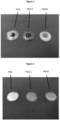
- Figure 1 shows the particles that was accumulated from all three stone types when the studs according to prior art, Comparative 1, were tested.
- Figure 2 shows the particles that was accumulated from all three stone types when the studs according to the invention, Invention 1, were tested. It can clearly be seen that the studs according to the invention generates far less particles that the prior art studs.
- Example 2 The same type of tire studs as described in Example 1 were used in this test.
- the tire studs were mounted onto tires. From the tires, pieces were cut out including two studs each.
- the equipment is arranged so that when the pendulum, where the tire pieces with the studs has been mounted, is released from a horizontal position, it will strike the stone material with a constant velocity.
- Two types of stone materials were tested, stone 2 from example 2, and a fourth type, stone 4.
- the stud was mounted at the tip of the pendulum in the equipment and the stone plate (80mm X 80mm X 15 mm) representing the road surface was mounted in the bottom of the equipment.
- the stone material was hit 200 times and the distance each time was 0,125 m which gives a total distance of 25m.
- the pendulum rig tester was placed in a sealed chamber to avoid contamination.
- the room air was drawn by a fan and entered the chamber through a filter.
- the particles in the air coming out of the chamber were then analyzed in the same way as in Example 2.
- Example 2 particles were also detected by placing filters at the outlet of the sealed chamber when the pendulum tests were performed.
- the filters collected particles of different sizes, 1 ⁇ m , 2.5 ⁇ m and 10 ⁇ m respectively.
- Figure 3 shows the particles that was accumulated from both stone types for the studs according to prior art, Comparative 1.
- Figure 4 shows the particles that was accumulated from both stone types when the studs according to the invention, Invention 1, were tested. It can clearly be seen that the studs according to the invention generates far less particles than the prior art studs.
Landscapes
- Engineering & Computer Science (AREA)
- Mechanical Engineering (AREA)
- Tires In General (AREA)
- Chemical & Material Sciences (AREA)
- Materials Engineering (AREA)
- Metallurgy (AREA)
- Organic Chemistry (AREA)
Description
- This invention relates to tire studs made of cemented carbide with a metal binder comprising Ni that decreases the wear on the road surface.
- Studded tires are widely used during the winter season in the Nordic countries. Tire studs made of cemented carbide for the use in winter tires for anti-skid properties has been known in the art for a long time. Cemented carbide materials are known for its wear resistance properties and high hardness and are used in many applications, such as e.g. metal cutting, wear parts etc.
- One of the problems with winter tires provided with studs is that it does not only wear on the ice but also on the road surface below. This have led to that different countries have regulated the used of studded tires by law to avoid premature wear of the roads. Another problem is the air born emissions caused by the wear of the road which can cause health problems.
- Another problem with the use of conventional cemented carbide with Co as binder, is that Co is considered to have a negative environmental and health impact and the use of Co might be restricted in the future. The tire studs are also worn, and Co is thus released into the environment.
- Cemented carbide tire studs with Co binder with small additions of Ni is known in the art.
- In
CN103014394 , tire studs of cemented carbide studs with a metallic binder based on Co with some Ni addition. This leads to an increased strength and impact toughness.
DE102012112658 describes a spike for a tire with a certain design where the upper part of the spike has a higher wear resistance and a higher density than the lower part of the spike. The upper part of the spike is a cemented carbide with a binder that comprising 6-15 wt% Co, 0-15 wt% Ni and 0-15 wt% Mo. The problem that is solved is to obtain a stud that is both good high abrasion and a low wight of the spike.
FR2080544
US6374886 describes a vehicle tire with studs made of cemented carbide where the binder is one or more of Co, Fe, Ni and Mo. The problem that is solved is to obtain a tire which e.g. have a good grip, little abrasion of the road surface and where the stud also functions at the end of the life cycle of the vehicle. This is achieved by a certain design of the rubber parts of the tires as well as the studs. - It is an object of the present invention to reduce the wear on the road surface and also to reduce the amount of particle emissions.
- It is also an object of the present invention to reduce the amount of Co that is released into the environment.
- The present invention relates to a tire stud made of a cemented carbide comprising at least 50 wt% WC and a metal binder in the amount between 3 and 25 wt%. Where the metal binder comprises at least 30 wt% Ni and less than 50 wt% Co.
- By tire stud is herein meant any type of anti-skid stud that is used in tires. It can have any shape common in the art.
- By cemented carbide is herein meant a material that comprises at least 50 wt% WC grains as the hard phase and where the WC grains are embedded in a metal binder.
- The tire stud comprises WC in an amount of at least 50 wt%, preferably at least 60 wt % more preferably at least 70 wt%. Preferably, the average grain size of the WC grains is between 0.3 and 20 µm, more preferably between 0.5 and 10 µm. The average grain size can be measured in different ways, like e.g. using a mean linear intercept method on a SEM image of the cemented carbide microstructure.
- The amount of metal binder in the cemented carbide is suitably between 3 and 25 wt%, preferably between 5 to 15 wt%.
- According to the present invention, the metal binder comprises at least 30 wt % Ni, preferably at least 50 wt% Ni.
- In one embodiment of the present invention, the metal binder comprises at least 90 wt% Ni, more preferably 95 wt % Ni.
- The Co content in the metal binder according to the present invention is suitably less than 50 wt%, preferably less than 30 wt%, more preferably less than 15 wt% of the metal binder.
- In one embodiment of the present invention, the cemented carbide is suitably free from Co. By that is herein meant that no Co is added as a raw material during manufacturing of the tire stud. However, small amounts of cobalt might still be present since some of the equipment during cemented carbide manufacturing e.g. the grinding media in the mill, usually is made of cemented carbide with a cobalt binder. By a cemented carbide free from Co herein means than the cemented carbide contains less than 1 wt % Co, preferably less than 0.5 wt% Co.
- In one embodiment of the present invention the metal binder suitably comprises at least 5 wt% Fe, preferably at least 10 wt% Fe.
- In one embodiment of the present invention the metal binder comprises Fe and Ni so that the total amount of Fe + Ni is at least 80 wt%, preferably in an amount of at least 85 wt% of the metal binder.
- In another embodiment of the present invention, the metal binder comprises between 80 and 90 wt% Ni and between 10 and 20 wt% Fe.
- In one embodiment of the present invention, the metal binder further comprises Cr in an amount of between 1 and 20 wt% of the metal binder, preferably between 10 and 15 wt% of the metal binder. A certain amount of Cr is beneficial in order to prevent corrosion.
- The cemented carbide in the tire stud according to the present invention can also comprise other elements common in the art of cemented carbide e.g. Ti, Nb, Ta, V etc. These elements will to some extent dissolve in the metal binder during sintering. The metal binder usually contains other elements in addition to those added as binder elements, such as e.g. Cr, Co etc. since other metallic elements easily dissolve in the metal binder.
- In one embodiment of the present invention, powders from recycled cemented carbide scrap can be used. The cemented carbide scrap has then been processed, for example using the Zn-method. The amount of recycled cemented carbide that can be used as raw material depends on its composition. Since the recycled cemented carbide also contains binder metals, like Co, the amount of recycled cemented carbide has to be adjusted in order to obtain the desired composition of the cemented carbide in the tire studs.
- The tire studs are made according to conventional techniques known in the art to make cemented carbides. The powder raw materials like e.g. WC, Ni and Fe powders, are mixed with a milling liquid, typically a water/ethanol mixture and an organic binder, e.g. polyethylene glycol (PEG) and thus forming a slurry. The slurry is then milled for several hours in a mill, e.g. a ball mill or an attritor mill. The milled slurry is then dried into granules. In production this is done using spray drying techniques, but when smaller batches are manufactured, pan drying can also be used. The dried powder is pressed into a green body in the shape of a tire stud. The green body is then sintered to form the final tire stud.
-
-
Figures 1 and 2 describes filters that collected particles from the tests in Example 2.Figure 1 shows the filters from when the prior art studs were tested whereasFigure 2 shows the filters from when the studs according to the invention were tested. -
Figures 3 and 4 describes filters that collected particles from the tests in Example 3.Figure 3 shows the filters from when the prior art studs were tested whereasFigure 4 shows the filters from when the studs according to the invention were tested. - Tire studs were manufactured from the amount of raw material as described in table 1. The tire studs according to the present invention, comprising a NiFe binder is herein denoted Invention 1, whereas the tire studs with a Co binder were commercially available, and are denoted Comparative 1. The amount of metal binder differs between Invention 1 and Comparative 1 since the same hardness of the tire stud was aimed for.
Table 1 WC (wt%) Ni (wt%) Fe (wt%) Co (wt%) Cr (wt%) Invention 1 Bal. 9.07 1.72 0.06 - Comparative 1 Bal. 0.22 - 10.85 0.08 - The tire studs were manufactured by mixing all the powder raw materials together with a water/ethanol milling liquid. The slurry was then milled for 50 hours followed by spray drying. The material was then subjected to a pressing operation forming green bodies in the shape of tire studs. The green bodies were then sintered in vacuum at 1410°C.
Table 2 HV30 Density (g/cm3) Invention 1 1173 14.45 Comparative 1 1177 14.46 - The wear of the road surface by the different tire studs was then investigated by a pin on disc method. Three different stone materials were used, stone 1, 2 and 3.
- The stud was mounted in the equipment and the stone plate (80mm X 80mm X 15 mm) representing the road surface was attached to a rotor. When testing the studded tire samples, the orientation of the stud was perpendicular to the sliding direction, as in real tire-on-road contacts.
- The rotating speed for the stone plate was 45 rpm and the total sliding distance for the tire stud was 50 m and the test were repeated 4 times.
- The pin-on-disc machine was in a sealed chamber to avoid contamination. The room air was drawn by a fan and entered the chamber through a filter. The particles in the air coming out of the chamber was then analyzed by an optical particle analyzer, TSI Optical Particle Sizer 3330.
- The total particle concentration/sliding distance (#/cm3/m) was measured.
- The results are shown in table 3 where each value is an average of 4 tests.
Table 3 Stone 1 Stone 2 Stone 3 Invention 1 56.9 47.0 60.9 Comparative 1 87.8 57.0 92.7 - The loss of mass/sliding distance (g/m) was also measured. This was done by weighing the stone plates before and after the test. The results are shown in table 4 where each value is an average of 4 tests.
Table 4 Stone 1 Stone 2 Stone 3 Invention 1 15.2 10.2 13.7 Comparative 1 19.7 12.7 20.3 - The particles were also detected by placing filters at the outlet of the sealed chamber when the pin-on-disc examples were performed. The filters collected particles of different sizes, 1 µm, 2.5 µm and 10 µm respectively.
Figure 1 shows the particles that was accumulated from all three stone types when the studs according to prior art, Comparative 1, were tested.Figure 2 shows the particles that was accumulated from all three stone types when the studs according to the invention, Invention 1, were tested. It can clearly be seen that the studs according to the invention generates far less particles that the prior art studs. - The wear on the road surface caused by the different tire studs was then investigated by a pendulum rig tester.
- The same type of tire studs as described in Example 1 were used in this test. The tire studs were mounted onto tires. From the tires, pieces were cut out including two studs each.
- The equipment is arranged so that when the pendulum, where the tire pieces with the studs has been mounted, is released from a horizontal position, it will strike the stone material with a constant velocity. Two types of stone materials were tested, stone 2 from example 2, and a fourth type, stone 4.
- The stud was mounted at the tip of the pendulum in the equipment and the stone plate (80mm X 80mm X 15 mm) representing the road surface was mounted in the bottom of the equipment. The stone material was hit 200 times and the distance each time was 0,125 m which gives a total distance of 25m.
- The pendulum rig tester was placed in a sealed chamber to avoid contamination. The room air was drawn by a fan and entered the chamber through a filter. The particles in the air coming out of the chamber were then analyzed in the same way as in Example 2.
- The test was repeated 3 times and the average of those tests are shown in Table 5, where the total particle concentration/sliding distance (#/cm3/m) is shown, and Table 6, where the loss of mass/sliding distance (g/m) is shown.
Table 5 Stone 2 Invention 1 39 Comparative 1 51 Table 6 Stone 2 Stone 4 Invention 1 8.2E-05 0,00092 Comparative 1 0.00033 0.0015 - Like in Example 2, particles were also detected by placing filters at the outlet of the sealed chamber when the pendulum tests were performed. The filters collected particles of different sizes, 1 µm , 2.5 µm and 10 µm respectively.
Figure 3 shows the particles that was accumulated from both stone types for the studs according to prior art, Comparative 1.Figure 4 shows the particles that was accumulated from both stone types when the studs according to the invention, Invention 1, were tested. It can clearly be seen that the studs according to the invention generates far less particles than the prior art studs.
Claims (6)
- A tire stud made of a cemented carbide comprising at least 50 wt% WC and a metal binder in the amount between 3 and 25 wt% wherein the metal binder comprises at least 30 wt% Ni and less than 50 wt% Co characterized in that the metal binder further comprises Fe in an amount of at least 5 wt% and Fe and Ni so that the total amount of Fe + Ni is at least 80 wt% of the metal binder.
- A tire stud according to claim 1 wherein the metal binder comprises at least 50 wt% Ni.
- A tire stud according to any of the preceding claims wherein the metal binder contains less than 15 wt% Co.
- A tire stud according to any of the preceding claims wherein the cemented carbide is free from Co.
- A tire stud according to any of the preceding claims wherein the metal binder comprises between 80 and 90 wt% Ni and between 10 and 20 wt% Fe.
- A tire stud according to any of the preceding claims wherein the metal binder further comprises Cr in an amount of between 1 and 20 wt% of the binder.
Priority Applications (4)
| Application Number | Priority Date | Filing Date | Title |
|---|---|---|---|
| EP20203072.2A EP3988339B1 (en) | 2020-10-21 | 2020-10-21 | Tire studs |
| CN202180070555.1A CN116323256A (en) | 2020-10-21 | 2021-10-20 | tire studs |
| US18/031,915 US20240001719A1 (en) | 2020-10-21 | 2021-10-20 | Tire studs |
| PCT/EP2021/079098 WO2022084391A1 (en) | 2020-10-21 | 2021-10-20 | Tire studs |
Applications Claiming Priority (1)
| Application Number | Priority Date | Filing Date | Title |
|---|---|---|---|
| EP20203072.2A EP3988339B1 (en) | 2020-10-21 | 2020-10-21 | Tire studs |
Publications (2)
| Publication Number | Publication Date |
|---|---|
| EP3988339A1 EP3988339A1 (en) | 2022-04-27 |
| EP3988339B1 true EP3988339B1 (en) | 2024-05-15 |
Family
ID=73005419
Family Applications (1)
| Application Number | Title | Priority Date | Filing Date |
|---|---|---|---|
| EP20203072.2A Active EP3988339B1 (en) | 2020-10-21 | 2020-10-21 | Tire studs |
Country Status (4)
| Country | Link |
|---|---|
| US (1) | US20240001719A1 (en) |
| EP (1) | EP3988339B1 (en) |
| CN (1) | CN116323256A (en) |
| WO (1) | WO2022084391A1 (en) |
Family Cites Families (12)
| Publication number | Priority date | Publication date | Assignee | Title |
|---|---|---|---|---|
| AT282375B (en) * | 1968-07-01 | 1970-06-25 | Plansee Metallwerk | Method for producing an anti-skid cleat |
| US3593771A (en) * | 1968-10-02 | 1971-07-20 | Kennametal Inc | Tire stud having lightweight wear-resistant pin |
| DE2106911A1 (en) * | 1970-02-16 | 1971-09-02 | Dahlberg F | Process for the production of anti-slip pins |
| US3779299A (en) * | 1970-05-15 | 1973-12-18 | Permanence Corp | Tire stud |
| DE2130911A1 (en) * | 1970-08-10 | 1972-02-17 | Plansee Metallwerk | Anti-skid studs, especially for vehicle tires |
| DE3274531D1 (en) * | 1982-05-21 | 1987-01-15 | Stahlgruber Gruber & Co Otto | Spike for tyres |
| US4626281A (en) * | 1983-07-26 | 1986-12-02 | The United States Of America As Represented By The United States Department Of Energy | Hard metal composition |
| US6374886B1 (en) * | 1999-10-29 | 2002-04-23 | Nokian Tyres Plc. | Vehicle tire with lamellar studs |
| CN103014394A (en) | 2012-12-03 | 2013-04-03 | 浙江东钨实业有限公司 | Preparation method of hard alloy for manufacturing automobile tyre studs |
| DE102012112658A1 (en) * | 2012-12-19 | 2014-06-26 | Continental Reifen Deutschland Gmbh | Spike |
| CN107460389B (en) * | 2016-06-03 | 2019-06-14 | 杨新跃 | A method of it preparing anti-sliding nail core composition and its is used to prepare anti-sliding nail core |
| CN111254337B (en) * | 2020-03-10 | 2020-12-11 | 株洲明日硬质合金有限公司 | Hard alloy anti-skid nail core for automobile tire and preparation method thereof |
-
2020
- 2020-10-21 EP EP20203072.2A patent/EP3988339B1/en active Active
-
2021
- 2021-10-20 US US18/031,915 patent/US20240001719A1/en not_active Abandoned
- 2021-10-20 WO PCT/EP2021/079098 patent/WO2022084391A1/en not_active Ceased
- 2021-10-20 CN CN202180070555.1A patent/CN116323256A/en active Pending
Also Published As
| Publication number | Publication date |
|---|---|
| WO2022084391A1 (en) | 2022-04-28 |
| US20240001719A1 (en) | 2024-01-04 |
| EP3988339A1 (en) | 2022-04-27 |
| CN116323256A (en) | 2023-06-23 |
Similar Documents
| Publication | Publication Date | Title |
|---|---|---|
| US4246006A (en) | Method of making sintered metal-diamond aggregates | |
| US3881282A (en) | Abrasive grain of fused alumina-zirconia-ceria alloy | |
| EP3808867B1 (en) | A rock drill insert | |
| AU2019380489B2 (en) | Binder redistribution within a cemented carbide mining insert | |
| CA2979505A1 (en) | A rock drill button | |
| EP3988339B1 (en) | Tire studs | |
| US12098447B2 (en) | Rock drill insert | |
| EP3763840B1 (en) | Gradient cemented carbide body and method of manufacturing thereof | |
| CN104692805A (en) | Sintered ceramic, slide part therefrom, and process for producing sintered ceramic | |
| CN111019605A (en) | Ceramic microcrystalline abrasive material with low bulk density and preparation method of abrasive tool product thereof | |
| Carpenter et al. | Methods of sieve analysis with particular reference | |
| CA3221039A1 (en) | Cemented carbide insert for mining or cutting applications comprising gamma phase carbide | |
| KR20090121247A (en) | Manufacturing method of composite diamond body | |
| ES2643688T3 (en) | Manufacturing process of cemented carbide bodies | |
| JPS5931584B2 (en) | Cemented carbide for glass cutting | |
| JP2025525506A (en) | Rock Drill Inserts | |
| GB1598614A (en) | Method for preparing scarfer spittings and a method for beneficiating a waste product to produce a size-graded abrasive product | |
| IT7827549A1 (en) | PROCEDURE FOR MANUFACTURING AGGREGATED DIAMOND ABRASIVE PARTICLES AND ABRASIVE PARTICLES OBTAINED THUS | |
| JPH0790304A (en) | Media for mixing hard powder |
Legal Events
| Date | Code | Title | Description |
|---|---|---|---|
| PUAI | Public reference made under article 153(3) epc to a published international application that has entered the european phase |
Free format text: ORIGINAL CODE: 0009012 |
|
| STAA | Information on the status of an ep patent application or granted ep patent |
Free format text: STATUS: THE APPLICATION HAS BEEN PUBLISHED |
|
| AK | Designated contracting states |
Kind code of ref document: A1 Designated state(s): AL AT BE BG CH CY CZ DE DK EE ES FI FR GB GR HR HU IE IS IT LI LT LU LV MC MK MT NL NO PL PT RO RS SE SI SK SM TR |
|
| STAA | Information on the status of an ep patent application or granted ep patent |
Free format text: STATUS: REQUEST FOR EXAMINATION WAS MADE |
|
| 17P | Request for examination filed |
Effective date: 20221027 |
|
| RBV | Designated contracting states (corrected) |
Designated state(s): AL AT BE BG CH CY CZ DE DK EE ES FI FR GB GR HR HU IE IS IT LI LT LU LV MC MK MT NL NO PL PT RO RS SE SI SK SM TR |
|
| GRAP | Despatch of communication of intention to grant a patent |
Free format text: ORIGINAL CODE: EPIDOSNIGR1 |
|
| STAA | Information on the status of an ep patent application or granted ep patent |
Free format text: STATUS: GRANT OF PATENT IS INTENDED |
|
| INTG | Intention to grant announced |
Effective date: 20231221 |
|
| GRAS | Grant fee paid |
Free format text: ORIGINAL CODE: EPIDOSNIGR3 |
|
| GRAA | (expected) grant |
Free format text: ORIGINAL CODE: 0009210 |
|
| STAA | Information on the status of an ep patent application or granted ep patent |
Free format text: STATUS: THE PATENT HAS BEEN GRANTED |
|
| AK | Designated contracting states |
Kind code of ref document: B1 Designated state(s): AL AT BE BG CH CY CZ DE DK EE ES FI FR GB GR HR HU IE IS IT LI LT LU LV MC MK MT NL NO PL PT RO RS SE SI SK SM TR |
|
| REG | Reference to a national code |
Ref country code: CH Ref legal event code: EP |
|
| REG | Reference to a national code |
Ref country code: DE Ref legal event code: R096 Ref document number: 602020030865 Country of ref document: DE |
|
| REG | Reference to a national code |
Ref country code: IE Ref legal event code: FG4D |
|
| REG | Reference to a national code |
Ref country code: LT Ref legal event code: MG9D |
|
| REG | Reference to a national code |
Ref country code: NL Ref legal event code: MP Effective date: 20240515 |
|
| PG25 | Lapsed in a contracting state [announced via postgrant information from national office to epo] |
Ref country code: IS Free format text: LAPSE BECAUSE OF FAILURE TO SUBMIT A TRANSLATION OF THE DESCRIPTION OR TO PAY THE FEE WITHIN THE PRESCRIBED TIME-LIMIT Effective date: 20240915 |
|
| PG25 | Lapsed in a contracting state [announced via postgrant information from national office to epo] |
Ref country code: BG Free format text: LAPSE BECAUSE OF FAILURE TO SUBMIT A TRANSLATION OF THE DESCRIPTION OR TO PAY THE FEE WITHIN THE PRESCRIBED TIME-LIMIT Effective date: 20240515 |
|
| PG25 | Lapsed in a contracting state [announced via postgrant information from national office to epo] |
Ref country code: HR Free format text: LAPSE BECAUSE OF FAILURE TO SUBMIT A TRANSLATION OF THE DESCRIPTION OR TO PAY THE FEE WITHIN THE PRESCRIBED TIME-LIMIT Effective date: 20240515 Ref country code: FI Free format text: LAPSE BECAUSE OF FAILURE TO SUBMIT A TRANSLATION OF THE DESCRIPTION OR TO PAY THE FEE WITHIN THE PRESCRIBED TIME-LIMIT Effective date: 20240515 |
|
| PG25 | Lapsed in a contracting state [announced via postgrant information from national office to epo] |
Ref country code: GR Free format text: LAPSE BECAUSE OF FAILURE TO SUBMIT A TRANSLATION OF THE DESCRIPTION OR TO PAY THE FEE WITHIN THE PRESCRIBED TIME-LIMIT Effective date: 20240816 |
|
| PG25 | Lapsed in a contracting state [announced via postgrant information from national office to epo] |
Ref country code: PT Free format text: LAPSE BECAUSE OF FAILURE TO SUBMIT A TRANSLATION OF THE DESCRIPTION OR TO PAY THE FEE WITHIN THE PRESCRIBED TIME-LIMIT Effective date: 20240916 |
|
| REG | Reference to a national code |
Ref country code: AT Ref legal event code: MK05 Ref document number: 1686665 Country of ref document: AT Kind code of ref document: T Effective date: 20240515 |
|
| PG25 | Lapsed in a contracting state [announced via postgrant information from national office to epo] |
Ref country code: NL Free format text: LAPSE BECAUSE OF FAILURE TO SUBMIT A TRANSLATION OF THE DESCRIPTION OR TO PAY THE FEE WITHIN THE PRESCRIBED TIME-LIMIT Effective date: 20240515 |
|
| PG25 | Lapsed in a contracting state [announced via postgrant information from national office to epo] |
Ref country code: ES Free format text: LAPSE BECAUSE OF FAILURE TO SUBMIT A TRANSLATION OF THE DESCRIPTION OR TO PAY THE FEE WITHIN THE PRESCRIBED TIME-LIMIT Effective date: 20240515 |
|
| PG25 | Lapsed in a contracting state [announced via postgrant information from national office to epo] |
Ref country code: AT Free format text: LAPSE BECAUSE OF FAILURE TO SUBMIT A TRANSLATION OF THE DESCRIPTION OR TO PAY THE FEE WITHIN THE PRESCRIBED TIME-LIMIT Effective date: 20240515 |
|
| PG25 | Lapsed in a contracting state [announced via postgrant information from national office to epo] |
Ref country code: PL Free format text: LAPSE BECAUSE OF FAILURE TO SUBMIT A TRANSLATION OF THE DESCRIPTION OR TO PAY THE FEE WITHIN THE PRESCRIBED TIME-LIMIT Effective date: 20240515 |
|
| PG25 | Lapsed in a contracting state [announced via postgrant information from national office to epo] |
Ref country code: LV Free format text: LAPSE BECAUSE OF FAILURE TO SUBMIT A TRANSLATION OF THE DESCRIPTION OR TO PAY THE FEE WITHIN THE PRESCRIBED TIME-LIMIT Effective date: 20240515 |
|
| PG25 | Lapsed in a contracting state [announced via postgrant information from national office to epo] |
Ref country code: PT Free format text: LAPSE BECAUSE OF FAILURE TO SUBMIT A TRANSLATION OF THE DESCRIPTION OR TO PAY THE FEE WITHIN THE PRESCRIBED TIME-LIMIT Effective date: 20240916 Ref country code: PL Free format text: LAPSE BECAUSE OF FAILURE TO SUBMIT A TRANSLATION OF THE DESCRIPTION OR TO PAY THE FEE WITHIN THE PRESCRIBED TIME-LIMIT Effective date: 20240515 Ref country code: NO Free format text: LAPSE BECAUSE OF FAILURE TO SUBMIT A TRANSLATION OF THE DESCRIPTION OR TO PAY THE FEE WITHIN THE PRESCRIBED TIME-LIMIT Effective date: 20240815 Ref country code: NL Free format text: LAPSE BECAUSE OF FAILURE TO SUBMIT A TRANSLATION OF THE DESCRIPTION OR TO PAY THE FEE WITHIN THE PRESCRIBED TIME-LIMIT Effective date: 20240515 Ref country code: LV Free format text: LAPSE BECAUSE OF FAILURE TO SUBMIT A TRANSLATION OF THE DESCRIPTION OR TO PAY THE FEE WITHIN THE PRESCRIBED TIME-LIMIT Effective date: 20240515 Ref country code: IS Free format text: LAPSE BECAUSE OF FAILURE TO SUBMIT A TRANSLATION OF THE DESCRIPTION OR TO PAY THE FEE WITHIN THE PRESCRIBED TIME-LIMIT Effective date: 20240915 Ref country code: HR Free format text: LAPSE BECAUSE OF FAILURE TO SUBMIT A TRANSLATION OF THE DESCRIPTION OR TO PAY THE FEE WITHIN THE PRESCRIBED TIME-LIMIT Effective date: 20240515 Ref country code: GR Free format text: LAPSE BECAUSE OF FAILURE TO SUBMIT A TRANSLATION OF THE DESCRIPTION OR TO PAY THE FEE WITHIN THE PRESCRIBED TIME-LIMIT Effective date: 20240816 Ref country code: FI Free format text: LAPSE BECAUSE OF FAILURE TO SUBMIT A TRANSLATION OF THE DESCRIPTION OR TO PAY THE FEE WITHIN THE PRESCRIBED TIME-LIMIT Effective date: 20240515 Ref country code: ES Free format text: LAPSE BECAUSE OF FAILURE TO SUBMIT A TRANSLATION OF THE DESCRIPTION OR TO PAY THE FEE WITHIN THE PRESCRIBED TIME-LIMIT Effective date: 20240515 Ref country code: BG Free format text: LAPSE BECAUSE OF FAILURE TO SUBMIT A TRANSLATION OF THE DESCRIPTION OR TO PAY THE FEE WITHIN THE PRESCRIBED TIME-LIMIT Effective date: 20240515 Ref country code: AT Free format text: LAPSE BECAUSE OF FAILURE TO SUBMIT A TRANSLATION OF THE DESCRIPTION OR TO PAY THE FEE WITHIN THE PRESCRIBED TIME-LIMIT Effective date: 20240515 Ref country code: RS Free format text: LAPSE BECAUSE OF FAILURE TO SUBMIT A TRANSLATION OF THE DESCRIPTION OR TO PAY THE FEE WITHIN THE PRESCRIBED TIME-LIMIT Effective date: 20240815 |
|
| PG25 | Lapsed in a contracting state [announced via postgrant information from national office to epo] |
Ref country code: DK Free format text: LAPSE BECAUSE OF FAILURE TO SUBMIT A TRANSLATION OF THE DESCRIPTION OR TO PAY THE FEE WITHIN THE PRESCRIBED TIME-LIMIT Effective date: 20240515 |
|
| PG25 | Lapsed in a contracting state [announced via postgrant information from national office to epo] |
Ref country code: EE Free format text: LAPSE BECAUSE OF FAILURE TO SUBMIT A TRANSLATION OF THE DESCRIPTION OR TO PAY THE FEE WITHIN THE PRESCRIBED TIME-LIMIT Effective date: 20240515 |
|
| PG25 | Lapsed in a contracting state [announced via postgrant information from national office to epo] |
Ref country code: CZ Free format text: LAPSE BECAUSE OF FAILURE TO SUBMIT A TRANSLATION OF THE DESCRIPTION OR TO PAY THE FEE WITHIN THE PRESCRIBED TIME-LIMIT Effective date: 20240515 |
|
| PG25 | Lapsed in a contracting state [announced via postgrant information from national office to epo] |
Ref country code: SK Free format text: LAPSE BECAUSE OF FAILURE TO SUBMIT A TRANSLATION OF THE DESCRIPTION OR TO PAY THE FEE WITHIN THE PRESCRIBED TIME-LIMIT Effective date: 20240515 Ref country code: RO Free format text: LAPSE BECAUSE OF FAILURE TO SUBMIT A TRANSLATION OF THE DESCRIPTION OR TO PAY THE FEE WITHIN THE PRESCRIBED TIME-LIMIT Effective date: 20240515 |
|
| PG25 | Lapsed in a contracting state [announced via postgrant information from national office to epo] |
Ref country code: SM Free format text: LAPSE BECAUSE OF FAILURE TO SUBMIT A TRANSLATION OF THE DESCRIPTION OR TO PAY THE FEE WITHIN THE PRESCRIBED TIME-LIMIT Effective date: 20240515 |
|
| PG25 | Lapsed in a contracting state [announced via postgrant information from national office to epo] |
Ref country code: SM Free format text: LAPSE BECAUSE OF FAILURE TO SUBMIT A TRANSLATION OF THE DESCRIPTION OR TO PAY THE FEE WITHIN THE PRESCRIBED TIME-LIMIT Effective date: 20240515 Ref country code: SK Free format text: LAPSE BECAUSE OF FAILURE TO SUBMIT A TRANSLATION OF THE DESCRIPTION OR TO PAY THE FEE WITHIN THE PRESCRIBED TIME-LIMIT Effective date: 20240515 Ref country code: RO Free format text: LAPSE BECAUSE OF FAILURE TO SUBMIT A TRANSLATION OF THE DESCRIPTION OR TO PAY THE FEE WITHIN THE PRESCRIBED TIME-LIMIT Effective date: 20240515 Ref country code: EE Free format text: LAPSE BECAUSE OF FAILURE TO SUBMIT A TRANSLATION OF THE DESCRIPTION OR TO PAY THE FEE WITHIN THE PRESCRIBED TIME-LIMIT Effective date: 20240515 Ref country code: DK Free format text: LAPSE BECAUSE OF FAILURE TO SUBMIT A TRANSLATION OF THE DESCRIPTION OR TO PAY THE FEE WITHIN THE PRESCRIBED TIME-LIMIT Effective date: 20240515 Ref country code: CZ Free format text: LAPSE BECAUSE OF FAILURE TO SUBMIT A TRANSLATION OF THE DESCRIPTION OR TO PAY THE FEE WITHIN THE PRESCRIBED TIME-LIMIT Effective date: 20240515 |
|
| PG25 | Lapsed in a contracting state [announced via postgrant information from national office to epo] |
Ref country code: IT Free format text: LAPSE BECAUSE OF FAILURE TO SUBMIT A TRANSLATION OF THE DESCRIPTION OR TO PAY THE FEE WITHIN THE PRESCRIBED TIME-LIMIT Effective date: 20240515 |
|
| REG | Reference to a national code |
Ref country code: DE Ref legal event code: R097 Ref document number: 602020030865 Country of ref document: DE |
|
| PLBE | No opposition filed within time limit |
Free format text: ORIGINAL CODE: 0009261 |
|
| STAA | Information on the status of an ep patent application or granted ep patent |
Free format text: STATUS: NO OPPOSITION FILED WITHIN TIME LIMIT |
|
| 26N | No opposition filed |
Effective date: 20250218 |
|
| PG25 | Lapsed in a contracting state [announced via postgrant information from national office to epo] |
Ref country code: SI Free format text: LAPSE BECAUSE OF FAILURE TO SUBMIT A TRANSLATION OF THE DESCRIPTION OR TO PAY THE FEE WITHIN THE PRESCRIBED TIME-LIMIT Effective date: 20240515 |
|
| REG | Reference to a national code |
Ref country code: DE Ref legal event code: R119 Ref document number: 602020030865 Country of ref document: DE |
|
| REG | Reference to a national code |
Ref country code: CH Ref legal event code: PL |
|
| GBPC | Gb: european patent ceased through non-payment of renewal fee |
Effective date: 20241021 |
|
| PG25 | Lapsed in a contracting state [announced via postgrant information from national office to epo] |
Ref country code: MC Free format text: LAPSE BECAUSE OF FAILURE TO SUBMIT A TRANSLATION OF THE DESCRIPTION OR TO PAY THE FEE WITHIN THE PRESCRIBED TIME-LIMIT Effective date: 20240515 |
|
| PG25 | Lapsed in a contracting state [announced via postgrant information from national office to epo] |
Ref country code: DE Free format text: LAPSE BECAUSE OF NON-PAYMENT OF DUE FEES Effective date: 20250501 |
|
| PG25 | Lapsed in a contracting state [announced via postgrant information from national office to epo] |
Ref country code: GB Free format text: LAPSE BECAUSE OF NON-PAYMENT OF DUE FEES Effective date: 20241021 |
|
| PG25 | Lapsed in a contracting state [announced via postgrant information from national office to epo] |
Ref country code: LU Free format text: LAPSE BECAUSE OF NON-PAYMENT OF DUE FEES Effective date: 20241021 Ref country code: BE Free format text: LAPSE BECAUSE OF NON-PAYMENT OF DUE FEES Effective date: 20241031 |
|
| PG25 | Lapsed in a contracting state [announced via postgrant information from national office to epo] |
Ref country code: FR Free format text: LAPSE BECAUSE OF NON-PAYMENT OF DUE FEES Effective date: 20241031 |
|
| PG25 | Lapsed in a contracting state [announced via postgrant information from national office to epo] |
Ref country code: CH Free format text: LAPSE BECAUSE OF NON-PAYMENT OF DUE FEES Effective date: 20241031 |
|
| REG | Reference to a national code |
Ref country code: BE Ref legal event code: MM Effective date: 20241031 |
|
| PG25 | Lapsed in a contracting state [announced via postgrant information from national office to epo] |
Ref country code: SE Free format text: LAPSE BECAUSE OF FAILURE TO SUBMIT A TRANSLATION OF THE DESCRIPTION OR TO PAY THE FEE WITHIN THE PRESCRIBED TIME-LIMIT Effective date: 20240515 |
|
| PG25 | Lapsed in a contracting state [announced via postgrant information from national office to epo] |
Ref country code: IE Free format text: LAPSE BECAUSE OF NON-PAYMENT OF DUE FEES Effective date: 20241021 |
|
| PG25 | Lapsed in a contracting state [announced via postgrant information from national office to epo] |
Ref country code: CY Free format text: LAPSE BECAUSE OF FAILURE TO SUBMIT A TRANSLATION OF THE DESCRIPTION OR TO PAY THE FEE WITHIN THE PRESCRIBED TIME-LIMIT; INVALID AB INITIO Effective date: 20201021 |
|
| PG25 | Lapsed in a contracting state [announced via postgrant information from national office to epo] |
Ref country code: HU Free format text: LAPSE BECAUSE OF FAILURE TO SUBMIT A TRANSLATION OF THE DESCRIPTION OR TO PAY THE FEE WITHIN THE PRESCRIBED TIME-LIMIT; INVALID AB INITIO Effective date: 20201021 |