EP3988204A1 - Porous cellulose medium and method for producing same - Google Patents
Porous cellulose medium and method for producing same Download PDFInfo
- Publication number
- EP3988204A1 EP3988204A1 EP20825674.3A EP20825674A EP3988204A1 EP 3988204 A1 EP3988204 A1 EP 3988204A1 EP 20825674 A EP20825674 A EP 20825674A EP 3988204 A1 EP3988204 A1 EP 3988204A1
- Authority
- EP
- European Patent Office
- Prior art keywords
- cellulose
- solution
- logmw
- porous cellulose
- porous
- Prior art date
- Legal status (The legal status is an assumption and is not a legal conclusion. Google has not performed a legal analysis and makes no representation as to the accuracy of the status listed.)
- Pending
Links
- 239000001913 cellulose Substances 0.000 title abstract description 227
- 229920002678 cellulose Polymers 0.000 title abstract description 223
- 238000004519 manufacturing process Methods 0.000 title description 20
- 239000002245 particle Substances 0.000 abstract description 46
- 238000005192 partition Methods 0.000 abstract description 32
- 229920003171 Poly (ethylene oxide) Polymers 0.000 abstract description 26
- 239000011148 porous material Substances 0.000 abstract description 20
- XLYOFNOQVPJJNP-UHFFFAOYSA-N water Substances O XLYOFNOQVPJJNP-UHFFFAOYSA-N 0.000 abstract description 18
- 238000001542 size-exclusion chromatography Methods 0.000 abstract description 17
- 238000007873 sieving Methods 0.000 abstract description 5
- 235000010980 cellulose Nutrition 0.000 description 218
- 239000000243 solution Substances 0.000 description 87
- 239000002609 medium Substances 0.000 description 77
- 239000012071 phase Substances 0.000 description 31
- XSQUKJJJFZCRTK-UHFFFAOYSA-N Urea Chemical compound NC(N)=O XSQUKJJJFZCRTK-UHFFFAOYSA-N 0.000 description 28
- 239000007921 spray Substances 0.000 description 27
- 238000005345 coagulation Methods 0.000 description 25
- 230000015271 coagulation Effects 0.000 description 25
- 239000007864 aqueous solution Substances 0.000 description 22
- 239000007788 liquid Substances 0.000 description 22
- OKKJLVBELUTLKV-UHFFFAOYSA-N Methanol Chemical compound OC OKKJLVBELUTLKV-UHFFFAOYSA-N 0.000 description 21
- HEMHJVSKTPXQMS-UHFFFAOYSA-M Sodium hydroxide Chemical compound [OH-].[Na+] HEMHJVSKTPXQMS-UHFFFAOYSA-M 0.000 description 18
- 239000007789 gas Substances 0.000 description 18
- 230000000052 comparative effect Effects 0.000 description 17
- 238000000034 method Methods 0.000 description 17
- 239000010419 fine particle Substances 0.000 description 16
- KWGKDLIKAYFUFQ-UHFFFAOYSA-M lithium chloride Chemical compound [Li+].[Cl-] KWGKDLIKAYFUFQ-UHFFFAOYSA-M 0.000 description 16
- LFQSCWFLJHTTHZ-UHFFFAOYSA-N Ethanol Chemical compound CCO LFQSCWFLJHTTHZ-UHFFFAOYSA-N 0.000 description 14
- 239000004202 carbamide Substances 0.000 description 14
- 229920002307 Dextran Polymers 0.000 description 13
- UMGDCJDMYOKAJW-UHFFFAOYSA-N thiourea Chemical compound NC(N)=S UMGDCJDMYOKAJW-UHFFFAOYSA-N 0.000 description 12
- 239000011324 bead Substances 0.000 description 10
- 239000002904 solvent Substances 0.000 description 10
- WMFOQBRAJBCJND-UHFFFAOYSA-M Lithium hydroxide Chemical compound [Li+].[OH-] WMFOQBRAJBCJND-UHFFFAOYSA-M 0.000 description 9
- PEDCQBHIVMGVHV-UHFFFAOYSA-N Glycerine Chemical compound OCC(O)CO PEDCQBHIVMGVHV-UHFFFAOYSA-N 0.000 description 8
- 238000006116 polymerization reaction Methods 0.000 description 8
- 239000007791 liquid phase Substances 0.000 description 7
- ZMXDDKWLCZADIW-UHFFFAOYSA-N N,N-Dimethylformamide Chemical compound CN(C)C=O ZMXDDKWLCZADIW-UHFFFAOYSA-N 0.000 description 6
- 230000001112 coagulating effect Effects 0.000 description 6
- 239000012530 fluid Substances 0.000 description 6
- 239000003550 marker Substances 0.000 description 6
- 238000005507 spraying Methods 0.000 description 6
- IJGRMHOSHXDMSA-UHFFFAOYSA-N Atomic nitrogen Chemical compound N#N IJGRMHOSHXDMSA-UHFFFAOYSA-N 0.000 description 4
- RTZKZFJDLAIYFH-UHFFFAOYSA-N Diethyl ether Chemical compound CCOCC RTZKZFJDLAIYFH-UHFFFAOYSA-N 0.000 description 4
- IAZDPXIOMUYVGZ-UHFFFAOYSA-N Dimethylsulphoxide Chemical compound CS(C)=O IAZDPXIOMUYVGZ-UHFFFAOYSA-N 0.000 description 4
- UFHFLCQGNIYNRP-UHFFFAOYSA-N Hydrogen Chemical compound [H][H] UFHFLCQGNIYNRP-UHFFFAOYSA-N 0.000 description 4
- LFTLOKWAGJYHHR-UHFFFAOYSA-N N-methylmorpholine N-oxide Chemical compound CN1(=O)CCOCC1 LFTLOKWAGJYHHR-UHFFFAOYSA-N 0.000 description 4
- PXIPVTKHYLBLMZ-UHFFFAOYSA-N Sodium azide Chemical compound [Na+].[N-]=[N+]=[N-] PXIPVTKHYLBLMZ-UHFFFAOYSA-N 0.000 description 4
- 239000003463 adsorbent Substances 0.000 description 4
- 239000003513 alkali Substances 0.000 description 4
- 229910001854 alkali hydroxide Inorganic materials 0.000 description 4
- 150000001720 carbohydrates Chemical class 0.000 description 4
- 238000004587 chromatography analysis Methods 0.000 description 4
- 238000001816 cooling Methods 0.000 description 4
- 229910001873 dinitrogen Inorganic materials 0.000 description 4
- 239000006185 dispersion Substances 0.000 description 4
- 235000011187 glycerol Nutrition 0.000 description 4
- 238000002156 mixing Methods 0.000 description 4
- 239000000203 mixture Substances 0.000 description 4
- 229920000642 polymer Polymers 0.000 description 4
- 229920003124 powdered cellulose Polymers 0.000 description 4
- 235000019814 powdered cellulose Nutrition 0.000 description 4
- 229910021642 ultra pure water Inorganic materials 0.000 description 4
- 239000012498 ultrapure water Substances 0.000 description 4
- 239000012808 vapor phase Substances 0.000 description 4
- KWYUFKZDYYNOTN-UHFFFAOYSA-M Potassium hydroxide Chemical compound [OH-].[K+] KWYUFKZDYYNOTN-UHFFFAOYSA-M 0.000 description 3
- 238000007792 addition Methods 0.000 description 3
- 239000003518 caustics Substances 0.000 description 3
- 239000011261 inert gas Substances 0.000 description 3
- 238000003756 stirring Methods 0.000 description 3
- JAUFPVINVSWFEL-UHFFFAOYSA-N 1,1-dimethylimidazol-1-ium Chemical compound C[N+]1(C)C=CN=C1 JAUFPVINVSWFEL-UHFFFAOYSA-N 0.000 description 2
- ALWXETURCOIGIZ-UHFFFAOYSA-N 1-nitropropylbenzene Chemical compound CCC([N+]([O-])=O)C1=CC=CC=C1 ALWXETURCOIGIZ-UHFFFAOYSA-N 0.000 description 2
- XKRFYHLGVUSROY-UHFFFAOYSA-N Argon Chemical compound [Ar] XKRFYHLGVUSROY-UHFFFAOYSA-N 0.000 description 2
- 229920000875 Dissolving pulp Polymers 0.000 description 2
- 238000001042 affinity chromatography Methods 0.000 description 2
- 150000008044 alkali metal hydroxides Chemical class 0.000 description 2
- 239000003795 chemical substances by application Substances 0.000 description 2
- AQEDFGUKQJUMBV-UHFFFAOYSA-N copper;ethane-1,2-diamine Chemical compound [Cu].NCCN AQEDFGUKQJUMBV-UHFFFAOYSA-N 0.000 description 2
- 239000003431 cross linking reagent Substances 0.000 description 2
- 238000004090 dissolution Methods 0.000 description 2
- 230000000694 effects Effects 0.000 description 2
- 239000000839 emulsion Substances 0.000 description 2
- 150000002148 esters Chemical class 0.000 description 2
- 125000000524 functional group Chemical group 0.000 description 2
- 230000005484 gravity Effects 0.000 description 2
- 238000002347 injection Methods 0.000 description 2
- 239000007924 injection Substances 0.000 description 2
- 229910017053 inorganic salt Inorganic materials 0.000 description 2
- 150000002576 ketones Chemical class 0.000 description 2
- 239000003446 ligand Substances 0.000 description 2
- 238000004811 liquid chromatography Methods 0.000 description 2
- 230000007774 longterm Effects 0.000 description 2
- 238000005259 measurement Methods 0.000 description 2
- 150000007522 mineralic acids Chemical class 0.000 description 2
- 150000004682 monohydrates Chemical class 0.000 description 2
- 229910052757 nitrogen Inorganic materials 0.000 description 2
- 239000000843 powder Substances 0.000 description 2
- 239000003755 preservative agent Substances 0.000 description 2
- 230000002335 preservative effect Effects 0.000 description 2
- 239000012266 salt solution Substances 0.000 description 2
- 238000000926 separation method Methods 0.000 description 2
- 238000001179 sorption measurement Methods 0.000 description 2
- 238000003860 storage Methods 0.000 description 2
- 230000002522 swelling effect Effects 0.000 description 2
- 229920006310 Asahi-Kasei Polymers 0.000 description 1
- 229920002134 Carboxymethyl cellulose Polymers 0.000 description 1
- 229920000168 Microcrystalline cellulose Polymers 0.000 description 1
- 229910019142 PO4 Inorganic materials 0.000 description 1
- 229920000297 Rayon Polymers 0.000 description 1
- 238000005903 acid hydrolysis reaction Methods 0.000 description 1
- 239000000908 ammonium hydroxide Substances 0.000 description 1
- 229910052786 argon Inorganic materials 0.000 description 1
- 238000000889 atomisation Methods 0.000 description 1
- 239000001768 carboxy methyl cellulose Substances 0.000 description 1
- 235000010948 carboxy methyl cellulose Nutrition 0.000 description 1
- 239000008112 carboxymethyl-cellulose Substances 0.000 description 1
- 230000003197 catalytic effect Effects 0.000 description 1
- 229920002301 cellulose acetate Polymers 0.000 description 1
- 238000007385 chemical modification Methods 0.000 description 1
- 239000003153 chemical reaction reagent Substances 0.000 description 1
- 238000013375 chromatographic separation Methods 0.000 description 1
- 238000004132 cross linking Methods 0.000 description 1
- 230000006196 deacetylation Effects 0.000 description 1
- 238000003381 deacetylation reaction Methods 0.000 description 1
- 239000002612 dispersion medium Substances 0.000 description 1
- 238000009826 distribution Methods 0.000 description 1
- 230000007717 exclusion Effects 0.000 description 1
- 239000000835 fiber Substances 0.000 description 1
- 239000002657 fibrous material Substances 0.000 description 1
- 244000144992 flock Species 0.000 description 1
- 125000002791 glucosyl group Chemical group C1([C@H](O)[C@@H](O)[C@H](O)[C@H](O1)CO)* 0.000 description 1
- 150000004676 glycans Chemical class 0.000 description 1
- 238000004191 hydrophobic interaction chromatography Methods 0.000 description 1
- 230000003100 immobilizing effect Effects 0.000 description 1
- 238000004255 ion exchange chromatography Methods 0.000 description 1
- 150000002605 large molecules Chemical class 0.000 description 1
- 229920002521 macromolecule Polymers 0.000 description 1
- -1 methanol or ethanol Chemical compound 0.000 description 1
- 235000019813 microcrystalline cellulose Nutrition 0.000 description 1
- 239000008108 microcrystalline cellulose Substances 0.000 description 1
- 229940016286 microcrystalline cellulose Drugs 0.000 description 1
- 239000003595 mist Substances 0.000 description 1
- 239000011259 mixed solution Substances 0.000 description 1
- 239000012046 mixed solvent Substances 0.000 description 1
- NBIIXXVUZAFLBC-UHFFFAOYSA-K phosphate Chemical compound [O-]P([O-])([O-])=O NBIIXXVUZAFLBC-UHFFFAOYSA-K 0.000 description 1
- 239000010452 phosphate Substances 0.000 description 1
- 229920001282 polysaccharide Polymers 0.000 description 1
- 239000005017 polysaccharide Substances 0.000 description 1
- 238000002360 preparation method Methods 0.000 description 1
- 102000004169 proteins and genes Human genes 0.000 description 1
- 108090000623 proteins and genes Proteins 0.000 description 1
- 125000001453 quaternary ammonium group Chemical group 0.000 description 1
- 239000002964 rayon Substances 0.000 description 1
- 239000004627 regenerated cellulose Substances 0.000 description 1
- 230000001172 regenerating effect Effects 0.000 description 1
- 239000002002 slurry Substances 0.000 description 1
- 238000006467 substitution reaction Methods 0.000 description 1
Images


Classifications
-
- B—PERFORMING OPERATIONS; TRANSPORTING
- B01—PHYSICAL OR CHEMICAL PROCESSES OR APPARATUS IN GENERAL
- B01J—CHEMICAL OR PHYSICAL PROCESSES, e.g. CATALYSIS OR COLLOID CHEMISTRY; THEIR RELEVANT APPARATUS
- B01J20/00—Solid sorbent compositions or filter aid compositions; Sorbents for chromatography; Processes for preparing, regenerating or reactivating thereof
- B01J20/281—Sorbents specially adapted for preparative, analytical or investigative chromatography
- B01J20/282—Porous sorbents
- B01J20/285—Porous sorbents based on polymers
-
- B—PERFORMING OPERATIONS; TRANSPORTING
- B01—PHYSICAL OR CHEMICAL PROCESSES OR APPARATUS IN GENERAL
- B01D—SEPARATION
- B01D15/00—Separating processes involving the treatment of liquids with solid sorbents; Apparatus therefor
- B01D15/08—Selective adsorption, e.g. chromatography
- B01D15/26—Selective adsorption, e.g. chromatography characterised by the separation mechanism
- B01D15/34—Size-selective separation, e.g. size-exclusion chromatography; Gel filtration; Permeation
-
- B—PERFORMING OPERATIONS; TRANSPORTING
- B01—PHYSICAL OR CHEMICAL PROCESSES OR APPARATUS IN GENERAL
- B01J—CHEMICAL OR PHYSICAL PROCESSES, e.g. CATALYSIS OR COLLOID CHEMISTRY; THEIR RELEVANT APPARATUS
- B01J2/00—Processes or devices for granulating materials, e.g. fertilisers in general; Rendering particulate materials free flowing in general, e.g. making them hydrophobic
-
- B—PERFORMING OPERATIONS; TRANSPORTING
- B01—PHYSICAL OR CHEMICAL PROCESSES OR APPARATUS IN GENERAL
- B01J—CHEMICAL OR PHYSICAL PROCESSES, e.g. CATALYSIS OR COLLOID CHEMISTRY; THEIR RELEVANT APPARATUS
- B01J2/00—Processes or devices for granulating materials, e.g. fertilisers in general; Rendering particulate materials free flowing in general, e.g. making them hydrophobic
- B01J2/02—Processes or devices for granulating materials, e.g. fertilisers in general; Rendering particulate materials free flowing in general, e.g. making them hydrophobic by dividing the liquid material into drops, e.g. by spraying, and solidifying the drops
- B01J2/06—Processes or devices for granulating materials, e.g. fertilisers in general; Rendering particulate materials free flowing in general, e.g. making them hydrophobic by dividing the liquid material into drops, e.g. by spraying, and solidifying the drops in a liquid medium
-
- B—PERFORMING OPERATIONS; TRANSPORTING
- B01—PHYSICAL OR CHEMICAL PROCESSES OR APPARATUS IN GENERAL
- B01J—CHEMICAL OR PHYSICAL PROCESSES, e.g. CATALYSIS OR COLLOID CHEMISTRY; THEIR RELEVANT APPARATUS
- B01J20/00—Solid sorbent compositions or filter aid compositions; Sorbents for chromatography; Processes for preparing, regenerating or reactivating thereof
- B01J20/22—Solid sorbent compositions or filter aid compositions; Sorbents for chromatography; Processes for preparing, regenerating or reactivating thereof comprising organic material
- B01J20/24—Naturally occurring macromolecular compounds, e.g. humic acids or their derivatives
-
- B—PERFORMING OPERATIONS; TRANSPORTING
- B01—PHYSICAL OR CHEMICAL PROCESSES OR APPARATUS IN GENERAL
- B01J—CHEMICAL OR PHYSICAL PROCESSES, e.g. CATALYSIS OR COLLOID CHEMISTRY; THEIR RELEVANT APPARATUS
- B01J20/00—Solid sorbent compositions or filter aid compositions; Sorbents for chromatography; Processes for preparing, regenerating or reactivating thereof
- B01J20/28—Solid sorbent compositions or filter aid compositions; Sorbents for chromatography; Processes for preparing, regenerating or reactivating thereof characterised by their form or physical properties
- B01J20/28002—Solid sorbent compositions or filter aid compositions; Sorbents for chromatography; Processes for preparing, regenerating or reactivating thereof characterised by their form or physical properties characterised by their physical properties
- B01J20/28004—Sorbent size or size distribution, e.g. particle size
-
- B—PERFORMING OPERATIONS; TRANSPORTING
- B01—PHYSICAL OR CHEMICAL PROCESSES OR APPARATUS IN GENERAL
- B01J—CHEMICAL OR PHYSICAL PROCESSES, e.g. CATALYSIS OR COLLOID CHEMISTRY; THEIR RELEVANT APPARATUS
- B01J20/00—Solid sorbent compositions or filter aid compositions; Sorbents for chromatography; Processes for preparing, regenerating or reactivating thereof
- B01J20/28—Solid sorbent compositions or filter aid compositions; Sorbents for chromatography; Processes for preparing, regenerating or reactivating thereof characterised by their form or physical properties
- B01J20/28014—Solid sorbent compositions or filter aid compositions; Sorbents for chromatography; Processes for preparing, regenerating or reactivating thereof characterised by their form or physical properties characterised by their form
- B01J20/28016—Particle form
-
- B—PERFORMING OPERATIONS; TRANSPORTING
- B01—PHYSICAL OR CHEMICAL PROCESSES OR APPARATUS IN GENERAL
- B01J—CHEMICAL OR PHYSICAL PROCESSES, e.g. CATALYSIS OR COLLOID CHEMISTRY; THEIR RELEVANT APPARATUS
- B01J20/00—Solid sorbent compositions or filter aid compositions; Sorbents for chromatography; Processes for preparing, regenerating or reactivating thereof
- B01J20/28—Solid sorbent compositions or filter aid compositions; Sorbents for chromatography; Processes for preparing, regenerating or reactivating thereof characterised by their form or physical properties
- B01J20/28054—Solid sorbent compositions or filter aid compositions; Sorbents for chromatography; Processes for preparing, regenerating or reactivating thereof characterised by their form or physical properties characterised by their surface properties or porosity
- B01J20/28078—Pore diameter
- B01J20/28085—Pore diameter being more than 50 nm, i.e. macropores
-
- B—PERFORMING OPERATIONS; TRANSPORTING
- B01—PHYSICAL OR CHEMICAL PROCESSES OR APPARATUS IN GENERAL
- B01J—CHEMICAL OR PHYSICAL PROCESSES, e.g. CATALYSIS OR COLLOID CHEMISTRY; THEIR RELEVANT APPARATUS
- B01J20/00—Solid sorbent compositions or filter aid compositions; Sorbents for chromatography; Processes for preparing, regenerating or reactivating thereof
- B01J20/281—Sorbents specially adapted for preparative, analytical or investigative chromatography
-
- B—PERFORMING OPERATIONS; TRANSPORTING
- B01—PHYSICAL OR CHEMICAL PROCESSES OR APPARATUS IN GENERAL
- B01J—CHEMICAL OR PHYSICAL PROCESSES, e.g. CATALYSIS OR COLLOID CHEMISTRY; THEIR RELEVANT APPARATUS
- B01J20/00—Solid sorbent compositions or filter aid compositions; Sorbents for chromatography; Processes for preparing, regenerating or reactivating thereof
- B01J20/30—Processes for preparing, regenerating, or reactivating
-
- B—PERFORMING OPERATIONS; TRANSPORTING
- B01—PHYSICAL OR CHEMICAL PROCESSES OR APPARATUS IN GENERAL
- B01J—CHEMICAL OR PHYSICAL PROCESSES, e.g. CATALYSIS OR COLLOID CHEMISTRY; THEIR RELEVANT APPARATUS
- B01J20/00—Solid sorbent compositions or filter aid compositions; Sorbents for chromatography; Processes for preparing, regenerating or reactivating thereof
- B01J20/30—Processes for preparing, regenerating, or reactivating
- B01J20/305—Addition of material, later completely removed, e.g. as result of heat treatment, leaching or washing, e.g. for forming pores
- B01J20/3064—Addition of pore forming agents, e.g. pore inducing or porogenic agents
-
- B—PERFORMING OPERATIONS; TRANSPORTING
- B01—PHYSICAL OR CHEMICAL PROCESSES OR APPARATUS IN GENERAL
- B01J—CHEMICAL OR PHYSICAL PROCESSES, e.g. CATALYSIS OR COLLOID CHEMISTRY; THEIR RELEVANT APPARATUS
- B01J20/00—Solid sorbent compositions or filter aid compositions; Sorbents for chromatography; Processes for preparing, regenerating or reactivating thereof
- B01J20/30—Processes for preparing, regenerating, or reactivating
- B01J20/3085—Chemical treatments not covered by groups B01J20/3007 - B01J20/3078
Definitions
- the present disclosure relates to a porous cellulose medium and a method for producing the same.
- porous cellulose medium can itself serve as an adsorbent, and when a surface of the porous cellulose medium is subjected to some sort of chemical modification, functions such as adsorption, separation, catalytic functions, etc. can be imparted.
- Patent Document 1 describes a method for producing porous cellulose beads, the method including a) mixing a low temperature alkaline aqueous solution and cellulose to produce a cellulose fine dispersion; b) adding a crosslinking agent to the cellulose fine dispersion to produce a mixed liquid; c) dispersing the mixed liquid in a dispersion medium to produce an emulsion; and d) contacting the emulsion with a coagulation solvent.
- cellulose beads having excellent adsorption ability with pore shapes and pore diameter distributions suitable for an adsorbent can be produced.
- Patent Document 2 describes a method for dissolving cellulose in a mixed aqueous solution from 5 to 12 weight% of sodium hydroxide and from 9 to 20 weight% of urea or from 3 to 8 weight% of thiourea, in which the cellulose is used as crystalline cellulose and the mixed aqueous solution is pre-cooled to 10 to 15°C, or without pre-cooling, the cellulose is dissolved in the mixed aqueous solution at 10 to 15°C, and the dissolved crystalline cellulose is regenerated to produce porous cellulose.
- it is possible to dissolve crystalline cellulose with fewer steps or less costs than a known method and to produce porous cellulose by regenerating crystalline cellulose in such a solution.
- a porous cellulose medium can be used, for example, as a support or the like in chromatography.
- the size of a pore diameter of a support can be adjusted and a pore volume of the pore diameter can be increased according to the size of the target molecule to be separated by the support in chromatography, the efficiency of the separation of target molecule can be increased.
- a porous cellulose medium is used as a support in chromatography and a large molecule such as a protein (for example, a polymer having a weight average molecular weight from approximately 10 5.0 to 10 5.5 , which is used as a calibration standard for chromatography) is used as a target molecule
- a large molecule such as a protein (for example, a polymer having a weight average molecular weight from approximately 10 5.0 to 10 5.5 , which is used as a calibration standard for chromatography)
- a target molecule for example, a polymer having a weight average molecular weight from approximately 10 5.0 to 10 5.5 , which is used as a calibration standard for chromatography
- the main purpose of the present disclosure is to provide a novel porous cellulose medium that can efficiently separate a large target molecule in a calibration standard having a large pore diameter and a large pore volume and a weight average molecular weight from approximately 10 5.0 to 10 5.5 .
- the inventors of the present invention conducted diligent research to solve the problems described above.
- a novel method for producing a porous cellulose medium in which the method includes atomizing a cellulose solution by spraying into a space from a spray nozzle, so as to form a fine particle, and coagulating the fine particle in a coagulation phase, wherein, in atomizing he cellulose solution, the space where the cellulose solution is sprayed is controlled such that a gas to be supplied to the space is only a gas being supplied together with the cellulose solution from the spray nozzle, and with this method it is possible to efficiently separate a large target molecule in the calibration standard having a large pore diameter and a large pore volume and a weight average molecular weight from approximately 10 5.0 to 10 5.5 .
- the following porous cellulose medium is preferably produced: the porous cellulose medium containing a porous cellulose particle having a particle size from 1 to 600 ⁇ m, wherein, in sieving the porous cellulose medium for classification and using a fraction corresponding to aperture openings between 53 ⁇ m and 106 ⁇ m as a support for size exclusion chromatography, a polyethylene oxide standard is run through size exclusion chromatography with pure water as a mobile phase, and a weight average molecular weight Mw and a gel partition coefficient K av of the polyethylene oxide standard satisfy the following Relationships (A) and (B): in a case where 4.80 ⁇ logMw ⁇ 5 . 50 , K av > ⁇ 0.445 ⁇ logMw + 2 .55 in a case where 5.75 ⁇ logMw , 0 ⁇ K av ⁇ 0.19 .
- a porous cellulose medium containing a porous cellulose particle having a particle size from 1 to 600 ⁇ m wherein, in sieving the porous cellulose medium for classification and using a fraction corresponding to aperture openings between 53 ⁇ m and 106 ⁇ m as a support for size exclusion chromatography, a polyethylene oxide standard is run through size exclusion chromatography with pure water as a mobile phase, and a weight average molecular weight Mw and a gel partition coefficient K av of the polyethylene oxide standard satisfy Relationships (A) and (B) below: in a case where 4.80 ⁇ logMw ⁇ 5.50 , K av > ⁇ 0.445 ⁇ logMw + 2.55 in a case where 5.75 ⁇ logMw , 0 ⁇ K av ⁇ 0.19 .
- a method for producing a porous cellulose medium including atomizing a cellulose solution by spraying into a space from a spray nozzle, so as to form a fine particle, and coagulating the fine particle in a coagulation phase, wherein in atomizing the cellulose solution, the space where the cellulose solution is sprayed is controlled such that a gas to be supplied is only a gas being supplied together with the cellulose solution from the spray nozzle.
- the cellulose solution contains a solvent, the solvent being at least one selected from the group consisting of a copper ethylenediamine solution, N-methylmorpholine oxide (NMMO) monohydrate, a caustic alkali-urea aqueous solution, a calcium thiocyanate aqueous solution, a N,N'-dimethylacetamide solution of lithium chloride, a dimethylformamide solution of lithium chloride, a dimethylimidazolium solution of lithium chloride, and a dimethyl sulfoxide solution of lithium chloride.
- NMMO N-methylmorpholine oxide
- the method for producing a porous cellulose medium according to any one of Third Aspect to Fifth Aspect, wherein the coagulation phase is formed of a liquid phase, a vapor phase thereof, or a combination of a gas phase of an inert gas and the liquid phase or the vapor phase, the liquid phase containing at least one selected from the group consisting of alcohol, ketone, ester, ether, water, inorganic acid, and an aqueous inorganic salt solution.
- a novel porous cellulose medium that can efficiently separate a large target molecule in a calibration standard having a large pore diameter and a large pore volume and a weight average molecular weight from approximately 10 5.0 to 10 5.5 , and a method for producing the same.
- the porous cellulose medium of the present disclosure contains porous cellulose particles having a particle size from 1 to 600 ⁇ m. Furthermore, the porous cellulose medium of the present disclosure is characterized in that in sieving the porous cellulose medium for classification and using a fraction corresponding to aperture openings between 53 ⁇ m and 106 ⁇ m as a support for size exclusion chromatography, a polyethylene oxide standard is run through size exclusion chromatography with pure water as a mobile phase, and a weight average molecular weight Mw and a gel partition coefficient K av of the polyethylene oxide standard satisfy Relationships (A) and (B) below: Relationship (A): in a case where 4.80 ⁇ logMw ⁇ 5.50 , K av > ⁇ 0.445 ⁇ logMw + 2.55 Relationship (B): in a case where 5.75 ⁇ logMw , 0 ⁇ K av ⁇ 0.19
- the porous cellulose medium of the present disclosure that simultaneously satisfies Relationship (A) and Relationship (B) can efficiently separate a large target molecule in a calibration standard having a large pore diameter and a large pore volume and a weight average molecular weight from approximately 10 5.0 to 10 5.5 .
- the porous cellulose medium that simultaneously satisfies Relationship (A) and Relationship (B) is a new one that is not known in the related art.
- the porous cellulose medium of the present disclosure with such characteristics can be preferably produced, for example, by employing the method described below in the section "2. Method for producing porous cellulose".
- the porous cellulose medium of the present disclosure contains porous cellulose particles having a particle size from 1 to 600 ⁇ m.
- the porous cellulose medium of the present disclosure is an aggregate of particulate porous cellulose, and contains porous cellulose particles having a particle size from 1 to 600 ⁇ m.
- the porous cellulose medium of the present disclosure is not particularly limited as long as it contains porous cellulose particles having a particle size within the above range, and can measure Relationships (A) and (B) described later (that is, it contains a fraction corresponding to aperture openings between 53 ⁇ m and 106 ⁇ m).
- the porous cellulose medium contains porous cellulose particles having a particle size from preferably approximately 5 to 400 ⁇ m, and more preferably approximately 10 to 250 ⁇ m.
- the particle size of the porous cellulose particle is a value set by using a sieve. For example, when the porous cellulose medium is passed through a sieve with an aperture opening of 250 ⁇ m and washed repeatedly on a sieve with aperture opening of 10 ⁇ m, porous cellulose particles having a particle size in the range from 10 to 250 ⁇ m can be extracted from the porous cellulose medium.
- the porous cellulose medium of the present disclosure may contain porous cellulose particles having a particle size of smaller than 1 ⁇ m or porous cellulose particles having a particle size greater than 600 ⁇ m.
- the lower limit of the particle size of the porous cellulose medium of the present disclosure is, for example, 1 ⁇ m or greater and 5 ⁇ m or greater, and examples of the upper limit include, for example, 600 ⁇ m or smaller, 500 ⁇ m or smaller, 400 ⁇ m or smaller, 300 ⁇ m or smaller, and the like.
- the proportion of the porous cellulose particles having a particle size from 10 to 250 ⁇ m in the porous cellulose medium of the present disclosure is preferably 80 mass% or greater, more preferably 90 mass% or greater, even more preferably 95 mass% or greater, and particularly preferably 98 mass% or greater, and also, it may be 100 mass%.
- porous cellulose medium of the present disclosure in sieving the porous cellulose medium for classification and using a fraction corresponding to aperture openings between 53 ⁇ m and 106 ⁇ m as a support for size exclusion chromatography, a polyethylene oxide standard is run through size exclusion chromatography with pure water as a mobile phase, and a weight average molecular weight Mw and a gel partition coefficient K av of the polyethylene oxide standard satisfy Relationships (A) and (B) below.
- the method for measuring the gel partition coefficient K av and calculating the Relationship with logMw is as follows.
- the porous cellulose medium is sieved for classification. Using a fraction corresponding to aperture openings between 53 ⁇ m and 106 ⁇ m as a support for size exclusion chromatography, a polyethylene oxide standard is run through size exclusion chromatography with pure water as a mobile phase, and thus the gel partition coefficient K av is obtained. Specifically, the classified porous cellulose medium is packed in a column (for example, "Tricorn 10/100" available from GE Healthcare Japan) so that the bed height is 8 cm or greater. The column is connected to high speed liquid chromatography system to perform size exclusion chromatography measurements.
- a column for example, "Tricorn 10/100" available from GE Healthcare Japan
- the marker is used by dissolving polyethylene oxide (for example, TSKgel polyethylene oxide standards SE kit available from TOSOH) and dextran (for example, Blue Dextran (Blue Dextran 2000, available from GE Healthcare)) is dissolved in ultrapure water and used. While degassed ultrapure water is flowing through the column at a flow rate of 0.1 mL/min, first, in order to determine the volume other than a bead portion in the column, a solution of dextran (Blue dextran (Blue Dextran 2000 available from GE Healthcare)) having a weight average molecular weight of 2 ⁇ 10 6 is injected, and a liquid flow rate until the peak is observed after the injection on a RI monitor.
- polyethylene oxide for example, TSKgel polyethylene oxide standards SE kit available from TOSOH
- dextran for example, Blue Dextran (Blue Dextran 2000, available from GE Healthcare)
- dextran for example, Blue Dextran 2000, available from GE Healthcare
- K av V R ⁇ V 0 / V t ⁇ V 0
- V R represents the amount of liquid flow rate (mL) until the peak is observed after injecting each of the marker solutions
- Vo represents the liquid flow rate (mL) until the peak is observed after injecting the dextran solution having a weight average molecular weight of 2 ⁇ 10 6
- Vt represents a volume (mL) of beads in the column.
- the weight average molecular weight Mw and the gel partition coefficient K av of the polyethylene oxide standard further satisfy Relationship (C) below in addition to Relationships (A) and (B) described above. in a case where 4 .80 ⁇ logMw ⁇ 5 .50 , ⁇ 0.445 ⁇ LOGmW + 3 > K av > ⁇ 0.445 ⁇ logMw + 2.55 .
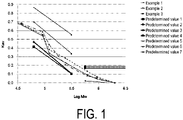
- the Relationship (C) is within a range of the straight line with a predetermined value of 1 and the straight line with a predetermined value of 5 in the graph of FIGS. 1 to 4 .
- the weight average molecular weight Mw and the gel partition coefficient K av of the polyethylene oxide standard more preferably satisfy Relationship (D) below, and still more preferably satisfy Relationship (E) below: in a case where 4 .80 ⁇ logMw ⁇ 5.50 , ⁇ 0.521 ⁇ logMw + 3.2 > K av > ⁇ 0.445 ⁇ logMw + 2.55 in a case where 4 .80 ⁇ logMw ⁇ 5 .50 , ⁇ 0.521 ⁇ logMw + 3.2 > K av > ⁇ 0.521 ⁇ logMw + 2.97
- Relationship (D) indicates a range between the straight line with a predetermined value of 1 in FIGS. 1 to 6 and the straight line with a predetermined value of 7.
- Relationship (E) indicates a range between the straight line with a predetermined value of 3 and the straight line with a predetermined value of 7 in FIGS. 1 to 6 .
- the weight average molecular weight Mw and the gel partition coefficient K av of the polyethylene oxide standards preferably satisfy Relationship (F) below, and more preferably have Relationship (G) below. 5.75 ⁇ logMw ,0 ⁇ K av ⁇ 0.17 5.75 ⁇ logMw , ⁇ 0.0482 ⁇ logMw + 0.3 ⁇ K av ⁇ 0.17
- Relationship (G) indicates a range between the straight line with a predetermined value of 4 and the straight line with a predetermined value of 6 in FIGS. 1 to 4 .
- the porous cellulose medium of the present disclosure is formed of cellulose and may include a known component contained in a known porous cellulose medium with the limit not to inhibit the effects of the present disclosure.
- a porous cellulose medium containing unsubstituted cellulose and a polymer having a glucose unit other than unsubstituted cellulose can be used, and carboxymethylcellulose, cellulose phosphate, and the like can be suitably used as the polymer.
- Such porous cellulose medium can be imparted with a functionality that is not the porous cellulose itself formed of unsubstituted cellulose (functionality of the polymer described above).
- the porous cellulose medium of the present disclosure can be usually stored in a wet state.
- the cellulose beads When the cellulose beads are to be dried, an appropriate amount of saccharides, glycerin, or the like is added. In the case of long-term storage in a wet state, a preservative such as an alcohol or sodium azide is added to prevent spoilage. In addition, the cellulose beads to which glycerin, a saccharide, urea, or the like has been added can be dried.
- porous cellulose medium of the present disclosure can also be particularly suitably used in size exclusion chromatography. Furthermore, this again indicates that the porous cellulose medium of the present disclosure can be used for chromatographic separation in various modes besides size exclusion by bonding an appropriate ligand to the porous cellulose medium or by substituting and modifying a functional group on its surface to another functional group. These other modes include modes such as ion exchange chromatography, hydrophobic interaction chromatography, and affinity chromatography.
- porous cellulose medium of the present disclosure can be used as a separating agent having improved strength by crosslinking between cellulose chains by covalent bonding using a crosslinking agent.
- An adsorbent can also be produced by immobilizing an affinity ligand on the porous cellulose medium of the present disclosure or a crosslinked porous cellulose medium.
- the adsorbent can also be used as a separating agent for affinity chromatography.
- the method for producing a porous cellulose medium is not particularly limited as long as a porous cellulose medium satisfying Relationships (A) and (B) with the aforementioned particle sizes is obtained, and the porous cellulose medium can be suitably produced by the production method described in the following section "2. Method for producing porous cellulose medium".
- the method for producing a porous cellulose medium includes atomizing a cellulose solution by spraying into a space from a spray nozzle, so as to form fine particles, and coagulating the fine particles in a coagulation phase, wherein in atomizing the cellulose solution, the space where the cellulose solution is sprayed is controlled such that a gas to be supplied is only a gas being supplied together with the cellulose solution from the spray nozzle.
- the cellulose solution is sprayed into the space from the spray nozzle to form fine particles. Furthermore, in atomizing the cellulose solution, the space in which the cellulose solution is sprayed is controlled such that a gas to be supplied is only a gas being supplied from the spray nozzle together with the cellulose solution.
- the cellulose solution is not particularly limited as long as the cellulose solution is a liquid containing cellulose and is coagulated in the coagulation phase described below.
- examples include cellulose solutions obtained by dissolving cellulose in the solvents.
- the solvents include a copper ethylenediamine solution, N-methylmorpholine oxide (NMMO) monohydrate, a caustic alkali-urea aqueous solution, a calcium thiocyanate aqueous solution, a N,N'-dimethylacetamide solution of lithium chloride, a dimethylformamide solution of lithium chloride, a dimethylimidazolium solution of lithium chloride, and a dimethyl sulfoxide solution of lithium chloride.
- NMMO N-methylmorpholine oxide
- the solvent is preferably a caustic alkali-urea aqueous solution (for example, urea-alkali hydroxide aqueous solution, including urea, thiourea, and the like).
- a caustic alkali-urea aqueous solution for example, urea-alkali hydroxide aqueous solution, including urea, thiourea, and the like.
- the cellulose solution means a liquid containing cellulose, which exhibits fluidity and solidifies cellulose when coming into contact with a coagulation phase, and it does not matter whether cellulose molecules are dispersed in the cellulose solution, some associated products are left, or fine fibrous materials are merely dispersed (sometimes referred to as a dispersion liquid). That is, in the method for producing a porous cellulose medium according to the present disclosure, the cellulose solution means a liquid containing cellulose, and the term includes a dispersion in which cellulose is dispersed in a liquid, and a solution in which cellulose is dissolved in a liquid. In the method for producing a porous cellulose medium according to the present disclosure, cellulose needs only be included in the cellulose solution, and in terms of the form, it may be dispersed or dissolved, or in a mixed state of the dispersed and dissolved.
- the method for preparing the cellulose solution will be described in detail below using an example case in which a urea-alkali hydroxide aqueous solution is used as the solvent.
- the alkali contained in the alkali hydroxide aqueous solution is preferably lithium hydroxide, sodium hydroxide, potassium hydroxide, or quaternary ammonium hydroxide, and sodium hydroxide is most preferable from the perspectives of product safety, price, and good dissolution or dispersibility.
- the alkali concentration of the alkaline aqueous solution is not particularly limited, but is preferably from 3 to 20 mass%. If the concentration of the alkali is within this range, the dispersibility, swelling property, and solubility of the cellulose in the alkaline aqueous solution are high, and thus such a concentration is preferable.
- the concentration of alkali is more preferably from 5 to 15 mass%, even more preferably from 7 to 10 mass%, and most preferably from 6 to 10 mass%.
- Urea or thiourea is further added to the alkaline aqueous solution.
- concentration of urea or thiourea is preferably from 10 to 15 mass%.
- Three components cellulose, alkali hydroxide, and urea or thiourea are added to the water, and the order of addition is appropriately selected to optimize the dissolution state of the cellulose. By cooling the slurry thus obtained under the conditions described later, a more transparent cellulose solution is obtained than immediately after addition of all the components.
- the cellulose may be of any type as long as it becomes fine particles when sprayed from a spray nozzle as a cellulose solution and solidifies when brought into contact with a coagulation phase; however, from the viewpoints such as excelling in solubility, and ease of handling with low viscosity of the solution, so-called microcrystalline cellulose that has been subjected to mild acid hydrolysis, cellulose that has been regenerated through deacetylation from cellulose acetate, and cellulose such as rayon fibers are preferable.
- the molecular weight of the cellulose is not particularly limited, but the degree of polymerization is preferably not greater than 1000. If the degree of polymerization is less than or equal to 1000, dispersibility and swelling properties in an alkaline aqueous solution are high, and thus such a degree of polymerization is preferable. If the degree of polymerization is greater than or equal to 10, the mechanical strength of the obtained cellulose beads is increased, and thus such a degree of polymerization is preferable.
- the range of the degree of polymerization is more preferably from 50 to 500, even more preferably from 100 to 400, and particularly preferably from 150 to 300.
- cellulose with improved solubility is dissolved pulp.
- the conditions for mixing the alkaline aqueous solution and the cellulose are not particularly limited as long as a cellulose solution is obtained.
- cellulose may be added to an alkaline aqueous solution, or an alkaline aqueous solution may be added to the cellulose.
- the cellulose may be suspended in water prior to mixing with the alkaline aqueous solution.
- the concentration of cellulose in the cellulose solution is preferably from 1 to 10 mass%.
- the content is 1 mass% or more, the mechanical strength of the obtained porous cellulose medium is increased, which is preferable.
- the content is 10 mass% or less, the viscosity of the cellulose solution is low, and spraying from a spray nozzle is facilitated so that the cellulose solution has a predetermined particle size.
- the concentration of cellulose in the cellulose solution is more preferably from 2 to 6 mass%, and even more preferably from 3 to 5 mass%. Note that the cellulose concentration in the cellulose solution does not include the portion that does not become uniform and is not completely dissolved, dispersed, or swollen.
- the temperature at which the cellulose solution is prepared is not particularly limited, but for example, a cellulose solution is suitably formed by mixing cellulose with an alkaline aqueous solution containing urea or thiourea at room temperature, cooling to a low temperature while stirring, and then returning the mixture to a manageable temperature.
- Examples of the temperature when cooling to a low temperature include from approximately 0°C to -30°C, and preferably from approximately -5°C to -15°C.
- the temperature of the cellulose solution sprayed from the spray nozzle is preferably approximately 0 to 50°C and more preferably approximately 10 to 40°C from the viewpoint of further suitably producing the porous cellulose of the present disclosure satisfying the above Relationships (A) and (B) and having a predetermined particle size.
- the temperature of the space when the cellulose solution is sprayed into from the spray nozzle is preferably approximately 0 to 50°C, and more preferably approximately 10 to 40°C.
- the space in which the cellulose solution is sprayed is controlled such that the gas to be supplied is only a gas being supplied from the spray nozzle together with the cellulose solution.
- the space in which the cellulose solution is sprayed can be connected via the exhaust port, but the external gas is controlled not to be supplied there from the exhaust port, and the gas being supplied to the space from the spray nozzle together with the cellulose solution is guided to the outside via the exhaust port (that is, in the forming fine particles, the space in which the cellulose solution is sprayed is not on the negative pressure side with respect to the external space). That is, the space in which the cellulose solution is sprayed is blocked with an external gas, and the concentration of the vapor of the coagulation phase liquid is increased as compared to the open system.
- the gas being supplied from the spray nozzle to the space together with the cellulose solution is preferably an inert gas, and examples thereof include nitrogen gas, argon, and the like. Additionally, the gas being supplied from the spray nozzle and the gas in the space are preferably identical.
- the particle size of the cellulose solution sprayed from the spray nozzle is not particularly limited as long as the porous cellulose medium to be produced contains porous cellulose particles having a particle size from 1 to 600 ⁇ m, from 5 to 400 ⁇ m, and from 10 to 250 ⁇ m, and is preferably approximately from 10 to 200 ⁇ m.
- the spray nozzle is not particularly limited as long as the spray nozzle can spray a liquid with a particle size from approximately 10 to 200 ⁇ m, and a commercially available two-fluid nozzle, a three-fluid nozzle, or the like can be used.
- the atomizing of the cellulose solution is preferably performed by spraying the sprayed cellulose solution so that the sprayed cellulose solution falls under gravity from above the coagulation phase in the coagulating the fine particles described below.
- the cellulose solution is preferably sprayed into the space from the spray nozzle, and the coagulation phase is brought into contact with the coagulation phase by gravity free fall.
- the height from the surface of the coagulation phase to the tip of the spray nozzle is preferably from 0.1 m to 20 m, and more preferably from 1 m to 20 m.
- the fine particles of the cellulose solution formed in the atomizing step are coagulated in a coagulation phase.
- a known coagulation phase that coagulates the cellulose solution can be used, and is formed of, for example, a liquid phase, a vapor phase thereof, or a combination of a gas phase of an inert gas and the liquid phase or the vapor phase, the liquid phase containing at least one selected from the group consisting of alcohol, ketone, ester, ether, water, inorganic acid, and an aqueous inorganic salt solution.
- the component constituting the coagulation phase may be one, or two or more.
- the coagulation phase is preferably formed of a component different from the solvent of the cellulose solution.
- a coagulation phase of water and alcohol is preferable, and a liquid phase of alcohol is particularly preferably used. It is also preferable to use a mixed solvent of water and alcohol (an alcohol aqueous solution).
- the alcohol is not particularly limited, but an alcohol having 6 or fewer carbons is preferable, an alcohol having 4 or fewer carbons is more preferable, and methanol is most preferable.
- the temperature of the coagulation phase is preferably approximately -30 to 50°C and more preferably approximately -20 to 40°C from the viewpoint of further suitably producing the porous cellulose of the present disclosure satisfying Relationships (A) and (B) below and having a predetermined particle size.
- the obtained porous cellulose medium can be washed through a suitable method using water or an alcohol such as methanol or ethanol, and can usually be stored in a wet state.
- an appropriate amount of saccharides, glycerin, or the like is added.
- a preservative such as an alcohol or sodium azide is added to prevent spoilage.
- the cellulose beads to which glycerin, a saccharide, urea, or the like has been added can be dried.
- the obtained cellulose solution (temperature 25°C) was sprayed from above to below in a vertical direction in a mist form together with nitrogen gas from a three-fluid nozzle (the particle size of the sprayed cellulose solution was approximately 10 to 200 ⁇ m), and dropped into liquid methanol (temperature 25°C) which is a coagulation phase.
- the space to be sprayed is a closed space (filled with nitrogen gas at a temperature of 25°C) other than an exhaust port for releasing nitrogen gas provided from the nozzle, and liquid methanol is installed below the three-fluid nozzle.
- the exhaust port was provided with a filter so that the sprayed cellulose did not leak from the spray space and was designed so that the spray space was not actively negative as compared to the outside.
- a porous cellulose medium (particle size: from 10 to 250 ⁇ m) was prepared using the same procedure as in Example 1 except that the powdered cellulose in Example 1 was changed to regenerated cellulose and the cellulose concentration at the time of the cellulose solution was set to 3 mass%.
- a porous cellulose medium (particle size: from 10 to 250 ⁇ m) was prepared using the same procedure as in Example 1 except that the powdered cellulose in Example 1 was changed to KC FLOCK W-200 (degree of polymerization approximately 250), Nippon Paper Industries Co., Ltd., and the cellulose concentration at the time of the cellulose solution was set to 3 mass%.
- a porous cellulose medium (particle size: from 10 to 250 ⁇ m) was prepared using the same procedure as in Example 1 except that the spray nozzle of Example 1 was changed to a two-fluid nozzle.
- a porous cellulose medium (particle size: from 10 to 250 ⁇ m) was prepared using the same procedure as in Example 1 except that the spray nozzle of Example 1 was changed to a two-fluid nozzle which is different from that of Example 4.
- a porous cellulose medium (particle size: from 10 to 250 ⁇ m) was prepared using the same procedure as in Example 4 except that the composition of liquid methanol installed below the nozzle in Example 4 was a mixed solution of equal amounts of water and methanol.
- a porous cellulose medium (particle size: from 10 to 250 ⁇ m) was prepared using the same procedure as in Example 4 except that sodium hydroxide in Example 4 was changed to lithium hydroxide, the lithium hydroxide concentration at the time of the cellulose solution was changed to 8 mass%, and the urea concentration was set to 15 mass%.
- the porous cellulose media obtained in the examples were sieved for classification, and using a fraction corresponding to aperture openings between 53 ⁇ m and 106 ⁇ m as a support for size exclusion chromatography, a polyethylene oxide standard was run through size exclusion chromatography with pure water as a mobile phase, and thus the gel partition coefficient K av was obtained.
- the classified porous cellulose medium was packed in a column ("Tricorn 10/100" manufactured by GE Healthcare Japan) so that the bed height was 8 cm or greater.
- the column was connected to high speed liquid chromatography system to perform size exclusion chromatography measurements.
- the marker was used by dissolving polyethylene oxide (TSKgel polyethylene oxide standard se kit manufactured by TOSOH) and dextran (Blue Dextran 2000, available from Ge Healthcare) was dissolved in ultrapure water and used. While degassed ultrapure water was flowing through the column at a flow rate of 0.1 mL/min, first, in order to determine the volume other than a bead portion in the column, a solution of dextran (Blue dextran (Blue Dextran 2000 available from GE Healthcare)) having a weight average molecular weight of 2 ⁇ 10 6 was injected, and a liquid flow rate until the peak was observed after the injection on a RI monitor. Next, the liquid flow rate was obtained similarly for each marker solution.
- dextran Blue Dextran 2000, available from Ge Healthcare
- K av V R ⁇ V 0 / V t ⁇ V 0
- V R represents the amount of liquid flow rate (mL) until the peak is observed after injecting each of the marker solutions
- Vo represents the liquid flow rate (mL) until the peak is observed after injecting the dextran solution having a weight average molecular weight of 2 ⁇ 10 6
- Vt represents a volume (mL) of beads in the column.
Landscapes
- Chemical & Material Sciences (AREA)
- Analytical Chemistry (AREA)
- Chemical Kinetics & Catalysis (AREA)
- Organic Chemistry (AREA)
- Engineering & Computer Science (AREA)
- Nanotechnology (AREA)
- Physics & Mathematics (AREA)
- Thermal Sciences (AREA)
- Polysaccharides And Polysaccharide Derivatives (AREA)
- Solid-Sorbent Or Filter-Aiding Compositions (AREA)
Abstract
Description
- The present disclosure relates to a porous cellulose medium and a method for producing the same.
- Polysaccharides represented by cellulose, and derivatives thereof are used in a variety of applications. For example, the porous cellulose medium can itself serve as an adsorbent, and when a surface of the porous cellulose medium is subjected to some sort of chemical modification, functions such as adsorption, separation, catalytic functions, etc. can be imparted.
- For example,
Patent Document 1 describes a method for producing porous cellulose beads, the method including a) mixing a low temperature alkaline aqueous solution and cellulose to produce a cellulose fine dispersion; b) adding a crosslinking agent to the cellulose fine dispersion to produce a mixed liquid; c) dispersing the mixed liquid in a dispersion medium to produce an emulsion; and d) contacting the emulsion with a coagulation solvent. According to the method described inPatent Document 1, cellulose beads having excellent adsorption ability with pore shapes and pore diameter distributions suitable for an adsorbent can be produced. - Furthermore,
Patent Document 2 describes a method for dissolving cellulose in a mixed aqueous solution from 5 to 12 weight% of sodium hydroxide and from 9 to 20 weight% of urea or from 3 to 8 weight% of thiourea, in which the cellulose is used as crystalline cellulose and the mixed aqueous solution is pre-cooled to 10 to 15°C, or without pre-cooling, the cellulose is dissolved in the mixed aqueous solution at 10 to 15°C, and the dissolved crystalline cellulose is regenerated to produce porous cellulose. According to the method described inPatent Document 2, it is possible to dissolve crystalline cellulose with fewer steps or less costs than a known method and to produce porous cellulose by regenerating crystalline cellulose in such a solution. -
- Patent Document 1:
WO 2016/167268 - Patent Document 2:
JP 2011-231152 A - A porous cellulose medium can be used, for example, as a support or the like in chromatography. Here, if the size of a pore diameter of a support can be adjusted and a pore volume of the pore diameter can be increased according to the size of the target molecule to be separated by the support in chromatography, the efficiency of the separation of target molecule can be increased.
- For example, when a porous cellulose medium is used as a support in chromatography and a large molecule such as a protein (for example, a polymer having a weight average molecular weight from approximately 105.0 to 105.5, which is used as a calibration standard for chromatography) is used as a target molecule, in order to efficiently separate the target molecule, it is required to increase the pore diameter of the porous cellulose medium and increase the pore volume of the pore diameter. However, in the known method for producing a porous cellulose medium, it is difficult to increase the pore volume for large pore diameters, and it is not possible to efficiently separate the target molecule in the calibration standard having a weight average molecular weight from approximately 105.0 to 105.5.
- Under such circumstances, the main purpose of the present disclosure is to provide a novel porous cellulose medium that can efficiently separate a large target molecule in a calibration standard having a large pore diameter and a large pore volume and a weight average molecular weight from approximately 105.0 to 105.5.
- The inventors of the present invention conducted diligent research to solve the problems described above. As a result, a novel method for producing a porous cellulose medium has been found, in which the method includes atomizing a cellulose solution by spraying into a space from a spray nozzle, so as to form a fine particle, and coagulating the fine particle in a coagulation phase, wherein, in atomizing he cellulose solution, the space where the cellulose solution is sprayed is controlled such that a gas to be supplied to the space is only a gas being supplied together with the cellulose solution from the spray nozzle, and with this method it is possible to efficiently separate a large target molecule in the calibration standard having a large pore diameter and a large pore volume and a weight average molecular weight from approximately 105.0 to 105.5. More specifically, it has been found that by employing such a production method, the following porous cellulose medium is preferably produced: the porous cellulose medium containing a porous cellulose particle having a particle size from 1 to 600 µm, wherein, in sieving the porous cellulose medium for classification and using a fraction corresponding to aperture openings between 53 µm and 106 µm as a support for size exclusion chromatography, a polyethylene oxide standard is run through size exclusion chromatography with pure water as a mobile phase, and a weight average molecular weight Mw and a gel partition coefficient Kav of the polyethylene oxide standard satisfy the following Relationships (A) and (B): in a case where


- The present disclosure was achieved through further examinations based on these findings.
- First Aspect. A porous cellulose medium containing a porous cellulose particle having a particle size from 1 to 600 µm, wherein, in sieving the porous cellulose medium for classification and using a fraction corresponding to aperture openings between 53 µm and 106 µm as a support for size exclusion chromatography, a polyethylene oxide standard is run through size exclusion chromatography with pure water as a mobile phase, and a weight average molecular weight Mw and a gel partition coefficient Kav of the polyethylene oxide standard satisfy Relationships (A) and (B) below: in a case where


- Second Aspect. The porous cellulose medium according to the first aspect, wherein the weight average molecular weight Mw and the gel partition coefficient Kav of the polyethylene oxide standard satisfy Relationship (C) below:
in a case where
- Third Aspect. A method for producing a porous cellulose medium, including atomizing a cellulose solution by spraying into a space from a spray nozzle, so as to form a fine particle, and coagulating the fine particle in a coagulation phase, wherein in atomizing the cellulose solution, the space where the cellulose solution is sprayed is controlled such that a gas to be supplied is only a gas being supplied together with the cellulose solution from the spray nozzle.
- Fourth Aspect. The method for producing a porous cellulose medium according to Third Aspect, wherein the cellulose solution contains a solvent, the solvent being at least one selected from the group consisting of a copper ethylenediamine solution, N-methylmorpholine oxide (NMMO) monohydrate, a caustic alkali-urea aqueous solution, a calcium thiocyanate aqueous solution, a N,N'-dimethylacetamide solution of lithium chloride, a dimethylformamide solution of lithium chloride, a dimethylimidazolium solution of lithium chloride, and a dimethyl sulfoxide solution of lithium chloride.
- Fifth Aspect. The method for producing a porous cellulose medium according to Third Aspect or Fourth Aspect, wherein the coagulation phase is formed of a component different from the solvent of the cellulose solution.
- Sixth Aspect. The method for producing a porous cellulose medium according to any one of Third Aspect to Fifth Aspect, wherein the coagulation phase is formed of a liquid phase, a vapor phase thereof, or a combination of a gas phase of an inert gas and the liquid phase or the vapor phase, the liquid phase containing at least one selected from the group consisting of alcohol, ketone, ester, ether, water, inorganic acid, and an aqueous inorganic salt solution.
- According to the present disclosure, it is possible to provide a novel porous cellulose medium that can efficiently separate a large target molecule in a calibration standard having a large pore diameter and a large pore volume and a weight average molecular weight from approximately 105.0 to 105.5, and a method for producing the same.
-
-
FIG. 1 is a graph showing a relationship between a logarithm of the weight average molecular weight (logMw) and the gel partition coefficient Kav of the polyethylene oxide standard with regard to the porous cellulose media of Examples 1 to 3 (each having a different cellulose). A straight line with a predetermined value of 1 to 7 is also illustrated. -
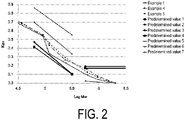
FIG. 2 is a graph showing a relationship between a logarithm of the weight average molecular weight (logMw) and the gel partition coefficient Kav of the polyethylene oxide standard with regard to the porous cellulose media of Examples 1, 4, and 5 (each having a different nozzle). A straight line with a predetermined value of 1 to 7 is also illustrated. -
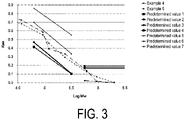
FIG. 3 is a graph showing a relationship between a logarithm of the weight average molecular weight (logMw) and the gel partition coefficient Kav of the polyethylene oxide standard with regard to the porous cellulose media of Examples 4 and 6 (each having a different coagulation bath composition). A straight line with a predetermined value of 1 to 7 is also illustrated. -
FIG. 4 is a graph showing a relationship between a logarithm of the weight average molecular weight (logMw) and the gel partition coefficient Kav of the polyethylene oxide standard with regard to the porous cellulose media of Examples 4 and 7 (each having a different cellulose solution). A straight line with a predetermined value of 1 to 7 is also illustrated. -
FIG. 5 is a graph showing a relationship between a logarithm of the weight average molecular weight (logMw) and the gel partition coefficient Kav of the polyethylene oxide standard with regard to the porous cellulose media of Comparative Reference Examples 1 to 6. A straight line with a predetermined value of 1 to 4 is also illustrated. -
FIG. 6 is a graph showing a relationship between a logarithm of the weight average molecular weight (logMw) and the gel partition coefficient Kav of the polyethylene oxide standard with regard to the porous cellulose media of Comparative Reference Examples 7 to 11. A straight line with a predetermined value of 1 to 4 is also illustrated. - The porous cellulose medium of the present disclosure contains porous cellulose particles having a particle size from 1 to 600 µm. Furthermore, the porous cellulose medium of the present disclosure is characterized in that in sieving the porous cellulose medium for classification and using a fraction corresponding to aperture openings between 53 µm and 106 µm as a support for size exclusion chromatography, a polyethylene oxide standard is run through size exclusion chromatography with pure water as a mobile phase, and a weight average molecular weight Mw and a gel partition coefficient Kav of the polyethylene oxide standard satisfy Relationships (A) and (B) below: Relationship (A): in a case where


- Hereinafter, the porous cellulose medium of the present disclosure will be described in detail. As will be described later, regarding the Relationship (A), a straight line Kav = -0.445 × logMw + 2.55 is, for example, the straight line indicated as a
predetermined value 1 inFIGS. 1 to 6 . In relation to the Relationship (B), a straight line Kav = 0.19 is the straight line indicated as apredetermined value 2 inFIGS. 1 to 6 , for example. The porous cellulose medium of the present disclosure that simultaneously satisfies Relationship (A) and Relationship (B) can efficiently separate a large target molecule in a calibration standard having a large pore diameter and a large pore volume and a weight average molecular weight from approximately 105.0 to 105.5. In addition, the porous cellulose medium that simultaneously satisfies Relationship (A) and Relationship (B) is a new one that is not known in the related art. As described below, the porous cellulose medium of the present disclosure with such characteristics can be preferably produced, for example, by employing the method described below in the section "2. Method for producing porous cellulose". - The porous cellulose medium of the present disclosure contains porous cellulose particles having a particle size from 1 to 600 µm. Specifically, the porous cellulose medium of the present disclosure is an aggregate of particulate porous cellulose, and contains porous cellulose particles having a particle size from 1 to 600 µm. The porous cellulose medium of the present disclosure is not particularly limited as long as it contains porous cellulose particles having a particle size within the above range, and can measure Relationships (A) and (B) described later (that is, it contains a fraction corresponding to aperture openings between 53 µm and 106 µm). From the viewpoint of more efficiently separating the target molecule in the calibration standard having a weight average molecular weight from approximately 105.0 to 105.5, the porous cellulose medium contains porous cellulose particles having a particle size from preferably approximately 5 to 400 µm, and more preferably approximately 10 to 250 µm. Note that, the particle size of the porous cellulose particle is a value set by using a sieve. For example, when the porous cellulose medium is passed through a sieve with an aperture opening of 250 µm and washed repeatedly on a sieve with aperture opening of 10 µm, porous cellulose particles having a particle size in the range from 10 to 250 µm can be extracted from the porous cellulose medium.
- The porous cellulose medium of the present disclosure may contain porous cellulose particles having a particle size of smaller than 1 µm or porous cellulose particles having a particle size greater than 600 µm. The lower limit of the particle size of the porous cellulose medium of the present disclosure is, for example, 1 µm or greater and 5 µm or greater, and examples of the upper limit include, for example, 600 µm or smaller, 500 µm or smaller, 400 µm or smaller, 300 µm or smaller, and the like. The proportion of the porous cellulose particles having a particle size from 10 to 250 µm in the porous cellulose medium of the present disclosure is preferably 80 mass% or greater, more preferably 90 mass% or greater, even more preferably 95 mass% or greater, and particularly preferably 98 mass% or greater, and also, it may be 100 mass%.
- According to the porous cellulose medium of the present disclosure, in sieving the porous cellulose medium for classification and using a fraction corresponding to aperture openings between 53 µm and 106 µm as a support for size exclusion chromatography, a polyethylene oxide standard is run through size exclusion chromatography with pure water as a mobile phase, and a weight average molecular weight Mw and a gel partition coefficient Kav of the polyethylene oxide standard satisfy Relationships (A) and (B) below. The method for measuring the gel partition coefficient Kav and calculating the Relationship with logMw is as follows.
- Relationship (A): in a case where


- The porous cellulose medium is sieved for classification. Using a fraction corresponding to aperture openings between 53 µm and 106 µm as a support for size exclusion chromatography, a polyethylene oxide standard is run through size exclusion chromatography with pure water as a mobile phase, and thus the gel partition coefficient Kav is obtained. Specifically, the classified porous cellulose medium is packed in a column (for example, "
Tricorn 10/100" available from GE Healthcare Japan) so that the bed height is 8 cm or greater. The column is connected to high speed liquid chromatography system to perform size exclusion chromatography measurements. The marker is used by dissolving polyethylene oxide (for example, TSKgel polyethylene oxide standards SE kit available from TOSOH) and dextran (for example, Blue Dextran (Blue Dextran 2000, available from GE Healthcare)) is dissolved in ultrapure water and used. While degassed ultrapure water is flowing through the column at a flow rate of 0.1 mL/min, first, in order to determine the volume other than a bead portion in the column, a solution of dextran (Blue dextran (Blue Dextran 2000 available from GE Healthcare)) having a weight average molecular weight of 2 × 10⁶ is injected, and a liquid flow rate until the peak is observed after the injection on a RI monitor. Next, the liquid flow rate is obtained similarly for each marker solution. The measured value is substituted into the following equation to calculate the value of Kav.
- In the porous cellulose medium of the present disclosure, from the viewpoint of more efficiently separating a target molecule in a calibration standard having a large weight average molecular weight from approximately 105.0 to 105.5, it is preferable that the weight average molecular weight Mw and the gel partition coefficient Kav of the polyethylene oxide standard further satisfy Relationship (C) below in addition to Relationships (A) and (B) described above.

- Here, for the Relationship (C), a straight line Kav = -0.445 × logMw + 3 is the straight line indicated as the
predetermined value 5 inFIGS. 1 to 4 , for example. In other words, in the range from 4.80 ≤ logMw ≤ 5.50, the Relationship (C) is within a range of the straight line with a predetermined value of 1 and the straight line with a predetermined value of 5 in the graph ofFIGS. 1 to 4 . - In addition, in the porous cellulose medium of the present disclosure, from the viewpoint of more efficiently separating a target molecule in the calibration standard having a large weight average molecular weight from approximately 105.0 to 105.5, the weight average molecular weight Mw and the gel partition coefficient Kav of the polyethylene oxide standard more preferably satisfy Relationship (D) below, and still more preferably satisfy Relationship (E) below:


- Here, for Relationship (D), a straight line Kav = -0.445 × logMw + 2.55 is the straight line indicated as the
predetermined value 1 inFIGS. 1 to 6 , for example. In addition, for Relationship (D), a straight line Kav = -0.521 × logMw + 3.2 is the straight line indicated as thepredetermined value 7 inFIGS. 1 to 6 , for example. In other words, in the range from 4.80 ≤ logMw ≤ 5.50, Relationship (D) indicates a range between the straight line with a predetermined value of 1 inFIGS. 1 to 6 and the straight line with a predetermined value of 7. - Here, for Relationship (E), a straight line Kav = -0.521 × logMw + 2.97 is the straight line indicated as the
predetermined value 3 inFIGS. 1 to 6 , for example. In addition, for Relationship (D), a straight line Kav = -0.521 × logMw + 3.2 is the straight line indicated as thepredetermined value 7 inFIGS. 1 to 6 , for example. In other words, in the range of 4.80 ≤ logMw ≤ 5.50, Relationship (E) indicates a range between the straight line with a predetermined value of 3 and the straight line with a predetermined value of 7 inFIGS. 1 to 6 . - In addition, in the porous cellulose medium of the present disclosure, from the viewpoint of more efficiently separating a target molecule in the calibration standards having a large weight average molecular weight from approximately 105.0 to 105.5, the weight average molecular weight Mw and the gel partition coefficient Kav of the polyethylene oxide standards preferably satisfy Relationship (F) below, and more preferably have Relationship (G) below.


- In relation to Relationship (F), a straight line Kav = 0.17 is the straight line indicated as a
predetermined value 4 inFIGS. 1 to 6 , for example. In relation to Relationship (G), a straight line Kav = Kav = -0.0482 × logMw + 0.3 is the straight line indicated as apredetermined value 6 inFIGS. 1 to 6 , for example. In other words, in the range of 5.75 ≤ logMw, Relationship (G) indicates a range between the straight line with a predetermined value of 4 and the straight line with a predetermined value of 6 inFIGS. 1 to 4 . - The porous cellulose medium of the present disclosure is formed of cellulose and may include a known component contained in a known porous cellulose medium with the limit not to inhibit the effects of the present disclosure. For example, a porous cellulose medium containing unsubstituted cellulose and a polymer having a glucose unit other than unsubstituted cellulose can be used, and carboxymethylcellulose, cellulose phosphate, and the like can be suitably used as the polymer. Such porous cellulose medium can be imparted with a functionality that is not the porous cellulose itself formed of unsubstituted cellulose (functionality of the polymer described above). The porous cellulose medium of the present disclosure can be usually stored in a wet state. When the cellulose beads are to be dried, an appropriate amount of saccharides, glycerin, or the like is added. In the case of long-term storage in a wet state, a preservative such as an alcohol or sodium azide is added to prevent spoilage. In addition, the cellulose beads to which glycerin, a saccharide, urea, or the like has been added can be dried.
- Further, the porous cellulose medium of the present disclosure can also be particularly suitably used in size exclusion chromatography. Furthermore, this again indicates that the porous cellulose medium of the present disclosure can be used for chromatographic separation in various modes besides size exclusion by bonding an appropriate ligand to the porous cellulose medium or by substituting and modifying a functional group on its surface to another functional group. These other modes include modes such as ion exchange chromatography, hydrophobic interaction chromatography, and affinity chromatography.
- In addition, the porous cellulose medium of the present disclosure can be used as a separating agent having improved strength by crosslinking between cellulose chains by covalent bonding using a crosslinking agent.
- An adsorbent can also be produced by immobilizing an affinity ligand on the porous cellulose medium of the present disclosure or a crosslinked porous cellulose medium. The adsorbent can also be used as a separating agent for affinity chromatography.
- In the present disclosure, the method for producing a porous cellulose medium is not particularly limited as long as a porous cellulose medium satisfying Relationships (A) and (B) with the aforementioned particle sizes is obtained, and the porous cellulose medium can be suitably produced by the production method described in the following section "2. Method for producing porous cellulose medium".
- The method for producing a porous cellulose medium includes atomizing a cellulose solution by spraying into a space from a spray nozzle, so as to form fine particles, and coagulating the fine particles in a coagulation phase, wherein in atomizing the cellulose solution, the space where the cellulose solution is sprayed is controlled such that a gas to be supplied is only a gas being supplied together with the cellulose solution from the spray nozzle. By employing such a production method, the porous cellulose medium of the present disclosure, which satisfies the above particle sizes and Relationships (A) and (B), can be suitably produced.
- In forming fine particles, the cellulose solution is sprayed into the space from the spray nozzle to form fine particles. Furthermore, in atomizing the cellulose solution, the space in which the cellulose solution is sprayed is controlled such that a gas to be supplied is only a gas being supplied from the spray nozzle together with the cellulose solution.
- The cellulose solution is not particularly limited as long as the cellulose solution is a liquid containing cellulose and is coagulated in the coagulation phase described below. Examples include cellulose solutions obtained by dissolving cellulose in the solvents. Examples of the solvents include a copper ethylenediamine solution, N-methylmorpholine oxide (NMMO) monohydrate, a caustic alkali-urea aqueous solution, a calcium thiocyanate aqueous solution, a N,N'-dimethylacetamide solution of lithium chloride, a dimethylformamide solution of lithium chloride, a dimethylimidazolium solution of lithium chloride, and a dimethyl sulfoxide solution of lithium chloride. These solvents may be used alone or in combination of two or more thereof. Among these, the solvent is preferably a caustic alkali-urea aqueous solution (for example, urea-alkali hydroxide aqueous solution, including urea, thiourea, and the like).
- Note that, the cellulose solution means a liquid containing cellulose, which exhibits fluidity and solidifies cellulose when coming into contact with a coagulation phase, and it does not matter whether cellulose molecules are dispersed in the cellulose solution, some associated products are left, or fine fibrous materials are merely dispersed (sometimes referred to as a dispersion liquid). That is, in the method for producing a porous cellulose medium according to the present disclosure, the cellulose solution means a liquid containing cellulose, and the term includes a dispersion in which cellulose is dispersed in a liquid, and a solution in which cellulose is dissolved in a liquid. In the method for producing a porous cellulose medium according to the present disclosure, cellulose needs only be included in the cellulose solution, and in terms of the form, it may be dispersed or dissolved, or in a mixed state of the dispersed and dissolved.
- The method for preparing the cellulose solution will be described in detail below using an example case in which a urea-alkali hydroxide aqueous solution is used as the solvent.
- The alkali contained in the alkali hydroxide aqueous solution is preferably lithium hydroxide, sodium hydroxide, potassium hydroxide, or quaternary ammonium hydroxide, and sodium hydroxide is most preferable from the perspectives of product safety, price, and good dissolution or dispersibility.
- The alkali concentration of the alkaline aqueous solution is not particularly limited, but is preferably from 3 to 20 mass%. If the concentration of the alkali is within this range, the dispersibility, swelling property, and solubility of the cellulose in the alkaline aqueous solution are high, and thus such a concentration is preferable. The concentration of alkali is more preferably from 5 to 15 mass%, even more preferably from 7 to 10 mass%, and most preferably from 6 to 10 mass%.
- Urea or thiourea is further added to the alkaline aqueous solution. The concentration of urea or thiourea is preferably from 10 to 15 mass%. Three components (cellulose, alkali hydroxide, and urea or thiourea) are added to the water, and the order of addition is appropriately selected to optimize the dissolution state of the cellulose. By cooling the slurry thus obtained under the conditions described later, a more transparent cellulose solution is obtained than immediately after addition of all the components.
- In the atomizing step, the cellulose may be of any type as long as it becomes fine particles when sprayed from a spray nozzle as a cellulose solution and solidifies when brought into contact with a coagulation phase; however, from the viewpoints such as excelling in solubility, and ease of handling with low viscosity of the solution, so-called microcrystalline cellulose that has been subjected to mild acid hydrolysis, cellulose that has been regenerated through deacetylation from cellulose acetate, and cellulose such as rayon fibers are preferable.
- The molecular weight of the cellulose is not particularly limited, but the degree of polymerization is preferably not greater than 1000. If the degree of polymerization is less than or equal to 1000, dispersibility and swelling properties in an alkaline aqueous solution are high, and thus such a degree of polymerization is preferable. If the degree of polymerization is greater than or equal to 10, the mechanical strength of the obtained cellulose beads is increased, and thus such a degree of polymerization is preferable. The range of the degree of polymerization is more preferably from 50 to 500, even more preferably from 100 to 400, and particularly preferably from 150 to 300.
- Another example of cellulose with improved solubility is dissolved pulp.
- The conditions for mixing the alkaline aqueous solution and the cellulose are not particularly limited as long as a cellulose solution is obtained. For example, cellulose may be added to an alkaline aqueous solution, or an alkaline aqueous solution may be added to the cellulose.
- The cellulose may be suspended in water prior to mixing with the alkaline aqueous solution.
- In addition, the concentration of cellulose in the cellulose solution is preferably from 1 to 10 mass%. When the content is 1 mass% or more, the mechanical strength of the obtained porous cellulose medium is increased, which is preferable. When the content is 10 mass% or less, the viscosity of the cellulose solution is low, and spraying from a spray nozzle is facilitated so that the cellulose solution has a predetermined particle size. The concentration of cellulose in the cellulose solution is more preferably from 2 to 6 mass%, and even more preferably from 3 to 5 mass%. Note that the cellulose concentration in the cellulose solution does not include the portion that does not become uniform and is not completely dissolved, dispersed, or swollen.
- The temperature at which the cellulose solution is prepared is not particularly limited, but for example, a cellulose solution is suitably formed by mixing cellulose with an alkaline aqueous solution containing urea or thiourea at room temperature, cooling to a low temperature while stirring, and then returning the mixture to a manageable temperature. Examples of the temperature when cooling to a low temperature include from approximately 0°C to -30°C, and preferably from approximately -5°C to -15°C. The temperature of the cellulose solution sprayed from the spray nozzle is preferably approximately 0 to 50°C and more preferably approximately 10 to 40°C from the viewpoint of further suitably producing the porous cellulose of the present disclosure satisfying the above Relationships (A) and (B) and having a predetermined particle size. Furthermore, from the same viewpoint, the temperature of the space when the cellulose solution is sprayed into from the spray nozzle is preferably approximately 0 to 50°C, and more preferably approximately 10 to 40°C.
- In the atomizing step, the space in which the cellulose solution is sprayed is controlled such that the gas to be supplied is only a gas being supplied from the spray nozzle together with the cellulose solution. For example, the space in which the cellulose solution is sprayed can be connected via the exhaust port, but the external gas is controlled not to be supplied there from the exhaust port, and the gas being supplied to the space from the spray nozzle together with the cellulose solution is guided to the outside via the exhaust port (that is, in the forming fine particles, the space in which the cellulose solution is sprayed is not on the negative pressure side with respect to the external space). That is, the space in which the cellulose solution is sprayed is blocked with an external gas, and the concentration of the vapor of the coagulation phase liquid is increased as compared to the open system.
- The gas being supplied from the spray nozzle to the space together with the cellulose solution is preferably an inert gas, and examples thereof include nitrogen gas, argon, and the like. Additionally, the gas being supplied from the spray nozzle and the gas in the space are preferably identical.
- From the viewpoint of further suitably producing the porous cellulose medium of the present disclosure satisfying the above Relationships (A) and (B) and having the predetermined particle size, the particle size of the cellulose solution sprayed from the spray nozzle is not particularly limited as long as the porous cellulose medium to be produced contains porous cellulose particles having a particle size from 1 to 600 µm, from 5 to 400 µm, and from 10 to 250 µm, and is preferably approximately from 10 to 200 µm.
- The spray nozzle is not particularly limited as long as the spray nozzle can spray a liquid with a particle size from approximately 10 to 200 µm, and a commercially available two-fluid nozzle, a three-fluid nozzle, or the like can be used.
- The atomizing of the cellulose solution is preferably performed by spraying the sprayed cellulose solution so that the sprayed cellulose solution falls under gravity from above the coagulation phase in the coagulating the fine particles described below. Specifically, in a state in which the spray nozzle is installed on the coagulation phase, the cellulose solution is preferably sprayed into the space from the spray nozzle, and the coagulation phase is brought into contact with the coagulation phase by gravity free fall. From the viewpoint of further suitably producing the porous cellulose of the present disclosure satisfying Relationships (A) and (B) above and having the predetermined particle size, the height from the surface of the coagulation phase to the tip of the spray nozzle is preferably from 0.1 m to 20 m, and more preferably from 1 m to 20 m.
- In the coagulating step, the fine particles of the cellulose solution formed in the atomizing step are coagulated in a coagulation phase.
- When the fine particles of the cellulose solution are coagulated in the coagulation phase, as described above, the fine particles of the cellulose solution are brought into contact with the coagulation phase.
- A known coagulation phase that coagulates the cellulose solution can be used, and is formed of, for example, a liquid phase, a vapor phase thereof, or a combination of a gas phase of an inert gas and the liquid phase or the vapor phase, the liquid phase containing at least one selected from the group consisting of alcohol, ketone, ester, ether, water, inorganic acid, and an aqueous inorganic salt solution. The component constituting the coagulation phase may be one, or two or more. The coagulation phase is preferably formed of a component different from the solvent of the cellulose solution.
- Among these, a coagulation phase of water and alcohol is preferable, and a liquid phase of alcohol is particularly preferably used. It is also preferable to use a mixed solvent of water and alcohol (an alcohol aqueous solution).
- The alcohol is not particularly limited, but an alcohol having 6 or fewer carbons is preferable, an alcohol having 4 or fewer carbons is more preferable, and methanol is most preferable.
- The temperature of the coagulation phase is preferably approximately -30 to 50°C and more preferably approximately -20 to 40°C from the viewpoint of further suitably producing the porous cellulose of the present disclosure satisfying Relationships (A) and (B) below and having a predetermined particle size.
- The obtained porous cellulose medium can be washed through a suitable method using water or an alcohol such as methanol or ethanol, and can usually be stored in a wet state. As described above, when the porous cellulose medium is to be dried, an appropriate amount of saccharides, glycerin, or the like is added. In the case of long-term storage in a wet state, a preservative such as an alcohol or sodium azide is added to prevent spoilage. In addition, the cellulose beads to which glycerin, a saccharide, urea, or the like has been added can be dried.
- The present disclosure will be described below in detail by presenting examples and comparative examples. Note that each of the configurations, combinations thereof, and the like in each example are merely an example, and various additions, omissions, substitutions, and other changes may be made as appropriate without departing from the spirit of the present disclosure. The present disclosure is not limited by the examples and is limited only by the claims.
- In a flask, sodium hydroxide was dissolved in water, the solution was cooled to room temperature, and powdered cellulose (ASAHI KASEI CORPORATION, CEOLUS PH 101, degree of polymerization: approximately 200) was dispersed therein with stirring. Furthermore, after urea was added and dissolved, the mixture was cooled to -15°C with stirring for approximately 1 hour, and then heated to room temperature using a water bath, resulting in a generally clear solution. The added amount of each reagent was weighed and added in the state of the cellulose solution such that the sodium hydroxide was 7 mass%, the powdered cellulose was 4 mass%, and the urea was 12 mass%.
- The obtained cellulose solution (temperature 25°C) was sprayed from above to below in a vertical direction in a mist form together with nitrogen gas from a three-fluid nozzle (the particle size of the sprayed cellulose solution was approximately 10 to 200 µm), and dropped into liquid methanol (temperature 25°C) which is a coagulation phase. The space to be sprayed is a closed space (filled with nitrogen gas at a temperature of 25°C) other than an exhaust port for releasing nitrogen gas provided from the nozzle, and liquid methanol is installed below the three-fluid nozzle. The exhaust port was provided with a filter so that the sprayed cellulose did not leak from the spray space and was designed so that the spray space was not actively negative as compared to the outside. After spraying, the fine powder obtained in liquid methanol was recovered. This fine powder was passed through a sieve with aperture openings of 250 µm and washed with water repeatedly on a sieve with an aperture opening of 10 µm to obtain a porous cellulose medium (particle size: from 10 to 250 µm).
- A porous cellulose medium (particle size: from 10 to 250 µm) was prepared using the same procedure as in Example 1 except that the powdered cellulose in Example 1 was changed to regenerated cellulose and the cellulose concentration at the time of the cellulose solution was set to 3 mass%.
- A porous cellulose medium (particle size: from 10 to 250 µm) was prepared using the same procedure as in Example 1 except that the powdered cellulose in Example 1 was changed to KC FLOCK W-200 (degree of polymerization approximately 250), Nippon Paper Industries Co., Ltd., and the cellulose concentration at the time of the cellulose solution was set to 3 mass%.
- A porous cellulose medium (particle size: from 10 to 250 µm) was prepared using the same procedure as in Example 1 except that the spray nozzle of Example 1 was changed to a two-fluid nozzle.
- A porous cellulose medium (particle size: from 10 to 250 µm) was prepared using the same procedure as in Example 1 except that the spray nozzle of Example 1 was changed to a two-fluid nozzle which is different from that of Example 4.
- A porous cellulose medium (particle size: from 10 to 250 µm) was prepared using the same procedure as in Example 4 except that the composition of liquid methanol installed below the nozzle in Example 4 was a mixed solution of equal amounts of water and methanol.
- A porous cellulose medium (particle size: from 10 to 250 µm) was prepared using the same procedure as in Example 4 except that sodium hydroxide in Example 4 was changed to lithium hydroxide, the lithium hydroxide concentration at the time of the cellulose solution was changed to 8 mass%, and the urea concentration was set to 15 mass%.
- The numerical values were obtained from the results (graph) shown for Example 2 of
Patent Document 1, and the values of gel partition coefficients Kav and logMw were plotted to create a graph ofFIG. 5 . - The numerical values were obtained from the results (graph) shown for Example 3 of
Patent Document 1, and the values of gel partition coefficients Kav and logMw were plotted to create a graph ofFIG. 5 . - The numerical values were obtained from the results (graph) shown for Example 4 of
Patent Document 1, and the values of gel partition coefficients Kav and logMw were plotted to create a graph ofFIG. 5 . - The numerical values were obtained from the results (graph) shown for Example 5 of
Patent Document 1, and the values of gel partition coefficients Kav and logMw were plotted to create a graph ofFIG. 5 . - The numerical values were obtained from the results (graph) shown for Example 7 of
Patent Document 1, and the values of gel partition coefficients Kav and logMw were plotted to create a graph ofFIG. 5 . - The numerical values were obtained from the results (graph) shown for Example 8 of
Patent Document 1, and the values of gel partition coefficients Kav and logMw were plotted to create a graph ofFIG. 5 . - The numerical values were obtained from the results (graph) shown for Comparative Reference Example 1 of
Patent Document 2, and the values of gel partition coefficients Kav and logMw were plotted to create a graph ofFIG. 6 . - The numerical values were obtained from the results (graph) shown for Example 4 of
Patent Document 2, and the values of gel partition coefficients Kav and logMw were plotted to create a graph ofFIG. 6 . - The numerical values were obtained from the results (graph) shown for Example 1 of
Patent Document 2, and the values of gel partition coefficients Kav and logMw were plotted to create a graph ofFIG. 6 . - The numerical values were obtained from the results (graph) shown for Example 2 of
Patent Document 2, and the values of gel partition coefficients Kav and logMw were plotted to create a graph ofFIG. 6 . - The numerical values were obtained from the results (graph) shown for Comparative Reference Example 2 of
Patent Document 1, and the values of gel partition coefficients Kav and logMw were plotted to create a graph ofFIG. 6 . - The porous cellulose media obtained in the examples were sieved for classification, and using a fraction corresponding to aperture openings between 53 µm and 106 µm as a support for size exclusion chromatography, a polyethylene oxide standard was run through size exclusion chromatography with pure water as a mobile phase, and thus the gel partition coefficient Kav was obtained. Specifically, the classified porous cellulose medium was packed in a column ("
Tricorn 10/100" manufactured by GE Healthcare Japan) so that the bed height was 8 cm or greater. The column was connected to high speed liquid chromatography system to perform size exclusion chromatography measurements. The marker was used by dissolving polyethylene oxide (TSKgel polyethylene oxide standard se kit manufactured by TOSOH) and dextran (Blue Dextran 2000, available from Ge Healthcare) was dissolved in ultrapure water and used. While degassed ultrapure water was flowing through the column at a flow rate of 0.1 mL/min, first, in order to determine the volume other than a bead portion in the column, a solution of dextran (Blue dextran (Blue Dextran 2000 available from GE Healthcare)) having a weight average molecular weight of 2 × 10⁶ was injected, and a liquid flow rate until the peak was observed after the injection on a RI monitor. Next, the liquid flow rate was obtained similarly for each marker solution. The measured value was substituted into the following equation to calculate the value of Kav.
- The results are shown in
FIGS. 1 to 4 together with the straight line of thepredetermined value 1 to 7 shown below. Note that, regarding Comparative Reference Examples 1 to 11, the numerical values were obtained fromPatent Documents FIGS. 5 and6 . -
- Straight line with predetermined value 1: in a case where 4.80 ≤ logMw ≤ 5.50, Kav = -0.445 × logMw + 2.55
- Straight line with predetermined value 2: in a case where 5.75 ≤ logMw, Kav = 0.19
- Straight line with predetermined value 3: in a case where 4.80 ≤ logMw ≤ 5.50, Kav = -0.521 × logMw + 2.97
- Straight line with predetermined value 4: in a case where 5.75 ≤ logMw, Kav = 0.17
- Straight line with predetermined value 5: in a case where 4.80 ≤ logMw ≤ 5.50, Kav = -0.445 × logMw + 3
- Straight line with predetermined value 6: in a case where 5.75 ≤ logMw, Kav = -0.0482 × logMw + 0.3
- Straight line with predetermined value 7: in a case where 4.80 ≤ logMw ≤ 5.50, Kav = -0.521 × logMw + 3.2
Claims (6)
- A porous cellulose medium comprising a porous cellulose particle having a particle size from 1 to 600 µm,
wherein, in sieving the porous cellulose medium for classification and using a fraction corresponding to aperture openings between 53 µm and 106 µm as a support for size exclusion chromatography, a polyethylene oxide standard is run through size exclusion chromatography with pure water as a mobile phase, and a weight average molecular weight Mw and a gel partition coefficient Kav of the polyethylene oxide standard satisfy Relationships (A) and (B):
in a case where
in a case where
- The porous cellulose medium according to claim 1,
wherein the weight average molecular weight Mw and the gel partition coefficient Kav of the polyethylene oxide standard satisfy Relationship (C): in a case where 4.80 ≤ logMw ≤ 5.50, -0.445 × logMw + 3 > Kav > -0.445 × logMw + 2.55 (C). - A method for producing a porous cellulose medium, comprising:atomizing a cellulose solution by spraying into a space from a spray nozzle, so as to form a fine particle; andcoagulating the fine particle in a coagulation phase,wherein in atomizing the cellulose solution, the space where the cellulose solution is sprayed is controlled such that a gas to be supplied is only a gas being supplied together with the cellulose solution from the spray nozzle.
- The method for producing a porous cellulose medium according to claim 3, wherein the cellulose solution contains a solvent, the solvent being at least one selected from the group consisting of a copper ethylenediamine solution, N-methylmorpholine oxide (NMMO) monohydrate, a caustic alkali-urea aqueous solution, a calcium thiocyanate aqueous solution, a N,N'-dimethylacetamide solution of lithium chloride, a dimethylformamide solution of lithium chloride, a dimethylimidazolium solution of lithium chloride, and a dimethyl sulfoxide solution of lithium chloride.
- The method for producing a porous cellulose medium according to claim 3 or 4,
wherein the coagulation phase is formed of a component different from the solvent of the cellulose solution. - The method for producing a porous cellulose medium according to any one of claims 3 to 5,
wherein the coagulation phase is formed of a liquid phase, a vapor phase thereof, or a combination of a gas phase of an inert gas and the liquid phase or the vapor phase, the liquid phase containing at least one selected from the group consisting of alcohol, ketone, ester, ether, water, inorganic acid, and an aqueous inorganic salt solution.
Applications Claiming Priority (2)
| Application Number | Priority Date | Filing Date | Title |
|---|---|---|---|
| JP2019114910 | 2019-06-20 | ||
| PCT/JP2020/024057 WO2020256088A1 (en) | 2019-06-20 | 2020-06-19 | Porous cellulose medium and method for producing same |
Publications (2)
| Publication Number | Publication Date |
|---|---|
| EP3988204A1 true EP3988204A1 (en) | 2022-04-27 |
| EP3988204A4 EP3988204A4 (en) | 2023-08-02 |
Family
ID=74040859
Family Applications (1)
| Application Number | Title | Priority Date | Filing Date |
|---|---|---|---|
| EP20825674.3A Pending EP3988204A4 (en) | 2019-06-20 | 2020-06-19 | Porous cellulose medium and method for producing same |
Country Status (5)
| Country | Link |
|---|---|
| US (1) | US12290796B2 (en) |
| EP (1) | EP3988204A4 (en) |
| JP (1) | JPWO2020256088A1 (en) |
| CN (1) | CN113905815B (en) |
| WO (1) | WO2020256088A1 (en) |
Family Cites Families (11)
| Publication number | Priority date | Publication date | Assignee | Title |
|---|---|---|---|---|
| JPS5621761B2 (en) | 1971-10-01 | 1981-05-21 | ||
| JP3044470B2 (en) | 1990-06-07 | 2000-05-22 | 日清紡績株式会社 | Method for producing cellulose fine powder |
| JP3177587B2 (en) | 1996-12-26 | 2001-06-18 | レンゴー株式会社 | Method for producing cellulose fine particles |
| JP5691233B2 (en) | 2010-04-23 | 2015-04-01 | Jnc株式会社 | Method for dissolving crystalline cellulose and method for producing porous cellulose |
| JP2013133355A (en) * | 2011-12-26 | 2013-07-08 | Univ Of Tokyo | Production method of regenerated cellulose spherical particle |
| CN105518059B (en) * | 2013-09-02 | 2019-01-01 | 捷恩智株式会社 | Method for producing porous cellulose particles, porous cellulose particles, and filler for chromatography |
| EP3459631A1 (en) * | 2013-09-27 | 2019-03-27 | Kaneka Corporation | Process for producing porous cellulose beads using alkali aqueous solution and porous cellulose beads produced by this process |
| JP2016153449A (en) * | 2015-02-20 | 2016-08-25 | 株式会社カネカ | Method for manufacturing porous cellulose particle |
| CN106140038B (en) | 2015-04-08 | 2019-07-12 | 通用电气公司 | The method and apparatus for preparing polymer particles |
| EP3284778A4 (en) | 2015-04-15 | 2018-11-21 | Kaneka Corporation | Method for producing porous cellulose beads, and adsorbent using same |
| JP6764464B2 (en) * | 2016-02-15 | 2020-09-30 | 東ソー株式会社 | Porous crosslinked cellulose gel and its manufacturing method |
-
2020
- 2020-06-19 JP JP2021526893A patent/JPWO2020256088A1/ja active Pending
- 2020-06-19 WO PCT/JP2020/024057 patent/WO2020256088A1/en not_active Ceased
- 2020-06-19 EP EP20825674.3A patent/EP3988204A4/en active Pending
- 2020-06-19 CN CN202080040912.5A patent/CN113905815B/en active Active
- 2020-06-19 US US17/619,250 patent/US12290796B2/en active Active
Also Published As
| Publication number | Publication date |
|---|---|
| JPWO2020256088A1 (en) | 2020-12-24 |
| US12290796B2 (en) | 2025-05-06 |
| CN113905815B (en) | 2024-11-12 |
| US20220258129A1 (en) | 2022-08-18 |
| CN113905815A (en) | 2022-01-07 |
| WO2020256088A1 (en) | 2020-12-24 |
| EP3988204A4 (en) | 2023-08-02 |
Similar Documents
| Publication | Publication Date | Title |
|---|---|---|
| US12134684B2 (en) | Method for producing cellulose beads | |
| EP2684897A1 (en) | Method for producing porous cellulose beads | |
| EP4008744A1 (en) | Porous cellulose particles and production method therefor | |
| EP0924255A2 (en) | Cellulose microspheres and method of manufacturing the same | |
| JP2015187255A (en) | Method for producing porous cellulose particles, and porous cellulose particles | |
| CN110559956A (en) | Hollow porous cellulose microsphere and preparation method and application thereof | |
| CN102698716B (en) | A kind of metal oxide particle adsorbent and preparation method thereof | |
| US12290796B2 (en) | Porous cellulose medium | |
| Silva et al. | Sulfonate-functionalized ionic liquids for pH-sensitive alginate beads preparation: Macromolecular structure study and drug release evaluation | |
| CN101716494A (en) | Magnetic compatible microsphere for purifying thrombin and preparation method and application thereof | |
| CA2384767A1 (en) | Cellulose dope and process for producing the same | |
| JPH08283457A (en) | Spherical cellulose and method for producing the same | |
| JPS5857401A (en) | Production of particulate porous chitosan | |
| JP4583777B2 (en) | Polyion complex fine particle dispersion and polyion complex fine particle | |
| TWI617353B (en) | Manufacturing method of nano colloidal particle carrier and carrier thereof | |
| EP4400535A1 (en) | Porous particles, method for producing same, and filler for chromatography using same | |
| JP6463035B2 (en) | POLYION COMPLEX POLYMER, COMPOSITION CONTAINING POLYION COMPLEX POLYMER, AND METHOD FOR PRODUCING POLYION COMPLEX POLYMER | |
| US12378381B2 (en) | Porous cellulose and method for producing same | |
| JP5578015B2 (en) | Method for producing cellulose particles, and cellulose particles | |
| JP4266672B2 (en) | Porous body, adsorbent and method for producing porous body | |
| JPS6140337A (en) | Production of granular porous chitosan | |
| CN105384847B (en) | A kind of instant pectin and preparation method thereof | |
| Omura | Preparation of Functional Cellulose Particles | |
| Kopka et al. | Influence of imidasolium ring substitution on chitin dissolution in ionic liquids | |
| CN121889450A (en) | Carboxymethyl cellulose or salt thereof and method for producing same |
Legal Events
| Date | Code | Title | Description |
|---|---|---|---|
| STAA | Information on the status of an ep patent application or granted ep patent |
Free format text: STATUS: THE INTERNATIONAL PUBLICATION HAS BEEN MADE |
|
| PUAI | Public reference made under article 153(3) epc to a published international application that has entered the european phase |
Free format text: ORIGINAL CODE: 0009012 |
|
| STAA | Information on the status of an ep patent application or granted ep patent |
Free format text: STATUS: REQUEST FOR EXAMINATION WAS MADE |
|
| 17P | Request for examination filed |
Effective date: 20211230 |
|
| AK | Designated contracting states |
Kind code of ref document: A1 Designated state(s): AL AT BE BG CH CY CZ DE DK EE ES FI FR GB GR HR HU IE IS IT LI LT LU LV MC MK MT NL NO PL PT RO RS SE SI SK SM TR |
|
| DAV | Request for validation of the european patent (deleted) | ||
| DAX | Request for extension of the european patent (deleted) | ||
| A4 | Supplementary search report drawn up and despatched |
Effective date: 20230705 |
|
| RIC1 | Information provided on ipc code assigned before grant |
Ipc: B01J 20/28 20060101ALI20230629BHEP Ipc: B01J 20/30 20060101ALI20230629BHEP Ipc: B01J 20/281 20060101ALI20230629BHEP Ipc: B01J 20/24 20060101ALI20230629BHEP Ipc: B01J 2/06 20060101ALI20230629BHEP Ipc: B01J 2/00 20060101ALI20230629BHEP Ipc: B01D 15/34 20060101ALI20230629BHEP Ipc: B01J 20/285 20060101AFI20230629BHEP |