EP3986954B1 - Methods for making sulfonated poly(phenylene ether) and articles made therefrom - Google Patents
Methods for making sulfonated poly(phenylene ether) and articles made therefrom Download PDFInfo
- Publication number
- EP3986954B1 EP3986954B1 EP20730730.7A EP20730730A EP3986954B1 EP 3986954 B1 EP3986954 B1 EP 3986954B1 EP 20730730 A EP20730730 A EP 20730730A EP 3986954 B1 EP3986954 B1 EP 3986954B1
- Authority
- EP
- European Patent Office
- Prior art keywords
- phenylene ether
- poly
- cosolvent
- dichloroethane
- solvent mixture
- Prior art date
- Legal status (The legal status is an assumption and is not a legal conclusion. Google has not performed a legal analysis and makes no representation as to the accuracy of the status listed.)
- Active
Links
Images


Classifications
-
- C—CHEMISTRY; METALLURGY
- C08—ORGANIC MACROMOLECULAR COMPOUNDS; THEIR PREPARATION OR CHEMICAL WORKING-UP; COMPOSITIONS BASED THEREON
- C08G—MACROMOLECULAR COMPOUNDS OBTAINED OTHERWISE THAN BY REACTIONS ONLY INVOLVING UNSATURATED CARBON-TO-CARBON BONDS
- C08G65/00—Macromolecular compounds obtained by reactions forming an ether link in the main chain of the macromolecule
- C08G65/02—Macromolecular compounds obtained by reactions forming an ether link in the main chain of the macromolecule from cyclic ethers by opening of the heterocyclic ring
- C08G65/32—Polymers modified by chemical after-treatment
- C08G65/321—Polymers modified by chemical after-treatment with inorganic compounds
- C08G65/326—Polymers modified by chemical after-treatment with inorganic compounds containing sulfur
-
- B—PERFORMING OPERATIONS; TRANSPORTING
- B01—PHYSICAL OR CHEMICAL PROCESSES OR APPARATUS IN GENERAL
- B01D—SEPARATION
- B01D3/00—Distillation or related exchange processes in which liquids are contacted with gaseous media, e.g. stripping
- B01D3/14—Fractional distillation or use of a fractionation or rectification column
- B01D3/143—Fractional distillation or use of a fractionation or rectification column by two or more of a fractionation, separation or rectification step
-
- B—PERFORMING OPERATIONS; TRANSPORTING
- B01—PHYSICAL OR CHEMICAL PROCESSES OR APPARATUS IN GENERAL
- B01D—SEPARATION
- B01D71/00—Semi-permeable membranes for separation processes or apparatus characterised by the material; Manufacturing processes specially adapted therefor
- B01D71/06—Organic material
- B01D71/52—Polyethers
- B01D71/522—Aromatic polyethers
- B01D71/5223—Polyphenylene oxide, phenyl ether polymers or polyphenylethers
-
- B—PERFORMING OPERATIONS; TRANSPORTING
- B01—PHYSICAL OR CHEMICAL PROCESSES OR APPARATUS IN GENERAL
- B01D—SEPARATION
- B01D71/00—Semi-permeable membranes for separation processes or apparatus characterised by the material; Manufacturing processes specially adapted therefor
- B01D71/06—Organic material
- B01D71/76—Macromolecular material not specifically provided for in a single one of groups B01D71/08 - B01D71/74
- B01D71/82—Macromolecular material not specifically provided for in a single one of groups B01D71/08 - B01D71/74 characterised by the presence of specified groups, e.g. introduced by chemical after-treatment
-
- C—CHEMISTRY; METALLURGY
- C08—ORGANIC MACROMOLECULAR COMPOUNDS; THEIR PREPARATION OR CHEMICAL WORKING-UP; COMPOSITIONS BASED THEREON
- C08G—MACROMOLECULAR COMPOUNDS OBTAINED OTHERWISE THAN BY REACTIONS ONLY INVOLVING UNSATURATED CARBON-TO-CARBON BONDS
- C08G65/00—Macromolecular compounds obtained by reactions forming an ether link in the main chain of the macromolecule
- C08G65/34—Macromolecular compounds obtained by reactions forming an ether link in the main chain of the macromolecule from hydroxy compounds or their metallic derivatives
- C08G65/48—Polymers modified by chemical after-treatment
-
- C—CHEMISTRY; METALLURGY
- C08—ORGANIC MACROMOLECULAR COMPOUNDS; THEIR PREPARATION OR CHEMICAL WORKING-UP; COMPOSITIONS BASED THEREON
- C08G—MACROMOLECULAR COMPOUNDS OBTAINED OTHERWISE THAN BY REACTIONS ONLY INVOLVING UNSATURATED CARBON-TO-CARBON BONDS
- C08G65/00—Macromolecular compounds obtained by reactions forming an ether link in the main chain of the macromolecule
- C08G65/34—Macromolecular compounds obtained by reactions forming an ether link in the main chain of the macromolecule from hydroxy compounds or their metallic derivatives
- C08G65/48—Polymers modified by chemical after-treatment
- C08G65/485—Polyphenylene oxides
-
- C—CHEMISTRY; METALLURGY
- C08—ORGANIC MACROMOLECULAR COMPOUNDS; THEIR PREPARATION OR CHEMICAL WORKING-UP; COMPOSITIONS BASED THEREON
- C08J—WORKING-UP; GENERAL PROCESSES OF COMPOUNDING; AFTER-TREATMENT NOT COVERED BY SUBCLASSES C08B, C08C, C08F, C08G or C08H
- C08J5/00—Manufacture of articles or shaped materials containing macromolecular substances
- C08J5/20—Manufacture of shaped structures of ion-exchange resins
- C08J5/22—Films, membranes or diaphragms
- C08J5/2206—Films, membranes or diaphragms based on organic and/or inorganic macromolecular compounds
- C08J5/2218—Synthetic macromolecular compounds
- C08J5/2256—Synthetic macromolecular compounds based on macromolecular compounds obtained by reactions other than those involving carbon-to-carbon bonds, e.g. obtained by polycondensation
-
- C—CHEMISTRY; METALLURGY
- C08—ORGANIC MACROMOLECULAR COMPOUNDS; THEIR PREPARATION OR CHEMICAL WORKING-UP; COMPOSITIONS BASED THEREON
- C08J—WORKING-UP; GENERAL PROCESSES OF COMPOUNDING; AFTER-TREATMENT NOT COVERED BY SUBCLASSES C08B, C08C, C08F, C08G or C08H
- C08J2371/00—Characterised by the use of polyethers obtained by reactions forming an ether link in the main chain; Derivatives of such polymers
- C08J2371/08—Polyethers derived from hydroxy compounds or from their metallic derivatives
- C08J2371/10—Polyethers derived from hydroxy compounds or from their metallic derivatives from phenols
- C08J2371/12—Polyphenylene oxides
-
- H—ELECTRICITY
- H01—ELECTRIC ELEMENTS
- H01M—PROCESSES OR MEANS, e.g. BATTERIES, FOR THE DIRECT CONVERSION OF CHEMICAL ENERGY INTO ELECTRICAL ENERGY
- H01M8/00—Fuel cells; Manufacture thereof
- H01M8/10—Fuel cells with solid electrolytes
- H01M2008/1095—Fuel cells with polymeric electrolytes
-
- H—ELECTRICITY
- H01—ELECTRIC ELEMENTS
- H01M—PROCESSES OR MEANS, e.g. BATTERIES, FOR THE DIRECT CONVERSION OF CHEMICAL ENERGY INTO ELECTRICAL ENERGY
- H01M8/00—Fuel cells; Manufacture thereof
- H01M8/10—Fuel cells with solid electrolytes
- H01M8/1016—Fuel cells with solid electrolytes characterised by the electrolyte material
- H01M8/1018—Polymeric electrolyte materials
- H01M8/102—Polymeric electrolyte materials characterised by the chemical structure of the main chain of the ion-conducting polymer
- H01M8/1025—Polymeric electrolyte materials characterised by the chemical structure of the main chain of the ion-conducting polymer having only carbon and oxygen, e.g. polyethers, sulfonated polyetheretherketones [S-PEEK], sulfonated polysaccharides, sulfonated celluloses or sulfonated polyesters
-
- H—ELECTRICITY
- H01—ELECTRIC ELEMENTS
- H01M—PROCESSES OR MEANS, e.g. BATTERIES, FOR THE DIRECT CONVERSION OF CHEMICAL ENERGY INTO ELECTRICAL ENERGY
- H01M8/00—Fuel cells; Manufacture thereof
- H01M8/10—Fuel cells with solid electrolytes
- H01M8/1016—Fuel cells with solid electrolytes characterised by the electrolyte material
- H01M8/1018—Polymeric electrolyte materials
- H01M8/102—Polymeric electrolyte materials characterised by the chemical structure of the main chain of the ion-conducting polymer
- H01M8/1032—Polymeric electrolyte materials characterised by the chemical structure of the main chain of the ion-conducting polymer having sulfur, e.g. sulfonated-polyethersulfones [S-PES]
-
- Y—GENERAL TAGGING OF NEW TECHNOLOGICAL DEVELOPMENTS; GENERAL TAGGING OF CROSS-SECTIONAL TECHNOLOGIES SPANNING OVER SEVERAL SECTIONS OF THE IPC; TECHNICAL SUBJECTS COVERED BY FORMER USPC CROSS-REFERENCE ART COLLECTIONS [XRACs] AND DIGESTS
- Y02—TECHNOLOGIES OR APPLICATIONS FOR MITIGATION OR ADAPTATION AGAINST CLIMATE CHANGE
- Y02E—REDUCTION OF GREENHOUSE GAS [GHG] EMISSIONS, RELATED TO ENERGY GENERATION, TRANSMISSION OR DISTRIBUTION
- Y02E60/00—Enabling technologies; Technologies with a potential or indirect contribution to GHG emissions mitigation
- Y02E60/30—Hydrogen technology
- Y02E60/50—Fuel cells
Definitions
- Disclosed herein is a method for making sulfonated poly(phenylene ether).
- Poly(phenylene ether)s are commercially attractive materials because of their unique combination of physical, chemical, and electrical properties. Furthermore, the combination of poly(phenylene ether)s with other polymers or additives provides blends which result in improved overall properties including chemical resistance, high strength, and high flow. As new commercial applications are explored, various sulfonated grades of poly(phenylene ether) materials are desired.
- JP 2004 273286 discloses electrolyte membranes which provide suppressed fuel crossover and, in particular, it is therein disclosed the sulfonation of poly(2,6-diphenyl-p-phenylene oxide) using two co-solvents and sulfonic acid.
- the resulting weight ratio of the sulfonated and non-sulfonated polymers was found to be non-homogeneous, with a distribution in composition ratio being observed in the film thickness direction, thus showing heterogeneity throughout the membrane material.
- WO 2019/009721 relates to polymers comprising sulfonated 2,6-diphenyl-1,4-phenylene oxide repeating units and their preparation method, which is based on the use of oleum as sulfonation agent.
- that particular synthetic process is cumbersome, as it involves the formation of very viscous pastes which form a pudding-like jelly ball which is difficult to handle and, additionally, a very low sulfonation level is achieved (e.g. sulfonation of 1.24 in Example 2).
- US 3631130 relates to a method for sulfonating poly(arylene oxides) with a mixture of chlorosulfonic acid and a nitroalkane, wherein a viscous semi-solid phase is formed, from which the sulfonated polymer must be isolated, thus also resulting in a cumbersome and time-consuming synthetic method.
- JP 2005174897 and EP 1619735 both relate to sulfonated polymer electrolyte materials, but they are silent about any specific synthetic method.
- JP 2007115446 relates to an electrolyte membrane production method, wherein a composite film is produced by pressure-impregnating a porous support with a thermoplastic polymer having an aromatic unit and subsequently bringing the film in contact with a solution containing a sulfonating agent.
- a method for sulfonation of poly(phenylene ether) comprises: dissolving a poly(phenylene ether) comprising 2,6-dimethyl-1,4-phenylene ether units, 2,3,6-trimethyl-1,4-phenylene ether units, 3,3',5,5'-tetramethyl-4,4'-dihydroxybiphenyl ether units, or a combination thereof in a mixture of 1,2-dichloroethane and preferably a cosolvent to form a solvent mixture in a mixing vessel, wherein the cosolvent may comprise at least one of methyl ethyl ketone, diethyl ether, methyl ethyl sulfone, ethyl acetate, or tetramethylene sulfone; combining a sulfonating agent with the solvent mixture, wherein the sulfonating agent reacts with the poly(phenylene ether) to form sulfonated poly(phen
- a method for sulfonation of poly(phenylene ether) according to claim 2 comprises: determining the desired sulfonation level; wherein, if the desired sulfonation level is greater than 20% then the method of claim 1 is followed and, if the sulfonation level is less than or equal to 20% then poly(phenylene ether) comprising 2,6-dimethyl-1,4-phenylene ether units, 2,3,6-trimethyl-1,4-phenylene ether units, 3,3',5,5'-tetramethyl-4,4'-dihydroxybiphenyl ether units, or a combination thereof is dissolved in 1,2-dichloroethane, preferably with no cosolvent, to form a solvent mixture in a mixing vessel; then combining a sulfonating agent with the solvent mixture, wherein the sulfonating agent reacts with the poly(phenylene ether) to form sulfonated poly(phenylene ether); precipitating the s
- Methods have been developed to reliably sulfonate of poly(phenylene ether) to degrees of sulfonation ranging from 20 to 50%.
- the process is scalable and allows for the production of poly(phenylene ether) with different sulfonation levels.
- methods enable sulfonating poly(phenylene ether) up to sulfonation levels of 50%, while maintaining homogeneity, and preferably recovering and recycling the solvents.
- the same was achieved using reaction solvent mixtures comprising 1,2-dichloroethane and a co-solvent (e.g., at least one of ethyl acetate or tetramethylene sulfone).
- polyphenylene oxide can be sulfonated between 20 to 50% while maintaining a homogeneous system.
- the solvent is recoverable and recyclable at a rate of greater than or equal to 80 weight percent (wt%), based upon a total weight of the solvent introduced into the system.
- ion exchange membranes for dialysis proton conducting membranes for polymer electrolyte membrane fuel cells, ion exchange membranes for flow batteries, hollow fiber membranes, precursor for molecular sieve carbon membranes for gas separation, precursor for carbon electrodes for fuel cells, carbon membrane reactors, etc.
- the degree of sulfonation can be controlled by adjusting an amount of solvent, and in particular, cosolvent, in the process and by the amount of sulfonating agent used.
- the process comprises dissolving poly(phenylene ether) in a solvent, adding a sulfonating agent to the mixture, and sulfonating the poly(phenylene ether).
- the solvent comprises 1,2-dichloroethane.
- the cosolvent comprises at least one of methyl ethyl ketone, diethyl ether, methyl ethyl sulfone, ethyl acetate (EA), or tetramethylene sulfone; preferably comprises at least one of ethyl acetate, or tetramethylene sulfone, and more preferably comprises or is ethyl acetate.
- Poly(phenylene ether)s include those comprising repeating structural units having the formula wherein each occurrence of Z 1 independently comprises halogen, unsubstituted or substituted C 1 -C 12 hydrocarbyl provided that the hydrocarbyl group is not tertiary hydrocarbyl, C 1 -C 12 hydrocarbylthio, C 1 -C 12 hydrocarbyloxy, or C 2 -C 12 halohydrocarbyloxy wherein at least two carbon atoms separate the halogen and oxygen atoms; and each occurrence of Z 2 independently comprises hydrogen, halogen, unsubstituted or substituted C 1 -C 12 hydrocarbyl provided that the hydrocarbyl group is not tertiary hydrocarbyl, C 1 -C 12 hydrocarbylthio, C 1 -C 12 hydrocarbyloxy, or C 2 -C 12 halohydrocarbyloxy wherein at least two carbon atoms separate the halogen and oxygen atoms.
- hydrocarbyl refers to a residue that contains only carbon and hydrogen.
- the residue can be aliphatic or aromatic, straight-chain, cyclic, bicyclic, branched, saturated, or unsaturated. It can also contain combinations of aliphatic, aromatic, straight chain, cyclic, bicyclic, branched, saturated, and unsaturated hydrocarbon moieties.
- the hydrocarbyl residue when described as substituted, it may, optionally, contain heteroatoms over and above the carbon and hydrogen members of the substituent residue.
- the hydrocarbyl residue when specifically described as substituted, can also contain one or more carbonyl groups, amino groups, hydroxyl groups, or the like, or it can contain heteroatoms within the backbone of the hydrocarbyl residue.
- Z 1 can be a di-n-butylaminomethyl group formed by reaction of a terminal 3,5-dimethyl-1,4-phenyl group with the di-n-butylamine component of an oxidative polymerization catalyst.
- the poly(phenylene ether) comprises 2,6-dimethyl-1,4-phenylene ether units, 2,3,6-trimethyl-1,4-phenylene ether units, or a combination thereof. In some embodiments, the poly(phenylene ether) is a poly(2,6-dimethyl-1,4-phenylene ether). In some embodiments, the poly(phenylene ether) comprises a poly(2,6-dimethyl-1,4-phenylene ether) having an intrinsic viscosity of 0.03 to 2 deciliter per gram (dl/g).
- the poly(phenylene ether) can have an intrinsic viscosity of 0.25 to 1.7 dl/g, specifically 0.25 to 0.7 dl/g, more specifically 0.35 to 0.55 dl/g, even more specifically 0.35 to 0.50 dl/g, measured at 25°C in chloroform using an Ubbelohde viscometer.
- the poly(phenylene ether) can comprise molecules having aminoalkyl-containing end group(s), typically located in a position ortho to the hydroxy group. Also frequently present are tetramethyldiphenoquinone (TMDQ) end groups, typically obtained from 2,6-dimethylphenol-containing reaction mixtures in which tetramethyldiphenoquinone by-product is present.
- TMDQ tetramethyldiphenoquinone
- the poly(phenylene ether) can be in the form of a homopolymer, a copolymer, a graft copolymer, an ionomer, a block copolymer, or an oligomer as well as combinations thereof.
- Poly(phenylene ether) as used herein can also refer to lower molecular weight phenylene ether oligomers.
- the phenylene ether oligomer comprises 2,6-dimethyl-1,4-phenylene ether units, 2,3,6-trimethyl-1,4-phenylene ether units, or a combination thereof.
- the phenylene ether oligomer can have an intrinsic viscosity of 0.03 to 0.13 deciliter per gram, or 0.05 to 0.1 deciliter per gram, or 0.1 to 0.15 deciliter per gram, measured at 25°C in chloroform using an Ubbelohde viscometer.
- the phenylene ether oligomer can have a number average molecular weight of 500 to 7,000 grams per mole, and a weight average molecular weight of 500 to 15,000 grams per mole, as determined by gel permeation chromatography using polystyrene standards.
- the number average molecular weight can be 750 to 4,000 grams per mole, and the weight average molecular weight can be 1,500 to 9,000 grams per mole, as determined by gel permeation chromatography using polystyrene standards.
- the phenylene ether oligomer can be monofunctional or bifunctional. In some embodiments, the phenylene ether oligomer can be monofunctional. For example, it can have a functional group at one terminus of the polymer chains.
- the functional group can be, for example, a hydroxyl group or a (meth)acrylate group, preferably a (meth)acrylate group.
- the phenylene ether oligomer comprises poly(2,6-dimethyl-1,4-phenylene ether).
- the phenylene ether oligomer can be bifunctional.
- it can have functional groups at both termini of the oligomer chain.
- the functional groups can be, for example, hydroxyl groups or (meth)acrylate groups, preferably (meth)acrylate groups.
- Bifunctional polymers with functional groups at both termini of the polymer chains are also referred to as "telechelic" polymers.
- the phenylene ether oligomer comprises a bifunctional phenylene ether oligomer having the structure wherein Q 1 and Q 2 each independently comprise halogen, unsubstituted or substituted C 1 -C 12 primary or secondary hydrocarbyl, C 1 -C 12 hydrocarbylthio, C 1 -C 12 hydrocarbyloxy, and C 2 -C 12 halohydrocarbyloxy wherein at least two carbon atoms separate the halogen and oxygen atoms; each occurrence of Q 3 and Q 4 independently comprise hydrogen, halogen, unsubstituted or substituted C 1 -C 12 primary or secondary hydrocarbyl, C 1 -C 12 hydrocarbylthio, C 1 -C 12 hydrocarbyloxy, and C 2 -C 12 halohydrocarbyloxy wherein at least two carbon atoms separate the halogen and oxygen atoms; Z is hydrogen or (meth)acrylate; x and y are independently 0 to 30,
- the phenylene ether oligomer comprises a bifunctional phenylene ether oligomer having the structure wherein Q 1 , Q 2 , Q 3 , Q 4 , L, x and y are as defined above R 10 is methyl or hydrogen
- x and y are independently 0 to 30, specifically 0 to 20, more specifically 0 to 15, even more specifically 0 to 10, yet more specifically 0 to 8.
- the sum of x and y is at least 2, specifically at least 3, more specifically at least 4.
- a phenylene ether oligomer can be analyzed by proton nuclear magnetic resonance spectroscopy ( 1 H NMR) to determine whether these limitations are met, on average.
- 1 H NMR can distinguish between protons associated with internal and terminal phenylene ether groups, with internal and terminal residues of a polyhydric phenol, and with terminal residues as well. It is therefore possible to determine the average number of phenylene ether repeating units per molecule, and the relative abundance of internal and terminal residues derived from dihydric phenol.
- the phenylene ether oligomer comprises a bifunctional phenylene ether oligomer having the structure wherein each occurrence of Q 5 and Q 6 independently comprises methyl, di-n-butylaminomethyl, or morpholinomethyl; and each occurrence of a and b is independently 0 to 20, with the proviso that the sum of a and b is at least 2; and each occurrence of R 10 is methyl or hydrogen.
- An exemplary bifunctional phenylene ether oligomer includes NORYL TM Resin SA9000, available from SABIC Innovative Plastics.
- the phenylene ether oligomer comprises a bifunctional phenylene ether oligomer having the structure wherein each occurrence of Q 5 and Q 6 independently comprises methyl, di-n-butylaminomethyl, or morpholinomethyl; and each occurrence of a and b is independently 0 to 20, with the proviso that the sum of a and b is at least 2.
- An exemplary bifunctional phenylene ether oligomer includes NORYL TM Resin SA90, available from SABIC Innovative Plastics.
- the poly(phenylene ether) comprises a poly(phenylene ether) homopolymer, oligomer, or combination thereof.
- the poly(phenylene ether) can preferably comprise a poly(2,6-dimethyl-1,4-phenylene ether).
- the poly(phenylene ether) composition can optionally further comprise one or more additives, with the proviso that the one or more additives do not significantly adversely affect one or more desirable properties of the poly(phenylene ether) composition).
- additives can include stabilizers, mold release agents, lubricants, processing aids, drip retardants, nucleating agents, UV blockers, dyes, pigments, antioxidants, anti-static agents, blowing agents, mineral oil, metal deactivators, antiblocking agents, and combinations thereof. When present, such additives are typically used in a total amount of less than or equal to 10 weight percent, specifically less than or equal to 5 weight percent, based on the total weight of the poly(phenylene ether) composition.
- the process for the sulfonation of the poly(phenylene ether) comprises dissolving the poly(phenylene ether) in a solvent (preferably in a solvent and cosolvent) to form a solvent mixture.
- the mixing can be performed at temperatures of 10°C to 60°C, e.g., 25°C to 40°C.
- the 1,2-dichloroethane is present in a sufficient quantity to dissolve the poly(phenylene ether).
- the amount of cosolvent is sufficient to prevent precipitation of the sulfonated poly(phenylene ether) before the desired degree of sulfonation has been attained.
- the solvent mixture can comprise 1 wt% to 20 wt%, preferably 5 wt% to 10 wt%, poly(phenylene ether); 80 wt% to 99 wt%, preferably 90 wt% to 95 wt% 1,2-dichloroethane; and, 0 to 10 wt% (e.g., greater than zero), preferably greater than 0 to 6.0 wt%, cosolvent; based upon 100 wt% weight of the solvent mixture.
- the solvent mixture can comprise 1 to 20 wt% of the poly(phenylene ether); 80 to 99 wt% of the 1,2-dichloroethane; and 0 to 10 wt% of the cosolvent, preferably greater than zero to 10 wt%, based upon 100 wt% of the solvent mixture.
- the amount of cosolvent is determined based upon the desired degree of sulfonation.
- the solvent mixture can comprise 1 wt% to 20 wt%, preferably 5 wt% to 10 wt%, poly(phenylene ether); 80 wt% to 99 wt%, preferably 90 wt% to 95 wt% 1,2-dichloroethane; no cosolvent is necessary.
- the presence of cosolvent is desirable.
- the solvent mixture can comprise 1 wt% to 10 wt%, preferably 5 wt% to 10 wt%, poly(phenylene ether); 70 wt% to 90 wt%, preferably 80 wt% to 90 wt% 1,2-dichloroethane, and 1 to 10 wt% preferably 2 to 6.0 wt%, cosolvent; based upon 100 wt% weight of the solvent mixture.
- the sulfonation level may be 25% to 50%, preferably 28% to 50%, as determined by NMR, or the sulfonated poly(phenylene ether) has a uniform sulfonation level in the range of 20 to 50%, preferably in the range of 25% to 50%, more preferably 28% to 50%, as determined by NMR.
- the solvent mixture can then be reacted with a sulfonating agent to sulfonate the poly(phenylene ether).
- the sulfonation can be performed at a temperature of up to 85°C, e.g., 10°C to 60°C, or 25°C to 40°C.
- the amount of sulfonating agent added to the solvent mixture can be 0.5 to 1 mole, preferably 0.25 to 0.9 moles, based upon a total 1 mole of poly(phenylene ether) that was dissolved in the solvent mixture.
- the specific amount of sulfonating agent added is dependent upon the desired level of sulfonation in the sulfonated reaction product.
- the sulfonating agent is added slowly to the solvent mixture, e.g., added over a period of 15 minutes (min.) to 60 min., (e.g., over a period of 30 mins).
- the solvent mixture can be stirred, e.g., for a period of time of 60 to 210 mins, prior to proceeding to precipitation.
- the sulfonated poly(phenylene ether) can be precipitated from the solvent mixture using an anti-solvent mixture, e.g., containing di-ionized (DI) water.
- an anti-solvent mixture e.g., containing di-ionized (DI) water.
- DI di-ionized
- hexane, heptane can be used, e.g., along with di-ionized water, to cause the sulfonated poly(phenylene ether) to precipitate out of the reaction solvent mixture.
- the reaction solvent mixture can be (e.g., slowly) added to the anti-solvent mixture, wherein the anti-solvent mixture can be used in an amount sufficient to induce precipitation.
- 100 grams (g) solvent mixture can be added to 300 g to 700g, preferably 390g to 595g, of the anti-solvent mixture with hexane to water weight ratios ranging from 0 to 1.15.
- the precipitated sulfonated poly(phenylene ether) can be filtered, and optionally washed and dried.
- the filtrate can be diphasic with the 1,2-dichloroethane,cosolvent, and optionally organic(s) (e.g., hexane) that were part of the anti-solvent mixture, as the organic phase and water as the aqueous phase.
- the method may further comprise recovering the solvent and the cosolvent.
- the filtrate can be further processed to recover at least one of the 1,2-dichloroethane, the cosolvent, or water; preferably to recover 1,2-dichloroethane and the cosolvent, more preferably to recover 1,2-dichloroethane, the cosolvent, and the water.
- Recovering the materials can comprise decanting the diphasic filtrate to form an aqueous stream and an organic stream.
- the organic stream can be further processed, e.g., distilled, to recover the 1,2-dichloroethane and/or the cosolvent.
- the recovered materials can be recycled. Greater than 97 wt%, preferably greater than or equal to 99 wt% of the 1,2-dichloroethane may be recycled, and/or greater than 95 wt%, preferably greater than or equal to 97 wt% of the cosolvent may be recycled; and/or greater than 90 wt%, preferably greater than or equal to 93 wt% of water used in the process may be recycled.
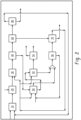
- the process entails introducing poly(phenylene ether), 1,2-dichloroethane,to a mixing vessel 10.
- the mixing vessel can be maintained at room temperature up to 85 °C, e.g., 30°C to 60°C, preferably 30°C to 45°C.
- the poly(phenylene ether), 1,2-dichloroethane, and a cosolvent can be mixed, e.g., until homogenous, to form the solvent mixture.
- the mixing can continue until a homogenous clear solution is obtained.
- the solvent mixture can be processed in a reaction vessel 20 along with a sulfonating agent.
- the sulfonated poly(phenylene ether) can then be precipitated from the mixture in a precipitation unit 30, e.g., once the desired degree of sulfonation has been attained.
- the reaction solvent mixture can be slowly added to the anti-solvent mixture (e.g., of hexane and DI water) to induce precipitation of the sulfonated poly(phenylene ether).
- the precipitated sulfonated poly(phenylene ether) can be separated from the liquid phase, e.g., in filtration unit 40, before the sulfonated poly(phenylene ether) is optionally washed (such as with DI water), e.g., in wash units 50,52, and dried, e.g., in drier 54.
- the liquid phase from the filtration unit 40 can be processed to remove water, e.g., in decantation unit 60 using liquid-liquid separation.
- the aqueous recovery phase from the decantation unit 60 can be processed in a multiple effect evaporator (MEE) 70 to recover the water.
- MEE multiple effect evaporator
- the resulting water can optionally be recycled, e.g., to, the wash unit 52, or the precipitation unit 30.
- the 1, 2-dichloroethane (EDC) stream from the decantation unit 60 can be further processed to separate the EDC by distillation in unit 80.
- the separated EDC can optionally be recycled, e.g., to mixing vessel 10.
- the process entails introducing poly(phenylene ether), 1,2-dichloroethane, and a cosolvent (ethyl acetate here), to a mixing vessel 10.
- the mixing vessel can be maintained at room temperature up to 85 °C, e.g., 30°C to 60°C, preferably 30°C to 45°C.
- the poly(phenylene ether), 1,2-dichloroethane, and a cosolvent can be mixed, e.g., until homogenous, to form the solvent mixture.
- the mixing can continue until a homogenous clear solution is obtained.
- the solvent mixture can be processed in a reaction vessel 20 along with a sulfonating agent.
- the sulfonated poly(phenylene ether) can be precipitated from the mixture in a precipitation unit 30, e.g., once the desired degree of sulfonation has been attained.
- the reaction solvent mixture can be slowly added to the anti-solvent mixture (e.g., DI water) to induce precipitation of the sulfonated poly(phenylene ether).
- the anti-solvent mixture e.g., DI water
- the precipitated sulfonated poly(phenylene ether) can be separated from the liquid phase, e.g., in filtration unit 40, before the sulfonated poly(phenylene ether) is optionally be reslurried with a DI water- hexane mixture, e.g., followed by a wash (e.g., with DI water) in units 50,52, and dried, e.g., in drier 54.
- the wash from the wash units 50,52 can optionally be separated in decantation unit 56, into an aqueous stream and a hexane stream.
- the hexane stream can optionally be recycled to the reslurry unit 50.
- the liquid phase from the filtration unit 40 can be processed to remove water, e.g., in decantation unit 60 using liquid-liquid separation.
- the aqueous phase from the decantation unit 60 and from decantation unit 56 can be processed in the multiple effect evaporator 70 to recover the water.
- the resulting water can optionally be recycled, e.g., to the reslurry unit 50, the wash unit 52, or the precipitation unit 30; and preferably to the reslurry unit 50.
- the EDC stream from the decantation unit 60 can be further processed to separate the EDC, e.g., from organic(s) and/or residue by distillation in the unit 80.
- the separated EDC can optionally be recycled, e.g., to mixing vessel 10.
- the process entails introducing poly(phenylene ether), 1,2-dichloroethane, and a cosolvent (e.g., tetramethylene sulfone), to a mixing vessel 10.
- the mixing vessel can be maintained at room temperature up to 85 °C, e.g., 30°C to 60°C, preferably 30°C to 45°C.
- the poly(phenylene ether), 1,2-dichloroethane, and cosolvent can be mixed, e.g., until homogenous, to form the solvent mixture.
- the mixing can continue until a homogenous clear solution is obtained.
- the solvent mixture can be processed in a reaction vessel 20 along with a sulfonating agent.
- the sulfonated poly(phenylene ether) can be precipitated from the mixture in a precipitation unit 30, e.g., once the desired degree of sulfonation has been attained.
- the reaction solvent mixture can be slowly added to the DI water (used as the anti-solvent mixture) to induce precipitation of the sulfonated poly(phenylene ether).
- the precipitated sulfonated poly(phenylene ether) can be separated from the liquid phase, e.g., in filtration unit 40, before the sulfonated poly(phenylene ether) is optionally reslurried in DI water- hexane mixture, e.g., followed by a wash (e.g., with DI water) in units 50,52, and dried, e.g., in drier 54.
- the wash from the wash units 50,52 can optionally be separated in decantation unit 56, into an aqueous stream and hexane stream.
- the hexane stream can optionally be recycled to the reslurry unit 50.
- the liquid phase from the filtration unit 40 can be processed to remove water, e.g., in decantation unit 60 using liquid-liquid separation.
- the aqueous phase from the decantation unit 60 and from decantation unit 56 can be processed in the multiple effect evaporator 70 to recover the water.
- the resulting water can optionally be recycled, e.g., to the reslurry unit 50, the wash unit 52, or the precipitation unit 30; and preferably to the reslurry unit 50.
- the EDC stream from the decantation unit 60 can be further processed to separate the EDC, e.g., from organic(s) and/or residue by distillation in the unit 80.
- the separated EDC can optionally be recycled, e.g., to mixing vessel 10.
- Example 1 Simulated method of making sulfonated polyphenylene ether (sPPE) with ion exchange capacity (IEC) of 1.5-1.6 milliequivalent per gram (meq/g). The scheme is illustrated in FIG. 1.
- sPPE sulfonated polyphenylene ether
- IEC ion exchange capacity
- a 3-necked round bottom glass flask equipped with a TEFLON stirrer, a reflux condenser and a pressure equalized dropping funnel was maintained at 35°C.
- 10.0 grams (g) of NORYL PPO TM 646 poly(phenylene ether) resin (commercially available from SABIC) was dissolved in 95 g of 1, 2-dichloroethane (EDC) until a homogenous clear solution was obtained; 60 minutes (min.). The temperature was subsequently reduced to 25°C. 2.37 g of chlorosulfonic acid was transferred to a pressure equalized dropping funnel and the same was added into the 1,2-dichloroethane solution under vigorous stirring over a 30 minute period.
- the industrial process scheme for the manufacture of sulfonated polyphenylene ether includes the dissolution of polyphenylene either (PPE) in 1,2-dichloroethane (basis of 100 kilogram per hour (kg/hr) of poly(phenylene ether)) with a residence time of 10 to 15 minutes. Dissolved 1,2-dichloroethane enters the reaction vessel where the reaction with chlorosulfonic acid (23.7 kg/hr) takes place with the mole ratio of chlorosulfonic acid to poly(phenylene ether) of 0.249. The reaction temperature is at 25°C with the residence time of 30 mins.
- the hydrochloride (HCl) gas which is evolved during the process is vented from the reactor and scrubbed using an alkali scrubber.
- the reaction mass from the reactor is precipitated in a precipitation vessel with starting poly(phenylene ether) to anti-solvent mixture volume ratio of 1:55.
- the precipitated mass is filtered and the wet sPPE goes for the purification by passing through two wash vessels and dried in a drier at the temperature of 50 to 60°C at reduced pressure of 100 millimeters of mercury (mmHg).
- the filtrate is biphasic with 1,2-dichloroethane (EDC) and hexane being the organic phase and water as the aqueous phase.
- EDC 1,2-dichloroethane
- Decanting liquid-liquid separation
- the distillation operation separates EDC as a distillate (which can be recycled), and the organic heavies at the bottom.
- the recycle efficiency for water and solvent is more than 90%. The entire scheme was simulated in Aspen to understand the recovery and recycle.
- Example 2 Simulated method of making sPPE with IEC of 1.8-2.0 meq/g. The scheme is illustrated in FIG. 2.
- a 3-necked round bottom glass flask equipped with a TEFLON stirrer, a reflux condenser and a pressure equalized dropping funnel was maintained at 40°C.
- 10.0 g of NORYL PPO TM 646 poly(phenylene ether) resin was dissolved in a 1,2-dichloroethane and ethyl acetate (EA) (179.5 g:11.7 g) mixture until a homogenous clear solution was obtained; 60 min.
- EA 1,2-dichloroethane and ethyl acetate
- the temperature was maintained at 40°C. 5.85 g of chlorosulfonic acid was transferred to a pressure equalized dropping funnel and the same was added into the 1,2-dichloroethane-ethylacetate solution mixture under vigorous stirring over a 30 minute period.
- the residue (sulfonated PPO) was then reslurried in DI water- hexane (500 ml:70 ml) mixture and refiltered. The residue was washed thoroughly with DI water until neutral pH. The sulfonated material is then dried under vacuum for 48 hours at room temperature.
- the industrial process scheme for the manufacture of sulfonated PPO includes dissolution of poly(phenylene ether) in 1,2-eichloroethane and ethyl acetate (basis of 100 kg/hr of poly(phenylene ether)) in the amount of 89.2 wt% EDC, 4.97 wt% poly(phenylene ether) and 5.83 wt% EA, based upon a total weight of the poly(phenylene ether), EA, and EDC, with a residence time of 10 to 15 minutes.
- Dissolved poly(phenylene ether) goes to the reaction vessel where the reaction with chlorosulfonic acid (58.5 kg/hr) takes place with the mole ratio of chlorosulfonic acid to poly(phenylene ether) of 0.613.
- the reaction temperature is at 40°C with the residence time of 30 mins.
- the HCl gas which is evolved during the process is vented from the reactor and scrubbed using alkali scrubber.
- the reaction mass from the reactor is precipitated in a precipitation vessel with starting poly(phenylene ether):water volume ratio of 1:120.
- the precipitated mass is filtered and the wet sPPE goes for the purification by passing through two wash vessels and dried in a drier at the temperature of 50 to 60°C at reduced pressure of 100 millimeters of mercury (mmHg).
- the filtrate is biphasic with 1,2-dichloroethane and EA being the organic phase and water as an aqueous phase.
- Decanting liquid-liquid separation
- EDC and EA forms heterogeneous azeotrope with water.
- the distillation operation separates EDC and EA as a distillate which can be recycled and the organic heavies at the bottom.
- the recycle efficiency for water and solvent is more than 90%. The entire scheme was simulated in Aspen to understand the recovery and recycle.
- Example 3 Simulated method of making sPPE with IEC of 1.8-2.0 meq/g. The scheme is illustrated in FIG. 2.
- a 3-necked round bottom glass flask equipped with a TEFLON stirrer, a reflux condenser and a pressure equalized dropping funnel was maintained at 40°C.
- 10.0 g of NORYL PPO TM 646 poly(phenylene ether) resin was dissolved in a 1,2-dichloroethane and ethyl acetate (93.9g:6.12g) mixture until a homogenous clear solution was obtained; 60 min.
- the temperature was maintained at 40°C.
- Chlorosulfonic acid (5.9 g) was transferred accurately to a pressure equalized dropping funnel and the same was added into the 1,2-dichloroethane and ethyl acetate mixture under vigorous stirring over a 30-min period.
- the residue (sPPE) is then reslurried in DI water/hexane (435ml:65ml) mixture and refiltered. The residue washed thoroughly with DI water until neutral pH. The sulfonated poly(phenylene ether) is then dried under vacuum for 48 hours at room temperature.
- the industrial process scheme for the manufacture of sulfonated poly(phenylene ether) includes the dissolution of poly(phenylene ether) in 1,2-dichloroethane and ethyl acetate (basis -100 kg/hr of poly(phenylene ether)) in the amount of 85.33 wt% EDC, 9.09 wt% poly(phenylene ether) and 5.58 wt% EA with a residence time of 10 to 15 minutes. Dissolved poly(phenylene ether) is introduced to the reaction vessel where the reaction with chlorosulfonic acid (59.1 kg/hr) takes place with the mole ratio of 0.62 with respect to poly(phenylene ether).
- the reaction temperature is at 40°C and the residence time is 30 min.
- the HCl gas which is evolved during the process, is vented from the reactor and scrubbed using an alkali scrubber.
- the reaction mass from the reactor is precipitated in a precipitation vessel with poly(phenylene ether):water volume ratio of 1:50.
- the precipitated mass is filtered and the wet sPPE is purified by passing through two wash vessels and is dried in a drier at the temperature of 50 to 60 °C at reduced pressure of 100 mmHg.
- the filtrate is biphasic with 1,2-dichloroethane and EA being the organic phase and water as the aqueous phase.
- Decanting liquid-liquid separation
- EDC and EA form heterogeneous azeotropes with water.
- the distillation operation separates the EDC and the EA as a distillate that can be recycled with organic heavies at the bottom.
- the recycle efficiency for water and solvent is more than 90%. The entire scheme was simulated in Aspen to understand the recovery and recycle.
- a 3-necked round bottom glass flask equipped with a TEFLON stirrer, a reflux condenser and a pressure equalized dropping funnel was maintained at 40°C.
- 10.0 g of NORYL PPO TM 646 poly(phenylene ether) resin was dissolved in a 1,2-dichloroethane and ethyl acetate (93.9g:6.12g) mixture until a homogenous clear solution was obtained; 60 min.
- the temperature was maintained at 40°C.
- Chlorosulfonic acid (5.9 g) was transferred accurately to a pressure equalized dropping funnel and the same was added into the 1,2-dichloroethane and ethyl acetate mixture under vigorous stirring over a 30-min period.
- the residue (sPPE) is then reslurried in DI water/hexane (435ml:65ml) mixture and refiltered. The residue washed thoroughly with DI water until neutral pH. The sulfonated material is then dried under vacuum for 48 hours at room temperature.
- a 3-necked round bottom glass flask equipped with a TEFLON stirrer, a reflux condenser and a pressure equalized dropping funnel was maintained at 40°C.
- 10.0 g of NORYL PPO TM 646 poly(phenylene ether) resin was dissolved in a 1,2-dichloroethane and ethyl acetate (93.9g:6.12g) mixture until a homogenous clear solution was obtained; 60 min.
- the temperature was maintained at 40°C.
- Chlorosulfonic acid (5.9 g) was transferred accurately to a pressure equalized dropping funnel and the same was added into the 1,2-dichloroethane and ethyl acetate mixture under vigorous stirring over a 30-min period.
- the residue (sPPE) is then reslurried in DI water/hexane (435ml:65ml) mixture and refiltered. The residue washed thoroughly with DI water until neutral pH. The sulfonated material is then dried under vacuum for 48 hours at room temperature.
- a 3-necked round bottom glass flask equipped with a TEFLON stirrer, a reflux condenser and a pressure equalized dropping funnel was maintained at 40°C.
- 10.0 g of NORYL PPO TM 646 poly(phenylene ether) resin was dissolved in a 1,2-dichloroethane and ethyl acetate (93.9g:6.12g) mixture until a homogenous clear solution was obtained; 60 min.
- the temperature was maintained at 40°C.
- Chlorosulfonic acid (5.9 g) was transferred accurately to a pressure equalized dropping funnel and the same was added into the 1,2-dichloroethane and ethyl acetate mixture under vigorous stirring over a 30-min period.
- the residue (sPPE) is then reslurried in DI water/hexane (435ml:65ml) mixture and refiltered. The residue washed thoroughly with DI water until neutral pH. The sulfonated material is then dried under vacuum for 48 hours at room temperature.
- a 3-necked round bottom glass flask equipped with a TEFLON stirrer, a reflux condenser and a pressure equalized dropping funnel was maintained at 40°C.
- 10.0 g of NORYL PPO TM 646 poly(phenylene ether) resin was dissolved in a 1,2-dichloroethane and ethyl acetate (93.9g:6.12g) mixture until a homogenous clear solution was obtained; 60 min.
- the temperature was maintained at 40°C.
- Chlorosulfonic acid (5.9 g) was transferred accurately to a pressure equalized dropping funnel and the same was added into the 1,2-dichloroethane and ethyl acetate mixture under vigorous stirring over a 30-min period.
- the residue (sPPE) is then reslurried in DI water/hexane (435ml:65ml) mixture and refiltered. The residue washed thoroughly with DI water until neutral pH. The sulfonated material is then dried under vacuum for 48 hours at room temperature.
- Example 8 Simulated method of making sPPE with an IEC of 2.5-3.0 meq/g. The scheme is illustrated in FIG. 2.
- 10.0 g of NORYI, PPO TM 646 poly(phenylene ether) resin was dissolved in a 1,2-dichloroethane and ethyl acetate (179.5g: 11.7g) mixture until a homogenous clear solution was obtained; 60 min.
- the temperature was maintained at 40°C.
- Chlorosulfonic acid (8.78 g) was transferred to a pressure equalized dropping funnel and the same was added into the 1,2-dichloroethane and ethylacetate mixture under vigorous stirring over a 30 minute period.
- the industrial process scheme for the manufacturing of sPPE includes the dissolution of poly(phenylene ether) in 1,2-dichloroethane and ethyl acetate (basis -100 kg/hr of poly(phenylene ether)) in the amount of 89.2 wt% EDC, 4.97 wt% poly(phenylene ether) and 5.83 wt% EA, based upon a total weight of the poly(phenylene ether), EA, and EDC, with a residence time of 10 to 15 minutes. Dissolved poly(phenylene ether) goes to the reaction vessel where the reaction with chlorosulfonic acid (87.8 kg/hr) takes place with the mole ratio 0.92 with respect to PPO.
- the reaction temperature is at 40 °C with the residence time of 30 mins.
- the HCl gas which is evolved during the process is vented from the reactor and scrubbed using alkali scrubber.
- the reaction mass from the reactor is precipitated in a precipitation vessel with poly(phenylene ether): water volume ratio of 1:50.
- the precipitated mass is filtered and the wet SPPE goes for the purification by passing through two wash vessels and dried in a drier at the temperature of 50 to 60 °C at reduced pressure of 100 mmHg.
- the filtrate is a biphasic with 1,2-Dichloroethane and EA are the organic phase and water as an aqueous phase.
- Decanting liquid-liquid separation
- EDC & EA from water followed by distillation to separate EDC and EA.
- Both EDC and EA forms heterogeneous azeotrope with water.
- the distillation operation separates EDC and EA as a distillate which can be recycled and the organic heavies at the bottom.
- the recycle efficiency for water and solvent is more than 90%.
- the entire scheme has been simulated in Aspen to understand the recovery and recycle.
- Example 9 Method of making sulfonated Polyphenylene oxide with Ion Exchange Capacity of 2.5-3.0 meq/g. The scheme is illustrated in FIG. 3.
- a 3-necked round bottom glass flask equipped with a Teflon stirrer, a reflux condenser and a pressure equalized dropping funnel was maintained at 40°C.
- 10.0 g of NORYL PPO TM 646 poly(phenylene ether) resin was dissolved in 1,2-Dichloroethane and tetramethylene sulfone (179.5g: 11.7g) solvent mixture till a homogenous clear solution was obtained in 60 mins.
- the temperature was maintained at 40°C. 5.85 gm of chlorosulfonic acid was transferred accurately to a pressure equalized dropping funnel and the same was added into the 1,2-Dichloroethane- tetramethylene sulfone solution mixture under vigorous stirring over a 30-minute period.
- the residue (sulfonated poly(phenylene ether)) was then reslurried in 500ml DI water and refiltered. The residue washed thoroughly with DI water until neutral pH. The sulfonated material was then dried under vacuum for 48 hours at room temperature.
- the Industrial process scheme for the manufacturing of the sulfonated poly(phenylene ether) consist of dissolution of poly(phenylene ether) in 1,2-dichloroethane and tetramethylene sulfone (basis -100 kg/hr of poly(phenylene ether)) in an amount of 89.2 wt% EDC, 4.97 wt% poly(phenylene ether) and 5.83 wt% tetramethylene sulfone, based upon a total weight of the poly(phenylene ether), tetramethylene sulfone, and EDC, with a residence time of 10 to 15 minutes.
- Dissolved poly(phenylene ether) goes to the reaction vessel where the reaction with chlorosulfonic acid (58.5 kg/hr) takes place with the mole ratio of 0.613 with respect to the poly(phenylene ether).
- the reaction temperature is at 40 °C with the residence time of 30 min.
- the HCl gas, which is evolved during the process, is vented from the reactor and scrubbed using alkali scrubber.
- the reaction mass from the reactor is precipitated in a precipitation vessel with starting poly(phenylene ether): anti-solvent mixture volume ratio of 1:120.
- the precipitated mass is filtered and the wet sPPE goes for purification by passing through two wash vessels and dried in a drier at the temperature of 50 to 60 °C at reduced pressure of 100 mmHg.
- the filtrate is biphasic with 1,2-dichloroethane, and tetramethylene sulfone are the organic phase and water as the aqueous phase. Decanting (liquid-liquid separation) to separate the EDC and tetramethylene sulfone from the water followed by distillation to separate the EDC and the tetramethylene sulfone.
- the distillation operation separates the EDC and the tetramethylene sulfone, as a distillate which can be recycled, with the organic heavies at the bottom.
- the recycle efficiency for the water and the solvent is more than 90%.
- the entire scheme has been simulated in Aspen to understand the recovery and recycle.
- Example 10 Scaled up ratio (500:1, from Example 1): Method of making 5 kilograms (kg) sulfonated polyphenylene ether (sPPE) with ion exchange capacity (IEC) of 1.5-1.6 milliequivalent per gram (meq/g).
- sPPE sulfonated polyphenylene ether
- IEC ion exchange capacity
- a multi neck 100 L reactor equipped with overhead stirrer reflux condenser, addition port and nitrogen purger was charged with NORYI, PPO TM 646 poly(phenylene ether) resin (at a reaction temperature (RT) of 25 to 30°C) and 1,2 ethylene dichloride (EDC).
- the reaction mass (RM) was heated to 30 to 35°C under stirring to get clear solution.
- Chlorosulfonic acid was added under nitrogen purging over a period of 20 to 25 min under vigorous stirring.
- the resultant reaction mass was stirred vigorously at RT for another 90 min under nitrogen.
- the reaction mass was added to a 500L reactor containing pre-cooled mixture of 175 L hexane and 100L DI water.
- the resultant precipitate was allowed to reach RT and was stirred at that same temperature for 10 hours.
- the solids were filtered via centrifuge and spin dried, and the wet solids were unloaded.
- the wet solids were stirred with 250 L DI water at RT for 4 h.
- the solids were filtered via centrifuge; spin dried well and the wet solids were unloaded.
- the wet solids were reslurried with additional 250 L DI water at RT for 14 hours at a neutral pH to isolate the sulfonated product.
- the solids were dried in a vacuum tray drier (VTD) at temperature of 35 to 40 °C for 72 h.
- VTD vacuum tray drier
- the resultant sulfonated polymer weighed: ⁇ 5.25 kg.
- Example 2 was repeated without the use of a cosolvent.
- a 3-necked round bottom glass flask equipped with a TEFLON stirrer, a reflux condenser and a pressure equalized dropping funnel was maintained at 40°C.
- 10.0 g of NORYI, PPO TM 646 poly(phenylene ether) resin was dissolved in a 1,2-dichloroethane (179.5 g) mixture until a homogenous clear solution was obtained; 60 min.
- the temperature was maintained at 40°C. 5.85 g of chlorosulfonic acid was transferred to a pressure equalized dropping funnel and the same was added into the 1,2-dichloroethane solution mixture under vigorous stirring over a 30 minute period. A nitrogen purge was maintained through with rapid stirring.
- reaction mass developed heterogeneity and the product precipitated out of the reaction mass.
- Stirring was continued for an additional 210 minutes at 40°C.
- the reaction mass was subsequently slowly transferred along with 1,200 ml of DI water (e.g., as the anti-solvent mixture) to a 2 L baffled precipitation vessel maintained at 10°C and fitted with a 4-blade agitator of about 60 mm diameter, running at 1,000 rpm, corresponding to 16.17 Hz (in SI units), giving a tip-speed of 3.14 m/s.
- the temperature was subsequently ramped up to 25°C after 1 hour.
- the stirring was continued for a total of 30 mins. This was followed by filtration.
- the residue (sulfonated PPO) was then reslurried in DI water- hexane (500 ml:70 ml) mixture and refiltered. The residue was washed thoroughly with DI water until neutral pH. The sulfonated material is then dried under vacuum for 48 hours at room temperature.
- Example 2 The sulfonated product once isolated using the exact procedure as cited in Example 2, had a degree of sulfonation of was 20 to 24% (non-uniform) as measured by NMR. This level was lower than the 31.42% degree of sulfonation of Example 2 which used ethyl acetate as a cosolvent. The development of heterogeneity and the subsequent phase separation of the sulfonated polymer prevented further sulfonation beyond 24%. However, as illustrated in Examples 2 through 9, inclusions of the co-solvent, ensured reaction homogeneity through the course of the sulfonations enabling higher degrees of sulfonation in the product, e.g., 24% here, with 31% in Example 2.
- Ion Exchange Capacity by potentiometry indicates the number of milliequivalents of ions in 1 g of the dry polymer.
- the degree of substitution (DS) indicates the percentage of repeat units bearing the sulfonic acid group along the sulfonated polymer molecular chain.
- the method involves dissolving the sPPE in a dimethyl acetamide/isopropyl alcohol mixture and titrating with alcoholic potassium hydroxide by potentiometric method. This non-aqueous titration was performed with Solvatrode (commercially available from Metrohm USA) as the electrode. This method uses a two solvent system. Consequently a sharp and reproducible end point is obtained.
- DS Degree of sulfonation
- NMR nuclear magnetic resonance spectroscopy
- the degree of sulfonation can be calculated either from the aliphatic or aromatic protons:
- Molecular Weight A gel permeation chromatography (GPC) method for estimation of the molecular weight (weight average molecular weight (Mw) and number average molecular weight (Mn)) was developed for the sPPE by using dimethyl formamide as a mobile phase with 0.1 wt%, based upon the weight of the mobile phase of lithium bromide as an additive.
- Agilent 2 x e.g., 2 columns
- PLgel 5 micrometer ( ⁇ m) MIXED-B, 300 x 7.5 mm, with one guard, column was used for the elution of sPPE with 1 milliliter per minute (ml/min) flow rate and 400°C of column temperature.
- UV detector at 254 nanometers (nm) was used to record the GPC chromatogram of sPPE, with an elution time of 30 min.
- Samples were slowly dissolved in the dimethyl formamide solvent at a concentration of two milligram per milliliter (mg/ml) for about 4 to 6 hours in a horizontal shaker.
- the solutions were filtered through a 0.45 ⁇ m PTFE filter into a GPC auto sampler vials for analysis.
- the GPC system calibrated with polystyrene standards in the range of to 180 Dalton (Da) to 6870 kDa (i.e. in the range of to 180 to 6870 ⁇ 10 3 atomic mass units in SI units).
- Agilent ChemStation software was used to set the baseline points.
- the major solvent which is common in all the examples is 1, 2 dichloroethane which is distilled in the distillation unit (80) from the trace of water and recycled. In all the cases the recovery is above 99% in terms of the 1, 2 dichloroethane.
- the ethyl acetate is used as a co-solvent along with the 1, 2 dichloroethane in Examples 2, 3-7, and 8.
- the ethyl-acetate together with the 1, 2 dichloroethane can be distilled in the distillation unit (80) and recycled for the sulphonation reaction.
- the recovery of the ethyl-acetate is above 97%.
- the recycle of water is common in all of the above examples, after the separation of aqueous vs organic in the decanter (60) the aqueous layer (mainly water) is evaporated in a multiple effect evaporator and recycled e.g., to precipitation and/or filtration units.
- the recycled water accounts to be 90%, preferably 94% or more, of the total quantity of water used.
- the commercial viability of this sulfonation process wherein poly(phenylene either is sulfonated to 20%-50% using 1, 2 dichloroethane and a co-solvent.
- the cosolvent can be at least one of methyl ethyl ketone, diethyl ether, methyl ethyl sulfone, ethyl acetate, or tetramethylene sulfone.
- uniform means the same degree of sulfonation across the isolated mass of the sulfonated polymer product as determined by 1H-NMR of at least 5 small samples taken from the entire product mass.
- test standards are the most recent standard in effect as of the filing date of this application, or, if priority is claimed, the filing date of the earliest priority application in which the test standard appears.
Landscapes
- Chemical & Material Sciences (AREA)
- Chemical Kinetics & Catalysis (AREA)
- Health & Medical Sciences (AREA)
- Medicinal Chemistry (AREA)
- Polymers & Plastics (AREA)
- Organic Chemistry (AREA)
- General Chemical & Material Sciences (AREA)
- Engineering & Computer Science (AREA)
- Manufacturing & Machinery (AREA)
- Inorganic Chemistry (AREA)
- Materials Engineering (AREA)
- Polyethers (AREA)
Description
- Disclosed herein is a method for making sulfonated poly(phenylene ether).
- Poly(phenylene ether)s are commercially attractive materials because of their unique combination of physical, chemical, and electrical properties. Furthermore, the combination of poly(phenylene ether)s with other polymers or additives provides blends which result in improved overall properties including chemical resistance, high strength, and high flow. As new commercial applications are explored, various sulfonated grades of poly(phenylene ether) materials are desired.
- Conventional methods for sulfonating poly(phenylene ether) develop heterogeneity with progressive levels of sulfonation, affection the reaction system making further sulfonation impossible.
JP 2004 273286 WO 2019/009721 relates to polymers comprising sulfonated 2,6-diphenyl-1,4-phenylene oxide repeating units and their preparation method, which is based on the use of oleum as sulfonation agent. However, that particular synthetic process is cumbersome, as it involves the formation of very viscous pastes which form a pudding-like jelly ball which is difficult to handle and, additionally, a very low sulfonation level is achieved (e.g. sulfonation of 1.24 in Example 2).US 3631130 relates to a method for sulfonating poly(arylene oxides) with a mixture of chlorosulfonic acid and a nitroalkane, wherein a viscous semi-solid phase is formed, from which the sulfonated polymer must be isolated, thus also resulting in a cumbersome and time-consuming synthetic method.JP 2005174897 EP 1619735 both relate to sulfonated polymer electrolyte materials, but they are silent about any specific synthetic method.JP 2007115446 - What is needed in the art is a scalable process for sulfonating poly(phenylene ether) up to sulfonation levels of 50%, and preferably with improved efficiency.
- Disclosed herein are methods for sulfonating poly(phenylene ether) as defined in
claim 1 or 2. - A method for sulfonation of poly(phenylene ether) according to claim 1 comprises: dissolving a poly(phenylene ether) comprising 2,6-dimethyl-1,4-phenylene ether units, 2,3,6-trimethyl-1,4-phenylene ether units, 3,3',5,5'-tetramethyl-4,4'-dihydroxybiphenyl ether units, or a combination thereof in a mixture of 1,2-dichloroethane and preferably a cosolvent to form a solvent mixture in a mixing vessel, wherein the cosolvent may comprise at least one of methyl ethyl ketone, diethyl ether, methyl ethyl sulfone, ethyl acetate, or tetramethylene sulfone; combining a sulfonating agent with the solvent mixture, wherein the sulfonating agent reacts with the poly(phenylene ether) to form sulfonated poly(phenylene ether); precipitating the sulfonated poly(phenylene ether); and filtering the precipitated sulfonated poly(phenylene ether) to form a sulfonated poly(phenylene ether) precipitate and a filtrate; wherein the sulfonated poly(phenylene ether) has a sulfonation level of 20 to 50%.
- A method for sulfonation of poly(phenylene ether) according to
claim 2 comprises: determining the desired sulfonation level; wherein, if the desired sulfonation level is greater than 20% then the method of claim 1 is followed and, if the sulfonation level is less than or equal to 20% then poly(phenylene ether) comprising 2,6-dimethyl-1,4-phenylene ether units, 2,3,6-trimethyl-1,4-phenylene ether units, 3,3',5,5'-tetramethyl-4,4'-dihydroxybiphenyl ether units, or a combination thereof is dissolved in 1,2-dichloroethane, preferably with no cosolvent, to form a solvent mixture in a mixing vessel; then combining a sulfonating agent with the solvent mixture, wherein the sulfonating agent reacts with the poly(phenylene ether) to form sulfonated poly(phenylene ether); precipitating the sulfonated poly(phenylene ether); and filtering the precipitated sulfonated poly(phenylene ether) to form a sulfonated poly(phenylene ether) precipitate and a filtrate. - Referring now to the drawings which are exemplary and not limiting.
-
FIG. 1 is a schematic drawing of an embodiment of a system for sulfonating poly(phenylene ether). -
FIG. 2 is a schematic drawing of another embodiment of a system for sulfonating poly(phenylene ether). -
FIG. 3 is a schematic drawing of another embodiment of a system for sulfonating poly(phenylene ether). -
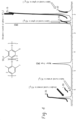
FIG. 4 is a nuclear magnetic resonance graph for degree of sulfonation. - Methods have been developed to reliably sulfonate of poly(phenylene ether) to degrees of sulfonation ranging from 20 to 50%. The process is scalable and allows for the production of poly(phenylene ether) with different sulfonation levels. For example, methods enable sulfonating poly(phenylene ether) up to sulfonation levels of 50%, while maintaining homogeneity, and preferably recovering and recycling the solvents. The same was achieved using reaction solvent mixtures comprising 1,2-dichloroethane and a co-solvent (e.g., at least one of ethyl acetate or tetramethylene sulfone). Presence of the co-solvent enables reaction homogeneity at progressive levels of sulfonation of the polyphenylene oxide involving comparatively high stoichiometric amounts of the sulfonating agent (e.g., chloro-sulfonic acid). For example, polyphenylene oxide can be sulfonated between 20 to 50% while maintaining a homogeneous system.
- It has been determined that inhibiting precipitation during sulfonation enables the controlling of the sulfonation level. Preferably, to make this process scalable and efficient, effective handling of the effluent from the process is important. In the present methods, the solvent is recoverable and recyclable at a rate of greater than or equal to 80 weight percent (wt%), based upon a total weight of the solvent introduced into the system.
- With the ability to efficiently produce poly(phenylene ether) with sulfonation levels of 20 to 50%, various diverse products are possible. For example, ion exchange membranes for dialysis, proton conducting membranes for polymer electrolyte membrane fuel cells, ion exchange membranes for flow batteries, hollow fiber membranes, precursor for molecular sieve carbon membranes for gas separation, precursor for carbon electrodes for fuel cells, carbon membrane reactors, etc.
- The degree of sulfonation can be controlled by adjusting an amount of solvent, and in particular, cosolvent, in the process and by the amount of sulfonating agent used. The process comprises dissolving poly(phenylene ether) in a solvent, adding a sulfonating agent to the mixture, and sulfonating the poly(phenylene ether). The solvent comprises 1,2-dichloroethane. The cosolvent comprises at least one of methyl ethyl ketone, diethyl ether, methyl ethyl sulfone, ethyl acetate (EA), or tetramethylene sulfone; preferably comprises at least one of ethyl acetate, or tetramethylene sulfone, and more preferably comprises or is ethyl acetate.
- Poly(phenylene ether)s include those comprising repeating structural units having the formula

terminal 3,5-dimethyl-1,4-phenyl group with the di-n-butylamine component of an oxidative polymerization catalyst. - In some embodiments, the poly(phenylene ether) comprises 2,6-dimethyl-1,4-phenylene ether units, 2,3,6-trimethyl-1,4-phenylene ether units, or a combination thereof. In some embodiments, the poly(phenylene ether) is a poly(2,6-dimethyl-1,4-phenylene ether). In some embodiments, the poly(phenylene ether) comprises a poly(2,6-dimethyl-1,4-phenylene ether) having an intrinsic viscosity of 0.03 to 2 deciliter per gram (dl/g). For example, the poly(phenylene ether) can have an intrinsic viscosity of 0.25 to 1.7 dl/g, specifically 0.25 to 0.7 dl/g, more specifically 0.35 to 0.55 dl/g, even more specifically 0.35 to 0.50 dl/g, measured at 25°C in chloroform using an Ubbelohde viscometer.
- In some embodiments, the poly(phenylene ether) can comprise molecules having aminoalkyl-containing end group(s), typically located in a position ortho to the hydroxy group. Also frequently present are tetramethyldiphenoquinone (TMDQ) end groups, typically obtained from 2,6-dimethylphenol-containing reaction mixtures in which tetramethyldiphenoquinone by-product is present. The poly(phenylene ether) can be in the form of a homopolymer, a copolymer, a graft copolymer, an ionomer, a block copolymer, or an oligomer as well as combinations thereof.
- Poly(phenylene ether) as used herein can also refer to lower molecular weight phenylene ether oligomers. In some embodiments, the phenylene ether oligomer comprises 2,6-dimethyl-1,4-phenylene ether units, 2,3,6-trimethyl-1,4-phenylene ether units, or a combination thereof. In some embodiments, the phenylene ether oligomer can have an intrinsic viscosity of 0.03 to 0.13 deciliter per gram, or 0.05 to 0.1 deciliter per gram, or 0.1 to 0.15 deciliter per gram, measured at 25°C in chloroform using an Ubbelohde viscometer. The phenylene ether oligomer can have a number average molecular weight of 500 to 7,000 grams per mole, and a weight average molecular weight of 500 to 15,000 grams per mole, as determined by gel permeation chromatography using polystyrene standards. In some embodiments, the number average molecular weight can be 750 to 4,000 grams per mole, and the weight average molecular weight can be 1,500 to 9,000 grams per mole, as determined by gel permeation chromatography using polystyrene standards.
- The phenylene ether oligomer can be monofunctional or bifunctional. In some embodiments, the phenylene ether oligomer can be monofunctional. For example, it can have a functional group at one terminus of the polymer chains. The functional group can be, for example, a hydroxyl group or a (meth)acrylate group, preferably a (meth)acrylate group. In some embodiments, the phenylene ether oligomer comprises poly(2,6-dimethyl-1,4-phenylene ether).
- In some embodiment, the phenylene ether oligomer can be bifunctional. For example, it can have functional groups at both termini of the oligomer chain. The functional groups can be, for example, hydroxyl groups or (meth)acrylate groups, preferably (meth)acrylate groups. Bifunctional polymers with functional groups at both termini of the polymer chains are also referred to as "telechelic" polymers. In some embodiments, the phenylene ether oligomer comprises a bifunctional phenylene ether oligomer having the structure


- In an embodiment, the phenylene ether oligomer comprises a bifunctional phenylene ether oligomer having the structure

- In the (meth)acrylate-terminated phenylene ether structure above, there are limitations on the variables x and y, which correspond to the number of phenylene ether repeating units at two different places in the bifunctional phenylene ether oligomer. In the structure, x and y are independently 0 to 30, specifically 0 to 20, more specifically 0 to 15, even more specifically 0 to 10, yet more specifically 0 to 8. The sum of x and y is at least 2, specifically at least 3, more specifically at least 4. A phenylene ether oligomer can be analyzed by proton nuclear magnetic resonance spectroscopy (1H NMR) to determine whether these limitations are met, on average. Specifically, 1H NMR can distinguish between protons associated with internal and terminal phenylene ether groups, with internal and terminal residues of a polyhydric phenol, and with terminal residues as well. It is therefore possible to determine the average number of phenylene ether repeating units per molecule, and the relative abundance of internal and terminal residues derived from dihydric phenol.
- In some embodiments the phenylene ether oligomer comprises a bifunctional phenylene ether oligomer having the structure
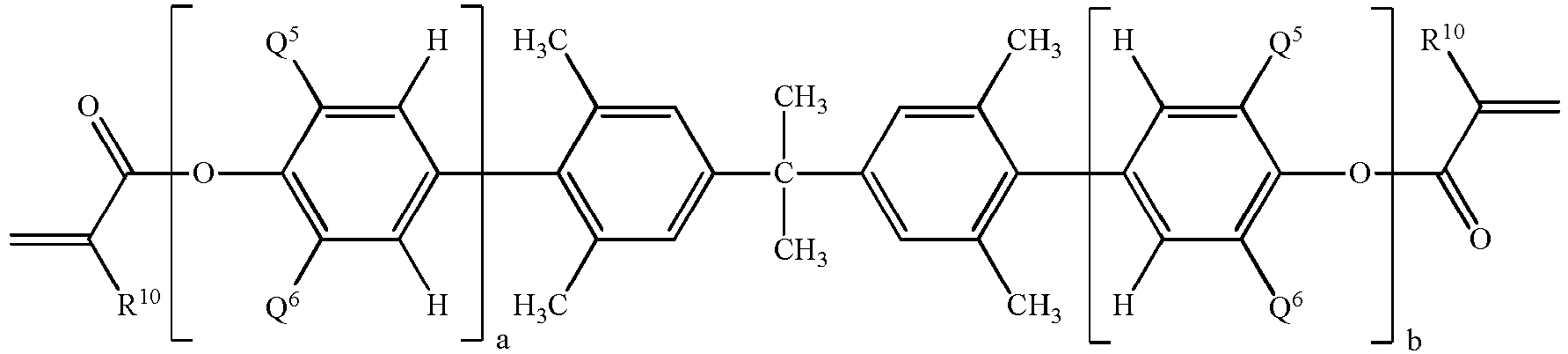
- In some embodiments the phenylene ether oligomer comprises a bifunctional phenylene ether oligomer having the structure

- In some embodiments, the poly(phenylene ether) comprises a poly(phenylene ether) homopolymer, oligomer, or combination thereof. The poly(phenylene ether) can preferably comprise a poly(2,6-dimethyl-1,4-phenylene ether).
- The poly(phenylene ether) composition can optionally further comprise one or more additives, with the proviso that the one or more additives do not significantly adversely affect one or more desirable properties of the poly(phenylene ether) composition). Exemplary additives can include stabilizers, mold release agents, lubricants, processing aids, drip retardants, nucleating agents, UV blockers, dyes, pigments, antioxidants, anti-static agents, blowing agents, mineral oil, metal deactivators, antiblocking agents, and combinations thereof. When present, such additives are typically used in a total amount of less than or equal to 10 weight percent, specifically less than or equal to 5 weight percent, based on the total weight of the poly(phenylene ether) composition.
- The process for the sulfonation of the poly(phenylene ether) comprises dissolving the poly(phenylene ether) in a solvent (preferably in a solvent and cosolvent) to form a solvent mixture. The mixing can be performed at temperatures of 10°C to 60°C, e.g., 25°C to 40°C. The 1,2-dichloroethane is present in a sufficient quantity to dissolve the poly(phenylene ether). The amount of cosolvent is sufficient to prevent precipitation of the sulfonated poly(phenylene ether) before the desired degree of sulfonation has been attained. The solvent mixture can comprise 1 wt% to 20 wt%, preferably 5 wt% to 10 wt%, poly(phenylene ether); 80 wt% to 99 wt%, preferably 90 wt% to 95 wt% 1,2-dichloroethane; and, 0 to 10 wt% (e.g., greater than zero), preferably greater than 0 to 6.0 wt%, cosolvent; based upon 100 wt% weight of the solvent mixture. The solvent mixture can comprise 1 to 20 wt% of the poly(phenylene ether); 80 to 99 wt% of the 1,2-dichloroethane; and 0 to 10 wt% of the cosolvent, preferably greater than zero to 10 wt%, based upon 100 wt% of the solvent mixture. The amount of cosolvent is determined based upon the desired degree of sulfonation. For example, for sulfonation of 10 to 20%, the solvent mixture can comprise 1 wt% to 20 wt%, preferably 5 wt% to 10 wt%, poly(phenylene ether); 80 wt% to 99 wt%, preferably 90 wt% to 95 wt% 1,2-dichloroethane; no cosolvent is necessary. However, for uniform sulfonation above 20%, the presence of cosolvent is desirable. For example, for a uniform sulfonation level of 25% to 50%, the solvent mixture can comprise 1 wt% to 10 wt%, preferably 5 wt% to 10 wt%, poly(phenylene ether); 70 wt% to 90 wt%, preferably 80 wt% to 90 wt% 1,2-dichloroethane, and 1 to 10 wt% preferably 2 to 6.0 wt%, cosolvent; based upon 100 wt% weight of the solvent mixture. The sulfonation level may be 25% to 50%, preferably 28% to 50%, as determined by NMR, or the sulfonated poly(phenylene ether) has a uniform sulfonation level in the range of 20 to 50%, preferably in the range of 25% to 50%, more preferably 28% to 50%, as determined by NMR.
- The solvent mixture can then be reacted with a sulfonating agent to sulfonate the poly(phenylene ether). The sulfonation can be performed at a temperature of up to 85°C, e.g., 10°C to 60°C, or 25°C to 40°C. The amount of sulfonating agent added to the solvent mixture can be 0.5 to 1 mole, preferably 0.25 to 0.9 moles, based upon a total 1 mole of poly(phenylene ether) that was dissolved in the solvent mixture. The specific amount of sulfonating agent added is dependent upon the desired level of sulfonation in the sulfonated reaction product. Desirably, the sulfonating agent is added slowly to the solvent mixture, e.g., added over a period of 15 minutes (min.) to 60 min., (e.g., over a period of 30 mins). Once the sulfonating agent is added to the solvent mixture, the solvent mixture can be stirred, e.g., for a period of time of 60 to 210 mins, prior to proceeding to precipitation.
- Once the poly(phenylene ether) has been sulfonated, the sulfonated poly(phenylene ether) can be precipitated from the solvent mixture using an anti-solvent mixture, e.g., containing di-ionized (DI) water. For example, at least one of hexane, heptane, can be used, e.g., along with di-ionized water, to cause the sulfonated poly(phenylene ether) to precipitate out of the reaction solvent mixture. The reaction solvent mixture can be (e.g., slowly) added to the anti-solvent mixture, wherein the anti-solvent mixture can be used in an amount sufficient to induce precipitation. For example, 100 grams (g) solvent mixture can be added to 300 g to 700g, preferably 390g to 595g, of the anti-solvent mixture with hexane to water weight ratios ranging from 0 to 1.15.
- The precipitated sulfonated poly(phenylene ether) can be filtered, and optionally washed and dried. The filtrate can be diphasic with the 1,2-dichloroethane,cosolvent, and optionally organic(s) (e.g., hexane) that were part of the anti-solvent mixture, as the organic phase and water as the aqueous phase. The method may further comprise recovering the solvent and the cosolvent. Hence, the filtrate can be further processed to recover at least one of the 1,2-dichloroethane, the cosolvent, or water; preferably to recover 1,2-dichloroethane and the cosolvent, more preferably to recover 1,2-dichloroethane, the cosolvent, and the water. Recovering the materials can comprise decanting the diphasic filtrate to form an aqueous stream and an organic stream. The organic stream can be further processed, e.g., distilled, to recover the 1,2-dichloroethane and/or the cosolvent. The recovered materials can be recycled. Greater than 97 wt%, preferably greater than or equal to 99 wt% of the 1,2-dichloroethane may be recycled, and/or greater than 95 wt%, preferably greater than or equal to 97 wt% of the cosolvent may be recycled; and/or greater than 90 wt%, preferably greater than or equal to 93 wt% of water used in the process may be recycled.
- Referring now to
FIG. 1 where the process is schematically illustrated. As is illustrated, the process entails introducing poly(phenylene ether), 1,2-dichloroethane,to a mixingvessel 10. The mixing vessel can be maintained at room temperature up to 85 °C, e.g., 30°C to 60°C, preferably 30°C to 45°C. Within the mixingvessel 10, the poly(phenylene ether), 1,2-dichloroethane, and a cosolvent, can be mixed, e.g., until homogenous, to form the solvent mixture. Optionally, the mixing can continue until a homogenous clear solution is obtained. From the mixingvessel 10, the solvent mixture can be processed in areaction vessel 20 along with a sulfonating agent. The sulfonated poly(phenylene ether) can then be precipitated from the mixture in aprecipitation unit 30, e.g., once the desired degree of sulfonation has been attained. For example, the reaction solvent mixture can be slowly added to the anti-solvent mixture (e.g., of hexane and DI water) to induce precipitation of the sulfonated poly(phenylene ether). The precipitated sulfonated poly(phenylene ether) can be separated from the liquid phase, e.g., infiltration unit 40, before the sulfonated poly(phenylene ether) is optionally washed (such as with DI water), e.g., inwash units filtration unit 40 can be processed to remove water, e.g., indecantation unit 60 using liquid-liquid separation. The aqueous recovery phase from thedecantation unit 60 can be processed in a multiple effect evaporator (MEE) 70 to recover the water. The resulting water can optionally be recycled, e.g., to, thewash unit 52, or theprecipitation unit 30. The 1, 2-dichloroethane (EDC) stream from thedecantation unit 60 can be further processed to separate the EDC by distillation inunit 80. The separated EDC can optionally be recycled, e.g., to mixingvessel 10. - Referring now to
FIG. 2 , where the process is schematically illustrated. As is illustrated, the process entails introducing poly(phenylene ether), 1,2-dichloroethane, and a cosolvent (ethyl acetate here), to a mixingvessel 10. The mixing vessel can be maintained at room temperature up to 85 °C, e.g., 30°C to 60°C, preferably 30°C to 45°C. Within the mixingvessel 10, the poly(phenylene ether), 1,2-dichloroethane, and a cosolvent, can be mixed, e.g., until homogenous, to form the solvent mixture. Optionally, the mixing can continue until a homogenous clear solution is obtained. From the mixingvessel 10, the solvent mixture can be processed in areaction vessel 20 along with a sulfonating agent. The sulfonated poly(phenylene ether) can be precipitated from the mixture in aprecipitation unit 30, e.g., once the desired degree of sulfonation has been attained. For example, the reaction solvent mixture can be slowly added to the anti-solvent mixture (e.g., DI water) to induce precipitation of the sulfonated poly(phenylene ether). The precipitated sulfonated poly(phenylene ether) can be separated from the liquid phase, e.g., infiltration unit 40, before the sulfonated poly(phenylene ether) is optionally be reslurried with a DI water- hexane mixture, e.g., followed by a wash (e.g., with DI water) inunits wash units decantation unit 56, into an aqueous stream and a hexane stream. The hexane stream can optionally be recycled to thereslurry unit 50. Meanwhile, the liquid phase from thefiltration unit 40 can be processed to remove water, e.g., indecantation unit 60 using liquid-liquid separation. The aqueous phase from thedecantation unit 60 and fromdecantation unit 56, can be processed in the multiple effect evaporator 70 to recover the water. The resulting water can optionally be recycled, e.g., to thereslurry unit 50, thewash unit 52, or theprecipitation unit 30; and preferably to thereslurry unit 50. The EDC stream from thedecantation unit 60 can be further processed to separate the EDC, e.g., from organic(s) and/or residue by distillation in theunit 80. The separated EDC can optionally be recycled, e.g., to mixingvessel 10. - Referring now to
FIG. 3 , where the process is schematically illustrated. As is illustrated, the process entails introducing poly(phenylene ether), 1,2-dichloroethane, and a cosolvent (e.g., tetramethylene sulfone), to a mixingvessel 10. The mixing vessel can be maintained at room temperature up to 85 °C, e.g., 30°C to 60°C, preferably 30°C to 45°C. Within the mixingvessel 10, the poly(phenylene ether), 1,2-dichloroethane, and cosolvent, can be mixed, e.g., until homogenous, to form the solvent mixture. Optionally, the mixing can continue until a homogenous clear solution is obtained. _From the mixingvessel 10, the solvent mixture can be processed in areaction vessel 20 along with a sulfonating agent. The sulfonated poly(phenylene ether) can be precipitated from the mixture in aprecipitation unit 30, e.g., once the desired degree of sulfonation has been attained. For example, the reaction solvent mixture can be slowly added to the DI water (used as the anti-solvent mixture) to induce precipitation of the sulfonated poly(phenylene ether). The precipitated sulfonated poly(phenylene ether) can be separated from the liquid phase, e.g., infiltration unit 40, before the sulfonated poly(phenylene ether) is optionally reslurried in DI water- hexane mixture, e.g., followed by a wash (e.g., with DI water) inunits wash units decantation unit 56, into an aqueous stream and hexane stream. The hexane stream can optionally be recycled to thereslurry unit 50. Meanwhile, the liquid phase from thefiltration unit 40 can be processed to remove water, e.g., indecantation unit 60 using liquid-liquid separation. The aqueous phase from thedecantation unit 60 and fromdecantation unit 56, can be processed in the multiple effect evaporator 70 to recover the water. The resulting water can optionally be recycled, e.g., to thereslurry unit 50, thewash unit 52, or theprecipitation unit 30; and preferably to thereslurry unit 50. The EDC stream from thedecantation unit 60 can be further processed to separate the EDC, e.g., from organic(s) and/or residue by distillation in theunit 80. The separated EDC can optionally be recycled, e.g., to mixingvessel 10. - This disclosure is further illustrated by the following examples, which are nonlimiting.
- A 3-necked round bottom glass flask equipped with a TEFLON stirrer, a reflux condenser and a pressure equalized dropping funnel was maintained at 35°C. 10.0 grams (g) of NORYL PPO™ 646 poly(phenylene ether) resin (commercially available from SABIC) was dissolved in 95 g of 1, 2-dichloroethane (EDC) until a homogenous clear solution was obtained; 60 minutes (min.). The temperature was subsequently reduced to 25°C. 2.37 g of chlorosulfonic acid was transferred to a pressure equalized dropping funnel and the same was added into the 1,2-dichloroethane solution under vigorous stirring over a 30 minute period. A 5 g rinse 1,2-dichloroethane was used to flush the dropping funnel. A nitrogen purge was maintained although with rapid stirring. At the end of this addition, the stirred solution becomes slightly cloudy. Stirring was continued for ab additional 60 minutes at 25°C. The reaction mass is subsequently slowly transferred along with hexane-deionized (DI) water ((350 milliliters (ml):200 ml) anti-solvent mixture) to a 2 liter (L) baffled precipitation vessel maintained at 10°C and fitted with a 4-blade agitator of about 60 millimeter (mm) diameter, running at 1,000 revolutions per minute (rpm), corresponding to 16.17 Hz (in SI units), giving a tip-speed of 3.14 meters per second (m/s). The temperature was subsequently ramped up to 25°C after 1 hour. The stirring was continued for a total of 8 hours. This was followed by filtration. The residue (sulfonated poly(phenylene ether) (sPPE)) was then reslurried in DI water and refiltered. The residue washed thoroughly with DI water until neutral pH. The sulfonated material was then dried under vacuum for 48 hours (h) at room temperature.
- The industrial process scheme for the manufacture of sulfonated polyphenylene ether (sPPE) includes the dissolution of polyphenylene either (PPE) in 1,2-dichloroethane (basis of 100 kilogram per hour (kg/hr) of poly(phenylene ether)) with a residence time of 10 to 15 minutes. Dissolved 1,2-dichloroethane enters the reaction vessel where the reaction with chlorosulfonic acid (23.7 kg/hr) takes place with the mole ratio of chlorosulfonic acid to poly(phenylene ether) of 0.249. The reaction temperature is at 25°C with the residence time of 30 mins. The hydrochloride (HCl) gas which is evolved during the process is vented from the reactor and scrubbed using an alkali scrubber. The reaction mass from the reactor is precipitated in a precipitation vessel with starting poly(phenylene ether) to anti-solvent mixture volume ratio of 1:55.
- The precipitated mass is filtered and the wet sPPE goes for the purification by passing through two wash vessels and dried in a drier at the temperature of 50 to 60°C at reduced pressure of 100 millimeters of mercury (mmHg). The filtrate is biphasic with 1,2-dichloroethane (EDC) and hexane being the organic phase and water as the aqueous phase. Decanting (liquid-liquid separation) is done to separate the EDC layer from the water followed by distillation to separate EDC from heavies. EDC formed heterogeneous azeotrope with water. The distillation operation separates EDC as a distillate (which can be recycled), and the organic heavies at the bottom. The recycle efficiency for water and solvent is more than 90%. The entire scheme was simulated in Aspen to understand the recovery and recycle.
- A 3-necked round bottom glass flask equipped with a TEFLON stirrer, a reflux condenser and a pressure equalized dropping funnel was maintained at 40°C. 10.0 g of NORYL PPO™ 646 poly(phenylene ether) resin was dissolved in a 1,2-dichloroethane and ethyl acetate (EA) (179.5 g:11.7 g) mixture until a homogenous clear solution was obtained; 60 min. The temperature was maintained at 40°C. 5.85 g of chlorosulfonic acid was transferred to a pressure equalized dropping funnel and the same was added into the 1,2-dichloroethane-ethylacetate solution mixture under vigorous stirring over a 30 minute period. A nitrogen purge was maintained through with rapid stirring. At the end of this addition, the stirred solution becomes slightly cloudy. Stirring was continued for an additional 210 minutes at 40°C. The reaction mass was subsequently slowly transferred along with 1,200 ml of DI water (e.g., as the anti-solvent mixture) to a 2 L baffled precipitation vessel maintained at 10°C and fitted with a 4-blade agitator of about 60 mm diameter, running at 1,000 rpm, corresponding to 16.17 Hz (in SI units), giving a tip-speed of 3.14 m/s. The temperature was subsequently ramped up to 25°C after 1 hour. The stirring was continued for a total of 30 mins. This was followed by filtration. The residue (sulfonated PPO) was then reslurried in DI water- hexane (500 ml:70 ml) mixture and refiltered. The residue was washed thoroughly with DI water until neutral pH. The sulfonated material is then dried under vacuum for 48 hours at room temperature.
- The industrial process scheme for the manufacture of sulfonated PPO (sPPE) includes dissolution of poly(phenylene ether) in 1,2-eichloroethane and ethyl acetate (basis of 100 kg/hr of poly(phenylene ether)) in the amount of 89.2 wt% EDC, 4.97 wt% poly(phenylene ether) and 5.83 wt% EA, based upon a total weight of the poly(phenylene ether), EA, and EDC, with a residence time of 10 to 15 minutes. Dissolved poly(phenylene ether) goes to the reaction vessel where the reaction with chlorosulfonic acid (58.5 kg/hr) takes place with the mole ratio of chlorosulfonic acid to poly(phenylene ether) of 0.613. The reaction temperature is at 40°C with the residence time of 30 mins. The HCl gas which is evolved during the process is vented from the reactor and scrubbed using alkali scrubber. The reaction mass from the reactor is precipitated in a precipitation vessel with starting poly(phenylene ether):water volume ratio of 1:120.
- The precipitated mass is filtered and the wet sPPE goes for the purification by passing through two wash vessels and dried in a drier at the temperature of 50 to 60°C at reduced pressure of 100 millimeters of mercury (mmHg). The filtrate is biphasic with 1,2-dichloroethane and EA being the organic phase and water as an aqueous phase. Decanting (liquid-liquid separation) is done to separate the EDC and EA from water followed by distillation to separate EDC and EA. Both EDC and EA forms heterogeneous azeotrope with water. The distillation operation separates EDC and EA as a distillate which can be recycled and the organic heavies at the bottom. The recycle efficiency for water and solvent is more than 90%. The entire scheme was simulated in Aspen to understand the recovery and recycle.
- A 3-necked round bottom glass flask equipped with a TEFLON stirrer, a reflux condenser and a pressure equalized dropping funnel was maintained at 40°C. 10.0 g of NORYL PPO™ 646 poly(phenylene ether) resin was dissolved in a 1,2-dichloroethane and ethyl acetate (93.9g:6.12g) mixture until a homogenous clear solution was obtained; 60 min. The temperature was maintained at 40°C. Chlorosulfonic acid (5.9 g) was transferred accurately to a pressure equalized dropping funnel and the same was added into the 1,2-dichloroethane and ethyl acetate mixture under vigorous stirring over a 30-min period. A nitrogen purge was maintained although with rapid stirring. At the end of this addition, the stirred solution becomes slightly cloudy. Stirring was continued for an additional 210 minutes at 40°C. The reaction mass is subsequently slowly transferred along with 500 ml of DI water (used as the anti-solvent mixture) to a 2 L baffled precipitation vessel maintained at 10°C and fitted with a 4-blade of agitator of approximately 60 mm diameter, running at 1,000 rpm, corresponding to 16.17 Hz (in SI units), giving a tip-speed of 3.14 m/s. The temperature was subsequently ramped up to 25°C after 1 hour. The stirring was continued for a total of 30 min. This was followed by filtration. The residue (sPPE) is then reslurried in DI water/hexane (435ml:65ml) mixture and refiltered. The residue washed thoroughly with DI water until neutral pH. The sulfonated poly(phenylene ether) is then dried under vacuum for 48 hours at room temperature.
- The industrial process scheme for the manufacture of sulfonated poly(phenylene ether) includes the dissolution of poly(phenylene ether) in 1,2-dichloroethane and ethyl acetate (basis -100 kg/hr of poly(phenylene ether)) in the amount of 85.33 wt% EDC, 9.09 wt% poly(phenylene ether) and 5.58 wt% EA with a residence time of 10 to 15 minutes. Dissolved poly(phenylene ether) is introduced to the reaction vessel where the reaction with chlorosulfonic acid (59.1 kg/hr) takes place with the mole ratio of 0.62 with respect to poly(phenylene ether). The reaction temperature is at 40°C and the residence time is 30 min. The HCl gas, which is evolved during the process, is vented from the reactor and scrubbed using an alkali scrubber. The reaction mass from the reactor is precipitated in a precipitation vessel with poly(phenylene ether):water volume ratio of 1:50.
- The precipitated mass is filtered and the wet sPPE is purified by passing through two wash vessels and is dried in a drier at the temperature of 50 to 60 °C at reduced pressure of 100 mmHg. The filtrate is biphasic with 1,2-dichloroethane and EA being the organic phase and water as the aqueous phase. Decanting (liquid-liquid separation) is done to separate the EDC and EA from the water followed by distillation to separate the EDC and the EA. Both EDC and EA form heterogeneous azeotropes with water. The distillation operation separates the EDC and the EA as a distillate that can be recycled with organic heavies at the bottom. The recycle efficiency for water and solvent is more than 90%. The entire scheme was simulated in Aspen to understand the recovery and recycle.
- Additional reactions were performed to determine a desired sulfonation reaction time after the addition of chlorosulfonic acid in Example 3. The scheme is illustrated in
FIG. 2 . - A 3-necked round bottom glass flask equipped with a TEFLON stirrer, a reflux condenser and a pressure equalized dropping funnel was maintained at 40°C. 10.0 g of NORYL PPO™ 646 poly(phenylene ether) resin was dissolved in a 1,2-dichloroethane and ethyl acetate (93.9g:6.12g) mixture until a homogenous clear solution was obtained; 60 min. The temperature was maintained at 40°C. Chlorosulfonic acid (5.9 g) was transferred accurately to a pressure equalized dropping funnel and the same was added into the 1,2-dichloroethane and ethyl acetate mixture under vigorous stirring over a 30-min period. A nitrogen purge was maintained although with rapid stirring. At the end of this addition, the stirred solution becomes slightly cloudy. Stirring was continued for an additional 60 minutes at 40°C. The reaction mass is subsequently slowly transferred along with 500 ml of DI water (used as the anti-solvent mixture) to a 2 L baffled precipitation vessel maintained at 10°C and fitted with a 4-blade of agitator of approximately 60 mm diameter, running at 1,000 rpm, corresponding to 16.17 Hz (in SI units), giving a tip-speed of 3.14 m/s. The temperature was subsequently ramped up to 25°C after 1 hour. The stirring was continued for a total of 30 min. This was followed by filtration. The residue (sPPE) is then reslurried in DI water/hexane (435ml:65ml) mixture and refiltered. The residue washed thoroughly with DI water until neutral pH. The sulfonated material is then dried under vacuum for 48 hours at room temperature.
- A 3-necked round bottom glass flask equipped with a TEFLON stirrer, a reflux condenser and a pressure equalized dropping funnel was maintained at 40°C. 10.0 g of NORYL PPO™ 646 poly(phenylene ether) resin was dissolved in a 1,2-dichloroethane and ethyl acetate (93.9g:6.12g) mixture until a homogenous clear solution was obtained; 60 min. The temperature was maintained at 40°C. Chlorosulfonic acid (5.9 g) was transferred accurately to a pressure equalized dropping funnel and the same was added into the 1,2-dichloroethane and ethyl acetate mixture under vigorous stirring over a 30-min period. A nitrogen purge was maintained although with rapid stirring. At the end of this addition, the stirred solution becomes slightly cloudy. Stirring was continued for an additional 120 minutes at 40°C. The reaction mass is subsequently slowly transferred along with 500 ml of DI water (used as the anti-solvent mixture) to a 2 L baffled precipitation vessel maintained at 10°C and fitted with a 4-blade of agitator of approximately 60 mm diameter, running at 1,000 rpm, corresponding to 16.17 Hz (in SI units), giving a tip-speed of 3.14 m/s. The temperature was subsequently ramped up to 25°C after 1 hour. The stirring was continued for a total of 30 min. This was followed by filtration. The residue (sPPE) is then reslurried in DI water/hexane (435ml:65ml) mixture and refiltered. The residue washed thoroughly with DI water until neutral pH. The sulfonated material is then dried under vacuum for 48 hours at room temperature.
- A 3-necked round bottom glass flask equipped with a TEFLON stirrer, a reflux condenser and a pressure equalized dropping funnel was maintained at 40°C. 10.0 g of NORYL PPO™ 646 poly(phenylene ether) resin was dissolved in a 1,2-dichloroethane and ethyl acetate (93.9g:6.12g) mixture until a homogenous clear solution was obtained; 60 min. The temperature was maintained at 40°C. Chlorosulfonic acid (5.9 g) was transferred accurately to a pressure equalized dropping funnel and the same was added into the 1,2-dichloroethane and ethyl acetate mixture under vigorous stirring over a 30-min period. A nitrogen purge was maintained although with rapid stirring. At the end of this addition, the stirred solution becomes slightly cloudy. Stirring was continued for an additional 180 minutes at 40°C. The reaction mass is subsequently slowly transferred along with 500 ml of DI water (used as the anti-solvent mixture) to a 2 L baffled precipitation vessel maintained at 10°C and fitted with a 4-blade of agitator of approximately 60 mm diameter, running at 1,000 rpm, corresponding to 16.17 Hz (in SI units), giving a tip-speed of 3.14 m/s. The temperature was subsequently ramped up to 25°C after 1 hour. The stirring was continued for a total of 30 min. This was followed by filtration. The residue (sPPE) is then reslurried in DI water/hexane (435ml:65ml) mixture and refiltered. The residue washed thoroughly with DI water until neutral pH. The sulfonated material is then dried under vacuum for 48 hours at room temperature.
- A 3-necked round bottom glass flask equipped with a TEFLON stirrer, a reflux condenser and a pressure equalized dropping funnel was maintained at 40°C. 10.0 g of NORYL PPO™ 646 poly(phenylene ether) resin was dissolved in a 1,2-dichloroethane and ethyl acetate (93.9g:6.12g) mixture until a homogenous clear solution was obtained; 60 min. The temperature was maintained at 40°C. Chlorosulfonic acid (5.9 g) was transferred accurately to a pressure equalized dropping funnel and the same was added into the 1,2-dichloroethane and ethyl acetate mixture under vigorous stirring over a 30-min period. A nitrogen purge was maintained although with rapid stirring. At the end of this addition, the stirred solution becomes slightly cloudy. Stirring was continued for an additional 210 minutes at 40°C. The reaction mass is subsequently slowly transferred along with 500 ml of DI water (used as the anti-solvent mixture) to a 2 L baffled precipitation vessel maintained at 10°C and fitted with a 4-blade of agitator of approximately 60 mm diameter, running at 1,000 rpm, corresponding to 16.17 Hz (in SI units), giving a tip-speed of 3.14 m/s. The temperature was subsequently ramped up to 25°C after 1 hour. The stirring was continued for a total of 30 min. This was followed by filtration. The residue (sPPE) is then reslurried in DI water/hexane (435ml:65ml) mixture and refiltered. The residue washed thoroughly with DI water until neutral pH. The sulfonated material is then dried under vacuum for 48 hours at room temperature.
- The corresponding data as given in the table for products properties below, show that the target ion exchange capacity (IEC) can be achieved within 2 hours after the addition of chlorosulfonic acid.
- A 3-necked round bottom glass flask equipped with a TEFLON stirrer, a reflux condenser, and a pressure equalized dropping funnel, was maintained at 40°C. 10.0 g of NORYI, PPO™ 646 poly(phenylene ether) resin was dissolved in a 1,2-dichloroethane and ethyl acetate (179.5g: 11.7g) mixture until a homogenous clear solution was obtained; 60 min. The temperature was maintained at 40°C. Chlorosulfonic acid (8.78 g) was transferred to a pressure equalized dropping funnel and the same was added into the 1,2-dichloroethane and ethylacetate mixture under vigorous stirring over a 30 minute period. A nitrogen purge was maintained through with rapid stirring. At the end of this addition, the stirred solution becomes slightly cloudy. Stirring was continued for an additional 210 minutes at 40°C. The reaction mass is subsequently slowly transferred along with 1,200 ml of DI water to a 2 L baffled precipitation vessel maintained at 10°C and fitted with a 4-blade of agitator of approximately 60 mm diameter, running at 1,000 rpm, corresponding to 16.17 Hz (in SI units), giving a tip-speed of 3.14 m/s. The temperature was subsequently ramped up to 25°C after 1 hour. The stirring was continued for a total of 30 min. This was followed by filtration. The residue (sPPE) was then reslurried in a DI water and hexane (500ml: 70ml) mixture and refiltered. The residue washed thoroughly with DI water until neutral pH and then dried under vacuum for 48 hours at room temperature.
- The industrial process scheme for the manufacturing of sPPE includes the dissolution of poly(phenylene ether) in 1,2-dichloroethane and ethyl acetate (basis -100 kg/hr of poly(phenylene ether)) in the amount of 89.2 wt% EDC, 4.97 wt% poly(phenylene ether) and 5.83 wt% EA, based upon a total weight of the poly(phenylene ether), EA, and EDC, with a residence time of 10 to 15 minutes. Dissolved poly(phenylene ether) goes to the reaction vessel where the reaction with chlorosulfonic acid (87.8 kg/hr) takes place with the mole ratio 0.92 with respect to PPO. The reaction temperature is at 40 °C with the residence time of 30 mins. The HCl gas which is evolved during the process is vented from the reactor and scrubbed using alkali scrubber. The reaction mass from the reactor is precipitated in a precipitation vessel with poly(phenylene ether): water volume ratio of 1:50.
- The precipitated mass is filtered and the wet SPPE goes for the purification by passing through two wash vessels and dried in a drier at the temperature of 50 to 60 °C at reduced pressure of 100 mmHg. The filtrate is a biphasic with 1,2-Dichloroethane and EA are the organic phase and water as an aqueous phase. Decanting (liquid-liquid separation) is done to separate the EDC & EA from water followed by distillation to separate EDC and EA. Both EDC and EA forms heterogeneous azeotrope with water. The distillation operation separates EDC and EA as a distillate which can be recycled and the organic heavies at the bottom. The recycle efficiency for water and solvent is more than 90%. The entire scheme has been simulated in Aspen to understand the recovery and recycle.
- A 3-necked round bottom glass flask equipped with a Teflon stirrer, a reflux condenser and a pressure equalized dropping funnel was maintained at 40°C. 10.0 g of NORYL PPO™ 646 poly(phenylene ether) resin was dissolved in 1,2-Dichloroethane and tetramethylene sulfone (179.5g: 11.7g) solvent mixture till a homogenous clear solution was obtained in 60 mins. The temperature was maintained at 40°C. 5.85 gm of chlorosulfonic acid was transferred accurately to a pressure equalized dropping funnel and the same was added into the 1,2-Dichloroethane- tetramethylene sulfone solution mixture under vigorous stirring over a 30-minute period. A nitrogen purge was maintained although with rapid stirring. At the end of this addition, the stirred solution becomes slightly cloudy. Stirring was continued for additional 210 minutes at 40°C. The reaction mass is subsequently slowly transferred with 1200 ml of DI water-hexane (50:50 w/w) (used as the anti-solvent mixture) to a 2 L baffled precipitation vessel maintained at 10°C and fitted with a 4-blade of agitator of ~60 mm diameter, running at 1000 rpm, corresponding to 16.17 Hz (in SI units), giving a tip-speed of 3.14 m/s. The temperature was subsequently ramped up to 25°C after 1 hour. The stirring was continued for a total of 30 mins. This was followed by filtration. The residue (sulfonated poly(phenylene ether)) was then reslurried in 500ml DI water and refiltered. The residue washed thoroughly with DI water until neutral pH. The sulfonated material was then dried under vacuum for 48 hours at room temperature.
- The Industrial process scheme for the manufacturing of the sulfonated poly(phenylene ether) consist of dissolution of poly(phenylene ether) in 1,2-dichloroethane and tetramethylene sulfone (basis -100 kg/hr of poly(phenylene ether)) in an amount of 89.2 wt% EDC, 4.97 wt% poly(phenylene ether) and 5.83 wt% tetramethylene sulfone, based upon a total weight of the poly(phenylene ether), tetramethylene sulfone, and EDC, with a residence time of 10 to 15 minutes. Dissolved poly(phenylene ether) goes to the reaction vessel where the reaction with chlorosulfonic acid (58.5 kg/hr) takes place with the mole ratio of 0.613 with respect to the poly(phenylene ether). The reaction temperature is at 40 °C with the residence time of 30 min. The HCl gas, which is evolved during the process, is vented from the reactor and scrubbed using alkali scrubber. The reaction mass from the reactor is precipitated in a precipitation vessel with starting poly(phenylene ether): anti-solvent mixture volume ratio of 1:120.
- The precipitated mass is filtered and the wet sPPE goes for purification by passing through two wash vessels and dried in a drier at the temperature of 50 to 60 °C at reduced pressure of 100 mmHg. The filtrate is biphasic with 1,2-dichloroethane, and tetramethylene sulfone are the organic phase and water as the aqueous phase. Decanting (liquid-liquid separation) to separate the EDC and tetramethylene sulfone from the water followed by distillation to separate the EDC and the tetramethylene sulfone. The distillation operation separates the EDC and the tetramethylene sulfone, as a distillate which can be recycled, with the organic heavies at the bottom. The recycle efficiency for the water and the solvent is more than 90%. The entire scheme has been simulated in Aspen to understand the recovery and recycle.
-
Input Quantity Sulfonation: NORYL™ PPO 646 resin 5 kg ethylene dichloride 100 L chlorosulfonic acid 1250 g (714 mL) hexane 175 L DI water 600 L - A multi neck 100 L reactor equipped with overhead stirrer reflux condenser, addition port and nitrogen purger was charged with NORYI, PPO™ 646 poly(phenylene ether) resin (at a reaction temperature (RT) of 25 to 30°C) and 1,2 ethylene dichloride (EDC). The reaction mass (RM) was heated to 30 to 35°C under stirring to get clear solution. Chlorosulfonic acid was added under nitrogen purging over a period of 20 to 25 min under vigorous stirring. The resultant reaction mass was stirred vigorously at RT for another 90 min under nitrogen. The reaction mass was added to a 500L reactor containing pre-cooled mixture of 175 L hexane and 100L DI water. The resultant precipitate was allowed to reach RT and was stirred at that same temperature for 10 hours. The solids were filtered via centrifuge and spin dried, and the wet solids were unloaded. The wet solids were stirred with 250 L DI water at RT for 4 h. The solids were filtered via centrifuge; spin dried well and the wet solids were unloaded. The wet solids were reslurried with additional 250 L DI water at RT for 14 hours at a neutral pH to isolate the sulfonated product.
- The solids were dried in a vacuum tray drier (VTD) at temperature of 35 to 40 °C for 72 h. The resultant sulfonated polymer weighed: ~ 5.25 kg.
- Example 2 was repeated without the use of a cosolvent. A 3-necked round bottom glass flask equipped with a TEFLON stirrer, a reflux condenser and a pressure equalized dropping funnel was maintained at 40°C. 10.0 g of NORYI, PPO™ 646 poly(phenylene ether) resin was dissolved in a 1,2-dichloroethane (179.5 g) mixture until a homogenous clear solution was obtained; 60 min. The temperature was maintained at 40°C. 5.85 g of chlorosulfonic acid was transferred to a pressure equalized dropping funnel and the same was added into the 1,2-dichloroethane solution mixture under vigorous stirring over a 30 minute period. A nitrogen purge was maintained through with rapid stirring. At the end of this addition, the reaction mass developed heterogeneity and the product precipitated out of the reaction mass. Stirring was continued for an additional 210 minutes at 40°C. The reaction mass was subsequently slowly transferred along with 1,200 ml of DI water (e.g., as the anti-solvent mixture) to a 2 L baffled precipitation vessel maintained at 10°C and fitted with a 4-blade agitator of about 60 mm diameter, running at 1,000 rpm, corresponding to 16.17 Hz (in SI units), giving a tip-speed of 3.14 m/s. The temperature was subsequently ramped up to 25°C after 1 hour. The stirring was continued for a total of 30 mins. This was followed by filtration. The residue (sulfonated PPO) was then reslurried in DI water- hexane (500 ml:70 ml) mixture and refiltered. The residue was washed thoroughly with DI water until neutral pH. The sulfonated material is then dried under vacuum for 48 hours at room temperature.
- The sulfonated product once isolated using the exact procedure as cited in Example 2, had a degree of sulfonation of was 20 to 24% (non-uniform) as measured by NMR. This level was lower than the 31.42% degree of sulfonation of Example 2 which used ethyl acetate as a cosolvent. The development of heterogeneity and the subsequent phase separation of the sulfonated polymer prevented further sulfonation beyond 24%. However, as illustrated in Examples 2 through 9, inclusions of the co-solvent, ensured reaction homogeneity through the course of the sulfonations enabling higher degrees of sulfonation in the product, e.g., 24% here, with 31% in Example 2.
- Ion Exchange Capacity by potentiometry: The ion exchange capacity (IEC) indicates the number of milliequivalents of ions in 1 g of the dry polymer. The degree of substitution (DS) indicates the percentage of repeat units bearing the sulfonic acid group along the sulfonated polymer molecular chain. The method involves dissolving the sPPE in a dimethyl acetamide/isopropyl alcohol mixture and titrating with alcoholic potassium hydroxide by potentiometric method. This non-aqueous titration was performed with Solvatrode (commercially available from Metrohm USA) as the electrode. This method uses a two solvent system. Consequently a sharp and reproducible end point is obtained.
- The sample was dissolved in the dimethyl acetamide and was diluted with the isopropyl alcohol to get reproducible ion exchange capacity. With only dimethyl acetamide, no sharp end point was obtained with considerable variability in replicate analysis. Not to be limited by theory, it is believed that this bi-solvent system helps in controlling the polarity and enables attaining a reproducible, sharp end point.

- A = volume in ml of 0.1N potassium hydroxide (KOH) solution required for titration;
- B = volume in ml of 0.1N KOH solution required for blank;
- F = normality of 0.1N KOH solution; and
- S = sample weight in grams.
- Degree of sulfonation (DS) (also referred to as sulfonation level) determined by nuclear magnetic resonance spectroscopy (NMR): The samples are dissolved in dimethyl sulfoxide-d6 (DMSO-d6, also known as deuterated DMSO) (with the help of overnight shaking in a horizontal shaker), 32 scans were averaged with 5 seconds delay. In case of undissolved portions, the solvent vial was sonicated in a water bath at 45°C for 15-30 minutes. An example of the resulting graph is illustrated in
FIG. 4 . - The degree of sulfonation can be calculated either from the aliphatic or aromatic protons:
- considering aromatic protons:

- considering aliphatic protons:

- Molecular Weight: A gel permeation chromatography (GPC) method for estimation of the molecular weight (weight average molecular weight (Mw) and number average molecular weight (Mn)) was developed for the sPPE by using dimethyl formamide as a mobile phase with 0.1 wt%, based upon the weight of the mobile phase of lithium bromide as an additive. Agilent 2 x (e.g., 2 columns) PLgel 5 micrometer (µm) MIXED-B, 300 x 7.5 mm, with one guard, column was used for the elution of sPPE with 1 milliliter per minute (ml/min) flow rate and 400°C of column temperature. Ultraviolet (UV) detector (at 254 nanometers (nm)) was used to record the GPC chromatogram of sPPE, with an elution time of 30 min. Samples were slowly dissolved in the dimethyl formamide solvent at a concentration of two milligram per milliliter (mg/ml) for about 4 to 6 hours in a horizontal shaker. The solutions were filtered through a 0.45 µm PTFE filter into a GPC auto sampler vials for analysis. The GPC system calibrated with polystyrene standards in the range of to 180 Dalton (Da) to 6870 kDa (i.e. in the range of to 180 to 6870· 103 atomic mass units in SI units). Agilent ChemStation software was used to set the baseline points.
- Polydispersity Index (PDI or Ð): can be determined by the following formula:

- Estimation of solubility: 0.1 g of the sPPE was placed in 10 ml of the respective solvents in polypropylene centrifuge tubes. The solvents were tetrahydrofuran (THF), methanol (MeOH), N-methyl-2-pyrroilidone (NMP), dimethylformamide (DMF), and dimethylacetamide (DMAc). The same were kept in shaker for 24 hours. The solutions were subsequently observed for any inhomogeneity.
Table 1: Product Properties Example No. IEC DS Mn Mw PDI meq/g % Daltons (or atomic mass units in SI) Daltons (or atomic mass units in SI) 1 1.52 22 86410 169813 2 2 2.16 31.41 99626 192170 1.9 3 2.24 33.6 113457 227190 1.9 4 1.7 24.4 99606 196027 1.9 5 1.84 29.8 105327 203310 1.9 6 2.08 30.4 103800 200930 1.9 7 2 29.2 110252 218753 1.9 8 2.6 42.1 108600 204653 1.9 9 2.725 41.76 104737 196537 1.8 10 1.50 20.8 75334 155243 2.0 Table 2: Solubility Data Example No. THF MeOH NMP DMF DMAc 1 Y N Y Y Y 2 Y Y Y Y Y 3 Y Y Y Y Y 4 Y Y Y Y Y 5 Y Y Y Y Y 6 Y Y Y Y Y 7 Y Y Y Y Y 8 Y Y Y Y Y 9 Y Y Y Y Y 10 Y N Y Y Y Table 3: Recovery & Recycle (R&R) Method used for the following Examples 1,2-Dichloroethane Ethyl Acetate Water Input Recycled R&R Input Recycled R&R Input Recycled R&R Kg/hr Kg/hr wt% Kg/hr Kg/hr wt% Kg/hr Kg/hr wt% 1 1000 995 99.5 NA NA NA 2000 1800 90% 2 1795 1780 99.1 117 114.52 97.8 12000 11400 95% 3-7 939 934.3 99.5 61.2 59.9 98 5000 4700 94% 8 1795 1780 99.1 117 114.52 97.8 12000 11400 94% 9 1795 1775 99.0 NA NA NA 12000 11400 94% - The recovery and recycling of the solvent and co-solvent has been studied by simulation and demonstrated in the lab scale for understanding the commercial viability of the process involving recovery and recycling of the solvent streams. The solvent quantity and type has been selected considering the recyclability of solvent as one of the principles in the claimed scheme.
- In this process the major solvent which is common in all the examples is 1, 2 dichloroethane which is distilled in the distillation unit (80) from the trace of water and recycled. In all the cases the recovery is above 99% in terms of the 1, 2 dichloroethane.
- The ethyl acetate is used as a co-solvent along with the 1, 2 dichloroethane in Examples 2, 3-7, and 8. The ethyl-acetate together with the 1, 2 dichloroethane can be distilled in the distillation unit (80) and recycled for the sulphonation reaction. The recovery of the ethyl-acetate is above 97%.
- The recycle of water is common in all of the above examples, after the separation of aqueous vs organic in the decanter (60) the aqueous layer (mainly water) is evaporated in a multiple effect evaporator and recycled e.g., to precipitation and/or filtration units. The recycled water accounts to be 90%, preferably 94% or more, of the total quantity of water used.
- Hence, the commercial viability of this sulfonation process wherein poly(phenylene either is sulfonated to 20%-50% using 1, 2 dichloroethane and a co-solvent. Has been proven. Although the ethyl-acetate has greater recyclability, the cosolvent can be at least one of methyl ethyl ketone, diethyl ether, methyl ethyl sulfone, ethyl acetate, or tetramethylene sulfone.
- As used herein "uniform" means the same degree of sulfonation across the isolated mass of the sulfonated polymer product as determined by 1H-NMR of at least 5 small samples taken from the entire product mass.
- All weight percentages are based upon a total of 100 weight percent.
- Unless specified to the contrary herein, all test standards are the most recent standard in effect as of the filing date of this application, or, if priority is claimed, the filing date of the earliest priority application in which the test standard appears.
Claims (15)
- A method for sulfonation of poly(phenylene ether), comprisingdissolving a poly(phenylene ether) comprising 2,6-dimethyl-1,4-phenylene ether units, 2,3,6-trimethyl-1,4-phenylene ether units, 3,3',5,5'-tetramethyl-4,4'-dihydroxybiphenyl ether units, or a combination thereof, in a mixture of 1,2-dichloroethane and preferably a cosolvent to form a solvent mixture in a mixing vessel;combining a sulfonating agent with the solvent mixture, wherein the sulfonating agent reacts with the poly(phenylene ether) to form sulfonated poly(phenylene ether);precipitating the sulfonated poly(phenylene ether); andfiltering the precipitated sulfonated poly(phenylene ether) to form a sulfonated poly(phenylene ether) precipitate and a filtrate;wherein the sulfonated poly(phenylene ether) has a sulfonation level of 20 to 50%.
- A method for sulfonation of poly(phenylene ether), comprising:
determining the desired sulfonation level;if the desired sulfonation level is greater than 20% then following the method of Claim 1, andif the sulfonation level is less than or equal to 20% then dissolving poly(phenylene ether) comprising 2,6-dimethyl-1,4-phenylene ether units, 2,3,6-trimethyl-1,4-phenylene ether units, 3,3',5,5'-tetramethyl-4,4'-dihydroxybiphenyl ether units, or a combination thereof in 1,2-dichloroethane, preferably with no cosolvent, to form a solvent mixture in a mixing vessel; then combining a sulfonating agent with the solvent mixture, wherein the sulfonating agent reacts with the poly(phenylene ether) to form sulfonated poly(phenylene ether); precipitating the sulfonated poly(phenylene ether); and filtering the precipitated sulfonated poly(phenylene ether) to form a sulfonated poly(phenylene ether) precipitate and a filtrate. - The method of any of the preceding claims, wherein the solvent mixture comprises the cosolvent, and wherein the cosolvent comprises at least one of methyl ethyl ketone, diethyl ether, methyl ethyl sulfone, ethyl acetate, or tetramethylene sulfone
- The method of any of the preceding claims, wherein the cosolvent comprises at least one of ethyl acetate or tetramethylene sulfone.
- The method of any of the preceding claims, wherein the cosolvent comprises ethyl acetate.
- The method of any of the preceding claims, wherein the cosolvent is ethyl acetate.
- The method of any of the preceding claims, wherein the dissolving is at a temperature of 30°C to 60°C.
- The method of any of the preceding claims, wherein the solvent mixture comprised:1 to 20 wt% of the poly(phenylene ether);80 to 99 wt% of the 1,2-dichloroethane; and0 to 10 wt% of the cosolvent, preferably greater than zero to 10 wt%;wherein the weight percentages are based upon 100 wt% of the solvent mixture.
- The method of any of the preceding claims, wherein the solvent mixture comprised:1 to 10 wt%, preferably 5 to 10 wt%, of the poly(phenylene ether);70 to 90 wt%, preferably 80 to 90 wt% of the 1,2-dichloroethane; and1 to 10 wt%, preferably 2 to 6 wt% of the cosolvent;wherein the weight percentages are based upon 100 wt% of the solvent mixture.
- The method of any of the preceding claims, further comprising recovering the solvent and the cosolvent.
- The method of Claim 8, wherein recovering the solvent and cosolvent comprises decantation of the filtrate, to form an organic stream, and distilling the organic stream.
- The method of any of Claims 8-9, further comprising recycling the solvent and the cosolvent to the mixing vessel.
- The method of any of the preceding claims, wherein the sulfonation level is 25% to 50%, preferably 28% to 50%, as determined by NMR.
- The method of any of the preceding claims, wherein the sulfonated poly(phenylene ether) has a uniform sulfonation level of 20 to 50%, preferably 25% to 50%, more preferably 28% to 50%, as determined by NMR.
- The method of any of the preceding claims,wherein greater than 97 wt%, preferably greater than or equal to 99 wt% of the 1,2-dichloroethane is recycled; and/orwherein greater than 95 wt%, preferably greater than or equal to 97 wt% of the cosolvent is recycled; and/orwherein greater than 90 wt%, preferably greater than or equal to 93 wt% of water used in the process is recycled.
Applications Claiming Priority (2)
| Application Number | Priority Date | Filing Date | Title |
|---|---|---|---|
| EP19180758 | 2019-06-18 | ||
| PCT/IB2020/054535 WO2020254885A1 (en) | 2019-06-18 | 2020-05-13 | Methods for making sulfonated poly(phenylene ether) and articles made therefrom |
Publications (2)
| Publication Number | Publication Date |
|---|---|
| EP3986954A1 EP3986954A1 (en) | 2022-04-27 |
| EP3986954B1 true EP3986954B1 (en) | 2025-01-15 |
Family
ID=66951858
Family Applications (1)
| Application Number | Title | Priority Date | Filing Date |
|---|---|---|---|
| EP20730730.7A Active EP3986954B1 (en) | 2019-06-18 | 2020-05-13 | Methods for making sulfonated poly(phenylene ether) and articles made therefrom |
Country Status (4)
| Country | Link |
|---|---|
| US (1) | US12398238B2 (en) |
| EP (1) | EP3986954B1 (en) |
| CN (1) | CN114008107B (en) |
| WO (1) | WO2020254885A1 (en) |
Families Citing this family (6)
| Publication number | Priority date | Publication date | Assignee | Title |
|---|---|---|---|---|
| KR102652027B1 (en) * | 2021-04-12 | 2024-03-27 | 주식회사 신아티앤씨 | Poly phenylene ether resin composition |
| KR102656211B1 (en) * | 2021-04-12 | 2024-04-15 | 주식회사 신아티앤씨 | Poly phenylene ether resin mixture |
| KR102595953B1 (en) * | 2021-04-12 | 2023-11-01 | 강남화성 (주) | Method for producing poly phenylene ether resin mixture |
| CN119365516A (en) | 2022-06-13 | 2025-01-24 | 高新特殊工程塑料全球技术有限公司 | Sulfonated poly (phenylene ether) and method for making same |
| WO2024224237A1 (en) * | 2023-04-28 | 2024-10-31 | Shpp Global Technologies B.V. | Sulfonated poly(phenylene ether) and method for the manufacture thereof |
| WO2024261565A1 (en) | 2023-06-20 | 2024-12-26 | Shpp Global Technologies B.V. | Porous carbon and method for the manufacture and uses thereof |
Family Cites Families (33)
| Publication number | Priority date | Publication date | Assignee | Title |
|---|---|---|---|---|
| US3259592A (en) | 1961-11-29 | 1966-07-05 | Gen Electric | Sulfonated polyphenylene ether cation exchange resin |
| US3631130A (en) | 1970-06-26 | 1971-12-28 | Gen Electric | Method for sulfonating poly-(aryleneoxide) |
| JP2694341B2 (en) | 1987-02-04 | 1997-12-24 | ハイドロノーティクス | Improved oxidation resistant film and method of manufacturing the same |
| US5348569A (en) | 1993-06-30 | 1994-09-20 | Praxair Technology, Inc. | Modified poly(phenylene oxide) based membranes for enhanced fluid separation |
| US6103414A (en) | 1995-12-28 | 2000-08-15 | The Research Foundation Of State University Of The New York | Blend membranes based on sulfonated poly(phenylene oxide) for polymer electrochemical cells |
| DE19745904A1 (en) | 1997-10-17 | 1999-04-22 | Hoechst Ag | Water-soluble metal colloid solution, used as catalyst for fuel cells and electrolysis cells |
| DE10201886B4 (en) | 2001-01-19 | 2014-01-23 | Honda Giken Kogyo K.K. | A polymer electrolyte membrane and a process for producing the same, and solid polymer electrolyte fuel cell using the same |
| CN100364160C (en) | 2003-03-06 | 2008-01-23 | 东丽株式会社 | Polymer electrolyte materials, polymer electrolyte components, membrane electrode assemblies, and polymer electrolyte fuel cells |
| JP2004273286A (en) | 2003-03-10 | 2004-09-30 | Toray Ind Inc | Electrolyte membrane and fuel cell using the same |
| JP5017766B2 (en) * | 2003-04-22 | 2012-09-05 | 東レ株式会社 | Polymer electrolyte material, polymer electrolyte component, membrane electrode composite, and polymer electrolyte fuel cell |
| US20050014432A1 (en) | 2003-06-20 | 2005-01-20 | Jain Mukesh K. | Waterproof and high moisture vapor permeable fabric laminate |
| JP2006231095A (en) | 2005-02-21 | 2006-09-07 | National Institute Of Advanced Industrial & Technology | Carbonized film and manufacturing method thereof |
| JP2007115446A (en) | 2005-10-18 | 2007-05-10 | Kaneka Corp | Method for forming electrolyte membrane |
| AR066665A1 (en) | 2007-05-21 | 2009-09-02 | Eisenberger Peter | SYSTEM AND METHOD FOR REMOVING CARBON DIOXIDE FROM THE ATMOSPHERE AND GLOBAL THERMOSTAT USING IT |
| CA2703617A1 (en) | 2007-11-05 | 2009-05-14 | Global Research Technologies, Llc | Removal of carbon dioxide from air |
| CN101459245A (en) | 2009-01-06 | 2009-06-17 | 武汉理工大学 | Recovery method for fuel cell membrane electrode key material |
| US20100218507A1 (en) | 2009-04-17 | 2010-09-02 | Adam Cherson | Sustainable Carbon Capture and Sequestration System and Methods |
| JP4911417B2 (en) | 2009-05-20 | 2012-04-04 | 独立行政法人産業技術総合研究所 | Hollow fiber carbon membrane introduced with metal ions and dehydration method of aqueous alcohol solution using the same |
| JP5628015B2 (en) | 2010-12-06 | 2014-11-19 | 住友精化株式会社 | Method for producing high purity 4-tert-butylbenzenesulfonyl chloride |
| JP5906675B2 (en) | 2011-11-02 | 2016-04-20 | 東洋紡株式会社 | Hollow fiber carbon membrane, separation membrane module, and method for producing hollow fiber carbon membrane |
| DE112012005418B4 (en) * | 2011-12-22 | 2018-06-21 | Konishi Chemical Ind. Co., Ltd. | Process for the preparation of a sulfonated aromatic polymer |
| CN103236553B (en) | 2013-04-10 | 2016-08-03 | 清华大学深圳研究生院 | A kind of cluster ion exchange membrane and preparation method thereof, flow battery |
| CN103219533B (en) | 2013-04-12 | 2015-09-30 | 清华大学深圳研究生院 | A kind of composite graphene ion exchange membrane for flow battery and preparation method thereof |
| CN103985890B (en) | 2014-05-21 | 2017-02-01 | 清华大学深圳研究生院 | Polyolefin double-layer protective ion exchange membrane, preparation method thereof and redox flow battery |
| US9624111B2 (en) | 2014-12-10 | 2017-04-18 | Ethan Novek | Integrated process for carbon capture and energy production |
| WO2016158183A1 (en) | 2015-03-27 | 2016-10-06 | 国立研究開発法人産業技術総合研究所 | Method for producing hollow fiber carbon membrane and separation membrane module |
| JP2019507822A (en) | 2016-03-09 | 2019-03-22 | ビーエーエスエフ ソシエタス・ヨーロピアBasf Se | Process for sulfonation of polymers |
| JP6855039B2 (en) | 2016-09-12 | 2021-04-07 | 小西化学工業株式会社 | Method for Producing Sulfonized Polyphenylene Oxide |
| NL2019192B1 (en) | 2017-07-06 | 2019-01-16 | Mxpolymers B V | Polymers comprising sulfonated 2,6-diphenyl-1,4-phenyleneoxide repeating units |
| US12584052B2 (en) | 2020-04-17 | 2026-03-24 | Kraton Corporation | Self-sterilizing protection for surfaces |
| EP4284538A1 (en) | 2020-12-21 | 2023-12-06 | SHPP Global Technologies B.V. | Selectively permeable membrane obtained by carbonization of sulfonated poly(phenylene ether) copolymer |
| EP4015070A1 (en) | 2020-12-21 | 2022-06-22 | SHPP Global Technologies B.V. | Selectively permeable membrane obtained by carbonization of sulfonated poly(phenylene ether) copolymer |
| CN113248759B (en) | 2021-05-31 | 2022-09-13 | 湖北工程学院 | Organic-inorganic composite acidic polyelectrolyte membrane and preparation method thereof |
-
2020
- 2020-05-13 CN CN202080044786.0A patent/CN114008107B/en active Active
- 2020-05-13 WO PCT/IB2020/054535 patent/WO2020254885A1/en not_active Ceased
- 2020-05-13 EP EP20730730.7A patent/EP3986954B1/en active Active
- 2020-05-13 US US17/613,862 patent/US12398238B2/en active Active
Also Published As
| Publication number | Publication date |
|---|---|
| US20220227931A1 (en) | 2022-07-21 |
| CN114008107B (en) | 2025-02-18 |
| CN114008107A (en) | 2022-02-01 |
| US12398238B2 (en) | 2025-08-26 |
| WO2020254885A1 (en) | 2020-12-24 |
| EP3986954A1 (en) | 2022-04-27 |
Similar Documents
| Publication | Publication Date | Title |
|---|---|---|
| EP3986954B1 (en) | Methods for making sulfonated poly(phenylene ether) and articles made therefrom | |
| EP2252646B1 (en) | High molecular weight poly(2,6-dimethyl-1,4-phenylene ether) and process therefor | |
| CN101613470A (en) | Morpholine-substituted poly (arylene ether) and method of making same | |
| CN101575417A (en) | Proton conductive polymer electrolytes and fuel cells | |
| CN1468275A (en) | Preparation of High Intrinsic Viscosity Poly(arylether) Resin | |
| US20180009950A1 (en) | Desalination of polyaryl ethers from a melt polymerization method | |
| EP2867275B1 (en) | Poly(phenylene ether) process | |
| US9975994B2 (en) | Desalination of polyaryl ethers by means of melt extraction | |
| US8084568B1 (en) | Poly(arylene ether) copolymer having cation-exchange group, process of manufacturing the same, and use thereof | |
| KR20110066614A (en) | Sulfonated poly (arylene ether) copolymers, preparation methods thereof, and uses thereof | |
| JP2002507636A (en) | Modified polymer and modified polymer membrane | |
| KR102327908B1 (en) | Demineralization of Polyaryl Ethers by Melt Extraction | |
| EP4536733B1 (en) | Sulfonated poly(phenylene ether) and methods for the manufacture thereof | |
| JP2010058073A (en) | Hydrophilized polyether sulfone separation membrane and method for producing the same | |
| WO2019219870A1 (en) | Process for preparing a poly(biphenyl ether sulfone) (ppsu) polymer | |
| US20080193822A1 (en) | Proton conducting membrane of polymer blend and process for preparing poly(amide imide) used therein | |
| CN110746593A (en) | Multi-sulfonic polymer and application thereof in water treatment | |
| CN117843960B (en) | Preparation method of polysulfone polymer | |
| KR20260003185A (en) | Sulfonated poly(phenylene ether) and method for preparing the same | |
| EP4400533A1 (en) | Block copolymer | |
| US20250346719A1 (en) | Polymer manufacturing process using a poly(arylethersulfone) as a reactant | |
| EP4551639A1 (en) | Process for the production of polyarylene(ether)sulfones with improved performance | |
| KR20110062849A (en) | Poly (arylene ether) copolymers, preparation methods thereof, and uses thereof |
Legal Events
| Date | Code | Title | Description |
|---|---|---|---|
| STAA | Information on the status of an ep patent application or granted ep patent |
Free format text: STATUS: UNKNOWN |
|
| STAA | Information on the status of an ep patent application or granted ep patent |
Free format text: STATUS: THE INTERNATIONAL PUBLICATION HAS BEEN MADE |
|
| PUAI | Public reference made under article 153(3) epc to a published international application that has entered the european phase |
Free format text: ORIGINAL CODE: 0009012 |
|
| STAA | Information on the status of an ep patent application or granted ep patent |
Free format text: STATUS: REQUEST FOR EXAMINATION WAS MADE |
|
| 17P | Request for examination filed |
Effective date: 20211013 |
|
| AK | Designated contracting states |
Kind code of ref document: A1 Designated state(s): AL AT BE BG CH CY CZ DE DK EE ES FI FR GB GR HR HU IE IS IT LI LT LU LV MC MK MT NL NO PL PT RO RS SE SI SK SM TR |
|
| STAA | Information on the status of an ep patent application or granted ep patent |
Free format text: STATUS: EXAMINATION IS IN PROGRESS |
|
| 17Q | First examination report despatched |
Effective date: 20230417 |
|
| GRAP | Despatch of communication of intention to grant a patent |
Free format text: ORIGINAL CODE: EPIDOSNIGR1 |
|
| STAA | Information on the status of an ep patent application or granted ep patent |
Free format text: STATUS: GRANT OF PATENT IS INTENDED |
|
| INTG | Intention to grant announced |
Effective date: 20240913 |
|
| GRAS | Grant fee paid |
Free format text: ORIGINAL CODE: EPIDOSNIGR3 |
|
| P01 | Opt-out of the competence of the unified patent court (upc) registered |
Free format text: CASE NUMBER: APP_59582/2024 Effective date: 20241104 |
|
| GRAA | (expected) grant |
Free format text: ORIGINAL CODE: 0009210 |
|
| STAA | Information on the status of an ep patent application or granted ep patent |
Free format text: STATUS: THE PATENT HAS BEEN GRANTED |
|
| AK | Designated contracting states |
Kind code of ref document: B1 Designated state(s): AL AT BE BG CH CY CZ DE DK EE ES FI FR GB GR HR HU IE IS IT LI LT LU LV MC MK MT NL NO PL PT RO RS SE SI SK SM TR |
|
| REG | Reference to a national code |
Ref country code: CH Ref legal event code: EP Ref country code: GB Ref legal event code: FG4D |
|
| REG | Reference to a national code |
Ref country code: DE Ref legal event code: R096 Ref document number: 602020044795 Country of ref document: DE |
|
| REG | Reference to a national code |
Ref country code: IE Ref legal event code: FG4D |
|
| REG | Reference to a national code |
Ref country code: NL Ref legal event code: FP |
|
| PGFP | Annual fee paid to national office [announced via postgrant information from national office to epo] |
Ref country code: NL Payment date: 20250425 Year of fee payment: 6 |
|
| PG25 | Lapsed in a contracting state [announced via postgrant information from national office to epo] |
Ref country code: RS Free format text: LAPSE BECAUSE OF FAILURE TO SUBMIT A TRANSLATION OF THE DESCRIPTION OR TO PAY THE FEE WITHIN THE PRESCRIBED TIME-LIMIT Effective date: 20250415 |
|
| PG25 | Lapsed in a contracting state [announced via postgrant information from national office to epo] |
Ref country code: FI Free format text: LAPSE BECAUSE OF FAILURE TO SUBMIT A TRANSLATION OF THE DESCRIPTION OR TO PAY THE FEE WITHIN THE PRESCRIBED TIME-LIMIT Effective date: 20250115 |
|
| PG25 | Lapsed in a contracting state [announced via postgrant information from national office to epo] |
Ref country code: PL Free format text: LAPSE BECAUSE OF FAILURE TO SUBMIT A TRANSLATION OF THE DESCRIPTION OR TO PAY THE FEE WITHIN THE PRESCRIBED TIME-LIMIT Effective date: 20250115 |
|
| PGFP | Annual fee paid to national office [announced via postgrant information from national office to epo] |
Ref country code: DE Payment date: 20250416 Year of fee payment: 6 |
|
| PG25 | Lapsed in a contracting state [announced via postgrant information from national office to epo] |
Ref country code: ES Free format text: LAPSE BECAUSE OF FAILURE TO SUBMIT A TRANSLATION OF THE DESCRIPTION OR TO PAY THE FEE WITHIN THE PRESCRIBED TIME-LIMIT Effective date: 20250115 |
|
| REG | Reference to a national code |
Ref country code: LT Ref legal event code: MG9D |
|
| PG25 | Lapsed in a contracting state [announced via postgrant information from national office to epo] |
Ref country code: IS Free format text: LAPSE BECAUSE OF FAILURE TO SUBMIT A TRANSLATION OF THE DESCRIPTION OR TO PAY THE FEE WITHIN THE PRESCRIBED TIME-LIMIT Effective date: 20250515 Ref country code: NO Free format text: LAPSE BECAUSE OF FAILURE TO SUBMIT A TRANSLATION OF THE DESCRIPTION OR TO PAY THE FEE WITHIN THE PRESCRIBED TIME-LIMIT Effective date: 20250415 |
|
| REG | Reference to a national code |
Ref country code: AT Ref legal event code: MK05 Ref document number: 1759852 Country of ref document: AT Kind code of ref document: T Effective date: 20250115 |
|
| PG25 | Lapsed in a contracting state [announced via postgrant information from national office to epo] |
Ref country code: HR Free format text: LAPSE BECAUSE OF FAILURE TO SUBMIT A TRANSLATION OF THE DESCRIPTION OR TO PAY THE FEE WITHIN THE PRESCRIBED TIME-LIMIT Effective date: 20250115 |
|
| PG25 | Lapsed in a contracting state [announced via postgrant information from national office to epo] |
Ref country code: LV Free format text: LAPSE BECAUSE OF FAILURE TO SUBMIT A TRANSLATION OF THE DESCRIPTION OR TO PAY THE FEE WITHIN THE PRESCRIBED TIME-LIMIT Effective date: 20250115 Ref country code: PT Free format text: LAPSE BECAUSE OF FAILURE TO SUBMIT A TRANSLATION OF THE DESCRIPTION OR TO PAY THE FEE WITHIN THE PRESCRIBED TIME-LIMIT Effective date: 20250515 |
|
| PGFP | Annual fee paid to national office [announced via postgrant information from national office to epo] |
Ref country code: FR Payment date: 20250422 Year of fee payment: 6 |
|
| PG25 | Lapsed in a contracting state [announced via postgrant information from national office to epo] |
Ref country code: BG Free format text: LAPSE BECAUSE OF FAILURE TO SUBMIT A TRANSLATION OF THE DESCRIPTION OR TO PAY THE FEE WITHIN THE PRESCRIBED TIME-LIMIT Effective date: 20250115 Ref country code: GR Free format text: LAPSE BECAUSE OF FAILURE TO SUBMIT A TRANSLATION OF THE DESCRIPTION OR TO PAY THE FEE WITHIN THE PRESCRIBED TIME-LIMIT Effective date: 20250416 |
|
| PG25 | Lapsed in a contracting state [announced via postgrant information from national office to epo] |
Ref country code: AT Free format text: LAPSE BECAUSE OF FAILURE TO SUBMIT A TRANSLATION OF THE DESCRIPTION OR TO PAY THE FEE WITHIN THE PRESCRIBED TIME-LIMIT Effective date: 20250115 |
|
| PG25 | Lapsed in a contracting state [announced via postgrant information from national office to epo] |
Ref country code: SE Free format text: LAPSE BECAUSE OF FAILURE TO SUBMIT A TRANSLATION OF THE DESCRIPTION OR TO PAY THE FEE WITHIN THE PRESCRIBED TIME-LIMIT Effective date: 20250115 |
|
| PG25 | Lapsed in a contracting state [announced via postgrant information from national office to epo] |
Ref country code: SM Free format text: LAPSE BECAUSE OF FAILURE TO SUBMIT A TRANSLATION OF THE DESCRIPTION OR TO PAY THE FEE WITHIN THE PRESCRIBED TIME-LIMIT Effective date: 20250115 |
|
| PG25 | Lapsed in a contracting state [announced via postgrant information from national office to epo] |
Ref country code: DK Free format text: LAPSE BECAUSE OF FAILURE TO SUBMIT A TRANSLATION OF THE DESCRIPTION OR TO PAY THE FEE WITHIN THE PRESCRIBED TIME-LIMIT Effective date: 20250115 |
|
| PG25 | Lapsed in a contracting state [announced via postgrant information from national office to epo] |
Ref country code: IT Free format text: LAPSE BECAUSE OF FAILURE TO SUBMIT A TRANSLATION OF THE DESCRIPTION OR TO PAY THE FEE WITHIN THE PRESCRIBED TIME-LIMIT Effective date: 20250115 |
|
| REG | Reference to a national code |
Ref country code: DE Ref legal event code: R097 Ref document number: 602020044795 Country of ref document: DE |
|
| PG25 | Lapsed in a contracting state [announced via postgrant information from national office to epo] |
Ref country code: CZ Free format text: LAPSE BECAUSE OF FAILURE TO SUBMIT A TRANSLATION OF THE DESCRIPTION OR TO PAY THE FEE WITHIN THE PRESCRIBED TIME-LIMIT Effective date: 20250115 Ref country code: EE Free format text: LAPSE BECAUSE OF FAILURE TO SUBMIT A TRANSLATION OF THE DESCRIPTION OR TO PAY THE FEE WITHIN THE PRESCRIBED TIME-LIMIT Effective date: 20250115 |
|
| PG25 | Lapsed in a contracting state [announced via postgrant information from national office to epo] |
Ref country code: RO Free format text: LAPSE BECAUSE OF FAILURE TO SUBMIT A TRANSLATION OF THE DESCRIPTION OR TO PAY THE FEE WITHIN THE PRESCRIBED TIME-LIMIT Effective date: 20250115 |
|
| PG25 | Lapsed in a contracting state [announced via postgrant information from national office to epo] |
Ref country code: SK Free format text: LAPSE BECAUSE OF FAILURE TO SUBMIT A TRANSLATION OF THE DESCRIPTION OR TO PAY THE FEE WITHIN THE PRESCRIBED TIME-LIMIT Effective date: 20250115 |
|
| PLBE | No opposition filed within time limit |
Free format text: ORIGINAL CODE: 0009261 |
|
| STAA | Information on the status of an ep patent application or granted ep patent |
Free format text: STATUS: NO OPPOSITION FILED WITHIN TIME LIMIT |
|
| REG | Reference to a national code |
Ref country code: CH Ref legal event code: L10 Free format text: ST27 STATUS EVENT CODE: U-0-0-L10-L00 (AS PROVIDED BY THE NATIONAL OFFICE) Effective date: 20251126 |
|
| REG | Reference to a national code |
Ref country code: CH Ref legal event code: H13 Free format text: ST27 STATUS EVENT CODE: U-0-0-H10-H13 (AS PROVIDED BY THE NATIONAL OFFICE) Effective date: 20251223 |
|
| 26N | No opposition filed |
Effective date: 20251016 |
|
| PG25 | Lapsed in a contracting state [announced via postgrant information from national office to epo] |
Ref country code: LU Free format text: LAPSE BECAUSE OF NON-PAYMENT OF DUE FEES Effective date: 20250513 |
|
| PG25 | Lapsed in a contracting state [announced via postgrant information from national office to epo] |
Ref country code: CH Free format text: LAPSE BECAUSE OF NON-PAYMENT OF DUE FEES Effective date: 20250531 |
|
| GBPC | Gb: european patent ceased through non-payment of renewal fee |
Effective date: 20250513 |
|
| REG | Reference to a national code |
Ref country code: BE Ref legal event code: MM Effective date: 20250531 |
|
| PG25 | Lapsed in a contracting state [announced via postgrant information from national office to epo] |
Ref country code: MC Free format text: LAPSE BECAUSE OF FAILURE TO SUBMIT A TRANSLATION OF THE DESCRIPTION OR TO PAY THE FEE WITHIN THE PRESCRIBED TIME-LIMIT Effective date: 20250115 |
|
| PG25 | Lapsed in a contracting state [announced via postgrant information from national office to epo] |
Ref country code: GB Free format text: LAPSE BECAUSE OF NON-PAYMENT OF DUE FEES Effective date: 20250513 |
|
| PG25 | Lapsed in a contracting state [announced via postgrant information from national office to epo] |
Ref country code: IE Free format text: LAPSE BECAUSE OF NON-PAYMENT OF DUE FEES Effective date: 20250513 |
|
| PG25 | Lapsed in a contracting state [announced via postgrant information from national office to epo] |
Ref country code: BE Free format text: LAPSE BECAUSE OF NON-PAYMENT OF DUE FEES Effective date: 20250531 |