EP3984418A1 - Method and container for treating a frozen food in a microwave oven - Google Patents
Method and container for treating a frozen food in a microwave oven Download PDFInfo
- Publication number
- EP3984418A1 EP3984418A1 EP21202665.2A EP21202665A EP3984418A1 EP 3984418 A1 EP3984418 A1 EP 3984418A1 EP 21202665 A EP21202665 A EP 21202665A EP 3984418 A1 EP3984418 A1 EP 3984418A1
- Authority
- EP
- European Patent Office
- Prior art keywords
- container
- heating
- frozen
- container body
- fried
- Prior art date
- Legal status (The legal status is an assumption and is not a legal conclusion. Google has not performed a legal analysis and makes no representation as to the accuracy of the status listed.)
- Granted
Links
Images


Classifications
-
- B—PERFORMING OPERATIONS; TRANSPORTING
- B65—CONVEYING; PACKING; STORING; HANDLING THIN OR FILAMENTARY MATERIAL
- B65D—CONTAINERS FOR STORAGE OR TRANSPORT OF ARTICLES OR MATERIALS, e.g. BAGS, BARRELS, BOTTLES, BOXES, CANS, CARTONS, CRATES, DRUMS, JARS, TANKS, HOPPERS, FORWARDING CONTAINERS; ACCESSORIES, CLOSURES, OR FITTINGS THEREFOR; PACKAGING ELEMENTS; PACKAGES
- B65D81/00—Containers, packaging elements, or packages, for contents presenting particular transport or storage problems, or adapted to be used for non-packaging purposes after removal of contents
- B65D81/34—Containers, packaging elements, or packages, for contents presenting particular transport or storage problems, or adapted to be used for non-packaging purposes after removal of contents for packaging foodstuffs or other articles intended to be cooked or heated within the package
- B65D81/3446—Containers, packaging elements, or packages, for contents presenting particular transport or storage problems, or adapted to be used for non-packaging purposes after removal of contents for packaging foodstuffs or other articles intended to be cooked or heated within the package specially adapted to be heated by microwaves
- B65D81/3453—Rigid containers, e.g. trays, bottles, boxes, cups
-
- B—PERFORMING OPERATIONS; TRANSPORTING
- B65—CONVEYING; PACKING; STORING; HANDLING THIN OR FILAMENTARY MATERIAL
- B65D—CONTAINERS FOR STORAGE OR TRANSPORT OF ARTICLES OR MATERIALS, e.g. BAGS, BARRELS, BOTTLES, BOXES, CANS, CARTONS, CRATES, DRUMS, JARS, TANKS, HOPPERS, FORWARDING CONTAINERS; ACCESSORIES, CLOSURES, OR FITTINGS THEREFOR; PACKAGING ELEMENTS; PACKAGES
- B65D43/00—Lids or covers for rigid or semi-rigid containers
- B65D43/02—Removable lids or covers
- B65D43/0202—Removable lids or covers without integral tamper element
- B65D43/0214—Removable lids or covers without integral tamper element secured only by friction or gravity
- B65D43/022—Removable lids or covers without integral tamper element secured only by friction or gravity only on the inside, or a part turned to the inside, of the mouth of the container
-
- B—PERFORMING OPERATIONS; TRANSPORTING
- B65—CONVEYING; PACKING; STORING; HANDLING THIN OR FILAMENTARY MATERIAL
- B65D—CONTAINERS FOR STORAGE OR TRANSPORT OF ARTICLES OR MATERIALS, e.g. BAGS, BARRELS, BOTTLES, BOXES, CANS, CARTONS, CRATES, DRUMS, JARS, TANKS, HOPPERS, FORWARDING CONTAINERS; ACCESSORIES, CLOSURES, OR FITTINGS THEREFOR; PACKAGING ELEMENTS; PACKAGES
- B65D2205/00—Venting means
- B65D2205/02—Venting holes
-
- B—PERFORMING OPERATIONS; TRANSPORTING
- B65—CONVEYING; PACKING; STORING; HANDLING THIN OR FILAMENTARY MATERIAL
- B65D—CONTAINERS FOR STORAGE OR TRANSPORT OF ARTICLES OR MATERIALS, e.g. BAGS, BARRELS, BOTTLES, BOXES, CANS, CARTONS, CRATES, DRUMS, JARS, TANKS, HOPPERS, FORWARDING CONTAINERS; ACCESSORIES, CLOSURES, OR FITTINGS THEREFOR; PACKAGING ELEMENTS; PACKAGES
- B65D2543/00—Lids or covers essentially for box-like containers
- B65D2543/00009—Details of lids or covers for rigid or semi-rigid containers
- B65D2543/00018—Overall construction of the lid
- B65D2543/00064—Shape of the outer periphery
- B65D2543/00074—Shape of the outer periphery curved
- B65D2543/00101—Shape of the outer periphery curved square-like or rectangular-like
-
- B—PERFORMING OPERATIONS; TRANSPORTING
- B65—CONVEYING; PACKING; STORING; HANDLING THIN OR FILAMENTARY MATERIAL
- B65D—CONTAINERS FOR STORAGE OR TRANSPORT OF ARTICLES OR MATERIALS, e.g. BAGS, BARRELS, BOTTLES, BOXES, CANS, CARTONS, CRATES, DRUMS, JARS, TANKS, HOPPERS, FORWARDING CONTAINERS; ACCESSORIES, CLOSURES, OR FITTINGS THEREFOR; PACKAGING ELEMENTS; PACKAGES
- B65D2543/00—Lids or covers essentially for box-like containers
- B65D2543/00009—Details of lids or covers for rigid or semi-rigid containers
- B65D2543/00018—Overall construction of the lid
- B65D2543/00259—Materials used
- B65D2543/00296—Plastic
-
- B—PERFORMING OPERATIONS; TRANSPORTING
- B65—CONVEYING; PACKING; STORING; HANDLING THIN OR FILAMENTARY MATERIAL
- B65D—CONTAINERS FOR STORAGE OR TRANSPORT OF ARTICLES OR MATERIALS, e.g. BAGS, BARRELS, BOTTLES, BOXES, CANS, CARTONS, CRATES, DRUMS, JARS, TANKS, HOPPERS, FORWARDING CONTAINERS; ACCESSORIES, CLOSURES, OR FITTINGS THEREFOR; PACKAGING ELEMENTS; PACKAGES
- B65D2581/00—Containers, packaging elements, or packages, for contents presenting particular transport or storage problems, or adapted to be used for non-packaging purposes after removal of contents
- B65D2581/34—Containers, packaging elements, or packages, for contents presenting particular transport or storage problems, or adapted to be used for non-packaging purposes after removal of contents for packaging foodstuffs or other articles intended to be cooked or heated within
- B65D2581/3401—Cooking or heating method specially adapted to the contents of the package
- B65D2581/3402—Cooking or heating method specially adapted to the contents of the package characterised by the type of product to be heated or cooked
- B65D2581/3404—Cooking pasta dishes, e.g. noodles
-
- B—PERFORMING OPERATIONS; TRANSPORTING
- B65—CONVEYING; PACKING; STORING; HANDLING THIN OR FILAMENTARY MATERIAL
- B65D—CONTAINERS FOR STORAGE OR TRANSPORT OF ARTICLES OR MATERIALS, e.g. BAGS, BARRELS, BOTTLES, BOXES, CANS, CARTONS, CRATES, DRUMS, JARS, TANKS, HOPPERS, FORWARDING CONTAINERS; ACCESSORIES, CLOSURES, OR FITTINGS THEREFOR; PACKAGING ELEMENTS; PACKAGES
- B65D2581/00—Containers, packaging elements, or packages, for contents presenting particular transport or storage problems, or adapted to be used for non-packaging purposes after removal of contents
- B65D2581/34—Containers, packaging elements, or packages, for contents presenting particular transport or storage problems, or adapted to be used for non-packaging purposes after removal of contents for packaging foodstuffs or other articles intended to be cooked or heated within
- B65D2581/3437—Containers, packaging elements, or packages, for contents presenting particular transport or storage problems, or adapted to be used for non-packaging purposes after removal of contents for packaging foodstuffs or other articles intended to be cooked or heated within specially adapted to be heated by microwaves
- B65D2581/3471—Microwave reactive substances present in the packaging material
- B65D2581/3477—Iron or compounds thereof
-
- B—PERFORMING OPERATIONS; TRANSPORTING
- B65—CONVEYING; PACKING; STORING; HANDLING THIN OR FILAMENTARY MATERIAL
- B65D—CONTAINERS FOR STORAGE OR TRANSPORT OF ARTICLES OR MATERIALS, e.g. BAGS, BARRELS, BOTTLES, BOXES, CANS, CARTONS, CRATES, DRUMS, JARS, TANKS, HOPPERS, FORWARDING CONTAINERS; ACCESSORIES, CLOSURES, OR FITTINGS THEREFOR; PACKAGING ELEMENTS; PACKAGES
- B65D2581/00—Containers, packaging elements, or packages, for contents presenting particular transport or storage problems, or adapted to be used for non-packaging purposes after removal of contents
- B65D2581/34—Containers, packaging elements, or packages, for contents presenting particular transport or storage problems, or adapted to be used for non-packaging purposes after removal of contents for packaging foodstuffs or other articles intended to be cooked or heated within
- B65D2581/3437—Containers, packaging elements, or packages, for contents presenting particular transport or storage problems, or adapted to be used for non-packaging purposes after removal of contents for packaging foodstuffs or other articles intended to be cooked or heated within specially adapted to be heated by microwaves
- B65D2581/3471—Microwave reactive substances present in the packaging material
- B65D2581/3479—Other metallic compounds, e.g. silver, gold, copper, nickel
-
- B—PERFORMING OPERATIONS; TRANSPORTING
- B65—CONVEYING; PACKING; STORING; HANDLING THIN OR FILAMENTARY MATERIAL
- B65D—CONTAINERS FOR STORAGE OR TRANSPORT OF ARTICLES OR MATERIALS, e.g. BAGS, BARRELS, BOTTLES, BOXES, CANS, CARTONS, CRATES, DRUMS, JARS, TANKS, HOPPERS, FORWARDING CONTAINERS; ACCESSORIES, CLOSURES, OR FITTINGS THEREFOR; PACKAGING ELEMENTS; PACKAGES
- B65D2581/00—Containers, packaging elements, or packages, for contents presenting particular transport or storage problems, or adapted to be used for non-packaging purposes after removal of contents
- B65D2581/34—Containers, packaging elements, or packages, for contents presenting particular transport or storage problems, or adapted to be used for non-packaging purposes after removal of contents for packaging foodstuffs or other articles intended to be cooked or heated within
- B65D2581/3437—Containers, packaging elements, or packages, for contents presenting particular transport or storage problems, or adapted to be used for non-packaging purposes after removal of contents for packaging foodstuffs or other articles intended to be cooked or heated within specially adapted to be heated by microwaves
- B65D2581/3486—Dielectric characteristics of microwave reactive packaging
- B65D2581/3494—Microwave susceptor
- B65D2581/3498—Microwave susceptor attached to the base surface
Definitions
- the present invention relates to a container for heating frozen filling-wrapping food such as frozen fried gyoza dumplings by a microwave oven, and a method for heating the frozen filling-wrapping food using the container.
- Fried gyoza dumplings are foods made by wrapping an inside filling (mixed ingredients composed of chopped vegetables, meat and the like) in a sheet-shaped skin mainly made from wheat flour and heating it while steaming so that the bottom surface is browned.
- the typical shape of the fried gyoza dumplings 100 is a three-dimensional shape that has a longitudinal direction and is curved, but there are various variations such as non-curved ones, thick ones, and large ones.
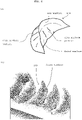
- a typical shape of fried gyoza dumplings has two side surface portions, an ear portion (a portion in which the folded skins are overlapped and joined with each other to form a single sheet and extend from one end to the other end in the longitudinal direction) located on an upper side, and a fried surface (heated and browned surface) located as a bottom surface as shown in FIG. 6 (a) in a posture in which the fried surface is directed downward.
- FIG. 6 (b) is a photographic diagram illustrating a typical state of the fried gyoza dumplings when the fried gyoza dumplings are served on a plate. As shown in the figure, the fried gyoza dumplings are arranged on a plate with the fried surface facing up to show the fried surface to the eater.
- frozen fried gyoza dumplings it is inevitable that the water in the inside filling will transfer from the inside to the fried surface portion of the skin during a period between the time of manufacture and heating, and in addition to this, in the case of heating with plastic wrap in a microwave oven, the water vapor released from the skin and inside filling steams the fried surface from the outside. Therefore, the frozen fried gyoza dumplings reheated in the microwave are significantly inferior to the original fried gyoza dumplings in terms of the savoriness and crispness of the fried surface.
- the container for heating in the microwave oven described in Patent Document 2 described above comprises a composite material in which particles of a microwave absorption heating element are dispersed in a silicone resin, and can also be used for baking bread and confectionery.
- the present inventors used such a food cooking container to heat frozen fried gyoza dumplings so that their fried surfaces became savory, it was found that the ear portion of the skin became dry and further scorched to be hardened, and the mouthfeel required for the skin was impaired.
- the ear portion of the gyoza dumpling skin is a protruding part that is easily dried away from the inside filling, and additionally, it is also considered to be a factor in the local increase in the temperature of the ear portion that the microwaves of the microwave oven tend to concentrate on the ear portion by the edge effect.
- fried gyoza dumplings are a special food in which a fried surface (a surface that requires savoriness and crispness) and the ear portion (a portion that requires an elastic mouthfeel like pasta and should not be dried) are exposed to the outside at the same time. Therefore, it has been found that it is not easy to satisfy the respective requirements for the fried surface and the ear portion at the same time only by heating the frozen fried gyoza dumplings using a conventionally known heating container for a microwave oven.
- the problems as described above are problems which similarly occur not only in frozen fried gyoza dumplings but also in foods obtained by frying and further freezing the filling-wrapping foods such as frozen fried xiaolongbao dumplings and frozen fried buns (such as frozen green chive buns) (that is, frozen filling-wrapping foods having both of the skin portion (especially the ear portion) which requires a soft mouthfeel instead of savoriness, and the fried surface (fried and browned surface) which requires savoriness.
- frozen fried xiaolongbao dumplings and frozen fried buns such as frozen green chive buns
- An object of the present invention is to solve the problems described above, and to provide a container for heating frozen filling-wrapping foods in a microwave oven, which is able to suppress the drying and scorch of the skin portion (particularly the ear portion) while re-imparting the fried surface of the frozen filling-wrapping foods with favorable crispness and savoriness by heating in a microwave oven.
- another object of the present invention is to provide a method for heating frozen filling-wrapping foods using the heating container for a microwave oven according to the present invention.
- the present inventors have diligently studied to solve the above problems, have found that it is possible to suppress the drying and scorch of the skin portion (particularly the ear portion) while restoring the crispness and savoriness on the fried surface by specifying the ratio of the weight of the polymer material included in the heat generating layer included in the container for heating in the microwave oven to the weight of the heating element dispersed therein, and further appropriately limiting the amount of water vapor that flows out of the container from the frozen filling-wrapping food when heated by a microwave oven, and have completed the present invention.
- the heat generating layer receives microwaves to heat up to a high temperature preferred to restore the fried surface of the frozen filling-wrapping foods (particularly, frozen fried gyoza dumplings). With this, favorable crispness and savoriness are re-imparted to the fried surface.
- the container for heating in the container for heating in the microwave oven (also referred to as the heating container) so that the outflow amount of water vapor to the outside of the heating container at the time when heating in the microwave oven is completed is not more than 0.05 g per 1 g of the frozen filling-wrapping foods set in the container, the excessive outflow of water released from the frozen filling-wrapping foods (particularly skin) to the outside of the container during heating is suppressed, the skin portion (particularly the ear portion) is appropriately steamed by the appropriate amount of water vapor remaining in the container, drying and scorching are suppressed, and the deterioration of the tactile sensation of the skin portion (particularly the ear portion) described above is suppressed.
- the frozen filling-wrapping foods are microwave-heated using the heating container and the heating method, it is possible to obtain preferable filling-wrapping foods (particularly fried gyoza dumplings) in which the drying and scorch of the skin portion (particularly the ear portion) are suppressed while the crispness and savoriness of the fried surface are favorably re-imparted, as compared to the case where the frozen filling-wrapping food is heated in a microwave oven with an end of the sealing film of the frozen filling-wrapping food packaging container simply peeled off, or with the frozen filling-wrapping food packaging container covered with plastic wrap.
- the present invention makes it possible to fry frozen filling-wrapping food in a microwave oven, it is easier to cook than frying pan cooking and enables safer cooking without using fire.
- the object of heating is the already fried filling-wrapping food, even if a plurality of the filling-wrapping foods are fried again at the same time, uneven frying does not occur on the fried surface of each filling-wrapping food.
- Such an effect on the fried surface becomes remarkable in the fried filling-wrapping food (especially, fried gyoza dumplings with a very large proportion of the fried surface visible in the served state as shown in FIG. 6 (b) ) that is served on a plate with the fried surface facing up.
- the heating container is a container for heating frozen filling-wrapping foods (foods obtained by freezing filling-wrapping foods that have been fried and browned) in a microwave oven.
- frozen fried gyoza dumplings foods obtained by freezing gyoza dumplings that have been fried and browned
- the main configuration of the heating container itself is basically the same.
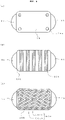
- FIG. 1 is a diagram showing an example of the configuration of the heating container, and shows a state in which frozen fried gyoza dumplings are arranged in a heated state inside the heating container for the sake of explanation.
- the heating container 1 has a container body 10 and a lid 20.
- the container body 10 is a tray-shaped container having an opening 10c for putting in and out the frozen fried gyoza dumplings 100 (fried gyoza dumplings after heating), and the lid 20 is configured to open and close an opening (a doorway surrounded by the edge portion 10c) of the container body 10.
- the container body 10 has an inner bottom surface 10a, and the inner bottom surface 10a is a flat surface with a predetermined area so that a predetermined number (five in the example of FIG.
- the container body 10 has a heat generating layer 11.
- the heat generating layer 11 comprises a composite material in which particulate heating elements m1 that generate heat under microwaves from a microwave oven are dispersed in a first polymer material m2.
- the heat-generating layer 11 is located so as to spread over the entire bottom portion, at least as a surface layer of the inner bottom surface of the container body, or at least as a layer below the surface layer of the inner bottom surface, in order to fry the fried surface of the frozen fried gyoza dumplings 100.
- the heat generating layer 11 is located so as to extend only to the bottom portion of the container body as a preferable aspect for selectively heating the fried surface, but may extend to the side wall portion of the container body.
- the weight ratio of the first polymer material m2 and the heating element m1 in the composite material constituting the heat generating layer 11 is selected to be 250 to 300 parts by weight of the heating element with respect to 100 parts by weight of the first polymer material, and this makes it possible to restore the appropriate savoriness to the fried surface of the frozen fried gyoza dumplings 100.
- the heating container 1 has a configuration in which the outflow amount of water vapor to the outside of the heating container when heating in the microwave oven is completed with the predetermined number of frozen fried gyoza dumplings 100 arranged inside and the lid 20 closed is suppressed so as note to be more than 0.05 g per 1 g of the fried gyoza dumplings set in the container.
- the lid 20 is provided with the ventilation hole 30, and the cross-sectional area of the ventilation hole 30 is selected so that the outflow amount of water vapor is not more than 0.05 g per 1 g of the fried gyoza dumplings set in the container.
- the basic shapes of the opening and the inner bottom surface of the container body are not particularly limited and may be circular or oval depending on the type of frozen filling-wrapping foods, but a square or rectangular shape is preferable (the roundness of the outer corners and the roundness of the inner corners are appropriately provided). The reason is that i) as shown in FIG.
- FIG. 1 (b) is a preferred basic shape as the basic shape of the opening or the inner bottom surface of the container body.
- the dimensions and structure of each part will be described by taking as an example the case where the basic shape of the opening or the inner bottom surface of the container body is a rectangle as shown in FIG. 1 (b) , but with reference thereto, the dimensions and structure when the shape of the opening or the inner bottom surface of the container body is another shape may be appropriately determined.
- the longitudinal dimension of general commercially available frozen fried gyoza dumplings (for example, "Juicy fried gyoza dumplings by microwave oven” manufactured by Ajinomoto Frozen Foods Co., Ltd.) (linear dimension in the vertical direction on the sheet for one frozen gyoza dumpling in FIG. 1 (b) ) is about 75 to 95 mm, the width direction (the dimension of one frozen fried gyoza dumpling in FIG.
- the height (the dimension h1 of one frozen fried gyoza dumpling in the vertical direction in FIG. 1(a) ) is about 25 to 45 mm
- the average weight of one frozen fried gyoza dumpling in the frozen state is about 15 to 25 g
- the average volume of one frozen fried gyoza dumpling in the frozen state is about 16 to 26 mL (mL represents milliliter).
- the number of frozen fried gyoza dumplings arranged in the container body for heating is not particularly limited, but the heating container should be able to be accommodated in the heating chamber of a general microwave oven, the number is 2 to 6 when eating gyoza dumplings as side menu or main menu, and there are cases where two or more servings are cooked at once using the two heating containers, so that about 2 to 12 gyoza dumplings can be illustrated as a heating form that can be preferably performed.
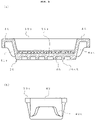
- FIG. 2 is a diagram for explaining the dimension of each part of the heating container.
- the dimension of each part of the container body 10 is not particularly limited, but if the dimensions are as illustrated below, about 2 to 6 of the above average frozen fried gyoza dumplings can be preferably heated at a time.
- the long side dimension L1 is 70 to 300 mm, preferably 100 to 200 mm, and the short side dimension L2 is 60 to 250 mm, preferably 70 to 150 mm.
- the depth D1 from the bottom surface 10a inside the container body 10 to the top surface 10e is 5 to 70 mm, preferably 15 to 30 mm.
- the total height D3 of the space inside the container formed when the opening of the container body 10 is closed by the lid 20 is 10 to 120 mm, preferably 30 to 60 mm, more preferably 30 to 50 mm.
- the internal depth D2 of the lid 20 is 5 to 50 mm, preferably 15 to 30 mm. It should be noted that in the example of FIG. 2 (a) , the lower end portion of the lid 20 extends downward so that it can slightly enter the inside of the container body. This extended portion is not included in the depth D2 of the lid 20. This extended portion is intended for positioning the lid and the like, and contrary to the example of FIG. 1 (a) or the like, it may be an aspect in which the extended portion extends upward so that the opening of the container body can slightly enter the inside of the lid.
- the depth D1 of the container body does not necessarily have to be a dimension greater than or equal to the height h1 of the frozen fried gyoza dumplings arranged inside.
- the total height dimension D3 of the internal space formed by the container body and the lid is preferably greater than or equal to the height h1 of the frozen fried gyoza dumplings, and D3 > h1 is more preferable from the viewpoint that it does not crush the frozen fried gyoza dumplings to be arranged.
- the proportion of the total volume Vs of the frozen fried gyoza dumplings arranged inside in the volume V1 of the internal space formed by the container body and the lid is preferably 5 to 50%, more preferably 5 to 20%, from the viewpoint of preventing the peripheral portion of the gyoza dumplings from drying and charring. If the proportion is less than 5%, drying and charring will occur on the periphery of the gyoza dumplings, which is not preferable.
- the shape of the gyoza dumplings will be a special shape (having the height and the size of the board which are generally difficult to be recognized as gyoza dumplings), and is not preferable.
- the internal space is too large, sufficient water is not supplied to the peripheral portion of the gyoza dumplings, the ear portion are dried, and further the risk of charring is increased.
- the internal space is too narrow, the water supply becomes excessive and the mouthfeel of the fried surface becomes unfavorable.
- the thickness of the wall portion of the container body may be uniform, or the thickness of the bottom portion (thickness indicated by the reference numeral t10b in FIG. 2 (a) ) and the thickness of the side wall portion (the portion indicated by the reference numeral t10s in FIG. 2 (b) ) may be different from each other.
- the thickness (t10b, t10s) of these wall portions is not particularly limited, but is preferably about 1 to 30 mm, and more preferably about 5 to 15 mm, from the viewpoint of weight reduction and strength of the container and measures against burns when the container after heating is touched.
- the wall portion that does not generate heat which is located on the lower side (outer side) of the heat generating layer, to be thicker so that the temperature is less likely to be high so as not to cause burns even if it is accidentally touched.
- the heat generating layer comprises a composite material in which particulate heating elements m1 that generate heat under microwaves from a microwave oven are dispersed in a first polymer material m2.
- a composite material in which particulate heating elements m1 that generate heat under microwaves from a microwave oven are dispersed in a first polymer material m2.
- Patent Documents 1 and 2 described above can be referred to.
- the strong magnetic material refers to a ferromagnetic material or a ferrimagnetic material, and refers to a substance having a large magnetic moment as a whole.
- NiZn ferrite is included as a preferable strong magnetic material from the viewpoint of heat generation temperature.
- the particle size of the heating element is not particularly limited, and the particle size of the heating element used in a conventionally known container for heating in the microwave oven can be referred to, and for example, a Feret diameter of about 50 to 250 ( ⁇ m) is exemplified.
- the Feret diameter is the distance between two parallel lines in a certain direction (also called a directional diameter) that sandwich an individual particle image obtained by a microscope (including a transmission electron microscope and an optical microscope).
- a known technique for manufacturing granules or powder can be referred to.
- Existing granular products and powder products can be used as the particles of the heating element.
- the first polymer material which is the base material included in the heat generating layer
- a material having a mechanical strength that can be used as a container and having heat resistance that does not melt at a temperature (about 100 to 350°C) that rises during microwave irradiation can be used, and a material using various molding materials alone or in combination, such as synthetic resins such as polyolefins, polyvinylidene chloride, polyesters, polyamides, ethylene / vinyl acetate copolymers, ethylene / vinyl alcohol, fluororesins, natural polymers such as cellulose, or papers made from natural pulp fibers and/or thermoplastic fibers, inorganic materials such as ceramics, silicone resin, polymer material containing glass fiber, is exemplified as a preferable material.
- silicone resin is exemplified as a preferable material from the viewpoints of moldability of the container, peelability of food after heating, durability after repeated use, and the like.
- a combination in which NiZn ferrite particles are used as the heating element and a silicone resin is used as the first polymer material is an optimal example for cooking frozen fried gyoza dumplings, and is a preferable heat generating layer.
- the weight ratio (mixing ratio) of the composite material included in the heat generating layer varies depending on the type of strong magnetic material used as the heating element, but generally about 250 parts by weight to 300 parts by weight of the particles of the strong magnetic material with respect to 100 parts by weight of the first polymer material is exemplified as a preferable weight ratio.
- the first polymer material is a silicone resin and the particles of the strong magnetic material are NiZn ferrite
- 250 to 300 parts by weight of NiZn ferrite with respect to 100 parts by weight of the silicone resin is exemplified as a preferable mixing ratio.
- the amount of NiZn ferrite particles is less than 250 parts by weight with respect to 100 parts by weight of the silicone resin, the calorific value is insufficient, and the savoriness and crispness cannot be sufficiently restored on the fried surface. If the amount of NiZn ferrite particles exceeds 300 parts by weight with respect to 100 parts by weight of the silicone resin, problems such as a decrease in the strength of the container occur, which is not preferable.
- the thickness of the heat generating layer is not particularly limited and varies depending on the content of the heating element, the design of the container body, and the like, but is preferably 0.01 to 10 mm, more preferably 0.5 to 5 mm.
- the inner surface of the container body (the inner bottom surface 10a and the inner surface 10s1 of the side wall portion in FIG. 1 (a) ) is the surface with which the frozen fried gyoza dumplings contact, it is preferable that the heating element of the heat generating layer is not exposed on the inner surface. Therefore, an aspect in which the inner surface layer of the container body is a surface layer comprising a polymer material that does not contain a heating element, and the heat generating layer is located as a lower layer of the surface layer as shown in FIG. 1 (a) is preferable.
- a surface layer material include the same material as the first polymer material used for the heat generating layer composite material and a surface layer polymer material different from the heat generating layer composite material.
- a single or composite material such as a silicone resin or polyester is preferable.
- the outer surface layer of the container body is also preferably a surface layer comprising a polymer material that does not contain a heating element.
- a surface layer material include the same material as the first polymer material and a different polymer material for the outer surface layer as in the inner surface layer.
- a single or composite material such as a silicone resin or polyester is preferable.
- FIG. 3 is a cross-sectional view showing an example of the laminated structure of the bottom portion of the container body.
- the inner surface layer 12 and the outer surface layer 13 are provided with the heat generating layer 11 interposed therebetween to form a three-layer structure.
- the thickness t11 of the heat generating layer 11 is as described above.
- the thickness t12 of the inner surface layer 12 is not particularly limited, and is about 0.1 to 10 mm, preferably about 0.5 to 3 mm.
- the thickness t13 of the outer surface layer 13 is not particularly limited, and is about 0.1 to 10 mm, preferably about 0.5 to 5 mm.
- the outer surface layer 13 is a thick layer integrally formed with the protruding portions shown in FIG. 4 (b) and (c) .
- the manufacturing method of the container body is not particularly limited, and a conventionally known manufacturing method of a container for heating in the microwave oven can also be referred to.
- the container body in injection molding, can be obtained by injection molding the first polymer material and the particles of the heating element described above at a mixing ratio in the above range in a mold.
- the container body in addition, can also be obtained by preparing a multi-layer sheet for the purpose as shown in FIG. 3 in advance and molding the multi-layer sheet into a container shape by vacuum forming or press molding.
- an inner surface layer or an outer surface layer on the heat generating layer formed in the shape of the container body may be formed using a conventionally known coating method.
- the outer peripheral shape of the lid may be appropriately determined so as to match the shape of the opening of the container body.
- the overall shape of the lid may be a dome shape as shown in FIG. 1 (a) , or a flat plate shape without bulging.
- the depth D2 in FIG. 2 (a) is 0, so it is preferable that the depth D1 of the container body is set to an appropriate depth according to the sufficient height h1 of the frozen fried gyoza dumplings.
- the lid 20 is provided with a knob (protrusion for grasping by hand) 21 for handling.
- the shape of the knob is not particularly limited, and may be appropriately designed so that it is easy to handle and easy to manufacture.
- the knob may be obtained by integrally molding with the lid, or fixing another part to the lid.
- a material that can be used for heating in a microwave oven may be used, and for example, a polymer material, glass, ceramics, a sintered body, a composite material thereof, or the like can be preferably used. It should be noted that when a polymer material is used as the material for the lid, it is preferable to use a material having high heat resistance such as silicone resin or polyester so that the portion in contact with the container body does not melt.
- the heating container is provided with a configuration for satisfying the following condition (I).
- any configuration in which the internal gas can flow out can be adopted, and various configurations as illustrated below can be included.
- the number of ventilation holes may be appropriately determined to be one or more according to the cross-sectional area of the ventilation holes. As shown in FIG. 1 (a) , it is preferable to provide one on the lid because it is easy to manufacture and stable steam removal can be performed. In addition, an aspect in which a ventilation hole is provided on the outer peripheral portion of the lid so that steam is ejected to the side is also preferable because it is easy to manufacture and stable steam removal can be performed.
- the total cross-sectional area of the cross-sectional area of the flow passage in the configurations (ii) to (iii) described above (the cross-sectional area when the passage is cut perpendicular to the direction in which the gas travels) and the cross-sectional area of the ventilation holes (including the ventilation grooves) in the configuration (iv) described above (the cross-sectional area when the ventilation hole is cut perpendicularly to the direction in which the gas travels) is selected to meet the condition (I) described above according to a predetermined number of frozen fried gyoza dumplings to be set in the container.
- the condition (I) is a value obtained by dividing the calculated outflow amount of water vapor by the total weight of a predetermined number of frozen fried gyoza dumplings (or a predetermined number of other frozen filling-wrapping foods) arranged before heating in the microwave oven.
- the outflow amount of water vapor is calculated by the difference (w1 - w2) between the total weight w1 (the sum of the weight of the heating container and the weight of a predetermined number of frozen fried gyoza dumplings arranged therein) before heating in the microwave oven and the total weight w2 (the sum of the weight of the heating container and the weight of a predetermined number of frozen fried gyoza dumplings arranged therein) when heating in the microwave oven is completed.
- a more preferable value of the outflow amount of water vapor to the outside of the heating container under the condition (I) described above is 0.03 g or lower per 1 g of frozen fried gyoza dumplings.
- the lower limit of the outflow amount of water vapor is preferably a smaller value from the viewpoint of steaming the ear portion. Providing the ventilation holes is preferable because the outflow amount of water vapor can be controlled to an intended value while having a simple configuration.
- the actual lower limit of the amount of weight reduction when the cross-sectional area of the ventilation hole is reduced is about 0.01 g per 1 g of fried gyoza dumplings.
- the lower limit of the amount of weight reduction can be set to a small value (substantially 0 g per 1 g of fried gyoza dumplings) that cannot be measured.
- the total cross-sectional area of the flow passages and ventilation holes satisfying the condition (I) described above varies depending on the size of the heating container (that is, the weight per frozen fried gyoza dumpling to be set in the container and a predetermined number thereof), but for example, when the weight of each frozen fried gyoza dumpling is generally about 15 to 30 g and the predetermined number is about 3 to 5, the total cross-sectional area is about 1 to 10 mm 2 , more preferably about 1 to 5 mm 2 .
- the value of the total cross-sectional area of the flow passages and ventilation holes is proportional to the predetermined number of frozen fried gyoza dumplings (or other frozen filling-wrapping foods) to be set in the container, so that it is only needed to change it appropriately according to the predetermined number.
- the method of forming the ventilation holes (including the grooves) is not particularly limited, and the method of forming the ventilation holes (including grooves) by a mold at the time of molding the container body and the lid, the method of forming holes in the container body and the lid after molding the container body and the lid, the method of providing a groove or a gap in the contact portion between the main body and the lid, and the like are exemplified.
- protruding portions 50 for supporting the container body in a state of being separated from the bottom surface of the heating chamber of the microwave oven while reducing the contact area between the outer bottom surface and the bottom surface of the heating chamber are provided on the outer bottom surface 10b of the container body 10.
- protruding portions 50 allow more microwaves from the microwave oven to circulate under the container body 10, and thus it becomes possible to heat the heat generating layer more efficiently.
- the contact area between the outer bottom surface 10b of the container body 10 and the bottom surface of the heating chamber of the microwave oven is reduced by the protruding portions 50, heat conduction from the container body 10 to the bottom surface of the heating chamber is suppressed and heat generated by the heat generating layer can be used more efficiently to heat the frozen fried gyoza dumplings inside.
- the lower end surfaces of the protruding portions are curved surfaces protruding downward, because the contact with the bottom surface of the heating chamber of the microwave oven approaches point contact or line contact, and the heat conduction is further suppressed.
- the protruding portions as a ridge-shaped protrusion (described later), the protruding portions function as a rib or a beam, and there is also an advantage that the strength and rigidity of the bottom portion of the container body are improved.
- the height of the protruding portions 50 (the dimension indicated by reference numeral H1 in FIG. 2 (a) ) is not particularly limited, but is preferably about 1 to 10 mm.
- the contact area between the protruding portions 50 and the bottom surface of the heating chamber of the microwave oven is preferably about 5 to 60% of the area defined by the outer line of the outer bottom surface of the container body from the viewpoint of preventing deflection when the container softens due to heating, maintaining strength, and promoting efficient intake of microwaves from the bottom surface.
- the form of the protruding portion 50 may be a sporadic leg or a ridge-shaped protrusion extending so as to draw various patterns.
- FIG. 4 (a) shows an example of sporadic protruding portions 50a at four corners like the legs of a table.
- FIG. 4 (b) shows an example of two or more parallel ridge-shaped protrusions 50b.
- FIG. 4 (c) shows an example of a pattern in which the ridge-shaped protrusions 50c2 intersect or connect with each other at an angle.
- the cross section of the ridge-shaped protrusions 50c2 in FIG. 4 (c) appears in FIG. 5 (a) .
- FIG. 5 (a) shows an example of FIG.
- annular ridge-shaped protrusion 50c1 surrounding the outer peripheral edge of the outer bottom surface 10b of the container body is provided, and these are combined to form ridge-shaped protrusions 50c.
- the annular ridge-shaped protrusion 50c1 as shown in FIG. 4 (c) may be provided alone or in combination with the parallel ridge-shaped protrusions 50b in FIG. 4 (b) .
- the method of forming the protruding portions is not particularly limited, but it includes, for example, a method of forming irregularities by press molding or the like, a method of forming a container body with irregularities using a molding mold and further coating the surface layer on the container body, and a method of joining irregularities formed separately to the bottom surface of the container body.
- a handle portion (a pair of handle portions 41, 42 in the example of FIG. 1 ) is provided on the outer side surface of the container body 10.
- the handle portion comprises a first polymer material or comprises a polymer material for other handle portions, and does not contain any heating elements. Therefore, the handle portion does not reach a high temperature even when heated in a microwave oven, and the user can grasp it by hand.
- the handle portion may be in an aspect in which it projects laterally like a flange over the entire outer circumference of the container body, or in an aspect in which one or more sporadic projections are provided so that they can be used as a handle.
- a pair of handle portions (41, 42) provided at opposite positions facing each other (in the example of the figure, both ends in the longitudinal direction) on the outer peripheral edge of the opening 10c of the container body 10 is included.
- a preferred structural example of the handle portions (41, 42) illustrated in FIG. 1 (b) is shown in the cross-sectional view of FIG. 5 (a) and the right side view in FIG. 5 (b) .
- FIG. 5 (a) when viewed from above appears in FIG. 1 (b) .
- ribs (41a, 42a) are provided on the lower side of the respective handle portions (41, 42) to increase the strength of the handle portion.
- the frozen filling-wrapping foods to be heated in the heating container are not particularly limited, and in addition to frozen fried gyoza dumplings, they may be frozen products of various filling-wrapping foods that have been heated and browned such as frozen fried xiaolongbao dumplings, frozen fried buns (such as frozen green chive buns), frozen spring rolls, and frozen products of browned rice cakes stuffed with sweet bean jam.
- the frozen filling-wrapping foods to be heated by the present invention may be commercially available products.
- the skin contains modified starch such as acetylated distarch phosphate or hydroxypropylated starch is preferable.
- modified starch such as acetylated distarch phosphate or hydroxypropylated starch
- Specifications of the skin used for frozen fried gyoza dumplings material composition, production method, unfolded shape before wrapping the filling (usually a circular sheet shape), external dimension, thickness, weight, and the like) and specifications of the inside filling (ingredients such as meat, vegetables, seasonings, weight, cooking method until wrapping in the skin) are not particularly limited, and conventionally known frozen fried gyoza dumplings and general fried gyoza dumplings can be referred to.
- the specifications of each part of the heating container can be finely adjusted as appropriate according to the composition of the frozen fried gyoza dumplings. The same applies to other frozen filling-wrapping foods.
- composition and manufacturing method of each part of the preferred frozen fried gyoza dumplings are illustrated below.
- the water content of the skin is 20 to 45% by weight, preferably 22 to 40% by weight, and more preferably 25 to 35% by weight, with respect to the total weight of the skin. From the viewpoint of suppressing the drying of the ear portion due to microwave heating, it is better to have a high water content, but if it is too high, the industrial suitability will decrease (that is, sticking to the rolling rollers and tearing during the production of the skin will occur).
- the thickness of the skin is 0.2 to 5.0 mm, preferably 0.3 to 2.0 mm, and more preferably 0.5 to 1.0 mm. From the viewpoint of suppressing the drying of the ear portion due to microwave heating, it is better to have a thick skin, but if it is too thick, the mouthfeel (crispness) of the fried surface will deteriorate.
- the salt concentration of the skin is 0.0 to 2.0% by weight, preferably 0.0 to 1.0% by weight, and more preferably 0.0 to 0.5% by weight. From the viewpoint of suppressing the drying of the ear portion due to microwave heating, it is better that the salt concentration is low.
- the skin contains at least flour and starch.
- starch hydroxypropylated starch and acetylated distarch phosphate which improve water retention are preferable, and in particular, acetylated distarch phosphate obtained by esterifying the starch with phosphorus oxychloride or trimetaphosphate and acetic anhydride or vinyl acetate is preferable.
- the content of the acetylated distarch phosphate is 1 to 48% by weight, preferably 2 to 42% by weight, and more preferably 3 to 30% by weight, with respect to the total weight of the skin.
- the content of the flour is 15 to 65% by weight, preferably 20 to 62% by weight, and more preferably 25 to 60% by weight, with respect to the total weight of the skin.
- the skin may contain components other than flour and starch, such as gluten, salt, fats and oils, glycine, xylose, sugars, and the like.
- the water content of the inside filling is 50 to 80% by weight, preferably 60 to 80% by weight, and more preferably 65 to 75% by weight, with respect to the total weight of the inside filling, from the viewpoint of suppressing the transfer of water to the fried surface during frozen storage and preventing the skin from drying.
- the oil content of the inside filling is 0 to 20% by weight, preferably 5 to 15% by weight, and more preferably 5 to 10% by weight, with respect to the total weight of the inside filling, from the viewpoint of obtaining a good mouthfeel of the fried surface due to the oil transferred from the inside filling during microwave heating.
- the water content of the ear portion is 30 to 40% by weight, preferably 32 to 39% by weight, and more preferably 35 to 38% by weight. If the water content is below the above range, the ear portion becomes dry and hard during microwave heating.
- the heating step preferably includes a step of steaming raw gyoza dumplings and then a step of frying the steamed gyoza dumplings, and may be a step of steaming while frying.
- the steaming step is performed by, for example, a method of blowing saturated steam, and the steaming time is preferably about 1 to 20 minutes.
- the frying step is preferably performed at a heating temperature of 150 to 260 °C for 1 to 10 minutes.
- the fried gyoza dumplings that have undergone the heating step are rapidly cooled at an appropriate low temperature to complete the frozen fried gyoza dumplings.
- the heating method is a method of heating frozen fried gyoza dumplings in a microwave oven using the container for heating in the microwave oven according to the present invention described above.
- a predetermined number of frozen fried gyoza dumplings are arranged (to be brought into contact with the inner bottom surface 10a with the fried surface facing downward) on the inner bottom surface 10a of the container body 10 of the heating container 1 according to the present invention.
- the opening of the container body 10 is closed by the lid 20 of the heating container, and the heating container containing the frozen fried gyoza dumplings is heated by a microwave oven.
- the microwave oven that can be used for the heating method may be for home use (rated high frequency output of about 500 to 1000 W) or for commercial use (rated high frequency output of about 1400 to 1800 W (some are about 1900 W)), which may be appropriately selected depending on the frozen filling-wrapping foods.
- the rated high frequency output is preferably about 1400 to 1800 W (may be about 1400 to 1900 W) from the viewpoint that they can be cooked and thawed in a short time, and the preferable heating time in that case is about 30 to 120 seconds, and the more preferable heating time is about 30 to 90 seconds. It is only necessary that the heating time of the other rated high frequency output is appropriately increased or decreased in proportion to the value of the rated high frequency output.
- the container for heating in the microwave oven of the present invention is actually produced, the heating method of the present invention was carried out by using the container for heating in the microwave oven on frozen fried gyoza dumplings, which is a typical example of frozen filling-wrapping food, as a target of heating, and its usefulness was evaluated.
- the heating container shown in FIG. 2 (b) and FIG. 5 (the cross-sectional shape of the lid is shown in FIG. 2 (a) ) was manufactured as three types of Samples 1 to 3 by changing the dimensions of each part of the container body, commercially available frozen fried gyoza dumplings were heated using these samples in a microwave oven, and the appropriate proportion of the volume of the frozen fried gyoza dumplings in the volume of the container body was examined from the quality of the fried gyoza dumplings.
- a ventilation hole was provided as a preferable configuration for stably suppressing the outflow amount of water vapor.
- the dimension of each part of each sample is as follows.
- the layer structure of the container body is as shown in FIG. 3 (b) and FIG. 5 (a) , the thickness t11 of the heat generating layer 11 is 1 mm, the thickness t12 of the inner surface layer 12 is about 1 mm, and the thickness t13 of the outer surface layer 13 (thickness excluding the protruding portions on the outer bottom surface of the container body) is 7 mm.
- One ventilation hole was provided on the side wall portion of the lid.
- the cross-sectional shape of the ventilation hole is circular, and the cross-sectional area is 7 mm 2 .
- the layer structure of the container body is as shown in FIG. 3 (b) and FIG. 5 (a) , the thickness t11 of the heat generating layer 11 is 1 mm, the thickness t12 of the inner surface layer 12 is about 1 mm, and the thickness t13 of the outer surface layer 13 (thickness excluding the protruding portions on the outer bottom surface of the container body) is 7 mm.
- One ventilation hole was provided on the side wall portion of the lid.
- the cross-sectional shape of the ventilation hole is circular, and the cross-sectional area is 7 mm 2 .
- the proper predetermined number of general frozen fried gyoza dumplings arranged in Sample 2 is 5.
- the layer structure of the container body is as shown in FIG. 3 (b) and FIG. 5 (a) , the thickness t11 of the heat generating layer 11 is 1 mm, the thickness t12 of the inner surface layer 12 is about 1 mm, and the thickness t13 of the outer surface layer 13 (thickness excluding the protruding portions on the outer bottom surface of the container body) is 7 mm.
- One ventilation hole was provided on the side wall portion of the lid.
- the cross-sectional shape of the ventilation hole is circular, and the cross-sectional area is 7 mm 2 .
- the base material m2 of the heat generating layer is a silicone resin
- the heating element m1 is Ni-Zn ferrite powder (particle diameter: about 100 to 200 ⁇ m (Feret diameter)).
- the material mixing ratio (weight ratio) of the heat generating layer is 300 parts by weight of the heating element with respect to 100 parts by weight of the silicone resin.
- the material of the inner surface layer 12 is a silicone resin.
- the material of the outer surface layer 13 is a silicone resin.
- the material of the lid is a silicone resin.
- the frozen fried gyoza dumplings (-18 °C) described above were arranged in Sample 1 or Sample 3 as many as described in the following, the opening was closed by the lid, and the frozen fried gyoza dumplings were heated in a microwave oven (1400 W) for 50 seconds.
- the temperature of the fried gyoza dumplings immediately after the completion of heating was 85 °C in any experiments.
- the outflow amount of water vapor in Experiment No. 1 to Experiment No. 4 (the outflow amount of water vapor per 1 g of frozen fried gyoza dumplings set in the container: unit is (g / g)) and the proportion of the total volume of frozen fried gyoza dumplings in the internal space of the container (%) were as shown in Table 1 below. [Table 1] Experiment No.
- sample container number of gyoza dumplings heating time (sec) outflow amount of water vapor (g/g) proportion (%) of total volume of frozen fried gyoza dumpling in internal space of container 1 1 5 50 0.025 24.3 2 3 5 50 0.017 5.7 3 3 4 50 0.021 4.6 4 3 2 50 0.016 2.3
- sample container number of gyoza dumplings heating time (sec) outflow amount of water vapor (g/g) proportion (%) of total volume of frozen fried gyoza dumpling in internal space of container 5 4 2 30 0.093 5.5 6 5 2 30 0.058 5.5 7 6 2 30 0.046 5.5 8 7 2 30 0.023 5.5 9 8 2 30 0.00 5.5
- Example 5 The same 5 judges as in Example 1 made a 4-grade evaluation as shown in Table 2 described above, and the sensory evaluation of the fried gyoza dumplings after heating was performed in the same way as in Example 1.
- the evaluation results of the fried gyoza dumplings after heating are shown in Table 5 below. [Table 5] Experiment No. charring of ear portion degree of drying of ear portion mouthfeel of fried surface 5 ⁇ ⁇ ⁇ 6 ⁇ ⁇ ⁇ 7 ⁇ ⁇ ⁇ 8 ⁇ ⁇ ⁇ 9 ⁇ ⁇ ⁇ ⁇
- the heating conditions in the microwave oven were 1400 W, 70 seconds.
- the core temperature of the fried gyoza dumplings immediately after the completion of heating was 85 °C.
- the heating conditions of Experiments 10 to 12 using the container Samples 9 to 11 are as shown in Table 6 below. [Table 6] Experiment No. sample container proportion of heating element (parts by weight) number of gyoza dumplings heating time (sec) outflow amount of water vapor (g/g) proportion (%) of total volume of frozen fried gyoza dumpling in internal space of container 10 9 300 8 70 0.014 9.2 11 10 250 8 70 0.012 9.2 12 11 200 8 70 0.029 9.2
- Example 7 The same 5 judges as in Example 1 made a 4-grade evaluation as shown in Table 2 described above, and the sensory evaluation of the fried gyoza dumplings after heating was performed in the same way as in Example 1. The evaluation results of the fried gyoza dumplings after heating are shown in Table 7 below. [Table 7] Experiment No. charring of ear portion degree of drying of ear portion mouthfeel of fried surface 10 ⁇ ⁇ ⁇ 11 ⁇ ⁇ ⁇ 12 ⁇ ⁇ ⁇
- the present invention it is possible to suppress the drying and scorch of the skin, especially ear portion (particularly, the ear portion of frozen fried gyoza dumplings), while re-imparting the fried surface of the frozen filling-wrapping foods (especially, frozen fried gyoza dumplings) with favorable crispness and savoriness by heating in a microwave oven. Therefore, even in the food service industry without a frying machine, it is possible to easily provide high-quality fried filling-wrapping foods (particularly fried gyoza dumplings) as if they were cooked in a frying pan, using frozen filling-wrapping foods.
Landscapes
- Engineering & Computer Science (AREA)
- Mechanical Engineering (AREA)
- Life Sciences & Earth Sciences (AREA)
- Food Science & Technology (AREA)
- Package Specialized In Special Use (AREA)
- Baking, Grill, Roasting (AREA)
- Cookers (AREA)
Abstract
Description
- The present invention relates to a container for heating frozen filling-wrapping food such as frozen fried gyoza dumplings by a microwave oven, and a method for heating the frozen filling-wrapping food using the container.
- Fried gyoza dumplings are foods made by wrapping an inside filling (mixed ingredients composed of chopped vegetables, meat and the like) in a sheet-shaped skin mainly made from wheat flour and heating it while steaming so that the bottom surface is browned. As illustrated in
FIG. 6 (a) , the typical shape of thefried gyoza dumplings 100 is a three-dimensional shape that has a longitudinal direction and is curved, but there are various variations such as non-curved ones, thick ones, and large ones. - A typical shape of fried gyoza dumplings has two side surface portions, an ear portion (a portion in which the folded skins are overlapped and joined with each other to form a single sheet and extend from one end to the other end in the longitudinal direction) located on an upper side, and a fried surface (heated and browned surface) located as a bottom surface as shown in
FIG. 6 (a) in a posture in which the fried surface is directed downward.FIG. 6 (b) is a photographic diagram illustrating a typical state of the fried gyoza dumplings when the fried gyoza dumplings are served on a plate. As shown in the figure, the fried gyoza dumplings are arranged on a plate with the fried surface facing up to show the fried surface to the eater. - For fried gyoza dumplings, not only the umami of the inside filling, but also the savory and crispy mouthfeel of the fried surface of the skin, the crunchy and moderately elastic mouthfeel on the side surface portions and ear portion of the skin (the mouthfeel as required for pasta and noodles), the original flavor of the skin, and the heterogeneous mouthfeel and the juicy mouthfeel of the inside filling have been regarded as important as a factor that determines the quality. For that reason, when making and eating fried gyoza dumplings, it has been considered good to eat as soon as possible after arranging the gyoza dumplings before heating (also called raw gyoza dumplings) on a frying pan, adding water, putting a lid thereon and fried cooking while steaming. This is because the fried gyoza dumplings are eaten before the fried surface absorbs water, the drip of the inside filling transfers to the skin, and the skin becomes dry and hard. Therefore, as for the cooking method of fried gyoza dumplings, it is more ideal to wrap the inside filling with skin to make raw gyoza dumplings and add water to the raw gyoza dumplings to fry them just before eating as much as possible. However, such an ideal cooking method takes time and effort.
- In recent years, in order to save the time and effort of cooking the fried gyoza dumplings as described above, a product (frozen fried gyoza dumplings) obtained by further freezing the fried gyoza dumplings as shown in
FIG. 6 (b) , which has been cooked into an edible state, has been developed (for example, Patent Document 1). The frozen fried gyoza dumplings have an advantage that they can be easily eaten simply by heating them in a microwave oven. -
- [Patent Document 1]
Japanese Patent No. 4374883 - [Patent Document 2]
WO 2016/174736 - However, when the present inventors examined the frozen fried gyoza dumplings heated in a microwave oven in detail, it was found that the following problems existed.
- In frozen fried gyoza dumplings, it is inevitable that the water in the inside filling will transfer from the inside to the fried surface portion of the skin during a period between the time of manufacture and heating, and in addition to this, in the case of heating with plastic wrap in a microwave oven, the water vapor released from the skin and inside filling steams the fried surface from the outside. Therefore, the frozen fried gyoza dumplings reheated in the microwave are significantly inferior to the original fried gyoza dumplings in terms of the savoriness and crispness of the fried surface.
- On the other hand, there are known food cooking containers that heat up to a relatively high temperature when irradiated with microwaves from a microwave oven. For example, the container for heating in the microwave oven described in
Patent Document 2 described above comprises a composite material in which particles of a microwave absorption heating element are dispersed in a silicone resin, and can also be used for baking bread and confectionery. However, when the present inventors used such a food cooking container to heat frozen fried gyoza dumplings so that their fried surfaces became savory, it was found that the ear portion of the skin became dry and further scorched to be hardened, and the mouthfeel required for the skin was impaired. This is because the ear portion of the gyoza dumpling skin is a protruding part that is easily dried away from the inside filling, and additionally, it is also considered to be a factor in the local increase in the temperature of the ear portion that the microwaves of the microwave oven tend to concentrate on the ear portion by the edge effect. - That is, unlike bread and baked confectionery having a baked surface on the entire outer surface, fried gyoza dumplings are a special food in which a fried surface (a surface that requires savoriness and crispness) and the ear portion (a portion that requires an elastic mouthfeel like pasta and should not be dried) are exposed to the outside at the same time. Therefore, it has been found that it is not easy to satisfy the respective requirements for the fried surface and the ear portion at the same time only by heating the frozen fried gyoza dumplings using a conventionally known heating container for a microwave oven.
- The problems as described above are problems which similarly occur not only in frozen fried gyoza dumplings but also in foods obtained by frying and further freezing the filling-wrapping foods such as frozen fried xiaolongbao dumplings and frozen fried buns (such as frozen green chive buns) (that is, frozen filling-wrapping foods having both of the skin portion (especially the ear portion) which requires a soft mouthfeel instead of savoriness, and the fried surface (fried and browned surface) which requires savoriness.
- An object of the present invention is to solve the problems described above, and to provide a container for heating frozen filling-wrapping foods in a microwave oven, which is able to suppress the drying and scorch of the skin portion (particularly the ear portion) while re-imparting the fried surface of the frozen filling-wrapping foods with favorable crispness and savoriness by heating in a microwave oven. In addition, another object of the present invention is to provide a method for heating frozen filling-wrapping foods using the heating container for a microwave oven according to the present invention.
- The present inventors have diligently studied to solve the above problems, have found that it is possible to suppress the drying and scorch of the skin portion (particularly the ear portion) while restoring the crispness and savoriness on the fried surface by specifying the ratio of the weight of the polymer material included in the heat generating layer included in the container for heating in the microwave oven to the weight of the heating element dispersed therein, and further appropriately limiting the amount of water vapor that flows out of the container from the frozen filling-wrapping food when heated by a microwave oven, and have completed the present invention.
- The main features of the present invention are as follows.
- [1] A container for heating a frozen filling-wrapping food in a microwave oven, comprising a container body having an opening for putting a frozen filling-wrapping food in and out, and a lid for opening and closing the opening, wherein
- the container body has an inner bottom surface and a heat generating layer, wherein
- a predetermined number of frozen filling-wrapping foods are placed with fried surfaces thereof facing downward on the inner bottom surface,
- the heat generating layer is composed of a composite material comprising a first polymer material and particulate heating elements dispersed in the first polymer material, the heating elements generating heat under microwaves from the microwave oven,
- the heat generating layer is disposed at least as a surface layer of the inner bottom surface or at least under the surface layer of the inner bottom surface, and
- the composite material comprises 250 to 300 parts by weight of the heating elements per 100 parts by weight of the first polymer material in a weight ratio; and
- the container body and/or the lid have/has a configuration to suppress an outflow amount of water vapor to the outside of the container such that the outflow amount is not more than 0.05 g per 1 g of the frozen filling-wrapping food at the time of completion of heating the predetermined number of frozen filling-wrapping foods set in the container with the lid closed in the microwave oven.
- the container body has an inner bottom surface and a heat generating layer, wherein
- [2] The container of the above-mentioned [1], wherein the configuration to suppress the outflow amount of water vapor is a ventilation hole provided in one or both of the container body and the lid.
- [3] The container of the above-mentioned [1] or [2], wherein the first polymer material is a silicone resin.
- [4] The container of any one of the above-mentioned [1] to [3], wherein the heating element is a strong magnetic material.
- [5] The container of any of the above-mentioned [1] to [4], wherein the container body has an inner surface layer free of heating elements and composed of the first polymer material or other polymer material for a surface layer, and the heat generating layer is a lower layer of the surface layer.
- [6] The container of any of the above-mentioned [1] to [5], wherein a proportion of a total volume of the predetermined number of frozen filling-wrapping foods with respect to an internal space of the container is 5 to 50% when the frozen filling-wrapping foods are arranged in the container and the lid is closed.
- [7] The container of any of the above-mentioned [1] to [6], further comprising protruding portions on an outer bottom surface of the container body so as to support the container body on a bottom surface of a heating chamber of the microwave oven while reducing a contact area between the outer bottom surface and the bottom surface of the heating chamber.
- [8] The container of any of the above-mentioned [1] to [7], further comprising a pair of handle portions on an outer side surface of the container body, wherein the handle portions are composed of the first polymer material or other polymer material for a handle portion and are free of heating elements.
- [9] The container of any of the above-mentioned [1] to [8], wherein the frozen filling-wrapping food comprises a skin comprising acetylated distarch phosphate or hydroxypropylated starch.
- [10] A method for heating a frozen filling-wrapping food, comprising setting a predetermined number of frozen filling-wrapping foods in the container of any of the above-mentioned [1] to [9] such that fried surfaces of the foods face downward on the inner bottom surface of the container body of the container, closing the opening of the container body with the lid of the container, and heating the container in a microwave oven.
- [11] The method of the above-mentioned [10], wherein the frozen filling-wrapping foods are frozen fried dumplings, a rated high-frequency output when heating in microwave oven is 1400 to 1800 W, and a heating time in the microwave oven is 30 to 90 seconds.
- By specifying the ratio of each weight of the polymer material and the heating elements included in the heat generating layer, the heat generating layer receives microwaves to heat up to a high temperature preferred to restore the fried surface of the frozen filling-wrapping foods (particularly, frozen fried gyoza dumplings). With this, favorable crispness and savoriness are re-imparted to the fried surface. In addition to this, by constructing the container for heating in the container for heating in the microwave oven (also referred to as the heating container) so that the outflow amount of water vapor to the outside of the heating container at the time when heating in the microwave oven is completed is not more than 0.05 g per 1 g of the frozen filling-wrapping foods set in the container, the excessive outflow of water released from the frozen filling-wrapping foods (particularly skin) to the outside of the container during heating is suppressed, the skin portion (particularly the ear portion) is appropriately steamed by the appropriate amount of water vapor remaining in the container, drying and scorching are suppressed, and the deterioration of the tactile sensation of the skin portion (particularly the ear portion) described above is suppressed. Therefore, if the frozen filling-wrapping foods (particularly, frozen fried gyoza dumplings) are microwave-heated using the heating container and the heating method, it is possible to obtain preferable filling-wrapping foods (particularly fried gyoza dumplings) in which the drying and scorch of the skin portion (particularly the ear portion) are suppressed while the crispness and savoriness of the fried surface are favorably re-imparted, as compared to the case where the frozen filling-wrapping food is heated in a microwave oven with an end of the sealing film of the frozen filling-wrapping food packaging container simply peeled off, or with the frozen filling-wrapping food packaging container covered with plastic wrap.
- In addition, since the present invention makes it possible to fry frozen filling-wrapping food in a microwave oven, it is easier to cook than frying pan cooking and enables safer cooking without using fire.
- In addition, since the object of heating is the already fried filling-wrapping food, even if a plurality of the filling-wrapping foods are fried again at the same time, uneven frying does not occur on the fried surface of each filling-wrapping food. Such an effect on the fried surface becomes remarkable in the fried filling-wrapping food (especially, fried gyoza dumplings with a very large proportion of the fried surface visible in the served state as shown in
FIG. 6 (b) ) that is served on a plate with the fried surface facing up. -
-
FIG. 1 is a diagram showing a preferable example of the configuration of the container for heating in the microwave oven of the present invention. In the figure, for the sake of explanation, an example is shown in which a predetermined number (five as an example in the figure) of frozen fried gyoza dumplings are arranged in the container for heating in the microwave oven.FIG. 1 (b) is a diagram viewed from above (plan view) with five frozen fried gyoza dumplings arranged on the inner bottom surface of the container body. InFIG. 1 (b) , the illustration of the lid is omitted in order to show the inside of the container body.FIG. 1 (a) is an arrow view of the end face cut along X1-X1 inFIG. 1 (b) (protrudingportions 50 are drawn for explanation). InFIG. 1 (a) , the depiction of the cross section of the fried gyoza dumplings is omitted and is represented by hatching. In addition, hatching indicating the cross section of the container body and the lid is omitted. -
FIG. 2 is a diagram showing the dimension of each part in a preferred aspect example of the container for heating in the microwave oven of the present invention. Similar toFIG. 1 ,FIG. 2 (a) is an arrow view of the end face cut along X1-X1 inFIG. 2 (b) , and all hatches showing a cross section (cut end face) are omitted.FIG. 2 (b) is a diagram viewed from above (plan view) ofFIG. 2 (a) . InFIG. 2 (b) , the left half of the lid is cut out in order to show the inside of the container body. -
FIG. 3 is a cross-sectional view illustrating the laminated structure of the bottom portion of the container body. -
FIG. 4 is a diagram of the container body viewed from below, illustrating the arrangement pattern of the protruding portions on the outer bottom surface of the container body. In the figure, the arrangement pattern of the protruding portions is shown in an easy-to-understand manner by hatching the protruding portions. -
FIG. 5 is a diagram illustrating a preferable aspect of the handles provided on the container body.FIG. 5 (a) is a cross-sectional view of the end view shown inFIG. 2 (a) . InFIG. 5 (a) , the protruding portions on the bottom of the container body have a cross section of the arrangement pattern shown inFIG. 4 (c) .FIG. 5 (b) is a side view (viewed from the right side) ofFIG. 5 (a) , showing the appearance of the handles. -
FIG. 6 is a diagram for explaining the form of the conventional typical shape of fried gyoza dumplings.FIG. 6 (a) shows the names of each portion of the fried gyoza dumplings when the fried surface is directed downward, andFIG. 6 (b) is a photographic figure which illustrates the most common state when the fried gyoza dumplings are served on a plate. - First, the container for heating in the microwave oven according to the present invention (hereinafter, also referred to as the heating container, also simply referred to as a container) will be described in detail. The heating container is a container for heating frozen filling-wrapping foods (foods obtained by freezing filling-wrapping foods that have been fried and browned) in a microwave oven. Hereinafter, the present invention will be described with reference to frozen fried gyoza dumplings (foods obtained by freezing gyoza dumplings that have been fried and browned) as an example of the heating target, but even if the heating target is another frozen filling-wrapping food, the main configuration of the heating container itself is basically the same.
-
FIG. 1 is a diagram showing an example of the configuration of the heating container, and shows a state in which frozen fried gyoza dumplings are arranged in a heated state inside the heating container for the sake of explanation. Theheating container 1 has acontainer body 10 and alid 20. Thecontainer body 10 is a tray-shaped container having an opening 10c for putting in and out the frozen fried gyoza dumplings 100 (fried gyoza dumplings after heating), and thelid 20 is configured to open and close an opening (a doorway surrounded by the edge portion 10c) of thecontainer body 10. Thecontainer body 10 has an inner bottom surface 10a, and the inner bottom surface 10a is a flat surface with a predetermined area so that a predetermined number (five in the example ofFIG. 1 ) of frozenfried gyoza dumplings 100 can be arranged with the fried surface facing downward. In addition, thecontainer body 10 has a heat generating layer 11. The heat generating layer 11 comprises a composite material in which particulate heating elements m1 that generate heat under microwaves from a microwave oven are dispersed in a first polymer material m2. - The heat-generating layer 11 is located so as to spread over the entire bottom portion, at least as a surface layer of the inner bottom surface of the container body, or at least as a layer below the surface layer of the inner bottom surface, in order to fry the fried surface of the frozen
fried gyoza dumplings 100. In the example ofFIG. 1 , the heat generating layer 11 is located so as to extend only to the bottom portion of the container body as a preferable aspect for selectively heating the fried surface, but may extend to the side wall portion of the container body. The weight ratio of the first polymer material m2 and the heating element m1 in the composite material constituting the heat generating layer 11 is selected to be 250 to 300 parts by weight of the heating element with respect to 100 parts by weight of the first polymer material, and this makes it possible to restore the appropriate savoriness to the fried surface of the frozenfried gyoza dumplings 100. - In addition, the
heating container 1 has a configuration in which the outflow amount of water vapor to the outside of the heating container when heating in the microwave oven is completed with the predetermined number of frozenfried gyoza dumplings 100 arranged inside and thelid 20 closed is suppressed so as note to be more than 0.05 g per 1 g of the fried gyoza dumplings set in the container. Various configuration examples for limiting the outflow amount of water vapor to such a range will be described later. In the example ofFIG. 1 , thelid 20 is provided with theventilation hole 30, and the cross-sectional area of theventilation hole 30 is selected so that the outflow amount of water vapor is not more than 0.05 g per 1 g of the fried gyoza dumplings set in the container. - With the above configuration, the effects described above can be obtained, and the object of the present invention is preferably achieved. Hereinafter, each part will be described in detail.
- The basic shapes of the opening and the inner bottom surface of the container body are not particularly limited and may be circular or oval depending on the type of frozen filling-wrapping foods, but a square or rectangular shape is preferable (the roundness of the outer corners and the roundness of the inner corners are appropriately provided). The reason is that i) as shown in
FIG. 1 (a) and (b) , when the frozenfried gyoza dumplings 100 are arranged parallel and densely inside the container body 10 (on the bottom surface 10a) during heating, the dead space is unlikely to occur, ii) generally, frozen fried gyoza dumplings are packed side by side in a square or rectangular tray, and the fried surfaces of the individual gyoza dumplings may be connected to each other, so that the square or rectangular shape makes it easier to arrange frozen fried gyoza dumplings on the container body as they are when heating, and it is easier to turn the container body over and arrange them on a plate even after heating, and the like. In addition, since many plates for serving fried gyoza dumplings which are oval or rectangular in shape are also seen in general, a rectangle as illustrated inFIG. 1 (b) is a preferred basic shape as the basic shape of the opening or the inner bottom surface of the container body. Hereinafter, the dimensions and structure of each part will be described by taking as an example the case where the basic shape of the opening or the inner bottom surface of the container body is a rectangle as shown inFIG. 1 (b) , but with reference thereto, the dimensions and structure when the shape of the opening or the inner bottom surface of the container body is another shape may be appropriately determined. - There are various shapes and sizes of general gyoza dumplings, but the shapes of general frozen fried gyoza dumplings currently on the market are as illustrated in
FIG. 6 . The longitudinal dimension of general commercially available frozen fried gyoza dumplings (for example, "Juicy fried gyoza dumplings by microwave oven" manufactured by Ajinomoto Frozen Foods Co., Ltd.) (linear dimension in the vertical direction on the sheet for one frozen gyoza dumpling inFIG. 1 (b) ) is about 75 to 95 mm, the width direction (the dimension of one frozen fried gyoza dumpling inFIG. 1 (b) in the left-right direction of the sheet) is about 20 to 40 mm, the height (the dimension h1 of one frozen fried gyoza dumpling in the vertical direction inFIG. 1(a) ) is about 25 to 45 mm, the average weight of one frozen fried gyoza dumpling in the frozen state is about 15 to 25 g, and the average volume of one frozen fried gyoza dumpling in the frozen state is about 16 to 26 mL (mL represents milliliter). Hereinafter, a case where such an average frozen-fried gyoza dumpling is to be heated will be described, but if the dimensions, volume, and weight of the frozen-fried gyoza dumpling are different, the specifications of the dimensions, volume, and the like of the heating container may be appropriately changed accordingly. - The number of frozen fried gyoza dumplings arranged in the container body for heating is not particularly limited, but the heating container should be able to be accommodated in the heating chamber of a general microwave oven, the number is 2 to 6 when eating gyoza dumplings as side menu or main menu, and there are cases where two or more servings are cooked at once using the two heating containers, so that about 2 to 12 gyoza dumplings can be illustrated as a heating form that can be preferably performed.
-
FIG. 2 is a diagram for explaining the dimension of each part of the heating container. The dimension of each part of thecontainer body 10 is not particularly limited, but if the dimensions are as illustrated below, about 2 to 6 of the above average frozen fried gyoza dumplings can be preferably heated at a time. - On the bottom surface of the rectangle inside the
container body 10 shown inFIG. 2 (b) , the long side dimension L1 is 70 to 300 mm, preferably 100 to 200 mm, and the short side dimension L2 is 60 to 250 mm, preferably 70 to 150 mm. - In
FIG. 2 (a) , the depth D1 from the bottom surface 10a inside thecontainer body 10 to the top surface 10e is 5 to 70 mm, preferably 15 to 30 mm. - In
FIG. 2 (a) , the total height D3 of the space inside the container formed when the opening of thecontainer body 10 is closed by thelid 20 is 10 to 120 mm, preferably 30 to 60 mm, more preferably 30 to 50 mm. - In
FIG. 2 (a) , the internal depth D2 of thelid 20 is 5 to 50 mm, preferably 15 to 30 mm. It should be noted that in the example ofFIG. 2 (a) , the lower end portion of thelid 20 extends downward so that it can slightly enter the inside of the container body. This extended portion is not included in the depth D2 of thelid 20. This extended portion is intended for positioning the lid and the like, and contrary to the example ofFIG. 1 (a) or the like, it may be an aspect in which the extended portion extends upward so that the opening of the container body can slightly enter the inside of the lid. - The depth D1 of the container body does not necessarily have to be a dimension greater than or equal to the height h1 of the frozen fried gyoza dumplings arranged inside. As in the example of
FIG. 2 (a) , when thecontainer body 10 is closed by thelid 20, the total height dimension D3 of the internal space formed by the container body and the lid is preferably greater than or equal to the height h1 of the frozen fried gyoza dumplings, and D3 > h1 is more preferable from the viewpoint that it does not crush the frozen fried gyoza dumplings to be arranged. - As in the example of
FIG. 1 (a) , when thecontainer body 10 is closed by thelid 20, the proportion of the total volume Vs of the frozen fried gyoza dumplings arranged inside in the volume V1 of the internal space formed by the container body and the lid is preferably 5 to 50%, more preferably 5 to 20%, from the viewpoint of preventing the peripheral portion of the gyoza dumplings from drying and charring. If the proportion is less than 5%, drying and charring will occur on the periphery of the gyoza dumplings, which is not preferable. If the ratio exceeds 50%, the shape of the gyoza dumplings will be a special shape (having the height and the size of the board which are generally difficult to be recognized as gyoza dumplings), and is not preferable. In other words, if the internal space is too large, sufficient water is not supplied to the peripheral portion of the gyoza dumplings, the ear portion are dried, and further the risk of charring is increased. On the contrary, if the internal space is too narrow, the water supply becomes excessive and the mouthfeel of the fried surface becomes unfavorable. - The thickness of the wall portion of the container body may be uniform, or the thickness of the bottom portion (thickness indicated by the reference numeral t10b in
FIG. 2 (a) ) and the thickness of the side wall portion (the portion indicated by the reference numeral t10s inFIG. 2 (b) ) may be different from each other. The thickness (t10b, t10s) of these wall portions is not particularly limited, but is preferably about 1 to 30 mm, and more preferably about 5 to 15 mm, from the viewpoint of weight reduction and strength of the container and measures against burns when the container after heating is touched. Since the heat-generating layer at the bottom portion of the container becomes hot after cooking, it is preferable to design the wall portion that does not generate heat, which is located on the lower side (outer side) of the heat generating layer, to be thicker so that the temperature is less likely to be high so as not to cause burns even if it is accidentally touched. - As described above, the heat generating layer comprises a composite material in which particulate heating elements m1 that generate heat under microwaves from a microwave oven are dispersed in a first polymer material m2. For the composite material and the molding technique for providing the heat generating layer inside the container body (particularly, on the surface layer or below the surface layer of the inner bottom surface), conventionally known techniques such as
Patent Documents - As a heating element, a material that generates heat under microwaves from a microwave oven can be used, and a strong magnetic material is preferable from the viewpoint that it generates heat efficiently. The strong magnetic material refers to a ferromagnetic material or a ferrimagnetic material, and refers to a substance having a large magnetic moment as a whole. For example, magnetite, γFe2O3, Ni1-xZnxFe2O4 of NiZn ferrite, Mn1-xZnxFe2O4 of MnZn ferrite, BaFe12O19 of barium ferrite, SrFe12O19 of strontium ferrite, permalloy, sendust, sumarium cobalt, ferrite having a spinel-based crystal structure such as Nd2Fe14B1, and ferrite having a garnet-based crystal structure such as I3Fe5O12 and Gd3Fe5O12 are included. In the present invention, NiZn ferrite is included as a preferable strong magnetic material from the viewpoint of heat generation temperature.
- The particle size of the heating element is not particularly limited, and the particle size of the heating element used in a conventionally known container for heating in the microwave oven can be referred to, and for example, a Feret diameter of about 50 to 250 (µm) is exemplified.
- The Feret diameter is the distance between two parallel lines in a certain direction (also called a directional diameter) that sandwich an individual particle image obtained by a microscope (including a transmission electron microscope and an optical microscope).
- For the method for manufacturing particles of the heating element, a known technique for manufacturing granules or powder can be referred to. Existing granular products and powder products can be used as the particles of the heating element.
- As the first polymer material, which is the base material included in the heat generating layer, a material having a mechanical strength that can be used as a container and having heat resistance that does not melt at a temperature (about 100 to 350°C) that rises during microwave irradiation can be used, and a material using various molding materials alone or in combination, such as synthetic resins such as polyolefins, polyvinylidene chloride, polyesters, polyamides, ethylene / vinyl acetate copolymers, ethylene / vinyl alcohol, fluororesins, natural polymers such as cellulose, or papers made from natural pulp fibers and/or thermoplastic fibers, inorganic materials such as ceramics, silicone resin, polymer material containing glass fiber, is exemplified as a preferable material. Among these materials, silicone resin is exemplified as a preferable material from the viewpoints of moldability of the container, peelability of food after heating, durability after repeated use, and the like. A combination in which NiZn ferrite particles are used as the heating element and a silicone resin is used as the first polymer material is an optimal example for cooking frozen fried gyoza dumplings, and is a preferable heat generating layer.
- The weight ratio (mixing ratio) of the composite material included in the heat generating layer varies depending on the type of strong magnetic material used as the heating element, but generally about 250 parts by weight to 300 parts by weight of the particles of the strong magnetic material with respect to 100 parts by weight of the first polymer material is exemplified as a preferable weight ratio. In particular, when the first polymer material is a silicone resin and the particles of the strong magnetic material are NiZn ferrite, 250 to 300 parts by weight of NiZn ferrite with respect to 100 parts by weight of the silicone resin is exemplified as a preferable mixing ratio. For example, if the amount of NiZn ferrite particles is less than 250 parts by weight with respect to 100 parts by weight of the silicone resin, the calorific value is insufficient, and the savoriness and crispness cannot be sufficiently restored on the fried surface. If the amount of NiZn ferrite particles exceeds 300 parts by weight with respect to 100 parts by weight of the silicone resin, problems such as a decrease in the strength of the container occur, which is not preferable.
- The thickness of the heat generating layer is not particularly limited and varies depending on the content of the heating element, the design of the container body, and the like, but is preferably 0.01 to 10 mm, more preferably 0.5 to 5 mm.
- Since the inner surface of the container body (the inner bottom surface 10a and the inner surface 10s1 of the side wall portion in
FIG. 1 (a) ) is the surface with which the frozen fried gyoza dumplings contact, it is preferable that the heating element of the heat generating layer is not exposed on the inner surface. Therefore, an aspect in which the inner surface layer of the container body is a surface layer comprising a polymer material that does not contain a heating element, and the heat generating layer is located as a lower layer of the surface layer as shown inFIG. 1 (a) is preferable. Examples of such a surface layer material include the same material as the first polymer material used for the heat generating layer composite material and a surface layer polymer material different from the heat generating layer composite material. For example, from the viewpoint of heat resistant temperature, a single or composite material such as a silicone resin or polyester is preferable. - Since the outer surface of the container body (the outer bottom surface 10b and the outer surface 10s2 of the side wall portion in
FIG. 1 (a) ) may also be touched before the container is taken out of the microwave oven and arranged on a plate after heating, it is preferable that the heating element of the heat generating layer is not exposed on the outer surface because it is necessary to take measures against burns. Therefore, as shown inFIG. 1 (a) , the outer surface layer of the container body is also preferably a surface layer comprising a polymer material that does not contain a heating element. Examples of such a surface layer material include the same material as the first polymer material and a different polymer material for the outer surface layer as in the inner surface layer. For example, from the viewpoint of heat resistant temperature, a single or composite material such as a silicone resin or polyester is preferable. -
FIG. 3 is a cross-sectional view showing an example of the laminated structure of the bottom portion of the container body. In the example ofFIG. 3 (a) , the inner surface layer 12 and theouter surface layer 13 are provided with the heat generating layer 11 interposed therebetween to form a three-layer structure. The thickness t11 of the heat generating layer 11 is as described above. The thickness t12 of the inner surface layer 12 is not particularly limited, and is about 0.1 to 10 mm, preferably about 0.5 to 3 mm. The thickness t13 of theouter surface layer 13 is not particularly limited, and is about 0.1 to 10 mm, preferably about 0.5 to 5 mm. In the example ofFIG. 3 (b) , theouter surface layer 13 is a thick layer integrally formed with the protruding portions shown inFIG. 4 (b) and (c) . - The manufacturing method of the container body is not particularly limited, and a conventionally known manufacturing method of a container for heating in the microwave oven can also be referred to. For example, in injection molding, the container body can be obtained by injection molding the first polymer material and the particles of the heating element described above at a mixing ratio in the above range in a mold. In addition, the container body can also be obtained by preparing a multi-layer sheet for the purpose as shown in
FIG. 3 in advance and molding the multi-layer sheet into a container shape by vacuum forming or press molding. In addition, an inner surface layer or an outer surface layer on the heat generating layer formed in the shape of the container body may be formed using a conventionally known coating method. - The outer peripheral shape of the lid may be appropriately determined so as to match the shape of the opening of the container body. The overall shape of the lid may be a dome shape as shown in
FIG. 1 (a) , or a flat plate shape without bulging. When the lid is in a flat plate shape, the depth D2 inFIG. 2 (a) is 0, so it is preferable that the depth D1 of the container body is set to an appropriate depth according to the sufficient height h1 of the frozen fried gyoza dumplings. As shown inFIG. 1 (a) and the like, it is preferable that thelid 20 is provided with a knob (protrusion for grasping by hand) 21 for handling. The shape of the knob is not particularly limited, and may be appropriately designed so that it is easy to handle and easy to manufacture. The knob may be obtained by integrally molding with the lid, or fixing another part to the lid. - As the material of the lid, a material that can be used for heating in a microwave oven may be used, and for example, a polymer material, glass, ceramics, a sintered body, a composite material thereof, or the like can be preferably used. It should be noted that when a polymer material is used as the material for the lid, it is preferable to use a material having high heat resistance such as silicone resin or polyester so that the portion in contact with the container body does not melt.
- The heating container is provided with a configuration for satisfying the following condition (I).
- Condition (I): Out flow amount (weight) of water vapor to the outside of the heating container at a time when heating in the microwave oven is completed with a predetermined number of frozen fried gyoza dumplings arranged in the heating container and the lid closed should not be more than 0.05 g per 1 g of the frozen fried gyoza dumplings. The same applies to other frozen filling-wrapping foods.
- In the present invention, as the configuration itself for satisfying the above condition (I), any configuration in which the internal gas can flow out can be adopted, and various configurations as illustrated below can be included.
- (i) A configuration having no ventilation path that communicates between the inside of the container and the outside of the container when the lid makes closure to the opening of the container body. However, the closure referred to here is not a sealed state in which the heating container bursts when heated, but an openable closure like the closure by a general cooking pot and its lid such that when the volume of gas in the container increases by heating, the gas itself can lift the lid and escape to the outside. The increase in the volume of the gas is caused by the thermal expansion of the air in the container, the water contained in the frozen fried gyoza dumplings, and the like becoming steam by heating.
In this configuration (i), by appropriately selecting the weight of the lid, unstable opening and closing of the lid when the water vapor inside the container flows out can be suppressed, whereby the outflow amount of water vapor can be safely and stably suppressed. It should be noted that by making the lid heavier, the outflow amount of water vapor can be more stably suppressed. In addition, in the configuration (i), the outflow amount of water vapor per 1 g of frozen fried gyoza dumplings can also be made as small as unmeasurable. - (ii) A configuration in which there is no flow passage that communicates between the inside of the container and the outside of the container when the lid closes the opening of the container body, but a guide or stopper that can shift the lid relative to the container body by a predetermined amount is provided so that a predetermined part of the opening is opened as a flow passage (not shown).
In this configuration (ii), the lid can be shifted by an amount predetermined by an experiment or the like in advance, so that the outflow amount of water vapor can be stabilized. - (iii) A configuration in which there is no flow passage that communicates between the inside of the container and the outside of the container when the lid closes the opening of the container body, but a relief valve is provided on the container body or lid so that the gas can flow out when the volume of the gas inside the container increases due to heating.
For the structure of the relief valve, a conventionally known technique can be referred to, and for example, it may be a simple structure in which among the openings of the inner and outer ends of the through hole (flow passage) provided peel ability in the container body or lid, the outer opening is simply closed openably by a hinge-operated flap (a flap that is lifted by the gas in the container to release the opening from closing). Depending on the characteristics of the opening operation of the relief valve, the outflow amount of water vapor per 1 g of frozen fried gyoza dumplings can also be made as small as unmeasurable. - (iv) A configuration in which ventilation holes are provided in one or both of the container body and the lid.
In this configuration (iv), ventilation holes are provided in one or both of the container body and the lid.FIG. 1 (a) shows an example in which theventilation hole 30 is provided on the upper surface of the lid for easy understanding, but the position of the ventilation hole may be the outer peripheral portion (side wall portion) of the lid or may be the side wall portion of the container. In addition, it may be a ventilation groove (including a gap provided in a predetermined section so as not to be visually recognized as a groove) provided in the boundary surface where the lid and the container body meet each other (that is, one or both surfaces of the upper surface 10e of the opening of the container body inFIG. 2 (a) and the lower surface of the lid in contact with the upper surface 10e). The ventilation groove is a groove (groove that crosses the wall portion in the thickness direction) provided from the inside of the container to the outside of the container at the boundary surface of the lid and/or the container body, and becomes a ventilation hole when the lid is closed. One ventilation hole may be formed by aligning the ventilation groove provided on the upper surface 10e of the opening of the container body and the ventilation groove provided on the lower surface of the outer peripheral portion of the lid with each other. - The number of ventilation holes may be appropriately determined to be one or more according to the cross-sectional area of the ventilation holes. As shown in
FIG. 1 (a) , it is preferable to provide one on the lid because it is easy to manufacture and stable steam removal can be performed. In addition, an aspect in which a ventilation hole is provided on the outer peripheral portion of the lid so that steam is ejected to the side is also preferable because it is easy to manufacture and stable steam removal can be performed. - The total cross-sectional area of the cross-sectional area of the flow passage in the configurations (ii) to (iii) described above (the cross-sectional area when the passage is cut perpendicular to the direction in which the gas travels) and the cross-sectional area of the ventilation holes (including the ventilation grooves) in the configuration (iv) described above (the cross-sectional area when the ventilation hole is cut perpendicularly to the direction in which the gas travels) is selected to meet the condition (I) described above according to a predetermined number of frozen fried gyoza dumplings to be set in the container.
- The condition (I) is a value obtained by dividing the calculated outflow amount of water vapor by the total weight of a predetermined number of frozen fried gyoza dumplings (or a predetermined number of other frozen filling-wrapping foods) arranged before heating in the microwave oven.
- The outflow amount of water vapor is calculated by the difference (w1 - w2) between the total weight w1 (the sum of the weight of the heating container and the weight of a predetermined number of frozen fried gyoza dumplings arranged therein) before heating in the microwave oven and the total weight w2 (the sum of the weight of the heating container and the weight of a predetermined number of frozen fried gyoza dumplings arranged therein) when heating in the microwave oven is completed.
- A more preferable value of the outflow amount of water vapor to the outside of the heating container under the condition (I) described above is 0.03 g or lower per 1 g of frozen fried gyoza dumplings.
- The lower limit of the outflow amount of water vapor is preferably a smaller value from the viewpoint of steaming the ear portion. Providing the ventilation holes is preferable because the outflow amount of water vapor can be controlled to an intended value while having a simple configuration. The actual lower limit of the amount of weight reduction when the cross-sectional area of the ventilation hole is reduced is about 0.01 g per 1 g of fried gyoza dumplings. In addition, as described above, in the aspect in which the ventilation holes are not provided, the lower limit of the amount of weight reduction can be set to a small value (substantially 0 g per 1 g of fried gyoza dumplings) that cannot be measured.
- The total cross-sectional area of the flow passages and ventilation holes satisfying the condition (I) described above varies depending on the size of the heating container (that is, the weight per frozen fried gyoza dumpling to be set in the container and a predetermined number thereof), but for example, when the weight of each frozen fried gyoza dumpling is generally about 15 to 30 g and the predetermined number is about 3 to 5, the total cross-sectional area is about 1 to 10 mm2, more preferably about 1 to 5 mm2.
- The value of the total cross-sectional area of the flow passages and ventilation holes is proportional to the predetermined number of frozen fried gyoza dumplings (or other frozen filling-wrapping foods) to be set in the container, so that it is only needed to change it appropriately according to the predetermined number.
- The method of forming the ventilation holes (including the grooves) is not particularly limited, and the method of forming the ventilation holes (including grooves) by a mold at the time of molding the container body and the lid, the method of forming holes in the container body and the lid after molding the container body and the lid, the method of providing a groove or a gap in the contact portion between the main body and the lid, and the like are exemplified.
- In a preferred aspect of the heating container, as shown by an example in
FIG. 1 (a) andFIG. 2 (a) , protrudingportions 50 for supporting the container body in a state of being separated from the bottom surface of the heating chamber of the microwave oven while reducing the contact area between the outer bottom surface and the bottom surface of the heating chamber are provided on the outer bottom surface 10b of thecontainer body 10. - These protruding
portions 50 allow more microwaves from the microwave oven to circulate under thecontainer body 10, and thus it becomes possible to heat the heat generating layer more efficiently. In addition, since the contact area between the outer bottom surface 10b of thecontainer body 10 and the bottom surface of the heating chamber of the microwave oven is reduced by the protrudingportions 50, heat conduction from thecontainer body 10 to the bottom surface of the heating chamber is suppressed and heat generated by the heat generating layer can be used more efficiently to heat the frozen fried gyoza dumplings inside. It should be noted that it is preferable that the lower end surfaces of the protruding portions are curved surfaces protruding downward, because the contact with the bottom surface of the heating chamber of the microwave oven approaches point contact or line contact, and the heat conduction is further suppressed. In addition, by providing the protruding portions as a ridge-shaped protrusion (described later), the protruding portions function as a rib or a beam, and there is also an advantage that the strength and rigidity of the bottom portion of the container body are improved. - The height of the protruding portions 50 (the dimension indicated by reference numeral H1 in
FIG. 2 (a) ) is not particularly limited, but is preferably about 1 to 10 mm. The contact area between the protrudingportions 50 and the bottom surface of the heating chamber of the microwave oven is preferably about 5 to 60% of the area defined by the outer line of the outer bottom surface of the container body from the viewpoint of preventing deflection when the container softens due to heating, maintaining strength, and promoting efficient intake of microwaves from the bottom surface. - The form of the protruding
portion 50 may be a sporadic leg or a ridge-shaped protrusion extending so as to draw various patterns.FIG. 4 (a) shows an example of sporadic protruding portions 50a at four corners like the legs of a table.FIG. 4 (b) shows an example of two or more parallel ridge-shaped protrusions 50b.FIG. 4 (c) shows an example of a pattern in which the ridge-shaped protrusions 50c2 intersect or connect with each other at an angle. The cross section of the ridge-shaped protrusions 50c2 inFIG. 4 (c) appears inFIG. 5 (a) . In the example ofFIG. 4 (c) , in addition to the ridge-shaped protrusions 50c2, an annular ridge-shaped protrusion 50c1 surrounding the outer peripheral edge of the outer bottom surface 10b of the container body is provided, and these are combined to form ridge-shaped protrusions 50c. The annular ridge-shaped protrusion 50c1 as shown inFIG. 4 (c) may be provided alone or in combination with the parallel ridge-shaped protrusions 50b inFIG. 4 (b) . - The method of forming the protruding portions is not particularly limited, but it includes, for example, a method of forming irregularities by press molding or the like, a method of forming a container body with irregularities using a molding mold and further coating the surface layer on the container body, and a method of joining irregularities formed separately to the bottom surface of the container body.
- In a preferred embodiment of the heating container, as shown in
FIG. 1 , a handle portion (a pair ofhandle portions FIG. 1 ) is provided on the outer side surface of thecontainer body 10. The handle portion comprises a first polymer material or comprises a polymer material for other handle portions, and does not contain any heating elements. Therefore, the handle portion does not reach a high temperature even when heated in a microwave oven, and the user can grasp it by hand. - The handle portion may be in an aspect in which it projects laterally like a flange over the entire outer circumference of the container body, or in an aspect in which one or more sporadic projections are provided so that they can be used as a handle. As a preferred aspect, as illustrated in
FIG. 1 (b) , a pair of handle portions (41, 42) provided at opposite positions facing each other (in the example of the figure, both ends in the longitudinal direction) on the outer peripheral edge of the opening 10c of thecontainer body 10 is included. A preferred structural example of the handle portions (41, 42) illustrated inFIG. 1 (b) is shown in the cross-sectional view ofFIG. 5 (a) and the right side view inFIG. 5 (b) . The shape of the handle portions (41, 42) ofFIG. 5 (a) when viewed from above appears inFIG. 1 (b) . As shown inFIG. 5 (a) and FIG. 5 (b) , ribs (41a, 42a) are provided on the lower side of the respective handle portions (41, 42) to increase the strength of the handle portion. - The frozen filling-wrapping foods to be heated in the heating container are not particularly limited, and in addition to frozen fried gyoza dumplings, they may be frozen products of various filling-wrapping foods that have been heated and browned such as frozen fried xiaolongbao dumplings, frozen fried buns (such as frozen green chive buns), frozen spring rolls, and frozen products of browned rice cakes stuffed with sweet bean jam.
- The frozen filling-wrapping foods to be heated by the present invention may be commercially available products. In the case of frozen fried gyoza dumplings, it is recommended as a preferable aspect to utilize the water contained in the skin of the frozen fried gyoza dumplings as the water for appropriately steaming the skin (particularly the ear portion) of the frozen fried gyoza dumplings at the time of heating. This eliminates the need to add water when heating in a microwave oven, making it possible to steam frozen fried gyoza dumplings with the intended amount of water, and the quality of the savoriness of the fried surface and the softness of the ear portion after heating approaches constant.
- In order to utilize the water contained in the skin of the frozen fried gyoza dumplings as the water for appropriately steaming the skin of the frozen fried gyoza dumplings during heating, an aspect in which the skin contains modified starch such as acetylated distarch phosphate or hydroxypropylated starch is preferable. By adding starch having aging resistance, when heated in a microwave oven, the effect of suppressing the absorption of microwaves by free water and evaporation from the skin is obtained, the drying of the ear portion and the like is suppressed, and the skin close to the original skin with favorable mouthfeel is obtained. The same applies to foods that are frozen after forming a fried surface on filling-wrapping foods that have the same skin as gyoza dumplings.
- Specifications of the skin used for frozen fried gyoza dumplings (material composition, production method, unfolded shape before wrapping the filling (usually a circular sheet shape), external dimension, thickness, weight, and the like) and specifications of the inside filling (ingredients such as meat, vegetables, seasonings, weight, cooking method until wrapping in the skin) are not particularly limited, and conventionally known frozen fried gyoza dumplings and general fried gyoza dumplings can be referred to. In addition, the specifications of each part of the heating container can be finely adjusted as appropriate according to the composition of the frozen fried gyoza dumplings. The same applies to other frozen filling-wrapping foods.
- The composition and manufacturing method of each part of the preferred frozen fried gyoza dumplings are illustrated below.
- The water content of the skin is 20 to 45% by weight, preferably 22 to 40% by weight, and more preferably 25 to 35% by weight, with respect to the total weight of the skin. From the viewpoint of suppressing the drying of the ear portion due to microwave heating, it is better to have a high water content, but if it is too high, the industrial suitability will decrease (that is, sticking to the rolling rollers and tearing during the production of the skin will occur).
- The thickness of the skin is 0.2 to 5.0 mm, preferably 0.3 to 2.0 mm, and more preferably 0.5 to 1.0 mm. From the viewpoint of suppressing the drying of the ear portion due to microwave heating, it is better to have a thick skin, but if it is too thick, the mouthfeel (crispness) of the fried surface will deteriorate.
- The salt concentration of the skin is 0.0 to 2.0% by weight, preferably 0.0 to 1.0% by weight, and more preferably 0.0 to 0.5% by weight. From the viewpoint of suppressing the drying of the ear portion due to microwave heating, it is better that the salt concentration is low.
- The skin contains at least flour and starch. As the starch, hydroxypropylated starch and acetylated distarch phosphate which improve water retention are preferable, and in particular, acetylated distarch phosphate obtained by esterifying the starch with phosphorus oxychloride or trimetaphosphate and acetic anhydride or vinyl acetate is preferable. It is preferable that the content of the acetylated distarch phosphate is 1 to 48% by weight, preferably 2 to 42% by weight, and more preferably 3 to 30% by weight, with respect to the total weight of the skin. It is preferable that the content of the flour is 15 to 65% by weight, preferably 20 to 62% by weight, and more preferably 25 to 60% by weight, with respect to the total weight of the skin. The skin may contain components other than flour and starch, such as gluten, salt, fats and oils, glycine, xylose, sugars, and the like.
- The water content of the inside filling is 50 to 80% by weight, preferably 60 to 80% by weight, and more preferably 65 to 75% by weight, with respect to the total weight of the inside filling, from the viewpoint of suppressing the transfer of water to the fried surface during frozen storage and preventing the skin from drying.
- The oil content of the inside filling is 0 to 20% by weight, preferably 5 to 15% by weight, and more preferably 5 to 10% by weight, with respect to the total weight of the inside filling, from the viewpoint of obtaining a good mouthfeel of the fried surface due to the oil transferred from the inside filling during microwave heating.
- The water content of the ear portion is 30 to 40% by weight, preferably 32 to 39% by weight, and more preferably 35 to 38% by weight. If the water content is below the above range, the ear portion becomes dry and hard during microwave heating.
- The preferred production conditions for frozen fried gyoza dumplings are illustrated below.
- The heating step preferably includes a step of steaming raw gyoza dumplings and then a step of frying the steamed gyoza dumplings, and may be a step of steaming while frying. In the heating step, it is preferable to heat the gyoza dumplings while spraying water so that the water content of the peripheral portion (particularly the ear portion) of the skin after frying is 30 to 40% by weight. The steaming step is performed by, for example, a method of blowing saturated steam, and the steaming time is preferably about 1 to 20 minutes. The frying step is preferably performed at a heating temperature of 150 to 260 °C for 1 to 10 minutes.
- The fried gyoza dumplings that have undergone the heating step are rapidly cooled at an appropriate low temperature to complete the frozen fried gyoza dumplings.
- Next, the heating method according to the present invention will be described.
- The heating method is a method of heating frozen fried gyoza dumplings in a microwave oven using the container for heating in the microwave oven according to the present invention described above. In the heating method, as illustrated in
FIG. 1 (a) , a predetermined number of frozen fried gyoza dumplings are arranged (to be brought into contact with the inner bottom surface 10a with the fried surface facing downward) on the inner bottom surface 10a of thecontainer body 10 of theheating container 1 according to the present invention. Then, the opening of thecontainer body 10 is closed by thelid 20 of the heating container, and the heating container containing the frozen fried gyoza dumplings is heated by a microwave oven. - The microwave oven that can be used for the heating method may be for home use (rated high frequency output of about 500 to 1000 W) or for commercial use (rated high frequency output of about 1400 to 1800 W (some are about 1900 W)), which may be appropriately selected depending on the frozen filling-wrapping foods. When the frozen fried gyoza dumplings are heated in a microwave oven, the rated high frequency output is preferably about 1400 to 1800 W (may be about 1400 to 1900 W) from the viewpoint that they can be cooked and thawed in a short time, and the preferable heating time in that case is about 30 to 120 seconds, and the more preferable heating time is about 30 to 90 seconds. It is only necessary that the heating time of the other rated high frequency output is appropriately increased or decreased in proportion to the value of the rated high frequency output.
- Hereinafter, the container for heating in the microwave oven of the present invention is actually produced, the heating method of the present invention was carried out by using the container for heating in the microwave oven on frozen fried gyoza dumplings, which is a typical example of frozen filling-wrapping food, as a target of heating, and its usefulness was evaluated.
- The heating container shown in
FIG. 2 (b) andFIG. 5 (the cross-sectional shape of the lid is shown inFIG. 2 (a) ) was manufactured as three types ofSamples 1 to 3 by changing the dimensions of each part of the container body, commercially available frozen fried gyoza dumplings were heated using these samples in a microwave oven, and the appropriate proportion of the volume of the frozen fried gyoza dumplings in the volume of the container body was examined from the quality of the fried gyoza dumplings. InSamples 1 to 3, a ventilation hole was provided as a preferable configuration for stably suppressing the outflow amount of water vapor. The dimension of each part of each sample is as follows. -
- Dimension L1 of the long side of the inner bottom surface 10a of the container body: 146 mm
- Dimension L2 of the short side of the inner bottom surface 10a of the container body: 90 mm
- Depth D1 from the inner bottom surface 10a to the top surface 10e of the container body: 20 mm
- The layer structure of the container body is as shown in
FIG. 3 (b) andFIG. 5 (a) , the thickness t11 of the heat generating layer 11 is 1 mm, the thickness t12 of the inner surface layer 12 is about 1 mm, and the thickness t13 of the outer surface layer 13 (thickness excluding the protruding portions on the outer bottom surface of the container body) is 7 mm. - Depth D2 of the lid: 23 mm
- Thickness of the lid: 3 mm
- Overall depth D3 (= D1 + D2) of the internal space when the container body is closed with the lid: 43 mm
- Volume of the internal space when the container body is closed with the lid: 330 mL
- One ventilation hole was provided on the side wall portion of the lid. The cross-sectional shape of the ventilation hole is circular, and the cross-sectional area is 7 mm2.
- The proper number of general frozen fried gyoza dumplings arranged in
Sample 1 is 4. -
- Dimension L1 of the long side of the inner bottom surface 10a of the container body: 186 mm
- Dimension L2 of the short side of the inner bottom surface 10a of the container body: 102 mm
- Depth D1 from the inner bottom surface 10a to the top surface 10e of the container body: 20 mm
- The layer structure of the container body is as shown in
FIG. 3 (b) andFIG. 5 (a) , the thickness t11 of the heat generating layer 11 is 1 mm, the thickness t12 of the inner surface layer 12 is about 1 mm, and the thickness t13 of the outer surface layer 13 (thickness excluding the protruding portions on the outer bottom surface of the container body) is 7 mm. - Depth D2 of the lid: 23 mm
- Thickness of the lid: 3 mm
- Overall depth D3 (= D1 + D2) of the internal space when the container body is closed with the lid: 43 mm
- Volume of the internal space when the container body is closed with the lid: 580 mL
- One ventilation hole was provided on the side wall portion of the lid. The cross-sectional shape of the ventilation hole is circular, and the cross-sectional area is 7 mm2.
- The proper predetermined number of general frozen fried gyoza dumplings arranged in
Sample 2 is 5. -
- Dimension L1 of the long side of the inner bottom surface 10a of the container body: 224 mm
- Dimension L2 of the short side of the inner bottom surface 10a of the container body: 170 mm
- Depth D1 from the inner bottom surface 10a to the top surface 10e of the container body: 20 mm
- The layer structure of the container body is as shown in
FIG. 3 (b) andFIG. 5 (a) , the thickness t11 of the heat generating layer 11 is 1 mm, the thickness t12 of the inner surface layer 12 is about 1 mm, and the thickness t13 of the outer surface layer 13 (thickness excluding the protruding portions on the outer bottom surface of the container body) is 7 mm. - Depth D2 of the lid: 23 mm
- Thickness of the lid: 3 mm
- Overall depth D3 (= D1 + D2) of the internal space when the container body is closed with the lid: 43 mm
- Volume of the internal space when the container body is closed with the lid: 1400 mL
- One ventilation hole was provided on the side wall portion of the lid. The cross-sectional shape of the ventilation hole is circular, and the cross-sectional area is 7 mm2.
- The proper predetermined number of general frozen fried gyoza dumplings arranged in
Sample 3 is 8. - In each sample, the base material m2 of the heat generating layer is a silicone resin, and the heating element m1 is Ni-Zn ferrite powder (particle diameter: about 100 to 200 µm (Feret diameter)). The material mixing ratio (weight ratio) of the heat generating layer is 300 parts by weight of the heating element with respect to 100 parts by weight of the silicone resin. The material of the inner surface layer 12 is a silicone resin. The material of the
outer surface layer 13 is a silicone resin. The material of the lid is a silicone resin. - Commercially available frozen fried gyoza dumplings were used. The average specifications of each part of the individual frozen fried gyoza dumplings in the frozen state are as follows.
- Longitudinal dimension (straight line distance): 80 mm
- Width of fried surface: 25 mm
- Height: 30 mm
- Weight: 15 g
- Average volume per frozen fried gyoza dumpling: about 16 mL
- The skin contains acetylated distarch phosphate (content rate is about 6%).
- The frozen fried gyoza dumplings (-18 °C) described above were arranged in
Sample 1 orSample 3 as many as described in the following, the opening was closed by the lid, and the frozen fried gyoza dumplings were heated in a microwave oven (1400 W) for 50 seconds. - Experiment No. 1: Five frozen fried gyoza dumplings were arranged in
Sample 1. - Experiment No. 2: Five frozen fried gyoza dumplings were arranged in
Sample 3. - Experiment No. 3: Four frozen fried gyoza dumplings were arranged in
Sample 3. - Experiment No. 4: Two frozen fried gyoza dumplings were arranged in
sample 3. - The temperature of the fried gyoza dumplings immediately after the completion of heating (particularly the temperature inside the gyoza dumplings (core temperature)) was 85 °C in any experiments. The outflow amount of water vapor in Experiment No. 1 to Experiment No. 4 (the outflow amount of water vapor per 1 g of frozen fried gyoza dumplings set in the container: unit is (g / g)) and the proportion of the total volume of frozen fried gyoza dumplings in the internal space of the container (%) were as shown in Table 1 below.
[Table 1] Experiment No. sample container number of gyoza dumplings heating time (sec) outflow amount of water vapor (g/g) proportion (%) of total volume of frozen fried gyoza dumpling in internal space of container 1 1 5 50 0.025 24.3 2 3 5 50 0.017 5.7 3 3 4 50 0.021 4.6 4 3 2 50 0.016 2.3 - The sensory evaluation of the fried gyoza dumplings after heating was performed by five professional judges who were sufficiently trained to evaluate the fried gyoza dumplings. The evaluation of each item was made on a 4-grade evaluation as shown in Table 2 below, and the highest number of evaluation among the evaluations of the 5 judges was adopted as the evaluation result for each item. "Crispy feeling" in Table 2 below means crispness.
[Table 2] charring of ear portion of fried gyoza dumpling after heating ⊙ less ○ rather less Δ much × very much degree of drying of ear portion of fried gyoza dumpling after heating ⊙ less ○ rather less Δ much × very much mouthfeel of fried surface ⊙ very crispy feeling ○ crispy feeling Δ less crispy feeling × scarce crispy feeling - The evaluation results of the fried gyoza dumplings after heating are shown in Table 3 below.
[Table 3] Experiment No. charring of ear portion degree of drying of ear portion mouthfeel of fried surface 1 ⊙ ○ ⊙ 2 ⊙ ○ ⊙ 3 ○ ○ Δ 4 × × × - As is clear from the results in Table 3, it was found that when the proportion of the total volume of frozen fried gyoza dumplings in the internal space of the container was 5% or more, the fried gyoza dumplings having less charring and drying in the ear portion of the fried gyoza dumplings after heating and having a good mouthfeel on the fried surface could be obtained.
- In the present example, using the container of the
above Sample 2 as a base, five kinds ofSamples 4 to 8 were produced by changing the cross-sectional area of the ventilation holes from 0 to 314 mm2, by using them, the same commercially available frozen fried gyoza dumplings as in Example 1 were heated in a microwave oven, and the appropriate proportion of the volume of the frozen fried gyoza dumplings in the volume of the container body was examined from the quality of the fried gyoza dumplings. - In
Samples 4 to 7, one ventilation hole was provided on the side wall portion of the lid, and in Sample 8, no ventilation hole was provided. The cross-sectional shape of the ventilation hole is circular, and the cross-sectional area is as follows. - Sample 4: 314 mm2
- Sample 5: 64 mm2
- Sample 6: 28 mm2
- Sample 7: 7 mm2
- Sample 8: 0 mm2 (with no ventilation hole)
- The heating conditions in the microwave oven were 1400 W for 30 seconds. The core temperature of the fried gyoza dumplings immediately after the completion of heating was 85 °C in any samples. Table 4 below shows the outflow amount of water vapor and the proportion (%) of the total volume of frozen fried gyoza dumplings in the internal space of the container in Experiment No. 5 to Experimental No. 9. It should be noted that in Experiment No. 9, it was visually confirmed that water vapor flowed out from between the container body and the lid, but no weight decrease was observed in the measuring instrument, and therefore the outflow amount of water vapor was regarded to be 0.00 (g / g).
[Table 4] Experiment No. sample container number of gyoza dumplings heating time (sec) outflow amount of water vapor (g/g) proportion (%) of total volume of frozen fried gyoza dumpling in internal space of container 5 4 2 30 0.093 5.5 6 5 2 30 0.058 5.5 7 6 2 30 0.046 5.5 8 7 2 30 0.023 5.5 9 8 2 30 0.00 5.5 - The same 5 judges as in Example 1 made a 4-grade evaluation as shown in Table 2 described above, and the sensory evaluation of the fried gyoza dumplings after heating was performed in the same way as in Example 1. The evaluation results of the fried gyoza dumplings after heating are shown in Table 5 below.
[Table 5] Experiment No. charring of ear portion degree of drying of ear portion mouthfeel of fried surface 5 Δ × ⊙ 6 × Δ ○ 7 ○ ○ ○ 8 ○ ○ ⊙ 9 ○ ○ ⊙ - As is clear from the results in Table 5, it was found that when the outflow amount of water vapor to the outside of the heating container was 0.00 to 0.05 g per 1 g of frozen fried gyoza dumplings, the fried gyoza dumplings having less charring and drying in the ear portion of the fried gyoza dumplings after heating and having a good mouthfeel on the fried surface could be obtained.
- In the present example, using the container of the
above Sample 3 as a base, three types of Samples 9 to 11 were produced by changing the weight proportion of the heating element in the first polymer material (100 parts by weight) of the heat generating layer, by using them, the same commercially available frozen fried gyoza dumplings as in Example 1 were heated in a microwave oven, and the appropriate proportion of the weight of the heating element in the heat generating layer was examined from the quality of the fried gyoza dumplings. - The heating conditions in the microwave oven were 1400 W, 70 seconds. The core temperature of the fried gyoza dumplings immediately after the completion of heating was 85 °C. The heating conditions of
Experiments 10 to 12 using the container Samples 9 to 11 are as shown in Table 6 below.[Table 6] Experiment No. sample container proportion of heating element (parts by weight) number of gyoza dumplings heating time (sec) outflow amount of water vapor (g/g) proportion (%) of total volume of frozen fried gyoza dumpling in internal space of container 10 9 300 8 70 0.014 9.2 11 10 250 8 70 0.012 9.2 12 11 200 8 70 0.029 9.2 - The same 5 judges as in Example 1 made a 4-grade evaluation as shown in Table 2 described above, and the sensory evaluation of the fried gyoza dumplings after heating was performed in the same way as in Example 1. The evaluation results of the fried gyoza dumplings after heating are shown in Table 7 below.
[Table 7] Experiment No. charring of ear portion degree of drying of ear portion mouthfeel of fried surface 10 ⊙ ○ ⊙ 11 ○ ○ Δ 12 ○ Δ × - As is clear from the results in Table 7, it was found that when the material component of the heat generating layer was 250 to 300 parts by weight of the heating element (Ni-Zn ferrite powder) with respect to 100 parts by weight of the polymer material, the fried gyoza dumplings having less charring and drying in the ear portion of the fried gyoza dumplings after heating and having a good mouthfeel on the fried surface could be obtained.
- According to the present invention, it is possible to suppress the drying and scorch of the skin, especially ear portion (particularly, the ear portion of frozen fried gyoza dumplings), while re-imparting the fried surface of the frozen filling-wrapping foods (especially, frozen fried gyoza dumplings) with favorable crispness and savoriness by heating in a microwave oven. Therefore, even in the food service industry without a frying machine, it is possible to easily provide high-quality fried filling-wrapping foods (particularly fried gyoza dumplings) as if they were cooked in a frying pan, using frozen filling-wrapping foods.
-
- 1
- container for heating in microwave oven
- 10
- container body
- 11
- heat generating layer
- m1
- heating element
- m2
- polymer material
- 20
- lid
- 30
- ventilation hole
- 41
- and 42 handle
- 50
- protruding portion on outer bottom surface of container body
- 100
- frozen fried gyoza dumpling
Claims (11)
- A container for heating a frozen filling-wrapping food in a microwave oven, comprising a container body having an opening for putting a frozen filling-wrapping food in and out, and a lid for opening and closing the opening, whereinthe container body has an inner bottom surface and a heat generating layer, whereina predetermined number of frozen filling-wrapping foods are placed with fried surfaces thereof facing downward on the inner bottom surface,the heat generating layer is composed of a composite material comprising a first polymer material and particulate heating elements dispersed in the first polymer material, the heating elements generating heat under microwaves from the microwave oven,the heat generating layer is disposed at least as a surface layer of the inner bottom surface or at least under the surface layer of the inner bottom surface, andthe composite material comprises 250 to 300 parts by weight of the heating elements per 100 parts by weight of the first polymer material in a weight ratio; andthe container body and/or the lid have/has a configuration to suppress an outflow amount of water vapor to the outside of the container such that the outflow amount is not more than 0.05 g per 1 g of the frozen filling-wrapping food at the time of completion of heating the predetermined number of frozen filling-wrapping foods set in the container with the lid closed in the microwave oven.
- The container according to claim 1, wherein the configuration to suppress the outflow amount of water vapor is a ventilation hole provided in one or both of the container body and the lid.
- The container according to claim 1 or 2, wherein the first polymer material is a silicone resin.
- The container according to any one of claims 1 to 3, wherein the heating element is a strong magnetic material.
- The container according to any one of claims 1 to 4, wherein the container body has an inner surface layer free of heating elements and composed of the first polymer material or other polymer material for a surface layer, and the heat generating layer is a lower layer of the surface layer.
- The container according to any one of claims 1 to 5, wherein a proportion of a total volume of the predetermined number of frozen filling-wrapping foods with respect to an internal space of the container is 5 to 50% when the frozen filling-wrapping foods are arranged in the container and the lid is closed.
- The container according to any one of claims 1 to 6, further comprising protruding portions on an outer bottom surface of the container body so as to support the container body on a bottom surface of a heating chamber of the microwave oven while reducing a contact area between the outer bottom surface and the bottom surface of the heating chamber.
- The container according to any one of claims 1 to 7, further comprising a pair of handle portions on an outer side surface of the container body, wherein the handle portions are composed of the first polymer material or other polymer material for a handle portion and are free of heating elements.
- The container according to any one of claims 1 to 8, wherein the frozen filling-wrapping food comprises a skin comprising acetylated distarch phosphate or hydroxypropylated starch.
- A method for heating a frozen filling-wrapping food, comprising setting a predetermined number of frozen filling-wrapping foods in the container according to any one of claims 1 to 9 such that fried surfaces of the foods face downward on the inner bottom surface of the container body of the container, closing the opening of the container body with the lid of the container, and heating the container in a microwave oven.
- The method according to claim 10, wherein the frozen filling-wrapping foods are frozen fried dumplings, a rated high-frequency output when heating in microwave oven is 1400 to 1800 W, and a heating time in the microwave oven is 30 to 90 seconds.
Applications Claiming Priority (1)
| Application Number | Priority Date | Filing Date | Title |
|---|---|---|---|
| JP2020174236A JP7505363B2 (en) | 2020-10-15 | 2020-10-15 | Microwave heating container for frozen packed foods and heating method using same |
Publications (2)
| Publication Number | Publication Date |
|---|---|
| EP3984418A1 true EP3984418A1 (en) | 2022-04-20 |
| EP3984418B1 EP3984418B1 (en) | 2024-12-04 |
Family
ID=78211958
Family Applications (1)
| Application Number | Title | Priority Date | Filing Date |
|---|---|---|---|
| EP21202665.2A Active EP3984418B1 (en) | 2020-10-15 | 2021-10-14 | Container for heating frozen filling-wrapping food in microwave oven and heating method using the same |
Country Status (3)
| Country | Link |
|---|---|
| EP (1) | EP3984418B1 (en) |
| JP (1) | JP7505363B2 (en) |
| ES (1) | ES3007308T3 (en) |
Citations (4)
| Publication number | Priority date | Publication date | Assignee | Title |
|---|---|---|---|---|
| JP2008220241A (en) * | 2007-03-12 | 2008-09-25 | Japan Tobacco Inc | Frozen fried gyoza and method for producing the same |
| JP4374883B2 (en) | 2002-04-19 | 2009-12-02 | 味の素株式会社 | Frozen grilled gyoza for cooking in a microwave |
| JP2011177408A (en) * | 2010-03-03 | 2011-09-15 | Toppan Printing Co Ltd | Container for microwave cooking, and method for cooking in microwave oven |
| WO2016174736A1 (en) | 2015-04-28 | 2016-11-03 | サンアロー株式会社 | Food cooking container for bread or cake and lidded food cooking container for bread or cake |
Family Cites Families (6)
| Publication number | Priority date | Publication date | Assignee | Title |
|---|---|---|---|---|
| JP4787137B2 (en) | 2006-11-17 | 2011-10-05 | 株式会社ニチレイフーズ | Method for producing food |
| JP2012091793A (en) | 2010-10-23 | 2012-05-17 | Hajime Tominaga | Heat-generating bag |
| JP5081317B1 (en) | 2011-07-22 | 2012-11-28 | 株式会社ヒラタ | Cooking container |
| JP5850821B2 (en) | 2012-11-12 | 2016-02-03 | Jfeケミカル株式会社 | Powder for microwave-absorbing heating element, microwave-absorbing heating element using the powder, and production method thereof |
| JP2018068241A (en) | 2016-11-01 | 2018-05-10 | 株式会社上野忠 | Premix powder, coated wrapping food, manufacturing method of dough and coated wrapping food |
| US20220030675A1 (en) | 2019-03-19 | 2022-01-27 | Maxell, Ltd. | A microwave oven cooking utensil and a method for manufacturing the same |
-
2020
- 2020-10-15 JP JP2020174236A patent/JP7505363B2/en active Active
-
2021
- 2021-10-14 EP EP21202665.2A patent/EP3984418B1/en active Active
- 2021-10-14 ES ES21202665T patent/ES3007308T3/en active Active
Patent Citations (4)
| Publication number | Priority date | Publication date | Assignee | Title |
|---|---|---|---|---|
| JP4374883B2 (en) | 2002-04-19 | 2009-12-02 | 味の素株式会社 | Frozen grilled gyoza for cooking in a microwave |
| JP2008220241A (en) * | 2007-03-12 | 2008-09-25 | Japan Tobacco Inc | Frozen fried gyoza and method for producing the same |
| JP2011177408A (en) * | 2010-03-03 | 2011-09-15 | Toppan Printing Co Ltd | Container for microwave cooking, and method for cooking in microwave oven |
| WO2016174736A1 (en) | 2015-04-28 | 2016-11-03 | サンアロー株式会社 | Food cooking container for bread or cake and lidded food cooking container for bread or cake |
Also Published As
| Publication number | Publication date |
|---|---|
| JP2022065563A (en) | 2022-04-27 |
| EP3984418B1 (en) | 2024-12-04 |
| JP7505363B2 (en) | 2024-06-25 |
| ES3007308T3 (en) | 2025-03-19 |
Similar Documents
| Publication | Publication Date | Title |
|---|---|---|
| US4882463A (en) | Food vessel using heating element for microwave oven | |
| EP1639863B1 (en) | Microwave oven cooking process | |
| US4948932A (en) | Apertured microwave reactive package | |
| US4891482A (en) | Disposable microwave heating receptacle and method of using same | |
| EP2342945B1 (en) | Microwaveable carton having multiple focused susceptors | |
| AU2007255524B2 (en) | Microwave food packaging | |
| CN102695922B (en) | Microwave Warming Tray for Multi-Temperature and Multi-Texture Frozen Foods | |
| US4963708A (en) | Microwave cooking apparatus | |
| CA2721885C (en) | Multi-component food packaging for microwave oven | |
| US5144106A (en) | Microwave cooking utensil employing two different microwave susceptors | |
| US4795649A (en) | Microwave cooking | |
| US20080175959A1 (en) | Microwavable Food Product and a Susceptor Therefor | |
| JPH02180173A (en) | Gas transmission type microwave reactive packing paper | |
| US20130171300A1 (en) | Cooking method and apparatus | |
| US9586746B2 (en) | Microwave package for single-step cooking of multi-component foodstuffs | |
| EP3984418B1 (en) | Container for heating frozen filling-wrapping food in microwave oven and heating method using the same | |
| US20080105688A1 (en) | Microwave Cooking Container With Separate Compartments For Crisping And Steaming | |
| US20240277180A1 (en) | Multi-compartment cooking tray and methods related thereto | |
| JP2007185118A (en) | Processed food product packaged for braising cooking |
Legal Events
| Date | Code | Title | Description |
|---|---|---|---|
| PUAI | Public reference made under article 153(3) epc to a published international application that has entered the european phase |
Free format text: ORIGINAL CODE: 0009012 |
|
| STAA | Information on the status of an ep patent application or granted ep patent |
Free format text: STATUS: THE APPLICATION HAS BEEN PUBLISHED |
|
| AK | Designated contracting states |
Kind code of ref document: A1 Designated state(s): AL AT BE BG CH CY CZ DE DK EE ES FI FR GB GR HR HU IE IS IT LI LT LU LV MC MK MT NL NO PL PT RO RS SE SI SK SM TR |
|
| STAA | Information on the status of an ep patent application or granted ep patent |
Free format text: STATUS: REQUEST FOR EXAMINATION WAS MADE |
|
| 17P | Request for examination filed |
Effective date: 20221020 |
|
| RBV | Designated contracting states (corrected) |
Designated state(s): AL AT BE BG CH CY CZ DE DK EE ES FI FR GB GR HR HU IE IS IT LI LT LU LV MC MK MT NL NO PL PT RO RS SE SI SK SM TR |
|
| REG | Reference to a national code |
Ref country code: DE Ref legal event code: R079 Ipc: B65D0043020000 Ref country code: DE Ref legal event code: R079 Ref document number: 602021022759 Country of ref document: DE Free format text: PREVIOUS MAIN CLASS: A47J0027000000 Ipc: B65D0043020000 |
|
| GRAP | Despatch of communication of intention to grant a patent |
Free format text: ORIGINAL CODE: EPIDOSNIGR1 |
|
| STAA | Information on the status of an ep patent application or granted ep patent |
Free format text: STATUS: GRANT OF PATENT IS INTENDED |
|
| RIC1 | Information provided on ipc code assigned before grant |
Ipc: A47J 27/00 20060101ALI20240524BHEP Ipc: B65D 81/34 20060101ALI20240524BHEP Ipc: B65D 43/02 20060101AFI20240524BHEP |
|
| INTG | Intention to grant announced |
Effective date: 20240610 |
|
| GRAS | Grant fee paid |
Free format text: ORIGINAL CODE: EPIDOSNIGR3 |
|
| GRAA | (expected) grant |
Free format text: ORIGINAL CODE: 0009210 |
|
| STAA | Information on the status of an ep patent application or granted ep patent |
Free format text: STATUS: THE PATENT HAS BEEN GRANTED |
|
| P01 | Opt-out of the competence of the unified patent court (upc) registered |
Free format text: CASE NUMBER: APP_53103/2024 Effective date: 20240924 |
|
| AK | Designated contracting states |
Kind code of ref document: B1 Designated state(s): AL AT BE BG CH CY CZ DE DK EE ES FI FR GB GR HR HU IE IS IT LI LT LU LV MC MK MT NL NO PL PT RO RS SE SI SK SM TR |
|
| REG | Reference to a national code |
Ref country code: CH Ref legal event code: EP |
|
| REG | Reference to a national code |
Ref country code: DE Ref legal event code: R096 Ref document number: 602021022759 Country of ref document: DE |
|
| REG | Reference to a national code |
Ref country code: IE Ref legal event code: FG4D |
|
| REG | Reference to a national code |
Ref country code: ES Ref legal event code: FG2A Ref document number: 3007308 Country of ref document: ES Kind code of ref document: T3 Effective date: 20250319 |
|
| REG | Reference to a national code |
Ref country code: LT Ref legal event code: MG9D |
|
| REG | Reference to a national code |
Ref country code: NL Ref legal event code: MP Effective date: 20241204 |
|
| PG25 | Lapsed in a contracting state [announced via postgrant information from national office to epo] |
Ref country code: HR Free format text: LAPSE BECAUSE OF FAILURE TO SUBMIT A TRANSLATION OF THE DESCRIPTION OR TO PAY THE FEE WITHIN THE PRESCRIBED TIME-LIMIT Effective date: 20241204 |
|
| PG25 | Lapsed in a contracting state [announced via postgrant information from national office to epo] |
Ref country code: FI Free format text: LAPSE BECAUSE OF FAILURE TO SUBMIT A TRANSLATION OF THE DESCRIPTION OR TO PAY THE FEE WITHIN THE PRESCRIBED TIME-LIMIT Effective date: 20241204 |
|
| PG25 | Lapsed in a contracting state [announced via postgrant information from national office to epo] |
Ref country code: BG Free format text: LAPSE BECAUSE OF FAILURE TO SUBMIT A TRANSLATION OF THE DESCRIPTION OR TO PAY THE FEE WITHIN THE PRESCRIBED TIME-LIMIT Effective date: 20241204 |
|
| PG25 | Lapsed in a contracting state [announced via postgrant information from national office to epo] |
Ref country code: NO Free format text: LAPSE BECAUSE OF FAILURE TO SUBMIT A TRANSLATION OF THE DESCRIPTION OR TO PAY THE FEE WITHIN THE PRESCRIBED TIME-LIMIT Effective date: 20250304 |
|
| PG25 | Lapsed in a contracting state [announced via postgrant information from national office to epo] |
Ref country code: LV Free format text: LAPSE BECAUSE OF FAILURE TO SUBMIT A TRANSLATION OF THE DESCRIPTION OR TO PAY THE FEE WITHIN THE PRESCRIBED TIME-LIMIT Effective date: 20241204 Ref country code: GR Free format text: LAPSE BECAUSE OF FAILURE TO SUBMIT A TRANSLATION OF THE DESCRIPTION OR TO PAY THE FEE WITHIN THE PRESCRIBED TIME-LIMIT Effective date: 20250305 |
|
| PG25 | Lapsed in a contracting state [announced via postgrant information from national office to epo] |
Ref country code: RS Free format text: LAPSE BECAUSE OF FAILURE TO SUBMIT A TRANSLATION OF THE DESCRIPTION OR TO PAY THE FEE WITHIN THE PRESCRIBED TIME-LIMIT Effective date: 20250304 |
|
| PG25 | Lapsed in a contracting state [announced via postgrant information from national office to epo] |
Ref country code: NL Free format text: LAPSE BECAUSE OF FAILURE TO SUBMIT A TRANSLATION OF THE DESCRIPTION OR TO PAY THE FEE WITHIN THE PRESCRIBED TIME-LIMIT Effective date: 20241204 |
|
| REG | Reference to a national code |
Ref country code: AT Ref legal event code: MK05 Ref document number: 1747960 Country of ref document: AT Kind code of ref document: T Effective date: 20241204 |
|
| PG25 | Lapsed in a contracting state [announced via postgrant information from national office to epo] |
Ref country code: SM Free format text: LAPSE BECAUSE OF FAILURE TO SUBMIT A TRANSLATION OF THE DESCRIPTION OR TO PAY THE FEE WITHIN THE PRESCRIBED TIME-LIMIT Effective date: 20241204 |
|
| PG25 | Lapsed in a contracting state [announced via postgrant information from national office to epo] |
Ref country code: PL Free format text: LAPSE BECAUSE OF FAILURE TO SUBMIT A TRANSLATION OF THE DESCRIPTION OR TO PAY THE FEE WITHIN THE PRESCRIBED TIME-LIMIT Effective date: 20241204 |
|
| PG25 | Lapsed in a contracting state [announced via postgrant information from national office to epo] |
Ref country code: IS Free format text: LAPSE BECAUSE OF FAILURE TO SUBMIT A TRANSLATION OF THE DESCRIPTION OR TO PAY THE FEE WITHIN THE PRESCRIBED TIME-LIMIT Effective date: 20250404 |
|
| PG25 | Lapsed in a contracting state [announced via postgrant information from national office to epo] |
Ref country code: PT Free format text: LAPSE BECAUSE OF FAILURE TO SUBMIT A TRANSLATION OF THE DESCRIPTION OR TO PAY THE FEE WITHIN THE PRESCRIBED TIME-LIMIT Effective date: 20250404 |
|
| PG25 | Lapsed in a contracting state [announced via postgrant information from national office to epo] |
Ref country code: EE Free format text: LAPSE BECAUSE OF FAILURE TO SUBMIT A TRANSLATION OF THE DESCRIPTION OR TO PAY THE FEE WITHIN THE PRESCRIBED TIME-LIMIT Effective date: 20241204 |
|
| PG25 | Lapsed in a contracting state [announced via postgrant information from national office to epo] |
Ref country code: AT Free format text: LAPSE BECAUSE OF FAILURE TO SUBMIT A TRANSLATION OF THE DESCRIPTION OR TO PAY THE FEE WITHIN THE PRESCRIBED TIME-LIMIT Effective date: 20241204 Ref country code: RO Free format text: LAPSE BECAUSE OF FAILURE TO SUBMIT A TRANSLATION OF THE DESCRIPTION OR TO PAY THE FEE WITHIN THE PRESCRIBED TIME-LIMIT Effective date: 20241204 |
|
| PG25 | Lapsed in a contracting state [announced via postgrant information from national office to epo] |
Ref country code: SK Free format text: LAPSE BECAUSE OF FAILURE TO SUBMIT A TRANSLATION OF THE DESCRIPTION OR TO PAY THE FEE WITHIN THE PRESCRIBED TIME-LIMIT Effective date: 20241204 |
|
| PG25 | Lapsed in a contracting state [announced via postgrant information from national office to epo] |
Ref country code: CZ Free format text: LAPSE BECAUSE OF FAILURE TO SUBMIT A TRANSLATION OF THE DESCRIPTION OR TO PAY THE FEE WITHIN THE PRESCRIBED TIME-LIMIT Effective date: 20241204 |
|
| PG25 | Lapsed in a contracting state [announced via postgrant information from national office to epo] |
Ref country code: IT Free format text: LAPSE BECAUSE OF FAILURE TO SUBMIT A TRANSLATION OF THE DESCRIPTION OR TO PAY THE FEE WITHIN THE PRESCRIBED TIME-LIMIT Effective date: 20241204 |
|
| REG | Reference to a national code |
Ref country code: DE Ref legal event code: R097 Ref document number: 602021022759 Country of ref document: DE |
|
| PG25 | Lapsed in a contracting state [announced via postgrant information from national office to epo] |
Ref country code: SE Free format text: LAPSE BECAUSE OF FAILURE TO SUBMIT A TRANSLATION OF THE DESCRIPTION OR TO PAY THE FEE WITHIN THE PRESCRIBED TIME-LIMIT Effective date: 20241204 |
|
| PG25 | Lapsed in a contracting state [announced via postgrant information from national office to epo] |
Ref country code: DK Free format text: LAPSE BECAUSE OF FAILURE TO SUBMIT A TRANSLATION OF THE DESCRIPTION OR TO PAY THE FEE WITHIN THE PRESCRIBED TIME-LIMIT Effective date: 20241204 |
|
| PLBE | No opposition filed within time limit |
Free format text: ORIGINAL CODE: 0009261 |
|
| STAA | Information on the status of an ep patent application or granted ep patent |
Free format text: STATUS: NO OPPOSITION FILED WITHIN TIME LIMIT |
|
| 26N | No opposition filed |
Effective date: 20250905 |
|
| PGFP | Annual fee paid to national office [announced via postgrant information from national office to epo] |
Ref country code: DE Payment date: 20251021 Year of fee payment: 5 |
|
| PGFP | Annual fee paid to national office [announced via postgrant information from national office to epo] |
Ref country code: GB Payment date: 20251022 Year of fee payment: 5 |
|
| PGFP | Annual fee paid to national office [announced via postgrant information from national office to epo] |
Ref country code: FR Payment date: 20251030 Year of fee payment: 5 |
|
| PGFP | Annual fee paid to national office [announced via postgrant information from national office to epo] |
Ref country code: ES Payment date: 20251216 Year of fee payment: 5 |