EP3982359B1 - Elektronische vorrichtung und verfahren zur stimmenerkennung dadurch - Google Patents
Elektronische vorrichtung und verfahren zur stimmenerkennung dadurch Download PDFInfo
- Publication number
- EP3982359B1 EP3982359B1 EP20849876.6A EP20849876A EP3982359B1 EP 3982359 B1 EP3982359 B1 EP 3982359B1 EP 20849876 A EP20849876 A EP 20849876A EP 3982359 B1 EP3982359 B1 EP 3982359B1
- Authority
- EP
- European Patent Office
- Prior art keywords
- speech recognition
- electronic device
- recognition model
- operation state
- speech
- Prior art date
- Legal status (The legal status is an assumption and is not a legal conclusion. Google has not performed a legal analysis and makes no representation as to the accuracy of the status listed.)
- Active
Links
Images






Classifications
-
- A—HUMAN NECESSITIES
- A47—FURNITURE; DOMESTIC ARTICLES OR APPLIANCES; COFFEE MILLS; SPICE MILLS; SUCTION CLEANERS IN GENERAL
- A47L—DOMESTIC WASHING OR CLEANING; SUCTION CLEANERS IN GENERAL
- A47L11/00—Machines for cleaning floors, carpets, furniture, walls, or wall coverings
- A47L11/40—Parts or details of machines not provided for in groups A47L11/02 - A47L11/38, or not restricted to one of these groups, e.g. handles, arrangements of switches, skirts, buffers, levers
- A47L11/4011—Regulation of the cleaning machine by electric means; Control systems and remote control systems therefor
-
- G—PHYSICS
- G10—MUSICAL INSTRUMENTS; ACOUSTICS
- G10L—SPEECH ANALYSIS TECHNIQUES OR SPEECH SYNTHESIS; SPEECH RECOGNITION; SPEECH OR VOICE PROCESSING TECHNIQUES; SPEECH OR AUDIO CODING OR DECODING
- G10L15/00—Speech recognition
- G10L15/08—Speech classification or search
-
- G—PHYSICS
- G10—MUSICAL INSTRUMENTS; ACOUSTICS
- G10L—SPEECH ANALYSIS TECHNIQUES OR SPEECH SYNTHESIS; SPEECH RECOGNITION; SPEECH OR VOICE PROCESSING TECHNIQUES; SPEECH OR AUDIO CODING OR DECODING
- G10L15/00—Speech recognition
- G10L15/08—Speech classification or search
- G10L15/14—Speech classification or search using statistical models, e.g. Hidden Markov Models [HMMs]
-
- G—PHYSICS
- G10—MUSICAL INSTRUMENTS; ACOUSTICS
- G10L—SPEECH ANALYSIS TECHNIQUES OR SPEECH SYNTHESIS; SPEECH RECOGNITION; SPEECH OR VOICE PROCESSING TECHNIQUES; SPEECH OR AUDIO CODING OR DECODING
- G10L15/00—Speech recognition
- G10L15/08—Speech classification or search
- G10L15/18—Speech classification or search using natural language modelling
-
- G—PHYSICS
- G10—MUSICAL INSTRUMENTS; ACOUSTICS
- G10L—SPEECH ANALYSIS TECHNIQUES OR SPEECH SYNTHESIS; SPEECH RECOGNITION; SPEECH OR VOICE PROCESSING TECHNIQUES; SPEECH OR AUDIO CODING OR DECODING
- G10L15/00—Speech recognition
- G10L15/20—Speech recognition techniques specially adapted for robustness in adverse environments, e.g. in noise, of stress induced speech
-
- G—PHYSICS
- G10—MUSICAL INSTRUMENTS; ACOUSTICS
- G10L—SPEECH ANALYSIS TECHNIQUES OR SPEECH SYNTHESIS; SPEECH RECOGNITION; SPEECH OR VOICE PROCESSING TECHNIQUES; SPEECH OR AUDIO CODING OR DECODING
- G10L15/00—Speech recognition
- G10L15/22—Procedures used during a speech recognition process, e.g. man-machine dialogue
-
- G—PHYSICS
- G10—MUSICAL INSTRUMENTS; ACOUSTICS
- G10L—SPEECH ANALYSIS TECHNIQUES OR SPEECH SYNTHESIS; SPEECH RECOGNITION; SPEECH OR VOICE PROCESSING TECHNIQUES; SPEECH OR AUDIO CODING OR DECODING
- G10L15/00—Speech recognition
- G10L15/28—Constructional details of speech recognition systems
-
- G—PHYSICS
- G10—MUSICAL INSTRUMENTS; ACOUSTICS
- G10L—SPEECH ANALYSIS TECHNIQUES OR SPEECH SYNTHESIS; SPEECH RECOGNITION; SPEECH OR VOICE PROCESSING TECHNIQUES; SPEECH OR AUDIO CODING OR DECODING
- G10L15/00—Speech recognition
- G10L15/28—Constructional details of speech recognition systems
- G10L15/32—Multiple recognisers used in sequence or in parallel; Score combination systems therefor, e.g. voting systems
-
- G—PHYSICS
- G10—MUSICAL INSTRUMENTS; ACOUSTICS
- G10L—SPEECH ANALYSIS TECHNIQUES OR SPEECH SYNTHESIS; SPEECH RECOGNITION; SPEECH OR VOICE PROCESSING TECHNIQUES; SPEECH OR AUDIO CODING OR DECODING
- G10L17/00—Speaker identification or verification techniques
- G10L17/22—Interactive procedures; Man-machine interfaces
- G10L17/24—Interactive procedures; Man-machine interfaces the user being prompted to utter a password or a predefined phrase
-
- G—PHYSICS
- G10—MUSICAL INSTRUMENTS; ACOUSTICS
- G10L—SPEECH ANALYSIS TECHNIQUES OR SPEECH SYNTHESIS; SPEECH RECOGNITION; SPEECH OR VOICE PROCESSING TECHNIQUES; SPEECH OR AUDIO CODING OR DECODING
- G10L25/00—Speech or voice analysis techniques not restricted to a single one of groups G10L15/00 - G10L21/00
- G10L25/78—Detection of presence or absence of voice signals
- G10L25/84—Detection of presence or absence of voice signals for discriminating voice from noise
-
- A—HUMAN NECESSITIES
- A47—FURNITURE; DOMESTIC ARTICLES OR APPLIANCES; COFFEE MILLS; SPICE MILLS; SUCTION CLEANERS IN GENERAL
- A47L—DOMESTIC WASHING OR CLEANING; SUCTION CLEANERS IN GENERAL
- A47L2201/00—Robotic cleaning machines, i.e. with automatic control of the travelling movement or the cleaning operation
- A47L2201/06—Control of the cleaning action for autonomous devices; Automatic detection of the surface condition before, during or after cleaning
-
- G—PHYSICS
- G10—MUSICAL INSTRUMENTS; ACOUSTICS
- G10L—SPEECH ANALYSIS TECHNIQUES OR SPEECH SYNTHESIS; SPEECH RECOGNITION; SPEECH OR VOICE PROCESSING TECHNIQUES; SPEECH OR AUDIO CODING OR DECODING
- G10L15/00—Speech recognition
- G10L15/08—Speech classification or search
- G10L15/18—Speech classification or search using natural language modelling
- G10L15/1822—Parsing for meaning understanding
-
- G—PHYSICS
- G10—MUSICAL INSTRUMENTS; ACOUSTICS
- G10L—SPEECH ANALYSIS TECHNIQUES OR SPEECH SYNTHESIS; SPEECH RECOGNITION; SPEECH OR VOICE PROCESSING TECHNIQUES; SPEECH OR AUDIO CODING OR DECODING
- G10L15/00—Speech recognition
- G10L15/08—Speech classification or search
- G10L2015/088—Word spotting
-
- G—PHYSICS
- G10—MUSICAL INSTRUMENTS; ACOUSTICS
- G10L—SPEECH ANALYSIS TECHNIQUES OR SPEECH SYNTHESIS; SPEECH RECOGNITION; SPEECH OR VOICE PROCESSING TECHNIQUES; SPEECH OR AUDIO CODING OR DECODING
- G10L15/00—Speech recognition
- G10L15/22—Procedures used during a speech recognition process, e.g. man-machine dialogue
- G10L2015/226—Procedures used during a speech recognition process, e.g. man-machine dialogue using non-speech characteristics
- G10L2015/228—Procedures used during a speech recognition process, e.g. man-machine dialogue using non-speech characteristics of application context
-
- G—PHYSICS
- G10—MUSICAL INSTRUMENTS; ACOUSTICS
- G10L—SPEECH ANALYSIS TECHNIQUES OR SPEECH SYNTHESIS; SPEECH RECOGNITION; SPEECH OR VOICE PROCESSING TECHNIQUES; SPEECH OR AUDIO CODING OR DECODING
- G10L25/00—Speech or voice analysis techniques not restricted to a single one of groups G10L15/00 - G10L21/00
- G10L25/48—Speech or voice analysis techniques not restricted to a single one of groups G10L15/00 - G10L21/00 specially adapted for particular use
Definitions
- the disclosure relates to an electronic device capable of recognizing a user's speech and a speech recognition method thereof.
- a speech recognition service for recognizing, when a user utters his/her desired command, the user's speech and detecting the command included in the user's utterance to thereby provide a service corresponding to the user's intention has been developed and supplied.
- noise generated by a device providing the speech recognition service may have great influence on speech recognition performance.
- an aspect of the disclosure to provide an electronic device capable of recognizing a user's speech and a speech recognition method thereof.
- an electronic device is provided according to claim 1.
- the operation state may include at least one of an operation mode or an operation intensity of the electronic device.
- the at least one processor may be further configured to select a speech recognition model corresponding to a state condition fulfilling the operation state from among a plurality of state conditions respectively matching the plurality of speech recognition models, as a speech recognition model corresponding to the operation state.
- the at least one processor may be further configured to change, when the operation state changes, the selected speech recognition model based on the changed operation state, and recognize the user's speech based on the changed speech recognition model.
- the at least one processor may be further configured to determine the sensitivity of the selected speech recognition model based on the operation state, and recognize the user's speech based on the selected sensitivity.
- the at least one processor may be further configured to change, when the operation state changes, the sensitivity based on the changed operation state.
- the at least one processor may be further configured to determine a first pattern for noise of a surrounding environment based on the operation state, and generate a speech recognition model based on the determined first pattern.
- the at least one processor may be further configured to determine a second pattern for noise of the electronic device based on the operation state, and determine the first pattern for the noise of the surrounding environment based on the second pattern.
- the plurality of speech recognition models may include a plurality of speech recognition models for recognizing a wakeup word.
- the electronic device may include at least one of a cleaner, an air conditioner, a refrigerator, a washing machine, or a clothes care apparatus.
- a speech recognition method of an electronic device is provided according to claim 11.
- the selecting of the speech recognition model may include selecting a speech recognition model corresponding to a state condition fulfilling the operation state from among a plurality of state conditions respectively matching the plurality of speech recognition models, as a speech recognition model corresponding to the operation state.
- the speech recognition method may further include changing, when the operation state changes, the selected speech recognition model based on the changed operation state, wherein the recognizing of the user's speech may include recognizing the user's speech based on the changed speech recognition model.
- the speech recognition method may further include determining the sensitivity of the selected speech recognition model based on the operation state, wherein the recognizing of the user's speech based on the selected speech recognition model may include recognizing the user's speech based on the determined sensitivity.
- the speech recognition method may further include changing, when the operation state changes, the sensitivity of the selected speech recognition model based on the changed operation state, wherein the recognizing of the user's speech based on the selected speech recognition model may include recognizing the user's speech based on the changed sensitivity.
- the speech recognition method may further include determining a first pattern for noise of a surrounding environment based on the operation state, and generating a speech recognition model based on the determined first pattern.
- a speech recognition rate and speech recognition accuracy may increase.
- portion may be implemented as software or hardware, and according to embodiments, a plurality of “portions”, “parts, “modules, “members” or “blocks” may be implemented as a single component, or a single “portion", “part, “module, “member” or “block” may include a plurality of components.
- An electronic device may be a device capable of receiving sound through a microphone and transmitting and receiving data through communications with an external device.
- the electronic device may be a home appliance, such as a robot cleaner, an air conditioner, a refrigerator, a washing machine, a clothes care apparatus, an air cleaner, a humidifier, an oven, a microwave oven, an audio system, a television (TV), a speaker, a computer, etc., or a mobile device, such as a smart phone, a tablet personal computer (PC), a PC, digital assistant (PDA), etc.
- the electronic device may perform speech recognition or provide a service provided through speech recognition, and perform machine learning or provide results of machine learning according to some embodiments.
- a cleaner, an air conditioner, a refrigerator, a TV, a speaker, etc. which is the electronic device, may also be respectively referred to as an artificial intelligence (AI) cleaner, an AI air conditioner, an AI refrigerator, an AI TV, an AI speaker, etc.
- AI artificial intelligence
- the electronic device may perform operations which will be described below, and have no limitation regarding its type, implementation method, name, etc.
- FIG. 1 shows a speech recognition system according to an embodiment of the disclosure.
- a user of a speech recognition system 1 may utter a control command for an electronic device 100 to input the control command to the electronic device 100.
- the electronic device 100 recognizes the user's speech and may output a response corresponding to the user's speech.
- the electronic device 100 may output a response corresponding to the user's intention as a response corresponding to the user's speech.
- the electronic device 100 may generate a control command or a conversational response corresponding to the user's intention, and output the control command or the conversational response.
- the electronic device 100 may be implemented as a home appliance providing various functions, such as a robot cleaner 100a, an air conditioner 100b, a refrigerator 100c, a washing machine 100d, an oven 100e, a clothes care apparatus 100f, etc.
- An operation state of the electronic device 100 can be a factor influencing speech recognition performance for a user's speech. The reason may be because noise of the electronic device 100 generated according to an operation state of the electronic device 100 may act as a factor interfering with accurate speech recognition.
- the operation state of the electronic device 100 may change in every minute.
- noise generated in the electronic device 100 may also change. Accordingly, to increase the accuracy of speech recognition, a speech recognition model that responds appropriately to a change of environmental noise including noise generated in the electronic device 100 may need to be used.
- FIG. 2 is a control block diagram of an electronic device according to a first embodiment of the disclosure
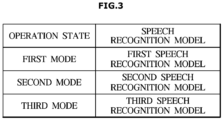
- FIG. 3 shows an example of a state condition table for selecting a speech recognition model in the electronic device according to the first embodiment of the disclosure.
- the electronic device 100 includes a microphone 110 for receiving a user's speech, a communicator or transceiver 120, a processor 130, a memory 140, and a driver 150.
- the microphone 110 can receive sound and convert the sound into an electrical signal.
- a single microphone 110 may be provided in the electronic device 100, or a plurality of microphones 110 may be provided to increase speech recognition performance.
- the microphone 110 may be mounted on an outer surface of the electronic device 100 or may be physically separated from the electronic device 100 to be positioned close to a user.
- the microphone 110 may be implemented as a movable stand microphone, a wearable microphone such as a headset, etc.
- an installation position or implementation type of the microphone 110 is not limited as long as the microphone 110 receives a user's speech.
- a speech uttered by a user can be converted into an electrical signal through the microphone 110 and input to the processor 130.
- a speech converted into an electrical signal is also referred to as a speech signal.
- the transceiver 120 may include a communication circuit for data exchange with an external device or for data exchange between components included in the electronic device 100.
- the transceiver 120 may transmit/receive various information to/from a server (not shown).
- the transceiver 120 may receive a speech recognition model from the server (not shown) and store the received speech recognition model in the memory 140.
- the transceiver 120 may include at least one communication module for transmitting/receiving data according to a predefined communication standard.
- the transceiver 120 may include at least one of a short-range communication module, a wired communication module, or a wireless communication module.
- the short-range communication module may include various short-range communication modules, such as a Bluetooth module, an Infrared communication module, a Radio Frequency Identification (RFID) communication module, a Wireless Local Access Network (WLAN) communication module, a Near Field Communication (NFC) module, a Zigbee communication module, etc., to transmit/receive signals through a wireless communication network at a short distance.
- RFID Radio Frequency Identification
- WLAN Wireless Local Access Network
- NFC Near Field Communication
- Zigbee communication module Zigbee communication module
- the wired communication module may include various cable communication modules, such as a Universal Serial Bus (USB), a High Definition Multimedia Interface (HDMI), a Digital Visual Interface (DVI), Recommended Standard-232 (RS-232), power line communication, or a Plain Old Telephone Service (POTS), as well as various wired communication modules, such as a Controller Area Network (CAN) communication module, a Local Area Network (LAN) module, a Wide Area Network (WAN) module, or a Value Added Network (VAN) module.
- USB Universal Serial Bus
- HDMI High Definition Multimedia Interface
- DVI Digital Visual Interface
- RS-232 Recommended Standard-232
- POTS Plain Old Telephone Service
- CAN Controller Area Network
- LAN Local Area Network
- WAN Wide Area Network
- VAN Value Added Network
- the wireless communication module may include wireless communication modules supporting various wireless communication methods, such as a global System for Mobile Communication (GSM), Code Division Multiple Access (CDMA), Wideband Code Division Multiple Access (WCDMA), Universal Mobile Telecommunications System (UMTS), Time Division Multiple Access (TDMA), Long Term Evolution (LTE), etc., as well as a Wireless Fidelity (WiFi) module and a Wireless broadband module.
- GSM Global System for Mobile Communication
- CDMA Code Division Multiple Access
- WCDMA Wideband Code Division Multiple Access
- UMTS Universal Mobile Telecommunications System
- TDMA Time Division Multiple Access
- LTE Long Term Evolution
- WiFi Wireless Fidelity
- the wireless communication module may include a wireless communication interface including an antenna and a transmitter for transmitting signals. Also, the wireless communication module may further include a call conversion module for converting a digital control signal output from a processor through the wireless communication interface into an analog wireless signal, according to a control of a controller.
- the wireless communication module may include a wireless communication interface including an antenna and a receiver for receiving signals. Also, the wireless communication module may further include a signal conversion module for demodulating an analog wireless signal received through the wireless communication interface into a digital control signal.
- the memory 140 may store various data related to operations of the electronic device 100, and stores data related to speech recognition.
- the memory 140 stores a plurality of speech recognition models 141 (141-1, 141-2, ...141-n).
- the memory 140 may store the plurality of speech recognition models 141 respectively corresponding to various operation states of the electronic device 100.
- the speech recognition models 141 may be received from an external server (not shown) through the transceiver 120, although not limited thereto. However, the speech recognition models 141 may have been stored in advance in the memory 140 upon design.
- the memory 140 may be implemented as at least one of a nonvolatile memory device (for example, a cache, Read Only Memory (ROM), Programmable ROM (PROM), Erasable Programmable ROM (EPROM), Electrically Erasable Programmable ROM (EEPROM), and Flash memory), a volatile memory device such as Random Access Memory (RAM), or a storage medium, such as Hard Disk Drive (HDD) and Compact Disk-Read Only Memory (CD-ROM), although not limited thereto.
- the memory 140 may be implemented as a chip that is separated from the processor 130 which will be described later, or the memory 140 and the processor 130 may be integrated into a single chip.
- the driver 150 may include at least one component for generating a driving force for enabling the electronic device 100 to provide at least one function or transferring the driving force.
- the driver 150 may include various components according to implementation examples of the electronic device 100.
- the driver 150 may include a motor, and further include a fan according to some cases.
- the driver 150 will be described in detail, later.
- the electronic device 100 includes the processor 130 electrically connected to the microphone 110, the transceiver 120, the memory 140, and the driver 150.
- the processor 130 recognizes a user's speech received through the microphone 110.
- the processor 130 may output an utterance in a text form based on a speech signal transferred from the microphone 110 to recognize a user's speech as a sentence.
- the processor 130 may include a speech recognition engine.
- the processor 130 may detect an actual speech section included in an input speech through End Point Detection (EPD), and extract a feature vector of the input speech from the detected actual speech section.
- EPD End Point Detection
- the processor 130 may apply feature vector extraction technology, such as Cepstrum, Linear Predictive Coefficient (LPC), Mel Frequency Cepstral Coefficient (MFCC), or Filter Bank Energy, to the detected actual speech section to extract the feature vector of the input speech.
- feature vector extraction technology such as Cepstrum, Linear Predictive Coefficient (LPC), Mel Frequency Cepstral Coefficient (MFCC), or Filter Bank Energy
- the processor 130 may compare the extracted feature vector to a trained reference pattern to obtain a result of recognition. For this, the processor 130 may use the speech recognition models 141 stored in the memory 140.
- the speech recognition models 141 may include at least ones of acoustic models for modeling and comparing signal characteristics of a speech or language models for modeling a linguistic order relation of words, syllables, etc. corresponding to a recognition vocabulary.
- the speech recognition models 141 may be models into which acoustic models and language models are integrated.
- the acoustic models may be divided into a direct comparison method of setting a recognition target to a feature vector model and comparing the feature vector model to a feature vector of speech data, and a statistical model method of statistically processing and using a feature vector of a recognition target.
- the direct comparison method is a method of setting a unit, such as a word, a phoneme, etc., being a recognition target to a feature vector model and determining similarity between an input speech and the feature vector model.
- a representative example of the direct comparison method is a vector quantization method.
- the vector quantization method is a method of mapping feature vectors of input speech data to a codebook which is a reference model to encode to representative values and comparing the encoded values to each other.
- the statistical model method is a method of configuring a unit for a recognition target into a state sequence and using a relation between state sequences.
- the state sequence may be configured with a plurality of nodes.
- Methods of using a relation between state sequences may include Dynamic Time Warping (DTW), Hidden Markov Model (HMM), a method using Artificial Neural Network (ANN), etc.
- the Dynamic Time Warping is a method of compensating for differences on the time axis upon comparison to a reference model in consideration of dynamic characteristics of speeches that signal lengths change over time even when the same person pronounces the same word
- the Hidden Markov Model is recognition technology of estimating a state change probability and an observation probability of a node through learning data after assuming that a speech is a Markov process having a state change probability and an observation probability of a node (output symbol) in each state, and calculating a probability that an input speech will be generated in an estimated model.
- the language model for modeling a linguistic order relation of words, syllables, etc. reduces acoustic ambiguity and recognition errors by applying an order relation between units constituting a language to units obtained from speech recognition.
- the language model there are a statistical language model and a model based on Finite State Automata (FSA), and the statistical language model uses a chain probability of words, such as Unigram, Bigram, Trigram, etc.
- FSA Finite State Automata
- the speech recognition model uses any method of the above-described methods for recognizing a speech.
- the processor 130 may use a speech recognition model including an acoustic model to which a Hidden Markov Model (HMM) is applied, or a speech recognition model using a N-best search method into which an acoustic model and a language model are integrated.
- HMM Hidden Markov Model
- the processor 130 may calculate a confidence value to secure reliability of a recognition result.
- a confidence value is a measure representing how reliable a speech recognition result is.
- a confidence value of a phoneme or word as a recognized result may be defined as a relative value for a probability that the corresponding phoneme or word has been uttered from different phonemes or words. Accordingly, a confidence value may be a value ranging from 0 to 1 or a value ranging from 0 to 100.
- the recognition result When a confidence value of a recognition result exceeds a predefined threshold value, the recognition result may be output to perform an operation corresponding to the recognition result, and, when a confidence value of a recognition result is smaller than or equal to the predefined threshold value, the recognition result may be rejected.
- the processor 130 may recognize a predefined word. In this case, the processor 130 may determine whether a recognition result matches the predefined word. When a rate of matching between the recognition result and the predefined word is greater than or equal to a predefined reference value, the processor 130 may determine that the corresponding word has been uttered by a user.
- the processor 130 may recognize a predefined wakeup word.
- the wakeup word may be a control command for activating a speech recognition mode.
- the processor 130 may recognize a wakeup word by using a pre-stored speech recognition model.
- the pre-stored speech recognition model may have a recognition range for recognizing a predefined word.
- the speech recognition model may be a speech recognition model for recognizing a wakeup word.
- a recognition range is limited to a predefined wakeup word
- a capacity of the memory 140 or the processor 130, required for speech recognition, may be reduced, although not limited thereto.
- the processor 130 may recognize more languages.
- the processor 130 may apply Natural Language Understanding (NLU) to an utterance in a text form as a recognition result to understand a user's intention included in the utterance.
- NLU Natural Language Understanding
- the processor 130 may perform morpheme analysis on an utterance in a text form and analyze a speech-act that the utterance has.
- Speech-act analysis may be a task of analyzing a user's utterance intention to understand utterance intention about whether the user asks a question, whether the user makes a request, whether the user gives an answer, whether the user simply expresses emotion, etc.
- the processor 130 may output a control command or a response corresponding to the user's intention understood through the morpheme analysis and speech-act analysis.
- the processor 130 may generate a control command for executing a service corresponding to the user's intention or output a response corresponding to the user's intention.
- a speech recognition model for performing an entity or a part of the above-described speech recognition process is stored in the memory 140, and a plurality of different speech recognition models is stored in the memory 140.
- the plurality of speech recognition models stored in the memory 140 may have different parameters. That is, the plurality of speech recognition models may be models modeled to perform the above-described speech recognition process by using different parameters, or models using different pieces of reference data.
- the plurality of different speech recognition models may be modeled to be suitable to different environments and stored in the memory 140. Accordingly, the different speech recognition models may be applied according to environments using speech recognition to achieve a high speech recognition rate and high speech recognition accuracy. Therefore, the processor 130 may select a speech recognition model that is suitable to an environment where speech recognition is performed. Hereinafter, an operation of selecting a speech recognition model in the processor 130 will be described in detail.
- the processor 130 selects a speech recognition model from among the plurality of speech recognition models stored in the memory 140, and recognizes a user's speech by using the selected speech recognition model. At this time, the processor 130 may reflect a state of the electronic device 100, which may influence speech recognition, to select a speech recognition model from among the plurality of speech recognition models stored in advance.
- the processor 130 selects a speech recognition model from among the plurality of speech recognition models stored in advance, based on an operation state of the electronic device 100.
- the operation state of the electronic device 100 may be a state factor that may influence noise generated in the electronic device 100, that is, a state factor from which noise of the electronic device 100 may be estimated.
- the operation state of the electronic device 100 may include at least one of an operation mode or an operation intensity of the electronic device 100.
- the operation mode may be information representing a kind of a function provided by the electronic device 100.
- the operation mode may be classified into a standby mode representing a state in which the electronic device 100 waits for receiving a command from a user, or an execution mode representing a state in which the electronic device 100 operates in response to an operation command received from a user.
- the operation mode may be classified into at least one mode representing kinds of various functions provided by the electronic device 100. A volume, intensity, pattern, etc. of noise generated in the electronic device 100 may depend on the operation mode.
- an operation mode may be set automatically according to a control command of the processor 130, or received from a user.
- the electronic device 100 may further include an input device (not shown).
- An operation intensity may be information representing an intensity of a driving force generated in the electronic device 100.
- the operation intensity may be expressed as data representing an intensity of a motor, such as torque, revolution per minute (rpm), current, etc. of the motor.
- the operation intensity may be expressed as data representing rpm of a fan.
- a volume, intensity, pattern, etc. of noise generated in the electronic device 100 may depend on the operation intensity.
- the operation state may further include at least one of an operating component or an operation location.
- the operating component may represent a kind of a component being in an operation state among at least one component included in the electronic device 100.
- the operating component may represent a component being in an operation state among at least one component included in the driver 150.
- Different components may generate noise having different volumes, intensities, patterns, etc. when operating.
- the operation location may be a location of the electronic device 100, and be a location that may influence noise generated in the electronic device 100.
- the operation location may be classified according to predefined areas. For example, the operation location may be classified into under the bed, near the wall, carpet, etc.
- a waveform of noise generated upon operation may depend on the operation location, and accordingly, a volume, intensity, pattern, etc. of noise may change according to the operation location.
- the processor 130 selects a speech recognition model corresponding to the operation state from among the plurality of speech recognition models. That is, the processor 130 can select a speech recognition model capable of securing a high speech recognition rate and high recognition performance according to the operation state of the electronic device 100.
- the processor 130 may identify a state condition fulfilling the operation state from among predefined state conditions for the plurality of speech recognition models, and select a speech recognition model corresponding to the state condition fulfilling the operation state, as a speech recognition model corresponding to the operation state.
- the predefined state conditions for the plurality of speech recognition models may be conditions for operation states, and may be defined upon design or according to a user's input.
- a state condition table in which state conditions for operation states match speech recognition models may be stored in the memory 140.
- the processor 130 may compare the operation state of the electronic device 100 to the state condition table to determine a speech recognition model corresponding to the operation state.
- the state conditions may be defined in advance as conditions for operation modes among operation states, and a state condition table in which speech recognition models match operation modes may be stored in the memory 140.
- a first speech recognition model, a second speech recognition model, and a third speech recognition model stored in the memory 140 may be models modeled to have different speech recognition parameters.
- the processor 130 may select the first speech recognition model from among the plurality of speech recognition models.
- the processor 130 may select the second speech recognition model, and, when an operation mode of the electronic device 100 is a third mode, the processor 130 may select the third speech recognition model.
- the processor 130 may raise a speech recognition rate and speech recognition accuracy.
- a wakeup word may be accurately recognized despite noise of the electronic device 100. Accordingly, the wakeup word may be recognized quickly and accurately although the user does not again utter the wakeup word.
- noise generated in the electronic device 100 may also change.
- the processor 130 may change the selected speech recognition model based on the changed operation state, and recognize a user's speech based on the changed speech recognition model. For this, the processor 130 may acquire an operation state in real time or at predefined time intervals.
- the processor 130 may change the first speech recognition mode to the second speech recognition mode. Thereafter, when the second mode changes to the third mode, the processor 130 may change the second speech recognition model to the third speech recognition model, and perform speech recognition by using the third speech recognition model.
- the processor 130 may increase accuracy and efficiency of speech recognition.
- the processor 130 may determine a parameter of a speech recognition model based on an operation state, and perform speech recognition based on the determined parameter.
- the parameter of the speech recognition model may include a sensitivity, and may include various speech recognition-related parameters in addition to a sensitivity.
- a sensitivity will be described.
- the processor 130 may identify a state condition fulfilling an operation state from among predefined conditions for operation states for sensitivities, and determine a sensitivity corresponding to the state condition fulfilling the operation state as a sensitivity of a speech recognition model.
- a sensitivity table in which sensitivities of speech recognition models match operation states may be stored in the memory 140.
- the processor 130 may compare an operation state of the electronic device 100 to the sensitivity table to determine a sensitivity of a speech recognition model corresponding to the operation state.
- Sensitivities may be classified into a plurality of predefined levels that are different according to the speech recognition models.
- the processor 130 may determine a sensitivity level corresponding to an operation state.
- the processor 130 may determine a sensitivity of a selected speech recognition model to be a first level.
- the processor 130 may determine a sensitivity of a speech recognition model to be a second level.
- the second level may have a higher sensitivity than the first level.
- the processor 130 determines a sensitivity of a speech recognition model according to an operation state, the processor 130 may reduce influence by noise of the electronic device 100. Accordingly, accuracy and efficiency of speech recognition may increase.
- noise generated in the electronic device 100 may also change. Accordingly, a case in which a sensitivity of a speech recognition model needs to change may occur.
- the processor 130 may change a sensitivity based on the changed operation state, and recognize a user's speech based on the changed sensitivity. For this, the processor 130 may acquire an operation state in real time or at predefined time intervals.
- Operation of changing a sensitivity of a speech recognition model may be performed simultaneously with operation of changing a speech recognition model. That is, when an operation state changes, the processor 130 may change a speech recognition model and a sensitivity of the speech recognition model based on the changed operation state, although not limited thereto. However, the processor 130 may change a sensitivity of a speech recognition mode, without changing the speech recognition model.
- a sensitivity of a speech recognition model can change according to a user's intention, instead of an operation state.
- the processor 130 determines a user's intention based on a result of speech recognition on the user's speech, and changes a sensitivity based on the user's intention.
- the processor 130 may understand context based on a result of speech recognition, understand a user's intention about whether the user will continue to utter or finish uttering according to the context, and change a sensitivity based on the user's intention.
- the processor 130 may change a sensitivity to a higher sensitivity.
- the processor 130 may change a sensitivity to a lower sensitivity.
- the processor 130 may generate a speech recognition model for noise of a surrounding environment based on an operation state, and store the speech recognition model in the memory 140 or the server (not shown).
- the processor 130 may determine a first pattern for noise of a surrounding environment based on an operation state, and generate a speech recognition model based on the first pattern.
- the noise of the surrounding environment may be noise excluding noise of the electronic device 200 among noise input to the microphone 110.
- the processor 130 may determine a second pattern for noise of the electronic device 100, that is, noise generated in the electronic device 100, based on an operation state, and determine a first pattern for noise of a surrounding environment based on the second pattern.
- noise patterns according to operation states may be stored in the memory 140 or the server (not shown).
- the processor 130 may determine a noise pattern corresponding to an operation state among noise patterns stored in the memory 140 or the server (not shown) to be a second pattern for noise of the electronic device 100.
- the processor 130 may determine noise excluding noise of the electronic device 100 of the second pattern among noise input to the microphone 110 to be noise of a surrounding environment, and extract a first pattern for the noise of the surrounding environment based on signal characteristics of the determined noise of the surrounding environment.
- the processor 130 may generate a speech recognition model based on the first pattern for the noise of the surrounding environment.
- the processor 130 may change at least one of a pre-selected speech recognition model or a sensitivity of the speech recognition model based on the first pattern for the noise of the surrounding environment.
- data for an algorithm for controlling operations of components in the electronic device 100 or a program for embodying the algorithm may be stored in the memory 140.
- the processor 130 may perform the above-described operations by using the data stored in the memory 140.
- the memory 140 and the processor 130 may be implemented as separate chips or integrated into a single chip.
- At least one component may be added or omitted to correspond to performance of the components of the electronic device 100 shown in FIG. 2 . Also, it will be easily understood by one of ordinary skill in the art that relative positions of the components may change to correspond to the performance or structure of the system.
- FIG. 2 may be software components and/or hardware components, such as a Field Programmable Gate Array (FPGA) and an Application Specific Integrated Circuit (ASIC).
- FPGA Field Programmable Gate Array
- ASIC Application Specific Integrated Circuit
- FIG. 4 is a control block diagram of an electronic device according to a second embodiment of the disclosure
- FIG. 5 shows an outer appearance of a robot cleaner as an implementation example of the electronic device according to the second embodiment of the disclosure
- FIG. 6 shows a bottom of the robot cleaner as the implementation example of the electronic device according to the second embodiment of the disclosure
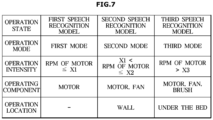
- FIG. 7 shows an example of a state condition table for selecting a speech recognition model in the electronic device according to the second embodiment of the disclosure.
- the electronic device 100 may be implemented as a robot cleaner including a main body 101, and a bumper 102 positioned in a front side of the main body 101.
- the electronic device 100 includes the microphone 110, the transceiver 120, the processor 130, the memory 140, and the driver 150.
- the microphone 110, the transceiver 120, the processor 130, and the memory 140 have been described above with reference to FIG. 2 , and the driver 150 may include an internal component of the robot cleaner.
- the driver 150 may include an internal component of the robot cleaner.
- the main body 101 of the electronic device 100 implemented as the robot cleaner according to the second embodiment of the disclosure may be substantially in a shape of a cylinder, as shown in FIG. 5 . More specifically, the main body 101 may include a top surface 101a formed substantially in a shape of a circle, and a side surface 101b formed along an edge of the top surface 101a.
- a plurality of microphones 110a and 110b may be positioned on the top surface 101a, although not limited thereto. However, the microphone 110 may be positioned on at least one of the bumper 102, a front surface 101c, the side surface 101b, or a bottom (see FIG. 6 ).
- the bumper 102 may reduce an impact transferred to the main body 101 upon a collision with an obstacle, and sense a collision with an obstacle.
- the obstacle may be an object, a person, or an animal that interferes with traveling of the electronic device 100.
- the obstacle may include a wall partitioning a cleaning space, furniture positioned in a cleaning space, and a person or animal located in a cleaning space.
- the bumper 102 When the electronic device 100 travels, the bumper 102 may face in a front direction, and a direction in which the bumper 102 faces may be defined as a 'front' direction of the electronic device 100, as shown in FIG. 5 .
- components for performing functions (moving and cleaning) of the robot cleaner may be provided, and the components may be included in the driver 150.
- the driver 150 may include a motor 151, a fan 152, a brush 153, and a wheel 154.
- the motor 151 may generate a driving force, and transfer the generated driving force to at least one of the fan 152, the brush 153, or the wheel 154.
- a plurality of motors 151 may be provided to generate and transfer driving forces independently for the fan 152, the brush 153, and the wheel 154, respectively.
- the wheel 154 may include a first wheel 154a positioned on a left side of the bottom of the electronic device 100 and a second wheel 154b positioned on a right side of the bottom of the electronic device 100, and rotate by the motor 151 to move the main body 101.
- a rotation shaft of a roller 145 may rotate, and accordingly, the roller 145 may support the main body 101 without interfering with traveling of the electronic device 100.
- the electronic device 100 may include a driving circuit for supplying driving current to the motor 151, and a rotation sensor (for example, an encoder, a hall sensor, etc.) for sensing rotations of the wheel 154.
- a rotation sensor for example, an encoder, a hall sensor, etc.
- the brush 153 may be positioned in a dust suction port 101e formed in the bottom of the main body 101, as shown in FIG. 6 .
- the brush 153 may rotate on a rotation shaft positioned to be horizontal to a floor of a cleaning space to scatter dust gathered on the floor to inside of the dust suction port 101e.
- the electronic device 100 may include various sensors for acquiring at least one of an operation mode, an operation intensity, an operating component, or an operation location.
- characteristics of noise generated in the electronic device 100 may also change accordingly.
- the processor 130 selects a speech recognition model capable of securing a high recognition rate and high recognition performance according to an operation state of the electronic device 100, and performs speech recognition based on the selected speech recognition model.
- This operation has been described above in the first embodiment, and state conditions for operation states may be modified appropriately according to an implementation example of the electronic device 100.
- state conditions may have been defined in advance as conditions for an operation mode, an operation intensity, an operating component, and an operation location among operation states, and a state condition table in which speech recognition models match operation modes may be stored in the memory 140.
- a first speech recognition model, a second speech recognition model, and a third speech recognition model stored in the memory 140 may be models modeled to have different speech recognition parameters.
- the operation mode may be classified according to functions of the robot cleaner, and the operation intensity may be represented as at least one value of rpm of the motor 151, torque of the motor 151, a magnitude of driving current provided to the motor 151, strength of the fan 152, or rpm of the fan 152.
- the processor 130 may select the first speech recognition model from among the plurality of speech recognition models.
- the processor 130 may select the second speech recognition model.
- the processor 130 may select the third speech recognition model.
- the processor 130 may raise a speech recognition rate and speech recognition accuracy.
- a wakeup word may be accurately recognized despite noise of the electronic device 100. Accordingly, the wakeup word may be recognized quickly and accurately although the user does not again utter the wakeup word.
- the processor 130 may determine a sensitivity of a speech recognition model according to an operation state including at least one of an operation mode, an operation intensity, an operating component, or an operation location, and change at least one of the speech recognition model or the sensitivity of the speech recognition model according to a change of the operation state. Also, the processor 130 changes the sensitivity based on a user's intention, and may generate a speech recognition model for noise of a surrounding environment based on an operation state. This operation has been described above in the first embodiment, and therefore, further descriptions thereof will be omitted.
- FIG. 8 is a control block diagram of an electronic device according to a third embodiment of the disclosure.
- FIG. 9 shows an outer appearance of an air conditioner as an implementation example of the electronic device according to the third embodiment of the disclosure
- FIG. 10 is an exploded perspective view of the air conditioner as the implementation example of the electronic device according to the third embodiment of the disclosure.
- the electronic device 100 may be implemented as an air conditioner including a housing 10 having at least one outlet opening 41 (41a, 41b, 41c), a heat exchanger 20 for exchanging heat with air entered inside of the housing 10, a blower 30 for circulating air to the inside or outside of the housing 10, and an outlet 40 for discharging air blown from the blower 30 to the outside of the housing 10.
- a housing 10 having at least one outlet opening 41 (41a, 41b, 41c)
- a heat exchanger 20 for exchanging heat with air entered inside of the housing 10
- a blower 30 for circulating air to the inside or outside of the housing 10
- an outlet 40 for discharging air blown from the blower 30 to the outside of the housing 10.
- the electronic device 100 includes the microphone 110, the transceiver 120, the processor 130, the memory 140, and a driver 160.
- the microphone 110, the transceiver 120, the processor 130, and the memory 140 have been described above with reference to FIG. 2 , and the driver 160 may include an internal component of the air conditioner.
- the driver 160 may include an internal component of the air conditioner.
- the housing 10 of the electronic device 100 implemented as the air conditioner according to the third embodiment of the disclosure may include, as shown in FIG. 9 , a front panel 10a in which the at least one outlet opening 41 (41a, 41b, 41c) is formed, a rear panel 10b positioned behind the front panel 10a, side panels 10c positioned between the front panel 10a and the rear panel 10b, and top and bottom panels 10d positioned above and below the side panels 10c.
- the at least one outlet opening 41 may be in a shape of a circle, and at least two or more outlet openings 41 may be provided in an up-down direction of the front panel 14 (or 10a shown in FIG. 9 ) in such a way to be spaced from each other.
- the outlet openings 41 may include a first outlet opening 41a, a second outlet opening 41b, and a third outlet opening 41c.
- a plurality of outlet holes 42 may be provided in a part of the front panel 10a.
- a first microphone 110d may be positioned, although not limited thereto. However, the microphone 110 may be positioned in at least one of the top and bottom panels 10d or the rear panel 10d. Also, the microphone 110 may be positioned at an appropriate location for receiving a user's speech.
- a suction port 19 may be formed to suck outside air to the inside of the housing 10.
- the suction port 19 may be positioned in the rear panel 10b positioned behind the heat exchanger 20 to guide outside air of the housing 10 to enter the inside of the housing 10. Air entered the inside of the housing 10 through the suction port 19 may pass through the heat exchanger 20 to absorb or lose heat. Air exchanged heat by passing through the heat exchanger 20 may be discharged to the outside of the housing 10 by the blower 30 via the outlet port 40.
- the blower 30 may include a fan 162, and a grille 34 positioned in a protruding direction of the fan 162.
- the fan 162 may be positioned to correspond to the at least one outlet opening 41, and the number of the fan 162 is not limited.
- the fan 162 may include a first fan 162a, a second fan 162b, and a third fan 162c.
- the blower 30 may include a motor 161 positioned at a center of the fan 162 to drive the fan 162.
- the motor 161 may include a first fan motor 161a for driving the first fan 162a, a second fan motor 161b for driving the second fan 162b, and a third fan motor 161c for driving the third fan 162c.
- the motor 161 may rotate the fan 162, and the rotating fan 162 may generate a flow of air passing through the heat exchanger 20.
- the grille 34 may include a plurality of blades 35. By adjusting the number, shape, and installation angle of the plurality of blades 35, a direction or amount of air that is blown from the fan 162 to the outlet opening 41 may be adjusted.
- a door actuator 163 may be positioned.
- the door actuator 163 and the motor 161 may be aligned in a front-back direction.
- the plurality of blades 35 of the grille 34 may be positioned in front of fan blades of the fan 162.
- the blower 30 may include a duct 36.
- the duct 36 may be in a shape of a circle surrounding the fan 162 to guide a flow of air flowing to the fan 162.
- the heat exchanger 20 may be positioned between the fan 162 and the suction port 19 to absorb heat from air entered through the suction port 19 or transfer heat to air entered through the suction port 19.
- the heat exchanger 20 may include a tube 21, and a header 22 coupled to upper and lower ends of the tube 21.
- a kind of the heat exchanger 20 is not limited.
- components for performing functions of the air conditioner such as blowing, temperature adjustment, air purification, etc., may be provided, and the components may be included in the driver 160.
- the outlet opening 41 may be opened and closed by a door 60, and may include a door blade 62 (62a, 62b or 62c).
- the door actuator 163 may operate the door blade 62 to open or close the door 60.
- the door actuator 163 may cause the door blade 62 to be spaced from an end 43 of a discharge guide 45 to open the door 60, and cause the door blade 62 from being in contact with the end 43 of the discharge guide 45 to close the door 60.
- the discharge guide element 45 may include a guide body 46 and a guide hole 47.
- the guide body 46 may form the first discharge path thereinside.
- the guide body 46 may be in the shape of a cylinder having a hollow interior. More specifically, the guide body 46 may be in the shape of a pipe whose one end faces the blower unit 30 and whose other end faces the outlet 41.
- the guide hole 47 may pass the second discharge path therethrough.
- the guide hole 47 may be formed in the guide body 46.
- the shape of the guide hole 47 may be not limited, and the guide hole 47 may have any structure that can be formed in the guide body 46 and enable air to flow in the outside direction of the guide body 46.
- the guide hole 47 may be a plurality of holes formed along the circumference of the guide body 46.
- the door blade 62 may include a blade body 63 being in a shape of a circle to correspond to the outlet opening 41, and a blade coupling portion 64 extending from the blade body 63 and coupled to the door actuator 163.
- the driver 160 may include the motor 161, the fan 162, and the door actuator 163.
- the electronic device 100 may include a driving circuit for supplying driving current to the motor 161 and a rotation sensor (for example, an encoder, a hall sensor, etc.) for sensing rotations of the fan 162, and may include various sensors for acquiring at least one of an operation mode, an operation intensity, an operating component, or an operation location.
- a rotation sensor for example, an encoder, a hall sensor, etc.
- characteristics of noise generated in the electronic device 100 may also change accordingly.
- the processor 130 determines a sensitivity of a speech recognition model capable of securing a high recognition rate and high recognition performance according to an operation state of the electronic device 100, and performs speech recognition based on the determined sensitivity. This operation has been described above in the first embodiment, and detailed conditions for operation states according to sensitivities may be modified appropriately according to an implementation example of the electronic device 100.
- conditions for operation states according to sensitivities may be set to conditions for operation modes, and the operation modes of the air conditioner may be classified into a first mode which is a mild wind mode and a second mode which is a strong wind mode.
- the processor 130 may determine, in the first mode, a sensitivity of a speech recognition model to be a first level, and may determine, in the second mode, a sensitivity of a speech recognition model to be a second level having a higher sensitivity than the first level.
- the conditions for operation states according to sensitivities may be set to conditions for at least one of an operation mode, an operation intensity, an operating component, or an operation location of an air conditioner.
- the processor 130 may identify a state condition fulfilling an operation state among predefined conditions for operation states according to sensitivities, and determine a sensitivity corresponding to the state condition fulfilling the operation state to be a sensitivity of a speech recognition model.
- a sensitivity table in which sensitivities for speech recognition models match operation states may be stored in the memory 140.
- the processor 130 may compare an operation state of the electronic device 100 to the sensitivity table to determine a sensitivity of a speech recognition model corresponding to the operation state.
- the processor 130 may reduce influence by noise of the electronic device 100. Accordingly, accuracy and efficiency of speech recognition may increase.
- a wakeup word may be accurately recognized through sensitivity adjustment despite noise of the electronic device 100. Accordingly, the wakeup word may be recognized quickly and accurately although the user does not again utter the wakeup word.
- the processor 130 may change, when an operation state changes, a sensitivity based on the changed operation state, and recognize a user's speech based on the changed sensitivity.
- the processor 30 may acquire an operation state in real time or at predefined time intervals.
- the processor 130 changes a sensitivity of a speech recognition model according to a user's intention in addition to an operation state, and may generate a speech recognition model for a noise of a surrounding environment based on the operation state. This operation has been described above in the first embodiment, and therefore, further descriptions thereof will be omitted.
- At least one component may be added or omitted to correspond to performance of the components of the electronic device 100 shown in FIGS. 4 and 8 . Also, it will be easily understood by one of ordinary skill in the art that relative positions of the components may change to correspond to the performance or structure of the system.
- FIGS. 4 and 8 may be software components and/or hardware components, such as a FPGA and an ASIC.
- FIG. 11 is a flowchart showing a speech recognition method of an electronic device according to an embodiment of the disclosure.
- the electronic device 100 may determine whether an operation state is acquired, in operation 901.
- the operation state of the electronic device 100 may be a state factor that may influence noise generated in the electronic device 100, that is, a state factor from which noise of the electronic device 100 may be estimated.
- the operation state may include at least one of an operation mode, an operation intensity, an operating component, or an operation location of the electronic device 100.
- the electronic device 100 selects a speech recognition model based on the operation state, in operation 902.
- the electronic device 100 selects a speech recognition model based on the operation state from among a plurality of speech recognition models stored in advance in the memory 140 or a server (not shown).
- the electronic device 100 may identify a state condition fulfilling the operation state from among predefined state conditions respectively for the plurality of speech recognition models, and select a speech recognition model corresponding to the state condition fulfilling the operation state as a speech recognition model corresponding to the operation state.
- a state condition for each of the plurality of speech recognition models may be defined as a condition for an operation state upon design or according to a user's input.
- a state condition table in which state conditions for operation states match speech recognition models may be stored in the memory 140.
- the electronic device 100 may compare the acquired operation state to the state condition table to determine a speech recognition model corresponding to the operation state.
- the electronic device 100 By selecting the speech recognition model corresponding to the acquired operation state from among the speech recognition models for the operation states, the electronic device 100 recognizes a user's speech based on the selected speech recognition model, in operation 903.
- a speech recognition rate and speech recognition accuracy may increase.
- a wakeup word may be accurately recognized despite noise of the electronic device 100. Accordingly, the wakeup word may be recognized quickly and accurately although the user does not again utter the wakeup word.
- FIG. 12 is a flowchart showing a speech recognition method of an electronic device according to an embodiment of the disclosure.
- the electronic device 100 acquires an operation state, and after the operation state is acquired (YES in operation 910), the electronic device 100 selects a speech recognition model based on the operation state, in operation 911.
- Operations 910 and 911 may be the same as operations 901 and 902 of FIG. 11 .
- the electronic device 100 may determine whether the operation state changes, in operation 912.
- the electronic device 100 may check the operation state in real time or at predefined time intervals.
- the electronic device 100 may change a speech recognition model to a speech recognition model corresponding to the changed operation state, in operation 913. That is, the electronic device 100 may reselect a speech recognition model based on the changed operation state.
- the electronic device 100 may recognize a user's speech based on the changed speech recognition model, in operation 914.
- a speech recognition model changes according to an operation state of the electronic device 100
- a speech recognition model that is suitable to a noise environment according to the operation state of the electronic device 100 may be used. Accordingly, accuracy and efficiency of speech recognition may increase.
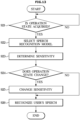
- FIG. 13 is a flowchart showing a speech recognition method of an electronic device according to an embodiment of the disclosure.
- the electronic device 100 acquires an operation state, and after the electronic device 100 acquires the operation state (YES in operation 921), the electronic device 100 selects a speech recognition model based on the operation state, in operation 922.
- Operations 921 and 922 may be the same as operation 901 and 902 of FIG. 11 .
- the electronic device 100 may determine a sensitivity of the speech recognition model selected based on the operation state, in operation 923.
- the sensitivity may be an example of a parameter of the speech recognition model.
- the sensitivity may be provided as a parameter of the speech recognition model, however, the electronic device 100 may determine various speech recognition-related parameters based on the operation state.
- the electronic device 100 may identify a state condition fulfilling the operation state from among predefined conditions for operation states for sensitivities, and determine a sensitivity corresponding to the state condition fulfilling the operation state as a sensitivity of the speech recognition model.
- a sensitivity table in which sensitivities of speech recognition models match operation states may be stored in the memory 140.
- the electronic device 100 may compare the operation state of the electronic device 100 to the sensitivity table to determine a sensitivity of a speech recognition model corresponding to the operation state.
- operation 923 is shown to be performed after operation 922 is performed, however, operations 922 and 923 may be performed simultaneously.
- the electronic device 100 may change the sensitivity based on the changed operation state, in operation 925. More specifically, the electronic device 100 may again determine a sensitivity based on the changed operation state, thereby changing the sensitivity of the speech recognition model to a sensitivity corresponding to the changed operation state.
- the electronic device 100 may recognize a user's speech based on the changed sensitivity, in operation 926.
- a wakeup word may be accurately recognized through sensitivity adjustment despite noise of the electronic device 100. Accordingly, the wakeup word may be recognized quickly and accurately although the user does not again utter the wakeup word.
- the disclosed embodiments may be implemented in the form of a recording medium that stores instructions executable by a computer.
- the instructions may be stored in the form of program codes, and when executed by a processor, the instructions may create a program module to perform operations of the disclosed embodiments.
- the recording medium may be implemented as a computer-readable recording medium.
- the computer-readable recording medium may include all kinds of recording media storing instructions that can be interpreted by a computer.
- the computer-readable recording medium may be ROM, RAM, a magnetic tape, a magnetic disc, a flash memory, an optical data storage device, etc.
Landscapes
- Engineering & Computer Science (AREA)
- Physics & Mathematics (AREA)
- Health & Medical Sciences (AREA)
- Audiology, Speech & Language Pathology (AREA)
- Human Computer Interaction (AREA)
- Acoustics & Sound (AREA)
- Multimedia (AREA)
- Computational Linguistics (AREA)
- Signal Processing (AREA)
- Artificial Intelligence (AREA)
- Probability & Statistics with Applications (AREA)
- User Interface Of Digital Computer (AREA)
- Navigation (AREA)
- Selective Calling Equipment (AREA)
Claims (14)
- Elektronische Vorrichtung, umfassend:ein Mikrofon (110), das dazu konfiguriert ist, eine Sprache eines Benutzers zu empfangen;einen Speicher (140) zum Speichern einer Vielzahl von Spracherkennungsmodellen (141); undmindestens einen Prozessor (130), der zu Folgendem konfiguriert ist:Auswählen eines Spracherkennungsmodells aus der Vielzahl von Spracherkennungsmodellen (141), die auf dem Speicher (140) gespeichert sind, auf Grundlage eines Betriebszustands der elektronischen Vorrichtung (100),Erkennen der von dem Mikrofon (110) empfangenen Sprache des Benutzers auf Grundlage des ausgewählten Spracherkennungsmodells,Bestimmen einer Absicht eines Benutzers auf Grundlage eines Ergebnisses der Spracherkennung der Sprache des Benutzers undÄndern einer Empfindlichkeit des ausgewählten Spracherkennungsmodells auf Grundlage der Absicht des Benutzers.
- Elektronische Vorrichtung nach Anspruch 1, wobei der Betriebszustand mindestens einen Betriebsmodus oder eine Betriebsintensität der elektronischen Vorrichtung (100) beinhaltet.
- Elektronische Vorrichtung nach Anspruch 1, wobei der mindestens eine Prozessor (130) ferner dazu konfiguriert ist, aus einer Vielzahl von Zustandsbedingungen, die jeweils mit der Vielzahl von Spracherkennungsmodellen (141) übereinstimmen, ein Spracherkennungsmodell, das einer Zustandsbedingung entspricht, die den Betriebszustand erfüllt, als ein Spracherkennungsmodell auszuwählen, das dem Betriebszustand entspricht.
- Elektronische Vorrichtung nach Anspruch 1, wobei der mindestens eine Prozessor (130) ferner zu Folgendem konfiguriert ist:Ändern des ausgewählten Spracherkennungsmodells auf Grundlage eines geänderten Betriebszustands, wenn sich der Betriebszustand ändert, undErkennen der Sprache des Benutzers auf Grundlage des geänderten Spracherkennungsmodells.
- Elektronische Vorrichtung nach Anspruch 1, wobei der mindestens eine Prozessor (130) ferner zu Folgendem konfiguriert ist:Bestimmen der Empfindlichkeit des ausgewählten Spracherkennungsmodells auf Grundlage des Betriebszustands undErkennen der Sprache des Benutzers auf Grundlage der bestimmten Empfindlichkeit.
- Elektronische Vorrichtung nach Anspruch 5, wobei der mindestens eine Prozessor (130) ferner dazu konfiguriert ist, bei einer Änderung des Betriebszustands die Empfindlichkeit auf Grundlage des geänderten Betriebszustands zu ändern.
- Elektronische Vorrichtung nach Anspruch 1, wobei der mindestens eine Prozessor (130) ferner zu Folgendem konfiguriert ist:Bestimmen eines ersten Musters für Geräusche einer Umgebung auf Grundlage des Betriebszustands undGenerieren eines Spracherkennungsmodells auf Grundlage des bestimmten ersten Musters.
- Elektronische Vorrichtung nach Anspruch 7, wobei der mindestens eine Prozessor (130) ferner zu Folgendem konfiguriert ist:Bestimmen eines zweiten Musters für Geräusche der elektronischen Vorrichtung auf Grundlage des Betriebszustands undBestimmen des ersten Musters für die Geräusche der Umgebung auf Grundlage des zweiten Musters.
- Elektronische Vorrichtung nach Anspruch 1, wobei die Vielzahl von Spracherkennungsmodellen (141) eine Vielzahl von Spracherkennungsmodellen zum Erkennen eines Aktivierungsworts umfasst.
- Elektronische Vorrichtung nach Anspruch 1, wobei die elektronische Vorrichtung mindestens eines von einer Reinigungseinrichtung, einer Klimaanlage, einem Kühlschrank, einer Waschmaschine oder einem Wäschepflegegerät umfasst.
- Spracherkennungsverfahren einer elektronischen Vorrichtung (100), wobei das Spracherkennungsverfahren Folgendes umfasst:Empfangen einer Sprache eines Benutzers;Auswählen (902, 911, 922) eines Spracherkennungsmodells aus einer Vielzahl von Spracherkennungsmodellen (141), die vorab gespeichert sind, auf Grundlage eines Betriebszustands der elektronischen Vorrichtung (100);Erkennen (903) der Sprache des Benutzers auf Grundlage des ausgewählten Spracherkennungsmodells;Bestimmen einer Absicht eines Benutzers auf Grundlage eines Ergebnisses der Spracherkennung der Sprache des Benutzers; undÄndern einer Empfindlichkeit des ausgewählten Spracherkennungsmodells auf Grundlage der Absicht des Benutzers.
- Spracherkennungsverfahren nach Anspruch 11, wobei das Auswählen (902) des Spracherkennungsmodells Folgendes umfasst:
Auswählen eines Spracherkennungsmodells, das einer Zustandsbedingung entspricht, die den Betriebszustand erfüllt, als ein Spracherkennungsmodell, das dem Betriebszustand entspricht, aus einer Vielzahl von Zustandsbedingungen, die jeweils mit der Vielzahl von Spracherkennungsmodellen (141) übereinstimmen. - Spracherkennungsverfahren nach Anspruch 11, ferner umfassend Ändern (913) des ausgewählten Spracherkennungsmodells auf Grundlage des geänderten Betriebszustands, wenn sich der Betriebszustand ändert (912),
wobei das Erkennen der Sprache des Benutzers Erkennen (914) der Sprache des Benutzers auf Grundlage des geänderten Spracherkennungsmodells umfasst. - Spracherkennungsverfahren nach Anspruch 11, wobei die Empfindlichkeit des ausgewählten Spracherkennungsmodells auf Grundlage des Betriebszustands bestimmt (923) wird und
wobei das Erkennen der Sprache des Benutzers auf Grundlage des ausgewählten Spracherkennungsmodells Erkennen (926) der Sprache des Benutzers auf Grundlage der bestimmten Empfindlichkeit umfasst.
Applications Claiming Priority (2)
| Application Number | Priority Date | Filing Date | Title |
|---|---|---|---|
| KR1020190096559A KR20210017392A (ko) | 2019-08-08 | 2019-08-08 | 전자 장치 및 이의 음성 인식 방법 |
| PCT/KR2020/009709 WO2021025343A1 (ko) | 2019-08-08 | 2020-07-23 | 전자 장치 및 이의 음성 인식 방법 |
Publications (4)
| Publication Number | Publication Date |
|---|---|
| EP3982359A1 EP3982359A1 (de) | 2022-04-13 |
| EP3982359A4 EP3982359A4 (de) | 2022-07-27 |
| EP3982359B1 true EP3982359B1 (de) | 2024-08-28 |
| EP3982359C0 EP3982359C0 (de) | 2024-08-28 |
Family
ID=74498583
Family Applications (1)
| Application Number | Title | Priority Date | Filing Date |
|---|---|---|---|
| EP20849876.6A Active EP3982359B1 (de) | 2019-08-08 | 2020-07-23 | Elektronische vorrichtung und verfahren zur stimmenerkennung dadurch |
Country Status (5)
| Country | Link |
|---|---|
| US (1) | US11551687B2 (de) |
| EP (1) | EP3982359B1 (de) |
| KR (1) | KR20210017392A (de) |
| CN (1) | CN114207709B (de) |
| WO (1) | WO2021025343A1 (de) |
Families Citing this family (10)
| Publication number | Priority date | Publication date | Assignee | Title |
|---|---|---|---|---|
| KR20190107622A (ko) * | 2019-09-02 | 2019-09-20 | 엘지전자 주식회사 | 이동형 에이젼트를 이용한 실시간 음성 인식 모델 업데이트 방법 및 장치 |
| KR102711367B1 (ko) * | 2020-01-02 | 2024-09-26 | 엘지전자 주식회사 | 음성 인식을 위한 음성 인식 민감도 조정 기술 |
| KR20230075915A (ko) * | 2021-11-23 | 2023-05-31 | 삼성전자주식회사 | 전자 장치 및 그 동작 방법 |
| EP4394760A4 (de) | 2021-12-01 | 2024-11-27 | Samsung Electronics Co., Ltd. | Elektronische vorrichtung und verfahren zur bereitstellung einer liste empfohlener äusserungen |
| US12488800B2 (en) | 2022-02-22 | 2025-12-02 | Samsung Electronics Co., Ltd. | Display apparatus and operating method thereof |
| EP4512579A4 (de) * | 2022-07-18 | 2025-07-09 | Samsung Electronics Co Ltd | Roboter zur erfassung von lerndaten und steuerungsverfahren dafür |
| EP4519873A4 (de) | 2022-09-05 | 2025-08-13 | Samsung Electronics Co Ltd | System und verfahren zur erkennung eines aufweckbefehls für einen sprachassistenten |
| CN115905828A (zh) * | 2022-10-18 | 2023-04-04 | 深圳开鸿数字产业发展有限公司 | 动作姿态识别方法、装置、存储介质及可穿戴设备 |
| CN115910059B (zh) * | 2022-11-09 | 2026-01-23 | 深圳市恒致云科技有限公司 | 语音指令获取方法及装置、马桶控制方法和智能马桶 |
| CN121415995A (zh) * | 2025-10-30 | 2026-01-27 | 首都医科大学附属复兴医院 | 一种用于糖尿病膳食管理的智能语音交互系统 |
Family Cites Families (25)
| Publication number | Priority date | Publication date | Assignee | Title |
|---|---|---|---|---|
| CA2180392C (en) * | 1995-07-31 | 2001-02-13 | Paul Wesley Cohrs | User selectable multiple threshold criteria for voice recognition |
| JP4244514B2 (ja) | 2000-10-23 | 2009-03-25 | セイコーエプソン株式会社 | 音声認識方法および音声認識装置 |
| WO2003052737A1 (en) * | 2001-12-17 | 2003-06-26 | Asahi Kasei Kabushiki Kaisha | Speech recognition method, remote controller, information terminal, telephone communication terminal and speech recognizer |
| KR100474340B1 (ko) | 2002-08-02 | 2005-03-10 | 엘지전자 주식회사 | 진공 청소기의 음성제어 장치 및 그 방법 |
| DE10251113A1 (de) * | 2002-11-02 | 2004-05-19 | Philips Intellectual Property & Standards Gmbh | Verfahren zum Betrieb eines Spracherkennungssystems |
| US6889189B2 (en) | 2003-09-26 | 2005-05-03 | Matsushita Electric Industrial Co., Ltd. | Speech recognizer performance in car and home applications utilizing novel multiple microphone configurations |
| JP4784366B2 (ja) | 2006-03-28 | 2011-10-05 | パナソニック電工株式会社 | 音声操作装置 |
| CN101071565A (zh) * | 2006-05-12 | 2007-11-14 | 摩托罗拉公司 | 用于校准语音识别系统的方法 |
| US7676363B2 (en) | 2006-06-29 | 2010-03-09 | General Motors Llc | Automated speech recognition using normalized in-vehicle speech |
| US9070367B1 (en) * | 2012-11-26 | 2015-06-30 | Amazon Technologies, Inc. | Local speech recognition of frequent utterances |
| US10198696B2 (en) * | 2014-02-04 | 2019-02-05 | GM Global Technology Operations LLC | Apparatus and methods for converting user input accurately to a particular system function |
| KR102257910B1 (ko) | 2014-05-02 | 2021-05-27 | 삼성전자주식회사 | 음성 인식 장치 및 방법, 잡음-음성 인식 모델 생성 장치 및 방법 |
| KR102371697B1 (ko) * | 2015-02-11 | 2022-03-08 | 삼성전자주식회사 | 음성 기능 운용 방법 및 이를 지원하는 전자 장치 |
| KR102585228B1 (ko) | 2015-03-13 | 2023-10-05 | 삼성전자주식회사 | 음성 인식 시스템 및 방법 |
| US20160284349A1 (en) * | 2015-03-26 | 2016-09-29 | Binuraj Ravindran | Method and system of environment sensitive automatic speech recognition |
| KR102405793B1 (ko) * | 2015-10-15 | 2022-06-08 | 삼성전자 주식회사 | 음성 신호 인식 방법 및 이를 제공하는 전자 장치 |
| KR102495523B1 (ko) * | 2016-02-04 | 2023-02-03 | 삼성전자 주식회사 | 음성 명령을 처리하는 방법 및 이를 제공하는 전자 장치 |
| US10360910B2 (en) * | 2016-08-29 | 2019-07-23 | Garmin Switzerland Gmbh | Automatic speech recognition (ASR) utilizing GPS and sensor data |
| US11183181B2 (en) * | 2017-03-27 | 2021-11-23 | Sonos, Inc. | Systems and methods of multiple voice services |
| KR102411766B1 (ko) * | 2017-08-25 | 2022-06-22 | 삼성전자주식회사 | 음성 인식 서비스를 활성화하는 방법 및 이를 구현한 전자 장치 |
| KR102492727B1 (ko) | 2017-12-04 | 2023-02-01 | 삼성전자주식회사 | 전자장치 및 그 제어방법 |
| US10777189B1 (en) * | 2017-12-05 | 2020-09-15 | Amazon Technologies, Inc. | Dynamic wakeword detection |
| US11011162B2 (en) * | 2018-06-01 | 2021-05-18 | Soundhound, Inc. | Custom acoustic models |
| US10714122B2 (en) * | 2018-06-06 | 2020-07-14 | Intel Corporation | Speech classification of audio for wake on voice |
| US10789943B1 (en) * | 2018-08-31 | 2020-09-29 | Interactions Llc | Proxy for selective use of human and artificial intelligence in a natural language understanding system |
-
2019
- 2019-08-08 KR KR1020190096559A patent/KR20210017392A/ko active Pending
-
2020
- 2020-07-22 US US16/935,425 patent/US11551687B2/en active Active
- 2020-07-23 WO PCT/KR2020/009709 patent/WO2021025343A1/ko not_active Ceased
- 2020-07-23 CN CN202080056308.1A patent/CN114207709B/zh active Active
- 2020-07-23 EP EP20849876.6A patent/EP3982359B1/de active Active
Also Published As
| Publication number | Publication date |
|---|---|
| WO2021025343A1 (ko) | 2021-02-11 |
| EP3982359A1 (de) | 2022-04-13 |
| CN114207709A (zh) | 2022-03-18 |
| EP3982359A4 (de) | 2022-07-27 |
| US20210043204A1 (en) | 2021-02-11 |
| CN114207709B (zh) | 2025-02-28 |
| KR20210017392A (ko) | 2021-02-17 |
| US11551687B2 (en) | 2023-01-10 |
| EP3982359C0 (de) | 2024-08-28 |
Similar Documents
| Publication | Publication Date | Title |
|---|---|---|
| US11551687B2 (en) | Electronic device and method for speech recognition of the same | |
| EP3716266B1 (de) | Vorrichtung mit künstlicher intelligenz und verfahren zum betrieb einer vorrichtung mit künstlicher intelligenz | |
| US11393491B2 (en) | Artificial intelligence device capable of controlling operation of another device and method of operating the same | |
| US11232788B2 (en) | Wakeword detection | |
| KR102134201B1 (ko) | 숫자 음성 인식에 있어서 음성 복호화 네트워크를 구성하기 위한 방법, 장치, 및 저장 매체 | |
| KR101579533B1 (ko) | 차량 및 그 제어 방법 | |
| US9286897B2 (en) | Speech recognizer with multi-directional decoding | |
| US8868410B2 (en) | Non-dialogue-based and dialogue-based learning apparatus by substituting for uttered words undefined in a dictionary with word-graphs comprising of words defined in the dictionary | |
| US11830485B2 (en) | Multiple speech processing system with synthesized speech styles | |
| KR102930046B1 (ko) | 음성 인식 기능을 제공하는 인공 지능 기기, 인공 지능 기기의 동작 방법 | |
| CA2507999A1 (en) | Sensor based speech recognizer selection, adaptation and combination | |
| KR20160013720A (ko) | 음성 인식 장치, 이를 포함하는 차량 및 음성 인식 방법 | |
| EP2609587A1 (de) | System und verfahren zur erkennung eines sprachbefehls eines benutzers in lauten umgebungen | |
| US11355124B2 (en) | Voice recognition method and voice recognition apparatus | |
| US11200903B2 (en) | Systems and methods for speaker verification using summarized extracted features | |
| US10540972B2 (en) | Speech recognition device, speech recognition method, non-transitory recording medium, and robot | |
| US11564194B1 (en) | Device communication | |
| US20230014114A1 (en) | Dialogue system and dialogue processing method | |
| KR102864447B1 (ko) | 음성 인식 장치, 이를 포함하는 차량 및 그 제어방법 | |
| KR101681988B1 (ko) | 음성 인식 장치, 이를 포함하는 차량 및 음성 인식 방법 | |
| US20240212673A1 (en) | Keyword spotting method based on neural network | |
| KR100664960B1 (ko) | 음성 인식 장치 및 방법 | |
| US12555576B2 (en) | Artificial intelligence apparatus and method for controlling the same | |
| Bhagath et al. | Speech recognition for indian spoken languages towards automated home appliances | |
| KR102228017B1 (ko) | 로봇 및 자율이동체 정밀 모션 제어를 위한 단독형 음성인식 기반 에이전트 모듈 |
Legal Events
| Date | Code | Title | Description |
|---|---|---|---|
| STAA | Information on the status of an ep patent application or granted ep patent |
Free format text: STATUS: THE INTERNATIONAL PUBLICATION HAS BEEN MADE |
|
| PUAI | Public reference made under article 153(3) epc to a published international application that has entered the european phase |
Free format text: ORIGINAL CODE: 0009012 |
|
| STAA | Information on the status of an ep patent application or granted ep patent |
Free format text: STATUS: REQUEST FOR EXAMINATION WAS MADE |
|
| 17P | Request for examination filed |
Effective date: 20220107 |
|
| AK | Designated contracting states |
Kind code of ref document: A1 Designated state(s): AL AT BE BG CH CY CZ DE DK EE ES FI FR GB GR HR HU IE IS IT LI LT LU LV MC MK MT NL NO PL PT RO RS SE SI SK SM TR |
|
| REG | Reference to a national code |
Ref country code: DE Ref legal event code: R079 Free format text: PREVIOUS MAIN CLASS: G10L0015220000 Ipc: G10L0015200000 Ref country code: DE Ref legal event code: R079 Ref document number: 602020036842 Country of ref document: DE Free format text: PREVIOUS MAIN CLASS: G10L0015220000 Ipc: G10L0015200000 |
|
| A4 | Supplementary search report drawn up and despatched |
Effective date: 20220628 |
|
| RIC1 | Information provided on ipc code assigned before grant |
Ipc: G10L 15/22 20060101ALI20220622BHEP Ipc: G10L 25/48 20130101ALI20220622BHEP Ipc: G10L 15/32 20130101ALI20220622BHEP Ipc: A47L 11/40 20060101ALI20220622BHEP Ipc: A47L 25/00 20060101ALI20220622BHEP Ipc: G10L 17/24 20130101ALI20220622BHEP Ipc: G10L 15/18 20130101ALI20220622BHEP Ipc: G10L 15/14 20060101ALI20220622BHEP Ipc: G10L 15/28 20130101ALI20220622BHEP Ipc: G10L 15/20 20060101AFI20220622BHEP |
|
| DAV | Request for validation of the european patent (deleted) | ||
| DAX | Request for extension of the european patent (deleted) | ||
| GRAP | Despatch of communication of intention to grant a patent |
Free format text: ORIGINAL CODE: EPIDOSNIGR1 |
|
| STAA | Information on the status of an ep patent application or granted ep patent |
Free format text: STATUS: GRANT OF PATENT IS INTENDED |
|
| INTG | Intention to grant announced |
Effective date: 20240328 |
|
| GRAS | Grant fee paid |
Free format text: ORIGINAL CODE: EPIDOSNIGR3 |
|
| GRAA | (expected) grant |
Free format text: ORIGINAL CODE: 0009210 |
|
| STAA | Information on the status of an ep patent application or granted ep patent |
Free format text: STATUS: THE PATENT HAS BEEN GRANTED |
|
| AK | Designated contracting states |
Kind code of ref document: B1 Designated state(s): AL AT BE BG CH CY CZ DE DK EE ES FI FR GB GR HR HU IE IS IT LI LT LU LV MC MK MT NL NO PL PT RO RS SE SI SK SM TR |
|
| REG | Reference to a national code |
Ref country code: CH Ref legal event code: EP |
|
| REG | Reference to a national code |
Ref country code: DE Ref legal event code: R096 Ref document number: 602020036842 Country of ref document: DE |
|
| REG | Reference to a national code |
Ref country code: IE Ref legal event code: FG4D |
|
| U01 | Request for unitary effect filed |
Effective date: 20240918 |
|
| U07 | Unitary effect registered |
Designated state(s): AT BE BG DE DK EE FI FR IT LT LU LV MT NL PT RO SE SI Effective date: 20241011 |
|
| PG25 | Lapsed in a contracting state [announced via postgrant information from national office to epo] |
Ref country code: NO Free format text: LAPSE BECAUSE OF FAILURE TO SUBMIT A TRANSLATION OF THE DESCRIPTION OR TO PAY THE FEE WITHIN THE PRESCRIBED TIME-LIMIT Effective date: 20241128 |
|
| PG25 | Lapsed in a contracting state [announced via postgrant information from national office to epo] |
Ref country code: PL Free format text: LAPSE BECAUSE OF FAILURE TO SUBMIT A TRANSLATION OF THE DESCRIPTION OR TO PAY THE FEE WITHIN THE PRESCRIBED TIME-LIMIT Effective date: 20240828 Ref country code: GR Free format text: LAPSE BECAUSE OF FAILURE TO SUBMIT A TRANSLATION OF THE DESCRIPTION OR TO PAY THE FEE WITHIN THE PRESCRIBED TIME-LIMIT Effective date: 20241129 |
|
| PG25 | Lapsed in a contracting state [announced via postgrant information from national office to epo] |
Ref country code: IS Free format text: LAPSE BECAUSE OF FAILURE TO SUBMIT A TRANSLATION OF THE DESCRIPTION OR TO PAY THE FEE WITHIN THE PRESCRIBED TIME-LIMIT Effective date: 20241228 |
|
| PG25 | Lapsed in a contracting state [announced via postgrant information from national office to epo] |
Ref country code: HR Free format text: LAPSE BECAUSE OF FAILURE TO SUBMIT A TRANSLATION OF THE DESCRIPTION OR TO PAY THE FEE WITHIN THE PRESCRIBED TIME-LIMIT Effective date: 20240828 |
|
| PG25 | Lapsed in a contracting state [announced via postgrant information from national office to epo] |
Ref country code: RS Free format text: LAPSE BECAUSE OF FAILURE TO SUBMIT A TRANSLATION OF THE DESCRIPTION OR TO PAY THE FEE WITHIN THE PRESCRIBED TIME-LIMIT Effective date: 20241128 Ref country code: ES Free format text: LAPSE BECAUSE OF FAILURE TO SUBMIT A TRANSLATION OF THE DESCRIPTION OR TO PAY THE FEE WITHIN THE PRESCRIBED TIME-LIMIT Effective date: 20240828 |
|
| PG25 | Lapsed in a contracting state [announced via postgrant information from national office to epo] |
Ref country code: RS Free format text: LAPSE BECAUSE OF FAILURE TO SUBMIT A TRANSLATION OF THE DESCRIPTION OR TO PAY THE FEE WITHIN THE PRESCRIBED TIME-LIMIT Effective date: 20241128 Ref country code: PL Free format text: LAPSE BECAUSE OF FAILURE TO SUBMIT A TRANSLATION OF THE DESCRIPTION OR TO PAY THE FEE WITHIN THE PRESCRIBED TIME-LIMIT Effective date: 20240828 Ref country code: NO Free format text: LAPSE BECAUSE OF FAILURE TO SUBMIT A TRANSLATION OF THE DESCRIPTION OR TO PAY THE FEE WITHIN THE PRESCRIBED TIME-LIMIT Effective date: 20241128 Ref country code: IS Free format text: LAPSE BECAUSE OF FAILURE TO SUBMIT A TRANSLATION OF THE DESCRIPTION OR TO PAY THE FEE WITHIN THE PRESCRIBED TIME-LIMIT Effective date: 20241228 Ref country code: HR Free format text: LAPSE BECAUSE OF FAILURE TO SUBMIT A TRANSLATION OF THE DESCRIPTION OR TO PAY THE FEE WITHIN THE PRESCRIBED TIME-LIMIT Effective date: 20240828 Ref country code: GR Free format text: LAPSE BECAUSE OF FAILURE TO SUBMIT A TRANSLATION OF THE DESCRIPTION OR TO PAY THE FEE WITHIN THE PRESCRIBED TIME-LIMIT Effective date: 20241129 Ref country code: ES Free format text: LAPSE BECAUSE OF FAILURE TO SUBMIT A TRANSLATION OF THE DESCRIPTION OR TO PAY THE FEE WITHIN THE PRESCRIBED TIME-LIMIT Effective date: 20240828 |
|
| PG25 | Lapsed in a contracting state [announced via postgrant information from national office to epo] |
Ref country code: SM Free format text: LAPSE BECAUSE OF FAILURE TO SUBMIT A TRANSLATION OF THE DESCRIPTION OR TO PAY THE FEE WITHIN THE PRESCRIBED TIME-LIMIT Effective date: 20240828 |
|
| PG25 | Lapsed in a contracting state [announced via postgrant information from national office to epo] |
Ref country code: CZ Free format text: LAPSE BECAUSE OF FAILURE TO SUBMIT A TRANSLATION OF THE DESCRIPTION OR TO PAY THE FEE WITHIN THE PRESCRIBED TIME-LIMIT Effective date: 20240828 |
|
| PG25 | Lapsed in a contracting state [announced via postgrant information from national office to epo] |
Ref country code: SK Free format text: LAPSE BECAUSE OF FAILURE TO SUBMIT A TRANSLATION OF THE DESCRIPTION OR TO PAY THE FEE WITHIN THE PRESCRIBED TIME-LIMIT Effective date: 20240828 |
|
| PLBE | No opposition filed within time limit |
Free format text: ORIGINAL CODE: 0009261 |
|
| STAA | Information on the status of an ep patent application or granted ep patent |
Free format text: STATUS: NO OPPOSITION FILED WITHIN TIME LIMIT |
|
| PGFP | Annual fee paid to national office [announced via postgrant information from national office to epo] |
Ref country code: GB Payment date: 20250624 Year of fee payment: 6 |
|
| 26N | No opposition filed |
Effective date: 20250530 |
|
| U20 | Renewal fee for the european patent with unitary effect paid |
Year of fee payment: 6 Effective date: 20250723 |
|
| REG | Reference to a national code |
Ref country code: CH Ref legal event code: H13 Free format text: ST27 STATUS EVENT CODE: U-0-0-H10-H13 (AS PROVIDED BY THE NATIONAL OFFICE) Effective date: 20260224 |
|
| PG25 | Lapsed in a contracting state [announced via postgrant information from national office to epo] |
Ref country code: CH Free format text: LAPSE BECAUSE OF NON-PAYMENT OF DUE FEES Effective date: 20250731 |